EP3368503B1 - Photolabile duftspeicherstoffe - Google Patents
Photolabile duftspeicherstoffe Download PDFInfo
- Publication number
- EP3368503B1 EP3368503B1 EP16766929.0A EP16766929A EP3368503B1 EP 3368503 B1 EP3368503 B1 EP 3368503B1 EP 16766929 A EP16766929 A EP 16766929A EP 3368503 B1 EP3368503 B1 EP 3368503B1
- Authority
- EP
- European Patent Office
- Prior art keywords
- weight
- oil
- agents
- gew
- acid
- Prior art date
- Legal status (The legal status is an assumption and is not a legal conclusion. Google has not performed a legal analysis and makes no representation as to the accuracy of the status listed.)
- Active
Links
- QTIZBHZVYWSPJD-LZUQWOSISA-N CC(CC(C1C(C)(C)CCCC1C)=O)[C@H](C(c1ccccc1)=O)C(ON)=O Chemical compound CC(CC(C1C(C)(C)CCCC1C)=O)[C@H](C(c1ccccc1)=O)C(ON)=O QTIZBHZVYWSPJD-LZUQWOSISA-N 0.000 description 1
Classifications
-
- C—CHEMISTRY; METALLURGY
- C11—ANIMAL OR VEGETABLE OILS, FATS, FATTY SUBSTANCES OR WAXES; FATTY ACIDS THEREFROM; DETERGENTS; CANDLES
- C11B—PRODUCING, e.g. BY PRESSING RAW MATERIALS OR BY EXTRACTION FROM WASTE MATERIALS, REFINING OR PRESERVING FATS, FATTY SUBSTANCES, e.g. LANOLIN, FATTY OILS OR WAXES; ESSENTIAL OILS; PERFUMES
- C11B9/00—Essential oils; Perfumes
- C11B9/0061—Essential oils; Perfumes compounds containing a six-membered aromatic ring not condensed with another ring
-
- A—HUMAN NECESSITIES
- A61—MEDICAL OR VETERINARY SCIENCE; HYGIENE
- A61K—PREPARATIONS FOR MEDICAL, DENTAL OR TOILETRY PURPOSES
- A61K8/00—Cosmetics or similar toiletry preparations
- A61K8/18—Cosmetics or similar toiletry preparations characterised by the composition
- A61K8/30—Cosmetics or similar toiletry preparations characterised by the composition containing organic compounds
- A61K8/33—Cosmetics or similar toiletry preparations characterised by the composition containing organic compounds containing oxygen
- A61K8/37—Esters of carboxylic acids
-
- A—HUMAN NECESSITIES
- A61—MEDICAL OR VETERINARY SCIENCE; HYGIENE
- A61L—METHODS OR APPARATUS FOR STERILISING MATERIALS OR OBJECTS IN GENERAL; DISINFECTION, STERILISATION OR DEODORISATION OF AIR; CHEMICAL ASPECTS OF BANDAGES, DRESSINGS, ABSORBENT PADS OR SURGICAL ARTICLES; MATERIALS FOR BANDAGES, DRESSINGS, ABSORBENT PADS OR SURGICAL ARTICLES
- A61L2/00—Disinfection or sterilisation of materials or objects, in general; Accessories therefor
-
- A—HUMAN NECESSITIES
- A61—MEDICAL OR VETERINARY SCIENCE; HYGIENE
- A61L—METHODS OR APPARATUS FOR STERILISING MATERIALS OR OBJECTS IN GENERAL; DISINFECTION, STERILISATION OR DEODORISATION OF AIR; CHEMICAL ASPECTS OF BANDAGES, DRESSINGS, ABSORBENT PADS OR SURGICAL ARTICLES; MATERIALS FOR BANDAGES, DRESSINGS, ABSORBENT PADS OR SURGICAL ARTICLES
- A61L9/00—Disinfection, sterilisation or deodorisation of air
- A61L9/01—Deodorant compositions
-
- A—HUMAN NECESSITIES
- A61—MEDICAL OR VETERINARY SCIENCE; HYGIENE
- A61Q—SPECIFIC USE OF COSMETICS OR SIMILAR TOILETRY PREPARATIONS
- A61Q13/00—Formulations or additives for perfume preparations
-
- A—HUMAN NECESSITIES
- A61—MEDICAL OR VETERINARY SCIENCE; HYGIENE
- A61Q—SPECIFIC USE OF COSMETICS OR SIMILAR TOILETRY PREPARATIONS
- A61Q19/00—Preparations for care of the skin
-
- C—CHEMISTRY; METALLURGY
- C07—ORGANIC CHEMISTRY
- C07C—ACYCLIC OR CARBOCYCLIC COMPOUNDS
- C07C69/00—Esters of carboxylic acids; Esters of carbonic or haloformic acids
- C07C69/66—Esters of carboxylic acids having esterified carboxylic groups bound to acyclic carbon atoms and having any of the groups OH, O—metal, —CHO, keto, ether, acyloxy, groups, groups, or in the acid moiety
- C07C69/73—Esters of carboxylic acids having esterified carboxylic groups bound to acyclic carbon atoms and having any of the groups OH, O—metal, —CHO, keto, ether, acyloxy, groups, groups, or in the acid moiety of unsaturated acids
- C07C69/738—Esters of keto-carboxylic acids or aldehydo-carboxylic acids
-
- C—CHEMISTRY; METALLURGY
- C11—ANIMAL OR VEGETABLE OILS, FATS, FATTY SUBSTANCES OR WAXES; FATTY ACIDS THEREFROM; DETERGENTS; CANDLES
- C11B—PRODUCING, e.g. BY PRESSING RAW MATERIALS OR BY EXTRACTION FROM WASTE MATERIALS, REFINING OR PRESERVING FATS, FATTY SUBSTANCES, e.g. LANOLIN, FATTY OILS OR WAXES; ESSENTIAL OILS; PERFUMES
- C11B9/00—Essential oils; Perfumes
- C11B9/0003—Compounds of unspecified constitution defined by the chemical reaction for their preparation
-
- C—CHEMISTRY; METALLURGY
- C11—ANIMAL OR VEGETABLE OILS, FATS, FATTY SUBSTANCES OR WAXES; FATTY ACIDS THEREFROM; DETERGENTS; CANDLES
- C11D—DETERGENT COMPOSITIONS; USE OF SINGLE SUBSTANCES AS DETERGENTS; SOAP OR SOAP-MAKING; RESIN SOAPS; RECOVERY OF GLYCEROL
- C11D3/00—Other compounding ingredients of detergent compositions covered in group C11D1/00
- C11D3/16—Organic compounds
- C11D3/20—Organic compounds containing oxygen
- C11D3/2093—Esters; Carbonates
-
- C—CHEMISTRY; METALLURGY
- C11—ANIMAL OR VEGETABLE OILS, FATS, FATTY SUBSTANCES OR WAXES; FATTY ACIDS THEREFROM; DETERGENTS; CANDLES
- C11D—DETERGENT COMPOSITIONS; USE OF SINGLE SUBSTANCES AS DETERGENTS; SOAP OR SOAP-MAKING; RESIN SOAPS; RECOVERY OF GLYCEROL
- C11D3/00—Other compounding ingredients of detergent compositions covered in group C11D1/00
- C11D3/50—Perfumes
- C11D3/502—Protected perfumes
- C11D3/507—Compounds releasing perfumes by thermal or chemical activation
-
- A—HUMAN NECESSITIES
- A61—MEDICAL OR VETERINARY SCIENCE; HYGIENE
- A61K—PREPARATIONS FOR MEDICAL, DENTAL OR TOILETRY PURPOSES
- A61K2800/00—Properties of cosmetic compositions or active ingredients thereof or formulation aids used therein and process related aspects
- A61K2800/10—General cosmetic use
-
- C—CHEMISTRY; METALLURGY
- C07—ORGANIC CHEMISTRY
- C07C—ACYCLIC OR CARBOCYCLIC COMPOUNDS
- C07C2601/00—Systems containing only non-condensed rings
- C07C2601/12—Systems containing only non-condensed rings with a six-membered ring
- C07C2601/16—Systems containing only non-condensed rings with a six-membered ring the ring being unsaturated
Definitions
- the present invention is in the field of fragrance storage substances, such as those used, for example, in the field of detergents or cleaning agents, cosmetic agents and air conditioning agents.
- the invention relates in particular to special ketones which function as photolabile odor storage substances.
- the present invention also relates to detergents or cleaning agents, cosmetic agents and air conditioning agents which contain such fragrance storage substances. It also relates to a method for long-lasting scenting of surfaces and also a method for long-lasting room scenting.
- Washing or cleaning agents or cosmetic agents mostly contain fragrances which give the agents a pleasant odor.
- the fragrances mostly mask the odor of the other ingredients, so that the consumer has a pleasant odor impression.
- fragrances are important constituents of the composition, since the laundry should have a pleasant and, if possible, fresh fragrance both in the wet and in the dry state.
- the use of fragrances is fundamentally problematic, since these are more or less volatile compounds, but a long-lasting fragrance effect is nevertheless sought.
- those fragrances which represent the fresh and light notes of the perfume and are particularly volatile due to their high vapor pressure the desired longevity of the fragrance impression can hardly be achieved.
- Delayed fragrance release can take place, for example, through carrier-bound preforms of fragrances.
- a carrier-bound preform of a fragrance is also referred to as a "pro-fragrance" or fragrance storage substance.
- a fragrance-giving or antimicrobial activity which is only delayed by the photochemically induced decay and is released on a certain surface over a longer period of time.
- WO 2009/118219 A1 discloses photoactivatable substances which enable the release of cyclic terpenes or cyclic terpenoids.
- WO 2015/124671 discloses the use of certain ketones as photoactivatable substances which, in the presence of light, release an active substance in a photochemical fragmentation.
- the active ingredient mentioned has, for example, a fragrance-giving activity, which by the photochemical induced decay is delayed and released over a longer period of time on a certain surface.
- the object of the present invention was to provide photoactivatable substances as fragrance storage substances which allow the delayed release of odorant ketones, in particular of damascones.
- the fragrance storage substances according to the invention are particularly effective for allowing the delayed release of fragrance ketones, especially damascones, and thereby providing a higher fragrance intensity than the photocages known in the prior art.
- the use of the scent storage substances according to the invention in detergents, cleaning agents or care products therefore leads to an improved long-term scent effect when used, in particular in connection with textile treatment.
- a laundry treatment agent such as, for example, detergents and fabric softeners
- an improved long-term fragrance effect of the treated laundry could be found.
- corresponding products have a particularly good storage stability.
- the agents according to the invention also enable the total amount of perfume which is in the Agent is included, to reduce, and still achieve odor benefits on the washed textiles, especially with a view to the feeling of freshness.
- fragrance storage substances according to the invention are used as fragrance storage substances for alpha-damascone.
- fragrances can be bound as the radical R to the compound of the formulas (VIII) - (XI).
- the stored ketones can be released by exposure to light with wavelengths from 200 to 600 nm.
- Substituted as used herein with respect to alkyl, alkenyl, alkoxy and acyl groups means that the corresponding group has one or more substituents which replace one or more hydrogen atoms and are selected from -OR ', -NR 'R ", -SR', -C (O) R ', -C (O) OR', -C (O) NR'R", -NR-C (O) -R ", and halogen, where R 'and R "are hydrogen or unsubstituted C1-10 alkyl.
- fragrance storage substances corresponding to the following formulas (VIII) to (XI) are suitable.
- the fragrance storage substances according to the invention can be incorporated stably into the usual detergent or cleaning agent matrices, into cosmetics and into existing odorant compositions. They enable a delayed release of the stored fragrances, including Damascone in the alpha, beta, gamma or delta form and Damascenon, in particular delta Damascenon. These scent storage substances give conventional detergents or cleaning agents and cosmetics a particularly long-lasting impression of freshness. The dried, washed textile in particular benefits from the good long-term freshness effect.
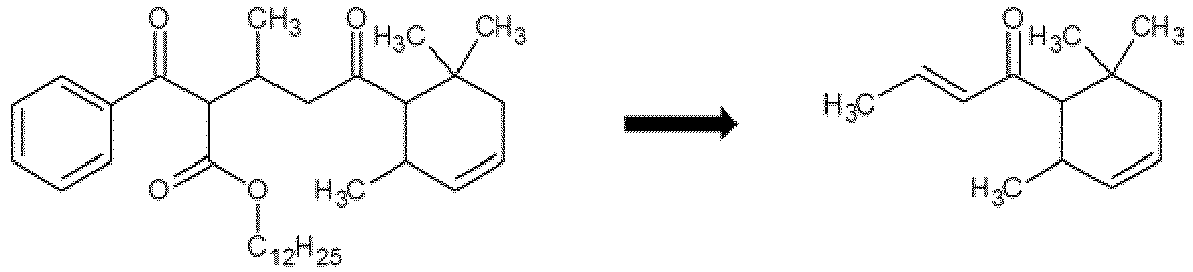
- the slow release of the stored odorous substance takes place after exposure to light (electromagnetic radiation) comprising the wavelengths from 200 to 600 nm, as illustrated in simplified form in the following exemplary reaction equation, whereby the example compound below is not according to the invention, but the reaction equation is analogous for the compounds according to the invention applies:
- Another object of the present invention is a detergent or cleaning agent, preferably a detergent, fabric softener or washing aid, containing at least one fragrance storage substance according to the invention, the fragrance storage substance preferably in a total amount between 0.0001 and 5 wt .-%, advantageously between 0.001 and 4% by weight, more advantageously between 0.01 and 3% by weight, in particular between 0.1 and 2% by weight, each based on the total agent.
- Suitable cleaning agents are e.g. Cleaning agents for hard surfaces, preferably dishwashing detergents. It can also be cleaning agents such as Household cleaners, all-purpose cleaners, window cleaners, floor cleaners, etc. It can preferably be a product for cleaning toilet bowls and urinals, advantageously a flushing cleaner for hanging in the toilet bowl.
- the washing or cleaning agent according to the invention contains at least one surfactant selected from anionic, cationic, nonionic, zwitterionic, amphoteric surfactants or mixtures thereof.
- the agent according to the invention is in solid or liquid form.
- data for the agent according to the invention in% by weight relate to the total weight of the agent according to the invention, unless stated otherwise.
- Another object of the invention is a cosmetic agent containing at least one fragrance storage substance according to the invention, which the fragrance storage substance preferably in a total amount between 0.0001 and 5 wt .-%, advantageously between 0.001 and 4 wt .-%, more advantageously between 0 , 01 and 3 wt .-%, in particular between 0.1 and 2 wt .-%, each based on the total agent.
- Another object of the invention is an air conditioning agent (e.g. room air freshener, room deodorant, room spray, etc.) containing at least one fragrance storage substance according to the invention, said fragrance storage substance preferably in a total amount between 0.0001 and 50% by weight, advantageously between 0.001 and 5% by weight .-%, more advantageously between 0.01 and 3 wt .-%, in particular between 0.1 and 2 wt .-%, each based on the total agent.
- an air conditioning agent e.g. room air freshener, room deodorant, room spray, etc.
- said fragrance storage substance preferably in a total amount between 0.0001 and 50% by weight, advantageously between 0.001 and 5% by weight .-%, more advantageously between 0.01 and 3 wt .-%, in particular between 0.1 and 2 wt .-%, each based on the total agent.
- fragrances i.e. detergents or cleaning agents, cosmetic agents, or air conditioning agents
- additional fragrances and / or fragrance storage substances in particular selected from the group comprising fragrances of natural or synthetic origin, preferably more volatile fragrances, higher-boiling fragrances, solid fragrances and / or adherent fragrances.
- Adhesive fragrances which can be used with advantage within the scope of the present invention are, for example, essential oils such as angelica root oil, anise oil, arnica flower oil, basil oil, bay oil, bergamot oil, champaca flower oil, noble fir oil, noble fir cone oil, elemi oil, eucalyptus oil, geranium oil, spruce almond oil, fennel oil, spruce almond oil , Guaiac wood oil, gurjun balsam oil, helichrysum oil, ho oil, ginger oil, iris oil, kajeput oil, calamus oil, chamomile oil, camphor oil, kanaga oil, cardamom oil, cassia oil, pine needle oil, copaiva balsam oil, coriander oil, spearmint oil, lime oil, melissa oil, almond oil, lime oil, lemon balm oil , Musk seed oil, myrrh oil, clove oil, neroli oil, niaouli
- fragrances can also be used in the context of the present invention as firmly adhering fragrances or fragrance mixtures, that is, fragrances.
- These compounds include the compounds mentioned below and mixtures of these: ambrettolide, alpha-amylcinnamaldehyde, anethole, anisaldehyde, aniseed alcohol, anisole, anthranilic acid methyl ester, acetophenone, benzylacetone, benzaldehyde, benzoic acid ethyl ester, benzophenone, benzyl alcohol, benzyl acetate, benzyl benzoate, boryl valyl formate , Bornyl acetate, alpha-bromostyrene, n-decylaldehyde, n-dodecylaldehyde, eugenol, eugenol methyl ether, eucalyptol, farne
- the more volatile fragrances include in particular the lower-boiling fragrances of natural or synthetic origin, which can be used alone or in mixtures.
- Examples of more volatile fragrances are alkyl isothiocyanates (alkyl mustard oils), butanedione, limonene, linalool, linaylacetate and propionate, menthol, Menthone, methyl-n-heptenone, phellandrene, phenylacetaldehyde, terpinylacetate, citral, citronellal.
- the agent according to the invention has at least one, preferably several, active components, in particular washing, care, cleaning and / or cosmetic components, advantageously selected from the group comprising anionic surfactants, cationic surfactants, amphoteric surfactants, nonionic surfactants, acidifying agents, alkalizing agents, anti-wrinkle compounds, antibacterial substances, antioxidants, anti-redeposition agents, antistatic agents, builders, bleaching agents, bleach activators, bleach stabilizers, bleaching catalysts, co-builders, ironing aids, Electrolytes, enzymes, color preservatives, colorants, dyes, color transfer inhibitors, fluorescent agents, fungicides, germicides, odor-complexing substances, auxiliaries, hydrotropes, rinse aids, complexing agents, preservatives, corrosion inhibitors ren, water-miscible organic solvents, optical brighteners, perfume carriers, pearlescent agents, pH adjusters,
- the amounts of the individual ingredients in the agents according to the invention are based on the intended use of the agents in question and the person skilled in the art is generally familiar with the magnitudes of the amounts of the ingredients to be used or can take them from the relevant specialist literature .
- the surfactant content will be chosen to be higher or lower.
- the surfactant content of, for example, detergents is between 10 and 50% by weight, preferably between 12.5 and 30% by weight and in particular between 15 and 25% by weight, while e.g.
- Cleaning agents for machine dishwashing e.g. between 0.1 and 10 wt .-%, preferably between 0.5 and 7.5 wt .-% and in particular between 1 and 5 wt .-% surfactants.
- the agents according to the invention can contain surfactants, anionic surfactants, nonionic surfactants and mixtures thereof, but also cationic surfactants being preferred.
- Suitable nonionic surfactants are in particular ethoxylation and / or propoxylation products of alkyl glycosides and / or linear or branched alcohols each with 12 to 18 carbon atoms in the alkyl part and 3 to 20, preferably 4 to 10, alkyl ether groups.
- Corresponding ethoxylation and / or propoxylation products of N-alkylamines, vicinal diols, fatty acid esters and fatty acid amides, which correspond to the long-chain alcohol derivatives mentioned in terms of the alkyl part, and of alkylphenols with 5 to 12 carbon atoms in the alkyl radical can also be used.
- Suitable anionic surfactants are in particular soaps and those which contain sulfate or sulfonate groups with preferably alkali ions as cations. Soaps that can be used are preferably the alkali salts of saturated or unsaturated fatty acids having 12 to 18 carbon atoms. Such fatty acids can also be used in a form that is not completely neutralized.
- the sulfate-type surfactants which can be used include the salts of the sulfuric acid half-esters of fatty alcohols having 12 to 18 carbon atoms and the sulfation products of the nonionic surfactants mentioned with a low degree of ethoxylation.
- the sulfonate-type surfactants that can be used include linear alkylbenzenesulfonates with 9 to 14 carbon atoms in the alkyl part, alkanesulfonates with 12 to 18 carbon atoms, and olefin sulfonates with 12 to 18 carbon atoms, which are formed when corresponding monoolefins are reacted with sulfur trioxide, as well as alpha-sulfo fatty acid esters, which are formed during the sulfonation of fatty acid methyl or ethyl esters.
- Cationic surfactants are preferably selected from the esterquats and / or the quaternary ammonium compounds (QAV) according to the general formula (R I ) (R II ) (R III ) (R IV ) N + X - , in which R I to R IV for identical or different C 1-22 -alkyl radicals, C 7-28 -arylalkyl radicals or heterocyclic radicals, two or, in the case of an aromatic bond as in pyridine, even three radicals together with the nitrogen atom forming the heterocycle, for example a pyridinium or imidazolinium compound , and X- stands for halide ions, sulfate ions, hydroxide ions or similar anions.
- QAV quaternary ammonium compounds
- QAV can be produced by reacting tertiary amines with alkylating agents such as methyl chloride, benzyl chloride, dimethyl sulfate, dodecyl bromide, but also ethylene oxide.
- alkylating agents such as methyl chloride, benzyl chloride, dimethyl sulfate, dodecyl bromide, but also ethylene oxide.
- alkylation of tertiary amines with one long alkyl radical and two methyl groups is particularly easy, and the quaternization of tertiary amines with two long radicals and one methyl group can be carried out with the aid of methyl chloride under mild conditions.
- Amines that have three long alkyl radicals or hydroxy-substituted alkyl radicals are not very reactive and are quaternized with dimethyl sulfate, for example.
- Possible QAVs are, for example, benzalkonium chloride (N-alkyl-N, N-dimethyl-benzylammonium chloride), benzalkon B (m, p-dichlorobenzyldimethyl-C 12 -alkylammonium chloride, benzoxonium chloride (benzyl-dodecyl-bis- (2-hydroxyethyl) -ammonium chloride), Cetrimonium bromide (N-hexadecyl-N, N-trimethyl-ammonium bromide), benzetonium chloride (N, N-dimethyl-N [2- [2- [2- [p- (1,1,3,3-tetramethylbutyl) phenoxy] ethoxy] ethyl) ] benzylammonium chloride), dialkyldimethylammonium chlorides such as di-n-decyl-dimethyl ammonium chloride, didecyldimethylammonium
- Preferred esterquats are methyl N- (2-hydroxyethyl) -N, N-di (tallow acyl-oxyethyl) ammonium methosulfate, bis- (palmitoyl) -ethyl-hydroxyethyl-methyl-ammonium-methosulfate or methyl-N, N-bis (acyloxyethyl) -N- (2-hydroxyethyl) ammonium methosulfate.
- methylhydroxyalkyldialkoyloxyalkylammonium methosulfates sold by the Stepan company under the trademark Stepantex® or those sold under the trade name Dehyquart® known products from BASF SE or those known under the name Rewoquat® from the manufacturer Evonik.
- Surfactants are contained in the agents according to the invention (ie detergents or cleaning agents, cosmetic agents, or air conditioning agents) in proportions of preferably 5% by weight to 50% by weight, in particular 8% by weight to 30% by weight .
- surfactants are used in laundry aftertreatment agents in particular, up to 30% by weight, in particular 5% by weight to 15% by weight.
- An agent according to the invention in particular a washing or cleaning agent, preferably contains at least one water-soluble and / or water-insoluble, organic and / or inorganic builder.
- the water-soluble organic builders include polycarboxylic acids, particularly citric acid and sugar acids, monomeric and polymeric aminopolycarboxylic acids, in particular methylglycinediacetic acid, nitrilotriacetic acid and ethylenediaminetetraacetic acid and polyaspartic acid, polyphosphonic acids, especially amino-tris (methylenephosphonic acid), ethylenediaminetetrakis (methylenephosphonic acid) and 1-hydroxyethane-1,1-diphosphonic acid, polymeric hydroxy compounds such as dextrin and polymeric (poly) carboxylic acids, polymeric acrylic acids, methacrylic acids, maleic acids and copolymers of these, which can also contain small amounts of polymerizable substances without carboxylic acid functionality in polymerized form.
- Suitable, albeit less preferred, compounds of this class are copolymers of acrylic acid or methacrylic acid with vinyl ethers, such as vinyl methyl ethers, vinyl esters, ethylene, propylene and styrene, in which the acid makes up at least 50% by weight.
- the organic builder substances can be used, in particular for the production of liquid agents, in the form of aqueous solutions, preferably in the form of 30 to 50 percent by weight aqueous solutions. All of the acids mentioned are generally used in the form of their water-soluble salts, in particular their alkali salts.
- Organic builder substances can, if desired, be present in amounts of up to 40% by weight, in particular up to 25% by weight and preferably from 1% by weight to 8% by weight. Quantities close to the upper limit mentioned are preferably used in pasty or liquid, in particular water-containing, agents according to the invention. Laundry post-treatment agents according to the invention, e.g. Fabric softeners can optionally also be free from organic builders.
- Alkali metal silicates and polyphosphates, preferably sodium triphosphate, are particularly suitable as water-soluble inorganic builder materials.
- water-insoluble, water-dispersible inorganic builder materials in particular crystalline or amorphous alkali metal aluminosilicates, if desired, in amounts of up to 50% by weight, preferably not more than 40% by weight and, in liquid agents, in particular from 1% by weight to 5% by weight. -%, are used.
- the crystalline sodium aluminosilicates in detergent quality, especially zeolite A, P and optionally X are preferred. Quantities close to the upper limit mentioned are preferably used in solid, particulate compositions.
- Suitable aluminosilicates in particular have no particles with a particle size greater than 30 ⁇ m and preferably consist of at least 80% by weight of particles with a size less than 10 ⁇ m.
- Suitable substitutes or partial substitutes for said aluminosilicate are crystalline alkali metal silicates, which can be present alone or in a mixture with amorphous silicates.
- the alkali silicates which can be used as builders in the agents according to the invention preferably have a molar ratio of alkali oxide to SiO 2 below 0.95, in particular from 1: 1.1 to 1:12, and can be amorphous or crystalline.
- Preferred alkali silicates are the sodium silicates, in particular the amorphous sodium silicates, with a molar ratio Na 2 O: SiO 2 of 1: 2 to 1: 2.8.
- the crystalline silicates used alone or in a mixture with amorphous silicates are preferably crystalline sheet silicates of the general formula Na 2 Si x O 2x + 1 y H 2 O, in which x, the so-called module, is a number of 1, 9 to 4 and y is a number from 0 to 20 and preferred values for x are 2, 3 or 4.
- Preferred crystalline sheet silicates are those in which x in the general formula mentioned assumes the values 2 or 3. Both beta and delta sodium disilicates (Na 2 Si 2 O 5 ⁇ y H 2 O) are particularly preferred.
- the weight ratio of aluminosilicate to silicate is preferably 1:10 to 10: 1.
- the weight ratio of amorphous alkali silicate to crystalline alkali silicate is preferably 1: 2 to 2: 1 and in particular 1: 1 to 2: 1.
- the agents according to the invention contain builder substances preferably in amounts of up to 60% by weight, in particular from 5% by weight to 40% by weight.
- Laundry post-treatment agents according to the invention e.g. Fabric softeners are preferably free of inorganic builders.
- Particularly suitable peroxygen compounds are organic peracids or peracid salts of organic acids, such as phthalimidopercaproic acid, perbenzoic acid or salts of diperdodecanedioic acid, hydrogen peroxide and, under the conditions of use, inorganic salts which release hydrogen peroxide, such as perborate, percarbonate and / or persilicate. If solid peroxygen compounds are to be used, these can be used in the form of powders or granules, which are also used in im Principle known way can be wrapped.
- Alkali percarbonate, alkali perborate monohydrate or, in particular in liquid agents, hydrogen peroxide in the form of aqueous solutions containing 3% by weight to 10% by weight hydrogen peroxide are particularly preferably used.
- an agent according to the invention contains bleaching agents, such as preferably peroxygen compounds, these are present in amounts of preferably up to 50% by weight, in particular from 5% by weight to 30% by weight.
- bleach stabilizers such as phosphonates, borates or metaborates and metasilicates and magnesium salts such as magnesium sulfate can be useful.
- Bleach activators which can be used are compounds which, under perhydrolysis conditions, give aliphatic peroxycarboxylic acids having preferably 1 to 10 carbon atoms, in particular 2 to 4 carbon atoms, and / or optionally substituted perbenzoic acid. Substances which carry O- and / or N-acyl groups with the number of carbon atoms mentioned and / or optionally substituted benzoyl groups are suitable.
- Polyacylated alkylenediamines especially tetraacetylethylenediamine (TAED), acylated triazine derivatives, especially 1,5-diacetyl-2,4-dioxo-hexahydro-1,3,5-triazine (DADHT), acylated glycolurils, especially tetraacetylglycoluril (TAGU), are preferred, N-acylimides, in particular N-nonanoyl succinimide (NOSI), acylated phenolsulfonates, in particular n-nonanoyl or isononanoyloxybenzenesulfonate (n- or iso-NOBS), carboxylic acid anhydrides, in particular phthalic anhydride, acylated polyhydric alcohols, in particular triacetin 2.5 Diacetoxy-2,5-dihydrofuran and enol esters as well as acetylated sorbitol and manni
- Hydrophilically substituted acylacetals and acyllactams are also used with preference.
- Combinations of conventional bleach activators can also be used.
- Such bleach activators can be present in the usual quantity range, preferably in quantities of 1% by weight to 10% by weight, in particular 2% by weight to 8% by weight, based on the total agent.
- sulfonimines and / or bleach-enhancing transition metal salts or transition metal complexes can also be present as so-called bleach catalysts.
- Enzymes that can be used in the agents are those from the class of the proteases, cutinases, amylases, pullulanases, hemicellulases, cellulases, lipases, oxidases and peroxidases and mixtures thereof. Enzymes obtained from fungi or bacteria such as Bacillus subtilis, Bacillus licheniformis, Streptomyces griseus, Humicola lanuginosa, Humicola insolens, Pseudomonas pseudoalcaligenes or Pseudomonas cepacia are particularly suitable.
- the optionally used enzymes can be adsorbed on carrier substances and / or embedded in coating substances in order to protect them against premature inactivation. They are, if desired, in the Agents according to the invention are preferably contained in amounts not exceeding 5% by weight, in particular from 0.2% by weight to 2% by weight.
- the agents can optionally contain derivatives of diaminostilbene disulfonic acid or alkali metal salts thereof as optical brighteners, for example.
- diaminostilbene disulfonic acid or alkali metal salts thereof as optical brighteners, for example.
- Suitable foam inhibitors include, for example, organopolysiloxanes and their mixtures with microfine, optionally silanized silica, and paraffin waxes and their mixtures with silanized silicic acid or bis-fatty acid alkylene diamides. Mixtures of different foam inhibitors are also advantageously used, for example those made from silicones, paraffins or waxes.
- the foam inhibitors in particular silicone- and / or paraffin-containing foam inhibitors, are preferably bound to a granular carrier substance which is soluble or dispersible in water. Mixtures of paraffin waxes and bistearylethylenediamides are particularly preferred.
- the agents can also contain components that have a positive effect on the ability of textiles to be washed out with oil and fat, so-called soil release agents. This effect becomes particularly clear when a textile is soiled that has already been washed several times beforehand with an agent that contains this oil and fat-dissolving component.
- the preferred oil and fat-dissolving components include, for example, non-ionic cellulose ethers such as methyl cellulose and methylhydroxypropyl cellulose with a proportion of methoxyl groups of 15 to 30% by weight and of hydroxypropoxyl groups of 1 to 15% by weight, each based on the nonionic cellulose ether, as well as the polymers known from the prior art of phthalic acid and / or terephthalic acid or their derivatives with monomeric and / or polymeric diols, in particular polymers made from ethylene terephthalates and / or polyethylene glycol terephthalates or anionically and / or nonionically modified derivatives of this.
- non-ionic cellulose ethers such as methyl cellulose and methylhydroxypropyl cellulose with a proportion of methoxyl groups of 15 to 30% by weight and of hydroxypropoxyl groups of 1 to 15% by weight, each based on the nonionic cellulose ether, as well as the polymers known from the prior art of
- the agents can also contain dye transfer inhibitors, preferably in amounts of 0.1% by weight to 2% by weight, in particular 0.1% by weight to 1% by weight, which in a preferred embodiment of the invention comprise polymers Vinyl pyrrolidone, vinyl imidazole, vinyl pyridine-N-oxide or copolymers of these.
- the task of graying inhibitors is to keep the dirt detached from the textile fiber suspended in the liquor.
- Water-soluble colloids of mostly organic nature are suitable for this, for example starch, glue, gelatin, salts of ether carboxylic acids or ether sulfonic acids of starch or cellulose or salts of acidic sulfuric acid esters of cellulose or starch.
- Water-soluble polyamides containing acidic groups are also suitable for this purpose. It is also possible to use starch derivatives other than those mentioned above, for example aldehyde starches.
- Cellulose ethers such as carboxymethyl cellulose (Na salt), methyl cellulose, hydroxyalkyl cellulose and mixed ethers such as methyl hydroxyethyl cellulose, methylhydroxypropyl cellulose, methyl carboxymethyl cellulose and their mixtures, for example in amounts of 0.1 to 5% by weight, based on the agent, can preferably be used.
- the organic solvents which can be used in the agents according to the invention, especially when they are in liquid or pasty form, include alcohols with 1 to 4 carbon atoms, in particular methanol, ethanol, isopropanol and tert-butanol, diols with 2 to 4 carbon atoms , in particular ethylene glycol and propylene glycol, as well as their mixtures and the ethers which can be derived from the cited classes of compounds.
- Such water-miscible solvents are preferably present in the agents according to the invention in amounts not exceeding 30% by weight, in particular from 6% by weight to 20% by weight.
- the agents according to the invention can contain acids that are compatible with the system and the environment, in particular citric acid, acetic acid, tartaric acid, malic acid, lactic acid, glycolic acid, succinic acid, glutaric acid and / or adipic acid, but also contain mineral acids, especially sulfuric acid, or bases, especially ammonium or alkali hydroxides.
- acids that are compatible with the system and the environment, in particular citric acid, acetic acid, tartaric acid, malic acid, lactic acid, glycolic acid, succinic acid, glutaric acid and / or adipic acid, but also contain mineral acids, especially sulfuric acid, or bases, especially ammonium or alkali hydroxides.
- Such pH regulators are optionally contained in the agents according to the invention, preferably not more than 20% by weight, in particular from 1.2% by weight to 17% by weight.
- solid agents according to the invention i.e. in particular washing or cleaning agents
- solid agents according to the invention does not present any difficulties and can in principle be carried out in a known manner, for example by spray drying or granulation, with optional peroxygen compound and optional bleach catalyst optionally being added later.
- agents according to the invention with increased bulk density in particular in the range from 650 g / l to 950 g / l
- a method having an extrusion step is preferred.
- the production of liquid compositions according to the invention also presents no difficulties and can also be carried out in a known manner.
- fragrance storage substances according to the invention is described in the example section using the production of two delta-Damascone-containing fragrance storage substances.
- the fragrance storage substances according to the invention can also be represented via these basic synthesis routes.
- the teaching according to the invention can be used to significantly reduce the perfume content in detergents, cleaning agents and personal care products. This makes it possible to offer perfumed products even for those particularly sensitive consumers who can only use normally perfumed products to a limited extent or not at all due to special intolerances and irritations.
- the agent is in liquid form, preferably in gel form.
- Preferred liquid washing or cleaning agents and also cosmetics have water contents of, for example, 10-95% by weight, preferably 20-80% by weight and in particular 30-70% by weight, based on the total composition.
- the water content can also be particularly low, for example ⁇ 30% by weight, preferably ⁇ 20% by weight, in particular ⁇ 15% by weight,% by weight in each case based on the total agent.
- the liquid agents can also contain non-aqueous solvents.
- the invention further provides a cosmetic agent, the cosmetic agent containing a fragrance storage substance according to the invention.
- Another object of the invention is a method for long-lasting scenting of surfaces, wherein a scent storage substance according to the invention or a washing or cleaning agent according to the invention is applied to the surface to be scented (e.g. textile, crockery, floor) and then said surface comprising electromagnetic radiation exposed to wavelengths from 200 to 600 nm.
- a scent storage substance according to the invention or a washing or cleaning agent according to the invention is applied to the surface to be scented (e.g. textile, crockery, floor) and then said surface comprising electromagnetic radiation exposed to wavelengths from 200 to 600 nm.
- Another object of the invention is a method for long-lasting room fragrancing, wherein an air conditioning agent according to the invention is exposed to electromagnetic radiation comprising wavelengths from 200 to 600 nm.
- Step 1 Benzoylacetic acid dodecyl ester
- the test substance was formulated into a fabric softener in molar equivalents with regard to the fragrance contained therein (corresponding to 0.4% by weight delta damascone); this was used in the rinse cycle of a washing process.
- the lobules were in a Petri dish with a quartz lid (permeable to the entire light spectrum).
- the pure fragrance delta-damascone as reference, the compound from Example 1 and AB-32 (compound from the prior art) were examined.
Landscapes
- Chemical & Material Sciences (AREA)
- Health & Medical Sciences (AREA)
- Life Sciences & Earth Sciences (AREA)
- Organic Chemistry (AREA)
- Chemical Kinetics & Catalysis (AREA)
- General Health & Medical Sciences (AREA)
- Animal Behavior & Ethology (AREA)
- Public Health (AREA)
- Veterinary Medicine (AREA)
- Oil, Petroleum & Natural Gas (AREA)
- Wood Science & Technology (AREA)
- Engineering & Computer Science (AREA)
- Epidemiology (AREA)
- Emergency Medicine (AREA)
- Birds (AREA)
- General Chemical & Material Sciences (AREA)
- Dermatology (AREA)
- Detergent Compositions (AREA)
Description
- Die vorliegende Erfindung liegt auf dem Gebiet der Duftspeicherstoffe, wie sie zum Beispiel auf dem Gebiet der Wasch- oder Reinigungsmittel, kosmetischen Mittel sowie Luftpflegemittel Einsatz finden. Die Erfindung betrifft insbesondere spezielle Ketone, die als photolabile Duftspeicherstoffe fungieren. Ferner betrifft die vorliegende Erfindung Wasch- oder Reinigungsmittel, kosmetische Mittel sowie Luftpflegemittel, welche solche Duftspeicherstoffe enthalten. Ferner betrifft sie ein Verfahren zur lang anhaltenden Beduftung von Oberflächen und ebenso ein Verfahren zur lang anhaltenden Raumbeduftung.
- Wasch- oder Reinigungsmittel bzw. kosmetische Mittel enthalten zumeist Duftstoffe, die den Mitteln einen angenehmen Geruch verleihen. Die Duftstoffe maskieren dabei zumeist den Geruch der anderen Inhaltstoffe, so dass beim Verbraucher ein angenehmer Geruchseindruck entsteht.
- Insbesondere im Bereich Waschmittel sind Duftstoffe wichtige Bestandteile der Zusammensetzung, da die Wäsche sowohl im feuchten als auch im trockenen Zustand einen angenehmen und möglichst auch frischen Duft aufweisen soll. Die Verwendung von Duftstoffen ist grundsätzlich problematisch, da es sich bei diesen um mehr oder minder leicht flüchtige Verbindungen handelt, aber dennoch ein lange anhaltender Dufteffekt angestrebt wird. Insbesondere bei denjenigen Riechstoffen, die die frischen und leichten Noten des Parfüms darstellen und infolge ihres hohen Dampfdrucks besonders flüchtig sind, ist die gewünschte Langlebigkeit des Dufteindrucks kaum erreichbar.
- Eine verzögerte Duftfreisetzung kann z.B. durch Träger-gebundene Vorformen von Duftstoffen erfolgen. Eine Träger-gebundene Vorform eines Duftstoffes wird auch als "Pro-Fragrance" oder Duftspeicherstoff bezeichnet. In diesem Zusammenhang offenbart das
US-Patent 6,949,680 die Verwendung bestimmter Phenyl- oder Pyridylketone als photoaktivierbare Substanzen, die in Gegenwart von Licht in einer photochemischen Fragmentierung ein terminales Alken als Aktivstoff freisetzen. Der genannte Aktivstoff besitzt beispielsweise eine duftgebende oder antimikrobielle Aktivität, die durch den photochemisch induzierten Zerfall erst verzögert und über einen längeren Zeitraum hinweg auf einer bestimmten Oberfläche freigesetzt wird. -
WO 2009/118219 A1 offenbart photoaktivierbare Substanzen, welche eine Freisetzung von cyclischen Terpenen oder cyclischen Terpenoiden ermöglichen. -
WO 2015/124671 offenbart die Verwendung bestimmter Ketone als photoaktivierbare Substanzen, die in Gegenwart von Licht in einer photochemischen Fragmentierung einen Aktivstoff freisetzen. Der genannte Aktivstoff besitzt beispielsweise eine duftgebende Aktivität, die durch den photochemisch induzierten Zerfall erst verzögert und über einen längeren Zeitraum hinweg auf einer bestimmten Oberfläche freigesetzt wird. - Aufgabe der vorliegenden Erfindung war die Bereitstellung photoaktivierbarer Substanzen als Duftspeicherstoffe, welche die verzögerte Freisetzung von Riechstoffketonen, insbesondere von Damasconen, erlauben.
- Gelöst wurde diese Aufgabe durch eine Verbindung der folgenden Formeln (VIII) bis (XI):


- Es konnte überraschend gefunden werden, dass die erfindungsgemäßen Duftspeicherstoffe besonders wirksam sind, um die verzögerte Freisetzung von Riechstoffketonen, insbesondere von Damasconen, zu erlauben und dabei eine höhere Duftintensität bereitstellen, als die im Stand der Technik bekannten Photocages. Die Anwendung der erfindungsgemäßen Duftspeicherstoffe in Wasch-, Reinigungs- oder Pflegemitteln führt daher bei deren Anwendung zu einer verbesserten Langzeitduftwirkung, insbesondere im Zusammenhang mit der Textilbehandlung. Zum Beispiel konnte bei der Anwendung erfindungsgemäßer Duftspeicherstoffe in einem Wäschebehandlungsmittels, wie z.B. Waschmittel sowie Weichspüler, eine verbesserte Langzeitduftwirkung der behandelten Wäsche gefunden werden. Ferner weisen entsprechende Produkte eine besonders gute Lagerstabilität auf. Die erfindungsgemäßen Mittel ermöglichen es zudem, die Gesamtmenge an Parfüm, welches im Mittel enthalten ist, zu reduzieren, und dennoch Geruchsvorteile auf den gewaschenen Textilien zu erzielen, insbesondere mit Blick auf das Frischeempfinden.
- Die erfindungsgemäßen Duftspeicherstoffe sind als Duftspeicherstoffe für alpha-Damascon.
- Die vorstehend genannten Duftstoffe können als Rest R an die Verbindung der Formeln (VIII)-(XI) gebunden sein. Durch Einwirkung von Licht umfassend die Wellenlängen von 200 bis 600 nm können die gespeicherten Ketone freigesetzt werden.
- "Substituiert", wie hierin in Bezug auf Alkyl-, Alkenyl-, Alkoxy- und Acylgruppen verwendet, bedeutet, dass die entsprechende Gruppe einen oder mehrere Substituenten aufweist, die ein oder mehrere Wasserstoffatome ersetzen, und ausgewählt werden aus -OR', -NR'R", -SR',-C(O)R', -C(O)OR', - C(O)NR'R", -NR-C(O)-R", und Halogen, wobei R' und R" für Wasserstoff oder unsubstituiertes C1-10 Alkyl stehen.
- "Substituiert", wie hierin in Bezug auf Cycloalkyl-, Aryl- oder andere cyclische Kohlenwasserstoffreste verwendet, bedeutet, dass die entsprechende Gruppe einen oder mehrere Substituenten aufweist, die ein oder mehrere Wasserstoffatome ersetzen, und ausgewählt werden aus -OR', -NR'R", -SR',-C(O)R', -C(O)OR', -C(O)NR'R", -NR-C(O)-R", Halogen, und C1-10 Alkyl, =CR'R", oder C2-10 Alkenyl, wobei R' und R" für Wasserstoff oder unsubstituiertes C1-10 Alkyl stehen.
- Erfindungsgemäß sind Duftspeicherstoffe entsprechend den nachfolgenden Formeln (VIII) bis (XI) geeignet.


- Die erfindungsgemäßen Duftspeicherstoffe lassen sich stabil in die üblichen Wasch- oder Reinigungsmittelmatrices, in Kosmetika und bestehende Riechstoffkompositionen einarbeiten. Sie ermöglichen eine verzögerte Freisetzung der gespeicherten Duftstoffe, unter anderem von Damascon in der alpha-, beta-, gamma- oder delta-Form sowie von Damascenon, insbesondere delta-Damascenon. Diese Duftspeicherstoffe verleihen üblichen Wasch- oder Reinigungsmitteln sowie Kosmetika einen besonders lange anhaltenden Frischeeindruck. Insbesondere das getrocknete, gewaschene Textil profitiert von der guten Langzeitfrischeduftwirkung. Die langsame Freisetzung des gespeicherten Riechstoffes erfolgt nach Einwirkung von Licht (elektromagnetische Strahlung) umfassend die Wellenlängen von 200 bis 600 nm, wie in der nachfolgenden, exemplarischen Reaktionsgleichung vereinfacht veranschaulicht, wobei die untenstehende Beispielverbindung nicht erfindungsgemäß ist, die Reaktionsgleichung aber analog für die erfindungsgemäßen Verbindungen gilt:
- Ein weiterer Gegenstand der vorliegenden Erfindung ist ein Wasch- oder Reinigungsmittel, vorzugsweise ein Waschmittel, Weichspüler oder Waschhilfsmittel, enthaltend mindestens ein Duftspeicherstoff gemäß der Erfindung, wobei der Duftspeicherstoff vorzugsweise in einer Gesamtmenge zwischen 0,0001 und 5 Gew.-%, vorteilhafterweise zwischen 0,001 und 4 Gew.-%, weiter vorteilhaft zwischen 0,01 und 3 Gew.-%, insbesondere zwischen 0,1 und 2 Gew.-%, jeweils bezogen auf das gesamte Mittel, enthalten ist. Geeignete Reinigungsmittel sind z.B. Reinigungsmittel für harte Oberflächen, wie vorzugsweise Geschirrspülmittel. Ebenso kann es sich um Reinigungsmittel wie z.B. Haushaltsreiniger, Allzweckreiniger, Fensterreiniger, Fußbodenreiniger usw. handeln. Vorzugsweise kann es sich um ein Produkt zur Reinigung von WC-Becken und Urinalen handeln, vorteilhafterweise um einen Spülreiniger zum Einhängen in das WC-Becken.
- Gemäß einer bevorzugten Ausführungsform der Erfindung enthält das erfindungsgemäße Wasch- oder Reinigungsmittel mindestens ein Tensid, ausgewählt aus anionischen, kationischen, nichtionischen, zwitterionischen, amphoteren Tensiden oder Mischungen daraus.
- Gemäß einer weiteren bevorzugten Ausführungsform der Erfindung liegt das erfindungsgemäße Mittel in fester oder flüssiger Form vor.
- Im Sinne dieser Erfindung beziehen sich Angaben für das erfindungsgemäße Mittel in Gew.-%, wenn nicht anders angegeben, auf das Gesamtgewicht des erfindungsgemäßen Mittels.
- Ein weiterer Gegenstand der Erfindung ist ein kosmetisches Mittel, enthaltend mindestens ein Duftspeicherstoff gemäß der Erfindung, welches den Duftspeicherstoff vorzugsweise in einer Gesamtmenge zwischen 0,0001 und 5 Gew.-%, vorteilhafterweise zwischen 0,001 und 4 Gew.-%, weiter vorteilhaft zwischen 0,01 und 3 Gew.-%, insbesondere zwischen 0,1 und 2 Gew.-%, jeweils bezogen auf das gesamte Mittel, enthält.
- Ein weiterer Gegenstand der Erfindung ist ein Luftpflegemittel (z.B. Raumlufterfrischer, Raumdeodorant, Raumspray usw.), enthaltend mindestens ein erfindungsgemäßen Duftspeicherstoff, wobei der genannte Duftspeicherstoff vorzugsweise in einer Gesamtmenge zwischen 0,0001 und 50 Gew.-%, vorteilhafterweise zwischen 0,001 und 5 Gew.-%, weiter vorteilhaft zwischen 0,01 und 3 Gew.-%, insbesondere zwischen 0,1 und 2 Gew.-%, jeweils bezogen auf das gesamte Mittel, enthalten ist.
- Nach einer weiteren bevorzugten Ausführungsform der Erfindung sind in einem erfindungsgemäßen Mittel (d.h. Wasch- oder Reinigungsmittel, kosmetisches Mittel, oder Luftpflegemittel) zusätzliche Duftstoffe und/oder Duftspeicherstoffe enthalten, insbesondere ausgewählt aus der Gruppe umfassend Duftstoffe natürlichen oder synthetischen Ursprungs, bevorzugt leichter flüchtige Duftstoffe, höhersiedende Duftstoffe, feste Duftstoffe und/oder haftfeste Duftstoffe.
- Haftfeste Riechstoffe, die im Rahmen der vorliegenden Erfindung mit Vorteil einsetzbar sind, sind beispielsweise etherische Öle wie Angelikawurzelöl, Anisöl, Arnikablütenöl, Basilikumöl, Bayöl, Bergamottöl, Champacablütenöl, Edeltannenöl, Edeltannenzapfenöl, Elemiöl, Eukalyptusöl, Fenchelöl, Fichtennandelöl, Galbanumöl, Geraniumöl, Gingergrasöl, Guajakholzöl, Gurjunbalsamöl, Helichrysumöl, Ho-Öl, Ingweröl, Irisöl, Kajeputöl, Kalmusöl, Kamillenöl, Kampferöl, Kanagaöl, Kardamomenöl, Kassiaöl, Kiefernnadelöl, Kopaivabalsamöl, Korianderöl, Krauseminzeöl, Kümmelöl, Kuminöl, Lavendelöl, Lemongrasöl, Limettenöl, Mandarinenöl, Melissenöl, Moschuskörneröl, Myrrhenöl, Nelkenöl, Neroliöl, Niaouliöl, Olibanumöl, Orangenöl, Origanumöl, Palmarosaöl, Patschuliöl, Perubalsamöl, Petitgrainöl, Pfefferöl, Pfefferminzöl, Pimentöl, Fichtenöl, Rosenöl, Rosmarinöl, Sandelholzöl, Sellerieöl, Spiköl, Sternanisöl, Terpentinöl, Thujaöl, Thymianöl, Verbenaöl, Vetiveröl, Wacholderbeeröl, Wermutöl, Wintergrünöl, Ylang-Ylang-Öl, Ysop-Öl, Zimtöl, Zimtblätteröl, Zitronellöl, Zitronenöl sowie Zypressenöl.
- Aber auch höhersiedende bzw. feste Riechstoffe natürlichen oder synthetischen Ursprungs können im Rahmen der vorliegenden Erfindung als haftfeste Riechstoffe bzw. Riechstoffgemische, also Duftstoffe eingesetzt werden. Zu diesen Verbindungen zählen die nachfolgend genannten Verbindungen sowie Mischungen aus diesen: Ambrettolid, alpha-Amylzimtaldehyd, Anethol, Anisaldehyd, Anisalkohol, Anisol, Anthranilsäuremethylester, Acetophenon, Benzylaceton, Benzaldehyd, Benzoesäureethylester, Benzophenon, Benzylalkohol, Benzylacetat, Benzylbenzoat, Benzylformiat, Benzylvalerianat, Borneol, Bornylacetat, alpha-Bromstyrol, n-Decylaldehyd, n-Dodecylaldehyd, Eugenol, Eugenolmethylether, Eukalyptol, Farnesol, Fenchon, Fenchylacetat, Geranylacetat, Geranylformiat, Heliotropin, Heptincarbonsäuremethylester, Heptaldehyd, Hydrochinon-Dimethylether, Hydroxyzimtaldehyd, Hydroxyzimtalkohol, Indol, Iron, Isoeugenol, Isoeugenolmethylether, Isosafrol, Jasmon, Kampfer, Karvakrol, Karvon, p-Kresolmethylether, Cumarin, p-Methoxyacetophenon, Methyl-n-amylketon, Methylanthranilsäuremethylester, p-Methylacetophenon, Methylchavikol, p-Methylchinolin, Methylbeta-naphthylketon, Methyl-n-nonylacetaldehyd, Methyl-n-nonylketon, Muskon, beta-Naphtholethylether, beta-Naphtholmethylether, Nerol, Nitrobenzol, n-Nonylaldehyd, Nonylakohol, n-Octylaldehyd, p-Oxy-Acetophenon, Pentadekanolid, beta-Phenylethylalkohol, Phenylacetaldehyd-Dimethylacetal, Phenylessigsäure, Pulegon, Safrol, Salicylsäureisoamylester, Salicylsäuremethylester, Salicylsäurehexylester, Salicylsäurecyclohexylester, Santalol, Skatol, Terpineol, Thymen, Thymol, gamma-Undecalacton, Vanillin, Veratrumaldehyd, Zimtaldehyd, Zimatalkohol, Zimtsäure, Zimtsäureethylester, Zimtsäurebenzylester. Zu den leichter flüchtigen Duftstoffen zählen insbesondere die niedriger siedenden Riechstoffe natürlichen oder synthetischen Ursprung, die allein oder in Mischungen eingesetzt werden können. Beispiele für leichter flüchtige Duftstoffe sind Alkylisothiocyanate (Alkylsenföle), Butandion, Limonen, Linalool, Linaylacetat und -propionat, Menthol, Menthon, Methyl-n-heptenon, Phellandren, Phenylacetaldehyd, Terpinylacetat, Zitral, Zitronellal.
- Nach einer weiteren bevorzugten Ausführungsform weist das erfindungsgemäße Mittel (d.h. Wasch- oder Reinigungsmittel, kosmetisches Mittel, oder Luftpflegemittel), wenigstens eine, vorzugsweise mehrere, aktive Komponenten, insbesondere wasch-, pflege-, reinigungsaktive und/oder kosmetische Komponenten auf, vorteilhafterweise ausgewählt aus der Gruppe umfassend anionische Tenside, kationische Tenside, amphotere Tenside, nichtionische Tenside, Acidifizierungsmittel, Alkalisierungsmittel, Anti-Knitter-Verbindungen, antibakterielle Stoffe, Antioxidantien, Antiredepositionsmittel, Antistatika, Buildersubstanzen, Bleichmittel, Bleichaktivatoren, Bleichstabilisatoren, Bleichkatalysatoren, Bügelhilfsmittel, Cobuilder, Einlaufverhinderer, Elektrolyte, Enzyme, Farbschutzstoffe, Färbemittel, Farbstoffe, Farbübertragungsinhibitoren, Fluoreszenzmittel, Fungizide, Germizide, geruchskomplexierende Substanzen, Hilfsmittel, Hydrotrope, Klarspüler, Komplexbildner, Konservierungsmittel, Korrosionsinhibitoren, wassermischbare organische Lösungsmittel, optische Aufheller, Parfümträger, Perlglanzgeber, pH-Stellmittel, Phobier- und Imprägniermittel, Polymere, Quell- und Schiebefestmittel, Schauminhibitoren, Schichtsilikate, schmutzabweisende Stoffe, Silberschutzmittel, Silikonöle, Soil release-Wirkstoffe, UV-Schutz-Substanzen, Viskositätsregulatoren, Verdickungsmittel, Verfärbungsinhibitoren, Vergrauungsinhibitoren, Vitamine und/oder Weichspüler.
- Die Mengen der einzelnen Inhaltsstoffe in den erfindungsgemäßen Mitteln (d.h. Wasch- oder Reinigungsmittel, kosmetisches Mittel oder Luftpflegemittel) orientieren sich jeweils am Einsatzzweck der betreffenden Mittel und der Fachmann ist mit den Größenordnungen der einzusetzenden Mengen der Inhaltsstoffe grundsätzlich vertraut oder kann diese der zugehörigen Fachliteratur entnehmen. Je nach Einsatzzweck der erfindungsgemäßen Mittel wird man beispielsweise den Tensidgehalt höher oder niedriger wählen. Üblicherweise kann z.B. der Tensidgehalt beispielsweise von Waschmitteln zwischen 10 und 50 Gew.-%, vorzugsweise zwischen 12,5 und 30 Gew.-% und insbesondere zwischen 15 und 25 Gew.-% betragen, während z.B. Reinigungsmittel für das maschinelle Geschirrspülen z.B. zwischen 0,1 und 10 Gew.-%, vorzugsweise zwischen 0,5 und 7,5 Gew.-% und insbesondere zwischen 1 und 5 Gew.-% Tenside enthalten können.
- Die erfindungsgemäßen Mittel (d.h. Wasch- oder Reinigungsmittel, kosmetisches Mittel oder Luftpflegemittel) können Tenside enthalten, wobei bevorzugt anionische Tenside, nichtionische Tenside und deren Gemische, aber auch kationische Tenside in Frage kommen. Geeignete nichtionische Tenside sind insbesondere Ethoxylierungs- und/oder Propoxylierungsprodukte von Alkylglykosiden und/oder linearen oder verzweigten Alkoholen mit jeweils 12 bis 18 C-Atomen im Alkylteil und 3 bis 20, vorzugsweise 4 bis 10 Alkylethergruppen. Weiterhin sind entsprechende Ethoxylierungs- und/oder Propoxylierungsprodukte von N-Alkylaminen, vicinalen Diolen, Fettsäureestern und Fettsäureamiden, die hinsichtlich des Alkylteils den genannten langkettigen Alkoholderivaten entsprechen, sowie von Alkylphenolen mit 5 bis 12 C-Atomen im Alkylrest brauchbar. Geeignete anionische Tenside sind insbesondere Seifen und solche, die Sulfat- oder SulfonatGruppen mit bevorzugt Alkaliionen als Kationen enthalten. Verwendbare Seifen sind bevorzugt die Alkalisalze der gesättigten oder ungesättigten Fettsäuren mit 12 bis 18 C-Atomen. Derartige Fettsäuren können auch in nicht vollständig neutralisierter Form eingesetzt werden. Zu den brauchbaren Tensiden des Sulfat-Typs gehören die Salze der Schwefelsäurehalbester von Fettalkoholen mit 12 bis 18 C-Atomen und die Sulfatierungsprodukte der genannten nichtionischen Tenside mit niedrigem Ethoxylierungsgrad. Zu den verwendbaren Tensiden vom Sulfonat-Typ gehören lineare Alkylbenzolsulfonate mit 9 bis 14 C-Atomen im Alkylteil, Alkansulfonate mit 12 bis 18 C-Atomen, sowie Olefinsulfonate mit 12 bis 18 C-Atomen, die bei der Umsetzung entsprechender Monoolefine mit Schwefeltrioxid entstehen, sowie alpha-Sulfofettsäureester, die bei der Sulfonierung von Fettsäuremethyl- oder -ethylestern entstehen.
- Kationische Tenside werden vorzugsweise unter den Esterquats und/oder den quaternären Ammoniumverbindungen (QAV) gemäß der allgemeinen Formel (RI)(RII)(RIII)(RIV)N+ X- ausgewählt, in der RI bis RIV für gleiche oder verschiedene C1-22-Alkylreste, C7-28-Arylalkylreste oder heterozyklische Reste stehen, wobei zwei oder im Falle einer aromatischen Einbindung wie im Pyridin sogar drei Reste gemeinsam mit dem Stickstoffatom den Heterozyklus, z.B. eine Pyridinium- oder Imidazoliniumverbindung, bilden, und X- für Halogenidionen, Sulfationen, Hydroxidionen oder ähnliche Anionen steht. QAV sind durch Umsetzung tertiärer Amine mit Alkylierungsmitteln, wie z.B. Methylchlorid, Benzylchlorid, Dimethylsulfat, Dodecylbromid, aber auch Ethylenoxid herstellbar. Die Alkylierung von tertiären Aminen mit einem langen Alkyl-Rest und zwei Methyl-Gruppen gelingt besonders leicht, auch die Quaternierung von tertiären Aminen mit zwei langen Resten und einer Methyl-Gruppe kann mit Hilfe von Methylchlorid unter milden Bedingungen durchgeführt werden. Amine, die über drei lange Alkyl-Reste oder Hydroxy-substituierte Alkyl-Reste verfügen, sind wenig reaktiv und werden z.B. mit Dimethylsulfat quaterniert. In Frage kommende QAV sind beispielweise Benzalkoniumchlorid (N Alkyl-N,N dimethyl-benzylammoniumchlorid), Benzalkon B (m,p-Dichlorbenzyldimethyl-C12-alkylammoniumchlorid, Benzoxoniumchlorid (Benzyl-dodecyl-bis-(2-hydroxyethyl)-ammoniumchlorid), Cetrimoniumbromid (N-Hexadecyl-N,N-trimethyl-ammoniumbromid), Benzetoniumchlorid (N,N Dimethyl-N [2-[2-[p-(1,1,3,3-tetramethylbutyl)phenoxy]-ethoxy]-ethyl]-benzylammoniumchlorid), Dialkyldimethylammoniumchloride wie Di-n-decyl-dimethyl-ammoniumchlorid, Didecyldimethylammoniumbromid, Dioctyl-dimethyl-ammoniumchlorid, 1-Cetylpyridiniumchlorid und Thiazoliniodid sowie deren Mischungen. Bevorzugte QAV sind die Benzalkoniumchloride mit C8-C22-Alkylresten, insbesondere C12-C14-Alkylbenzyl-dimethylammoniumchlorid.
- Bevorzugte Esterquats sind Methyl-N-(2-hydroxyethyl)-N,N-di(talgacyl-oxyethyl)ammonium-methosulfat, Bis-(palmitoyl)-ethyl-hydroxyethyl-methyl-ammonium-methosulfat oder Methyl-N,N-bis(acyloxyethyl)-N-(2-hydroxyethyl)ammonium-methosulfat. Handelsübliche Beispiele sind die von der Firma Stepan unter dem Warenzeichen Stepantex® vertriebenen Methylhydroxyalkyldialkoyloxyalkylammoniummethosulfate oder die unter dem Handelsnamen Dehyquart® bekannten Produkte der Firma BASF SE beziehungsweise die unter der Bezeichnung Rewoquat® bekannten Produkte des Herstellers Evonik.
- Tenside sind in den erfindungsgemäßen Mitteln (d.h. Wasch- oder Reinigungsmittel, kosmetisches Mittel, oder Luftpflegemittel) in Mengenanteilen von vorzugsweise 5 Gew.-% bis 50 Gew.-%, insbesondere von 8 Gew.-% bis 30 Gew.-%, enthalten. Insbesondere in Wäsche-Nachbehandlungsmitteln werden vorzugsweise bis zu 30 Gew.-%, insbesondere 5 Gew.-% bis 15 Gew.-% Tenside, unter diesen bevorzugt wenigstens anteilsweise Kationtenside, eingesetzt.
- Ein erfindungsgemäßes Mittel, insbesondere Wasch- oder Reinigungsmittel, enthält vorzugsweise mindestens einen wasserlöslichen und/oder wasserunlöslichen, organischen und/oder anorganischen Builder. Zu den wasserlöslichen organischen Buildersubstanzen gehören Polycarbonsäuren, insbesondere Citronensäure und Zuckersäuren, monomere und polymere Aminopolycarbonsäuren, insbesondere Methylglycindiessigsäure, Nitrilotriessigsäure und Ethylendiamintetraessigsäure sowie Polyasparaginsäure, Polyphosphonsäuren, insbesondere Aminotris(methylenphosphonsäure), Ethylendiamintetrakis(methylenphosphonsäure) und 1-Hydroxyethan-1,1-diphosphonsäure, polymere Hydroxyverbindungen wie Dextrin sowie polymere (Poly-)carbonsäuren, polymere Acrylsäuren, Methacrylsäuren, Maleinsäuren und Mischpolymere aus diesen, die auch geringe Anteile polymerisierbarer Substanzen ohne Carbonsäurefunktionalität einpolymerisiert enthalten können. Geeignete, wenn auch weniger bevorzugte Verbindungen dieser Klasse sind Copolymere der Acrylsäure oder Methacrylsäure mit Vinylethern, wie Vinylmethylethern, Vinylester, Ethylen, Propylen und Styrol, in denen der Anteil der Säure mindestens 50 Gew.-% beträgt. Die organischen Buildersubstanzen können, insbesondere zur Herstellung flüssiger Mittel, in Form wässriger Lösungen, vorzugsweise in Form 30- bis 50-gewichtsprozentiger wässriger Lösungen eingesetzt werden. Alle genannten Säuren werden in der Regel in Form ihrer wasserlöslichen Salze, insbesondere ihre Alkalisalze, eingesetzt.
- Organische Buildersubstanzen können, falls gewünscht, in Mengen bis zu 40 Gew.-%, insbesondere bis zu 25 Gew.-% und vorzugsweise von 1 Gew.-% bis 8 Gew.-% enthalten sein. Mengen nahe der genannten Obergrenze werden vorzugsweise in pastenförmigen oder flüssigen, insbesondere wasserhaltigen, erfindungsgemäßen Mitteln eingesetzt. Erfindungsgemäße Wäschenachbehandlungsmittel, wie z.B. Weichspüler, können gegebenenfalls auch frei von organischem Builder sein.
- Als wasserlösliche anorganische Buildermaterialien kommen insbesondere Alkalisilikate und Polyphosphate, vorzugsweise Natriumtriphosphat, in Betracht. Als wasserunlösliche, wasserdispergierbare anorganische Buildermaterialien können insbesondere kristalline oder amorphe Alkalialumosilikate, falls gewünscht, in Mengen von bis zu 50 Gew.-%, vorzugsweise nicht über 40 Gew.-% und in flüssigen Mitteln insbesondere von 1 Gew.-% bis 5 Gew.-%, eingesetzt werden. Unter diesen sind die kristallinen Natriumalumosilikate in Waschmittelqualität, insbesondere Zeolith A, P und gegebenenfalls X, bevorzugt. Mengen nahe der genannten Obergrenze werden vorzugsweise in festen, teilchenförmigen Mitteln eingesetzt. Geeignete Alumosilikate weisen insbesondere keine Teilchen mit einer Korngröße über 30 µm auf und bestehen vorzugsweise zu wenigstens 80 Gew.-% aus Teilchen mit einer Größe unter 10 µm.
- Geeignete Substitute beziehungsweise Teilsubstitute für das genannte Alumosilikat sind kristalline Alkalisilikate, die allein oder im Gemisch mit amorphen Silikaten vorliegen können. Die in den erfindungsgemäßen Mitteln als Gerüststoffe brauchbaren Alkalisilikate weisen vorzugsweise ein molares Verhältnis von Alkalioxid zu SiO2 unter 0,95, insbesondere von 1:1,1 bis 1:12 auf und können amorph oder kristallin vorliegen. Bevorzugte Alkalisilikate sind die Natriumsilikate, insbesondere die amorphen Natriumsilikate, mit einem molaren Verhältnis Na2O:SiO2 von 1:2 bis 1:2,8. Als kristalline Silikate, die allein oder im Gemisch mit amorphen Silikaten vorliegen können, werden vorzugsweise kristalline Schichtsilikate der allgemeinen Formel Na2SixO2x+1 · y H2O eingesetzt, in der x, das sogenannte Modul, eine Zahl von 1,9 bis 4 und y eine Zahl von 0 bis 20 ist und bevorzugte Werte für x 2, 3 oder 4 sind. Bevorzugte kristalline Schichtsilikate sind solche, bei denen x in der genannten allgemeinen Formel die Werte 2 oder 3 annimmt. Insbesondere sind sowohl beta- als auch delta-Natriumdisilikate (Na2Si2O5 · y H2O) bevorzugt. Auch aus amorphen Alkalisilikaten hergestellte, praktisch wasserfreie kristalline Alkalisilikate der obengenannten allgemeinen Formel, in der x eine Zahl von 1,9 bis 2,1 bedeutet, können in erfindungsgemäßen Mitteln eingesetzt werden. In einer weiteren bevorzugten Ausführungsform erfindungsgemäßer Mittel wird ein kristallines Natriumschichtsilikat mit einem Modul von 2 bis 3 eingesetzt, wie es aus Sand und Soda hergestellt werden kann. Kristalline Natriumsilikate mit einem Modul im Bereich von 1,9 bis 3,5 werden in einer weiteren bevorzugten Ausführungsform erfindungsgemäßer Mittel eingesetzt. Falls als zusätzliche Buildersubstanz auch Alkalialumosilikat, insbesondere Zeolith, vorhanden ist, beträgt das Gewichtsverhältnis Alumosilikat zu Silikat, jeweils bezogen auf wasserfreie Aktivsubstanzen, vorzugsweise 1:10 bis 10:1. In Mitteln, die sowohl amorphe als auch kristalline Alkalisilikate enthalten, beträgt das Gewichtsverhältnis von amorphem Alkalisilikat zu kristallinem Alkalisilikat vorzugsweise 1:2 bis 2:1 und insbesondere 1:1 bis 2:1.
- Buildersubstanzen sind, falls gewünscht, in den erfindungsgemäßen Mitteln vorzugsweise in Mengen bis zu 60 Gew.-%, insbesondere von 5 Gew.-% bis 40 Gew.-%, enthalten. Erfindungsgemäße Wäschenachbehandlungsmittel, wie z.B. Weichspüler, sind vorzugsweise frei von anorganischem Builder.
- Als geeignete Persauerstoffverbindungen kommen insbesondere organische Persäuren beziehungsweise persaure Salze organischer Säuren, wie Phthalimidopercapronsäure, Perbenzoesäure oder Salze der Diperdodecandisäure, Wasserstoffperoxid und unter den Anwendungsbedingungen Wasserstoffperoxid abgebende anorganische Salze, wie Perborat, Percarbonat und/oder Persilikat, in Betracht. Sofern feste Persauerstoffverbindungen eingesetzt werden sollen, können diese in Form von Pulvern oder Granulaten verwendet werden, die auch in im Prinzip bekannter Weise umhüllt sein können. Besonders bevorzugt wird Alkalipercarbonat, Alkaliperborat-Monohydrat oder insbesondere in flüssigen Mitteln Wasserstoffperoxid in Form wässriger Lösungen, die 3 Gew.-% bis 10 Gew.-% Wasserstoffperoxid enthalten, ggf. eingesetzt. Falls ein erfindungsgemäßes Mittel Bleichmittel, wie vorzugsweise Persauerstoffverbindungen, enthält, sind diese in Mengen von vorzugsweise bis zu 50 Gew.-%, insbesondere von 5 Gew.-% bis 30 Gew.-%, vorhanden. Der Zusatz geringer Mengen bekannter Bleichmittelstabilisatoren wie beispielsweise von Phosphonaten, Boraten bzw. Metaboraten und Metasilikaten sowie Magnesiumsalzen wie Magnesiumsulfat kann zweckdienlich sein.
- Als Bleichaktivatoren können Verbindungen, die unter Perhydrolysebedingungen aliphatische Peroxocarbonsäuren mit vorzugsweise 1 bis 10 C-Atomen, insbesondere 2 bis 4 C-Atomen, und/oder gegebenenfalls substituierte Perbenzoesäure ergeben, eingesetzt werden. Geeignet sind Substanzen, die O- und/oder N-Acylgruppen der genannten C-Atomzahl und/oder gegebenenfalls substituierte Benzoylgruppen tragen. Bevorzugt sind mehrfach acylierte Alkylendiamine, insbesondere Tetraacetylethylendiamin (TAED), acylierte Triazinderivate, insbesondere 1,5-Diacetyl-2,4-dioxo-hexahydro-1,3,5-triazin (DADHT), acylierte Glykolurile, insbesondere Tetraacetylglykoluril (TAGU), N-Acylimide, insbesondere N-Nonanoylsuccinimid (NOSI), acylierte Phenolsulfonate, insbesondere n-Nonanoyl- oder Isononanoyloxybenzolsulfonat (n- bzw. iso-NOBS), Carbonsäureanhydride, insbesondere Phthalsäureanhydrid, acylierte mehrwertige Alkohole, insbesondere Triacetin, Ethylenglykoldiacetat, 2,5-Diacetoxy-2,5-dihydrofuran und Enolester sowie acetyliertes Sorbitol und Mannitol beziehungsweise deren Mischungen (SORMAN), acylierte Zuckerderivate, insbesondere Pentaacetylglukose (PAG), Pentaacetylfruktose, Tetraacetylxylose und Octaacetyllactose sowie acetyliertes, gegebenenfalls N-alkyliertes Glucamin und Gluconolacton, und/oder N-acylierte Lactame, beispielsweise N-Benzoylcaprolactam. Hydrophil substituierte Acylacetale und Acyllactame werden ebenfalls bevorzugt eingesetzt. Auch Kombinationen konventioneller Bleichaktivatoren können eingesetzt werden. Derartige Bleichaktivatoren können im üblichen Mengenbereich, vorzugsweise in Mengen von 1 Gew.-% bis 10 Gew.-%, insbesondere 2 Gew.-% bis 8 Gew.-%, bezogen auf gesamtes Mittel, enthalten sein.
- Zusätzlich zu den oben aufgeführten konventionellen Bleichaktivatoren oder an deren Stelle können auch Sulfonimine und/oder bleichverstärkende Übergangsmetallsalze beziehungsweise Übergangsmetallkomplexe als sogenannte Bleichkatalysatoren enthalten sein.
- Als in den Mitteln verwendbare Enzyme kommen solche aus der Klasse der Proteasen, Cutinasen, Amylasen, Pullulanasen, Hemicellulasen, Cellulasen, Lipasen, Oxidasen und Peroxidasen sowie deren Gemische in Frage. Besonders geeignet sind aus Pilzen oder Bakterien, wie Bacillus subtilis, Bacillus licheniformis, Streptomyces griseus, Humicola lanuginosa, Humicola insolens, Pseudomonas pseudoalcaligenes oder Pseudomonas cepacia gewonnene enzymatische Wirkstoffe. Die gegebenenfalls verwendeten Enzyme können an Trägerstoffen adsorbiert und/oder in Hüllsubstanzen eingebettet sein, um sie gegen vorzeitige Inaktivierung zu schützen. Sie sind, falls gewünscht, in den erfindungsgemäßen Mitteln vorzugsweise in Mengen nicht über 5 Gew.-%, insbesondere von 0,2 Gew.-% bis 2 Gew.-%, enthalten.
- Die Mittel können ggf. als optische Aufheller beispielsweise Derivate der Diaminostilbendisulfonsäure beziehungsweise deren Alkalimetallsalze enthalten. Geeignet sind zum Beispiel Salze der 4,4'-Bis(2-anilino-4-morpholino-1,3,5-triazinyl-6-amino)stilben-2,2'-disulfonsäure oder gleichartig aufgebaute Verbindungen, die anstelle der Morpholino-Gruppe eine Diethanolaminogruppe, eine Methylaminogruppe, eine Anilinogruppe oder eine 2-Methoxyethylaminogruppe tragen.
- Zu den geeigneten Schauminhibitoren gehören beispielsweise Organopolysiloxane und deren Gemische mit mikrofeiner, gegebenenfalls silanierter Kieselsäure sowie Paraffinwachse und deren Gemische mit silanierter Kieselsäure oder Bisfettsäure-alkylendiamiden. Mit Vorteilen werden auch Gemische aus verschiedenen Schauminhibitoren verwendet, zum Beispiel solche aus Silikonen, Paraffinen oder Wachsen. Vorzugsweise sind die Schauminhibitoren, insbesondere Silikon- und/oder Paraffin-haltige Schauminhibitoren, an eine granulare, in Wasser lösliche beziehungsweise dispergierbare Trägersubstanz gebunden. Insbesondere sind dabei Mischungen aus Paraffinwachsen und Bistearylethylendiamiden bevorzugt.
- Zusätzlich können die Mittel auch Komponenten enthalten, welche die Öl- und Fettauswaschbarkeit aus Textilien positiv beeinflussen, sogenannte soil release-Wirkstoffe. Dieser Effekt wird besonders deutlich, wenn ein Textil verschmutzt wird, das bereits vorher mehrfach mit einem Mittel, das diese öl- und fettlösende Komponente enthält, gewaschen wurde. Zu den bevorzugten öl- und fettlösenden Komponenten zählen beispielsweise nicht-ionische Celluloseether wie Methylcellulose und Methylhydroxypropylcellulose mit einem Anteil an Methoxyl-Gruppen von 15 bis 30 Gew.-% und an Hydroxypropoxyl-Gruppen von 1 bis 15 Gew.-%, jeweils bezogen auf den nichtionischen Celluloseether, sowie die aus dem Stand der Technik bekannten Polymere der Phthalsäure und/oder der Terephthalsäure bzw. von deren Derivaten mit monomeren und/oder polymeren Diolen, insbesondere Polymere aus Ethylenterephthalaten und/oder Polyethylenglykolterephthalaten oder anionisch und/oder nichtionisch modifizierten Derivaten von diesen.
- Die Mittel können auch Farbübertragungsinhibitoren, vorzugsweise in Mengen von 0,1 Gew.-% bis 2 Gew.-%, insbesondere 0,1 Gew.-% bis 1 Gew.-%, enthalten, die in einer bevorzugten Ausgestaltung der Erfindung Polymere aus Vinylpyrrolidon, Vinylimidazol, Vinylpyridin-N-Oxid oder Copolymere aus diesen sind.
- Vergrauungsinhibitoren haben die Aufgabe, den von der Textilfaser abgelösten Schmutz in der Flotte suspendiert zu halten. Hierzu sind wasserlösliche Kolloide meist organischer Natur geeignet, beispielsweise Stärke, Leim, Gelatine, Salze von Ethercarbonsäuren oder Ethersulfonsäuren der Stärke oder der Cellulose oder Salze von sauren Schwefelsäureestern der Cellulose oder der Stärke. Auch wasserlösliche, saure Gruppen enthaltende Polyamide sind für diesen Zweck geeignet. Weiterhin lassen sich andere als die obengenannten Stärkederivate verwenden, zum Beispiel Aldehydstärken. Bevorzugt können Celluloseether, wie Carboxymethylcellulose (Na-Salz), Methylcellulose, Hydroxyalkylcellulose und Mischether, wie Methylhydroxyethylcellulose, Methylhydroxypropylcellulose, Methylcarboxymethylcellulose und deren Gemische, beispielsweise in Mengen von 0,1 bis 5 Gew.-%, bezogen auf die Mittel, eingesetzt werden.
- Zu den in den erfindungsgemäßen Mitteln, insbesondere wenn sie in flüssiger oder pastöser Form vorliegen, verwendbaren organischen Lösungsmitteln gehören Alkohole mit 1 bis 4 C-Atomen, insbesondere Methanol, Ethanol, Isopropanol und tert.-Butanol, Diole mit 2 bis 4 C-Atomen, insbesondere Ethylenglykol und Propylenglykol, sowie deren Gemische und die aus den genannten Verbindungsklassen ableitbaren Ether. Derartige wassermischbare Lösungsmittel sind in den erfindungsgemäßen Mitteln vorzugsweise in Mengen von nicht über 30 Gew.-%, insbesondere von 6 Gew.-% bis 20 Gew.-%, vorhanden.
- Zur Einstellung eines gewünschten, sich durch die Mischung der übrigen Komponenten nicht von selbst ergebenden pH-Werts können die erfindungsgemäßen Mittel system- und umweltverträgliche Säuren, insbesondere Citronensäure, Essigsäure, Weinsäure, Apfelsäure, Milchsäure, Glykolsäure, Bernsteinsäure, Glutarsäure und/oder Adipinsäure, aber auch Mineralsäuren, insbesondere Schwefelsäure, oder Basen, insbesondere Ammonium- oder Alkalihydroxide, enthalten. Derartige pH-Regulatoren sind optional in den erfindungsgemäßen Mitteln vorzugsweise nicht über 20 Gew.-%, insbesondere von 1,2 Gew.-% bis 17 Gew.-%, enthalten.
- Die Herstellung fester erfindungsgemäßer Mittel (d.h. insbesondere Wasch- oder Reinigungsmittel) bereitet keine Schwierigkeiten und kann im Prinzip in bekannter Weise, zum Beispiel durch Sprühtrocknen oder Granulation, erfolgen, wobei optionale Persauerstoffverbindung und optionaler Bleichkatalysator gegebenenfalls später zugesetzt werden. Zur Herstellung erfindungsgemäßer Mittel mit erhöhtem Schüttgewicht, insbesondere im Bereich von 650 g/l bis 950 g/l, ist ein einen Extrusionsschritt aufweisendes Verfahren bevorzugt. Die Herstellung flüssiger erfindungsgemäßer Mittel bereitet ebenfalls keine Schwierigkeiten und kann ebenfalls in bekannter Weise erfolgen.
- Die Herstellung der erfindungsgemäßen Duftspeicherstoffe wird im Beispielteil exemplarisch anhand der Herstellung von zwei delta-Damascone-enthaltenden Duftspeicherstoffen beschrieben. Über diese prinzipiellen Syntheserouten sind auch die erfindungsgemäßen Duftspeicherstoffe darstellbar.
- Gemäß einer bevorzugten Ausführungsform kann die erfindungsgemäße Lehre dazu eingesetzt werden, den Parfümanteil in Wasch-, Reinigungs- und Körperpflegemitteln signifikant herabzusetzen. Dadurch ist es möglich, parfümierte Produkte auch für solche besonders empfindlichen Konsumenten anzubieten, die normal parfümierte Produkte aufgrund spezieller Unverträglichkeiten und Irritationen nur eingeschränkt oder gar nicht verwenden können.
- Ein bevorzugtes erfindungsgemäßes festes, insbesondere pulverförmiges Waschmittel kann neben dem erfindungsgemäßen Duftspeicherstoff insbesondere noch Komponenten enthalten, die z.B. ausgewählt sind aus den folgenden:
- Aniontenside, wie vorzugsweise Alkylbenzolsulfonat, Alkylsulfat, z.B. in Mengen von 5-30 Gew.-%
- Nichtionische Tenside, wie vorzugsweise Fettalkoholpolyglycolether, Alkylpolyglucosid, Fettsäureglucamid z.B. in Mengen von vorzugsweise 0,5-15 Gew.-%
- Gerüststoffe, wie z.B. Zeolith, Polycarboxylat, Natriumcitrat, in Mengen von z.B. 0-70 Gew.-%, vorteilhafterweise 5-60 Gew.-%, vorzugsweise 10-55 Gew.-%, insbesondere 15-40 Gew.-%,
- Alkalien, wie z.B. Natriumcarbonat, in Mengen von z.B. 0-35 Gew.-% vorteilhafterweise 1-30 Gew.-%, vorzugsweise 2-25 Gew.-%, insbesondere 5-20 Gew.-%,
- Bleichmittel, wie z.B. Natriumperborat, Natriumpercarbonat, in Mengen von z.B. 0-30 Gew.-% vorteilhafterweise 5-25 Gew.-%, vorzugsweise 10-20 Gew.-%,
- Korrosionsinhibitoren, z.B. Natriumsilicat, in Mengen von z.B. 0-10 Gew.-%, vorteilhafterweise 1-6 Gew.-%, vorzugsweise 2-5 Gew.-%, insbesondere 3-4 Gew.-%,
- Stabilisatoren, z.B. Phosphonate, vorteilhafterweise 0-1 Gew.-%,
- Schauminhibitor, z.B. Seife, Siliconöle, Paraffine vorteilhafterweise 0-4 Gew.-%, vorzugsweise 0,1-3 Gew.-%, insbesondere 0,2-1 Gew.-%,
- Enzyme, z.B. Proteasen, Amylasen, Cellulasen, Lipasen, vorteilhafterweise 0-2 Gew.-%, vorzugsweise 0,2-1 Gew.-%, insbesondere 0,3-0,8 Gew.-%,
- Vergrauungsinhibitor, z.B. Carboxymethylcellulose, vorteilhafterweise 0-1 Gew.-%,
- Verfärbungsinhibitor, z.B. Polyvinylpyrrolidon-Derivate, vorzugsweise 0-2 Gew.-%,
- Stellmittel, z.B. Natriumsulfat, vorteilhafterweise 0-20 Gew.-%,
- Optische Aufheller, z.B. Stilben-Derivat, Biphenyl-Derivat, vorteilhafterweise 0-0,4 Gew.-%, insbesondere 0,1-0,3 Gew.-%,
- ggf. weitere Duftstoffe
- ggf. Wasser
- ggf. Seife
- ggf. Bleichaktivatoren
- ggf. Cellulosederivate
- ggf. Schmutzabweiser,
- In einer anderen bevorzugten Ausführungsform der Erfindung liegt das Mittel in flüssiger Form vor, vorzugsweise in Gelform. Bevorzugte flüssige Wasch- oder Reinigungsmittel sowie Kosmetika haben Wassergehalte von z.B. 10-95 Gew.-%, vorzugsweise 20-80 Gew.-% und insbesondere 30-70 Gew.-%, bezogen auf das gesamte Mittel. Im Falle von flüssigen Konzentraten kann der Wassergehalt auch besonders gering sein, z.B. < 30 Gew.-%, vorzugsweise < 20 Gew.-%, insbesondere < 15 Gew.-% betragen, Gew.-% jeweils bezogen auf das gesamte Mittel. Die flüssigen Mittel können auch nichtwässrige Lösungsmittel enthalten.
- Ein bevorzugtes erfindungsgemäßes flüssiges, insbesondere gelförmiges Waschmittel kann neben dem erfindungsgemäßen Duftspeicherstoff insbesondere noch Komponenten enthalten, die z.B. ausgewählt sind aus den folgenden:
- Aniontenside, wie vorzugsweise Alkylbenzolsulfonat, Alkylsulfat, z.B. in Mengen von 5-40 Gew.-%
- Nichtionische Tenside, wie vorzugsweise Fettalkoholpolyglycolether, Alkylpolyglucosid, Fettsäureglucamid z.B. in Mengen von vorzugsweise 0,5-25 Gew.-%
- Gerüststoffe, wie z.B. Zeolith, Polycarboxylat, Natriumcitrat, vorteilhafterweise 0-15 Gew.-%, vorzugsweise 0,01-10 Gew.-%, insbesondere 0,1-5 Gew.-%,
- Schauminhibitor, z.B. Seife, Siliconöle, Paraffine, in Mengen von z.B. 0-10 Gew.-%, vorteilhafterweise 0,1-4 Gew.-%, vorzugsweise 0,2-2 Gew.-%, insbesondere 1-3 Gew.-%,
- Enzyme, z.B. Proteasen, Amylasen, Cellulasen, Lipasen, in Mengen von z.B. 0-3 Gew.-%, vorteilhafterweise 0,1-2 Gew.-%, vorzugsweise 0,2-1 Gew.-%, insbesondere 0,3-0,8 Gew.-%,
- Optische Aufheller, z.B. Stilben-Derivat, Biphenyl-Derivat, in Mengen von z.B. 0-1 Gew.-%, vorteilhafterweise 0,1-0,3 Gew.-%, insbesondere 0,1-0,4 Gew.-%,
- ggf. weitere Duftstoffe
- ggf. Stabilisatoren,
- Wasser
- ggf. Seife, in Mengen von z.B. 0-25 Gew.-%, vorteilhafterweise 1-20 Gew.-%, vorzugsweise 2-15 Gew.-%, insbesondere 5-10 Gew.-%,
- ggf. Lösungsmittel (vorzugsweise Alkohole), vorteilhafterweise 0-25 Gew.-%, vorzugsweise 1-20 Gew.-%, insbesondere 2-15 Gew.-%, Gew.-% jeweils bezogen auf das gesamte Mittel.
- Ein bevorzugter erfindungsgemäßer flüssiger Weichspüler kann neben dem erfindungsgemäßen Duftspeicherstoff insbesondere noch Komponenten enthalten, die ausgewählt sind aus den folgenden:
- Kationische Tenside, wie insbesondere Esterquats, z.B. in Mengen von 5-30 Gew.-%,
- Cotenside, wie z.B. Glycerolmonostearat, Stearinsäure, Fettalkohole, Fettalkoholethoxylate, z.B. in Mengen von 0-5 Gew.-%, vorzugsweise 0,1-4 Gew.-%,
- Emulgatoren, wie z.B. Fettaminethoxylate, z.B. in Mengen von 0-4 Gew.-%, vorzugsweise 0,1-3 Gew.-%,
- ggf. weitere Duftstoffe
- Farbstoffe, vorzugsweise im ppm-Bereich
- Stabilisatoren, vorzugsweise im ppm-Bereich
- Lösemittel, wie z.B. Wasser, in Mengen von vorzugsweise 60-90 Gew.-%,
- Gew.-% jeweils bezogen auf das gesamte Mittel.
- Ein weiterer Gegenstand der Erfindung ist ein kosmetisches Mittel, wobei das kosmetische Mittel einen erfindungsgemäßen Duftspeicherstoff enthält.
- Ein weiterer Gegenstand der Erfindung ist ein Verfahren zur lang anhaltenden Beduftung von Oberflächen, wobei ein erfindungsgemäßer Duftspeicherstoff oder ein erfindungsgemäßes Wasch- oder Reinigungsmittel auf die zu beduftende Oberfläche (z.B. Textil, Geschirr, Fußboden) aufgebracht wird und die genannte Oberfläche anschließend einer elektromagnetischen Strahlung umfassend die Wellenlängen von 200 bis 600 nm ausgesetzt wird.
- Ein weiterer Gegenstand der Erfindung ist ein Verfahren zur lang anhaltenden Raumbeduftung, wobei ein erfindungsgemäßes Luftpflegemittel einer elektromagnetischen Strahlung umfassend die Wellenlängen von 200 bis 600 nm ausgesetzt wird.
-

- In einem Rundkolben wurden 10 mmol Benzoylessigsäureethylester, 12 mmol 1-Dodecanol in 30 ml Toluol vorgelegt und 6 h unter Rückfluss erhitzt. Das Lösungsmittel wurde abdestilliert, das entstandene Produkt wurde säulenchromatographisch aufgereinigt (EtOAc:c-Hex 1:10, Rf = 0.51); Ausbeute 97%.
-

- In einem Rundkolben wurde ein Gemisch aus 9 mmol Benzoylessigsäuredodecylester, 9 mmol delta-Damascon und 0,9 mmol Eisen(III)-Chlorid Hexahydrat in 2 ml Chloroform 48 h bei 50 °C gerührt. Anschließend wurde das Rohprodukt säulenchromatographisch aufgereinigt (MTBE:c-Hex, 1:5 Rf = 0.68); Ausbeute 88%.
- Die Testsubstanz wurde mol-gleich in Bezug auf den darin enthaltenen Riechstoff (entsprechend 0,4 Gew.-% delta-Damascon) in einen Weichspüler einformuliert, dieser wurde im Spülgang eines Waschprozesses verwendet. Die so behandelte Wäsche wurde nach dem Trocknen 1 min lang mit Hilfe des Sonnenlichtsimulationsgerät Atlas Suntest XXL+ mit 0,6 W/cm2 bestrahlt. Die Läppchen befanden sich dabei in einer Petrischale mit Quarzdeckel (durchlässig für das gesamte Lichtspektrum). Nach der Bestrahlung wurde die Intensität des Duftes von 10 geruchlich geschulten Personen abgerochen, wobei jede Probe in zwei voneinander unabhängigen Durchgängen bewertet wurde, und mit Werten auf einer Skala von 1 bis 10 (10 = intensiv, 0 = kein Geruch) bewertet. Untersucht wurden der reine Riechstoff delta-Damascon als Referenz, die Verbindung aus Beispiel 1 und AB-32 (Verbindung aus dem Stand der Technik).


-
Probe Duftintensität nach Bestrahlung Referenz 3 Substanz aus Bsp. 1 6 AB-32 4 - Es zeigt sich, dass die obige Verbindung den bekannten Substanzen im Hinblick auf die Duftintensität überlegen ist.
Claims (7)
- Verbindung, entsprechend einer der folgenden Formeln (VIII) bis (XI):


- Wasch- oder Reinigungsmittel, enthaltend mindestens eine Verbindung nach Anspruch 1, wobei die genannte Verbindung vorzugsweise in einer Gesamtmenge zwischen 0,0001 und 5 Gew.-%, vorteilhafterweise zwischen 0,001 und 4 Gew.-%, weiter vorteilhaft zwischen 0,01 und 3 Gew.-%, insbesondere zwischen 0,1 und 2 Gew.-%, jeweils bezogen auf das gesamte Mittel, enthalten ist.
- Wasch- oder Reinigungsmittel nach Anspruch 2, dadurch gekennzeichnet, dass(1) es mindestens ein Tensid ausgewählt aus anionischen, kationischen, nichtionischen, zwitterionischen, amphoteren Tensiden oder Mischungen daraus enthält; und/oder(2) es in fester oder flüssiger Form vorliegt.
- Luftpflegemittel, enthaltend mindestens eine Verbindung nach Anspruch 1, wobei die genannte Verbindung vorzugsweise in einer Gesamtmenge zwischen 0,0001 und 50 Gew.-%, vorteilhafterweise zwischen 0,001 und 5 Gew.-%, weiter vorteilhaft zwischen 0,01 und 3 Gew.-%, insbesondere zwischen 0,1 und 2 Gew.-%, jeweils bezogen auf das gesamte Mittel, enthalten ist.
- Kosmetisches Mittel, enthaltend mindestens eine Verbindung nach Anspruch 1, wobei die genannte Verbindung vorzugsweise in einer Gesamtmenge zwischen 0,0001 und 5 Gew.-%, vorteilhafterweise zwischen 0,001 und 4 Gew.-%, weiter vorteilhaft zwischen 0,01 und 3 Gew.-%, insbesondere zwischen 0,1 und 2 Gew.-%, jeweils bezogen auf das gesamte Mittel, enthalten ist.
- Verfahren zur lang anhaltenden Beduftung von Oberflächen, dadurch gekennzeichnet, dass eine Verbindung nach Anspruch 1 oder ein Mittel nach Anspruch 2 oder 3 auf die zu beduftende Oberfläche aufgebracht wird und die genannte Oberfläche anschließend einer elektromagnetischen Strahlung umfassend die Wellenlängen von 200 bis 600 nm ausgesetzt wird.
- Verfahren zur lang anhaltenden Raumbeduftung, dadurch gekennzeichnet, dass ein Luftpflegemittel nach Anspruch 4 enthalten ist, das einer elektromagnetischen Strahlung umfassend die Wellenlängen von 200 bis 600 nm ausgesetzt wird.
Applications Claiming Priority (2)
| Application Number | Priority Date | Filing Date | Title |
|---|---|---|---|
| DE102015220928.8A DE102015220928A1 (de) | 2015-10-27 | 2015-10-27 | Photolabile Duftspeicherstoffe |
| PCT/EP2016/071689 WO2017071873A1 (de) | 2015-10-27 | 2016-09-14 | Photolabile duftspeicherstoffe |
Publications (2)
| Publication Number | Publication Date |
|---|---|
| EP3368503A1 EP3368503A1 (de) | 2018-09-05 |
| EP3368503B1 true EP3368503B1 (de) | 2020-11-04 |
Family
ID=56943520
Family Applications (1)
| Application Number | Title | Priority Date | Filing Date |
|---|---|---|---|
| EP16766929.0A Active EP3368503B1 (de) | 2015-10-27 | 2016-09-14 | Photolabile duftspeicherstoffe |
Country Status (4)
| Country | Link |
|---|---|
| US (1) | US10392579B2 (de) |
| EP (1) | EP3368503B1 (de) |
| DE (1) | DE102015220928A1 (de) |
| WO (1) | WO2017071873A1 (de) |
Family Cites Families (3)
| Publication number | Priority date | Publication date | Assignee | Title |
|---|---|---|---|---|
| BR0111462A (pt) | 2000-06-15 | 2003-05-06 | Firmenich & Cie | Composição ou produto perfumante, mascarador (a), antimicrobiano (a), repelente ou que atrai inseto, método para gerar uma atividade especìfica do tipo perfumante, mascaradora, antimicrobiana, repelente ou que atrai inseto, precursor de uma molécula perfumante ativa, mascaradora, antimicrobiana, repelente ou que atrai inseto, e, superfìcie selecionada do grupo que consiste de pele ou cabelo, piso, janela, azulejo, móveis, tecido ou roupas e plantas |
| DE102008016327A1 (de) | 2008-03-28 | 2009-10-01 | Henkel Ag & Co. Kgaa | Photolabile Duftspeicherstoffe |
| DE102014203252A1 (de) | 2014-02-24 | 2015-08-27 | Henkel Ag & Co. Kgaa | Photolabile Duftspeicherstoffe |
-
2015
- 2015-10-27 DE DE102015220928.8A patent/DE102015220928A1/de not_active Withdrawn
-
2016
- 2016-09-14 US US15/771,120 patent/US10392579B2/en active Active
- 2016-09-14 EP EP16766929.0A patent/EP3368503B1/de active Active
- 2016-09-14 WO PCT/EP2016/071689 patent/WO2017071873A1/de not_active Ceased
Non-Patent Citations (1)
| Title |
|---|
| None * |
Also Published As
| Publication number | Publication date |
|---|---|
| US10392579B2 (en) | 2019-08-27 |
| EP3368503A1 (de) | 2018-09-05 |
| WO2017071873A1 (de) | 2017-05-04 |
| US20180305637A1 (en) | 2018-10-25 |
| DE102015220928A1 (de) | 2017-04-27 |
Similar Documents
| Publication | Publication Date | Title |
|---|---|---|
| EP3110393B1 (de) | Photolabile duftspeicherstoffe | |
| EP2536679B1 (de) | Photolabile duftspeicherstoffe | |
| WO2010105873A2 (de) | Lilial-substitut | |
| DE102009001570A1 (de) | Lilial-Surrogat | |
| WO2018095814A1 (de) | Cyclische ketale als duftstoffvorläuferverbindungen | |
| WO2013113444A1 (de) | Verfahren zur verminderung von schlechtgerüchen | |
| EP3122319A1 (de) | Photolabile duftspeicherstoffe | |
| EP3233781B1 (de) | Photolabile duftstoffvorläuferverbindung | |
| EP2726455B1 (de) | Photolabile duftspeicherstoffe | |
| EP3350304A1 (de) | Diazirine als photocages, die doppelbindungen enthaltende moleküle freisetzen | |
| EP2726051A1 (de) | Photolabile duftspeicherstoffe | |
| DE102012210566A1 (de) | Photolabile Duftspeicherstoffe | |
| EP3368504A1 (de) | Photolabile duftspeicherstoffe | |
| WO2017071873A1 (de) | Photolabile duftspeicherstoffe | |
| EP2864284B1 (de) | Photolabile duftspeicherstoffe | |
| DE102012210567A1 (de) | Photolabile Duftspeicherstoffe | |
| WO2017071872A1 (de) | Ketone freisetzende photocages |
Legal Events
| Date | Code | Title | Description |
|---|---|---|---|
| STAA | Information on the status of an ep patent application or granted ep patent |
Free format text: STATUS: THE INTERNATIONAL PUBLICATION HAS BEEN MADE |
|
| PUAI | Public reference made under article 153(3) epc to a published international application that has entered the european phase |
Free format text: ORIGINAL CODE: 0009012 |
|
| STAA | Information on the status of an ep patent application or granted ep patent |
Free format text: STATUS: REQUEST FOR EXAMINATION WAS MADE |
|
| 17P | Request for examination filed |
Effective date: 20180316 |
|
| AK | Designated contracting states |
Kind code of ref document: A1 Designated state(s): AL AT BE BG CH CY CZ DE DK EE ES FI FR GB GR HR HU IE IS IT LI LT LU LV MC MK MT NL NO PL PT RO RS SE SI SK SM TR |
|
| AX | Request for extension of the european patent |
Extension state: BA ME |
|
| RIN1 | Information on inventor provided before grant (corrected) |
Inventor name: GERKE, THOMAS Inventor name: KROPF, CHRISTIAN Inventor name: LANDES, AGNIESZKA Inventor name: HUCHEL, URSULA Inventor name: GRIESBECK, AXEL |
|
| RIN1 | Information on inventor provided before grant (corrected) |
Inventor name: GRIESBECK, AXEL Inventor name: GERKE, THOMAS Inventor name: KROPF, CHRISTIAN Inventor name: LANDES, AGNIESZKA Inventor name: HUCHEL, URSULA |
|
| DAV | Request for validation of the european patent (deleted) | ||
| DAX | Request for extension of the european patent (deleted) | ||
| STAA | Information on the status of an ep patent application or granted ep patent |
Free format text: STATUS: EXAMINATION IS IN PROGRESS |
|
| 17Q | First examination report despatched |
Effective date: 20190510 |
|
| GRAP | Despatch of communication of intention to grant a patent |
Free format text: ORIGINAL CODE: EPIDOSNIGR1 |
|
| STAA | Information on the status of an ep patent application or granted ep patent |
Free format text: STATUS: GRANT OF PATENT IS INTENDED |
|
| INTG | Intention to grant announced |
Effective date: 20200525 |
|
| RIC1 | Information provided on ipc code assigned before grant |
Ipc: A61L 2/00 20060101ALI20200511BHEP Ipc: A61Q 13/00 20060101ALI20200511BHEP Ipc: C11D 3/50 20060101ALI20200511BHEP Ipc: C11D 3/20 20060101ALI20200511BHEP Ipc: A61Q 19/00 20060101ALI20200511BHEP Ipc: C07C 69/738 20060101AFI20200511BHEP Ipc: C11B 9/00 20060101ALI20200511BHEP Ipc: A61K 8/37 20060101ALI20200511BHEP |
|
| GRAS | Grant fee paid |
Free format text: ORIGINAL CODE: EPIDOSNIGR3 |
|
| GRAA | (expected) grant |
Free format text: ORIGINAL CODE: 0009210 |
|
| STAA | Information on the status of an ep patent application or granted ep patent |
Free format text: STATUS: THE PATENT HAS BEEN GRANTED |
|
| AK | Designated contracting states |
Kind code of ref document: B1 Designated state(s): AL AT BE BG CH CY CZ DE DK EE ES FI FR GB GR HR HU IE IS IT LI LT LU LV MC MK MT NL NO PL PT RO RS SE SI SK SM TR |
|
| REG | Reference to a national code |
Ref country code: GB Ref legal event code: FG4D Free format text: NOT ENGLISH |
|
| REG | Reference to a national code |
Ref country code: CH Ref legal event code: EP |
|
| REG | Reference to a national code |
Ref country code: AT Ref legal event code: REF Ref document number: 1330633 Country of ref document: AT Kind code of ref document: T Effective date: 20201115 |
|
| REG | Reference to a national code |
Ref country code: DE Ref legal event code: R096 Ref document number: 502016011632 Country of ref document: DE |
|
| REG | Reference to a national code |
Ref country code: IE Ref legal event code: FG4D Free format text: LANGUAGE OF EP DOCUMENT: GERMAN |
|
| REG | Reference to a national code |
Ref country code: NL Ref legal event code: MP Effective date: 20201104 |
|
| PG25 | Lapsed in a contracting state [announced via postgrant information from national office to epo] |
Ref country code: PT Free format text: LAPSE BECAUSE OF FAILURE TO SUBMIT A TRANSLATION OF THE DESCRIPTION OR TO PAY THE FEE WITHIN THE PRESCRIBED TIME-LIMIT Effective date: 20210304 Ref country code: RS Free format text: LAPSE BECAUSE OF FAILURE TO SUBMIT A TRANSLATION OF THE DESCRIPTION OR TO PAY THE FEE WITHIN THE PRESCRIBED TIME-LIMIT Effective date: 20201104 Ref country code: NO Free format text: LAPSE BECAUSE OF FAILURE TO SUBMIT A TRANSLATION OF THE DESCRIPTION OR TO PAY THE FEE WITHIN THE PRESCRIBED TIME-LIMIT Effective date: 20210204 Ref country code: GR Free format text: LAPSE BECAUSE OF FAILURE TO SUBMIT A TRANSLATION OF THE DESCRIPTION OR TO PAY THE FEE WITHIN THE PRESCRIBED TIME-LIMIT Effective date: 20210205 Ref country code: FI Free format text: LAPSE BECAUSE OF FAILURE TO SUBMIT A TRANSLATION OF THE DESCRIPTION OR TO PAY THE FEE WITHIN THE PRESCRIBED TIME-LIMIT Effective date: 20201104 |
|
| PG25 | Lapsed in a contracting state [announced via postgrant information from national office to epo] |
Ref country code: SE Free format text: LAPSE BECAUSE OF FAILURE TO SUBMIT A TRANSLATION OF THE DESCRIPTION OR TO PAY THE FEE WITHIN THE PRESCRIBED TIME-LIMIT Effective date: 20201104 Ref country code: BG Free format text: LAPSE BECAUSE OF FAILURE TO SUBMIT A TRANSLATION OF THE DESCRIPTION OR TO PAY THE FEE WITHIN THE PRESCRIBED TIME-LIMIT Effective date: 20210204 Ref country code: PL Free format text: LAPSE BECAUSE OF FAILURE TO SUBMIT A TRANSLATION OF THE DESCRIPTION OR TO PAY THE FEE WITHIN THE PRESCRIBED TIME-LIMIT Effective date: 20201104 Ref country code: IS Free format text: LAPSE BECAUSE OF FAILURE TO SUBMIT A TRANSLATION OF THE DESCRIPTION OR TO PAY THE FEE WITHIN THE PRESCRIBED TIME-LIMIT Effective date: 20210304 Ref country code: LV Free format text: LAPSE BECAUSE OF FAILURE TO SUBMIT A TRANSLATION OF THE DESCRIPTION OR TO PAY THE FEE WITHIN THE PRESCRIBED TIME-LIMIT Effective date: 20201104 Ref country code: ES Free format text: LAPSE BECAUSE OF FAILURE TO SUBMIT A TRANSLATION OF THE DESCRIPTION OR TO PAY THE FEE WITHIN THE PRESCRIBED TIME-LIMIT Effective date: 20201104 |
|
| REG | Reference to a national code |
Ref country code: LT Ref legal event code: MG9D |
|
| PG25 | Lapsed in a contracting state [announced via postgrant information from national office to epo] |
Ref country code: HR Free format text: LAPSE BECAUSE OF FAILURE TO SUBMIT A TRANSLATION OF THE DESCRIPTION OR TO PAY THE FEE WITHIN THE PRESCRIBED TIME-LIMIT Effective date: 20201104 |
|
| PG25 | Lapsed in a contracting state [announced via postgrant information from national office to epo] |
Ref country code: RO Free format text: LAPSE BECAUSE OF FAILURE TO SUBMIT A TRANSLATION OF THE DESCRIPTION OR TO PAY THE FEE WITHIN THE PRESCRIBED TIME-LIMIT Effective date: 20201104 Ref country code: SK Free format text: LAPSE BECAUSE OF FAILURE TO SUBMIT A TRANSLATION OF THE DESCRIPTION OR TO PAY THE FEE WITHIN THE PRESCRIBED TIME-LIMIT Effective date: 20201104 Ref country code: EE Free format text: LAPSE BECAUSE OF FAILURE TO SUBMIT A TRANSLATION OF THE DESCRIPTION OR TO PAY THE FEE WITHIN THE PRESCRIBED TIME-LIMIT Effective date: 20201104 Ref country code: CZ Free format text: LAPSE BECAUSE OF FAILURE TO SUBMIT A TRANSLATION OF THE DESCRIPTION OR TO PAY THE FEE WITHIN THE PRESCRIBED TIME-LIMIT Effective date: 20201104 Ref country code: SM Free format text: LAPSE BECAUSE OF FAILURE TO SUBMIT A TRANSLATION OF THE DESCRIPTION OR TO PAY THE FEE WITHIN THE PRESCRIBED TIME-LIMIT Effective date: 20201104 Ref country code: LT Free format text: LAPSE BECAUSE OF FAILURE TO SUBMIT A TRANSLATION OF THE DESCRIPTION OR TO PAY THE FEE WITHIN THE PRESCRIBED TIME-LIMIT Effective date: 20201104 |
|
| REG | Reference to a national code |
Ref country code: DE Ref legal event code: R097 Ref document number: 502016011632 Country of ref document: DE |
|
| PG25 | Lapsed in a contracting state [announced via postgrant information from national office to epo] |
Ref country code: DK Free format text: LAPSE BECAUSE OF FAILURE TO SUBMIT A TRANSLATION OF THE DESCRIPTION OR TO PAY THE FEE WITHIN THE PRESCRIBED TIME-LIMIT Effective date: 20201104 |
|
| PLBE | No opposition filed within time limit |
Free format text: ORIGINAL CODE: 0009261 |
|
| STAA | Information on the status of an ep patent application or granted ep patent |
Free format text: STATUS: NO OPPOSITION FILED WITHIN TIME LIMIT |
|
| 26N | No opposition filed |
Effective date: 20210805 |
|
| PG25 | Lapsed in a contracting state [announced via postgrant information from national office to epo] |
Ref country code: NL Free format text: LAPSE BECAUSE OF FAILURE TO SUBMIT A TRANSLATION OF THE DESCRIPTION OR TO PAY THE FEE WITHIN THE PRESCRIBED TIME-LIMIT Effective date: 20201104 Ref country code: IT Free format text: LAPSE BECAUSE OF FAILURE TO SUBMIT A TRANSLATION OF THE DESCRIPTION OR TO PAY THE FEE WITHIN THE PRESCRIBED TIME-LIMIT Effective date: 20201104 Ref country code: AL Free format text: LAPSE BECAUSE OF FAILURE TO SUBMIT A TRANSLATION OF THE DESCRIPTION OR TO PAY THE FEE WITHIN THE PRESCRIBED TIME-LIMIT Effective date: 20201104 |
|
| PG25 | Lapsed in a contracting state [announced via postgrant information from national office to epo] |
Ref country code: SI Free format text: LAPSE BECAUSE OF FAILURE TO SUBMIT A TRANSLATION OF THE DESCRIPTION OR TO PAY THE FEE WITHIN THE PRESCRIBED TIME-LIMIT Effective date: 20201104 |
|
| REG | Reference to a national code |
Ref country code: CH Ref legal event code: PL |
|
| REG | Reference to a national code |
Ref country code: BE Ref legal event code: MM Effective date: 20210930 |
|
| PG25 | Lapsed in a contracting state [announced via postgrant information from national office to epo] |
Ref country code: IS Free format text: LAPSE BECAUSE OF FAILURE TO SUBMIT A TRANSLATION OF THE DESCRIPTION OR TO PAY THE FEE WITHIN THE PRESCRIBED TIME-LIMIT Effective date: 20210304 Ref country code: MC Free format text: LAPSE BECAUSE OF FAILURE TO SUBMIT A TRANSLATION OF THE DESCRIPTION OR TO PAY THE FEE WITHIN THE PRESCRIBED TIME-LIMIT Effective date: 20201104 |
|
| PG25 | Lapsed in a contracting state [announced via postgrant information from national office to epo] |
Ref country code: LU Free format text: LAPSE BECAUSE OF NON-PAYMENT OF DUE FEES Effective date: 20210914 Ref country code: IE Free format text: LAPSE BECAUSE OF NON-PAYMENT OF DUE FEES Effective date: 20210914 Ref country code: BE Free format text: LAPSE BECAUSE OF NON-PAYMENT OF DUE FEES Effective date: 20210930 |
|
| PG25 | Lapsed in a contracting state [announced via postgrant information from national office to epo] |
Ref country code: LI Free format text: LAPSE BECAUSE OF NON-PAYMENT OF DUE FEES Effective date: 20210930 Ref country code: CH Free format text: LAPSE BECAUSE OF NON-PAYMENT OF DUE FEES Effective date: 20210930 |
|
| REG | Reference to a national code |
Ref country code: AT Ref legal event code: MM01 Ref document number: 1330633 Country of ref document: AT Kind code of ref document: T Effective date: 20210914 |
|
| PG25 | Lapsed in a contracting state [announced via postgrant information from national office to epo] |
Ref country code: AT Free format text: LAPSE BECAUSE OF NON-PAYMENT OF DUE FEES Effective date: 20210914 |
|
| PG25 | Lapsed in a contracting state [announced via postgrant information from national office to epo] |
Ref country code: CY Free format text: LAPSE BECAUSE OF FAILURE TO SUBMIT A TRANSLATION OF THE DESCRIPTION OR TO PAY THE FEE WITHIN THE PRESCRIBED TIME-LIMIT Effective date: 20201104 |
|
| P01 | Opt-out of the competence of the unified patent court (upc) registered |
Effective date: 20230530 |
|
| PG25 | Lapsed in a contracting state [announced via postgrant information from national office to epo] |
Ref country code: HU Free format text: LAPSE BECAUSE OF FAILURE TO SUBMIT A TRANSLATION OF THE DESCRIPTION OR TO PAY THE FEE WITHIN THE PRESCRIBED TIME-LIMIT; INVALID AB INITIO Effective date: 20160914 |
|
| PGFP | Annual fee paid to national office [announced via postgrant information from national office to epo] |
Ref country code: GB Payment date: 20230920 Year of fee payment: 8 |
|
| PG25 | Lapsed in a contracting state [announced via postgrant information from national office to epo] |
Ref country code: MK Free format text: LAPSE BECAUSE OF FAILURE TO SUBMIT A TRANSLATION OF THE DESCRIPTION OR TO PAY THE FEE WITHIN THE PRESCRIBED TIME-LIMIT Effective date: 20201104 |
|
| PG25 | Lapsed in a contracting state [announced via postgrant information from national office to epo] |
Ref country code: TR Free format text: LAPSE BECAUSE OF FAILURE TO SUBMIT A TRANSLATION OF THE DESCRIPTION OR TO PAY THE FEE WITHIN THE PRESCRIBED TIME-LIMIT Effective date: 20201104 |
|
| PG25 | Lapsed in a contracting state [announced via postgrant information from national office to epo] |
Ref country code: MT Free format text: LAPSE BECAUSE OF FAILURE TO SUBMIT A TRANSLATION OF THE DESCRIPTION OR TO PAY THE FEE WITHIN THE PRESCRIBED TIME-LIMIT Effective date: 20201104 |
|
| GBPC | Gb: european patent ceased through non-payment of renewal fee |
Effective date: 20240914 |
|
| PG25 | Lapsed in a contracting state [announced via postgrant information from national office to epo] |
Ref country code: GB Free format text: LAPSE BECAUSE OF NON-PAYMENT OF DUE FEES Effective date: 20240914 |
|
| PGFP | Annual fee paid to national office [announced via postgrant information from national office to epo] |
Ref country code: DE Payment date: 20250919 Year of fee payment: 10 |
|
| PGFP | Annual fee paid to national office [announced via postgrant information from national office to epo] |
Ref country code: FR Payment date: 20250922 Year of fee payment: 10 |
|
| REG | Reference to a national code |
Ref country code: DE Ref legal event code: R084 Ref document number: 502016011632 Country of ref document: DE |