EP3369723B1 - Procédé de production de dérivés d'acides aryl- et hétéroarylacétique - Google Patents
Procédé de production de dérivés d'acides aryl- et hétéroarylacétique Download PDFInfo
- Publication number
- EP3369723B1 EP3369723B1 EP18162783.7A EP18162783A EP3369723B1 EP 3369723 B1 EP3369723 B1 EP 3369723B1 EP 18162783 A EP18162783 A EP 18162783A EP 3369723 B1 EP3369723 B1 EP 3369723B1
- Authority
- EP
- European Patent Office
- Prior art keywords
- formula
- alkyl
- iii
- preparing compounds
- aryl
- Prior art date
- Legal status (The legal status is an assumption and is not a legal conclusion. Google has not performed a legal analysis and makes no representation as to the accuracy of the status listed.)
- Active
Links
Classifications
-
- C—CHEMISTRY; METALLURGY
- C07—ORGANIC CHEMISTRY
- C07D—HETEROCYCLIC COMPOUNDS
- C07D333/00—Heterocyclic compounds containing five-membered rings having one sulfur atom as the only ring hetero atom
- C07D333/02—Heterocyclic compounds containing five-membered rings having one sulfur atom as the only ring hetero atom not condensed with other rings
- C07D333/04—Heterocyclic compounds containing five-membered rings having one sulfur atom as the only ring hetero atom not condensed with other rings not substituted on the ring sulphur atom
- C07D333/06—Heterocyclic compounds containing five-membered rings having one sulfur atom as the only ring hetero atom not condensed with other rings not substituted on the ring sulphur atom with only hydrogen atoms, hydrocarbon or substituted hydrocarbon radicals, directly attached to the ring carbon atoms
- C07D333/24—Radicals substituted by carbon atoms having three bonds to hetero atoms with at the most one bond to halogen, e.g. ester or nitrile radicals
-
- C—CHEMISTRY; METALLURGY
- C07—ORGANIC CHEMISTRY
- C07C—ACYCLIC OR CARBOCYCLIC COMPOUNDS
- C07C201/00—Preparation of esters of nitric or nitrous acid or of compounds containing nitro or nitroso groups bound to a carbon skeleton
- C07C201/06—Preparation of nitro compounds
- C07C201/12—Preparation of nitro compounds by reactions not involving the formation of nitro groups
-
- C—CHEMISTRY; METALLURGY
- C07—ORGANIC CHEMISTRY
- C07C—ACYCLIC OR CARBOCYCLIC COMPOUNDS
- C07C205/00—Compounds containing nitro groups bound to a carbon skeleton
- C07C205/49—Compounds containing nitro groups bound to a carbon skeleton the carbon skeleton being further substituted by carboxyl groups
- C07C205/56—Compounds containing nitro groups bound to a carbon skeleton the carbon skeleton being further substituted by carboxyl groups having nitro groups bound to carbon atoms of six-membered aromatic rings and carboxyl groups bound to acyclic carbon atoms of the carbon skeleton
-
- C—CHEMISTRY; METALLURGY
- C07—ORGANIC CHEMISTRY
- C07C—ACYCLIC OR CARBOCYCLIC COMPOUNDS
- C07C253/00—Preparation of carboxylic acid nitriles
- C07C253/30—Preparation of carboxylic acid nitriles by reactions not involving the formation of cyano groups
-
- C—CHEMISTRY; METALLURGY
- C07—ORGANIC CHEMISTRY
- C07C—ACYCLIC OR CARBOCYCLIC COMPOUNDS
- C07C255/00—Carboxylic acid nitriles
- C07C255/49—Carboxylic acid nitriles having cyano groups bound to carbon atoms of six-membered aromatic rings of a carbon skeleton
- C07C255/57—Carboxylic acid nitriles having cyano groups bound to carbon atoms of six-membered aromatic rings of a carbon skeleton containing cyano groups and carboxyl groups, other than cyano groups, bound to the carbon skeleton
-
- C—CHEMISTRY; METALLURGY
- C07—ORGANIC CHEMISTRY
- C07C—ACYCLIC OR CARBOCYCLIC COMPOUNDS
- C07C319/00—Preparation of thiols, sulfides, hydropolysulfides or polysulfides
- C07C319/14—Preparation of thiols, sulfides, hydropolysulfides or polysulfides of sulfides
- C07C319/20—Preparation of thiols, sulfides, hydropolysulfides or polysulfides of sulfides by reactions not involving the formation of sulfide groups
-
- C—CHEMISTRY; METALLURGY
- C07—ORGANIC CHEMISTRY
- C07C—ACYCLIC OR CARBOCYCLIC COMPOUNDS
- C07C323/00—Thiols, sulfides, hydropolysulfides or polysulfides substituted by halogen, oxygen or nitrogen atoms, or by sulfur atoms not being part of thio groups
- C07C323/50—Thiols, sulfides, hydropolysulfides or polysulfides substituted by halogen, oxygen or nitrogen atoms, or by sulfur atoms not being part of thio groups containing thio groups and carboxyl groups bound to the same carbon skeleton
- C07C323/51—Thiols, sulfides, hydropolysulfides or polysulfides substituted by halogen, oxygen or nitrogen atoms, or by sulfur atoms not being part of thio groups containing thio groups and carboxyl groups bound to the same carbon skeleton having the sulfur atoms of the thio groups bound to acyclic carbon atoms of the carbon skeleton
- C07C323/52—Thiols, sulfides, hydropolysulfides or polysulfides substituted by halogen, oxygen or nitrogen atoms, or by sulfur atoms not being part of thio groups containing thio groups and carboxyl groups bound to the same carbon skeleton having the sulfur atoms of the thio groups bound to acyclic carbon atoms of the carbon skeleton the carbon skeleton being acyclic and saturated
-
- C—CHEMISTRY; METALLURGY
- C07—ORGANIC CHEMISTRY
- C07C—ACYCLIC OR CARBOCYCLIC COMPOUNDS
- C07C323/00—Thiols, sulfides, hydropolysulfides or polysulfides substituted by halogen, oxygen or nitrogen atoms, or by sulfur atoms not being part of thio groups
- C07C323/50—Thiols, sulfides, hydropolysulfides or polysulfides substituted by halogen, oxygen or nitrogen atoms, or by sulfur atoms not being part of thio groups containing thio groups and carboxyl groups bound to the same carbon skeleton
- C07C323/62—Thiols, sulfides, hydropolysulfides or polysulfides substituted by halogen, oxygen or nitrogen atoms, or by sulfur atoms not being part of thio groups containing thio groups and carboxyl groups bound to the same carbon skeleton having the sulfur atom of at least one of the thio groups bound to a carbon atom of a six-membered aromatic ring of the carbon skeleton
-
- C—CHEMISTRY; METALLURGY
- C07—ORGANIC CHEMISTRY
- C07C—ACYCLIC OR CARBOCYCLIC COMPOUNDS
- C07C67/00—Preparation of carboxylic acid esters
- C07C67/30—Preparation of carboxylic acid esters by modifying the acid moiety of the ester, such modification not being an introduction of an ester group
- C07C67/333—Preparation of carboxylic acid esters by modifying the acid moiety of the ester, such modification not being an introduction of an ester group by isomerisation; by change of size of the carbon skeleton
- C07C67/343—Preparation of carboxylic acid esters by modifying the acid moiety of the ester, such modification not being an introduction of an ester group by isomerisation; by change of size of the carbon skeleton by increase in the number of carbon atoms
-
- C—CHEMISTRY; METALLURGY
- C07—ORGANIC CHEMISTRY
- C07C—ACYCLIC OR CARBOCYCLIC COMPOUNDS
- C07C69/00—Esters of carboxylic acids; Esters of carbonic or haloformic acids
- C07C69/612—Esters of carboxylic acids having a carboxyl group bound to an acyclic carbon atom and having a six-membered aromatic ring in the acid moiety
- C07C69/614—Esters of carboxylic acids having a carboxyl group bound to an acyclic carbon atom and having a six-membered aromatic ring in the acid moiety of phenylacetic acid
-
- C—CHEMISTRY; METALLURGY
- C07—ORGANIC CHEMISTRY
- C07C—ACYCLIC OR CARBOCYCLIC COMPOUNDS
- C07C69/00—Esters of carboxylic acids; Esters of carbonic or haloformic acids
- C07C69/612—Esters of carboxylic acids having a carboxyl group bound to an acyclic carbon atom and having a six-membered aromatic ring in the acid moiety
- C07C69/616—Esters of carboxylic acids having a carboxyl group bound to an acyclic carbon atom and having a six-membered aromatic ring in the acid moiety polycyclic
-
- C—CHEMISTRY; METALLURGY
- C07—ORGANIC CHEMISTRY
- C07C—ACYCLIC OR CARBOCYCLIC COMPOUNDS
- C07C69/00—Esters of carboxylic acids; Esters of carbonic or haloformic acids
- C07C69/62—Halogen-containing esters
- C07C69/65—Halogen-containing esters of unsaturated acids
-
- C—CHEMISTRY; METALLURGY
- C07—ORGANIC CHEMISTRY
- C07C—ACYCLIC OR CARBOCYCLIC COMPOUNDS
- C07C69/00—Esters of carboxylic acids; Esters of carbonic or haloformic acids
- C07C69/66—Esters of carboxylic acids having esterified carboxylic groups bound to acyclic carbon atoms and having any of the groups OH, O—metal, —CHO, keto, ether, acyloxy, groups, groups, or in the acid moiety
- C07C69/73—Esters of carboxylic acids having esterified carboxylic groups bound to acyclic carbon atoms and having any of the groups OH, O—metal, —CHO, keto, ether, acyloxy, groups, groups, or in the acid moiety of unsaturated acids
- C07C69/734—Ethers
-
- C—CHEMISTRY; METALLURGY
- C07—ORGANIC CHEMISTRY
- C07C—ACYCLIC OR CARBOCYCLIC COMPOUNDS
- C07C69/00—Esters of carboxylic acids; Esters of carbonic or haloformic acids
- C07C69/66—Esters of carboxylic acids having esterified carboxylic groups bound to acyclic carbon atoms and having any of the groups OH, O—metal, —CHO, keto, ether, acyloxy, groups, groups, or in the acid moiety
- C07C69/73—Esters of carboxylic acids having esterified carboxylic groups bound to acyclic carbon atoms and having any of the groups OH, O—metal, —CHO, keto, ether, acyloxy, groups, groups, or in the acid moiety of unsaturated acids
- C07C69/738—Esters of keto-carboxylic acids or aldehydo-carboxylic acids
-
- C—CHEMISTRY; METALLURGY
- C07—ORGANIC CHEMISTRY
- C07C—ACYCLIC OR CARBOCYCLIC COMPOUNDS
- C07C69/00—Esters of carboxylic acids; Esters of carbonic or haloformic acids
- C07C69/76—Esters of carboxylic acids having a carboxyl group bound to a carbon atom of a six-membered aromatic ring
Definitions
- the invention relates to a process for the preparation of aryl and heteroaryl acetic acids and their derivatives by reacting aryl or heteroaryl halides with malonic acid diesters in the presence of a palladium catalyst, one or more bases and optionally a phase transfer catalyst.
- This process enables the preparation of a large number of functionalized aryl and heteroarylacetic acids and their derivatives, in particular also the preparation of arylacetic acids with sterically demanding substituents.
- Phenylacetic acid derivatives are usually produced in multi-stage syntheses, which usually have a low group tolerance. Production can take place, for example, starting from acetophenones by a Willgerodt-Kindler reaction (see for example HE Zaugg et al., J. Amer. Chem. Soc. 70 (1948) 3224-8 ). However, this method produces large amounts of sulphurous waste. In addition, highly odorous, volatile sulfur compounds can occur.
- arylacetic acids Another method for the production of arylacetic acids starts from benzyl bromides or chlorides. From this, e.g. the corresponding nitriles are produced with sodium cyanide, which are then saponified.
- the benzyl bromides or chlorides required can be obtained, for example, by bromo- or chloromethylation of the corresponding aromatics.
- highly carcinogenic compounds such as bis (chloromethyl) ether or bis (bromomethyl) ether cannot be ruled out, so that technically a high level of safety is required.
- the halogenomethylation of substituted aromatics leads in many cases to isomer mixtures.
- Another known method for producing phenylacetic acids consists in diazotizing a corresponding aniline in the first step, reacting the diazonium compound obtained with vinylidene chloride in the second step, and then using the trichloro- or bromo-dichloroethyl compound in the third step with water or alcohols to form arylacetic acid or to implement their esters (see for example VMNaidan and AVDombrovskii, Zhurnal Obshchei Khimii 34 (1984) 1469-73 ; EP-A-835243 ).
- this reaction only gives good yields with those anilines which carry electron-withdrawing radicals on the aromatic and in which the amino group is not sterically blocked.
- enolates can only be used if there are no other enolizable groups in the molecule. For example, ketones are therefore excluded as substrates for such processes.
- Some electrochemical processes are also known ( Synthesis 1990, 369-381 ; J. Org. Chem. 1996, 61, 1748-1755 ), but these processes are disadvantageous because of the complex procedure and the low space-time yields.
- Another known method consists in the palladium- or copper-catalyzed coupling reaction of aryl halides with malonic esters or ⁇ -ketoesters, followed by a thermally induced dealkoxycarbonylation or retro-Claisen condensation.
- Aryl iodides and activated aryl bromides were reacted with diethyl malonate in the presence of a palladium catalyst and 10 equivalents of very expensive cesium carbonate, with reaction times of up to 76 hours being necessary ( Chem. Commun. 2001, 2704-2705 ).
- 2-arylmalonic acid diesters of the formula (IV) are formed as intermediates, but not isolated.
- the aryl halides of the formula (I) are known in principle or can be prepared by known methods.
- the compounds of the formula (II) are known in principle or can be prepared by known methods.
- the bases used in process step B) according to the invention are mixtures of inorganic bases such as alkali metal or alkaline earth metal hydroxides, carbonates, bicarbonates, oxides, phosphates, hydrogen phosphates, fluorides or hydrogen fluorides, such as e.g. Lithium, sodium, potassium, cesium, magnesium, rubidium, calcium or barium hydroxides, oxides, phosphates, hydrogen phosphates, fluorides, hydrogen fluorides and lithium, sodium, potassium, magnesium, Rubidium, calcium or barium carbonates, bicarbonates.
- Mixtures of alkali and alkaline earth phosphates, carbonates or bicarbonates are used, and mixtures of sodium and potassium carbonates and bicarbonates are particularly preferably used.
- the mixture of potassium carbonate and potassium bicarbonate is highlighted.
- the mixtures of the inorganic bases can contain different molar ratios of the individual bases. In general, molar ratios between 0.1 and 10 are used. It is preferred to work with molar ratios of 0.5 to 5.
- Palladium catalysts used in the process according to the invention are palladium (II) salts such as palladium chloride, bromide, iodide, acetate, acetylacetonate, which can optionally be replaced by other ligands such as.
- B. alkyl nitriles can be stabilized, or Pd (0) species such as palladium on activated carbon, Pd (PPh 3 ) 4 , bis (dibenzylideneacetone) palladium or tris (dibenzylideneacetone) dipalladium are used.
- Bis (dibenzylideneacetone) palladium, tris (dibenzylideneacetone) dipalladium, palladium chloride, palladium bromide and palladium acetate are preferred; bis (dibenzylideneacetone) palladium and palladium acetate are highlighted.
- the amount of palladium catalyst used in the process according to the invention is 0.001 to 5 mol percent, based on the aryl halide used. Preference is given to using from 0.005 to 3 mol percent; 0.01 to 1 mol percent is particularly preferred.
- the phosphine ligands used in the process according to the invention are ligands PR 10 R 11 R 12 , where the radicals R 10 , R 11 and R 12 represent hydrogen, linear and branched C 1 -C 8 -alkyl, vinyl, aryl, or heteroaryl from Series pyridine, pyrimidine, pyrrole, thiophene or furan, which in turn with further substituents from the series linear and branched C 1 -C 8 -alkyl or C 6 -C 10 -aryl, linear and branched C 1 -C 8 -alkyloxy or C 1 -C 10 aryloxy, halogenated linear and branched C 1 -C 8 alkyl or halogenated C 6 -C 10 aryl, linear and branched C 1 -C 8 alkyl or C 6 -C 10 aryloxycarbonyl, linear and branched C 1 -C 8 alkylamino, linear and branched C 1
- Preferred phosphine ligands are trialkylphosphines such as triethylphosphine, tri-n-butyl-phosphine, tri-tert-butyl-phosphine, tricyclohexylphosphine, tris (1-adamantyl) phosphine, n-butyl-di (1-adamantyl) -phosphine (cataCXium® A) , Benzyl-di (1-adamantyl) -phosphine (cataCXium® ABn), 2- (di-tert-butylphosphino) biphenyl (JohnPhos), 2- (di-cyclohexylphosphino) -2 '- (N, N-dimethylamino) biphenyl (DavePhos) and 2-di-cyclohexylphosphino) -2 ', 6'-dimethoxy-1,1'
- Tri-tert-butyl-phosphine can be used as free phosphine or in the form of the HBF 4 adduct.
- phosphine 1-20 molar equivalents of phosphine are used, based on the amount of palladium used. Preferably 1-4 molar equivalents are used.
- the process according to the invention is carried out at temperatures from 0.degree. C. to 220.degree. C., preferably at 50.degree. C. to 200.degree. C. and particularly preferably at 100.degree. C. to 180.degree.
- the process according to the invention can be carried out in the presence of a solvent or using an excess of malonic ester of the formula (II). Preference is given to working in the presence of an excess of malonic ester of the formula (II).
- the excess of malonic ester of the formula (II) is between 2 and 20 molar equivalents, based on the aryl halide of the formula (I). Preference is given to working with excesses of 3 to 10 molar equivalents.
- the process according to the invention is usually carried out under normal pressure, but can also be carried out under reduced or increased pressure.
- reaction mixture is preferably worked up by distillation and / or by extraction or chromatographic methods after the reaction has ended.
- IR (KBr): ⁇ 2983 (vs), 2938 (s), 1735 (vs), 1619 (m), 1586 (w), 1420 (m), 1326 (vs), 1164 (s), 1124 (s ), 1067 (s), 1020 (m), 823 (w).
Landscapes
- Chemical & Material Sciences (AREA)
- Organic Chemistry (AREA)
- Chemical Kinetics & Catalysis (AREA)
- Organic Low-Molecular-Weight Compounds And Preparation Thereof (AREA)
- Low-Molecular Organic Synthesis Reactions Using Catalysts (AREA)
- Pyridine Compounds (AREA)
- Heterocyclic Compounds Containing Sulfur Atoms (AREA)
Claims (12)
- Procédé pour la préparation de composés de formule (III)

Ar représente le groupe R1, R2, R3, R4 et R5, indépendamment les uns des autres, identiques ou différents, représentant hydrogène, amino, cyano, nitro, halogène, C1-6-alkyle, C1-6-thioalkyle, thiophényle, C1-6-alcoxy, C6-10-aryloxy, phényle, -CO-C6-10-aryle, -CO-C1-3-alkyle, -COO-C1-6-alkyle ou -COO-C6-10-aryle, éventuellement substitué par halogène,le radical Ar pouvant par ailleurs également représenter un radical hétéroaromatique oule radical Ar pouvant également représenter 1-naphtyle ou 2-naphtyle,etR6 et R7 représentant indépendamment l'un de l'autre C1-8-alkyle éventuellement substitué, phényle, aryle ou NR8R9,R8 et R9, indépendamment l'un de l'autre, identiques ou différents représentant C1-4-alkyle ou phényle éventuellement substitué par C1-3-alkyle, qui peut être substitué par fluor ou chlore, par nitro, cyano ou di-C1-3-alkylamino, ou conjointement avec l'atome d'azote auquel ils sont fixés, représentant un cycle saturé ou insaturé, substitué ou non substitué,caractérisé en ce qu'on transforme un halogénure d'aryle ou d'hétéroaryle de formule (I)
Ar-Hal (I)
dans laquelleHal représente chlore, brome ou iode etAr possède les significations mentionnées ci-dessus,avec des esters d'acide malonique de formule (II)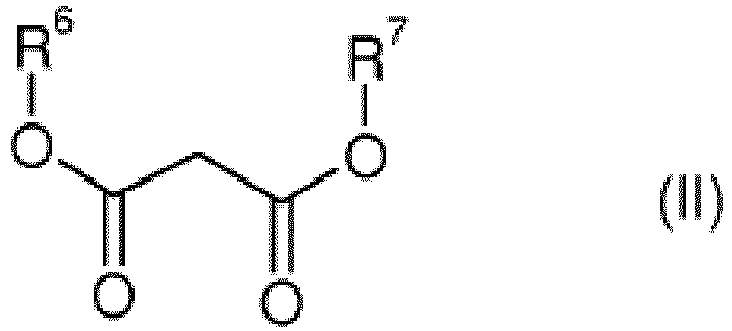 R6 et R7 possèdent les significations mentionnées ci-dessusen présence d'un catalyseur de palladium, d'un ligand phosphine etB) d'un mélange de bases inorganiques, le carbonate de césium et le bicarbonate de césium n'étant pas utilisés,éventuellement avec utilisation d'un solvant organique.
 - Procédé pour la préparation de composés de formule (III) selon la revendication 1,
Ar représentant 1-naphtyle ou 2-naphtyle, 3-thiényle ou le groupe R1, R2, R3, R4 et R5, indépendamment les uns des autres, identiques ou différents, représentant hydrogène, amino, cyano, nitro, fluor, C1-4-alkyle, C1-4-thioalkyle, thiophényle, C1-4-alcoxy, C6-10-aryloxy, phényle, -CO-C6-8-aryle, -CO-C1-3-alkyle,-COO-C1-4-alkyle ou -COO-C6-8-aryle, éventuellement substitué par fluor,Hal représentant chlore, brome ou iode,R6 et R7, indépendamment l'un de l'autre, identiques ou différents, représentant C1-4-alkyle.
 - Procédé pour la préparation de composés de formule (III) selon la revendication 1,
Ar représentant 1-naphtyle ou 2-naphtyle, 3-thiényle ou le groupe R1, R2, R3, R4 et R5, indépendamment les uns des autres, identiques ou différents, représentant hydrogène, amino, cyano, nitro, fluor, méthyle, méthylthio, éthyle, i-propyle, n-propyle, CF3, C2F5, C3F7, méthoxy, éthoxy, phényle, -CO-phényle,-CO-méthyle, -CO-éthyle, -COO-méthyle, -COO-éthyle ou -COO-phényle,Hal représentant chlore, brome ou iode,R6 et R7 représentant indépendamment l'un de l'autre méthyle ou éthyle.
 - Procédé pour la préparation de composés de formule (III) selon la revendication 1,
Ar représentant 1-naphtyle, 2-naphtyle, phényle, 4-N,N-diméthylaminophényle, 4-méthylthiophényle, 4-méthoxyphényle, 4-éthoxyphényle, 3-méthoxyphényle, 2-méthoxyphényle, 2-méthylphényle, 3-méthylphényle, 4-méthylphényle, 4-fluorophényle, 3-fluorophényle, 2-fluorophényle, 2-éthylphényle, 4-éthoxycarbonylphényle, 3-thiényle. - Procédé pour la préparation de composés de formule (III) selon la revendication 1,
Ar représentant 2,6-diméthylphényle, 2,4,6-triméthylphényle, 4-cyanophényle, 4-cyano-2-méthylphényle, 3-cyanophényle, 4-éthoxycarbonylphényle, 4-trifluorométhylphényle, 4-acétylphényle, 4-nitrophényle, 4-benzoylphényle. - Procédé pour la préparation de composés de formule (III) selon la revendication 1,
R6 et R7 représentant éthyle. - Procédé pour la préparation de composés de formule (III) selon la revendication 1, caractérisé en ce que le bis(dibenzylidènacétone)palladium, le tris(dibenzylidènacétone)dipalladium ou l'acétate de palladium sont utilisés en tant que catalyseurs de palladium.
- Procédé pour la préparation de composés de formule (III) selon la revendication 1, caractérisé en ce que la tri-tert-butyl-phosphine, la tricyclohexylphosphine, la tris(1-adamantyl)phosphine, la n-butyl-di(1-adamantyl)-phosphine (cataCXium® A), la benzyl- di(1-adamantyl)-phosphine (cataCXium® ABn), le 2-(di-tert-butylphosphino)biphényle (JohnPhos) ou le 2-(di-cyclohexylphosphino)-2'-(N,N-diméthylamino) sont utilisés en tant que ligand phosphine.
- Procédé pour la préparation de composés de formule (III) selon la revendication 1, caractérisé en ce que la tri-tert-butyl-phosphine est utilisée en tant que ligand.
- Procédé pour la préparation de composés de formule (III) selon la revendication 1, caractérisé en ce que dans l'étape de procédé B) des mélanges de carbonate de potassium et de bicarbonate de potassium sont utilisés en tant que bases.
- Procédé pour la préparation de composés de formule (III) selon la revendication 1, caractérisé en ce que l'ester malonique de formule (II) est utilisé en excès comme solvant.
- Procédé pour la préparation de composés de formule (III) selon la revendication 1, caractérisé en ce qu'on opère à des températures de 100 à 180 °C.
Applications Claiming Priority (4)
| Application Number | Priority Date | Filing Date | Title |
|---|---|---|---|
| US201161448379P | 2011-03-02 | 2011-03-02 | |
| EP11156559 | 2011-03-02 | ||
| PCT/EP2012/053233 WO2012116942A1 (fr) | 2011-03-02 | 2012-02-27 | Procédé de production de dérivés d'acides aryl- et hétéroarylacétique |
| EP12706245.3A EP2681185B8 (fr) | 2011-03-02 | 2012-02-27 | Procédé de production de dérivés d'acides aryl- et hétéroarylacétique |
Related Parent Applications (2)
| Application Number | Title | Priority Date | Filing Date |
|---|---|---|---|
| EP12706245.3A Division-Into EP2681185B8 (fr) | 2011-03-02 | 2012-02-27 | Procédé de production de dérivés d'acides aryl- et hétéroarylacétique |
| EP12706245.3A Division EP2681185B8 (fr) | 2011-03-02 | 2012-02-27 | Procédé de production de dérivés d'acides aryl- et hétéroarylacétique |
Publications (2)
| Publication Number | Publication Date |
|---|---|
| EP3369723A1 EP3369723A1 (fr) | 2018-09-05 |
| EP3369723B1 true EP3369723B1 (fr) | 2020-10-14 |
Family
ID=43770656
Family Applications (2)
| Application Number | Title | Priority Date | Filing Date |
|---|---|---|---|
| EP12706245.3A Active EP2681185B8 (fr) | 2011-03-02 | 2012-02-27 | Procédé de production de dérivés d'acides aryl- et hétéroarylacétique |
| EP18162783.7A Active EP3369723B1 (fr) | 2011-03-02 | 2012-02-27 | Procédé de production de dérivés d'acides aryl- et hétéroarylacétique |
Family Applications Before (1)
| Application Number | Title | Priority Date | Filing Date |
|---|---|---|---|
| EP12706245.3A Active EP2681185B8 (fr) | 2011-03-02 | 2012-02-27 | Procédé de production de dérivés d'acides aryl- et hétéroarylacétique |
Country Status (12)
| Country | Link |
|---|---|
| US (2) | US9096568B2 (fr) |
| EP (2) | EP2681185B8 (fr) |
| JP (1) | JP6100174B2 (fr) |
| KR (2) | KR101927556B1 (fr) |
| CN (1) | CN103596918B (fr) |
| BR (1) | BR112013022282B1 (fr) |
| DK (2) | DK2681185T3 (fr) |
| ES (1) | ES2690944T3 (fr) |
| IL (2) | IL227996A (fr) |
| MX (1) | MX341269B (fr) |
| TW (1) | TWI555730B (fr) |
| WO (1) | WO2012116942A1 (fr) |
Families Citing this family (3)
| Publication number | Priority date | Publication date | Assignee | Title |
|---|---|---|---|---|
| EP3377221B1 (fr) * | 2015-10-29 | 2023-07-26 | The Trustees of Princeton University | Une méthode de couplage croisé utilisant un complexe de métal de transition comprenant un ligand pad3 |
| CN112239384B (zh) * | 2020-08-07 | 2023-05-12 | 浙江理工大学 | 一种硫酯化合物的制备方法 |
| CN118771976A (zh) * | 2024-06-25 | 2024-10-15 | 宁波萃英化学技术有限公司 | 一种酮洛芬-d3的制备方法 |
Family Cites Families (11)
| Publication number | Priority date | Publication date | Assignee | Title |
|---|---|---|---|---|
| EP0835243B1 (fr) | 1995-06-30 | 2003-01-29 | Bayer CropScience AG | Cetoenols a substitution dialkyle-halogenure de phenyle s'utilisant comme herbicides et comme pesticides |
| GB9904933D0 (en) * | 1999-03-04 | 1999-04-28 | Glaxo Group Ltd | Compounds |
| DE19938736A1 (de) * | 1999-08-16 | 2001-02-22 | Bayer Ag | Verfahren zur Herstellung von [Bis-(trifluormethyl)-phenyl]-essigsäuren und deren Alkylestern sowie [Bis-(trifluormethyl)-phenyl]-malonsäure-dialkylester |
| DE10111262A1 (de) | 2001-03-09 | 2002-09-12 | Studiengesellschaft Kohle Mbh | Verfahren zur Herstellung von Vinyl- Aryl- und Heteroarylessigsäuren und ihrer Devivate |
| AU2002302248B2 (en) * | 2001-05-23 | 2008-03-06 | Merck Frosst Canada Ltd. | Dihydropyrrolo[1,2-A]indole and tetrahydropyrido[1,2-A]-indole derivatives as prostaglandin D2 receptor antagonists |
| SI2248809T1 (sl) | 2005-03-28 | 2012-09-28 | Toyama Chemical Co Ltd | Alkil-3-(2-(benzo(b)tiofen-5-il)-etoksi)-propanoati kot vmesniki v proizvodnji derivatov azetidin-3-ola |
| AU2006316644B2 (en) * | 2005-11-18 | 2011-11-10 | Merck Sharp & Dohme Corp. | Spirohydantoin tricyclic CGRP receptor antagonists |
| US20110039893A1 (en) * | 2006-10-11 | 2011-02-17 | Takeda Pharmaceutical Company Limited | Gsk-3beta inhibitor |
| DE202007001123U1 (de) * | 2007-01-25 | 2007-06-06 | KRÜGER, Günter | Anlage zum Trocknen von organischen Massen |
| UA105362C2 (en) | 2008-04-02 | 2014-05-12 | Бьорингер Ингельхайм Интернациональ Гмбх | 1-heterocyclyl-1, 5-dihydro-pyrazolo [3, 4-d] pyrimidin-4-one derivatives and their use as pde9a modulators |
| CN102753513B (zh) * | 2010-01-19 | 2015-03-18 | 拜耳知识产权有限责任公司 | 制备芳基和杂芳基乙酸衍生物的方法 |
-
2012
- 2012-02-27 WO PCT/EP2012/053233 patent/WO2012116942A1/fr not_active Ceased
- 2012-02-27 EP EP12706245.3A patent/EP2681185B8/fr active Active
- 2012-02-27 DK DK12706245.3T patent/DK2681185T3/en active
- 2012-02-27 BR BR112013022282-4A patent/BR112013022282B1/pt active IP Right Grant
- 2012-02-27 US US14/002,691 patent/US9096568B2/en active Active
- 2012-02-27 KR KR1020137022738A patent/KR101927556B1/ko active Active
- 2012-02-27 MX MX2013009828A patent/MX341269B/es active IP Right Grant
- 2012-02-27 ES ES12706245.3T patent/ES2690944T3/es active Active
- 2012-02-27 DK DK18162783.7T patent/DK3369723T3/da active
- 2012-02-27 EP EP18162783.7A patent/EP3369723B1/fr active Active
- 2012-02-27 JP JP2013555836A patent/JP6100174B2/ja active Active
- 2012-02-27 CN CN201280011378.0A patent/CN103596918B/zh active Active
- 2012-02-27 KR KR1020187032851A patent/KR101999939B1/ko active Active
- 2012-03-01 TW TW101106641A patent/TWI555730B/zh active
-
2013
- 2013-08-18 IL IL227996A patent/IL227996A/en active IP Right Grant
-
2015
- 2015-04-15 US US14/686,886 patent/US9376417B2/en active Active
-
2017
- 2017-11-02 IL IL255391A patent/IL255391B/en active IP Right Grant
Non-Patent Citations (1)
| Title |
|---|
| None * |
Also Published As
| Publication number | Publication date |
|---|---|
| US9376417B2 (en) | 2016-06-28 |
| KR101999939B1 (ko) | 2019-07-15 |
| EP2681185A1 (fr) | 2014-01-08 |
| CN103596918B (zh) | 2015-09-16 |
| IL227996A (en) | 2017-11-30 |
| BR112013022282B1 (pt) | 2019-03-26 |
| IL255391B (en) | 2019-09-26 |
| WO2012116942A1 (fr) | 2012-09-07 |
| KR20140006010A (ko) | 2014-01-15 |
| BR112013022282A2 (pt) | 2017-03-01 |
| US20140155632A1 (en) | 2014-06-05 |
| DK3369723T3 (da) | 2021-01-11 |
| ES2690944T3 (es) | 2018-11-23 |
| EP2681185B1 (fr) | 2018-07-11 |
| MX2013009828A (es) | 2013-10-03 |
| TW201245142A (en) | 2012-11-16 |
| MX341269B (es) | 2016-08-09 |
| DK2681185T3 (en) | 2018-10-29 |
| US20150315171A1 (en) | 2015-11-05 |
| EP3369723A1 (fr) | 2018-09-05 |
| US9096568B2 (en) | 2015-08-04 |
| IL227996A0 (en) | 2013-09-30 |
| CN103596918A (zh) | 2014-02-19 |
| JP6100174B2 (ja) | 2017-03-22 |
| KR20180126084A (ko) | 2018-11-26 |
| JP2014514253A (ja) | 2014-06-19 |
| IL255391A0 (en) | 2017-12-31 |
| KR101927556B1 (ko) | 2018-12-10 |
| EP2681185B8 (fr) | 2018-08-29 |
| TWI555730B (zh) | 2016-11-01 |
Similar Documents
| Publication | Publication Date | Title |
|---|---|---|
| EP3369723B1 (fr) | Procédé de production de dérivés d'acides aryl- et hétéroarylacétique | |
| EP3215481A1 (fr) | Procédé de production de biphénylamines à partir d'azobenzènes par catalyse au ruthénium | |
| EP2526081B1 (fr) | Procédé de production de dérivés d'acides aryl- et hétéroarylacétique | |
| EP0006205B1 (fr) | Procédé pour la préparation de dérivés d'acides chlorostyrène cyclopropane carboxyliques | |
| EP1713755B1 (fr) | Procede pour produire de l'acide 2,5-dimethylphenylacetique | |
| CH638481A5 (de) | Verfahren zur herstellung viergliedriger cyclischer ketone. | |
| DE2605398C3 (de) | Verfahren zur Herstellung von ß -Dihalogenäthenylcyclopropancarbonsäure-Derivaten | |
| WO2017121699A1 (fr) | Procédé de préparation de 2-aryl-éthanols substitués | |
| DE10111262A1 (de) | Verfahren zur Herstellung von Vinyl- Aryl- und Heteroarylessigsäuren und ihrer Devivate | |
| EP3774719B1 (fr) | Procédé de production d'acides 2,6-dialkylphényl acétiques | |
| EP1223158A1 (fr) | Procédé de préparation d'acides biphényl carboxyliques substitués par un groupe trifluoromethyl et nouveaux nitriles de biphényl substitués par un groupe trifluoro- ou trichloro- methyl | |
| EP0018533B1 (fr) | Acides pentane -(or pentine)- carboxyliques substituée, procédé de leurs préparation et leur utilisation pour la préparation d'esters d'acide (arylvinyl)-3 diméthyl-2,2 cyclopropanecarboxylique-1 | |
| CH628015A5 (de) | Verfahren zur decarbalkoxylierung von carbonsaeureestern. | |
| DE4225763A1 (de) | Verfahren zur Herstellung von Halogenaromaten | |
| EP0017952B1 (fr) | Procédé pour la préparation d'esters d'acides styryle-cyclopropane carboxyliques, leurs intermédiaires et procédé pour leur préparation | |
| WO2017072038A1 (fr) | Procédé de préparation d'acides 2-alkyl-4-trifluorométhyl-3-alkylsulfonyl-benzoïques | |
| EP0050777A2 (fr) | Préparation d'acides cyclopropancarboxyliques substitués par des alkylchlores-fluorés, leurs dérivés et leur intermédiaires | |
| DE2710151A1 (de) | Verfahren zur herstellung von dihalogenvinyl-gamma-butyrolactonen | |
| DE3040001A1 (de) | Verfahren zur herstellung von fluorsubstituierten estern von cyclopropancarbonsaeuren | |
| DE3043975A1 (de) | Verfahren zur herstellung von chlorfluoralkylsubstituierten cyclopropancarbonsaeuren und deren derivaten und zwischenprodukten dafuer | |
| DE3042270A1 (de) | Verfahren zur herstellung von 3-acylsubstituierten cyclobutanon-derivaten | |
| DE3203379A1 (de) | Verfahren zur herstellung von 2,2-dimethyl-3-(ss-fluor-ss-trifluormethylvinyl)-cyclopropancarbonsaeure und zwischenprodukte in diesem verfahren |
Legal Events
| Date | Code | Title | Description |
|---|---|---|---|
| PUAI | Public reference made under article 153(3) epc to a published international application that has entered the european phase |
Free format text: ORIGINAL CODE: 0009012 |
|
| STAA | Information on the status of an ep patent application or granted ep patent |
Free format text: STATUS: THE APPLICATION HAS BEEN PUBLISHED |
|
| AC | Divisional application: reference to earlier application |
Ref document number: 2681185 Country of ref document: EP Kind code of ref document: P |
|
| AK | Designated contracting states |
Kind code of ref document: A1 Designated state(s): AL AT BE BG CH CY CZ DE DK EE ES FI FR GB GR HR HU IE IS IT LI LT LU LV MC MK MT NL NO PL PT RO RS SE SI SK SM TR |
|
| RIN1 | Information on inventor provided before grant (corrected) |
Inventor name: HIMMLER, THOMAS Inventor name: GOOSSEN, LUKAS J. Inventor name: RUDOLPHI, FELIX Inventor name: SONG, BINGRUI |
|
| STAA | Information on the status of an ep patent application or granted ep patent |
Free format text: STATUS: REQUEST FOR EXAMINATION WAS MADE |
|
| 17P | Request for examination filed |
Effective date: 20190305 |
|
| RBV | Designated contracting states (corrected) |
Designated state(s): AL AT BE BG CH CY CZ DE DK EE ES FI FR GB GR HR HU IE IS IT LI LT LU LV MC MK MT NL NO PL PT RO RS SE SI SK SM TR |
|
| STAA | Information on the status of an ep patent application or granted ep patent |
Free format text: STATUS: EXAMINATION IS IN PROGRESS |
|
| 17Q | First examination report despatched |
Effective date: 20190704 |
|
| GRAP | Despatch of communication of intention to grant a patent |
Free format text: ORIGINAL CODE: EPIDOSNIGR1 |
|
| STAA | Information on the status of an ep patent application or granted ep patent |
Free format text: STATUS: GRANT OF PATENT IS INTENDED |
|
| INTG | Intention to grant announced |
Effective date: 20200430 |
|
| RIN1 | Information on inventor provided before grant (corrected) |
Inventor name: HIMMLER, THOMAS Inventor name: SONG, BINGRUI Inventor name: RUDOLPHI, FELIX Inventor name: GOOSSEN, LUKAS J. |
|
| GRAS | Grant fee paid |
Free format text: ORIGINAL CODE: EPIDOSNIGR3 |
|
| GRAA | (expected) grant |
Free format text: ORIGINAL CODE: 0009210 |
|
| STAA | Information on the status of an ep patent application or granted ep patent |
Free format text: STATUS: THE PATENT HAS BEEN GRANTED |
|
| AC | Divisional application: reference to earlier application |
Ref document number: 2681185 Country of ref document: EP Kind code of ref document: P |
|
| AK | Designated contracting states |
Kind code of ref document: B1 Designated state(s): AL AT BE BG CH CY CZ DE DK EE ES FI FR GB GR HR HU IE IS IT LI LT LU LV MC MK MT NL NO PL PT RO RS SE SI SK SM TR |
|
| REG | Reference to a national code |
Ref country code: GB Ref legal event code: FG4D Free format text: NOT ENGLISH |
|
| REG | Reference to a national code |
Ref country code: AT Ref legal event code: REF Ref document number: 1323428 Country of ref document: AT Kind code of ref document: T Effective date: 20201015 Ref country code: CH Ref legal event code: EP |
|
| REG | Reference to a national code |
Ref country code: DE Ref legal event code: R096 Ref document number: 502012016424 Country of ref document: DE |
|
| REG | Reference to a national code |
Ref country code: IE Ref legal event code: FG4D Free format text: LANGUAGE OF EP DOCUMENT: GERMAN |
|
| REG | Reference to a national code |
Ref country code: DK Ref legal event code: T3 Effective date: 20210107 Ref country code: FI Ref legal event code: FGE |
|
| REG | Reference to a national code |
Ref country code: NL Ref legal event code: FP |
|
| PG25 | Lapsed in a contracting state [announced via postgrant information from national office to epo] |
Ref country code: RS Free format text: LAPSE BECAUSE OF FAILURE TO SUBMIT A TRANSLATION OF THE DESCRIPTION OR TO PAY THE FEE WITHIN THE PRESCRIBED TIME-LIMIT Effective date: 20201014 Ref country code: PT Free format text: LAPSE BECAUSE OF FAILURE TO SUBMIT A TRANSLATION OF THE DESCRIPTION OR TO PAY THE FEE WITHIN THE PRESCRIBED TIME-LIMIT Effective date: 20210215 Ref country code: NO Free format text: LAPSE BECAUSE OF FAILURE TO SUBMIT A TRANSLATION OF THE DESCRIPTION OR TO PAY THE FEE WITHIN THE PRESCRIBED TIME-LIMIT Effective date: 20210114 Ref country code: GR Free format text: LAPSE BECAUSE OF FAILURE TO SUBMIT A TRANSLATION OF THE DESCRIPTION OR TO PAY THE FEE WITHIN THE PRESCRIBED TIME-LIMIT Effective date: 20210115 |
|
| REG | Reference to a national code |
Ref country code: LT Ref legal event code: MG4D |
|
| PG25 | Lapsed in a contracting state [announced via postgrant information from national office to epo] |
Ref country code: SE Free format text: LAPSE BECAUSE OF FAILURE TO SUBMIT A TRANSLATION OF THE DESCRIPTION OR TO PAY THE FEE WITHIN THE PRESCRIBED TIME-LIMIT Effective date: 20201014 Ref country code: BG Free format text: LAPSE BECAUSE OF FAILURE TO SUBMIT A TRANSLATION OF THE DESCRIPTION OR TO PAY THE FEE WITHIN THE PRESCRIBED TIME-LIMIT Effective date: 20210114 Ref country code: LV Free format text: LAPSE BECAUSE OF FAILURE TO SUBMIT A TRANSLATION OF THE DESCRIPTION OR TO PAY THE FEE WITHIN THE PRESCRIBED TIME-LIMIT Effective date: 20201014 Ref country code: PL Free format text: LAPSE BECAUSE OF FAILURE TO SUBMIT A TRANSLATION OF THE DESCRIPTION OR TO PAY THE FEE WITHIN THE PRESCRIBED TIME-LIMIT Effective date: 20201014 Ref country code: IS Free format text: LAPSE BECAUSE OF FAILURE TO SUBMIT A TRANSLATION OF THE DESCRIPTION OR TO PAY THE FEE WITHIN THE PRESCRIBED TIME-LIMIT Effective date: 20210214 |
|
| PG25 | Lapsed in a contracting state [announced via postgrant information from national office to epo] |
Ref country code: HR Free format text: LAPSE BECAUSE OF FAILURE TO SUBMIT A TRANSLATION OF THE DESCRIPTION OR TO PAY THE FEE WITHIN THE PRESCRIBED TIME-LIMIT Effective date: 20201014 |
|
| REG | Reference to a national code |
Ref country code: DE Ref legal event code: R097 Ref document number: 502012016424 Country of ref document: DE Ref country code: ES Ref legal event code: FG2A Ref document number: 2842879 Country of ref document: ES Kind code of ref document: T3 Effective date: 20210715 |
|
| PG25 | Lapsed in a contracting state [announced via postgrant information from national office to epo] |
Ref country code: LT Free format text: LAPSE BECAUSE OF FAILURE TO SUBMIT A TRANSLATION OF THE DESCRIPTION OR TO PAY THE FEE WITHIN THE PRESCRIBED TIME-LIMIT Effective date: 20201014 Ref country code: RO Free format text: LAPSE BECAUSE OF FAILURE TO SUBMIT A TRANSLATION OF THE DESCRIPTION OR TO PAY THE FEE WITHIN THE PRESCRIBED TIME-LIMIT Effective date: 20201014 Ref country code: SK Free format text: LAPSE BECAUSE OF FAILURE TO SUBMIT A TRANSLATION OF THE DESCRIPTION OR TO PAY THE FEE WITHIN THE PRESCRIBED TIME-LIMIT Effective date: 20201014 Ref country code: SM Free format text: LAPSE BECAUSE OF FAILURE TO SUBMIT A TRANSLATION OF THE DESCRIPTION OR TO PAY THE FEE WITHIN THE PRESCRIBED TIME-LIMIT Effective date: 20201014 Ref country code: EE Free format text: LAPSE BECAUSE OF FAILURE TO SUBMIT A TRANSLATION OF THE DESCRIPTION OR TO PAY THE FEE WITHIN THE PRESCRIBED TIME-LIMIT Effective date: 20201014 Ref country code: CZ Free format text: LAPSE BECAUSE OF FAILURE TO SUBMIT A TRANSLATION OF THE DESCRIPTION OR TO PAY THE FEE WITHIN THE PRESCRIBED TIME-LIMIT Effective date: 20201014 |
|
| PLBE | No opposition filed within time limit |
Free format text: ORIGINAL CODE: 0009261 |
|
| STAA | Information on the status of an ep patent application or granted ep patent |
Free format text: STATUS: NO OPPOSITION FILED WITHIN TIME LIMIT |
|
| 26N | No opposition filed |
Effective date: 20210715 |
|
| PG25 | Lapsed in a contracting state [announced via postgrant information from national office to epo] |
Ref country code: MC Free format text: LAPSE BECAUSE OF FAILURE TO SUBMIT A TRANSLATION OF THE DESCRIPTION OR TO PAY THE FEE WITHIN THE PRESCRIBED TIME-LIMIT Effective date: 20201014 |
|
| PG25 | Lapsed in a contracting state [announced via postgrant information from national office to epo] |
Ref country code: AL Free format text: LAPSE BECAUSE OF FAILURE TO SUBMIT A TRANSLATION OF THE DESCRIPTION OR TO PAY THE FEE WITHIN THE PRESCRIBED TIME-LIMIT Effective date: 20201014 Ref country code: LU Free format text: LAPSE BECAUSE OF NON-PAYMENT OF DUE FEES Effective date: 20210227 |
|
| PG25 | Lapsed in a contracting state [announced via postgrant information from national office to epo] |
Ref country code: SI Free format text: LAPSE BECAUSE OF FAILURE TO SUBMIT A TRANSLATION OF THE DESCRIPTION OR TO PAY THE FEE WITHIN THE PRESCRIBED TIME-LIMIT Effective date: 20201014 |
|
| PG25 | Lapsed in a contracting state [announced via postgrant information from national office to epo] |
Ref country code: IE Free format text: LAPSE BECAUSE OF NON-PAYMENT OF DUE FEES Effective date: 20210227 |
|
| PG25 | Lapsed in a contracting state [announced via postgrant information from national office to epo] |
Ref country code: IS Free format text: LAPSE BECAUSE OF FAILURE TO SUBMIT A TRANSLATION OF THE DESCRIPTION OR TO PAY THE FEE WITHIN THE PRESCRIBED TIME-LIMIT Effective date: 20210214 |
|
| PG25 | Lapsed in a contracting state [announced via postgrant information from national office to epo] |
Ref country code: CY Free format text: LAPSE BECAUSE OF FAILURE TO SUBMIT A TRANSLATION OF THE DESCRIPTION OR TO PAY THE FEE WITHIN THE PRESCRIBED TIME-LIMIT Effective date: 20201014 |
|
| PG25 | Lapsed in a contracting state [announced via postgrant information from national office to epo] |
Ref country code: HU Free format text: LAPSE BECAUSE OF FAILURE TO SUBMIT A TRANSLATION OF THE DESCRIPTION OR TO PAY THE FEE WITHIN THE PRESCRIBED TIME-LIMIT; INVALID AB INITIO Effective date: 20120227 |
|
| PG25 | Lapsed in a contracting state [announced via postgrant information from national office to epo] |
Ref country code: MK Free format text: LAPSE BECAUSE OF FAILURE TO SUBMIT A TRANSLATION OF THE DESCRIPTION OR TO PAY THE FEE WITHIN THE PRESCRIBED TIME-LIMIT Effective date: 20201014 |
|
| PG25 | Lapsed in a contracting state [announced via postgrant information from national office to epo] |
Ref country code: TR Free format text: LAPSE BECAUSE OF FAILURE TO SUBMIT A TRANSLATION OF THE DESCRIPTION OR TO PAY THE FEE WITHIN THE PRESCRIBED TIME-LIMIT Effective date: 20201014 |
|
| PG25 | Lapsed in a contracting state [announced via postgrant information from national office to epo] |
Ref country code: MT Free format text: LAPSE BECAUSE OF FAILURE TO SUBMIT A TRANSLATION OF THE DESCRIPTION OR TO PAY THE FEE WITHIN THE PRESCRIBED TIME-LIMIT Effective date: 20201014 |
|
| PGFP | Annual fee paid to national office [announced via postgrant information from national office to epo] |
Ref country code: NL Payment date: 20260128 Year of fee payment: 15 |
|
| REG | Reference to a national code |
Ref country code: CH Ref legal event code: U11 Free format text: ST27 STATUS EVENT CODE: U-0-0-U10-U11 (AS PROVIDED BY THE NATIONAL OFFICE) Effective date: 20260301 |
|
| PGFP | Annual fee paid to national office [announced via postgrant information from national office to epo] |
Ref country code: GB Payment date: 20260128 Year of fee payment: 15 |
|
| PGFP | Annual fee paid to national office [announced via postgrant information from national office to epo] |
Ref country code: ES Payment date: 20260311 Year of fee payment: 15 |
|
| PGFP | Annual fee paid to national office [announced via postgrant information from national office to epo] |
Ref country code: DE Payment date: 20260121 Year of fee payment: 15 Ref country code: DK Payment date: 20260213 Year of fee payment: 15 |
|
| PGFP | Annual fee paid to national office [announced via postgrant information from national office to epo] |
Ref country code: AT Payment date: 20260127 Year of fee payment: 15 |
|
| PGFP | Annual fee paid to national office [announced via postgrant information from national office to epo] |
Ref country code: IT Payment date: 20260128 Year of fee payment: 15 Ref country code: FI Payment date: 20260213 Year of fee payment: 15 Ref country code: BE Payment date: 20260122 Year of fee payment: 15 |
|
| PGFP | Annual fee paid to national office [announced via postgrant information from national office to epo] |
Ref country code: FR Payment date: 20260121 Year of fee payment: 15 |
|
| PGFP | Annual fee paid to national office [announced via postgrant information from national office to epo] |
Ref country code: CH Payment date: 20260301 Year of fee payment: 15 |