EP3370363A1 - Hybride datentransportlösung, insbesondere für verbindungen über satellit - Google Patents
Hybride datentransportlösung, insbesondere für verbindungen über satellit Download PDFInfo
- Publication number
- EP3370363A1 EP3370363A1 EP18159571.1A EP18159571A EP3370363A1 EP 3370363 A1 EP3370363 A1 EP 3370363A1 EP 18159571 A EP18159571 A EP 18159571A EP 3370363 A1 EP3370363 A1 EP 3370363A1
- Authority
- EP
- European Patent Office
- Prior art keywords
- data
- tcp
- interface
- channel
- channels
- Prior art date
- Legal status (The legal status is an assumption and is not a legal conclusion. Google has not performed a legal analysis and makes no representation as to the accuracy of the status listed.)
- Granted
Links
Images



Classifications
-
- H—ELECTRICITY
- H04—ELECTRIC COMMUNICATION TECHNIQUE
- H04L—TRANSMISSION OF DIGITAL INFORMATION, e.g. TELEGRAPHIC COMMUNICATION
- H04L5/00—Arrangements affording multiple use of the transmission path
- H04L5/003—Arrangements for allocating sub-channels of the transmission path
- H04L5/0037—Inter-user or inter-terminal allocation
-
- H—ELECTRICITY
- H04—ELECTRIC COMMUNICATION TECHNIQUE
- H04L—TRANSMISSION OF DIGITAL INFORMATION, e.g. TELEGRAPHIC COMMUNICATION
- H04L12/00—Data switching networks
- H04L12/02—Details
- H04L12/16—Arrangements for providing special services to substations
- H04L12/18—Arrangements for providing special services to substations for broadcast or conference, e.g. multicast
- H04L12/189—Arrangements for providing special services to substations for broadcast or conference, e.g. multicast in combination with wireless systems
-
- H—ELECTRICITY
- H04—ELECTRIC COMMUNICATION TECHNIQUE
- H04B—TRANSMISSION
- H04B7/00—Radio transmission systems, i.e. using radiation field
- H04B7/14—Relay systems
- H04B7/15—Active relay systems
- H04B7/185—Space-based or airborne stations; Stations for satellite systems
- H04B7/18502—Airborne stations
-
- H—ELECTRICITY
- H04—ELECTRIC COMMUNICATION TECHNIQUE
- H04L—TRANSMISSION OF DIGITAL INFORMATION, e.g. TELEGRAPHIC COMMUNICATION
- H04L1/00—Arrangements for detecting or preventing errors in the information received
- H04L1/12—Arrangements for detecting or preventing errors in the information received by using return channel
- H04L1/16—Arrangements for detecting or preventing errors in the information received by using return channel in which the return channel carries supervisory signals, e.g. repetition request signals
-
- H—ELECTRICITY
- H04—ELECTRIC COMMUNICATION TECHNIQUE
- H04L—TRANSMISSION OF DIGITAL INFORMATION, e.g. TELEGRAPHIC COMMUNICATION
- H04L45/00—Routing or path finding of packets in data switching networks
- H04L45/24—Multipath
-
- H—ELECTRICITY
- H04—ELECTRIC COMMUNICATION TECHNIQUE
- H04L—TRANSMISSION OF DIGITAL INFORMATION, e.g. TELEGRAPHIC COMMUNICATION
- H04L67/00—Network arrangements or protocols for supporting network services or applications
- H04L67/01—Protocols
- H04L67/04—Protocols specially adapted for terminals or networks with limited capabilities; specially adapted for terminal portability
-
- H—ELECTRICITY
- H04—ELECTRIC COMMUNICATION TECHNIQUE
- H04W—WIRELESS COMMUNICATION NETWORKS
- H04W8/00—Network data management
- H04W8/26—Network addressing or numbering for mobility support
-
- H—ELECTRICITY
- H04—ELECTRIC COMMUNICATION TECHNIQUE
- H04W—WIRELESS COMMUNICATION NETWORKS
- H04W92/00—Interfaces specially adapted for wireless communication networks
-
- H—ELECTRICITY
- H04—ELECTRIC COMMUNICATION TECHNIQUE
- H04L—TRANSMISSION OF DIGITAL INFORMATION, e.g. TELEGRAPHIC COMMUNICATION
- H04L47/00—Traffic control in data switching networks
- H04L47/10—Flow control; Congestion control
- H04L47/12—Avoiding congestion; Recovering from congestion
- H04L47/125—Avoiding congestion; Recovering from congestion by balancing the load, e.g. traffic engineering
-
- H—ELECTRICITY
- H04—ELECTRIC COMMUNICATION TECHNIQUE
- H04L—TRANSMISSION OF DIGITAL INFORMATION, e.g. TELEGRAPHIC COMMUNICATION
- H04L47/00—Traffic control in data switching networks
- H04L47/10—Flow control; Congestion control
- H04L47/19—Flow control; Congestion control at layers above the network layer
- H04L47/193—Flow control; Congestion control at layers above the network layer at the transport layer, e.g. TCP related
-
- H—ELECTRICITY
- H04—ELECTRIC COMMUNICATION TECHNIQUE
- H04L—TRANSMISSION OF DIGITAL INFORMATION, e.g. TELEGRAPHIC COMMUNICATION
- H04L69/00—Network arrangements, protocols or services independent of the application payload and not provided for in the other groups of this subclass
- H04L69/16—Implementation or adaptation of Internet protocol [IP], of transmission control protocol [TCP] or of user datagram protocol [UDP]
Definitions
- the invention relates to the field of telecommunications and in particular satellite telecommunications.
- a solution envisaged to cope with this increase consists in simultaneously using two or more different communication channels which the user can have at his terminal, to transmit or receive the desired information.
- such a solution requires an adaptation of the existing data exchange protocol, the TCP protocol, so that the latter is able to simultaneously manage data streams (we speak of "sub-flows ”) passing through different channels and intended to be assembled together to form a single data stream at the user level, data stream for supplying a given application, implemented by this user (data storage in a center remote storage or playback of video files transmitted by a remote broadcast platform for example).
- MP-TCP is an extension of the standard transport protocol “TCP” which allows to add to this protocol capabilities called “multipath” or “Multi-Path” (“MP”) according to the English terminology.
- a typical case of implementation of the "MP-TCP" protocol that can currently be considered is that of smart mobile phones or “smartphones” according to recognized Anglo-Saxon terminology.
- Smartphones are typically equipment equipped with 2 network access interfaces: an interface with mobile networks, 3G / 4G standards for example, and a WI-FI TM interface with a terminal ("set top box” or simply “box”) Internet.
- the figure 1 illustrates the principle of using two distinct Internet access thanks to the MP-TCP protocol, taking as a typical example of application the application to smartphones.
- the "MP-TCP" protocol makes it possible to use the two networks (3G / 4G and WI-FI TM) to download or read data from the same server, as long as the latter supports this protocol, by combining the capabilities of the two networks to provide the same global transport service, seen from the application.
- the data take two physically different routes (in full line and dashed line on the figure 1 ), and predetermined according to the IP addresses of the clients and servers.
- These lanes may eventually take a common section, as shown on figure 1 between one of the routers of the network and the TCP server, this router having no particular functionality.
- a protocol of the MP-TCP type thus makes it possible to create and manage secondary data streams ('subflows' according to the Anglo-Saxon denomination) associated with different interface / address pairs, but also partly identical. or in full.
- Multi-Path multichannel functionality
- this implementation is managed in the TCP client / server software stack by providing two sub-layers: the MP-TCP sublayer, which is aware of all subflows, and the sub-layer.
- “subflow” sub-layer which is nothing more than the local implementation of a conventional TCP connection (ie no "MP") with the IP interface of each of the channels carrying the secondary data streams (" subflows ").
- Multi-Path integration also involves the creation of specific messages and signaling that allows an MP-TCP compatible machine to determine if its correspondent is MP-TCP compatible, to be informed. that a local interface of a host is available for the "Multi-Path" communication, then proceed to the actual creation of the "subflows".
- the solution consisting in setting up an MP-TCP protocol to improve the data transfer rate on a network, especially the Internet, therefore requires the availability of several available transmission channels through which the data packets are passed through. several streams which are recombined, on arrival, to restore the frame of the expected data.
- each channel is supposed to be able to support two-way exchanges (data and protocol) between transmitter and receiver, one channel (“go” channel) being dedicated to the transfer of data from the transmitter to the receiver while another channel (channel "return”) is dedicated to the transfer of acknowledgment information between the recipient receiver of the data and the transmitter.
- This acknowledgment information is necessary for the congestion control of the network path in question and the reliability of the transfer to trigger retransmissions when necessary.
- bidirectional links allowing "broadband” or “Broadband” type communications English terminology and unidirectional links allowing "broadcast” or “broadcast” type communications according to this same terminology; the seconds being, at present, widely more widespread.
- the setting up of links according to an MP-TCP protocol does not always constitute, at the present time, a possible solution to improve the bit rate, for lack of a sufficient number of bidirectional data links available.
- the problem is the lack of a return path in sufficient numbers prevents efficient multichannel transport solutions, such as MP-TCP, from being deployed in this context.
- the transport of the signaling of the acknowledgments of reception (signals "ACK") which make it possible, by the means of the detections of losses of packets, to determine the level and the events of congestion in order to take the necessary actions at the level of the data transmitter, is provided by the way back.
- asymmetric and unidirectional routing methods such as the UDLR solution ("UniDirectional Link Routing" according to the English terminology), have been devised, notably implementing a unidirectional satellite link, coupled to a terrestrial return path.
- PEP type functions -TCP PEP for "Performance Enhancement Proxy” according to the Anglo-Saxon name. This type of function advantageously avoids, to a certain extent, possible congestion that may occur on a data link, particularly in the case of the use of a satellite transmission channel.
- a partial solution to this problem can also consist of a data transmission system implementing the MP-TCP protocol between PEPs at the level of a gateway ("gateway” or "GW” according to the English name). ) and satellite terminals.
- An object of the invention is to provide a solution for forming bidirectional data links using different transmission channels, for conveying data packets in the form of secondary data streams; each secondary stream passing through a given transmission channel.
- Another object of the invention is to propose a solution making it possible to optimize the transmission of data streams in the form of streams of secondary data traveling in parallel, by using both bidirectional transmission channels and unidirectional transmission channels.
- the object of the invention is, according to a first aspect, a method for performing the exchange of data streams between two terminals, a server terminal providing data to a client terminal, via a multichannel link. formed of a plurality of transmission channels of which at least one of the channels is a monodirectional channel, said data stream containing data transmitted from the server terminal to the client terminal as well as acknowledgment information transmitted in the same flow of the client terminal to the terminal server.
- the method according to the invention implements an interface module dedicated to the transmission of data forming said data stream, realizing the separation of said data stream into a plurality of secondary data streams and passing said secondary data streams. via said plurality of transmission channels forming the multichannel link.
- It also implements an interface module dedicated to receiving said data, realizing the reception of the data forming the secondary data streams transmitted via said plurality of channels and the reassembly of said secondary data streams into a single data stream.
- the interface modules are further configured to route the acknowledgment information of the data packets composing a secondary data stream passing through a one-way channel, associating them with the acknowledgment information of the packets of data. data component of a secondary data stream passing through a bidirectional channel.
- the asymmetric routing function is provided, in transmission mode, by an interface module that carries out an identification of the secondary data stream (s) formed from a single data stream, intended to to pass through a unidirectional channel, and a marking of the acknowledgment information constituting this or these before integrating the latter to a data stream intended to pass through a bidirectional channel.
- the asymmetric routing function is provided, in reception mode, by an interface module which carries out the identification of the marked acknowledgment information and the reassociation of this information with the data constituting the flow. secondary data having passed through the corresponding unidirectional channel.
- the interface elements are integrated with PEP servers, placed at the output of the terminals considered and responsible for managing and optimizing the bit rate of the data exchanged so as to avoid the saturation of the link and recurring loss of data packets.
- the protocol for exchanging data between the two terminals is a TCP protocol
- the "TCP interface” and “TCP / MP-TCP adaptation" functions of the transmission mode interface module being integrated with a PEP server placed at the output of the server terminal
- the "TCP interface” and “MP-TCP / TCP adaptation” functions of the reception mode interface module being integrated into a PEP server placed at the output of the client terminal
- the respective "asymmetrical routing" functions are implemented in additional router or switch type interface machines, placed at the output of the PEP servers.
- the subject of the invention is also, according to a second aspect, the implementation of the method according to the invention for performing the exchange of data streams between two terminals, by means of a multi-way link formed of a plurality satellite transmission channels of which at least one of the channels is a one-way channel providing broadcast type links.
- the method according to the invention makes it possible to develop a multichannel network architecture compatible with MP-TCP operation, while one of the channels, in other words one of the data links used, being unidirectional.
- the return path of the other system is employed, applying specific routing rules at the component level where the network paths are shared.
- the method according to the invention is presented through an example of application relating to the establishment of a multichannel data link between two terminals connected to the Internet network using a network infrastructure comprising two satellite communication channels, one of which is a unidirectional channel in the network sense of the term, that is to say a channel having no return channel.
- a network infrastructure comprising two satellite communication channels, one of which is a unidirectional channel in the network sense of the term, that is to say a channel having no return channel.
- the use of the method according to the invention is not limited to the case of an Internet network infrastructure and the only TCP protocol, but can be extended to network infrastructures comprising a plurality of accessible communication channels, these channels being all bidirectional channels or some of these channels being only unidirectional.
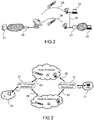
- the figure 2 illustrates an example of a network infrastructure using satellite channels for establishing Internet communication between a service providing terminal 21 such as the provision of video on demand files, and user terminals 22 and 23 to which the services are accessible.
- a service providing terminal 21 such as the provision of video on demand files
- user terminals 22 and 23 to which the services are accessible.
- two satellite channels 24 and 25 are available, one of which 24 allows bidirectional communication of the Broadband type and the other 25 only one unidirectional communication of the Broadcast type.
- Reception of the satellite data is here carried out either directly (broadcast mode) or via PEP 27 (Broadband mode) intended in particular to optimize the data transfer rate.
- PEP 27 Broadband mode
- the terminal 23 can only receive data from the provider terminal and can not return any acknowledgment information so that if the data packets transmitted by the provider terminal 21 are corrupted during the transfer the user terminal 23 has no opportunity to inform the sender so that the corrupted data are permanently lost.
- hybrid channel is meant a channel having one or more unidirectional channels and one or more bidirectional channels.
- a hybrid channel consists for example of a broadcast type satellite link 33 and a Broadband type satellite link 32.
- the figure 4 illustrates the general functional structure of the multichannel data transfer method according to the invention, in the context, taken as an example, of the next data transmission, a TCP protocol, from a server terminal 42 to a client terminal 41.
- data is here presented as being realized via two communication channels, a bidirectional channel 441 and a unidirectional channel 442.
- the described structure can easily be generalized to ensure a data transfer via a plurality of communication channels forming a multichannel channel 44.
- the functional structure of the method according to the invention mainly implements two interface elements 43a and 43b interposed between the terminals 41 and 42 considered and the communication network 44 connecting the two terminals.
- the interface element 43a in communication with the client terminal 41 i.e., the terminal receiving the data
- the interface element 43b in communication with the server terminal 42 that is to say the terminal transmitting the data
- each interface element 43a or 43b simultaneously provides a "TCP interface” function 431, a "TCP / MP-TCP adaptation” function 432 and an "asymmetrical routing" function 433.
- the two interface elements 43a and 43b implement these different functions symmetrically.
- the "TCP interface” function 431 is intended, in a known manner, to allow the exchange of data streams with the terminal to which the considered interface element 43a or 43b is connected. This function advantageously makes it possible to implement the method according to the invention without having to modify the existing server terminal 42 and the client terminal 41 which can thus continue to exchange data according to the pre-existing TCP protocol.
- TCP / MP-TCP adaptation ensures, in reception mode, that is to say in the case of the interface element 43a, the separation of the stream of data, in TCP format, received from the server terminal 41 in a plurality of secondary data streams.
- the MP-TCP protocol assumes that the communication channels through which the different secondary data streams transit, are provided with a return channel allowing the recipient to transmit the acknowledgment information relating to the received data. As illustrated by figure 4 , some channels exploited are unidirectional channels, such as the channel 442 that is to say without a return path.
- each interface element 43a or 43b of the device according to the invention is provided with an asymmetrical routing function.
- the "asymmetrical routing" function 433 advantageously makes it possible to take into account the use of unidirectional transmission channels, the channels used to transmit data in broadcast mode for example, and to take into account any possible saturation of the data. secondary data streams passing through these channels.
- the "asymmetrical routing" function 433 advantageously makes it possible to secure the data exchange via a unidirectional communication channel.
- the "asymmetrical routing" function 433 carries out a redirection of the acknowledgment information relating to the data which transit through unidirectional channel 432 to the return channel of bidirectional channel 441
- the "asymmetrical routing" function 433 reassociates the stream of acknowledgment information relating to the transmitted data. via the unidirectional channel 442 with the secondary data stream transmitted through the unidirectional channel 441 so as to reform a secondary data stream MP-TCP.
- the method according to the invention can be implemented in different ways.
- the various functions that it fulfills, described in the preceding text, can for example be implemented at the level of interface components of the PEP or "Performance Enhancement Proxy" type.
- These devices are generally interposed, in the context of the operation of satellite communication channels in particular, between the terminal in question and the communication network. They play in particular the role of buffers, and allow to "accelerate” or regulate the fluidity of the transfer of data transmitted or received by the terminal.
- a PEP normally plays the role of a client terminal or a client terminal vis-à-vis the latter. terminal server. Reciprocally, vis-à-vis the network, it plays the role of client or server.
- a PEP therefore in itself provides a TCP interface function such as function 431.
- an economically advantageous solution for implementing the method according to the invention advantageously consists in modifying the software structure of the PEP considered so as to endow the latter with a "TCP / MP-TCP adaptation" function such as function 432 and an "asymmetric routing" function, such as function 433.
- the asymmetrical routing function constitutes, in association with the TCP interface and TCP / MP-TCP adaptation functions, the characteristic element of the device according to the invention.
- this function illustrated by the figures 3 and 4 , can be realized in different ways.
- the asymmetric routing function can thus be installed within the software implementation of the multichannel PEP stack, by modifying the input and output IP addresses for the packets. after separation into different streams of secondary data.
- the communication network i.e. the different channels operated
- the machine implementing the multipath PEP function can be installed on a separate machine interposed between the communication network (i.e. the different channels operated) and the machine implementing the multipath PEP function.
- the asymmetrical routing serves, as has been said above, to detect the stream of acknowledgment information transmitted by the client terminal and concerning the data having passed through a unidirectional channel and to transit this information by the return channel of one of the bidirectional channels implemented. So, in the example of the figure 4 , the asymmetric routing function will ensure the transit of the acknowledgment information relating to the channel 442 by the return channel of the bidirectional channel 441.
- a direct (and preferred) implementation is, for example, to manipulate the rules of the local routing table which identifies the data packets to realize when necessary a redirection of certain data packets.
- This direct implementation is an advantageous mode of implementation because it is simple from a functional point of view. However, it can introduce network constraints, in particular when, in the case of transmission via satellite channels, there are other intermediate switching devices, of the router or switch type, placed between the PEPs and satellite transmission equipment. Packets associated with a physical port will necessarily have the expected destination address for that interface, otherwise they will not be forwarded (i.e. to be rejected).
- the method according to the invention makes it possible to establish a data exchange between two terminals, via a bidirectional exchange protocol with generation and transfer of acknowledgment information by the receiving terminal to the terminal.
- receiving terminal using bidirectional data channels and unidirectional channels. This use advantageously makes it possible, particularly in the case of a satellite communication network, to substantially increase the bit rate of the transmitted information.
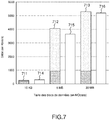
- the figure 7 illustrates the result obtained by implementing the method according to the invention in the frame, taken as an example, of a structure simplified, directly linking MP-TCP, end-to-end (ie without setting up PEP interfaces between the network and the terminals), with optimal parameterization, a transmitting terminal and a receiving terminal.
- bar graphs 711, 712 and 713 indicate the performance, taken as reference, of a TCP connection on a bidirectional link (terrestrial link type) of 1 Mbits / s and in the halftone portions of the same bar graphs a connection on a bidirectional link (satellite type) of 5 Mbps.
- the size of the message is represented.
- the bar graphs 714, 715 and 716 corresponds to a hybrid link implementing the method according to the invention in a hybrid environment MPTCP, with a terrestrial link at 1 Mbps bidirectional and satellite link 5 Mbits / s unidirectional, the asymmetrical routing mechanism of the acknowledgment information according to the invention being activated.
- the graph of the figure 7 allows to note, through this particular example, that the method according to the invention makes it possible to widely mutualize the two resources manage to use the resources of the two systems, and that, since the size of the message is sufficient, typically beyond Beyond 5 megabytes, almost optimal performance is obtained, substantially equivalent to the operation of two bidirectional channels, compared to the available resources.
Landscapes
- Engineering & Computer Science (AREA)
- Signal Processing (AREA)
- Computer Networks & Wireless Communication (AREA)
- Physics & Mathematics (AREA)
- Astronomy & Astrophysics (AREA)
- Aviation & Aerospace Engineering (AREA)
- General Physics & Mathematics (AREA)
- Databases & Information Systems (AREA)
- Data Exchanges In Wide-Area Networks (AREA)
- Radio Relay Systems (AREA)
- Computer Security & Cryptography (AREA)
Applications Claiming Priority (1)
| Application Number | Priority Date | Filing Date | Title |
|---|---|---|---|
| FR1700204A FR3063589B1 (fr) | 2017-03-02 | 2017-03-02 | Solution de transport de donnees hybride notamment pour liaisons par satellite |
Publications (2)
| Publication Number | Publication Date |
|---|---|
| EP3370363A1 true EP3370363A1 (de) | 2018-09-05 |
| EP3370363B1 EP3370363B1 (de) | 2020-12-02 |
Family
ID=59649757
Family Applications (1)
| Application Number | Title | Priority Date | Filing Date |
|---|---|---|---|
| EP18159571.1A Active EP3370363B1 (de) | 2017-03-02 | 2018-03-01 | Hybride datentransportlösung, insbesondere für verbindungen über satellit |
Country Status (4)
| Country | Link |
|---|---|
| US (1) | US10601602B2 (de) |
| EP (1) | EP3370363B1 (de) |
| CA (1) | CA2997246A1 (de) |
| FR (1) | FR3063589B1 (de) |
Families Citing this family (4)
| Publication number | Priority date | Publication date | Assignee | Title |
|---|---|---|---|---|
| JP6573658B2 (ja) | 2014-07-21 | 2019-09-11 | 華為技術有限公司Huawei Technologies Co.,Ltd. | リンク制御ノードおよびリンク制御方法、および通信システム |
| WO2021061157A1 (en) * | 2019-09-27 | 2021-04-01 | Viasat, Inc. | Method and apparatus for distributing network traffic over multiple communication networks |
| US11223574B2 (en) * | 2019-12-27 | 2022-01-11 | Google Llc | Multi-stage switching topology |
| CN116527572A (zh) * | 2023-04-19 | 2023-08-01 | 浙江理工大学 | 基于5g的多路径数据传输系统 |
Citations (1)
| Publication number | Priority date | Publication date | Assignee | Title |
|---|---|---|---|---|
| CN105049369A (zh) * | 2015-08-14 | 2015-11-11 | 浙江大学 | 异构无线网络中基于mptcp的视频传输拥塞控制方法 |
Family Cites Families (4)
| Publication number | Priority date | Publication date | Assignee | Title |
|---|---|---|---|---|
| US8966011B2 (en) * | 2007-12-28 | 2015-02-24 | Echostar Technologies L.L.C. | Performance enhancing proxy |
| US9264353B2 (en) * | 2011-09-22 | 2016-02-16 | Qualcomm Incorporated | Dynamic subflow control for a multipath transport connection in a wireless communication network |
| US9742628B2 (en) * | 2015-03-20 | 2017-08-22 | Alcatel-Lucent Usa Inc. | Cross-layer aware communication of a multipath data flow via a communication network |
| US10498868B2 (en) * | 2017-02-14 | 2019-12-03 | Alcatel Lucent | Multipath transport communications |
-
2017
- 2017-03-02 FR FR1700204A patent/FR3063589B1/fr not_active Expired - Fee Related
-
2018
- 2018-03-01 EP EP18159571.1A patent/EP3370363B1/de active Active
- 2018-03-02 CA CA2997246A patent/CA2997246A1/en active Pending
- 2018-03-02 US US15/910,243 patent/US10601602B2/en active Active
Patent Citations (1)
| Publication number | Priority date | Publication date | Assignee | Title |
|---|---|---|---|---|
| CN105049369A (zh) * | 2015-08-14 | 2015-11-11 | 浙江大学 | 异构无线网络中基于mptcp的视频传输拥塞控制方法 |
Non-Patent Citations (2)
| Title |
|---|
| BALASUBRAMANIAN ANANTHARAMAN ET AL: "Detecting Shared Congested Router for Mobile Communication Using Multiple-Interface Devices", 2015 IEEE GLOBAL COMMUNICATIONS CONFERENCE (GLOBECOM), IEEE, 6 December 2015 (2015-12-06), pages 1 - 6, XP032872615, DOI: 10.1109/GLOCOM.2014.7417478 * |
| CHEN XIAO ET AL: "Performance Guaranteed Routing Protocols for Asymmetric Sensor Networks", IEEE TRANSACTIONS ON EMERGING TOPICS IN COMPUTING, IEEE, vol. 1, no. 1, 1 June 2013 (2013-06-01), pages 111 - 120, XP011527603, DOI: 10.1109/TETC.2013.2273888 * |
Also Published As
| Publication number | Publication date |
|---|---|
| US10601602B2 (en) | 2020-03-24 |
| EP3370363B1 (de) | 2020-12-02 |
| FR3063589A1 (fr) | 2018-09-07 |
| US20180254911A1 (en) | 2018-09-06 |
| FR3063589B1 (fr) | 2021-07-23 |
| CA2997246A1 (en) | 2018-09-02 |
Similar Documents
| Publication | Publication Date | Title |
|---|---|---|
| EP3739843B1 (de) | Udp-kommunikationsverfahren über multiple kommunikationswege zwischen zwei endgeräten | |
| US20060050736A1 (en) | Rural broadband hybrid satellite/terrestrial solution | |
| FR2711468A1 (fr) | Dispositif d'interconnexion entre deux réseaux locaux distants, et procédé d'interconnexion correspondant. | |
| EP3370363B1 (de) | Hybride datentransportlösung, insbesondere für verbindungen über satellit | |
| WO2009077683A1 (fr) | Contrôle de l'interface d'émission d'un message de réponse sip | |
| EP1309131A1 (de) | Verfahren zur Realisierung eines full-duplex switched Ethernet redundanten Kommunikationsnetz | |
| CA2698325A1 (fr) | Methode de transmission de messages acars sur ip | |
| FR2925808A1 (fr) | Procede de communication dans un reseau comprenant un reseau primaire et un reseau secondaire | |
| FR2836315A1 (fr) | Correlation des requetes en qualite de service au sein d'un systeme de controle d'un reseau de donnees | |
| EP2622802A1 (de) | Verfahren zur gewinnung von wegüberlastungsinformationen über einen ersten knoten | |
| EP3361746B1 (de) | System zur verwaltung von mediendatenströmen | |
| EP1432210B1 (de) | System zum Steuern von Prozessen, die zu Datenstromen in einem Kommunikationsnetzwerk zugehören | |
| EP3989494B1 (de) | Verfahren zur aggregation und steuerung von nachrichten über einen eingeschränkten bidirektionalen kommunikationskanal | |
| EP2031809B1 (de) | Verfahren zur Verarbeitung von Datenströmen in einem Kommunikationsnetz | |
| EP2604013B1 (de) | Verfahren und architektur eines systems zur öffnung von kanälen bei der herstellung einer voip-kommunikation im p-bgan--clearmode, swiftbroadband und fleetbroadband | |
| WO2008145901A1 (fr) | Procede et dispositif d'interface entre les protocoles udp ou tcp et sctp | |
| EP2476225B1 (de) | Verfahren und system zur steuerung des leitwegs eines datenstroms von einer dienstklasse über ein verschlüsseltes mesh-netzwerk | |
| EP4595404A1 (de) | Verfahren zur verwaltung von datenverkehr zwischen einer quell- und empfängereinheit sowie entsprechende einheit und computerprogramm | |
| EP4027619A1 (de) | Endpunktsystem für ein avionik-kommunikationssystem und entsprechendes avionik-kommunikationssystem | |
| EP2890026A1 (de) | Kommunikationsverfahren, das über einen Relaisknoten umgesetzt wird | |
| FR2877179A1 (fr) | Procede de transmission d'un flux video dans un reseau de telecommunications mobiles a debit restreint | |
| EP1583286A1 (de) | Verfahren und Vorrichtung für Hochgeschwindigkeitspaketdatenkommunikation | |
| EP3809798A1 (de) | Kommunikationssystem mit einem verbindungsnetz und einer vielzahl von funkstandorten, die über das verbindungsnetz miteinander verbunden sind | |
| EP1367777A1 (de) | Anlage zum Zugriff an Anwendungsservern | |
| FR2904905A1 (fr) | Procedes et systemes d'emission et de reception d'un flux de donnees en fonction de contraintes de qualite de service |
Legal Events
| Date | Code | Title | Description |
|---|---|---|---|
| PUAI | Public reference made under article 153(3) epc to a published international application that has entered the european phase |
Free format text: ORIGINAL CODE: 0009012 |
|
| STAA | Information on the status of an ep patent application or granted ep patent |
Free format text: STATUS: THE APPLICATION HAS BEEN PUBLISHED |
|
| AK | Designated contracting states |
Kind code of ref document: A1 Designated state(s): AL AT BE BG CH CY CZ DE DK EE ES FI FR GB GR HR HU IE IS IT LI LT LU LV MC MK MT NL NO PL PT RO RS SE SI SK SM TR |
|
| AX | Request for extension of the european patent |
Extension state: BA ME |
|
| STAA | Information on the status of an ep patent application or granted ep patent |
Free format text: STATUS: REQUEST FOR EXAMINATION WAS MADE |
|
| 17P | Request for examination filed |
Effective date: 20190304 |
|
| RBV | Designated contracting states (corrected) |
Designated state(s): AL AT BE BG CH CY CZ DE DK EE ES FI FR GB GR HR HU IE IS IT LI LT LU LV MC MK MT NL NO PL PT RO RS SE SI SK SM TR |
|
| RIC1 | Information provided on ipc code assigned before grant |
Ipc: H04W 72/00 20090101ALI20200518BHEP Ipc: H04L 29/06 20060101ALI20200518BHEP Ipc: H04L 12/707 20130101ALI20200518BHEP Ipc: H04L 29/12 20060101ALI20200518BHEP Ipc: H04W 8/26 20090101ALI20200518BHEP Ipc: H04L 29/08 20060101ALI20200518BHEP Ipc: H04W 92/00 20090101ALI20200518BHEP Ipc: H04L 1/18 20060101AFI20200518BHEP Ipc: H04L 12/801 20130101ALI20200518BHEP Ipc: H04L 12/803 20130101ALI20200518BHEP Ipc: H04B 7/185 20060101ALI20200518BHEP Ipc: H04L 1/16 20060101ALI20200518BHEP Ipc: H04L 5/00 20060101ALI20200518BHEP |
|
| GRAP | Despatch of communication of intention to grant a patent |
Free format text: ORIGINAL CODE: EPIDOSNIGR1 |
|
| STAA | Information on the status of an ep patent application or granted ep patent |
Free format text: STATUS: GRANT OF PATENT IS INTENDED |
|
| INTG | Intention to grant announced |
Effective date: 20200706 |
|
| GRAS | Grant fee paid |
Free format text: ORIGINAL CODE: EPIDOSNIGR3 |
|
| GRAA | (expected) grant |
Free format text: ORIGINAL CODE: 0009210 |
|
| STAA | Information on the status of an ep patent application or granted ep patent |
Free format text: STATUS: THE PATENT HAS BEEN GRANTED |
|
| AK | Designated contracting states |
Kind code of ref document: B1 Designated state(s): AL AT BE BG CH CY CZ DE DK EE ES FI FR GB GR HR HU IE IS IT LI LT LU LV MC MK MT NL NO PL PT RO RS SE SI SK SM TR |
|
| REG | Reference to a national code |
Ref country code: GB Ref legal event code: FG4D Free format text: NOT ENGLISH |
|
| REG | Reference to a national code |
Ref country code: AT Ref legal event code: REF Ref document number: 1342097 Country of ref document: AT Kind code of ref document: T Effective date: 20201215 Ref country code: CH Ref legal event code: EP |
|
| REG | Reference to a national code |
Ref country code: IE Ref legal event code: FG4D Free format text: LANGUAGE OF EP DOCUMENT: FRENCH |
|
| REG | Reference to a national code |
Ref country code: DE Ref legal event code: R096 Ref document number: 602018010231 Country of ref document: DE |
|
| PG25 | Lapsed in a contracting state [announced via postgrant information from national office to epo] |
Ref country code: GR Free format text: LAPSE BECAUSE OF FAILURE TO SUBMIT A TRANSLATION OF THE DESCRIPTION OR TO PAY THE FEE WITHIN THE PRESCRIBED TIME-LIMIT Effective date: 20210303 Ref country code: NO Free format text: LAPSE BECAUSE OF FAILURE TO SUBMIT A TRANSLATION OF THE DESCRIPTION OR TO PAY THE FEE WITHIN THE PRESCRIBED TIME-LIMIT Effective date: 20210302 Ref country code: FI Free format text: LAPSE BECAUSE OF FAILURE TO SUBMIT A TRANSLATION OF THE DESCRIPTION OR TO PAY THE FEE WITHIN THE PRESCRIBED TIME-LIMIT Effective date: 20201202 Ref country code: RS Free format text: LAPSE BECAUSE OF FAILURE TO SUBMIT A TRANSLATION OF THE DESCRIPTION OR TO PAY THE FEE WITHIN THE PRESCRIBED TIME-LIMIT Effective date: 20201202 |
|
| REG | Reference to a national code |
Ref country code: NL Ref legal event code: MP Effective date: 20201202 |
|
| REG | Reference to a national code |
Ref country code: AT Ref legal event code: MK05 Ref document number: 1342097 Country of ref document: AT Kind code of ref document: T Effective date: 20201202 |
|
| PG25 | Lapsed in a contracting state [announced via postgrant information from national office to epo] |
Ref country code: BG Free format text: LAPSE BECAUSE OF FAILURE TO SUBMIT A TRANSLATION OF THE DESCRIPTION OR TO PAY THE FEE WITHIN THE PRESCRIBED TIME-LIMIT Effective date: 20210302 Ref country code: SE Free format text: LAPSE BECAUSE OF FAILURE TO SUBMIT A TRANSLATION OF THE DESCRIPTION OR TO PAY THE FEE WITHIN THE PRESCRIBED TIME-LIMIT Effective date: 20201202 Ref country code: LV Free format text: LAPSE BECAUSE OF FAILURE TO SUBMIT A TRANSLATION OF THE DESCRIPTION OR TO PAY THE FEE WITHIN THE PRESCRIBED TIME-LIMIT Effective date: 20201202 Ref country code: PL Free format text: LAPSE BECAUSE OF FAILURE TO SUBMIT A TRANSLATION OF THE DESCRIPTION OR TO PAY THE FEE WITHIN THE PRESCRIBED TIME-LIMIT Effective date: 20201202 |
|
| PG25 | Lapsed in a contracting state [announced via postgrant information from national office to epo] |
Ref country code: NL Free format text: LAPSE BECAUSE OF FAILURE TO SUBMIT A TRANSLATION OF THE DESCRIPTION OR TO PAY THE FEE WITHIN THE PRESCRIBED TIME-LIMIT Effective date: 20201202 Ref country code: HR Free format text: LAPSE BECAUSE OF FAILURE TO SUBMIT A TRANSLATION OF THE DESCRIPTION OR TO PAY THE FEE WITHIN THE PRESCRIBED TIME-LIMIT Effective date: 20201202 |
|
| REG | Reference to a national code |
Ref country code: LT Ref legal event code: MG9D |
|
| PG25 | Lapsed in a contracting state [announced via postgrant information from national office to epo] |
Ref country code: CZ Free format text: LAPSE BECAUSE OF FAILURE TO SUBMIT A TRANSLATION OF THE DESCRIPTION OR TO PAY THE FEE WITHIN THE PRESCRIBED TIME-LIMIT Effective date: 20201202 Ref country code: EE Free format text: LAPSE BECAUSE OF FAILURE TO SUBMIT A TRANSLATION OF THE DESCRIPTION OR TO PAY THE FEE WITHIN THE PRESCRIBED TIME-LIMIT Effective date: 20201202 Ref country code: LT Free format text: LAPSE BECAUSE OF FAILURE TO SUBMIT A TRANSLATION OF THE DESCRIPTION OR TO PAY THE FEE WITHIN THE PRESCRIBED TIME-LIMIT Effective date: 20201202 Ref country code: SM Free format text: LAPSE BECAUSE OF FAILURE TO SUBMIT A TRANSLATION OF THE DESCRIPTION OR TO PAY THE FEE WITHIN THE PRESCRIBED TIME-LIMIT Effective date: 20201202 Ref country code: PT Free format text: LAPSE BECAUSE OF FAILURE TO SUBMIT A TRANSLATION OF THE DESCRIPTION OR TO PAY THE FEE WITHIN THE PRESCRIBED TIME-LIMIT Effective date: 20210405 Ref country code: SK Free format text: LAPSE BECAUSE OF FAILURE TO SUBMIT A TRANSLATION OF THE DESCRIPTION OR TO PAY THE FEE WITHIN THE PRESCRIBED TIME-LIMIT Effective date: 20201202 Ref country code: RO Free format text: LAPSE BECAUSE OF FAILURE TO SUBMIT A TRANSLATION OF THE DESCRIPTION OR TO PAY THE FEE WITHIN THE PRESCRIBED TIME-LIMIT Effective date: 20201202 |
|
| PG25 | Lapsed in a contracting state [announced via postgrant information from national office to epo] |
Ref country code: AT Free format text: LAPSE BECAUSE OF FAILURE TO SUBMIT A TRANSLATION OF THE DESCRIPTION OR TO PAY THE FEE WITHIN THE PRESCRIBED TIME-LIMIT Effective date: 20201202 |
|
| REG | Reference to a national code |
Ref country code: DE Ref legal event code: R097 Ref document number: 602018010231 Country of ref document: DE |
|
| PG25 | Lapsed in a contracting state [announced via postgrant information from national office to epo] |
Ref country code: IS Free format text: LAPSE BECAUSE OF FAILURE TO SUBMIT A TRANSLATION OF THE DESCRIPTION OR TO PAY THE FEE WITHIN THE PRESCRIBED TIME-LIMIT Effective date: 20210402 |
|
| PLBE | No opposition filed within time limit |
Free format text: ORIGINAL CODE: 0009261 |
|
| STAA | Information on the status of an ep patent application or granted ep patent |
Free format text: STATUS: NO OPPOSITION FILED WITHIN TIME LIMIT |
|
| PG25 | Lapsed in a contracting state [announced via postgrant information from national office to epo] |
Ref country code: AL Free format text: LAPSE BECAUSE OF FAILURE TO SUBMIT A TRANSLATION OF THE DESCRIPTION OR TO PAY THE FEE WITHIN THE PRESCRIBED TIME-LIMIT Effective date: 20201202 Ref country code: IT Free format text: LAPSE BECAUSE OF FAILURE TO SUBMIT A TRANSLATION OF THE DESCRIPTION OR TO PAY THE FEE WITHIN THE PRESCRIBED TIME-LIMIT Effective date: 20201202 Ref country code: MC Free format text: LAPSE BECAUSE OF FAILURE TO SUBMIT A TRANSLATION OF THE DESCRIPTION OR TO PAY THE FEE WITHIN THE PRESCRIBED TIME-LIMIT Effective date: 20201202 |
|
| REG | Reference to a national code |
Ref country code: CH Ref legal event code: PL |
|
| 26N | No opposition filed |
Effective date: 20210903 |
|
| PG25 | Lapsed in a contracting state [announced via postgrant information from national office to epo] |
Ref country code: DK Free format text: LAPSE BECAUSE OF FAILURE TO SUBMIT A TRANSLATION OF THE DESCRIPTION OR TO PAY THE FEE WITHIN THE PRESCRIBED TIME-LIMIT Effective date: 20201202 Ref country code: SI Free format text: LAPSE BECAUSE OF FAILURE TO SUBMIT A TRANSLATION OF THE DESCRIPTION OR TO PAY THE FEE WITHIN THE PRESCRIBED TIME-LIMIT Effective date: 20201202 |
|
| REG | Reference to a national code |
Ref country code: BE Ref legal event code: MM Effective date: 20210331 |
|
| PG25 | Lapsed in a contracting state [announced via postgrant information from national office to epo] |
Ref country code: ES Free format text: LAPSE BECAUSE OF FAILURE TO SUBMIT A TRANSLATION OF THE DESCRIPTION OR TO PAY THE FEE WITHIN THE PRESCRIBED TIME-LIMIT Effective date: 20201202 Ref country code: IE Free format text: LAPSE BECAUSE OF NON-PAYMENT OF DUE FEES Effective date: 20210301 Ref country code: LI Free format text: LAPSE BECAUSE OF NON-PAYMENT OF DUE FEES Effective date: 20210331 Ref country code: CH Free format text: LAPSE BECAUSE OF NON-PAYMENT OF DUE FEES Effective date: 20210331 |
|
| PG25 | Lapsed in a contracting state [announced via postgrant information from national office to epo] |
Ref country code: IS Free format text: LAPSE BECAUSE OF FAILURE TO SUBMIT A TRANSLATION OF THE DESCRIPTION OR TO PAY THE FEE WITHIN THE PRESCRIBED TIME-LIMIT Effective date: 20210402 |
|
| PG25 | Lapsed in a contracting state [announced via postgrant information from national office to epo] |
Ref country code: BE Free format text: LAPSE BECAUSE OF NON-PAYMENT OF DUE FEES Effective date: 20210331 |
|
| PG25 | Lapsed in a contracting state [announced via postgrant information from national office to epo] |
Ref country code: CY Free format text: LAPSE BECAUSE OF FAILURE TO SUBMIT A TRANSLATION OF THE DESCRIPTION OR TO PAY THE FEE WITHIN THE PRESCRIBED TIME-LIMIT Effective date: 20201202 |
|
| PG25 | Lapsed in a contracting state [announced via postgrant information from national office to epo] |
Ref country code: HU Free format text: LAPSE BECAUSE OF FAILURE TO SUBMIT A TRANSLATION OF THE DESCRIPTION OR TO PAY THE FEE WITHIN THE PRESCRIBED TIME-LIMIT; INVALID AB INITIO Effective date: 20180301 |
|
| PG25 | Lapsed in a contracting state [announced via postgrant information from national office to epo] |
Ref country code: MK Free format text: LAPSE BECAUSE OF FAILURE TO SUBMIT A TRANSLATION OF THE DESCRIPTION OR TO PAY THE FEE WITHIN THE PRESCRIBED TIME-LIMIT Effective date: 20201202 |
|
| PG25 | Lapsed in a contracting state [announced via postgrant information from national office to epo] |
Ref country code: MT Free format text: LAPSE BECAUSE OF FAILURE TO SUBMIT A TRANSLATION OF THE DESCRIPTION OR TO PAY THE FEE WITHIN THE PRESCRIBED TIME-LIMIT Effective date: 20201202 |
|
| PG25 | Lapsed in a contracting state [announced via postgrant information from national office to epo] |
Ref country code: TR Free format text: LAPSE BECAUSE OF FAILURE TO SUBMIT A TRANSLATION OF THE DESCRIPTION OR TO PAY THE FEE WITHIN THE PRESCRIBED TIME-LIMIT Effective date: 20201202 |
|
| PGFP | Annual fee paid to national office [announced via postgrant information from national office to epo] |
Ref country code: LU Payment date: 20260227 Year of fee payment: 9 |
|
| PGFP | Annual fee paid to national office [announced via postgrant information from national office to epo] |
Ref country code: GB Payment date: 20260223 Year of fee payment: 9 |
|
| PGFP | Annual fee paid to national office [announced via postgrant information from national office to epo] |
Ref country code: DE Payment date: 20260218 Year of fee payment: 9 |
|
| PGFP | Annual fee paid to national office [announced via postgrant information from national office to epo] |
Ref country code: FR Payment date: 20260223 Year of fee payment: 9 |