EP3370882B1 - Zyklonsystem - Google Patents
Zyklonsystem Download PDFInfo
- Publication number
- EP3370882B1 EP3370882B1 EP16810230.9A EP16810230A EP3370882B1 EP 3370882 B1 EP3370882 B1 EP 3370882B1 EP 16810230 A EP16810230 A EP 16810230A EP 3370882 B1 EP3370882 B1 EP 3370882B1
- Authority
- EP
- European Patent Office
- Prior art keywords
- cyclone
- cone
- wall
- flow
- cyclone system
- Prior art date
- Legal status (The legal status is an assumption and is not a legal conclusion. Google has not performed a legal analysis and makes no representation as to the accuracy of the status listed.)
- Active
Links
Images



Classifications
-
- B—PERFORMING OPERATIONS; TRANSPORTING
- B04—CENTRIFUGAL APPARATUS OR MACHINES FOR CARRYING-OUT PHYSICAL OR CHEMICAL PROCESSES
- B04C—APPARATUS USING FREE VORTEX FLOW, e.g. CYCLONES
- B04C5/00—Apparatus in which the axial direction of the vortex is reversed
- B04C5/08—Vortex chamber constructions
- B04C5/081—Shapes or dimensions
-
- B—PERFORMING OPERATIONS; TRANSPORTING
- B04—CENTRIFUGAL APPARATUS OR MACHINES FOR CARRYING-OUT PHYSICAL OR CHEMICAL PROCESSES
- B04C—APPARATUS USING FREE VORTEX FLOW, e.g. CYCLONES
- B04C5/00—Apparatus in which the axial direction of the vortex is reversed
- B04C5/02—Construction of inlets by which the vortex flow is generated, e.g. tangential admission, the fluid flow being forced to follow a downward path by spirally wound bulkheads, or with slightly downwardly-directed tangential admission
- B04C5/04—Tangential inlets
-
- B—PERFORMING OPERATIONS; TRANSPORTING
- B04—CENTRIFUGAL APPARATUS OR MACHINES FOR CARRYING-OUT PHYSICAL OR CHEMICAL PROCESSES
- B04C—APPARATUS USING FREE VORTEX FLOW, e.g. CYCLONES
- B04C5/00—Apparatus in which the axial direction of the vortex is reversed
- B04C5/14—Construction of the underflow ducting; Apex constructions; Discharge arrangements ; discharge through sidewall provided with a few slits or perforations
-
- B—PERFORMING OPERATIONS; TRANSPORTING
- B04—CENTRIFUGAL APPARATUS OR MACHINES FOR CARRYING-OUT PHYSICAL OR CHEMICAL PROCESSES
- B04C—APPARATUS USING FREE VORTEX FLOW, e.g. CYCLONES
- B04C5/00—Apparatus in which the axial direction of the vortex is reversed
- B04C5/14—Construction of the underflow ducting; Apex constructions; Discharge arrangements ; discharge through sidewall provided with a few slits or perforations
- B04C5/15—Construction of the underflow ducting; Apex constructions; Discharge arrangements ; discharge through sidewall provided with a few slits or perforations with swinging flaps or revolving sluices; Sluices; Check-valves
-
- B—PERFORMING OPERATIONS; TRANSPORTING
- B04—CENTRIFUGAL APPARATUS OR MACHINES FOR CARRYING-OUT PHYSICAL OR CHEMICAL PROCESSES
- B04C—APPARATUS USING FREE VORTEX FLOW, e.g. CYCLONES
- B04C5/00—Apparatus in which the axial direction of the vortex is reversed
- B04C5/14—Construction of the underflow ducting; Apex constructions; Discharge arrangements ; discharge through sidewall provided with a few slits or perforations
- B04C5/18—Construction of the underflow ducting; Apex constructions; Discharge arrangements ; discharge through sidewall provided with a few slits or perforations with auxiliary fluid assisting discharge
-
- B—PERFORMING OPERATIONS; TRANSPORTING
- B04—CENTRIFUGAL APPARATUS OR MACHINES FOR CARRYING-OUT PHYSICAL OR CHEMICAL PROCESSES
- B04C—APPARATUS USING FREE VORTEX FLOW, e.g. CYCLONES
- B04C5/00—Apparatus in which the axial direction of the vortex is reversed
- B04C5/14—Construction of the underflow ducting; Apex constructions; Discharge arrangements ; discharge through sidewall provided with a few slits or perforations
- B04C5/185—Dust collectors
-
- B—PERFORMING OPERATIONS; TRANSPORTING
- B04—CENTRIFUGAL APPARATUS OR MACHINES FOR CARRYING-OUT PHYSICAL OR CHEMICAL PROCESSES
- B04C—APPARATUS USING FREE VORTEX FLOW, e.g. CYCLONES
- B04C5/00—Apparatus in which the axial direction of the vortex is reversed
- B04C5/24—Multiple arrangement thereof
- B04C5/26—Multiple arrangement thereof for series flow
-
- D—TEXTILES; PAPER
- D21—PAPER-MAKING; PRODUCTION OF CELLULOSE
- D21B—FIBROUS RAW MATERIALS OR THEIR MECHANICAL TREATMENT
- D21B1/00—Fibrous raw materials or their mechanical treatment
- D21B1/04—Fibrous raw materials or their mechanical treatment by dividing raw materials into small particles, e.g. fibres
- D21B1/12—Fibrous raw materials or their mechanical treatment by dividing raw materials into small particles, e.g. fibres by wet methods, by the use of steam
- D21B1/30—Defibrating by other means
- D21B1/34—Kneading or mixing; Pulpers
-
- D—TEXTILES; PAPER
- D21—PAPER-MAKING; PRODUCTION OF CELLULOSE
- D21D—TREATMENT OF THE MATERIALS BEFORE PASSING TO THE PAPER-MAKING MACHINE
- D21D5/00—Purification of the pulp suspension by mechanical means; Apparatus therefor
- D21D5/18—Purification of the pulp suspension by mechanical means; Apparatus therefor with the aid of centrifugal force
- D21D5/24—Purification of the pulp suspension by mechanical means; Apparatus therefor with the aid of centrifugal force in cyclones
-
- B—PERFORMING OPERATIONS; TRANSPORTING
- B04—CENTRIFUGAL APPARATUS OR MACHINES FOR CARRYING-OUT PHYSICAL OR CHEMICAL PROCESSES
- B04C—APPARATUS USING FREE VORTEX FLOW, e.g. CYCLONES
- B04C9/00—Combinations with other devices, e.g. fans, expansion chambers, diffusors, water locks
- B04C2009/008—Combinations with other devices, e.g. fans, expansion chambers, diffusors, water locks with injection or suction of gas or liquid into the cyclone
Definitions
- the invention relates to a cyclone system.
- the invention relates to a rotary separator.
- Such systems are from the WO 2016/023536 A2 known.
- the invention relates to a cyclone as described there.
- a hydrocyclone with a particularly long lower cone is from the U.S. 3,612,276 A known.
- the use of a porous material in the cone describes the DE 10 92 886 B .
- the conditioner Before treating the particles in the cyclone, it is advantageous to treat them in a conditioner. Particles mixed with liquid, which are frayed in the conditioner, are particularly relevant here.
- the conditioner is then used for intensive blending and the friction of the particles against one another causes fiberization.
- the effectiveness of the conditioner and, in particular, the energy consumption required for the defibering depend heavily on the design of the conditioner.
- the particles washed out in the lower reaches of a conditioner can be further treated in a preferably single-stage or multi-stage hydrocyclone in order to separate out in particular sand-like particles.
- a hydrocyclone is simple in construction, leads to good efficiency and requires little energy.
- aluminum particles can also be discharged in such a hydrocyclone. Fibers that accumulate in the cyclone can either be separated in a disc filter or thickener or returned to the processor in the area of the upper reaches.
- a multi-stage wash can follow, which begins with a highly enriched wash water and ends with quasi fresh water.
- the DE 10 92 886 B describes a cyclone, the lower end of which is made of a porous material and is surrounded by a cylinder filled with water. This brings about an even supply of water on the inside of the porous material.
- the porous material causes an undirected, strongly damped water supply, which extends evenly over the entire conical area of the porous material.
- the invention is based on the object of improving the selectivity of a cyclone system. This is achieved by a cyclone system with the features of patent claim 1 and a method with the features of patent claim 8.
- the fractions be separated from the mixture in a liquid that is lighter or heavier than water. This can be achieved, for example, by adding salt or alcohol to the water.
- hydrophobic liquids such as oils can also be used.
- materials with a density greater than 1 g / cm 3 are deposited in the hydrocyclone.
- this can be influenced by special flow conditions.
- a liquid such as in particular water can be fed in at the lower end of the hydrocyclone in a tapering collecting cone or a discharge cone in order to achieve a countercurrent.
- the liquid is preferably supplied via nozzles or inflow openings. These can be distributed on the circumference in one or more levels.
- the inflow should be dimensioned in such a way that a laminar flow favors the separation.
- a cyclone system is created from several cyclones connected in series.
- the cyclones are preferably designed as cyclones in which a widening exit cone is connected to the central outlet.
- a batch fraction is treated first in a first cyclone and then in a second cyclone, with more liquid being supplied in countercurrent in the first cyclone to increase the selectivity than in the second cyclone.
- a high degree of selectivity can be achieved by means of a large amount of liquid fed in countercurrent, while the amount of liquid fed in can be reduced in the subsequent cyclone or in the subsequent cyclones.
- a regulation enables material, preferably as a pasty material, to be continuously removed from at least the first cyclone on the discharge cone.
- a discharge valve is only opened so far that a sediment of discharge material remains in the cyclone and the discharge is carried out continuously according to the input.
- sensors can determine the height of the sediment in the discharge in order to control the opening of the valve via a control device.
- the Figure 1 shows the integration of a conditioner 1 in a device with a large hydrocyclone 2.
- This hydrocyclone 2 has an inlet cone 3 and a head area 4. In the head area, a tangential inlet 5 and a central outlet 6 are provided.
- the inlet cone 3 can extend up to the head area 4, so that the head area is also conical. In an alternative embodiment, the inlet cone 3 can also be cylindrical.
- the conditioner 1 has a screw 13 in its upper area 12 and a sieve 14 underneath, which separates the upper area 12 from an underflow 15.
- the screw 13 is preferably designed as a spiral which only touches the screen plate directly above the screen 14 and drives the material radially outward.
- a screw leading to the spiral is preferably dispensed with in order to avoid the entry of air into the lower area of the conditioner and to facilitate the discharge of air in the conditioner.
- the substance mixture 16 treated in the conditioner 1 is discharged with a discharge screw 17 and conveyed to a buffer 18, which can hold a larger amount of the substance mixture in order to feed it to a collector 19 as required, from where the material is conveyed to the decentralized inlet 5 of the hydrocyclone 2 via a centrifugal pump 20.
- the collector 21 serves to dilute the circulated material with water 22 and then add it to the centrifugal pump 20 in liquid form.
- the collector 21 can therefore be designed as a screw conveyor to which liquid is added in order to achieve a consistency that can be conveyed via the centrifugal pump 20.
- discharge helix or discharge screw 17 and buffer 19 instead of discharge helix or discharge screw 17 and buffer 19, a particularly large discharge helix can be provided, which on the one hand makes it possible to withdraw material from the overflow of conditioner 1 and on the other hand to store as much material as possible, which is then gradually liquefied and the centrifugal pump 20 is added.
- the material first migrates in a spiral shape up to the constriction 7 and from there further into the exit cone 8, where a material fraction is removed via the lock 10. The remaining material migrates in a spiral shape in the exit cone 8 back up into the entrance cone 3 and via the central outlet 6 back to the conditioner 1.
- Feed openings 23 in the lower region 8 of the cyclone 2 allow water or another liquid to be fed in, in order to facilitate the separation of the material in the cyclone by means of a radial flow component directed from the outside to the inside.
- the feed openings can be designed as nozzles which allow a liquid to enter the cyclone in a defined flow direction.
- the main flow passes in an arc into the line 25 and from there to the circulation pump 26.
- This circulation pump 26 thus conveys from the central outlet 6 of the cyclone 2 to the tangential inlet 5 of the cyclone 2.
- the circuit between the hydrocyclone 2, the conditioner 1 and the centrifugal pump 20 makes it possible to treat the mixture 16 over a longer period of time and to remove different fractions from the circuit at the discharge opening 11.
- the sliding gate 18 is moved and the light material, such as in particular polyolefins such as polyethylene and polypropylene, is discharged.
- the light material such as in particular polyolefins such as polyethylene and polypropylene
- plastic materials can be separated in the hydrocyclone 2 simply by choosing the liquid 22.
- the plastics can be separated in a further cyclone which contains a liquid that is lighter or heavier than water.
- New material 28 is added as a mixture of substances either upstream of the centrifugal pump 20 to the collector 21 or at another point, for example at the buffer 19.
- the underflow 15 of the conditioner 1 is fed via a pump 29 to a small cyclone 30, where sand or, for example, aluminum 31 is separated and discharged, while a suspension 32 cleaned of coarse grain is fed to a second small cyclone 33, in which fine grain 34 sinks and is discharged, while cleaned pulp 35 is discharged via the overflow and fed to a filter 36.
- a small cyclone 30 where sand or, for example, aluminum 31 is separated and discharged, while a suspension 32 cleaned of coarse grain is fed to a second small cyclone 33, in which fine grain 34 sinks and is discharged, while cleaned pulp 35 is discharged via the overflow and fed to a filter 36.
- the fibrous materials are separated off, while the liquid reaches the collector 21 via the line 37 and from there to the centrifugal pump 20.
- the Figure 8 shows the use of two large cyclones connected in series.
- a small cyclone has a maximum diameter of less than 0.5 m and an inlet diameter of less than 100 mm, while a large cyclone has a maximum diameter of more than 0.7 m and a diameter at the inlet of more than 150 mm.
- the arrangement corresponds to that in Figure 1 described and it is different first a cyclone 2 and then a cyclone 2 'run through.
- cyclones are preferably connected in series.
- the material 40 to be treated enters the first cyclone 42 via the tangential inlet 41. In this, the flow separates the material into a suspension 43 and coarse grain 44, which has been cleaned of coarse grain and which can be removed from the first cyclone 42 through the discharge 45.
- a collecting container 46 at the lower end of the cyclone 42, which is delimited at the top and bottom by a slide 47 and 48, respectively.
- the openings 49 and 50 in the collecting container 46 are used for supplying and removing filling water and for venting.
- An opening 51 above the slide 47 and in the lower area of the cyclone 42 is used to supply countercurrent water to the cyclone 42 in the lower area.
- the cyclone 42 consists of an upper part 52 which is conical or cylindrical and a constriction 53 under which a conical cyclone element widens downwards.
- the second cyclone 55 is connected downstream of the first cyclone 42 and the suspension 43, which has been cleaned of coarse grain, on the upper reaches of the first cyclone 42 is fed to the tangential inlet 56 of the second cyclone 55.
- This second cyclone 55 is constructed like the first cyclone 42 and it is used to separate the fine grain 57 from the suspension 57 which has been cleaned of coarse grain and which is removed from the second cyclone 55 at the discharge 58. Coarse grain and fine grain are removed from the upper reaches of the second cyclone 55 Suspension 59 taken from the second cyclone 55.
- countercurrent water 60 supports the separation in the cyclone and sliders 61 and 62 delimit a collecting container 63 on which openings 64 and 65 are provided for ventilation and for filling water.
- the Figure 3 shows how coarse grain 70, fine grain 71 and fibrous material 72 are fed in at the tangential inlet 41.
- This pulp suspension 70, 71, 72 contaminated with coarse grain and fine grain is conveyed tangentially into the first cyclone 42 by means of a pump 29.
- a downwardly directed vortex 73 which is referred to as the primary vortex, is formed in the cyclone 42.
- This primary vortex initially pulls pulp, coarse grain and fine grain down.
- the particles with a higher specific gravity than that of the liquid are coarse grain 70 and fine grain 71 in the present case. These particles are pressed outwardly from the primary vortex 73 by the high centrifugal force and sink down at the edge of the cone 52.
- the Figure 5 shows that the sinking of the lighter fine grain 71 is prevented from sinking by countercurrent water 51, which is supplied from below, and is initially held in suspension in cone 54.
- the lighter fine grain 71 then gets into the upward vortex 74 and is transported together with the fibrous material 72 via the upper reaches into the second cyclone 55.
- the heavier coarse grain 70 is not stopped by the countercurrent water 51 and continues to sink. This creates a pure coarse grain fraction 44 in the first cyclone 42, which can be drawn off in pasty form via the collecting container 46.
- the result of the fractionation can thus be determined by the amount of countercurrent water 51.
- the Figure 7 shows the separation in the second cyclone 55, at the tangential inlet 56 of which the pulp suspension made of pulp 72 and fine grain 71 is fed from the coarse grain.
- the pulp 72 and fine grain 71 form a primary vortex 76 in the upper part 75 of the second cyclone 55, and fine grain 71 is pushed outward out of the primary vortex 76 and sinks downwards at the edge of the cone 75.
- the cleaned fibrous material 72 is discharged with the secondary vortex 77 via the upper course 78.
- the fine grain 71 sinks in the second cyclone 55, so that a fine grain fraction arises in the lower region 79 of the second cyclone 55, which can be drawn off as a pasty fine grain fraction 80 via the collecting container 63.
- no countercurrent water is generally used in the second cyclone 55.
- the upper part of the cyclone can have a cylindrical area or even be completely cylindrical up to the constriction.
- this cylindrical area as a tube in the upper area of the cyclone could be shorter than the conical area below the constriction.
- the Figure 9 shows a hydrocyclone 90 which can be used as a small and in particular also as a large cyclone.
- the liquid to be treated enters the cyclone tangentially and migrates in a spiral shape on the conical wall 92, which can also be cylindrical, up to a point 93, after which an exit cone 94 adjoins.
- the small angle 95 of the wall 92 of 6 to 7 ° with respect to the central axis 96 ensures a sufficiently laminar flow in the outlet cone.
- the outer wall 98 has two inlets 100, 101 for water or gas and the inner wall 102 has an upper region 108 above the inlets 100 and 101 with a large number of feed openings 104. Since the feed openings are bores in the inner wall 103 which are perpendicular are bored into the wall, a feed flow 105 arises at a lift angle 106 of more than 0 ° and preferably less than 20 ° relative to a normal 107 of the central axis 96.
- the bores of the feed openings 104 have a diameter of 2 to 6 mm and preferably of about 4 mm.
- the inlets 100 and 101 lead to a flow which impacts against the opposite outer side of the inner wall 103 and is distributed between the inner wall 103 and the outer wall 98. This creates an overpressure between the walls, which ensures that a uniform and evenly distributed flow reaches the cyclone through the large number of feed openings 104, which flows slightly upwards to give the particles in the cyclone an upward impulse. This increases the effect that the light particles flow upwards while the heavier particles sink downwards.
Landscapes
- Engineering & Computer Science (AREA)
- Mechanical Engineering (AREA)
- Physics & Mathematics (AREA)
- Geometry (AREA)
- Life Sciences & Earth Sciences (AREA)
- Wood Science & Technology (AREA)
- Fluid Mechanics (AREA)
- Cyclones (AREA)
Description
- Die Erfindung betrifft ein Zyklonsystem. Allgemein betrifft die Erfindung einen Rotationsabscheider.
- Derartige Anlagen sind aus der
WO 2016/023536 A2 bekannt. Insbesondere betrifft die Erfindung einen Zyklon, wie er dort beschrieben ist. - Ein Hydrozyklon mit einem besonders langen unteren Konus ist aus der
US 3 612 276 A bekannt. Die Verwendung eines porösen Materials im Konus beschreibt dieDE 10 92 886 B . - Vor der Behandlung der Partikel im Zyklon ist es vorteilhaft, sie in einem Aufbereiter zu behandeln. Hierbei sind vor allem mit Flüssigkeit versetzte Partikel relevant, die im Aufbereiter zerfasert werden. Der Aufbereiter dient dann der intensiven Vermengung und die Reibung der Partikel aneinander bewirkt eine Zerfaserung. Die Effektivität des Aufbereiters und insbesondere die für die Zerfaserung notwendige Energieaufnahme hängen stark von der Gestaltung des Aufbereiters ab.
- Die im Unterlauf eines Aufbereiters ausgeschwemmten Partikel können in einem vorzugsweise einstufigen oder mehrstufigen Hydrozyklon weiter behandelt werden, um insbesondere sandartige Partikel auszuscheiden. Ein derartiger Hydrozyklon ist einfach im Aufbau, führt zu einem guten Wirkungsgrad und benötigt wenig Energie. Je nach Einsatz der Chemikalien können in einem derartigen Hydrozyklon auch Aluminiumpartikel ausgeschleust werden. Im Zyklon anfallende Fasern können entweder in einem Scheibenfilter oder Eindicker ausgeschieden werden oder in den Aufbereiter im Bereich des Oberlaufs wieder zurückgeführt werden.
- Nach Abschluss eines derartigen Trennprozesses kann eine mehrstufige Wäsche folgen, die mit einem hochangereichten Waschwasser beginnt und mit quasi Frischwasser endet.
- Die
DE 10 92 886 B beschreibt einen Zyklon, dessen unteres Ende aus einem porösen Material hergestellt ist und von einem mit Wasser gefüllten Zylinder umgeben ist. Dadurch wird an der Innenseite des porösen Materials eine gleichmäßige Wasserzufuhr bewirkt. Das poröse Material bewirkt aber eine ungerichtete, stark gedämpfte Wasserzufuhr, die sich gleichmäßig über den gesamten konischen Bereich des porösen Materials erstreckt. - Der Erfindung liegt die Aufgabe zu Grunde, die Trennschärfe eines Zyklonsystems zu verbessern. Dies wird durch ein Zyklonsystem mit den Merkmalen des Patentanspruchs 1 und ein Verfahren mit den Merkmalen des Patentanspruchs 8 gelöst.
- Um im Aufbereiter und/oder im Zyklon das Gemenge leichter trennen zu können, wird ferner vorgeschlagen, dass das Trennen der Fraktionen vom Gemenge in einer Flüssigkeit durchgeführt wird, die leichter oder schwerer als Wasser ist. Das kann beispielsweise durch eine Zugabe von Salz oder Alkohol zum Wasser erreicht werden. Es können aber auch hydrophobe Flüssigkeiten wie beispielsweise Öle verwendet werden.
- Im Hydrozyklon werden in der Regel Materialien mit einer Dichte größer 1g/cm3 abgeschieden. Das kann aber durch spezielle Strömungsverhältnisse beeinflusst werden. Dafür kann am unteren Ende des Hydrozyklons in einem sich verjüngenden Sammelkonus oder einem Austragskonus eine Flüssigkeit wie insbesondere Wasser zugeführt werden, um eine Gegenströmung zu erzielen. Bevorzugt wird die Flüssigkeit über Düsen oder Zuströmöffnungen zugeführt. Diese können am Umfang verteilt in einer oder mehreren Ebenen angeordnet sein. Die Zuströmung sollte so bemessen sein, dass eine laminare Strömung die Trennung begünstigt.
- Besonders vorteilhaft ist es, wenn man ein Zyklonsystem aus mehreren hintereinander geschalteten Zyklonen erstellt. Dabei sind die Zyklone vorzugsweise als Zyklone ausgebildet, bei denen sich an den zentralen Ablauf ein sich erweiternder Ausgangskonus anschließt. Vorteilhafte Weiterbildungen sind Gegenstand der Unteransprüche.
- Verfahrensmäßig wird eine Gemengefraktion zuerst in einem ersten Zyklon und danach in einem zweiten Zyklon behandelt, wobei im ersten Zyklon mehr Flüssigkeit im Gegenstrom zur Erhöhung der Trennschärfe zugeführt wird als im zweiten Zyklon. Dabei kann durch viel im Gegenstrom zugeführte Flüssigkeit eine hohe Trennschärfe erzielt werden, während im nachfolgenden Zyklon oder in den nachfolgenden Zyklonen die Menge der zugeführten Flüssigkeit reduziert werden kann.
- Eine Regelung ermöglicht es, dass zumindest dem ersten Zyklon am Austragskonus kontinuierlich Material, vorzugsweise als pastöses Material, entnommen wird. Dazu wird ein Austragsventil nur so weit geöffnet, dass ein Bodensatz an Austragsmaterial im Zyklon verbleibt und der Austrag entsprechend dem Eintrag kontinuierlich durchgeführt wird. Hierfür können Sensoren die Höhe des Bodensatzes im Austrag ermitteln, um über eine Regeleinrichtung die Öffnung des Ventils zu steuern.
- Ein Ausführungsbeispiel ist in der Zeichnung dargestellt. Es zeigt
- Figur 1
- schematisch eine Vorrichtung zur Behandlung von Verbundstoffen mit zwei kleinen und einem großen Hydrozyklon,
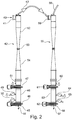
- Figur 2
- vergrößert zwei hintereinander geschaltete Zyklone,
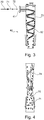
- Figur 3
- den Kopfbereich des ersten Zyklons aus
Figur 2 , - Figur 4
- den Verengungsbereich des ersten Zyklons aus
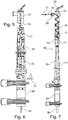
Figur 2 , - Figur 5
- den oberen Auslass des ersten Zyklons aus
Figur 2 , - Figur 6
- den unteren Bereich des in
Figur 2 gezeigten Zyklons, - Figur 7
- den in
Figur 2 gezeigten zweiten Zyklon, - Figur 8
- schematisch eine Vorrichtung zur Behandlung von Verbundstoffen mit zwei kleinen und zwei großen Hydrozyklon und
- Figur 9
- einen Zyklon mit einem doppelwandigen Ausgangskonus in einer aufgeschnittenen Ansicht.
- Die
Figur 1 zeigt die Einbindung eines Aufbereiters 1 in eine Vorrichtung mit einem großen Hydrozyklon 2. Dieser Hydrozyklon 2 hat einen Eingangskonus 3 und einen Kopfbereich 4. Im Kopfbereich sind ein tangentialer Zulauf 5 und ein zentraler Ablauf 6 vorgesehen. Der Eingangskonus 3 kann sich bis zum Kopfbereich 4 erstrecken, sodass auch der Kopfbereich konisch ausgebildet ist. In einer alternativen Ausführungsform kann auch der Eingangskonus 3 zylinderförmig ausgebildet sein. - Am unteren Ende des Eingangskonus 3 befindet sich ein kleinerer Durchmesser 7, der wie eine Einschnürung vom Eingangskonus 3 in einen sich erweiternden Ausgangskonus 8 überleitet. Am unteren Ende des Ausgangskonus 8 ist ein sich wieder verjüngender Sammelkonus 9 vorgesehen, der eine durch eine Schleuse 10 verschlossene Austragsöffnung 11 aufweist.
- Der Aufbereiter 1 hat in seinem oberen Bereich 12 eine Schraube 13 und darunter einen Sieb 14, das den oberen Bereich 12 von einem Unterlauf 15 trennt. Die Schraube 13 ist vorzugsweise als Spirale ausgebildet, die nur direkt oberhalb des Siebes 14 über das Siebblech streift und das Material nach radial außen treibt. Auf eine zur Spirale führende Schraube wird vorzugsweise verzichtet, um den Eintrag von Luft in den unteren Bereich des Aufbereiters zu vermeiden und den Austrag von Luft im Aufbereiter zu erleichtern.
- Das im Aufbereiter 1 behandelte Stoffgemenge 16 wird mit einer Austragsschnecke 17 ausgetragen und zu einem Puffer 18 gefördert, der eine größere Menge des Stoffgemenges aufnehmen kann, um sie je nach Bedarf einem Sammler 19 zuzuführen, von wo das Material über eine Kreiselpumpe 20 zum dezentralen Zulauf 5 des Hydrozyklons 2 gefördert wird. Der Sammler 21 dient dazu, das im Kreislauf geführte Material mit Wasser 22 zu verdünnen und dann verflüssigt der Kreiselpumpe 20 zuzugeben. Der Sammler 21 kann daher als Schneckenförderer ausgebildet sein, dem Flüssigkeit zugegeben wird, um eine über die Kreiselpumpe 20 förderbare Konsistenz zu erzielen.
- An Stelle von Austragswendel oder Austragsschnecke 17 und Puffer 19 kann auch eine besonders große Austragswendel vorgesehen werden, die es einerseits ermöglicht, Material aus dem Oberlauf des Aufbereiters 1 abzuziehen und andererseits möglichst viel Material zu speichern, das dann nach und nach verflüssigt wird und der Kreiselpumpe 20 zugegeben wird.
- Im Hydrozyklon 2 wandert das Material zunächst spiralförmig bis zur Einschnürung 7 und von dort weiter in den Ausgangskonus 8, wo eine Materialfraktion über die Schleuse 10 entnommen wird. Das übrige Material wandert spiralförmig im Ausgangskonus 8 wieder nach oben in den Eingangskonus 3 und über den zentralen Ablauf 6 zurück zum Aufbereiter 1.
- Zuführöffnungen 23 im unteren Bereich 8 des Zyklons 2 erlauben es, Wasser oder eine andere Flüssigkeit zuzuführen, um durch eine radiale von außen nach innen gerichtete Strömungskomponente die Trennung des Materials im Zyklon zu erleichtern. Hierzu können die Zuführöffnungen als Düsen ausgebildet sein, die in einer definierten Strömungsrichtung eine Flüssigkeit in den Zyklon eintreten lassen.
- An der Weiche 24 gelangt in einem Bogen der Hauptstrom in die Leitung 25 und von dort zur Kreislaufpumpe 26. Diese Kreislaufpumpe 26 fördert somit vom zentralen Ablauf 6 des Zyklons 2 zum tangentialen Zulauf 5 des Zyklons 2.
- Ein Bypass 27, der nicht unbedingt benötigt wird, ermöglicht es, einen Teilstrom vor der Kreislaufpumpe 26 abzuziehen und über dem Sammler 21 oder direkt der Kreiselpumpe 20 zuzuführen.
- Der Kreislauf zwischen Hydrozyklon 2, Aufbereiter 1 und Kreiselpumpe 20 ermöglicht es, das Gemenge 16 über einen längeren Zeitraum zu behandeln und dabei an der Austragsöffnung 11 unterschiedliche Fraktionen dem Kreislauf zu entnehmen.
- Wenn alle werthaltigen Fraktionen entnommen sind, wird die Schiebeweiche 18 umgestellt und das Leichtmaterial, wie insbesondere Polyolefine, wie Polyethylen und Polypropylen, ausgetragen.
- Dabei können verschiedene Kunststoffmaterialien bereits durch die Wahl der Flüssigkeit 22 in dem Hydrozyklon 2 getrennt werden. Alternativ können auch nach der Weiche 18 in einem weiteren Zyklon, der eine Flüssigkeit enthält, die leichter oder schwerer als Wasser ist, die Kunststoffe getrennt werden.
- Neues Material 28 wird als Stoffgemenge entweder vor der Kreiselpumpe 20 dem Sammler 21 zugegeben oder an einer anderen Stelle wie beispielsweise am Puffer 19 zugeführt.
- Der Unterlauf 15 des Aufbereiters 1 wird über eine Pumpe 29 einem kleinen Zyklon 30 zugeführt, wo Sande oder beispielsweise auch Aluminium 31 abgetrennt und ausgetragen wird, während eine von Grobkorn gereinigte Suspension 32 einem zweiten kleinen Zyklon 33 zugeführt wird, in dem Feinkorn 34 absinkt und ausgetragen wird, während gereinigter Faserstoff 35 über den Oberlauf abgeführt wird und einem Filter 36 zugeführt wird. Hier werden die Faserstoffe abgetrennt, während die Flüssigkeit über die Leitung 37 zum Sammler 21 und von dort zur Kreiselpumpe 20 gelangt.
- Die
Figur 8 zeigt den Einsatz von zwei hintereinander geschalteten großen Zyklonen. Dabei hat ein kleiner Zyklon einen maximalen Durchmesser von weniger als 0,5 m und einen Zulaufdurchmesser von weniger als 100 mm, während ein großer Zyklon einen maximalen Durchmesser von mehr als 0,7 m und einen Durchmesser am Zulauf von mehr 150 mm aufweist. Die Anordnung entspricht der inFigur 1 beschrieben und es wird abweichend zuerst ein Zyklon 2 und anschließend ein Zyklon 2' durchlaufen. - Das Wirkprinzip eines der kleinen Zyklone und das Zusammenwirken der zwei kleinen Zyklonen wird im Folgenden an dem in den
Figuren 2 bis 7 gezeigten Beispiel beschrieben. - Während bereits mit einem einzigen der in
Figur 2 gezeigten Zyklone eine gute Trennung unterschiedlicher Materialien erreicht werden kann, bietet die Kombination derartiger Zyklone die Möglichkeit einer Fraktionierung. Dabei werden vorzugsweise zwei oder mehr Zyklone hintereinander geschaltet. Das zu behandelnde Material 40 gelangt über den tangentialen Zulauf 41 in den ersten Zyklon 42. Darin trennt sich durch die Strömung das Material in eine von Grobkorn gereinigte Suspension 43 und Grobkorn 44, das durch den Abzug 45 aus dem ersten Zyklon 42 entnommen werden kann. - Um das Grobkorn zu entnehmen ist am unteren Ende des Zyklons 42 ein Auffangbehälter 46, der oben und unten jeweils von einem Schieber 47 bzw. 48 begrenzt ist. Die Öffnungen 49 und 50 im Auffangbehälter 46 dienen dem Zu- und Abführen von Füllwasser und der Entlüftung.
- Eine Öffnung 51 oberhalb des Schiebers 47 und im unteren Bereich des Zyklons 42 dient dazu, im unteren Bereich dem Zyklon 42 Gegenströmwasser zuzuführen.
- Der Zyklon 42 besteht aus einem oberen Teil 52, das konisch oder zylinderförmig ausgebildet ist und einer Einschnürung 53, unter der sich ein konisches Zyklonelement nach unten erweitert.
- Der zweite Zyklon 55 ist dem ersten Zyklon 42 nachgeschaltet und die von Grobkorn gereinigte Suspension 43 am Oberlauf des ersten Zyklons 42 wird dem tangentialen Zulauf 56 des zweiten Zyklons 55 zugeführt. Dieser zweite Zyklon 55 ist wie der erste Zyklon 42 aufgebaut und er dient dazu, der von Grobkorn gereinigten Suspension Feinkorn 57 abzutrennen, das am Abzug 58 dem zweiten Zyklon 55 entnommen wird. Am Oberlauf des zweiten Zyklons 55 wird von Grobkorn und Feinkorn gereinigte Suspension 59 dem zweiten Zyklon 55 entnommen. Auch am zweiten Zyklon unterstützt Gegenströmwasser 60 die Trennung im Zyklon und Schieber 61 und 62 begrenzen einen Auffangbehälter 63, an dem Öffnungen 64 und 65 für die Entlüftung und für Füllwasser vorgesehen sind.
- Die
Figur 3 zeigt, wie an tangentialem Zulauf 41 Grobkorn 70, Feinkorn 71 und Faserstoff 72 zugeführt werden. Diese mit Grobkorn und Feinkorn verunreinigte Faserstoffsuspension 70, 71, 72 wird mittels einer Pumpe 29 tangential in den ersten Zyklon 42 gefördert. Im Zyklon 42 bildet sich ein abwärts gerichteter Wirbel 73, der als Primärwirbel bezeichnet wird. Dieser Primärwirbel zieht Faserstoff, Grobkorn und Feinkorn zunächst nach unten. Die Teilchen mit einem höheren spezifischen Gewicht als den der Flüssigkeit sind im vorliegenden Fall Grobkorn 70 und Feinkorn 71. Diese Partikel werden durch die hohe Zentrifugalkraft nach außen aus dem Primärwirbel 73 herausgedrückt und sinken am Rand des Konus 52 nach unten ab. - Durch die konische Form 52 und die Einschnürung 53 wird der Wirbel 73 zur Umkehr gezwungen. Es bildet sich ein zweiter aufwärts gerichteter Wirbel, der Sekundärwirbel 74, der leichte Teile mit nach oben reist und über den Oberlauf in den zweiten Zyklon 55 transportiert wird. Grobkorn 70 und Feinkorn 71 sinken im unteren Teil 54 des ersten Zyklons 42 weiter ab.
- Die
Figur 5 zeigt, dass das Absinken des leichteren Feinkorns 71 durch Gegenströmwasser 51, das von unten zugeführt wird, in seinem Absinken gehindert wird und in Konus 54 zunächst in der Schwebe gehalten wird. Das leichtere Feinkorn 71 gerät dann in den Aufwärtswirbel 74 und wird zusammen mit dem Faserstoff 72 über den Oberlauf in den zweiten Zyklon 55 transportiert. - Das schwerere Grobkorn 70 wird durch das Gegenströmwasser 51 nicht aufgehalten und sinkt weiter ab. Dadurch entsteht im ersten Zyklon 42 eine reine Grobkornfraktion 44, die über den Auffangbehälter 46 in pastöser Form abgezogen werden kann.
- Durch die Menge des gegenströmenden Wassers 51 kann somit das Ergebnis der Fraktionierung bestimmt werden.
- Die
Figur 7 zeigt die Trennung im zweiten Zyklon 55, an dessen tangentialen Zulauf 56 vom Grobkorn gereinigte Faserstoffsuspension aus Faserstoff 72 und Feinkorn 71 zugeführt wird. Fasserstoff 72 und Feinkorn 71 bilden im oberen Teil 75 des zweiten Zyklons 55 einen Primärwirbel 76 und Feinkorn 71 wird nach außen aus dem Primärwirbel 76 herausgedrückt und sinkt am Rand des Konus 75 nach unten ab. Der gereinigte Faserstoff 72 wird mit dem Sekundärwirbel 77 über den Oberlauf 78 ausgetragen. - Das Feinkorn 71 sinkt im zweiten Zyklon 55 ab, sodass im unteren Bereich 79 des zweiten Zyklons 55 eine Feinkornfraktion entsteht, die über den Auffangbehälter 63 als pastöse Feinkornfraktion 80 abgezogen werden kann. Je länger der untere Konus 79 ist, umso feineres Korn kann abgeschieden werden, wenn das Zentrifugalteil im oberen Bereich 75 entsprechend ausgelegt ist. Im zweiten Zyklon 55 wird in der Regel kein Gegenströmwasser verwendet.
- Der obere Teil des Zyklons kann einen zylinderförmigen Bereich aufweisen oder sogar vollständig bis zur Einschnürung zylinderförmig sein. Außerdem könnte dieser zylinderförmige Bereich als Rohr im oberen Bereich des Zyklons kürzer sein als der konische Bereich unterhalb der Einschnürung.
- Die
Figur 9 zeigt einen Hydrozyklon 90, der als kleiner und insbesondere auch als großer Zyklon eingesetzt werden kann. Im oberen Bereich 91 gelangt die zu behandelnde Flüssigkeit tangential in den Zyklon und wandert spiralförmig an der konischen Wandung 92, die auch zylinderförmig ausgebildet sein kann, bis zu einer Stelle 93, nach der sich ein Ausgangskonus 94 anschließt. Der kleine Winkel 95 der Wandung 92 von 6 bis 7° gegenüber der zentralen Achse 96 sorgt für eine hinreichend laminare Strömung im Ausgangskonus. - Daran schließt sich ein sich wieder verengender Sammelkonus 97 an, der doppelwandig ausgebildet ist. Die äußere Wandung 98 hat zwei Zuläufe 100, 101 für Wasser oder Gas und die innere Wandung 102 hat einen oberen Bereich 108 oberhalb der Zuläufe 100 und 101 mit einer Vielzahl an Zuführöffnungen 104. Da die Zuführöffnungen Bohrungen in der inneren Wandung 103 sind, die senkrecht in die Wandung gebohrt sind, entsteht eine Zuführströmung 105 in einem Auftriebswinkel 106 von mehr als 0° und vorzugsweise weniger als 20° gegenüber einer Normalen 107 der zentralen Achse 96. Die Bohrungen der Zuführöffnungen 104 haben einen Durchmesser von 2 bis 6 mm und vorzugsweise von etwa 4 mm. Die Zuläufe 100 und 101 führen zu einer Strömung, die gegen die gegenüber liegende äußere Seite der inneren Wandung 103 prallt und sich zwischen innerer Wandung 103 und äußerer Wandung 98 verteilt. Dadurch entsteht ein Überdruck zwischen den Wandungen, der dafür sorgt dass durch die Vielzahl der Zuführöffnungen 104 eine gleichmäßige und gleichverteilte Strömung in den Zyklon gelangt, die leicht nach oben weist, um den Partikeln im Zyklon einen Impuls nach oben zu geben. Dadurch wird der Effekt verstärkt, dass die leichten Partikel nach oben strömen, während die schwereren Partikel nach unten absinken.
Claims (10)
- Zyklonsystem, insbesondere für einen Aufbereiter (1), mit einem Kopfbereich (4), der einen dezentralen, vorzugsweise tangentialen, Zulauf (5) und einen zentralen Ablauf (6) aufweist, und einem sich erweiternden Ausgangskonus (8) mit einer zentralen Achse (96), dadurch gekennzeichnet, dass eine Wandung (103) bereichsweise doppelwandig ist und an der äußeren Wandung (98) mindestens eine Zulauföffnung (100, 101) und an der inneren Wandung (103) eine Vielzahl an Zuführöffnungen (104) aufweist, wobei an den Ausgangskonus (8) ein sich wieder verjüngender Sammelkonus (9) anschließt, der die Zulauföffnung (100, 101) aufweist, die in einem Bereich (108) angeordnet ist, in dem die innere Wandung (103) keine Zuführöffnung (104) aufweist, sodass die innere Wandung (103) eine Prallfläche für das durch die Zulauföffnung (100, 101) zugeführte Medium bildet.
- Zyklonsystem nach Anspruch 1, dadurch gekennzeichnet, dass der Kopfbereich (4) bis zu dem sich erweiternden Ausgangskonus (8) zylinderförmig ist.
- Zyklonsystem nach einem der vorhergehenden Ansprüche, dadurch gekennzeichnet, dass sich an den Ausgangskonus (8) oder den Sammelkonus (9) eine verschließbare Austragsöffnung (11) anschließt.
- Zyklonsystem nach Anspruch 3, dadurch gekennzeichnet, dass die Austragsöffnung (11) eine Schleuse (10) aufweist.
- Zyklonsystem nach Anspruch 3 oder 4, dadurch gekennzeichnet, dass die Austragsöffnung (11) ein Ventil aufweist, das einen kontinuierlichen geregelten Austrag ermöglicht.
- Zyklonsystem nach einem der vorhergehenden Ansprüche, dadurch gekennzeichnet, dass die Zuführöffnungen (104) für einen Zulauf einer Flüssigkeit oder eines Gases in der Wandung (103) derart angeordnet sind, dass eine Zuführströmung (105) in einem Auftriebswinkel (106) von mehr als 0° und vorzugsweise weniger als 20° gegenüber einer Normalen (107) der zentralen Achse (96) entsteht.
- Zyklonsystem nach einem der vorhergehenden Ansprüche, dadurch gekennzeichnet, dass mehrere derartige Zyklone (2, 2') mit einem maximalen Durchmesser von mehr als 0,7 m und einem tangentialen Zulauf (5) mit einem Durchmesser von mehr als 150 mm hintereinander geschaltet sind, um den Reinigungsgrad zu erhöhen.
- Verfahren zum nacheinander Betreiben von Zyklonen (2. 2') mit sich erweiternden Ausgangskonen (8, 8'), wobei in den sich erweiternden Ausgangskonen (8, (8') die Strömung derart eingestellt wird, dass der Ausgangskonus (8, 8') beim Betrieb mit Flüssigkeit vollständig gefüllt ist und im äußeren Bereich eine rotatorisch nach unten gerichtete Strömung vorliegt und im zentralen Bereich eine nach oben gerichtete Strömung, dadurch gekennzeichnet, dass im ersten Zyklon mehr Flüssigkeit im Gegenstrom zur Erhöhung der Trennschärfe zugeführt wird als im zweiten Zyklon.
- Verfahren nach Anspruch 9, dadurch gekennzeichnet, dass auch der jeweilige Kopfbereich (4) der Zyklone beim Betrieb vollständig mit Flüssigkeit gefüllt ist und im äußeren Bereich eine rotatorisch nach unten gerichtete Strömung vorliegt und im zentralen Bereich eine nach oben gerichtete Strömung.
- Verfahren nach Anspruch 9 oder 10, dadurch gekennzeichnet, dass zumindest dem ersten Zyklon an der Austragsöffnung (11) kontinuierlich Material, vorzugsweise als pastöses Material, entnommen wird.
Applications Claiming Priority (3)
| Application Number | Priority Date | Filing Date | Title |
|---|---|---|---|
| DE102015014285 | 2015-11-06 | ||
| DE102016007548.1A DE102016007548A1 (de) | 2015-11-06 | 2016-06-22 | Zyklonsystem |
| PCT/DE2016/000388 WO2017076384A1 (de) | 2015-11-06 | 2016-11-07 | Zyklonsystem |
Publications (2)
| Publication Number | Publication Date |
|---|---|
| EP3370882A1 EP3370882A1 (de) | 2018-09-12 |
| EP3370882B1 true EP3370882B1 (de) | 2021-01-06 |
Family
ID=58584427
Family Applications (1)
| Application Number | Title | Priority Date | Filing Date |
|---|---|---|---|
| EP16810230.9A Active EP3370882B1 (de) | 2015-11-06 | 2016-11-07 | Zyklonsystem |
Country Status (10)
| Country | Link |
|---|---|
| US (1) | US20190060918A1 (de) |
| EP (1) | EP3370882B1 (de) |
| JP (1) | JP2018533479A (de) |
| KR (1) | KR20180090281A (de) |
| AU (1) | AU2016351053A1 (de) |
| CA (1) | CA3004375A1 (de) |
| DE (2) | DE102016007548A1 (de) |
| HK (1) | HK1253278A1 (de) |
| RU (1) | RU2018120722A (de) |
| WO (1) | WO2017076384A1 (de) |
Cited By (1)
| Publication number | Priority date | Publication date | Assignee | Title |
|---|---|---|---|---|
| DE102022110164A1 (de) | 2021-08-26 | 2023-03-02 | Voith Patent Gmbh | Hydrozyklonanordnung |
Families Citing this family (2)
| Publication number | Priority date | Publication date | Assignee | Title |
|---|---|---|---|---|
| US11932816B2 (en) * | 2019-02-15 | 2024-03-19 | Exxonmobil Chemical Patents Inc. | Coke and tar removal from a furnace effluent |
| CA3153460A1 (en) * | 2021-03-30 | 2022-09-30 | Kyata Capital Inc. | Systems and methods for removing contaminants from surfaces of solid material |
Citations (1)
| Publication number | Priority date | Publication date | Assignee | Title |
|---|---|---|---|---|
| GB2284165A (en) * | 1993-11-24 | 1995-05-31 | Winton Eurotech Limited | Dust Separator |
Family Cites Families (9)
| Publication number | Priority date | Publication date | Assignee | Title |
|---|---|---|---|---|
| US2735547A (en) * | 1956-02-21 | vissac | ||
| BE501733A (de) * | 1950-03-09 | |||
| DE1092886B (de) * | 1953-09-16 | 1960-11-17 | Bauer Bros Company | Hydrozyklon zum Abtrennen von Faserstoffen aus einer Suspension |
| AT285486B (de) * | 1968-04-22 | 1970-10-27 | Oesterr Amerikan Magnesit | Verfahren und Zentrifugalkraftklassierer zum Trennen einer Trübe in mehrere Kornanteile |
| US3612276A (en) * | 1969-04-29 | 1971-10-12 | Bird Machine Co | Vortex-type separator apparatus |
| DE2410700A1 (de) * | 1974-03-06 | 1975-09-11 | Bayer Ag | Verfahren zur abscheidung von feststoffen aus einem gasstrom und dafuer geeignete vorrichtung |
| US4960525A (en) * | 1988-09-26 | 1990-10-02 | The United States Of America, As Represented By The Secretary Of Agriculture | Hydrocyclone for washing particles in liquid suspension |
| DE202005003104U1 (de) * | 2005-02-25 | 2005-05-12 | Voith Paper Patent Gmbh | Schwerteilaustragsvorrichtung für einen zum Abscheiden von Schwerteilen aus einer Faserstoffsuspension bestimmten Hydrozyklon |
| AT512479B1 (de) * | 2012-02-10 | 2013-11-15 | Andritz Energy & Environment Gmbh | Verfahren zur feinstoffreduktion im rea-gips |
-
2016
- 2016-06-22 DE DE102016007548.1A patent/DE102016007548A1/de not_active Withdrawn
- 2016-11-07 CA CA3004375A patent/CA3004375A1/en not_active Abandoned
- 2016-11-07 RU RU2018120722A patent/RU2018120722A/ru not_active Application Discontinuation
- 2016-11-07 HK HK18112567.8A patent/HK1253278A1/zh unknown
- 2016-11-07 WO PCT/DE2016/000388 patent/WO2017076384A1/de not_active Ceased
- 2016-11-07 JP JP2018543425A patent/JP2018533479A/ja active Pending
- 2016-11-07 KR KR1020187015992A patent/KR20180090281A/ko not_active Withdrawn
- 2016-11-07 US US15/773,622 patent/US20190060918A1/en not_active Abandoned
- 2016-11-07 AU AU2016351053A patent/AU2016351053A1/en not_active Abandoned
- 2016-11-07 DE DE112016005089.5T patent/DE112016005089A5/de not_active Withdrawn
- 2016-11-07 EP EP16810230.9A patent/EP3370882B1/de active Active
Patent Citations (1)
| Publication number | Priority date | Publication date | Assignee | Title |
|---|---|---|---|---|
| GB2284165A (en) * | 1993-11-24 | 1995-05-31 | Winton Eurotech Limited | Dust Separator |
Cited By (1)
| Publication number | Priority date | Publication date | Assignee | Title |
|---|---|---|---|---|
| DE102022110164A1 (de) | 2021-08-26 | 2023-03-02 | Voith Patent Gmbh | Hydrozyklonanordnung |
Also Published As
| Publication number | Publication date |
|---|---|
| DE102016007548A1 (de) | 2017-05-11 |
| DE112016005089A5 (de) | 2018-07-26 |
| US20190060918A1 (en) | 2019-02-28 |
| EP3370882A1 (de) | 2018-09-12 |
| AU2016351053A1 (en) | 2018-05-24 |
| HK1253278A1 (zh) | 2019-06-14 |
| RU2018120722A3 (de) | 2020-05-18 |
| RU2018120722A (ru) | 2019-12-06 |
| WO2017076384A1 (de) | 2017-05-11 |
| JP2018533479A (ja) | 2018-11-15 |
| KR20180090281A (ko) | 2018-08-10 |
| CA3004375A1 (en) | 2017-05-11 |
Similar Documents
| Publication | Publication Date | Title |
|---|---|---|
| AT511837B1 (de) | Hydrozyklon mit feinstoffabreicherung im zyklonunterlauf | |
| DE754339C (de) | Verfahren und Vorrichtung zum Entfernen von schweren Teilchen unter Fliehkraftwirkung aus einer Aufschwemmung, insbesondere von Zellstoff, Papierstoff u. dgl. | |
| DE870531C (de) | Verfahren und Vorrichtung zum Trennen von in einer Fluessigkeit suspendierten Feststoffen oder Gasen | |
| DE1069116B (de) | Verfahren und Vorrichtung zum Abscheiden von feste Stoffe enthaltenden Faserstoffaufschwemmungen an einem Hydrozyklon | |
| DE1461196A1 (de) | Verfahren und Vorrichtung zum Abscheiden von Unreinigkeiten aus einem Papierbrei und aehnlichen faserhaltigen Aufschwemmungen | |
| EP3370882B1 (de) | Zyklonsystem | |
| DE4426159A1 (de) | Flotationseinrichtung | |
| DE3871905T2 (de) | Verfahren und vorrichtung zur abtrennung und gewinnung von partikeln. | |
| DE102009039238B3 (de) | Hydrozyklonanordnung | |
| EP0398864A2 (de) | Verfahren und Vorrichtung zum Abtrennen von Stoffen aus einem Medium | |
| DE102004025149A1 (de) | Drucksortierter zum Sieben einer Faserstoffsuspension | |
| DE19706775B4 (de) | Hackschnitzelwaschanlage | |
| EP3180473B1 (de) | Aufbereiter und verfahren zum behandeln eines stoffgemenges | |
| DE10331683B3 (de) | Verfahren und Siebapparat zum Sortieren einer verschmutzten Papierfasersuspension | |
| DE69936605T2 (de) | Eine Abscheider-Zentrifuge | |
| DE69514836T2 (de) | Siebvorrichtung | |
| WO2020187652A1 (de) | Filteranordnung nach art eines fliehkraftabscheiders | |
| DE202006003421U1 (de) | Vorrichtung zum Austragen von Schwerteilen aus einem Apparat zur Behandlung einer Faserstoffsuspension, insbesondere aus einem zum Reinigen einer Faserstoffsuspension betreibbaren Hydrozyklon | |
| EP4042023B1 (de) | Dentalabscheider | |
| EP4041123B1 (de) | Dentalabscheider | |
| DE102013100694B4 (de) | Verfahren und Vorrichtung zur Aufbereitung einer von Zusatzstoffen verunreinigten Basisflüssikeit | |
| DE10218377B4 (de) | Verfahren und Vorrichtung zur Schwerstoffabtrennung aus Aufschlämmungen | |
| CH385170A (de) | Verfahren zum Aufbereiten von Flüssigkeiten und Hydrozyklon zur Durchführung dieses Verfahrens | |
| WO2017174500A1 (de) | Verfahren und anlage zur aufbereitung von asche aus müllverbrennungsanlagen | |
| DE102015114519A1 (de) | Tangential-Separator (TS) |
Legal Events
| Date | Code | Title | Description |
|---|---|---|---|
| STAA | Information on the status of an ep patent application or granted ep patent |
Free format text: STATUS: UNKNOWN |
|
| STAA | Information on the status of an ep patent application or granted ep patent |
Free format text: STATUS: THE INTERNATIONAL PUBLICATION HAS BEEN MADE |
|
| PUAI | Public reference made under article 153(3) epc to a published international application that has entered the european phase |
Free format text: ORIGINAL CODE: 0009012 |
|
| STAA | Information on the status of an ep patent application or granted ep patent |
Free format text: STATUS: REQUEST FOR EXAMINATION WAS MADE |
|
| 17P | Request for examination filed |
Effective date: 20180530 |
|
| AK | Designated contracting states |
Kind code of ref document: A1 Designated state(s): AL AT BE BG CH CY CZ DE DK EE ES FI FR GB GR HR HU IE IS IT LI LT LU LV MC MK MT NL NO PL PT RO RS SE SI SK SM TR |
|
| AX | Request for extension of the european patent |
Extension state: BA ME |
|
| DAV | Request for validation of the european patent (deleted) | ||
| DAX | Request for extension of the european patent (deleted) | ||
| REG | Reference to a national code |
Ref country code: HK Ref legal event code: DE Ref document number: 1253278 Country of ref document: HK |
|
| STAA | Information on the status of an ep patent application or granted ep patent |
Free format text: STATUS: EXAMINATION IS IN PROGRESS |
|
| 17Q | First examination report despatched |
Effective date: 20190719 |
|
| GRAP | Despatch of communication of intention to grant a patent |
Free format text: ORIGINAL CODE: EPIDOSNIGR1 |
|
| STAA | Information on the status of an ep patent application or granted ep patent |
Free format text: STATUS: GRANT OF PATENT IS INTENDED |
|
| INTG | Intention to grant announced |
Effective date: 20200827 |
|
| GRAS | Grant fee paid |
Free format text: ORIGINAL CODE: EPIDOSNIGR3 |
|
| GRAA | (expected) grant |
Free format text: ORIGINAL CODE: 0009210 |
|
| STAA | Information on the status of an ep patent application or granted ep patent |
Free format text: STATUS: THE PATENT HAS BEEN GRANTED |
|
| AK | Designated contracting states |
Kind code of ref document: B1 Designated state(s): AL AT BE BG CH CY CZ DE DK EE ES FI FR GB GR HR HU IE IS IT LI LT LU LV MC MK MT NL NO PL PT RO RS SE SI SK SM TR |
|
| REG | Reference to a national code |
Ref country code: GB Ref legal event code: FG4D Free format text: NOT ENGLISH |
|
| REG | Reference to a national code |
Ref country code: AT Ref legal event code: REF Ref document number: 1351791 Country of ref document: AT Kind code of ref document: T Effective date: 20210115 Ref country code: CH Ref legal event code: EP |
|
| REG | Reference to a national code |
Ref country code: DE Ref legal event code: R096 Ref document number: 502016012162 Country of ref document: DE |
|
| REG | Reference to a national code |
Ref country code: IE Ref legal event code: FG4D Free format text: LANGUAGE OF EP DOCUMENT: GERMAN |
|
| REG | Reference to a national code |
Ref country code: NL Ref legal event code: MP Effective date: 20210106 |
|
| REG | Reference to a national code |
Ref country code: LT Ref legal event code: MG9D |
|
| PG25 | Lapsed in a contracting state [announced via postgrant information from national office to epo] |
Ref country code: FI Free format text: LAPSE BECAUSE OF FAILURE TO SUBMIT A TRANSLATION OF THE DESCRIPTION OR TO PAY THE FEE WITHIN THE PRESCRIBED TIME-LIMIT Effective date: 20210106 Ref country code: GR Free format text: LAPSE BECAUSE OF FAILURE TO SUBMIT A TRANSLATION OF THE DESCRIPTION OR TO PAY THE FEE WITHIN THE PRESCRIBED TIME-LIMIT Effective date: 20210407 Ref country code: HR Free format text: LAPSE BECAUSE OF FAILURE TO SUBMIT A TRANSLATION OF THE DESCRIPTION OR TO PAY THE FEE WITHIN THE PRESCRIBED TIME-LIMIT Effective date: 20210106 Ref country code: NO Free format text: LAPSE BECAUSE OF FAILURE TO SUBMIT A TRANSLATION OF THE DESCRIPTION OR TO PAY THE FEE WITHIN THE PRESCRIBED TIME-LIMIT Effective date: 20210406 Ref country code: PT Free format text: LAPSE BECAUSE OF FAILURE TO SUBMIT A TRANSLATION OF THE DESCRIPTION OR TO PAY THE FEE WITHIN THE PRESCRIBED TIME-LIMIT Effective date: 20210506 Ref country code: LT Free format text: LAPSE BECAUSE OF FAILURE TO SUBMIT A TRANSLATION OF THE DESCRIPTION OR TO PAY THE FEE WITHIN THE PRESCRIBED TIME-LIMIT Effective date: 20210106 Ref country code: BG Free format text: LAPSE BECAUSE OF FAILURE TO SUBMIT A TRANSLATION OF THE DESCRIPTION OR TO PAY THE FEE WITHIN THE PRESCRIBED TIME-LIMIT Effective date: 20210406 |
|
| PG25 | Lapsed in a contracting state [announced via postgrant information from national office to epo] |
Ref country code: LV Free format text: LAPSE BECAUSE OF FAILURE TO SUBMIT A TRANSLATION OF THE DESCRIPTION OR TO PAY THE FEE WITHIN THE PRESCRIBED TIME-LIMIT Effective date: 20210106 Ref country code: RS Free format text: LAPSE BECAUSE OF FAILURE TO SUBMIT A TRANSLATION OF THE DESCRIPTION OR TO PAY THE FEE WITHIN THE PRESCRIBED TIME-LIMIT Effective date: 20210106 Ref country code: PL Free format text: LAPSE BECAUSE OF FAILURE TO SUBMIT A TRANSLATION OF THE DESCRIPTION OR TO PAY THE FEE WITHIN THE PRESCRIBED TIME-LIMIT Effective date: 20210106 Ref country code: SE Free format text: LAPSE BECAUSE OF FAILURE TO SUBMIT A TRANSLATION OF THE DESCRIPTION OR TO PAY THE FEE WITHIN THE PRESCRIBED TIME-LIMIT Effective date: 20210106 |
|
| PG25 | Lapsed in a contracting state [announced via postgrant information from national office to epo] |
Ref country code: IS Free format text: LAPSE BECAUSE OF FAILURE TO SUBMIT A TRANSLATION OF THE DESCRIPTION OR TO PAY THE FEE WITHIN THE PRESCRIBED TIME-LIMIT Effective date: 20210506 |
|
| REG | Reference to a national code |
Ref country code: DE Ref legal event code: R097 Ref document number: 502016012162 Country of ref document: DE |
|
| PG25 | Lapsed in a contracting state [announced via postgrant information from national office to epo] |
Ref country code: EE Free format text: LAPSE BECAUSE OF FAILURE TO SUBMIT A TRANSLATION OF THE DESCRIPTION OR TO PAY THE FEE WITHIN THE PRESCRIBED TIME-LIMIT Effective date: 20210106 Ref country code: CZ Free format text: LAPSE BECAUSE OF FAILURE TO SUBMIT A TRANSLATION OF THE DESCRIPTION OR TO PAY THE FEE WITHIN THE PRESCRIBED TIME-LIMIT Effective date: 20210106 Ref country code: SM Free format text: LAPSE BECAUSE OF FAILURE TO SUBMIT A TRANSLATION OF THE DESCRIPTION OR TO PAY THE FEE WITHIN THE PRESCRIBED TIME-LIMIT Effective date: 20210106 |
|
| PLBE | No opposition filed within time limit |
Free format text: ORIGINAL CODE: 0009261 |
|
| STAA | Information on the status of an ep patent application or granted ep patent |
Free format text: STATUS: NO OPPOSITION FILED WITHIN TIME LIMIT |
|
| PG25 | Lapsed in a contracting state [announced via postgrant information from national office to epo] |
Ref country code: RO Free format text: LAPSE BECAUSE OF FAILURE TO SUBMIT A TRANSLATION OF THE DESCRIPTION OR TO PAY THE FEE WITHIN THE PRESCRIBED TIME-LIMIT Effective date: 20210106 Ref country code: SK Free format text: LAPSE BECAUSE OF FAILURE TO SUBMIT A TRANSLATION OF THE DESCRIPTION OR TO PAY THE FEE WITHIN THE PRESCRIBED TIME-LIMIT Effective date: 20210106 Ref country code: DK Free format text: LAPSE BECAUSE OF FAILURE TO SUBMIT A TRANSLATION OF THE DESCRIPTION OR TO PAY THE FEE WITHIN THE PRESCRIBED TIME-LIMIT Effective date: 20210106 |
|
| 26N | No opposition filed |
Effective date: 20211007 |
|
| PG25 | Lapsed in a contracting state [announced via postgrant information from national office to epo] |
Ref country code: ES Free format text: LAPSE BECAUSE OF FAILURE TO SUBMIT A TRANSLATION OF THE DESCRIPTION OR TO PAY THE FEE WITHIN THE PRESCRIBED TIME-LIMIT Effective date: 20210106 Ref country code: AL Free format text: LAPSE BECAUSE OF FAILURE TO SUBMIT A TRANSLATION OF THE DESCRIPTION OR TO PAY THE FEE WITHIN THE PRESCRIBED TIME-LIMIT Effective date: 20210106 |
|
| PG25 | Lapsed in a contracting state [announced via postgrant information from national office to epo] |
Ref country code: SI Free format text: LAPSE BECAUSE OF FAILURE TO SUBMIT A TRANSLATION OF THE DESCRIPTION OR TO PAY THE FEE WITHIN THE PRESCRIBED TIME-LIMIT Effective date: 20210106 |
|
| PG25 | Lapsed in a contracting state [announced via postgrant information from national office to epo] |
Ref country code: IT Free format text: LAPSE BECAUSE OF FAILURE TO SUBMIT A TRANSLATION OF THE DESCRIPTION OR TO PAY THE FEE WITHIN THE PRESCRIBED TIME-LIMIT Effective date: 20210106 |
|
| PG25 | Lapsed in a contracting state [announced via postgrant information from national office to epo] |
Ref country code: IS Free format text: LAPSE BECAUSE OF FAILURE TO SUBMIT A TRANSLATION OF THE DESCRIPTION OR TO PAY THE FEE WITHIN THE PRESCRIBED TIME-LIMIT Effective date: 20210506 |
|
| PG25 | Lapsed in a contracting state [announced via postgrant information from national office to epo] |
Ref country code: MC Free format text: LAPSE BECAUSE OF FAILURE TO SUBMIT A TRANSLATION OF THE DESCRIPTION OR TO PAY THE FEE WITHIN THE PRESCRIBED TIME-LIMIT Effective date: 20210106 |
|
| REG | Reference to a national code |
Ref country code: CH Ref legal event code: PL |
|
| GBPC | Gb: european patent ceased through non-payment of renewal fee |
Effective date: 20211107 |
|
| PG25 | Lapsed in a contracting state [announced via postgrant information from national office to epo] |
Ref country code: LU Free format text: LAPSE BECAUSE OF NON-PAYMENT OF DUE FEES Effective date: 20211107 Ref country code: BE Free format text: LAPSE BECAUSE OF NON-PAYMENT OF DUE FEES Effective date: 20211130 |
|
| REG | Reference to a national code |
Ref country code: BE Ref legal event code: MM Effective date: 20211130 |
|
| PG25 | Lapsed in a contracting state [announced via postgrant information from national office to epo] |
Ref country code: IE Free format text: LAPSE BECAUSE OF NON-PAYMENT OF DUE FEES Effective date: 20211107 Ref country code: GB Free format text: LAPSE BECAUSE OF NON-PAYMENT OF DUE FEES Effective date: 20211107 |
|
| REG | Reference to a national code |
Ref country code: AT Ref legal event code: MM01 Ref document number: 1351791 Country of ref document: AT Kind code of ref document: T Effective date: 20211107 |
|
| PG25 | Lapsed in a contracting state [announced via postgrant information from national office to epo] |
Ref country code: AT Free format text: LAPSE BECAUSE OF NON-PAYMENT OF DUE FEES Effective date: 20211107 |
|
| PG25 | Lapsed in a contracting state [announced via postgrant information from national office to epo] |
Ref country code: HU Free format text: LAPSE BECAUSE OF FAILURE TO SUBMIT A TRANSLATION OF THE DESCRIPTION OR TO PAY THE FEE WITHIN THE PRESCRIBED TIME-LIMIT; INVALID AB INITIO Effective date: 20161107 |
|
| PG25 | Lapsed in a contracting state [announced via postgrant information from national office to epo] |
Ref country code: CY Free format text: LAPSE BECAUSE OF FAILURE TO SUBMIT A TRANSLATION OF THE DESCRIPTION OR TO PAY THE FEE WITHIN THE PRESCRIBED TIME-LIMIT Effective date: 20210106 Ref country code: NL Free format text: LAPSE BECAUSE OF NON-PAYMENT OF DUE FEES Effective date: 20210206 |
|
| PG25 | Lapsed in a contracting state [announced via postgrant information from national office to epo] |
Ref country code: LI Free format text: LAPSE BECAUSE OF NON-PAYMENT OF DUE FEES Effective date: 20220630 Ref country code: CH Free format text: LAPSE BECAUSE OF NON-PAYMENT OF DUE FEES Effective date: 20220630 |
|
| PG25 | Lapsed in a contracting state [announced via postgrant information from national office to epo] |
Ref country code: MK Free format text: LAPSE BECAUSE OF FAILURE TO SUBMIT A TRANSLATION OF THE DESCRIPTION OR TO PAY THE FEE WITHIN THE PRESCRIBED TIME-LIMIT Effective date: 20210106 |
|
| PG25 | Lapsed in a contracting state [announced via postgrant information from national office to epo] |
Ref country code: MT Free format text: LAPSE BECAUSE OF FAILURE TO SUBMIT A TRANSLATION OF THE DESCRIPTION OR TO PAY THE FEE WITHIN THE PRESCRIBED TIME-LIMIT Effective date: 20210106 |
|
| REG | Reference to a national code |
Ref country code: HK Ref legal event code: WD Ref document number: 1253278 Country of ref document: HK |
|
| PG25 | Lapsed in a contracting state [announced via postgrant information from national office to epo] |
Ref country code: TR Free format text: LAPSE BECAUSE OF FAILURE TO SUBMIT A TRANSLATION OF THE DESCRIPTION OR TO PAY THE FEE WITHIN THE PRESCRIBED TIME-LIMIT Effective date: 20210106 |
|
| PGFP | Annual fee paid to national office [announced via postgrant information from national office to epo] |
Ref country code: DE Payment date: 20251127 Year of fee payment: 10 |
|
| PGFP | Annual fee paid to national office [announced via postgrant information from national office to epo] |
Ref country code: FR Payment date: 20251126 Year of fee payment: 10 |