EP3377288B1 - Procédé de production de granulés de matière plastique - Google Patents
Procédé de production de granulés de matière plastique Download PDFInfo
- Publication number
- EP3377288B1 EP3377288B1 EP16790290.7A EP16790290A EP3377288B1 EP 3377288 B1 EP3377288 B1 EP 3377288B1 EP 16790290 A EP16790290 A EP 16790290A EP 3377288 B1 EP3377288 B1 EP 3377288B1
- Authority
- EP
- European Patent Office
- Prior art keywords
- plastic granules
- dealdehydization
- pressure
- plastic
- gas
- Prior art date
- Legal status (The legal status is an assumption and is not a legal conclusion. Google has not performed a legal analysis and makes no representation as to the accuracy of the status listed.)
- Active
Links
Images

Classifications
-
- B—PERFORMING OPERATIONS; TRANSPORTING
- B29—WORKING OF PLASTICS; WORKING OF SUBSTANCES IN A PLASTIC STATE IN GENERAL
- B29B—PREPARATION OR PRETREATMENT OF THE MATERIAL TO BE SHAPED; MAKING GRANULES OR PREFORMS; RECOVERY OF PLASTICS OR OTHER CONSTITUENTS OF WASTE MATERIAL CONTAINING PLASTICS
- B29B9/00—Making granules
- B29B9/02—Making granules by dividing preformed material
- B29B9/06—Making granules by dividing preformed material in the form of filamentary material, e.g. combined with extrusion
- B29B9/065—Making granules by dividing preformed material in the form of filamentary material, e.g. combined with extrusion under-water, e.g. underwater pelletizers
-
- B—PERFORMING OPERATIONS; TRANSPORTING
- B01—PHYSICAL OR CHEMICAL PROCESSES OR APPARATUS IN GENERAL
- B01J—CHEMICAL OR PHYSICAL PROCESSES, e.g. CATALYSIS OR COLLOID CHEMISTRY; THEIR RELEVANT APPARATUS
- B01J2/00—Processes or devices for granulating materials, e.g. fertilisers in general; Rendering particulate materials free flowing in general, e.g. making them hydrophobic
- B01J2/20—Processes or devices for granulating materials, e.g. fertilisers in general; Rendering particulate materials free flowing in general, e.g. making them hydrophobic by expressing the material, e.g. through sieves and fragmenting the extruded length
-
- C—CHEMISTRY; METALLURGY
- C08—ORGANIC MACROMOLECULAR COMPOUNDS; THEIR PREPARATION OR CHEMICAL WORKING-UP; COMPOSITIONS BASED THEREON
- C08G—MACROMOLECULAR COMPOUNDS OBTAINED OTHERWISE THAN BY REACTIONS ONLY INVOLVING UNSATURATED CARBON-TO-CARBON BONDS
- C08G63/00—Macromolecular compounds obtained by reactions forming a carboxylic ester link in the main chain of the macromolecule
- C08G63/78—Preparation processes
-
- F—MECHANICAL ENGINEERING; LIGHTING; HEATING; WEAPONS; BLASTING
- F26—DRYING
- F26B—DRYING SOLID MATERIALS OR OBJECTS BY REMOVING LIQUID THEREFROM
- F26B5/00—Drying solid materials or objects by processes not involving the application of heat
- F26B5/16—Drying solid materials or objects by processes not involving the application of heat by contact with sorbent bodies, e.g. absorbent mould; by admixture with sorbent materials
-
- B—PERFORMING OPERATIONS; TRANSPORTING
- B29—WORKING OF PLASTICS; WORKING OF SUBSTANCES IN A PLASTIC STATE IN GENERAL
- B29B—PREPARATION OR PRETREATMENT OF THE MATERIAL TO BE SHAPED; MAKING GRANULES OR PREFORMS; RECOVERY OF PLASTICS OR OTHER CONSTITUENTS OF WASTE MATERIAL CONTAINING PLASTICS
- B29B9/00—Making granules
- B29B9/16—Auxiliary treatment of granules
- B29B2009/165—Crystallizing granules
-
- B—PERFORMING OPERATIONS; TRANSPORTING
- B29—WORKING OF PLASTICS; WORKING OF SUBSTANCES IN A PLASTIC STATE IN GENERAL
- B29B—PREPARATION OR PRETREATMENT OF THE MATERIAL TO BE SHAPED; MAKING GRANULES OR PREFORMS; RECOVERY OF PLASTICS OR OTHER CONSTITUENTS OF WASTE MATERIAL CONTAINING PLASTICS
- B29B9/00—Making granules
- B29B9/16—Auxiliary treatment of granules
- B29B2009/168—Removing undesirable residual components, e.g. solvents, unreacted monomers; Degassing
-
- F—MECHANICAL ENGINEERING; LIGHTING; HEATING; WEAPONS; BLASTING
- F26—DRYING
- F26B—DRYING SOLID MATERIALS OR OBJECTS BY REMOVING LIQUID THEREFROM
- F26B2200/00—Drying processes and machines for solid materials characterised by the specific requirements of the drying goods
- F26B2200/08—Granular materials
-
- F—MECHANICAL ENGINEERING; LIGHTING; HEATING; WEAPONS; BLASTING
- F26—DRYING
- F26B—DRYING SOLID MATERIALS OR OBJECTS BY REMOVING LIQUID THEREFROM
- F26B2200/00—Drying processes and machines for solid materials characterised by the specific requirements of the drying goods
- F26B2200/12—Manure
Definitions
- the invention relates to a method for producing a plastic granulate according to the type specified in the preamble of claim 1.
- DE 10 2007 040 135 A1 relates to a process for the continuous production of polyester granules from highly viscous polyester melts with a degree of polymerization of 132 to 165.
- the highly viscous melt (hiV) is heated by means of a metering pump, which can build up a pressure of> 80 bar to 200 bar
- Nozzle plate 3 pressed underwater pelletizing under at least 1 bar overpressure with a water inlet temperature of at least 70 ° C, preferably 80-95 ° C).
- a closely fitting cutting knife ring peels off the melt from every hole in the nozzle plate, whereby round or oval grains (pellets) are formed, which solidify amorphously on the surface due to intensive water washing.
- the water chamber is under slight overpressure and the liquor ratio is between 8 and 12: 1.
- the pellet / water mixture passes through a short pipe and an agglomerate separator into the pre-dryer, which is designed as a stirred centrifuge, the water separation taking place in the lower area and the pellets exiting in the upper area.
- EP 2 712 881 A1 discloses an apparatus for continuously pelletizing and crystallizing a polymer comprising a unit for forming a polymer pellet material and a cooling pellet material in a liquid cooling medium. A downstream unit for drying pellet material and a crystallizer for crystallizing pellet material are also provided. The crystallizer communicates directly via the connecting line with the upstream unit for separating the liquid cooling medium from the pellet material and drying the pellet material, so that the material to be treated can pass freely from the upstream unit to the subsequent unit. An inlet is used to import inert gas.
- An apparatus for continuously pelletizing and crystallizing a polymer comprises: a unit for forming one Polymer pellet material and for cooling the pellet material in a liquid cooling medium; a downstream unit for drying the pellet material, the downstream unit having an outlet opening for exporting gas; and a crystallizer for crystallizing the pellet material.
- the crystallizer communicates directly via a connecting line with the pre-connected unit for separating the liquid cooling medium from the pellet material and for drying the pellet material, so that the material to be treated can pass unhindered from the pre-connected unit to the downstream unit; and includes an inlet for introducing inert gas, the crystallizer communicating with an inert gas tank via the inlet so that the pressure in the crystallizer can be increased relative to a pressure in the unit for drying the pellet material.
- plastic granules with a high softening temperature, namely above 120 ° C.
- plastic granules can be polycarbonate, polycarbonate blend, polystyrene, high-temperature thermoplastics.
- a process fluid is contained in a process chamber.
- the process chamber is partially delimited by a perforated plate for the production of strands from liquid plastic.
- a dividing device interacts with the perforated plate for the plastic strands emerging from the perforated plate. This creates a mixture of process fluid and granulate.
- the process fluid has a temperature of more than 120 ° C.
- the pressure in the process chamber is greater than 2 bar.
- the mixture of process fluid and granulate passes through a cooling section while maintaining the pressure.
- the granules are then separated from the process fluid under pressure in a separating device and passed through a pressure lock. This procedure has generally proven itself. However, the quality of the plastic granules for further processing for certain applications is still too low.
- the low-water plastic granules obtained in this way after the water has been separated off are placed in a dealdehydization tank and treated there by means of a purge air stream with an inlet temperature between 180 ° C. and 200 ° C.
- the plastic granulate is either directly in the Given dealdehydization container or by means of a metering device. This is intended to simplify the method in terms of apparatus and to operate it at lower operating costs.
- the particularly high quality demands on the polyester for packaging with regard to viscosity, color, acetaldehyde content, acetaldehyde reformation and melting behavior are to be maintained or improved.
- a disadvantage of this method is that the quality of the plastic granulate is not satisfactory for certain applications.
- the object of the invention is therefore to provide a method for producing plastic granules which produce plastic granules with a higher quality with regard to viscosity, color, acetaldehyde content, melting behavior and the like.
- the outlay on equipment should be kept as low as possible and the method should be operated with the lowest possible operating costs.
- the invention is based on the knowledge that both the process parameters in the plastic granulation, which are responsible for the nucleation to influence the crystallization, and for the crystallization as such, but also a dealdehydization of the plastic granules significantly influence the quality of the plastic granules and therefore both measures combined with adapted and coordinated parameters lead to better quality of the plastic granules overall. In addition, this results in further possibilities to optimize the process with regard to operating costs and to improve the quality of the plastic granules.
- a method for producing a plastic granulate in which a process fluid is contained in a process chamber. Underwater pelletizing takes place in the process chamber.
- the process fluid in the process chamber has a temperature that is in a temperature range from greater than or equal to 120 ° C. to a maximum of 160 ° C.
- there is a process pressure in the process chamber that is greater than the pressure of the vapor pressure curve of the process fluid (12), but at least 2.0 bar. Under this process pressure, the plastic strands are granulated into plastic granules.
- a mixture of process fluid and plastic granulate is then discharged from the process chamber with cooling of the plastic granulate into a first cooling section, wherein i the plastic granulate under process pressure from the Process fluid is separated.
- the plastic granulate is then continuously fed in line to a dealdehydization tank.
- the process pressure is maintained and targeted nucleation, i.e. the generation of crystallization nuclei, on the surface of the plastic granulate is made possible by an optimized cooling temperature, so that the plastic granulate has optimized conditions for crystallization and can be fed to the dealdehydization tank.
- the plastic granules are treated with a purge gas, in particular purge air, in order to reduce the acetaldehyde content of the plastic granules.
- a purge gas in particular purge air
- the use of purge gas is particularly simple and saves considerable operating costs, especially when using purge air.
- the process chamber is preferably partially delimited by a perforated plate for producing strands of liquid plastic.
- a dividing device interacts with the perforated plate for the plastic strands emerging from the perforated plate, and underwater granulation takes place through the dividing device in the process fluid on the perforated plate in the process chamber. It has been shown that under these conditions, favorable surface shapes are created for the further processing of the plastic granulate. This also further increases the degree of vacuole freedom in the plastic granulate produced using this method.
- the plastic granulate is conveyed directly to a dealdehydization tank by dry gas, in particular dry air, via a crystallization section.
- dry gas in particular dry air
- This two-stage cooling of the plastic granulate achieves, on the one hand, that the surface quality of the plastic granulate is improved, and, on the other hand, that the crystallization of the plastic granulate is specifically influenced by the dry air parameters and can thus be optimized. It also prevents the plastic granules from sticking together.
- the dry gas with the plastic granules is preferably introduced together into the dealdehydization tank and serves as a further purge gas.
- the dry gas is both a transport medium for the plastic granulate to the dealdehydization container and a treatment medium in the dealdehydization container for the plastic granulate introduced there, which also reduces the expenditure on equipment and energy.
- the plastic granules are placed in the dealdehydization container with a surface temperature of 165 ° C. to 185 ° C. brought in.
- the plastic granulate has a temperature from the beginning which favors the dealdehydization process in the dealdehydization tank.
- the dry gas preferably detects the plastic granules after the first separation device with a dew point of -25 ° C to -40 ° C. This prevents water from condensing on the plastic granulate during transport of the plastic granulate and undesirably negatively influencing the crystallization.
- the dry gas detects the plastic granules after the first separation device at a temperature of 180 ° C to 210 ° C, which favors the crystallization process during transport.
- the degree of crystallization of the plastic granules with which the plastic granules enter the dealdehydization container can be determined via the corresponding transport speed and / or the length of the crystallization section.
- the underwater granulation preferably produces plastic granules which, after the dealdehydization container, have an average weight of plastic granules in a range from 8 to 36 mg, in particular 12 to 24 mg.
- a smaller plastic granulate cools down faster, which has a negative impact on crystallization. In this respect, the stated value is a compromise between the opposite requirements during the process for the plastic granulate.
- the weight specifications relate to the average weight of the plastic granules, with a tolerance of the weight of the plastic granules of a maximum of 10%. This has the advantage that the plastic granulate crystallizes homogeneously and is easier to process further.
- part of the dry gas also forms the purge gas for the dealdehydization tank, in which part of the dry gas is branched off, in particular in front of the crystallization section, and fed to the dealdehydization tank as the purge gas.
- the purge gas for the dealdehydization tank, in which part of the dry gas is branched off, in particular in front of the crystallization section, and fed to the dealdehydization tank as the purge gas.
- a closed circuit is thereby generated in a simple manner and energy from the purge gas can be made available again to the further process in which an outlet on the dealdehydization container is used to discharge the plastic granules into the Dry gas introduced into the dealdehydization tank - further purge gas - and process gas consisting of the purge gas introduced into the dealdehydization tank, in particular together with a fresh gas which supplements the required amount of dry gas, is fed to a gas treatment unit which processes this gas as dry gas and feeds it back to the plastic granulate after the first separating device.
- the method can continue to be operated, for example, in two different alternatives:
- the pressure is reduced after the first separation device and before the crystallization section in such a way that a predetermined dew point of the dry gas is ensured.
- This has the advantage that, in particular, the crystallization section and the dealdehydization tank can be constructed more simply, since there is no longer any process pressure.
- a pressure of more than 2 bar is maintained in the dry gas or purge gas from the first separating device to the dealdehydization tank and in the dealdehydization tank and for pressure to be reduced after the dealdehydization tank, in particular to atmospheric pressure.
- the parameter range which is set by physical limits, is expanded.
- the pressure in the dealdehydization tank is preferably less than 10 bar.
- the pressure reduction after the dealdehydization tank can take place via a rotary valve or a lock or via an intermediate chamber with a slide at the inlet and a slide at the outlet and mutual opening of the slide.
- the pressure in the dealdehydization tank is kept constant in the region of the dew point at atmospheric pressure of less than 0 ° C. during the dealdehydization.
- the plastic granulate can be fed to a further cooling section with a cooling fluid, in which the plastic granulate is cooled at a cooling fluid temperature of less than 40 ° C to less than 65 ° C.
- the cooling fluid preferably has a loading density of more than 30% by weight of plastic granules in the further cooling section.
- the plastic granulate consists in particular of a partially crystalline thermoplastic polyester or co-polyester, for example polyethylene terephthalate, since the advantages mentioned above are particularly evident here.
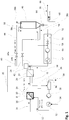
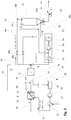
- a method according to the invention is shown schematically.
- a knife rotor which is assigned to a perforated plate 8 is located in a process chamber 10.
- the knife rotor and the perforated plate 8 form a conventional underwater pelletizer.
- the process chamber 10 is successively supplied with hot process fluid 12, usually hot process water.
- a plastic melt 14 is introduced into the process chamber 10 via the perforated plate 8, which, as plastic strands in the Perforated plate 8 emerging and cut into plastic granules 16 by the knife rotor.
- a mixture 18 of plastic granulate 16 and process water 12 is thus formed.
- the plastic melt consists of a plastic, for example thermoplastic polyester or co-polyester, for example polyethylene terephthalate.
- the plastic melt 14 is also pressed as a function of the speed of the knife rotor through the perforated plate 8.
- the cooling areas can be determined by correspondingly coordinating the speeds of the passage of the plastic melt through the perforated plate 8 in relation to the rotational speed of the knife rotor and the temperature of the process water 12. Cooling by convection is preferred, since this results in the best surface quality and thus the quality of the plastic granulate 16.
- the process water 12 has a temperature in the process chamber 10 which is in a range from 120 ° C. to 160 ° C.
- a process pressure in the process chamber and in the sections of the process described below which are greater than the pressure of the vapor pressure curve of the process water 12, but at least 2.0 bar.
- the plastic granulate 16 is fed to a mixing area 24 via a line 20 and a separating device 22, in which the mixture 18 of plastic granulate 16 and process water 12 is separated from one another.
- the area from the process chamber 10 via line 20 and the separating device 22 forms a first cooling section 25.
- the process water 12 separated from the mixture 18 in the separating device 22 is fed to a process water reservoir 26. From there, the process water 12 is fed via a filter 28, a pump 30 to a heat exchanger 32, in which the process water 12 is heated again to the required process temperature required in the process chamber 10. For this purpose, heating medium 34 is supplied to the heat exchanger 32. Filter residues 36 are removed from the filter 28. The process water 12 heated in the heat exchanger 32 is then fed back to the process chamber 10.
- the plastic granulate 16 is mixed with dry air 38 to form a mixture 40.
- the dry air 38 detects the plastic granules 16 in the mixing area 24 after the first separating device 22 with a dew point of -25 ° C to -40 ° C.
- the temperature of the dry air 38 is in a range from 180 ° C to 210 ° C.
- the mixture 40 is fed to a pressure lock 42, for example in the form of an impeller lock, where the pressure level is at ambient pressure is lowered.
- the dryer air 38 also has a predetermined dew point.
- the mixture 40 is fed to a dealdehydization tank 46 via a valve 48a and a crystallization section 44. The speed of the mixture is controlled by the crystallization section 44 via the valve 48a.
- dry air 38 is branched off and fed to the dealdehydization tank 46 in the lower region as purge air 38a.
- the quantity to be branched is regulated / controlled via a valve 48b.
- the mixture 40 of plastic granules 16 and dry air 38 passes through the crystallization section 44.
- the length of time in the crystallization section 44 is determined via the length of the crystallization section 44 but also via the flow rate of the dry air 38.
- the plastic granules 16 have a surface temperature of 165 ° C. to 185 ° C. before entering the dealdehydization container 46.
- the mixture 40 of plastic granules 16 and dry air 38 enters the dealdehydization tank 46. This part of the dry air 38 serves as further purge air 38b.
- the dealdehydization container 46 has an outlet 50 in the upper region, via which the purge air 38a and the further purge air 38b are fed back to a dry air treatment device 52.
- the dry air treatment device 52 has a fresh air supply 54, a fresh air filter 56, a control valve 58 for setting the required amount of fresh air, a pump 60 and a treatment unit 62, which consists of temperature control and dehumidification.
- Acetal aldehyde and excess water are removed by absorption on molecular sieves or similar substances and processes known to the person skilled in the art.
- Acetal aldehyde largely breaks down into water and carbon dioxide.
- the purge air 38c consisting of the purge air 38a and 38b, emerging from the dealdehydization tank 46 via the outlet 50 is fed to the fresh air 54 after the control valve 58.
- the purge air 38 c and the fresh air 54 form the new dry air 38, so that the circuit is closed.
- the plastic granules 16 emerge from the dealdehydization container 46 at a temperature of greater than 200 ° C. via a lock 64.
- the plastic granulate 16 has a granulate weight of 8 to 36 mg, in particular 12 to 24 mg.
- the underwater congratulations in the process chamber 10 are coordinated accordingly.
- the deviation of the weight of the plastic granules 16 is a maximum of 10% from a weight average of the plastic granules.
- the mean value relates to a statistically relevant proportion of plastic granules 16 in a small time window after the dealdehydization tank 46, that is to say the process tract.
- the plastic granulate 16 is fed to a further cooling section 66 with a cooling fluid, in which the plastic granulate 16 is cooled to less than 65 ° C. at a cooling fluid temperature of less than 40 ° C.
- the cooling fluid has a loading density of more than 30% by weight of plastic granules 16 in the further cooling section 66.
- the plastic granulate 16 consists of a partially crystalline thermoplastic polyester or co-polyester, for example polyethylene terephthalate.
- the pressure is not reduced until after the dealdehydization tank 46.
- the purge air 38c is therefore only supplied to the fresh air 54 after the high-pressure fan 60, since the purge air 38c is still under pressure.
- a pressure of more than 2 bar in the dry air 38 is maintained.
- a pressure reduction, in particular to atmospheric pressure, takes place only after the dealdehydization tank 46.
- the pressure in the dealdehydization tank 46 is less than 10 bar.
- the dew point is kept constant at less than 0 ° C. at atmospheric pressure.
- the pressure is reduced by a rotary valve 64a.
- this can also be done via a lock or via an intermediate chamber with a slide at the entrance and a slide at the exit and mutual opening of the slide.
- the quality of the plastic granules is considerably improved by the method according to the invention. A constant high viscosity or a high molecular weight of the plastic is guaranteed. This is therefore much more suitable to produce higher quality products.
Landscapes
- Chemical & Material Sciences (AREA)
- Engineering & Computer Science (AREA)
- Health & Medical Sciences (AREA)
- Mechanical Engineering (AREA)
- Chemical Kinetics & Catalysis (AREA)
- Organic Chemistry (AREA)
- Life Sciences & Earth Sciences (AREA)
- Molecular Biology (AREA)
- General Engineering & Computer Science (AREA)
- Medicinal Chemistry (AREA)
- Polymers & Plastics (AREA)
- Processing And Handling Of Plastics And Other Materials For Molding In General (AREA)
Claims (18)
- Procédé de production d'un granulé de matière plastique (16), dans lequel un fluide de processus (12) est contenu dans une chambre de processus (10), une granulation subaquatique s'effectue dans la chambre de processus (10), le fluide de processus (12) dans la chambre de processus (10) présente une température qui est comprise dans une plage de température de 120 °C à 160 °C, une pression de processus d'au moins 2,0 bar règne dans la chambre de processus (10) et une granulation des boudins de matière plastique (14) en granulé de matière plastique (16) s'effectue à cette pression de processus, un mélange (18) de fluide de processus (12) et de granulé de matière plastique (16) est évacué de la chambre de processus (10) tout en refroidissant le granulé de matière plastique (16) dans un premier tronçon de refroidissement (25), le granulé de matière plastique (16) est séparé du fluide de processus (12) à la pression de processus dans un premier dispositif séparateur (22), caractérisé en ce que, dans le premier tronçon de refroidissement (25), la pression de processus est maintenue, une pression de processus supérieure à la pression de la courbe de pression de vapeur du fluide de processus (12) règne dans la chambre de processus (10), et le granulé de matière plastique (16), après avoir été séparé du fluide de processus (12) dans le premier dispositif séparateur (22), est amené en continu dans une ligne à un récipient de désaldéhydation (46), dans lequel le granulé de matière plastique (16) est traité avec un gaz de rinçage (38a, 38b), en particulier de l'air de rinçage, pour réduire la teneur en acétaldéhyde du granulé de matière plastique (16).
- Procédé selon la revendication 1, caractérisé en ce que la chambre de processus (10) est partiellement délimitée par une plaque perforée (8) pour produire des boudins de matière plastique liquide (14), un dispositif de fragmentation coopère avec la plaque perforée (8) pour les boudins de matière plastique sortant de la plaque perforée (8) dans la chambre de processus (10) et la granulation subaquatique est effectuée grâce au dispositif de fragmentation dans le fluide de processus (12) sur la plaque perforée (8) dans la chambre de processus (10).
- Procédé selon la revendication 1 ou 2, caractérisé en ce que, après le premier dispositif séparateur (22), le granulé de matière plastique (16) est transporté, en particulier directement, par le gaz sec (38), de préférence l'air sec, sur un tronçon de cristallisation (44) jusqu'à un récipient de désaldéhydation (46).
- Procédé selon la revendication 3, caractérisé en ce que le gaz sec (38) est introduit conjointement avec les granulés de matière plastique (16) dans le récipient de désaldéhydation (46) et sert de gaz de rinçage complémentaire (40).
- Procédé selon l'une des revendications précédentes, caractérisé en ce que le granulé de matière plastique (16) est introduit dans le récipient désaldéhydation (46) avec une température de surface de 165° à 185 °C.
- Procédé selon l'une des revendications 3 à 5, caractérisé en ce que le gaz sec (38) saisit les granulés de matière plastique (16) après le premier dispositif séparateur (22) à un point de rosée de -25 °C à -40 °C.
- Procédé selon l'une des revendications 3 à 5, caractérisé en ce que le gaz sec (38) saisit les granulés de matière plastique (16) après le premier dispositif séparateur (22) à une température de 180 °C à 210 °C.
- Procédé selon l'une des revendications précédentes, caractérisé en ce que la granulation subaquatique permet de produire des granulés de matière plastique (16) qui présentent un poids moyen de granulé de matière plastique dans une plage de 8 à 36 mg, en particulier de 12 à 24 mg, après le récipient de désaldéhydation (46).
- Procédé selon l'une des revendications 3 à 8, caractérisé en ce qu'une partie du gaz sec (38) forme aussi le gaz de rinçage (38a) pour le récipient de désaldéhydation (46), dans lequel une partie du gaz sec (38) est déviée, en particulier avant le tronçon de cristallisation (44), et est amenée en tant que gaz de rinçage (38a, 38b, 38c) au récipient de désaldéhydation (46).
- Procédé selon l'une des revendications 3 à 9, caractérisé en ce qu'un gaz de processus constitué du gaz sec (38b) introduit avec les granulés de matière plastique (16) dans le récipient de désaldéhydation (46) et du gaz de rinçage (38a) introduit dans le récipient de désaldéhydation (46), en particulier conjointement avec un gaz frais complétant la quantité nécessaire de gaz sec (38), est amené par le biais d'une sortie (50) sur le récipient de désaldéhydation (46) à un traitement gazeux qui traite ledit gaz sous forme de gaz sec (38) et l'amène de nouveau au granulé de matière plastique (16) après le premier dispositif séparateur (22).
- Procédé selon l'une des revendications 3 à 10, caractérisé en ce que, après le premier dispositif séparateur (22) et avant le tronçon de cristallisation (44), une réduction de pression telle s'effectue de manière à garantir un point de rosée prédéfini du gaz sec (38).
- Procédé selon l'une des revendications 3 à 10, caractérisé en ce que, à partir du premier dispositif séparateur (22) jusqu'au récipient de désaldéhydation (46), une pression de plus de 2 bar est maintenue dans le gaz sec (38) et, après le récipient de désaldéhydation (46), une réduction de pression s'effectue, notamment jusqu'à la pression atmosphérique.
- Procédé selon la revendication 12, caractérisé en ce que la pression dans le récipient de désaldéhydation (46) est inférieure à 10 bar.
- Procédé selon l'une des revendications 3 à 10 ou 11 à 13, caractérisé en ce que la réduction de pression après le récipient de désaldéhydation (46) s'effectue par le biais d'une écluse à roue cellulaire (64a) ou d'une écluse (64) ou par le biais d'une chambre intermédiaire avec une glissière à l'entrée et une glissière à la sortie et avec ouverture réciproque des glissières.
- Procédé selon la revendication 14, caractérisé en ce que, pendant la désaldéhydation sous pression, la pression dans le récipient de désaldéhydation (46) est maintenue constante dans la plage du point de rosée sous pression atmosphérique inférieure à 0 °C.
- Procédé selon l'une des revendications précédentes, caractérisé en ce que, après la désaldéhydation, le granulé de matière plastique (16) est amené à un autre tronçon de refroidissement (66) avec un fluide de refroidissement (68), dans lequel le granulé de matière plastique (16) est refroidi jusqu'à moins de 65 °C à une température de fluide de refroidissement inférieure à 40 °C.
- Procédé selon la revendication 16, caractérisé en ce que le fluide de refroidissement (68) présente une densité de chargement supérieure à 30 % en poids de granulés de matière plastique (16) dans l'autre tronçon de refroidissement (66).
- Procédé selon l'une des revendications précédentes, caractérisé en ce que le granulé de matière plastique (16) se compose d'un polyester ou copolyester thermoplastique partiellement cristallisé, par exemple de polyéthylène téréphtalate.
Applications Claiming Priority (2)
| Application Number | Priority Date | Filing Date | Title |
|---|---|---|---|
| DE102015119787.1A DE102015119787A1 (de) | 2015-11-16 | 2015-11-16 | Verfahren zur Herstellung eines Kunststoffgranulats |
| PCT/EP2016/074886 WO2017084821A1 (fr) | 2015-11-16 | 2016-10-17 | Procédé de fabrication d'un granulat de matériau synthétique |
Publications (2)
| Publication Number | Publication Date |
|---|---|
| EP3377288A1 EP3377288A1 (fr) | 2018-09-26 |
| EP3377288B1 true EP3377288B1 (fr) | 2020-04-01 |
Family
ID=57223653
Family Applications (1)
| Application Number | Title | Priority Date | Filing Date |
|---|---|---|---|
| EP16790290.7A Active EP3377288B1 (fr) | 2015-11-16 | 2016-10-17 | Procédé de production de granulés de matière plastique |
Country Status (6)
| Country | Link |
|---|---|
| US (1) | US11241665B2 (fr) |
| EP (1) | EP3377288B1 (fr) |
| CN (1) | CN108463320B (fr) |
| DE (1) | DE102015119787A1 (fr) |
| TW (1) | TWI607846B (fr) |
| WO (1) | WO2017084821A1 (fr) |
Cited By (1)
| Publication number | Priority date | Publication date | Assignee | Title |
|---|---|---|---|---|
| US12496753B2 (en) | 2020-08-18 | 2025-12-16 | Evonik Operations Gmbh | Production of high temperature polymer based pellets by underwater pelletization at elevated water temperature to produce (rigid) bead foams |
Families Citing this family (3)
| Publication number | Priority date | Publication date | Assignee | Title |
|---|---|---|---|---|
| DE102015119787A1 (de) | 2015-11-16 | 2017-05-18 | Maag Automatik Gmbh | Verfahren zur Herstellung eines Kunststoffgranulats |
| EP3536470A1 (fr) * | 2018-03-06 | 2019-09-11 | Nordson Corporation | Procédé et dispositif de traitement thermique de granulés en matière plastique |
| CN113561358B (zh) * | 2021-08-24 | 2023-05-30 | 揭阳市忠创塑料制品有限公司 | 一种再生塑料颗粒加工冷却设备 |
Family Cites Families (22)
| Publication number | Priority date | Publication date | Assignee | Title |
|---|---|---|---|---|
| JPS6431605A (en) * | 1987-07-28 | 1989-02-01 | Kanegafuchi Chemical Ind | Drying and granulating method of vinyl chloride resin for processing of paste |
| AU2003248066A1 (en) * | 2002-07-18 | 2004-02-09 | Kuraray Co., Ltd. | Process for producing pellet of ethylene/vinyl alcohol copolymer |
| ITTO20020714A1 (it) * | 2002-08-09 | 2004-02-10 | Giuliano Cavaglia | Procedimento per la polimerizzazione continua di |
| ITTO20021124A1 (it) * | 2002-12-24 | 2004-06-25 | Giuliano Cavaglia | Reattore e metodo per polimerizzare in continuo in fase solida il polietilentereftalato (pet). |
| DE10310829A1 (de) * | 2003-03-13 | 2004-09-23 | Basf Ag | Thermoplastgranulate |
| US7204945B2 (en) * | 2003-09-16 | 2007-04-17 | Eastman Chemical Company | Direct coupling of melt polymerization and solid state processing for PET |
| US8079158B2 (en) * | 2004-09-02 | 2011-12-20 | Grupo Petrotemex, S.A. De C.V. | Process for separating and drying thermoplastic particles under high pressure |
| CN101438116A (zh) * | 2004-09-02 | 2009-05-20 | 伊士曼化工公司 | 高压下分离和干燥热塑性颗粒的方法 |
| AT505475B1 (de) * | 2005-06-14 | 2011-11-15 | Fellinger Markus | Verfahren und anlage zur erhöhung der grenzviskosität von polyestermaterial mittels festphasenpolykondensation |
| DE102006027176B4 (de) * | 2005-08-26 | 2015-08-06 | Lurgi Zimmer Gmbh | Verfahren und Vorrichtung zur Verringerung des Acetaldehydgehaltes von Polyestergranulat sowie Polyestergranulat |
| DE102006012587B4 (de) * | 2006-03-16 | 2015-10-29 | Lurgi Zimmer Gmbh | Verfahren und Vorrichtung zur Kristallisation von Polyestermaterial |
| TW200740586A (en) * | 2006-04-28 | 2007-11-01 | Univ Lunghwa Sci & Technology | A micro-injection forming technology for production of high-precision plastic parts materials |
| DE102006058642A1 (de) * | 2006-12-11 | 2008-06-12 | Bühler AG | Verfahren zur Herstellung homogen kristallisierter Polykondensatgranulate |
| DE102007040135A1 (de) * | 2007-08-24 | 2009-02-26 | Bkg Bruckmann & Kreyenborg Granuliertechnik Gmbh | Verfahren zur Herstellung von Polyester-Granulaten aus hochviskosen Polyester-Schmelzen sowie Vorrichtung zur Herstellung der Polyester-Granulate |
| US8044169B2 (en) * | 2008-03-03 | 2011-10-25 | Grupo Petrotemex, S.A. De C.V. | Dryer configuration for production of polyester particles |
| DE102008062480A1 (de) * | 2008-12-16 | 2010-06-17 | Automatik Plastics Machinery Gmbh | Verfahren zum Granulieren von Kunststoff mit hoher Erweichungstemperatur |
| US20110245452A1 (en) * | 2010-03-31 | 2011-10-06 | Uop Llc | Integrated Underwater Melt Cutting, Solid-State Polymerization Process |
| EP2433771B1 (fr) * | 2010-09-28 | 2016-12-21 | Uhde Inventa-Fischer GmbH | Procédé d'augmentation du poids moléculaire en utilisant la chaleur résiduelle de granulés de polyester |
| EP2570247B1 (fr) * | 2011-09-19 | 2018-03-28 | Uhde Inventa-Fischer GmbH | Dispositif de séchage/dégazage ainsi que dispositif et procédé de fabrication directe de corps moulés à partir de masses de polyester en fusion |
| EP2712881B1 (fr) * | 2012-09-26 | 2015-05-20 | Bühler Thermal Processes AG | Procédé et dispositif de cristallisation directe de polymères sous gaz inerte |
| US20160016332A1 (en) * | 2014-07-18 | 2016-01-21 | Uop Llc | Method related to a solid state polymerization zone |
| DE102015119787A1 (de) | 2015-11-16 | 2017-05-18 | Maag Automatik Gmbh | Verfahren zur Herstellung eines Kunststoffgranulats |
-
2015
- 2015-11-16 DE DE102015119787.1A patent/DE102015119787A1/de not_active Withdrawn
-
2016
- 2016-10-17 CN CN201680066782.6A patent/CN108463320B/zh active Active
- 2016-10-17 US US15/776,779 patent/US11241665B2/en active Active
- 2016-10-17 EP EP16790290.7A patent/EP3377288B1/fr active Active
- 2016-10-17 WO PCT/EP2016/074886 patent/WO2017084821A1/fr not_active Ceased
- 2016-11-08 TW TW105136325A patent/TWI607846B/zh active
Non-Patent Citations (1)
| Title |
|---|
| None * |
Cited By (1)
| Publication number | Priority date | Publication date | Assignee | Title |
|---|---|---|---|---|
| US12496753B2 (en) | 2020-08-18 | 2025-12-16 | Evonik Operations Gmbh | Production of high temperature polymer based pellets by underwater pelletization at elevated water temperature to produce (rigid) bead foams |
Also Published As
| Publication number | Publication date |
|---|---|
| CN108463320A (zh) | 2018-08-28 |
| WO2017084821A1 (fr) | 2017-05-26 |
| DE102015119787A1 (de) | 2017-05-18 |
| CN108463320B (zh) | 2021-02-02 |
| TW201718212A (zh) | 2017-06-01 |
| US11241665B2 (en) | 2022-02-08 |
| TWI607846B (zh) | 2017-12-11 |
| US20180333693A1 (en) | 2018-11-22 |
| EP3377288A1 (fr) | 2018-09-26 |
Similar Documents
| Publication | Publication Date | Title |
|---|---|---|
| EP2180987B2 (fr) | Procédé de production de granulés de polyester faiblement hydrolysés à partir de polyester fondu hautement visqueux, et procédé de production de granulés de polyester | |
| EP2853374B1 (fr) | Dispositif de recyclage de matières plastiques | |
| DE60212652T2 (de) | Verfahren zur entwässerung und entgasung von polymerpulvern | |
| EP2520402B1 (fr) | Procédé de granulation en tête | |
| EP1993798B1 (fr) | Procede de fabrication d'un granule non collant a partir d'un materiau a base de polyester et de post-traitement d'un granule ainsi obtenu | |
| DE19914116C2 (de) | Unterwasser-Granulator und Verfahren zur Granulierung thermoplastischer Kunststoffe | |
| EP3043973B1 (fr) | Procédé de fabrication de granulés sphériques cristallins en surface par fractionnement à chaud, et dispositif de mise en oeuvre de ce procédé | |
| DE1905677A1 (de) | Verfahren zum Kristallisieren von Polyestern | |
| EP1676686A2 (fr) | Procédé et dispositif pour augmenter la viscosité limite de polyester | |
| EP3708936B1 (fr) | Procédé de recyclage de polyoléfines | |
| WO2015082069A1 (fr) | Procédé de production de grains de granulat à partir d'un matériau fondu | |
| EP1917128B1 (fr) | Procede et dispositif pour reduire la teneur en acetaldehyde d'un granulat de polyester | |
| WO2017084821A1 (fr) | Procédé de fabrication d'un granulat de matériau synthétique | |
| DE68916600T2 (de) | Apparat und Verfahren zur Verfestigung von Teilchen aus thermoplastischem Material. | |
| DE102013109003A1 (de) | Vorrichtung und Verfahren zum Trocknen von Kunststoffgranulatkörnern | |
| DE102011018403A1 (de) | Verfahren zur Herstellung von pharmazeutischen Erzeugnissen aus einem Schmelzematerial | |
| DE102012011894A1 (de) | Verfahren und Vorrichtung zum Granulieren von Schmelzematerial | |
| DE102018124523B4 (de) | Verfahren zur Herstellung von Polymeren, in welchen Füllstoffe mit Partikelgrößen kleiner 10 μm eingearbeitet und homogen verteilt sind. | |
| EP3077170A1 (fr) | Dispositif et procédé de granulation de matériau fondu | |
| WO2003028969A1 (fr) | Granulateur a lames et procede de production de corps de coupe | |
| DE10112089A1 (de) | Vorrichtung zur Herstellung von synthetischen Faserstoffen | |
| DE102023119050A1 (de) | Unterwasser-Granuliervorrichtung und -verfahren | |
| DE19833543A1 (de) | Verfahren und Vorrichtung zum Extrudieren |
Legal Events
| Date | Code | Title | Description |
|---|---|---|---|
| STAA | Information on the status of an ep patent application or granted ep patent |
Free format text: STATUS: UNKNOWN |
|
| STAA | Information on the status of an ep patent application or granted ep patent |
Free format text: STATUS: THE INTERNATIONAL PUBLICATION HAS BEEN MADE |
|
| PUAI | Public reference made under article 153(3) epc to a published international application that has entered the european phase |
Free format text: ORIGINAL CODE: 0009012 |
|
| STAA | Information on the status of an ep patent application or granted ep patent |
Free format text: STATUS: REQUEST FOR EXAMINATION WAS MADE |
|
| 17P | Request for examination filed |
Effective date: 20180615 |
|
| AK | Designated contracting states |
Kind code of ref document: A1 Designated state(s): AL AT BE BG CH CY CZ DE DK EE ES FI FR GB GR HR HU IE IS IT LI LT LU LV MC MK MT NL NO PL PT RO RS SE SI SK SM TR |
|
| AX | Request for extension of the european patent |
Extension state: BA ME |
|
| STAA | Information on the status of an ep patent application or granted ep patent |
Free format text: STATUS: EXAMINATION IS IN PROGRESS |
|
| DAV | Request for validation of the european patent (deleted) | ||
| DAX | Request for extension of the european patent (deleted) | ||
| 17Q | First examination report despatched |
Effective date: 20190214 |
|
| GRAP | Despatch of communication of intention to grant a patent |
Free format text: ORIGINAL CODE: EPIDOSNIGR1 |
|
| STAA | Information on the status of an ep patent application or granted ep patent |
Free format text: STATUS: GRANT OF PATENT IS INTENDED |
|
| INTG | Intention to grant announced |
Effective date: 20191120 |
|
| RIC1 | Information provided on ipc code assigned before grant |
Ipc: C08G 63/78 20060101ALI20191108BHEP Ipc: B29B 9/16 20060101ALN20191108BHEP Ipc: F26B 5/16 20060101ALI20191108BHEP Ipc: B29B 9/06 20060101AFI20191108BHEP |
|
| GRAS | Grant fee paid |
Free format text: ORIGINAL CODE: EPIDOSNIGR3 |
|
| GRAA | (expected) grant |
Free format text: ORIGINAL CODE: 0009210 |
|
| STAA | Information on the status of an ep patent application or granted ep patent |
Free format text: STATUS: THE PATENT HAS BEEN GRANTED |
|
| AK | Designated contracting states |
Kind code of ref document: B1 Designated state(s): AL AT BE BG CH CY CZ DE DK EE ES FI FR GB GR HR HU IE IS IT LI LT LU LV MC MK MT NL NO PL PT RO RS SE SI SK SM TR |
|
| REG | Reference to a national code |
Ref country code: GB Ref legal event code: FG4D Free format text: NOT ENGLISH |
|
| REG | Reference to a national code |
Ref country code: CH Ref legal event code: EP Ref country code: AT Ref legal event code: REF Ref document number: 1250800 Country of ref document: AT Kind code of ref document: T Effective date: 20200415 |
|
| REG | Reference to a national code |
Ref country code: DE Ref legal event code: R096 Ref document number: 502016009401 Country of ref document: DE |
|
| REG | Reference to a national code |
Ref country code: IE Ref legal event code: FG4D Free format text: LANGUAGE OF EP DOCUMENT: GERMAN |
|
| REG | Reference to a national code |
Ref country code: CH Ref legal event code: NV Representative=s name: AMMANN PATENTANWAELTE AG BERN, CH |
|
| PG25 | Lapsed in a contracting state [announced via postgrant information from national office to epo] |
Ref country code: BG Free format text: LAPSE BECAUSE OF FAILURE TO SUBMIT A TRANSLATION OF THE DESCRIPTION OR TO PAY THE FEE WITHIN THE PRESCRIBED TIME-LIMIT Effective date: 20200701 |
|
| REG | Reference to a national code |
Ref country code: NL Ref legal event code: MP Effective date: 20200401 |
|
| REG | Reference to a national code |
Ref country code: LT Ref legal event code: MG4D |
|
| PG25 | Lapsed in a contracting state [announced via postgrant information from national office to epo] |
Ref country code: CZ Free format text: LAPSE BECAUSE OF FAILURE TO SUBMIT A TRANSLATION OF THE DESCRIPTION OR TO PAY THE FEE WITHIN THE PRESCRIBED TIME-LIMIT Effective date: 20200401 Ref country code: IS Free format text: LAPSE BECAUSE OF FAILURE TO SUBMIT A TRANSLATION OF THE DESCRIPTION OR TO PAY THE FEE WITHIN THE PRESCRIBED TIME-LIMIT Effective date: 20200801 Ref country code: NO Free format text: LAPSE BECAUSE OF FAILURE TO SUBMIT A TRANSLATION OF THE DESCRIPTION OR TO PAY THE FEE WITHIN THE PRESCRIBED TIME-LIMIT Effective date: 20200701 Ref country code: GR Free format text: LAPSE BECAUSE OF FAILURE TO SUBMIT A TRANSLATION OF THE DESCRIPTION OR TO PAY THE FEE WITHIN THE PRESCRIBED TIME-LIMIT Effective date: 20200702 Ref country code: NL Free format text: LAPSE BECAUSE OF FAILURE TO SUBMIT A TRANSLATION OF THE DESCRIPTION OR TO PAY THE FEE WITHIN THE PRESCRIBED TIME-LIMIT Effective date: 20200401 Ref country code: LT Free format text: LAPSE BECAUSE OF FAILURE TO SUBMIT A TRANSLATION OF THE DESCRIPTION OR TO PAY THE FEE WITHIN THE PRESCRIBED TIME-LIMIT Effective date: 20200401 Ref country code: PT Free format text: LAPSE BECAUSE OF FAILURE TO SUBMIT A TRANSLATION OF THE DESCRIPTION OR TO PAY THE FEE WITHIN THE PRESCRIBED TIME-LIMIT Effective date: 20200817 Ref country code: SE Free format text: LAPSE BECAUSE OF FAILURE TO SUBMIT A TRANSLATION OF THE DESCRIPTION OR TO PAY THE FEE WITHIN THE PRESCRIBED TIME-LIMIT Effective date: 20200401 Ref country code: FI Free format text: LAPSE BECAUSE OF FAILURE TO SUBMIT A TRANSLATION OF THE DESCRIPTION OR TO PAY THE FEE WITHIN THE PRESCRIBED TIME-LIMIT Effective date: 20200401 |
|
| PG25 | Lapsed in a contracting state [announced via postgrant information from national office to epo] |
Ref country code: HR Free format text: LAPSE BECAUSE OF FAILURE TO SUBMIT A TRANSLATION OF THE DESCRIPTION OR TO PAY THE FEE WITHIN THE PRESCRIBED TIME-LIMIT Effective date: 20200401 Ref country code: LV Free format text: LAPSE BECAUSE OF FAILURE TO SUBMIT A TRANSLATION OF THE DESCRIPTION OR TO PAY THE FEE WITHIN THE PRESCRIBED TIME-LIMIT Effective date: 20200401 Ref country code: RS Free format text: LAPSE BECAUSE OF FAILURE TO SUBMIT A TRANSLATION OF THE DESCRIPTION OR TO PAY THE FEE WITHIN THE PRESCRIBED TIME-LIMIT Effective date: 20200401 |
|
| PG25 | Lapsed in a contracting state [announced via postgrant information from national office to epo] |
Ref country code: AL Free format text: LAPSE BECAUSE OF FAILURE TO SUBMIT A TRANSLATION OF THE DESCRIPTION OR TO PAY THE FEE WITHIN THE PRESCRIBED TIME-LIMIT Effective date: 20200401 |
|
| REG | Reference to a national code |
Ref country code: DE Ref legal event code: R097 Ref document number: 502016009401 Country of ref document: DE |
|
| PG25 | Lapsed in a contracting state [announced via postgrant information from national office to epo] |
Ref country code: DK Free format text: LAPSE BECAUSE OF FAILURE TO SUBMIT A TRANSLATION OF THE DESCRIPTION OR TO PAY THE FEE WITHIN THE PRESCRIBED TIME-LIMIT Effective date: 20200401 Ref country code: ES Free format text: LAPSE BECAUSE OF FAILURE TO SUBMIT A TRANSLATION OF THE DESCRIPTION OR TO PAY THE FEE WITHIN THE PRESCRIBED TIME-LIMIT Effective date: 20200401 Ref country code: RO Free format text: LAPSE BECAUSE OF FAILURE TO SUBMIT A TRANSLATION OF THE DESCRIPTION OR TO PAY THE FEE WITHIN THE PRESCRIBED TIME-LIMIT Effective date: 20200401 Ref country code: EE Free format text: LAPSE BECAUSE OF FAILURE TO SUBMIT A TRANSLATION OF THE DESCRIPTION OR TO PAY THE FEE WITHIN THE PRESCRIBED TIME-LIMIT Effective date: 20200401 Ref country code: SM Free format text: LAPSE BECAUSE OF FAILURE TO SUBMIT A TRANSLATION OF THE DESCRIPTION OR TO PAY THE FEE WITHIN THE PRESCRIBED TIME-LIMIT Effective date: 20200401 |
|
| PLBE | No opposition filed within time limit |
Free format text: ORIGINAL CODE: 0009261 |
|
| STAA | Information on the status of an ep patent application or granted ep patent |
Free format text: STATUS: NO OPPOSITION FILED WITHIN TIME LIMIT |
|
| PG25 | Lapsed in a contracting state [announced via postgrant information from national office to epo] |
Ref country code: PL Free format text: LAPSE BECAUSE OF FAILURE TO SUBMIT A TRANSLATION OF THE DESCRIPTION OR TO PAY THE FEE WITHIN THE PRESCRIBED TIME-LIMIT Effective date: 20200401 Ref country code: SK Free format text: LAPSE BECAUSE OF FAILURE TO SUBMIT A TRANSLATION OF THE DESCRIPTION OR TO PAY THE FEE WITHIN THE PRESCRIBED TIME-LIMIT Effective date: 20200401 |
|
| 26N | No opposition filed |
Effective date: 20210112 |
|
| PG25 | Lapsed in a contracting state [announced via postgrant information from national office to epo] |
Ref country code: SI Free format text: LAPSE BECAUSE OF FAILURE TO SUBMIT A TRANSLATION OF THE DESCRIPTION OR TO PAY THE FEE WITHIN THE PRESCRIBED TIME-LIMIT Effective date: 20200401 |
|
| GBPC | Gb: european patent ceased through non-payment of renewal fee |
Effective date: 20201017 |
|
| PG25 | Lapsed in a contracting state [announced via postgrant information from national office to epo] |
Ref country code: MC Free format text: LAPSE BECAUSE OF FAILURE TO SUBMIT A TRANSLATION OF THE DESCRIPTION OR TO PAY THE FEE WITHIN THE PRESCRIBED TIME-LIMIT Effective date: 20200401 Ref country code: LU Free format text: LAPSE BECAUSE OF NON-PAYMENT OF DUE FEES Effective date: 20201017 |
|
| REG | Reference to a national code |
Ref country code: BE Ref legal event code: MM Effective date: 20201031 |
|
| PG25 | Lapsed in a contracting state [announced via postgrant information from national office to epo] |
Ref country code: FR Free format text: LAPSE BECAUSE OF NON-PAYMENT OF DUE FEES Effective date: 20201031 |
|
| PG25 | Lapsed in a contracting state [announced via postgrant information from national office to epo] |
Ref country code: BE Free format text: LAPSE BECAUSE OF NON-PAYMENT OF DUE FEES Effective date: 20201031 Ref country code: GB Free format text: LAPSE BECAUSE OF NON-PAYMENT OF DUE FEES Effective date: 20201017 |
|
| PG25 | Lapsed in a contracting state [announced via postgrant information from national office to epo] |
Ref country code: IE Free format text: LAPSE BECAUSE OF NON-PAYMENT OF DUE FEES Effective date: 20201017 |
|
| PG25 | Lapsed in a contracting state [announced via postgrant information from national office to epo] |
Ref country code: TR Free format text: LAPSE BECAUSE OF FAILURE TO SUBMIT A TRANSLATION OF THE DESCRIPTION OR TO PAY THE FEE WITHIN THE PRESCRIBED TIME-LIMIT Effective date: 20200401 Ref country code: MT Free format text: LAPSE BECAUSE OF FAILURE TO SUBMIT A TRANSLATION OF THE DESCRIPTION OR TO PAY THE FEE WITHIN THE PRESCRIBED TIME-LIMIT Effective date: 20200401 Ref country code: CY Free format text: LAPSE BECAUSE OF FAILURE TO SUBMIT A TRANSLATION OF THE DESCRIPTION OR TO PAY THE FEE WITHIN THE PRESCRIBED TIME-LIMIT Effective date: 20200401 |
|
| PG25 | Lapsed in a contracting state [announced via postgrant information from national office to epo] |
Ref country code: MK Free format text: LAPSE BECAUSE OF FAILURE TO SUBMIT A TRANSLATION OF THE DESCRIPTION OR TO PAY THE FEE WITHIN THE PRESCRIBED TIME-LIMIT Effective date: 20200401 |
|
| REG | Reference to a national code |
Ref country code: CH Ref legal event code: U11 Free format text: ST27 STATUS EVENT CODE: U-0-0-U10-U11 (AS PROVIDED BY THE NATIONAL OFFICE) Effective date: 20251101 |
|
| PGFP | Annual fee paid to national office [announced via postgrant information from national office to epo] |
Ref country code: DE Payment date: 20251021 Year of fee payment: 10 |
|
| PGFP | Annual fee paid to national office [announced via postgrant information from national office to epo] |
Ref country code: AT Payment date: 20251022 Year of fee payment: 10 |
|
| PGFP | Annual fee paid to national office [announced via postgrant information from national office to epo] |
Ref country code: IT Payment date: 20251024 Year of fee payment: 10 |
|
| PGFP | Annual fee paid to national office [announced via postgrant information from national office to epo] |
Ref country code: CH Payment date: 20251101 Year of fee payment: 10 |