EP3377338B1 - Lauffläche für flugzeugreifen - Google Patents
Lauffläche für flugzeugreifen Download PDFInfo
- Publication number
- EP3377338B1 EP3377338B1 EP16809505.7A EP16809505A EP3377338B1 EP 3377338 B1 EP3377338 B1 EP 3377338B1 EP 16809505 A EP16809505 A EP 16809505A EP 3377338 B1 EP3377338 B1 EP 3377338B1
- Authority
- EP
- European Patent Office
- Prior art keywords
- tyre
- rubber composition
- units
- diene
- diene elastomer
- Prior art date
- Legal status (The legal status is an assumption and is not a legal conclusion. Google has not performed a legal analysis and makes no representation as to the accuracy of the status listed.)
- Active
Links
Images


Classifications
-
- B—PERFORMING OPERATIONS; TRANSPORTING
- B60—VEHICLES IN GENERAL
- B60C—VEHICLE TYRES; TYRE INFLATION; TYRE CHANGING; CONNECTING VALVES TO INFLATABLE ELASTIC BODIES IN GENERAL; DEVICES OR ARRANGEMENTS RELATED TO TYRES
- B60C11/00—Tyre tread bands; Tread patterns; Anti-skid inserts
- B60C11/0041—Tyre tread bands; Tread patterns; Anti-skid inserts comprising different tread rubber layers
- B60C11/005—Tyre tread bands; Tread patterns; Anti-skid inserts comprising different tread rubber layers with cap and base layers
- B60C11/0058—Tyre tread bands; Tread patterns; Anti-skid inserts comprising different tread rubber layers with cap and base layers with different cap rubber layers in the axial direction
-
- B—PERFORMING OPERATIONS; TRANSPORTING
- B60—VEHICLES IN GENERAL
- B60C—VEHICLE TYRES; TYRE INFLATION; TYRE CHANGING; CONNECTING VALVES TO INFLATABLE ELASTIC BODIES IN GENERAL; DEVICES OR ARRANGEMENTS RELATED TO TYRES
- B60C1/00—Tyres characterised by the chemical composition or the physical arrangement or mixture of the composition
-
- B—PERFORMING OPERATIONS; TRANSPORTING
- B60—VEHICLES IN GENERAL
- B60C—VEHICLE TYRES; TYRE INFLATION; TYRE CHANGING; CONNECTING VALVES TO INFLATABLE ELASTIC BODIES IN GENERAL; DEVICES OR ARRANGEMENTS RELATED TO TYRES
- B60C1/00—Tyres characterised by the chemical composition or the physical arrangement or mixture of the composition
- B60C1/0016—Compositions of the tread
-
- B—PERFORMING OPERATIONS; TRANSPORTING
- B60—VEHICLES IN GENERAL
- B60C—VEHICLE TYRES; TYRE INFLATION; TYRE CHANGING; CONNECTING VALVES TO INFLATABLE ELASTIC BODIES IN GENERAL; DEVICES OR ARRANGEMENTS RELATED TO TYRES
- B60C11/00—Tyre tread bands; Tread patterns; Anti-skid inserts
-
- B—PERFORMING OPERATIONS; TRANSPORTING
- B60—VEHICLES IN GENERAL
- B60C—VEHICLE TYRES; TYRE INFLATION; TYRE CHANGING; CONNECTING VALVES TO INFLATABLE ELASTIC BODIES IN GENERAL; DEVICES OR ARRANGEMENTS RELATED TO TYRES
- B60C11/00—Tyre tread bands; Tread patterns; Anti-skid inserts
- B60C11/0041—Tyre tread bands; Tread patterns; Anti-skid inserts comprising different tread rubber layers
- B60C11/005—Tyre tread bands; Tread patterns; Anti-skid inserts comprising different tread rubber layers with cap and base layers
- B60C11/0058—Tyre tread bands; Tread patterns; Anti-skid inserts comprising different tread rubber layers with cap and base layers with different cap rubber layers in the axial direction
- B60C11/0066—Tyre tread bands; Tread patterns; Anti-skid inserts comprising different tread rubber layers with cap and base layers with different cap rubber layers in the axial direction having an asymmetric arrangement
-
- C—CHEMISTRY; METALLURGY
- C08—ORGANIC MACROMOLECULAR COMPOUNDS; THEIR PREPARATION OR CHEMICAL WORKING-UP; COMPOSITIONS BASED THEREON
- C08K—Use of inorganic or non-macromolecular organic substances as compounding ingredients
- C08K3/00—Use of inorganic substances as compounding ingredients
- C08K3/02—Elements
- C08K3/04—Carbon
-
- C—CHEMISTRY; METALLURGY
- C08—ORGANIC MACROMOLECULAR COMPOUNDS; THEIR PREPARATION OR CHEMICAL WORKING-UP; COMPOSITIONS BASED THEREON
- C08L—COMPOSITIONS OF MACROMOLECULAR COMPOUNDS
- C08L9/00—Compositions of homopolymers or copolymers of conjugated diene hydrocarbons
-
- B—PERFORMING OPERATIONS; TRANSPORTING
- B60—VEHICLES IN GENERAL
- B60C—VEHICLE TYRES; TYRE INFLATION; TYRE CHANGING; CONNECTING VALVES TO INFLATABLE ELASTIC BODIES IN GENERAL; DEVICES OR ARRANGEMENTS RELATED TO TYRES
- B60C1/00—Tyres characterised by the chemical composition or the physical arrangement or mixture of the composition
- B60C2001/0083—Compositions of the cap ply layers
-
- B—PERFORMING OPERATIONS; TRANSPORTING
- B60—VEHICLES IN GENERAL
- B60C—VEHICLE TYRES; TYRE INFLATION; TYRE CHANGING; CONNECTING VALVES TO INFLATABLE ELASTIC BODIES IN GENERAL; DEVICES OR ARRANGEMENTS RELATED TO TYRES
- B60C11/00—Tyre tread bands; Tread patterns; Anti-skid inserts
- B60C11/0008—Tyre tread bands; Tread patterns; Anti-skid inserts characterised by the tread rubber
- B60C2011/0016—Physical properties or dimensions
-
- B—PERFORMING OPERATIONS; TRANSPORTING
- B60—VEHICLES IN GENERAL
- B60C—VEHICLE TYRES; TYRE INFLATION; TYRE CHANGING; CONNECTING VALVES TO INFLATABLE ELASTIC BODIES IN GENERAL; DEVICES OR ARRANGEMENTS RELATED TO TYRES
- B60C2200/00—Tyres specially adapted for particular applications
- B60C2200/02—Tyres specially adapted for particular applications for aircrafts
-
- C—CHEMISTRY; METALLURGY
- C08—ORGANIC MACROMOLECULAR COMPOUNDS; THEIR PREPARATION OR CHEMICAL WORKING-UP; COMPOSITIONS BASED THEREON
- C08L—COMPOSITIONS OF MACROMOLECULAR COMPOUNDS
- C08L2205/00—Polymer mixtures characterised by other features
- C08L2205/02—Polymer mixtures characterised by other features containing two or more polymers of the same C08L -group
- C08L2205/025—Polymer mixtures characterised by other features containing two or more polymers of the same C08L -group containing two or more polymers of the same hierarchy C08L, and differing only in parameters such as density, comonomer content, molecular weight, structure
Definitions
- the present invention relates to an aircraft tire, and, in particular, the tread of an aircraft tire.
- An aircraft tire is characterized by use at high pressure, load and speed.
- a tire for aircraft of size 46x17R20 intended to equip a commercial aircraft, can be used at a pressure equal to 15.3 bars, a static load equal to 21 tonnes and a maximum speed equal to 360 km / h.
- an aircraft tire is used at a pressure greater than 9 bars and at a deflection rate at least equal to 32%.
- the operating pressure is defined, for example, by the standard of the Tire and Rim Association (TRA).
- the deflection rate of a tire is, by definition, its radial deformation, or its variation in radial height, when the latter changes from an inflated unloaded state to an inflated state loaded statically, under the pressure conditions and recommended by, for example, the TRA standard. It is expressed in the form of a relative arrow, defined by the ratio of this variation in the radial height of the tire to half the difference between the outside diameter of the tire and the maximum diameter of the rim measured on the rim flange. .
- the outside diameter of the tire is measured statically in an unloaded state inflated to the recommended pressure.
- a tire having a geometry of revolution with respect to an axis of rotation the geometry of the tire is generally described in a meridian plane containing the axis of rotation of the tire.
- the radial, axial and circumferential directions respectively designate the directions perpendicular to the axis of rotation of the tire, parallel to the axis of rotation of the tire and perpendicular to the meridian plane.
- the expressions "radially”, “axially” and “circumferentially” mean respectively "in the radial direction”, “in the axial direction” and "in the circumferential direction”.
- the tread is the part of the tire intended to come into contact with the ground via a tread surface and extending radially from a bottom surface to the tread surface, axially from a first edge up to a second tread edge defining the axial width of the tread, and circumferentially over the entire periphery of the tire.
- the axial width of the tread is defined as the width of the contact area between the tread and the ground, measured along the axial straight line passing through the center of the contact area, when the tire new is subject to the load and pressure conditions recommended by the TRA standard.
- the tread is generally made up of elements in relief separated by hollows.
- the elements in relief are most often continuous circumferential ribs over the entire circumference of the tire and separated by circumferential grooves or grooves.
- the tread which is the wearing part of the tire, comprises at least one rubber composition, most often based on natural rubber and carbon black, these two main elements giving the rubber composition the mechanical properties necessary for conditions for using an aircraft tire.
- a rubber composition conventionally comprises a vulcanization system and protective agents.
- a radial type tire comprises a reinforcing reinforcement, consisting of a crown reinforcement and a radial carcass reinforcement radially inside the crown reinforcement.
- the crown reinforcement comprises at least one crown layer constituted by reinforcing elements or reinforcements coated with an elastomeric mixture and parallel to each other.
- the radial carcass reinforcement comprises at least one carcass layer constituted by reinforcements coated with an elastomeric mixture, mutually parallel and oriented substantially radially, that is to say forming, with the circumferential direction, an angle between 85 ° and 95 °.
- the reinforcements of the top and carcass layers, for aircraft tires are most often textile reinforcements, of aliphatic polyamide, such as nylon, of aromatic polyamide, such as aramid, or of a hybrid material combining, for example, an aliphatic polyamide and an aromatic polyamide.
- the lateral parts of the tread In the taxiing phase or “taxi phase”, before takeoff or after landing, the lateral parts of the tread, positioned axially on either side of the median part and each having an axial width at least equal at 10% and at most equal to 25% of the total axial width of the tread, are subjected to wear called “taxi wear”, resulting from the braking forces exerted on these lateral parts due to their rotational speed greater than that of the middle part.
- the tread is mainly worn at the level of its central part, on landing, and at the level of its lateral parts, in the taxi phase.
- the skilled person sought, according to a first course of action, to optimize the inflated meridian profile of the running surface, this meridian profile being the meridian cut of the running surface of a new tire inflated to its nominal pressure and not loaded, without taking account of the circumferential grooves.
- Optimizing this inflated meridian profile that is to say its geometric shape, makes it possible to optimize the geometric shape of the contact surface of the tire with the ground and, consequently, the distribution of mechanical stresses in this contact surface and so act on wear of the tread.
- documents EP 1163120 , EP 1381525 , EP 1477333 and EP 2310213 describe solutions aimed at optimizing the inflated profile of the rolling surface, by acting on the extension rigidities of the crown and / or carcass layers, or on differential rigidities of extension between the middle part and the lateral parts crown layers, or on an optimized crown layer profile with a concave middle part. All these solutions are based on changes in material and / or geometry of the top layers.
- wear also depends on the rubber composition (s) constituting the tread and on their sensitivity to abrasion, characterized in particular by their cohesion, the cohesion depending on the chemical composition.
- the inventors have set themselves the objective, with respect to an aircraft tire of the state of the art, of increasing the resistance to wear and tear on the middle part of the tread, during the landing phases , while retaining the same level of resistance to taxi wear of the lateral parts of the tread, during the taxi phases, by acting on the rubber composition or compositions of the various parts of the tread.
- the lateral parts of the tread may have different axial widths and / or have different lateral rubber compositions, even if, preferably, the axial widths of the lateral parts are identical and if their lateral rubber compositions are also identical.
- a content by mass or rate of a first diene elastomer at least equal to 50 phr (50 parts per hundred parts of elastomer) means that this first diene elastomer is the majority elastomer in the middle rubber composition. This level of majority diene elastomer makes a strong contribution to the resistance to wear and tear of the middle part of the tread.
- the middle rubber composition comprises at least 60 phr of a first diene elastomer in the middle part.
- the first diene elastomer is a copolymer comprising ethylene units, butadiene units and units of cyclic structure chosen from the units of formula UD and of formula EU,
- unit unit UD forms a bivalent hydrocarbon ring with 6 carbon atoms of the 1,2-cyclohexane type
- unit unit unit forms a bivalent hydrocarbon ring with 6 carbon atoms of the 1,4- type cyclohexane.
- the first diene elastomer can consist of a mixture of elastomers which contain the units UA, UB, UC, UD, UE and UF according to the respective molar percentages m, n, o, p, q and r such that defined above and which differ from each other by their macrostructure or microstructure, in particular by the respective molar ratio of the units UA, UB, UC, UD, UE and UF.
- r is equal to 0, that is to say that the first diene elastomer does not contain a UF unit.
- the first diene elastomer contains at least one of the units which are a bivalent 6-carbon hydrocarbon ring of 1,2-cyclohexane type carbon and a bivalent hydrocarbon ring with 6 carbon atoms of 1,4-cyclohexane type.
- p is strictly greater than 0.
- the first diene elastomer contains as monomer units only the units UA, UB, UC, UD and UE according to their respective molar percentage m, n, o, p and q, preferably all different from 0.
- the first diene elastomer contains as monomer units only the units UA, UB, UC and UD according to their respective molar percentage m, n, o and p, preferably all different from 0.
- R 1 and R 2 are identical and denote a hydrogen atom.
- the first diene elastomer preferably has a number-average molar mass (Mn) of at least 60,000 g / mol and at most 1,500,000 g / mol .
- the first diene elastomer can be obtained according to various methods of synthesis known to those skilled in the art, in particular as a function of the target values of m, n, o, p, q and r.
- the first diene elastomer can be prepared by copolymerization of at least one conjugated diene monomer and ethylene and according to known synthesis methods, in particular in the presence of a catalytic system comprising a metallocene complex. Mention may be made in this connection of the catalytic systems based on metallocene complexes, which catalytic systems are described in the documents.
- conjugated diene monomer a conjugated diene having from 4 to 12 carbon atoms is especially suitable. Mention may be made of 1,3-butadiene, 2-methyl-1,3-butadiene, 2,3-dimethyl-1,3-butadiene, an aryl-1,3-butadiene, 1,3-pentadiene According to a As a preferred aspect, the diene monomer is 1,3-butadiene or 2-methyl-1,3-butadiene, more preferably 1,3-butadiene, in which case R 1 and R 2 each represent hydrogen.
- the first diene elastomer can be obtained by copolymerization of at least one conjugated diene monomer and ethylene, in the presence of a catalytic system comprising a metallocene lanthanide complex with ligands ansa fluorenyl type.
- a catalytic system comprising a metallocene lanthanide complex with ligands ansa fluorenyl type.
- the first diene elastomer which contains UF units can be obtained by copolymerization of at least one conjugated diene monomer and two olefins, such as ethylene and an alpha-olefin, in the presence of a catalytic system comprising a metallocene lanthanide complex with ligands of the ansa cyclopentadienyl-fluorenyl type.
- alpha-olefin monomer suitable for example, is an alpha-olefin having 3 to 18 carbon atoms, advantageously having 3 to 6 carbon atoms. Mention may be made of propylene, butene, pentene, hexene or a mixture of these compounds.
- styrene derivative As a termonomer associated with at least one conjugated diene monomer and ethylene, mention may also be made of a styrene derivative.
- the catalytic systems based on metallocene complexes can be those described in the documents EP 1 092 731 A1 , EP 1 656 400 A1 , EP 1 829 901 A1 , EP 1,957,506 A1 , on behalf of the Claimants.
- the first diene elastomer can be prepared in accordance with the documents cited above, by adapting the polymerization conditions by means known to those skilled in the art, so as to reach values of number-average molar mass (Mn) of at least minus 60,000 g / mol.
- Mn number-average molar mass
- the polymerization time can be significantly increased so that the conversion to monomer is greater, then leading to the obtaining of molar masses of at least 60,000 g / mol.
- the stoichiometry of the alkylating agent with respect to the metallocene complex (s) is reduced, so as to reduce the chain transfer reactions and allow molecular weights of at least 60,000 g / mol to be obtained.
- the middle rubber composition comprises a second elastomer, preferably diene, that is to say comprising diene monomer units.
- the level of the second elastomer is preferably less than 50 phr.
- the second elastomer of the middle rubber composition can be a "substantially unsaturated” or "essentially saturated” diene elastomer.
- essentially unsaturated means a diene elastomer derived from at least in part of conjugated diene monomers, having a content of units or units of diene origin (conjugated dienes) which is greater than 15% (% by moles), which units of diene origin have a carbon-carbon double bond; This is how diene elastomers such as butyl rubbers or copolymers of dienes and of alpha-olefins of the EPDM type do not enter into the preceding definition and can be qualified in particular as “essentially saturated” diene elastomers (content of motifs of diene origin weak or very weak, always less than 15%).
- the expression “highly unsaturated” diene elastomer is understood in particular to mean a diene elastomer having a rate of units of diene origin (conjugated dienes) which is greater than 50%.
- the second elastomer is a highly unsaturated diene elastomer chosen from the group consisting of polybutadienes, polyisoprenes, butadiene copolymers, isoprene copolymers and mixtures of these elastomers.
- the second elastomer is a ternary copolymer obtained by copolymerization of ethylene, of an ⁇ -olefin having 3 to 6 carbon atoms with a non-conjugated diene monomer having of 6 to 12 carbon atoms.
- the first diene elastomer is the only elastomer of the middle rubber composition.
- the reinforcing filler known for its capacity to reinforce a rubber composition which can be used for the manufacture of tires, can be a carbon black, an inorganic reinforcing filler such as silica with which a coupling agent is associated in known manner, or still a mixture of these two types of charge.
- a reinforcing filler typically consists of nanoparticles whose average size (by mass) is less than a micrometer, generally less than 500 nm, most often between 20 and 200 nm, in particular and more preferably between 20 and 150 nm.
- the reinforcing filler of the middle rubber composition comprises a carbon black.
- the carbon black has a BET specific surface preferably of at least 90 m 2 / g, more preferably of at least 100 m 2 / g.
- the blacks conventionally used in tires or their treads blacks called pneumatic grade
- the reinforcing carbon blacks of the series 100, 200, 300 ASTM grade
- the carbon blacks can be used in the isolated state, as commercially available, or in any other form, for example as a support for some of the rubber additives used.
- the BET specific surface area of carbon blacks is measured according to standard D6556-10 [multipoint method (minimum 5 points) - gas: nitrogen - relative pressure range P / P0: 0.1 to 0.3].
- the reinforcing filler of the middle rubber composition comprises 100% by mass of a carbon black.
- the reinforcing filler of the middle rubber composition comprises an inorganic filler, preferably a silica.
- reinforcing inorganic filler any inorganic or mineral filler, whatever its color and its origin (natural or synthetic), also called “white” filler, “clear” filler or even “non-black” filler by opposition to carbon black, capable of reinforcing on its own, without other means than an intermediate coupling agent, a rubber composition intended for the manufacture of tires, in other words capable of replacing, in its reinforcing function, conventional tire grade carbon black; such a charge is generally characterized, in a known manner, by the presence of hydroxyl groups (-OH) on its surface.
- -OH hydroxyl groups
- mineral fillers of the siliceous type in particular silica (SiO 2 ) are suitable.
- the silica used can be any reinforcing silica known to those skilled in the art, in particular any precipitated or pyrogenic silica having a BET surface as well as a CTAB specific surface, both less than 450 m 2 / g, preferably from 30 to 400 m 2 / g, in particular between 60 and 300 m 2 / g.
- reinforcing inorganic filler is also understood to mean mixtures of various reinforcing inorganic fillers, in particular highly dispersible silicas as described above.
- the BET specific surface is determined in a known manner by gas adsorption using the method of Brunauer-Emmett-Teller described in "The Journal of the American Chemical Society” Vol. 60, page 309, February 1938 , more precisely according to the French standard NF ISO 9277 of December 1996 (multi-point volumetric method (5 points) - gas: nitrogen - degassing: 1 hour at 160 ° C - relative pressure range p / in : 0.05 to 0.17).
- the CTAB specific surface is the external surface determined according to French standard NF T 45-007 of November 1987 (method B).
- a coupling agent or bonding agent
- organosilanes or polyorganosiloxanes at least bifunctional are used.
- the reinforcing filler content of the middle rubber composition is at least equal to 20 phr and at most equal to 70 phr, preferably at least equal to 25 phr and at most equal to 50 phr.
- a rate of reinforcing filler of the median rubber composition preferably at least equal to 25 pce and at most equal to 50 pce, makes it possible to improve the resistance to wear and tear when landing, without degrading the resistance to taxi wear, during taxiing phases.
- the crosslinking system can be based either on sulfur or on sulfur and / or peroxide and / or bismaleimide donors.
- the crosslinking system is preferably a vulcanization system, that is to say a system based on sulfur (or a sulfur donor agent) and on a primary vulcanization accelerator.
- a secondary accelerator or known vulcanization activators such as zinc oxide , stearic acid or equivalent compounds, guanidic derivatives (in particular diphenylguanidine), or else known vulcanization retardants.
- Sulfur is used at a preferential rate of between 0.5 and 12 phr, in particular between 1 and 10 phr.
- the primary vulcanization accelerator is used at a preferential rate of between 0.5 and 10 phr, more preferably of between 0.5 and 5.0 phr.
- the middle rubber composition can also comprise all or part of the usual additives usually used in elastomer compositions intended to constitute treads, such as for example plasticizers, pigments, protective agents such as anti-ozone waxes. , chemical anti-ozonants, anti-oxidants, anti-fatigue agents.
- the middle rubber composition comprises 0 to 20 phr of a liquid plasticizer.
- a plasticizer is considered to be liquid when, at 23 ° C, it has the capacity to take the shape of its container in the long term, this definition being given in opposition to plasticizing resins which are by nature solid at room temperature.
- liquid plasticizer mention may be made of vegetable oils, mineral oils, plasticizers ethers, esters, phosphates, sulfonates and their mixtures.
- the level of liquid plasticizer in the middle rubber composition is equal to 0.
- At least one lateral rubber composition is advantageously different from the middle rubber composition.
- At least one lateral rubber composition advantageously comprises a diene elastomer, a reinforcing filler and a crosslinking system, which diene elastomer is a highly unsaturated diene elastomer chosen from the group consisting of polybutadienes, polyisoprenes , butadiene copolymers, isoprene copolymers and mixtures of these elastomers.
- This first embodiment of the lateral rubber composition is identical to the rubber composition of a tread of the prior art and therefore guarantees a level of wear resistance in the taxi phase of the lateral parts of the tread identical to that of the prior art taken as reference.
- At least one lateral rubber composition advantageously comprises at most 50 phr of the first diene elastomer according to any one of the embodiments of the first diene elastomer previously described.
- the diene elastomer of a side rubber composition may or may not be identical to the first diene elastomer of the middle rubber composition.
- This second embodiment of the lateral rubber composition guarantees a level of resistance to wear in the taxi phase of the lateral parts of the tread close to that of the prior art taken as reference.
- the two lateral parts, positioned axially on either side of the middle part have identical axial widths.
- the two lateral parts consist of identical lateral rubber compositions.
- the two lateral parts, positioned axially on either side of the middle part have identical axial widths and are formed by identical lateral rubber compositions.
- the tire comprising a crown reinforcement radially internal to the tread, the tire advantageously comprises an intermediate layer constituted by a rubber composition in contact by a radially external face with at least the middle portion of the tread and by a face radially inner with the crown reinforcement.
- Contact of the radially outer face of the intermediate layer with at least the middle portion of the tread means that the axial width of this contact is at least equal to the axial width L C of the middle portion of the tread.
- a contact of the radially inner face of the intermediate layer with the crown reinforcement is a contact with the protective reinforcement, which is the most radially outer part of the crown reinforcement intended to protect the working reinforcement, which is the most radially inner part of the crown reinforcement.
- This intermediate layer also called the bonding layer, guarantees a better bond between the tread comprising a rubber composition according to the invention and the crown reinforcement.
- the intermediate layer consists of a rubber composition comprising natural rubber.
- the rubber composition also includes a reinforcing filler and a crosslinking system.
- the intermediate layer consists of a rubber composition comprising an elastomer comprising ethylene units and diene units comprising a carbon-carbon double bond, which units are statistically distributed within the elastomer.
- the rubber composition also includes a reinforcing filler and a crosslinking system.
- the rubber composition of the interlayer can be used in its generic form, such as described previously, or in the form of any of its embodiments, described in the document FR 14/61755 .
- the intermediate layer consists of an elastomeric laminate, comprising radially from the outside towards the inside, n layers Ci, n being an integer greater than or equal to 2 and i being an integer ranging from 1 to n, each consisting of a diene rubber composition, the layer C1 comprising a diene elastomer E comprising ethylene units and diene units, the diene units representing more than 10% by mass of the monomer units of the diene elastomer E, the layer Cn comprising from 50 to less than 100 phr of a diene elastomer N having a mass content of diene unit greater than 50%, the content expressed in pce of diene elastomer N being higher in the layer Cn than in the layer C1, the level expressed in pce of diene elastomer E being higher in layer C1 than in layer Cn, layers Ci, for the values of i ranging from 2 to n-1 for n greater than 2,
- the rubber compositions also include a reinforcing filler and a crosslinking system.
- the rubber compositions of the interlayer, according to this fourth embodiment can be used in their generic forms, as described above, or in the form of any one of their respective embodiments, described in the document. FR 14/62227 .
- the microstructure is determined by 1 H NMR analysis, supplemented by 13 C NMR analysis when the resolution of the 1 H NMR spectra does not allow the allocation and quantification of all the species.
- the measurements are carried out using a 500 MHz BRUKER NMR spectrometer at frequencies of 500.43 MHz for the observation of the proton and 125.83 MHz for the observation of the carbon.
- an HRMAS 4 mm z-grad probe is used to observe the proton and the carbon in decoupled mode from the proton. Spectra are acquired at rotational speeds from 4000 Hz to 5000 Hz.
- est used a liquid NMR probe to observe the proton and the carbon in decoupled mode from the proton.
- the preparation of non-soluble samples is done in rotors filled with the analyzed material and a deuterated solvent allowing the swelling, in general deuterated chloroform (CDCl3).
- the solvent used must always be deuterated and its chemical nature can be adapted by a person skilled in the art.
- the quantities of material used are adjusted so as to obtain spectra with sufficient sensitivity and resolution.
- the soluble samples are dissolved in a deuterated solvent (approximately 25 mg of elastomer in 1 ml), generally deuterated chloroform (CDCl3).
- the solvent or solvent mixture used must always be deuterated and its chemical nature can be adapted by a person skilled in the art.
- the sequences respectively used for proton NMR and carbon NMR are identical for a soluble sample and a swollen sample.
- a single pulse sequence of 30 ° is used for the proton NMR.
- the spectral window is adjusted to observe all of the resonance lines belonging to the molecules analyzed.
- the number of accumulations is adjusted in order to obtain a signal to noise ratio sufficient for the quantification of each pattern.
- the recycling time between each pulse is adapted to obtain a quantitative measurement.
- For carbon NMR a 30 ° single pulse sequence is used with a proton decoupling only during acquisition to avoid the “Nuclear Overhauser” (NOE) effects and remain quantitative.
- NOE Nuclear Overhauser
- the spectral window is adjusted to observe all of the resonance lines belonging to the molecules analyzed.
- the number of accumulations is adjusted in order to obtain a signal to noise ratio sufficient for the quantification of each pattern.
- the recycling time between each pulse is adapted to obtain a quantitative measurement. NMR measurements are carried out at 25 ° C.
- the figure 1 presents a sectional view in a meridian plane of the top of an aircraft tire according to the invention, comprising a tread 2 radially from the outside towards the inside, a crown reinforcement 5 and a carcass reinforcement 6.
- the tread 2 having an axial width L comprises a middle portion 3, having an axial width L C at least equal to 50% and at most equal to 80% of the axial width L of the tread and constituted by a composition of middle rubber, and two lateral parts (41, 42), positioned axially on either side of the middle part 3, each having an axial width (L S1 , L S2 ) at least equal to 10% and at most equal to 25% of the axial width L of the tread and each constituted by a lateral rubber composition.
- the figure 2 presents a sectional view in a meridian plane of the top of an airplane tire according to a particular embodiment of the invention, in which the tire 1 also comprises an intermediate layer 7 constituted by a rubber composition in contact with a face radially outer with the tread 2 and by a radially inner face with the crown reinforcement 5.
- the invention has been more particularly studied in the case of an airplane tire of size 46x17R20, intended to equip the main landing gear of an airliner.
- the inflation pressure is 15.3 bars, the static load 21 tonnes and the maximum speed 360 km / h.
- first diene elastomer comprises ethylene units and diene units comprising a carbon-carbon double bond, which units are statistically distributed within the first diene elastomer, the ethylene units representing at least 50 mol% of all the monomer units of the first diene elastomer.
- the rubber compositions according to the invention and of the state of the art were prepared according to the process described below. Is introduced into an internal mixer (final filling rate: about 70% by volume), whose initial tank temperature is about 80 ° C, successively the diene elastomers, the reinforcing fillers, as well as the various other ingredients a except the vulcanization system. Thermomechanical work (non-productive phase) is then carried out in one step, which lasts in total around 3 to 4 min, until a temperature maximum “fall” of 165 ° C.
- the mixture thus obtained is recovered, it is cooled and then sulfur and a sulfonamide-type accelerator are incorporated on a mixer (homo-finisher) at 70 ° C., mixing everything (productive phase) for an appropriate time (for example ten minutes).
- the compositions thus obtained are then calendered either in the form of plates (thickness 2 to 3 mm) or of thin sheets of rubber for the measurement of their physical or mechanical properties, or extruded in the form of a tread for aircraft tires.
- the evaluation of the wear resistance of the previously defined rubber compositions was evaluated, on samples, in particular by a high speed abrasion test, representative of the landing conditions of an associated tire for aircraft. a measurement of mass loss and a measurement of the breaking strength.
- a sample of rubber composition is subjected to an abrasion test on a high speed abrasimeter.
- the high speed abrasion test is carried out according to the principle described in the article by SK Clark "Touchdown dynamics", Precision Measurement Company, Ann Arbor, MI, NASA, Langley Research Center, Computational Modeling of Tires pages 9-19 published in August 1995 .
- the tread material rubs on a surface such as a Norton Vulcan A30S-BF42 disc.
- the linear speed during contact is 70 m / s with an average contact pressure of 15 to 20 bars.
- the device is designed to rub until an energy of 10 to 20 MJ / m 2 of contact surface is exhausted.
- the rubber composition T1 comprises 100 phr of natural rubber: it is a composition based on natural rubber, often used by a person skilled in the art to manufacture a tire tread for aircraft.
- the rubber composition C1 comprises 100 pce of a diene elastomer E1 comprising, in accordance with the invention, ethylene units and diene units comprising a carbon-carbon double bond, which units are statistically distributed within the first diene elastomer, the ethylene units representing at least 50 mol% of all of the monomer units of the first diene elastomer.
- This diene elastomer E1 is a copolymer comprising UA, UB, UC, UD units at molar percentages, as defined by Table II below: 71% of UA unit, 8% of UB unit, 14% of UC unit and 7% UD motif.
- Table III presents the mass loss performances of the rubber compositions T1 and C1 respectively, following laboratory tests of abrasion on a high speed abrasimeter as previously described.
- the mass loss performance of the rubber composition C1 is almost double (180%) that of the rubber composition T1.
- Table III ⁇ /u> Composition T1 C1 Mass loss performance (%) 100 180
- an airplane tire whose tread comprises, in the middle part, a rubber composition C1 will have better resistance to wear and to touch and may, at equivalent wear rate, perform a greater number of landings than '' an airplane tire, the tread of which comprises, in the middle part, a composition based on natural rubber T1.
Landscapes
- Engineering & Computer Science (AREA)
- Mechanical Engineering (AREA)
- Chemical & Material Sciences (AREA)
- Health & Medical Sciences (AREA)
- Chemical Kinetics & Catalysis (AREA)
- Medicinal Chemistry (AREA)
- Polymers & Plastics (AREA)
- Organic Chemistry (AREA)
- Compositions Of Macromolecular Compounds (AREA)
- Tires In General (AREA)
Claims (29)
- Flugzeugreifen (1) mit einer Lauffläche (2) mit einer axialen Breite L, wobei die Lauffläche (2) Folgendes umfasst:- einen mittleren Teil (3) mit einer axialen Breite LC, die mindestens gleich 50 % und höchstens gleich 80 % der axialen Breite L der Lauffläche ist, der aus einer mittleren Kautschukzusammensetzung besteht,- und zwei seitliche Teile (41, 42), die axial auf jeder Seite des mittleren Teils (3) positioniert sind, jeweils mit einer axialen Breite (LS1, LS2), die mindestens gleich 10 % und höchstens gleich 25 % der axialen Breite L der Lauffläche ist, die jeweils aus einer seitlichen Kautschukzusammensetzung bestehen,dadurch gekennzeichnet, dass die mittlere Kautschukzusammensetzung mindestens 50 phe eines ersten Dienelastomers, einen verstärkenden Füllstoff und ein Vernetzungssystem umfasst, wobei das erste Dienelastomer Ethylen-Einheiten und Dien-Einheiten mit einer Kohlenstoff-Kohlenstoff-Doppelbindung, die statistisch in dem ersten Dienelastomer verteilt sind, umfasst, wobei die Ethylen-Einheiten mindestens 50 Mol-% aller Monomereinheiten des ersten Dienelastomers ausmachen.
- Reifen (1) nach Anspruch 1, wobei die mittlere Kautschukzusammensetzung mindestens 60 phe eines ersten Dienelastomers umfasst.
- Reifen (1) nach einem der Ansprüche 1 oder 2, wobei das erste Dienelastomer ein Copolymer ist, das Ethylen-Einheiten, Butadien-Einheiten und Einheiten cyclischer Struktur, die aus den Einheiten der Formel UD und der Formel UE

- Reifen (1) nach einem der Ansprüche 1 bis 3, wobei das erste Dienelastomer ein Copolymer ist, das die folgenden Einheiten UA, UB, UC, UD, UE und UF umfasst, die statistisch in der Copolymerkette verteilt sind,
UA) -CH2-CH2-
gemäß einem Molprozentanteil von m %
UB) -CH2-R1C=CR2-CH2-
gemäß einem Molprozentanteil von n %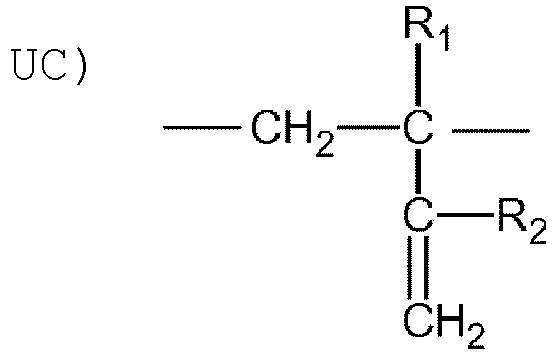


 wobei R1 und R2, die gleich oder verschieden sind, für ein Wasserstoffatom, einen Methylrest oder einen Phenylrest, der in ortho-, meta- oder para-Position durch einen Methylrest substituiert oder unsubstituiert ist, stehen,wobei R3 für einen Alkylrest mit 1 bis 4 Kohlenstoffatomen oder einen Arylrest steht,m, n, o, p, q und r für Zahlen im Bereich von 0 bis 100 stehen,m ≥ 50


- Reifen (1) nach Anspruch 4, wobei r gleich 0 ist.
- Reifen (1) nach Anspruch 4 oder 5, wobei mindestens einer der beiden Molprozentanteile p und q von 0 verschieden ist.
- Reifen (1) nach einem der Ansprüche 4 bis 6, wobei p streng größer als 0 ist.
- Reifen (1) nach einem der Ansprüche 4 bis 7, wobei das erste Dienelastomer mindestens eines und vorzugsweise alle der folgenden Kriterien erfüllt:m ≥ 65n + o + p + q ≥ 15, noch weiter bevorzugt 20


- Reifen (1) nach einem der Ansprüche 4 bis 8, wobei das erste Dienelastomer als Monomereinheiten nur die Einheiten UA, UB, UC, UD und UE gemäß ihrem jeweiligen Molprozentanteil m, n, o, p bzw. q, die vorzugsweise alle von 0 verschieden sind, enthält.
- Reifen (1) nach einem der Ansprüche 4 bis 9, wobei das erste Dienelastomer als Monomereinheiten nur die Einheiten UA, UB, UC und UD gemäß ihrem jeweiligen Molprozentanteil m, n, o bzw. p, die vorzugsweise alle von 0 verschieden sind, enthält.
- Reifen (1) nach einem der Ansprüche 4 bis 10, wobei R1 und R2 gleich sind und für ein Wasserstoffatom stehen.
- Reifen (1) nach einem der Ansprüche 1 bis 11, wobei das erste Dienelastomer das einzige Elastomer der mittleren Kautschukzusammensetzung ist.
- Reifen (1) nach einem der Ansprüche 1 bis 11, wobei die mittlere Kautschukzusammensetzung ein zweites Elastomer, vorzugsweise ein Dienelastomer, umfasst.
- Reifen (1) nach Anspruch 13, wobei das zweite Elastomer ein stark ungesättigtes Dienelastomer ist, das aus der Gruppe bestehend aus Polybutadienen, Polyisoprenen, Butadien-Copolymeren, Isopren-Copolymeren und Mischungen dieser Elastomere ausgewählt ist.
- Reifen (1) nach Anspruch 13, wobei das zweite Elastomer ein durch Copolymerisation von Ethylen und einem α-Olefin mit 3 bis 6 Kohlenstoffatomen mit einem nichtkonjugierten Dienmonomer mit 6 bis 12 Kohlenstoffatomen erhaltenes ternäres Copolymer ist.
- Reifen (1) nach einem der Ansprüche 1 bis 15, wobei der verstärkende Füllstoff der mittleren Kautschukzusammensetzung einen Ruß umfasst.
- Reifen (1) nach Anspruch 16, wobei der verstärkende Füllstoff der mittleren Kautschukzusammensetzung 100 Massen-% eines Rußes umfasst.
- Reifen (1) nach einem der Ansprüche 1 bis 16, wobei der verstärkende Füllstoff der mittleren Kautschukzusammensetzung einen anorganischen Füllstoff, vorzugsweise eine Kieselsäure, umfasst.
- Reifen (1) nach einem der Ansprüche 1 bis 18, wobei der Gehaltan verstärkendem Füllstoff der mittleren Kautschukzusammensetzung mindestens gleich 20 phe und höchstens gleich 70 phe, vorzugsweise mindestens gleich 25 phe und höchstens gleich 50 phe, ist.
- Reifen (1) nach einem der Ansprüche 1 bis 19, wobei die mittlere Kautschukzusammensetzung 0 bis 20 phe eines flüssigen Weichmachers umfasst.
- Reifen (1) nach Anspruch 20, wobei der Gehalt an flüssigem Weichmacher der mittleren Kautschukzusammensetzung gleich 0 ist.
- Reifen (1) nach einem der Ansprüche 1 bis 21, wobei mindestens eine seitliche Kautschukzusammensetzung von der mittleren Kautschukzusammensetzung verschieden ist.
- Reifen (1) nach einem der Ansprüche 1 bis 22, wobei mindestens eine seitliche Kautschukzusammensetzung ein Dienelastomer, einen verstärkenden Füllstoff und ein Vernetzungssystem umfasst, wobei das Dienelastomer ein stark ungesättigtes Dienelastomer ist, das aus der Gruppe bestehend aus Polybutadienen, Polyisoprenen, Butadien-Copolymeren, Isopren-Copolymeren und Mischungen dieser Elastomere ausgewählt ist.
- Reifen (1) nach einem der Ansprüche 1 bis 22, wobei mindestens eine seitliche Kautschukzusammensetzung höchstens 50 phe des ersten Dienelastomers nach einem der Ansprüche 1 bis 11 umfasst.
- Reifen (1) nach einem der Ansprüche 1 bis 24, wobei die beiden seitlichen Teile (41, 42), die axial auf jeder Seite des mittleren Teils (3) positioniert sind, gleiche axiale Breiten (LS1, LS2) aufweisen und aus den gleichen seitlichen Kautschukzusammensetzungen bestehen.
- Reifen (1) nach einem der Ansprüche 1 bis 25, wobei der Reifen eine Scheitelbewehrung (5) radial innerhalb der Lauffläche (2) umfasst, wobei der Reifen (1) eine Zwischenschicht (7) umfasst, die aus mindestens einer Kautschukzusammensetzung besteht und über eine radial äußere Seite mit mindestens dem mittleren Teil (3) der Lauffläche (2) und über eine radial innere Seite mit der Scheitelbewehrung (5) in Kontakt steht.
- Reifen (1) nach Anspruch 26, wobei die Zwischenschicht (7) aus einer Kautschukzusammensetzung besteht, die Naturkautschuk umfasst.
- Reifen (1) nach Anspruch 26, wobei die Zwischenschicht (7) aus einer Kautschukzusammensetzung besteht, die ein Elastomer umfasst, das Ethylen-Einheiten und Dien-Einheiten mit einer Kohlenstoff-Kohlenstoff-Doppelbindung, die statistisch in dem Elastomer verteilt sind, umfasst.
- Reifen (1) nach Anspruch 26, wobei die Zwischenschicht (7) aus einem Elastomerlaminat besteht, das radial von außen nach innen n Schichten Ci umfasst, wobei n eine ganze Zahl größer oder gleich 2 ist und i eine ganze Zahl im Bereich von 1 bis n ist, die jeweils aus einer Dienkautschukzusammensetzung bestehen, wobei die Schicht C1 ein Dienelastomer E umfasst, das Ethylen-Einheiten und Dien-Einheiten umfasst, wobei die Dien-Einheiten mehr als 10 Massen-% der Monomereinheiten des Dienelastomers E ausmachen, wobei die Schicht Cn 50 bis weniger als 100 phe eines Dienelastomers N mit einem Massengehalt an Dien-Einheiten von mehr als 50 % umfasst, wobei der in phe ausgedrückte Gehalt an Dienelastomer N in der Schicht Cn höher ist als in der Schicht C1, wobei der in phe ausgedrückte Gehalt an Dienelastomer E in der Schicht C1 höher ist als in der Schicht Cn, wobei die Schichten Ci für die Werte von i im Bereich von 2 bis n-1 mit n größer als 2 ein Dienelastomer I umfassen, das aus der Gruppe bestehend aus Dien-Homopolymeren und -Copolymeren mit mehr als 10 Massen-% Dien-Einheiten ausgewählt ist.
Applications Claiming Priority (2)
| Application Number | Priority Date | Filing Date | Title |
|---|---|---|---|
| FR1561131A FR3044007B1 (fr) | 2015-11-19 | 2015-11-19 | Bande de roulement pour pneumatique d'avion |
| PCT/FR2016/053011 WO2017085423A1 (fr) | 2015-11-19 | 2016-11-18 | Bande de roulement pour pneumatique d'avion |
Publications (2)
| Publication Number | Publication Date |
|---|---|
| EP3377338A1 EP3377338A1 (de) | 2018-09-26 |
| EP3377338B1 true EP3377338B1 (de) | 2020-01-01 |
Family
ID=55025236
Family Applications (1)
| Application Number | Title | Priority Date | Filing Date |
|---|---|---|---|
| EP16809505.7A Active EP3377338B1 (de) | 2015-11-19 | 2016-11-18 | Lauffläche für flugzeugreifen |
Country Status (6)
| Country | Link |
|---|---|
| US (1) | US11090980B2 (de) |
| EP (1) | EP3377338B1 (de) |
| JP (1) | JP2018537341A (de) |
| CN (1) | CN108463360B (de) |
| FR (1) | FR3044007B1 (de) |
| WO (1) | WO2017085423A1 (de) |
Families Citing this family (7)
| Publication number | Priority date | Publication date | Assignee | Title |
|---|---|---|---|---|
| FR3085684B1 (fr) * | 2018-09-11 | 2021-06-04 | Michelin & Cie | Composition de caoutchouc |
| FR3085683B1 (fr) * | 2018-09-11 | 2020-10-23 | Michelin & Cie | Pneumatique |
| FR3086949B1 (fr) * | 2018-10-09 | 2020-12-04 | Michelin & Cie | Composition de caoutchouc |
| FR3089225A3 (fr) | 2018-12-04 | 2020-06-05 | Michelin & Cie | Bande de roulement pour pneumatique d’avion |
| FR3090663A3 (fr) * | 2018-12-21 | 2020-06-26 | Michelin & Cie | Bande de roulement pour pneumatique |
| FR3090656A3 (fr) * | 2018-12-21 | 2020-06-26 | Michelin & Cie | Bande de roulement pour pneumatique |
| FR3111352B1 (fr) * | 2020-06-11 | 2023-02-10 | Michelin & Cie | Composition de caoutchouc presentant une resistance aux agressions amelioree |
Family Cites Families (44)
| Publication number | Priority date | Publication date | Assignee | Title |
|---|---|---|---|---|
| FR1462227A (fr) | 1964-07-14 | 1966-04-15 | Fisons Ltd | Procédé pour la production d'un engrais |
| US3423212A (en) | 1964-11-20 | 1969-01-21 | Union Carbide Corp | Method for packaging food products |
| DE1909914U (de) | 1964-11-25 | 1965-02-11 | Zeller Plastik Koehn Graeber & | Aufhaengevorrichtung fuer behaelter. |
| GB2045009B (en) | 1979-03-31 | 1983-02-09 | Ferranti Ltd | Circuit assemblies |
| US4463120A (en) | 1983-01-24 | 1984-07-31 | Sws Silicones Corporation | Process for preparing an aqueous adhesive composition |
| JPH0618950B2 (ja) | 1986-06-17 | 1994-03-16 | 株式会社ブリヂストン | ゴム組成物 |
| US5534574A (en) * | 1995-03-10 | 1996-07-09 | The Goodyear Tire & Rubber Company | Silica reinforced rubber preparation and tire with tread thereof |
| IT1290083B1 (it) | 1997-03-14 | 1998-10-19 | Pirelli | Pneumatico a bassa temperatura d'esercizio |
| FR2791000B1 (fr) | 1999-03-17 | 2001-05-04 | Michelin Soc Tech | Armature de sommet de pneumatique radial |
| FR2799468B1 (fr) | 1999-10-12 | 2006-04-28 | Michelin Soc Tech | Systeme catalytique utilisable pour la copolymerisation de l'ethylene et d'un diene conjugue, procede de preparation de ce systeme catalytique et d'un copolymere d'ethylene et d'un diene conjugue |
| FR2823698B1 (fr) | 2001-04-19 | 2004-05-07 | Michelin Soc Tech | Armatures de pneumatique pour avion |
| JP3699017B2 (ja) * | 2001-06-29 | 2005-09-28 | 住友ゴム工業株式会社 | ベーストレッド用ゴム組成物および空気入りタイヤ |
| US7712499B2 (en) | 2002-01-24 | 2010-05-11 | Bridgestone Corporation | Pneumatic radial tire with specified belt layer |
| US7138450B2 (en) | 2002-05-09 | 2006-11-21 | Cph Innovations Corp. | Vulcanized rubber composition with a liquid adhesion promoter containing an adhesive resin and ester |
| JP4367338B2 (ja) * | 2002-05-31 | 2009-11-18 | 日本ゼオン株式会社 | 共役ジエン系ゴム、その製造方法、ゴム組成物およびゴム架橋物 |
| JP2005533166A (ja) | 2002-07-17 | 2005-11-04 | ザ シー.ピー.ホール カンパニー | エラストマー用の可塑剤としてのダイメレート及びトリメレートエステル |
| CA2502345A1 (fr) | 2002-10-16 | 2004-04-29 | Michelin Recherche Et Technique S.A. | Copolymeres ethylene/ butadiene, system catalytique et les produires et production desdits polymers |
| US7131474B2 (en) | 2002-12-12 | 2006-11-07 | The Goodyear Tire & Rubber Company | Tire with rubber tread of load bearing central and lateral zones |
| FR2858817B1 (fr) | 2003-08-13 | 2006-02-03 | Michelin Soc Tech | Systeme catalytique pour l'obtention de copolymeres diene(s) conjugue(s)/ mono-olefine(s) et ces copolymeres |
| US20050194076A1 (en) * | 2004-03-08 | 2005-09-08 | Piet Vermaat | Pneumatic tire having a crown reinforcement structure with a plurality of adjacent cord reinforced strips and a process to manufacture or retread such a tire |
| US20070017617A1 (en) * | 2005-07-22 | 2007-01-25 | Lafrique Michel M | Tire with tread of cap/semibase construction |
| FR2893029B1 (fr) | 2005-11-09 | 2009-01-16 | Michelin Soc Tech | Complexe metallocene borohydrure d'un lanthanide, systeme catalytique l'incorporant, procede de polymerisation l'utilisant et copolymere ethylene/butadiene obtenu par ce procede |
| FR2893028B1 (fr) | 2005-11-09 | 2008-02-15 | Michelin Soc Tech | Complexe metallocene borohydrure d'un lanthanide, systeme catalytique l'incorporant, procede de polymerisation l'utilisant et copolymere ethylene/butadiene obtenu par ce procede |
| JP4907976B2 (ja) | 2005-12-21 | 2012-04-04 | 株式会社ブリヂストン | 航空機用空気入りラジアルタイヤ |
| FR2933031B1 (fr) | 2008-06-30 | 2011-08-19 | Michelin Soc Tech | Sommet pour pneumatique d'avion |
| JP5579744B2 (ja) * | 2008-12-29 | 2014-08-27 | コンパニー ゼネラール デ エタブリッスマン ミシュラン | 大型車両トレッド/アンダートレッド |
| FR2952855B1 (fr) | 2009-11-26 | 2011-11-11 | Michelin Soc Tech | Pneu destine a equiper un vehicule portant de lourdes charges |
| EP2516179B1 (de) * | 2009-12-23 | 2015-08-19 | MICHELIN Recherche et Technique S.A. | Kautschukzusammensetzung für flugzeugreifenprofile |
| FR2956616A1 (fr) * | 2010-02-23 | 2011-08-26 | Michelin Soc Tech | Pneumatique comprenant un organe electronique |
| FR2975045B1 (fr) * | 2011-05-12 | 2013-06-14 | Michelin Soc Tech | Pneumatique dont la zone sommet est pourvue d'une sous-couche comportant un elastomere thermoplastique |
| JP2013023516A (ja) | 2011-07-15 | 2013-02-04 | Jx Nippon Oil & Energy Corp | ゴム組成物、架橋ゴム組成物、空気入りタイヤ及びイソブチレン系重合体の製造方法 |
| FR2983121B1 (fr) | 2011-11-29 | 2013-12-20 | Michelin Soc Tech | Sommet pour pneumatique d'avion |
| FR2984335B1 (fr) * | 2011-12-16 | 2018-01-12 | Societe De Technologie Michelin | Pneumatique pourvu d'une couche interne a base d'un melange d'un elastomere dienique et d'un elastomere thermoplastique |
| FR2992897B1 (fr) | 2012-07-05 | 2014-08-15 | Michelin & Cie | Pneumatique comportant une bande de roulement constituee de plusieurs melanges elastomeriques |
| FR3001223B1 (fr) * | 2013-01-22 | 2015-03-06 | Michelin & Cie | Composition de caoutchouc comprenant un elastomere dienique fortement sature |
| FR3010348B1 (fr) | 2013-09-06 | 2015-09-04 | Michelin & Cie | Pneumatique comportant une bande de roulement perfectionnee |
| US9352615B2 (en) * | 2013-10-22 | 2016-05-31 | The Goodyear Tire & Rubber Company | Pneumatic tire with multi-tread cap |
| FR3012148B1 (fr) * | 2013-10-22 | 2015-12-04 | Michelin & Cie | Pneumatique d'avion dont la bande de roulement comprend une composition a base de silicone elastomerique |
| FR3024155B1 (fr) * | 2014-07-22 | 2016-07-22 | Michelin & Cie | Pneumatique pour avion |
| FR3029837B1 (fr) * | 2014-12-11 | 2016-12-30 | Michelin & Cie | Stratifie elastomere comprenant plus de 3 couches |
| FR3044009B1 (fr) * | 2015-11-19 | 2017-12-08 | Michelin & Cie | Bande de roulement pour pneumatique d'avion |
| FR3044010A1 (fr) * | 2015-11-19 | 2017-05-26 | Michelin & Cie | Bande de roulement pour pneumatique d'avion |
| FR3044008B1 (fr) * | 2015-11-19 | 2017-12-08 | Michelin & Cie | Bande de roulement pour pneumatique d'avion |
| US20190061425A1 (en) * | 2017-08-30 | 2019-02-28 | The Goodyear Tire & Rubber Company | Pneumatic tire |
-
2015
- 2015-11-19 FR FR1561131A patent/FR3044007B1/fr active Active
-
2016
- 2016-11-18 EP EP16809505.7A patent/EP3377338B1/de active Active
- 2016-11-18 US US15/776,470 patent/US11090980B2/en active Active
- 2016-11-18 WO PCT/FR2016/053011 patent/WO2017085423A1/fr not_active Ceased
- 2016-11-18 JP JP2018526096A patent/JP2018537341A/ja active Pending
- 2016-11-18 CN CN201680067736.8A patent/CN108463360B/zh active Active
Non-Patent Citations (1)
| Title |
|---|
| None * |
Also Published As
| Publication number | Publication date |
|---|---|
| CN108463360A (zh) | 2018-08-28 |
| JP2018537341A (ja) | 2018-12-20 |
| US20180326789A1 (en) | 2018-11-15 |
| CN108463360B (zh) | 2019-12-31 |
| FR3044007B1 (fr) | 2017-12-08 |
| WO2017085423A1 (fr) | 2017-05-26 |
| US11090980B2 (en) | 2021-08-17 |
| EP3377338A1 (de) | 2018-09-26 |
| FR3044007A1 (fr) | 2017-05-26 |
Similar Documents
| Publication | Publication Date | Title |
|---|---|---|
| EP3377339B1 (de) | Lauffläche für einen flugzeugreifen | |
| EP3377338B1 (de) | Lauffläche für flugzeugreifen | |
| EP3172061B1 (de) | Flugzeugreifen | |
| EP3592573B1 (de) | Reifen mit einer zusammensetzung mit einem ethylenreichen elastomer, einem peroxid und einem multifunktionalen acrylatderivat | |
| EP3592808B1 (de) | Reifen mit einer zusammensetzung mit einem ethylenreichen elastomer, einem peroxid und einem zinkacrylat | |
| EP3478759B1 (de) | Latex zusammensetzung enthaltend ein epoxidharz und einen speziellen aminhärter | |
| EP3890992B1 (de) | Lauffläche für einen flugzeugreifen | |
| EP4076983B1 (de) | Reifen mit einer lauffläche mit verstärkungselementen | |
| EP2104710A1 (de) | Reifenlauffläche mit einer xanthangummipulver enthaltenden zusammensetzung | |
| EP3328663B1 (de) | Flugzeugreifen | |
| EP3377335B1 (de) | Lauffläche für einen flugzeugreifen | |
| FR3060591A1 (fr) | Composition de caoutchouc comprenant une poudrette de caoutchouc specifique | |
| EP3172062B1 (de) | Flugzeugreifen | |
| EP3377334B1 (de) | Lauffläche für einen flugzeugreifen | |
| EP3818103B1 (de) | Kautschukmischung mit einem epoxydharz und ein ambinobenzoatderivat | |
| EP3880490B1 (de) | Mit einer lauffläche versehener reifen | |
| FR3140304A1 (fr) | Pneumatique comprenant une composition de caoutchouc amelioree | |
| FR3133857A1 (fr) | Composition élastomérique aux propriétés améliorées |
Legal Events
| Date | Code | Title | Description |
|---|---|---|---|
| STAA | Information on the status of an ep patent application or granted ep patent |
Free format text: STATUS: UNKNOWN |
|
| STAA | Information on the status of an ep patent application or granted ep patent |
Free format text: STATUS: THE INTERNATIONAL PUBLICATION HAS BEEN MADE |
|
| PUAI | Public reference made under article 153(3) epc to a published international application that has entered the european phase |
Free format text: ORIGINAL CODE: 0009012 |
|
| STAA | Information on the status of an ep patent application or granted ep patent |
Free format text: STATUS: REQUEST FOR EXAMINATION WAS MADE |
|
| 17P | Request for examination filed |
Effective date: 20180619 |
|
| AK | Designated contracting states |
Kind code of ref document: A1 Designated state(s): AL AT BE BG CH CY CZ DE DK EE ES FI FR GB GR HR HU IE IS IT LI LT LU LV MC MK MT NL NO PL PT RO RS SE SI SK SM TR |
|
| AX | Request for extension of the european patent |
Extension state: BA ME |
|
| RAP1 | Party data changed (applicant data changed or rights of an application transferred) |
Owner name: COMPAGNIE GENERALE DES ETABLISSEMENTS MICHELIN |
|
| DAV | Request for validation of the european patent (deleted) | ||
| DAX | Request for extension of the european patent (deleted) | ||
| GRAP | Despatch of communication of intention to grant a patent |
Free format text: ORIGINAL CODE: EPIDOSNIGR1 |
|
| STAA | Information on the status of an ep patent application or granted ep patent |
Free format text: STATUS: GRANT OF PATENT IS INTENDED |
|
| INTG | Intention to grant announced |
Effective date: 20190703 |
|
| GRAS | Grant fee paid |
Free format text: ORIGINAL CODE: EPIDOSNIGR3 |
|
| GRAA | (expected) grant |
Free format text: ORIGINAL CODE: 0009210 |
|
| STAA | Information on the status of an ep patent application or granted ep patent |
Free format text: STATUS: THE PATENT HAS BEEN GRANTED |
|
| AK | Designated contracting states |
Kind code of ref document: B1 Designated state(s): AL AT BE BG CH CY CZ DE DK EE ES FI FR GB GR HR HU IE IS IT LI LT LU LV MC MK MT NL NO PL PT RO RS SE SI SK SM TR |
|
| REG | Reference to a national code |
Ref country code: GB Ref legal event code: FG4D Free format text: NOT ENGLISH |
|
| REG | Reference to a national code |
Ref country code: CH Ref legal event code: EP Ref country code: AT Ref legal event code: REF Ref document number: 1219319 Country of ref document: AT Kind code of ref document: T Effective date: 20200115 |
|
| REG | Reference to a national code |
Ref country code: DE Ref legal event code: R096 Ref document number: 602016027496 Country of ref document: DE |
|
| REG | Reference to a national code |
Ref country code: IE Ref legal event code: FG4D Free format text: LANGUAGE OF EP DOCUMENT: FRENCH |
|
| REG | Reference to a national code |
Ref country code: NL Ref legal event code: MP Effective date: 20200101 |
|
| REG | Reference to a national code |
Ref country code: LT Ref legal event code: MG4D |
|
| PG25 | Lapsed in a contracting state [announced via postgrant information from national office to epo] |
Ref country code: PT Free format text: LAPSE BECAUSE OF FAILURE TO SUBMIT A TRANSLATION OF THE DESCRIPTION OR TO PAY THE FEE WITHIN THE PRESCRIBED TIME-LIMIT Effective date: 20200527 Ref country code: NO Free format text: LAPSE BECAUSE OF FAILURE TO SUBMIT A TRANSLATION OF THE DESCRIPTION OR TO PAY THE FEE WITHIN THE PRESCRIBED TIME-LIMIT Effective date: 20200401 Ref country code: FI Free format text: LAPSE BECAUSE OF FAILURE TO SUBMIT A TRANSLATION OF THE DESCRIPTION OR TO PAY THE FEE WITHIN THE PRESCRIBED TIME-LIMIT Effective date: 20200101 Ref country code: RS Free format text: LAPSE BECAUSE OF FAILURE TO SUBMIT A TRANSLATION OF THE DESCRIPTION OR TO PAY THE FEE WITHIN THE PRESCRIBED TIME-LIMIT Effective date: 20200101 Ref country code: NL Free format text: LAPSE BECAUSE OF FAILURE TO SUBMIT A TRANSLATION OF THE DESCRIPTION OR TO PAY THE FEE WITHIN THE PRESCRIBED TIME-LIMIT Effective date: 20200101 Ref country code: CZ Free format text: LAPSE BECAUSE OF FAILURE TO SUBMIT A TRANSLATION OF THE DESCRIPTION OR TO PAY THE FEE WITHIN THE PRESCRIBED TIME-LIMIT Effective date: 20200101 Ref country code: LT Free format text: LAPSE BECAUSE OF FAILURE TO SUBMIT A TRANSLATION OF THE DESCRIPTION OR TO PAY THE FEE WITHIN THE PRESCRIBED TIME-LIMIT Effective date: 20200101 |
|
| PG25 | Lapsed in a contracting state [announced via postgrant information from national office to epo] |
Ref country code: GR Free format text: LAPSE BECAUSE OF FAILURE TO SUBMIT A TRANSLATION OF THE DESCRIPTION OR TO PAY THE FEE WITHIN THE PRESCRIBED TIME-LIMIT Effective date: 20200402 Ref country code: BG Free format text: LAPSE BECAUSE OF FAILURE TO SUBMIT A TRANSLATION OF THE DESCRIPTION OR TO PAY THE FEE WITHIN THE PRESCRIBED TIME-LIMIT Effective date: 20200401 Ref country code: IS Free format text: LAPSE BECAUSE OF FAILURE TO SUBMIT A TRANSLATION OF THE DESCRIPTION OR TO PAY THE FEE WITHIN THE PRESCRIBED TIME-LIMIT Effective date: 20200501 Ref country code: SE Free format text: LAPSE BECAUSE OF FAILURE TO SUBMIT A TRANSLATION OF THE DESCRIPTION OR TO PAY THE FEE WITHIN THE PRESCRIBED TIME-LIMIT Effective date: 20200101 Ref country code: LV Free format text: LAPSE BECAUSE OF FAILURE TO SUBMIT A TRANSLATION OF THE DESCRIPTION OR TO PAY THE FEE WITHIN THE PRESCRIBED TIME-LIMIT Effective date: 20200101 Ref country code: HR Free format text: LAPSE BECAUSE OF FAILURE TO SUBMIT A TRANSLATION OF THE DESCRIPTION OR TO PAY THE FEE WITHIN THE PRESCRIBED TIME-LIMIT Effective date: 20200101 |
|
| REG | Reference to a national code |
Ref country code: DE Ref legal event code: R097 Ref document number: 602016027496 Country of ref document: DE |
|
| PG25 | Lapsed in a contracting state [announced via postgrant information from national office to epo] |
Ref country code: ES Free format text: LAPSE BECAUSE OF FAILURE TO SUBMIT A TRANSLATION OF THE DESCRIPTION OR TO PAY THE FEE WITHIN THE PRESCRIBED TIME-LIMIT Effective date: 20200101 Ref country code: SK Free format text: LAPSE BECAUSE OF FAILURE TO SUBMIT A TRANSLATION OF THE DESCRIPTION OR TO PAY THE FEE WITHIN THE PRESCRIBED TIME-LIMIT Effective date: 20200101 Ref country code: SM Free format text: LAPSE BECAUSE OF FAILURE TO SUBMIT A TRANSLATION OF THE DESCRIPTION OR TO PAY THE FEE WITHIN THE PRESCRIBED TIME-LIMIT Effective date: 20200101 Ref country code: DK Free format text: LAPSE BECAUSE OF FAILURE TO SUBMIT A TRANSLATION OF THE DESCRIPTION OR TO PAY THE FEE WITHIN THE PRESCRIBED TIME-LIMIT Effective date: 20200101 Ref country code: RO Free format text: LAPSE BECAUSE OF FAILURE TO SUBMIT A TRANSLATION OF THE DESCRIPTION OR TO PAY THE FEE WITHIN THE PRESCRIBED TIME-LIMIT Effective date: 20200101 Ref country code: EE Free format text: LAPSE BECAUSE OF FAILURE TO SUBMIT A TRANSLATION OF THE DESCRIPTION OR TO PAY THE FEE WITHIN THE PRESCRIBED TIME-LIMIT Effective date: 20200101 |
|
| PLBE | No opposition filed within time limit |
Free format text: ORIGINAL CODE: 0009261 |
|
| STAA | Information on the status of an ep patent application or granted ep patent |
Free format text: STATUS: NO OPPOSITION FILED WITHIN TIME LIMIT |
|
| REG | Reference to a national code |
Ref country code: AT Ref legal event code: MK05 Ref document number: 1219319 Country of ref document: AT Kind code of ref document: T Effective date: 20200101 |
|
| 26N | No opposition filed |
Effective date: 20201002 |
|
| PG25 | Lapsed in a contracting state [announced via postgrant information from national office to epo] |
Ref country code: IT Free format text: LAPSE BECAUSE OF FAILURE TO SUBMIT A TRANSLATION OF THE DESCRIPTION OR TO PAY THE FEE WITHIN THE PRESCRIBED TIME-LIMIT Effective date: 20200101 Ref country code: AT Free format text: LAPSE BECAUSE OF FAILURE TO SUBMIT A TRANSLATION OF THE DESCRIPTION OR TO PAY THE FEE WITHIN THE PRESCRIBED TIME-LIMIT Effective date: 20200101 |
|
| PGFP | Annual fee paid to national office [announced via postgrant information from national office to epo] |
Ref country code: GB Payment date: 20201120 Year of fee payment: 5 |
|
| PG25 | Lapsed in a contracting state [announced via postgrant information from national office to epo] |
Ref country code: PL Free format text: LAPSE BECAUSE OF FAILURE TO SUBMIT A TRANSLATION OF THE DESCRIPTION OR TO PAY THE FEE WITHIN THE PRESCRIBED TIME-LIMIT Effective date: 20200101 Ref country code: SI Free format text: LAPSE BECAUSE OF FAILURE TO SUBMIT A TRANSLATION OF THE DESCRIPTION OR TO PAY THE FEE WITHIN THE PRESCRIBED TIME-LIMIT Effective date: 20200101 |
|
| REG | Reference to a national code |
Ref country code: DE Ref legal event code: R119 Ref document number: 602016027496 Country of ref document: DE |
|
| PG25 | Lapsed in a contracting state [announced via postgrant information from national office to epo] |
Ref country code: MC Free format text: LAPSE BECAUSE OF FAILURE TO SUBMIT A TRANSLATION OF THE DESCRIPTION OR TO PAY THE FEE WITHIN THE PRESCRIBED TIME-LIMIT Effective date: 20200101 |
|
| REG | Reference to a national code |
Ref country code: CH Ref legal event code: PL |
|
| PG25 | Lapsed in a contracting state [announced via postgrant information from national office to epo] |
Ref country code: LU Free format text: LAPSE BECAUSE OF NON-PAYMENT OF DUE FEES Effective date: 20201118 |
|
| REG | Reference to a national code |
Ref country code: BE Ref legal event code: MM Effective date: 20201130 |
|
| PG25 | Lapsed in a contracting state [announced via postgrant information from national office to epo] |
Ref country code: LI Free format text: LAPSE BECAUSE OF NON-PAYMENT OF DUE FEES Effective date: 20201130 Ref country code: CH Free format text: LAPSE BECAUSE OF NON-PAYMENT OF DUE FEES Effective date: 20201130 |
|
| PG25 | Lapsed in a contracting state [announced via postgrant information from national office to epo] |
Ref country code: IE Free format text: LAPSE BECAUSE OF NON-PAYMENT OF DUE FEES Effective date: 20201118 |
|
| PG25 | Lapsed in a contracting state [announced via postgrant information from national office to epo] |
Ref country code: DE Free format text: LAPSE BECAUSE OF NON-PAYMENT OF DUE FEES Effective date: 20210601 |
|
| PG25 | Lapsed in a contracting state [announced via postgrant information from national office to epo] |
Ref country code: TR Free format text: LAPSE BECAUSE OF FAILURE TO SUBMIT A TRANSLATION OF THE DESCRIPTION OR TO PAY THE FEE WITHIN THE PRESCRIBED TIME-LIMIT Effective date: 20200101 Ref country code: MT Free format text: LAPSE BECAUSE OF FAILURE TO SUBMIT A TRANSLATION OF THE DESCRIPTION OR TO PAY THE FEE WITHIN THE PRESCRIBED TIME-LIMIT Effective date: 20200101 Ref country code: CY Free format text: LAPSE BECAUSE OF FAILURE TO SUBMIT A TRANSLATION OF THE DESCRIPTION OR TO PAY THE FEE WITHIN THE PRESCRIBED TIME-LIMIT Effective date: 20200101 |
|
| PG25 | Lapsed in a contracting state [announced via postgrant information from national office to epo] |
Ref country code: MK Free format text: LAPSE BECAUSE OF FAILURE TO SUBMIT A TRANSLATION OF THE DESCRIPTION OR TO PAY THE FEE WITHIN THE PRESCRIBED TIME-LIMIT Effective date: 20200101 Ref country code: AL Free format text: LAPSE BECAUSE OF FAILURE TO SUBMIT A TRANSLATION OF THE DESCRIPTION OR TO PAY THE FEE WITHIN THE PRESCRIBED TIME-LIMIT Effective date: 20200101 |
|
| GBPC | Gb: european patent ceased through non-payment of renewal fee |
Effective date: 20211118 |
|
| PG25 | Lapsed in a contracting state [announced via postgrant information from national office to epo] |
Ref country code: BE Free format text: LAPSE BECAUSE OF NON-PAYMENT OF DUE FEES Effective date: 20201130 |
|
| PG25 | Lapsed in a contracting state [announced via postgrant information from national office to epo] |
Ref country code: GB Free format text: LAPSE BECAUSE OF NON-PAYMENT OF DUE FEES Effective date: 20211118 |
|
| PGFP | Annual fee paid to national office [announced via postgrant information from national office to epo] |
Ref country code: FR Payment date: 20251126 Year of fee payment: 10 |