EP3379240A1 - Geruchssensor und geruchsmesssystem - Google Patents
Geruchssensor und geruchsmesssystem Download PDFInfo
- Publication number
- EP3379240A1 EP3379240A1 EP16865943.1A EP16865943A EP3379240A1 EP 3379240 A1 EP3379240 A1 EP 3379240A1 EP 16865943 A EP16865943 A EP 16865943A EP 3379240 A1 EP3379240 A1 EP 3379240A1
- Authority
- EP
- European Patent Office
- Prior art keywords
- odor
- substance
- sensor
- membrane
- dopant
- Prior art date
- Legal status (The legal status is an assumption and is not a legal conclusion. Google has not performed a legal analysis and makes no representation as to the accuracy of the status listed.)
- Ceased
Links
Images








Classifications
-
- G—PHYSICS
- G01—MEASURING; TESTING
- G01N—INVESTIGATING OR ANALYSING MATERIALS BY DETERMINING THEIR CHEMICAL OR PHYSICAL PROPERTIES
- G01N27/00—Investigating or analysing materials by the use of electric, electrochemical, or magnetic means
- G01N27/02—Investigating or analysing materials by the use of electric, electrochemical, or magnetic means by investigating impedance
- G01N27/04—Investigating or analysing materials by the use of electric, electrochemical, or magnetic means by investigating impedance by investigating resistance
- G01N27/12—Investigating or analysing materials by the use of electric, electrochemical, or magnetic means by investigating impedance by investigating resistance of a solid body in dependence upon absorption of a fluid; of a solid body in dependence upon reaction with a fluid, for detecting components in the fluid
- G01N27/125—Composition of the body, e.g. the composition of its sensitive layer
- G01N27/126—Composition of the body, e.g. the composition of its sensitive layer comprising organic polymers
-
- G—PHYSICS
- G01—MEASURING; TESTING
- G01N—INVESTIGATING OR ANALYSING MATERIALS BY DETERMINING THEIR CHEMICAL OR PHYSICAL PROPERTIES
- G01N27/00—Investigating or analysing materials by the use of electric, electrochemical, or magnetic means
-
- G—PHYSICS
- G01—MEASURING; TESTING
- G01N—INVESTIGATING OR ANALYSING MATERIALS BY DETERMINING THEIR CHEMICAL OR PHYSICAL PROPERTIES
- G01N27/00—Investigating or analysing materials by the use of electric, electrochemical, or magnetic means
- G01N27/02—Investigating or analysing materials by the use of electric, electrochemical, or magnetic means by investigating impedance
- G01N27/22—Investigating or analysing materials by the use of electric, electrochemical, or magnetic means by investigating impedance by investigating capacitance
- G01N27/227—Sensors changing capacitance upon adsorption or absorption of fluid components, e.g. electrolyte-insulator-semiconductor sensors, MOS capacitors
-
- G—PHYSICS
- G01—MEASURING; TESTING
- G01N—INVESTIGATING OR ANALYSING MATERIALS BY DETERMINING THEIR CHEMICAL OR PHYSICAL PROPERTIES
- G01N27/00—Investigating or analysing materials by the use of electric, electrochemical, or magnetic means
- G01N27/26—Investigating or analysing materials by the use of electric, electrochemical, or magnetic means by investigating electrochemical variables; by using electrolysis or electrophoresis
- G01N27/403—Cells and electrode assemblies
- G01N27/414—Ion-sensitive or chemical field-effect transistors, i.e. ISFETS or CHEMFETS
- G01N27/4141—Ion-sensitive or chemical field-effect transistors, i.e. ISFETS or CHEMFETS specially adapted for gases
-
- G—PHYSICS
- G01—MEASURING; TESTING
- G01N—INVESTIGATING OR ANALYSING MATERIALS BY DETERMINING THEIR CHEMICAL OR PHYSICAL PROPERTIES
- G01N29/00—Investigating or analysing materials by the use of ultrasonic, sonic or infrasonic waves; Visualisation of the interior of objects by transmitting ultrasonic or sonic waves through the object
- G01N29/02—Analysing fluids
- G01N29/022—Fluid sensors based on microsensors, e.g. quartz crystal-microbalance [QCM], surface acoustic wave [SAW] devices, tuning forks, cantilevers, flexural plate wave [FPW] devices
-
- G—PHYSICS
- G01—MEASURING; TESTING
- G01N—INVESTIGATING OR ANALYSING MATERIALS BY DETERMINING THEIR CHEMICAL OR PHYSICAL PROPERTIES
- G01N29/00—Investigating or analysing materials by the use of ultrasonic, sonic or infrasonic waves; Visualisation of the interior of objects by transmitting ultrasonic or sonic waves through the object
- G01N29/02—Analysing fluids
- G01N29/036—Analysing fluids by measuring frequency or resonance of acoustic waves
-
- G—PHYSICS
- G01—MEASURING; TESTING
- G01N—INVESTIGATING OR ANALYSING MATERIALS BY DETERMINING THEIR CHEMICAL OR PHYSICAL PROPERTIES
- G01N33/00—Investigating or analysing materials by specific methods not covered by groups G01N1/00 - G01N31/00
- G01N33/0004—Gaseous mixtures, e.g. polluted air
- G01N33/0009—General constructional details of gas analysers, e.g. portable test equipment
- G01N33/0027—General constructional details of gas analysers, e.g. portable test equipment concerning the detector
- G01N33/0031—General constructional details of gas analysers, e.g. portable test equipment concerning the detector comprising two or more sensors, e.g. a sensor array
-
- G—PHYSICS
- G01—MEASURING; TESTING
- G01N—INVESTIGATING OR ANALYSING MATERIALS BY DETERMINING THEIR CHEMICAL OR PHYSICAL PROPERTIES
- G01N5/00—Analysing materials by weighing, e.g. weighing small particles separated from a gas or liquid
- G01N5/02—Analysing materials by weighing, e.g. weighing small particles separated from a gas or liquid by absorbing or adsorbing components of a material and determining change of weight of the adsorbent, e.g. determining moisture content
-
- G—PHYSICS
- G01—MEASURING; TESTING
- G01N—INVESTIGATING OR ANALYSING MATERIALS BY DETERMINING THEIR CHEMICAL OR PHYSICAL PROPERTIES
- G01N27/00—Investigating or analysing materials by the use of electric, electrochemical, or magnetic means
- G01N27/02—Investigating or analysing materials by the use of electric, electrochemical, or magnetic means by investigating impedance
- G01N27/22—Investigating or analysing materials by the use of electric, electrochemical, or magnetic means by investigating impedance by investigating capacitance
- G01N27/221—Investigating or analysing materials by the use of electric, electrochemical, or magnetic means by investigating impedance by investigating capacitance by investigating the dielectric properties
- G01N2027/222—Investigating or analysing materials by the use of electric, electrochemical, or magnetic means by investigating impedance by investigating capacitance by investigating the dielectric properties for analysing gases
-
- G—PHYSICS
- G01—MEASURING; TESTING
- G01N—INVESTIGATING OR ANALYSING MATERIALS BY DETERMINING THEIR CHEMICAL OR PHYSICAL PROPERTIES
- G01N2291/00—Indexing codes associated with group G01N29/00
- G01N2291/02—Indexing codes associated with the analysed material
- G01N2291/025—Change of phase or condition
- G01N2291/0255—(Bio)chemical reactions, e.g. on biosensors
-
- G—PHYSICS
- G01—MEASURING; TESTING
- G01N—INVESTIGATING OR ANALYSING MATERIALS BY DETERMINING THEIR CHEMICAL OR PHYSICAL PROPERTIES
- G01N2291/00—Indexing codes associated with group G01N29/00
- G01N2291/02—Indexing codes associated with the analysed material
- G01N2291/025—Change of phase or condition
- G01N2291/0256—Adsorption, desorption, surface mass change, e.g. on biosensors
Definitions
- the present invention relates to a substance absorbing membrane, and an odor sensor which includes the adsorbent membrane. Moreover, the invention relates to an odor measuring system which includes the odor sensor.
- An odor is the only sense, among the senses possessed by a human being, which is not mechanically measurable by a sensor, and it is anticipated that the information expected to be provided by the odor data can be utilized in various aspects such as medicine, safety, security, environment, EC (e-commerce), and IoT (Internet of Things).
- such a sensor basically performs measurement of odors by combining sensors that respectively respond to known specific gases, and it has been difficult to implement the expression of actual odors, which originate from substances that are not well-known or from an interaction of a plurality of substances.
- sensors having an array structure composed of a plurality of sensors that use electroconductive polymers such as polypyrrole were suggested in the 1990's, and thus, techniques of expressing odors by mapping the differences in the responses of sensors in an array form have been investigated and put to practical use.
- Non-Patent Document 1 Souza et al. published a method of expressing an odor by using a polypyrrole thin film formed on a four-terminal gold electrode using five kinds of dopants such as p-toluene sulfonic acid, as a gas absorbent membrane, and mapping any changes in the oxidation reduction potential of the membrane caused by gas adsorption.
- dopants such as p-toluene sulfonic acid
- Non-Patent Document 2 a method of visualizing an odor by incorporating a substance that serves as a plasticizer (polystyrene or a derivative thereof) when polypyrrole is polymerized, thereby changing the film properties, configuring a capacitor array using this membrane as a resistive film, and mapping the change in capacity occurring when a gas is adsorbed to this capacitor array.
- a plasticizer polystyrene or a derivative thereof
- Non-Patent Document 3 the sensor investigated in this study cannot be said to be a sensor with high sensitivity, while it has linearity in sensitivity at a high concentration range.
- Non-Patent Document 4 Pandy et al. reported that hydrogen sulfide could be detected with high sensitivity by using an electrode produced by forming nanowires of polyaniline on gold nanoparticles or an electrode produced by forming nanowires of polyaniline on a metal salt, and reading out any impedance changes caused by gas adsorption onto those electrodes.
- Li et al. have investigated on the adsorption characteristics of triethylamine, ethanol, and ethyl acetate by producing a prototype of a polyaniline-coated QCM by coating a QCM by dropping water-soluble polyaniline thereon. It was found that a polyaniline-coated QCM shows responses with satisfactory reproducibility, and shows different responses depending on the polarity of the adsorbed gas (Non-Patent Document 5).
- Nathan et al. suggested an array type odor sensor comprising a QCM, a metal oxide semiconductor, an optical sensor, a MEMS sensor, an electrochemical sensor, or the like, the array type odor sensor being obtained by forming at least one kind or more of electroconductive polymers such as polypyrrole, polyaniline, and polythiophene (Patent Document 1).
- electroconductive polymers such as polypyrrole, polyaniline, and polythiophene
- Non-Patent Document 6 Regard the number of human olfactory receptors, it is considered that there are about 380 kinds of olfactory receptors (Non-Patent Document 6). From this, it is speculated that in order to perform an accurate odor pattern analysis that is close as far as possible to the odor pattern analysis system of the human being, 30 to 40 kinds of sensor arrays at the minimum are desired.
- Nathan et al. as described above have suggested to use five kinds of electroconductive polymers and derivatives thereof in adsorbent membranes, and thus, numerous adsorbent membranes can be prepared when various derivatives of electroconductive polymers and the like having alkyl substituents are used.
- the odor substance dissolves into a special mucous membrane called olfactory epithelium at the top part of the nasal cavity and is perceived there. Then, the olfactory cells in the olfactory epithelium generate electric signals, the electric signals are transmitted through the olfactory nerves and olfactory bulbs to the brain (limbic system), and the sense of odor occurs.
- olfactory epithelium a special mucous membrane
- olfactory receptors odor sensors
- odor sensors odor sensors
- Several olfactory receptors respond to one odor molecule, and thus an odor is detected.
- concentration of an odor changes, the combination of the responding olfactory receptors is changed, and the odor is perceived as a different odor.
- Tonosaki wrote in his book that attention has been paid to a plurality of odor causative substances having different molecular structures produce similar odors, and that at least some parts of the external form of those molecules giving similar odors resemble very closely has been found in a study by Amoore. That is, it has been suggested thereby that there is a possibility that olfactory receptors may have recognized the outline structures of the molecules.
- Non-Patent Document 7 Non-Patent Document 7
- Patent Document 1 US 6631333 B1
- the present invention was achieved in view of such circumstances as described above, and it is an object of the invention to provide an odor sensor that enables detection and rigorous distinction of a particular odor from a complicated collection of odors, like in the human olfactory perception; a substance adsorbing membrane used in the odor sensor; and a method for producing the substance adsorbing membrane.
- a database of odor patterns can be established by using such a sensor, and the database can be utilized in odor identification.
- the inventors of the present invention conducted investigations and researches, in order to solve the problems described above, on a method for producing a substance adsorbing membrane by significantly widening the scope of characteristics of the substance adsorbing membrane, and thereby enabling an increase in the number of elements of sensor arrays.
- the inventors found that when an electroconductive polymer is used as a basic skeleton of a substance adsorbing membrane, and a salt or an acid which forms a co-ion having a counterion of the electroconductive polymer or a dopant as a cation is incorporated to co-exist with the electroconductive polymer, the physical properties (polarity, hydrophilicity/hydrophobicity, steric hindrance, and the like)of the electroconductive polymer basic skeleton are significantly changed, and substantially limitless kinds of substance adsorbing membranes can be configured. Thus, the inventors finally completed the present invention.
- the present invention provides the following means in order to solve the problems described above.
- the characteristics of the substance adsorbing membrane change, and the physical, chemical, or electrical characteristics and the like of the substance adsorbing membrane are changed.
- the individual sensor elements can measure the state of adsorption of the odor substance to the substance adsorbing membrane.
- the adsorption characteristics of the substance adsorbing membrane for an odor substance can be changed by means of the type of the electroconductive polymer included in the substance adsorbing membrane, and the type and the amount of addition of the dopant added to the electroconductive polymer.
- a substance adsorbing membrane having particular adsorption characteristics a plurality of odor substances having an affinity to the adsorption characteristics can be adsorbed.
- a gas generally includes a large number of odor substances that constitute an "odor", and the collection of odor substances included in a gas has a variable amount of adsorption to a certain substance adsorbing membrane depending on the composition of the collection.
- an odor sensor includes two or more sensor elements each including a substance adsorbing membrane having respectively different dopant content ratios
- the odor sensor can detect two or more states of adsorption for a single gas. That is, the odor sensor can output detection patterns originating from the states of adsorption to be respectively measured by the two or more sensor elements.
- odor substance means, in a broad sense, a substance capable of adsorbing to a substance adsorbing membrane. Therefore, substances that are generally not considered as odor causative substances can also be included. In many cases, the "odor” includes a plurality of causative odor substances, and substances that are not recognized as odor substances. Moreover, unknown odor substances may also exist. The present invention has paid attention not to the adsorption of those individual odor substances, but to the amount of adsorption of odor substances having particular adsorption characteristics, which can be adsorbed to a particular substance adsorbing membrane. Meanwhile, in the present specification, even in a case in which the words "odor substance” is simply described, the term may mean, not individual odor substances, but a "collection of odor substances" which may include a plurality of odor substances.
- the sensor element and the sensor of the present invention can be provided with a wide variety of substance adsorbing membranes having physical, chemical, or electrical characteristics specific to odor substance, the sensor element and the sensor can detect an odor even in a general environment in which various substances exist as a mixture, without limiting the substance.
- such a sensor of the present invention is different from conventional odor sensors which are based on the principle of gas analysis, from the viewpoint that the sensor of the invention does not express an odor as components of constituent substances but outputs an image pattern of an odor.
- the odor sensor according to Embodiment 1 is an odor sensor including at least two sensor elements each including a substance adsorbing membrane which adsorbs at least one or more odor substances included in the air; and a signal conversion unit which measures the physical, chemical, or electrical characteristics of the substance adsorbing membrane after adsorption of the above-mentioned substance, in which the substance adsorbing membrane contains an electroconductive polymer and a dopant capable of modifying the substance characteristics of the electroconductive polymer, and the at least two sensor elements are respectively provided with substance adsorbing membranes having different basic skeletons and proportions of the dopant.
- the substance adsorbing membrane can modify the membrane characteristics by means of the dopant, and each substance adsorbing membrane selectively and specifically adsorbs a certain substance.
- each substance adsorbing membrane selectively and specifically adsorbs a certain substance.
- an "odor” includes a collection of specific single molecules or molecular groups consisting of different molecules each at different concentrations and which can be acquired as olfactory information by human beings or living beings including human beings.
- the signal conversion unit measures the state of adsorption of an odor substance to a substance adsorbing membrane, and measures any changes in the physical, chemical, or electrical characteristics of the substance adsorbing membrane caused by adsorption of the odor substance to the substance adsorbing membrane.
- the "state of adsorption of an odor substance to a substance adsorbing membrane” conceptually includes, for example, an "amount of adsorption of an odor substance to a substance adsorbing membrane".
- the physical, chemical, or electrical characteristics of the substance adsorbing membrane change, and the state of adsorption of the odor substance to the substance adsorbing membrane is determined by measuring the quantity of the changes.
- physical, chemical, or electrical characteristics include physical characteristics such as changes in the frequency of a quartz crystal oscillator, changes in the optical characteristics (changes in the absorption wavelength, changes in the absorbance, changes in the refractive index, and the like), and changes in the velocity of the surface acoustic waves; electrochemical characteristics such as changes in the electrochemical impedance and changes in the oxidation reduction potential; and electrical characteristics such as charge coupling, gate voltage, impedance, resonance frequency, and band gap.
- Fig. 1 is a cross-sectional view of a sensor element 101 of the present invention.
- the sensor element 101 is provided on the surface with a sensor main body 102; and a substance adsorbing membrane 103 that is provided on the surface of the sensor main body 102 and adsorbs an odor substance (chemical substance).
- the sensor main body 102 is provided on a substrate 110.
- an excitation electrode (not illustrated in the diagram) is disposed on the surface on the opposite side may also be adopted.
- the substance adsorbing membrane 103 is a thin film formed from a ⁇ -electron conjugated polymer, and this ⁇ -electron conjugated polymer thin film can contain at least one kind selected from an inorganic acid, an organic acid, and an ionic liquid as a dopant 105.
- the sensor main body 102 is provided so as to have a function as a signal conversion unit (transducer) which measures the state of adsorption of a substance by measuring any changes in the physical, chemical, or electrical characteristics caused by the substance adsorbed to the surface of the substance adsorbing membrane.
- the physical, chemical, or electrical element of the sensor main body is not particularly limited as long as the element is a sensor, such as a quartz crystal oscillator sensor (QCM), a surface acoustic wave sensor, a field effect transistor (FET) sensor, a charge coupled element sensor, a MOS field effect transistor sensor, a metal oxide semiconductor sensor, an organic electroconductive polymer sensor, or an electrochemical sensor, and various sensors can be used as appropriate according to the purpose from case to case.
- the structure of the element can adopt various different structures according to the purpose of detection of the sensor.
- the sensor in the case of a quartz crystal oscillator, the sensor may have a structure of a conventional type in which electrodes are attached on both surfaces, or a sensor having a structure having a separated electrode with only a single-sided electrode, by which a high Q value can be acquired, may also be used.
- the ⁇ -electron conjugated polymer used as the substance adsorbing membrane 103 is not particularly limited; although, a polymer having a so-called ⁇ -electron conjugated polymer, such as polypyrrole or a derivative thereof, polyaniline or a derivative thereof, polythiophene or a derivative thereof, polyacetylene or a derivative thereof, or polyazulene or a derivative thereof as a skeleton, is favorable.
- such a ⁇ -electron conjugated polymer exhibits electrical conductivity such that the skeletal polymer itself becomes a cation in an oxidized state, and the polymer includes an anion as a dopant.
- a neutral ⁇ -electron conjugated polymer which does not have a dopant can also be selected as the substance adsorbing membrane.
- Fig. 2 and Fig. 3 illustrate some examples of substances which can be used in chemical formulae and a table.
- Examples of the dopant include inorganic ions such as chloride ion, oxychloride ion, bromide ion, sulfate ion, nitrate ion, and borate ion; organic acid anions such as alkyl sulfonates, benzenesulfonates, and carboxylates; and polymeric acid anions such as polyacrylates and polystyrene sulfonates.
- inorganic ions such as chloride ion, oxychloride ion, bromide ion, sulfate ion, nitrate ion, and borate ion
- organic acid anions such as alkyl sulfonates, benzenesulfonates, and carboxylates
- polymeric acid anions such as polyacrylates and polystyrene sulfonates.
- a method of incorporating a salt such as table salt, or an ionic compound which includes both cations and anions, such as an ionic liquid, into a neutral ⁇ -electron conjugated polymer and thereby performing doping under chemical equilibrium can also be used.
- the ionic liquid which can be used herein is not particularly limited; although, examples thereof include, based on the type of the cation, pyridine-based, alicyclic amine-based, and aliphatic amine-based ionic liquids. By selecting the type of the anion to be used in combination with this, various structures can be synthesized.
- Examples of the cation include ammonium-based ions such as imidazolium salts and pyridinium salts; phosphonium-based ions; and inorganic ions.
- anion to be employed examples include halogen-based ions such as bromide ion and triflate; boron-based ions such as tetraphenylborate; and phosphorus-based ions such as hexafluorophosphate.
- the content of the dopant in the ⁇ -electron conjugated polymer may be adjusted to the range of 0.01 to 5, and preferably to the range of 0.1 to 2, in a case in which a state of having one molecule of the dopant incorporated into two repeating units which form the high dopant is designated as 1.
- the content is lower than or equal to the minimum value of this range, the characteristics of the membrane are lost, and when the dopant is incorporated in an amount more than or equal to the maximum value, the effect of adsorption characteristics possessed by the polymer itself disappears, and it also becomes difficult to produce a membrane having desired adsorption characteristics in a well-controlled manner.
- the detection sensitivity for the chemical substance as an odor substance can be maintained at a suitable level.
- the thickness of the substance adsorbing membrane can be selected as appropriate according to the characteristics of the substance which serves as an object of adsorption.
- the thickness can be adjusted to the range of 10 nm to 10 ⁇ m, and preferably, it is preferable to adjust the thickness to 50 nm to 800 nm.
- the membrane thickness is less than 10 nm, a sufficient sensitivity cannot be obtained.
- the membrane thickness is more than 10 ⁇ m, the weight of the membrane exceeds the upper limit of the weight that can be measured by the sensor element, which is not preferable.
- the membrane can be produced by selecting an appropriate membrane forming method, such as diluting a solvent stock solution with various solvents, subsequently dissolving the dopant component therein to prepare a membrane solution, and then dropping the membrane solution on the surface of a sensor element using a microdispenser or the like.
- an appropriate membrane forming method such as diluting a solvent stock solution with various solvents, subsequently dissolving the dopant component therein to prepare a membrane solution, and then dropping the membrane solution on the surface of a sensor element using a microdispenser or the like.
- application of the membrane solution by ink jetting can also be employed.
- Fig. 4 is a schematic diagram of an odor sensor 100 and an odor measurement system 1000 of the present invention, which are described below.
- the odor sensor 100 includes sensor elements 101 as described above.
- the odor sensor 100 of the present invention has a plurality of the sensor elements 101
- the odor sensor 100 is enabled to adsorb substances having various characteristics by varying, for example, the configuration of the substance adsorbing membranes 103 provided on the surface of the sensor elements 101 for every element.
- the combination of the elements can be modified in various ways according to the purpose of the detection. Substance recognition patterning as a whole is performed by detecting the adsorption pattern of each substance, and thereby, an adsorption pattern related to a certain group of odor substances can be presented.
- odor sensor In the conventional so-called odor sensor, most of the sensors have single probes for detecting odor causative substance molecules, and in such a case, only a qualitative or quantitative measurement of the single odor substance molecules can be performed.
- the odor sensor of the present invention is provided with a plurality of sensor elements. Furthermore, a configuration of exhibiting a reaction specific to a molecule to which the action of the sensor is directed can be adopted for each sensor, by providing substance adsorbing membranes having respectively different characteristics on the surface of the sensor element, and the extents of the action directed to the respective intended molecules can be regulated.
- all of the sensor elements used herein can have an identical element structure, that is, in the case of a QCM detection system, the sensor elements can form an array structure composed only of QCM sensors, and in the case of a FET detection system, the sensor elements can form a sensor element array structure composed only of FET sensors.
- an element array may also be configured by having a plurality of types of the element structures described above arranged together.
- the ⁇ -electron conjugated polymer used as the substance adsorbing membrane 103 an array structure formed from a single membrane may be adopted, and a sensor array in which only the dopant is varied for each of the elements may be produced.
- a configuration in which the ⁇ -electron conjugated polymer itself may be varied for each of the elements, may also be adopted. Even in the latter case, the dopant can be optionally disposed on a sensor array, independently of the ⁇ -electron conjugated polymer.
- the structure may be an array structure in which the substance adsorbing membrane is not formed in one or more of the sensor elements. These elements that do not have a membrane formed thereon can be used as references, and therefore, high detection accuracy can be secured.
- the odor sensor of the present invention can use various combinations of the configuration of the sensor element main body and the substance adsorbing membrane, a variety of sensor configurations can be adopted according to the characteristics of the substance as an object of detection.
- Sensor elements having different substance adsorbing membranes 103 applied thereon exhibit different interactions with an odor causative substance, which is an object of measurement.
- Sensor elements having different substance adsorbing membranes 103 applied thereon exhibit different interactions with an odor causative substance, which is an object of measurement.
- the information of sensor arrangement about which sensor adsorbs and detects which odor substance as the information about the X-axis direction and the Y-axis direction, and a qualitative odor pattern formed by changes in frequency in the same element group (adsorption characteristics or the extent of interaction) expressed at least in three-dimensions can be obtained.
- the sensor element or the excitation electrode can be formed from any arbitrary electroconductive material.
- examples thereof include inorganic materials such as gold, silver, platinum, chromium, titanium, aluminum, nickel, nickel-based alloys, silicon, carbon, and carbon nanotubes; and organic materials, including electroconductive polymers such as polypyrrole and polyaniline.
- the various sensors that constitute various arrays can have respectively slightly different interactions with an odor causative substance, which is a substance to be measured.
- the influence exerted by other co-existing oscillators that is, crosstalk can be reduced by changing the resonance frequencies of various oscillators, which is preferable.
- the odor sensor can be arbitrarily designed such that various oscillators within a common substrate show different sensitivities.
- a silicon substrate, a substrate formed from a quartz crystal, a printed wiring substrate, a ceramic substrate, a resin substrate, and the like can be used.
- the substrate is a multilayer wiring substrate such as an interposer substrate, and an excitation electrode for self-exciting the quartz crystal substrate; a mounted wiring; and electrodes for electricity conduction are disposed on the substrate at arbitrary positions.
- the substrate is wired to, for example, bumps, for the purpose of electrical grounding or electrical conduction to other electronic circuit boards and the like.
- a convex shape is a more preferable shape for the quartz crystal oscillator because the convex shape is smaller in size and prevents interference between various oscillators within the substrate by confining energy within each oscillator, and an increase in the Q value is anticipated.
- a structure in which the quartz crystal oscillator is produced into a convex shape (lens shape or emboss shape) having a thickness distribution, one surface side thereof is provided with a separated type excitation electrode (electrode for inputting a voltage for oscillation), and an electroconductive membrane is installed at a position facing the opposite surface of the excitation electrode, can be adopted.
- the Q value and conductance can be increased by the oscillation energy confinement effect, and a quartz crystal oscillator which is not susceptible to an interference caused by external contact without a decrease in the oscillation energy even if the oscillator is miniaturized, can be obtained.
- the S/N ratio is increased, and the oscillator becomes highly sensitive.
- a QCM sensor formed herein has a structure called inverted mesa shape or a convex shape, since close surface mounting is enabled, the structure is suitable for miniaturization.
- a convex type that is more suitable for a small-sized sensor is described as an example; however, if there is any other shape that is more optimal, that shape can be selected.
- a convex hybrid shape obtained by inserting convexities into a concavity of the inverted mesa has also been attempted. Furthermore, increases in the sensitivity of QCM elements (Q values) can also be seen in an elliptical shape as well as a circular shape, and thus, a shape that is more optimal in the aspects of cost and the like may be used.
- the size of the sensor main body is preferably the same as, or even smaller than, the area where the substance adsorbing membrane has been applied on the surface of the sensor main body.
- the sensor since there is a limitation in the reduction of the area of application of the substance adsorbing membrane, the sensor may be configured such that a plurality of sensor main bodies (signal conversion units) are assigned in the area where the substance adsorbing membrane has been applied.
- a transistor array composed of a plurality of fine MOSFET's, and a charge-coupled element array may be exemplified, and from the viewpoint of the ease of measurement and miniaturization, a charge-coupled element array is particularly preferred.
- the odor sensor of the present invention can be operated on almost all odor substances as objects of detection, without limitations, as long as the odor substances are substances able to be adsorbed to the substance adsorbing membrane 103. Furthermore, based on such a configuration, a number of sensor elements required for detecting a number of substances that are desired to be detected and specified may be provided, and thereby, a plurality of odor substances included in an odor itself can be measured quantitatively and qualitatively. Thus, such odor can be comprehensively measured.
- the sensor elements 101 that are disposed in the odor sensor 100 can be selected according to the substance to be measured. That is, sensor elements 101 based on a substance adsorbing membrane 103 having characteristics specific to an odor substance to be detected and measured; and a sensor main body 102 can be selected and disposed as appropriate.
- the sensor elements 101 Since the number of the sensor elements 101 is adjusted to at least two arrangements, the sensor elements can respectively specifically detect a plurality of odor substances included in an odor itself.
- the detection sensitivity for each sensor element can also be varied by varying the characteristics, the membrane thickness or the like of the substance adsorbing membrane. Thereby, the concentration and the like of the odor substance as object of measurement can also be measured.
- odor substances measured from combinations of the detection patterns of sensors can be specified by measuring a specific odor, that is, the odor itself composed of a plurality of odor substances.
- the detection unit 1001 since the detection unit 1001 has odor sensors 100 in an array structure, the number of sensors that specifically act on particular substance molecules, the arrangement of the sensors, and the type of the sensors can be determined after arbitrarily designing the a reaction pattern for the array as a whole obtained through the operation of the sensors. Then, when the reaction pattern is stored in advance in an odor information storage unit 1004, the reaction pattern can be compared with the reaction at the odor sensor 100 for each of the odor substances. Therefore, a collection of a plurality of odor substances can be measured, and thereby, measurement of an odor itself including a plurality of odor substances, which could not be realized with conventional odor sensors, is now enabled.
- an odor sensor 100 provided in the detection unit 1001 of the odor measurement system 1000 of the present invention as illustrated in Fig. 4 is brought into contact with an odor substance as an object of measurement. Through this contact, molecules of the odor substance are absorbed, and the substance is adsorbed to a substance adsorbing membrane 103 of the sensor element 101.
- the odor sensor 100 has a multi-array structure in which at least two or more sensor elements 101 are disposed.
- each sensor element 101 interact with each of intended odor substances to an extent characteristic to the odor substance, and the sensor element should interact with various odor causative substances included in an odor.
- the array part is brought into contact with a gas including adsorbed odor substances, and the results of the interaction exhibited by the respective sensors are obtained as data.
- the interaction data may vary depending on the sensor used.
- the interaction data are physical information outputted from a transducer unit, such as emission responses, changes in the electrical resistance, or changes in the oscillation frequency.
- a signal information retrieving process is performed at the measurement unit 1002 wherein the patterns of the interaction data are retrieved as signal information which is correlated with particularly measured odor factors and including the positional information of the responding sensors on the sensor array or the intensity of the interaction.
- this measurement data pattern obtained by performing data processing for example, the output pattern illustrated in Fig. 4
- the output pattern illustrated in Fig. 4 is reproduced by means of the difference in the emission responses or is displayed as matrix information, thereby the odor itself can be visualized or made easily recognizable.
- this data-processed interaction pattern information can be stored in a database together with information data related to odors by providing, for example, an odor information storage unit.
- the interaction pattern information can be utilized in the case of reproducing odors.
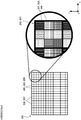
- Fig. 5 is a schematic diagram of the odor sensor arrangement structure 205 with a partially magnified diagram thereof.
- the partially magnified diagram including an odor sensor 200 disposed at the upper right corner of the odor sensor arrangement structure 205 and the vicinity thereof is illustrated inside the circle.
- Fig. 5 illustrates a case in which odor sensors 200 each have nine sensor elements planarly arranged in three columns in the Y-direction and three rows in the X-direction, and are planarly arranged in five columns in the Y-direction and six rows in the X-direction, so that thirty odor sensors in total are arranged.
- all of the nine sensor elements 201 have mutually different substance adsorbing membranes 203.
- the odor sensor arrangement structure 205 includes two or more arranged units of the odor sensor 200 including sensor elements 201.
- the odor sensor includes two or more sensor elements 201, each of which has a substance adsorbing membrane 203 which adsorbs odor substances; and a signal conversion unit which determines the state of adsorption of the odor substances to the substance adsorbing membrane 203.
- the substance adsorbing membrane 203 contains an electroconductive polymer and a dopant which changes the substance characteristics of the electroconductive polymer.
- the respective substance adsorbing membranes 203 possessed by the two or more sensor elements have respectively different content ratios of the dopant with respect to the electroconductive polymer.
- the odor sensor arrangement structure 205 can detect the state of adsorption of an odor substance at two or more distinct positions. Thereby, the positional information of an odor substance or a gas including the odor substance can be detected.
- the direction of movement of the odor substance or a gas including the odor substance can be recognized based on the difference in the amount of adsorption of the odor substance at the respective odor sensors. That is, the direction of movement of the odor substance can be detected. For example, it may be considered that by detecting a so-called "burning smell" generated in a state of smoldering before ignition, or the like with an odor sensor arrangement structure 205, it can be detected from which direction the burning smell has moved, and thus the odor sensor arrangement structure 205 can be useful in specification of the site of ignition.
- the measured values at the respective odor sensors of the odor sensor arrangement structure 205 can be recorded in a chronological order. Thereby, the path through which an odor substance has moved with a lapse of time can be recognized.
- the concentration distribution of the odor substance at positions corresponding to the respective odor sensors of the odor sensor arrangement structure 205 and the course of transition thereof can also be recognized.
- the odor sensors 200 included in the odor sensor arrangement structure 205 may be identical or different; however, in the case of figuring out the direction of movement of a particular odor substance, it is preferable that the respective odor sensors 200 have in common at least one substance adsorbing membrane 203 that should be included in each of the odor sensors 200. Furthermore, it is more preferable that the respective odor sensors 200 have in common the combination of the substance adsorbing membranes 203 included in each of the odor sensors 200. Furthermore, it is preferable that the respective odor sensors 200 are identical.
- the overall shape of the odor sensor arrangement structure 205 is not particularly limited; however, for example, as illustrated in Fig. 5 , the odor sensor arrangement structure may be a planar-shaped odor sensor arrangement structure 205 in which various sensor elements 201 in each odor sensor are planarly arranged, and the respective odor sensors 200 are planarly arranged.
- the overall shape of the odor sensor arrangement structure 205 is a planar shape, installation of the odor sensor arrangement structure at arbitrary planar-shaped places such as the wall, the ceiling, and the floor is facilitated.
- the overall shape of the odor sensor arrangement structure 205 may also be a cylindrical shape or a spherical shape, both having the surface covered with odor sensors 200.
- an overall shape such as a cylindrical shape or a spherical shape as such, the direction of movement of an odor substance can be recognized three-dimensionally.
- the method for producing the odor sensor arrangement structure 205 is not particularly limited; however, for example, in a case in which a transistor sensor array such as a charge-coupled element array or a MOSFET is used as the sensor main body (signal conversion unit), the transistor sensor array can be partitioned into compartments 207 in an area corresponding to odor sensors, each compartment 207 can be further partitioned into subcompartments 208 in an area corresponding to sensor elements 201, and then respectively different substance adsorbing membranes 203 can be formed in each of the subcompartments 208.
- a transistor sensor array such as a charge-coupled element array or a MOSFET
- odor sensor arrangement structure 205 An application example of the odor sensor arrangement structure 205 is explained with reference to Fig. 6 to Fig. 9 .
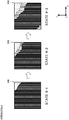
- Fig. 6 is an explanatory diagram illustrating changes in the state of adsorption occurring when water is adsorbed to the substance adsorbing membrane.
- Fig. 7 is an explanatory diagram illustrating changes in the state of desorption occurring when water is desorbed from the substance adsorbing membrane.
- Fig. 8 is an explanatory diagram illustrating changes in the state of adsorption occurring when Japanese sake is adsorbed to the substance adsorbing membrane.
- Fig. 9 is an explanatory diagram illustrating changes in the state of adsorption occurring when Japanese sake is desorbed from a substance adsorbing membrane.
- FIG. 9 illustrate the cases in which odor sensor arrangement structures 215, 225, 235, and 245 are provided on an X-Y plane, and water or Japanese sake contained in a sample container 216 or 236 is disposed at the position of a circle shown at the lower left of the odor sensor arrangement structure 215 or 235 in the diagram.
- the measurement results obtained immediately after disposing water or Japanese sake are indicated in Fig. 6 and Fig. 8 as “State 1-1" and “State 3-1", respectively.
- the measurement results obtained immediately after removing water or Japanese sake are indicated in Fig. 7 and Fig. 9 as “State 2-1" and “State 4-1", respectively.
- Measurement results obtained after a lapse of certain time after disposing or removing water or Japanese sake are indicated in Fig. 6 to Fig.
- the changes in the physical, chemical, or electrical characteristics of the various substance adsorbing membranes 203 which are attributed to the adsorption of an odor substance to the various substance adsorbing membranes 203, can be indicated by, for example, color discrimination or shade gradation depending on the magnitude of the amount of change.
- the measurement results are indicated by shade gradation depending on the magnitude of the amount of change.
- the shade gradation is shown to become darker as the amount of change increases, such that a case in which the amount of change is null (no change) or small is represented by a light shade; a case in which the amount of change is of a medium degree is represented by a shade of a medium degree; and a case in which the amount of change is large is represented by a dark shade.
- the shade is indicated in three levels for convenience; however, the threshold values for the change in color tone or the change in shade can be determined freely as appropriate.
- the amount of change is null (no change) or small; however, at State 1-2 after a lapse of certain time, the region with a medium-level amount of change has progressed to about 2/3 from the lower left corner, and the region with a large amount of change has progressed to about 1/3 from the lower left corner.
- the amount of change has increased in most part of the odor sensor arrangement structure 215, and it is understood that the area in which the odor substance is adsorbed to the substance adsorbing membranes 203 of the various odor sensors 200 has been spread to most part of the odor sensor arrangement structure 215.
- the direction of movement of the odor substance can be determined by visualizing the changes in a chronological order as in the case of State 1-1 to State 1-3.
- discrimination of an odor substance or a collection of odor substances based on the odor pattern at the odor sensors 200 alone, as well as the changes over time in the state of adsorption detected using the odor sensor arrangement structures 215, 225, 235, and 245 can also be used for the discrimination of an odor substance or a collection of odor substances.
- the odor sensor arrangement structures 215, 225, 235, and 245 which include those odor sensors 200 can also detect the migration of two or more odor substances. Furthermore, in a case in which two or more odor substances are combined on the odor sensor arrangement structures 215, 225, 235, and 245, the odor sensors in the region where two or more odor substances have been combined can detect an odor pattern corresponding to the combined two or more odor substances.
- Example 1 Substance adsorbing membrane based on combination of electroconductive polymer and ionic liquid>
- the concentrations of the sample gases were respectively 10 ppm.
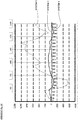
- the results of the present experiment are presented in Fig. 10 .
- the vertical axis represents changes in the frequency when the sensor responded, and the horizontal axis represents time.
- the sensor of System 5 provided with a dopant-containing substance adsorbing membrane responds specifically to each samples.
- Example 2 (Comparative Example) ⁇ Test by membrane formation with ionic liquid only>
- a substance adsorbing membrane was produced from an ionic liquid, and tests were performed as follows.
- Fig. 11 The results of the present test are presented in Fig. 11 .
- the vertical axis and the horizontal axis of the graph are similar to those of Fig. 10 .
- responses occurred to some extent; however, it was not considered that the sensor exhibited a reaction specific to a particular substance.
- Membrane solutions were prepared using 0.4% polyaniline, and mixing the polymer with the following ionic liquids as dopants.
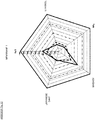
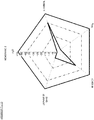
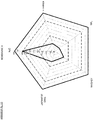
- Fig. 12 to Fig. 16 are radar charts showing the measurement results for various sample gases obtained with the Membranes 1 to 5 described above. As shown in the charts, it was found that when an ionic liquid as a dopant was mixed with polyaniline as an electroconductive polymer, the substance adsorption characteristics of the membranes changed according to the mixing conditions.
- odors can be measured in a manner specific to various substances, by changing the combination of the type, amount, and the like of the electroconductive polymer and the dopant.
- Example 4 an evaluation was carried out for a case in which collections of odor substances of each of instant coffee and drip coffee were adsorbed to substance adsorbing membranes a to 1 produced using polyaniline as the electroconductive polymer and the following ionic liquids La to Ll as the dopant. Meanwhile, the preparation of the membrane solutions, sample production, and flow measurement were carried out substantially in the same manner as in Example 1, except that the ionic liquids were different.
- 2% polyaniline as a raw material solution was diluted to ten times with NMP (N-methyl-2-pyrrolidone), and thereby a 0.2% polyaniline solution was prepared.
- NMP N-methyl-2-pyrrolidone
- ionic liquids La to Ll were prepared such that the molar ratio of the ionic liquid (dopant) component would be 1.0 with respect to 2 units of aniline.
- the 0.2% polyaniline solution thus prepared was mixed with each of the ionic liquids La to Ll at a volume ratio of 1:1, and thus respective membrane solutions were prepared.
- Sample gas Powders of instant coffee and drip coffee were each placed in a sealed container for a certain time period, and the gases inside the sealed container were used as sample gases.
- Sample gases were sequentially introduced according to a cycle of introducing the sample gases into the chamber; the cycle including leaving the sample gas to stand for 300 seconds, and then introducing air for 300 seconds. Meanwhile, the chamber was refreshed by purging the sample gas inside the chamber by introducing air for 300 seconds.
- Fig. 17 is a radar chart showing Result 1 of Example 4, and shows the results obtained in a case in which a collection of odor substances from instant coffee was adsorbed to the substance adsorbing membranes a to l.
- Fig. 18 is a radar chart showing Result 2 of Example 4, and shows the results obtained in a case in which a collection of odor substances form drip coffee was adsorbed to the substance adsorbing membranes a to l.
- a sensor based on sensor elements provided with the substance adsorbing membrane of the odor sensor of the present invention can detect the odor itself based on the detection pattern, even in a state in which a plurality of substances are mixed in a complicated manner, in other words, it is possible to provide a "second nose".
- the present invention is not intended to be used as a substitute for the gas sensors which are heavily used in chemical industries and the like, and the present invention can be used for patterning and analyses of odors in various fields such as, for example, quality management of products composed of a large number of various chemical species and have complicated odors, such as food products or beverages; replacement of sensory test for odorant products; and design of the odors of stationeries and daily goods.
- quality management of products composed of a large number of various chemical species and have complicated odors, such as food products or beverages; replacement of sensory test for odorant products; and design of the odors of stationeries and daily goods whereby, sensing based on odors in a variety of circumstances is enabled.
- odors can be recorded based on the measurement of odor patterns using the odor sensor and the odor measurement system of the present invention, and an odor regeneration system in a virtual space can be provided based on the records of odors. Meanwhile, it is also possible to display odors as images in the case of online sales where users cannot perceive odors.
Landscapes
- Chemical & Material Sciences (AREA)
- Health & Medical Sciences (AREA)
- Life Sciences & Earth Sciences (AREA)
- Physics & Mathematics (AREA)
- Immunology (AREA)
- Pathology (AREA)
- Analytical Chemistry (AREA)
- Biochemistry (AREA)
- General Health & Medical Sciences (AREA)
- General Physics & Mathematics (AREA)
- Engineering & Computer Science (AREA)
- Electrochemistry (AREA)
- Chemical Kinetics & Catalysis (AREA)
- Power Engineering (AREA)
- Medicinal Chemistry (AREA)
- Combustion & Propulsion (AREA)
- Food Science & Technology (AREA)
- Molecular Biology (AREA)
- Microelectronics & Electronic Packaging (AREA)
- Acoustics & Sound (AREA)
- Investigating Or Analyzing Materials By The Use Of Fluid Adsorption Or Reactions (AREA)
- Investigating Or Analyzing Materials By The Use Of Electric Means (AREA)
- Investigating Or Analyzing Materials By The Use Of Ultrasonic Waves (AREA)
- Investigating Or Analysing Materials By Optical Means (AREA)
Applications Claiming Priority (2)
| Application Number | Priority Date | Filing Date | Title |
|---|---|---|---|
| PCT/JP2015/082326 WO2017085796A1 (ja) | 2015-11-17 | 2015-11-17 | 匂いセンサおよび匂い測定システム |
| PCT/JP2016/055082 WO2017085939A1 (ja) | 2015-11-17 | 2016-02-22 | 匂いセンサおよび匂い測定システム |
Publications (2)
| Publication Number | Publication Date |
|---|---|
| EP3379240A1 true EP3379240A1 (de) | 2018-09-26 |
| EP3379240A4 EP3379240A4 (de) | 2019-05-01 |
Family
ID=58718666
Family Applications (1)
| Application Number | Title | Priority Date | Filing Date |
|---|---|---|---|
| EP16865943.1A Ceased EP3379240A4 (de) | 2015-11-17 | 2016-02-22 | Geruchssensor und geruchsmesssystem |
Country Status (5)
| Country | Link |
|---|---|
| US (2) | US11073491B2 (de) |
| EP (1) | EP3379240A4 (de) |
| JP (2) | JP6508689B2 (de) |
| CN (2) | CN108139344B (de) |
| WO (2) | WO2017085796A1 (de) |
Cited By (3)
| Publication number | Priority date | Publication date | Assignee | Title |
|---|---|---|---|---|
| DE102020210931A1 (de) | 2020-08-31 | 2022-03-03 | Zf Friedrichshafen Ag | System und Verfahren zur Identifikation von krankheitsspezifischen Gerüchen in einem Personenbeförderungsmittel und Personenbeförderungsmittel |
| DE102021213970A1 (de) | 2021-12-08 | 2023-06-15 | Zf Friedrichshafen Ag | Computer-implementiertes Verfahren und Vorrichtung zum Zuordnen einer Geruchssubtanz eines zu untersuchenden Gases zu einem elektrischen Geruchssignal |
| US12222307B2 (en) | 2022-02-02 | 2025-02-11 | Tdk Corporation | Polymer material, sensor element, and gas measurement device |
Families Citing this family (50)
| Publication number | Priority date | Publication date | Assignee | Title |
|---|---|---|---|---|
| WO2017150214A1 (ja) * | 2016-02-29 | 2017-09-08 | 京セラ株式会社 | 検査装置及び検査システム |
| ES2983914T3 (es) * | 2016-05-27 | 2024-10-28 | Carrier Corp | Dispositivo de detección de gas y método de fabricación del mismo |
| JP2018155576A (ja) * | 2017-03-17 | 2018-10-04 | 太陽誘電株式会社 | 検出素子及び検出装置 |
| JP6976530B2 (ja) * | 2017-06-19 | 2021-12-08 | 株式会社アロマビット | 複合データ生成方法及び複合データ生成装置 |
| JP7212966B2 (ja) * | 2017-06-19 | 2023-01-26 | 株式会社アロマビット | 複合データ生成方法及び複合データ生成装置 |
| JP6943400B2 (ja) * | 2017-09-08 | 2021-09-29 | 株式会社アロマビット | 導電性高分子膜の作製方法 |
| FR3071061B1 (fr) * | 2017-09-14 | 2019-09-13 | Aryballe Technologies | Systeme de detection perfectionne pour nez electronique et nez electronique comprenant un tel systeme |
| JP7043205B2 (ja) * | 2017-09-19 | 2022-03-29 | 株式会社東芝 | 分子検出装置及び分子検出方法 |
| JP7042067B2 (ja) * | 2017-12-04 | 2022-03-25 | 東芝ライフスタイル株式会社 | 衣類乾燥機 |
| JP7075826B2 (ja) * | 2018-06-15 | 2022-05-26 | 東芝ライフスタイル株式会社 | 冷蔵庫 |
| CN109115839B (zh) * | 2018-07-03 | 2020-11-20 | 华东师范大学 | 一种管内生长掺杂态或填充介孔聚苯胺气体传感器及制备方法 |
| JP7269559B2 (ja) * | 2018-07-12 | 2023-05-09 | 浜松ホトニクス株式会社 | 匂いセンサ及び匂いセンサの製造方法 |
| WO2020036171A1 (ja) * | 2018-08-17 | 2020-02-20 | 富士フイルム株式会社 | センサ |
| JP7124579B2 (ja) * | 2018-09-06 | 2022-08-24 | 日本精工株式会社 | ガスセンサ |
| JP6877394B2 (ja) * | 2018-09-18 | 2021-05-26 | 株式会社東芝 | ケミカルセンサ用液膜材料及びケミカルセンサ |
| WO2020102880A1 (en) * | 2018-11-20 | 2020-05-28 | National Research Council Of Canada | Sensor platform |
| FR3091346B1 (fr) * | 2018-12-31 | 2020-12-25 | Aryballe Tech | Procede de caracterisation de composes cibles |
| JP7354895B2 (ja) * | 2019-03-29 | 2023-10-03 | 味の素株式会社 | 高分子組成物、キット、及び、物質吸着膜の形成方法 |
| JP7391540B2 (ja) * | 2019-05-31 | 2023-12-05 | 浜松ホトニクス株式会社 | 匂いセンサ及び匂い検出方法 |
| EP3978899B1 (de) | 2019-06-03 | 2023-11-22 | I-PEX Inc. | System zum nachweis von substanzen und verfahren zum nachweis von substanzen |
| CN110320268B (zh) * | 2019-08-15 | 2021-10-29 | 杭州市中医院 | 通过味觉检测系统表征溶液中的味物质的方法 |
| CN110320269B (zh) * | 2019-08-15 | 2021-11-02 | 杭州市中医院 | 通过味觉检测系统检测溶液中的味物质的方法 |
| US12313579B2 (en) * | 2019-12-27 | 2025-05-27 | Aroma Bit, Inc. | Odor sensor, odor measurement system, and method for producing odor sensor |
| EP4089609A4 (de) | 2020-02-28 | 2023-06-28 | I-PEX Inc. | Informationsverwaltungssystem, informationsverwaltungsverfahren und programm |
| US11898988B2 (en) | 2020-03-17 | 2024-02-13 | Kabushiki Kaisha Toshiba | Molecular sensor, molecular detection device, and molecular detection method |
| CN115349089B (zh) * | 2020-03-23 | 2026-04-14 | 国立研究开发法人物质材料研究机构 | 基本气味选定方法、通过基本气味的组合来表现、提示或合成气味的方法及装置 |
| MX2022015810A (es) * | 2020-06-11 | 2023-04-11 | Nanobio Detection Systems Llc | Sistemas y metodos para la deteccion de compuestos organicos volatiles. |
| US12269315B2 (en) | 2020-08-20 | 2025-04-08 | Denso International America, Inc. | Systems and methods for measuring and managing odor brought into rental vehicles |
| US11932080B2 (en) | 2020-08-20 | 2024-03-19 | Denso International America, Inc. | Diagnostic and recirculation control systems and methods |
| US12251991B2 (en) | 2020-08-20 | 2025-03-18 | Denso International America, Inc. | Humidity control for olfaction sensors |
| US11813926B2 (en) | 2020-08-20 | 2023-11-14 | Denso International America, Inc. | Binding agent and olfaction sensor |
| US12017506B2 (en) | 2020-08-20 | 2024-06-25 | Denso International America, Inc. | Passenger cabin air control systems and methods |
| US12377711B2 (en) | 2020-08-20 | 2025-08-05 | Denso International America, Inc. | Vehicle feature control systems and methods based on smoking |
| US11636870B2 (en) | 2020-08-20 | 2023-04-25 | Denso International America, Inc. | Smoking cessation systems and methods |
| US11760170B2 (en) | 2020-08-20 | 2023-09-19 | Denso International America, Inc. | Olfaction sensor preservation systems and methods |
| US11828210B2 (en) | 2020-08-20 | 2023-11-28 | Denso International America, Inc. | Diagnostic systems and methods of vehicles using olfaction |
| US11881093B2 (en) | 2020-08-20 | 2024-01-23 | Denso International America, Inc. | Systems and methods for identifying smoking in vehicles |
| US11760169B2 (en) | 2020-08-20 | 2023-09-19 | Denso International America, Inc. | Particulate control systems and methods for olfaction sensors |
| JP6825157B1 (ja) * | 2020-09-09 | 2021-02-03 | 環境電子株式会社 | 油類及びカビ臭の自動検出装置及び臭いセンサ付き魚類による毒物自動監視装置 |
| WO2022181819A1 (ja) * | 2021-02-26 | 2022-09-01 | 株式会社香味醗酵 | 変換装置、予測モデル作製装置、変換情報作製方法、予測モデル作製方法、及びプログラム |
| KR102629642B1 (ko) * | 2021-06-28 | 2024-01-29 | 재단법인대구경북과학기술원 | 다중물질 표면 탄성파 계측장치 |
| US20240310798A1 (en) | 2021-07-12 | 2024-09-19 | Sony Group Corporation | Information processing apparatus, control method, program, and presentation apparatus |
| WO2023027120A1 (ja) * | 2021-08-27 | 2023-03-02 | パナソニックIpマネジメント株式会社 | 感応膜及びガスセンサ |
| JP7833162B2 (ja) * | 2021-10-19 | 2026-03-19 | 株式会社レボーン | 検出装置、情報処理装置及びプログラム |
| US20230213429A1 (en) * | 2022-01-03 | 2023-07-06 | Opteev Technologies, Inc. | Systems and methods for detecting aerosolized viral particles |
| US12461051B2 (en) | 2022-03-08 | 2025-11-04 | Ut-Battelle, Llc | Gas sensor and method of manufacture |
| CN114577864B (zh) * | 2022-05-09 | 2022-07-12 | 成都晟铎传感技术有限公司 | 一种改善金属盐中毒效应的mems硫化氢传感器及制备方法 |
| JP7767252B2 (ja) * | 2022-09-16 | 2025-11-11 | 株式会社東芝 | 分子センサおよび分子検出装置 |
| JP2024043137A (ja) | 2022-09-16 | 2024-03-29 | 株式会社東芝 | 分子センサ、分子検出装置及び分子検出方法 |
| US20240264106A1 (en) * | 2023-02-03 | 2024-08-08 | Honeywell International Inc. | Systems, apparatuses, and methods for detecting a vapor |
Family Cites Families (37)
| Publication number | Priority date | Publication date | Assignee | Title |
|---|---|---|---|---|
| US4886625A (en) * | 1987-10-29 | 1989-12-12 | Miles Inc. | Functionalized conducting polymers and their use in diagnostic devices |
| JPH07159304A (ja) * | 1993-12-06 | 1995-06-23 | Kaoru Santo | 匂いセンサ |
| US5571401A (en) | 1995-03-27 | 1996-11-05 | California Institute Of Technology | Sensor arrays for detecting analytes in fluids |
| US5756879A (en) * | 1996-07-25 | 1998-05-26 | Hughes Electronics | Volatile organic compound sensors |
| JPH10142134A (ja) * | 1996-11-06 | 1998-05-29 | Yokogawa Electric Corp | 匂い測定装置 |
| JP3755247B2 (ja) * | 1997-07-08 | 2006-03-15 | 株式会社島津製作所 | においセンサ |
| JP3724143B2 (ja) * | 1997-08-28 | 2005-12-07 | 株式会社島津製作所 | ガスセンサ |
| JPH11132978A (ja) * | 1997-10-27 | 1999-05-21 | Shimadzu Corp | ガスセンサ |
| JPH11264808A (ja) * | 1998-03-17 | 1999-09-28 | Shimadzu Corp | ガスセンサユニット |
| JP4482228B2 (ja) * | 1998-04-09 | 2010-06-16 | カリフォルニア・インスティテュート・オブ・テクノロジー | アナライト検出のための電子技術 |
| WO2000020852A1 (en) | 1998-10-02 | 2000-04-13 | California Institute Of Technology | Conductive organic sensors, arrays and methods of use |
| US6631333B1 (en) | 1999-05-10 | 2003-10-07 | California Institute Of Technology | Methods for remote characterization of an odor |
| US7097973B1 (en) * | 1999-06-14 | 2006-08-29 | Alpha Mos | Method for monitoring molecular species within a medium |
| JP3292866B2 (ja) * | 1999-09-27 | 2002-06-17 | 東京工業大学長 | におい・ガス流可視化装置およびにおい・ガス流計測装置 |
| CN1325907C (zh) * | 2001-02-21 | 2007-07-11 | 巴西农业研究公司 | 通过总体选择性分析混合物的传感器及其在传感器系统中的应用 |
| JP2003004616A (ja) * | 2001-06-20 | 2003-01-08 | Horiba Ltd | 土壌汚染ガス分析装置 |
| KR20040054801A (ko) * | 2001-11-26 | 2004-06-25 | 소니 인터내셔널(유로파) 게엠베하 | 실온에 근접한 온도에서 조작 및 제조되는, 1d 반도체재료의 화학 감지 재료로서의 용도 |
| JP2003307481A (ja) * | 2002-04-17 | 2003-10-31 | Canon Inc | マルチチャネルバイオセンサ |
| US6994777B2 (en) * | 2002-09-04 | 2006-02-07 | Lynntech, Inc. | Chemical sensors utilizing conducting polymer compositions |
| JP4153475B2 (ja) * | 2004-08-12 | 2008-09-24 | 日本電信電話株式会社 | ガス分子選択材料とそれを用いたガス分子検知素子ならびにガスセンサアレイおよびガス分析方法 |
| JP5052760B2 (ja) | 2005-04-27 | 2012-10-17 | 株式会社フジクラ | 導電材料の製造方法 |
| JP2011252932A (ja) * | 2005-09-15 | 2011-12-15 | Nippon Dempa Kogyo Co Ltd | 水晶発振器及び感知装置 |
| US8375768B2 (en) * | 2006-03-30 | 2013-02-19 | Oakland University | Ionic liquid thin layer sensor for electrochemical and/or piezoelectric measurements |
| CN100507539C (zh) * | 2007-03-29 | 2009-07-01 | 浙江大学 | 一种含有导电聚合物的味觉传感器的制备方法 |
| JP2009097905A (ja) * | 2007-10-15 | 2009-05-07 | Shinshu Univ | センサおよびその製造方法 |
| JP5422938B2 (ja) * | 2008-08-19 | 2014-02-19 | 凸版印刷株式会社 | 流体測定装置 |
| EP2370808B2 (de) * | 2008-12-01 | 2020-07-22 | MSA Europe GmbH | Elektrochemische gassensoren mit ionischen flüssigen elektrolytsystemen |
| JP2011179838A (ja) * | 2010-02-26 | 2011-09-15 | Sumitomo Electric Ind Ltd | 水晶発振子センサ及びこれを用いたqcm装置 |
| RU2442158C2 (ru) * | 2010-04-23 | 2012-02-10 | Государственное образовательное учреждение высшего профессионального образования Воронежская государственная технологическая академия (ГОУ ВПО ВГТА) | Способ формирования матрицы сенсоров "статического электронного носа" для идентификации мускатного аромата винограда, виноградного сырья и сока |
| JP5918236B2 (ja) | 2010-08-20 | 2016-05-18 | ロディア オペレーションズRhodia Operations | ポリマー組成物、ポリマーフィルム、ポリマーゲル、ポリマーフォーム、並びに当該フィルム、ゲル及びフォームを含有する電子デバイス |
| JP2012124601A (ja) * | 2010-12-06 | 2012-06-28 | Olympus Imaging Corp | 撮像装置および撮像プログラム |
| JP2012220454A (ja) * | 2011-04-13 | 2012-11-12 | Olympus Corp | 検出センサ、物質検出システム |
| US8910508B2 (en) * | 2012-04-16 | 2014-12-16 | International Business Machines Corporation | Early detection of overheating devices |
| US9207390B2 (en) * | 2012-06-14 | 2015-12-08 | Empire Technology Development Llc | Light guide structures and display devices |
| CN103149111A (zh) * | 2013-02-26 | 2013-06-12 | 浙江大学 | 一种基于嗅觉受体传感器检测气味物质丁二酮的方法 |
| CN103234962A (zh) * | 2013-05-09 | 2013-08-07 | 董建国 | 一种阴道微生态环境传感器及其制作方法 |
| CN103439397B (zh) * | 2013-09-16 | 2016-02-03 | 华东理工大学 | 面向嗅觉模拟仪器的气敏传感器选择、更换与校正方法 |
-
2015
- 2015-11-17 WO PCT/JP2015/082326 patent/WO2017085796A1/ja not_active Ceased
-
2016
- 2016-02-22 EP EP16865943.1A patent/EP3379240A4/de not_active Ceased
- 2016-02-22 CN CN201680059047.2A patent/CN108139344B/zh active Active
- 2016-02-22 JP JP2017551540A patent/JP6508689B2/ja active Active
- 2016-02-22 CN CN202111098029.4A patent/CN113655092A/zh active Pending
- 2016-02-22 WO PCT/JP2016/055082 patent/WO2017085939A1/ja not_active Ceased
-
2018
- 2018-05-17 US US15/982,699 patent/US11073491B2/en active Active
-
2019
- 2019-03-27 JP JP2019059775A patent/JP6883306B2/ja active Active
-
2021
- 2021-06-10 US US17/343,861 patent/US11796497B2/en active Active
Cited By (4)
| Publication number | Priority date | Publication date | Assignee | Title |
|---|---|---|---|---|
| DE102020210931A1 (de) | 2020-08-31 | 2022-03-03 | Zf Friedrichshafen Ag | System und Verfahren zur Identifikation von krankheitsspezifischen Gerüchen in einem Personenbeförderungsmittel und Personenbeförderungsmittel |
| WO2022042935A1 (de) | 2020-08-31 | 2022-03-03 | Zf Friedrichshafen Ag | System und verfahren zur identifikation von krankheitsspezifischen gerüchen in einem personenbeförderungsmittel und personenbeförderungsmittel |
| DE102021213970A1 (de) | 2021-12-08 | 2023-06-15 | Zf Friedrichshafen Ag | Computer-implementiertes Verfahren und Vorrichtung zum Zuordnen einer Geruchssubtanz eines zu untersuchenden Gases zu einem elektrischen Geruchssignal |
| US12222307B2 (en) | 2022-02-02 | 2025-02-11 | Tdk Corporation | Polymer material, sensor element, and gas measurement device |
Also Published As
| Publication number | Publication date |
|---|---|
| CN113655092A (zh) | 2021-11-16 |
| CN108139344A (zh) | 2018-06-08 |
| WO2017085796A1 (ja) | 2017-05-26 |
| US20210302347A1 (en) | 2021-09-30 |
| US20180266977A1 (en) | 2018-09-20 |
| JP6883306B2 (ja) | 2021-06-09 |
| US11073491B2 (en) | 2021-07-27 |
| JPWO2017085939A1 (ja) | 2018-08-30 |
| WO2017085939A1 (ja) | 2017-05-26 |
| JP6508689B2 (ja) | 2019-05-08 |
| CN108139344B (zh) | 2021-10-15 |
| HK1256338A1 (zh) | 2019-09-20 |
| US11796497B2 (en) | 2023-10-24 |
| JP2019124700A (ja) | 2019-07-25 |
| EP3379240A4 (de) | 2019-05-01 |
Similar Documents
| Publication | Publication Date | Title |
|---|---|---|
| US11796497B2 (en) | Odor sensor and odor measurement system | |
| Piras et al. | Sensing and sensitivity: computational chemistry of graphene‐based sensors | |
| Simões et al. | Electrochemical sensors | |
| Toro et al. | A new biomimetic sensor based on molecularly imprinted polymers for highly sensitive and selective determination of hexazinone herbicide | |
| Rafiee et al. | Impedimetric and stripping voltammetric determination of methamphetamine at gold nanoparticles-multiwalled carbon nanotubes modified screen printed electrode | |
| Zhu et al. | Chemiresistive ionogel sensor array for the detection and discrimination of volatile organic vapor | |
| US12105024B2 (en) | Substrate-immobilized optical nanosensors | |
| Gholivand et al. | Determination of lamotrigine by using molecularly imprinted polymer–carbon paste electrode | |
| Kim et al. | Molecularly imprinted chemiresistive sensor for specific recognition of furaneol as a biomarker of strawberry flavor conditions | |
| Jaishi et al. | A novel colorimetric tuning fork sensor for ammonia monitoring | |
| Huang et al. | Photothermal modulated hotspot for accurate and sensitive SERS detection of pesticides in complicated media | |
| Almeida et al. | Optimizing potentiometric ionophore and electrode design for environmental on-site control of antibiotic drugs: Application to sulfamethoxazole | |
| Yari et al. | Voltammetric Determination of Trace Antiepileptic Gabapentin with a Silver‐Nanoparticle Modified Multiwalled Carbon Nanotube Paste Electrode | |
| Ghorbani et al. | Direct voltammetric determination of carbendazim by utilizing a nanosized imprinted polymer/MWCNTs-modified electrode | |
| Tian et al. | One-pot preparation of conductive carbon black porous organic polymer composites for highly sensitive detection of chloramphenicol | |
| Liang et al. | Electrochemical sensor for luteolin detection | |
| Stefan-van Staden et al. | Dot microsensors based on zinc porphyrins and zinc phthalocyanine for the determination of indigo carmine | |
| Mecheri et al. | New modified selective platinum electrode based on poly (ethylene glycol) for Iron (III) detection in real water | |
| Hadjixenis et al. | A compact bipolar electrochemistry device utilizing a liquid free catholyte and eye visual indication of the reporting event for the determination of antioxidant capacity in real-world samples | |
| Gondal et al. | Advanced Detection of Imatinib Using Carbon-Based Nanoparticles: A Novel Nanostructured Approach for Sensitive and Selective Analysis | |
| HK1256338B (en) | Odor sensor and odor measurement system | |
| Xie et al. | Chemiluminescence sensor for sulfonylurea herbicide using molecular imprinted microspheres as recognition element | |
| Li et al. | Triple-synergistic Mn-MOF electrochemical sensor for multiplex antibiotic detection: A robust and stable platform for food safety monitoring | |
| Wang et al. | Biosensor for caffeine detection using Drosophila gustatory receptor-derived peptide | |
| Mahato et al. | Poly (N‐[4H‐1, 2, 4‐triazol‐4‐yl] acrylamide) with different ratio of poly (vinyl chloride) composite membrane for liquid phase sensing of alcohol |
Legal Events
| Date | Code | Title | Description |
|---|---|---|---|
| STAA | Information on the status of an ep patent application or granted ep patent |
Free format text: STATUS: THE INTERNATIONAL PUBLICATION HAS BEEN MADE |
|
| PUAI | Public reference made under article 153(3) epc to a published international application that has entered the european phase |
Free format text: ORIGINAL CODE: 0009012 |
|
| STAA | Information on the status of an ep patent application or granted ep patent |
Free format text: STATUS: REQUEST FOR EXAMINATION WAS MADE |
|
| 17P | Request for examination filed |
Effective date: 20180514 |
|
| AK | Designated contracting states |
Kind code of ref document: A1 Designated state(s): AL AT BE BG CH CY CZ DE DK EE ES FI FR GB GR HR HU IE IS IT LI LT LU LV MC MK MT NL NO PL PT RO RS SE SI SK SM TR |
|
| AX | Request for extension of the european patent |
Extension state: BA ME |
|
| DAV | Request for validation of the european patent (deleted) | ||
| DAX | Request for extension of the european patent (deleted) | ||
| RIC1 | Information provided on ipc code assigned before grant |
Ipc: G01N 5/02 20060101ALI20190321BHEP Ipc: G01N 27/12 20060101AFI20190321BHEP Ipc: G01N 27/414 20060101ALI20190321BHEP Ipc: G01N 27/22 20060101ALI20190321BHEP |
|
| A4 | Supplementary search report drawn up and despatched |
Effective date: 20190328 |
|
| STAA | Information on the status of an ep patent application or granted ep patent |
Free format text: STATUS: EXAMINATION IS IN PROGRESS |
|
| 17Q | First examination report despatched |
Effective date: 20200812 |
|
| REG | Reference to a national code |
Ref country code: DE Ref legal event code: R003 |
|
| STAA | Information on the status of an ep patent application or granted ep patent |
Free format text: STATUS: THE APPLICATION HAS BEEN REFUSED |
|
| 18R | Application refused |
Effective date: 20250131 |