EP3382605A1 - Analyseverfahren eines strukturierten dokuments, das verformbar ist - Google Patents
Analyseverfahren eines strukturierten dokuments, das verformbar ist Download PDFInfo
- Publication number
- EP3382605A1 EP3382605A1 EP18165339.5A EP18165339A EP3382605A1 EP 3382605 A1 EP3382605 A1 EP 3382605A1 EP 18165339 A EP18165339 A EP 18165339A EP 3382605 A1 EP3382605 A1 EP 3382605A1
- Authority
- EP
- European Patent Office
- Prior art keywords
- image
- interest
- document
- transformation
- points
- Prior art date
- Legal status (The legal status is an assumption and is not a legal conclusion. Google has not performed a legal analysis and makes no representation as to the accuracy of the status listed.)
- Withdrawn
Links
Images




Classifications
-
- G—PHYSICS
- G06—COMPUTING OR CALCULATING; COUNTING
- G06V—IMAGE OR VIDEO RECOGNITION OR UNDERSTANDING
- G06V30/00—Character recognition; Recognising digital ink; Document-oriented image-based pattern recognition
- G06V30/40—Document-oriented image-based pattern recognition
- G06V30/41—Analysis of document content
- G06V30/418—Document matching, e.g. of document images
-
- G—PHYSICS
- G06—COMPUTING OR CALCULATING; COUNTING
- G06V—IMAGE OR VIDEO RECOGNITION OR UNDERSTANDING
- G06V10/00—Arrangements for image or video recognition or understanding
- G06V10/10—Image acquisition
- G06V10/12—Details of acquisition arrangements; Constructional details thereof
- G06V10/14—Optical characteristics of the device performing the acquisition or on the illumination arrangements
- G06V10/143—Sensing or illuminating at different wavelengths
-
- G—PHYSICS
- G06—COMPUTING OR CALCULATING; COUNTING
- G06V—IMAGE OR VIDEO RECOGNITION OR UNDERSTANDING
- G06V30/00—Character recognition; Recognising digital ink; Document-oriented image-based pattern recognition
- G06V30/40—Document-oriented image-based pattern recognition
- G06V30/41—Analysis of document content
- G06V30/414—Extracting the geometrical structure, e.g. layout tree; Block segmentation, e.g. bounding boxes for graphics or text
-
- G—PHYSICS
- G06—COMPUTING OR CALCULATING; COUNTING
- G06V—IMAGE OR VIDEO RECOGNITION OR UNDERSTANDING
- G06V10/00—Arrangements for image or video recognition or understanding
- G06V10/10—Image acquisition
- G06V10/16—Image acquisition using multiple overlapping images; Image stitching
Definitions
- the present invention relates to a method for analyzing the content of a structured document that can be deformed.
- a structured document such as an identity document, a game ticket, a proof of address, an invoice, a form, etc.
- the structured document thus comprises predetermined generic information already present in the model, but also personalized information. For example, in a passport, the name and first name of the passport holder is personalized information.
- Methods such as that described in the document FR 2952218 , propose to take into account deformations in the image of a software-submitted document and structured light projection, in order to determine an image of a virtual document identical to the actual document but which would not be deformed. For this, points of interest of a two-dimensional grid projected on the document are mapped to the corresponding points in the wrinkled document, and a deformation of the document is calculated on the basis of these mappings.
- Such methods however, have the disadvantage of requiring the use of a projection system of the grid.
- the method proposed in the document WO2011 / 058418 proposes to correct a perspective transformation of an acquired image showing a document to be analyzed.
- maps of interest points extracted in the acquired image are matched with predetermined points of interest of a reference image showing a document model.
- a homography of the image of the document compatible with these mapping of points of interest is calculated.
- it is necessary to predetermine a large number of points of interest in the reference image so that a large number of mappings can be made and the transformation is accurately corrected.
- the process described in the document WO2011 / 058418 requires a high computational load to accurately characterize the deformations experienced by the document.
- An object of the invention is to analyze a deformed structured document by means of a method which does not require a grid projection system, and which is less expensive in terms of computational workload compared to the methods of the state of the art. , with equal accuracy.
- the estimation of the transformation between the two acquired images is relatively simple to implement. Indeed, this transformation can be a homography of which an approximation can be predetermined. Therefore, at equal accuracy, the cumulative computational load required to estimate the first and third transformations is reduced.
- the fourth transformation of the method according to the second aspect of the invention gives deformation information complementary to that given by the first transformation.
- the second reference image and the second acquired image are used to more precisely characterize the deformations of the structured document as shown in the first acquired image, compared to the model shown in the first reference image.
- the method according to the second aspect of the invention constitutes an alternative solution to the method according to the first aspect of the invention to reduce the calculation load compared to the methods of the state of the art, with equal accuracy.
- the geometric transformation point and geometric transformation estimation steps are applied to the two acquired images showing the same document to be analyzed.
- This can be used to map points of interest belonging to regions with personalized content; this constitutes an additional source of information to better characterize the deformations undergone by the structured document in question, and consequently to refine the subsequent analysis of the content of the document.
- the first image can be acquired while the document is illuminated by light radiation in a first wavelength band, and the second image acquired while the document is illuminated by light radiation in a second wavelength band, the second wavelength band being different from the first wavelength band or the second image being acquired after first image.
- the first wavelength band may be in the visible range
- the second wavelength band may be in the infrared range, for example the near infrared range, or in the ultraviolet range.
- the method may also be implemented from a third image acquired while the document is illuminated by light radiation in a third wavelength band different from the second wavelength band, in which case the second wavelength band is in the infrared range, the third band of wavelengths is in the ultraviolet range, and the method comprises determining at least a third region to be analyzed in the third frame, and an analysis of the content of the third specified region.
- Acquired images can show the document from different angles.
- the images acquired can be acquired successively by means of the same objective, or else can be acquired by different objectives.
- the method may further comprise, for a plurality of predetermined regions of interest of the first reference image, an estimate of a local geometric transformation specific to the region of interest, from the second points of interest located in the region of interest. region of interest and the first points of interest with which these second points of interest have been mapped, in which the first geometric transformation is also estimated from the local geometric transformations specific to the regions of interest of the first image reference.
- the method may further comprise, for a plurality of custom regions of interest of the first acquired image, the estimation of a local geometric transformation specific to the region of personalized interest, starting from fourth points of interest (P4A1) located in the region of personalized interest and third points of interest (P3A2) with which these fourth points of interest have been mapped, wherein the second geometric transformation is also estimated from local geometrical transformations specific to the regions of personalized interest of the first acquired image.
- P4A1 fourth points of interest
- P3A2 third points of interest
- the method may further include merging the provided results of each analysis step.
- the merge may include document authentication, in which authentication succeeds provided that information is found during the analysis of at least one of the acquired images, and not found during the analysis of at least one of the acquired images. least another of the acquired images.
- Each analysis may include character recognition, and wherein the merge comprises an arbitration between the characters recognized during the analysis steps.
- the method according to the second aspect of the invention may further comprise, for a plurality of regions of interest of the second reference image, an estimate of a local geometric transformation specific to the region of interest, starting from the sixth points of interest located in the region of interest and fifth points of interest with which these sixth points of interest were mapped, in which the fourth transformation is also estimated from the local geometric transformations specific to the regions of interest. interest of the second reference image.
- a computer program product comprising code instructions for executing the analysis method according to the first aspect of the invention or according to the second aspect of the invention, when this program is executed by a processor.
- a content analysis device of a structured document capable of being deformed, and configured to implement the method according to the first aspect of the invention.
- a content analysis device of a structured document capable of being deformed is configured to implement the method according to the second aspect of the invention.
- a structured document is a document in which at least some of the information of interest to be analyzed in the document is written in one or more predetermined areas of known and fixed location for all documents of a same type, as opposed to a free paper document.
- the information provided by the document may be in the form of handwriting or printing characters or may be graphic elements such as images or logos.
- Such documents are, for example, identity documents such as passports, identity cards or driving licenses, forms, invoices, supporting documents, examination questionnaires or game tickets. For each of these types of documents at least one document model is likely to be defined.
- regions of interest Two types of regions of interest are found in a structured document of a particular model. Some of these regions of interest have a predetermined content, which is found on all documents of the same model, and others a personalized content, that is to say variable in documents of the same model. The regions of interest are systematically found in the same place with the same contents in different structured documents from the same model, on the assumption that these documents are in an undistorted state.
- a region of interest may include one or more predetermined graphic elements (image, logo, or string of characters in a predetermined font).
- FIG 1 a structured document of the passport type.
- This document includes in particular a first region of interest including the character string "surname" in print.
- This first region is of predetermined content in that it will be found on all other passports of the same model.
- This document also includes a second personalized area of interest containing the surname of the person holding the passport (here "Donatien").
- a structured document in a perfect state is usually flat, without folding.
- the passport represented in figure 1 is in a deformed state, more precisely wrinkled.
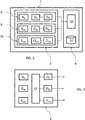
- a structured document analysis device 1 comprises an image acquisition module 2 of the structured document, and a processing module 4 of the images acquired by the acquisition module 2.
- the image acquisition module 2 can be configured to acquire images of different types.
- the image acquisition module 2 is configured to produce at least one image of a first type carrying information on the document to be analyzed when the document is illuminated by a light source in the visible range S V.
- the light source in the visible range S V is a light source generating light radiation having at least one wavelength in the range of 380 nanometers to 780 nanometers.
- the image acquisition module 2 may comprise such a light source in the visible range S V so as to illuminate the document to be analyzed. In a variant, the image acquisition module 2 does not include such a light source in the visible range, and the document is simply subjected to surrounding lighting.
- the image acquisition module 2 also comprises a sensor D V sensitive to the visible wavelength emitted by the source in the visible range S V.
- the image acquisition module 2 is configured to produce at least one image of a second type, carrying information on the document to be analyzed when the document is illuminated by an infrared (IR) source.
- IR infrared
- the image acquisition module 2 then comprises such an infrared source S IR and also an infrared sensor D IR sensitive to the infrared wavelength emitted by the infrared source S IR .
- the image acquisition module 2 is configured to produce at least one image of a third type carrying information on the document to be analyzed when the document is illuminated by an ultraviolet (UV) source. That is, a light source generating ultraviolet light radiation (radiation having at least one wavelength of less than 380 nanometers).
- UV ultraviolet
- the image acquisition module 2 then comprises such a UV source, which is noted S UV .
- the images according to the first type, second type and third type are hereinafter referred to respectively as “visible images”, “infrared images” and “UV images”.
- the image acquisition module 2 comprises three image capture units each comprising an objective defined by an optical axis: a first unit 6 comprising a first objective O V for acquiring visible images, a second unit 8 comprising a second objective O IR to acquire infrared images, and a third unit comprising a third objective O UV to acquire UV images.
- the three types of image can thus be produced in parallel by the three image capture units 6, 8, 10.
- the acquisition module 2 comprises a single lens O which is used for the acquisition of several types of images, for example the three types of images.
- This image acquisition module 2 is configurable in an acquisition mode in the visible domain, in an acquisition mode in the infrared range and in an acquisition mode in the ultraviolet range.
- the image acquisition module 2 typically comprises a mobile infrared filter between an active position and an inactive position.
- the infrared filter is adapted to selectively retain at least one infrared wavelength emitted by the infrared source, and eliminate any wavelength in the visible range.
- the image acquisition module 2 When the image acquisition module 2 is configured in the visible acquisition mode, the images acquired by the image acquisition module 2 are classified as visible images.
- the light source in the visible domain possibly integrated in the image acquisition module 2 is activated in the visible acquisition mode.
- the infrared source When the image acquisition module 2 is configured in the infrared acquisition mode, the infrared source is activated, and the infrared filter is positioned in the active position. The infrared radiation emitted by the source is projected towards the document to be analyzed.
- the infrared radiation is reflected by the surface of the document and then is received by the objective of the image acquisition module 2
- the viewer simultaneously captures visible radiation if the document is not plunged into darkness.
- the received radiation passes through the infrared filter; only the infrared wavelengths are preserved in the radiation obtained at the output of the filter.
- An infrared image is then produced based on the filtered radiation.
- the UV source When the image acquisition module 2 is configured in the ultraviolet acquisition mode, the UV source is activated.
- the infrared filter is also positioned in the inactive position. The UV radiation emitted by the UV source is projected towards the document to be analyzed.
- the document is likely to present certain information invisible to the naked eye, but which becomes visible when these defects are illuminated by UV radiation.
- the incident UV radiation is wavelength shifted to the visible range, so that the radiation reflected by the document has at least one wavelength in the visible range carrying information about these defects.
- This reflected radiation is received by the camera, and an image of the third type is produced based on this received radiation.
- the infrared filter is in its inactive position, the received radiation is not filtered by the infrared filter.
- Such information invisible to the naked eye is for example used to make it more difficult to copy official structured documents, such as an identity card or a passport.
- the image acquisition module 2 is configured to produce at least one type of image among the three types of images mentioned above. It will be seen in the following that these different images, carrying different but complementary information, can be advantageously combined to improve the accuracy of the analysis of the structured document.
- the image processing module 4 comprises at least one processor 12 configured to implement image processing algorithms which will be detailed below.
- the image processing module 4 furthermore comprises at least one memory 14 for storing data, in particular images received from the acquisition module or images resulting from image processing implemented by the processor.
- the memory 14 stores in particular at least one reference image showing a structured document model in an undistorted state.
- the document model shown in a reference image includes several regions of interest of predetermined content.
- Each point of interest is for example defined by a pair of coordinates for locating it in the reference image.
- the reference image of the points of interest relating to regions of personalized interest is not identified for the simple reason that the model shown in this reference image does not include such regions of interest. custom.
- the figure 4 illustrates a reference image M1 having four regions of interest of predetermined content Zr1, Zr2, Zr3, Zr4, of rectangular shapes. For example, are stored for each of these three regions of interest four points of interest, corresponding to the four corners of these regions, it being understood that other points of interest located within these regions are usable.
- the reference image M1 is for example a visible image that has been previously acquired by the image acquisition module 2, or by an equivalent device.
- each reference image is associated with a type of image that can be acquired by the image acquisition module 2.
- the memory can storing at least one visible image (including the M1 image) and / or at least one infrared reference image and / or at least one UV reference image.
- figure 1 by means of the device according to one of Figures 2 or 3 .
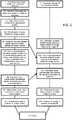
- the image acquisition module 2 acquires a first visible image A1.
- the first acquired image A1 is stored in the memory 14 of the image processing module 4.
- the first acquired image A1 shows the document and more precisely regions of interest Za1, Za2, Za3, Za4, Za10, Za11. Some of these regions (the regions Za1, Za2, Za3, Za4) have a predetermined content similar to regions of interest Zr1, Zr2, Zr3, Zr4 of the reference image M1.
- the deformations of the document to be analyzed are such that the regions of interest of predetermined content Za1 to Za4 do not appear exactly in the same form, orientation and / or position in the image A1 as the corresponding regions of interest Zr1 to Zr4 in the reference image M1.
- step E2 When several reference pictures associated with the "visible" picture type are stored in the memory, one of them is selected (step E2). It is assumed in the following that the image M1 is selected as the reference visible image.
- the image processing module 4 determines in the acquired image at least one region of interest (step E4).
- the image processing module 4 extracts points of interest in the acquired image A1, according to a known method of the state of the art (step E5).
- the image processing module 4 maps points of interest of the region of interest Zr1 of the image M1, stored in the memory, with points of interest extracted in the image A1 (step E6). according to a known method of the state of the art. For example, the point P1A1 located in the zone Za1 is mapped to the point P2M1 located in the zone Zr1.
- Ci the set of matches made for the Zri region.
- This set C1 is representative of local deformations to the region Zr1, experienced by the document to be analyzed with respect to the model shown in the reference image M1.
- a transformation T1 provides more complete deformation information than a set Ci of mappings of points of interest alone.
- the image processing module 4 estimates a global geometric transformation TM1A1 taking into account the deformations of the structured document shown in the first acquired image compared to to the first model, according to a known method of the state of the art (step E8).
- the TM1A1 transformation is global in that it covers the complete model shown in the reference image and the document shown in the acquired A1 image.
- the transformation TM1A1 can be determined using an inverse distance weighting or spline interpolation algorithm.
- the global transformation TM1A1 can be seen as a piecewise continuous function on a dimension definition domain 2 corresponding at least to the whole of the model shown in the reference image A1 towards an image domain also of dimension 2 corresponding at least to the entire structured document shown in the acquired image A1.
- the definition domain is the set of pixels of the reference image M1.
- the image of each pixel of the image M1 by this transformation TM1A1 is a pixel of the acquired image A1.
- the computation applied by this global transformation TM1A1 is different according to the location of the pixel of the reference image considered.
- the global transformation uses the local transformation Ti to transform a pixel in the region of interest Zri.
- a pixel lying outside any zone of interest Zri shown in the reference image is transformed by the transformation TM1A1 for example by means of the local transformation Ti of the Zri region closest to this pixel.
- the TM1A1 geometrical transformation characterizes deformations such as crumpling, which are deformations much more complex than simple deformations due to the perspective induced by a bad positioning of the treated document, for example in a plane inclined with respect to the plane of grip. image, as is the case with the method described in the document WO2011 / 058418 .
- TXiYj a global geometric transformation taking into account deformations of a document shown in the image "Yj” compared to a document shown in the image "Xi”.
- the image processing module 4 determines at least one region to be analyzed in the first acquired image A1 by projecting at least one reference region of the reference image M1 by means of the first transformation TM1A1 (step E9 ).
- a reference region is for example one of the regions of interest of the reference image M1.
- the image processing module 4 then analyzes the content of the region determined during step E9 according to a known method (step E10): character recognition (OCR), etc.
- a second image A2 showing the same structured document is acquired by the image acquisition module 2 (step E1 ').
- the second image A2 may be an image of the same type as the first image (therefore an image acquired with the same lighting conditions as when the image A1 is acquired), but in this case showing the document from an angle different view.
- This different angle of view can be obtained by moving an objective of the acquisition module between acquisitions of A1 and A2 images (this displacement being natural when the acquisition module is embedded in a portable mobile terminal).
- the second image A2 may be of a different type than the first acquired image A1 (infrared or UV).
- the second image can show the document from an angle of view identical to or different from the image A1.
- the image A2 is an infrared image.
- the second acquired image A1 is stored in the memory 14 of the image processing module 4.
- the image processing module 4 extracts points of interest in the second acquired image A2 (step E11), according to the same method as that used during step E5.
- the image processing module 4 matches the points of interest extracted in the second acquired image A2 with these points of interest extracted in the first acquired image A1 remaining unused during the step E11. In other words, it is possible that at least one of the points of interest from the image A1 used here is different from each of the points of interest from the same image A1 mapped to a point of interest. reference image M1.
- mapping sets C10, C11 respectively corresponding to the regions Za10, Za11, between the images A1 and A2. These two sets are based on items that were not extracted in step E5.
- the C20 mapping set for the Za2 area is obtained. For constitute this set, points extracted during the step E6 may have been reused.
- the image processing module 4 estimates, from the correspondences made in the previous step E11, a geometric transformation TA1A2 taking into account the deformations of the document shown in the second acquired image A2 with respect to the document shown in the first acquired image A1.
- the image processing module 4 estimates a geometric transformation taking into account deformations of the document shown in one of the two acquired images A1 or A2, referred to as the target image, with respect to the first model, the transformation depending on the second transformation TA1A2. (step E13).
- the image A2 is used as the target image during the step E13.
- the image processing module 4 determines at least one region to be analyzed in the target image A2 by projecting the same reference region as that determined during the step E9, by means of the geometric transformation TM1A2 estimated at during the step E13.
- the image processing module 4 then analyzes the content of the region determined in the image A2 (step E15), for example in the same manner as during the step E10.
- the analyzes of the acquired images A1, A2 may comprise the same treatments, for example a character recognition (OCR), or predetermined patterns, known in themselves.
- OCR character recognition
- step E18 The results of the analyzes of the different acquired images A1, A2 are then combined in a melting step (step E18).
- the E18 merge comprises an authentication of the structured document whose result depends on the analyzes of the acquired images A1, A2.
- the one or a reference region is a region containing a security pattern selectively revealed by infrared illumination of the structured document
- authentication succeeds provided that this security reason is detected in the infrared image A2 during the analysis E15, but not detected in the visible image A1 during the analysis E10: the structured document is then considered authentic. Otherwise, the authentication fails: the structured document is then considered as inauthentic.
- the merger comprises an arbitration between characters detected during the analyzes E10, E15.
- This can be implemented when the structured document comprises a string of characters visible in each of the acquired images A1, A2.
- the image processing module 4 detects in the image A1 the character string ABRUCADABRA, and in the image A2 the character string ABRACADABRU, whereas the string of characters that actually appeared in the document shown in FIG. these images is ABRACADABRA.
- Is produced for each character a confidence index of detection. For example, is associated with the "final A" detected in the A1 image a confidence index value greater than the confidence index associated with the "U” final detected in the A2 image; the "A" is retained.
- the "U" in the fourth position of the character string detected in the image A1 is associated with a confidence index lower than the confidence index associated with the "A" character of the same position detected in the image A2: A in fourth position of the string from A2 is retained.
- the E18 melting step has the effect of synergistically consolidating the results of the two analyzes.
- a single reference image M1 has been advantageously used to determine the same reference region to be analyzed in the acquired images A1, A2.
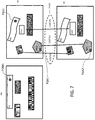
- the estimation of the transformation TA1A2 between the images acquired A1 and A2 is relatively simple to implement, and that there is no direct mapping of points of interest between images M1 and A2, as schematically illustrates figure 8 .
- the transformation TA1A2 can be a homography of which an approximation can be predetermined and be a function of the way the image acquisition module 2 is designed. As a result, the cumulative processing time for estimating TM1A1 and TM1A2 transformations is reduced.
- figure 9 an example of reference image M1 showing a structured document of the passport type.
- the figure 10 shows an example of acquired image A2 in the infrared domain.
- At least a third image A3 can also be acquired by the image acquisition module 2 (step E1 ") .
- the third image A3 is for example a UV-type image, constituting a source of image. Additional information on the deformations of the document to be analyzed.
- the images A1 and A3 have been acquired by means of the same objective at close moments; it is assumed that the two images A1 and A3 show the structured document from the same angle of view. Therefore, the image processing module 4 then determines at least one region to be analyzed in the A3 image by projection of the same reference region as that used during the steps E9 and E14, by means of the TM1A1 geometric transformation. estimated (step E16).
- the processing steps implemented by the image processing module 4 on the basis of the image A2 may be repeated for the third image A3, so as to obtain a TM1A3 geometrical transformation resulting from the composition of the TM1A1 transformation already discussed and a TA1A3 transformation between the acquired images A1 and A3.
- the image processing module 4 can then determine at least one region to be analyzed in the A3 image by projection of the same reference region as that used during the steps E9 and E14, by means of the estimated TM1A3 geometric transformation. .
- the image processing module 4 then analyzes the content of the determined region (step E17), for example in the same way as during step E10 or E15.
- the melting step 18 is then performed not on the basis of two images, but of the three images A1, A2 and A3, according to the modalities described above.
- the method according to the second embodiment uses a single reference image M1 to determine the same reference region to be analyzed in the acquired images A1, A2.
- the UV image constitutes a complementary source of information making it possible to improve the fusion treatment carried out during step 18.
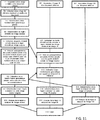
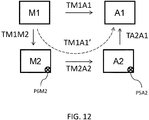
- FIG. 12 In a third embodiment, the general principle of which is schematically illustrated in figure 12 , another reference image M2 is used, in addition to the reference image M1. In addition, the image A1 is used as the target image.
- the second reference image M2 is of the same type as the second acquired image A2 (infrared type in the preceding examples).
- the second reference image M2 is for example acquired during a preliminary step using the acquisition module, under the same lighting conditions as those used for the acquisition of the image A2.
- the second reference image M2 shows a model of the structured document having regions of interest of predetermined content.
- these regions of interest are not necessarily the same as those shown in the reference image M1.
- the model shown in the image M2 thus relates to the same structured document, but may be different from the model shown in the image M1 in terms of content.
- the second reference image M2 comprises at least one region of interest of predetermined content not present in the image M1.
- This region has for example a content only revealed by infrared, such as a security reason.
- information may have been printed or written on the document to be analyzed by means of a visible but optically variable ink, and other information by means of an infrared ink not visible to the naked eye but revealed in an infrared image, such an ink being traditionally optically more stable than the visible ink.
- regions of interest may appear in the A1 image in the visible range, but not in the infrared A2 image.
- the models shown in reference images M1 and M2 can be shown from different angles of view.
- a predetermined TM1M2 geometrical transformation has been previously stored in the memory, taking into account the deformations of the model shown in the image M2 with respect to the model shown in the image. M1.
- this transformation TM1M2 is simply representative of a change of angle of view between the images M1 and M2.
- the image processing module 4 estimates a geometric transformation TM 1 A 1 'taking into account the deformations of the document shown in the acquired image A1, with respect to the first model M1, the transformation depending on the second transformation TA1A2.
- the transformation TM 1 A 1 ' is obtained by composition of the inverse of the transformation TA1A2 (inverse which one notes TA2A1), of the transformation TM2A2, and of the transformation TM1M2 predetermined.
- TM 1 AT 1 ' TM 1 M 2 ⁇ TM 2 AT 2 ⁇ YOUR 2 AT 1
- the transformation TM2A2 is estimated from point-of-interest mapping of the image M2 (such as the point P6M2 represented in figure 12 ) with points of interest extracted in the acquired image A2 (such as the point P5A2 represented in figure 12 ), in the same way as for the transformation T M1A1.
- the points P6A2 and the points P4A2 biassed to obtain the transformation TA1A2 may be identical or different.
- the transformation TM1A1 'thus estimated takes into account the deformations of the structured document shown in the first acquired image A1 with respect to the model shown in the first reference image M1.
- this transformation TM1A1 gives information of deformations complementary to those given by the transformation TM1A1, and this because of the fact that the correspondences of points of interest between the images A1 and A2 are not the same as the correspondences of points of d interest between M1 and A1 images.
- the images M2 and A2 have been used to more precisely characterize the deformations of the structured document as shown in the image A1 with respect to the model shown in the reference image A1. .
- the matches made between the images A1 and A2 serve not only to implement the analysis of the image A2 during the step E15, and this by means of the transformation TM1A2 (see part C.2), but also to improve the analysis of the image A1 carried out during the step E10, by the calculation of the transformation TM1A1 '(see part C.3).
- the image considered as target image is different.
- the additional deformation information obtained from the image A2 can not only be used during the step E14 to precisely locate a region of interest in the image A2, but also serve to improve the quality of the image. the analysis E10 performed on the visible image A1.
- each additional transformation TM 1 A 1 (i) can be used in addition to the transformation TM1A1 during the step E9 of determining one or more regions of the image A1 for the analysis of their content during step E10.
Landscapes
- Engineering & Computer Science (AREA)
- Computer Vision & Pattern Recognition (AREA)
- Physics & Mathematics (AREA)
- General Physics & Mathematics (AREA)
- Multimedia (AREA)
- Theoretical Computer Science (AREA)
- Artificial Intelligence (AREA)
- Computer Graphics (AREA)
- Geometry (AREA)
- Image Processing (AREA)
- Document Processing Apparatus (AREA)
- Character Input (AREA)
Applications Claiming Priority (1)
| Application Number | Priority Date | Filing Date | Title |
|---|---|---|---|
| FR1752725A FR3064782B1 (fr) | 2017-03-30 | 2017-03-30 | Procede d'analyse d'un document structure susceptible d'etre deforme |
Publications (1)
| Publication Number | Publication Date |
|---|---|
| EP3382605A1 true EP3382605A1 (de) | 2018-10-03 |
Family
ID=59409431
Family Applications (1)
| Application Number | Title | Priority Date | Filing Date |
|---|---|---|---|
| EP18165339.5A Withdrawn EP3382605A1 (de) | 2017-03-30 | 2018-03-30 | Analyseverfahren eines strukturierten dokuments, das verformbar ist |
Country Status (5)
| Country | Link |
|---|---|
| US (1) | US10482324B2 (de) |
| EP (1) | EP3382605A1 (de) |
| AU (1) | AU2018202324B2 (de) |
| CA (1) | CA3000153A1 (de) |
| FR (1) | FR3064782B1 (de) |
Cited By (2)
| Publication number | Priority date | Publication date | Assignee | Title |
|---|---|---|---|---|
| WO2021116427A1 (fr) | 2019-12-11 | 2021-06-17 | Carrus Gaming | Procédé, dispositif et produit programme d'ordinateur de décodage d'un bulletin de jeu |
| US20210390328A1 (en) * | 2019-07-22 | 2021-12-16 | Abbyy Production Llc | Optical character recognition of documents having non-coplanar regions |
Families Citing this family (6)
| Publication number | Priority date | Publication date | Assignee | Title |
|---|---|---|---|---|
| US10311556B1 (en) * | 2018-07-02 | 2019-06-04 | Capital One Services, Llc | Systems and methods for image data processing to remove deformations contained in documents |
| FR3086884B1 (fr) | 2018-10-09 | 2020-11-27 | Idemia Identity & Security France | Procede de detection de fraude documentaire. |
| CN109829437B (zh) * | 2019-02-01 | 2022-03-25 | 北京旷视科技有限公司 | 图像处理方法、文本识别方法、装置和电子系统 |
| CN110070097B (zh) * | 2019-04-19 | 2023-07-25 | 戴文跃 | 一种图形对象比对方法 |
| FR3104772B1 (fr) * | 2019-12-13 | 2023-04-21 | Idemia Identity & Security France | Terminal d’analyse de document et procédé d’analyse de document |
| FR3117247A1 (fr) * | 2020-12-04 | 2022-06-10 | Imprimerie Nationale | Procede et systeme d’extraction et de lecture de donnees d’un document physique |
Citations (4)
| Publication number | Priority date | Publication date | Assignee | Title |
|---|---|---|---|---|
| US20050078851A1 (en) * | 2003-09-30 | 2005-04-14 | Jones Robert L. | Multi-channel digital watermarking |
| US20090059316A1 (en) * | 2007-08-29 | 2009-03-05 | Scientific Games International, Inc. | Enhanced Scanner Design |
| DE102013101587A1 (de) * | 2013-02-18 | 2014-08-21 | Bundesdruckerei Gmbh | Verfahren zum überprüfen der echtheit eines identifikationsdokumentes |
| US20160350592A1 (en) * | 2013-09-27 | 2016-12-01 | Kofax, Inc. | Content-based detection and three dimensional geometric reconstruction of objects in image and video data |
Family Cites Families (12)
| Publication number | Priority date | Publication date | Assignee | Title |
|---|---|---|---|---|
| US6606421B1 (en) * | 2000-05-25 | 2003-08-12 | Hewlett-Packard Development Company, L.P. | Geometric deformation correction method and system for dot pattern images |
| US7190834B2 (en) * | 2003-07-22 | 2007-03-13 | Cognex Technology And Investment Corporation | Methods for finding and characterizing a deformed pattern in an image |
| US8144921B2 (en) * | 2007-07-11 | 2012-03-27 | Ricoh Co., Ltd. | Information retrieval using invisible junctions and geometric constraints |
| FR2952218B1 (fr) | 2009-10-30 | 2012-03-30 | Sagem Securite | Procede et dispositif pour obtenir une image d'un document defroisse a partir d'une image de ce document lorsqu'il est froisse. |
| EP2320390A1 (de) | 2009-11-10 | 2011-05-11 | Icar Vision Systems, SL | Verfahren und System zum Lesen und Validieren von Identitätsdokumenten |
| US8472726B2 (en) * | 2011-01-07 | 2013-06-25 | Yuval Gronau | Document comparison and analysis |
| US8965134B2 (en) * | 2011-04-05 | 2015-02-24 | Hewlett-Packard Development Company, L.P. | Document registration |
| EP3879487B1 (de) * | 2012-10-26 | 2023-11-29 | Brainlab AG | Anpassung von patientenbildern an bilder eines anatomischen atlas |
| RU2643465C2 (ru) * | 2013-06-18 | 2018-02-01 | Общество с ограниченной ответственностью "Аби Девелопмент" | Устройства и способы, которые используют иерархически упорядоченную структуру данных, содержащую непараметризованные символы, для преобразования изображений документов в электронные документы |
| US9922247B2 (en) * | 2013-12-18 | 2018-03-20 | Abbyy Development Llc | Comparing documents using a trusted source |
| RU2571378C2 (ru) * | 2013-12-18 | 2015-12-20 | Общество с ограниченной ответственностью "Аби Девелопмент" | Устройство и способ поиска различий в документах |
| FR3027136B1 (fr) * | 2014-10-10 | 2017-11-10 | Morpho | Procede d'identification d'un signe sur un document deforme |
-
2017
- 2017-03-30 FR FR1752725A patent/FR3064782B1/fr not_active Expired - Fee Related
-
2018
- 2018-03-29 CA CA3000153A patent/CA3000153A1/fr active Pending
- 2018-03-29 US US15/940,908 patent/US10482324B2/en active Active
- 2018-03-30 EP EP18165339.5A patent/EP3382605A1/de not_active Withdrawn
- 2018-04-03 AU AU2018202324A patent/AU2018202324B2/en not_active Ceased
Patent Citations (4)
| Publication number | Priority date | Publication date | Assignee | Title |
|---|---|---|---|---|
| US20050078851A1 (en) * | 2003-09-30 | 2005-04-14 | Jones Robert L. | Multi-channel digital watermarking |
| US20090059316A1 (en) * | 2007-08-29 | 2009-03-05 | Scientific Games International, Inc. | Enhanced Scanner Design |
| DE102013101587A1 (de) * | 2013-02-18 | 2014-08-21 | Bundesdruckerei Gmbh | Verfahren zum überprüfen der echtheit eines identifikationsdokumentes |
| US20160350592A1 (en) * | 2013-09-27 | 2016-12-01 | Kofax, Inc. | Content-based detection and three dimensional geometric reconstruction of objects in image and video data |
Non-Patent Citations (3)
| Title |
|---|
| "Network and Parallel Computing", vol. 8357, 1 January 2014, SPRINGER INTERNATIONAL PUBLISHING, Cham, ISBN: 978-3-642-35622-3, ISSN: 0302-9743, article CHELHWON KIM ET AL: "Dewarping Book Page Spreads Captured with a Mobile Phone Camera", pages: 101 - 112, XP055431471, 032548, DOI: 10.1007/978-3-319-05167-3_8 * |
| NOBORU NAKAJIMA ET AL: "Video Mosaicing for Document Imaging", PROC. CBDAR, DEMO SESSION (2007)., 1 January 2007 (2007-01-01), XP055106029 * |
| TIWARI LOKENDER ET AL: "Robust Camera Captured Image Mosaicking for Document Digitization and OCR Processing", 2014 INTERNATIONAL CONFERENCE ON INFORMATION TECHNOLOGY, 1 December 2014 (2014-12-01), pages 100 - 105, XP093149811, ISBN: 978-1-4799-8083-3, Retrieved from the Internet <URL:https://ieeexplore.ieee.org/stampPDF/getPDF.jsp?tp=&arnumber=7033304&ref=aHR0cHM6Ly9pZWVleHBsb3JlLmllZWUub3JnL2Fic3RyYWN0L2RvY3VtZW50LzcwMzMzMDQ/Y2FzYV90b2tlbj1xR0JWWUlONXRtOEFBQUFBOk5VaERUUWthbTlWUmJHSGMzTktsSWpySGFHcklaeGZyWGFETE1fRWtQUU9WNVY2d2dxV1h5ajZFb1RaM3NNRW1hd21scnE0> DOI: 10.1109/ICIT.2014.71 * |
Cited By (4)
| Publication number | Priority date | Publication date | Assignee | Title |
|---|---|---|---|---|
| US20210390328A1 (en) * | 2019-07-22 | 2021-12-16 | Abbyy Production Llc | Optical character recognition of documents having non-coplanar regions |
| US11699294B2 (en) * | 2019-07-22 | 2023-07-11 | Abbyy Development Inc. | Optical character recognition of documents having non-coplanar regions |
| WO2021116427A1 (fr) | 2019-12-11 | 2021-06-17 | Carrus Gaming | Procédé, dispositif et produit programme d'ordinateur de décodage d'un bulletin de jeu |
| FR3104771A1 (fr) * | 2019-12-11 | 2021-06-18 | Idemia Identity & Security France | Procédé, dispositif et produit programme d’ordinateur de décodage d’un bulletin de jeu |
Also Published As
| Publication number | Publication date |
|---|---|
| CA3000153A1 (fr) | 2018-09-30 |
| FR3064782A1 (fr) | 2018-10-05 |
| AU2018202324A1 (en) | 2018-10-18 |
| US10482324B2 (en) | 2019-11-19 |
| AU2018202324B2 (en) | 2022-10-13 |
| FR3064782B1 (fr) | 2019-04-05 |
| US20180285639A1 (en) | 2018-10-04 |
Similar Documents
| Publication | Publication Date | Title |
|---|---|---|
| EP3382605A1 (de) | Analyseverfahren eines strukturierten dokuments, das verformbar ist | |
| EP2689400B1 (de) | Verfahren und vorrichtung zum prüfen von sicherheitsdokumente | |
| FR2932588A1 (fr) | Procede et dispositif de lecture d'une caracteristique physique sur un objet | |
| WO2017089736A1 (fr) | Procede d'authentification et/ou de controle d'integrite d'un sujet | |
| WO2019133996A1 (en) | System and method for combining identity information to facilitate image acquisition | |
| WO2011086275A1 (fr) | Procede de securisation d'un objet et objet correspondant | |
| EP3567521B1 (de) | Biometrisches erkennungsverfahren anhand der iris | |
| EP3401837B1 (de) | Vorrichtung zum abnehmen von fingerabdrücken | |
| EP3388976B1 (de) | Betrugserkennungsverfahren | |
| FR2986890A1 (fr) | Procede d'insertion d'une marque numerique dans une image, et procede correspondant de detection d'une marque numerique dans une image a analyser | |
| CA2982878C (fr) | Procede de verification d'un dispositif de securite comportant une signature | |
| EP3577635B1 (de) | Verfahren zur verifizierung der authentizität eines empfindlichen produkts | |
| WO2020144225A1 (fr) | Procédé de traitement d'images numériques | |
| WO2013156728A1 (fr) | Dispositif de securite et document identitaire | |
| EP2073175A1 (de) | Datenträger für die gesicherte Identifikation und Sicherungsverfahren eines solchen Datenträgers | |
| FR3044451A3 (fr) | Procede d'authentification par motif de glass | |
| EP4738287A1 (de) | Authentifizierung von dokumenten auf basis von modifizierter font-detektion | |
| FR3147653A1 (fr) | Procédé de tatouage numérique d’une image et procédé de détection associé | |
| FR3048106A1 (fr) | Procede visuel d'authentification | |
| FR3126196A1 (fr) | Procédé de personnalisation d'un dispositif de sécurité, dispositif de sécurité personnalisé, document d’identité comportant un tel dispositif, et procédé d'authentification d'un tel dispositif | |
| HK1260582A1 (en) | Method for analyzing a structured document likely to be deformed | |
| EP4381471A1 (de) | Verfahren zur bestimmung, ob ein bild einer person dargestellt ists-gesicht zur verwendung als id-fotografie | |
| EP3579141A1 (de) | Verarbeitungsverfahren eines fingerabdruck-bilds der papillarlinien | |
| EP3459755A1 (de) | Verfahren zum einfügen von guillochierten motiven, verfahren zum extrahieren guillochierter motive, authentifizierungsverfahren dieser guillochierten motive und vorrichtungen zur umsetzung | |
| FR3057375A1 (fr) | Procede de lecture d'une serie de codes-barres bidimentionnels disposes sur un support, produit programme d'ordinateur et dispositif de lecture associes |
Legal Events
| Date | Code | Title | Description |
|---|---|---|---|
| PUAI | Public reference made under article 153(3) epc to a published international application that has entered the european phase |
Free format text: ORIGINAL CODE: 0009012 |
|
| STAA | Information on the status of an ep patent application or granted ep patent |
Free format text: STATUS: THE APPLICATION HAS BEEN PUBLISHED |
|
| AK | Designated contracting states |
Kind code of ref document: A1 Designated state(s): AL AT BE BG CH CY CZ DE DK EE ES FI FR GB GR HR HU IE IS IT LI LT LU LV MC MK MT NL NO PL PT RO RS SE SI SK SM TR |
|
| AX | Request for extension of the european patent |
Extension state: BA ME |
|
| RAP1 | Party data changed (applicant data changed or rights of an application transferred) |
Owner name: IDEMIA IDENTITY & SECURITY FRANCE |
|
| STAA | Information on the status of an ep patent application or granted ep patent |
Free format text: STATUS: REQUEST FOR EXAMINATION WAS MADE |
|
| 17P | Request for examination filed |
Effective date: 20190321 |
|
| RBV | Designated contracting states (corrected) |
Designated state(s): AL AT BE BG CH CY CZ DE DK EE ES FI FR GB GR HR HU IE IS IT LI LT LU LV MC MK MT NL NO PL PT RO RS SE SI SK SM TR |
|
| STAA | Information on the status of an ep patent application or granted ep patent |
Free format text: STATUS: EXAMINATION IS IN PROGRESS |
|
| 17Q | First examination report despatched |
Effective date: 20191007 |
|
| REG | Reference to a national code |
Ref country code: HK Ref legal event code: DE Ref document number: 1260582 Country of ref document: HK |
|
| REG | Reference to a national code |
Ref country code: DE Ref legal event code: R079 Free format text: PREVIOUS MAIN CLASS: G06K0009000000 Ipc: G06V0030418000 |
|
| GRAP | Despatch of communication of intention to grant a patent |
Free format text: ORIGINAL CODE: EPIDOSNIGR1 |
|
| STAA | Information on the status of an ep patent application or granted ep patent |
Free format text: STATUS: GRANT OF PATENT IS INTENDED |
|
| RIC1 | Information provided on ipc code assigned before grant |
Ipc: G06V 10/143 20220101ALI20240410BHEP Ipc: G06V 30/418 20220101AFI20240410BHEP |
|
| INTG | Intention to grant announced |
Effective date: 20240424 |
|
| STAA | Information on the status of an ep patent application or granted ep patent |
Free format text: STATUS: THE APPLICATION IS DEEMED TO BE WITHDRAWN |
|
| 18D | Application deemed to be withdrawn |
Effective date: 20240827 |
|
| REG | Reference to a national code |
Ref country code: HK Ref legal event code: WD Ref document number: 1260582 Country of ref document: HK |