EP3385337A1 - Pigmente die mit mindestens einem polysiloxan behandelt wurden zur verwendung in thermoplasten - Google Patents
Pigmente die mit mindestens einem polysiloxan behandelt wurden zur verwendung in thermoplasten Download PDFInfo
- Publication number
- EP3385337A1 EP3385337A1 EP17165087.2A EP17165087A EP3385337A1 EP 3385337 A1 EP3385337 A1 EP 3385337A1 EP 17165087 A EP17165087 A EP 17165087A EP 3385337 A1 EP3385337 A1 EP 3385337A1
- Authority
- EP
- European Patent Office
- Prior art keywords
- inorganic pigment
- reactive polysiloxane
- pigment
- range
- coated
- Prior art date
- Legal status (The legal status is an assumption and is not a legal conclusion. Google has not performed a legal analysis and makes no representation as to the accuracy of the status listed.)
- Withdrawn
Links
- -1 polysiloxane Polymers 0.000 title claims abstract description 63
- 229920001296 polysiloxane Polymers 0.000 title claims abstract description 47
- 229920001169 thermoplastic Polymers 0.000 title claims abstract description 22
- 239000004416 thermosoftening plastic Substances 0.000 title claims abstract description 20
- 239000000049 pigment Substances 0.000 title claims description 35
- 239000001023 inorganic pigment Substances 0.000 claims abstract description 70
- 238000000034 method Methods 0.000 claims abstract description 31
- 238000004519 manufacturing process Methods 0.000 claims abstract description 10
- GWEVSGVZZGPLCZ-UHFFFAOYSA-N Titan oxide Chemical compound O=[Ti]=O GWEVSGVZZGPLCZ-UHFFFAOYSA-N 0.000 claims description 20
- 229920003023 plastic Polymers 0.000 claims description 20
- 239000004033 plastic Substances 0.000 claims description 20
- 229920000515 polycarbonate Polymers 0.000 claims description 17
- 239000004417 polycarbonate Substances 0.000 claims description 17
- 238000001035 drying Methods 0.000 claims description 16
- 239000000203 mixture Substances 0.000 claims description 15
- 238000001746 injection moulding Methods 0.000 claims description 11
- 239000004408 titanium dioxide Substances 0.000 claims description 7
- XLOMVQKBTHCTTD-UHFFFAOYSA-N Zinc monoxide Chemical compound [Zn]=O XLOMVQKBTHCTTD-UHFFFAOYSA-N 0.000 claims description 6
- TZCXTZWJZNENPQ-UHFFFAOYSA-L barium sulfate Chemical compound [Ba+2].[O-]S([O-])(=O)=O TZCXTZWJZNENPQ-UHFFFAOYSA-L 0.000 claims description 6
- 238000002156 mixing Methods 0.000 claims description 6
- 238000003801 milling Methods 0.000 claims description 5
- 229920000435 poly(dimethylsiloxane) Polymers 0.000 claims description 5
- PXGOKWXKJXAPGV-UHFFFAOYSA-N Fluorine Chemical compound FF PXGOKWXKJXAPGV-UHFFFAOYSA-N 0.000 claims description 4
- 229920001577 copolymer Polymers 0.000 claims description 4
- 239000004205 dimethyl polysiloxane Substances 0.000 claims description 4
- 238000001125 extrusion Methods 0.000 claims description 4
- 229910052731 fluorine Inorganic materials 0.000 claims description 4
- 239000011737 fluorine Substances 0.000 claims description 4
- 125000004435 hydrogen atom Chemical group [H]* 0.000 claims description 4
- 238000004898 kneading Methods 0.000 claims description 4
- 125000006353 oxyethylene group Chemical group 0.000 claims description 4
- 239000011787 zinc oxide Substances 0.000 claims description 3
- 238000000748 compression moulding Methods 0.000 claims description 2
- 238000003825 pressing Methods 0.000 claims description 2
- 239000002245 particle Substances 0.000 description 13
- 238000000576 coating method Methods 0.000 description 11
- 239000000843 powder Substances 0.000 description 10
- PNEYBMLMFCGWSK-UHFFFAOYSA-N Alumina Chemical compound [O-2].[O-2].[O-2].[Al+3].[Al+3] PNEYBMLMFCGWSK-UHFFFAOYSA-N 0.000 description 9
- 239000011248 coating agent Substances 0.000 description 8
- 230000003287 optical effect Effects 0.000 description 8
- 239000000047 product Substances 0.000 description 7
- 238000007669 thermal treatment Methods 0.000 description 7
- 238000012667 polymer degradation Methods 0.000 description 5
- XLYOFNOQVPJJNP-UHFFFAOYSA-N water Substances O XLYOFNOQVPJJNP-UHFFFAOYSA-N 0.000 description 5
- OKTJSMMVPCPJKN-UHFFFAOYSA-N Carbon Chemical compound [C] OKTJSMMVPCPJKN-UHFFFAOYSA-N 0.000 description 4
- UFHFLCQGNIYNRP-UHFFFAOYSA-N Hydrogen Chemical compound [H][H] UFHFLCQGNIYNRP-UHFFFAOYSA-N 0.000 description 4
- 229920004011 Macrolon® Polymers 0.000 description 4
- VYPSYNLAJGMNEJ-UHFFFAOYSA-N Silicium dioxide Chemical compound O=[Si]=O VYPSYNLAJGMNEJ-UHFFFAOYSA-N 0.000 description 4
- 239000000654 additive Substances 0.000 description 4
- 238000004458 analytical method Methods 0.000 description 4
- 229910052799 carbon Inorganic materials 0.000 description 4
- 150000001875 compounds Chemical class 0.000 description 4
- 235000013870 dimethyl polysiloxane Nutrition 0.000 description 4
- 239000000463 material Substances 0.000 description 4
- 229920000642 polymer Polymers 0.000 description 4
- 238000003860 storage Methods 0.000 description 4
- 230000015572 biosynthetic process Effects 0.000 description 3
- 239000007795 chemical reaction product Substances 0.000 description 3
- 230000007423 decrease Effects 0.000 description 3
- 238000010438 heat treatment Methods 0.000 description 3
- 239000001257 hydrogen Substances 0.000 description 3
- 229910052739 hydrogen Inorganic materials 0.000 description 3
- MSRJTTSHWYDFIU-UHFFFAOYSA-N octyltriethoxysilane Chemical compound CCCCCCCC[Si](OCC)(OCC)OCC MSRJTTSHWYDFIU-UHFFFAOYSA-N 0.000 description 3
- 229960003493 octyltriethoxysilane Drugs 0.000 description 3
- 229920002959 polymer blend Polymers 0.000 description 3
- 230000008646 thermal stress Effects 0.000 description 3
- 239000004696 Poly ether ether ketone Substances 0.000 description 2
- 239000004952 Polyamide Substances 0.000 description 2
- 239000004698 Polyethylene Substances 0.000 description 2
- 239000004743 Polypropylene Substances 0.000 description 2
- 150000001298 alcohols Chemical class 0.000 description 2
- 230000015556 catabolic process Effects 0.000 description 2
- 238000006731 degradation reaction Methods 0.000 description 2
- 235000013305 food Nutrition 0.000 description 2
- 238000000465 moulding Methods 0.000 description 2
- 239000006259 organic additive Substances 0.000 description 2
- 229920003229 poly(methyl methacrylate) Polymers 0.000 description 2
- 229920002647 polyamide Polymers 0.000 description 2
- 229920001707 polybutylene terephthalate Polymers 0.000 description 2
- 229920002530 polyetherether ketone Polymers 0.000 description 2
- 229920000573 polyethylene Polymers 0.000 description 2
- 229920000139 polyethylene terephthalate Polymers 0.000 description 2
- 239000005020 polyethylene terephthalate Substances 0.000 description 2
- 239000004926 polymethyl methacrylate Substances 0.000 description 2
- 229920001155 polypropylene Polymers 0.000 description 2
- 235000012239 silicon dioxide Nutrition 0.000 description 2
- 239000000377 silicon dioxide Substances 0.000 description 2
- LFQSCWFLJHTTHZ-UHFFFAOYSA-N Ethanol Chemical compound CCO LFQSCWFLJHTTHZ-UHFFFAOYSA-N 0.000 description 1
- 238000003109 Karl Fischer titration Methods 0.000 description 1
- 229920004061 Makrolon® 3108 Polymers 0.000 description 1
- 239000004793 Polystyrene Substances 0.000 description 1
- XECAHXYUAAWDEL-UHFFFAOYSA-N acrylonitrile butadiene styrene Chemical compound C=CC=C.C=CC#N.C=CC1=CC=CC=C1 XECAHXYUAAWDEL-UHFFFAOYSA-N 0.000 description 1
- 230000000996 additive effect Effects 0.000 description 1
- 230000002411 adverse Effects 0.000 description 1
- 238000005904 alkaline hydrolysis reaction Methods 0.000 description 1
- 239000003963 antioxidant agent Substances 0.000 description 1
- QVGXLLKOCUKJST-UHFFFAOYSA-N atomic oxygen Chemical compound [O] QVGXLLKOCUKJST-UHFFFAOYSA-N 0.000 description 1
- 230000033228 biological regulation Effects 0.000 description 1
- 238000004364 calculation method Methods 0.000 description 1
- 238000004040 coloring Methods 0.000 description 1
- 238000009833 condensation Methods 0.000 description 1
- 230000005494 condensation Effects 0.000 description 1
- 229920006037 cross link polymer Polymers 0.000 description 1
- 210000003298 dental enamel Anatomy 0.000 description 1
- 238000001514 detection method Methods 0.000 description 1
- 230000006866 deterioration Effects 0.000 description 1
- 238000002845 discoloration Methods 0.000 description 1
- KPUWHANPEXNPJT-UHFFFAOYSA-N disiloxane Chemical class [SiH3]O[SiH3] KPUWHANPEXNPJT-UHFFFAOYSA-N 0.000 description 1
- 239000011363 dried mixture Substances 0.000 description 1
- 239000000428 dust Substances 0.000 description 1
- 238000001704 evaporation Methods 0.000 description 1
- 230000008020 evaporation Effects 0.000 description 1
- 230000009969 flowable effect Effects 0.000 description 1
- 230000009477 glass transition Effects 0.000 description 1
- 239000008187 granular material Substances 0.000 description 1
- 230000001771 impaired effect Effects 0.000 description 1
- 238000002347 injection Methods 0.000 description 1
- 239000007924 injection Substances 0.000 description 1
- 229920000554 ionomer Polymers 0.000 description 1
- 238000002844 melting Methods 0.000 description 1
- 230000008018 melting Effects 0.000 description 1
- 239000001301 oxygen Substances 0.000 description 1
- 229910052760 oxygen Inorganic materials 0.000 description 1
- 229920000728 polyester Polymers 0.000 description 1
- 229920000098 polyolefin Polymers 0.000 description 1
- 229920006324 polyoxymethylene Polymers 0.000 description 1
- 229920002635 polyurethane Polymers 0.000 description 1
- 239000004814 polyurethane Substances 0.000 description 1
- 239000004800 polyvinyl chloride Substances 0.000 description 1
- 239000002243 precursor Substances 0.000 description 1
- 230000001681 protective effect Effects 0.000 description 1
- 239000000523 sample Substances 0.000 description 1
- 238000007873 sieving Methods 0.000 description 1
- 238000000638 solvent extraction Methods 0.000 description 1
- 239000007858 starting material Substances 0.000 description 1
- 239000000126 substance Substances 0.000 description 1
- 229920002725 thermoplastic elastomer Polymers 0.000 description 1
- 229920001187 thermosetting polymer Polymers 0.000 description 1
- 230000007704 transition Effects 0.000 description 1
- 229920002554 vinyl polymer Polymers 0.000 description 1
Images



Classifications
-
- C—CHEMISTRY; METALLURGY
- C09—DYES; PAINTS; POLISHES; NATURAL RESINS; ADHESIVES; COMPOSITIONS NOT OTHERWISE PROVIDED FOR; APPLICATIONS OF MATERIALS NOT OTHERWISE PROVIDED FOR
- C09C—TREATMENT OF INORGANIC MATERIALS, OTHER THAN FIBROUS FILLERS, TO ENHANCE THEIR PIGMENTING OR FILLING PROPERTIES ; PREPARATION OF CARBON BLACK ; PREPARATION OF INORGANIC MATERIALS WHICH ARE NO SINGLE CHEMICAL COMPOUNDS AND WHICH ARE MAINLY USED AS PIGMENTS OR FILLERS
- C09C1/00—Treatment of specific inorganic materials other than fibrous fillers; Preparation of carbon black
- C09C1/02—Compounds of alkaline earth metals or magnesium
- C09C1/027—Barium sulfates
-
- C—CHEMISTRY; METALLURGY
- C08—ORGANIC MACROMOLECULAR COMPOUNDS; THEIR PREPARATION OR CHEMICAL WORKING-UP; COMPOSITIONS BASED THEREON
- C08K—Use of inorganic or non-macromolecular organic substances as compounding ingredients
- C08K9/00—Use of pretreated ingredients
- C08K9/04—Ingredients treated with organic substances
- C08K9/06—Ingredients treated with organic substances with silicon-containing compounds
-
- C—CHEMISTRY; METALLURGY
- C08—ORGANIC MACROMOLECULAR COMPOUNDS; THEIR PREPARATION OR CHEMICAL WORKING-UP; COMPOSITIONS BASED THEREON
- C08K—Use of inorganic or non-macromolecular organic substances as compounding ingredients
- C08K3/00—Use of inorganic substances as compounding ingredients
- C08K3/18—Oxygen-containing compounds, e.g. metal carbonyls
- C08K3/20—Oxides; Hydroxides
- C08K3/22—Oxides; Hydroxides of metals
-
- C—CHEMISTRY; METALLURGY
- C08—ORGANIC MACROMOLECULAR COMPOUNDS; THEIR PREPARATION OR CHEMICAL WORKING-UP; COMPOSITIONS BASED THEREON
- C08K—Use of inorganic or non-macromolecular organic substances as compounding ingredients
- C08K9/00—Use of pretreated ingredients
- C08K9/02—Ingredients treated with inorganic substances
-
- C—CHEMISTRY; METALLURGY
- C08—ORGANIC MACROMOLECULAR COMPOUNDS; THEIR PREPARATION OR CHEMICAL WORKING-UP; COMPOSITIONS BASED THEREON
- C08K—Use of inorganic or non-macromolecular organic substances as compounding ingredients
- C08K9/00—Use of pretreated ingredients
- C08K9/08—Ingredients agglomerated by treatment with a binding agent
-
- C—CHEMISTRY; METALLURGY
- C08—ORGANIC MACROMOLECULAR COMPOUNDS; THEIR PREPARATION OR CHEMICAL WORKING-UP; COMPOSITIONS BASED THEREON
- C08L—COMPOSITIONS OF MACROMOLECULAR COMPOUNDS
- C08L69/00—Compositions of polycarbonates; Compositions of derivatives of polycarbonates
-
- C—CHEMISTRY; METALLURGY
- C09—DYES; PAINTS; POLISHES; NATURAL RESINS; ADHESIVES; COMPOSITIONS NOT OTHERWISE PROVIDED FOR; APPLICATIONS OF MATERIALS NOT OTHERWISE PROVIDED FOR
- C09C—TREATMENT OF INORGANIC MATERIALS, OTHER THAN FIBROUS FILLERS, TO ENHANCE THEIR PIGMENTING OR FILLING PROPERTIES ; PREPARATION OF CARBON BLACK ; PREPARATION OF INORGANIC MATERIALS WHICH ARE NO SINGLE CHEMICAL COMPOUNDS AND WHICH ARE MAINLY USED AS PIGMENTS OR FILLERS
- C09C1/00—Treatment of specific inorganic materials other than fibrous fillers; Preparation of carbon black
- C09C1/04—Compounds of zinc
- C09C1/043—Zinc oxide
-
- C—CHEMISTRY; METALLURGY
- C09—DYES; PAINTS; POLISHES; NATURAL RESINS; ADHESIVES; COMPOSITIONS NOT OTHERWISE PROVIDED FOR; APPLICATIONS OF MATERIALS NOT OTHERWISE PROVIDED FOR
- C09C—TREATMENT OF INORGANIC MATERIALS, OTHER THAN FIBROUS FILLERS, TO ENHANCE THEIR PIGMENTING OR FILLING PROPERTIES ; PREPARATION OF CARBON BLACK ; PREPARATION OF INORGANIC MATERIALS WHICH ARE NO SINGLE CHEMICAL COMPOUNDS AND WHICH ARE MAINLY USED AS PIGMENTS OR FILLERS
- C09C1/00—Treatment of specific inorganic materials other than fibrous fillers; Preparation of carbon black
- C09C1/04—Compounds of zinc
- C09C1/06—Lithopone
-
- C—CHEMISTRY; METALLURGY
- C09—DYES; PAINTS; POLISHES; NATURAL RESINS; ADHESIVES; COMPOSITIONS NOT OTHERWISE PROVIDED FOR; APPLICATIONS OF MATERIALS NOT OTHERWISE PROVIDED FOR
- C09C—TREATMENT OF INORGANIC MATERIALS, OTHER THAN FIBROUS FILLERS, TO ENHANCE THEIR PIGMENTING OR FILLING PROPERTIES ; PREPARATION OF CARBON BLACK ; PREPARATION OF INORGANIC MATERIALS WHICH ARE NO SINGLE CHEMICAL COMPOUNDS AND WHICH ARE MAINLY USED AS PIGMENTS OR FILLERS
- C09C1/00—Treatment of specific inorganic materials other than fibrous fillers; Preparation of carbon black
- C09C1/36—Compounds of titanium
- C09C1/3607—Titanium dioxide
- C09C1/3615—Physical treatment, e.g. grinding, treatment with ultrasonic vibrations
- C09C1/3623—Grinding
-
- C—CHEMISTRY; METALLURGY
- C09—DYES; PAINTS; POLISHES; NATURAL RESINS; ADHESIVES; COMPOSITIONS NOT OTHERWISE PROVIDED FOR; APPLICATIONS OF MATERIALS NOT OTHERWISE PROVIDED FOR
- C09C—TREATMENT OF INORGANIC MATERIALS, OTHER THAN FIBROUS FILLERS, TO ENHANCE THEIR PIGMENTING OR FILLING PROPERTIES ; PREPARATION OF CARBON BLACK ; PREPARATION OF INORGANIC MATERIALS WHICH ARE NO SINGLE CHEMICAL COMPOUNDS AND WHICH ARE MAINLY USED AS PIGMENTS OR FILLERS
- C09C1/00—Treatment of specific inorganic materials other than fibrous fillers; Preparation of carbon black
- C09C1/36—Compounds of titanium
- C09C1/3607—Titanium dioxide
- C09C1/3653—Treatment with inorganic compounds
- C09C1/3661—Coating
-
- C—CHEMISTRY; METALLURGY
- C09—DYES; PAINTS; POLISHES; NATURAL RESINS; ADHESIVES; COMPOSITIONS NOT OTHERWISE PROVIDED FOR; APPLICATIONS OF MATERIALS NOT OTHERWISE PROVIDED FOR
- C09C—TREATMENT OF INORGANIC MATERIALS, OTHER THAN FIBROUS FILLERS, TO ENHANCE THEIR PIGMENTING OR FILLING PROPERTIES ; PREPARATION OF CARBON BLACK ; PREPARATION OF INORGANIC MATERIALS WHICH ARE NO SINGLE CHEMICAL COMPOUNDS AND WHICH ARE MAINLY USED AS PIGMENTS OR FILLERS
- C09C1/00—Treatment of specific inorganic materials other than fibrous fillers; Preparation of carbon black
- C09C1/36—Compounds of titanium
- C09C1/3607—Titanium dioxide
- C09C1/3684—Treatment with organo-silicon compounds
-
- C—CHEMISTRY; METALLURGY
- C09—DYES; PAINTS; POLISHES; NATURAL RESINS; ADHESIVES; COMPOSITIONS NOT OTHERWISE PROVIDED FOR; APPLICATIONS OF MATERIALS NOT OTHERWISE PROVIDED FOR
- C09C—TREATMENT OF INORGANIC MATERIALS, OTHER THAN FIBROUS FILLERS, TO ENHANCE THEIR PIGMENTING OR FILLING PROPERTIES ; PREPARATION OF CARBON BLACK ; PREPARATION OF INORGANIC MATERIALS WHICH ARE NO SINGLE CHEMICAL COMPOUNDS AND WHICH ARE MAINLY USED AS PIGMENTS OR FILLERS
- C09C1/00—Treatment of specific inorganic materials other than fibrous fillers; Preparation of carbon black
- C09C1/36—Compounds of titanium
- C09C1/3692—Combinations of treatments provided for in groups C09C1/3615 - C09C1/3684
-
- C—CHEMISTRY; METALLURGY
- C09—DYES; PAINTS; POLISHES; NATURAL RESINS; ADHESIVES; COMPOSITIONS NOT OTHERWISE PROVIDED FOR; APPLICATIONS OF MATERIALS NOT OTHERWISE PROVIDED FOR
- C09C—TREATMENT OF INORGANIC MATERIALS, OTHER THAN FIBROUS FILLERS, TO ENHANCE THEIR PIGMENTING OR FILLING PROPERTIES ; PREPARATION OF CARBON BLACK ; PREPARATION OF INORGANIC MATERIALS WHICH ARE NO SINGLE CHEMICAL COMPOUNDS AND WHICH ARE MAINLY USED AS PIGMENTS OR FILLERS
- C09C3/00—Treatment in general of inorganic materials, other than fibrous fillers, to enhance their pigmenting or filling properties
- C09C3/12—Treatment with organosilicon compounds
-
- C—CHEMISTRY; METALLURGY
- C01—INORGANIC CHEMISTRY
- C01P—INDEXING SCHEME RELATING TO STRUCTURAL AND PHYSICAL ASPECTS OF SOLID INORGANIC COMPOUNDS
- C01P2004/00—Particle morphology
- C01P2004/80—Particles consisting of a mixture of two or more inorganic phases
- C01P2004/82—Particles consisting of a mixture of two or more inorganic phases two phases having the same anion, e.g. both oxidic phases
- C01P2004/84—Particles consisting of a mixture of two or more inorganic phases two phases having the same anion, e.g. both oxidic phases one phase coated with the other
-
- C—CHEMISTRY; METALLURGY
- C01—INORGANIC CHEMISTRY
- C01P—INDEXING SCHEME RELATING TO STRUCTURAL AND PHYSICAL ASPECTS OF SOLID INORGANIC COMPOUNDS
- C01P2006/00—Physical properties of inorganic compounds
- C01P2006/60—Optical properties, e.g. expressed in CIELAB-values
- C01P2006/62—L* (lightness axis)
-
- C—CHEMISTRY; METALLURGY
- C01—INORGANIC CHEMISTRY
- C01P—INDEXING SCHEME RELATING TO STRUCTURAL AND PHYSICAL ASPECTS OF SOLID INORGANIC COMPOUNDS
- C01P2006/00—Physical properties of inorganic compounds
- C01P2006/60—Optical properties, e.g. expressed in CIELAB-values
- C01P2006/64—Optical properties, e.g. expressed in CIELAB-values b* (yellow-blue axis)
-
- C—CHEMISTRY; METALLURGY
- C08—ORGANIC MACROMOLECULAR COMPOUNDS; THEIR PREPARATION OR CHEMICAL WORKING-UP; COMPOSITIONS BASED THEREON
- C08K—Use of inorganic or non-macromolecular organic substances as compounding ingredients
- C08K3/00—Use of inorganic substances as compounding ingredients
- C08K3/18—Oxygen-containing compounds, e.g. metal carbonyls
- C08K3/20—Oxides; Hydroxides
- C08K3/22—Oxides; Hydroxides of metals
- C08K2003/2237—Oxides; Hydroxides of metals of titanium
- C08K2003/2241—Titanium dioxide
-
- C—CHEMISTRY; METALLURGY
- C08—ORGANIC MACROMOLECULAR COMPOUNDS; THEIR PREPARATION OR CHEMICAL WORKING-UP; COMPOSITIONS BASED THEREON
- C08K—Use of inorganic or non-macromolecular organic substances as compounding ingredients
- C08K3/00—Use of inorganic substances as compounding ingredients
- C08K3/18—Oxygen-containing compounds, e.g. metal carbonyls
- C08K3/20—Oxides; Hydroxides
- C08K3/22—Oxides; Hydroxides of metals
- C08K2003/2296—Oxides; Hydroxides of metals of zinc
-
- C—CHEMISTRY; METALLURGY
- C08—ORGANIC MACROMOLECULAR COMPOUNDS; THEIR PREPARATION OR CHEMICAL WORKING-UP; COMPOSITIONS BASED THEREON
- C08K—Use of inorganic or non-macromolecular organic substances as compounding ingredients
- C08K3/00—Use of inorganic substances as compounding ingredients
- C08K3/30—Sulfur-, selenium- or tellurium-containing compounds
- C08K2003/3045—Sulfates
Definitions
- the present invention relates to inorganic pigments treated/coated with at least one non-reactive polysiloxane, methods for producing these coated inorganic pigments, thermoplastics comprising these coated inorganic pigments and methods for the production of these thermoplastics.
- Plastics can be divided into the main groups of thermoplastics and thermosets. Polymers that have a flow transition range above the working temperature are known as thermoplastics. Thermoplastics are linear or branched polymers which in principle are flowable above the glass transition temperature (Tg) in the case of amorphous thermoplastics and above the melting point (Tm) in the case of (partly) crystalline thermoplastics. The chain movability is so large that the polymer molecules slide easily over one another and the material reaches the molten state (flow range, polymer melt).
- the properties of plastics can be controlled by the use of additives.
- additives encompass pigments, e.g. inorganic pigments that are responsible for the coloring.
- inorganic pigments are usually surface-modified. Hence, they are coated to improve the stability of plastic articles or compounds with regard to polymer degradation.
- the polymer degradation can be e.g. recognized as yellow color of the plastic articles or compounds after applying thermal stress during the extrusion/molding process or thermal stress during the lifetime of the plastic article.
- Inorganic pigments can be surface-modified by inorganic coatings. Silicon dioxide and aluminium oxide are commonly used as an inorganic coating of a titanium dioxide pigment, for example.
- inorganic pigments with or without an inorganic coating can still adversely affect plastics, as these pigments often exhibit active sites on their surfaces.
- organic coatings e.g. antioxidants or octyltriethoxysilanes for inorganic pigments to improve the stability of the plastic materials.
- Inorganic pigments are furthermore hygroscopic and thus contain water strongly bound to the surface with its active sites.
- the high residual moisture content also negatively influences the plastic properties and is regarded to be at least partly responsible for discoloration of the plastic.
- inorganic pigments having organic coatings According to the state of art are that the organic additives used for coating react with the water traces bound to the pigment surface under condensation of reaction products like hydrogen. Other additives lead e.g. to the formation of alcohol after subsequent thermal treatment. A further disadvantage is that the organic substances used for coating regularly do not meet requirements for materials intended to be in contact with food.
- the inorganic pigments according to the present invention provide a surface, on which the active sites are mostly covered by the at least one non-reactive polysiloxane accompanied by a low residual moisture content. Due to the treating or coating, the inorganic pigments show reduced hygroscopic properties, which seem to be responsible for an improved storage stability, and the treatment leads to an improved stability of plastic articles containing these coated pigments.
- the low residual moisture content and the coverage of the active sites seem to be responsible for reduced polymer degradation, which is measured as yellow color of the plastics due to thermal stress during the extrusion/molding process or during the lifetime of the plastic article containing the inorganic pigment. Other impacts on the properties of the plastics, which are impaired by polymer degradation like mechanical strength, will also be reduced.
- the inorganic pigment can be coated either with one kind of non-reactive polysiloxanes or with a mixture of different kinds of non-reactive polysiloxanes of the general Formula I as shown above.
- the at least one non-reactive polysiloxane is polydimethylsiloxane, most preferably a FDA-approved polydimethylsiloxane, e.g. M350, which is a polydimethylsiloxane having a viscosity of 350 mm 2 x s -1 at 25°C.
- the at least one polysiloxanes is preferably present in an amount of 0.1 and 10 wt-%, preferably between 1 and 8 wt-%, more preferably between 3 and 6 wt-% of the coated inorganic pigment, calculated on the total weight of the coated pigment according to carbon analysis after drying at 160°C to weight constancy. It has been found that the degradation properties of the coated inorganic pigment according to the present invention rapidly decreases with an increasing amount of the at least one non-reactive polysiloxane. However, amounts of the at least one non-reactive polysiloxane of more than 3 % per weight only slightly decreases the degradation properties further.
- the inorganic pigment according to the present invention can be any inorganic pigment, however, the inorganic pigment is preferably selected from the group consisting of titanium dioxide, barium sulfate, zinc oxide and lithopone or mixtures thereof, more preferably the inorganic pigment is titanium dioxide, most preferably rutile.
- the inorganic pigment according to the present invention can be organically or inorganically surface-modified with further compounds before treating with the at least one non-reactive polysiloxane of the general Formula I.
- the inorganic pigment can also be pretreated with a reactive siloxane like MH-15 having reactive Si-H moieties or other reactive polysiloxanes having Si-OR moieties in order to additionally silanize the surface of the pigment particles.
- the inorganic pigment is a titanium dioxide pigment being treated with hydrated inorganic precursors of silicon dioxide and/or aluminium oxide and then treated with at least one non-reactive polysiloxane of the general Formula I.
- the coated pigment comprises reactive groups selected from -Si-H, or -Si-OR in an amount of less than 0.1 wt.-%, preferably less than 0.01 wt.-% calculated on the total weight of the coated pigment and the added amount of organic additive after drying at 160°C to weight constancy.
- reactive groups selected from -Si-H, or -Si-OR in an amount of less than 0.1 wt.-%, preferably less than 0.01 wt.-% calculated on the total weight of the coated pigment and the added amount of organic additive after drying at 160°C to weight constancy.
- the treating step is preferably carried out at a temperature in the range of 100°C to 450°C, more preferably at a temperature in the range of 250°C to 400 °C. Due to the elevated temperature, the water is driven out of the inorganic pigment and the surface of the inorganic pigment with its active sites is covered by the at least one non-reactive polysiloxane.
- the treating step can also be carried out as a two-step or multi-step process in which the at least one non-reactive polysiloxane of the general Formula I is added to the pigment in several steps which stages might be interrupted each by a milling or kneading step.
- coated inorganic pigments preferably selected from the group consisting of titanium dioxide, barium sulfate, zinc oxide and lithopone, preferably titanium dioxide, more preferably rutile, or mixtures thereof.
- the inorganic pigment is used in a pre-dried form having a residual moisture content of less than 1 wt-%, preferably less than 0.5 wt-%, more preferably less than 0.4 wt-%, determined by drying at 160°C to weight constancy.
- a pre-dried inorganic pigment an elevated temperature during the treating of the inorganic pigment with at least one non-reactive polysiloxane of the general Formula I is not mandatory.
- the inorganic pigment thermally until a residual moisture content of less than 1.0 wt-%, preferably less than 0.5 wt-%, more preferably less than 0.4 wt-%, determined by drying at 160°C to weight constancy, is achieved, followed by treating the obtained inorganic pigment with the at least one non-reactive polysiloxane of the general Formula I.
- a residual moisture content of less than 1.0 wt-%, preferably less than 0.5 wt-%, more preferably less than 0.4 wt-%, determined by drying at 160°C to weight constancy.
- the step of treating the inorganic pigment with said at least one non-reactive polysiloxane of the general Formula I is carried out for less than 12 h, preferably less than 6 h, more preferably less than 4h, most preferably between 0.25 to 2 h.
- the thermal treatment can also be applied by microwave heating.
- microwaves By using microwaves, the drying-time can significantly be reduced to a few minutes, but may lead to a deterioration of the color value b. Therefore, applying microwave heating should be carried out under conditions with controlled energy impact.
- the treating comprises milling and/or kneading.
- only a partial amount of the at least one non-reactive polysiloxane is added to the inorganic pigment before the milling step and/or kneading step, wherein the remaining amount of the at least one non-reactive polysiloxane is added during the further process.
- Such a partitioning of the at least one non-reactive polysiloxane is particularly preferred if a steam jet mill is used for milling and leads to increased yields of the coated inorganic pigment.
- the inorganic pigment is crushed down to a size of less than 1 mm, preferably to a size of less than 0,8 mm, more preferably to less than 0,6 mm, before being treated with the at least one non-reactive polysiloxane.
- the at least one non-reactive polysiloxane is used in an amount that a coated inorganic pigment comprising between 0.1 and 10 wt-%, preferably between 1 and 8 %, more preferably between 3 and 6 % of the at least one polysiloxane, referred to the total weight of the treated pigment after drying at 160°C to weight constancy and calculated in accordance with a carbon analysis, is obtained.
- the method of the present invention comprises the step of adding at least one additive having reactive groups selected from silane-(Si-H) or C 1 -C 12 -alkoxy-siloxanes.
- at least one additive having reactive groups selected from silane-(Si-H) or C 1 -C 12 -alkoxy-siloxanes Such coated inorganic pigments provide an further improved thermal stability.
- the silane-(Si-H) can be added before, together or after the addition of the non-reactive polysiloxane.
- the present invention further provides a thermoplastic comprising the inorganic pigment of the present invention.
- Thermoplastics which can be used in the process of the invention include thermoplastically workable plastics having pronounced entropy-elastic properties.
- Thermoplastics also include all plastics consisting of linear or thermolabile crosslinked polymer molecules, for example polyolefins, vinyl polymers, polyesters, polyacetals, polycarbonates, also polyurethanes, ionomers, and thermoplastic elastomers such as acrylnitrile-butadiene-styrene (ABS), polyamide (PA), polylactate (PLA), polymethylmethacrylate (PMMA), polycarbonate (PC), polyethylene terephthalate (PET), polyethylene (PE), polypropylene (PP), polystyrene (PS), polyether etherketone (PEEK), polyvinylchloride (PVC), PBT polybutylene terephthalate as well as baking enamels for powder coating.
- ABS acrylnitrile-butadiene-styrene
- the thermoplastic comprises polycarbonate.
- the present invention further provides a method for the production of a thermoplastic comprising adding a pigment according to the present invention to a thermoplastic polymer, mixing the polymer mixture and subjecting the obtained polymer mixture to a plastics forming process, preferably an injection molding process, a compression molding process, a pressing process or an extrusion process.
- the polymer mixture is dried at a temperature in the range of 80°C to 200°C for 1-10 h before the plastics forming process.
- the plastic production process is carried out at a temperature in the range of 200°C to 450°C, preferably in the range of 280°C to 370°C.
- the methods for determining properties of the coated pigments are as follows.
- a mixture of 5% of the coated pigment in Makrolon 3108 powder is dried for 5 hours at 120°C.
- the dried mixture is processed on an Arburg 221 injection moulder at 300°C and 350°C, respectively giving white polycarbonate plates.
- the optical properties Lightness L* and color b* (according to the CIELab color system) of the moulded plates are determined with a Hunterlab UltraScan VIS spectrophotometer applying a light source D 65 using a 10° observer with gloss included.
- the content of the organic coating on a pigment is determined by carbon analysis of the pigment using an ELTRA CS2000 analyzer and calculation of the total organic coating out of it according to the share of carbon in the organic applied.
- the probe is combusted at 1100°C in an oxygen stream and the formed CO 2 is passed through in an infrared cell for detection.
- the water content of the particles can be calculated making use of the Karl-Fischer titration method.
- the content of reactive groups such as -Si-H moieties is measured by alkaline hydrolysis and volumetric determination of the formed hydrogen gas.
- the particle size of the particles is determined by sieving analysis.
- All weight percentages refer to the total weight of the treated pigment after drying to weight constancy at 160°C. Such drying can be carried under air or protective atmosphere.
- the following processes include mixing of polycarbonate powder Macrolon 3108 (PC) and the obtained pigment powder (5 %) of Examples 1. A), B) and C), respectively, drying of the mixture at 120°C for 5h and subsequently subjecting the mixture an injection moulding process at 300 and 350°C.
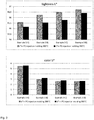
- Optical properties of polycarbonate (PC) plates containing the pigments according to examples A)-C) were analyzed and shown in Figure 1 .
- PC polycarbonate
- the following processes include the mixing of polycarbonate powder Macrolon 3108 (PC) and the pigment powder (5% referred to the weight of the) containing M350 and Octyltriethoxysilane, respectively, drying of the mixture at 120°C for 5h and subsequently subjecting the mixture an injection moulding process at 300 and 350°C.
- the resulting plates were analyzed regarding optical properties Lightness L* and colour b*.
- M350 compared to Octyltriethoxysilane, leads to higher L * and lower b* values at test temperatures 300 and 350°C as and shown in Figure 2 .
- the injection moulding process includes mixing polycarbonate powder Macrolon 3108 (PC) and the pigment powder (5%), drying of the mixture at 120°C for 5h and subsequently subjecting the mixture an injection moulding process at 300 and 350°C, respectively.
- the resulting plates were analyzed regarding optical properties Lightness L* and colour b* and shown in Figure 3 . An increasing amount of organic treatment increases L* and decreases colour b* at test temperatures 300 and 350°C, respectively.
- the injection moulding process includes mixing of polycarbonate powder Macrolon 3108 (PC) and the pigment powder (5%), drying of the mixture at 120°C for 5h and subsequently subjecting the mixture an injection moulding process at 300 and 350°C, respectively.
- the resulting plates were analyzed regarding optical properties Lightness L* and colour b* and shown in Figure 4 . Microwave heating leads to higher L * and higher b* at test temperatures 300 and 350°C, compared to thermal treatment at 350°C.
Landscapes
- Chemical & Material Sciences (AREA)
- Organic Chemistry (AREA)
- Health & Medical Sciences (AREA)
- Chemical Kinetics & Catalysis (AREA)
- Medicinal Chemistry (AREA)
- Polymers & Plastics (AREA)
- Pigments, Carbon Blacks, Or Wood Stains (AREA)
- Compositions Of Macromolecular Compounds (AREA)
- Paints Or Removers (AREA)
Priority Applications (10)
| Application Number | Priority Date | Filing Date | Title |
|---|---|---|---|
| EP17165087.2A EP3385337A1 (de) | 2017-04-05 | 2017-04-05 | Pigmente die mit mindestens einem polysiloxan behandelt wurden zur verwendung in thermoplasten |
| CN201880018348.XA CN110520482A (zh) | 2017-04-05 | 2018-03-29 | 应用于热塑性塑料的用至少一种非反应性聚硅氧烷处理的颜料 |
| BR112019021089-0A BR112019021089A2 (pt) | 2017-04-05 | 2018-03-29 | Pigmento tratado com pelo menos um polissiloxano não reativo para uso em termoplásticos |
| CA3053873A CA3053873A1 (en) | 2017-04-05 | 2018-03-29 | Pigment treated with at least one non-reactive polysiloxane for use in thermoplastics |
| US16/500,818 US20210284821A1 (en) | 2017-04-05 | 2018-03-29 | Pigment treated with at least one non-reactive polysiloxane for use in thermoplastics |
| EP18713952.2A EP3607005B1 (de) | 2017-04-05 | 2018-03-29 | Pigmente die mit mindestens einem polysiloxan behandelt wurden zur verwendung in thermoplasten |
| AU2018248482A AU2018248482A1 (en) | 2017-04-05 | 2018-03-29 | Pigment treated with at least one non-reactive polysiloxane for use in thermoplastics |
| JP2019555224A JP2020516720A (ja) | 2017-04-05 | 2018-03-29 | 熱可塑性材料に使用するための、少なくとも1種の非反応性ポリシロキサンで処理した顔料 |
| PCT/EP2018/058127 WO2018184991A1 (en) | 2017-04-05 | 2018-03-29 | Pigment treated with at least one non-reactive polysiloxane for use in thermoplastics |
| TW107111766A TW201843246A (zh) | 2017-04-05 | 2018-04-03 | 用於熱塑性塑料之顏料 |
Applications Claiming Priority (1)
| Application Number | Priority Date | Filing Date | Title |
|---|---|---|---|
| EP17165087.2A EP3385337A1 (de) | 2017-04-05 | 2017-04-05 | Pigmente die mit mindestens einem polysiloxan behandelt wurden zur verwendung in thermoplasten |
Publications (1)
| Publication Number | Publication Date |
|---|---|
| EP3385337A1 true EP3385337A1 (de) | 2018-10-10 |
Family
ID=58544737
Family Applications (2)
| Application Number | Title | Priority Date | Filing Date |
|---|---|---|---|
| EP17165087.2A Withdrawn EP3385337A1 (de) | 2017-04-05 | 2017-04-05 | Pigmente die mit mindestens einem polysiloxan behandelt wurden zur verwendung in thermoplasten |
| EP18713952.2A Active EP3607005B1 (de) | 2017-04-05 | 2018-03-29 | Pigmente die mit mindestens einem polysiloxan behandelt wurden zur verwendung in thermoplasten |
Family Applications After (1)
| Application Number | Title | Priority Date | Filing Date |
|---|---|---|---|
| EP18713952.2A Active EP3607005B1 (de) | 2017-04-05 | 2018-03-29 | Pigmente die mit mindestens einem polysiloxan behandelt wurden zur verwendung in thermoplasten |
Country Status (9)
| Country | Link |
|---|---|
| US (1) | US20210284821A1 (de) |
| EP (2) | EP3385337A1 (de) |
| JP (1) | JP2020516720A (de) |
| CN (1) | CN110520482A (de) |
| AU (1) | AU2018248482A1 (de) |
| BR (1) | BR112019021089A2 (de) |
| CA (1) | CA3053873A1 (de) |
| TW (1) | TW201843246A (de) |
| WO (1) | WO2018184991A1 (de) |
Citations (6)
| Publication number | Priority date | Publication date | Assignee | Title |
|---|---|---|---|---|
| EP1204006A1 (de) * | 2000-11-06 | 2002-05-08 | Ricoh Company, Ltd. | Externe Additive für elektrophotographische Toner, Herstellungsverfahren, elektrophotographischer Toner und Bildererzeugungsapparat |
| WO2002055596A1 (de) * | 2001-01-12 | 2002-07-18 | Omya Ag | Procede de traitement d'une charge minerale par un polydialkylsiloxane et un acide gras, charges hydrophobes ansi obtenues, et leurs applications dans des polymers pour films 'respirables' |
| EP1281735A1 (de) * | 2001-08-04 | 2003-02-05 | Degussa AG | Hydrophobe Fällungskieselsäure mit hohem Weissgrad und extrem niedriger Feuchtigkeitsaufnahme |
| EP1333053A2 (de) * | 2002-01-30 | 2003-08-06 | Degussa AG | Raumtemperaturvernetzende Einkomponenten-Silikonkautschukformulierungen mit hydrophoben Kieselsäuren |
| WO2007011980A2 (en) * | 2005-07-18 | 2007-01-25 | E.I. Dupont De Nemours And Company | Increased loose bulk density powders and polymers containing them |
| WO2015135536A2 (de) * | 2014-03-14 | 2015-09-17 | Sachtleben Chemie Gmbh | Verfahren zur oberflächenbehandlung von partikeln, die so erhaltenen partikel und deren verwendung |
Family Cites Families (17)
| Publication number | Priority date | Publication date | Assignee | Title |
|---|---|---|---|---|
| JPH01182368A (ja) * | 1988-01-14 | 1989-07-20 | Shiseido Co Ltd | 疎水性粉体およびこれを含有する化粧料 |
| JP3274024B2 (ja) * | 1994-05-31 | 2002-04-15 | テイカ株式会社 | 化粧料の製造方法 |
| US5653794A (en) * | 1995-12-01 | 1997-08-05 | Scm Chemicals, Inc. | Silane treated inorganic pigments |
| ES2347779T3 (es) * | 2002-06-05 | 2010-11-04 | Showa Denko K.K. | Polvo que comprende oxido de zinc revestido con silice, composicion de polimero organico que contiene el polvo y articulo conformado a partir de ella. |
| JP4582439B2 (ja) * | 2002-06-05 | 2010-11-17 | 昭和電工株式会社 | シリカ被覆酸化亜鉛含有粉末、それを含有する有機重合体組成物およびその成形品 |
| JP4236529B2 (ja) * | 2002-07-16 | 2009-03-11 | 信越化学工業株式会社 | オルガノポリシロキサン被覆粉体及びその製造方法 |
| ES2340276T3 (es) | 2004-02-03 | 2010-06-01 | THE PROCTER & GAMBLE COMPANY | Composicion detergente para lavar la ropa, solida en particulas, que comprende arcilla y polidimetilsiloxano. |
| ES2640445T3 (es) * | 2004-06-24 | 2017-11-03 | Ishihara Sangyo Kaisha, Ltd. | Pigmentos de dióxido de titanio, proceso para la producción de los mismos, y composiciones de resina que contienen los pigmentos |
| JP2007056082A (ja) * | 2005-08-23 | 2007-03-08 | Tayca Corp | ジメチコンとジメチコン/メチコンコポリマーとの混合物被覆微粒子酸化チタンまたは微粒子酸化亜鉛、その製造方法、そのシリコーンオイルスラリーおよびそれらを配合した化粧料 |
| US8883878B2 (en) | 2006-06-29 | 2014-11-11 | Sabic Global Technologies B.V. | Thermoplastic polycarbonate compositions |
| WO2008027561A2 (en) * | 2006-09-01 | 2008-03-06 | Cabot Corporation | Surface-treated metal oxide particles |
| DE102006051634A1 (de) * | 2006-11-02 | 2008-05-08 | Evonik Degussa Gmbh | Oberflächenmodifizierte Zink-Silicium-Oxidpartikel |
| DE102006051635A1 (de) * | 2006-11-02 | 2008-05-08 | Evonik Degussa Gmbh | Hydrophobes Zinkoxid |
| DE102006059849A1 (de) | 2006-12-15 | 2008-06-19 | Kronos International, Inc. | Verfahren zur Oberflächenbehandlung von Festkörperpartikeln, insbesondere Titandioxid-Pigmentpartikel |
| EP2212032B1 (de) | 2007-11-19 | 2011-04-20 | E. I. du Pont de Nemours and Company | Bearbeitete kunststoffoberflächen mit verbesserten reinigungseigenschaften |
| DE102008058351A1 (de) | 2008-11-20 | 2010-06-02 | Kronos International, Inc. | Oberflächenbehandelte Titandioxid-Pigmente für Kunststoffe und Verfahren zur Herstellung |
| JP6012983B2 (ja) * | 2012-02-28 | 2016-10-25 | 石原産業株式会社 | 被覆粉体及びその製造方法 |
-
2017
- 2017-04-05 EP EP17165087.2A patent/EP3385337A1/de not_active Withdrawn
-
2018
- 2018-03-29 CA CA3053873A patent/CA3053873A1/en active Pending
- 2018-03-29 EP EP18713952.2A patent/EP3607005B1/de active Active
- 2018-03-29 CN CN201880018348.XA patent/CN110520482A/zh active Pending
- 2018-03-29 US US16/500,818 patent/US20210284821A1/en not_active Abandoned
- 2018-03-29 AU AU2018248482A patent/AU2018248482A1/en not_active Abandoned
- 2018-03-29 BR BR112019021089-0A patent/BR112019021089A2/pt not_active Application Discontinuation
- 2018-03-29 JP JP2019555224A patent/JP2020516720A/ja active Pending
- 2018-03-29 WO PCT/EP2018/058127 patent/WO2018184991A1/en not_active Ceased
- 2018-04-03 TW TW107111766A patent/TW201843246A/zh unknown
Patent Citations (6)
| Publication number | Priority date | Publication date | Assignee | Title |
|---|---|---|---|---|
| EP1204006A1 (de) * | 2000-11-06 | 2002-05-08 | Ricoh Company, Ltd. | Externe Additive für elektrophotographische Toner, Herstellungsverfahren, elektrophotographischer Toner und Bildererzeugungsapparat |
| WO2002055596A1 (de) * | 2001-01-12 | 2002-07-18 | Omya Ag | Procede de traitement d'une charge minerale par un polydialkylsiloxane et un acide gras, charges hydrophobes ansi obtenues, et leurs applications dans des polymers pour films 'respirables' |
| EP1281735A1 (de) * | 2001-08-04 | 2003-02-05 | Degussa AG | Hydrophobe Fällungskieselsäure mit hohem Weissgrad und extrem niedriger Feuchtigkeitsaufnahme |
| EP1333053A2 (de) * | 2002-01-30 | 2003-08-06 | Degussa AG | Raumtemperaturvernetzende Einkomponenten-Silikonkautschukformulierungen mit hydrophoben Kieselsäuren |
| WO2007011980A2 (en) * | 2005-07-18 | 2007-01-25 | E.I. Dupont De Nemours And Company | Increased loose bulk density powders and polymers containing them |
| WO2015135536A2 (de) * | 2014-03-14 | 2015-09-17 | Sachtleben Chemie Gmbh | Verfahren zur oberflächenbehandlung von partikeln, die so erhaltenen partikel und deren verwendung |
Non-Patent Citations (1)
| Title |
|---|
| TADAO KATAOKA, SHIGEYUKI UEDA: "Viscosity-Molecular Weight Relationship For Polydimethylsiloxane", POLYMER LETTERS, vol. 4, no. 5, May 1966 (1966-05-01), pages 317 - 322, XP002774761, DOI: 10.1002/pol.1966.110040503 * |
Also Published As
| Publication number | Publication date |
|---|---|
| EP3607005A1 (de) | 2020-02-12 |
| CN110520482A (zh) | 2019-11-29 |
| AU2018248482A1 (en) | 2019-10-03 |
| EP3607005B1 (de) | 2021-04-14 |
| BR112019021089A2 (pt) | 2020-05-12 |
| AU2018248482A8 (en) | 2019-10-10 |
| WO2018184991A1 (en) | 2018-10-11 |
| TW201843246A (zh) | 2018-12-16 |
| CA3053873A1 (en) | 2018-10-11 |
| US20210284821A1 (en) | 2021-09-16 |
| JP2020516720A (ja) | 2020-06-11 |
Similar Documents
| Publication | Publication Date | Title |
|---|---|---|
| US9499677B2 (en) | Black ceramic additives, pigments, and formulations | |
| EP2337813B1 (de) | Produkte auf polymerbasis mit verbesserter solarreflektivität und verbessertem uv-schutz | |
| US6455158B1 (en) | Treatment of minerals with alkylsilanes and alkylsilane copolymers | |
| US10738206B2 (en) | Black ceramic additives, pigments, and formulations | |
| EP1607452B1 (de) | Lackformulierung zur Verbesserung der Oberflächeneigenschaften | |
| JP6498204B2 (ja) | 粒子の表面処理及びその使用 | |
| US20170253720A1 (en) | Black ceramic additives, pigments, and formulations | |
| KR20060056219A (ko) | 유기 첨가제로 처리된 화성 실리카로 캡슐화된 이산화티탄입자의 제조 방법 | |
| US20160299267A1 (en) | Thermal resistant titanium dioxide particles and the formation of cool articles | |
| KR100855927B1 (ko) | 이산화티탄 안료의 제조 방법 및 그 이산화티탄 안료를배합한 수지 조성물 | |
| WO2019007598A1 (en) | TREATED BARIUM SULFATE PARTICLES AND USE THEREOF | |
| EP3607005A1 (de) | Mit mindestens einem nichtreaktiven polysiloxan behandelte pigmente zur verwendung in thermoplasten | |
| AU2015343361B2 (en) | Preparation of lacing resistant, titanium dioxide particles for use in photodurable thin film production | |
| DE19955816A1 (de) | Verwendung | |
| KR101703007B1 (ko) | 원적외선을 상온에서 자체 방출하는 신소재 멜라민 합성수지 몰딩 화합물의 제조방법 및 이를 응용한 성형제품 | |
| RU2382797C2 (ru) | Огнестойкое пластмассовое формованное изделие из прозрачного огнестойкого поликарбоната или полифенилсульфона, имеющее поверхность с металлическим блеском, и способ его получения | |
| RU2497848C1 (ru) | Способ получения экструзионной окрашенной поливинилхлоридной композиции и экструзионная окрашенная поливинилхлоридная композиция строительного назначения | |
| KR102305165B1 (ko) | 내화학성이 우수하며, 금속질감을 갖는 열가소성 수지 조성물 및 이를 포함하는 성형품 | |
| Asiaban et al. | Investigation of the effect of Titanium Dioxide on optical aspects and physical and mechanical characteristics of ABS Polymer | |
| RU2524386C1 (ru) | Способ получения экструзионной окрашенной поливинилхлоридной композиции и экструзионная окрашенная поливинилхлоридная композиция строительного назначения | |
| US20170233578A1 (en) | Colloidal silica coated magnesium hydroxide | |
| WO2016156258A1 (en) | Gloss polymer additives with reduced incidence of discoloration | |
| HK1104311B (en) | Fire-retarding sheet material having a metallic effect |
Legal Events
| Date | Code | Title | Description |
|---|---|---|---|
| PUAI | Public reference made under article 153(3) epc to a published international application that has entered the european phase |
Free format text: ORIGINAL CODE: 0009012 |
|
| STAA | Information on the status of an ep patent application or granted ep patent |
Free format text: STATUS: THE APPLICATION HAS BEEN PUBLISHED |
|
| AK | Designated contracting states |
Kind code of ref document: A1 Designated state(s): AL AT BE BG CH CY CZ DE DK EE ES FI FR GB GR HR HU IE IS IT LI LT LU LV MC MK MT NL NO PL PT RO RS SE SI SK SM TR |
|
| AX | Request for extension of the european patent |
Extension state: BA ME |
|
| STAA | Information on the status of an ep patent application or granted ep patent |
Free format text: STATUS: THE APPLICATION IS DEEMED TO BE WITHDRAWN |
|
| 18D | Application deemed to be withdrawn |
Effective date: 20190411 |