EP3385352A1 - Agent pour diminuer la fluidité d'un mélange solide-liquide et procédé de production d'un mélange à fluidité basse - Google Patents
Agent pour diminuer la fluidité d'un mélange solide-liquide et procédé de production d'un mélange à fluidité basse Download PDFInfo
- Publication number
- EP3385352A1 EP3385352A1 EP16870637.2A EP16870637A EP3385352A1 EP 3385352 A1 EP3385352 A1 EP 3385352A1 EP 16870637 A EP16870637 A EP 16870637A EP 3385352 A1 EP3385352 A1 EP 3385352A1
- Authority
- EP
- European Patent Office
- Prior art keywords
- fluidity
- solid
- decreasing
- agent
- liquid mixture
- Prior art date
- Legal status (The legal status is an assumption and is not a legal conclusion. Google has not performed a legal analysis and makes no representation as to the accuracy of the status listed.)
- Withdrawn
Links
- 239000000203 mixture Substances 0.000 title claims abstract description 146
- 230000003247 decreasing effect Effects 0.000 title claims abstract description 128
- 239000007788 liquid Substances 0.000 title claims abstract description 109
- 238000004519 manufacturing process Methods 0.000 title claims description 11
- 239000003795 chemical substances by application Substances 0.000 claims abstract description 119
- 238000000034 method Methods 0.000 claims abstract description 49
- 239000000835 fiber Substances 0.000 claims abstract description 46
- 239000008187 granular material Substances 0.000 claims abstract description 42
- 238000004438 BET method Methods 0.000 claims abstract description 17
- 239000002245 particle Substances 0.000 claims abstract description 16
- 239000001913 cellulose Substances 0.000 claims abstract description 15
- 229920002678 cellulose Polymers 0.000 claims abstract description 15
- 239000000126 substance Substances 0.000 claims abstract description 15
- 229920001477 hydrophilic polymer Polymers 0.000 claims abstract description 12
- 238000002156 mixing Methods 0.000 claims description 25
- 239000007791 liquid phase Substances 0.000 claims description 20
- 238000011068 loading method Methods 0.000 claims description 17
- 239000007790 solid phase Substances 0.000 claims description 12
- 230000001965 increasing effect Effects 0.000 claims description 9
- 239000000843 powder Substances 0.000 claims description 3
- XLYOFNOQVPJJNP-UHFFFAOYSA-N water Substances O XLYOFNOQVPJJNP-UHFFFAOYSA-N 0.000 description 27
- 239000002689 soil Substances 0.000 description 25
- VTYYLEPIZMXCLO-UHFFFAOYSA-L Calcium carbonate Chemical compound [Ca+2].[O-]C([O-])=O VTYYLEPIZMXCLO-UHFFFAOYSA-L 0.000 description 22
- 239000013585 weight reducing agent Substances 0.000 description 18
- 239000000463 material Substances 0.000 description 13
- 238000005259 measurement Methods 0.000 description 13
- 239000000945 filler Substances 0.000 description 12
- 229910000019 calcium carbonate Inorganic materials 0.000 description 11
- 238000006243 chemical reaction Methods 0.000 description 10
- 238000010276 construction Methods 0.000 description 10
- OKTJSMMVPCPJKN-UHFFFAOYSA-N Carbon Chemical compound [C] OKTJSMMVPCPJKN-UHFFFAOYSA-N 0.000 description 9
- 238000004458 analytical method Methods 0.000 description 9
- 238000002485 combustion reaction Methods 0.000 description 9
- 238000010438 heat treatment Methods 0.000 description 8
- 230000000452 restraining effect Effects 0.000 description 7
- 108010059892 Cellulase Proteins 0.000 description 6
- 229940106157 cellulase Drugs 0.000 description 6
- 230000000052 comparative effect Effects 0.000 description 6
- 239000010802 sludge Substances 0.000 description 6
- 238000003756 stirring Methods 0.000 description 6
- 238000010521 absorption reaction Methods 0.000 description 5
- ODINCKMPIJJUCX-UHFFFAOYSA-N calcium oxide Inorganic materials [Ca]=O ODINCKMPIJJUCX-UHFFFAOYSA-N 0.000 description 5
- 229910052799 carbon Inorganic materials 0.000 description 5
- 239000010419 fine particle Substances 0.000 description 5
- 239000000243 solution Substances 0.000 description 5
- 229910052623 talc Inorganic materials 0.000 description 5
- 239000005995 Aluminium silicate Substances 0.000 description 4
- WQZGKKKJIJFFOK-GASJEMHNSA-N Glucose Natural products OC[C@H]1OC(O)[C@H](O)[C@@H](O)[C@@H]1O WQZGKKKJIJFFOK-GASJEMHNSA-N 0.000 description 4
- 235000012211 aluminium silicate Nutrition 0.000 description 4
- BRPQOXSCLDDYGP-UHFFFAOYSA-N calcium oxide Chemical compound [O-2].[Ca+2] BRPQOXSCLDDYGP-UHFFFAOYSA-N 0.000 description 4
- 239000000292 calcium oxide Substances 0.000 description 4
- 230000008859 change Effects 0.000 description 4
- 238000006114 decarboxylation reaction Methods 0.000 description 4
- 238000006297 dehydration reaction Methods 0.000 description 4
- 238000011038 discontinuous diafiltration by volume reduction Methods 0.000 description 4
- 239000008103 glucose Substances 0.000 description 4
- NLYAJNPCOHFWQQ-UHFFFAOYSA-N kaolin Chemical compound O.O.O=[Al]O[Si](=O)O[Si](=O)O[Al]=O NLYAJNPCOHFWQQ-UHFFFAOYSA-N 0.000 description 4
- 229920005610 lignin Polymers 0.000 description 4
- 230000007246 mechanism Effects 0.000 description 4
- 239000011148 porous material Substances 0.000 description 4
- 230000008569 process Effects 0.000 description 4
- 230000035484 reaction time Effects 0.000 description 4
- CURLTUGMZLYLDI-UHFFFAOYSA-N Carbon dioxide Chemical compound O=C=O CURLTUGMZLYLDI-UHFFFAOYSA-N 0.000 description 3
- 108090000790 Enzymes Proteins 0.000 description 3
- 102000004190 Enzymes Human genes 0.000 description 3
- 238000002441 X-ray diffraction Methods 0.000 description 3
- 238000013459 approach Methods 0.000 description 3
- AXCZMVOFGPJBDE-UHFFFAOYSA-L calcium dihydroxide Chemical compound [OH-].[OH-].[Ca+2] AXCZMVOFGPJBDE-UHFFFAOYSA-L 0.000 description 3
- 239000013078 crystal Substances 0.000 description 3
- 230000018044 dehydration Effects 0.000 description 3
- 230000007613 environmental effect Effects 0.000 description 3
- 229940088598 enzyme Drugs 0.000 description 3
- 229910001678 gehlenite Inorganic materials 0.000 description 3
- 239000011521 glass Substances 0.000 description 3
- SZVJSHCCFOBDDC-UHFFFAOYSA-N iron(II,III) oxide Inorganic materials O=[Fe]O[Fe]O[Fe]=O SZVJSHCCFOBDDC-UHFFFAOYSA-N 0.000 description 3
- 238000003801 milling Methods 0.000 description 3
- 239000004570 mortar (masonry) Substances 0.000 description 3
- 239000006228 supernatant Substances 0.000 description 3
- 239000000454 talc Substances 0.000 description 3
- 238000012360 testing method Methods 0.000 description 3
- 238000005979 thermal decomposition reaction Methods 0.000 description 3
- UQSXHKLRYXJYBZ-UHFFFAOYSA-N Iron oxide Chemical compound [Fe]=O UQSXHKLRYXJYBZ-UHFFFAOYSA-N 0.000 description 2
- VYPSYNLAJGMNEJ-UHFFFAOYSA-N Silicium dioxide Chemical compound O=[Si]=O VYPSYNLAJGMNEJ-UHFFFAOYSA-N 0.000 description 2
- 239000000920 calcium hydroxide Substances 0.000 description 2
- 229910001861 calcium hydroxide Inorganic materials 0.000 description 2
- 229910002092 carbon dioxide Inorganic materials 0.000 description 2
- 230000015556 catabolic process Effects 0.000 description 2
- 239000004568 cement Substances 0.000 description 2
- 239000004927 clay Substances 0.000 description 2
- 230000006835 compression Effects 0.000 description 2
- 238000007906 compression Methods 0.000 description 2
- 238000006731 degradation reaction Methods 0.000 description 2
- 239000006185 dispersion Substances 0.000 description 2
- 230000000694 effects Effects 0.000 description 2
- 238000011049 filling Methods 0.000 description 2
- 238000006703 hydration reaction Methods 0.000 description 2
- 230000006872 improvement Effects 0.000 description 2
- 238000011534 incubation Methods 0.000 description 2
- 230000014759 maintenance of location Effects 0.000 description 2
- 239000011859 microparticle Substances 0.000 description 2
- 230000007935 neutral effect Effects 0.000 description 2
- 230000003287 optical effect Effects 0.000 description 2
- 239000011368 organic material Substances 0.000 description 2
- 230000000704 physical effect Effects 0.000 description 2
- 238000002360 preparation method Methods 0.000 description 2
- 230000002265 prevention Effects 0.000 description 2
- 239000000741 silica gel Substances 0.000 description 2
- 229910002027 silica gel Inorganic materials 0.000 description 2
- 238000007711 solidification Methods 0.000 description 2
- 230000008023 solidification Effects 0.000 description 2
- 238000001179 sorption measurement Methods 0.000 description 2
- 238000002411 thermogravimetry Methods 0.000 description 2
- GUBGYTABKSRVRQ-UHFFFAOYSA-N 2-(hydroxymethyl)-6-[4,5,6-trihydroxy-2-(hydroxymethyl)oxan-3-yl]oxyoxane-3,4,5-triol Chemical compound OCC1OC(OC2C(O)C(O)C(O)OC2CO)C(O)C(O)C1O GUBGYTABKSRVRQ-UHFFFAOYSA-N 0.000 description 1
- 229910000789 Aluminium-silicon alloy Inorganic materials 0.000 description 1
- BVKZGUZCCUSVTD-UHFFFAOYSA-L Carbonate Chemical compound [O-]C([O-])=O BVKZGUZCCUSVTD-UHFFFAOYSA-L 0.000 description 1
- 101710141626 Cellulose 1,4-beta-cellobiosidase (reducing end) CelS Proteins 0.000 description 1
- 241000233866 Fungi Species 0.000 description 1
- 229920002488 Hemicellulose Polymers 0.000 description 1
- 239000002202 Polyethylene glycol Substances 0.000 description 1
- 239000004372 Polyvinyl alcohol Substances 0.000 description 1
- 229920002125 Sokalan® Polymers 0.000 description 1
- 238000005299 abrasion Methods 0.000 description 1
- 239000002250 absorbent Substances 0.000 description 1
- 230000002745 absorbent Effects 0.000 description 1
- 239000008351 acetate buffer Substances 0.000 description 1
- 230000032683 aging Effects 0.000 description 1
- 238000004380 ashing Methods 0.000 description 1
- 238000001354 calcination Methods 0.000 description 1
- 239000011575 calcium Substances 0.000 description 1
- 239000001569 carbon dioxide Substances 0.000 description 1
- 239000007795 chemical reaction product Substances 0.000 description 1
- 238000007796 conventional method Methods 0.000 description 1
- 238000001816 cooling Methods 0.000 description 1
- 230000000593 degrading effect Effects 0.000 description 1
- 238000001514 detection method Methods 0.000 description 1
- 238000002845 discoloration Methods 0.000 description 1
- 238000001035 drying Methods 0.000 description 1
- 239000003792 electrolyte Substances 0.000 description 1
- 230000002708 enhancing effect Effects 0.000 description 1
- 238000001704 evaporation Methods 0.000 description 1
- 230000008020 evaporation Effects 0.000 description 1
- 230000001747 exhibiting effect Effects 0.000 description 1
- 230000020169 heat generation Effects 0.000 description 1
- 238000003837 high-temperature calcination Methods 0.000 description 1
- 230000036571 hydration Effects 0.000 description 1
- 230000001771 impaired effect Effects 0.000 description 1
- 239000011256 inorganic filler Substances 0.000 description 1
- 229910003475 inorganic filler Inorganic materials 0.000 description 1
- 229910010272 inorganic material Inorganic materials 0.000 description 1
- 239000011147 inorganic material Substances 0.000 description 1
- 150000002500 ions Chemical class 0.000 description 1
- JEIPFZHSYJVQDO-UHFFFAOYSA-N iron(III) oxide Inorganic materials O=[Fe]O[Fe]=O JEIPFZHSYJVQDO-UHFFFAOYSA-N 0.000 description 1
- 230000001537 neural effect Effects 0.000 description 1
- 239000003960 organic solvent Substances 0.000 description 1
- 238000001139 pH measurement Methods 0.000 description 1
- 230000001863 plant nutrition Effects 0.000 description 1
- 239000004584 polyacrylic acid Substances 0.000 description 1
- 229920001515 polyalkylene glycol Polymers 0.000 description 1
- 229920001223 polyethylene glycol Polymers 0.000 description 1
- 229920000642 polymer Polymers 0.000 description 1
- 229920001451 polypropylene glycol Polymers 0.000 description 1
- 229920002451 polyvinyl alcohol Polymers 0.000 description 1
- 238000010298 pulverizing process Methods 0.000 description 1
- 238000012797 qualification Methods 0.000 description 1
- 238000011002 quantification Methods 0.000 description 1
- 238000001953 recrystallisation Methods 0.000 description 1
- 230000002787 reinforcement Effects 0.000 description 1
- 238000005070 sampling Methods 0.000 description 1
- 239000007787 solid Substances 0.000 description 1
- 230000006641 stabilisation Effects 0.000 description 1
- 238000011105 stabilization Methods 0.000 description 1
- 239000000725 suspension Substances 0.000 description 1
- 238000010998 test method Methods 0.000 description 1
Images


Classifications
-
- C—CHEMISTRY; METALLURGY
- C09—DYES; PAINTS; POLISHES; NATURAL RESINS; ADHESIVES; COMPOSITIONS NOT OTHERWISE PROVIDED FOR; APPLICATIONS OF MATERIALS NOT OTHERWISE PROVIDED FOR
- C09K—MATERIALS FOR MISCELLANEOUS APPLICATIONS, NOT PROVIDED FOR ELSEWHERE
- C09K17/00—Soil-conditioning materials or soil-stabilising materials
- C09K17/14—Soil-conditioning materials or soil-stabilising materials containing organic compounds only
- C09K17/18—Prepolymers; Macromolecular compounds
- C09K17/32—Prepolymers; Macromolecular compounds of natural origin, e.g. cellulosic materials
-
- C—CHEMISTRY; METALLURGY
- C08—ORGANIC MACROMOLECULAR COMPOUNDS; THEIR PREPARATION OR CHEMICAL WORKING-UP; COMPOSITIONS BASED THEREON
- C08L—COMPOSITIONS OF MACROMOLECULAR COMPOUNDS
- C08L1/00—Compositions of cellulose, modified cellulose or cellulose derivatives
- C08L1/02—Cellulose; Modified cellulose
-
- C—CHEMISTRY; METALLURGY
- C02—TREATMENT OF WATER, WASTE WATER, SEWAGE, OR SLUDGE
- C02F—TREATMENT OF WATER, WASTE WATER, SEWAGE, OR SLUDGE
- C02F11/00—Treatment of sludge; Devices therefor
-
- C—CHEMISTRY; METALLURGY
- C08—ORGANIC MACROMOLECULAR COMPOUNDS; THEIR PREPARATION OR CHEMICAL WORKING-UP; COMPOSITIONS BASED THEREON
- C08B—POLYSACCHARIDES; DERIVATIVES THEREOF
- C08B1/00—Preparatory treatment of cellulose for making derivatives thereof, e.g. pre-treatment, pre-soaking, activation
-
- F—MECHANICAL ENGINEERING; LIGHTING; HEATING; WEAPONS; BLASTING
- F15—FLUID-PRESSURE ACTUATORS; HYDRAULICS OR PNEUMATICS IN GENERAL
- F15D—FLUID DYNAMICS, i.e. METHODS OR MEANS FOR INFLUENCING THE FLOW OF GASES OR LIQUIDS
- F15D1/00—Influencing flow of fluids
-
- E—FIXED CONSTRUCTIONS
- E02—HYDRAULIC ENGINEERING; FOUNDATIONS; SOIL SHIFTING
- E02D—FOUNDATIONS; EXCAVATIONS; EMBANKMENTS; UNDERGROUND OR UNDERWATER STRUCTURES
- E02D3/00—Improving or preserving soil or rock, e.g. preserving permafrost soil
-
- E—FIXED CONSTRUCTIONS
- E02—HYDRAULIC ENGINEERING; FOUNDATIONS; SOIL SHIFTING
- E02D—FOUNDATIONS; EXCAVATIONS; EMBANKMENTS; UNDERGROUND OR UNDERWATER STRUCTURES
- E02D3/00—Improving or preserving soil or rock, e.g. preserving permafrost soil
- E02D3/005—Soil-conditioning by mixing with fibrous materials, filaments, open mesh or the like
-
- E—FIXED CONSTRUCTIONS
- E02—HYDRAULIC ENGINEERING; FOUNDATIONS; SOIL SHIFTING
- E02F—DREDGING; SOIL-SHIFTING
- E02F7/00—Equipment for conveying or separating excavated material
Definitions
- the present invention relates to an agent for decreasing the fluidity of a solid-liquid mixture, and a method for producing a low-fluidity mixture.
- the inventors of the present invention believed that the aforementioned difficulties in civil construction works can be overcome if the fluidity of the solid-liquid mixture is decreased within a short time by a simple operation.
- the inventors also believed that, for decreasing the fluidity of the solid-liquid mixture, it is necessary to prevent an increase in volume from the viewpoint of volume reduction, cost, and the like.
- the present invention is devised in view of the problems described above, and an object thereof is to provide an agent for decreasing the fluidity of a solid-liquid mixture and a method, whereby it becomes possible to decrease the fluidity of a solid-liquid mixture within a short time by a simple operation while preventing the increase in the volume, regardless of the chemical composition of the solid-liquid mixture.
- the inventors of the present invention found that the aforementioned problems can be solved by infiltrating and capturing a solid phase and a liquid phase of the solid-liquid mixture in voids that are formed by entangled fibers, specifically, by using an agent for decreasing the fluidity of a solid-liquid mixture, which is a specific granular material having a structure formed by entangled fibers, and thus completed the present invention accordingly.
- a first embodiment of the present invention is an agent for decreasing the fluidity of a solid-liquid mixture containing a granular material having a structure formed by entangled fibers in which the granular material has an average particle diameter of 300 ⁇ m or less and a specific surface area of 0.25 m 2 /g or more and 100 m 2 /g or less as measured by a BET method.
- a second embodiment of the present invention is an agent for decreasing the fluidity of a solid-liquid mixture containing a granular material having a structure formed by entangled fibers in which the granular material has a porosity of 50% or more as calculated in accordance with the formula: (1 - (bulk density)/(true density)) ⁇ 100 and a specific surface area of 0.25 m 2 /g or more and 100 m 2 /g or less as measured by a BET method.
- a third embodiment of the present invention is a method for producing a low-fluidity mixture including mixing a solid-liquid mixture and the aforementioned agent for decreasing the fluidity to obtain a low-fluidity mixture.
- One mode for carrying out the third embodiment of the present invention is a method for producing a low-fluidity mixture including mixing a solid-liquid mixture and the agent for decreasing the fluidity of a solid-liquid mixture in a container to obtain a low-fluidity mixture, in which the agent for decreasing the fluidity contains a granular material having a structure formed by entangled fibers, and the granular material has an average particle diameter of 300 ⁇ m or less and a specific surface area of 0.25 m2/g or more and 100 m2/g or less as measured by a BET method, or a porosity of 50% or more as calculated in accordance with the formula: (1 - (bulk density)/(true density)) ⁇ 100 and a specific surface area of 0.25 m2/g or more and 100
- a fourth embodiment of the present invention is a method for conveying a low-fluidity mixture including moving the low-fluidity mixture obtained by the aforementioned method after loading the low-fluidity mixture on a moving body.
- a fifth embodiment of the present invention is a method for increasing the degree of fluidity decrease of a solid-liquid mixture by infiltrating and capturing a solid phase and a liquid phase of the solid-liquid mixture in voids that are formed by entangled fibers.
- a sixth embodiment of the present invention is a method for increasing the degree of freedom of a chemical composition of a solid-liquid mixture as a subject for decreasing the fluidity by infiltrating and capturing a solid phase and a liquid phase of the solid-liquid mixture in voids that are formed by entangled fibers.
- a seventh embodiment of the present invention is a method for preventing a volume increase of a solid-liquid mixture after decreasing the fluidity by infiltrating and capturing a solid phase and a liquid phase of the solid-liquid mixture in voids that are formed by entangled fibers.
- the present invention it is possible to decrease the fluidity of a solid-liquid mixture within a short time by a simple operation while preventing the increase in the volume, regardless of the chemical composition of the solid-liquid mixture. Furthermore, according to the present invention, an agent for decreasing the fluidity of a solid-liquid mixture and a method which enable the above can be provided.
- FIG. 1 is a photograph showing an agent for decreasing the fluidity according to the present invention.
- FIG. 2 is a photograph showing a state in which soil microparticles are captured by voids formed by entangled fibers with regard to the agent for decreasing the fluidity according to the present invention.
- FIGs. 3A and 3B are graphs showing the results of thermogravimetry ⁇ differential analysis of the agent for decreasing the fluidity according to the present invention.
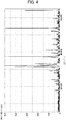
- FIG. 4 is a graph showing the results of X ray diffraction analysis of ignition ash of the agent for decreasing the fluidity according to the present invention.
- One embodiment of the agent for decreasing the fluidity according to the present invention is an agent for decreasing the fluidity of a solid-liquid mixture, which is a granular material having a structure formed by entangled fibers in which the granular material has an average particle diameter of 300 ⁇ m or less and a specific surface area of 0.25 m 2 /g or more and 100 m 2 /g or less as measured by a BET method.
- another embodiment of the agent for decreasing the fluidity according to the present invention is an agent for decreasing the fluidity of a solid-liquid mixture, which is a granular material having a structure formed by entangled fibers in which the granular material has a porosity of 50% or more as calculated in accordance with the formula: (1 - (bulk density)/(true density)) ⁇ 100 and a specific surface area of 0.25 m 2 /g or more and 100 m 2 /g or less as measured by a BET method.
- the average particle diameter of a granular material may be 300 ⁇ m or less.
- the average particle diameter indicates an average value of particle diameter of the granular materials observed under an optical microscope.
- the aforementioned fiber is not particularly limited, and examples thereof include a fiber containing a hydrophilic polymer.
- the fiber contains a hydrophilic polymer, when water is included in the liquid phase of the solid-liquid mixture, affinity between the fiber and the liquid phase is enhanced and the liquid phase is more easily captured by the agent for decreasing the fluidity, and thus the degree of fluidity decrease of the solid-liquid mixture is more easily increased.
- the hydrophilic polymer is not particularly limited, and examples thereof include cellulose, polyvinyl alcohol, polyalkylene glycol (for example, polyethylene glycol and polypropylene glycol), and polyacrylic acid, and from the viewpoint of having biodegradability and pH in neutral range (for example, around pH 8) and also an excellent low environmental loading property, cellulose is preferable.
- content of the hydrophilic polymer in the agent for decreasing the fluidity according to the present invention is preferably 40% by weight or more, more preferably 45% by weight or more, and even more preferably 47% by weight or more.
- content is 40% by weight or more, when water is contained in the liquid phase of the solid-liquid mixture, affinity between the fiber and the liquid phase is enhanced and the liquid phase is more easily captured by the agent for decreasing the fluidity, and thus the degree of fluidity decrease of the solid-liquid mixture is more easily increased.
- the upper limit of the content may be 100% by weight, but, when the degree of fluidity decrease of a solid-liquid mixture or the like is considered, the upper limit of the content is preferably 80% by weight or less, more preferably 60% by weight or less, and even more preferably 57% by weight or less.
- the agent for decreasing the fluidity according to the present invention may be used with, as an optional component, an inorganic filler such as calcium carbonate (CaCO 3 ), kaolin (Al 4 Si 4 O 10 (OH) 8 ), or talc (Mg 3 Si 4 O 10 (OH) 2 ) as long as the purpose of the present invention is not impaired.
- an inorganic filler such as calcium carbonate (CaCO 3 ), kaolin (Al 4 Si 4 O 10 (OH) 8 ), or talc (Mg 3 Si 4 O 10 (OH) 2 ) as long as the purpose of the present invention is not impaired.
- the solid-liquid mixture is not particularly limited, and examples thereof include mud.
- Content of the liquid phase in the solid-liquid mixture is not particularly limited, and it is typically 20 to 90% by weight, more typically 30 to 75% by weight, even more typically 40 to 60% by weight, and particularly typically 45 to 55% by weight.
- the mud may have cone index qc of less than 400 (kN/m 2 ), and specifically, it may be 350 (kN/m 2 ) or less, 300 (kN/m 2 ) or less, 250 (kN/m 2 ) or less, 200 (kN/m 2 ) or less, 175 (kN/m 2 ) or less, 150 (kN/m 2 ) or less, 125 (kN/m 2 ) or less, 100 (kN/m 2 ) or less, 75 (kN/m 2 ) or less, or 60 (kN/m 2 ) or less.
- Lower limit of the cone index qc of mud may be 10 (kN/m 2 ) or so, although it is not particularly limited.
- the method for producing the agent for decreasing the fluidity according to the present invention is not particularly limited, and a method including milling material pieces by a mill can be mentioned, for example.
- the material pieces include those capable of forming a fiber according to milling by a mill, and more specific examples thereof include shredder scrap, paper pieces including used paper, or the like. According to this method, a granular material having a structure formed by entangled fibers is formed.
- agent for decreasing the fluidity is described in accordance with the following properties that are exhibited by the agent for decreasing the fluidity according to the present invention.
- the agent for decreasing the fluidity according to the present invention has the physical liquid absorption as a main mechanism, and it does not require any reaction time. As a result, it is possible to shorten the time from an occurrence of a solid-liquid mixture with high fluidity such as sludge having high water retention rate to completion of a treatment (achievement of low-fluidity mixture).
- the granular material constituting the agent for decreasing the fluidity according to the present invention has a structure formed by entangled fibers, and as shown in Examples, the structure exhibits a cotton-like shape.
- This cotton-like structure has many voids having an interconnecting property, and when the agent for decreasing the fluidity is added to a solid-liquid mixture having high liquid retention rate such as sludge and water or fine particles constituting the sludge infiltrate the voids, an internal pressure is unlikely to work thereon. As a result, exchange between the air filling the voids and water or fine particles progresses rapidly.
- air filled in the interconnecting voids in a cotton-like structure of the agent for decreasing the fluidity is converted into extremely small air (bubble) by the water or fine particles, and together with the air, the water or fine particles are physically restrained to the interconnecting voids.
- the free movement of the solid-liquid mixture having high water retention rate such as sludge, which used to have a liquid property, is restrained by the fiber structure, and after addition and stirring of the agent for decreasing the fluidity (dispersing of the agent for decreasing the fluidity in solid-liquid mixture), plasticity is caused immediately.
- the main body of the fiber constituting the agent for decreasing the fluidity is a hydrophilic polymer like cellulose and the liquid phase of the solid-liquid mixture contains water
- the hydrophilic polymer has many hydrophilic groups on the molecular side chain, an electric attractive force is exhibited between the water molecule and fibers constituting the voids, thus contributing to the difficulty (restraining force) of losing water which has infiltrated the interconnecting voids.
- the granular material constituting the agent for decreasing the fluidity has an extremely small average particle diameter of 300 ⁇ m or less. It contributes to the dispersion level of the agent for decreasing the fluidity when the agent for decreasing the fluidity is added to a solid-liquid mixture and stirred therein, and, along with the aforementioned physical restraining mechanism, also contributes to the instantaneous property.
- the average particle diameter is preferably 250 ⁇ m or less, and more preferably 200 ⁇ m or less.
- lower limit of the average particle diameter is, although not particularly limited, typically 3 ⁇ m or more, and more typically 50 ⁇ m or more.
- the specific surface area of the granular material constituting the agent for decreasing the fluidity is 0.25 m 2 /g or more and 100 m 2 /g or less as measured by a BET method.
- the fiber constituting the agent for decreasing the fluidity itself has fine voids, but compared to silica gel (specific surface area as measured by a BET method: about 500 m 2 /g) used for an absorbent material or the like, or activated carbon (specific surface area as measured by a BET method: about 1000 m 2 /g) used for adsorption or the like, it has a smaller specific surface area as measured by BET method.
- the silica gel or activated carbon has many voids (fine pores) of angstrom order in the material
- the fiber constituting the granule of the granular material itself has not so many fine pores of angstrom order.
- those fine pores exhibit a great influence on the gas adsorption property whereas the influence of the fine pores is not so high for liquid absorption, particularly, for a short period of time
- the aforementioned measurement value of the specific surface area of the agent for decreasing the fluidity supports the instant liquid absorption principle which has, as a main principle, the physical restraining mechanism based on interconnecting voids resulting from entangling among fibers which constitute the agent for decreasing the fluidity.
- the specific surface area of the granular material constituting the agent for decreasing the fluidity as measured by a BET method is, from the viewpoint of the liquid absorbing property by the agent for decreasing the fluidity, preferably 0.25 m 2 /g or more and 100 m 2 /g or less, more preferably 0.5 m 2 /g or more and 10 m 2 /g or less, even more preferably 0.75 m 2 /g or more and 5 m 2 /g or less, and particularly more preferably 1 m 2 /g or more and 2 m 2 /g or less.
- the operation required for a treatment is just addition of the agent for decreasing the fluidity to a solid-liquid mixture, and stirring.
- complex order, operation, and items for determination like addition of plural chemicals, addition order involved with the addition of plural chemicals, balance in blending amounts, or the like are not required, and the operation is simple so that anybody can perform.
- the agent for decreasing the fluidity according to the present invention can be used regardless of the chemical composition of the solid-liquid mixture as a subject for improvement.
- the solid phase of the solid-liquid mixture may be either an inorganic material or an organic material, for example.
- the liquid phase of the solid-liquid mixture may be any of water, an organic solvent, and a solution. In the case of a solution, a solute like electrolyte, concentration and type of ions, or the like does not matter.
- the granular material constituting the agent for decreasing the fluidity according to the present invention has voids as described above. Those voids are interconnecting voids based on entangling among fibers which constitute the agent for decreasing the fluidity, fine voids present in the fiber itself, and intergranular voids. In one embodiment, the granular material constituting the agent for decreasing the fluidity according to the present invention has a porosity of 50% or more as calculated in accordance with the formula: (1 - (bulk density)/(true density)) ⁇ 100.
- the porosity is, from the viewpoint of the liquid absorbing property by the agent for decreasing the fluidity, preferably 60% or more, more preferably 70% or more, even more preferably 80% or more, and particularly preferably 85% or more.
- Upper limit of the porosity is, from the viewpoint of the strength or the like of the agent for decreasing the fluidity, preferably 95% or less, more preferably 93% or less, even more preferably 91% or less, and particularly preferably 89% or less.
- the bulk density is calculated from, after filling a container having a certain volume with the agent for decreasing the fluidity, internal volume and weight of a granular material constituting the filled agent for decreasing the fluidity without applying a load from above, in particular.
- Example 2 when mud having water content ratio of 48% by weight is improved to have cone index of 200 kN/m 2 or higher, i.e., cone index of "fourth-class treated soil" as one quality category prescribed in "Technical standard for using treated soil of construction mud", the agent for decreasing the fluidity needs to be added in an amount of 25 kg per 1 m 3 .
- volume of the granular material constituting the agent for decreasing the fluidity which is added in Example 2 is as follows: 25 ⁇ 1000/(1.9 ⁇ 100 ⁇ 100 ⁇ 100) ⁇ 0.013 m 3 .
- the volume increase rate caused by constitutional fibers or the like after adding the agent for decreasing the fluidity in Example 2 can be calculated to be 1% or so.
- the physical restraining to interconnecting voids that are constituted by entangling of fibers constituting the granular material has a constant water-retaining force while the water restrained by celldoron can be extruded by a physical action like compression or the like.
- the handlability can be improved for unloading construction sludge or the like and volume reduction and weight reduction of sludge or the like can be easily carried out by having physical dehydration like compression, compared to a method for volume reduction and a method for weight reduction of a related art using high temperature calcination furnace or the like, the volume reduction and weight reduction can be achieved at low cost.
- the low environmental loading property is described for a case in which the fibers constituting the agent for decreasing the fluidity according to the present invention contain cellulose.
- Cellulose is degraded by cellulase, and as it is degraded by fungi or the like that are present in soil, the agent for decreasing the fluidity added to an environment is converted to original soil over time.
- a degrading enzyme like cellulase
- this biodegradability enables release of water or fine particles, which are physically restrained by the agent for decreasing the fluidity, from the restrain.
- pH of the agent for decreasing the fluidity is in a neutral range (around pH 8), and as pH of the soil after the addition of the agent for decreasing the fluidity remains within a neural range, it has little influence over farmland or neighboring vegetation.
- the method for producing a low-fluidity mixture according to the present invention includes mixing a solid-liquid mixture with the agent for decreasing the fluidity according to the present invention to obtain a low-fluidity mixture.
- the mixing method is not particularly limited, and a well-known method may be used.
- the amount of the agent for decreasing the fluidity to be mixed with a solid-liquid mixture is not particularly limited, and from the viewpoint of the degree of fluidity decrease of a solid-liquid mixture or the like, it is, for example, 1.5 parts by weight or more, preferably 3 parts by weight or more, more preferably 4.5 parts by weight or more, and even more preferably 9 parts by weight or more relative to 100 parts by weight of the solid-liquid mixture.
- the upper limit of the above amount is not particularly limited, and from the viewpoint of easy prevention of the volume increase or the like, it is, for example, 50 parts by weight or less, preferably 30 parts by weight or less, more preferably 20 parts by weight or less, and even more preferably 15 parts by weight or less relative to 100 parts by weight of the solid-liquid mixture.
- the agent for decreasing the fluidity that is used in the present invention a volume increase before and after the mixing is unlikely to occur.
- the solid-liquid mixture is mixed in an amount of 50% by volume or more but less than 100% by volume relative to the target loading volume of a low-fluidity mixture into a container, and the total volume of the use amount of the solid-liquid mixture and the agent for decreasing the fluidity exceeds the target loading volume of a low-fluidity mixture into a container.
- Use amount of the solid-liquid mixture is, relative to the target loading volume, preferably 60% by volume or more, and more preferably 70% by volume or more, 80% by volume or more, 85% by volume or more, 90% by volume or more, 95% by volume or more, or 97% by volume or more. Furthermore, use amount of the solid-liquid mixture may be 99.9% by volume or less, 99.5% by volume or less, 99% by volume or less, 95% by volume or less, or 90% by volume or less relative to the target loading volume, considering a slight volume increase after the mixing.
- the target loading volume of a low-fluidity mixture into a container may be a variable value which needs to be set for each use, or set at a constant value for each container from the viewpoint of safety or the like, or a fixed value that is the same as the maximum volume of each container.
- the total volume of the use amount of the solid-liquid mixture and the agent for decreasing the fluidity may be 101% by volume or more, or it is preferably 102% by volume or more, 103% by volume or more, 108% by volume or more, 110% by volume or more, or 115% by volume or more relative to the target loading volume of the low-fluidity mixture into a container.
- the aforementioned total volume may be less than 200% by volume, or specifically, it may be 190% by volume or less, 175% by volume or less, 150% by volume or less, 140% by volume or less, 130% by volume or less, or 120% by volume or less relative to the target loading volume of the low-fluidity mixture into a container.
- the aforementioned amount is preferable from the viewpoint of the efficiency of the process for producing a low-fluidity mixture using one container, but in the present invention, the total volume of the use amount of the solid-liquid mixture and the agent for decreasing the fluidity may be an amount of 101% by volume or less of the target loading volume.
- the mixing can be carried out in a closed space or a space with constant volume of a container. According to the present invention, even when the mixing is carried out in a closed space or a space with constant volume, container breakage caused by a significant volume increase is easily prevented. Furthermore, because the mixing in a closed space or a space with constant volume generally has poor operability compared to mixing in an open space, there is a problem that it is difficult to achieve sufficient mixing or to confirm the sufficient mixing, but the aforementioned problem can be solved by the present invention since the agent for decreasing the fluidity which is also excellent in terms of the instantaneous property, operational simplicity, and universality is used. From the same point of view, the mixing may be carried out by using a container on a vehicle for transporting powder particle.
- the closed space or space with constant volume may be closed or have a constant volume, and it also encompasses a container space that can be reversibly open or have a variable volume. Meanwhile, in the present invention, a container with an open space may be used.
- the cone index qc of a low-fluidity mixture that is obtained by the method of one embodiment of the present invention by using mud is, although not particularly limited, preferably higher by 50 (kN/m 2 ) or more than the cone index qc of mud, and specifically, it may be higher by 75 (kN/m 2 ) or more, 100 (kN/m 2 ) or more, 125 (kN/m 2 ) or more, 140 (kN/m 2 ) or more, 175 (kN/m 2 ) or more, 200 (kN/m 2 ) or more, 250 (kN/m 2 ) or more, 300 (kN/m 2 ) or more, 400 (kN/m 2 ) or more, 500 (kN/m 2 ) or more, 600 (kN/m 2 ) or more, 700 (kN/m 2 ) or more, 800 (kN/m 2 ) or more, 900 (kN/m 2 ) or more, or 1000 (kN/m 2
- the low-fluidity mixture produced by the aforementioned method may be used, either directly or after undergoing an additional stabilization treatment (for example, calcination treatment or addition of solidifying agent) (for example, on improved mud, construction, or the like), or it may be also discarded.
- an additional stabilization treatment for example, calcination treatment or addition of solidifying agent
- solidifying agent for example, on improved mud, construction, or the like
- the method for conveying a low-fluidity mixture according to the present invention includes moving a low-fluidity mixture, which is obtained by the method for producing a low-fluidity mixture according to the present invention, by using a moving body.
- the moving body include a vehicle for transporting powder particle and a dump truck.
- the conveyed low-fluidity mixture may be used for construction or the like or discarded on a site after the movement.
- Another embodiment of the present invention is a method for increasing the degree of fluidity decrease of a solid-liquid mixture by infiltrating and capturing a solid phase and a liquid phase of the solid-liquid mixture in voids that are formed by entangled fibers.
- the agent for decreasing the fluidity according to the present invention can be used, for example. That is because, the granular material constituting the agent for decreasing the fluidity has voids that are formed by entangled fibers and the solid phase and the liquid phase of the solid-liquid mixture are captured in the voids as they infiltrate thereto.
- Another embodiment of the present invention is a method for increasing the degree of freedom of a chemical composition of a solid-liquid mixture as a subject for decreasing the fluidity by infiltrating and capturing a solid phase and a liquid phase of the solid-liquid mixture in voids that are formed by entangled fibers.
- the agent for decreasing the fluidity according to the present invention can be used, for example.
- the agent for decreasing the fluidity according to the present invention can be used regardless of the chemical composition of the solid-liquid mixture, and it can increase the degree of freedom of the chemical composition of the solid-liquid mixture, which becomes a subject for decreasing the fluidity.
- Still another embodiment of the present invention is a method for preventing a volume increase of a solid-liquid mixture after decreasing the fluidity by infiltrating and capturing a solid phase and a liquid phase of the solid-liquid mixture in voids that are formed by entangled fibers.
- the agent for decreasing the fluidity according to the present invention can be used, for example.
- the agent for decreasing the fluidity according to the present invention can prevent the volume increase of a solid-liquid mixture after decreasing the fluidity.
- Shredder scrap (specific surface area of 0.23 m 2 /g as measured by BET method) was milled by a mill to obtain an agent for decreasing the fluidity which consists of a granular material having average particle diameter of 200 ⁇ m and specific surface area of 1.6 m 2 /g as measured by a BET method.
- an agent for decreasing the fluidity which consists of a granular material having average particle diameter of 200 ⁇ m and specific surface area of 1.6 m 2 /g as measured by a BET method.
- True density of the granular material was measured by a dry type densitometer manufactured by SHIMADZU CORPORATION, and it was found to be 1.9 g/cm 3 .
- bulk density of the granular material was 0.25 g/cm 3 .
- the granular material had porosity as follows: (1 - 0.25/1.9) ⁇ 100 ⁇ 87%.
- Mud with water content ratio of 48% by weight and the agent for decreasing the fluidity obtained from Example 1 were mixed with each other according to the weight shown in Table 1.
- the soil after the mixing was subjected to cone index measurement based on JIS A 1228.
- the results are shown Table 1.
- the ratio described in Table 1 indicates the weight ratio of the agent for decreasing the fluidity relative to the mud.
- FIG. 2 A state obtained after mixing the mud with water content ratio of 60% by weight with the agent for decreasing the fluidity in an amount of 10% by weight is shown in FIG. 2 .
- the soil microparticles were captured in voids of the cotton-like structure having entangled fibers in the agent for decreasing the fluidity. Furthermore, for taking a photograph, the moisture had been evaporated by drying.
- Example 6 The agent for decreasing the fluidity obtained in Example 1
- the cellulase preparation (trade name: Cellulase SS, manufactured by Nagase ChemteX Corporation) was diluted with 0.1 M acetate buffer (pH 5.5) to have concentration of 1/50, and thus a diluted enzyme solution was prepared.
- 0.1 M acetate buffer pH 5.5
- a diluted enzyme solution was prepared.
- the sample was added in an amount of 25 mg followed by stirring. At that time, it was observed by a naked eye that not any one of the samples is slightly dissolved. After that, incubation for 24 hours at 40°C was carried out. At Hour 0 and Hour 24 from the incubation, the reaction solution was centrifuged (7,000 ⁇ g, 5 minutes) and the supernatant was recovered. The supernatant was boiled for 5 minutes to terminate the reaction.
- the agent for decreasing the fluidity according to the present invention can be efficiently degraded by cellulase, and thus the agent was confirmed to have good biodegradability.
- TG-DTA is a method of examining, based on an exothermic and endothermic behavior and a weight change, a state in which a chemical change (including combustion) of a material is caused by heating.
- TG-DTA was measured for the agent for decreasing the fluidity obtained from Example 1 by using Thermo Plus EVO2 differential thermal balance TG8121 that is manufactured by Rigaku Corporation. Furthermore, the measurement conditions were sample weight of 15 mg, measurement temperature range of 20 to 950°C, and temperature increase rate of 20°C/minute.
- XRD is an analysis method by which qualification and quantification of a material is carried out by utilizing that each material has a unique crystal structure.
- the ash produced by ig-Loss of above (1) was pulverized using a pestle and mortar, and the ash obtained from the pulverization using a pestle and mortar was pulverized using a pestle and mortar, and then filled in a holder for XRD measurement.
- FIGs. 3A and 3B The results are shown in FIGs. 3A and 3B .
- the line indicated by “TEMP” represents the heating temperature
- the line indicated by “TG” represents the weight change (TG curve)
- the line indicated by “DTA” represents the exothermic and endothermic reactions (DTA curve).
- FIG. 3B is obtained by modifying the drawing scale of the DTA curve in FIG. 3A .
- Wooden fibers contain a large amount of hemicelluloses and lignin other than cellulose, but lignin is removed as much as possible during paper-making process as it is viscous and becomes a cause of discoloration, and thus the content thereof is very small. As such, it is considered to be the combustion of non-combusted carbon of cellulose and/or printed carbon. The weight reduction at that point was about 7% according to the measured value.
- a gentle endothermic peak was shown at 700°C to 800°C, and weight reduction was also shown at the same temperatures. This is understood as a phenomenon in which calcium carbonate of the filler contained in the agent for decreasing the fluidity undergoes a decarboxylation reaction. The reduced amount of this decarboxylation was about 12%.
- a filler is used for various purposes.
- a filler that is generally used include calcium carbonate (CaCO 3 ), kaolin (Al 4 Si 4 O 10 (OH) 8 ), and talc (Mg 3 Si 4 O 10 (OH) 2 ).
- CaCO 3 calcium carbonate
- Al 4 Si 4 O 10 (OH) 8 kaolin
- talc magnesium calcium carbonate
- a filler other than calcium carbonate is also included in the agent for decreasing the fluidity.
- thermal decomposition of calcium carbonate (reaction formula: CaCO 3 + ⁇ H ⁇ CaO+CO 2 , ⁇ H is calorie) is at 700°C or higher and also has a high weight reduction amount (theoretical value of 44%), it can be clearly detected (although there are reports indicating that the thermal decomposition of calcium carbonate occurs at 600°C or so, or data indicating the occurrence near 900°C, depending on literatures, it is however 700 to 800°C according to the present measurement conditions).
- the thermal decomposition of kaolin or talc (in those cases, dehydration reaction of crystal water) is broad at temperatures of 350 to 650°C and the weight reduction amount is as small as 10 to 14%, it is overlapped with the combustion reaction of cellulose, and thus difficult to detect by TG-DTA.
- the total weight reduction obtained by TG-DTA (heated up to 950°C) was 72.12%, which almost corresponds to the ignition loss of 73.72% of (1) above (heated up to 1000°C). Furthermore, the cellulose content contained in the agent for decreasing the fluidity was about 48 to 56%.
- the weight reduction of the agent for decreasing the fluidity at 575°C which is the ashing temperature prescribed in JIS P 8251:2002, was 61.84% (with the proviso that the weight reduction amount of adsorbed water is also included in this value).
- Calcium oxide is a material generated by decarboxylation that is caused by ignition of calcium carbonate in filler, and it is contained in the largest amount in the ash. Furthermore, calcium hydroxide detected with a trace amount is a reaction product of calcium oxide in the sample with moisture in air during the measurement. In addition, gehlenite considered to be generated by dehydration and recrystallization of a clay-based filler like kaolin was contained. The main component of the ash included those two types, and it was found that they originate from a filler.
- magnetite was also observed, although it was a small amount. There is a possibility that it has originated from a stapler, abrasion of a milling wing, ink components, or the like.
Landscapes
- Chemical & Material Sciences (AREA)
- Engineering & Computer Science (AREA)
- Organic Chemistry (AREA)
- Life Sciences & Earth Sciences (AREA)
- Chemical Kinetics & Catalysis (AREA)
- Health & Medical Sciences (AREA)
- Polymers & Plastics (AREA)
- Medicinal Chemistry (AREA)
- Materials Engineering (AREA)
- Environmental & Geological Engineering (AREA)
- Hydrology & Water Resources (AREA)
- Water Supply & Treatment (AREA)
- Fluid Mechanics (AREA)
- Physics & Mathematics (AREA)
- General Life Sciences & Earth Sciences (AREA)
- Soil Sciences (AREA)
- Mechanical Engineering (AREA)
- General Engineering & Computer Science (AREA)
- Biochemistry (AREA)
- Soil Conditioners And Soil-Stabilizing Materials (AREA)
- Processing Of Solid Wastes (AREA)
- Investigation Of Foundation Soil And Reinforcement Of Foundation Soil By Compacting Or Drainage (AREA)
- Agricultural Chemicals And Associated Chemicals (AREA)
Applications Claiming Priority (4)
| Application Number | Priority Date | Filing Date | Title |
|---|---|---|---|
| JP2015234231A JP5931267B1 (ja) | 2015-11-30 | 2015-11-30 | 固液混合物の流動性低下剤 |
| JP2015234232 | 2015-11-30 | ||
| JP2015238813A JP5959709B1 (ja) | 2015-11-30 | 2015-12-07 | 低流動性混合物の製造方法 |
| PCT/JP2016/085296 WO2017094700A1 (fr) | 2015-11-30 | 2016-11-29 | Agent pour diminuer la fluidité d'un mélange solide-liquide et procédé de production d'un mélange à fluidité basse |
Publications (2)
| Publication Number | Publication Date |
|---|---|
| EP3385352A1 true EP3385352A1 (fr) | 2018-10-10 |
| EP3385352A4 EP3385352A4 (fr) | 2019-03-13 |
Family
ID=58796913
Family Applications (1)
| Application Number | Title | Priority Date | Filing Date |
|---|---|---|---|
| EP16870637.2A Withdrawn EP3385352A4 (fr) | 2015-11-30 | 2016-11-29 | Agent pour diminuer la fluidité d'un mélange solide-liquide et procédé de production d'un mélange à fluidité basse |
Country Status (5)
| Country | Link |
|---|---|
| US (1) | US20190127641A1 (fr) |
| EP (1) | EP3385352A4 (fr) |
| CN (1) | CN108603092A (fr) |
| SG (1) | SG11201804530TA (fr) |
| WO (1) | WO2017094700A1 (fr) |
Families Citing this family (1)
| Publication number | Priority date | Publication date | Assignee | Title |
|---|---|---|---|---|
| JP7821567B2 (ja) * | 2020-05-14 | 2026-02-27 | デクセリアルズ株式会社 | 排水処理剤、及び排水処理剤の製造方法 |
Family Cites Families (17)
| Publication number | Priority date | Publication date | Assignee | Title |
|---|---|---|---|---|
| JPH06330039A (ja) * | 1993-05-19 | 1994-11-29 | Sanki Kogyo Kk | 固結剤 |
| JPH1160806A (ja) * | 1997-08-25 | 1999-03-05 | Asahi Chem Ind Co Ltd | 表面処理粉体組成物 |
| JP3783388B2 (ja) * | 1997-12-26 | 2006-06-07 | 栗田工業株式会社 | 高含水率泥土、泥水又は汚泥の改質固化方法 |
| JP3606759B2 (ja) * | 1999-03-12 | 2005-01-05 | 株式会社テルナイト | 浚渫底泥の非流動化処理方法 |
| JP2000264764A (ja) * | 1999-03-12 | 2000-09-26 | Mitsubishi Paper Mills Ltd | 排泥からなる堆肥の製造方法 |
| JP2000288600A (ja) * | 1999-04-09 | 2000-10-17 | Terunaito:Kk | 浚渫底泥の脱水処理方法 |
| JP2000288589A (ja) * | 1999-04-09 | 2000-10-17 | Terunaito:Kk | 建設汚泥の再生処理方法 |
| JP2001121193A (ja) | 1999-10-29 | 2001-05-08 | Terunaito:Kk | 汚泥の再生方法 |
| CA2427991C (fr) * | 2000-11-06 | 2008-01-22 | Asahi Kasei Kabushiki Kaisha | Particules cellulosiques destinees a des preparations pharmaceutiques |
| JP4260045B2 (ja) * | 2004-03-01 | 2009-04-30 | 征八朗 三浦 | 高活性脱水助剤の製造方法 |
| DK2564931T3 (da) * | 2005-03-24 | 2014-08-25 | Xyleco Inc | Fremgangsmåder til fremstilling af fibrøse materialer |
| JP4884785B2 (ja) | 2006-01-23 | 2012-02-29 | 雅人 森 | 改良土及び改良土の製造方法 |
| JP5042589B2 (ja) | 2006-10-23 | 2012-10-03 | 株式会社あの津技研 | 軟泥土壌用粉末固化材及びその製造方法 |
| US9132195B2 (en) * | 2008-05-21 | 2015-09-15 | Asahi Kasei Chemicals Corporation | Cellulose powder having excellent segregation preventive effect, and compositions thereof |
| BR112015012599A2 (pt) * | 2012-12-19 | 2017-07-11 | Kimberly Clark Co | fibras de baixa densidade e métodos para sua formação |
| CN103232866B (zh) * | 2013-04-10 | 2014-03-26 | 太原理工大学 | 一种纤维球填料及其净化煤气的方法 |
| JP6206340B2 (ja) * | 2014-04-30 | 2017-10-04 | 信越化学工業株式会社 | コンクリート組成物 |
-
2016
- 2016-11-29 CN CN201680079741.0A patent/CN108603092A/zh active Pending
- 2016-11-29 SG SG11201804530TA patent/SG11201804530TA/en unknown
- 2016-11-29 WO PCT/JP2016/085296 patent/WO2017094700A1/fr not_active Ceased
- 2016-11-29 US US15/779,858 patent/US20190127641A1/en not_active Abandoned
- 2016-11-29 EP EP16870637.2A patent/EP3385352A4/fr not_active Withdrawn
Also Published As
| Publication number | Publication date |
|---|---|
| CN108603092A (zh) | 2018-09-28 |
| SG11201804530TA (en) | 2018-06-28 |
| WO2017094700A1 (fr) | 2017-06-08 |
| EP3385352A4 (fr) | 2019-03-13 |
| US20190127641A1 (en) | 2019-05-02 |
Similar Documents
| Publication | Publication Date | Title |
|---|---|---|
| Naeem et al. | Optimization of the structural characteristics of CaO and its effective stabilization yield high-capacity CO2 sorbents | |
| EP3535793B1 (fr) | Particules de silicium recouvertes de carbone pour des batteries lithium-ion | |
| Levis et al. | Characterisation of halloysite for use as a microtubular drug delivery system | |
| Ciszewski et al. | Reduced graphene oxide–bismuth oxide composite as electrode material for supercapacitors | |
| Valverde et al. | Role of crystal structure on CO2 capture by limestone derived CaO subjected to carbonation/recarbonation/calcination cycles at Ca-looping conditions | |
| JP2021529724A (ja) | 表面官能化された炭素質粒子、その製造方法及びその適用 | |
| Tulloch et al. | Influence of selected coal contaminants on graphitic carbon electro-oxidation for application to the direct carbon fuel cell | |
| Zhang et al. | Facile assembly of silica gel/reduced graphene oxide/Ag nanoparticle composite with a core–shell structure and its excellent catalytic properties | |
| KR20160140823A (ko) | 분말상 토버모라이트형 규산칼슘계 재료 및 그 제조방법 | |
| KR20220143093A (ko) | 탄소-코팅된 실리콘 입자의 제조 방법 | |
| US7939050B2 (en) | Composite article and related method | |
| KR102129907B1 (ko) | 사슬 연장용 고체 분산체, 이를 이용한 사슬 연장된 폴리우레탄 및 사슬 연장된 폴리우레탄의 제조방법 | |
| Ndayishimiye et al. | Coalescence in cold sintering: A study on sodium molybdate | |
| Pi et al. | Investigation of Y2O3/MgO‐modified extrusion–spheronized CaO‐based pellets for high‐temperature CO2 capture | |
| Chowdhury et al. | A simple template-free bioinspired route of 1D Bi2S3 nanorods synthesis for electrochemical CO2 reduction to formate | |
| Cherkaski et al. | Densification behavior and microstructure evolution of yttrium-doped ThO2 ceramics | |
| US20190127641A1 (en) | Agent for decreasing fluidity of solid-liquid mixture, and method for producing low-fluidity mixture | |
| EP4324802B1 (fr) | Argile mécanochimiquement carbonatée, ses procédés de production et ses utilisations | |
| Häringer et al. | Influence of process parameters on the electrochemical properties of hierarchically structured Na3V2 (PO4) 3/C composites | |
| JP5959709B1 (ja) | 低流動性混合物の製造方法 | |
| JP5931267B1 (ja) | 固液混合物の流動性低下剤 | |
| WO2015117194A1 (fr) | Électrode dopée et ses usages | |
| CN113663491A (zh) | 脱硫剂组合物及其制备方法 | |
| Ochigbo et al. | Dynamic mechanical and thermal properties of the composites of thermoplastic starch and lanthanum hydroxide nanoparticles | |
| KR20260035883A (ko) | 황화물 고체 전해질 분말 및 전극 합제 |
Legal Events
| Date | Code | Title | Description |
|---|---|---|---|
| STAA | Information on the status of an ep patent application or granted ep patent |
Free format text: STATUS: THE INTERNATIONAL PUBLICATION HAS BEEN MADE |
|
| PUAI | Public reference made under article 153(3) epc to a published international application that has entered the european phase |
Free format text: ORIGINAL CODE: 0009012 |
|
| STAA | Information on the status of an ep patent application or granted ep patent |
Free format text: STATUS: REQUEST FOR EXAMINATION WAS MADE |
|
| 17P | Request for examination filed |
Effective date: 20180628 |
|
| AK | Designated contracting states |
Kind code of ref document: A1 Designated state(s): AL AT BE BG CH CY CZ DE DK EE ES FI FR GB GR HR HU IE IS IT LI LT LU LV MC MK MT NL NO PL PT RO RS SE SI SK SM TR |
|
| AX | Request for extension of the european patent |
Extension state: BA ME |
|
| STAA | Information on the status of an ep patent application or granted ep patent |
Free format text: STATUS: EXAMINATION IS IN PROGRESS |
|
| DAV | Request for validation of the european patent (deleted) | ||
| DAX | Request for extension of the european patent (deleted) | ||
| A4 | Supplementary search report drawn up and despatched |
Effective date: 20190211 |
|
| RIC1 | Information provided on ipc code assigned before grant |
Ipc: E02D 3/00 20060101AFI20190205BHEP Ipc: C08L 97/02 20060101ALI20190205BHEP Ipc: D01F 6/14 20060101ALI20190205BHEP Ipc: E02F 7/00 20060101ALI20190205BHEP |
|
| 17Q | First examination report despatched |
Effective date: 20190226 |
|
| GRAP | Despatch of communication of intention to grant a patent |
Free format text: ORIGINAL CODE: EPIDOSNIGR1 |
|
| STAA | Information on the status of an ep patent application or granted ep patent |
Free format text: STATUS: GRANT OF PATENT IS INTENDED |
|
| RIC1 | Information provided on ipc code assigned before grant |
Ipc: C08L 1/02 20060101AFI20200519BHEP Ipc: E02D 3/00 20060101ALI20200519BHEP |
|
| INTG | Intention to grant announced |
Effective date: 20200622 |
|
| STAA | Information on the status of an ep patent application or granted ep patent |
Free format text: STATUS: THE APPLICATION IS DEEMED TO BE WITHDRAWN |
|
| 18D | Application deemed to be withdrawn |
Effective date: 20201103 |