EP3388108B1 - Systèmes et procédés de calcul de dose dans la génération de plans de traitement par rayonnement - Google Patents
Systèmes et procédés de calcul de dose dans la génération de plans de traitement par rayonnement Download PDFInfo
- Publication number
- EP3388108B1 EP3388108B1 EP18162838.9A EP18162838A EP3388108B1 EP 3388108 B1 EP3388108 B1 EP 3388108B1 EP 18162838 A EP18162838 A EP 18162838A EP 3388108 B1 EP3388108 B1 EP 3388108B1
- Authority
- EP
- European Patent Office
- Prior art keywords
- dose
- fluence
- prediction model
- radiation treatment
- maps
- Prior art date
- Legal status (The legal status is an assumption and is not a legal conclusion. Google has not performed a legal analysis and makes no representation as to the accuracy of the status listed.)
- Active
Links
Images




Classifications
-
- A—HUMAN NECESSITIES
- A61—MEDICAL OR VETERINARY SCIENCE; HYGIENE
- A61N—ELECTROTHERAPY; MAGNETOTHERAPY; RADIATION THERAPY; ULTRASOUND THERAPY
- A61N5/00—Radiation therapy
- A61N5/10—X-ray therapy; Gamma-ray therapy; Particle-irradiation therapy
- A61N5/103—Treatment planning systems
-
- A—HUMAN NECESSITIES
- A61—MEDICAL OR VETERINARY SCIENCE; HYGIENE
- A61N—ELECTROTHERAPY; MAGNETOTHERAPY; RADIATION THERAPY; ULTRASOUND THERAPY
- A61N5/00—Radiation therapy
- A61N5/10—X-ray therapy; Gamma-ray therapy; Particle-irradiation therapy
- A61N5/103—Treatment planning systems
- A61N5/1031—Treatment planning systems using a specific method of dose optimization
-
- G—PHYSICS
- G06—COMPUTING OR CALCULATING; COUNTING
- G06T—IMAGE DATA PROCESSING OR GENERATION, IN GENERAL
- G06T7/00—Image analysis
- G06T7/0002—Inspection of images, e.g. flaw detection
- G06T7/0012—Biomedical image inspection
-
- A—HUMAN NECESSITIES
- A61—MEDICAL OR VETERINARY SCIENCE; HYGIENE
- A61N—ELECTROTHERAPY; MAGNETOTHERAPY; RADIATION THERAPY; ULTRASOUND THERAPY
- A61N5/00—Radiation therapy
- A61N5/10—X-ray therapy; Gamma-ray therapy; Particle-irradiation therapy
- A61N5/103—Treatment planning systems
- A61N2005/1041—Treatment planning systems using a library of previously administered radiation treatment applied to other patients
-
- A—HUMAN NECESSITIES
- A61—MEDICAL OR VETERINARY SCIENCE; HYGIENE
- A61N—ELECTROTHERAPY; MAGNETOTHERAPY; RADIATION THERAPY; ULTRASOUND THERAPY
- A61N5/00—Radiation therapy
- A61N5/10—X-ray therapy; Gamma-ray therapy; Particle-irradiation therapy
- A61N5/103—Treatment planning systems
- A61N5/1036—Leaf sequencing algorithms
-
- A—HUMAN NECESSITIES
- A61—MEDICAL OR VETERINARY SCIENCE; HYGIENE
- A61N—ELECTROTHERAPY; MAGNETOTHERAPY; RADIATION THERAPY; ULTRASOUND THERAPY
- A61N5/00—Radiation therapy
- A61N5/10—X-ray therapy; Gamma-ray therapy; Particle-irradiation therapy
- A61N5/103—Treatment planning systems
- A61N5/1038—Treatment planning systems taking into account previously administered plans applied to the same patient, i.e. adaptive radiotherapy
-
- A—HUMAN NECESSITIES
- A61—MEDICAL OR VETERINARY SCIENCE; HYGIENE
- A61N—ELECTROTHERAPY; MAGNETOTHERAPY; RADIATION THERAPY; ULTRASOUND THERAPY
- A61N5/00—Radiation therapy
- A61N5/10—X-ray therapy; Gamma-ray therapy; Particle-irradiation therapy
- A61N5/1042—X-ray therapy; Gamma-ray therapy; Particle-irradiation therapy with spatial modulation of the radiation beam within the treatment head
- A61N5/1045—X-ray therapy; Gamma-ray therapy; Particle-irradiation therapy with spatial modulation of the radiation beam within the treatment head using a multi-leaf collimator, e.g. for intensity modulated radiation therapy or IMRT
Definitions
- radiation therapy involves directing a beam of high energy proton, photon, or electron radiation ("therapeutic radiation") into a target volume (e.g., a tumor or lesion).
- a target volume e.g., a tumor or lesion
- a treatment plan specific to that patient is developed.
- the plan defines various aspects of the therapy using simulations and optimizations based on past experiences.
- the plan can specify the appropriate beam type (e.g., flattening filter free type) and the appropriate beam energy.
- Other parts of the plan can specify, for example, the angle of the beam relative to the patient, the beam shape, the placement of boluses and shields, and the like.
- the purpose of the treatment plan is to deliver sufficient radiation to the target volume while minimizing exposure of surrounding healthy tissue to the radiation.
- the planner's goal is to find a solution that is optimal with respect to multiple clinical goals that may be contradictory in the sense that an improvement toward one goal may have a detrimental effect on reaching another goal. For example, a treatment plan that spares the liver from receiving a dose of radiation may result in the stomach receiving too much radiation.
- the planner defines a set of quality metrics, such as target homogeneity, critical organ sparing, and the like, and respective target values Q i for the metrics.
- the metrics are defined such that a smaller value is preferred over a larger value.
- the planner also defines a relative priority or weight w i for each of the quality metrics.
- the optimal plan is determined by minimizing the cost function C.
- the optimal solution of the cost function may not necessarily describe the clinically best balance between quality metrics, or the dose distribution might have some undesirable features that are difficult to represent as a quality metric.
- One way to assist the planner is a knowledge-based approach that automatically generates objective functions so that the resulting plan incorporates and reflects present practices utilized in creating the knowledge base. This typically captures the best practices utilized at a treatment center, but can also be based on larger knowledge bases of well-defined treatments gathered from multiple treatment centers.
- Pareto surface navigation is an MCO technique that facilitates exploration of the tradeoffs between clinical goals.
- a treatment plan is considered to be Pareto optimal if it satisfies the goals and none of the metrics can be improved without worsening at least one of the other metrics.
- the set of Pareto optimal plans define a Pareto surface related to the set of clinical goals. Movement along the Pareto surface results in tradeoffs between the clinical goals; some metrics will improve at the cost of worsening one or more other metrics.
- the planner can navigate along the Pareto surface and choose a final (optimized) radiation treatment plan that seems to be the best according to the criteria applied by the planner, or a treatment plan can be selected automatically based on its proximity to the Pareto surface.
- Treatment planning methods using a plurality of dose prediction models are disclosed in publications US 2014/139040 and US 2015/0095043 .
- Embodiments according to the present invention provide a methodology that efficiently and quickly generates additional radiation treatment plans, in particular by efficiently and quickly performing dose calculations.
- a value for a first dose calculated using a first set of fluence maps and a first (faster) dose prediction model is accessed.
- a second fluence map is accessed.
- the second fluence map is projected onto the first set of fluence maps to determine a set of scalars and a residual value.
- a second dose is calculated using the first dose prediction model, the set of scalars, and the second fluence map.
- the second dose is calculated using a second (more accurate) dose prediction model and the second fluence map.
- a final radiation treatment plan is selected from a sample set of treatment plans that includes at least a first radiation treatment plan based on the first set of fluence maps and a second radiation treatment plan based on the second fluence map.
- the ability to use the first (faster) dose prediction model in lieu of the second (more accurate but slower and more resource-intensive) dose prediction model means that additional radiation treatment plans can be quickly and efficiently generated.
- embodiments according to the invention improve the field of radiation treatment planning specifically and the field of radiation therapy in general.
- beam intensity is varied across each treatment region (target volume) in a patient.
- the patient is treated with many smaller beams (e.g., pencil beams or beamlets), each of which can have its own intensity, and each of which can be delivered from a different angle (which may be referred to as beam geometry).
- Embodiments according to the invention allow more effective treatment plans to be generated quickly, which can be of critical importance considering the urgency of beginning radiation therapy when a patient is diagnosed with a disease such as cancer. Also, embodiments according to the invention help improve the functioning of computing systems because fewer computational resources are needed and consumed to develop a plan, meaning also that computer resources are freed up to perform other tasks.
- the computing system or similar electronic computing device manipulates and transforms data represented as physical (electronic) quantities within the computing system memories, registers or other such information storage, transmission or display devices.
- Terms such as “dose” or “fluence” generally refer to a dose or fluence value; the use of such terms will be clear from the context of the surrounding discussion.
- Embodiments described herein may be discussed in the general context of computer-executable instructions residing on some form of computer-readable storage medium, such as program modules, executed by one or more computers or other devices.
- computer-readable storage media may comprise non-transitory computer storage media and communication media.
- program modules include routines, programs, objects, components, data structures, etc., that perform particular tasks or implement particular abstract data types.
- the functionality of the program modules may be combined or distributed as desired in various embodiments.
- Computer storage media includes volatile and nonvolatile, removable and non-removable media implemented in any method or technology for storage of information such as computer-readable instructions, data structures, program modules or other data.
- Computer storage media includes, but is not limited to, random access memory (RAM), read only memory (ROM), electrically erasable programmable ROM (EEPROM), flash memory or other memory technology, compact disk ROM (CD-ROM), digital versatile disks (DVDs) or other optical storage, magnetic cassettes, magnetic tape, magnetic disk storage or other magnetic storage devices, or any other medium that can be used to store the desired information and that can accessed to retrieve that information.
- Communication media can embody computer-executable instructions, data structures, and program modules, and includes any information delivery media.
- communication media includes wired media such as a wired network or direct-wired connection, and wireless media such as acoustic, radio frequency (RF), infrared and other wireless media. Combinations of any of the above can also be included within the scope of computer-readable media.
- wired media such as a wired network or direct-wired connection
- wireless media such as acoustic, radio frequency (RF), infrared and other wireless media. Combinations of any of the above can also be included within the scope of computer-readable media.
- RF radio frequency
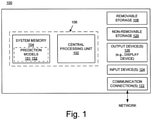
- Figure 1 shows a block diagram of an example of a computing system 100 upon which the embodiments described herein may be implemented.
- the system 100 includes at least one processing unit 102 and memory 104. This most basic configuration is illustrated in Figure 1 by dashed line 106.
- the system 100 may also have additional features and/or functionality.
- the system 100 may also include additional storage (removable and/or non-removable) including, but not limited to, magnetic or optical disks or tape. Such additional storage is illustrated in Figure 1 by removable storage 108 and non-removable storage 120.
- the system 100 may also contain communications connection(s) 122 that allow the device to communicate with other devices, e.g., in a networked environment using logical connections to one or more remote computers.
- the system 100 also includes input device(s) 124 such as keyboard, mouse, pen, voice input device, touch input device, etc.
- input device(s) 124 such as keyboard, mouse, pen, voice input device, touch input device, etc.
- output device(s) 126 such as a display device, speakers, printer, etc., are also included.
- embodiments according to the invention utilize two dose prediction models 151 and 152.
- the memory 104 includes computer-readable instructions, data structures, program modules, and the like associated with the dose calculation models or dose prediction models 151 and 152.
- the dose prediction models 151 and 152 may instead reside in any one of the computer storage media used by the system 100, or may be distributed over some combination of the computer storage media, or may be distributed over some combination of networked computers.
- the dose prediction model 151 (also referred to herein as the first prediction model) executes faster than and requires fewer computational resources, but is less accurate than, the dose prediction model 152 (also referred to herein as the second prediction model).
- the dose prediction model 152 (also referred to herein as the second prediction model).
- the dose prediction models 151 and 152 may be used to predict dose parameters for a treatment plan corresponding to a particular patient.
- the dose prediction models 151 and 152 may be implemented as a dose-volume histogram (DVH) estimation model for a region of interest (ROI), where the predicted quantity is a dose volume histogram.
- the ROI is a three-dimensional (3D) volume in the patient that contains the target volume as well as any nearby structures (organs) that might be adversely affected by radiation.
- the prediction models 151 and 152 also generate a prediction based on a distance to a target (DTH) histogram, which expresses the distance an ROI to a radiation target.
- the dose prediction models 151 and 152 are implemented as any other model suitable for predicting (calculating) doses (as a dose histogram or spatial 3D dose distribution) for a radiation treatment plan.
- the dose prediction models 151 and 152 can then be used to develop a radiation treatment plan for a particular patient by receiving patient-specific information (e.g., geometry information) that is input to and processed by the model.
- patient-specific information e.g., geometry information
- the input patient-specific information may contain any combination of parameters that can practically affect the radiation treatment plan.
- the patient-specific information may be organized as a vector or a data structure including feature elements for: size and shape of the target volume; location of the target volume; size and shape of an organ at risk; type of an organ at risk; a part of the target volume that overlaps an organ; and a part of an organ that overlaps the target volume.
- FIG 2 is a block diagram illustrating an example of an automated radiation therapy treatment planning system 200 in an embodiment according to the present invention.
- the system 200 includes an input interface 210 to receive patient-specific information (data) 201, a data processing component 220 that implements the prediction models 151 and 152, and an output interface 230.
- the system 200 in whole or in part may be implemented as a software program, hardware logic, or a combination thereof on/using the computing system 100 ( Figure 1 ).
- the patient-specific information is provided to and processed by the prediction models 151 and 152.
- the prediction models 151 and 152 yield a prediction result, e.g., an achievable dose distribution prediction.
- a treatment plan based on the prediction result can then be generated.
- the prediction result is accompanied by parameters indicative of the quality of the prediction, such as reliability of the result (e.g., affected by the internal coherence of the training data), complexity of the predicted plan, and probability of the result.
- Figure 3 illustrates an embodiment of a knowledge-based planning system 300 incorporating a combination of patient records and statistical models for generating radiation treatment plans in an embodiment according to the present invention.
- the system 300 includes a knowledge base 302 and a treatment planning tool set 310.
- the knowledge base 302 includes patient records 304 (e.g., radiation treatment plans), treatment types 306, and statistical models 308.
- the treatment planning tool set 310 in the example of Figure 3 includes a current patient record 312, a treatment type 314, a medical image processing module 316, an optimizer 318, a dose distribution module 320, and a final radiation treatment plan 322.
- the treatment planning tool set 310 searches through the knowledge base 302 (through the patient records 304) for prior patient records that are similar to the current patient record 312.
- the statistical models 308 can be used to compare the predicted results for the current patient record 312 to a statistical patient.
- a selected treatment type 306, and selected statistical models 308, the tool set 310 uses the current patient record 312, a selected treatment type 306, and selected statistical models 308, the tool set 310 generates a radiation treatment plan 322.
- a radiation treatment plan developed in this manner (e.g., the treatment plan 322) can be referred to as a balanced plan.
- the medical image processing module 316 provides automatic contouring and automatic segmentation of two-dimensional crosssectional slides (e.g., from computed tomography or magnetic resonance imaging) to form a 3D image using the medical images in the current patient record 312. Dose distribution maps are calculated by the dose distribution module 320, which may utilize the dose prediction models 151 and 152 of the optimizer 318.
- the knowledge base 302 can be searched for a combination of objectives that can be applied by the optimizer 318 to determine a dose distribution. For example, an average organ-at-risk dose-volume histogram, a mean cohort organ-at-risk dose-volume histogram, and average organ-at-risk objectives can be selected from the knowledge base 302.
- the optimizer 318 uses the dose prediction models 151 and 152 to help shape the dose distribution. Accordingly, the optimizer 318 can provide a 3D dose distribution, fluences, and associated dose-volume histograms for the current patient. By using the dose prediction models 151 and 152, those results are expected to fall within the historically accepted range for a patient with a similar disease type and treatment type.
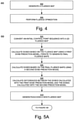
- FIGS 4, 5A , 5B , and 6 are flowcharts 400, 500, and 600, respectively, of examples of computer-implemented methods for generating a radiation treatment plan in embodiments according to the present invention.
- the flowcharts 400, 500, and 600 can be implemented as computer-executable instructions residing on some form of computer-readable storage medium (e.g., using the computing system 100 of Figure 1 ).
- IMRT beam intensity is varied across each treatment region (target volume) in a patient.
- the patient is treated with many smaller beams (e.g., pencil beams or beamlets), each of which can have its own intensity, and each of which can be delivered from a different angle (which may be referred to as beam geometry).
- a radiation treatment system for IMRT includes a number of components including, for example, a linear accelerator that delivers a beam (beamlet) of high energy proton, photon, or electron radiation that is modulated using a multileaf collimators (MLC).
- a linear accelerator that delivers a beam (beamlet) of high energy proton, photon, or electron radiation that is modulated using a multileaf collimators (MLC).
- MLC multileaf collimators
- a fluence map is generated.
- a control point sequence is selected or generated, defining how the radiation treatment system is to deliver the required doses to the patient/target volume.
- the control point sequence can be selected using the knowledge-based planning system 300 of Figure 3 .
- a control point sequence can include, for example, settings (leaf sequence settings) that control movement of the MLC during radiation treatment.
- a control point sequence can be converted into a two-dimensional (2D) fluence map that represents the intensity of the beam passing through the MLC aperture per unit of time.
- fluence optimization is performed, to optimize the individual components of the fluence map to produce the best radiation treatment plan for treating the patient.
- the ROI can be divided into smaller 3D elements known as voxels.
- Each voxel will receive a dose of radiation that can be predicted using the 2D fluence map.
- Each voxel will receive radiation from one or more beamlets delivered from different directions.
- the total dose for a voxel is the sum of the doses delivered by each beamlet received by the voxel.
- the planner's goal is to find a solution that is optimal with respect to multiple clinical goals that may be contradictory in the sense that an improvement toward one goal may have a detrimental effect on reaching another goal.
- a set of plans is generated as defined above and a well-selected sample set of those plans is used to define a Pareto surface for MCO.
- a treatment plan is further described.
- an initial control point sequence is converted into a 2D fluence map F sequence.
- doses e.g., per voxel based on the fluence map F are calculated using the first dose prediction model 151 ( Figure 1 ).
- the first dose prediction model 151 is characterized as a faster but less accurate model than the second dose prediction model 152.
- the first dose prediction model 151 is designated herein as D1
- the doses calculated using that model and the fluence maps F are designated herein in the form of D1(F).
- Fo consists of n fluence maps: Fo,1, Fo,2, ..., Fo,n, where n is the number of cost functions that are considered.
- doses based on the fluence maps Fo are calculated using the second (more accurate) dose prediction model 152.
- the second dose prediction model 152 is designated herein as D2, and the doses calculated using that model and the fluence maps F are designated herein in the form of D2(F).
- De D2(F) - D1(F).
- De D2(Fo) - D1(Fo).
- the fluence maps Fo Fo,1, Fo,2, ..., Fo,n
- the doses D2(Fo) D2(Fo,1), D2(Fo,2), ..., D2(Fo,n)
- the differences De De(De(Fo,1), De(Fo,2), ..., De(Fo,n)
- a radiation treatment plan is generated (this plan may be referred to herein as the first radiation treatment plan; the term "first” does not necessarily mean that it is the initial plan and instead is used simply as a differentiator).
- the operations just described can be repeated to generate any number of radiation treatment plans to provide a well-selected sample set of plans that can be used to define a Pareto surface.
- another fluence map Fp is generated or accessed.
- the fluence map Fp can be generated using a new control point sequence.
- the operation of determining the scalars is referred to as projecting, and a1*Fo,1 is a projection of Fp in Fo,1 (for example).
- the scalars a1, a2, ..., an are chosen so that Fr is as small as possible. In practice, this means that the squared sum of all of the pixels in Fr is as small as possible; in linear algebra terminology, the squared length of Fr is minimized.
- the 3D dose (dose per voxel) is a linear function of the fluence maps.
- De(a1*F1 + a2*F2 + ... + an*Fn) a1*De(F1) + a2*De(F2) + ... + an*De(Fn).
- the size (magnitude) of Fr is used to determine whether De(Fp) (D2(Fp) - D1(Fp)) can be approximated satisfactorily using a1*De(Fo,1) + a2*De(Fo,2) + ... + an*De(Fo,n). More specifically, Fr is compared to a threshold value.
- the threshold value can be a fixed value or it can be scaled (normalized) to the size of Fp. In an embodiment, the threshold value is expressed as: Fr ⁇ ⁇ i De Fp i ⁇ i Fr , where " I I " indicates a selected error measure for dose and fluence (e.g., the length in linear algebra).
- the dose D(Fp) based on the fluence map Fp is calculated using the first (faster) dose prediction model 151 (D1) and also using the set of scalars a1, a2, ..., an.
- the doses D2(Fo) (D2(Fo,1), D2(Fo,2), ..., D2(Fo,n)), which were calculated using the second (more accurate) dose prediction model 152 and the fluence maps Fo (Fo,1, Fo,2, ..., Fo,n) in block 506, are accessed.
- the differences De (De(Fo,1), De(Fo,2), ..., De(Fo,n)), which were calculated in block 508, are accessed.
- the dose D(Fp) for the new treatment plan is calculated using the second dose prediction model 152 (D2).
- doses for the new treatment plan can be approximated using the first (faster) dose prediction model 151 instead of the second (more accurate) dose prediction model 152.
- Other treatment plans can be similarly generated.
- the projection of the new fluence map onto the previous fluence maps determines scalars that weight the previous maps and also determines a residual value used to evaluate the error associated with the approximation, to determine which dose prediction model is to be used. Accordingly, dose results previously calculated for another plan using the more accurate model are used to get a fast first order correction to a new plan that is close to the other plan. Computational resources are saved, and the sample plan set can be more quickly expanded.
- first doses (D1(Fo,1), D1(Fo,2), ..., D1(Fo,n)) are accessed (e.g., from memory) or are calculated using the first dose prediction model 151 (D1) and a first set of fluence maps (Fo,1, Fo,2, ..., Fo,n).
- a second fluence map Fp is accessed (e.g., from memory) or generated.
- a dose prediction model is selected based on the residual value.
- a second dose (D(Fp) is calculated using the first dose prediction model 151 (D1), the set of scalars, and the second fluence map Fp.
- the second dose D(Fp) is calculated using the second dose prediction model 152 (D2) and the second fluence map Fp.
- third doses D2(Fo) (D2(Fo,1), D2(Fo,2), ..., D2(Fo,n)) that were calculated using the first set of fluence maps Fo and the second dose prediction model 152 are accessed.
- a fourth dose D1(Fr) is calculated using the first dose prediction model 151 and the residual value Fr, and the fourth dose is summed with the products of multiplying the set of scalars and the set of third doses to calculate the second dose:
- D Fp D1 Fr + a 1 * D 2 Fo 1 + a 2 * D 2 Fo 2 + ... + an * D 2 Fo n .
- third doses De (De(Fo,1), De(Fo,2), ..., De(Fo,n)), which are the differences between doses calculated using the first set of fluence maps Fo and the first dose prediction model 151 and doses calculated using the first set of fluence maps Fo and the second dose prediction model 152, are accessed.
- a final radiation treatment plan including a final fluence map is selected from a sample set of treatment plans that includes at least a first radiation treatment plan based on the first set of fluence maps Fo and a second radiation treatment plan based on the second fluence map Fp.
- the final fluence map can be converted into a set of leaf sequence settings that control movement of an MLC during radiation treatment.
- embodiments according to the invention improve the field of radiation treatment planning specifically and the field of radiation therapy in general.
- Embodiments according to the invention allow more effective treatment plans to be generated quickly, which can be of critical importance considering the urgency of beginning radiation therapy when a patient is diagnosed with a disease such as cancer.
- embodiments according to the invention help improve the functioning of computer systems because fewer computational resources are needed and consumed to develop a plan, meaning also that computer resources are freed up to perform other tasks.
- Embodiments according to the invention are thus described. These embodiments can be used to plan different types of external beam radiotherapy other than IMRT including, for example, image-guided radiotherapy (IGRT), RapidArc TM radiotherapy, stereotactic body radiotherapy (SBRT), and stereotactic ablative radiotherapy (SABR).
- IGRT image-guided radiotherapy
- SBRT stereotactic body radiotherapy
- SABR stereotactic ablative radiotherapy
Landscapes
- Health & Medical Sciences (AREA)
- Engineering & Computer Science (AREA)
- Biomedical Technology (AREA)
- General Health & Medical Sciences (AREA)
- Nuclear Medicine, Radiotherapy & Molecular Imaging (AREA)
- Radiology & Medical Imaging (AREA)
- Veterinary Medicine (AREA)
- Animal Behavior & Ethology (AREA)
- Pathology (AREA)
- Public Health (AREA)
- Life Sciences & Earth Sciences (AREA)
- Medical Informatics (AREA)
- Quality & Reliability (AREA)
- Computer Vision & Pattern Recognition (AREA)
- Physics & Mathematics (AREA)
- General Physics & Mathematics (AREA)
- Theoretical Computer Science (AREA)
- Radiation-Therapy Devices (AREA)
Claims (14)
- Système informatique (100) comprenant :une unité centrale de traitement, CPU (102) ; etune mémoire (104) couplée à la CPU et dans laquelle sont stockées des instructions qui, lorsqu'elles sont exécutées par le système informatique, amènent le système informatique à exécuter des opérations associées à la génération d'un plan de traitement par rayonnement, les opérations comprenant :l'accès à une première dose calculée à l'aide d'un premier ensemble de cartes de fluence et d'un premier modèle de prédiction de dose ;l'accès à une seconde carte de fluence ;la projection de la seconde carte de fluence sur le premier ensemble de cartes de fluence pour déterminer un ensemble de scalaires qui pondèrent le premier ensemble de cartes de fluence et une valeur résiduelle utilisée pour évaluer une erreur associée à l'utilisation du premier modèle de prédiction de dose pour calculer une dose sur la base de la seconde carte de fluence ; etlorsque la valeur résiduelle répond à un critère, le calcul d'une deuxième dose à l'aide du premier modèle de prédiction de dose, de l'ensemble de scalaires et de la seconde carte de fluence, et dans lequel lorsque la valeur résiduelle ne répond pas au critère, le calcul de la deuxième dose à l'aide d'un second modèle de prédiction de dose et de la seconde carte de fluence.
- Système informatique selon la revendication 1, dans lequel les opérations comprennent en outre l'accès à un ensemble de troisièmes doses calculées à l'aide du premier ensemble de cartes de fluence et du second modèle de prédiction de dose ;
dans lequel ledit calcul d'une deuxième dose à l'aide du premier modèle de prédiction de dose, de l'ensemble de scalaires et de la seconde carte de fluence comprend :le calcul d'une quatrième dose à l'aide du premier modèle de prédiction de dose et de la valeur résiduelle ; etl'addition de la quatrième dose et de produits de la multiplication de l'ensemble de scalaires et de l'ensemble de troisièmes doses. - Système informatique selon la revendication 1, dans lequel les opérations comprennent en outre l'accès à un ensemble de troisièmes doses comprenant des différences entre des doses calculées à l'aide du premier ensemble de cartes de fluence et du premier modèle de prédiction de dose et des doses calculées à l'aide du premier ensemble de cartes de fluence et du second modèle de prédiction de dose ;
dans lequel ledit calcul d'une deuxième dose à l'aide du premier modèle de prédiction de dose, de l'ensemble de scalaires et de la seconde carte de fluence comprend :le calcul d'une quatrième dose à l'aide de la seconde carte de fluence et du premier modèle de prédiction de dose ; etl'addition de la quatrième dose et de produits de la multiplication de l'ensemble de scalaires et du troisième ensemble de doses. - Système informatique selon la revendication 1, 2 ou 3, dans lequel le critère comprend une valeur de seuil pour une grandeur de la valeur résiduelle.
- Système informatique selon la revendication 1, 2, 3 ou 4, dans lequel le critère comprend une valeur de seuil pour une valeur normalisée de la valeur résiduelle.
- Système informatique selon l'une quelconque des revendications 1 à 5, dans lequel le second modèle de prédiction de dose est plus précis et utilise davantage de ressources de calcul que le premier modèle de prédiction de dose.
- Système informatique selon l'une quelconque des revendications 1 à 6, dans lequel les opérations comprennent en outre :la sélection d'une carte de fluence finale pour un traitement par rayonnement, dans lequel la carte de fluence finale est sélectionnée parmi une pluralité de cartes de fluence comprenant au moins le premier ensemble de cartes de fluence et la seconde carte de fluence ; etla conversion de la carte de fluence finale en paramètres de séquence de lames qui commandent le mouvement d'un collimateur multilame pendant le traitement par rayonnement.
- Procédé mis en œuvre par ordinateur pour une planification de traitement par rayonnement, le procédé comprenant :la génération d'un premier plan de traitement par rayonnement comprenant un premier ensemble de cartes de fluence, dans lequel le premier plan de traitement par rayonnement est généré à l'aide d'un premier modèle de prédiction de dose qui calcule des premières doses à l'aide du premier ensemble de cartes de fluence ;la génération d'un second plan de traitement par rayonnement comprenant une seconde carte de fluence, dans lequel le second plan de traitement par rayonnement est généré par :la projection de la seconde carte de fluence sur le premier ensemble de cartes de fluence pour déterminer un ensemble de scalaires qui pondèrent le premier ensemble de cartes de fluence et une valeur résiduelle qui peut être utilisée pour évaluer une erreur associée à l'utilisation du premier modèle de prédiction de dose pour calculer une dose sur la base de la seconde carte de fluence ; etlorsque la valeur résiduelle répond à un critère, l'utilisation du premier modèle de prédiction de dose pour calculer une deuxième dose à l'aide de l'ensemble de scalaires et de la seconde carte de fluence, et lorsque la valeur résiduelle ne répond pas au critère, l'utilisation d'un second modèle de prédiction de dose pour calculer la deuxième dose à l'aide de la seconde carte de fluence ; etla sélection d'un plan de traitement par rayonnement final parmi une pluralité de plans de traitement par rayonnement, dans lequel la pluralité de plans de traitement par rayonnement comprend au moins les premier et second plans de traitement par rayonnement.
- Procédé selon la revendication 8, comprenant en outre l'accès à des troisièmes doses calculées à l'aide du premier ensemble de cartes de fluence et du second modèle de prédiction de dose ;
dans lequel le calcul de la deuxième dose à l'aide du premier modèle de prédiction de dose, de l'ensemble de scalaires et du second ensemble de cartes de fluence comprend :le calcul d'une quatrième dose à l'aide du premier modèle de prédiction de dose et de la valeur résiduelle ; etl'addition de la quatrième dose et de produits de la multiplication de l'ensemble de scalaires et des troisièmes doses. - Procédé selon la revendication 8, comprenant en outre l'accès à des troisièmes doses comprenant des différences entre des doses calculées à l'aide du premier ensemble de cartes de fluence et du premier modèle de prédiction de dose et des doses calculées à l'aide du premier ensemble de cartes de fluence et du second modèle de prédiction de dose ;
dans lequel le calcul de la deuxième dose à l'aide du premier modèle de prédiction de dose, de l'ensemble de scalaires et du second ensemble de cartes de fluence comprend :le calcul d'une quatrième dose à l'aide de la seconde carte de fluence et du premier modèle de prédiction de dose ; etl'addition de la quatrième dose et de produits de la multiplication de l'ensemble de scalaires et des troisièmes doses. - Procédé selon la revendication 8, 9 ou 10, dans lequel le critère comprend une valeur de seuil pour une grandeur de la valeur résiduelle.
- Procédé selon la revendication 8, 9, 10 ou 11, dans lequel le critère comprend une valeur de seuil pour une valeur normalisée de la valeur résiduelle.
- Procédé selon l'une quelconque des revendications 8 à 12, dans lequel le second modèle de prédiction de dose est plus précis et utilise davantage de ressources de calcul que le premier modèle de prédiction de dose.
- Procédé selon l'une quelconque des revendications 8 à 13, comprenant en outre :la sélection d'une carte de fluence finale pour le plan de traitement par rayonnement final, dans lequel la carte de fluence finale est sélectionnée parmi une pluralité de cartes de fluence comprenant au moins le premier ensemble de cartes de fluence et la seconde carte de fluence ; etla conversion de la carte de fluence finale en paramètres de séquence de lames qui commandent le mouvement d'un collimateur multilame.
Applications Claiming Priority (1)
| Application Number | Priority Date | Filing Date | Title |
|---|---|---|---|
| US15/466,451 US10188873B2 (en) | 2017-03-22 | 2017-03-22 | Systems and methods for dose calculation in generating radiation treatment plans |
Publications (2)
| Publication Number | Publication Date |
|---|---|
| EP3388108A1 EP3388108A1 (fr) | 2018-10-17 |
| EP3388108B1 true EP3388108B1 (fr) | 2022-03-09 |
Family
ID=61800303
Family Applications (1)
| Application Number | Title | Priority Date | Filing Date |
|---|---|---|---|
| EP18162838.9A Active EP3388108B1 (fr) | 2017-03-22 | 2018-03-20 | Systèmes et procédés de calcul de dose dans la génération de plans de traitement par rayonnement |
Country Status (3)
| Country | Link |
|---|---|
| US (1) | US10188873B2 (fr) |
| EP (1) | EP3388108B1 (fr) |
| CN (1) | CN108771794B (fr) |
Families Citing this family (12)
| Publication number | Priority date | Publication date | Assignee | Title |
|---|---|---|---|---|
| US10512791B2 (en) * | 2018-02-06 | 2019-12-24 | Varian Medical Systems International Ag | Methods to optimize coverage for multiple targets simultaneously for radiation treatments |
| CN109966662B (zh) * | 2019-04-30 | 2020-11-24 | 四川省肿瘤医院 | 一种验证放射治疗剂量的系统 |
| US11278737B2 (en) | 2019-09-09 | 2022-03-22 | Varian Medical Systems International Ag | Systems and methods for automatic treatment planning and optimization |
| US11537912B2 (en) * | 2020-02-19 | 2022-12-27 | Varian Medical Systems International Ag | Generating and applying robust dose prediction models |
| EP3869517B1 (fr) * | 2020-02-21 | 2025-04-02 | RaySearch Laboratories AB | Génération d'une pluralité de plans de traitement potentiels pour l'optimisation à critères multiples |
| WO2022000159A1 (fr) * | 2020-06-29 | 2022-01-06 | Shanghai United Imaging Healthcare Co., Ltd. | Systèmes et procédés de planification de radiothérapie |
| US20240198133A1 (en) * | 2021-03-08 | 2024-06-20 | The General Hospital Corporation | System and method for inverse treatment planning for radiation therapy |
| US12064647B2 (en) * | 2021-06-29 | 2024-08-20 | Siemens Healthineers International Ag | Method and apparatus to facilitate generating a leaf sequence for a multi-leaf collimator |
| CN113941100A (zh) * | 2021-10-26 | 2022-01-18 | 程明霞 | 根据三维空间剂量分布生成可交付放疗计划的方法及装置 |
| ES2940534A1 (es) * | 2021-11-04 | 2023-05-08 | Univ Sevilla | Metodo para la planificacion de tratamiento de radioterapia |
| JP2024122774A (ja) * | 2023-02-28 | 2024-09-09 | 株式会社日立製作所 | 治療計画装置、方法、およびプログラム |
| US12605564B2 (en) * | 2023-03-30 | 2026-04-21 | Siemens Healthineers International Ag | Radiation treatment plan optimization employing a morphed fluence map |
Family Cites Families (31)
| Publication number | Priority date | Publication date | Assignee | Title |
|---|---|---|---|---|
| US5351280A (en) * | 1992-03-19 | 1994-09-27 | Wisconsin Alumni Research Foundation | Multi-leaf radiation attenuator for radiation therapy |
| JPH08511452A (ja) * | 1993-06-09 | 1996-12-03 | ウイスコンシン アラムナイ リサーチ フオンデーシヨン | 抑制された回転自由度を有する放射治療システムおよび動的コリメータ |
| CN100496386C (zh) * | 2006-12-29 | 2009-06-10 | 成都川大奇林科技有限责任公司 | 精确放射治疗计划系统 |
| US8085899B2 (en) * | 2007-12-12 | 2011-12-27 | Varian Medical Systems International Ag | Treatment planning system and method for radiotherapy |
| US7809107B2 (en) * | 2008-06-30 | 2010-10-05 | Varian Medical Systems International Ag | Method for controlling modulation strength in radiation therapy |
| US8588369B2 (en) * | 2008-08-28 | 2013-11-19 | Varian Medical Systems, Inc. | Radiation system with rotating patient support |
| JP2012501230A (ja) * | 2008-08-28 | 2012-01-19 | トモセラピー・インコーポレーテッド | 線量不確定度を計算するシステム及び方法 |
| US7835494B2 (en) * | 2008-08-28 | 2010-11-16 | Varian Medical Systems International Ag | Trajectory optimization method |
| DE102008053611A1 (de) * | 2008-10-27 | 2010-05-06 | Gsi Helmholtzzentrum Für Schwerionenforschung Gmbh | Bestrahlung eines Zielvolumens unter Berücksichtigung eines zu schützenden Volumens |
| US10363437B2 (en) * | 2008-12-11 | 2019-07-30 | Varian Medical Systems International Ag | Real time treatment parameter algorithm for moving targets |
| US8411819B2 (en) * | 2009-01-15 | 2013-04-02 | Varian Medical Systems International Ag | Radiation treatment planning and execution that consider the type of critical organ |
| US8121252B2 (en) * | 2009-03-11 | 2012-02-21 | Varian Medical Systems, Inc. | Use of planning atlas in radiation therapy |
| CN101756713A (zh) * | 2009-09-09 | 2010-06-30 | 西安交通大学 | 超声造影成像、灌注参量估计和灌注参量功能成像及其集成方法 |
| US8315357B2 (en) * | 2009-10-08 | 2012-11-20 | The Board Of Trustees Of The Leland Stanford Junior University | Radiation therapy inverse treatment planning using a regularization of sparse segments |
| CN102812465B (zh) * | 2010-03-08 | 2016-04-20 | 皇家飞利浦电子股份有限公司 | 包括高效剂量计算的剂量计算任务的安排 |
| EP2575965A4 (fr) * | 2010-06-07 | 2013-12-11 | Univ Manitoba | Procédé d'optimisation multi-objectif de radiothérapie |
| US8976929B2 (en) * | 2010-07-16 | 2015-03-10 | Duke University | Automatic generation of patient-specific radiation therapy planning parameters |
| US9381376B2 (en) * | 2012-10-12 | 2016-07-05 | Varian Medical Systems International Ag | Systems, devices, and methods for quality assurance of radiation therapy |
| US9550076B2 (en) * | 2013-01-31 | 2017-01-24 | The Board Of Trustees Of The Leland Stanford Junior University | EPID dosimetry method and system for radiation therapy |
| CN103149582B (zh) * | 2013-02-01 | 2016-01-27 | 沈阳东软医疗系统有限公司 | 获取模体对放射性线束的吸收剂量的方法及装置 |
| US9463334B2 (en) | 2013-03-15 | 2016-10-11 | Varian Medical Systems International Ag | Radiation therapy planing using integrated model |
| US9409039B2 (en) * | 2013-05-21 | 2016-08-09 | Varian Medical Systems International Ag | Systems and methods for automatic creation of dose prediction models and therapy treatment plans as a cloud service |
| US9827445B2 (en) * | 2013-09-27 | 2017-11-28 | Varian Medical Systems International Ag | Automatic creation and selection of dose prediction models for treatment plans |
| US10046177B2 (en) * | 2014-06-18 | 2018-08-14 | Elekta Ab | System and method for automatic treatment planning |
| WO2016001046A1 (fr) * | 2014-06-30 | 2016-01-07 | Koninklijke Philips N.V. | Système et procédé de planification de radiothérapie |
| WO2016081916A1 (fr) * | 2014-11-21 | 2016-05-26 | The Regents Of The University Of California | Prévision de la distribution tridimensionnelle d'une dose de radiothérapie |
| US20180043182A1 (en) * | 2015-03-06 | 2018-02-15 | Duke University | Systems and methods for automated radiation treatment planning with decision support |
| EP3075416B1 (fr) * | 2015-04-02 | 2017-06-07 | RaySearch Laboratories AB | Système et procédé pour déterminer un plan de traitement de rayonnement |
| CN105105780B (zh) * | 2015-08-04 | 2018-04-03 | 上海联影医疗科技有限公司 | 动态楔形板控制点的生成方法及装置 |
| CN108463270A (zh) * | 2015-08-13 | 2018-08-28 | 西里斯医疗公司 | 结果驱动的辐射疗法处理计划 |
| CN105031819B (zh) * | 2015-08-25 | 2018-11-06 | 上海联影医疗科技有限公司 | 一种剂量优化系统 |
-
2017
- 2017-03-22 US US15/466,451 patent/US10188873B2/en active Active
-
2018
- 2018-03-20 EP EP18162838.9A patent/EP3388108B1/fr active Active
- 2018-03-21 CN CN201810235106.8A patent/CN108771794B/zh active Active
Non-Patent Citations (1)
| Title |
|---|
| None * |
Also Published As
| Publication number | Publication date |
|---|---|
| EP3388108A1 (fr) | 2018-10-17 |
| US10188873B2 (en) | 2019-01-29 |
| CN108771794A (zh) | 2018-11-09 |
| US20180272152A1 (en) | 2018-09-27 |
| CN108771794B (zh) | 2021-05-04 |
Similar Documents
| Publication | Publication Date | Title |
|---|---|---|
| EP3388108B1 (fr) | Systèmes et procédés de calcul de dose dans la génération de plans de traitement par rayonnement | |
| EP3052188B1 (fr) | Prévision de distribution de dose réalisable au moyen d'informations 3d servant d'entrée | |
| CN114423494B (zh) | 使用可微剂量函数的放疗治疗计划 | |
| US11986672B2 (en) | Radiation treatment planning for delivering high dose rates to spots in a target | |
| US11534625B2 (en) | Radiation treatment based on dose rate | |
| EP3342461B1 (fr) | Sélection d'un modèle de prédiction de dose sur la base d'objectifs cliniques | |
| US11027148B2 (en) | System and method for planning a radiation therapy treatment | |
| CN109069858B (zh) | 一种放射治疗系统及计算机可读存储装置 | |
| US9827445B2 (en) | Automatic creation and selection of dose prediction models for treatment plans | |
| US11116995B2 (en) | Radiation treatment planning based on dose rate | |
| CN108697905B (zh) | 放射治疗规划设备、方法和存储介质 | |
| US10512790B2 (en) | Systems and methods for generating radiation treatment plans | |
| US12076584B2 (en) | Analysis of dose rate robustness against uncertainties in radiation treatment planning | |
| CN115135380B (zh) | 生成和应用鲁棒的剂量预测模型 | |
| CN117642211A (zh) | 评估用于放射辐射处理计划的处理参数 | |
| HK1262097A1 (en) | Systems and methods for dose calculation in generating radiation treatment plans | |
| WO2025165561A1 (fr) | Mise à jour de plans de traitement par radiothérapie à l'aide d'informations dérivées d'images de lame entière (wsi) |
Legal Events
| Date | Code | Title | Description |
|---|---|---|---|
| PUAI | Public reference made under article 153(3) epc to a published international application that has entered the european phase |
Free format text: ORIGINAL CODE: 0009012 |
|
| STAA | Information on the status of an ep patent application or granted ep patent |
Free format text: STATUS: THE APPLICATION HAS BEEN PUBLISHED |
|
| AK | Designated contracting states |
Kind code of ref document: A1 Designated state(s): AL AT BE BG CH CY CZ DE DK EE ES FI FR GB GR HR HU IE IS IT LI LT LU LV MC MK MT NL NO PL PT RO RS SE SI SK SM TR |
|
| AX | Request for extension of the european patent |
Extension state: BA ME |
|
| STAA | Information on the status of an ep patent application or granted ep patent |
Free format text: STATUS: REQUEST FOR EXAMINATION WAS MADE |
|
| RAP1 | Party data changed (applicant data changed or rights of an application transferred) |
Owner name: VARIAN MEDICAL SYSTEMS INTERNATIONAL AG |
|
| 17P | Request for examination filed |
Effective date: 20190329 |
|
| RBV | Designated contracting states (corrected) |
Designated state(s): AL AT BE BG CH CY CZ DE DK EE ES FI FR GB GR HR HU IE IS IT LI LT LU LV MC MK MT NL NO PL PT RO RS SE SI SK SM TR |
|
| STAA | Information on the status of an ep patent application or granted ep patent |
Free format text: STATUS: EXAMINATION IS IN PROGRESS |
|
| 17Q | First examination report despatched |
Effective date: 20190823 |
|
| RIC1 | Information provided on ipc code assigned before grant |
Ipc: A61N 5/10 20060101AFI20190816BHEP |
|
| REG | Reference to a national code |
Ref country code: HK Ref legal event code: DE Ref document number: 1262097 Country of ref document: HK |
|
| GRAP | Despatch of communication of intention to grant a patent |
Free format text: ORIGINAL CODE: EPIDOSNIGR1 |
|
| STAA | Information on the status of an ep patent application or granted ep patent |
Free format text: STATUS: GRANT OF PATENT IS INTENDED |
|
| INTG | Intention to grant announced |
Effective date: 20210920 |
|
| GRAS | Grant fee paid |
Free format text: ORIGINAL CODE: EPIDOSNIGR3 |
|
| GRAA | (expected) grant |
Free format text: ORIGINAL CODE: 0009210 |
|
| STAA | Information on the status of an ep patent application or granted ep patent |
Free format text: STATUS: THE PATENT HAS BEEN GRANTED |
|
| AK | Designated contracting states |
Kind code of ref document: B1 Designated state(s): AL AT BE BG CH CY CZ DE DK EE ES FI FR GB GR HR HU IE IS IT LI LT LU LV MC MK MT NL NO PL PT RO RS SE SI SK SM TR |
|
| REG | Reference to a national code |
Ref country code: CH Ref legal event code: EP Ref country code: AT Ref legal event code: REF Ref document number: 1473632 Country of ref document: AT Kind code of ref document: T Effective date: 20220315 |
|
| REG | Reference to a national code |
Ref country code: DE Ref legal event code: R096 Ref document number: 602018031842 Country of ref document: DE |
|
| REG | Reference to a national code |
Ref country code: IE Ref legal event code: FG4D |
|
| REG | Reference to a national code |
Ref country code: LT Ref legal event code: MG9D |
|
| REG | Reference to a national code |
Ref country code: NL Ref legal event code: MP Effective date: 20220309 |
|
| PG25 | Lapsed in a contracting state [announced via postgrant information from national office to epo] |
Ref country code: SE Free format text: LAPSE BECAUSE OF FAILURE TO SUBMIT A TRANSLATION OF THE DESCRIPTION OR TO PAY THE FEE WITHIN THE PRESCRIBED TIME-LIMIT Effective date: 20220309 Ref country code: RS Free format text: LAPSE BECAUSE OF FAILURE TO SUBMIT A TRANSLATION OF THE DESCRIPTION OR TO PAY THE FEE WITHIN THE PRESCRIBED TIME-LIMIT Effective date: 20220309 Ref country code: NO Free format text: LAPSE BECAUSE OF FAILURE TO SUBMIT A TRANSLATION OF THE DESCRIPTION OR TO PAY THE FEE WITHIN THE PRESCRIBED TIME-LIMIT Effective date: 20220609 Ref country code: LT Free format text: LAPSE BECAUSE OF FAILURE TO SUBMIT A TRANSLATION OF THE DESCRIPTION OR TO PAY THE FEE WITHIN THE PRESCRIBED TIME-LIMIT Effective date: 20220309 Ref country code: HR Free format text: LAPSE BECAUSE OF FAILURE TO SUBMIT A TRANSLATION OF THE DESCRIPTION OR TO PAY THE FEE WITHIN THE PRESCRIBED TIME-LIMIT Effective date: 20220309 Ref country code: BG Free format text: LAPSE BECAUSE OF FAILURE TO SUBMIT A TRANSLATION OF THE DESCRIPTION OR TO PAY THE FEE WITHIN THE PRESCRIBED TIME-LIMIT Effective date: 20220609 |
|
| REG | Reference to a national code |
Ref country code: AT Ref legal event code: MK05 Ref document number: 1473632 Country of ref document: AT Kind code of ref document: T Effective date: 20220309 |
|
| PG25 | Lapsed in a contracting state [announced via postgrant information from national office to epo] |
Ref country code: LV Free format text: LAPSE BECAUSE OF FAILURE TO SUBMIT A TRANSLATION OF THE DESCRIPTION OR TO PAY THE FEE WITHIN THE PRESCRIBED TIME-LIMIT Effective date: 20220309 Ref country code: GR Free format text: LAPSE BECAUSE OF FAILURE TO SUBMIT A TRANSLATION OF THE DESCRIPTION OR TO PAY THE FEE WITHIN THE PRESCRIBED TIME-LIMIT Effective date: 20220610 Ref country code: FI Free format text: LAPSE BECAUSE OF FAILURE TO SUBMIT A TRANSLATION OF THE DESCRIPTION OR TO PAY THE FEE WITHIN THE PRESCRIBED TIME-LIMIT Effective date: 20220309 |
|
| PG25 | Lapsed in a contracting state [announced via postgrant information from national office to epo] |
Ref country code: NL Free format text: LAPSE BECAUSE OF FAILURE TO SUBMIT A TRANSLATION OF THE DESCRIPTION OR TO PAY THE FEE WITHIN THE PRESCRIBED TIME-LIMIT Effective date: 20220309 |
|
| PG25 | Lapsed in a contracting state [announced via postgrant information from national office to epo] |
Ref country code: SM Free format text: LAPSE BECAUSE OF FAILURE TO SUBMIT A TRANSLATION OF THE DESCRIPTION OR TO PAY THE FEE WITHIN THE PRESCRIBED TIME-LIMIT Effective date: 20220309 Ref country code: SK Free format text: LAPSE BECAUSE OF FAILURE TO SUBMIT A TRANSLATION OF THE DESCRIPTION OR TO PAY THE FEE WITHIN THE PRESCRIBED TIME-LIMIT Effective date: 20220309 Ref country code: RO Free format text: LAPSE BECAUSE OF FAILURE TO SUBMIT A TRANSLATION OF THE DESCRIPTION OR TO PAY THE FEE WITHIN THE PRESCRIBED TIME-LIMIT Effective date: 20220309 Ref country code: PT Free format text: LAPSE BECAUSE OF FAILURE TO SUBMIT A TRANSLATION OF THE DESCRIPTION OR TO PAY THE FEE WITHIN THE PRESCRIBED TIME-LIMIT Effective date: 20220711 Ref country code: ES Free format text: LAPSE BECAUSE OF FAILURE TO SUBMIT A TRANSLATION OF THE DESCRIPTION OR TO PAY THE FEE WITHIN THE PRESCRIBED TIME-LIMIT Effective date: 20220309 Ref country code: EE Free format text: LAPSE BECAUSE OF FAILURE TO SUBMIT A TRANSLATION OF THE DESCRIPTION OR TO PAY THE FEE WITHIN THE PRESCRIBED TIME-LIMIT Effective date: 20220309 Ref country code: CZ Free format text: LAPSE BECAUSE OF FAILURE TO SUBMIT A TRANSLATION OF THE DESCRIPTION OR TO PAY THE FEE WITHIN THE PRESCRIBED TIME-LIMIT Effective date: 20220309 Ref country code: AT Free format text: LAPSE BECAUSE OF FAILURE TO SUBMIT A TRANSLATION OF THE DESCRIPTION OR TO PAY THE FEE WITHIN THE PRESCRIBED TIME-LIMIT Effective date: 20220309 |
|
| REG | Reference to a national code |
Ref country code: CH Ref legal event code: PL |
|
| PG25 | Lapsed in a contracting state [announced via postgrant information from national office to epo] |
Ref country code: PL Free format text: LAPSE BECAUSE OF FAILURE TO SUBMIT A TRANSLATION OF THE DESCRIPTION OR TO PAY THE FEE WITHIN THE PRESCRIBED TIME-LIMIT Effective date: 20220309 Ref country code: IS Free format text: LAPSE BECAUSE OF FAILURE TO SUBMIT A TRANSLATION OF THE DESCRIPTION OR TO PAY THE FEE WITHIN THE PRESCRIBED TIME-LIMIT Effective date: 20220709 Ref country code: AL Free format text: LAPSE BECAUSE OF FAILURE TO SUBMIT A TRANSLATION OF THE DESCRIPTION OR TO PAY THE FEE WITHIN THE PRESCRIBED TIME-LIMIT Effective date: 20220309 |
|
| REG | Reference to a national code |
Ref country code: BE Ref legal event code: MM Effective date: 20220331 |
|
| REG | Reference to a national code |
Ref country code: DE Ref legal event code: R097 Ref document number: 602018031842 Country of ref document: DE |
|
| PLBE | No opposition filed within time limit |
Free format text: ORIGINAL CODE: 0009261 |
|
| STAA | Information on the status of an ep patent application or granted ep patent |
Free format text: STATUS: NO OPPOSITION FILED WITHIN TIME LIMIT |
|
| PG25 | Lapsed in a contracting state [announced via postgrant information from national office to epo] |
Ref country code: MC Free format text: LAPSE BECAUSE OF FAILURE TO SUBMIT A TRANSLATION OF THE DESCRIPTION OR TO PAY THE FEE WITHIN THE PRESCRIBED TIME-LIMIT Effective date: 20220309 Ref country code: LU Free format text: LAPSE BECAUSE OF NON-PAYMENT OF DUE FEES Effective date: 20220320 Ref country code: LI Free format text: LAPSE BECAUSE OF NON-PAYMENT OF DUE FEES Effective date: 20220331 Ref country code: IE Free format text: LAPSE BECAUSE OF NON-PAYMENT OF DUE FEES Effective date: 20220320 Ref country code: DK Free format text: LAPSE BECAUSE OF FAILURE TO SUBMIT A TRANSLATION OF THE DESCRIPTION OR TO PAY THE FEE WITHIN THE PRESCRIBED TIME-LIMIT Effective date: 20220309 Ref country code: CH Free format text: LAPSE BECAUSE OF NON-PAYMENT OF DUE FEES Effective date: 20220331 |
|
| 26N | No opposition filed |
Effective date: 20221212 |
|
| PG25 | Lapsed in a contracting state [announced via postgrant information from national office to epo] |
Ref country code: SI Free format text: LAPSE BECAUSE OF FAILURE TO SUBMIT A TRANSLATION OF THE DESCRIPTION OR TO PAY THE FEE WITHIN THE PRESCRIBED TIME-LIMIT Effective date: 20220309 Ref country code: BE Free format text: LAPSE BECAUSE OF NON-PAYMENT OF DUE FEES Effective date: 20220331 |
|
| PG25 | Lapsed in a contracting state [announced via postgrant information from national office to epo] |
Ref country code: FR Free format text: LAPSE BECAUSE OF NON-PAYMENT OF DUE FEES Effective date: 20220509 |
|
| PG25 | Lapsed in a contracting state [announced via postgrant information from national office to epo] |
Ref country code: IT Free format text: LAPSE BECAUSE OF FAILURE TO SUBMIT A TRANSLATION OF THE DESCRIPTION OR TO PAY THE FEE WITHIN THE PRESCRIBED TIME-LIMIT Effective date: 20220309 |
|
| REG | Reference to a national code |
Ref country code: DE Ref legal event code: R081 Ref document number: 602018031842 Country of ref document: DE Owner name: SIEMENS HEALTHINEERS INTERNATIONAL AG, CH Free format text: FORMER OWNER: VARIAN MEDICAL SYSTEMS INTERNATIONAL AG, STEINHAUSEN, CH Ref country code: DE Ref legal event code: R082 Ref document number: 602018031842 Country of ref document: DE Representative=s name: MAIER, DANIEL OLIVER, DIPL.-ING. UNIV., DE |
|
| PG25 | Lapsed in a contracting state [announced via postgrant information from national office to epo] |
Ref country code: HU Free format text: LAPSE BECAUSE OF FAILURE TO SUBMIT A TRANSLATION OF THE DESCRIPTION OR TO PAY THE FEE WITHIN THE PRESCRIBED TIME-LIMIT; INVALID AB INITIO Effective date: 20180320 |
|
| PG25 | Lapsed in a contracting state [announced via postgrant information from national office to epo] |
Ref country code: MK Free format text: LAPSE BECAUSE OF FAILURE TO SUBMIT A TRANSLATION OF THE DESCRIPTION OR TO PAY THE FEE WITHIN THE PRESCRIBED TIME-LIMIT Effective date: 20220309 Ref country code: CY Free format text: LAPSE BECAUSE OF FAILURE TO SUBMIT A TRANSLATION OF THE DESCRIPTION OR TO PAY THE FEE WITHIN THE PRESCRIBED TIME-LIMIT Effective date: 20220309 |
|
| PG25 | Lapsed in a contracting state [announced via postgrant information from national office to epo] |
Ref country code: MT Free format text: LAPSE BECAUSE OF FAILURE TO SUBMIT A TRANSLATION OF THE DESCRIPTION OR TO PAY THE FEE WITHIN THE PRESCRIBED TIME-LIMIT Effective date: 20220309 |
|
| PGFP | Annual fee paid to national office [announced via postgrant information from national office to epo] |
Ref country code: DE Payment date: 20250520 Year of fee payment: 8 |
|
| PGFP | Annual fee paid to national office [announced via postgrant information from national office to epo] |
Ref country code: GB Payment date: 20250403 Year of fee payment: 8 |
|
| REG | Reference to a national code |
Ref country code: DE Ref legal event code: R082 Ref document number: 602018031842 Country of ref document: DE |
|
| REG | Reference to a national code |
Ref country code: HK Ref legal event code: WD Ref document number: 1262097 Country of ref document: HK |
|
| PG25 | Lapsed in a contracting state [announced via postgrant information from national office to epo] |
Ref country code: TR Free format text: LAPSE BECAUSE OF FAILURE TO SUBMIT A TRANSLATION OF THE DESCRIPTION OR TO PAY THE FEE WITHIN THE PRESCRIBED TIME-LIMIT Effective date: 20220309 |