EP3388973B1 - Procédé et dispositif de détermination d'un état de la chaussée - Google Patents
Procédé et dispositif de détermination d'un état de la chaussée Download PDFInfo
- Publication number
- EP3388973B1 EP3388973B1 EP18163571.5A EP18163571A EP3388973B1 EP 3388973 B1 EP3388973 B1 EP 3388973B1 EP 18163571 A EP18163571 A EP 18163571A EP 3388973 B1 EP3388973 B1 EP 3388973B1
- Authority
- EP
- European Patent Office
- Prior art keywords
- roadway
- image data
- spray water
- aquaplaning
- vehicle
- Prior art date
- Legal status (The legal status is an assumption and is not a legal conclusion. Google has not performed a legal analysis and makes no representation as to the accuracy of the status listed.)
- Active
Links
Images

Classifications
-
- G—PHYSICS
- G06—COMPUTING OR CALCULATING; COUNTING
- G06V—IMAGE OR VIDEO RECOGNITION OR UNDERSTANDING
- G06V20/00—Scenes; Scene-specific elements
- G06V20/50—Context or environment of the image
- G06V20/56—Context or environment of the image exterior to a vehicle by using sensors mounted on the vehicle
- G06V20/588—Recognition of the road, e.g. of lane markings; Recognition of the vehicle driving pattern in relation to the road
-
- G—PHYSICS
- G06—COMPUTING OR CALCULATING; COUNTING
- G06V—IMAGE OR VIDEO RECOGNITION OR UNDERSTANDING
- G06V20/00—Scenes; Scene-specific elements
- G06V20/50—Context or environment of the image
- G06V20/56—Context or environment of the image exterior to a vehicle by using sensors mounted on the vehicle
- G06V20/58—Recognition of moving objects or obstacles, e.g. vehicles or pedestrians; Recognition of traffic objects, e.g. traffic signs, traffic lights or roads
-
- B—PERFORMING OPERATIONS; TRANSPORTING
- B60—VEHICLES IN GENERAL
- B60T—VEHICLE BRAKE CONTROL SYSTEMS OR PARTS THEREOF; BRAKE CONTROL SYSTEMS OR PARTS THEREOF, IN GENERAL; ARRANGEMENT OF BRAKING ELEMENTS ON VEHICLES IN GENERAL; PORTABLE DEVICES FOR PREVENTING UNWANTED MOVEMENT OF VEHICLES; VEHICLE MODIFICATIONS TO FACILITATE COOLING OF BRAKES
- B60T8/00—Arrangements for adjusting wheel-braking force to meet varying vehicular or ground-surface conditions, e.g. limiting or varying distribution of braking force
- B60T8/17—Using electrical or electronic regulation means to control braking
- B60T8/172—Determining control parameters used in the regulation, e.g. by calculations involving measured or detected parameters
-
- B—PERFORMING OPERATIONS; TRANSPORTING
- B60—VEHICLES IN GENERAL
- B60W—CONJOINT CONTROL OF VEHICLE SUB-UNITS OF DIFFERENT TYPE OR DIFFERENT FUNCTION; CONTROL SYSTEMS SPECIALLY ADAPTED FOR HYBRID VEHICLES; ROAD VEHICLE DRIVE CONTROL SYSTEMS FOR PURPOSES NOT RELATED TO THE CONTROL OF A PARTICULAR SUB-UNIT
- B60W30/00—Purposes of road vehicle drive control systems not related to the control of a particular sub-unit, e.g. of systems using conjoint control of vehicle sub-units
- B60W30/02—Control of vehicle driving stability
-
- B—PERFORMING OPERATIONS; TRANSPORTING
- B60—VEHICLES IN GENERAL
- B60W—CONJOINT CONTROL OF VEHICLE SUB-UNITS OF DIFFERENT TYPE OR DIFFERENT FUNCTION; CONTROL SYSTEMS SPECIALLY ADAPTED FOR HYBRID VEHICLES; ROAD VEHICLE DRIVE CONTROL SYSTEMS FOR PURPOSES NOT RELATED TO THE CONTROL OF A PARTICULAR SUB-UNIT
- B60W40/00—Estimation or calculation of non-directly measurable driving parameters for road vehicle drive control systems not related to the control of a particular sub unit, e.g. by using mathematical models
- B60W40/02—Estimation or calculation of non-directly measurable driving parameters for road vehicle drive control systems not related to the control of a particular sub unit, e.g. by using mathematical models related to ambient conditions
- B60W40/06—Road conditions
-
- G—PHYSICS
- G06—COMPUTING OR CALCULATING; COUNTING
- G06T—IMAGE DATA PROCESSING OR GENERATION, IN GENERAL
- G06T7/00—Image analysis
- G06T7/50—Depth or shape recovery
- G06T7/514—Depth or shape recovery from specularities
-
- G—PHYSICS
- G06—COMPUTING OR CALCULATING; COUNTING
- G06V—IMAGE OR VIDEO RECOGNITION OR UNDERSTANDING
- G06V20/00—Scenes; Scene-specific elements
- G06V20/50—Context or environment of the image
- G06V20/56—Context or environment of the image exterior to a vehicle by using sensors mounted on the vehicle
-
- B—PERFORMING OPERATIONS; TRANSPORTING
- B60—VEHICLES IN GENERAL
- B60T—VEHICLE BRAKE CONTROL SYSTEMS OR PARTS THEREOF; BRAKE CONTROL SYSTEMS OR PARTS THEREOF, IN GENERAL; ARRANGEMENT OF BRAKING ELEMENTS ON VEHICLES IN GENERAL; PORTABLE DEVICES FOR PREVENTING UNWANTED MOVEMENT OF VEHICLES; VEHICLE MODIFICATIONS TO FACILITATE COOLING OF BRAKES
- B60T2210/00—Detection or estimation of road or environment conditions; Detection or estimation of road shapes
- B60T2210/10—Detection or estimation of road conditions
- B60T2210/13—Aquaplaning, hydroplaning
-
- B—PERFORMING OPERATIONS; TRANSPORTING
- B60—VEHICLES IN GENERAL
- B60W—CONJOINT CONTROL OF VEHICLE SUB-UNITS OF DIFFERENT TYPE OR DIFFERENT FUNCTION; CONTROL SYSTEMS SPECIALLY ADAPTED FOR HYBRID VEHICLES; ROAD VEHICLE DRIVE CONTROL SYSTEMS FOR PURPOSES NOT RELATED TO THE CONTROL OF A PARTICULAR SUB-UNIT
- B60W2420/00—Indexing codes relating to the type of sensors based on the principle of their operation
- B60W2420/40—Photo, light or radio wave sensitive means, e.g. infrared sensors
- B60W2420/403—Image sensing, e.g. optical camera
-
- B—PERFORMING OPERATIONS; TRANSPORTING
- B60—VEHICLES IN GENERAL
- B60W—CONJOINT CONTROL OF VEHICLE SUB-UNITS OF DIFFERENT TYPE OR DIFFERENT FUNCTION; CONTROL SYSTEMS SPECIALLY ADAPTED FOR HYBRID VEHICLES; ROAD VEHICLE DRIVE CONTROL SYSTEMS FOR PURPOSES NOT RELATED TO THE CONTROL OF A PARTICULAR SUB-UNIT
- B60W2552/00—Input parameters relating to infrastructure
-
- B—PERFORMING OPERATIONS; TRANSPORTING
- B60—VEHICLES IN GENERAL
- B60W—CONJOINT CONTROL OF VEHICLE SUB-UNITS OF DIFFERENT TYPE OR DIFFERENT FUNCTION; CONTROL SYSTEMS SPECIALLY ADAPTED FOR HYBRID VEHICLES; ROAD VEHICLE DRIVE CONTROL SYSTEMS FOR PURPOSES NOT RELATED TO THE CONTROL OF A PARTICULAR SUB-UNIT
- B60W2555/00—Input parameters relating to exterior conditions, not covered by groups B60W2552/00, B60W2554/00
- B60W2555/20—Ambient conditions, e.g. wind or rain
-
- B—PERFORMING OPERATIONS; TRANSPORTING
- B60—VEHICLES IN GENERAL
- B60W—CONJOINT CONTROL OF VEHICLE SUB-UNITS OF DIFFERENT TYPE OR DIFFERENT FUNCTION; CONTROL SYSTEMS SPECIALLY ADAPTED FOR HYBRID VEHICLES; ROAD VEHICLE DRIVE CONTROL SYSTEMS FOR PURPOSES NOT RELATED TO THE CONTROL OF A PARTICULAR SUB-UNIT
- B60W50/00—Details of control systems for road vehicle drive control not related to the control of a particular sub-unit, e.g. process diagnostic or vehicle driver interfaces
- B60W50/08—Interaction between the driver and the control system
- B60W50/14—Means for informing the driver, warning the driver or prompting a driver intervention
-
- G—PHYSICS
- G06—COMPUTING OR CALCULATING; COUNTING
- G06T—IMAGE DATA PROCESSING OR GENERATION, IN GENERAL
- G06T2207/00—Indexing scheme for image analysis or image enhancement
- G06T2207/30—Subject of image; Context of image processing
- G06T2207/30248—Vehicle exterior or interior
- G06T2207/30252—Vehicle exterior; Vicinity of vehicle
Definitions
- the present invention relates to a method and a device for determining a road condition.
- the present invention relates to the detection of a road with a risk of aquaplaning.
- the present invention relates to a motor vehicle with a device for determining a road condition.
- Aquaplaning is the floating of a tire on a film of water on a wet road surface. A wedge of water pushes itself under the tire contact patch, leading to a loss of grip. At the moment of aquaplaning, no steering and braking forces can be transferred to the road surface. The occurrence of aquaplaning poses a significant danger to the operation of a motor vehicle. A particular danger arises from the fact that in many cases aquaplaning occurs without any significant warning to the driver, meaning the driver is caught off guard. During aquaplaning, the tire completely loses contact with the road surface, and the vehicle essentially floats on water. In this condition, the vehicle can neither be steered nor braked. Since aquaplaning, which depends on the amount of water displaced per unit of time, only occurs above a critical driving speed, accidents are often particularly serious due to the high driving speed.
- a method for determining a road surface by means of a vehicle camera system in which at least one image of a vehicle's surroundings is recorded by means of the vehicle system, the at least one image is evaluated in order to provide indications of the presence of a road surface when driving over the road by a vehicle, the determined indicators are taken into account when determining a road surface and the result of the determination of the road surface can be output.
- the WO 2017/005689 A1 describes a method for determining at least one tire-specific characteristic of a tire of a motor vehicle, in which an area of the tire of the motor vehicle is detected by means of at least one vehicle-mounted camera, wherein a tire sidewall of the tire with a tire label is detected as the area by means of the at least one camera, and the tire label is identified by means of an evaluation device and the at least one tire-specific characteristic is determined on the basis of the tire label.
- the present invention discloses a method for determining a road condition having the features of patent claim 1, a device for determining a road condition having the features of patent claim 7, and a motor vehicle having the features of patent claim 11.
- a method for determining a road surface condition includes the step of providing image data.
- the image capture device captures at least part of the space around a wheel of a vehicle.
- the method further comprises the step of detecting splash water in the provided image data.
- the method comprises a step of classifying a road surface condition using the splash water detected in the provided image data. Classifying the road surface condition includes at least distinguishing between a dry road surface, a wet road surface, and a road surface with a risk of aquaplaning.
- a motor vehicle with a device according to the invention for determining a road condition A motor vehicle with a device according to the invention for determining a road condition.
- the present invention is based on the finding that aquaplaning is generally a problem for the driver of a vehicle and also for assistance systems of a fully or partially automated moving vehicle.
- a wedge of water pushes itself under the tire contact patch and thus leads to a loss of grip.
- the water can be absorbed by the tire via channels in the tire tread on a wet road surface with a shallow water depth. The water adheres to the tire due to its surface tension and is then thrown into the wheel house by centrifugal forces.
- aquaplaning begins to develop and occurs, the tire has to displace more and more water. This initially increases the amount of water thrown into the wheel house by the tire.
- the increased dynamic pressure also forces more water to the side and forward.
- the present invention is therefore based on the idea of taking this finding into account and detecting impending aquaplaning by analyzing the spray on at least one wheel of the vehicle and the surrounding area. At least three different conditions can be distinguished here. On a dry road surface, there is generally no spray, so the absence of spray indicates a dry road surface. If, on the other hand, spray occurs, this is an indication that the road surface is at least wet, i.e., a road surface on which there is water. As long as the vehicle's tire is still in direct contact with the road surface, the spray will at least largely be spray that is thrown into the wheel house due to the radial movement of the wheel. As the probability of aquaplaning increases, more spray will also occur to the side or possibly even forward. Thus, the analysis of the spray on a vehicle's wheel can be used to determine the risk of aquaplaning or the presence of aquaplaning.
- the detected spray can be used to directly determine a potential risk of aquaplaning. This eliminates the need for special, potentially complex, or error-prone sensor calibration. Therefore, the detection of the spray, particularly the optical detection of the spray on at least one wheel and the surrounding area, can provide highly reliable detection of a potential risk of aquaplaning. In particular, it is also unnecessary to adjust the aquaplaning detection system after a tire change or after a change in one or more of the vehicle's tire parameters.
- classifying the road condition further comprises detecting a risk of micro-aquaplaning.
- Micro-aquaplaning refers to a condition in which the vehicle, in particular at least one wheel of the vehicle, is immediately on the verge of aquaplaning.
- the contact zone in which the vehicle's tire and the road surface are in direct contact is virtually zero or at least reduced to a minimum.
- the vehicle's braking and/or maneuverability is still limited, but aquaplaning is imminent. This is evident, for example, when braking from higher speeds so noticeable that the braking distance is significantly increased. This condition is therefore of particular importance because in this state it is still possible to intervene in the vehicle's handling in a controlled manner.
- the detection of splash water comprises determining a direction of projection of the splash water. Further parameters for evaluating the splash water in the image data are also possible.
- the detection of splash water can additionally comprise determining an exit position of the splash water in the image data, determining a water quantity of the splash water in the image data, determining a number of droplets in the image data and/or determining a projection distance of the splash water.
- detecting splash water includes determining a proportion of image data containing splash water. For this purpose, for example, the number of pixels in the image data that represent splash water can be determined. Likewise, it is possible, for example, to determine an area ratio, a pixel ratio, or another ratio between image data containing splash water and image data without splash water.
- detecting splash water includes detecting a change in the proportion of splash water in the image data. For example, a temporal increase or decrease in pixels associated with splash water or in water droplets in the image data can be determined.
- the method comprises a step of transmitting the classified road condition to a display device and/or a control device of the vehicle.
- the classified road condition can be displayed to a driver of the vehicle, allowing them to adjust their driving behavior accordingly.
- a control device can receive and evaluate the classification of the road condition, and then for a driver assistance system or a system for fully or partially automated driving to adapt the control processes according to the classified road condition.
- the classification of the road condition can also be transmitted to other vehicles or a central data processing device via a transmission device.
- the device comprises an illumination device.
- the illumination device is designed to at least partially illuminate the area captured by the image capture device.
- the illumination can be provided by visible or invisible light.
- illumination with infrared light or light of a predetermined wavelength is also possible. or a predetermined wavelength spectrum. This makes it possible to reliably detect splash water on the vehicle's wheel even in the dark or under unfavorable lighting conditions.
- the device for determining the road condition comprises a signaling device.
- the signaling device is designed to output a signal if a predetermined road condition has been classified.
- This signaling can be, for example, an optical, acoustic, or haptic signal that is output to the driver of the vehicle.
- the signaling can also comprise an electronic signal that is transmitted, for example, to another unit of the vehicle. In this way, the control of the vehicle can be automatically adapted to the classified road condition.
- the signaling can also comprise transmitting the classified road condition to an external device, for example, another vehicle or a central data processing device.
- the motor vehicle comprises a control device designed to adapt at least one function of the motor vehicle using the classified road condition.
- the driving behavior of the vehicle can be adapted depending on the classified road condition. This can increase driving safety.
- Figure 1 shows a schematic representation of a vehicle 1 with a device for determining a road condition.
- the device for determining the road condition comprises at least one image capture device 11 and an evaluation device 12.
- the image capture device 11 can, for example, be a camera or a camera system with several cameras.
- the cameras of the image capture device 11 can, in principle, be any suitable camera, such as a camera for recording monochromatic image data or a camera for capturing color image data.
- the image capture device 11 can also be a camera already present in the vehicle 1 of a driver assistance system or any other system of the vehicle 1.
- the image capture device 1 is directed at a wheel 21 of a vehicle 1, a side of the vehicle 1, or at least an area surrounding the wheel 21. In other words, at least one wheel 21 or the wheel house surrounding this one wheel 21, or one side of the vehicle 1 is located in the field of view (FOV) of the image capture device 11.
- FOV field of view
- the road surface condition it is generally sufficient to capture at least one wheel 21 of the vehicle 1 using an image capture device.
- a rear wheel 21 or both rear wheels 21 of a vehicle 1 can be captured using image capture devices 11.
- one or both front wheels are used, since the effect of splashing water is greater here than on the rear wheels.
- the image capture device 11 can capture image data of a wheel 21 of the vehicle 1 in the visible light spectrum. Color or monochromatic image data can be captured. Additionally or alternatively, it is also possible to capture image data in the non-visible infrared and/or ultraviolet wavelength range.
- the image capture device 11 can completely optically capture at least one wheel 21 of the vehicle 1.
- a further area in the vicinity of the wheel 21 of the vehicle 1 can also be optically detected.
- the image area to be detected by the image capture device 11 should, in addition to at least a part of the wheel 21 or a part of the wheel house of the vehicle 1, also include a surrounding area in which, in the case of wet road conditions, splash water is to be expected, which is displaced by the wheel 21 when the vehicle 1 moves.
- the image capture device 11 can, for example, periodically capture the field of view (FOV) at a predetermined frame rate and provide corresponding image data. However, it is also possible to adjust the frame rate for capturing the image data depending on other parameters, such as vehicle speed or the like.
- FOV field of view
- the field of view of the image capture device 11 can be illuminated by a suitable illumination device 13.
- the light emitted by the illumination device 13 can, in particular, be adapted to the wavelength range detected by the image capture device 11. For example, if infrared light is detected by the image capture device 11, infrared light in the corresponding wavelength range can also be emitted by the illumination device 13.
- invisible light such as infrared light, any impairment of other persons, in particular drivers of other vehicles or other persons in the vicinity of the vehicle 1, can be avoided.
- the image data captured by the image capture device 11 is then provided to the evaluation device 12.
- the evaluation device 12 processes the image data provided by the image capture device 11 and, in particular, detects elements in the provided image data that can be assigned to splash water.
- the splash water to be detected in the image data is water that is displaced by the wheel 21 monitored by the image capture device 11 and/or water that initially adheres to the respective wheel 21 and is thrown away from the wheel 21 due to the radial movement of the wheel 21.
- the evaluation device 12 can determine one or more characteristic properties of the detected splash water in the image data. Based on the characteristic properties of the splash water in the image data, the evaluation device 12 then classifies the road condition.
- This classification of road conditions includes at least three classes of road conditions: a dry road, a wet road and a road with a risk of aquaplaning.
- the road surface is classified as dry. However, if splash water is detected in the image data captured by the image capture device 11, the road surface is at least wet—and there may also be a risk of aquaplaning. Therefore, when splash water occurs, an additional analysis is performed to detect a possible risk of aquaplaning based on one or more characteristic properties of the splash water, or, if necessary, to estimate the probability of a risk of aquaplaning.
- the water on the road surface can initially drain through the grooves in the tread of a tire on wheel 21. As long as the water can still drain sufficiently, the protruding parts of the tread in such a tire can still come into contact with the road surface, so that grip and braking effects are still maintained. As the amount of water and/or the speed of the vehicle 1 increases, more water is also displaced to the side and possibly also forward. This also increases the risk of aquaplaning. Therefore, an increase in splash water, in particular the detection of lateral and/or forward-directed splash water, can also be interpreted as an indication of an increasing risk of aquaplaning.
- the road condition is classified as "risk of aquaplaning."
- the total amount of spray water, the amount of water that is detached from the wheel and thrown into the wheel house and/or the spray water directed to the side or forward can be evaluated as criteria for detecting a risk of aquaplaning.
- the road surface can be classified as wet if a first threshold is exceeded, and if a second threshold is exceeded, the road surface can be classified as a road surface with a risk of aquaplaning. Furthermore, it is also possible to evaluate the change in the proportion of splash water in the captured image data and, if the proportion of splash water increases rapidly, to conclude that the road surface is wet or that it is a road surface with a risk of aquaplaning.
- the threshold values for distinguishing between a dry road surface, a wet road surface, and a road surface with a risk of aquaplaning can also be adjusted based on other parameters, such as the driving speed or windshield wiper activity of vehicle 1, or the outside temperature.
- a classification of the road condition is provided based on a projection direction of the spray water. Furthermore, a classification of the road condition based on a projection distance of the spray water is also possible. Further parameters such as the droplet or jet shape of the escaping water for distinguishing the road conditions are also possible.
- the classification of the road condition may also distinguish one or more other road conditions in addition to the three road conditions described above.
- a further road condition known as "micro-aquaplaning” is possible.
- This road condition, known as micro-aquaplaning is a road condition in which wheel 21 still has some – possibly only slight – adhesion to the road surface, but complete aquaplaning is imminent.
- Figure 2 shows a schematic representation of a three-zone model for describing the contact between a tire 30 and a road surface 35.
- the water 37 on the road surface 35 is shown hatched.
- the contact area of the tire 30 with the road surface 35 can be divided into three areas 31-33. If the vehicle, and thus also the tire 30, moves in the direction of travel indicated by the arrow, an approach zone 31 initially forms on the tire, in which water is approximately wedge-shaped between the tire 30 and the road surface 35. This approach zone 31 is followed by a transition zone 32. In the area of the contact zone 33, which adjoins the transition zone 32, the tire 30 is in direct contact with the road surface 35, whereby a corresponding adhesion effect can be achieved.
- contact zone 33 decreases, and thus the contact area between tire 30 and road surface 35. If this expansion of contact zone 33 approaches zero, the risk of aquaplaning is imminent. This condition is therefore referred to as micro-aquaplaning. If contact zone 33 no longer exists, i.e., there is water in the entire area between tire 30 and road surface 35, aquaplaning occurs, and a vehicle can no longer be steered or braked in a controlled manner during this condition.
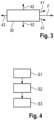
- FIG 3 shows a schematic representation of the individual spray water directions of a tire 30 with driving direction F. While on a dry road surface, no If splash water occurs, then on a wet road surface, as already described, splash water will initially form due to the adhesion of water to the surface of the tire 30, which will be thrown away from the tire 30 due to the radial movement of the tire 30. This splash water is primarily thrown backwards into the wheel house of the vehicle and exits laterally at the rear part of the wheel house in the form of drops or jets. This portion of the splash water is in Figure 3 designated by reference numeral 43. As the water level and/or driving speed increases, more spray is displaced to the side in directions 42.
- a type of bow wave can form in front of tire 30 in the direction of travel F, which may also cause spray forward in directions 41.
- this spray is caused by increased water pressure when there is a risk of aquaplaning.
- the main point of exit for the water is at the bottom in the area of contact between the tire and the road surface, i.e. at the tire contact patch. This is accompanied by water being thrown into the wheel arches by centrifugal force, which escapes laterally from the wheel arches and a significant development of spray in the entire area near the wheel.
- the amount and/or direction of the splash water can be used to determine the road surface condition and, in particular, the likelihood of impending aquaplaning.
- the classification of the road condition in particular an indication of a wet road surface and the detection of aquaplaning risk, can then be given to the driver of the vehicle.
- a visual, acoustic, and/or haptic signal is issued to the vehicle driver.
- the driver can then adjust their driving style accordingly, for example, by reducing speed, and thus prevent uncontrolled driving behavior due to aquaplaning.
- the classification of the road condition in particular the detection of a wet road surface as well as the detection of a risk of aquaplaning or, if applicable, micro-aquaplaning or the probability of aquaplaning, to another control system of the vehicle 1.
- a driver assistance system can automatically intervene in the vehicle's driving behavior based on the classification of the road condition in order to prevent uncontrolled driving behavior due to aquaplaning or, if applicable, intervene in the vehicle's control as soon as aquaplaning occurs in order to avoid dangerous steering and/or braking maneuvers during aquaplaning.
- a fully or partially automated driving system can also adapt the driving behavior according to the classification of the road condition.
- a detected road condition in particular the detection of a risk of aquaplaning or the probability of aquaplaning, to other vehicles or a central computer system via a communication device, such as a radio interface or similar. This allows other road users to also benefit from the classification of the road condition.
- Figure 4 shows a schematic representation of a method for determining a road condition according to one embodiment.
- image data is first captured and provided by an image capture device 11.
- the image capture device 11 is, as already described above, directed at at least one wheel 21 of the vehicle, an area surrounding the wheel 21, and/or at least one side of the vehicle 1.
- splash water is detected in the captured image data.
- the road condition is classified in step S3.
- the classification comprises at least a distinction between three road conditions: dry road, wet road, and aquaplaning road.
- one or more further road conditions are also possible.
- the classification can, for example, also include a further road condition of impending aquaplaning, which is referred to here as microaquaplaning.
- the present invention relates to a classification of a road surface condition based on the amount of spray occurring at a vehicle wheel.
- the space around a vehicle wheel is captured using a camera, and the image captured by the camera is analyzed to detect any spray therein. Based on the detected amount of spray, a distinction can be made between a dry road surface, a wet road surface, or a road surface with a risk of aquaplaning.
Landscapes
- Engineering & Computer Science (AREA)
- Physics & Mathematics (AREA)
- Transportation (AREA)
- Mechanical Engineering (AREA)
- Automation & Control Theory (AREA)
- Theoretical Computer Science (AREA)
- General Physics & Mathematics (AREA)
- Multimedia (AREA)
- Mathematical Physics (AREA)
- Computer Vision & Pattern Recognition (AREA)
- Human Computer Interaction (AREA)
- Traffic Control Systems (AREA)
- Investigating Or Analysing Materials By Optical Means (AREA)
- Control Of Driving Devices And Active Controlling Of Vehicle (AREA)
- Image Analysis (AREA)
- Data Mining & Analysis (AREA)
- Life Sciences & Earth Sciences (AREA)
- Artificial Intelligence (AREA)
- Bioinformatics & Cheminformatics (AREA)
- Bioinformatics & Computational Biology (AREA)
- Evolutionary Biology (AREA)
- Evolutionary Computation (AREA)
- General Engineering & Computer Science (AREA)
- Tires In General (AREA)
Claims (12)
- Procédé pour déterminer l'état d'une chaussée, comprenant les étapes suivantes :fourniture (S1) de données d'image par un dispositif (11) de capture d'images, le dispositif (11) de capture d'images capturant au moins une partie d'un espace situé autour d'une roue d'un véhicule (1) ;détection (S2) de projections d'eau dans les données d'image fournies ;
etclassification (S3) d'un état de la chaussée en utilisant les projections d'eau détectées dans les données d'image fournies ;la classification (S3) de l'état de la chaussée comprenant une distinction entre une chaussée sèche et une chaussée mouillée,caractériséen ce que la détection (S2) des projections d'eau comprend la détermination d'une direction de projection des projections d'eau,la classification (S3) de l'état de la chaussée comprenant en outre au moins une distinction entre une chaussée mouillée sans risque d'aquaplaning et une chaussée mouillée avec risque d'aquaplaning, la classification (S3) étant basée sur la direction de projection déterminée. - Procédé selon la revendication 1, dans lequel la classification (S3) de l'état de la chaussée comprend en outre la détection d'un risque de micro-aquaplanage, dans lequel un effet d'adhérence de la roue à la chaussée est encore présent, mais un aquaplanage complet est imminent.
- Procédé selon la revendication 1 ou la revendication 2, dans lequel la détection (S2) de projections d'eau comprend en outre la détermination d'une position de sortie des projections d'eau dans les données d'image, d'un angle de sortie des projections d'eau dans les données d'image, d'une quantité d'eau des projections d'eau dans les données d'image, d'un nombre de gouttes dans les données d'image et/ou d'une distinction entre une forme de goutte ou de jet des projections d'eau.
- Procédé selon l'une des revendications 1 à 3, dans lequel la détection (S2) de projections d'eau comprend en outre la détermination d'une proportion de données d'image avec des projections d'eau.
- Procédé selon l'une des revendications 1 à 4, dans lequel la détection (S2) de projections d'eau comprend en outre la détection d'une modification de la proportion de projections d'eau dans les données d'image.
- Procédé selon l'une des revendications 1 à 5, comprenant une étape de transmission de l'état classifié de la chaussée à un dispositif d'affichage et/ou à un dispositif de commande d'un véhicule (1).
- Dispositif pour déterminer l'état d'une chaussée, comprenant :un dispositif (11) de capture d'images qui est conçu pour capturer et fournir des données d'images d'au moins une partie d'un espace autour d'une roue (21) d'un véhicule (1) ; etun dispositif d'évaluation (12) qui est conçu pour détecter les projections d'eau dans les données d'image fournies et pour classifier l'état de la chaussée en utilisant les projections d'eau détectées dans les données d'image,la classification (S3) de l'état de la chaussée comprenant une distinction entre une chaussée sèche et une chaussée mouillée,caractériséen ce que la détection (S2) des projections d'eau comprend la détermination d'une direction des projections d'eau,la classification (S3) de l'état de la chaussée comprenant en outre au moins une distinction entre une chaussée mouillée sans risque d'aquaplaning et une chaussée mouillée avec risque d'aquaplaning, la classification (S3) étant basée sur la direction de projection déterminée.
- Dispositif selon la revendication 7, comprenant un dispositif d'éclairage (13) qui est conçu pour éclairer au moins partiellement l'espace capturé par le dispositif de capture d'images.
- Dispositif selon la revendication 7 ou la revendication 8, comprenant un dispositif de signalisation qui est conçu pour émettre un signal si un état prédéfini de la chaussée a été classifié.
- Dispositif selon l'une des revendications 7 à 9, comprenant un dispositif de transmission qui est conçu pour transmettre l'état de chaussée classifié à un autre dispositif.
- Véhicule automobile (1) équipé d'un dispositif pour déterminer un état de chaussée selon l'une des revendications 7 à 10.
- Véhicule automobile (1) selon la revendication 11, comprenant un dispositif de commande qui est conçu pour adapter au moins une fonction du véhicule automobile (1) en utilisant l'état de la chaussée classifié.
Applications Claiming Priority (1)
| Application Number | Priority Date | Filing Date | Title |
|---|---|---|---|
| DE102017206244.4A DE102017206244A1 (de) | 2017-04-11 | 2017-04-11 | Verfahren und vorrichtung zur ermittlung eines fahrbahnzustands |
Publications (2)
| Publication Number | Publication Date |
|---|---|
| EP3388973A1 EP3388973A1 (fr) | 2018-10-17 |
| EP3388973B1 true EP3388973B1 (fr) | 2025-05-14 |
Family
ID=61768080
Family Applications (1)
| Application Number | Title | Priority Date | Filing Date |
|---|---|---|---|
| EP18163571.5A Active EP3388973B1 (fr) | 2017-04-11 | 2018-03-23 | Procédé et dispositif de détermination d'un état de la chaussée |
Country Status (6)
| Country | Link |
|---|---|
| US (1) | US10824883B2 (fr) |
| EP (1) | EP3388973B1 (fr) |
| JP (1) | JP7171215B2 (fr) |
| KR (1) | KR102548549B1 (fr) |
| CN (1) | CN108688669B (fr) |
| DE (1) | DE102017206244A1 (fr) |
Families Citing this family (14)
| Publication number | Priority date | Publication date | Assignee | Title |
|---|---|---|---|---|
| DE102018218733B4 (de) * | 2018-10-31 | 2025-03-13 | Robert Bosch Gmbh | Verfahren zur Unterstützung einer kamerabasierten Umfelderkennung eines Fortbewegungsmittels mittels einer Strassennässeinformation eines ersten Ultraschallsensors |
| DE102019202062A1 (de) * | 2019-02-15 | 2020-08-20 | Zf Friedrichshafen Ag | Zustandserfassungsvorrichtung, Verfahren zum Erfassen eines Zustands sowie Fahrzeug |
| DE102019209268B4 (de) * | 2019-06-26 | 2023-03-02 | Continental Automotive Technologies GmbH | Verfahren zur Bewertung eines Fahrbahnzustandes einer Fahrbahn, auf der sich ein Kraftfahrzeug bewegt, sowie Verfahren zum Reduzieren eines Gefährdungsgrades für ein sich auf einer Fahrbahn bewegendes Kraftfahrzeug in Bezug auf eine Gefahrenstelle |
| DE102019210935A1 (de) * | 2019-07-24 | 2021-01-28 | Zf Friedrichshafen Ag | Erkennen und Bewerten einer Wasseransammlung auf einer Fahrbahn |
| CN112537314A (zh) | 2019-09-20 | 2021-03-23 | 大陆汽车有限公司 | 用于确定湿路状况的系统和方法 |
| CN110631460B (zh) * | 2019-11-06 | 2024-05-10 | 广西壮族自治区汽车拖拉机研究所有限公司 | 一种车辆防飞溅系统安装角度测量装置及测量方法 |
| US20210354723A1 (en) * | 2020-05-12 | 2021-11-18 | Waymo Llc | Determining puddle severity for autonomous vehicles |
| DE102020208784A1 (de) | 2020-07-15 | 2022-01-20 | Robert Bosch Gesellschaft mit beschränkter Haftung | Verfahren zum Bewerten einer Aquaplaninggefahr |
| CN112611697B (zh) * | 2020-11-27 | 2022-06-28 | 山东大学 | 一种透水沥青路面渗透性衰减模型试验系统及方法 |
| JP7600971B2 (ja) * | 2021-12-03 | 2024-12-17 | トヨタ自動車株式会社 | 車載通知装置 |
| DE102022209815A1 (de) | 2022-09-19 | 2024-03-21 | Robert Bosch Gesellschaft mit beschränkter Haftung | Verfahren zur Bestimmung einer Trajektorie zum Befahren einer Fahrbahn, Recheneinheit und Computerprogramm |
| DE102023103308A1 (de) * | 2023-02-10 | 2024-08-14 | Bayerische Motoren Werke Aktiengesellschaft | Untergrund- und Witterungssensorik für ein Fahrzeug |
| US12600381B2 (en) * | 2024-07-09 | 2026-04-14 | Scott C Harris | Vehicle operation modification based on weather sensing sensors |
| US20260077787A1 (en) * | 2024-09-13 | 2026-03-19 | International Business Machines Corporation | Proactive vehicle aquaplaning mitigation system |
Citations (1)
| Publication number | Priority date | Publication date | Assignee | Title |
|---|---|---|---|---|
| US5765119A (en) * | 1994-12-29 | 1998-06-09 | Honda Giken Kogyo Kabushiki Kaisha | Method and device for estimating hydroplaning-occuring vehicle speed and method and device for detecting possibility of occurence of hydroplaning |
Family Cites Families (24)
| Publication number | Priority date | Publication date | Assignee | Title |
|---|---|---|---|---|
| JPH03156341A (ja) * | 1989-08-01 | 1991-07-04 | Ohtsu Tire & Rubber Co Ltd :The | タイヤのハイドロプレーニングテスト方法及び装置 |
| US6807473B1 (en) * | 2003-04-09 | 2004-10-19 | Continental Teves, Inc. | Road recognition system |
| JP2007322231A (ja) * | 2006-05-31 | 2007-12-13 | Fujifilm Corp | 路面状況検出装置 |
| JP5019849B2 (ja) * | 2006-11-02 | 2012-09-05 | 株式会社ブリヂストン | タイヤの表面検査方法および装置 |
| DE102007060858A1 (de) * | 2007-12-13 | 2009-06-18 | Technische Universität Ilmenau | Vorrichtung und Verfahren zur Ermittlung des Reibungszustandes einer Fahrbahnoberfläche |
| DE102010008258A1 (de) * | 2010-02-17 | 2011-08-18 | Conti Temic microelectronic GmbH, 90411 | Verfahren zur automatischen Prävention von Aquaplaning |
| JP5657917B2 (ja) * | 2010-05-19 | 2015-01-21 | 株式会社ブリヂストン | 路面状態推定方法 |
| DE102010063017A1 (de) * | 2010-12-14 | 2012-06-14 | Robert Bosch Gmbh | Verfahren in einem Fahrerassistenzsystem zur Erkennung von Nässe auf einer Fahrbahn |
| DE102012202271A1 (de) * | 2011-07-11 | 2013-01-17 | Robert Bosch Gmbh | Vorrichtung und Verfahren zur Reifenprüfung |
| DE102012201896A1 (de) | 2012-02-09 | 2013-08-14 | Robert Bosch Gmbh | Fahrerassistenzverfahren und Fahrerassistenzsystem für verschneite Straßen |
| DE102012221518A1 (de) * | 2012-11-26 | 2014-05-28 | Robert Bosch Gmbh | Verfahren zur Ermittlung der Straßenglätte in einem Fahrzeug |
| DE102013213106A1 (de) * | 2013-09-18 | 2015-03-19 | Continental Teves Ag & Co. Ohg | Verfahren und System zur Bewertung einer Zuverlässigkeit eines sensorikbasierten Fahrzeugsystems |
| DE102013223367A1 (de) | 2013-11-15 | 2015-05-21 | Continental Teves Ag & Co. Ohg | Verfahren und Vorrichtung zur Bestimmung eines Fahrbahnzustands mittels eines Fahrzeugkamerasystems |
| DE102013113431A1 (de) * | 2013-12-04 | 2015-06-11 | Dr. Ing. H.C. F. Porsche Aktiengesellschaft | Bestimmen einer Aquaplaning-Gefahr |
| KR101394244B1 (ko) * | 2013-12-12 | 2014-05-14 | 한국건설기술연구원 | 다중영상 취득장치 및 이를 활용한 이동식 노면상태 자동검지 시스템 |
| KR101618551B1 (ko) * | 2014-07-02 | 2016-05-09 | 엘지전자 주식회사 | 차량 운전 보조 장치 및 이를 구비한 차량 |
| DE102015208428A1 (de) * | 2015-05-06 | 2016-11-10 | Continental Teves Ag & Co. Ohg | Verfahren und Vorrichtung zur Erkennung und Bewertung von Umwelteinflüssen und Fahrbahnzustandsinformationen im Fahrzeugumfeld |
| DE102015110952A1 (de) * | 2015-07-07 | 2017-01-12 | Valeo Schalter Und Sensoren Gmbh | Verfahren zum Bestimmen zumindest einer reifenspezifischen Kenngröße, Fahrerassistenzsystem sowie Kraftfahrzeug |
| US9836660B2 (en) * | 2015-12-03 | 2017-12-05 | GM Global Technology Operations LLC | Vision-based wet road surface condition detection using tire tracks |
| DE102016205430A1 (de) * | 2016-04-01 | 2017-10-05 | Robert Bosch Gmbh | Verfahren und Vorrichtung zur Reibwertbestimmung eines befahrbaren Untergrunds mittels eines Ego-Fahrzeugs |
| DE102016009928A1 (de) * | 2016-08-16 | 2017-02-02 | Daimler Ag | Verfahren zum Erfassen von Nässe auf einer Fahrbahn |
| US10339391B2 (en) * | 2016-08-24 | 2019-07-02 | Gm Global Technology Operations Llc. | Fusion-based wet road surface detection |
| US10668854B2 (en) * | 2017-02-09 | 2020-06-02 | Komatsu Ltd. | Work vehicle and display device |
| US10078892B1 (en) * | 2017-03-16 | 2018-09-18 | GM Global Technology Operations LLC | Methods and systems for vehicle tire analysis using vehicle mounted cameras |
-
2017
- 2017-04-11 DE DE102017206244.4A patent/DE102017206244A1/de active Pending
-
2018
- 2018-03-23 EP EP18163571.5A patent/EP3388973B1/fr active Active
- 2018-04-05 KR KR1020180039770A patent/KR102548549B1/ko active Active
- 2018-04-05 JP JP2018073007A patent/JP7171215B2/ja active Active
- 2018-04-08 CN CN201810320644.7A patent/CN108688669B/zh active Active
- 2018-04-09 US US15/948,103 patent/US10824883B2/en active Active
Patent Citations (1)
| Publication number | Priority date | Publication date | Assignee | Title |
|---|---|---|---|---|
| US5765119A (en) * | 1994-12-29 | 1998-06-09 | Honda Giken Kogyo Kabushiki Kaisha | Method and device for estimating hydroplaning-occuring vehicle speed and method and device for detecting possibility of occurence of hydroplaning |
Non-Patent Citations (1)
| Title |
|---|
| SCHEDL ALOIS ET AL: "Innovation & Nachhaltigkeit im Betonstraßenbau - Publikation anlässlich der Festveranstaltung zum 75. Geburtstag von BR h. c. Prof. DI Dr. techn. Hermann Sommer", 1 February 2011 (2011-02-01), Vienna, Austria, pages 1 - 16, XP055850140, Retrieved from the Internet <URL:https://www.zement.at/downloads/betonstrassenbau_2011.pdf> [retrieved on 20211011] * |
Also Published As
| Publication number | Publication date |
|---|---|
| KR20180114842A (ko) | 2018-10-19 |
| US20180293448A1 (en) | 2018-10-11 |
| CN108688669A (zh) | 2018-10-23 |
| EP3388973A1 (fr) | 2018-10-17 |
| CN108688669B (zh) | 2023-04-18 |
| KR102548549B1 (ko) | 2023-06-27 |
| US10824883B2 (en) | 2020-11-03 |
| JP7171215B2 (ja) | 2022-11-15 |
| JP2018181328A (ja) | 2018-11-15 |
| DE102017206244A1 (de) | 2018-10-11 |
Similar Documents
| Publication | Publication Date | Title |
|---|---|---|
| EP3388973B1 (fr) | Procédé et dispositif de détermination d'un état de la chaussée | |
| EP2788967B1 (fr) | Procédé permettant de surveiller et de signaler une situation de circulation dans l'environnement d'un véhicule | |
| DE102014220759B4 (de) | Überwachung eines Aufmerksamkeitsgrads eines Fahrers eines Fahrzeugs | |
| DE102008011228B4 (de) | Verfahren zur Unterstützung eines Nutzers eines Fahrzeugs, Steuereinrichtung für ein Fahrerassistenzsystem eines Fahrzeugs und Fahrzeug mit einer derartigen Steuereinrichtung | |
| DE102009007885B4 (de) | Verfahren zur Erkennung von auf die eigene Fahrspur einscherenden oder aus der eigenen Fahrspur ausscherenden Fahrzeugen | |
| DE102016122481B4 (de) | Verfahren zur Feststellung eines schneebedeckten Oberflächenzustands einer Fahrbahn | |
| DE102009041566B4 (de) | Verfahren zur Klassifizierung des Fahrbahnreibwerts | |
| DE102011088130B4 (de) | Verfahren und Vorrichtung zur Erkennung einer Bremssituation | |
| WO2019174682A1 (fr) | Procédé et dispositif de détection et d'évaluation des états de voie de circulation et des influences environnementales météorologiques | |
| EP2400473A1 (fr) | Procédé et dispositif destinés à assister un conducteur de véhicule | |
| EP3622709B1 (fr) | Procédé et dispositif de détection à résolution spatiale d'un objet externe à un véhicule à l'aide d'un capteur intégré dans un véhicule | |
| WO2011003487A1 (fr) | Procédé de mise en uvre correcte de freinages durgence autonomes pour véhicule routier | |
| DE102005062275A1 (de) | Verfahren zur Erkennung eines drohenden Heckaufpralls | |
| DE102014215273A1 (de) | Steuerung eines Kraftfahrzeugs | |
| DE102013220430A1 (de) | Verfahren und System zur Identifizierung einer Gefahrensituation sowie Verwendung des Systems | |
| EP3456573B1 (fr) | Procédé et dispositif d'affichage d'accélérations de véhicules précédents dans un véhicule | |
| DE102016204877A1 (de) | Verfahren zum Betreiben eines Fahrassistenzsystems zur Durchführung eines autonomen oder teilautonomen Fahrmanövers eines Fahrzeugs und derartiges Fahrassistenzsystem | |
| EP4214100A1 (fr) | Procédé permettant de faire fonctionner un véhicule à conduite automatique | |
| DE102015205368A1 (de) | Beleuchtungsvorrichtung für ein Fahrzeug | |
| DE102016216745A1 (de) | Verfahren zum Betrieb eines Kraftfahrzeugs | |
| EP2555178B1 (fr) | Procédé de détection d'objets placés sur le côté d'un véhicule utilitaire et véhicule utilitaire avec système de détection permettant de réaliser le procédé | |
| DE102020211106A1 (de) | Fahrzeugassistenzsystem | |
| DE102014225085B4 (de) | Verfahren und Vorrichtung zur Ermittlung des Reibwertes einer Fahrbahnoberfläche | |
| EP2743130B1 (fr) | Procédé et dispositif de commande de la distribution lumineuse d'une lampe d'un véhicule | |
| EP3006295B1 (fr) | Procédé destiné au fonctionnement d'un système d'assistance d'un véhicule automobile et système d'assistance |
Legal Events
| Date | Code | Title | Description |
|---|---|---|---|
| PUAI | Public reference made under article 153(3) epc to a published international application that has entered the european phase |
Free format text: ORIGINAL CODE: 0009012 |
|
| STAA | Information on the status of an ep patent application or granted ep patent |
Free format text: STATUS: THE APPLICATION HAS BEEN PUBLISHED |
|
| AK | Designated contracting states |
Kind code of ref document: A1 Designated state(s): AL AT BE BG CH CY CZ DE DK EE ES FI FR GB GR HR HU IE IS IT LI LT LU LV MC MK MT NL NO PL PT RO RS SE SI SK SM TR |
|
| AX | Request for extension of the european patent |
Extension state: BA ME |
|
| STAA | Information on the status of an ep patent application or granted ep patent |
Free format text: STATUS: REQUEST FOR EXAMINATION WAS MADE |
|
| 17P | Request for examination filed |
Effective date: 20190417 |
|
| RBV | Designated contracting states (corrected) |
Designated state(s): AL AT BE BG CH CY CZ DE DK EE ES FI FR GB GR HR HU IE IS IT LI LT LU LV MC MK MT NL NO PL PT RO RS SE SI SK SM TR |
|
| STAA | Information on the status of an ep patent application or granted ep patent |
Free format text: STATUS: EXAMINATION IS IN PROGRESS |
|
| 17Q | First examination report despatched |
Effective date: 20200406 |
|
| RAP1 | Party data changed (applicant data changed or rights of an application transferred) |
Owner name: CONTINENTAL AUTONOMOUS MOBILITY GERMANY GMBH |
|
| REG | Reference to a national code |
Ref country code: DE Ref legal event code: R079 Free format text: PREVIOUS MAIN CLASS: G06K0009000000 Ipc: G06V0020560000 Ref document number: 502018015808 Country of ref document: DE |
|
| GRAP | Despatch of communication of intention to grant a patent |
Free format text: ORIGINAL CODE: EPIDOSNIGR1 |
|
| STAA | Information on the status of an ep patent application or granted ep patent |
Free format text: STATUS: GRANT OF PATENT IS INTENDED |
|
| RIC1 | Information provided on ipc code assigned before grant |
Ipc: B60T 8/172 20060101ALN20241217BHEP Ipc: B60W 40/06 20120101ALI20241217BHEP Ipc: B60R 16/023 20060101ALI20241217BHEP Ipc: G06V 20/56 20220101AFI20241217BHEP |
|
| INTG | Intention to grant announced |
Effective date: 20250107 |
|
| GRAS | Grant fee paid |
Free format text: ORIGINAL CODE: EPIDOSNIGR3 |
|
| GRAA | (expected) grant |
Free format text: ORIGINAL CODE: 0009210 |
|
| STAA | Information on the status of an ep patent application or granted ep patent |
Free format text: STATUS: THE PATENT HAS BEEN GRANTED |
|
| AK | Designated contracting states |
Kind code of ref document: B1 Designated state(s): AL AT BE BG CH CY CZ DE DK EE ES FI FR GB GR HR HU IE IS IT LI LT LU LV MC MK MT NL NO PL PT RO RS SE SI SK SM TR |
|
| REG | Reference to a national code |
Ref country code: GB Ref legal event code: FG4D Free format text: NOT ENGLISH |
|
| REG | Reference to a national code |
Ref country code: CH Ref legal event code: EP |
|
| REG | Reference to a national code |
Ref country code: DE Ref legal event code: R096 Ref document number: 502018015808 Country of ref document: DE |
|
| REG | Reference to a national code |
Ref country code: IE Ref legal event code: FG4D Free format text: LANGUAGE OF EP DOCUMENT: GERMAN |
|
| REG | Reference to a national code |
Ref country code: DE Ref legal event code: R081 Ref document number: 502018015808 Country of ref document: DE Owner name: AUMOVIO AUTONOMOUS MOBILITY GERMANY GMBH, DE Free format text: FORMER OWNER: CONTINENTAL AUTONOMOUS MOBILITY GERMANY GMBH, 85057 INGOLSTADT, DE |
|
| RAP4 | Party data changed (patent owner data changed or rights of a patent transferred) |
Owner name: AUMOVIO AUTONOMOUS MOBILITY GERMANY GMBH |
|
| REG | Reference to a national code |
Ref country code: NL Ref legal event code: MP Effective date: 20250514 |
|
| PG25 | Lapsed in a contracting state [announced via postgrant information from national office to epo] |
Ref country code: PT Free format text: LAPSE BECAUSE OF FAILURE TO SUBMIT A TRANSLATION OF THE DESCRIPTION OR TO PAY THE FEE WITHIN THE PRESCRIBED TIME-LIMIT Effective date: 20250915 Ref country code: FI Free format text: LAPSE BECAUSE OF FAILURE TO SUBMIT A TRANSLATION OF THE DESCRIPTION OR TO PAY THE FEE WITHIN THE PRESCRIBED TIME-LIMIT Effective date: 20250514 Ref country code: ES Free format text: LAPSE BECAUSE OF FAILURE TO SUBMIT A TRANSLATION OF THE DESCRIPTION OR TO PAY THE FEE WITHIN THE PRESCRIBED TIME-LIMIT Effective date: 20250514 |
|
| REG | Reference to a national code |
Ref country code: LT Ref legal event code: MG9D |
|
| PG25 | Lapsed in a contracting state [announced via postgrant information from national office to epo] |
Ref country code: GR Free format text: LAPSE BECAUSE OF FAILURE TO SUBMIT A TRANSLATION OF THE DESCRIPTION OR TO PAY THE FEE WITHIN THE PRESCRIBED TIME-LIMIT Effective date: 20250815 Ref country code: NO Free format text: LAPSE BECAUSE OF FAILURE TO SUBMIT A TRANSLATION OF THE DESCRIPTION OR TO PAY THE FEE WITHIN THE PRESCRIBED TIME-LIMIT Effective date: 20250814 |
|
| PG25 | Lapsed in a contracting state [announced via postgrant information from national office to epo] |
Ref country code: PL Free format text: LAPSE BECAUSE OF FAILURE TO SUBMIT A TRANSLATION OF THE DESCRIPTION OR TO PAY THE FEE WITHIN THE PRESCRIBED TIME-LIMIT Effective date: 20250514 Ref country code: NL Free format text: LAPSE BECAUSE OF FAILURE TO SUBMIT A TRANSLATION OF THE DESCRIPTION OR TO PAY THE FEE WITHIN THE PRESCRIBED TIME-LIMIT Effective date: 20250514 |
|
| PG25 | Lapsed in a contracting state [announced via postgrant information from national office to epo] |
Ref country code: BG Free format text: LAPSE BECAUSE OF FAILURE TO SUBMIT A TRANSLATION OF THE DESCRIPTION OR TO PAY THE FEE WITHIN THE PRESCRIBED TIME-LIMIT Effective date: 20250514 |
|
| PG25 | Lapsed in a contracting state [announced via postgrant information from national office to epo] |
Ref country code: HR Free format text: LAPSE BECAUSE OF FAILURE TO SUBMIT A TRANSLATION OF THE DESCRIPTION OR TO PAY THE FEE WITHIN THE PRESCRIBED TIME-LIMIT Effective date: 20250514 |
|
| PG25 | Lapsed in a contracting state [announced via postgrant information from national office to epo] |
Ref country code: RS Free format text: LAPSE BECAUSE OF FAILURE TO SUBMIT A TRANSLATION OF THE DESCRIPTION OR TO PAY THE FEE WITHIN THE PRESCRIBED TIME-LIMIT Effective date: 20250814 |
|
| PG25 | Lapsed in a contracting state [announced via postgrant information from national office to epo] |
Ref country code: IS Free format text: LAPSE BECAUSE OF FAILURE TO SUBMIT A TRANSLATION OF THE DESCRIPTION OR TO PAY THE FEE WITHIN THE PRESCRIBED TIME-LIMIT Effective date: 20250914 |
|
| PG25 | Lapsed in a contracting state [announced via postgrant information from national office to epo] |
Ref country code: LV Free format text: LAPSE BECAUSE OF FAILURE TO SUBMIT A TRANSLATION OF THE DESCRIPTION OR TO PAY THE FEE WITHIN THE PRESCRIBED TIME-LIMIT Effective date: 20250514 |
|
| PG25 | Lapsed in a contracting state [announced via postgrant information from national office to epo] |
Ref country code: DK Free format text: LAPSE BECAUSE OF FAILURE TO SUBMIT A TRANSLATION OF THE DESCRIPTION OR TO PAY THE FEE WITHIN THE PRESCRIBED TIME-LIMIT Effective date: 20250514 Ref country code: SM Free format text: LAPSE BECAUSE OF FAILURE TO SUBMIT A TRANSLATION OF THE DESCRIPTION OR TO PAY THE FEE WITHIN THE PRESCRIBED TIME-LIMIT Effective date: 20250514 |
|
| PG25 | Lapsed in a contracting state [announced via postgrant information from national office to epo] |
Ref country code: CZ Free format text: LAPSE BECAUSE OF FAILURE TO SUBMIT A TRANSLATION OF THE DESCRIPTION OR TO PAY THE FEE WITHIN THE PRESCRIBED TIME-LIMIT Effective date: 20250514 |
|
| PG25 | Lapsed in a contracting state [announced via postgrant information from national office to epo] |
Ref country code: EE Free format text: LAPSE BECAUSE OF FAILURE TO SUBMIT A TRANSLATION OF THE DESCRIPTION OR TO PAY THE FEE WITHIN THE PRESCRIBED TIME-LIMIT Effective date: 20250514 |
|
| PG25 | Lapsed in a contracting state [announced via postgrant information from national office to epo] |
Ref country code: RO Free format text: LAPSE BECAUSE OF FAILURE TO SUBMIT A TRANSLATION OF THE DESCRIPTION OR TO PAY THE FEE WITHIN THE PRESCRIBED TIME-LIMIT Effective date: 20250514 Ref country code: SK Free format text: LAPSE BECAUSE OF FAILURE TO SUBMIT A TRANSLATION OF THE DESCRIPTION OR TO PAY THE FEE WITHIN THE PRESCRIBED TIME-LIMIT Effective date: 20250514 |
|
| PG25 | Lapsed in a contracting state [announced via postgrant information from national office to epo] |
Ref country code: IT Free format text: LAPSE BECAUSE OF FAILURE TO SUBMIT A TRANSLATION OF THE DESCRIPTION OR TO PAY THE FEE WITHIN THE PRESCRIBED TIME-LIMIT Effective date: 20250514 |
|
| REG | Reference to a national code |
Ref country code: DE Ref legal event code: R097 Ref document number: 502018015808 Country of ref document: DE |
|
| PLBE | No opposition filed within time limit |
Free format text: ORIGINAL CODE: 0009261 |
|
| STAA | Information on the status of an ep patent application or granted ep patent |
Free format text: STATUS: NO OPPOSITION FILED WITHIN TIME LIMIT |
|
| REG | Reference to a national code |
Ref country code: CH Ref legal event code: L10 Free format text: ST27 STATUS EVENT CODE: U-0-0-L10-L00 (AS PROVIDED BY THE NATIONAL OFFICE) Effective date: 20260325 |
|
| PGFP | Annual fee paid to national office [announced via postgrant information from national office to epo] |
Ref country code: GB Payment date: 20260319 Year of fee payment: 9 |
|
| PGFP | Annual fee paid to national office [announced via postgrant information from national office to epo] |
Ref country code: FR Payment date: 20260323 Year of fee payment: 9 |
|
| 26N | No opposition filed |
Effective date: 20260217 |