EP3389059A1 - Fil de bobinage et son utilisation - Google Patents
Fil de bobinage et son utilisation Download PDFInfo
- Publication number
- EP3389059A1 EP3389059A1 EP17165745.5A EP17165745A EP3389059A1 EP 3389059 A1 EP3389059 A1 EP 3389059A1 EP 17165745 A EP17165745 A EP 17165745A EP 3389059 A1 EP3389059 A1 EP 3389059A1
- Authority
- EP
- European Patent Office
- Prior art keywords
- winding wire
- additive
- wire according
- layer
- paint
- Prior art date
- Legal status (The legal status is an assumption and is not a legal conclusion. Google has not performed a legal analysis and makes no representation as to the accuracy of the status listed.)
- Withdrawn
Links
- 238000004804 winding Methods 0.000 title claims abstract description 42
- 239000000654 additive Substances 0.000 claims abstract description 35
- 230000000996 additive effect Effects 0.000 claims abstract description 31
- 238000000576 coating method Methods 0.000 claims abstract description 18
- 239000011248 coating agent Substances 0.000 claims abstract description 17
- 239000000203 mixture Substances 0.000 claims abstract description 15
- 238000009472 formulation Methods 0.000 claims abstract description 13
- 239000003973 paint Substances 0.000 claims description 32
- 239000003879 lubricant additive Substances 0.000 claims description 11
- 239000000463 material Substances 0.000 claims description 11
- 239000002904 solvent Substances 0.000 claims description 8
- 238000001035 drying Methods 0.000 claims description 6
- 239000004962 Polyamide-imide Substances 0.000 claims description 3
- 230000001050 lubricating effect Effects 0.000 claims description 3
- 229920002312 polyamide-imide Polymers 0.000 claims description 3
- 239000004020 conductor Substances 0.000 claims description 2
- KPUWHANPEXNPJT-UHFFFAOYSA-N disiloxane Chemical class [SiH3]O[SiH3] KPUWHANPEXNPJT-UHFFFAOYSA-N 0.000 claims description 2
- 229920003055 poly(ester-imide) Polymers 0.000 claims description 2
- NIXOWILDQLNWCW-UHFFFAOYSA-M Acrylate Chemical compound [O-]C(=O)C=C NIXOWILDQLNWCW-UHFFFAOYSA-M 0.000 claims 1
- 239000002966 varnish Substances 0.000 claims 1
- 238000004519 manufacturing process Methods 0.000 abstract description 5
- 238000000034 method Methods 0.000 abstract description 5
- 239000010410 layer Substances 0.000 description 16
- -1 polysiloxane Polymers 0.000 description 9
- 210000003298 dental enamel Anatomy 0.000 description 7
- 239000004922 lacquer Substances 0.000 description 7
- 239000000314 lubricant Substances 0.000 description 7
- 239000011347 resin Substances 0.000 description 6
- 229920005989 resin Polymers 0.000 description 6
- 229920001296 polysiloxane Polymers 0.000 description 5
- 239000001993 wax Substances 0.000 description 5
- 238000009826 distribution Methods 0.000 description 4
- 239000012188 paraffin wax Substances 0.000 description 4
- RYGMFSIKBFXOCR-UHFFFAOYSA-N Copper Chemical compound [Cu] RYGMFSIKBFXOCR-UHFFFAOYSA-N 0.000 description 3
- 229910052802 copper Inorganic materials 0.000 description 3
- 239000010949 copper Substances 0.000 description 3
- 238000001704 evaporation Methods 0.000 description 3
- 238000012876 topography Methods 0.000 description 3
- 238000004132 cross linking Methods 0.000 description 2
- 235000013870 dimethyl polysiloxane Nutrition 0.000 description 2
- 230000000694 effects Effects 0.000 description 2
- 229920000435 poly(dimethylsiloxane) Polymers 0.000 description 2
- 239000000523 sample Substances 0.000 description 2
- 230000003746 surface roughness Effects 0.000 description 2
- 238000009736 wetting Methods 0.000 description 2
- 239000002202 Polyethylene glycol Substances 0.000 description 1
- VYPSYNLAJGMNEJ-UHFFFAOYSA-N Silicium dioxide Chemical compound O=[Si]=O VYPSYNLAJGMNEJ-UHFFFAOYSA-N 0.000 description 1
- 238000005299 abrasion Methods 0.000 description 1
- 230000004308 accommodation Effects 0.000 description 1
- 239000003795 chemical substances by application Substances 0.000 description 1
- 239000011247 coating layer Substances 0.000 description 1
- 150000001875 compounds Chemical class 0.000 description 1
- 238000007596 consolidation process Methods 0.000 description 1
- 238000010276 construction Methods 0.000 description 1
- 230000007547 defect Effects 0.000 description 1
- 230000002950 deficient Effects 0.000 description 1
- 230000001419 dependent effect Effects 0.000 description 1
- 238000010586 diagram Methods 0.000 description 1
- 239000004205 dimethyl polysiloxane Substances 0.000 description 1
- 238000010292 electrical insulation Methods 0.000 description 1
- 230000008020 evaporation Effects 0.000 description 1
- 238000011086 high cleaning Methods 0.000 description 1
- 238000005470 impregnation Methods 0.000 description 1
- 238000009413 insulation Methods 0.000 description 1
- 230000003993 interaction Effects 0.000 description 1
- 239000007788 liquid Substances 0.000 description 1
- 238000005461 lubrication Methods 0.000 description 1
- 125000002496 methyl group Chemical group [H]C([H])([H])* 0.000 description 1
- 239000003595 mist Substances 0.000 description 1
- 238000012856 packing Methods 0.000 description 1
- 229920000058 polyacrylate Polymers 0.000 description 1
- 229920000570 polyether Polymers 0.000 description 1
- 229920001223 polyethylene glycol Polymers 0.000 description 1
- 229920000642 polymer Polymers 0.000 description 1
- 230000005855 radiation Effects 0.000 description 1
- 239000013074 reference sample Substances 0.000 description 1
- 230000000717 retained effect Effects 0.000 description 1
- 239000007787 solid Substances 0.000 description 1
- 239000007921 spray Substances 0.000 description 1
- 239000000126 substance Substances 0.000 description 1
- 239000000758 substrate Substances 0.000 description 1
- 238000012360 testing method Methods 0.000 description 1
- 238000013022 venting Methods 0.000 description 1
Images


Classifications
-
- H—ELECTRICITY
- H01—ELECTRIC ELEMENTS
- H01B—CABLES; CONDUCTORS; INSULATORS; SELECTION OF MATERIALS FOR THEIR CONDUCTIVE, INSULATING OR DIELECTRIC PROPERTIES
- H01B3/00—Insulators or insulating bodies characterised by the insulating materials; Selection of materials for their insulating or dielectric properties
- H01B3/002—Inhomogeneous material in general
Definitions
- the invention relates to a winding wire, in particular one as they are used for the coils of electric motors.
- Coils for electric motors are made of copper wires by winding method.
- the electrical insulation of the individual wires with each other is ensured by an insulating wire enamel, for example based on polyamide-imide.
- the coils are usually still applied with a impregnating resin to fix the position of the individual wires.
- the impregnation behavior is influenced such that out of the cavities which result between the individual wires, the impregnating resin runs out before curing and as a result the mechanical adhesion of the individual wires is also insufficient. This can cause vibration-related problems during later operation of the engine.
- a disadvantage of the previously known winding wire with wire insulation is a poor lubricity, so that without the application of an additional wax layer - for example, paraffin - the tensile force for introducing the wires or copper mass would have to be increased in the groove.
- the object of the present invention is therefore to provide an insulated winding wire with improved sliding properties, which overcomes the disadvantages of the prior art.
- the subject of the present invention is therefore a winding wire made of an electrically conductive material, comprising at least one layer of an insulating coating, characterized in that a formulation for producing the insulating coating is added at least one lubricant additive, the sliding and / or leveling properties of insulating coating on the surface improved.
- the invention relates to the use of an insulating coated according to the invention winding wire for producing a winding wire coil for an electric motor.
- the insulating coating comprises at least one, but preferably several layers of an insulating paint material.
- the concentration of the slip additive increases radially outwards, that is, for example, lower, that is to say metal-wire-closer layers, no lubricant additive is added at all, whereas in outer, surface-closer layers Additive is added. It is particularly preferred that the uppermost and outermost layer of insulating paint material is mixed with slip additive.
- the distribution of the slip additive in the position is inhomogeneous, in particular so that it follows a concentration gradient that reaches its maximum on the surface of the layer.
- the insulating coating comprises a plurality of layers of one or more different lacquers.
- At least the uppermost layer of the coating is added a lubricant additive which improves the sliding and / or leveling properties.
- the distribution of the slip additive in the paint coating is inhomogeneous, such that the slip additive is enriched on the surface of the layer of insulating paint material.
- the distribution of the slip additive in the position follows a concentration gradient which reaches a maximum at the surface.
- a suitable slip additive usually accumulates on the paint surface and / or also improves the flow properties of the paint, the surface roughness and / or surface waviness is reduced and thus also produces an improved surface topography of the insulating paint.
- the improved surface topography in turn leads to improved windability of the wires regardless of whether the surface is additionally lubricious or not.
- the surface is lubricated, for example, by the "lubricating film” described below. It is particularly advantageous in the present invention that lubricity and surface topography are improved in one go.
- course refers to the property of paints, unevenness, which have arisen during the application, for example by spray mist, to compensate automatically after the application.
- the course of a lacquer and / or a coating material is highly dependent on its flow behavior, its surface tension, the application parameters and the drying conditions. If the course is insufficient, surface defects occur, such as a pronounced structure, dents and / or craters on the paint surface. Good coatings, on the other hand, create even, smooth surfaces with low coefficients of sliding friction.
- At least one polysiloxane in particular an organically modified siloxane, is added as slip additive.
- a compound from the class of polyacrylates may be added as a slip additive in the insulating paint.
- polysiloxanes in particular the following have proven useful: Polyethersiloxane and / or organically modified siloxanes having a high content of polydimethylsiloxane segments, which show particularly low interactions both with each other and with other substances.
- Organically modified siloxanes or polysiloxanes are derived, for example, from low molecular weight polydimethylsiloxanes by replacing individual methyl groups with various organic side chains.
- polyethers are used as organic side chains.
- Organically modified polysiloxanes minimize surface irregularities and give the paint a particularly smooth surface. During the venting / evaporating and / or drying process, the organically modified polysiloxanes accumulate continuously on the surface. It forms a film that allows the pasting of a solid. This creates a kind of hydrodynamic lubrication and the sliding resistance is significantly reduced.
- a slip additive can produce a hydrodynamic lubricant film by accumulating on the paint surface.
- this lubricating film is comparable to a very thin liquid film.
- slip additives prove to be particularly effective, because they are transported to the surface during evaporation of the solvent, ie during drying of the paint with the solvent.
- slip additive for example, a commercial lubricant and / or flow control agent is added, for example one with a molecular weight in the range of 500 to 25,000 g / mol, in particular one with a molecular weight in the range of 1000 to 15,000 g / mol, in particular one with a Molar mass in the range of 5,000 to 10,000 g / mol.
- the preferred polymeric slip additives are relatively immobile in the interface and form a bulky resistor on the surface, contrary to the flow of material that usually arises, for example, not only from the substrate to the surface of the paint when evaporating the solvent, but also transversely to it, in particular by gaps, which leave behind for example a evaporated solvent molecule.
- the flow of material along the surface is but one of the causes of drying the paint, which is why the original smoothness, the freshly applied, even wet and still uncrosslinked, that is not cured lacquer, disappears during drying and a surface roughness, which is visually recognizable by a matting of the lacquer, is formed.
- paint base for the formulation in which the at least one slip additive is introduced for example, a crosslinking curing, in particular a radiation and / or temperature-curing paint, in particular a conventionally already customary for this application paint used.
- crosslinking of the slip additive (s) may well take place with the paint base formulation.
- a lacquer base conventionally used as a wire enamel polymer, in particular, for example, polyamide-imide and / or polyester-imide, as well as any mixtures and / or blends thereof.
- the lubricity additive may, for example, in an amount in the range of 0.01 wt% to 2.5 wt%, in particular from 0.1 wt% to 1.0 wt%, particularly preferably from 0.15 wt% to 0.5% by weight of the dry matter of the individual paint layer may be present.
- dry mass refers to the mass of the lacquer layer after removal of the solvent.
- the sliding friction is reduced to less than 20% of the value of the standard wire compared to the coated winding wire without lubricant additive and without lubricant.
- the wire enamel is applied to the winding wire in up to 12 layers, for example in the form of two different lacquers, which are applied alternately.
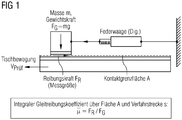
- the table 4 on which the mass 1 is on the contact interface 5 is pulled to the left, while the sliding friction 6 wants to keep the mass 1 against this direction.
- the resistance to be overcome is determined via the fine balance 2.
- the fine scale indicates the force that must be expended to bring the mass 1 on the surface of the contact interface 5 to slide.
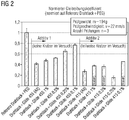
- FIG. 2 are the reduced sliding friction coefficients of wire enamel samples with sliding additive addition shown.
- the value 1 on the far left in the graph was a sample coated with wax, in particular polyethylene glycol.
- the slip additive 2 proved to be particularly advantageous because it not only provides the lowest coefficients of friction, but also has no appreciable concentration dependence with respect to the reduction in sliding friction. Thus, added to this lubricant additive added in very small amounts, the same effect as other lubricious additives in larger amounts added.
- the sample was the slip additive available under the trade name Glide 415®.
- FIG. 4 Finally, the results of shear tests of 2x2 mm quartz glass cubes on with sliding additive staggered wire enamel surfaces.
- the reference value herein refers to a paraffin-free surface, so the reference values should be slightly lower.
- the graphs shown show that the values are slightly reduced by the sliding-additive staggered coating in both investigated standard impregnating resins.
- the sliding friction can be reduced to less than 20%, which equals the construction of higher-torque motors in the same space or of the same torque motors in a smaller space, in any case, an increase in power density in electric motors.
- the efficiency is increased by the invention, since higher wire fillings in the groove are possible, finally, a reduction of the asymmetry of windings and / or a reduction of the failure rate by wire damage during retraction due to high pull-in forces are possible.
- the here presented for the first time isolated winding wire with lubricant additive can be used without changing the manufacturing processes, the lubricant or paraffin in the production can be omitted, reducing the pull-in forces increases the life of the corresponding devices and finally, the process times for producing the coils for the electric motors be shortened because the application and removal of the lubricant is eliminated and also higher winding speeds can be realized.
- the invention is characterized in that the conventional system for the production of winding wire coils for electric motors can be practically adopted, but two or more process steps can be omitted, because a small amount of commercially available lubricant additive of the formulation at least for the uppermost layer of the insulating coating of the wires is added.
- the invention also relates to the use of a winding wire for producing a coil for an electric motor.
Landscapes
- Insulated Conductors (AREA)
- Paints Or Removers (AREA)
- Insulation, Fastening Of Motor, Generator Windings (AREA)
Priority Applications (2)
| Application Number | Priority Date | Filing Date | Title |
|---|---|---|---|
| EP17165745.5A EP3389059A1 (fr) | 2017-04-10 | 2017-04-10 | Fil de bobinage et son utilisation |
| PCT/EP2018/051826 WO2018188825A1 (fr) | 2017-04-10 | 2018-01-25 | Fil de bobinage et son utilisation |
Applications Claiming Priority (1)
| Application Number | Priority Date | Filing Date | Title |
|---|---|---|---|
| EP17165745.5A EP3389059A1 (fr) | 2017-04-10 | 2017-04-10 | Fil de bobinage et son utilisation |
Publications (1)
| Publication Number | Publication Date |
|---|---|
| EP3389059A1 true EP3389059A1 (fr) | 2018-10-17 |
Family
ID=58530451
Family Applications (1)
| Application Number | Title | Priority Date | Filing Date |
|---|---|---|---|
| EP17165745.5A Withdrawn EP3389059A1 (fr) | 2017-04-10 | 2017-04-10 | Fil de bobinage et son utilisation |
Country Status (2)
| Country | Link |
|---|---|
| EP (1) | EP3389059A1 (fr) |
| WO (1) | WO2018188825A1 (fr) |
Citations (7)
| Publication number | Priority date | Publication date | Assignee | Title |
|---|---|---|---|---|
| GB627660A (en) * | 1947-07-01 | 1949-08-12 | Norman Dixon | Improvements in electric cables |
| US3528852A (en) * | 1965-10-27 | 1970-09-15 | Anaconda Wire & Cable Co | Dual-coated electrical conductor |
| US3583885A (en) * | 1969-08-29 | 1971-06-08 | Essex International Inc | Sil-alkyd coatings for wire |
| EP0033224A1 (fr) * | 1980-01-24 | 1981-08-05 | Sumitomo Electric Industries Limited | Fil d'enroulement magnétique |
| CH640972A5 (en) * | 1978-12-26 | 1984-01-31 | Sumitomo Electric Industries | Method for producing a lubricated, insulated wire |
| US4693936A (en) * | 1984-05-02 | 1987-09-15 | Essex Group, Inc. | Low coefficient of friction magnet wire enamels |
| US20110127067A1 (en) * | 2009-11-30 | 2011-06-02 | Hitachi Cable, Ltd. | Insulated wire |
-
2017
- 2017-04-10 EP EP17165745.5A patent/EP3389059A1/fr not_active Withdrawn
-
2018
- 2018-01-25 WO PCT/EP2018/051826 patent/WO2018188825A1/fr not_active Ceased
Patent Citations (7)
| Publication number | Priority date | Publication date | Assignee | Title |
|---|---|---|---|---|
| GB627660A (en) * | 1947-07-01 | 1949-08-12 | Norman Dixon | Improvements in electric cables |
| US3528852A (en) * | 1965-10-27 | 1970-09-15 | Anaconda Wire & Cable Co | Dual-coated electrical conductor |
| US3583885A (en) * | 1969-08-29 | 1971-06-08 | Essex International Inc | Sil-alkyd coatings for wire |
| CH640972A5 (en) * | 1978-12-26 | 1984-01-31 | Sumitomo Electric Industries | Method for producing a lubricated, insulated wire |
| EP0033224A1 (fr) * | 1980-01-24 | 1981-08-05 | Sumitomo Electric Industries Limited | Fil d'enroulement magnétique |
| US4693936A (en) * | 1984-05-02 | 1987-09-15 | Essex Group, Inc. | Low coefficient of friction magnet wire enamels |
| US20110127067A1 (en) * | 2009-11-30 | 2011-06-02 | Hitachi Cable, Ltd. | Insulated wire |
Also Published As
| Publication number | Publication date |
|---|---|
| WO2018188825A1 (fr) | 2018-10-18 |
Similar Documents
| Publication | Publication Date | Title |
|---|---|---|
| DE3237022C2 (fr) | ||
| DE69126461T2 (de) | Emaillacke, Verfahren zu deren Herstellung und deren Verwendung in lackisolierten Leitern | |
| DE69923105T2 (de) | Vorgeschmiertes Kabel und Herstellungsverfahren | |
| EP2721616B1 (fr) | Systèmes isolants à résistance accrue aux décharges partielles et leur procédé de fabrication | |
| DE3125762C2 (fr) | ||
| DE2558538A1 (de) | Homogene urethandispersionen | |
| DE69634941T2 (de) | Film mit hoher koronabeständigkeit, sowie isolierter elektrischer draht, spule und motor, die diesem film als insulationsmaterial benutzen | |
| DE2558544A1 (de) | Waessrige ueberzugs-zusammensetzung fuer magnetdraht | |
| DE2915874A1 (de) | Verfahren und verbesserung der elektrischen isolierwirkung einer aussenflaeche eines festen elektrischen isolators | |
| DE3229662C2 (de) | Reibwerkstoff zur Verwendung in einem Leistungsregler | |
| DE102016222984B4 (de) | Verfahren zum Herstellen einer Zusammensetzung für eine poröse, isolierende Beschichtung aus einem organisch-anorganischen Hybridmaterial | |
| DE3232967C2 (de) | Mit einem Gleitmittel versehener, maschinell verarbeitbarer Magnetwicklungsdraht | |
| DE102021201666A1 (de) | Nutisolationssystem für eine elektrische rotierende Maschine, Verfahren zur Herstellung eines Nutisolationssystems | |
| EP3389059A1 (fr) | Fil de bobinage et son utilisation | |
| DE102005017112A1 (de) | Feuchtigkeitsabweisende Schutzschicht für einen Wickelkopf einer elektrischen Maschine | |
| WO2024012906A1 (fr) | Fil de section circulaire émaillé, son procédé de fabrication et son utilisation | |
| EP2705095B1 (fr) | Vernis isolant et stratifié isolant | |
| DE102019209346A1 (de) | Imprägnierformulierung, Isolationsmaterial, Verfahren zum Herstellen eines Isolationsmaterials und elektrische Maschine mit einem Isolationsmaterial | |
| DE10311142B4 (de) | Lacksystem als Oberflächenschicht für Substrate und Verfahren zum Herstellen des Lacksystems | |
| DE102018105521B4 (de) | Verfahren und Vorrichtung zur Herstellung eines linearen elektroaktiven koaxialen Polymeraktors | |
| DE2041897A1 (de) | Lackisolierter und mit gleitmittel versehener Leiter | |
| DE2500517A1 (de) | Impraegniermittel fuer die festen schichten eines dielektrikums in einem wickelkondensator | |
| AT391379B (de) | Lackdraht mit niedrigem reibungskoeffizienten sowie verfahren zur herstellung eines solchen lackdrahtes | |
| EP2923362A1 (fr) | Fil verni | |
| DE2602765B2 (de) | Transformator mit einem oelumlaufkuehlsystem und verfahren zur verhinderung des aufbaus statischer elektrischer ladungen aufgrund der oelstroemung |
Legal Events
| Date | Code | Title | Description |
|---|---|---|---|
| PUAI | Public reference made under article 153(3) epc to a published international application that has entered the european phase |
Free format text: ORIGINAL CODE: 0009012 |
|
| AK | Designated contracting states |
Kind code of ref document: A1 Designated state(s): AL AT BE BG CH CY CZ DE DK EE ES FI FR GB GR HR HU IE IS IT LI LT LU LV MC MK MT NL NO PL PT RO RS SE SI SK SM TR |
|
| AX | Request for extension of the european patent |
Extension state: BA ME |
|
| STAA | Information on the status of an ep patent application or granted ep patent |
Free format text: STATUS: THE APPLICATION IS DEEMED TO BE WITHDRAWN |
|
| 18D | Application deemed to be withdrawn |
Effective date: 20190418 |