EP3389791B1 - Oxidationsmittel zur oxidativen färbe- und blondierbehandlung keratinischer fasern mit reduzierter schädigung - Google Patents
Oxidationsmittel zur oxidativen färbe- und blondierbehandlung keratinischer fasern mit reduzierter schädigung Download PDFInfo
- Publication number
- EP3389791B1 EP3389791B1 EP16809043.9A EP16809043A EP3389791B1 EP 3389791 B1 EP3389791 B1 EP 3389791B1 EP 16809043 A EP16809043 A EP 16809043A EP 3389791 B1 EP3389791 B1 EP 3389791B1
- Authority
- EP
- European Patent Office
- Prior art keywords
- group
- groups
- acid
- formula
- treatment agent
- Prior art date
- Legal status (The legal status is an assumption and is not a legal conclusion. Google has not performed a legal analysis and makes no representation as to the accuracy of the status listed.)
- Active
Links
- 0 *C(C(CSS(*)(=O)=O)N*)=O Chemical compound *C(C(CSS(*)(=O)=O)N*)=O 0.000 description 7
- DLGCQBHUNILHTR-UHFFFAOYSA-N CC(C)(C)ON=C Chemical compound CC(C)(C)ON=C DLGCQBHUNILHTR-UHFFFAOYSA-N 0.000 description 1
Classifications
-
- A—HUMAN NECESSITIES
- A61—MEDICAL OR VETERINARY SCIENCE; HYGIENE
- A61K—PREPARATIONS FOR MEDICAL, DENTAL OR TOILETRY PURPOSES
- A61K8/00—Cosmetics or similar toiletry preparations
- A61K8/02—Cosmetics or similar toiletry preparations characterised by special physical form
- A61K8/0216—Solid or semisolid forms
-
- A—HUMAN NECESSITIES
- A61—MEDICAL OR VETERINARY SCIENCE; HYGIENE
- A61K—PREPARATIONS FOR MEDICAL, DENTAL OR TOILETRY PURPOSES
- A61K8/00—Cosmetics or similar toiletry preparations
- A61K8/18—Cosmetics or similar toiletry preparations characterised by the composition
- A61K8/19—Cosmetics or similar toiletry preparations characterised by the composition containing inorganic ingredients
- A61K8/22—Peroxides; Oxygen; Ozone
-
- A—HUMAN NECESSITIES
- A61—MEDICAL OR VETERINARY SCIENCE; HYGIENE
- A61K—PREPARATIONS FOR MEDICAL, DENTAL OR TOILETRY PURPOSES
- A61K8/00—Cosmetics or similar toiletry preparations
- A61K8/18—Cosmetics or similar toiletry preparations characterised by the composition
- A61K8/30—Cosmetics or similar toiletry preparations characterised by the composition containing organic compounds
- A61K8/33—Cosmetics or similar toiletry preparations characterised by the composition containing organic compounds containing oxygen
- A61K8/36—Carboxylic acids; Salts or anhydrides thereof
- A61K8/362—Polycarboxylic acids
-
- A—HUMAN NECESSITIES
- A61—MEDICAL OR VETERINARY SCIENCE; HYGIENE
- A61K—PREPARATIONS FOR MEDICAL, DENTAL OR TOILETRY PURPOSES
- A61K8/00—Cosmetics or similar toiletry preparations
- A61K8/18—Cosmetics or similar toiletry preparations characterised by the composition
- A61K8/30—Cosmetics or similar toiletry preparations characterised by the composition containing organic compounds
- A61K8/40—Cosmetics or similar toiletry preparations characterised by the composition containing organic compounds containing nitrogen
- A61K8/42—Amides
-
- A—HUMAN NECESSITIES
- A61—MEDICAL OR VETERINARY SCIENCE; HYGIENE
- A61K—PREPARATIONS FOR MEDICAL, DENTAL OR TOILETRY PURPOSES
- A61K8/00—Cosmetics or similar toiletry preparations
- A61K8/18—Cosmetics or similar toiletry preparations characterised by the composition
- A61K8/30—Cosmetics or similar toiletry preparations characterised by the composition containing organic compounds
- A61K8/40—Cosmetics or similar toiletry preparations characterised by the composition containing organic compounds containing nitrogen
- A61K8/43—Guanidines
-
- A—HUMAN NECESSITIES
- A61—MEDICAL OR VETERINARY SCIENCE; HYGIENE
- A61K—PREPARATIONS FOR MEDICAL, DENTAL OR TOILETRY PURPOSES
- A61K8/00—Cosmetics or similar toiletry preparations
- A61K8/18—Cosmetics or similar toiletry preparations characterised by the composition
- A61K8/30—Cosmetics or similar toiletry preparations characterised by the composition containing organic compounds
- A61K8/40—Cosmetics or similar toiletry preparations characterised by the composition containing organic compounds containing nitrogen
- A61K8/44—Aminocarboxylic acids or derivatives thereof, e.g. aminocarboxylic acids containing sulfur; Salts; Esters or N-acylated derivatives thereof
-
- A—HUMAN NECESSITIES
- A61—MEDICAL OR VETERINARY SCIENCE; HYGIENE
- A61K—PREPARATIONS FOR MEDICAL, DENTAL OR TOILETRY PURPOSES
- A61K8/00—Cosmetics or similar toiletry preparations
- A61K8/18—Cosmetics or similar toiletry preparations characterised by the composition
- A61K8/30—Cosmetics or similar toiletry preparations characterised by the composition containing organic compounds
- A61K8/40—Cosmetics or similar toiletry preparations characterised by the composition containing organic compounds containing nitrogen
- A61K8/44—Aminocarboxylic acids or derivatives thereof, e.g. aminocarboxylic acids containing sulfur; Salts; Esters or N-acylated derivatives thereof
- A61K8/442—Aminocarboxylic acids or derivatives thereof, e.g. aminocarboxylic acids containing sulfur; Salts; Esters or N-acylated derivatives thereof substituted by amido group(s)
-
- A—HUMAN NECESSITIES
- A61—MEDICAL OR VETERINARY SCIENCE; HYGIENE
- A61K—PREPARATIONS FOR MEDICAL, DENTAL OR TOILETRY PURPOSES
- A61K8/00—Cosmetics or similar toiletry preparations
- A61K8/18—Cosmetics or similar toiletry preparations characterised by the composition
- A61K8/30—Cosmetics or similar toiletry preparations characterised by the composition containing organic compounds
- A61K8/46—Cosmetics or similar toiletry preparations characterised by the composition containing organic compounds containing sulfur
- A61K8/466—Cosmetics or similar toiletry preparations characterised by the composition containing organic compounds containing sulfur containing sulfonic acid derivatives; Salts
-
- A—HUMAN NECESSITIES
- A61—MEDICAL OR VETERINARY SCIENCE; HYGIENE
- A61Q—SPECIFIC USE OF COSMETICS OR SIMILAR TOILETRY PREPARATIONS
- A61Q5/00—Preparations for care of the hair
- A61Q5/10—Preparations for permanently dyeing the hair
-
- A—HUMAN NECESSITIES
- A61—MEDICAL OR VETERINARY SCIENCE; HYGIENE
- A61K—PREPARATIONS FOR MEDICAL, DENTAL OR TOILETRY PURPOSES
- A61K2800/00—Properties of cosmetic compositions or active ingredients thereof or formulation aids used therein and process related aspects
- A61K2800/40—Chemical, physico-chemical or functional or structural properties of particular ingredients
- A61K2800/42—Colour properties
- A61K2800/43—Pigments; Dyes
- A61K2800/432—Direct dyes
- A61K2800/4324—Direct dyes in preparations for permanently dyeing the hair
-
- A—HUMAN NECESSITIES
- A61—MEDICAL OR VETERINARY SCIENCE; HYGIENE
- A61K—PREPARATIONS FOR MEDICAL, DENTAL OR TOILETRY PURPOSES
- A61K2800/00—Properties of cosmetic compositions or active ingredients thereof or formulation aids used therein and process related aspects
- A61K2800/80—Process related aspects concerning the preparation of the cosmetic composition or the storage or application thereof
- A61K2800/88—Two- or multipart kits
- A61K2800/882—Mixing prior to application
Definitions
- the present invention relates to a hair-friendly oxidizing agent for oxidative hair coloring or bleaching and a gentle method for oxidative hair coloring or bleaching, in which keratin fibers are protected from oxidative influences or oxidative hair damage is repaired.
- the natural hydrophobicity of the keratinic fiber is reduced because the coloring or lightening agents first have to make the hair penetrable in order to be effective.
- the water-repellent effect is, on the one hand, a natural protection of the hair, on the other hand, parameters desired by the consumer such as shine, suppleness, grip and "falling" of the hair are closely linked to it.
- pretreatment agents are on the market which are intended to protect the hair from the aggressive influence.
- these often weigh down the hair or impair the success of the subsequent lightening or coloring of the hair; in particular the fastness to washing of the dyeing can be impaired by the pretreatment agent.
- Numerous post-treatment agents are also known which attempt to repair the hair damage caused by the oxidative dye treatment.
- all of these processes require a multi-stage application process, either an application of a further hair treatment agent before or after dyeing. This is often perceived by the consumer as annoying, since the oxidative dye treatment itself, even with several work steps and an exposure time of up to 60 minutes, is very complex.
- the object of the present invention was to provide a means and a method for oxidative hair coloring with a hair-protecting treatment which overcomes the disadvantages mentioned without adversely affecting the color result of the oxidative dye treatment.
- a coloring agent and a method should be provided in which the hair is not weighed down and the least possible damage to the hair occurs.
- the hair protection achieved should be as little time-consuming as possible and should be carried out together with the dyeing step if possible.
- dicarboxylic acids such as maleic acid or succinic acid in hair care are state of the art. These are widely used in shampoos and especially in conditioners in order to develop care effects there. So the patent application discloses WO 2005 / 115314A1 a process for restructuring keratin fibers, in which the keratin fibers are brought into contact with cystine and with at least one dicarboxylic acid having 2 to 10 carbon atoms, preferred dicarboxylic acids being selected from oxalic acid, malonic acid, succinic acid, glutaric acid, adipic acid, pimelic acid, azelaic acid, maleic acid, Fumaric acid and sorbic acid and succinic acid is particularly preferred.
- the patent application DE 10051774 A1 describes the use of short-chain carboxylic acids with a molecular weight below 750 g / mol in cosmetic compositions as an active ingredient for restructuring keratin fibers.
- the patent application EP1174112A discloses hair treatment compositions which, in addition to an organic acid, contain an organic solvent, a cationic surfactant and a higher alcohol as further compulsory constituents and are used to repair pores in hair.
- the Mintel database under entry numbers 529647, 2061070, 743114, 1431193 and 406342, discloses oxidative hair dye or bleaching agent kits comprising an aqueous hydrogen peroxide preparation containing maleic acid. None of these hydrogen peroxide preparations contain an amino acid.
- oxidative treatment agents which, in addition to typical constituents, such as hydrogen peroxide and water, contain at least one dicarboxylic acid with 2 to 10 carbon atoms and at least one amino acid, preferably at least one amino acid of the formula (VI), lead to significantly improved hair protection in the perform oxidative hair treatment without affecting the results of the oxidative dyeing or bleaching treatment.
- the content of at least one dicarboxylic acid with 2 to 10 carbon atoms in combination with at least one amino acid, preferably at least one amino acid of the formula (VI) protects the hair from damage caused by the high level during dyeing and / or lightening pH of the agent and is protected by the oxidizing agent. This could be ascertained, among other things, from the fact that less hair breakage occurred during the subsequent combing and the hair lost less elasticity, as can be demonstrated by tension-stretch measurements, than after the application of dyes and bleaching agents not according to the invention.
- Keratin fibers, keratin fibers or keratin fibers are preferably human hair, fur, wool and feathers.
- Dicarboxylic acids with 2 to 10 carbon atoms which are preferred according to the invention are selected from maleic acid, fumaric acid, succinic acid, malic acid, oxalic acid, malonic acid, adipic acid, pimelic acid, suberic acid, azelaic acid, sebacic acid, D-tartaric acid, L-tartaric acid, meso-tartaric acid, graphenic acid, alpha-succinic acid , beta-ketoglutaric acid and mixtures of these acids.
- Maleic acid, fumaric acid, malic acid and succinic acid and mixtures of these acids are particularly preferred according to the invention.
- Succinic acid is extremely preferred according to the invention.
- the dicarboxylic acids mentioned make a significant contribution to the reduced hair damage caused by the treatment agents according to the invention.
- the at least one dicarboxylic acid having 2 to 10 carbon atoms can be present as an undissociated acid, partially dissociated or fully dissociated.
- the counterion is selected from physiologically compatible cations, such as, in particular, the alkali metal, alkaline earth metal and zinc ions as well as ammonium ions, alkylammonium, alkanolammonium and glucammonium ions, especially those Mono, di and trimethyl, ethyl and hydroxyethyl ammonium ions.
- Sodium, potassium, magnesium, ammonium and monoethanolammonium ions are extraordinarily preferred as counterions for the partially or completely dissociated dicarboxylic acids having 2 to 10 carbon atoms.
- neutralized dicarboxylic acids having 2 to 10 carbon atoms can also be used with amino acids with an alkaline reaction, such as, for example, arginine, lysine, ornithine and histidine.
- the sodium, potassium, ammonium, monoethanolammonium, lysine and arginine salts and mixtures thereof are preferred salts of dicarboxylic acids with 2 to 10 carbon atoms.
- Preferred treatment agents according to the invention contain the at least one dicarboxylic acid having 2 to 10 carbon atoms or one or more salts thereof in a total amount of 0.2 to 4% by weight, preferably 0.33 to 3% by weight, particularly preferably 0.5 to 2% by weight, each converted to the undissociated acid and based on the weight of the treatment agent.
- the above quantitative data refer to the respective dicarboxylic acid in undissociated form in order not to falsify the quantitative data by different molecular weights of the salts.
- a weight of 15% by weight disodium succinate hexahydrate would give a concentration of succinic acid of the equivalent of 6.55% by weight.
- the reduced hair damage effect of the treatment agents according to the invention is essentially due to the at least one aforementioned dicarboxylic acid in interaction with at least one amino acid.
- the treatment agents according to the invention therefore contain at least one amino acid as a further mandatory component.
- Preferred amino acids are selected from arginine, lysine, histidine, asparagine, glutamine, cysteine, methionine, tryptophan, serine, alanine, aspartic acid, glutamic acid, glycine, isoleucine, leucine, phenylalanine, proline, threonine, tyrosine and valine and mixtures of these amino acids.
- oxidative treatment agents preferred according to the invention contain at least one amino acid in a total amount of 0.05 to 3% by weight, preferably 0.1 to 2% by weight, particularly preferably 0.2 to 1.2% by weight, in each case converted on the undissociated acid and based on the weight of the oxidative treatment agent.
- oxidative treatment agents preferred according to the invention contain at least one amino acid selected from arginine, lysine, histidine, asparagine, glutamine, cysteine, methionine, tryptophan, serine, alanine, aspartic acid, glutamic acid, glycine, isoleucine, leucine, phenylalanine, proline, threonine, tyrosine and Valine and mixtures of these amino acids, in a total amount of 0.05 to 3% by weight, preferably 0.1 to 2% by weight, particularly preferably 0.2 to 1.2% by weight, in each case converted to the undissociated Acid and based on the weight of the oxidative treatment agent.
- amino acid selected from arginine, lysine, histidine, asparagine, glutamine, cysteine, methionine, tryptophan, serine, alanine, aspartic acid, glutamic acid, glycine, isoleucine, leucine,
- a particularly greatly reduced hair damage effect of the treatment agents according to the invention is essentially due to the aforementioned dicarboxylic acids in interaction with at least one selected amino acid of the formula (VI).
- Preferred amino acids of formula (VI) are selected from arginine, lysine, histidine, asparagine, glutamine, cysteine, methionine, tryptophan and mixtures thereof.
- Particularly preferred oxidative treatment agents contain mixtures of arginine and lysine or at least one salt of these amino acids.
- Preferred oxidative treatment agents according to the invention contain the at least one amino acid of the formula (VI) or one or more salts thereof in a total amount of 0.05 to 3% by weight, preferably 0.1 to 2% by weight, particularly preferably 0.2 up to 1.2 wt .-%, each converted to the undissociated acid and based on the weight of the treatment agent.
- Further particularly preferred treatment agents according to the invention contain mixtures of arginine and lysine or at least one salt of these amino acids in a total amount of 0.05 to 3% by weight, preferably 0.1 to 2% by weight, particularly preferably 0.2 to 1, 2% by weight, each converted to the undissociated acid and based on the weight of the treatment agent.
- Oxidative treatment agents preferred according to the invention are characterized in that they contain 0.5 to 13% by weight, more preferably 1 to 7% by weight, particularly preferably 2 to 6% by weight and very particularly preferably 3 to 4.5% by weight.
- % Hydrogen peroxide (calculated as 100% H 2 O 2 ), each based on the total weight of the oxidative treatment agent according to the invention.
- Bleaching agents or particularly strongly lightening colorants can also contain strongly oxidizing peroxide compounds, such as potassium, sodium and / or ammonium persulfate and / or sodium percarbonate.
- strongly oxidizing peroxide compounds such as potassium, sodium and / or ammonium persulfate and / or sodium percarbonate.
- the oxidative treatment agents according to the invention contain water, preferably in an amount of 20 to 95% by weight, preferably 30 to 90% by weight, particularly preferably 40 to 85% by weight, extremely preferably 50 to 80% by weight , each based on the total weight of the oxidative treatment agent according to the invention.
- Oxidative treatment agents according to the invention have a pH in the range from 2.5 to 6.5, preferably in the range from 3 to 5.5, particularly preferably in the range from 3.5 to 5.0, measured in each case at 20.degree ,
- a chelating agent is understood to mean a compound which forms chelates in aqueous solution with calcium ions or magnesium ions.
- chelates are understood as meaning cyclic compounds in which metal ions, furthermore groups with lonely electron pairs or with electron gaps and furthermore hydrogen are involved in the ring formation.
- Chelating agents preferred according to the invention have a molar mass of 100 g / mol to 600 g / mol.
- Further chelating agents preferred according to the invention are selected from pyridine-2,6-dicarboxylic acid (dipicolinic acid), 1-hydroxyethane-1,1-diphosphonic acid (HEDP, etidronic acid) and their sodium, potassium and ammonium salts, disodium pyrophosphate, beta-alaninediacetic acid, ethylenediaminetetraacetic acid ( EDTA) and its sodium, potassium and ammonium salts, aminotrimethylenephosphonic acid, diethylenetriaminepentamethylenephosphonic acid, Dinatriumazacycloheptandiphosphonat, Dinatriumhydroxyethylaminobismethylphosphonat, Dinatriumhydroxyethyliminodiacetat, hydroxyethylethylenediaminetriacetic acid (HEDTA), and their sodium or potassium salts, pentapotassium triphosphate, pen
- Chelating agents which are particularly preferred according to the invention are selected from pyridine-2,6-dicarboxylic acid (dipicolinic acid), 1-hydroxyethane-1,1-diphosphonic acid (HEDP, etidronic acid) and their sodium, potassium and ammonium salts, disodium pyrophosphate, ethylenediaminetetraacetic acid (EDTA) and the like Potassium and ammonium salts, pentasodium diethylenetriaminepentaacetate (pentasodium pentetate), tetrasodium pyrophosphate, trisodium ethylenediamine disuccinate (trisodium EDDS) and mixtures of these chelating agents.
- pyridine-2,6-dicarboxylic acid dipicolinic acid
- HEDP 1-hydroxyethane-1,1-diphosphonic acid
- EDTA ethylenediaminetetraacetic acid
- EDDS trisodium ethylenediamine disuccinate
- Oxidative treatment agents which are particularly preferred according to the invention contain at least one chelating agent in a total amount of 0.01-2.5% by weight, preferably in a total amount of 0.1-1.5% by weight, particularly preferably in a total amount of 0, 2 - 0.6 wt .-%, each based on the weight of the oxidative treatment agent.
- the radical R1 can either represent a hydrogen atom or a structural element of the formula (IV)
- the structural element of the formula (IV) is further characterized by the repetition index x, where x is an integer from 1 to 100.
- the repetition index x indicates how many structural elements of the formula (IV) are contained in the compound of the formula (III).
- X is preferably an integer from 1 to 50, more preferably x is an integer from 1 to 20, and very particularly preferably x is an integer from 1 to 10.
- the compound of the formula (III) contains 10 structural elements of the formula (IV).
- radical R2 in each of the structural elements of the formula (IV) can be chosen independently of the preceding structural element of the formula (IV). If the compounds of the formula (III) contain, for example, 10 structural units of the formula (IV), these 10 structural units can be the same or else different.
- the radical R2 represents a hydrogen atom, a methyl group, an isopropyl group, a 2-methyl-propyl group, a 1-methyl-propyl group, a benzyl group, a 4-hydroxybenzyl group, a hydroxymethyl group, a 1-hydroxethyl group, a 4-aminobutyl group, one 3-carbamimidamidopropyl group, a 2-carboxyethyl group, a carboxymethyl group, a 2-carbamoylethyl group, a carbamoylmethyl group, a sulfanylmethyl group, a 2- (methylsulfanyl) ethyl group, a 1H-imidazole -4-ylmethyl group, a 1H-indol-3-ylmethyl group or for a (sulfosulfanyl) methyl group.
- the structural element of the formula (IV) is thus an amino acid which is linked peptically via its amino and / or its acid function within the compound of the formula (III). If the amino acid is cysteine, it can also be in the form of a Bunte salt.
- radical R2 represents a hydrogen atom
- the structural element of the formula (IV) is based on the amino acid glycine.
- radical R2 represents a methyl group
- the structural element of the formula (IV) is based on the amino acid alanine.
- radical R2 stands for an isopropyl group (ie a group (H 3 C) 2 CH-)
- the structural element of the formula (IV) is based on the amino acid valine.
- radical R2 is for a 2-methylpropyl group (ie a group (H 3 C) 2 CH-CH 2 -), the structural element of the formula (IV) is based on the amino acid leucine.
- radical R2 stands for a 1-methyl-propyl group (i.e. a group H3C-CH2-CH (CH3) -)
- the structural element of the formula (IV) is based on the amino acid isoleucine.
- radical R2 represents a benzyl group (ie a group C 6 H 5 -CH 2 -)
- the structural element of the formula (IV) is based on the amino acid phenylalanine.
- radical R2 represents a 4-hydroxybenzyl group (ie a group 4-OH-C 6 H 5 -CH 2 -), the structural element of the formula (IV) is based on the amino acid tyrosine.
- radical R2 stands for a hydroxymethyl group (i.e. a group HO-CH2-)
- structural element of the formula (IV) is based on the amino acid serine.
- radical R2 represents a 1-hydroxyethyl group (ie a group H3C-CH (OH) -)
- structural element of the formula (IV) is based on the amino acid threonine.
- radical R2 represents a 4-aminobutyl group (i.e. a group H2N-CH2-CH2-CH2-CH2-), the structural element of the formula (IV) is based on the amino acid lysine.
- radical R2 represents a 3-carbamimidamidopropyl group (ie a group H 2 NC (NH) -NH-CH 2 -CH 2 -CH 2 -), the structural element of the formula (IV) is based on the amino acid arginine.
- radical R2 represents a 2-carboxyethyl group (i.e. a group HOOC-CH2-CH2-)
- structural element of the formula (IV) is based on the amino acid glutamic acid.
- radical R2 represents a carboxymethyl group (i.e. a group HOOC-CH2-)
- structural element of the formula (IV) is based on the amino acid aspartic acid.
- radical R2 represents a 2-carbamoylethyl group (i.e. a group H2N-C (O) -CH2-CH2-), the structural element of the formula (IV) is based on the amino acid glutamine.
- radical R2 represents a carbamoylmethyl group (i.e. a group H2N-C (O) -CH2-)
- the structural element of the formula (IV) is based on the amino acid asparagine.
- radical R2 stands for a sulfanylmethyl group (i.e. a group HS-CH2-)
- the structural element of the formula (IV) is based on the amino acid cysteine.
- radical R2 represents a 2- (methylsulfanyl) ethyl group (i.e. a group H3C-S-CH2-CH2-), the structural element of the formula (IV) is based on the amino acid methionine.
- radical R2 represents a 1H-imidazol-4-ylmethyl group
- structural element of the formula (IV) is based on the amino acid histidine.
- radical R2 represents a 1H-indol-3-ylmethyl group
- structural element of the formula (IV) is based on the amino acid tryptophan.
- radical R2 can also represent a (sulfosulfanyl) methyl group, this is a Bunte salt structure of the formula HO-S (O 2 ) -S-CH 2 -.
- the Bunte salt structure of the formula HO-S (O 2 ) -S-CH 2 - can also be present in its deprotonated form.
- M1 is the grouping -OM2 or a structural element of the formula (V)
- the structural element of the formula (V) is characterized by the repetition index y, where y stands for an integer from 1 to 100.
- the repetition index y indicates how many structural elements of the formula (V) are contained in the compound of the formula (III).
- y is an integer from 1 to 50, more preferably y is an integer from 1 to 20, and most preferably y is an integer from 1 to 10.
- the compound of the formula (III) contains 10 structural elements of the formula (V).
- radical R3 in each of the structural elements of the formula (V) can be selected independently of the preceding structural element of the formula (V). If the compounds of the formula (III) contain, for example, 10 structural units of the formula (V), these 10 structural units can be the same or else different.
- the radical R3 stands for a hydrogen atom, a methyl group, an isopropyl group, a 2-methyl-propyl group, a 1-methyl-propyl group, a benzyl group, a 4-hydroxybenzyl group, a hydroxymethyl group, a 1-hydroxyethyl group, a 4-aminobutyl group, one 3-carbamimidamidopropyl group, a 2-carboxyethyl group, a carboxymethyl group, a 2-carbamoylethyl group, a carbamoylmethyl group, a sulfanylmethyl group, a 2- (methylsulfanyl) ethyl group, a 1H-imidazole -4-ylmethyl group, a 1H-indol-3-ylmethyl group or a (sulfosulfanyl) methyl group.
- the structural element of the formula (V) is therefore also an amino acid which is linked peptically via its amino and / or its acid function within the compound of the formula (III). If the amino acid is cysteine, it can also be in the form of a Bunte salt.
- radical R3 stands for a hydrogen atom
- structural element of the formula (V) is based on the amino acid glycine.
- the structural element of the formula (V) is based on the amino acid alanine.
- radical R3 is an isopropyl group (ie a group (H 3 C) 2 CH-)
- the structural element of the formula (V) is based on the amino acid valine.
- the structural element of the formula (V) is based on the amino acid leucine.
- radical R3 stands for a 1-methyl-propyl group (i.e. a group H3C-CH2-CH (CH3) -)
- the structural element of the formula (V) is based on the amino acid isoleucine.
- radical R3 stands for a benzyl group (ie a group C 6 H 5 -CH 2 -)
- the structural element of the formula (V) is based on the amino acid phenylalanine.
- radical R3 stands for a 4-hydroxybenzyl group (ie a group 4OH-C 6 H 5 -CH 2 -)
- structural element of the formula (V) is based on the amino acid tyrosine.
- radical R3 stands for a hydroxymethyl group (i.e. a group HO-CH2-)
- structural element of the formula (V) is based on the amino acid serine.
- radical R3 stands for a 1-hydroxyethyl group (i.e. a group H3C-CH (OH) -)
- structural element of the formula (V) is based on the amino acid threonine.
- radical R3 stands for a 4-aminobutyl group (i.e. a group H2N-CH2-CH2-CH2-CH2-), the structural element of the formula (V) is based on the amino acid lysine.
- radical R3 stands for a 3-carbamimidamidopropyl group (ie a group H 2 NC (NH) -NH-CH 2 -CH 2 -CH 2 -), the structural element of the formula (V) is based on the amino acid arginine. If the radical R3 stands for a 2-carboxyethyl group (ie a group HOOC-CH2-CH2-), the structural element of the formula (V) is based on the amino acid glutamic acid.
- radical R3 stands for a carboxymethyl group (i.e. a group HOOC-CH2-)
- the structural element of the formula (V) is based on the amino acid aspartic acid.
- radical R3 stands for a 2-carbamoylethyl group (i.e. a group H2N-C (O) -CH2-CH2-), the structural element of the formula (V) is based on the amino acid glutamine.
- radical R3 stands for a carbamoylmethyl group (i.e. a group H2N-C (O) -CH2-)
- structural element of the formula (V) is based on the amino acid asparagine.
- radical R3 stands for a sulfanylmethyl group (i.e. a group HS-CH2-)
- the structural element of the formula (V) is based on the amino acid cysteine.
- radical R3 stands for a 2- (methylsulfanyl) ethyl group (i.e. a group H3C-S-CH2-CH2-), the structural element of the formula (V) is based on the amino acid methionine.
- radical R3 stands for a 1H-imidazol-4-ylmethyl group
- structural element of the formula (V) is based on the amino acid histidine.
- radical R3 stands for a 1H-indol-3-ylmethyl group
- structural element of the formula (V) is based on the amino acid tryptophan.
- radical R3 can also stand for a (sulfosulfanyl) methyl group, this is a Bunte salt structure of the formula HO-S (O 2 ) -S-CH 2 -.
- the Bunte salt structure of the formula HO-S (O 2 ) -S-CH 2 - can also be present in its deprotonated form.
- the radical M2 stands for a hydrogen atom, an equivalent of a mono- or polyvalent cation or an ammonium ion (NH 4 ) + .
- the preferred equivalents of a mono- or polyvalent cation are, in particular, the cations of sodium and potassium (Na + or K + ) or also magnesium or calcium (1/2 Mg 2+ or 1 ⁇ 2 Ca 2+ ).
- the grouping -OM2 is the grouping -OH. If M2 stands for a sodium cation, then the grouping -OM2 is the grouping -ONa. If M2 stands for a potassium cation, the group -OM2 is the group -OK. If M2 stands for an ammonium ion, the group -OM2 is the group -O (NH 4 ).
- the group -OM2 is always adjacent to a carbonyl group.
- M2 is H, K, Na or ammonium
- the compound of formula (III) is therefore either in the form of an acid in its protonated form or else the sodium, potassium or ammonium salt of this acid.
- the compounds of formula (III) according to the invention are either the colored salt of the amino acid cysteine, the colored salts of oligopeptides or the colored salts of peptides.
- the compound of the formula (III) is the Bunte salt of the amino acid cysteine.
- the compound of formula (III) is the compound of formula (purple) where M2 is again defined as previously described.
- the compound of the formula (purple) is in the form of its free acid, it is 2-amino-3- (sulfosulfanyl) propanoic acid. This substance is commercially available.
- the treatment agent according to the invention can also contain several compounds of the formula (III) as a mixture of different oligopeptides. These oligopeptides are defined by their average molecular weight.
- the average molecular weight M w of the at least one oligopeptide of the formula (III) can be determined, for example, by gel permeation chromatography (GPC) with polystyrene as the internal standard in accordance with DIN 55672-3, version 8/2007.
- the molecular weight of the compound of the formula (III) used according to the invention can vary. It is particularly preferred according to the invention if the compound of the formula (III) is an oligopeptide which has a molecular weight M w of 200 to 2,000 Da, preferably from 250 to 1,500 Da, preferably from 300 to 1,200 Da, in particular from 400 up to 800 Da.
- oligopeptide in the context of the present invention is understood to mean condensation products of amino acids which have the above-mentioned molecular weights.
- an oxidative according to the invention is Treatment agent characterized in that it contains at least one compound of formula (III) which has a molecular weight M w of 200 to 2,000 Da (Dalton), preferably from 250 to 1,500 Da, preferably from 300 to 1,200 Da, in particular from 400 to 800 Da having.
- oligomers are used in the treatment agent according to the invention, these mixtures can be defined by their average molecular weight.
- a preferred treatment agent according to the invention is characterized in that it contains at least one mixture of compounds of the formula (III) which have an average molecular weight M w of 200 to 2,000 Da, preferably from 250 to 1,500 Da, preferably from 300 to 1,200 Da , in particular from 400 to 800 Da.
- the protective or repair effect which the compounds of the formula (III) have also depends on the repeat indices x and y. As described above, it is very particularly preferred if x is an integer from 1 to 10 and y is an integer from 1 to 10.
- the proportion of Bunte salt units which are contained in the compound of the formula (III) also has a decisive influence on the effectiveness of the protective action or "repair action" of the compounds.
- the compound of the formula (III) has at least two, preferably at least three, Bunte salt units.
- an oxidative treatment agent according to the invention is characterized in that it contains one or more compounds of the formula (III) listed above in a total amount of from 0.001 to 2.5% by weight, more preferably from 0.01 to 1, 0 wt .-% and particularly preferably from 0.02 to 0.1 wt .-%, each based on the weight of the treatment agent according to the invention.
- Particularly preferred fatty acid amides of the formula (AMID-I) are those in which R 1 is selected from alkoxylated alkyl groups of the formula wherein n is an integer in the range from 1 to 10, preferably in the range from 1 to 4 and R 4 is selected from a saturated linear C4-C22 alkyl group, R 2 is hydrogen and R 3 is selected is from a saturated linear C1-C22 alkyl group which is substituted by a hydroxyl group.
- fatty acid amides of the formula (AMID-I) are those in which R 1 is selected from alkoxylated alkyl groups of the formula wherein n is 1 and R 4 is selected from a saturated linear C11-C16 alkyl group, R 2 is hydrogen and R 3 is selected from a beta-hydroxyethyl group.
- R 1 is selected from alkoxylated alkyl groups of the formula wherein n is 1 and R 4 is selected from a saturated linear C11-C16 alkyl group
- R 2 is hydrogen
- R 3 is selected from a beta-hydroxyethyl group.
- Such a particularly preferred fatty acid amide according to the invention is, for example, trideceth-2 carboxamide MEA.
- fatty acid amides of the formula (AMID-I) are those in which R 1 is selected from a saturated linear C11-C21 alkyl group, R 2 is hydrogen and R 3 is selected from a saturated linear C1-C22 alkyl group which is substituted with an amine group, a C1-C3 alkylamine group or a di (C1-C3) alkylamine group.
- fatty acid amides of the formula (AMID-I) are those in which R 1 is selected from a saturated linear C11-C21 alkyl group, R 2 is hydrogen and R 3 is selected from a gamma-dimethylamine-n-propyl group ,
- Such fatty acid amides which are particularly preferred according to the invention are, for example, stearamidopropyldimethylamine and behenamidopropyldimethylamine.
- fatty acid amides of the formula (AMID-I) are those in which R 1 is selected from a saturated linear C11-C21 alkyl group, R 2 is hydrogen and R 3 is selected from a saturated linear C1-C3 alkyl group which is substituted in the omega position with a 4,5-dihydroimidazolium group, the latter being substituted in the 2 position with a C8-C22 alkyl group and in the 1 position with a methyl group.
- fatty acid amides of the formula (AMID-I) are those in which R 1 is selected from a saturated linear C11-C21 alkyl group, R 2 is hydrogen and R 3 is selected from an ethyl group which is in the omega position with a 4,5-Dihydroimidazoliumgrupppe is substituted, the latter being substituted in the 2-position with a C8-C22 alkyl group and in the 1-position with a methyl group.
- Such fatty acid amides which are particularly preferred according to the invention are, for example, 1- (docosanamidoethyl) -2-heneicosyl-1-methyl-4,5-dihydroimidazolium methyl sulfate, which bears the INCI name "Quaternium-91”, and 1- (cocoylamidoethyl) -2-cocoyl -1-methyl-4,5-dihydroimidazolium methyl sulfate, which carries the INCI name "Quaternium-87” and the CAS number 92201-88-2 Has.
- Oxidative treatment agents which are particularly preferred according to the invention contain, based on their weight, in a total amount of 0.1 to 10% by weight, particularly preferably 0.2 to 5% by weight, extremely preferably 0.4-2% by weight , at least one of the fatty acid amides of the formula (AMID-I), including at least one compound which is selected from trideceth-2 carboxamides MEA, stearamidopropyldimethylamine, behenamidopropyldimethylamine, quaternium-87 and quaternium-91.
- AMID-I fatty acid amides of the formula (AMID-I)
- the oxidative treatment agents according to the invention can be applied directly and without adding any further composition to the keratin fibers to be treated, in particular to human hair. This type of application is particularly suitable for achieving a slight lightening or bleaching of the keratin fibers and / or for longer preserving the lightening effect of a previous bleaching.
- the oxidative treatment agent according to the invention must be adjusted to a pH in the range 6 from 6.5 to 12 (measured at 20 ° C.) by adding an alkalizing agent. Since alkaline hydrogen peroxide solutions are not stable in storage, the alkalizing agent is only added shortly before application to the keratin fibers.
- composition (B) can be solid, in particular powdery, but also liquid (0 to 500 mPas at 20 ° C), medium viscosity (> 400 to 4000 mPas at 20 ° C) or cream or pasty (> 4000 to 4,000,000 mPas at 20 ° C). If the composition (B) is in powder form, it is preferred according to the invention that it contains at least one persulfate salt and / or at least one percarbonate salt.
- the alkalizing agent-containing composition (B) can be both anhydrous and water-containing. If the mixture of oxidative treatment agent according to the invention and alkalizing agent-containing composition (B) is intended for lightening or bleaching keratin fibers, in particular human hair, the composition (B) usually contains no oxidation dye precursors. However, it is possible that it contains certain substantive dyes that compensate for an undesirable red or orange tinge in the melanin degradation products. This technology is for example in WO2002074270A1 or in EP 2306963A1 disclosed.
- compositions (B) suitable for combination with the oxidative treatment agent according to the invention contain at least one alkalizing agent selected from ammonium hydroxide, monoethanolamine and sodium silicates and mixtures thereof.
- the composition (B), which is mixed with the oxidative treatment agent according to the invention to form the ready-to-use coloring or lightening agent must have a pH in the range from 6.5 to 11.0, preferably 8 up to 10.5, particularly preferably 8.5 to 10, each measured at 20 ° C. Furthermore, it is important for the coloring or lightening result that the ready-to-use coloring or lightening agent, which is obtained by mixing the oxidative treatment agent according to the invention with the composition (B), has a pH in the range from 6.5 to 11.0, preferably 8 to 10.5, particularly preferably 8.5 to 9.5, each measured at 20 ° C. At these pH values, the outer keratin fiber layer opens optimally for the absorption of the oxidation dye precursors and / or the oxidative effect of the hydrogen peroxide and possibly other peroxide compounds unfolds optimally.
- Ammonia is preferably used in the form of its aqueous solution.
- Corresponding aqueous ammonia solutions can be 10 to 35 percent solutions (calculated in% by weight, 100 g aqueous ammonia solution accordingly contain 10 to 35 g ammonia).
- Ammonia is preferably used in the form of a 20 to 30% by weight solution, particularly preferably in the form of a 25% by weight solution.
- the composition (B) used according to the invention is characterized in that it contains ammonium hydroxide in an amount of from 0.20 to 18.0% by weight, preferably from 1.0 to 15% by weight, more preferably from 2.0 to 12.0 wt .-% and particularly preferably from 3.0 to 9 wt .-% - based on the weight of the composition (B) used according to the invention.
- compositions (B) used according to the invention contain monoethanolamine.
- monoethanolamine is in a total amount of 0.2-9.0% by weight, preferably from 1.0-7% by weight, more preferably from 2.0 to 6.0 % By weight and particularly preferably from 3.0 to 5.5% by weight, based on the weight of the composition (B) used according to the invention.
- Sodium silicates for the purposes of the present invention are chemical compounds which are composed of sodium oxide and silicon dioxide and which can occur in different molar ratios (monosilicate, metasilicate and polysilicate).
- An example of a sodium silicate is the sodium salt of orthosilicic acid with the empirical formula Na 4 SiO 4 , which is also referred to as sodium orthosilicate.
- suitable sodium silicates are disodium metasilicate or sodium metasilicate with the formula Na 2 SiO 3 , disodium disilicate with the formula Na 2 Si 2 O 5 or disodium trisilicate with the formula Na 2 Si 3 O 7 .
- Silicates in amorphous form can be produced by melting silicon dioxide and alkali oxide in molar ratios between 1: 1 and 4: 1.
- the solids obtained in this way are dissolved at about 150 ° C. and a steam pressure of 5 bar in order to obtain a solution of the sodium silicates in water; these corresponding solutions are alkali water glasses.
- Alkali water glasses are glass-like (amorphous) sodium silicates solidified from a melt or their aqueous solutions. This is also called soda water glass. Sodium water glasses are also included in the definition of sodium silicates within this invention.
- the molar composition in water glasses is usually 2 to 4 mol SiO 2 per 1 mol alkali oxide (Na 2 O).
- sodium silicate which is in the form of its aqueous solution, an Na 2 O content of 7.5 to 8.8% by weight and an SiO2 content of 25.0 to 28.5% by weight. % owns and that CAS-No. 1344-09-5 (Chemical Abstracts Number).
- compositions (B) preferably used according to the invention contain at least one sodium silicate in a total amount of 0.1 to 9% by weight, preferably 0.2 to 8% by weight, particularly preferably 1 to 7.5% by weight, in each case based on the weight of the composition (B) used according to the invention.
- alkalizing agents such as potassium hydroxide (KOH) and sodium hydroxide (NaOH), can also be present, usually in a total amount of 0.05 to 1.5% by weight, preferably 0.1 to 0.6% by weight, in each case based on the weight of the composition (B) used according to the invention.
- KOH potassium hydroxide
- NaOH sodium hydroxide
- the composition (B) contains at least one oxidation dye precursor to form the dyes.
- Oxidation dye precursors include developer type and coupler type oxidation dye precursors.
- Particularly suitable oxidation dye precursors of the developer type are selected from at least one compound from the group p-phenylenediamine, p-toluenediamine, 2- (2-hydroxyethyl) -p-phenylenediamine, 2- (1,2-dihydroxyethyl) -p-phenylenediamine , N, N-bis- (2-hydroxyethyl) -p-phenylenediamine, 2-methoxymethyl-p-phenylenediamine, N- (4-amino-3-methylphenyl) -N- [3- (1H-imidazol-1-yl ) propyl] amine, N, N'-bis (2-hydroxyethyl) -N, N'-bis (4-aminophenyl) -1,3-diamino-propan-2-ol, bis- (2-hydroxy- 5-aminophenyl)
- Particularly suitable oxidation dye precursors of the coupler type are selected from the group 3-aminophenol, 5-amino-2-methylphenol, 3-amino-2-chloro-6-methylphenol, 2-hydroxy-4-aminophenoxyethanol, 5-amino-4- chloro-2-methylphenol, 5- (2-hydroxyethyl) amino-2-methylphenol, 2,4-dichloro-3-aminophenol, 2-aminophenol, 3-phenylenediamine, 2- (2,4-diaminophenoxy) ethanol, 1 , 3-bis (2,4-diaminophenoxy) propane, 1-methoxy-2-amino-4- (2-hydroxyethylamino) benzene, 1,3-bis (2,4-diaminophenyl) propane, 2,6-bis (2'-hydroxyethylamino) -1-methylbenzene, 2 - ( ⁇ 3 - [(2-hydroxyethyl) amino] -4-methoxy-5-methylphenyl ⁇ amino) ethanol
- compositions (B) used according to the invention contain one or more oxidation dye precursors in a total amount of 0.01 to 30.0% by weight, preferably 0.1 to 15% by weight, more preferably 0.6 to 3.1% by weight and very particularly preferably from 1.2 to 2.2% by weight, based on the weight of the composition (B) used according to the invention.
- the oxidative treatment agents according to the invention or the compositions (B) used according to the invention additionally contain at least one further direct dye.
- Direct dyes can be divided into anionic, cationic and nonionic direct dyes.
- the substantive dyes are preferably selected from the nitrophenylenediamines, the nitroaminophenols, the azo dyes, the anthraquinones, the triarylmethane dyes or the indophenols and their physiologically tolerable salts.
- the substantive dyes are each preferably present in a total amount of 0.001 to 2% by weight, based on the weight of the composition (B) used according to the invention or based on the weight of the oxidative treatment agent according to the invention.
- Direct dyes are used in oxidative dyes to shade the achieved shade, in oxidative bleaching agents to compensate for undesirable red tones that can arise when the hair's own melanin is broken down.
- Preferred anionic direct dyes are those with the international names or trade names Acid Yellow 1, Yellow 10, Acid Yellow 23, Acid Yellow 36, Acid Orange 7, Acid Red 33, Acid Red 52, Pigment Red 57: 1, Acid Blue 7, Acid Green 50, Acid Violet 43, Acid Black 1, Acid Black 52, Bromphenol Blue and Tetrabromphenol Blue known compounds.
- Preferred cationic substantive dyes are cationic triphenylmethane dyes, such as, for example, Basic Blue 7, Basic Blue 26, Basic Violet 2 and Basic Violet 14, aromatic systems which are substituted with a quaternary nitrogen group, such as, for example, Basic Yellow 57, Basic Red 76, Basic Blue 99 , Basic Brown 16 and Basic Brown 17, cationic anthraquinone dyes such as HC Blue 16 (Bluequat B) and direct dyes which contain a heterocycle which has at least one quaternary nitrogen atom, in particular Basic Yellow 87, Basic Orange 31 and Basic Red 51. Die Cationic direct dyes sold under the Arianor trademark are also preferred cationic direct dyes according to the invention.
- Nonionic nitro and quinone dyes and neutral azo dyes are particularly suitable as nonionic direct dyes.
- Preferred nonionic direct dyes are those with the international names or trade names HC Yellow 2, HC Yellow 4, HC Yellow 5, HC Yellow 6, HC Yellow 12, HC Orange 1, Disperse Orange 3, HC Red 1, HC Red 3, HC Red 7, HC Red 10, HC Red 11, HC Red 13, HC Red BN, HC Blue 2, HC Blue 11, HC Blue 12, Disperse Blue 3, HC Violet 1, Disperse Violet 1, Disperse Violet 4, Disperse Black 9 known compounds, as well as 1,4-diamino-2-nitrobenzene, 2-amino-4-nitrophenol, 1,4-bis (2-hydroxyethyl) amino-2-nitrobenzene, 3-nitro-4- (2-hydroxyethyl ) aminophenol, 2- (2-hydroxyethyl) amino-4,6-dinitrophenol, 4 - [(2-hydroxyethyl) amino] -3-nitro-1-methylbenzene, 1-a
- Oxidative treatment agents preferred according to the invention and / or compositions (B) preferably used according to the invention contain at least one permanently cationic polymer B as a further optional ingredient.
- the permanently cationic polymer preferably also contains at least one permanently anionically charged monomer type, the cationic monomers being present in a molar excess to the anionic monomers, so that the at least one second polymer according to the invention has a net cationic charge ,
- Such preferred polymers according to the invention are also referred to as amphoteric or zwitterionic polymers.
- Permanent cationic polymers which are extraordinarily preferred according to the invention are selected from 2- [2-hydroxy-3- (trimethylammonio) propoxy] ethyl cellulose ether chloride, amphoteric copolymers with cationic net charge, which consist of acrylamidopropyltrimethylammonium chloride and acrylic acid in a molar ratio of 60:40 to 95: 5, preferably 75 : 25 to 90:10 to each other, and terpolymers consist of acrylic acid, diallyldimethylammonium chloride and acrylamide, and mixtures of two and three of these polymers.
- Particularly preferred polymer B mixtures contain 2- [2-hydroxy-3- (trimethylammonio) propoxy] ethyl cellulose ether chloride and at least one amphoteric copolymer with a net cationic charge, which consists of acrylamidopropyltrimethylammonium chloride and acrylic acid in a molar ratio of 60:40 to 95: 5, preferably 75 : 25 to 90:10 to each other.
- polymer B mixtures contain 2- [2-hydroxy-3- (trimethylammonio) propoxy] ethyl cellulose ether chloride, at least one amphoteric copolymer with a net cationic charge, which consists of acrylamidopropyltrimethylammonium chloride and acrylic acid in a molar ratio of 60:40 to 95: 5, preferably of 75:25 to 90:10 to each other, and at least one terpolymer of acrylic acid, diallyldimethylammonium chloride and acrylamide.
- amphoteric copolymer with a net cationic charge which consists of acrylamidopropyltrimethylammonium chloride and acrylic acid in a molar ratio of 60:40 to 95: 5, preferably of 75:25 to 90:10 to each other, and at least one terpolymer of acrylic acid, diallyldimethylammonium chloride and acrylamide.
- Permanent-cationic polymers B which are also extremely preferred according to the invention, are selected from polyquaternium-10, amphoteric copolymers with a net cationic charge, which consist of acrylamidopropyltrimethylammonium chloride and acrylic acid in a molar ratio of from 60:40 to 95: 5, preferably from 75:25 to 90:10 to one another , and Polyquaternium-39, and mixtures of two and three of these polymers.
- polymer B mixtures contain polyquaternium-10 and at least one amphoteric copolymer with a net cationic charge, which consists of acrylamidopropyltrimethylammonium chloride and acrylic acid in a molar ratio of 60:40 to 95: 5, preferably 75:25 to 90:10, to one another.
- polymer B mixtures contain polyquaternium-10 and at least one amphoteric copolymer with a net cationic charge, which consists of acrylamidopropyltrimethylammonium chloride and acrylic acid in a molar ratio of 60:40 to 95: 5, preferably 75:25 to 90:10 to one another, and Polyquaternium-39th
- Preferred oxidative treatment agents according to the invention contain the at least one permanently cationic polymer B in a total amount of 0.05 to 1.5% by weight, preferably 0.1 to 1.0% by weight, particularly preferably 0.2 to 0.8 % By weight, in each case based on the weight of the oxidative treatment agent according to the invention.
- compositions (B) used according to the invention contain the at least one permanently cationic polymer B in a total amount of 0.05 to 1.5% by weight, preferably 0.1 to 1.0% by weight, particularly preferably 0.2 to 0.8% by weight, based in each case on the weight of the composition (B) used according to the invention.
- oxidative treatment agents preferred according to the invention and / or compositions (B) preferably used according to the invention contain 2- [2-hydroxy-3- (trimethylammonio) propoxy] ethyl cellulose ether chloride and at least one amphoteric copolymer with a net cationic charge, which consists of acrylamidopropyltrimethylammonium chloride and acrylic acid in a molar ratio of 60 : 40 to 95: 5, preferably from 75:25 to 90:10 to one another, particularly in a total amount of 0.05 to 1.5% by weight, preferably 0.1 to 1.0% by weight preferably 0.2 to 0.8% by weight, in each case based on the weight of the oxidative treatment agent according to the invention or the weight of the composition (B) used according to the invention.
- oxidative treatment agents preferred according to the invention and / or compositions (B) preferably used according to the invention contain 2- [2-hydroxy-3- (trimethylammonio) propoxy] ethyl cellulose ether chloride, at least one amphoteric copolymer with a net cationic charge, which consists of acrylamidopropyltrimethylammonium chloride and acrylic acid in a molar ratio of 60: 40 to 95: 5, preferably from 75:25 to 90:10 to one another, and at least one terpolymer of acrylic acid, diallyldimethylammonium chloride and acrylamide, in a total amount of 0.05 to 1.5% by weight, preferably 0.1 up to 1.0% by weight, particularly preferably 0.2 to 0.8% by weight, in each case based on the weight of the oxidative treatment agent according to the invention or the weight of the composition (B) used according to the invention.
- 2- [2-hydroxy-3- (trimethylammonio) propoxy] ethyl cellulose ether chloride
- oxidative treatment agents and / or compositions (B) preferably used according to the invention contain polyquaternium-10 and at least one amphoteric copolymer with a net cationic charge which consists of acrylamidopropyltrimethylammonium chloride and acrylic acid in a molar ratio of 60:40 to 95: 5, preferably from 75:25 to 90:10 to one another, consists in a total amount of 0.05 to 1.5% by weight, preferably 0.1 to 1.0% by weight, particularly preferably 0.2 to 0.8% by weight, in each case based on the weight of the oxidative treatment agent according to the invention or the weight of the composition (B) used according to the invention.
- oxidative treatment agents and / or compositions (B) preferably used according to the invention contain polyquaternium-10 and at least one amphoteric copolymer with a net cationic charge which consists of acrylamidopropyltrimethylammonium chloride and acrylic acid in a molar ratio of 60:40 to 95: 5, preferably from 75:25 to 90:10 to each other, and polyquaternium-39 in a total amount of 0.05 to 1.5 wt .-%, preferably 0.1 to 1.0 wt .-%, particularly preferably 0.2 to 0.8 wt .-%, each based on the weight of the oxidative treatment agent according to the invention or the weight of the composition (B) used according to the invention.
- the process according to the invention for oxidative dyeing and / or lightening of keratin fibers, in particular human hair can optionally be followed by further hair treatment steps, for example the application of a conditioner, a hair styling agent, for example a smoothing agent or a waving agent, another hair dye, for example for dyeing or bleaching of highlights, rinsing steps and drying steps, for example rubbing dry or pressing dry with a towel, blow-drying or drying with a drying hood.
- a conditioner for example a smoothing agent or a waving agent
- another hair dye for example for dyeing or bleaching of highlights
- rinsing steps and drying steps for example rubbing dry or pressing dry with a towel, blow-drying or drying with a drying hood.
- the weight ratio of oxidative treatment agent according to the invention contains the water, hydrogen peroxide and the hair-protecting combination of at least one dicarboxylic acid having 2 to 10 carbon atoms and at least one amino acid, preferably at least one amino acid of the formula (VI), and one pH in the range from 2.5 to 6.5, preferably in the range from 3 to 5.5, particularly preferably in the range from 3.5 to 5.0, measured in each case at 20 ° C., to the composition (B ), containing at least one alkalizing agent, selected from ammonium hydroxide, monoethanolamine and sodium silicates and mixtures thereof, optionally water and and optionally at least one oxidation dye precursor and / or at least one direct dye, in the range from 10: 1 to 1: 4, preferably 5: 1 to 1: 3, particularly preferably 4: 1 to 1: 2, extremely preferably 2: 1 to 1: 1.
- oxidative treatment agents according to the invention are intended to illustrate the invention without restricting it thereto.
- Table 1 ⁇ /u> Oxidative treatment agents (developer) for oxidative hair colors and bleaching agents (all quantities in% by weight) ingredient number 1 No. 2 No. 3 No. 4 No.
- the color creams 1 and 2 according to Table 4 correspond to the compositions (B) shown in the description. They were each mixed in a weight ratio of 1: 1 with one of the oxidative treatment agents from Tables 1, 2 or 3, applied immediately afterwards to tresses of human hair and, after an exposure time of 45 minutes, rinsed out with water and a shampoo. The hair was then dried first with a towel and then with a hair dryer.
Landscapes
- Health & Medical Sciences (AREA)
- Life Sciences & Earth Sciences (AREA)
- Animal Behavior & Ethology (AREA)
- General Health & Medical Sciences (AREA)
- Public Health (AREA)
- Veterinary Medicine (AREA)
- Birds (AREA)
- Epidemiology (AREA)
- Emergency Medicine (AREA)
- Chemical & Material Sciences (AREA)
- Inorganic Chemistry (AREA)
- Cosmetics (AREA)
Description
- Die vorliegende Erfindung betrifft ein Haar schonendes Oxidationsmittel zur oxidativen Haarfärbung oder Blondierung sowie ein schonendes Verfahren zur oxidativen Haarfärbung oder Blondierung, bei dem keratinische Fasern vor oxidativen Einflüssen geschützt bzw. oxidative Haarschäden repariert werden.
- Beim oxidativen Färben oder Blondieren von Haaren tritt das Problem auf, dass es aufgrund der aggressiven Agentien zu Schäden an der keratinischen Faser kommen kann. Insbesondere die natürliche Hydrophobizität der keratinischen Faser wird reduziert, da die Färbe- bzw. Aufhellmittel das Haar zunächst penetrationsfähig machen müssen, um ihre Wirkung zu entfalten. Die Wasser abweisende Wirkung ist aber einerseits ein natürlicher Schutz des Haares, andererseits sind vom Verbraucher erwünschte Parameter wie Glanz, Geschmeidigkeit, Griff und "Fallen" der Haare eng mit ihr verknüpft.
- Um die genannten Nachteile zu überwinden, sind so genannte Vorbehandlungsmittel auf dem Markt, die das Haar vor dem aggressiven Einfluss schützen sollen. Diese beschweren das Haar aber oft oder beeinträchtigen den Erfolg der im Anschluss stattfindenden Aufhellung bzw. Färbung des Haares; insbesondere die Waschechtheit der Färbung kann durch das Vorbehandlungsmittel verschlechtert sein. Auch sind zahlreiche Nachbehandlungsmittel bekannt, mit denen versucht wird, die bei der oxidativen Färbebehandlung verursachten Haarschädigungen zu reparieren. Alle diese Verfahren erfordern aber ein mehrstufiges Anwendungsverfahren, eben entweder eine dem Färben vor- oder nachgelagerte Applikation eines weiteren Haarbehandlungsmittels. Dies wird vom Verbraucher häufig als lästig wahrgenommen, da bereits die oxidative Färbebehandlung selbst mit mehreren Arbeitsschritten und einer Einwirkzeit von bis zu 60 Minuten sehr aufwändig ist.
- Der vorliegenden Erfindung lag die Aufgabe zugrunde, ein Mittel und ein Verfahren zur oxidativen Haarfärbung mit einer Haar schützenden Behandlung bereitzustellen, das die genannten Nachteile überwindet, ohne das Farbergebnis der oxidativen Färbebehandlung negativ zu beeinflussen. Dabei sollten insbesondere ein Färbemittel und ein Verfahren bereitgestellt werden, bei dem das Haar nicht beschwert wird und eine möglichst geringe Haarschädigung auftritt. Weiterhin sollte der erzielte Haarschutz möglichst wenig zeitaufwändig sein und möglichst zusammen mit dem Färbeschritt selbst erfolgen.
- Der Einsatz von Dicarbonsäuren wie Maleinsäure oder Bernsteinsäure in der Haarpflege ist Stand der Technik. Diese werden in Shampoos und insbesondere in Conditionern breit eingesetzt, um dort Pflegeeffekte zu entfalten. So offenbart die Patentanmeldung
WO 2005/115314A1 ein Verfahren zur Restrukturierung keratinischer Fasern, bei dem die Keratinfasern mit Cystin und mit mindestens einer Dicarbonsäure mit 2 bis 10 Kohlenstoffatomen in Kontakt gebracht werden, wobei bevorzugte Dicarbonsäuren ausgewählt sind aus Oxalsäure, Malonsäure, Bernsteinsäure, Glutarsäure, Adipinsäure, Pimelinsäure, Azelainsäure, Maleinsäure, Fumarsäure und Sorbinsäure und Bernsteinsäure besonders bevorzugt ist. Die PatentanmeldungDE 10051774 A1 beschreibt die Verwendung kurzkettiger Carbonsäuren mit einem Molekulargewicht unter 750 g/mol in kosmetischen Mitteln als Wirkstoff zur Restrukturierung keratinischer Fasern. Die PatentanmeldungEP1174112A offenbart Haarbehandlungsmittel, die neben einer organischen Säure als weitere zwingende Bestandteile ein organisches Lösungsmittel, ein kationisches Tensid und einen höheren Alkohol enthalten und zur Reparatur von Poren in Haaren dienen. - In der Mintel-Datenbank sind unter den Eintragsnummern 529647, 2061070, 743114, 1431193 und 406342 oxidative Haarfärbe- oder Blondierungsmittel-Kits offenbart, die eine wässrige Wasserstoffperoxidzubereitung umfassen, die Maleinsäure enthält. Keine dieser Wasserstoffperoxidzubereitungen enthält eine Aminosäure.
- Es wurde nun gefunden, dass oxidative Behandlungsmittel, die neben typischen Bestandteilen, wie Wasserstoffperoxid und Wasser, mindestens eine Dicarbonsäure mit 2 bis 10 Kohlenstoffatomen und mindestens eine Aminosäure, bevorzugt mindestens eine Aminosäure der Formel (VI), enthalten, zu deutlich verbessertem Haarschutz bei der oxidativen Haarbehandlung führen, ohne dass die Ergebnisse der oxidativen Färbe- oder Blondierbehandlung beeinträchtigt werden. Es wurde überraschend gefunden, dass durch den Gehalt an mindestens einer Dicarbonsäure mit 2 bis 10 Kohlenstoffatomen in Kombination mit mindestens einer Aminosäure, bevorzugt mindestens einer Aminosäure der Formel (VI), das Haar während der Färbens und/oder des Aufhellens vor Schädigungen durch den hohen pH des Mittels und durch das Oxidationsmittel geschützt wird. Dies ließ sich unter anderem daran feststellen, dass beim anschließenden Kämmen weniger Haarbruch auftrat und das Haar weniger an Elastizität einbüßte, wie sich durch Zug-Dehn-Messungen nachweisen ließ, als nach der Applikation nicht erfindungsgemäßer Färbe- und Blondiermittel.
- Gegenstand der vorliegenden Erfindung ist in einer ersten Ausführungsform ein oxidatives Behandlungsmittel für keratinische Fasern, insbesondere für Humanhaar, enthaltend
- a) mindestens eine Dicarbonsäure mit 2 bis 10 Kohlenstoffatomen und/oder mindestens ein Salz dieser Säure(n),
- b) mindestens eine Aminosäure,
- c) weiterhin Wasserstoffperoxid und
- d) Wasser,
- Ein weiterer Gegenstand der vorliegenden Erfindung ist ein Verfahren zur oxidativen Färbung und/oder Aufhellung keratinischer Fasern, insbesondere von Humanhaar, bei dem ein oxidatives Behandlungsmittel auf die keratinischen Fasern, insbesondere auf das Humanhaar, aufgetragen und ggf. nach einer Einwirkzeit von 0,1 bis 60 Minuten, bevorzugt 1 bis 50 Minuten, besonders bevorzugt 10 bis 45 Minuten, außerordentlich bevorzugt 30 bis 45 Minuten, wieder ausgespült wird, wobei dieses Behandlungsmittel
- a) mindestens eine Dicarbonsäure mit 2 bis 10 Kohlenstoffatomen und/oder mindestens ein Salz dieser Säure(n),
- b) mindestens eine Aminosäure,
- c) Wasserstoffperoxid und
- d) Wasser
- Ein weiterer Gegenstand der vorliegenden Erfindung ist ein Verfahren zur oxidativen Färbung und/oder Aufhellung keratinischer Fasern, insbesondere von Humanhaar, das folgende Verfahrensschritte umfasst:
- I. Bereitstellen eines oxidativen Behandlungsmittels (A), enthaltend
- a) mindestens eine Dicarbonsäure mit 2 bis 10 Kohlenstoffatomen und/oder mindestens ein Salz dieser Säure(n), die bevorzugt ausgewählt ist aus Maleinsäure, Fumarsäure, Bernsteinsäure, Äpfelsäure, Oxalsäure, Malonsäure, Adipinsäure, Pimelinsäure, Korksäure, Azelainsäure, Sebacinsäure, D-Weinsäure, L-Weinsäure, meso-Weinsäure, Traubensäure, alpha-Ketoglutarsäure, beta-Ketoglutarsäure sowie Mischungen dieser Säuren, besonders bevorzugt ausgewählt aus Bernsteinsäure, Äpfelsäure, Maleinsäure und Fumarsäure, außerordentlich bevorzugt ausgewählt aus Bernsteinsäure, weiterhin
- b) mindestens eine Aminosäure, die bevorzugt ausgewählt ist aus Aminosäuren der Formel (VI)
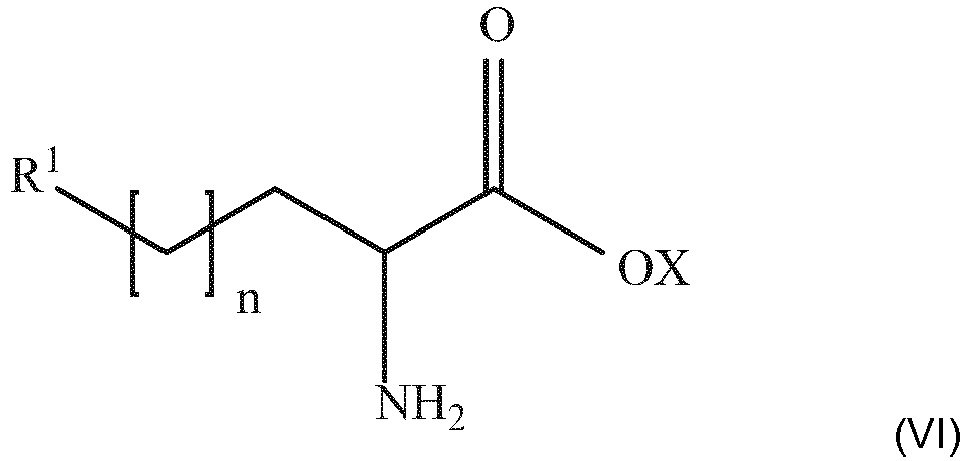
- X für ein Wasserstoffatom oder ein ein- oder zweiwertiges Kation steht;
- n für null, 1, 2 oder 3 steht;
- R1 für einen Rest steht, der ausgewählt ist aus einer Aminogruppe, einer Guanidin-Gruppe, einer (1H-Imidazol-4-yl)-Gruppe, einer Carbonsäureamid-Gruppe -CONH2, einer 1H-Indol-3-yl-Gruppe, einer Thiol-Gruppe -SH und einer Methylsulfanyl-Gruppe -SCH3, oder mindestens ein Salz dieser Aminosäure,
- c) Wasserstoffperoxid und
- d) Wasser,
- e) wobei das oxidative Behandlungsmittel einen pH-Wert im Bereich von 2,5 - 6,5, bevorzugt im Bereich von 3 - 5,5, besonders bevorzugt im Bereich von 3,5 bis 5,0, aufweist, jeweils bei 20°C gemessen,
- f) optional weiterhin mindestens eine Substanz, die ausgewählt ist aus
- Verbindungen der allgemeinen Formel (III),
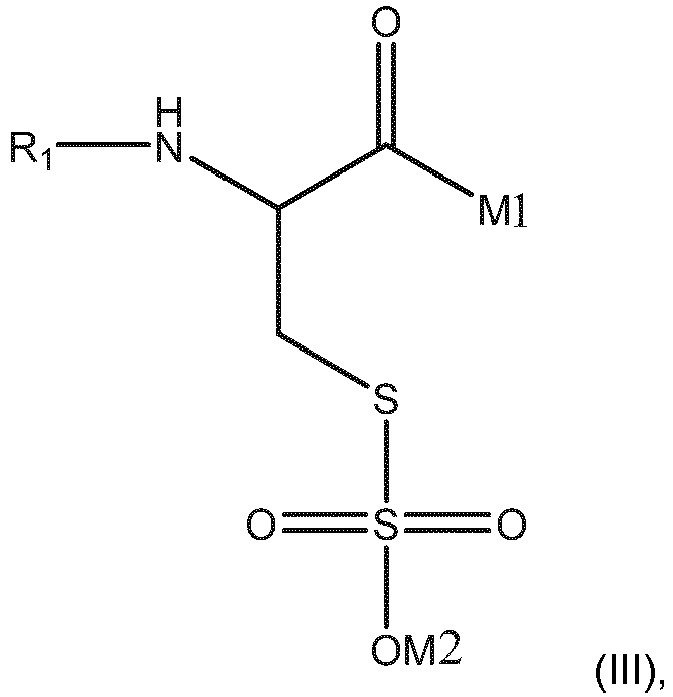
R1 für ein Wasserstoffatom oder für ein Strukturelement der Formel (IV) steht
- x für eine ganze Zahl von 1 bis 100 steht,
- der Rest R2 in jedem der Strukturelemente der Formel (IV) jeweils unabhängig vom vorangegangenen Strukturelement der Formel (IV) gewählt werden kann,
- R2 steht für ein Wasserstoffatom, eine Methylgruppe, eine Isopropylgruppe, eine 2-Methylpropylgruppe, eine 1-Methyl-propylgruppe, eine Benzylgruppe, eine 4-Hydroxybenzylgruppe, eine Hydroxymethylgruppe, 1-Hydroxyethylgruppe, eine 4-Aminobutylgruppe, eine 3-Carbamimidamidopropyl-Gruppe, eine 2-Carboxyethyl-Gruppe, eine Carboxymethyl-Gruppe, eine 2-Carbamoylethyl-Gruppe, eine Carbamoylmethyl-Gruppe, eine Sulfanylmethyl-Gruppe, eine 2-(Methylsulfanyl)ethyl-Gruppe, eine 1H-Imidazol-4-ylmethyl-Gruppe, eine 1H-Indol-3-ylmethyl-Gruppe oder eine (Sulfosulfanyl)-methyl-Gruppe,
- M1 steht für die Gruppierung -OM2 oder für ein Strukturelement der Formel (V)

- y für eine ganze Zahl von 1 bis 100 steht,
- der Rest R3 in jedem der Strukturelemente der Formel (V) jeweils unabhängig vom vorangegangenen Strukturelement der Formel (V) gewählt werden kann,
- R3 steht für ein Wasserstoffatom, eine Methylgruppe, eine Isopropylgruppe, eine 2-Methylpropylgruppe, eine 1-Methyl-propylgruppe, eine Benzylgruppe, eine 4-Hydroxybenzylgruppe, eine Hydroxymethylgruppe, eine 1-Hydroxyethylgruppe, eine 4-Aminobutylgruppe, eine 3-Carbamimidamidopropyl-Gruppe, eine 2-Carboxyethyl-Gruppe, eine Carboxymethyl-Gruppe, eine 2-Carbamoylethyl-Gruppe, eine Carbamoylmethyl-Gruppe, eine Sulfanylmethyl-Gruppe, eine 2-(Methylsulfanyl)ethyl-Gruppe, eine 1H-Imidazol-4-ylmethyl-Gruppe, eine 1H-Indol-3-ylmethyl-Gruppe oder eine (Sulfosulfanyl)-methyl-Gruppe,
- M2 steht für ein Wasserstoffatom, ein Äquivalent eines ein oder mehrwertigen Kations oder ein Ammoniumion (NH4)+, und
- mindestens einem Chelatbildner, bevorzugt in einer Gesamtmenge von 0,01 - 2,5 Gew.-%, besonders bevorzugt in einer Gesamtmenge von 0,1 - 1,5 Gew.-%, außerordentlich bevorzugt in einer Gesamtmenge von 0,2 - 0,6 Gew.-%, jeweils bezogen auf das Gewicht des oxidativen Behandlungsmittels (A), und
- mindestens einem Fettsäureamid mit der Formel (AMID-I), bevorzugt in einer Gesamtmenge von 0,1 bis 10 Gew.-%, besonders bevorzugt 0,2 bis 5 Gew.-%, außerordentlich bevorzugt 0,4 - 2 Gew.-%, jeweils bezogen auf das Gewicht des oxidativen Behandlungsmittels (A),

R1 ausgewählt ist aus linearen und verzweigten C4-C22-Alkylgruppen, die gesättigt oder ungesättigt sind, wobei die Alkyl- und Alkenylgruppen unsubstituiert sind oder mit Sauerstoffatomen, Stickstoffatomen, Hydroxylgruppen, Ethergruppen, Oxyalkylengruppen, Polyoxyalkylengruppen, Carbonsäuregruppen, Amingruppen, Amidgruppen, Halogen-enthaltenden Gruppen, Estergruppen, Siloxangruppen oder Polysiloxangruppen substituiert sein können,
und alkoxylierten Alkylgruppen der Formeln:

- R4 und R5, die gleich oder verschieden sein können, ausgewählt sind aus linearen und verzweigten C4-C22-Alkylgruppen, die gesättigt oder ungesättigt sind,
- n eine ganze Zahl im Bereich von 1 bis 10, bevorzugt im Bereich von 1 bis 4 ist und
- m eine ganze Zahl im Bereich von 1 bis 6 liegt und
- R2 und R3, die gleich oder verschieden sein können, jeweils unabhängig voneinander ausgewählt sind aus H; linearen und verzweigten C1-C22-Alkylgruppen, die gesättigt oder ungesättigt sind, wobei die Alkyl- und Alkenylgruppen unsubstituiert sind oder mit Sauerstoffatomen, Stickstoffatomen, Hydroxylgruppen, Ethergruppen, Oxyalkylengruppen, insbesondere Oxyethylengruppen, Polyoxyalkylengruppen, insbesondere Polyoxyethylengruppen, Carbonsäuregruppen, Amingruppen, Alkylamingruppen, insbesondere C1-C3-Alkylamingruppen, Dialkylamingruppen, insbesondere Di-(C1-C3)-alkylamingruppen, substituierten und nicht substituierten 4,5-Dihydroimidazoliumgrupppen, Amidgruppen, Halogen enthaltenden Gruppen, Estergruppen, Siloxangruppen oder Polysiloxangruppen substituiert sind,
- Verbindungen der allgemeinen Formel (III),
- II. Bereitstellen einer Zusammensetzung (B), enthaltend
- g) mindestens ein Alkalisierungsmittel, ausgewählt aus Ammoniumhydroxid, Monoethanolamin und Natriumsilikaten sowie Mischungen hiervon,
- h) ggf. Wasser und
- i) ggf. mindestens ein Oxidationsfarbstoffvorprodukt und/oder mindestens einen direktziehenden Farbstoff,
- III. Vermischen der Zusammensetzungen (A) und (B) miteinander, wobei das Gewichtsverhältnis von (A) zu (B) bevorzugt im Bereich von 10:1 bis 1:4, bevorzugt im Bereich von 5:1 bis 1:3, besonders bevorzugt im Bereich von 4:1 bis 1:2, außerordentlich bevorzugt im Bereich von 2:1 bis 1:1 liegt, direkt anschließend
- IV. Auftragen der Mischung aus (A) und (B) auf die keratinischen Fasern, insbesondere auf das Humanhaar, und
- V. Ausspülen nach einer Einwirkzeit von 0,1 bis 60 Minuten, bevorzugt 1 bis 50 Minuten, besonders bevorzugt 10 bis 45 Minuten, außerordentlich bevorzugt 30 bis 45 Minuten,
- VI. ggf. weitere Haarbehandlungen, wie Verformen, Konditionieren und/oder Trocknen.
- Unter keratinischen Fasern, keratinhaltigen Fasern oder Keratinfasern sind bevorzugt menschliche Haare zu verstehen, weiterhin Pelze, Wolle und Federn.
- Unter "direkt anschließend" wird erfindungsgemäß ein Zeitraum von 1 bis 600 Sekunden verstanden.
- Erfindungsgemäß bevorzugte Dicarbonsäuren mit 2 bis 10 Kohlenstoffatomen sind ausgewählt aus Maleinsäure, Fumarsäure, Bernsteinsäure, Äpfelsäure, Oxalsäure, Malonsäure, Adipinsäure, Pimelinsäure, Korksäure, Azelainsäure, Sebacinsäure, D-Weinsäure, L-Weinsäure, meso-Weinsäure, Traubensäure, alpha-Ketoglutarsäure, beta-Ketoglutarsäure sowie Mischungen dieser Säuren.
- Erfindungsgemäß besonders bevorzugt sind Maleinsäure, Fumarsäure, Äpfelsäure und Bernsteinsäure, sowie Mischungen dieser Säuren. Erfindungsgemäß außerordentlich bevorzugt ist Bernsteinsäure. Die genannten Dicarbonsäuren leisten einen wesentlichen Beitrag zur verringerten Haarschädigung durch die erfindungsgemäßen Behandlungsmittel.
- Je nach pH-Wert des erfindungsgemäßen oxidativen Behandlungsmittels oder der in einem der erfindungsgemäßen Färbe- oder Blondierverfahren eingesetzten Zusammensetzung (B) kann die mindestens eine Dicarbonsäure mit 2 bis 10 Kohlenstoffatomen als undissoziierte Säure, teilweise dissoziiert oder vollständig dissoziiert vorliegen. Liegt die mindestens eine Dicarbonsäure mit 2 bis 10 Kohlenstoffatomen teilweise dissoziiert oder vollständig dissoziiert vor, so ist das Gegenion ausgewählt aus physiologisch verträglichen Kationen, wie insbesondere den Alkalimetall-, Erdalkalimetall- und Zinkionen sowie Ammoniumionen, Alkylammonium-, Alkanolammonium- und Glucammoniumionen, insbesondere die Mono-, Di- und Trimethyl-, -ethyl- und -hydroxyethylammoniumionen. Ebenfalls bevorzugt sind die Salze der Dicarbonsäuren mit 2 bis 10 Kohlenstoffatomen mit Amino-C1-C6-Alkanolen, insbesondere mit Monoethanolamin, und Amino-C1-C6-Alkandiolen, insbesondere mit 2-Amino-2-methylpropan-1-ol, 2-Amino-2-methylpropan-1,3-diol, 2-Aminopropan-1-ol, 3-Aminopropan-1-ol, 1-Aminopropan-2-ol (MIPA) und 2-Amino-2-(hydroxymethyl)propan-1,3-diol (TRIS), wobei die Salze mit Monoethanolamin, 2-Amino-2-methylpropan-1-ol und 2-Amino-2-methylpropan-1,3-diol besonders bevorzugt sind.
- Außerordentlich bevorzugt sind Natrium-, Kalium-, Magnesium-, Ammonium und Monoethanolammonium-lonen als Gegenionen für die teilweise oder vollständig dissoziierten Dicarbonsäuren mit 2 bis 10 Kohlenstoffatomen. Daneben können jedoch auch mit alkalisch reagierenden Aminosäuren, wie beispielsweise Arginin, Lysin, Ornithin und Histidin, neutralisierte Dicarbonsäuren mit 2 bis 10 Kohlenstoffatomen eingesetzt werden.
- Die Natrium-, Kalium-, Ammonium-, Monoethanolammonium-, Lysin- sowie Argininsalze sowie deren Mischungen sind bevorzugte Salze der Dicarbonsäuren mit 2 bis 10 Kohlenstoffatomen.
- Bevorzugte erfindungsgemäße Behandlungsmittel enthalten die mindestens eine Dicarbonsäure mit 2 bis 10 Kohlenstoffatomen oder ein oder mehrere Salze hiervon in einer Gesamtmenge von 0,2 bis 4 Gew.-%, bevorzugt 0,33 bis 3 Gew.-%, besonders bevorzugt 0,5 bis 2 Gew.-%, jeweils umgerechnet auf die undissoziierte Säure und bezogen auf das Gewicht des Behandlungsmittels.
- Auch wenn die Dicarbonsäuren in Salzform vorliegen, beziehen sich die vorstehenden Mengenangaben auf die jeweilige Dicarbonsäure in undissoziierter Form, um die Mengenangabe nicht durch unterschiedliche Molgewichte der Salze zu verfälschen. Eine Einwaage von 15 Gew.-% Dinatriumsuccinathexahydrat ergäbe beispielsweise eine Konzentration an Bernsteinsäure von umgerechnet 6,55 Gew.-%.
- Die verringerte Haarschädigungswirkung der erfindungsgemäßen Behandlungsmittel ist wesentlich zurückzuführen auf die mindestens eine vorgenannte Dicarbonsäure im Zusammenwirken mit mindestens einer Aminosäure.
- Die erfindungsgemäßen Behandlungsmittel enthalten daher als weitere obligatorische Komponente mindestens eine Aminosäure. Bevorzugte Aminosäuren sind ausgewählt aus Arginin, Lysin, Histidin, Asparagin, Glutamin, Cystein, Methionin, Tryptophan, Serin, Alanin, Asparaginsäure, Glutaminsäure, Glycin, Isoleucin, Leucin, Phenylalanin, Prolin, Threonin, Tyrosin und Valin sowie Mischungen dieser Aminosäuren. Weitere erfindungsgemäß bevorzugte oxidative Behandlungsmittel enthalten mindestens eine Aminosäure in einer Gesamtmenge von 0,05 bis 3 Gew.-%, bevorzugt 0,1 bis 2 Gew.-%, besonders bevorzugt 0,2 bis 1,2 Gew.-%, jeweils umgerechnet auf die undissoziierte Säure und bezogen auf das Gewicht des oxidativen Behandlungsmittels. Weitere erfindungsgemäß bevorzugte oxidative Behandlungsmittel enthalten mindestens eine Aminosäure, ausgewählt aus Arginin, Lysin, Histidin, Asparagin, Glutamin, Cystein, Methionin, Tryptophan, Serin, Alanin, Asparaginsäure, Glutaminsäure, Glycin, Isoleucin, Leucin, Phenylalanin, Prolin, Threonin, Tyrosin und Valin sowie Mischungen dieser Aminosäuren, in einer Gesamtmenge von 0,05 bis 3 Gew.-%, bevorzugt 0,1 bis 2 Gew.-%, besonders bevorzugt 0,2 bis 1,2 Gew.-%, jeweils umgerechnet auf die undissoziierte Säure und bezogen auf das Gewicht des oxidativen Behandlungsmittels.
- Eine besonders stark verringerte Haarschädigungswirkung der erfindungsgemäßen Behandlungsmittel ist wesentlich zurückzuführen auf die vorgenannten Dicarbonsäuren im Zusammenwirken mit mindestens einer ausgewählten Aminosäure der Formel (VI).
- Bevorzugte erfindungsgemäße oxidative Behandlungsmittel enthalten daher als obligatorische Komponente mindestens eine Aminosäure der Formel (VI)
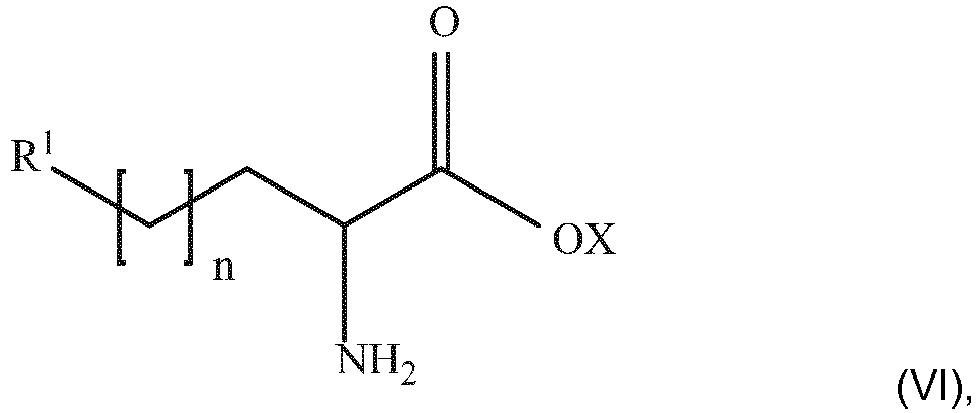
- X für ein Wasserstoffatom oder ein ein- oder zweiwertiges Kation steht;
- n für null, 1, 2 oder 3 steht;
- R1 für einen Rest steht, der ausgewählt ist aus einer Aminogruppe, einer Guanidin-Gruppe, einer (1H-Imidazol-4-yl)-Gruppe, einer Carbonsäureamid-Gruppe -CONH2, einer 1H-Indol-3-yl-Gruppe, einer Thiol-Gruppe -SH und einer Methylsulfanyl-Gruppe -SCH3, oder mindestens einem Salz dieser Aminosäure.
- Bevorzugte Aminosäuren der Formel (VI) sind ausgewählt aus Arginin, Lysin, Histidin, Asparagin, Glutamin, Cystein, Methionin, Tryptophan sowie Mischungen hiervon. Besonders bevorzugte oxidative Behandlungsmittel enthalten Mischungen aus Arginin und Lysin oder mindestens einem Salz dieser Aminosäuren.
- Bevorzugte erfindungsgemäße oxidative Behandlungsmittel enthalten die mindestens eine Aminosäure der Formel (VI) oder ein oder mehrere Salze hiervon in einer Gesamtmenge von 0,05 bis 3 Gew.-%, bevorzugt 0,1 bis 2 Gew.-%, besonders bevorzugt 0,2 bis 1,2 Gew.-%, jeweils umgerechnet auf die undissoziierte Säure und bezogen auf das Gewicht des Behandlungsmittels. Weitere besonders bevorzugte erfindungsgemäße Behandlungsmittel enthalten Mischungen aus Arginin und Lysin oder mindestens einem Salz dieser Aminosäuren in einer Gesamtmenge von 0,05 bis 3 Gew.-%, bevorzugt 0,1 bis 2 Gew.-%, besonders bevorzugt 0,2 bis 1,2 Gew.-%, jeweils umgerechnet auf die undissoziierte Säure und bezogen auf das Gewicht des Behandlungsmittels.
- Die Ausbildung der Farbstoffe in oxidativen Färbemitteln bzw. der Abbau des haareigenen Farbstoffs Melanin zur Blondierung erfolgt erst durch den Einfluss einer Peroxidverbindung als Oxidationsmittel. Üblicherweise wird hierfür Wasserstoffperoxid verwendet. Der Einsatz von Wasserstoffperoxid kann nur in Form einer wässrigen Lösung erfolgen.
- Erfindungsgemäß bevorzugte oxidative Behandlungsmittel sind dadurch gekennzeichnet, dass sie 0,5 bis 13 Gew.-%, weiter bevorzugt 1 bis 7 Gew.-%, besonders bevorzugt 2 bis 6 Gew.-% und ganz besonders bevorzugt 3 bis 4,5 Gew.-% Wasserstoffperoxid (berechnet als 100 %-iges H2O2) enthalten, jeweils bezogen auf das Gesamtgewicht des erfindungsgemäßen oxidativen Behandlungsmittels.
- Blondiermittel oder besonders stark aufhellende Färbemittel können darüber hinaus stark oxidierende Peroxidverbindungen, wie Kalium-, Natrium- und/oder Ammoniumpersulfat und/oder Natriumpercarbonat enthalten.
- Die erfindungsgemäßen oxidativen Behandlungsmittel enthalten Wasser, und zwar bevorzugt in einer Menge von 20 bis 95 Gew.-%, bevorzugt 30 bis 90 Gew.-%, besonders bevorzugt 40 bis 85 Gew.-%, außerordentlich bevorzugt 50 bis 80 Gew.-%, jeweils bezogen auf das Gesamtgewicht des erfindungsgemäßen oxidativen Behandlungsmittels.
- Erfindungsgemäße oxidative Behandlungsmittel weisen einen pH-Wert im Bereich von 2,5 - 6,5, bevorzugt im Bereich von 3 - 5,5, besonders bevorzugt im Bereich von 3,5 bis 5,0, auf, jeweils bei 20°C gemessen.
- Der erfindungsgemäße Effekt kann überraschend gesteigert werden, wenn das oxidative Behandlungsmittel mindestens einen Chelatbildner enthält. Unter einem Chelatbildner wird erfindungsgemäß eine Verbindung verstanden, die in wässriger Lösung mit Calciumionen oder Magnesiumionen Chelate bildet. Unter Chelaten werden erfindungsgemäß zyklische Verbindungen verstanden, bei denen Metallionen, weiterhin Gruppierungen mit einsamen Elektronenpaaren oder mit Elektronenlücken und weiterhin Wasserstoff an der Ringbildung beteiligt sind.
- Erfindungsgemäß bevorzugte Chelatbildner weisen eine Molmasse von 100 g/mol bis 600 g/mol auf. Weitere erfindungsgemäß bevorzugte Chelatbildner sind ausgewählt aus Pyridin-2,6-dicarbonsäure (Dipicolinsäure), 1-Hydroxyethan-1,1-diphosphonsäure (HEDP, Etidronsäure) und deren Natrium-, Kalium- und Ammoniumsalzen, Dinatriumpyrophosphat, beta-Alanindiessigsäure, Ethylendiamintetraessigsäure (EDTA) und deren Natrium-, Kalium- und Ammoniumsalzen, Aminotrimethylenphosphonsäure, Diethylentriaminpentamethylenphosphonsäure, Dinatriumazacycloheptandiphosphonat, Dinatriumhydroxyethylaminobismethylphosphonat, Dinatriumhydroxyethyliminodiacetat, Hydroxyethylethylendiamintriessigsäure (HEDTA) und deren Natrium- oder Kaliumsalze, Pentakaliumtriphosphat, Pentanatriumtriphosphat, Pentanatriumaminotrimethylenphosphonat, Pentanatriumethylendiamintetramethylenphosphonat, Pentanatriumdiethylentriaminpentaacetat (Pentanatrium Pentetate), Diethylentriaminpentaessigsäure (Pentetic Acid), Phosphonobutantricarbonsäure, Kaliumethylendiamintetramethylenphosphonat (Kalium EDTMP), Natriumethylendiamintetramethylenphosphonat (Natrium EDTMP), Natriumdiethylentriaminpentamethylenphosphonat (Natrium DTPMP), Natriumhexametaphosphat, Tetrakaliumpyrophosphat, Tetranatriumpyrophosphat, Tetranatriumdicarboxymethylaspartat, Tetranatriumiminodisuccinat, Trinatriumdicarboxymethylalaninat, Trinatriumethylendiamindisuccinat (Trinatrium EDDS) und Trinatriumnitrilotriacetat sowie Mischungen dieser Chelatbildner.
- Erfindungsgemäß besonders bevorzugte Chelatbildner sind ausgewählt aus Pyridin-2,6-dicarbonsäure (Dipicolinsäure), 1-Hydroxyethan-1,1-diphosphonsäure (HEDP, Etidronsäure) und deren Natrium-, Kalium- und Ammoniumsalzen, Dinatriumpyrophosphat, Ethylendiamintetraessigsäure (EDTA) und deren Kalium- und Ammoniumsalzen, Pentanatriumdiethylentriaminpentaacetat (Pentanatrium Pentetate), Tetranatriumpyrophosphat, Trinatriumethylendiamindisuccinat (Trinatrium EDDS) sowie Mischungen dieser Chelatbildner.
- Erfindungsgemäß besonders bevorzugte oxidative Behandlungsmittel enthalten mindestens einen Chelatbildner in einer Gesamtmenge von 0,01 - 2,5 Gew.-%, bevorzugt in einer Gesamtmenge von 0,1 - 1,5 Gew.-%, besonders bevorzugt in einer Gesamtmenge von 0,2 - 0,6 Gew.-%, jeweils bezogen auf das Gewicht des oxidativen Behandlungsmittels.
- Weiterhin wurde überraschend festgestellt, dass die verringerte Haarschädigungswirkung der erfindungsgemäßen und erfindungsgemäß bevorzugten oxidativen Behandlungsmittel weiter unterstützt werden kann, wenn mindestens eine Verbindung der allgemeinen Formel (III) enthalten ist. Erfindungsgemäß bevorzugte oxidative Behandlungsmittel enthalten daher
- (a) mindestens eine Verbindung der allgemeinen Formel (III)

R1 für ein Wasserstoffatom oder für ein Strukturelement der Formel (IV) steht
- x für eine ganze Zahl von 1 bis 100 steht,
- der Rest R2 in jedem der Strukturelemente der Formel (IV) jeweils unabhängig vom vorangegangenen Strukturelement der Formel (IV) gewählt werden kann,
- R2 steht für ein Wasserstoffatom, eine Methylgruppe, eine Isopropylgruppe, eine 2-Methyl-propylgruppe, eine 1-Methyl-propylgruppe, eine Benzylgruppe, eine 4-Hydroxybenzylgruppe, eine Hydroxymethylgruppe, 1-Hydroxyethylgruppe, eine 4-Aminobutylgruppe, eine 3-Carbamimidamidopropyl-Gruppe, eine 2-Carboxyethyl-Gruppe, eine Carboxymethyl-Gruppe, eine 2-Carbamoylethyl-Gruppe, eine Carbamoylmethyl-Gruppe, eine Sulfanylmethyl-Gruppe, eine 2-(Methylsulfanyl)ethyl-Gruppe, eine 1H-Imidazol-4-ylmethyl-Gruppe, eine 1H-Indol-3-yl-methyl-Gruppe oder eine (Sulfosulfanyl)methyl-Gruppe,
- M1 steht für die Gruppierung -OM2 oder für ein Strukturelement der Formel (V)

- y für eine ganze Zahl von 1 bis 100 steht,
- der Rest R3 in jedem der Strukturelemente der Formel (V) jeweils unabhängig vom vorangegangenen Strukturelement der Formel (V) gewählt werden kann,
- R3 steht für ein Wasserstoffatom, eine Methylgruppe, eine Isopropylgruppe, eine 2-Methyl-propylgruppe, eine 1-Methyl-propylgruppe, eine Benzylgruppe, eine 4-Hydroxybenzylgruppe, eine Hydroxymethylgruppe, eine 1-Hydroxyethylgruppe, eine 4-Aminobutylgruppe, eine 3-Carbamimidamidopropyl-Gruppe, eine 2-Carboxyethyl-Gruppe, eine Carboxymethyl-Gruppe, eine 2-Carbamoylethyl-Gruppe, eine Carbamoylmethyl-Gruppe, eine Sulfanylmethyl-Gruppe, eine 2-(Methylsulfanyl)ethyl-Gruppe, eine 1H-Imidazol-4-ylmethyl-Gruppe, eine 1H-Indol-3-ylmethyl-Gruppe oder eine (Sulfosulfanyl)methyl-Gruppe,
- M2 steht für ein Wasserstoffatom, ein Äquivalent eines ein oder mehrwertigen Kations oder ein Ammoniumion (NH4)+.
- Bei dem wesentlichen Inhaltsstoff (a) der Formel (III) handelt es sich um das Bunte-Salz einer Aminosäure, eines Oligopeptids oder eines Peptids, das eine Verbindung der Formel (III) darstellt,

R1 für ein Wasserstoffatom oder für ein Strukturelement der Formel (IV) steht
- x für eine ganze Zahl von 1 bis 100 steht,
- der Rest R2 in jedem der Strukturelemente der Formel (IV) jeweils unabhängig vom vorangegangenen Strukturelement der Formel (IV) gewählt werden kann,
- R2 steht für ein Wasserstoffatom, eine Methylgruppe, eine Isopropylgruppe, eine 2-Methyl-propylgruppe, eine 1-Methyl-propylgruppe, eine Benzylgruppe, eine 4-Hydroxybenzylgruppe, eine Hydroxymethylgruppe, 1-Hydroxyethylgruppe, eine 4-Aminobutylgruppe, eine 3-Carbamimidamidopropyl-Gruppe, eine 2-Carboxyethyl-Gruppe, eine Carboxymethyl-Gruppe, eine 2-Carbamoylethyl-Gruppe, eine Carbamoylmethyl-Gruppe, eine Sulfanylmethyl-Gruppe, eine 2-(Methylsulfanyl)ethyl-Gruppe, eine 1H-Imidazol-4-ylmethyl-Gruppe, eine 1H-Indol-3-ylmethyl-Gruppe oder eine (Sulfosulfanyl)methyl-Gruppe,
- M1 steht für die Gruppierung -OM2 oder für ein Strukturelement der Formel (V)

- y für eine ganze Zahl von 1 bis 100 steht
- der Rest R3 in jedem der Strukturelemente der Formel (V) jeweils unabhängig vom vorangegangenen Strukturelement der Formel (V) gewählt werden kann,
- R3 steht für ein Wasserstoffatom, eine Methylgruppe, eine Isopropylgruppe, eine 2-Methyl-propylgruppe, eine 1-Methyl-propylgruppe, eine Benzylgruppe, eine 4-Hydroxybenzylgruppe, eine Hydroxymethylgruppe, eine 1-Hydroxyethylgruppe, eine 4-Aminobutylgruppe, eine 3-Carbamimidamidopropyl-Gruppe, eine 2-Carboxyethyl-Gruppe, eine Carboxymethyl-Gruppe, eine 2-Carbamoylethyl-Gruppe, eine Carbamoylmethyl-Gruppe, eine Sulfanylmethyl-Gruppe, eine 2-(Methylsulfanyl)ethyl-Gruppe, eine 1H-Imidazol-4-ylmethyl-Gruppe, eine 1H-Indol-3-ylmethyl-Gruppe oder eine (Sulfosulfanyl)methyl-Gruppe,
- M2 steht für ein Wasserstoffatom, ein Äquivalent eines ein oder mehrwertigen Kations oder ein Ammoniumion (NH4)+.
- Der Rest R1 kann entweder für ein Wasserstoffatom oder für ein Strukturelement der Formel (IV) stehen

- Das Strukturelement der Formel (IV) ist weiterhin gekennzeichnet durch den Wiederholungsindex x, wobei x für eine ganze Zahl von 1 bis 100 steht. Der Wiederholungsindex x gibt an, wie viele Strukturelemente der Formel (IV) in der Verbindung der Formel (III) enthalten sind.
- Bevorzugt steht x für eine ganze Zahl von 1 bis 50, weiter bevorzugt steht x für eine ganze Zahl von 1 bis 20, und ganz besonders bevorzugt steht x für eine ganze Zahl von 1 bis 10.
- Wenn x beispielweise für die Zahl 10 steht, beinhaltet die Verbindung der Formel (III) 10 Strukturelemente der Formel (IV).
- Hierbei ist wesentlich, dass der Rest R2 in jedem der Strukturelemente der Formel (IV) jeweils unabhängig vom vorangegangenen Strukturelement der Formel (IV) gewählt werden kann. Enthalten die Verbindungen der Formel (III) beispielsweise 10 Struktureinheiten der Formel (IV), so können diese 10 Struktureinheiten gleich oder aber auch verschieden sein.
- Der Rest R2 steht für ein Wasserstoffatom, eine Methylgruppe, eine Isopropylgruppe, eine 2-Methyl-propylgruppe, eine 1-Methyl-propylgruppe, eine Benzylgruppe, eine 4-Hydroxybenzylgruppe, eine Hydroxymethylgruppe, eine 1-Hydroxethylgruppe, eine 4-Aminobutylgruppe, eine 3-Carbamimidamidopropyl-Gruppe, eine 2-Carboxyethyl-Gruppe, eine Carboxymethyl-Gruppe, eine 2-Carbamoylethyl-Gruppe, eine Carbamoylmethyl-Gruppe, eine Sulfanylmethyl-Gruppe, eine 2-(Methylsulfanyl)-ethyl-Gruppe, eine 1H-Imidazol-4-ylmethyl-Gruppe, eine 1H-Indol-3-ylmethyl-Gruppe oder für eine (Sulfosulfanyl)methyl-Gruppe.
- Bei dem Strukturelement der Formel (IV) handelt es sich somit um eine Aminosäure, die peptidisch über ihre Amino- und/oder ihre Säurefunktion innerhalb der Verbindung der Formel (III) verknüpft ist. Wenn es sich bei der Aminosäure um Cystein handelt, kann diese auch in Form eines Bunte-Salzes vorliegen.
- Wenn der Rest R2 für ein Wasserstoffatom steht, so beruht das Strukturelement der Formel (IV) auf der Aminosäure Glycin.
- Wenn der Rest R2 für eine Methylgruppe steht, so beruht das Strukturelement der Formel (IV) auf der Aminosäure Alanin.
- Wenn der Rest R2 für eine Isopropylgruppe (d.h. eine Gruppe (H3C)2CH-) steht, so beruht das Strukturelement der Formel (IV) auf der Aminosäure Valin.
- Wenn der Rest R2 für eine 2-Methylpropylgruppe (d.h. eine Gruppe (H3C)2CH-CH2-), so beruht das Strukturelement der Formel (IV) auf der Aminosäure Leucin.
- Wenn der Rest R2 für eine 1-Methyl-propylgruppe (d.h. eine Gruppe H3C-CH2-CH(CH3)-) steht, so beruht das Strukturelement der Formel (IV) auf der Aminosäure Isoleucin.
- Wenn der Rest R2 für eine Benzylgruppe (d.h. eine Gruppe C6H5-CH2-) steht, so beruht das Strukturelement der Formel (IV) auf der Aminosäure Phenylalanin.
- Wenn der Rest R2 für eine 4-Hydroxybenzylgruppe (d.h. eine Gruppe 4-OH-C6H5-CH2-) steht, so beruht das Strukturelement der Formel (IV) auf der Aminosäure Tyrosin.
- Wenn der Rest R2 für eine Hydroxymethylgruppe (d.h. eine Gruppe HO-CH2-) steht, so beruht das Strukturelement der Formel (IV) auf der Aminosäure Serin.
- Wenn der Rest R2 für eine 1-Hydroxyethylgruppe (d.h. eine Gruppe H3C-CH(OH)-) steht, so beruht das Strukturelement der Formel (IV) auf der Aminosäure Threonin.
- Wenn der Rest R2 für eine 4-Aminobutylgruppe (d.h. eine Gruppe H2N-CH2-CH2-CH2-CH2-) steht, so beruht das Strukturelement der Formel (IV) auf der Aminosäure Lysin.
- Wenn der Rest R2 für eine 3-Carbamimidamidopropyl-Gruppe (d.h. eine Gruppe H2N-C(NH)-NH-CH2-CH2-CH2-) steht, so beruht das Strukturelement der Formel (IV) auf der Aminosäure Arginin.
- Wenn der Rest R2 für eine 2-Carboxyethyl-Gruppe (d.h. eine Gruppe HOOC-CH2-CH2-) steht, so beruht das Strukturelement der Formel (IV) auf der Aminosäure Glutaminsäure.
- Wenn der Rest R2 für eine Carboxymethyl-Gruppe (d.h. eine Gruppe HOOC-CH2-) steht, so beruht das Strukturelement der Formel (IV) auf der Aminosäure Asparaginsäure.
- Wenn der Rest R2 für eine 2-Carbamoylethyl-Gruppe (d.h. eine Gruppe H2N-C(O)-CH2-CH2-) steht, so beruht das Strukturelement der Formel (IV) auf der Aminosäure Glutamin.
- Wenn der Rest R2 für eine Carbamoylmethyl-Gruppe (d.h. eine Gruppe H2N-C(O)-CH2-) steht, so beruht das Strukturelement der Formel (IV) auf der Aminosäure Asparagin.
- Wenn der Rest R2 für eine Sulfanylmethyl-Gruppe (d.h. eine Gruppe HS-CH2-) steht, so beruht das Strukturelement der Formel (IV) auf der Aminosäure Cystein.
- Wenn der Rest R2 für eine 2-(Methylsulfanyl)ethyl-Gruppe (d.h. eine Gruppe H3C-S-CH2-CH2-) steht, so beruht das Strukturelement der Formel (IV) auf der Aminosäure Methionin.
- Wenn der Rest R2 für eine 1H-Imidazol-4-ylmethyl-Gruppe steht, so beruht das Strukturelement der Formel (IV) auf der Aminosäure Histidin.
- Wenn der Rest R2 für eine 1H-Indol-3-ylmethyl-Gruppe steht, so beruht das Strukturelement der Formel (IV) auf der Aminosäure Tryptophan.
- Schließlich kann der Rest R2 auch für eine (Sulfosulfanyl)methyl-Gruppe stehen, hierbei handelt es sich um eine Bunte-Salz-Struktur der Formel HO-S(O2)-S-CH2-.
- Je nach pH-Wert des Behandlungsmittels kann die Bunte-Salz-Struktur der Formel HO-S(O2)-S-CH2- auch in ihrer deprotonierten Form vorliegen.
- Innerhalb der Verbindung der Formel (III) steht M1 steht die Gruppierung -OM2 oder für ein Strukturelement der Formel (V)

- Das Strukturelement der Formel (V) ist gekennzeichnet durch den Wiederholungsindex y, wobei y für eine ganze Zahl von 1 bis 100 steht. Der Wiederholungsindex y gibt an, wie viele Strukturelemente der Formel (V) in der Verbindung der Formel (III) enthalten sind.
- Bevorzugt steht y für eine ganze Zahl von 1 bis 50, weiter bevorzugt steht y für eine ganze Zahl von 1 bis 20, und ganz besonders bevorzugt steht y für eine ganze Zahl von 1 bis 10.
- Wenn y beispielweise für die Zahl 10 steht, beinhaltet die Verbindung der Formel (III) 10 Strukturelemente der Formel (V).
- Hierbei ist wesentlich, dass der Rest R3 in jedem der Strukturelemente der Formel (V) jeweils unabhängig vom vorangegangenen Strukturelement der Formel (V) gewählt werden kann. Enthalten die Verbindungen der Formel (III) beispielsweise 10 Struktureinheiten der Formel (V), so können diese 10 Struktureinheiten gleich oder aber auch verschieden sein.
- Der Rest R3 steht für ein Wasserstoffatom, eine Methylgruppe, eine Isopropylgruppe, eine 2-Methyl-propylgruppe, eine 1-Methyl-propylgruppe, eine Benzylgruppe, eine 4-Hydroxybenzylgruppe, eine Hydroxymethylgruppe, eine 1-Hydroxyethylgruppe, eine 4-Aminobutylgruppe, eine 3-Carbamimidamidopropyl-Gruppe, eine 2-Carboxyethyl-Gruppe, eine Carboxymethyl-Gruppe, eine 2-Carbamoylethyl-Gruppe, eine Carbamoylmethyl-Gruppe, eine Sulfanylmethyl-Gruppe, eine 2-(Methylsulfanyl)-ethyl-Gruppe, eine 1H-Imidazol-4-ylmethyl-Gruppe, eine 1H-Indol-3-ylmethyl-Gruppe oder eine (Sulfosulfanyl)methyl-Gruppe.
- Damit handelt es sich auch bei dem Strukturelement der Formel (V) um eine Aminosäure, die peptidisch über ihre Amino- und/oder ihre Säurefunktion innerhalb der Verbindung der Formel (III) verknüpft ist. Wenn es sich bei der Aminosäure um Cystein handelt, kann diese auch in Form eines Bunte-Salzes vorliegen.
- Wenn der Rest R3 für ein Wasserstoffatom steht, so beruht das Strukturelement der Formel (V) auf der Aminosäure Glycin.
- Wenn der Rest R3 für eine Methylgruppe steht, so beruht das Strukturelement der Formel (V) auf der Aminosäure Alanin.
- Wenn der Rest R3 für eine Isopropylgruppe (d.h. eine Gruppe (H3C)2CH-) steht, so beruht das Strukturelement der Formel (V) auf der Aminosäure Valin.
- Wenn der Rest R3 für eine 2-Methylpropylgruppe (d.h. eine Gruppe (H3C)2CH-CH2-), so beruht das Strukturelement der Formel (V) auf der Aminosäure Leucin.
- Wenn der Rest R3 für eine 1-Methyl-propylgruppe (d.h. eine Gruppe H3C-CH2-CH(CH3)-) steht, so beruht das Strukturelement der Formel (V) auf der Aminosäure Isoleucin.
- Wenn der Rest R3 für eine Benzylgruppe (d.h. eine Gruppe C6H5-CH2-) steht, so beruht das Strukturelement der Formel (V) auf der Aminosäure Phenylalanin.
- Wenn der Rest R3 für eine 4-Hydroxybenzylgruppe (d.h. eine Gruppe 4OH-C6H5-CH2-) steht, so beruht das Strukturelement der Formel (V) auf der Aminosäure Tyrosin.
- Wenn der Rest R3 für eine Hydroxymethylgruppe (d.h. eine Gruppe HO-CH2-) steht, so beruht das Strukturelement der Formel (V) auf der Aminosäure Serin.
- Wenn der Rest R3 für eine 1-Hydroxyethylgruppe (d.h. eine Gruppe H3C-CH(OH)-) steht, so beruht das Strukturelement der Formel (V) auf der Aminosäure Threonin.
- Wenn der Rest R3 für eine 4-Aminobutylgruppe (d.h. eine Gruppe H2N-CH2-CH2-CH2-CH2-) steht, so beruht das Strukturelement der Formel (V) auf der Aminosäure Lysin.
- Wenn der Rest R3 für eine 3-Carbamimidamidopropyl-Gruppe (d.h. eine Gruppe H2N-C(NH)-NH-CH2-CH2-CH2-) steht, so beruht das Strukturelement der Formel (V) auf der Aminosäure Arginin. Wenn der Rest R3 für eine 2-Carboxyethyl-Gruppe (d.h. eine Gruppe HOOC-CH2-CH2-) steht, so beruht das Strukturelement der Formel (V) auf der Aminosäure Glutaminsäure.
- Wenn der Rest R3 für eine Carboxymethyl-Gruppe (d.h. eine Gruppe HOOC-CH2-) steht, so beruht das Strukturelement der Formel (V) auf der Aminosäure Asparaginsäure.
- Wenn der Rest R3 für eine 2-Carbamoylethyl-Gruppe (d.h. eine Gruppe H2N-C(O)-CH2-CH2-) steht, so beruht das Strukturelement der Formel (V) auf der Aminosäure Glutamin.
- Wenn der Rest R3 für eine Carbamoylmethyl-Gruppe (d.h. eine Gruppe H2N-C(O)-CH2-) steht, so beruht das Strukturelement der Formel (V) auf der Aminosäure Asparagin.
- Wenn der Rest R3 für eine Sulfanylmethyl-Gruppe (d.h. eine Gruppe HS-CH2-) steht, so beruht das Strukturelement der Formel (V) auf der Aminosäure Cystein.
- Wenn der Rest R3 für eine 2-(Methylsulfanyl)ethyl-Gruppe (d.h. eine Gruppe H3C-S-CH2-CH2-) steht, so beruht das Strukturelement der Formel (V) auf der Aminosäure Methionin.
- Wenn der Rest R3 für eine 1H-Imidazol-4-ylmethyl-Gruppe steht, so beruht das Strukturelement der Formel (V) auf der Aminosäure Histidin.
- Wenn der Rest R3 für eine 1H-Indol-3-ylmethyl-Gruppe steht, so beruht das Strukturelement der Formel (V) auf der Aminosäure Tryptophan.
- Schließlich kann der Rest R3 auch für eine (Sulfosulfanyl)methyl-Gruppe stehen, hierbei handelt es sich um eine Bunte-Salz Struktur der Formel HO-S(O2)-S-CH2-.
- Je nach pH-Wert des Behandlungsmittels kann auch hier die Bunte-Salz Struktur der Formel HO-S(O2)-S-CH2- auch in ihrer deprotonierten Form vorliegen.
- Der Rest M2 steht für ein Wasserstoffatom, ein Äquivalent eines ein oder mehrwertigen Kations oder ein Ammoniumion (NH4)+.
- Als bevorzugte Äquivalente eines ein oder mehrwertigen Kations können insbesondere die Kationen von Natrium und Kalium (Na+ bzw. K+) oder auch Magnesium oder Calcium (1/2 Mg2+ oder ½ Ca2+) genannt werden.
- Steht M2 für ein Wasserstoffatom, so handelt es sich bei der Gruppierung -OM2 um die Gruppierung -OH. Steht M2 für ein Natriumkation, so handelt es sich bei der Gruppierung -OM2 um die Gruppierung -ONa. Steht M2 für ein Kaliumkation, so handelt es sich bei der Gruppierung -OM2 um die Gruppierung -OK. Steht M2 für ein Ammoniumion, so handelt es sich bei der Gruppierung -OM2 um die Gruppierung -O(NH4).
- Die Gruppierung -OM2 ist stets einer Carbonylgruppe benachbart. In Summe liegt, wenn M2 für H, K, Na oder Ammonium steht, damit in der Verbindung der Formel (III) daher entweder in Form eine Säure in ihrer protonierten Form oder aber das Natrium, Kalium oder Ammoniumsalz dieser Säure vor.
- Bei den erfindungsgemäßen Verbindungen der Formel (III) handelt es sich entweder um das Bunte-Salz der Aminosäure Cystein, um die Bunte-Salze von Oligopeptiden oder aber um die Bunte-Salze von Peptiden.
- Wenn der Rest R1 für ein Wasserstoffatom steht und der Rest M1 für eine Gruppierung -OM2 steht, dann handelt es sich bei der Verbindung der Formel (III) um das Bunte-Salz der Aminosäure Cystein. In diesem Fall handelt es sich bei der Verbindung der Formel (III) um die Verbindung der Formel (lila),

- Liegt die Verbindung der Formel (lila) in Form ihrer freien Säure vor, so handelt es sich um 2-Amino-3-(sulfosulfanyl)propansäure. Diese Substanz ist kommerziell erhältlich.
- Es hat sich herausgestellt, dass der Einsatz der Verbindung der Formel (lila) in Behandlungsmittel bereits bei besonders geringen Einsatzmengen zu einer besonders effektiven Reduzierung der Haarschädigung führt, die auch nach wiederholten Haarwäschen noch vorhanden ist. Deshalb ist der Einsatz von Verbindungen der Formel (lila) in Behandlungsmitteln ganz besonders bevorzugt.
- In einer ganz besonders bevorzugten Ausführungsform ist ein erfindungsgemäßes oxidatives Behandlungsmittel, dadurch gekennzeichnet, dass es mindestens eine Verbindung der Formel (III) enthält, wobei
- R1 für ein Wasserstoffatom steht und
- M1 für eine Gruppierung -OM2 steht.
- Wenn eine Verbindung der Formel (lila) eingesetzt wird, so handelt es sich bevorzugt um den Einsatz dieser spezifischen Verbindung. Werden als Verbindungen der Formel (III) jedoch die Bunte-Salze von Oligopeptiden eingesetzt, so kann das erfindungsgemäße Behandlungsmittel auch mehrere Verbindungen der Formel (III) als Gemisch verschiedener Oligopeptide enthalten. Diese Oligopeptide werden durch ihr mittleres Molgewicht definiert. Das mittlere Molekulargewicht Mw des mindestens einen Oligopeptids der Formel (III) kann beispielsweise durch Gelpermeationschromatographie (GPC) mit Polystyrol als internem Standard gemäß DIN 55672-3, Version 8/2007, bestimmt werden.
- Je nachdem, wie viele Strukturelemente der Formel (III) und/oder (IV) in der Verbindung der Formel (III) enthält sind, und je nach Art dieser Aminosäuren kann das Molgewicht der erfindungsgemäß verwendeten Verbindung der Formel (III) variieren. Es ist erfindungsgemäß besonders bevorzugt, wenn es sich bei der Verbindung der Formel (III) um ein Oligopeptid handelt, das ein Molekulargewicht Mw von 200 bis 2.000 Da, vorzugsweise von 250 bis 1.500 Da, bevorzugt von 300 bis 1.200 Da, insbesondere von 400 bis 800 Da aufweist.
- Unter dem Begriff "Oligopeptid" im Rahmen der vorliegenden Erfindung werden Kondensationsprodukte von Aminosäuren verstanden, welche die oben genannten Molekulargewichte besitzen.
- In einer ganz besonders bevorzugten Ausführungsform ist ein erfindungsgemäßes oxidatives Behandlungsmittel dadurch gekennzeichnet, dass es mindestens eine Verbindung der Formel (III) enthält, die ein Molekulargewicht Mw von 200 bis 2.000 Da (Dalton), vorzugsweise von 250 bis 1.500 Da, bevorzugt von 300 bis 1.200 Da, insbesondere von 400 bis 800 Da aufweist.
- Wird im erfindungsgemäßen Behandlungsmittel eine Mischung von Oligomeren eingesetzt, so können diese Mischungen durch ihr mittleres Molekulargewicht definiert werden.
- In diesem Fall ist ein bevorzugtes erfindungsgemäßes Behandlungsmittel dadurch gekennzeichnet, dass es mindestens eine Mischung von Verbindungen der Formel (III) enthält, die ein mittleres Molekulargewicht Mw von 200 bis 2.000 Da, vorzugsweise von 250 bis 1.500 Da, bevorzugt von 300 bis 1.200 Da, insbesondere von 400 bis 800 Da aufweist.
- Weiterhin hat sich gezeigt, dass der Schutz- oder Repair-Effekt, den die Verbindungen der Formel (III) besitzen, auch von den Wiederholungsindices x und y abhängt. Wie zuvor beschrieben, ist es ganz besonders bevorzugt, wenn x für eine ganze Zahl von 1 bis 10 steht und y für eine ganze Zahl von 1 bis 10 steht.
- In einer weiteren ganz besonders bevorzugten Ausführungsform ist ein erfindungsgemäßes oxidatives Behandlungsmittel dadurch gekennzeichnet, dass es mindestens eine Verbindung der Formel (III) enthält, wobei
- R1 für ein Strukturelement der Formel (IV) steht, und
- M1 für ein Strukturelement der Formel (V) steht, und
- x für eine ganze Zahl von 1 bis 10 steht und
- y für eine ganze Zahl von 1 bis 10 steht.
- Neben dem Molekulargewicht der Verbindung der Formel (III) nimmt auch der Anteil der Bunte-Salz Einheiten, die in der Verbindung der Formel (III) enthalten sind, einen entscheidenden Einfluss auf die Wirksamkeit der Schutzwirkung oder "Repair-Wirkung" der Verbindungen.
- Verbindungen mit mindestens einer Bunte-Salz-Einheit - wie sie beispielsweise in der Verbindung der Formel (IIIa) vorhanden ist-sind sehr effektiv, insbesondere wenn sie als monomere Verbindung eingesetzt werden. Oligopeptide mit mindestens einer Bunte-Salz Einheit sind besonders wirksam, wenn sie ein niedriges Molekulargewicht von bis zu 1200, insbesondere 800 Dalton haben.
- Bei Einsatz von Oligopeptiden ist es jedoch von ganz besonderem Vorteil, wenn die Verbindung der Formel (III) mindestens zwei, bevorzugt mindestens drei Bunte-Salz Einheiten besitzt.
- In einer weiteren ganz besonders bevorzugten Ausführungsform ist ein erfindungsgemäßes Behandlungsmittel dadurch gekennzeichnet, dass es mindestens eine Verbindung der Formel (III) enthält, wobei
- R1 für ein Strukturelement der Formel (IV) steht, und
- der Rest R2 in mindestens einem Strukturelement der Formel (IV) für eine (Sulfosulfanyl)methyl-Gruppe (d.h. eine Gruppe HO-S(O2)-S-CH2-) steht.
- In einer weiteren ganz besonders bevorzugten Ausführungsform ist ein erfindungsgemäßes Behandlungsmittel dadurch gekennzeichnet, dass es mindestens eine Verbindung der Formel (III) enthält, wobei
- R1 für ein Strukturelement der Formel (IV) steht, und
- x für eine ganze Zahl von mindestens 3 steht und
- der Rest R2 in mindestens 3 Strukturelementen der Formel (IV) für eine 2-Carboxyethyl-Gruppe (d.h. eine Gruppe HOOC-CH2-CH2-) steht.
- In einer weiteren ganz besonders bevorzugten Ausführungsform ist ein erfindungsgemäßes Behandlungsmittel dadurch gekennzeichnet, dass es mindestens eine Verbindung der Formel (III) enthält, wobei
- M1 für ein Strukturelement der Formel (V) steht, und
- y für eine ganze Zahl von mindestens 3 steht und
- der Rest R3 in mindestens 3 Strukturelementen der Formel (IV) für eine Gruppe (Glu) steht. Die mindestens eine Verbindung der Formel (III) ist - bezogen auf das Gesamtgewicht des erfindungsgemäß bevorzugten Behandlungsmittels in einer Gesamtmenge von 0,001 bis 10 Gew.-% enthalten. Überraschenderweise hat sich jedoch herausgestellt, dass die Verbindung(en) der Formel (III) bereits in geringen Einsatzkonzentrationen eine sehr gute Reduzierung der Haarschädigung bewirken können. Dies ist insbesondere dann von Vorteil, wenn die mindestens eine Verbindung der Formel (III) dem erfindungsgemäßen Behandlungsmittel als Additiv (beispielsweise in Form einer Pflegelösung oder Reparaturlösung) vor der Applikation auf das Haar hinzugefügt werden sollen. Aus diesem Grund ist es besonders vorteilhaft, wenn das erfindungsgemäß bevorzugte oxidative Behandlungsmittel eine oder mehrere Verbindungen der vorstehend aufgeführten Formel (III) in einer Gesamtmenge von 0,001 bis 2,5 Gew.-% weiter bevorzugt von 0,01 bis 1,0 Gew.-% und besonders bevorzugt von 0,02 bis 0,1 Gew.-% enthält, jeweils bezogen auf das Gewicht des erfindungsgemäßen oxidativen Behandlungsmittels.
- In einer weiteren ganz besonders bevorzugten Ausführungsform ist ein erfindungsgemäßes oxidatives Behandlungsmittel dadurch gekennzeichnet, dass es eine oder mehrere Verbindungen der vorstehend aufgeführten Formel (III) in einer Gesamtmenge von 0,001 bis 2,5 Gew.-% weiter bevorzugt von 0,01 bis 1,0 Gew.-% und besonders bevorzugt von 0,02 bis 0,1 Gew.-% enthält, jeweils bezogen auf das Gewicht des erfindungsgemäßen Behandlungsmittels.
- Der erfindungsgemäße Effekt kann überraschend gesteigert werden, wenn das oxidative Behandlungsmittel mindestens ein Fettsäureamid der Formel (AMID-I), wie nachstehend beschrieben, enthält. Erfindungsgemäß bevorzugte oxidative Behandlungsmittel enthalten mindestens ein Fettsäureamid der Formel (AMID-I),

- R1 ausgewählt ist aus linearen und verzweigten C4-C22-Alkylgruppen, die gesättigt oder ungesättigt sind, wobei die Alkyl- und Alkenylgruppen unsubstituiert sind oder mit Sauerstoffatomen, Stickstoffatomen, Hydroxylgruppen, Ethergruppen, Oxyalkylengruppen, Polyoxyalkylengruppen, Carbonsäuregruppen, Amingruppen, Amidgruppen, Halogen-enthaltenden Gruppen, Estergruppen, Siloxangruppen oder Polysiloxangruppen substituiert sein können,
- und aus alkoxylierten Alkylgruppen der Formeln


- R4 und R5, die gleich oder verschieden sein können, ausgewählt sind aus linearen und verzweigten C4-C22-Alkylgruppen, die gesättigt oder ungesättigt sind,
- n eine ganze Zahl im Bereich von 1 bis 10, bevorzugt im Bereich von 1 bis 4 ist und m eine ganze Zahl im Bereich von 1 bis 6 liegt und
- R2 und R3, die gleich oder verschieden sein können, jeweils unabhängig voneinander ausgewählt sind aus H; linearen und verzweigten C1-C22-Alkylgruppen, die gesättigt oder ungesättigt sind, wobei die Alkyl- und Alkenylgruppen unsubstituiert sind oder mit Sauerstoffatomen, Stickstoffatomen, Hydroxylgruppen, Ethergruppen, Oxyalkylengruppen, insbesondere Oxyethylengruppen, Polyoxyalkylengruppen, insbesondere Polyoxyethylengruppen, Carbonsäuregruppen, Amingruppen, Alkylamingruppen, insbesondere C1-C3-Alkylamingruppen, Dialkylamingruppen, insbesondere Di-(C1-C3)-alkylamingruppen, substituierten und nicht substituierten 4,5-Dihydroimidazoliumgrupppen, Amidgruppen, Halogen enthaltenden Gruppen, Estergruppen, Siloxangruppen oder Polysiloxangruppen substituiert sind.
- Bevorzugt ist mindestens ein Fettsäureamid der Formel (AMID-I), wie vorstehend dargestellt, in einer Gesamtmenge von 0,1 bis 10 Gew.-%, besonders bevorzugt 0,2 bis 5 Gew.-%, außerordentlich bevorzugt 0,4 - 2 Gew.-%, jeweils bezogen auf das Gewicht des oxidativen Behandlungsmittels, enthalten.
- Besonders bevorzugte Fettsäureamide der Formel (AMID-I) sind solche, bei denen R1 ausgewählt ist aus alkoxylierten Alkylgruppen der Formel


- Weitere besonders bevorzugte Fettsäureamide der Formel (AMID-I) sind solche, bei denen R1 ausgewählt ist aus einer gesättigten linearen C11-C21-Alkylgruppe, R2 Wasserstoff ist und R3 ausgewählt ist aus einer gesättigten linearen C1-C22-Alkylgruppe, die mit einer Amingruppe, einer C1-C3-Alkylamingruppe oder einer Di-(C1-C3)-alkylamingruppe substituiert ist. Weitere besonders bevorzugte Fettsäureamide der Formel (AMID-I) sind solche, bei denen R1 ausgewählt ist aus einer gesättigten linearen C11-C21-Alkylgruppe, R2 Wasserstoff ist und R3 ausgewählt ist aus einer gamma-Dimethylamin-n-propyl-Gruppe. Derartige erfindungsgemäß besonders bevorzugte Fettsäureamide sind zum Beispiel Stearamidopropyldimethylamin und Behenamidopropyldimethylamin.
- Weitere besonders bevorzugte Fettsäureamide der Formel (AMID-I) sind solche, bei denen R1 ausgewählt ist aus einer gesättigten linearen C11-C21-Alkylgruppe, R2 Wasserstoff ist und R3 ausgewählt ist aus einer gesättigten linearen C1-C3-Alkylgruppe, die in omega-Position mit einer 4,5-Dihydroimidazoliumgrupppe substituiert ist, wobei letztere in 2-Position mit einer C8-C22-Alkylgruppe und in 1-Position mit einer Methylgruppe substituiert ist. Weitere besonders bevorzugte Fettsäureamide der Formel (AMID-I) sind solche, bei denen R1 ausgewählt ist aus einer gesättigten linearen C11-C21-Alkylgruppe, R2 Wasserstoff ist und R3 ausgewählt ist aus einer Ethylgruppe, die in omega-Position mit einer 4,5-Dihydroimidazoliumgrupppe substituiert ist, wobei letztere in 2-Position mit einer C8-C22-Alkylgruppe und in 1-Position mit einer Methylgruppe substituiert ist. Derartige erfindungsgemäß besonders bevorzugte Fettsäureamide sind zum Beispiel 1-(Docosanamidoethyl)-2-heneicosyl-1-methyl-4,5-dihydroimidazoliummethylsulfat, das die INCI-Bezeichnung "Quaternium-91" trägt, und 1-(Cocoylamidoethyl)-2-cocoyl-1-methyl-4,5-dihydroimidazoliummethylsulfat, das die INCI-Bezeichnung "Quaternium-87" trägt und die CAS-Nummer 92201-88-2 hat. Erfindungsgemäß besonders bevorzugte oxidative Behandlungsmittel enthalten, jeweils bezogen auf ihr Gewicht, in einer Gesamtmenge von 0,1 bis 10 Gew.-%, besonders bevorzugt 0,2 bis 5 Gew.- %, außerordentlich bevorzugt 0,4 - 2 Gew.-%, mindestens eines der Fettsäureamide der Formel (AMID-I), darunter mindestens eine Verbindung, die ausgewählt ist aus Trideceth-2 Carboxamide MEA, Stearamidopropyldimethylamin, Behenamidopropyldimethylamin, Quaternium-87 und Quaternium-91.
- Die erfindungsgemäßen oxidativen Behandlungsmittel können direkt und ohne eine weitere Zusammensetzung zuzugeben auf die zu behandelnden Keratinfasern, insbesondere auf das Humanhaar, aufgetragen werden. Diese Applikationsart ist insbesondere dazu geeignet, eine leichte Aufhellung oder Blondierung der Keratinfasern zu erzielen und/oder den Aufhelleffekt einer vorhergehenden Blondierung länger zu konservieren. Um allerdings eine stärkere Aufhell- oder Blondierwirkung zu erzielen, muss das erfindungsgemäße oxidative Behandlungsmittel durch Zugabe eines Alkalisierungsmittels auf einen pH-Wert im Bereich 6 von 6,5 bis 12 (gemessen bei 20°C) eingestellt werden. Da alkalische Wasserstoffperoxidlösungen nicht lagerstabil sind, erfolgt die Zugabe des Alkalisierungsmittels erst kurz vor der Applikation auf die Keratinfasern. Dieses Alkalisierungsmittel, im Folgenden als Zusammensetzung (B) bezeichnet, kann fest, insbesondere pulverförmig sein, aber auch flüssig (0 bis 500 mPas bei 20°C), mittelviskos (> 400 bis 4000 mPas bei 20°C) oder creme- oder pastenförmig (> 4000 bis 4.000.000 mPas bei 20°C). Sofern die Zusammensetzung (B) pulverförmig ist, ist es erfindungsgemäß bevorzugt, dass sie mindestens ein Persulfatsalz und/oder mindestens ein Percarbonatsalz enthält.
- Die Alkalisierungsmittel-haltige Zusammensetzung (B) kann sowohl wasserfrei als auch wasserhaltig sein. Wenn die Mischung aus erfindungsgemäßem oxidativen Behandlungsmittel und Alkalisierungsmittel-haltiger Zusammensetzung (B) zum Aufhellen oder Blondieren von Keratinfasern, insbesondere von Humanhaar, bestimmt ist, enthält die Zusammensetzung (B) üblicherweise keine Oxidationsfarbstoffvorprodukte. Es ist aber möglich, dass sie bestimmte direktziehende Farbstoffe enthält, die einen unerwünschten Rot- oder Orangestich der Melaninabbauprodukte kompensieren. Diese Technologie ist zum Beispiel in
WO2002074270A1 oder inEP 2306963A1 offenbart. - Die zur Kombination mit dem erfindungsgemäßen oxidativen Behandlungsmittel geeigneten Zusammensetzungen (B) enthalten mindestens ein Alkalisierungsmittel, ausgewählt aus Ammoniumhydroxid, Monoethanolamin und Natriumsilikaten sowie Mischungen hiervon.
- Zur Erzielung der gewünschten permanenten Färbung oder Aufhellung der keratinischen Fasern muss die Zusammensetzung (B), die mit dem erfindungsgemäßen oxidativen Behandlungsmittel zum anwendungsbereiten Färbe- oder Aufhellmittel vermischt wird, einen pH-Wert im Bereich von 6,5 bis 11,0, bevorzugt 8 bis 10,5, besonders bevorzugt 8,5 bis 10, aufweisen, jeweils gemessen bei 20°C. Weiterhin ist es für das Färbe- oder Aufhellergebnis wichtig, dass das anwendungsbereite Färbe- oder Aufhellmittel, das durch Vermischen des erfindungsgemäßen oxidativen Behandlungsmittels mit der Zusammensetzung (B) erhalten wird, einen pH-Wert im Bereich von 6,5 bis 11,0, bevorzugt 8 bis 10,5, besonders bevorzugt 8,5 bis 9,5, aufweist, jeweils gemessen bei 20°C. Bei diesen pH-Werten öffnet sich die äußere Keratinfaserschicht optimal zur Aufnahme der Oxidationsfarbstoffvorprodukte und/oder entfaltet sich die oxidative Wirkung des Wasserstoffperoxids und ggf. weiterer Peroxidverbindungen optimal.
- Bevorzugt wird Ammoniak in Form seiner wässrigen Lösung eingesetzt. Bei entsprechenden wässrigen Ammoniak-Lösungen kann es sich um 10 bis 35 prozentige Lösungen handeln (berechnet in Gew.-%, 100 g wässrige Ammoniaklösung enthalten dementsprechend 10 bis 35 g Ammoniak).
- Bevorzugt wird Ammoniak in Form einer 20 bis 30 Gew.-%igen Lösung, besonders bevorzugt in Form einer 25 Gew.-%igen Lösung eingesetzt.
- In einer besonders bevorzugten Ausführungsform ist die erfindungsgemäß verwendete Zusammensetzung (B) dadurch gekennzeichnet, dass sie Ammoniumhydroxid in einer Menge von 0,20 bis 18,0 Gew.-%, bevorzugt von 1,0 bis 15 Gew.-%, weiter bevorzugt von 2,0 bis 12,0 Gew.-% und besonders bevorzugt von 3,0 bis 9 Gew.-% - bezogen auf das Gewicht der erfindungsgemäß verwendeten Zusammensetzung (B) - enthält.
- Zusätzlich zu bzw. anstelle von Ammoniumhydroxid enthalten bevorzugte erfindungsgemäß verwendete Zusammensetzungen (B) Monoethanolamin.
- Zur Erzielung einer maximalen Geruchsabdeckung und zur Optimierung der Echtheitseigenschaften ist Monoethanolamin in einer Gesamtmenge von 0,2 - 9,0 Gew.-%, bevorzugt von 1,0-7 Gew.-%, weiter bevorzugt von 2,0 bis 6,0 Gew.-% und besonders bevorzugt von 3,0 bis 5,5 Gew.-% - bezogen auf das Gewicht der erfindungsgemäß verwendeten Zusammensetzung (B) - enthalten.
- Bei Natriumsilikaten im Sinne der vorliegenden Erfindung handelt es sich um chemische Verbindungen, die sich aus Natriumoxid und Siliciumdioxid zusammensetzen und die in verschiedenen molaren Verhältnissen (Monosilikat, Metasilikat und Polysilikat) vorkommen können. Ein Beispiel für ein Natriumsilikat ist das Natriumsalz der Orthokieselsäure mit der Summenformel Na4SiO4, das auch als Natriumorthosilikat bezeichnet wird.
- Weitere Beispiele für geeignete Natriumsilikate sind das Dinatriummetasilikat bzw. Natriummetasilikat mit der Summenformel Na2SiO3, das Dinatriumdisilikat mit der Summenformel Na2Si2O5 oder das Dinatriumtrisilikat mit der Summenformel Na2Si3O7.
- Silikate in amorpher Form können durch das Zusammenschmelzen von Siliciumdioxid und Alkalioxid in molaren Verhältnissen zwischen 1:1 und 4:1 hergestellt werden. Die so erhaltenen Feststoffe werden bei etwa 150 °C und 5 bar Dampfdruck gelöst, um eine Lösung der Natriumsilikate in Wasser zu erhalten, bei diesen entsprechenden Lösungen handelt es sich um Alkaliwassergläser.
- Als Alkaliwassergläser werden aus einer Schmelze erstarrte, glasartige (amorphe) Natriumsilikate oder ihre wässrigen Lösungen bezeichnet. Diese nennt man auch Natronwasserglas. Auch Natronwassergläser sind innerhalb dieser Erfindung von der Definition der Natriumsilikate umfasst.
- Die molare Zusammensetzung bei Wassergläsern beträgt üblicherweise 2 bis 4 mol SiO2 auf 1 mol Alkalioxid (Na2O).
- Ein Beispiel für ein bevorzugtes Natriumsilikat ist Natronwasserglas, das in Form seiner wässrigen Lösung vorliegt, einen Na2O-Gehalt von 7,5 bis 8,8 Gew.-% und einen SiO2 Gehalt von 25,0 bis 28,5 Gew.-% besitzt und das die CAS-Nr. 1344-09-5 (Chemical Abstracts Number) hat.
- Weitere erfindungsgemäß bevorzugt verwendete Zusammensetzungen (B) enthalten mindestens ein Natriumsilikat in einer Gesamtmenge von 0,1 bis 9 Gew.-%, bevorzugt 0,2 bis 8 Gew.-%, besonders bevorzugt 1 bis 7,5 Gew.-%, jeweils bezogen auf das Gewicht der erfindungsgemäß verwendeten Zusammensetzung (B).
- Weiterhin können andere Alkalisierungsmittel, wie Kaliumhydroxid (KOH) und Natriumhydroxid (NaOH) enthalten sein, meist in einer Gesamtmenge von 0,05 bis 1,5 Gew.-%, bevorzugt 0,1 bis 0,6 Gew.-%, jeweils bezogen auf das Gewicht des der erfindungsgemäß verwendeten Zusammensetzung (B).
- Wenn die Mischung aus erfindungsgemäßem oxidativen Behandlungsmittel und Alkalisierungsmittel-haltiger Zusammensetzung (B) zum oxidativen Färben von Keratinfasern, insbesondere von Humanhaar, bestimmt ist, enthält die Zusammensetzung (B) zur Ausbildung der Farbstoffe mindestens ein Oxidationsfarbstoffvorprodukt.
- Unter die Oxidationsfarbstoffvorprodukte fallen Oxidationsfarbstoffvorprodukte vom Entwickler-Typ und vom Kuppler-Typ. Besonders geeignete Oxidationsfarbstoffvorprodukte vom Entwickler-Typ sind dabei ausgewählt aus mindestens einer Verbindung aus der Gruppe p-Phenylendiamin, p-Toluylendiamin, 2-(2-Hydroxyethyl)-p-phenylendiamin, 2-(1,2-Dihydroxyethyl)-p-phenylendiamin, N,N-Bis-(2-hydroxyethyl)-p-phenylendiamin, 2-Methoxymethyl-p-phenylendiamin, N-(4-Amino-3-methylphenyl)-N-[3-(1H-imidazol-1-yl)propyl]amin, N,N'-Bis-(2-hydroxyethyl)-N,N'-bis-(4-aminophenyl)-1,3-diamino-propan-2-ol, Bis-(2-hydroxy-5-aminophenyl)methan, 1,3-Bis-(2,5-diaminophen-oxy)propan-2-ol, N,N'-Bis-(4-aminophenyl)-1,4-diazacycloheptan, 1,10-Bis-(2,5-diaminophenyl)-1,4,7,10-tetraoxadecan, p-Aminophenol, 4-Amino-3-methylphenol, 4-Amino-2-aminomethylphenol, 4-Amino-2-(1,2-dihydroxyethyl)phenol, 4-Amino-2-(diethylaminomethyl)phenol, 4,5-Diamino-1-(2-hydroxyethyl)pyrazol, 2,4,5,6-Tetraaminopyrimidin, 4-Hydroxy-2,5,6-triaminopyrimidin, 2-Hydroxy-4,5,6-triaminopyrimidin, 2,3-Diamino-6,7-dihydro-1H,5H-pyrazolo[1,2-a]pyrazol-1-on sowie deren physiologisch verträglichen Salzen.
- Besonders geeignete Oxidationsfarbstoffvorprodukte vom Kuppler-Typ sind ausgewählt aus der Gruppe 3-Aminophenol, 5-Amino-2-methylphenol, 3-Amino-2-chlor-6-methylphenol, 2-Hydroxy-4-aminophenoxyethanol, 5-Amino-4-chlor-2-methylphenol, 5-(2-Hydroxyethyl)-amino-2-methylphenol, 2,4-Dichlor-3-aminophenol, 2-Aminophenol, 3-Phenylendiamin, 2-(2,4-Diaminophenoxy)ethanol, 1,3-Bis(2,4-diaminophenoxy)propan, 1-Methoxy-2-amino-4-(2-hydroxyethylamino)benzol, 1,3-Bis-(2,4-diaminophenyl)propan, 2,6-Bis(2'-hydroxyethylamino)-1-methylbenzol, 2-({3-[(2-Hydroxyethyl)-amino]-4-methoxy-5-methylphenyl}amino)ethanol, 2-({3-[(2-Hydroxyethyl)amino]-2-methoxy-5-methylphenyl}amino)ethanol, 2-({3-[(2-Hydroxyethyl)amino]-4,5-dimethylphenyl}amino)ethanol, 2-[3-Morpholin-4-ylphenyl)amino]ethanol, 3-Amino-4-(2-methoxyethoxy)-5-methylphenylamin, 1-Amino-3-bis-(2-hydroxyethyl)aminobenzol, Resorcin, 2-Methylresorcin, 4-Chlorresorcin, 1,2,4-Trihydroxybenzol, 2-Amino-3-hydroxypyridin, 3-Amino-2-methylamino-6-methoxypyridin, 2,6-Dihydroxy-3,4-dimethylpyridin, 3,5-Diamino-2,6-dimethoxypyridin, 1-Phenyl-3-methylpyrazol-5-on, 1-Naphthol, 1,5-Dihydroxynaphthalin, 2,7-Dihydroxynaphthalin, 1,7-Dihydroxynaphthalin, 1,8-Dihydroxynaphthalin, 4-Hydroxyindol, 6-Hydroxyindol, 7-Hydroxyindol, 4-Hydroxyindolin, 6-Hydroxyindolin, 7-Hydroxyindolin oder Gemischen dieser Verbindungen oder deren physiologisch verträglichen Salzen.
- In einer bevorzugten Ausführungsform enthalten die erfindungsgemäß verwendeten Zusammensetzungen (B) ein oder mehrere Oxidationsfarbstoffvorprodukte in einer Gesamtmenge von 0,01 bis 30,0 Gew.-%, bevorzugt von 0,1 bis 15 Gew.-%, weiter bevorzugt von 0,6 bis 3,1 Gew.-% und ganz besonders bevorzugt von 1,2 bis 2,2 Gew.-%, bezogen auf das Gewicht der erfindungsgemäß verwendeten Zusammensetzung (B).
- In einer weiteren bevorzugten Ausführungsform enthalten die erfindungsgemäßen oxidativen Behandlungsmittel oder die erfindungsgemäß verwendeten Zusammensetzungen (B) zusätzlich mindestens einen weiteren direktziehenden Farbstoff. Direktziehende Farbstoffe können in anionische, kationische und nichtionische direktziehende Farbstoffe unterteilt werden. Die direktziehenden Farbstoffe sind vorzugsweise ausgewählt aus den Nitrophenylendiaminen, den Nitroaminophenolen, den Azofarbstoffen, den Anthrachinonen, den Triarylmethanfarbstoffen oder den Indophenolen und deren physiologisch verträglichen Salzen. Die direktziehenden Farbstoffe sind jeweils bevorzugt in einer Gesamtmenge von 0,001 bis 2 Gew.-%, bezogen auf das Gewicht der erfindungsgemäß verwendeten Zusammensetzung (B) oder bezogen auf das Gewicht des erfindungsgemäßen oxidativen Behandlungsmittels, enthalten. Direktziehende Farbstoffe dienen in oxidativen Färbemitteln zur Nuancierung des erzielten Farbtons, in oxidativen Blondiermitteln zum Ausgleich unerwünschter Rottöne, die beim Abbau des haareigenen Melanins entstehen können.
- Bevorzugte anionische direktziehende Farbstoffe sind die unter den internationalen Bezeichnungen bzw. Handelsnamen Acid Yellow 1, Yellow 10, Acid Yellow 23, Acid Yellow 36, Acid Orange 7, Acid Red 33, Acid Red 52, Pigment Red 57:1, Acid Blue 7, Acid Green 50, Acid Violet 43, Acid Black 1, Acid Black 52, Bromphenolblau und Tetrabromphenolblau bekannten Verbindungen.
- Bevorzugte kationische direktziehende Farbstoffe sind kationische Triphenylmethanfarbstoffe, wie beispielsweise Basic Blue 7, Basic Blue 26, Basic Violet 2 und Basic Violet 14, aromatische Systeme, die mit einer quaternären Stickstoffgruppe substituiert sind, wie beispielsweise Basic Yellow 57, Basic Red 76, Basic Blue 99, Basic Brown 16 und Basic Brown 17, kationische Anthrachinonfarbstoffe, wie HC Blue 16 (Bluequat B) sowie direktziehende Farbstoffe, die einen Heterozyklus enthalten, der mindestens ein quaternäres Stickstoffatom aufweist, insbesondere Basic Yellow 87, Basic Orange 31 und Basic Red 51. Die kationischen direktziehenden Farbstoffe, die unter dem Warenzeichen Arianor vertrieben werden, sind erfindungsgemäß ebenfalls bevorzugte kationische direktziehende Farbstoffe.
- Als nichtionische direktziehende Farbstoffe eignen sich insbesondere nichtionische Nitro- und Chinonfarbstoffe und neutrale Azofarbstoffe. Bevorzugte nichtionische direktziehende Farbstoffe sind die unter den internationalen Bezeichnungen bzw. Handelsnamen HC Yellow 2, HC Yellow 4, HC Yellow 5, HC Yellow 6, HC Yellow 12, HC Orange 1, Disperse Orange 3, HC Red 1, HC Red 3, HC Red 7,HC Red 10, HC Red 11, HC Red 13, HC Red BN, HC Blue 2, HC Blue 11, HC Blue 12, Disperse Blue 3, HC Violet 1, Disperse Violet 1, Disperse Violet 4, Disperse Black 9 bekannten Verbindungen, sowie 1,4-Diamino-2-nitrobenzol, 2-Amino-4-nitrophenol, 1,4-Bis-(2-hydroxyethyl)-amino-2-nitrobenzol, 3-Nitro-4-(2-hydroxyethyl)aminophenol, 2-(2-Hydroxyethyl)amino-4,6-dinitrophenol, 4-[(2-Hydroxyethyl)amino]-3-nitro-1-methylbenzol, 1-Amino-4-(2-hydroxyethyl)amino-5-chlor-2-nitrobenzol, 4-Amino-3-nitrophenol, 1-(2'-Ureidoethyl)amino-4-nitrobenzol, 2-[(4-Amino-2-nitrophenyl)amino]benzoesäure, 4-[(3-Hydroxypropyl)amino]-3-nitrophenol, 4-Nitro-o-phenylendiamin, 6-Nitro-1,2,3,4-tetrahydrochinoxalin, 2-Hydroxy-1,4-naphthochinon, Pikraminsäure und deren Salze, 2-Amino-6-chloro-4-nitrophenol, 4-Ethylamino-3-nitrobenzoesäure und 2-Chlor-6-ethylamino-4-nitrophenol.
- Als weiteren optionalen Inhaltsstoff enthalten erfindungsgemäß bevorzugte oxidative Behandlungsmittel und/oder erfindungsgemäß bevorzugt verwendete Zusammensetzungen (B) mindestens ein permanent kationisches Polymer B.
- Bevorzugt enthält das permanent kationische Polymer neben mindestens einem permanent kationisch geladenen Monomer-Typ auch mindestens einen permanent anionisch geladenen Monomer-Typ, wobei die kationischen Monomere im molaren Überschuss zu den anionischen Monomeren vorliegen, so dass das mindestens eine zweite erfindungsgemäße Polymer eine kationische Nettoladung aufweist. Derartige erfindungsgemäß bevorzugte Polymere werden auch als amphotere oder zwitterionische Polymere bezeichnet.
- In einer ersten bevorzugten Ausführungsform enthalten erfindungsgemäß bevorzugte oxidative Behandlungsmittel und/oder erfindungsgemäß bevorzugt verwendete Zusammensetzungen (B) mindestens ein permanent kationisches Polymer, das ausgewählt ist aus
- kationischen Polymeren, die aufgebaut sind aus Monomeren mit quartären Ammoniumgruppen der allgemeinen Formel (IIa),
R3-CH=CR4-CO-Z-(CnH2n)-N(+)R5R6R7 A(-) (IIa),
in der R3 und R4 unabhängig voneinander für Wasserstoff oder eine Methylgruppe stehen, R5, R6 und R7 unabhängig voneinander für eine Alkylgruppe mit 1 bis 4 Kohlenstoffatomen stehen, Z für eine NH-Gruppe oder ein Sauerstoffatom steht, n für eine ganze Zahl von 2 bis 4 steht und A(-) das Anion einer anorganischen oder organischen Säure darstellt,
bevorzugt ausgewählt aus kationischen Polymeren, die aufgebaut sind aus Acrylamidopropyltrimethylammoniumchlorid,
besonders bevorzugt ausgewählt aus amphoteren Polymeren mit kationischer Nettoladung, die durch Polymerisation aufgebaut sind aus- a) kationischen Monomeren mit quartären Ammoniumgruppen der allgemeinen Formel (IIa),
R3-CH=CR4-CO-Z-(CnH2n)-N(+)R5R6R7 A(-) (IIa),
in der R3 und R4 unabhängig voneinander für Wasserstoff oder eine Methylgruppe stehen, R5, R6 und R7 unabhängig voneinander für eine Alkylgruppe mit 1 bis 4 Kohlenstoffatomen stehen, Z für eine NH-Gruppe oder ein Sauerstoffatom steht, n für eine ganze Zahl von 2 bis 4 steht und A(-) das Anion einer anorganischen oder organischen Säure darstellt, und - b) mindestens einer ungesättigten Carbonsäure, ausgewählt aus Acrylsäure, Methacrylsäure und Crotonsäure sowie aus Mischungen dieser Säuren, wobei die mindestens eine ungesättigte Carbonsäure in Form ihrer Salze vorliegen kann,
außerordentlichst bevorzugt ausgewählt aus amphoteren Copolymeren mit kationischer Nettoladung, die aus Acrylamidopropyltrimethylammoniumchlorid und Acrylsäure im Molverhältnis von 60:40 bis 95:5, bevorzugt von 75:25 bis 90:10 zueinander, bestehen; - a) kationischen Monomeren mit quartären Ammoniumgruppen der allgemeinen Formel (IIa),
- 2-[2-Hydroxy-3-(trimethylammonio)propoxy]ethylcelluloseetherchlorid, das beispielsweise unter der INCI-Bezeichnung Polyquaternium-10 erhältlich ist,
- Terpolymeren aus Acrylsäure, Diallyldimethylammoniumchlorid und Acrylamid, wie sie beispielsweise unter der INCI-Bezeichnung Polyquaternium-39 erhältlich sind,
- Homopolymeren des N,N,N-Trimethyl-2-[(methyl-1-oxo-2-propenyl)oxy]ethanaminiumchlorid, wie sie beispielsweise unter der INCI-Bezeichnung Polyquaternium-37 erhältlich sind,
- Copolymeren aus Diallyldimethylammoniumchlorid und Acrylsäure, wie sie beispielsweise unter der INCI-Bezeichnung Polyquaternium-22 erhältlich sind,
- Hydroxyethylcellulose-Dimethyldiallylammoniumchlorid-Copolymeren, wie sie beispielsweise unter der INCI-Bezeichnung Polyquaternium-4 erhältlich sind,
- Copolymeren aus Acrylamid und beta-Methacrylyloxyethyltrimethylammoniummethosulfat, wie sie beispielsweise unter der INCI-Bezeichnung Polyquaternium-5 erhältlich sind,
- Homopolymeren des N,N-Dimethyl-N-2-Propenyl-2-Propen-1-aminiumchlorid, wie sie beispielsweise unter der INCI-Bezeichnung Polyquaternium-6 erhältlich sind,
- Copolymeren aus Diallyldimethylammoniumchlorid und Acrylamid, wie sie beispielsweise unter der INCI-Bezeichnung Polyquaternium-7 erhältlich sind,
- Copolymeren aus Vinylpyrrolidon und Dimethylaminoethylmethacrylatdiethylsulfat, wie sie beispielsweise unter der INCI-Bezeichnung Polyquaternium-11 erhältlich sind,
- sowie Mischungen der vorgenannten Polymere.
- Erfindungsgemäß außerordentlich bevorzugte permanente kationische Polymere sind ausgewählt aus 2-[2-Hydroxy-3-(trimethylammonio)propoxy]ethylcelluloseetherchlorid, amphoteren Copolymeren mit kationischer Nettoladung, die aus Acrylamidopropyltrimethylammoniumchlorid und Acrylsäure im Molverhältnis von 60:40 bis 95:5, bevorzugt von 75:25 bis 90:10 zueinander, bestehen und Terpolymeren aus Acrylsäure, Diallyldimethylammoniumchlorid und Acrylamid, sowie Zweier- und Dreier-Mischungen dieser Polymere.
- Besonders bevorzugte Polymer B-Mischungen enthalten 2-[2-Hydroxy-3-(trimethylammonio)propoxy]ethylcelluloseetherchlorid und mindestens ein amphoteres Copolymer mit kationischer Nettoladung, das aus Acrylamidopropyltrimethylammoniumchlorid und Acrylsäure im Molverhältnis von 60:40 bis 95:5, bevorzugt von 75:25 bis 90:10 zueinander, besteht.
- Weitere besonders bevorzugte Polymer B-Mischungen enthalten 2-[2-Hydroxy-3-(trimethylammonio)propoxy]ethylcelluloseetherchlorid, mindestens ein amphoteres Copolymer mit kationischer Nettoladung, das aus Acrylamidopropyltrimethylammoniumchlorid und Acrylsäure im Molverhältnis von 60:40 bis 95:5, bevorzugt von 75:25 bis 90:10 zueinander, besteht, und mindestens ein Terpolymer aus Acrylsäure, Diallyldimethylammoniumchlorid und Acrylamid.
- Erfindungsgemäß ebenfalls außerordentlich bevorzugte permanent-kationische Polymere B sind ausgewählt aus Polyquaternium-10, amphoteren Copolymeren mit kationischer Nettoladung, die aus Acrylamidopropyltrimethylammoniumchlorid und Acrylsäure im Molverhältnis von 60:40 bis 95:5, bevorzugt von 75:25 bis 90:10 zueinander, bestehen, und Polyquaternium-39, sowie Zweier- und Dreier-Mischungen dieser Polymere.
- Weitere besonders bevorzugte Polymer B-Mischungen enthalten Polyquaternium-10 und mindestens ein amphoteres Copolymer mit kationischer Nettoladung, das aus Acrylamidopropyltrimethylammoniumchlorid und Acrylsäure im Molverhältnis von 60:40 bis 95:5, bevorzugt von 75:25 bis 90:10 zueinander, besteht.
- Weitere besonders bevorzugte Polymer B-Mischungen enthalten Polyquaternium-10 und mindestens ein amphoteres Copolymer mit kationischer Nettoladung, das aus Acrylamidopropyltrimethylammoniumchlorid und Acrylsäure im Molverhältnis von 60:40 bis 95:5, bevorzugt von 75:25 bis 90:10 zueinander, besteht, und Polyquaternium-39.
- Bevorzugte erfindungsgemäße oxidative Behandlungsmittel enthalten das mindestens eine permanent kationische Polymer B in einer Gesamtmenge von 0,05 bis 1,5 Gew.-%, bevorzugt 0,1 bis 1,0 Gew.-%, besonders bevorzugt 0,2 bis 0,8 Gew.-%, jeweils bezogen auf das Gewicht des erfindungsgemäßen oxidativen Behandlungsmittels.
- Bevorzugte erfindungsgemäß verwendete Zusammensetzungen (B) enthalten das mindestens eine permanent kationische Polymer B in einer Gesamtmenge von 0,05 bis 1,5 Gew.-%, bevorzugt 0,1 bis 1,0 Gew.-%, besonders bevorzugt 0,2 bis 0,8 Gew.-%, jeweils bezogen auf das Gewicht der erfindungsgemäß verwendeten Zusammensetzung (B).
- Weitere erfindungsgemäß bevorzugte Behandlungsmittel und/oder erfindungsgemäß bevorzugt verwendete Zusammensetzungen (B) enthalten mindestens ein permanent kationisches Polymer B, ausgewählt aus
- kationischen Polymeren, die aufgebaut sind aus Monomeren mit quartären Ammoniumgruppen der allgemeinen Formel (IIa),
R3-CH=CR4-CO-Z-(CnH2n)-N(+)R5R6R7 A(-) (IIa),
in der R3 und R4 unabhängig voneinander für Wasserstoff oder eine Methylgruppe stehen, R5, R6 und R7 unabhängig voneinander für eine Alkylgruppe mit 1 bis 4 Kohlenstoffatomen stehen, Z für eine NH-Gruppe oder ein Sauerstoffatom steht, n für eine ganze Zahl von 2 bis 4 steht und A(-) das Anion einer anorganischen oder organischen Säure darstellt,
bevorzugt ausgewählt aus kationischen Polymeren, die aufgebaut sind aus Acrylamidopropyltrimethylammoniumchlorid,
besonders bevorzugt ausgewählt aus amphoteren Polymeren mit kationischer Nettoladung, die durch Polymerisation aufgebaut sind aus- c) kationischen Monomeren mit quartären Ammoniumgruppen der allgemeinen Formel (IIa),
R3-CH=CR4-CO-Z-(CnH2n)-N(+)R5R6R7 A(-) (IIa),
in der R3 und R4 unabhängig voneinander für Wasserstoff oder eine Methylgruppe stehen, R5, R6 und R7 unabhängig voneinander für eine Alkylgruppe mit 1 bis 4 Kohlenstoffatomen stehen, Z für eine NH-Gruppe oder ein Sauerstoffatom steht, n für eine ganze Zahl von 2 bis 4 steht und A(-) das Anion einer anorganischen oder organischen Säure darstellt, und - d) mindestens einer ungesättigten Carbonsäure, ausgewählt aus Acrylsäure, Methacrylsäure und Crotonsäure sowie aus Mischungen dieser Säuren, wobei die mindestens eine ungesättigte Carbonsäure in Form ihrer Salze vorliegen kann,
außerordentlich bevorzugt ausgewählt aus amphoteren Polymeren mit kationischer Nettoladung, die den mindestens einen Monomer-Typ der allgemeinen Formel (IIa) und den mindestens einen Monomer-Typ der ungesättigten Carbonsäure, ausgewählt aus Acrylsäure, Methacrylsäure und Crotonsäure sowie Mischungen hiervon, in einem Molverhältnis von 60:40 bis 95:5, bevorzugt von 75:25 bis 90:10 zueinander enthalten,
außerordentlichst bevorzugt ausgewählt aus amphoteren Copolymeren mit kationischer Nettoladung, die aus Acrylamidopropyltrimethylammoniumchlorid und Acrylsäure im Molverhältnis von 60:40 bis 95:5, bevorzugt von 75:25 bis 90:10 zueinander, bestehen; - c) kationischen Monomeren mit quartären Ammoniumgruppen der allgemeinen Formel (IIa),
- 2-[2-Hydroxy-3-(trimethylammonio)propoxy]ethylcelluloseetherchlorid, das beispielsweise unter der INCI-Bezeichnung Polyquaternium-10 erhältlich ist,
- Terpolymeren aus Acrylsäure, Diallyldimethylammoniumchlorid und Acrylamid, wie sie beispielsweise unter der INCI-Bezeichnung Polyquaternium-39 erhältlich sind,
- Homopolymeren des N,N,N-Trimethyl-2-[(methyl-1-oxo-2-propenyl)oxy]ethanaminiumchlorid, wie sie beispielsweise unter der INCI-Bezeichnung Polyquaternium-37 erhältlich sind,
- Copolymeren aus Diallyldimethylammoniumchlorid und Acrylsäure, wie sie beispielsweise unter der INCI-Bezeichnung Polyquaternium-22 erhältlich sind,
- Hydroxyethylcellulose-Dimethyldiallylammoniumchlorid-Copolymeren, wie sie beispielsweise unter der INCI-Bezeichnung Polyquaternium-4 erhältlich sind,
- Copolymeren aus Acrylamid und beta-Methacrylyloxyethyltrimethylammoniummethosulfat, wie sie beispielsweise unter der INCI-Bezeichnung Polyquaternium-5 erhältlich sind,
- Homopolymeren des N,N-Dimethyl-N-2-Propenyl-2-Propen-1-aminiumchlorid, wie sie beispielsweise unter der INCI-Bezeichnung Polyquaternium-6 erhältlich sind,
- Copolymeren aus Diallyldimethylammoniumchlorid und Acrylamid, wie sie beispielsweise unter der INCI-Bezeichnung Polyquaternium-7 erhältlich sind, sowie
- Copolymeren aus Vinylpyrrolidon und Dimethylaminoethylmethacrylatdiethylsulfat, wie sie beispielsweise unter der INCI-Bezeichnung Polyquaternium-11 erhältlich sind,
- Weitere erfindungsgemäß bevorzugte oxidative Behandlungsmittel und/oder erfindungsgemäß bevorzugt verwendete Zusammensetzungen (B).enthalten 2-[2-Hydroxy-3-(trimethylammonio)propoxy]ethylcelluloseetherchlorid und mindestens ein amphoteres Copolymer mit kationischer Nettoladung, das aus Acrylamidopropyltrimethylammoniumchlorid und Acrylsäure im Molverhältnis von 60:40 bis 95:5, bevorzugt von 75:25 bis 90:10 zueinander, besteht, in einer Gesamtmenge von 0,05 bis 1,5 Gew.-%, bevorzugt 0,1 bis 1,0 Gew.-%, besonders bevorzugt 0,2 bis 0,8 Gew.-%, jeweils bezogen auf das Gewicht des erfindungsgemäßen oxidativen Behandlungsmittels bzw. das Gewicht der erfindungsgemäß verwendeten Zusammensetzung (B).
- Weitere erfindungsgemäß bevorzugte oxidative Behandlungsmittel und/oder erfindungsgemäß bevorzugt verwendete Zusammensetzungen (B) enthalten 2-[2-Hydroxy-3-(trimethylammonio)propoxy]ethylcelluloseetherchlorid, mindestens ein amphoteres Copolymer mit kationischer Nettoladung, das aus Acrylamidopropyltrimethylammoniumchlorid und Acrylsäure im Molverhältnis von 60:40 bis 95:5, bevorzugt von 75:25 bis 90:10 zueinander, besteht, und mindestens ein Terpolymer aus Acrylsäure, Diallyldimethylammoniumchlorid und Acrylamid, in einer Gesamtmenge von 0,05 bis 1,5 Gew.-%, bevorzugt 0,1 bis 1,0 Gew.-%, besonders bevorzugt 0,2 bis 0,8 Gew.-%, jeweils bezogen auf das Gewicht des erfindungsgemäßen oxidativen Behandlungsmittels bzw. das Gewicht der erfindungsgemäß verwendeten Zusammensetzung (B).
- Weitere besonders bevorzugte oxidative Behandlungsmittel und/oder erfindungsgemäß bevorzugt verwendete Zusammensetzungen (B) enthalten Polyquaternium-10 und mindestens ein amphoteres Copolymer mit kationischer Nettoladung, das aus Acrylamidopropyltrimethylammoniumchlorid und Acrylsäure im Molverhältnis von 60:40 bis 95:5, bevorzugt von 75:25 bis 90:10 zueinander, besteht, in einer Gesamtmenge von 0,05 bis 1,5 Gew.-%, bevorzugt 0,1 bis 1,0 Gew.-%, besonders bevorzugt 0,2 bis 0,8 Gew.-%, jeweils bezogen auf das Gewicht des erfindungsgemäßen oxidativen Behandlungsmittels bzw. das Gewicht der erfindungsgemäß verwendeten Zusammensetzung (B).
- Weitere besonders bevorzugte oxidative Behandlungsmittel und/oder erfindungsgemäß bevorzugt verwendete Zusammensetzungen (B) enthalten Polyquaternium-10 und mindestens ein amphoteres Copolymer mit kationischer Nettoladung, das aus Acrylamidopropyltrimethylammoniumchlorid und Acrylsäure im Molverhältnis von 60:40 bis 95:5, bevorzugt von 75:25 bis 90:10 zueinander, besteht, und Polyquaternium-39 in einer Gesamtmenge von 0,05 bis 1,5 Gew.-%, bevorzugt 0,1 bis 1,0 Gew.-%, besonders bevorzugt 0,2 bis 0,8 Gew.-%, jeweils bezogen auf das Gewicht des erfindungsgemäßen oxidativen Behandlungsmittels bzw. das Gewicht der erfindungsgemäß verwendeten Zusammensetzung (B).
- Ein weiterer Gegenstand der vorliegenden Erfindung ist ein Verfahren zur oxidativen Färbung und/oder Aufhellung keratinischer Fasern, insbesondere von Humanhaar, bei dem ein oxidatives Behandlungsmittel auf die keratinischen Fasern, insbesondere auf das Humanhaar, aufgetragen und ggf. nach einer Einwirkzeit von 0,1 bis 60 Minuten, bevorzugt 1 bis 50 Minuten, besonders bevorzugt 10 bis 45 Minuten, außerordentlich bevorzugt 30 bis 45 Minuten, wieder ausgespült wird, wobei dieses Behandlungsmittel
- b) mindestens eine Dicarbonsäure mit 2 bis 10 Kohlenstoffatomen und/oder mindestens ein Salz dieser Säure(n),
- c) mindestens eine Aminosäure,
- e) Wasserstoffperoxid und
- f) Wasser
- Für das erfindungsgemäße Verfahren zur oxidativen Färbung und/oder Aufhellung keratinischer Fasern, insbesondere von Humanhaar, und seine bevorzugten Ausführungsformen gilt mutatis mutandis das zu den erfindungsgemäßen und erfindungsgemäß bevorzugten oxidativen Behandlungsmitteln Gesagte.
- An das erfindungsgemäße Verfahren zur oxidativen Färbung und/oder Aufhellung keratinischer Fasern, insbesondere von Humanhaar, können sich optional weitere Haarbehandlungsschritte anschließen, beispielsweise die Applikation eines Conditioners, eines Haarverformungsmittels, beispielsweise eines Glättmittels oder eines Wellmittels, eines weiteren Haarfärbemittels, beispielsweise zum Färben oder Blondieren von Strähnchen, Ausspülschritte und Trocknungsschritte, zum Beispiel das Trockenreiben oder Trockenpressen mit dem Handtuch, Fönen oder das Trocknen mit einer Trockenhaube.
- Es hat sich erfindungsgemäß bewährt, wenn das Gewichtsverhältnis von erfindungsgemäßem oxidativen Behandlungsmittel, das Wasser, Wasserstoffperoxid und die Haar schützende Kombination aus mindestens einer Dicarbonsäure mit 2 bis 10 Kohlenstoffatomen und mindestens einer Aminosäure, bevorzugt mindestens einer Aminosäure der Formel (VI), enthält und einen pH-Wert im Bereich von 2,5 - 6,5, bevorzugt im Bereich von 3 - 5,5, besonders bevorzugt im Bereich von 3,5 bis 5,0, aufweist, jeweils bei 20°C gemessen, zur Zusammensetzung (B), enthaltend mindestens ein Alkalisierungsmittel, ausgewählt aus Ammoniumhydroxid, Monoethanolamin und Natriumsilikaten sowie Mischungen hiervon, ggf. Wasser und und ggf. mindestens ein Oxidationsfarbstoffvorprodukt und/oder mindestens einen direktziehenden Farbstoff, im Bereich von 10:1 bis 1:4, bevorzugt 5:1 bis 1:3, besonders bevorzugt 4:1 bis 1:2, außerordentlich bevorzugt 2:1 bis 1:1 liegt.
- Für das erfindungsgemäße Verfahren zur oxidativen Färbung und/oder Aufhellung keratinischer Fasern, insbesondere von Humanhaar, mit dem aus den mindestens zwei vorstehend genannten Zusammensetzungen (A) und (B) und seine bevorzugten Ausführungsformen gilt mutatis mutandis das zu den erfindungsgemäßen und erfindungsgemäß bevorzugten oxidativen Behandlungsmitteln Gesagte.
- Die nachfolgenden Beispiele für erfindungsgemäße oxidative Behandlungsmittel sollen die Erfindung verdeutlichen, ohne sie hierauf zu beschränken.
Tabelle 1: Oxidative Behandlungsmittel (Developer) für oxidative Haarfarben und Blondierungsmittel (alle Mengenangaben in Gew.-%) Inhaltsstoff Nr. 1 Nr. 2 Nr. 3 Nr. 4 Nr. 5 Cetearyl Alcohol 2,8 2,2 5 5 5 PEG-40 Castor Oil 0,6 0,4 1,5 1,5 1,5 Sodium Cetearyl Sulfate 0,4 0,3 1,0 1,0 1,0 Paraffinöl 21,0 13,0 31,0 - - Isopropylmyristat - - - 15,0 31,0 Etidronsäure 0,15 0,15 0,15 0,15 0,15 L-Arginin 0,4 0,4 - 0,4 - L-Lysinhydrochlorid - - 0,7 - 0,7 Bernsteinsäure 1,0 1,0 1,0 1,0 1,0 Dinatriumpyrophosphat 0,1 0,1 0,1 0,1 0,1 Dipicolinsäure 0,1 0,1 0,1 0,1 0,1 Natriumbenzoat 0,04 0,04 0,04 0,04 0,04 Kaliumhydroxid 0,12 0,12 0,12 0,12 0,12 Wasserstoffperoxid 6,0 9,0 12,0 9,0 12,0 Wasser (demineralisiert) ad 100 ad 100 ad 100 ad 100 ad 100 Tabelle 2: Oxidative Behandlungsmittel (Developer) für oxidative Haarfarben und Blondierungsmittel (alle Mengenangaben in Gew.-%) Inhaltsstoff Nr. 1 Nr. 2 Nr. 3 Nr. 4 Nr. 5 Cetearyl Alcohol 2,8 2,2 5 5 5 PEG-40 Castor Oil 0,6 0,4 1,5 - 1,5 Sodium Cetearyl Sulfate 0,4 0,3 1,0 - - Paraffinöl 21,0 13,0 31,0 - - Isopropylmyristat - - - 15,0 31,0 Trideceth-2 carboxamide MEA - - - 2,0 2,0 Etidronsäure 0,15 0,15 0,15 0,15 0,15 L-Arginin 0,4 0,4 - 0,4 - L-Lysinhydrochlorid - - 0,7 - 0,7 Maleinsäure 1,0 1,0 - 1,0 1,0 Fumarsäure - - 1,0 - - Dinatriumpyrophosphat 0,1 0,1 0,1 0,1 0,1 Dipicolinsäure 0,1 0,1 0,1 0,1 0,1 Natriumbenzoat 0,04 0,04 0,04 0,04 0,04 Kaliumhydroxid 0,12 0,12 0,12 0,12 0,12 Wasserstoffperoxid 6,0 9,0 12,0 9,0 12,0 Wasser (demineralisiert) ad 100 ad 100 ad 100 ad 100 ad 100 Tabelle 3: Oxidative Behandlungsmittel (Developer) für oxidative Haarfarben und Blondierungsmittel (alle Mengenangaben in Gew.-%) Inhaltsstoff Nr. 1 Nr. 2 Nr. 3 Nr. 4 Nr. 5 1,2-Propylenglycol 2,0 2,0 2,0 2,0 2,0 Cetearyl Alcohol 1,5 1,5 3,6 1,5 3,6 Ceteareth-20 0,6 0,4 1,5 1,5 1,5 Trideceth-2 carboxamide MEA - - 2,0 - 2,0 Paraffinöl 2,0 13,0 31,0 - - Isopropylmyristat - - - 2,0 31,0 Etidronsäure 0,15 0,15 0,15 0,15 0,15 L-Arginin 0,4 0,4 - 0,4 - L-Lysinhydrochlorid - - 0,7 - 0,7 Dinatriumsuccinathexahydrat 1,5 2,0 2,0 2,0 1,5 Steardimonium Hydroxypropyl Hydrolyzed Keratin 0,1 0,1 0,1 0,1 0,1 Dinatriumpyrophosphat 0,1 0,1 0,1 0,1 0,1 Dipicolinsäure 0,1 0,1 0,1 0,1 0,1 Natriumbenzoat 0,04 0,04 0,04 0,04 0,04 Kaliumhydroxid 0,2 0,2 0,2 0,2 0,2 Wasserstoffperoxid 6,0 9,0 12,0 6,0 9,0 Wasser (demineralisiert) ad 100 ad 100 ad 100 ad 100 ad 100 Tabelle 4: Färbecremes (alle Mengenangaben in Gew.-%) Formulierungsbestandteile (Farbcreme) 1 2 Cetylalkohol 3,6 4,6 Behenylalcohol 2,4 3,0 Paraffinum Liquidum 2,1 2,1 Eumulgin B 3 (INCI: Ceteareth-30) 1,2 1,8 Brij S 100 PA (Stearyl alcohol ethoxylated (100 EO)) 0,6 1,0 Cutina GMS (INCI: Glyceryl Stearate) 0,6 0,6 Propylenglycol 6,0 6,0 p-Toluylendiamin Sulfat 1,50 1,50 Resorcin 0,58 0,58 m-Aminophenol 0,16 0,16 3-Amino-2-methylamino-6-methoxypyridin 0,05 0,05 Kaliumhydroxid (50 %ig) 0,7 0,7 Ethylendiamintetraessigsäure, Tetranatriumsalz 0,20 0,20 Natriumsulfit (wasserfrei) 0,30 0,30 Vitamin C 0,05 0,05 Produkt W 37194 (N,N,N-Trimethyl-3-[(1-oxo-2-propenyl)amino]-1-propanaminiumchloride, polymer with sodium 2-propenoate) (INCI: Acrylamidopropyltrimonium chloride /Acrylate Copolymer), 20 Gew.-%ige wässrige Lösung 3,75 3,0 Ammoniak (25 Gew.-%ige wässrige Lösung) 5,80 5,80 Parfüm 0,40 0,40 Wasser ad 100 ad 100 - Die Farbcremes 1 und 2 gemäß Tabelle 4 entsprechen den in der Beschreibung dargestellten Zusammensetzungen (B). Sie wurden jeweils im Gewichtsverhältnis 1:1 mit einem der oxidativen Behandlungsmittel aus den Tabellen 1, 2 oder 3 vermischt, direkt anschließend auf Humanhaarsträhnen aufgetragen und nach einer Einwirkzeit von 45 Minuten mit Wasser und einem Shampoo ausgespült. Anschließend wurde das Haar zuerst mit einem Handtuch und dann mit einem Fön getrocknet.
Tabelle 5: Blondierpulver (pulverförmige Zusammensetzung (B)) Formulierungsbestandteile (Gew.-%) Natriumsilikat (SiO2:Na2O = 2:1) 36,00 Magnesiumcarbonat 12,85 Natriumhexametaphosphat 0,20 Rohagit S hv (Methylmethacrylat, Methacrylsäure Copolymer) 1,00 EDTA Dinatriumsalz (Ethylenediaminetetraessigsäure, Dinatriumsalz) 0,60 Polyquaternium-4 0,30 Kieselsäure, hydrophil 0,40 Glycin 0,60 Kaliumpersulfat 32,00 Ammoniumpersulfat 10,00 CI 77007 (ULTRAMARINES) 0,15 Dimethicone (85 Gew.-%), Dimethiconol (15 Gew.-%) 1,50 Paraffinum Liquidum 3,80 - Zur Herstellung des anwendungsbereiten Blondierungsmittels wurden jeweils 2 Gewichtsteile eines oxidativen Behandlungsmittels aus den Tabellen 1, 2 oder 3 mit einem Gewichtsteil des Blondierpulvers gemäß Tabelle 5 vermischt, direkt anschließend auf Humanhaarsträhnen aufgetragen und nach einer Einwirkzeit von 50 Minuten mit Wasser und einem Shampoo ausgespült. Anschließend wurde das Haar zuerst mit einem Handtuch und dann mit einem Fön getrocknet.
Claims (14)
- Oxidatives Behandlungsmittel für keratinische Fasern, insbesondere für Humanhaar, enthaltenda) mindestens eine Dicarbonsäure mit 2 bis 10 Kohlenstoffatomen und/oder mindestens ein Salz dieser Säure(n),b) mindestens eine Aminosäure,c) Wasserstoffperoxid, bevorzugt in einer Menge von 0,5 bis 13 Gew.-%, weiter bevorzugt 1 bis 7 Gew.-%, besonders bevorzugt 2 bis 6 Gew.-% und ganz besonders bevorzugt 3 bis 4,5 Gew.-% (berechnet als 100 %-iges H2O2), jeweils bezogen auf das Gesamtgewicht des erfindungsgemäßen oxidativen Behandlungsmittels, undd) Wasser, bevorzugt in einer Menge von 20 bis 95 Gew.-%, bevorzugt 30 bis 90 Gew.-%, besonders bevorzugt 40 bis 85 Gew.-%, außerordentlich bevorzugt 50 bis 80 Gew.-%, jeweils bezogen auf das Gesamtgewicht des erfindungsgemäßen oxidativen Behandlungsmittels,wobei das oxidative Behandlungsmittel einen pH-Wert im Bereich von 2,5 - 6,5, bevorzugt im Bereich von 3 - 5,5, besonders bevorzugt im Bereich von 3,5 bis 5,0, aufweist, jeweils bei 20°C gemessen.
- Behandlungsmittel gemäß Anspruch 1, dadurch gekennzeichnet, dass die mindestens eine Aminosäure ausgewählt ist aus Aminosäuren der Formel (VI)
 X für ein Wasserstoffatom oder ein ein- oder zweiwertiges Kation steht;n für null, 1, 2 oder 3 steht;R1 für einen Rest steht, der ausgewählt ist aus einer Aminogruppe, einer Guanidin-Gruppe, einer (1H-Imidazol-4-yl)-Gruppe, einer Carbonsäureamid-Gruppe -CONH2, einer 1H-Indol-3-yl-Gruppe, einer Thiol-Gruppe -SH und einer Methylsulfanyl-Gruppe -SCH3, oder mindestens ein Salz dieser Aminosäure.
 - Behandlungsmittel gemäß Anspruch 1 oder 2, dadurch gekennzeichnet, dass die mindestens eine Dicarbonsäure mit 2 bis 10 Kohlenstoffatomen ausgewählt ist aus Maleinsäure, Fumarsäure, Bernsteinsäure, Äpfelsäure, Oxalsäure, Malonsäure, Adipinsäure, Pimelinsäure, Korksäure, Azelainsäure, Sebacinsäure, D-Weinsäure, L-Weinsäure, meso-Weinsäure, Traubensäure, alpha-Ketoglutarsäure, beta-Ketoglutarsäure sowie Mischungen dieser Säuren, bevorzugt ausgewählt aus Bernsteinsäure, Äpfelsäure, Maleinsäure und Fumarsäure, besonders bevorzugt ausgewählt aus Bernsteinsäure.
- Behandlungsmittel gemäß einem der Ansprüche 1 bis 3, dadurch gekennzeichnet, dass die mindestens eine Dicarbonsäure mit 2 bis 10 Kohlenstoffatomen in einer Gesamtmenge von 0,1 bis 5 Gew.-%, bevorzugt 0,2 bis 4 Gew.-%, besonders bevorzugt 0,5 bis 2 Gew.-%, enthalten ist, jeweils umgerechnet auf die undissoziierte Säure und bezogen auf das Gewicht des Behandlungsmittels.
- Behandlungsmittel gemäß einem der Ansprüche 2 bis 4, dadurch gekennzeichnet, dass die mindestens eine Aminosäure der Formel (VI) ausgewählt ist aus Arginin, Lysin, Histidin, Asparagin, Glutamin, Cystein, Methionin, Tryptophan sowie Mischungen hiervon, besonders bevorzugt Mischungen aus Arginin und Lysin.
- Behandlungsmittel gemäß einem der Ansprüche 1 bis 5, dadurch gekennzeichnet, dass die mindestens eine Aminosäure in einer Gesamtmenge von 0,05 bis 3 Gew.-%, bevorzugt 0,1 bis 2 Gew.-%, besonders bevorzugt 0,2 bis 1,2 Gew.-%, enthalten ist, jeweils umgerechnet auf die undissoziierte Säure und bezogen auf das Gewicht des Behandlungsmittels.
- Behandlungsmittel gemäß einem der Ansprüche 1 - 6, dadurch gekennzeichnet, dass mindestens ein Chelatbildner enthalten ist, bevorzugt in einer Gesamtmenge von 0,01 - 2,5 Gew.-%, besonders bevorzugt in einer Gesamtmenge von 0,1 - 1,5 Gew.-%, außerordentlich bevorzugt in einer Gesamtmenge von 0,2 - 0,6 Gew.-%, jeweils bezogen auf das Gewicht des oxidativen Behandlungsmittels.
- Behandlungsmittel gemäß einem der Ansprüche 1 - 7, dadurch gekennzeichnet, dass mindestens eine Verbindung der allgemeinen Formel (III) enthalten ist,

R1 für ein Wasserstoffatom oder für ein Strukturelement der Formel (IV) steht x für eine ganze Zahl von 1 bis 100 steht,der Rest R2 in jedem der Strukturelemente der Formel (IV) jeweils unabhängig vom vorangegangenen Strukturelement der Formel (IV) gewählt werden kann,R2 steht für ein Wasserstoffatom, eine Methylgruppe, eine Isopropylgruppe, eine 2-Methyl-propylgruppe, eine 1-Methyl-propylgruppe, eine Benzylgruppe, eine 4-Hydroxybenzylgruppe, eine Hydroxymethylgruppe, 1-Hydroxyethylgruppe, eine 4-Aminobutylgruppe, eine 3-Carbamimidamidopropyl-Gruppe, eine 2-Carboxyethyl-Gruppe, eine Carboxymethyl-Gruppe, eine 2-Carbamoylethyl-Gruppe, eine Carbamoylmethyl-Gruppe, eine Sulfanylmethyl-Gruppe, eine 2-(Methylsulfanyl)ethyl-Gruppe, eine 1H-Imidazol-4-ylmethyl-Gruppe, eine 1H-Indol-3-ylmethyl-Gruppe oder eine (Sulfosulfanyl)methyl-Gruppe,M1 steht für die Gruppierung -OM2 oder für ein Strukturelement der Formel (V)
 y für eine ganze Zahl von 1 bis 100 steht,der Rest R3 in jedem der Strukturelemente der Formel (V) jeweils unabhängig vom vorangegangenen Strukturelement der Formel (V) gewählt werden kann,R3 steht für ein Wasserstoffatom, eine Methylgruppe, eine Isopropylgruppe, eine 2-Methyl-propylgruppe, eine 1-Methyl-propylgruppe, eine Benzylgruppe, eine 4-Hydroxybenzylgruppe, eine Hydroxymethylgruppe, eine 1-Hydroxyethylgruppe, eine 4-Aminobutylgruppe, eine 3-Carbamimidamidopropyl-Gruppe, eine 2-Carboxyethyl-Gruppe, eine Carboxymethyl-Gruppe, eine 2-Carbamoylethyl-Gruppe, eine Carbamoylmethyl-Gruppe, eine Sulfanylmethyl-Gruppe, eine 2-(Methylsulfanyl)ethyl-Gruppe, eine 1H-Imidazol-4-ylmethyl-Gruppe, eine 1H-Indol-3-ylmethyl-Gruppe oder eine (Sulfosulfanyl)methyl-Gruppe,M2 steht für ein Wasserstoffatom, ein Äquivalent eines ein oder mehrwertigen Kations oder ein Ammoniumion (NH4)+,wobei bevorzugt eine oder mehrere Verbindungen der vorstehend aufgeführten Formel (III) in einer Gesamtmenge von 0,001 bis 2,5 Gew.-% weiter bevorzugt von 0,01 bis 1,0 Gew.-% und besonders bevorzugt von 0,02 bis 0,1 Gew.-% enthalten sind, jeweils bezogen auf das Gewicht des Behandlungsmittels.
 - Behandlungsmittel gemäß einem der Ansprüche 1 - 8, dadurch gekennzeichnet, dass mindestens ein Fettsäureamid mit der Formel (AMID-I) enthalten ist, bevorzugt in einer Gesamtmenge von 0,1 bis 10 Gew.-%, besonders bevorzugt 0,2 bis 5 Gew.-%, außerordentlich bevorzugt 0,4 - 2 Gew.-%, jeweils bezogen auf das Gewicht des Behandlungsmittels,
 - R1 ausgewählt ist aus linearen und verzweigten C4-C22-Alkylgruppen, die gesättigt oder ungesättigt sind, wobei die Alkyl- und Alkenylgruppen unsubstituiert sind oder mit Sauerstoffatomen, Stickstoffatomen, Hydroxylgruppen, Ethergruppen, Oxyalkylengruppen, Polyoxyalkylengruppen, Carbonsäuregruppen, Amingruppen, Amidgruppen, Halogen-enthaltenden Gruppen, Estergruppen, Siloxangruppen oder Polysiloxangruppen substituiert sein können,
und alkoxylierten Alkylgruppen der Formeln:
 - R4 und R5, die gleich oder verschieden sein können, ausgewählt sind aus linearen und verzweigten C4-C22-Alkylgruppen, die gesättigt oder ungesättigt sind,- n eine ganze Zahl im Bereich von 1 bis 10, bevorzugt im Bereich von 1 bis 4 ist und- m eine ganze Zahl im Bereich von 1 bis 6 liegt und- R2 und R3, die gleich oder verschieden sein können, jeweils unabhängig voneinander ausgewählt sind aus H; linearen und verzweigten C1-C22-Alkylgruppen, die gesättigt oder ungesättigt sind, wobei die Alkyl- und Alkenylgruppen unsubstituiert sind oder mit Sauerstoffatomen, Stickstoffatomen, Hydroxylgruppen, Ethergruppen, Oxyalkylengruppen, insbesondere Oxyethylengruppen, Polyoxyalkylengruppen, insbesondere Polyoxyethylengruppen, Carbonsäuregruppen, Amingruppen, Alkylamingruppen, insbesondere C1-C3-Alkylamingruppen, Dialkylamingruppen, insbesondere Di-(C1-C3)-alkylamingruppen, substituierten und nicht substituierten 4,5-Dihydroimidazoliumgrupppen, Amidgruppen, Halogen enthaltenden Gruppen, Estergruppen, Siloxangruppen oder Polysiloxangruppen substituiert sind.
 - Verfahren zur oxidativen Färbung und/oder Aufhellung keratinischer Fasern, insbesondere von Humanhaar, bei dem ein Behandlungsmittel gemäß einem der Ansprüche 1 - 9 auf die keratinischen Fasern, insbesondere auf das Humanhaar, aufgetragen und ggf. nach einer Einwirkzeit von 0,1 bis 60 Minuten, bevorzugt 1 bis 50 Minuten, besonders bevorzugt 10 bis 45 Minuten, außerordentlich bevorzugt 30 bis 45 Minuten, wieder ausgespült wird.
- Verfahren zur oxidativen Färbung und/oder Aufhellung keratinischer Fasern, insbesondere von Humanhaar, das folgende Verfahrensschritte umfasst:I. Bereitstellen eines oxidativen Behandlungsmittels (A), enthaltenda) mindestens eine Dicarbonsäure mit 2 bis 10 Kohlenstoffatomen und/oder mindestens ein Salz dieser Säure(n), die bevorzugt ausgewählt ist aus Maleinsäure, Fumarsäure, Bernsteinsäure, Äpfelsäure, Oxalsäure, Malonsäure, Adipinsäure, Pimelinsäure, Korksäure, Azelainsäure, Sebacinsäure, D-Weinsäure, L-Weinsäure, meso-Weinsäure, Traubensäure, alpha-Ketoglutarsäure, beta-Ketoglutarsäure sowie Mischungen dieser Säuren, besonders bevorzugt ausgewählt aus Bernsteinsäure, Maleinsäure und Fumarsäure, außerordentlich bevorzugt ausgewählt aus Bernsteinsäure, weiterhinb) mindestens eine Aminosäure, die bevorzugt ausgewählt ist aus Aminosäuren der Formel (VI)
 X für ein Wasserstoffatom oder ein ein- oder zweiwertiges Kation steht;n für null, 1, 2 oder 3 steht;R1 für einen Rest steht, der ausgewählt ist aus einer Aminogruppe, einer Guanidin-Gruppe, einer (1H-Imidazol-4-yl)-Gruppe, einer Carbonsäureamid-Gruppe -CONH2, einer 1H-Indol-3-yl-Gruppe, einer Thiol-Gruppe -SH und einer Methylsulfanyl-Gruppe - SCH3, oder mindestens ein Salz dieser Aminosäure,c) Wasserstoffperoxid,d) Wasser,e) wobei das oxidative Behandlungsmittel einen pH-Wert im Bereich von 2,5 - 6,5, bevorzugt im Bereich von 3 - 5,5, besonders bevorzugt im Bereich von 3,5 bis 5,0, aufweist, jeweils bei 20°C gemessen,f) optional weiterhin mindestens eine Substanz, die ausgewählt ist aus- Verbindungen der allgemeinen Formel (III),
R1 für ein Wasserstoffatom oder für ein Strukturelement der Formel (IV) steht x für eine ganze Zahl von 1 bis 100 steht,der Rest R2 in jedem der Strukturelemente der Formel (IV) jeweils unabhängig vom vorangegangenen Strukturelement der Formel (IV) gewählt werden kann,R2 steht für ein Wasserstoffatom, eine Methylgruppe, eine Isopropylgruppe, eine 2-Methylpropylgruppe, eine 1-Methyl-propylgruppe, eine Benzylgruppe, eine 4-Hydroxybenzylgruppe, eine Hydroxymethylgruppe, 1-Hydroxyethylgruppe, eine 4-Aminobutylgruppe, eine 3-Carbamimidamidopropyl-Gruppe, eine 2-Carboxyethyl-Gruppe, eine Carboxymethyl-Gruppe, eine 2-Carbamoylethyl-Gruppe, eine Carbamoylmethyl-Gruppe, eine Sulfanylmethyl-Gruppe, eine 2-(Methylsulfanyl)ethyl-Gruppe, eine 1H-Imidazol-4-ylmethyl-Gruppe, eine 1H-Indol-3-ylmethyl-Gruppe oder eine (Sulfosulfanyl)-methyl-Gruppe,M1 steht für die Gruppierung -OM2 oder für ein Strukturelement der Formel (V)
 y für eine ganze Zahl von 1 bis 100 steht,der Rest R3 in jedem der Strukturelemente der Formel (V) jeweils unabhängig vom vorangegangenen Strukturelement der Formel (V) gewählt werden kann,R3 steht für ein Wasserstoffatom, eine Methylgruppe, eine Isopropylgruppe, eine 2-Methylpropylgruppe, eine 1-Methyl-propylgruppe, eine Benzylgruppe, eine 4-Hydroxybenzylgruppe, eine Hydroxymethylgruppe, eine 1-Hydroxyethylgruppe, eine 4-Aminobutylgruppe, eine 3-Carbamimidamidopropyl-Gruppe, eine 2-Carboxyethyl-Gruppe, eine Carboxymethyl-Gruppe, eine 2-Carbamoylethyl-Gruppe, eine Carbamoylmethyl-Gruppe, eine Sulfanylmethyl-Gruppe, eine 2-(Methylsulfanyl)ethyl-Gruppe, eine 1H-Imidazol-4-ylmethyl-Gruppe, eine 1H-Indol-3-ylmethyl-Gruppe oder eine (Sulfosulfanyl)-methyl-Gruppe,M2 steht für ein Wasserstoffatom, ein Äquivalent eines ein oder mehrwertigen Kations oder ein Ammoniumion (NH4)+,- mindestens einem Chelatbildner, bevorzugt in einer Gesamtmenge von 0,01 - 2,5 Gew.-%, besonders bevorzugt in einer Gesamtmenge von 0,1 - 1,5 Gew.-%, außerordentlich bevorzugt in einer Gesamtmenge von 0,2 - 0,6 Gew.-%, jeweils bezogen auf das Gewicht des oxidativen Behandlungsmittels (A), und- mindestens einem Fettsäureamid mit der Formel (AMID-I), bevorzugt in einer Gesamtmenge von 0,1 bis 10 Gew.-%, besonders bevorzugt 0,2 bis 5 Gew.-%, außerordentlich bevorzugt 0,4 - 2 Gew.-%, jeweils bezogen auf das Gewicht des oxidativen Behandlungsmittels (A),
 R1 ausgewählt ist aus linearen und verzweigten C4-C22-Alkylgruppen, die gesättigt oder ungesättigt sind, wobei die Alkyl- und Alkenylgruppen unsubstituiert sind oder mit Sauerstoffatomen, Stickstoffatomen, Hydroxylgruppen, Ethergruppen, Oxyalkylengruppen, Polyoxyalkylengruppen, Carbonsäuregruppen, Amingruppen, Amidgruppen, Halogen-enthaltenden Gruppen, Estergruppen, Siloxangruppen oder Polysiloxangruppen substituiert sein können,und alkoxylierten Alkylgruppen der Formeln:
 R4 und R5, die gleich oder verschieden sein können, ausgewählt sind aus linearen und verzweigten C4-C22-Alkylgruppen, die gesättigt oder ungesättigt sind,n eine ganze Zahl im Bereich von 1 bis 10, bevorzugt im Bereich von 1 bis 4 ist undm eine ganze Zahl im Bereich von 1 bis 6 liegt undR2 und R3, die gleich oder verschieden sein können, jeweils unabhängig voneinander ausgewählt sind aus H; linearen und verzweigten C1-C22-Alkylgruppen, die gesättigt oder ungesättigt sind, wobei die Alkyl- und Alkenylgruppen unsubstituiert sind oder mit Sauerstoffatomen, Stickstoffatomen, Hydroxylgruppen, Ethergruppen, Oxyalkylengruppen, insbesondere Oxyethylengruppen, Polyoxyalkylengruppen, insbesondere Polyoxyethylengruppen, Carbonsäuregruppen, Amingruppen, Alkylamingruppen, insbesondere C1-C3-Alkylamingruppen, Dialkylamingruppen, insbesondere Di-(C1-C3)-alkylamingruppen, substituierten und nicht substituierten 4,5-Dihydroimidazoliumgrupppen, Amidgruppen, Halogen enthaltenden Gruppen, Estergruppen, Siloxangruppen oder Polysiloxangruppen substituiert sind,II. Bereitstellen einer Zusammensetzung (B), enthaltendg) mindestens ein Alkalisierungsmittel, ausgewählt aus Ammoniumhydroxid, Monoethanolamin und Natriumsilikaten sowie Mischungen hiervon,h) ggf. Wasser undi) ggf. mindestens ein Oxidationsfarbstoffvorprodukt und/oder mindestens einen direktziehenden Farbstoff,wobei die Zusammensetzung (B) bevorzugt einen pH-Wert im Bereich von 6,5 bis 12,0, bevorzugt 8 - 11,5, besonders bevorzugt 8,5 bis 11,0, aufweist, jeweils gemessen bei 20°C,III. Vermischen der Zusammensetzungen (A) und (B) miteinander, wobei das Gewichtsverhältnis von (A) zu (B) bevorzugt im Bereich von 10:1 bis 1:4, bevorzugt im Bereich von 5:1 bis 1:3, besonders bevorzugt im Bereich von 4:1 bis 1:2, außerordentlich bevorzugt im Bereich von 2:1 bis 1:1 liegt, direkt anschließendIV. Auftragen der Mischung aus (A) und (B) auf die keratinischen Fasern, insbesondere auf das Humanhaar, undV. Ausspülen nach einer Einwirkzeit von 0,1 bis 60 Minuten, bevorzugt 1 bis 50 Minuten, besonders bevorzugt 10 bis 45 Minuten, außerordentlich bevorzugt 30 bis 45 Minuten,VI. ggf. weitere Haarbehandlungen, wie Verformen, Konditionieren und/oder Trocknen.
 - Verfahren gemäß Anspruch 10 oder 11, dadurch gekennzeichnet, dass das oxidative Behandlungsmittel (A) die mindestens eine Dicarbonsäure mit 2 bis 10 Kohlenstoffatomen in einer Gesamtmenge von 0,1 bis 5 Gew.-%, bevorzugt 0,2 bis 4 Gew.-%, besonders bevorzugt 0,5 bis 2 Gew.-%, enthält, jeweils umgerechnet auf die undissoziierte Säure und bezogen auf das Gewicht des Behandlungsmittels (A).
- Verfahren gemäß einem der Ansprüche 10 bis 12, dadurch gekennzeichnet, dass das oxidative Behandlungsmittel (A) die mindestens eine Aminosäure in einer Gesamtmenge von 0,05 bis 3 Gew.-%, bevorzugt 0,1 bis 2 Gew.-%, besonders bevorzugt 0,2 bis 1,2 Gew.-%, enthält, jeweils umgerechnet auf die undissoziierte Säure und bezogen auf das Gewicht des oxidativen Behandlungsmittels (A).
- Verfahren gemäß einem der Ansprüche 11 bis 13, dadurch gekennzeichnet, dass die Zusammensetzung (B) pulverförmig ist und mindestens ein Persulfatsalz und/oder mindestens ein Percarbonatsalz enthält.
Applications Claiming Priority (2)
| Application Number | Priority Date | Filing Date | Title |
|---|---|---|---|
| DE102015225137.3A DE102015225137A1 (de) | 2015-12-14 | 2015-12-14 | Oxidationsmittel zur oxidativen Färbe- und Blondierbehandlung keratinischer Fasern mit reduzierter Schädigung |
| PCT/EP2016/080408 WO2017102582A1 (de) | 2015-12-14 | 2016-12-09 | Oxidationsmittel zur oxidativen färbe- und blondierbehandlung keratinischer fasern mit reduzierter schädigung |
Publications (2)
| Publication Number | Publication Date |
|---|---|
| EP3389791A1 EP3389791A1 (de) | 2018-10-24 |
| EP3389791B1 true EP3389791B1 (de) | 2020-02-05 |
Family
ID=57530698
Family Applications (1)
| Application Number | Title | Priority Date | Filing Date |
|---|---|---|---|
| EP16809043.9A Active EP3389791B1 (de) | 2015-12-14 | 2016-12-09 | Oxidationsmittel zur oxidativen färbe- und blondierbehandlung keratinischer fasern mit reduzierter schädigung |
Country Status (4)
| Country | Link |
|---|---|
| US (1) | US20170165161A1 (de) |
| EP (1) | EP3389791B1 (de) |
| DE (1) | DE102015225137A1 (de) |
| WO (1) | WO2017102582A1 (de) |
Families Citing this family (22)
| Publication number | Priority date | Publication date | Assignee | Title |
|---|---|---|---|---|
| JP2018514570A (ja) | 2015-05-01 | 2018-06-07 | ロレアル | 化学処理における活性剤の使用 |
| DE102016209468A1 (de) * | 2016-05-31 | 2017-11-30 | Henkel Ag & Co. Kgaa | Haar schonende Mittel und Verfahren zur oxidativen Haarfärbung oder Blondierung mit ausgewählten Dicarbonsäuren |
| EP3377030B1 (de) * | 2015-11-20 | 2020-05-06 | Henkel AG & Co. KGaA | Haar schonende mittel und verfahren zur oxidativen haarfärbung oder blondierung |
| EP3380062B1 (de) | 2015-11-24 | 2021-07-07 | L'oreal | Zusammensetzungen zur behandlung der haare |
| JP6873994B2 (ja) | 2015-11-24 | 2021-05-19 | ロレアル | 毛髪を処置するための組成物 |
| CN108495686A (zh) | 2015-11-24 | 2018-09-04 | 欧莱雅 | 用于处理毛发的组合物 |
| DE102016213441A1 (de) * | 2016-07-22 | 2018-01-25 | Henkel Ag & Co. Kgaa | Haar schonende Mittel und Verfahren zur oxidativen Haarfärbung mit verbesserter Aufhellleistung |
| DE102016215198A1 (de) * | 2016-08-16 | 2018-02-22 | Henkel Ag & Co. Kgaa | Mittel zur verbesserten oxidativen Aufhellung von keratinhaltigen Fasern |
| US11135150B2 (en) | 2016-11-21 | 2021-10-05 | L'oreal | Compositions and methods for improving the quality of chemically treated hair |
| US11433011B2 (en) | 2017-05-24 | 2022-09-06 | L'oreal | Methods for treating chemically relaxed hair |
| DE102017218967A1 (de) * | 2017-10-24 | 2019-04-25 | Henkel Ag & Co. Kgaa | Blondiermittel mit Methionin |
| DE102017218978A1 (de) * | 2017-10-24 | 2019-04-25 | Henkel Ag & Co. Kgaa | "Strukturkräftigende Haarbehandlungsmittel mit gesteigerter Pflegewirkung " |
| DE102017218982A1 (de) * | 2017-10-24 | 2019-04-25 | Henkel Ag & Co. Kgaa | Strukturkräftigender Haarbehandlungsmittel mit gesteigerter Pflegewirkung " |
| DE102017219296A1 (de) * | 2017-10-27 | 2019-05-02 | Henkel Ag & Co. Kgaa | Relaxer mit Methionin |
| DE102017220439A1 (de) | 2017-11-16 | 2019-05-16 | Henkel Ag & Co. Kgaa | Lagerstabiler Entwickler für Oxidationsfärbemittel |
| DE102017222516A1 (de) * | 2017-12-12 | 2019-06-13 | Henkel Ag & Co. Kgaa | Blondiermittel und Verfahren zur schonenden oxidativen Haaraufhellung |
| EP4011355A1 (de) | 2017-12-29 | 2022-06-15 | L'oreal | Zusammensetzungen zur änderung der haarfärbung |
| US11090249B2 (en) | 2018-10-31 | 2021-08-17 | L'oreal | Hair treatment compositions, methods, and kits for treating hair |
| US11419809B2 (en) | 2019-06-27 | 2022-08-23 | L'oreal | Hair treatment compositions and methods for treating hair |
| JP7374457B2 (ja) * | 2019-08-27 | 2023-11-07 | ホーユー株式会社 | 酸化染毛用又は毛髪脱色・脱染用組成物 |
| TW202131893A (zh) * | 2019-10-31 | 2021-09-01 | 日商花王股份有限公司 | 包含胺基酸之水性氧化性組合物 |
| BR102021006988A2 (pt) | 2021-04-12 | 2022-10-25 | Chemyunion Ltda | Composições capilares, seus processos de produção, usos e métodos de tratamento capilar |
Family Cites Families (11)
| Publication number | Priority date | Publication date | Assignee | Title |
|---|---|---|---|---|
| TWI278328B (en) | 2000-07-21 | 2007-04-11 | Kao Corp | Hair cosmetic composition |
| DE10051774A1 (de) | 2000-10-19 | 2002-04-25 | Henkel Kgaa | Neue Verwendung von kurzkettigen Carbonsäuren |
| RU2308936C2 (ru) | 2001-03-19 | 2007-10-27 | Л`Аван Гард Инк. | Композиция для одновременного осветления и окрашивания волос, содержащая устойчивые к обесцвечиванию кислотные и основные красители |
| JP2002363048A (ja) * | 2001-05-31 | 2002-12-18 | Nicca Chemical Co Ltd | 2剤式染毛・脱色剤組成物用第1剤、2剤式染毛・脱色剤組成物キット、及びそれを用いた毛髪処理方法 |
| DE102004024506A1 (de) | 2004-05-18 | 2005-12-15 | Henkel Kgaa | Verfahren zur Restrukturierung keratinischer Fasern |
| DE102008036957A1 (de) | 2008-08-08 | 2010-02-11 | Henkel Ag & Co. Kgaa | Mattierungsadditiv für Blondierungen |
| EP2202219A1 (de) * | 2008-12-24 | 2010-06-30 | Kao Corporation, S.A. | Mischung von Amiden und kosmetische Zusammensetzungen, die diese Mischung umfassen |
| DE102009029043A1 (de) * | 2009-08-31 | 2011-03-03 | Henkel Ag & Co. Kgaa | Intensive, schonende Färbemittel |
| DE102012209990A1 (de) * | 2012-06-14 | 2013-12-19 | Henkel Ag & Co. Kgaa | Verfahren zur schonenden oxidativen Haarbehandlung |
| CA2918829A1 (en) * | 2013-08-23 | 2015-02-26 | The Procter & Gamble Company | Hair colouring methods and kits thereof |
| DE102013217027A1 (de) * | 2013-08-27 | 2015-03-05 | Henkel Ag & Co. Kgaa | Produkte zur oxidativen Farbeveränderung von keratinischen Fasern im Spender |
-
2015
- 2015-12-14 DE DE102015225137.3A patent/DE102015225137A1/de not_active Withdrawn
-
2016
- 2016-12-09 EP EP16809043.9A patent/EP3389791B1/de active Active
- 2016-12-09 WO PCT/EP2016/080408 patent/WO2017102582A1/de not_active Ceased
- 2016-12-13 US US15/377,779 patent/US20170165161A1/en not_active Abandoned
Non-Patent Citations (1)
| Title |
|---|
| None * |
Also Published As
| Publication number | Publication date |
|---|---|
| DE102015225137A1 (de) | 2017-06-14 |
| US20170165161A1 (en) | 2017-06-15 |
| EP3389791A1 (de) | 2018-10-24 |
| WO2017102582A1 (de) | 2017-06-22 |
Similar Documents
| Publication | Publication Date | Title |
|---|---|---|
| EP3389791B1 (de) | Oxidationsmittel zur oxidativen färbe- und blondierbehandlung keratinischer fasern mit reduzierter schädigung | |
| EP3377030B1 (de) | Haar schonende mittel und verfahren zur oxidativen haarfärbung oder blondierung | |
| EP3463270B1 (de) | Haar schonende mittel und verfahren zur oxidativen haarfärbung oder blondierung mit ausgewählten dicarbonsäuren | |
| EP2925284B1 (de) | Farbglanzmittel mit speziellen kationischen farbstoffen, tensiden und polymeren | |
| WO2016005143A1 (de) | Verbesserte entfärbung von gefärbten keratinischen fasern | |
| DE102016200688A1 (de) | Keratinfaserschonende Mittel und Verfahren zur oxidativen Haarfärbung | |
| EP2559456A2 (de) | Mittel zum Behandeln und/oder Färben keratinischer Fasern, enthaltend spezifische Aminosilikone und Alkalisierungsmittel | |
| DE102013215583A1 (de) | Mehrkomponenten-Verpackungseinheit zum oxidativen Färben von keratinischen Fasern mit reduziertem Ammoniak-Geruch | |
| DE102015218077A1 (de) | Haar schonendes Oxidationsfärbe- oder -blondiermittel und schonendes Haarfärbe- oder -blondierverfahren | |
| EP2651515B1 (de) | Mittel zur farb- und/oder formveränderung keratinischer fasern | |
| DE102013226074A1 (de) | Mittel zur Haarfärbung mit intensiver Konditionierung | |
| DE102015222946A1 (de) | Haar schonende Mittel und Verfahren zur oxidativen Haarfärbung oder Blondierung | |
| EP3076939B2 (de) | Mittel zum oxidativen färben von haaren enthaltend spezielle kombinationen von entwicklern und kupplern | |
| WO2025087606A1 (de) | Diamin-crosslinker zur verbesserung der haarbeschaffenheit bei der anwendung von oxidativen haarbehandlungsmitteln | |
| WO2019057470A1 (de) | Verbesserte entfärbung von gefärbten keratinischen fasern | |
| DE102023210499A1 (de) | Anorganisch-organischer Diamin-Crosslinker zur Verbesserung der Haarbeschaffenheit bei der Anwendung von oxidativen Haarbehandlungsmitteln | |
| DE102015203825A1 (de) | "Färbemittel für keratinische Fasern enthaltend ein Dipeptid und einen direktziehenden Farbstoff" | |
| WO2015185340A1 (de) | Oxidationsfärbemittel mit kationischen keratinhydrolysaten | |
| EP3076940B1 (de) | Mittel zum oxidativen färben von haaren enthaltend spezielle kombinationen von entwicklern und kupplern | |
| DE102023211218A1 (de) | Neuartiger Wasserstoffperoxid-haltiger Developer für oxidative Färbe- und Blondiermittel für keratinische Fasern | |
| DE102023209065A1 (de) | Verbesserung der Waschechtheit Level 2 Colorationen durch Versiegelung mit Silanen | |
| EP3076929B1 (de) | "mittel zum färben von haaren enthaltend spezielle kombinationen von entwicklern und kupplern" | |
| DE102015203002A1 (de) | Färbemittel für keratinische Fasern enthaltend eine Kombination aus drei Farbstoffen | |
| DE102016205616A1 (de) | 4,5-Diaminoimidazole als neue Oxidationsfarbstoffvorprodukte vom Entwicklertyp | |
| DE102014210741A1 (de) | Aufhellmittel mit kationischen Keratinhydrolysaten |
Legal Events
| Date | Code | Title | Description |
|---|---|---|---|
| STAA | Information on the status of an ep patent application or granted ep patent |
Free format text: STATUS: UNKNOWN |
|
| STAA | Information on the status of an ep patent application or granted ep patent |
Free format text: STATUS: THE INTERNATIONAL PUBLICATION HAS BEEN MADE |
|
| PUAI | Public reference made under article 153(3) epc to a published international application that has entered the european phase |
Free format text: ORIGINAL CODE: 0009012 |
|
| STAA | Information on the status of an ep patent application or granted ep patent |
Free format text: STATUS: REQUEST FOR EXAMINATION WAS MADE |
|
| 17P | Request for examination filed |
Effective date: 20180605 |
|
| AK | Designated contracting states |
Kind code of ref document: A1 Designated state(s): AL AT BE BG CH CY CZ DE DK EE ES FI FR GB GR HR HU IE IS IT LI LT LU LV MC MK MT NL NO PL PT RO RS SE SI SK SM TR |
|
| AX | Request for extension of the european patent |
Extension state: BA ME |
|
| DAV | Request for validation of the european patent (deleted) | ||
| DAX | Request for extension of the european patent (deleted) | ||
| RIC1 | Information provided on ipc code assigned before grant |
Ipc: A61K 8/46 20060101ALI20190724BHEP Ipc: A61K 8/22 20060101ALI20190724BHEP Ipc: A61K 8/44 20060101ALI20190724BHEP Ipc: A61Q 5/10 20060101AFI20190724BHEP Ipc: A61K 8/42 20060101ALI20190724BHEP Ipc: A61K 8/362 20060101ALI20190724BHEP |
|
| GRAP | Despatch of communication of intention to grant a patent |
Free format text: ORIGINAL CODE: EPIDOSNIGR1 |
|
| STAA | Information on the status of an ep patent application or granted ep patent |
Free format text: STATUS: GRANT OF PATENT IS INTENDED |
|
| INTG | Intention to grant announced |
Effective date: 20190903 |
|
| GRAS | Grant fee paid |
Free format text: ORIGINAL CODE: EPIDOSNIGR3 |
|
| GRAA | (expected) grant |
Free format text: ORIGINAL CODE: 0009210 |
|
| STAA | Information on the status of an ep patent application or granted ep patent |
Free format text: STATUS: THE PATENT HAS BEEN GRANTED |
|
| AK | Designated contracting states |
Kind code of ref document: B1 Designated state(s): AL AT BE BG CH CY CZ DE DK EE ES FI FR GB GR HR HU IE IS IT LI LT LU LV MC MK MT NL NO PL PT RO RS SE SI SK SM TR |
|
| REG | Reference to a national code |
Ref country code: GB Ref legal event code: FG4D Free format text: NOT ENGLISH |
|
| REG | Reference to a national code |
Ref country code: AT Ref legal event code: REF Ref document number: 1229492 Country of ref document: AT Kind code of ref document: T Effective date: 20200215 |
|
| REG | Reference to a national code |
Ref country code: DE Ref legal event code: R096 Ref document number: 502016008654 Country of ref document: DE |
|
| REG | Reference to a national code |
Ref country code: IE Ref legal event code: FG4D Free format text: LANGUAGE OF EP DOCUMENT: GERMAN |
|
| REG | Reference to a national code |
Ref country code: CH Ref legal event code: EP |
|
| REG | Reference to a national code |
Ref country code: NL Ref legal event code: MP Effective date: 20200205 |
|
| PG25 | Lapsed in a contracting state [announced via postgrant information from national office to epo] |
Ref country code: FI Free format text: LAPSE BECAUSE OF FAILURE TO SUBMIT A TRANSLATION OF THE DESCRIPTION OR TO PAY THE FEE WITHIN THE PRESCRIBED TIME-LIMIT Effective date: 20200205 Ref country code: RS Free format text: LAPSE BECAUSE OF FAILURE TO SUBMIT A TRANSLATION OF THE DESCRIPTION OR TO PAY THE FEE WITHIN THE PRESCRIBED TIME-LIMIT Effective date: 20200205 Ref country code: PT Free format text: LAPSE BECAUSE OF FAILURE TO SUBMIT A TRANSLATION OF THE DESCRIPTION OR TO PAY THE FEE WITHIN THE PRESCRIBED TIME-LIMIT Effective date: 20200628 Ref country code: NO Free format text: LAPSE BECAUSE OF FAILURE TO SUBMIT A TRANSLATION OF THE DESCRIPTION OR TO PAY THE FEE WITHIN THE PRESCRIBED TIME-LIMIT Effective date: 20200505 |
|
| REG | Reference to a national code |
Ref country code: LT Ref legal event code: MG4D |
|
| PG25 | Lapsed in a contracting state [announced via postgrant information from national office to epo] |
Ref country code: BG Free format text: LAPSE BECAUSE OF FAILURE TO SUBMIT A TRANSLATION OF THE DESCRIPTION OR TO PAY THE FEE WITHIN THE PRESCRIBED TIME-LIMIT Effective date: 20200505 Ref country code: LV Free format text: LAPSE BECAUSE OF FAILURE TO SUBMIT A TRANSLATION OF THE DESCRIPTION OR TO PAY THE FEE WITHIN THE PRESCRIBED TIME-LIMIT Effective date: 20200205 Ref country code: SE Free format text: LAPSE BECAUSE OF FAILURE TO SUBMIT A TRANSLATION OF THE DESCRIPTION OR TO PAY THE FEE WITHIN THE PRESCRIBED TIME-LIMIT Effective date: 20200205 Ref country code: HR Free format text: LAPSE BECAUSE OF FAILURE TO SUBMIT A TRANSLATION OF THE DESCRIPTION OR TO PAY THE FEE WITHIN THE PRESCRIBED TIME-LIMIT Effective date: 20200205 Ref country code: GR Free format text: LAPSE BECAUSE OF FAILURE TO SUBMIT A TRANSLATION OF THE DESCRIPTION OR TO PAY THE FEE WITHIN THE PRESCRIBED TIME-LIMIT Effective date: 20200506 Ref country code: IS Free format text: LAPSE BECAUSE OF FAILURE TO SUBMIT A TRANSLATION OF THE DESCRIPTION OR TO PAY THE FEE WITHIN THE PRESCRIBED TIME-LIMIT Effective date: 20200605 |
|
| PG25 | Lapsed in a contracting state [announced via postgrant information from national office to epo] |
Ref country code: NL Free format text: LAPSE BECAUSE OF FAILURE TO SUBMIT A TRANSLATION OF THE DESCRIPTION OR TO PAY THE FEE WITHIN THE PRESCRIBED TIME-LIMIT Effective date: 20200205 |
|
| PG25 | Lapsed in a contracting state [announced via postgrant information from national office to epo] |
Ref country code: SK Free format text: LAPSE BECAUSE OF FAILURE TO SUBMIT A TRANSLATION OF THE DESCRIPTION OR TO PAY THE FEE WITHIN THE PRESCRIBED TIME-LIMIT Effective date: 20200205 Ref country code: RO Free format text: LAPSE BECAUSE OF FAILURE TO SUBMIT A TRANSLATION OF THE DESCRIPTION OR TO PAY THE FEE WITHIN THE PRESCRIBED TIME-LIMIT Effective date: 20200205 Ref country code: CZ Free format text: LAPSE BECAUSE OF FAILURE TO SUBMIT A TRANSLATION OF THE DESCRIPTION OR TO PAY THE FEE WITHIN THE PRESCRIBED TIME-LIMIT Effective date: 20200205 Ref country code: LT Free format text: LAPSE BECAUSE OF FAILURE TO SUBMIT A TRANSLATION OF THE DESCRIPTION OR TO PAY THE FEE WITHIN THE PRESCRIBED TIME-LIMIT Effective date: 20200205 Ref country code: SM Free format text: LAPSE BECAUSE OF FAILURE TO SUBMIT A TRANSLATION OF THE DESCRIPTION OR TO PAY THE FEE WITHIN THE PRESCRIBED TIME-LIMIT Effective date: 20200205 Ref country code: EE Free format text: LAPSE BECAUSE OF FAILURE TO SUBMIT A TRANSLATION OF THE DESCRIPTION OR TO PAY THE FEE WITHIN THE PRESCRIBED TIME-LIMIT Effective date: 20200205 Ref country code: DK Free format text: LAPSE BECAUSE OF FAILURE TO SUBMIT A TRANSLATION OF THE DESCRIPTION OR TO PAY THE FEE WITHIN THE PRESCRIBED TIME-LIMIT Effective date: 20200205 Ref country code: ES Free format text: LAPSE BECAUSE OF FAILURE TO SUBMIT A TRANSLATION OF THE DESCRIPTION OR TO PAY THE FEE WITHIN THE PRESCRIBED TIME-LIMIT Effective date: 20200205 |
|
| REG | Reference to a national code |
Ref country code: DE Ref legal event code: R097 Ref document number: 502016008654 Country of ref document: DE |
|
| PLBE | No opposition filed within time limit |
Free format text: ORIGINAL CODE: 0009261 |
|
| STAA | Information on the status of an ep patent application or granted ep patent |
Free format text: STATUS: NO OPPOSITION FILED WITHIN TIME LIMIT |
|
| 26N | No opposition filed |
Effective date: 20201106 |
|
| PG25 | Lapsed in a contracting state [announced via postgrant information from national office to epo] |
Ref country code: IT Free format text: LAPSE BECAUSE OF FAILURE TO SUBMIT A TRANSLATION OF THE DESCRIPTION OR TO PAY THE FEE WITHIN THE PRESCRIBED TIME-LIMIT Effective date: 20200205 |
|
| REG | Reference to a national code |
Ref country code: DE Ref legal event code: R084 Ref document number: 502016008654 Country of ref document: DE |
|
| PG25 | Lapsed in a contracting state [announced via postgrant information from national office to epo] |
Ref country code: PL Free format text: LAPSE BECAUSE OF FAILURE TO SUBMIT A TRANSLATION OF THE DESCRIPTION OR TO PAY THE FEE WITHIN THE PRESCRIBED TIME-LIMIT Effective date: 20200205 Ref country code: SI Free format text: LAPSE BECAUSE OF FAILURE TO SUBMIT A TRANSLATION OF THE DESCRIPTION OR TO PAY THE FEE WITHIN THE PRESCRIBED TIME-LIMIT Effective date: 20200205 |
|
| REG | Reference to a national code |
Ref country code: CH Ref legal event code: PL |
|
| PG25 | Lapsed in a contracting state [announced via postgrant information from national office to epo] |
Ref country code: MC Free format text: LAPSE BECAUSE OF FAILURE TO SUBMIT A TRANSLATION OF THE DESCRIPTION OR TO PAY THE FEE WITHIN THE PRESCRIBED TIME-LIMIT Effective date: 20200205 |
|
| REG | Reference to a national code |
Ref country code: BE Ref legal event code: MM Effective date: 20201231 |
|
| PG25 | Lapsed in a contracting state [announced via postgrant information from national office to epo] |
Ref country code: LU Free format text: LAPSE BECAUSE OF NON-PAYMENT OF DUE FEES Effective date: 20201209 Ref country code: IE Free format text: LAPSE BECAUSE OF NON-PAYMENT OF DUE FEES Effective date: 20201209 |
|
| PG25 | Lapsed in a contracting state [announced via postgrant information from national office to epo] |
Ref country code: CH Free format text: LAPSE BECAUSE OF NON-PAYMENT OF DUE FEES Effective date: 20201231 Ref country code: LI Free format text: LAPSE BECAUSE OF NON-PAYMENT OF DUE FEES Effective date: 20201231 |
|
| PG25 | Lapsed in a contracting state [announced via postgrant information from national office to epo] |
Ref country code: TR Free format text: LAPSE BECAUSE OF FAILURE TO SUBMIT A TRANSLATION OF THE DESCRIPTION OR TO PAY THE FEE WITHIN THE PRESCRIBED TIME-LIMIT Effective date: 20200205 Ref country code: MT Free format text: LAPSE BECAUSE OF FAILURE TO SUBMIT A TRANSLATION OF THE DESCRIPTION OR TO PAY THE FEE WITHIN THE PRESCRIBED TIME-LIMIT Effective date: 20200205 Ref country code: CY Free format text: LAPSE BECAUSE OF FAILURE TO SUBMIT A TRANSLATION OF THE DESCRIPTION OR TO PAY THE FEE WITHIN THE PRESCRIBED TIME-LIMIT Effective date: 20200205 |
|
| PG25 | Lapsed in a contracting state [announced via postgrant information from national office to epo] |
Ref country code: MK Free format text: LAPSE BECAUSE OF FAILURE TO SUBMIT A TRANSLATION OF THE DESCRIPTION OR TO PAY THE FEE WITHIN THE PRESCRIBED TIME-LIMIT Effective date: 20200205 Ref country code: AL Free format text: LAPSE BECAUSE OF FAILURE TO SUBMIT A TRANSLATION OF THE DESCRIPTION OR TO PAY THE FEE WITHIN THE PRESCRIBED TIME-LIMIT Effective date: 20200205 |
|
| PG25 | Lapsed in a contracting state [announced via postgrant information from national office to epo] |
Ref country code: BE Free format text: LAPSE BECAUSE OF NON-PAYMENT OF DUE FEES Effective date: 20201231 |
|
| REG | Reference to a national code |
Ref country code: AT Ref legal event code: MM01 Ref document number: 1229492 Country of ref document: AT Kind code of ref document: T Effective date: 20211209 |
|
| PG25 | Lapsed in a contracting state [announced via postgrant information from national office to epo] |
Ref country code: AT Free format text: LAPSE BECAUSE OF NON-PAYMENT OF DUE FEES Effective date: 20211209 |
|
| P01 | Opt-out of the competence of the unified patent court (upc) registered |
Effective date: 20230530 |
|
| PGFP | Annual fee paid to national office [announced via postgrant information from national office to epo] |
Ref country code: DE Payment date: 20251211 Year of fee payment: 10 |
|
| PGFP | Annual fee paid to national office [announced via postgrant information from national office to epo] |
Ref country code: GB Payment date: 20251219 Year of fee payment: 10 |
|
| PGFP | Annual fee paid to national office [announced via postgrant information from national office to epo] |
Ref country code: FR Payment date: 20251229 Year of fee payment: 10 |