EP3392111A1 - Procédé et dispositif de détermination d'une distraction visuelle d'un conducteur d'un véhicule - Google Patents
Procédé et dispositif de détermination d'une distraction visuelle d'un conducteur d'un véhicule Download PDFInfo
- Publication number
- EP3392111A1 EP3392111A1 EP18152094.1A EP18152094A EP3392111A1 EP 3392111 A1 EP3392111 A1 EP 3392111A1 EP 18152094 A EP18152094 A EP 18152094A EP 3392111 A1 EP3392111 A1 EP 3392111A1
- Authority
- EP
- European Patent Office
- Prior art keywords
- attention
- driver
- card
- vehicle
- modeling
- Prior art date
- Legal status (The legal status is an assumption and is not a legal conclusion. Google has not performed a legal analysis and makes no representation as to the accuracy of the status listed.)
- Granted
Links
Images
Classifications
-
- B—PERFORMING OPERATIONS; TRANSPORTING
- B60—VEHICLES IN GENERAL
- B60W—CONJOINT CONTROL OF VEHICLE SUB-UNITS OF DIFFERENT TYPE OR DIFFERENT FUNCTION; CONTROL SYSTEMS SPECIALLY ADAPTED FOR HYBRID VEHICLES; ROAD VEHICLE DRIVE CONTROL SYSTEMS FOR PURPOSES NOT RELATED TO THE CONTROL OF A PARTICULAR SUB-UNIT
- B60W40/00—Estimation or calculation of non-directly measurable driving parameters for road vehicle drive control systems not related to the control of a particular sub unit, e.g. by using mathematical models
- B60W40/08—Estimation or calculation of non-directly measurable driving parameters for road vehicle drive control systems not related to the control of a particular sub unit, e.g. by using mathematical models related to drivers or passengers
-
- B—PERFORMING OPERATIONS; TRANSPORTING
- B60—VEHICLES IN GENERAL
- B60K—ARRANGEMENT OR MOUNTING OF PROPULSION UNITS OR OF TRANSMISSIONS IN VEHICLES; ARRANGEMENT OR MOUNTING OF PLURAL DIVERSE PRIME-MOVERS IN VEHICLES; AUXILIARY DRIVES FOR VEHICLES; INSTRUMENTATION OR DASHBOARDS FOR VEHICLES; ARRANGEMENTS IN CONNECTION WITH COOLING, AIR INTAKE, GAS EXHAUST OR FUEL SUPPLY OF PROPULSION UNITS IN VEHICLES
- B60K35/00—Instruments specially adapted for vehicles; Arrangement of instruments in or on vehicles
- B60K35/10—Input arrangements, i.e. from user to vehicle, associated with vehicle functions or specially adapted therefor
-
- G—PHYSICS
- G06—COMPUTING OR CALCULATING; COUNTING
- G06V—IMAGE OR VIDEO RECOGNITION OR UNDERSTANDING
- G06V20/00—Scenes; Scene-specific elements
- G06V20/50—Context or environment of the image
- G06V20/59—Context or environment of the image inside of a vehicle, e.g. relating to seat occupancy, driver state or inner lighting conditions
- G06V20/597—Recognising the driver's state or behaviour, e.g. attention or drowsiness
-
- G—PHYSICS
- G06—COMPUTING OR CALCULATING; COUNTING
- G06V—IMAGE OR VIDEO RECOGNITION OR UNDERSTANDING
- G06V40/00—Recognition of biometric, human-related or animal-related patterns in image or video data
- G06V40/10—Human or animal bodies, e.g. vehicle occupants or pedestrians; Body parts, e.g. hands
- G06V40/18—Eye characteristics, e.g. of the iris
- G06V40/19—Sensors therefor
-
- B—PERFORMING OPERATIONS; TRANSPORTING
- B60—VEHICLES IN GENERAL
- B60K—ARRANGEMENT OR MOUNTING OF PROPULSION UNITS OR OF TRANSMISSIONS IN VEHICLES; ARRANGEMENT OR MOUNTING OF PLURAL DIVERSE PRIME-MOVERS IN VEHICLES; AUXILIARY DRIVES FOR VEHICLES; INSTRUMENTATION OR DASHBOARDS FOR VEHICLES; ARRANGEMENTS IN CONNECTION WITH COOLING, AIR INTAKE, GAS EXHAUST OR FUEL SUPPLY OF PROPULSION UNITS IN VEHICLES
- B60K2360/00—Indexing scheme associated with groups B60K35/00 or B60K37/00 relating to details of instruments or dashboards
- B60K2360/149—Instrument input by detecting viewing direction not otherwise provided for
-
- B—PERFORMING OPERATIONS; TRANSPORTING
- B60—VEHICLES IN GENERAL
- B60W—CONJOINT CONTROL OF VEHICLE SUB-UNITS OF DIFFERENT TYPE OR DIFFERENT FUNCTION; CONTROL SYSTEMS SPECIALLY ADAPTED FOR HYBRID VEHICLES; ROAD VEHICLE DRIVE CONTROL SYSTEMS FOR PURPOSES NOT RELATED TO THE CONTROL OF A PARTICULAR SUB-UNIT
- B60W40/00—Estimation or calculation of non-directly measurable driving parameters for road vehicle drive control systems not related to the control of a particular sub unit, e.g. by using mathematical models
- B60W40/08—Estimation or calculation of non-directly measurable driving parameters for road vehicle drive control systems not related to the control of a particular sub unit, e.g. by using mathematical models related to drivers or passengers
- B60W2040/0818—Inactivity or incapacity of driver
-
- B—PERFORMING OPERATIONS; TRANSPORTING
- B60—VEHICLES IN GENERAL
- B60W—CONJOINT CONTROL OF VEHICLE SUB-UNITS OF DIFFERENT TYPE OR DIFFERENT FUNCTION; CONTROL SYSTEMS SPECIALLY ADAPTED FOR HYBRID VEHICLES; ROAD VEHICLE DRIVE CONTROL SYSTEMS FOR PURPOSES NOT RELATED TO THE CONTROL OF A PARTICULAR SUB-UNIT
- B60W2552/00—Input parameters relating to infrastructure
- B60W2552/05—Type of road, e.g. motorways, local streets, paved or unpaved roads
-
- B—PERFORMING OPERATIONS; TRANSPORTING
- B60—VEHICLES IN GENERAL
- B60W—CONJOINT CONTROL OF VEHICLE SUB-UNITS OF DIFFERENT TYPE OR DIFFERENT FUNCTION; CONTROL SYSTEMS SPECIALLY ADAPTED FOR HYBRID VEHICLES; ROAD VEHICLE DRIVE CONTROL SYSTEMS FOR PURPOSES NOT RELATED TO THE CONTROL OF A PARTICULAR SUB-UNIT
- B60W2552/00—Input parameters relating to infrastructure
- B60W2552/10—Number of lanes
-
- B—PERFORMING OPERATIONS; TRANSPORTING
- B60—VEHICLES IN GENERAL
- B60W—CONJOINT CONTROL OF VEHICLE SUB-UNITS OF DIFFERENT TYPE OR DIFFERENT FUNCTION; CONTROL SYSTEMS SPECIALLY ADAPTED FOR HYBRID VEHICLES; ROAD VEHICLE DRIVE CONTROL SYSTEMS FOR PURPOSES NOT RELATED TO THE CONTROL OF A PARTICULAR SUB-UNIT
- B60W2552/00—Input parameters relating to infrastructure
- B60W2552/30—Road curve radius
-
- B—PERFORMING OPERATIONS; TRANSPORTING
- B60—VEHICLES IN GENERAL
- B60W—CONJOINT CONTROL OF VEHICLE SUB-UNITS OF DIFFERENT TYPE OR DIFFERENT FUNCTION; CONTROL SYSTEMS SPECIALLY ADAPTED FOR HYBRID VEHICLES; ROAD VEHICLE DRIVE CONTROL SYSTEMS FOR PURPOSES NOT RELATED TO THE CONTROL OF A PARTICULAR SUB-UNIT
- B60W2552/00—Input parameters relating to infrastructure
- B60W2552/53—Road markings, e.g. lane marker or crosswalk
-
- B—PERFORMING OPERATIONS; TRANSPORTING
- B60—VEHICLES IN GENERAL
- B60W—CONJOINT CONTROL OF VEHICLE SUB-UNITS OF DIFFERENT TYPE OR DIFFERENT FUNCTION; CONTROL SYSTEMS SPECIALLY ADAPTED FOR HYBRID VEHICLES; ROAD VEHICLE DRIVE CONTROL SYSTEMS FOR PURPOSES NOT RELATED TO THE CONTROL OF A PARTICULAR SUB-UNIT
- B60W2554/00—Input parameters relating to objects
- B60W2554/40—Dynamic objects, e.g. animals, windblown objects
- B60W2554/404—Characteristics
- B60W2554/4041—Position
-
- B—PERFORMING OPERATIONS; TRANSPORTING
- B60—VEHICLES IN GENERAL
- B60W—CONJOINT CONTROL OF VEHICLE SUB-UNITS OF DIFFERENT TYPE OR DIFFERENT FUNCTION; CONTROL SYSTEMS SPECIALLY ADAPTED FOR HYBRID VEHICLES; ROAD VEHICLE DRIVE CONTROL SYSTEMS FOR PURPOSES NOT RELATED TO THE CONTROL OF A PARTICULAR SUB-UNIT
- B60W2556/00—Input parameters relating to data
- B60W2556/45—External transmission of data to or from the vehicle
- B60W2556/50—External transmission of data to or from the vehicle of positioning data, e.g. GPS [Global Positioning System] data
Definitions
- the invention is based on a device or a method according to the preamble of the independent claims.
- the subject of the present invention is also a computer program.
- the visual distraction can be determined, for example, depending on a perspective or a head pose of the driver.
- a visual distraction can be understood as a distraction of the driver by certain objects or events in an environment of the vehicle, which causes an attention deficit for the driver.
- a so-called heat map can be understood as a visualization technique for a location of most common viewing position (ie, those positions in which the gaze often lingers are termed "hot") by which directions of the driver's attention are transformable into a two-dimensional image , For example, in a spherical coordinate system with the coordinates polar angle and azimuth angle.
- the attention card can be described, for example, by means of an m ⁇ n matrix.
- an attention demand card analogous to the attention card can be understood to be a two-dimensional illustration of a need for attention with regard to the surroundings of the vehicle in the coordinate system.
- the attention demand card may be formed as a kind of negative to the attention card.
- an attention demand card can also be understood as a coldmap for representing a "negative heat" (cold).
- the sensor of the vehicle may be, for example, an interior sensor of the vehicle, such as an (infrared) camera or the like.
- the distraction value may represent a difference between the attention card and the attention demand card.
- the attention needs can be adapted to actual environmental conditions.
- the peripheral perception of the driver can be included in the modeling.
- the knowledge of the driver about environment objects in the modeling can be mapped. This is particularly relevant in the case of changes of state, for example when a preceding vehicle decelerates.
- Another advantage is the ability to model in detail the temporal dynamics of forgetting visual impressions, such as when the driver changes his direction of view.
- the attention card or, additionally or alternatively, the attention demand card may be formed based on a spherical coordinate system. This allows a spherical and thus realistic as possible imaging of the vehicle environment.
- the spherical coordinate system has a polar angle range between minus 180 degrees and plus 180 degrees or, additionally or alternatively, an azimuth angle range between minus 60 degrees and plus 60 degrees. This allows an efficient simulation of the environment of the vehicle by means of the coordinate system.
- the attention card or, additionally or alternatively, the attention demand map is formed with a co-ordinate origin representing a center of a location area of a head of the driver in the vehicle.
- a difference in the step of comparing, may be formed from the attention card and the attention demand map to determine a value representing a positive or negative deviation of the actual distribution from the target distribution as the deflection value.
- the deflection value corresponds to, for example, a difference between the actual and the desired value or an actual distribution and a desired distribution. This allows a differentiated detection of the attention distribution in the environment of the vehicle.
- a to a foveal visual axis of the driver Concentric eccentricity can be determined and used to model a peripheral perception of the driver.
- This modeling can be done, for example, by varying the weighting of perceived attention in central and peripheral viewing areas.
- the attention card can be formed taking into account the modeled peripheral perception.
- a foveal visual axis can be understood to mean an imaginary straight line that runs from the center of the fovea centralis (retina) through the center of the pupil.
- the visual distraction of the driver can be determined taking into account the peripheral perception of the driver.
- the reliability of the process can be significantly increased.
- the driver information is weighted using a weighting function in a time-dependent manner.
- the attention card can be formed using the weighted driver information.
- a weighting function for example, a decay function can be understood with which a line of sight or head posture of the driver can be multiplied according to their age.
- a temporal fading of a visual impression corresponding to the human memory which may correspond to a particular line of vision or head posture of the driver, may be taken into account in determining the visual distraction.
- the driver information may be used to detect a rigid gaze of the driver.
- the attention card can be formed depending on a recognition of the driver's rigid gaze. Under a fixed gaze, a look with little information content or lack of information can be understood. By this embodiment, the reliability of the method can be further increased.
- a mirror view or, in addition or alternatively, a shoulder view of the driver can be determined.
- the attention card can accordingly, taking into account the Mirror look or shoulder look or both look styles. This embodiment enables a particularly accurate detection of the visual distraction.
- the attention demand map may be formed using environment information provided by an environment sensor of the vehicle or, additionally or alternatively, navigation information for navigating the vehicle from a digital map.
- the visual deflection can be determined depending on the situation with high accuracy.
- the navigation information may represent a road type, a lane number, a lane position, a lane curvature or object information relating to at least one object in the surroundings of the vehicle or a combination of at least two of said parameters.
- the object information may represent, for example, a position, a type or a state change of the object. This allows a particularly accurate situation-dependent modeling of the visual distraction.
- This method can be implemented, for example, in software or hardware or in a mixed form of software and hardware, for example in a control unit.
- the approach presented here also creates a device that is designed to perform the steps of a variant of a method presented here in appropriate facilities to drive or implement. Also by this embodiment of the invention in the form of a device, the object underlying the invention can be solved quickly and efficiently.
- the device may comprise at least one computing unit for processing signals or data, at least one memory unit for storing signals or data, at least one interface to a sensor or an actuator for reading sensor signals from the sensor or for outputting of data or control signals to the actuator and / or at least one communication interface for reading in or outputting data embedded in a communication protocol.
- the arithmetic unit may be, for example, a signal processor, a microcontroller or the like, wherein the memory unit may be a flash memory, an EPROM or a magnetic memory unit.
- the communication interface can be designed to read or output data wirelessly and / or by line, wherein a communication interface that can read or output line-bound data, for example, electrically or optically read this data from a corresponding data transmission line or output to a corresponding data transmission line.
- a device can be understood as meaning an electrical device which processes sensor signals and outputs control and / or data signals in dependence thereon.
- the device may have an interface, which may be formed in hardware and / or software.
- the interfaces can be part of a so-called system ASIC, for example, which contains a wide variety of functions of the device.
- the interfaces are their own integrated circuits or at least partially consist of discrete components.
- the interfaces may be software modules that are present, for example, on a microcontroller in addition to other software modules.
- the device is used to control the vehicle.
- the device can access, for example, sensor signals such as acceleration, pressure, steering angle or environmental sensor signals.
- the control takes place via actuators such as brake or steering actuators or an engine control unit of the vehicle.
- Also of advantage is a computer program product or computer program with program code which can be stored on a machine-readable carrier or storage medium such as a semiconductor memory, a hard disk memory or an optical memory and for carrying out, implementing and / or controlling the steps of the method according to one of the above described embodiments, in particular when the program product or program is executed on a computer or a device.
- a machine-readable carrier or storage medium such as a semiconductor memory, a hard disk memory or an optical memory
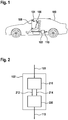
- Fig. 1 shows a schematic representation of a vehicle 100 with a device 102 according to one embodiment.
- the device 102 is coupled to an interior sensor 104 for detecting a viewing direction or a head posture of a driver 106, for example an (infrared) camera.
- the interior sensor 104 sends a driver information 108 representing the sighting or head posture to the apparatus 102 configured to use it to model an attention card representing an actual distribution of the driver 106's attention.
- the attention card for example, viewing directions that accumulate differently depending on the distribution of attention in different areas of an environment of the vehicle 100, mapped two-dimensionally in the manner of a heat map.
- the attention card is based here on a two-dimensional coordinate system, which, for example, reflects an attention-relevant area of the vehicle environment.
- the attention card is based on a two-dimensional spherical coordinate system for spherical replication of the vehicle environment.
- the device 102 is further configured to model regions of the vehicle environment that require increased driver attention in a corresponding attention demand map analogous to the attention map using the two-dimensional coordinate system.
- the modeling of the attention demand map is also done using the driver information 108, i. H. depending on a respective viewing direction or head posture of the driver 106 with respect to the vehicle environment.
- the attention demand map represents a target distribution of the attention of the driver 106.
- the device 102 To determine the visual distraction of the driver 106, the device 102 performs a comparison between the two cards, such as by means of
- the device 102 outputs a deflection value 110 representing the visual deflection.
- a deflection value 110 representing the visual deflection. This is used, for example, by a control device of the vehicle 100, in response to the visual distraction a warning for warning the driver 106 or, for example in the context of a partially or highly automated control of the vehicle 100, a drive signal for driving at least one actuator of the vehicle 100th , such as a steering or braking actuator to generate.
- Fig. 2 shows a schematic representation of a device 102 according to an embodiment, for example, a previously with reference to FIG Fig. 1 described device.
- the device 102 includes a modeling unit 210 that is configured to read the driver information 108 and use it to form the attention card. Further, the modeling unit 210 is configured to model the attention demand by forming the attention-getting map.
- the modeling unit 210 sends a first record 212 representing the attention card and a second record 214 representing the attention demand card to a comparison unit 220 configured to compare the two cards from each other using the two sets of data 212,214 and thus the driver's visual distraction determining deflection value 110.
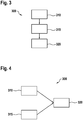
- FIG. 12 shows a flowchart of a method 300 according to one embodiment.
- the method 300 for determining a driver's visual distraction can be performed, for example, using a device as described above with reference to FIG Figures 1 and 2 is described.
- the driver's attention is modeled by forming the attention card.
- the modeling of the need for attention takes place by forming the attention demand map, for example in the form of a coldmap.
- the two maps are compared in step 320 to determine the distraction value representing the driver's visual distraction.
- FIG. 12 shows a flowchart of a method 300 according to one embodiment. Shown is a basic model for the detection of impermissible visual distraction. In this case, in step 310, the detection of a selective visual attention of the driver by modeling the attention card and in step 315, the detection of the attention needs from the environmental condition by modeling the attention needs map. Finally, in step 320, a distraction hypothesis is established by detecting impermissible deflection on the basis of a desired-actual comparison between the two maps.
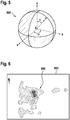
- Fig. 5 shows a schematic representation of a coordinate system 500 for use in a method according to an embodiment, such as a previously described with reference to FIGS. 1 to 4 described method. Shown is an example of a spherical coordinate system with the polar coordinates polar angle ⁇ and azimuth angle ⁇ for displaying attentional directions.
- So-called heat maps are used to model a state of attention of the driver and the need for attention from the environment.
- spherical coordinates are used to transform directions of attention into a two-dimensional map (polar angle ⁇ and azimuth angle ⁇ ). Accordingly, such a heatmap is completely writable using an n ⁇ m matrix.
- the need for attention is described with a coldmap that depicts a "negative heat”.
- the origin 0 of this heatmap should be at the center of a headbox, that is, in an area where the driver's head is usually located. Errors caused by the driver's head not being in this position can be neglected, since deviations of the head positions are small compared to the longitudinal distance to the viewed objects outside the vehicle. Accordingly, the heat and cold map are used only for objects outside the vehicle.
- these heat and cold maps are spanned on a sphere around the vehicle in order to be able to model the entire environment of the vehicle, for example with a value range for the polar angle ⁇ between minus 180 degrees and plus 180 degrees.
- the range of values for the azimuth angle ⁇ may be smaller, for example, between minus 60 degrees and plus 60 degrees, where 0 degrees corresponds to a horizontal.
- Fig. 6 shows a schematic representation of a attention card 600 according to an embodiment. Shown is an example of a heatmap as a attention card for the visualization of the attention distribution.
- the vehicle environment is merely exemplified by a rectangle 602 indicated. In this case, for example, map areas with different degrees of accumulation of viewing directions are shown in different colors.
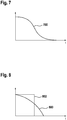
- FIG. 15 is a diagram illustrating an attention density function 700 for use in a method according to an embodiment such as that described above with reference to FIG FIGS. 1 to 6 described method.
- the attention density is shown as a function of an eccentricity angle ⁇ .
- a more detailed description of the attention density function 700 can be found in the following description.
- FIG. 15 is a diagram illustrating a weighting function 800, here an expiration function, for use in a method according to an embodiment, such as that described above with reference to FIG FIGS. 1 to 7 described method.
- the weighting function 800 is dependent on represented a time t and exemplifies a modeled memory of the driver. Furthermore, a standard time window 802, in which the direction of view or head position of the driver is processed by default, for example, with a window size of 5 seconds, located.
- the weighting function 800 is for taking into account a deterioration of looks after a certain time. A corresponding decay factor is described, for example, by a function as a function of the past time.
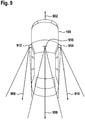
- Fig. 9 shows a schematic representation of a view distribution in a vehicle 100, such as a preceding with reference to Fig. 1 described vehicle.
- the vehicle 100 is shown in plan view, a direction of travel of the vehicle 100 is with a in Fig. 9 marked upwards arrow 902.
- Arrows 906, 908, 910 which are directed opposite to the direction of travel, symbolize in each case lines of sight of the driver when looking through a left exterior mirror 912, a right exterior mirror 914 and an interior mirror 916.
- Areas with more "cold” are areas to which the driver pays too little visual attention. This can also be called a positive attention gap. On the other hand, in areas with more "heat” the driver pays too much attention, also called a negative attention gap, which means distracting the driver.
- a warning function is triggered.
- a warning function is triggered.
- the driver is distracted, but also those areas to which he pays too much attention and those areas to which he pays too little attention.
- HMI functions such as LED treadmills, a direction-dependent display of sounds or vibrations.
- the driver's selective visual attention is detected by describing an accumulation of the viewing directions in a moving window.
- the window size is set to 5 seconds and describes the last 5 seconds.
- Various modular extensions are conceivable, each of which can increase the accuracy of the modeling. These will be described below by way of example.
- the eccentricity angle ⁇ is used concentrically with the driver's foveal axis.
- the attention density ie the "heat" density
- Fig. 8 the attention density function
- the temporal component of human memory is considered.
- glances expire after a certain period of time, for example corresponding to the window size mentioned above after 5 seconds.
- a decay function is introduced, with which past glances are multiplied according to their age.
- the rigid view is first recognized accordingly, for example on the basis of a saccade and fixation frequency.
- the accumulation of the gaze directions becomes the attention card, i. H. to the heatmap, so that no additional "heat” is taken into account for these periods. If this condition is maintained for a longer period of time, this results in an empty heat map - the driver does not pay any attention.
- mirror views into one of the existing exterior mirrors always apply to the vehicle surroundings, but usually to a rear area of the vehicle. Accordingly, according to one exemplary embodiment, mirror views are evaluated as rearward views and considered as such in the calculation of the attention card. For this reason, it is advantageous if the attention card is built around the entire vehicle, and not just around its front part.
- the need for attention from the vehicle environment is modeled depending on the information available about the vehicle environment.
- no information about the vehicle environment is available.
- a standard distribution is used for the attention demand card. This is optionally taking into account mirror and shoulder views of the driver.
- the attention demand card is adjusted according to the requirements as follows.
- a road type such as inner-city road, country road or motorway is available.
- the need for attention changes. For example, in urban areas a much wider distribution of attention is required than on highways.
- This is stored, for example, in standard attention demand cards for the respective environments. For example, the presence of infrastructure elements such as intersections or crosswalks in corresponding coldmaps is taken into account.
- Outdoor camera information can be used to know road characteristics.
- information such as the number of lanes, track position or curvature of the lanes, d. H. the presence of curves, provided. This information is used to adjust the attention card accordingly.
- positions and types of environment objects such as vehicles, pedestrians and other road users are available via corresponding environment model information, these, for example, are also used to adapt the Attention needs used.
- environment model information such as vehicles, pedestrians and other road users
- an evaluation of the criticality of the respective objects is additionally available.
- This information is now used to create additional "cold" at the appropriate places in the coldmap. This should correspond to the position and the criticality of the respective objects. The higher the criticality, the more coldness is generated.
- an exemplary embodiment comprises a "and / or" link between a first feature and a second feature, then this is to be read so that the embodiment according to one embodiment, both the first feature and the second feature and according to another embodiment either only first feature or only the second feature.
Landscapes
- Engineering & Computer Science (AREA)
- Physics & Mathematics (AREA)
- Transportation (AREA)
- Mechanical Engineering (AREA)
- Theoretical Computer Science (AREA)
- Mathematical Physics (AREA)
- General Physics & Mathematics (AREA)
- Multimedia (AREA)
- Automation & Control Theory (AREA)
- Health & Medical Sciences (AREA)
- General Health & Medical Sciences (AREA)
- Ophthalmology & Optometry (AREA)
- Human Computer Interaction (AREA)
- Chemical & Material Sciences (AREA)
- Combustion & Propulsion (AREA)
- Traffic Control Systems (AREA)
- Fittings On The Vehicle Exterior For Carrying Loads, And Devices For Holding Or Mounting Articles (AREA)
Applications Claiming Priority (1)
| Application Number | Priority Date | Filing Date | Title |
|---|---|---|---|
| DE102017202194.2A DE102017202194A1 (de) | 2017-02-13 | 2017-02-13 | Verfahren und Vorrichtung zum Ermitteln einer visuellen Ablenkung eines Fahrers eines Fahrzeugs |
Publications (2)
| Publication Number | Publication Date |
|---|---|
| EP3392111A1 true EP3392111A1 (fr) | 2018-10-24 |
| EP3392111B1 EP3392111B1 (fr) | 2024-07-10 |
Family
ID=61024569
Family Applications (1)
| Application Number | Title | Priority Date | Filing Date |
|---|---|---|---|
| EP18152094.1A Active EP3392111B1 (fr) | 2017-02-13 | 2018-01-17 | Procédé et dispositif de détermination d'une distraction visuelle d'un conducteur d'un véhicule |
Country Status (2)
| Country | Link |
|---|---|
| EP (1) | EP3392111B1 (fr) |
| DE (1) | DE102017202194A1 (fr) |
Cited By (3)
| Publication number | Priority date | Publication date | Assignee | Title |
|---|---|---|---|---|
| CN111400423A (zh) * | 2020-03-16 | 2020-07-10 | 郑州航空工业管理学院 | 基于多视图几何的智慧城市cim三维车辆位姿建模系统 |
| CN114923486A (zh) * | 2022-04-21 | 2022-08-19 | 厦门大学 | 一种基于全局环境图和注意力侧重的机器人导航方法 |
| CN118372834A (zh) * | 2024-04-29 | 2024-07-23 | 重庆赛力斯凤凰智创科技有限公司 | 驾驶员注意力监测方法、装置、设备和介质 |
Families Citing this family (8)
| Publication number | Priority date | Publication date | Assignee | Title |
|---|---|---|---|---|
| DE102019217609A1 (de) * | 2019-11-14 | 2021-05-20 | Volkswagen Aktiengesellschaft | Verfahren zur Überwachung und Unterstützung eines Fahrers in einem Fahrzeug, Überwachungssystem, Fahrzeug |
| DE102020110417A1 (de) * | 2020-04-16 | 2021-10-21 | Valeo Schalter Und Sensoren Gmbh | Verfahren und System zur Assistenz eines Fahrers |
| DE102020003018B4 (de) | 2020-05-19 | 2025-12-31 | Mercedes-Benz Group AG | Verfahren zur Ermittlung einer Reaktionsfähigkeit |
| DE102020214908B4 (de) | 2020-11-27 | 2024-01-04 | Volkswagen Aktiengesellschaft | Verfahren und Vorrichtung zur Überwachung der Blickrichtung eines Fahrers beim Führen eines Kraftfahrzeugs |
| DE102021202504A1 (de) | 2021-03-15 | 2022-09-15 | Robert Bosch Gesellschaft mit beschränkter Haftung | Verfahren zum Erkennen einer Unaufmerksamkeit eines Fahrers eines Fahrzeugs |
| DE102021208148A1 (de) | 2021-07-28 | 2023-02-02 | Robert Bosch Gesellschaft mit beschränkter Haftung | Verfahren zum Überwachen der Beobachtung einer Fahrsituation |
| DE102023200047A1 (de) * | 2023-01-03 | 2024-07-04 | Volkswagen Aktiengesellschaft | Verfahren zum Vorbereiten einer Person auf eine Verkehrssituation, die eine erhöhte Aufmerksamkeit der Person bedarf, mittels eines Unterstützungssystems eines Kraftfahrzeugs, Computerprogrammprodukt, computerlesbares Speichermedium sowie Unterstützungssystem |
| DE102023116400A1 (de) * | 2023-06-22 | 2024-12-24 | Bayerische Motoren Werke Aktiengesellschaft | Vorrichtung und Verfahren zum Betreiben eines Fahrzeugs |
Citations (5)
| Publication number | Priority date | Publication date | Assignee | Title |
|---|---|---|---|---|
| EP1484014A1 (fr) * | 2003-06-02 | 2004-12-08 | Delphi Technologies, Inc. | Procédé et dispositif de sensibilation à un objet |
| EP1961622A1 (fr) * | 2005-12-12 | 2008-08-27 | Matsushita Electric Industries Co., Ltd. | Dispositif d'assistance au voyage en securite |
| WO2011088344A2 (fr) * | 2010-01-14 | 2011-07-21 | Toyota Motor Engineering & Manufacturing North America, Inc. | Détections conducteur et environnement combinées pour systèmes de sécurité de véhicule |
| GB2500690A (en) * | 2012-03-30 | 2013-10-02 | Jaguar Cars | Driver monitoring and vehicle control system |
| EP2743117A1 (fr) * | 2012-12-17 | 2014-06-18 | State Farm Mutual Automobile Insurance Company | Système et procédé pour surveiller et réduire la déficience d'un opérateur de véhicule |
Family Cites Families (2)
| Publication number | Priority date | Publication date | Assignee | Title |
|---|---|---|---|---|
| JP4259587B2 (ja) | 2007-03-30 | 2009-04-30 | 株式会社デンソー | データベース装置、注意喚起装置及び運転支援装置 |
| DE102014201036A1 (de) | 2014-01-21 | 2015-07-23 | Bayerische Motoren Werke Aktiengesellschaft | Bildbasierte Klassifikation des Fahrerzustands und/oder des Fahrerverhaltens |
-
2017
- 2017-02-13 DE DE102017202194.2A patent/DE102017202194A1/de active Pending
-
2018
- 2018-01-17 EP EP18152094.1A patent/EP3392111B1/fr active Active
Patent Citations (5)
| Publication number | Priority date | Publication date | Assignee | Title |
|---|---|---|---|---|
| EP1484014A1 (fr) * | 2003-06-02 | 2004-12-08 | Delphi Technologies, Inc. | Procédé et dispositif de sensibilation à un objet |
| EP1961622A1 (fr) * | 2005-12-12 | 2008-08-27 | Matsushita Electric Industries Co., Ltd. | Dispositif d'assistance au voyage en securite |
| WO2011088344A2 (fr) * | 2010-01-14 | 2011-07-21 | Toyota Motor Engineering & Manufacturing North America, Inc. | Détections conducteur et environnement combinées pour systèmes de sécurité de véhicule |
| GB2500690A (en) * | 2012-03-30 | 2013-10-02 | Jaguar Cars | Driver monitoring and vehicle control system |
| EP2743117A1 (fr) * | 2012-12-17 | 2014-06-18 | State Farm Mutual Automobile Insurance Company | Système et procédé pour surveiller et réduire la déficience d'un opérateur de véhicule |
Cited By (4)
| Publication number | Priority date | Publication date | Assignee | Title |
|---|---|---|---|---|
| CN111400423A (zh) * | 2020-03-16 | 2020-07-10 | 郑州航空工业管理学院 | 基于多视图几何的智慧城市cim三维车辆位姿建模系统 |
| CN114923486A (zh) * | 2022-04-21 | 2022-08-19 | 厦门大学 | 一种基于全局环境图和注意力侧重的机器人导航方法 |
| CN114923486B (zh) * | 2022-04-21 | 2024-05-17 | 厦门大学 | 一种基于全局环境图和注意力侧重的机器人导航方法 |
| CN118372834A (zh) * | 2024-04-29 | 2024-07-23 | 重庆赛力斯凤凰智创科技有限公司 | 驾驶员注意力监测方法、装置、设备和介质 |
Also Published As
| Publication number | Publication date |
|---|---|
| DE102017202194A1 (de) | 2018-08-16 |
| EP3392111B1 (fr) | 2024-07-10 |
Similar Documents
| Publication | Publication Date | Title |
|---|---|---|
| EP3392111B1 (fr) | Procédé et dispositif de détermination d'une distraction visuelle d'un conducteur d'un véhicule | |
| EP3454013B1 (fr) | Procédé, dispositif et support d'enregistrement lisible par ordinateur pourvu d'instructions de commande d'un affichage d'un dispositif d'affichage à réalité augmentée pour un véhicule automobile | |
| DE102017107396B4 (de) | Testverfahren und Testvorrichtung für Fahrerassistenzsysteme | |
| DE602004007083T2 (de) | Fahreradaptives Kollisionswarnsystem | |
| DE102004057947B4 (de) | Verfahren zur Funktionsprüfung eines kraftfahrzeugseitig integrierten Fahrerassistenzsystems | |
| DE602004012962T2 (de) | Echtzeit-hinderniserkennung mit einer kalibrierten kamera und bekannter ego-bewegung | |
| EP3685123B1 (fr) | Procédé, dispositif et support de stockage lisible par ordinateur avec instructions pour commander l'affichage d'un dispositif d'affichage tête haute de réalité augmentée pour un véhicule automobile | |
| DE112019007195B4 (de) | Anzeigesteuerungseinrichtung, anzeigesteuerungsverfahren und anzeigesteuerungsprogramm | |
| DE112017005111T5 (de) | Bordanzeigesteuervorrichtung | |
| WO2021170421A1 (fr) | Procédé de fonctionnement de lunettes de données dans un véhicule automobile et système comprenant un véhicule automobile et des lunettes de données | |
| DE112017003916T5 (de) | Head-Up-Display-Vorrichtung, Anzeigesteuerverfahren und Steuerprogramm | |
| WO2007020153A1 (fr) | Procede de detection d'un espace de circulation | |
| DE102013205882A1 (de) | Verfahren und Vorrichtung zum Führen eines Fahrzeugs im Umfeld eines Objekts | |
| WO2014170278A1 (fr) | Procédé permettant de déterminer si un occupant d'un véhicule remarque un ou plusieurs objets d'intérêt dans l'environnement du véhicule | |
| WO2019057439A1 (fr) | Procédé, dispositif et support d'enregistrement lisible par ordinateur doté d'instructions de commande d'un dispositif d'affichage d'un dispositif d'affichage tête-haute à réalité augmentée pour un véhicule | |
| DE102016014712B4 (de) | Fahrzeug und Verfahren zur Ausgabe von Informationen an eine Fahrzeugumgebung | |
| WO2019233687A1 (fr) | Concept pour fournir des valeurs de correction pour l'affichage de contenus à réalité augmentée sur un affichage tête haute pour un véhicule automobile | |
| DE102017215163A1 (de) | System aus einem Kraftfahrzeug und einer Augmented-Reality-Brille und Verfahren zum Bestimmen einer Pose einer Augmented-Reality-Brille im Innenraum eines Fahrzeugs | |
| EP3361355A1 (fr) | Procédé, dispositif et support d'enregistrement lisible par ordinateur pourvu d'instructions de commande d'un écran d'affichage tête haute en réalité augmentée | |
| EP3707547B1 (fr) | Système et procédé de détermination d'une pose de lunettes de réalité augmentée, système et procédé d'étalonnage de lunettes de réalité augmentée, procédé pour assister à la détermination d'une pose de lunettes de réalité augmentée et véhicule adapté à la mise en oeuvre du procédé | |
| EP2888623B1 (fr) | Commande d'un affichage tête haute d'un véhicule et système de formation d'images pour l'affichage tête haute | |
| EP3966060A1 (fr) | Procédé de fonctionnement d'un véhicule automobile | |
| DE112014003725B4 (de) | Verfahren und System zur Feststellung von Fahrmerkmalen bei einem Fahrzeug | |
| DE102023122867A1 (de) | Verfahren und Vorrichtung zum Justieren einer Innenraumkamera für ein Outside-in Tracking einer Datenbrille | |
| DE102023113127A1 (de) | Verfahren zum Verringern des Auftretens von Reisekrankheit, Einrichtung zum Bereitstellen einer künstlichen Intelligenz sowie Kraftfahrzeug mit einer solchen |
Legal Events
| Date | Code | Title | Description |
|---|---|---|---|
| PUAI | Public reference made under article 153(3) epc to a published international application that has entered the european phase |
Free format text: ORIGINAL CODE: 0009012 |
|
| STAA | Information on the status of an ep patent application or granted ep patent |
Free format text: STATUS: THE APPLICATION HAS BEEN PUBLISHED |
|
| AK | Designated contracting states |
Kind code of ref document: A1 Designated state(s): AL AT BE BG CH CY CZ DE DK EE ES FI FR GB GR HR HU IE IS IT LI LT LU LV MC MK MT NL NO PL PT RO RS SE SI SK SM TR |
|
| AX | Request for extension of the european patent |
Extension state: BA ME |
|
| STAA | Information on the status of an ep patent application or granted ep patent |
Free format text: STATUS: REQUEST FOR EXAMINATION WAS MADE |
|
| 17P | Request for examination filed |
Effective date: 20190424 |
|
| RBV | Designated contracting states (corrected) |
Designated state(s): AL AT BE BG CH CY CZ DE DK EE ES FI FR GB GR HR HU IE IS IT LI LT LU LV MC MK MT NL NO PL PT RO RS SE SI SK SM TR |
|
| RAP1 | Party data changed (applicant data changed or rights of an application transferred) |
Owner name: ROBERT BOSCH GMBH |
|
| STAA | Information on the status of an ep patent application or granted ep patent |
Free format text: STATUS: EXAMINATION IS IN PROGRESS |
|
| 17Q | First examination report despatched |
Effective date: 20211202 |
|
| GRAP | Despatch of communication of intention to grant a patent |
Free format text: ORIGINAL CODE: EPIDOSNIGR1 |
|
| STAA | Information on the status of an ep patent application or granted ep patent |
Free format text: STATUS: GRANT OF PATENT IS INTENDED |
|
| RIC1 | Information provided on ipc code assigned before grant |
Ipc: B60W 40/08 20120101AFI20240229BHEP |
|
| INTG | Intention to grant announced |
Effective date: 20240319 |
|
| GRAS | Grant fee paid |
Free format text: ORIGINAL CODE: EPIDOSNIGR3 |
|
| GRAA | (expected) grant |
Free format text: ORIGINAL CODE: 0009210 |
|
| STAA | Information on the status of an ep patent application or granted ep patent |
Free format text: STATUS: THE PATENT HAS BEEN GRANTED |
|
| AK | Designated contracting states |
Kind code of ref document: B1 Designated state(s): AL AT BE BG CH CY CZ DE DK EE ES FI FR GB GR HR HU IE IS IT LI LT LU LV MC MK MT NL NO PL PT RO RS SE SI SK SM TR |
|
| REG | Reference to a national code |
Ref country code: CH Ref legal event code: EP |
|
| REG | Reference to a national code |
Ref country code: DE Ref legal event code: R096 Ref document number: 502018014831 Country of ref document: DE |
|
| REG | Reference to a national code |
Ref country code: LT Ref legal event code: MG9D |
|
| REG | Reference to a national code |
Ref country code: NL Ref legal event code: MP Effective date: 20240710 |
|
| PG25 | Lapsed in a contracting state [announced via postgrant information from national office to epo] |
Ref country code: PT Free format text: LAPSE BECAUSE OF FAILURE TO SUBMIT A TRANSLATION OF THE DESCRIPTION OR TO PAY THE FEE WITHIN THE PRESCRIBED TIME-LIMIT Effective date: 20241111 |
|
| PG25 | Lapsed in a contracting state [announced via postgrant information from national office to epo] |
Ref country code: NL Free format text: LAPSE BECAUSE OF FAILURE TO SUBMIT A TRANSLATION OF THE DESCRIPTION OR TO PAY THE FEE WITHIN THE PRESCRIBED TIME-LIMIT Effective date: 20240710 |
|
| PG25 | Lapsed in a contracting state [announced via postgrant information from national office to epo] |
Ref country code: PT Free format text: LAPSE BECAUSE OF FAILURE TO SUBMIT A TRANSLATION OF THE DESCRIPTION OR TO PAY THE FEE WITHIN THE PRESCRIBED TIME-LIMIT Effective date: 20241111 Ref country code: NL Free format text: LAPSE BECAUSE OF FAILURE TO SUBMIT A TRANSLATION OF THE DESCRIPTION OR TO PAY THE FEE WITHIN THE PRESCRIBED TIME-LIMIT Effective date: 20240710 |
|
| PG25 | Lapsed in a contracting state [announced via postgrant information from national office to epo] |
Ref country code: NO Free format text: LAPSE BECAUSE OF FAILURE TO SUBMIT A TRANSLATION OF THE DESCRIPTION OR TO PAY THE FEE WITHIN THE PRESCRIBED TIME-LIMIT Effective date: 20241010 |
|
| PG25 | Lapsed in a contracting state [announced via postgrant information from national office to epo] |
Ref country code: GR Free format text: LAPSE BECAUSE OF FAILURE TO SUBMIT A TRANSLATION OF THE DESCRIPTION OR TO PAY THE FEE WITHIN THE PRESCRIBED TIME-LIMIT Effective date: 20241011 Ref country code: FI Free format text: LAPSE BECAUSE OF FAILURE TO SUBMIT A TRANSLATION OF THE DESCRIPTION OR TO PAY THE FEE WITHIN THE PRESCRIBED TIME-LIMIT Effective date: 20240710 Ref country code: PL Free format text: LAPSE BECAUSE OF FAILURE TO SUBMIT A TRANSLATION OF THE DESCRIPTION OR TO PAY THE FEE WITHIN THE PRESCRIBED TIME-LIMIT Effective date: 20240710 |
|
| PG25 | Lapsed in a contracting state [announced via postgrant information from national office to epo] |
Ref country code: BG Free format text: LAPSE BECAUSE OF FAILURE TO SUBMIT A TRANSLATION OF THE DESCRIPTION OR TO PAY THE FEE WITHIN THE PRESCRIBED TIME-LIMIT Effective date: 20240710 |
|
| PG25 | Lapsed in a contracting state [announced via postgrant information from national office to epo] |
Ref country code: LV Free format text: LAPSE BECAUSE OF FAILURE TO SUBMIT A TRANSLATION OF THE DESCRIPTION OR TO PAY THE FEE WITHIN THE PRESCRIBED TIME-LIMIT Effective date: 20240710 |
|
| PG25 | Lapsed in a contracting state [announced via postgrant information from national office to epo] |
Ref country code: IS Free format text: LAPSE BECAUSE OF FAILURE TO SUBMIT A TRANSLATION OF THE DESCRIPTION OR TO PAY THE FEE WITHIN THE PRESCRIBED TIME-LIMIT Effective date: 20241110 |
|
| PG25 | Lapsed in a contracting state [announced via postgrant information from national office to epo] |
Ref country code: HR Free format text: LAPSE BECAUSE OF FAILURE TO SUBMIT A TRANSLATION OF THE DESCRIPTION OR TO PAY THE FEE WITHIN THE PRESCRIBED TIME-LIMIT Effective date: 20240710 |
|
| PG25 | Lapsed in a contracting state [announced via postgrant information from national office to epo] |
Ref country code: ES Free format text: LAPSE BECAUSE OF FAILURE TO SUBMIT A TRANSLATION OF THE DESCRIPTION OR TO PAY THE FEE WITHIN THE PRESCRIBED TIME-LIMIT Effective date: 20240710 Ref country code: RS Free format text: LAPSE BECAUSE OF FAILURE TO SUBMIT A TRANSLATION OF THE DESCRIPTION OR TO PAY THE FEE WITHIN THE PRESCRIBED TIME-LIMIT Effective date: 20241010 |
|
| PG25 | Lapsed in a contracting state [announced via postgrant information from national office to epo] |
Ref country code: RS Free format text: LAPSE BECAUSE OF FAILURE TO SUBMIT A TRANSLATION OF THE DESCRIPTION OR TO PAY THE FEE WITHIN THE PRESCRIBED TIME-LIMIT Effective date: 20241010 Ref country code: PL Free format text: LAPSE BECAUSE OF FAILURE TO SUBMIT A TRANSLATION OF THE DESCRIPTION OR TO PAY THE FEE WITHIN THE PRESCRIBED TIME-LIMIT Effective date: 20240710 Ref country code: NO Free format text: LAPSE BECAUSE OF FAILURE TO SUBMIT A TRANSLATION OF THE DESCRIPTION OR TO PAY THE FEE WITHIN THE PRESCRIBED TIME-LIMIT Effective date: 20241010 Ref country code: LV Free format text: LAPSE BECAUSE OF FAILURE TO SUBMIT A TRANSLATION OF THE DESCRIPTION OR TO PAY THE FEE WITHIN THE PRESCRIBED TIME-LIMIT Effective date: 20240710 Ref country code: IS Free format text: LAPSE BECAUSE OF FAILURE TO SUBMIT A TRANSLATION OF THE DESCRIPTION OR TO PAY THE FEE WITHIN THE PRESCRIBED TIME-LIMIT Effective date: 20241110 Ref country code: HR Free format text: LAPSE BECAUSE OF FAILURE TO SUBMIT A TRANSLATION OF THE DESCRIPTION OR TO PAY THE FEE WITHIN THE PRESCRIBED TIME-LIMIT Effective date: 20240710 Ref country code: GR Free format text: LAPSE BECAUSE OF FAILURE TO SUBMIT A TRANSLATION OF THE DESCRIPTION OR TO PAY THE FEE WITHIN THE PRESCRIBED TIME-LIMIT Effective date: 20241011 Ref country code: FI Free format text: LAPSE BECAUSE OF FAILURE TO SUBMIT A TRANSLATION OF THE DESCRIPTION OR TO PAY THE FEE WITHIN THE PRESCRIBED TIME-LIMIT Effective date: 20240710 Ref country code: ES Free format text: LAPSE BECAUSE OF FAILURE TO SUBMIT A TRANSLATION OF THE DESCRIPTION OR TO PAY THE FEE WITHIN THE PRESCRIBED TIME-LIMIT Effective date: 20240710 Ref country code: BG Free format text: LAPSE BECAUSE OF FAILURE TO SUBMIT A TRANSLATION OF THE DESCRIPTION OR TO PAY THE FEE WITHIN THE PRESCRIBED TIME-LIMIT Effective date: 20240710 |
|
| REG | Reference to a national code |
Ref country code: DE Ref legal event code: R097 Ref document number: 502018014831 Country of ref document: DE |
|
| PG25 | Lapsed in a contracting state [announced via postgrant information from national office to epo] |
Ref country code: SM Free format text: LAPSE BECAUSE OF FAILURE TO SUBMIT A TRANSLATION OF THE DESCRIPTION OR TO PAY THE FEE WITHIN THE PRESCRIBED TIME-LIMIT Effective date: 20240710 Ref country code: DK Free format text: LAPSE BECAUSE OF FAILURE TO SUBMIT A TRANSLATION OF THE DESCRIPTION OR TO PAY THE FEE WITHIN THE PRESCRIBED TIME-LIMIT Effective date: 20240710 Ref country code: RO Free format text: LAPSE BECAUSE OF FAILURE TO SUBMIT A TRANSLATION OF THE DESCRIPTION OR TO PAY THE FEE WITHIN THE PRESCRIBED TIME-LIMIT Effective date: 20240710 |
|
| PG25 | Lapsed in a contracting state [announced via postgrant information from national office to epo] |
Ref country code: EE Free format text: LAPSE BECAUSE OF FAILURE TO SUBMIT A TRANSLATION OF THE DESCRIPTION OR TO PAY THE FEE WITHIN THE PRESCRIBED TIME-LIMIT Effective date: 20240710 |
|
| PG25 | Lapsed in a contracting state [announced via postgrant information from national office to epo] |
Ref country code: CZ Free format text: LAPSE BECAUSE OF FAILURE TO SUBMIT A TRANSLATION OF THE DESCRIPTION OR TO PAY THE FEE WITHIN THE PRESCRIBED TIME-LIMIT Effective date: 20240710 |
|
| PG25 | Lapsed in a contracting state [announced via postgrant information from national office to epo] |
Ref country code: IT Free format text: LAPSE BECAUSE OF FAILURE TO SUBMIT A TRANSLATION OF THE DESCRIPTION OR TO PAY THE FEE WITHIN THE PRESCRIBED TIME-LIMIT Effective date: 20240710 Ref country code: SK Free format text: LAPSE BECAUSE OF FAILURE TO SUBMIT A TRANSLATION OF THE DESCRIPTION OR TO PAY THE FEE WITHIN THE PRESCRIBED TIME-LIMIT Effective date: 20240710 |
|
| PLBE | No opposition filed within time limit |
Free format text: ORIGINAL CODE: 0009261 |
|
| STAA | Information on the status of an ep patent application or granted ep patent |
Free format text: STATUS: NO OPPOSITION FILED WITHIN TIME LIMIT |
|
| 26N | No opposition filed |
Effective date: 20250411 |
|
| REG | Reference to a national code |
Ref country code: CH Ref legal event code: PL |
|
| PG25 | Lapsed in a contracting state [announced via postgrant information from national office to epo] |
Ref country code: SE Free format text: LAPSE BECAUSE OF FAILURE TO SUBMIT A TRANSLATION OF THE DESCRIPTION OR TO PAY THE FEE WITHIN THE PRESCRIBED TIME-LIMIT Effective date: 20240710 |
|
| PG25 | Lapsed in a contracting state [announced via postgrant information from national office to epo] |
Ref country code: LU Free format text: LAPSE BECAUSE OF NON-PAYMENT OF DUE FEES Effective date: 20250117 Ref country code: MC Free format text: LAPSE BECAUSE OF FAILURE TO SUBMIT A TRANSLATION OF THE DESCRIPTION OR TO PAY THE FEE WITHIN THE PRESCRIBED TIME-LIMIT Effective date: 20240710 |
|
| GBPC | Gb: european patent ceased through non-payment of renewal fee |
Effective date: 20250117 |
|
| PG25 | Lapsed in a contracting state [announced via postgrant information from national office to epo] |
Ref country code: GB Free format text: LAPSE BECAUSE OF NON-PAYMENT OF DUE FEES Effective date: 20250117 Ref country code: BE Free format text: LAPSE BECAUSE OF NON-PAYMENT OF DUE FEES Effective date: 20250131 |
|
| PG25 | Lapsed in a contracting state [announced via postgrant information from national office to epo] |
Ref country code: CH Free format text: LAPSE BECAUSE OF NON-PAYMENT OF DUE FEES Effective date: 20250131 |
|
| REG | Reference to a national code |
Ref country code: BE Ref legal event code: MM Effective date: 20250131 |
|
| PG25 | Lapsed in a contracting state [announced via postgrant information from national office to epo] |
Ref country code: IE Free format text: LAPSE BECAUSE OF NON-PAYMENT OF DUE FEES Effective date: 20250117 |
|
| REG | Reference to a national code |
Ref country code: AT Ref legal event code: MM01 Ref document number: 1701814 Country of ref document: AT Kind code of ref document: T Effective date: 20250117 |
|
| PGFP | Annual fee paid to national office [announced via postgrant information from national office to epo] |
Ref country code: DE Payment date: 20260319 Year of fee payment: 9 |
|
| PG25 | Lapsed in a contracting state [announced via postgrant information from national office to epo] |
Ref country code: AT Free format text: LAPSE BECAUSE OF NON-PAYMENT OF DUE FEES Effective date: 20250117 |
|
| PGFP | Annual fee paid to national office [announced via postgrant information from national office to epo] |
Ref country code: FR Payment date: 20260127 Year of fee payment: 9 |
|
| PG25 | Lapsed in a contracting state [announced via postgrant information from national office to epo] |
Ref country code: CY Free format text: LAPSE BECAUSE OF FAILURE TO SUBMIT A TRANSLATION OF THE DESCRIPTION OR TO PAY THE FEE WITHIN THE PRESCRIBED TIME-LIMIT Effective date: 20240710 |
|
| PG25 | Lapsed in a contracting state [announced via postgrant information from national office to epo] |
Ref country code: TR Free format text: LAPSE BECAUSE OF FAILURE TO SUBMIT A TRANSLATION OF THE DESCRIPTION OR TO PAY THE FEE WITHIN THE PRESCRIBED TIME-LIMIT Effective date: 20240710 |
|
| PG25 | Lapsed in a contracting state [announced via postgrant information from national office to epo] |
Ref country code: LT Free format text: LAPSE BECAUSE OF FAILURE TO SUBMIT A TRANSLATION OF THE DESCRIPTION OR TO PAY THE FEE WITHIN THE PRESCRIBED TIME-LIMIT Effective date: 20240710 |