EP3392189B1 - Procédé et appareil de commande de blocage de porte d'ascenseur - Google Patents
Procédé et appareil de commande de blocage de porte d'ascenseur Download PDFInfo
- Publication number
- EP3392189B1 EP3392189B1 EP18165686.9A EP18165686A EP3392189B1 EP 3392189 B1 EP3392189 B1 EP 3392189B1 EP 18165686 A EP18165686 A EP 18165686A EP 3392189 B1 EP3392189 B1 EP 3392189B1
- Authority
- EP
- European Patent Office
- Prior art keywords
- door
- count
- stall
- threshold level
- determined
- Prior art date
- Legal status (The legal status is an assumption and is not a legal conclusion. Google has not performed a legal analysis and makes no representation as to the accuracy of the status listed.)
- Not-in-force
Links
Images


Classifications
-
- B—PERFORMING OPERATIONS; TRANSPORTING
- B66—HOISTING; LIFTING; HAULING
- B66B—ELEVATORS; ESCALATORS OR MOVING WALKWAYS
- B66B13/00—Doors, gates, or other apparatus controlling access to, or exit from, cages or lift well landings
- B66B13/02—Door or gate operation
- B66B13/14—Control systems or devices
- B66B13/143—Control systems or devices electrical
- B66B13/146—Control systems or devices electrical method or algorithm for controlling doors
-
- B—PERFORMING OPERATIONS; TRANSPORTING
- B66—HOISTING; LIFTING; HAULING
- B66B—ELEVATORS; ESCALATORS OR MOVING WALKWAYS
- B66B5/00—Applications of checking, fault-correcting, or safety devices in elevators
-
- B—PERFORMING OPERATIONS; TRANSPORTING
- B66—HOISTING; LIFTING; HAULING
- B66B—ELEVATORS; ESCALATORS OR MOVING WALKWAYS
- B66B5/00—Applications of checking, fault-correcting, or safety devices in elevators
- B66B5/02—Applications of checking, fault-correcting, or safety devices in elevators responsive to abnormal operating conditions
Definitions
- the present disclosure relates to a motion control of an elevator door, and more particularly, to an elevator door stall control.
- An elevator door performs an opening or closing motion on a platform of a floor where the elevator is supposed to be stopped, during which passengers may get on or off the elevator.
- An exceptional motion of an elevator door signifies a motion of an elevator door that does not conform to a door movement speed command of a door controller when the elevator door is opening or closing.
- a door stall has been known as one of the exceptional motions of an elevator door.
- the door stall may signify a state in which a door stands still or moves at a remarkable slow speed compared to a normal movement speed, not conforming to the speed or position command given by the door controller.
- the door stall is an exceptional motion of an elevator door caused by passengers or an elevator installation state such as mechanical friction between a door and a door sill. When door stall is detected, it is regarded as passenger touch or blockage, the applied force should be controlled to prevent blocking passenger damage or door mechanical damage.
- US 4,342,378 discloses a velocity/stall subroutine to determine whether the door control should dictate a stall current to the door, such as when the door is being nudged against a blockage.
- the door stall threshold level is a maximum threshold value of the negligible occurrence of exceptional motions of a door, which may be previously set at a production stage of the elevator door system or to a value considering the opening width of a door, door mass, and installation conditions at the site after installation and before operation of an elevator.
- an elevator door stall control method which can automatically detect a door stall threshold level suitable for the elevator installation state and accordingly handle a door stall, is demanded.
- the present disclosure is directed to a method and apparatus for stall control of an elevator door.
- a method to update a stall threshold level of an elevator door to control a door stall occurrence during opening or closing of the elevator door the method being defined by claim 1.
- the exceptional motion count is determined with respect to at least one preset position or position range on a pathway of the door.
- the exceptional motion count is determined by summing a first weighted count and a second weighted count that are determined by applying a weight to each of the first count and the second count.
- each of the minimum acceptable speed and the maximum acceptable acceleration is determined based on at least one of a position on a pathway of the door and a movement speed profile of the door.
- the door is determined to be stalled when the determined exceptional motion count is greater than or equal to the preset stall threshold level.
- a current position of the door is determined to be a stall position, and a value obtained by increasing the preset stall threshold level by a predetermined increment is re-determined as a stall threshold level with respect to the stall position.
- the stall threshold level is set to be a different value according to each position on the pathway of the door on a platform.
- the stall threshold level is set to be a different value according to each floor that the elevator is stopped.
- the method is automatically started according to whether the preset stall threshold level of the door is updated or manually started by an external command.
- a method of controlling a stall of an elevator door occurring during opening or closing of the elevator door comprising, determining an exceptional motion count of a door based on at least one of a speed and an acceleration of the door, determining whether the door is stalled, based on a determined exceptional motion count of the door and a preset stall threshold level of the door, and selecting a subsequent motion of the door according to the determination of whether the door is stalled, wherein, in the selecting of the subsequent motion, when the door approaches a stall position, at least one of a first motion of tuning a motion of the door and a second motion of increasing a determined stall threshold level by a predetermined increment is selected as the subsequent motion of the door.
- the motion of the door is tuned based on a change in at least one of a speed, a position, and a torque for operating the door.
- an apparatus for controlling a stall of an elevator door occurring during opening or closing of the elevator door the apparatus being defined by claim 10.
- the controller when the door approaches a predetermined stall position, the controller performs applying a subsequent motion control command to the actuator.
- the actuator tunes a motion of the door based on a change in at least one of a speed, a position, and a torque for operating the door.
- FIG. 1 schematically illustrates an elevator door system 100 according to an embodiment of the present disclosure.
- the elevator door system 100 may include a car door 110 installed on an elevator car moving along a hoistway and a landing door 140 installed on a platform of each floor where passengers get on the elevator car.
- a door controller 160 drives a motor 120 installed at the car door 110 to first open the car door 110 and then open a landing door 140 after unlocking a landing door lock device 150 by using a coupler 130 attached to the car door 110.
- a landing door 140 that is mechanically coupled with the car door 110 is opened, an elevator door opens and thus passengers may get on or off.
- the door controller 160 drives the motor 120 to close the car door 110 and thus the landing door 140 mechanically coupled with the car door 110 is closed together. Accordingly, the elevator door is in a closed state.
- the door controller 160 has at least one stored motion parameter related to a motion of the elevator door and controls the motion of the elevator door according to the motion parameters.
- the motion parameters may include, for example, static parameters such as an opening width of a door, and a door mass, and other parameters such as a door speed, a door acceleration, a door stall position, a door stall level, and a count or threshold value related to various motions.
- the door controller 160 controls a door motion by a feedback control mechanism based on a value of at least one motion parameter.
- the door controller 160 calculates a door speed command and a position command from the at least one motion parameter and controls the motor 120 to operate the door to follow a speed and a position instructed by the calculated speed command and position command, and receives a value of an encoder connected to the motor 120 and detects actual speed and position of the door.
- the door controller 160 calculates the speed command and the position command based on the actual speed and position of the door received from the encoder, and transmits the calculated commands to the motor 120. Accordingly, the motor 120 is driven at an updated speed and to an updated position and thus the elevator door is actually opened or closed.
- the door controller 160 In the control process of a door motion, when an exceptional motion of the door is detected, the door controller 160 increases a value of at least one motion parameter such that an exceptional motion count, and when the exceptional motion count exceeds a preset stall threshold level, the door controller 160 determines that the door is stalled.
- the stall threshold level may denote the maximum value of the exceptional motion count that may be negligible in the door control process.
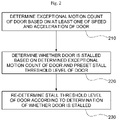
- FIG. 2 is a flowchart for explaining a method of updating a door stall threshold level, according to an embodiment of the present disclosure.
- a controller 520 illustrated in FIG. 5 may determine an exceptional motion count of a door based on at least one of the speed and acceleration of the door (210).
- the exceptional motion count may be determined with respect to at least one preset position on a pathway of the door.
- the preset position based on which the exceptional motion count is determined may be, for example, all positions on the pathway of the door, a position spaced apart at a certain interval, a random position, a position determined according to a door speed profile, or a stall position, but the present disclosure is not limited thereto.
- the controller 520 may determine an exceptional motion count of the door based on at least one of the speed and acceleration of a door detected by a detector 510 of FIG. 5 .
- the detected speed of a door may be determined by a movement distance of the door for a specific time
- the detected acceleration of a door may be determined by a change in the speed of the door for a specific time.
- Each of the amounts of the specific time for determining the speed of a door and the specific time for determining the acceleration of a door may be set to a predetermined value, or may be dynamically set based on at least one of, for example, the position, speed, and acceleration of a door and the distance from a current position to the stall position.
- the exceptional motion count may be determined by increasing a current value of the exceptional motion count by a predetermined increment based on at least one of the detected speed and acceleration of a door.
- the predetermined increment may be an integer greater than or equal to 1.
- the predetermined increment may be weighted based on at least one of the detected speed and acceleration of a door.
- the exceptional motion count may be determined by decreasing the current value of the exceptional motion count by a predetermined decrement based on at least one of the speed and acceleration of a door.
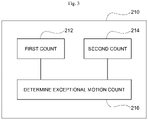
- FIG. 3 is a block diagram showing an operation of determining an exceptional motion count of a door, according to an embodiment of the present disclosure.
- the controller 520 increases a first count A 212 when the speed of a door is less than a minimum acceptable speed.
- the controller 520 increases a second count B 214 when the acceleration of a door is greater than maximum acceptable acceleration.
- B Second Count if ⁇ v velocity ⁇ t time > Maximum Acceptable Acceleration
- the controller 520 determines an exceptional motion count based on at least one of the first count A and the second count B (216).
- an exceptional motion count C may be determined by producing a first weighted count and a second weighted count by applying weights ⁇ and ⁇ to the first count A and the second count B, respectively, and summing the first weighted count and the second weighted count.
- Exceptional Motion Count c ⁇ ⁇ A + ⁇ ⁇ B
- each of the weights ⁇ and ⁇ may be set by a predetermined value or may be dynamically set based on at least one of, for example, the position, speed, and acceleration of a door and the distance from a current position to a stall position.
- the minimum acceptable speed and the maximum acceptable acceleration usable for determining the first count A and the second count B may be determined based on at least one of a position on the pathway of a door and a movement speed profile of a door.
- the controller 520 determines whether the door is stalled based on the determined exceptional motion count of a door and the preset stall threshold level of a door (220).
- the controller 520 may determine that the door is stalled when the determined exceptional motion count of a door is greater than or equal to the preset stall threshold level of a door. In other words, when the exceptional motion count of a door is less than the preset stall threshold level of a door, the controller 520 may determine that the exceptional motion is a negligible exceptional motion.
- the preset stall threshold level of a door may be set to a default value, a value of a stall threshold level determined and updated in a preceding door stall threshold level update process in the controller 520, or a value appropriate to each position of a door at which the speed or acceleration of a door changes over a speed profile of a door.
- the controller 520 re-determines the stall threshold level of a door according to the determination of whether the door is stalled (230).
- the controller 520 may determine in the operation 230 that a current position of a door to be a stall position. In an embodiment, the controller 520 may re-determine a value obtained by increasing the door stall threshold level preset in the operation 230 by a predetermined increment to be a stall threshold level with respect to the determined stall position.
- the predetermined increment may be an integer greater than or equal to 1.
- the predetermined increment may be weighted based on at least one of the detected speed and acceleration of a door.
- increasing the preset door stall threshold level by the predetermined increment may signify an increase of tolerance with respect to the exceptional motion of a door at the stall position when the door is opened or closed after the stall threshold level is updated. Accordingly, the door stall due to an elevator installation state repeatedly occurring at the same position may not be considered as a door stall needing addressing.
- the stall threshold level of a door may be set to be a different value according to each position on the pathway of a door on a platform. In an embodiment, the stall threshold level of a door may be set to be a different value according to a floor where the elevator is supposed to be stopped. Accordingly, the stall threshold level may be automatically set according to each floor and each position on the pathway of a door, and the stall threshold level may be differently set for each position and each floor according to the installation state of an elevator.
- the controller 520 may store the determined stall position and a stall threshold level for the determined stall position.
- the determined stall position and stall threshold level may be transferred to an elevator worker, an operator, or a maintenance service company to be used as a guideline for checking an elevator installation state.
- the operations 210 to 230 may be automatically started according to whether the predetermined stall threshold level of a door is updated or may be manually started by an external command.
- the controller 520 may store information about whether the stall threshold level of a door is updated, and may use the information as a value indicating whether the predetermined stall threshold level of a door is updated.
- the controller 520 may store the value indicating that the update of the stall threshold level of a door is completed.
- the value indicating whether the predetermined stall threshold level of a door is updated may be determined by whether the stall position of a door is determined or by whether the door is in a factory initialization state.
- the external command may be transferred to the controller 520 via an external device capable of communicating with the controller 520.
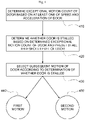
- FIG. 4 is a flowchart of a method of controlling an elevator door stall, according to an embodiment of the present disclosure.
- the controller 520 determines an exceptional motion count of a door based on at least one of the speed and acceleration of a door by the same process as the operation 210 of FIG. 2 (410). The controller 520 determines whether the door is stalled based on the determined exceptional motion count of a door and the preset stall threshold level of a door by the same process as the operation 220 of FIG. 2 (420).
- the controller 520 may select a subsequent motion of a door according to the determination of whether the door is stalled (430). When the door is determined to be stalled, the controller 520 may select at least one of a first motion 440 of tuning the motion of a door when the door approaches a stall position and a second motion 450 of increasing the determined stall threshold level by a predetermined increment as the subsequent motion of the door.
- the first motion 440 may control the door stall by tuning the door motion based on a change in at least one of a speed, a position, and a torque for operating the door.
- the at least one of the speed, position, and torque of a door may be controlled by a proportional, integral, and derivative gains control (PID).
- PID proportional, integral, and derivative gains control
- the first motion 440 may perform smooth opening/closing of a door to overcome the door stall due to an elevator installation state repeatedly occurring at the same position, by increasing current for operating the door, following late a target position, or increasing torque applied to the motor 120.
- the predetermined increment may be an integer greater than or equal to 1.
- the predetermined increment may be weighted based on at least one of the detected speed and acceleration of a door.
- the increasing the preset door stall threshold level by the predetermined increment may signify an increase of tolerance with respect to the exceptional motion of a door at the stall position when the door is opened or closed. Accordingly, the door stall due to an elevator installation state repeatedly occurring at the same position may not be considered as a door stall which should be handled by this logic.
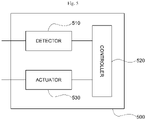
- FIG. 5 is a block diagram of an apparatus 500 for controlling stall of an elevator door, according to an embodiment of the present disclosure.
- the door stall control apparatus 500 includes the detector 510 for detecting a speed and an acceleration of a door.
- the detector 510 may detect a position and a speed of a door on a pathway according to time, and may calculate an acceleration of a door therefrom.
- the detector 510 may detect other dynamic motion parameters of the door.
- the door stall control apparatus 500 includes the controller 520.
- the controller 520 determines an exceptional motion count of a door based on at least one of the speed and acceleration of a door, and determines whether the door is stalled, based on the determined exceptional motion count of a door and the preset stall threshold level of a door.
- the door stall control apparatus 500 further includes an actuator 530 for moving the door according to a door movement speed command by the controller 520.
- the controller 520 may perform at least one of applying an increased movement speed command to the actuator 530 and resetting the stall threshold level such that the stall threshold level with respect to the stall position is increased by the predetermined increment.
- the actuator 530 may include a motor for driving the door.
- the actuator 530 may increase at least one of the current applied to the motor and the torque driving the motor.
- the door stall control apparatus 500 configured as above according to the present embodiment may overcome the door stall due to the elevator installation state repeatedly occurring at the same position.
- FIG. 6 is a graph showing a door stall position and a counter motion thereto with a door speed command and a detected position according to time, according to an embodiment of the present disclosure.
- the actuator 530 moves a door according to a door speed command given by the controller 520.
- the movement of the door is detected by the detector 510 as the position of a door (detected position).
- the controller 520 may instruct at least one operation of steps 1, 2 and 3 for door stall control.
- the step 1 may correspond to the first motion 440 of tuning the motion of a door based on a change in at least one of the speed and position for operating the door
- the step 2 may correspond to the second motion 450 of increasing the determined stall threshold level by a predetermined increment
- the step 3 may correspond to the first motion 440 of increasing the speed of a door by increasing the amount of torque applied to the motor for operating the door.
- the order of the steps may be changed as necessary.
Landscapes
- Engineering & Computer Science (AREA)
- Automation & Control Theory (AREA)
- Elevator Door Apparatuses (AREA)
Claims (12)
- Procédé de mise à jour d'un niveau de seuil de blocage d'une porte d'ascenseur pour commander un blocage de porte se produisant durant une ouverture ou une fermeture de la porte d'ascenseur, le procédé comprenant :la détermination d'un compte de mouvements exceptionnels d'une porte sur la base d'au moins l'une d'une vitesse et une accélération de la porte (210) ;dans lequel la détermination du compte de mouvements exceptionnels (210) comprend :si la vitesse de la porte est inférieure à une vitesse acceptable minimale, l'augmentation d'un premier compte (212) ; etsi l'accélération de la porte est supérieure à une accélération acceptable maximale, l'augmentation d'un second compte (214) ;dans lequel le compte de mouvements exceptionnels est déterminé (216) sur la base d'au moins l'un du premier compte et du second compte ; et caractérisé par :le fait de déterminer si la porte est bloquée, sur la base d'un compte de mouvements exceptionnels déterminé de la porte et d'un niveau de seuil de blocage prédéfini de la porte (220) ; etle fait de redéterminer le niveau de seuil de blocage de la porte conformément au fait de déterminer si la porte est bloquée (230).
- Procédé selon la revendication 1, dans lequel, dans la détermination du compte de mouvements exceptionnels, le compte de mouvements exceptionnels est déterminé en ce qui concerne au moins une position prédéfinie sur un chemin de la porte.
- Procédé selon la revendication 1 ou 2, dans lequel le compte de mouvements exceptionnels est déterminé en additionnant un premier compte pondéré et un second compte pondéré qui sont déterminés en appliquant un poids à chacun du premier compte et du second compte.
- Procédé selon une quelconque revendication précédente, dans lequel chacune de la vitesse acceptable minimale et de l'accélération acceptable maximale est déterminée sur la base d'au moins l'un d'une position sur un chemin de la porte et un profil de vitesse de mouvement de la porte.
- Procédé selon une quelconque revendication précédente, dans lequel, dans le fait de déterminer si la porte est bloquée, la porte est déterminée comme étant bloquée lorsque le compte de mouvements exceptionnels déterminé est supérieur ou égal au niveau de seuil de blocage prédéfini.
- Procédé selon une quelconque revendication précédente, dans lequel, dans la redétermination du niveau de seuil de blocage, une position courante de la porte est déterminée comme étant une position de blocage, et
une valeur obtenue en augmentant le niveau de seuil de blocage prédéfini d'un incrément prédéterminé est redéterminée comme étant un niveau de seuil de blocage en ce qui concerne la position de blocage. - Procédé selon une quelconque revendication précédente, dans lequel le niveau de seuil de blocage est défini pour être une valeur différente conformément à chaque position sur le chemin de la porte sur une plateforme.
- Procédé selon une quelconque revendication précédente, dans lequel le niveau de seuil de blocage est défini pour être une valeur différente conformément à chaque étage où l'ascenseur est arrêté.
- Procédé selon une quelconque revendication précédente, qui est lancé automatiquement suivant si le niveau de seuil de blocage prédéfini de la porte est mis à jour ou lancé manuellement par un ordre externe.
- Appareil permettant de commander un blocage d'une porte d'ascenseur se produisant durant une ouverture ou une fermeture de la porte d'ascenseur, l'appareil (500) comprenant :un détecteur (510) conçu pour détecter une vitesse et une accélération d'une porte ;un dispositif de commande (520) conçu pour déterminer un compte de mouvements exceptionnels de la porte sur la base d'au moins l'une de la vitesse et de l'accélération de la porte ; dans lequel la détermination du compte de mouvements exceptionnels comprend :si la vitesse de la porte est inférieure à une vitesse acceptable minimale, l'augmentation d'un premier compte ; etsi l'accélération de la porte est supérieure à une accélération acceptable maximale, l'augmentation d'un second compte ;dans lequel le compte de mouvements exceptionnels est déterminé sur la base d'au moins l'un du premier compte et du second compte ; etun actionneur (530) conçu pour déplacer la porte conformément à un ordre de commande de mouvement par le dispositif de commande,caractérisé en ce que : le dispositif de commande (520) est en outre conçu pour déterminer si la porte est bloquée, sur la base d'un compte de mouvements exceptionnels déterminé de la porte et d'un niveau de seuil de blocage prédéfini de la porte ; etdans lequel, lorsque la porte approche d'une position de blocage prédéterminée, le dispositif de commande (520) réalise une redétermination du niveau de seuil de blocage de sorte que le niveau de seuil de blocage en ce qui concerne la position de blocage augmente d'un incrément prédéterminé.
- Appareil selon la revendication 10, dans lequel, lorsque la porte approche d'une position de blocage prédéterminée, le dispositif de commande réalise une application d'un ordre de commande de mouvement ultérieur sur l'actionneur.
- Appareil selon la revendication 11, dans lequel, lors de la réception de l'ordre de commande de mouvement ultérieur, l'actionneur règle un mouvement de la porte sur la base d'un changement dans au moins l'un d'une vitesse, une position et un couple permettant de faire fonctionner la porte.
Applications Claiming Priority (1)
| Application Number | Priority Date | Filing Date | Title |
|---|---|---|---|
| US15/478,482 US10280042B2 (en) | 2017-04-04 | 2017-04-04 | Method and apparatus for stall control of elevator door |
Publications (2)
| Publication Number | Publication Date |
|---|---|
| EP3392189A1 EP3392189A1 (fr) | 2018-10-24 |
| EP3392189B1 true EP3392189B1 (fr) | 2022-03-30 |
Family
ID=61906666
Family Applications (1)
| Application Number | Title | Priority Date | Filing Date |
|---|---|---|---|
| EP18165686.9A Not-in-force EP3392189B1 (fr) | 2017-04-04 | 2018-04-04 | Procédé et appareil de commande de blocage de porte d'ascenseur |
Country Status (3)
| Country | Link |
|---|---|
| US (1) | US10280042B2 (fr) |
| EP (1) | EP3392189B1 (fr) |
| CN (1) | CN108689287B (fr) |
Families Citing this family (2)
| Publication number | Priority date | Publication date | Assignee | Title |
|---|---|---|---|---|
| JP7141369B2 (ja) * | 2019-08-09 | 2022-09-22 | 株式会社日立ビルシステム | エレベータードア監視装置及びエレベータードア監視システム |
| CN116812702A (zh) * | 2023-07-31 | 2023-09-29 | 杭州优迈科技有限公司 | 电梯门机控制方法、装置、系统和计算机设备 |
Family Cites Families (23)
| Publication number | Priority date | Publication date | Assignee | Title |
|---|---|---|---|---|
| US4299308A (en) * | 1979-12-27 | 1981-11-10 | Otis Elevator Company | Position controlled elevator door motion |
| US4367810A (en) * | 1979-12-27 | 1983-01-11 | Otis Elevator Company | Elevator car and door motion interlocks |
| US4300660A (en) * | 1979-12-27 | 1981-11-17 | Otis Elevator Company | Elevator door motion reversal |
| US4300661A (en) * | 1979-12-27 | 1981-11-17 | Otis Elevator Company | Elevator door stall mode with hysteresis |
| US4305480A (en) * | 1979-12-27 | 1981-12-15 | Otis Elevator Company | Integral gain elevator door motion control |
| US4342378A (en) * | 1979-12-27 | 1982-08-03 | Otis Elevator Company | Elevator door motion bench velocity |
| US4300663A (en) * | 1979-12-27 | 1981-11-17 | Otis Elevator Company | Elevator door motion mode control |
| US4305481A (en) * | 1979-12-27 | 1981-12-15 | Otis Elevator Company | Elevator door motion modification |
| US4300662A (en) * | 1979-12-27 | 1981-11-17 | Otis Elevator Company | Elevator door motor compensations |
| US4308935A (en) | 1979-12-27 | 1982-01-05 | Otis Elevator Company | Autonomous elevator cab operation |
| US4342379A (en) * | 1979-12-27 | 1982-08-03 | Otis Elevator Company | Time controlled elevator door motion |
| US4776433A (en) | 1988-01-25 | 1988-10-11 | Westinghouse Electric Corp. | Elevator door control system |
| US7548037B2 (en) | 1992-04-22 | 2009-06-16 | Nartron Corporation | Collision monitoring system |
| DE19504032C2 (de) | 1994-05-02 | 1996-11-14 | Dorma Gmbh & Co Kg | Verfahren zur Regelung einer durch einen Antriebsmotor angetriebenen automatischen Tür |
| US5706913A (en) | 1995-10-31 | 1998-01-13 | Otis Elevator Company | Guide assembly for an elevator door |
| US5708338A (en) | 1995-11-03 | 1998-01-13 | Ford Motor Company | System and method for controlling vehicle sliding door |
| US5955710A (en) | 1998-01-20 | 1999-09-21 | Captivate Network, Inc. | Information distribution system for use in an elevator |
| CN100355642C (zh) * | 2002-09-27 | 2007-12-19 | 三菱电机株式会社 | 电梯门的控制装置 |
| US7156210B2 (en) | 2003-02-24 | 2007-01-02 | The Peelle Company Ltd. | Freight elevator landing door control |
| US9120646B2 (en) * | 2009-07-17 | 2015-09-01 | Otis Elevator Company | Systems and methods for determining functionality of an automatic door system |
| CN102205924B (zh) | 2011-06-03 | 2013-08-28 | 博朗电梯(漳州)有限公司 | 新型无线电梯门机操控系统 |
| CN202594587U (zh) | 2012-05-03 | 2012-12-12 | 天津城市建设学院 | 一种全数字无刷直流电机电梯门机控制装置 |
| CN205294529U (zh) | 2015-12-15 | 2016-06-08 | 上海长江斯迈普电梯有限公司 | 电梯防拉门安全装置 |
-
2017
- 2017-04-04 US US15/478,482 patent/US10280042B2/en active Active
-
2018
- 2018-04-03 CN CN201810293672.4A patent/CN108689287B/zh not_active Expired - Fee Related
- 2018-04-04 EP EP18165686.9A patent/EP3392189B1/fr not_active Not-in-force
Also Published As
| Publication number | Publication date |
|---|---|
| US10280042B2 (en) | 2019-05-07 |
| CN108689287A (zh) | 2018-10-23 |
| CN108689287B (zh) | 2022-06-07 |
| EP3392189A1 (fr) | 2018-10-24 |
| US20180282128A1 (en) | 2018-10-04 |
Similar Documents
| Publication | Publication Date | Title |
|---|---|---|
| KR102361312B1 (ko) | 엘리베이터 안전 시스템 및 엘리베이터 시스템 모니터링 방법 | |
| EP1661842B1 (fr) | Système de contrôle pour portes d'ascenseur avec définition et justement de la position de rérérence des portes | |
| EP2681142B1 (fr) | Commande de mouvement de cabine d'ascenseur dans une zone de palier | |
| US20190389694A1 (en) | Elevator system | |
| EP3293137A1 (fr) | Procédé et système de surveillance et de réglage de fonctionnement de porte d'ascenseur | |
| US10280042B2 (en) | Method and apparatus for stall control of elevator door | |
| US9126809B2 (en) | Device and method for controlling elevator car door | |
| US20180370757A1 (en) | Hydraulic elevator system with position or speed based valve control | |
| EP3287403B1 (fr) | Ascenseur | |
| KR20180130181A (ko) | 엘리베이터의 슬립 검출 및 제어 방법 | |
| US20250136413A1 (en) | Method and apparatus for detecting automatic closing function of a floor door in an elevator system | |
| EP3587334B1 (fr) | Système de porte d'ascenseur à ajustement automatique | |
| EP3539914B1 (fr) | Temps d'arrêt adaptatif de porte d'ascenseur | |
| JP5365090B2 (ja) | エレベーター装置 | |
| US12559343B2 (en) | Emergency terminal deceleration in elevator systems | |
| WO2024170053A1 (fr) | Système d'ascenseur et procédé d'optimisation d'ouverture de porte avancée | |
| EP4185550B1 (fr) | Commande de porte d'ascenseur | |
| JPWO2019171857A1 (ja) | エレベータードアの係合装置およびエレベータードア装置 | |
| KR102060362B1 (ko) | 승강기 도어의 충격 제어 장치 | |
| CN119117827A (zh) | 包括底坑安全接口的电梯系统 | |
| JPH02239076A (ja) | エレベータ制御装置 | |
| HK1091187B (en) | Inputting or adjusting reference positions in a door controller | |
| HK1192211A (en) | Elevator car movement control in a landing zone | |
| HK1247174A1 (zh) | 针对轿厢门的闩锁系统 |
Legal Events
| Date | Code | Title | Description |
|---|---|---|---|
| PUAI | Public reference made under article 153(3) epc to a published international application that has entered the european phase |
Free format text: ORIGINAL CODE: 0009012 |
|
| STAA | Information on the status of an ep patent application or granted ep patent |
Free format text: STATUS: THE APPLICATION HAS BEEN PUBLISHED |
|
| AK | Designated contracting states |
Kind code of ref document: A1 Designated state(s): AL AT BE BG CH CY CZ DE DK EE ES FI FR GB GR HR HU IE IS IT LI LT LU LV MC MK MT NL NO PL PT RO RS SE SI SK SM TR |
|
| AX | Request for extension of the european patent |
Extension state: BA ME |
|
| STAA | Information on the status of an ep patent application or granted ep patent |
Free format text: STATUS: REQUEST FOR EXAMINATION WAS MADE |
|
| 17P | Request for examination filed |
Effective date: 20190418 |
|
| RBV | Designated contracting states (corrected) |
Designated state(s): AL AT BE BG CH CY CZ DE DK EE ES FI FR GB GR HR HU IE IS IT LI LT LU LV MC MK MT NL NO PL PT RO RS SE SI SK SM TR |
|
| GRAP | Despatch of communication of intention to grant a patent |
Free format text: ORIGINAL CODE: EPIDOSNIGR1 |
|
| STAA | Information on the status of an ep patent application or granted ep patent |
Free format text: STATUS: GRANT OF PATENT IS INTENDED |
|
| INTG | Intention to grant announced |
Effective date: 20201217 |
|
| GRAJ | Information related to disapproval of communication of intention to grant by the applicant or resumption of examination proceedings by the epo deleted |
Free format text: ORIGINAL CODE: EPIDOSDIGR1 |
|
| STAA | Information on the status of an ep patent application or granted ep patent |
Free format text: STATUS: REQUEST FOR EXAMINATION WAS MADE |
|
| INTC | Intention to grant announced (deleted) | ||
| GRAP | Despatch of communication of intention to grant a patent |
Free format text: ORIGINAL CODE: EPIDOSNIGR1 |
|
| STAA | Information on the status of an ep patent application or granted ep patent |
Free format text: STATUS: GRANT OF PATENT IS INTENDED |
|
| INTG | Intention to grant announced |
Effective date: 20211015 |
|
| GRAS | Grant fee paid |
Free format text: ORIGINAL CODE: EPIDOSNIGR3 |
|
| GRAA | (expected) grant |
Free format text: ORIGINAL CODE: 0009210 |
|
| STAA | Information on the status of an ep patent application or granted ep patent |
Free format text: STATUS: THE PATENT HAS BEEN GRANTED |
|
| AK | Designated contracting states |
Kind code of ref document: B1 Designated state(s): AL AT BE BG CH CY CZ DE DK EE ES FI FR GB GR HR HU IE IS IT LI LT LU LV MC MK MT NL NO PL PT RO RS SE SI SK SM TR |
|
| REG | Reference to a national code |
Ref country code: GB Ref legal event code: FG4D |
|
| REG | Reference to a national code |
Ref country code: CH Ref legal event code: EP |
|
| REG | Reference to a national code |
Ref country code: AT Ref legal event code: REF Ref document number: 1479043 Country of ref document: AT Kind code of ref document: T Effective date: 20220415 |
|
| REG | Reference to a national code |
Ref country code: DE Ref legal event code: R096 Ref document number: 602018032829 Country of ref document: DE |
|
| REG | Reference to a national code |
Ref country code: IE Ref legal event code: FG4D |
|
| REG | Reference to a national code |
Ref country code: LT Ref legal event code: MG9D |
|
| PG25 | Lapsed in a contracting state [announced via postgrant information from national office to epo] |
Ref country code: SE Free format text: LAPSE BECAUSE OF FAILURE TO SUBMIT A TRANSLATION OF THE DESCRIPTION OR TO PAY THE FEE WITHIN THE PRESCRIBED TIME-LIMIT Effective date: 20220330 Ref country code: RS Free format text: LAPSE BECAUSE OF FAILURE TO SUBMIT A TRANSLATION OF THE DESCRIPTION OR TO PAY THE FEE WITHIN THE PRESCRIBED TIME-LIMIT Effective date: 20220330 Ref country code: NO Free format text: LAPSE BECAUSE OF FAILURE TO SUBMIT A TRANSLATION OF THE DESCRIPTION OR TO PAY THE FEE WITHIN THE PRESCRIBED TIME-LIMIT Effective date: 20220630 Ref country code: LT Free format text: LAPSE BECAUSE OF FAILURE TO SUBMIT A TRANSLATION OF THE DESCRIPTION OR TO PAY THE FEE WITHIN THE PRESCRIBED TIME-LIMIT Effective date: 20220330 Ref country code: HR Free format text: LAPSE BECAUSE OF FAILURE TO SUBMIT A TRANSLATION OF THE DESCRIPTION OR TO PAY THE FEE WITHIN THE PRESCRIBED TIME-LIMIT Effective date: 20220330 Ref country code: BG Free format text: LAPSE BECAUSE OF FAILURE TO SUBMIT A TRANSLATION OF THE DESCRIPTION OR TO PAY THE FEE WITHIN THE PRESCRIBED TIME-LIMIT Effective date: 20220630 |
|
| REG | Reference to a national code |
Ref country code: NL Ref legal event code: MP Effective date: 20220330 |
|
| REG | Reference to a national code |
Ref country code: AT Ref legal event code: MK05 Ref document number: 1479043 Country of ref document: AT Kind code of ref document: T Effective date: 20220330 |
|
| PG25 | Lapsed in a contracting state [announced via postgrant information from national office to epo] |
Ref country code: LV Free format text: LAPSE BECAUSE OF FAILURE TO SUBMIT A TRANSLATION OF THE DESCRIPTION OR TO PAY THE FEE WITHIN THE PRESCRIBED TIME-LIMIT Effective date: 20220330 Ref country code: GR Free format text: LAPSE BECAUSE OF FAILURE TO SUBMIT A TRANSLATION OF THE DESCRIPTION OR TO PAY THE FEE WITHIN THE PRESCRIBED TIME-LIMIT Effective date: 20220701 Ref country code: FI Free format text: LAPSE BECAUSE OF FAILURE TO SUBMIT A TRANSLATION OF THE DESCRIPTION OR TO PAY THE FEE WITHIN THE PRESCRIBED TIME-LIMIT Effective date: 20220330 |
|
| PG25 | Lapsed in a contracting state [announced via postgrant information from national office to epo] |
Ref country code: NL Free format text: LAPSE BECAUSE OF FAILURE TO SUBMIT A TRANSLATION OF THE DESCRIPTION OR TO PAY THE FEE WITHIN THE PRESCRIBED TIME-LIMIT Effective date: 20220330 |
|
| PG25 | Lapsed in a contracting state [announced via postgrant information from national office to epo] |
Ref country code: SM Free format text: LAPSE BECAUSE OF FAILURE TO SUBMIT A TRANSLATION OF THE DESCRIPTION OR TO PAY THE FEE WITHIN THE PRESCRIBED TIME-LIMIT Effective date: 20220330 Ref country code: SK Free format text: LAPSE BECAUSE OF FAILURE TO SUBMIT A TRANSLATION OF THE DESCRIPTION OR TO PAY THE FEE WITHIN THE PRESCRIBED TIME-LIMIT Effective date: 20220330 Ref country code: RO Free format text: LAPSE BECAUSE OF FAILURE TO SUBMIT A TRANSLATION OF THE DESCRIPTION OR TO PAY THE FEE WITHIN THE PRESCRIBED TIME-LIMIT Effective date: 20220330 Ref country code: PT Free format text: LAPSE BECAUSE OF FAILURE TO SUBMIT A TRANSLATION OF THE DESCRIPTION OR TO PAY THE FEE WITHIN THE PRESCRIBED TIME-LIMIT Effective date: 20220801 Ref country code: ES Free format text: LAPSE BECAUSE OF FAILURE TO SUBMIT A TRANSLATION OF THE DESCRIPTION OR TO PAY THE FEE WITHIN THE PRESCRIBED TIME-LIMIT Effective date: 20220330 Ref country code: EE Free format text: LAPSE BECAUSE OF FAILURE TO SUBMIT A TRANSLATION OF THE DESCRIPTION OR TO PAY THE FEE WITHIN THE PRESCRIBED TIME-LIMIT Effective date: 20220330 Ref country code: CZ Free format text: LAPSE BECAUSE OF FAILURE TO SUBMIT A TRANSLATION OF THE DESCRIPTION OR TO PAY THE FEE WITHIN THE PRESCRIBED TIME-LIMIT Effective date: 20220330 Ref country code: AT Free format text: LAPSE BECAUSE OF FAILURE TO SUBMIT A TRANSLATION OF THE DESCRIPTION OR TO PAY THE FEE WITHIN THE PRESCRIBED TIME-LIMIT Effective date: 20220330 |
|
| PG25 | Lapsed in a contracting state [announced via postgrant information from national office to epo] |
Ref country code: PL Free format text: LAPSE BECAUSE OF FAILURE TO SUBMIT A TRANSLATION OF THE DESCRIPTION OR TO PAY THE FEE WITHIN THE PRESCRIBED TIME-LIMIT Effective date: 20220330 Ref country code: IS Free format text: LAPSE BECAUSE OF FAILURE TO SUBMIT A TRANSLATION OF THE DESCRIPTION OR TO PAY THE FEE WITHIN THE PRESCRIBED TIME-LIMIT Effective date: 20220730 Ref country code: AL Free format text: LAPSE BECAUSE OF FAILURE TO SUBMIT A TRANSLATION OF THE DESCRIPTION OR TO PAY THE FEE WITHIN THE PRESCRIBED TIME-LIMIT Effective date: 20220330 |
|
| REG | Reference to a national code |
Ref country code: CH Ref legal event code: PL |
|
| REG | Reference to a national code |
Ref country code: DE Ref legal event code: R097 Ref document number: 602018032829 Country of ref document: DE |
|
| REG | Reference to a national code |
Ref country code: BE Ref legal event code: MM Effective date: 20220430 |
|
| PG25 | Lapsed in a contracting state [announced via postgrant information from national office to epo] |
Ref country code: MC Free format text: LAPSE BECAUSE OF FAILURE TO SUBMIT A TRANSLATION OF THE DESCRIPTION OR TO PAY THE FEE WITHIN THE PRESCRIBED TIME-LIMIT Effective date: 20220330 Ref country code: LU Free format text: LAPSE BECAUSE OF NON-PAYMENT OF DUE FEES Effective date: 20220404 Ref country code: LI Free format text: LAPSE BECAUSE OF NON-PAYMENT OF DUE FEES Effective date: 20220430 Ref country code: DK Free format text: LAPSE BECAUSE OF FAILURE TO SUBMIT A TRANSLATION OF THE DESCRIPTION OR TO PAY THE FEE WITHIN THE PRESCRIBED TIME-LIMIT Effective date: 20220330 Ref country code: CH Free format text: LAPSE BECAUSE OF NON-PAYMENT OF DUE FEES Effective date: 20220430 |
|
| PLBE | No opposition filed within time limit |
Free format text: ORIGINAL CODE: 0009261 |
|
| STAA | Information on the status of an ep patent application or granted ep patent |
Free format text: STATUS: NO OPPOSITION FILED WITHIN TIME LIMIT |
|
| PG25 | Lapsed in a contracting state [announced via postgrant information from national office to epo] |
Ref country code: BE Free format text: LAPSE BECAUSE OF NON-PAYMENT OF DUE FEES Effective date: 20220430 |
|
| GBPC | Gb: european patent ceased through non-payment of renewal fee |
Effective date: 20220630 |
|
| 26N | No opposition filed |
Effective date: 20230103 |
|
| PG25 | Lapsed in a contracting state [announced via postgrant information from national office to epo] |
Ref country code: IE Free format text: LAPSE BECAUSE OF NON-PAYMENT OF DUE FEES Effective date: 20220404 |
|
| PG25 | Lapsed in a contracting state [announced via postgrant information from national office to epo] |
Ref country code: SI Free format text: LAPSE BECAUSE OF FAILURE TO SUBMIT A TRANSLATION OF THE DESCRIPTION OR TO PAY THE FEE WITHIN THE PRESCRIBED TIME-LIMIT Effective date: 20220330 Ref country code: GB Free format text: LAPSE BECAUSE OF NON-PAYMENT OF DUE FEES Effective date: 20220630 |
|
| PG25 | Lapsed in a contracting state [announced via postgrant information from national office to epo] |
Ref country code: IT Free format text: LAPSE BECAUSE OF FAILURE TO SUBMIT A TRANSLATION OF THE DESCRIPTION OR TO PAY THE FEE WITHIN THE PRESCRIBED TIME-LIMIT Effective date: 20220330 |
|
| PG25 | Lapsed in a contracting state [announced via postgrant information from national office to epo] |
Ref country code: HU Free format text: LAPSE BECAUSE OF FAILURE TO SUBMIT A TRANSLATION OF THE DESCRIPTION OR TO PAY THE FEE WITHIN THE PRESCRIBED TIME-LIMIT; INVALID AB INITIO Effective date: 20180404 |
|
| PG25 | Lapsed in a contracting state [announced via postgrant information from national office to epo] |
Ref country code: MK Free format text: LAPSE BECAUSE OF FAILURE TO SUBMIT A TRANSLATION OF THE DESCRIPTION OR TO PAY THE FEE WITHIN THE PRESCRIBED TIME-LIMIT Effective date: 20220330 Ref country code: CY Free format text: LAPSE BECAUSE OF FAILURE TO SUBMIT A TRANSLATION OF THE DESCRIPTION OR TO PAY THE FEE WITHIN THE PRESCRIBED TIME-LIMIT Effective date: 20220330 |
|
| PGFP | Annual fee paid to national office [announced via postgrant information from national office to epo] |
Ref country code: FR Payment date: 20240320 Year of fee payment: 7 |
|
| PGFP | Annual fee paid to national office [announced via postgrant information from national office to epo] |
Ref country code: DE Payment date: 20240320 Year of fee payment: 7 |
|
| PG25 | Lapsed in a contracting state [announced via postgrant information from national office to epo] |
Ref country code: MT Free format text: LAPSE BECAUSE OF FAILURE TO SUBMIT A TRANSLATION OF THE DESCRIPTION OR TO PAY THE FEE WITHIN THE PRESCRIBED TIME-LIMIT Effective date: 20220330 |
|
| REG | Reference to a national code |
Ref country code: DE Ref legal event code: R119 Ref document number: 602018032829 Country of ref document: DE |
|
| PG25 | Lapsed in a contracting state [announced via postgrant information from national office to epo] |
Ref country code: TR Free format text: LAPSE BECAUSE OF FAILURE TO SUBMIT A TRANSLATION OF THE DESCRIPTION OR TO PAY THE FEE WITHIN THE PRESCRIBED TIME-LIMIT Effective date: 20220330 |
|
| PG25 | Lapsed in a contracting state [announced via postgrant information from national office to epo] |
Ref country code: DE Free format text: LAPSE BECAUSE OF NON-PAYMENT OF DUE FEES Effective date: 20251104 |
|
| PG25 | Lapsed in a contracting state [announced via postgrant information from national office to epo] |
Ref country code: FR Free format text: LAPSE BECAUSE OF NON-PAYMENT OF DUE FEES Effective date: 20250430 |