EP3399249A1 - Unité extérieure de système de climatisation - Google Patents
Unité extérieure de système de climatisation Download PDFInfo
- Publication number
- EP3399249A1 EP3399249A1 EP17779095.3A EP17779095A EP3399249A1 EP 3399249 A1 EP3399249 A1 EP 3399249A1 EP 17779095 A EP17779095 A EP 17779095A EP 3399249 A1 EP3399249 A1 EP 3399249A1
- Authority
- EP
- European Patent Office
- Prior art keywords
- expanded
- housing
- outdoor unit
- bracket member
- rectangular opening
- Prior art date
- Legal status (The legal status is an assumption and is not a legal conclusion. Google has not performed a legal analysis and makes no representation as to the accuracy of the status listed.)
- Withdrawn
Links
- 238000004378 air conditioning Methods 0.000 title claims description 14
- 230000000630 rising effect Effects 0.000 claims abstract description 22
- 238000005452 bending Methods 0.000 claims abstract description 9
- 239000007769 metal material Substances 0.000 claims abstract description 8
- 239000003507 refrigerant Substances 0.000 claims description 13
- 238000009434 installation Methods 0.000 claims description 9
- 239000000463 material Substances 0.000 description 9
- 238000004519 manufacturing process Methods 0.000 description 7
- 238000001816 cooling Methods 0.000 description 4
- 239000002184 metal Substances 0.000 description 3
- 239000011347 resin Substances 0.000 description 3
- 229920005989 resin Polymers 0.000 description 3
- 230000006866 deterioration Effects 0.000 description 2
- 239000002699 waste material Substances 0.000 description 2
- 230000000694 effects Effects 0.000 description 1
- 230000004048 modification Effects 0.000 description 1
- 238000012986 modification Methods 0.000 description 1
- 238000005192 partition Methods 0.000 description 1
- XLYOFNOQVPJJNP-UHFFFAOYSA-N water Substances O XLYOFNOQVPJJNP-UHFFFAOYSA-N 0.000 description 1
Images

Classifications
-
- F—MECHANICAL ENGINEERING; LIGHTING; HEATING; WEAPONS; BLASTING
- F24—HEATING; RANGES; VENTILATING
- F24F—AIR-CONDITIONING; AIR-HUMIDIFICATION; VENTILATION; USE OF AIR CURRENTS FOR SCREENING
- F24F1/00—Room units for air-conditioning, e.g. separate or self-contained units or units receiving primary air from a central station
- F24F1/06—Separate outdoor units, e.g. outdoor unit to be linked to a separate room comprising a compressor and a heat exchanger
- F24F1/26—Refrigerant piping
- F24F1/32—Refrigerant piping for connecting the separate outdoor units to indoor units
-
- F—MECHANICAL ENGINEERING; LIGHTING; HEATING; WEAPONS; BLASTING
- F24—HEATING; RANGES; VENTILATING
- F24F—AIR-CONDITIONING; AIR-HUMIDIFICATION; VENTILATION; USE OF AIR CURRENTS FOR SCREENING
- F24F1/00—Room units for air-conditioning, e.g. separate or self-contained units or units receiving primary air from a central station
- F24F1/06—Separate outdoor units, e.g. outdoor unit to be linked to a separate room comprising a compressor and a heat exchanger
- F24F1/56—Casing or covers of separate outdoor units, e.g. fan guards
Definitions
- the present invention relates to an outdoor unit of an air conditioning system.
- connection valves connection ports corresponding to the number of indoor units are installed on one side surface of the outdoor unit. For this reason, the outdoor unit is increased in size.
- a platelike attachment member 22 which protrudes laterally, is attached to a side surface 2a of an outdoor unit body 2 and a plurality of connection ports 3 and 4 are installed on the attachment member 22 so as to be arranged in a vertical direction as shown in Figs. 1 to 3 of PTL 1. According to this structure, since a space on the side surface 2a of the outdoor unit body 2 can be efficiently used, an increase in the size of the outdoor unit in a planar shape can be considerably suppressed.
- strainers and various internal devices corresponding to the number of the indoor units are received in a housing of the outdoor unit of the multi-type air conditioning system in addition to the above-mentioned connection valves (connection ports). For this reason, there is a situation that the housing of a single-type outdoor unit is hard to be shared in a multi-type outdoor unit.
- the present invention has been made in consideration of the above-mentioned situation, and an object of the present invention is to provide an outdoor unit of an air conditioning system of which the manufacturing costs can be reduced by a reduction in the size of a housing, the sharing of the housing between a single-type outdoor unit and a multi-type outdoor unit, and a reduction in the material costs of the housing.
- the present invention employs the following means to achieve the object.
- an outdoor unit of an air conditioning system includes: an expanded portion that is formed of a part, which is expanded in the shape of a projection, of a side surface of a housing in which a plurality of internal devices, such as a refrigerant compressor and a heat exchanger, are received; and a connection valve which is installed on an expanded surface of the expanded portion and to which a refrigerant pipe to be connected to an indoor unit is connected. At least one of the internal devices to be connected to the connection valve is disposed in an interior space of the expanded portion.
- At least one of the internal devices is disposed in the interior space of the expanded portion that is formed of a part, which is expanded in the shape of a projection, of the side surface of the housing. Accordingly, even though the housing is a housing for a single-type outdoor unit, a surplus space can be provided in the housing. Accordingly, other internal devices can be installed in this surplus space. For this reason, it is possible to reduce manufacturing costs by sharing the housing between a single-type outdoor unit and a multi-type outdoor unit.
- the expanded portion may include a plurality of installation portions for the connection valve.
- the housing designed for a single-type outdoor unit can be easily shared as a housing for a multi-type outdoor unit.
- the expanded portion may include: a rectangular opening portion that is formed at the side surface of the housing; an expanded bracket member that is formed by bending a sheet metal material separate from the side surface of the housing, is fitted to the rectangular opening portion, and includes the expanded surface which is positioned outside the side surface of the housing and on which the connection valve is installed and a pair of rising surfaces which extends from two opposite sides of the expanded surface and is connected to the rectangular opening portion; and a pair of closing panels that closes opening portions formed on sides of the expanded bracket member at which the rising surfaces are not formed.
- the expanded bracket member can be formed by not drawing but bending a sheet metal material. For this reason, the degree of freedom in the shape of the expanded bracket member can be increased, the expansion height of the expanded portion can be set to be large to enlarge the interior space, and the angles of the rising surfaces with respect to the side surface of the housing can be set to steep angles to increase the area of the top flat portion of the expanded portion. Moreover, since the waste of materials, which occurs during drawing, does not occur, the material costs of the housing can be reduced.
- the closing panels may be integrated with the side surface of the housing, and may rise from two opposite sides of the rectangular opening portion.
- portions which should have been cut off in the past in a case in which the rectangular opening portion is to be formed at the side surface of the housing, are bent from two opposite sides of the rectangular opening portion so as to rise and are used as the closing panels. For this reason, the material costs of the housing can be reduced.
- fastening pieces which overlap a surface of the expanded surface of the expanded bracket member, may be formed at the closing panels, and locking protrusions, which are to be engaged with locking holes formed in the expanded surface, may be formed at the fastening pieces.
- the locking protrusions of the closing panels are engaged with the locking holes of the expanded surface, so that the closing panels are fastened after being maintained in a state in which the both closing panels are pulled to the expanded surface. For this reason, it is possible to prevent the deterioration of appearance or the leakage of interior noise from gaps that is caused in a case in which gaps are formed between the expanded surface (expanded bracket member) and the closing panels.
- the outdoor unit of an air conditioning system of the present invention it is possible to reduce the manufacturing costs of the outdoor unit by reducing the size of the housing, sharing the housing between a single-type outdoor unit and a multi-type outdoor unit, and reducing the material costs of the housing.
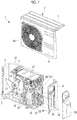
- Fig. 1 is an exploded perspective view of an outdoor unit according to an embodiment of the present invention.
- the outdoor unit 1 forms a multi-type air conditioning system by being connected to a plurality of indoor units, which are installed in a store, an office, a house, and the like, through refrigerant pipes.
- the outdoor unit 1 includes a base plate 2 (see also Fig. 6 ) that is positioned at a bottom portion of the outdoor unit 1 and is formed by, for example, a sheet metal press and a box-like housing 3 that is mounted on the base plate 2 and is made of, for example, sheet metal.
- the housing 3 is a combination of a front panel 4, a top panel 5, a left side panel (not shown), a right side panel 6, and a back panel (not shown).
- An air discharge outlet 4a is formed at the front panel 4, and air suction openings are formed at the left side panel and the back panel (not shown).
- a heat exchanger room 8 is installed one side (for example, left side) in a width direction and a machine room 9 is installed on the other side (for example, right side).
- the heat exchanger room 8 and the machine room 9 are partitioned by a partition wall 10.
- a heat exchanger 12, which is formed in a substantially L shape in plan view, is installed in the heat exchanger room 8.
- the heat exchanger 12 overlaps the air suction openings that are formed at the left side panel and the back panel of the housing 3.
- a fan blade 13 and a fan motor 14, which supplies cooling air to the heat exchanger 12, are supported by a fan bracket 15 and are installed in the heat exchanger room 8. Outside air is sucked into the heat exchanger room 8 from the air suction openings, which are formed at the back surface and left side surface of the housing 3, as cooling air by the rotation of the fan blade 13. After the cooling air exchanges heat with a refrigerant while passing through the heat exchanger 12, the cooling air is discharged from the air discharge outlet 4a that is formed at the front surface of the housing 3.
- a strainer 19 see Figs. 5 and 6
- an accumulator 20 and an electric box (controller) 21, including a refrigerant compressor (compressor) 18 compressing a refrigerant
- the outdoor unit 1 is a multi-type outdoor unit that compresses refrigerants of, for example, two indoor units by one refrigerant compressor 18, the right side panel 6, which forms the right side surface of the housing 3, is provided with two connection valves 25 and 26 and a highpressure refrigerant pipe and a low-pressure refrigerant pipe (not shown) to be connected to each indoor unit are connected to each of the connection valves 25 and 26.
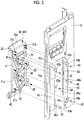
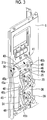
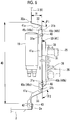
- an expanded portion 30, which is formed of a part of the right side panel 6 expanded in the shape of a projection, is formed on the right side panel 6.
- a height H (see Fig. 6 ) of the expanded portion 30 is set to about 3 to 5 cm
- two upper and lower connection valve-installation portions 35 and 36 are formed on an expanded surface 31 that is the outer surface of the expanded portion 30 expanded to the outermost side
- the respective connection valves 25 and 26 are fastened and fixed to these two connection valve-installation portions 35 and 36 by bolts.
- the expanded portion 30 and the connection valves 25 and 26 are covered with a design cover 38, which is shown in Fig. 1 and molded with a resin, so that the appearance of the outdoor unit 1 is formed.
- the interior space of the housing 3 is enlarged by the internal volume of the expanded portion 30.
- at least one of the internal devices to be connected to the connection valves 25 and 26 is disposed in an interior space S of the expanded portion 30.
- a high-capacity strainer 19, which is to be connected to the connection valves 25 and 26, is disposed in the interior space S of the expanded portion 30 in this embodiment, but other internal devices may be disposed in the interior space S.
- an expanded bracket member 41 which is formed by bending a sheet metal material separate from the right side panel 6, is fitted to a vertically long rectangular opening portion 40, which is formed at the right side panel 6, from the inside, so that the expanded portion 30 is formed.
- the thickness of the expanded bracket member 41 is set to be larger than the thickness of the right side panel 6 so that the expanded bracket member 41 has strength.
- the thickness of the expanded bracket member 41 is set to be the same as the thickness of the base plate 2.
- two fastening bosses 42 are formed at the lower edge portion of the expanded bracket member 41, these fastening bosses 42 overlap the inside of a rising wall 2a formed around the base plate 2, and two screws 43 are fastened to the fastening bosses 42 through the rising wall 2a from the outside, so that the expanded bracket member 41 is firmly fixed to the base plate 2.
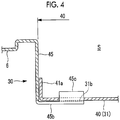
- the expanded bracket member 41 includes the above-mentioned expanded surface 31 that is positioned so as to be offset to the outside from the right side panel 6 of the housing 3 by the height H, and a pair of upper and lower rising surfaces 32 and 33 that extends toward the right side panel 6 from two opposite upper and lower sides of the expanded surface 31 and is connected to the rectangular opening portion 40.
- the rising surfaces 32 and 33 are formed so as to be bent at opening angles ⁇ 1 and ⁇ 2 (see Fig. 6 ) of about 90° to 135° with respect to the expanded surface 31.
- the opening angles ⁇ 1 and ⁇ 2 are set so that the expanded surface 31, the rising surface 32, and the rising surface 33 form a substantially trapezoidal shape in front view (see Fig. 6 ).
- these opening angles ⁇ 1 and ⁇ 2 are set to be closer to a right angle, the internal volume (space S) of the expanded portion 30 can be enlarged by an increase in the length of the expanded surface 31 in a vertical direction, that is, the area of the expanded surface 31.
- the opening angles ⁇ 1 and ⁇ 2 of the rising surfaces 32 and 33 are too close to a right angle, condensed water, which drips from the surfaces of the internal devices disposed in the expanded portion 30, flows on the upper surface of the lower rising surface 33 and may flow to the outside. Accordingly, the opening angles ⁇ 1 and 02 need to be set to be larger than a right angle to some extent.
- the effective area of the expanded surface 31 and the effective areas of the connection valve-installation portions 35 and 36 are reduced due to the inclination angles of the rising surfaces 32 and 33 in a case in which the height H of the expanded portion 30 is set to be too large, the height H of the expanded portion 30 needs to be properly selected.
- connection valve-installation portions 35 and 36 are embossed and formed so as to expand outward from the base plane of the expanded surface 31.
- a locking piece 32a which is to be locked to the upper side of the rectangular opening portion 40, is integrally formed at the tip portion of the upper rising surface 32 so as to be bent, and the two fastening bosses 42, which fix the expanded bracket member 41 to the base plate 2, are formed below the lower rising surface 33 as described above.
- overlapping margins 41a which overlap closing panels 45 and 46 to be described below, are provided at both edge portions of each of the surfaces 31, 32, and 33.
- a pair of closing panels 45 and 46 is bent so as to rise from two vertical sides, which face each other, of the rectangular opening portion 40 of the right side panel 6 at a right angle with respect to the surface direction of the right side panel 6.
- the pair of closing panels 45 and 46 faces each other in parallel to each other.
- the inner portions of the rectangular opening portion 40 are bent outward at a right angle without being cut off, so that the closing panels 45 and 46 are formed integrally with the right side panel 6.
- the shape of the contour of the outer periphery of each of these closing panels 45 and 46 in plan view follows the shape of the trapezoidal shape of the expanded bracket member 41.
- bent edge portions 45a and 46a which overlap the expanded surface 31 of the expanded bracket member 41 from the outside, are formed at the closing panels 45 and 46 of the right side panel 6 and, for example, a total of six fastening pieces 45b and 46b are formed at both upper and lower end portions and intermediate portions of the bent edge portions 45a and 46a.
- these six fastening pieces 45b and 46b overlap the expanded surface 31 and screws 48, which penetrate from the outside, are fastened to fastening bosses 31a (see Fig. 6 ) formed on the expanded surface 31 of the expanded bracket member 41, the expanded bracket member 41 is fixed to the right side panel 6 (closing panels 45 and 46) and the rectangular opening portion 40 is closed. As a result, the expanded portion 30 is formed.
- tongue-like locking protrusions 45c and 46c are formed at four fastening pieces 45b and 46b, which correspond to four corners of the expanded surface 31 of the expanded bracket member 41, among the six fastening pieces 45b and 46b that are formed at the closing panels 45 and 46 of the right side panel 6.
- These four locking protrusions 45c and 46c are engaged with slit hole-like locking holes 31b that are formed in four corners of the expanded surface 31. Accordingly, the expanded bracket member 41 is positioned.
- the locking hole 31b is formed as a horizontal slit hole in this embodiment, but may be formed as a vertical slit hole or may have the shape of a hole other than a slit hole.
- the outdoor unit 1 has the above-mentioned structure.
- the interior space of the housing 3 can be enlarged so that other internal devices can be disposed in the interior space S.
- the plurality of connection valves 25 and 26 are installed on the expanded surface 31 of the expanded portion 30 and internal devices (for example, the strainer 19) to be connected to the connection valves 25 and 26 are disposed in the enlarged interior space S of the expanded portion 30.
- the housing 3 can be shared between a single-type outdoor unit and a multi-type outdoor unit, so that the manufacturing costs of the outdoor unit 1 can be significantly reduced.
- the plurality of connection valves 25 and 26 can be installed on the expanded portion 30. Accordingly, in a case in which the expanded portion 30 on which the plurality of connection valves 25 and 26 can be installed as described above is provided on a housing 3 designed for a single-type outdoor unit, the housing 3 can be easily shared as a housing for a multi-type outdoor unit. In a case in which an expanded portion 30 of which the connection valve-installation portions 35 and 36 are replaced with one connection valve-installation portion is provided on a housing, the housing can also be used as a housing for a single-type outdoor unit.
- the expanded bracket member 41 is attached to the rectangular opening portion 40 formed at, for example, the right side panel 6 of the housing 3, so that the expanded portion 30 is formed.
- the expanded bracket member 41 is formed by bending a sheet metal material; and includes the expanded surface 31 on which the connection valves 25 and 26 are installed, and the pair of rising surfaces 32 and 33 that extends from two opposite sides of the expanded surface 31 and is connected to the rectangular opening portion 40. That is, the expanded bracket member 41 is formed by not drawing but bending.
- the degree of freedom in the shape of the expanded bracket member 41 is increased, the height H of the expanded portion 30 is set to be large to further enlarge the interior space of the housing 3, and the angles of the rising surfaces 32 and 33 with respect to the side surface of the housing 3 are set to steep angles to increase the area of the expanded surface 31. Accordingly, two or more connection valves 25 and 26 can be reasonably installed. Moreover, since the waste of materials and the reduction of yield, which occur during drawing, do not occur, material costs involved in the manufacture of the housing 3 can be reduced.
- the pair of closing panels 45 and 46 which closes the opening portions formed on the sides of the expanded bracket member 41, are bent so as to rise from two opposite sides of the rectangular opening portion 40, which are formed at the right side panel 6 of the housing 3, at a right angle. Accordingly, the pair of closing panels 45 and 46 is formed integrally with the right side panel 6. According to this structure, portions, which should have been cut off in the past in a case in which the rectangular opening portion 40 is to be formed at the side surface of the housing 3, can be used as the closing panels 45 and 46. For this reason, material costs involved in the manufacture of the housing 3 can be reduced.
- the fastening pieces 45b and 46b overlapping the surface of the expanded surface 31 of the expanded bracket member 41 are formed at the closing panels 45 and 46, and the locking protrusions 45c and 46c, which are to be engaged with the locking holes 31b formed in the expanded surface 31, are formed at the fastening pieces 45b and 46b.
- the locking protrusions 45c and 46c of the closing panels 45 and 46 are engaged with the locking holes 31b of the expanded surface 31, so that the closing panels 45 and 46 are fastened after being maintained in a state in which the closing panels 45 and 46 are pulled to the expanded surface 31. For this reason, since it is possible to prevent gaps from being formed between the expanded surface 31 (expanded bracket member 41) and the closing panels 45 and 46, it is possible to prevent the deterioration of appearance, the leakage of interior noise, and the like.
- the outdoor unit 1 of an air conditioning system of this embodiment it is possible to reduce the manufacturing costs of the outdoor unit 1 by reducing the size of the housing 3, sharing the housing 3 between a single-type outdoor unit and a multi-type outdoor unit, and reducing the material costs of the housing 3.
- the present invention is not limited to only the structure of the embodiment and can be appropriately modified or improved, and embodiments, which have been modified or improved in this way, are also included in the scope of the right of the present invention.
- the internal devices, which are received in the interior space S of the expanded portion 30, are not limited to the strainer 19, and other devices or only pipes may be received.
- the expanded portion 30 may be formed at the left side surface of the housing 3.
- examples in which the expanded portion 30 is formed at the front surface, the rear surface, and the upper surface of the housing 3 are also considered as modification examples.
- an expanded bracket member 41 formed by bending a sheet metal material is fixed to the right side panel 6 formed by bending a sheet metal material likewise, so that the expanded portion 30 is formed in this embodiment.
- the expanded portion 30 is not limited to this structure, and, for example, the expanded portion 30 may be molded with a resin or may be made of a combination of a resin and metal.
Landscapes
- Engineering & Computer Science (AREA)
- Chemical & Material Sciences (AREA)
- Combustion & Propulsion (AREA)
- Mechanical Engineering (AREA)
- General Engineering & Computer Science (AREA)
- Other Air-Conditioning Systems (AREA)
Applications Claiming Priority (2)
| Application Number | Priority Date | Filing Date | Title |
|---|---|---|---|
| JP2016075137A JP2017187204A (ja) | 2016-04-04 | 2016-04-04 | 空気調和システムの室外機 |
| PCT/JP2017/013944 WO2017175717A1 (fr) | 2016-04-04 | 2017-04-03 | Unité extérieure de système de climatisation |
Publications (2)
| Publication Number | Publication Date |
|---|---|
| EP3399249A1 true EP3399249A1 (fr) | 2018-11-07 |
| EP3399249A4 EP3399249A4 (fr) | 2019-02-27 |
Family
ID=60001173
Family Applications (1)
| Application Number | Title | Priority Date | Filing Date |
|---|---|---|---|
| EP17779095.3A Withdrawn EP3399249A4 (fr) | 2016-04-04 | 2017-04-03 | Unité extérieure de système de climatisation |
Country Status (4)
| Country | Link |
|---|---|
| EP (1) | EP3399249A4 (fr) |
| JP (1) | JP2017187204A (fr) |
| AU (1) | AU2017246781B2 (fr) |
| WO (1) | WO2017175717A1 (fr) |
Cited By (1)
| Publication number | Priority date | Publication date | Assignee | Title |
|---|---|---|---|---|
| EP4438962A4 (fr) * | 2022-01-28 | 2025-03-05 | Samsung Electronics Co., Ltd. | Climatiseur du type plafonnier |
Family Cites Families (7)
| Publication number | Priority date | Publication date | Assignee | Title |
|---|---|---|---|---|
| JPH01153425U (fr) * | 1988-04-13 | 1989-10-23 | ||
| JPH05133565A (ja) * | 1991-11-15 | 1993-05-28 | Matsushita Electric Ind Co Ltd | 空気調和機の室外ユニツト |
| JPH11230581A (ja) | 1998-02-17 | 1999-08-27 | Daikin Ind Ltd | 空気調和装置の室外機 |
| JP4711790B2 (ja) * | 2005-09-26 | 2011-06-29 | 三洋電機株式会社 | 空気調和装置 |
| FR2947038A1 (fr) * | 2009-06-23 | 2010-12-24 | Sanyo Electric Co | Climatiseur |
| JP2011007371A (ja) * | 2009-06-23 | 2011-01-13 | Sanyo Electric Co Ltd | 空気調和機 |
| JP6099925B2 (ja) * | 2012-10-04 | 2017-03-22 | 三菱重工業株式会社 | 空気調和機の室外ユニット |
-
2016
- 2016-04-04 JP JP2016075137A patent/JP2017187204A/ja not_active Withdrawn
-
2017
- 2017-04-03 AU AU2017246781A patent/AU2017246781B2/en not_active Expired - Fee Related
- 2017-04-03 EP EP17779095.3A patent/EP3399249A4/fr not_active Withdrawn
- 2017-04-03 WO PCT/JP2017/013944 patent/WO2017175717A1/fr not_active Ceased
Cited By (1)
| Publication number | Priority date | Publication date | Assignee | Title |
|---|---|---|---|---|
| EP4438962A4 (fr) * | 2022-01-28 | 2025-03-05 | Samsung Electronics Co., Ltd. | Climatiseur du type plafonnier |
Also Published As
| Publication number | Publication date |
|---|---|
| AU2017246781A1 (en) | 2018-06-28 |
| WO2017175717A1 (fr) | 2017-10-12 |
| JP2017187204A (ja) | 2017-10-12 |
| AU2017246781B2 (en) | 2019-09-12 |
| EP3399249A4 (fr) | 2019-02-27 |
Similar Documents
| Publication | Publication Date | Title |
|---|---|---|
| EP3240973B1 (fr) | Unité extérieure d'appareil de conditionnement d'air | |
| EP3124888A1 (fr) | Unite d'interieur de climatiseur | |
| EP3130866B1 (fr) | Unite d'interieur de climatiseur | |
| EP2801763B1 (fr) | Unité extérieure et dispositif de cycle de réfrigération avec unité extérieure | |
| US20140224457A1 (en) | Outdoor unit and refrigerating apparatus | |
| AU2014260970B2 (en) | Decorative panel and air-conditioner indoor unit provided with same | |
| EP3040629B1 (fr) | Dispositif externe pour un climatiseur d'air | |
| EP3040631B1 (fr) | Dispositif extérieur de climatiseur d'air | |
| KR20200135085A (ko) | 이동형 공기조화기 | |
| EP3851758B1 (fr) | Climatiseur | |
| US10274209B2 (en) | Air conditioner and indoor unit of the same | |
| JP5104993B1 (ja) | 冷凍装置の室外ユニット | |
| EP3399249A1 (fr) | Unité extérieure de système de climatisation | |
| KR102073002B1 (ko) | 공기조화기 | |
| JP2015210020A (ja) | 空気調和機の室外機 | |
| JP2013007561A (ja) | 冷凍装置の室外ユニット | |
| CN214536550U (zh) | 空调系统 | |
| WO2009133909A1 (fr) | Unité d’intérieur pour climatiseur | |
| CN217423585U (zh) | 一种空调室内机及空调器 | |
| EP4417882B1 (fr) | Climatiseur de type au plafond | |
| JP6827194B2 (ja) | 屋外用冷蔵庫 | |
| KR20160086141A (ko) | 공기 조화기의 실외기 | |
| CN214148169U (zh) | 空调器室外机 | |
| JP7438145B2 (ja) | 空気調和装置の室外機 | |
| EP3822548B1 (fr) | Machine de plafond |
Legal Events
| Date | Code | Title | Description |
|---|---|---|---|
| STAA | Information on the status of an ep patent application or granted ep patent |
Free format text: STATUS: THE INTERNATIONAL PUBLICATION HAS BEEN MADE |
|
| PUAI | Public reference made under article 153(3) epc to a published international application that has entered the european phase |
Free format text: ORIGINAL CODE: 0009012 |
|
| STAA | Information on the status of an ep patent application or granted ep patent |
Free format text: STATUS: REQUEST FOR EXAMINATION WAS MADE |
|
| 17P | Request for examination filed |
Effective date: 20180731 |
|
| AK | Designated contracting states |
Kind code of ref document: A1 Designated state(s): AL AT BE BG CH CY CZ DE DK EE ES FI FR GB GR HR HU IE IS IT LI LT LU LV MC MK MT NL NO PL PT RO RS SE SI SK SM TR |
|
| AX | Request for extension of the european patent |
Extension state: BA ME |
|
| A4 | Supplementary search report drawn up and despatched |
Effective date: 20190128 |
|
| RIC1 | Information provided on ipc code assigned before grant |
Ipc: F24F 1/0059 20190101ALI20190122BHEP Ipc: F24F 1/32 20110101AFI20190122BHEP Ipc: F24F 1/56 20110101ALI20190122BHEP Ipc: F24F 13/20 20060101ALI20190122BHEP |
|
| DAV | Request for validation of the european patent (deleted) | ||
| DAX | Request for extension of the european patent (deleted) | ||
| STAA | Information on the status of an ep patent application or granted ep patent |
Free format text: STATUS: THE APPLICATION HAS BEEN WITHDRAWN |
|
| 18W | Application withdrawn |
Effective date: 20191008 |