EP3408143B1 - Procédé de fabrication d'une plaque de immatriculation de véhicule rétro-réfléchissant, plaque de immatriculation rétro-réfléchissant, et dispositif de mise en uvre du procédé - Google Patents
Procédé de fabrication d'une plaque de immatriculation de véhicule rétro-réfléchissant, plaque de immatriculation rétro-réfléchissant, et dispositif de mise en uvre du procédé Download PDFInfo
- Publication number
- EP3408143B1 EP3408143B1 EP17700329.0A EP17700329A EP3408143B1 EP 3408143 B1 EP3408143 B1 EP 3408143B1 EP 17700329 A EP17700329 A EP 17700329A EP 3408143 B1 EP3408143 B1 EP 3408143B1
- Authority
- EP
- European Patent Office
- Prior art keywords
- blank
- shield
- plate blank
- security
- license plate
- Prior art date
- Legal status (The legal status is an assumption and is not a legal conclusion. Google has not performed a legal analysis and makes no representation as to the accuracy of the status listed.)
- Active
Links
Images


Classifications
-
- B—PERFORMING OPERATIONS; TRANSPORTING
- B60—VEHICLES IN GENERAL
- B60R—VEHICLES, VEHICLE FITTINGS, OR VEHICLE PARTS, NOT OTHERWISE PROVIDED FOR
- B60R13/00—Elements for body-finishing, identifying, or decorating; Arrangements or adaptations for advertising purposes
- B60R13/10—Registration, licensing, or like devices
Definitions
- the present invention relates to a method for producing a retroreflective license plate and an apparatus for carrying out the method.
- the invention relates to a manufacturing method for a motor vehicle license plate with novel security features, and to a device suitable for carrying out this method for producing a motor vehicle license plate with novel security features.
- An Ensure TM security feature is an optical marking of the film that is only visible when the film is oriented vertically at a viewing angle of approximately 30 ° to the horizontal. Otherwise the film appears uniformly retroreflective, ie the security feature is invisible.
- a method for producing the Ensure TM Image security feature is described, for example, in US 4,691,993 A or in the EP 0 203 752 B1 described.
- the Ensure TM Image security feature is realized by deliberately local damage to the metallic reflection layer contained in the retroreflective film by means of laser radiation. It therefore presupposes the existence of a dedicated metallic reflective layer in the retroreflective sheeting ahead and therefore cannot be inserted into retroreflective foils based on embedded microprisms.
- a retroreflective sheeting is marketed under the name Ensure TM Virtual Security Thread, which comprises an optically perceptible security feature that is incorporated into the material of the sheeting and appears three-dimensional. It includes two virtual images, one of which appears to float above the plane of the shield and one below. When viewed directly from the film, it is also visible from a greater distance and can also be combined with the Ensure TM Image security feature. Further information on retroreflective foils with the Ensure TM Virtual Security Thread security feature can also be found in the EP 1 602 946 B1 . The Ensure TM Virtual Security Thread security feature can also only be incorporated into retroreflective foils with embedded microlenses and a metallic reflective layer.
- the Ensure TM Virtual Security Thread security feature can only be introduced during film production.
- a change in the security feature, e.g. its contour is therefore reserved for the film manufacturer, which makes the procurement of smaller quantities of film with a safety feature individualized on customer request problematic and, in particular, cost-intensive.
- the application of security features of these types customized to the customer's requirements at the label manufacturer is impossible.
- optical hologram seals are produced in a separate production process on a separate carrier film.
- Leonhard Kurz founded & Co.KG offers so-called hologram sealing foils, which comprise a polyester carrier on which a lacquer package consisting of an adhesive layer, a structured metallization to form the optical hologram seal, a replication layer and a protective lacquer is removably arranged.
- these hologram seals are transferred from the polyester film to the surface of the license plate using a thermal transfer process and thermally welded to the surface of the plate.
- Such optical hologram seals are easy to verify optically and can in particular also be applied to retroreflective films without a metallic reflective layer , for example on retroreflective foils that are based on based on microprismatic elements.
- attaching them to the license plate is technically complex and therefore increases the production costs of the license plate.
- the polyester carrier of the seal adheres in areas to the surface of the license plate after the seal has been transferred to the surface of the license plate, so that a device is required which detaches the polyester carrier from the license plate again. There is also the risk of mechanical damage to the surface of the license plate.
- hologram seals are naturally non-transparent because of the metal layer contained therein, which in particular in the case of retroreflective license plate signs leads to local areas with no retroreflectivity, which can be undesirable or even inadmissible in accordance with local approval regulations.
- production of holograms customized according to customer requirements is expensive, since a master for hologram production is required for each individual motif, which is complex to produce. The creation of small series is therefore generally forbidden for reasons of cost.
- the DE 10 2004 017 094 A1 discloses a method of manufacturing a license plate, wherein various layers, including an optically variable layer that can provide a security feature, can be provided on the plate.
- a stamp can be used to create macroscopic structures that have an optical effect.
- an embossing stamp only has a specific, predetermined one can mold the macroscopic structure and the method is therefore cost-intensive if, for example, an individualized security feature is to be provided.
- the object of the present invention is therefore to provide an inexpensive method for producing a license plate with an integrated security feature, which is inexpensive and avoids the aforementioned disadvantages. Furthermore, it is an object of the present invention to provide an advantageous license plate with an integrated security feature and a device which is suitable for carrying out the method according to the invention and which is therefore also suitable for producing a license plate according to the invention.
- This object is achieved by a manufacturing method for a license plate according to claim 1 and a manufacturing device according to claim 5.
- the method according to the invention can often be integrated in the form of a few additional method steps directly into existing method sequences for the production of motor vehicle license plates, without requiring changes to these method sequences.
- the license plates produced by the method have a novel, optically perceptible security feature, which is based on an optically perceptible, extensively extended security structure, which is incorporated into the front surface of the blank plate and on regular, raised or recessed structures in the surface of the blank plate is based.
- These license plates therefore offer a high level of protection against counterfeiting, since the security structure forming the security feature is integrally connected to the material of the license plate blank, in particular here to the label plate or to a plastic film laminated thereon.
- the new type of security structure does not require any non-transparent, for example metallic, reflective layer, so that it can also be advantageously applied to retroreflective shield blanks or shield blanks, the embedded additional, optically perceptible security features such as the previously described Ensure TM Image or Ensure TM Virtual Security Thread from the company 3M include, without making them illegible or unrecognizable and thus ineffective by covering them.
- a method according to the invention is provided for the production of a license plate.
- it comprises the method step of providing a blank shield that is extended over a large area, e.g. a plastic shield plate or a metallic shield plate with laminated colored plastic film.
- a blank plate can already be a ready-to-use vehicle license plate, which is only provided with the security structure according to the invention within the scope of the method according to the invention.
- an optically perceptible, in particular extensive security structure is now introduced into the front surface of the shield blank in a suitable manner.
- This is intended to include processes which either locally deform or remove the material of the shield blank on its front surface.
- This formulation should not explicitly include processes in which additional material is applied to the front surface of the shield blank.
- This security structure introduced according to the invention comprises extensive, regular, raised or recessed structures in the surface of the shield blank, which are designed in such a way that the security structure introduced has an optical effect based on optical interference, especially color effect.
- the regular spacing of the structures introduced is therefore advantageously of the order of magnitude of the wavelength of visible light, in particular in the range between 150 nanometers and 30 micrometers, particularly preferably between 450 and 1500 nanometers.
- the dominant structure size of the introduced microstructure in the above-mentioned. Frames can be tailored to customer needs.
- microstructures can be generated that reflect at certain angles through constructive interference in the visible range and are therefore directly perceptible as colored images with the human eye.
- microstructures can also be generated which reflect in wavelength ranges which are invisible to the human eye, e.g. in the UV or near IR. Structures of this type are predestined for machine authenticity checking.
- the shield blank has retroreflective properties. These retroreflective properties are particularly preferably based on (micro) prismatic elements embedded in the shield blank or formed integrally therewith.
- the shield blank has an additional optically perceptible security feature which is embedded in the material of the shield blank.
- This can be, for example, the aforementioned security features, which 3M offers under the names Ensure TM Image or Ensure TM Virtual Security Thread.
- the shield blank comprises e.g. metallic shield plate, which is laminated with a retroreflective foil from 3M of the types 4750E or 4750T, i.e. such a film is laminated onto the front surface of the shield plate.
- the security feature according to the invention Since the security feature according to the invention shows constructive interference only at certain angles and thus appears to the observer as a colored structure only at certain angles, the security feature according to the invention is essentially invisible or transparent when viewed vertically onto the blank plate (or the ready-to-use license plate). Is it formed in or on the surface of a transparent layer, e.g. can consist of a plastic, optically perceptible properties of the film or of the shield blank, such as e.g. Maintain additional security features embedded in the film or a retroreflectivity as far as possible. In particular, this means that it is possible to design the security structure according to the invention over a large area, in particular so large that the security structure extends essentially over the entire surface of the shield blank. This represents a particular advantage of the security structure according to the invention and thus of a license plate equipped with such.
- the blank plate is provided with an individual license plate legend, e.g. can be printed on the front surface.
- the label legend can also be embossed into the shield blank when using an embossable material for the shield blank, e.g. as a raised imprint.
- An embossed license plate legend can also be colored, which is possible in particular by means of transfer from a hot stamping foil in a thermal transfer process or by rolling with an ink roller.
- a label legend can also be formed by attaching separately formed individual characters to the front surface of the blank plate.
- a vehicle license plate is basically understood to be a label which is already provided with an individual license plate legend.
- a license plate blank is understood to be a label that has not yet been provided with an individual license plate legend.
- this wording is intended to be both a ready-to-use and a License plate-specific individualized license plate plates also include a license plate blank in the aforementioned sense.
- the security structure according to the invention can be introduced into the front surface both on a blank plate and on a ready-to-use motor vehicle license plate that is individualized with a label legend. This relates in particular to the method according to the invention and to the license plate, the protection from the latter also being intended to extend explicitly to blank blanks in the sense mentioned above.
- the optically perceptible security structure can be introduced into the film both before and after the film is laminated on.
- the film can advantageously be colored, e.g. to comply with national approval regulations.
- the film which is laminated onto the shield plate has retroreflective properties.
- it can be a film with microlenses embedded in a transparent plastic layer and a reflection layer behind it, or a film with microprismatic elements embedded in a transparent plastic layer.
- a further transparent layer for example made of a suitable plastic, can be arranged above the microlenses or the microprismatic elements.
- the film which is laminated onto the shield plate can be equipped with additional security features which are particularly suitable for a visual or visual inspection.
- the film can be equipped with the Ensure TM Image and / or Ensure Ensure TM Virtual Security Thread security features offered by 3M.
- films from other film manufacturers that have alternative security features can also be used advantageously.
- the film to be laminated or already laminated is equipped by the user of the method according to the invention with additional, advantageously optically recognizable security features, for example according to the teaching of the aforementioned US 4,691,993 A .
- the method described there is based on laser treatment of a retroreflective film with embedded microlenses and can advantageously also be integrated into the course of the method according to the invention.
- the optically perceptible security structure is transferred from a structured stamp or a structured roller into the front surface of the shield blank by means of mechanical embossing, in particular by means of hot stamping.
- the punch or the roller can in particular be made of a metal, preferably a suitable steel, in particular stainless steel, or also of a suitable ceramic material.
- Nickel has also proven particularly useful, particularly in the manufacture of sleeves, i.e. of sleeve-like embossing forms, which i.A. are intended to be pushed onto embossing rollers.
- coated metallic materials are fundamentally accessible to microstructuring and can therefore be used in the process for stamping dies or rollers. To simplify matters, only stamps are used in the following. However, this wording should also explicitly include embossing rollers and sleeves.
- the preferred temperature range for hot stamping is largely determined by the materials used for the shield blank. Typical hot stamping temperatures are between 70 ° C and 180 ° C, with temperatures around 150 ° C to be favoured. The latter temperatures have proven particularly useful when embossing shield blanks, which comprise a plastic film laminated onto a shield plate. This temperature is particularly advantageous when using commercially available retroreflective foils for the production of license plates, such as those offered by the manufacturers 3M, Avery and Orafol in a variety of ways.
- Typical embossing pressures are a maximum of 10 tons with an embossing area of 20 x 20 mm 2 , but generally lower pressures in the range of 1 to 2 tons are sufficient, especially for hot embossing.
- embossing rollers enables a continuous embossing process, e.g. tape-like security structures are created analogously to the Ensure TM Virtual Security Thread from 3M.
- the security structure is therefore produced by rolling the surface of the shield blank with a structured embossing roller or a sleeve.
- embossing stamps also enables large-area security structures to be produced, which can be produced by embossing using a plurality of stamps.
- simultaneous embossing by means of a plurality of stamps can take place using an embossing press, which increases the efficiency of the method.
- the dies do not have to adjoin one another, but can also be arranged at a distance from one another, e.g. to emboss in all four corners of the shield blank at the same time. Special advantages result from the use of different embossing stamps if they complement the overall motif or structure with regard to the motif or structure introduced, e.g. jointly form the four corners of a rectangle.
- the material forming the surface of the shield blank for example the top layer of a plastic film laminated onto a shield blank or the material of the shield blank itself, can be mechanically embossed.
- the material is particularly preferably hot-stampable, ie, stampable under the action of heat.
- both a direct structuring of the embossing stamp by means of a suitable structuring process, which acts directly on the embossing stamp, and an indirect structuring is possible.
- Indirect structuring is understood to mean that a negative of the desired embossing stamp is generated by means of a suitable structuring method, which is then transferred to the surface of the embossing stamp in a subsequent process step, forming the desired positive.
- the structuring of the stamp is preferably produced by means of direct or indirect laser structuring of a workpiece from a material suitable for use as an embossing stamp.
- direct laser structuring is to be understood to mean that the laser radiation used for structuring acts directly on the stamp and there produces the mechanical structure that is molded into the material to be embossed.
- indirect laser structuring is to be understood to mean that the laser radiation used for structuring acts directly on a suitable negative stamp and generates a mechanical structure there. This is then transferred in a suitable manner as a positive into the surface of the stamping die, as a result of which the mechanical structure which is molded into the material to be stamped is produced.
- the structuring of the stamp or of the negative stamp can be based on a structure which is generated by means of interference from at least two laser beams. Such structuring is also referred to in the context of the present invention as "laser interference structuring”.
- the DE 10 2012 011 343 A1 discloses both a method for direct laser interference structuring and an indirectly working method.
- pulsed laser radiation has proven particularly useful for laser interference structuring.
- wavelengths, pulse durations, pulse repetition rates and pulse energies the disclosure of the DE 10 2012 011 343 A1 refer, the value ranges disclosed there also belong to the disclosure of the present application.
- the optically perceptible security structure is introduced into the front surface of the shield blank by means of direct laser structuring, which is based on the interference of at least two laser beams on / in the surface of the shield blank.
- a corresponding method which is particularly suitable for direct laser interference structuring of shield blanks with a security structure according to the invention, is, for example, again from the DE 10 2012 011 343 A1 known. Due to its high execution speed, the method disclosed there is also suitable for the integration of a structure for the production of motor vehicle license plates when producing large-area structures. The method can also be used in particular to produce large-area structures, in particular when a moving object, such as a shield blank, is to be structured in a production line.
- a first structure which can in particular be large, is introduced into the surface of the shield blank by means of mechanical stamping. Since this structure is based on an embossing stamp, it cannot be varied from shield blank to shield blank without considerable effort, rather it will be kept constant over a larger number of shield blanks (ie a few tens to a few tens of thousands).
- a second structure is created using laser structuring. Especially if use is made of the from the DE 10 2012 011 343 A1
- the security structure introduced can be varied from shield blank to shield blank. This allows, for example, the application of an individual numbering of the manufactured blank plates, or an individual identification, which codes, for example, the date of manufacture, the time of manufacture, the machine used, the operator of the machine, etc.
- the stamp or shield blank and the point of incidence of the laser beams on the stamp or shield blank are moved relative to one another perpendicular to the direction of expansion of the foci .
- provision can be made in particular to move the blank plate or the stamp.
- use can be made of any linear movement of the shield blanks that may be present during their manufacture on a corresponding production system.
- a mask is imaged on the surface of the stamp or the shield blank.
- This mask is essentially opaque to the laser radiation used for laser interference structuring.
- it can be based on a metallic material.
- the use of masks which are designed as structured metallic layers, which are designed to be self-supporting in the form of a film and which can be carried by an optically transparent support such as a glass substrate, has proven useful.
- the optically perceptible security structure comprises a plurality of discrete surface areas which, when viewed at a fixed angle, have at least two different color effects. Different color effects can be achieved by, for example, varying the characteristic dimensions of the regular structures, such as the dominant structure spacing.
- the method according to the invention makes it possible in particular to avoid the disadvantages associated with the application of the hologram seals known from the prior art. This means that there is no waste that has to be disposed of, and no potentially health-relevant substances, e.g. free from a heated hot glue.
- the space requirement is also minimal, at least in the case of mechanical embossing of the security structure according to the invention, so that the embossing process can easily be integrated into existing production plants for the production of shield blanks.
- a vehicle license plate has a blank blank that extends over a large area.
- the method according to the invention which are directly transferred to license plates can be. This applies in particular since the method according to the invention is suitable and set up for producing a motor vehicle license plate.
- an optically perceptible, extensively extended security structure is now introduced into the front surface of the shield blank, which shows a color effect based on optical interference.
- This color effect is based on extensive, regular, raised or deepened structures in the surface of the shield blank.
- the license plate When ready for use, the license plate usually has an individual license plate legend.
- the shield blank also has retroreflective properties.
- this is based on (micro) prismatic elements embedded in or formed by the material of the shield blank.
- the shield blank has an additional, optically perceptible security feature which is embedded in the material of the shield blank.
- optically perceptible security features of the type Ensure TM Image and Ensure TM Virtual Security Thread are incorporated.
- the optically perceptible security structure is arranged in an area of the license plate in which the blank plate has retroreflective properties.
- the security structure according to the invention can also be further advantageously developed by designing the security structure according to the invention such that the license plate also has retroreflective properties in the area in which the optically perceptible security structure is arranged.
- the security structure according to the invention must in principle have at least some transparency. It is a particular advantage of the security structure according to the invention, which shows a color effect based on optical interference, that is, on extensive, regular, raised or deepened structures in the surface of the shield blank is based on the fact that, if it is formed in or on transparent surfaces, it usually already has a certain degree of transparency without further measures.
- the optically perceptible security structure is arranged in an area of the license plate below which the additional optically perceptible security feature, which is embedded in the material of the label blank, is arranged.
- optically perceptible additional security feature embedded in the material of the shield blank can be recognized through the optically perceptible security structure which is introduced into the front surface of the shield blank.
- the front surface of the blank plate can be mechanically embossed, in particular hot stamped.
- the security structure can be produced particularly simply by means of mechanical stamping of the shield blank with a suitably structured stamp.
- the license plate has a shield plate, on the front surface of which a film with a transparent cover layer is laminated.
- This film can have retroreflective properties in particular.
- the shield board can e.g. be made of a metal such as aluminum or a plastic.
- the optically perceptible security structure has a plurality of discrete surface areas which have at least two different color effects.
- a security structure which has the shape of a symbol, a logo, etc., into individual pixels, and in this way the symbol or the logo is at least two-colored.
- the structuring unit is set up to generate an optically perceptible security structure which comprises a plurality of discrete surface areas which have at least two different color effects. Different color effects can be created by e.g. Variation of the characteristic dimensions of the regular structures such as of the dominant structural distance.
- the board feed can have a tape feed, with which a metallic endless tape wound on a supply roll is fed.
- Individual shield boards are then removed from this endless belt in the production process, for example by means of punching.
- the feeding of a metallic strip, from which individual shield boards are subsequently removed in the production process should also be understood as “provision of a shield board”.
- the structuring unit comprises a structured stamp and is set up to transfer the optically perceptible security structure from the structured stamp into the surface of the shield blank by means of mechanical stamping, in particular by means of hot stamping.
- the device advantageously additionally comprises a mechanical stamping unit.
- the embossing unit can advantageously be designed such that the embossing stamp can be heated. Furthermore, the embossing unit can be designed such that a heating device is provided which allows at least local heating of a shield blank to be embossed.
- the structuring unit comprises a laser and is set up to introduce the optically perceptible security structure into the surface of the shield blank by means of interference from at least two laser beams.
- the structuring unit is set up in such a way that the laser beams each have a linear focus and the foci overlap on or in the surface of the shield blank to be structured.
- a particularly high degree of design freedom with regard to the security structure introduced by means of direct laser interference structuring with at least two beams can be achieved if the device is set up in such a way that the shield blank to be structured and the point of incidence of the laser beams on the shield blank are moved relative to one another perpendicular to the direction of expansion of the foci .
- a shield blank transport device integrated into the device can be provided, which in particular also carries out the transport of the shield blanks when carrying out the manufacturing method according to the invention.
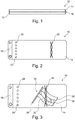
- Fig. 1 shows a shield blank 10 according to the prior art in side view.
- the shield blank 10 comprises a metallic shield plate 12 made of aluminum sheet, on the front of which a retroreflective foil 14 is laminated.
- the retroreflective film 14 is provided on the back with a pressure-activatable adhesive layer 16, which in Fig. 1 is also indicated schematically.
- the retroreflective film 14 is based on microlenses (not shown) embedded in a transparent plastic material, which are arranged in a plane parallel to the direction of extension of the film in the material of the film 14. Behind the A metallic reflection layer (not shown) is arranged at a substantially constant distance from the plane of the microlenses and from the microlenses.
- the microlenses in cooperation with the metallic reflection layer effect the retroreflective properties of the film 14.
- the microlenses are covered with a transparent cover layer (not shown), which consists of a transparent plastic that contains a high proportion of PVC, is suitable for hot stamping and is mechanically good can be shaped.
- Fig. 2 shows the shield blank Fig. 1 under supervision.
- the retroreflective sheeting 14 laminated onto the shield board 12 has, on the one hand, colored areas 18 which are already applied by the sheeting manufacturer during the manufacture of the sheeting 14.
- these colored areas are printed by the manufacturer of the sign blank 10 onto the sign boards 12 laminated with the retroreflective film 14, preferably by means of a thermal transfer process.
- the printed areas are a blue band arranged on the left side of the shield blank, in which on the one hand a country code and on the other hand the sovereign symbol of the European Union are arranged.
- the film 14 has optically perceptible first and second additional security features 20, 22 embedded in the material of the film 14.
- the first additional security feature 20, which is embedded several times in the material of the film, is a 3M Ensure TM Image security feature.
- the second additional security feature 22 is an Ensure TM Virtual Security Thread from 3M.
- Fig. 3 shows a blank 10 according to the invention for a license plate in supervision.
- the shield blank according to the invention Fig. 3 differs from the shield blank Fig. 2 through the security structure 30 according to the invention, which is introduced into the upper surface of the shield blank 10.
- the security structure 30 is formed in the surface of the transparent cover layer of the film 14, which covers the layer of the microlenses, ie in what is known as the "top coat".
- the security structure 30 shown is extended in area and forms a flag in the exemplary embodiment shown.
- the security structure 30 is visually perceptible when an observer sees the front surface of the shield blank 10 at a predetermined viewing angle viewed from, for example, 30 ° against the surface normal of the shield blank 10. In the case of a vertical plan view of the shield blank 10, on the other hand, the security structure 30 is practically invisible, to that extent the illustration in FIG Fig. 3 to understand only symbolically.
- the security structure 30 has four different areas 32, 34, 36, 38, which when viewed from the same viewing angle each produce different color impressions on the viewer. These color effects of the security structure 30 are based on optical interference, which is based on extensive, regular, raised or deepened microstructures in the surface of the shield blank 10.
- Each of the four areas 32, 34, 36, 38 comprises a multiplicity of separate surface areas (“pixels”), which are each identically microstructured within a area 32, 34, 36, 38, so that they produce the same color impression on the viewer.
- pixels separate surface areas
- the microstructuring of area 32 from a given viewing angle can produce a yellow color impression
- the microstructuring of area 34 from the same viewing angle for example, a red color impression
- the microstructuring of area 36 from the same viewing angle for example, an approximately black color impression
- the microstructuring of area 38 from the same viewing angle for example a brown color impression.
- the four regions 32, 34, 36, 38 are each nano- / microstructured uniformly, so that each has its own color impression. A breakdown of each individual area 32, 34, 36, 38 into individual, identically structured pixels was omitted. As a result, such a security structure is much easier to manufacture.
- the security structure 30 is practically invisible.
- the retroreflectivity of the license plate is practically not reduced in these areas 32, 34, 36, 38.
- FIG. 3 schematically shown, in which the security structure 30 is arranged in an area in which a second additional security feature 22 is formed in the material of the film 14. Since the security structure 30 is practically invisible when the shield blank 210 according to the invention is viewed vertically, the second additional security feature 22 also remains accessible to an optical inspection or verification. This represents a significant advantage of the blank 10 according to the invention or of a license plate 1 produced therewith.
- the retroreflective properties of the shield blank 10 are also retained in the areas in which the security structure is introduced into the surface of the shield blank 10. This represents a further essential advantage of the blank 10 according to the invention or of a license plate 1 produced therewith.
- FIG. 5 A ready-to-use license plate 1 according to the invention is shown in supervision. It is based on the shield blank Fig. 3 , which was provided with a circumferential raised edge 32 and an individual identification legend 34 in a subsequent processing step. Both the edge 32 and the characters of the license plate legend 34 are raised and produced by means of mechanical stamping of the shield blank 10. After the embossing, the raised embossed areas of the license plate 1, ie the peripheral edge 32 and the identification legend 34, have been permanently colored black by means of a color transfer from a color transfer film in a thermal transfer process.
- Fig. 6 shows an embodiment of a manufacturing device 100 in a schematic representation.
- the device 100 is provided and set up for the production of a license plate 1. It comprises a blank feed 102 for providing a shield blank 10.
- the blank 10 consists of a (not yet isolated) section of an endless aluminum strip 114 which is unwound from a supply roll 116. These tasks are carried out by the functional unit of the board feeder 110.
- the device 100 comprises a film feed 120 for providing a film 14, for example a retroreflective film with a transparent cover layer as in connection with FIG 1 and 2 explained.
- the film feeder 120 comprises a supply reel 122, on which a supply of the described film 14 is wound up as an endless belt.
- the film structure corresponds to that in connection with Fig. 1 described structure.
- the film 14 to be laminated onto the shield board is unwound and fed to a laminating station 130, in which the film 14 is laminated onto the endless metal strip 114, which is also fed to the laminating station 130.
- a paper liner 128 covering the adhesive layer 16 is pulled off the film 14 and wound onto a take-up roll 126.
- the adhesive layer of the film 14 is further brought into contact with the metal strip 114.
- a (possibly heated) pressure roller 132 arranged in the laminating station 130 applies a defined contact pressure to the film 14 and thus ensures activation of the adhesive layer.
- a mechanical structuring unit 150 in the form of a hot stamping station is arranged between the laminating station 130 assigned to the board feed 110 and the punching unit 140.
- This is set up to introduce an optically perceptible, extensively extended security structure 30 into the front surface of the shield blank 10, more precisely into the top coat of the retroreflective film 14 laminated onto the shield plate 12.
- the introduced security structure 30 shows a color effect based on optical interference. which is based on regular, raised or recessed structures in the surface of the shield blank 10.
- the structuring unit 150 is set up to generate an optically perceptible security structure 30 which comprises a plurality of discrete surface areas, which have at least two different color effects. These different color effects are achieved, for example, by varying the characteristic dimensions of the regular structures, such as the dominant structure spacing.
- the structuring unit 150 comprises a structured metal stamp (not shown) and is set up to mechanically hot stamp the retroreflective film 14 from the structured stamp into the surface of the top coat of the film 14 and thus the shield blank 10 by means of mechanical hot stamping transfer.
- the structuring unit 150 is designed in such a way that the stamping die can be heated, so that it e.g. can be heated to a temperature of over 70 ° C, in particular between 120 ° C and 160 ° C, preferably to 150 ° C. Furthermore, the structuring unit 150 is equipped with an additional circuit board heater (not shown) which allows local heating of a shield blank 10 to be embossed in the area in which the security structure 30 is to be mechanically stamped into the surface of the shield blank 10.
- the metallic embossing stamp is provided with a negative of the security structure 30 to be introduced into the surface of the shield blank 10, which is to be molded into the surface of the shield blank 10.
- the structuring of the embossing stamp was generated by means of direct laser interference structuring, ie the structuring of the embossing stamp is based on a structure which was generated by interference from at least two laser beams.
- the two laser beams which can be generated, for example, by beam splitting a laser beam generated by a laser, each have a linear focus. These partial beams are guided in such a way that the foci overlap on or in the surface of the previously highly polished stamp, which is made of stainless steel.
- the laser interference structuring of the embossing stamp causes the stamp and the point of incidence of the laser beams on the stamp to be moved relative to one another perpendicularly to the direction of expansion of the foci. Furthermore, it is provided that for the formation of the negative for the optically perceptible, extensive security structure on the embossing stamp, an optical mask is imaged on the surface of the stamp.
- Fig. 7 shows an embodiment of a manufacturing device 100 according to the invention again in a schematic representation.
- the manufacturing device 100 according to the second exemplary embodiment corresponds in all its features to the manufacturing device according to the first exemplary embodiment Fig. 6 with the exception of the structuring unit 150, which in this second exemplary embodiment does not work mechanically, but rather is laser-based and therefore contactless.
- the structuring unit 150 comprises a laser (not shown) and is set up to introduce the optically perceptible security structure 30 into the surface of the shield blank 10 by means of interference from at least two laser beams.
- the structuring unit 150 is set up such that the laser beams each have a linear focus and the foci overlap on or in the surface of the shield blank 10 to be structured.
- the structuring unit 150 interacts with the control of the advance of the board feeder 110, so that the shield blank 10 to be structured and the point of incidence of the laser beams on the shield blank 10 are moved relative to one another in a controlled manner perpendicular to the direction of expansion of the foci. In this way, a large variety of designs of the security structure 30 generated can be achieved.
- the laser-based structuring unit 150 is set up to image an optical mask on the surface of the shield blank 10 in order to form the optically perceptible, extensive security structure in the surface of the shield blank 10.
- Adhesive layer 116 Supply roll of metallic tape 18th colored printed area
- Supply roll of foil 22 second additional security feature 126
- Take-up roll 30th Security structure 128 Paper liner 32 raised edge 130 Laminating station 34
Landscapes
- Engineering & Computer Science (AREA)
- Mechanical Engineering (AREA)
- Vehicle Waterproofing, Decoration, And Sanitation Devices (AREA)
Claims (8)
- Procédé de fabrication d'une plaque d'immatriculation (1) comprenant les étapes de procédé suivantes consistant à:a) fournir une ébauche de plaque (10) étendue en nappe,
etb) réaliser une structure de sécurité (30) optiquement perceptible et étendue en nappe, dans la surface avant de l'ébauche de plaque (10), ladite structure de sécurité (30) réalisée présentant un effet optique basé sur une interférence optique, en particulier un effet de couleur, et étant basée sur des structures étendues en nappe, régulières, en relief ou en creux dans la surface de l'ébauche de plaque (10),caractérisé par le fait que la structure de sécurité (30) optiquement perceptible est réalisée au moyen d'interférence d'au moins deux faisceaux laser dans la surface avant de l'ébauche de plaque (10). - Procédé selon la revendication 1, caractérisé par le fait que les faisceaux laser présentent chacun un foyer linéaire et que les foyers se superposent l'un à l'autre sur ou bien dans la surface de la surface avant de l'ébauche de plaque (10).
- Procédé selon la revendication 1 ou 2, caractérisé par le fait que l'ébauche de plaque (10) et le point d'impact des faisceaux laser sur l'ébauche de plaque (10) sont déplacés l'un par rapport à l'autre perpendiculairement à la direction d'extension des foyers.
- Procédé selon la revendication 1, caractérisé par le fait que la structure de sécurité (30) optiquement perceptible comprend une pluralité de zones de surface discrètes qui présentent au moins deux effets de couleur différents.
- Dispositif (100) de fabrication d'une plaque d'immatriculation (1), comprenant les caractéristiques suivantes:a) un dispositif d'amenée d'ébauche (102) pour fournir une ébauche de plaque (10), etb) une unité de structuration (150) qui est adaptée pour réaliser une structure de sécurité (30) optiquement perceptible et étendue en nappe, dans la surface avant de l'ébauche de plaque (10), ladite structure de sécurité (30) réalisée présentant un effet de couleur basé sur une interférence optique et étant basée sur des structures régulières en relief ou en creux dans la surface de l'ébauche de plaque (10),caractérisé par le fait que ladite unité de structuration (150) comprend un laser pour générer un faisceau laser et est adaptée pour réaliser la structure de sécurité (30) optiquement perceptible, au moyen d'interférence d'au moins deux faisceaux laser, dans la surface de l'ébauche de plaque (10).
- Dispositif (100) selon la revendication 5, caractérisé par le fait que l'unité de structuration (150) est adaptée pour produire une structure de sécurité (30) optiquement perceptible qui comprend une pluralité de zones de surface discrètes (32, 34, 36, 38) qui présentent au moins deux effets de couleur différents.
- Dispositif (100) selon la revendication 5, caractérisé par le fait que les faisceaux laser présentent chacun un foyer linéaire et que les foyers se superposent l'un à l'autre sur ou bien dans la surface de l'ébauche de plaque (10).
- Dispositif (100) selon la revendication 7, caractérisé par le fait que le dispositif (100) est adapté pour déplacer, l'un par rapport à l'autre, l'ébauche de plaque (10) et le point d'impact des faisceaux laser sur l'ébauche de plaque (10), de manière contrôlée et perpendiculairement à la direction d'extension des foyers.
Priority Applications (2)
| Application Number | Priority Date | Filing Date | Title |
|---|---|---|---|
| EP19219268.0A EP3659867A1 (fr) | 2016-04-04 | 2017-01-11 | Procédé de fabrication d'une plaque d'immatriculation de véhicule rétro-réfléchissant, plaque d'immatriculation rétro-réfléchissant, et dispositif de mise en oeuvre du procédé |
| PL17700329T PL3408143T3 (pl) | 2016-04-04 | 2017-01-11 | Sposób wytwarzania odblaskowej pojazdowej tablicy rejestracyjnej, odblaskowa pojazdowa tablica rejestracyjna i urządzenie do przeprowadzania sposobu |
Applications Claiming Priority (2)
| Application Number | Priority Date | Filing Date | Title |
|---|---|---|---|
| DE102016106065.8A DE102016106065A1 (de) | 2016-04-04 | 2016-04-04 | Verfahren zur Herstellung eines retroreflektierenden Kfz-Kennzeichenschilds, retroreflektierendes Kfz-Kennzeichenschild sowie Vorrichtung zur Durchführung des Verfahrens |
| PCT/EP2017/050493 WO2017174221A1 (fr) | 2016-04-04 | 2017-01-11 | Procédé de fabrication d'une plaque d'immatriculation rétroréfléchissante de véhicule automobile, plaque d'immatriculation rétroréfléchissante de véhicule automobile, et dispositif permettant la mise en œuvre du procédé |
Related Child Applications (2)
| Application Number | Title | Priority Date | Filing Date |
|---|---|---|---|
| EP19219268.0A Division-Into EP3659867A1 (fr) | 2016-04-04 | 2017-01-11 | Procédé de fabrication d'une plaque d'immatriculation de véhicule rétro-réfléchissant, plaque d'immatriculation rétro-réfléchissant, et dispositif de mise en oeuvre du procédé |
| EP19219268.0A Division EP3659867A1 (fr) | 2016-04-04 | 2017-01-11 | Procédé de fabrication d'une plaque d'immatriculation de véhicule rétro-réfléchissant, plaque d'immatriculation rétro-réfléchissant, et dispositif de mise en oeuvre du procédé |
Publications (2)
| Publication Number | Publication Date |
|---|---|
| EP3408143A1 EP3408143A1 (fr) | 2018-12-05 |
| EP3408143B1 true EP3408143B1 (fr) | 2020-04-01 |
Family
ID=57796351
Family Applications (2)
| Application Number | Title | Priority Date | Filing Date |
|---|---|---|---|
| EP19219268.0A Withdrawn EP3659867A1 (fr) | 2016-04-04 | 2017-01-11 | Procédé de fabrication d'une plaque d'immatriculation de véhicule rétro-réfléchissant, plaque d'immatriculation rétro-réfléchissant, et dispositif de mise en oeuvre du procédé |
| EP17700329.0A Active EP3408143B1 (fr) | 2016-04-04 | 2017-01-11 | Procédé de fabrication d'une plaque de immatriculation de véhicule rétro-réfléchissant, plaque de immatriculation rétro-réfléchissant, et dispositif de mise en uvre du procédé |
Family Applications Before (1)
| Application Number | Title | Priority Date | Filing Date |
|---|---|---|---|
| EP19219268.0A Withdrawn EP3659867A1 (fr) | 2016-04-04 | 2017-01-11 | Procédé de fabrication d'une plaque d'immatriculation de véhicule rétro-réfléchissant, plaque d'immatriculation rétro-réfléchissant, et dispositif de mise en oeuvre du procédé |
Country Status (4)
| Country | Link |
|---|---|
| EP (2) | EP3659867A1 (fr) |
| DE (1) | DE102016106065A1 (fr) |
| PL (1) | PL3408143T3 (fr) |
| WO (1) | WO2017174221A1 (fr) |
Cited By (1)
| Publication number | Priority date | Publication date | Assignee | Title |
|---|---|---|---|---|
| WO2024100118A1 (fr) * | 2022-11-09 | 2024-05-16 | SurFunction GmbH | Procédé de fabrication d'un outil, outil, procédé d'usinage d'une pièce, pièce |
Families Citing this family (1)
| Publication number | Priority date | Publication date | Assignee | Title |
|---|---|---|---|---|
| DE102017100256A1 (de) | 2017-01-09 | 2018-07-12 | Erich Utsch Ag | Rohling für ein retroreflektierendes Schild sowie Verfahren zu dessen Herstellung, retroreflektierendes Schild Verfahren zu dessen Herstellung |
Citations (1)
| Publication number | Priority date | Publication date | Assignee | Title |
|---|---|---|---|---|
| DE102004017094A1 (de) * | 2004-04-07 | 2005-11-03 | Leonhard Kurz Gmbh & Co. Kg | Verfahren zur Herstellung eines Kraftfahrzeug-Nummernschildes sowie ein Kraftfahrzeug-Nummernschild |
Family Cites Families (9)
| Publication number | Priority date | Publication date | Assignee | Title |
|---|---|---|---|---|
| CA1232068A (fr) * | 1984-06-08 | 1988-01-26 | National Research Council Of Canada | Dispositif d'authentification interferometrique a reconnaissance de formes |
| US4688894A (en) | 1985-05-13 | 1987-08-25 | Minnesota Mining And Manufacturing Company | Transparent retroreflective sheets containing directional images and method for forming the same |
| US6594926B1 (en) * | 1999-02-11 | 2003-07-22 | Edward J. Wujciga | Vehicle license plate cover |
| US7068434B2 (en) | 2000-02-22 | 2006-06-27 | 3M Innovative Properties Company | Sheeting with composite image that floats |
| DE10020548B4 (de) * | 2000-04-27 | 2011-03-24 | Securasta Gmbh | Plakette, insbesondere Zulassungs-, Prüf-, Siegel- oder Mautplakette, vorzugsweise für Kraftfahrzeuge |
| DE10226718A1 (de) * | 2002-05-08 | 2003-11-20 | Utsch Ag Erich | Herstellungsverfahren für Kraftfahrzeug-Kennzeichenschilder, Kraftfahrzeug-Kennzeichenschild und Vorrichtung zur Durchführung des Verfahrens |
| DE102004017093B4 (de) * | 2004-04-07 | 2007-09-20 | Leonhard Kurz Gmbh & Co. Kg | Prägefolie zur Herstellung fälschungssicherer Kraftfahrzeug-Nummernschilder und fälschungssicheres Kraftfahrzeug-Nummernschild mit einer solchen Prägefolie sowie Verwendung |
| DE102006057507A1 (de) * | 2006-12-06 | 2008-06-12 | Merck Patent Gmbh | Optisch variables Sicherheitselement |
| DE102012011343B4 (de) | 2012-06-11 | 2017-05-18 | Fraunhofer-Gesellschaft zur Förderung der angewandten Forschung e.V. | Vorrichtung zur Interferenzstrukturierung von Proben |
-
2016
- 2016-04-04 DE DE102016106065.8A patent/DE102016106065A1/de not_active Ceased
-
2017
- 2017-01-11 EP EP19219268.0A patent/EP3659867A1/fr not_active Withdrawn
- 2017-01-11 EP EP17700329.0A patent/EP3408143B1/fr active Active
- 2017-01-11 WO PCT/EP2017/050493 patent/WO2017174221A1/fr not_active Ceased
- 2017-01-11 PL PL17700329T patent/PL3408143T3/pl unknown
Patent Citations (1)
| Publication number | Priority date | Publication date | Assignee | Title |
|---|---|---|---|---|
| DE102004017094A1 (de) * | 2004-04-07 | 2005-11-03 | Leonhard Kurz Gmbh & Co. Kg | Verfahren zur Herstellung eines Kraftfahrzeug-Nummernschildes sowie ein Kraftfahrzeug-Nummernschild |
Cited By (1)
| Publication number | Priority date | Publication date | Assignee | Title |
|---|---|---|---|---|
| WO2024100118A1 (fr) * | 2022-11-09 | 2024-05-16 | SurFunction GmbH | Procédé de fabrication d'un outil, outil, procédé d'usinage d'une pièce, pièce |
Also Published As
| Publication number | Publication date |
|---|---|
| WO2017174221A1 (fr) | 2017-10-12 |
| PL3408143T3 (pl) | 2020-10-05 |
| DE102016106065A1 (de) | 2017-10-05 |
| EP3659867A1 (fr) | 2020-06-03 |
| EP3408143A1 (fr) | 2018-12-05 |
Similar Documents
| Publication | Publication Date | Title |
|---|---|---|
| EP2585314B1 (fr) | Procédé de décoration de surfaces | |
| EP1263610B1 (fr) | Stratifie, en particulier sous forme de cartes, et son procede de fabrication | |
| WO2017097430A1 (fr) | Élément de sécurité muni d'une image lenticulaire | |
| EP3802144B1 (fr) | Procédé de fabrication d'un élément stratifié et d'un film stratifié ainsi qu'élément stratifié et film stratifié | |
| EP0308904A2 (fr) | Carte d'identité imprimable à plusieurs couches et procédé pour sa réalisation | |
| EP3215371B1 (fr) | Support de données comprenant un élément de sécurité transparent | |
| WO1997030855A1 (fr) | Film de transfert et son procede de production | |
| DE102018112652A1 (de) | Verfahren zur Herstellung eines Laminatkörpers und einer Laminierfolie sowie Laminatkörper und Laminierfolie | |
| EP4041553A1 (fr) | Dispositif d'application de revêtement et procédé avec poste d'estampage et poste d'impression | |
| EP3408143B1 (fr) | Procédé de fabrication d'une plaque de immatriculation de véhicule rétro-réfléchissant, plaque de immatriculation rétro-réfléchissant, et dispositif de mise en uvre du procédé | |
| WO2003096257A2 (fr) | Procede de fabrication de plaques d'immatriculation de vehicules, plaque d'immatriculation de vehicules et dispositif de mise en oeuvre du procede | |
| EP1395427B1 (fr) | Procede et dispositif pour fabriquer un support de donnees portable | |
| EP2470375B1 (fr) | Composite en feuilles, procédé de fabrication d'un composite en feuilles, et procédé de fabrication d'un document de sécurité contenant un tel composite en feuilles | |
| DE102010025278A1 (de) | Verfahren zur Dekoration von Oberflächen | |
| DE4411404B4 (de) | Schichtverbund zum Übertragen von optisch variablen Einzelelementen auf zu sichernde Gegenstände, Sicherheitsdokument und ein Verfahren zur Herstellung eines Schichtverbunds | |
| EP3013648B1 (fr) | Procédé de fabrication d'une plaque d'immatriculation et plaque d'immatriculation | |
| EP4514618A1 (fr) | Procédé de transfert d'un élément de sécurité sur un substrat cible | |
| DE10226718A1 (de) | Herstellungsverfahren für Kraftfahrzeug-Kennzeichenschilder, Kraftfahrzeug-Kennzeichenschild und Vorrichtung zur Durchführung des Verfahrens | |
| EP3814149B1 (fr) | Procédé et dispositif d'amélioration de produits imprimés | |
| EP3653396A1 (fr) | Feuille composite destinée au revêtement d'une plaque d'immatriculation ainsi que plaque d'immatriculation, son procédé et son dispositif de fabrication | |
| DE102018106398A1 (de) | Schildrohling für ein fälschungssicheres Kennzeichenschild sowie Verfahren zu dessen Herstellung, fälschungssicheres Kennzeichenschild und dessen Herstellung | |
| DE102017009092A1 (de) | Verfahren zur Herstellung eines optisch variablen Elements sowie entsprechendes Element | |
| EP4067104A1 (fr) | Procédé de fabrication pour un élément de sécurité optiquement variable | |
| WO2018127320A1 (fr) | Ébauche pour plaque rétro-réfléchissante et procédé pour sa fabrication, plaque rétro-réfléchissante ainsi que procédé pour sa fabrication |
Legal Events
| Date | Code | Title | Description |
|---|---|---|---|
| STAA | Information on the status of an ep patent application or granted ep patent |
Free format text: STATUS: UNKNOWN |
|
| STAA | Information on the status of an ep patent application or granted ep patent |
Free format text: STATUS: THE INTERNATIONAL PUBLICATION HAS BEEN MADE |
|
| PUAI | Public reference made under article 153(3) epc to a published international application that has entered the european phase |
Free format text: ORIGINAL CODE: 0009012 |
|
| STAA | Information on the status of an ep patent application or granted ep patent |
Free format text: STATUS: REQUEST FOR EXAMINATION WAS MADE |
|
| STAA | Information on the status of an ep patent application or granted ep patent |
Free format text: STATUS: EXAMINATION IS IN PROGRESS |
|
| 17P | Request for examination filed |
Effective date: 20180827 |
|
| AK | Designated contracting states |
Kind code of ref document: A1 Designated state(s): AL AT BE BG CH CY CZ DE DK EE ES FI FR GB GR HR HU IE IS IT LI LT LU LV MC MK MT NL NO PL PT RO RS SE SI SK SM TR |
|
| AX | Request for extension of the european patent |
Extension state: BA ME |
|
| 17Q | First examination report despatched |
Effective date: 20181130 |
|
| DAV | Request for validation of the european patent (deleted) | ||
| DAX | Request for extension of the european patent (deleted) | ||
| GRAP | Despatch of communication of intention to grant a patent |
Free format text: ORIGINAL CODE: EPIDOSNIGR1 |
|
| STAA | Information on the status of an ep patent application or granted ep patent |
Free format text: STATUS: GRANT OF PATENT IS INTENDED |
|
| INTG | Intention to grant announced |
Effective date: 20190822 |
|
| GRAS | Grant fee paid |
Free format text: ORIGINAL CODE: EPIDOSNIGR3 |
|
| GRAJ | Information related to disapproval of communication of intention to grant by the applicant or resumption of examination proceedings by the epo deleted |
Free format text: ORIGINAL CODE: EPIDOSDIGR1 |
|
| GRAL | Information related to payment of fee for publishing/printing deleted |
Free format text: ORIGINAL CODE: EPIDOSDIGR3 |
|
| STAA | Information on the status of an ep patent application or granted ep patent |
Free format text: STATUS: EXAMINATION IS IN PROGRESS |
|
| INTC | Intention to grant announced (deleted) | ||
| GRAR | Information related to intention to grant a patent recorded |
Free format text: ORIGINAL CODE: EPIDOSNIGR71 |
|
| STAA | Information on the status of an ep patent application or granted ep patent |
Free format text: STATUS: GRANT OF PATENT IS INTENDED |
|
| GRAA | (expected) grant |
Free format text: ORIGINAL CODE: 0009210 |
|
| STAA | Information on the status of an ep patent application or granted ep patent |
Free format text: STATUS: THE PATENT HAS BEEN GRANTED |
|
| INTG | Intention to grant announced |
Effective date: 20200219 |
|
| AK | Designated contracting states |
Kind code of ref document: B1 Designated state(s): AL AT BE BG CH CY CZ DE DK EE ES FI FR GB GR HR HU IE IS IT LI LT LU LV MC MK MT NL NO PL PT RO RS SE SI SK SM TR |
|
| REG | Reference to a national code |
Ref country code: GB Ref legal event code: FG4D Free format text: NOT ENGLISH |
|
| REG | Reference to a national code |
Ref country code: AT Ref legal event code: REF Ref document number: 1250958 Country of ref document: AT Kind code of ref document: T Effective date: 20200415 Ref country code: CH Ref legal event code: EP |
|
| REG | Reference to a national code |
Ref country code: DE Ref legal event code: R096 Ref document number: 502017004475 Country of ref document: DE |
|
| REG | Reference to a national code |
Ref country code: IE Ref legal event code: FG4D Free format text: LANGUAGE OF EP DOCUMENT: GERMAN |
|
| REG | Reference to a national code |
Ref country code: NL Ref legal event code: FP |
|
| PG25 | Lapsed in a contracting state [announced via postgrant information from national office to epo] |
Ref country code: BG Free format text: LAPSE BECAUSE OF FAILURE TO SUBMIT A TRANSLATION OF THE DESCRIPTION OR TO PAY THE FEE WITHIN THE PRESCRIBED TIME-LIMIT Effective date: 20200701 |
|
| REG | Reference to a national code |
Ref country code: LT Ref legal event code: MG4D |
|
| PG25 | Lapsed in a contracting state [announced via postgrant information from national office to epo] |
Ref country code: FI Free format text: LAPSE BECAUSE OF FAILURE TO SUBMIT A TRANSLATION OF THE DESCRIPTION OR TO PAY THE FEE WITHIN THE PRESCRIBED TIME-LIMIT Effective date: 20200401 Ref country code: NO Free format text: LAPSE BECAUSE OF FAILURE TO SUBMIT A TRANSLATION OF THE DESCRIPTION OR TO PAY THE FEE WITHIN THE PRESCRIBED TIME-LIMIT Effective date: 20200701 Ref country code: LT Free format text: LAPSE BECAUSE OF FAILURE TO SUBMIT A TRANSLATION OF THE DESCRIPTION OR TO PAY THE FEE WITHIN THE PRESCRIBED TIME-LIMIT Effective date: 20200401 Ref country code: PT Free format text: LAPSE BECAUSE OF FAILURE TO SUBMIT A TRANSLATION OF THE DESCRIPTION OR TO PAY THE FEE WITHIN THE PRESCRIBED TIME-LIMIT Effective date: 20200817 Ref country code: GR Free format text: LAPSE BECAUSE OF FAILURE TO SUBMIT A TRANSLATION OF THE DESCRIPTION OR TO PAY THE FEE WITHIN THE PRESCRIBED TIME-LIMIT Effective date: 20200702 Ref country code: IS Free format text: LAPSE BECAUSE OF FAILURE TO SUBMIT A TRANSLATION OF THE DESCRIPTION OR TO PAY THE FEE WITHIN THE PRESCRIBED TIME-LIMIT Effective date: 20200801 Ref country code: SE Free format text: LAPSE BECAUSE OF FAILURE TO SUBMIT A TRANSLATION OF THE DESCRIPTION OR TO PAY THE FEE WITHIN THE PRESCRIBED TIME-LIMIT Effective date: 20200401 Ref country code: CZ Free format text: LAPSE BECAUSE OF FAILURE TO SUBMIT A TRANSLATION OF THE DESCRIPTION OR TO PAY THE FEE WITHIN THE PRESCRIBED TIME-LIMIT Effective date: 20200401 |
|
| PG25 | Lapsed in a contracting state [announced via postgrant information from national office to epo] |
Ref country code: LV Free format text: LAPSE BECAUSE OF FAILURE TO SUBMIT A TRANSLATION OF THE DESCRIPTION OR TO PAY THE FEE WITHIN THE PRESCRIBED TIME-LIMIT Effective date: 20200401 Ref country code: RS Free format text: LAPSE BECAUSE OF FAILURE TO SUBMIT A TRANSLATION OF THE DESCRIPTION OR TO PAY THE FEE WITHIN THE PRESCRIBED TIME-LIMIT Effective date: 20200401 Ref country code: HR Free format text: LAPSE BECAUSE OF FAILURE TO SUBMIT A TRANSLATION OF THE DESCRIPTION OR TO PAY THE FEE WITHIN THE PRESCRIBED TIME-LIMIT Effective date: 20200401 |
|
| PG25 | Lapsed in a contracting state [announced via postgrant information from national office to epo] |
Ref country code: AL Free format text: LAPSE BECAUSE OF FAILURE TO SUBMIT A TRANSLATION OF THE DESCRIPTION OR TO PAY THE FEE WITHIN THE PRESCRIBED TIME-LIMIT Effective date: 20200401 |
|
| REG | Reference to a national code |
Ref country code: DE Ref legal event code: R097 Ref document number: 502017004475 Country of ref document: DE |
|
| PG25 | Lapsed in a contracting state [announced via postgrant information from national office to epo] |
Ref country code: EE Free format text: LAPSE BECAUSE OF FAILURE TO SUBMIT A TRANSLATION OF THE DESCRIPTION OR TO PAY THE FEE WITHIN THE PRESCRIBED TIME-LIMIT Effective date: 20200401 Ref country code: DK Free format text: LAPSE BECAUSE OF FAILURE TO SUBMIT A TRANSLATION OF THE DESCRIPTION OR TO PAY THE FEE WITHIN THE PRESCRIBED TIME-LIMIT Effective date: 20200401 Ref country code: RO Free format text: LAPSE BECAUSE OF FAILURE TO SUBMIT A TRANSLATION OF THE DESCRIPTION OR TO PAY THE FEE WITHIN THE PRESCRIBED TIME-LIMIT Effective date: 20200401 Ref country code: IT Free format text: LAPSE BECAUSE OF FAILURE TO SUBMIT A TRANSLATION OF THE DESCRIPTION OR TO PAY THE FEE WITHIN THE PRESCRIBED TIME-LIMIT Effective date: 20200401 Ref country code: ES Free format text: LAPSE BECAUSE OF FAILURE TO SUBMIT A TRANSLATION OF THE DESCRIPTION OR TO PAY THE FEE WITHIN THE PRESCRIBED TIME-LIMIT Effective date: 20200401 Ref country code: SM Free format text: LAPSE BECAUSE OF FAILURE TO SUBMIT A TRANSLATION OF THE DESCRIPTION OR TO PAY THE FEE WITHIN THE PRESCRIBED TIME-LIMIT Effective date: 20200401 |
|
| PLBE | No opposition filed within time limit |
Free format text: ORIGINAL CODE: 0009261 |
|
| STAA | Information on the status of an ep patent application or granted ep patent |
Free format text: STATUS: NO OPPOSITION FILED WITHIN TIME LIMIT |
|
| PG25 | Lapsed in a contracting state [announced via postgrant information from national office to epo] |
Ref country code: SK Free format text: LAPSE BECAUSE OF FAILURE TO SUBMIT A TRANSLATION OF THE DESCRIPTION OR TO PAY THE FEE WITHIN THE PRESCRIBED TIME-LIMIT Effective date: 20200401 |
|
| 26N | No opposition filed |
Effective date: 20210112 |
|
| PG25 | Lapsed in a contracting state [announced via postgrant information from national office to epo] |
Ref country code: SI Free format text: LAPSE BECAUSE OF FAILURE TO SUBMIT A TRANSLATION OF THE DESCRIPTION OR TO PAY THE FEE WITHIN THE PRESCRIBED TIME-LIMIT Effective date: 20200401 |
|
| PG25 | Lapsed in a contracting state [announced via postgrant information from national office to epo] |
Ref country code: MC Free format text: LAPSE BECAUSE OF FAILURE TO SUBMIT A TRANSLATION OF THE DESCRIPTION OR TO PAY THE FEE WITHIN THE PRESCRIBED TIME-LIMIT Effective date: 20200401 |
|
| REG | Reference to a national code |
Ref country code: CH Ref legal event code: PL |
|
| PG25 | Lapsed in a contracting state [announced via postgrant information from national office to epo] |
Ref country code: LU Free format text: LAPSE BECAUSE OF NON-PAYMENT OF DUE FEES Effective date: 20210111 |
|
| REG | Reference to a national code |
Ref country code: BE Ref legal event code: MM Effective date: 20210131 |
|
| PG25 | Lapsed in a contracting state [announced via postgrant information from national office to epo] |
Ref country code: FR Free format text: LAPSE BECAUSE OF NON-PAYMENT OF DUE FEES Effective date: 20210131 |
|
| PG25 | Lapsed in a contracting state [announced via postgrant information from national office to epo] |
Ref country code: LI Free format text: LAPSE BECAUSE OF NON-PAYMENT OF DUE FEES Effective date: 20210131 Ref country code: CH Free format text: LAPSE BECAUSE OF NON-PAYMENT OF DUE FEES Effective date: 20210131 |
|
| PG25 | Lapsed in a contracting state [announced via postgrant information from national office to epo] |
Ref country code: IE Free format text: LAPSE BECAUSE OF NON-PAYMENT OF DUE FEES Effective date: 20210111 |
|
| PG25 | Lapsed in a contracting state [announced via postgrant information from national office to epo] |
Ref country code: BE Free format text: LAPSE BECAUSE OF NON-PAYMENT OF DUE FEES Effective date: 20210131 |
|
| REG | Reference to a national code |
Ref country code: AT Ref legal event code: MM01 Ref document number: 1250958 Country of ref document: AT Kind code of ref document: T Effective date: 20220111 |
|
| PG25 | Lapsed in a contracting state [announced via postgrant information from national office to epo] |
Ref country code: AT Free format text: LAPSE BECAUSE OF NON-PAYMENT OF DUE FEES Effective date: 20220111 |
|
| PGFP | Annual fee paid to national office [announced via postgrant information from national office to epo] |
Ref country code: PL Payment date: 20230127 Year of fee payment: 7 Ref country code: GB Payment date: 20230124 Year of fee payment: 7 |
|
| PG25 | Lapsed in a contracting state [announced via postgrant information from national office to epo] |
Ref country code: CY Free format text: LAPSE BECAUSE OF FAILURE TO SUBMIT A TRANSLATION OF THE DESCRIPTION OR TO PAY THE FEE WITHIN THE PRESCRIBED TIME-LIMIT Effective date: 20200401 |
|
| PGFP | Annual fee paid to national office [announced via postgrant information from national office to epo] |
Ref country code: NL Payment date: 20230125 Year of fee payment: 7 |
|
| P01 | Opt-out of the competence of the unified patent court (upc) registered |
Effective date: 20230605 |
|
| PG25 | Lapsed in a contracting state [announced via postgrant information from national office to epo] |
Ref country code: HU Free format text: LAPSE BECAUSE OF FAILURE TO SUBMIT A TRANSLATION OF THE DESCRIPTION OR TO PAY THE FEE WITHIN THE PRESCRIBED TIME-LIMIT; INVALID AB INITIO Effective date: 20170111 |
|
| PG25 | Lapsed in a contracting state [announced via postgrant information from national office to epo] |
Ref country code: MK Free format text: LAPSE BECAUSE OF FAILURE TO SUBMIT A TRANSLATION OF THE DESCRIPTION OR TO PAY THE FEE WITHIN THE PRESCRIBED TIME-LIMIT Effective date: 20200401 |
|
| REG | Reference to a national code |
Ref country code: NL Ref legal event code: MM Effective date: 20240201 |
|
| GBPC | Gb: european patent ceased through non-payment of renewal fee |
Effective date: 20240111 |
|
| PG25 | Lapsed in a contracting state [announced via postgrant information from national office to epo] |
Ref country code: MT Free format text: LAPSE BECAUSE OF FAILURE TO SUBMIT A TRANSLATION OF THE DESCRIPTION OR TO PAY THE FEE WITHIN THE PRESCRIBED TIME-LIMIT Effective date: 20200401 |
|
| PG25 | Lapsed in a contracting state [announced via postgrant information from national office to epo] |
Ref country code: GB Free format text: LAPSE BECAUSE OF NON-PAYMENT OF DUE FEES Effective date: 20240111 |
|
| PG25 | Lapsed in a contracting state [announced via postgrant information from national office to epo] |
Ref country code: NL Free format text: LAPSE BECAUSE OF NON-PAYMENT OF DUE FEES Effective date: 20240201 |
|
| PG25 | Lapsed in a contracting state [announced via postgrant information from national office to epo] |
Ref country code: NL Free format text: LAPSE BECAUSE OF NON-PAYMENT OF DUE FEES Effective date: 20240201 Ref country code: GB Free format text: LAPSE BECAUSE OF NON-PAYMENT OF DUE FEES Effective date: 20240111 |
|
| PG25 | Lapsed in a contracting state [announced via postgrant information from national office to epo] |
Ref country code: PL Free format text: LAPSE BECAUSE OF NON-PAYMENT OF DUE FEES Effective date: 20240111 |
|
| PG25 | Lapsed in a contracting state [announced via postgrant information from national office to epo] |
Ref country code: TR Free format text: LAPSE BECAUSE OF FAILURE TO SUBMIT A TRANSLATION OF THE DESCRIPTION OR TO PAY THE FEE WITHIN THE PRESCRIBED TIME-LIMIT Effective date: 20200401 |
|
| PGFP | Annual fee paid to national office [announced via postgrant information from national office to epo] |
Ref country code: DE Payment date: 20260120 Year of fee payment: 10 |