EP3408406B1 - Nouvel adaptateur du typ y de séquençage d'acides nucléiques et procédé d'utilisation - Google Patents
Nouvel adaptateur du typ y de séquençage d'acides nucléiques et procédé d'utilisation Download PDFInfo
- Publication number
- EP3408406B1 EP3408406B1 EP17701499.0A EP17701499A EP3408406B1 EP 3408406 B1 EP3408406 B1 EP 3408406B1 EP 17701499 A EP17701499 A EP 17701499A EP 3408406 B1 EP3408406 B1 EP 3408406B1
- Authority
- EP
- European Patent Office
- Prior art keywords
- nucleic acid
- barcode
- adaptor
- barcodes
- adaptors
- Prior art date
- Legal status (The legal status is an assumption and is not a legal conclusion. Google has not performed a legal analysis and makes no representation as to the accuracy of the status listed.)
- Active
Links
Images
Classifications
-
- C—CHEMISTRY; METALLURGY
- C12—BIOCHEMISTRY; BEER; SPIRITS; WINE; VINEGAR; MICROBIOLOGY; ENZYMOLOGY; MUTATION OR GENETIC ENGINEERING
- C12Q—MEASURING OR TESTING PROCESSES INVOLVING ENZYMES, NUCLEIC ACIDS OR MICROORGANISMS; COMPOSITIONS OR TEST PAPERS THEREFOR; PROCESSES OF PREPARING SUCH COMPOSITIONS; CONDITION-RESPONSIVE CONTROL IN MICROBIOLOGICAL OR ENZYMOLOGICAL PROCESSES
- C12Q1/00—Measuring or testing processes involving enzymes, nucleic acids or microorganisms; Compositions therefor; Processes of preparing such compositions
- C12Q1/68—Measuring or testing processes involving enzymes, nucleic acids or microorganisms; Compositions therefor; Processes of preparing such compositions involving nucleic acids
- C12Q1/6869—Methods for sequencing
-
- C—CHEMISTRY; METALLURGY
- C12—BIOCHEMISTRY; BEER; SPIRITS; WINE; VINEGAR; MICROBIOLOGY; ENZYMOLOGY; MUTATION OR GENETIC ENGINEERING
- C12N—MICROORGANISMS OR ENZYMES; COMPOSITIONS THEREOF; PROPAGATING, PRESERVING, OR MAINTAINING MICROORGANISMS; MUTATION OR GENETIC ENGINEERING; CULTURE MEDIA
- C12N15/00—Mutation or genetic engineering; DNA or RNA concerning genetic engineering, vectors, e.g. plasmids, or their isolation, preparation or purification; Use of hosts therefor
- C12N15/09—Recombinant DNA-technology
- C12N15/10—Processes for the isolation, preparation or purification of DNA or RNA
- C12N15/1034—Isolating an individual clone by screening libraries
- C12N15/1065—Preparation or screening of tagged libraries, e.g. tagged microorganisms by STM-mutagenesis, tagged polynucleotides, gene tags
-
- C—CHEMISTRY; METALLURGY
- C12—BIOCHEMISTRY; BEER; SPIRITS; WINE; VINEGAR; MICROBIOLOGY; ENZYMOLOGY; MUTATION OR GENETIC ENGINEERING
- C12Q—MEASURING OR TESTING PROCESSES INVOLVING ENZYMES, NUCLEIC ACIDS OR MICROORGANISMS; COMPOSITIONS OR TEST PAPERS THEREFOR; PROCESSES OF PREPARING SUCH COMPOSITIONS; CONDITION-RESPONSIVE CONTROL IN MICROBIOLOGICAL OR ENZYMOLOGICAL PROCESSES
- C12Q1/00—Measuring or testing processes involving enzymes, nucleic acids or microorganisms; Compositions therefor; Processes of preparing such compositions
- C12Q1/68—Measuring or testing processes involving enzymes, nucleic acids or microorganisms; Compositions therefor; Processes of preparing such compositions involving nucleic acids
- C12Q1/6806—Preparing nucleic acids for analysis, e.g. for polymerase chain reaction [PCR] assay
-
- C—CHEMISTRY; METALLURGY
- C12—BIOCHEMISTRY; BEER; SPIRITS; WINE; VINEGAR; MICROBIOLOGY; ENZYMOLOGY; MUTATION OR GENETIC ENGINEERING
- C12Q—MEASURING OR TESTING PROCESSES INVOLVING ENZYMES, NUCLEIC ACIDS OR MICROORGANISMS; COMPOSITIONS OR TEST PAPERS THEREFOR; PROCESSES OF PREPARING SUCH COMPOSITIONS; CONDITION-RESPONSIVE CONTROL IN MICROBIOLOGICAL OR ENZYMOLOGICAL PROCESSES
- C12Q1/00—Measuring or testing processes involving enzymes, nucleic acids or microorganisms; Compositions therefor; Processes of preparing such compositions
- C12Q1/68—Measuring or testing processes involving enzymes, nucleic acids or microorganisms; Compositions therefor; Processes of preparing such compositions involving nucleic acids
- C12Q1/6844—Nucleic acid amplification reactions
- C12Q1/6853—Nucleic acid amplification reactions using modified primers or templates
- C12Q1/6855—Ligating adaptors
Definitions
- the invention related to nucleic acid analysis, more specifically to adaptors that aid in nucleic acid sequencing.
- MPS Massive Parallel Sequencing
- NGS Next Generation Sequencing
- MPS Massive Parallel Sequencing
- NGS Next Generation Sequencing
- Universal primer binding sites and barcodes can be added to target molecules in a sample by adding an adaptor.
- Adaptors can be added by extending a primer containing the adaptor sequence or by ligating the adaptor.
- a molecular tag or barcode is a short sequence containing unique identifying information.
- the tag may be unique to a particular sample (shared by all molecules derived from the sample) or used to identify an individual molecule (shared only by progeny of that molecule).
- the sample ID tags (SID) and unique molecular ID tags (UID) are known in the art. The sample ID allows one to pool samples in a sequencing run while the molecular IDs enable tracking progeny of each molecule in the original sample.
- WO2013/181170 discloses Y shaped adaptors which contain randomised indexing adapters in each single stranded portion of the Y-shaped adaptor. The indexes are designed based on the Hamming tag.
- WO2015/100427 discloses Y-shaped adaptors wherein the single stranded portions may comprise a strand-identification barcode.
- the adaptors can be used in determining errors during sequencing.
- the present invention employs an economical adaptor that allows for reduced-error nucleic acid sequencing with a minimum expenditure of resources and maximum sensitivity.
- the invention is a pool of adaptors, each adaptor comprising a double-stranded portion at one end and a single stranded portion comprising two non-hybridizable strands at the opposite end, and further comprising at least one primer-binding site and at least one barcode in each single-stranded portion, wherein the barcodes on each adaptor in the pool are in a known relationship.
- the barcodes on one strand of the same adaptor may be at least one edit distance apart.
- the relationship between the barcodes on the same adaptor is reverse complementarity.
- the invention is an article of manufacture comprising the pool of adaptors described above.
- the pool may be contained in a single vial.
- the invention is a method of sequencing nucleic acids comprising: ligating to each nucleic acid in a sample an adaptor comprising a double-stranded portion at one end and a single stranded portion comprising two non-hybridizable strands at the opposite end, and further comprising at least one primer-binding site and a first barcode on the first strand and a second barcode on the second strand of the single-stranded portion, wherein the first and second barcodes on each adaptor in the pool are in a known relationship, wherin the known relationship is reverse complementarity, determining the sequence of at least a portion of the nucleic acid strands and of the first and second barcodes, comparing the sequence of the nucleic acid strand containing the first barcode and the sequence of the nucleic acid strand containing the second barcode to identify not perfectly complementary sequences, determining that the not perfectly complementary sequences contain at least one experimental error.
- the method may further comprise amplifying the ligated nucleic acid prior to sequence determination to obtain separate double stranded sequences containing the first and the second barcode.
- the sequences determined to contain at least one experimental error may be omitted from the sequencing results.
- the method may further comprise grouping sequences containing the same barcode and the same genomic coordinates of the nucleic acid, comparing sequences within the group to identify non-identical sequences and determining that the non-identical sequences contain at least one experimental error.
- the sample used in the method may contain cell-free DNA.
- a method of making a pool of adaptors for nucleic acid sequencing comprising annealing in a pairwise manner single strands of nucleic acid to form adaptors comprising a double-stranded portion at one end and a single stranded portion comprising two non-hybridizable strands at the opposite end, and further comprising at least one primer-binding site and at least one barcode in each single-stranded portion, wherein prior to annealing the single strands of nucleic acids are combined in a way that establishes a known relationship between the barcodes in the pool of adaptors.
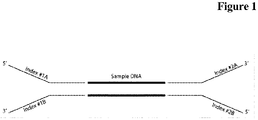
- FIG. 1 A diagram of the adaptors ligated to both ends of a sample nucleic acid.
- adaptor refers to a polynucleotide that can be attached to one or both termini of a nucleic acid molecule.
- An adaptor may comprise only a double-stranded region or also a single-stranded region.
- the double-stranded region is formed by hybridizable portions of two nucleic acid strands while the single-stranded region is formed by non-hybridizable portions of the same two nucleic acid strands.
- the non-hybridizable portion may be open (Y-shaped adaptor) or covalently closed by linking the free 5'- and 3'-ends (dumbbell-shaped adaptor).
- the single-stranded portion of the adaptor is sometimes referred to as a "fork,” while the double stranded portion is sometimes referred to as a "stem.”
- barcode and “index” are used interchangeably to refer to a sequence of nucleotides within a polynucleotide that is used to identify a nucleic acid molecule.
- a barcode can be used to identify a sample from which a nucleic acid molecule is derived when several samples are combined (as is common in some massively parallel sequencing techniques).
- a barcode can also be used to identify a unique nucleic acid molecule and progeny thereof resulting from amplification.
- a barcode can be synthesized at the time a nucleic acid (e.g ., a primer or an adaptor) is synthesized.
- a barcode can comprise pre-defined or random sequences or combinations thereof.
- pre-defined means that sequence of a barcode is known at the time a nucleic acid with the barcode is synthesized.
- random " or "degenerate sequence” means that a random mixture of nucleotides is used when the barcode within the nucleic acid is synthesized.
- a non-random, i.e., biased mixture of bases can be used during oligonucleotide sequencing resulting in a barcode that preferentially contains certain bases.
- a barcode can sometimes comprise an endogenous sequence present in the unaltered genome.
- An endogenous barcode can be formed by a junction of the randomly fragmented nucleic acid and an adaptor.
- a combination synthetic-endogenous barcode can be formed by the combination of the genomic coordinates of the start and end position of the randomly fragmented nucleic acid and a synthetic barcode in the adaptor.
- single-stranded barcode e.g., within an adaptor, means a barcode not hybridized to its complementary sequence.
- double-stranded barcode means a barcode hybridized to its complementary sequence.
- a single-stranded barcode can be situated in the single-stranded portion of an adaptor, and a double-stranded barcode can be situated in the double-stranded portion of an adaptor.
- hybridizable refers to two polynucleotide strands that can form a duplex.
- the duplex can form when the strands are perfectly or at least partially complementary.
- Complementarity may be defined by Watson-Crick hydrogen bonding. Additional interactions (e.g., Hoogsteen pairing and hydrophobic interactions) can support hybridization in the absence of perfect Watson-Crick complementarity.
- non-hybridizable refers to two polynucleotide strands that cannot form a duplex under experimental conditions.
- the duplex is unable to form when the strands do not share even partial complementarity and no additional interactions (e.g., Hoogsteen pairing and hydrophobic interactions) suffice to support specific hybridization.
- edit distance between two nucleic acid sequences, especially between two barcodes, refers to the number of changes required to change one sequence into another, where a change is the addition, subtraction, or substitution of a base.
- paired in reference to barcodes means having a known relationship between two barcode sequences on the two oligos of an adaptor molecule.
- the term includes complementarity (base pairing), reverse complementarity, as well as any other artificial relationship, e.g., a reference table, indicating which two barcoded adaptor strands have been intentionally paired during the hybridization step.
- amplification refers to any method for increasing the number of copies of a nucleic acid sequence.
- the amplification can be performed with the use of a polymerase, e.g., in one or more polymerase chain reactions (PCR) or another exponential or linear method of amplification.
- PCR polymerase chain reactions
- amplicons means nucleic acid products of an amplification reaction.
- universal primer and “universal primer site” refer to a primer and a primer-binding sequence not present in any target sequence but added to all target sequences (e.g., by being a part of a target-specific primer or by being a part of an adaptor). After the universal primer site has been added, the universal primer can be used for amplification or sequencing of all target sequences in a sample.
- deduping refers to a method of grouping nucleic acid sequences into groups consisting of progeny of a single molecule originally present in the sample. Deduping further comprises analysis of the sequences of the progeny molecules to indirectly determine the sequence of the original molecule with a reduced rate of errors.
- error in the context of nucleic acid sequencing refers to an incorrect base readout.
- the term encompasses any error revealed during the sequencing step, not only the error of the sequencing step itself.
- the error includes errors of DNA polymerase during primer extension or target amplification, errors of the sequencing polymerase and errors of the sequencing instrument, e.g., detector.
- errors also include errors of in vitro DNA synthesis (oligo synthesis). Errors include base substitution (wrong base),lack of incorporation (deleted base), or addition of a base (inserted base).
- error rate refers to the number of errors per correct base read.
- reduced error rate from an error-prevention measure refers to the error rate with the measure compared to the error rate without the measure.
- cfDNA cell-free DNA
- cfDNA refers to DNA in a sample that when collected, was not contained within a cell. The term does not refer to DNA that is rendered cell-free by in vitro disruption of cells or tissues.
- cfDNAs can comprise both normal cell and cancer cell-derived DNA. cfDNA is commonly obtained from blood or plasma ("circulation"). cfDNAs may be released into the circulation through secretion or cell death processes, e.g., cellular necrosis or apoptosis. Some cfDNA is ctDNA (see below).
- circulating tumor DNA or "circulating cancer DNA” refers to the fraction of cell-free DNA (cfDNA) that originates from a tumor.
- sample refers to any biological sample that is isolated from a subject.
- a sample can include body tissues or fluids.
- the sample may also be a tumor sample.
- Samples can be obtained directly from a subject, from previously excised or drawn sample or from the environment (e.g., forensic samples).
- blood sample refers to whole blood or any fraction thereof, including blood cells, serum and plasma.
- the invention includes adaptors for single-molecule sequencing of nucleic acids.
- Adaptors conjugated to a nucleic acid molecule are shown in Figure 1 .
- the current nucleic acid sequencing methods referred to as Next Generation Sequencing (NGS) or Massively Parallel Sequencing (MPS) involve capturing, optionally amplifying and sequencing each individual molecule in a sample. Optional amplification can be before capture, after capture, or both.
- NGS further involves universal sequencing primers and optionally, universal pre-amplification primers.
- each target nucleic acid molecule is conjugated to an adaptor.
- Adaptors are typically conjugated to both sides of target nucleic acid molecules and contain binding sites for universal primers and other sequences necessary for sequencing.
- Adaptors may contain barcodes that uniquely identify a sample from which target molecules originated (sample ID or SID). Adaptors may contain barcodes that uniquely identify each target molecules (unique molecular ID or UID). SID and UID may exist separately or be combined into a single barcode.
- a convenient way to attach adaptors to a double-stranded target nucleic acid is via ligation.
- the target nucleic acid and the adaptor must have compatible ends.
- the target nucleic acid is end-repaired to contain blunt ends and the adaptor has a double stranded blunt end.
- the target nucleic acid is end-repaired and both the target nucleic acid and the adaptor are engineered to have a one-base extension. For example, and extension creating a T-A pair enables efficient ligation between the adaptor molecule and the target nucleic acid. DNA overhangs resulting from a restriction digest could also be used to improve ligation efficiency.
- Y-shaped adaptors described e.g., in U.S. Patent No. 6395887 .
- These adaptors comprise a double-stranded portion at one end and a single stranded portion comprising two non-hybridizable strands at the opposite end. Only the double-stranded portion is capable of ligation to the target nucleic acid ensuring correct orientation of the ligated products.
- the invention is a novel adaptor for analysis of nucleic acids.
- the adaptor comprises a double-stranded portion at one end and a single stranded portion comprising two non-hybridizable strands at the opposite end.
- the precise length of each portion is not essential as long as the adaptor possesses the following properties: 1) has sufficient length to accommodate all the elements described below; 2) has a suitable melting temperature; and 3) does not form any secondary structure in the single-stranded portion that may impede the adaptor's performance.
- One skilled in the art can design an oligonucleotide with desired melting temperature to accommodate a particular assay needs.
- the length of the single-stranded portion not exceed 20 nucleotides and the length of the double stranded be sufficient to remain hybridized at room temperature and allow binding of DNA ligase.
- the adaptor comprises binding sites for one or more primers.
- the primers may be sequencing primers, amplification primers or both. In some embodiments, the same primer may be a sequencing primer and an amplification primer.
- the adaptors may also comprise sequences specific to a particular sequencing technology, for example, sequences that hybridize to the solid support in the sequencing instrument (e.g ., cluster generation sequences in Illumina instruments).
- the adaptor may contain, naturally occurring bases (e.g ., Adenosine (A), Thymidine (T), Guanosine (G), Cytosine (C), and Uracil (U)), other natural bases such as Inosine (I) and methyl-Cytosine (mC), modified versions of the natural bases as well as non-naturally occurring bases e.g ., aminoallyl-uridine, iso-cytosines, isoguanine, and 2-aminopurine.
- naturally occurring bases e.g ., Adenosine (A), Thymidine (T), Guanosine (G), Cytosine (C), and Uracil (U)
- other natural bases such as Inosine (I) and methyl-Cytosine (mC)
- modified versions of the natural bases e.g ., aminoallyl-uridine, iso-cytosines, isoguanine, and 2-aminopurine.
- the adaptors used in the present invention further comprise barcodes.
- the barcode can contain natural or non-natural nucleotides described above.
- the barcode may have a pre-defined sequence, a random sequence, or a non-random biased sequence that preferentially contains certain bases.
- a biased sequence is used to avoid error-prone bases.
- a biased sequence is used to modulate the melting temperature of the barcode-containing nucleic acid.
- each adaptor comprises two barcodes or indices, one on each of the single strands of the single-stranded portion.
- the ligated product comprising a target DNA fragment and two adaptors comprises four barcodes.
- each adaptor e.g., Index 1A and 1B
- the barcodes in each adaptor have sequences in a 1:1 relationship.
- the relationship is reverse complementarity; whereby identifying one barcode sequence (e.g., Index 1A) unambiguously determines the second barcode sequence (Index 1B).
- the invention is a pool of adaptors described in Figure 1 .
- each adaptor comprises a double-stranded portion at one end and a single stranded portion comprising two non-hybridizable strands at the opposite end.
- the adaptors in the pool further comprise binding sites for one or more primers, e.g., sequencing primers, amplification primers or both.
- the adaptors in the pool further comprise barcodes.
- each adaptor comprises two barcodes, one on each of the single strands of the single-stranded portion.
- the barcodes in adaptors are in a 1:1 relationship whereby identifying one barcode sequence unambiguously determines the second barcode sequence.
- the sequences are reverse complementary, .
- the adaptors within the pool have barcodes at least 1 or at least 3 edit distance apart.
- One of skilled in the art would be able to determine what edit distance is optimal for a particular experiment. Generally, greater edit distance means that fewer barcodes can be used in one pool. However, if an assay or a manufacturing process has a high error rate, greater edit distance will be required. For example, oligonucleotide manufacturing process used to make adaptors may have a high error rate. Similarly, a nucleic acid polymerase used in DNA amplification or primer extension in the sequencing by synthesis workflow can have a high error rate. These error rates would require increasing edit distance among the barcodes in adaptors of the pool. Conversely, improving the accuracy of each of the methods mentioned above will allow decreasing edit distance among the barcodes in adaptors of the pool.
- an article of manufacture may comprise a single vial containing the entire pool of adaptors. Alternatively, an article of manufacture can comprise a kit where one or more adaptors of the pool are present in separate vials.
- the method comprises combining and annealing in a pairwise manner two single strands of nucleic acid to form adaptors wherein each adaptor comprises a double-stranded portion at one end and a single stranded portion comprising two non-hybridizable strands at the opposite end.
- the single strands forming the adaptors comprise binding sites for one or more primers, e.g., sequencing primers, amplification primers or both.
- the single strands forming the adaptors further comprise barcodes.
- each strand comprises a barcode in the non-complementary region so that each adaptor comprises at least two barcodes, At least one on each of the single strands of the single-stranded portion.
- the single strands are combined and annealed so that barcodes in adaptors are in a 1:1 relationship.
- the sequences are reverse complementary, .
- adaptors are used in a method that involves creating a reference whereby identifying one sequence (e.g., Index 1A in Fig. 1 ) unambiguously determines the second sequence (Index 1B in Fig. 1 ).
- the invention is a method of sequencing nucleic acids in a sample using adaptors with single-stranded barcodes.
- the method comprises attaching to nucleic acids in the sample a pool of adaptors to form a pool of adaptor-target molecules.
- the attaching may be via ligation with a DNA ligase, e.g ., a T4 DNA ligase, E. coli DNA ligase, mammalian ligase, or any combination thereof.
- the mammalian ligase may be DNA ligase I, DNA ligase III, or DNA ligase IV.
- the ligase may also be a thermostable ligase.
- the sample nucleic acid may be subjected to end repair (e.g., with a DNA polymerase) and A-tailing, also with a DNA polymerase or terminal transferase.
- Each adaptor comprises a double-stranded portion at one end and a single stranded portion comprising two non-hybridizable strands at the opposite end.
- the adaptor comprises a first barcode in one strand of the single stranded portion and a second barcode in the other strand of the single stranded portion, and wherein the first and second barcodes in each adaptor are in a known relationship , whereby the known relationship is reverse complementarity, such that each first barcode can be unambiguously associated with each second barcode.
- multiple adaptors with multiple pairs of barcodes are present but there are fewer adaptors then target nucleic acid molecules in each sample.
- the number of adaptors with unique pairs of barcodes is sufficient to identify all, nearly all, or a desired percentage of the original nucleic acid molecules in the sample.
- the identification utilizes both the unique barcode and the genomic coordinates (breakpoints) for each target nucleic acid molecule as described below.
- the adaptor further comprises binding sites for one or more primers.
- the method further comprises a step of amplifying both strands of the adaptor-target molecules prior to determining their sequence.
- the method further comprises a step of determining the sequence of the adaptor-target molecules. In this step, at least a portion of the sequence of the target nucleic acid is determined and the sequence of barcodes in the adaptors is determined.
- the method further comprises a step of error correction wherein the adaptor-target sequence containing each first barcode is paired with the adaptor-target sequence containing the corresponding second barcode in the known relationship with the first barcode.
- the target sequence attached to the adaptor with barcode 1A is paired with the target sequence attached to the adaptor with barcode 1B.
- the first molecules with barcode 1A represent the first strand of the original molecule and the second molecules with barcode 1B represent the second strand of the original molecule. Pairing barcodes 1A and 1B allows matching of the original strands for error correction.
- the change is deemed to be an experimental error.
- Molecules containing experimental errors are omitted from the results.
- the molecules containing experimental error found in the raw data file are not included in the results file.
- Same-origin sequences are also identified by virtue of having the same adaptor barcodes and the same genomic coordinates of the target nucleic acid. If the target sequence of the same-origin molecules is not identical, e.g., a base substitution is present in only a fraction of the same-origin molecules, the change is deemed to be an experimental error.
- the sample comprises cell-free nucleic acids, such as cell-free plasma nucleic acids.
- DNA may be fragmented, e.g., may be on average about 170 nucleotides in length, which may coincide with the length of DNA wrapped around a single nucleosome.
- the nucleic acid can be fragmented in vitro using e.g ., sonication or restriction digestion.
Landscapes
- Chemical & Material Sciences (AREA)
- Life Sciences & Earth Sciences (AREA)
- Organic Chemistry (AREA)
- Health & Medical Sciences (AREA)
- Engineering & Computer Science (AREA)
- Zoology (AREA)
- Wood Science & Technology (AREA)
- Proteomics, Peptides & Aminoacids (AREA)
- Genetics & Genomics (AREA)
- General Engineering & Computer Science (AREA)
- Biotechnology (AREA)
- Bioinformatics & Cheminformatics (AREA)
- Analytical Chemistry (AREA)
- Microbiology (AREA)
- Molecular Biology (AREA)
- Biophysics (AREA)
- Physics & Mathematics (AREA)
- Biochemistry (AREA)
- General Health & Medical Sciences (AREA)
- Immunology (AREA)
- Chemical Kinetics & Catalysis (AREA)
- Biomedical Technology (AREA)
- Bioinformatics & Computational Biology (AREA)
- Crystallography & Structural Chemistry (AREA)
- Plant Pathology (AREA)
- Measuring Or Testing Involving Enzymes Or Micro-Organisms (AREA)
- Heterocyclic Carbon Compounds Containing A Hetero Ring Having Oxygen Or Sulfur (AREA)
Claims (8)
- Groupe d'adaptateurs, chaque adaptateur comprenant une partie double brin à une extrémité et une partie simple brin comprenant deux brins non hybridables à l'extrémité opposée, et comprenant en outre au moins un site de liaison à l'amorce et au moins un code-barres dans chaque partie simple brin, dans lequel les codes-barres sur chaque adaptateur dans le groupe sont dans une relation connue,
dans lequel la relation entre les codes-barres est une complémentarité inverse. - Article manufacturé comprenant le groupe d'adaptateurs selon la revendication 1.
- Article selon la revendication 2, dans lequel le groupe est contenu dans un flacon unique.
- Procédé de séquençage d'acides nucléiques comprenant :a) la ligature à chaque acide nucléique dans un échantillon d'un adaptateur d'un groupe d'adaptateurs selon la revendication 1 comprenant une partie double brin à une extrémité et une partie simple brin comprenant deux brins non hybridables à l'extrémité opposée, et comprenant en outre au moins un site de liaison à l'amorce et un premier code-barres sur le premier brin et un second code-barres sur le second brin de la partie simple brin, les premier et second codes-barres sur chaque adaptateur dans le groupe étant dans une relation connue, la relation entre les codes-barres étant une complémentarité inverse,b) la détermination de la séquence d'au moins une partie des brins d'acides nucléiques et des premier et second codes-barres,c) la comparaison de la séquence du brin d'acide nucléique contenant le premier code-barres et de la séquence du brin d'acide nucléique contenant le second code-barres pour identifier des séquences non parfaitement complémentaires,d) la détermination que les séquences non parfaitement complémentaires contiennent au moins une erreur expérimentale.
- Procédé selon la revendication 4, comprenant en outre l'amplification de l'acide nucléique ligaturé avant la détermination de séquence pour obtenir des séquences double brin séparées contenant le premier et le second code-barres.
- Procédé selon la revendication 4, dans lequel les séquences déterminées pour contenir au moins une erreur expérimentale sont omises des résultats de séquençage.
- Procédé selon la revendication 4, comprenant en outre le regroupement de séquences contenant le même code-barres et les mêmes coordonnées génomiques de l'acide nucléique, la comparaison des séquences au sein du groupe pour identifier les séquences non identiques et la détermination que les séquences non identiques contiennent au moins une erreur expérimentale.
- Procédé selon la revendication 4, dans lequel l'échantillon contient un ADN acellulaire.
Applications Claiming Priority (2)
| Application Number | Priority Date | Filing Date | Title |
|---|---|---|---|
| US201662288903P | 2016-01-29 | 2016-01-29 | |
| PCT/EP2017/051588 WO2017129647A1 (fr) | 2016-01-29 | 2017-01-26 | Nouvel adaptateur de séquençage d'acides nucléiques et procédé d'utilisation |
Publications (2)
| Publication Number | Publication Date |
|---|---|
| EP3408406A1 EP3408406A1 (fr) | 2018-12-05 |
| EP3408406B1 true EP3408406B1 (fr) | 2022-06-15 |
Family
ID=57890833
Family Applications (1)
| Application Number | Title | Priority Date | Filing Date |
|---|---|---|---|
| EP17701499.0A Active EP3408406B1 (fr) | 2016-01-29 | 2017-01-26 | Nouvel adaptateur du typ y de séquençage d'acides nucléiques et procédé d'utilisation |
Country Status (6)
| Country | Link |
|---|---|
| US (2) | US20180334709A1 (fr) |
| EP (1) | EP3408406B1 (fr) |
| JP (1) | JP6714709B2 (fr) |
| CN (1) | CN108474026A (fr) |
| ES (1) | ES2924487T3 (fr) |
| WO (1) | WO2017129647A1 (fr) |
Families Citing this family (11)
| Publication number | Priority date | Publication date | Assignee | Title |
|---|---|---|---|---|
| LT3645717T (lt) * | 2017-06-27 | 2021-12-10 | F. Hoffmann-La Roche Ag | Moduliniai nukleorūgščių adapteriai |
| WO2019183640A1 (fr) * | 2018-03-23 | 2019-09-26 | Board Of Regents, The University Of Texas System | Séquençage efficace d'adn double brin avec un taux d'erreurs extrêmement faible |
| US11555185B2 (en) | 2018-12-19 | 2023-01-17 | New England Biolabs, Inc. | Target enrichment |
| CN115956128B (zh) | 2020-07-08 | 2026-03-27 | 豪夫迈·罗氏有限公司 | 在下一代测序文库的靶捕获过程中使用毒性引物对非靶文库分子进行靶向消耗 |
| WO2022131285A1 (fr) | 2020-12-15 | 2022-06-23 | ジェノダイブファーマ株式会社 | Procédé d'évaluation de l'efficacité de ligature d'adaptateur dans une séquence d'échantillon d'adn |
| WO2024046992A1 (fr) | 2022-09-02 | 2024-03-07 | F. Hoffmann-La Roche Ag | Amélioration de la performance de l'enrichissement des cibles de nouvelle génération |
| WO2025240460A2 (fr) | 2024-05-14 | 2025-11-20 | Roche Molecular Systems, Inc. | Dosage pour la détection de mutations conférant une résistance au traitement avec un agent immunothérapeutique |
| WO2026082489A1 (fr) | 2024-10-18 | 2026-04-23 | F. Hoffmann-La Roche Ag | Pcr universelle destinée à renforcer la récupération de molécules dans la préparation d'une bibliothèque d'adn acellulaire et flux de travail d'enrichissement en cibles |
| WO2026087220A1 (fr) | 2024-10-22 | 2026-04-30 | F. Hoffmann-La Roche Ag | Préparation de banques d'adn pour séquençage de nouvelle génération à l'aide d'adaptateurs y modifiés avec des liaisons phosphorothioate |
| WO2026093331A1 (fr) | 2024-10-28 | 2026-05-07 | F. Hoffmann-La Roche Ag | Constructions d'adaptateurs en épingle à cheveux et amorces pour générer des molécules de bibliothèque de séquençage de nouvelle génération |
| WO2026099278A1 (fr) | 2024-11-08 | 2026-05-15 | F. Hoffmann-La Roche Ag | Normalisation et mutualisation de banques de séquençage sans pcr |
Family Cites Families (30)
| Publication number | Priority date | Publication date | Assignee | Title |
|---|---|---|---|---|
| US5714320A (en) * | 1993-04-15 | 1998-02-03 | University Of Rochester | Rolling circle synthesis of oligonucleotides and amplification of select randomized circular oligonucleotides |
| US6395887B1 (en) | 1995-08-01 | 2002-05-28 | Yale University | Analysis of gene expression by display of 3'-end fragments of CDNAS |
| WO2004033728A2 (fr) * | 2002-10-11 | 2004-04-22 | Erasmus Universiteit Rotterdam | Amorces d'amplification d'acides nucleiques pour etudes de la clonalite basee sur la pcr |
| EP1616947B1 (fr) * | 2003-03-28 | 2012-05-09 | Japan as represented by Director General of National Rehabilitation Center for Persons with Disabilities | METHODE DE SYNTHESE D'UN ADNc |
| US20060008833A1 (en) * | 2004-07-12 | 2006-01-12 | Jacobson Joseph M | Method for long, error-reduced DNA synthesis |
| US20060223122A1 (en) * | 2005-03-08 | 2006-10-05 | Agnes Fogo | Classifying and predicting glomerulosclerosis using a proteomics approach |
| GB2424946A (en) * | 2005-04-05 | 2006-10-11 | Stratec Biomedical Systems Ag | A detection system for substance binding using up-converting fluorescent probes |
| WO2009133466A2 (fr) * | 2008-04-30 | 2009-11-05 | Population Genetics Technologies Ltd. | Construction de bibliothèque d'adaptateurs asymétriques |
| US10388403B2 (en) * | 2010-01-19 | 2019-08-20 | Verinata Health, Inc. | Analyzing copy number variation in the detection of cancer |
| CN102725424B (zh) * | 2010-01-25 | 2014-07-09 | Rd生物科技公司 | 靶核酸的自折叠扩增 |
| WO2011097424A1 (fr) * | 2010-02-05 | 2011-08-11 | Siemens Healthcare Diagnostics Inc. | Procédés pour augmenter le niveau multiplex par externalisation de la référence passive dans des réactions en chaîne de la polymérase |
| EP2363502B1 (fr) * | 2010-03-04 | 2017-02-15 | miacom Diagnostics GmbH | FISH de multiplexage amélioré |
| JP2014512826A (ja) * | 2011-04-25 | 2014-05-29 | バイオ−ラド ラボラトリーズ インコーポレイテッド | 核酸分析のための方法および組成物 |
| CA2843618C (fr) * | 2011-05-16 | 2020-04-21 | Universitetet I Oslo | Detection de dinoflagelles produisant des saxitoxines |
| WO2012162161A1 (fr) * | 2011-05-20 | 2012-11-29 | Phthisis Diagnostics | Système et procédé de détection de microsporidia |
| EP3388535B1 (fr) * | 2011-12-09 | 2021-03-24 | Adaptive Biotechnologies Corporation | Diagnostic de malignités lymphoïdes et détection de maladies résiduelles minimales |
| EP2823064B1 (fr) * | 2012-03-05 | 2019-02-06 | President and Fellows of Harvard College | Procédés pour le séquençage épigénétique |
| WO2013142389A1 (fr) * | 2012-03-20 | 2013-09-26 | University Of Washington Through Its Center For Commercialization | Méthodes permettant de faire baisser le taux d'erreur observé lors d'un séquençage adn massivement parallèle en faisant appel à un séquençage consensus duplex |
| EP4026912A1 (fr) * | 2012-05-10 | 2022-07-13 | The General Hospital Corporation | Procédés de détermination d'une séquence nucléotidique |
| AU2013267609C1 (en) * | 2012-05-31 | 2019-01-03 | Board Of Regents, The University Of Texas System | Method for accurate sequencing of DNA |
| EP2970951B1 (fr) * | 2013-03-13 | 2019-02-20 | Illumina, Inc. | Procédés pour le séquençage d'acide nucléique |
| US20160032396A1 (en) * | 2013-03-15 | 2016-02-04 | The Board Of Trustees Of The Leland Stanford Junior University | Identification and Use of Circulating Nucleic Acid Tumor Markers |
| US10087481B2 (en) * | 2013-03-19 | 2018-10-02 | New England Biolabs, Inc. | Enrichment of target sequences |
| CN111534580B (zh) * | 2013-12-28 | 2024-06-04 | 夸登特健康公司 | 用于检测遗传变异的方法和系统 |
| RU2688485C2 (ru) * | 2014-01-07 | 2019-05-21 | Фундасио Привада Институт Де Медисина Предиктива И Персоналицада Дель Кансер | Способы получения библиотек двухцепочечных днк и способы секвенирования для идентификации метилированных цитозинов |
| HUE058149T2 (hu) * | 2014-01-31 | 2022-07-28 | Swift Biosciences Inc | Javított eljárások DNS-szubsztrátok feldolgozására |
| WO2015131107A1 (fr) * | 2014-02-28 | 2015-09-03 | Nugen Technologies, Inc. | Séquençage au bisulfite de représentation réduite avec adaptateurs de diversité |
| EP3155127B1 (fr) * | 2014-06-13 | 2020-07-22 | Life Technologies Corporation | Amplification multiplex d'acides nucléiques |
| WO2016040901A1 (fr) * | 2014-09-12 | 2016-03-17 | The Board Of Trustees Of The Leland Stanford Junior University | Identification et utilisation d'acides nucléiques circulants |
| US10844428B2 (en) * | 2015-04-28 | 2020-11-24 | Illumina, Inc. | Error suppression in sequenced DNA fragments using redundant reads with unique molecular indices (UMIS) |
-
2017
- 2017-01-26 EP EP17701499.0A patent/EP3408406B1/fr active Active
- 2017-01-26 WO PCT/EP2017/051588 patent/WO2017129647A1/fr not_active Ceased
- 2017-01-26 ES ES17701499T patent/ES2924487T3/es active Active
- 2017-01-26 JP JP2018539334A patent/JP6714709B2/ja active Active
- 2017-01-26 CN CN201780008365.0A patent/CN108474026A/zh active Pending
-
2018
- 2018-07-27 US US16/048,196 patent/US20180334709A1/en not_active Abandoned
-
2022
- 2022-12-19 US US18/068,157 patent/US20230124718A1/en not_active Abandoned
Also Published As
| Publication number | Publication date |
|---|---|
| US20180334709A1 (en) | 2018-11-22 |
| ES2924487T3 (es) | 2022-10-07 |
| JP6714709B2 (ja) | 2020-06-24 |
| EP3408406A1 (fr) | 2018-12-05 |
| CN108474026A (zh) | 2018-08-31 |
| US20230124718A1 (en) | 2023-04-20 |
| JP2019504624A (ja) | 2019-02-21 |
| WO2017129647A1 (fr) | 2017-08-03 |
Similar Documents
| Publication | Publication Date | Title |
|---|---|---|
| US20230124718A1 (en) | Novel adaptor for nucleic acid sequencing and method of use | |
| US20240141426A1 (en) | Compositions and methods for identification of a duplicate sequencing read | |
| JP7332733B2 (ja) | 次世代シークエンシングのための高分子量dnaサンプル追跡タグ | |
| ES2810300T3 (es) | Etiquetado y evaluación de una secuencia diana | |
| JP2020521486A (ja) | シングルセルトランスクリプトームの増幅法 | |
| JP2021168659A (ja) | 次世代ゲノムウォーキングのための方法ならびに関連する組成物およびキット | |
| CN109844137B (zh) | 用于鉴定嵌合产物的条形码化环状文库构建 | |
| US20220364169A1 (en) | Sequencing method for genomic rearrangement detection | |
| CN105026577A (zh) | 通过序列捕获检测基因组重排 | |
| JP2016520326A (ja) | マルチプレックス配列決定のための分子バーコード化 | |
| US20170175182A1 (en) | Transposase-mediated barcoding of fragmented dna | |
| US20200370108A1 (en) | Methods and compositions for selecting and amplifying dna targets in a single reaction mixture | |
| JP7850658B2 (ja) | 3’オーバーハングを修復する方法 | |
| JP2023552984A (ja) | 両端からポリヌクレオチド断片を配列決定するための方法 | |
| WO2019046783A1 (fr) | Procédés de fabrication et d'utilisation de molécules en tandem à codes à barre double | |
| HK1227923A1 (en) | Compositions and methods for identification of a duplicate sequencing read |
Legal Events
| Date | Code | Title | Description |
|---|---|---|---|
| STAA | Information on the status of an ep patent application or granted ep patent |
Free format text: STATUS: UNKNOWN |
|
| STAA | Information on the status of an ep patent application or granted ep patent |
Free format text: STATUS: THE INTERNATIONAL PUBLICATION HAS BEEN MADE |
|
| PUAI | Public reference made under article 153(3) epc to a published international application that has entered the european phase |
Free format text: ORIGINAL CODE: 0009012 |
|
| STAA | Information on the status of an ep patent application or granted ep patent |
Free format text: STATUS: REQUEST FOR EXAMINATION WAS MADE |
|
| 17P | Request for examination filed |
Effective date: 20180829 |
|
| AK | Designated contracting states |
Kind code of ref document: A1 Designated state(s): AL AT BE BG CH CY CZ DE DK EE ES FI FR GB GR HR HU IE IS IT LI LT LU LV MC MK MT NL NO PL PT RO RS SE SI SK SM TR |
|
| AX | Request for extension of the european patent |
Extension state: BA ME |
|
| DAV | Request for validation of the european patent (deleted) | ||
| DAX | Request for extension of the european patent (deleted) | ||
| STAA | Information on the status of an ep patent application or granted ep patent |
Free format text: STATUS: EXAMINATION IS IN PROGRESS |
|
| 17Q | First examination report despatched |
Effective date: 20200707 |
|
| REG | Reference to a national code |
Ref country code: DE Ref legal event code: R079 Ref document number: 602017058487 Country of ref document: DE Free format text: PREVIOUS MAIN CLASS: C12Q0001680000 Ipc: C12Q0001680600 |
|
| GRAP | Despatch of communication of intention to grant a patent |
Free format text: ORIGINAL CODE: EPIDOSNIGR1 |
|
| STAA | Information on the status of an ep patent application or granted ep patent |
Free format text: STATUS: GRANT OF PATENT IS INTENDED |
|
| RIC1 | Information provided on ipc code assigned before grant |
Ipc: C12Q 1/6869 20180101ALI20220124BHEP Ipc: C12Q 1/6855 20180101ALI20220124BHEP Ipc: C12Q 1/6806 20180101AFI20220124BHEP |
|
| INTG | Intention to grant announced |
Effective date: 20220208 |
|
| GRAS | Grant fee paid |
Free format text: ORIGINAL CODE: EPIDOSNIGR3 |
|
| GRAA | (expected) grant |
Free format text: ORIGINAL CODE: 0009210 |
|
| STAA | Information on the status of an ep patent application or granted ep patent |
Free format text: STATUS: THE PATENT HAS BEEN GRANTED |
|
| AK | Designated contracting states |
Kind code of ref document: B1 Designated state(s): AL AT BE BG CH CY CZ DE DK EE ES FI FR GB GR HR HU IE IS IT LI LT LU LV MC MK MT NL NO PL PT RO RS SE SI SK SM TR |
|
| REG | Reference to a national code |
Ref country code: CH Ref legal event code: EP Ref country code: GB Ref legal event code: FG4D |
|
| RIN1 | Information on inventor provided before grant (corrected) |
Inventor name: KLASS, DANIEL |
|
| REG | Reference to a national code |
Ref country code: IE Ref legal event code: FG4D |
|
| REG | Reference to a national code |
Ref country code: DE Ref legal event code: R096 Ref document number: 602017058487 Country of ref document: DE |
|
| REG | Reference to a national code |
Ref country code: AT Ref legal event code: REF Ref document number: 1498445 Country of ref document: AT Kind code of ref document: T Effective date: 20220715 |
|
| REG | Reference to a national code |
Ref country code: ES Ref legal event code: FG2A Ref document number: 2924487 Country of ref document: ES Kind code of ref document: T3 Effective date: 20221007 |
|
| REG | Reference to a national code |
Ref country code: LT Ref legal event code: MG9D |
|
| REG | Reference to a national code |
Ref country code: NL Ref legal event code: MP Effective date: 20220615 |
|
| PG25 | Lapsed in a contracting state [announced via postgrant information from national office to epo] |
Ref country code: SE Free format text: LAPSE BECAUSE OF FAILURE TO SUBMIT A TRANSLATION OF THE DESCRIPTION OR TO PAY THE FEE WITHIN THE PRESCRIBED TIME-LIMIT Effective date: 20220615 Ref country code: NO Free format text: LAPSE BECAUSE OF FAILURE TO SUBMIT A TRANSLATION OF THE DESCRIPTION OR TO PAY THE FEE WITHIN THE PRESCRIBED TIME-LIMIT Effective date: 20220915 Ref country code: LT Free format text: LAPSE BECAUSE OF FAILURE TO SUBMIT A TRANSLATION OF THE DESCRIPTION OR TO PAY THE FEE WITHIN THE PRESCRIBED TIME-LIMIT Effective date: 20220615 Ref country code: HR Free format text: LAPSE BECAUSE OF FAILURE TO SUBMIT A TRANSLATION OF THE DESCRIPTION OR TO PAY THE FEE WITHIN THE PRESCRIBED TIME-LIMIT Effective date: 20220615 Ref country code: GR Free format text: LAPSE BECAUSE OF FAILURE TO SUBMIT A TRANSLATION OF THE DESCRIPTION OR TO PAY THE FEE WITHIN THE PRESCRIBED TIME-LIMIT Effective date: 20220916 Ref country code: FI Free format text: LAPSE BECAUSE OF FAILURE TO SUBMIT A TRANSLATION OF THE DESCRIPTION OR TO PAY THE FEE WITHIN THE PRESCRIBED TIME-LIMIT Effective date: 20220615 Ref country code: BG Free format text: LAPSE BECAUSE OF FAILURE TO SUBMIT A TRANSLATION OF THE DESCRIPTION OR TO PAY THE FEE WITHIN THE PRESCRIBED TIME-LIMIT Effective date: 20220915 |
|
| REG | Reference to a national code |
Ref country code: AT Ref legal event code: MK05 Ref document number: 1498445 Country of ref document: AT Kind code of ref document: T Effective date: 20220615 |
|
| PG25 | Lapsed in a contracting state [announced via postgrant information from national office to epo] |
Ref country code: RS Free format text: LAPSE BECAUSE OF FAILURE TO SUBMIT A TRANSLATION OF THE DESCRIPTION OR TO PAY THE FEE WITHIN THE PRESCRIBED TIME-LIMIT Effective date: 20220615 Ref country code: LV Free format text: LAPSE BECAUSE OF FAILURE TO SUBMIT A TRANSLATION OF THE DESCRIPTION OR TO PAY THE FEE WITHIN THE PRESCRIBED TIME-LIMIT Effective date: 20220615 |
|
| PG25 | Lapsed in a contracting state [announced via postgrant information from national office to epo] |
Ref country code: NL Free format text: LAPSE BECAUSE OF FAILURE TO SUBMIT A TRANSLATION OF THE DESCRIPTION OR TO PAY THE FEE WITHIN THE PRESCRIBED TIME-LIMIT Effective date: 20220615 |
|
| PG25 | Lapsed in a contracting state [announced via postgrant information from national office to epo] |
Ref country code: SM Free format text: LAPSE BECAUSE OF FAILURE TO SUBMIT A TRANSLATION OF THE DESCRIPTION OR TO PAY THE FEE WITHIN THE PRESCRIBED TIME-LIMIT Effective date: 20220615 Ref country code: SK Free format text: LAPSE BECAUSE OF FAILURE TO SUBMIT A TRANSLATION OF THE DESCRIPTION OR TO PAY THE FEE WITHIN THE PRESCRIBED TIME-LIMIT Effective date: 20220615 Ref country code: RO Free format text: LAPSE BECAUSE OF FAILURE TO SUBMIT A TRANSLATION OF THE DESCRIPTION OR TO PAY THE FEE WITHIN THE PRESCRIBED TIME-LIMIT Effective date: 20220615 Ref country code: PT Free format text: LAPSE BECAUSE OF FAILURE TO SUBMIT A TRANSLATION OF THE DESCRIPTION OR TO PAY THE FEE WITHIN THE PRESCRIBED TIME-LIMIT Effective date: 20221017 Ref country code: EE Free format text: LAPSE BECAUSE OF FAILURE TO SUBMIT A TRANSLATION OF THE DESCRIPTION OR TO PAY THE FEE WITHIN THE PRESCRIBED TIME-LIMIT Effective date: 20220615 Ref country code: CZ Free format text: LAPSE BECAUSE OF FAILURE TO SUBMIT A TRANSLATION OF THE DESCRIPTION OR TO PAY THE FEE WITHIN THE PRESCRIBED TIME-LIMIT Effective date: 20220615 Ref country code: AT Free format text: LAPSE BECAUSE OF FAILURE TO SUBMIT A TRANSLATION OF THE DESCRIPTION OR TO PAY THE FEE WITHIN THE PRESCRIBED TIME-LIMIT Effective date: 20220615 |
|
| PG25 | Lapsed in a contracting state [announced via postgrant information from national office to epo] |
Ref country code: PL Free format text: LAPSE BECAUSE OF FAILURE TO SUBMIT A TRANSLATION OF THE DESCRIPTION OR TO PAY THE FEE WITHIN THE PRESCRIBED TIME-LIMIT Effective date: 20220615 Ref country code: IS Free format text: LAPSE BECAUSE OF FAILURE TO SUBMIT A TRANSLATION OF THE DESCRIPTION OR TO PAY THE FEE WITHIN THE PRESCRIBED TIME-LIMIT Effective date: 20221015 |
|
| REG | Reference to a national code |
Ref country code: DE Ref legal event code: R097 Ref document number: 602017058487 Country of ref document: DE |
|
| PG25 | Lapsed in a contracting state [announced via postgrant information from national office to epo] |
Ref country code: AL Free format text: LAPSE BECAUSE OF FAILURE TO SUBMIT A TRANSLATION OF THE DESCRIPTION OR TO PAY THE FEE WITHIN THE PRESCRIBED TIME-LIMIT Effective date: 20220615 |
|
| PLBE | No opposition filed within time limit |
Free format text: ORIGINAL CODE: 0009261 |
|
| STAA | Information on the status of an ep patent application or granted ep patent |
Free format text: STATUS: NO OPPOSITION FILED WITHIN TIME LIMIT |
|
| PG25 | Lapsed in a contracting state [announced via postgrant information from national office to epo] |
Ref country code: DK Free format text: LAPSE BECAUSE OF FAILURE TO SUBMIT A TRANSLATION OF THE DESCRIPTION OR TO PAY THE FEE WITHIN THE PRESCRIBED TIME-LIMIT Effective date: 20220615 |
|
| 26N | No opposition filed |
Effective date: 20230316 |
|
| PG25 | Lapsed in a contracting state [announced via postgrant information from national office to epo] |
Ref country code: SI Free format text: LAPSE BECAUSE OF FAILURE TO SUBMIT A TRANSLATION OF THE DESCRIPTION OR TO PAY THE FEE WITHIN THE PRESCRIBED TIME-LIMIT Effective date: 20220615 |
|
| PG25 | Lapsed in a contracting state [announced via postgrant information from national office to epo] |
Ref country code: LU Free format text: LAPSE BECAUSE OF NON-PAYMENT OF DUE FEES Effective date: 20230126 |
|
| REG | Reference to a national code |
Ref country code: BE Ref legal event code: MM Effective date: 20230131 |
|
| PG25 | Lapsed in a contracting state [announced via postgrant information from national office to epo] |
Ref country code: BE Free format text: LAPSE BECAUSE OF NON-PAYMENT OF DUE FEES Effective date: 20230131 |
|
| PG25 | Lapsed in a contracting state [announced via postgrant information from national office to epo] |
Ref country code: IE Free format text: LAPSE BECAUSE OF NON-PAYMENT OF DUE FEES Effective date: 20230126 |
|
| PG25 | Lapsed in a contracting state [announced via postgrant information from national office to epo] |
Ref country code: MC Free format text: LAPSE BECAUSE OF FAILURE TO SUBMIT A TRANSLATION OF THE DESCRIPTION OR TO PAY THE FEE WITHIN THE PRESCRIBED TIME-LIMIT Effective date: 20220615 |
|
| PG25 | Lapsed in a contracting state [announced via postgrant information from national office to epo] |
Ref country code: MC Free format text: LAPSE BECAUSE OF FAILURE TO SUBMIT A TRANSLATION OF THE DESCRIPTION OR TO PAY THE FEE WITHIN THE PRESCRIBED TIME-LIMIT Effective date: 20220615 |
|
| PG25 | Lapsed in a contracting state [announced via postgrant information from national office to epo] |
Ref country code: BG Free format text: LAPSE BECAUSE OF FAILURE TO SUBMIT A TRANSLATION OF THE DESCRIPTION OR TO PAY THE FEE WITHIN THE PRESCRIBED TIME-LIMIT Effective date: 20220615 |
|
| PG25 | Lapsed in a contracting state [announced via postgrant information from national office to epo] |
Ref country code: BG Free format text: LAPSE BECAUSE OF FAILURE TO SUBMIT A TRANSLATION OF THE DESCRIPTION OR TO PAY THE FEE WITHIN THE PRESCRIBED TIME-LIMIT Effective date: 20220615 |
|
| PG25 | Lapsed in a contracting state [announced via postgrant information from national office to epo] |
Ref country code: CY Free format text: LAPSE BECAUSE OF FAILURE TO SUBMIT A TRANSLATION OF THE DESCRIPTION OR TO PAY THE FEE WITHIN THE PRESCRIBED TIME-LIMIT; INVALID AB INITIO Effective date: 20170126 |
|
| PG25 | Lapsed in a contracting state [announced via postgrant information from national office to epo] |
Ref country code: HU Free format text: LAPSE BECAUSE OF FAILURE TO SUBMIT A TRANSLATION OF THE DESCRIPTION OR TO PAY THE FEE WITHIN THE PRESCRIBED TIME-LIMIT; INVALID AB INITIO Effective date: 20170126 |
|
| PG25 | Lapsed in a contracting state [announced via postgrant information from national office to epo] |
Ref country code: TR Free format text: LAPSE BECAUSE OF FAILURE TO SUBMIT A TRANSLATION OF THE DESCRIPTION OR TO PAY THE FEE WITHIN THE PRESCRIBED TIME-LIMIT Effective date: 20220615 |
|
| PGFP | Annual fee paid to national office [announced via postgrant information from national office to epo] |
Ref country code: GB Payment date: 20251220 Year of fee payment: 10 |
|
| PGFP | Annual fee paid to national office [announced via postgrant information from national office to epo] |
Ref country code: FR Payment date: 20251217 Year of fee payment: 10 |
|
| REG | Reference to a national code |
Ref country code: CH Ref legal event code: U11 Free format text: ST27 STATUS EVENT CODE: U-0-0-U10-U11 (AS PROVIDED BY THE NATIONAL OFFICE) Effective date: 20260201 |
|
| PGFP | Annual fee paid to national office [announced via postgrant information from national office to epo] |
Ref country code: ES Payment date: 20260202 Year of fee payment: 10 |
|
| PGFP | Annual fee paid to national office [announced via postgrant information from national office to epo] |
Ref country code: DE Payment date: 20251217 Year of fee payment: 10 |
|
| PGFP | Annual fee paid to national office [announced via postgrant information from national office to epo] |
Ref country code: IT Payment date: 20260107 Year of fee payment: 10 |
|
| PGFP | Annual fee paid to national office [announced via postgrant information from national office to epo] |
Ref country code: CH Payment date: 20260201 Year of fee payment: 10 |