EP3411406B1 - Molécule de liaison aux antigènes multispécifique présentant de meilleures caractéristiques d'internalisation - Google Patents
Molécule de liaison aux antigènes multispécifique présentant de meilleures caractéristiques d'internalisation Download PDFInfo
- Publication number
- EP3411406B1 EP3411406B1 EP17704190.2A EP17704190A EP3411406B1 EP 3411406 B1 EP3411406 B1 EP 3411406B1 EP 17704190 A EP17704190 A EP 17704190A EP 3411406 B1 EP3411406 B1 EP 3411406B1
- Authority
- EP
- European Patent Office
- Prior art keywords
- antibody
- multispecific antibody
- binding
- antigen
- antibody according
- Prior art date
- Legal status (The legal status is an assumption and is not a legal conclusion. Google has not performed a legal analysis and makes no representation as to the accuracy of the status listed.)
- Active
Links
Images



Classifications
-
- A—HUMAN NECESSITIES
- A61—MEDICAL OR VETERINARY SCIENCE; HYGIENE
- A61K—PREPARATIONS FOR MEDICAL, DENTAL OR TOILETRY PURPOSES
- A61K47/00—Medicinal preparations characterised by the non-active ingredients used, e.g. carriers or inert additives; Targeting or modifying agents chemically bound to the active ingredient
- A61K47/50—Medicinal preparations characterised by the non-active ingredients used, e.g. carriers or inert additives; Targeting or modifying agents chemically bound to the active ingredient the non-active ingredient being chemically bound to the active ingredient, e.g. polymer-drug conjugates
- A61K47/51—Medicinal preparations characterised by the non-active ingredients used, e.g. carriers or inert additives; Targeting or modifying agents chemically bound to the active ingredient the non-active ingredient being chemically bound to the active ingredient, e.g. polymer-drug conjugates the non-active ingredient being a modifying agent
- A61K47/68—Medicinal preparations characterised by the non-active ingredients used, e.g. carriers or inert additives; Targeting or modifying agents chemically bound to the active ingredient the non-active ingredient being chemically bound to the active ingredient, e.g. polymer-drug conjugates the non-active ingredient being a modifying agent the modifying agent being an antibody, an immunoglobulin or a fragment thereof, e.g. an Fc-fragment
- A61K47/6801—Drug-antibody or immunoglobulin conjugates defined by the pharmacologically or therapeutically active agent
- A61K47/6803—Drugs conjugated to an antibody or immunoglobulin, e.g. cisplatin-antibody conjugates
-
- A—HUMAN NECESSITIES
- A61—MEDICAL OR VETERINARY SCIENCE; HYGIENE
- A61K—PREPARATIONS FOR MEDICAL, DENTAL OR TOILETRY PURPOSES
- A61K47/00—Medicinal preparations characterised by the non-active ingredients used, e.g. carriers or inert additives; Targeting or modifying agents chemically bound to the active ingredient
- A61K47/50—Medicinal preparations characterised by the non-active ingredients used, e.g. carriers or inert additives; Targeting or modifying agents chemically bound to the active ingredient the non-active ingredient being chemically bound to the active ingredient, e.g. polymer-drug conjugates
- A61K47/51—Medicinal preparations characterised by the non-active ingredients used, e.g. carriers or inert additives; Targeting or modifying agents chemically bound to the active ingredient the non-active ingredient being chemically bound to the active ingredient, e.g. polymer-drug conjugates the non-active ingredient being a modifying agent
- A61K47/68—Medicinal preparations characterised by the non-active ingredients used, e.g. carriers or inert additives; Targeting or modifying agents chemically bound to the active ingredient the non-active ingredient being chemically bound to the active ingredient, e.g. polymer-drug conjugates the non-active ingredient being a modifying agent the modifying agent being an antibody, an immunoglobulin or a fragment thereof, e.g. an Fc-fragment
- A61K47/6801—Drug-antibody or immunoglobulin conjugates defined by the pharmacologically or therapeutically active agent
- A61K47/6803—Drugs conjugated to an antibody or immunoglobulin, e.g. cisplatin-antibody conjugates
- A61K47/68031—Drugs conjugated to an antibody or immunoglobulin, e.g. cisplatin-antibody conjugates the drug being an auristatin
-
- A—HUMAN NECESSITIES
- A61—MEDICAL OR VETERINARY SCIENCE; HYGIENE
- A61K—PREPARATIONS FOR MEDICAL, DENTAL OR TOILETRY PURPOSES
- A61K47/00—Medicinal preparations characterised by the non-active ingredients used, e.g. carriers or inert additives; Targeting or modifying agents chemically bound to the active ingredient
- A61K47/50—Medicinal preparations characterised by the non-active ingredients used, e.g. carriers or inert additives; Targeting or modifying agents chemically bound to the active ingredient the non-active ingredient being chemically bound to the active ingredient, e.g. polymer-drug conjugates
- A61K47/51—Medicinal preparations characterised by the non-active ingredients used, e.g. carriers or inert additives; Targeting or modifying agents chemically bound to the active ingredient the non-active ingredient being chemically bound to the active ingredient, e.g. polymer-drug conjugates the non-active ingredient being a modifying agent
- A61K47/68—Medicinal preparations characterised by the non-active ingredients used, e.g. carriers or inert additives; Targeting or modifying agents chemically bound to the active ingredient the non-active ingredient being chemically bound to the active ingredient, e.g. polymer-drug conjugates the non-active ingredient being a modifying agent the modifying agent being an antibody, an immunoglobulin or a fragment thereof, e.g. an Fc-fragment
- A61K47/6835—Medicinal preparations characterised by the non-active ingredients used, e.g. carriers or inert additives; Targeting or modifying agents chemically bound to the active ingredient the non-active ingredient being chemically bound to the active ingredient, e.g. polymer-drug conjugates the non-active ingredient being a modifying agent the modifying agent being an antibody, an immunoglobulin or a fragment thereof, e.g. an Fc-fragment the modifying agent being an antibody or an immunoglobulin bearing at least one antigen-binding site
- A61K47/6849—Medicinal preparations characterised by the non-active ingredients used, e.g. carriers or inert additives; Targeting or modifying agents chemically bound to the active ingredient the non-active ingredient being chemically bound to the active ingredient, e.g. polymer-drug conjugates the non-active ingredient being a modifying agent the modifying agent being an antibody, an immunoglobulin or a fragment thereof, e.g. an Fc-fragment the modifying agent being an antibody or an immunoglobulin bearing at least one antigen-binding site the antibody targeting a receptor, a cell surface antigen or a cell surface determinant
-
- A—HUMAN NECESSITIES
- A61—MEDICAL OR VETERINARY SCIENCE; HYGIENE
- A61K—PREPARATIONS FOR MEDICAL, DENTAL OR TOILETRY PURPOSES
- A61K47/00—Medicinal preparations characterised by the non-active ingredients used, e.g. carriers or inert additives; Targeting or modifying agents chemically bound to the active ingredient
- A61K47/50—Medicinal preparations characterised by the non-active ingredients used, e.g. carriers or inert additives; Targeting or modifying agents chemically bound to the active ingredient the non-active ingredient being chemically bound to the active ingredient, e.g. polymer-drug conjugates
- A61K47/51—Medicinal preparations characterised by the non-active ingredients used, e.g. carriers or inert additives; Targeting or modifying agents chemically bound to the active ingredient the non-active ingredient being chemically bound to the active ingredient, e.g. polymer-drug conjugates the non-active ingredient being a modifying agent
- A61K47/68—Medicinal preparations characterised by the non-active ingredients used, e.g. carriers or inert additives; Targeting or modifying agents chemically bound to the active ingredient the non-active ingredient being chemically bound to the active ingredient, e.g. polymer-drug conjugates the non-active ingredient being a modifying agent the modifying agent being an antibody, an immunoglobulin or a fragment thereof, e.g. an Fc-fragment
- A61K47/6835—Medicinal preparations characterised by the non-active ingredients used, e.g. carriers or inert additives; Targeting or modifying agents chemically bound to the active ingredient the non-active ingredient being chemically bound to the active ingredient, e.g. polymer-drug conjugates the non-active ingredient being a modifying agent the modifying agent being an antibody, an immunoglobulin or a fragment thereof, e.g. an Fc-fragment the modifying agent being an antibody or an immunoglobulin bearing at least one antigen-binding site
- A61K47/6851—Medicinal preparations characterised by the non-active ingredients used, e.g. carriers or inert additives; Targeting or modifying agents chemically bound to the active ingredient the non-active ingredient being chemically bound to the active ingredient, e.g. polymer-drug conjugates the non-active ingredient being a modifying agent the modifying agent being an antibody, an immunoglobulin or a fragment thereof, e.g. an Fc-fragment the modifying agent being an antibody or an immunoglobulin bearing at least one antigen-binding site the antibody targeting a determinant of a tumour cell
-
- A—HUMAN NECESSITIES
- A61—MEDICAL OR VETERINARY SCIENCE; HYGIENE
- A61K—PREPARATIONS FOR MEDICAL, DENTAL OR TOILETRY PURPOSES
- A61K47/00—Medicinal preparations characterised by the non-active ingredients used, e.g. carriers or inert additives; Targeting or modifying agents chemically bound to the active ingredient
- A61K47/50—Medicinal preparations characterised by the non-active ingredients used, e.g. carriers or inert additives; Targeting or modifying agents chemically bound to the active ingredient the non-active ingredient being chemically bound to the active ingredient, e.g. polymer-drug conjugates
- A61K47/51—Medicinal preparations characterised by the non-active ingredients used, e.g. carriers or inert additives; Targeting or modifying agents chemically bound to the active ingredient the non-active ingredient being chemically bound to the active ingredient, e.g. polymer-drug conjugates the non-active ingredient being a modifying agent
- A61K47/68—Medicinal preparations characterised by the non-active ingredients used, e.g. carriers or inert additives; Targeting or modifying agents chemically bound to the active ingredient the non-active ingredient being chemically bound to the active ingredient, e.g. polymer-drug conjugates the non-active ingredient being a modifying agent the modifying agent being an antibody, an immunoglobulin or a fragment thereof, e.g. an Fc-fragment
- A61K47/6835—Medicinal preparations characterised by the non-active ingredients used, e.g. carriers or inert additives; Targeting or modifying agents chemically bound to the active ingredient the non-active ingredient being chemically bound to the active ingredient, e.g. polymer-drug conjugates the non-active ingredient being a modifying agent the modifying agent being an antibody, an immunoglobulin or a fragment thereof, e.g. an Fc-fragment the modifying agent being an antibody or an immunoglobulin bearing at least one antigen-binding site
- A61K47/6875—Medicinal preparations characterised by the non-active ingredients used, e.g. carriers or inert additives; Targeting or modifying agents chemically bound to the active ingredient the non-active ingredient being chemically bound to the active ingredient, e.g. polymer-drug conjugates the non-active ingredient being a modifying agent the modifying agent being an antibody, an immunoglobulin or a fragment thereof, e.g. an Fc-fragment the modifying agent being an antibody or an immunoglobulin bearing at least one antigen-binding site the antibody being a hybrid immunoglobulin
- A61K47/6879—Medicinal preparations characterised by the non-active ingredients used, e.g. carriers or inert additives; Targeting or modifying agents chemically bound to the active ingredient the non-active ingredient being chemically bound to the active ingredient, e.g. polymer-drug conjugates the non-active ingredient being a modifying agent the modifying agent being an antibody, an immunoglobulin or a fragment thereof, e.g. an Fc-fragment the modifying agent being an antibody or an immunoglobulin bearing at least one antigen-binding site the antibody being a hybrid immunoglobulin the immunoglobulin having two or more different antigen-binding sites, e.g. bispecific or multispecific immunoglobulin
-
- A—HUMAN NECESSITIES
- A61—MEDICAL OR VETERINARY SCIENCE; HYGIENE
- A61P—SPECIFIC THERAPEUTIC ACTIVITY OF CHEMICAL COMPOUNDS OR MEDICINAL PREPARATIONS
- A61P35/00—Antineoplastic agents
-
- A—HUMAN NECESSITIES
- A61—MEDICAL OR VETERINARY SCIENCE; HYGIENE
- A61P—SPECIFIC THERAPEUTIC ACTIVITY OF CHEMICAL COMPOUNDS OR MEDICINAL PREPARATIONS
- A61P35/00—Antineoplastic agents
- A61P35/02—Antineoplastic agents specific for leukemia
-
- A—HUMAN NECESSITIES
- A61—MEDICAL OR VETERINARY SCIENCE; HYGIENE
- A61P—SPECIFIC THERAPEUTIC ACTIVITY OF CHEMICAL COMPOUNDS OR MEDICINAL PREPARATIONS
- A61P43/00—Drugs for specific purposes, not provided for in groups A61P1/00-A61P41/00
-
- C—CHEMISTRY; METALLURGY
- C07—ORGANIC CHEMISTRY
- C07K—PEPTIDES
- C07K16/00—Immunoglobulins [IG], e.g. monoclonal or polyclonal antibodies
- C07K16/18—Immunoglobulins [IG], e.g. monoclonal or polyclonal antibodies against material from animals or humans
- C07K16/28—Immunoglobulins [IG], e.g. monoclonal or polyclonal antibodies against material from animals or humans against receptors, cell surface antigens or cell surface determinants
- C07K16/2839—Immunoglobulins [IG], e.g. monoclonal or polyclonal antibodies against material from animals or humans against receptors, cell surface antigens or cell surface determinants against the integrin superfamily
- C07K16/2842—Immunoglobulins [IG], e.g. monoclonal or polyclonal antibodies against material from animals or humans against receptors, cell surface antigens or cell surface determinants against the integrin superfamily against integrin beta1-subunit-containing molecules, e.g. CD29, CD49
-
- C—CHEMISTRY; METALLURGY
- C07—ORGANIC CHEMISTRY
- C07K—PEPTIDES
- C07K16/00—Immunoglobulins [IG], e.g. monoclonal or polyclonal antibodies
- C07K16/18—Immunoglobulins [IG], e.g. monoclonal or polyclonal antibodies against material from animals or humans
- C07K16/28—Immunoglobulins [IG], e.g. monoclonal or polyclonal antibodies against material from animals or humans against receptors, cell surface antigens or cell surface determinants
- C07K16/2896—Immunoglobulins [IG], e.g. monoclonal or polyclonal antibodies against material from animals or humans against receptors, cell surface antigens or cell surface determinants against molecules with a "CD"-designation, not provided for elsewhere
-
- C—CHEMISTRY; METALLURGY
- C07—ORGANIC CHEMISTRY
- C07K—PEPTIDES
- C07K16/00—Immunoglobulins [IG], e.g. monoclonal or polyclonal antibodies
- C07K16/18—Immunoglobulins [IG], e.g. monoclonal or polyclonal antibodies against material from animals or humans
- C07K16/32—Immunoglobulins [IG], e.g. monoclonal or polyclonal antibodies against material from animals or humans against translation products of oncogenes
-
- A—HUMAN NECESSITIES
- A61—MEDICAL OR VETERINARY SCIENCE; HYGIENE
- A61K—PREPARATIONS FOR MEDICAL, DENTAL OR TOILETRY PURPOSES
- A61K39/00—Medicinal preparations containing antigens or antibodies
- A61K2039/505—Medicinal preparations containing antigens or antibodies comprising antibodies
-
- C—CHEMISTRY; METALLURGY
- C07—ORGANIC CHEMISTRY
- C07K—PEPTIDES
- C07K2317/00—Immunoglobulins specific features
- C07K2317/20—Immunoglobulins specific features characterized by taxonomic origin
- C07K2317/21—Immunoglobulins specific features characterized by taxonomic origin from primates, e.g. man
-
- C—CHEMISTRY; METALLURGY
- C07—ORGANIC CHEMISTRY
- C07K—PEPTIDES
- C07K2317/00—Immunoglobulins specific features
- C07K2317/20—Immunoglobulins specific features characterized by taxonomic origin
- C07K2317/24—Immunoglobulins specific features characterized by taxonomic origin containing regions, domains or residues from different species, e.g. chimeric, humanized or veneered
-
- C—CHEMISTRY; METALLURGY
- C07—ORGANIC CHEMISTRY
- C07K—PEPTIDES
- C07K2317/00—Immunoglobulins specific features
- C07K2317/30—Immunoglobulins specific features characterized by aspects of specificity or valency
- C07K2317/31—Immunoglobulins specific features characterized by aspects of specificity or valency multispecific
-
- C—CHEMISTRY; METALLURGY
- C07—ORGANIC CHEMISTRY
- C07K—PEPTIDES
- C07K2317/00—Immunoglobulins specific features
- C07K2317/60—Immunoglobulins specific features characterized by non-natural combinations of immunoglobulin fragments
- C07K2317/66—Immunoglobulins specific features characterized by non-natural combinations of immunoglobulin fragments comprising a swap of domains, e.g. CH3-CH2, VH-CL or VL-CH1
-
- C—CHEMISTRY; METALLURGY
- C07—ORGANIC CHEMISTRY
- C07K—PEPTIDES
- C07K2317/00—Immunoglobulins specific features
- C07K2317/70—Immunoglobulins specific features characterized by effect upon binding to a cell or to an antigen
- C07K2317/77—Internalization into the cell
-
- C—CHEMISTRY; METALLURGY
- C07—ORGANIC CHEMISTRY
- C07K—PEPTIDES
- C07K2317/00—Immunoglobulins specific features
- C07K2317/90—Immunoglobulins specific features characterized by (pharmaco)kinetic aspects or by stability of the immunoglobulin
- C07K2317/92—Affinity (KD), association rate (Ka), dissociation rate (Kd) or EC50 value
Definitions
- the first monoclonal antibodies originated from mice and rats.
- the progress in antibody technology has led to the availability of humanized and human antibodies with decreased immunogenicity risk profiles.
- Genetic and chemical engineering is leading to the development of more potent antibodies with an increased therapeutic potential. This includes antibodies with optimized Fc-mediated effector functions, optimized binding characteristics or optimized anti-tumor activity through the conjugation to toxic molecules (antibody-drug conjugates).
- ADC Antibody-drug conjugates
- ADCs are emerging as powerful therapeutics for the treatment of cancer, as they combine antibody-mediated tumor-targeting with the cytotoxic activity of toxins.
- ADCs comprise an antibody (e.g. a monoclonal antibody, a single-chain variable fragment [scFv], or a bispecific antibody) linked to a cytotoxic payload or drug.
- scFv single-chain variable fragment
- the advantage of directing cytotoxic drugs to tumors with an antibody against a tumor-associated antigen is that the therapeutic window can be improved relative to the unconjugated cytotoxic drug. This allows for the application of cytotoxic payloads of increased potency.
- ADCs the requirement for antigen- and antibody-mediated internalization limits the number of suitable ADC targets. Many tumor-associated antigens do not internalize well or do not route well to lysosomes and therefore represent less promising candidate targets for ADC-based therapeutics. Also, in many cases, intracellular processing of ADCs is inefficient. Following internalization, receptors such as transferrin, HER2, cell adhesion molecule L1 and integrins, are continuously recycled back from the endosomal compartment to the plasma membrane. High antigen turn over, efficient translocation to the lysosomes and highly toxic payloads are therefore required to achieve maximal killing activity by ADCs.
- transferrin transferrin
- HER2 cell adhesion molecule L1 and integrins
- Methods to enhance internalization, lysosomal targeting, intratumoral and intracellular processing of ADCs might be used to enhance the tumor cell killing activity of ADCs.
- One approach to optimize the ADCs activity is by selecting a specific epitope on the tumor-associated target, as the specific epitope recognized may influence internalization and lysosomal routing. For instance, it has been previously shown that the efficacy of HER2-ADCs can be improved by selecting HER2-ADCs that allow enhanced internalization by piggybacking of HER2 onto other ErbB molecules via heterodimer formation. This provides an attractive strategy for increasing ADC delivery and tumor cell killing capacity to both high and low HER2 expressing tumor cells.
- bispecific anti-IL-4R/anti-CD63 antibody The examples show reduction of IL-4 receptor using a bispecific anti-IL-4R/anti-CD63 antibody due to the increased receptor internalization.
- Bispecific anti-SOST/anti-CD63 antibody or anti-LPS/anti-CD63 antibody increase internalization of SOST and LPS respectively.
- Use of the bispecific constructs to increase ADC internalization is suggested.
- EP2808035 discloses the use of bispecific antibodies to induce membrane protein depletion. In the examples is shown the production of bispecific anti-Met/anti-HER2 antibody and anti-Met/anti-EGFR antibody.
- the specific affinity range of the second antigen-binding domain bestows surprisingly beneficial properties on the multispecific antibody of the present invention.
- the second antigen-binding domain is found within a specific range of binding affinities to readily induce internalization of the multispecific antibody as well as to induce cytotoxicity of the drug-conjugated antibody. This applies in particular where the first domain specifically binds a tumor-associated antigen such as for example HER2.
- the second antigen-binding domain exerts only limited internalization and cytotoxicity (when employed in the context of an ADC) within the specific range of binding affinities, without binding of the first binding domain, i.e.
- the multispecific antibody of the present invention demonstrates binding, internalization, lysosomal routing and toxin release in tumor cells, accompanied by minimal internalization, lysosomal routing and toxin release in non-tumor cells.
- the multispecific antibody of the present invention allows for utilization of tumor antigens that usually do not internalize or poorly internalize, thereby greatly enhancing the pool of potential ADC targets.
- the present invention relates to a pharmaceutical composition
- a pharmaceutical composition comprising the multispecific antibody as an active ingredient, to nucleic acid(s) encoding the multispecific antibody, to an expression vector containing said nucleic acid(s) and being capable of expressing said nucleic acids in a single or multiple prokaryotic or eukaryotic host cel lines as appropriate, and to prokaryotic or eukaryotic host cell lines comprising said vector(s).
- binding refers to the binding of an antibody to a predetermined antigen or target, e.g. with a binding affinity corresponding to a K D value of about 10 -8 M or less.
- K D values may be determined by biolayer interferometry (BLI) in an Octet HTX instrument using the antibody, as the immobilized ligand and the antigen as the analyte.
- antibody in the context of the present invention refers to an immunoglobulin molecule, a fragment of an immunoglobulin molecule, or a derivative of either thereof, which has the ability to specifically bind to an antigen, preferably dual binding to two different antigens such as for bispecific antibodies, under typical physiological conditions for a relevant functionally-defined period to induce, promote, enhance, and/or modulate a physiological response associated with antibody binding to the antigen.
- variable regions of the immunoglobulin molecule (either of the heavy and/or light chains or heavy chains only) contain a binding domain that interacts with an antigen.
- the constant regions of the antibodies (Abs) may mediate the binding of the immunoglobulin to FcRn.
- Multispecific antibodies may also be generated using other technologies and formats, such as but not limited to: tandem scFv, tandem scFv-Fc, knob-into-hole IgGs, scFv-Fc knobs-into-holes, scFv-Fc-scFv, F(ab')2, Fab-scFv, (Fab'scFv)2, Diabody, scDiabody, scDiabody-Fc, or scDiabody-CH3, Triomab, kih IgG common LC, CrossMab, DVD-Ig, 2 in 1-IgG, IgG-scFv, bi-Nanobody, BiTE, TandAbs, DART, DART-Fc, scFv-HSA-scFv, orthoFab-IgG, tetravalent Tv-IgGs, dock-and-lock (DNL) formats such as DNL-Fab3 and Azymetric scaffold, or
- Binding of both T and E by the multispecific antibody preferably induces internalization of the multispecific antibody of the present invention, as well as cytotoxicity of a multispecific drug-conjugated antibody of the present invention, to a greater extent than by binding to target T alone.
- the second antigen-binding domain exerts only limited contribution to internalization of the multispecific antibody and cytotoxicity of multispecific drug-conjugated antibodies within this specific affinity range, i.e. demonstrating surprisingly low or absent cytotoxicity in cells that express the internalizing effector protein (E) in absence of the tumor target (T).
- the multispecific antibody of the present invention demonstrates binding, internalization, lysosomal accumulation in tumor cells, accompanied by minimal internalization into non-tumor cells.
- CD63 The Cluster of Differentiation 63 (CD63, Uniprot ID P08962) molecule is also known as lysosome-associated membrane glycoprotein 3 (LAMP-3).
- CD63 is also known as: platelet glycoprotein 40 (Pltgp40), melanoma antigen ME491 or MLA1, ocular melanoma-associated antigen (OMA81H), tetraspanin-30 (TSPAN30), granulophysin or lysosomal integral membrane protein-1 (LIMP-1).
- CD63 is a member of the tetraspanin superfamily and is ubiquitously expressed. The CD63 gene is located on human chromosome 12q13 and was the first characterized tetraspanin. Originally, CD63 was discovered as a protein present on the cell surface of activated blood platelets, known as Pltgp40 and in early stage human melanoma cells, where it was known as ME491.
- CD63 The major pool of CD63 resides in intracellular compartments such as endosomes and lysosomes, but some expression can be found on the cell surface.
- CD63 has been described to regulate transport of other proteins typically through endocytosis.
- CD63 has been described to regulate surface expression of membrane-type 1 matrix metalloproteinase by targeting the enzyme for lysosomal degradation, and silencing of CD63 in endothelial cells prevents internalization of vascular endothelial growth factor receptor 2 (VEGFR2) in response to its ligand VEGF.
- VEGFR2 vascular endothelial growth factor receptor 2
- CD63 has been demonstrated to continuously shuttle between the plasma membrane and lysosomes, which was dependent on the presence of AP2 and clathrin.
- CD63 seems an attractive antigen to facilitate internalization and lysosomal delivery, a feature suitable for enhancing efficacy of certain antibody drug conjugates (ADC) targeting tumor antigens that by themselves to not internalize and/or shuttle to lysosomes sufficiently.
- ADC antibody drug conjugates
- Tumor-associated antigens may be grouped in different classes of antigens: 1) Class l HLA-restricted cancer testis antigens which are expressed normally in the testis or in some tumors but not in normal tissues, including antigens from the MAGE, BAGE, GAGE, NY-ESO and BORIS families; 2) Class I HLA restricted differentiation antigens, including melanocyte differentiation antigens such as MART-1, gp100, PSA, Tyrosinase, TRP-1 and TRP-2; 3) Widely expressed antigens, which are antigens expressed both in normal and tumor tissue though at different levels or altered translation products, including CEA, HER2/neu, hTERT, MUC1, MUC2 and WT1; 4) Tumor specific antigens which are unique antigens that arise from mutations of normal genes including ⁇ -catenin, ⁇ -fetoprotein, MUM, RAGE, SART, etc; 5) Viral antigens such as HPV, EBV; and 6) Fusion proteins, which are
- tumor-associated antigens include tumor-associated antigens that are highly overexpressed, but lack sufficient lysosomal transport, such as glycosylphosphatidylinositol (GPI) anchored proteins (i.e., glypican family, uPAR, folate binding receptors, prostasin, FcgRlllb [CD16b], alkaline phosphatase, acetylcholinesterase, 5' nucleotidase [p36], Cripto, LFA-3 [CD58], DAF [CD55], Thy-1 [CD90], Qa-2, Ly-6A and MIRL [CD59]), adhesion molecules (i.e., selectins, L1CAM, N-CAM, LRP1, TAG1, cadherins), which are often recycle back to the plasma membrane after endocytosis, with only a minor fraction being targeted for lysosomal degradation
- Preferred examples of tumor-associated antigens include tumor-specific antigens that are
- tumor-associated antigens include selection of glycotargets such as, Lewis-Y (CD174), Lewis-X (CD15), SLe X , SLe A , sTn, fucosyl-GM1, Globo H, SSEA-3, GM2, GD2, GD3, Polysialic acids or glycoproteins (i.e., Mucins).
- glycotargets such as, Lewis-Y (CD174), Lewis-X (CD15), SLe X , SLe A , sTn, fucosyl-GM1, Globo H, SSEA-3, GM2, GD2, GD3, Polysialic acids or glycoproteins (i.e., Mucins).
- the target molecule is a cell surface-expressed receptor.
- the target molecule is a tyrosine kinase receptor, preferably a transmembrane tyrosine kinase receptor.
- the target molecule is a membrane-bound ligand.
- the target molecule is a tumor-associated protein or polypeptide.
- the tumor-associated antigen is an antigen that is not ordinarily internalized or is poorly internalized.
- the tumor-associated antigen is an antigen that shows inefficient routing to the lysosomal compartment.
- the multispecific antibody is internalized into the cell by way of binding to E only in the presence of the target molecule (T). It is also preferred that the multispecific antibody is internalized into the cell by way of binding to E only when the first domain is specifically bound to the target molecule (T).
- the multispecific antibody may, upon binding to E, be more efficiently transported to the lysosomal compartment in cells expressing T as compared to cells not expressing T.
- the first and/or the second antigen-binding domain comprises at least one antibody variable region, preferably at least two antibody variable regions.
- the multispecific antibody of the present invention is a bispecific antibody, wherein the bispecific antibody is a full-length antibody, preferably an IgG1 antibody.
- Said second antigen-binding domain may have one or more mutations that modulate the affinity of the second antigen-binding domain with CD63.
- Said second antigen-binding domain may be derived from an antibody having one or more mutations in the VH and/or VL that modulates the affinity of the second antigen-binding domain with E..
- said second domain preferably as part of said second binding arm, comprises:
- said first and second antigen-binding domains are each a pair of an antibody heavy chain variable domain and an antibody light chain variable domain.
- the multispecific antibody may be a tumor-associated target (T)xCD63 bispecific antibody.
- the (T)xCD63 bispecific antibody may be conjugated to a cytotoxic drug.
- the (T)xCD63 bispecific antibody may be conjugated to duostatin-3.
- the (T)xCD63 bispecific antibody may be conjugated to duostatin-3 and the anti-CD63 binding domain, which is the second binding domain, may comprise VH CDRs 1, 2, and 3 as provided in SEQ ID Nos: 2, 12, and 4, respectively, and VL CDRs 1, 2, and 3 as provided in SEQ ID Nos: 6, 7, and 8, respectively.
- the binding of T and E by the multispecific antibody may induce internalization of the multispecific antibody to a greater extent than the binding of T by the first domain alone.
- the binding of T and E by the multispecific antibodies of the present invention preferably induces cytotoxicity to a greater extent than the binding of T by the first domain alone.
- the K D value may be determined by biolayer interferometry at 30°C.
- K D may be determined by biolayer interferometry at 30 °C and a pH of between 7.2 and 7.5, such as between 7.3 and 7.4, such as pH 7.4.
- K D may be determined by biolayer interferometry at 30 °C at 1000 RPM shaker speed.
- K D may be determined by biolayer interferometry using an Octet system, such as Octet HTX (ForteBio).
- the first CH3 region has an F405L substitution and the second CH3 region has a K409R substitution, or (ii) the first CH3 region has a K409R substitution and the second CH3 region has an F405L substitution.
- the cytotoxic moiety may be selected from the group consisting of duostatin-3, duostatin-5, pyrrolobenzodiazepine or an analog or derivative thereof, IGN-based toxins or an analog or derivative thereof, alpha-amanitin or an analog or derivative thereof, dolastatin or an analog or derivative thereof, taxol ; cytochalasin B; gramicidin D; ethidium bromide; emetine; mitomycin; etoposide; tenoposide; vincristine; vinblastine; colchicin; doxorubicin; daunorubicin; dihydroxy anthracin dione; a tubulin-inhibitor such as maytansine or an analog or derivative thereof; mitoxantrone; mithramycin; actinomycin D; 1-dehydrotestosterone; a glucocorticoid; procaine; tetracaine; lidocaine; propranolol ; puromycin
- the cytotoxic moiety, drug or radioisotope may be linked to said antibody, or fragment thereof, with a cleavable linker, such as N-succinimydyl 4-(2-pyridyldithio)-pentanoate (SSP), maleimidocaproyl-valine-citrulline-p-aminobenzyloxycarbonyl (mc-vc-PAB) or AV-1 K-lock valine-citrulline.
- SSP N-succinimydyl 4-(2-pyridyldithio)-pentanoate
- mc-vc-PAB maleimidocaproyl-valine-citrulline-p-aminobenzyloxycarbonyl
- AV-1 K-lock valine-citrulline AV-1 K-lock valine-citrulline
- the linker can be, e. g. a peptidyl linker that is cleaved by an intracellular peptidase or protease enzyme, including but not limited to, a lysosomal or endosomal protease.
- the peptidyl linker is at least two amino acids long or at least three amino acids long.
- Cleaving agents can include cathepsins B and D and plasmin, all of which are known to hydrolyze dipeptide drug derivatives resulting in the release of active drug inside the target cells (see e. g. Dubowchik and Walker, 1999, Pharm. Therapeutics 83:67-123 ).
- the multispecific antibodies disclosed herein may be generated by using technologies or formats such as but not limited to: DuoBody, CrossMab, Triomab, kih IgG common LC, DVD-Ig, 2 in 1-IgG, IgG-scFv, bi-Nanobody, BiTE, TandAbs, DART, DART-Fc, scFv-HSA-scFv, orthoFab-IgG, tetravalent Tv-IgGs, dock-and-lock (DNL) formats such as DNL-Fab3, or fragments such as tandem scFv, tandem scFv-Fc, knob-into-hole IgGs, scFv-Fc knobs-into-holes, scFv-Fc-scFv, F(ab')2, Fab-scFv, (Fab'scFv)2, Diabody, scDiabody, scDiabody-Fc, scDia
- such an additional therapeutic agent may be selected from an alkylating agent, such as mechlorethamine, thioepa, chlorambucil, melphalan, carmustine (BSNU), lomustine (CCNU), cyclophosphamide, busulfan, dibromomannitol, streptozotocin, dacarbazine (DTIC), procarbazine, mitomycin C, cisplatin and other platinum derivatives, such as carboplatin.
- an alkylating agent such as mechlorethamine, thioepa, chlorambucil, melphalan, carmustine (BSNU), lomustine (CCNU), cyclophosphamide, busulfan, dibromomannitol, streptozotocin, dacarbazine (DTIC), procarbazine, mitomycin C, cisplatin and other platinum derivatives, such as carboplatin.
- such an additional therapeutic agent may be selected from an anti-mitotic agent, such as taxanes, for instance docetaxel, and paclitaxel, and vinca alkaloids, for instance vindesine, vincristine, vinblastine, and vinorelbine.
- an additional therapeutic agent may be selected from a topoisomerase inhibitor, such as topotecan or irinotecan, or a cytostatic drug, such as etoposide and teniposide.
- such an additional therapeutic agent may be selected from a growth factor inhibitor, such as an inhibitor of ErbB1 (EGFR) (such as an EGFR antibody, e.g.
- EGFR ErbB1
- the DAR of the ADCs was determined by hydrophobic interaction chromatography (HIC).
- Table 1 - Heavy chain variable region (VH), light chain variable region (VL) and CDR sequences of the anti-CD63 antibody 2192 SEQ ID No: 1 VH 2192 Amino acid positions 20-143 SEQ ID No: 2 VH 2192, CDR1 GYTFTSYV SEQ ID No: 3 VH 2192, CDR2 ITPYNDGT SEQ ID No: 4 VH 2192, CDR3 VGGDNYYYAMDY SEQ ID No: 5 VL 2192 Amino acid positions 21-134 SEQ ID No:6 VL 2192, CDR1 QSVLYSSNQKNY SEQ ID No: 7 VL 2192, CDR2 WAS SEQ ID No: 8 VL 2192, CDR3 HQYFSSFT SEQ ID No: 9 LN54H mutation in VL CDR1 QSVLYSSHQKNY SEQ ID No: 10 T71H mutation in VH CDR2 I
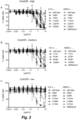
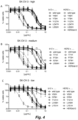
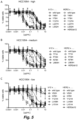
- Cytotoxicity of the bsADCs was tested using HCC1954, SK-OV-3 and Colo205 cells.
- Cells were seeded in 96-well tissue culture plates (5,000 cells/well) and incubated for 6 hours at 37°C.
- Serially diluted ADCs (10-0.0005 ⁇ g/mL) were added and the cells were incubated for 4 days at 37°C.
- Cell viability was assessed using CellTiter-GLO (Promega), according to the manufacturer's guidelines. The percentage of viable cells was depicted as a percentage relative to untreated cells (0% cell death) and staurosporin-treated cells (100% cell death).
- Percentage viable cells (RFU ADC treated cells - RFU staurosporin-treated cells) ⁇ 100 / (RFU untreated cells - RFU staurosporin-treated cells)
- RFU relative fluorescence units
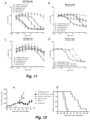
- Figures 3-5 show cell viability after 4 days treatment with serially diluted ADCs as percentage compared to untreated cells. Data shown are mean ⁇ standard deviation of at least two different experiments. IC 50 values for cytotoxicity were determined using GraphPad Prism 6 software and depicted in Table 3.
- SK-OV-3 cells were cultured on glass coverslips (Thermo Fisher Scientific) at 37°C for 16 hours. Antibody (2 and 10 ⁇ g/mL) was added and cells were incubated for 16 hours at 37°C. Cells were fixed, permeabilized and incubated 45 min with goat anti-human IgG1-FITC (Jackson) to stain for human IgG and mouse anti-human CD107a-APC (BD) to stain for lysosomes.
- IgG1-FITC goat anti-human IgG1-FITC
- BD mouse anti-human CD107a-APC
- bsHER2xCD63 N74H does not bind to, and accumulate in, healthy tissues that do not express the model tumor antigen HER2
- bsHER2xCD63 N74H and monovalent and bivalent control antibodies were conjugated with FITC. Their accumulation was investigated in granulocytes and thrombocytes of healthy donors that do not express HER2.
- Whole blood samples from healthy donors were collected in Heparin tubes.
- Whole blood was diluted 1:2 in RPMI-1640 supplemented with 10% heat-inactivated cosmic calf serum.
- Anti-CD63 antibodies were conjugated with FITC (Thermo Scientific) according to manufacturer's instruction and added to whole blood cells at final concentration of 10 g/mL.
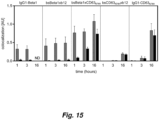
- the grey bars in Figure 9 represent total IgG staining (depicted as arbitrary units).
- the black bars in Figure 9 represent lysosomal co-localization (depicted as arbitrary units).
- IgG1-HER2 and bsHER2xb12 both showed similar staining of SK-OV-3 cells after 1, 3, and 16 hours (grey bars).
- a small portion of IgG1-HER2 and bsHER2xb12 showed lysosomal co-localization after 16 hours antibody exposure (black bars).
- HER2 downmodulation ELISA Using a HER2 downmodulation ELISA it was investigated if the strong lysosomal targeting observed with bsHER2xCD63 N74H , also resulted in increased downmodulation of the targeted antigen.
- AU565, SK-OV-3 and Colo 205 cells were seeded (1 million cells/flask) in T25 flasks (Greiner) and incubated overnight at 37°C to obtain a confluent monolayer.
- Antibodies were added (10 ⁇ g/mL) and cells were cultured for another 3 days at 37°C, washed and lysed. Total protein levels were quantified using bicinchoninic acid (BCA) protein assay reagent (Pierce), according to manufacturer's instruction.
- BCA bicinchoninic acid
- HER2 protein in tumor cell lines with different expression levels of HER2; AU565 (500,000 HER2/cell, Figure 10A ), SK-OV-3 (200,000 HER2/cell, Figure 10B ) and Colo205 (50,000 HER2/cell, Figure 10C ) was quantified after three days of incubation with HER2 antibody and compared with untreated cells (see Figure 10 ).
- IgG1-HER2 induced ⁇ 40% downmodulation of total HER2 in AU565 cells that express high levels of HER2.
- the monovalent bsHER2xb12 antibody showed dose-dependent binding to HER2-positive SK-OV-3 cells (FACS binding example)
- no downmodulation of HER2 was observed with bsHER2xb12.
- bsHER2xCD63 N74H -ADC induced significant inhibition of tumor growth, while the monovalent bsHER2xb12-ADC or bsCD63 N74H xb12-duo3, had no effect on tumor growth.
- Mantel-Cox analysis of Kalan Meyer plot indicated significant inhibition of tumor growth by bsHER2xCD63 N74H -ADC, P-value ⁇ 0.0001.
- Example 13 Lysosomal co-localization of bsBeta1xCD63 N74H measured with confocal microscopy
Landscapes
- Health & Medical Sciences (AREA)
- Chemical & Material Sciences (AREA)
- Life Sciences & Earth Sciences (AREA)
- Immunology (AREA)
- Medicinal Chemistry (AREA)
- General Health & Medical Sciences (AREA)
- Organic Chemistry (AREA)
- Engineering & Computer Science (AREA)
- Bioinformatics & Cheminformatics (AREA)
- Pharmacology & Pharmacy (AREA)
- Animal Behavior & Ethology (AREA)
- Public Health (AREA)
- Veterinary Medicine (AREA)
- Epidemiology (AREA)
- Proteomics, Peptides & Aminoacids (AREA)
- Biochemistry (AREA)
- Biophysics (AREA)
- Genetics & Genomics (AREA)
- Molecular Biology (AREA)
- Cell Biology (AREA)
- Chemical Kinetics & Catalysis (AREA)
- General Chemical & Material Sciences (AREA)
- Nuclear Medicine, Radiotherapy & Molecular Imaging (AREA)
- Oncology (AREA)
- Hematology (AREA)
- Peptides Or Proteins (AREA)
- Medicines That Contain Protein Lipid Enzymes And Other Medicines (AREA)
- Medicines Containing Antibodies Or Antigens For Use As Internal Diagnostic Agents (AREA)
- Medicinal Preparation (AREA)
- Micro-Organisms Or Cultivation Processes Thereof (AREA)
- Preparation Of Compounds By Using Micro-Organisms (AREA)
- Acyclic And Carbocyclic Compounds In Medicinal Compositions (AREA)
- Steroid Compounds (AREA)
Claims (33)
- Anticorps multispécifique comprenant un premier domaine de liaison à l'antigène et un second domaine de liaison à l'antigène, le premier domaine de liaison à l'antigène se liant spécifiquement à une molécule cible (T) qui est un antigène associé à une tumeur, exprimé à la surface de la cellule, et le second domaine de liaison à l'antigène se liant spécifiquement à une protéine effectrice d'internalisation (E), E étant CD63, et le second domaine de liaison à l'antigène ayant une valeur de constante de dissociation KD avec E comprise entre 2,0×10⁻⁹ et 7,3×10⁻⁹, la valeur KD étant déterminée par interférométrie de biocouche.
- Anticorps multispécifique selon la revendication 1, comprenant i) un premier bras de liaison qui comprend le premier domaine de liaison à l'antigène et ii) un second bras de liaison qui comprend le second domaine de liaison à l'antigène.
- Anticorps multispécifique selon la revendication 1 ou 2, dans lequel l'anticorps multispécifique est un anticorps bispécifique.
- Anticorps multispécifique selon l'une quelconque des revendications précédentes, dans lequel T est un récepteur exprimé à la surface de la cellule.
- Anticorps multispécifique selon l'une quelconque des revendications précédentes, dans lequel T est un récepteur tyrosine kinase.
- Anticorps multispécifique selon l'une quelconque des revendications précédentes, dans lequel T est choisi dans l'ensemble constitué par CD81, CD82, CD9 et CD151, une intégrine, MHCII, CXCR4, TM4SF5, la synténine-1, TIMP-1, H, la K-ATPase, l'antigène L6 et MT1-MMP.
- Anticorps multispécifique selon l'une quelconque des revendications 1-4, dans lequel T est HER2.
- Anticorps multispécifique selon l'une quelconque des revendications 1-4 et 6, dans lequel T est un intégrine.
- Anticorps multispécifique selon l'une quelconque des revendications précédentes, qui est un anticorps bispécifique ou un fragment d'anticorps bispécifique.
- Anticorps multispécifique selon l'une quelconque des revendications précédentes, dans lequel l'anticorps multispécifique est un anticorps bispécifique comprenant un premier bras de liaison comprenant le premier domaine de liaison à l'antigène et un second bras de liaison comprenant ledit second domaine de liaison à l'antigène.
- Anticorps multispécifique selon la revendication 10, dans lequel ledit premier domaine de liaison à l'antigène comprend une première séquence variable (VH) de chaîne lourde et une première séquence variable (VL) de chaîne légère, et ledit second domaine de liaison à l'antigène comprend une seconde séquence variable (VH) de chaîne lourde et une seconde séquence variable (VL) de chaîne légère, et dans lequel lesdites séquences variables comprennent chacune trois séquences CDR, CDR1, CDR2 et CDR3.
- Anticorps multispécifique selon la revendication 10 ou 11, dans lequel (i) ledit premier bras de liaison comprend une première chaîne lourde comprenant une première séquence variable (VH) de chaîne lourde et une première séquence constante (CH) de chaîne lourde, et une première chaîne légère comprenant une première séquence variable (VL) de chaîne légère et une première séquence constante (CL) de chaîne légère, et (ii) ledit second bras de liaison comprend une seconde chaîne lourde comprenant une seconde séquence variable (VH) de chaîne lourde et une seconde séquence constante (CH) de chaîne lourde, et une seconde chaîne légère comprenant une seconde séquence variable (VL) de chaîne légère et une seconde séquence constante (CL) de chaîne légère.
- Anticorps multispécifique selon l'une quelconque des revendications 10-12, dans lequel le premier bras de liaison est dérivé d'un anticorps chimérique ou d'un anticorps humanisé ou d'un anticorps humain.
- Anticorps multispécifique selon l'une quelconque des revendications précédentes, qui est un anticorps bispécifique, l'anticorps bispécifique étant un anticorps complet, de préférence un anticorps IgG1.
- Anticorps multispécifique selon l'une quelconque des revendications précédentes, dans lequel ledit second domaine comprend :a. les CDR de VH 1, 2, et 3 telles que présentées dans les séquences SEQ ID NO: 2, 3, et 4, respectivement, et les CDR de VL 1, 2, et 3 telles que présentées dans les séquences SEQ ID NO: 9, 7, et 8, respectivement, oub. les CDR de VH 1, 2, et 3 telles que présentées dans les séquences SEQ ID NO: 2, 10, et 4, respectivement, et les CDR de VL 1, 2, et 3 telles que présentées dans les séquences SEQ ID NO: 6, 7, et 8, respectivement, ouc. les CDR de VH 1, 2, et 3 telles que présentées dans les séquences SEQ ID NO: 2, 11, et 4, respectivement, et les CDR de VL 1, 2, et 3 telles que présentées dans les séquences SEQ ID NO: 6, 7, et 8, respectivement, oud. les CDR de VH 1, 2, et 3 telles que présentées dans les séquences SEQ ID NO: 2, 12, et 4, respectivement, et les CDR de VL 1, 2, et 3 telles que présentées dans les séquences SEQ ID NO: 6, 7, et 8, respectivement.
- Anticorps multispécifique selon la revendication 15, dans lequel ledit second domaine de liaison comprend les CDR de VH 1, 2, et 3 telles que présentées dans les séquences SEQ ID NO: 2, 12, et 14, respectivement, et les CDR de VL 1, 2, et 3 telles que présentées dans les séquences SEQ ID NO: 6, 7, et 8, respectivement.
- Anticorps multispécifique selon l'une quelconque des revendications précédentes, dans lequel lesdits premier et second domaines de liaison à l'antigène consistent chacun en une paire d'un domaine variable de chaîne lourde d'anticorps et d'un domaine variable de chaîne légère d'anticorps.
- Anticorps multispécifique selon l'une quelconque des revendications précédentes, dans lequel l'anticorps est un anticorps bispécifique à cibles (T)×CD63 associées à une tumeur.
- Anticorps multispécifique selon l'une quelconque des revendications 1-5, 7 et 9-18, dans lequel l'anticorps est un anticorps bispécifique HER2×CD63.
- Anticorps multispécifique selon l'une quelconque des revendications précédentes, dans lequel l'anticorps a une valeur CE50 pour la liaison à des cellules exprimant une cible (T) associée à une tumeur, telles que des cellules exprimant HER2, inférieure à 5,0 µg/ml, telle qu'inférieure à 0,5 µg/ml, telle que déterminée par cytométrie en flux.
- Anticorps multispécifique selon l'une quelconque des revendications précédentes, dans lequel KD est déterminée par interférométrie de biocouche à 30 °C.
- Anticorps multispécifique selon l'une quelconque des revendications précédentes, dans lequel l'anticorps est un anticorps bispécifique comprenant :i) un premier bras de liaison comprenant une première chaîne lourde comprenant une première séquence constante (CH) de chaîne lourde, ladite première CH comprenant une première région CH3, etii) un second bras de liaison comprenant une seconde chaîne lourde comprenant une seconde séquence constante (CH) de chaîne lourde, ladite seconde CH comprenant une seconde région CH3,dans lequel les séquences desdites première et seconde régions CH3 sont différentes et sont telles qu'une interaction hétérodimère entre lesdits premier et second bras de liaison est plus forte qu'une interaction homodimère de chacun desdits premier et second bras de liaison.
- Anticorps multispécifique selon la revendication 22, dans lequel dans ladite première région CH3 de chaine lourde au moins l'un des acides aminés dans une position correspondant aux positions T366, L368, K370, D399, F405, Y407 ou K409 de chaîne lourde d'IgG1 humaine a été remplacé, et dans ladite seconde région CH3 de chaine lourde au moins l'un des acides aminés dans une position correspondant aux positions T366, L368, K370, D399, F405, Y407 ou K409 de chaîne lourde d'IgG1 humaine a été remplacé, et dans lequel ladite première et ladite seconde chaîne lourde ne comportent pas de remplacements aux mêmes positions, et dans lequel les positions d'acides aminés sont numérotées conformément à l'index EU.
- Anticorps multispécifique selon la revendication 23, dans lequel (i) la première région CH3 comporte un remplacement F405L et la seconde région CH3 comporte un remplacement K409R, ou (ii) la première région CH3 comporte un remplacement K409R et la seconde région CH3 comporte un remplacement F405L.
- Anticorps multispécifique selon l'une quelconque des revendications précédentes, dans lequel l'anticorps multispécifique est conjugué à un fragment cytotoxique, un radio-isotope ou un médicament.
- Anticorps multispécifique selon la revendication 25, dans lequel le fragment cytotoxique est choisi dans l'ensemble constitué par la maytansine, une calichéamicine, une duocarmycine, une duostatine, la duostatine-3, la duostatine-5, la rachelmycine, (CC-1065), l'auristatine, la mométhylauristatine E, la monométhylauristatine F, la doxorubicine, une dolastatine, la pyrrolobenzodiazépine, les toxines à base d'IGN, et l'alpha-amanitine.
- Anticorps multispécifique selon l'une quelconque des revendications précédentes, dans lequel l'anticorps est un fragment d'anticorps bispécifique choisi parmi un scFv en tandem, scFv-Fc en tandem, ScFv-Fc « knobs-into-holes » (nœuds-dans-cavités), scFv-Fc-scFv, F(ab')2, Fab-scFv, (Fab'scFv)2, dianticorps, scdianticorps, scdianticorps-Fc, et scdianticorps-CH3.
- Anticorps multispécifique selon l'une quelconque des revendications 1-26 ou fragment d'anticorps bispécifique selon la revendication 27, destiné à être utilisé dans un procédé pour le traitement et/ou la prévention d'un cancer.
- Anticorps multispécifique destiné à être utilisé selon la revendication 28, dans lequel le cancer est un cancer de l'endomètre/du col, un cancer du poumon, un mélanome malin, un cancer de l'ovaire, un cancer du pancréas, un cancer de la prostate, un cancer du testicule, une tumeur de tissu mou telle qu'un sarcome synovial, un cancer du sein, une tumeur du cerveau, une leucémie, un lymphome, un mastocytome, un cancer du rein, un cancer du col utérin, un cancer de la vessie, un cancer de l'œsophage, un cancer gastrique, ou un cancer colorectal.
- Composition pharmaceutique comprenant l'anticorps multispécifique selon l'une quelconque des revendications 1-26 en tant qu'un composant actif.
- Acide nucléique codant pour un anticorps multispécifique selon l'une quelconque des revendications 1-26.
- Vecteur d'expression contenant l'acide nucléique selon la revendication 31, capable d'exprimer ledit acide nucléique dans des lignées de cellules hôtes procaryotes ou eucaryotes.
- Lignée de cellules hôtes procaryotes ou eucaryotes comprenant un vecteur selon la revendication 32.
Priority Applications (1)
| Application Number | Priority Date | Filing Date | Title |
|---|---|---|---|
| EP25168122.7A EP4628105A3 (fr) | 2016-02-05 | 2017-02-03 | Molécule de liaison aux antigènes multispécifique présentant de meilleures caractéristiques d'internalisation |
Applications Claiming Priority (2)
| Application Number | Priority Date | Filing Date | Title |
|---|---|---|---|
| DKPA201600074 | 2016-02-05 | ||
| PCT/EP2017/052335 WO2017134197A1 (fr) | 2016-02-05 | 2017-02-03 | Molécule de liaison aux antigènes multispécifique présentant de meilleures caractéristiques d'internalisation |
Related Child Applications (1)
| Application Number | Title | Priority Date | Filing Date |
|---|---|---|---|
| EP25168122.7A Division EP4628105A3 (fr) | 2016-02-05 | 2017-02-03 | Molécule de liaison aux antigènes multispécifique présentant de meilleures caractéristiques d'internalisation |
Publications (2)
| Publication Number | Publication Date |
|---|---|
| EP3411406A1 EP3411406A1 (fr) | 2018-12-12 |
| EP3411406B1 true EP3411406B1 (fr) | 2025-04-09 |
Family
ID=58009794
Family Applications (2)
| Application Number | Title | Priority Date | Filing Date |
|---|---|---|---|
| EP25168122.7A Pending EP4628105A3 (fr) | 2016-02-05 | 2017-02-03 | Molécule de liaison aux antigènes multispécifique présentant de meilleures caractéristiques d'internalisation |
| EP17704190.2A Active EP3411406B1 (fr) | 2016-02-05 | 2017-02-03 | Molécule de liaison aux antigènes multispécifique présentant de meilleures caractéristiques d'internalisation |
Family Applications Before (1)
| Application Number | Title | Priority Date | Filing Date |
|---|---|---|---|
| EP25168122.7A Pending EP4628105A3 (fr) | 2016-02-05 | 2017-02-03 | Molécule de liaison aux antigènes multispécifique présentant de meilleures caractéristiques d'internalisation |
Country Status (9)
| Country | Link |
|---|---|
| US (2) | US20190352423A1 (fr) |
| EP (2) | EP4628105A3 (fr) |
| JP (2) | JP7676100B2 (fr) |
| KR (2) | KR20260018979A (fr) |
| CN (1) | CN109071658A (fr) |
| AU (1) | AU2017214338B2 (fr) |
| ES (1) | ES3034683T3 (fr) |
| MA (1) | MA46419A (fr) |
| WO (1) | WO2017134197A1 (fr) |
Families Citing this family (25)
| Publication number | Priority date | Publication date | Assignee | Title |
|---|---|---|---|---|
| HRP20241208T1 (hr) | 2010-04-20 | 2024-11-22 | Genmab A/S | Heterodimerni proteini koji sadrže fc fragment protutijela i postupci za njihovu proizvodnju |
| EP2825553B1 (fr) | 2012-03-14 | 2018-07-25 | Regeneron Pharmaceuticals, Inc. | Molécules multispécifiques de liaison à des antigènes et leurs utilisations |
| IL296285A (en) | 2015-07-06 | 2022-11-01 | Regeneron Pharma | Multispecific antigen-binding molecules and uses thereof |
| CN106883297B (zh) * | 2015-12-16 | 2019-12-13 | 苏州康宁杰瑞生物科技有限公司 | 基于ch3结构域的异二聚体分子、其制备方法及用途 |
| EP3448891A1 (fr) | 2016-04-28 | 2019-03-06 | Regeneron Pharmaceuticals, Inc. | Procédés de production de molécules multispécifiques se liant à l'antigène |
| CN110506055A (zh) | 2017-02-17 | 2019-11-26 | 戴纳立制药公司 | 工程改造的转铁蛋白受体结合多肽 |
| US10484066B2 (en) * | 2017-04-04 | 2019-11-19 | Qualcomm Incorporated | Beam management using synchronization signals through channel feedback framework |
| DK3635009T3 (da) | 2017-06-07 | 2026-03-30 | Regeneron Pharma | Sammensætninger og fremgangsmåder til internalisering af enzymer |
| AR112257A1 (es) | 2017-06-21 | 2019-10-09 | Gilead Sciences Inc | Anticuerpos multiespecíficos dirigidos al vih-1 gp120 y cd3 humana, composiciones que los comprende, ácido nucleico, vector y célula huésped relacionados, método para producirlos, método para detectar células que expresan gp120 y cd3, kit de anticuerpos, fragmentos de anticuerpo que se une a gp120 y método para producirlos |
| WO2019084057A2 (fr) * | 2017-10-24 | 2019-05-02 | Magenta Therapeutics, Inc. | Compositions et procédés pour la déplétion des cellules cd117+ |
| KR20200069364A (ko) | 2017-10-24 | 2020-06-16 | 마젠타 테라퓨틱스 인코포레이티드 | Cd117+ 세포의 고갈을 위한 조성물 및 방법 |
| US12258597B2 (en) * | 2018-02-07 | 2025-03-25 | Regeneron Pharmaceuticals, Inc. | Methods and compositions for therapeutic protein delivery |
| KR102871690B1 (ko) * | 2018-04-30 | 2025-10-16 | 리제너론 파마슈티칼스 인코포레이티드 | Her2 및/또는 aplp2에 결합하는 항체 및 이중특이적 항원-결합 분자 및 접합체 그리고 이들의 용도 |
| BR112020023145A2 (pt) * | 2018-05-17 | 2021-02-02 | Regeneron Pharmaceuticals, Inc. | anticorpo anti-cd63 ou fragmento de ligação ao antígeno do mesmo, molécula de ligação ao antígeno biespecífica, proteína terapêutica de múltiplos domínios, polinucleotídeo composição farmacêutica, e, composto |
| WO2020056021A1 (fr) * | 2018-09-11 | 2020-03-19 | The Johns Hopkins University | Système de libération de médicament dépendant de la force pour améliorer la destruction sélective et réduire au minimum les effets indésirables dans le traitement du cancer |
| TWI874341B (zh) | 2018-12-18 | 2025-03-01 | 美商健生生物科技公司 | 產生異二聚體抗體之方法 |
| AU2019404061A1 (en) | 2018-12-19 | 2021-07-22 | The Board Of Trustees Of The Leland Stanford Junior University | Bifunctional molecules for lysosomal targeting and related compositions and methods |
| WO2020180398A1 (fr) * | 2019-01-14 | 2020-09-10 | The Regents Of The University Of California | Compositions et procédés de modulation de l'internalisation cellulaire |
| CN113677705A (zh) * | 2019-03-04 | 2021-11-19 | 南通壹宸生物医药科技有限公司 | 新型双特异性结合分子及其药物偶联物 |
| CN110893236A (zh) * | 2019-10-09 | 2020-03-20 | 中山大学 | 溶酶体靶向的抗体药物偶联物及其应用 |
| MX2022005330A (es) | 2019-11-05 | 2022-05-26 | Regeneron Pharma | Moleculas de union multiespecificas con scfv en el extremo nterminal. |
| WO2022037582A1 (fr) * | 2020-08-18 | 2022-02-24 | 上海君实生物医药科技股份有限公司 | Anticorps bispécifique anti-cd3 et anti-cldn-18.2 et son utilisation |
| RS66266B1 (sr) | 2021-02-03 | 2024-12-31 | Mythic Therapeutics Inc | Anti-met antitela i njihova primena |
| EP4370157A1 (fr) | 2021-07-14 | 2024-05-22 | Lycia Therapeutics, Inc. | Composés et conjugués de liaison au récepteur de surface cellulaire asgpr |
| CN114702593B (zh) * | 2022-03-11 | 2023-12-08 | 苏州思萃免疫技术研究所有限公司 | 一种抗folr1/vegf的全人双特异性抗体及其筛选方法和应用 |
Citations (4)
| Publication number | Priority date | Publication date | Assignee | Title |
|---|---|---|---|---|
| WO2013138400A1 (fr) | 2012-03-14 | 2013-09-19 | Regeneron Pharmaceuticals, Inc. | Molécules multispécifiques de liaison à des antigènes et leurs utilisations |
| EP2808035A1 (fr) | 2013-05-29 | 2014-12-03 | Samsung Electronics Co., Ltd | Composition de déplétion de protéine membranaire cible |
| WO2015157592A1 (fr) | 2014-04-11 | 2015-10-15 | Medimmune, Llc | Anticorps anti-her2 bispécifiques |
| WO2017007796A1 (fr) | 2015-07-06 | 2017-01-12 | Regeneron Pharmaceuticals, Inc. | Molécules multispécifiques de liaison à l'antigène et leurs utilisations |
Family Cites Families (5)
| Publication number | Priority date | Publication date | Assignee | Title |
|---|---|---|---|---|
| US6214345B1 (en) | 1993-05-14 | 2001-04-10 | Bristol-Myers Squibb Co. | Lysosomal enzyme-cleavable antitumor drug conjugates |
| FR2724393A1 (fr) | 1994-09-12 | 1996-03-15 | Inst Nat Sante Rech Med | Obtention d'un anticorps monoclonal recombinant humanise a partir d'un anticorps monoclonal murin, sa production en cellules d'insecte, et ses utilisations |
| CA2631184A1 (fr) | 2005-11-28 | 2007-05-31 | Genmab A/S | Anticorps monovalents recombines et leurs procedes de production |
| HRP20241208T1 (hr) | 2010-04-20 | 2024-11-22 | Genmab A/S | Heterodimerni proteini koji sadrže fc fragment protutijela i postupci za njihovu proizvodnju |
| AU2012245116A1 (en) | 2011-04-20 | 2013-11-07 | Genmab A/S | Bispecific antibodies against HER2 and CD3 |
-
2017
- 2017-02-03 KR KR1020267000219A patent/KR20260018979A/ko active Pending
- 2017-02-03 MA MA046419A patent/MA46419A/fr unknown
- 2017-02-03 JP JP2018540751A patent/JP7676100B2/ja active Active
- 2017-02-03 ES ES17704190T patent/ES3034683T3/es active Active
- 2017-02-03 EP EP25168122.7A patent/EP4628105A3/fr active Pending
- 2017-02-03 CN CN201780009916.5A patent/CN109071658A/zh active Pending
- 2017-02-03 US US16/072,437 patent/US20190352423A1/en not_active Abandoned
- 2017-02-03 EP EP17704190.2A patent/EP3411406B1/fr active Active
- 2017-02-03 AU AU2017214338A patent/AU2017214338B2/en active Active
- 2017-02-03 WO PCT/EP2017/052335 patent/WO2017134197A1/fr not_active Ceased
- 2017-02-03 KR KR1020187025203A patent/KR20180104148A/ko not_active Ceased
-
2022
- 2022-04-06 US US17/714,735 patent/US20230076417A1/en active Pending
- 2022-04-21 JP JP2022070251A patent/JP7592660B2/ja active Active
Patent Citations (4)
| Publication number | Priority date | Publication date | Assignee | Title |
|---|---|---|---|---|
| WO2013138400A1 (fr) | 2012-03-14 | 2013-09-19 | Regeneron Pharmaceuticals, Inc. | Molécules multispécifiques de liaison à des antigènes et leurs utilisations |
| EP2808035A1 (fr) | 2013-05-29 | 2014-12-03 | Samsung Electronics Co., Ltd | Composition de déplétion de protéine membranaire cible |
| WO2015157592A1 (fr) | 2014-04-11 | 2015-10-15 | Medimmune, Llc | Anticorps anti-her2 bispécifiques |
| WO2017007796A1 (fr) | 2015-07-06 | 2017-01-12 | Regeneron Pharmaceuticals, Inc. | Molécules multispécifiques de liaison à l'antigène et leurs utilisations |
Non-Patent Citations (10)
| Title |
|---|
| ARAN F LABRIJN, JOYCE I MEESTERS, PATRICK PRIEM, ROB N DE JONG, EWALD T J VAN DEN BREMER, MURIEL D VAN KAMPEN, ARNOUT F GERRITSEN,: "Controlled Fab-arm exchange for the generation of stable bispecific IgG1", NATURE PROTOCOLS, NATURE PUBLISHING GROUP, GB, vol. 9, no. 10, 1 January 2014 (2014-01-01), GB , pages 2450 - 2463, XP055201251, ISSN: 1754-2189, DOI: 10.1038/nprot.2014.169 |
| B. E. C. G. DE GOEIJ, T. VINK, H. TEN NAPEL, E. C. W. BREIJ, D. SATIJN, R. WUBBOLTS, D. MIAO, P. W. H. I. PARREN: "Efficient Payload Delivery by a Bispecific Antibody-Drug Conjugate Targeting HER2 and CD63", MOLECULAR CANCER THERAPEUTICS, AMERICAN ASSOCIATION FOR CANCER RESEARCH, US, vol. 15, no. 11, 1 November 2016 (2016-11-01), US , pages 2688 - 2697, XP055358969, ISSN: 1535-7163, DOI: 10.1158/1535-7163.MCT-16-0364 |
| BART ECG DE GOEIJ, MATTHIAS PEIPP, SIMONE DE HAIJ, EDWARD N VAN DEN BRINK, CHRISTIAN KELLNER, THILO RIEDL, ROB DE JONG, TOM VINK, : "HER2 monoclonal antibodies that do not interfere with receptor heterodimerization-mediated signaling induce effective internalization and represent valuable components for rational antibody-drug conjugate design", MABS, LANDES BIOSCIENCE, US, vol. 6, no. 2, 1 March 2014 (2014-03-01), US , pages 392 - 402, XP055260782, ISSN: 1942-0870, DOI: 10.4161/mabs.27705 |
| DATABASE UNIPROTKB 23 July 2007 (2007-07-23), XP093359078, Database accession no. P08962 - CD63_HUMAN |
| DE GOEIJ BART, SATIJN DAVID, FREITAG CLAUDIA M., WUBBOLTS RICHARD, BLEEKER WIM K., KHASANOV ALISHER, ZHU TONG, CHEN GARY, MIAO DAV: "High Turnover of Tissue Factor Enables Efficient Intracellular Delivery of Antibody–Drug Conjugates", MOLECULAR CANCER THERAPEUTICS, AMERICAN ASSOCIATION FOR CANCER RESEARCH, US, vol. 14, no. 5, 1 May 2015 (2015-05-01), US , pages 1130 - 1140, XP093359069, ISSN: 1535-7163, DOI: 10.1158/1535-7163.MCT-14-0798 |
| DUNLAP TYLER, CAO YANGUANG: "Physiological Considerations for Modeling in vivo Antibody-Target Interactions", FRONTIERS IN PHARMACOLOGY, FRONTIERS RESEARCH FOUNDATION, CH, vol. 13, CH , XP093359084, ISSN: 1663-9812, DOI: 10.3389/fphar.2022.856961 |
| IGAWA T.; MIMOTO F.; HATTORI K.: "pH-dependent antigen-binding antibodies as a novel therapeutic modality", BIOCHIMICA ET BIOPHYSICA ACTA (BBA) - PROTEINS & PROTEOMICS, ELSEVIER, NETHERLANDS, vol. 1844, no. 11, 12 August 2014 (2014-08-12), Netherlands , pages 1943 - 1950, XP029050320, ISSN: 1570-9639, DOI: 10.1016/j.bbapap.2014.08.003 |
| KONTERMANN ROLAND E: "Dual targeting strategies with bispecific antibodies", MABS, LANDES BIOSCIENCE, US, vol. 4, no. 2, 1 March 2012 (2012-03-01), US , pages 182 - 197, XP002698995, ISSN: 1942-0862, DOI: 10.4161/mabs.4.2.19000 |
| METZELAAR M. J., ET AL.: "BIOCHEMICAL AND IMMUNOHISTOCHEMICAL CHARACTERISTICS OF CD62 AND CD63 MONOCLONAL ANTIBODIES. ÖEXPRESSION OF GMP-140 AND LIMP-CD63 (CD63 ANTIGEN) IN HUMAN LYMPHOID TISSUES.", VIRCHOWS ARCHIV SECTION B. CELL PATHOLOGY., SPRINGER VERLAG, BERLIN, DE, 1 January 1991 (1991-01-01), DE , pages 269 - 277., XP000573002, ISSN: 0340-6075 |
| STEFFEN DICKOPF, GEORGES GUY J., BRINKMANN ULRICH: "Format and geometries matter: Structure-based design defines the functionality of bispecific antibodies", COMPUTATIONAL AND STRUCTURAL BIOTECHNOLOGY JOURNAL, RESEARCH NETWORK OF COMPUTATIONAL AND STRUCTURAL BIOTECHNOLOGY, SWEDEN, vol. 18, 14 May 2020 (2020-05-14), Sweden , pages 1221 - 1227, XP055740966, ISSN: 2001-0370, DOI: 10.1016/j.csbj.2020.05.006 |
Also Published As
| Publication number | Publication date |
|---|---|
| JP2022103195A (ja) | 2022-07-07 |
| WO2017134197A1 (fr) | 2017-08-10 |
| CN109071658A (zh) | 2018-12-21 |
| JP2019506865A (ja) | 2019-03-14 |
| NZ784695A (en) | 2025-05-30 |
| KR20260018979A (ko) | 2026-02-09 |
| JP7592660B2 (ja) | 2024-12-02 |
| EP3411406A1 (fr) | 2018-12-12 |
| KR20180104148A (ko) | 2018-09-19 |
| US20230076417A1 (en) | 2023-03-09 |
| JP7676100B2 (ja) | 2025-05-14 |
| NZ744533A (en) | 2025-05-02 |
| AU2017214338A1 (en) | 2018-08-09 |
| MA46419A (fr) | 2018-12-12 |
| US20190352423A1 (en) | 2019-11-21 |
| EP4628105A3 (fr) | 2025-12-31 |
| EP4628105A2 (fr) | 2025-10-08 |
| AU2017214338B2 (en) | 2024-04-11 |
| ES3034683T3 (en) | 2025-08-21 |
Similar Documents
| Publication | Publication Date | Title |
|---|---|---|
| US20230076417A1 (en) | Multispecific antigen-binding molecule with improved internalization characteristics | |
| US9598496B2 (en) | Antibody capable of specifically recognizing transferrin receptor | |
| JP2022066565A (ja) | 抗ntb-a抗体ならびに関連する組成物および方法 | |
| SG11202111109UA (en) | Biparatopic fr-alpha antibodies and immunoconjugates | |
| TWI812645B (zh) | 新型抗cd19抗體 | |
| TW202112354A (zh) | 遮蔽抗體調配物 | |
| KR20220110231A (ko) | 항-αvβ6 항체 및 항체-약물 접합체 | |
| KR20230154020A (ko) | 클라우딘-6에 대한 항체 및 이의 용도 | |
| CN112004558A (zh) | Lgals3bp抗体-药物-偶联物及其用于癌症的治疗的用途 | |
| US20250277054A1 (en) | Psma antibodies and uses thereof | |
| JP7812988B2 (ja) | Lewis Yに対するヒト化抗体 | |
| KR20240007939A (ko) | 항-p-카드헤린 항체를 포함하는 항체 콘쥬게이트 및 이의 용도 | |
| EP4703380A1 (fr) | Anticorps ciblant l'intégrine et leur utilisation | |
| HK40001717B (en) | Multispecific antigen‑binding molecule with improved internalization characteristics | |
| HK40001717A (en) | Multispecific antigen‑binding molecule with improved internalization characteristics | |
| CN121311508A (zh) | 抗her2互补性双特异抗体-药物偶联物及其制备方法和用途 | |
| WO2026082125A1 (fr) | Anticorps se liant à folr1, médicament le contenant et utilisation associée | |
| EA049994B1 (ru) | Конъюгаты антитела против нектина-4 и эксатекана | |
| EP4493595A1 (fr) | Anticorps dirigés contre lypd3 | |
| CN121604979A (zh) | 包含效应分子的pd-l1和trop-2靶向缀合物及其用途 | |
| EA052759B1 (ru) | Антитела против pd-l1 и конъюгаты антитело-лекарственное средство |
Legal Events
| Date | Code | Title | Description |
|---|---|---|---|
| STAA | Information on the status of an ep patent application or granted ep patent |
Free format text: STATUS: UNKNOWN |
|
| STAA | Information on the status of an ep patent application or granted ep patent |
Free format text: STATUS: THE INTERNATIONAL PUBLICATION HAS BEEN MADE |
|
| PUAI | Public reference made under article 153(3) epc to a published international application that has entered the european phase |
Free format text: ORIGINAL CODE: 0009012 |
|
| STAA | Information on the status of an ep patent application or granted ep patent |
Free format text: STATUS: REQUEST FOR EXAMINATION WAS MADE |
|
| 17P | Request for examination filed |
Effective date: 20180904 |
|
| AK | Designated contracting states |
Kind code of ref document: A1 Designated state(s): AL AT BE BG CH CY CZ DE DK EE ES FI FR GB GR HR HU IE IS IT LI LT LU LV MC MK MT NL NO PL PT RO RS SE SI SK SM TR |
|
| AX | Request for extension of the european patent |
Extension state: BA ME |
|
| STAA | Information on the status of an ep patent application or granted ep patent |
Free format text: STATUS: EXAMINATION IS IN PROGRESS |
|
| 17Q | First examination report despatched |
Effective date: 20190628 |
|
| REG | Reference to a national code |
Ref country code: HK Ref legal event code: DE Ref document number: 40001717 Country of ref document: HK |
|
| RAP3 | Party data changed (applicant data changed or rights of an application transferred) |
Owner name: GENMAB A/S |
|
| GRAP | Despatch of communication of intention to grant a patent |
Free format text: ORIGINAL CODE: EPIDOSNIGR1 |
|
| STAA | Information on the status of an ep patent application or granted ep patent |
Free format text: STATUS: GRANT OF PATENT IS INTENDED |
|
| INTG | Intention to grant announced |
Effective date: 20231121 |
|
| GRAS | Grant fee paid |
Free format text: ORIGINAL CODE: EPIDOSNIGR3 |
|
| GRAJ | Information related to disapproval of communication of intention to grant by the applicant or resumption of examination proceedings by the epo deleted |
Free format text: ORIGINAL CODE: EPIDOSDIGR1 |
|
| GRAL | Information related to payment of fee for publishing/printing deleted |
Free format text: ORIGINAL CODE: EPIDOSDIGR3 |
|
| STAA | Information on the status of an ep patent application or granted ep patent |
Free format text: STATUS: EXAMINATION IS IN PROGRESS |
|
| GRAP | Despatch of communication of intention to grant a patent |
Free format text: ORIGINAL CODE: EPIDOSNIGR1 |
|
| STAA | Information on the status of an ep patent application or granted ep patent |
Free format text: STATUS: GRANT OF PATENT IS INTENDED |
|
| INTC | Intention to grant announced (deleted) | ||
| INTG | Intention to grant announced |
Effective date: 20240917 |
|
| GRAS | Grant fee paid |
Free format text: ORIGINAL CODE: EPIDOSNIGR3 |
|
| GRAA | (expected) grant |
Free format text: ORIGINAL CODE: 0009210 |
|
| STAA | Information on the status of an ep patent application or granted ep patent |
Free format text: STATUS: THE PATENT HAS BEEN GRANTED |
|
| AK | Designated contracting states |
Kind code of ref document: B1 Designated state(s): AL AT BE BG CH CY CZ DE DK EE ES FI FR GB GR HR HU IE IS IT LI LT LU LV MC MK MT NL NO PL PT RO RS SE SI SK SM TR |
|
| REG | Reference to a national code |
Ref country code: GB Ref legal event code: FG4D |
|
| REG | Reference to a national code |
Ref country code: CH Ref legal event code: EP |
|
| REG | Reference to a national code |
Ref country code: DE Ref legal event code: R096 Ref document number: 602017088794 Country of ref document: DE |
|
| P01 | Opt-out of the competence of the unified patent court (upc) registered |
Free format text: CASE NUMBER: APP_16095/2025 Effective date: 20250402 |
|
| REG | Reference to a national code |
Ref country code: IE Ref legal event code: FG4D |
|
| REG | Reference to a national code |
Ref country code: NL Ref legal event code: MP Effective date: 20250409 |
|
| REG | Reference to a national code |
Ref country code: ES Ref legal event code: FG2A Ref document number: 3034683 Country of ref document: ES Kind code of ref document: T3 Effective date: 20250821 |
|
| PG25 | Lapsed in a contracting state [announced via postgrant information from national office to epo] |
Ref country code: NL Free format text: LAPSE BECAUSE OF FAILURE TO SUBMIT A TRANSLATION OF THE DESCRIPTION OR TO PAY THE FEE WITHIN THE PRESCRIBED TIME-LIMIT Effective date: 20250409 |
|
| REG | Reference to a national code |
Ref country code: AT Ref legal event code: MK05 Ref document number: 1783477 Country of ref document: AT Kind code of ref document: T Effective date: 20250409 |
|
| PG25 | Lapsed in a contracting state [announced via postgrant information from national office to epo] |
Ref country code: PT Free format text: LAPSE BECAUSE OF FAILURE TO SUBMIT A TRANSLATION OF THE DESCRIPTION OR TO PAY THE FEE WITHIN THE PRESCRIBED TIME-LIMIT Effective date: 20250811 Ref country code: FI Free format text: LAPSE BECAUSE OF FAILURE TO SUBMIT A TRANSLATION OF THE DESCRIPTION OR TO PAY THE FEE WITHIN THE PRESCRIBED TIME-LIMIT Effective date: 20250409 |
|
| REG | Reference to a national code |
Ref country code: LT Ref legal event code: MG9D |
|
| PG25 | Lapsed in a contracting state [announced via postgrant information from national office to epo] |
Ref country code: GR Free format text: LAPSE BECAUSE OF FAILURE TO SUBMIT A TRANSLATION OF THE DESCRIPTION OR TO PAY THE FEE WITHIN THE PRESCRIBED TIME-LIMIT Effective date: 20250710 Ref country code: NO Free format text: LAPSE BECAUSE OF FAILURE TO SUBMIT A TRANSLATION OF THE DESCRIPTION OR TO PAY THE FEE WITHIN THE PRESCRIBED TIME-LIMIT Effective date: 20250709 |
|
| PG25 | Lapsed in a contracting state [announced via postgrant information from national office to epo] |
Ref country code: PL Free format text: LAPSE BECAUSE OF FAILURE TO SUBMIT A TRANSLATION OF THE DESCRIPTION OR TO PAY THE FEE WITHIN THE PRESCRIBED TIME-LIMIT Effective date: 20250409 |
|
| PG25 | Lapsed in a contracting state [announced via postgrant information from national office to epo] |
Ref country code: BG Free format text: LAPSE BECAUSE OF FAILURE TO SUBMIT A TRANSLATION OF THE DESCRIPTION OR TO PAY THE FEE WITHIN THE PRESCRIBED TIME-LIMIT Effective date: 20250409 |
|
| PG25 | Lapsed in a contracting state [announced via postgrant information from national office to epo] |
Ref country code: HR Free format text: LAPSE BECAUSE OF FAILURE TO SUBMIT A TRANSLATION OF THE DESCRIPTION OR TO PAY THE FEE WITHIN THE PRESCRIBED TIME-LIMIT Effective date: 20250409 |
|
| PG25 | Lapsed in a contracting state [announced via postgrant information from national office to epo] |
Ref country code: AT Free format text: LAPSE BECAUSE OF FAILURE TO SUBMIT A TRANSLATION OF THE DESCRIPTION OR TO PAY THE FEE WITHIN THE PRESCRIBED TIME-LIMIT Effective date: 20250409 |
|
| PG25 | Lapsed in a contracting state [announced via postgrant information from national office to epo] |
Ref country code: RS Free format text: LAPSE BECAUSE OF FAILURE TO SUBMIT A TRANSLATION OF THE DESCRIPTION OR TO PAY THE FEE WITHIN THE PRESCRIBED TIME-LIMIT Effective date: 20250709 |
|
| PG25 | Lapsed in a contracting state [announced via postgrant information from national office to epo] |
Ref country code: IS Free format text: LAPSE BECAUSE OF FAILURE TO SUBMIT A TRANSLATION OF THE DESCRIPTION OR TO PAY THE FEE WITHIN THE PRESCRIBED TIME-LIMIT Effective date: 20250809 |
|
| PG25 | Lapsed in a contracting state [announced via postgrant information from national office to epo] |
Ref country code: LV Free format text: LAPSE BECAUSE OF FAILURE TO SUBMIT A TRANSLATION OF THE DESCRIPTION OR TO PAY THE FEE WITHIN THE PRESCRIBED TIME-LIMIT Effective date: 20250409 |
|
| REG | Reference to a national code |
Ref country code: DE Ref legal event code: R026 Ref document number: 602017088794 Country of ref document: DE |
|
| PG25 | Lapsed in a contracting state [announced via postgrant information from national office to epo] |
Ref country code: DK Free format text: LAPSE BECAUSE OF FAILURE TO SUBMIT A TRANSLATION OF THE DESCRIPTION OR TO PAY THE FEE WITHIN THE PRESCRIBED TIME-LIMIT Effective date: 20250409 Ref country code: SM Free format text: LAPSE BECAUSE OF FAILURE TO SUBMIT A TRANSLATION OF THE DESCRIPTION OR TO PAY THE FEE WITHIN THE PRESCRIBED TIME-LIMIT Effective date: 20250409 |
|
| PGFP | Annual fee paid to national office [announced via postgrant information from national office to epo] |
Ref country code: FR Payment date: 20251231 Year of fee payment: 10 |
|
| VS25 | Lapsed in a validation state [announced via postgrant information from nat. office to epo] |
Ref country code: MD Free format text: LAPSE BECAUSE OF FAILURE TO SUBMIT A TRANSLATION OF THE DESCRIPTION OR TO PAY THE FEE WITHIN THE PRESCRIBED TIME-LIMIT Effective date: 20250409 |
|
| PLBI | Opposition filed |
Free format text: ORIGINAL CODE: 0009260 |
|
| PG25 | Lapsed in a contracting state [announced via postgrant information from national office to epo] |
Ref country code: CZ Free format text: LAPSE BECAUSE OF FAILURE TO SUBMIT A TRANSLATION OF THE DESCRIPTION OR TO PAY THE FEE WITHIN THE PRESCRIBED TIME-LIMIT Effective date: 20250409 |
|
| PLAX | Notice of opposition and request to file observation + time limit sent |
Free format text: ORIGINAL CODE: EPIDOSNOBS2 |
|
| REG | Reference to a national code |
Ref country code: CH Ref legal event code: L10 Free format text: ST27 STATUS EVENT CODE: U-0-0-L10-L00 (AS PROVIDED BY THE NATIONAL OFFICE) Effective date: 20260121 |
|
| PG25 | Lapsed in a contracting state [announced via postgrant information from national office to epo] |
Ref country code: EE Free format text: LAPSE BECAUSE OF FAILURE TO SUBMIT A TRANSLATION OF THE DESCRIPTION OR TO PAY THE FEE WITHIN THE PRESCRIBED TIME-LIMIT Effective date: 20250409 |
|
| PG25 | Lapsed in a contracting state [announced via postgrant information from national office to epo] |
Ref country code: RO Free format text: LAPSE BECAUSE OF FAILURE TO SUBMIT A TRANSLATION OF THE DESCRIPTION OR TO PAY THE FEE WITHIN THE PRESCRIBED TIME-LIMIT Effective date: 20250409 Ref country code: SK Free format text: LAPSE BECAUSE OF FAILURE TO SUBMIT A TRANSLATION OF THE DESCRIPTION OR TO PAY THE FEE WITHIN THE PRESCRIBED TIME-LIMIT Effective date: 20250409 |
|
| 26 | Opposition filed |
Opponent name: ELKINGTON AND FIFE LLP Effective date: 20260109 |
|
| PGFP | Annual fee paid to national office [announced via postgrant information from national office to epo] |
Ref country code: GB Payment date: 20260106 Year of fee payment: 10 |
|
| PGFP | Annual fee paid to national office [announced via postgrant information from national office to epo] |
Ref country code: ES Payment date: 20260311 Year of fee payment: 10 |
|
| PGFP | Annual fee paid to national office [announced via postgrant information from national office to epo] |
Ref country code: DE Payment date: 20251230 Year of fee payment: 10 |
|
| PGFP | Annual fee paid to national office [announced via postgrant information from national office to epo] |
Ref country code: IT Payment date: 20260122 Year of fee payment: 10 |
|
| VS25 | Lapsed in a validation state [announced via postgrant information from nat. office to epo] |
Ref country code: MA Free format text: LAPSE BECAUSE OF FAILURE TO SUBMIT A TRANSLATION OF THE DESCRIPTION OR TO PAY THE FEE WITHIN THE PRESCRIBED TIME-LIMIT Effective date: 20250409 |