EP3415574B1 - Verfahren zur herstellung einer kationischen elektrotauchlackierungszusammensetzung - Google Patents
Verfahren zur herstellung einer kationischen elektrotauchlackierungszusammensetzung Download PDFInfo
- Publication number
- EP3415574B1 EP3415574B1 EP17750169.9A EP17750169A EP3415574B1 EP 3415574 B1 EP3415574 B1 EP 3415574B1 EP 17750169 A EP17750169 A EP 17750169A EP 3415574 B1 EP3415574 B1 EP 3415574B1
- Authority
- EP
- European Patent Office
- Prior art keywords
- parts
- coating composition
- cationic electrodeposition
- electrodeposition coating
- compounds
- Prior art date
- Legal status (The legal status is an assumption and is not a legal conclusion. Google has not performed a legal analysis and makes no representation as to the accuracy of the status listed.)
- Active
Links
Images
Classifications
-
- C—CHEMISTRY; METALLURGY
- C09—DYES; PAINTS; POLISHES; NATURAL RESINS; ADHESIVES; COMPOSITIONS NOT OTHERWISE PROVIDED FOR; APPLICATIONS OF MATERIALS NOT OTHERWISE PROVIDED FOR
- C09D—COATING COMPOSITIONS, e.g. PAINTS, VARNISHES OR LACQUERS; FILLING PASTES; CHEMICAL PAINT OR INK REMOVERS; INKS; CORRECTING FLUIDS; WOODSTAINS; PASTES OR SOLIDS FOR COLOURING OR PRINTING; USE OF MATERIALS THEREFOR
- C09D5/00—Coating compositions, e.g. paints, varnishes or lacquers, characterised by their physical nature or the effects produced; Filling pastes
- C09D5/44—Coating compositions, e.g. paints, varnishes or lacquers, characterised by their physical nature or the effects produced; Filling pastes for electrophoretic applications
- C09D5/4419—Coating compositions, e.g. paints, varnishes or lacquers, characterised by their physical nature or the effects produced; Filling pastes for electrophoretic applications with polymers obtained otherwise than by polymerisation reactions only involving carbon-to-carbon unsaturated bonds
- C09D5/443—Polyepoxides
- C09D5/4453—Polyepoxides characterised by the nature of the curing agent
-
- C—CHEMISTRY; METALLURGY
- C09—DYES; PAINTS; POLISHES; NATURAL RESINS; ADHESIVES; COMPOSITIONS NOT OTHERWISE PROVIDED FOR; APPLICATIONS OF MATERIALS NOT OTHERWISE PROVIDED FOR
- C09D—COATING COMPOSITIONS, e.g. PAINTS, VARNISHES OR LACQUERS; FILLING PASTES; CHEMICAL PAINT OR INK REMOVERS; INKS; CORRECTING FLUIDS; WOODSTAINS; PASTES OR SOLIDS FOR COLOURING OR PRINTING; USE OF MATERIALS THEREFOR
- C09D5/00—Coating compositions, e.g. paints, varnishes or lacquers, characterised by their physical nature or the effects produced; Filling pastes
- C09D5/44—Coating compositions, e.g. paints, varnishes or lacquers, characterised by their physical nature or the effects produced; Filling pastes for electrophoretic applications
- C09D5/4419—Coating compositions, e.g. paints, varnishes or lacquers, characterised by their physical nature or the effects produced; Filling pastes for electrophoretic applications with polymers obtained otherwise than by polymerisation reactions only involving carbon-to-carbon unsaturated bonds
- C09D5/443—Polyepoxides
- C09D5/4434—Polyepoxides characterised by the nature of the epoxy binder
- C09D5/4438—Binder based on epoxy/amine adducts, i.e. reaction products of polyepoxides with compounds containing amino groups only
-
- C—CHEMISTRY; METALLURGY
- C09—DYES; PAINTS; POLISHES; NATURAL RESINS; ADHESIVES; COMPOSITIONS NOT OTHERWISE PROVIDED FOR; APPLICATIONS OF MATERIALS NOT OTHERWISE PROVIDED FOR
- C09D—COATING COMPOSITIONS, e.g. PAINTS, VARNISHES OR LACQUERS; FILLING PASTES; CHEMICAL PAINT OR INK REMOVERS; INKS; CORRECTING FLUIDS; WOODSTAINS; PASTES OR SOLIDS FOR COLOURING OR PRINTING; USE OF MATERIALS THEREFOR
- C09D5/00—Coating compositions, e.g. paints, varnishes or lacquers, characterised by their physical nature or the effects produced; Filling pastes
- C09D5/44—Coating compositions, e.g. paints, varnishes or lacquers, characterised by their physical nature or the effects produced; Filling pastes for electrophoretic applications
- C09D5/4419—Coating compositions, e.g. paints, varnishes or lacquers, characterised by their physical nature or the effects produced; Filling pastes for electrophoretic applications with polymers obtained otherwise than by polymerisation reactions only involving carbon-to-carbon unsaturated bonds
- C09D5/443—Polyepoxides
- C09D5/4457—Polyepoxides containing special additives, e.g. pigments, polymeric particles
-
- C—CHEMISTRY; METALLURGY
- C25—ELECTROLYTIC OR ELECTROPHORETIC PROCESSES; APPARATUS THEREFOR
- C25D—PROCESSES FOR THE ELECTROLYTIC OR ELECTROPHORETIC PRODUCTION OF COATINGS; ELECTROFORMING; APPARATUS THEREFOR
- C25D13/00—Electrophoretic coating characterised by the process
- C25D13/04—Electrophoretic coating characterised by the process with organic material
-
- C—CHEMISTRY; METALLURGY
- C25—ELECTROLYTIC OR ELECTROPHORETIC PROCESSES; APPARATUS THEREFOR
- C25D—PROCESSES FOR THE ELECTROLYTIC OR ELECTROPHORETIC PRODUCTION OF COATINGS; ELECTROFORMING; APPARATUS THEREFOR
- C25D13/00—Electrophoretic coating characterised by the process
- C25D13/12—Electrophoretic coating characterised by the process characterised by the article coated
- C25D13/16—Wires; Strips; Foils
Definitions
- the present invention relates to a method for producing a cationic electrodeposition coating composition that is excellent in storage stability and low-temperature curability, as well as finished appearance and corrosion resistance of the coating film.
- Cationic electrodeposition coating compositions have excellent application workability and form a coating film with excellent corrosion resistance. They have thus been widely used for, for example, automobile parts, electrical equipment parts, and other industrial machinery, which are required to have such properties.
- cationic electrodeposition coating compositions are provided in the form of a mixture of two components, i.e., a resin emulsion component in which resin components comprising a cationic resin (e.g., an amino group-containing epoxy resin) and a curing agent (also called “crosslinking agent”; e.g., a blocked polyisocyanate compound) are mixed and dispersed in an aqueous medium, and a pigment dispersion paste component containing a pigment dispersed with a resin for pigment dispersion.
- a coating composition is used for a coating bath, and a current is applied using a substrate as a cathode and the counter electrode as anode to form a deposited coating film on the substrate.
- the deposited coating film is heated to form a crosslink-cured coating film.
- the heating temperature in the coating film formation described above is commonly higher than 160°C. However, to reduce energy costs, there is demand for performing heating at low temperature (80 to 160°C, and preferably 80 to 130°C.) . This is called "low-temperature baking.”
- the low-temperature baking is commonly performed using a low-temperature curable blocked polyisocyanate compound as a curing agent.
- PTL 1 (Claim 3) discloses that low-temperature curing is performed using an oxime-blocked isocyanate-containing cationic electrodeposition coating composition.
- PTL 2 (Claim 7) discloses a low-temperature-baking electrodeposition coating composition that is baked at a temperature of 100 to 160°C and that oxime-blocked and lactam-blocked polyisocyanate compounds can dissociate (undergo a reaction) at relatively low temperature.
- PTL 3 discloses that a self-crosslinking resin containing a specific blocked isocyanate group can be cured at a low temperature of 120°C or less and can also be used as a cationic electrodeposition coating composition.
- electrodeposition coating compositions whose reactivity at low temperature is enhanced may have unsatisfactory long-term storage stability (bath stability), resulting in, for example, poor finished appearance and corrosion resistance of the coating film.
- PTL 4 discloses a method for forming a coating film by low-temperature baking, comprising performing electrodeposition coating using a base resin (an amine-added epoxy resin), performing electrodeposition coating using an aqueous dispersion of a blocked polyisocyanate curing agent to which water dispersibility is imparted, and drying the resulting coating film by heating at 60 to 150°C. Since coating compositions and coating are separately used for the base resin and the curing agent, the storage stability (bath stability) of the coating compositions is improved. However, the curing agent may not be homogeneously present in the coating film, resulting in, for example, poor corrosion resistance. In addition, since this method requires additional coating and washing steps, it is necessary to provide additional equipment.
- An object of the present invention is to provide a method for producing a cationic electrodeposition coating composition that is excellent in storage stability and low-temperature curability, as well as finished appearance and corrosion resistance of the coating film.
- the present inventors conducted extensive research to achieve the above object, and found that the object can be achieved by a method for producing a cationic electrodeposition coating composition, wherein three components, i.e., a low-temperature curable blocked polyisocyanate compound, an amino group-containing epoxy resin, and a pigment dispersion paste, are separately dispersed in water, and the dispersions are mixed.
- three components i.e., a low-temperature curable blocked polyisocyanate compound, an amino group-containing epoxy resin, and a pigment dispersion paste
- the present invention provides the following methods for producing a cationic electrodeposition coating composition and coated article obtained by applying the cationic electrodeposition coating composition to a substrate by electrodeposition.
- the cationic electrodeposition coating composition obtained by the production method of the present invention has excellent coating composition stability (bath stability), and even if a low-temperature curable blocked polyisocyanate compound is used as a curing agent, the resulting coating film is excellent in finished appearance and corrosion resistance.
- an automotive body coated with the coating composition obtained by the method of the present invention has a coating film with excellent finished appearance and is less corroded or deteriorated even when the car is driven for a long period of time in an environment in which snow-melting salt has been spread.
- the cationic coating composition obtained by the production method of the present invention has excellent storage stability over a long period of time.
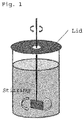
- Fig. 1 shows an overview of the storage test in the Examples of the present application.
- the present invention relates to a method for producing a cationic electrodeposition coating composition, comprising mixing three components, i.e., an aqueous dispersion of an amino group-containing epoxy resin (A), an aqueous dispersion of a blocked polyisocyanate compound (B), and a pigment dispersion paste (C).
- A amino group-containing epoxy resin
- B blocked polyisocyanate compound
- C pigment dispersion paste
- a blocked polyisocyanate compound which is a curing agent, an amino group-containing epoxy resin, which is a base resin component that is to be reacted with the curing agent, and a pigment dispersion paste containing a pigment, a catalyst, and a resin for pigment dispersion are separately present in a coating composition (aqueous solvent), thus enabling the storage stability (bath stability) to be improved.
- the method of the present invention is especially effective for the storage stability of a low-temperature-baking composition that undergoes a curing reaction at 80 to 160°C (preferably 100 to 130°C) .
- the above components of the cationic electrodeposition coating composition i.e., the aqueous dispersion (A), the aqueous dispersion (B), and the pigment dispersion paste (C), are present as mixed in a coating bath, which is used as a cationic electrodeposition coating composition.
- Two components may be mixed before being supplied to a coating bath (for example, the components (A) and (B), components (B) and (C), or components (A) and (C) may be mixed beforehand and supplied to a coating bath).
- Aqueous solvent refers to a solvent containing water and/or a hydrophilic solvent as a main component (the main component is present in an amount of 50 mass% or more in the solvent).
- hydrophilic solvents include ethylene glycol, ethylene glycol monoalkyl ethers (such as methyl ether, ethyl ether, and butyl ether), diethylene glycol, diethylene glycol monoalkyl ethers (such as methyl ether, ethyl ether, and butyl ether), glyme solvents (such as ethylene glycol dimethyl ether), diglyme solvents (such as diethylene glycol dimethyl ether), alcohol solvents (such as methyl alcohol, ethyl alcohol, propyl alcohol, and n-butyl alcohol), propylene glycol, propylene glycol monoalkyl ethers (such as methyl ether, ethyl ether, and butyl ether), dipropylene glycol, dipropylene glycol, di
- Aqueous dispersion refers to one in which a resin component is present in the form of particles in the aqueous solvent without dissolving.
- the aqueous dispersion of an amino group-containing epoxy resin (A) that can be used in the present invention is a dispersion in which an amino group-containing epoxy resin (a), which is a main component, is dispersed in an aqueous solvent.
- the aqueous dispersion (A) may contain, for example, additives, such as neutralizing agents, emulsifiers, and catalysts, and other resin components, in addition to the amino group-containing epoxy resin (a).
- additives such as neutralizing agents, emulsifiers, and catalysts, and other resin components, in addition to the amino group-containing epoxy resin (a).
- the content of the amino group-containing epoxy resin (a) in the aqueous dispersion (A) is preferably 50 mass% or more, more preferably 70 mass% or more, and even more preferably 90 mass% or more, based on the solids content.
- the method for dispersing the amino group-containing epoxy resin (a) in an aqueous solvent is preferably a method in which a solution of the amino group-containing epoxy resin (a) is neutralized with an acid compound and dispersed.
- the acid compound is not particularly limited, and any known acid compounds can be used. Specific examples include inorganic acids, such as hydrochloric acid, nitric acid, phosphoric acid, and sulfamic acid; organic acids, such as formic acid, acetic acid, propionic acid, lactic acid, and like carboxylic acid compounds; and the like. These acid compounds can be used singly or in a combination of two or more. Of these, organic acids are preferable, and carboxylic acid compounds are particularly preferable.
- Examples of the amino group-containing epoxy resin (a), which is a constituent of the aqueous dispersion of the amino group-containing epoxy resin (A), include (1) adducts of an epoxy resin with primary mono- and polyamines, secondary mono- and polyamines, or primary and secondary mixed polyamines (see, for example, U.S. Patent No. 3,984,299 ); (2) adducts of an epoxy resin with secondary mono- and polyamines containing a ketimine-blocked primary amino group (see, for example, U.S. Patent No. 4,017,438 ); (3) reaction products obtained by etherifying an epoxy resin and a hydroxy compound containing a ketiminated primary amino group (see, for example, JPS59-043013A ); and the like.
- the epoxy resin used for producing the amino group-containing epoxy resin (a) is a compound having at least one epoxy group, and preferably two or more epoxy groups, per molecule.
- the molecular weight is preferably such that the epoxy resin has a number average molecular weight of at least 300, preferably 400 to 4,000, and more preferably 800 to 2,500; and has an epoxy equivalent of at least 160, preferably 180 to 2,500, and more preferably 400 to 1,500.
- Examples of such epoxy resins for use include those obtained by reacting a polyphenol compound with epihalohydrin (such as epichlorohydrin).
- polyphenol compounds that can be used for forming the epoxy resin include bis(4-hydroxyphenyl)-2,2-propane [bisphenol A], bis(4-hydroxyphenyl)methane [bisphenol F], bis(4-hydroxycyclohexyl)methane [hydrogenated bisphenol F], 2,2-bis(4-hydroxycyclohexyl)propane [hydrogenated bisphenol A], 4,4'-dihydroxybenzophenone, bis(4-hydroxyphenyl)-1,1-ethane, bis(4-hydroxyphenyl)-1,1-isobutane, bis(4-hydroxy-3-tert-butyl-phenyl)-2,2-propane, bis(2-hydroxynaphthyl)methane, tetra(4-hydroxyphenyl)-1,1,2,2-ethane, 4,4'-dihydroxydiphenylsulfone, phenol novolac, cresol novolac, and the like.
- Examples of commercially available products of the epoxy resin include products sold under the trade names of jER828EL, jER1002, jER1004, and jER1007 by Mitsubishi Chemical Corporation.
- the epoxy resin for use may contain a polyalkylene oxide chain in the resin skeleton.
- Such epoxy resins can be obtained by ( ⁇ ) a method comprising reacting an epoxy resin having at least one epoxy group, preferably two or more epoxy groups with alkylene oxide or polyalkylene oxide to introduce a polyalkylene oxide chain, ( ⁇ ) a method comprising reacting the polyphenol compound with polyalkylene oxide having at least one epoxy group, preferably two or more epoxy groups to introduce a polyalkylene oxide chain, or other like methods.
- Epoxy resins originally containing polyalkylene oxide chains may also be used (see, for example, JPH08-337750A).
- the alkylene group in a polyalkylene oxide chain is preferably C 2-8 alkylene, more preferably ethylene, propylene, or butylene, and particularly preferably propylene.
- the content of the polyalkylene oxide chain, as a constituent of polyalkylene oxide, is generally 1.0 to 15 mass%, preferably 2.0 to 9.5 mass%, and more preferably 3.0 to 8.0 mass%, based on the solids mass of the amino group-containing epoxy resin from the standpoint of improved coating composition stability, finished appearance, and corrosion resistance.
- Examples of the primary mono- and polyamines, secondary mono- and polyamines, or primary and secondary mixed polyamines mentioned above in (1) as materials used for producing the amino group-containing epoxy resin (a) include mono- or dialkylamines, such as monomethylamine, dimethylamine, monoethylamine, diethylamine, monoisopropylamine, diisopropylamine, monobutylamine, and dibutylamine; alkanolamines, such as monoethanolamine, diethanolamine, mono(2-hydroxypropyl)amine, and monomethylaminoethanol; alkylene polyamines, such as ethylenediamine, propylenediamine, butylenediamine, hexamethylenediamine, diethylenetriamine, and triethylenetetramine; and the like.
- mono- or dialkylamines such as monomethylamine, dimethylamine, monoethylamine, diethylamine, monoisopropylamine, diisopropylamine, monobutylamine, and
- Examples of the secondary mono- and polyamines containing a ketimine-blocked primary amino group mentioned above in (2) as materials used for producing the amino group-containing epoxy resin (a) include ketiminated products obtained by reacting a ketone compound with, for example, diethylenetriamine, among the primary and secondary mixed polyamines mentioned above in (1) as materials used for producing the amine-added epoxy resin.
- Examples of the ketiminated primary amino group-containing hydroxy compound mentioned above in (3) as a material used for producing the amino group-containing epoxy resin (a) include hydroxy-containing ketiminated products obtained by reacting a ketone compound with a primary amino group- and hydroxy-containing compound, such as monoethanolamine or mono(2-hydroxypropyl)amine, among the primary mono- and polyamines, secondary mono- and polyamines, and primary and secondary mixed polyamines, mentioned above in (1) as materials used for producing the amino group-containing epoxy resin (a).
- a primary amino group- and hydroxy-containing compound such as monoethanolamine or mono(2-hydroxypropyl)amine
- the amine value of the amino group-containing epoxy resin (a) is preferably 10 to 100 mg KOH/g, and more preferably 30 to 80 mg KOH/g, based on the resin solids, from the standpoint of improved water dispersibility and corrosion resistance.
- the amino group-containing epoxy resin (a) may be modified with a modifier.
- the modifier is not particularly limited as long as it is a resin or compound that is reactive with an epoxy resin.
- examples of usable modifiers include polyols, polyether polyols, polyester polyols, polyamidoamines, polycarboxylic acids, and fatty acids; polyisocyanate compounds and compounds obtained by reacting polyisocyanate compounds; lactone compounds such as ⁇ -caprolactone; acrylic monomers and compounds obtained by polymerization reaction of acrylic monomers; xylene formaldehyde compounds; and epoxy compounds. These modifiers can be used singly or in a combination of two or more.
- the amount of the modifier used is not strictly limited, and can be suitably changed, for example, according to the intended use of the coating composition. From the standpoint of improved finished appearance and corrosion resistance, it is suitable that the amount of the modifier is generally 0 to 50 mass%, preferably 0.1 to 30 mass%, and more preferably 1 to 20 mass%, based on the solids mass of the amino group-containing epoxy resin.
- the addition reaction of the amine compound and modifier to the epoxy resin can generally be performed in a suitable solvent at a temperature of about 80 to 170°C, and preferably about 90 to 150°C for about 1 to 6 hours, and preferably about 1 to 5 hours.
- the solvent examples include hydrocarbon solvents such as toluene, xylene, cyclohexane, and n-hexane; ester solvents such as methyl acetate, ethyl acetate, and butyl acetate; ketone solvents such as acetone, methyl ethyl ketone, methyl isobutyl ketone, and methyl amyl ketone; amide compounds such as dimethylformamide and dimethylacetamide; alcohol solvents such as methanol, ethanol, n-propanol, and iso-propanol; ether alcohol compounds such as ethylene glycol monobutyl ether and diethylene glycol monoethyl ether; and mixtures thereof.
- hydrocarbon solvents such as toluene, xylene, cyclohexane, and n-hexane
- ester solvents such as methyl acetate, ethyl acetate, and butyl acetate
- the aqueous dispersion of a blocked polyisocyanate compound (B) that can be used in the present invention is a dispersion in which a component containing a blocked polyisocyanate compound (b) is dispersed in an aqueous solvent.
- the blocked polyisocyanate compound (b) is obtained by reacting an isocyanate compound (b-1) with a blocking agent (b-2).
- the aqueous dispersion (B) may contain, for example, additives, such as neutralizing agents and emulsifiers, and other resin components, in addition to the polyisocyanate compound (b).
- the content of the blocked polyisocyanate compound (b) in the aqueous dispersion (B) is preferably 50 mass% or more, more preferably 65 mass% or more, and even more preferably 80 mass% or more, based on the solids content.
- the method for dispersing the blocked polyisocyanate compound (b) in an aqueous solvent is preferably a method using an emulsifier.
- the emulsifier is preferably a cationic emulsifier from the standpoint of cationic electrodeposition coating performance.
- a nonionic emulsifier, an anionic emulsifier, an amphoteric emulsifier, etc. may also be used if necessary.
- cationic emulsifier a known cationic emulsifier can be used. Specific examples include resins having cationic functional groups, such as amine salt, ammonium salt, pyridinium salt, phosphonium salt, and sulfonium salt; and like. These can be used singly or in a combination of two or more.
- the cationic functional group content is such that the amine value (mg KOH/g) is preferably about 20 to 300, and more preferably 30 to 200.
- a cationic functional group content such that the amine value (mg KOH/g) is less than 20 may result in poor dispersibility, and a cationic functional group content such that the amine value (mg KOH/g) is more than 300 may adversely affect, for example, the water resistance of the coating film.
- the cationic emulsifier can be produced by imparting cationic functional group(s) to a resin main chain according to a known method.
- the resin skeleton of the cationic emulsifier is not particularly limited. Specific examples include epoxy resins, acrylic resins, liquid rubbers (elastomers), polyurethanes, polyethers, and modified resins and composite resins thereof, and the like. These can be used singly or in a combination of two or more.
- the cationic emulsifier whose resin skeleton is an epoxy resin can be synthesized in the same manner as in the amino group-containing epoxy resin (a) described above.
- the cationic emulsifier whose resin skeleton is an acrylic resin can be synthesized by, for example, a ring opening addition reaction of an acrylic copolymer containing glycidyl group(s) in the molecule with amine compound(s). Specifically, some or all of the glycidyl group(s) in a glycidyl group-containing acrylic resin obtained by copolymerizing glycidyl group-containing acrylic monomer(s), such as glycidyl(meth)acrylate, with other monomer(s) can be reacted with amine compound(s) to obtain a cationic acrylic resin.
- the cationic emulsifier whose resin skeleton is an acrylic resin can also be obtained by copolymerizing amino group-containing acrylic monomer(s) with other monomer(s).
- amino group-containing acrylic monomers include N,N-dimethylaminoethyl (meth)acrylate, N,N-diethylaminoethyl(meth)acrylate, and the like.
- cationic group(s) can be introduced by subjecting hydroxy groups, carboxy groups, epoxy groups, etc., at the molecular terminal(s) and/or in the molecular structure to an urethanization reaction or addition reaction with amine compound(s).
- the content of the emulsifier is preferably 0.01 to 40 mass%, more preferably 0.1 to 30 mass%, and even more preferably 1 to 20 mass%, based on the resin solids content of the aqueous dispersion (B) .
- the content of active hydrogen groups in the emulsifier that are to be reacted with isocyanate groups in the polyisocyanate compound (b-1) is preferably low.
- the active hydrogen group content in the emulsifier is preferably 50 mol% or less, more preferably 0 to 30 mol%, and even more preferably 0 to 10 mol%, based on the isocyanate group content in the polyisocyanate compound (b-1).
- the blocked polyisocyanate compound (b), which is a constituent of the aqueous dispersion of the blocked polyisocyanate compound (B), is a product generated through an addition reaction of a polyisocyanate compound (b-1) with a blocking agent (b-2).
- an active hydrogen-containing compound other than the blocking agent (b-2) may be used and reacted, together with the blocking agent (b-2), with the polyisocyanate compound (b-1) (in the present invention, a compound obtained by a reaction using an active hydrogen-containing compound other than the blocking agent (b-2) is, as a matter of course, also included in the "product generated through an addition reaction of a polyisocyanate compound (b-1) with a blocking agent (b-2)").
- polyisocyanate compound (b-1) a known polyisocyanate compound can be used. Examples include tolylene diisocyanate, xylylene diisocyanate, phenylene diisocyanate, diphenylmethane-2,2'-diisocyanate, diphenylmethane-2,4'-diisocyanate, diphenylmethane-4,4'-diisocyanate, crude MDI [polymethylene polyphenyl isocyanate], bis(isocyanatemethyl)cyclohexane, tetramethylene diisocyanate, hexamethylene diisocyanate, methylene diisocyanate, isophorone diisocyanate, and like aromatic, aliphatic, or alicyclic polyisocyanate compounds; cyclopolymers or biurets of these polyisocyanate compounds; and combinations thereof.
- MDI polymethylene polyphenyl isocyanate
- the blocking agent (b-2) is added to isocyanate groups of the polyisocyanate compound (b-1) to block the isocyanate groups.
- the blocked polyisocyanate compound (b) produced through the addition is stable at room temperature; however, when heated to the coating film baking temperature (for example, about 80 to 200°C), the blocking agent preferably dissociates to regenerate free isocyanate groups.
- Examples of the blocking agent (b-2) include methylethylketoxime, cyclohexanone oxime, and like oxime compounds; phenol, para-t-butylphenol, cresol, and like phenol compounds; n-butanol, 2-ethylhexanol, phenylcarbinol, methylphenylcarbinol, ethylene glycol monomethyl ether, ethylene glycol monoethyl ether, ethylene glycol monobutyl ether, diethylene glycol monoethyl ether, ethylene glycol, propylene glycol, propylene glycol monomethyl ether, methoxymethanol, and like alcohol compounds; ⁇ -caprolactam, ⁇ -butyrolactam, and like lactam compounds; dimethyl malonate, diethyl malonate, diisopropyl malonate, ethyl acetoacetate, isopropyl acetoacetate, methyl acetoacetate, isoprop
- At least one member selected from the group consisting of pyrazole compounds, active methylene compounds, oxime compounds, phenol compounds, lactam compounds, and alcohol compounds is preferable as the blocking agent (b-2) from the standpoint of low-temperature curability (dissociation temperature).
- pyrazole compounds are more preferable, and pyrazole compounds are particularly preferable.
- the pyrazole compound 3,5-dimethylpyrazole and/or 3-methylpyrazole is preferable, and 3,5-dimethylpyrazole is more preferable.
- the pigment dispersion paste (C) that can be used in the present invention comprises a coloring pigment, a rust-preventive pigment, an extender pigment, a curing catalyst, etc., that have been dispersed as fine particles in it.
- the pigment dispersion paste may be prepared, for example, by mixing additives, such as a resin for pigment dispersion, a pigment, and a neutralizing agent, and subjecting the mixture to dispersion treatment in a dispersing mixer, such as a ball mill, a sand mill, or a pebble mill.
- Known resins may be used as the resin for pigment dispersion without any particular limitation.
- usable resins include epoxy resins having hydroxy and cationic groups, acrylic resins having hydroxy and cationic groups, tertiary amine-type epoxy resins, quaternary ammonium salt-type epoxy resins, tertiary sulfonium salt-type epoxy resins, tertiary amine-type acrylic resins, quaternary ammonium salt-type acrylic resins, tertiary sulfonium salt-type acrylic resins, and the like.
- the pigment and known pigments can be used. Examples include coloring pigments, such as titanium oxide, carbon black, and colcothar; extender pigments, such as clay, mica, baryta, calcium carbonate, and silica; rust-preventive pigments; and the like.
- an organic tin compound such as dibutyltin dibenzoate, dioctyltin oxide, or dibutyltin oxide, may also be used as a catalyst.
- organic tin compound such as dibutyltin dibenzoate, dioctyltin oxide, or dibutyltin oxide.
- an inorganic compound such as a zinc compound, a bismuth compound, a titanium compound, a zirconium compound, or an yttrium compound; an organic compound, such as a phosphazene compound, an amine compound, or a quaternary salt compound; a composite thereof; or the like be used as an alternative catalyst for organic tin compounds, or that substantially no catalyst be used as an alternative catalyst for organic tin compounds.
- the aqueous dispersion of the amino group-containing epoxy resin (A), other than the pigment dispersion paste (C), may contain the organic compound.
- the amount of the pigment in the pigment dispersion paste (C) is preferably 1 to 100 parts by mass and particularly preferably 10 to 50 parts by mass, per 100 parts by mass of the resin solids content in the cationic electrodeposition coating composition.
- the proportions of the amino group-containing epoxy resin (a) contained in the aqueous dispersion (A) and the blocked polyisocyanate curing agent (b) contained in the aqueous dispersion (B) are preferably such that the amount of the component (a) is 30 to 90 parts by mass, and preferably 40 to 85 parts by mass, and the amount of the component (b) is 10 to 70 parts by mass, and preferably 10 to 60 parts by mass, based on the total resin solids mass of the components (a) and (b) to achieve excellent storage stability and obtain a coated article that is excellent in finished appearance and corrosion resistance.
- the amine value of the entire resin contained in the coating composition be generally 20 to 150 mg KOH/g based on the resin solids content. Having proportions outside the above ranges may adversely affect the characteristics of the coating composition or coating film performance described above.
- the cationic electrodeposition coating composition may contain resins, such as acrylic resin, epoxy resin, urethane resin, and melamine resin; additives, such as surfactants, surface control agents, curing catalysts, and neutralizing agents; pigments; solvents; etc., in addition to the essential components, i.e., the aqueous dispersion of the amino group-containing epoxy resin (A), the aqueous dispersion of the blocked polyisocyanate compound (B), and the pigment dispersion paste (C).
- resins such as acrylic resin, epoxy resin, urethane resin, and melamine resin
- additives such as surfactants, surface control agents, curing catalysts, and neutralizing agents
- pigments solvents; etc.
- the present invention provides a method for forming a cationic electrodeposition coating film comprising the steps of immersing a substrate in an electrodeposition bath comprising the cationic electrodeposition coating composition obtained by the production method described above, and applying a current using the substrate as a cathode.
- Examples of substrates to which the cationic electrodeposition coating composition of the present invention is applied include automobile bodies, two-wheeled vehicles, home appliances, other appliances, and the like.
- the substrates are not particularly limited, as long as they contain metal.
- metallic steel plates as substrates include cold-rolled steel plates, hot-dip galvanized steel plates, electro-galvanized steel plates, electrolytic zinc-iron duplex-plated steel plates, organic composite-plated steel plates, aluminium materials, magnesium materials, and the like. If necessary, these metal plates may be washed using alkali degreasing etc., and then subjected to surface treatment such as phosphate chemical conversion treatment, chromate treatment, or composite oxide treatment.
- the cationic electrodeposition coating composition may be applied to a desired substrate surface by cationic electrodeposition coating.
- the cationic electrodeposition coating may be generally performed by using, as a bath, a cationic electrodeposition coating composition diluted with deionized water or the like to a solids content of about 5 to 40 mass%, and preferably 10 to 25 mass%, and adjusted to a pH of 4.0 to 9.0, and preferably 5.5 to 7.0.
- the temperature of the bath is generally adjusted to 15 to 35°C, and a current is applied at a load voltage of 100 to 400 V, and preferably 150 to 350 V, using the substrate as a cathode.
- the coated substrate is fully washed with ultrafiltrate (UF filtrate), reverse osmosis water (RO water), industrial water, pure water, or the like, to remove the excess cationic electrodeposition coating composition adhering to the substrate.
- UF filtrate ultrafiltrate
- RO water reverse osmosis water
- industrial water pure water, or the like
- the thickness of the electrodeposition coating film is not particularly limited, and can generally be in the range of 5 to 40 ⁇ m, and preferably 10 to 30 ⁇ m, based on the thickness of the dry coating film.
- the electrodeposition coating film is commonly bake-dried at a surface temperature of the coated article of higher than 160°C but lower than 200°C using a dryer, such as an electric hot-air dryer or a gas hot-air dryer.
- the bake drying is performed by heating the electrodeposition coating film at a surface temperature of the coated article of preferably lower than 160°C, more preferably 80 to 130°C, and particularly preferably 100 to 130°C, for 10 to 180 minutes, and preferably 20 to 50 minutes, from the standpoint of reducing energy cost.
- a cured coating film can be obtained by such bake drying.
- jER828EL (trade name, epoxy resin produced by Japan Epoxy Resin Co., Ltd., epoxy equivalent: 190, number average molecular weight: 350), 400 parts of bisphenol A, and 0.2 parts of dimethylbenzylamine were placed in a flask equipped with a stirrer, a thermometer, a nitrogen inlet tube, and a reflux condenser, and the mixture was reacted at 130°C until the epoxy equivalent became 750. Subsequently, 100 parts of ⁇ -caprolactone and 0.05 parts of tetrabutoxy titanium were added, and the mixture was heated to 170°C and reacted at 170°C for 4 hours.
- Placcel 205 (trade name, produced by Daicel Corporation, polycaprolactone polyol compound), 140 parts of diethanolamine, and 65 parts of ketiminized product of diethylenetriamine obtained by reacting diethylenetriamine with methyl isobutyl ketone were then added thereto, and the mixture was reacted at 120°C for 4 hours. Thereafter, 400 parts of ethylene glycol monobutyl ether was added to obtain an amino group-containing epoxy resin solution having a resin solids content of 80%. The obtained amino group-containing epoxy resin had an amine value of 56 mg KOH/g based the solids content.
- the NCO content means the content (%) of NCO groups per 100 parts by mass of the resin solids content.
- Sumidur N3300 (trade name, produced by Sumika Bayer Urethane Co., Ltd., polyisocyanate having a hexamethylene diisocyanate-derived isocyanurate structure), 125 parts of methyl ethyl ketone, and 20 parts of PEG-1000 (produced by Sanyo Chemical Industries, Ltd., polyethylene glycol) were placed in a four-necked flask equipped with a stirrer, a heating device, a cooling device, and a pressure reducing device, and the mixture was reacted at 70°C for 2 hours.
- Sumidur N3300 trade name, produced by Sumika Bayer Urethane Co., Ltd., polyisocyanate having a hexamethylene diisocyanate-derived isocyanurate structure
- PEG-1000 produced by Sanyo Chemical Industries, Ltd., polyethylene glycol
- a mixed solvent comprising 30 parts of methoxypropanol and 30 parts of isobutanol was placed in a reaction vessel equipped with a thermometer, a thermostat, a stirrer, a reflux condenser, a nitrogen inlet tube, and a dropping funnel, and heated to 110°C.
- a mixture comprising 20 parts of ethyl acrylate, 50 parts of n-butyl acrylate, 30 parts of N,N-dimethylaminoethyl methacrylate, 10 parts of isobutanol, and 4 parts of t-butyl peroxyoctanoate was added to the mixed solvent above over a period of 4 hours.
- a mixture comprising 0.5 parts of t-butyl peroxyoctanoate and 10 parts of isobutanol was added dropwise for 1 hour. Subsequently, the mixture was aged for 1 hour with stirring, and 40 parts of 10% formic acid was then added to obtain a cationic emulsifier No. 1 having a solids concentration of 50%.
- the obtained cationic emulsifier had an amine value of 107 mg KOH/g, a hydroxy value of 0 mg KOH/g, an active hydrogen value (in terms of amine value) of 0 mg KOH/g, and a weight average molecular weight of 10,000.
- a mixed solvent comprising 30 parts of methoxypropanol and 30 parts of isobutanol was placed in a reaction vessel equipped with a thermometer, a thermostat, a stirrer, a reflux condenser, a nitrogen inlet tube, and a dropping funnel, and heated to 110°C.
- a mixture comprising 30 parts of n-butyl acrylate, 30 parts of N,N-dimethylaminoethyl methacrylate, 40 parts of 2-hydroxyethyl acrylate, 10 parts of isobutanol, and 4 parts of t-butyl peroxyoctanoate was added to the mixed solvent above over a period of 4 hours.
- a mixture comprising 0.5 parts of t-butyl peroxyoctanoate and 10 parts of isobutanol was added dropwise for 1 hour. Subsequently, the mixture was aged for 1 hour with stirring, and 40 parts of 10% formic acid was added to obtain a cationic emulsifier No. 2 having a solids concentration of 50%.
- the obtained cationic emulsifier had an amine value of 107 mg KOH/g, a hydroxy value of 194 mg KOH/g, an active hydrogen value (in terms of amine value) of 194 mg KOH/g, and a weight average molecular weight of 10,000.
- jER828EL (trade name, epoxy resin produced by Japan Epoxy Resin Co., Ltd., epoxy equivalent: 190, number average molecular weight: 350), 137 parts of bisphenol A, and 0.2 parts of dimethylbenzylamine were placed in a flask equipped with a stirrer, a thermometer, a nitrogen inlet tube, and a reflux condenser, and the mixture was reacted at 130°C until the epoxy equivalent became 370.
- a cationic emulsifier No. 3 solution having a solids content of 80%.
- the obtained cationic emulsifier had an amine value of 180 mg KOH/g and an active hydrogen value (in terms of amine value) of 397 mg KOH/g based the solids content.
- jER828EL (trade name, epoxy resin produced by Japan Epoxy Resin Co., Ltd., epoxy equivalent: 190, number average molecular weight: 350), 137 parts of bisphenol A, and 0.2 parts of dimethylbenzylamine were placed in a flask equipped with a stirrer, a thermometer, a nitrogen inlet tube, and a reflux condenser, and the mixture was reacted at 130°C until the epoxy equivalent became 370.
- a cationic emulsifier No. 4 solution having a solids content of 80%.
- the obtained cationic emulsifier had an amine value of 115 mg KOH/g and an active hydrogen value (in terms of amine value) of 306 mg KOH/g based the solids content.
- jER828EL (trade name, epoxy resin produced by Japan Epoxy Resin Co., Ltd., epoxy equivalent: 190, number average molecular weight: 350), 137 parts of bisphenol A, and 0.2 parts of dimethylbenzylamine were placed in a flask equipped with a stirrer, a thermometer, a nitrogen inlet tube, and a reflux condenser, and the mixture was reacted at 130°C until the epoxy equivalent became 370.
- a cationic emulsifier No. 5 solution having a solids content of 80%.
- the obtained cationic emulsifier had an amine value of 122 mg KOH/g and an active hydrogen value (in terms of amine value) of 204 mg KOH/g based the solids content.
- Cationic electrodeposition coating compositions X-2 to X-14 were produced in the same manner as in Example 1, except that the components of the cationic electrodeposition coating composition X-1 of Example 1 and their amounts were changed as shown in Table 1 below.
- the amounts in Table 1 are values of active ingredients or solids contents.
- the coating composition of Comparative Example 1 was produced by a conventional method in which the amino group-containing epoxy resin and the blocked polyisocyanate compound were mixed, and the mixture was dispersed in water and then mixed with the pigment dispersion paste.
- Note 1 Noigen EA-167: trade name, produced by DKS Co. Ltd., nonionic emulsifier (polyoxyethylene alkyl styrenated ether)
- the cationic electrodeposition coating compositions after the storage test were applied to a dry film thickness of 17 ⁇ m by electrodeposition, and the resulting films were bake-dried at 120°C for 30 minutes to obtain test plates (after storage test).
- Ra Surface roughness of the coating surface of each test plate was measured at a cut-off value of 0.8 mm with a Surf Test 301 (trade name, produced by Mitutoyo Corporation, surface roughness tester), and evaluated according to the following criteria. In the evaluation, A to C are pass, and D is fail.
- the coating films were cross-cut with a knife so that the cut reached the substrate of the test plates.
- the test plates were then subjected to a salt spray test at 35°C for 840 hours in accordance with JIS Z-2371. Corrosion resistance was evaluated based on the width of rust and blistering from the cut on one side according to the following criteria. In the evaluation, A to C are pass, and D is fail.
Landscapes
- Chemical & Material Sciences (AREA)
- Life Sciences & Earth Sciences (AREA)
- Chemical Kinetics & Catalysis (AREA)
- Materials Engineering (AREA)
- Engineering & Computer Science (AREA)
- Organic Chemistry (AREA)
- Molecular Biology (AREA)
- Health & Medical Sciences (AREA)
- Wood Science & Technology (AREA)
- Electrochemistry (AREA)
- Metallurgy (AREA)
- Paints Or Removers (AREA)
- Polyurethanes Or Polyureas (AREA)
Claims (7)
- Verfahren zur Herstellung einer kationischen Elektroabscheidungs-Beschichtungszusammensetzung, umfassend das Mischen von drei Bestandteilen, d.h. einer wässrigen Dispersion eines aminogruppenhaltigen Epoxidharzes (A), einer wässrigen Dispersion einer blockierten Polyisocyanatverbindung (B) und einer Pigmentdispersionspaste (C),
wobei die wässrige Dispersion einer blockierten Polyisocyanatverbindung (B) einen Emulgator und eine blockierte Polyisocyanatverbindung (b) umfasst, die durch Umsetzen einer Isocyanatverbindung (b-1) mit einem Blockierungsmittel (b-2) erhalten wird, und der Gehalt an aktiven Wasserstoffgruppen in dem Emulgator 50 Mol-% oder weniger, bezogen auf den Gehalt an Isocyanatgruppen in der Polyisocyanatverbindung (b-1), beträgt. - Verfahren zur Herstellung einer kationischen Elektroabscheidungs-Beschichtungszusammensetzung nach Anspruch 1, wobei der Emulgator in einer Menge von 0,01 bis 40 Massen-%, bezogen auf den Gehalt an Harzfeststoffen der wässrigen Dispersion (B), vorhanden ist.
- Verfahren zur Herstellung einer kationischen Elektroabscheidungs-Beschichtungszusammensetzung nach Anspruch 2, wobei der Emulgator ein kationischer Emulgator ist.
- Verfahren zur Herstellung einer kationischen Elektroabscheidungs-Beschichtungszusammensetzung nach einem der Ansprüche 1 bis 3, wobei das Blockierungsmittel (b-2) mindestens ein Element ist, ausgewählt aus der Gruppe bestehend aus Pyrazolverbindungen, aktiven Methylenverbindungen, Oximverbindungen, Phenolverbindungen, Lactamverbindungen und Alkoholverbindungen.
- Verfahren zur Herstellung einer kationischen Elektroabscheidungs-Beschichtungszusammensetzung nach einem der Ansprüche 1 bis 4, wobei die Gelanteil unter Verwendung der durch das Verfahren erhaltenen kationischen Elektroabscheidungs-Beschichtungszusammensetzung 90 % oder mehr beträgt, wobei der Gelanteil wie folgt gemessen wird:
die kationische Elektroabscheidungs-Beschichtungszusammensetzung wird auf eine Metallplatte durch Elektroabscheidung aufgetragen, um eine Filmdicke nach dem Härten von 20 µm zu erhalten, und der resultierende Film wird für 30 Minuten auf 120°C erwärmt; die Masse des erhaltenen gehärteten Beschichtungsfilms (Wa) wird gemessen; der gehärtete Beschichtungsfilm wird in Aceton eingetaucht und unter Rückfluss für 5 Stunden erwärmt; nach dem Eintauchen in Aceton wird der Beschichtungsfilm für 1 Stunde bei 110°C getrocknet, und die Masse des Beschichtungsfilms (Wb) gemessen; und der Gelanteil wird gemäß der nachstehenden Gleichung bestimmt:
- Verfahren zur Bildung eines Beschichtungsfilms, umfassend das Aufbringen einer kationischen Elektroabscheidungs-Beschichtungszusammensetzung, die durch das Verfahren nach einem der Ansprüche 1 bis 5 erhalten wurde, auf ein Metallsubstrat durch Elektroabscheidung, um einen Beschichtungsfilm zu bilden, und Einbrennen des Films bei einer Temperatur von 160°C oder weniger.
- Verfahren zur Bildung eines Beschichtungsfilms, umfassend das Aufbringen einer kationischen Elektroabscheidungs-Beschichtungszusammensetzung, die durch das Verfahren nach einem der Ansprüche 1 bis 5 erhalten wurde, auf ein Metallsubstrat durch Elektroabscheidung, um einen Beschichtungsfilm zu bilden, und Einbrennen des Films bei einer Temperatur von 80 bis 130°C
Applications Claiming Priority (3)
| Application Number | Priority Date | Filing Date | Title |
|---|---|---|---|
| JP2016021879 | 2016-02-08 | ||
| US201662295764P | 2016-02-16 | 2016-02-16 | |
| PCT/JP2017/003905 WO2017138445A1 (ja) | 2016-02-08 | 2017-02-03 | カチオン電着塗料組成物の製造方法 |
Publications (3)
| Publication Number | Publication Date |
|---|---|
| EP3415574A1 EP3415574A1 (de) | 2018-12-19 |
| EP3415574A4 EP3415574A4 (de) | 2019-10-30 |
| EP3415574B1 true EP3415574B1 (de) | 2020-09-16 |
Family
ID=59496206
Family Applications (1)
| Application Number | Title | Priority Date | Filing Date |
|---|---|---|---|
| EP17750169.9A Active EP3415574B1 (de) | 2016-02-08 | 2017-02-03 | Verfahren zur herstellung einer kationischen elektrotauchlackierungszusammensetzung |
Country Status (5)
| Country | Link |
|---|---|
| US (1) | US10316200B2 (de) |
| EP (1) | EP3415574B1 (de) |
| JP (1) | JP6608463B2 (de) |
| CN (1) | CN108603070B (de) |
| WO (1) | WO2017138445A1 (de) |
Cited By (2)
| Publication number | Priority date | Publication date | Assignee | Title |
|---|---|---|---|---|
| WO2023078670A1 (en) | 2021-11-04 | 2023-05-11 | Basf Coatings Gmbh | Self-emulsifying blocked polyisocyanate dispersion and process for preparing the same |
| WO2023078664A1 (en) | 2021-11-04 | 2023-05-11 | Basf Coatings Gmbh | Electrodeposition coating composition and its preparation |
Families Citing this family (10)
| Publication number | Priority date | Publication date | Assignee | Title |
|---|---|---|---|---|
| WO2019121092A1 (en) * | 2017-12-20 | 2019-06-27 | Basf Se | Composition for tin or tin alloy electroplating comprising suppressing agent |
| CN112105668B (zh) * | 2018-05-07 | 2023-07-21 | 巴斯夫聚氨酯有限责任公司 | 作为pu体系助粘剂的金属部件的基于阴极浸涂(ktl)的环氧树脂 |
| JP6716818B1 (ja) * | 2019-01-08 | 2020-07-08 | 株式会社ウェルグリーン | 2液常温硬化型樹脂組成物及び硬化型樹脂の製造法 |
| EP3932997B1 (de) * | 2019-02-27 | 2024-04-03 | Kansai Paint Co., Ltd | Lichthärtbare beschichtungszusammensetzung und beschichteter artikel |
| US20220154014A1 (en) * | 2019-03-29 | 2022-05-19 | Kansai Paint Co., Ltd. | Cationic electrodeposition coating material composition |
| JP6714752B1 (ja) * | 2019-04-25 | 2020-06-24 | 関西ペイント株式会社 | カチオン電着塗料組成物 |
| JP7634360B2 (ja) * | 2020-12-03 | 2025-02-21 | 日本ペイント・オートモーティブコーティングス株式会社 | カチオン電着塗料組成物、電着塗装方法及びカチオン電着塗膜 |
| JP7538777B2 (ja) | 2021-05-31 | 2024-08-22 | 日本ペイント・オートモーティブコーティングス株式会社 | カチオン電着塗料組成物、電着塗装物および電着塗装物の製造方法 |
| CN115975469A (zh) * | 2022-12-27 | 2023-04-18 | 安徽朗凯奇建材有限公司 | 一种装饰用保温防水涂料及其制备方法 |
| JP2025147631A (ja) * | 2024-03-25 | 2025-10-07 | 日本ペイント・オートモーティブコーティングス株式会社 | カチオン電着塗料組成物およびその製造方法 |
Family Cites Families (15)
| Publication number | Priority date | Publication date | Assignee | Title |
|---|---|---|---|---|
| US3984299A (en) | 1970-06-19 | 1976-10-05 | Ppg Industries, Inc. | Process for electrodepositing cationic compositions |
| US4017438A (en) | 1974-12-16 | 1977-04-12 | Ppg Industries, Inc. | Ketimine-blocked primary amine group-containing cationic electrodepositable resins |
| DE3002865C2 (de) * | 1980-01-28 | 1983-04-21 | Basf Farben + Fasern Ag, 2000 Hamburg | Wäßrige Dispersion und deren Verwendung |
| EP0368882A1 (de) | 1987-07-29 | 1990-05-23 | BASF Lacke + Farben AG | Kathodisch abscheidbare kunstharze enthaltende wässrige elektrotauchlackbäder und verfahren zur beschichtung elektrisch leitfähiger substrate |
| JP3051938B2 (ja) | 1990-06-04 | 2000-06-12 | 関西ペイント株式会社 | 自己硬化性樹脂の製造方法 |
| JP3369721B2 (ja) | 1994-04-27 | 2003-01-20 | 関西ペイント株式会社 | 電着塗膜形成方法 |
| JPH0881644A (ja) * | 1994-07-15 | 1996-03-26 | Kansai Paint Co Ltd | カチオン電着塗料の製造方法 |
| WO1997047402A1 (de) * | 1996-06-12 | 1997-12-18 | Herberts Gesellschaft mit beschränkter Haftung | Verfahren zur herstellung von mehrschichtlackierungen auf elektrisch leitfähigen substraten |
| JPH10120947A (ja) | 1996-10-15 | 1998-05-12 | Nippon Paint Co Ltd | カチオン電着塗料組成物およびそれを用いたワキ防止方法 |
| JP2002126616A (ja) * | 2000-10-26 | 2002-05-08 | Nippon Paint Co Ltd | 塗膜形成方法及び積層塗膜 |
| JP3883190B2 (ja) | 2002-06-21 | 2007-02-21 | 関西ペイント株式会社 | 塗膜形成方法 |
| JP2006002003A (ja) * | 2004-06-16 | 2006-01-05 | Nippon Paint Co Ltd | カチオン電着塗料組成物 |
| JP2008202122A (ja) * | 2007-02-22 | 2008-09-04 | Nippon Paint Co Ltd | 硬化電着塗膜形成方法および複層塗膜形成方法 |
| JP6076187B2 (ja) * | 2012-04-26 | 2017-02-08 | 関西ペイント株式会社 | カチオン電着塗料組成物 |
| JP6506505B2 (ja) | 2014-03-26 | 2019-04-24 | 日本ペイント・オートモーティブコーティングス株式会社 | カチオン電着塗料用エマルションの乳化現場での製造方法およびアミン化樹脂の運搬方法 |
-
2017
- 2017-02-03 EP EP17750169.9A patent/EP3415574B1/de active Active
- 2017-02-03 WO PCT/JP2017/003905 patent/WO2017138445A1/ja not_active Ceased
- 2017-02-03 JP JP2017566914A patent/JP6608463B2/ja active Active
- 2017-02-03 CN CN201780009370.3A patent/CN108603070B/zh active Active
- 2017-02-07 US US15/426,128 patent/US10316200B2/en active Active
Non-Patent Citations (1)
| Title |
|---|
| None * |
Cited By (2)
| Publication number | Priority date | Publication date | Assignee | Title |
|---|---|---|---|---|
| WO2023078670A1 (en) | 2021-11-04 | 2023-05-11 | Basf Coatings Gmbh | Self-emulsifying blocked polyisocyanate dispersion and process for preparing the same |
| WO2023078664A1 (en) | 2021-11-04 | 2023-05-11 | Basf Coatings Gmbh | Electrodeposition coating composition and its preparation |
Also Published As
| Publication number | Publication date |
|---|---|
| US10316200B2 (en) | 2019-06-11 |
| US20170226354A1 (en) | 2017-08-10 |
| JP6608463B2 (ja) | 2019-11-20 |
| CN108603070B (zh) | 2021-03-05 |
| JPWO2017138445A1 (ja) | 2018-12-06 |
| EP3415574A1 (de) | 2018-12-19 |
| WO2017138445A1 (ja) | 2017-08-17 |
| EP3415574A4 (de) | 2019-10-30 |
| CN108603070A (zh) | 2018-09-28 |
Similar Documents
| Publication | Publication Date | Title |
|---|---|---|
| US10316200B2 (en) | Method for manufacturing a cationic electrodeposition coating composition | |
| US8026320B2 (en) | Cationic electrodeposition coating composition | |
| EP3689979B1 (de) | Zusammensetzung zur elektrolytischen kathodenabscheidungsbeschichtung | |
| EP2752467B1 (de) | Verfahren zur herstellung einer emulsionsharzzusammensetzung für kationische galvanisierung | |
| EP3950149A1 (de) | Kationische elektrotauchlackzusammensetzung | |
| EP2708583B1 (de) | Kationische elektrotauchlackzusammensetzung zum beschichten von abschnitten mit engem spielraum und verfahren zur bildung der elektrotauchlackzusammensetzung | |
| EP3604465B1 (de) | Kationische elektrotauchlackzusammensetzung | |
| JP6796229B1 (ja) | カチオン電着塗料の塗装方法 | |
| JP4060620B2 (ja) | 無鉛性カチオン電着塗料を用いる電着塗装方法 | |
| EP3960821A1 (de) | Zusammensetzung zur elektrolytischen kathodenabscheidungsbeschichtung | |
| JP2024149621A (ja) | カチオン電着塗料組成物 | |
| CN1310212A (zh) | 阳离子电沉积涂料组合物 | |
| JP7587394B2 (ja) | カチオン電着塗料組成物 | |
| JP6976281B2 (ja) | カチオン電着塗料組成物 | |
| JP2002294141A (ja) | カチオン電着塗料組成物 | |
| CN113840884A (zh) | 阳离子电沉积涂料组合物的制备方法 | |
| JP4460699B2 (ja) | 可塑剤を含むカチオン電着塗料組成物 | |
| JP2002129100A (ja) | カチオン電着塗料組成物 | |
| JP4417046B2 (ja) | カチオン電着塗料組成物 | |
| JP2022129794A (ja) | カチオン電着塗料組成物 | |
| WO2016167147A1 (ja) | 電着塗料組成物、電着塗料組成物用触媒 | |
| EP3747552A1 (de) | Materialzusammensetzung zur kationischen elektrotauchlackierung und verfahren zur formung von gehärtetem elektrotauchlack | |
| JP6995076B2 (ja) | カチオン電着塗料組成物 | |
| JP2002241690A (ja) | カチオン性塗料組成物 | |
| JPH09187726A (ja) | 高耐食性電着塗膜被覆物 |
Legal Events
| Date | Code | Title | Description |
|---|---|---|---|
| STAA | Information on the status of an ep patent application or granted ep patent |
Free format text: STATUS: THE INTERNATIONAL PUBLICATION HAS BEEN MADE |
|
| PUAI | Public reference made under article 153(3) epc to a published international application that has entered the european phase |
Free format text: ORIGINAL CODE: 0009012 |
|
| STAA | Information on the status of an ep patent application or granted ep patent |
Free format text: STATUS: REQUEST FOR EXAMINATION WAS MADE |
|
| 17P | Request for examination filed |
Effective date: 20180906 |
|
| AK | Designated contracting states |
Kind code of ref document: A1 Designated state(s): AL AT BE BG CH CY CZ DE DK EE ES FI FR GB GR HR HU IE IS IT LI LT LU LV MC MK MT NL NO PL PT RO RS SE SI SK SM TR |
|
| AX | Request for extension of the european patent |
Extension state: BA ME |
|
| RIC1 | Information provided on ipc code assigned before grant |
Ipc: C09D 163/00 20060101AFI20170901BHEP Ipc: C09D 7/12 20060101ALI20170901BHEP Ipc: C09D 175/04 20060101ALI20170901BHEP Ipc: C09D 5/44 20060101ALI20170901BHEP |
|
| DAV | Request for validation of the european patent (deleted) | ||
| DAX | Request for extension of the european patent (deleted) | ||
| A4 | Supplementary search report drawn up and despatched |
Effective date: 20190927 |
|
| RIC1 | Information provided on ipc code assigned before grant |
Ipc: C09D 5/44 20060101ALI20190923BHEP Ipc: C09D 163/00 20060101AFI20190923BHEP Ipc: C09D 175/04 20060101ALI20190923BHEP |
|
| GRAP | Despatch of communication of intention to grant a patent |
Free format text: ORIGINAL CODE: EPIDOSNIGR1 |
|
| STAA | Information on the status of an ep patent application or granted ep patent |
Free format text: STATUS: GRANT OF PATENT IS INTENDED |
|
| INTG | Intention to grant announced |
Effective date: 20200508 |
|
| GRAS | Grant fee paid |
Free format text: ORIGINAL CODE: EPIDOSNIGR3 |
|
| GRAA | (expected) grant |
Free format text: ORIGINAL CODE: 0009210 |
|
| STAA | Information on the status of an ep patent application or granted ep patent |
Free format text: STATUS: THE PATENT HAS BEEN GRANTED |
|
| AK | Designated contracting states |
Kind code of ref document: B1 Designated state(s): AL AT BE BG CH CY CZ DE DK EE ES FI FR GB GR HR HU IE IS IT LI LT LU LV MC MK MT NL NO PL PT RO RS SE SI SK SM TR |
|
| REG | Reference to a national code |
Ref country code: GB Ref legal event code: FG4D |
|
| REG | Reference to a national code |
Ref country code: CH Ref legal event code: EP |
|
| REG | Reference to a national code |
Ref country code: DE Ref legal event code: R096 Ref document number: 602017023794 Country of ref document: DE |
|
| REG | Reference to a national code |
Ref country code: IE Ref legal event code: FG4D |
|
| REG | Reference to a national code |
Ref country code: AT Ref legal event code: REF Ref document number: 1314162 Country of ref document: AT Kind code of ref document: T Effective date: 20201015 |
|
| PG25 | Lapsed in a contracting state [announced via postgrant information from national office to epo] |
Ref country code: FI Free format text: LAPSE BECAUSE OF FAILURE TO SUBMIT A TRANSLATION OF THE DESCRIPTION OR TO PAY THE FEE WITHIN THE PRESCRIBED TIME-LIMIT Effective date: 20200916 Ref country code: HR Free format text: LAPSE BECAUSE OF FAILURE TO SUBMIT A TRANSLATION OF THE DESCRIPTION OR TO PAY THE FEE WITHIN THE PRESCRIBED TIME-LIMIT Effective date: 20200916 Ref country code: GR Free format text: LAPSE BECAUSE OF FAILURE TO SUBMIT A TRANSLATION OF THE DESCRIPTION OR TO PAY THE FEE WITHIN THE PRESCRIBED TIME-LIMIT Effective date: 20201217 Ref country code: SE Free format text: LAPSE BECAUSE OF FAILURE TO SUBMIT A TRANSLATION OF THE DESCRIPTION OR TO PAY THE FEE WITHIN THE PRESCRIBED TIME-LIMIT Effective date: 20200916 Ref country code: BG Free format text: LAPSE BECAUSE OF FAILURE TO SUBMIT A TRANSLATION OF THE DESCRIPTION OR TO PAY THE FEE WITHIN THE PRESCRIBED TIME-LIMIT Effective date: 20201216 Ref country code: NO Free format text: LAPSE BECAUSE OF FAILURE TO SUBMIT A TRANSLATION OF THE DESCRIPTION OR TO PAY THE FEE WITHIN THE PRESCRIBED TIME-LIMIT Effective date: 20201216 |
|
| REG | Reference to a national code |
Ref country code: AT Ref legal event code: MK05 Ref document number: 1314162 Country of ref document: AT Kind code of ref document: T Effective date: 20200916 |
|
| REG | Reference to a national code |
Ref country code: NL Ref legal event code: MP Effective date: 20200916 |
|
| PG25 | Lapsed in a contracting state [announced via postgrant information from national office to epo] |
Ref country code: LV Free format text: LAPSE BECAUSE OF FAILURE TO SUBMIT A TRANSLATION OF THE DESCRIPTION OR TO PAY THE FEE WITHIN THE PRESCRIBED TIME-LIMIT Effective date: 20200916 Ref country code: RS Free format text: LAPSE BECAUSE OF FAILURE TO SUBMIT A TRANSLATION OF THE DESCRIPTION OR TO PAY THE FEE WITHIN THE PRESCRIBED TIME-LIMIT Effective date: 20200916 |
|
| REG | Reference to a national code |
Ref country code: LT Ref legal event code: MG4D |
|
| PG25 | Lapsed in a contracting state [announced via postgrant information from national office to epo] |
Ref country code: LT Free format text: LAPSE BECAUSE OF FAILURE TO SUBMIT A TRANSLATION OF THE DESCRIPTION OR TO PAY THE FEE WITHIN THE PRESCRIBED TIME-LIMIT Effective date: 20200916 Ref country code: CZ Free format text: LAPSE BECAUSE OF FAILURE TO SUBMIT A TRANSLATION OF THE DESCRIPTION OR TO PAY THE FEE WITHIN THE PRESCRIBED TIME-LIMIT Effective date: 20200916 Ref country code: PT Free format text: LAPSE BECAUSE OF FAILURE TO SUBMIT A TRANSLATION OF THE DESCRIPTION OR TO PAY THE FEE WITHIN THE PRESCRIBED TIME-LIMIT Effective date: 20210118 Ref country code: RO Free format text: LAPSE BECAUSE OF FAILURE TO SUBMIT A TRANSLATION OF THE DESCRIPTION OR TO PAY THE FEE WITHIN THE PRESCRIBED TIME-LIMIT Effective date: 20200916 Ref country code: SM Free format text: LAPSE BECAUSE OF FAILURE TO SUBMIT A TRANSLATION OF THE DESCRIPTION OR TO PAY THE FEE WITHIN THE PRESCRIBED TIME-LIMIT Effective date: 20200916 Ref country code: EE Free format text: LAPSE BECAUSE OF FAILURE TO SUBMIT A TRANSLATION OF THE DESCRIPTION OR TO PAY THE FEE WITHIN THE PRESCRIBED TIME-LIMIT Effective date: 20200916 |
|
| PG25 | Lapsed in a contracting state [announced via postgrant information from national office to epo] |
Ref country code: ES Free format text: LAPSE BECAUSE OF FAILURE TO SUBMIT A TRANSLATION OF THE DESCRIPTION OR TO PAY THE FEE WITHIN THE PRESCRIBED TIME-LIMIT Effective date: 20200916 Ref country code: AT Free format text: LAPSE BECAUSE OF FAILURE TO SUBMIT A TRANSLATION OF THE DESCRIPTION OR TO PAY THE FEE WITHIN THE PRESCRIBED TIME-LIMIT Effective date: 20200916 Ref country code: AL Free format text: LAPSE BECAUSE OF FAILURE TO SUBMIT A TRANSLATION OF THE DESCRIPTION OR TO PAY THE FEE WITHIN THE PRESCRIBED TIME-LIMIT Effective date: 20200916 Ref country code: IS Free format text: LAPSE BECAUSE OF FAILURE TO SUBMIT A TRANSLATION OF THE DESCRIPTION OR TO PAY THE FEE WITHIN THE PRESCRIBED TIME-LIMIT Effective date: 20210116 Ref country code: PL Free format text: LAPSE BECAUSE OF FAILURE TO SUBMIT A TRANSLATION OF THE DESCRIPTION OR TO PAY THE FEE WITHIN THE PRESCRIBED TIME-LIMIT Effective date: 20200916 |
|
| REG | Reference to a national code |
Ref country code: DE Ref legal event code: R097 Ref document number: 602017023794 Country of ref document: DE |
|
| PG25 | Lapsed in a contracting state [announced via postgrant information from national office to epo] |
Ref country code: SK Free format text: LAPSE BECAUSE OF FAILURE TO SUBMIT A TRANSLATION OF THE DESCRIPTION OR TO PAY THE FEE WITHIN THE PRESCRIBED TIME-LIMIT Effective date: 20200916 |
|
| PLBE | No opposition filed within time limit |
Free format text: ORIGINAL CODE: 0009261 |
|
| STAA | Information on the status of an ep patent application or granted ep patent |
Free format text: STATUS: NO OPPOSITION FILED WITHIN TIME LIMIT |
|
| 26N | No opposition filed |
Effective date: 20210617 |
|
| PG25 | Lapsed in a contracting state [announced via postgrant information from national office to epo] |
Ref country code: DK Free format text: LAPSE BECAUSE OF FAILURE TO SUBMIT A TRANSLATION OF THE DESCRIPTION OR TO PAY THE FEE WITHIN THE PRESCRIBED TIME-LIMIT Effective date: 20200916 Ref country code: SI Free format text: LAPSE BECAUSE OF FAILURE TO SUBMIT A TRANSLATION OF THE DESCRIPTION OR TO PAY THE FEE WITHIN THE PRESCRIBED TIME-LIMIT Effective date: 20200916 |
|
| PG25 | Lapsed in a contracting state [announced via postgrant information from national office to epo] |
Ref country code: MC Free format text: LAPSE BECAUSE OF FAILURE TO SUBMIT A TRANSLATION OF THE DESCRIPTION OR TO PAY THE FEE WITHIN THE PRESCRIBED TIME-LIMIT Effective date: 20200916 |
|
| GBPC | Gb: european patent ceased through non-payment of renewal fee |
Effective date: 20210203 |
|
| REG | Reference to a national code |
Ref country code: BE Ref legal event code: MM Effective date: 20210228 |
|
| PG25 | Lapsed in a contracting state [announced via postgrant information from national office to epo] |
Ref country code: LI Free format text: LAPSE BECAUSE OF NON-PAYMENT OF DUE FEES Effective date: 20210228 Ref country code: IT Free format text: LAPSE BECAUSE OF FAILURE TO SUBMIT A TRANSLATION OF THE DESCRIPTION OR TO PAY THE FEE WITHIN THE PRESCRIBED TIME-LIMIT Effective date: 20200916 Ref country code: LU Free format text: LAPSE BECAUSE OF NON-PAYMENT OF DUE FEES Effective date: 20210203 Ref country code: CH Free format text: LAPSE BECAUSE OF NON-PAYMENT OF DUE FEES Effective date: 20210228 |
|
| PG25 | Lapsed in a contracting state [announced via postgrant information from national office to epo] |
Ref country code: IE Free format text: LAPSE BECAUSE OF NON-PAYMENT OF DUE FEES Effective date: 20210203 Ref country code: GB Free format text: LAPSE BECAUSE OF NON-PAYMENT OF DUE FEES Effective date: 20210203 |
|
| PG25 | Lapsed in a contracting state [announced via postgrant information from national office to epo] |
Ref country code: BE Free format text: LAPSE BECAUSE OF NON-PAYMENT OF DUE FEES Effective date: 20210228 |
|
| PG25 | Lapsed in a contracting state [announced via postgrant information from national office to epo] |
Ref country code: NL Free format text: LAPSE BECAUSE OF NON-PAYMENT OF DUE FEES Effective date: 20200923 Ref country code: CY Free format text: LAPSE BECAUSE OF FAILURE TO SUBMIT A TRANSLATION OF THE DESCRIPTION OR TO PAY THE FEE WITHIN THE PRESCRIBED TIME-LIMIT Effective date: 20200916 |
|
| PG25 | Lapsed in a contracting state [announced via postgrant information from national office to epo] |
Ref country code: HU Free format text: LAPSE BECAUSE OF FAILURE TO SUBMIT A TRANSLATION OF THE DESCRIPTION OR TO PAY THE FEE WITHIN THE PRESCRIBED TIME-LIMIT; INVALID AB INITIO Effective date: 20170203 |
|
| PG25 | Lapsed in a contracting state [announced via postgrant information from national office to epo] |
Ref country code: MK Free format text: LAPSE BECAUSE OF FAILURE TO SUBMIT A TRANSLATION OF THE DESCRIPTION OR TO PAY THE FEE WITHIN THE PRESCRIBED TIME-LIMIT Effective date: 20200916 |
|
| PG25 | Lapsed in a contracting state [announced via postgrant information from national office to epo] |
Ref country code: TR Free format text: LAPSE BECAUSE OF FAILURE TO SUBMIT A TRANSLATION OF THE DESCRIPTION OR TO PAY THE FEE WITHIN THE PRESCRIBED TIME-LIMIT Effective date: 20200916 |
|
| PG25 | Lapsed in a contracting state [announced via postgrant information from national office to epo] |
Ref country code: MT Free format text: LAPSE BECAUSE OF FAILURE TO SUBMIT A TRANSLATION OF THE DESCRIPTION OR TO PAY THE FEE WITHIN THE PRESCRIBED TIME-LIMIT Effective date: 20200916 |
|
| PGFP | Annual fee paid to national office [announced via postgrant information from national office to epo] |
Ref country code: FR Payment date: 20251231 Year of fee payment: 10 |
|
| PGFP | Annual fee paid to national office [announced via postgrant information from national office to epo] |
Ref country code: DE Payment date: 20251230 Year of fee payment: 10 |