EP3415890A1 - Prüfstand für eine pitchdrehverbindung - Google Patents
Prüfstand für eine pitchdrehverbindung Download PDFInfo
- Publication number
- EP3415890A1 EP3415890A1 EP17175755.2A EP17175755A EP3415890A1 EP 3415890 A1 EP3415890 A1 EP 3415890A1 EP 17175755 A EP17175755 A EP 17175755A EP 3415890 A1 EP3415890 A1 EP 3415890A1
- Authority
- EP
- European Patent Office
- Prior art keywords
- rotor blade
- test stand
- stand according
- rotor
- rotor hub
- Prior art date
- Legal status (The legal status is an assumption and is not a legal conclusion. Google has not performed a legal analysis and makes no representation as to the accuracy of the status listed.)
- Granted
Links
- 238000012360 testing method Methods 0.000 title claims abstract description 45
- 238000005452 bending Methods 0.000 claims abstract description 8
- 230000000087 stabilizing effect Effects 0.000 claims description 7
- 239000000758 substrate Substances 0.000 claims 2
- 230000006641 stabilisation Effects 0.000 description 3
- 238000011105 stabilization Methods 0.000 description 3
- 238000010276 construction Methods 0.000 description 1
- 230000001419 dependent effect Effects 0.000 description 1
- 238000011161 development Methods 0.000 description 1
- 230000005284 excitation Effects 0.000 description 1
- 238000011990 functional testing Methods 0.000 description 1
- 230000000977 initiatory effect Effects 0.000 description 1
- 238000011835 investigation Methods 0.000 description 1
- 238000005259 measurement Methods 0.000 description 1
- 230000007246 mechanism Effects 0.000 description 1
- 238000000034 method Methods 0.000 description 1
Images

Classifications
-
- G—PHYSICS
- G01—MEASURING; TESTING
- G01M—TESTING STATIC OR DYNAMIC BALANCE OF MACHINES OR STRUCTURES; TESTING OF STRUCTURES OR APPARATUS, NOT OTHERWISE PROVIDED FOR
- G01M5/00—Investigating the elasticity of structures, e.g. deflection of bridges or air-craft wings
- G01M5/0016—Investigating the elasticity of structures, e.g. deflection of bridges or air-craft wings of aircraft wings or blades
Definitions
- the present invention relates to a test stand which has a rotor hub held in a rotor hub adapter, to which a rotor blade element is mounted via a rotary joint. The pitch turning connection is checked.
- Test rigs are used to perform accelerated life testing of a slewing ring, perform deformation measurements, and validate finite element models for slewing. Furthermore, damage test mechanisms can be validated on test benches and functional tests for alternative designs can be carried out with little effort.
- Rotary joints between the rotor hub and rotor blade are also referred to as pitch rotary joint.
- EP 2 315 940 Another test stand for testing rotor blades has become known.
- the fixed rotor blade is connected to weights that can be vibrated via actuators.
- the invention has for its object to provide a test rig that allows the simplest possible means to check a pitch turning connection.
- the device according to the invention serves as a test stand.
- the test stand has a rotor hub held in a rotor hub adapter, to which a rotor blade element is mounted via a rotary joint.
- a lifting device is provided, which acts on the rotor blade in order to introduce a transverse force into the rotor blade element.
- the transverse force introduced into the rotor blade element imparts a necessary load / bending moment on the rotary joint for testing purposes.
- rotor blade root area and rotor blade hub are used to map an original rigidity and the rotor blade element is preferably shorter than a rotor blade, whereby a compact construction is possible.
- the belt of the transverse force compensation device forms a bearing surface supporting the rotor blade element.
- the deflecting element has an L-shape, at the foot of which the at least one clamping cylinder is supported.
- the tensioning rocker is pivotally mounted in the transverse force compensation device, wherein it pivots upon extension of the clamping cylinder and thus tensioning the belt.
- the transverse force compensation device is movable along a longitudinal direction of the rotor blade element.
- the movable shear force compensation device ensures that it can be brought into the desired position between rotary joint and force introduction by the lifting device, which can be adjusted over the length of the lever arms and the desired bending moments and shear forces.
- the transverse force compensation device may also have a chassis with which it can be moved, in particular in order to be used as a lifting and traversing device for the exchange of the pitch turning connection.
- the rotor blade element is designed as a rotor blade stump whose length is a fraction of the length of a complete rotor blade.
- the use of the transverse force compensation device makes it particularly possible to use a rotor blade stump on the test bench, whereby a desired ratio between bending moment and lateral force can be adjusted on the rotary joint via the transverse force compensation device, as if wind loads on a rotor blade over its entire length attack.
- a Lasteinleit till is provided for the lifting device, with which the force is introduced into the rotor blade element.
- the load introduction device is adapted to the cross section of the rotor blade element and in particular ensures that there are no distortions in the force distribution, due to the Circumstance that a rotor blade element is used instead of a complete rotor blade in the test stand.
- the load introduction device preferably offers the degree of freedom of the pitch, which permits blade adjustment during loading.
- the rotor hub holder has at least one stabilizing cylinder, which counteracts the lifting device to stabilize the test stand, whereby it is possible to build loads on the pitch rotary joint, which may be greater than they are taken up by a rotor hub adapter alone can.
- the use of a stabilization cylinder has the particular advantage that the rotor hub holder is sufficiently stabilized.
- the rotor hub holder preferably has a rotor hub adapter for connection to a shaft flange of the rotor hub and two lever-type supporting elements for connection to two rotor blade flanges on the rotor hub.
- the rotor hub holder is formed in three parts, wherein the three parts are each connected to a connecting flange on the rotor hub.
- the rotor hub adapter is supported vertically on a base, for example in the form of a foundation.
- the two provided for connection to the two rotor blade flanges of the rotor hub support members have a connection flange for connection to the rotor hub.
- Each support member further has a lever arm which is preferably connected via a stabilizing cylinder to the ground to initiate a stabilizing force in the rotor hub holder. The force is thus introduced on both sides of the Pitch rotary connection via the lifting device in the rotor blade element and the lever arms of the supporting elements in the rotor hub, thereby the test rig is stabilized as a whole.
- measuring sensors are provided on the rotary connection, which are connected to a test stand unit.
- Forces and loads are calculated from the cylinder forces and the positions as well as the dimensions of the pitch turning joint. Deformations and strains are measured directly at the pitch turning joint.
- the rotor blade element and its rotary joint are equipped with a pitch drive, so that investigations on the pitch drive can be performed.
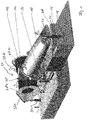
- Fig. 1 shows a rotor blade element 10, which is arranged on a rotor hub 12 with the interposition of a rotary joint 14.
- the rotary joint 14 is sometimes referred to as a pitch rotary joint.
- the rotor blade element 10 forms a rotor blade root, which is for example one fifth of the length of the entire rotor blade.
- a lifting device 16 has a foot 18, a hydraulic cylinder 20 and a force introduction device 22.
- the force introduction device 22 is in shape to the Contour of the rotor blade element 10 adapted and hingedly connected to the hydraulic cylinder 20.
- the rotor hub 12 is supported via a rotor hub adapter 24 on a foundation 26.
- a rotor hub adapter 24 on a foundation 26.
- Fig. 1 can be seen from the rotor hub adapter 24 two support elements 28a, 28b.
- Each of the support elements 28a, 28b has a connection flange 30 with which the support element is connected to the rotor hub 12.
- two lever arms 32a and 32b are provided on each of the support members 28a, 28b.
- the lever arms 32a, 32b do not rest on the foundation 26, but are connected via hydraulic stabilizing cylinders 34 to the end of the lever arms 32a, 32b.
- the rotor hub holder 24 additionally has a foot adapter (not shown), which is connected to a shaft flange of the rotor hub and rests on the foundation 26.
- a force is introduced into the rotor blade element via the lifting cylinder 20.
- To initiate the force of the lifting cylinder 20 is shortened, as well as the hydraulic cylinder 34 on the support element.
- a bending moment for the rotary joint 14 comes from the (Qkk device) 36 and is accepted.
- the transverse force compensation device 36 has a circumferential belt 38 and a deflection element 40 and a tensioning rocker 42. Between the elements 40, 42, one or more clamping cylinders 44 are provided. Clamping rocker 42 and deflecting element 40 each have a roller pair 46a, 46b, 48a, 48b. The endless belt 38 is guided over the roller pairs 46a, 46b, 48a, 48b. Between the deflecting element and the tensioning rocker, the tensioning cylinder 44 acts which, in the case of an extension, increases the distance between the rollers 46b and 48b in the direction of the double arrow A. The magnification is due to a pivoting movement the tensioning rocker 42 achieved in the direction of the double arrow B. For this purpose, the arm 49 of the tensioning rocker 42 is pivotally hinged below the roller 48 a.
- this has a travel drive 50 with which it can move in the rotor blade longitudinal direction, which is particularly advantageous for an exchange of the pitch turning connection and / or the rotor blade element.
- the ratio of lateral force and load moment on the pitch turning joint is set mainly by the pressure in the tensioning cylinder (s) and the lifter, the lateral force compensation is operated as close as possible to the pitch turning joint, so as to minimize the main load counteracting moment of the QKK device possible to keep.
- the rotor blade element preferably lies close to the rotary connection on the belt, which is held and tensioned by the transverse force compensation device.
- the voltage is in the test mode in synchronism with the initiation of the transverse force on the lifting device 16th
- Fig. 1 also shows in a schematic representation of the essential occurring on the test bench according to the invention forces F and moments M.
- the loading force F B is introduced via the lifting device 16.
- the supporting force F S is applied by the tensioned belt.
- the load moment M B arises, which acts on the pitch turning joint.
- the adapter torque M A is applied by the rotor hub holder, in particular by the rotor hub adapter which is supported on the foundation body.
- the counter-moments M G on the support elements are applied via the stabilization cylinder 34 with the stabilization force F S.
Landscapes
- Engineering & Computer Science (AREA)
- Aviation & Aerospace Engineering (AREA)
- Physics & Mathematics (AREA)
- General Physics & Mathematics (AREA)
- Investigating Strength Of Materials By Application Of Mechanical Stress (AREA)
Abstract
Description
- Die vorliegende Erfindung betrifft einen Prüfstand, der eine in einem Rotornabenadapter gehaltene Rotornabe aufweist, an die über eine Drehverbindung ein Rotorblattelement montiert ist. Geprüft wird die Pitchdrehverbindung.
- Prüfstände werden eingesetzt, um beschleunigte Lebensdauertests für eine Drehverbindung durchzuführen, Verformungsmessungen und Validierungen der Finite-Elemente-Modelle für die Drehverbindung durchzuführen. Ferner können an Prüfständen Schadensmechanismen validiert und Funktionstests für alternative Bauformen mit geringem Aufwand ausgeführt werden. Drehverbindungen zwischen Rotornabe und Rotorblatt werden auch als Pitchdrehverbindung bezeichnet.
- Aus
EP 2 741 068 B1 ist ein Prüfstand für ein Rotorblatt bekannt geworden, bei dem ein vollständiges Rotorblatt an einer Tragstruktur befestigt und über ein Anregungsaggregat in Schwingungen versetzt wird. Federelemente, die jeweils zwischen einer im Prüfbetrieb ortsfesten Anlenkstelle und dem Rotorblatt geschaltet und mit dem Rotorblatt derart verbunden, dass das Rotorblatt zur Beeinflussung des Schwingungsverhaltens durch die Federelemente mit Federkräften beaufschlagt wird, deren Kraftrichtung wenigstens eine Komponente aufweist, die parallel zur Hauptbelastungsrichtung des Rotorblatts verläuft. Hierdurch kann eine Reduktion der Prüfdauer erzielt werden. - Aus
EP 2 650 666 A2 ist eine Vorrichtung für eine Belastungsprüfung an einer Windenergieanlage bekannt geworden. Zur Einleitung der Betriebsbelastungen werden gegenüber den Rotorblättern verkürzte Prüfhebel mit Beschwerungskörpern an ihren freien Enden eingesetzt. - Aus
EP 2 315 940 ist ein weiterer Prüfstand zum Testen von Rotorblättern bekannt geworden. Bei dem Prüfstand wird das fixierte Rotorblatt mit Gewichten verbunden, die über Betätigungseinrichtungen in Schwingungen versetzt werden können. - Der Erfindung liegt die Aufgabe zugrunde, einen Prüfstand bereitzustellen, der mit möglichst einfachen Mitteln es gestattet, eine Pitchdrehverbindung zu prüfen.
- Erfindungsgemäß wird die Aufgabe durch eine Vorrichtung mit den Merkmalen aus Anspruch 1 gelöst. Vorteilhafte Ausgestaltungen bilden den Gegenstand der Unteransprüche.
- Die erfindungsgemäße Vorrichtung dient als ein Prüfstand. Der Prüfstand besitzt eine in einem Rotornabenadapter gehaltene Rotornabe, an die über eine Drehverbindung ein Rotorblattelement montiert ist. An dem von dem Rotornabenadapter fortweisenden Ende des Rotorblattelements ist eine Hubeinrichtung vorgesehen, die an dem Rotorblatt angreift, um eine Querkraft in das Rotorblattelement einzuleiten. Die in das Rotorblattelement eingeleitete Querkraft bringt an der Drehverbindung für Prüfzwecke ein notwendiges Belastungs-/Biegemoment auf. Erfindungsgemäß ist eine Querkraftkompensations-Einrichtung (Qkk-Einrichtung) vorgesehen, die zwischen der Drehverbindung und der Hubeinrichtung über einen spannbaren Gurt das Rotorblattelement abstützt, um ein vorbestimmtes Verhältnis von Biegemoment und Querkraft an der Drehverbindung einzustellen. Über die Hubeinrichtung wird eine Querkraft bevorzugt am Rotorblattende eingeleitet, diese Querkraft wird mit der Querkraftkompensations-Einrichtung teilweise kompensiert und in ein Biegemoment umgesetzt, das an der Drehverbindung anliegt. Die Verwendung einer Querkraftkompensations-Einrichtung erlaubt es, mit einem Rotorblattelement zu arbeiten, das im Wesentlichen die mechanischen Eigenschaften des Rotorblattwurzelbereiches nachbildet, aber nicht die gesamte Länge des Rotorblatts aufweist. Durch die Verwendung eines Rotorblattelements wird die Möglichkeit geschaffen, die gewünschten Tests an der Drehverbindung mit deutlich geringerem Aufwand durchzuführen, wobei Rotorblattwurzelbereich und Rotorblattnabe verwendet werden, um eine Originalsteifigkeit abzubilden und das Rotorblattelement bevorzugt kürzer als ein Rotorblatt ist, wodurch ein kompakter Aufbau möglich ist.
- In einer bevorzugten Weiterbildung bildet ausschließlich der Gurt der Querkraftkompensations-Einrichtung eine das Rotorblattelement abstützende Auflagefläche. Die Verwendung eines Gurtes zur Abstützung des Rotorblattelements bei eingeleiteten Querkräften stellt sicher, dass die von der Querkraftkompensations-Einrichtung aufzunehmende Kraft gleichmäßig über die Auflagefläche des Gurtes verteilt und so eine Beschädigung des Rotorblattelements vermieden wird.
- In einer bevorzugten Ausgestaltung besitzt die Querkraftkompensations-Einrichtung ein ortsfestes Umlenkelement und eine Spannschwinge, deren Abstand über mindestens einen Spannzylinder eingestellt werden kann. Durch eine Veränderung des Abstandes zwischen dem Umlenkelement und der Spannschwinge ist es möglich, die Querkraftkompensations-Einrichtung auf die aufzunehmende Stützkraft einzustellen und entsprechend anzupassen. Bevorzugt sind dafür mindestens zwei Paar Rollen vorgesehen, die als Lager für den Gurt vorgesehen sind, wobei der Gurt als Endlosgurt über die mindestens vier Rollen umläuft. Durch ein Verspannen des Umlenkelementes gegen die Spannschwinge wird der Gurt gespannt und kann die Stützkraft auf den Rotorblattwurzelbereich besser aufbringen.
- In einer bevorzugten Ausgestaltung besitzt das Umlenkelement eine L-Form, an dessen Fuß sich der mindestens eine Spannzylinder abstützt. Die Spannschwinge ist schwenkbar in der Querkraftkompensations-Einrichtung gelagert, wobei sie bei einem Ausfahren des Spannzylinders verschwenkt und damit den Gurt spannt.
- In einer bevorzugten Ausgestaltung ist die Querkraftkompensations-Einrichtung entlang einer Längsrichtung des Rotorblattelements verfahrbar. Die verfahrbare Querkraftkompensations-Einrichtung stellt sicher, dass sie in die gewünschte Position zwischen Drehverbindung und Krafteinleitung durch die Hubeinrichtung gebracht werden kann, wodurch sich über die Länge der Hebelarme auch die gewünschten Biegemomente und Querkräfte einstellen lassen. Je nach Ausgestaltung kann die Querkraftkompensations-Einrichtung auch ein Fahrwerk besitzen, mit dem sie verfahrbar ist, insbesondere um als Hub- und Verfahreinrichtung für den Tausch der Pitchdrehverbindung verwendet zu werden.
- In einer bevorzugten Ausgestaltung ist das Rotorblattelement als ein Rotorblattstumpf ausgebildet, dessen Länge einen Bruchteil der Länge eines vollständigen Rotorblatts aufweist. Die Verwendung der Querkraftkompensations-Einrichtung erlaubt es in besonderem Maße, einen Rotorblattstumpf an dem Prüfstand einzusetzen, wobei über die Querkraftkompensations-Einrichtung ein gewünschtes Verhältnis zwischen Biegemoment und Querkraft an der Drehverbindung eingestellt werden kann, so als würden Windlasten an einem Rotorblatt über dessen gesamte Länge angreifen.
- Bevorzugt ist eine Lasteinleiteinrichtung für die Hubeinrichtung vorgesehen, mit der die Kraft in das Rotorblattelement eingeleitet wird. Die Lasteinleiteinrichtung ist in an den Querschnitt des Rotorblattelements angepasst und sorgt insbesondere dafür, dass es nicht zu Verfälschungen in der Kraftverteilung kommt, aufgrund des Umstandes, dass ein Rotorblattelement anstelle eines vollständigen Rotorblatts im Prüfstand verwendet wird. Bevorzugt bietet die Lasteinleiteinrichtung den Freiheitsgrad des Pitchens, was eine Blattverstellung während des Belastens zulässt.
- In einer besonders bevorzugten Weiterbildung der Erfindung weist die Rotornabenhalterung mindestens einen Stabilisationszylinder auf, der der Hubeinrichtung entgegenwirkt, um den Prüfstand zu stabilisieren, wodurch es möglich ist, Belastungen an der Pitchdrehverbindung aufzubauen, die größer sein können, als sie von einem Rotornabenadapter allein aufgenommen werden können. Die Verwendung eines Stabilisationszylinders besitzt den besonderen Vorteil, dass die Rotornabenhalterung ausreichend stabilisiert ist. Bevorzugt weist die Rotornabenhalterung einen Rotornabenadapter zur Verbindung mit einem Wellenflansch der Rotornabe und zwei hebelartigen Abstützelemente zur Verbindung mit zwei Rotorblattflanschen an der Rotornabe auf. In dieser bevorzugten Ausgestaltung ist die Rotornabenhalterung dreiteilig ausgebildet, wobei die drei Teile jeweils mit einem Anschlussflansch an der Rotornabe verbunden sind. Der Rotornabenadapter stützt sich stehend auf einem Untergrund, beispielsweise in Form eines Fundaments ab. Die beiden zur Verbindung mit den zwei Rotorblattflanschen der Rotornabe vorgesehenen Abstützelemente besitzen einen Anschlussflansch zur Verbindung mit der Rotornabe. Jedes Abstützelement besitzt ferner einen Hebelarm, der bevorzugt über einen Stabilisationszylinder mit dem Untergrund verbunden ist, um eine stabilisierende Kraft in die Rotornabenhalterung einzuleiten. Die Krafteinleitung erfolgt somit auf beiden Seiten der Pitchdrehverbindung über die Hubeinrichtung in das Rotorblattelement und über die Hebelarme der Abstützelemente in die Rotornabe, hierdurch wird der Prüfstand insgesamt stabilisiert.
- In einer bevorzugten Ausgestaltung sind an der Drehverbindung Messsensoren vorgesehen, die mit einer Prüfstandseinheit verbunden sind.
- Kräfte und Belastungen werden aus den Zylinderkräften und den Positionen sowie Dimensionen der Pitchdrehverbindung berechnet. An der Pitchdrehverbindung werden Verformungen und Dehnungen direkt gemessen.
- In einer bevorzugten Weiterbildung der Erfindung sind das Rotorblattelement und seine Drehverbindung mit einem Pitchantrieb ausgestattet, so dass auch Untersuchungen an dem Pitchantrieb durchgeführt werden können.
- Ein bevorzugtes Ausführungsbeispiel der Erfindung wird anhand der nachfolgenden Figuren näher erläutert. Es zeigen:
- Fig. 1
- eine perspektivische Ansicht eines Rotorblattprüfstandes mit einem Rotorblattelement und einer Querkraftkompensations-Einrichtung und
- Fig. 2
- eine perspektivische Ansicht einer Querkraftkompensations-Einrichtung mit Gurt ohne Rotorblatt.
-
Fig. 1 zeigt eine Rotorblattelement 10, das an einer Rotornabe 12 unter Zwischenschaltung einer Drehverbindung 14 angeordnet ist. Die Drehverbindung 14 wird gelegentlich auch als Pitchdrehverbindung bezeichnet. Das Rotorblattelement 10 bildet eine Rotorblattwurzel, die beispielsweise ein Fünftel der Länge des gesamten Rotorblatts beträgt. - Einen Hubeinrichtung 16 besitzt einen Fuß 18, einen Hydraulikzylinder 20 und eine Krafteinleiteeinrichtung 22. Die Krafteinleiteeinrichtung 22 ist in ihrer Form an die Kontur des Rotorblattelements 10 angepasst und gelenkig mit dem Hydraulikzylinder 20 verbunden.
- Die Rotornabe 12 ist über einen Rotornabenadapter 24 auf einem Fundament 26 abgestützt. In
Fig. 1 sind von dem Rotornabenadapter 24 zwei Abstützelemente 28a, 28b zu erkennen. Jedes der Abstützelemente 28a, 28b besitzt einen Anschlussflansch 30, mit dem das Abstützelement mit der Rotornabe 12 verbunden ist. Ferner sind zwei Hebelarme 32a und 32b an jedem der Abstützelemente 28a, 28b vorgesehen. Die Hebelarme 32a, 32b liegen nicht auf dem Fundament 26 auf, sondern sind über hydraulische Stabilisierungszylinder 34 mit dem Ende der Hebelarme 32a, 32b verbunden. - Die Rotornabenhalterung 24 besitzt zusätzlich einen Fußadapter (nicht dargestellt), der mit einem Wellenflansch der Rotornabe verbunden ist und auf dem Fundament 26 aufsteht. Für den Prüfvorgang wird über den Hubzylinder 20 eine Kraft in das Rotorblattelement eingeleitet. Zur Einleitung der Kraft wird der Hubzylinder 20 verkürzt, ebenso wie der Hydraulikzylinder 34 an dem Abstützelement. Ein Biegemoment für die Drehverbindung 14 stammt von der (Qkk-Einrichtung) 36 und wird in Kauf genommen.
- Die Querkraftkompensations-Einrichtung 36 besitzt einen umlaufenden Gurt 38 sowie ein Umlenkelement 40 und eine Spannschwinge 42. Zwischen den Elementen 40, 42 sind ein oder mehrere Spannzylinder 44 vorgesehen. Spannschwinge 42 und Umlenkelement 40 besitzen jeweils ein Rollenpaar 46a, 46b, 48a, 48b. Der Endlosgurt 38 ist über die Rollenpaare 46a, 46b, 48a, 48b geführt. Zwischen dem Umlenkelement und der Spannschwinge wirkt der Spannzylinder 44, der bei einer Verlängerung den Abstand zwischen den Rollen 46b und 48b in Richtung des Doppelpfeils A vergrößert. Die Vergrößerung wird durch eine Schwenkbewegung der Spannschwinge 42 in Richtung des Doppelpfeils B erzielt. Hierzu ist der Arm 49 der Spannschwinge 42 schwenkbar unterhalb der Rolle 48a angelenkt.
- Zur besseren Einstellung der Querkraftkompensations-Einrichtung 36 besitzt diese einen Fahrantrieb 50, mit dem diese in Rotorblattlängsrichtung verfahren kann, was insbesondere für einen Tausch der Pitchdrehverbindung und/oder des Rotorblattelements von Vorteil ist. Das Verhältnis von Querkraft und Belastungsmoment an der Pitchdrehverbindung wird hauptsächlich über den Druck in dem oder den Spannzylindern und der Hubeinrichtung eingestellt, die Querkraftkompensation wird so nah wie möglich an der Pitchdrehverbindung betrieben, um gerade das der Hauptbelastung entgegenwirkende Moment der QKK-Einrichtung so gering wie möglich zu halten.
- Das Rotorblattelement liegt dabei bevorzugt nahe der Drehverbindung auf dem Gurt auf, der durch die Querkraftkompensations-Einrichtung 36 gehalten und gespannt wird. Die Spannung erfolgt im Prüfbetrieb synchron zur Einleitung der Querkraft über die Hubeinrichtung 16.
-
Fig. 1 zeigt ebenfalls in einer schematischen Darstellung die wesentlichen an dem erfindungsgemäßen Prüfstand auftretenden Kräfte F und Momente M. Die Belastungskraft FB wird über die Hubeinrichtung 16 eingeleitet. An der Querkraftkompensationseinrichtung 36 wird die Stützkraft FS durch den gespannten Gurt aufgebracht. Es entsteht das Belastungsmoment MB, das an der Pitchdrehverbindung angreift. Nabenseitig wird durch die Rotornabenhalterung das Adaptermoment MA, insbesondere durch den sich auf dem Fundamentkörper abstützenden Rotornabenadapter aufgebracht. Die Gegenmomente MG an den Abstützelementen werden über die Stabilisationszylinder 34 mit der Stabilisationskraft FS aufgebracht. -
- 10
- Rotorblattelement
- 12
- Rotornabe
- 14
- Drehverbindung
- 16
- Hubeinrichtung
- 18
- Fuß
- 20
- Hydraulikzylinder
- 22
- Lasteinleiteeinrichtung
- 24
- Rotornabenhalterung
- 26
- Fundament
- 28a
- Abstützelement
- 28b
- Abstützelement
- 30
- Anschlussflansch
- 32a
- Hebelarm
- 32b
- Hebelarm
- 34
- Stabilisierungszylinder
- 36
- Querkraftkompensations-Einrichtung
- 38
- Gurt
- 40
- Umlenkelement
- 42
- Spannschwinge
- 44
- Spannzylinder
- 46a,b
- Rollenpaar
- 48a,b
- Rollenpaar
- 50
- Fahrantrieb
Claims (15)
- Prüfstand für eine Pitchdrehverbindung, der eine in einem Rotornabenadapter (24) gehaltene Rotornabe (12) aufweist, an die über eine Drehverbindung (14) ein Rotorblattelement (10) montiert ist, an dessen von dem Rotornabenadapter (24) fortweisendem Ende eine Hubeinrichtung (16) angreift, die eine Querkraft in das Ende des Rotorblattelements (10) einleiten kann, dadurch gekennzeichnet, dass eine Querkraftkompensationseinrichtung (QKK-Einrichtung) (36) zwischen der Drehverbindung (14) und der Hubeinrichtung (16) über einen spannbaren Gurt (38) das Rotorblattelement (10) abstützt, um ein vorbestimmtes Verhältnis von Biegemoment und Querkraft an der Drehverbindung (14) ein zu stellen.
- Prüfstand nach Anspruch 1, dadurch gekennzeichnet, dass ausschließlich der Gurt (38) der QKK-Einrichtung (36) eine das Rotorblattelement (10) abstützende Auflagefläche bildet.
- Prüfstand nach Anspruch 1 oder 2, dadurch gekennzeichnet, dass die QKK-Einrichtung (36) ein feststehendes Umlenkelement (40) und eine Spannschwinge (42) aufweist, deren Abstand über mindestens einen Spannzylinder (44) eingestellt werden kann.
- Prüfstand nach Anspruch 3, dadurch gekennzeichnet, dass das Umlenkelement (40) und die Spannungsschwinge (42) mindestens zwei Paar Rollen (46, 48) tragen, die als Lager für den Gurt (38) vorgesehen sind, wobei der Gurt (38) als Endlosgurt um die mindestens vier Rollen (46, 48) umläuft.
- Prüfstand nach Anspruch 3 oder 4, dadurch gekennzeichnet, dass die festende Schwinge (40) eine L-Form besitzt an deren Fuß sich der mindestens eine Spannzylinder (44) abstützt und die Spannschwinge (42) schwenkbar derart gelagert ist, dass bei einem Ausfahren des Spannzylinders (44) der Gurt (38) gespannt wird.
- Prüfstand nach einem der Ansprüche 1 bis 5, dadurch gekennzeichnet, dass die QKK-Einrichtung (36) entlang einer Längsrichtung des Rotorblattelements (10) verfahrbar ist.
- Prüfstand nach einem der Ansprüche 1 bis 6, dadurch gekennzeichnet, dass das Rotorblattelement (10) ein Blattstumpf ist, der einen Bruchteil der Länge eines vollständigen Rotorblattes aufweist.
- Prüfstand nach einem der Ansprüche 1 bis 7, dadurch gekennzeichnet, dass die Hubeinrichtung (16) mindestens einen Hydraulikzylinder (20) aufweist, der zur Aufbringung einer Kraft das Rotorblattelement (10) gegen den gespannten Gurt (38) der QKK-Einrichtung (36) drückt.
- Prüfstand nach Anspruch 8, dadurch gekennzeichnet, dass die Hubeinrichtung (16) über eine an dem Querschnitt des Rotorblattelements (10) angepasste Lasteinleiteinrichtung seine Kraft einleitet, wobei die Lasteinleiteinrichtung eine Blattverstellung zulässt.
- Prüfstand nach einem der Ansprüche 1 bis 9, dadurch gekennzeichnet, dass der Rotornabenadapter (24) mindestens einen Stabilisationszylinder (34) aufweist, der der Hubeinrichtung (16) entgegen wirkt.
- Prüfstand nach einem der Ansprüche 1 bis 10, dadurch gekennzeichnet, dass die Rotornabenhalterung (24) einen Rotornabenadapter zur Verbindung mit einem Wellenflansch der Rotornabe und zwei Abstützelemente (28a, 28b) zur Verbindung mit zwei Rotorblattflanschen der Rotornabe (12) aufweist.
- Prüfstand nach Anspruch 11, dadurch gekennzeichnet, dass der Rotornabenadapter sich stehend auf einem Untergrund (26) abstützt.
- Prüfstand nach Anspruch 11 oder 12, dadurch gekennzeichnet, dass jedes der Abstützelemente (28a, 28b) einen Anschlussflansch (30) zur direkten Verbindung mit dem Rotorblattflansch und einen Hebelarm (32a, 32b) aufweist, der mit dem Untergrund (26) verbunden ist, um eine die Rotornabe (12) stabilisierende Kraft einzuleiten.
- Prüfstand nach einem der Ansprüche 1 bis 13, dadurch gekennzeichnet, dass an der Drehverbindung (14) des Rotorblattelements (10) Messsensoren vorgesehen sind, die mit einer Prüfstandeinheit verbunden ist, um erfasste Dehnungen und Verformungen aufzuzeichnen und auszuwerten.
- Prüfstand nach einem der Ansprüche 1 bis 14, dadurch gekennzeichnet, dass das Rotorblattelement (10) mit einem Pitchantrieb ausgestattet ist.
Priority Applications (1)
| Application Number | Priority Date | Filing Date | Title |
|---|---|---|---|
| EP17175755.2A EP3415890B1 (de) | 2017-06-13 | 2017-06-13 | Prüfstand für eine pitchdrehverbindung |
Applications Claiming Priority (1)
| Application Number | Priority Date | Filing Date | Title |
|---|---|---|---|
| EP17175755.2A EP3415890B1 (de) | 2017-06-13 | 2017-06-13 | Prüfstand für eine pitchdrehverbindung |
Publications (2)
| Publication Number | Publication Date |
|---|---|
| EP3415890A1 true EP3415890A1 (de) | 2018-12-19 |
| EP3415890B1 EP3415890B1 (de) | 2020-06-03 |
Family
ID=59067527
Family Applications (1)
| Application Number | Title | Priority Date | Filing Date |
|---|---|---|---|
| EP17175755.2A Active EP3415890B1 (de) | 2017-06-13 | 2017-06-13 | Prüfstand für eine pitchdrehverbindung |
Country Status (1)
| Country | Link |
|---|---|
| EP (1) | EP3415890B1 (de) |
Cited By (2)
| Publication number | Priority date | Publication date | Assignee | Title |
|---|---|---|---|---|
| CN113173261A (zh) * | 2021-04-20 | 2021-07-27 | 中国直升机设计研究所 | 一种旋翼天平装试验台复合加载现场校核装置及方法 |
| CN114088390A (zh) * | 2021-11-15 | 2022-02-25 | 江苏科技大学 | 透平机械基础变加速度运动仿真测试平台及运动仿真方法 |
Citations (5)
| Publication number | Priority date | Publication date | Assignee | Title |
|---|---|---|---|---|
| DE202010003033U1 (de) * | 2010-02-17 | 2010-05-27 | Nordex Energy Gmbh | Hebezeug zur Positionierung eines Rotorblatts einer Windenergieanlage |
| EP2315940A2 (de) | 2008-06-30 | 2011-05-04 | Vestas Wind Systems A/S | Prüfstand zum testen von schaufeln für eine windturbine |
| EP2650666A2 (de) | 2012-04-10 | 2013-10-16 | Friedrich Prof. Dr.-Ing. Klinger | Vorrichtung für Belastungsprüfungen an Windenergieanlagen |
| KR101482778B1 (ko) * | 2014-05-22 | 2015-01-19 | 한국기계연구원 | 블레이드 피로시험용 비틀림발생장치 및 이를 이용한 피로시험 방법 |
| EP2741068B1 (de) | 2012-12-05 | 2016-11-02 | Industrieanlagen-Betriebsgesellschaft mbH | Prüfstand für ein Rotorblatt, Anordnung mit einem derartigen Prüfstand und Verfahren zum Betreiben eines derartigen Prüfstands |
-
2017
- 2017-06-13 EP EP17175755.2A patent/EP3415890B1/de active Active
Patent Citations (5)
| Publication number | Priority date | Publication date | Assignee | Title |
|---|---|---|---|---|
| EP2315940A2 (de) | 2008-06-30 | 2011-05-04 | Vestas Wind Systems A/S | Prüfstand zum testen von schaufeln für eine windturbine |
| DE202010003033U1 (de) * | 2010-02-17 | 2010-05-27 | Nordex Energy Gmbh | Hebezeug zur Positionierung eines Rotorblatts einer Windenergieanlage |
| EP2650666A2 (de) | 2012-04-10 | 2013-10-16 | Friedrich Prof. Dr.-Ing. Klinger | Vorrichtung für Belastungsprüfungen an Windenergieanlagen |
| EP2741068B1 (de) | 2012-12-05 | 2016-11-02 | Industrieanlagen-Betriebsgesellschaft mbH | Prüfstand für ein Rotorblatt, Anordnung mit einem derartigen Prüfstand und Verfahren zum Betreiben eines derartigen Prüfstands |
| KR101482778B1 (ko) * | 2014-05-22 | 2015-01-19 | 한국기계연구원 | 블레이드 피로시험용 비틀림발생장치 및 이를 이용한 피로시험 방법 |
Cited By (2)
| Publication number | Priority date | Publication date | Assignee | Title |
|---|---|---|---|---|
| CN113173261A (zh) * | 2021-04-20 | 2021-07-27 | 中国直升机设计研究所 | 一种旋翼天平装试验台复合加载现场校核装置及方法 |
| CN114088390A (zh) * | 2021-11-15 | 2022-02-25 | 江苏科技大学 | 透平机械基础变加速度运动仿真测试平台及运动仿真方法 |
Also Published As
| Publication number | Publication date |
|---|---|
| EP3415890B1 (de) | 2020-06-03 |
Similar Documents
| Publication | Publication Date | Title |
|---|---|---|
| EP3874248B1 (de) | Verfahren und prüfvorrichtung zum prüfen von rotorblättern | |
| DE102009002678B4 (de) | Prüfverfahren für Drehgestelle sowie Prüf- und Montagestand | |
| EP2741068B1 (de) | Prüfstand für ein Rotorblatt, Anordnung mit einem derartigen Prüfstand und Verfahren zum Betreiben eines derartigen Prüfstands | |
| DE2659633C3 (de) | Windkanalanlage | |
| DE112013003362T5 (de) | Düsenberührungsmechanismus und Spritzgießmaschine | |
| EP2330399A1 (de) | System zur Prüfung der Betriebsfestigkeit eines Probekörpers, insbesondere eines Radsatzes von Schienenfahrzeugen | |
| EP3415890A1 (de) | Prüfstand für eine pitchdrehverbindung | |
| EP3704460B1 (de) | Vorrichtung zur strukturprüfung | |
| DE102010017455B4 (de) | Vorrichtung und Verfahren zur Prüfung der Betriebsfestigkeit eines Körpers | |
| DE10135594A1 (de) | Hebebühne für Fahrzeuge | |
| DE3204472C2 (de) | Umlaufbiegemaschine | |
| DE19945189B4 (de) | Hebezeug | |
| EP3105164B2 (de) | Kransockel für einen ladekran | |
| DE69217537T2 (de) | Penetrometerkopf mit Gehäuse, und seine Anwendung | |
| DE102008034403A1 (de) | Messanordnung zum Messen der linearen Kraftverteilung eines Wischblatts gegen eine Scheibe | |
| DE10205669C5 (de) | Hubladebühnenvorrichtung für Fahrzeuge | |
| WO2009153026A1 (de) | Drehportal für einen ofen | |
| DE102007015438A1 (de) | Verstellanordnung mit einem Scherengestell, insbesondere Federelement | |
| DE102023208694A1 (de) | Prüfvorrichtung und Prüfverfahren zum Prüfen eines Drehlagers | |
| DE102015006778A1 (de) | System und Verfahren zum Transportieren und Heben eines Rotorblatts einer Windenergieanlage | |
| EP4229384B1 (de) | Vorrichtung und verfahren zum einspannen eines prüfkörpers | |
| EP2946991B1 (de) | Anhebevorrichtung für eine fahrzeugachse eines fahrzeugs | |
| DE102022112753B4 (de) | Vorrichtung zum Beeinflussen eines Faltvorgangs einer faltbaren Plattform, faltbare Plattform welche die Vorrichtung umfasst | |
| DE102017004057A1 (de) | Prüfvorrichtung, Verfahren zur Prüfung eines Prüflings und Verwendung der Prüfvorrichtung | |
| DE102005039945B4 (de) | Scherenhubtisch |
Legal Events
| Date | Code | Title | Description |
|---|---|---|---|
| PUAI | Public reference made under article 153(3) epc to a published international application that has entered the european phase |
Free format text: ORIGINAL CODE: 0009012 |
|
| STAA | Information on the status of an ep patent application or granted ep patent |
Free format text: STATUS: THE APPLICATION HAS BEEN PUBLISHED |
|
| AK | Designated contracting states |
Kind code of ref document: A1 Designated state(s): AL AT BE BG CH CY CZ DE DK EE ES FI FR GB GR HR HU IE IS IT LI LT LU LV MC MK MT NL NO PL PT RO RS SE SI SK SM TR |
|
| AX | Request for extension of the european patent |
Extension state: BA ME |
|
| STAA | Information on the status of an ep patent application or granted ep patent |
Free format text: STATUS: REQUEST FOR EXAMINATION WAS MADE |
|
| 17P | Request for examination filed |
Effective date: 20190415 |
|
| RBV | Designated contracting states (corrected) |
Designated state(s): AL AT BE BG CH CY CZ DE DK EE ES FI FR GB GR HR HU IE IS IT LI LT LU LV MC MK MT NL NO PL PT RO RS SE SI SK SM TR |
|
| GRAP | Despatch of communication of intention to grant a patent |
Free format text: ORIGINAL CODE: EPIDOSNIGR1 |
|
| STAA | Information on the status of an ep patent application or granted ep patent |
Free format text: STATUS: GRANT OF PATENT IS INTENDED |
|
| INTG | Intention to grant announced |
Effective date: 20200117 |
|
| GRAS | Grant fee paid |
Free format text: ORIGINAL CODE: EPIDOSNIGR3 |
|
| GRAA | (expected) grant |
Free format text: ORIGINAL CODE: 0009210 |
|
| STAA | Information on the status of an ep patent application or granted ep patent |
Free format text: STATUS: THE PATENT HAS BEEN GRANTED |
|
| AK | Designated contracting states |
Kind code of ref document: B1 Designated state(s): AL AT BE BG CH CY CZ DE DK EE ES FI FR GB GR HR HU IE IS IT LI LT LU LV MC MK MT NL NO PL PT RO RS SE SI SK SM TR |
|
| REG | Reference to a national code |
Ref country code: GB Ref legal event code: FG4D Free format text: NOT ENGLISH |
|
| REG | Reference to a national code |
Ref country code: CH Ref legal event code: EP Ref country code: AT Ref legal event code: REF Ref document number: 1277504 Country of ref document: AT Kind code of ref document: T Effective date: 20200615 |
|
| REG | Reference to a national code |
Ref country code: DE Ref legal event code: R096 Ref document number: 502017005514 Country of ref document: DE |
|
| REG | Reference to a national code |
Ref country code: LT Ref legal event code: MG4D |
|
| PG25 | Lapsed in a contracting state [announced via postgrant information from national office to epo] |
Ref country code: GR Free format text: LAPSE BECAUSE OF FAILURE TO SUBMIT A TRANSLATION OF THE DESCRIPTION OR TO PAY THE FEE WITHIN THE PRESCRIBED TIME-LIMIT Effective date: 20200904 Ref country code: NO Free format text: LAPSE BECAUSE OF FAILURE TO SUBMIT A TRANSLATION OF THE DESCRIPTION OR TO PAY THE FEE WITHIN THE PRESCRIBED TIME-LIMIT Effective date: 20200903 Ref country code: FI Free format text: LAPSE BECAUSE OF FAILURE TO SUBMIT A TRANSLATION OF THE DESCRIPTION OR TO PAY THE FEE WITHIN THE PRESCRIBED TIME-LIMIT Effective date: 20200603 Ref country code: SE Free format text: LAPSE BECAUSE OF FAILURE TO SUBMIT A TRANSLATION OF THE DESCRIPTION OR TO PAY THE FEE WITHIN THE PRESCRIBED TIME-LIMIT Effective date: 20200603 Ref country code: LT Free format text: LAPSE BECAUSE OF FAILURE TO SUBMIT A TRANSLATION OF THE DESCRIPTION OR TO PAY THE FEE WITHIN THE PRESCRIBED TIME-LIMIT Effective date: 20200603 |
|
| REG | Reference to a national code |
Ref country code: NL Ref legal event code: MP Effective date: 20200603 |
|
| PG25 | Lapsed in a contracting state [announced via postgrant information from national office to epo] |
Ref country code: BG Free format text: LAPSE BECAUSE OF FAILURE TO SUBMIT A TRANSLATION OF THE DESCRIPTION OR TO PAY THE FEE WITHIN THE PRESCRIBED TIME-LIMIT Effective date: 20200903 Ref country code: HR Free format text: LAPSE BECAUSE OF FAILURE TO SUBMIT A TRANSLATION OF THE DESCRIPTION OR TO PAY THE FEE WITHIN THE PRESCRIBED TIME-LIMIT Effective date: 20200603 Ref country code: LV Free format text: LAPSE BECAUSE OF FAILURE TO SUBMIT A TRANSLATION OF THE DESCRIPTION OR TO PAY THE FEE WITHIN THE PRESCRIBED TIME-LIMIT Effective date: 20200603 Ref country code: RS Free format text: LAPSE BECAUSE OF FAILURE TO SUBMIT A TRANSLATION OF THE DESCRIPTION OR TO PAY THE FEE WITHIN THE PRESCRIBED TIME-LIMIT Effective date: 20200603 |
|
| PG25 | Lapsed in a contracting state [announced via postgrant information from national office to epo] |
Ref country code: NL Free format text: LAPSE BECAUSE OF FAILURE TO SUBMIT A TRANSLATION OF THE DESCRIPTION OR TO PAY THE FEE WITHIN THE PRESCRIBED TIME-LIMIT Effective date: 20200603 Ref country code: AL Free format text: LAPSE BECAUSE OF FAILURE TO SUBMIT A TRANSLATION OF THE DESCRIPTION OR TO PAY THE FEE WITHIN THE PRESCRIBED TIME-LIMIT Effective date: 20200603 |
|
| REG | Reference to a national code |
Ref country code: DE Ref legal event code: R119 Ref document number: 502017005514 Country of ref document: DE |
|
| PG25 | Lapsed in a contracting state [announced via postgrant information from national office to epo] |
Ref country code: EE Free format text: LAPSE BECAUSE OF FAILURE TO SUBMIT A TRANSLATION OF THE DESCRIPTION OR TO PAY THE FEE WITHIN THE PRESCRIBED TIME-LIMIT Effective date: 20200603 Ref country code: SM Free format text: LAPSE BECAUSE OF FAILURE TO SUBMIT A TRANSLATION OF THE DESCRIPTION OR TO PAY THE FEE WITHIN THE PRESCRIBED TIME-LIMIT Effective date: 20200603 Ref country code: PT Free format text: LAPSE BECAUSE OF FAILURE TO SUBMIT A TRANSLATION OF THE DESCRIPTION OR TO PAY THE FEE WITHIN THE PRESCRIBED TIME-LIMIT Effective date: 20201006 Ref country code: CZ Free format text: LAPSE BECAUSE OF FAILURE TO SUBMIT A TRANSLATION OF THE DESCRIPTION OR TO PAY THE FEE WITHIN THE PRESCRIBED TIME-LIMIT Effective date: 20200603 Ref country code: IT Free format text: LAPSE BECAUSE OF FAILURE TO SUBMIT A TRANSLATION OF THE DESCRIPTION OR TO PAY THE FEE WITHIN THE PRESCRIBED TIME-LIMIT Effective date: 20200603 Ref country code: ES Free format text: LAPSE BECAUSE OF FAILURE TO SUBMIT A TRANSLATION OF THE DESCRIPTION OR TO PAY THE FEE WITHIN THE PRESCRIBED TIME-LIMIT Effective date: 20200603 Ref country code: RO Free format text: LAPSE BECAUSE OF FAILURE TO SUBMIT A TRANSLATION OF THE DESCRIPTION OR TO PAY THE FEE WITHIN THE PRESCRIBED TIME-LIMIT Effective date: 20200603 |
|
| REG | Reference to a national code |
Ref country code: CH Ref legal event code: PL |
|
| PG25 | Lapsed in a contracting state [announced via postgrant information from national office to epo] |
Ref country code: PL Free format text: LAPSE BECAUSE OF FAILURE TO SUBMIT A TRANSLATION OF THE DESCRIPTION OR TO PAY THE FEE WITHIN THE PRESCRIBED TIME-LIMIT Effective date: 20200603 Ref country code: SK Free format text: LAPSE BECAUSE OF FAILURE TO SUBMIT A TRANSLATION OF THE DESCRIPTION OR TO PAY THE FEE WITHIN THE PRESCRIBED TIME-LIMIT Effective date: 20200603 Ref country code: IS Free format text: LAPSE BECAUSE OF FAILURE TO SUBMIT A TRANSLATION OF THE DESCRIPTION OR TO PAY THE FEE WITHIN THE PRESCRIBED TIME-LIMIT Effective date: 20201003 |
|
| PG25 | Lapsed in a contracting state [announced via postgrant information from national office to epo] |
Ref country code: LU Free format text: LAPSE BECAUSE OF NON-PAYMENT OF DUE FEES Effective date: 20200613 Ref country code: MC Free format text: LAPSE BECAUSE OF FAILURE TO SUBMIT A TRANSLATION OF THE DESCRIPTION OR TO PAY THE FEE WITHIN THE PRESCRIBED TIME-LIMIT Effective date: 20200603 |
|
| PLBE | No opposition filed within time limit |
Free format text: ORIGINAL CODE: 0009261 |
|
| STAA | Information on the status of an ep patent application or granted ep patent |
Free format text: STATUS: NO OPPOSITION FILED WITHIN TIME LIMIT |
|
| REG | Reference to a national code |
Ref country code: BE Ref legal event code: MM Effective date: 20200630 |
|
| PG25 | Lapsed in a contracting state [announced via postgrant information from national office to epo] |
Ref country code: CH Free format text: LAPSE BECAUSE OF NON-PAYMENT OF DUE FEES Effective date: 20200630 Ref country code: DK Free format text: LAPSE BECAUSE OF FAILURE TO SUBMIT A TRANSLATION OF THE DESCRIPTION OR TO PAY THE FEE WITHIN THE PRESCRIBED TIME-LIMIT Effective date: 20200603 Ref country code: LI Free format text: LAPSE BECAUSE OF NON-PAYMENT OF DUE FEES Effective date: 20200630 Ref country code: IE Free format text: LAPSE BECAUSE OF NON-PAYMENT OF DUE FEES Effective date: 20200613 Ref country code: FR Free format text: LAPSE BECAUSE OF NON-PAYMENT OF DUE FEES Effective date: 20200803 |
|
| 26N | No opposition filed |
Effective date: 20210304 |
|
| PG25 | Lapsed in a contracting state [announced via postgrant information from national office to epo] |
Ref country code: DE Free format text: LAPSE BECAUSE OF NON-PAYMENT OF DUE FEES Effective date: 20210101 Ref country code: BE Free format text: LAPSE BECAUSE OF NON-PAYMENT OF DUE FEES Effective date: 20200630 Ref country code: SI Free format text: LAPSE BECAUSE OF FAILURE TO SUBMIT A TRANSLATION OF THE DESCRIPTION OR TO PAY THE FEE WITHIN THE PRESCRIBED TIME-LIMIT Effective date: 20200603 |
|
| GBPC | Gb: european patent ceased through non-payment of renewal fee |
Effective date: 20210613 |
|
| PG25 | Lapsed in a contracting state [announced via postgrant information from national office to epo] |
Ref country code: GB Free format text: LAPSE BECAUSE OF NON-PAYMENT OF DUE FEES Effective date: 20210613 |
|
| PG25 | Lapsed in a contracting state [announced via postgrant information from national office to epo] |
Ref country code: TR Free format text: LAPSE BECAUSE OF FAILURE TO SUBMIT A TRANSLATION OF THE DESCRIPTION OR TO PAY THE FEE WITHIN THE PRESCRIBED TIME-LIMIT Effective date: 20200603 Ref country code: MT Free format text: LAPSE BECAUSE OF FAILURE TO SUBMIT A TRANSLATION OF THE DESCRIPTION OR TO PAY THE FEE WITHIN THE PRESCRIBED TIME-LIMIT Effective date: 20200603 Ref country code: CY Free format text: LAPSE BECAUSE OF FAILURE TO SUBMIT A TRANSLATION OF THE DESCRIPTION OR TO PAY THE FEE WITHIN THE PRESCRIBED TIME-LIMIT Effective date: 20200603 |
|
| PG25 | Lapsed in a contracting state [announced via postgrant information from national office to epo] |
Ref country code: MK Free format text: LAPSE BECAUSE OF FAILURE TO SUBMIT A TRANSLATION OF THE DESCRIPTION OR TO PAY THE FEE WITHIN THE PRESCRIBED TIME-LIMIT Effective date: 20200603 |
|
| REG | Reference to a national code |
Ref country code: AT Ref legal event code: MM01 Ref document number: 1277504 Country of ref document: AT Kind code of ref document: T Effective date: 20220613 |
|
| PG25 | Lapsed in a contracting state [announced via postgrant information from national office to epo] |
Ref country code: AT Free format text: LAPSE BECAUSE OF NON-PAYMENT OF DUE FEES Effective date: 20220613 |