EP3421009A1 - Blanker aorta-stent und stent für aorta-dissektionen - Google Patents
Blanker aorta-stent und stent für aorta-dissektionen Download PDFInfo
- Publication number
- EP3421009A1 EP3421009A1 EP17765862.2A EP17765862A EP3421009A1 EP 3421009 A1 EP3421009 A1 EP 3421009A1 EP 17765862 A EP17765862 A EP 17765862A EP 3421009 A1 EP3421009 A1 EP 3421009A1
- Authority
- EP
- European Patent Office
- Prior art keywords
- stent
- aortic
- stents
- connector
- support
- Prior art date
- Legal status (The legal status is an assumption and is not a legal conclusion. Google has not performed a legal analysis and makes no representation as to the accuracy of the status listed.)
- Withdrawn
Links
Images







Classifications
-
- A—HUMAN NECESSITIES
- A61—MEDICAL OR VETERINARY SCIENCE; HYGIENE
- A61F—FILTERS IMPLANTABLE INTO BLOOD VESSELS; PROSTHESES; DEVICES PROVIDING PATENCY TO, OR PREVENTING COLLAPSING OF, TUBULAR STRUCTURES OF THE BODY, e.g. STENTS; ORTHOPAEDIC, NURSING OR CONTRACEPTIVE DEVICES; FOMENTATION; TREATMENT OR PROTECTION OF EYES OR EARS; BANDAGES, DRESSINGS OR ABSORBENT PADS; FIRST-AID KITS
- A61F2/00—Filters implantable into blood vessels; Prostheses, i.e. artificial substitutes or replacements for parts of the body; Appliances for connecting them with the body; Devices providing patency to, or preventing collapsing of, tubular structures of the body, e.g. stents
- A61F2/82—Devices providing patency to, or preventing collapsing of, tubular structures of the body, e.g. stents
- A61F2/86—Stents in a form characterised by the wire-like elements; Stents in the form characterised by a net-like or mesh-like structure
- A61F2/89—Stents in a form characterised by the wire-like elements; Stents in the form characterised by a net-like or mesh-like structure the wire-like elements comprising two or more adjacent rings flexibly connected by separate members
-
- A—HUMAN NECESSITIES
- A61—MEDICAL OR VETERINARY SCIENCE; HYGIENE
- A61F—FILTERS IMPLANTABLE INTO BLOOD VESSELS; PROSTHESES; DEVICES PROVIDING PATENCY TO, OR PREVENTING COLLAPSING OF, TUBULAR STRUCTURES OF THE BODY, e.g. STENTS; ORTHOPAEDIC, NURSING OR CONTRACEPTIVE DEVICES; FOMENTATION; TREATMENT OR PROTECTION OF EYES OR EARS; BANDAGES, DRESSINGS OR ABSORBENT PADS; FIRST-AID KITS
- A61F2/00—Filters implantable into blood vessels; Prostheses, i.e. artificial substitutes or replacements for parts of the body; Appliances for connecting them with the body; Devices providing patency to, or preventing collapsing of, tubular structures of the body, e.g. stents
- A61F2/82—Devices providing patency to, or preventing collapsing of, tubular structures of the body, e.g. stents
- A61F2/86—Stents in a form characterised by the wire-like elements; Stents in the form characterised by a net-like or mesh-like structure
- A61F2/88—Stents in a form characterised by the wire-like elements; Stents in the form characterised by a net-like or mesh-like structure the wire-like elements formed as helical or spiral coils
-
- A—HUMAN NECESSITIES
- A61—MEDICAL OR VETERINARY SCIENCE; HYGIENE
- A61F—FILTERS IMPLANTABLE INTO BLOOD VESSELS; PROSTHESES; DEVICES PROVIDING PATENCY TO, OR PREVENTING COLLAPSING OF, TUBULAR STRUCTURES OF THE BODY, e.g. STENTS; ORTHOPAEDIC, NURSING OR CONTRACEPTIVE DEVICES; FOMENTATION; TREATMENT OR PROTECTION OF EYES OR EARS; BANDAGES, DRESSINGS OR ABSORBENT PADS; FIRST-AID KITS
- A61F2/00—Filters implantable into blood vessels; Prostheses, i.e. artificial substitutes or replacements for parts of the body; Appliances for connecting them with the body; Devices providing patency to, or preventing collapsing of, tubular structures of the body, e.g. stents
- A61F2/0077—Special surfaces of prostheses, e.g. for improving ingrowth
-
- A—HUMAN NECESSITIES
- A61—MEDICAL OR VETERINARY SCIENCE; HYGIENE
- A61F—FILTERS IMPLANTABLE INTO BLOOD VESSELS; PROSTHESES; DEVICES PROVIDING PATENCY TO, OR PREVENTING COLLAPSING OF, TUBULAR STRUCTURES OF THE BODY, e.g. STENTS; ORTHOPAEDIC, NURSING OR CONTRACEPTIVE DEVICES; FOMENTATION; TREATMENT OR PROTECTION OF EYES OR EARS; BANDAGES, DRESSINGS OR ABSORBENT PADS; FIRST-AID KITS
- A61F2/00—Filters implantable into blood vessels; Prostheses, i.e. artificial substitutes or replacements for parts of the body; Appliances for connecting them with the body; Devices providing patency to, or preventing collapsing of, tubular structures of the body, e.g. stents
- A61F2/02—Prostheses implantable into the body
- A61F2/04—Hollow or tubular parts of organs, e.g. bladders, tracheae, bronchi or bile ducts
- A61F2/06—Blood vessels
- A61F2/07—Stent-grafts
-
- A—HUMAN NECESSITIES
- A61—MEDICAL OR VETERINARY SCIENCE; HYGIENE
- A61F—FILTERS IMPLANTABLE INTO BLOOD VESSELS; PROSTHESES; DEVICES PROVIDING PATENCY TO, OR PREVENTING COLLAPSING OF, TUBULAR STRUCTURES OF THE BODY, e.g. STENTS; ORTHOPAEDIC, NURSING OR CONTRACEPTIVE DEVICES; FOMENTATION; TREATMENT OR PROTECTION OF EYES OR EARS; BANDAGES, DRESSINGS OR ABSORBENT PADS; FIRST-AID KITS
- A61F2/00—Filters implantable into blood vessels; Prostheses, i.e. artificial substitutes or replacements for parts of the body; Appliances for connecting them with the body; Devices providing patency to, or preventing collapsing of, tubular structures of the body, e.g. stents
- A61F2/82—Devices providing patency to, or preventing collapsing of, tubular structures of the body, e.g. stents
- A61F2/86—Stents in a form characterised by the wire-like elements; Stents in the form characterised by a net-like or mesh-like structure
- A61F2/90—Stents in a form characterised by the wire-like elements; Stents in the form characterised by a net-like or mesh-like structure characterised by a net-like or mesh-like structure
- A61F2/91—Stents in a form characterised by the wire-like elements; Stents in the form characterised by a net-like or mesh-like structure characterised by a net-like or mesh-like structure made from perforated sheets or tubes, e.g. perforated by laser cuts or etched holes
- A61F2/915—Stents in a form characterised by the wire-like elements; Stents in the form characterised by a net-like or mesh-like structure characterised by a net-like or mesh-like structure made from perforated sheets or tubes, e.g. perforated by laser cuts or etched holes with bands having a meander structure, adjacent bands being connected to each other
-
- A—HUMAN NECESSITIES
- A61—MEDICAL OR VETERINARY SCIENCE; HYGIENE
- A61F—FILTERS IMPLANTABLE INTO BLOOD VESSELS; PROSTHESES; DEVICES PROVIDING PATENCY TO, OR PREVENTING COLLAPSING OF, TUBULAR STRUCTURES OF THE BODY, e.g. STENTS; ORTHOPAEDIC, NURSING OR CONTRACEPTIVE DEVICES; FOMENTATION; TREATMENT OR PROTECTION OF EYES OR EARS; BANDAGES, DRESSINGS OR ABSORBENT PADS; FIRST-AID KITS
- A61F2/00—Filters implantable into blood vessels; Prostheses, i.e. artificial substitutes or replacements for parts of the body; Appliances for connecting them with the body; Devices providing patency to, or preventing collapsing of, tubular structures of the body, e.g. stents
- A61F2/82—Devices providing patency to, or preventing collapsing of, tubular structures of the body, e.g. stents
- A61F2/92—Stents in the form of a rolled-up sheet expanding after insertion into the vessel, e.g. with a spiral shape in cross-section
-
- A—HUMAN NECESSITIES
- A61—MEDICAL OR VETERINARY SCIENCE; HYGIENE
- A61F—FILTERS IMPLANTABLE INTO BLOOD VESSELS; PROSTHESES; DEVICES PROVIDING PATENCY TO, OR PREVENTING COLLAPSING OF, TUBULAR STRUCTURES OF THE BODY, e.g. STENTS; ORTHOPAEDIC, NURSING OR CONTRACEPTIVE DEVICES; FOMENTATION; TREATMENT OR PROTECTION OF EYES OR EARS; BANDAGES, DRESSINGS OR ABSORBENT PADS; FIRST-AID KITS
- A61F2/00—Filters implantable into blood vessels; Prostheses, i.e. artificial substitutes or replacements for parts of the body; Appliances for connecting them with the body; Devices providing patency to, or preventing collapsing of, tubular structures of the body, e.g. stents
- A61F2/95—Instruments specially adapted for placement or removal of stents or stent-grafts
-
- A—HUMAN NECESSITIES
- A61—MEDICAL OR VETERINARY SCIENCE; HYGIENE
- A61F—FILTERS IMPLANTABLE INTO BLOOD VESSELS; PROSTHESES; DEVICES PROVIDING PATENCY TO, OR PREVENTING COLLAPSING OF, TUBULAR STRUCTURES OF THE BODY, e.g. STENTS; ORTHOPAEDIC, NURSING OR CONTRACEPTIVE DEVICES; FOMENTATION; TREATMENT OR PROTECTION OF EYES OR EARS; BANDAGES, DRESSINGS OR ABSORBENT PADS; FIRST-AID KITS
- A61F2/00—Filters implantable into blood vessels; Prostheses, i.e. artificial substitutes or replacements for parts of the body; Appliances for connecting them with the body; Devices providing patency to, or preventing collapsing of, tubular structures of the body, e.g. stents
- A61F2/82—Devices providing patency to, or preventing collapsing of, tubular structures of the body, e.g. stents
- A61F2/86—Stents in a form characterised by the wire-like elements; Stents in the form characterised by a net-like or mesh-like structure
- A61F2/90—Stents in a form characterised by the wire-like elements; Stents in the form characterised by a net-like or mesh-like structure characterised by a net-like or mesh-like structure
-
- A—HUMAN NECESSITIES
- A61—MEDICAL OR VETERINARY SCIENCE; HYGIENE
- A61F—FILTERS IMPLANTABLE INTO BLOOD VESSELS; PROSTHESES; DEVICES PROVIDING PATENCY TO, OR PREVENTING COLLAPSING OF, TUBULAR STRUCTURES OF THE BODY, e.g. STENTS; ORTHOPAEDIC, NURSING OR CONTRACEPTIVE DEVICES; FOMENTATION; TREATMENT OR PROTECTION OF EYES OR EARS; BANDAGES, DRESSINGS OR ABSORBENT PADS; FIRST-AID KITS
- A61F2/00—Filters implantable into blood vessels; Prostheses, i.e. artificial substitutes or replacements for parts of the body; Appliances for connecting them with the body; Devices providing patency to, or preventing collapsing of, tubular structures of the body, e.g. stents
- A61F2/02—Prostheses implantable into the body
- A61F2/04—Hollow or tubular parts of organs, e.g. bladders, tracheae, bronchi or bile ducts
- A61F2/06—Blood vessels
- A61F2/07—Stent-grafts
- A61F2002/075—Stent-grafts the stent being loosely attached to the graft material, e.g. by stitching
-
- A—HUMAN NECESSITIES
- A61—MEDICAL OR VETERINARY SCIENCE; HYGIENE
- A61F—FILTERS IMPLANTABLE INTO BLOOD VESSELS; PROSTHESES; DEVICES PROVIDING PATENCY TO, OR PREVENTING COLLAPSING OF, TUBULAR STRUCTURES OF THE BODY, e.g. STENTS; ORTHOPAEDIC, NURSING OR CONTRACEPTIVE DEVICES; FOMENTATION; TREATMENT OR PROTECTION OF EYES OR EARS; BANDAGES, DRESSINGS OR ABSORBENT PADS; FIRST-AID KITS
- A61F2/00—Filters implantable into blood vessels; Prostheses, i.e. artificial substitutes or replacements for parts of the body; Appliances for connecting them with the body; Devices providing patency to, or preventing collapsing of, tubular structures of the body, e.g. stents
- A61F2/82—Devices providing patency to, or preventing collapsing of, tubular structures of the body, e.g. stents
- A61F2/86—Stents in a form characterised by the wire-like elements; Stents in the form characterised by a net-like or mesh-like structure
- A61F2/90—Stents in a form characterised by the wire-like elements; Stents in the form characterised by a net-like or mesh-like structure characterised by a net-like or mesh-like structure
- A61F2/91—Stents in a form characterised by the wire-like elements; Stents in the form characterised by a net-like or mesh-like structure characterised by a net-like or mesh-like structure made from perforated sheets or tubes, e.g. perforated by laser cuts or etched holes
- A61F2/915—Stents in a form characterised by the wire-like elements; Stents in the form characterised by a net-like or mesh-like structure characterised by a net-like or mesh-like structure made from perforated sheets or tubes, e.g. perforated by laser cuts or etched holes with bands having a meander structure, adjacent bands being connected to each other
- A61F2002/9155—Adjacent bands being connected to each other
- A61F2002/91558—Adjacent bands being connected to each other connected peak to peak
-
- A—HUMAN NECESSITIES
- A61—MEDICAL OR VETERINARY SCIENCE; HYGIENE
- A61F—FILTERS IMPLANTABLE INTO BLOOD VESSELS; PROSTHESES; DEVICES PROVIDING PATENCY TO, OR PREVENTING COLLAPSING OF, TUBULAR STRUCTURES OF THE BODY, e.g. STENTS; ORTHOPAEDIC, NURSING OR CONTRACEPTIVE DEVICES; FOMENTATION; TREATMENT OR PROTECTION OF EYES OR EARS; BANDAGES, DRESSINGS OR ABSORBENT PADS; FIRST-AID KITS
- A61F2/00—Filters implantable into blood vessels; Prostheses, i.e. artificial substitutes or replacements for parts of the body; Appliances for connecting them with the body; Devices providing patency to, or preventing collapsing of, tubular structures of the body, e.g. stents
- A61F2/82—Devices providing patency to, or preventing collapsing of, tubular structures of the body, e.g. stents
- A61F2/86—Stents in a form characterised by the wire-like elements; Stents in the form characterised by a net-like or mesh-like structure
- A61F2/90—Stents in a form characterised by the wire-like elements; Stents in the form characterised by a net-like or mesh-like structure characterised by a net-like or mesh-like structure
- A61F2/91—Stents in a form characterised by the wire-like elements; Stents in the form characterised by a net-like or mesh-like structure characterised by a net-like or mesh-like structure made from perforated sheets or tubes, e.g. perforated by laser cuts or etched holes
- A61F2/915—Stents in a form characterised by the wire-like elements; Stents in the form characterised by a net-like or mesh-like structure characterised by a net-like or mesh-like structure made from perforated sheets or tubes, e.g. perforated by laser cuts or etched holes with bands having a meander structure, adjacent bands being connected to each other
- A61F2002/9155—Adjacent bands being connected to each other
- A61F2002/91575—Adjacent bands being connected to each other connected peak to trough
-
- A—HUMAN NECESSITIES
- A61—MEDICAL OR VETERINARY SCIENCE; HYGIENE
- A61F—FILTERS IMPLANTABLE INTO BLOOD VESSELS; PROSTHESES; DEVICES PROVIDING PATENCY TO, OR PREVENTING COLLAPSING OF, TUBULAR STRUCTURES OF THE BODY, e.g. STENTS; ORTHOPAEDIC, NURSING OR CONTRACEPTIVE DEVICES; FOMENTATION; TREATMENT OR PROTECTION OF EYES OR EARS; BANDAGES, DRESSINGS OR ABSORBENT PADS; FIRST-AID KITS
- A61F2/00—Filters implantable into blood vessels; Prostheses, i.e. artificial substitutes or replacements for parts of the body; Appliances for connecting them with the body; Devices providing patency to, or preventing collapsing of, tubular structures of the body, e.g. stents
- A61F2/95—Instruments specially adapted for placement or removal of stents or stent-grafts
- A61F2002/9505—Instruments specially adapted for placement or removal of stents or stent-grafts having retaining means other than an outer sleeve, e.g. male-female connector between stent and instrument
- A61F2002/9511—Instruments specially adapted for placement or removal of stents or stent-grafts having retaining means other than an outer sleeve, e.g. male-female connector between stent and instrument the retaining means being filaments or wires
-
- A—HUMAN NECESSITIES
- A61—MEDICAL OR VETERINARY SCIENCE; HYGIENE
- A61F—FILTERS IMPLANTABLE INTO BLOOD VESSELS; PROSTHESES; DEVICES PROVIDING PATENCY TO, OR PREVENTING COLLAPSING OF, TUBULAR STRUCTURES OF THE BODY, e.g. STENTS; ORTHOPAEDIC, NURSING OR CONTRACEPTIVE DEVICES; FOMENTATION; TREATMENT OR PROTECTION OF EYES OR EARS; BANDAGES, DRESSINGS OR ABSORBENT PADS; FIRST-AID KITS
- A61F2210/00—Particular material properties of prostheses classified in groups A61F2/00 - A61F2/26 or A61F2/82 or A61F9/00 or A61F11/00 or subgroups thereof
- A61F2210/0014—Particular material properties of prostheses classified in groups A61F2/00 - A61F2/26 or A61F2/82 or A61F9/00 or A61F11/00 or subgroups thereof using shape memory or superelastic materials, e.g. nitinol
-
- A—HUMAN NECESSITIES
- A61—MEDICAL OR VETERINARY SCIENCE; HYGIENE
- A61F—FILTERS IMPLANTABLE INTO BLOOD VESSELS; PROSTHESES; DEVICES PROVIDING PATENCY TO, OR PREVENTING COLLAPSING OF, TUBULAR STRUCTURES OF THE BODY, e.g. STENTS; ORTHOPAEDIC, NURSING OR CONTRACEPTIVE DEVICES; FOMENTATION; TREATMENT OR PROTECTION OF EYES OR EARS; BANDAGES, DRESSINGS OR ABSORBENT PADS; FIRST-AID KITS
- A61F2220/00—Fixations or connections for prostheses classified in groups A61F2/00 - A61F2/26 or A61F2/82 or A61F9/00 or A61F11/00 or subgroups thereof
- A61F2220/0025—Connections or couplings between prosthetic parts, e.g. between modular parts; Connecting elements
- A61F2220/0075—Connections or couplings between prosthetic parts, e.g. between modular parts; Connecting elements sutured, ligatured or stitched, retained or tied with a rope, string, thread, wire or cable
-
- A—HUMAN NECESSITIES
- A61—MEDICAL OR VETERINARY SCIENCE; HYGIENE
- A61F—FILTERS IMPLANTABLE INTO BLOOD VESSELS; PROSTHESES; DEVICES PROVIDING PATENCY TO, OR PREVENTING COLLAPSING OF, TUBULAR STRUCTURES OF THE BODY, e.g. STENTS; ORTHOPAEDIC, NURSING OR CONTRACEPTIVE DEVICES; FOMENTATION; TREATMENT OR PROTECTION OF EYES OR EARS; BANDAGES, DRESSINGS OR ABSORBENT PADS; FIRST-AID KITS
- A61F2230/00—Geometry of prostheses classified in groups A61F2/00 - A61F2/26 or A61F2/82 or A61F9/00 or A61F11/00 or subgroups thereof
- A61F2230/0063—Three-dimensional shapes
-
- A—HUMAN NECESSITIES
- A61—MEDICAL OR VETERINARY SCIENCE; HYGIENE
- A61F—FILTERS IMPLANTABLE INTO BLOOD VESSELS; PROSTHESES; DEVICES PROVIDING PATENCY TO, OR PREVENTING COLLAPSING OF, TUBULAR STRUCTURES OF THE BODY, e.g. STENTS; ORTHOPAEDIC, NURSING OR CONTRACEPTIVE DEVICES; FOMENTATION; TREATMENT OR PROTECTION OF EYES OR EARS; BANDAGES, DRESSINGS OR ABSORBENT PADS; FIRST-AID KITS
- A61F2250/00—Special features of prostheses classified in groups A61F2/00 - A61F2/26 or A61F2/82 or A61F9/00 or A61F11/00 or subgroups thereof
- A61F2250/0014—Special features of prostheses classified in groups A61F2/00 - A61F2/26 or A61F2/82 or A61F9/00 or A61F11/00 or subgroups thereof having different values of a given property or geometrical feature, e.g. mechanical property or material property, at different locations within the same prosthesis
- A61F2250/0018—Special features of prostheses classified in groups A61F2/00 - A61F2/26 or A61F2/82 or A61F9/00 or A61F11/00 or subgroups thereof having different values of a given property or geometrical feature, e.g. mechanical property or material property, at different locations within the same prosthesis differing in elasticity, stiffness or compressibility
-
- A—HUMAN NECESSITIES
- A61—MEDICAL OR VETERINARY SCIENCE; HYGIENE
- A61F—FILTERS IMPLANTABLE INTO BLOOD VESSELS; PROSTHESES; DEVICES PROVIDING PATENCY TO, OR PREVENTING COLLAPSING OF, TUBULAR STRUCTURES OF THE BODY, e.g. STENTS; ORTHOPAEDIC, NURSING OR CONTRACEPTIVE DEVICES; FOMENTATION; TREATMENT OR PROTECTION OF EYES OR EARS; BANDAGES, DRESSINGS OR ABSORBENT PADS; FIRST-AID KITS
- A61F2250/00—Special features of prostheses classified in groups A61F2/00 - A61F2/26 or A61F2/82 or A61F9/00 or A61F11/00 or subgroups thereof
- A61F2250/0014—Special features of prostheses classified in groups A61F2/00 - A61F2/26 or A61F2/82 or A61F9/00 or A61F11/00 or subgroups thereof having different values of a given property or geometrical feature, e.g. mechanical property or material property, at different locations within the same prosthesis
- A61F2250/0029—Special features of prostheses classified in groups A61F2/00 - A61F2/26 or A61F2/82 or A61F9/00 or A61F11/00 or subgroups thereof having different values of a given property or geometrical feature, e.g. mechanical property or material property, at different locations within the same prosthesis differing in bending or flexure capacity
-
- A—HUMAN NECESSITIES
- A61—MEDICAL OR VETERINARY SCIENCE; HYGIENE
- A61F—FILTERS IMPLANTABLE INTO BLOOD VESSELS; PROSTHESES; DEVICES PROVIDING PATENCY TO, OR PREVENTING COLLAPSING OF, TUBULAR STRUCTURES OF THE BODY, e.g. STENTS; ORTHOPAEDIC, NURSING OR CONTRACEPTIVE DEVICES; FOMENTATION; TREATMENT OR PROTECTION OF EYES OR EARS; BANDAGES, DRESSINGS OR ABSORBENT PADS; FIRST-AID KITS
- A61F2250/00—Special features of prostheses classified in groups A61F2/00 - A61F2/26 or A61F2/82 or A61F9/00 or A61F11/00 or subgroups thereof
- A61F2250/0014—Special features of prostheses classified in groups A61F2/00 - A61F2/26 or A61F2/82 or A61F9/00 or A61F11/00 or subgroups thereof having different values of a given property or geometrical feature, e.g. mechanical property or material property, at different locations within the same prosthesis
- A61F2250/0039—Special features of prostheses classified in groups A61F2/00 - A61F2/26 or A61F2/82 or A61F9/00 or A61F11/00 or subgroups thereof having different values of a given property or geometrical feature, e.g. mechanical property or material property, at different locations within the same prosthesis differing in diameter
-
- A—HUMAN NECESSITIES
- A61—MEDICAL OR VETERINARY SCIENCE; HYGIENE
- A61F—FILTERS IMPLANTABLE INTO BLOOD VESSELS; PROSTHESES; DEVICES PROVIDING PATENCY TO, OR PREVENTING COLLAPSING OF, TUBULAR STRUCTURES OF THE BODY, e.g. STENTS; ORTHOPAEDIC, NURSING OR CONTRACEPTIVE DEVICES; FOMENTATION; TREATMENT OR PROTECTION OF EYES OR EARS; BANDAGES, DRESSINGS OR ABSORBENT PADS; FIRST-AID KITS
- A61F2310/00—Prostheses classified in A61F2/28 or A61F2/30 - A61F2/44 being constructed from or coated with a particular material
- A61F2310/00005—The prosthesis being constructed from a particular material
- A61F2310/00011—Metals or alloys
- A61F2310/00023—Titanium or titanium-based alloys, e.g. Ti-Ni alloys
Definitions
- the present disclosure relates to the field of medical instrument, and particularly to an aortic bare stent and an aortic dissection stent.
- An aorta blood vessel of a human body is constituted by three tunicas, namely, a tunica intima, a tunica media, and a tunica adventitia, respectively, and the three tunicas fit closely and together support pass-through of blood.
- An aortic dissection occurs when the tunica intima is locally torn, and the tunica intima is gradually dissected and expanded under powerful blood impacts, thus forming two lumens, i.e., a true lumen and a false lumen, inside an artery.
- the aortic dissection is a cardiovascular disease seriously threatening life health of human beings, with an overall morbidity of about 50/100 thousand, and a fatality rate of about 15/100 thousand.
- Stanford classification is a relatively common classification for aortic dissections.
- the Stanford classification is divided into two types, type A and type B, where a Stanford type A dissection refers to a dissection involving an ascending aorta and/or an aortic arch; a Stanford type B dissection refers to a dissection merely involving a descending thoracic aorta.
- the Stanford type A dissection currently is still treated through conventional surgical operations due to a special anatomical structure of a lesion position; the Stanford type B dissection currently is mainly subjected to endovascular interventional treatment, which has been in quite rapid development in recent years.
- the present disclosure provides an aortic bare stent, which has a proper radial support strength, a proper axial support strength, and a good bending flexibility, moreover, when being released, the aortic bare stent is easy to be bent to be adapted to a shape of a blood vessel, thereby reducing compression to a blood vessel wall.
- An aortic bare stent is in a tubular net structure, with multiple support stents in circles and arranged along an axial direction. Two adjacent support stents are connected by a connector stent.
- the connector stent is made of a hyper-elastic material, and a flexural rigidity of the connector stent is less than that of the support stent.
- the flexural rigidity of the support stent is larger than that of the connector stent.
- the support stent ensures that the aortic bare stent has a sufficient support strength in a radial direction.
- the connector stent ensures that the aortic bare stent has a good bending flexibility, and meanwhile also can serve a function of axial support.
- the support stent and the connector stent are all self-expanding stents. In a natural extension state, since the support stent and the connector stent all have a certain flexural rigidity, a straight-tube-shape form of the aortic bare stent can be maintained.
- the connector stent When the aortic bare stent according to the present disclosure is bent under an external stress, the connector stent is deformed, so as to be adapted to overall bending of the aortic bare stent, and after the external stress disappears, the connector stent can restore an initial shape, that is, the aortic bare stent turns back to the straight-tube shape in a natural extension state.
- the support stent and the connector stent serve different functions.
- the support stent is mainly used to provide a radial support function, and can well abut against a blood vessel.
- the connector stent on one hand, needs to maintain the straight-tube-shape form of the aortic bare stent, and on the other hand, further needs to be easily deformed under an external force, such that the aortic bare stent has a good flexibility.
- the support stent and the connector stent serve different functions, the support stent and the connector stent have different flexural rigidities, preferably, a ratio of the flexural rigidity of the connector stent to the flexural rigidity of the support stents falls within a range of 0.5:100 ⁇ 20:100.
- the flexural rigidity of the connector stent and the flexural rigidity of the support stent may be measured according to performances of materials for forming the connector stent and the support stent, respectively.
- the flexural rigidity of the connector stent is defined as a flexural rigidity of the aortic bare stent fabricated completely by the material of the connector stent;
- the flexural rigidity of the support stent is defined as a flexural rigidity of the aortic bare stent fabricated completely by the material of the support stent.
- structure parameters of the aortic bare stent for example, a radial dimension, an axial length, and so on, are the same, but excluding contents belonging to properties of the materials themselves, such as a cross section area of the materials, and so on.
- the support stent is made of a single-strand hyper-elastic nickel titanium wire or formed by cutting a nickel titanium tubing.
- Fabricating the support stent by the hyper-elastic nickel titanium wire in the related art aims at ensuring the proper flexural rigidity of the support stent.
- the flexural rigidity reflects a capability that a structure resists bending deformation.
- a formula for calculating the flexural rigidity of a structure in mechanics of materials is EI, where E is an elasticity modulus of a material, which is a constant; I is an inertial moment of a cross section of the material, and the inertial moment I of the cross section of a circular shape is ⁇ d 4 /64, where d is a wire diameter (in the present disclosure, the wire diameter refers to a diameter of a cross section of the nickel titanium wire unless otherwise stated). Therefore, with the same nickel titanium wire, the flexural rigidity is proportional to the wire diameter to the power of four.
- the flexural rigidity of the nickel titanium wire with the wire diameter of 0.3mm is 337 times that of the nickel titanium wire with the wire diameter of 0.07mm.
- the hyper-elastic nickel titanium wire for fabricating the support stent has a diameter falling within a range of 0.2 ⁇ 0.45mm. Further preferably, the hyper-elastic nickel titanium wire for fabricating the support stent has a diameter falling within a range of 0.3 ⁇ 0.4mm. Most preferably, the hyper-elastic nickel titanium wire for fabricating the support stent has a diameter of 0.3mm.
- the connector stent is made of a multi-strand composite wire
- the multi-strand composite wire is formed by twisting or weaving multiple strands of filaments
- each strand of filament is independently of a nickel titanium material or a polymer material.
- each strand of filament of the multi-strand composite wire is a hyper-elastic nickel titanium filament.
- the multi-strand composite wire not only allows a relatively big bending deformation to increase the bending flexibility of the aortic bare stent, but also has a certain strength, thus ensuring radial and axial support performances of the aortic bare stent.
- the multi-strand composite wire there is at least one hyper-elastic nickel titanium filament, and the remaining strands of filaments may be hyper-elastic polymer fibers, polymer sutures or mix-woven polymer sutures, for example, PET sutures, PP sutures, and so on.
- the multi-strand composite wire is formed by twisting or weaving 2-7 strands of filaments.
- the multi-strand composite wire is formed by twisting or weaving three strands of filaments.
- the multi-strand composite wire is formed by twisting or weaving four strands of filaments.
- the multi-strand composite wire is formed by twisting or weaving five strands of filaments.
- the multi-strand composite wire is formed by twisting or weaving six strands of filaments.
- the flexural rigidity of the connector stent depends on the structure of the connector stent, and the material for fabricating the connector stent.
- the material of the connector stent is a multi-strand composite wire.
- a filament diameter of each strand of filament of the multi-strand composite wire affects the flexural rigidity of the connector stent.
- each strand of filament of the multi-strand composite wire has a diameter falling within a range of 0.05 ⁇ 0.2mm.
- each strand of filament of the multi-strand composite wire has a diameter falling within a range of 0.07 ⁇ 0.10mm.
- each strand of filament of the multi-strand composite wire has a diameter falling within a range of 0.07 ⁇ 0.08mm.
- each strand of filament of the multi-strand composite wire has a diameter of 0.07mm.
- the multi-strand composite wire is formed by twisting three strands of hyper-elastic nickel titanium filaments, and each strand of the hyper-elastic nickel titanium filament has a filament diameter of 0.07mm.
- the multi-strand composite wire is formed by weaving three strands of hyper-elastic nickel titanium filaments, and each strand of the hyper-elastic nickel titanium filament has a filament diameter of 0.07mm.
- the twisted multi-strand nickel titanium wire has a wire diameter (a diameter of a circumscribed circle of a cross section) less than or equal to that of the support stent.
- the twisted multi-strand nickel titanium wire has the wire diameter of 0.15mm.
- the aortic bare stent according to the present disclosure is in the straight-tube shape in the natural extension state, and after being release in vivo, the aortic bare stent is bent, and extends at equal diameters or variable diameters along a length direction of the straight-tube shape, so as to be adapted to the shape of the blood vessel.
- each support stent independently forms a ring, and each support stent fluctuates to be in a wave shape along the axial direction while extending circumferentially.
- the support stents have the same structure, and peaks of two adjacent support stents are aligned.
- the connector stent is connected to corresponding connection points of two adjacent support stents.
- each connector stent is used to connect two adjacent support stents.
- each connector stent independently forms a ring, and each connector stent fluctuates to be in a wave shape along the axial direction while extending circumferentially, and is connected to each connection point at two sides of an extending path to form a closed lattice structure.
- the peaks of the connector stent are connected to the valleys of the upper adjacent support stent, and the valleys of the connector stent are connected to the peaks of the lower adjacent support stent.
- the closed lattice structure takes diamonds as unit lattices, and the peaks and the valleys of the connector stent, and the peaks and the valleys of the support stent as connection points.
- each connector stent independently forms a ring, and each connector stent fluctuates to be in a wave shape along the axial direction while extending circumferentially, part of the peaks and part of the valleys at two sides of an extending path of the connector stent act as connection points to be connected to the connector stent to form an open-loop lattice structure.
- connection points that is, part of the peaks and the valleys of the support stent exist in isolation, and are not connected to the connector stent.
- each connector stent independently forms a ring, and each connector stent fluctuates to be in a wave shape along the axial direction while extending circumferentially, and the peaks and the valleys at two sides of the extending path of the connector stent alternately act as connection points to be connected to the connector stent to form an open-loop lattice structure.
- the peaks and the valleys at two sides of the extending path of the connector stent are divided as peaks acting as connection points, peaks not acting as connection points, valleys acting as connection points, and valleys not acting as connection points.
- the peaks acting as connection points and the peaks not acting connection points are distributed at intervals, and the valleys acting as connection points and the valleys not acting connection points are distributed at intervals.
- the support stents and the connector stents are arranged at intervals, and the support stents are at two ends of the bare stent.
- the number of the peaks and the number of the valleys of each support stent are the same.
- the number of the peaks and the number of the valleys of the connector stent are the same.
- the support stents and the connector stents have the same number of peaks and the same number of valleys.
- the axial length of the support stent is not less than that of the connector stent.
- a ratio of the axial length of the connector stent to the axial length of the support stent falls within a range of 1:1 ⁇ 1:2.5.
- the ratio of the axial length of the connector stent to the axial length of the support stent falls within a range of 1:1.5 ⁇ 1:2.
- the aortic bare stent also may be in other structural forms, for example, except the support stents at positions of head and tail, the support stents at other positions are in an open-loop structure, and adjacent support stents are connected head to tail to form a spiral shape.
- the connector stent is connected to corresponding connection points in a winding or knotting manner.
- the connector stent is in relative fixed connection to corresponding connection points, that is, when the aortic bare stent on the whole is bent, the connector stent is deformed, but the connector stent and the support stent do not slide relatively at the connection points.
- At least one axial connector is further included, and each axial connector is connected to corresponding connection points of the support stent in a knotting or winding manner.
- Each axial connector extends along a generatrix of the aortic bare stent, and each axial connector is connected to all or part of the support stents contacting the axial connector.
- each axial connector is connected sequentially to the peaks (or the valleys) located on the same generatrix of the bare stent.
- multiple axial connectors are uniformly distributed along a circumferential direction of the aortic bare stent.
- the aortic bare stent according to the present disclosure may be in a tubular shape extending with unequal diameters, for example, the aortic bare stent is in a tapered-tube shape, or the aortic bare stent is in a structure with variable diameters constituted by a tapered-tube shape and a straight-tube shape.
- the support stents in the present disclosure have different structures, for example, part of the support stents are in a closed annular structure, part of the support stents are in a net-shape structure, and axial lengths of the support stents are not completely equal.
- the connector stents also may be in different structures.
- the present disclosure further provides an aortic dissection stent which includes a covered stent and a bare stent butted with each other, and the bare stent is the aortic bare stent as mentioned.
- the covered stent is used to block a proximal tear of a type B dissection, reduce a pressure inside a false lumen, and promote thrombosis of blood inside the false lumen.
- the aortic bare stent is placed at a distal end of the covered stent, and used to rebuild a true lumen of the blood vessel, and ensure that arterial blood can flow fluently in various internal organs.
- Butted portions of the covered stent and the bare stent are nested with each other, that is, at least one portion is an overlapping area.
- An axial length of the overlapping area is set as required.
- the aortic bare stent according to the present disclosure has the proper radial support strength, the proper axial support strength, and the good bending flexibility, and when being released, the aortic bare stent is easy to be bent to be adapted to the form of the blood vessel, thereby reducing the compression to the blood vessel wall.
- a proximal end refers to an end close to a position of heart
- a distal end refers to an end away from the position of heart.
- an upper side is the proximal end
- a lower side is the distal end.
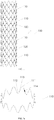
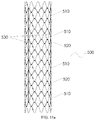
- an aortic bare stent 100 is constituted by multiple annular support stents 110 and multiple annular connector stents 120.
- the aortic bare stent 100 on the whole is in a tubular net structure, the support stents 110 are in a same structure, and the connector stents 120 are also in a same structure.
- the multiple annular support stents 110 are sequentially arranged in parallel at intervals from a proximal end of the aortic bare stent 100 to a distal end of the aortic bare stent 100.
- One connector stent 120 is arranged between two adjacent support stents 110, that is, the support stents 110 and the connector stents 120 are distributed at intervals along an axial direction of the aortic bare stent 100.
- the support stents 110 and the connector supports 120 have a same diameter, both being 30mm, that is, a diameter of a tubular shape of the aortic bare stent 100 is 30mm.
- each support stent 110 extends along a circumferential direction of the aortic bare stent 100, forming a closed annular shape, and fluctuates along the axial direction of the aortic bare stent 100 while extending circumferentially, forming a wave shape.
- the wave shape is a sinusoidal waveform (or a cosine waveform).
- the wave shape has multiple peaks 111 and multiple valleys 112 distributed at intervals.
- the adjacent peak 111 and valley 112 are connected by a connecting rod 113.
- the number of the peaks 111 is twelve.
- the number of the valleys 112 is also twelve.
- Each support stent 110 has an axial length of 8mm.
- Each support stent 110 is formed by weaving a hyper-elastic nickel titanium wire.
- the nickel titanium wire has a relatively thin wire diameter falling within a range of 0.2 ⁇ 0.4mm.
- Each support stent 110 in the present embodiment is formed by weaving a hyper-elastic nickel titanium wire with a diameter of 0.3mm.
- each support stent 110 is provided with one connecting steel jacket 114.
- Two ends of the hyper-elastic nickel titanium wire are located inside the connecting steel jacket 114, and the two ends of the hyper-elastic nickel titanium wire are fixed inside the steel jacket 114 in a mechanical compressing manner or a welding manner.
- the hyper-elastic nickel titanium wire having a thinner wire diameter is used in the present embodiment to weave the support stent, and the sinusoidal waveform of each support stent has more peaks and more valleys, such that a support force of the whole aortic bare stent 100 in the circumferential direction is distributed more uniformly, with better flexibility, thus better satisfying requirements of cases with a dissection.
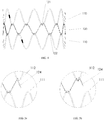
- each connector stent 120 extends along the circumferential direction of the aortic bare stent 100, forming a closed annular shape, and fluctuates along the axial direction of the aortic bare stent 100 while extending circumferentially, forming a wave shape.
- the wave shape is a sinusoidal waveform (or a cosine waveform).
- the wave shape has multiple peaks 121 and valleys 122 distributed at intervals.
- the adjacent peak 121 and valley 122 are connected by a connecting rod 123.
- the number of the peaks 121 is twelve.
- the number of the valleys 122 is also twelve.
- Each connector stent 120 has an axial length of 4.5mm.
- Each connector stent 120 is formed by weaving one multi-strand nickel titanium wire.
- the multi-strand nickel titanium wire is formed by mechanically twisting or weaving no less than three hyper-elastic nickel titanium filaments.
- the multi-strand nickel titanium wire has a wire diameter falling within a range of 0.1 ⁇ 0.4mm.
- the multi-strand nickel titanium wire is formed by twisting three strands of hyper-elastic nickel titanium monofilaments.
- the three strands of hyper-elastic nickel titanium monofilaments are a hyper-elastic nickel titanium filament 1201, a hyper-elastic nickel titanium filament 1202, and a hyper-elastic nickel titanium filament 1203, respectively.
- the three strands of the hyper-elastic nickel titanium monofilaments have a same filament diameter.
- Each strand of the hyper-elastic nickel titanium monofilament has a filament diameter of 0.07mm.
- the twisted multi-strand nickel titanium wire has the wire diameter (a diameter of a circumscribed circle of a cross section) of 0.15mm.
- a weaved connector stent 120 is illustrated in FIG. 2b .
- Two end portions of the multi-strand nickel titanium wire for fabricating the connector stent 120 are connected together in a knotting manner, in a welding manner or by adding a steel jacket. The two end portions are fixed together in the knotting manner in the present embodiment.
- two adjacent support stents 110 are connected by one connector stent 120, the peaks of the two adjacent support stents 110 are arranged in an aligned manner (the valleys are also arranged in an aligned manner).
- the peaks 121 of each connector stent 120 are connected to the valleys 112 of an upper adjacent support stent 110, and the valleys 122 of each connector stent 120 are connected to the peaks 111 of a lower adjacent support stent 110. All of the support stents 110 and the connector stents 120 are combined to form the aortic bare stent 100 in a tubular shape, and a circumferential face of the tubular shape is in a net structure with diamond grids.
- the aortic bare stent 100 is formed by connecting and closing eleven support stents 110 and ten connector stents 120, and has a total axial length of 133mm.
- the aortic bare stent 100 provided in the present embodiment has a uniform, reasonable, and relatively small support force on an outer circumferential surface, which not only can avoid a problem of generating new dissection tears due to a too big radial force, but also can ensure a good bending flexibility of the aortic bare stent 100, thus being adapted to various forms of aortic anatomical structures.
- the aortic bare stent 100 according to the present embodiment has a relatively good axial support performance in the axial direction, thus avoiding shortening of the stent due to accumulation.
- the aortic bare stent 100 is designed in a closed-loop manner, which can avoid a problem of overturn of a single stent caused by an open-loop connection or puncturing of a blood vessel wall by peaks of an open loop.
- a single peak 121 or a single valley 122 of each connector stent 120 is fixedly connected together with a single valley 112 or a single peak 111 of a corresponding support stent 110, and the connector stent 120 and the support stent 110 do not move relatively to each other.
- each connector stent 120 is fixed, at positions of the peaks or the valleys, on the valleys or the peaks of a corresponding support stent 110 in a winding manner.
- a process of winding connection is illustrated in FIGS. 5a-5b .
- the connector stent 120 connects two adjacent support stents 110.
- a head end 124 of the multi-strand nickel titanium wire goes in from outside of the valley 112 ("outside” refers to outside of the aortic bare stent, and the same interpretation is applied to "outside” and “inside” in the following text, unless otherwise stated), and after winding the valley 112, the head end 124 goes towards the lower support stent 110 and goes to outside of the lower support stent 110, as illustrated in FIG. 5a .
- the multi-strand nickel titanium wire is wound on the valley of the support stent 110 by 3-5 turns in a manner as illustrated in FIG. 5a , three turns in the present embodiment as illustrated in FIG. 5b , thus completing fixed winding connection between one peak of the connector stent 120 and the valley 112 of the support stent 110.
- the head end 124 of the nickel titanium wire goes in from outside of the adjacent peak 111 of the lower adjacent support stent 110, and after winding the peak 111, the head end 124 goes towards the upper support stent 110 and goes to outside of the upper support stent 110, as illustrated in FIG. 5c .
- the multi-strand nickel titanium wire is wound on the peak of the support stent 110 by 3-5 turns in a manner as illustrated in FIG. 5c , three turns in the present embodiment as illustrated in FIG. 5d , thus completing fixed winding connection between one valley of the connector stent 120 and the peak 111 of the support stent 110.
- an aortic bare stent 200 in the present embodiment is constituted by multiple support stents 210 in circles and multiple connector stents 220 in circles.
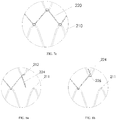
- the present embodiment is distinguished from the embodiment 1 merely in that peaks or valleys of the support stents 210 and valleys or peaks of the connector stents 220 are fixed in a knotting manner.
- each connector stent 220 is fixed, at positions of the peaks or the valleys, on the valleys or the peaks of a corresponding support stent 210 in a knotting manner.
- a head end 224 of a multi-strand nickel titanium wire goes out from inside of a valley 212 of an upper support stent, and after winding the valley, passes through a bottom portion of the nickel titanium wire itself.
- the head end 224 of the nickel titanium wire goes into inside of the valley from outside of the valley, and a circle 225 is formed between the multi-strand nickel titanium wire and the valley 212 of the support stent 210;
- the head end 224 of the nickel titanium wire winds the valley and goes out from the circle 225 formed by the nickel titanium wire, thus completing the fixed knotting connection between one peak 221 of the connector stent 220 and one valley 212 of the support stent 210.
- the head end 224 of the nickel titanium wire goes out from inside of an adjacent peak 211 of a lower support stent 210, and a fixed knotting connection between the valley 222 of the connector stent 220 and the peak 211 of the lower adjacent support stent 210 is completed in the manner of knotting the peak 221 of the connector stent 220 and the valley 212 of the support stent 210.
- FIG. 15 is a schematic view illustrating treatment of a type B aortic dissection with the aortic bare stent 200 provided in the present embodiment in combination with a proximal covered stent 10.
- a is a proximal blood vessel tear
- b is a false lumen
- c is an overlapping region of the covered stent 10 and the aortic bare stent 200.
- the proximal covered stent 10 blocks the proximal tear of the type B dissection, to reduce a pressure inside the false lumen, and promote thrombosis of blood inside the false lumen; the aortic bare stent 200 is placed at a distal end of the covered stent 10, and partially overlaps the covered stent 10, for rebuilding the true lumen of the blood vessel, and ensuring that arterial blood flows fluently in various internal organs.
- the present embodiment is distinguished from the embodiment 2 merely in that the connector stent 220 and the support stent 210 are fixed in a different knotting manner.
- each connector stent 220 is fixed, at positions of the peaks or the valleys, on the valleys or the peaks of the corresponding support stent 210 in another knotting manner.
- the head end 224 of the multi-strand nickel titanium wire goes in from outside of the valley 212 of the upper support stent 210, and after winding the valley, passes through a top portion of the nickel titanium wire.
- the head end 224 of the nickel titanium wire goes to outside of the valley from inside of the valley, and a circle 226 is formed between the multi-strand nickel titanium wire and the support stent 210.
- the head end 224 of the nickel titanium wire winds the valley and goes out from the circle 226 formed by the nickel titanium wire, thus completing the fixed knotting connection between one peak 221 of the connector stent 220 and one valley 212 of the support stent 210.
- the head end 224 of the nickel titanium wire goes in from outside of an adjacent peak 211 of the lower adjacent support stent 210, and the knotting connection between the valley 222 of the connector stent 220 and the peak 211 of the lower adjacent support stent 210 is completed in the manner of knotting the peak 221 of the connector stent 220 and the valley 212 of the support stent 210.
- An aortic bare stent 300 according to the present embodiment is distinguished from the embodiment 1 merely in that a dissection bare stent 300 further includes one or more axial connectors 330, in addition to multiple support stents 310 in circles and multiple connector stents 320 in circles.
- the number of the axial connectors 330 is a divisor of the number of peaks of each support stent 310.
- the axial connectors 330 are uniformly distributed on the aortic bare stent 300 in a circumferential direction.
- Each axial connector 330 connects all or part of annular support stents 310 on a same generatrix of a cylinder in a knotting or winding manner.
- Corresponding valleys 312 of the support stents 310 are aligned, and corresponding peaks 311 of the support stents 310 are also aligned.
- the axial connector 330 connects the valleys 312, or connects the peaks 311.
- the axial connectors 330 may be made of one multi-strand nickel titanium wire, and also may be made of a high-strength filament and a mix-woven polymer suture, for example, a PET suture, a PP suture, and so on.
- one axial connector 330 is provided in the present embodiment, and is made of a multi-strand nickel titanium wire with the same structure as the annular connector stent 310.
- the axial connector 330 is fixedly and sequentially connected to ten valleys 312 of ten proximal support stents on the same generatrix.
- a connecting manner is the knotting manner as illustrated in the embodiment 3.
- a most distal support stent 310 is not fixedly connected to the axial connector 330, and is not restricted by the axial connector 330.
- a problem of excessive axial elongation of the aortic bare stent 300 in a sheathing process can be avoided, meanwhile, it also facilitates accurate positioning of the aortic bare stent 300 when being released in a surgical process.
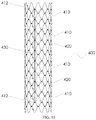
- an aortic bare stent 400 is distinguished from the embodiment 4 merely in that the number of valleys of ten proximal support stents 410 connected to an axial connector 430 is different from that of the valleys of ten proximal support stents 310 connected to the axial connector 330.
- the axial connector 430 is merely fixed in a knotting manner to two valleys 312, namely, a valley 312 of a first support stent 410 and a valley 312 of a tenth support stent 410, on a same generatrix, while second to ninth support stents 410 are not fixedly connected to the axial connector 430.
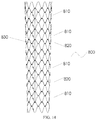
- an aortic bare stent 500 is distinguished from the embodiment 4 merely in the following: three axial connectors 530 are provided in the present embodiment, the three axial connectors 530 are uniformly distributed in a circumferential direction of the aortic bare stent 500, and each axial connector 530 is connected to valleys of support stents 510 in a same manner as illustrated in the embodiment 4.
- an aortic bare stent 600 is constituted by multiple support stents 610 in circles and multiple connector stents 620 in circles.
- the present embodiment is distinguished from the embodiment 1 merely in that the aortic bare stent 600 according to the present embodiment is in a tapered-tube-shape structure, and a proximal end of the aortic bare stent 600 has a diameter of 30mm, a distal end of the aortic bare stent 600 has a diameter of 26mm, and the aortic bare stent 600 has an axial length of 180mm.
- an aortic bare stent 700 is constituted by multiple support stents 710 in circles and multiple connector stents 720 in circles.
- the present embodiment is distinguished from the embodiment 2 merely in the following: the aortic bare stent 700 according to the present embodiment is in a tapered-tube-shape structure, and a proximal end of the aortic bare stent 700 has a diameter of 30mm, a distal end of the aortic bare stent 700 has a diameter of 26mm, and the aortic bare stent 700 has an axial length of 180mm.
- an aortic bare stent 800 is constituted by multiple support stents 810 in circles, multiple connector stents 820 in circles, and an axial connector 830.
- the present embodiment is distinguished from the embodiment 4 merely in the following: the aortic bare stent 800 according to the present embodiment is in a tapered-tube-shape structure, and a proximal end of the aortic bare stent 800 has a diameter of 30mm, a distal end of the aortic bare stent 800 has a diameter of 26mm, and the aortic bare stent 800 has an axial length of 180mm.
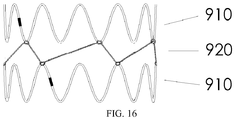
- an aortic bare stent 900 is constituted by multiple support stents 910 in circles and multiple connector stents 920 in circles.
- the present embodiment is distinguished from the embodiment 2 merely in that connection points for the support stents 910 and the connector stents 920 are different in the present embodiment.
- each two connection points are spaced by one valley which does not act as a connection point, likewise, among peaks of the lower support stent 910 adjacent to the connector stent 920, each two connection points are spaced by one peak which does not act as a connection point.
Landscapes
- Health & Medical Sciences (AREA)
- Engineering & Computer Science (AREA)
- Biomedical Technology (AREA)
- Cardiology (AREA)
- Oral & Maxillofacial Surgery (AREA)
- Transplantation (AREA)
- Heart & Thoracic Surgery (AREA)
- Vascular Medicine (AREA)
- Life Sciences & Earth Sciences (AREA)
- Animal Behavior & Ethology (AREA)
- General Health & Medical Sciences (AREA)
- Public Health (AREA)
- Veterinary Medicine (AREA)
- Physics & Mathematics (AREA)
- Optics & Photonics (AREA)
- Gastroenterology & Hepatology (AREA)
- Pulmonology (AREA)
- Media Introduction/Drainage Providing Device (AREA)
- Prostheses (AREA)
Applications Claiming Priority (2)
| Application Number | Priority Date | Filing Date | Title |
|---|---|---|---|
| CN201610158220.6A CN105769383B (zh) | 2016-03-18 | 2016-03-18 | 一种主动脉裸支架及主动脉夹层支架 |
| PCT/CN2017/076942 WO2017157320A1 (zh) | 2016-03-18 | 2017-03-16 | 一种主动脉裸支架及主动脉夹层支架 |
Publications (2)
| Publication Number | Publication Date |
|---|---|
| EP3421009A1 true EP3421009A1 (de) | 2019-01-02 |
| EP3421009A4 EP3421009A4 (de) | 2019-09-04 |
Family
ID=56394168
Family Applications (1)
| Application Number | Title | Priority Date | Filing Date |
|---|---|---|---|
| EP17765862.2A Withdrawn EP3421009A4 (de) | 2016-03-18 | 2017-03-16 | Blanker aorta-stent und stent für aorta-dissektionen |
Country Status (4)
| Country | Link |
|---|---|
| US (1) | US10799375B2 (de) |
| EP (1) | EP3421009A4 (de) |
| CN (2) | CN105769383B (de) |
| WO (1) | WO2017157320A1 (de) |
Cited By (1)
| Publication number | Priority date | Publication date | Assignee | Title |
|---|---|---|---|---|
| EP3677221A4 (de) * | 2017-08-28 | 2021-09-22 | Lifetech Scientific (Shenzhen) Co., Ltd. | Abgedeckter stent |
Families Citing this family (30)
| Publication number | Priority date | Publication date | Assignee | Title |
|---|---|---|---|---|
| KR101696810B1 (ko) * | 2015-02-04 | 2017-02-01 | 주식회사 엠아이텍 | 연결용 스텐트 및 그의 제조방법 |
| KR101728319B1 (ko) * | 2015-04-15 | 2017-04-19 | 주식회사 엠아이텍 | 스텐트 제조방법 |
| CN105769383B (zh) * | 2016-03-18 | 2019-12-10 | 杭州唯强医疗科技有限公司 | 一种主动脉裸支架及主动脉夹层支架 |
| CN109890323B (zh) * | 2016-10-27 | 2023-09-12 | 急速医疗有限公司 | 编织丝线管腔内装置 |
| CN108095858B (zh) * | 2016-11-24 | 2020-08-21 | 先健科技(深圳)有限公司 | 防短缩覆膜支架及其制作方法 |
| CN106890039B (zh) * | 2017-04-11 | 2019-04-05 | 南京微创医学科技股份有限公司 | 一种超顺应性分段支架及其编织方法 |
| CN108606861A (zh) * | 2018-05-07 | 2018-10-02 | 哈尔滨工业大学 | 一种仿玻璃海绵支架及其制备方法 |
| CN110507449B (zh) * | 2018-05-22 | 2022-12-20 | 先健科技(深圳)有限公司 | 覆膜支架 |
| WO2020024936A1 (zh) * | 2018-08-02 | 2020-02-06 | 杭州唯强医疗科技有限公司 | 高柔顺性支架 |
| CN110786972B (zh) * | 2018-08-02 | 2024-11-15 | 杭州唯强医疗科技有限公司 | 一种高柔顺性的血管支架 |
| CN210301319U (zh) * | 2018-12-29 | 2020-04-14 | 杭州唯强医疗科技有限公司 | 一种改进贴壁性能的覆膜血管支架 |
| US11959277B1 (en) * | 2019-01-28 | 2024-04-16 | William E. Smith | Pre-stressed sinusoidal member in assembly and applications |
| US11608632B2 (en) * | 2019-01-28 | 2023-03-21 | William E. Smith | Pre-stressed sinusoidal member in assembly and applications |
| EP3941392B1 (de) | 2019-03-20 | 2025-04-23 | Inqb8 Medical Technologies, LLC | Aortendissektionsimplantat |
| CN110292471A (zh) * | 2019-08-01 | 2019-10-01 | 吴忠隐 | 一种静脉支架 |
| US11723784B2 (en) * | 2019-11-12 | 2023-08-15 | Microvention, Inc. | Stent delivery system and method |
| CN113893062B (zh) * | 2020-07-06 | 2023-01-03 | 先健科技(深圳)有限公司 | 覆膜支架 |
| WO2022178740A1 (zh) * | 2021-02-25 | 2022-09-01 | 普利瑞医疗科技(苏州)有限公司 | 一种外周血管支架及其制备方法和应用 |
| CN114948364B (zh) * | 2021-02-25 | 2025-07-15 | 普利瑞医疗科技(苏州)有限公司 | 一种外周血管支架及其制备方法 |
| US12070401B2 (en) * | 2021-02-26 | 2024-08-27 | Olympus Corporation | Stent device having looped interlocking regions and non-looped interlocking regions |
| JP7762703B2 (ja) * | 2021-02-26 | 2025-10-30 | Sbカワスミ株式会社 | ステント |
| CN113476175B (zh) * | 2021-07-01 | 2025-06-10 | 上海创心医学科技有限公司 | 一种血管支架 |
| CN113476178B (zh) * | 2021-07-01 | 2025-06-10 | 上海创心医学科技有限公司 | 一种血管支架 |
| CN113476176B (zh) * | 2021-07-01 | 2025-06-10 | 上海创心医学科技有限公司 | 一种血管支架 |
| CN114424991B (zh) * | 2022-01-21 | 2024-08-30 | 江苏理工学院 | 一种新型血管支架 |
| CN115153953B (zh) * | 2022-09-08 | 2023-01-03 | 深圳市华和创微医疗科技有限公司 | 三维编织支架、制作方法 |
| CN115363818A (zh) * | 2022-09-14 | 2022-11-22 | 北京宥安医疗科技有限公司 | 一种覆膜支架及制作方法 |
| CN115778488A (zh) * | 2022-11-24 | 2023-03-14 | 江苏盛玛特新材料科技有限公司 | 取栓支架及其制作方法 |
| CN118436464B (zh) * | 2024-07-08 | 2024-10-15 | 乐普(北京)医疗器械股份有限公司 | 一种主动脉裸支架结构 |
| CN119564390B (zh) * | 2024-12-17 | 2025-11-14 | 北京华脉泰科医疗器械股份有限公司 | 一种裸支架子单元及裸支架 |
Family Cites Families (41)
| Publication number | Priority date | Publication date | Assignee | Title |
|---|---|---|---|---|
| US5236447A (en) * | 1990-06-29 | 1993-08-17 | Nissho Corporation | Artificial tubular organ |
| US5366504A (en) * | 1992-05-20 | 1994-11-22 | Boston Scientific Corporation | Tubular medical prosthesis |
| US5449373A (en) * | 1994-03-17 | 1995-09-12 | Medinol Ltd. | Articulated stent |
| US6331188B1 (en) * | 1994-08-31 | 2001-12-18 | Gore Enterprise Holdings, Inc. | Exterior supported self-expanding stent-graft |
| US6015429A (en) * | 1994-09-08 | 2000-01-18 | Gore Enterprise Holdings, Inc. | Procedures for introducing stents and stent-grafts |
| US6241757B1 (en) * | 1997-02-04 | 2001-06-05 | Solco Surgical Instrument Co., Ltd. | Stent for expanding body's lumen |
| US5827321A (en) * | 1997-02-07 | 1998-10-27 | Cornerstone Devices, Inc. | Non-Foreshortening intraluminal prosthesis |
| DE29702671U1 (de) * | 1997-02-17 | 1997-04-10 | Jomed Implantate GmbH, 72414 Rangendingen | Stent |
| US6033433A (en) * | 1997-04-25 | 2000-03-07 | Scimed Life Systems, Inc. | Stent configurations including spirals |
| DE69838256T2 (de) * | 1997-09-24 | 2008-05-15 | Med Institute, Inc., West Lafayette | Radial aufweitbarer stent |
| US6077296A (en) * | 1998-03-04 | 2000-06-20 | Endologix, Inc. | Endoluminal vascular prosthesis |
| US20010032010A1 (en) * | 1998-08-26 | 2001-10-18 | Thomas O. Hoover | Medical prosthesis |
| US6190403B1 (en) * | 1998-11-13 | 2001-02-20 | Cordis Corporation | Low profile radiopaque stent with increased longitudinal flexibility and radial rigidity |
| FR2797388B1 (fr) * | 1999-08-09 | 2001-11-30 | Novatech Inc | Structure d'une prothese destinee a etre implantee dans un conduit humain ou animal et prothese pourvue d'une telle structure |
| SG86458A1 (en) * | 2000-03-01 | 2002-02-19 | Medinol Ltd | Longitudinally flexible stent |
| US6723119B2 (en) * | 2000-03-01 | 2004-04-20 | Medinol Ltd. | Longitudinally flexible stent |
| US20030069630A1 (en) * | 2001-03-02 | 2003-04-10 | Robert Burgermeister | Stent with radiopaque markers incorporated thereon |
| JP2002291904A (ja) * | 2001-03-30 | 2002-10-08 | Shimadzu Corp | 生体吸収性ステント及びその製造方法 |
| US7147661B2 (en) * | 2001-12-20 | 2006-12-12 | Boston Scientific Santa Rosa Corp. | Radially expandable stent |
| US7029493B2 (en) * | 2002-01-25 | 2006-04-18 | Cordis Corporation | Stent with enhanced crossability |
| WO2004049978A1 (en) * | 2002-12-04 | 2004-06-17 | Cook Incorporated | Method and device for treating aortic dissection |
| EP1542761B1 (de) * | 2003-06-02 | 2007-12-05 | S & G Biotech, Inc. | Zylindrischer stent |
| US7763063B2 (en) * | 2003-09-03 | 2010-07-27 | Bolton Medical, Inc. | Self-aligning stent graft delivery system, kit, and method |
| US7854756B2 (en) * | 2004-01-22 | 2010-12-21 | Boston Scientific Scimed, Inc. | Medical devices |
| DE602005024585D1 (de) * | 2004-09-28 | 2010-12-16 | Cook William Europ | Vorrichtung zur behandlung von aortendissektion |
| US20070150051A1 (en) * | 2005-01-10 | 2007-06-28 | Duke Fiduciary, Llc | Vascular implants and methods of fabricating the same |
| US8728144B2 (en) * | 2005-12-29 | 2014-05-20 | Cook Medical Technologies Llc | Endoluminal device including a mechanism for proximal or distal fixation, and sealing and methods of use thereof |
| BRPI0721499A2 (pt) * | 2007-03-23 | 2013-01-08 | Invatec Technology Ct Gmbh | pràtese endoluminal |
| US8926688B2 (en) * | 2008-01-11 | 2015-01-06 | W. L. Gore & Assoc. Inc. | Stent having adjacent elements connected by flexible webs |
| US8394138B2 (en) * | 2008-09-05 | 2013-03-12 | Cook Medical Technologies Llc | Multi-strand helical stent |
| EP2355755B1 (de) * | 2008-09-15 | 2017-10-18 | Abbott Laboratories Vascular Enterprises Limited | Stent mit unabhängigen stentringen und übergangsansätzen |
| CN201303993Y (zh) * | 2008-11-05 | 2009-09-09 | 复旦大学附属中山医院 | 模块式主动脉腔内支架 |
| RU2566225C2 (ru) * | 2009-02-09 | 2015-10-20 | ЭВИЗИО МЕДИКАЛ ДЕВАЙСИЗ ЮЭлСи | Стент |
| US20130211489A1 (en) * | 2010-02-10 | 2013-08-15 | Apertomed L.L.C. | Methods, Systems and Devices for Treatment of Cerebrospinal Venous Insufficiency and Multiple Sclerosis |
| CN202122626U (zh) * | 2011-05-11 | 2012-01-25 | 微创医疗器械(上海)有限公司 | 一种术中分支覆膜支架 |
| CN102813566A (zh) * | 2012-04-24 | 2012-12-12 | 冯海全 | 冠脉支架 |
| CN102670338A (zh) * | 2012-06-11 | 2012-09-19 | 上海中山医疗科技发展公司 | 一种预弯型主动脉覆膜支架及其制作方法 |
| DE102012107465A1 (de) * | 2012-08-15 | 2014-05-22 | Pfm Medical Ag | Implantierbare Einrichtung zur Verwendung im menschlichen und/oder tierischen Körper zum Ersatz einer Organklappe |
| US9956096B2 (en) * | 2013-08-15 | 2018-05-01 | Cook Medical Technologies Llc | Assembly for treating branched vessels |
| CN105769383B (zh) * | 2016-03-18 | 2019-12-10 | 杭州唯强医疗科技有限公司 | 一种主动脉裸支架及主动脉夹层支架 |
| CN205612592U (zh) * | 2016-03-18 | 2016-10-05 | 唯强医疗科技(上海)有限公司 | 一种主动脉裸支架及主动脉夹层支架 |
-
2016
- 2016-03-18 CN CN201610158220.6A patent/CN105769383B/zh active Active
- 2016-03-18 CN CN201910900601.0A patent/CN110742709B/zh active Active
-
2017
- 2017-03-16 US US16/084,264 patent/US10799375B2/en active Active
- 2017-03-16 EP EP17765862.2A patent/EP3421009A4/de not_active Withdrawn
- 2017-03-16 WO PCT/CN2017/076942 patent/WO2017157320A1/zh not_active Ceased
Cited By (2)
| Publication number | Priority date | Publication date | Assignee | Title |
|---|---|---|---|---|
| EP3677221A4 (de) * | 2017-08-28 | 2021-09-22 | Lifetech Scientific (Shenzhen) Co., Ltd. | Abgedeckter stent |
| US11523893B2 (en) | 2017-08-28 | 2022-12-13 | Lifetech Scientific (Shenzhen) Co., Ltd | Covered stent |
Also Published As
| Publication number | Publication date |
|---|---|
| CN105769383B (zh) | 2019-12-10 |
| EP3421009A4 (de) | 2019-09-04 |
| CN110742709A (zh) | 2020-02-04 |
| CN105769383A (zh) | 2016-07-20 |
| US20190070027A1 (en) | 2019-03-07 |
| CN110742709B (zh) | 2022-06-28 |
| US10799375B2 (en) | 2020-10-13 |
| WO2017157320A1 (zh) | 2017-09-21 |
Similar Documents
| Publication | Publication Date | Title |
|---|---|---|
| US10799375B2 (en) | Aortic bare stent and aortic dissection stent | |
| JP5685694B2 (ja) | ステント部材 | |
| US8394138B2 (en) | Multi-strand helical stent | |
| JP7097166B2 (ja) | 柔軟性ステント | |
| JP4898990B2 (ja) | カニューレステント | |
| CN209107690U (zh) | 分段式覆膜支架 | |
| JP2013543416A (ja) | ステントグラフトシステム | |
| US20230414339A1 (en) | Membrane-Covered Stent | |
| CN108095858A (zh) | 防短缩覆膜支架及其制作方法 | |
| KR20170084214A (ko) | 스텐트 보철 | |
| US20220362003A1 (en) | Segmented covered stent and preparation method therefor | |
| CN208910578U (zh) | 管腔支架 | |
| CN205612592U (zh) | 一种主动脉裸支架及主动脉夹层支架 | |
| WO2019128703A1 (zh) | 覆膜支架 | |
| CN109966015A (zh) | 覆膜支架 | |
| CN214761637U (zh) | 一种外周血管支架 | |
| CN201328897Y (zh) | 一种增强显影可视性的冠状动脉球囊扩张支架 | |
| CN109966017A (zh) | 覆膜支架 | |
| CN201350139Y (zh) | 一种径向支撑力高的冠状动脉球囊扩张支架 | |
| JP2021078619A (ja) | ステント及びその検査方法 | |
| CN218220396U (zh) | 二尖瓣环缩装置 | |
| CN205307149U (zh) | 心脏冠状动脉支架 | |
| JP6688125B2 (ja) | 高柔軟性ステント | |
| US20250127639A1 (en) | Woven braid pattern for stents and related methods | |
| CN115737201A (zh) | 二尖瓣环缩装置 |
Legal Events
| Date | Code | Title | Description |
|---|---|---|---|
| STAA | Information on the status of an ep patent application or granted ep patent |
Free format text: STATUS: THE INTERNATIONAL PUBLICATION HAS BEEN MADE |
|
| PUAI | Public reference made under article 153(3) epc to a published international application that has entered the european phase |
Free format text: ORIGINAL CODE: 0009012 |
|
| STAA | Information on the status of an ep patent application or granted ep patent |
Free format text: STATUS: REQUEST FOR EXAMINATION WAS MADE |
|
| 17P | Request for examination filed |
Effective date: 20180925 |
|
| AK | Designated contracting states |
Kind code of ref document: A1 Designated state(s): AL AT BE BG CH CY CZ DE DK EE ES FI FR GB GR HR HU IE IS IT LI LT LU LV MC MK MT NL NO PL PT RO RS SE SI SK SM TR |
|
| AX | Request for extension of the european patent |
Extension state: BA ME |
|
| RIN1 | Information on inventor provided before grant (corrected) |
Inventor name: LI, JIANMIN Inventor name: WANG, YONGSHENG Inventor name: ZHANG, TINGCHAO Inventor name: FU, WEIGUO |
|
| DAV | Request for validation of the european patent (deleted) | ||
| DAX | Request for extension of the european patent (deleted) | ||
| A4 | Supplementary search report drawn up and despatched |
Effective date: 20190801 |
|
| RIC1 | Information provided on ipc code assigned before grant |
Ipc: A61F 2/89 20130101ALI20190726BHEP Ipc: A61F 2/07 20130101AFI20190726BHEP Ipc: A61F 2/915 20130101ALI20190726BHEP |
|
| RAP3 | Party data changed (applicant data changed or rights of an application transferred) |
Owner name: HANGZHOU ENDONOM MEDTECH CO., LTD |
|
| STAA | Information on the status of an ep patent application or granted ep patent |
Free format text: STATUS: EXAMINATION IS IN PROGRESS |
|
| 17Q | First examination report despatched |
Effective date: 20221104 |
|
| STAA | Information on the status of an ep patent application or granted ep patent |
Free format text: STATUS: THE APPLICATION IS DEEMED TO BE WITHDRAWN |
|
| 18D | Application deemed to be withdrawn |
Effective date: 20251111 |