EP3421428B1 - Objet moulé en zéolithe porteuse d'argent - Google Patents
Objet moulé en zéolithe porteuse d'argent Download PDFInfo
- Publication number
- EP3421428B1 EP3421428B1 EP17756575.1A EP17756575A EP3421428B1 EP 3421428 B1 EP3421428 B1 EP 3421428B1 EP 17756575 A EP17756575 A EP 17756575A EP 3421428 B1 EP3421428 B1 EP 3421428B1
- Authority
- EP
- European Patent Office
- Prior art keywords
- molded article
- zeolite
- silver
- weight
- less
- Prior art date
- Legal status (The legal status is an assumption and is not a legal conclusion. Google has not performed a legal analysis and makes no representation as to the accuracy of the status listed.)
- Active
Links
Images

Classifications
-
- B—PERFORMING OPERATIONS; TRANSPORTING
- B01—PHYSICAL OR CHEMICAL PROCESSES OR APPARATUS IN GENERAL
- B01J—CHEMICAL OR PHYSICAL PROCESSES, e.g. CATALYSIS OR COLLOID CHEMISTRY; THEIR RELEVANT APPARATUS
- B01J20/00—Solid sorbent compositions or filter aid compositions; Sorbents for chromatography; Processes for preparing, regenerating or reactivating thereof
- B01J20/02—Solid sorbent compositions or filter aid compositions; Sorbents for chromatography; Processes for preparing, regenerating or reactivating thereof comprising inorganic material
- B01J20/10—Solid sorbent compositions or filter aid compositions; Sorbents for chromatography; Processes for preparing, regenerating or reactivating thereof comprising inorganic material comprising silica or silicate
- B01J20/16—Alumino-silicates
- B01J20/18—Synthetic zeolitic molecular sieves
-
- B—PERFORMING OPERATIONS; TRANSPORTING
- B01—PHYSICAL OR CHEMICAL PROCESSES OR APPARATUS IN GENERAL
- B01J—CHEMICAL OR PHYSICAL PROCESSES, e.g. CATALYSIS OR COLLOID CHEMISTRY; THEIR RELEVANT APPARATUS
- B01J20/00—Solid sorbent compositions or filter aid compositions; Sorbents for chromatography; Processes for preparing, regenerating or reactivating thereof
- B01J20/02—Solid sorbent compositions or filter aid compositions; Sorbents for chromatography; Processes for preparing, regenerating or reactivating thereof comprising inorganic material
- B01J20/10—Solid sorbent compositions or filter aid compositions; Sorbents for chromatography; Processes for preparing, regenerating or reactivating thereof comprising inorganic material comprising silica or silicate
- B01J20/16—Alumino-silicates
- B01J20/18—Synthetic zeolitic molecular sieves
- B01J20/186—Chemical treatments in view of modifying the properties of the sieve, e.g. increasing the stability or the activity, also decreasing the activity
-
- B—PERFORMING OPERATIONS; TRANSPORTING
- B01—PHYSICAL OR CHEMICAL PROCESSES OR APPARATUS IN GENERAL
- B01J—CHEMICAL OR PHYSICAL PROCESSES, e.g. CATALYSIS OR COLLOID CHEMISTRY; THEIR RELEVANT APPARATUS
- B01J20/00—Solid sorbent compositions or filter aid compositions; Sorbents for chromatography; Processes for preparing, regenerating or reactivating thereof
- B01J20/28—Solid sorbent compositions or filter aid compositions; Sorbents for chromatography; Processes for preparing, regenerating or reactivating thereof characterised by their form or physical properties
-
- B—PERFORMING OPERATIONS; TRANSPORTING
- B01—PHYSICAL OR CHEMICAL PROCESSES OR APPARATUS IN GENERAL
- B01J—CHEMICAL OR PHYSICAL PROCESSES, e.g. CATALYSIS OR COLLOID CHEMISTRY; THEIR RELEVANT APPARATUS
- B01J20/00—Solid sorbent compositions or filter aid compositions; Sorbents for chromatography; Processes for preparing, regenerating or reactivating thereof
- B01J20/28—Solid sorbent compositions or filter aid compositions; Sorbents for chromatography; Processes for preparing, regenerating or reactivating thereof characterised by their form or physical properties
- B01J20/28002—Solid sorbent compositions or filter aid compositions; Sorbents for chromatography; Processes for preparing, regenerating or reactivating thereof characterised by their form or physical properties characterised by their physical properties
- B01J20/28004—Sorbent size or size distribution, e.g. particle size
-
- B—PERFORMING OPERATIONS; TRANSPORTING
- B01—PHYSICAL OR CHEMICAL PROCESSES OR APPARATUS IN GENERAL
- B01J—CHEMICAL OR PHYSICAL PROCESSES, e.g. CATALYSIS OR COLLOID CHEMISTRY; THEIR RELEVANT APPARATUS
- B01J20/00—Solid sorbent compositions or filter aid compositions; Sorbents for chromatography; Processes for preparing, regenerating or reactivating thereof
- B01J20/28—Solid sorbent compositions or filter aid compositions; Sorbents for chromatography; Processes for preparing, regenerating or reactivating thereof characterised by their form or physical properties
- B01J20/28014—Solid sorbent compositions or filter aid compositions; Sorbents for chromatography; Processes for preparing, regenerating or reactivating thereof characterised by their form or physical properties characterised by their form
- B01J20/28016—Particle form
-
- B—PERFORMING OPERATIONS; TRANSPORTING
- B01—PHYSICAL OR CHEMICAL PROCESSES OR APPARATUS IN GENERAL
- B01J—CHEMICAL OR PHYSICAL PROCESSES, e.g. CATALYSIS OR COLLOID CHEMISTRY; THEIR RELEVANT APPARATUS
- B01J20/00—Solid sorbent compositions or filter aid compositions; Sorbents for chromatography; Processes for preparing, regenerating or reactivating thereof
- B01J20/28—Solid sorbent compositions or filter aid compositions; Sorbents for chromatography; Processes for preparing, regenerating or reactivating thereof characterised by their form or physical properties
- B01J20/28014—Solid sorbent compositions or filter aid compositions; Sorbents for chromatography; Processes for preparing, regenerating or reactivating thereof characterised by their form or physical properties characterised by their form
- B01J20/28033—Membrane, sheet, cloth, pad, lamellar or mat
- B01J20/2804—Sheets with a specific shape, e.g. corrugated, folded, pleated, helical
-
- B—PERFORMING OPERATIONS; TRANSPORTING
- B01—PHYSICAL OR CHEMICAL PROCESSES OR APPARATUS IN GENERAL
- B01J—CHEMICAL OR PHYSICAL PROCESSES, e.g. CATALYSIS OR COLLOID CHEMISTRY; THEIR RELEVANT APPARATUS
- B01J20/00—Solid sorbent compositions or filter aid compositions; Sorbents for chromatography; Processes for preparing, regenerating or reactivating thereof
- B01J20/28—Solid sorbent compositions or filter aid compositions; Sorbents for chromatography; Processes for preparing, regenerating or reactivating thereof characterised by their form or physical properties
- B01J20/28054—Solid sorbent compositions or filter aid compositions; Sorbents for chromatography; Processes for preparing, regenerating or reactivating thereof characterised by their form or physical properties characterised by their surface properties or porosity
- B01J20/28057—Surface area, e.g. B.E.T specific surface area
- B01J20/28064—Surface area, e.g. B.E.T specific surface area being in the range 500-1000 m2/g
-
- B—PERFORMING OPERATIONS; TRANSPORTING
- B01—PHYSICAL OR CHEMICAL PROCESSES OR APPARATUS IN GENERAL
- B01J—CHEMICAL OR PHYSICAL PROCESSES, e.g. CATALYSIS OR COLLOID CHEMISTRY; THEIR RELEVANT APPARATUS
- B01J20/00—Solid sorbent compositions or filter aid compositions; Sorbents for chromatography; Processes for preparing, regenerating or reactivating thereof
- B01J20/30—Processes for preparing, regenerating, or reactivating
-
- B—PERFORMING OPERATIONS; TRANSPORTING
- B01—PHYSICAL OR CHEMICAL PROCESSES OR APPARATUS IN GENERAL
- B01J—CHEMICAL OR PHYSICAL PROCESSES, e.g. CATALYSIS OR COLLOID CHEMISTRY; THEIR RELEVANT APPARATUS
- B01J20/00—Solid sorbent compositions or filter aid compositions; Sorbents for chromatography; Processes for preparing, regenerating or reactivating thereof
- B01J20/30—Processes for preparing, regenerating, or reactivating
- B01J20/3085—Chemical treatments not covered by groups B01J20/3007 - B01J20/3078
-
- B—PERFORMING OPERATIONS; TRANSPORTING
- B01—PHYSICAL OR CHEMICAL PROCESSES OR APPARATUS IN GENERAL
- B01J—CHEMICAL OR PHYSICAL PROCESSES, e.g. CATALYSIS OR COLLOID CHEMISTRY; THEIR RELEVANT APPARATUS
- B01J29/00—Catalysts comprising molecular sieves
- B01J29/04—Catalysts comprising molecular sieves having base-exchange properties, e.g. crystalline zeolites
- B01J29/06—Crystalline aluminosilicate zeolites; Isomorphous compounds thereof
- B01J29/08—Crystalline aluminosilicate zeolites; Isomorphous compounds thereof of the faujasite type, e.g. type X or Y
- B01J29/10—Crystalline aluminosilicate zeolites; Isomorphous compounds thereof of the faujasite type, e.g. type X or Y containing iron group metals, noble metals or copper
- B01J29/12—Noble metals
-
- B—PERFORMING OPERATIONS; TRANSPORTING
- B01—PHYSICAL OR CHEMICAL PROCESSES OR APPARATUS IN GENERAL
- B01J—CHEMICAL OR PHYSICAL PROCESSES, e.g. CATALYSIS OR COLLOID CHEMISTRY; THEIR RELEVANT APPARATUS
- B01J35/00—Catalysts, in general, characterised by their form or physical properties
- B01J35/40—Catalysts, in general, characterised by their form or physical properties characterised by dimensions, e.g. grain size
-
- B—PERFORMING OPERATIONS; TRANSPORTING
- B01—PHYSICAL OR CHEMICAL PROCESSES OR APPARATUS IN GENERAL
- B01J—CHEMICAL OR PHYSICAL PROCESSES, e.g. CATALYSIS OR COLLOID CHEMISTRY; THEIR RELEVANT APPARATUS
- B01J35/00—Catalysts, in general, characterised by their form or physical properties
- B01J35/60—Catalysts, in general, characterised by their form or physical properties characterised by their surface properties or porosity
- B01J35/61—Surface area
- B01J35/617—500-1000 m2/g
-
- B—PERFORMING OPERATIONS; TRANSPORTING
- B01—PHYSICAL OR CHEMICAL PROCESSES OR APPARATUS IN GENERAL
- B01J—CHEMICAL OR PHYSICAL PROCESSES, e.g. CATALYSIS OR COLLOID CHEMISTRY; THEIR RELEVANT APPARATUS
- B01J37/00—Processes, in general, for preparing catalysts; Processes, in general, for activation of catalysts
- B01J37/30—Ion-exchange
-
- C—CHEMISTRY; METALLURGY
- C01—INORGANIC CHEMISTRY
- C01B—NON-METALLIC ELEMENTS; COMPOUNDS THEREOF; METALLOIDS OR COMPOUNDS THEREOF NOT COVERED BY SUBCLASS C01C
- C01B39/00—Compounds having molecular sieve and base-exchange properties, e.g. crystalline zeolites; Their preparation; After-treatment, e.g. ion-exchange or dealumination
- C01B39/02—Crystalline aluminosilicate zeolites; Isomorphous compounds thereof; Direct preparation thereof; Preparation thereof starting from a reaction mixture containing a crystalline zeolite of another type, or from preformed reactants; After-treatment thereof
- C01B39/20—Faujasite type, e.g. type X or Y
- C01B39/22—Type X
-
- B—PERFORMING OPERATIONS; TRANSPORTING
- B01—PHYSICAL OR CHEMICAL PROCESSES OR APPARATUS IN GENERAL
- B01J—CHEMICAL OR PHYSICAL PROCESSES, e.g. CATALYSIS OR COLLOID CHEMISTRY; THEIR RELEVANT APPARATUS
- B01J2229/00—Aspects of molecular sieve catalysts not covered by B01J29/00
- B01J2229/10—After treatment, characterised by the effect to be obtained
- B01J2229/20—After treatment, characterised by the effect to be obtained to introduce other elements in the catalyst composition comprising the molecular sieve, but not specially in or on the molecular sieve itself
Definitions
- the present invention relates to a zeolite molded article and a production method thereof.
- Zeolites have excellent adsorption characteristics, and for this reason, are used as adsorbents after ion exchange with various metal ions. From an industrial point of view, the zeolites used as adsorbents are used in the form of a zeolite molded article.
- the zeolite molded article is obtained by mixing a zeolite powder and a clay binder and then calcining the mixture.
- zeolite molded articles carrying silver by ion exchange have high adsorption characteristics. Accordingly, silver-containing zeolite molded articles are widely used as various adsorbents (for example, those disclosed in Patent Literatures 1 to 4).
- Patent Literatures 1 and 2 describe methods of using silver ion-exchanged zeolite molded articles to remove moisture and sulfur compounds in gases.
- the silver ion-exchanged zeolite molded article is prepared by subjecting a cylindrical zeolite molded article having a length of about 3 to 4 mm to silver ion exchange.
- Patent Literature 3 describes a method of using a bead-like Ag-containing X type zeolite molded article having a diameter of 1.4 to 1.5 mm, to remove carbon monoxide, ethylene, propylene, and the like in air.
- Patent Literature 4 discloses a zeolite molded article which obtained by granulating an X type zeolite powder that has been ion-exchanged with silver, to remove radioactive iodine contained in steam.
- Patent Literature 5 discloses a method of treating an exhaust gas containing iodine or organic iodine using a silver-carrying zeolite molded article containing two types of zeolites, i.e., an X type zeolite and an A type zeolite, and containing no binder.
- Patent Literature 6 is directed to a method of absorbing and retaining air-bone inorganic iodine and organic iodine species by passing a gaseous stream containing these iodines through a filter bed of a crystalline aluminosilicate zeolite of the molecular sieve type which is in the silver ion-exchanged form.
- the zeolite X has the following formula 0.9 ⁇ 0.2 M 2/n O:Al 2 O 3 :2.5+0.5SiO 2 :0 to 8 H 2 O.
- Patent Literature 7 an X-type zeolite compact containing 90 wt.-% or more of an X-type zeolite is described.
- Patent Literature 8 discloses a molecular sieve absorbent based on synthetic zeolite A.
- the zeolite molded article containing silver exhibits high adsorption characteristics, it is expensive because it contains silver, which is a precious metal. Furthermore, when the silver-containing zeolite molded articles described in Patent Literatures 1 to 4 are produced, silver aggregates during their production. Aggregated silver does not contribute to adsorption. The aggregated silver causes a decrease in the specific surface area of the zeolite and pore clogging, so that the adsorption characteristics of the silver-containing zeolite remarkably deteriorate. Such a problem becomes remarkable particularly when zeolite is used in the form of a molded article. Further, the zeolite molded article described in Patent Literature 5 is inferior in dispersibility of silver.
- the present inventors have investigated in detail the behavior of silver when performing the silver carrying treatment on the zeolite molded article. As a result, the present inventors have found that carrying silver on the zeolite molded article progresses unevenly. In addition, the present inventors have found that by controlling the purity and state of the zeolite molded article, the silver carrying treatment proceeds uniformly and the silver is highly dispersed.
- the present invention can provide a zeolite molded article and a method of producing the same, in which aggregation of silver is inhibited as compared with conventional silver-carrying zeolite molded articles, and which is further excellent in dispersibility of silver.
- the molded article of the present invention can have excellent adsorption characteristics expected as various adsorbents such as gases and ions.
- the silver-carrying zeolite molded article of the present invention (hereinafter also referred to as "molded article of the present invention") is a zeolite molded article that has been allowed to carry silver. As a result, the molded article of the present invention has high adsorption characteristics.
- the zeolite molded article refers to those in which zeolite is solidified to have a certain shape. Therefore, any size and shape suitable for handleability of the molded article when used in various adsorbent applications may be adopted.
- the ratio of 1 mol of silicon (Si) to 2 mol of aluminum (Al) (hereinafter referred to as "Si/Al 2 molar ratio") of the molded article of the present invention is 2.0 or more and 3.0 or less.
- the Si/Al 2 molar ratio is preferably 2.2 or more, further preferably 2.4 or more, and still further preferably 2.6 or more. This further inhibits the aggregation of silver.
- the Si/Al 2 molar ratio is 3.0 or less. As a result, the number of Al sites is more increased, whereby silver is more highly dispersed.
- the molded article of the present invention preferably contains an alkali metal.
- an alkali metal is at least one type selected from the group consisting of lithium (Li), sodium (Na), potassium (K), rubidium (Rb), and cesium (Cs).
- the molded article of the present invention preferably contains Na.
- the molar ratio of the total of the alkali metal and silver to Al (hereinafter referred to as the "molar ratio of (alkali metal + Ag)/Al") of the molded article of the present invention is 0.9 or more and 1.1 or less.
- the total amount of SiO 2 , Al 2 O 3 , Ag 2 O, and an alkali metal oxide of the molded article of the present invention is 90% by weight or more, preferably 95% by weight or more, further preferably 97% by weight or more, and more preferably 98% by weight or more.
- a zeolite molded article in which there are few components by which silver tends to aggregate other than zeolite and silver is highly dispersed is provided.
- Ag and alkali metal in the molded article of the present invention are expressed in terms of oxides, and can be expressed, for example, as a weight ratio in a state of being heated at 900°C.
- the BET specific surface area of the molded article of the present invention is 560 m 2 /g or greater, preferably 600 m 2 /g or greater, and further preferably 700 m 2 /g or greater. This can cause the surface of the molded article of the present invention and the adsorbate to be efficiently in contact with each other, and the molded article to have high adsorption characteristics.
- the BET specific surface area of the molded article of the present invention is 900 m 2 /g or smaller, preferably 850 m 2 /g or smaller, and further preferably 750 m 2 /g or smaller.
- the BET specific surface area of the molded article of the present invention is preferably 600 m 2 /g or greater and 900 m 2 /g or smaller, further preferably 700 m 2 /g or greater and 850 m 2 /g or smaller, and still further preferably 700 m 2 /g or greater and 750 m 2 /g or smaller. This can increase the ratio of silver ions to the total amount of silver to be carried, whereby silver acts efficiently on adsorption.
- the crystal structure of the molded article of the present invention is preferably at least any of an A type zeolite and a FAU type zeolite, and further preferably a FAU type zeolite. Since the FAU type zeolite has a large pore diameter such as 8 ⁇ or greater and 15 ⁇ or smaller, aggregation of silver is further inhibited. As the FAU type zeolite, an X type zeolite and a Y type zeolite can be mentioned. The crystal structure of the zeolite molded article of the present invention can be confirmed by powder X-ray diffraction measurement.
- the molded article of the present invention includes not only a zeolite powder but also a zeolite converted from an inorganic binder. That is, the molded article contains zeolite fine particles, which will be described later.
- the zeolite powder may have any particle size as long as it has an average particle size larger than that of the zeolite fine particles described later.
- the average particle size of the zeolite powder is preferably 2 ⁇ m or greater and 8 ⁇ m or smaller, and further preferably 3 ⁇ m or greater and 6 ⁇ m or smaller. This can enhance the strength of the molded article of the present invention.
- the average particle size of the zeolite powder can be determined on the basis of an average size of 30 or more independent particles which can be confirmed in a scanning electron microscope observation view with a measurement magnification of 1,500 to 3,000 and are selected randomly.
- the molded article of the present invention has a zeolite purity, before carrying silver, of 90% or more, preferably 95% or more, and further preferably 97% or more.
- the zeolite purity can be calculated by a general moisture adsorption amount measurement. Specifically, the zeolite purity can be calculated using the following formula (1) by the ratio of the amount of moisture adsorbed per 100 g of the zeolite molded article before carrying silver to the amount of moisture adsorbed per 100 g of the zeolite powder.
- Zeolite Purity Moisture Adsorption Amount of Zeolite Molded Article before Carrying Silver / Moisture Adsorption Amount of Zeolite Powder ⁇ 100
- the zeolite purity of the molded article containing the X type zeolite powder can be calculated using the following formula (2).
- Zeolite Purity Water Adsorption Amount of X type Zeolite Molded Article before Carrying Silver / Water Adsorption Amount of X type Zeolite Powder ⁇ 100
- a zeolite molded article having such a high zeolite purity can be obtained by converting an inorganic binder in the molded article into a zeolite. That is, the molded article of the present invention contains an inorganic binder converted into a zeolite. Usually, when an inorganic binder is converted into a zeolite, zeolite fine particles described later are formed and present on the surface of the zeolite powder. Since the zeolite fine particles function as a binder that binds the zeolite powders to each other, the mechanical strength of the molded article of the present invention is increased.
- the strength of a molded article containing no zeolite fine particles and having a zeolite purity of less than 90% is substantially low.
- the zeolite molded article is obtained by molding a mixture of the zeolite powder and the inorganic binder.
- the plasticity necessary for molding cannot be obtained, and it becomes extremely difficult to obtain a molded article having a certain shape. Therefore, the molded article of the present invention contain zeolite powder and zeolite fine particles.
- the zeolite fine particles have an average particle size of 0.2 ⁇ m or greater and 1.5 ⁇ m or smaller.
- the average particle size of the zeolite fine particles can be determined on the basis of an average size of 30 or more independent particles of minimum units with a particle diameter of 1.5 ⁇ m or smaller which can be confirmed in a scanning electron microscope observation view with a measurement magnification of 10,000 to 15,000 and are selected randomly.
- the zeolite powder has zeolite fine particles on the surface thereof. That is, the fact that the zeolite powder has the zeolite fine powder on the surface thereof can be qualitatively confirmed by the scanning electron microscope observation view.
- the volume distribution particle size it can also be confirmed from the volume distribution particle size that the zeolite powder has zeolite fine particles on the surface thereof. That is, the volume distribution particle size measured in the pulverized state of the molded article of the present invention has a monomodal particle size distribution peak, and the volume average particle size (D50) thereof is approximately the same as that of the zeolite powder. That is, there is no peak in the particle size distribution corresponding to the average particle size of the zeolite fine particles. Accordingly, it can be confirmed that the zeolite powder and the zeolite fine particles are integrated with each other and the zeolite powder has the zeolite fine particles on the surface thereof.
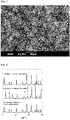
- a zeolite molded article having a high zeolite purity can also be confirmed by XRD. That is, in the obtained XRD pattern, only diffraction peaks attributable to the zeolite structure are confirmed. When the zeolite purity is not satisfied and the zeolite contains a large amount of impurities, for example, an inorganic binder, a diffraction peak derived from the inorganic binder may be observed. Furthermore, as in Example 1 and Example 3, no impurities other than the specific zeolite were confirmed. This reveals that each specific zeolite (Example 1: X type zeolite, Example 3: A type zeolite) includes a single type thereof. When this zeolite is a single type, the dispersibility of silver is excellent.
- the zeolite fine particles also act as a binder. Therefore, the molded article of the present invention is excellent in mechanical strength.
- the pressure resistance of the molded article of the present invention is usually 15 N or more, preferably 30 N or more, and further preferably 40 N or more for a cylindrical molded article having a diameter of 1.5 mm and an average length of 5 mm, for example.
- silver species are silver ions, silver clusters, and metallic silver. Silver ions are silver in the dispersed state, while silver clusters and metallic silver are silver in the aggregated state.
- the ratio of the total of the silver cluster and the metallic silver relative to the amount of silver carried in the molded article of the present invention is 70% or less, further preferably 50% or less, and still further preferably 45% orless. Since higher adsorption characteristics can be expected, the ratio of the total of the silver cluster and the metallic silver relative to the amount of silver carried in the molded article of the present invention is preferably 43% or less, and further preferably 34% or less.
- the molded article of the present invention preferably contains a large amount of silver ions, and the content of silver ions is 5% by weight or more, preferably 8% by weight or more, and further preferably 11% by weight or more.
- the amount of silver ions is preferably 30% by weight or less, further preferably 26% by weight or less, still further preferably 25% by weight or less, more preferably 19% by weight or less, and particularly preferably 14% by weight or less.
- the content of silver ions is preferably 8% by weight or more and 25% by weight or less, and further preferably 11% by weight or more and 25% by weight or less.
- the molded article of the present invention contains metallic silver or silver clusters which are aggregated silver. Since they clog the pores of the zeolite to reduce the adsorption performance, the contents thereof are preferably as low as possible.
- the content of the silver clusters of the molded article of the present invention is preferably 22% by weight or less, further preferably 12% by weight or less, still further preferably 11% by weight or less, more preferably 8.5% by weight or less, and particularly preferably 7% by weight or less.
- the content of the metallic silver of the molded article of the present invention is preferably 2.5% by weight or less, further preferably 1.4% by weight or less, still further preferably 1.1% by weight or less, more preferably 1.0% by weight or less, and particularly preferably 0.8% by weight or less.
- the content of the silver ions is represented by the following formula (4).
- Content of Silver Ions Proportion of Silver Ions ⁇ Amount of Carried Silver
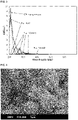
- the proportion of each of silver species can be determined by UV-VIS measurement. That is, the UV-VIS pattern of the molded article of the present invention is separated by waveforms. In the UV-VIS pattern after waveform separation, a peak having a peak top in a wavelength range of 210 nm or more and 240 nm or less is assigned as a peak of silver ion, a peak having a peak top in a wavelength range of more than 240 nm and 350 nm or less is assigned as a peak of silver cluster, and a peak having a peak top in a wavelength range of more than 350 nm and 700 nm or less is assigned as a peak of metallic silver.
- the ratio of silver contained in each of the silver ion, silver cluster, and metallic silver can be determined from the peak area of each peak obtained.
- the amount of silver carried on the molded article of the present invention is higher than the content of the silver ions and is preferably 50% by weight or less. In general, it is said that the adsorption characteristics become higher as the amount of carried silver increases. However, when the amount of carried silver is more than 50% by weight, aggregation of silver becomes noticeable, and the amount of metallic silver and silver clusters, which are aggregated silver, in particular, metallic silver become large. The metallic silver not only clogs the pores of the zeolite, but also tends to be detached from the zeolite molded article, so that the resulting zeolite molded article has low adsorption characteristics per unit silver amount.
- the amount of carried silver when the amount of carried silver is more than 50% by weight, production costs become too high, limiting the industrial applications. Since silver in the molded article of the present invention efficiently contributes to adsorption characteristics, it is preferable that the amount of carried silver be 46% by weight or less.
- the amount of carried silver is preferably 36% by weight or less, further preferably 35.5% by weight or less, still further preferably 35% by weight or less, more preferably 32% by weight or less, particularly preferably 30% by weight or less, further more preferably 25% by weight or less, and more preferably 20% by weight or less. It is preferable that the amount of carried silver in the molded article of the present invention be 5% by weight or more.
- the amount of carried silver is preferably 8% by weight or more, further preferably 11% by weight or more, and still further preferably 16% by weight or more. As a result, the content of silver ions is increased, and a molded article having excellent adsorption characteristics can be obtained.
- the shape of the molded article of the present invention is preferably at least one type selected from the group consisting of a disk shape, a cylinder shape, a hollow shape, a polyhedron shape, a sphere shape, a substantially sphere shape, a three-leaf shape, and a massive shape.
- the shape is further preferably at least one type selected from the group consisting of a cylinder shape, a sphere shape, and a three-leaf shape, and particularly preferably a cylinder shape.
- the size of the molded article of the present invention is preferably 0.1 mm or greater and 5.0 mm or smaller, further preferably 0.1 mm or greater and 4.0 mm or smaller, and still further preferably 0.1 mm or greater and 2.0 mm or smaller, in terms of an average diameter.
- the molded article of the present invention can be used as an adsorbent.
- the molded article of the present invention may be used solely as an adsorbent, or may be mixed with an adsorbent of an optional component and used as an adsorbent.
- the molded article of the present invention can be obtained by a production method including an ion exchange treatment step of subjecting the zeolite molded article having a zeolite purity of 90% or more, preferably a zeolite purity of 95% or more to an ion exchange treatment with an aqueous solution containing silver.
- the ion exchange treatment step is performed such that the zeolite molded article having a zeolite purity of 90% or more, preferably a zeolite purity of 95% or more, is treated with an aqueous solution containing silver. As a result, aggregation of silver is inhibited, and a zeolite molded article in which silver is highly dispersed can be obtained.
- the molded article to be subjected to the ion exchange treatment step has the zeolite purity of 90% or more, and preferably the zeolite purity of 95% or more. As a result, the silver carried on the obtained molded article becomes more highly dispersed.
- the zeolite molded article having the zeolite purity of 90% or more, preferably the zeolite purity of 95% or more, can preferably be obtained by a production method that additionally includes a step of subjecting the zeolite molded article to an alkali treatment.
- the alkali treatment is to treat the zeolite molded article with an alkali aqueous solution.
- the zeolite purity of the zeolite molded article to be subjected to the alkali treatment is 95% by weight or more, and further preferably 97% by weight or more.
- the alkali aqueous solution used for the alkali treatment is preferably at least one type selected from the group consisting of a sodium hydroxide aqueous solution, a potassium hydroxide aqueous solution, and a lithium hydroxide aqueous solution, and further preferably sodium hydroxide.
- Sodium hydroxide is available at low cost.
- the alkali concentration of the alkali aqueous solution is arbitrarily set. From the viewpoint of zeolite conversion efficiency and production costs, it is preferable that the alkali concentration of the alkali aqueous solution be 1% by weight or more and 30% by weight or less.
- the alkali concentration is preferably 3% by weight or more and 20% by weight or less, and further preferably 5% by weight or more and 12% by weight or less.
- the alkali aqueous solution preferably contains SiO 2 as necessary.
- the SiO 2 concentration of the alkali aqueous solution is preferably 0.5% by weight or more and 5% by weight or less, and further preferably 0.5% by weight or more and 2% by weight or less.
- the conditions of the alkali treatment include bringing the zeolite molded article into contact with an alkali aqueous solution and treating the zeolite molded article at 40°C or higher and 100°C or lower for 3 hours or longer. As a result, the inorganic binder contained in the zeolite molded article is sufficiently converted into the zeolite.
- the silver-containing aqueous solution to be supplied to the ion exchange treatment step may be any aqueous solution containing a silver compound.
- the silver compound is preferably at least one selected from the group consisting of silver nitrate, silver sulfate, silver acetate, and silver chloride, and is further preferably silver nitrate. Silver nitrate is available at low cost.
- the silver concentration of the silver-containing aqueous solution is arbitrarily set. From the viewpoint of ion exchange efficiency and production costs, the silver concentration of the silver-containing aqueous solution is preferably 0.1% by weight or more and 30% by weight or less in terms of silver nitrate.
- the treatment method is arbitrarily selected so long as silver is carried on the zeolite molded article.
- Examples thereof may include a method of stirring the zeolite molded article in a silver-containing aqueous solution so that the zeolite molded article is not crushed, and a method of circulating the silver-containing aqueous solution through the zeolite molded article packed in a column.
- the treatment temperature is preferably 30°C or higher and 90°C or lower.
- the weight ratio of the silver-containing aqueous solution to the zeolite molded article is preferably 3 or more and 10 or less.
- the molded article of the present invention obtained in the alkali treatment step may be crushed in order to adjust the molded article to have an arbitrary size.
- the zeolite molded article to be subjected to the alkali treatment step can be obtained by a production method including a mixing step of mixing the zeolite powder with the inorganic binder, a molding step of molding the mixture, and a calcining step of calcining the molded article.
- the mixing step it is preferable to mix the zeolite powder and the inorganic binder to obtain a mixture.
- the weight ratio of the mixture is set such that the weight of the inorganic binder is preferably 50 parts by weight or less, further preferably 30 parts by weight or less, and still further preferably 20 parts by weight or less, relative to 100 parts by weight of the zeolite powder.
- the inorganic binder is usually contained in an amount of 10 parts by weight or more.
- the inorganic binder be a clay mineral.
- the inorganic binder is preferably at least one clay mineral selected from the group consisting of kaolin, attapulgite, sepiolite, and montmorillonite, and is further preferably kaolin. As a result, the inorganic binder is more efficiently converted into the zeolite in the alkali treatment step described above.
- a granulation aid may be included in addition to the zeolite powder and the inorganic binder in order to improve the granulating property.
- the granulation aid may include methylcellulose, and carboxymethylcellulose may be mentioned as a particularly preferred methylcellulose. Water may be added as necessary.
- the molding step it is preferable to mold the mixture using at least one arbitrary molding method selected from the group consisting of rolling granulation, fluidized bed granulation, stirring granulation, compression granulation, extrusion granulation, crushing granulation, and spray granulation.
- a molded article drying step may be included in which moisture of the molded article is removed.
- the drying temperature in the molded article drying step may be 100°C or higher as an example.
- the calcining step it is preferable to perform the treatment at 500°C or higher in an arbitrary atmosphere.
- the production method of the present invention preferably includes a drying step of drying the zeolite molded article, after the ion exchange treatment, at 100°C or lower.
- drying is performed preferably at 95°C or lower, and further preferably at 90°C or lower.
- drying is performed preferably at 45°C or higher, preferably at 50°C or higher, and further preferably at 60°C or higher.
- the conditions that promote drying may easily promote aggregation of silver. Therefore, it is preferable that the atmosphere in the drying step be not a pressurized atmosphere, an oxygen atmosphere, or a vacuum atmosphere, but the drying step is performed in the air atmosphere.
- the zeolite powder or the zeolite molded article (hereinafter, simply referred to as "sample") was dried at 110°C in the air to sufficiently remove moisture.
- the sample was left to stand in a desiccator for 16 hours or longer under the conditions of a temperature of 25°C and a relative humidity of 80%, and subjected to a hydration treatment for saturating and adsorbing moisture.
- the weight (X1) of the sample after the hydration treatment was measured.
- the sample after the hydration treatment was subjected to a heat treatment under the condition of 900°C in the air for 1 hour to sufficiently remove moisture.
- the sample weight (X2) after the heat treatment was measured.
- the water adsorption amount per 100 g of the sample (hereinafter referred to as "g/100 g-agent") was determined by the following formula (5).
- the zeolite purity was calculated by substituting the moisture adsorption amount obtained by the expression (5) into the formula (1) .
- the BET specific surface area was measured using a common BET specific surface area measuring device (device name: BELSORP 28SA, manufactured by Microtrac Bell Corporation).
- the adsorption isotherm was measured at the liquid nitrogen temperature (-196°C) as the adsorption temperature.
- the BET specific surface area was calculated from the nitrogen adsorption volume in the range corresponding to the relative pressure of 0 to 0.1 in the obtained adsorption isotherm.
- the measurement sample was pulverized to an aggregation diameter of 0.5 mm to 1 mm, sized, and then heated at 350°C for 2 hours under vacuum, as pretreatment.
- the molded article sample was dissolved in an acid to prepare a measurement solution.
- the concentration of metal ions in the measurement solution was measured by the ICP method. Measurement was performed using a common ICP-AES (device name: OPTIMA3000DV, manufactured by PERKIN-ELMER).
- the respective concentrations of silicon, aluminum, an alkali metal, and silver of the measurement sample were determined.
- the contents of the obtained silicon, aluminum, alkali metal, and silver were measured, and the Si/Al 2 molar ratio, Na/Al molar ratio, and Ag/Al molar ratio in the sample were determined.
- Silicon, aluminum, alkaline metal, and silver were converted in terms of their oxides to obtain a total amount, and the sum total (% by weight) of SiO 2 , Al 2 O 3 , Na 2 O, and Ag 2 O was determined on the basis of the total amount. Also, the amount of carried silver was determined on the basis of the silver concentrations.
- the state of silver in the molded article was measured by ultraviolet-visible light measurement. That is, ultraviolet-visible absorption was measured under the following conditions using a self-recorded spectrophotometer (device name: UV-3100, manufactured by Shimadzu Corporation) in which an integrating sphere attachment device (device name: ISR-3100, manufactured by Shimadzu Corporation) was attached to the sample chamber.
- a self-recorded spectrophotometer device name: UV-3100, manufactured by Shimadzu Corporation
- an integrating sphere attachment device device name: ISR-3100, manufactured by Shimadzu Corporation
- the resulting UV-VIS pattern was separated into waveforms.
- a peak having a peak top in a wavelength range of 210 nm or more and 240 nm or less was assigned as a peak of silver ion
- a peak having a peak top in a wavelength range of more than 240 nm and 350 nm or less was assigned as a peak of silver cluster
- a peak having a peak top in a wavelength range of more than 350 nm and 700 nm or less was assigned as a peak of metallic silver.
- the proportion of silver contained in silver ions (Ag(ion)), silver clusters (Ag(clus)), and metallic silver (Ag(metal)) was determined from the peak areas of the respective peaks obtained.
- the content of each of silver species in the measurement sample was determined from the amount of carried silver obtained by the ICP measurement and the proportion of each of silver species obtained by the UV-VIS measurement.
- the pulverized sample was allowed to pass through a sieve having an opening of 200 ⁇ m. After 0.5 g of the pulverized sample having passed through the sieve was added to 50 ml of pure water to form a slurry, ultrasonic dispersion was performed for 2 minutes with a homogenizer. After that, the particle size distribution of the slurry solution was measured by a micro track (manufactured by Nikkiso Co., Ltd.).
- the mixture was molded by extrusion molding to obtain a cylindrical molded article having a diameter of 1.5 mm.
- the molded article was dried at 100°C overnight and then calcined at 600°C for 3 hours under air flow.
- the calcined molded article was washed with pure water that was at room temperature. After washing, an aqueous solution containing NaOH (8.1% by weight) and SiO 2 (1% by weight) was circulated through the molded article at a flow rate of 235 mL/min. The circulating flow was performed at 40°C for 1 hour and then at 90°C for 7 hours to convert the kaolin clay to zeolite. The Si/Al 2 molar ratio of the resulting X type zeolite molded article was 2.8.
- the moisture adsorption amount of the X type zeolite powder was 35.0 (g/100 g-agent), and the moisture adsorption amount of the X type zeolite molded article was 34.2 (g/100 g-agent) .
- the zeolite purity was 97.7%.
- XRD measurements confirmed that the resulting zeolite contained no other zeolite structures than the X type zeolite (thus containing a single type of the X type zeolite) .
- the XRD diffraction diagram is shown in FIG. 8 .
- the ion exchange treatment was performed at 50°C for 4 hours.
- the stirring was performed in the vicinity of the liquid surface of the silver nitrate aqueous solution at a stirring speed of 100 rpm. During the ion exchange treatment, the flow of the molded article due to stirring could not be confirmed.
- the product was washed with sufficient amount of pure water and dried at 90°C for 12 hours to obtain a molded article of this example.
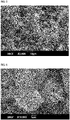
- FIGS. 1 and 2 show SEM observation views of the molded article of this example.
- the average particle size of the zeolite fine particles in the molded article was 0.64 ⁇ m.
- the average particle size of the zeolite powder in the molded article was determined from FIG. 2 , and as a result, the average particle size was 4. 4 ⁇ m.
- impurities other than the X type zeolite were not confirmed in the molded article (thus, the molded article contained a single type of the X type zeolite).
- FIG. 3 shows the result of UV-VIS measurement of the molded article of the present embodiment and the results of waveform separation. The evaluation results of the molded article of this example are shown in Tables 1, 2 and 3.
- the molded article of this example was pulverized in a mortar to have an aggregation diameter of 0.1 to 15 ⁇ m, and then the volume distribution particle size thereof was measured. As a result, the particle size distribution was monomodal, and the volume average particle size (D50) was 3.7 ⁇ m. As a result, it was confirmed that zeolite fine particles were present on the surface of the zeolite powder in the molded article of this example.
- the moisture adsorption amount of the commercially available X type zeolite molded article was 29.5 (g/100g-agent), and thus, the zeolite purity thereof was 84.3% by weight.
- FIGS. 4 and 5 show SEM observation views of the molded article of this comparative example.
- X type zeolite fine particles were not observed, and it was confirmed that a filamentous clay binder was present on the surface of the zeolite powder.
- the average particle size of the X type zeolite powder in the molded article was determined from FIG. 5 , and was 2.5 ⁇ m.
- the evaluation results of the molded article of this comparative example are shown in Tables 1, 2, and 3.
- the molded article of the example contained more silver ions than the zeolite molded article of the comparative example by 10% or more, and the aggregation of silver was inhibited.
- the zeolite molded article of the comparative example had a particularly large number of silver clusters as compared with the molded article of the example.
- a molded article of this example was obtained in the same manner as that in Example 1 except that 29.9 g of silver nitrate was dissolved in 142 g of pure water to prepare a silver nitrate aqueous solution of 17.4% by weight.
- the evaluation results of the molded article of this example are shown in Tables 4, 5, and 6.
- a molded article of this example was obtained in the same manner as that in Comparative Example 1 except that 32.5 g of silver nitrate was dissolved in 142 g of pure water to prepare a silver nitrate aqueous solution of 18.6% by weight.
- the evaluation results of the molded article of this comparative example are shown in Tables 4, 5, and 6.
- the mixture was extruded to obtain a plurality of cylindrical zeolite molded articles having a diameter of 1.5 mm and a length of 1 to 5 mm.
- the molded article was dried at 100°C overnight and then calcined at 600°C for 3 hours under air flow.
- the calcined molded article was washed with pure water that was at room temperature. After washing, an aqueous solution containing NaOH (6% by weight) was circulated through the molded article at a flow rate of 235 mL/min. The circulating flow was performed at 40°C for 1 hour and then at 80°C for 5 hours to convert the kaolin clay to zeolite. The Si/Al 2 molar ratio of the resulting A type zeolite molded article was 2.5.
- the moisture adsorption amount of the A type zeolite powder was 27.0 (g/100 g-agent), and the moisture adsorption amount of the A type zeolite molded article was 26.5 (g/100 g-agent) .
- the zeolite purity was 98.1%.
- XRD measurements confirmed that the resulting zeolite contained no other zeolite structures than the type A zeolite (thus containing a single type of the A type zeolite) .
- the XRD diffraction diagram is shown in FIG. 8 .
- the ion exchange treatment was performed at 50°C for 4 hours.
- the stirring was performed in the vicinity of the liquid surface of the silver nitrate aqueous solution at a stirring speed of 100 rpm. During the ion exchange treatment, the flow of the molded article due to stirring could not be confirmed.
- the product was washed with sufficient amount of pure water and dried at 90°C for 12 hours to obtain a molded article of this example.
- FIGS. 6 and 7 show SEM observation views of the molded article of this example.
- the average particle size of the zeolite fine particles in the molded article was 0.39 ⁇ m.
- the average particle size of the zeolite powder in the molded article was determined from FIG. 7 , and as a result, the average particle size was 4.2 ⁇ m.
- impurities other than the A type zeolite were not confirmed in the molded article (thus, the molded article contained a single type of the A type zeolite).
- the evaluation results of the molded article of this example are shown in Tables 7, 8 and 9.
- a molded article of this example was obtained in the same manner as that in Example 3 except that 30.7 g of silver nitrate was dissolved in 142 g of pure water to prepare a silver nitrate aqueous solution of 17.8% by weight.
- the evaluation results of the molded article of this example are shown in Tables 7, 8, and 9.
- the calcined molded article was washed with pure water that was at room temperature. After washing, an aqueous solution containing NaOH (6% by weight) was circulated through the molded article at a flow rate of 235 mL/min.
- a zeolite molded article was obtained in the same manner as that in Example 1 except that the circulating flow was performed at 40°C for 1 hour, and then at 80°C for 5 hours to convert the kaolin clay to an A type zeolite.
- the XRD diffraction diagram is shown in FIG. 8 .
- the moisture adsorption amount of the zeolite molded article containing the X type zeolite and the A type zeolite was 33.4 (g/100g-agent). From the result of Example 1, the moisture adsorption amount of the X type zeolite molded article was 34.2 (g/100g-agent), and from the result of Example 3, the moisture adsorption amount of the A type zeolite molded article was 26.5 (g/100g-agent). Therefore, it was confirmed that this zeolite molded article was a molded article containing 89.6% of the X type zeolite molded article and 10.4% of the A type zeolite molded article (in terms of ratio).
- a molded article of this comparative example was obtained by performing ion exchange treatment of silver in the same manner as that in Example 1 except that 29.9 g of silver nitrate was dissolved in 142 g of pure water to prepare a silver nitrate aqueous solution of 17.4% by weight.
- the evaluation results of the molded articles of this comparative example are shown in Tables 10 and 11.
- the silver-carrying zeolite molded article according to the present invention can be used as an adsorbent. Furthermore, the silver-carrying zeolite molded article according to the present invention can be used as catalysts, antibacterial agents, and other known zeolite molded article applications.
Landscapes
- Chemical & Material Sciences (AREA)
- Organic Chemistry (AREA)
- Chemical Kinetics & Catalysis (AREA)
- Analytical Chemistry (AREA)
- Engineering & Computer Science (AREA)
- Materials Engineering (AREA)
- Inorganic Chemistry (AREA)
- Life Sciences & Earth Sciences (AREA)
- General Life Sciences & Earth Sciences (AREA)
- Geology (AREA)
- Crystallography & Structural Chemistry (AREA)
- Silicates, Zeolites, And Molecular Sieves (AREA)
- Solid-Sorbent Or Filter-Aiding Compositions (AREA)
Claims (6)
- Article moulé en zéolite portant de l'argent, dans lequelle rapport molaire Si/Al2 est de 2,0 ou plus et 3,0 ou moins,le rapport molaire (métal alcalin + Ag)/Al est de 0,9 ou plus et 1,1 ou moins,la quantité totale de SiO2, d'Al2O3, d'Ag2O, et d'un oxyde de métal alcalin est de 90 % en poids ou plus,l'ion argent est contenu en une quantité de 5 % en poids ou plus,l'article moulé contient un seul type de zéolite,et l'article moulé en zéolite portant de l'argent a des particules fines de zéolite ayant une granulométrie moyenne, déterminée conformément à la description, de 0,2 µm ou plus et 1,5 µm ou moins sur la surface d'une poudre de zéolite,la poudre de zéolite a une granulométrie moyenne supérieure à celle des particules fines de zéolite, etla surface spécifique BET de l'article moulé, mesurée conformément à la description, est de 560 m2/g ou plus et 900 m2/g ou moins.
- Article moulé en zéolite portant de l'argent selon la revendication 1, dans lequel le métal alcalin est le sodium.
- Article moulé en zéolite portant de l'argent selon la revendication 1 ou 2, lequel article moulé en zéolite a une structure cristalline de type FAU.
- Article moulé en zéolite portant de l'argent selon l'une quelconque des revendications 1 à 3, dans lequel la teneur en argent est inférieure à 36 % en poids.
- Procédé de production de l'article moulé en zéolite portant de l'argent selon l'une quelconque des revendications 1 à 4, comprenant une étape d'échange d'ions consistant à soumettre un article moulé en zéolite ayant une pureté de la zéolite de 90 % ou plus à un traitement d'échange d'ions avec une solution aqueuse contenant de l'argent.
- Procédé de production selon la revendication 5, comprenant une étape de séchage consistant à sécher l'article moulé en zéolite après l'étape de traitement par échange d'ions à 100°C ou moins.
Applications Claiming Priority (2)
| Application Number | Priority Date | Filing Date | Title |
|---|---|---|---|
| JP2016035659 | 2016-02-26 | ||
| PCT/JP2017/006787 WO2017146137A1 (fr) | 2016-02-26 | 2017-02-23 | Objet moulé en zéolithe porteuse d'argent |
Publications (3)
| Publication Number | Publication Date |
|---|---|
| EP3421428A1 EP3421428A1 (fr) | 2019-01-02 |
| EP3421428A4 EP3421428A4 (fr) | 2019-10-16 |
| EP3421428B1 true EP3421428B1 (fr) | 2022-04-13 |
Family
ID=59686152
Family Applications (1)
| Application Number | Title | Priority Date | Filing Date |
|---|---|---|---|
| EP17756575.1A Active EP3421428B1 (fr) | 2016-02-26 | 2017-02-23 | Objet moulé en zéolithe porteuse d'argent |
Country Status (5)
| Country | Link |
|---|---|
| US (1) | US10603652B2 (fr) |
| EP (1) | EP3421428B1 (fr) |
| JP (1) | JP6926521B2 (fr) |
| CA (1) | CA3015324C (fr) |
| WO (1) | WO2017146137A1 (fr) |
Families Citing this family (2)
| Publication number | Priority date | Publication date | Assignee | Title |
|---|---|---|---|---|
| EP3422363B1 (fr) * | 2016-02-26 | 2021-04-21 | Ebara Corporation | Procédé pour traiter un fluide contenant de l'iode radioactif |
| JP7110792B2 (ja) * | 2018-07-26 | 2022-08-02 | 東ソー株式会社 | 銀イオン交換ゼオライトの製造方法 |
Family Cites Families (16)
| Publication number | Priority date | Publication date | Assignee | Title |
|---|---|---|---|---|
| US3658467A (en) | 1969-07-28 | 1972-04-25 | Atomic Energy Commission | System for total iodine retention |
| JPS51135237A (en) | 1975-05-17 | 1976-11-24 | Torao Kamo | Production of imitation of rock pot |
| US4938958A (en) * | 1986-12-05 | 1990-07-03 | Shinagawa Fuel Co., Ltd. | Antibiotic zeolite |
| DE3808742A1 (de) | 1988-03-16 | 1989-09-28 | Kernforschungsz Karlsruhe | Verfahren zur entfernung von iod und iodverbindungen aus gasen und daempfen mit silberhaltigem zeolith x |
| JP2701055B2 (ja) * | 1988-10-26 | 1998-01-21 | クニミネ工業株式会社 | 金属含有粘土鉱物の製造方法 |
| JP3123057B2 (ja) * | 1990-04-11 | 2001-01-09 | 東ソー株式会社 | X型ゼオライト成形体の製造方法 |
| JP3772412B2 (ja) * | 1996-08-08 | 2006-05-10 | 東ソー株式会社 | 低摩耗性ゼオライトビーズ成形体及びその製造方法 |
| JP3799678B2 (ja) | 1996-09-13 | 2006-07-19 | 東ソー株式会社 | 高強度低摩耗性ゼオライト粒状物、その製造方法及びそれを用いた吸着分離方法 |
| JPH1150069A (ja) | 1997-08-05 | 1999-02-23 | Tosoh Corp | 天然ガスの精製方法 |
| JP2003002636A (ja) * | 2001-06-19 | 2003-01-08 | Tosoh Corp | バインダーレスゼオライトビーズ成形体およびその製造方法並びにこれを用いた吸着除去方法 |
| JP3895134B2 (ja) | 2001-07-05 | 2007-03-22 | 東京瓦斯株式会社 | 燃料ガスの脱硫装置及び脱硫方法 |
| US6572838B1 (en) | 2002-03-25 | 2003-06-03 | Council Of Scientific And Industrial Research | Process for the preparation of molecular sieve adsorbent for selective adsorption of nitrogen and argon |
| US7125817B2 (en) * | 2003-02-20 | 2006-10-24 | Exxonmobil Chemical Patents Inc. | Combined cracking and selective hydrogen combustion for catalytic cracking |
| JP2006281068A (ja) * | 2005-03-31 | 2006-10-19 | Catalysts & Chem Ind Co Ltd | 吸着剤 |
| US7455718B2 (en) | 2005-06-30 | 2008-11-25 | Praxair Technology, Inc. | Silver-exchanged zeolites and methods of manufacture therefor |
| JP5504368B1 (ja) | 2013-10-23 | 2014-05-28 | ラサ工業株式会社 | 放射性ヨウ素吸着剤、及び放射性ヨウ素の処理方法 |
-
2017
- 2017-02-23 JP JP2017031864A patent/JP6926521B2/ja active Active
- 2017-02-23 WO PCT/JP2017/006787 patent/WO2017146137A1/fr not_active Ceased
- 2017-02-23 US US16/078,902 patent/US10603652B2/en active Active
- 2017-02-23 EP EP17756575.1A patent/EP3421428B1/fr active Active
- 2017-02-23 CA CA3015324A patent/CA3015324C/fr active Active
Non-Patent Citations (1)
| Title |
|---|
| None * |
Also Published As
| Publication number | Publication date |
|---|---|
| EP3421428A4 (fr) | 2019-10-16 |
| EP3421428A1 (fr) | 2019-01-02 |
| US10603652B2 (en) | 2020-03-31 |
| CA3015324C (fr) | 2023-07-18 |
| JP2017154965A (ja) | 2017-09-07 |
| JP6926521B2 (ja) | 2021-08-25 |
| US20190046950A1 (en) | 2019-02-14 |
| CA3015324A1 (fr) | 2017-08-31 |
| WO2017146137A1 (fr) | 2017-08-31 |
Similar Documents
| Publication | Publication Date | Title |
|---|---|---|
| EP2249961B1 (fr) | Granulé formant agent d'adsorption et procédé pour sa fabrication | |
| EP3255015B1 (fr) | Nouvelle zéolithe | |
| KR20200096846A (ko) | 포름알데히드 산화를 촉진하기 위한 망가니즈 촉매 및 그의 제조 및 용도 | |
| EP2527296B1 (fr) | Granulé zéolithique sans liant avec structure faujasite et procédé de fabrication d'un tel granulé zéolithique sans liant et son utilisation | |
| JP6218925B2 (ja) | 第4族金属のケイ酸塩の製造方法及びその使用 | |
| US9162899B2 (en) | BaX type Zeolite granule and process for preparing the same | |
| CN110475608B (zh) | 重金属吸附剂 | |
| JP2020033215A (ja) | セリウム含有デルタ型二酸化マンガン単分散粒子及びその製造方法 | |
| EP3421428B1 (fr) | Objet moulé en zéolithe porteuse d'argent | |
| JP2021087901A (ja) | 水処理用浄化剤の製造方法 | |
| JP4890444B2 (ja) | カルシウム及び/又はマグネシウムを含む多孔質粒子からなる粒状物 | |
| WO2013099253A1 (fr) | Poudre granulée contenant du titane et son procédé de production, et catalyseur de traitement de gaz d'échappement utilisant celle-ci et son procédé de production | |
| JPWO2017141931A1 (ja) | セシウム又は/及びストロンチウム吸着剤 | |
| CN110639283A (zh) | 一种采用凹土复合材料制备空气滤网的方法 | |
| JP4987235B2 (ja) | ゼオライト成形体 | |
| WO2024095914A1 (fr) | Corps moulé en zéolite | |
| JP6673841B2 (ja) | 吸着材 | |
| WO2017213022A1 (fr) | Zéolite de chabazite à haute résistance hydrothermique et son procédé de production | |
| JP2006281068A (ja) | 吸着剤 | |
| JP2020142955A (ja) | 層状マンガン酸化物成形体及びその製造方法 | |
| JPWO2017146130A1 (ja) | 放射性ヨウ素含有流体の処理方法 | |
| JPH0443696B2 (fr) | ||
| JP6898744B2 (ja) | 重金属イオン吸着剤 | |
| CN106185927B (zh) | 含铈的木质活性炭的制备方法 | |
| KR20240030476A (ko) | 석탄 비산재로부터 금속이온이 교환된 암모니아 가스 흡착용 합성 제올라이트의 제조방법 |
Legal Events
| Date | Code | Title | Description |
|---|---|---|---|
| STAA | Information on the status of an ep patent application or granted ep patent |
Free format text: STATUS: THE INTERNATIONAL PUBLICATION HAS BEEN MADE |
|
| PUAI | Public reference made under article 153(3) epc to a published international application that has entered the european phase |
Free format text: ORIGINAL CODE: 0009012 |
|
| STAA | Information on the status of an ep patent application or granted ep patent |
Free format text: STATUS: REQUEST FOR EXAMINATION WAS MADE |
|
| 17P | Request for examination filed |
Effective date: 20180827 |
|
| AK | Designated contracting states |
Kind code of ref document: A1 Designated state(s): AL AT BE BG CH CY CZ DE DK EE ES FI FR GB GR HR HU IE IS IT LI LT LU LV MC MK MT NL NO PL PT RO RS SE SI SK SM TR |
|
| AX | Request for extension of the european patent |
Extension state: BA ME |
|
| DAV | Request for validation of the european patent (deleted) | ||
| DAX | Request for extension of the european patent (deleted) | ||
| A4 | Supplementary search report drawn up and despatched |
Effective date: 20190912 |
|
| RIC1 | Information provided on ipc code assigned before grant |
Ipc: C01B 39/22 20060101AFI20190906BHEP Ipc: B01J 20/18 20060101ALI20190906BHEP Ipc: B01J 20/30 20060101ALI20190906BHEP Ipc: B01J 20/28 20060101ALI20190906BHEP |
|
| STAA | Information on the status of an ep patent application or granted ep patent |
Free format text: STATUS: EXAMINATION IS IN PROGRESS |
|
| 17Q | First examination report despatched |
Effective date: 20200721 |
|
| GRAP | Despatch of communication of intention to grant a patent |
Free format text: ORIGINAL CODE: EPIDOSNIGR1 |
|
| STAA | Information on the status of an ep patent application or granted ep patent |
Free format text: STATUS: GRANT OF PATENT IS INTENDED |
|
| INTG | Intention to grant announced |
Effective date: 20220105 |
|
| GRAS | Grant fee paid |
Free format text: ORIGINAL CODE: EPIDOSNIGR3 |
|
| GRAA | (expected) grant |
Free format text: ORIGINAL CODE: 0009210 |
|
| STAA | Information on the status of an ep patent application or granted ep patent |
Free format text: STATUS: THE PATENT HAS BEEN GRANTED |
|
| AK | Designated contracting states |
Kind code of ref document: B1 Designated state(s): AL AT BE BG CH CY CZ DE DK EE ES FI FR GB GR HR HU IE IS IT LI LT LU LV MC MK MT NL NO PL PT RO RS SE SI SK SM TR |
|
| REG | Reference to a national code |
Ref country code: GB Ref legal event code: FG4D |
|
| REG | Reference to a national code |
Ref country code: CH Ref legal event code: EP |
|
| REG | Reference to a national code |
Ref country code: DE Ref legal event code: R096 Ref document number: 602017055934 Country of ref document: DE |
|
| REG | Reference to a national code |
Ref country code: IE Ref legal event code: FG4D |
|
| REG | Reference to a national code |
Ref country code: AT Ref legal event code: REF Ref document number: 1483294 Country of ref document: AT Kind code of ref document: T Effective date: 20220515 |
|
| REG | Reference to a national code |
Ref country code: LT Ref legal event code: MG9D |
|
| REG | Reference to a national code |
Ref country code: NL Ref legal event code: MP Effective date: 20220413 |
|
| REG | Reference to a national code |
Ref country code: AT Ref legal event code: MK05 Ref document number: 1483294 Country of ref document: AT Kind code of ref document: T Effective date: 20220413 |
|
| PG25 | Lapsed in a contracting state [announced via postgrant information from national office to epo] |
Ref country code: NL Free format text: LAPSE BECAUSE OF FAILURE TO SUBMIT A TRANSLATION OF THE DESCRIPTION OR TO PAY THE FEE WITHIN THE PRESCRIBED TIME-LIMIT Effective date: 20220413 |
|
| PG25 | Lapsed in a contracting state [announced via postgrant information from national office to epo] |
Ref country code: SE Free format text: LAPSE BECAUSE OF FAILURE TO SUBMIT A TRANSLATION OF THE DESCRIPTION OR TO PAY THE FEE WITHIN THE PRESCRIBED TIME-LIMIT Effective date: 20220413 Ref country code: PT Free format text: LAPSE BECAUSE OF FAILURE TO SUBMIT A TRANSLATION OF THE DESCRIPTION OR TO PAY THE FEE WITHIN THE PRESCRIBED TIME-LIMIT Effective date: 20220816 Ref country code: NO Free format text: LAPSE BECAUSE OF FAILURE TO SUBMIT A TRANSLATION OF THE DESCRIPTION OR TO PAY THE FEE WITHIN THE PRESCRIBED TIME-LIMIT Effective date: 20220713 Ref country code: LT Free format text: LAPSE BECAUSE OF FAILURE TO SUBMIT A TRANSLATION OF THE DESCRIPTION OR TO PAY THE FEE WITHIN THE PRESCRIBED TIME-LIMIT Effective date: 20220413 Ref country code: HR Free format text: LAPSE BECAUSE OF FAILURE TO SUBMIT A TRANSLATION OF THE DESCRIPTION OR TO PAY THE FEE WITHIN THE PRESCRIBED TIME-LIMIT Effective date: 20220413 Ref country code: GR Free format text: LAPSE BECAUSE OF FAILURE TO SUBMIT A TRANSLATION OF THE DESCRIPTION OR TO PAY THE FEE WITHIN THE PRESCRIBED TIME-LIMIT Effective date: 20220714 Ref country code: FI Free format text: LAPSE BECAUSE OF FAILURE TO SUBMIT A TRANSLATION OF THE DESCRIPTION OR TO PAY THE FEE WITHIN THE PRESCRIBED TIME-LIMIT Effective date: 20220413 Ref country code: ES Free format text: LAPSE BECAUSE OF FAILURE TO SUBMIT A TRANSLATION OF THE DESCRIPTION OR TO PAY THE FEE WITHIN THE PRESCRIBED TIME-LIMIT Effective date: 20220413 Ref country code: BG Free format text: LAPSE BECAUSE OF FAILURE TO SUBMIT A TRANSLATION OF THE DESCRIPTION OR TO PAY THE FEE WITHIN THE PRESCRIBED TIME-LIMIT Effective date: 20220713 Ref country code: AT Free format text: LAPSE BECAUSE OF FAILURE TO SUBMIT A TRANSLATION OF THE DESCRIPTION OR TO PAY THE FEE WITHIN THE PRESCRIBED TIME-LIMIT Effective date: 20220413 |
|
| PG25 | Lapsed in a contracting state [announced via postgrant information from national office to epo] |
Ref country code: RS Free format text: LAPSE BECAUSE OF FAILURE TO SUBMIT A TRANSLATION OF THE DESCRIPTION OR TO PAY THE FEE WITHIN THE PRESCRIBED TIME-LIMIT Effective date: 20220413 Ref country code: PL Free format text: LAPSE BECAUSE OF FAILURE TO SUBMIT A TRANSLATION OF THE DESCRIPTION OR TO PAY THE FEE WITHIN THE PRESCRIBED TIME-LIMIT Effective date: 20220413 Ref country code: LV Free format text: LAPSE BECAUSE OF FAILURE TO SUBMIT A TRANSLATION OF THE DESCRIPTION OR TO PAY THE FEE WITHIN THE PRESCRIBED TIME-LIMIT Effective date: 20220413 Ref country code: IS Free format text: LAPSE BECAUSE OF FAILURE TO SUBMIT A TRANSLATION OF THE DESCRIPTION OR TO PAY THE FEE WITHIN THE PRESCRIBED TIME-LIMIT Effective date: 20220813 |
|
| REG | Reference to a national code |
Ref country code: DE Ref legal event code: R097 Ref document number: 602017055934 Country of ref document: DE |
|
| PG25 | Lapsed in a contracting state [announced via postgrant information from national office to epo] |
Ref country code: SM Free format text: LAPSE BECAUSE OF FAILURE TO SUBMIT A TRANSLATION OF THE DESCRIPTION OR TO PAY THE FEE WITHIN THE PRESCRIBED TIME-LIMIT Effective date: 20220413 Ref country code: SK Free format text: LAPSE BECAUSE OF FAILURE TO SUBMIT A TRANSLATION OF THE DESCRIPTION OR TO PAY THE FEE WITHIN THE PRESCRIBED TIME-LIMIT Effective date: 20220413 Ref country code: RO Free format text: LAPSE BECAUSE OF FAILURE TO SUBMIT A TRANSLATION OF THE DESCRIPTION OR TO PAY THE FEE WITHIN THE PRESCRIBED TIME-LIMIT Effective date: 20220413 Ref country code: EE Free format text: LAPSE BECAUSE OF FAILURE TO SUBMIT A TRANSLATION OF THE DESCRIPTION OR TO PAY THE FEE WITHIN THE PRESCRIBED TIME-LIMIT Effective date: 20220413 Ref country code: DK Free format text: LAPSE BECAUSE OF FAILURE TO SUBMIT A TRANSLATION OF THE DESCRIPTION OR TO PAY THE FEE WITHIN THE PRESCRIBED TIME-LIMIT Effective date: 20220413 Ref country code: CZ Free format text: LAPSE BECAUSE OF FAILURE TO SUBMIT A TRANSLATION OF THE DESCRIPTION OR TO PAY THE FEE WITHIN THE PRESCRIBED TIME-LIMIT Effective date: 20220413 |
|
| PLBE | No opposition filed within time limit |
Free format text: ORIGINAL CODE: 0009261 |
|
| STAA | Information on the status of an ep patent application or granted ep patent |
Free format text: STATUS: NO OPPOSITION FILED WITHIN TIME LIMIT |
|
| 26N | No opposition filed |
Effective date: 20230116 |
|
| PG25 | Lapsed in a contracting state [announced via postgrant information from national office to epo] |
Ref country code: AL Free format text: LAPSE BECAUSE OF FAILURE TO SUBMIT A TRANSLATION OF THE DESCRIPTION OR TO PAY THE FEE WITHIN THE PRESCRIBED TIME-LIMIT Effective date: 20220413 |
|
| PG25 | Lapsed in a contracting state [announced via postgrant information from national office to epo] |
Ref country code: SI Free format text: LAPSE BECAUSE OF FAILURE TO SUBMIT A TRANSLATION OF THE DESCRIPTION OR TO PAY THE FEE WITHIN THE PRESCRIBED TIME-LIMIT Effective date: 20220413 |
|
| P01 | Opt-out of the competence of the unified patent court (upc) registered |
Effective date: 20230523 |
|
| PG25 | Lapsed in a contracting state [announced via postgrant information from national office to epo] |
Ref country code: MC Free format text: LAPSE BECAUSE OF FAILURE TO SUBMIT A TRANSLATION OF THE DESCRIPTION OR TO PAY THE FEE WITHIN THE PRESCRIBED TIME-LIMIT Effective date: 20220413 |
|
| REG | Reference to a national code |
Ref country code: CH Ref legal event code: PL |
|
| REG | Reference to a national code |
Ref country code: BE Ref legal event code: MM Effective date: 20230228 |
|
| PG25 | Lapsed in a contracting state [announced via postgrant information from national office to epo] |
Ref country code: LU Free format text: LAPSE BECAUSE OF NON-PAYMENT OF DUE FEES Effective date: 20230223 Ref country code: LI Free format text: LAPSE BECAUSE OF NON-PAYMENT OF DUE FEES Effective date: 20230228 Ref country code: CH Free format text: LAPSE BECAUSE OF NON-PAYMENT OF DUE FEES Effective date: 20230228 |
|
| REG | Reference to a national code |
Ref country code: IE Ref legal event code: MM4A |
|
| PG25 | Lapsed in a contracting state [announced via postgrant information from national office to epo] |
Ref country code: IT Free format text: LAPSE BECAUSE OF FAILURE TO SUBMIT A TRANSLATION OF THE DESCRIPTION OR TO PAY THE FEE WITHIN THE PRESCRIBED TIME-LIMIT Effective date: 20220413 Ref country code: IE Free format text: LAPSE BECAUSE OF NON-PAYMENT OF DUE FEES Effective date: 20230223 |
|
| PG25 | Lapsed in a contracting state [announced via postgrant information from national office to epo] |
Ref country code: BE Free format text: LAPSE BECAUSE OF NON-PAYMENT OF DUE FEES Effective date: 20230228 |
|
| PG25 | Lapsed in a contracting state [announced via postgrant information from national office to epo] |
Ref country code: BG Free format text: LAPSE BECAUSE OF FAILURE TO SUBMIT A TRANSLATION OF THE DESCRIPTION OR TO PAY THE FEE WITHIN THE PRESCRIBED TIME-LIMIT Effective date: 20220413 |
|
| PG25 | Lapsed in a contracting state [announced via postgrant information from national office to epo] |
Ref country code: BG Free format text: LAPSE BECAUSE OF FAILURE TO SUBMIT A TRANSLATION OF THE DESCRIPTION OR TO PAY THE FEE WITHIN THE PRESCRIBED TIME-LIMIT Effective date: 20220413 |
|
| PG25 | Lapsed in a contracting state [announced via postgrant information from national office to epo] |
Ref country code: CY Free format text: LAPSE BECAUSE OF FAILURE TO SUBMIT A TRANSLATION OF THE DESCRIPTION OR TO PAY THE FEE WITHIN THE PRESCRIBED TIME-LIMIT; INVALID AB INITIO Effective date: 20170223 |
|
| PG25 | Lapsed in a contracting state [announced via postgrant information from national office to epo] |
Ref country code: HU Free format text: LAPSE BECAUSE OF FAILURE TO SUBMIT A TRANSLATION OF THE DESCRIPTION OR TO PAY THE FEE WITHIN THE PRESCRIBED TIME-LIMIT; INVALID AB INITIO Effective date: 20170223 |
|
| PG25 | Lapsed in a contracting state [announced via postgrant information from national office to epo] |
Ref country code: TR Free format text: LAPSE BECAUSE OF FAILURE TO SUBMIT A TRANSLATION OF THE DESCRIPTION OR TO PAY THE FEE WITHIN THE PRESCRIBED TIME-LIMIT Effective date: 20220413 |
|
| PGFP | Annual fee paid to national office [announced via postgrant information from national office to epo] |
Ref country code: FR Payment date: 20251231 Year of fee payment: 10 |
|
| PGFP | Annual fee paid to national office [announced via postgrant information from national office to epo] |
Ref country code: GB Payment date: 20260106 Year of fee payment: 10 |
|
| PGFP | Annual fee paid to national office [announced via postgrant information from national office to epo] |
Ref country code: DE Payment date: 20260102 Year of fee payment: 10 |