EP3422812A1 - Induktionserwärmungsvorrichtung und verfahren zur erfassung eines kochgefässes an einer induktionserwärmungsvorrichtung - Google Patents
Induktionserwärmungsvorrichtung und verfahren zur erfassung eines kochgefässes an einer induktionserwärmungsvorrichtung Download PDFInfo
- Publication number
- EP3422812A1 EP3422812A1 EP18179877.8A EP18179877A EP3422812A1 EP 3422812 A1 EP3422812 A1 EP 3422812A1 EP 18179877 A EP18179877 A EP 18179877A EP 3422812 A1 EP3422812 A1 EP 3422812A1
- Authority
- EP
- European Patent Office
- Prior art keywords
- loaded
- cooking vessel
- induction heating
- heating device
- coil
- Prior art date
- Legal status (The legal status is an assumption and is not a legal conclusion. Google has not performed a legal analysis and makes no representation as to the accuracy of the status listed.)
- Pending
Links
Images



Classifications
-
- H—ELECTRICITY
- H05—ELECTRIC TECHNIQUES NOT OTHERWISE PROVIDED FOR
- H05B—ELECTRIC HEATING; ELECTRIC LIGHT SOURCES NOT OTHERWISE PROVIDED FOR; CIRCUIT ARRANGEMENTS FOR ELECTRIC LIGHT SOURCES, IN GENERAL
- H05B6/00—Heating by electric, magnetic or electromagnetic fields
- H05B6/02—Induction heating
- H05B6/10—Induction heating apparatus, other than furnaces, for specific applications
- H05B6/12—Cooking devices
-
- G—PHYSICS
- G01—MEASURING; TESTING
- G01R—MEASURING ELECTRIC VARIABLES; MEASURING MAGNETIC VARIABLES
- G01R23/00—Arrangements for measuring frequencies; Arrangements for analysing frequency spectra
- G01R23/02—Arrangements for measuring frequency, e.g. pulse repetition rate; Arrangements for measuring period of current or voltage
- G01R23/06—Arrangements for measuring frequency, e.g. pulse repetition rate; Arrangements for measuring period of current or voltage by converting frequency into an amplitude of current or voltage
- G01R23/07—Arrangements for measuring frequency, e.g. pulse repetition rate; Arrangements for measuring period of current or voltage by converting frequency into an amplitude of current or voltage using response of circuits tuned on resonance, e.g. grid-drip meter
-
- G—PHYSICS
- G01—MEASURING; TESTING
- G01R—MEASURING ELECTRIC VARIABLES; MEASURING MAGNETIC VARIABLES
- G01R23/00—Arrangements for measuring frequencies; Arrangements for analysing frequency spectra
- G01R23/02—Arrangements for measuring frequency, e.g. pulse repetition rate; Arrangements for measuring period of current or voltage
- G01R23/10—Arrangements for measuring frequency, e.g. pulse repetition rate; Arrangements for measuring period of current or voltage by converting frequency into a train of pulses, which are then counted, i.e. converting the signal into a square wave
-
- H—ELECTRICITY
- H05—ELECTRIC TECHNIQUES NOT OTHERWISE PROVIDED FOR
- H05B—ELECTRIC HEATING; ELECTRIC LIGHT SOURCES NOT OTHERWISE PROVIDED FOR; CIRCUIT ARRANGEMENTS FOR ELECTRIC LIGHT SOURCES, IN GENERAL
- H05B6/00—Heating by electric, magnetic or electromagnetic fields
- H05B6/02—Induction heating
- H05B6/06—Control, e.g. of temperature, of power
- H05B6/062—Control, e.g. of temperature, of power for cooking plates or the like
-
- H—ELECTRICITY
- H05—ELECTRIC TECHNIQUES NOT OTHERWISE PROVIDED FOR
- H05B—ELECTRIC HEATING; ELECTRIC LIGHT SOURCES NOT OTHERWISE PROVIDED FOR; CIRCUIT ARRANGEMENTS FOR ELECTRIC LIGHT SOURCES, IN GENERAL
- H05B6/00—Heating by electric, magnetic or electromagnetic fields
- H05B6/02—Induction heating
- H05B6/06—Control, e.g. of temperature, of power
- H05B6/062—Control, e.g. of temperature, of power for cooking plates or the like
- H05B6/065—Control, e.g. of temperature, of power for cooking plates or the like using coordinated control of multiple induction coils
-
- H—ELECTRICITY
- H05—ELECTRIC TECHNIQUES NOT OTHERWISE PROVIDED FOR
- H05B—ELECTRIC HEATING; ELECTRIC LIGHT SOURCES NOT OTHERWISE PROVIDED FOR; CIRCUIT ARRANGEMENTS FOR ELECTRIC LIGHT SOURCES, IN GENERAL
- H05B6/00—Heating by electric, magnetic or electromagnetic fields
- H05B6/02—Induction heating
- H05B6/10—Induction heating apparatus, other than furnaces, for specific applications
- H05B6/12—Cooking devices
- H05B6/1209—Cooking devices induction cooking plates or the like and devices to be used in combination with them
-
- H—ELECTRICITY
- H05—ELECTRIC TECHNIQUES NOT OTHERWISE PROVIDED FOR
- H05B—ELECTRIC HEATING; ELECTRIC LIGHT SOURCES NOT OTHERWISE PROVIDED FOR; CIRCUIT ARRANGEMENTS FOR ELECTRIC LIGHT SOURCES, IN GENERAL
- H05B2213/00—Aspects relating both to resistive heating and to induction heating, covered by H05B3/00 and H05B6/00
- H05B2213/05—Heating plates with pan detection means
-
- H—ELECTRICITY
- H05—ELECTRIC TECHNIQUES NOT OTHERWISE PROVIDED FOR
- H05B—ELECTRIC HEATING; ELECTRIC LIGHT SOURCES NOT OTHERWISE PROVIDED FOR; CIRCUIT ARRANGEMENTS FOR ELECTRIC LIGHT SOURCES, IN GENERAL
- H05B2213/00—Aspects relating both to resistive heating and to induction heating, covered by H05B3/00 and H05B6/00
- H05B2213/07—Heating plates with temperature control means
Definitions
- An induction heating device and a method for sensing a cooking vessel on an induction heating device is disclosed herein.
- a cooking vessel such as a pot or container, may be heated via electricity by resistive heating or inductive heating.
- resistive heating or inductive heating heat is generated when current flows through a metal resistance wire or a non-metallic heating element, such as silicon carbide, and is transmitted to a cooking vessel via radiation or conduction, thereby heating the cooking vessel.
- a high-frequency power of a predetermined magnitude is applied to a working coil such that a magnetic field is generated around the working coil and an eddy current is generated in a cooking vessel made of a metal, such that the cooking vessel itself is heated.
- the principle of induction heating is as follows. First, as power is applied to an induction heating device, a high-frequency voltage of a predetermined magnitude is applied to a working coil. Accordingly, a magnetic field is generated around the working coil, which is disposed in an induction heating device. When the flux of the generated inductive magnetic field passes through a bottom of a cooking vessel containing metal that is loaded on the induction heating device, an eddy current is generated inside the bottom of the cooking vessel. The resulting eddy current flows in the bottom of the cooking vessel, thereby heating the cooking vessel.
- a plate of the induction heating device may not be heated; rather, only the cooking vessel itself may be heated.
- the inductive magnetic field around the working coil may be extinguished, and the cooking vessel may immediately cease to be heated.
- a temperature of the plate may be kept at a relatively low temperature even during cooking, making the device safe to use.
- the induction heating device may heat only the cooking vessel itself by induction heating
- the induction heating device may be more energy-efficient than a gas-range or resistance heating device.
- Another advantage of such an induction heating device is that it may heat the cooking vessel faster than other heating devices. The higher the output of the induction heating device, the faster the cooking vessel may be heated.
- the types of cooking vessels that may be used with an induction heating device are limited to those in which an eddy current can be generated when high-frequency power is supplied to the working coil of the induction heating device; for example, a metal or ferromagnetic object. It is therefore advantageous to accurately determine whether the cooking vessel placed on the induction heating device may be heated via induction.
- a predetermined amount of power is supplied to the working coil inside the induction heating device for a predetermined time to determine whether the previously described eddy current occurs in the cooking vessel.
- This process determines the type of cooking vessel and whether it is suitable for induction heating.
- excessive power for example, 200 W or more
- a new induction heating device is needed that accurately and quickly identifies the type of cooking vessel while consuming less power.
- the present disclosure aims to provide an induction heating device and a method for sensing a loaded-object on the induction heating device, which may be capable of accurately and quickly discriminating the type of the loaded-object while consuming less power than a conventional one.
- the present disclosure is intended to provide an induction heating device and a method for sensing a loaded-object on the induction heating device, which may be capable of simultaneously performing temperature measurement of the loaded-object and determining the type of the loaded-object.
- the present disclosure is intended to provide an induction heating device and a method for sensing a loaded-object on the induction heating device, in which immediately after the user places the loaded object on the induction heating device, the induction heating device automatically determines the type of the loaded object, thereby eliminating the input action for the user's heating-region selection.
- the present disclosure is to provide an induction heating device with a new loaded-object sensor for accurately determining a type of the loaded-object while consuming less power than in the prior art.
- the new loaded-object sensor according to the present disclosure has a cylindrical hollow body with a sensing coil wound on an outer face thereof. Further, a temperature sensor is accommodated in a receiving space formed inside the body of the loaded-object loaded-object sensor.
- the loaded-object loaded-object sensor having such a configuration is disposed in a central region of the working coil and concentrically with the coil.
- the loaded-object sensor may determine the type of loaded-object placed at the corresponding position to the working coil and at the same time, measure the temperature of the loaded-object.
- the sensing coil included in the loaded-object loaded-object sensor according to the present disclosure has fewer rotation counts and a smaller total length than those of the working coil. Accordingly, the loaded-object sensor according to the present invention may identify the type of the loaded-object while consumes less power as compared with the discrimination method of the loaded-object using the conventional working coil.
- the temperature sensor is accommodated in the internal space of the loaded-object loaded-object sensor according to the present disclosure. Accordingly, there is an advantage that the temperature may be measured and the type of the loaded-object may be deter-mined at the same time by using the loaded-object sensor having a smaller size and volume than the conventional one.
- a control unit in accordance with the present disclosure converts a resonance wave-form generated as the current is applied to the sensing coil into a square-waveform.
- the control unit may determine the type of the loaded object based on the number of pulses of the converted square-waveform. This may lead to an improved determination of the type of the loaded object compared to the conventional approach.
- an induction heating device comprising: a loading plate on which a loaded-object is placed; a working coil disposed below the loading plate for heating the loaded-object using an inductive current; a loaded-object sensor disposed concentrically with the working coil, wherein the loaded-object sensor includes a body, and a sensing coil wound on the body, wherein the working coil surrounds the loaded-object sensor; and a control unit configured for applying a current to the sensing coil to generate a resonant signal, and determining, based on the generated resonant signal, whether the loaded object has an inductive heating property, wherein the control unit is configured to: convert the resonant signal into a square-waveform; compare a number of pulses of the square-waveform with a predetermined reference value; determine, based on the comparison result, whether the loaded object has an inductive heating property.
- the control unit determines that the loaded-object has an inductive heating property, wherein when the number of the pulses of the square-waveform exceeds the predetermined reference value, the control unit determines that the loaded-object is a non-inductive heating loaded-object.
- control unit includes: a resonant signal generation unit configured to apply a current having a predetermined frequency to the sensing coil to generate the resonant signal; a comparator configured to compare the resonant signal generated from the resonant signal generation unit with a reference signal to generate the square-waveform; and a loaded-object determination unit, wherein the loaded-object determination unit is configured to: count the number of the pulses of the square-waveform output from the comparator; compare the counted number of the pulses of the square-waveform with the predetermined reference value; and deter-mine, based on the comparison result, whether the loaded object has an inductive heating property.
- the body includes a cylindrical hollow body having a first receiving space defined therein; wherein the cylindrical hollow body has a side wall portion having a coil outlet channel defined therein, wherein the sensing coil passes though the coil outlet channel out of the body.
- the coil outlet channel includes at least two coil outlet channels, wherein the loaded-object sensor has at least two lead-pins, wherein the sensing coil is wound around the two lead-pins, wherein the lead-pins pass through the channels respectively.
- the loaded-object sensor further includes a substrate coupled to the body at the sending coil outlet side, wherein the substrate is configured to guide an extension of the pins in a predetermined direction.
- the substrate includes: at least two lead-pin holes which the at least two lead-pins pass; and at least two first conductive lead pads formed around the at least two lead-pin holes, wherein the at least two first lead pads are electrically connected to the sensing coil wound around the at least two lead-pins.
- the substrate further includes at least two second conductive pads electrically connected to the at least two first pads respectively.
- the body includes a cylindrical hollow body having a first receiving space defined therein; wherein the loaded-object sensor further includes a hollow cylindrical magnetic core received in the first space, wherein the hollow magnetic core has a second receiving space defined therein.
- the loaded-object sensor further includes a temperature sensor housed in the second receiving space.
- the body has lower and upper portions having different outer diameters, wherein the sensing coil is wound on an outer face of one of the lower and up-per portions, wherein said one of the lower and upper portions has a smaller outer diameter than the other of the lower and upper potions.
- the loaded-object sensor further includes a guide having a third receiving space defined therein for receiving the body therein, wherein the induction heating device has a coil base on which a working coil is disposed, wherein the guide has a guiding and engaged structure for guiding the body and being engaged with the coil base.
- a method for determining a loaded-object disposed an induction heating device wherein the induction heating device includes a sensing coil, wherein the method comprises: applying a current to the sensing coil to generate a resonant signal; converting the resonant signal into a square-waveform; comparing a number of pulses of the square-waveform with a predetermined reference value; and determining, based on the comparison result, whether the loaded object has an inductive heating property.
- determining, based on the comparison result, whether the loaded object has an inductive heating property includes: when the number of the pulses of the square-waveform is equal to or smaller than the predetermined reference value, determining that the loaded-object has an inductive heating property; and when the number of the pulses of the square-waveform exceeds the predetermined reference value, determining that the loaded-object is a non-inductive heating loaded-object.
- converting the resonant signal into the square-waveform includes comparing the resonant signal with a predetermined reference signal to generate the square-waveform.
- the induction heating device and the method for sensing a loaded-object on the induction heating device may be capable of accurately and quickly discriminating the type of the loaded-object while consuming less power than a conventional one.
- the induction heating device and the method for sensing a loaded-object on the induction heating device may simultaneously perform temperature measurement of the loaded-object and determination of the type of the loaded-object.
- using the induction heating device and the method for sensing a loaded-object on the induction heating device automatically determines the type of the loaded object immediately after the user places the loaded object on the induction heating device, thereby eliminating the input action for the user's heating-region selection.
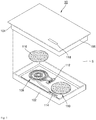
- FIG. 1 is a schematic representation of an induction heating device according to an embodiment.
- an induction heating device 10 may include a casing 102 constituting a main body, and a cover plate 104 that may be coupled to the casing 102 to seal the casing 102.
- the cover plate 104 may be coupled with a top face of the casing 102 to seal a space S defined inside the casing 102 from the outside.
- the cover plate 104 may include a plate 106 on which a cooking vessel such as a cooking vessel (for example, a cooking pot or pan or container) may be placed.
- the plate 106 may be made of a tempered glass material such as ceramic glass.
- working coil assemblies 108 and 110 that may heat the cooking vessel may be provided in the space S formed inside the casing 102.
- an interface 114 may be further provided that allows a user to apply power, to control an output of the working coil assembles 108 and 110, and to view displayed information related to the induction heating device 10.
- the interface 114 may be a touch panel capable of both information input via touch and information output via display.
- embodiments disclosed herein are not limited thereto, and an interface 114 having a different configuration may be used.
- a manipulation region 118 may be provided with the plate 106 at a position that corresponds to the interface 114.
- the manipulation region 118 may be pre-printed with characters and images, for example. The user may perform a desired manipulation by touching a specific point in the manipulation region 118 corresponding to the pre-printed character or image.
- the information output from the interface 114 may be displayed through the plate 106.
- a power supply 112 that supplies power to the working coil assemblies 108 and 110 and the interface 114 may be provided in the space S formed inside the casing 102.
- the two working coil assemblies 108 and 110 are shown inside the casing 102. However, in other embodiments disclosed herein, one working coil assembly may be provided within the casing 102, or three or more working coil assemblies may be provided.
- Each of the working coil assemblies 108 and 110 may include a working coil that generates an inductive magnetic field using a high frequency alternating current supplied thereto by the power supply 112, and a thermal insulating sheet 116 that protects the coil from heat generated by a cooking vessel. Depending on the embodiment, the thermal insulating sheet 116 may be omitted.
- a controller 70 may be provided in the space S formed inside the casing 102. The controller 70 may receive a user command via the interface 114 and may control the power supply 112 to activate or deactivate the power supplied to the working coil in the working coil assemblies 108 and 110 based on the user command.
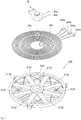
- Figure 2 is a perspective view showing a structure of a working coil assembly included in an induction heating device according to an embodiment.
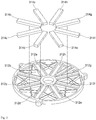
- Figure 3 is a perspective view showing a coil base included in the working coil assembly according to an embodiment.
- the working coil assembly may include a first working coil 202, a second working coil 204, and a coil base 206.
- the first working coil 202 may be mounted on the coil base 206 and may be wound circularly by a first rotation count in a radial direction.
- a second working coil 204 may be mounted on the coil base 206, and may be wound concentrically with the first working coil 202 in a circular shape by a second rotation count in the radial direction.
- the first working coil 202 may be located inside the second working coil 204.
- a rotation count of the first working coil 202 and a rotation count of the second working coil 204 may vary.
- the sum of the rotation count of the first working coil 202 and the rotation count of the second working coil 204 may be limited by a size of the coil base 206 and specifications of the induction heating device and a wireless power transmission device.
- Both ends of the first working coil 202 and both ends of the second working coil 204 may extend outside the first working coil 202 and the second working coil 204, respectively.
- Connectors 204a and 204b may be respectively connected to both ends of the first working coil 202, while connectors 204c and 204d may be respectively connected to both ends of the second working coil 204.
- the first working coil 202 and the second working coil 204 may be electrically connected to the controller 70 or the power supply 112 via the connectors 204a, 204b, 204c and 204d.
- each of the connectors 204a, 204b, 204c, and 204d may be implemented as a conductive connection terminal.
- the coil base 206 may accommodate the first working coil 202 and the second working coil 204, and may be made of a nonconductive material. In the region where the first working coil 202 and the second working coil 204 are mounted, receptacles 212a to 212h may be formed in the lower portion of the coil base 206 to receive magnetic sheets; for example, ferrite sheets as described hereinafter.
- receptacles 312a to 312h may be formed at the lower portions of the coil base 206 to accommodate ferrite sheets 314a to 314h.
- the ferrite sheets 314a to 314h may extend in a radial direction of the first working coil 202 and the second working coil 204.
- a number, shape, position, and cross-sectional area of ferrite sheets 314a to 314h may vary depending on the embodiment.
- the first working coil 202 and the second working coil 204 may be mounted on the coil base 206.
- a magnetic sheet such as ferrite sheets 314a to 314h, may be mounted under the first working coil 202 and the second working coil 204. This magnetic sheet may prevent a flux generated by the first working coil 202 and the second working coil 204 from being directed below the coil base 206, which may increase a flux density produced by the first working coil 202 and the second working coil 204.
- a cooking vessel sensor 20 may be provided in a central region of the first working coil 202. In Figure 2 , the cooking vessel sensor 20 may be provided concentrically with the first working coil 202, but depending on the embodiment, a position of the cooking vesselcooking vessel sensor 20 may vary.
- a sensing coil 44 may be wound by a predetermined rotation count on an outer face of a body of the cooking vessel sensor 20. Both ends of the sensing coil 44 may be connected to connectors 62a and 62b, respectively. The sensing coil may be electrically connected to the controller 70 or the power supply 112 via the connectors 62a and 62b. The controller 70 may supply current to the sensing coil 44 through the connectors 62a and 62b of the cooking vessel sensor 20 to determine a type of the cooking vessel; that is, the controller may determine whether or not the cooking vessel has inductive heating properties, or whether or not an eddy current can occur in the cooking vessel.
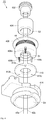
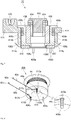
- Figure 4 is a perspective view of each component of a cooking vessel sensor according to an embodiment.
- Figure 5 is a perspective view showing a configuration of a body included in a cooking vessel sensor according to an embodiment.
- Figure 6 is a perspective view showing a structure of a body included in a cooking vessel sensor according to another embodiment.
- Figure 7 is a vertical cross-sectional view showing an assembled state of components constituting the cooking vessel sensor according to an embodiment.
- Figure 8 is a perspective view showing combined body and substrate according to an embodiment.
- the cooking vesselcooking vessel sensor 20 may include a temperature sensor 402, a magnetic core 404, a body 406, a substrate 410, and a guide 414.
- the body 406 may have a hollow cylindrical shape.
- a first receiving space S1 that accommodates the magnetic core 404 may be defined inside the body 406.
- the magnetic core 404 may have a hollow cylindrical shape and may be made of a magnetic material, such as ferrite.
- the magnetic core 404 may increase the density of the flux induced in the sensing coil 44 when current flows through the sensing coil 44.
- a second receiving space S2 may be formed inside the magnetic core 404.
- a temperature sensor 402 may be received within the second receiving space S2 of the magnetic core 404.
- the temperature sensor 402 may be configured to measure a temperature of a cooking vessel.
- the temperature sensor may have wires 42a and 42b that may electrically connect to the controller 70 or the power supply 112.
- the wires 42a and 42b of the temperature sensor 402 may extend outwardly through an open bottom of the magnetic core 404, an open bottom of the body 406, and an opening in the substrate 410.
- a first flange 406c may extend horizontally outward from a top of the body 406.
- the first flange 406c may engage with a top end of the hollow guide 414 and may support the body 406 when the body 406 is inserted into the hollow guide 414.
- a second flange 406d may extend horizontally outward from a lower end of the body 406. The second flange 406d may engage with the magnetic core 404 to support the magnetic core 404 when the magnetic core 404 is inserted into the first receiving space S1 of the body 406.
- the sensing coil 44 may be wound by a predetermined rotation count.
- the body 406 may have an upper hollow portion or first outer face 406a having a relatively small outer diameter, and a lower hollow portion or second outer face 406b having an outer diameter larger than that of the upper hollow portion 406a.
- the sensing coil 44 may be wound on the outer face of the upper hollow portion 406a.
- the hollow guide 414 may have a third receiving space S3 defined therein.
- an outer face of the lower hollow portion 406b may be in contact with the inner side face of the hollow guide 414.
- the sensing coil 44 may be provided between the inner side face of the hollow guide 414 and the outer side face of the upper hollow portion 406a.
- the outer diameters of the upper hollow portion 406a and the lower hollow portion 406b may be configured such that the sensing coil 44 wound on the upper hollow portion 406a does not contact the inner face of the hollow guide 414 when the body 406 is inserted into or removed out of the hollow guide 414.
- the sensing coil 44 wound on the outer face of the upper hollow portion 406a may extend out of the body 406 to electrically connect with the controller 70 or the power supply 112.
- a coil outlet or coil outlet channel 430 that draws the sensing coil 44 to the outside of the body 406 may be defined in the body 406.
- a vertical coil outlet 430 having a hole shape from where the sensing coil 44, wound on the upper hollow portion 406a to the outside of the body 406, extends may be vertically defined in the lower hollow portion 406b of the body 406.
- the sensing coil 44 may thus be directly electrically coupled with the controller 70 or the power supply 112 through the coil outlet 430.
- a substrate 410 may not be provided.
- the sensing coil 44 may be wound on a lead pin (not shown) passing through a lead pin channel 432 defined vertically in the lower hollow portion or second outer face 406b of the body 406.
- the lead pin may extend in a predetermined direction through a substrate 410, and may be like lead pin 408c.
- a coil outlet 430 having a groove form may be defined vertically in the lower hollow portion 406b of the body 406.
- the sensing coil 44 wound around the up-per hollow portion 406a may extend out of the body via coil outlet 430.
- the sensing coil 44 wound on the upper hollow portion 406a may pass through the coil outlet 430, may be drawn out of the body 406, and then may be directly connected to the controller 70 or the power supply 112. In this case, a substrate 410 may not be provided.
- the sensing coil 44 may be easily drawn out of the body 406 without contacting the inner side face of the hollow guide 414.
- the sensing coil 44 may be wound on a lead pin passing through a lead pin channel 432 defined vertically in the lower hollow portion 406b of the body 406.
- the lead pin may extend in a predetermined direction through a substrate 410.
- the sensing coil 44 may be electrically connected to the controller 70 or the power supply 112. A current may be applied to the sensing coil 44 to determine the type of the cooking vessel under control of the controller 70.
- the sensing coil 44 may wound on the upper hollow portion 406a of the body 406, and then the sensing coil 44 may be wound on lead pins 408a, 408b and/or 408c.
- the lead pins 408a, 408b, and 408c may respectively pass through the coil outlet 430 or the lead pin channel 432 defined in the lower hollow portion 406b and may be drawn out of the body 406.
- one or a first end of the coil 44 may be wound on a first lead pin 408a and the other or a second end of the sensing coil 44 may be wound on a second lead pin 408b.
- multiple coil outlets may be defined, through which at least two lead pins (that is, 408a, around which one end of the sensing coil 44 may be would, and 408b, around which the other end of the sensing coil 44 may be wound) respectively may pass.
- a third lead pin 408c may additionally be provided for rigid coupling between the body 406 and a substrate 410.
- the substrate 410 may be provided on a lower end of the body.
- the lead pins 408a, 408b, and 408c may pass through the substrate 410.
- the substrate may have lead pin holes 412a, 412b and 412c defined therein to correspond to the lead-pins 408a, 408b, and 408c.
- the lead pins 408a, 408b, and 408c may pass through the holes 412a, 412b, and 412c respectively.
- the body 406 and the substrate 410 may be combined.
- the substrate 410 may be coupled to the lower end of the body 406 and may extend the sensing coil 44, which is wound on the lead-pins 408a and 408b, along a predetermined direction.
- the hollow body 406 receiving the magnetic core 404 and temperature sensor 402 therein may be placed in the third receiving space S3 formed within the hollow guide 414.
- the hollow guide 414 may position the body 406, the magnetic core 404, and the temperature sensor 402 into a central region 230 of the coil base 206 as shown in Figure 2 .
- the hollow guide 414 may include a guiding portion or guide 414a and an engaged portion 414b.
- the guiding portion 414a may have an inclined face to guide the hollow guide 414 to be inserted into the central region 230 so that it may couple with the coil base 206.
- the guiding portion 414a may have a stopper to prevent the hollow guide 414 from disengaging from the central region 230 after the hollow guide 414 is inserted into the central region 230.
- the engaged portion 414b may have an outer diameter corresponding to a diameter of the central region 230 of the coil base 206.
- the engaged portion 414b may maintain contact with the central region 230 when the hollow guide 414 is inserted into the central region 230.
- the hollow guide 414 may be inserted, coupled, and secured into the central region 230 of the coil base 206.
- the hollow guide 414 may have an auxiliary side portion in which a receiving space 420 may be formed. Within the receiving space 420 of the auxiliary side portion, another unit or module, like the controller 70, may be accommodated.
- the cooking vessel sensor may determine a type of the cooking vessel by measuring a current flowing through the sensing coil 44, and also by measuring a temperature of the cooking vessel using the temperature sensor 402.
- the temperature sensor 402 may be received within the body 406, an overall size and volume of the induction heating device may be reduced as compared with a structure in which a temperature sensor and a cooking vessel sensor are provided separately.
- a placement of the sensors and utilization of the space inside the induction heating device becomes more flexible.
- Figure 8 is a perspective view showing a combined state of the body and substrate according to an embodiment.
- the lead pins 408a, 408b, and 408c may pass through the lead pin holes 412a, 412b, and 412c, respectively, so that the body 406 and the substrate 410 may be coupled firmly to each other.
- one end of the sensing coil 44 wound on the outer face of the body 406 is wound on a first lead-pin 408a, while the other end of the sensing coil 44 is wound on a second lead-pin 408b.
- first pads or pinhole pads 610a and 610b may be formed around the first lead pin hole 412a and second lead pin hole 412b defined in the substrate 410, respectively.
- the first pads or pinhole pads 610a and 610b may be made of a conductor such as a metal.
- the first pads or pinhole pads 610a and 610b may be electrically and respectively connected to the sensing coil 44 wound on the first lead pin 408a and the second lead pin 408b via bonding such as soldering.
- the first pads or pinhole pads 610a and 610b may be electrically connected to second pads or wire pads 612a and 612b formed on the substrate 410, respectively.
- the second pads or wire 612a and 612b are made of a conductor, such as a metal, in a similar way to the first pads or pinhole pads 610a and 610b. Positions of the second pads or wire pads 612a and 612b on the substrate 410 may vary according to the embodiment.
- the second pads or wire pads 612a and 612b may be respectively connected to wires 60a and 60b made of a conductor such as a metal. Further, one end of each of the wires 60a and 60b may be connected to each of connectors 62a and 62b that connect to the controller 70 or the power supply 112.
- the sensing coil 44 wound on the outer face of the body 406 may pass through the first pads or pinhole pads 610a and 610b, the second pads or wire pads 612a and 612b, the wires 60a and 60b, and the connectors 62a and 62b, so that it may be electrically connected to a controller 70 or a power supply 112.
- the sensing coil 44 wound on the outer face of the body 406 may be extended in a predetermined direction via the substrate 410.
- the body 406 may be inserted into the third receiving space S3 of the hollow guide 414 with the sensing coil 44 wound around the body 406.
- the lead pins 408a and 408b may guide both ends of the sensing coil 44 out of the body 406 and the hollow guide 414 when the body 406 is inserted into the hollow guide 414.
- both ends of the sensing coil 44 may be directly connected to the controller 70 or the power supply 112.
- a force may be applied to the sensing coil 44.
- the sensing coil 44 may be disengaged from the lead pins 408a and 408b, or the sensing coil 44 may be disconnected.
- the sensing coil 44 connected to the lead pins 408a and 408b may be electrically connected to the first pads or pinhole pads 610a and 610b and the second pads or wire pads 612a and 612b.
- the wires 60a and 60b connected to the second pads or wire pads 612a and 612b may be connected to the controller 70 or the power supply 112. In this case, even when external force is applied to the sensing coil 44, the sensing coil 44 may stay engaged with the lead pins 408a and 408b, or the sensing coil 44 may be prevented from being disconnected.
- the connection between the sensing coil 44 and the controller 70 and/or power supply 112 may be limited. Accordingly, the arrangement of the controller 70 and the power supply 112 may also be limited.
- the connection of the wires 60a and 60b may be freely set based on the positions of the second pads or wire pads 612a and 612b.
- the arrangement of the controller 70 or the power supply 112 may be freely set.
- the second pads or wire pads 612a and 612b may not be disposed on the substrate 410.
- the wires 60a and 60b may be electrically connected directly to the first pads or pinhole pads 610a and 610b, respectively. By adjusting the connection points between the wires 60a and 60b and the first pads or pinhole pads 610a and 610b, the connection between the wires 60a and 60b and the controller 70 or the power supply 112 may be freely set.
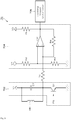
- FIG 9 is a circuit diagram of a controller according to one embodiment of the present disclosure.
- a controller 70 may include a resonant signal generator 702, a comparator unit 704, and a cooking vessel determiner 706.
- the resonant signal generator 702 may include a capacitor C1 connected in parallel with the sensing coil 44.
- the sensing coil 44 and capacitor C1 may be connected between a first power supply V1 and a ground terminal.
- the first power supply V1 may supply current to the sensing coil 44 and capacitor C1.
- a switching element S1 may be connected between the sensing coil 44 and the capacitor C1, and the ground terminal.
- the switching element S1 may repeatedly perform the switching operation, that is, turn-on and turn-off thereof to allow a current with a predetermined amplitude, magnitude, and/or phase to flow through the sensing coil 44 and capacitor C1.
- a switching signal PS having a predetermined period may be input at one end of the switching element S1.
- the sensing coil 44 and the capacitor C1 cause a resonance phenomenon (LC resonance). According to this resonance phenomenon, a resonant signal which is damped over time may be generated.
- the generated resonant signal may be input into a comparator CP included in the comparator unit 704.
- the comparator unit 704 may include a comparator CP, may compare a resonant signal generated by the resonant signal generator 702 with a reference signal to generate a square waveform.
- the comparator CP may be configured to compare a resonant signal generated by the resonant signal generator 702 with a reference signal generated by a second power supply V2, and may output a comparison result. More specifically, the comparator CP may compare the voltage magnitude of the reference signal generated by the second power supply V2 with the voltage magnitude of the resonant signal generated by the resonant signal generator 702. Then, the comparator CP outputs an output signal having voltage magnitude levels that vary based on the comparison result. Thus, the output signal may represent a square waveform.
- the comparator CP may output a signal having a voltage magnitude of a first level, for example, 5V. If the voltage magnitude of the resonant signal is less than the voltage magnitude of the reference signal, the comparator CP may output a signal having a voltage magnitude of a second level, for example, 0V.
- the voltage magnitude of the reference signal generated by the second power supply V2 may be set differently by adjusting the magnitudes of voltage-dividing resistors R2 and R3.
- the cooking vessel determiner 706 may count the number of square waveform pulses output from the comparator unit 704.
- the cooking vessel determiner 706 may compare the counted number of pulses of the square waveform with a predetermined reference value and may then determine the type of the cooking vessel (inductive or non-inductive) based on the comparison result. In an exemplary embodiment, if the counted number of pulses of the square waveform is less than or equal to a predetermined reference value, the cooking vessel determiner 706 may determine that the cooking vessel is inductive, or has an inductive heating property. If the counted number of pulses of the square waveform exceeds a predetermined reference value, the cooking vessel determiner 706 may determine that the cooking vessel is a cooking vessel heating cooking vessel.
- the controller 70 may further include various other resistors and power supplies, such as R1, R4, and R5 and/or V3 shown in the exemplary embodiment of Figure 9 .
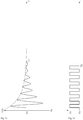
- Figure 10 shows a waveform of a resonant signal output by a resonant signal generator 702 of the controller 70 when there is no object or cooking vessel with an inductive heating property near or around the cooking vessel sensor 20.
- Figure 11 shows a waveform of an output square wave when a comparator CP of the controller 70 converts the resonant signal shown in Figure 10 .
- a current having a predetermined amplitude, magnitude, and/or phase may be supplied to the sensing coil 44 and the capacitor C1 via the switching operation of the switching element S1, causing resonance phenomena, or LC resonance.
- the resonant signal generator 702 may output a resonant signal that attenuates over time t, as shown in Figure 10 .
- the impedance of the circuit including the sensing coil 44 and capacitor C1 may be kept lower when there is no cooking vessel with inductive heating properties near or around the cooking vessel sensor 20 than when there is an inductive object or cooking vessel, or an object or cooking vessel with inductive heating properties, near or around the cooking vessel sensor 20. Therefore, as shown in Figure 10 which exemplifies the former case, the resonant signal output by the resonant signal generator 702 attenuates for a relatively long time due to a lower impedance, and then disappears at time T1.
- the comparator CP of comparator unit 704 may receive the resonant signal as shown in Figure 10 .
- the comparator CP may compare the voltage magnitude of the input resonant signal with the voltage magnitude of the reference signal; for example, 5V. Thus, only when the voltage magnitude of the received resonant signal is greater than or equal to the voltage magnitude of the reference signal, the comparator CP may output a signal of the first level, for example, 5V. Otherwise, the comparator CP may output a signal of the second level; for example, 0V.
- the waveform of the output signal from the comparator CP may be expressed as a square waveform as shown in Fig. 11 .
- the impedance of the circuit including the sensing coil 44 and capacitor C1 may be kept relatively lower when there is no inductive cooking vessel near or around the cooking vessel sensor 20 than when there is an inductive cooking vessel around the cooking vessel sensor 20. Therefore, in the former case exemplified by Figures 10 and 11 , the resonant signal output by the resonant signal generator 702 may attenuate for a relatively long time, and may ultimately disappear at time T1. Thus, as shown in Figure 11 , a total of, for example, 16 square waveform pulses are generated until time T1 is reached.
- Figure 12 shows a waveform of a resonant signal output by the resonant signal generator 702 when an inductive cooking vessel, or a cooking vessel with inductive heating properties, is present near or around the cooking vessel sensor 20.
- Figure 13 shows a waveform of a square waveform output when the comparator CP of the cooking vessel sensor 20 converts the resonant signal shown in Figure 12 .
- a current having a predetermined amplitude, magnitude, and/or phase may be supplied to the sensing coil 44 and the capacitor C1 via the switching operation of the switching element S1, which may cause resonance phenomena, or LC resonance.
- the resonant signal generator 702 may output a resonant signal that attenuates over time t, as shown in Figure 12 .
- the impedance of the circuit that includes the sensing coil 44 and capacitor C1 may be kept relatively higher when a cooking vessel with an inductive heating property is present near or around the cooking vessel sensor than when there is no such object or cooking vessel present.
- the resonant signal output by the resonant signal generator 702 may attenuate for a relatively short time, due to the higher impedance, and then disappear at time t2.
- the comparator CP of the comparator unit 704 may receive the resonant signal as shown in Figure 12 .
- the comparator CP may compare the voltage magnitude of the input resonant signal with the voltage magnitude of the reference signal, which may be, for example, 5V. Thus, only when the voltage magnitude of the received resonant signal is greater than or equal to the voltage magnitude of the set reference signal, the comparator CP may output a signal of the first level; for example, 5V. Otherwise, the comparator CP may output a signal of the second level; for example, 0V. In this way, the waveform of the output signal from the comparator CP may be expressed as a square waveform, as shown in Figure 13 .
- the impedance of the circuit including the sensing coil 44 and capacitor C1 may be kept higher when there is an inductive cooking vessel near or around the cooking vessel sensor 20 than when there is no such cooking vessel present. Therefore, in the former case, the resonant signal output by the resonant signal generator 702 may attenuate for a relatively short time, and then may disappear at time T2. Thus, as shown in Figure 13 , a total of 7 square waveform pulses, for example, may be generated until time T2 is reached.
- the number of square waveform pulses output by the comparator unit 704 may be higher when there is no inductive cooking vessel with inductive heating properties around the cooking vessel sensor 20 than there is when an inductive cooking vessel having inductive heating properties near or around the cooking vessel sensor 20.
- the cooking vessel determiner 706 may count the number of square waveform pulses output by the comparator unit 704 and may compare the counted number of pulses of the square waveform to a predetermined reference value. Then, the cooking vessel determiner 706 may accurately determine, based on the comparison result, whether or not there is an object or a cooking vessel having an inductive heating property near or around the cooking vessel sensor.
- the cooking vessel determiner 706 may determine that the cooking vessel has an inductive heating property. Conversely, if the counted number of pulses in the square waveform exceeds the predetermined reference value, the cooking vessel determiner 706 may determine that the cooking vessel is a non-inductive heating cooking vessel.
- the reference value referenced by the cooking vessel determiner 706 may be determined as follows. First, an inductive heating cooking vessel and a non-inductive heating cooking vessel may be provided near or around the cooking vessel sensor. Then, a cooking vessel sensing operation may be performed on the inductive heating loaded object and the non-inductive heating cooking vessel. Then, based on the number of square waveform pulses obtained by the sensing operation, the reference value may be determined experimentally. Further, the set reference value may be calibrated based on environmental factors such as temperature around the cooking vessel sensor.
- FIG 14 is a flow chart of a cooking vessel sensing method performed by an induction heating device according to an embodiment.
- a controller such as controller 70 included in the induction heating device according to an embodiment may apply current to a sensing coil, such as sensing coil 44 (operation 1202).
- the controller may apply switching signal PS to a switching element, such as switching element, S1 in order to apply a current having a predetermined amplitude, magnitude, and/or phase to the sensing coil and a capacitor, such as capacitor C1, which may be connected in parallel to the sensing coil.
- Such a current application may be performed at a predetermined cycle (for example, every 1 second or 5 seconds).
- an LC resonant signal due to resonance between the sensing coil and the capacitor may be output.
- the controller may convert the resonant signal generated when current is applied to the sensing coil into a square waveform (operation 1204).
- the operation 1204 that converts the resonant signal to the square waveform may include an operation that generates a square waveform by comparing the resonant signal with a predetermined reference signal.
- the controller may determine the type of the cooking vessel (that is, whether or not it has an inductive heating property) based on the counted number of pulses of the converted square wave-form (operation 1206). As described above, the controller may compare the counted number of pulses of the transformed square waveform with a predetermined reference value. Based on the comparison result, the controller may determine whether a cooking vessel having an inductive heating property exists or a non-inductive heating cooking vessel exists around a cooking vessel sensor, such as cooking vessel sensor 20.
- the operation 1206 that determines the type of the cooking vessel based on the counted number of pulses of the transformed square waveform may be performed as follows. If the counted number of pulses of the square waveform is smaller than or equal to a predetermined reference value, the controller may determine that the cooking vessel has an inductive heating property. Conversely, if the counted number of pulses in the square waveform exceeds the predetermined reference value, the controller may determine that the cooking vessel is a non-inductive heating cooking vessel.
- the controller may convert the resonant signal according to a resonance phenomenon generated when current is applied to the sensing coil into a square wave-form. Then, the controller may count the number of pulses of the square waveform to accurately perform the cooking vessel sensing. Such cooking vessel sensing may be repeatedly performed with a predetermined cycle (for example, every 1 second or 0.5 seconds). As a result, embodiments disclosed herein can accurately and quickly determine the type of cooking vessels placed on the induction heating device by the user while consuming less power than in related art.
- Figure 15 shows the manipulation region 118 of the induction heating device according to an embodiment.
- Figure 15 shows an embodiment of the manipulation region 118 located in the plate 106 of Figure 1 as described above.
- the manipulation region 118 may include heating region buttons 802a, 804a, and 806a that respectively indicate positions of heating regions included in the induction heating device.
- the manipulation region 118 may include a heating power button 810 that controls the heating power of each heating region.
- information about the three heating regions may be displayed in the manipulation region 118; however, embodiments are not limited thereto.
- the number of heating regions included in the induction heating device may vary depending on the embodiment. Current heating powers of the corresponding heating regions may be respectively indicated by corresponding numbers in heating power displays 802b, 804b, and 806b.
- the manipulation region 118 may further include a turbo display region that indicates a state in which a particular heating region is rapidly heated.
- a user places a cooking vessel he wants to use on a designated heating region.
- the user must indicate with a button the heating region on which the cooking vessel was placed.
- the user must then input the heating power to be applied to the cooking vessel placed on the heating region via another button.
- a conventional induction heating device sense the cooking vessel and/or determine whether the cooking vessel on the designated heating region selected by the user has an inductive heating property.
- the induction heating device applies a current to a working coil corresponding to the selected heating region to perform a heating operation that reaches the heating power designated by the user. So, according to the related art, after the user places the cooking vessel in a certain heating region, the user must specify the specific heating region to be heated via the touch of the cooking vessel selection button.
- a current is applied to the sensing coil 44 of the cooking vessel sensor 20 repeatedly at a predetermined time interval (for example, 1 second or 0.5 seconds), and, thus, the type of the cooking vessel is determined in real time based on the result.
- a predetermined time interval for example, 1 second or 0.5 seconds
- the type of the cooking vessel may be determined immediately after the predetermined time interval elapses without further action by the user.
- the induction heating device does not wait for the user to select one of the heating region selection buttons 802a, 804a, or 806a to determine whether the cooking vessel is inductive, and may also further indicate that a certain heating region is available on one of the heating power displays 802b, 804b, or 806b corresponding to the heating region on which the cooking vessel was placed using a character or number (for example, 0).
- a character or number for example, 0
- the user may input a heating power to be applied to the corresponding heating region via the touch of the heating power button 810. Then, the heating power input is immediately displayed in the corresponding heating power display.
- the induction heating device then applies a current to the working coil 108 so that the heating power of the corresponding heating region reaches the heating power input by the user.
- a number or letter for example, u
- the heating power display at least one of 802b, 804n, or 806b
- the induction heating device disclosed herein may eliminate an input operation by the user that selects the heating region. Further, when the user places a cooking vessel on any heating region, the induction heating device may display, on each heating power display 802b, 804b, and 806b, within a very short period of time, whether the corresponding cooking vessel has an inductive heating property. Therefore, the user may intuitively and quickly check the type of the cooking vessel that the user puts.
- Embodiments disclosed herein aim to provide an induction heating device and a method for sensing a cooking vessel on the induction heating device, which may be capable of accurately and quickly determining the type of a cooking vessel (that is, whether or not the cooking vessel has inductive heating properties) while consuming less power than a conventional one. Further, embodiments disclosed herein are intended to provide an induction heating device and a method for sensing a cooking vessel on the induction heating device, which may be capable of simultaneously measuring a temperature of the cooking vessel and determining the type of the cooking vessel.
- embodiments disclosed herein are intended to provide an induction heating device and a method for sensing a cooking vessel on the induction heating device that immediately determines the type of the cooking vessel after the user places the cooking vessel on the induction heating devicecooking vessel, thereby eliminating the need for a user to input or select a heating region.
- Embodiments disclosed herein are not limited to the above-mentioned purposes. Other purposes and advantages of the disclosed embodiments, as not mentioned above, may be understood from the following descriptions and more clearly understood from the embodiments disclosed herein. Further, it will be readily appreciated that the objects and advantages of the embodiments disclosed herein may be realized by features and combinations thereof as disclosed in the claims.
- Embodiments disclosed herein may provide an induction heating device with a new cooking vessel sensor for accurately determining a type of the cooking vessel while consuming less power than in the related art.
- the new cooking vessel sensor according to an embodiment may have a cylindrical hollow body with a sensing coil wound on an outer face thereof. Further, a temperature sensor may be accommodated in a receiving space formed inside the body of the cooking vessel sensor.
- the cooking vessel sensor may be provided in a central region of the working coil and concentrically with the working coil. The cooking vessel sensor may determine the type of cooking vessel (or whether or not it is inductive) placed at the corresponding position to the working coil and simultaneously measure the temperature of the cooking vessel.
- the sensing coil included in the cooking vessel sensor according to embodiments disclosed herein may have fewer rotation counts and a smaller total length than those of the working coil. Accordingly, the cooking vessel sensor according to disclosed embodiments may identify the type of the cooking vessel while consuming less power as compared with the determination method of the cooking vessel using a conventional working coil.
- the temperature sensor may be accommodated in the internal space of the cooking vessel sensor according to embodiments disclosed herein. Accordingly, there is an advantage that the temperature may be measured at the same time as the type of the cooking vessel may be determined, and the cooking vessel sensor may have a smaller size and volume than a conventional sensor.
- a controller in accordance with the embodiments disclosed herein may convert a resonance waveform generated as the current that is applied to the sensing coil into a square waveform.
- the controller may determine the type of the cooking vessel (that is, whether or not it has an inductive heating property) based on the number of pulses of the converted square waveform, leading to an improved determination method of the type of the cooking vessel compared to conventional approaches.
- An induction heating device may include a plate on which a cooking vessel is placed; a working coil provided below the plate that may heat the cooking vessel using an inductive current; a cooking vessel sensor provided concentrically with the working coil, wherein the cooking vessel sensor includes a body and a sensing coil wound on the body, wherein the working coil surrounds the cooking vessel sensor; and a controller configured to apply a current to the sensing coil to generate a resonant signal, and to determine, based on the generated resonant signal, whether or not the cooking vessel has an inductive heating property, wherein the controller may be configured to convert the resonant signal into a square waveform; compare a number of pulses of the square wave-form with a predetermined reference value; and determine, based on the comparison result, whether the cooking vessel has an inductive heating property.
- the controller may determine that the cooking vessel has an inductive heating property; and when the number of pulses of the square waveform exceeds the predetermined reference value, the controller may determine that the cooking vessel is a non-inductive heating cooking vessel.
- the controller may include a resonant signal generator configured to apply a current having a predetermined frequency to the sensing coil to generate a resonant signal; a comparator configured to compare the resonant signal generated from the resonant signal generator with a reference signal to generate the square waveform; and a cooking vessel determiner, wherein the cooking vessel determiner may be configured to count the number of pulses of the square waveform output from the comparator; compare the counted number of pulses of the square waveform with the predetermined reference value; and determine, based on the comparison result, whether or not the cooking vessel has an inductive heating property.
- the body may include a cylindrical hollow body having a first receiving space defined therein; wherein the cylindrical hollow body has a side wall or side wall portion having a coil outlet or coil outlet channel defined therein, wherein the sensing coil passes though the coil outlet out of the body.
- the coil outlet may include at least two coil outlets or coil outlet channels, wherein the cooking vessel sensor has at least two lead pins, wherein the sensing coil is wound around the two lead pins, and wherein the lead pins pass through the coil outlets or coil outlet channels respectively.
- the cooking vessel sensor may further include a substrate coupled to the body at a sensing coil outlet side, wherein the substrate may be configured to guide an extension of the pins in a predetermined direction.
- the substrate may include at least two lead pin holes in which the at least two lead pins may pass; and at least two first conductive lead pads or pinhole pads formed around the at least two lead pin holes, wherein the at least two first lead pads are electrically connected to the sensing coil wound around the at least two lead pins.
- the substrate may further include at least two second conductive pads or wire pads electrically connected to the at least two first pads, respectively.
- the body may include a cylindrical hollow body having a first receiving space defined therein; wherein the cooking vessel sensor may further include a hollow cylindrical magnetic core received in the first space, wherein the hollow magnetic core has a second receiving space defined therein. In an exemplary embodiment, the cooking vessel sensor may further include a temperature sensor housed in the second receiving space.
- the body may have lower and upper portions (or first and second outer faces) having different outer diameters, wherein the sensing coil may be wound on an outer face of one of the lower and upper portions, wherein said one of the lower and upper portions has a smaller outer diameter than the other of the lower and upper potions.
- the cooking vessel sensor may further include a guide having a third receiving space defined therein that receives the body therein, wherein the induction heating device may have a coil base on which a working coil is provided, wherein the guide has a guiding and engaged structure that guides the body and is engaged with the coil base.
- Embodiments disclosed herein may provide a method that determines whether a cooking vessel provided on an induction heating device has inductive heating properties, wherein the induction heating device may include a sensing coil, and wherein the method may comprise applying a current to the sensing coil to generate a resonant signal; converting the resonant signal into a square waveform; comparing a number of pulses of the square waveform with a predetermined reference value; and determining, based on the comparison result, whether the cooking vessel is inductive or has an inductive heating property.
- Embodiments disclosed herein may determine, based on the comparison result, whether the cooking vessel has an inductive heating property, wherein such determination may include determining that the cooking vessel has an inductive heating property when the number of the pulses of the square waveform is equal to or smaller than a predetermined reference value; and determining that the cooking vessel is a non-inductive heating cooking vessel when the number of pulses of the square waveform exceeds the predetermined reference value.
- converting the resonant signal into the square waveform may include comparing the resonant signal with a predetermined reference signal to generate the square waveform.
- Embodiments disclosed herein may be capable of accurately and quickly determining the type of a cooking vessel (that is, whether or not the cooking vessel has inductive heating properties) while consuming less power than in conventional induction heating devices or conventional methods for sensing a cooking vessel on a conventional induction heating device. Further, embodiments disclosed herein may simultaneously perform a temperature measurement of the cooking vessel and a determination of the type of the cooking vessel. Moreover, embodiments disclosed herein may automatically determine the type of the cooking vessel immediately after the user places a cooking vessel on the induction heating device, thereby eliminating the need for a user action that inputs a heating region selection.
- first, second, third, etc. may be used herein to describe various elements, components, regions, layers and/or sections, these elements, components, regions, layers and/or sections should not be limited by these terms. They are only used to distinguish one element, component, region, layer or section from another region, layer or section. Thus, a first element, component, region, layer or section could be termed a second element, component, region, layer or section without departing from the teachings of the present invention.
- spatially relative terms such as “lower”, “upper” and the like, may be used herein for ease of description to describe the relationship of one element or feature to another element(s) or feature(s) as illustrated in the figures. It will be understood that the spatially relative terms are intended to encompass different orientations of the device in use or operation, in addition to the orientation depicted in the figures. For example, if the device in the figures is turned over, elements described as “lower” relative to other elements or features would then be oriented “upper” relative the other elements or features. Thus, the exemplary term “lower” can encompass both an orientation of above and below. The device may be otherwise oriented (rotated 90 degrees or at other orientations) and the spatially relative descriptors used herein interpreted accordingly.
- Embodiments of the disclosure are described herein with reference to cross-section illustrations that are schematic illustrations of idealized embodiments (and intermediate structures) of the disclosure. As such, variations from the shapes of the illustrations as a result, for example, of manufacturing techniques and/or tolerances, are to be expected. Thus, embodiments of the disclosure should not be construed as limited to the particular shapes of regions illustrated herein but are to include deviations in shapes that result, for example, from manufacturing.
- any reference in this specification to "one embodiment,” “an embodiment,” “example embodiment,” etc. means that a particular feature, structure, or characteristic described in connection with the embodiment is included in at least one embodiment.
- the appearances of such phrases in various places in the specification are not necessarily all referring to the same embodiment.
Landscapes
- Physics & Mathematics (AREA)
- Electromagnetism (AREA)
- General Physics & Mathematics (AREA)
- Induction Heating Cooking Devices (AREA)
Applications Claiming Priority (1)
| Application Number | Priority Date | Filing Date | Title |
|---|---|---|---|
| KR1020170080800A KR102069583B1 (ko) | 2017-06-26 | 2017-06-26 | 유도 가열 장치 및 유도 가열 장치의 용기 감지 방법 |
Publications (1)
| Publication Number | Publication Date |
|---|---|
| EP3422812A1 true EP3422812A1 (de) | 2019-01-02 |
Family
ID=62791615
Family Applications (1)
| Application Number | Title | Priority Date | Filing Date |
|---|---|---|---|
| EP18179877.8A Pending EP3422812A1 (de) | 2017-06-26 | 2018-06-26 | Induktionserwärmungsvorrichtung und verfahren zur erfassung eines kochgefässes an einer induktionserwärmungsvorrichtung |
Country Status (3)
| Country | Link |
|---|---|
| US (2) | US11178732B2 (de) |
| EP (1) | EP3422812A1 (de) |
| KR (1) | KR102069583B1 (de) |
Cited By (1)
| Publication number | Priority date | Publication date | Assignee | Title |
|---|---|---|---|---|
| IT201900013785A1 (it) * | 2019-08-02 | 2021-02-02 | Irca Spa | Riscaldatore a induzione per un piano di cottura |
Families Citing this family (5)
| Publication number | Priority date | Publication date | Assignee | Title |
|---|---|---|---|---|
| KR102841204B1 (ko) * | 2020-02-19 | 2025-08-01 | 엘지전자 주식회사 | 유도 가열 방식의 쿡탑 |
| KR102843807B1 (ko) * | 2020-03-12 | 2025-08-06 | 엘지전자 주식회사 | 전기 레인지 |
| KR102856906B1 (ko) * | 2020-06-26 | 2025-09-05 | 엘지전자 주식회사 | 조리기기 |
| CN115435920B (zh) * | 2021-06-01 | 2025-09-19 | 佛山市顺德区美的电热电器制造有限公司 | 锅具温度检测组件以及烹饪装置 |
| WO2023224458A1 (ko) * | 2022-05-19 | 2023-11-23 | 삼성전자주식회사 | 유도 가열 장치 및 그 제어 방법 |
Citations (7)
| Publication number | Priority date | Publication date | Assignee | Title |
|---|---|---|---|---|
| EP0442275A2 (de) * | 1990-02-10 | 1991-08-21 | E.G.O. Elektro-Geräte Blanc und Fischer GmbH & Co. KG | Einrichtung zum Erkennen eines in einer Heizzone eines Koch- oder Wärmegerätes aufgestellten Kochgefässes |
| DE19502935A1 (de) * | 1995-01-31 | 1996-08-01 | Ego Elektro Blanc & Fischer | Verfahren und Einrichtung zur Übermittlung von Daten von einem Kochgefäß zu einer Kocheinrichtung |
| WO2014090868A1 (en) * | 2012-12-11 | 2014-06-19 | Arcelik Anonim Sirketi | An induction heating cooktop |
| WO2015032422A1 (en) * | 2013-09-03 | 2015-03-12 | Arcelik Anonim Sirketi | Quasi-resonant induction heater having cookware position sensing circuit |
| US20160095168A1 (en) * | 2014-09-30 | 2016-03-31 | General Electric Company | System and method for detecting vessel presence for an induction heating apparatus |
| EP3026981A1 (de) * | 2014-11-25 | 2016-06-01 | E.G.O. ELEKTRO-GERÄTEBAU GmbH | Induktionskochfeld sowie verfahren zur steuerung eines induktionskochfelds |
| WO2017149126A1 (en) * | 2016-03-04 | 2017-09-08 | Arcelik Anonim Sirketi | Induction heating cooker power control circuit |
Family Cites Families (14)
| Publication number | Priority date | Publication date | Assignee | Title |
|---|---|---|---|---|
| JPS6038345U (ja) | 1983-08-15 | 1985-03-16 | リンナイ株式会社 | 燃焼安全装置 |
| DE4022846C2 (de) * | 1990-07-18 | 1994-08-11 | Schott Glaswerke | Vorrichtung zur Leistungssteuerung und -begrenzung bei einer Heizfläche aus Glaskeramik oder einem vergleichbaren Material |
| JPH0638345A (ja) | 1992-07-10 | 1994-02-10 | Oyo Kikaku:Kk | 配線引出し用ブロック |
| JPH0678833A (ja) | 1992-09-07 | 1994-03-22 | Daifuku Co Ltd | 棚構造 |
| JP2572319Y2 (ja) * | 1993-04-12 | 1998-05-20 | 株式会社ユニシアジェックス | 磁歪式トルクセンサ |
| JP3423566B2 (ja) * | 1997-02-26 | 2003-07-07 | 三菱電機株式会社 | 磁気センサ |
| KR100241445B1 (ko) | 1997-06-23 | 2000-04-01 | 구자홍 | 복합조리기의 구동 제어장치 및 방법 |
| JP4345151B2 (ja) * | 1999-08-27 | 2009-10-14 | パナソニック株式会社 | 誘導加熱調理器 |
| EP1416635B1 (de) * | 2002-11-01 | 2012-12-12 | Omron Corporation | Sensorvorrichtung |
| US6969987B2 (en) | 2003-10-16 | 2005-11-29 | Aaron Schwartzbart | Hybrid inductive sensor |
| ES2376566B1 (es) | 2009-10-13 | 2013-01-29 | Bsh Electrodomésticos España, S.A. | Campo de cocción con sensores inductivos. |
| KR102051063B1 (ko) * | 2013-05-03 | 2019-12-02 | 쿠쿠전자 주식회사 | 인덕션레인지 |
| WO2015063942A1 (ja) * | 2013-11-01 | 2015-05-07 | 三菱電機株式会社 | 誘導加熱調理器 |
| DE102014214795A1 (de) | 2014-07-28 | 2016-01-28 | E.G.O. Elektro-Gerätebau GmbH | Verfahren und Vorrichtung zur Erkennung der Posititon eines Topfes an einem Induktionskochfeld |
-
2017
- 2017-06-26 KR KR1020170080800A patent/KR102069583B1/ko active Active
-
2018
- 2018-06-26 EP EP18179877.8A patent/EP3422812A1/de active Pending
- 2018-06-26 US US16/018,835 patent/US11178732B2/en active Active
-
2021
- 2021-10-13 US US17/500,342 patent/US11785680B2/en active Active
Patent Citations (8)
| Publication number | Priority date | Publication date | Assignee | Title |
|---|---|---|---|---|
| EP0442275A2 (de) * | 1990-02-10 | 1991-08-21 | E.G.O. Elektro-Geräte Blanc und Fischer GmbH & Co. KG | Einrichtung zum Erkennen eines in einer Heizzone eines Koch- oder Wärmegerätes aufgestellten Kochgefässes |
| DE19502935A1 (de) * | 1995-01-31 | 1996-08-01 | Ego Elektro Blanc & Fischer | Verfahren und Einrichtung zur Übermittlung von Daten von einem Kochgefäß zu einer Kocheinrichtung |
| WO2014090868A1 (en) * | 2012-12-11 | 2014-06-19 | Arcelik Anonim Sirketi | An induction heating cooktop |
| WO2015032422A1 (en) * | 2013-09-03 | 2015-03-12 | Arcelik Anonim Sirketi | Quasi-resonant induction heater having cookware position sensing circuit |
| US20160095168A1 (en) * | 2014-09-30 | 2016-03-31 | General Electric Company | System and method for detecting vessel presence for an induction heating apparatus |
| EP3026981A1 (de) * | 2014-11-25 | 2016-06-01 | E.G.O. ELEKTRO-GERÄTEBAU GmbH | Induktionskochfeld sowie verfahren zur steuerung eines induktionskochfelds |
| EP3026981B1 (de) * | 2014-11-25 | 2017-08-09 | E.G.O. ELEKTRO-GERÄTEBAU GmbH | Induktionskochfeld sowie verfahren zur steuerung eines induktionskochfelds |
| WO2017149126A1 (en) * | 2016-03-04 | 2017-09-08 | Arcelik Anonim Sirketi | Induction heating cooker power control circuit |
Cited By (3)
| Publication number | Priority date | Publication date | Assignee | Title |
|---|---|---|---|---|
| IT201900013785A1 (it) * | 2019-08-02 | 2021-02-02 | Irca Spa | Riscaldatore a induzione per un piano di cottura |
| WO2021024130A1 (en) * | 2019-08-02 | 2021-02-11 | I.R.C.A. S.P.A. Industria Resistenze Corazzate E Affini | Induction heater for a cooktop |
| US12389499B2 (en) | 2019-08-02 | 2025-08-12 | I.R.C.A. S.P.A. Industria Resistenze Corazzate E Affini | Induction heater for a cooktop |
Also Published As
| Publication number | Publication date |
|---|---|
| US20220039217A1 (en) | 2022-02-03 |
| US11785680B2 (en) | 2023-10-10 |
| US20180376545A1 (en) | 2018-12-27 |
| US11178732B2 (en) | 2021-11-16 |
| KR102069583B1 (ko) | 2020-01-23 |
| KR20190001196A (ko) | 2019-01-04 |
Similar Documents
| Publication | Publication Date | Title |
|---|---|---|
| EP3422812A1 (de) | Induktionserwärmungsvorrichtung und verfahren zur erfassung eines kochgefässes an einer induktionserwärmungsvorrichtung | |
| EP3422811B1 (de) | Sensor für geladene objekte und induktionserwärmungsvorrichtung mit sensor für geladene objekte | |
| EP3422808B1 (de) | Induktionserwärmungsvorrichtung | |
| EP3422810B1 (de) | Induktionswärmevorrichtung und vorrichtung zur steuerung davon | |
| US11770881B2 (en) | Cooking vessel sensor and induction heating device including a cooking vessel sensor | |
| KR102294498B1 (ko) | 유도 가열 장치 및 유도 가열 장치의 용기 감지 방법 | |
| KR102250802B1 (ko) | 유도 가열 장치 및 유도 가열 장치의 제어 방법 | |
| KR102379826B1 (ko) | 용기 감지 센서 및 용기 감지 센서를 포함하는 유도 가열 장치 | |
| EP3422809B1 (de) | Induktionserwärmungsvorrichtung | |
| KR102258803B1 (ko) | 용기 감지 센서 및 용기 감지 센서를 포함하는 유도 가열 장치 | |
| KR102069582B1 (ko) | 용기 감지 센서 및 용기 감지 센서를 포함하는 유도 가열 장치 | |
| KR102256126B1 (ko) | 용기 감지 센서 및 용기 감지 센서를 포함하는 유도 가열 장치 |
Legal Events
| Date | Code | Title | Description |
|---|---|---|---|
| PUAI | Public reference made under article 153(3) epc to a published international application that has entered the european phase |
Free format text: ORIGINAL CODE: 0009012 |
|
| STAA | Information on the status of an ep patent application or granted ep patent |
Free format text: STATUS: REQUEST FOR EXAMINATION WAS MADE |
|
| 17P | Request for examination filed |
Effective date: 20180626 |
|
| AK | Designated contracting states |
Kind code of ref document: A1 Designated state(s): AL AT BE BG CH CY CZ DE DK EE ES FI FR GB GR HR HU IE IS IT LI LT LU LV MC MK MT NL NO PL PT RO RS SE SI SK SM TR |
|
| AX | Request for extension of the european patent |
Extension state: BA ME |
|
| RBV | Designated contracting states (corrected) |
Designated state(s): AL AT BE BG CH CY CZ DE DK EE ES FI FR GB GR HR HU IE IS IT LI LT LU LV MC MK MT NL NO PL PT RO RS SE SI SK SM TR |
|
| STAA | Information on the status of an ep patent application or granted ep patent |
Free format text: STATUS: EXAMINATION IS IN PROGRESS |
|
| 17Q | First examination report despatched |
Effective date: 20210901 |