EP3426760B1 - Manganbleichmittelkatalysatorengranulate - Google Patents
Manganbleichmittelkatalysatorengranulate Download PDFInfo
- Publication number
- EP3426760B1 EP3426760B1 EP17710284.5A EP17710284A EP3426760B1 EP 3426760 B1 EP3426760 B1 EP 3426760B1 EP 17710284 A EP17710284 A EP 17710284A EP 3426760 B1 EP3426760 B1 EP 3426760B1
- Authority
- EP
- European Patent Office
- Prior art keywords
- coating
- weight
- granule
- particles
- bleach catalyst
- Prior art date
- Legal status (The legal status is an assumption and is not a legal conclusion. Google has not performed a legal analysis and makes no representation as to the accuracy of the status listed.)
- Active
Links
Images


Classifications
-
- C—CHEMISTRY; METALLURGY
- C11—ANIMAL OR VEGETABLE OILS, FATS, FATTY SUBSTANCES OR WAXES; FATTY ACIDS THEREFROM; DETERGENTS; CANDLES
- C11D—DETERGENT COMPOSITIONS; USE OF SINGLE SUBSTANCES AS DETERGENTS; SOAP OR SOAP-MAKING; RESIN SOAPS; RECOVERY OF GLYCEROL
- C11D3/00—Other compounding ingredients of detergent compositions covered in group C11D1/00
- C11D3/39—Organic or inorganic per-compounds
- C11D3/3902—Organic or inorganic per-compounds combined with specific additives
- C11D3/3905—Bleach activators or bleach catalysts
- C11D3/3907—Organic compounds
- C11D3/3917—Nitrogen-containing compounds
- C11D3/392—Heterocyclic compounds, e.g. cyclic imides or lactames
-
- C—CHEMISTRY; METALLURGY
- C11—ANIMAL OR VEGETABLE OILS, FATS, FATTY SUBSTANCES OR WAXES; FATTY ACIDS THEREFROM; DETERGENTS; CANDLES
- C11D—DETERGENT COMPOSITIONS; USE OF SINGLE SUBSTANCES AS DETERGENTS; SOAP OR SOAP-MAKING; RESIN SOAPS; RECOVERY OF GLYCEROL
- C11D17/00—Detergent materials or soaps characterised by their shape or physical properties
- C11D17/0039—Coated compositions or coated components in the compositions, (micro)capsules
-
- C—CHEMISTRY; METALLURGY
- C11—ANIMAL OR VEGETABLE OILS, FATS, FATTY SUBSTANCES OR WAXES; FATTY ACIDS THEREFROM; DETERGENTS; CANDLES
- C11D—DETERGENT COMPOSITIONS; USE OF SINGLE SUBSTANCES AS DETERGENTS; SOAP OR SOAP-MAKING; RESIN SOAPS; RECOVERY OF GLYCEROL
- C11D3/00—Other compounding ingredients of detergent compositions covered in group C11D1/00
- C11D3/39—Organic or inorganic per-compounds
- C11D3/3902—Organic or inorganic per-compounds combined with specific additives
- C11D3/3905—Bleach activators or bleach catalysts
- C11D3/3932—Inorganic compounds or complexes
-
- C—CHEMISTRY; METALLURGY
- C11—ANIMAL OR VEGETABLE OILS, FATS, FATTY SUBSTANCES OR WAXES; FATTY ACIDS THEREFROM; DETERGENTS; CANDLES
- C11D—DETERGENT COMPOSITIONS; USE OF SINGLE SUBSTANCES AS DETERGENTS; SOAP OR SOAP-MAKING; RESIN SOAPS; RECOVERY OF GLYCEROL
- C11D3/00—Other compounding ingredients of detergent compositions covered in group C11D1/00
- C11D3/39—Organic or inorganic per-compounds
- C11D3/3902—Organic or inorganic per-compounds combined with specific additives
- C11D3/3905—Bleach activators or bleach catalysts
- C11D3/3935—Bleach activators or bleach catalysts granulated, coated or protected
-
- C—CHEMISTRY; METALLURGY
- C11—ANIMAL OR VEGETABLE OILS, FATS, FATTY SUBSTANCES OR WAXES; FATTY ACIDS THEREFROM; DETERGENTS; CANDLES
- C11D—DETERGENT COMPOSITIONS; USE OF SINGLE SUBSTANCES AS DETERGENTS; SOAP OR SOAP-MAKING; RESIN SOAPS; RECOVERY OF GLYCEROL
- C11D3/00—Other compounding ingredients of detergent compositions covered in group C11D1/00
- C11D3/395—Bleaching agents
Definitions
- the present invention relates to manganese bleach catalyst granules and to their use in bleach-containing compositions. More particularly, it relates to granules wherein the bleach catalyst has improved storage stability, and wherein the loss of bleach catalyst is reduced in the production of bleach catalyst granules.
- granular detergents which contain a bleaching agent, such as a hydrogen peroxide precursor like perborate or percarbonate. It is well known to improve the effect of the bleach at low temperatures by adding a bleach catalyst, e.g., a bleach catalyst comprising manganese and a ligand which is di- or trimethyl azacyclononane or a derivative thereof such as MnTACN).
- a bleach catalyst e.g., a bleach catalyst comprising manganese and a ligand which is di- or trimethyl azacyclononane or a derivative thereof such as MnTACN.
- WO 2016/005392 discloses a co-granule comprising an enzyme and a manganese bleach catalyst. It shows that the enzyme stability is improved by the manganese bleach catalyst.
- the inventors have developed granules comprising a manganese bleach catalyst, which have improved storage stability in bleach containing compositions, and which can be produced with a low loss/recycle of the bleach catalyst.
- the invention provides non-enzymatic granules comprising
- the bleach catalyst particles have a volume average particle size D 50 in the range of 5 to 25 ⁇ m.
- the invention also provides a method for making the above-mentioned granules of the invention.
- the present invention concerns a particularly stable manganese-containing bleach catalyst granule and the process for making it.
- the bleach catalyst is applied as a coating onto a core particle, and a salt coating is applied onto the bleach catalyst coating.
- the bleach catalyst is in the form of small particles that attaches to surface of the core particles.
- Manganese bleach catalyst crystal particles which are used in ADW applications, are typically produced in size of around 200 microns. In order to be used in ADW detergent, the bleach catalyst particles must be protected from reactive compounds, such as bleaching agents. With a typical granulate size of 300-1200 microns used in the industry, the protective coating of 200 microns bleach catalyst particles on a granule surface is difficult and uneconomical due to high physical losses (> 50%). Not only would the process be expensive, but it would also be impossible to obtain a homogenous layer, and to protect the so-formed manganese bleach catalyst layer effectively due to the large primary crystal particle size.
- the present invention discloses a stabilized bleach catalyst granule comprises a uniform layer of Manganese bleach catalyst crystal particles.
- the size of the bleach catalyst crystal particles is in the range of 1-50 microns, and a protective salt coating is applied. A specific ratio is used between the thickness of the coating and the bleach catalyst particle size. If a smaller particle size is used, the process becomes significantly more difficult and expensive. If a larger particle size is used, the layer of bleach catalyst particles becomes inhomogeneous and a high amount of bleach catalyst will be lost in the process, which gives significantly higher costs, as the manganese bleach catalyst is an expensive detergent component.
- a particularly suitable technology for safe and efficient size reduction of the bleach catalyst particles is the milling in a wet state - wet milling.
- the wet milled manganese bleach catalyst particles of around 25 microns are applied by coating the inert core particles (250-1200 microns) in combination with a binder. This allows rapid, efficient and economical deposition of bleach catalyst particles onto the granules with physical yields of 50-100%.
- a coating of for example sodium sulfate salt is applied onto the granule, followed by a film layer (third coating) of polymer, kaolin and white pigment.
- the so formed homogenous layer is a protective coating, w hich ensures that coated bleach catalyst particles are strongly separated from the oxidative detergent components, e.g., percarbonates.
- a non-enzymatic granule of the invention is a particle containing a bleach catalyst according to the invention, and no enzymes.
- the granule may be (roughly) spherical.
- the granule typically has an average diameter of 20-2000 ⁇ m, particularly 50-1500 ⁇ m, 100-1500 ⁇ m or 250-1200 ⁇ m.
- the granule is composed of a core, and one or more coatings (outer layers) surrounding the core.
- the core may include a stabilizer such as a reducing agent/antioxidant and/or a salt of a multivalent cation and/or an acidic buffer component, typically as a homogenous blend.
- the blend may also include binders (such as synthetic polymer, wax, fat, or carbohydrate).
- the blend may further include additional materials such as fillers, fibre materials (cellulose or synthetic fibres), stabilizing agents, solubilising agents, suspension agents, viscosity regulating agents, light spheres, plasticizers, salts, lubricants and fragrances.
- the core can be prepared by granulating the blend, e.g., by use of granulation techniques including: crystallisation, precipitation, pan-coating, fluid bed coating, fluid bed agglomeration, rotary atomization, extrusion, prilling, spheronization, size reduction methods, drum granulation, and/or high shear granulation.
- granulation techniques including: crystallisation, precipitation, pan-coating, fluid bed coating, fluid bed agglomeration, rotary atomization, extrusion, prilling, spheronization, size reduction methods, drum granulation, and/or high shear granulation.
- the core may consist of an inert particle with the blend absorbed into it, or with the blend applied on to the surface, e.g., via fluid bed coating.
- the core particle may have a diameter of 20-2000 ⁇ m, particularly 50-1500 ⁇ m, 100-1500 ⁇ m or 250-1200 ⁇ m.
- the core may contain a reducing agent, a peroxide decomposing catalyst and/or an antioxidant (a molecule capable of slowing or preventing the oxidation of other molecules).
- a reducing agent a peroxide decomposing catalyst and/or an antioxidant (a molecule capable of slowing or preventing the oxidation of other molecules).
- examples are sulfites, thiosulfates, erythorbates, ascorbates and nitrites, e.g. as salts of alkali metals and earth alkali metals.
- Other suitable materials are methionine, cysteine, propyl gallate, tert-butyl hydroquinone, tocopherols, thiodipropionic acid, butylated hydroxytoluene (BHT), butylated hydroxyanisol (BHA) or tannic acid.
- the amount of the antioxidant, peroxide decomposing catalyst or reducing agent may be at least 0.1% by weight relative to the core, particularly at least 0.2%, at least 0.5%, or at least 1%.
- the amount may be at most 10% by weight relative to the core, particularly at most 5%, at most 4%, at most 3%, or at most 2%.
- the amount of a salt is calculated in anhydrous form.
- Peroxide decomposing catalysts can be efficient in even lower concentrations, e.g. at least 0.001%, or at least 0.01%; the amount may be at most 5% or at most 1%.
- the core may contain a salt of a multivalent cation in the core, particularly a divalent or trivalent cation, e.g., a salt of Mg, Zn, Cu, Mn, Ca or Al.
- the salt may include an organic or inorganic anion such as sulfate, chloride or acetate.
- Particular salts include magnesium sulfate and zinc sulfate, e.g. magnesium sulfate heptahydrate.
- the salt may be used in an amount of at least 0.1% by weight of the core, particularly at least 0.5% by weight, e.g. at least 1% by weight.
- the amount may be at most 15%, 10% or 5%.
- the percentage indicates the amount of the salt in anhydrous form.
- the multivalent cation may be used in an amount of at least 0.02% by weight of the core, particularly at least 0.1% by weight, e.g. at least 0.2% by weight.
- the amount may be at most 6%, at most 4% or at most 2%.
- the percentage indicates the amount of the multivalent cation.
- the core may contain an acidic buffer component (acidic buffering agent) in the core or the coating.
- the amount may be at least 0.1% by weight of the core, particularly at least 1% by weight.
- the amount is typipcally at most 10% by weight of the core, particularly at most 5% by weight. The percentage indicates the amount in anhydrous form.
- the acidic buffer component has a pH below 7 when measured as a 1 % by weight aqueous solution (or alternatively a 10% solution).
- the acidic buffer component may have a pH of 1 to below 7, e.g. a pH of 3 to below 7, particularly a pH of 4 to 5.
- the acidic buffer component is typically a mixture comprising a weak acid and the corresponding base; it is at least partly in its acid form.
- the acidic buffer component has a pKa from 2 to 9, in particular a pK a from 4 to 9, in particular a pK a from 5 to 8, in particular a pK a from 2 to 6, in particular a pK a from 2 to 5, in particular a pK a from 2 to 4, in particular a pK a from 5 to 7.
- a pKa from 2 to 9, in particular a pK a from 4 to 9, in particular a pK a from 5 to 8, in particular a pK a from 2 to 6, in particular a pK a from 2 to 5, in particular a pK a from 2 to 4, in particular a pK a from 5 to 7.
- the pH of an aqueous solution is in general below the pK a .
- Particularly suitable acidic buffer components are salts of H 3 PO 4 e.g. NaH 2 PO 4 , KH 2 PO 4 , and Ca(H 2 PO 4 ) 2 , polyphosphates e.g. sodium hexametaphosphate, polyacrylic acid and partly neutralized polyacrylic acid and co-polymers thereof, simple organic acids (less than 10 carbon atoms e.g. 6 or less carbon atoms) such as citric acid and salts thereof such as hydrogen citrate, e.g. disodium hydrogen citrate, malonic, succinic, glutaric, adipic acid.
- H 3 PO 4 e.g. NaH 2 PO 4 , KH 2 PO 4 , and Ca(H 2 PO 4 ) 2
- polyphosphates e.g. sodium hexametaphosphate
- simple organic acids less than 10 carbon atoms e.g. 6 or less carbon atoms
- the acidic buffer components are selected from the group consisting of polyacrylic acid and partly neutralized polyacrylic acid and co-polymers thereof, citric acid and Na 3 -citrate.
- the granule comprises a core surrounded by a first, a second, and a third coating.
- Each coating should form a substantially continuous layer.
- a substantially continuous layer is to be understood as a coating having few or no holes, so that the core unit it is encapsulating has few or none uncoated areas.
- the layer or coating should in particular be homogenous in thickness.
- the first coating comprises the bleach catalyst and a binder.
- the amount of the bleach catalyst may be in the range of 2-15% by weight of the core, particularly 3-10%.
- the binder may be a carbohydrate binder such as dextrin and/or sucrose, e.g. in an amount of 1-20% by weight of the core.
- the average thickness of the first coating is in the range of 1 to 15 ⁇ m, preferably 1 to 10 ⁇ m.
- the second coating comprises at least 60% by weight of the coating of a salt, e.g. at least 65%, at least 70%, at least 75%, at least 80%, at least 85%, at least 90%, at least 95% or at least 99%.
- a salt e.g. at least 65%, at least 70%, at least 75%, at least 80%, at least 85%, at least 90%, at least 95% or at least 99%.
- the second coating may be applied in an amount of at least 10% by weight of the core, e.g. at least 15%, 20%, 30%, or 40%.
- the amount may be at most 100%, 90%, 80% or 70%.
- the salt coating is preferably at least 5 ⁇ m thick, particularly at least 10 ⁇ m, at least 15 ⁇ m or at least 20 ⁇ m. The thicker the coating the more time consuming and expensive it gets to produce the granule.
- the thickness of the salt coating is below 100 ⁇ m.
- the thickness of the salt coating is below 80 ⁇ m.
- the total thickness of the salt coating is below 50 ⁇ m.
- the salt may be added from a salt solution where the salt is completely dissolved or from a salt suspension wherein the fine particles is less than 50 ⁇ m, such as less than 10 ⁇ m or less than 5 ⁇ m.
- the salt coating is especially effective if it is applied in a fluid bed under relatively high humidity conditions.
- the salt coating can further contain other materials as known in the art, e.g. fillers, antisticking agents, pigments, dyes, plasticizers and/or binders, such as titanium dioxide, kaolin, calcium carbonate or talc.
- fillers e.g. fillers, antisticking agents, pigments, dyes, plasticizers and/or binders, such as titanium dioxide, kaolin, calcium carbonate or talc.
- the salt in the second coating may be an inorganic salt or organic salt. It has a constant humidity at 20°C above 85%, particularly above 90%, or it may be another hydrate form of such a salt (e.g. anhydrate).
- the salt coating may be according to WO 00/01793 .
- the second coating may comprise a single salt or a mixture of two or more salts.
- the salt may be water soluble, in particular having a solubility at least 0.1 grams in 100 g of water at 20°C, preferably at least 0.5 g per 100 g water, e.g. at least 1 g per 100 g water, e.g. at least 5 g per 100 g water.
- the salt may be in anhydrous form, or it may be a hydrated salt, i.e. a crystalline salt hydrate with bound water(s) of crystallization, such as described in WO 99/32595 .
- Specific examples include anhydrous sodium sulfate (Na 2 SO 4 ), anhydrous magnesium sulfate (MgSO 4 ), magnesium sulfate heptahydrate (MgSO 4 (7H 2 O)), zinc sulfate heptahydrate (ZnSO 4 (7H 2 O)), sodium phosphate dibasic heptahydrate (Na 2 HPO 4 (7H 2 O)), and sodium citrate dihydrate.
- the salt it applied as a solution of the salt e.g. using a fluid bed.
- the granule includes an additional third coating on the outside of the salt coating (second coating), e.g. in an amount of at least 0.5% by weight of the core, particularly at least 1%, e.g., at most 20% or 10%.
- the third coating may comprise a film-forming agent, such as a film-forming polymer.
- the film-forming agent be polyethylene glycol (PEG), hydroxypropyl methyl cellulose (HPMC or MHPC), polyvinyl alcohol (PVA) or other film forming agents and can further contain fillers, antisticking agents, pigment, dye, plasticizers etc.
- the average total thickness of the second and third coatings may be at least 20 ⁇ m, or at least 30 ⁇ m, and/or it may be at least 400% of the thickness of the first coating.
- the combined second and third coating makes up at least 30% by weight of the core.
- the bleach catalyst used as a component of (and to prepare) the granule of the invention is a manganese complex with nitrogen-containing ligands; preferably the nitrogen-containing ligands comprises at least one ligand selected from the group consisting of di- or trimethyltriazacyclononanes and derivates thereof.
- the bleach catalysts are manganese complexes of the oxidation step II, III or in particular IV that contains one or more macrocyclic ligand(s) with the donor functions N and/or NR; where R is a hydrocarbon residue with up to 5 C-atoms, in particular methyl, ethyl or propyl.
- Preferred bleach catalysts are manganese complexes with ligands selected from the group 1,4,7-trimethyl-1,4,7-triazacyclononane, 1,4,7-triazacyclononane, 1,5,9-trimethyl-1.[delta].
- [theta]-triazacyclododecan 2-methyl-1,4,7-trimethyl-1,4,7-triazacyclononane, 2-methyl-1,4,7-triazacyclononane, 1,2-bis-(4,7-dimethyl-1,4,7-triazacyclo-nono-1-yl) ethane, cyclam or its methyl-substituted derivatives, and/or cyclen or its methyl-substituted derivatives, in particular 1,8-dimethylcyclam, 1,7-dimethylcyclen, 1,8-diethylcyclam, 1,7-diethylcyclen, 1,8-dibenzylcyclam or 1,7-dibenzylcyclen.
- Particularly preferred ligands are 1,4,7-trimethyl-1,4,7-triazacyclononane (Me-TACN), 1,4,7-triazacyclononane (TACN) or bridged ligands such as 1,2-bis-(4,7-dimethyl-1,4,7-triazacyclonono-1-yl) ethane (Me4-DTNE), as described for example in EP 0 458 397 , EP 0 458 398 , EP 0 549 272 , EP 0 530 870 , WO 96/06154 , WO 96/06157 or WO 2006/125517 .
- Me-TACN 1,4,7-trimethyl-1,4,7-triazacyclononane
- TACN 1,4,7-triazacyclononane
- bridged ligands such as 1,2-bis-(4,7-dimethyl-1,4,7-triazacyclonono-1-yl) ethane (Me4-DTNE), as described for
- the type of counter-ion (e.g., X in formulae 1 and 2 below) for charge neutrality is not critical for the activity of the manganese complex and can be selected from, for example, any of the following counter-ions: chloride; sulphate; nitrate; methylsulphate; surfactant anions, such as the long-chain alkylsulphates, alkylsulphonates, alkylbenzenesulphonates, tosylate; trifluoromethylsulphonate; perchlorate (ClO 4 - ), BPh 4 - , and PF 6 - , though some counter-ions are more preferred than others for reasons of product property and safety.
- the bleach catalyst is a bleach enhancing manganese complex according to the following formula (1) or the following formula (2): wherein a is 1 or 2; b is a number from 0 to 4; and X is any monovalent or divalent anion, preferably the anion is PF 6 - , CH 3 COO - , Cl - , SO 4 2- , and in particular PF 6 - .
- bleach catalyst particles contain as bleach catalyst bis (N,N',N"-trimethyl-1,4,7-triazacyclononane)-trioxo-dimangan (IV) di(hexafluorophosphate) monohydrate, that is available as Peractive ® MnTACN.
- the bleach catalyst is provided in the form of bleach catalyst particles having at least 80% by weight of the above-mentioned bleach catalyst; preferably having at least 90% by weight, and in particular having 95 to 100% by weight of the above-mentioned bleach catalyst.
- the bleach catalyst particles are characterized in that at least 70% by weight of the particles have a particle size in the range from 1 ⁇ m to 50 ⁇ m, at most 15% by weight of the particles have a particle size of > 50 ⁇ m (more than 50 ⁇ m), and at most 15% by weight of the particles have a particle size of ⁇ 1 ⁇ m (less than 1 ⁇ m), wherein the percentages are based on the total amount of the particles.
- the determination of particle size according to the invention is obtained by laser diffractometry using the standard ISO13320 (2009).
- the particle sizes stated are the sizes of the primary particles.
- the powders according to the invention may also contain aggregates from the primary particles.
- the size of these aggregates is typically from 5 ⁇ m to 5000 ⁇ m.
- Preferred bleach catalyst particles are characterized in that at least 90% by weight of the particles have particle sizes in the range from 2 ⁇ m to 50 ⁇ m, at most 5% by weight of the particles have particle sizes of > 50 ⁇ m, and at most 5% by weight of the particles have particle sizes of ⁇ 2 ⁇ m, wherein the percentages are based on the total amount of the particles.
- the bleach catalyst particles have a volume average particle size D 50 in the range from 5 ⁇ m to 25 ⁇ m.
- D 50 means that 50% by volume of the particles are smaller than the specified value for D 50 .
- D 97 means that 97% by volume of the particles are smaller than the specified value for D 97 .
- D 99 and D 10 mean that 99 and 10% by volume, respectively, of the particles are smaller than the specified value for D 99 and D 10 , respectively.
- the bleach catalyst particles have a volume average particle size D 99 of ⁇ 50 ⁇ m and D 10 of ⁇ 5 ⁇ m.
- the bleach catalyst particles have a volume average particle size D 97 of ⁇ 50 ⁇ m and D 10 ⁇ 5 ⁇ m.
- the bleach catalyst particles have a volume average particle size D 99 of ⁇ 50 ⁇ m and D 10 ⁇ 1 ⁇ m.
- the bleach catalyst particles comprise no particles having particle sizes greater than 100 ⁇ m and/or no particles having particle sizes of less than 100 nm.
- the bleach catalyst particles have a volume average particle size D 97 in the range of 8 ⁇ m to 35 ⁇ m.
- the bleach catalyst particles have a volume average particle size D 97 in the range of 10 ⁇ m to 30 ⁇ m.
- the bleach catalyst particles have a volume average particle size D 97 in the range of 11 ⁇ m to 25 ⁇ m.
- the bleach catalyst particles have a volume average particle size D 97 in the range of 12 ⁇ m to 20 ⁇ m.
- the distribution of the particle sizes of the bleach catalyst particles can be monomodal or polymodal, preferably monomodal or bimodal, and particularly monomodal.
- the distribution can be symmetrical or asymmetrical.
- the bleach catalyst particles may be produced by the steps of:
- a particularly preferred milling device is the wet mill.
- the grinding of step (b) is carried out so that at least 70% by weight of the total amount of particles of the finely divided powder have particle sizes in the range from 1 ⁇ m to 50 ⁇ m, at most 15% by weight of the particles have particle sizes of > 50 ⁇ m, and at most 15% by weight of the particles have particle sizes of ⁇ 1 ⁇ m.
- the coarse particles separated in the particle separation device are led back into the milling apparatus.
- the manganese complex containing particulate material is ground in wet state.
- the granule of the invention may be used in a detergent formulated for use in laundry wash or dishwash.
- the detergent composition comprises a bleaching system, typically in an amount of 1-30% by weight, e.g. 5-20%.
- the bleaching system comprises a source of hydrogen peroxide such as sodium percarbonate, sodium perborates and hydrogen peroxide-urea (1:1), preformed peracids and mixtures thereof.
- Suitable preformed peracids include, but are not limited to, peroxycarboxylic acids and salts, diperoxydicarboxylic acids, perimidic acids and salts, peroxymonosulfuric acids and salts, for example, Oxone (R), and mixtures thereof.
- Non-limiting examples of bleaching systems include peroxide-based bleaching systems, which may comprise, for example, an inorganic salt, including alkali metal salts such as sodium salts of perborate (usually mono- or tetra-hydrate), percarbonate, persulfate, perphosphate, persilicate salts, in combination with a peracid-forming bleach activator.
- an inorganic salt including alkali metal salts such as sodium salts of perborate (usually mono- or tetra-hydrate), percarbonate, persulfate, perphosphate, persilicate salts, in combination with a peracid-forming bleach activator.
- the bleaching system may also comprise a bleach activator, i.e. a compound which reacts with hydrogen peroxide to form a peracid via perhydrolysis.
- a bleach activator i.e. a compound which reacts with hydrogen peroxide to form a peracid via perhydrolysis.
- the peracid thus formed constitutes the activated bleach.
- Suitable bleach activators to be used herein include those belonging to the class of esters, amides, imides or anhydrides.
- Suitable examples are tetraacetylethylenediamine (TAED), sodium 4-[(3,5,5-trimethylhexanoyl)oxy]benzene-1-sulfonate (ISONOBS), 4-(dodecanoyloxy)benzene-1-sulfonate (LOBS), 4-(decanoyloxy)benzene-1-sulfonate, 4-(decanoyloxy)benzoate (DOBS or DOBA), 4-(nonanoyloxy)benzene-1-sulfonate (NOBS), and/or those disclosed in WO98/17767 .
- TAED tetraacetylethylenediamine
- ISONOBS 4-[(3,5,5-trimethylhexanoyl)oxy]benzene-1-sulfonate
- LOBS 4-(dodecanoyloxy)benzene-1-sulfonate
- DOBS or DOBA 4-(decanoyloxy)benzoate
- the dish wash detergent generally comprises a builder, typically in an amount of 40-65%, particularly 50-65%.
- the builder may particularly be a chelating agent that forms water-soluble complexes with Ca and Mg.
- Non-limiting examples of builders include zeolites, diphosphates (pyrophosphates), triphosphates such as sodium triphosphate (STP or STPP), carbonates such as sodium carbonate, soluble silicates such as sodium metasilicate, layered silicates (e.g., SKS-6 from Hoechst), ethanolamines such as 2-aminoethan-1-ol (MEA), diethanolamine (DEA, also known as 2,2'-iminodiethan-1-ol), triethanolamine (TEA, also known as 2,2',2"-nitrilotriethan-1-ol), and (carboxymethyl)inulin (CMI), and combinations thereof.
- zeolites diphosphates (pyrophosphates), triphosphates such as sodium triphosphate (S
- the dish washing composition can include at least one non-ionic surfactant.
- Suitable nonionic surfactants include, but are not limited to low-foaming nonionic (LFNI) surfactants.
- LFNI surfactant is most typically used in an automatic dishwashing composition because of the improved water-sheeting action (especially from glassware) which they confer to the automatic dishwashing composition. They also may encompass non-silicone, phosphate or non-phosphate polymeric materials which are known to defoam food soils encountered in automatic dishwashing.
- the LFNI surfactant may have a relatively low cloud point and a high hydrophilic-lipophilic balance (HLB). Cloud points of 1% solutions in water are typically below about 32°C. and alternatively lower, e.g., 0°C, for optimum control of sudsing throughout a full range of water temperatures.
- HLB hydrophilic-lipophilic balance
- a LFNI surfactant may include, but is not limited to: alkoxylated surfactants, especially ethoxylates derived from primary alcohols, and blends thereof with more sophisticated surfactants, such as the polyoxypropylene/polyoxyethylene/polyoxypropylene reverse block polymers.
- Suitable block polyoxyethylene-polyoxypropylene polymeric compounds that meet the requirements may include those based on ethylene glycol, propylene glycol, glycerol, trimethylolpropane and ethylenediamine, and mixtures thereof.
- certain of the block polymer surfactant compounds designated as Pluronic TM and Tetronic TM are suitable in automatic dishwashing compositions.
- the LFNI surfactant can optionally include a propylene oxide in an amount up to about 15% by weight.
- Other LFNI surfactants can be prepared by the processes described in US 4,223,163 .
- the LFNI surfactant may also be derived from a straight chain fatty alcohol containing from about 16 to about 20 carbon atoms (C 16 -C 20 alcohol), alternatively a C 18 alcohol, condensed with an average of from about 6 to about 15 moles, or from about 7 to about 12 moles, and alternatively, from about 7 to about 9 moles of ethylene oxide per mole of alcohol.
- the ethoxylated nonionic surfactant so derived may have a narrow ethoxylate distribution relative to the average.
- a LFNI surfactant having a cloud point below 30°C. may be present in an amount from about 0.01% to about 60%, or from about 0.5% to about 10% by weight, and alternatively, from about 1% to about 5% by weight of the composition.
- the surfactant is a non-ionic surfactant or a non-ionic surfactant system having a phase inversion temperature, as measured at a concentration of 1% in distilled water, between 40 and 70°C, preferably between 45 and 65°C.
- a non-ionic surfactant system is meant herein a mixture of two or more non-ionic surfactants.
- Preferred for use herein are non-ionic surfactant systems. They seem to have improved cleaning and finishing properties and stability in product than single non-ionic surfactants.
- Suitable nonionic surfactants include: i) ethoxylated non-ionic surfactants prepared by the reaction of a monohydroxy alkanol or alkyphenol with 6 to 20 carbon atoms with preferably at least 12 moles particularly preferred at least 16 moles, and still more preferred at least 20 moles of ethylene oxide per mole of alcohol or alkylphenol; ii) alcohol alkoxylated surfactants having a from 6 to 20 carbon atoms and at least one ethoxy and propoxy group. Preferred for use herein are mixtures of surfactants i) and ii).
- R 1 O[CH 2 CH(CH 3 )O] x [CH 2 CH 2 O] y [CH 2 CH(OH)R 2 ] (I) wherein R 1 is a linear or branched, aliphatic hydrocarbon radical having from 4 to 18 carbon atoms; R 2 is a linear or branched aliphatic hydrocarbon radical having from 2 to 26 carbon atoms; x is an integer having an average value of from 0.5 to 1.5, more preferably about 1; and y is an integer having a value of at least 15, more preferably at least 20.
- such surfactants have at least about 10 carbon atoms in the terminal epoxide unit [CH 2 CH(OH)R 2 ]. Suitable examples are described in WO 94/22800 .
- non-ionic surfactants have a Draves wetting time of less than 360 seconds, preferably less than 200 seconds, more preferably less than 100 seconds and especially less than 60 seconds as measured by the Draves wetting method (standard method ISO 8022 using the following conditions; 3-g hook, 5-g cotton skein, 0.1% by weight aqueous solution at a temperature of 25°C).
- Amine oxides surfactants are also useful in the present invention as anti-redeposition surfactants include linear and branched compounds having the formula: wherein R 3 is selected from an alkyl, hydroxyalkyl, acylamidopropoyl and alkyl phenyl group, or mixtures thereof, containing from 8 to 26 carbon atoms, preferably 8 to 18 carbon atoms; R 4 is an alkylene or hydroxyalkylene group containing from 2 to 3 carbon atoms, preferably 2 carbon atoms, or mixtures thereof; x is from 0 to 5, preferably from 0 to 3; and each R 5 is an alkyl or hydroxyalkyl group containing from 1 to 3, preferably from 1 to 2 carbon atoms, or a polyethylene oxide group containing from 1 to 3, preferable 1, ethylene oxide groups.
- the R 5 groups can be attached to each other, e.g., through an oxygen or nitrogen atom, to form a ring structure.
- amine oxide surfactants in particular include C 10 -C 18 alkyl dimethyl amine oxides and C 8 -C 18 alkoxy ethyl dihydroxyethyl amine oxides.
- examples of such materials include dimethyloctylamine oxide, diethyldecylamine oxide, bis-(2-hydroxyethyl)dodecylamine oxide, dimethyldodecylamine oxide, dipropyltetradecylamine oxide, methylethylhexadecylamine oxide, dodecylamidopropyl dimethylamine oxide, cetyl dimethylamine oxide, stearyl dimethylamine oxide, tallow dimethylamine oxide and dimethyl-2-hydroxyoctadecylamine oxide.
- Preferred are C 10 -C 18 alkyl dimethylamine oxide, and C 10 -C 18 acylamido alkyl dimethylamine oxide.
- Surfactants and especially non-ionic surfactants may be present in amounts from 0 to 10% by weight, preferably from 0.1% to 10%, and most preferably from 0.25% to 6%.
- a hydrotrope is a compound that solubilises hydrophobic compounds in aqueous solutions (or oppositely, polar substances in a non-polar environment).
- hydrotropes typically have both hydrophilic and a hydrophobic character (so-called amphiphilic properties as known from surfactants); however the molecular structure of hydrotropes generally do not favor spontaneous self-aggregation, see e.g. review by Hodgdon and Kaler (2007), Current Opinion in Colloid & Interface Science 12: 121-128 .
- Hydrotropes do not display a critical concentration above which self-aggregation occurs as found for surfactants and lipids forming miceller, lamellar or other well defined meso-phases.
- hydrotropes show a continuous-type aggregation process where the sizes of aggregates grow as concentration increases.
- many hydrotropes alter the phase behavior, stability, and colloidal properties of systems containing substances of polar and non-polar character, including mixtures of water, oil, surfactants, and polymers.
- Hydrotropes are classically used across industries from pharma, personal care, food, to technical applications.
- Use of hydrotropes in detergent compositions allow for example more concentrated formulations of surfactants (as in the process of compacting liquid detergents by removing water) without inducing undesired phenomena such as phase separation or high viscosity.
- the detergent may contain 0-10% by weight, for example 0-5% by weight, such as about 0.5 to about 5%, or about 3% to about 5%, of a hydrotrope.
- Any hydrotrope known in the art for use in detergents may be utilized.
- Non-limiting examples of hydrotropes include sodium benzenesulfonate, sodium p-toluene sulfonate (STS), sodium xylene sulfonate (SXS), sodium cumene sulfonate (SCS), sodium cymene sulfonate, amine oxides, alcohols and polyglycolethers, sodium hydroxynaphthoate, sodium hydroxynaphthalene sulfonate, sodium ethylhexyl sulfate, and combinations thereof.
- the detergent composition may contain about 0-65% by weight, such as about 5% to about 50% of a detergent builder or co-builder, or a mixture thereof.
- the level of builder is typically 40-65%, particularly 50-65%.
- the builder and/or co-builder may particularly be a chelating agent that forms water-soluble complexes with Ca and Mg. Any builder and/or co-builder known in the art for use in ADW detergents may be utilized.
- Non-limiting examples of builders include zeolites, diphosphates (pyrophosphates), triphosphates such as sodium triphosphate (STP or STPP), carbonates such as sodium carbonate, soluble silicates such as sodium metasilicate, layered silicates (e.g., SKS-6 from Hoechst), ethanolamines such as 2-aminoethan-1-ol (MEA), diethanolamine (DEA, also known as 2,2'-iminodiethan-1-ol), triethanolamine (TEA, also known as 2,2',2"-nitrilotriethan-1-ol), and (carboxymethyl)inulin (CMI), and combinations thereof.
- zeolites such as 2-aminoethan-1-ol (MEA), diethanolamine (DEA, also known as 2,2'-iminodiethan-1-ol), triethanolamine (TEA, also known as 2,2',2"-nitrilotriethan-1-ol), and (carboxymethyl)inulin (
- the detergent composition may also contain 0-50% by weight, such as about 5% to about 30%, of a detergent co-builder.
- the detergent composition may include include a co-builder alone, or in combination with a builder, for example a zeolite builder.
- co-builders include homopolymers of polyacrylates or copolymers thereof, such as poly(acrylic acid) (PAA) or copoly(acrylic acid/maleic acid) (PAA/PMA).
- PAA/PMA poly(acrylic acid)
- Further non-limiting examples include citrate, chelators such as aminocarboxylates, aminopolycarboxylates and phosphonates, and alkyl- or alkenylsuccinic acid.
- NTA 2,2',2"-nitrilotriacetic acid
- EDTA ethylenediaminetetraacetic acid
- DTPA diethylenetriaminepentaacetic acid
- IDS iminodisuccinic acid
- EDDS ethylenediamine- N , N'- disuccinic acid
- MGDA methylglycinediacetic acid
- GLDA glutamic acid-N,N-diacetic acid
- HEDP 1-hydroxyethane-1,1-diphosphonic acid
- EDTMPA ethylenediaminetetra(methylenephosphonic acid)
- DTMPA or DTPMPA diethylenetriaminepentakis(methylenephosphonic acid)
- EDG N-(2-hydroxyethyl)iminodiacetic acid
- ASMA aspartic acid-N-monoacetic acid
- ASDA aspartic acid-N , N -diacetic acid
- ASMP aspartic acid-N-monopropi
- Inorganic and organic bleaches are suitable cleaning actives for use herein.
- Inorganic bleaches include perhydrate salts such as perborate, percarbonate, perphosphate, persulfate and persilicate salts.
- the inorganic perhydrate salts are normally the alkali metal salts.
- the inorganic perhydrate salt may be included as the crystalline solid without additional protection. Alternatively, the salt can be coated.
- Alkali metal percarbonates, particularly sodium percarbonate are preferred perhydrates for use herein.
- the percarbonate is most preferably incorporated into the products in a coated form which provides in-product stability.
- a suitable coating material providing in product stability comprises mixed salt of a water-soluble alkali metal sulphate and carbonate. Such coatings together with coating processes have previously been described in GB 1,466,799 .
- the weight ratio of the mixed salt coating material to percarbonate lies in the range from 1:200 to 1:4, more preferably from 1:99 to 1:19, and most preferably from 1:49 to 1:19.
- the mixed salt is of sodium sulphate and sodium carbonate which has the general formula Na2SO4.n.Na2CO3 wherein n is from 0.1 to 3, preferably n is from 0.3 to 1.0 and most preferably n is from 0.2 to 0.5.
- Another suitable coating material providing in product stability comprises sodium silicate of SiO2: Na2O ratio from 1.8: 1 to 3.0: 1, preferably 1.8: 1 to 2.4: 1, and/or sodium metasilicate, preferably applied at a level of from 2% to 10%, (normally from 3% to 5%) of SiO2 by weight of the inorganic perhydrate salt.
- Magnesium silicate can also be included in the coating. Coatings that contain silicate and borate salts or boric acids or other inorganics are also suitable.
- Potassium peroxymonopersulfate is another inorganic perhydrate salt of utility herein.
- Typical organic bleaches are organic peroxyacids including diacyl and tetraacylperoxides, especially diperoxydodecanedioc acid, diperoxytetradecanedioc acid, and diperoxyhexadecanedioc acid.
- Dibenzoyl peroxide is a preferred organic peroxyacid herein.
- Mono- and diperazelaic acid, mono- and diperbrassylic acid, and Nphthaloylaminoperoxicaproic acid are also suitable herein.
- the diacyl peroxide should preferably be present in the form of particles having a weight average diameter of from about 0.1 to about 100 microns, preferably from about 0.5 to about 30 microns, more preferably from about 1 to about 10 microns. Preferably, at least about 25%, more preferably at least about 50%, even more preferably at least about 75%, most preferably at least about 90%, of the particles are smaller than 10 microns, preferably smaller than 6 microns. Diacyl peroxides within the above particle size range have also been found to provide better stain removal especially from plastic dishware, while minimizing undesirable deposition and filming during use in automatic dishwashing machines, than larger diacyl peroxide particles.
- the preferred diacyl peroxide particle size thus allows the formulator to obtain good stain removal with a low level of diacyl peroxide, which reduces deposition and filming. Conversely, as diacyl peroxide particle size increases, more diacyl peroxide is needed for good stain removal, which increases deposition on surfaces encountered during the dishwashing process.
- organic bleaches include the peroxy acids, particular examples being the alkylperoxy acids and the arylperoxy acids.
- Preferred representatives are (a) peroxybenzoic acid and its ring-substituted derivatives, such as alkylperoxybenzoic acids, but also peroxy-[alpha]- naphthoic acid and magnesium monoperphthalate, (b) the aliphatic or substituted aliphatic peroxy acids, such as peroxylauric acid, peroxystearic acid, [epsilon]-phthalimidoperoxycaproic acid[phthaloiminoperoxyhexanoic acid (PAP)], o-carboxybenzamidoperoxycaproic acid, N- nonenylamidoperadipic acid and N-nonenylamidopersuccinates, and (c) aliphatic and araliphatic peroxydicarboxylic acids, such as 1,12-diperoxycarboxylic acid, 1,9-diperoxyazelaic
- Bleach activators are typically organic peracid precursors that enhance the bleaching action in the course of cleaning at temperatures of 60[deg.] C and below.
- Bleach activators suitable for use herein include compounds which, under perhydrolysis conditions, give aliphatic peroxoycarboxylic acids having preferably from 1 to 10 carbon atoms, in particular from 2 to 4 carbon atoms, and/or optionally substituted perbenzoic acid. Suitable substances bear O-acyl and/or N-acyl groups of the number of carbon atoms specified and/or optionally substituted benzoyl groups.
- polyacylated alkylenediamines in particular tetraacetylethylenediamine (TAED), acylated triazine derivatives, in particular l,5-diacetyl-2,4-dioxohexahydro-l,3,5-triazine (DADHT), acylated glycolurils, in particular tetraacetylglycoluril (TAGU), N-acylimides, in particular N-nonanoylsuccinimide (NOSI), acylated phenolsulfonates, in particular n-nonanoyl- or isononanoyloxybenzenesulfonate (n- or iso- NOBS), carboxylic anhydrides, in particular phthalic anhydride, acylated polyhydric alcohols, in particular triacetin, ethylene glycol diacetate and 2,5-diacetoxy-2,5-dihydrofuran and also tri
- Preferred silicates are sodium silicates such as sodium disilicate, sodium metasilicate and crystalline phyllosilicates. Silicates if present are at a level of from about 1 to about 20%, preferably from about 5 to about 15% by weight of composition.
- Metal care agents may prevent or reduce the tarnishing, corrosion or oxidation of metals, including aluminium, stainless steel and non-ferrous metals, such as silver and copper. Suitable examples include one or more of the following:
- the composition of the invention comprises from 0.1 to 5% by weight of the composition of a metal care agent, preferably the metal care agent is a zinc salt.
- the detergent may contain 0-10% by weight, such as 0.5-5%, 2-5%, 0.5-2% or 0.2-1% of a polymer. Any polymer known in the art for use in detergents may be utilized.
- the polymer may function as a co-builder as mentioned above, or may provide anti redeposition, fiber protection, soil release, dye transfer inhibition, grease cleaning and/or anti-foaming properties. Some polymers may have more than one of the above-mentioned properties and/or more than one of the below-mentioned motifs.
- Exemplary polymers include (carboxymethyl)cellulose (CMC), poly(vinyl alcohol) (PVA), poly(vinylpyrrolidone) (PVP), poly(ethyleneglycol) or poly(ethylene oxide) (PEG), ethoxylated poly(ethyleneimine), carboxymethyl inulin (CMI), and polycarboxylates such as PAA, PAA/PMA, poly-aspartic acid, and lauryl methacrylate/acrylic acid copolymers , hydrophobically modified CMC (HM-CMC) and silicones, copolymers of terephthalic acid and oligomeric glycols, copolymers of poly(ethylene terephthalate) and poly(oxyethene terephthalate) (PET-POET), PVP, poly(vinylimidazole) (PVI), poly(vinylpyridine-N-oxide) (PVPO or PVPNO) and polyvinylpyrrolidone-vinylimidazole
- exemplary polymers include sulfonated polycarboxylates, polyethylene oxide and polypropylene oxide (PEO-PPO) and diquaternium ethoxy sulfate.
- PEO-PPO polypropylene oxide
- diquaternium ethoxy sulfate diquaternium ethoxy sulfate.
- Other exemplary polymers are disclosed in, e.g., WO 2006/130575 . Salts of the above-mentioned polymers are also contemplated.
- the detergent additive as well as the detergent composition may comprise one or more enzymes, in particular enzymes suitable for including in laundry or dishwash detergents (detergent enzymes), such as a protease (e.g., subtilisin or metalloprotease), lipase, cutinase, amylase, carbohydrase, cellulase, pectinase, mannanase, arabinase, galactanase, xanthanase, xylanase, DNAse, perhydrolase, oxidoreductase (e.g., laccase, peroxidase, peroxygenase and/or haloperoxidase).
- enzymes e.g., subtilisin or metalloprotease
- lipase cutinase
- amylase carbohydrase
- carbohydrase cellulase
- pectinase cellulase
- Preferred detergent enzymes are protease (e.g., subtilisin or metalloprotease), lipase, amylase, lyase, cellulase, pectinase, mannanase, DNAse, perhydrolase, and oxidoreductases (e.g., laccase, peroxidase, peroxygenase and/or haloperoxidase); or combinations thereof.
- protease e.g., subtilisin or metalloprotease
- lipase e.g., amylase, lyase, cellulase, pectinase, mannanase, DNAse, perhydrolase, and oxidoreductases (e.g., laccase, peroxidase, peroxygenase and/or haloperoxidase); or combinations thereof.
- Particularly preferred detergent enzymes are protease (e.g., subtilisin or metalloprotease), lipase, amylase, cellulase, pectinase, and mannanase; or combinations thereof.
- protease e.g., subtilisin or metalloprotease
- lipase e.g., amylase
- cellulase e.g., pectinase
- pectinase e.g., mannanase
- the properties of the selected enzyme(s) should be compatible with the selected detergent, (i.e., pH-optimum, compatibility with other enzymatic and non-enzymatic ingredients, etc.), and the enzyme(s) should be present in effective amounts.
- proteases for use in the present invention are serine proteases, such as subtilisins, metalloproteases and/or trypsin-like proteases.
- the proteases are subtilisins or metalloproteases; more preferably, the proteases are subtilisins.
- a serine protease is an enzyme which catalyzes the hydrolysis of peptide bonds, and in which there is an essential serine residue at the active site ( White, Handler and Smith, 1973 "Principles of Biochemistry," Fifth Edition, McGraw-Hill Book Company, NY, pp. 271-272 ).
- Subtilisins include, preferably consist of, the I-S1 and I-S2 sub-groups as defined by Siezen et al., Protein Engng. 4 (1991) 719-737 ; and Siezen et al., Protein Science 6 (1997) 501-523 . Because of the highly conserved structure of the active site of serine proteases, the subtilisin according to the invention may be functionally equivalent to the proposed sub-group designated subtilase by Siezen et al. (supra).
- subtilisin may be of animal, vegetable or microbial origin, including chemically or genetically modified mutants (protein engineered variants), preferably an alkaline microbial subtilisin.
- subtilisins are those derived from Bacillus, e.g., subtilisin Novo, subtilisin Carlsberg, subtilisin BPN', subtilisin 309, subtilisin 147 and subtilisin 168 (described in WO 89/06279 ) and Protease PD138 ( WO 93/18140 ). Examples are described in WO 98/020115 , WO 01/44452 , WO 01/58275 , WO 01/58276 , WO 03/006602 and WO 04/099401 .
- WO92/19729 WO96/034946 , WO98/20115 , WO98/20116 , WO99/011768 , WO01/44452 , WO03/006602 , WO04/03186 , WO04/041979 , WO07/006305 , WO11/036263 , WO11/036264 , especially the variants with substitutions in one or more of the following positions: 3, 4, 9, 15, 27, 36, 43, 57, 61, 62, 68, 76, 87, 95, 96, 97, 98, 99, 100, 101, 102, 103, 104, 106, 118, 120, 123, 128, 129, 130, 156, 158, 160, 161, 167, 170, 182, 185, 188, 191, 194, 195, 199, 204, 205, 206, 209, 212, 217, 218,
- the protease may comprise a substitution at one or more positions corresponding to positions 171, 173, 175, 179, or 180 of SEQ ID NO: 3 of WO 2004/067737 .
- protease variants may comprise one or more of the following substitutions: S3T, V4I, S9R, S9E, A15T, K27R, *36D, N43R, G61E, G61D, N62D, N62E, V68A, N76D, N87S,R, *97E, A98S, S99G,S99D, S99A, S99AD, S101E, S101D, S101G, S101M, S101N, S101R, S101H, S103A, V104I, V104Y, V104N, S106A, G118V, G118R, H120D, H120N, N123S, S128L, P129Q, S130A, S156D, A158E, G160D, G160P, S161E, Y167A, R170S, Q182E, N185E, S188E, Q191N, A194P, G195E, V199M, N204D, V205
- proteases examples include those sold under the trade names Alcalase TM , Relase TM , Relase TM Ultra, Savinase TM , Savinase TM Ultra, Duralase TM , Durazym TM , Everlase TM , Primase TM , Polarzyme TM , Kannase TM , Liquanase TM , Liquanase TM Ultra, Ovozyme TM , Coronase TM , Coronase TM Ultra, Blaze TM , Blaze Evity TM 100T, Blaze Evity TM 125T, Blaze Evity TM 150T, Neutrase TM , and Esperase TM (Novozymes A/S); those sold under the tradename Maxatase TM , Maxacal TM , Puramax TM , FN2 TM , FN3 TM , FN4 TM , Excellase TM , Maxapese
- the lyase may be a pectate lyase derived from Bacillus, particularly B. lichniformis or B. agaradhaerens, or a variant derived of any of these, e.g. as described in US 6124127 , WO 99/027083 , WO 99/027084 , WO 02/006442 , WO 02/092741 , WO 03/095638 , Commercially available pectate lyases are XPect TM ; Pectawash TM and Pectaway TM (Novozymes A/S).
- the mannanase may be an alkaline mannanase of Family 5 or 26. It may be a wild-type from Bacillus or Humicola, particularly B. agaradhaerens, B. licheniformis, B. halodurans, B. clausii, or H. insolens. Suitable mannanases are described in WO 99/064619 . Commercially available mannanases are Mannaway TM (Novozymes A/S), and Mannastar TM (Dupont).
- Suitable cellulases include those of bacterial or fungal origin. Chemically modified or protein engineered mutants are included. Suitable cellulases include cellulases from the genera Bacillus, Pseudomonas, Humicola, Fusarium, Thielavia, Acremonium, e.g., the fungal cellulases produced from Humicola insolens, Myceliophthora thermophila and Fusarium oxysporum disclosed in US 4,435,307 , US 5,648,263 , US 5,691,178 , US 5,776,757 and WO 89/09259 .
- cellulases are the alkaline or neutral cellulases having color care benefits.
- Examples of such cellulases are cellulases described in EP 0 495 257 , EP 0 531 372 , WO 96/11262 , WO 96/29397 , WO 98/08940 .
- Other examples are cellulase variants such as those described in WO 94/07998 , EP 0 531 315 , US 5,457,046 , US 5,686,593 , US 5,763,254 , WO 95/24471 , WO 98/12307 and PCT/DK98/00299 .
- cellulases include Celluzyme TM , Carezyme TM , Carezyme Premium TM , Whitezyme TM , and Celluclean TM (Novozymes A/S); Clazinase TM , Revitalenz TM , and Puradax HA TM (DuPont); Biotouch TM DCL and FCL (AB Enzymes); and KAC-500(B) TM (Kao Corporation).
- Suitable lipases and cutinases include those of bacterial or fungal origin. Chemically modified or protein engineered mutants are included. Examples include lipase from Thermomyces, e.g., from T. lanuginosus (previously named Humicola lanuginosa) as described in EP 258 068 and EP 305 216 , cutinase from Humicola, e.g., H. insolens as described in WO 96/13580 , a Pseudomonas lipase, e.g., from P. alcaligenes or P. pseudoalcaligenes ( EP 218 272 ), P. cepacia ( EP 331 376 ), P.
- Thermomyces e.g., from T. lanuginosus (previously named Humicola lanuginosa) as described in EP 258 068 and EP 305 216
- cutinase from Humicola e.g., H
- lipase variants such as those described in WO 92/05249 , WO 94/01541 , EP 407 225 , EP 260 105 , WO 95/35381 , WO 96/00292 , WO 95/30744 , WO 94/25578 , WO 95/14783 , WO 95/22615 , WO 97/04079 , WO 97/07202 , WO 00/060063 , WO 2007/087508 and WO 2009/109500 .
- Preferred commercially available lipase enzymes include Lipolase TM , Lipolase Ultra TM , and Lipex TM ; Lecitase TM , Lipolex TM ; Lipoclean TM , Lipoprime TM (Novozymes A/S).
- Other commercially available lipases include Lumafast (DuPont); Lipomax (Gist-Brocades/DuPont) and Bacillus sp. lipase from Solvay.
- Suitable amylases include those of bacterial or fungal origin. Chemically modified or protein engineered mutants are included. Amylases include, for example, ⁇ amylases obtained from Bacillus, e.g., a special strain of Bacillus licheniformis, described in more detail in GB 1,296,839 .
- amylases examples include amylases having SEQ ID NO: 2 in WO 95/10603 or variants having 90% sequence identity to SEQ ID NO: 3 thereof. Preferred variants are described in WO 94/02597 , WO 94/18314 , WO 97/43424 and SEQ ID NO: 4 of WO 99/019467 , such as variants with substitutions in one or more of the following positions: 15, 23, 105, 106, 124, 128, 133, 154, 156, 178, 179, 181, 188, 190, 197, 201, 202, 207, 208, 209, 211, 243, 264, 304, 305, 391, 408, and 444.
- amylases having SEQ ID NO: 6 in WO 02/010355 or variants thereof having 90% sequence identity to SEQ ID NO: 6.
- Preferred variants of SEQ ID NO: 6 are those having a deletion in positions 181 and 182 and a substitution in position 193.
- Other amylases which are suitable are hybrid alpha-amylase comprising residues 1-33 of the alpha-amylase derived from B. amyloliquefaciens shown in SEQ ID NO: 6 of WO 2006/066594 and residues 36-483 of the B. licheniformis alpha-amylase shown in SEQ ID NO: 4 of WO 2006/066594 or variants having 90% sequence identity thereof.
- Preferred variants of this hybrid alpha-amylase are those having a substitution, a deletion or an insertion in one of more of the following positions: G48, T49, G107, H156, A181, N190, M197, I201, A209 and Q264. Most preferred variants of the hybrid alpha-amylase comprising residues 1-33 of the alpha-amylase derived from B.
- amyloliquefaciens shown in SEQ ID NO: 6 of WO 2006/066594 and residues 36-483 of SEQ ID NO: 4 are those having the substitutions: M197T; H 156 Y + A 181 T + N 190 F + A 209 V + Q 264 S ; or G 48 A + T 49 I + G 107 A + H 156 Y + A 181 T + N 190 F + I 201 F + A 209 V + Q 264 S .
- amylases which are suitable are amylases having SEQ ID NO: 6 in WO 99/019467 or variants thereof having 90% sequence identity to SEQ ID NO: 6.
- Preferred variants of SEQ ID NO: 6 are those having a substitution, a deletion or an insertion in one or more of the following positions: R181, G182, H183, G184, N195, I206, E212, E216 and K269.
- Particularly preferred amylases are those having deletion in positions R181 and G182, or positions H183 and G184.
- Additional amylases which can be used are those having SEQ ID NO: 1, SEQ ID NO: 3, SEQ ID NO: 2 or SEQ ID NO: 7 of WO 96/023873 or variants thereof having 90% sequence identity to SEQ ID NO: 1, SEQ ID NO: 2, SEQ ID NO: 3 or SEQ ID NO: 7.
- Preferred variants of SEQ ID NO: 1, SEQ ID NO: 2, SEQ ID NO: 3 or SEQ ID NO: 7 are those having a substitution, a deletion or an insertion in one or more of the following positions: 140, 181, 182, 183, 184, 195, 206, 212, 243, 260, 269, 304 and 476.
- More preferred variants are those having a deletion in positions 181 and 182 or positions 183 and 184.
- Most preferred amylase variants of SEQ ID NO: 1, SEQ ID NO: 2 or SEQ ID NO: 7 are those having a deletion in positions 183 and 184 and a substitution in one or more of positions 140, 195, 206, 243, 260, 304 and 476.
- amylases which can be used are amylases having SEQ ID NO: 2 of WO 08/153815 , SEQ ID NO: 10 in WO 01/66712 or variants thereof having 90% sequence identity to SEQ ID NO: 2 of WO 08/153815 or 90% sequence identity to SEQ ID NO: 10 in WO 01/66712 .
- Preferred variants of SEQ ID NO: 10 in WO 01/66712 are those having a substitution, a deletion or an insertion in one of more of the following positions: 176, 177, 178, 179, 190, 201, 207, 211 and 264.
- amylases having SEQ ID NO: 2 of WO 09/061380 or variants having 90% sequence identity to SEQ ID NO: 2 thereof.
- Preferred variants of SEQ ID NO: 2 are those having a truncation of the C-terminus and/or a substitution, a deletion or an insertion in one of more of the following positions: Q87, Q98, S125, N128, T131, T165, K178, R180, S181, T182, G183, M201, F202, N225, S243, N272, N282, Y305, R309, D319, Q320, Q359, K444 and G475.
- More preferred variants of SEQ ID NO: 2 are those having the substitution in one of more of the following positions: Q87E,R, Q98R, S125A, N128C, T131I, T165I, K178L, T182G, M201L, F202Y, N225E,R, N272E,R, S243Q,A,E,D, Y305R, R309A, Q320R, Q359E, K444E and G475K and/or deletion in position R180 and/or S181 or of T182 and/or G183.
- Most preferred amylase variants of SEQ ID NO: 2 are those having the substitutions: N 128 C + K 178 L + T 182 G + Y 305 R + G 475 K ; N 128 C + K 178 L + T 182 G + F 202 Y + Y 305 R + D 319 T + G 475 K ; S 125 A + N 128 C + K 178 L + T 182 G + Y 305 R + G 475 K ; or S 125 A + N 128 C + T 131 I + T 165 I + K 178 L + T 182 G + Y 305 R + G 475 K wherein the variants are C-terminally truncated and optionally further comprises a substitution at position 243 and/or a deletion at position 180 and/or position 181.
- amylases are the alpha-amylase having SEQ ID NO: 12 in WO01/66712 or a variant having at least 90% sequence identity to SEQ ID NO: 12.
- Preferred amylase variants are those having a substitution, a deletion or an insertion in one of more of the following positions of SEQ ID NO: 12 in WO01/66712 : R28, R118, N174; R181, G182, D183, G184, G186, W189, N195, M202, Y298, N299, K302, S303, N306, R310, N314; R320, H324, E345, Y396, R400, W439, R444, N445, K446, Q449, R458, N471, N484.
- Particular preferred amylases include variants having a deletion of D183 and G184 and having the substitutions R118K, N195F, R320K and R458K, and a variant additionally having substitutions in one or more position selected from the group: M9, G149, G182, G186, M202, T257, Y295, N299, M323, E345 and A339, most preferred a variant that additionally has substitutions in all these positions.
- amylase variants such as those described in WO2011/098531 , WO2013/001078 and WO2013/001087 .
- amylases are Stainzyme TM ; Stainzyme Plus TM ; Duramyl TM , Termamyl TM , Termamyl Ultra TM ; Natalase TM , Fungamyl TM and BAN TM (Novozymes A/S), Rapidase TM and Purastar TM /Effectenz TM , Powerase TM , Amplify TM , Amplify Prime TM , Preferenz TM S100, and Preferenz TM S110 (DuPont).
- DNase Deoxyribonuclease
- Suitable deoxyribonucleases are any enzyme that catalyzes the hydrolytic cleavage of phosphodiester linkages in the DNA backbone, thus degrading DNA.
- a DNase which is obtainable from a bacterium is preferred; in particular a DNase which is obtainable from a Bacillus is preferred; in particular a DNase which is obtainable from Bacillus subtilis or Bacillus licheniformis is preferred. Examples of such DNases are described in patent application WO 2011/098579 or in PCT/EP2013/075922 .
- Suitable perhydrolases are capable of catalyzing a perhydrolysis reaction that results in the production of a peracid from a carboxylic acid ester (acyl) substrate in the presence of a source of peroxygen (e.g., hydrogen peroxide). While many enzymes perform this reaction at low levels, perhydrolases exhibit a high perhydrolysis:hydrolysis ratio, often greater than 1.
- Suitable perhydrolases may be of plant, bacterial or fungal origin. Chemically modified or protein engineered mutants are included.
- useful perhydrolases include naturally occurring Mycobacterium perhydrolase enzymes, or variants thereof.
- An exemplary enzyme is derived from Mycobacterium smegmatis. Such enzyme, its enzymatic properties, its structure, and variants thereof, are described in WO 2005/056782 , WO 2008/063400 , US 2008/145353 , and US2007167344 .
- Suitable oxidases and peroxidases include various sugar oxidases, laccases, peroxidases and haloperoxidases.
- Suitable peroxidases include those comprised by the enzyme classification EC 1.11.1.7, as set out by the Nomenclature Committee of the International Union of Biochemistry and Molecular Biology (IUBMB), or any fragment derived therefrom, exhibiting peroxidase activity.
- IUBMB Nomenclature Committee of the International Union of Biochemistry and Molecular Biology
- Suitable peroxidases include those of plant, bacterial or fungal origin. Chemically modified or protein engineered mutants are included. Examples of useful peroxidases include peroxidases from Coprinopsis, e.g., from C. cinerea (EP 179,486), and variants thereof as those described in WO 93/24618 , WO 95/10602 , and WO 98/15257 .
- a peroxidase for use in the invention also include a haloperoxidase enzyme, such as chloroperoxidase, bromoperoxidase and compounds exhibiting chloroperoxidase or bromoperoxidase activity.
- haloperoxidases are classified according to their specificity for halide ions. Chloroperoxidases (E.C. 1.11.1.10) catalyze formation of hypochlorite from chloride ions.
- the haloperoxidase is a chloroperoxidase.
- the haloperoxidase is a vanadium haloperoxidase, i.e., a vanadate-containing haloperoxidase.
- the vanadate-containing haloperoxidase is combined with a source of chloride ion.
- Haloperoxidases have been isolated from many different fungi, in particular from the fungus group dematiaceous hyphomycetes, such as Caldariomyces, e.g., C. fumago, Alternaria, Curvularia, e.g., C. verruculosa and C. inaequalis, Drechslera, Ulocladium and Botrytis.
- Caldariomyces e.g., C. fumago
- Alternaria Curvularia
- Curvularia e.g., C. verruculosa and C. inaequalis
- Drechslera Ulocladium and Botrytis.
- Haloperoxidases have also been isolated from bacteria such as Pseudomonas, e.g., P. pyrrocinia and Streptomyces, e.g., S. aureofaciens.
- the haloperoxidase is derivable from Curvularia sp., in particular Curvularia verruculosa or Curvularia inaequalis, such as C. inaequalis CBS 102.42 as described in WO 95/27046 ; or C. verruculosa CBS 147.63 or C. verruculosa CBS 444.70 as described in WO 97/04102 ; or from Drechslera hartlebii as described in WO 01/79459 , Dendryphiella salina as described in WO 01/79458 , Phaeotrichoconis crotalarie as described in WO 01/79461 , or Geniculosporium sp. as described in WO 01/79460 .
- Curvularia verruculosa or Curvularia inaequalis such as C. inaequalis CBS 102.42 as described in WO 95/27046 ; or C. verruculosa CBS 147.63 or C
- An oxidase according to the invention include, in particular, any laccase enzyme comprised by the enzyme classification EC 1.10.3.2, or any fragment derived therefrom exhibiting laccase activity, or a compound exhibiting a similar activity, such as a catechol oxidase (EC 1.10.3.1), an o-aminophenol oxidase (EC 1.10.3.4), or a bilirubin oxidase (EC 1.3.3.5).
- a catechol oxidase EC 1.10.3.1
- an o-aminophenol oxidase EC 1.10.3.4
- a bilirubin oxidase EC 1.3.3.5
- Preferred laccase enzymes are enzymes of microbial origin.
- the enzymes may be derived from plants, bacteria or fungi (including filamentous fungi and yeasts).
- Suitable examples from fungi include a laccase derivable from a strain of Aspergillus, Neurospora, e.g., N. crassa, Podospora, Botrytis, Collybia, Fomes, Lentinus, Pleurotus, Trametes, e.g., T. villosa and T. versicolor, Rhizoctonia, e.g., R. solani, Coprinopsis, e.g., C. cinerea, C. comatus, C. friesii, and C. plicatilis, Psathyrella, e.g., P. condelleana, Panaeolus, e.g., P.
- papilionaceus Myceliophthora, e.g., M. thermophila, Schytalidium, e.g., S. thermophilum, Polyporus, e.g., P. pinsitus, Phlebia, e.g., P. radiata ( WO 92/01046 ), or Coriolus, e.g., C. hirsutus ( JP 2238885 ).
- Suitable examples from bacteria include a laccase derivable from a strain of Bacillus.
- a laccase derived from Coprinopsis or Myceliophthora is preferred; in particular a laccase derived from Coprinopsis cinerea, as disclosed in WO 97/08325 ; or from Myceliophthora thermophila, as disclosed in WO 95/33836 .
- the detergent enzyme(s) may be included in a detergent composition by adding separate additives containing one or more enzymes, or by adding a combined additive comprising all of these enzymes.
- a detergent additive of the invention i.e., a separate additive or a combined additive, can be formulated, for example, as a granulate, liquid, slurry, etc.
- Preferred detergent additive formulations are granulates, in particular non-dusting granulates, liquids, in particular stabilized liquids, or slurries.
- Non-dusting granulates may be produced, e.g. as disclosed in US 4,106,991 and US 4,661,452 and may optionally be coated by methods known in the art.
- waxy coating materials are poly(ethylene oxide) products (polyethyleneglycol, PEG) with mean molar weights of 1000 to 20000; ethoxylated nonylphenols having from 16 to 50 ethylene oxide units; ethoxylated fatty alcohols in which the alcohol contains from 12 to 20 carbon atoms and in which there are 15 to 80 ethylene oxide units; fatty alcohols; fatty acids; and mono- and di- and triglycerides of fatty acids.
- film-forming coating materials suitable for application by fluid bed techniques are given in GB 1483591 .
- Liquid enzyme preparations may, for instance, be stabilized by adding a polyol such as propylene glycol, a sugar or sugar alcohol, lactic acid or boric acid according to established methods.
- Protected enzymes may be prepared according to the method disclosed in EP 238,216.
- any detergent components known in the art for use in ADW detergents may also be utilized.
- Other optional detergent components include anti-corrosion agents, anti-shrink agents, anti-soil redeposition agents, anti-wrinkling agents, bactericides, binders, corrosion inhibitors, disintegrants/disintegration agents, dyes, enzyme stabilizers (including boric acid, borates, peptide aldehydes and bisulfites thereof, CMC, and/or polyols such as propylene glycol), fabric conditioners including clays, fillers/processing aids, fluorescent whitening agents/optical brighteners, foam boosters, foam (suds) regulators, perfumes, soil-suspending agents, softeners, suds suppressors, tarnish inhibitors, and wicking agents, either alone or in combination.
- Any ingredient known in the art for use ADW detergents may be utilized. The choice of such ingredients is well within the skill of the artisan.
- the detergent compositions of the present invention can also contain dispersants.
- powdered detergents may comprise dispersants.
- Suitable water-soluble organic materials include the homo- or co-polymeric acids or their salts, in which the polycarboxylic acid comprises at least two carboxyl radicals separated from each other by not more than two carbon atoms.
- Suitable dispersants are for example described in Powdered Detergents, Surfactant science series volume 71, Marcel Dekker, Inc .
- the detergent compositions of the present invention may also include one or more dye transfer inhibiting agents.
- Suitable polymeric dye transfer inhibiting agents include, but are not limited to, polyvinylpyrrolidone polymers, polyamine N-oxide polymers, copolymers of N-vinylpyrrolidone and N-vinylimidazole, polyvinyloxazolidones and polyvinylimidazoles or mixtures thereof.
- the dye transfer inhibiting agents may be present at levels from about 0.0001 % to about 10%, from about 0.01% to about 5% or even from about 0.1% to about 3% by weight of the composition.
- the detergent compositions of the present invention will preferably also contain additional components that may tint articles being cleaned, such as fluorescent whitening agent or optical brighteners. Where present the brightener is preferably at a level of about 0.01% to about 0.5%.
- Any fluorescent whitening agent suitable for use in a laundry detergent composition may be used in the composition of the present invention.
- the most commonly used fluorescent whitening agents are those belonging to the classes of diaminostilbene-sulfonic acid derivatives, diarylpyrazoline derivatives and bisphenyl-distyryl derivatives.
- diaminostilbene-sulfonic acid derivative type of fluorescent whitening agents include the sodium salts of: 4,4'-bis-(2-diethanolamino-4-anilino-s-triazin-6-ylamino) stilbene-2,2'-disulfonate, 4,4'-bis-(2,4-dianilino-s-triazin-6-ylamino) stilbene-2.2'-disulfonate, 4,4'-bis-(2-anilino-4-( N -methyl- N -2-hydroxy-ethylamino)-s-triazin-6-ylamino) stilbene-2,2'-disulfonate, 4,4'-bis-(4-phenyl-1,2,3-triazol-2-yl)stilbene-2,2'-disulfonate and sodium 5-(2 H -naphtho[1,2- d ][1,2,3]triazol-2-yl)-2-[( E )-2
- Preferred fluorescent whitening agents are Tinopal DMS and Tinopal CBS available from Ciba-Geigy AG, Basel, Switzerland.
- Tinopal DMS is the disodium salt of 4,4'-bis-(2-morpholino-4-anilino-s-triazin-6-ylamino) stilbene-2,2'-disulfonate.
- Tinopal CBS is the disodium salt of 2,2'-bis-(phenyl-styryl)-disulfonate.
- fluorescent whitening agents is the commercially available Parawhite KX, supplied by Paramount Minerals and Chemicals, Mumbai, India.
- Other fluorescers suitable for use in the invention include the 1-3-diaryl pyrazolines and the 7-alkylaminocoumarins.
- Suitable fluorescent brightener levels include lower levels of from about 0.01, from 0.05, from about 0.1 or even from about 0.2 wt % to upper levels of 0.5 or even 0.75 wt%.
- the detergent compositions of the present invention may also include one or more soil release polymers which aid the removal of soils from fabrics such as cotton and polyester based fabrics, in particular the removal of hydrophobic soils from polyester based fabrics.
- the soil release polymers may for example be nonionic or anionic terephthalte based polymers, polyvinyl caprolactam and related copolymers, vinyl graft copolymers, polyester polyamides see for example Chapter 7 in Powdered Detergents, Surfactant science series volume 71, Marcel Dekker, Inc .
- Another type of soil release polymers are amphiphilic alkoxylated grease cleaning polymers comprising a core structure and a plurality of alkoxylate groups attached to that core structure.
- the core structure may comprise a polyalkylenimine structure or a polyalkanolamine structure as described in detail in WO 2009/087523 .
- random graft co-polymers are suitable soil release polymers. Suitable graft co-polymers are described in more detail in WO 2007/138054 , WO 2006/108856 and WO 2006/113314 .
- Other soil release polymers are substituted polysaccharide structures especially substituted cellulosic structures such as modified cellulose deriviatives such as those described in EP 1867808 or WO 2003/040279 .
- Suitable cellulosic polymers include cellulose, cellulose ethers, cellulose esters, cellulose amides and mixtures thereof.
- Suitable cellulosic polymers include anionically modified cellulose, nonionically modified cellulose, cationically modified cellulose, zwitterionically modified cellulose, and mixtures thereof.
- Suitable cellulosic polymers include methyl cellulose, carboxy methyl cellulose, ethyl cellulose, hydroxyl ethyl cellulose, hydroxyl propyl methyl cellulose, ester carboxy methyl cellulose, and mixtures thereof.
- the detergent compositions of the present invention may also include one or more anti-redeposition agents such as carboxymethylcellulose (CMC), polyvinyl alcohol (PVA), polyvinylpyrrolidone (PVP), polyoxyethylene and/or polyethyleneglycol (PEG), homopolymers of acrylic acid, copolymers of acrylic acid and maleic acid, and ethoxylated polyethyleneimines.
- CMC carboxymethylcellulose
- PVA polyvinyl alcohol
- PVP polyvinylpyrrolidone
- PEG polyethyleneglycol
- homopolymers of acrylic acid copolymers of acrylic acid and maleic acid
- ethoxylated polyethyleneimines ethoxylated polyethyleneimines.
- the cellulose based polymers described under soil release polymers above may also function as anti-redeposition agents.
- the detergent compositions of the present invention may also include one or more rheology modifiers, structurants or thickeners, as distinct from viscosity reducing agents.
- the rheology modifiers are selected from the group consisting of non-polymeric crystalline, hydroxyfunctional materials, polymeric rheology modifiers which impart shear thinning characteristics to the aqueous liquid matrix of a liquid detergent composition.
- the rheology and viscosity of the detergent can be modified and adjusted by methods known in the art, for example as shown in EP 2169040 .
- adjunct materials include, but are not limited to, anti-shrink agents, anti-wrinkling agents, bactericides, binders, carriers, dyes, enzyme stabilizers, fabric softeners, fillers, foam regulators, hydrotropes, perfumes, pigments, sod suppressors, solvents, and structurants for liquid detergents and/or structure elasticizing agents.
- the detergent composition of the invention may be in any convenient form, e.g., a bar, a homogenous tablet, a tablet having two or more layers, a pouch having one or more compartments, a regular or compact powder, a granule, a paste, a gel, or a regular, compact or concentrated liquid.
- Pouches can be configured as single or multi compartments. It can be of any form, shape and material which is suitable for hold the composition, e.g. without allowing the release of the composition to release of the composition from the pouch prior to water contact.
- the pouch is made from water soluble film which encloses an inner volume. Said inner volume can be divided into compartments of the pouch.
- Preferred films are polymeric materials preferably polymers which are formed into a film or sheet.
- Preferred polymers, copolymers or derivates thereof are selected polyacrylates, and water soluble acrylate copolymers, methyl cellulose, carboxy methyl cellulose, sodium dextrin, ethyl cellulose, hydroxyethyl cellulose, hydroxypropyl methyl cellulose, malto dextrin, poly methacrylates, most preferably polyvinyl alcohol copolymers and, hydroxypropyl methyl cellulose (HPMC).
- the level of polymer in the film for example PVA is at least about 60%.
- Preferred average molecular weight will typically be about 20,000 to about 150,000.
- Films can also be of blended compositions comprising hydrolytically degradable and water soluble polymer blends such as polylactide and polyvinyl alcohol (known under the Trade reference M8630 as sold by MonoSol LLC, Indiana, USA) plus plasticisers like glycerol, ethylene glycerol, propylene glycol, sorbitol and mixtures thereof.
- the pouches can comprise a solid laundry cleaning composition or part components and/or a liquid cleaning composition or part components separated by the water soluble film.
- the compartment for liquid components can be different in composition than compartments containing solids: US2009/0011970 A1 .
- Detergent ingredients can be separated physically from each other by compartments in water dissolvable pouches or in different layers of tablets. Thereby negative storage interaction between components can be avoided. Different dissolution profiles of each of the compartments can also give rise to delayed dissolution of selected components in the wash solution.
- a liquid or gel detergent which is not unit dosed, may be aqueous, typically containing at least 20% by weight and up to 95% water, such as up to about 70% water, up to about 65% water, up to about 55% water, up to about 45% water, up to about 35% water.
- Other types of liquids including without limitation, alkanols, amines, diols, ethers and polyols may be included in an aqueous liquid or gel.
- An aqueous liquid or gel detergent may contain from 0-30% organic solvent.
- Chemicals used in the Examples were commercial products of at least reagent grade.
- the experiment was conducted to show the positive impact of increasing the thickness of the salt coating and reducing the particle size of the bleach catalyst.
- the experiment was done by using scanning electron microscopy (SEM-EDX) with granules which were cut to examine the coverage and exposure of bleach catalyst material to the exterior.
- SEM-EDX scanning electron microscopy
- Granule (a) showed poor coating quality and large exposure of bleach catalyst (bad coverage) to the surroundings.
- the granule had inhomogeneous layers and a fuzzy edge - see also Figure 1 .
- Granule (b) showed good coating quality and no exposure of bleach catalyst (good coverage) to the surroundings.
- the granule had uniform layers and a clear edge - see also Figure 2 .
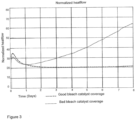
- the experiment was done by measuring heat release when the granule was incubated with a bleach (percarbonate) containing powder detergent. This reveals the contact of bleach catalyst with the bleach source, and indirectly the quality of coating and coverage of bleach catalyst material.
- Heat release was measured in a TAM (thermal activity measurement) setup.
- the coated granules were mixed with the detergent and transferred to TAM ampoules.
- FIG. 3 shows the heat release generated by the two samples during 8 days of incubation in the TAM setup.
- Granule (c) created no heat flow and thus no contact of the bleach catalyst with the bleach source in the detergent.
- Granule (d) created increased heat flow and thus intensive contact of the bleach catalyst with the bleach source in the detergent.
Landscapes
- Chemical & Material Sciences (AREA)
- Life Sciences & Earth Sciences (AREA)
- Engineering & Computer Science (AREA)
- Chemical Kinetics & Catalysis (AREA)
- Oil, Petroleum & Natural Gas (AREA)
- Wood Science & Technology (AREA)
- Organic Chemistry (AREA)
- Inorganic Chemistry (AREA)
- Detergent Compositions (AREA)
Claims (16)
- Nicht-enzymatisches Körnchen, umfassend(a) einen Kern, umgeben von(b) einer ersten Beschichtung, die Bleichmittelkatalysatorpartikel und ein Bindemittel umfasst, welche umgeben ist von(c) einer zweiten Beschichtung, die mindestens 60 Gew.-% der Beschichtung eines wasserlöslichen Salzes mit einer konstanten Feuchtigkeit bei 20°C, die über 85% beträgt, umfasst, welche umgeben ist von(d) einer dritten Beschichtung;wobei die Bleichmittelkatalysatorpartikel mindestens 80 Gew.-% eines Mangankomplexes mit stickstoffhaltigen Liganden umfassen, dadurch gekennzeichnet, dass mindestens 70 Gew.-% der Partikel Partikelgrößen im Bereich von 1 µm bis 50 µm aufweisen, höchstens 15 Gew.-% der Partikel Partikelgrößen von > 50 µm aufweisen, und höchstens 15 Gew.-% der Partikel Partikelgrößen von < 1 µm aufweisen, wobei die Prozentzahlen auf der Gesamtmenge der Partikel basieren.
- Körnchen nach Anspruch 1, wobei der Mangankomplex einen Liganden umfasst, der Di- oder Trimethyltriazacyclononan oder ein Derivat davon ist.
- Körnchen nach Anspruch 1 oder 2, wobei der Mangankomplex die nachstehende Formel (1) oder (2) aufweist:


- Körnchen nach einem beliebigen der Ansprüche 1 bis 3, wobei der Mangankomplex Bis-(N,N',N"-Trimethyl-1,4,7-triazacyclononan)-trioxo-dimangan(IV)-di(hexafluorophosphat)-Monohydrat ist.
- Körnchen nach einem beliebigen der Ansprüche 1 bis 4, wobei die Bleichmittelkatalysatorpartikel eine volumengemittelte Partikelgröße D50 im Bereich von 5 bis 25 µm aufweisen.
- Körnchen nach einem beliebigen der Ansprüche 1 bis 5, wobei die durchschnittliche Dicke der ersten Beschichtung im Bereich von 1 bis 15 µm liegt.
- Körnchen nach einem beliebigen der Ansprüche 1 bis 6, wobei die durchschnittliche Gesamtdicke der zweiten und dritten Beschichtung mindestens 400 % der Dicke der ersten Beschichtung beträgt.
- Körnchen nach einem beliebigen der Ansprüche 1 bis 7, wobei die durchschnittliche Gesamtdicke der zweiten und dritten Beschichtung mindestens 20 µm beträgt.
- Körnchen nach einem beliebigen der Ansprüche 1 bis 8, wobei die Menge des Bleichmittelkatalysators in der ersten Beschichtung im Bereich von 2 bis 15 Gew.-% des Kerns liegt.
- Körnchen nach einem beliebigen der Ansprüche 1 bis 9, wobei die Menge an Bindemittel in der ersten Beschichtung im Bereich von 1 bis 20 Gew.-% des Kerns liegt.
- Körnchen nach einem beliebigen der Ansprüche 1 bis 10, wobei die kombinierte zweite und dritte Beschichtung mindestens 30 Gew.-% des Kerns ausmacht.
- Körnchen nach einem beliebigen der Ansprüche 1 bis 11, wobei die zweite Beschichtung mindestens 80 Gew.-% der Beschichtung des wasserlöslichen Salzes umfasst, und wobei die zweite Beschichtung 20-100 Gew.-% des Kerns ausmacht.
- Körnchen nach einem beliebigen der Ansprüche 1 bis 12, wobei die zweite Beschichtung Natriumsulfat umfasst.
- Körnchen nach einem beliebigen der Ansprüche 1 bis 13, wobei die dritte Beschichtung ein filmbildendes Mittel oder ein Polymer umfasst, wie Polyethylenglykol, Hydroxypropylmethylcellulose (HPMC oder MHPC) oder Polyvinylalkohol (PVA).
- Verfahren zum Herstellen eines nicht-enzymatischen Körnchens, umfassend(a) Herstellen eines Kerns,(b) Umgeben des Kerns mit einer ersten Beschichtung, die Bleichmittelkatalysatorpartikel und ein Bindemittel umfasst,(c) Umgeben der ersten Beschichtung mit einer zweiten Beschichtung, die mindestens 60 Gew.-% der Beschichtung eines wasserlöslichen Salzes mit einer konstanten Feuchtigkeit bei 20°C, die über 85 % beträgt, umfasst, und(d) Umgeben der zweiten Beschichtung mit einer dritten Beschichtung;wobei die Bleichmittelkatalysatorpartikel mindestens 80 Gew.-% eines Mangankomplexes mit stickstoffhaltigen Liganden umfassen; wobei mindestens 70 Gew.-% der Partikel Partikelgrößen im Bereich von 1 µm bis 50 µm aufweisen, höchstens 15 Gew.-% der Partikel Partikelgrößen von > 50 µm aufweisen, und höchstens 15 Gew.-% der Partikel Partikelgrößen von < 1 µm aufweisen, wobei die Prozentzahlen auf der Gesamtmenge der Partikel basieren.
- Detergenszusammensetzung, die ein oberflächenaktives Mittel, einen Detergensgerüststoff, ein Bleichmittel, das eine H2O2-Quelle ist, ein Enzym umfasst, und welche Detergenszusammensetzung des Weiteren ein Körnchen gemäß einem beliebigen der Ansprüche 1 bis 14 umfasst.
Applications Claiming Priority (4)
| Application Number | Priority Date | Filing Date | Title |
|---|---|---|---|
| EP16159923 | 2016-03-11 | ||
| EP16198298 | 2016-11-10 | ||
| PCT/EP2017/055553 WO2017153528A1 (en) | 2016-03-11 | 2017-03-09 | Pourable detergent suspension comprising bleach catalyst granules |
| PCT/EP2017/055875 WO2017153612A1 (en) | 2016-03-11 | 2017-03-13 | Manganese bleach catalyst granules |
Publications (2)
| Publication Number | Publication Date |
|---|---|
| EP3426760A1 EP3426760A1 (de) | 2019-01-16 |
| EP3426760B1 true EP3426760B1 (de) | 2023-08-30 |
Family
ID=59789032
Family Applications (1)
| Application Number | Title | Priority Date | Filing Date |
|---|---|---|---|
| EP17710284.5A Active EP3426760B1 (de) | 2016-03-11 | 2017-03-13 | Manganbleichmittelkatalysatorengranulate |
Country Status (4)
| Country | Link |
|---|---|
| US (2) | US20190062675A1 (de) |
| EP (1) | EP3426760B1 (de) |
| CN (1) | CN109153943B (de) |
| WO (1) | WO2017153612A1 (de) |
Families Citing this family (1)
| Publication number | Priority date | Publication date | Assignee | Title |
|---|---|---|---|---|
| EP4008765A1 (de) | 2020-12-07 | 2022-06-08 | WeylChem Performance Products GmbH | Zusammensetzungen mit protonierten triazacyclischen verbindungen und bleichmittel und reinigungsmittel damit |
Family Cites Families (20)
| Publication number | Priority date | Publication date | Assignee | Title |
|---|---|---|---|---|
| AU6003598A (en) * | 1997-03-20 | 1998-10-20 | Procter & Gamble Company, The | Laundry additive particle having multiple surface coatings |
| US7022660B1 (en) * | 1999-03-09 | 2006-04-04 | The Procter & Gamble Company | Process for preparing detergent particles having coating or partial coating layers |
| US6858572B1 (en) * | 1999-03-09 | 2005-02-22 | The Procter & Gamble Company | Process for producing coated detergent particles |
| EP1456336A1 (de) * | 2001-12-21 | 2004-09-15 | Novozymes A/S | Überzüge aus salz |
| US7425528B2 (en) * | 2002-07-01 | 2008-09-16 | Novozymes A/S | Stabilization of granules |
| ES2284012T3 (es) * | 2003-05-21 | 2007-11-01 | Ciba Specialty Chemicals Holding Inc. | Composicion en particulas estables que comprenden catalizadores de blanqueo. |
| WO2005059083A1 (en) * | 2003-12-19 | 2005-06-30 | Unilever N.V. | Detergent granules and process for their manufacture |
| SI1882732T1 (sl) * | 2006-07-27 | 2010-08-31 | Evonik Degussa Gmbh | Oplaščeni delci natrijevega perkarbonata |
| DE102009017724A1 (de) * | 2009-04-11 | 2010-10-14 | Clariant International Limited | Bleichmittelgranulate |
| DE102009017722A1 (de) * | 2009-04-11 | 2010-10-14 | Clariant International Limited | Bleichmittelgranulate mit Aktivcoating |
| WO2011056904A1 (en) * | 2009-11-06 | 2011-05-12 | The Procter & Gamble Company | High efficiency particle comprising benefit agent |
| BR112012024674B1 (pt) * | 2010-04-26 | 2019-07-02 | Novozymes A/S | Grânulo, e, composição de detergente granular |
| ES2614083T3 (es) * | 2010-10-14 | 2017-05-29 | Unilever N.V. | Partícula de detergente para lavado de ropa |
| WO2012175401A2 (en) * | 2011-06-20 | 2012-12-27 | Novozymes A/S | Particulate composition |
| CN103747771A (zh) * | 2011-08-10 | 2014-04-23 | 宝洁公司 | 包封物 |
| US20140338134A1 (en) * | 2013-05-20 | 2014-11-20 | The Procter & Gamble Company | Encapsulates |
| DK2966161T3 (en) * | 2014-07-08 | 2019-02-25 | Dalli Werke Gmbh & Co Kg | ENZYME BLENDIC CATALYST CATEGRANULATE SUITABLE FOR DETERGENT COMPOSITIONS |
| EP3167036B1 (de) * | 2014-07-08 | 2019-03-20 | Novozymes A/S | Co-granulat eines enzyms und bleichmittelkatalysator |
| CN106687572A (zh) * | 2014-09-10 | 2017-05-17 | 巴斯夫欧洲公司 | 包封清洁组合物 |
| US9732303B2 (en) * | 2016-01-06 | 2017-08-15 | The Procter & Gamble Company | Microcapsules formed from phosphate esters and compositions containing same |
-
2017
- 2017-03-13 EP EP17710284.5A patent/EP3426760B1/de active Active
- 2017-03-13 CN CN201780014524.8A patent/CN109153943B/zh active Active
- 2017-03-13 US US16/080,112 patent/US20190062675A1/en not_active Abandoned
- 2017-03-13 WO PCT/EP2017/055875 patent/WO2017153612A1/en not_active Ceased
-
2024
- 2024-10-08 US US18/909,608 patent/US20250027013A1/en active Pending
Also Published As
| Publication number | Publication date |
|---|---|
| US20250027013A1 (en) | 2025-01-23 |
| US20190062675A1 (en) | 2019-02-28 |
| EP3426760A1 (de) | 2019-01-16 |
| CN109153943A (zh) | 2019-01-04 |
| CN109153943B (zh) | 2021-08-24 |
| WO2017153612A1 (en) | 2017-09-14 |
Similar Documents
| Publication | Publication Date | Title |
|---|---|---|
| US12509645B2 (en) | Cleaning compositions and uses thereof | |
| US12012573B2 (en) | Cleaning compositions and uses thereof | |
| EP3167036B1 (de) | Co-granulat eines enzyms und bleichmittelkatalysator | |
| EP3039113B1 (de) | Enzymgranulat mit fluoreszierendem aufheller | |
| US11028352B2 (en) | Detergent pouch with enzymatic water-soluble film | |
| EP3292192B1 (de) | Enzymbleichkatalysatorgranulat für geschirrreinigungsmittel | |
| US20250027013A1 (en) | Manganese Bleach Catalyst Granules | |
| EP3697880B1 (de) | Staubarme granulate | |
| EP3535377B1 (de) | Mehrkerngranulate | |
| EP3697881B1 (de) | Staubarme granulate |
Legal Events
| Date | Code | Title | Description |
|---|---|---|---|
| STAA | Information on the status of an ep patent application or granted ep patent |
Free format text: STATUS: UNKNOWN |
|
| STAA | Information on the status of an ep patent application or granted ep patent |
Free format text: STATUS: THE INTERNATIONAL PUBLICATION HAS BEEN MADE |
|
| PUAI | Public reference made under article 153(3) epc to a published international application that has entered the european phase |
Free format text: ORIGINAL CODE: 0009012 |
|
| STAA | Information on the status of an ep patent application or granted ep patent |
Free format text: STATUS: REQUEST FOR EXAMINATION WAS MADE |
|
| 17P | Request for examination filed |
Effective date: 20181011 |
|
| AK | Designated contracting states |
Kind code of ref document: A1 Designated state(s): AL AT BE BG CH CY CZ DE DK EE ES FI FR GB GR HR HU IE IS IT LI LT LU LV MC MK MT NL NO PL PT RO RS SE SI SK SM TR |
|
| AX | Request for extension of the european patent |
Extension state: BA ME |
|
| DAV | Request for validation of the european patent (deleted) | ||
| DAX | Request for extension of the european patent (deleted) | ||
| STAA | Information on the status of an ep patent application or granted ep patent |
Free format text: STATUS: EXAMINATION IS IN PROGRESS |
|
| 17Q | First examination report despatched |
Effective date: 20200228 |
|
| GRAP | Despatch of communication of intention to grant a patent |
Free format text: ORIGINAL CODE: EPIDOSNIGR1 |
|
| STAA | Information on the status of an ep patent application or granted ep patent |
Free format text: STATUS: GRANT OF PATENT IS INTENDED |
|
| INTG | Intention to grant announced |
Effective date: 20230331 |
|
| GRAS | Grant fee paid |
Free format text: ORIGINAL CODE: EPIDOSNIGR3 |
|
| GRAA | (expected) grant |
Free format text: ORIGINAL CODE: 0009210 |
|
| STAA | Information on the status of an ep patent application or granted ep patent |
Free format text: STATUS: THE PATENT HAS BEEN GRANTED |
|
| AK | Designated contracting states |
Kind code of ref document: B1 Designated state(s): AL AT BE BG CH CY CZ DE DK EE ES FI FR GB GR HR HU IE IS IT LI LT LU LV MC MK MT NL NO PL PT RO RS SE SI SK SM TR |
|
| REG | Reference to a national code |
Ref country code: GB Ref legal event code: FG4D |
|
| REG | Reference to a national code |
Ref country code: CH Ref legal event code: EP |
|
| P01 | Opt-out of the competence of the unified patent court (upc) registered |
Effective date: 20230728 |
|
| REG | Reference to a national code |
Ref country code: DE Ref legal event code: R096 Ref document number: 602017073364 Country of ref document: DE |
|
| REG | Reference to a national code |
Ref country code: IE Ref legal event code: FG4D |
|
| REG | Reference to a national code |
Ref country code: NL Ref legal event code: FP |
|
| REG | Reference to a national code |
Ref country code: LT Ref legal event code: MG9D |
|
| REG | Reference to a national code |
Ref country code: AT Ref legal event code: MK05 Ref document number: 1605475 Country of ref document: AT Kind code of ref document: T Effective date: 20230830 |
|
| PG25 | Lapsed in a contracting state [announced via postgrant information from national office to epo] |
Ref country code: GR Free format text: LAPSE BECAUSE OF FAILURE TO SUBMIT A TRANSLATION OF THE DESCRIPTION OR TO PAY THE FEE WITHIN THE PRESCRIBED TIME-LIMIT Effective date: 20231201 |
|
| PG25 | Lapsed in a contracting state [announced via postgrant information from national office to epo] |
Ref country code: IS Free format text: LAPSE BECAUSE OF FAILURE TO SUBMIT A TRANSLATION OF THE DESCRIPTION OR TO PAY THE FEE WITHIN THE PRESCRIBED TIME-LIMIT Effective date: 20231230 |
|
| PG25 | Lapsed in a contracting state [announced via postgrant information from national office to epo] |
Ref country code: SE Free format text: LAPSE BECAUSE OF FAILURE TO SUBMIT A TRANSLATION OF THE DESCRIPTION OR TO PAY THE FEE WITHIN THE PRESCRIBED TIME-LIMIT Effective date: 20230830 Ref country code: RS Free format text: LAPSE BECAUSE OF FAILURE TO SUBMIT A TRANSLATION OF THE DESCRIPTION OR TO PAY THE FEE WITHIN THE PRESCRIBED TIME-LIMIT Effective date: 20230830 Ref country code: NO Free format text: LAPSE BECAUSE OF FAILURE TO SUBMIT A TRANSLATION OF THE DESCRIPTION OR TO PAY THE FEE WITHIN THE PRESCRIBED TIME-LIMIT Effective date: 20231130 Ref country code: LV Free format text: LAPSE BECAUSE OF FAILURE TO SUBMIT A TRANSLATION OF THE DESCRIPTION OR TO PAY THE FEE WITHIN THE PRESCRIBED TIME-LIMIT Effective date: 20230830 Ref country code: LT Free format text: LAPSE BECAUSE OF FAILURE TO SUBMIT A TRANSLATION OF THE DESCRIPTION OR TO PAY THE FEE WITHIN THE PRESCRIBED TIME-LIMIT Effective date: 20230830 Ref country code: IS Free format text: LAPSE BECAUSE OF FAILURE TO SUBMIT A TRANSLATION OF THE DESCRIPTION OR TO PAY THE FEE WITHIN THE PRESCRIBED TIME-LIMIT Effective date: 20231230 Ref country code: HR Free format text: LAPSE BECAUSE OF FAILURE TO SUBMIT A TRANSLATION OF THE DESCRIPTION OR TO PAY THE FEE WITHIN THE PRESCRIBED TIME-LIMIT Effective date: 20230830 Ref country code: GR Free format text: LAPSE BECAUSE OF FAILURE TO SUBMIT A TRANSLATION OF THE DESCRIPTION OR TO PAY THE FEE WITHIN THE PRESCRIBED TIME-LIMIT Effective date: 20231201 Ref country code: FI Free format text: LAPSE BECAUSE OF FAILURE TO SUBMIT A TRANSLATION OF THE DESCRIPTION OR TO PAY THE FEE WITHIN THE PRESCRIBED TIME-LIMIT Effective date: 20230830 Ref country code: AT Free format text: LAPSE BECAUSE OF FAILURE TO SUBMIT A TRANSLATION OF THE DESCRIPTION OR TO PAY THE FEE WITHIN THE PRESCRIBED TIME-LIMIT Effective date: 20230830 |
|
| PG25 | Lapsed in a contracting state [announced via postgrant information from national office to epo] |
Ref country code: PL Free format text: LAPSE BECAUSE OF FAILURE TO SUBMIT A TRANSLATION OF THE DESCRIPTION OR TO PAY THE FEE WITHIN THE PRESCRIBED TIME-LIMIT Effective date: 20230830 |
|
| PG25 | Lapsed in a contracting state [announced via postgrant information from national office to epo] |
Ref country code: ES Free format text: LAPSE BECAUSE OF FAILURE TO SUBMIT A TRANSLATION OF THE DESCRIPTION OR TO PAY THE FEE WITHIN THE PRESCRIBED TIME-LIMIT Effective date: 20230830 |
|
| PG25 | Lapsed in a contracting state [announced via postgrant information from national office to epo] |
Ref country code: SM Free format text: LAPSE BECAUSE OF FAILURE TO SUBMIT A TRANSLATION OF THE DESCRIPTION OR TO PAY THE FEE WITHIN THE PRESCRIBED TIME-LIMIT Effective date: 20230830 Ref country code: RO Free format text: LAPSE BECAUSE OF FAILURE TO SUBMIT A TRANSLATION OF THE DESCRIPTION OR TO PAY THE FEE WITHIN THE PRESCRIBED TIME-LIMIT Effective date: 20230830 Ref country code: ES Free format text: LAPSE BECAUSE OF FAILURE TO SUBMIT A TRANSLATION OF THE DESCRIPTION OR TO PAY THE FEE WITHIN THE PRESCRIBED TIME-LIMIT Effective date: 20230830 Ref country code: EE Free format text: LAPSE BECAUSE OF FAILURE TO SUBMIT A TRANSLATION OF THE DESCRIPTION OR TO PAY THE FEE WITHIN THE PRESCRIBED TIME-LIMIT Effective date: 20230830 Ref country code: DK Free format text: LAPSE BECAUSE OF FAILURE TO SUBMIT A TRANSLATION OF THE DESCRIPTION OR TO PAY THE FEE WITHIN THE PRESCRIBED TIME-LIMIT Effective date: 20230830 Ref country code: CZ Free format text: LAPSE BECAUSE OF FAILURE TO SUBMIT A TRANSLATION OF THE DESCRIPTION OR TO PAY THE FEE WITHIN THE PRESCRIBED TIME-LIMIT Effective date: 20230830 Ref country code: SK Free format text: LAPSE BECAUSE OF FAILURE TO SUBMIT A TRANSLATION OF THE DESCRIPTION OR TO PAY THE FEE WITHIN THE PRESCRIBED TIME-LIMIT Effective date: 20230830 Ref country code: PT Free format text: LAPSE BECAUSE OF FAILURE TO SUBMIT A TRANSLATION OF THE DESCRIPTION OR TO PAY THE FEE WITHIN THE PRESCRIBED TIME-LIMIT Effective date: 20240102 |
|
| PG25 | Lapsed in a contracting state [announced via postgrant information from national office to epo] |
Ref country code: IT Free format text: LAPSE BECAUSE OF FAILURE TO SUBMIT A TRANSLATION OF THE DESCRIPTION OR TO PAY THE FEE WITHIN THE PRESCRIBED TIME-LIMIT Effective date: 20230830 |
|
| REG | Reference to a national code |
Ref country code: DE Ref legal event code: R097 Ref document number: 602017073364 Country of ref document: DE |
|
| PLBE | No opposition filed within time limit |
Free format text: ORIGINAL CODE: 0009261 |
|
| STAA | Information on the status of an ep patent application or granted ep patent |
Free format text: STATUS: NO OPPOSITION FILED WITHIN TIME LIMIT |
|
| PG25 | Lapsed in a contracting state [announced via postgrant information from national office to epo] |
Ref country code: SI Free format text: LAPSE BECAUSE OF FAILURE TO SUBMIT A TRANSLATION OF THE DESCRIPTION OR TO PAY THE FEE WITHIN THE PRESCRIBED TIME-LIMIT Effective date: 20230830 |
|
| 26N | No opposition filed |
Effective date: 20240603 |
|
| REG | Reference to a national code |
Ref country code: CH Ref legal event code: PL |
|
| PG25 | Lapsed in a contracting state [announced via postgrant information from national office to epo] |
Ref country code: BG Free format text: LAPSE BECAUSE OF FAILURE TO SUBMIT A TRANSLATION OF THE DESCRIPTION OR TO PAY THE FEE WITHIN THE PRESCRIBED TIME-LIMIT Effective date: 20230830 |
|
| PG25 | Lapsed in a contracting state [announced via postgrant information from national office to epo] |
Ref country code: LU Free format text: LAPSE BECAUSE OF NON-PAYMENT OF DUE FEES Effective date: 20240313 |
|
| PG25 | Lapsed in a contracting state [announced via postgrant information from national office to epo] |
Ref country code: MC Free format text: LAPSE BECAUSE OF FAILURE TO SUBMIT A TRANSLATION OF THE DESCRIPTION OR TO PAY THE FEE WITHIN THE PRESCRIBED TIME-LIMIT Effective date: 20230830 |
|
| PG25 | Lapsed in a contracting state [announced via postgrant information from national office to epo] |
Ref country code: MC Free format text: LAPSE BECAUSE OF FAILURE TO SUBMIT A TRANSLATION OF THE DESCRIPTION OR TO PAY THE FEE WITHIN THE PRESCRIBED TIME-LIMIT Effective date: 20230830 Ref country code: LU Free format text: LAPSE BECAUSE OF NON-PAYMENT OF DUE FEES Effective date: 20240313 Ref country code: BG Free format text: LAPSE BECAUSE OF FAILURE TO SUBMIT A TRANSLATION OF THE DESCRIPTION OR TO PAY THE FEE WITHIN THE PRESCRIBED TIME-LIMIT Effective date: 20230830 |
|
| PG25 | Lapsed in a contracting state [announced via postgrant information from national office to epo] |
Ref country code: IE Free format text: LAPSE BECAUSE OF NON-PAYMENT OF DUE FEES Effective date: 20240313 |
|
| PG25 | Lapsed in a contracting state [announced via postgrant information from national office to epo] |
Ref country code: IE Free format text: LAPSE BECAUSE OF NON-PAYMENT OF DUE FEES Effective date: 20240313 Ref country code: CH Free format text: LAPSE BECAUSE OF NON-PAYMENT OF DUE FEES Effective date: 20240331 |
|
| PG25 | Lapsed in a contracting state [announced via postgrant information from national office to epo] |
Ref country code: CY Free format text: LAPSE BECAUSE OF FAILURE TO SUBMIT A TRANSLATION OF THE DESCRIPTION OR TO PAY THE FEE WITHIN THE PRESCRIBED TIME-LIMIT; INVALID AB INITIO Effective date: 20170313 |
|
| PG25 | Lapsed in a contracting state [announced via postgrant information from national office to epo] |
Ref country code: HU Free format text: LAPSE BECAUSE OF FAILURE TO SUBMIT A TRANSLATION OF THE DESCRIPTION OR TO PAY THE FEE WITHIN THE PRESCRIBED TIME-LIMIT; INVALID AB INITIO Effective date: 20170313 |
|
| PG25 | Lapsed in a contracting state [announced via postgrant information from national office to epo] |
Ref country code: TR Free format text: LAPSE BECAUSE OF FAILURE TO SUBMIT A TRANSLATION OF THE DESCRIPTION OR TO PAY THE FEE WITHIN THE PRESCRIBED TIME-LIMIT Effective date: 20230830 |
|
| PGFP | Annual fee paid to national office [announced via postgrant information from national office to epo] |
Ref country code: NL Payment date: 20260227 Year of fee payment: 10 |
|
| PGFP | Annual fee paid to national office [announced via postgrant information from national office to epo] |
Ref country code: GB Payment date: 20260223 Year of fee payment: 10 |
|
| PGFP | Annual fee paid to national office [announced via postgrant information from national office to epo] |
Ref country code: DE Payment date: 20260218 Year of fee payment: 10 |
|
| PGFP | Annual fee paid to national office [announced via postgrant information from national office to epo] |
Ref country code: BE Payment date: 20260227 Year of fee payment: 10 |
|
| PGFP | Annual fee paid to national office [announced via postgrant information from national office to epo] |
Ref country code: FR Payment date: 20260223 Year of fee payment: 10 |