EP3429016B1 - Feststoff-sulfid-elektrolyt - Google Patents
Feststoff-sulfid-elektrolyt Download PDFInfo
- Publication number
- EP3429016B1 EP3429016B1 EP17763451.6A EP17763451A EP3429016B1 EP 3429016 B1 EP3429016 B1 EP 3429016B1 EP 17763451 A EP17763451 A EP 17763451A EP 3429016 B1 EP3429016 B1 EP 3429016B1
- Authority
- EP
- European Patent Office
- Prior art keywords
- solid electrolyte
- sulfide solid
- peak
- lgps
- electrolyte material
- Prior art date
- Legal status (The legal status is an assumption and is not a legal conclusion. Google has not performed a legal analysis and makes no representation as to the accuracy of the status listed.)
- Active
Links
Images




Classifications
-
- H—ELECTRICITY
- H01—ELECTRIC ELEMENTS
- H01M—PROCESSES OR MEANS, e.g. BATTERIES, FOR THE DIRECT CONVERSION OF CHEMICAL ENERGY INTO ELECTRICAL ENERGY
- H01M10/00—Secondary cells; Manufacture thereof
- H01M10/05—Accumulators with non-aqueous electrolyte
- H01M10/056—Accumulators with non-aqueous electrolyte characterised by the materials used as electrolytes, e.g. mixed inorganic/organic electrolytes
- H01M10/0561—Accumulators with non-aqueous electrolyte characterised by the materials used as electrolytes, e.g. mixed inorganic/organic electrolytes the electrolyte being constituted of inorganic materials only
- H01M10/0562—Solid materials
-
- C—CHEMISTRY; METALLURGY
- C01—INORGANIC CHEMISTRY
- C01G—COMPOUNDS CONTAINING METALS NOT COVERED BY SUBCLASSES C01D OR C01F
- C01G19/00—Compounds of tin
- C01G19/006—Compounds containing tin, with or without oxygen or hydrogen, and containing two or more other elements
-
- C—CHEMISTRY; METALLURGY
- C01—INORGANIC CHEMISTRY
- C01B—NON-METALLIC ELEMENTS; COMPOUNDS THEREOF; METALLOIDS OR COMPOUNDS THEREOF NOT COVERED BY SUBCLASS C01C
- C01B17/00—Sulfur; Compounds thereof
- C01B17/22—Alkali metal sulfides or polysulfides
-
- C—CHEMISTRY; METALLURGY
- C01—INORGANIC CHEMISTRY
- C01B—NON-METALLIC ELEMENTS; COMPOUNDS THEREOF; METALLOIDS OR COMPOUNDS THEREOF NOT COVERED BY SUBCLASS C01C
- C01B33/00—Silicon; Compounds thereof
- C01B33/06—Metal silicides
-
- C—CHEMISTRY; METALLURGY
- C04—CEMENTS; CONCRETE; ARTIFICIAL STONE; CERAMICS; REFRACTORIES
- C04B—LIME, MAGNESIA; SLAG; CEMENTS; COMPOSITIONS THEREOF, e.g. MORTARS, CONCRETE OR LIKE BUILDING MATERIALS; ARTIFICIAL STONE; CERAMICS; REFRACTORIES; TREATMENT OF NATURAL STONE
- C04B35/00—Shaped ceramic products characterised by their composition; Ceramics compositions; Processing powders of inorganic compounds preparatory to the manufacturing of ceramic products
- C04B35/515—Shaped ceramic products characterised by their composition; Ceramics compositions; Processing powders of inorganic compounds preparatory to the manufacturing of ceramic products based on non-oxide ceramics
- C04B35/547—Shaped ceramic products characterised by their composition; Ceramics compositions; Processing powders of inorganic compounds preparatory to the manufacturing of ceramic products based on non-oxide ceramics based on sulfides or selenides or tellurides
-
- C—CHEMISTRY; METALLURGY
- C04—CEMENTS; CONCRETE; ARTIFICIAL STONE; CERAMICS; REFRACTORIES
- C04B—LIME, MAGNESIA; SLAG; CEMENTS; COMPOSITIONS THEREOF, e.g. MORTARS, CONCRETE OR LIKE BUILDING MATERIALS; ARTIFICIAL STONE; CERAMICS; REFRACTORIES; TREATMENT OF NATURAL STONE
- C04B35/00—Shaped ceramic products characterised by their composition; Ceramics compositions; Processing powders of inorganic compounds preparatory to the manufacturing of ceramic products
- C04B35/622—Forming processes; Processing powders of inorganic compounds preparatory to the manufacturing of ceramic products
- C04B35/626—Preparing or treating the powders individually or as batches ; preparing or treating macroscopic reinforcing agents for ceramic products, e.g. fibres; mechanical aspects section B
- C04B35/62605—Treating the starting powders individually or as mixtures
- C04B35/6261—Milling
- C04B35/6262—Milling of calcined, sintered clinker or ceramics
-
- C—CHEMISTRY; METALLURGY
- C04—CEMENTS; CONCRETE; ARTIFICIAL STONE; CERAMICS; REFRACTORIES
- C04B—LIME, MAGNESIA; SLAG; CEMENTS; COMPOSITIONS THEREOF, e.g. MORTARS, CONCRETE OR LIKE BUILDING MATERIALS; ARTIFICIAL STONE; CERAMICS; REFRACTORIES; TREATMENT OF NATURAL STONE
- C04B35/00—Shaped ceramic products characterised by their composition; Ceramics compositions; Processing powders of inorganic compounds preparatory to the manufacturing of ceramic products
- C04B35/622—Forming processes; Processing powders of inorganic compounds preparatory to the manufacturing of ceramic products
- C04B35/626—Preparing or treating the powders individually or as batches ; preparing or treating macroscopic reinforcing agents for ceramic products, e.g. fibres; mechanical aspects section B
- C04B35/62605—Treating the starting powders individually or as mixtures
- C04B35/62695—Granulation or pelletising
-
- C—CHEMISTRY; METALLURGY
- C04—CEMENTS; CONCRETE; ARTIFICIAL STONE; CERAMICS; REFRACTORIES
- C04B—LIME, MAGNESIA; SLAG; CEMENTS; COMPOSITIONS THEREOF, e.g. MORTARS, CONCRETE OR LIKE BUILDING MATERIALS; ARTIFICIAL STONE; CERAMICS; REFRACTORIES; TREATMENT OF NATURAL STONE
- C04B35/00—Shaped ceramic products characterised by their composition; Ceramics compositions; Processing powders of inorganic compounds preparatory to the manufacturing of ceramic products
- C04B35/622—Forming processes; Processing powders of inorganic compounds preparatory to the manufacturing of ceramic products
- C04B35/64—Burning or sintering processes
-
- H—ELECTRICITY
- H01—ELECTRIC ELEMENTS
- H01B—CABLES; CONDUCTORS; INSULATORS; SELECTION OF MATERIALS FOR THEIR CONDUCTIVE, INSULATING OR DIELECTRIC PROPERTIES
- H01B1/00—Conductors or conductive bodies characterised by the conductive materials; Selection of materials as conductors
- H01B1/06—Conductors or conductive bodies characterised by the conductive materials; Selection of materials as conductors mainly consisting of other non-metallic substances
- H01B1/10—Conductors or conductive bodies characterised by the conductive materials; Selection of materials as conductors mainly consisting of other non-metallic substances sulfides
-
- H—ELECTRICITY
- H01—ELECTRIC ELEMENTS
- H01M—PROCESSES OR MEANS, e.g. BATTERIES, FOR THE DIRECT CONVERSION OF CHEMICAL ENERGY INTO ELECTRICAL ENERGY
- H01M10/00—Secondary cells; Manufacture thereof
- H01M10/05—Accumulators with non-aqueous electrolyte
- H01M10/052—Li-accumulators
-
- H—ELECTRICITY
- H01—ELECTRIC ELEMENTS
- H01M—PROCESSES OR MEANS, e.g. BATTERIES, FOR THE DIRECT CONVERSION OF CHEMICAL ENERGY INTO ELECTRICAL ENERGY
- H01M10/00—Secondary cells; Manufacture thereof
- H01M10/05—Accumulators with non-aqueous electrolyte
- H01M10/052—Li-accumulators
- H01M10/0525—Rocking-chair batteries, i.e. batteries with lithium insertion or intercalation in both electrodes; Lithium-ion batteries
-
- C—CHEMISTRY; METALLURGY
- C01—INORGANIC CHEMISTRY
- C01P—INDEXING SCHEME RELATING TO STRUCTURAL AND PHYSICAL ASPECTS OF SOLID INORGANIC COMPOUNDS
- C01P2002/00—Crystal-structural characteristics
- C01P2002/70—Crystal-structural characteristics defined by measured X-ray, neutron or electron diffraction data
- C01P2002/72—Crystal-structural characteristics defined by measured X-ray, neutron or electron diffraction data by d-values or two theta-values, e.g. as X-ray diagram
-
- C—CHEMISTRY; METALLURGY
- C01—INORGANIC CHEMISTRY
- C01P—INDEXING SCHEME RELATING TO STRUCTURAL AND PHYSICAL ASPECTS OF SOLID INORGANIC COMPOUNDS
- C01P2002/00—Crystal-structural characteristics
- C01P2002/70—Crystal-structural characteristics defined by measured X-ray, neutron or electron diffraction data
- C01P2002/74—Crystal-structural characteristics defined by measured X-ray, neutron or electron diffraction data by peak-intensities or a ratio thereof only
-
- C—CHEMISTRY; METALLURGY
- C01—INORGANIC CHEMISTRY
- C01P—INDEXING SCHEME RELATING TO STRUCTURAL AND PHYSICAL ASPECTS OF SOLID INORGANIC COMPOUNDS
- C01P2004/00—Particle morphology
- C01P2004/30—Particle morphology extending in three dimensions
- C01P2004/40—Particle morphology extending in three dimensions prism-like
-
- H—ELECTRICITY
- H01—ELECTRIC ELEMENTS
- H01M—PROCESSES OR MEANS, e.g. BATTERIES, FOR THE DIRECT CONVERSION OF CHEMICAL ENERGY INTO ELECTRICAL ENERGY
- H01M2300/00—Electrolytes
- H01M2300/0017—Non-aqueous electrolytes
- H01M2300/0065—Solid electrolytes
- H01M2300/0068—Solid electrolytes inorganic
-
- Y—GENERAL TAGGING OF NEW TECHNOLOGICAL DEVELOPMENTS; GENERAL TAGGING OF CROSS-SECTIONAL TECHNOLOGIES SPANNING OVER SEVERAL SECTIONS OF THE IPC; TECHNICAL SUBJECTS COVERED BY FORMER USPC CROSS-REFERENCE ART COLLECTIONS [XRACs] AND DIGESTS
- Y02—TECHNOLOGIES OR APPLICATIONS FOR MITIGATION OR ADAPTATION AGAINST CLIMATE CHANGE
- Y02E—REDUCTION OF GREENHOUSE GAS [GHG] EMISSIONS, RELATED TO ENERGY GENERATION, TRANSMISSION OR DISTRIBUTION
- Y02E60/00—Enabling technologies; Technologies with a potential or indirect contribution to GHG emissions mitigation
- Y02E60/10—Energy storage using batteries
-
- Y—GENERAL TAGGING OF NEW TECHNOLOGICAL DEVELOPMENTS; GENERAL TAGGING OF CROSS-SECTIONAL TECHNOLOGIES SPANNING OVER SEVERAL SECTIONS OF THE IPC; TECHNICAL SUBJECTS COVERED BY FORMER USPC CROSS-REFERENCE ART COLLECTIONS [XRACs] AND DIGESTS
- Y02—TECHNOLOGIES OR APPLICATIONS FOR MITIGATION OR ADAPTATION AGAINST CLIMATE CHANGE
- Y02P—CLIMATE CHANGE MITIGATION TECHNOLOGIES IN THE PRODUCTION OR PROCESSING OF GOODS
- Y02P70/00—Climate change mitigation technologies in the production process for final industrial or consumer products
- Y02P70/50—Manufacturing or production processes characterised by the final manufactured product
-
- Y—GENERAL TAGGING OF NEW TECHNOLOGICAL DEVELOPMENTS; GENERAL TAGGING OF CROSS-SECTIONAL TECHNOLOGIES SPANNING OVER SEVERAL SECTIONS OF THE IPC; TECHNICAL SUBJECTS COVERED BY FORMER USPC CROSS-REFERENCE ART COLLECTIONS [XRACs] AND DIGESTS
- Y02—TECHNOLOGIES OR APPLICATIONS FOR MITIGATION OR ADAPTATION AGAINST CLIMATE CHANGE
- Y02T—CLIMATE CHANGE MITIGATION TECHNOLOGIES RELATED TO TRANSPORTATION
- Y02T10/00—Road transport of goods or passengers
- Y02T10/60—Other road transportation technologies with climate change mitigation effect
- Y02T10/70—Energy storage systems for electromobility, e.g. batteries
Definitions
- the present invention relates to a sulfide solid electrolyte having an LGPS-type crystal structure and good ionic conductivity, in particular having a Sn-Si solid solution without Ge.
- Non-Patent Literature 1 discloses a Li ion conductor (sulfide solid electrolyte material) having an Li (4-x) Ge (1-x) P x S 4 composition. Furthermore, Patent Literature 1 discloses an LiGePS-based sulfide solid electrolyte material with a high ratio of crystal phases having characteristic peaks in X-ray diffraction measurement. Further, Non-Patent Literature 2 discloses an LiGePS-based sulfide solid electrolyte material.
- M1 element such as a Li element
- M2 element such as a Ge element, a Si element
- Non-Patent Literature 2 reports Li 10 GeP 2 S 12 (hereinafter, sometimes referred to as "LGPS-based sulfide solid electrolyte", “LGPS”, etc.) exhibiting high ionic conductivity comparable to a 12 x 10 -3 Scm -1 electrolytic solution.
- Ge is expensive.
- Ge has low chemical stability, such as electrochemical reduction resistance.
- the reduction potential of Ge is about 0.25 V (vs Li/Li+).
- a negative electrode active material having an operating potential lower than 0.25 V there is a problem that the sulfide solid electrolyte material is reductively decomposed and deteriorated.
- the present invention has been achieved in light of the above problem and aims to provide a sulfide solid electrolyte material which does not contain Ge and which has good electrochemical stability and high lithium ion conductivity.
- a solid conductive material of the composition formula Li 4-x [Sn y Si (1-y) ] (1-x) P x S 4 (LSSPS (y:1-y)x) excellent in ionic conductivity can be obtained and further that a solid conductive material having excellent ionic conductivity can be obtained even when the ratio of Li to [Sn y Si (1-y) ] is changed, whereby the present invention has been completed.
- the sulfide solid electrolyte material does not contain Ge, it exhibits high ionic conductivity comparable to LGPS-based sulfide solid electrolyte materials. Further, since the sulfide solid electrolyte does not contain relatively expensive Ge, cost can be greatly reduced as compared with solid electrolyte materials containing Ge as an indispensable component, such as conventional LGPS-based materials. Furthermore, although Ge has low reduction resistance, the sulfide solid electrolyte material of the present invention, which does not contain Ge, can be expected to improve electrochemical stability such as reduction resistance.
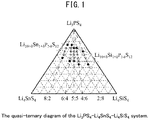
- FIG. 1 is a quasi-ternary diagram of an Li 4 SnS 4 -Li 4 SiS 4 -Li 3 PS 4 system and the composition formula of the substance in this ternary diagram is represented by Li 4-x [Sn y Si 1-y ] 1-x P x S 4 .
- x corresponds to the composition ratio of Li 3 PS 4 .
- the ratios of Sn:Si are shown as indications on the lower base side of the ternary diagram. Further, broken lines extending from the positions of these indications to the upper vertex are shown. For example, on the broken line extending from the 2:8 on the lower base side to the upper vertex, compositions in which x varies while the Sn:Si ratio is maintained at 2:8 are obtained.
- the material having an Li 4-x [Sn y Si 1-y ] 1-x P x S 4 composition satisfies the above-described peak conditions, i.e., has the same crystal structure as LGPS-based sulfide solid electrolytes.
- the electrolyte material of the present application has a crystal structure in which the Ge of the LGPS-based sulfide solid electrolyte material is substituted with Sn-Si in a solid solution state, and as a result, has a high ionic conductivity like LGPS-based sulfide solid electrolytes.
- the electrolyte material of the present application contains Si, a sulfide solid electrolyte material having a low reduction potential can be obtained. Since Si has a small ionic radius and forms a strong bond with S, it is thought that Si has a property by which it is not easily reductively decomposed, and as a result, it is presumed that the reduction potential thereof is low. Further, when comparing the alloying potential with Li, Si is in the vicinity of 0.35 V (Li/Li + ), which is lower than the vicinity of 0.4 V (Li/Li + ) of Ge, and is difficult to alloy with Li, and as a result, the reduction potential of the electrolyte material of the present application is presumed to be low.
- the presumed reduction potential of the electrolyte material of the present application is about 0.175 V (vs. Li/Li+). Conversely, the presumed reduction potential of the LGPS (Li 3.33 Ge 0.33 P 0.67 S 4 ) is about 0.255 V (vs. Li/Li + ), and therefore, the electrolytic material of the present application is not subject to reductive decomposition.
- the value of I B /I A is preferably smaller.
- the ratio is preferably 0.45 or less, more preferably 0.25 or less, further preferably 0.15 or less, and particularly preferably 0.07 or less.
- the value of I B /I A is preferably zero.
- the peak is defined as a peak at a position of 29.58° ⁇ 0.50°.
- the electrolyte material of the present application can also have peaks at these positions. Note that these peak positions may also deviate in the range of ⁇ 0.50°.
- a solid conductive material having excellent ionic conductivity can be obtained even when the ratio of Li to [Sn y Si (1-y) ] is changed. More specifically, a coefficient z has been added to the composition ratio of Li and [Sn y Si (1-y) ] in the above composition formula, whereby a solid conductive material excellent in ionic conductivity can be obtained in the range of 0 ⁇ z ⁇ -0.2 for the composition formula Li 4-4z-x [Sn y Si 1-y ] 1+z-x P x S 4 .
- the coefficient z is related to the composition ratio of Li and [Sn y Si (1-y) ] in the composition, and the smaller the z, the lower the ratio of [Sn y Si (1-y) ] and the higher the ratio of Li.
- FIG. 1 is not suitable for expressing the change in P since when z changes, namely, when the ratio of Li to [Sn y Si (1-y) ] changes, the point on the ternary diagram of FIG. 1 moves vertically, but the ratio of P (P is not related to the coefficient z) also changes accordingly.
- y i.e., the ratio of Sn:Si is changed
- x is changed, i.e., the relative amount of P is changed.
- this peak is one of the peaks of the low ionic-conductivity crystal phase.
- the value of I B /I A described above may become 0.50 or more in some cases.
- the range of z is limited to 0 ⁇ z ⁇ -0.2.
- the value of I B /I A is less than 0.5, and a solid electrolyte material having good ionic conductivity can be obtained.
- the Rietveld method was used to obtain the lattice constants.
- the Rietveld method is a structural analysis method which makes it possible to obtain many structural parameters with high accuracy from diffraction patterns obtained by powder X-ray diffraction measurement and neutron diffraction measurement.
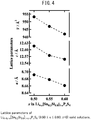
- the a-axis length of the lattice constant is 8.65 to 8.70 angstrom and the c-axis length is 12.55 to 12.62. Even if x is outside of this range, it is possible to extrapolate to some extent to obtain the axis lengths since the change of the axis lengths is smooth.
- FIG. 5 is a perspective view detailing an example of the crystal structure of the Li 4-4z-x [Sn y Si 1-y ] 1+z-x P x S 4 electrolyte material of the present application.
- the octahedron has Li as the central element and has six S atoms at the apexes of the octahedron, and is typically an LiS 6 octahedron.
- the (Sn/Si/P)S 4 tetrahedron has Sn/Si/P as the central element and four S atoms at the apexes of the tetrahedron, and is typically an SiS 4 tetrahedron, an SnS 4 tetrahedron, or a PS 4 tetrahedron.
- the PS 4 tetrahedron is a tetrahedron having P as the central element and four S atoms at the apexes of the tetrahedron.
- the (Sn/Si/P)S 4 tetrahedrons and octahedrons share edges, and the PS 4 tetrahedrons and the octahedrons share vertices.
- the quadrangles, which connect the tetrahedrons and octahedrons, represent unit cells
- FIG. 6 is an example of a synchrotron X-ray Rietveld refinement pattern for the Li 4-4z-x [Sn y Si 1-y ] 1+z-x P x S 4 electrolyte material of the present application.
- the observed data is represented by the symbol (+), and the actual radiation superimposed on the data is obtained by Rietveld analysis.
- the observation data and the analysis results are consistent.
- the bottom line in Fig. 6 shows the difference between the observed value and the calculated value intensity. The difference thereof is very small, confirming that the observation data and the analysis results are consistent.
- ) plotted between the upper and lower lines is the possible Bragg reflection position of the space group P4 2 /nmc of the LGPS-type crystal phase. This also confirms that the electrolyte material of the present application has an LGPS-type crystal phase.
- Synchrotron X-ray measurement is a measurement method using synchrotron radiation (electromagnetic waves generated when the traveling direction of electrons travelling straight at a speed close to the speed of light is changed). Since synchrotron radiation has a high brightness, the crystal structure can be analyzed in detail.
- the sulfide solid electrolyte material of the present application has an LGPS-type crystal structure and is typically a crystalline sulfide solid electrolyte material.
- the sulfide solid electrolyte material of the present application preferably has a high ionic conductivity.
- the ionic conductivity of the sulfide solid electrolyte material at 25 °C, when powdered sulfide solid electrolyte material is formed into sintered pellets is preferably 5.0 x 10 -3 S/cm or more, more preferably 7.0 x 10 -3 S/cm or more, further preferably 9.0 x 10 -3 S/cm or more, and may further preferably be 11.0 x 10 -3 S/cm or more.
- the ionic conductivity of sintered pellets of a powder of Li 3.45 [Sn 0.09 Si 0.36 ]P 0.55 S 4 which is an example of the sulfide solid electrolyte material of the present application, was measured at 26 to 127 °C.
- FIG. 7 shows temperature-dependent impedance and an Arrhenius plot.
- the ionic conductivity at each temperature is obtained as the sum of the bulk/grain boundary resistances.
- the activation energy is 19 kJ/mol, which is a typical value for excellent ionic conductors.
- the ionic conductivity at room temperature was calculated as 11.0 ⁇ 10 -3 S/cm.
- This value is better than the 5.0 ⁇ 10 -3 S/cm of LSnPS (the composition of the lower left vertex in FIG. 1 ) or the 6.7 ⁇ 10 -3 S/cm of LSiPS (the composition of the lower right vertex in FIG. 1 ).
- LSnPS the composition of the lower left vertex in FIG. 1
- LSiPS the composition of the lower right vertex in FIG. 1
- the form of the sulfide solid electrolyte material of the present application is not particularly limited, but may be, for example, a powder form.
- the average particle size of the powder sulfide solid electrolyte material is preferably in the range of, for example, 0.1 ⁇ m to 50 ⁇ m.
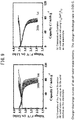
- FIG. 8 is a cyclic voltammogram of Li 3.45 [Sn 0.09 Si 0.36 ]P 0.55 S 4 , which is an example of the sulfide solid electrolyte material of the present application, in which an Li metal and Au were used as the electrodes.
- FIG. 8 with exception of the peak due to the dissolution/precipitation reaction of lithium to Li/Li + in the vicinity of 0 V, no significant current peaks are observed.
- This confirms that the sulfide solid electrolyte material of the present invention has a wide potential window. Since the Ge contained in LGPS has a low reduction resistance, it can be expected that reduction resistance of the sulfide solid electrolyte material of the present application is improved, since Ge is not contained therein.
- the lattice constant and lithium concentration affect ionic conductivity in the LGPS-type crystal phase.
- the presence ratio (1+z-x) of M is limited, and the solid solution regions of Si, Ge, and Sn are 0.525 ⁇ x ⁇ 0.60, 0.50 ⁇ x ⁇ 0.67, and 0.70 ⁇ x ⁇ 0.75, respectively (where 0 ⁇ z ⁇ -0.2).
- the proportion of elemental P in the MPS 4 tetrahedron increases and the volume increase effect decreases.
- the concentration of lithium also decreases.
- suitable lattice parameters having a high lithium concentration can be discovered.
- the inventors of the present invention conceived that the Sn/Si ratio, and the Sn 4+ , Si 4+ /P 5+ ratio are important in order to optimize the tunnel size for facilitating the migration of lithium. Based on this idea, a region excellent in lithium ion conductivity has been found. Further, the inventors of the present invention have discovered that a solid conductive material having excellent ionic conductivity can be obtained even when the ratio of Li to M is changed, whereby the present invention was completed.
- the sulfide solid electrolyte material of the present invention has high ionic conductivity, it can be used for any application requiring ionic conductivity.
- the sulfide solid electrolyte material of the present application is preferably used in batteries, since it can greatly contribute to higher battery output.
- FIG. 9 shows the charge/discharge curves of an all-solid-state battery using Li 3.45 [Sn 0.09 Si 0.36 ]P 0.55 S 4 , which is an example of the sulfide solid electrolyte material of the present application, as an electrolyte, an LiCoO 2 cathode coated with LiNbO 3 , and a Li-In alloy anode.
- the charge/discharge rate was 0.05 C. From FIG. 9 , it can be seen that this battery operates satisfactorily without problems.
- the method for producing the sulfide solid electrolyte material of the present application includes a raw material preparation step of milling, mixing and forming elemental Li, elemental Si, elemental Sn, elemental P, and elemental S to prepare a raw material composition and a heating step of heating the raw material composition to obtain a solid electrolyte material.
- Sulfides of each element, Li 2 S, P 2 S 5 , SiS 2 , and SnS 2 may be used as the feedstock for each element.
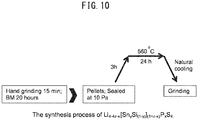
- FIG. 10 is an explanatory view showing an example of the method for producing the solid electrolyte material of the present invention.
- the solid electrolyte material production method of FIG. 10 first, Li 2 S, P 2 S 5 , SiS 2 , and SnS 2 are roughly crushed by hand, milled and mixed by a ball mill or the like, and pelletized to prepare a raw material composition. Next, the raw material composition is heated and a solid electrolyte material is obtained by a solid phase reaction.
- Mechanical milling may be used for the milling and mixing.
- Mechanical milling is a method of milling a sample while applying mechanical energy.
- Examples of such mechanical milling include vibration milling, ball milling, turbo milling, mechanofusion, disk milling, and the like. Among these, vibration milling and a ball milling are preferable.
- the conditions of the vibration milling, which is an example of mechanical milling, are not particularly limited as long the object can be milled and mixed thereby.
- the vibration amplitude of the vibration milling is preferably in the range of, for example, 5 mm to 15 mm, in particular in the range of 6 mm to 10 mm.
- the vibration frequency of the vibration milling is preferably in the range of, for example, 500 rpm to 2000 rpm, particularly preferably in the range of 1000 rpm to 1800 rpm.
- the packing rate of the sample in vibration milling is preferably in the range of, for example, 1% by volume to 80% by volume, in particular 5% by volume to 60% by volume, and especially 10% by volume to 50% by volume. It is preferable to use an oscillator (for example, an oscillator made of alumina) in the vibration mill.
- the conditions of ball milling are not particularly limited as long as the object can be milled and mixed thereby.
- the rotational speed of the table when carrying out planetary ball milling is preferably in the range of, for example, 200 rpm to 500 rpm, particularly preferably in the range of 250 rpm to 400 rpm.
- the processing time for carrying out the planetary ball milling is preferably in the range of, for example, 1 hour to 100 hours, in particular 1 hour to 70 hours.
- the heating temperature in the heating step can be appropriately adjusted in accordance with the raw material, but is preferably within the range of approximately 500 °C to 900 °C.
- the heating time includes the heating time and the resting time, and it is preferable to appropriately adjust each time so as to obtain a desired solid electrolyte material.
- the heating time and the resting time may each be within the range of 30 minutes to 48 hours.
- the heating may be performed in a substantial vacuum.
- the substantial vacuum may be, for example, 0.01 to 100 Pa.
- natural cooling may be employed or annealing may be performed so that a desired solid electrolyte material can be obtained.
- the raw materials Li 2 S, P 2 S 5 , SiS 2 , and SnS 2 were hand-pulverized and weighed in an argon atmosphere glove box, and a mixed sample was prepared using a ball mill.
- the sample was placed in a pelleter and a pressure of 20 MPa was imparted to the pelleter using a uniaxial press machine to form pellets having a diameter of 13 mm.
- These pellets were sealed in a carbon-coated quartz tube in a substantial vacuum of 10 Pa. Thereafter, the quartz tube containing the pellets was heated to 560 °C (heating rate of about 3 °C/min) over 3 hours, maintained for 24 hours, and then naturally cooled. Further, pulverization was carried out for evaluation subsequent thereto.
- the composition of the synthesized sample is generally plotted in the ternary diagram of Table 1, but it may not be plotted in the ternary diagram of Table 1.
- the composition represented by the gray circle symbol inside the triangle is a composition in which the LGPS-type crystal phase is confirmed as a single phase.
- the composition represented by the black circle symbol is a composition in which crystal phases other than the LGPS-type crystal phase have also been confirmed. The method of confirming the crystal phases will be described later.
- the obtained samples were subjected to the following measurements and evaluations.
- powder X-ray diffraction measurement was performed using a powder X-ray diffractometer Ulima-IV (produced by Rigaku Corporation) and Smart Lab (produced by Rigaku Corporation).
- Ulima-IV produced by Rigaku Corporation
- Smart Lab produced by Rigaku Corporation
- Cu-K ⁇ radiation having an X-ray wavelength of 1.5418 angstrom was used for the powder X-ray diffraction measurement.
- the powder X-ray diffraction measurement was performed at diffraction angles (2 ⁇ ) in steps of 0.01° in the range of 10 to 35°.
- Crushed samples were placed in cells for sintered pellets, and a pressure of 169 MPa was applied to the cells at room temperature to produce pellets. Thereafter, sintering was carried out at 550 °C for 12 hours to obtain sintered pellets of the solid electrolyte materials of the various compositions.
- Samples for measurement having pellet diameters of about 10 mm and thicknesses of 1 to 2 mm were prepared.
- Au was used as an electrode and bonded to the sample for measurement to prepare a Au/sample for measurement/Au battery.
- a Frequency Response Analyzer manufactured by NF Corporation was used to measure the conductivity of the measurement sample.
- Electrochemical stability is also referred to as potential window, and can be evaluated by, for example, cyclic voltammetry by assembling a cell in which a conductive lithium ion inorganic solid electrolyte and a polymer composite molded body are interposed between a Au foil and a lithium foil. Measurement was carried out at a sweep rate of 1 mV/sec. A potentiostat/galvanostat Solatron 1287 (manufactured by Solartron Corp.) was used for the measurement. The scan rate was 1 mV/s and the scan range was -0.5 to 5 V vs. Li/Li + .
- interposed all-solid-state lithium batteries were constructed using, as a separator, the obtained sulfide solid electrolyte materials as a lithium ion conductive solid electrolyte, as a cathode, a lithium cobalt oxide coated with lithium niobate, and as an anode, a lithium-indium alloy.
- batteries using an LGPS (Li 10 GeP 2 S 12 ) sulfide solid electrolyte as an electrolyte material were prepared, and charging and discharging were carried out under the same conditions as above.
- LGPS Li 10 GeP 2 S 12
- X-ray diffraction (XRD) measurement was carried out using the obtained sulfide solid electrolyte materials shown in the ternary diagram of FIG 1 . A part of the results arc shown in FIG 2 .
- the sulfide solid electrolyte materials of the present application also had a peak in this position.
- the sulfide solid electrolyte material of the present application had a value of I B /I A of less than 0.50, which suggests high ionic conductivity.
- the inventors of the present application added the coefficient z to the composition ratio of Li and [Sn y Si (1-y) ] to the above composition formula, and have discovered that a solid conductive material having excellent ionic conductivity can be obtained in the range of 0 > z ⁇ -0.2 in the case of Li 4-4z-x [Sn y Si 1-y ] 1+z-x P x S 4 .
- z is related to the composition ratio of Li and [Sn y Si (1-y) ] in the composition. The smaller the z, the lower the ratio of [Sn y Si (1-y) ] and the higher the ratio of Li.
- these compositions had an LGPS-type crystal structure with high ionic conductivity.
- this peak is one of the peaks of the crystal phase having low ionic conductivity.
- the value of I B /I A described above may become 0.50 or more in some cases.
- the range of z is limited to 0 > z ⁇ - 0.2.
- the value of I B /I A is less than 0.5, and a solid electrolyte material having good ionic conductivity is obtained.
- FIG. 6 is a synchrotron X-ray Rietveld analysis pattern of the Li 4-4z-x [Sn y Si 1-y ] 1+z-x P x S 4 electrolyte material of the present application.
- the observed data was represented by the symbol (+), and the actual radiation superimposed on the data is obtained by Rietveld analysis.
- the observed data and the analysis result are consistent.
- the lowest line in FIG. 6 shows the difference between the observed value and the calculated value intensity. The difference is very small, confirming that the observed data and the analysis result are consistent.
- ) plotted between the upper and lower lines is the possible Bragg reflection position of the space group P4 2 /nmc of the LGPS-type crystal phase. This also confirms that the electrolyte material of the present application has an LGPS-type crystal phase.
- FIG. 7 shows the temperature-dependent impedance and an Arrhenius plot obtained by measuring the ionic conductivity of sintered pellets of the powder of the Li 3.45 [Sn 0.09 Si 0.36 ]P 0.55 S 4 sulfide solid electrolyte material of the present application at 26 to 127 ° C.
- the ionic conductivity at room temperature found from this included 11.0 ⁇ 10 -3 S/cm, demonstrating excellent conductivity comparable to 12.0 ⁇ 10 -3 S/cm reported for conventional LGPS-type solid electrolytes.
- the ionic conductivity of the sintered pellets is shown in Table 1 and fluctuates with x, but was 7.95 ⁇ 10 -3 S/cm to 11 ⁇ 10 -3 S/cm.
- the ionic conductivity when a solid electrolyte other than the solid electrolyte of the present invention was used is as follows. Li 9.81 Sn 0.81 P 2.19 S 12 (LSnPS) 5 ⁇ 10 -3 S/cm Li 7.2 Si 0.2 P 0.8 S 6 8.5 ⁇ 10 -4 S/cm Li 3.225 [Sn 0.735 Si 0.99 ]P 0.375 S 6 3.9 ⁇ 10 -5 S/cm
- the ionic conductivity of the sulfide solid electrolyte material of the present application is greatly improved as compared to these Comparative Examples.
- FIG. 8 shows the cyclic voltammetry of the Li 3.45 [Sn 0.09 Si 0.36 ]P 0.55 S 4 sulfide solid electrolyte material of the present application, using Li metal and Au as electrodes.
- FIG. 8 no significant current peaks were observed except for the peak due to the dissolution/precipitation reaction of lithium in the vicinity of 0 V vs. Li/Li + .
- the scan range was -0.5 to 5 V, suggesting that the sulfide solid electrolyte material of the present application was electrochemically stable in this range.
- charge/discharge data for batteries assembled using LGPS electrolytes is also shown in FIG. 9 .
- the interval between the charging and discharging curves of the Examples of the present invention was narrow and the polarization resistance was small since the resistance between the Si-Sn solid solution of the present invention and the electrode is smaller than the resistance between the LGPS and the electrode. This suggests that the reduction potential of the Si-Sn solid solution was lower. Furthermore, a larger capacity after 20 cycles than when using LGPS was actually demonstrated.
Landscapes
- Chemical & Material Sciences (AREA)
- Engineering & Computer Science (AREA)
- Organic Chemistry (AREA)
- Manufacturing & Machinery (AREA)
- Inorganic Chemistry (AREA)
- Ceramic Engineering (AREA)
- General Chemical & Material Sciences (AREA)
- Electrochemistry (AREA)
- Chemical Kinetics & Catalysis (AREA)
- Materials Engineering (AREA)
- Structural Engineering (AREA)
- General Physics & Mathematics (AREA)
- Condensed Matter Physics & Semiconductors (AREA)
- Physics & Mathematics (AREA)
- Secondary Cells (AREA)
- Conductive Materials (AREA)
Claims (3)
- Sulfid-Festelektrolyt, der durch die Zusammensetzungsformel dargestellt wird:
Li4-4z-x[SnySi1-y]1+z-xPxS4
wobei 0,5 ≤ x ≤ 0,6, y = 0,2 und 0 > z ≥ -0,2 gilt, wobei
der Sulfid-Festelektrolyt einen Peak an einer Position 2θ = 29.58° ± 0.50° bei einer Röntgenbeugungsmessung unter Verwendung von CuKa-Strahlung aufweist und keinen Peak an einer Position 2θ = 27.33° ± 0.50° bei der Röntgenbeugungsmessung unter Verwendung von CuKa-Strahlung aufweist, oder wenn der Sulfid-Festelektrolyt an der Position 2θ = 27.33° ± 0.50° einen Peak aufweist, der Wert von IB/IA kleiner als 0,50 ist (wobei IA die Beugungsintensität des Peaks bei θ = 29.58° ± 0.50° ist und IB die Beugungsintensität des Peaks 2 bei 2θ = 27.33° ± 0.50° ist). - Sulfid-Festelektrolyt nach Anspruch 1, wobei in einer Kristallphase, die einen Peak an einer Position 2θ = 29.58° ± 0.50° aufweist, die a-Achsenlänge der Gitterkonstante 8,65 bis 8,70 Angström beträgt und die c-Achsenlänge 12,55 bis 12,62 Angström beträgt.
- Sulfid-Festelektrolyt nach Anspruch 2, wobei in den Bereichen der Achsenlängen die Achsenlängen allmählich abnehmen, wenn x in der Zusammensetzungsformel zunimmt.
Applications Claiming Priority (2)
| Application Number | Priority Date | Filing Date | Title |
|---|---|---|---|
| JP2016048790 | 2016-03-11 | ||
| PCT/JP2017/009824 WO2017155119A1 (ja) | 2016-03-11 | 2017-03-10 | 硫化物固体電解質 |
Publications (3)
| Publication Number | Publication Date |
|---|---|
| EP3429016A1 EP3429016A1 (de) | 2019-01-16 |
| EP3429016A4 EP3429016A4 (de) | 2019-10-16 |
| EP3429016B1 true EP3429016B1 (de) | 2021-04-28 |
Family
ID=59790423
Family Applications (1)
| Application Number | Title | Priority Date | Filing Date |
|---|---|---|---|
| EP17763451.6A Active EP3429016B1 (de) | 2016-03-11 | 2017-03-10 | Feststoff-sulfid-elektrolyt |
Country Status (6)
| Country | Link |
|---|---|
| US (1) | US20190074541A1 (de) |
| EP (1) | EP3429016B1 (de) |
| JP (1) | JP6742031B2 (de) |
| KR (1) | KR102390230B1 (de) |
| CN (1) | CN109314274B (de) |
| WO (1) | WO2017155119A1 (de) |
Families Citing this family (13)
| Publication number | Priority date | Publication date | Assignee | Title |
|---|---|---|---|---|
| EP3505500B1 (de) * | 2016-08-23 | 2024-06-26 | Tokyo Institute of Technology | Sulfidfeststoffelektrolyt |
| PL3605703T3 (pl) | 2017-03-22 | 2021-10-25 | Mitsubishi Gas Chemical Company, Inc. | Sposób wytwarzania elektrolitu stałego na bazie lgps |
| KR102714666B1 (ko) * | 2018-06-13 | 2024-10-07 | 미쯔비시 가스 케미칼 컴파니, 인코포레이티드 | Lgps계 고체 전해질 및 제조 방법 |
| JP7119753B2 (ja) * | 2018-08-16 | 2022-08-17 | 三菱瓦斯化学株式会社 | Lgps系固体電解質の製造方法 |
| JP7107087B2 (ja) * | 2018-08-16 | 2022-07-27 | 三菱瓦斯化学株式会社 | Lgps系固体電解質の製造方法 |
| JP7058051B2 (ja) * | 2018-09-06 | 2022-04-21 | トヨタ自動車株式会社 | 蓄電デバイス |
| KR20200077715A (ko) | 2018-12-21 | 2020-07-01 | 전자부품연구원 | 황화물계 고체전해질 및 그의 제조 방법 |
| CN111178270B (zh) * | 2019-12-30 | 2023-04-18 | 上海交通大学 | 基于xrd的三元组合材料芯片结构分析系统及方法 |
| CA3167101A1 (en) * | 2020-01-17 | 2021-07-22 | Mitsubishi Gas Chemical Company, Inc. | Method for producing sulfide solid electrolyte including sn |
| KR20260021585A (ko) * | 2023-03-08 | 2026-02-13 | 유미코아 | Lgps형 고체 황화물 전해질의 제조 방법 |
| JPWO2025047173A1 (de) * | 2023-09-01 | 2025-03-06 | ||
| JP2025037080A (ja) * | 2023-09-05 | 2025-03-17 | トヨタ自動車株式会社 | 全固体電池および全固体電池の製造方法 |
| WO2026070362A1 (ja) * | 2024-09-30 | 2026-04-02 | 株式会社村田製作所 | 硫化物固体電解質 |
Family Cites Families (8)
| Publication number | Priority date | Publication date | Assignee | Title |
|---|---|---|---|---|
| US8051375B2 (en) | 2009-04-02 | 2011-11-01 | Sony Corporation | TV widget multiview content organization |
| JP2013041749A (ja) * | 2011-08-16 | 2013-02-28 | Toyota Motor Corp | 電池システム |
| JP5888609B2 (ja) * | 2012-02-06 | 2016-03-22 | 国立大学法人東京工業大学 | 硫化物固体電解質材料、電池および硫化物固体電解質材料の製造方法 |
| KR101660609B1 (ko) * | 2012-02-06 | 2016-09-27 | 도요타지도샤가부시키가이샤 | 황화물 고체 전해질 재료, 전지 및 황화물 고체 전해질 재료의 제조 방법 |
| JP5561383B2 (ja) * | 2013-01-11 | 2014-07-30 | トヨタ自動車株式会社 | 硫化物固体電解質材料、電池および硫化物固体電解質材料の製造方法 |
| JP6037444B2 (ja) * | 2013-01-17 | 2016-12-07 | 国立大学法人東京工業大学 | 硫化物固体電解質材料、電池および硫化物固体電解質材料の製造方法 |
| JP2015032550A (ja) * | 2013-08-06 | 2015-02-16 | トヨタ自動車株式会社 | 硫化物固体電解質材料、電池および硫化物固体電解質材料の製造方法 |
| CN103401018B (zh) * | 2013-08-09 | 2016-08-10 | 宁德时代新能源科技股份有限公司 | 锂离子电池的固态电解质材料 |
-
2017
- 2017-03-10 WO PCT/JP2017/009824 patent/WO2017155119A1/ja not_active Ceased
- 2017-03-10 KR KR1020187026163A patent/KR102390230B1/ko active Active
- 2017-03-10 CN CN201780016415.XA patent/CN109314274B/zh active Active
- 2017-03-10 JP JP2018504622A patent/JP6742031B2/ja active Active
- 2017-03-10 US US16/083,597 patent/US20190074541A1/en not_active Abandoned
- 2017-03-10 EP EP17763451.6A patent/EP3429016B1/de active Active
Non-Patent Citations (1)
| Title |
|---|
| None * |
Also Published As
| Publication number | Publication date |
|---|---|
| EP3429016A4 (de) | 2019-10-16 |
| EP3429016A1 (de) | 2019-01-16 |
| KR20180118668A (ko) | 2018-10-31 |
| JP6742031B2 (ja) | 2020-08-19 |
| CN109314274A (zh) | 2019-02-05 |
| US20190074541A1 (en) | 2019-03-07 |
| CN109314274B (zh) | 2021-08-24 |
| KR102390230B1 (ko) | 2022-04-25 |
| WO2017155119A1 (ja) | 2017-09-14 |
| JPWO2017155119A1 (ja) | 2019-01-31 |
Similar Documents
| Publication | Publication Date | Title |
|---|---|---|
| EP3429016A1 (de) | Feststoff-sulfid-elektrolyt | |
| Kwak et al. | Li+ conduction in air-stable Sb-Substituted Li4SnS4 for all-solid-state Li-Ion batteries | |
| EP3828980B1 (de) | Sulfidfestelektrolyt und festkörperbatterie | |
| KR102448921B1 (ko) | 황화물 고체전해질 | |
| KR102637919B1 (ko) | 리튬 이온 전기화학셀용 고체 전해질 | |
| EP3171444B1 (de) | Feststoffelektrolyt auf sulfidbasis für lithium-ionen-batterien und verfahren zur herstellung des elektrolyts | |
| Dynarowska et al. | Ionic conductivity and structural properties of Na2Ti3O7 anode material | |
| CN104081577B (zh) | 硫化物固体电解质材料、电池和硫化物固体电解质材料的制造方法 | |
| EP3239986B1 (de) | Ionenleiter und verfahren zur herstellung davon | |
| Jung et al. | Synthesis and electrochemical performance of (100− x) Li7P3S11-xLi2OHBr composite solid electrolyte for all-solid-state lithium batteries | |
| US11777138B2 (en) | Solid state electrolytes and methods of production thereof | |
| Chen et al. | Nanoscale spinel LiFeTiO 4 for intercalation pseudocapacitive Li+ storage | |
| US20180205116A1 (en) | Lithium solid electrolyte | |
| EP3843192B1 (de) | Ionenleiter mit einer hochtemperaturphase von licb9h10, verfahren zur herstellung davon und festelektrolyt für eine festkörperbatterie mit besagtem ionenleiter | |
| Jang et al. | Preparation of argyrodite Li6–2xZnxPS5− xOxCl with improved electrochemical performance and air stability for all-solid-state batteries | |
| Chen et al. | W6+-doped Nb2O5 as high-rate anode materials for lithium-ion batteries | |
| Wang et al. | A Dynamically Stable Sulfide Electrolyte Architecture for High‐Performance All‐Solid‐State Lithium Metal Batteries | |
| US10403933B2 (en) | Solid electrolyte material and method for producing the same | |
| van Zeijl | Analysis of the material composition and ionic conductivity of bismuth fluoride and barium tin fluoride and how these factors affect their application in fluoride-ion batteries |
Legal Events
| Date | Code | Title | Description |
|---|---|---|---|
| STAA | Information on the status of an ep patent application or granted ep patent |
Free format text: STATUS: THE INTERNATIONAL PUBLICATION HAS BEEN MADE |
|
| PUAI | Public reference made under article 153(3) epc to a published international application that has entered the european phase |
Free format text: ORIGINAL CODE: 0009012 |
|
| STAA | Information on the status of an ep patent application or granted ep patent |
Free format text: STATUS: REQUEST FOR EXAMINATION WAS MADE |
|
| 17P | Request for examination filed |
Effective date: 20181009 |
|
| AK | Designated contracting states |
Kind code of ref document: A1 Designated state(s): AL AT BE BG CH CY CZ DE DK EE ES FI FR GB GR HR HU IE IS IT LI LT LU LV MC MK MT NL NO PL PT RO RS SE SI SK SM TR |
|
| AX | Request for extension of the european patent |
Extension state: BA ME |
|
| DAV | Request for validation of the european patent (deleted) | ||
| DAX | Request for extension of the european patent (deleted) | ||
| A4 | Supplementary search report drawn up and despatched |
Effective date: 20190918 |
|
| RIC1 | Information provided on ipc code assigned before grant |
Ipc: C01G 19/00 20060101ALI20190912BHEP Ipc: C01B 33/06 20060101ALI20190912BHEP Ipc: C01B 17/22 20060101ALI20190912BHEP Ipc: H01M 10/052 20100101ALI20190912BHEP Ipc: C04B 35/547 20060101ALI20190912BHEP Ipc: H01B 1/06 20060101ALI20190912BHEP Ipc: H01M 10/0562 20100101AFI20190912BHEP |
|
| STAA | Information on the status of an ep patent application or granted ep patent |
Free format text: STATUS: EXAMINATION IS IN PROGRESS |
|
| 17Q | First examination report despatched |
Effective date: 20200720 |
|
| GRAP | Despatch of communication of intention to grant a patent |
Free format text: ORIGINAL CODE: EPIDOSNIGR1 |
|
| STAA | Information on the status of an ep patent application or granted ep patent |
Free format text: STATUS: GRANT OF PATENT IS INTENDED |
|
| INTG | Intention to grant announced |
Effective date: 20201125 |
|
| GRAS | Grant fee paid |
Free format text: ORIGINAL CODE: EPIDOSNIGR3 |
|
| GRAA | (expected) grant |
Free format text: ORIGINAL CODE: 0009210 |
|
| STAA | Information on the status of an ep patent application or granted ep patent |
Free format text: STATUS: THE PATENT HAS BEEN GRANTED |
|
| AK | Designated contracting states |
Kind code of ref document: B1 Designated state(s): AL AT BE BG CH CY CZ DE DK EE ES FI FR GB GR HR HU IE IS IT LI LT LU LV MC MK MT NL NO PL PT RO RS SE SI SK SM TR |
|
| REG | Reference to a national code |
Ref country code: GB Ref legal event code: FG4D |
|
| REG | Reference to a national code |
Ref country code: CH Ref legal event code: EP |
|
| REG | Reference to a national code |
Ref country code: AT Ref legal event code: REF Ref document number: 1388145 Country of ref document: AT Kind code of ref document: T Effective date: 20210515 |
|
| REG | Reference to a national code |
Ref country code: DE Ref legal event code: R096 Ref document number: 602017037655 Country of ref document: DE |
|
| REG | Reference to a national code |
Ref country code: IE Ref legal event code: FG4D |
|
| REG | Reference to a national code |
Ref country code: LT Ref legal event code: MG9D |
|
| REG | Reference to a national code |
Ref country code: AT Ref legal event code: MK05 Ref document number: 1388145 Country of ref document: AT Kind code of ref document: T Effective date: 20210428 |
|
| PG25 | Lapsed in a contracting state [announced via postgrant information from national office to epo] |
Ref country code: FI Free format text: LAPSE BECAUSE OF FAILURE TO SUBMIT A TRANSLATION OF THE DESCRIPTION OR TO PAY THE FEE WITHIN THE PRESCRIBED TIME-LIMIT Effective date: 20210428 Ref country code: LT Free format text: LAPSE BECAUSE OF FAILURE TO SUBMIT A TRANSLATION OF THE DESCRIPTION OR TO PAY THE FEE WITHIN THE PRESCRIBED TIME-LIMIT Effective date: 20210428 Ref country code: NL Free format text: LAPSE BECAUSE OF FAILURE TO SUBMIT A TRANSLATION OF THE DESCRIPTION OR TO PAY THE FEE WITHIN THE PRESCRIBED TIME-LIMIT Effective date: 20210428 Ref country code: HR Free format text: LAPSE BECAUSE OF FAILURE TO SUBMIT A TRANSLATION OF THE DESCRIPTION OR TO PAY THE FEE WITHIN THE PRESCRIBED TIME-LIMIT Effective date: 20210428 Ref country code: AT Free format text: LAPSE BECAUSE OF FAILURE TO SUBMIT A TRANSLATION OF THE DESCRIPTION OR TO PAY THE FEE WITHIN THE PRESCRIBED TIME-LIMIT Effective date: 20210428 Ref country code: BG Free format text: LAPSE BECAUSE OF FAILURE TO SUBMIT A TRANSLATION OF THE DESCRIPTION OR TO PAY THE FEE WITHIN THE PRESCRIBED TIME-LIMIT Effective date: 20210728 |
|
| PG25 | Lapsed in a contracting state [announced via postgrant information from national office to epo] |
Ref country code: IS Free format text: LAPSE BECAUSE OF FAILURE TO SUBMIT A TRANSLATION OF THE DESCRIPTION OR TO PAY THE FEE WITHIN THE PRESCRIBED TIME-LIMIT Effective date: 20210828 Ref country code: GR Free format text: LAPSE BECAUSE OF FAILURE TO SUBMIT A TRANSLATION OF THE DESCRIPTION OR TO PAY THE FEE WITHIN THE PRESCRIBED TIME-LIMIT Effective date: 20210729 Ref country code: NO Free format text: LAPSE BECAUSE OF FAILURE TO SUBMIT A TRANSLATION OF THE DESCRIPTION OR TO PAY THE FEE WITHIN THE PRESCRIBED TIME-LIMIT Effective date: 20210728 Ref country code: PT Free format text: LAPSE BECAUSE OF FAILURE TO SUBMIT A TRANSLATION OF THE DESCRIPTION OR TO PAY THE FEE WITHIN THE PRESCRIBED TIME-LIMIT Effective date: 20210830 Ref country code: LV Free format text: LAPSE BECAUSE OF FAILURE TO SUBMIT A TRANSLATION OF THE DESCRIPTION OR TO PAY THE FEE WITHIN THE PRESCRIBED TIME-LIMIT Effective date: 20210428 Ref country code: PL Free format text: LAPSE BECAUSE OF FAILURE TO SUBMIT A TRANSLATION OF THE DESCRIPTION OR TO PAY THE FEE WITHIN THE PRESCRIBED TIME-LIMIT Effective date: 20210428 Ref country code: SE Free format text: LAPSE BECAUSE OF FAILURE TO SUBMIT A TRANSLATION OF THE DESCRIPTION OR TO PAY THE FEE WITHIN THE PRESCRIBED TIME-LIMIT Effective date: 20210428 Ref country code: RS Free format text: LAPSE BECAUSE OF FAILURE TO SUBMIT A TRANSLATION OF THE DESCRIPTION OR TO PAY THE FEE WITHIN THE PRESCRIBED TIME-LIMIT Effective date: 20210428 |
|
| REG | Reference to a national code |
Ref country code: NL Ref legal event code: MP Effective date: 20210428 |
|
| PG25 | Lapsed in a contracting state [announced via postgrant information from national office to epo] |
Ref country code: SM Free format text: LAPSE BECAUSE OF FAILURE TO SUBMIT A TRANSLATION OF THE DESCRIPTION OR TO PAY THE FEE WITHIN THE PRESCRIBED TIME-LIMIT Effective date: 20210428 Ref country code: SK Free format text: LAPSE BECAUSE OF FAILURE TO SUBMIT A TRANSLATION OF THE DESCRIPTION OR TO PAY THE FEE WITHIN THE PRESCRIBED TIME-LIMIT Effective date: 20210428 Ref country code: RO Free format text: LAPSE BECAUSE OF FAILURE TO SUBMIT A TRANSLATION OF THE DESCRIPTION OR TO PAY THE FEE WITHIN THE PRESCRIBED TIME-LIMIT Effective date: 20210428 Ref country code: ES Free format text: LAPSE BECAUSE OF FAILURE TO SUBMIT A TRANSLATION OF THE DESCRIPTION OR TO PAY THE FEE WITHIN THE PRESCRIBED TIME-LIMIT Effective date: 20210428 Ref country code: DK Free format text: LAPSE BECAUSE OF FAILURE TO SUBMIT A TRANSLATION OF THE DESCRIPTION OR TO PAY THE FEE WITHIN THE PRESCRIBED TIME-LIMIT Effective date: 20210428 Ref country code: EE Free format text: LAPSE BECAUSE OF FAILURE TO SUBMIT A TRANSLATION OF THE DESCRIPTION OR TO PAY THE FEE WITHIN THE PRESCRIBED TIME-LIMIT Effective date: 20210428 Ref country code: CZ Free format text: LAPSE BECAUSE OF FAILURE TO SUBMIT A TRANSLATION OF THE DESCRIPTION OR TO PAY THE FEE WITHIN THE PRESCRIBED TIME-LIMIT Effective date: 20210428 |
|
| REG | Reference to a national code |
Ref country code: DE Ref legal event code: R097 Ref document number: 602017037655 Country of ref document: DE |
|
| PLBE | No opposition filed within time limit |
Free format text: ORIGINAL CODE: 0009261 |
|
| STAA | Information on the status of an ep patent application or granted ep patent |
Free format text: STATUS: NO OPPOSITION FILED WITHIN TIME LIMIT |
|
| 26N | No opposition filed |
Effective date: 20220131 |
|
| PG25 | Lapsed in a contracting state [announced via postgrant information from national office to epo] |
Ref country code: IS Free format text: LAPSE BECAUSE OF FAILURE TO SUBMIT A TRANSLATION OF THE DESCRIPTION OR TO PAY THE FEE WITHIN THE PRESCRIBED TIME-LIMIT Effective date: 20210828 Ref country code: AL Free format text: LAPSE BECAUSE OF FAILURE TO SUBMIT A TRANSLATION OF THE DESCRIPTION OR TO PAY THE FEE WITHIN THE PRESCRIBED TIME-LIMIT Effective date: 20210428 |
|
| PG25 | Lapsed in a contracting state [announced via postgrant information from national office to epo] |
Ref country code: IT Free format text: LAPSE BECAUSE OF FAILURE TO SUBMIT A TRANSLATION OF THE DESCRIPTION OR TO PAY THE FEE WITHIN THE PRESCRIBED TIME-LIMIT Effective date: 20210428 |
|
| PG25 | Lapsed in a contracting state [announced via postgrant information from national office to epo] |
Ref country code: MC Free format text: LAPSE BECAUSE OF FAILURE TO SUBMIT A TRANSLATION OF THE DESCRIPTION OR TO PAY THE FEE WITHIN THE PRESCRIBED TIME-LIMIT Effective date: 20210428 |
|
| REG | Reference to a national code |
Ref country code: CH Ref legal event code: PL |
|
| REG | Reference to a national code |
Ref country code: BE Ref legal event code: MM Effective date: 20220331 |
|
| PG25 | Lapsed in a contracting state [announced via postgrant information from national office to epo] |
Ref country code: LU Free format text: LAPSE BECAUSE OF NON-PAYMENT OF DUE FEES Effective date: 20220310 Ref country code: LI Free format text: LAPSE BECAUSE OF NON-PAYMENT OF DUE FEES Effective date: 20220331 Ref country code: IE Free format text: LAPSE BECAUSE OF NON-PAYMENT OF DUE FEES Effective date: 20220310 Ref country code: CH Free format text: LAPSE BECAUSE OF NON-PAYMENT OF DUE FEES Effective date: 20220331 |
|
| PG25 | Lapsed in a contracting state [announced via postgrant information from national office to epo] |
Ref country code: BE Free format text: LAPSE BECAUSE OF NON-PAYMENT OF DUE FEES Effective date: 20220331 |
|
| PG25 | Lapsed in a contracting state [announced via postgrant information from national office to epo] |
Ref country code: HU Free format text: LAPSE BECAUSE OF FAILURE TO SUBMIT A TRANSLATION OF THE DESCRIPTION OR TO PAY THE FEE WITHIN THE PRESCRIBED TIME-LIMIT; INVALID AB INITIO Effective date: 20170310 |
|
| PG25 | Lapsed in a contracting state [announced via postgrant information from national office to epo] |
Ref country code: MK Free format text: LAPSE BECAUSE OF FAILURE TO SUBMIT A TRANSLATION OF THE DESCRIPTION OR TO PAY THE FEE WITHIN THE PRESCRIBED TIME-LIMIT Effective date: 20210428 Ref country code: CY Free format text: LAPSE BECAUSE OF FAILURE TO SUBMIT A TRANSLATION OF THE DESCRIPTION OR TO PAY THE FEE WITHIN THE PRESCRIBED TIME-LIMIT Effective date: 20210428 |
|
| PG25 | Lapsed in a contracting state [announced via postgrant information from national office to epo] |
Ref country code: MT Free format text: LAPSE BECAUSE OF FAILURE TO SUBMIT A TRANSLATION OF THE DESCRIPTION OR TO PAY THE FEE WITHIN THE PRESCRIBED TIME-LIMIT Effective date: 20210428 |
|
| PG25 | Lapsed in a contracting state [announced via postgrant information from national office to epo] |
Ref country code: TR Free format text: LAPSE BECAUSE OF FAILURE TO SUBMIT A TRANSLATION OF THE DESCRIPTION OR TO PAY THE FEE WITHIN THE PRESCRIBED TIME-LIMIT Effective date: 20210428 |
|
| PGFP | Annual fee paid to national office [announced via postgrant information from national office to epo] |
Ref country code: GB Payment date: 20260202 Year of fee payment: 10 |
|
| PGFP | Annual fee paid to national office [announced via postgrant information from national office to epo] |
Ref country code: DE Payment date: 20260320 Year of fee payment: 10 |
|
| PGFP | Annual fee paid to national office [announced via postgrant information from national office to epo] |
Ref country code: FR Payment date: 20260226 Year of fee payment: 10 |