EP3432006A1 - Elektronikeinrichtung mit in einen kühlkörper integrierten stromsensor - Google Patents
Elektronikeinrichtung mit in einen kühlkörper integrierten stromsensor Download PDFInfo
- Publication number
- EP3432006A1 EP3432006A1 EP18171375.1A EP18171375A EP3432006A1 EP 3432006 A1 EP3432006 A1 EP 3432006A1 EP 18171375 A EP18171375 A EP 18171375A EP 3432006 A1 EP3432006 A1 EP 3432006A1
- Authority
- EP
- European Patent Office
- Prior art keywords
- current
- electronic device
- current sensor
- cooling element
- power line
- Prior art date
- Legal status (The legal status is an assumption and is not a legal conclusion. Google has not performed a legal analysis and makes no representation as to the accuracy of the status listed.)
- Granted
Links
Images

Classifications
-
- H—ELECTRICITY
- H10—SEMICONDUCTOR DEVICES; ELECTRIC SOLID-STATE DEVICES NOT OTHERWISE PROVIDED FOR
- H10W—GENERIC PACKAGES, INTERCONNECTIONS, CONNECTORS OR OTHER CONSTRUCTIONAL DETAILS OF DEVICES COVERED BY CLASS H10
- H10W40/00—Arrangements for thermal protection or thermal control
- H10W40/20—Arrangements for cooling
- H10W40/22—Arrangements for cooling characterised by their shape, e.g. having conical or cylindrical projections
-
- G—PHYSICS
- G01—MEASURING; TESTING
- G01R—MEASURING ELECTRIC VARIABLES; MEASURING MAGNETIC VARIABLES
- G01R15/00—Details of measuring arrangements of the types provided for in groups G01R17/00 - G01R29/00, G01R33/00 - G01R33/26 or G01R35/00
- G01R15/14—Adaptations providing voltage or current isolation, e.g. for high-voltage or high-current networks
- G01R15/20—Adaptations providing voltage or current isolation, e.g. for high-voltage or high-current networks using galvano-magnetic devices, e.g. Hall-effect devices, i.e. measuring a magnetic field via the interaction between a current and a magnetic field, e.g. magneto resistive or Hall effect devices
- G01R15/202—Adaptations providing voltage or current isolation, e.g. for high-voltage or high-current networks using galvano-magnetic devices, e.g. Hall-effect devices, i.e. measuring a magnetic field via the interaction between a current and a magnetic field, e.g. magneto resistive or Hall effect devices using Hall-effect devices
-
- B—PERFORMING OPERATIONS; TRANSPORTING
- B60—VEHICLES IN GENERAL
- B60R—VEHICLES, VEHICLE FITTINGS, OR VEHICLE PARTS, NOT OTHERWISE PROVIDED FOR
- B60R16/00—Electric or fluid circuits specially adapted for vehicles and not otherwise provided for; Arrangement of elements of electric or fluid circuits specially adapted for vehicles and not otherwise provided for
- B60R16/02—Electric or fluid circuits specially adapted for vehicles and not otherwise provided for; Arrangement of elements of electric or fluid circuits specially adapted for vehicles and not otherwise provided for electric constitutive elements
-
- G—PHYSICS
- G01—MEASURING; TESTING
- G01R—MEASURING ELECTRIC VARIABLES; MEASURING MAGNETIC VARIABLES
- G01R1/00—Details of instruments or arrangements of the types included in groups G01R5/00 - G01R13/00 and G01R31/00
- G01R1/02—General constructional details
- G01R1/18—Screening arrangements against electric or magnetic fields, e.g. against earth's field
-
- G—PHYSICS
- G01—MEASURING; TESTING
- G01R—MEASURING ELECTRIC VARIABLES; MEASURING MAGNETIC VARIABLES
- G01R15/00—Details of measuring arrangements of the types provided for in groups G01R17/00 - G01R29/00, G01R33/00 - G01R33/26 or G01R35/00
- G01R15/14—Adaptations providing voltage or current isolation, e.g. for high-voltage or high-current networks
- G01R15/20—Adaptations providing voltage or current isolation, e.g. for high-voltage or high-current networks using galvano-magnetic devices, e.g. Hall-effect devices, i.e. measuring a magnetic field via the interaction between a current and a magnetic field, e.g. magneto resistive or Hall effect devices
- G01R15/207—Constructional details independent of the type of device used
-
- H—ELECTRICITY
- H10—SEMICONDUCTOR DEVICES; ELECTRIC SOLID-STATE DEVICES NOT OTHERWISE PROVIDED FOR
- H10W—GENERIC PACKAGES, INTERCONNECTIONS, CONNECTORS OR OTHER CONSTRUCTIONAL DETAILS OF DEVICES COVERED BY CLASS H10
- H10W70/00—Package substrates; Interposers; Redistribution layers [RDL]
- H10W70/60—Insulating or insulated package substrates; Interposers; Redistribution layers
- H10W70/611—Insulating or insulated package substrates; Interposers; Redistribution layers for connecting multiple chips together
-
- H—ELECTRICITY
- H10—SEMICONDUCTOR DEVICES; ELECTRIC SOLID-STATE DEVICES NOT OTHERWISE PROVIDED FOR
- H10W—GENERIC PACKAGES, INTERCONNECTIONS, CONNECTORS OR OTHER CONSTRUCTIONAL DETAILS OF DEVICES COVERED BY CLASS H10
- H10W70/00—Package substrates; Interposers; Redistribution layers [RDL]
- H10W70/60—Insulating or insulated package substrates; Interposers; Redistribution layers
- H10W70/62—Insulating or insulated package substrates; Interposers; Redistribution layers characterised by their interconnections
- H10W70/65—Shapes or dispositions of interconnections
-
- H—ELECTRICITY
- H10—SEMICONDUCTOR DEVICES; ELECTRIC SOLID-STATE DEVICES NOT OTHERWISE PROVIDED FOR
- H10W—GENERIC PACKAGES, INTERCONNECTIONS, CONNECTORS OR OTHER CONSTRUCTIONAL DETAILS OF DEVICES COVERED BY CLASS H10
- H10W90/00—Package configurations
-
- B—PERFORMING OPERATIONS; TRANSPORTING
- B60—VEHICLES IN GENERAL
- B60R—VEHICLES, VEHICLE FITTINGS, OR VEHICLE PARTS, NOT OTHERWISE PROVIDED FOR
- B60R16/00—Electric or fluid circuits specially adapted for vehicles and not otherwise provided for; Arrangement of elements of electric or fluid circuits specially adapted for vehicles and not otherwise provided for
- B60R16/02—Electric or fluid circuits specially adapted for vehicles and not otherwise provided for; Arrangement of elements of electric or fluid circuits specially adapted for vehicles and not otherwise provided for electric constitutive elements
- B60R16/03—Electric or fluid circuits specially adapted for vehicles and not otherwise provided for; Arrangement of elements of electric or fluid circuits specially adapted for vehicles and not otherwise provided for electric constitutive elements for supply of electrical power to vehicle subsystems or for
-
- G—PHYSICS
- G01—MEASURING; TESTING
- G01R—MEASURING ELECTRIC VARIABLES; MEASURING MAGNETIC VARIABLES
- G01R31/00—Arrangements for testing electric properties; Arrangements for locating electric faults; Arrangements for electrical testing characterised by what is being tested not provided for elsewhere
- G01R31/005—Testing of electric installations on transport means
- G01R31/006—Testing of electric installations on transport means on road vehicles, e.g. automobiles or trucks
-
- H—ELECTRICITY
- H02—GENERATION; CONVERSION OR DISTRIBUTION OF ELECTRIC POWER
- H02M—APPARATUS FOR CONVERSION BETWEEN AC AND AC, BETWEEN AC AND DC, OR BETWEEN DC AND DC, AND FOR USE WITH MAINS OR SIMILAR POWER SUPPLY SYSTEMS; CONVERSION OF DC OR AC INPUT POWER INTO SURGE OUTPUT POWER; CONTROL OR REGULATION THEREOF
- H02M7/00—Conversion of AC power input into DC power output; Conversion of DC power input into AC power output
- H02M7/003—Constructional details, e.g. physical layout, assembly, wiring or busbar connections
-
- H—ELECTRICITY
- H10—SEMICONDUCTOR DEVICES; ELECTRIC SOLID-STATE DEVICES NOT OTHERWISE PROVIDED FOR
- H10W—GENERIC PACKAGES, INTERCONNECTIONS, CONNECTORS OR OTHER CONSTRUCTIONAL DETAILS OF DEVICES COVERED BY CLASS H10
- H10W40/00—Arrangements for thermal protection or thermal control
- H10W40/10—Arrangements for heating
-
- H—ELECTRICITY
- H10—SEMICONDUCTOR DEVICES; ELECTRIC SOLID-STATE DEVICES NOT OTHERWISE PROVIDED FOR
- H10W—GENERIC PACKAGES, INTERCONNECTIONS, CONNECTORS OR OTHER CONSTRUCTIONAL DETAILS OF DEVICES COVERED BY CLASS H10
- H10W76/00—Containers; Fillings or auxiliary members therefor; Seals
- H10W76/10—Containers or parts thereof
- H10W76/12—Containers or parts thereof characterised by their shape
- H10W76/15—Containers comprising an insulating or insulated base
- H10W76/153—Containers comprising an insulating or insulated base having interconnections in passages through the insulating or insulated base
Definitions
- the invention relates to an electronic device with at least one component to be cooled, a cooling element for cooling the component to be cooled, at least one power line and a respective current sensor for detecting a current strength of a current flowing through the respective power line.
- the invention relates to a motor vehicle.
- AC sensors can be used.
- Hall sensors can be used.
- open-loop Hall sensors can be used which have a flux concentrator, for example a ring of soft iron guided around the pipe. In open-loop sensor technology, the Hall voltage is detected directly.
- the problem here is that corresponding Hall sensors are relatively large construction.
- the components of the Hall sensor can heat up during operation, which can potentially lead to measurement errors or the measurement accuracy drops.
- the invention is therefore based on the object of specifying a space-saving possibility for measuring a current intensity in an electronic device, which can be implemented in particular with low technical complexity.
- the object is achieved by an electronic device of the type mentioned above, wherein the cooling element has a recess into which the current sensor engages or in which the current sensor is arranged.
- the cooling element may for example be a cooling plate, which may serve to cool electrical semiconductor switches or other heat-generating components of the electronic device.
- the cooling plate may for example be a metal plate, which increases the surface for radiating heat due to its high thermal conductivity.
- the cooling element or the cooling plate comprises an active cooling.
- the cooling element or the cooling plate can be penetrated by cooling passages through which a cooling fluid flows.
- the current sensor can be designed as a prefabricated module, which is fastened to the cooling plate, in particular via a housing of the current sensor.
- the current sensor can be screwed, riveted, locked or glued to the cooling element.
- the current sensor may in particular be an alternating current sensor.
- a Hall sensor with flux concentrator can be used.
- the current sensor can provide a voltage which depends on the measured current intensity. This can be detected by a control device, in particular using an analog-to-digital converter.
- the electronic device may be an electronic module which has at least one defined connection for connection to further components.
- the components of the electronic module can be arranged in particular within a housing.
- the recess of the cooling element may in particular be an opening.
- the power line can serve to supply power to the electronic device, or it can be used to provide energy from the electronic device to another component.
- the electronic device is a current transformer, the current of one or more output lines can be measured.
- the power line connects several components of the electronic device together.
- the power line is passed through a recess of the current sensor.
- the current measurement may in particular be contactless.
- the recess may be at least partially surrounded by a flux concentrator of the current sensor, for example by an open soft iron ring.
- the recess can in particular pass through a housing of the current sensor.
- the power line can end at least on one side with an open contact area, which serves to connect a connecting means.
- the power line may terminate in a plug or socket.
- the recess of the cooling element may be an opening through which the power line is passed.
- the current sensor may be arranged in the opening and the power line may be passed through the current sensor.
- cooling of the power line in particular in the area of the current sensor, can be achieved.
- This makes it possible to use a power line which, at least in the region of the current sensor, has a smaller line cross-section than would be required for an uncooled line.
- a flux concentrator with a smaller inner diameter can be used at the same time, whereby a total of a smaller-sized current sensor can be realized.
- Several current sensors can be arranged together in the recess of the cooling element.
- the current sensors can be arranged in particular in a common housing. As a result, the electronic device can be constructed simpler. If a plurality of current sensors are arranged together in an opening, wherein the current lines are each guided by the current sensors, in particular by contact areas of the power lines on one side of the cooling element, a connecting element, for example a plug or a socket, be formed for all power lines. As a result, a connection of multiple power lines can be easily implemented.
- a housing having one or more current sensors can be shaped such that it is guided or held by the recess of the cooling element. If the recess is an opening, then the housing may have a support section which projects beyond the opening, so that the housing rests on the cooling element after insertion into the opening with the support section. As a result, a particularly simple assembly of the current sensor or the current sensors is achieved.
- the support portion may include a recess or aperture to guide, for example, a screw or rivet with which the current sensor is attached to the cooling element.
- the current sensor may comprise a flux concentrating element encompassing the power line, which has an opening in the circumferential direction in which a Hall probe is arranged.
- the flux concentration element may, for example, have an open ring shape or a C shape.
- Hall probes with flux concentrator are known in principle in the prior art and will not be explained in detail. In the case of a Hall probe, at least in open-loop measurements, a fixed current is applied to the Hall probe and a voltage which drops substantially perpendicular thereto is measured. Since there is a clear relationship between the induced field and a guided current and a voltage drop across a Hall probe and a field passing through the Hall probe, a current in the power line can thus be measured without contact. The relationship between a voltage drop across the Hall probe and the current can be approximated as linear. However, it is also possible to measure this relationship beforehand and store it, for example, as a value table in a control device which detects the measurement data of the Hall probe.
- the flux concentration element may for example consist of soft iron or another paramagnetic or soft magnetic material.
- the flux concentration element and / or the Hall probe may be at least partially, preferably completely, within the recess of the cooling element.
- the electronic device may be a power converter or comprise a power converter.
- it can be an inverter, in particular for an electric motor, for example a drive motor of a motor vehicle.
- the component to be cooled or at least one of the components to be cooled may be a semiconductor switch.
- the semiconductor switch may be a transistor, for example an IGBT or a mosfet. Circuits for converting currents by means of semiconductor switches are known in the art and therefore will not be explained. Compared with, for example, relays, semiconductor switches allow significantly shorter switching intervals. Meanwhile, semiconductor switches can be realized, which have a very low resistance in a closed switch. Nevertheless, in particular in a direction of high currents, as required, for example, for drive motors, a certain power dissipation from the semiconductor switch, whereby corresponding circuits are typically cooled. A cooling element necessary for this purpose can be used simultaneously in the electronic device according to the invention for receiving and for cooling the current sensor.
- the cooling element may be made of metal at least in the region of the recess.
- a cooling element made of metal in particular a cooling plate, has a good thermal conductivity and can thus serve to increase a surface through which heat can be radiated.
- it can be advantageous to additionally provide active cooling wherein, for example, cooling fluid can be passed through cooling passages of the cooling element.
- the at least partially forming the cooling element made of metal improves the electromagnetic shielding of the current sensor against external influences. This can serve to further increase the measurement accuracy. Alternatively or additionally, a smaller current sensor can be realized due to the improved electromagnetic shielding.
- the invention relates to a motor vehicle comprising an electronic device according to the invention.
- the electronic device can be used in particular as an inverter for an engine of the motor vehicle, especially a drive motor of the motor vehicle.
- the motor vehicle comprises a control device, by means of which the power supplied to the motor is regulated, wherein at least one of the current sensors detects a current supplied to the motor, wherein a sensor signal of this sensor is usable as an input variable of a power control.
- the control can regulate the current to a desired value, for example by a pulse width control of the semiconductor switches used in the direction of change.
- Fig. 1 shows an electronic device 1, with a plurality of components to be cooled 2, which are arranged on a printed circuit board 3 and are cooled by a cooling device 4.
- the electronic device 1 is an inverter which converts a direct current provided by a battery 5 and supplies an alternating current to a motor 6.
- the engine 6 may be, for example, a drive motor of a motor vehicle.
- the provision of the alternating current via a power line 7.
- a plurality of power lines 7 may be used to provide a three-phase current to the motor 6 for energizing the motor 6.
- the components 2 to be cooled may in particular be semiconductor switches which are used to convert the current.
- corresponding switching signals or pulse widths and phase positions can be preset by a control device 8.
- the cooling element 4 may be a cooling plate, which may be formed for example as a metal plate.
- cooling channels could be provided in the cooling element 4, through which a cooling fluid can be guided in order to further improve the cooling of the component 2 to be cooled.
- the electronic device 1 has a current sensor 9, which is arranged in a recess 10, namely an opening, of the cooling element 4.
- the construction of the current sensor 9 will be described later in detail with reference to FIG Fig. 2 and 3 be explained.
- the current sensor 9 is formed by a flux concentrator, which surrounds the power line 7 and which has an opening in which a Hall probe is arranged. If a solid current is conducted with such a Hall probe via second contacts, a voltage can be tapped via two further contacts which is approximately proportional to the current flowing through the current line 7. Non-linearities of this sensor can be compensated by a previous calibration, for which purpose a look-up table can be stored in the controller 8, for example.
- the power cable 7 is guided through a recess 11, namely an opening, of the current sensor 9 to allow a contactless measurement of the current.
- the construction shown of the electronic device 1 allows by the arrangement of the current sensor 9 in the cooling device 4, an integration of a current measurement with a low space consumption.
- both the current sensor 9 and the power line 7 are also cooled in the region of the current sensor 9 by the cooling element 4, the measurement accuracy of the current sensor 9 can be improved and the line cross-section of the Power line 7 can be reduced, which also allows the use of a more compact current sensor 9.
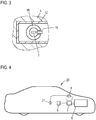
- FIG. 2 and 3 show detailed views of another embodiment of an electronic device.
- the structure is essentially the same as in Fig. 1 shown device, wherein instead of a power line 7 three power lines 7 are used to provide three phases of an alternating current to an external device, such as the motor 6.
- an external device such as the motor 6.
- three current sensors 9 are arranged for the three power lines 7. These are fastened to the cooling element 4 via a common housing 12.
- the housing 12 can in Fig. 2 be inserted from above into the recess 10 and rests with support portions 13 on the edge of the recess 10. These have openings to secure the housing 10 and thus the current sensors 9 with fastening elements 14, for example with screws, to the cooling element 4.
- the individual current sensors 9 are formed by a flow concentration element 15 encompassing the power line 7 and a Hall probe 16, the flux concentration element 15 having an opening in the circumferential direction in which the Hall probe 16 is arranged.
- the wiring of the Hall probe 16 is not shown for clarity.
- the sections 17 of the power lines 7, in which they pass through the cooling element 4 and the current sensor 9, have a narrowed cross-section. This is made possible by the fact that the power line 7 is cooled in this area 17 each by the cooling element 4, whereby the current carrying capacity is improved. This makes it possible for the recess 11 of the current sensor 9 or of the flux concentration element 15 to have a smaller diameter than would otherwise be required, with which the current sensor 9 can be made more compact overall.
- the power lines 7 have unilaterally open contacts 19, through which a plug 18 is formed in the region of the cooling element.
- the motor 6 can be connected via a corresponding connecting element.
- the cooling element 4 is formed at least in the region of the recess 10 made of metal, then the cooling element 4 can also serve for the electromagnetic shielding of the current sensor 9, whereby its measurement accuracy can be improved.
- Fig. 4 shows a motor vehicle 20 having a motor 6 as an electronic drive motor, which is powered by the battery 5, for example, a high-voltage battery.
- a motor 6 as an electronic drive motor, which is powered by the battery 5, for example, a high-voltage battery.
- an electronic device 1 is provided which, as to Fig. 1 is explained, is constructed as with respect to Fig. 2 and 3 has been explained, separate power lines 7 are used for the individual phases of the alternating current.
- the control device 8 data of a plurality of vehicle devices 21, for example, from an accelerator pedal sensor, detected to specify a target power for the engine 6.
- control device 8 In order to set this desired power, the control device 8 detects the currently provided current intensity via the current sensors 9 of the electronic device 1 and, on the other hand, gives pulse widths for the semiconductor switches of the electronic device in order to regulate the actually emitted current intensity to the desired current intensity.
Landscapes
- Physics & Mathematics (AREA)
- General Physics & Mathematics (AREA)
- Engineering & Computer Science (AREA)
- Mechanical Engineering (AREA)
- Measuring Instrument Details And Bridges, And Automatic Balancing Devices (AREA)
- Geometry (AREA)
- Inverter Devices (AREA)
Abstract
Description
- Die Erfindung betrifft eine Elektronikeinrichtung mit wenigstens einer zu kühlenden Komponente, einem Kühlelement zur Kühlung der zu kühlenden Komponente, wenigstens einer Stromleitung und einem jeweiligen Stromsensor zur Erfassung einer Stromstärke eines durch die jeweilige Stromleitung fließenden Stroms. Daneben betrifft die Erfindung ein Kraftfahrzeug.
- In einer Vielzahl von Anwendungsfällen ist es erforderlich, einer Elektronikeinrichtung zugeführte Ströme bzw. durch diese bereitgestellte Ströme zu überwachen. Beispielsweise soll bei Traktionswechselrichtern in Kraftfahrzeugen typischerweise eine Überwachung und Regelung der bereitgestellten Leistung bzw. Stromstärke erfolgen. Hierzu können Wechselstromsensoren genutzt werden. Als Wechselstromsensoren können beispielsweise Hall-Sensoren genutzt werden. Um eine hohe Empfindlichkeit bei einer möglichst einfachen Beschaltung zu erreichen, können Open-Loop-Hall-Sensoren genutzt werden, die einen Flusskonzentrator, beispielsweise einen um die Leitung geführten Ring aus Weicheisen, aufweisen. Bei einer Open-Loop-Sensorik wird die Hall-Spannung direkt erfasst.
- Problematisch ist hierbei, dass entsprechende Hall-Sensoren relativ großbauend sind. Zudem können sich die Komponenten des Hall-Sensors im Betrieb erwärmen, womit potentiell Messfehler auftreten können bzw. die Messgenauigkeit sinkt.
- Aus der Druckschrift
DE 10 2004 054 317 A1 ist eine Strommessvorrichtung bekannt, bei der der Strom durch einen Stromkanal fließt, der so angeordnet ist, dass er einen vorbestimmten Punkt auf einem Substrat umgibt. An diesem Punkt ist ein magnetisches Messelement zur Umwandlung des magnetischen Flusses in eine Spannung vorgesehen. Der Stromkanal ist in Schichten auf einem hochwärmeleitfähigen Substrat aufgetragen, an dessen Rückseite ein wärmeableitender Kühlkörper angeordnet ist. Nachteilig an diesem Vorgehen ist, dass weiterhin ein relativ großer Bauraum zur Strommessung erforderlich ist. Zudem ist es nicht möglich, Standardkomponenten zur Strommessung zu nutzen, woraus letztlich höhere Kosten und eine höhere Komplexität für die Elektronikeinrichtung resultieren. - Der Erfindung liegt somit die Aufgabe zugrunde, eine platzsparende Möglichkeit zur Messung einer Stromstärke in einer Elektronikeinrichtung anzugeben, die insbesondere mit geringer technischer Komplexität umsetzbar ist.
- Die Aufgabe wird erfindungsgemäß durch eine Elektronikeinrichtung der eingangs genannten Art gelöst, wobei das Kühlelement eine Ausnehmung aufweist, in die der Stromsensor eingreift oder in der der Stromsensor angeordnet ist.
- Erfindungsgemäß wird somit vorgeschlagen, einen Stromsensor zumindest teilweise in ein ohnehin in der Elektronikeinrichtung vorgesehenes Kühlelement zu integrieren. Durch die zumindest teilweise Aufnahme des Stromsensors in dem Kühlelement kann Bauraum eingespart werden. Zugleich resultiert hieraus eine Kühlung des Stromsensors, wodurch potentiell die Baugröße des Stromsensors weiter reduziert werden kann und/oder seine Messempfindlichkeit steigen kann.
- Das Kühlelement kann beispielsweise eine Kühlplatte sein, die dazu dienen kann, elektrische Halbleiterschalter oder andere wärmeerzeugende Komponenten der Elektronikeinrichtung zu kühlen. Die Kühlplatte kann beispielsweise eine Metallplatte sein, die aufgrund ihrer hohen Wärmeleitfähigkeit die Oberfläche zum Abstrahlen von Wärme vergrößert. Es ist jedoch auch möglich, dass das Kühlelement bzw. die Kühlplatte eine aktive Kühlung umfasst. Beispielsweise kann das Kühlelement bzw. die Kühlplatte von Kühlkanälen durchsetzt sein, die von einem Kühlfluid durchströmt werden.
- Der Stromsensor kann als vorkonfektioniertes Modul ausgebildet sein, das, insbesondere über ein Gehäuse des Stromsensors, an der Kühlplatte befestigt ist. Der Stromsensor kann mit dem Kühlelement verschraubt, vernietet, verrastet oder verklebt sein. Der Stromsensor kann insbesondere ein Wechselstromsensor sein. Beispielsweise kann ein Hall-Sensor mit Flusskonzentrator genutzt werden. Der Stromsensor kann insbesondere eine Spannung bereitstellen, die von der gemessenen Stromstärke abhängt. Diese kann, insbesondere mithilfe eines Analog-Digital-Wandlers, durch eine Steuereinrichtung erfasst werden.
- Die Elektronikeinrichtung kann ein Elektronikmodul sein, das wenigstens einen definierten Anschluss zur Verbindung mit weiteren Komponenten aufweist. Die Komponenten des Elektronikmoduls können insbesondere innerhalb eines Gehäuses angeordnet sein. Die Ausnehmung des Kühlelements kann insbesondere eine Durchbrechung sein.
- Die Stromleitung kann zur Energieversorgung der Elektronikeinrichtung dienen oder über sie kann Energie von der Elektronikeinrichtung an eine andere Komponente bereitgestellt werden. Ist die Elektronikeinrichtung beispielsweise ein Stromwandler, kann der Strom einer oder mehrerer Ausgangsleitungen gemessen werden. Alternativ oder ergänzend ist es jedoch auch möglich, dass die Stromleitung mehrere Komponenten der Elektronikeinrichtung miteinander verbindet.
- Vorzugsweise ist die Stromleitung durch eine Ausnehmung des Stromsensors geführt. Die Strommessung kann insbesondere kontaktlos sein. Die Ausnehmung kann zumindest abschnittsweise von einem Flusskonzentrator des Stromsensors umgeben sein, beispielsweise von einem offenen Weicheisenring. Die Ausnehmung kann insbesondere ein Gehäuse des Stromsensors durchsetzen. Die Stromleitung kann zumindest einseitig mit einem offenen Kontaktbereich enden, der zum Anschluss eines Verbindungsmittels dient. Beispielsweise kann die Stromleitung in einem Stecker oder einer Buchse enden.
- Die Ausnehmung des Kühlelements kann eine Durchbrechung sein, durch die die Stromleitung hindurchgeführt ist. Insbesondere kann der Stromsensor in der Durchbrechung angeordnet sein und die Stromleitung kann durch den Stromsensor hindurchgeführt sein. Durch das Führen der Stromleitung durch die Durchbrechung kann eine Kühlung der Stromleitung, insbesondere im Bereich des Stromsensors, erreicht werden. Hierdurch kann es möglich sein, eine Stromleitung zu verwenden, die zumindest im Bereich des Stromsensors einen geringeren Leitungsquerschnitt aufweist als er bei einer ungekühlten Leitung erforderlich wäre. Bei einer Nutzung eines kleineren Leitungsquerschnitts kann jedoch zugleich ein Flusskonzentrator mit geringerem Innendurchmesser genutzt werden, wodurch insgesamt ein kleiner bauender Stromsensor realisiert werden kann.
- Es können mehrere Stromsensoren gemeinsam in der Ausnehmung des Kühlelements angeordnet sein. Die Stromsensoren können insbesondere in einem gemeinsamen Gehäuse angeordnet sein. Hierdurch kann die Elektronikeinrichtung einfacher aufgebaut werden. Werden mehrere Stromsensoren gemeinsam in einer Durchbrechung angeordnet, wobei die Stromleitungen jeweils durch die Stromsensoren geführt sind, kann insbesondere durch Kontaktbereiche der Stromleitungen an einer Seite des Kühlelements ein Verbindungselement, beispielsweise ein Stecker oder eine Buchse, für alle Stromleitungen ausgebildet werden. Hierdurch kann eine Verbindung mehrerer Stromleitungen einfach umgesetzt werden.
- Ein Gehäuse, das einen oder mehrere Stromsensoren aufweist, kann derart geformt sein, dass es durch die Ausnehmung des Kühlelements geführt bzw. gehaltert wird. Ist die Ausnehmung eine Durchbrechung, so kann das Gehäuse einen Stützabschnitt aufweisen, der über die Durchbrechung hinausragt, so dass das Gehäuse nach dem Einsetzen in die Durchbrechung mit dem Stützabschnitt auf dem Kühlelement aufliegt. Hierdurch wird eine besonders einfache Montage des Stromsensors bzw. der Stromsensoren erreicht. Der Stützabschnitt kann eine Ausnehmung oder Durchbrechung aufweisen, um beispielsweise eine Schraube oder eine Niete zu führen, mit der der Stromsensor an dem Kühlelement befestigt ist.
- Der Stromsensor kann ein die Stromleitung umgreifendes Flusskonzentrationselement aufweisen, das in Umfangsrichtung eine Öffnung aufweist, in der eine Hall-Sonde angeordnet ist. Das Flusskonzentrationselement kann beispielsweise eine offene Ringform bzw. eine C-Form aufweisen. Hall-Sonden mit Flusskonzentrator sind im Stand der Technik prinzipiell bekannt und sollen nicht detailliert erläutert werden. Bei einer Hall-Sonde wird, zumindest bei Open-Loop-Messungen, ein fester Strom an die Hall-Sonde angelegt und eine im Wesentlichen senkrecht hierzu abfallende Spannung gemessen. Da ein eindeutiger Zusammenhang zwischen dem induzierten Feld und einer geführten Stromstärke und einer an einer Hall-Sonde abfallenden Spannung und einem die Hall-Sonde durchsetzenden Feld vorliegt, kann somit eine Stromstärke in der Stromleitung kontaktlos gemessen werden. Der Zusammenhang zwischen einer an der Hall-Sonde abfallenden Spannung und der Stromstärke kann näherungsweise als linear angenommen werden. Es ist jedoch auch möglich, diesen Zusammenhang vorangehend zu messen und beispielsweise als Wertetabelle in einer die Messdaten der Hall-Sonde erfassenden Steuereinrichtung abzulegen.
- Das Flusskonzentrationselement kann beispielsweise aus Weicheisen oder einem anderen paramagnetischen bzw. weichmagnetischen Material bestehen. Das Flusskonzentrationselement und/oder die Hall-Sonde können zumindest teilweise, vorzugsweise vollständig, innerhalb der Ausnehmung des Kühlelements liegen. Durch eine Kühlung der Hall-Sonde und/oder des Flusskonzentrationselements kann die Empfindlichkeit der Hall-Sonde verbessert werden und es kann insgesamt ein kleiner bauender Stromsensor realisiert werden.
- Die Elektronikeinrichtung kann ein Stromrichter sein oder einen Stromrichter umfassen. Sie kann insbesondere ein Wechselrichter, insbesondere für einen elektrischen Motor, beispielsweise einen Antriebsmotor eines Kraftfahrzeugs, sein.
- Die zu kühlende Komponente oder wenigstens eine der zu kühlenden Komponenten kann ein Halbleiterschalter sein. Der Halbleiterschalter kann ein Transistor, beispielsweise ein IGBT oder ein Mosfet, sein. Schaltungen zum Umrichten von Strömen mithilfe von Halbleiterschaltern sind im Stand der Technik bekannt und sollen daher nicht erläutert werden. Gegenüber beispielsweise Relais erlauben Halbleiterschalter deutlich kürzere Schaltintervalle. Mittlerweile können Halbleiterschalter realisiert werden, die bei einem geschlossenen Schalter einen sehr geringen Widerstand aufweisen. Dennoch fällt, insbesondere bei einer Richtung von Hochströmen, wie sie beispielsweise für Antriebsmotoren erforderlich sind, eine gewisse Verlustleistung am Halbleiterschalter ab, wodurch entsprechende Schaltungen typischerweise gekühlt werden. Ein hierfür notwendiges Kühlelement kann in der erfindungsgemäßen Elektronikeinrichtung gleichzeitig zur Aufnahme und zur Kühlung des Stromsensors genutzt werden.
- Das Kühlelement kann zumindest im Bereich der Ausnehmung aus Metall bestehen. Ein Kühlelement aus Metall, insbesondere eine Kühlplatte, weist eine gute Wärmeleitfähigkeit auf und kann somit dazu dienen, eine Oberfläche, über die Wärme abgestrahlt werden kann, zu vergrößern. Wie bereits erläutert kann es vorteilhaft sein, zusätzlich eine aktive Kühlung vorzusehen, wobei beispielsweise Kühlfluid durch Kühlkanäle des Kühlelements geführt werden kann. Die zumindest bereichsweise Ausbildung des Kühlelements aus Metall verbessert die elektromagnetische Abschirmung des Stromsensors gegenüber externen Einflüssen. Dies kann dazu dienen, die Messgenauigkeit weiter zu erhöhen. Alternativ oder ergänzend kann aufgrund der verbesserten elektromagnetischen Abschirmung auch ein kleiner bauender Stromsensor realisiert werden.
- Neben der erfindungsgemäßen Elektronikeinrichtung betrifft die Erfindung ein Kraftfahrzeug, das eine erfindungsgemäße Elektronikeinrichtung umfasst. Die Elektronikeinrichtung kann insbesondere als Wechselrichter für einen Motor des Kraftfahrzeugs, speziell einen Antriebsmotor des Kraftfahrzeugs, verwendet werden.
- Vorzugsweise umfasst das Kraftfahrzeug eine Steuereinrichtung, durch die die dem Motor zugeführte Leistung geregelt wird, wobei wenigstens einer der Stromsensoren einen an den Motor bereitgestellten Strom erfasst, wobei ein Sensorsignal dieses Sensors als Eingangsgröße einer Leistungsregelung nutzbar ist. Die Regelung kann, beispielsweise durch eine Pulsweitensteuerung der bei der Wechselrichtung genutzten Halbleiterschaltern, den Strom auf einen Sollwert regeln.
- Weitere Vorteile und Einzelheiten der Erfindung ergeben sich aus den folgenden Ausführungsbeispielen sowie den zugehörigen Zeichnungen. Hierbei zeigen schematisch:
- Fig. 1
- ein Ausführungsbeispiel einer erfindungsgemäßen Elektronikeinrichtung,
- Fig. 2 und 3
- Detailansichten eines weiteren Ausführungsbeispiels einer erfindungsgemäßen Elektronikeinrichtung, und
- Fig.4
- ein Ausführungsbeispiel eines erfindungsgemäßen Kraftfahrzeugs.
-
Fig. 1 zeigt eine Elektronikeinrichtung 1, mit mehreren zu kühlenden Komponenten 2, die auf einer Leiterplatine 3 angeordnet sind und durch eine Kühleinrichtung 4 gekühlt werden. Die Elektronikeinrichtung 1 ist im gezeigten Beispiel ein Wechselrichter, der einen durch eine Batterie 5 bereitgestellten Gleichstrom umrichtet und einen Wechselstrom an einen Motor 6 bereitstellt. Der Motor 6 kann beispielsweise ein Antriebsmotor eines Kraftfahrzeugs sein. Die Bereitstellung des Wechselstroms erfolgt über eine Stromleitung 7. Zur übersichtlicheren Darstellung ist inFig. 1 nur eine Stromleitung 7 dargestellt. Wie später noch erläutert werden wird, können zur Bestromung des Motors 6 jedoch vorzugsweise mehrere Stromleitungen 7 verwendet werden, um einen Drehstrom an den Motor 6 bereitzustellen. - Die zu kühlenden Komponenten 2 können insbesondere Halbleiterschalter sein, die zur Umrichtung des Stroms genutzt werden. Hierzu können entsprechende Schaltsignale bzw. Pulsweiten und Phasenlagen durch eine Steuereinrichtung 8 vorgegeben werden. Das Kühlelement 4 kann eine Kühlplatte sein, die beispielsweise als Metallplatte ausgebildet sein kann. Optional könnten in dem Kühlelement 4 Kühlkanäle vorgesehen werden, durch die ein Kühlfluid geführt werden kann, um die Kühlung der zu kühlenden Komponente 2 weiter zu verbessern.
- Um den über die Stromleitung 7 bereitgestellten Strom auf einen Sollwert zu regeln, soll durch die Steuereinrichtung 8 ein Ist-Wert des Stromes ermittelt werden. Hierzu weist die Elektronikeinrichtung 1 einen Stromsensor 9 auf, der in einer Ausnehmung 10, nämlich einer Durchbrechung, des Kühlelements 4 angeordnet ist. Der Aufbau des Stromsensors 9 wird später noch im Detail mit Bezug auf
Fig. 2 und3 erläutert werden. Der Stromsensor 9 wird durch einen Flusskonzentrator gebildet, der die Stromleitung 7 umgibt und der eine Durchbrechung aufweist, in der eine Hall-Sonde angeordnet ist. Wird mit einer solchen Hall-Sonde über zweite Kontakte ein fester Strom geführt, so kann über zwei weitere Kontakte eine Spannung abgegriffen werden, die näherungsweise proportional zum durch die Stromleitung 7 fließenden Strom ist. Nichtlinearitäten dieses Sensors können durch eine vorangehende Kalibrierung ausgeglichen werden, wozu in der Steuerung 8 beispielsweise eine Look-Up-Tabelle abgelegt sein kann. - Das Stromkabel 7 ist durch eine Ausnehmung 11, nämlich eine Durchbrechung, des Stromsensors 9 geführt, um eine kontaktlose Messung des Stroms zu ermöglichen.
- Der gezeigte Aufbau der Elektronikeinrichtung 1 ermöglicht durch die Anordnung des Stromsensors 9 in der Kühleinrichtung 4 eine Integration einer Strommessung bei einem geringen Bauraumverbrauch. Da zudem sowohl der Stromsensor 9 als auch die Stromleitung 7 im Bereich des Stromsensors 9 durch das Kühlelement 4 mitgekühlt werden, kann die Messgenauigkeit des Stromsensors 9 verbessert werden und der Leitungsquerschnitt der Stromleitung 7 kann verringert werden, wodurch auch die Nutzung eines kompakteren Stromsensors 9 ermöglicht wird.
-
Fig. 2 und3 zeigen Detailansichten eines weiteren Ausführungsbeispiels einer Elektronikeinrichtung. Der Aufbau entspricht im Wesentlichen der inFig. 1 gezeigten Einrichtung, wobei statt einer Stromleitung 7 drei Stromleitungen 7 verwendet werden, um drei Phasen eines Wechselstroms an eine externe Einrichtung, beispielsweise den Motor 6, bereitzustellen. Bereits mit Bezug zuFig. 1 diskutierte Elemente werden hierbei mit den gleichen Bezugszeichen bezeichnet. - In der Ausnehmung 10 des Kühlelements 4 sind drei Stromsensoren 9 für die drei Stromleitungen 7 angeordnet. Diese sind über ein gemeinsames Gehäuse 12 an dem Kühlelement 4 befestigt. Das Gehäuse 12 kann in
Fig. 2 von oben in die Ausnehmung 10 eingesetzt werden und liegt mit Stützabschnitten 13 auf dem Rand der Ausnehmung 10 auf. Diese weisen Durchbrechungen auf, um das Gehäuse 10 und somit die Stromsensoren 9 mit Befestigungselementen 14, beispielsweise mit Schrauben, an dem Kühlelement 4 zu befestigen. - Die einzelnen Stromsensoren 9 werden durch ein die Stromleitung 7 umgreifendes Flusskonzentrationselement 15 und eine Hall-Sonde 16 gebildet, wobei das Flusskonzentrationselement 15 in Umfangsrichtung eine Öffnung aufweist, in der die Hall-Sonde 16 angeordnet ist. Die Verdrahtung der Hall-Sonde 16 ist aus Übersichtlichkeitsgründen nicht dargestellt. Die Abschnitte 17 der Stromleitungen 7, in denen diese das Kühlelement 4 und den Stromsensor 9 durchqueren, weisen einen verengten Querschnitt auf. Dies wird dadurch ermöglicht, dass die Stromleitung 7 in diesem Bereich 17 jeweils durch das Kühlelement 4 gekühlt wird, wodurch die Stromtragefähigkeit verbessert wird. Dies ermöglicht es, dass auch die Ausnehmung 11 des Stromsensors 9 bzw. des Flusskonzentrationselements 15 einen kleineren Durchmesser aufweist, als er anderenfalls erforderlich wäre, womit der Stromsensor 9 insgesamt kompakter aufgebaut werden kann.
- Die Stromleitungen 7 weisen einseitig offene Kontakte 19 auf, durch die ein Stecker 18 im Bereich des Kühlelements gebildet wird. An diesen kann über ein entsprechendes Verbindungselement beispielsweise der Motor 6 angeschlossen werden.
- Ist das Kühlelement 4 zumindest im Bereich der Ausnehmung 10 aus Metall gebildet, so kann das Kühlelement 4 zugleich zur elektromagnetischen Abschirmung des Stromsensors 9 dienen, womit dessen Messgenauigkeit verbessert werden kann.
-
Fig. 4 zeigt ein Kraftfahrzeug 20, das als Motor 6 einen elektronischen Antriebsmotor aufweist, der durch die Batterie 5, beispielsweise eine Hochspannungsbatterie, gespeist wird. Um den durch die Batterie 5 bereitgestellten Gleichstrom in einen dreiphasigen Wechselstrom umzuwandeln, ist eine Elektronikeinrichtung 1 vorgesehen, die wie zuFig. 1 erläutert, aufgebaut ist, wobei wie mit Bezug zuFig. 2 und3 erläutert wurde, separate Stromleitungen 7 für die einzelnen Phasen des Wechselstroms verwendet werden. Durch die Steuereinrichtung 8 werden Daten einer Vielzahl von Fahrzeugeinrichtungen 21, beispielsweise von einem Fahrpedalsensor, erfasst, um eine Sollleistung für den Motor 6 vorzugeben. Um diese Sollleistung einzustellen, erfasst die Steuereinrichtung 8 einerseits über die Stromsensoren 9 der Elektronikeinrichtung 1 die aktuell bereitgestellte Stromstärke und gibt andererseits Pulsweiten für die Halbleiterschalter der Elektronikeinrichtung vor, um die tatsächlich abgegebene Stromstärke auf die Sollstromstärke zu regeln.
Claims (10)
- Elektronikeinrichtung mit wenigstens einer zu kühlenden Komponente (2), einem Kühlelement (4) zur Kühlung der zu kühlenden Komponente (2), wenigstens einer Stromleitung (7) und einem jeweiligen Stromsensor (9) zur Erfassung einer Stromstärke eines durch die jeweilige Stromleitung (7) fließenden Stroms,
dadurch gekennzeichnet,
dass das Kühlelement (4) eine Ausnehmung (10) aufweist, in die der Stromsensor (9) eingreift oder in der der Stromsensor (9) angeordnet ist. - Elektronikeinrichtung nach Anspruch 1,
dadurch gekennzeichnet,
dass die Stromleitung (7) durch eine Ausnehmung (11) des Stromsensors (9) geführt ist. - Elektronikeinrichtung nach Anspruch 1 oder 2,
dadurch gekennzeichnet,
dass die Ausnehmung (10) des Kühlelements (4) eine Durchbrechung ist, durch die die Stromleitung (7) hindurch geführt ist. - Elektronikeinrichtung nach einem der vorangehenden Ansprüche,
dadurch gekennzeichnet,
dass mehrere der Stromsensoren (9) gemeinsam in der Ausnehmung (10) des Kühlelements (4) angeordnet sind. - Elektronikeinrichtung nach Anspruch 4,
dadurch gekennzeichnet,
dass die Stromsensoren (9) in einem gemeinsamen Gehäuse (12) angeordnet sind. - Elektronikeinrichtung nach einem der vorangehenden Ansprüche,
dadurch gekennzeichnet,
dass der Stromsensor (9) ein die Stromleitung (7) umgreifendes Flusskonzentrationselement (15) aufweist, das in Umfangsrichtung eine Öffnung aufweist, in der eine Hallsonde (16) angeordnet ist. - Elektronikeinrichtung nach einem der vorangehenden Ansprüche,
dadurch gekennzeichnet,
dass sie ein Stromrichter ist oder einen Stromrichter umfasst. - Elektronikeinrichtung nach Anspruch 7,
dadurch gekennzeichnet,
dass die zu kühlende Komponente (2) oder wenigstens eine der zu kühlenden Komponenten (2) ein Halbleiterschalter ist. - Elektronikeinrichtung nach einem der vorangehenden Ansprüche,
dadurch gekennzeichnet,
dass das Kühlelement (4) zumindest im Bereich der Ausnehmung (10) aus Metall besteht. - Kraftfahrzeug,
dadurch gekennzeichnet,
dass es eine Elektronikeinrichtung (1) nach einem der vorangehenden Ansprüche umfasst.
Applications Claiming Priority (1)
| Application Number | Priority Date | Filing Date | Title |
|---|---|---|---|
| DE102017212434.2A DE102017212434A1 (de) | 2017-07-20 | 2017-07-20 | Elektronikeinrichtung mit wenigstens einer zu kühlenden Komponente |
Publications (2)
| Publication Number | Publication Date |
|---|---|
| EP3432006A1 true EP3432006A1 (de) | 2019-01-23 |
| EP3432006B1 EP3432006B1 (de) | 2024-12-11 |
Family
ID=62143061
Family Applications (1)
| Application Number | Title | Priority Date | Filing Date |
|---|---|---|---|
| EP18171375.1A Active EP3432006B1 (de) | 2017-07-20 | 2018-05-09 | Elektronikeinrichtung mit in einen kühlkörper integrierten stromsensor |
Country Status (4)
| Country | Link |
|---|---|
| US (1) | US10784180B2 (de) |
| EP (1) | EP3432006B1 (de) |
| CN (1) | CN109283376B (de) |
| DE (1) | DE102017212434A1 (de) |
Cited By (1)
| Publication number | Priority date | Publication date | Assignee | Title |
|---|---|---|---|---|
| WO2023213346A1 (de) * | 2022-05-06 | 2023-11-09 | Fachhochschule Kiel | Leistungshalbleiter-modul mit steckverbindung |
Citations (7)
| Publication number | Priority date | Publication date | Assignee | Title |
|---|---|---|---|---|
| WO1994027157A1 (en) * | 1993-05-11 | 1994-11-24 | Abb Strömberg Kojeet Oy | Current measurement transducer based on magnetic flux density measurement |
| US20060255793A1 (en) * | 2005-05-12 | 2006-11-16 | Michel Montreuil | Current sensor |
| US20080048642A1 (en) * | 2006-08-25 | 2008-02-28 | Denso Corporation | Current sensor |
| EP2261973A2 (de) * | 2009-06-09 | 2010-12-15 | SEMIKRON Elektronik GmbH & Co. KG | Leistungselektronisches System |
| DE102015202770A1 (de) * | 2015-02-16 | 2016-08-18 | Schaeffler Technologies AG & Co. KG | Vorrichtung zur integrierten Strommessung innerhalb einer Hochvolt-Kontaktierung eines Hybridmoduls und Hybridmodul mit der Vorrichtung |
| DE102015111204A1 (de) * | 2015-07-10 | 2017-01-12 | Semikron Elektronik Gmbh & Co. Kg | Leistungselektronisches Modul mit Lastanschlusselementen |
| EP3236724A1 (de) * | 2016-04-18 | 2017-10-25 | SEMIKRON Elektronik GmbH & Co. KG | Leistungselektronische anordnung und fahrzeuge hiermit |
Family Cites Families (12)
| Publication number | Priority date | Publication date | Assignee | Title |
|---|---|---|---|---|
| US6426617B1 (en) * | 1999-09-28 | 2002-07-30 | Rockwell Automation Technologies, Inc. | Hall effect current sensor system packaging |
| FR2839417B1 (fr) * | 2002-05-03 | 2004-07-16 | Dav | Dispositif de commutation de puissance refroidi |
| DE102004054317B4 (de) | 2004-11-10 | 2014-05-15 | Mitsubishi Denki K.K. | Strommessvorrichtung |
| JP5975596B2 (ja) | 2010-08-05 | 2016-08-23 | 矢崎総業株式会社 | 電流センサ構造 |
| CH703903B1 (de) | 2010-10-01 | 2014-04-30 | Melexis Tessenderlo Nv | Stromsensor. |
| JP5806134B2 (ja) | 2012-01-23 | 2015-11-10 | トヨタ自動車株式会社 | 電力変換装置 |
| DE102012206271A1 (de) * | 2012-04-17 | 2013-10-17 | Semikron Elektronik Gmbh & Co. Kg | Flüssigkeitsgekühlte Anordnung mit anreihbaren Leistungshalbleitermodulen und mindestens einer Kondensatoreinrichtung und Leistungshalbleitermodul hierzu |
| US20140091060A1 (en) * | 2012-09-28 | 2014-04-03 | Arc Suppression Technologies | Arc suppression control and methods therefor |
| AU2016202141B2 (en) * | 2015-04-06 | 2019-02-21 | Zonge International, Inc. | Circuits and methods for monitoring current in geophysical survey systems |
| US10128723B2 (en) * | 2015-07-07 | 2018-11-13 | Milwaukee Electric Tool Corporation | Printed circuit board spacer |
| JP2018004269A (ja) * | 2016-06-27 | 2018-01-11 | アイシン精機株式会社 | 電流センサ |
| JP6503413B2 (ja) * | 2017-05-31 | 2019-04-17 | 本田技研工業株式会社 | Dc/dcコンバータおよび電気機器 |
-
2017
- 2017-07-20 DE DE102017212434.2A patent/DE102017212434A1/de active Pending
-
2018
- 2018-05-09 EP EP18171375.1A patent/EP3432006B1/de active Active
- 2018-05-30 US US15/992,469 patent/US10784180B2/en active Active
- 2018-07-19 CN CN201810798050.7A patent/CN109283376B/zh active Active
Patent Citations (7)
| Publication number | Priority date | Publication date | Assignee | Title |
|---|---|---|---|---|
| WO1994027157A1 (en) * | 1993-05-11 | 1994-11-24 | Abb Strömberg Kojeet Oy | Current measurement transducer based on magnetic flux density measurement |
| US20060255793A1 (en) * | 2005-05-12 | 2006-11-16 | Michel Montreuil | Current sensor |
| US20080048642A1 (en) * | 2006-08-25 | 2008-02-28 | Denso Corporation | Current sensor |
| EP2261973A2 (de) * | 2009-06-09 | 2010-12-15 | SEMIKRON Elektronik GmbH & Co. KG | Leistungselektronisches System |
| DE102015202770A1 (de) * | 2015-02-16 | 2016-08-18 | Schaeffler Technologies AG & Co. KG | Vorrichtung zur integrierten Strommessung innerhalb einer Hochvolt-Kontaktierung eines Hybridmoduls und Hybridmodul mit der Vorrichtung |
| DE102015111204A1 (de) * | 2015-07-10 | 2017-01-12 | Semikron Elektronik Gmbh & Co. Kg | Leistungselektronisches Modul mit Lastanschlusselementen |
| EP3236724A1 (de) * | 2016-04-18 | 2017-10-25 | SEMIKRON Elektronik GmbH & Co. KG | Leistungselektronische anordnung und fahrzeuge hiermit |
Cited By (1)
| Publication number | Priority date | Publication date | Assignee | Title |
|---|---|---|---|---|
| WO2023213346A1 (de) * | 2022-05-06 | 2023-11-09 | Fachhochschule Kiel | Leistungshalbleiter-modul mit steckverbindung |
Also Published As
| Publication number | Publication date |
|---|---|
| EP3432006B1 (de) | 2024-12-11 |
| US20190027420A1 (en) | 2019-01-24 |
| US10784180B2 (en) | 2020-09-22 |
| CN109283376A (zh) | 2019-01-29 |
| CN109283376B (zh) | 2021-08-17 |
| DE102017212434A1 (de) | 2019-01-24 |
Similar Documents
| Publication | Publication Date | Title |
|---|---|---|
| DE102010044509A1 (de) | Umrichtervorrichtung | |
| DE102018130954A1 (de) | Stromsensor | |
| EP2250509B1 (de) | Strommessvorrichtung mittels magnetempfindlichem sensor für ein leistungselektronisches system | |
| DE102019003373B4 (de) | Leistungshalbleitervorrichtung mit integrierter Strommessung und Leistungsmodul diese aufweisend und Verfahren zum Messen eines Stroms darin | |
| WO2013091949A1 (de) | Steuervorrichtung für halbleiterschalter eines wechselrichters und verfahren zum ansteuern eines wechselrichters | |
| DE102020208167A1 (de) | Leistungsmodul zum Betreiben eines Elektrofahrzeugantriebs mit einer verbesserten Temperaturbestimmung der Leistungshalbleiter | |
| EP1028321A2 (de) | Stromteiler für Messwandler | |
| DE102014208255B4 (de) | Schaltungsanordnung, Stromwandler mit einer Schaltungsanordnung | |
| EP3432006B1 (de) | Elektronikeinrichtung mit in einen kühlkörper integrierten stromsensor | |
| DE102010036040A1 (de) | Strommesseinrichtung, insbesondere in einem Umrichter eines Flurförderzeugs | |
| DE102019114524A1 (de) | Anordnung mit einem Leistungselektroniksubstrat und einem Kontaktelement, Leistungselektronikeinheit und Stromrichter | |
| DE102022127337B3 (de) | Elektrische Vorrichtung mit einem oder mehreren Sensoren an fluidumströmten leistungsführenden und/oder leistungsschaltenden Elementen | |
| DE102017221551A1 (de) | Stromsensor | |
| DE102020106447B4 (de) | Anordnung zur Strommessung | |
| DE102004054317A1 (de) | Strommessvorrichtung | |
| AT523610B1 (de) | Umrichterbaugruppe | |
| EP1921733B1 (de) | Drehstrommotor und Steuervorrichtung | |
| EP3200225A2 (de) | Elektronikmodul mit einer leistungshalbleiteranordnung | |
| DE102016218703B4 (de) | Stromsteuervorrichtung und Herstellverfahren für Stromsteuervorrichtung | |
| DE102015112031A1 (de) | Anordnung und Verfahren zur Verbesserung einer Strombelastbarkeit von Leiterbahnen | |
| EP4662986A1 (de) | Invertereinrichtung für eine elektrische achse eines kraftfahrzeugs sowie elektrische achse | |
| DE102013213348A1 (de) | Leistungshalbleitermodul und elektrischer Antrieb mit einem Leistungshalbleitermodul | |
| EP3651336A1 (de) | Gleichstromschalter | |
| WO2006125407A1 (de) | Vorrichtung zur messung der stromstärke | |
| WO2011064024A1 (de) | Schaltungseinrichtung und leistungsschaltkreis mit der schaltungseinrichtung |
Legal Events
| Date | Code | Title | Description |
|---|---|---|---|
| PUAI | Public reference made under article 153(3) epc to a published international application that has entered the european phase |
Free format text: ORIGINAL CODE: 0009012 |
|
| STAA | Information on the status of an ep patent application or granted ep patent |
Free format text: STATUS: THE APPLICATION HAS BEEN PUBLISHED |
|
| AK | Designated contracting states |
Kind code of ref document: A1 Designated state(s): AL AT BE BG CH CY CZ DE DK EE ES FI FR GB GR HR HU IE IS IT LI LT LU LV MC MK MT NL NO PL PT RO RS SE SI SK SM TR |
|
| AX | Request for extension of the european patent |
Extension state: BA ME |
|
| STAA | Information on the status of an ep patent application or granted ep patent |
Free format text: STATUS: REQUEST FOR EXAMINATION WAS MADE |
|
| 17P | Request for examination filed |
Effective date: 20190723 |
|
| RBV | Designated contracting states (corrected) |
Designated state(s): AL AT BE BG CH CY CZ DE DK EE ES FI FR GB GR HR HU IE IS IT LI LT LU LV MC MK MT NL NO PL PT RO RS SE SI SK SM TR |
|
| STAA | Information on the status of an ep patent application or granted ep patent |
Free format text: STATUS: EXAMINATION IS IN PROGRESS |
|
| 17Q | First examination report despatched |
Effective date: 20220224 |
|
| P01 | Opt-out of the competence of the unified patent court (upc) registered |
Effective date: 20230529 |
|
| GRAP | Despatch of communication of intention to grant a patent |
Free format text: ORIGINAL CODE: EPIDOSNIGR1 |
|
| STAA | Information on the status of an ep patent application or granted ep patent |
Free format text: STATUS: GRANT OF PATENT IS INTENDED |
|
| RIC1 | Information provided on ipc code assigned before grant |
Ipc: H01L 23/36 20060101ALN20240912BHEP Ipc: H01L 23/055 20060101ALN20240912BHEP Ipc: H02M 7/00 20060101ALN20240912BHEP Ipc: G01R 15/20 20060101AFI20240912BHEP |
|
| INTG | Intention to grant announced |
Effective date: 20240924 |
|
| GRAS | Grant fee paid |
Free format text: ORIGINAL CODE: EPIDOSNIGR3 |
|
| GRAA | (expected) grant |
Free format text: ORIGINAL CODE: 0009210 |
|
| STAA | Information on the status of an ep patent application or granted ep patent |
Free format text: STATUS: THE PATENT HAS BEEN GRANTED |
|
| AK | Designated contracting states |
Kind code of ref document: B1 Designated state(s): AL AT BE BG CH CY CZ DE DK EE ES FI FR GB GR HR HU IE IS IT LI LT LU LV MC MK MT NL NO PL PT RO RS SE SI SK SM TR |
|
| REG | Reference to a national code |
Ref country code: GB Ref legal event code: FG4D Free format text: NOT ENGLISH |
|
| REG | Reference to a national code |
Ref country code: CH Ref legal event code: EP |
|
| REG | Reference to a national code |
Ref country code: DE Ref legal event code: R096 Ref document number: 502018015400 Country of ref document: DE |
|
| REG | Reference to a national code |
Ref country code: IE Ref legal event code: FG4D Free format text: LANGUAGE OF EP DOCUMENT: GERMAN |
|
| REG | Reference to a national code |
Ref country code: LT Ref legal event code: MG9D |
|
| PG25 | Lapsed in a contracting state [announced via postgrant information from national office to epo] |
Ref country code: HR Free format text: LAPSE BECAUSE OF FAILURE TO SUBMIT A TRANSLATION OF THE DESCRIPTION OR TO PAY THE FEE WITHIN THE PRESCRIBED TIME-LIMIT Effective date: 20241211 |
|
| PG25 | Lapsed in a contracting state [announced via postgrant information from national office to epo] |
Ref country code: FI Free format text: LAPSE BECAUSE OF FAILURE TO SUBMIT A TRANSLATION OF THE DESCRIPTION OR TO PAY THE FEE WITHIN THE PRESCRIBED TIME-LIMIT Effective date: 20241211 |
|
| PG25 | Lapsed in a contracting state [announced via postgrant information from national office to epo] |
Ref country code: BG Free format text: LAPSE BECAUSE OF FAILURE TO SUBMIT A TRANSLATION OF THE DESCRIPTION OR TO PAY THE FEE WITHIN THE PRESCRIBED TIME-LIMIT Effective date: 20241211 |
|
| REG | Reference to a national code |
Ref country code: NL Ref legal event code: MP Effective date: 20241211 |
|
| PG25 | Lapsed in a contracting state [announced via postgrant information from national office to epo] |
Ref country code: ES Free format text: LAPSE BECAUSE OF FAILURE TO SUBMIT A TRANSLATION OF THE DESCRIPTION OR TO PAY THE FEE WITHIN THE PRESCRIBED TIME-LIMIT Effective date: 20241211 |
|
| PG25 | Lapsed in a contracting state [announced via postgrant information from national office to epo] |
Ref country code: NO Free format text: LAPSE BECAUSE OF FAILURE TO SUBMIT A TRANSLATION OF THE DESCRIPTION OR TO PAY THE FEE WITHIN THE PRESCRIBED TIME-LIMIT Effective date: 20250311 |
|
| PG25 | Lapsed in a contracting state [announced via postgrant information from national office to epo] |
Ref country code: LV Free format text: LAPSE BECAUSE OF FAILURE TO SUBMIT A TRANSLATION OF THE DESCRIPTION OR TO PAY THE FEE WITHIN THE PRESCRIBED TIME-LIMIT Effective date: 20241211 Ref country code: GR Free format text: LAPSE BECAUSE OF FAILURE TO SUBMIT A TRANSLATION OF THE DESCRIPTION OR TO PAY THE FEE WITHIN THE PRESCRIBED TIME-LIMIT Effective date: 20250312 |
|
| PG25 | Lapsed in a contracting state [announced via postgrant information from national office to epo] |
Ref country code: RS Free format text: LAPSE BECAUSE OF FAILURE TO SUBMIT A TRANSLATION OF THE DESCRIPTION OR TO PAY THE FEE WITHIN THE PRESCRIBED TIME-LIMIT Effective date: 20250311 |
|
| PG25 | Lapsed in a contracting state [announced via postgrant information from national office to epo] |
Ref country code: NL Free format text: LAPSE BECAUSE OF FAILURE TO SUBMIT A TRANSLATION OF THE DESCRIPTION OR TO PAY THE FEE WITHIN THE PRESCRIBED TIME-LIMIT Effective date: 20241211 |
|
| PG25 | Lapsed in a contracting state [announced via postgrant information from national office to epo] |
Ref country code: SM Free format text: LAPSE BECAUSE OF FAILURE TO SUBMIT A TRANSLATION OF THE DESCRIPTION OR TO PAY THE FEE WITHIN THE PRESCRIBED TIME-LIMIT Effective date: 20241211 |
|
| PG25 | Lapsed in a contracting state [announced via postgrant information from national office to epo] |
Ref country code: PL Free format text: LAPSE BECAUSE OF FAILURE TO SUBMIT A TRANSLATION OF THE DESCRIPTION OR TO PAY THE FEE WITHIN THE PRESCRIBED TIME-LIMIT Effective date: 20241211 |
|
| PGFP | Annual fee paid to national office [announced via postgrant information from national office to epo] |
Ref country code: DE Payment date: 20250531 Year of fee payment: 8 |
|
| PG25 | Lapsed in a contracting state [announced via postgrant information from national office to epo] |
Ref country code: IS Free format text: LAPSE BECAUSE OF FAILURE TO SUBMIT A TRANSLATION OF THE DESCRIPTION OR TO PAY THE FEE WITHIN THE PRESCRIBED TIME-LIMIT Effective date: 20250411 |
|
| PG25 | Lapsed in a contracting state [announced via postgrant information from national office to epo] |
Ref country code: PT Free format text: LAPSE BECAUSE OF FAILURE TO SUBMIT A TRANSLATION OF THE DESCRIPTION OR TO PAY THE FEE WITHIN THE PRESCRIBED TIME-LIMIT Effective date: 20250411 |
|
| PG25 | Lapsed in a contracting state [announced via postgrant information from national office to epo] |
Ref country code: EE Free format text: LAPSE BECAUSE OF FAILURE TO SUBMIT A TRANSLATION OF THE DESCRIPTION OR TO PAY THE FEE WITHIN THE PRESCRIBED TIME-LIMIT Effective date: 20241211 |
|
| PG25 | Lapsed in a contracting state [announced via postgrant information from national office to epo] |
Ref country code: RO Free format text: LAPSE BECAUSE OF FAILURE TO SUBMIT A TRANSLATION OF THE DESCRIPTION OR TO PAY THE FEE WITHIN THE PRESCRIBED TIME-LIMIT Effective date: 20241211 |
|
| PG25 | Lapsed in a contracting state [announced via postgrant information from national office to epo] |
Ref country code: SK Free format text: LAPSE BECAUSE OF FAILURE TO SUBMIT A TRANSLATION OF THE DESCRIPTION OR TO PAY THE FEE WITHIN THE PRESCRIBED TIME-LIMIT Effective date: 20241211 |
|
| PG25 | Lapsed in a contracting state [announced via postgrant information from national office to epo] |
Ref country code: CZ Free format text: LAPSE BECAUSE OF FAILURE TO SUBMIT A TRANSLATION OF THE DESCRIPTION OR TO PAY THE FEE WITHIN THE PRESCRIBED TIME-LIMIT Effective date: 20241211 |
|
| PG25 | Lapsed in a contracting state [announced via postgrant information from national office to epo] |
Ref country code: IT Free format text: LAPSE BECAUSE OF FAILURE TO SUBMIT A TRANSLATION OF THE DESCRIPTION OR TO PAY THE FEE WITHIN THE PRESCRIBED TIME-LIMIT Effective date: 20241211 |
|
| PG25 | Lapsed in a contracting state [announced via postgrant information from national office to epo] |
Ref country code: SE Free format text: LAPSE BECAUSE OF FAILURE TO SUBMIT A TRANSLATION OF THE DESCRIPTION OR TO PAY THE FEE WITHIN THE PRESCRIBED TIME-LIMIT Effective date: 20241211 |
|
| REG | Reference to a national code |
Ref country code: DE Ref legal event code: R097 Ref document number: 502018015400 Country of ref document: DE |
|
| PG25 | Lapsed in a contracting state [announced via postgrant information from national office to epo] |
Ref country code: DK Free format text: LAPSE BECAUSE OF FAILURE TO SUBMIT A TRANSLATION OF THE DESCRIPTION OR TO PAY THE FEE WITHIN THE PRESCRIBED TIME-LIMIT Effective date: 20241211 |
|
| PLBE | No opposition filed within time limit |
Free format text: ORIGINAL CODE: 0009261 |
|
| STAA | Information on the status of an ep patent application or granted ep patent |
Free format text: STATUS: NO OPPOSITION FILED WITHIN TIME LIMIT |
|
| REG | Reference to a national code |
Ref country code: CH Ref legal event code: L10 Free format text: ST27 STATUS EVENT CODE: U-0-0-L10-L00 (AS PROVIDED BY THE NATIONAL OFFICE) Effective date: 20251022 |
|
| 26N | No opposition filed |
Effective date: 20250912 |
|
| REG | Reference to a national code |
Ref country code: CH Ref legal event code: H13 Free format text: ST27 STATUS EVENT CODE: U-0-0-H10-H13 (AS PROVIDED BY THE NATIONAL OFFICE) Effective date: 20251223 |
|
| PG25 | Lapsed in a contracting state [announced via postgrant information from national office to epo] |
Ref country code: LU Free format text: LAPSE BECAUSE OF NON-PAYMENT OF DUE FEES Effective date: 20250509 |
|
| PG25 | Lapsed in a contracting state [announced via postgrant information from national office to epo] |
Ref country code: CH Free format text: LAPSE BECAUSE OF NON-PAYMENT OF DUE FEES Effective date: 20250531 |
|
| GBPC | Gb: european patent ceased through non-payment of renewal fee |
Effective date: 20250509 |
|
| REG | Reference to a national code |
Ref country code: BE Ref legal event code: MM Effective date: 20250531 |
|
| PG25 | Lapsed in a contracting state [announced via postgrant information from national office to epo] |
Ref country code: MC Free format text: LAPSE BECAUSE OF FAILURE TO SUBMIT A TRANSLATION OF THE DESCRIPTION OR TO PAY THE FEE WITHIN THE PRESCRIBED TIME-LIMIT Effective date: 20241211 |
|
| PG25 | Lapsed in a contracting state [announced via postgrant information from national office to epo] |
Ref country code: GB Free format text: LAPSE BECAUSE OF NON-PAYMENT OF DUE FEES Effective date: 20250509 |
|
| PG25 | Lapsed in a contracting state [announced via postgrant information from national office to epo] |
Ref country code: IE Free format text: LAPSE BECAUSE OF NON-PAYMENT OF DUE FEES Effective date: 20250509 |
|
| PG25 | Lapsed in a contracting state [announced via postgrant information from national office to epo] |
Ref country code: BE Free format text: LAPSE BECAUSE OF NON-PAYMENT OF DUE FEES Effective date: 20250531 |
|
| PG25 | Lapsed in a contracting state [announced via postgrant information from national office to epo] |
Ref country code: FR Free format text: LAPSE BECAUSE OF NON-PAYMENT OF DUE FEES Effective date: 20250531 |