EP3436629B1 - Gegenstand mit kompressionswirkung und verfahren zur herstellung des besagten gegenstands - Google Patents
Gegenstand mit kompressionswirkung und verfahren zur herstellung des besagten gegenstands Download PDFInfo
- Publication number
- EP3436629B1 EP3436629B1 EP17720184.5A EP17720184A EP3436629B1 EP 3436629 B1 EP3436629 B1 EP 3436629B1 EP 17720184 A EP17720184 A EP 17720184A EP 3436629 B1 EP3436629 B1 EP 3436629B1
- Authority
- EP
- European Patent Office
- Prior art keywords
- tubular element
- stitches
- knitted
- tubular
- article
- Prior art date
- Legal status (The legal status is an assumption and is not a legal conclusion. Google has not performed a legal analysis and makes no representation as to the accuracy of the status listed.)
- Active
Links
Images


Classifications
-
- D—TEXTILES; PAPER
- D04—BRAIDING; LACE-MAKING; KNITTING; TRIMMINGS; NON-WOVEN FABRICS
- D04B—KNITTING
- D04B1/00—Weft knitting processes for the production of fabrics or articles not dependent on the use of particular machines; Fabrics or articles defined by such processes
- D04B1/22—Weft knitting processes for the production of fabrics or articles not dependent on the use of particular machines; Fabrics or articles defined by such processes specially adapted for knitting goods of particular configuration
- D04B1/24—Weft knitting processes for the production of fabrics or articles not dependent on the use of particular machines; Fabrics or articles defined by such processes specially adapted for knitting goods of particular configuration wearing apparel
- D04B1/28—Weft knitting processes for the production of fabrics or articles not dependent on the use of particular machines; Fabrics or articles defined by such processes specially adapted for knitting goods of particular configuration wearing apparel gloves
-
- D—TEXTILES; PAPER
- D04—BRAIDING; LACE-MAKING; KNITTING; TRIMMINGS; NON-WOVEN FABRICS
- D04B—KNITTING
- D04B1/00—Weft knitting processes for the production of fabrics or articles not dependent on the use of particular machines; Fabrics or articles defined by such processes
- D04B1/10—Patterned fabrics or articles
- D04B1/102—Patterned fabrics or articles with stitch pattern
- D04B1/108—Gussets, e.g. pouches or heel or toe portions
-
- D—TEXTILES; PAPER
- D10—INDEXING SCHEME ASSOCIATED WITH SUBLASSES OF SECTION D, RELATING TO TEXTILES
- D10B—INDEXING SCHEME ASSOCIATED WITH SUBLASSES OF SECTION D, RELATING TO TEXTILES
- D10B2501/00—Wearing apparel
- D10B2501/04—Outerwear; Protective garments
- D10B2501/041—Gloves
-
- D—TEXTILES; PAPER
- D10—INDEXING SCHEME ASSOCIATED WITH SUBLASSES OF SECTION D, RELATING TO TEXTILES
- D10B—INDEXING SCHEME ASSOCIATED WITH SUBLASSES OF SECTION D, RELATING TO TEXTILES
- D10B2509/00—Medical; Hygiene
Definitions
- the present invention relates to the technical field of articles with a compressive effect, in particular for therapeutic use, comprising an integrally knitted piece comprising at least a first knitted tubular element and a second knitted tubular element, such as gloves with a compressive effect, without seam obtained by knitting.
- the present invention also relates to the technical field of processes for obtaining such articles.
- Articles with a compressive effect are used to prevent or treat venous circulation problems, particularly in the lower or upper limb, as well as pathologies linked to dysfunctions of the lymphatic system and reduce edema.
- Venous disorders can have several origins, among these we find in particular: a stiffening of the venous wall, an alteration of the valves, an increase in the diameter of the veins, or even a congenital malformation, such as for example an angioma.
- Articles with a compressive effect comprising an integrally knitted piece comprising at least a first knitted tubular element and a second knitted tubular element, in particular hand gloves with a compressive effect, can be used in the context of the applications cited above but also in treatment of severe burns, and in particular to prevent the appearance of hypertrophic scars and retractile bands, or to improve their appearance.
- Articles with a compressive effect can be used in the treatment of thermal, chemical or electrical burns, the fight against functional or unsightly complications of scars (keloids, hypertrophic, flanges, etc.) and the treatment of skin graft areas.
- the local pressure exerted on a member by an article with a compressive effect is a function in particular of the force-elongation characteristics of said article.
- P represents the pressure, expressed in Pascals, exerted at a given point of the limb considered, 1 mmHg is worth approximately 133 pascals.
- L is the width, expressed in meter, of the area considered of the member and n represents the number of layers of the article with compressive effect arranged on said area.
- T is the tension, expressed in Newtons, exerted by said article when it is slipped on the lower or upper limb.
- R is the radius of curvature, expressed in meters, at the point considered on the lower or upper limb.
- US 2006/0021390 relates to a hand glove with a seamless compressive effect obtained by knitting at least one elastic mesh thread and at least one elastic weft thread on a rectilinear knitting machine in which the tubes corresponding to the fingers and the Palms are joined when knitting the glove.
- Modeling and/or transfer techniques and/or varying the size of the stitches and/or the tension of the threads are used to manufacture the glove but it is not described precisely how these techniques are implemented.
- a mesh diagram is also not described.
- EP 2,075,361 A1 describes the manufacture of a hand glove with a compressive effect knitted on a straight knitting machine comprising two needle beds in which two tubular elements are linked by knitting by transferring stitches from the front bed to the rear bed (see fig.1 , transition from line 1 to line 2). Each tubular element is knitted in stockinette stitch every other needle or more so as to leave free needles, on the back or front bed, which will receive the stitches from the front or back bed.
- connection by knitting between two tubular elements is thus carried out by overlapping all of the stitches of the first and second tubular elements arranged on the front and rear needle beds so that the junction obtained would be thick and uncomfortable, particularly in this example in which the connection would be made by overlapping over five meshes.
- the tubular elements must be knitted in a planed manner, that is to say knitted one needle out of two, out of three or even more, which generates tubular elements of large gauge, for example of the order of 6 columns of mesh per centimeter or 15 columns of mesh per inch (1 inch is 2.54 cm).
- the compressive hand glove obtained is therefore in a “large” mesh knit, to the detriment of the precision of the desired compressive effect and the comfort of the wearer.
- plane knitting does not make it possible to manufacture small gloves precisely, that is to say limited in circumference, for example intended for children.
- EP 1.354.525 A1 describes the process of knitting a glove by straight knitting on two needle beds to make the fingers in tubular form ( Figure 3 ), the tubular parts are made one after the other and are connected by mesh, the finger tab being made by knitting empty needles between the needles used to make the adjacent fingers.
- the present invention overcomes the aforementioned problems in that its subject, according to a first aspect, is an article with a compressive effect, in particular a glove with a compressive effect, comprising an integrally knitted part comprising at least a first knitted tubular element and a second knitted tubular member, each having an upper end and an open lower end, the first tubular member being joined to the second tubular member at their lower ends.
- Said at least first and second tubular elements each comprise a number of columns of meshes, and optionally of rows of meshes, per centimeter greater than or equal to 8.
- the first tubular element comprises a first anterior portion and a first posterior portion, at level of its lower end
- the second tubular element comprises a second anterior portion and a second posterior portion at the level of its lower end
- the first anterior portion and the second anterior portion knitted overlap on at least one stitch, preferably at least three stitches, and said first and second anterior portions not being overlapped by the first and second posterior portions.
- the knitting process according to the invention selected, and described below in reference to a second aspect of the invention makes it possible to knit tubular elements on all the needles of the first and second needle beds of a straight knitting machine, and not one needle out of two or more, as is necessary in the state of the technique for joining two tubular elements.
- This arrangement contributes to obtaining a “fine” gauge for knitted tubular elements, that is to say a number of columns of stitches, and possibly rows of stitches, per centimeter greater than or equal to 8, of preferably greater than or equal to 10.
- each of said first and second tubular elements have a number of columns of meshes, and possibly of rows of meshes, per cm less than or equal to 15, more particularly less than or equal to 13.
- said at least first and second tubular elements according to the invention are thin, aesthetic, comfortable while providing the desired compressive effect.
- the gauge being fine, it is also possible while retaining the properties stated below to obtain tubular elements of very varied sizes.
- said fully knitted piece is knitted on a straight knitting machine.
- the number of columns of mesh per centimeter (or recalculated per inch) and/or the number of rows of mesh per centimeter (or recalculated per inch) can be measured on the article with a compressive effect, at rest, according to the NF EN standard. 14971 April 2006 “Textiles – Knitted fabrics – Determination of the number of stitches per unit length and unit area”.
- the article with a compressive effect according to the invention can be a hand glove or a hand mitten, or even a finger cover, possibly comprising, in the extension of the wrist, a sleeve covering all or part of the forearm and /or arm; or a foot glove arranged in a sock, stocking, knee-high, half-tights, tights or panty, or even a finger cover; or a jersey comprising at least one sleeve part and possibly at least one second sleeve part; or in a combination of these.
- glove with compressive effect is understood to mean a hand or foot glove.
- the knitted piece according to the invention and therefore at least the first tubular element and the second tubular element, can thus cover, depending on the construction of the compression article, one or more zones of the body, in particular chosen from the or the following areas, independently of each other, alone or in combination: one or more finger(s) of the hand, at least part of the hand (back and palm), the wrist, the forearm and/or the arm, one or more toes, the foot, ankle, leg, thigh, waist, and torso.
- the first and second tubular elements are intended to each at least partially cover a finger, in particular respectively the index and middle fingers, the connection ( or junction) by knitting between the first and second tubular elements at their lower ends is found at the corner between said fingers covered by the first and second tubular elements.
- the article with a compressive effect is a compressive glove and also comprises third, fourth and fifth tubular elements as well as a main tubular element, the connections by knitting between said tubular elements are found at the level of the corners between the fingers.
- the compressive effect glove comprises a first knitted tubular element (in particular intended to cover at least partially the index finger or a first toe), a second knitted tubular element (in particular intended to cover at least in part part the middle finger or a second toe), and possibly a main knitted tubular element (in particular intended to cover at least partly the back and the palm of the hand or at least partly the foot), and/or a third element knitted tubular element (in particular intended to cover the ring finger or a third toe), and/or a fourth knitted tubular element (in particular intended to cover the little finger or a fourth toe), and/or a fifth knitted tubular element (in particular intended to cover the thumb or a fifth toe, in particular the little finger).
- a first knitted tubular element in particular intended to cover at least partially the index finger or a first toe
- a second knitted tubular element in particular intended to cover at least in part part the middle finger or a second toe
- possibly a main knitted tubular element in particular intended
- Each of said knitted tubular elements comprises an upper end, which can be opened or closed, and an open lower end for the passage of a finger or hand, or alternatively, a toe or foot.
- the main knitted tubular element comprises an upper end and a lower end.
- the upper end of the main tubular element is connected to the openings of the lower ends of the knitted tubular elements and is secured to the latter.
- the lower end of the main knitted tubular element is open to allow passage of the hand or foot.
- the compressive effect glove comprises a tubular wrist or ankle portion knitted as an extension of the main knitted element.
- This knitted tubular portion can be knitted along a ribbed edge and/or includes a thread adhering to the skin knitted so as to be on the internal face of the wrist or ankle portion (and therefore in order to come into contact with the skin At door).
- the thread adhering to the skin may be an elastic monofilament thread, as defined below, in particular forming floats on the internal face of the wrist or ankle portion in order to improve adhesion.
- the integrally knitted part comprises, in addition to first and second knitted tubular elements, a main knitted tubular element, and/or a third knitted tubular element and/or a fourth knitted tubular element and/or a fifth knitted tubular element.
- the first tubular element (open upper and lower ends) is intended to cover at least partly the palm and the back of the hand, and the second tubular element is intended to cover at least part of the thumb (upper end closed or open).
- the main tubular element is, in this case, an extension of the first and second knitted and linked tubular elements, and covers at least partly the back and the palm of the hand.
- the open end(s) of the knitted tubular element(s) can/can be closed during knitting, or in a conventional manner using a seam.
- the upper end of a tubular element is closed during knitting, for example by starting with knitting the closed upper end, for example using 1*1 rib, then continuing by forming the tube of the tubular element by knitting on the front and back needle beds using stockinette stitches for example.
- the part according to the invention is entirely knitted in that the tubular elements it comprises are obtained by knitting and secured together by knitting, this arrangement does not exclude that finishing touches by sewing can be carried out on said part, such as for example the closure of an upper end of a tubular element.
- the integrally knitted piece, and therefore the first and second tubular elements, and/or the third and/or the fourth and/or the fifth knitted tubular element(s) and/or the element main tubular comprise a first mesh wire (preferably elastic) and a second mesh wire (preferably non-elastic).
- titers (dtex) indicated in this text can be measured using the NF EN ISO 2060 standard of June 1995.
- yarn means a yarn spun from fibers, a multifilament yarn, a covered yarn, a monofilament yarn, or a combination of these, in particular which can undergo a knitting step.
- said elastic thread(s) is/are one or more elastic monofilament thread(s), possibly covered with one or more covering thread(s).
- Said monofilament thread(s) is/are preferably made of elastane, that is to say based on polyurethane, for example such as those marketed under the brand Dorlastan ® , Glospan ® , Linel ® or even Lycra ® .
- the monofilament elastic thread(s) may also be made of latex, that is to say based on natural or synthetic gum, such as for example elastodiene, or in any other equivalent material known from the state of the art.
- Said covering thread(s) may be arranged around an elastic core thread by covering, twisting or braiding, or using a nozzle using a technique called “Air Jet”. , preferably by covering or by “air-jet”.
- Said covering thread(s) is/are preferably multifilament thread(s).
- Said covering thread(s) have a density three times, preferably at least five times, lower than the density of the elastic core thread.
- the second mesh yarn (notably non-elastic) and/or the covering yarn(s) is/are in one or more materials chosen from the group comprising: polyamide 6, polyamide 6- 6, polyamide 12, polyamide 4-6, polypropylene, polyethylene, polyester such as polyethylene terephthalate, cotton, viscose, silk, wool, polyacrylic, and a mixture thereof.
- the density of the first elastic mesh yarn is between 350 dtex and 1500 dtex, in particular between 800 dtex and 1500 dtex, in particular the monofilament elastic core yarn has a density of between 22 dtex and 1250 dtex.
- the covering yarn(s) has/have a title of between 22 dtex and 220 dtex.
- the first elastic mesh thread comprises at least two covering threads.
- the density of the second knit thread, in particular non-elastic is between 22 dtex and 500 dtex.
- the second mesh wire may comprise several ends, in particular at least three ends.
- the article with a compressive effect according to the invention does not comprise a woven elastic thread.
- the first tubular element comprises a first anterior portion and a first posterior portion, at its lower end
- the second tubular element comprises a second anterior portion and a second posterior portion at its lower end.
- the first anterior portion and the second anterior portion knitted overlap on at least one stitch, preferably at least three stitches, and said first and second anterior portions are not overlapped by the first and second posterior portions.
- each tubular element in the compression article comprises a posterior face and an anterior face, said anterior portion being disposed on the anterior face and said posterior portion being disposed on the posterior face. More preferably, the posterior portion is distinct from the anterior portion, and is placed facing the anterior portion.
- first knitted posterior portion and the second knitted posterior portion overlap on at least one stitch, preferably at least three stitches, and said first and second posterior portions are not overlapped by the first and second anterior portions.
- the method according to the invention described below advantageously makes it possible to put stitches of a given needle bed on hold without transferring them to the needles of the opposite needle bed, by means of transfer members, known in the technical field of knitting under the name “sliders”.
- Each of said transfer members being coupled to a needle so that the stitch supported by a specific needle is placed on hold on the transfer member of the needle placed on the opposite needle bed.
- this transfer member thus advantageously serves as a valve and allows a stitch to be put on hold to transfer this stitch from a needle of a given needle bed to a needle of another needle bed or onto a needle of the same needle bed.
- the joining or joining between the first tubular element and the second tubular element is done by overlapping two anterior portions with each other on the one hand and by the overlapping of two posterior portions on the other hand, the anterior portions not being not overlapped by the posterior portions so that the joining by knitting only includes one knitted layer which makes it possible to obtain a thin joining which improves comfort.
- Overlapping can be done on at least one stitch or two or more stitches.
- the overlap is preferably carried out on at least three meshes (in particular at most five meshes) which makes it possible to obtain a solid connection and an article with a compressive effect that is comfortable to wear.
- first/second knitted posterior/anterior portion and the second/first knitted posterior/anterior portion overlap that said first/second posterior/anterior portion is indifferently above or below said second/first portion posterior/anterior.
- first and second anterior portions are not overlapped by the first and second posterior portions that the first and second posterior portions are not arranged above or below said first and second anterior portions.
- the first and second front portions are supported on a first needle bed and are superimposed (overlapped) one on the other on this needle bed without being superimposed with the first and second posterior portions while the first and second posterior portions are supported on a second needle bed (different from the first needle bed) and are superimposed (overlapped) one on the 'other without also being superimposed with the first and second anterior portions (which remain on the first bed).
- first tubular element and the second tubular element are joined according to a first knitted connection zone, and a second knitted connection zone, distinct from the first knitted connection zone, each of said first and second knitted zones are made up of 'a knitted diaper.
- said integrally knitted piece comprises a main knitted tubular element, configured to cover at least part of the palm when worn. and the back of the hand, having an upper end, which upper end is joined to the first and second tubular members at their lower ends, said main tubular member comprising an open lower end.
- the upper end of the first tubular element, and optionally the upper end of the second tubular element is/are closed or open.
- said integrally knitted piece comprises a number of columns of stitches, and possibly rows of stitches, per centimeter greater than or equal to 8, preferably greater than or equal to 10, more preferably less than or equal to 15, in particular less than or equal to 13.
- said at least first and second tubular elements, and optionally the main tubular element comprise at least a first elastic mesh thread and a second non-elastic mesh thread.
- said at least first knitted tubular element, and/or the second tubular element, and/or the main tubular element comprise a first elastic mesh yarn forming meshes loaded on a column of stitches on two or more.
- the first elastic mesh thread forms at least two consecutive loaded meshes, preferably at least three consecutive loaded meshes.
- the needle beds each comprise holding members arranged between the needles, designated in the state of the art under the term "sinkers”. These members hold the stitch that has been loaded while waiting for the next load to form, which allows the loaded stitch to be retained in the knitted structure without it being necessary to form a looped stitch.
- This arrangement advantageously makes it possible to better control the elasticity of the knitted piece, which can be more elastic, while maintaining the level of desired compression.
- This arrangement also contributes to obtaining a higher gauge, that is to say “finer” mesh.
- the knitted piece obtained thus advantageously has a great fineness of mesh which makes it possible to better control the pressure imparted.
- the first elastic mesh thread forms loaded stitches every other column of stitches, on a row of stitches n, then loaded stitches, on a row of stitches n+p, on the columns of stitches which have not supported meshes loaded on the row of meshes n, with n and p which are integers other than 0, in particular p is worth 1 or more.
- This arrangement advantageously makes it possible to balance the knitted structure of the knitted piece and to avoid a locking effect linked to the first elastic mesh thread, which improves the aesthetics.
- said at least one first tubular element, and/or the second tubular element, and/or the main tubular element comprise a non-elastic knit thread forming jersey stitches, in particular corresponding to the second knit thread mentioned above.
- the knitted piece obtained has fine mesh, which makes it possible to control the pressure exerted on the patient.
- the method according to the invention also advantageously makes it possible to manufacture articles with a custom compressive effect.
- step (vi) the knitting of the main tubular element, once secured to the fifth tubular element, continues in order to cover the back and the palm of the hand according to the desired configuration or the foot .
- the third tubular element when the third tubular element is joined to the second tubular element on the knitting machine, several rows of stockinette stitches are knitted, thus forming an intermediate tubular element in the extension of the first, second and third tubular elements, the fourth tubular element is joined by knitting to this intermediate tubular element, in the extension of the lower end of the third tubular element.
- the number of needles supporting the first, second, third and fourth tubular elements on a given needle bed, front or rear is greater than the number of needles supporting the main tubular element on a given bed, front or rear.
- the first bed can be the front or rear bed, preferably in the context of the invention, the first bed is the rear bed.
- the knitting steps (i) and optionally (iii) and/or (iv), and/or (v), comprise the knitting of a first elastic knit thread forming stitches loaded at least one needle out of two, and the first elastic mesh thread forms at least two consecutive loads, preferably at least three consecutive loads.
- the first elastic mesh thread forms loaded stitches every other needle, on a row of stitches n, then loaded stitches, on a row of stitches n+p, on the needles which do not have supported by meshes loaded on the row of meshes n, with n and p which are integers other than 0, in particular p is 1 or more.
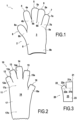
- the first example of an article with a compressive effect 1 shown in figure 1 is in this specific example a hand glove with compressive effect 2.
- This article 1 comprises an integrally knitted piece 3 comprising a first knitted tubular element 4 (intended to cover the index finger), a second knitted tubular element 5 (intended to cover the middle finger), a third knitted tubular element 6 (intended to cover the ring finger), a fourth knitted tubular element 7 (intended to cover the little finger), a fifth knitted tubular element 8 (intended to cover the thumb) and a tubular element main knitted 9 (intended to cover the palm and back of the hand), each of said elements (4,5,6,7,8,9) having an upper end (4a,5a,6a,7a,8a,9a ) and an open lower end (4b,5b,6b,7b,8b,9b).
- the first 4, second 5, third 6 and fourth 7 tubular elements are joined at their lower ends (4b, 5b, 6b, 7b) which are an extension
- the number of mesh columns per cm in the first, second, third, fourth and fifth tubular elements is between 8 and 10
- the number of mesh columns per cm in the main tubular element is comprised between 10 and 12.
- the upper ends (4a,5a,6a,7a,8a) of the first 4, second 5, third 6, fourth 7 and fifth 8 tubular elements of the first example of compressive article 1 are closed, these ends (4a,5a,6a , 7a, 8a) can be closed during knitting of the fully knitted piece 3, or by sewing in a conventional manner.
- each tubular element is knitted starting by knitting said closed end in 1*1 rib, then continuing by knitting the tube using stockinette stitches.
- the compressive article 10 is a hand glove with compressive effect 11 comprising an integrally knitted piece 18 of which all the upper ends (12a, 13a, 14a, 15a, 16a) of the first 12, second 13, third 14, fourth 15 and fifth 16 tubular elements are open.
- the upper ends 17a and lower 17b of the main tubular element 17 are open.
- the second example of article with compressive effect 20 represented in Figure 3 is a mitten comprising an integrally knitted piece 25, which knitted piece 25 comprises a first tubular element 21 intended to cover at least partly the back and the palm of the hand and a second tubular element 22 intended to cover at least partly the thumb .
- the upper (21a, 22a) and lower (21b, 22b) ends of the first 21 and second 22 tubular elements are open.
- the first 21 and second 22 tubular elements are extended by the main knitted tubular element 23.
- FIG. 4 represents three different sizes of articles with a compressive effect (26,27,28) in order to illustrate that thanks to the fine gauge which can be achieved for the compressive articles according to the invention, very varied sizes, even very small ones can be obtained, for example gloves with a compressive effect corresponding to the size of gloves for children.
- the fully knitted parts (3,18,25) of the compressive effect articles (1,10,20) shown on the figures 1 to 3 may comprise a knitted wrist portion, intended to cover the wrist, which knitted portion may comprise a knitted ribbed edge and/or an adherent thread knitted on the internal face of the wrist portion so as to come into contact with the skin.
- Each tubular element (4,5,6,7,8,9) of the compressive effect hand glove 2 shown in figure 1 is knitted according to the stitch pattern shown in Figure 5 .
- the mesh pattern of the Figure 5 read from bottom to top, the first tubular element 4 is knitted on a straight knitting machine comprising two needle beds (front and rear needle beds).
- a second thread of stitch 30, non-elastic is knitted in stockinette stitch on all the needles of the front 31 and rear needle beds.
- 32 as shown on lines 12 and I4
- a first elastic stitch thread 33 is knitted, forming loaded stitches on the odd needles on the front bed, on line I1, therefore every other needle, and on the needles pairs on the back bed, on line 13.
- the second non-elastic stitch thread 30 is knitted in stockinette stitch on all the needles of the front 31 and rear 32 needle beds as shown on lines 16 and I8, and the first elastic stitch thread 33 is knitted, by forming loaded stitches on the even needles on the front bed 31, on line 15, so every other needle, and on the odd needles on the rear bed, on line I7.
- Said loaded stitches are consecutive, that is to say they follow each other without the first thread of stitches 33 forming looped stitches.
- the first elastic mesh yarn 33 comprises an elastic monofilament yarn in the core, for example in polyurethane, having a density of the order of 350 dtex to 940 dtex, and two covering yarns arranged by wrapping around the core; said covering threads each having a density of the order of 22 dtex to 78 dtex.
- said covering threads are made of polyamide (6-6).
- the second non-elastic knit thread 30 is a thread with three simple ends, each end having a count of 156 dtex, the total count of the second knit thread is thus of the order of 468 dtex, preferably the second thread is in polyamide (6-6).
- the second tubular element 5 is knitted in the same way as the first tubular element 4 then the first 4 and second 5 tubular elements are joined during a connection step by knitting at their lower ends (4b, 5b) according to the mesh diagram shown in Figure 6 .
- the first 5 and second 4 tubular elements are arranged side by side, without being separated by needles, on the needles of the front 31 and rear 32 needle beds on line I1.
- the mesh diagram of the Figure 6 is also read from bottom to top.
- the rear bed 32 is mounted by one needle to the right, that is to say moved by one needle to the right (+1) on line 12.
- the stitches of the second tubular element 5 arranged on the rear bed 32 (also called first bed bed in this text) are then transferred to the transfer members (sliders) of the front bed bed at line 13.
- the stitches of the second tubular element 5 supported by the needles of the rear bed 32 are thus put on hold.
- the rear bed 32 is mounted with three needles towards the left (-3) so that two stitches supported by the rear bed 32 of the first tubular element 4 find themselves facing two stitches of the second tubular element 5 arranged on the front bed 31 , as shown in line I4.
- the stitches of the second tubular element 5 supported by the front bed 31 are placed on hold on the needle transfer members of the opposite bed, as shown in line 17, then the bed rear 32 is straddled to the right by three needles (+3), as shown in line I8, and the stitches of the second tubular element 5 put on hold are transferred to the front bed 31, as shown in line I9, in so that three meshes of the second tubular element 5 of the front bed 31 overlap three meshes of the first tubular element 4 supported by the front bed 31, as shown on line 110. Finally, the rear bed 32 is straddled to the left of a needle (-1), as shown in line I11.
- first tubular element 4 and the second tubular element 5 The junction between the first tubular element 4 and the second tubular element 5 is thus made.
- the third tubular element 6 Once the third tubular element 6 has been knitted, it will be joined to the second tubular element 5 according to the same process and so on for the fourth tubular element 7 on the third tubular element 6.
- a few rows of jersey stitches are knitted so that the junction of the fourth tubular element 7 in the extension of the third tubular element 6 is offset and thus follows the natural arrangement of the fingers.
- the main tubular element 9 is knitted in the extension of the (first 4 to the fourth 7) joined tubular elements.
- the number of needles (and therefore of stitches) on which the main tubular element 9 is knitted is equal to the number of needles (and therefore of stitches) of each of the first to the fourth tubular elements minus the number of stitches necessary for the junctions .
- the fifth tubular element 8 is knitted separately then joined to the main tubular element 9 according to the same process junction than that described above to join together by knitting the first 4 and second 5 tubular elements at their lower ends (4b, 5b).
- the first tubular element 4 thus comprises a first front portion 4c corresponding to at least one mesh, preferably at least three meshes arranged on the front bed 31 (see line I11), and a first posterior portion 4d corresponding to at least one stitch, preferably at least three stitches arranged on the rear bed 32 (see line I11), said first anterior portions 4c and posterior 4d being arranged at the level of the lower end 4b of the first tubular element 4 as shown in Figure 6 .
- the second tubular element 5 comprises a second front portion 5c corresponding to at least one stitch, preferably at least three stitches, arranged on the front bed 31; and a second posterior portion 5d corresponding to at least one stitch, preferably at least three stitches arranged on the rear bed 32, said second anterior portions 5c and posterior 5d being arranged at the level of the lower end 5b of the second element tubular 5 as shown in Figure 6 .
- first anterior portion 4c and the second anterior portion 5c knitted overlap on at least one stitch, in this specific example on three stitches, said first 4c and second 5c anterior portions n 'being not overlapped by the first 4d and second 5d posterior portions.
- first knitted posterior portion 4d and the second knitted posterior portion 5d overlap on at least one stitch, in this specific example on three stitches, and said first 4d and second 5d posterior portions are not overlapped by the first 4c and second 5c anterior portions.
- the junction between the tubular elements of the compressive effect article is thin and comfortable for the user.
- the tubular elements can be knitted in “all-needle” jersey, which makes it possible to obtain a fine gauge, and thus better control of the pressure exerted and the size of the item 1.
- the loaded stitches formed with the second elastic thread 33 are consecutive without forming looped stitches, which advantageously makes it possible to control the elasticity of the knitted piece 3.
- the arrangement of the loads alternately on the even and odd needles between the needle beds makes it possible to improve the appearance of the knitted piece and to avoid a barring effect.
- the compression articles according to the invention thus advantageously have a fine gauge, that is to say a number of mesh columns per cm greater than or equal to 8 and less than or equal to 15, in particular less than or equal to 13 , while allowing you to control the desired elasticity and compression.
- the compression articles according to the invention can also be manufactured to measure and in varied sizes, even very small, in the case of compression articles for children, even young children.
Landscapes
- Engineering & Computer Science (AREA)
- Textile Engineering (AREA)
- Knitting Of Fabric (AREA)
- Gloves (AREA)
Claims (13)
- Erzeugnis mit Kompressionswirkung (1, 2, 10, 11, 20, 26, 27, 28), umfassend- ein einstückiges Gestrick (3, 18, 25), umfassend mindestens ein erstes röhrenförmiges Strickelement (4, 12, 21) und ein zweites röhrenförmiges Strickelement (5, 13, 22), die jeweils ein oberes Ende (4a, 5a, 12a, 13a, 21a, 22a) und ein unteres offenes Ende (4b, 5b, 12b, 13b, 21b, 22b) aufweisen,- wobei das erste röhrenförmige Element (4) mit dem zweiten röhrenförmigen Element (5) auf Höhe ihrer unteren Enden (4b, 5b) verbunden ist,- wobei das erste röhrenförmige Element (4) einen ersten vorderen Abschnitt (4c) und einen ersten hinteren Abschnitt (4d) in Höhe seines unteren Endes (4b) umfasst,- wobei das zweite röhrenförmige Element (5) einen zweiten vorderen Abschnitt (5c) und einen zweiten hinteren Abschnitt (5d) in Höhe seines unteren Endes (5b) umfasst, wobei das Erzeugnis dadurch gekennzeichnet ist, dass:- das mindestens erste (4) und zweite (5) röhrenförmige Element jeweils eine Anzahl von Maschenstäbchen, gemessen gemäß der Norm NF EN 14971, April 2006, und gegebenenfalls Maschenreihen, von größer oder gleich 8 je Zentimeter umfassen,- sich der erste vordere Strickabschnitt (4c) und der zweite vordere Strickabschnitt (5c) bei mindestens einer Masche, bevorzugt mindestens drei Maschen, überlappen und- sich der erste (4c) und der zweite (5c) vordere Abschnitt nicht mit dem ersten (4d) und dem zweiten (5d) hinteren Abschnitt überlappen.
- Erzeugnis (1, 2, 10, 11, 20, 26, 27, 28) nach Anspruch 1, dadurch gekennzeichnet, dass sich der erste hintere Strickabschnitt (4d) und der zweite hintere Strickabschnitt (5d) bei mindestens einer Masche, bevorzugt mindestens drei Maschen, überlappen und dass sich der erste (4d) und der zweite (5d) hintere Abschnitt nicht mit dem ersten (4c) und zweiten (5c) vorderen Abschnitt überlappen.
- Erzeugnis (1, 2, 10, 11, 20, 26, 27, 28) nach einem der Ansprüche 1 und 2, dadurch gekennzeichnet, dass das erste röhrenförmige Element (4) und das zweite röhrenförmige Element (5) gemäß einer ersten Strickverbindungszone und einer zweiten Strickverbindungszone, die sich von der ersten Strickverbindungszone unterscheidet, zusammengefügt sind, wobei jede von der ersten und der zweiten Strickzone durch eine Stricklage gebildet ist.
- Erzeugnis (1, 2, 10, 11, 20, 26, 27, 28) nach einem der Ansprüche 1 bis 3, dadurch gekennzeichnet, dass das einstückige Gestrick (3, 18, 25) ein röhrenförmiges Hauptstrickelement (9, 17, 23) umfasst, das dazu ausgestaltet ist, beim Tragen die Fläche oder den Rücken der Hand zumindest teilweise oder den Fuß zumindest teilweise zu bedecken, und ein oberes Ende (9a) aufweist, wobei das obere Ende (9a) mit dem ersten (4) und dem zweiten (5) röhrenförmigen Element in Höhe ihrer unteren Enden (4b, 5b) zusammengefügt ist, wobei das röhrenförmige Hauptelement (9) ein unteres offenes Ende (9b) umfasst.
- Erzeugnis (1, 2, 10, 11, 20, 26, 27, 28) nach einem der Ansprüche 1 bis 4, dadurch gekennzeichnet, dass das obere Ende (4a) des ersten röhrenförmigen Elements (4) und gegebenenfalls das obere Ende (5a) des zweiten röhrenförmigen Elements (5) geschlossen oder offen sind.
- Erzeugnis (1, 2, 10, 11, 20, 26, 27, 28) nach einem der Ansprüche 1 bis 5, dadurch gekennzeichnet, dass das einstückige Gestrick (3, 18, 25) eine Anzahl von Maschenstäbchen und gegebenenfalls Maschenreihen von größer oder gleich 8 je Zentimeter umfasst.
- Erzeugnis (1, 2, 10, 11, 20, 26, 27, 28) nach einem der Ansprüche 1 bis 6, dadurch gekennzeichnet, dass das mindestens erste (4) und zweite (5) röhrenförmige Element und gegebenenfalls das röhrenförmige Hauptelement (9, 17, 23) mindestens ein erstes elastisches Maschengarn (33) und ein zweites nichtelastisches Maschengarn (30) umfassen.
- Erzeugnis (1, 2, 10, 11, 20, 26, 27, 28) nach einem der Ansprüche 1 bis 7, dadurch gekennzeichnet, dass das mindestens erste röhrenförmige Strickelement (4) und/oder das zweite röhrenförmige Element (5) und/oder das röhrenförmige Hauptelement (9, 17, 23) ein erstes elastisches Maschengarn (33) umfasst/umfassen, das beladene Maschen bei einem von zwei oder mehr Maschenstäbchen bildet.
- Erzeugnis (1, 2, 10, 11, 20, 26, 27, 28) nach Anspruch 8, dadurch gekennzeichnet, dass das erste elastische Maschengarn (33) mindestens zwei aufeinanderfolgende beladene Maschen, bevorzugt mindestens drei aufeinanderfolgende beladene Maschen, bildet.
- Erzeugnis (1, 2, 10, 11, 20, 26, 27, 28) nach einem der Ansprüche 1 bis 9, dadurch gekennzeichnet, dass das mindestens erste röhrenförmige Element (4) und/oder das zweite röhrenförmige Element (5) und/oder das röhrenförmige Hauptelement (9, 17, 23) ein nichtelastisches Maschengarn (30) umfasst/umfassen, das Jersey-Maschen bildet.
- Erzeugnis (1, 2, 10, 11, 20, 26, 27, 28) nach einem der vorhergehenden Ansprüche, dadurch gekennzeichnet, dass das erste röhrenförmige Element (4) und/oder das zweite röhrenförmige Element (5) und/oder das röhrenförmige Hauptelement (9, 17, 23) eine Anzahl von Maschenstäbchen von größer oder gleich 10, bevorzugt kleiner oder gleich 15, je Zentimeter umfasst/umfassen.
- Verfahren zum Herstellen eines Erzeugnisses mit Kompressionswirkung (1, 2, 10, 11, 20, 26, 27, 28), insbesondere eines Handschuhs mit Kompressionswirkung (2, 11, 20, 26, 27, 28), nach einem der Ansprüche 1 bis 11, umfassend die folgenden Schritte:(i) Stricken, auf einer Flachstrickmaschine, umfassend ein erstes und ein zweites Nadelbett, eines ersten röhrenförmigen Elements (4), dann eines zweiten röhrenförmigen Elements (5), wobei jedes von dem ersten (4) und zweiten (5) röhrenförmigen Element ein oberes Ende (4a, 5a) und ein unteres offenes Ende (4b, 5b) umfasst, und(ii) Verbinden des zweiten röhrenförmigen Elements (5) mit dem ersten röhrenförmigen Element (4) auf der Strickmaschine in Höhe ihrer unteren Enden (4b, 5b),(iii) gegebenenfalls Stricken, auf der Flachstrickmaschine, eines dritten (6) und eines vierten (7) röhrenförmigen Elements, die jeweils ein oberes Ende (6a, 7a) und ein unteres offenes Ende (6b, 7b) umfassen, dann Verbinden, auf der Strickmaschine, des dritten röhrenförmigen Elements (6) mit dem zweiten röhrenförmigen Element (5) in Höhe ihrer unteren Enden (5b, 6b), dann Verbinden des vierten röhrenförmigen Elements (7) mit dem dritten röhrenförmigen Element (6) in Höhe ihrer unteren Enden (6b, 7b) auf der Strickmaschine,(iv) gegebenenfalls Stricken eines röhrenförmigen Hauptelements (9, 17, 23) in der Verlängerung des ersten (4) und des zweiten (5) röhrenförmigen Elements, die zusammengefügt sind, und gegebenenfalls des dritten (6) und des vierten (7) röhrenförmigen Elements, die zusammengefügt sind, wobei das röhrenförmige Hauptelement (9) dazu vorgesehen ist, beim Tragen den Rücken und die Fläche der Hand oder den Fuß zumindest teilweise zu bedecken,(v) gegebenenfalls Stricken eines fünften röhrenförmigen Elements (8), das ein oberes Ende (8a) und ein unteres offenes Ende (8b) aufweist, dann Verbinden des fünften röhrenförmigen Elements (8) mit dem röhrenförmigen Hauptelement (9) auf Höhe seines unteren Endes (8b) auf der Strickmaschine,wobei die Schritte des Strickens (i) und (ii) und gegebenenfalls (iii) und/oder (iv) und/oder (v) es ermöglichen, ein einstückiges Gestrick zu bilden, und das Verfahren dadurch gekennzeichnet ist, dassdas mindestens erste (4) und zweite (5) röhrenförmige Element jeweils eine Anzahl von Maschenstäbchen, gemessen gemäß der Norm NF EN 14971, April 2006, und gegebenenfalls Maschenreihen von größer oder gleich 8 je Zentimeter umfassen, und dass der Schritt des Verbindens auf der Strickmaschine (ii) und gegebenenfalls der Schritt des Verbindens (iii) und/oder (v) umfassen:- einen Schritt des Aussetzens der Maschen des zweiten (5) oder des ersten (4) röhrenförmigen Elements, die durch das erste Bett (32) getragen werden, dann des Umlegens auf mindestens eine Nadel des ersten Betts (32), das auch die Maschen des ersten (4) oder des zweiten (5) röhrenförmigen Elements trägt, derart, dass sich, sobald die ausgesetzten Maschen des zweiten (5) oder des ersten (4) röhrenförmigen Elements auf das erste Bett (32) verschoben sind, das zweite (5) oder das erste (4) röhrenförmige Element mit dem ersten (4) oder dem zweiten (5) röhrenförmigen Element auf dem ersten Bett (32) bei mindestens einer Masche überlappt,- einen Schritt des Aussetzens der Maschen des zweiten (5) oder des ersten (4) röhrenförmigen Elements, die durch das zweite Bett (31) getragen werden, dann des Umlegens auf mindestens eine Nadel des ersten Betts (32), das auch die Maschen des ersten (4) und des zweiten (5) röhrenförmigen Elements trägt, derart, dass sich, sobald die ausgesetzten Maschen des zweiten (5) oder des ersten (4) röhrenförmigen Elements auf das zweite Bett (31) verschoben sind, das zweite (5) oder das erste (4) röhrenförmige Element mit dem ersten (4) oder dem zweiten (5) röhrenförmigen Element auf dem zweiten Bett (31) bei mindestens einer Masche überlappt.
- Verfahren nach Anspruch 12, dadurch gekennzeichnet, dass die Schritte des Strickens (i) und gegebenenfalls (iii) und/oder (iv) und/oder (v) das Stricken eines ersten elastischen Maschengarns (33), das Ladungen auf mindestens einer von zwei Nadeln bildet, umfassen und dass das erste elastische Maschengarn (33) mindestens zwei aufeinanderfolgende Ladungen, bevorzugt mindestens drei aufeinanderfolgende Ladungen, bildet.
Applications Claiming Priority (2)
| Application Number | Priority Date | Filing Date | Title |
|---|---|---|---|
| FR1652701A FR3049619B1 (fr) | 2016-03-29 | 2016-03-29 | Article a effet compressif et procede de fabrication dudit article |
| PCT/FR2017/050723 WO2017168095A1 (fr) | 2016-03-29 | 2017-03-29 | Article a effet compressif et procede de fabrication dudit article |
Publications (2)
| Publication Number | Publication Date |
|---|---|
| EP3436629A1 EP3436629A1 (de) | 2019-02-06 |
| EP3436629B1 true EP3436629B1 (de) | 2023-11-01 |
Family
ID=56119577
Family Applications (1)
| Application Number | Title | Priority Date | Filing Date |
|---|---|---|---|
| EP17720184.5A Active EP3436629B1 (de) | 2016-03-29 | 2017-03-29 | Gegenstand mit kompressionswirkung und verfahren zur herstellung des besagten gegenstands |
Country Status (3)
| Country | Link |
|---|---|
| EP (1) | EP3436629B1 (de) |
| FR (1) | FR3049619B1 (de) |
| WO (1) | WO2017168095A1 (de) |
Families Citing this family (1)
| Publication number | Priority date | Publication date | Assignee | Title |
|---|---|---|---|---|
| DE102018130932A1 (de) * | 2018-12-05 | 2020-06-10 | Julius Zorn Gmbh | Gestrickter Kompressionsartikel |
Citations (3)
| Publication number | Priority date | Publication date | Assignee | Title |
|---|---|---|---|---|
| EP2075361A1 (de) * | 2007-12-29 | 2009-07-01 | Medi GmbH & Co. KG | Nahtloses Kompressionsgestrick und Verfahren zu dessen Herstellung |
| JP2010281000A (ja) * | 2009-06-03 | 2010-12-16 | Masahiro Koma | 編物のクッション構造 |
| JP2013083014A (ja) * | 2011-10-08 | 2013-05-09 | Hohoho Co Ltd | 手足の浮腫緩和用保持具 |
Family Cites Families (5)
| Publication number | Priority date | Publication date | Assignee | Title |
|---|---|---|---|---|
| GB9910576D0 (en) * | 1999-05-08 | 1999-07-07 | Smith & Nephew | Compression gloves |
| KR100768349B1 (ko) * | 2000-12-27 | 2007-10-18 | 가부시키가이샤 시마세이키 세이사쿠쇼 | 편성 장갑 |
| JP2005287976A (ja) * | 2004-04-02 | 2005-10-20 | Kanebo Ltd | 手袋型清掃具 |
| DE102004036344B4 (de) | 2004-07-27 | 2007-05-24 | Bsn-Jobst Gmbh | Strickware zum Stützen und/oder Komprimieren und/oder Kompressionsbehandlung von Körperteilen und Verfahren zur Herstellung einer solchen Strickware |
| JP5952693B2 (ja) * | 2012-09-19 | 2016-07-13 | ショーワグローブ株式会社 | 編機及び手袋の製造方法 |
-
2016
- 2016-03-29 FR FR1652701A patent/FR3049619B1/fr not_active Expired - Fee Related
-
2017
- 2017-03-29 EP EP17720184.5A patent/EP3436629B1/de active Active
- 2017-03-29 WO PCT/FR2017/050723 patent/WO2017168095A1/fr not_active Ceased
Patent Citations (3)
| Publication number | Priority date | Publication date | Assignee | Title |
|---|---|---|---|---|
| EP2075361A1 (de) * | 2007-12-29 | 2009-07-01 | Medi GmbH & Co. KG | Nahtloses Kompressionsgestrick und Verfahren zu dessen Herstellung |
| JP2010281000A (ja) * | 2009-06-03 | 2010-12-16 | Masahiro Koma | 編物のクッション構造 |
| JP2013083014A (ja) * | 2011-10-08 | 2013-05-09 | Hohoho Co Ltd | 手足の浮腫緩和用保持具 |
Also Published As
| Publication number | Publication date |
|---|---|
| WO2017168095A1 (fr) | 2017-10-05 |
| FR3049619B1 (fr) | 2018-04-20 |
| EP3436629A1 (de) | 2019-02-06 |
| FR3049619A1 (fr) | 2017-10-06 |
Similar Documents
| Publication | Publication Date | Title |
|---|---|---|
| EP2536370B1 (de) | Röhrenförmigen druck-orthese | |
| EP2611404B1 (de) | Kompressionsorthese | |
| EP1094771B1 (de) | Kompresionsstrumpf oder -strumpfhose | |
| US7363778B2 (en) | Seamless three-dimensional toe section for prosthetic socks and prosthetic shrinkers | |
| FR2957783A1 (fr) | Article de contention a usage medical | |
| EP3818205B1 (de) | Leicht an-/ausziehbares kompressionskleidungsstück und verwendung eines fadens mit florfasern zum stricken des kompressionskleidungsstücks | |
| FR2801495A1 (fr) | Orthese compressive ayant au moins une zone renforcee | |
| WO2017168095A1 (fr) | Article a effet compressif et procede de fabrication dudit article | |
| EP2909368A1 (de) | Zuschnitt und schlauchförmige strickware mit einer haltekante aus einer einzigen stärke sowie verfahren zur herstellung solch eines artikels | |
| EP2227204B1 (de) | Röhrenförmig komprimierter bekleidungsartikel | |
| EP2298974B1 (de) | Kleidungsartikel mit Ketten-gestrickter Haftzone | |
| WO2012107571A1 (fr) | Ortheses de compression veineuse elastique avec une pointe de pied avec pression allegee | |
| EP4341475B1 (de) | Verfahren zum stricken von dichten zonen und daraus resultierende strickware | |
| WO2024184515A1 (fr) | Procédé de fabrication d'un article de compression et article de compression associé | |
| EP2885988B1 (de) | Formender Bekleidungsartikel | |
| EP2364682B1 (de) | Kompressionsorthese der unteren Gliedmaßen vom Typ Strumpfhose oder Strümpfe in Form von 3/4 Strümpfen | |
| FR3157073A1 (fr) | Article vestimentaire pour proteger une zone lesee de la peau | |
| FR3020568A1 (fr) | Procede de fabrication d'un article de contention tel qu'un bas medical de compression et article de contention obtenu selon ledit procede | |
| WO2010084259A1 (fr) | Orthèse compressive du membre inférieur à structure combinée bas/chaussette | |
| FR2978171A1 (fr) | Tricot a mailles cueillies | |
| EP2174561A1 (de) | Anliegende Bekleidungshülle für Arm oder Bein und Strumpf, Strumpfhose, Unterhose, Kleidungsstück für den Oberkörper, das eine solche Hülle umfasst |
Legal Events
| Date | Code | Title | Description |
|---|---|---|---|
| STAA | Information on the status of an ep patent application or granted ep patent |
Free format text: STATUS: UNKNOWN |
|
| STAA | Information on the status of an ep patent application or granted ep patent |
Free format text: STATUS: THE INTERNATIONAL PUBLICATION HAS BEEN MADE |
|
| PUAI | Public reference made under article 153(3) epc to a published international application that has entered the european phase |
Free format text: ORIGINAL CODE: 0009012 |
|
| STAA | Information on the status of an ep patent application or granted ep patent |
Free format text: STATUS: REQUEST FOR EXAMINATION WAS MADE |
|
| 17P | Request for examination filed |
Effective date: 20180822 |
|
| AK | Designated contracting states |
Kind code of ref document: A1 Designated state(s): AL AT BE BG CH CY CZ DE DK EE ES FI FR GB GR HR HU IE IS IT LI LT LU LV MC MK MT NL NO PL PT RO RS SE SI SK SM TR |
|
| AX | Request for extension of the european patent |
Extension state: BA ME |
|
| DAV | Request for validation of the european patent (deleted) | ||
| DAX | Request for extension of the european patent (deleted) | ||
| STAA | Information on the status of an ep patent application or granted ep patent |
Free format text: STATUS: EXAMINATION IS IN PROGRESS |
|
| 17Q | First examination report despatched |
Effective date: 20211213 |
|
| REG | Reference to a national code |
Ref country code: DE Free format text: PREVIOUS MAIN CLASS: D04B0001280000 Ref country code: DE Ref legal event code: R079 Ref document number: 602017075964 Country of ref document: DE Free format text: PREVIOUS MAIN CLASS: D04B0001280000 Ipc: D04B0001100000 |
|
| GRAP | Despatch of communication of intention to grant a patent |
Free format text: ORIGINAL CODE: EPIDOSNIGR1 |
|
| STAA | Information on the status of an ep patent application or granted ep patent |
Free format text: STATUS: GRANT OF PATENT IS INTENDED |
|
| RIC1 | Information provided on ipc code assigned before grant |
Ipc: D04B 1/28 20060101ALI20230503BHEP Ipc: D04B 1/10 20060101AFI20230503BHEP |
|
| INTG | Intention to grant announced |
Effective date: 20230531 |
|
| GRAS | Grant fee paid |
Free format text: ORIGINAL CODE: EPIDOSNIGR3 |
|
| GRAA | (expected) grant |
Free format text: ORIGINAL CODE: 0009210 |
|
| STAA | Information on the status of an ep patent application or granted ep patent |
Free format text: STATUS: THE PATENT HAS BEEN GRANTED |
|
| AK | Designated contracting states |
Kind code of ref document: B1 Designated state(s): AL AT BE BG CH CY CZ DE DK EE ES FI FR GB GR HR HU IE IS IT LI LT LU LV MC MK MT NL NO PL PT RO RS SE SI SK SM TR |
|
| REG | Reference to a national code |
Ref country code: GB Ref legal event code: FG4D Free format text: NOT ENGLISH |
|
| REG | Reference to a national code |
Ref country code: CH Ref legal event code: EP |
|
| REG | Reference to a national code |
Ref country code: DE Ref legal event code: R096 Ref document number: 602017075964 Country of ref document: DE |
|
| REG | Reference to a national code |
Ref country code: IE Ref legal event code: FG4D Free format text: LANGUAGE OF EP DOCUMENT: FRENCH |
|
| REG | Reference to a national code |
Ref country code: LT Ref legal event code: MG9D |
|
| REG | Reference to a national code |
Ref country code: NL Ref legal event code: MP Effective date: 20231101 |
|
| PG25 | Lapsed in a contracting state [announced via postgrant information from national office to epo] |
Ref country code: GR Free format text: LAPSE BECAUSE OF FAILURE TO SUBMIT A TRANSLATION OF THE DESCRIPTION OR TO PAY THE FEE WITHIN THE PRESCRIBED TIME-LIMIT Effective date: 20240202 |
|
| PG25 | Lapsed in a contracting state [announced via postgrant information from national office to epo] |
Ref country code: IS Free format text: LAPSE BECAUSE OF FAILURE TO SUBMIT A TRANSLATION OF THE DESCRIPTION OR TO PAY THE FEE WITHIN THE PRESCRIBED TIME-LIMIT Effective date: 20240301 |
|
| PG25 | Lapsed in a contracting state [announced via postgrant information from national office to epo] |
Ref country code: LT Free format text: LAPSE BECAUSE OF FAILURE TO SUBMIT A TRANSLATION OF THE DESCRIPTION OR TO PAY THE FEE WITHIN THE PRESCRIBED TIME-LIMIT Effective date: 20231101 |
|
| REG | Reference to a national code |
Ref country code: AT Ref legal event code: MK05 Ref document number: 1627323 Country of ref document: AT Kind code of ref document: T Effective date: 20231101 |
|
| PG25 | Lapsed in a contracting state [announced via postgrant information from national office to epo] |
Ref country code: NL Free format text: LAPSE BECAUSE OF FAILURE TO SUBMIT A TRANSLATION OF THE DESCRIPTION OR TO PAY THE FEE WITHIN THE PRESCRIBED TIME-LIMIT Effective date: 20231101 |
|
| PG25 | Lapsed in a contracting state [announced via postgrant information from national office to epo] |
Ref country code: AT Free format text: LAPSE BECAUSE OF FAILURE TO SUBMIT A TRANSLATION OF THE DESCRIPTION OR TO PAY THE FEE WITHIN THE PRESCRIBED TIME-LIMIT Effective date: 20231101 |
|
| PG25 | Lapsed in a contracting state [announced via postgrant information from national office to epo] |
Ref country code: ES Free format text: LAPSE BECAUSE OF FAILURE TO SUBMIT A TRANSLATION OF THE DESCRIPTION OR TO PAY THE FEE WITHIN THE PRESCRIBED TIME-LIMIT Effective date: 20231101 |
|
| PG25 | Lapsed in a contracting state [announced via postgrant information from national office to epo] |
Ref country code: NL Free format text: LAPSE BECAUSE OF FAILURE TO SUBMIT A TRANSLATION OF THE DESCRIPTION OR TO PAY THE FEE WITHIN THE PRESCRIBED TIME-LIMIT Effective date: 20231101 Ref country code: LT Free format text: LAPSE BECAUSE OF FAILURE TO SUBMIT A TRANSLATION OF THE DESCRIPTION OR TO PAY THE FEE WITHIN THE PRESCRIBED TIME-LIMIT Effective date: 20231101 Ref country code: IS Free format text: LAPSE BECAUSE OF FAILURE TO SUBMIT A TRANSLATION OF THE DESCRIPTION OR TO PAY THE FEE WITHIN THE PRESCRIBED TIME-LIMIT Effective date: 20240301 Ref country code: GR Free format text: LAPSE BECAUSE OF FAILURE TO SUBMIT A TRANSLATION OF THE DESCRIPTION OR TO PAY THE FEE WITHIN THE PRESCRIBED TIME-LIMIT Effective date: 20240202 Ref country code: ES Free format text: LAPSE BECAUSE OF FAILURE TO SUBMIT A TRANSLATION OF THE DESCRIPTION OR TO PAY THE FEE WITHIN THE PRESCRIBED TIME-LIMIT Effective date: 20231101 Ref country code: BG Free format text: LAPSE BECAUSE OF FAILURE TO SUBMIT A TRANSLATION OF THE DESCRIPTION OR TO PAY THE FEE WITHIN THE PRESCRIBED TIME-LIMIT Effective date: 20240201 Ref country code: AT Free format text: LAPSE BECAUSE OF FAILURE TO SUBMIT A TRANSLATION OF THE DESCRIPTION OR TO PAY THE FEE WITHIN THE PRESCRIBED TIME-LIMIT Effective date: 20231101 Ref country code: PT Free format text: LAPSE BECAUSE OF FAILURE TO SUBMIT A TRANSLATION OF THE DESCRIPTION OR TO PAY THE FEE WITHIN THE PRESCRIBED TIME-LIMIT Effective date: 20240301 |
|
| PG25 | Lapsed in a contracting state [announced via postgrant information from national office to epo] |
Ref country code: SE Free format text: LAPSE BECAUSE OF FAILURE TO SUBMIT A TRANSLATION OF THE DESCRIPTION OR TO PAY THE FEE WITHIN THE PRESCRIBED TIME-LIMIT Effective date: 20231101 Ref country code: RS Free format text: LAPSE BECAUSE OF FAILURE TO SUBMIT A TRANSLATION OF THE DESCRIPTION OR TO PAY THE FEE WITHIN THE PRESCRIBED TIME-LIMIT Effective date: 20231101 Ref country code: PL Free format text: LAPSE BECAUSE OF FAILURE TO SUBMIT A TRANSLATION OF THE DESCRIPTION OR TO PAY THE FEE WITHIN THE PRESCRIBED TIME-LIMIT Effective date: 20231101 Ref country code: NO Free format text: LAPSE BECAUSE OF FAILURE TO SUBMIT A TRANSLATION OF THE DESCRIPTION OR TO PAY THE FEE WITHIN THE PRESCRIBED TIME-LIMIT Effective date: 20240201 Ref country code: LV Free format text: LAPSE BECAUSE OF FAILURE TO SUBMIT A TRANSLATION OF THE DESCRIPTION OR TO PAY THE FEE WITHIN THE PRESCRIBED TIME-LIMIT Effective date: 20231101 Ref country code: HR Free format text: LAPSE BECAUSE OF FAILURE TO SUBMIT A TRANSLATION OF THE DESCRIPTION OR TO PAY THE FEE WITHIN THE PRESCRIBED TIME-LIMIT Effective date: 20231101 |
|
| PG25 | Lapsed in a contracting state [announced via postgrant information from national office to epo] |
Ref country code: DK Free format text: LAPSE BECAUSE OF FAILURE TO SUBMIT A TRANSLATION OF THE DESCRIPTION OR TO PAY THE FEE WITHIN THE PRESCRIBED TIME-LIMIT Effective date: 20231101 |
|
| PG25 | Lapsed in a contracting state [announced via postgrant information from national office to epo] |
Ref country code: CZ Free format text: LAPSE BECAUSE OF FAILURE TO SUBMIT A TRANSLATION OF THE DESCRIPTION OR TO PAY THE FEE WITHIN THE PRESCRIBED TIME-LIMIT Effective date: 20231101 |
|
| PG25 | Lapsed in a contracting state [announced via postgrant information from national office to epo] |
Ref country code: SK Free format text: LAPSE BECAUSE OF FAILURE TO SUBMIT A TRANSLATION OF THE DESCRIPTION OR TO PAY THE FEE WITHIN THE PRESCRIBED TIME-LIMIT Effective date: 20231101 |
|
| PG25 | Lapsed in a contracting state [announced via postgrant information from national office to epo] |
Ref country code: SM Free format text: LAPSE BECAUSE OF FAILURE TO SUBMIT A TRANSLATION OF THE DESCRIPTION OR TO PAY THE FEE WITHIN THE PRESCRIBED TIME-LIMIT Effective date: 20231101 Ref country code: SK Free format text: LAPSE BECAUSE OF FAILURE TO SUBMIT A TRANSLATION OF THE DESCRIPTION OR TO PAY THE FEE WITHIN THE PRESCRIBED TIME-LIMIT Effective date: 20231101 Ref country code: RO Free format text: LAPSE BECAUSE OF FAILURE TO SUBMIT A TRANSLATION OF THE DESCRIPTION OR TO PAY THE FEE WITHIN THE PRESCRIBED TIME-LIMIT Effective date: 20231101 Ref country code: IT Free format text: LAPSE BECAUSE OF FAILURE TO SUBMIT A TRANSLATION OF THE DESCRIPTION OR TO PAY THE FEE WITHIN THE PRESCRIBED TIME-LIMIT Effective date: 20231101 Ref country code: EE Free format text: LAPSE BECAUSE OF FAILURE TO SUBMIT A TRANSLATION OF THE DESCRIPTION OR TO PAY THE FEE WITHIN THE PRESCRIBED TIME-LIMIT Effective date: 20231101 Ref country code: DK Free format text: LAPSE BECAUSE OF FAILURE TO SUBMIT A TRANSLATION OF THE DESCRIPTION OR TO PAY THE FEE WITHIN THE PRESCRIBED TIME-LIMIT Effective date: 20231101 Ref country code: CZ Free format text: LAPSE BECAUSE OF FAILURE TO SUBMIT A TRANSLATION OF THE DESCRIPTION OR TO PAY THE FEE WITHIN THE PRESCRIBED TIME-LIMIT Effective date: 20231101 |
|
| REG | Reference to a national code |
Ref country code: DE Ref legal event code: R097 Ref document number: 602017075964 Country of ref document: DE |
|
| PLBE | No opposition filed within time limit |
Free format text: ORIGINAL CODE: 0009261 |
|
| STAA | Information on the status of an ep patent application or granted ep patent |
Free format text: STATUS: NO OPPOSITION FILED WITHIN TIME LIMIT |
|
| 26N | No opposition filed |
Effective date: 20240802 |
|
| PG25 | Lapsed in a contracting state [announced via postgrant information from national office to epo] |
Ref country code: SI Free format text: LAPSE BECAUSE OF FAILURE TO SUBMIT A TRANSLATION OF THE DESCRIPTION OR TO PAY THE FEE WITHIN THE PRESCRIBED TIME-LIMIT Effective date: 20231101 |
|
| PG25 | Lapsed in a contracting state [announced via postgrant information from national office to epo] |
Ref country code: SI Free format text: LAPSE BECAUSE OF FAILURE TO SUBMIT A TRANSLATION OF THE DESCRIPTION OR TO PAY THE FEE WITHIN THE PRESCRIBED TIME-LIMIT Effective date: 20231101 |
|
| REG | Reference to a national code |
Ref country code: CH Ref legal event code: PL |
|
| PG25 | Lapsed in a contracting state [announced via postgrant information from national office to epo] |
Ref country code: LU Free format text: LAPSE BECAUSE OF NON-PAYMENT OF DUE FEES Effective date: 20240329 |
|
| PG25 | Lapsed in a contracting state [announced via postgrant information from national office to epo] |
Ref country code: MC Free format text: LAPSE BECAUSE OF FAILURE TO SUBMIT A TRANSLATION OF THE DESCRIPTION OR TO PAY THE FEE WITHIN THE PRESCRIBED TIME-LIMIT Effective date: 20231101 |
|
| GBPC | Gb: european patent ceased through non-payment of renewal fee |
Effective date: 20240329 |
|
| PG25 | Lapsed in a contracting state [announced via postgrant information from national office to epo] |
Ref country code: MC Free format text: LAPSE BECAUSE OF FAILURE TO SUBMIT A TRANSLATION OF THE DESCRIPTION OR TO PAY THE FEE WITHIN THE PRESCRIBED TIME-LIMIT Effective date: 20231101 Ref country code: LU Free format text: LAPSE BECAUSE OF NON-PAYMENT OF DUE FEES Effective date: 20240329 |
|
| REG | Reference to a national code |
Ref country code: BE Ref legal event code: MM Effective date: 20240331 |
|
| PG25 | Lapsed in a contracting state [announced via postgrant information from national office to epo] |
Ref country code: BE Free format text: LAPSE BECAUSE OF NON-PAYMENT OF DUE FEES Effective date: 20240331 |
|
| PG25 | Lapsed in a contracting state [announced via postgrant information from national office to epo] |
Ref country code: GB Free format text: LAPSE BECAUSE OF NON-PAYMENT OF DUE FEES Effective date: 20240329 |
|
| PG25 | Lapsed in a contracting state [announced via postgrant information from national office to epo] |
Ref country code: IE Free format text: LAPSE BECAUSE OF NON-PAYMENT OF DUE FEES Effective date: 20240329 |
|
| PG25 | Lapsed in a contracting state [announced via postgrant information from national office to epo] |
Ref country code: IE Free format text: LAPSE BECAUSE OF NON-PAYMENT OF DUE FEES Effective date: 20240329 Ref country code: GB Free format text: LAPSE BECAUSE OF NON-PAYMENT OF DUE FEES Effective date: 20240329 Ref country code: BE Free format text: LAPSE BECAUSE OF NON-PAYMENT OF DUE FEES Effective date: 20240331 Ref country code: CH Free format text: LAPSE BECAUSE OF NON-PAYMENT OF DUE FEES Effective date: 20240331 |
|
| PGFP | Annual fee paid to national office [announced via postgrant information from national office to epo] |
Ref country code: DE Payment date: 20250313 Year of fee payment: 9 |
|
| PGFP | Annual fee paid to national office [announced via postgrant information from national office to epo] |
Ref country code: FR Payment date: 20250321 Year of fee payment: 9 |
|
| PG25 | Lapsed in a contracting state [announced via postgrant information from national office to epo] |
Ref country code: CY Free format text: LAPSE BECAUSE OF FAILURE TO SUBMIT A TRANSLATION OF THE DESCRIPTION OR TO PAY THE FEE WITHIN THE PRESCRIBED TIME-LIMIT; INVALID AB INITIO Effective date: 20170329 |
|
| PG25 | Lapsed in a contracting state [announced via postgrant information from national office to epo] |
Ref country code: HU Free format text: LAPSE BECAUSE OF FAILURE TO SUBMIT A TRANSLATION OF THE DESCRIPTION OR TO PAY THE FEE WITHIN THE PRESCRIBED TIME-LIMIT; INVALID AB INITIO Effective date: 20170329 |
|
| PG25 | Lapsed in a contracting state [announced via postgrant information from national office to epo] |
Ref country code: FI Free format text: LAPSE BECAUSE OF FAILURE TO SUBMIT A TRANSLATION OF THE DESCRIPTION OR TO PAY THE FEE WITHIN THE PRESCRIBED TIME-LIMIT Effective date: 20231101 |
|
| PG25 | Lapsed in a contracting state [announced via postgrant information from national office to epo] |
Ref country code: TR Free format text: LAPSE BECAUSE OF FAILURE TO SUBMIT A TRANSLATION OF THE DESCRIPTION OR TO PAY THE FEE WITHIN THE PRESCRIBED TIME-LIMIT Effective date: 20231101 |