EP3438043A1 - Procédé de préparation d'une eau d'acide chloreux à l'aide d'une matière première obtenue par électrolyse de sel - Google Patents
Procédé de préparation d'une eau d'acide chloreux à l'aide d'une matière première obtenue par électrolyse de sel Download PDFInfo
- Publication number
- EP3438043A1 EP3438043A1 EP17775438.9A EP17775438A EP3438043A1 EP 3438043 A1 EP3438043 A1 EP 3438043A1 EP 17775438 A EP17775438 A EP 17775438A EP 3438043 A1 EP3438043 A1 EP 3438043A1
- Authority
- EP
- European Patent Office
- Prior art keywords
- acid
- aqueous solution
- salt
- sodium
- chlorous acid
- Prior art date
- Legal status (The legal status is an assumption and is not a legal conclusion. Google has not performed a legal analysis and makes no representation as to the accuracy of the status listed.)
- Pending
Links
Images
Classifications
-
- C—CHEMISTRY; METALLURGY
- C25—ELECTROLYTIC OR ELECTROPHORETIC PROCESSES; APPARATUS THEREFOR
- C25B—ELECTROLYTIC OR ELECTROPHORETIC PROCESSES FOR THE PRODUCTION OF COMPOUNDS OR NON-METALS; APPARATUS THEREFOR
- C25B1/00—Electrolytic production of inorganic compounds or non-metals
- C25B1/01—Products
- C25B1/24—Halogens or compounds thereof
- C25B1/26—Chlorine; Compounds thereof
- C25B1/265—Chlorates
-
- A—HUMAN NECESSITIES
- A61—MEDICAL OR VETERINARY SCIENCE; HYGIENE
- A61L—METHODS OR APPARATUS FOR STERILISING MATERIALS OR OBJECTS IN GENERAL; DISINFECTION, STERILISATION OR DEODORISATION OF AIR; CHEMICAL ASPECTS OF BANDAGES, DRESSINGS, ABSORBENT PADS OR SURGICAL ARTICLES; MATERIALS FOR BANDAGES, DRESSINGS, ABSORBENT PADS OR SURGICAL ARTICLES
- A61L2/00—Disinfection or sterilisation of materials or objects, in general; Accessories therefor
- A61L2/16—Disinfection or sterilisation of materials or objects, in general; Accessories therefor using chemical substances
- A61L2/18—Liquid substances
-
- C—CHEMISTRY; METALLURGY
- C01—INORGANIC CHEMISTRY
- C01B—NON-METALLIC ELEMENTS; COMPOUNDS THEREOF; METALLOIDS OR COMPOUNDS THEREOF NOT COVERED BY SUBCLASS C01C
- C01B11/00—Oxides or oxyacids of halogens; Salts thereof
- C01B11/08—Chlorous acid
-
- C—CHEMISTRY; METALLURGY
- C02—TREATMENT OF WATER, WASTE WATER, SEWAGE, OR SLUDGE
- C02F—TREATMENT OF WATER, WASTE WATER, SEWAGE, OR SLUDGE
- C02F1/00—Treatment of water, waste water, or sewage
- C02F1/46—Treatment of water, waste water, or sewage by electrochemical methods
-
- C—CHEMISTRY; METALLURGY
- C02—TREATMENT OF WATER, WASTE WATER, SEWAGE, OR SLUDGE
- C02F—TREATMENT OF WATER, WASTE WATER, SEWAGE, OR SLUDGE
- C02F1/00—Treatment of water, waste water, or sewage
- C02F1/70—Treatment of water, waste water, or sewage by reduction
-
- C—CHEMISTRY; METALLURGY
- C25—ELECTROLYTIC OR ELECTROPHORETIC PROCESSES; APPARATUS THEREFOR
- C25B—ELECTROLYTIC OR ELECTROPHORETIC PROCESSES FOR THE PRODUCTION OF COMPOUNDS OR NON-METALS; APPARATUS THEREFOR
- C25B15/00—Operating or servicing cells
- C25B15/02—Process control or regulation
-
- C—CHEMISTRY; METALLURGY
- C25—ELECTROLYTIC OR ELECTROPHORETIC PROCESSES; APPARATUS THEREFOR
- C25B—ELECTROLYTIC OR ELECTROPHORETIC PROCESSES FOR THE PRODUCTION OF COMPOUNDS OR NON-METALS; APPARATUS THEREFOR
- C25B15/00—Operating or servicing cells
- C25B15/02—Process control or regulation
- C25B15/023—Measuring, analysing or testing during electrolytic production
- C25B15/025—Measuring, analysing or testing during electrolytic production of electrolyte parameters
- C25B15/029—Concentration
-
- C—CHEMISTRY; METALLURGY
- C25—ELECTROLYTIC OR ELECTROPHORETIC PROCESSES; APPARATUS THEREFOR
- C25B—ELECTROLYTIC OR ELECTROPHORETIC PROCESSES FOR THE PRODUCTION OF COMPOUNDS OR NON-METALS; APPARATUS THEREFOR
- C25B15/00—Operating or servicing cells
- C25B15/02—Process control or regulation
- C25B15/023—Measuring, analysing or testing during electrolytic production
- C25B15/025—Measuring, analysing or testing during electrolytic production of electrolyte parameters
- C25B15/029—Concentration
- C25B15/031—Concentration pH
-
- C—CHEMISTRY; METALLURGY
- C25—ELECTROLYTIC OR ELECTROPHORETIC PROCESSES; APPARATUS THEREFOR
- C25B—ELECTROLYTIC OR ELECTROPHORETIC PROCESSES FOR THE PRODUCTION OF COMPOUNDS OR NON-METALS; APPARATUS THEREFOR
- C25B15/00—Operating or servicing cells
- C25B15/02—Process control or regulation
- C25B15/021—Process control or regulation of heating or cooling
-
- C—CHEMISTRY; METALLURGY
- C25—ELECTROLYTIC OR ELECTROPHORETIC PROCESSES; APPARATUS THEREFOR
- C25B—ELECTROLYTIC OR ELECTROPHORETIC PROCESSES FOR THE PRODUCTION OF COMPOUNDS OR NON-METALS; APPARATUS THEREFOR
- C25B15/00—Operating or servicing cells
- C25B15/02—Process control or regulation
- C25B15/023—Measuring, analysing or testing during electrolytic production
- C25B15/025—Measuring, analysing or testing during electrolytic production of electrolyte parameters
- C25B15/027—Temperature
Definitions
- the present invention relates to a method of manufacturing a chlorous acid aqueous solution using a raw material obtained by electrolyzing a salt.
- a chlorous acid aqueous solution have drawn interest as an antimicrobial agent, sterilizing agent, microbe-removing agent, disinfecting agent, antiviral agent, and food additive/sterilizer.
- Patent Literature 1 discloses the use of sodium chlorate as the raw material of a chlorous acid aqueous solution.
- the method has one additional step of electrolysis compared to conventional methods, the method enables the manufacture of not only a chlorous acid aqueous solution with an antimicrobial effect, sterilizing effect, microbe-removing effect, disinfecting effect, and antiviral effect having conventional functions, but also a chlorous acid aqueous solution that also has a high antimicrobial power, sterilizing power, microbe-removing power, disinfecting power, and antiviral power.
- the present invention also provides the following embodiments.
- the present invention provides a novel method of manufacturing a useful agent, i.e., chlorous acid aqueous solution, by using an electrolyzed salt, i.e., chlorate.
- a useful agent i.e., chlorous acid aqueous solution
- an electrolyzed salt i.e., chlorate.
- chlorate such as sodium chlorate is designated as a category I hazardous material under the Fire Service Act and a deleterious substance under the Poisonous and Deleterious Substances Control Act and is a potent oxidant
- chlorate is a substance that cannot be readily handled, requiring care in handling, because it was necessary to store chlorate away from organic compounds and substances that are readily oxidized.
- the manufacturing method of the present invention generates chlorate in an electrolysis reaction system and directly transitions to the next step, so that a chlorous acid aqueous solution can be manufactured more safely compared to conventional manufacturing methods.
- the manufacturing method of the present invention uses sodium chloride that meets the specification of sodium chloride in the Japanese Pharmacopoeia. This is for preventing the generation of a carcinogenic substance bromic acid (BrO 3 -) from bromide (Br-) since salt is used as the raw material.
- bromide (Br-) concentration 100 ⁇ g/g or less.
- a chloric acid containing aqueous solution generated in an electrolysis reaction system using sodium chloride that meets the specification of sodium chloride in the Japanese Pharmacopoeia as a raw material is used directly in the next manufacturing step.
- chlorous acid aqueous solutions with various functions such as significantly improved high reactivity can be manufactured by concurrent use of oxyacid with a reducing action such as acidic thiosulfuric acid or dithionous acid, while a reducing agent was limited to hydrogen peroxide in the past.
- chlorous acid aqueous solution refers to an aqueous solution including chlorous acid (HClO 2 ), which is used as an antimicrobial agent, sterilizing agent, microbe-removing agent, disinfecting agent, antiviral agent, and food additive: sterilizer.
- the chlorous acid aqueous solution of the present invention creates a transitional state and delays a decomposition reaction, so that chlorous acid (HClO 2 ) can be stably maintained over a long period of time.
- chlorous acid aqueous solution can encompass a "chlorous acid aqueous solution preparation".
- a chlorous acid aqueous solution preparation can be manufactured by using a chlorous acid aqueous solution manufactured through the manufacturing method of the present invention and adding a specific buffer.
- As a representative constitution of a chlorous acid aqueous solution preparation 14.500% (w/v) chlorous acid aqueous solution (4% product), 1.000% (w/v) potassium dihydrogen phosphate, 0.014% (w/v) sodium hydroxide, and 86.500% (w/v) purified water can be mixed and used (sold under the name "Keaforupisu” by the Applicant), but the constitution is not limited thereto.
- the chlorous acid aqueous solution may be 0.25% (w/v) to 75% (w/v)
- potassium dihydrogen phosphate may be 0.70% (w/v) to 13.90% (w/v)
- sodium hydroxide may be 0.01% (w/v) to 5.60% (w/v). It is also possible to use sodium dihydrogen phosphate instead of potassium dihydrogen phosphate, and potassium hydroxide instead of sodium hydroxide.
- Stability of a chlorous acid aqueous solution refers to a state of maintaining chlorous acid (HClO 2 ) .
- antimicrobial refers to suppression of growth of pathogenic, harmful, or infectious microorganisms such as mold and microbes.
- a substance having antimicrobial action is referred to as an antimicrobial agent.
- sterilizing refers to killing of pathogenic, harmful, or infectious microorganisms such as mold and microbes.
- a substance having sterilizing action is referred to as a sterilizing agent.
- microbe-removing refers to removal of pathogenic, harmful, or infectious microorganisms such as mold and microbes.
- a substance having microbe-removing action is referred to as a microbe-removing agent.
- disinfecting refers to disinfection of pathogenic, harmful, or infectious microorganisms such as mold and microbes.
- a substance having disinfecting action is referred to as a disinfecting agent.
- antiviral refers to inactivation of a virus or the like.
- a substance having an inactivation effect is referred to as an antiviral agent.
- a substance with an antimicrobial action is referred to as an antimicrobial agent
- a substance with a sterilizing action is referred to as a sterilizing agent
- a substance with a microbe-removing action is referred to as a microbe-removing agent
- a substance with a disinfecting action is referred to as a disinfecting agent
- a substance with an antiviral action is referred to as an antiviral agent, which need to be distinctly expressed herein.
- Substances that are not described herein do not fall under them.
- these terms are generally understood as agents that also have action corresponding to antimicrobial action, sterilizing action, microbe-removing action, disinfecting action, and virus inactivation action.
- an article used with a manufactured chlorous acid aqueous solution is any article that can be impregnated with the chlorous acid aqueous solution to be used for antimicrobial action, sterilizing action, microbe-removing action, disinfecting action, and virus inactivation action purposes, including medical devices and the like. Examples thereof include, but are not limited to, a sheet, film, patch, brush, nonwoven fabric, paper, fabric, absorbent cotton, sponge, and the like. Any material may be used, as long as a chlorous acid aqueous solution can be impregnated therein.
- TAL is used to measure alkalinity of a sample by titrating 0.1 mol/L hydrochloric acid-standard acid solution until the sample has a pH of 4.0, wherein alkalinity (TAL) is 1 when 1 mL of 0.1 mol/L hydrochloric acid is required to make 100 g of sample to have a pH of 4.0.
- a pH of 4.0 is the second neutralization point for sodium carbonate. Since high test hypochlorite has a broad specification and varies between manufacturers depending on the formulation of the pH adjuster or the like, TAL is generally not described in the specification in many cases.
- oxygen with a reduction action refers to an acid in which hydrogen that can dissociate as a proton is bound to an oxygen atom, represented by the general formula XO n (OH) m (wherein X is a metal atom or a nonmetal atom other than oxygen, and n and m are integers that are 1 or greater).
- Representative examples of oxyacids with a reducing action include thiosulfuric acid, dithionous acid, peroxymonosulfuric acid, peroxydisulfuric acid, and the like.
- quor refers to a liquid generated after electrolysis (see John J. McKetta, Guy E. Weismantel, editor, “Encyclopedia of Chemical Processing and Design", pages 51 and 148 to 151 ).
- acidic thiosulfuric acid refers to “thiosulfate in an acidic state", which is obtained from thiosulfuric acid by adding thiosulfate to a strong acidic substance such as sulfuric acid.
- the chlorous acid aqueous solution used in the present invention has the features and functions found by the inventor.
- the present invention relates to a method that is different from known manufacturing methods, such as those described in Patent Literature 1.
- a chlorous acid aqueous solution obtained by this manufacturing method forms a "cyclic reaction" that can indirectly maintain unstable chlorous acid and has a function of supplementing the oxidation capability that has been lost by contact with an organic matter or microorganism so that the same antimicrobial power, sterilizing power, microbe-removing power, disinfecting power, and antiviral power can be maintained indefinitely, which is a feature that is clearly different from the antimicrobial effect, sterilizing effect, microbe-removing effect, disinfecting effect, and antiviral effect of sodium hypochlorite that are strong effects but immediately disappear upon contact with an organic matter or a microorganism.
- the present invention electrolyzes a salt that has a low cost and is readily handled instead of chlorate as the raw material to obtain chlorate or an aqueous solution including chlorate and then adds dithionous acid or acidic thiosulfuric acid, which is acidified with sulfuric acid, to the aqueous solution to perform a first reaction.
- chlorine gas including a chlorous acid is generated, and then hydrogen peroxide mixed with acidic thiosulfuric acid, dithionous acid, or the like is further added to perform a second reaction.
- chlorine dioxide gas including a chlorous acid is generated, and each gas is allowed to adsorb to a neutralization agent with high TAL and buffering power in the neutral region.
- the gas generated in the first reaction and the gas generated in the second reaction can be allowed to adsorb to separate neutralization agents and then combined.
- Development of a method of manufacturing a chlorous acid aqueous solution with various functions such as high reactivity compared to conventional manufacturing methods is achieved by adding a buffer as needed to a chlorous acid aqueous solution prepared by allowing the first reaction gas and the second reaction gas to adsorb to maintain the pH (pH 3.2 to pH 8.5).
- the present invention provides a method of manufacturing a chlorous acid aqueous solution, including the steps of: 1) electrolyzing a salt to obtain a chlorate or an aqueous solution thereof; and (2) reducing the chlorate or the aqueous solution thereof to manufacture an aqueous solution including a chlorous acid.
- the present invention preferably provides a method of manufacturing a chlorous acid aqueous solution, including the steps of: 1) electrolyzing a salt to obtain a chlorate or an aqueous solution thereof; and (2) reducing the chlorate or the aqueous solution thereof by concurrently using one or several types of oxyacids with a reducing action to manufacture an aqueous solution including a chlorous acid.
- chlorous acid aqueous solution including a chlorous acid (HClO 2 ) (chlorous acid aqueous solution), which can be used as an antimicrobial agent, sterilizing agent, microbe-removing agent, disinfecting agent, and an antiviral agent, generate chlorous acid (HClO 2 ) by adding hydrogen peroxide (H 2 O 2 ) in an amount required to produce chlorous acid by a reducing reaction from chloric acid (HClO 3 ) obtained by adding sulfuric acid (H 2 SO 4 ) or an aqueous solution thereof to an aqueous solution of sodium chlorate (NaClO 3 ) to induce an acidic condition.
- the basic chemical reaction of this method of manufacturing is represented by the following formula A and formula B.
- Formula A indicates that chloric acid is obtained while sodium ions are simultaneously removed by adding sulfuric acid (H 2 SO 4 ) or an aqueous solution thereof in an amount and concentration at which the pH value of an aqueous sodium chlorate (NaClO 3 ) solution can be maintained within acidity.
- formula B indicates that chloric acid (HClO 3 ) is reduced with hydrogen peroxide (H 2 O 2 ) to produce chlorous acid (HClO 2 ).
- the method of manufacturing a chlorous acid aqueous solution in the present invention starts from electrolyzing a salt into a raw material.
- This reaction is a known method, which is performed according to formula G NaCl + 3H 2 O ⁇ NaClO 3 + 3H 2 (formula G) .
- the salt is sodium chloride.
- the sodium chloride meets the specification of sodium chloride in the Japanese Pharmacopoeia. Although not wishing to be bound by any theory, this is because the amount of bromic acid (BrO 3 -) generated can be kept at or below the water quality standards for drinking water by using only sodium chloride meeting the specification of sodium chloride in the Japanese Pharmacopoeia (bromide (Br-) concentration: 100 ⁇ g/g or less).
- the electrolyzing includes making an aqueous saturated sodium chloride solution flow in a diaphragm-free electrolytic cell and adding about 0.3% hydrochloric acid (approximately 0.1N-HCl) and conducting electricity to maintain a pH region of about 5.9 to about 7.5.
- hydrochloric acid approximately 0.1N-HCl
- Examples of preferred pH upon electrolysis include, but are not limited to, a pH region of about 5.9 to about 7.5, about 6.0 to about 7.5, about 6.1 to about 7.5, about 6.2 to about 7.5, about 6.3 to about 7.5, about 6.4 to about 7.5, about 6.5 to about 7.5, about 6.6 to about 7.5, about 6.7 to about 7.5, about 6.8 to about 7.5, about 6.9 to about 7.5, about 7.0 to about 7.5, about 7.1 to about 7.5, about 7.2 to about 7.5, about 7.3 to about 7.5, and about 7.4 to about 7.5.
- Examples of more preferred pH include, but are not limited to, a pH region of about 5.9 to about 7.5.
- Examples of still more preferred pH include, but are not limited to, pH region of about 5.9 to about 7.0.
- the most preferred examples of pH include, but are not limited to, about 6.0.
- the conditions for electrolysis are electrical conduction under conditions with a voltage of about 2.75 to about 3.5 V, a current density of about 600 to about 5000 A/m 2 , and a solution temperature of about 70° C to about 90° C.
- a voltage of about 2.75 to about 3.5 V a current density of about 600 to about 5000 A/m 2
- a solution temperature of about 70° C to about 90° C.
- Examples of a preferred voltage include, but are not limited to, about 2.8 to about 3.5 V, about 2.9 to about 3.5 V, about 3.0 to about 3.5V, about 3.1 to about 3.5 V, about 3.2 to about 3.5 V, about 3.3 to about 3.5 V, and about 3.4 to about 3.5 V.
- Examples of the most optimal voltage include, but are not limited to, about 3V.
- Examples of preferred current density include, but are not limited to, about 600 to about 5000 A/m 2 , about 700 to about 5000 A/m 2 , about 800 to about 5000 A/m 2 , about 900 to about 5000 A/m 2 , about 1000 to about 5000 A/m 2 , about 1100 to about 5000 A/m 2 , about 1200 to about 5000 A/m 2 , about 1300 to about 5000 A/m 2 , about 1400 to about 5000 A/m 2 , about 1500 to about 5000 A/m 2 , about 1600 to about 5000 A/m 2 , about 1700 to about 5000 A/m 2 , about 1800 to about 5000 A/m 2 , about 1900 to about 5000 A/m 2 , about 2000 to about 5000 A/m 2 , about 2100 to about 5000 A/m 2 , about 2200 to about 5000 A/m 2 , about 2300 to about 5000 A/m 2 , about 2400 to about 5000 A/m 2 , about 2500
- examples of preferred solution temperature include, but are not limited to, about 75° C to about 90° C, about 80° C to about 90° C, about 85° C to about 90° C, about 70° C to about 85° C, about 70° C to about 80° C, and about 70° C to about 75° C.
- the concentration of the sulfuric acid, phosphoric acid, or nitric acid is, but not limited to, about 60% (w/w) to about 90% (w/w), more preferably about 65% (w/w) to about 90% (w/w), about 70% (w/w) to about 90% (w/w), about 60% (w/w) to about 85% (w/w), about 60% (w/w) to about 80% (w/w), or about 60% (w/w) to about 75% (w/w) and still more preferably about 70% (w/w).
- the acid solution includes an acidic thiosulfuric acid.
- an acidic thiosulfuric acid is an acidic thiosulfuric acid.
- the concentration of the acidic thiosulfuric acid is not limited to, but is preferably about 0% (w/v) to about 1.3% (w/v), more preferably about 0.1% (w/v) to about 1.3% (w/v), about 0.2% (w/v) to about 1.3% (w/v), about 0.3% (w/v) to about 1.3% (w/v), about 0.4% (w/v) to about 1.3% (w/v), about 0.5% (w/v) to about 1.3% (w/v), about 0% (w/v) to about 1.2% (w/v), about 0% (w/v) to about 1.1% (w/v), about 0% (w/v) to about 1.0% (w/v), about 0% (w/v) to about 0.9% (w/v), about 0% (w/v) to about 0.8% (w/v), or about 0% (w/v) to about 0.7% (w/v), and still more preferably about 0.5% (w/v) to about 0.7% (w/v).
- an oxyacid with a reducing action or a salt thereof is used concurrently in the reducing step.
- this is because concurrent use of oxyacid with a reducing action or a salt thereof in the reducing step enables the manufacture of not only conventional chlorous acid aqueous solutions primarily with a delayed effect, but also chlorous acid aqueous solutions with various functions such as significantly improved fast acting high reactivity.
- hydrogen peroxide is generally used, and oxyacid with a reducing action is also used or concurrently used.
- an oxyacid including hydrogen peroxide includes, besides hydrogen peroxide, dithionous acid, acidic thiosulfuric acid, peroxymonosulfuric acid, peroxydisulfuric acid, peroxyphosphoric acid, peroxychromic acid, or manganese oxide as an oxyacid with a reducing action.
- this is because a conventional reducing reaction using hydrogen peroxide only generates chlorine dioxide, but a chlorous acid can be generated and gas including chlorous acid can be obtained by concurrent use of hydrogen peroxide with such an oxyacid with a reducing action.
- preferred oxyacids with a reducing action include, but are not limited to, acidic thiosulfuric acid and dithionous acid.
- the concentration of the acidic thiosulfuric acid or dithionous acid is, but not limited to, about 0.5% to about 1.5%, preferably about 0.5% to about 1.4%, about 0.5% to about 1.3%, about 0.5% to about 1.2%, about 0.5% to about 1.1%, or about 0.5% to about 1.0%, and still more preferably about 0.5% to about 1.0%.
- the present manufacturing method generates two types of gas.
- Gas including chlorine and chlorous acid is obtained as gas from a first reaction (hereinafter, referred to as the first reaction gas) and gas including chlorous acid and chlorine dioxide is obtained as gas from a second reaction (hereinafter, referred to as the second reaction gas).
- the pH of a neutralization agent allowing adsorption of first reaction gas and second reaction gas is not limited to, but is preferably about 6.0 or greater, about 6.5 or greater, about 7.0 or greater, about 7.5 or greater, about 8.0 or greater, about 8.5 or greater, about 9.0 or greater, about 9.5 or greater, about 10.0 or greater, about 11.0 or greater, about 12.0 or greater, or about 13.0 or greater, if possible about 6.0 or greater and about 11.0 or less, more preferably about 6.5 or greater and about 11.0 or less, about 7.0 or greater and about 11.0 or less, about 7.5 or greater and about 11.0 or less, about 8.0 or greater and about 11.0 or less, about 8.5 or greater and about 11.0 or less, about 9.0 or greater and about 11.0 or less, about 9.5 or greater and about 11.0 or less, about 10.0 or greater and about 11.0 or less, or about 10.5 or greater and about 11.0 or less, and optimally about 10.3 to about 10.7.
- TAL is about 20 or greater, about 30 or greater, about 40 or greater, about 50 or greater, about 60 or greater, about 70 or greater, about 80 or greater, about 90 or greater, about 100 or greater, about 200 or greater, about 300 or greater, about 400 or greater, about 500 or greater, about 600 or greater, about 700 or greater, about 800 or greater, about 900 or greater, about 1000 or greater, about 1100 or greater, about 1200 or greater, about 1300 or greater, about 1400 or greater, about 1500 or greater, about 1600 or greater, about 1700 or greater, about 1800 or greater, or about 1900 or greater, and optimally 2000, but is not limited thereto.
- the conditions for a neutralization agent are basically in accordance with the content of PCT/JP2014/006379 , but the pH is 6.0 or greater. If possible, pH of 6.0 or greater and 11.0 or less is desirable, and pH of 10.3 to 10.7 is optimal. TAL is desirably 20 or greater and optimally 2000. More importantly than these conditions, the neutralization agent must have high buffering power in the pH range of 4.5 or greater to 7.5.
- the neutralization agent can use an inorganic acid, an inorganic acid salt, an organic acid, an organic acid salt, a hydroxide salt or the like, but compliance with the above conditions is prioritized above all.
- an aqueous solution including a chlorate obtained by electrolysis contains a byproduct hypochlorite in some cases, an acid prepared by adding thiosulfate to sulfuric acid is slowly added. At this time, hypochlorite reacts with sulfuric acid, resulting in chlorine gas (formula I). Meanwhile, acidic thiosulfuric acid desalted in an acidic state converts some of chlorate to chlorous acid (formula J) and is simultaneously gasified, so that this is trapped in a neutralization solution.
- the acid and acidic thiosulfuric acid are suitably mixed at an amount of about 0% (w/v) to about 1.3% (w/v) with respect to about 70% (w/w) aqueous solution of acid to be added.
- the optimal concentration of acidic thiosulfuric acid is desirably about 0.5% to about 0.7%.
- peroxymonosulfuric acid peroxydisulfuric acid
- peroxyphosphoric acid peroxychromic acid
- manganese oxide may be used.
- Two types of gas including chlorous acid generated in a two stage reaction are trapped in a neutralization agent.
- An aqueous solution obtained with the neutralization agent is a chlorous acid aqueous solution.
- a single chlorous acid aqueous solution can be prepared by mixing solutions with first reaction gas and second reaction gas adsorbed to separate neutralization agents.
- Neutralization agents may have the same components. Neutralization agents with different components may be also used if the above conditions are met.
- generated chlorous acid has properties of decomposing early into chlorine dioxide gas or chlorine gas due to the presence of chloride ions (Cl-) or hypochlorous acid (HClO) and other reduced products, or multiple chlorous acid molecules inducing decomposition reactions on each other. For this reason, it is necessary to prepare chlorous acid so that the state of chlorous acid (HClO 2 ) can be maintained over a long period of time in order to be useful as an antimicrobial agent, sterilizing agent, microbe-removing agent, disinfecting agent, and antiviral agent.
- a preferred embodiment includes the step of adding a buffer to the aqueous solution including a chlorous acid that has been manufactured, in order to maintain a cyclic reaction.
- a buffer Any one of an inorganic acid, an inorganic acid salt, an organic acid, and an organic acid salt, or two or more types thereof are mixed in. This is because addition of an extra step in this manner adjusts the pH or the like, creates a transitional state, and delay the decomposition reaction, so that chlorous acid (HClO 2 ) can be stably maintained over a long period of time.
- a more preferred embodiment includes the step of mixing any one of an inorganic acid and an inorganic acid salt, or two or more types thereof, into the aqueous solution including the chlorous acid, in order to maintain a cyclic reaction. This is because addition of an extra step in this manner can adjust the pH or the like and adjust the transitional state.
- a still more preferred embodiment includes the step of mixing any one of an inorganic acid and an inorganic acid salt, or two or more types thereof, into the aqueous solution including the chlorous acid, and then mixing any one of an inorganic acid, an inorganic acid salt, an organic acid, and an organic acid salt or two or more types thereof, in order to maintain a cyclic reaction. This is because addition of an extra step in this manner can adjust the pH or the like and adjust the transitional state.
- carbonic acid, phosphoric acid, boric acid, or sulfuric acid can be used as the inorganic acid in the above method, but phosphoric acid is preferred.
- a chlorous acid aqueous solution can maintain a high buffering effect within a suitable pH range in a state of chlorous acid while retaining the antimicrobial effect, sterilizing effect, microbe-removing effect, disinfecting effect, and antiviral effect by using phosphoric acid in particular in the present invention.
- carbonate, hydroxide salt, phosphate, or borate can be used as the inorganic acid, but phosphate is preferred.
- Hydroxide salt is encompassed in the scope of inorganic acid salts herein.
- sodium carbonate, potassium carbonate, sodium bicarbonate, or potassium bicarbonate can be used as carbonate.
- sodium carbonate can be used. This is because it has buffering power at two pH regions of weak alkaline region and weak acidic region, so that chlorous acid can be more advantageously stabilized in these regions.
- examples of hydroxide salts include inorganic hydroxides.
- sodium hydroxide or potassium hydroxide, calcium hydroxide, or barium hydroxide can be used.
- Sodium hydroxide or potassium hydroxide is preferred.
- such hydroxide salts can be used to increase chlorous acid content.
- use of a divalent salt can be advantageous because desaltomg is possible in combined use with phosphoric acid such that the amount of salt to chlorous acid and chlorite ions can be reduced.
- sodium hydroxide or potassium hydroxide is 0.1 N to 1.0 N
- buffer pH of sodium phosphate and potassium phosphate is 5.0 to 7.5, especially pH of 5.0 to 7.0. This is because the effect thereof is unexpectedly enhanced stably for a long period of time, more than the previously-expected levels, with such constitution and pH.
- disodium hydrogen phosphate sodium dihydrogen phosphate, trisodium phosphate, tripotassium phosphate, dipotassium hydrogen phosphate, or potassium dihydrogen phosphate can be used as the phosphate.
- these phosphates can have buffering power in a useful pH region exerting the most antimicrobial power, sterilizing power, microbe-removing power, disinfecting power, and antiviral power, which is a pH from 5 to 6. This can be advantageous because chlorous acid can be stable in this pH region.
- the present invention demonstrates that a longer and more stable transitional state can be created and chlorous acid (HClO 2 ) can be maintained over a longer period of time by delaying a decomposition reaction when using potassium salt (potassium hydroxide, potassium phosphate salt (e.g., tripotassium phosphate, dipotassium hydrogen phosphate, or potassium dihydrogen phosphate)) as metal, in comparison to cases using sodium salt (e.g., sodium hydroxide, sodium phosphate salt (disodium hydrogen phosphate, sodium dihydrogen phosphate, trisodium phosphate) as metal.
- potassium salt potassium salt
- potassium phosphate salt e.g., tripotassium phosphate, dipotassium hydrogen phosphate, or potassium dihydrogen phosphate
- sodium salt e.g., sodium hydroxide, sodium phosphate salt (disodium hydrogen phosphate, sodium dihydrogen phosphate, trisodium phosphate)
- succinic acid, citric acid, malic acid, acetic acid, or lactic acid can be used as an organic acid.
- Succinic acid can be preferably used.
- succinic acid can have buffering power from a pH of 5 level to 4 level. Drastic gasification of chlorine dioxide can be suppressed within this range of pH. However, pH tends to drastically decrease when pH is less than 5 level, in which case use of organic acid with a buffering power at a pH from 3 level such as citric acid is desirable.
- sodium succinate, potassium succinate, sodium citrate, potassium citrate, sodium malate, potassium malate, sodium acetate, potassium acetate, sodium lactate, potassium lactate, or calcium lactate can be used as an organic acid salt.
- a transitional state such as Na + + ClO 2 - ⁇ -> Na-ClO 2 , K + + ClO 2 - ⁇ -> K-ClO 2 , or H + + ClO 2 - ⁇ -> H-ClO 2 can be temporarily created to delay the progression of chlorous acid (HClO 2 ) to chlorine dioxide (ClO 2 ), which enables the manufacture of an aqueous solution including chlorous acid (HClO 2 ) that maintains chlorous acid for a long period of time and generates little chlorine dioxide (ClO 2 ).
- the rate of decomposition of an aqueous sodium chlorite solution in terms of pH is higher when pH is lower, i.e., when acidity is stronger. That is, the absolute rates of reactions (a), (b), and (c) in the above formula increase.
- reaction (a) decreases for a lower pH
- the total decomposition rate changes significantly, i.e., increases.
- the amount of generated chlorine dioxide (ClO 2 ) increases with the decrease in pH.
- the lower pH value results in earlier bleaching as well as antimicrobial power, sterilizing power, microbe-removing power, disinfecting power, and antiviral power.
- inorganic acid, inorganic acid salt, organic acid or organic acid salt is added to an aqueous solution including chlorous acid (HClO 2 )
- pH values are adjusted within the range of 3.2 to 8.5, or within a preferred range such as pH 3.2 to 7.0 or pH 5.0 to 7.0 in accordance with the objective, from the viewpoint of balancing suppression of chlorine dioxide generation and sterilizing power.
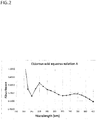
- a spectrometric measurement of a sample can simultaneously identify an absorbent section including an acidic chlorite ion (H + +ClO 2 - ) representing a peak near 260 nm and an absorbent section including chlorine dioxide (ClO 2 ) representing a peak near 350 nm between wavelengths of about 240 to about 420 nm, it is possible to recognize the presence of the chlorous acid aqueous solution of the present invention, i.e., the presence of chlorous acid (HClO 2 ).
- pH can be further stabilized at this time by directly adding a buffering agent or by first adjusting the pH with sodium carbonate or the like and then adding another buffering agent.
- the present invention unexpectedly maintains an antimicrobial effect, sterilizing effect, microbe-removing effect, disinfecting effect, and antiviral effect while achieving the effect stably for a long period of time because a combination of chlorous acid (HClO 2 ), chlorine dioxide gas (ClO 2 ), or an aqueous solution including the same and any one of an inorganic acid, inorganic acid salt, organic acid, and organic acid salt, two or more types thereof, or a combination thereof can create a transitional state and delay a decomposition reaction to stabilize and maintain chlorous acid (HClO 2 ) over a long period of time.
- chlorous acid H 2
- ClO 2 chlorine dioxide gas
- Examples of preferable ranges of pH include, but are not limited to, 3.2 or higher to less than 7.0, about 5.0 to about 7.5, about 5.0 to about 7.0, about 5.5 to about 7.0, about 5.0 to about 6.0, and the like.
- Examples of the lower limit include, but are not limited to, about 5.0, about 5.1, about 5.2, about 5.3, about 5.4, about 5.5, and the like
- examples of the upper limit include, but are not limited to, about 7.5, about 7.4, about 7.3, about 7.2, about 7.1, about 7.0, about 6.9, about 6.8, about 6.7, about 6.5, about 6.4, about 6.3, about 6.2, about 6.1, about 6.0, about 5.9, about 5.8, about 5.7, about 5.6, about 5.5, and the like.
- the optimal pH includes, but is not limited to, about 5.5.
- “about” is used for a pH value herein, the range is intended to span 0.05 in both directions when the significant digit is the first decimal point.
- about 5.5 is understood as referring to 5.45 to 5.55.
- pH is preferably, but not limited to, less than 7.0 in the present invention.
- Preferable metal hydroxide includes sodium hydroxide and/or potassium hydroxide.
- Preferable metal phosphate includes sodium phosphate (e.g., disodium hydrogen phosphate, sodium dihydrogen phosphate, trisodium phosphate) and/or potassium phosphate (e.g., tripotassium phosphate, dipotassium hydrogen phosphate, and potassium dihydrogen phosphate; especially potassium dihydrogen phosphate), and still preferably potassium hydroxide and potassium phosphate (e.g., tripotassium phosphate, dipotassium hydrogen phosphate, and potassium dihydrogen phosphate; especially potassium dihydrogen phosphate), where the above are non-limiting examples.
- sodium phosphate e.g., disodium hydrogen phosphate, sodium dihydrogen phosphate, trisodium phosphate
- potassium phosphate e.g., tripotassium phosphate, dipotassium hydrogen phosphate, and potassium dihydrogen phosphate; especially potassium di
- the present invention provides an apparatus for manufacturing a chlorous acid aqueous solution, including: 1) an electrolytic cell for electrolyzing a salt to obtain a chlorate or an aqueous solution thereof, and 2) a reaction tank for reducing the chlorate or an aqueous solution thereof to obtain an aqueous solution including a chlorous acid.
- the present invention provides articles impregnated with the antimicrobial agent, sterilizing agent, microbe-removing agent, disinfecting agent, or antiviral agent of the present invention.
- An article that can be used as the article of the present invention is any article that can be impregnated with a chlorous acid aqueous solution to be used for antimicrobial, sterilizing, microbe-removing, disinfecting, and antiviral purposes and the like, including medical devices and the like. Examples thereof include, but are not limited to, a sheet, film, patch, brush, nonwoven fabric, paper, fabric, absorbent cotton, sponge, and the like.
- Salt is added to a salt dissolving tank containing tap water until salt no longer dissolves to obtain a salt solution.
- the salt solution is transferred to fill an electrolytic cell and a storage tank. At this time, the solution is filtered to remove salt that has not dissolved.
- a hydrochloric acid diluent with a concentration of about 0.3% is placed in a hydrochloric acid titration apparatus to start titration. The pH value is adjusted while circulating the salt solution.
- a cooling apparatus is started up to circulate cooling water.
- a control panel is operated to generate electricity for conducting electricity through a rectifier.
- the solution after electrical conduction is transferred to a reaction tank.
- a neutralization tank is loaded with a neutralization solution and a gas washing apparatus is loaded with a gas washing solution in advance, and then a stirring apparatus of the reaction tank is started up, and an acid solution is slowly added to the solution after electrical conduction therein. At this time, the remaining acid solution is added after confirming that first reaction gas is not generated in the reaction tank. Furthermore, a hydrogen peroxide solution is slowly added to slowly generate second reaction gas, thus allowing the gas to adsorb to the neutralization solution in the neutralization tank. This operation is repeated as much as needed. The manufacture is completed when the specification is met.
- chlorous acid The primary active ingredient of chlorous acid aqueous solutions is chlorous acid.
- chlorous acid is often misunderstood to be the same as chlorine dioxide or sodium chlorite.
- chlorous acid aqueous solution is also different from acidified sodium chlorite (ASC).
- the reagent is prepared at the time of use. The solution remaining from use during the day should be discarded and never be used the next day. About 10 w/w% sulfuric acid; about 100 g of sulfuric acid is added to about 900 g of water. *sulfuric acid should be slowly added along a glass rod. 1 w/w% starch solution; about 494.5 g of water is added to about 5.0 g of starch (soluble) and about 0.5 g of sodium azide. The mixture is heated with a microwave (or electric heater). The starch (soluble) is dissolved while stirring with a glass rod once in a while. When the solution is transparent, heating is discontinued. The solution is cooled and refrigerated.
- the amount of chlorine of sodium hypochlorite is denoted not only as the available chlorine concentration derived by iodometry, but also as the amount of activated chlorine involved in the sterilizing effect contained in sodium hypochlorite, i.e., oxidation capability is denoted as free chlorine. It is well known that the free chlorine and available chlorine concentration of sodium hypochlorite show the same value. However, for chlorous acid aqueous solutions, the amount of activated chlorine involved in an antimicrobial effect, sterilizing effect, microbe-removing effect, disinfecting effect, and antiviral effect contained therein does not match the value of chlorous acid concentration obtained by the above measurement method. In this regard, it is necessary to find the oxidation capability of a chlorous acid aqueous solution by the same approach as the free chlorine of sodium hypochlorite. This can be quantified by the following method.
- Oxidation capability of chlorous acid aqueous solution the basis and principle of measurement of sodium hypochlorite converted concentration are based on the description in "Regulation of Water Supply Act, Appended Table 3, Absorption spectroscopy” and Japanese Pharmacopoeia [General Tests, Processes and Apparatus] 2.24.
- Oxidation capability of chlorous acid aqueous solution sodium hypochlorite converted concentration is found by the following method.
- a spectrophotometer is used as a measuring apparatus. After adjusting the apparatus in advance by the operation method appended to the spectrophotometer, wavelengths, transmittance and the like are checked with the premise that they comply with the test. For wavelengths, a wavelength calibration optical filter is used to measure transmittance near the wavelength of a reference value shown on the test certificate under test conditions in the test certificate appended to each filter. The wavelength at which the transmittance exhibits the minimal value is read out. However, when a test is conducted, deviation between the measured wavelength and the wavelength of the reference value is to be ⁇ 0.5 nm or less. Measurement is to be repeated three times. Each of the measured values is to be within a mean value ⁇ 0.2 nm or less.
- a transmittance calibration optical filter is used to read out the transmittance at the wavelength of a reference value shown on the test certificate under test conditions in the test certificate appended to each filter. Further, when a test is conducted, deviation between the measured transmittance and the reference transmittance is to be within the upper limit value and the lower limit value of relative precision shown in the test certificate plus 1%. Measurement is repeated three times. It is confirmed that each measured value of absorbance (or measured value of transmittance converted to absorbance) is within mean value ⁇ 0.002 when absorbance is 0.500 or less, and each of the values is within mean value ⁇ 0.004 when absorbance exceeds 0.500. It is desirable to confirm that transmittance plots out a straight line by using multiple transmittance calibration optical filters with different transmittance at the same wavelength.
- An apparatus adjusted in advance is used.
- a light source, detector, measurement mode of the apparatus, measured wavelength or range of measured wavelengths, spectrum width, wavelength scanning rate and the like are selected and determined.
- the apparatus is activated and left standing for a certain period of time to confirm that the apparatus operates stably.
- a shutter is placed on a sample optical path to block out light, and the indicated value of transmittance at the measured wavelength or range of measured wavelengths is adjusted to be 0%.
- the shutter is removed, and the indicated value of transmittance at the measured wavelength or range of measured wavelengths is adjusted to be 100% (or absorbance to 0%), and a cell containing a control solution or the like is placed on the optical path.
- the cell containing a control solution or the like is placed on a sample optical path and the control optical path, and the indicated value of transmittance is adjusted to 100% (or absorbance to 0%).
- a specified solution or a solvent used in the test is used as the control solution.
- a solution prepared by mixing the potassium dihydrogen phosphate solution and dipotassium hydrogen phosphate solution and adjusting with potassium dihydrogen phosphate solution or dipotassium hydrogen phosphate solution so that the pH is 6.5 by using a pH meter is used as a "phosphate buffer solution”. Chlorine gas generated from dripping sulfuric acid (1+4) into sodium hypochlorite is allowed to be absorbed into purified water to prepare chlorine water, which is then used to adjust the free chlorine concentration to 100 ppm. The solution is used as a "reference solution”. (At this time, it is necessary to confirm that the diluted solution is 100 ppm).
- the reference solution is accurately measured out, to which ion exchange water (or distilled water) is added to make a solution including 0.01 mL, 0.02 mL, 0.05 mL, or 0.10 mL in 1 mL.
- the solution is used as a "standard solution”. Further, 9.5 mL of the standard solution is measured out, to which 0.5 mL of phosphate buffer solution is added and mixed homogeneously. 0.1 g of indicator is added thereto and mixed.
- a test is conducted by ultraviolet-visible spectrophotometry [The Japanese Pharmacopoeia [General Tests, Processes and Apparatus] 2.24].
- Absorbance at wavelength of 510 nm is measured, 9.5 mL of ion exchange water (or distilled water) is measured, 0.5 mL of phosphate buffer solution is added, and mixed homogeneously. The resultant solution is used as a "blank solution”. Next, the blank solution is tested by ultraviolet-visible spectrophotometry [The Japanese Pharmacopoeia [General Tests, Processes and Apparatus] 2.24], and the absorbance at wavelength 510 nm is measured. The above operation is repeated three times. A value obtained by subtracting the absorbance of the blank solution from the absorbance of the standard solution is used to calculate a mean value of absorbance at each concentration. The calculated values are used to create "calibration curves" within one hour after preparing the reference solution by plotting oxidation power ( ⁇ free chlorine concentration) on the horizontal (X) axis and absorbance on the vertical (Y) axis on a graph.
- oxidation power ⁇ free chlorine concentration
- a solution prepared by mixing the potassium dihydrogen phosphate solution and dipotassium hydrogen phosphate solution and adjusting with the potassium dihydrogen phosphate solution or dipotassium hydrogen phosphate solution so that the pH is 6.5 by using a pH meter is used as a "phosphate buffer solution”.
- a chlorous acid aqueous solution is then adjusted to 300 ppm as the chlorous acid concentration by using ion exchange water (or distilled water). The solution is used as a "test solution”. 9.5 mL of the test solution is then measured out, to which 0.5 mL of phosphate buffer solution is added and mixed. 0.1 g of the indicator is then added and mixed. Absorbance at the wavelength of 510 nm was immediately measured using a spectrophotometer.
- the precise antimicrobial effect, sterilizing effect, microbe-removing effect, disinfecting effect, and antiviral effect of a chlorous acid aqueous solution can be guaranteed only after a comparison and evaluation thereof with the antimicrobial effect, sterilizing effect, microbe-removing effect, disinfecting effect, and antiviral effect of phenol on E. coli.
- the following is the operation method thereof.
- Phenol normal broth medium, desoxycholate medium, sodium chloride, and sterilized water
- Phenol is dissolved with hot water of about 70°C. 25 mL is measured out and precisely diluted to 500 mL with water (40°C). The specific gravity at 20°C is confirmed to be within the range of 1.000 ⁇ 0.005. *Opacity does not pose any problems.
- Liquid medium (1L volume): 18.0 g of normal broth medium is added to 1L of water in a 1000 mL Erlenmeyer flask with a stopper. They are mixed and dissolved for about 30 minutes at normal temperature. After confirming that the medium has thoroughly dissolved, the solution is subjected to an autoclave (121°C, 15 minutes).
- Liquid medium volume of 200 mL: about 18.0 g of normal broth medium is added to 1L of water. They were mixed and dissolved for about 30 minutes at normal temperature. After confirming that the medium has thoroughly dissolved, 200 mL of the solution is dispensed into a 300 mL Erlenmeyer flask with a stopper and subjected to an autoclave (121°C, 15 minutes).
- Liquid medium (test tube): about 18.0 g of normal broth medium is added to 1L of water. They were mixed and dissolved for about 30 minutes at normal temperature. After confirming that the medium has thoroughly dissolved, 10 mL of the solution is dispensed into each test tube, sealed with an aluminum cap, and subjected to an autoclave (121°C, 15 minutes).
- Saline About 8.5 g of sodium chloride is dissolved into about 500 ml of water. The solution is diluted with water to be 1L and subjected to an autoclave (121°C, 15 minutes).
- Sterilized water A suitable amount of distilled water is placed in a pharmaceutical glass bottle and subjected to an autoclave (121°C, 15 minutes).
- Oxidation capability setting (DPD) 4 2 1.0 0.8 0.6 0.4 0.2 0.1 Volume prior to adding microbial solution (mL) 9.0 9.0 9.0 9.0 9.0 9.0 9.0 9.0 9.0 9.0 9.0 9.0 9.0 9.0 9.0 9.0 9.0 9.0
- the prepared samples are dispensed into test tubes subjected to dry heat sterilization in accordance with the above formulation.
- a sterilized platinum inoculation loop is immersed in the liquid medium after 5 minutes and 10 minutes. A water film is made in the ring at the tip of the platinum inoculation loop. The liquid medium (test tube) is inoculated in this state.
- test segments observed to have opacity after incubation are recorded as "+” and test segments without opacity are recorded as "-”.
- a cotton swab is immersed in the liquid medium of the test segments evaluated as "+”, and the medium is smeared onto a desoxycholate medium (flat plate) from the center to the outside so as to draw a straight line.
- the sample name is described on the back surface of the Petri dish where the medium was smeared, and the sample is cultured for 24 hours at 37°C.
- dilution factors of the value used are found from the stock solution of chlorous acid aqueous solution and stock solution of phenol as "dilution factor of sample solution” and “dilution factor of phenol”, respectively, which are plugged into the following equations to find the phenol coefficient (PC).
- Dilution factor of phenol 100/value of concentration of phenol used Equation 3
- Phenol constant (PC) dilution factor of sample solution/dilution factor of phenol [Table 5] (Example)
- the concentration setting used is determined to be 0.75%, and the dilution factor is 133.
- an antimicrobial effect, sterilizing effect, microbe-removing effect, disinfecting effect, and antiviral effect of chlorine oxides have different antimicrobial effect, sterilizing effect, microbe-removing effect, disinfecting effect, and antiviral effect that can be exerted with respect to 1 oxidation capability depending on the type of main active ingredient. If this is quantified using "phenol coefficient per oxidation capability (100)", the antimicrobial effect, sterilizing effect, microbe-removing effect, disinfecting effect, and antiviral effect can be handled separately for chlorous acid contained in an chlorous acid aqueous solution, chlorine dioxide, sodium chlorite, and ASC.
- Sodium chlorite Reagent Aqueous solution prepared by measuring out 31.25 g of sodium chlorite (80% product, Wako) and dissolving the sodium chlorite into 100 ml of ion exchange water, wherein maximum absorbance section of UV spectrum can be observed only at 260 nm.
- Chlorous acid aqueous solution A Chlorous acid aqueous solution manufactured according to the manufacturing method in Example 2, wherein maximum absorbance sections of UV spectrum can be observed at both 260 nm and 350 nm.
- Chlorine dioxide Reagent Aqueous solution prepared by measuring out 31.25 g of sodium chlorite (80% product, Wako), dissolving the sodium chlorite into 100 ml of ion exchange water, diluting the solution to 1200 ppm, and adding 0.1 mol/L hydrochloric acid thereto so that the pH would be 2.3 or less, wherein maximum absorbance section of UV spectrum can be observed only near 350 nm.
- Dissolved chlorine dioxide Reagent Aqueous solution prepared by measuring out 31.25 g of sodium chlorite (80% product, Wako), dissolving the sodium chlorite into 100 ml of ion exchange water, adding 0.1 mol/L hydrochloric acid thereto to generate chlorine dioxide gas, and dissolving the gas into ultrapure water, wherein the available chlorine concentration at this time is 0.3% (w/v) and the maximum absorbance section of UV spectrum can be observed only near 350 nm.
- chlorous acid aqueous solution A While the relationship between the oxidation capability and phenol coefficient of chlorine dioxide and dissolved chlorine dioxide matched, only chlorous acid aqueous solution A exhibited a high phenol coefficient with low oxidation capability, which is a tendency that is clearly different from the relationship between oxidation capability and phenol coefficient of sodium chlorite and chlorine dioxide. This demonstrates that the oxidation capability of chlorous acid aqueous solution A has a higher antimicrobial effect, sterilizing effect, microbe-removing effect, disinfecting effect, and antiviral effect than the oxidation capability of chlorine dioxide or sodium chlorite.
- ASC was prepared by faithfully reproducing WO 99/18805 by Kross to compare ASC with chlorous acid aqueous solution A manufactured in Example 2.
- Chlorous acid aqueous solution A Chlorous acid aqueous solution manufactured according to the manufacturing method in Example 2, wherein maximum absorbance sections of UV spectrum can be observed at both 260 nm and 350 nm.
- ASC ASC prepared by adding citric acid (claim 3) to an aqueous solution of chlorite with an available chlorine concentration of 1200 ppm (claim 2) so that the pH is 2.2 (claim 1) based on WO 99/18805 (available chlorine concentration 1200 ppm, pH 2.2)
- ASC is an antimicrobial agent, sterilizing agent, microbe-removing agent, disinfecting agent, or antiviral agent with properties that are closer to chlorine dioxide than chlorous acid aqueous solutions.
- an antimicrobial component, sterilizing component, microbe-removing component, disinfecting component, or antiviral agent of a chlorine oxide is a chlorite ion, chlorous acid, or chlorine dioxide. It is desirable that the phenol coefficient per oxidation capability (100) of a chlorous acid aqueous solution is maintained at or above 1.0 if possible.
- a chlorous acid aqueous solution is used as an antimicrobial agent, sterilizing agent, microbe-removing agent, disinfecting agent, or antiviral agent
- the antimicrobial power, sterilizing power, microbe-removing power, disinfecting power, and antiviral power can be guaranteed, unlike sodium hypochlorite, by managing three values, i.e., "oxidation capability per 100 ppm of chlorous acid concentration", “phenol coefficient per oxidation capability (100)", and "phenol coefficient per 10000 ppm of chlorous acid concentration”.
- Example 2 Manufacture of chlorous acid aqueous solution with a conventional sterilizing effect function manufactured in Patent Literature 1 in a diaphragm free electrolytic cell-reaction tank integrated manufacturing plant.
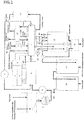
- Figure 1 shows an example of an integrated manufacturing plant that was used.
- each of the numbers is the member shown in the following Tables.
- Table 11 Number Name 1 salt dissolving tank 2 saturated salt water filtration apparatus 3 pump 1 4 control panel 5 rectifier/power source 6 electrolytic cell 7 storage tank 8 measurement instrument 9 pump 2 10 cooling apparatus 11 hydrochloric acid titration apparatus 12 reaction tank 13 stirrer 14 acid adding apparatus 15 hydrogen peroxide adding apparatus 16 pump 3 17 neutralization tank 18 gas washing tank 19 waste fluid treating tank 20 capacitor 21 jacket
- Table 12 Number Name A saturated salt water discharge valve B electrolytic cell discharge valve C air valve D circulation opening/closing spigot E liquor discharge valve F sulfuric acid inlet valve G hydrogen peroxide inlet valve H air pump spigot I trifurcated spigot J reaction solution discharge valve K air valve L sample valve
- Formulation table a Saturated salt water Name of raw material Amount 1 Tap water 65.0 g 2 Sodium chloride in the Japanese Pharmacopoeia 35.0 g Total 100 g
- Formulation table b Aqueous 0.1 mol/L hydrochloric acid solution (for titration) Name of raw material Amount 1 Tap water 65.0 g 2 Concentrated hydrochloric acid (98% product) 35.0 g Total 100 g
- Formulation table c Acid solution Name of raw material Amount 1 Tap water 300.0 g 2 Sulfuric acid 700.0 g Total 1000 g
- Formulation table d Hydrogen peroxide solution Name of raw material Amount 1 Tap water 64.0 g 2 Dithionous acid-sulfuric acid mixture 1 g 3 Hydrogen peroxide (35% product) 35.0 g Total 100 g Dithionous acid-sulfuric acid mixture: 1 g of sodium dithionate is
- Formulation table e Reaction solution Name of raw material Amount 1 Liquor 200 g 2 Acid solution 300 g 3 Hydrogen peroxide solution 50 g
- Formulation table f Neutralization solution Name of raw material Amount 1 Tap water 731.88 g 2 Sodium hydroxide 2.5 g 3 Dipotassium hydrogen phosphate 139.36 g 4 Sodium carbonate 53 g 5 Sodium tetraborate 7.62 g 6 35% hydrogen peroxide 30 1000 g
- Formulation table g Gas washing solution Name of raw material Amount 1 Tap water 910 g 2 Sodium hydroxide 60 g 3 35% hydrogen peroxide 30 Total 1000 g
- Formulation table h Waste fluid neutralization solution Name of raw material Amount 1 Tap water 790.0 g 2 Sodium ascorbate 150.0 g 3 Sodium hydroxide 60 g Total 1000 g
- Saturated salt water is prepared by adding salt that meets the specification of sodium chloride in the Japanese Pharmacopoeia to a salt dissolving tank containing tap water until the salt no longer dissolves.
- Pump 1 is started up to transfer the saturated salt water to fill an electrolytic cell and a storage tank. At this time, the saturated salt water is passed through a saturated salt water filtration apparatus to remove undissolved sodium chloride crystals.
- Hydrochloric acid diluent with a 0.3% concentration is placed in a hydrochloric acid titration apparatus to start titration.
- Pump 2 is started up to adjust the pH value to 6.0 while circulating the saturated salt water. pH and solution temperature monitors are started up to record the value at the time.
- a cooling apparatus is started up to circulate cooling water.
- a control panel is operated to generate electricity and start conducting electricity through a rectifier (voltage of 3V, current of 100 A, current density of 2500 A/m 2 , 80°C ⁇ 5°C, and 78 hours and 30 minutes).
- the materials of electrodes connected to the electrolysis cell are platinum/iridium coated titanium (anode) and highly pure steel (cathode). These electrodes are disposed in parallel at a 5 mm interval without a diaphragm.
- the saturated salt water passes through this space to circulate the electrolytic cell and the storage tank.
- the concentration of sodium chlorate of liquid obtained at this time is 50% (w/v), and the available chlorine concentration was 0 ppm.
- Pump 2 is stopped, and the liquor is transferred to a reaction tank.
- a neutralization solution is loaded into a neutralization tank and a gas washing solution is loaded into a gas washing apparatus in advance, and then a stirring apparatus of the reaction tank is started up and an acid solution is slowly added to about 1 kg of the liquid in the reaction tank. At this time, the remaining acid solution is added after confirming that first reaction gas is not generated in the reaction tank. Furthermore, a hydrogen peroxide solution is slowly added to slowly generate second reaction gas. The gas is allowed to adsorb to the neutralization solution in the neutralization tank. This operation is repeated twice. The manufacture ends when the specification is met.
- a chlorous acid aqueous solution was manufactured as described below.
- An aqueous solution of the product has maximum absorbance sections at wavelengths of 258 to 262 nm and 346 to 361 nm.
- An aqueous solution of the product had maximum absorbance sections at wavelengths of 258 to 262 nm and 346 to 361 nm.
- Potassium iodide-starch paper When potassium iodide-starch paper is immersed in the product, the paper changes its color to blue and then loses the color. When potassium iodide-starch paper was immersed in the product, the paper changed its color to blue and then lost the color. Chlorous acid concentration - 51926.48 ppm
- chlorous acid aqueous solution preparation A was prepared by adding the following formulation to maintain a cyclic reaction.
- Formulation table 1 Formulation of chlorous acid aqueous solution preparation A Name of raw material Amount 1 Tap water 789.04 g 2 Potassium dihydrogen phosphate 54.43 g 3 Dipotassium hydrogen phosphate 69.68 g 4 Chlorous acid aqueous solution A 86.85 g Total 1000 g
- Component analysis table for chlorous acid aqueous solution preparation A Measured item Specification value 1 Actual measurement value Chlorous acid concentration 4500 ppm or greater 4516 ppm Oxidation capability Not set 152 Phenol coefficient Not set 1.40 Oxidation capability per 100 ppm of chlorous acid concentration 1.1 or greater (self-imposed specification) 3.36 Phenol coefficient per oxidation capability (100) 0.7 or greater (self-imposed specification) 0.92 Phenol coefficient per 10000
- Example 3 Manufacture of highly reactive chlorous acid aqueous solution by a diaphragm free electrolytic cell-reaction tank integrated manufacturing plant
- Formulation table a Saturated salt water Name of raw material Amount 1 Tap water 65.0 g 2 Sodium chloride in the Japanese Pharmacopoeia 35.0 g Total 100 g
- Formulation table b Aqueous 0.1 mol/L hydrochloric acid solution (for titration) Name of raw material Amount 1 Tap water 65.0 g 2 Concentrated hydrochloric acid (98% product) 35.0 g Total 100 g
- Formulation table j Acid solution Name of raw material Amount 1 Tap water 295.0 g 2 Sodium thiosulfate 5.0 g 3 Sulfuric acid 700.0 g Total 1000 g
- Formulation table d Hydrogen peroxide solution Name of raw material Amount 1 Tap water 64.0 g 2 Dithionous acid-sulfuric acid mixture 1 g 3 Hydrogen peroxide (35% product) 35.0 g Total 100 g Dithionous acid-sulfuric
- Formulation table e Reaction solution Name of raw material Amount 1 Liquor 200 g 2 Acid solution 300 g 3 Hydrogen peroxide solution 50 g
- Formulation table f Neutralization solution Name of raw material Amount 1 Tap water 731.88 g 2 Sodium hydroxide 2.5 g 3 Dipotassium hydrogen phosphate 139.36 g 4 Sodium carbonate 53 g 5 Sodium tetraborate 7.62 g 6 35% hydrogen peroxide 30 1000 g
- Formulation table g Gas washing solution Name of raw material Amount 1 Tap water 910 g 2 Sodium hydroxide 60 g 3 35% hydrogen peroxide 30 Total 1000 g
- Formulation table h Waste fluid neutralization solution Name of raw material Amount 1 Tap water 790.0 g 2 Sodium ascorbate 150.0 g 3 Sodium hydroxide 60 g Total 1000 g
- Saturated salt water is prepared by adding salt that meets the specification of sodium chloride in the Japanese Pharmacopoeia to a salt dissolving tank containing tap water until the salt no longer dissolves.
- Pump 1 is started up to transfer the saturated salt water to fill an electrolytic cell and a storage tank. At this time, the saturated salt water is passed through a saturated salt water filtration apparatus to remove undissolved sodium chloride crystals.
- Hydrochloric acid diluent with a 0.3% concentration is placed in a hydrochloric acid titration apparatus to start titration.
- Pump 2 is started up to adjust the pH value to 6.5 while circulating the saturated salt water. pH and solution temperature monitors are started up to record the value at the time.
- a cooling apparatus is started up to circulate cooling water.
- a control panel is operated to generate electricity and start conducting electricity through a rectifier (voltage of 3 V, current of 100 A, current density of 2500 A/m 2 , 85° C ⁇ 5°C, and 78 hours and 30 minutes).
- the materials of electrodes connected to the electrolysis cell are platinum/iridium coated titanium (anode) and highly pure steel (cathode). These electrodes are disposed in parallel at a 5 mm interval without a diaphragm.
- the saturated salt water passes through this space to circulate the electrolytic cell and the storage tank.
- the concentration of sodium chlorate of liquid obtained at this time is 49% (w/v), and the available chlorine concentration was 9889 ppm.
- Pump 2 is stopped, and the liquor is transferred to a reaction tank.
- a neutralization solution is loaded into a neutralization tank and a gas washing solution is loaded into a gas washing apparatus in advance, and then a stirring apparatus of the reaction tank is started up and an acid solution is slowly added to about 1 kg of the liquid in the reaction tank.
- First reaction gas is allowed to be generated in the reaction tank and to adsorb to the neutralization solution in the neutralization tank.
- a hydrogen peroxide solution is slowly added to slowly generate second reaction gas.
- the gas is allowed to adsorb to the neutralization solution in the neutralization tank. This operation is repeated twice. The manufacture ends when the specification is met.
- a chlorous acid aqueous solution was manufactured as described below.
- An aqueous solution of the product has maximum absorbance sections at wavelengths of 258 to 262 nm and 346 to 361 nm.
- An aqueous solution of the product had maximum absorbance sections at wavelengths of 258 to 262 nm and 346 to 361 nm.
- Potassium iodide-starch paper When potassium iodide-starch paper is immersed in the product, the paper changes its color to blue and then loses the color. When potassium iodide-starch paper was immersed in the product, the paper changed its color to blue and then lost the color. Chlorous acid concentration - 46999.83 ppm
- chlorous acid aqueous solution preparation B was prepared by adding the following formulation to maintain a cyclic reaction.
- Formulation table k Formulation of chlorous acid aqueous solution preparation B Name of raw material Amount 1 Tap water 774.41 g 2 Potassium dihydrogen phosphate 54.43 g 3 Dipotassium hydrogen phosphate 69.68 g 4 Chlorous acid aqueous solution B 101.48 g Total 1000 g
- Component analysis table for chlorous acid aqueous solution preparation B Measured item Specification value 1 Actual measurement value Chlorous acid concentration 4500 ppm or greater 4770 ppm Oxidation capability Not set 572 Phenol coefficient Not set 9.03 Oxidation capability per 100 ppm of chlorous acid concentration 1.1 or greater (self-imposed specification) 11.99 Phenol coefficient per oxidation capability (100) 0.7 or greater (self-imposed specification) 1.57 Phenol coefficient per 10000
- a comparative test was conducted for chlorous acid aqueous solution A manufactured in Example 2 and the preparation thereof, i.e., chlorous acid aqueous solution preparation A, as well as chlorous acid aqueous solution B manufactured in Example 3 and the preparation thereof, i.e., chlorous acid aqueous solution preparation B, in the absence of organic matters.
- a chlorous acid aqueous solution manufactured by the manufacturing method patent of Patent Literature 1 was used as the control.
- chlorous acid concentration, oxidation capability, and phenol coefficient of the chlorous acid aqueous solution of Patent Literature 1 chlorous acid aqueous solution A, chlorous acid aqueous solution preparation A, chlorous acid aqueous solution B, and chlorous acid aqueous solution preparation B were found. Furthermore, 1 ml of E. coli solution (10 7 E. coli) was added to 8 ml of saline and thoroughly stirred. 1 ml of the solution prepared by adjusting each of the chlorous acid aqueous solutions and chlorous acid aqueous solution preparations to the chlorous acid concentration of 200 ppm was added and contacted for 15 seconds, 30 seconds, 1 minute, 5 minutes, and 10 minutes.
- Chlorous acid aqueous solution A manufactured by the present manufacturing method can be used to obtain aqueous solutions including various concentrations of chlorate as liquid by electrolysis, with salt as the raw material.
- chlorous acid aqueous solutions having more diverse chlorous acid concentrations and oxidation capability compared to chlorous acid aqueous solutions made by a conventional manufacturing method can be manufactured.
- a chlorous acid aqueous solution manufactured by the manufacturing method patent in Patent Literature 1 is characterized by having an antimicrobial effect, sterilizing effect, microbe-removing effect, disinfecting effect, and antiviral effect having conventional functions. It was also found that chlorous acid aqueous solution A manufactured by the present manufacturing method and chlorous acid aqueous solution A maintaining a cyclic reaction by utilizing a buffer with this chlorous acid aqueous solution A as the raw material also exert an antimicrobial effect, sterilizing effect, microbe-removing effect, disinfecting effect, and antiviral effect having conventional features, just like a chlorous acid aqueous solution manufactured by the manufacturing method patent in Patent Literature 1.
- chlorous acid aqueous solution B and chlorous acid aqueous solution preparation B have a more highly reactive antimicrobial power, sterilizing power, microbe-removing power, disinfecting power, and antiviral power compared to chlorous acid aqueous solution A, enabling high reactivity to E. coli in 15 seconds of contact, which was impossible with conventional chlorous acid aqueous solutions.
- chlorous acid aqueous solution B can maintain the antimicrobial power, sterilizing power, microbe-removing power, disinfecting power, and antiviral power in weak acidic region, so that it is evident that this is not an effect due to sodium hypochlorite.
- the antimicrobial power, sterilizing power, microbe-removing power, disinfecting power, and antiviral power of chlorous acid aqueous solution B significantly decreased, such that only the antimicrobial effect, sterilizing effect, microbe-removing effect, disinfecting effect, and antiviral effect with the same property as conventional chlorous acid aqueous solutions was exhibited.
- chlorous acid aqueous solution B had antimicrobial power, sterilizing power, microbe-removing power, disinfecting power, and antiviral power with high reactivity.
- antimicrobial effect, sterilizing effect, microbe-removing effect, disinfecting effect, and antiviral effect of chlorous acid aqueous solutions with conventional features but also antimicrobial effect, sterilizing effect, microbe-removing effect, disinfecting effect, and antiviral effect corresponding to high reactivity can be maintained for a long period of time by maintaining a cyclical reaction.
- the highly reactive antimicrobial effect, sterilizing effect, microbe-removing effect, disinfecting effect, and antiviral effect is not derived from sodium hypochlorite.
- an aqueous solution including a chlorous acid aqueous solution obtained by the present invention can be utilized in applications such as an antimicrobial agent, sterilizing agent, microbe-removing agent, disinfecting agent, antiviral agent, bleach, and blood stain removing agent.
Landscapes
- Chemical & Material Sciences (AREA)
- Organic Chemistry (AREA)
- Engineering & Computer Science (AREA)
- Chemical Kinetics & Catalysis (AREA)
- Electrochemistry (AREA)
- Metallurgy (AREA)
- Materials Engineering (AREA)
- Inorganic Chemistry (AREA)
- Automation & Control Theory (AREA)
- Life Sciences & Earth Sciences (AREA)
- Water Supply & Treatment (AREA)
- Environmental & Geological Engineering (AREA)
- Hydrology & Water Resources (AREA)
- General Chemical & Material Sciences (AREA)
- Analytical Chemistry (AREA)
- Health & Medical Sciences (AREA)
- Animal Behavior & Ethology (AREA)
- Epidemiology (AREA)
- General Health & Medical Sciences (AREA)
- Public Health (AREA)
- Veterinary Medicine (AREA)
- Electrolytic Production Of Non-Metals, Compounds, Apparatuses Therefor (AREA)
- Agricultural Chemicals And Associated Chemicals (AREA)
- Apparatus For Disinfection Or Sterilisation (AREA)
- Disinfection, Sterilisation Or Deodorisation Of Air (AREA)
- Water Treatment By Electricity Or Magnetism (AREA)
Applications Claiming Priority (2)
| Application Number | Priority Date | Filing Date | Title |
|---|---|---|---|
| JP2016070264 | 2016-03-31 | ||
| PCT/JP2017/013333 WO2017170904A1 (fr) | 2016-03-31 | 2017-03-30 | Procédé de préparation d'une eau d'acide chloreux à l'aide d'une matière première obtenue par électrolyse de sel |
Publications (2)
| Publication Number | Publication Date |
|---|---|
| EP3438043A1 true EP3438043A1 (fr) | 2019-02-06 |
| EP3438043A4 EP3438043A4 (fr) | 2019-12-18 |
Family
ID=59965963
Family Applications (1)
| Application Number | Title | Priority Date | Filing Date |
|---|---|---|---|
| EP17775438.9A Pending EP3438043A4 (fr) | 2016-03-31 | 2017-03-30 | Procédé de préparation d'une eau d'acide chloreux à l'aide d'une matière première obtenue par électrolyse de sel |
Country Status (6)
| Country | Link |
|---|---|
| US (2) | US11912569B2 (fr) |
| EP (1) | EP3438043A4 (fr) |
| JP (5) | JP7233925B2 (fr) |
| CN (2) | CN121894612A (fr) |
| AU (1) | AU2017245046B2 (fr) |
| WO (1) | WO2017170904A1 (fr) |
Cited By (1)
| Publication number | Priority date | Publication date | Assignee | Title |
|---|---|---|---|---|
| EP4186563A4 (fr) * | 2020-07-22 | 2024-07-24 | Sankei Co., Ltd. | Agent de destruction du coronavirus |
Families Citing this family (5)
| Publication number | Priority date | Publication date | Assignee | Title |
|---|---|---|---|---|
| CN109811366A (zh) * | 2019-03-20 | 2019-05-28 | 鄂尔多斯市瀚博科技有限公司 | 一种分解电解循环淡盐水中氯酸盐的方法 |
| US20220331467A1 (en) * | 2019-08-08 | 2022-10-20 | Sankei Co., Ltd. | Halal disinfectant liquid |
| WO2022014595A1 (fr) | 2020-07-14 | 2022-01-20 | 三慶株式会社 | Procédé de fabrication de viande de volaille mettant en œuvre une eau d'acide chloreux |
| JP2024108361A (ja) * | 2023-01-31 | 2024-08-13 | パナソニックIpマネジメント株式会社 | 空間浄化装置 |
| WO2025239363A1 (fr) * | 2024-05-14 | 2025-11-20 | 三慶株式会社 | Procédé de production d'une préparation d'eau d'acide chloreux permettant une stabilisation plus efficace dans un liquide à une température ordinaire dans des concentrations élevées et faibles de l'eau d'acide chloreux, de l'acide chloreux en tant que composant efficace principal de celle-ci, et des radicaux de peroxyde de chlore en tant qu'espèces moléculaires actives de celle-ci |
Family Cites Families (17)
| Publication number | Priority date | Publication date | Assignee | Title |
|---|---|---|---|---|
| FR1086055A (fr) * | 1953-07-02 | 1955-02-09 | Electro Chimie Soc D | Perfectionnement à la fabrication de chlorates alcalins par voie électrolytique |
| JPS5951481B2 (ja) * | 1977-06-08 | 1984-12-14 | クロリン エンジニアズ株式会社 | 二酸化塩素の製造方法 |
| CA1109019A (fr) * | 1979-02-13 | 1981-09-15 | Erco Industries Limited | Construction d'une cellule a chlorate |
| FR2441667A1 (fr) * | 1978-11-14 | 1980-06-13 | Ugine Kuhlmann | Procede de preparation electrolytique des chlorates alcalins |
| US4470888A (en) * | 1983-09-08 | 1984-09-11 | Pennwalt Corporation | Method for preparing alkali metal chlorates by electrolysis |
| US4877500A (en) * | 1988-06-30 | 1989-10-31 | Joseph Callerame | Process for the production of chlorine dioxide |
| CA2079633C (fr) * | 1992-07-31 | 1998-04-28 | John Robert Jackson | Methode de preparation des chlorates provenant des ecoulements de gaz de combustion obtenus lors de la production de dioxyde de chlore |
| US6063425A (en) | 1997-10-09 | 2000-05-16 | Alcide Corporation | Method for optimizing the efficacy of chlorous acid disinfecting sprays for poultry and other meats |
| US7087208B2 (en) * | 2001-08-02 | 2006-08-08 | Sampson Allison H | Methods for making chlorous acid and chlorine dioxide |
| JP2005330159A (ja) | 2004-05-21 | 2005-12-02 | Mitsubishi Gas Chem Co Inc | 食塩から化学パルプの無塩素漂白用薬品の製造方法 |
| CN100441230C (zh) * | 2005-08-01 | 2008-12-10 | 郑祥开 | 一种可产生气态二氧化氯的便携式空气消毒器 |
| ES2988065T3 (es) * | 2006-08-28 | 2024-11-19 | Honbu Sankei Co Ltd | Solución acuosa de ácido cloroso para uso como desinfectante |
| AU2015201401B2 (en) * | 2006-08-28 | 2016-07-07 | Honbu Sankei Co., Ltd | Process for producing aqueous chlorous acid solution for use as disinfectant |
| CN101878779B (zh) * | 2010-07-08 | 2013-06-19 | 北京可佳永好科贸有限公司 | 一种消毒液 |
| US20160106106A1 (en) * | 2013-05-20 | 2016-04-21 | Honbu Sankei Co., Ltd. | Drug-resistant microbe and variant microbe disinfectant containing chlorous acid aqueous solution |
| JP2015110544A (ja) * | 2013-05-20 | 2015-06-18 | 本部三慶株式会社 | 亜塩素酸水製剤の長期保存および新規用途 |
| WO2015093062A1 (fr) | 2013-12-20 | 2015-06-25 | 本部三慶株式会社 | Procédé pour produire de l'acide chloreux aqueux par adsorption de dioxyde de chlore |
-
2017
- 2017-03-30 AU AU2017245046A patent/AU2017245046B2/en active Active
- 2017-03-30 CN CN202511910180.1A patent/CN121894612A/zh active Pending
- 2017-03-30 US US16/088,708 patent/US11912569B2/en active Active
- 2017-03-30 CN CN201780028159.6A patent/CN109071220A/zh active Pending
- 2017-03-30 WO PCT/JP2017/013333 patent/WO2017170904A1/fr not_active Ceased
- 2017-03-30 EP EP17775438.9A patent/EP3438043A4/fr active Pending
- 2017-03-30 JP JP2018509453A patent/JP7233925B2/ja active Active
-
2020
- 2020-10-28 JP JP2020180527A patent/JP2021028289A/ja not_active Withdrawn
-
2022
- 2022-06-01 JP JP2022089681A patent/JP2022121439A/ja not_active Withdrawn
-
2023
- 2023-09-15 JP JP2023150195A patent/JP2023171397A/ja active Pending
-
2024
- 2024-01-18 US US18/416,827 patent/US20240246816A1/en active Pending
-
2025
- 2025-10-31 JP JP2025184725A patent/JP2026012377A/ja active Pending
Cited By (1)
| Publication number | Priority date | Publication date | Assignee | Title |
|---|---|---|---|---|
| EP4186563A4 (fr) * | 2020-07-22 | 2024-07-24 | Sankei Co., Ltd. | Agent de destruction du coronavirus |
Also Published As
| Publication number | Publication date |
|---|---|
| AU2017245046B2 (en) | 2020-07-16 |
| JP2023171397A (ja) | 2023-12-01 |
| EP3438043A4 (fr) | 2019-12-18 |
| JP2022121439A (ja) | 2022-08-19 |
| AU2017245046A1 (en) | 2018-10-11 |
| CN121894612A (zh) | 2026-04-21 |
| US11912569B2 (en) | 2024-02-27 |
| CN109071220A (zh) | 2018-12-21 |
| JP2026012377A (ja) | 2026-01-23 |
| WO2017170904A1 (fr) | 2017-10-05 |
| JP7233925B2 (ja) | 2023-03-07 |
| JP2021028289A (ja) | 2021-02-25 |
| US20240246816A1 (en) | 2024-07-25 |
| US20200299133A1 (en) | 2020-09-24 |
| JPWO2017170904A1 (ja) | 2019-02-14 |
Similar Documents
| Publication | Publication Date | Title |
|---|---|---|
| US20240246816A1 (en) | Method for manufacturing chlorous acid water using raw material obtained by salt electrolysis | |
| JP7265871B2 (ja) | 殺菌剤として使用する亜塩素酸を含む水溶液の製造方法 | |
| WO2005117914A2 (fr) | Solution biocide | |
| EP4339155A1 (fr) | Radical peroxyde de chlore et procédé de production, composition, procédé de quantification et utilisation de ce radical | |
| JP7164767B1 (ja) | 次亜塩素酸水 | |
| JP2014148526A (ja) | 殺菌消毒液の製造方法 | |
| JP2007031374A (ja) | 殺菌消毒液の製造方法 | |
| JP6240632B2 (ja) | 殺菌消毒液の製造方法 | |
| JP2026071341A (ja) | 殺菌剤として使用する亜塩素酸を含む水溶液の製造方法 | |
| JP2012140375A (ja) | 新規次亜塩素酸組成物、及びその製造法 | |
| CN116709922A (zh) | 次氯酸水 |
Legal Events
| Date | Code | Title | Description |
|---|---|---|---|
| STAA | Information on the status of an ep patent application or granted ep patent |
Free format text: STATUS: THE INTERNATIONAL PUBLICATION HAS BEEN MADE |
|
| PUAI | Public reference made under article 153(3) epc to a published international application that has entered the european phase |
Free format text: ORIGINAL CODE: 0009012 |
|
| STAA | Information on the status of an ep patent application or granted ep patent |
Free format text: STATUS: REQUEST FOR EXAMINATION WAS MADE |
|
| 17P | Request for examination filed |
Effective date: 20181011 |
|
| AK | Designated contracting states |
Kind code of ref document: A1 Designated state(s): AL AT BE BG CH CY CZ DE DK EE ES FI FR GB GR HR HU IE IS IT LI LT LU LV MC MK MT NL NO PL PT RO RS SE SI SK SM TR |
|
| AX | Request for extension of the european patent |
Extension state: BA ME |
|
| DAV | Request for validation of the european patent (deleted) | ||
| A4 | Supplementary search report drawn up and despatched |
Effective date: 20191120 |
|
| RIC1 | Information provided on ipc code assigned before grant |
Ipc: C25B 1/26 20060101ALI20191114BHEP Ipc: A61L 2/18 20060101ALI20191114BHEP Ipc: C02F 1/46 20060101ALI20191114BHEP Ipc: C01B 11/08 20060101AFI20191114BHEP Ipc: A61L 101/06 20060101ALI20191114BHEP Ipc: C25B 9/00 20060101ALI20191114BHEP Ipc: C02F 1/70 20060101ALI20191114BHEP |
|
| STAA | Information on the status of an ep patent application or granted ep patent |
Free format text: STATUS: EXAMINATION IS IN PROGRESS |
|
| 17Q | First examination report despatched |
Effective date: 20230109 |