EP3439129B1 - Dimensionnement d'un accumulateur d'énergie et d'un onduleur - Google Patents
Dimensionnement d'un accumulateur d'énergie et d'un onduleur Download PDFInfo
- Publication number
- EP3439129B1 EP3439129B1 EP18182444.2A EP18182444A EP3439129B1 EP 3439129 B1 EP3439129 B1 EP 3439129B1 EP 18182444 A EP18182444 A EP 18182444A EP 3439129 B1 EP3439129 B1 EP 3439129B1
- Authority
- EP
- European Patent Office
- Prior art keywords
- information
- electricity
- capacity
- household
- energy
- Prior art date
- Legal status (The legal status is an assumption and is not a legal conclusion. Google has not performed a legal analysis and makes no representation as to the accuracy of the status listed.)
- Active
Links
Images


Classifications
-
- H—ELECTRICITY
- H02—GENERATION; CONVERSION OR DISTRIBUTION OF ELECTRIC POWER
- H02J—ELECTRIC POWER NETWORKS; CIRCUIT ARRANGEMENTS OR SYSTEMS FOR SUPPLYING OR DISTRIBUTING ELECTRIC POWER; SYSTEMS FOR STORING ELECTRIC ENERGY
- H02J3/00—Circuit arrangements for AC mains or AC distribution networks
-
- G—PHYSICS
- G06—COMPUTING OR CALCULATING; COUNTING
- G06Q—INFORMATION AND COMMUNICATION TECHNOLOGY [ICT] SPECIALLY ADAPTED FOR ADMINISTRATIVE, COMMERCIAL, FINANCIAL, MANAGERIAL OR SUPERVISORY PURPOSES; SYSTEMS OR METHODS SPECIALLY ADAPTED FOR ADMINISTRATIVE, COMMERCIAL, FINANCIAL, MANAGERIAL OR SUPERVISORY PURPOSES, NOT OTHERWISE PROVIDED FOR
- G06Q50/00—Information and communication technology [ICT] specially adapted for implementation of business processes of specific business sectors, e.g. utilities or tourism
- G06Q50/06—Energy or water supply
-
- H—ELECTRICITY
- H02—GENERATION; CONVERSION OR DISTRIBUTION OF ELECTRIC POWER
- H02J—ELECTRIC POWER NETWORKS; CIRCUIT ARRANGEMENTS OR SYSTEMS FOR SUPPLYING OR DISTRIBUTING ELECTRIC POWER; SYSTEMS FOR STORING ELECTRIC ENERGY
- H02J3/00—Circuit arrangements for AC mains or AC distribution networks
- H02J3/28—Arrangements for balancing of the load in networks by storage of energy
- H02J3/32—Arrangements for balancing of the load in networks by storage of energy using batteries or super capacitors with converting means
-
- H—ELECTRICITY
- H02—GENERATION; CONVERSION OR DISTRIBUTION OF ELECTRIC POWER
- H02J—ELECTRIC POWER NETWORKS; CIRCUIT ARRANGEMENTS OR SYSTEMS FOR SUPPLYING OR DISTRIBUTING ELECTRIC POWER; SYSTEMS FOR STORING ELECTRIC ENERGY
- H02J2103/00—Details of circuit arrangements for mains or AC distribution networks
- H02J2103/30—Simulating, planning, modelling, reliability check or computer assisted design [CAD] of electric power networks
-
- Y—GENERAL TAGGING OF NEW TECHNOLOGICAL DEVELOPMENTS; GENERAL TAGGING OF CROSS-SECTIONAL TECHNOLOGIES SPANNING OVER SEVERAL SECTIONS OF THE IPC; TECHNICAL SUBJECTS COVERED BY FORMER USPC CROSS-REFERENCE ART COLLECTIONS [XRACs] AND DIGESTS
- Y02—TECHNOLOGIES OR APPLICATIONS FOR MITIGATION OR ADAPTATION AGAINST CLIMATE CHANGE
- Y02E—REDUCTION OF GREENHOUSE GAS [GHG] EMISSIONS, RELATED TO ENERGY GENERATION, TRANSMISSION OR DISTRIBUTION
- Y02E60/00—Enabling technologies; Technologies with a potential or indirect contribution to GHG emissions mitigation
-
- Y—GENERAL TAGGING OF NEW TECHNOLOGICAL DEVELOPMENTS; GENERAL TAGGING OF CROSS-SECTIONAL TECHNOLOGIES SPANNING OVER SEVERAL SECTIONS OF THE IPC; TECHNICAL SUBJECTS COVERED BY FORMER USPC CROSS-REFERENCE ART COLLECTIONS [XRACs] AND DIGESTS
- Y04—INFORMATION OR COMMUNICATION TECHNOLOGIES HAVING AN IMPACT ON OTHER TECHNOLOGY AREAS
- Y04S—SYSTEMS INTEGRATING TECHNOLOGIES RELATED TO POWER NETWORK OPERATION, COMMUNICATION OR INFORMATION TECHNOLOGIES FOR IMPROVING THE ELECTRICAL POWER GENERATION, TRANSMISSION, DISTRIBUTION, MANAGEMENT OR USAGE, i.e. SMART GRIDS
- Y04S40/00—Systems for electrical power generation, transmission, distribution or end-user application management characterised by the use of communication or information technologies, or communication or information technology specific aspects supporting them
- Y04S40/20—Information technology specific aspects, e.g. CAD, simulation, modelling, system security
Definitions
- the invention relates to a method and a device for dimensioning an energy store, in particular the invention relates to a method and a device for determining capacity information for dimensioning an energy store.
- Photovoltaics, wind energy, (micro) CHP (combined heat and power) or similar power generation systems installed in the household can cover at least part of the household's electricity requirements.
- renewable energies e.g. photovoltaics or wind energy
- it can be stored in an energy storage device.
- the capacity of an energy storage device is usually estimated. In this case, for example, the energy store is dimensioned on the basis of the household's annual electricity consumption and/or the annual electricity generation of the electricity generation plant.
- the maximum generation capacity of the electricity generation capacity is often known.
- the annual amount of energy generated by the power generation plant is usually not. This is estimated, for example, based on the maximum generation capacity of the power generation plant and the regional radiation data. This can sometimes lead to an unnecessarily large dimensioning of the energy store, because in particular the amount of energy generated annually is usually assumed to be greatly simplified.
- the possible peak performance of a photovoltaic system cannot be achieved, e.g. B. if the area of the photovoltaic system that can be used to generate electricity is limited by local conditions (e.g. Shadows cast by obstacles such as trees or tall buildings) cannot be fully utilized.
- a tool capable of determining the correct battery size calculation for a variety of different household and PV combinations is disclosed.
- a device which is set up or includes corresponding means to carry out and/or control a method according to the first aspect.
- Devices according to the method the first aspect are or comprise in particular one or more devices according to the second aspect.
- a system comprising one or more devices, which together are designed and/or set up to carry out a specific method according to all aspects, the system a server, a power generation system arranged in a household and a power generation system arranged in the household Includes smart meter and device.
- a power generation plant is an energy source, in particular a so-called renewable energy source.
- the power generation system is a photovoltaic system, a cogeneration system, a wind turbine, a solar system, a geothermal system, or a combination thereof, to name some non-limiting examples.
- the power generation plant can be a micro-KW (power plant), e.g. B. be a combined heat and power plant or the like, which can be installed in the household.
- a photovoltaic system also known as a PV system (or PVA for short), is a solar power system in which solar cells convert part of the solar radiation into electrical energy.
- the typical direct type of energy conversion is referred to as photovoltaics.
- a CHP plant generates electricity and heat at the same time.
- the waste heat that is produced during electricity generation is used to heat heating or service water in a household.
- a household is understood to mean, for example, a residential building with one or more residential units, an office building with one or more offices, or a building open to the public (e.g. a train station, airport, shopping center or the like), to give a few non-limiting examples to name.
- the household has at least one power generation system, for example a photovoltaic system can be installed on the roof of a building and/or a CHP system or another power generation system (e.g. a (micro) combined heat and power plant) can be installed in the basement of the building, which are designed to generate at least part of the electrical energy to be consumed in the household. Before it is consumed, the electricity generated can be stored in an energy store, for example.
- An energy store also referred to below as a battery—is understood in particular to mean any energy store that stores energy by means of electrochemical or physical processes and provides an output voltage. In particular, this is to be understood as meaning energy stores which contain one or more capacitor, accumulator and/or battery cells connected in series and possibly also in parallel.
- Preferred electrochemical energy stores can be accumulator cells, in particular of the type Pb - lead accumulator, NiCd - nickel-cadmium accumulator, NiH2 - nickel-hydrogen accumulator, NiMH - nickel-metal hydride accumulator, Li-Ion - lithium-ion accumulator, LiPo - lithium -Polymer Battery, LiFe - Lithium Metal Battery, LiMn - Lithium Manganese Battery, LiFePO4 - Lithium Iron Phosphate Battery, LiTi - Lithium Titanate Battery, RAM - Rechargeable Alkaline Manganese, Ni-Fe - Nickel -Iron battery, Na/NiCl - Sodium-nickel chloride high-temperature battery SCiB - Super Charge Ion Battery, silver-zinc battery, silicone battery, vanadium redox battery and/or zinc-bromine battery. Double-layer capacitors or other types of capacitors can also serve as energy stores.
- the generation information and/or the consumption information can be recorded or include, for example, in the form of data or in the form of a large number (at least two) data sets.
- the generation information can be indicative of the electrical power generated by the power generation plant, for example.
- the consumption information can be indicative of the electrical power consumed by the household, for example.
- the consumption information is z. B. the electrical power drawn from the power grid, which is consumed, for example, in addition to the electrical energy generated by the power generation plant of the household.
- the generation information and/or the consumption information is recorded, for example, by one or more electricity meters.
- the recorded generation information and/or the recorded consumption information is sent to a device, e.g. B. transmitted to a server.
- the information can be transmitted, for example, via a communication interface (eg according to the WLAN (Wireless Local Area Network) or the BT (Bluetooth) standard).
- the information can be transmitted, for example, via the Internet or a data network that connects the devices to one another.
- the determined capacity information may be transmitted to a user's device (e.g., a computer) accordingly.
- the capacity information is determined at least partially on the basis of a reference value, which is used as a comparison value, for example as a factor for the determination.
- the reference value represents, for example, that 100% of the energy generated by the power generation plant must be consumed directly in the household. Unused electricity cannot be used due to the lack of an energy storage device get saved.
- the energy storage device is calculated accordingly, e.g. B. designed with a capacity of 0 kWh.
- a further factor on which the capacity information can be determined at least partially based is, for example, a service life of the energy store.
- deep discharges of the energy store should be avoided.
- a so-called “usable capacity” of the energy store can be used, for example.
- the actual capacity of the energy store can therefore be slightly larger, and correspondingly less capacity of the energy store is used to z. B. to prevent deep discharges and similar edge effects.
- the capacity information can be determined, for example, in such a way that the dimensioning of the energy store is determined in such a way that a deep discharge of the energy store is avoided. This can be done, for example, at least partially based on the recorded consumption information.
- the consumption information can, for example, provide information about the power consumption of the household, the power consumption of the household being that which is drawn from the power grid in addition to the power generated by the power generation plant.
- Other factors on which the determination of the capacity information can be based, for example, at least in part, are e.g. B. Economic factors.
- An economic factor is, for example, the amortization period of the power generation system and/or the energy storage device. If the specific capacity information shows, for example, that the amortization period when purchasing an energy storage device is very long, it can make the most sense, for example based on the actual electricity consumption of the household, to invest in an energy storage device, at least given the current market situation and the price for the energy storage device waive.
- a possible electricity price increase for electricity to be additionally obtained from the electricity grid can be taken into account when determining the capacity information. Since a possible electricity price increase for a future period can only be estimated, the electricity price increase can be assumed to be around 2% price increase per year, for example. Additionally or alternatively, the electricity price increase can be estimated on the basis of historical data, for example by taking into account the actual electricity price increase from one or more previous years and assuming a similar or the same price increase for the future. An electricity price increase has an influence, for example, on the amortization period of a power generation plant and/or an energy store, so that the capacity information can also be influenced accordingly.
- the predefined time interval can be determined in advance, for example. Additionally or alternatively, the predefined time interval can be defined according to predetermined rules.
- the production information and/or the consumption information can, for example, be and/or include a large number of individually recorded data sets, e.g. B. recorded at time intervals.
- a data set of the generation information and/or the consumption information can be recorded at a specific point in time, for example.
- a further data record of the generation information and/or the consumption information can be recorded at a further point in time, for example.
- the respective data records of the generation information and/or the consumption information can be recorded at regular intervals or intervals, for example.
- the individual data records of the generation information and/or the consumption information can be recorded discretely. Accordingly, they can respective data sets of generation information and/or consumption information at intervals of one second, one minute to several minutes (e.g. 10, 15, 20, or 30 minutes) so that a historical course of the corresponding large number of data sets can be recorded Generation information and / or consumption information is included.
- the production information and/or the consumption information can, for example, cover a (historical or past) period of, for example, one month, two months, three months, half a year, one year or longer, to name a few non-limiting examples.
- the method analyzes, for example, current performance data (generation information) installed in the household power generation system (e.g. photovoltaic system, e.g. comprising at least one photovoltaic cell), and (e.g. current and/or historical) consumption information in order to determine to be able to carry out the capacity information indicative of a capacity for the energy storage device.
- generation information e.g. current performance data (generation information) installed in the household power generation system (e.g. photovoltaic system, e.g. comprising at least one photovoltaic cell), and (e.g. current and/or historical) consumption information in order to determine to be able to carry out the capacity information indicative of a capacity for the energy storage device.
- the capacity information is determined accordingly, at least in part, based on current and/or historical generation information and/or current and/or historical consumption information, for example over a predefined period of time, e.g. B. the past months to a year or more were recorded.
- the generation information and/or the consumption information can each include a large number of data sets that are recorded, for example, at daily, hourly, minutely or even secondly intervals from one another.
- a minute-by-minute resolution of the data sets included in the generation information and/or consumption information is preferred, since this z. B. represents a good compromise between memory requirements and information content through the exact data resolution.
- This current and/or historical information is stored, for example, in a memory deposited, e.g. B a database. These stored data records can be read from the database, for example.
- the capacity information based on at least one data set that is included in the generation information and/or the consumption information. If, for example, there is still no power generation system in the household, the generation information of the power generation system can alternatively be simulated. Further details can be found in the back part of this specification.
- the capacity information can be determined on the basis of historical generation information and consumption information, for example.
- the capacity information is determined at least partially based on each data set comprised by the generation information and the consumption information.
- the capacity information can be determined indicative of a dimensioning of an energy store for a power generation system comprised by a household on the basis of actual generation information (the electrical power generated by the power generation system) and consumption information (the electrical power consumed by the household). Accordingly, the capacity of the energy store can be adapted very specifically to the requirements that actually occur in the household.
- the capacity information is determined at least partially on the basis of the consumption information, that is to say on the basis of the electricity actually consumed by at least one energy consumer in the household.
- the capacity information is determined, for example, by determining the electricity generated by the electricity generation plant minus the electricity consumed by the household. Accordingly, it can be recorded, for example, how often and at what time the amount of electricity generated by the electricity generation plant sufficient to cover or exceed the consumption of electricity in the household, so that this excess electricity can be stored in an energy storage device, e.g. B. can be saved for later use.
- Determining the capacity information objectively includes taking into account a simultaneity of the generation information and the consumption information.
- the simultaneity of generation information indicative of an amount of energy generated and consumption information indicative of an amount of energy consumed by the household can be recorded, for example, how much of the currently generated amount of energy can be used by the household. It can be used either by direct consumption by one or more energy consumers in the household, by storing the generated amount of energy in the energy storage device, by feeding the generated amount of energy into the power grid of an energy supply company (for a corresponding fee), or a combination of the above .
- the capacity information can be determined at least partially on the basis of the generated generation information and the recorded consumption information, taking this simultaneity into account.
- the generation information can be recorded by an energy management box, for example.
- the energy management box records, for example, the generating capacity of the power generation plant, e.g. B. a photovoltaic system or a CHP system.
- the consumption information can, for example, by means of an electricity meter, z. B. a smart meter can be detected.
- the smart meter can also, for example, record an amount of electricity fed into the electricity grid of a utility company. It can be to minimize. It can also be ensured, for example, that the potential of the power generation system installed in the household is sufficiently exploited.
- reference information can be recorded indicative of an amount of energy drawn from the power grid.
- the generation information, the consumption information, the feed information, the reference information, or a combination thereof can be recorded simultaneously, ie in parallel, for example.
- the generation information, the consumption information, the feed information, the reference information, or a combination thereof can be recorded one after the other.
- the feed-in information can be recorded, for example, by one or more electricity meters.
- the one or more electricity meters can be embodied as a smart meter, for example.
- the smart meter can, for example, act or be designed as a bidirectional electricity meter, with the smart meter detecting (e.g. measuring) the electrical energy (current) drawn from the power grid on the one hand - feed information - and on the other hand, for example, the electrical energy fed into the power grid (current) senses (e.g. measures) - reference information.
- the consumption information can be recorded, for example, to minimize. It can also be ensured, for example, that the potential of the power generation system installed in the household is sufficiently exploited.
- reference information can be recorded indicative of an amount of energy drawn from the power grid.
- the generation information, the consumption information, the feed information, the reference information, or a combination thereof can be recorded simultaneously, ie in parallel, for example.
- the generation information, the consumption information, the feed information, the reference information, or a combination thereof can be recorded one after the other.
- the feed-in information can be recorded, for example, by one or more electricity meters.
- the one or more electricity meters can be embodied as a smart meter, for example.
- the smart meter can, for example, act or be designed as a bidirectional electricity meter, with the smart meter detecting (e.g. measuring) the electrical energy (current) drawn from the power grid on the one hand - feed information - and on the other hand, for example, the electrical energy fed into the power grid (current) senses (e.g. measures) - reference information.
- the consumption information can be recorded, for example, for example, by determining based on the captured generation information, the captured feed information, the captured reference information, or a combination thereof.
- the determination of the capacity information includes the determination of a state of charge information of the energy store, wherein the state of charge information is indicative of a quantity of electricity stored in the energy store.
- the state of charge information is, for example, initially assumed to have a value of 0%, a value of 0% meaning that 0% of the available capacity of the energy store is used or electricity is stored in 0% of the available capacity. Accordingly, the energy store is completely discharged. If, on the other hand, the state of charge information represents a value of 100%, the energy store is fully charged or 100% of the available energy of the energy store can be used to supply consumers in the household.
- the state of charge information can represent a value in the range from 0% to 100%, for example.
- the determination of the capacity information can, for example, be iterated on the basis of the initial state of charge information.
- the respective data sets of generation information and/or consumption information can be iterated at intervals of one second, one minute to several minutes (e.g. 10, 15, 20, or 30 minutes), with the state of charge information being at least partially based on the recorded production information and the recorded consumption information changed after each iteration.
- This can, for example, be simulated for different maximum capacities (e.g. 1-20 kWh) of an energy store.
- the capacity information can be determined in such a way that the Energy storage is selected that is most sensibly adapted to the actual needs of the household.
- the capacity information is also indicative of usage information for the energy store, with a user being able to determine at least partially based on the usage information whether the capacity of the energy store is being used optimally or not.
- the capacity information can include corresponding usage information, with the usage information being determined accordingly.
- the capacity of the energy storage device can be used optimally if it is possible to save electricity from the grid.
- the capacity of the energy storage device can be used optimally if as much as possible of the electricity generated by the electricity generation system is consumed by at least one energy consumer in the household.
- An exemplary embodiment provides that the capacity information is determined taking into account maximizing the self-sufficiency of the household.
- the self-sufficiency of the household is understood to mean independence from purchasing electricity from the electricity grid.
- the determination of the capacity information can, for example, include taking into account a saving in electricity purchases, wherein the saving can at least partially influence the self-sufficiency of the household.
- the capacity information is determined taking into account the minimization of a power purchase from the power grid.
- the capacity of the energy store would have to be designed to be very large, with saturation in terms of the cost/benefit ratio of the energy store occurring relatively far below such a large capacity of the energy store. For example, 80 to 90% of the maximum possible savings in electricity purchases can be achieved with a capacity of the energy store that is only about 20% of the capacity size of the energy store that would be required for the maximum possible savings in electricity purchases.
- An exemplary embodiment provides that the capacity information represents a size of an energy store.
- the capacity information can include or represent size information of the energy store, e.g. B. a capacity in the unit kWh.
- the capacity information can be determined at least partially based on one of cases i) to iii), for example, if the generation information and/or the consumption information includes a large number of data sets (e.g. present in minute resolution), and an iteration over this data for different capacities (e.g. 1 to 20 kWh) is simulated. For each of the large number of data sets, it can be determined, for example, whether electricity is obtained from the electricity grid or whether electricity is fed into the electricity grid.
- a large number of data sets e.g. present in minute resolution
- an iteration over this data for different capacities e.g. 1 to 20 kWh
- the energy storage device In case i) the energy storage device is being discharged and in order to meet the electricity demand of the household at that time, additional electricity has to be drawn from the electricity grid in addition to the electricity produced by the electricity generation plant.
- the reference information or a data set included in the reference information can be determined corresponding to the data set or data sets of the generation information and/or consumption information at the same point in time.
- the corresponding data record of the reference information is then, for example, indicative of the fact that in case i) additional electricity is drawn from the electricity grid in addition to the electricity generated by the electricity generation plant.
- the energy store is charged and after meeting the electricity demand from the household at that time, additional electricity available from the power generation facility can be used to charge the energy store.
- the feed information or a data record that is included in the feed information can be recorded at the same time as the data record or data records of the generation information and/or consumption information.
- the corresponding data set of the feed-in information is then, for example, indicative of the fact that in case ii) electricity generated by the electricity generation plant is fed into the electricity network.
- loss mechanisms can be included, e.g. B. self-discharge of the energy store when not in use and/or conversion losses.
- inverter information can be determined. For example, it can be determined which inverter z. B. provides the lowest losses in relation to the peak power of the power generation plant and the energy storage.
- the inverter is dimensioned so that an inverter is not dimensioned in such a way that it can direct much greater power than can ever occur based on the power generation system electrically connected to the inverter. This can, for example, have a positive effect on the amortization period of the energy storage device, as well as additional technical components such as the inverter.
- an inverter is usually dimensioned based on the maximum possible power (peak power) of the power generation system. As a rule, this peak power is not called up, since, for example, the maximum charging current of the energy store connected to the power-generating system can represent a limiting factor.
- the conversion efficiency indicates what proportion of the energy to be directed in the form of direct current is present as alternating current after conversion. For example, an inverter can achieve an efficiency of around 98%. This can be taken into account accordingly when determining the inverter information.
- the energy store can be dimensioned in such a way that 99% of the cases that occur in the household (eg determined on the basis of historical consumption information) can be guaranteed.
- the remaining capacity of the energy store is released for temporary storage of electricity from the power grid.
- the remaining capacity of the energy storage can for example for the temporary storage of energy already generated, e.g. B. from renewable energies, z. B. generated in other households.
- the power-generating system is a photovoltaic system or a combined heat and power system.
- the generation information and the consumption information are recorded by an electricity meter.
- the electricity meter is a smart meter, for example.
- FIG. 1 shows an embodiment of a system 100 according to the third aspect.
- the system 100 is set up or includes appropriate means to carry out and/or control a method according to the first aspect.
- the system 100 includes a power generation plant 141 and a smart meter 145 located in a household 140 .
- the household 140 can optionally have power electronics 142, a router 143 and an energy management box 144 include.
- Communication links can be provided between the individual entities 141 to 145 for (bi-)directional data transmission, e.g. B. according to the WLAN and / or BT standard for wireless communication links, and / or according to the LAN (Local Area Network) and / or USB (Universal Serial Bus) for wired communication links, to name a few non-limiting examples .
- the energy management box 144 is z. B. connected to the smart meter 145 by means of a d0 interface.
- the household 140 e.g. B. the energy management box 144 or the smart meter 145 also each have a communication link to a communication network 130 (z. B. Internet), so that information between the household 140 and a server 110 can be transmitted.
- the server 110 is connected to a database 120, so that z. B. information stored in the database 120 can be accessed.
- the energy management box 144 can also record the electrical power (electricity) generated by the power generation plant 141 (e.g. measure), and optionally store information transmitted by the smart meter 145 (the electrical power drawn from the power grid and the electrical power fed into the power grid), and transmit it to another device (e.g. server 110) via a communication interface, for example.
- z. B. server 110 the determination of capacity information that, for example, a dimensioning of an energy store that can be included in the household 140 for storing electrical power generated by the power generation plant 141 of the system 100 allow. Based on this capacity information, for example, a recommendation for the dimensioning of the energy store can be made adapted to the actual needs in the household 140 . To this end, the determined capacity information will be output by the server (e.g. server 110).
- the server e.g. server 110
- FIG. 2 shows a visualization of a dependency of a power purchase and a self-sufficiency for the dimensioning of an energy store, wherein the dimensioning of the energy store was determined according to an embodiment.
- the x-axis of the in 2 The diagram shown shows simulated energy storage capacities, here from 0 to 20 kWh.
- the y-axis of the chart reflects the amount of electricity purchased from a utility's power grid by a household in addition to that from the power-generating facility (e.g., power-generating facility 141 of 1 ) can be obtained.
- a capacity of 0% no energy storage available
- electricity generated by a power generation plant must be consumed immediately by the household. Otherwise, electricity must be drawn from the grid. This case only occurs relatively rarely.
- the dashed upper line is located at 100%.
- the self-sufficiency of the household from an energy supply company is about 20% in the event that no energy store is included in the household. This value can be lower or higher depending on the situation in the household.
- an energy storage device for the household that is adapted to the actual need should have a dimensioning of 3 to 7 kWh for the application shown.
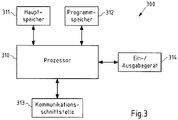
- FIG 3 shows a block diagram of an embodiment of an optional device 300, which in particular can execute an exemplary method according to the first aspect.
- the device 300 is, for example, a device according to the second aspect or a system according to the third aspect.
- the device 300 may be, for example, a computer, a desktop computer, a server, a thin client, or a portable computer (mobile device) such as a laptop computer, a tablet computer, a personal digital assistant (PDA), or a smartphone .
- the device can, for example, fulfill the function of a server or a client.
- Processor 310 of device 300 is embodied in particular as a microprocessor, microcontrol unit, microcontroller, digital signal processor (DSP), application-specific integrated circuit (ASIC) or field programmable gate array (FPGA).
- DSP digital signal processor
- ASIC application-specific integrated circuit
- FPGA field programmable gate array
- Program memory 312 is preferably a local data carrier permanently connected to the device 300 .
- Data carriers permanently connected to the device 300 are, for example, hard disks that are built into the device 300 .
- the data medium can also be a data medium that can be connected to the device 300 in a detachable manner, such as a memory stick, a removable data medium, a portable hard disk, a CD, a DVD and/or a floppy disk.
- Program memory 312 contains, for example, the operating system of device 300, which is at least partially loaded into main memory 311 when device 300 is started and executed by processor 310. In particular, when device 300 boots, at least a portion of the operating system core is loaded into main memory 311 and executed by processor 310 .
- the operating system of device 300 is, for example, a Windows, UNIX, Linux, Android, Apple iOS and/or MAC operating system.
- the operating system enables the device 300 to be used for data processing.
- it manages resources such as main memory 311 and program memory 312, communication interface 313, input and output device 313, provides others with programming interfaces, among other things provides basic functions to programs and controls the execution of programs.
- Processor 310 controls the communication interface 313, which can be a network interface, for example, and can be embodied as a network card, network module and/or modem.
- the communication interface 313 is set up in particular to connect the device 300 to other devices, in particular via a (wireless) communication system, for example a network, and to communicate with them.
- communications interface 313 may receive and forward data to processor 310 (via the communications system) and/or receive and transmit data from processor 310 (via the communications system).
- Examples of a communication system are a local area network (LAN), a wide area network (WAN), a wireless network (for example according to the IEEE 802.11 standard, the Bluetooth (LE) standard and/or the NFC standard), a wired one network, a cellular network, a telephone network and/or the Internet.
- LAN local area network
- WAN wide area network
- wireless network for example according to the IEEE 802.11 standard, the Bluetooth (LE) standard and/or the NFC standard
- a wired one network for example according to the IEEE 802.11 standard, the Bluetooth (LE) standard and/or the NFC standard
- processor 310 can control at least one input/output device 314 .
- Input/output device 314 is, for example, a keyboard, mouse, display, microphone, touch-sensitive display, speaker, reader, disk drive, and/or camera.
- input/output device 314 may accept input from a user and forward it to processor 310 and/or receive information from processor 310 and output information for the user.
- FIG. 1 shows different exemplary embodiments of storage media on which an exemplary embodiment of a computer program according to the invention can be stored.
- the storage medium can be, for example, a magnetic, electrical, optical and/or other type of storage medium.
- the storage medium can, for example, be part of a processor (e.g. the processor 410 the 4 ), for example a (non-volatile or volatile) program memory of the processor or a part thereof (such as program memory 412 in 4 ).
- Exemplary embodiments of a storage medium are a flash memory 410, an SSD hard drive 411, a magnetic hard drive 412, a memory card 413, a memory stick 414 (e.g. a USB stick), a CD-ROM or DVD 415 or a floppy disk 416.
- Calculations to determine the capacity information can be done, for example, as set out below:
- Losses that can occur during energy transport can, for example, be taken into account in the calculations in an idealized manner. For example, transmission losses that typically occur and are associated with the one or more current conductors that are used can be taken into account.
- 'FIT' Fee in Tariff
- FIT Fee in Tariff
- 'Total Invest' designates a possible sum that is to be paid for the purchase of an energy store, taking into account the capacity of the energy store, which is represented by the specific capacity information.
- 'Typical_cost_per_kWh' is, for example, an idealized value with standard market costs for an energy storage unit per capacity in kWh, e.g. B. about 1500 € per kWh.
- a (discharge) charging power of the energy store can be taken into account, which indicates how quickly the energy store can be charged and/or discharged or must be able to be in order to be able to store the electrical energy generated by the power generation plant and/or stored electrical energy can provide to meet the needs of the household.
- one or more framework conditions can be taken into account accordingly.
- One of these framework conditions can be, for example, that 99% of all household situations (apart from peak benefits) should be covered. For example, based on the historical data, it can be determined that e.g. B. a peak power of 'x kW' was obtained 5 times in the period analyzed, with 'x' being greater than 14kW, for example. At one point in time, for example, several energy consumers in the household have requested and needed a total of more than 14 kW of power.
- the energy store In order to be able to cover this case with energy that is stored in the energy store, the energy store would have to be dimensioned accordingly in order to be able to cover this case. However, this would sometimes make the energy storage device very expensive or appear uneconomical for an investor. Accordingly, the analysis of historical data as a result provide that in, for example, 99% of the cases occurring in the data, only about 4 kW were requested by the energy consumers in the household. The energy store should therefore be dimensioned at least partially based on this (dis)charging power, with that (dis)charging power of the energy store being sensibly dimensioned that can cover 99% of the cases occurring in the data, i.e. a corresponding (dis) has charging power.
- All technical parameters can be determined, for example, by a server (e.g. back-end server) at a predetermined point in time or after a predetermined period of time (e.g. once a day).
- a server e.g. back-end server
- one or more economic parameters can be determined, for example.
- these can be determined in a front end (for example an application, for example a browser application).
- Parameters entered in the front end e.g. B. from a user using an input interface, can be taken into account by the front end when determining one or more economic parameters.
- An exemplary embodiment provides that the generation capacity of the electricity generation system (eg photovoltaic system, CHP system or the like, to name a few non-limiting examples) can be predicted. For example, based on input parameters z. B. be entered by a user such. B. Photovoltaic system size, required intermediate parameters such. B. Peak performance of the photovoltaic or CHP system can be determined. Subsequently, parameters such as historical weather information, Generating services from existing power generation plants in the area or the like are transferred to the simulated power generation plant. At least partially based on these data and/or parameters, for example, a generation output of a simulated power generation plant can be predicted.
- the electricity generation system eg photovoltaic system, CHP system or the like, to name a few non-limiting examples
- the power actually consumed by at least one energy consumer in the household should be taken into account, e.g. B. by means of an electricity meter (z. B. a smart meter) can be detected.
- an electricity meter z. B. a smart meter
- a base load consumption of the household can be taken into account for determining the capacity information.
- the electricity consumption the power actually consumed
- the power actually consumed can be determined in periods of rest, such as at night or when the people living in the household are absent.
- changes in the base load consumption of the household can be analyzed.
- the one or more analysis results can be presented to a user in a visual form, for example. This enables immediate feedback to the user with regard to energy consumption optimization, for example potential savings (eg financial savings potential) being able to be shown to the user in particular.
- a profile analysis can be carried out, for example, at least partially based on the output capacity information.
- the profile analysis can be carried out at least partially based on the generation information and/or the consumption information.
- the profile analysis visualizes, for example, a transparent and descriptively summarized representation of power generation and power consumption behavior in a household.
- one or more energy flows in the household can be displayed and/or evaluated in a bundled manner according to different time categories—such as weekdays, for example.
- time categories such as weekdays, for example.
- the user can view his typical profile for a specific day of the week and compare it with current and/or historical data in order to be able to determine an optimization with regard to energy consumption, for example.
- new energy consumers can be determined, or the replacement of an energy consumer by a more modern energy consumer can be confirmed with regard to the actual energy consumption.
Landscapes
- Engineering & Computer Science (AREA)
- Power Engineering (AREA)
- Business, Economics & Management (AREA)
- Health & Medical Sciences (AREA)
- Economics (AREA)
- Public Health (AREA)
- Water Supply & Treatment (AREA)
- General Health & Medical Sciences (AREA)
- Human Resources & Organizations (AREA)
- Marketing (AREA)
- Primary Health Care (AREA)
- Strategic Management (AREA)
- Tourism & Hospitality (AREA)
- Physics & Mathematics (AREA)
- General Business, Economics & Management (AREA)
- General Physics & Mathematics (AREA)
- Theoretical Computer Science (AREA)
- Management, Administration, Business Operations System, And Electronic Commerce (AREA)
- Supply And Distribution Of Alternating Current (AREA)
Claims (10)
- Procédé mis en œuvre par un ou plusieurs dispositifs (110, 141-145, 300), comprenant- acquérir des informations de production indicatives d'une quantité de courant électrique produite, le courant électrique produit étant produit par une installation de production de courant électrique (141) ;- acquérir des informations de consommation indicatives d'une quantité de courant électrique consommée, le courant électrique étant consommé par un ménage (140) ;- déterminer une information de capacité indicative d'un dimensionnement d'un dispositif de stockage d'énergie, l'information de capacité étant déterminée au moins en partie sur la base des informations de production acquises et des informations de consommation acquises ;- émettre ou faire émettre les informations de capacité déterminées ; et- acquérir des informations d'injection indicatives d'une quantité de courant électrique pouvant être injectée dans un réseau électrique, la quantité de courant électrique pouvant être injectée dans le réseau électrique ayant été produite par l'installation de production de courant électrique (141) ;la détermination de l'information de capacité étant effectuée au moins en partie sur la base des informations d'injection acquises ;caractérisé en ce que le procédé comprend en outre- déterminer une information d'autorisation indicative d'une partie de la capacité du dispositif de stockage d'énergie qui est utilisable pour le stockage temporaire d'énergie électrique du réseau électrique, dans lequel l'information d'autorisation est déterminée au moins en partie sur la base de l'information de capacité déterminée ;- émettre ou faire émettre l'information d'autorisation déterminée ;- donner une autorisation pour part de la capacité du dispositif de stockage d'énergie pour un stockage intermédiaire du courant électrique provenant du réseau électrique ; et- acquérir des informations d'onduleur indicatives de pertes de courant qui se produisent lors de la conversion du courant électrique généré par l'installation de production de courant électrique (141) en un courant électrique utilisable par le ménage (140) ;la détermination des informations de capacité étant basée au moins en partie sur les informations d'onduleur acquises, etun dimensionnement de l'onduleur étant en outre effectué.
- Procédé selon la revendication 1, dans lequel la détermination de l'information de capacité comprend la détermination d'une information d'état de charge du dispositif de stockage d'énergie, l'information d'état de charge étant indicative d'une quantité de courant électrique stockée dans le dispositif de stockage d'énergie.
- Procédé selon l'une des revendications précédentes, dans lequel la détermination de l'information de capacité est effectuée en tenant compte de la maximisation de l'autosuffisance du ménage (140).
- Procédé selon l'une des revendications précédentes, dans lequel la détermination de l'information de capacité est effectuée en tenant compte de la minimisation d'un prélèvement de courant électrique sur le réseau électrique.
- Procédé selon l'une des revendications précédentes, dans lequel l'information de capacité représente une grandeur d'un dispositif de stockage d'énergie.
- Procédé selon l'une des revendications 2 à 5, dans lequel la détermination de l'information de capacité est au moins partiellement basée sur l'un des cas i) à iii) suivants :i) l'information d'état de charge représente une valeur supérieure à 0% et une différence déterminée entre les informations de production et les informations de consommation indique qu'un prélèvement de courant électrique sur le réseau électrique a lieu ;ii) l'information d'état de charge représente une valeur inférieure à 100 % et une différence déterminée entre les informations de production et les informations de consommation indique qu'il y a injection de courant électrique dans le réseau électrique ;iii) l'information d'état de charge représente une valeur égale à 0% et une différence déterminée entre les informations de production et les informations de consommation indique qu'un prélèvement de courant électrique sur le réseau électrique a lieu, ou l'information d'état de charge représente une valeur égale à 100% et une différence déterminée entre les informations de production et les informations de consommation indique qu'un prélèvement de courant électrique sur le réseau électrique a lieu ;et la détermination des informations de capacité comprend en outre- déterminer une information d'état de charge mise à jour, sur la base du cas i) à iii) correspondant.
- Procédé selon l'une des revendications précédentes, dans lequel les informations de consommation et/ou les informations de production sont acquises sur un intervalle de temps prédéfini.
- Procédé selon l'une des revendications précédentes, dans lequel l'installation de production de courant électrique (141) est une installation photovoltaïque ou une installation de cogénération force-chaleur.
- Procédé selon l'une quelconque des revendications précédentes, dans lequel les informations de production et les informations de consommation sont acquises par un compteur de courant électrique (145).
- Système (100) comprenant un ou plusieurs dispositifs (110, 141-145, 300) qui, ensemble, sont conçus et/ou configurés pour mettre en œuvre un procédé selon l'une quelconque des revendications 1 à 9,- dans lequel le système (100) comprend un serveur (110), une installation de production de courant électrique (141) disposée dans un ménage (140) et un compteur intelligent (145) disposé dans le ménage (140), et un dispositif (300).
Applications Claiming Priority (1)
| Application Number | Priority Date | Filing Date | Title |
|---|---|---|---|
| DE102017117216.5A DE102017117216A1 (de) | 2017-07-31 | 2017-07-31 | Dimensionierung eines Energiespeichers |
Publications (3)
| Publication Number | Publication Date |
|---|---|
| EP3439129A1 EP3439129A1 (fr) | 2019-02-06 |
| EP3439129B1 true EP3439129B1 (fr) | 2022-12-28 |
| EP3439129B8 EP3439129B8 (fr) | 2023-02-08 |
Family
ID=62904355
Family Applications (1)
| Application Number | Title | Priority Date | Filing Date |
|---|---|---|---|
| EP18182444.2A Active EP3439129B8 (fr) | 2017-07-31 | 2018-07-09 | Dimensionnement d'un accumulateur d'énergie et d'un onduleur |
Country Status (2)
| Country | Link |
|---|---|
| EP (1) | EP3439129B8 (fr) |
| DE (1) | DE102017117216A1 (fr) |
Cited By (1)
| Publication number | Priority date | Publication date | Assignee | Title |
|---|---|---|---|---|
| WO2025104435A1 (fr) * | 2023-11-14 | 2025-05-22 | Smart Origin Ltd | Procédés de gestion d'énergie et de dimensionnement de systèmes de stockage d'énergie destinés à être installés sur un site comportant une source de génération d'énergie |
Families Citing this family (2)
| Publication number | Priority date | Publication date | Assignee | Title |
|---|---|---|---|---|
| CN114142470B (zh) * | 2021-12-03 | 2024-02-27 | 国网甘肃省电力公司经济技术研究院 | 电力系统新能源电站配套储能合理规模测算方法及系统 |
| CN117313956B (zh) * | 2023-11-23 | 2024-03-08 | 国网湖北省电力有限公司经济技术研究院 | 一种考虑热储能和电化学储能的楼宇能量优化方法及装置 |
Family Cites Families (2)
| Publication number | Priority date | Publication date | Assignee | Title |
|---|---|---|---|---|
| DE102011106683A1 (de) * | 2011-09-10 | 2013-03-14 | Christoph Müller | Bidirektionales automatisches Stromhandelssystem |
| EP2610986A1 (fr) * | 2011-12-30 | 2013-07-03 | Thomson Licensing | Procédé pour déterminer une probabilité d'interruption d'alimentation d'une grille d'alimentation électrique, procédé pour adapter une capacité de production d'électricité et procédé pour déterminer la dimension de l'unité de stockage d'énergie |
-
2017
- 2017-07-31 DE DE102017117216.5A patent/DE102017117216A1/de not_active Ceased
-
2018
- 2018-07-09 EP EP18182444.2A patent/EP3439129B8/fr active Active
Cited By (1)
| Publication number | Priority date | Publication date | Assignee | Title |
|---|---|---|---|---|
| WO2025104435A1 (fr) * | 2023-11-14 | 2025-05-22 | Smart Origin Ltd | Procédés de gestion d'énergie et de dimensionnement de systèmes de stockage d'énergie destinés à être installés sur un site comportant une source de génération d'énergie |
Also Published As
| Publication number | Publication date |
|---|---|
| EP3439129B8 (fr) | 2023-02-08 |
| DE102017117216A1 (de) | 2019-01-31 |
| EP3439129A1 (fr) | 2019-02-06 |
Similar Documents
| Publication | Publication Date | Title |
|---|---|---|
| EP2293410B1 (fr) | Dispositif de commande d'énergie pour un réseau d'énergie avec une unité de commande pour commander un flux d'énergie entre l'unité de production d'énergie, l'unité de stockage d'énergie, l'unité de chargement et/ou le réseau d'énergie | |
| EP2293409B1 (fr) | Unité d'îlot d'un réseau d'énergie en îlot pour la communication de demandes d'énergie avec une autre unité d'îlot | |
| EP3590169B1 (fr) | Procédé de gestion d'énergie pour système énergétique et système énergétique | |
| DE102014213248B4 (de) | Verfahren und System zum Aufladen eines Energiespeichers eines mobilen Energieverbrauchers | |
| DE202011005048U1 (de) | Elektrische Energieverteilungsvorrichtung für ein Gebäude | |
| EP2528183B1 (fr) | Procédé et dispositif d'alimentation en courant | |
| DE102011090141A1 (de) | Verfahren und Vorrichtung zur Nutzung elektrischer Energie einer an ein Hausstromnetz angeschlossenen Einrichtung zur Erzeugung erneuerbarer elektrischer Energie | |
| EP3439129B1 (fr) | Dimensionnement d'un accumulateur d'énergie et d'un onduleur | |
| DE102015101738A1 (de) | Verfahren zum Betrieb einer Energieerzeugungsanlage und Energieerzeugungsanlage | |
| WO2014023724A2 (fr) | Système accumulateur photovoltaïque | |
| DE102016118115A1 (de) | Energieversorgungssystem und Verfahren zum Betreiben eines Energieversorgungssystems | |
| DE102011010791A1 (de) | System zur Erzeugung regenerativer elektrischer Energie mit intelligenter Energieverwaltungseinheit | |
| DE202008016967U1 (de) | Steuereinheit zum Energieflussmanagement von Stromverbrauch und Einspeisung an Stromnetzen | |
| WO2013068267A1 (fr) | Procede pour fournir une puissance de régulation en tenant compte d'une fréquence nominale variable | |
| EP2685580A2 (fr) | Dispositif de détermination et/ou de commande d'un temps de fonctionnement d'un consommateur couplé à une centrale, en particulier une centrale photovoltaïque, et à un accumulateur d'énergie, et procédé de fonctionnement d'un accumulateur d'énergie couplé à une centrale. | |
| DE102010001874A1 (de) | Speicher für elektrische Energie | |
| EP3039765B1 (fr) | Procédé et commande de fonctionnement d'un accumulateur d'énergie destiné à une installation photovoltaïque | |
| DE102012113049A1 (de) | Verfahren zum Betreiben von Energiespeichern | |
| EP3695478A1 (fr) | Utilisations multiples d'accumulateurs d'énergie | |
| DE102021105425B3 (de) | Verfahren zur Bestimmung eines elektrischen Transfer-Energieflusses in eine oder aus einer Reserveeinheit, Verwendung des Ergebnisses dieses Verfahrens und Steuerungssystem zum Durchführen des Verfahrens | |
| EP3042433B1 (fr) | Procédé et dispositif permettant la gestion optimale pour un système d'accumulation d'un système photovoltaïque | |
| Roberson et al. | Performance assessment of the PNM prosperity electricity storage project | |
| EP2429061B1 (fr) | Procédé de pronostic de perte d'énergie amélioré dans un réseau de transmission | |
| WO2025011957A1 (fr) | Procédé et dispositif de fonctionnement d'un dispositif de stockage de batterie dans une collectivité à énergie renouvelable | |
| WO2024109983A1 (fr) | Charge bidirectionnelle d'un véhicule électrique |
Legal Events
| Date | Code | Title | Description |
|---|---|---|---|
| PUAI | Public reference made under article 153(3) epc to a published international application that has entered the european phase |
Free format text: ORIGINAL CODE: 0009012 |
|
| STAA | Information on the status of an ep patent application or granted ep patent |
Free format text: STATUS: THE APPLICATION HAS BEEN PUBLISHED |
|
| AK | Designated contracting states |
Kind code of ref document: A1 Designated state(s): AL AT BE BG CH CY CZ DE DK EE ES FI FR GB GR HR HU IE IS IT LI LT LU LV MC MK MT NL NO PL PT RO RS SE SI SK SM TR |
|
| AX | Request for extension of the european patent |
Extension state: BA ME |
|
| RAP1 | Party data changed (applicant data changed or rights of an application transferred) |
Owner name: GREENCOM NETWORKS AG |
|
| STAA | Information on the status of an ep patent application or granted ep patent |
Free format text: STATUS: REQUEST FOR EXAMINATION WAS MADE |
|
| 17P | Request for examination filed |
Effective date: 20190806 |
|
| RBV | Designated contracting states (corrected) |
Designated state(s): AL AT BE BG CH CY CZ DE DK EE ES FI FR GB GR HR HU IE IS IT LI LT LU LV MC MK MT NL NO PL PT RO RS SE SI SK SM TR |
|
| STAA | Information on the status of an ep patent application or granted ep patent |
Free format text: STATUS: EXAMINATION IS IN PROGRESS |
|
| 17Q | First examination report despatched |
Effective date: 20190925 |
|
| RIN1 | Information on inventor provided before grant (corrected) |
Inventor name: KLAES, MARCEL Inventor name: KRUPPA, SIMON |
|
| GRAP | Despatch of communication of intention to grant a patent |
Free format text: ORIGINAL CODE: EPIDOSNIGR1 |
|
| STAA | Information on the status of an ep patent application or granted ep patent |
Free format text: STATUS: GRANT OF PATENT IS INTENDED |
|
| RIC1 | Information provided on ipc code assigned before grant |
Ipc: G06Q 50/06 20120101ALI20220603BHEP Ipc: G05B 15/02 20060101ALI20220603BHEP Ipc: H02J 3/32 20060101ALI20220603BHEP Ipc: H02J 3/00 20060101AFI20220603BHEP |
|
| INTG | Intention to grant announced |
Effective date: 20220713 |
|
| GRAS | Grant fee paid |
Free format text: ORIGINAL CODE: EPIDOSNIGR3 |
|
| GRAA | (expected) grant |
Free format text: ORIGINAL CODE: 0009210 |
|
| STAA | Information on the status of an ep patent application or granted ep patent |
Free format text: STATUS: THE PATENT HAS BEEN GRANTED |
|
| AK | Designated contracting states |
Kind code of ref document: B1 Designated state(s): AL AT BE BG CH CY CZ DE DK EE ES FI FR GB GR HR HU IE IS IT LI LT LU LV MC MK MT NL NO PL PT RO RS SE SI SK SM TR |
|
| REG | Reference to a national code |
Ref country code: GB Ref legal event code: FG4D Free format text: NOT ENGLISH |
|
| REG | Reference to a national code |
Ref country code: CH Ref legal event code: EP |
|
| REG | Reference to a national code |
Ref country code: DE Ref legal event code: R096 Ref document number: 502018011295 Country of ref document: DE |
|
| REG | Reference to a national code |
Ref country code: CH Ref legal event code: PK Free format text: BERICHTIGUNG B8 |
|
| REG | Reference to a national code |
Ref country code: AT Ref legal event code: REF Ref document number: 1541069 Country of ref document: AT Kind code of ref document: T Effective date: 20230115 |
|
| REG | Reference to a national code |
Ref country code: IE Ref legal event code: FG4D Free format text: LANGUAGE OF EP DOCUMENT: GERMAN |
|
| RAP2 | Party data changed (patent owner data changed or rights of a patent transferred) |
Owner name: ENPHASE ENERGY, INC. |
|
| REG | Reference to a national code |
Ref country code: DE Ref legal event code: R081 Ref document number: 502018011295 Country of ref document: DE Owner name: ENPHASE ENERGY INC., FREMONT, US Free format text: FORMER OWNER: GREENCOM NETWORKS AG, 81669 MUENCHEN, DE |
|
| REG | Reference to a national code |
Ref country code: LT Ref legal event code: MG9D |
|
| PG25 | Lapsed in a contracting state [announced via postgrant information from national office to epo] |
Ref country code: SE Free format text: LAPSE BECAUSE OF FAILURE TO SUBMIT A TRANSLATION OF THE DESCRIPTION OR TO PAY THE FEE WITHIN THE PRESCRIBED TIME-LIMIT Effective date: 20221228 Ref country code: NO Free format text: LAPSE BECAUSE OF FAILURE TO SUBMIT A TRANSLATION OF THE DESCRIPTION OR TO PAY THE FEE WITHIN THE PRESCRIBED TIME-LIMIT Effective date: 20230328 Ref country code: LT Free format text: LAPSE BECAUSE OF FAILURE TO SUBMIT A TRANSLATION OF THE DESCRIPTION OR TO PAY THE FEE WITHIN THE PRESCRIBED TIME-LIMIT Effective date: 20221228 Ref country code: FI Free format text: LAPSE BECAUSE OF FAILURE TO SUBMIT A TRANSLATION OF THE DESCRIPTION OR TO PAY THE FEE WITHIN THE PRESCRIBED TIME-LIMIT Effective date: 20221228 |
|
| REG | Reference to a national code |
Ref country code: NL Ref legal event code: MP Effective date: 20221228 |
|
| PG25 | Lapsed in a contracting state [announced via postgrant information from national office to epo] |
Ref country code: RS Free format text: LAPSE BECAUSE OF FAILURE TO SUBMIT A TRANSLATION OF THE DESCRIPTION OR TO PAY THE FEE WITHIN THE PRESCRIBED TIME-LIMIT Effective date: 20221228 Ref country code: LV Free format text: LAPSE BECAUSE OF FAILURE TO SUBMIT A TRANSLATION OF THE DESCRIPTION OR TO PAY THE FEE WITHIN THE PRESCRIBED TIME-LIMIT Effective date: 20221228 Ref country code: HR Free format text: LAPSE BECAUSE OF FAILURE TO SUBMIT A TRANSLATION OF THE DESCRIPTION OR TO PAY THE FEE WITHIN THE PRESCRIBED TIME-LIMIT Effective date: 20221228 Ref country code: GR Free format text: LAPSE BECAUSE OF FAILURE TO SUBMIT A TRANSLATION OF THE DESCRIPTION OR TO PAY THE FEE WITHIN THE PRESCRIBED TIME-LIMIT Effective date: 20230329 |
|
| P01 | Opt-out of the competence of the unified patent court (upc) registered |
Effective date: 20230510 |
|
| PG25 | Lapsed in a contracting state [announced via postgrant information from national office to epo] |
Ref country code: NL Free format text: LAPSE BECAUSE OF FAILURE TO SUBMIT A TRANSLATION OF THE DESCRIPTION OR TO PAY THE FEE WITHIN THE PRESCRIBED TIME-LIMIT Effective date: 20221228 |
|
| REG | Reference to a national code |
Ref country code: DE Ref legal event code: R082 Ref document number: 502018011295 Country of ref document: DE Representative=s name: HGF EUROPE LLP, DE |
|
| PG25 | Lapsed in a contracting state [announced via postgrant information from national office to epo] |
Ref country code: SM Free format text: LAPSE BECAUSE OF FAILURE TO SUBMIT A TRANSLATION OF THE DESCRIPTION OR TO PAY THE FEE WITHIN THE PRESCRIBED TIME-LIMIT Effective date: 20221228 Ref country code: RO Free format text: LAPSE BECAUSE OF FAILURE TO SUBMIT A TRANSLATION OF THE DESCRIPTION OR TO PAY THE FEE WITHIN THE PRESCRIBED TIME-LIMIT Effective date: 20221228 Ref country code: PT Free format text: LAPSE BECAUSE OF FAILURE TO SUBMIT A TRANSLATION OF THE DESCRIPTION OR TO PAY THE FEE WITHIN THE PRESCRIBED TIME-LIMIT Effective date: 20230428 Ref country code: ES Free format text: LAPSE BECAUSE OF FAILURE TO SUBMIT A TRANSLATION OF THE DESCRIPTION OR TO PAY THE FEE WITHIN THE PRESCRIBED TIME-LIMIT Effective date: 20221228 Ref country code: EE Free format text: LAPSE BECAUSE OF FAILURE TO SUBMIT A TRANSLATION OF THE DESCRIPTION OR TO PAY THE FEE WITHIN THE PRESCRIBED TIME-LIMIT Effective date: 20221228 |
|
| PG25 | Lapsed in a contracting state [announced via postgrant information from national office to epo] |
Ref country code: SK Free format text: LAPSE BECAUSE OF FAILURE TO SUBMIT A TRANSLATION OF THE DESCRIPTION OR TO PAY THE FEE WITHIN THE PRESCRIBED TIME-LIMIT Effective date: 20221228 Ref country code: PL Free format text: LAPSE BECAUSE OF FAILURE TO SUBMIT A TRANSLATION OF THE DESCRIPTION OR TO PAY THE FEE WITHIN THE PRESCRIBED TIME-LIMIT Effective date: 20221228 Ref country code: IS Free format text: LAPSE BECAUSE OF FAILURE TO SUBMIT A TRANSLATION OF THE DESCRIPTION OR TO PAY THE FEE WITHIN THE PRESCRIBED TIME-LIMIT Effective date: 20230428 Ref country code: AL Free format text: LAPSE BECAUSE OF FAILURE TO SUBMIT A TRANSLATION OF THE DESCRIPTION OR TO PAY THE FEE WITHIN THE PRESCRIBED TIME-LIMIT Effective date: 20221228 |
|
| REG | Reference to a national code |
Ref country code: DE Ref legal event code: R097 Ref document number: 502018011295 Country of ref document: DE |
|
| PG25 | Lapsed in a contracting state [announced via postgrant information from national office to epo] |
Ref country code: DK Free format text: LAPSE BECAUSE OF FAILURE TO SUBMIT A TRANSLATION OF THE DESCRIPTION OR TO PAY THE FEE WITHIN THE PRESCRIBED TIME-LIMIT Effective date: 20221228 Ref country code: CZ Free format text: LAPSE BECAUSE OF FAILURE TO SUBMIT A TRANSLATION OF THE DESCRIPTION OR TO PAY THE FEE WITHIN THE PRESCRIBED TIME-LIMIT Effective date: 20221228 |
|
| PLBE | No opposition filed within time limit |
Free format text: ORIGINAL CODE: 0009261 |
|
| STAA | Information on the status of an ep patent application or granted ep patent |
Free format text: STATUS: NO OPPOSITION FILED WITHIN TIME LIMIT |
|
| 26N | No opposition filed |
Effective date: 20230929 |
|
| PG25 | Lapsed in a contracting state [announced via postgrant information from national office to epo] |
Ref country code: SI Free format text: LAPSE BECAUSE OF FAILURE TO SUBMIT A TRANSLATION OF THE DESCRIPTION OR TO PAY THE FEE WITHIN THE PRESCRIBED TIME-LIMIT Effective date: 20221228 |
|
| PG25 | Lapsed in a contracting state [announced via postgrant information from national office to epo] |
Ref country code: MC Free format text: LAPSE BECAUSE OF FAILURE TO SUBMIT A TRANSLATION OF THE DESCRIPTION OR TO PAY THE FEE WITHIN THE PRESCRIBED TIME-LIMIT Effective date: 20221228 |
|
| PG25 | Lapsed in a contracting state [announced via postgrant information from national office to epo] |
Ref country code: MC Free format text: LAPSE BECAUSE OF FAILURE TO SUBMIT A TRANSLATION OF THE DESCRIPTION OR TO PAY THE FEE WITHIN THE PRESCRIBED TIME-LIMIT Effective date: 20221228 |
|
| REG | Reference to a national code |
Ref country code: CH Ref legal event code: PL |
|
| REG | Reference to a national code |
Ref country code: BE Ref legal event code: MM Effective date: 20230731 |
|
| PG25 | Lapsed in a contracting state [announced via postgrant information from national office to epo] |
Ref country code: LU Free format text: LAPSE BECAUSE OF NON-PAYMENT OF DUE FEES Effective date: 20230709 |
|
| GBPC | Gb: european patent ceased through non-payment of renewal fee |
Effective date: 20230709 |
|
| PG25 | Lapsed in a contracting state [announced via postgrant information from national office to epo] |
Ref country code: LU Free format text: LAPSE BECAUSE OF NON-PAYMENT OF DUE FEES Effective date: 20230709 |
|
| REG | Reference to a national code |
Ref country code: IE Ref legal event code: MM4A |
|
| PG25 | Lapsed in a contracting state [announced via postgrant information from national office to epo] |
Ref country code: CH Free format text: LAPSE BECAUSE OF NON-PAYMENT OF DUE FEES Effective date: 20230731 Ref country code: GB Free format text: LAPSE BECAUSE OF NON-PAYMENT OF DUE FEES Effective date: 20230709 |
|
| PG25 | Lapsed in a contracting state [announced via postgrant information from national office to epo] |
Ref country code: IT Free format text: LAPSE BECAUSE OF FAILURE TO SUBMIT A TRANSLATION OF THE DESCRIPTION OR TO PAY THE FEE WITHIN THE PRESCRIBED TIME-LIMIT Effective date: 20221228 Ref country code: FR Free format text: LAPSE BECAUSE OF NON-PAYMENT OF DUE FEES Effective date: 20230731 Ref country code: BE Free format text: LAPSE BECAUSE OF NON-PAYMENT OF DUE FEES Effective date: 20230731 |
|
| PG25 | Lapsed in a contracting state [announced via postgrant information from national office to epo] |
Ref country code: IE Free format text: LAPSE BECAUSE OF NON-PAYMENT OF DUE FEES Effective date: 20230709 |
|
| PG25 | Lapsed in a contracting state [announced via postgrant information from national office to epo] |
Ref country code: IE Free format text: LAPSE BECAUSE OF NON-PAYMENT OF DUE FEES Effective date: 20230709 |
|
| REG | Reference to a national code |
Ref country code: AT Ref legal event code: MM01 Ref document number: 1541069 Country of ref document: AT Kind code of ref document: T Effective date: 20230709 |
|
| PG25 | Lapsed in a contracting state [announced via postgrant information from national office to epo] |
Ref country code: AT Free format text: LAPSE BECAUSE OF NON-PAYMENT OF DUE FEES Effective date: 20230709 |
|
| PG25 | Lapsed in a contracting state [announced via postgrant information from national office to epo] |
Ref country code: AT Free format text: LAPSE BECAUSE OF NON-PAYMENT OF DUE FEES Effective date: 20230709 |
|
| PG25 | Lapsed in a contracting state [announced via postgrant information from national office to epo] |
Ref country code: BG Free format text: LAPSE BECAUSE OF FAILURE TO SUBMIT A TRANSLATION OF THE DESCRIPTION OR TO PAY THE FEE WITHIN THE PRESCRIBED TIME-LIMIT Effective date: 20221228 |
|
| PG25 | Lapsed in a contracting state [announced via postgrant information from national office to epo] |
Ref country code: BG Free format text: LAPSE BECAUSE OF FAILURE TO SUBMIT A TRANSLATION OF THE DESCRIPTION OR TO PAY THE FEE WITHIN THE PRESCRIBED TIME-LIMIT Effective date: 20221228 |
|
| PG25 | Lapsed in a contracting state [announced via postgrant information from national office to epo] |
Ref country code: CY Free format text: LAPSE BECAUSE OF FAILURE TO SUBMIT A TRANSLATION OF THE DESCRIPTION OR TO PAY THE FEE WITHIN THE PRESCRIBED TIME-LIMIT; INVALID AB INITIO Effective date: 20180709 |
|
| PG25 | Lapsed in a contracting state [announced via postgrant information from national office to epo] |
Ref country code: HU Free format text: LAPSE BECAUSE OF FAILURE TO SUBMIT A TRANSLATION OF THE DESCRIPTION OR TO PAY THE FEE WITHIN THE PRESCRIBED TIME-LIMIT; INVALID AB INITIO Effective date: 20180709 |
|
| PGFP | Annual fee paid to national office [announced via postgrant information from national office to epo] |
Ref country code: DE Payment date: 20250618 Year of fee payment: 8 |
|
| PG25 | Lapsed in a contracting state [announced via postgrant information from national office to epo] |
Ref country code: TR Free format text: LAPSE BECAUSE OF FAILURE TO SUBMIT A TRANSLATION OF THE DESCRIPTION OR TO PAY THE FEE WITHIN THE PRESCRIBED TIME-LIMIT Effective date: 20221228 |