EP3440238B1 - Électrolyseurs comportants des couches de catalyseur - Google Patents
Électrolyseurs comportants des couches de catalyseur Download PDFInfo
- Publication number
- EP3440238B1 EP3440238B1 EP16782111.5A EP16782111A EP3440238B1 EP 3440238 B1 EP3440238 B1 EP 3440238B1 EP 16782111 A EP16782111 A EP 16782111A EP 3440238 B1 EP3440238 B1 EP 3440238B1
- Authority
- EP
- European Patent Office
- Prior art keywords
- electrolyzer
- cathode
- catalyst layer
- weight
- cell
- Prior art date
- Legal status (The legal status is an assumption and is not a legal conclusion. Google has not performed a legal analysis and makes no representation as to the accuracy of the status listed.)
- Active
Links
Images



Classifications
-
- H—ELECTRICITY
- H01—ELECTRIC ELEMENTS
- H01M—PROCESSES OR MEANS, e.g. BATTERIES, FOR THE DIRECT CONVERSION OF CHEMICAL ENERGY INTO ELECTRICAL ENERGY
- H01M4/00—Electrodes
- H01M4/86—Inert electrodes with catalytic activity, e.g. for fuel cells
- H01M4/8663—Selection of inactive substances as ingredients for catalytic active masses, e.g. binders, fillers
- H01M4/8673—Electrically conductive fillers
-
- C—CHEMISTRY; METALLURGY
- C25—ELECTROLYTIC OR ELECTROPHORETIC PROCESSES; APPARATUS THEREFOR
- C25B—ELECTROLYTIC OR ELECTROPHORETIC PROCESSES FOR THE PRODUCTION OF COMPOUNDS OR NON-METALS; APPARATUS THEREFOR
- C25B1/00—Electrolytic production of inorganic compounds or non-metals
- C25B1/01—Products
- C25B1/02—Hydrogen or oxygen
- C25B1/04—Hydrogen or oxygen by electrolysis of water
-
- C—CHEMISTRY; METALLURGY
- C25—ELECTROLYTIC OR ELECTROPHORETIC PROCESSES; APPARATUS THEREFOR
- C25B—ELECTROLYTIC OR ELECTROPHORETIC PROCESSES FOR THE PRODUCTION OF COMPOUNDS OR NON-METALS; APPARATUS THEREFOR
- C25B1/00—Electrolytic production of inorganic compounds or non-metals
- C25B1/01—Products
- C25B1/23—Carbon monoxide or syngas
-
- C—CHEMISTRY; METALLURGY
- C25—ELECTROLYTIC OR ELECTROPHORETIC PROCESSES; APPARATUS THEREFOR
- C25B—ELECTROLYTIC OR ELECTROPHORETIC PROCESSES FOR THE PRODUCTION OF COMPOUNDS OR NON-METALS; APPARATUS THEREFOR
- C25B11/00—Electrodes; Manufacture thereof not otherwise provided for
- C25B11/02—Electrodes; Manufacture thereof not otherwise provided for characterised by shape or form
- C25B11/03—Electrodes; Manufacture thereof not otherwise provided for characterised by shape or form perforated or foraminous
- C25B11/031—Porous electrodes
- C25B11/032—Gas diffusion electrodes
-
- C—CHEMISTRY; METALLURGY
- C25—ELECTROLYTIC OR ELECTROPHORETIC PROCESSES; APPARATUS THEREFOR
- C25B—ELECTROLYTIC OR ELECTROPHORETIC PROCESSES FOR THE PRODUCTION OF COMPOUNDS OR NON-METALS; APPARATUS THEREFOR
- C25B11/00—Electrodes; Manufacture thereof not otherwise provided for
- C25B11/04—Electrodes; Manufacture thereof not otherwise provided for characterised by the material
- C25B11/051—Electrodes formed of electrocatalysts on a substrate or carrier
- C25B11/052—Electrodes comprising one or more electrocatalytic coatings on a substrate
-
- C—CHEMISTRY; METALLURGY
- C25—ELECTROLYTIC OR ELECTROPHORETIC PROCESSES; APPARATUS THEREFOR
- C25B—ELECTROLYTIC OR ELECTROPHORETIC PROCESSES FOR THE PRODUCTION OF COMPOUNDS OR NON-METALS; APPARATUS THEREFOR
- C25B11/00—Electrodes; Manufacture thereof not otherwise provided for
- C25B11/04—Electrodes; Manufacture thereof not otherwise provided for characterised by the material
- C25B11/051—Electrodes formed of electrocatalysts on a substrate or carrier
- C25B11/073—Electrodes formed of electrocatalysts on a substrate or carrier characterised by the electrocatalyst material
- C25B11/091—Electrodes formed of electrocatalysts on a substrate or carrier characterised by the electrocatalyst material consisting of at least one catalytic element and at least one catalytic compound; consisting of two or more catalytic elements or catalytic compounds
- C25B11/095—Electrodes formed of electrocatalysts on a substrate or carrier characterised by the electrocatalyst material consisting of at least one catalytic element and at least one catalytic compound; consisting of two or more catalytic elements or catalytic compounds at least one of the compounds being organic
-
- C—CHEMISTRY; METALLURGY
- C25—ELECTROLYTIC OR ELECTROPHORETIC PROCESSES; APPARATUS THEREFOR
- C25B—ELECTROLYTIC OR ELECTROPHORETIC PROCESSES FOR THE PRODUCTION OF COMPOUNDS OR NON-METALS; APPARATUS THEREFOR
- C25B13/00—Diaphragms; Spacing elements
- C25B13/04—Diaphragms; Spacing elements characterised by the material
- C25B13/08—Diaphragms; Spacing elements characterised by the material based on organic materials
-
- C—CHEMISTRY; METALLURGY
- C25—ELECTROLYTIC OR ELECTROPHORETIC PROCESSES; APPARATUS THEREFOR
- C25B—ELECTROLYTIC OR ELECTROPHORETIC PROCESSES FOR THE PRODUCTION OF COMPOUNDS OR NON-METALS; APPARATUS THEREFOR
- C25B15/00—Operating or servicing cells
- C25B15/08—Supplying or removing reactants or electrolytes; Regeneration of electrolytes
-
- C—CHEMISTRY; METALLURGY
- C25—ELECTROLYTIC OR ELECTROPHORETIC PROCESSES; APPARATUS THEREFOR
- C25B—ELECTROLYTIC OR ELECTROPHORETIC PROCESSES FOR THE PRODUCTION OF COMPOUNDS OR NON-METALS; APPARATUS THEREFOR
- C25B3/00—Electrolytic production of organic compounds
- C25B3/01—Products
- C25B3/03—Acyclic or carbocyclic hydrocarbons
-
- C—CHEMISTRY; METALLURGY
- C25—ELECTROLYTIC OR ELECTROPHORETIC PROCESSES; APPARATUS THEREFOR
- C25B—ELECTROLYTIC OR ELECTROPHORETIC PROCESSES FOR THE PRODUCTION OF COMPOUNDS OR NON-METALS; APPARATUS THEREFOR
- C25B3/00—Electrolytic production of organic compounds
- C25B3/01—Products
- C25B3/07—Oxygen containing compounds
-
- C—CHEMISTRY; METALLURGY
- C25—ELECTROLYTIC OR ELECTROPHORETIC PROCESSES; APPARATUS THEREFOR
- C25B—ELECTROLYTIC OR ELECTROPHORETIC PROCESSES FOR THE PRODUCTION OF COMPOUNDS OR NON-METALS; APPARATUS THEREFOR
- C25B3/00—Electrolytic production of organic compounds
- C25B3/20—Processes
- C25B3/25—Reduction
-
- C—CHEMISTRY; METALLURGY
- C25—ELECTROLYTIC OR ELECTROPHORETIC PROCESSES; APPARATUS THEREFOR
- C25B—ELECTROLYTIC OR ELECTROPHORETIC PROCESSES FOR THE PRODUCTION OF COMPOUNDS OR NON-METALS; APPARATUS THEREFOR
- C25B3/00—Electrolytic production of organic compounds
- C25B3/20—Processes
- C25B3/25—Reduction
- C25B3/26—Reduction of carbon dioxide
-
- C—CHEMISTRY; METALLURGY
- C25—ELECTROLYTIC OR ELECTROPHORETIC PROCESSES; APPARATUS THEREFOR
- C25B—ELECTROLYTIC OR ELECTROPHORETIC PROCESSES FOR THE PRODUCTION OF COMPOUNDS OR NON-METALS; APPARATUS THEREFOR
- C25B9/00—Cells or assemblies of cells; Constructional parts of cells; Assemblies of constructional parts, e.g. electrode-diaphragm assemblies; Process-related cell features
- C25B9/17—Cells comprising dimensionally-stable non-movable electrodes; Assemblies of constructional parts thereof
- C25B9/19—Cells comprising dimensionally-stable non-movable electrodes; Assemblies of constructional parts thereof with diaphragms
-
- C—CHEMISTRY; METALLURGY
- C25—ELECTROLYTIC OR ELECTROPHORETIC PROCESSES; APPARATUS THEREFOR
- C25B—ELECTROLYTIC OR ELECTROPHORETIC PROCESSES FOR THE PRODUCTION OF COMPOUNDS OR NON-METALS; APPARATUS THEREFOR
- C25B9/00—Cells or assemblies of cells; Constructional parts of cells; Assemblies of constructional parts, e.g. electrode-diaphragm assemblies; Process-related cell features
- C25B9/17—Cells comprising dimensionally-stable non-movable electrodes; Assemblies of constructional parts thereof
- C25B9/19—Cells comprising dimensionally-stable non-movable electrodes; Assemblies of constructional parts thereof with diaphragms
- C25B9/23—Cells comprising dimensionally-stable non-movable electrodes; Assemblies of constructional parts thereof with diaphragms comprising ion-exchange membranes in or on which electrode material is embedded
-
- G—PHYSICS
- G01—MEASURING; TESTING
- G01N—INVESTIGATING OR ANALYSING MATERIALS BY DETERMINING THEIR CHEMICAL OR PHYSICAL PROPERTIES
- G01N27/00—Investigating or analysing materials by the use of electric, electrochemical, or magnetic means
- G01N27/26—Investigating or analysing materials by the use of electric, electrochemical, or magnetic means by investigating electrochemical variables; by using electrolysis or electrophoresis
- G01N27/28—Electrolytic cell components
- G01N27/30—Electrodes, e.g. test electrodes; Half-cells
-
- H—ELECTRICITY
- H01—ELECTRIC ELEMENTS
- H01M—PROCESSES OR MEANS, e.g. BATTERIES, FOR THE DIRECT CONVERSION OF CHEMICAL ENERGY INTO ELECTRICAL ENERGY
- H01M4/00—Electrodes
- H01M4/86—Inert electrodes with catalytic activity, e.g. for fuel cells
- H01M4/8663—Selection of inactive substances as ingredients for catalytic active masses, e.g. binders, fillers
- H01M4/8668—Binders
-
- H—ELECTRICITY
- H01—ELECTRIC ELEMENTS
- H01M—PROCESSES OR MEANS, e.g. BATTERIES, FOR THE DIRECT CONVERSION OF CHEMICAL ENERGY INTO ELECTRICAL ENERGY
- H01M4/00—Electrodes
- H01M4/86—Inert electrodes with catalytic activity, e.g. for fuel cells
- H01M4/90—Selection of catalytic material
- H01M4/9008—Organic or organo-metallic compounds
-
- H—ELECTRICITY
- H01—ELECTRIC ELEMENTS
- H01M—PROCESSES OR MEANS, e.g. BATTERIES, FOR THE DIRECT CONVERSION OF CHEMICAL ENERGY INTO ELECTRICAL ENERGY
- H01M4/00—Electrodes
- H01M4/86—Inert electrodes with catalytic activity, e.g. for fuel cells
- H01M4/90—Selection of catalytic material
- H01M4/9041—Metals or alloys
-
- H—ELECTRICITY
- H01—ELECTRIC ELEMENTS
- H01M—PROCESSES OR MEANS, e.g. BATTERIES, FOR THE DIRECT CONVERSION OF CHEMICAL ENERGY INTO ELECTRICAL ENERGY
- H01M4/00—Electrodes
- H01M4/86—Inert electrodes with catalytic activity, e.g. for fuel cells
- H01M4/90—Selection of catalytic material
- H01M4/92—Metals of platinum group
-
- H—ELECTRICITY
- H01—ELECTRIC ELEMENTS
- H01M—PROCESSES OR MEANS, e.g. BATTERIES, FOR THE DIRECT CONVERSION OF CHEMICAL ENERGY INTO ELECTRICAL ENERGY
- H01M8/00—Fuel cells; Manufacture thereof
-
- H—ELECTRICITY
- H01—ELECTRIC ELEMENTS
- H01M—PROCESSES OR MEANS, e.g. BATTERIES, FOR THE DIRECT CONVERSION OF CHEMICAL ENERGY INTO ELECTRICAL ENERGY
- H01M8/00—Fuel cells; Manufacture thereof
- H01M8/10—Fuel cells with solid electrolytes
- H01M8/1016—Fuel cells with solid electrolytes characterised by the electrolyte material
- H01M8/1018—Polymeric electrolyte materials
- H01M8/102—Polymeric electrolyte materials characterised by the chemical structure of the main chain of the ion-conducting polymer
- H01M8/1023—Polymeric electrolyte materials characterised by the chemical structure of the main chain of the ion-conducting polymer having only carbon, e.g. polyarylenes, polystyrenes or polybutadiene-styrenes
-
- H—ELECTRICITY
- H01—ELECTRIC ELEMENTS
- H01M—PROCESSES OR MEANS, e.g. BATTERIES, FOR THE DIRECT CONVERSION OF CHEMICAL ENERGY INTO ELECTRICAL ENERGY
- H01M8/00—Fuel cells; Manufacture thereof
- H01M8/10—Fuel cells with solid electrolytes
- H01M8/1016—Fuel cells with solid electrolytes characterised by the electrolyte material
- H01M8/1018—Polymeric electrolyte materials
- H01M8/1041—Polymer electrolyte composites, mixtures or blends
- H01M8/1053—Polymer electrolyte composites, mixtures or blends consisting of layers of polymers with at least one layer being ionically conductive
-
- Y—GENERAL TAGGING OF NEW TECHNOLOGICAL DEVELOPMENTS; GENERAL TAGGING OF CROSS-SECTIONAL TECHNOLOGIES SPANNING OVER SEVERAL SECTIONS OF THE IPC; TECHNICAL SUBJECTS COVERED BY FORMER USPC CROSS-REFERENCE ART COLLECTIONS [XRACs] AND DIGESTS
- Y02—TECHNOLOGIES OR APPLICATIONS FOR MITIGATION OR ADAPTATION AGAINST CLIMATE CHANGE
- Y02E—REDUCTION OF GREENHOUSE GAS [GHG] EMISSIONS, RELATED TO ENERGY GENERATION, TRANSMISSION OR DISTRIBUTION
- Y02E60/00—Enabling technologies; Technologies with a potential or indirect contribution to GHG emissions mitigation
- Y02E60/30—Hydrogen technology
- Y02E60/36—Hydrogen production from non-carbon containing sources, e.g. by water electrolysis
-
- Y—GENERAL TAGGING OF NEW TECHNOLOGICAL DEVELOPMENTS; GENERAL TAGGING OF CROSS-SECTIONAL TECHNOLOGIES SPANNING OVER SEVERAL SECTIONS OF THE IPC; TECHNICAL SUBJECTS COVERED BY FORMER USPC CROSS-REFERENCE ART COLLECTIONS [XRACs] AND DIGESTS
- Y02—TECHNOLOGIES OR APPLICATIONS FOR MITIGATION OR ADAPTATION AGAINST CLIMATE CHANGE
- Y02E—REDUCTION OF GREENHOUSE GAS [GHG] EMISSIONS, RELATED TO ENERGY GENERATION, TRANSMISSION OR DISTRIBUTION
- Y02E60/00—Enabling technologies; Technologies with a potential or indirect contribution to GHG emissions mitigation
- Y02E60/30—Hydrogen technology
- Y02E60/50—Fuel cells
Definitions
- the field of the invention is electrochemistry.
- the devices, systems and compositions described involve the electrochemical conversion of carbon dioxide into useful products, the electrolysis of water, electric power generation using fuel cells and electrochemical water purification.
- CO 2 carbon dioxide
- Patent App. Pub. No. 2008/0223727 Hori, Y., "Electrochemical CO2 reduction on metal electrodes", Modern Aspects of Electrochemistry 42 (2008), pages 89-189 ; Gattrell, M. et al. "A review of the aqueous electrochemical reduction of CO2 to hydrocarbons at copper”, Journal of Electroanalytical Chemistry 594 (2006), pages 1-19 ; and DuBois, D., Encyclopedia of Electrochemistry, 7a, Springer (2006), pages 202-225 .
- US 2012/171583 A1 describes a method for gas phase electrochemical reduction of carbon dioxide comprising the steps of introducing a gas phase fuel to an anode flow field of an gas diffusion anode of a proton exchange membrane (PEM) fuel cell, introducing a gas phase carbon dioxide to a chemically modified gas diffusion cathode including a coating of a polymer aromatic amine flow field of a cathode of said PEM fuel cell, and reducing at least a portion of said gas phase carbon dioxide to a product mixture at said cathode.
- PEM proton exchange membrane
- WO 2016/039999 A1 describes a process for the reduction of carbon dioxide using an electrochemical device comprising a polymeric anion exchange membrane including an anion exchange polymer, wherein the anion exchange polymer comprises at least one positively charged group selected from a guanidinium, a guanidinium derivative, an N-alkyl conjugated heterocyclic cation, or combinations thereof.
- US 2015/345034 A1 describes a photoelectro-chemical cell including an anode and a cathode comprising a carbon material, wherein the carbon material is surface functionalized with at least one poly(ionic) liquid, and wherein at least one metallic nanoparticle is disposed on the functionalized carbon material surface, and an energy source configured to irradiate the anode.
- US 2011/237830 A1 describes catalysts comprised of at least one catalytically active element and at least one helper catalyst.
- Li et al., J. Mater. Chem., 2011, 21, 11340 and Lin et al., Chem. Mater., 2013, 25, 1858 disclose certain imidazolium-based anion-exchange membranes.
- an electrochemical cell contains an anode, a cathode and an electrolyte. Catalysts can be placed on the anode, the cathode, and/or in the electrolyte to promote the desired chemical reactions.
- reactants or a solution containing reactants are fed into the cell.
- voltage is then applied between the anode and the cathode to promote the desired electrochemical reaction. Note that the convention for designating the cathode and anode is that the cathode is the electrode at which chemical reduction occurs.
- electrolytic cells also known as electrolyzers, devices in which electrical energy is supplied in order to force a chemical oxidation-reduction reaction
- galvanic cells such as fuel cells and batteries
- a spontaneous electrochemical reaction produces electricity in an external circuit during normal operation.
- a chemical species acquires electrons from the cathode, thus becoming more negative and reducing its formal oxidation number.
- a reactant comprising CO 2 , carbonate or bicarbonate is fed into the cell.
- a voltage is applied to the cell, and the CO 2 reacts to form new chemical compounds.
- 7075-7084 find that they can achieve 400 mA/cm 2 at a cell potential of 3 V (42% electrical efficiency) by continuously supplying 3 M KOH to the cell. Unfortunately, if the KOH is recycled, the KOH will react with CO 2 to form KHCO 3 . Verma et al. find that the current drops to 40 mA/cm 2 in KHCO 3 .
- An electrochemical cell for the conversion of CO 2 that achieves (a) reasonable energy efficiencies (at least 40%), (b) reasonable currents (above 150 mA/cm 2 ), and (c) reasonable selectivities (above 50%), without needing to continuously introduce other reactants, would represent a significant advance in the electrochemical field.
- an electrolyzer cathode catalyst layer allows high currents to be obtained at lower voltages.
- the catalyst layer contains one or more catalytically active chemical elements and an anion conducting polymer, wherein the ion conducting polymer is comprised of positively charged cyclic amine groups.
- the cyclic amine is a one or more of tetra-methyl-imidazolium, pyrazoliums, pyrrolidiniums, pyrroliums, pyrimidiums, piperidiniums, indoliums, triaziniums, and polymers thereof.
- tetra-methyl-imidazolium, pyrazoliums, pyrrolidiniums, pyrroliums, pyrimidiums, piperidiniums, indoliums, triaziniums have at least one nitrogen that has no hydrogens directly bound to it.
- Such positive charged cyclic amine groups are aromatic.
- the catalytic chemical element is chosen from the list: V, Cr, Mn, Fe, Co, Ni, Cu, Sn, Zr, Nb, Mo, Ru, Rh, Pd, Ag, Cd, Hf, Ta, W, Re, Ir, Pt, Au, Hg, Al, Si, In, Tl, Pb, Bi, Sb, Te, U, Sm, Tb, La, Ce, and Nd; more preferably the catalytically active element is chosen from the list Pt, Pd, Au, Ag, Cu, Ni, Fe, Sn, Bi, Co, In, Ru and Rh; most preferably the catalytically active element is chosen from the list Au, Ag, Cu, Sn, Sb, Bi, and In.
- the weight of the ion conducting polymer in the catalyst layer is less than 64% of the weight of the catalytically active element. Most preferably the weight of the ion conducting polymer in the catalyst layer is between 1 and 10% of the weight of the catalytically active element.
- the catalyst layer also contains elemental carbon, most preferably carbon black, such as that available from Cabot Corporation, Boston, Massachusetts, USA, under the trade designation Vulcan XC-72R.
- the catalyst layer can be part of an electrolyzer, fuel cell, battery or sensor.
- Electrolysis products may include CO, OH , HCO , H 2 CO, (HCO 2 ) ⁇ , HCOOH, H 2 O 2 , CH 3 OH, CH 4 , C 2 H 4 , CH 3 CH 2 OH, CH 3 COO ⁇ , CH 3 COOH, C 2 H 6 , O 2 , H 2 , (COOH) 2 , and (COO ⁇ ) 2 .
- the feed to the electrolyzer includes CO 2 .
- the catalyst layer is in electrical contact with the cathode.
- the catalyst layer is part of a CO 2 electrolyzer. CO 2 can be fed into the electrolyzer cathode and water can be fed into the anode.
- the water feed contains an electrolyte, preferably a carbonate, bicarbonate or hydroxide.
- any numerical value ranges recited herein include all values from the lower value to the upper value in increments of one unit, provided that there is a separation of at least two units between any lower value and any higher value.
- concentration of a component or value of a process variable such as, for example, size, angle, pressure, time and the like, is, for example, from 1 to 98, specifically from 20 to 80, more specifically from 30 to 70, it is intended that values such as 15 to 85, 22 to 68, 43 to 51, 30 to 32, and the like, are expressly enumerated in this specification.
- one unit is considered to be 0.0001, 0.001, 0.01 or 0.1 as appropriate.
- electrochemical conversion of CO 2 refers to any electrochemical process where carbon dioxide, carbonate, or bicarbonate is converted into another chemical substance in any step of the process.
- polymer electrolyte membrane refers to both cation exchange membranes, which generally comprise polymers having multiple covalently attached negatively charged groups, and anion exchange membranes, which generally comprise polymers having multiple covalently attached positively charged groups.
- Typical cation exchange membranes include proton conducting membranes, such as the perfluorosulfonic acid polymer available under the trade designation NAFION from E. I. du Pont de Nemours and Company (DuPont) of Wilmington, DE.
- anion exchange polymer refers to polymers having multiple covalently attached positively charged groups.
- anion exchange membrane electrolyzer refers to an electrolyzer with an anion-conducting polymer electrolyte membrane separating the anode from the cathode.
- Hydrogen Evolution Reaction also called “HER” as used here refers to the electrochemical reaction 2H + + 2e - ⁇ H 2 .
- MEA refers to a membrane electrode assembly, which typically comprises at least an ion-conducting membrane having an anode layer attached or in close proximity to one face of the membrane and a cathode layer attached or in close proximity to the other side of the membrane.
- CV refers to cyclic voltammetry or cyclic voltammogram.
- Millipore water is water that is produced by a Millipore filtration system with a resistivity of at least 18.2 megohm-cm.
- GC gas chromatograph
- imidazolium refers to a positively charged ligand containing an imidazole group. This includes a bare imidazole or a substituted imidazole.
- pyridinium refers to a positively charged ligand containing a pyridinium group. This includes a protonated bare pyridine or a substituted pyridine or pyridinium.
- pyrazoliums refers to a positively charged ligand containing a pyrazolium group. This includes a bare pyrazolium or a substituted pyrazolium.
- phosphonium refers to a positively charged ligand containing phosphorous. This includes substituted phosphorous.
- positively charged cyclic amine refers to a positively charged ligand containing a cyclic amine. This specifically includes imidazoliums, pyrazoliums, pyrrolidiniums, pyrroliums, pyrimidiums, piperidiniums, indoliums, triaziniums, and polymers thereof, such as the vinyl benzyl copolymers described herein.
- electrochemical device refers to a device capable of either generating electrical energy from chemical reactions or facilitating chemical reactions through the introduction of electrical energy. Batteries, fuel cells, electrolyzers, and electrochemical reactors are specifically included.
- vinyl benzyl derivatives refers to a chemical of the form. or polymers thereof where X is hydrogen, halogens, linear alkyls, branched alkyls, cyclic alkyls, heteroalkyls, aryls, cyclic aryls, heteroaryls, alkylaryls, heteroalkylaryls, imidazoliums, pyridiniums, pyrazoliums, pyrrolidiniums, pyrroliums, pyrimidiums, piperidiniums, indoliums, or triaziniums. Polymers thereof, such as the vinyl benzyl copolymers described herein, are specifically included.
- One embodiment of the advance is an electrolyzer cathode catalyst layer that improves the output of a CO 2 electrolyzer.
- FIG. 1 illustrates a fuel cell hardware assembly 30, which includes a membrane electrode assembly 32 interposed between rigid flow field plates 34 and 36, the flow fields typically being formed of graphite or a graphite composite material.
- Membrane electrode assembly 32 consists of a polymer electrolyte (ion exchange) membrane 42 interposed between two electrodes, namely, anode 44 and cathode 46.
- Anode 44 and cathode 46 are typically formed of porous electrically conductive sheet material, preferably carbon fiber paper, and have planar major surfaces. Electrodes 44 and 46 have a thin layer of catalyst material disposed on their major surfaces at the interface with membrane 42 to render them electrochemically active.
- a distinguishing feature here is the addition of anion conducting polymers to the catalyst layer to improve the cell output.
- Patents include U.S. Patent Nos. 5,234,777 ; 5,869,416 ; 6,156,449 ; 6,696,382 ; 6,800,391 ; 6,844,286 ; 7,364,813 ; 7,754,369 ; 7,754,369 ; 7,855,160 ; 7,906,452 ; 8,198,206 ; 8,481,231 ; 8,940,460 ; 9,127,182 ; and 9,160,008 ; U.S. Pat. App. Pub. Nos.
- Acidic polymers such as perfluorosulfonic acids, including those available from DuPont under the trade designation Nafion, are used. Acidic polymers substantially decrease the selectivity of CO 2 electrolyzers, so they are typically not useful in practical CO 2 electrolyzers.
- imidazole and pyrazole would be protonated under the acidic conditions in U.S. Patent No. 6,841,285 thus forming imidazolium and pyrazolium ions, so that the implication of the '285 patent is that imidazoliums and pyrazoliums should not be used in a catalyst layer.
- the catalyst layer also includes at least one Catalytically Active Element.
- Catalytically Active Element refers to a chemical element that can serve as a catalyst for the electrochemical conversion of CO 2 or another species of interest in a desired reaction.
- the device includes one or more of the following Catalytically Active Elements: V, Cr, Mn, Fe, Co, Ni, Cu, Sn, Zr, Nb, Mo, Ru, Rh, Pd, Ag, Cd, Hf, Ta, W, Re, Ir, Pt, Au, Hg, Al, Si, In, Tl, Pb, Bi, Sb, Te, U, Sm, Tb, La, Ce, and Nd. Research has established that Pt, Pd, Au, Ag, Cu, Ni, Fe, Sn, Bi, Co, In, Ru and Rh perform well, with Au, Ag, Cu, Sn, Sb, Bi, and In perform especially well.
- Embodiments of the present invention also include the addition of electrically conductive species to the catalyst layer, with carbon being a conductive preferred component.
- the objective of this example is to show that in contrast to the indication in US 6,841,285 , the addition of polymers containing imidazoliums to the catalyst layer enhances the performance of a CO 2 electrolyzer.
- PSMIM polystyrene and poly l-(p-vinylbenzyl)-3-methyl-imidazolium: where X - is an anion, m > 0 and n > 0.
- the inhibitor-free styrene was prepared by passing styrene (Sigma-Aldrich, Saint Louis, MO) through the tert-butylcatechol (TBC) inhibitor remover (Sigma-Aldrich 311340). In general, 40 ml of remover is sufficient to yield 50 ml of clear, inhibitor free styrene. Inhibitor TBC in 4-vinylbenzyl chloride (4-VBC) was removed by the same inhibitor remover in a similar fashion.
- TBC tert-butylcatechol
- 4-VBC 4-vinylbenzyl chloride
- Poly(4-vinylbenzyl chloride-co-styrene) was then synthesized by heating a solution of inhibitor-free styrene (Sigma-Aldrich) (36.139 g, 350 mmol) and 4-vinylbenzyl chloride (Sigma-Aldrich) (29.7272 g, 190 mmol) in chlorobenzene (Sigma-Aldrich) (45 ml) at 60-65°C in an oil bath for approximately 20 hours under argon gas with AIBN (a,a'-Azoisobutyronitrile, Sigma-Aldrich) (0.5927 g, 0.90 wt% based on the total monomers' weight) as initiator.
- AIBN a,a'-Azoisobutyronitrile, Sigma-Aldrich
- Polystyrene methyimidazolium chloride (PSMIM) was synthesized by adding 1-methylimidazole (Sigma-Aldrich) (2.8650 g, 034.9 mmol), which is an alkylimidazole, to the solution of the poly(4-VBC-co-St) (5.0034 g, 19.4 mmol) in anhydrous N,N -Dimethylformamide (DMF) (Sigma-Aldrich) (30 mL). The mixture was then stirred at around 30°C for around 50 hours to form a PSMIM solution.
- 1-methylimidazole Sigma-Aldrich
- DMF N,N -Dimethylformamide
- PSMIM-DVB was synthesized starting with poly(4-vinylbenzyl chloride co-styrene.) 1-methylimidazole (Sigma-Aldrich) (3.912 g, 47.7 mmol) was added in a 250 ml 3-neck round bottom flask to the solution of the poly(4-VBC-co-St) (15.358 g, 59.8mmol) in anhydrous N,N-Dimethylformamide (DMF) (Sigma-Aldrich) (105 mL).
- DMF N,N-Dimethylformamide
- Membranes were prepared by casting the PSMIM-DVB solution prepared above directly onto a flat glass surface. The thickness of the solution on the glass was controlled by a film applicator (MTI Corporation, Richmond, CA) with an adjustable doctor blade. The membranes were then dried in a vacuum oven in the following step wise fashion. They were first kept at 80°C for 120 minutes, then at 100°C for 60 minutes, at 120°C for 30 minutes and finally at 150°C for 60 minutes. Chloride ions in the membranes were removed by soaking the membranes in 1 M KOH solution for 24 hours or longer.
- the cathode layer in Specific Example 1 was prepared as follows. Silver ink was made by mixing 100 mg of silver nanoparticles (20-40 nm, 45509, Alfa Aesar, Ward Hill, MA), 5 mg porous carbon (Vulcan XC-72R, Fuel Cell Earth, Woburn, MA) and different amounts of PSMIM-CI in 3 ml of ethanol (459844, Sigma-Aldrich, St. Louis, MO). The mixture was then sonicated for 10 minutes. The silver ink was painted onto a gas diffusion layer (Sigracet 35 BC GDL, Ion Power Inc., New Castle, DE) covering an area of 6 cm x 6 cm. The electrode was immersed in 1 M KOH for at least 1 hour so that PSMIM-CI converted by ion exchange to PSMIM-OH. Then the electrode was cut into 2.5 cm x 2.5 cm sections for cell testing.
- Silver ink was made by mixing 100 mg of silver nanoparticles (20-40 nm, 45509, Alfa Aesar, Ward Hill
- the anode in Specific Example 1 was prepared as follows: 100 mg of IrO 2 (43396, Alfa Aesar, Ward Hill, MA) was dispersed in the mixture of 1 ml of deionized water, 2 ml of isopropanol (3032-16, Cell Fine Chemicals, Avantor Performance Materials, Center Valley, PA) and 0.1 ml of 5wt.% poly-tetrafluoroethylene (PTFE) dispersion (665800, Sigma-Aldrich, St. Louis, MO). The mixture was sonicated for 10 min using a water bath sonicator. The ink was painted onto 6 cm X 6 cm of carbon fiber paper (Toray Paper 120, Fuel Cell Earth, Woburn, MA). The actual IrO 2 loading was about 2 mg/cm 2 . The electrode was cut into 3 cm X 3 cm sections for cell testing.
- the membrane was sandwiched between the anode and the cathode with the metal-containing layers on the anode and cathode facing the membrane, and the whole assembly was mounted in a Fuel Cell Technologies 5 cm 2 fuel cell hardware assembly with serpentine flow fields.
- CO 2 humidified at 25°C was fed into the cathode flow field at a rate of 20 sccm, and 10 mM KHCO 3 was fed into the anode flow field.
- the cyclic voltammograms were collected by scanning the cell potential from 1.2 to 3.0 V. All of the scans were made at room temperature and atmospheric pressure.
- FIG. 2 shows the results.
- Plot 200 is a base case with no PSMIM in the cathode catalyst layer ink. Notice that the current increases when PSMIM is added to the catalyst layer in a later sample, such that the PSMIM weight is 1% of the weight of the silver (plot 201). Further increases in the current are seen as the PSMIM concentration is increased so that the PSMIM weight is 5% of the weight of the silver (plot 202). Then there is a small decrease when the weight of the PSMIM is increased to 10% of the weight of the silver (plot 203). A decrease in the selectivity of the reaction was observed.
- the objective of this example is to show that in contrast to the findings in U.S. Patent Nos. 6,841,285 , the addition of polymers containing tetra-methyl-imidazolium to the catalyst layer enhances the performance of a CO 2 electrolyzer.
- PSTMIM poly(4-vinylbenzyl chloride-co-styrene) was prepared as in Specific Example 1. Tetra-methyl-imidazolium (TCI) (5.934 g) was added to the solution of the poly(4-VBC-co-St) (10 g) in anhydrous N,N-Dimethylformamide (DMF) (Sigma-Aldrich) (85 mL). The mixture was stirred at 30-35°C for around 60 hours. PSTMIM was obtained as white solid particles after purification by precipitation into diethyl ether. PSTMIM refers to a material that contains a co-polymer of styrene and l-(p-vinylbenzyl)-tetra-methyl-imidazolium.
- the cathode in Specific Example 2 was prepared as follows. Silver ink was made by mixing 100 mg of silver nanoparticles (20-40 nm, 45509, Alfa Aesar, Ward Hill, MA), 5 mg porous carbon (Vulcan XC-72R, Fuel Cell Earth, Woburn, MA) and different amounts of PSTMIM-CI in 3 ml of ethanol (459844, Sigma-Aldrich, St. Louis, MO). The mixture was then sonicated for 10 minutes. The silver ink was painted onto a gas diffusion layer (Sigracet 35 BC GDL, Ion Power Inc., New Castle, DE) covering an area of 6 cm x 6 cm. The electrode was immersed in 1 M KOH for at least 1 hour so that PSTMIM-CI converted to PSTMIM-OH. Then the electrode was cut into 2.5 cm X 2.5 cm for cell testing.
- Silver ink was made by mixing 100 mg of silver nanoparticles (20-40 nm, 45509, Alfa Aesar, Ward Hill, MA), 5 mg porous
- the anode in specific example 2 was the same as in Specific Example 1 and the cell was tested as in Specific Example 1.
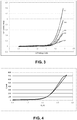
- FIG. 3 shows the voltammograms measured at varying PSTMIM content. Notice that the current is higher than the base case (plot 200) in FIG. 2 when PSTMIM is added to the catalyst later so that the PSTMIM weight is 1% of the weight of the silver (plot 210). Further increases in the current are seen as the PSTMIM concentration is increased so that the PSTMIM weight is 4% of the weight of the silver (plot 211). Then there is a small decrease when the weight of the PSTMIM is increased to 8% of the weight of the silver (plot 212). The performance continues to decrease when the weight of the PSTMIM is 16% of the weight of the silver (plot 213), but the cell current is still higher than the base case in FIG. 2 (plot 200). The performance is lower than the base case in FIG. 2 (plot 200) when the weight of the PSTMIM is 32% of the weight of the silver (plot 214), but the cell current is still significant.
- the objective of this example is to show that in contrast to the findings in US 6,841,285 , the addition of polymers containing pyridiniums to the catalyst layer changes the performance of a CO 2 electrolyzer but does not poison it.
- PSMP poly(4-vinylbenzyl chloride co-styrene) was prepared as in Specific Example 1. Pyridine (Sigma-Aldrich) (0.318 g, 4.68 mmol) was added to the solution of the poly(4-VBC-co-St) (1 g, 3.89 mmol) in anhydrous N,N-Dimethylformamide (DMF) (Sigma-Aldrich) (8 mL). The mixture was stirred at room temperature for 60 hours, and PSMP was obtained as a white solid after purification by precipitation into diethyl ether.
- PSMP refers to a material that contains a co-polymer of styrene and l-(p-vinylbenzyl)-pyridinium.
- the cathode in Specific Example 3 was prepared as follows. Silver ink was made by mixing 100 mg of silver nanoparticles (20-40 nm, 45509, Alfa Aesar, Ward Hill, MA), 5 mg porous carbon (Vulcan XC-72R, Fuel Cell Earth, Woburn, MA) and different amounts of PSMP-Cl in 3 ml of ethanol (459844, Sigma-Aldrich, St. Louis, MO). The mixture was then sonicated for 10 minutes. The silver ink was painted onto a gas diffusion layer (Sigracet 35 BC GDL, Ion Power Inc., New Castle, DE) covering an area of 6 cm x 6 cm. The electrode was immersed in 1 M KOH for at least 1 hour so that PSMP-Cl was converted to PSMP-OH. Then the electrode was cut into 2.5 cm X 2.5 cm sections for cell testing.
- Silver ink was made by mixing 100 mg of silver nanoparticles (20-40 nm, 45509, Alfa Aesar, Ward Hill, MA), 5 mg por
- the anode in Specific Example 3 was the same as in Specific Example 1 and the cell was tested as in Specific Example 1.
- FIG. 4 shows the voltammograms measured when the weight of the PSMP was 5% of the weight of the silver. Notice that the current is considerably above the base case (200) in FIG 2 .
- the objective of this example is to show that in contrast to the findings in the '285 patent, the addition of polymers containing pyrazoliums to the catalyst layer enhances the performance of a CO 2 electrolyzer.
- PSPZ poly(4-vinylbenzyl chloride co-styrene) was prepared as in Specific Example 1. Pyrazole (Sigma-Aldrich) (0.593 g, 4.67 mmol) was added to the solution of the poly(4-VBC-co-St) (1 g, 3.89 mmol) in anhydrous N,N-Dimethylformamide (DMF) (Sigma-Aldrich) (8 mL). The mixture was stirred at room temperature for 60 hours and this PSPY-DMF was accordingly further diluted for use as the ionomer.
- PSPY refers to a material that contains a co-polymer of styrene and l-(p-vinylbenzyl)-pyrazolium ionomers.
- the anode in Specific Example 4 was the same as in Specific Example 1 and the cell was tested as in Specific Example 1.
- FIG. 5 shows a voltammogram measured when the weight of the PSPY was 5% of the weight of the silver. Notice that the current is considerably above the base case (200) in FIG 2 .
- the objective of this example is to show that the addition of a PSMIM to the cathode of a CO 2 electrolyzer also improves the steady state performance of the electrolyzer.
- the anode and cathode for this test were synthesized as in Specific Example 1.
- the weight of the PSMIM in the cathode layer was 2% of the weight of the silver.
- PSTMIM-DVB membrane was used in this experiment.
- the preparation of the PSTMIM-DVB membrane is as follows: Poly(4-vinylbenzyl chloride co-styrene) was formed as in specific example 1. Tetramethylimidazole (TMIM) (TCI) (4.05 g, 32.6 mmol) was added in a 250 ml 3-neck round bottom flask to the solution of the poly(4-VBC-co-St) (10 g, 38.9 mol) in anhydrous N,N-Dimethylformamide (DMF) (Sigma-Aldrich) (73 mL).
- TMIM Tetramethylimidazole
- TCI Tetramethylimidazole
- DMF N,N-Dimethylformamide
- the cell was assembled and tested as in Specific Example 1.
- FIG. 6 shows how the voltage and selectivity varied with time when the cell was held at a fixed current of 3 amps (600 mA/cm 2 ). Notice that the cell is producing 600 mA/cm 2 at 3.3 volts. GC analysis showed that the cell was converting CO 2 to CO with over 95% selectivity to CO.
- the Schmidt paper (referred to above, available at http://www.sccer-hae.ch/resources/Talks/08_Krause_Power_to_Value.pdf; last accessed on May 17, 2016) requires over 6 volts to reach the same current. Consequently, our cell would only need about half as much energy as Schmidt et al.'s to convert CO 2 at a rate corresponding to 600 mA/cm 2 . The results are stable. The loss of performance reported in the Schauer paper is not seen.
Landscapes
- Chemical & Material Sciences (AREA)
- Chemical Kinetics & Catalysis (AREA)
- Electrochemistry (AREA)
- Engineering & Computer Science (AREA)
- Organic Chemistry (AREA)
- Materials Engineering (AREA)
- Metallurgy (AREA)
- General Chemical & Material Sciences (AREA)
- Life Sciences & Earth Sciences (AREA)
- Manufacturing & Machinery (AREA)
- Inorganic Chemistry (AREA)
- Sustainable Energy (AREA)
- Sustainable Development (AREA)
- Health & Medical Sciences (AREA)
- Composite Materials (AREA)
- Crystallography & Structural Chemistry (AREA)
- General Health & Medical Sciences (AREA)
- Immunology (AREA)
- Biochemistry (AREA)
- Analytical Chemistry (AREA)
- Physics & Mathematics (AREA)
- General Physics & Mathematics (AREA)
- Molecular Biology (AREA)
- Pathology (AREA)
- Electrodes For Compound Or Non-Metal Manufacture (AREA)
- Electrolytic Production Of Non-Metals, Compounds, Apparatuses Therefor (AREA)
- Inert Electrodes (AREA)
Claims (6)
- Électrolyseur comprenant une couche catalytique comprenant un élément catalytiquement actif et un polymère conducteur d'ions,ledit élément catalytiquement actif étant sélectionné dans le groupe constitué de V, Cr, Mn Fe, Co, Ni, Cu, Sn, Zr, Nb, Mo, Ru, Rh, Pd, Ag, Cd, Hf, Ta, W, Re, Ir, Pt, Au, Hg, Al, Si, In, Tl, Pb, Bi, Sb, Te, U, Sm, Tb, La, Ce, et Nd ; etledit polymère conducteur d'ions comprenant :un copolymère de styrène et un ligant comprenant des groupes amides cycliques chargés positivement, ledit ligant comprenant des groupes d'amine cyclique chargé positivement comprenant de l'imidazole tétra-méthyl et/ou un pyrazolium, un pyrrolidinium et/ou un pyrrolium et/ou un pyrimidium et/ou un piperidinium et/ou un indolium et/ou un triazinium,l'électrolyseur ayant une entrée de flux de produit de départ, l'électrolyseur étant disposé de manière à être en contact avec un flux de produit de départ comprenant du CO2 avec ladite couche catalytique, l'électrolyseur ayant une anode et une cathode, ladite couche catalytique étant en contact électrique avec la cathode.
- Électrolyseur selon la revendication 1, l'électrolyseur étant conçu pour alimenter en CO2la cathode.
- Électrolyseur selon la revendication 1, l'électrolyseur étant conçu pour alimenter en eau l'anode.
- Électrolyseur selon la revendication 3, dans lequel l'alimentation en eau comprend en outre un électrolyte.
- Électrolyseur selon la revendication 4, l'électrolyseur étant un carbonate et/ou un bicarbonate et/ou un hydroxyde.
- Électrolyseur selon la revendication 4, dans lequel le poids du polymère conducteur d'ions correspond à 1 % et 10 % du poids de l'élément catalytiquement actif dans la couche catalytique.
Applications Claiming Priority (3)
| Application Number | Priority Date | Filing Date | Title |
|---|---|---|---|
| US15/090,477 US9580824B2 (en) | 2010-07-04 | 2016-04-04 | Ion-conducting membranes |
| US15/158,227 US9945040B2 (en) | 2010-07-04 | 2016-05-18 | Catalyst layers and electrolyzers |
| PCT/US2016/045210 WO2017176306A1 (fr) | 2016-04-04 | 2016-08-02 | Couches de catalyseur et électrolyseurs |
Publications (2)
| Publication Number | Publication Date |
|---|---|
| EP3440238A1 EP3440238A1 (fr) | 2019-02-13 |
| EP3440238B1 true EP3440238B1 (fr) | 2021-10-27 |
Family
ID=60000599
Family Applications (1)
| Application Number | Title | Priority Date | Filing Date |
|---|---|---|---|
| EP16782111.5A Active EP3440238B1 (fr) | 2016-04-04 | 2016-08-02 | Électrolyseurs comportants des couches de catalyseur |
Country Status (6)
| Country | Link |
|---|---|
| EP (1) | EP3440238B1 (fr) |
| JP (1) | JP6568326B2 (fr) |
| KR (1) | KR102291918B1 (fr) |
| CN (1) | CN108884578B (fr) |
| AU (1) | AU2016401931B2 (fr) |
| WO (2) | WO2017176306A1 (fr) |
Cited By (1)
| Publication number | Priority date | Publication date | Assignee | Title |
|---|---|---|---|---|
| EP4345197A3 (fr) * | 2022-09-08 | 2024-10-23 | Korea Institute of Science and Technology | Ensemble membrane-électrode pour réduction de co2 comprenant une membrane échangeuse de cations, ensemble pour réduction de co2 comprenant ledit mea et son procédé de fabrication |
Families Citing this family (19)
| Publication number | Priority date | Publication date | Assignee | Title |
|---|---|---|---|---|
| JP6784776B2 (ja) | 2016-05-03 | 2020-11-11 | オーパス 12 インコーポレイテッドOpus 12 Incorporated | Co2、coおよび他の化学化合物の電気化学反応のための先進的構造を有するリアクタ |
| US12359325B2 (en) | 2016-05-03 | 2025-07-15 | Twelve Benefit Corporation | Membrane electrode assembly for COx reduction |
| WO2019144135A1 (fr) * | 2018-01-22 | 2019-07-25 | Opus-12 Incorporated | Système et procédé de commande de réacteur à dioxyde de carbone |
| BR112021010368A2 (pt) * | 2018-11-28 | 2021-08-24 | Opus 12 Incorporated | Eletrolisador e método de uso |
| WO2020132064A1 (fr) * | 2018-12-18 | 2020-06-25 | Opus 12 Inc. | Électrolyseur et son procédé d'utilisation |
| WO2020146402A1 (fr) | 2019-01-07 | 2020-07-16 | Opus 12 Inc. | Système et procédé de production de méthane |
| EP4065753A1 (fr) | 2019-11-25 | 2022-10-05 | Twelve Benefit Corporation | Assemblage membrane-électrodes pour la réduction de co x |
| CN112320895A (zh) * | 2020-09-21 | 2021-02-05 | 北京科技大学 | 一种三维电极处理印染废水耦合产甲烷的装置及方法 |
| CN116234942B (zh) | 2020-10-14 | 2026-02-17 | 国立大学法人筑波大学 | 电极、其制造方法、水电解装置和燃料电池 |
| US12421392B2 (en) | 2020-10-20 | 2025-09-23 | Twelve Benefit Corporation | Ionic polymers and copolymers |
| GB2602030A (en) * | 2020-12-15 | 2022-06-22 | Univ Liverpool | Improvements in electrochemical reduction of carbon dioxide |
| BR112023016931A2 (pt) | 2021-02-23 | 2023-11-07 | Twelve Benefit Corp | Procedimento de recuperação para eletrolisadores de óxido de carbono |
| KR102524209B1 (ko) * | 2021-04-29 | 2023-04-24 | 한국과학기술연구원 | 단방향 흐름을 형성하는 전기화학적 이산화탄소 환원 장치용 유동 플레이트 |
| US20240279376A1 (en) * | 2021-05-26 | 2024-08-22 | National Institutes for Quantum Science and Technology | Resin composition, resin composition production method, and electrochemical device |
| CN114717595B (zh) * | 2022-04-25 | 2023-09-05 | 湘潭大学 | 一种高度有序PdAg合金催化材料及其制备方法和在电催化还原二氧化碳中的应用 |
| US12305304B2 (en) | 2022-10-13 | 2025-05-20 | Twelve Benefit Corporation | Interface for carbon oxide electrolyzer bipolar membrane |
| US12378685B2 (en) | 2022-12-22 | 2025-08-05 | Twelve Benefit Corporation | Surface modification of metal catalysts with hydrophobic ligands or ionomers |
| EP4491766A1 (fr) * | 2023-07-13 | 2025-01-15 | Universite De Pau Et Des Pays De L'adour | Electrodes comprenant des liquides polyioniques pour la conversion électrochimique du co2, cellules électrolytiques de réduction du co2 et leur utilisation pour produire des produits de réduction du co2 |
| CN118546179B (zh) * | 2024-05-13 | 2026-04-10 | 安徽大学 | 一种吡唑类三核钴基催化剂的制备方法 |
Family Cites Families (75)
| Publication number | Priority date | Publication date | Assignee | Title |
|---|---|---|---|---|
| US3403054A (en) | 1961-08-18 | 1968-09-24 | Gen Electric | Fuel cell with ion-permeable membrane |
| US3959094A (en) | 1975-03-13 | 1976-05-25 | The United States Of America As Represented By The United States Energy Research And Development Administration | Electrolytic synthesis of methanol from CO2 |
| US4240882A (en) | 1979-11-08 | 1980-12-23 | Institute Of Gas Technology | Gas fixation solar cell using gas diffusion semiconductor electrode |
| AU535073B2 (en) | 1979-12-17 | 1984-03-01 | Unisearch Limited | Methanol synthesis catalyst and use thereof |
| US4545872A (en) | 1984-03-27 | 1985-10-08 | Texaco Inc. | Method for reducing carbon dioxide to provide a product |
| US4609451A (en) | 1984-03-27 | 1986-09-02 | Texaco Inc. | Means for reducing carbon dioxide to provide a product |
| US4523981A (en) | 1984-03-27 | 1985-06-18 | Texaco Inc. | Means and method for reducing carbon dioxide to provide a product |
| US4595465A (en) | 1984-12-24 | 1986-06-17 | Texaco Inc. | Means and method for reducing carbn dioxide to provide an oxalate product |
| US4620906A (en) | 1985-01-31 | 1986-11-04 | Texaco Inc. | Means and method for reducing carbon dioxide to provide formic acid |
| US4673473A (en) | 1985-06-06 | 1987-06-16 | Peter G. Pa Ang | Means and method for reducing carbon dioxide to a product |
| US4608132A (en) | 1985-06-06 | 1986-08-26 | Texaco Inc. | Means and method for the electrochemical reduction of carbon dioxide to provide a product |
| US4608133A (en) | 1985-06-10 | 1986-08-26 | Texaco Inc. | Means and method for the electrochemical reduction of carbon dioxide to provide a product |
| US4609440A (en) | 1985-12-18 | 1986-09-02 | Gas Research Institute | Electrochemical synthesis of methane |
| US4609441A (en) | 1985-12-18 | 1986-09-02 | Gas Research Institute | Electrochemical reduction of aqueous carbon dioxide to methanol |
| US4756807A (en) | 1986-10-09 | 1988-07-12 | Gas Research Institute | Chemically modified electrodes for the catalytic reduction of CO2 |
| US4711708A (en) | 1986-10-09 | 1987-12-08 | Gas Research Institute | Chemically modified electrodes for the catalytic reduction of CO2 |
| US4668349A (en) | 1986-10-24 | 1987-05-26 | The Standard Oil Company | Acid promoted electrocatalytic reduction of carbon dioxide by square planar transition metal complexes |
| US4818353A (en) | 1987-07-07 | 1989-04-04 | Langer Stanley H | Method for modifying electrocatalyst material, electrochemical cells and electrodes containing this modified material, and synthesis methods utilizing the cells |
| US5064733A (en) | 1989-09-27 | 1991-11-12 | Gas Research Institute | Electrochemical conversion of CO2 and CH4 to C2 hydrocarbons in a single cell |
| JP3009703B2 (ja) | 1990-05-02 | 2000-02-14 | 正道 藤平 | 二酸化炭素ガス還元用電極触媒 |
| US5234777A (en) | 1991-02-19 | 1993-08-10 | The Regents Of The University Of California | Membrane catalyst layer for fuel cells |
| JP3360850B2 (ja) | 1992-09-21 | 2003-01-07 | 株式会社日立製作所 | 銅系酸化触媒とその用途 |
| KR0169188B1 (ko) | 1995-07-31 | 1999-03-20 | 강박광 | 탄화수소의 제조방법 |
| US5702755A (en) | 1995-11-06 | 1997-12-30 | The Dow Chemical Company | Process for preparing a membrane/electrode assembly |
| US5709789A (en) | 1996-10-23 | 1998-01-20 | Sachem, Inc. | Electrochemical conversion of nitrogen containing gas to hydroxylamine and hydroxylammonium salts |
| US6660680B1 (en) | 1997-02-24 | 2003-12-09 | Superior Micropowders, Llc | Electrocatalyst powders, methods for producing powders and devices fabricated from same |
| US5928806A (en) | 1997-05-07 | 1999-07-27 | Olah; George A. | Recycling of carbon dioxide into methyl alcohol and related oxygenates for hydrocarbons |
| US6024855A (en) | 1997-08-15 | 2000-02-15 | Sachem, Inc. | Electrosynthesis of hydroxylammonium salts and hydroxylamine using a mediator |
| DE19837669A1 (de) | 1998-08-20 | 2000-03-09 | Degussa | Katalysatorschicht für Polymer-Elektrolyt-Brennstoffzellen |
| KR100351625B1 (ko) | 1999-11-11 | 2002-09-11 | 한국화학연구원 | 탄화수소 제조용 촉매 |
| DE10037074A1 (de) | 2000-07-29 | 2002-02-14 | Omg Ag & Co Kg | Tinte zur Herstellung von Membran-Elektroden-Einheiten für PEM-Brennstoffzellen |
| EP1342281B1 (fr) | 2000-11-09 | 2007-01-03 | Ird A/S | Ensembles d'electrodes a membranes pour piles a combustible directes au methanol et leurs procedes de production |
| US6696382B1 (en) | 2000-11-14 | 2004-02-24 | The Regents Of The University Of California | Catalyst inks and method of application for direct methanol fuel cells |
| JP4371601B2 (ja) * | 2001-04-11 | 2009-11-25 | 株式会社トクヤマ | バイポーラ膜 |
| US6664207B2 (en) | 2001-09-26 | 2003-12-16 | Conocophillips Company | Catalyst for converting carbon dioxide to oxygenates and processes therefor and therewith |
| GB0200253D0 (en) | 2002-01-08 | 2002-02-20 | Johnson Matthey Plc | Improved material for electrode manufacture |
| EP1387423B1 (fr) | 2002-07-31 | 2009-01-21 | Umicore AG & Co. KG | Encres aqueuses catalytiques et leurs emplois dans la fabrication de substrats recouverts de catalyseur |
| US6841285B2 (en) | 2002-08-28 | 2005-01-11 | Ballard Power Systems Inc. | Impregnation of ion-exchange membranes to improve electrochemical fuel cell performance |
| US20040107869A1 (en) | 2002-12-10 | 2004-06-10 | 3M Innovative Properties Company | Catalyst ink |
| US7364813B2 (en) | 2003-09-12 | 2008-04-29 | Matsushita Electric Industrial Co., Ltd. | Ink for forming catalyst layer, and electrode and membrane-electrode assembly using the same |
| EP1669341A4 (fr) | 2003-09-17 | 2007-01-03 | Japan Science & Tech Agency | Procede de reduction de dioxyde de carbone avec un complexe organometallique |
| US20060110631A1 (en) | 2004-02-18 | 2006-05-25 | Polyfuel, Inc. | Catalyst ink, process for making catalyst ink and for preparing catalyst coated membranes |
| US6987134B1 (en) | 2004-07-01 | 2006-01-17 | Robert Gagnon | How to convert carbon dioxide into synthetic hydrocarbon through a process of catalytic hydrogenation called CO2hydrocarbonation |
| EP1612874A1 (fr) | 2004-07-02 | 2006-01-04 | SOLVAY (Société Anonyme) | Pile à combustible solide alkaline contenant membrane échangeuse d'ions |
| JP2008534719A (ja) | 2005-03-30 | 2008-08-28 | ユミコア・アクチエンゲゼルシャフト・ウント・コムパニー・コマンディットゲゼルシャフト | 触媒層を製造するためのインク |
| GB0510119D0 (en) | 2005-05-18 | 2005-06-22 | Johnson Matthey Plc | Polymer dispersion and electrocatalyst ink |
| EP1951933A4 (fr) | 2005-10-13 | 2011-08-24 | Mantra Energy Alternatives Ltd | Reduction electrochimique de dioxyde de carbone a courants paralleles |
| DE102005054149A1 (de) | 2005-11-14 | 2007-05-16 | Basf Ag | Aminhaltige Katalysatortinte für Brennstoffzellen |
| US7378561B2 (en) | 2006-08-10 | 2008-05-27 | University Of Southern California | Method for producing methanol, dimethyl ether, derived synthetic hydrocarbons and their products from carbon dioxide and water (moisture) of the air as sole source material |
| CN101689637A (zh) | 2007-06-15 | 2010-03-31 | 住友化学株式会社 | 催化剂油墨、催化剂油墨的制备方法、膜-电极接合体的制造方法及由此得到的膜-电极接合体、以及燃料电池 |
| JP5196988B2 (ja) | 2007-12-21 | 2013-05-15 | スリーエム イノベイティブ プロパティズ カンパニー | インク組成物、その製造方法、そのインク組成物を用いて形成した電極触媒層及びこれらの用途 |
| CA2716777A1 (fr) | 2008-02-29 | 2009-09-11 | Basf Se | Encre catalytique contenant un liquide ionique et utilisation de celle-ci dans la fabrication d'electrodes, de membranes a revetement catalytique (ccm), d'electrodes de diffusion gazeuse (gde) et d'ensemblesmembrane -electrode (mea) |
| EP2294644A4 (fr) | 2008-06-04 | 2013-05-22 | Cellera Inc | Piles à combustible à membrane alcaline et appareil et procédé d introduction d eau à l intérieur de celles-ci |
| US8481231B2 (en) | 2009-05-14 | 2013-07-09 | GM Global Technology Operations LLC | Preparation of nanostructured thin catalytic layer-based electrode ink |
| WO2011003884A1 (fr) | 2009-07-07 | 2011-01-13 | Basf Se | Encre renfermant des particules de polymère, électrode et unité mea correspondantes |
| EP2467889A1 (fr) | 2009-08-21 | 2012-06-27 | Basf Se | Encre de catalyseur contenant des acides inorganiques et/ou organiques et son utilisation pour la production d électrodes, de membranes revêtues d un catalyseur, d électrodes à diffusion de gaz et d ensembles membrane-électrodes |
| EP2518806B1 (fr) | 2009-12-25 | 2015-08-19 | Showa Denko K.K. | Encre, couche catalytique produite à l'aide de l'encre et leurs utilisations |
| JP4947243B2 (ja) | 2010-03-16 | 2012-06-06 | 凸版印刷株式会社 | 燃料電池用カソード触媒層の製造方法、カソード触媒層および固体高分子形燃料電池用膜電極接合体 |
| US9370773B2 (en) | 2010-07-04 | 2016-06-21 | Dioxide Materials, Inc. | Ion-conducting membranes |
| US20110237830A1 (en) * | 2010-03-26 | 2011-09-29 | Dioxide Materials Inc | Novel catalyst mixtures |
| US9566574B2 (en) * | 2010-07-04 | 2017-02-14 | Dioxide Materials, Inc. | Catalyst mixtures |
| US9577279B2 (en) | 2010-12-05 | 2017-02-21 | Cornell University | Ionomers and methods of making same and uses thereof |
| US20120171583A1 (en) | 2010-12-30 | 2012-07-05 | Liquid Light, Inc. | Gas phase electrochemical reduction of carbon dioxide |
| US20120196741A1 (en) | 2011-01-28 | 2012-08-02 | Ford Global Technologies, Llc | Thin Film Ink Catalyst |
| US8940460B2 (en) | 2011-02-14 | 2015-01-27 | Nissan North America, Inc. | Catalyst ink preparation for fuel cell electrode fabrication |
| JP5494585B2 (ja) | 2011-07-27 | 2014-05-14 | トヨタ自動車株式会社 | 燃料電池電極用触媒インク、膜電極接合体、燃料電池 |
| JP5821468B2 (ja) | 2011-09-26 | 2015-11-24 | 日産自動車株式会社 | 触媒インクの調製方法 |
| JP6070564B2 (ja) | 2011-10-14 | 2017-02-01 | 凸版印刷株式会社 | 触媒粒子、触媒インク、及びこれらの製造方法、並びに、燃料電池用電極触媒層、膜電極接合体、及び固体高分子形燃料電池の各々の製造方法 |
| JP5888025B2 (ja) | 2012-03-14 | 2016-03-16 | ヤマハ株式会社 | 通信制御装置 |
| JP6077774B2 (ja) | 2012-07-20 | 2017-02-08 | 株式会社トクヤマ | イオン伝導性付与剤並びにカソード触媒層並びに該触媒層を用いて形成する膜−電極接合体並びに陰イオン交換膜型燃料電池及びその運転方法 |
| US8858777B2 (en) * | 2012-07-26 | 2014-10-14 | Liquid Light, Inc. | Process and high surface area electrodes for the electrochemical reduction of carbon dioxide |
| GB201322494D0 (en) | 2013-12-19 | 2014-02-05 | Johnson Matthey Fuel Cells Ltd | Catalyst layer |
| WO2015124251A1 (fr) | 2014-02-20 | 2015-08-27 | Merck Patent Gmbh | Procede pour la preparation de fibres a partir d'une solution de catalyseur, et articles comportant de telles fibres |
| US20150345034A1 (en) * | 2014-03-18 | 2015-12-03 | Indian Institute Of Technology Madras | Systems, methods, and materials for producing hydrocarbons from carbon dioxide |
| WO2016039999A1 (fr) * | 2014-09-08 | 2016-03-17 | 3M Innovative Properties Company | Membrane polymère ionique pour un électrolyseur de dioxyde de carbone |
-
2016
- 2016-08-02 EP EP16782111.5A patent/EP3440238B1/fr active Active
- 2016-08-02 AU AU2016401931A patent/AU2016401931B2/en active Active
- 2016-08-02 JP JP2018551990A patent/JP6568326B2/ja active Active
- 2016-08-02 CN CN201680084124.XA patent/CN108884578B/zh active Active
- 2016-08-02 KR KR1020187031595A patent/KR102291918B1/ko active Active
- 2016-08-02 WO PCT/US2016/045210 patent/WO2017176306A1/fr not_active Ceased
-
2017
- 2017-03-31 WO PCT/US2017/025624 patent/WO2017176597A1/fr not_active Ceased
Non-Patent Citations (2)
| Title |
|---|
| BENCAI LIN ET AL: "Alkaline Stable C2-Substituted Imidazolium-Based Anion-Exchange Membranes", CHEMISTRY OF MATERIALS, vol. 25, no. 9, 14 May 2013 (2013-05-14), pages 1858 - 1867, XP055189117, ISSN: 0897-4756, DOI: 10.1021/cm400468u * |
| WEI LI ET AL: "Novel anion exchange membranes based on polymerizable imidazolium salt for alkaline fuel cell applications", JOURNAL OF MATERIALS CHEMISTRY, vol. 21, no. 30, 1 January 2011 (2011-01-01), pages 11340, XP055189111, ISSN: 0959-9428, DOI: 10.1039/c1jm11093d * |
Cited By (1)
| Publication number | Priority date | Publication date | Assignee | Title |
|---|---|---|---|---|
| EP4345197A3 (fr) * | 2022-09-08 | 2024-10-23 | Korea Institute of Science and Technology | Ensemble membrane-électrode pour réduction de co2 comprenant une membrane échangeuse de cations, ensemble pour réduction de co2 comprenant ledit mea et son procédé de fabrication |
Also Published As
| Publication number | Publication date |
|---|---|
| AU2016401931B2 (en) | 2019-03-07 |
| WO2017176597A1 (fr) | 2017-10-12 |
| CN108884578B (zh) | 2020-05-05 |
| KR20180126572A (ko) | 2018-11-27 |
| AU2016401931A1 (en) | 2018-11-01 |
| KR102291918B1 (ko) | 2021-08-23 |
| EP3440238A1 (fr) | 2019-02-13 |
| JP6568326B2 (ja) | 2019-08-28 |
| WO2017176306A1 (fr) | 2017-10-12 |
| JP2019510884A (ja) | 2019-04-18 |
| CN108884578A (zh) | 2018-11-23 |
Similar Documents
| Publication | Publication Date | Title |
|---|---|---|
| EP3440238B1 (fr) | Électrolyseurs comportants des couches de catalyseur | |
| US10428432B2 (en) | Catalyst layers and electrolyzers | |
| US10975480B2 (en) | Electrocatalytic process for carbon dioxide conversion | |
| KR102277793B1 (ko) | 수 전해장치 | |
| AU2018204762B2 (en) | Electrolyzer and membranes | |
| EP2898120B1 (fr) | Dispositifs et procédés pour la reduction électrolytique de dioxyde de carbone et capteur de dioxyde de carbone | |
| JP6606182B2 (ja) | 二酸化炭素電気分解装置用のイオン性ポリマー膜 | |
| US9481939B2 (en) | Electrochemical device for converting carbon dioxide to a reaction product | |
| US9982353B2 (en) | Water electrolyzers | |
| US10173169B2 (en) | Devices for electrocatalytic conversion of carbon dioxide | |
| EP3440239B1 (fr) | Membrane conductrice d'ions | |
| US10724142B2 (en) | Water electrolyzers employing anion exchange membranes |
Legal Events
| Date | Code | Title | Description |
|---|---|---|---|
| STAA | Information on the status of an ep patent application or granted ep patent |
Free format text: STATUS: THE INTERNATIONAL PUBLICATION HAS BEEN MADE |
|
| PUAI | Public reference made under article 153(3) epc to a published international application that has entered the european phase |
Free format text: ORIGINAL CODE: 0009012 |
|
| STAA | Information on the status of an ep patent application or granted ep patent |
Free format text: STATUS: REQUEST FOR EXAMINATION WAS MADE |
|
| 17P | Request for examination filed |
Effective date: 20181022 |
|
| AK | Designated contracting states |
Kind code of ref document: A1 Designated state(s): AL AT BE BG CH CY CZ DE DK EE ES FI FR GB GR HR HU IE IS IT LI LT LU LV MC MK MT NL NO PL PT RO RS SE SI SK SM TR |
|
| AX | Request for extension of the european patent |
Extension state: BA ME |
|
| RIN1 | Information on inventor provided before grant (corrected) |
Inventor name: SAJJAD, SYED DAWAR Inventor name: MASEL, RICHARD I. Inventor name: LIU, ZENGCAI Inventor name: KUTZ, ROBERT |
|
| DAV | Request for validation of the european patent (deleted) | ||
| DAX | Request for extension of the european patent (deleted) | ||
| STAA | Information on the status of an ep patent application or granted ep patent |
Free format text: STATUS: EXAMINATION IS IN PROGRESS |
|
| 17Q | First examination report despatched |
Effective date: 20200121 |
|
| REG | Reference to a national code |
Ref country code: DE Ref legal event code: R079 Ref document number: 602016065459 Country of ref document: DE Free format text: PREVIOUS MAIN CLASS: C25B0003040000 Ipc: C25B0001230000 |
|
| GRAP | Despatch of communication of intention to grant a patent |
Free format text: ORIGINAL CODE: EPIDOSNIGR1 |
|
| STAA | Information on the status of an ep patent application or granted ep patent |
Free format text: STATUS: GRANT OF PATENT IS INTENDED |
|
| RIC1 | Information provided on ipc code assigned before grant |
Ipc: G01N 27/30 20060101ALI20210503BHEP Ipc: H01M 8/00 20160101ALI20210503BHEP Ipc: H01M 4/92 20060101ALI20210503BHEP Ipc: H01M 4/90 20060101ALI20210503BHEP Ipc: H01M 4/86 20060101ALI20210503BHEP Ipc: C25B 11/095 20210101ALI20210503BHEP Ipc: C25B 11/052 20210101ALI20210503BHEP Ipc: C25B 11/032 20210101ALI20210503BHEP Ipc: C25B 9/23 20210101ALI20210503BHEP Ipc: C25B 3/26 20210101ALI20210503BHEP Ipc: C25B 3/07 20210101ALI20210503BHEP Ipc: C25B 3/03 20210101ALI20210503BHEP Ipc: C25B 1/23 20210101AFI20210503BHEP |
|
| INTG | Intention to grant announced |
Effective date: 20210527 |
|
| GRAS | Grant fee paid |
Free format text: ORIGINAL CODE: EPIDOSNIGR3 |
|
| GRAA | (expected) grant |
Free format text: ORIGINAL CODE: 0009210 |
|
| STAA | Information on the status of an ep patent application or granted ep patent |
Free format text: STATUS: THE PATENT HAS BEEN GRANTED |
|
| AK | Designated contracting states |
Kind code of ref document: B1 Designated state(s): AL AT BE BG CH CY CZ DE DK EE ES FI FR GB GR HR HU IE IS IT LI LT LU LV MC MK MT NL NO PL PT RO RS SE SI SK SM TR |
|
| REG | Reference to a national code |
Ref country code: GB Ref legal event code: FG4D |
|
| RIN1 | Information on inventor provided before grant (corrected) |
Inventor name: SAJJAD, SYED DAWAR Inventor name: KUTZ, ROBERT Inventor name: LIU, ZENGCAI Inventor name: MASEL, RICHARD I. |
|
| REG | Reference to a national code |
Ref country code: CH Ref legal event code: EP |
|
| REG | Reference to a national code |
Ref country code: AT Ref legal event code: REF Ref document number: 1441868 Country of ref document: AT Kind code of ref document: T Effective date: 20211115 |
|
| REG | Reference to a national code |
Ref country code: DE Ref legal event code: R096 Ref document number: 602016065459 Country of ref document: DE |
|
| REG | Reference to a national code |
Ref country code: IE Ref legal event code: FG4D |
|
| REG | Reference to a national code |
Ref country code: LT Ref legal event code: MG9D |
|
| REG | Reference to a national code |
Ref country code: NL Ref legal event code: MP Effective date: 20211027 |
|
| REG | Reference to a national code |
Ref country code: AT Ref legal event code: MK05 Ref document number: 1441868 Country of ref document: AT Kind code of ref document: T Effective date: 20211027 |
|
| PG25 | Lapsed in a contracting state [announced via postgrant information from national office to epo] |
Ref country code: RS Free format text: LAPSE BECAUSE OF FAILURE TO SUBMIT A TRANSLATION OF THE DESCRIPTION OR TO PAY THE FEE WITHIN THE PRESCRIBED TIME-LIMIT Effective date: 20211027 Ref country code: LT Free format text: LAPSE BECAUSE OF FAILURE TO SUBMIT A TRANSLATION OF THE DESCRIPTION OR TO PAY THE FEE WITHIN THE PRESCRIBED TIME-LIMIT Effective date: 20211027 Ref country code: FI Free format text: LAPSE BECAUSE OF FAILURE TO SUBMIT A TRANSLATION OF THE DESCRIPTION OR TO PAY THE FEE WITHIN THE PRESCRIBED TIME-LIMIT Effective date: 20211027 Ref country code: BG Free format text: LAPSE BECAUSE OF FAILURE TO SUBMIT A TRANSLATION OF THE DESCRIPTION OR TO PAY THE FEE WITHIN THE PRESCRIBED TIME-LIMIT Effective date: 20220127 Ref country code: AT Free format text: LAPSE BECAUSE OF FAILURE TO SUBMIT A TRANSLATION OF THE DESCRIPTION OR TO PAY THE FEE WITHIN THE PRESCRIBED TIME-LIMIT Effective date: 20211027 |
|
| PG25 | Lapsed in a contracting state [announced via postgrant information from national office to epo] |
Ref country code: IS Free format text: LAPSE BECAUSE OF FAILURE TO SUBMIT A TRANSLATION OF THE DESCRIPTION OR TO PAY THE FEE WITHIN THE PRESCRIBED TIME-LIMIT Effective date: 20220227 Ref country code: SE Free format text: LAPSE BECAUSE OF FAILURE TO SUBMIT A TRANSLATION OF THE DESCRIPTION OR TO PAY THE FEE WITHIN THE PRESCRIBED TIME-LIMIT Effective date: 20211027 Ref country code: PT Free format text: LAPSE BECAUSE OF FAILURE TO SUBMIT A TRANSLATION OF THE DESCRIPTION OR TO PAY THE FEE WITHIN THE PRESCRIBED TIME-LIMIT Effective date: 20220228 Ref country code: PL Free format text: LAPSE BECAUSE OF FAILURE TO SUBMIT A TRANSLATION OF THE DESCRIPTION OR TO PAY THE FEE WITHIN THE PRESCRIBED TIME-LIMIT Effective date: 20211027 Ref country code: NO Free format text: LAPSE BECAUSE OF FAILURE TO SUBMIT A TRANSLATION OF THE DESCRIPTION OR TO PAY THE FEE WITHIN THE PRESCRIBED TIME-LIMIT Effective date: 20220127 Ref country code: NL Free format text: LAPSE BECAUSE OF FAILURE TO SUBMIT A TRANSLATION OF THE DESCRIPTION OR TO PAY THE FEE WITHIN THE PRESCRIBED TIME-LIMIT Effective date: 20211027 Ref country code: LV Free format text: LAPSE BECAUSE OF FAILURE TO SUBMIT A TRANSLATION OF THE DESCRIPTION OR TO PAY THE FEE WITHIN THE PRESCRIBED TIME-LIMIT Effective date: 20211027 Ref country code: HR Free format text: LAPSE BECAUSE OF FAILURE TO SUBMIT A TRANSLATION OF THE DESCRIPTION OR TO PAY THE FEE WITHIN THE PRESCRIBED TIME-LIMIT Effective date: 20211027 Ref country code: GR Free format text: LAPSE BECAUSE OF FAILURE TO SUBMIT A TRANSLATION OF THE DESCRIPTION OR TO PAY THE FEE WITHIN THE PRESCRIBED TIME-LIMIT Effective date: 20220128 Ref country code: ES Free format text: LAPSE BECAUSE OF FAILURE TO SUBMIT A TRANSLATION OF THE DESCRIPTION OR TO PAY THE FEE WITHIN THE PRESCRIBED TIME-LIMIT Effective date: 20211027 |
|
| REG | Reference to a national code |
Ref country code: DE Ref legal event code: R097 Ref document number: 602016065459 Country of ref document: DE |
|
| PG25 | Lapsed in a contracting state [announced via postgrant information from national office to epo] |
Ref country code: SM Free format text: LAPSE BECAUSE OF FAILURE TO SUBMIT A TRANSLATION OF THE DESCRIPTION OR TO PAY THE FEE WITHIN THE PRESCRIBED TIME-LIMIT Effective date: 20211027 Ref country code: SK Free format text: LAPSE BECAUSE OF FAILURE TO SUBMIT A TRANSLATION OF THE DESCRIPTION OR TO PAY THE FEE WITHIN THE PRESCRIBED TIME-LIMIT Effective date: 20211027 Ref country code: RO Free format text: LAPSE BECAUSE OF FAILURE TO SUBMIT A TRANSLATION OF THE DESCRIPTION OR TO PAY THE FEE WITHIN THE PRESCRIBED TIME-LIMIT Effective date: 20211027 Ref country code: EE Free format text: LAPSE BECAUSE OF FAILURE TO SUBMIT A TRANSLATION OF THE DESCRIPTION OR TO PAY THE FEE WITHIN THE PRESCRIBED TIME-LIMIT Effective date: 20211027 Ref country code: DK Free format text: LAPSE BECAUSE OF FAILURE TO SUBMIT A TRANSLATION OF THE DESCRIPTION OR TO PAY THE FEE WITHIN THE PRESCRIBED TIME-LIMIT Effective date: 20211027 Ref country code: CZ Free format text: LAPSE BECAUSE OF FAILURE TO SUBMIT A TRANSLATION OF THE DESCRIPTION OR TO PAY THE FEE WITHIN THE PRESCRIBED TIME-LIMIT Effective date: 20211027 |
|
| PLBE | No opposition filed within time limit |
Free format text: ORIGINAL CODE: 0009261 |
|
| STAA | Information on the status of an ep patent application or granted ep patent |
Free format text: STATUS: NO OPPOSITION FILED WITHIN TIME LIMIT |
|
| 26N | No opposition filed |
Effective date: 20220728 |
|
| PG25 | Lapsed in a contracting state [announced via postgrant information from national office to epo] |
Ref country code: AL Free format text: LAPSE BECAUSE OF FAILURE TO SUBMIT A TRANSLATION OF THE DESCRIPTION OR TO PAY THE FEE WITHIN THE PRESCRIBED TIME-LIMIT Effective date: 20211027 |
|
| PG25 | Lapsed in a contracting state [announced via postgrant information from national office to epo] |
Ref country code: SI Free format text: LAPSE BECAUSE OF FAILURE TO SUBMIT A TRANSLATION OF THE DESCRIPTION OR TO PAY THE FEE WITHIN THE PRESCRIBED TIME-LIMIT Effective date: 20211027 |
|
| PG25 | Lapsed in a contracting state [announced via postgrant information from national office to epo] |
Ref country code: MC Free format text: LAPSE BECAUSE OF FAILURE TO SUBMIT A TRANSLATION OF THE DESCRIPTION OR TO PAY THE FEE WITHIN THE PRESCRIBED TIME-LIMIT Effective date: 20211027 |
|
| REG | Reference to a national code |
Ref country code: CH Ref legal event code: PL |
|
| GBPC | Gb: european patent ceased through non-payment of renewal fee |
Effective date: 20220802 |
|
| PG25 | Lapsed in a contracting state [announced via postgrant information from national office to epo] |
Ref country code: LU Free format text: LAPSE BECAUSE OF NON-PAYMENT OF DUE FEES Effective date: 20220802 Ref country code: LI Free format text: LAPSE BECAUSE OF NON-PAYMENT OF DUE FEES Effective date: 20220831 Ref country code: CH Free format text: LAPSE BECAUSE OF NON-PAYMENT OF DUE FEES Effective date: 20220831 |
|
| REG | Reference to a national code |
Ref country code: BE Ref legal event code: MM Effective date: 20220831 |
|
| PG25 | Lapsed in a contracting state [announced via postgrant information from national office to epo] |
Ref country code: IT Free format text: LAPSE BECAUSE OF FAILURE TO SUBMIT A TRANSLATION OF THE DESCRIPTION OR TO PAY THE FEE WITHIN THE PRESCRIBED TIME-LIMIT Effective date: 20211027 |
|
| P01 | Opt-out of the competence of the unified patent court (upc) registered |
Effective date: 20230526 |
|
| PG25 | Lapsed in a contracting state [announced via postgrant information from national office to epo] |
Ref country code: IE Free format text: LAPSE BECAUSE OF NON-PAYMENT OF DUE FEES Effective date: 20220802 Ref country code: FR Free format text: LAPSE BECAUSE OF NON-PAYMENT OF DUE FEES Effective date: 20220831 |
|
| PG25 | Lapsed in a contracting state [announced via postgrant information from national office to epo] |
Ref country code: BE Free format text: LAPSE BECAUSE OF NON-PAYMENT OF DUE FEES Effective date: 20220831 |
|
| PG25 | Lapsed in a contracting state [announced via postgrant information from national office to epo] |
Ref country code: GB Free format text: LAPSE BECAUSE OF NON-PAYMENT OF DUE FEES Effective date: 20220802 |
|
| PG25 | Lapsed in a contracting state [announced via postgrant information from national office to epo] |
Ref country code: HU Free format text: LAPSE BECAUSE OF FAILURE TO SUBMIT A TRANSLATION OF THE DESCRIPTION OR TO PAY THE FEE WITHIN THE PRESCRIBED TIME-LIMIT; INVALID AB INITIO Effective date: 20160802 |
|
| PG25 | Lapsed in a contracting state [announced via postgrant information from national office to epo] |
Ref country code: MK Free format text: LAPSE BECAUSE OF FAILURE TO SUBMIT A TRANSLATION OF THE DESCRIPTION OR TO PAY THE FEE WITHIN THE PRESCRIBED TIME-LIMIT Effective date: 20211027 Ref country code: CY Free format text: LAPSE BECAUSE OF FAILURE TO SUBMIT A TRANSLATION OF THE DESCRIPTION OR TO PAY THE FEE WITHIN THE PRESCRIBED TIME-LIMIT Effective date: 20211027 |
|
| PG25 | Lapsed in a contracting state [announced via postgrant information from national office to epo] |
Ref country code: MT Free format text: LAPSE BECAUSE OF FAILURE TO SUBMIT A TRANSLATION OF THE DESCRIPTION OR TO PAY THE FEE WITHIN THE PRESCRIBED TIME-LIMIT Effective date: 20211027 |
|
| PGFP | Annual fee paid to national office [announced via postgrant information from national office to epo] |
Ref country code: DE Payment date: 20250827 Year of fee payment: 10 |
|
| PG25 | Lapsed in a contracting state [announced via postgrant information from national office to epo] |
Ref country code: TR Free format text: LAPSE BECAUSE OF FAILURE TO SUBMIT A TRANSLATION OF THE DESCRIPTION OR TO PAY THE FEE WITHIN THE PRESCRIBED TIME-LIMIT Effective date: 20211027 |