EP3441180A1 - Procédé de réparation de superalliages - Google Patents
Procédé de réparation de superalliages Download PDFInfo
- Publication number
- EP3441180A1 EP3441180A1 EP17185841.8A EP17185841A EP3441180A1 EP 3441180 A1 EP3441180 A1 EP 3441180A1 EP 17185841 A EP17185841 A EP 17185841A EP 3441180 A1 EP3441180 A1 EP 3441180A1
- Authority
- EP
- European Patent Office
- Prior art keywords
- component
- temperature
- inconel
- superalloy
- welding
- Prior art date
- Legal status (The legal status is an assumption and is not a legal conclusion. Google has not performed a legal analysis and makes no representation as to the accuracy of the status listed.)
- Withdrawn
Links
Images



Classifications
-
- B—PERFORMING OPERATIONS; TRANSPORTING
- B23—MACHINE TOOLS; METAL-WORKING NOT OTHERWISE PROVIDED FOR
- B23P—METAL-WORKING NOT OTHERWISE PROVIDED FOR; COMBINED OPERATIONS; UNIVERSAL MACHINE TOOLS
- B23P6/00—Restoring or reconditioning objects
- B23P6/04—Repairing fractures or cracked metal parts or products, e.g. castings
-
- B—PERFORMING OPERATIONS; TRANSPORTING
- B23—MACHINE TOOLS; METAL-WORKING NOT OTHERWISE PROVIDED FOR
- B23P—METAL-WORKING NOT OTHERWISE PROVIDED FOR; COMBINED OPERATIONS; UNIVERSAL MACHINE TOOLS
- B23P6/00—Restoring or reconditioning objects
- B23P6/04—Repairing fractures or cracked metal parts or products, e.g. castings
- B23P6/045—Repairing fractures or cracked metal parts or products, e.g. castings of turbine components, e.g. moving or stationary blades, rotors, etc.
-
- B—PERFORMING OPERATIONS; TRANSPORTING
- B23—MACHINE TOOLS; METAL-WORKING NOT OTHERWISE PROVIDED FOR
- B23K—SOLDERING OR UNSOLDERING; WELDING; CLADDING OR PLATING BY SOLDERING OR WELDING; CUTTING BY APPLYING HEAT LOCALLY, e.g. FLAME CUTTING; WORKING BY LASER BEAM
- B23K1/00—Soldering, e.g. brazing, or unsoldering
- B23K1/0008—Soldering, e.g. brazing, or unsoldering specially adapted for particular articles or work
- B23K1/0018—Brazing of turbine parts
-
- B—PERFORMING OPERATIONS; TRANSPORTING
- B23—MACHINE TOOLS; METAL-WORKING NOT OTHERWISE PROVIDED FOR
- B23K—SOLDERING OR UNSOLDERING; WELDING; CLADDING OR PLATING BY SOLDERING OR WELDING; CUTTING BY APPLYING HEAT LOCALLY, e.g. FLAME CUTTING; WORKING BY LASER BEAM
- B23K1/00—Soldering, e.g. brazing, or unsoldering
- B23K1/008—Soldering within a furnace
-
- B—PERFORMING OPERATIONS; TRANSPORTING
- B23—MACHINE TOOLS; METAL-WORKING NOT OTHERWISE PROVIDED FOR
- B23K—SOLDERING OR UNSOLDERING; WELDING; CLADDING OR PLATING BY SOLDERING OR WELDING; CUTTING BY APPLYING HEAT LOCALLY, e.g. FLAME CUTTING; WORKING BY LASER BEAM
- B23K1/00—Soldering, e.g. brazing, or unsoldering
- B23K1/20—Preliminary treatment of work or areas to be soldered, e.g. in respect of a galvanic coating
- B23K1/206—Cleaning
-
- B—PERFORMING OPERATIONS; TRANSPORTING
- B23—MACHINE TOOLS; METAL-WORKING NOT OTHERWISE PROVIDED FOR
- B23K—SOLDERING OR UNSOLDERING; WELDING; CLADDING OR PLATING BY SOLDERING OR WELDING; CUTTING BY APPLYING HEAT LOCALLY, e.g. FLAME CUTTING; WORKING BY LASER BEAM
- B23K26/00—Working by laser beam, e.g. welding, cutting or boring
- B23K26/0006—Working by laser beam, e.g. welding, cutting or boring taking account of the properties of the material involved
-
- B—PERFORMING OPERATIONS; TRANSPORTING
- B23—MACHINE TOOLS; METAL-WORKING NOT OTHERWISE PROVIDED FOR
- B23K—SOLDERING OR UNSOLDERING; WELDING; CLADDING OR PLATING BY SOLDERING OR WELDING; CUTTING BY APPLYING HEAT LOCALLY, e.g. FLAME CUTTING; WORKING BY LASER BEAM
- B23K26/00—Working by laser beam, e.g. welding, cutting or boring
- B23K26/02—Positioning or observing the workpiece, e.g. with respect to the point of impact; Aligning, aiming or focusing the laser beam
- B23K26/06—Shaping the laser beam, e.g. by masks or multi-focusing
- B23K26/062—Shaping the laser beam, e.g. by masks or multi-focusing by direct control of the laser beam
- B23K26/0622—Shaping the laser beam, e.g. by masks or multi-focusing by direct control of the laser beam by shaping pulses
-
- B—PERFORMING OPERATIONS; TRANSPORTING
- B23—MACHINE TOOLS; METAL-WORKING NOT OTHERWISE PROVIDED FOR
- B23K—SOLDERING OR UNSOLDERING; WELDING; CLADDING OR PLATING BY SOLDERING OR WELDING; CUTTING BY APPLYING HEAT LOCALLY, e.g. FLAME CUTTING; WORKING BY LASER BEAM
- B23K26/00—Working by laser beam, e.g. welding, cutting or boring
- B23K26/20—Bonding
- B23K26/21—Bonding by welding
-
- B—PERFORMING OPERATIONS; TRANSPORTING
- B23—MACHINE TOOLS; METAL-WORKING NOT OTHERWISE PROVIDED FOR
- B23K—SOLDERING OR UNSOLDERING; WELDING; CLADDING OR PLATING BY SOLDERING OR WELDING; CUTTING BY APPLYING HEAT LOCALLY, e.g. FLAME CUTTING; WORKING BY LASER BEAM
- B23K26/00—Working by laser beam, e.g. welding, cutting or boring
- B23K26/20—Bonding
- B23K26/32—Bonding taking account of the properties of the material involved
-
- B—PERFORMING OPERATIONS; TRANSPORTING
- B23—MACHINE TOOLS; METAL-WORKING NOT OTHERWISE PROVIDED FOR
- B23K—SOLDERING OR UNSOLDERING; WELDING; CLADDING OR PLATING BY SOLDERING OR WELDING; CUTTING BY APPLYING HEAT LOCALLY, e.g. FLAME CUTTING; WORKING BY LASER BEAM
- B23K26/00—Working by laser beam, e.g. welding, cutting or boring
- B23K26/34—Laser welding for purposes other than joining
-
- B—PERFORMING OPERATIONS; TRANSPORTING
- B23—MACHINE TOOLS; METAL-WORKING NOT OTHERWISE PROVIDED FOR
- B23K—SOLDERING OR UNSOLDERING; WELDING; CLADDING OR PLATING BY SOLDERING OR WELDING; CUTTING BY APPLYING HEAT LOCALLY, e.g. FLAME CUTTING; WORKING BY LASER BEAM
- B23K26/00—Working by laser beam, e.g. welding, cutting or boring
- B23K26/34—Laser welding for purposes other than joining
- B23K26/342—Build-up welding
-
- B—PERFORMING OPERATIONS; TRANSPORTING
- B23—MACHINE TOOLS; METAL-WORKING NOT OTHERWISE PROVIDED FOR
- B23K—SOLDERING OR UNSOLDERING; WELDING; CLADDING OR PLATING BY SOLDERING OR WELDING; CUTTING BY APPLYING HEAT LOCALLY, e.g. FLAME CUTTING; WORKING BY LASER BEAM
- B23K26/00—Working by laser beam, e.g. welding, cutting or boring
- B23K26/60—Preliminary treatment
-
- B—PERFORMING OPERATIONS; TRANSPORTING
- B23—MACHINE TOOLS; METAL-WORKING NOT OTHERWISE PROVIDED FOR
- B23K—SOLDERING OR UNSOLDERING; WELDING; CLADDING OR PLATING BY SOLDERING OR WELDING; CUTTING BY APPLYING HEAT LOCALLY, e.g. FLAME CUTTING; WORKING BY LASER BEAM
- B23K31/00—Processes relevant to this subclass, specially adapted for particular articles or purposes, but not covered by any single one of main groups B23K1/00 - B23K28/00
- B23K31/12—Processes relevant to this subclass, specially adapted for particular articles or purposes, but not covered by any single one of main groups B23K1/00 - B23K28/00 relating to investigating the properties, e.g. the weldability, of materials
-
- B—PERFORMING OPERATIONS; TRANSPORTING
- B23—MACHINE TOOLS; METAL-WORKING NOT OTHERWISE PROVIDED FOR
- B23K—SOLDERING OR UNSOLDERING; WELDING; CLADDING OR PLATING BY SOLDERING OR WELDING; CUTTING BY APPLYING HEAT LOCALLY, e.g. FLAME CUTTING; WORKING BY LASER BEAM
- B23K31/00—Processes relevant to this subclass, specially adapted for particular articles or purposes, but not covered by any single one of main groups B23K1/00 - B23K28/00
- B23K31/12—Processes relevant to this subclass, specially adapted for particular articles or purposes, but not covered by any single one of main groups B23K1/00 - B23K28/00 relating to investigating the properties, e.g. the weldability, of materials
- B23K31/125—Weld quality monitoring
-
- B—PERFORMING OPERATIONS; TRANSPORTING
- B23—MACHINE TOOLS; METAL-WORKING NOT OTHERWISE PROVIDED FOR
- B23K—SOLDERING OR UNSOLDERING; WELDING; CLADDING OR PLATING BY SOLDERING OR WELDING; CUTTING BY APPLYING HEAT LOCALLY, e.g. FLAME CUTTING; WORKING BY LASER BEAM
- B23K35/00—Rods, electrodes, materials, or media, for use in soldering, welding, or cutting
- B23K35/22—Rods, electrodes, materials, or media, for use in soldering, welding, or cutting characterised by the composition or nature of the material
- B23K35/24—Selection of soldering or welding materials proper
- B23K35/30—Selection of soldering or welding materials proper with the principal constituent melting at less than 1550°C
- B23K35/3033—Ni as the principal constituent
-
- B—PERFORMING OPERATIONS; TRANSPORTING
- B23—MACHINE TOOLS; METAL-WORKING NOT OTHERWISE PROVIDED FOR
- B23K—SOLDERING OR UNSOLDERING; WELDING; CLADDING OR PLATING BY SOLDERING OR WELDING; CUTTING BY APPLYING HEAT LOCALLY, e.g. FLAME CUTTING; WORKING BY LASER BEAM
- B23K35/00—Rods, electrodes, materials, or media, for use in soldering, welding, or cutting
- B23K35/22—Rods, electrodes, materials, or media, for use in soldering, welding, or cutting characterised by the composition or nature of the material
- B23K35/24—Selection of soldering or welding materials proper
- B23K35/30—Selection of soldering or welding materials proper with the principal constituent melting at less than 1550°C
- B23K35/3033—Ni as the principal constituent
- B23K35/304—Ni as the principal constituent with Cr as the next major constituent
-
- B—PERFORMING OPERATIONS; TRANSPORTING
- B23—MACHINE TOOLS; METAL-WORKING NOT OTHERWISE PROVIDED FOR
- B23P—METAL-WORKING NOT OTHERWISE PROVIDED FOR; COMBINED OPERATIONS; UNIVERSAL MACHINE TOOLS
- B23P6/00—Restoring or reconditioning objects
- B23P6/002—Repairing turbine components, e.g. moving or stationary blades, rotors
- B23P6/007—Repairing turbine components, e.g. moving or stationary blades, rotors using only additive methods, e.g. build-up welding
-
- B—PERFORMING OPERATIONS; TRANSPORTING
- B24—GRINDING; POLISHING
- B24B—MACHINES, DEVICES, OR PROCESSES FOR GRINDING OR POLISHING; DRESSING OR CONDITIONING OF ABRADING SURFACES; FEEDING OF GRINDING, POLISHING, OR LAPPING AGENTS
- B24B27/00—Other grinding machines or devices
- B24B27/033—Other grinding machines or devices for grinding a surface for cleaning purposes, e.g. for descaling or for grinding off flaws in the surface
-
- C—CHEMISTRY; METALLURGY
- C23—COATING METALLIC MATERIAL; COATING MATERIAL WITH METALLIC MATERIAL; CHEMICAL SURFACE TREATMENT; DIFFUSION TREATMENT OF METALLIC MATERIAL; COATING BY VACUUM EVAPORATION, BY SPUTTERING, BY ION IMPLANTATION OR BY CHEMICAL VAPOUR DEPOSITION, IN GENERAL; INHIBITING CORROSION OF METALLIC MATERIAL OR INCRUSTATION IN GENERAL
- C23G—CLEANING OR DE-GREASING OF METALLIC MATERIAL BY CHEMICAL METHODS OTHER THAN ELECTROLYSIS
- C23G1/00—Cleaning or pickling metallic material with solutions or molten salts
- C23G1/28—Cleaning or pickling metallic material with solutions or molten salts with molten salts
- C23G1/32—Heavy metals
-
- C—CHEMISTRY; METALLURGY
- C23—COATING METALLIC MATERIAL; COATING MATERIAL WITH METALLIC MATERIAL; CHEMICAL SURFACE TREATMENT; DIFFUSION TREATMENT OF METALLIC MATERIAL; COATING BY VACUUM EVAPORATION, BY SPUTTERING, BY ION IMPLANTATION OR BY CHEMICAL VAPOUR DEPOSITION, IN GENERAL; INHIBITING CORROSION OF METALLIC MATERIAL OR INCRUSTATION IN GENERAL
- C23G—CLEANING OR DE-GREASING OF METALLIC MATERIAL BY CHEMICAL METHODS OTHER THAN ELECTROLYSIS
- C23G5/00—Cleaning or de-greasing metallic material by other methods; Apparatus for cleaning or de-greasing metallic material with organic solvents
-
- F—MECHANICAL ENGINEERING; LIGHTING; HEATING; WEAPONS; BLASTING
- F01—MACHINES OR ENGINES IN GENERAL; ENGINE PLANTS IN GENERAL; STEAM ENGINES
- F01D—NON-POSITIVE DISPLACEMENT MACHINES OR ENGINES, e.g. STEAM TURBINES
- F01D5/00—Blades; Blade-carrying members; Heating, heat-insulating, cooling or antivibration means on the blades or the members
- F01D5/005—Repairing methods or devices
-
- G—PHYSICS
- G01—MEASURING; TESTING
- G01N—INVESTIGATING OR ANALYSING MATERIALS BY DETERMINING THEIR CHEMICAL OR PHYSICAL PROPERTIES
- G01N21/00—Investigating or analysing materials by the use of optical means, i.e. using sub-millimetre waves, infrared, visible or ultraviolet light
- G01N21/62—Systems in which the material investigated is excited whereby it emits light or causes a change in wavelength of the incident light
- G01N21/63—Systems in which the material investigated is excited whereby it emits light or causes a change in wavelength of the incident light optically excited
- G01N21/64—Fluorescence; Phosphorescence
- G01N21/6428—Measuring fluorescence of fluorescent products of reactions or of fluorochrome labelled reactive substances, e.g. measuring quenching effects, using measuring "optrodes"
-
- B—PERFORMING OPERATIONS; TRANSPORTING
- B23—MACHINE TOOLS; METAL-WORKING NOT OTHERWISE PROVIDED FOR
- B23K—SOLDERING OR UNSOLDERING; WELDING; CLADDING OR PLATING BY SOLDERING OR WELDING; CUTTING BY APPLYING HEAT LOCALLY, e.g. FLAME CUTTING; WORKING BY LASER BEAM
- B23K2101/00—Articles made by soldering, welding or cutting
- B23K2101/001—Turbines
-
- B—PERFORMING OPERATIONS; TRANSPORTING
- B23—MACHINE TOOLS; METAL-WORKING NOT OTHERWISE PROVIDED FOR
- B23K—SOLDERING OR UNSOLDERING; WELDING; CLADDING OR PLATING BY SOLDERING OR WELDING; CUTTING BY APPLYING HEAT LOCALLY, e.g. FLAME CUTTING; WORKING BY LASER BEAM
- B23K2103/00—Materials to be soldered, welded or cut
- B23K2103/08—Non-ferrous metals or alloys
-
- B—PERFORMING OPERATIONS; TRANSPORTING
- B23—MACHINE TOOLS; METAL-WORKING NOT OTHERWISE PROVIDED FOR
- B23K—SOLDERING OR UNSOLDERING; WELDING; CLADDING OR PLATING BY SOLDERING OR WELDING; CUTTING BY APPLYING HEAT LOCALLY, e.g. FLAME CUTTING; WORKING BY LASER BEAM
- B23K2103/00—Materials to be soldered, welded or cut
- B23K2103/18—Dissimilar materials
- B23K2103/26—Alloys of Nickel and Cobalt and Chromium
-
- F—MECHANICAL ENGINEERING; LIGHTING; HEATING; WEAPONS; BLASTING
- F05—INDEXING SCHEMES RELATING TO ENGINES OR PUMPS IN VARIOUS SUBCLASSES OF CLASSES F01-F04
- F05D—INDEXING SCHEME FOR ASPECTS RELATING TO NON-POSITIVE-DISPLACEMENT MACHINES OR ENGINES, GAS-TURBINES OR JET-PROPULSION PLANTS
- F05D2230/00—Manufacture
- F05D2230/20—Manufacture essentially without removing material
- F05D2230/23—Manufacture essentially without removing material by permanently joining parts together
- F05D2230/232—Manufacture essentially without removing material by permanently joining parts together by welding
-
- F—MECHANICAL ENGINEERING; LIGHTING; HEATING; WEAPONS; BLASTING
- F05—INDEXING SCHEMES RELATING TO ENGINES OR PUMPS IN VARIOUS SUBCLASSES OF CLASSES F01-F04
- F05D—INDEXING SCHEME FOR ASPECTS RELATING TO NON-POSITIVE-DISPLACEMENT MACHINES OR ENGINES, GAS-TURBINES OR JET-PROPULSION PLANTS
- F05D2230/00—Manufacture
- F05D2230/20—Manufacture essentially without removing material
- F05D2230/23—Manufacture essentially without removing material by permanently joining parts together
- F05D2230/232—Manufacture essentially without removing material by permanently joining parts together by welding
- F05D2230/237—Brazing
-
- F—MECHANICAL ENGINEERING; LIGHTING; HEATING; WEAPONS; BLASTING
- F05—INDEXING SCHEMES RELATING TO ENGINES OR PUMPS IN VARIOUS SUBCLASSES OF CLASSES F01-F04
- F05D—INDEXING SCHEME FOR ASPECTS RELATING TO NON-POSITIVE-DISPLACEMENT MACHINES OR ENGINES, GAS-TURBINES OR JET-PROPULSION PLANTS
- F05D2230/00—Manufacture
- F05D2230/40—Heat treatment
-
- F—MECHANICAL ENGINEERING; LIGHTING; HEATING; WEAPONS; BLASTING
- F05—INDEXING SCHEMES RELATING TO ENGINES OR PUMPS IN VARIOUS SUBCLASSES OF CLASSES F01-F04
- F05D—INDEXING SCHEME FOR ASPECTS RELATING TO NON-POSITIVE-DISPLACEMENT MACHINES OR ENGINES, GAS-TURBINES OR JET-PROPULSION PLANTS
- F05D2230/00—Manufacture
- F05D2230/80—Repairing, retrofitting or upgrading methods
-
- F—MECHANICAL ENGINEERING; LIGHTING; HEATING; WEAPONS; BLASTING
- F05—INDEXING SCHEMES RELATING TO ENGINES OR PUMPS IN VARIOUS SUBCLASSES OF CLASSES F01-F04
- F05D—INDEXING SCHEME FOR ASPECTS RELATING TO NON-POSITIVE-DISPLACEMENT MACHINES OR ENGINES, GAS-TURBINES OR JET-PROPULSION PLANTS
- F05D2260/00—Function
- F05D2260/80—Diagnostics
-
- F—MECHANICAL ENGINEERING; LIGHTING; HEATING; WEAPONS; BLASTING
- F05—INDEXING SCHEMES RELATING TO ENGINES OR PUMPS IN VARIOUS SUBCLASSES OF CLASSES F01-F04
- F05D—INDEXING SCHEME FOR ASPECTS RELATING TO NON-POSITIVE-DISPLACEMENT MACHINES OR ENGINES, GAS-TURBINES OR JET-PROPULSION PLANTS
- F05D2300/00—Materials; Properties thereof
- F05D2300/10—Metals, alloys or intermetallic compounds
- F05D2300/17—Alloys
- F05D2300/175—Superalloys
Definitions
- This invention relates to joining technology generally, and specifically, to a repair or service method for damaged components fabricated of high gamma prime superalloys.
- Rene 108 is one superalloy that is becoming a desired material of choice for blades, nozzles, and shrouds in advanced gas turbines. Rene 108 and other high gamma prime superalloys have excellent mechanical and oxidation properties at elevated temperatures. However, Rene 108 and other high gamma prime superalloys have poor weldability and are some of the hardest to weld materials in the superalloy category. Welding high gamma prime superalloys using any traditional welding procedures results in significant cracking in the weld metal and base metal heat-affected zone. Undesirable cracks along the weld line lead to unacceptable welds.
- a method of repairing a superalloy component includes a series of sequential steps. The steps are, cleaning the component, applying brazing material to the component, heat treating the component, inspecting the component, preparing the surface of the component, welding the component, and performing a second inspection of the component.
- the superalloy component is comprised of a high gamma prime superalloy.
- a method of servicing a superalloy component comprised of a high gamma prime superalloy includes the following sequential steps, (a) cleaning the component with a salt bath immersion followed by fluoride ion cleaning, (b) applying brazing material to the component, (c) heat treating the component, (d) inspecting the component, (e) preparing the surface of the component, (f) welding the component, the welding performed with a pulse modulated laser source and a wire weld filler material, (g) recontouring a welded area of the component, and (h) performing a second inspection of the component.
- FIG. 1 illustrates a high gamma prime superalloy component 10 with cracks or defects 12, 13 formed in the component.
- the component 10 may be a turbomachine airfoil or part, or any other suitable part comprised of a superalloy.
- the superalloy may be formed of a conventionally cast (CC), directionally solidified (DS) or single crystal (SX) material.
- the crack 12 is an example of a branched crack that does not go all the way through the component.
- Crack 13 is an example of a crack that extends completely through the component. Cracks or defects may be straight or characterized by a complex shape (e.g. branched).
- Examples of high gamma prime superalloys are Rene 108 (Balance Ni, 0.07% C, 8% Cr, 9% Co, 0.5% Mo, 3.2% Ta, 0.7% Ti, 5.6% Al, 0.015% B, 0.01% Zr 1.4% Hf), CM 247 (also known as Rene 108), Mar M 247 (Balance Ni, 0.15% C, 15.5% Cr, 9.5% Co, 2% Mo, 3.8% W, 2% Nb, 1.8% Ti, 4.3% Al, 0.015% B, 0.05% Zr), Udimet 700 (Balance Ni, 0.07% C, 15% Cr, 18.5% Co, 5% Mo, 3.5% Ti, 4.4% Al, 0.025% B), Inconel 939 (Balance Ni, 0.15% C, 22.4% Cr, 19% Co, 1.6% W, 1% Nb, 1.4% Ta, 3.7% Ti, 1.9% Al, 0.01 % B, 0.1 % Zr), Inconel 738 (Balance Ni, 0.09-0.17% C, 1
- the component 10 has had braze material (e.g., a braze alloy or braze paste) applied and has undergone a brazing heat treatment.
- the braze material 14 has flowed into the crack 13, but not all of crack 13 is filled. The brazing operation was partly successful. This unfilled region of crack 13 will be indicated by an inspection process.
- FIG. 3 illustrates a cross-sectional view of a partially repaired component 10.
- the unfilled region of crack 13 has been machined (or grinded) into a semi-circular groove 15.
- the groove 15 is then subsequently filled in with a filler material/metal, such as weld wire, and welded with a modulated pulsing laser source.
- a filler material/metal such as weld wire
- welding is defined as pulsed modulation laser welding with wire as the weld filler material, and welding does not include laser cladding (where a powder is fed into a focused laser beam as it is scanned across the target surface, leaving behind a deposited coating of the chosen material).
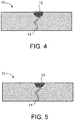
- FIG. 4 illustrates a cross-sectional view of the repaired component 10.
- the unfilled region of crack 13 that was machined (or ground) into a semi-circular groove has now been filled in with a filler metal 16 (such as weld wire), and welded with a modulated pulsing laser source.
- the groove 15 is repeatedly welded and filled with weld filler until the groove is filled to the desired amount.
- FIG. 5 illustrates a cross-sectional view of the repaired component 10.
- the excess weld filler material 16 has been machined away in a final finishing or recontouring step.
- the crack 13 has now been filled in with the filler metal 16 (such as weld wire), welded with a modulated pulsing laser source and the surface of the repair has been recontoured to the desired profile.
- FIG. 6 is a flowchart of the method 100 of welding or repairing the superalloy component 10. The following steps are performed sequentially.
- the method 100 includes a cleaning step 110 that immerses the component 10 in the salt bath.
- the salt bath is a preliminary cleaning process applied generally after removal of the consumed protective metallic coating and, in some components, of the thermal barrier coating.
- the salt bath removes tenacious and thermodynamically stable oxidation and to some extent also corrosion products from cracks and from the components' surface. Uncoated parts, which also have been subjected to strong thermo-mechanical fatigue (TMF) degradation and erosion impact, may also need a salt bath to remove these contamination scales.
- TMF thermo-mechanical fatigue
- the salt bath reduces the thickness of the oxide surface scales by 70% to 90%, and removes inner oxidation products from cooling holes and cavities. Contaminants such as oil, grease etc., can also be dissolved.
- Salt bath cleaning is carried out in a discontinuous process in which the components 10 are charged in chemically resistant baskets and immersed for a predetermined time in the molten salt bath.
- Salt baths for metal oxide removal may be primarily composed of sodium hydroxide and differing amounts of strongly oxidizing agents, such as sodium nitrate. Some catalysts are also added to the salt bath to accelerate and control the oxidizing properties of the salt bath. Additional compounds may also be added to protect the base metal from undesired chemical attack.
- the salt bath is preferred to have the lowest possible viscosity during the entire component exposure time to be able to penetrate cracks and internal cavities.
- the salt bath used for metal oxide removal may operate in a temperature range of about 400 °C to about 500 °C. In the case of Rene 108, the salt bath is highly desired, since the cracks are deeply oxidized and the successive cleaning step, so-called "fluoride ion cleaning" (FIC), alone would not be sufficient to remove all oxides.
- FIC fluoride i
- a second cleaning step 120 employs dynamic sub-atmospheric fluoride ion cleaning (FIC), which is a highly effective process for the removal of deeply embedded oxides from superalloys containing significant amounts of aluminum and titanium.
- FIC fluoride ion cleaning
- the cleaning effect is based on chemical reactions, such as the conversion of thermodynamically highly stable metal oxides in reducible fluorides as well as the formation of volatile metal fluorides. These reactions take place in a reactor, which is heated up to a temperature range of about 900 °C to about 1200 °C, with pressures between about 50 Torr and about 765 Torr.
- Gases e.g., Argon (Ar), hydrogen (H 2 ) and/or hydrogen fluoride (HF)
- Argon (Ar) Argon
- H 2 hydrogen
- HF hydrogen fluoride
- the extraction of the gaseous reaction products is obtained by evacuating the system. This last step is important since the chemical reactions described represent dynamic equilibria. It means that they reach the product side to some extent and are easily reversed if the chemical reaction products (metal fluorides and water) are not removed continuously during the process cycle.
- the cracks must be supplied with fresh reaction gases through intermediate evacuation steps of the reactor volume.
- a FIC process is a sequence of cleaning cycles, which is tailored according to the specific alloy, the degree of damage and the component. Excessive material attack, especially in terms of aluminum, titanium and yttrium depletion, as well as attack of sensitive areas and brazed joints, must be avoided since it could lead to a reduction of the mechanical properties or oxidation resistance of the base metal. On the other hand, the wetting behavior of the braze alloy is improved by the depletion of the cleaned surface (elements like titanium, which easily oxidize, can prevent from wetting.). In the specific case of Rene 108, cleaning is very challenging since the cracks are very long (typically > 4mm) and strongly oxidized. The flow time of HF gas is strongly related to the length of the cracks and for this reason a specific long FIC process is applied in case of Rene 108 to be able to clean up to the bottom of the cracks.
- the effectiveness of the FIC process is assessed by investigating characteristic metallurgical criteria: mainly the depth of the material attack and the oxide removal from the cracks. Oxide scales should be completely removed from crack surfaces and from wide accessible cracks. In extremely fine cracks, difficult to be accessed by the process gas, a certain amount of local residual oxides can be tolerated. Grain boundaries carbide attack and generally IGA can occur and is tolerated according to threshold values defined for the specific cases.
- the FIC process is considered one of the most reliable methods to remove oxides from cracked material, even in case of very fine thermomechanical fatigue cracks. For this reason, combined with a suitable brazing process, it can be used to repair even highly loaded areas of components.
- a brazing paste is applied to the component.
- High temperature brazing has been successfully implemented in the gas turbine industry to repair superalloy components in high loaded areas and even in critical components such as rotating parts. The main aim was reducing the scrap rate by extending the range of repairable parts. Compared to welding, the brazing process avoids distortions and therefore retains the shape of a component thanks to the uniform heating and cooling of the components in the vacuum furnace during brazing. Brazing, according to the method described herein, yields joints characterized by high temperature strength, excellent creep, excellent low cycle fatigue (LCF) properties, as well as oxidation resistance on the repaired locations.
- LCF low cycle fatigue
- a suitable nickel-based brazing alloy may have the following composition (by weight percent): Nickel balance, Chromium 13% to 17%, Cobalt 8% to 12%, Tantalum 2% to 5%, Aluminum 4% to 7%, Boron ⁇ 4%, Yttrium ⁇ 0.5%.
- the braze material may be a pure braze alloy, e.g., D-15 (Balance Ni, 15% Cr, 10.25% Co, 3.5% Ta, 3.5% Al, 2.3% B), AMS 4782 (71% Ni, 19% Cr, 10% Si), DF-4B (Balance Ni, 14% Cr, 10% Co, 3.5% Al, 2.75% B, 2.5% Ta, 0.05% Y), Amdry 788 (Balance Co, 22% Cr, 21% Ni, 14% W, 2% B, 2% Si, 0.03% La) or also a mixture of brazing alloys like AMS 4782 and a powder of the superalloy Inconel 738, Inconel 625, Inconel 718, Haynes 230 (57%-Balance Ni, 22%, Cr, 14% W, 2% Mo, 3% max Fe, 5% max Co, 0.5% Mn, 0.4% Si, 0.5% max Nb, 0.3% Al, 0.1% max Ti, 0.1% C, 0.02% La, 0.015% max B), MM509
- the brazing alloy may be mixed with binders (e.g., between 8% and 12%) and then applied on the top of the crack.
- a second layer of brazing paste may be applied on top of the first layer of brazing paste.
- This second layer is a mixture of brazing alloy and a gap filler.
- the gap filler may be a nickel based superalloy with a similar or equivalent composition to the base metal (e.g., MarM247). For Rene 108, the gap filler would be very similar or identical material (i.e., Rene 108).
- the powder is mixed with the binder and finally applied on the surface of the component. Additional brazing alloy application steps should allow filling of wide cracks without unacceptable porosity.
- Non-limiting examples of other suitable filler materials are GTD-262, Rene 41 (Balance Ni, 0.09% C, 19% Cr, 11% Co, 9.75% Mo, 3.15% Ti, 1.65% Al, 0.005% B), GTD-111, Rene 108LC, Inconel 738, Inconel 738LC, and GTD-222.
- the design of some superalloy components may allow the application of the brazing paste on the cracks from two sides of the crack, or opposing component surfaces. Brazing paste can be injected directly on the internal surface of the component. The "double-sided" application of brazing paste permits even stronger repairs. After applying the brazing alloy paste, stop-off may be put around the areas to be brazed to avoid excessive flowing of the brazing paste in locations where brazing is not desired. In case of cracks close to cooling holes, metallic pins covered with ceramic can be inserted in the cooling air holes to avoid their closure due to the flow of the brazing alloy.
- the components are brazed and heat treated.
- the components may be put in a high vacuum furnace.
- the position of the parts depends on the cracks' orientation and generally the parts are positioned in the way that the weight force, combined with the capillary force, facilitates the flow of the brazing alloy in most of the cracks to be brazed.
- the brazing process runs in high vacuum.
- the furnace system will be slowly heated up to a temperature range of about 200 °C to about 400 °C. During this first heating phase the binder gradually evaporates and leads to a slight shrinkage of the brazing paste. After this short dwell time meant to eliminate most of the binder, the temperature continues to gradually increase.
- the described mechanism is generally defined as diffusion brazing or transient liquid phase brazing (TLP brazing).
- the dwell time at the intermediate temperature between solidus and liquidus temperature and the temperature higher than the liquidus temperature should be prolonged (e.g., 12 hours) compared to other nickel based superalloys, single crystal (SX) material included, since due to Rene 108's typically very long cracks, complete filling is difficult in the generally chosen time for the above-mentioned scenarios.
- SX single crystal
- FIG. 7 illustrates a chart of one example braze/heat treatment cycle.
- the chart is not to scale.
- the components are heated to a first temperature and held there for a first predetermined time. This is indicated by numeral 1.
- a second heating phase heats the components to a second temperature and this second temperature is held for a second period of time. The second temperature is greater than the first temperature. This is indicated by numeral 2.
- a third heating phase heats the components to a third temperature and this third temperature is held for a third predetermined time. The third temperature is higher than the second temperature. This is indicated by numeral 3.
- the components are allowed to cool to a fourth temperature and the components are held at this temperature for a fourth predetermined time.
- the fourth temperature is lower than the third temperature, but higher than the first temperature. This is indicated by numeral 4.
- the final phase is a cooling of the components back to room temperature.
- step 150 a recontouring of the brazed area is performed.
- the evaporation of binder is normally compensated by a generous brazing deposition.
- the described shrinkage can easily lead to insufficient filling of cracks, especially on the top.
- Such defects can be recognized mainly in the machining step after brazing.
- There excessive brazed material is removed by machining or slightly hand grinding to restore the original or desired geometry on the component surface. This process is called “recontouring” or "blending".
- a non-destructive test is performed on the component.
- a suitable NDT inspection method for defects detection is fluorescent penetrant inspection (FPI).
- FPI fluorescent penetrant inspection
- a fluorescent dye is applied to the surface of part (the entire component or only the zone of interest) in order to detect defects that may compromise the integrity or quality of the part in question.
- FPI may include the following sequential steps, initial cleaning, penetrant application, excess penetrant removal, developer application, inspection and final cleaning. Before the penetrant can be applied to the surface of the component, it must be ensured that the surface thereof is free of any contamination such as oil, dirt, or scale that may fill a defect or falsely indicate a flaw.
- Dwell time a defined time (so-called "dwell time") is required for the penetrant to seep into flaws or defects in the component. Dwell time varies by material and the size of the indications that are intended to be identified but is generally less than 30 minutes. It requires much less time to penetrate larger flaws because the penetrant is able to soak in much faster. In the excess penetrant removal step, after the mentioned dwell time has passed, penetrant on the outer surface of the material is then removed.
- This highly controlled process ensures that the penetrant is removed only from the surface of the material and not from inside any identified flaws.
- a contrasting developer is applied to the surface of the component. This serves as a background against which flaws can easily be detected.
- the developer also causes penetrant bleeding from any defects.
- the inspection step identifies the defects. To detect defects, an inspector will use ultraviolet (UV) radiation with an appropriate intensity to inspect. This takes place in a dark room to ensure good contrast between the glow emitted by the penetrant in the defected areas and the unlit surface of the material. The inspector carefully examines all surfaces in question and assesses the detected defects according to the predetermined standards.
- UV ultraviolet
- Areas in question may be marked so that location of indications can be identified easily without the use of the UV lighting. Post inspection, and upon successful inspection of the product, the component is returned for a final cleaning before it is moved on to another process, or deemed defective and reworked or scrapped. The component may be cleaned in ultrasound bath to completely remove the FPI remains.
- step 170 the surface of the component is prepared for the second repair phase. This will occur if any defects were found in the previous inspection step 160. Local machining or grinding of areas containing defects is performed. These machined areas should have a clean and regular shape area, which is desired for reliable pulsed laser welding.
- the entire defected area may be manually machined/ground by means of a hand grinder with a tip diameter properly defined based on the required grinding depth.
- the area may also be machined by a computer controlled machine (e.g., a CNC machine).
- the grinding depth is defined in accordance to braze defect depth, if it can be recognized, component geometry (e.g. wall thickness) and scope of repair in general.
- a tip of about 3 mm diameter or more and a grinding depth of about 0.5 mm or more is normally enough. However, other diameters and depths may be required in some applications.
- the ground area has the shape of grooves with round contours at the beginning and end zone, and a radius of curvature of about 1.5 mm or more.
- the previously brazed zone should be located as near as possible to the center of the grooves to have a homogenous heat dispersion and stress distribution during the following laser wire welding process.
- the previously machined grooves are filled with filler material.
- Pulsed laser welding is a joint technique where the weld filler is provided in the form of a wire (e.g., diameter of about 0.4 to 1 mm). Other wire diameters may be used as desired.
- the wire is in contact with the surface that needs to be joined and melted by means of direct exposure to the pulse modulated laser light.
- the generated heat on the molten wire is directly transferred into the base material that will be partially melted as the bonding is established. Because of the pulsing nature of the process the fused zone is limited to the laser exposed zone with limited heat input because of the fine control on the overall pulse energy, duration and intensity distribution of the laser.
- An advantage of the process is the extremely low heat input and the laser's limited temperature distribution during the welding because of the pulse modulation.
- the pulsed modulation of the laser creates a small heat affected zone and so, a low dilution or intermixing zone of the base metal.
- a first layer is melted on the bottom part of the groove (usually in direct contact with the brazing paste) for the entire groove length, and subsequent layers are built on top of the first one with an appropriate X, Y and Z shift (according to weld bead dimension, groove radius of curvature) until the groove is satisfactorily filled.
- Laser peak power may be between about 0.1 kW to about 3 kW.
- Wire diameter is between about 0.4 mm to 1 mm.
- Laser pulse duration may be between about 10 ms to 100 ms. Process parameters above or below these ranges may also be employed, as desired in the specific application. Pulse shape is defined according to the base material sensitivity to cracks and weldability in general. An important parameter is the appropriate modulation of process heat input and stress releasing.
- Laser frequency may be between about 1 Hz to about 50 Hz.
- Translation speed is the speed of the laser head during the welding execution, and should be chosen in combination with the laser frequency in order to achieve the desired target spot to spot overlap.
- a second recontouring step 190 may be performed on the welded area to return the surface of the component to the desired profile. This is similar to step 150, described above.
- a second inspection step 195 may be performed to verify that all defects have been filled and repaired. This is similar to step 160, described above.
- One additional advantage of the method 100, which incorporates pulse modulated laser wire welding, described herein is that very limited grinding effort is required because of the near net shape nature of this welding execution. Laser wire welding generates very little, if any, over welded areas. This results in a huge benefit in term of time, cost and expense.
- Approximating language may be applied to modify any quantitative representation that could permissibly vary without resulting in a change in the basic function to which it is related. Accordingly, a value modified by a term or terms, such as “about,” “approximately” and “substantially,” are not to be limited to the precise value specified. In at least some instances, the approximating language may correspond to the precision of an instrument for measuring the value.
- range limitations may be combined and/or interchanged, such ranges are identified and include all the sub-ranges contained therein unless context or language indicates otherwise.
- the terms “about” and “approximately” as applied to a particular value of a range applies to both values, and unless otherwise dependent on the precision of the instrument measuring the value, may indicate +/- 10% of the stated value(s).
Landscapes
- Engineering & Computer Science (AREA)
- Mechanical Engineering (AREA)
- Physics & Mathematics (AREA)
- Optics & Photonics (AREA)
- Plasma & Fusion (AREA)
- Chemical & Material Sciences (AREA)
- Health & Medical Sciences (AREA)
- Chemical Kinetics & Catalysis (AREA)
- Immunology (AREA)
- Metallurgy (AREA)
- Organic Chemistry (AREA)
- Materials Engineering (AREA)
- General Chemical & Material Sciences (AREA)
- Quality & Reliability (AREA)
- General Engineering & Computer Science (AREA)
- Analytical Chemistry (AREA)
- Biochemistry (AREA)
- General Health & Medical Sciences (AREA)
- General Physics & Mathematics (AREA)
- Pathology (AREA)
- Life Sciences & Earth Sciences (AREA)
- Nuclear Medicine, Radiotherapy & Molecular Imaging (AREA)
- Laser Beam Processing (AREA)
- Turbine Rotor Nozzle Sealing (AREA)
Priority Applications (3)
| Application Number | Priority Date | Filing Date | Title |
|---|---|---|---|
| EP17185841.8A EP3441180A1 (fr) | 2017-08-11 | 2017-08-11 | Procédé de réparation de superalliages |
| US16/028,016 US11207751B2 (en) | 2017-08-11 | 2018-07-05 | Method of repairing superalloys |
| KR1020180093305A KR102566105B1 (ko) | 2017-08-11 | 2018-08-09 | 초합금 보수 방법 |
Applications Claiming Priority (1)
| Application Number | Priority Date | Filing Date | Title |
|---|---|---|---|
| EP17185841.8A EP3441180A1 (fr) | 2017-08-11 | 2017-08-11 | Procédé de réparation de superalliages |
Publications (1)
| Publication Number | Publication Date |
|---|---|
| EP3441180A1 true EP3441180A1 (fr) | 2019-02-13 |
Family
ID=59592900
Family Applications (1)
| Application Number | Title | Priority Date | Filing Date |
|---|---|---|---|
| EP17185841.8A Withdrawn EP3441180A1 (fr) | 2017-08-11 | 2017-08-11 | Procédé de réparation de superalliages |
Country Status (3)
| Country | Link |
|---|---|
| US (1) | US11207751B2 (fr) |
| EP (1) | EP3441180A1 (fr) |
| KR (1) | KR102566105B1 (fr) |
Cited By (9)
| Publication number | Priority date | Publication date | Assignee | Title |
|---|---|---|---|---|
| CN110394594A (zh) * | 2019-06-18 | 2019-11-01 | 武汉船用机械有限责任公司 | 中频熔敷铅黄铜层缺陷的修复方法 |
| CN110744259A (zh) * | 2019-11-26 | 2020-02-04 | 西安热工研究院有限公司 | 一种火电机组用高压主汽阀门密封面的梯度修复方法 |
| CN110948174A (zh) * | 2019-11-26 | 2020-04-03 | 中国第一汽车股份有限公司 | 一种铸件铸造缺陷的修补方法 |
| CN111331311A (zh) * | 2020-03-03 | 2020-06-26 | 平罗县荣昌碳化硅有限公司 | 一种破碎机锤头的修复方法 |
| CN111390341A (zh) * | 2020-04-29 | 2020-07-10 | 安徽马钢设备检修有限公司 | Glama机械手大臂连杆焊缝断裂在线焊接装置及工艺 |
| CN112091528A (zh) * | 2020-09-23 | 2020-12-18 | 哈尔滨电气动力装备有限公司 | 液压假轴修复的工艺方法 |
| CN114888520A (zh) * | 2022-03-15 | 2022-08-12 | 航发优材(镇江)钛合金精密成型有限公司 | 一种中介机匣补焊修复过程抑制缺陷产生的方法 |
| CN115780940A (zh) * | 2022-08-01 | 2023-03-14 | 西南交通大学 | 锆合金的焊接方法 |
| WO2023121488A1 (fr) * | 2021-12-21 | 2023-06-29 | General Electric Company | Réparation de brasure |
Families Citing this family (14)
| Publication number | Priority date | Publication date | Assignee | Title |
|---|---|---|---|---|
| US10625361B2 (en) * | 2017-06-14 | 2020-04-21 | General Electric Company | Method of welding superalloys |
| US11135677B2 (en) | 2018-03-06 | 2021-10-05 | General Electric Company | Laser welding of component |
| US10780515B2 (en) | 2018-04-26 | 2020-09-22 | Raytheon Technologies Corporation | Auto-adaptive braze dispensing systems and methods |
| US11235405B2 (en) * | 2019-05-02 | 2022-02-01 | General Electric Company | Method of repairing superalloy components using phase agglomeration |
| CN110824014A (zh) * | 2019-10-25 | 2020-02-21 | 中国航发北京航空材料研究院 | 一种用于高温合金锻件的无损检测方法 |
| KR102423535B1 (ko) | 2020-03-27 | 2022-07-20 | 두산에너빌리티 주식회사 | 기계 설비의 보수용 쿠폰 |
| US11426822B2 (en) * | 2020-12-03 | 2022-08-30 | General Electric Company | Braze composition and process of using |
| CN114703472B (zh) * | 2022-03-15 | 2023-07-28 | 湘潭大学 | 一种基于等温凝固原理修复镍基高温合金的方法 |
| CN115874073B (zh) * | 2022-11-28 | 2024-07-19 | 先导薄膜材料(广东)有限公司 | 一种高熵合金的熔炼方法 |
| CN116586898B (zh) * | 2023-04-21 | 2025-12-30 | 浙江景昇薄膜科技有限公司 | 一种半导体靶材工艺裂缝的修复方法 |
| US12546015B2 (en) | 2023-04-26 | 2026-02-10 | Ge Infrastructure Technology Llc | Fluoride ion cleaning systems and methods including post-retort fluid stream processing |
| KR102631599B1 (ko) * | 2023-08-28 | 2024-02-01 | 터보파워텍(주) | 브레이징을 이용한 가스터빈용 고온부품의 와이드 크랙 수리방법 |
| CN119566615B (zh) * | 2023-09-07 | 2025-11-25 | 中国航发商用航空发动机有限责任公司 | 一种高温合金钎料及高温合金焊接件 |
| CN119658045A (zh) * | 2023-09-12 | 2025-03-21 | 通用电气技术有限公司 | 用于减少共晶相的钎焊修复方法 |
Citations (7)
| Publication number | Priority date | Publication date | Assignee | Title |
|---|---|---|---|---|
| US4098450A (en) * | 1977-03-17 | 1978-07-04 | General Electric Company | Superalloy article cleaning and repair method |
| US4566939A (en) * | 1985-01-25 | 1986-01-28 | Avco Corporation | Surface preparation of nickel base alloys for brazing |
| JP2003001478A (ja) * | 2001-04-17 | 2003-01-08 | Toshiba Corp | 構造部材の亀裂補修方法及び亀裂補修装置 |
| EP1312437A1 (fr) * | 2001-11-19 | 2003-05-21 | ALSTOM (Switzerland) Ltd | Procédé pour réparer une fissure |
| EP1424158A1 (fr) * | 2002-11-29 | 2004-06-02 | Alstom Technology Ltd | Méthode pour la fabrication, la modification ou la réparation de pièces monocristallines ou de pièces à solidification directionnelle |
| EP1972408A2 (fr) * | 2007-03-22 | 2008-09-24 | United Technologies Corporation | Réparation de fissure d'alliage de nickel en deux étapes |
| EP2868426A2 (fr) * | 2013-11-04 | 2015-05-06 | Siemens Energy, Inc. | Compositions d'alliage de brasage et procédés de brasage pour super-alliages |
Family Cites Families (30)
| Publication number | Priority date | Publication date | Assignee | Title |
|---|---|---|---|---|
| US3260619A (en) * | 1965-02-04 | 1966-07-12 | Kolene Corp | Methods and compositions for cleaning metal |
| US4285459A (en) * | 1979-07-31 | 1981-08-25 | Chromalloy American Corporation | High temperature braze repair of superalloys |
| US4381944A (en) * | 1982-05-28 | 1983-05-03 | General Electric Company | Superalloy article repair method and alloy powder mixture |
| US5071486A (en) * | 1986-02-06 | 1991-12-10 | University Of Dayton | Process for removing protective coatings and bonding layers from metal parts |
| US5071054A (en) * | 1990-12-18 | 1991-12-10 | General Electric Company | Fabrication of cast articles from high melting temperature superalloy compositions |
| US5437737A (en) * | 1994-02-07 | 1995-08-01 | United Technologies Corporation | Repair coating for superalloy articles, such as gas turbine engine components |
| US5806751A (en) * | 1996-10-17 | 1998-09-15 | United Technologies Corporation | Method of repairing metallic alloy articles, such as gas turbine engine components |
| US6450183B1 (en) * | 1999-12-22 | 2002-09-17 | Kolene Corporation | Composition, apparatus, and method of conditioning scale on a metal surface |
| US6530971B1 (en) * | 2001-01-29 | 2003-03-11 | General Electric Company | Nickel-base braze material and braze repair method |
| US6575349B2 (en) * | 2001-02-22 | 2003-06-10 | Hickham Industries, Inc. | Method of applying braze materials to a substrate |
| US6495793B2 (en) * | 2001-04-12 | 2002-12-17 | General Electric Company | Laser repair method for nickel base superalloys with high gamma prime content |
| ATE283936T1 (de) * | 2001-05-14 | 2004-12-15 | Alstom Technology Ltd | Verfahren zum isothermischen hartlöten von einkristallinen gegenständen |
| US7010987B2 (en) * | 2002-10-31 | 2006-03-14 | Alstom (Switzerland) Ltd | Non-destructive method of detecting defects in braze-repaired cracks |
| US7146725B2 (en) * | 2003-05-06 | 2006-12-12 | Siemens Power Generation, Inc. | Repair of combustion turbine components |
| US20080017694A1 (en) * | 2003-09-24 | 2008-01-24 | Alexander Schnell | Braze Alloy And The Use Of Said Braze Alloy |
| US7303112B2 (en) * | 2004-10-29 | 2007-12-04 | United Technologies Corporation | Repair of braze joint and article repaired |
| US7360678B2 (en) * | 2005-01-27 | 2008-04-22 | United Technologies Corporation | Repair and reclassification of superalloy components |
| US20060200963A1 (en) * | 2005-03-11 | 2006-09-14 | United Technologies Corporation | Method for repairing parts composed of superalloys |
| EP1910006B1 (fr) * | 2005-07-22 | 2011-12-21 | Siemens Aktiengesellschaft | Procede de reparation d'un composant comprenant une microstructure orientee par reglage, durant l'action thermique d'un faisceau d'electrons ou laser, d'un gradient de temperature |
| US7824510B2 (en) * | 2008-01-28 | 2010-11-02 | Honeywell International Inc. | Methods of repairing engine components |
| EP2524062B1 (fr) * | 2010-01-11 | 2018-11-28 | Kolene Corporation | Processus de conditionnement d'une couche d'amadou métallique et sa installation |
| US8595929B2 (en) * | 2010-10-21 | 2013-12-03 | Siemens Energy, Inc. | Repair of a turbine engine surface containing crevices |
| CN103298582B (zh) * | 2011-02-22 | 2015-09-02 | 三菱重工业株式会社 | 叶轮的制造方法 |
| US10076811B2 (en) * | 2011-11-03 | 2018-09-18 | Siemens Energy, Inc. | Structural braze repair of superalloy component |
| US9272369B2 (en) * | 2012-09-12 | 2016-03-01 | Siemens Energy, Inc. | Method for automated superalloy laser cladding with 3D imaging weld path control |
| US20140209576A1 (en) * | 2013-01-31 | 2014-07-31 | Kazim Ozbaysal | Use of elevated pressures for reducing cracks in superalloy welding and cladding |
| WO2014143963A1 (fr) * | 2013-03-15 | 2014-09-18 | Siemens Energy, Inc. | Préforme préfrittée pour la réparation de composant de superalliage |
| JP2015033717A (ja) * | 2013-08-09 | 2015-02-19 | 三菱重工業株式会社 | 補修方法 |
| US10024161B2 (en) * | 2015-02-09 | 2018-07-17 | United Technologies Corporation | Turbine blade tip repair |
| US10279416B2 (en) * | 2016-03-15 | 2019-05-07 | General Electric Company | Weld forced crack and braze repair for superalloys |
-
2017
- 2017-08-11 EP EP17185841.8A patent/EP3441180A1/fr not_active Withdrawn
-
2018
- 2018-07-05 US US16/028,016 patent/US11207751B2/en active Active
- 2018-08-09 KR KR1020180093305A patent/KR102566105B1/ko active Active
Patent Citations (7)
| Publication number | Priority date | Publication date | Assignee | Title |
|---|---|---|---|---|
| US4098450A (en) * | 1977-03-17 | 1978-07-04 | General Electric Company | Superalloy article cleaning and repair method |
| US4566939A (en) * | 1985-01-25 | 1986-01-28 | Avco Corporation | Surface preparation of nickel base alloys for brazing |
| JP2003001478A (ja) * | 2001-04-17 | 2003-01-08 | Toshiba Corp | 構造部材の亀裂補修方法及び亀裂補修装置 |
| EP1312437A1 (fr) * | 2001-11-19 | 2003-05-21 | ALSTOM (Switzerland) Ltd | Procédé pour réparer une fissure |
| EP1424158A1 (fr) * | 2002-11-29 | 2004-06-02 | Alstom Technology Ltd | Méthode pour la fabrication, la modification ou la réparation de pièces monocristallines ou de pièces à solidification directionnelle |
| EP1972408A2 (fr) * | 2007-03-22 | 2008-09-24 | United Technologies Corporation | Réparation de fissure d'alliage de nickel en deux étapes |
| EP2868426A2 (fr) * | 2013-11-04 | 2015-05-06 | Siemens Energy, Inc. | Compositions d'alliage de brasage et procédés de brasage pour super-alliages |
Cited By (10)
| Publication number | Priority date | Publication date | Assignee | Title |
|---|---|---|---|---|
| CN110394594A (zh) * | 2019-06-18 | 2019-11-01 | 武汉船用机械有限责任公司 | 中频熔敷铅黄铜层缺陷的修复方法 |
| CN110744259A (zh) * | 2019-11-26 | 2020-02-04 | 西安热工研究院有限公司 | 一种火电机组用高压主汽阀门密封面的梯度修复方法 |
| CN110948174A (zh) * | 2019-11-26 | 2020-04-03 | 中国第一汽车股份有限公司 | 一种铸件铸造缺陷的修补方法 |
| CN111331311A (zh) * | 2020-03-03 | 2020-06-26 | 平罗县荣昌碳化硅有限公司 | 一种破碎机锤头的修复方法 |
| CN111390341A (zh) * | 2020-04-29 | 2020-07-10 | 安徽马钢设备检修有限公司 | Glama机械手大臂连杆焊缝断裂在线焊接装置及工艺 |
| CN112091528A (zh) * | 2020-09-23 | 2020-12-18 | 哈尔滨电气动力装备有限公司 | 液压假轴修复的工艺方法 |
| CN112091528B (zh) * | 2020-09-23 | 2021-08-13 | 哈尔滨电气动力装备有限公司 | 液压假轴修复的工艺方法 |
| WO2023121488A1 (fr) * | 2021-12-21 | 2023-06-29 | General Electric Company | Réparation de brasure |
| CN114888520A (zh) * | 2022-03-15 | 2022-08-12 | 航发优材(镇江)钛合金精密成型有限公司 | 一种中介机匣补焊修复过程抑制缺陷产生的方法 |
| CN115780940A (zh) * | 2022-08-01 | 2023-03-14 | 西南交通大学 | 锆合金的焊接方法 |
Also Published As
| Publication number | Publication date |
|---|---|
| US20190047094A1 (en) | 2019-02-14 |
| KR102566105B1 (ko) | 2023-08-10 |
| US11207751B2 (en) | 2021-12-28 |
| KR20190017687A (ko) | 2019-02-20 |
Similar Documents
| Publication | Publication Date | Title |
|---|---|---|
| US11207751B2 (en) | Method of repairing superalloys | |
| EP3536444B1 (fr) | Soudage au laser d'un composant | |
| EP3417972B1 (fr) | Procédé de soudure de superalliages | |
| KR100818862B1 (ko) | 용접 수리 방법 | |
| CA2399210C (fr) | Soudage d'articles en superalliage | |
| JP5322371B2 (ja) | 一体形ブレード付きディスクを補修する方法、作業開始時および作業終了時テストピース | |
| US20050067466A1 (en) | Crack repair method | |
| JP5008354B2 (ja) | ターボ機械の一体型のブレード付きディスクのブレードを補修する方法、および該方法を実行するための試験片 | |
| CN107186309B (zh) | 超级合金的焊缝强制开裂和钎焊修补 | |
| CN106563929A (zh) | 修复和制造涡轮发动机部件的方法及涡轮发动机部件 | |
| EP1705338B1 (fr) | Méthode pour réparer des pièces en superalliages | |
| JP6838832B2 (ja) | 超合金用溶接フィラー | |
| JP2011064077A (ja) | ガスタービン部品およびその補修方法 | |
| US20080210741A1 (en) | Weld repair as a combined heat treatment brazing process for metallic components | |
| Ellison et al. | Powder metallurgy repair of turbine components | |
| JP7608066B2 (ja) | 相凝集を使用して超合金構成要素を修復する方法 | |
| EP3173175A1 (fr) | Procédé de traitement d'article et article traité | |
| RU2823420C1 (ru) | Способ ремонта пера охлаждаемых рабочих лопаток газотурбинных двигателей из жаропрочных сплавов методом лазерной порошковой наплавки | |
| Miglietti | Wide gap diffusion braze repairs of nozzle segments cast from FSX-414 Co-based superalloy | |
| Cornu et al. | Weldability of superalloys by Nd: YAG laser | |
| Pacquentin et al. | Journal of Advanced Joining Processes |
Legal Events
| Date | Code | Title | Description |
|---|---|---|---|
| PUAI | Public reference made under article 153(3) epc to a published international application that has entered the european phase |
Free format text: ORIGINAL CODE: 0009012 |
|
| AK | Designated contracting states |
Kind code of ref document: A1 Designated state(s): AL AT BE BG CH CY CZ DE DK EE ES FI FR GB GR HR HU IE IS IT LI LT LU LV MC MK MT NL NO PL PT RO RS SE SI SK SM TR |
|
| AX | Request for extension of the european patent |
Extension state: BA ME |
|
| STAA | Information on the status of an ep patent application or granted ep patent |
Free format text: STATUS: THE APPLICATION IS DEEMED TO BE WITHDRAWN |
|
| 18D | Application deemed to be withdrawn |
Effective date: 20190814 |