EP3442974B1 - Dérivés de pyrazolopyrimidine - Google Patents
Dérivés de pyrazolopyrimidine Download PDFInfo
- Publication number
- EP3442974B1 EP3442974B1 EP17715204.8A EP17715204A EP3442974B1 EP 3442974 B1 EP3442974 B1 EP 3442974B1 EP 17715204 A EP17715204 A EP 17715204A EP 3442974 B1 EP3442974 B1 EP 3442974B1
- Authority
- EP
- European Patent Office
- Prior art keywords
- alkyl
- group
- hydrogen
- methyl
- halogenoalkyl
- Prior art date
- Legal status (The legal status is an assumption and is not a legal conclusion. Google has not performed a legal analysis and makes no representation as to the accuracy of the status listed.)
- Active
Links
Classifications
-
- C—CHEMISTRY; METALLURGY
- C07—ORGANIC CHEMISTRY
- C07D—HETEROCYCLIC COMPOUNDS
- C07D487/00—Heterocyclic compounds containing nitrogen atoms as the only ring hetero atoms in the condensed system, not provided for by groups C07D451/00 - C07D477/00
- C07D487/02—Heterocyclic compounds containing nitrogen atoms as the only ring hetero atoms in the condensed system, not provided for by groups C07D451/00 - C07D477/00 in which the condensed system contains two hetero rings
- C07D487/04—Ortho-condensed systems
-
- A—HUMAN NECESSITIES
- A61—MEDICAL OR VETERINARY SCIENCE; HYGIENE
- A61K—PREPARATIONS FOR MEDICAL, DENTAL OR TOILETRY PURPOSES
- A61K31/00—Medicinal preparations containing organic active ingredients
- A61K31/33—Heterocyclic compounds
- A61K31/395—Heterocyclic compounds having nitrogen as a ring hetero atom, e.g. guanethidine or rifamycins
- A61K31/495—Heterocyclic compounds having nitrogen as a ring hetero atom, e.g. guanethidine or rifamycins having six-membered rings with two or more nitrogen atoms as the only ring heteroatoms, e.g. piperazine or tetrazines
- A61K31/505—Pyrimidines; Hydrogenated pyrimidines, e.g. trimethoprim
- A61K31/519—Pyrimidines; Hydrogenated pyrimidines, e.g. trimethoprim ortho- or peri-condensed with heterocyclic rings
-
- A—HUMAN NECESSITIES
- A61—MEDICAL OR VETERINARY SCIENCE; HYGIENE
- A61K—PREPARATIONS FOR MEDICAL, DENTAL OR TOILETRY PURPOSES
- A61K31/00—Medicinal preparations containing organic active ingredients
- A61K31/33—Heterocyclic compounds
- A61K31/395—Heterocyclic compounds having nitrogen as a ring hetero atom, e.g. guanethidine or rifamycins
- A61K31/535—Heterocyclic compounds having nitrogen as a ring hetero atom, e.g. guanethidine or rifamycins having six-membered rings with at least one nitrogen and one oxygen as the ring hetero atoms, e.g. 1,2-oxazines
- A61K31/5375—1,4-Oxazines, e.g. morpholine
- A61K31/5377—1,4-Oxazines, e.g. morpholine not condensed and containing further heterocyclic rings, e.g. timolol
-
- A—HUMAN NECESSITIES
- A61—MEDICAL OR VETERINARY SCIENCE; HYGIENE
- A61P—SPECIFIC THERAPEUTIC ACTIVITY OF CHEMICAL COMPOUNDS OR MEDICINAL PREPARATIONS
- A61P33/00—Antiparasitic agents
- A61P33/10—Anthelmintics
-
- C—CHEMISTRY; METALLURGY
- C07—ORGANIC CHEMISTRY
- C07D—HETEROCYCLIC COMPOUNDS
- C07D487/00—Heterocyclic compounds containing nitrogen atoms as the only ring hetero atoms in the condensed system, not provided for by groups C07D451/00 - C07D477/00
- C07D487/02—Heterocyclic compounds containing nitrogen atoms as the only ring hetero atoms in the condensed system, not provided for by groups C07D451/00 - C07D477/00 in which the condensed system contains two hetero rings
Definitions
- the present invention covers new pyrazolopyrimidine derivatives of general formula (I) as described and defined herein, methods of preparing said compounds, intermediate compounds useful for preparing said compounds, pharmaceutical compositions and combinations comprising said compounds, and the use of said compounds for manufacturing pharmaceutical compositions for the control, treatment and/or prevention of diseases, in particular for the control, treatment and/or prevention of infections with helminths, more particularly of infections with gastro-intestinal and extra-intestinal nematodes, in animals and humans, formulations containing such compounds.
- the invention also covers new pyrazolopyrimidine derivatives of general formula (I) for use in methods for the control, treatment and/or prevention of infections with helminths, more particularly of infections with gastro-intestinal and extra-intestinal nematodes, in animals and humans as a sole agent or in combination with other active ingredients.
- Certain pyrazolopyrimidine carboxamides are related to their activity increasing the efficacy of the endogenous ligand 3-hydroxybutyrateas as described in Journal of Medicinal Chemistry, 55, (7), 3563-3567 .
- Other pyrazolopyrimidine carboxamides are described as allosteric agonists for the high affinity nicotinic acid receptor GPR109A as in Bioorganic & Medicinal Chemistry Letters, 18, (18), 4948-4951 .
- pyrazolopyrimidine carboxamides are known as protein kinase modulators ( EP1918291 ), as active ingredients for treatment or prevention of skin dieseases ( WO 2009041663 ) or as NAD(P)H oxidase inhibitors ( WO 2003091256 ).
- a certain method for a library synthesis process of said compounds is described in Journal of Combinatorial Chemistry, 9, (3), 507-512 .
- WO 2016/012485 A1 concerns certain pyridyl carboxamide derivatives, the use of these compounds for the control, treatment and/or prevention of infections with helminths in animals and humans, formulations containing such compounds and methods for the control, treatment and/or prevention of infections with helminths in anmials and humans.
- the compounds of the present invention have surprisingly been found to effectively interact with Slo-1 of nematodes.
- This interaction is characterized by achieving paralysis/inhibition in particular of gastro-intestinal nematodes, of free-living nematodes, and of filariae, for which data are given in the biological experimental section. Therefore the compounds of the present invention may be used as anthelmintics for the control, treatment and/or prevention of gastro-intestinal and extra-intestinal helminth infections, in particular gastro-intestinal and extra-intestinal infections with nematodes, including filariae.
- the present invention covers compounds of general formula (I): in which :
- substituted means that one or more hydrogen atoms on the designated atom or group are replaced with a selection from the indicated group, provided that the designated atom's normal valency under the existing circumstances is not exceeded. Combinations of substituents and/or variables are permissible.
- optionally substituted means that the number of substituents can be equal to or different from zero. Unless otherwise indicated, it is possible that optionally substituted groups are substituted with as many optional substituents as can be accommodated by replacing a hydrogen atom with a non-hydrogen substituent on any available carbon or nitrogen atom.
- the term "one or more”, e.g. in the definition of the substituents of the compounds of general formula (I) of the present invention, means "1, 2, 3, 4 or 5, particularly 1, 2, 3 or 4, more particularly 1, 2 or 3, even more particularly 1 or 2".
- an oxo substituent represents an oxygen atom, which is bound to a carbon atom or to a sulfur atom via a double bond.
- ring substituent means a substituent attached to an aromatic or nonaromatic ring which replaces an available hydrogen atom on the ring.
- a composite substituent be composed of more than one parts, e.g. (C 1 -C 4 -alkoxy)-(C 1 -C 4 -alkyl)-, it is possible for the position of a given part to be at any suitable position of said composite substituent, i.e. the C 1 -C 4 -alkoxy part can be attached to any carbon atom of the C 1 -C 4 -alkyl part of said (C 1 -C 4 -alkoxy)-(C 1 -C 4 -alkyl)- group.
- a hyphen at the beginning or at the end of such a composite substituent indicates the point of attachment of said composite substituent to the rest of the molecule.
- a ring comprising carbon atoms and optionally one or more heteroatoms, such as nitrogen, oxygen or sulfur atoms for example, be substituted with a substituent
- substituent it is possible for said substituent to be bound at any suitable position of said ring, be it bound to a suitable carbon atom and/or to a suitable heteroatom.
- halogen atom means a fluorine, chlorine, bromine or iodine atom, particularly a fluorine, chlorine or bromine atom.
- C 1 -C 4 -alkyl means a linear or branched, saturated, monovalent hydrocarbon group having 1, 2, 3, or 4 carbon atoms, e.g. a methyl, ethyl, n -propyl, isopropyl, n -butyl, sec -butyl, isobutyl or a tert -butyl group, or an isomer thereof.
- said group has 1, 2 or 3 carbon atoms (“C 1 -C 3 -alkyl”), e.g. a methyl, ethyl, n -propyl or isopropyl group.
- C 1 -C 4 -hydroxyalkyl means a linear or branched, saturated, monovalent hydrocarbon group in which the term “C 1 -C 4 -alkyl” is defined supra, and in which 1 or 2 hydrogen atoms are replaced with a hydroxy group, e.g.
- -NH(C 1 -C 4 -alkyl) or "-N(C 1 -C 4 -alkyl) 2 " means a linear or branched, saturated, monovalent group in which the term "C 1 -C 4 -alkyl” is as defined supra, e.g. a methylamino, ethylamino, n -propylamino, isopropylamino, N , N -dimethylamino, N -methyl- N -ethylamino or N , N -diethylamino group.
- C 1 -C 4 -halogenoalkyl means a linear or branched, saturated, monovalent hydrocarbon group in which the term "C 1 -C 4 -alkyl” is as defined supra, and in which one or more of the hydrogen atoms are replaced, identically or differently, with a halogen atom.
- said halogen atom is a fluorine atom. More particularly, all said halogen atoms are fluorine atoms ("C 1 -C 4 -fluoroalkyl").
- Said C 1 -C 4 -halogenoalkyl group is, for example, fluoromethyl, difluoromethyl, trifluoromethyl, 2-fluoroethyl, 2,2-difluoroethyl, 2,2,2-trifluoroethyl, pentafluoroethyl, 3,3,3-trifluoropropyl or 1,3-difluoropropan-2-yl.
- C 1 -C 4 -alkoxy means a linear or branched, saturated, monovalent group of formula (C 1 -C 4 -alkyl)-O-, in which the term “C 1 -C 4 -alkyl” is as defined supra, e.g. a methoxy, ethoxy, n -propoxy, isopropoxy, n -butoxy, sec -butoxy, isobutoxy or tert -butoxy group, or an isomer thereof.
- C 1 -C 4 -halogenoalkoxy means a linear or branched, saturated, monovalent C 1 -C 4 -alkoxy group, as defined supra, in which one or more of the hydrogen atoms is replaced, identically or differently, with a halogen atom.
- said halogen atom is a fluorine atom.
- Said C 1 -C 4 -halogenoalkoxy group is, for example, fluoromethoxy, difluoromethoxy, trifluoromethoxy, 2,2,2-trifluoroethoxy or pentafluoroethoxy.
- C 2 -C 4 -alkenyl means a linear or branched, monovalent hydrocarbon group, which contains one double bond, and which has 2, 3 or 4 carbon atoms.
- Said C 2 -C 4 -alkenyl group is, for example, an ethenyl (or "vinyl"), a prop-2-en-1-yl (or “allyl”), prop-1-en-1-yl, but-3-enyl, but-2-enyl, but-1-enyl, prop-1-en-2-yl (or “isopropenyl”), 2-methylprop-2-enyl, 1-methylprop-2-enyl, 2-methylprop-1-enyl or a 1-methylprop-1-enyl, group. Particularly, said group is allyl.
- C 2 -C 4 -alkynyl means a linear monovalent hydrocarbon group which contains one triple bond, and which contains 2, 3 or 4 carbon atoms.
- Said C 2 -C 4 -alkynyl group is, for example, an ethynyl, a prop-1-ynyl, prop-2-ynyl (or “propargyl”), but-1-ynyl, but-2-ynyl, but-3-ynyl or 1-methylprop-2-ynyl, group.
- said alkynyl group is prop-1-ynyl or prop-2-ynyl.
- C 3 -C 6 -cycloalkyl means a saturated, monovalent, monocyclic hydrocarbon ring which contains 3, 4, 5 or 6 carbon atoms ("C 3 -C 6 -cycloalkyl").
- Said C 3 -C 6 -cycloalkyl group is for example, a monocyclic hydrocarbon ring, e.g. a cyclopropyl, cyclobutyl, cyclopentyl or cyclohexyl group.
- C 3 -C 6 -halogenocycloalkyl means a saturated, monovalent, monocyclic hydrocarbon ring in which the term “C 3 -C 6 -cycloalkyl” is as defined supra, and in which one or more of the hydrogen atoms are replaced, identically or differently, with a halogen atom.
- said halogen atom is a fluorine or chlorine atom.
- Said C 3 -C 6 -halogenocycloalkyl group is for example, a monocyclic hydrocarbon ring substituted with one or two fluorine or chlorine atoms, e.g.
- heterocycloalkyl and “4- to 6-membered heterocycloalkyl” mean a monocyclic, saturated heterocycle with 4, 5, 6 or 7 or, respectively, 4, 5 or 6 ring atoms in total, which contains one or two identical or different ring heteroatoms from the series N, O and S, it being possible for said heterocycloalkyl group to be attached to the rest of the molecule via any one of the carbon atoms or, if present, a nitrogen atom.
- Said heterocycloalkyl group can be a 4-membered ring, such as azetidinyl, oxetanyl or thietanyl, for example; or a 5-membered ring, such as tetrahydrofuranyl, 1,3-dioxolanyl, thiolanyl, pyrrolidinyl, imidazolidinyl, pyrazolidinyl, 1,1-dioxidothiolanyl, 1,2-oxazolidinyl, 1,3-oxazolidinyl or 1,3-thiazolidinyl, for example; or a 6-membered ring, such as tetrahydropyranyl, tetrahydrothiopyranyl, piperidinyl, morpholinyl, dithianyl, thiomorpholinyl, piperazinyl, 1,3-dioxanyl, 1,4-dioxanyl or 1,2-oxazinanyl
- 4- to 6-membered heterocycloalkyl means a 4- to 6-membered heterocycloalkyl as defined supra containing one ring nitrogen atom and optionally one further ring heteroatom from the series: N, O, S.
- 5- or 6-membered heterocycloalkyl means a monocyclic, saturated heterocycle with 5 or 6 ring atoms in total, containing one ring nitrogen atom and optionally one further ring heteroatom from the series: N, O.
- 6- or 10-membered aryl means a monovalent, monocyclic or bicyclic aromatic ring having 6 or 10 carbon ring atoms, e.g. a phenyl or naphthyl group.
- heteroaryl means a monovalent, monocyclic, bicyclic or tricyclic aromatic ring having 5, 6, 8, 9, 10, 11, 12, 13 or 14 ring atoms (a “5- to 14-membered heteroaryl” group), particularly 5, 6, 9 or 10 ring atoms (a "5- to 10-membered heteroaryl” group), which contains at least one ring heteroatom and optionally one, two or three further ring heteroatoms from the series: N, O and/or S, and which is bound via a ring carbon atom or optionally via a ring nitrogen atom (if allowed by valency).
- Said heteroaryl group can be a 5-membered heteroaryl group, such as, for example, thienyl, furanyl, pyrrolyl, oxazolyl, thiazolyl, imidazolyl, pyrazolyl, isoxazolyl, isothiazolyl, oxadiazolyl, triazolyl, thiadiazolyl or tetrazolyl; or a 6-membered heteroaryl group, such as, for example, pyridinyl, pyridazinyl, pyrimidinyl, pyrazinyl or triazinyl; or a tricyclic heteroaryl group, such as, for example, carbazolyl, acridinyl or phenazinyl; or a 9-membered heteroaryl group, such as, for example, benzofuranyl, benzothienyl, benzoxazolyl, benzisoxazolyl, benzimidazolyl,
- heteroaryl or heteroarylene groups include all possible isomeric forms thereof, e.g .: tautomers and positional isomers with respect to the point of linkage to the rest of the molecule.
- pyridinyl includes pyridin-2-yl, pyridin-3-yl and pyridin-4-yl; or the term thienyl includes thien-2-yl and thien-3-yl.
- C 1 -C 4 as used in the present text, e.g. in the context of the definition of "C 1 -C 4 -alkyl", “C 1 -C 4 -halogenoalkyl", “C 1 -C 4 -hydroxyalkyl", “C 1 -C 4 -alkoxy” or “C 1 -C 4 -halogenoalkoxy” means an alkyl group having a finite number of carbon atoms of 1 to 4, i.e. 1, 2, 3 or 4 carbon atoms.
- C 3 -C 6 as used in the present text, e.g. in the context of the definition of "C 3 -C 6 -cycloalkyl” or C 3 -C 6 -halogenocycloalkyl, means a cycloalkyl group having a finite number of carbon atoms of 3 to 6, i.e. 3, 4, 5 or 6 carbon atoms.
- the term "leaving group” means an atom or a group of atoms that is displaced in a chemical reaction as stable species taking with it the bonding electrons.
- a leaving group is selected from the group comprising: halide, in particular fluoride, chloride, bromide or iodide, (methylsulfonyl)oxy, [(trifluoromethyl)sulfonyl]oxy, [(nonafluorobutyl)-sulfonyl]oxy, (phenylsulfonyl)oxy, [(4-methylphenyl)sulfonyl]oxy, [(4-bromophenyl)sulfonyl]oxy, [(4-nitrophenyl)sulfonyl]oxy, [(2-nitrophenyl)sulfonyl]oxy, [(4-isopropylphenyl)sulfonyl]oxy, [(2,4,6-triisopropyl
- An oxo substituent in the context of the invention means an oxygen atom, which is bound to a carbon atom via a double bond.
- the invention therefore includes one or more isotopic variant(s) of the compounds of general formula (I), particularly deuterium-containing compounds of general formula (I).
- Isotopic variant of a compound or a reagent is defined as a compound exhibiting an unnatural proportion of one or more of the isotopes that constitute such a compound.
- Isotopic variant of the compound of general formula (I) is defined as a compound of general formula (I) exhibiting an unnatural proportion of one or more of the isotopes that constitute such a compound.
- unnatural proportion means a proportion of such isotope which is higher than its natural abundance.
- the natural abundances of isotopes to be applied in this context are described in " Isotopic Compositions of the Elements 1997", Pure Appl. Chem., 70(1), 217-235, 1998 .
- isotopes examples include stable and radioactive isotopes of hydrogen, carbon, nitrogen, oxygen, phosphorus, sulfur, fluorine, chlorine, bromine and iodine, such as 2 H (deuterium), 3 H (tritium), 11 C, 13 C, 14 C, 15 N, 17 O, 18 O, 32 P, 33 P, 33 S, 34 S, 35 S, 36 S, 18 F, 36 Cl, 82 Br, 123 I, 124 I, 125 I, 129 I and 131 I, respectively.
- stable and radioactive isotopes of hydrogen, carbon, nitrogen, oxygen, phosphorus, sulfur, fluorine, chlorine, bromine and iodine such as 2 H (deuterium), 3 H (tritium), 11 C, 13 C, 14 C, 15 N, 17 O, 18 O, 32 P, 33 P, 33 S, 34 S, 35 S, 36 S, 18 F, 36 Cl, 82 Br, 123 I, 124 I, 125 I, 129 I and 131 I, respectively
- the isotopic variant(s) of the compounds of general formula (I) preferably contain deuterium ("deuterium-containing compounds of general formula (I)").
- Isotopic variants of the compounds of general formula (I) in which one or more radioactive isotopes, such as 3 H or 14 C, are incorporated are useful e.g. in drug and/or substrate tissue distribution studies. These isotopes are particularly preferred for the ease of their incorporation and detectability.
- Positron emitting isotopes such as 18 F or 11 C may be incorporated into a compound of general formula (I).
- These isotopic variants of the compounds of general formula (I) are useful for in vivo imaging applications.
- Deuterium-containing and 13 C-containing compounds of general formula (I) can be used in mass spectrometry analyses in the context of preclinical or clinical studies.
- Isotopic variants of the compounds of general formula (I) can generally be prepared by methods known to a person skilled in the art, such as those described in the schemes and/or examples herein, by substituting a reagent for an isotopic variant of said reagent, preferably for a deuterium-containing reagent.
- a reagent for an isotopic variant of said reagent preferably for a deuterium-containing reagent.
- deuterium from D 2 O can be incorporated either directly into the compounds or into reagents that are useful for synthesizing such compounds.
- Deuterium gas is also a useful reagent for incorporating deuterium into molecules. Catalytic deuteration of olefinic bonds and acetylenic bonds is a rapid route for incorporation of deuterium.
- Metal catalysts i.e.
- deuterated reagents and synthetic building blocks are commercially available from companies such as for example C/D/N Isotopes, Quebec, Canada; Cambridge Isotope Laboratories Inc., Andover, MA, USA; and CombiPhos Catalysts, Inc., Princeton, NJ, USA.
- deuterium-containing compound of general formula (I) is defined as a compound of general formula (I), in which one or more hydrogen atom(s) is/are replaced by one or more deuterium atom(s) and in which the abundance of deuterium at each deuterated position of the compound of general formula (I) is higher than the natural abundance of deuterium, which is about 0.015%.
- the abundance of deuterium at each deuterated position of the compound of general formula (I) is higher than 10%, 20%, 30%, 40%, 50%, 60%, 70% or 80%, preferably higher than 90%, 95%, 96% or 97%, even more preferably higher than 98% or 99% at said position(s). It is understood that the abundance of deuterium at each deuterated position is independent of the abundance of deuterium at other deuterated position(s).
- the selective incorporation of one or more deuterium atom(s) into a compound of general formula (I) may alter the physicochemical properties (such as for example acidity [ C. L. Perrin, et al., J. Am. Chem. Soc., 2007, 129, 4490 ], basicity [ C. L. Perrin et al., J. Am. Chem. Soc., 2005, 127, 9641 ], lipophilicity [ B. Testa et al., Int. J. Pharm., 1984, 19(3), 271 ]) and/or the metabolic profile of the molecule and may result in changes in the ratio of parent compound to metabolites or in the amounts of metabolites formed.
- physicochemical properties such as for example acidity [ C. L. Perrin, et al., J. Am. Chem. Soc., 2007, 129, 4490 ], basicity [ C. L. Perrin et al., J. Am. Chem. So
- Kassahun et al., WO2012/112363 are examples for this deuterium effect. Still other cases have been reported in which reduced rates of metabolism result in an increase in exposure of the drug without changing the rate of systemic clearance (e.g. Rofecoxib: F. Schneider et al., Arzneim. Forsch. / Drug. Res., 2006, 56, 295 ; Telaprevir: F. Maltais et al., J. Med. Chem., 2009, 52, 7993 ). Deuterated drugs showing this effect may have reduced dosing requirements (e.g. lower number of doses or lower dosage to achieve the desired effect) and/or may produce lower metabolite loads.
- a compound of general formula (I) may have multiple potential sites of attack for metabolism.
- deuterium-containing compounds of general formula (I) having a certain pattern of one or more deuterium-hydrogen exchange(s) can be selected.
- the deuterium atom(s) of deuterium-containing compound(s) of general formula (I) is/are attached to a carbon atom and/or is/are located at those positions of the compound of general formula (I), which are sites of attack for metabolizing enzymes such as e.g. cytochrome P 450 .
- stable compound' or “stable structure” is meant a compound that is sufficiently robust to survive isolation to a useful degree of purity from a reaction mixture, and formulation into an efficacious therapeutic agent.
- the compounds of the present invention optionally contain one or more asymmetric centres, depending upon the location and nature of the various substituents desired. It is possible that one or more asymmetric carbon atoms are present in the (R) or (S) configuration, which can result in racemic mixtures in the case of a single asymmetric centre, and in diastereomeric mixtures in the case of multiple asymmetric centres. In certain instances, it is possible that asymmetry also be present due to restricted rotation about a given bond, for example, the central bond adjoining two substituted aromatic rings of the specified compounds.
- Preferred compounds are those which produce the more desirable biological activity.
- Separated, pure or partially purified isomers and stereoisomers or racemic or diastereomeric mixtures of the compounds of the present invention are also included within the scope of the present invention.
- the purification and the separation of such materials can be accomplished by standard techniques known in the art.
- Preferred isomers are those which produce the more desirable biological activity.
- These separated, pure or partially purified isomers or racemic mixtures of the compounds of this invention are also included within the scope of the present invention.
- the purification and the separation of such materials can be accomplished by standard techniques known in the art.
- the optical isomers can be obtained by resolution of the racemic mixtures according to conventional processes, for example, by the formation of diastereoisomeric salts using an optically active acid or base or formation of covalent diastereomers.
- appropriate acids are tartaric, diacetyltartaric, ditoluoyltartaric and camphorsulfonic acid.
- Mixtures of diastereoisomers can be separated into their individual diastereomers on the basis of their physical and/or chemical differences by methods known in the art, for example, by chromatography or fractional crystallisation.
- the optically active bases or acids are then liberated from the separated diastereomeric salts.
- a different process for separation of optical isomers involves the use of chiral chromatography (e.g., HPLC columns using a chiral phase), with or without conventional derivatisation, optimally chosen to maximise the separation of the enantiomers.
- Suitable HPLC columns using a chiral phase are commercially available, such as those manufactured by Daicel, e.g ., Chiracel OD and Chiracel OJ, for example, among many others, which are all routinely selectable.
- Enzymatic separations, with or without derivatisation are also useful.
- the optically active compounds of the present invention can likewise be obtained by chiral syntheses utilizing optically active starting materials.
- the present invention includes all possible stereoisomers of the compounds of the present invention as single stereoisomers, or as any mixture of said stereoisomers, e.g. (R)- or (S)-isomers, in any ratio.
- Isolation of a single stereoisomer, e.g. a single enantiomer or a single diastereomer, of a compound of the present invention is achieved by any suitable state of the art method, such as chromatography, especially chiral chromatography, for example.
- any compound of the present invention which contains a pyrazolopyrimidine moiety with R 2 as NH(C 1 -C 4 -alkyl) group can exist as an amino tautomer, or an imino tautomer, or even a mixture in any amount of the two tautomers, namely :
- the present invention includes all possible tautomers of the compounds of the present invention as single tautomers, or as any mixture of said tautomers, in any ratio.
- the compounds of the present invention can exist as N-oxides, which are defined in that at least one nitrogen of the compounds of the present invention is oxidised.
- the present invention includes all such possible N-oxides.
- the present invention also covers useful forms of the compounds of the present invention, such as metabolites, hydrates, solvates, salts, in particular pharmaceutically acceptable salts, and/or co-precipitates.
- the compounds of the present invention can exist as a hydrate, or as a solvate, wherein the compounds of the present invention contain polar solvents, in particular water, methanol or ethanol for example, as structural element of the crystal lattice of the compounds. It is possible for the amount of polar solvents, in particular water, to exist in a stoichiometric or non-stoichiometric ratio.
- polar solvents in particular water
- stoichiometric solvates e.g. a hydrate, hemi-, (semi-), mono-, sesqui-, di-, tri-, tetra-, penta-solvates or hydrates, respectively, are possible.
- the present invention includes all such hydrates or solvates.
- the compounds of the present invention may exist in free form, e.g. as a free base, or as a free acid, or as a zwitterion, or to exist in the form of a salt.
- Said salt may be any salt, either an organic or inorganic addition salt, particularly any pharmaceutically acceptable organic or inorganic addition salt, which is customarily used in pharmacy, or which is used, for example, for isolating or purifying the compounds of the present invention.
- pharmaceutically acceptable salt refers to an inorganic or organic acid addition salt of a compound of the present invention.
- pharmaceutically acceptable salt refers to an inorganic or organic acid addition salt of a compound of the present invention.
- S. M. Berge, et al. “Pharmaceutical Salts,” J. Pharm. Sci. 1977, 66, 1-19 .
- a suitable pharmaceutically acceptable salt of the compounds of the present invention may be, for example, an acid-addition salt of a compound of the present invention bearing a nitrogen atom, in a chain or in a ring, for example, which is sufficiently basic, such as an acid-addition salt with an inorganic acid, or "mineral acid", such as hydrochloric, hydrobromic, hydroiodic, sulfuric, sulfamic, bisulfuric, phosphoric, or nitric acid, for example, or with an organic acid, such as formic, acetic, acetoacetic, pyruvic, trifluoroacetic, propionic, butyric, hexanoic, heptanoic, undecanoic, lauric, benzoic, salicylic, 2-(4-hydroxybenzoyl)-benzoic, camphoric, cinnamic, cyclopentanepropionic, digluconic, 3-hydroxy-2-naphthoic, nico
- an alkali metal salt for example a sodium or potassium salt
- an alkaline earth metal salt for example a calcium, magnesium or strontium salt, or an aluminium or a zinc salt
- acid addition salts of the claimed compounds to be prepared by reaction of the compounds with the appropriate inorganic or organic acid via any of a number of known methods.
- alkali and alkaline earth metal salts of acidic compounds of the present invention are prepared by reacting the compounds of the present invention with the appropriate base via a variety of known methods.
- the present invention includes all possible salts of the compounds of the present invention as single salts, or as any mixture of said salts, in any ratio.
- the present invention includes all possible crystalline forms, or polymorphs, of the compounds of the present invention, either as single polymorph, or as a mixture of more than one polymorph, in any ratio.
- the present invention covers compounds of general formula (I), supra, in which:
- the present invention covers compounds of general formula (I), supra, in which:
- the present invention covers compounds of general formula (I), supra, in which:
- the present invention covers compounds of general formula (I), supra, in which:
- a seventh embodiment of the first aspect which covers compounds of general formula (I), supra, in which the following compounds are excluded and stereoisomers, tautomers, N-oxides, hydrates, solvates, and salts thereof, and mixtures of same.
- the present invention covers compounds of general formula (II): in which:
- the present invention covers compounds of formula (I), supra, in which the stereochemistry is as represented by formula (II): and stereoisomers, tautomers, N-oxides, hydrates, solvates, and salts thereof, and mixtures of same.
- the present invention covers combinations of two or more of the above mentioned embodiments under the heading "further embodiments of the first aspect of the present invention”.
- the present invention covers any embodiment for compounds of general formula (I), supra, and any combination of two or more of the above mentioned embodiments under the heading "further embodiments of the first aspect of the present invention", for the compounds of general formula (II), supra.
- the present invention covers any sub-combination within any embodiment or aspect of the present invention of compounds of general formula (I), supra.
- the present invention covers the compounds of general formula (I) which are disclosed in the Example Section of this text, infra.
- the compounds according to the invention of general formula (I) can be prepared according to the schemes 1 to 9 as shown in the Experimental Section to the present invention (General Procedures).
- the schemes and procedures described illustrate synthetic routes to the compounds of general formula (I) of the invention. It is clear to the person skilled in the art that the order of transformations as exemplified in schemes 1 to 9 can be modified in various ways. The order of transformations exemplified in these schemes is therefore not intended to be limiting. In addition, interconversion of any of the substituents, Q, R, R 1 , R 2 , R 3 , R 4 or R 5 can be achieved before and/or after the exemplified transformations.
- the present invention covers methods of preparing compounds of general formula (I) as defined supra, said methods comprising the step of allowing an intermediate compound of general formula 1F : in which R°, R 1 , R 2 , R 3 , R 4 , X, Y, o and n are as defined for the compound of general formula (I) as defined supra, to react with a compound of general formula 1H : Q - B(OR) 2 1H ,
- the present invention covers methods of preparing compounds of general formula (I) as defined supra, said methods comprising the step of allowing an intermediate compound of general formula 2E :
- the present invention covers methods of preparing compounds of general formula (I) as defined supra, said methods comprising the step of allowing an intermediate compound of general formula 1F :
- the present invention covers methods of preparing compounds of general formula (I) as defined supra, said methods comprising the step of allowing an intermediate compound of general formula 2E :
- the present invention covers methods of preparing compounds of the present invention of general formula (I), said methods comprising the steps as described in the Experimental Section herein.
- the present invention covers the intermediate compounds which are disclosed in the Example Section of this text, infra.
- the compounds of general formula (I) of the present invention can be converted to any salt, preferably pharmaceutically acceptable salts, as described herein, by any method which is known to the person skilled in the art.
- any salt of a compound of general formula (I) of the present invention can be converted into the free compound, by any method which is known to the person skilled in the art.
- Compounds of general formula (I) of the present invention demonstrate a valuable pharmacological spectrum of action, which could not have been predicted.
- Compounds of the present invention have surprisingly been found to effectively interact with Slo-1 and it is possible therefore that said compounds be used for the treatment or prevention of diseases, preferably helminthic infections, particulary of gastro-intestinal and extra-intestinal helminth infections, more particulary of gastro-intestinal and extra-intestinal infections with nematodes in humans and animals.
- Compounds of the present invention are used for use to control, treat and/or prevent helminth infections, in particular gastro-intestinal and extra-intestinal helminth infections.
- This method comprises administering to a mammal in need thereof an amount of a compound of this invention, or a pharmaceutically acceptable salt, isomer, polymorph, metabolite, hydrate, solvate or ester thereof; which is effective to treat the disorder.
- this method comprises administering to birds, namely cage birds or in particular poultry, in need thereof an amount of a compound of this invention, or a pharmaceutically acceptable salt, isomer, polymorph, metabolite, hydrate, solvate or ester thereof; which is effective to treat the disorder.
- compounds of the present invention are suitable, with favourable toxicity in warm blooded animals, for controlling parasites, in particular helminths, which occur in animal breeding and animal husbandry in livestock, breeding, zoo, laboratory, experimental and domestic animals. They are active against all or specific stages of development of the parasites, in particular of the helminths.
- Agricultural livestock include, for example, mammals, such as, sheep, goats, horses, donkeys, camels, buffaloes, rabbits, reindeers, fallow deers, and in particular cattle and pigs; or poultry, such as turkeys, ducks, geese, and in particular chickens; or fish or crustaceans, e.g. in aquaculture or, as the case may be, insects such as bees.
- mammals such as, sheep, goats, horses, donkeys, camels, buffaloes, rabbits, reindeers, fallow deers, and in particular cattle and pigs
- poultry such as turkeys, ducks, geese, and in particular chickens
- fish or crustaceans e.g. in aquaculture or, as the case may be, insects such as bees.
- Domestic animals include, for example, mammals, such as hamsters, guinea pigs, rats, mice, chinchillas, ferrets or in particular dogs, cats; cage birds; reptiles; amphibians or aquarium fish.
- the present disclosure also provides the compounds of present invention for use in methods of treating helminth infections, particularly gastro-intestinal and extra-intestinal helminth infections, more particularly gastro-intestinal and extra-intestinal infections with nematodes.
- treating or “treatment” as used in the present text is used conventionally, e.g., the management or care of a subject for the purpose of combating, alleviating, reducing, relieving, improving the condition of a disease or disorder, such as a nematode infection.
- treating or “treatment” includes prophylactic, metaphylactic or therapeutical treatment
- Helminths pathogenic for humans or animals include, for example, acanthocephala, nematodes, pentastoma and platyhelmintha (e.g. monogenea, cestodes and trematodes).
- helminths include: Monogenea: e.g.: Dactylogyrus spp., Gyrodactylus spp., Microbothrium spp., Polystoma spp., Troglocephalus spp.
- Cestodes from the order of the Pseudophyllidea, for example: Bothridium spp., Diphyllobothrium spp., Diplogonoporus spp., Ichthyobothrium spp., Ligula spp., Schistocephalus spp., Spirometra spp.
- Cyclophyllida for example: Andyra spp., Anoplocephala spp., Avitellina spp., Bertiella spp., Cittotaenia spp., Davainea spp., Diorchis spp., Diplopylidium spp., Dipylidium spp., Echinococcus spp., Echinocotyle spp., Echinolepis spp., Hydatigera spp., Hymenolepis spp., Joyeuxiella spp., Mesocestoides spp., Moniezia spp., Paranoplocephala spp., Raillietina spp., Stilesia spp., Taenia spp., Thysaniezia spp., Thysanosoma spp.
- Trematodes from the class of the Digenea, for example: Austrobilharzia spp., Brachylaima spp., Calicophoron spp., Catatropis spp., Clonorchis spp.
- Collyriclum spp. Cotylophoron spp., Cyclocoelum spp., Dicrocoelium spp., Diplostomum spp., Echinochasmus spp., Echinoparyphium spp., Echinostoma spp., Eurytrema spp., Fasciola spp., Fasciolides spp., Fasciolopsis spp., Fischoederius spp., Gastrothylacus spp., Gigantobilharzia spp., Gigantocotyle spp., Heterophyes spp., Hypoderaeum spp., Leucochloridium spp., Metagonimus spp., Metorchis spp., Nanophyetus spp., Notocotylus spp., Opisthorchis spp., Or
- Nematodes from the order of the Trichinellida, for example: Capillaria spp., Eucoleus spp., Paracapillaria spp., Trichinella spp., Trichomosoides spp., Trichuris spp.
- Acantocephala from the order of the Oligacanthorhynchida, for example: Macracanthorhynchus spp., Prosthenorchis spp.; from the order of the Moniliformida, for example: Moniliformis spp. from the order of the Polymorphida, for example: Filicollis spp.; from the order of the Echinorhynchida, for example: Acanthocephalus spp., Echinorhynchus spp., Leptorhynchoides spp.
- Pentastoma from the order of the Porocephalida, for example: Linguatula spp.
- the compounds of the present invention can be used in particular for use in therapy and prevention i.e. prophylaxis, of helminth infections, particularly gastro-intestinal and extra-intestinal helminth infections, more particularly gastro-intestinal and extra-intestinal infections with nematodes.
- the compounds of the present invention for use to control animal parasites, in particular helminths, it is intended to reduce or prevent illness, cases of deaths and performance reductions (in the case of meat, milk, wool, hides, eggs, honey), so that more economical and simpler animal keeping is made possible and better animal well-being is achievable.
- control means that the compounds of the present invention are effective for use in reducing the incidence of the respective parasite in an animal infected with such parasites to innocuous levels. More specifically, “controlling”, as used herein, means that the compounds of the present invention are effective for use in killing the respective parasite, inhibiting its growth, or inhibiting its proliferation
- the present invention covers compounds of general formula (I), as described supra, or stereoisomers, tautomers, N-oxides, hydrates, solvates, and salts thereof, particularly pharmaceutically acceptable salts thereof, or mixtures of same, for use in the treatment or prevention of diseases, in particular of helminth infections, particulary of gastro-intestinal and extra-intestinal helminth infections, more particulary of gastro-intestinal and extra-intestinal infections with nematodes.
- diseases in particular of helminth infections, particulary of gastro-intestinal and extra-intestinal helminth infections, more particulary of gastro-intestinal and extra-intestinal infections with nematodes.
- the pharmaceutical activity of the compounds according to the invention can be explained by their interaction with the Slo-1 ion channel.
- the present invention covers compounds of general formula (I), as described supra, or stereoisomers, tautomers, N-oxides, hydrates, solvates, and salts thereof, particularly pharmaceutically acceptable salts thereof, or mixtures of same, for use in the treatment or prevention of diseases, in particular of helminth infections, particulary of gastro-intestinal and extra-intestinal helminth infections, more particulary of gastro-intestinal and extra-intestinal infections with nematodes.
- diseases in particular of helminth infections, particulary of gastro-intestinal and extra-intestinal helminth infections, more particulary of gastro-intestinal and extra-intestinal infections with nematodes.
- the present invention covers compounds of general formula (I), as described supra, or stereoisomers, tautomers, N-oxides, hydrates, solvates, and salts thereof, particularly pharmaceutically acceptable salts thereof, or mixtures of same, for use in a method of treatment or prevention of diseases, in particular of helminth infections, particulary of gastro-intestinal and extra-intestinal helminth infections, more particulary of gastro-intestinal and extra-intestinal infections with nematodes.
- diseases in particular of helminth infections, particulary of gastro-intestinal and extra-intestinal helminth infections, more particulary of gastro-intestinal and extra-intestinal infections with nematodes.
- the present invention covers compounds of general formula (I), as described supra, or stereoisomers, tautomers, N-oxides, hydrates, solvates, and salts thereof, for use in a method of treatment or prevention of diseases, in particular of helminth infections, particularly of gastro-intestinal and extra-intestinal helminth infections, more particulary of gastro-intestinal and extra-intestinal infections with nematodes, using an effective amount of a compound of general formula (I), as described supra, or stereoisomers, tautomers, N-oxides, hydrates, solvates, and salts thereof, particularly pharmaceutically acceptable salts thereof, or mixtures of same.
- the present invention covers compounds of general formula (I), as described supra, or stereoisomers, tautomers, N-oxides, hydrates, solvates, and salts thereof, particularly pharmaceutically acceptable salts thereof, or mixtures of same, for use as an antiendoparasitical agent.
- the present invention covers compounds of general formula (I), as described supra, or stereoisomers, tautomers, N-oxides, hydrates, solvates, and salts thereof, particularly pharmaceutically acceptable salts thereof, or mixtures of same, for use as a anthelmintic agent, in particular for use as a nematicidal agent, a platyhelminthicidal agent, an acanthocephalicidal agent, or a pentastomicidal agent.
- anthelmintic agent in particular for use as a nematicidal agent, a platyhelminthicidal agent, an acanthocephalicidal agent, or a pentastomicidal agent.
- the present invention covers pharmaceutical compositions, in particular a veterinary formulation, comprising a compound of general formula (I), as described supra, or a stereoisomer, a tautomer, an N-oxide, a hydrate, a solvate, a salt thereof, particularly a pharmaceutically acceptable salt, or a mixture of same, and one or more excipients), in particular one or more pharmaceutically acceptable excipient(s).
- a veterinary formulation comprising a compound of general formula (I), as described supra, or a stereoisomer, a tautomer, an N-oxide, a hydrate, a solvate, a salt thereof, particularly a pharmaceutically acceptable salt, or a mixture of same, and one or more excipients), in particular one or more pharmaceutically acceptable excipient(s).
- excipients in particular one or more pharmaceutically acceptable excipient(s).
- the present invention covers a method for preparing a pharmaceutical composition, in particular a veterinary formulation, comprising the step of mixing a compound of general formula (I), as described supra, or a stereoisomer, a tautomer, an N-oxide, a hydrate, a solvate, a salt thereof, particularly a pharmaceutically acceptable salt, or a mixture of same, with one or more excipients), in particular one or more pharmaceutically acceptable excipient(s).
- a compound of general formula (I) as described supra, or a stereoisomer, a tautomer, an N-oxide, a hydrate, a solvate, a salt thereof, particularly a pharmaceutically acceptable salt, or a mixture of same, with one or more excipients), in particular one or more pharmaceutically acceptable excipient(s).
- the present invention covers a pharmaceutical composition, in particular a veterinary formulation, for use in a method of treatment or prevention of diseases, in particular of helminth infections, particularly of gastro-intestinal and extra-intestinal helminth infections, more particulary of gastro-intestinal and extra-intestinal infections with nematodes, using a pharmaceutical composition, in particular a veterinary formulation, comprising an effective amount of a compound of general formula (I), as described supra, or stereoisomers, tautomers, N-oxides, hydrates, solvates, and salts thereof, particularly pharmaceutically acceptable salts thereof, or mixtures of same.
- a pharmaceutical composition in particular a veterinary formulation, for use in a method of treatment or prevention of diseases, in particular of helminth infections, particularly of gastro-intestinal and extra-intestinal helminth infections, more particulary of gastro-intestinal and extra-intestinal infections with nematodes, using a pharmaceutical composition, in particular a veterinary formulation, comprising an effective amount of a compound of general formula
- the present invention covers compounds of general formula (I), or of general formula (II), as described supra, or of a pharmaceutical composition, in particular a veterinary formulation, for use in a method for controlling helminth infections in humans and/or animals, particularly of gastro-intestinal and extra-intestinal helminth infections, more particulary of gastro-intestinal and extra-intestinal infections with nematodes, by administering an anthelminthically effective amount of at least one compound of general formula (I), as described supra, or of general formula (II), as described supra, or of a pharmaceutical composition, in particular a veterinary formulation, comprising an effective amount of a compound of general formula (I), or of general formula (II), both as described supra.
- the present invention furthermore covers pharmaceutical compositions, in particular veterinary formulations, which comprise at least one compound according to the invention, conventionally together with one or more pharmaceutically suitable excipients, and to their use for the above mentioned purposes.
- the compounds according to the invention can have systemic and/or local activity.
- they can be administered in a suitable manner, such as, for example, via the oral, parenteral, pulmonary, nasal, sublingual, lingual, buccal, rectal, vaginal, dermal, transdermal, conjunctival, otic route or as an implant or stent.
- Such administration can be carried out prophylactically, methaphylactically or therapeutically.
- the compounds according to the invention for oral administration, it is possible to formulate the compounds according to the invention to dosage forms known in the art that deliver the compounds of the invention rapidly and/or in a modified manner, such as, for example, tablets (uncoated or coated tablets, for example with enteric or controlled release coatings that dissolve with a delay or are insoluble), orallydisintegrating tablets, films/wafers, films/lyophylisates, capsules (for example hard or soft gelatine capsules), sugar-coated tablets, granules, pellets, chewables (for example soft chewables), powders, emulsions, suspensions, aerosols or solutions. It is possible to incorporate the compounds according to the invention in crystalline and/or amorphised and/or dissolved form into said dosage forms.
- Parenteral administration can be effected with avoidance of an absorption step (for example intravenous, intraarterial, intracardial, intraspinal or intralumbal) or with inclusion of absorption (for example intramuscular, subcutaneous, intracutaneous, percutaneous or intraperitoneal).
- absorption step for example intravenous, intraarterial, intracardial, intraspinal or intralumbal
- absorption for example intramuscular, subcutaneous, intracutaneous, percutaneous or intraperitoneal.
- Administration forms which are suitable for parenteral administration are, inter alia, preparations for injection and infusion in the form of solutions, suspensions, emulsions, lyophylisates or sterile powders.
- Examples which are suitable for other administration routes are pharmaceutical forms for inhalation [inter alia powder inhalers, nebulizers], nasal drops, nasal solutions, nasal sprays; tablets/films/wafers/capsules for lingual, sublingual or buccal administration; suppositories; eye drops, eye ointments, eye baths, ocular inserts, ear drops, ear sprays, ear powders, earrinses, ear tampons; vaginal capsules, aqueous suspensions (lotions, mixturae agitandae), lipophilic suspensions, emulsions, ointments, creams, transdermal therapeutic systems (such as, for example, patches), milk, pastes, foams, spot-ons, dusting powders, implants or stents.
- inhalation inter alia powder inhalers, nebulizers
- nasal drops nasal solutions, nasal sprays
- tablets/films/wafers/capsules for lingual, sub
- the compounds according to the invention can be incorporated into the stated administration forms. This can be effected in a manner known per se by mixing with pharmaceutically suitable excipients.
- Pharmaceutically suitable excipients include, inter alia,
- the present invention furthermore relates to a pharmaceutical composition which comprise at least one compound according to the invention, conventionally together with one or more pharmaceutically suitable excipient(s), and to their use according to the present invention.
- the present invention covers pharmaceutical combinations, in particular medicaments, comprising at least one compound of general formula (I) of the present invention and at least one or more further active ingredients, in particular for the treatment and/or prevention of an endo- and/or ectoparasiticidal infection.
- endoparasite in the present invention is used as known to persons skilled in the art, and refers in particular to helminths.
- helminths refers in particular to helminths.
- ectoparasite in the present invention is used as known to persons skilled in the art, and refers in particular to arthropods, particularly insects or acarids.
- the present invention covers a pharmaceutical combination, in particular a veterinary combination, which comprises:
- a "fixed combination” in the present invention is used as known to persons skilled in the art and is defined as a combination wherein, for example, a first active ingredient, such as one or more compounds of general formula (I) of the present invention, and a further active ingredient are present together in one unit dosage or in one single entity.
- a “fixed combination” is a pharmaceutical composition wherein a first active ingredient and a further active ingredient are present in admixture for simultaneous administration, such as in a formulation.
- Another example of a "fixed combination” is a pharmaceutical combination wherein a first active ingredient and a further active ingredient are present in one unit without being in admixture.
- a non-fixed combination or "kit-of-parts" in the present invention is used as known to persons skilled in the art and is defined as a combination wherein a first active ingredient and a further active ingredient are present in more than one unit.
- a non-fixed combination or kit-of-parts is a combination wherein the first active ingredient and the further active ingredient are present separately. It is possible for the components of the non-fixed combination or kit-of-parts to be administered separately, sequentially, simultaneously, concurrently or chronologically staggered.
- the compounds of the present invention can be administered as the sole pharmaceutical agent or in combination with one or more other pharmaceutically active ingredients where the combination causes no unacceptable adverse effects.
- the present invention also covers such pharmaceutical combinations.
- the compounds of the present invention can be combined with known ectoparasiticides and/or endoparasiticides.
- ectoparasiticides and/or endoparasiticides are insecticides, acaricides and nematicides, and include in particular:
- Further active ingredients such as, for example, Afidopyropen, Afoxolaner, Azadirachtin, Benclothiaz, Benzoximate, Bifenazate, Broflanilide, Bromopropylate, Chinomethionat, Chloroprallethrin, Cryolite, Cyclaniliprole, Cycloxaprid, Cyhalodiamide, Dicloromezotiaz, Dicofol, epsilon-Metofluthrin, epsilon-Momfluthrin, Flometoquin, Fluazaindolizine, Fluensulfone, Flufenerim, Flufenoxystrobin, Flufiprole, Fluhexafon, Fluopyram, Fluralaner, Fluxametamide, Fufenozide, Guadipyr, Heptafluthrin, Imidaclothiz, Iprodione, kappa-Bifen
- insecticides and acaricides of particular interest for use in animal health are and include in particular [i.e. Mehlhorn et al Encyclpaedic Reference of Parasitology 4th edition (ISBN 978-3-662-43978-4 )]:
- Antiprotozoal active ingredients in the present invention including the following active ingredients:
- All named other or further active ingredients in the present invention can, if their functional groups enable this, optionally form salts with suitable bases or acids.
- the effective dosage of the compounds of the present invention can readily be determined for treatment of each desired indication.
- the amount of the active ingredient to be administered in the treatment of one of these conditions can vary widely according to such considerations as the particular compound and dosage unit employed, the mode of administration, the period of treatment, the age and sex of the subject treated, and the nature and extent of the condition treated.
- the total amount of the active ingredient to be administered will generally range from about 0.001 mg/kg to about 200 mg/kg body weight per day, and preferably from about 0.01 mg/kg to about 20 mg/kg body weight per day.
- Clinically useful dosing schedules will range from one to three times a day dosing to once every four weeks dosing.
- drug holidays in which a subject is not dosed with a drug for a certain period of time, to be beneficial to the overall balance between pharmacological effect and tolerability.
- a unit dosage may contain from about 0.5 mg to about 1500 mg of active ingredient, and can be administered one or more times per day or less than once a day.
- the average daily dosage for administration by injection including intravenous, intramuscular, subcutaneous and parenteral injections, and use of infusion techniques will preferably be from 0.01 to 200 mg/kg of total body weight.
- the average daily rectal dosage regimen will preferably be from 0.01 to 200 mg/kg of total body weight.
- the average daily vaginal dosage regimen will preferably be from 0.01 to 200 mg/kg of total body weight.
- the average daily topical dosage regimen will preferably be from 0.1 to 200 mg administered between one to four times daily.
- the transdermal concentration will preferably be that required to maintain a daily dose of from 0.01 to 200 mg/kg.
- the average daily inhalation dosage regimen will preferably be from 0.01 to 100 mg/kg of total body weight.
- the specific initial and continuing dosage regimen for each subject will vary according to the nature and severity of the condition as determined by the attending diagnostician, the activity of the specific compound employed, the age and general condition of the subject, time of administration, route of administration, rate of excretion of the drug, drug combinations.
- the desired mode of treatment and number of doses of a compound of the present invention or a pharmaceutically acceptable salt or ester or composition thereof can be ascertained by those skilled in the art using conventional treatment tests.
- the compounds and intermediates produced according to the methods of the invention may require purification. Purification of organic compounds is well known to the person skilled in the art and there may be several ways of purifying the same compound. In some cases, no purification may be necessary. In some cases, the compounds may be purified by crystallization. In some cases, impurities may be stirred out using a suitable solvent. In some cases, the compounds may be purified by chromatography, particularly flash column chromatography, using for example prepacked silica gel cartridges, e.g.
- the compounds may be purified by preparative HPLC using for example a Waters autopurifier equipped with a diode array detector and/or online electrospray ionization mass spectrometer in combination with a suitable prepacked reverse phase column and eluents such as gradients of water and acetonitrile which may contain additives such as trifluoroacetic acid, formic acid or aqueous ammonia.
- purification methods as described above can provide those compounds of the present invention which possess a sufficiently basic or acidic functionality in the form of a salt, such as, in the case of a compound of the present invention which is sufficiently basic, a trifluoroacetate or formate salt for example, or, in the case of a compound of the present invention which is sufficiently acidic, an ammonium salt for example.
- a salt of this type can either be transformed into its free base or free acid form, respectively, by various methods known to the person skilled in the art, or be used as salts in subsequent biological assays. It is to be understood that the specific form (e.g. salt, free base) of a compound of the present invention as isolated and as described herein is not necessarily the only form in which said compound can be applied to a biological assay in order to quantify the specific biological activity.
- M+1 (or M+H) means the molecular ion peak, plus or minus 1 a.m.u. (atomic mass unit) respectively, as observed in mass spectroscopy by electrospray ionization (ESI + or-).
- MS instrument type Agilent Technologies 6130 Quadrupole LC-MS; HPLC instrument type: Agilent Technologies 1260 Infinity; column: Waters XSelect (C18, 30x2.1mm, 3.5 ⁇ ); flow: 1 mL/min; column temp: 35°C; eluent A: 0.1% formic acid in acetonitrile; eluent B: 0.1% formic acid in water; lin.
- MS instrument type Agilent Technologies 6130 Quadrupole LC-MS; HPLC instrument type: Agilent Technologies 1260 Infinity; column: Waters XSelect (C18, 50x2.1mm, 3.5 ⁇ ); flow: 0.8 mL/min; column temp: 35°C; eluent A: 0.1% formic acid in acetonitrile; eluent B: 0.1% formic acid in water; lin.
- MS instrument type Agilent Technologies 6130 Quadrupole LC-MS; HPLC instrument type: Agilent Technologies 1260 Infinity; column: Waters XSelect (C18, 50x2.1mm, 3.5 ⁇ ); flow: 0.8 mL/min; column temp: 35°C; eluent A: 0.1% formic acid in acetonitrile; eluent B: 0.1% formic acid in water; lin.
- MS instrument type Agilent Technologies G1956B Quadrupole LC-MS
- HPLC instrument type Agilent Technologies 1200 preparative LC
- column Waters Sunfire (C18, 150x19mm, 5 ⁇ ); flow: 25 ml/min
- column temp RT
- eluent A 0.1% formic acid in acetonitrile
- eluent B 0.1% formic acid in water
- MSD (ESI pos/neg) mass range 100 - 800; fraction collection based on MS and DAD, or MS instrument type: ACQ-SQD2
- HPLC instrument type Waters Modular Preparative HPLC System
- column Waters XSelect (C18, 150x19mm, 10 ⁇ m); flow: 24 ml/min prep pump, 1 mL/min loading pump
- column temp RT
- eluent A 0.1% formic acid in acetonitrile
- eluent B 0.1%
- MS instrument type Agilent Technologies G1956B Quadrupole LC-MS
- HPLC instrument type Agilent Technologies 1200 preparative LC
- HPLC instrument type Waters Modular Preparative HPLC System
- 1 H-NMR-data were determined with a Bruker Avance 400 (equipped with a flow cell (60 ⁇ l volume) or with a Bruker A VIII 400 equipped with 1.7 mm cryo CPTCI probe head or with a Bruker AVI I 600 (600.13 MHz) equipped with a 5 mm cryo TCI probe head or with a Bruker AVIII 600 (601.6 MHz) equipped with a 5 mm cryo CPMNP probe head with tetramethylsilane as reference (0.0) and the solvents CD 3 CN, CDCl 3 or D 6 -DMSO.
- ß-Ketoesters 1A can be easily transformed into the corresponding ethyl ethoxymethylene acetoacetates 1B by reaction with orthoformates.
- the pyrazolo[1,5-a]pyrimidines 1C can be synthezised by condensation of the ethyl ethoxymethyleneacetoacetates 1B with the 3-substituted 5-aminopyrazoles 1I as described in Chemistry of Heteocyclic Compounds 2011, 47, 321-331 for example.
- the 3-position of the pyrazolo[1,5-a]pyrimidine 1C can be functionalized using N-bromosuccinimide to the versatile 3-bromo analogues 1D. Subsequent saponification of the ethyl esters 1D e.g. with lithium hydroxide smoothly results in the corresponding carboxylic acids 1E .
- the pyrazolo[1,5-a]pyrimidine carboxamides 1F are obtained by amide coupling conditions, e.g. via carboxylic acid chlorides which are combined with amines 1G under basic conditions, e.g. triethylamine or via amide formation from the carboxylic acids which are combined with amines 1G and dehydration reagents, e.g.
- 4-Aryl aminopyrazoles 2C are derived from the corresponding aryl acetonitriles 2A via condensation with ethyl carboxylates and subsequent cyclization with hydrazine as described in Bioorganic & Medicinal Chemistry Letters 2014, 24, 5478 for example.
- the final pyrazolo[1,5-a]pyrimidine carboxamides (I) are obtained by amide coupling conditions, e.g. via carboxylic acid chlorides which are combined with amines 1G under basic conditions, e.g. triethylamine or via amide formation from the carboxylic acids which are combined with amines 1G and dehydration reagents, e.g. N -(3-dimethylaminoisopro-pyl)- N '-ethylcarbodiimide-hydrochloride (EDC). Similar syntheses are described in Journal of Medicinal Chemistry 2012, 55, 3563-3567 for example.
- amide coupling conditions e.g. via carboxylic acid chlorides which are combined with amines 1G under basic conditions, e.g. triethylamine or via amide formation from the carboxylic acids which are combined with amines 1G and dehydration reagents, e.g. N -(3-di
- 4-Aryl hydroxyaminopyrazoles 4B are derived from the corresponding aryl acetonitriles 2A via condensation with diethyl carbonate and subsequent cyclization. Condensation of ethyl ethoxymethylene acetoacetates 1B with the 4-aryl hydroxyaminopyrazoles 4B give the pyrazolo[1,5-a]pyrimidines 4C as described in Journal of Medicinal Chemistry 2012, 55, 3563-3567 for example.
- Hydroxypyrazolo[1,5-a]pyrimidines 4C can be converted into the corresponding triflate 4D.
- Buchwald-Hartwig coupling of 4D with benzophenone imine affords 4E, which can be converted into the amino pyrazolo[1,5-a]pyrimidines 4F.
- the Sandmeyer reaction of 4F affords the Chloropyrazolo[1,5-a]pyrimidines 4G.
- the final pyrazolo[1,5-a]pyrimidine carboxamides (I-a) are obtained by amide coupling conditions, e.g. via carboxylic acid chlorides which are combined with amines 1G under basic conditions, e.g. triethylamine or via amide formation from the carboxylic acids which are combined with amines 1G and dehydration reagents, e.g. N -(3-di-methylaminoisopropyl)- N '-ethylcarbodiimide-hydrochloride (EDC). Similar syntheses are described in Journal of Medicinal Chemistry 2012, 55, 3563-3567 for example.
- amide coupling conditions e.g. via carboxylic acid chlorides which are combined with amines 1G under basic conditions, e.g. triethylamine or via amide formation from the carboxylic acids which are combined with amines 1G and dehydration reagents, e.g. N -(3-d
- 4-Aryl aminopyrazoles 2C are derived from the corresponding aryl acetonitriles 2A via condensation with ethyl carboxylates and subsequent cyclization with hydrazine as described in Bioorganic & Medicinal Chemistry Letters 2014, 24, 5478 for example.
- the hydroxypyrazolo[1,5-a]pyrimidines 5B can be synthesized by condensation of 5A with the 3-substituted 5-aminopyrazoles 2C. Hydroxypyrazolo[1,5-a]pyrimidines 5B are subsequently alkylated using an alkylation reagent and a base to give the alkoxypyrazolo[1,5-a]pyrimidines 5C. Saponification of the ethyl esters 5C e.g. with lithium hydroxide smoothly resulted in the corresponding carboxylic acids 5D. The final pyrazolo[1,5-a]pyrimidine carboxamides (I-a) are obtained by amide coupling conditions, e.g.
- the hydroxypyrazolo[1,5-a]pyrimidines 6B can be synthesized by condensation of 5A with the 3-substituted 4-bromo-5-aminopyrazoles 6A. Hydroxypyrazolo[1,5-a]pyrimidines 6B are subsequently alkylated using an alkylation reagent and a base to give the alkoxypyrazolo[1,5-a]pyrimidines 6C. Saponification of the ethyl esters 6C e.g. with lithium hydroxide smoothly resulted in the corresponding carboxylic acids 6D.
- the carboxamide intermediate 6E are obtained from 6D by amide coupling conditions, e.g.
- the pyrazolo[1,5-a]pyrimidines 7A can be synthezised by condensation of 5A with the 3-substituted 5-aminopyrazoles 1I .
- the hydroxyl group of 7A can be converted into the corresponding chloro derivative 7B by using a chlorination reagent like POCl 3 as it is described in WO2011/08689 , for example.
- the 3-position of the pyrazolo[1,5-a]pyrimidine 7B can be functionalized using N-bromosuccinimide to the versatile 3-bromo analogues 7C.
- the pyrazolo[1,5-a]pyrimidine carboxamides 7F are obtained by amide coupling conditions, e.g. via carboxylic acid chlorides which are combined with amines 1G under basic conditions, e.g. triethylamine or via amide formation from the carboxylic acids which are combined with amines 1G and dehydration reagents, e.g. N -(3-dimethylaminoisopropyl)- N '-ethylcarbodiimide-hydrochloride (EDC). Similar syntheses are described in Journal of Medicinal Chemistry 2012, 55, 3563-3567 for example.
- amide coupling conditions e.g. via carboxylic acid chlorides which are combined with amines 1G under basic conditions, e.g. triethylamine or via amide formation from the carboxylic acids which are combined with amines 1G and dehydration reagents, e.g. N -(3-dimethylaminois
- the final pyrazolo[1,5-a]pyrimidine (I-b) are obtained from 8B by amide coupling conditions, e.g. via carboxylic acid chlorides which are combined with amines 1G under basic conditions, e.g. triethylamine or via amide formation from the carboxylic acids which are combined with amines 1G and dehydration reagents, e.g. N -(3-dimethylaminoisopropyl)- N '-ethylcarbodiimide-hydrochloride (EDC). Similar syntheses are described in Journal of Medicinal Chemistry 2012, 55, 3563-3567 for example.
- amide coupling conditions e.g. via carboxylic acid chlorides which are combined with amines 1G under basic conditions, e.g. triethylamine or via amide formation from the carboxylic acids which are combined with amines 1G and dehydration reagents, e.g. N -(3-dimethyl
- the pyrazolo[1,5-a]pyrimidines 9A can be synthezised by condensation of the malonic ester derivative 5A with the pre-Q-substituted 5-aminopyrazoles 2C.
- the hydroxyl group of 9A can be converted into the corresponding chloro derivative 9B by using a chlorination reagent like POCl 3 as it is described in WO2011/08689 , for example.
- the amination of 9B results in the corresponding 7-amino pyrazolo[1,5-a]pyrimidines 8A. Saponification of the ethyl esters 8A e.g. with boron tribromide smoothly resulted in the corresponding carboxylic acids 8B.
- the final pyrazolo[1,5-a]pyrimidine (I-b) are obtained from 8B by amide coupling conditions, e.g. via carboxylic acid chlorides which are combined with amines 1G under basic conditions, e.g. triethylamine or via amide formation from the carboxylic acids which are combined with amines 1G and dehydration reagents, e.g. N -(3-dimethylaminoisopropyl)- N '-ethylcarbodiimide-hydro-chloride (EDC). Similar syntheses are described in Journal of Medicinal Chemistry 2012, 55, 3563-3567 for example.
- amide coupling conditions e.g. via carboxylic acid chlorides which are combined with amines 1G under basic conditions, e.g. triethylamine or via amide formation from the carboxylic acids which are combined with amines 1G and dehydration reagents, e.g. N -(3-d
- Step 2 Ethyl 7-isopropyl-2-methylpyrazolo[1,5-a]pyrimidine-6-carboxylate (1C-1)
- the aqueous layer was acidified with a solution of concentrated hydrochloric acid (50 mL) in water (500 mL) and was extracted with ethyl acetate (2x400 mL).
- the aqueous layer was further acidified with hydrochloric acid (4N; 200 mL) and was extracted with ethyl acetate (2x400 mL).
- the combined organic layers were washed with water (400 mL) and brine (400 mL) and were dried with sodium sulfate. Solvents were removed in vacuo and the residue was co-evaporated with toluene and ethyl acetate to afford 26.0 g (84 mmol) of the title compound.
- Step 5 (S)-3-Bromo-N-(2,3-dihydro-1H-inden-1-yl)-7-isopropyl-2-methylpyrazolo[1,5-a]pyrimidine-6-carboxamide (1F-1)
- Step 6 (S)-N-(2,3-Dihydro-1H-inden-1-yl)-3-(3-fluorophenyl)-7-isopropyl-2-methylpyrazolo[1,5-a]pyrimidine-6-carboxamide (Compound 290)
- Step 4 Ethyl 7-(difluoromethyl)-2-methyl-3-(3-(trifluoromethyl)phenyl)pyrazolo[1,5-a]pyrimidine-6-carboxylate (2D-4)
- Step 5 7-(Difluoromethyl)-2-methyl-3-(3-(trifluoromethyl)phenyl)pyrazolo[1,5-a]pyrimidine-6-carboxylic acid (2E-4)
- Step 6 ( S )-7-(Difluoromethyl)- N -(2,3-dihydro-1 H -inden-1-yl)-2-methyl-3-(3-(trifluoromethyl)-phenyl)-pyrazolo[1,5-a]pyrimidine-6-carboxamide (Compound 311)
- N -(3-Dimethylaminopropyl)- N '-ethylcarbodiimide hydrochloride (170 mg, 0.89 mmol) and 1-hydroxy-7-azabenzotriazole (11 mg, 0.08 mmol) were added to a solution of of (S)-2,3-dihydro-1H-inden-1-amine (108 mg, 0.81 mmol, 0.104 mL) and 7-(difluoromethyl)-2-methyl-3-(3-(trifluoromethyl)phenyl)pyrazolo[1,5-a]pyrimidine-6-carboxylic acid (300 mg, 0.45 mmol; purity: 56%) in N,N -dimethylformamide (3 mL) at 0°C.
- Step 3 Ethyl 3-(2,3-difluorophenyl)-2-hydroxy-7-isopropylpyrazolo[1,5-a]pyrimidine-6-carboxylate (4C-1)
- Step 4 Ethyl 3-(2,3-difluorophenyl)-7-isopropyl-2-(((trifluoromethyl)sulfonyl)oxy)pyrazolo[1,5-a]pyrimidine- 6-carboxylate (4D-1)
- Step 5 Ethyl 3-(2,3-difluorophenyl)-2-((diphenylmethylene)amino)-7-isopropylpyrazolo[1,5-a]pyrimidine-6-carboxylate (4E-1)
- a three-necked flask equipped with reflux setup and thermometer was loaded with cesium carbonate (9.36 g, 28.7 mmol).
- the flask was heated with a heat-gun at maximum capacity for approximately 15 minutes in vacuo.
- the flask was then allowed to cool to room temperature in vacuo and was flushed with nitrogen.
- Tris(dibenzylideneacetone)dipalladium(0) (0.66 g, 0.72 mmol) and 9,9-dimethyl-4,5-bis(diphenylphosphino)xanthene (0.83 g, 1.44 mmol) were added and the resulting mixture was stirred at 100°C overnight.
- the reaction mixture was allowed to cool to room temperature and was poured out into saturated aqueous ammonium chloride (500 mL). The mixture was extracted with ethyl acetate (3x100 mL). Combined organic extracts were dried with sodium sulfate and concentrated in vacuo.
- Step 6 Ethyl 2-amino-3-(2,3-difluorophenyl)-7-isopropylpyrazolo[1,5-a]pyrimidine-6-carboxylate (4F-1)
- Step 7 Ethyl 2-chloro-3-(2,3-difluorophenyl)-7-isopropylpyrazolo[1,5-a]pyrimidine-6-carboxylate (4G-1)
- Step 8 2-Chloro-3-(2,3-difluorophenyl)-7-isopropylpyrazolo[1,5-a]pyrimidine-6-carboxylic acid (4H-1)
- Step 9 2-Chloro-N-((S)-chroman-4-yl)-3-(2,3-difluorophenyl)-7-isopropylpyrazolo[1,5-a] pyrimidine-6-carboxamide (Compound 281)
- N-(3-dimethylaminopropyl)-3-ethylcarbodiimide hydrochloride 60 mg, 0.31 mmol
- ethyl cyanoglyoxylate-2-oxime 4 mg, 0.03 mmol
- 2-chloro-3-(2,3-difluorophenyl)-7-isopropylpyrazolo[1,5-a]pyrimidine-6-carboxylic acid 100 mg, 0.28 mmol
- (S)-chroman-4-amine hydrochloride 55 mg, 0.30 mmol
- triethylamine 35 mg, 0.34 mmol, 0.05 mL
- 3-cyclopropyl-3-oxo-propionic acid ethyl ester (5.0 g, 31.9 mmol) was used as a starting material using the same procedure as for 1B-1. Material was used as such.
- Methyl 4-methoxy-3-oxobutanoate (5.0 g, 34.2 mmol, 4.4 mL was used as a starting material using the same procedure as for 1B-1. Material was used as such.
- N-bromosuccinimide (8.21 g, 46.1 mmol) was added to a solution of ethyl 7-cyclopropyl-2-methylpyrazolo[1,5-a]pyrimidine-6-carboxylate (10.29 g, 42.0 mmol) in anhydrous acetonitrile (400 mL). The reaction mixture was stirred for 5 h. Solvents were removed in vacuo. Residue was triturated in methanol overnight. The solid was filtered off and triturated in methanol. Solid was filtered off and dried on air. 5.33 g of the title compound were obtained. The filtrate was concentrated in vacuo. The residue was triturated in methanol. The solid was filtered off and dried on air. 4.37 g of the title compound were obtained. Materials were combined. In total 9.70 g (29.9 mmol; 71% of theory) of the title compound were obtained.
- N-bromosuccinimide (10.9 g, 61.4 mmol) was added to a suspension of ethyl 2-methyl-7-(trifluoromethyl)pyrazolo[1,5-a]pyrimidine-6-carboxylate (15.3 g, 55.8 mmol) in anhydrous acetonitrile (500 mL). The reaction mixture was stirred for 5 h. N-bromosuccinimide (0.99 g, 5.6 mmol) was added and stirring at room temperature was continued for 18 h. The solid was filtered off, washed with acetonitrile and dried on air. 5.36 g of the title compound were obtained. The filtrate was concentrated in vacuo.
- N-bromosuccinimide (11.1 g, 62.4 mmol) was added to a solution of ethyl 2-cyclopropyl-7-isopropylpyrazolo[1,5-a]pyrimidine-6-carboxylate (16.8 g, 61.5 mmol) in acetonitrile (600 mL).
- the reaction mixture was stirred at room temperature for 15 min and was concentrated in vacuo.
- the residue was triturated in diethyl ether.
- the solids were filtered off and washed with diethyl ether.
- the filtrate was concentrated in vacuo and the residue was triturated in diisopropyl ether.
- the solids were filtered off.
- the filtrate was treated with active charcoal.
- the charcoal was filtered off over kieselguhr and the filtrate was concentrated in vacuo. 20.8 g (57.3 mmol; 93% of theory) of the title compound were obtained.
- N-bromosuccinimide (31.4 g, 176 mmol) was added to a solution of ethyl 7-ethyl-2-methylpyrazolo[1,5-a]pyrimidine-6-carboxylate (40.3 g, 173 mmol) in anhydrous acetonitrile (600 mL).
- the reaction mixture was stirred for 1 h at room temperature. Solvents were removed in vacuo. The residue was triturated in methanol. The solid was filtered off and dried on air. The filtrate was concentrated in vacuo. The residue was triturated in methanol. The solid was filtered off and dried on air. Solid materials were combined. In total 31.2 g (103 mmol, 60% of theory) of the title compound were obtained.
- diethyl cyanophosphonate (2.2 g, 13.2 mmol, 2.0 mL) was added to a solution of 3-bromo-7-cyclopropyl-2-methylpyrazolo[1,5-a]pyrimidine-6-carboxylic acid (3.0 g, 10.1 mmol; purity 47%), (S)-2,3-dihydro-1H-inden-1-amine (1.5 g, 11.1 mmol, 1.4 mL) and triethyl amine (2.6 g, 25.3 mmol, 3.5 mL) in dichloromethane (75 mL). The reaction mixture was stirred for 18 h.
- diethyl cyanophosphonate (1.96 g, 12.04 mmol, 1.82 mL) was added to a solution of 3-bromo-2-methyl-7-(trifluoromethyl)pyrazolo[1,5-a]pyrimidine-6-carboxylic acid (3.00 g, 9.26 mmol), (S)-2,3-dihydro-1H-inden-1-amine (1.36 g, 10.18 mmol, 1.30 mL) and triethyl amine (2.34 g, 23.14 mmol, 3.21 mL) in dichloromethane (100 mL). Reaction mixture was stirred for 5 h. Water (30 mL) was added. Layers were separated.
- N -(3-Dimethylaminopropyl)- N '-ethylcarbodiimide hydrochloride (1.43 g, 7.47 mmol) and ethyl cyano(hydroxyimino)acetate (0.10 g, 0.68 mmol) were added under nitrogen atmosphere to a stirred mixture of 3-bromo-2-(difluoromethyl)-7-isopropylpyrazolo[1,5-a]pyrimidine-6-carboxylic acid (2.27 g, 6.79 mmol), (S)-chroman-4-amine hydrochloride (1.26 g, 6.79 mmol) and triethylamine (0.83 g, 8.15 mmol, 1.13 mL) in dry N,N-dimethylformamide (50 mL) at 0 °C.
- N -(3-dimethylaminopropyl)- N '-ethylcarbodiimide hydrochloride (1.84 g, 9.61 mmol) and ethyl cyano(hydroxyimino)acetate (0.12 g, 0.87 mmol) were added at 0°C under nitrogen atmosphere to a stirred mixture of 3-bromo-7-cyclopropyl-2-(difluoromethyl)pyrazolo[1,5-a]pyrimidine-6-carboxylic acid (2.90 g, 8.73 mmol), (S)-chroman-4-amine hydrochloride (1.62 g, 8.73 mmol) and triethylamine (1.06 g, 10.48 mmol, 1.46 mL) in dry N,N-dimethylformamide (75 mL).
- 2,2,2-Trifluoroethyl trifluoromethanesulfonate (0.66 g, 2.86 mmol, 0.4 mL) was added to a mixture of 4-(4,4,5,5-tetramethyl-1,3,2-dioxaborolan-2-yl)-1H-pyrazole (0.46 g, 2.37 mmol) and cesium carbonate (1.60 g, 4.92 mmol) in dry N,N-dimethylformamide (10.0 mL) at 0°C. After stirring for 30 min the reaction mixture was allowed to warm to room temperature. After stirring for 3 h the reaction mixture was poured out into water (200 mL) and the mixture was extracted with ethyl acetate (3x50 mL). The combined organic layers were washed with water (3x100 mL) and brine and were dried with sodium sulfate. Solvents were removed in vacuo to afford 0.42 g (1.51 mmol; 64% of theory) of the title compound.
- 2,2-Difluoroethyl trifluoromethanesulfonate (1.00 g, 4.67 mmol) was added to a mixture of 4-(4,4,5,5-tetramethyl-1,3,2-dioxaborolan-2-yl)-1H-pyrazole (0.91 mg, 4.67 mmol) and caesium carbonate (3.04 g, 9.34 mmol) in dry N,N-dimethylformamide (18 mL). The resulting mixture was stirred at room temperature for 72 h. The reaction mixture was diluted with ethyl acetate (150 mL) and washed with brine (3x100 mL). The organic layer was dried with sodium sulfate and concentrated in vacuo. Purification by flash column chromatography (Method L7; 12 g; heptane, 10%-30% ethyl acetate) afforded 0.44 g (1.68 mmol; 36% of theory) of the title compound.
- 2-lodopropane (1.14 g, 6.70 mmol, 0.67 mL) was added to a mixture of 4-(4,4,5,5-tetramethyl-1,3,2-dioxaborolan-2-yl)-1H-pyrazole (1.00 g, 5.15 mmol) and caesium carbonate (3.49 g, 10.72 mmol) in dry N,N-dimethylformamide (20 mL) at 0°C. After stirring for 30 min the ice-water bath was removed. The reaction mixture was stirred at room temperature overnight. The reaction mixture was diluted with ethyl acetate (150 mL) and washed with brine (3x100 mL).
- Ethyl trifluoromethanesulfonate (1.00 g, 5.61 mmol) was added to a mixture of 4-(4,4,5,5-tetramethyl-1,3,2-dioxaborolan-2-yl)-1H-pyrazole (0.99 g, 5.10 mmol) and caesium carbonate (3.46 g, 10.62 mmol) in dry N,N-dimethylformamide (20 mL) at 0°C. After stirring for 30 min the ice-water bath was removed. The reaction mixture was stirred at room temperature overnight. lodoethane (0.80 g, 5.10 mmol, 0.41 ml) was added and the reaction mixture was stirred at room temperature overnight.
- 2-Dimethylaminoethyl chloride hydrochloride (0.97 g, 6.70 mmol) was added to a mixture of 4-(4,4,5,5-tetramethyl-1,3,2-dioxaborolan-2-yl)-1H-pyrazole (1.00 g, 5.15 mmol) and caesium carbonate (5.54 g, 17.01 mmol) in dry N,N-dimethylformamide (20 mL) at 0°C. After stirring for 30 min the ice-water bath was removed. The reaction mixture was stirred at room temperature for three days. The reaction mixture was diluted with ethyl acetate (150 mL) and washed with brine (3x100 mL). The organic layer was dried with sodium sulfate and concentrated in vacuo to afford 1.00 g (3.41 mmol; 66% of theory) of the title compound.
- Tris(dibenzylideneacetone)dipalladium(0) 34 mg, 0.04 mmol
- 9,9-dimethyl-4,5-bis(diphenylphosphino)xanthene 43 mg, 0.08 mmol
- the reaction mixture was stirred at 100°C for 20 h, was allowed to cool to room temperature and was combined with the crude reaction mixture of a previous reaction towards the title compound starting with 104 mg (0.21 mmol) of ethyl 3-(3,4-difluorophenyl)-7-isopropyl-2-(((trifluoromethyl)sulfonyl)oxy)-pyrazolo[1,5-a]pyrimidine-6-carboxylate.
- Tris(dibenzylideneacetone)dipalladium(0) (0.31 g, 0.34 mmol) and 9,9-dimethyl-4,5-bis(diphenylphosphino)xanthene (0.39 g, 0.67 mmol) were added.
- the reaction mixture was stirred at 100°C for 20 h and was partitioned between water and ethyl acetate. The aqueous layer was extracted with ethyl acetate. The combined organic layers were washed with water and brine, dried with sodium sulfate and concentrated in vacuo.
- the dichloromethane phase was separated via a Whatman cartridge.
- the aqueous phase was extracted again with dichloromethane.
- the combined extracts were dried via a sodium sulfate /silica gel cartridge and concentrated in vacuo. Purification by flash chromatography with an ethyl acetate / cyclohexane gradient afforded 100 mg (67.6 %) of the title compound.
- Ethyl 7-hydroxy-2-methylpyrazolo[1,5-a]pyrimidine-6-carboxylate 50 g, 226 mmol was added to phosphorus oxychloride (500 mL) under nitrogen atmosphere at room temperature.
- the reaction mixture was cooled to 0 - 5 °C and N,N-diethylaniline (50 mL, 311.6 mmol) was added slowly over 0.5 h at the same temperature (exothermic observed during the addition).
- the reaction mixture was stirred at 120 °C for 4 h and the reaction completion was confirmed by TLC.
- the reaction mixture was cooled and concentrated to get a brown residue. The residue was quenched with ice cold water (1.0 L).
- the resulting cold aqueous solution was extracted with diethylether (3 x 150 mL), combined organic layers were washed with saturated sodium bicarbonate solution (200 mL) and brine (200 mL), dried over MgSO4 and concentrated to get a brown liquid.
- the crude product was purified by flash column chromatography using 0 - 15% of ethyl acetate in petrol ether as eluent to get ethyl 7-chloro-2-methylpyrazolo[1,5-a]pyrimidine-6-carboxylate (25.3 g, 46.8 %) as light green solid.
- Ethyl 7-chloro-2-methylpyrazolo[1,5-a]pyrimidine-6-carboxylate (20 g, 83 mmol) and sodium acetate (20.7 g, 62 mmol) were dissolved in acetic acid (200 mL) under nitrogen atmosphere. Bromine (13.3 g, 83 mmol) in acetic acid (10 mL) was added drop wise over 20 minutes at room temperature. The reaction mixture was stirred at room temperature for an additional hour and the reaction completion was confirmed by TLC. The reaction mixture was cooled to 0 °C and 500 mL of water were added. The precipitated solids were filtered off and dried to get ethyl 3- bromo-7-chloro-2-methylpyrazolo[1,5-a]pyrimidine-6-carboxylate (10.9 g, 41%) as light yellow solid.
- a microwave tube was charged with ethyl 3-bromo-7-chloro-2-methylpyrazolo[1,5-a]pyrimidine-6-carboxylate (2 g, 6.27 mmol) in ethanol (10 mL) under nitrogen atmosphere at room temperature. Morpholine (0.82 g, 9.4 mmol) was added and the reaction mixture was treated in a microwave device (Biotage) for 30 min at 100 °C.
- a microwave tube was charged with 25 mL dioxane, ethyl 3-bromo-7-(dimethylamino)-2-methylpyrazolo[1,5-a]pyrimi-dine-6-carboxylate (500 mg, 1.52 mmol), 2,3-dichlorophenyl boronic acid (292 mg, 1.52 mmol), aqueous cesium carbonate solution (996 mg, 3.05 mmol in 2.98 mL water) and (1,1'-bis(diphenylphosphino)-ferrocene-palladium-dichloromethane complex (112 mg, 0.15 mmol).
- the reaction mixture was degassed with argon for 5 min and was treated in a microwave device (Biotage) for 30 min at 100 °C.
- the crude mixture was filtered and washed through a silica gel / sodium sulfate cartridge.
- the solvents of the filtrate were evaporated under reduced pressure, the remaining raw material was purified by flash column chromatography using a n-hexane /ethyl acetate gradient to get ethyl 3-(2,3-dichlorophenyl)-7-(dimethylamino)-2-methylpyrazolo[1,5-a]pyrimidine-6-carboxylate (354 mg, 29.5 %) as an off-white solid.
- a microwave tube was charged with 25 mL dioxane, ethyl 3-bromo-2-methyl-7-(morpholin-4-yl)pyrazolo[1,5-a]pyrimidine-6-carboxylate (700 mg, 1.89 mmol), 2,3-dichlorophenyl boronic acid (452 mg, 2.37 mmol), aqueous sodium bicarbonate solution (1.67 g, 15.7 mmol in 7.9 mL water) and (1,1'-bis(diphenylphosphino)-ferrocene-palladium-chloride (115 mg, 0.15 mmol).
- the reaction mixture was degassed with argon for 5 min and was treated in a microwave device (Biotage) for 30 min at 100 °C.
- the crude mixture was filtered and washed through a silica gel /sodium sulfate cartridge.
- the solvents of the filtrate were evaporated under reduced pressure, the remaining raw material was purified by suspension into DMF and filtration to get ethyl 3-(2,3-dichlorophenyl)-2-methyl-7-(morpholin-4-yl)pyrazolo[1,5-a]pyrimidine-6-carboxylate (150 mg, 17.5 %) as off-white solid.
Landscapes
- Chemical & Material Sciences (AREA)
- Organic Chemistry (AREA)
- Health & Medical Sciences (AREA)
- Veterinary Medicine (AREA)
- General Health & Medical Sciences (AREA)
- Medicinal Chemistry (AREA)
- Life Sciences & Earth Sciences (AREA)
- Animal Behavior & Ethology (AREA)
- Pharmacology & Pharmacy (AREA)
- Public Health (AREA)
- Tropical Medicine & Parasitology (AREA)
- Chemical Kinetics & Catalysis (AREA)
- General Chemical & Material Sciences (AREA)
- Nuclear Medicine, Radiotherapy & Molecular Imaging (AREA)
- Epidemiology (AREA)
- Pharmaceuticals Containing Other Organic And Inorganic Compounds (AREA)
- Nitrogen Condensed Heterocyclic Rings (AREA)
- Agricultural Chemicals And Associated Chemicals (AREA)
- Pyridine Compounds (AREA)
Claims (11)
- Composé de formule générale (I) :
 o vaut 0, 1, 2, 3 ou 4,R est choisi dans le groupe constitué par hydrogène, halogène, cyano, nitro, -OH, alkyle en C1 à C4, halogénoalkyle en C1 à C4 ayant 1 à 5 atomes d'halogène, alcoxy en C1 à C4, halogénoalcoxy en C1 à C4 ayant 1 à 5 atomes d'halogène, cycloalkyle en C3 à C6, -NH2, -NH(alkyle en C1 à C4), -N(alkyle en C1 à C4)2, -S-alkyle en C1 à C4, -S(O)-alkyle en C1 à C4, -SO2-alkyle en C1 à C4, -S-halogénoalkyle en C1 à C4, -S(O)-halogénoalkyle en C1 à C4 et -SO2-halogénoalkyle en C1 à C4 ayant 1 à 5 atomes d'halogène,n vaut 0 ou 1,X, Y sont indépendamment choisis dans le groupe constitué par CR5R6, O, S, et N-R7, au moins l'un parmi X et Y étant CR5R6,R1 est choisi dans le groupe constitué par hydrogène, -CHO, -OH, alkyle en C1 à C4, halogénoalkyle en C1 à C4 ayant 1 à 5 atomes d'halogène, alcoxy en C1 à C4, halogénoalcoxy en C1 à C4 ayant 1 à 5 atomes d'halogène, cycloalkyle en C3 à C6, halogénocycloalkyle en C3 à C6 ayant 1 à 5 atomes d'halogène, alcényle en C3 à C4, alcynyle en C3 à C4, alcoxy en C1 à C4-alkyle en C1 à C4, cycloalkyl en C3 à C6-alkyle en C1 à C3, cyano-alkyle en C1 à C4, amino-alkyle en C1 à C4, alkylamino en C1 à C4-alkyle en C1 à C4, di-(alkyl en C1 à C4)amino-alkyle en C1 à C4, alkylcarbonyle en C1 à C4, halogénoalkylcarbonyle en C1 à C4 ayant 1 à 5 atomes d'halogène, alcoxycarbonyle en C1 à C4, benzyloxycarbonyle, alcoxy en C1 à C4-alkylcarbonyle en C1 à C4, -SO2-alkyle en C1 à C4, et -SO2-halogénoalkyle en C1 à C4 ayant 1 à 5 atomes d'halogène,R2 est choisi dans le groupe constitué par hydrogène, halogène, cyano, - CHO, alkyle en C1 à C4, alcényle en C2 à C4, alcynyle en C2 à C4, cycloalkyle en C3 à C6, halogénoalkyle en C1 à C4 ayant 1 à 5 atomes d'halogène, alcoxy en C1 à C4-alkyle en C1 à C4, benzyle ayant 1 à 5 atomes d'halogène, alcoxy en C1 à C4, -NH2, - NH(alkyle en C1 à C4), -N(alkyle en C1 à C4)2, -NH(cycloalkyle en C3 à C6), -N(alkyl en C1 à C4)(cycloalkyle en C3 à C6), -NH(hétérocycloalkyle de 4 à 7 chaînons), - N(alkyl en C1 à C4)(hétérocycloalkyle de 4 à 7 chaînons), -NH(alcoxy en C1 à C4), - N(alkyle en C1 à C4)(alcoxy en C1 à C4), -NH-SO2-(alkyle en C1 à C4), -N(SO2-[alkyle en C1 à C4])(alkyle en C1 à C4), (alkyle en C1 à C4)-NH-alkyle en C1 à C4, (alkyle en C1 à C4)2-N-alkyle en C1 à C4-, -S-alkyle en C1 à C4, -S(O)-alkyle en C1 à C4, -SO2-alkyle en C1 à C4, (alcoxyimino en C1 à C4)-alkyle en C1 à C4, et un hétérocycle monocyclique choisi dans le groupe d'hétérocycloalkyle de 4 à 7 chaînons, hétéroaryle de 5 chaînons ayant au moins un atome d'azote par l'intermédiaire duquel le cycle hétéroaryle est relié au reste de la molécule, et d'hétéroaryle de 6 chaînons ayant au moins un atome d'azote, dont chacun dans R2 est facultativement substitué par 1, 2 ou 3 substituants indépendamment choisis dans le groupe constitué par hydrogène, halogène, cyano, nitro, -OH, oxo, thiono, alkyle en C1 à C4, halogénoalkyle en C1 à C4 ayant 1 à 5 atomes d'halogène, alcoxy en C1 à C4, halogénoalcoxy en C1 à C4 ayant 1 à 5 atomes d'halogène, cycloalkyle en C3 à C6, -NH2, -NH(alkyle en C1 à C4), -N(alkyle en C1 à C4)2, -S-alkyle en C1 à C4, -S(O)-alkyle en C1 à C4, -SO2-alkyle en C1 à C4, -S-halogénoalkyle en C1 à C4, -S(O)-halogénoalkyle en C1 à C4 et -SO2-halogénoalkyle en C1 à C4 ayant 1 à 5 atomes d'halogène, et chaque alkyle en C1 à C4, cycloalkyle en C3 à C6 et alcoxy en C1 à C4 dans R2 pouvant être facultativement substitué par halogène, OH, NH2, -NH(alkyle en C1 à C4), -N(alkyle en C1 à C4)2, cyano, carboxy, carbamoyle, alcoxycarbonyle, - C(O)-NH(alkyle en C1 à C4), -C(O)-N(alkyle en C1 à C4)2, -C(O)-NH(cycloalkyle en C3 à C6), alcoxy en C1 à C4, -S-alkyle en C1 à C4, -S(O)-alkyle en C1 à C4, -SO2-alkyle en C1 à C4, ou facultativement substitué par un hétérocycle monocyclique choisi dans le groupe d'hétérocycloalkyle de 4 à 7 chaînons ou d'un hétéroaryle de 5 chaînons ayant au moins un atome d'azote par l'intermédiaire duquel le cycle hétéroaryle est relié à l'alkyle en C1 à C4 ou au cycloalkyle en C3 à C6, dont chacun est éventuellement substitué par 1, 2 ou 3 substituants indépendamment choisis dans le groupe constitué par hydrogène, halogène, cyano, nitro, -OH, oxo, thiono, alkyle en C1 à C4, halogénoalkyle en C1 à C4 ayant 1 à 5 atomes d'halogène, alcoxy en C1 à C4, halogénoalcoxy en C1 à C4 ayant 1 à 5 atomes d'halogène, cycloalkyle en C3 à C6, -NH2, -NH(alkyle en C1 à C4), -N(alkyle en C1 à C4)2, -S-alkyle en C1 à C4, -S(O)-alkyle en C1 à C4, -SO2-alkyle en C1 à C4, -S-halogénoalkyle en C1 à C4, -S(O)-halogénoalkyle en C1 à C4 et -SO2-halogénoalkyle en C1 à C4 halogénoalkyle ayant 1 à 5 atomes d'halogène,R3 est choisi dans le groupe constitué par hydrogène, halogène, alkyle en C1 à C4, halogénoalkyle en C1 à C4 ayant 1 à 5 atomes d'halogène, et cycloalkyle en C3 à C6,R4 est choisi dans le groupe constitué par hydrogène, halogène, alkyle en C1 à C4, halogénoalkyle en C1 à C4 ayant 1 à 5 atomes d'halogène, cycloalkyle en C3 à C6, -S-alkyle en C1 à C4, -S(O)-alkyle en C1 à C4, et -SO2-alkyle en C1 à C4,R5 est choisi dans le groupe constitué par hydrogène, fluor et alkyle en C1 à C4,R6 est choisi dans le groupe constitué par hydrogène, fluor et alkyle en C1 à C4,R7 est choisi dans le groupe constitué par hydrogène et alkyle en C1 à C4,Q est choisi dans le groupe constitué par aryle de 6 ou 10 chaînons et hétéroaryle de 5 à 10 chaînons, dont chacun peut être facultativement substitué par 1, 2, 3, 4 ou 5 substituants,ou un stéréo-isomère, un tautomère, un N-oxyde, un hydrate, un solvate, ou un sel de celui-ci, ou un mélange de ces derniers.
 - Composé selon la revendication 1, dans lequel :o vaut 0, 1, 2, 3 ou 4R est choisi dans le groupe constitué par hydrogène, halogène, alkyle en C1 à C4 et halogénoalkyle en C1 à C4 ayant 1 à 5 atomes d'halogène,n vaut 0 ou 1,X, Y sont indépendamment choisis dans le groupe constitué par CR5R6, O, S, et N-R7, au moins l'un parmi X et Y étant CR5R6,R1 est choisi dans le groupe constitué par hydrogène, alkyle en C1 à C4, cycloalkyle en C3 à C6, alkylcarbonyle en C1 à C4, alcoxycarbonyle en C1 à C4, alcényle en C3 à C4, alcynyle en C3 à C4, alcoxy en C1 à C4-alkyle en C1 à C4,R2 est choisi dans le groupe constitué par hydrogène, halogène, cyano, alkyle en C1 à C4, alcényle en C2 à C4, alcynyle en C2 à C4, cycloalkyle en C3 à C6, halogénoalkyle en C1 à C4 ayant 1 à 5 atomes d'halogène, alcoxy en C1 à C4-alkyle en C1 à C4, benzyle ayant 1 à 5 atomes d'halogène, alcoxy C1 à C4, -NH2, -NH(alkyle en C1 à C4), -N(alkyle en C1 à C4)2, -NH(cycloalkyle en C3 à C6), -N(alkyle en C1 à C4)(cycloalkyle en C3 à C6), -NH(hétérocycloalkyle de 4 à 7 chaînons), -N(alkyle en C1 à C4)(hétérocycloalkyle de 4 à 7 chaînons), -NH(alcoxy en C1 à C4), -N(alkyle en C1 à C4)(alcoxy en C1 à C4), -NH-SO2-(alkyle en C1 à C4), -N(SO2-[alkyle en C1 à C4])(alkyle en C1 à C4), (alkyle en C1 à C4)-NH-alkyle en C1 à C4, (alkyl en C1 à C4)2-N-alkyle en C1 à C4, -S-alkyle en C1 à C4, -S(O)-alkyle en C1 à C4, -SO2-alkyle en C1 à C4, (alcoxyimino en C1 à C4)-alkyle en C1 à C4, et un hétérocycle monocyclique choisi dans le groupe d'hétérocycloalkyle de 4 à 7 chaînons, hétéroaryle de 5 chaînons ayant au moins un atome d'azote par l'intermédiaire duquel le cycle hétéroaryle est relié au reste de la molécule, et hétéroaryle de 6 chaînons ayant au moins un atome d'azote, dont chacun dans R2 est facultativement substitué par 1, 2 ou 3 substituants indépendamment choisis dans le groupe constitué par hydrogène, halogène, cyano, nitro, -OH, oxo, thiono, alkyle en C1 à C4, halogénoalkyle en C1 à C4 ayant 1 à 5 atomes d'halogène, alcoxy en C1 à C4, halogénoalcoxy en C1 à C4 ayant 1 à 5 atomes d'halogène, cycloalkyle en C3 à C6, -NH2, -NH(alkyle en C1 à C4), -N(alkyle en C1 à C4)2, -S-alkyle en C1 à C4, -S(O)-alkyle en C1 à C4, -SO2-alkyle en C1 à C4, -S-halogénoalkyle en C1 à C4, -S(O)-halogénoalkyle en C1 à C4 et -SO2-halogénoalkyle en C1 à C4 ayant 1 à 5 atomes d'halogène, et chaque alkyle en C1 à C4, cycloalkyle en C3 à C6 et alcoxy en C1 à C4 dans R2 pouvant être facultativement substitué par halogène, OH, NH2, -NH(alkyle en C1 à C4), -N(alkyle en C1 à C4)2, cyano, carboxy, carbamoyle, alcoxycarbonyle, -C(O)-NH(alkyle en C1 à C4), -C(O)-N(alkyle en C1 à C4)2, alcoxy en C1 à C4, -S-alkyle en C1 à C4, -S(O)-alkyle en C1 à C4,-SO2-alkyle en C1 à C4, ou facultativement substitué par un hétérocycle monocyclique choisi dans le groupe d'azétidines, pyrrolidines, morpholines, pipéridines, pipérazines, pyrrolidinones, morpholinones, pipéridinones, pipérazinones, pyrazoles, triazoles, imidazoles et pyrroles, un cycle hétéroaryle étant relié à l'alkyle en C1 à C4 ou au cycloalkyle en C3 à C6 par l'intermédiaire de l'un de ses atomes d'azote, dont chacun en tant que substituant d'alkyle en C1 à C4, de cycloalkyle en C3 à C6 et d'alcoxy en C1 à C4 dans R2 est facultativement substitué par 1, 2 ou 3 substituants indépendamment choisis dans le groupe constitué par hydrogène, halogène, cyano, oxo, alkyle en C1 à C4, halogénoalkyle en C1 à C4 ayant 1 à 5 atomes d'halogène,R3 est choisi dans le groupe constitué par hydrogène, halogène, alkyle en C1 à C4, halogénoalkyle en C1 à C4 ayant 1 à 5 atomes d'halogène, cycloalkyle en C3 à C6,R4 est choisi dans le groupe constitué par hydrogène, halogène, alkyle en C1 à C4, halogénoalkyle en C1 à C4 ayant 1 à 5 atomes d'halogène, cycloalkyle en C3 à C6, -S-alkyle en C1 à C4, -S(O)-alkyle en C1 à C4, -SO2-alkyle en C1 à C4,R5 est choisi dans le groupe constitué par hydrogène, fluor ou alkyle en C1 à C4,R6 est choisi dans le groupe constitué par hydrogène, fluor ou alkyle en C1 à C4,R7 est choisi dans le groupe constitué par hydrogène ou alkyle en C1 à C4,Q est choisi dans le groupe constitué par aryle de 6 ou 10 chaînons et hétéroaryle de 5 à 10 chaînons, dont chacun peut être facultativement substitué par 1, 2, 3, 4 ou 5 substituants,ou un stéréo-isomère, un tautomère, un N-oxyde, un hydrate, un solvate, ou un sel de celui-ci, ou un mélange de ces derniers.
- Composé selon la revendication 1 ou 2, dans lequel :o vaut 0, 1, 2, 3 ou 4,R est choisi dans le groupe constitué par hydrogène, fluor, chlore, alkyle en C1 à C4,n vaut 0 ou 1,X, Y sont indépendamment choisis dans le groupe constitué par CR5R6, O, S, et N-R7, au moins l'un parmi X et Y étant CR5R6,R1 est choisi dans le groupe constitué par hydrogène et alkyle en C1 à C4,R2 est choisi dans le groupe constitué par hydrogène, alkyle en C1 à C4, cycloalkyle en C3 à C6, halogénoalkyle en C1 à C4 ayant 1 à 5 atomes d'halogène, alcoxy en C1 à C4-alkyle en C1 à C4, benzyle ayant 1 à 5 atomes d'halogène, alcoxy en C1 à C4, -NH(alkyle en C1 à C4), -N(alkyle en C1 à C4)2, -NH(cycloalkyle en C3 à C6), -N(alkyl en C1 à C4)(cycloalkyle en C3 à C6), -N(alkyl en C1 à C4)(hétérocycloalkyle de 6 chaînons), -N(alkyl en C1 à C4)(alcoxy en C1 à C4), (alkyl en C1 à C4)2-N-alkyle en C1 à C4, et hétérocycloalkyle de 4 à 6 chaînons ayant au moins un atome d'azote par l'intermédiaire duquel le cycle hétérocycloalkyle est relié au reste de la molécule, un groupe hétérocycloalkyle dans R2 pouvant être facultativement substitué par 1 à 4 substituants choisis dans le groupe constitué par fluor, chlore, cyano, oxo, alkyle en C1 à C4, alcoxy en C1 à C4, -N(alkyle en C1 à C4)2, et chaque alkyle en C1 à C4, cycloalkyle en C3 à C6 et alcoxy en C1 à C4 dans R2 pouvant être facultativement substitué par halogène, OH, NH2, -NH(alkyle en C1 à C4), -N(alkyle en C1 à C4)2, cyano, carboxy, carbamoyle, alcoxycarbonyle, -C(O)-NH(alkyle en C1 à C4), -C(O)-N(alkyle en C1 à C4)2,alcoxy en C1 à C4, -S-alkyle en C1 à C4, -S(O)-alkyle en C1 à C4, -SO2-alkyle en C1 à C4, ou facultativement substitué par un hétérocycle monocyclique choisi dans le groupe d'azétidines, pyrrolidines, morpholines, pipéridines et pipérazines, dont chacun en tant que substituant d'alkyle en C1 à C4, cycloalkyle en C3 à C6 et alcoxy en C1 à C4 dans R2 est facultativement substitué par 1, 2 ou 3 substituants indépendamment choisis dans le groupe constitué par hydrogène, halogène, cyano, oxo, alkyle en C1 à C4, halogénoalkyle en C1 à C4 ayant 1 à 5 atomes d'halogène,R3 est choisi dans le groupe constitué par hydrogène et alkyle en C1 à C4,R4 est choisi dans le groupe constitué par hydrogène, halogène, alkyle en C1 à C4, halogénoalkyle en C1 à C4 ayant 1 à 5 atomes d'halogène, cycloalkyle en C3 à C6, -S-alkyle en C1 à C4, -S(O)-alkyle en C1 à C4, -SO2-alkyle en C1 à C4,R5 est hydrogène ou méthyle,R6 est hydrogène ou méthyle,R7 est hydrogène ou méthyle, etQ est un cycle phényle substitué de la formule (Q1)
 dans laquelle :Z1, Z2, Z3, Z4 et Z5 sont indépendamment choisis dans le groupe constitué par hydrogène, halogène, SFs, cyano, -CHO, nitro, alkyle en C1 à C4, halogénoalkyle en C1 à C4 ayant 1 à 5 atomes d'halogène, hydroxy, alcoxy en C1 à C4, cycloalkyl en C3 à C6-alcoxy en C1 à C4, -O-(cycloalkyle en C3 à C6), cyano-alcoxy en C1 à C4, halogénoalcoxy en C1 à C4 ayant 1 à 5 atomes d'halogène, -NH(alkyle en C1 à C4), - N(alkyle en C1 à C4)2, -NH-SO2-(alkyle en C1 à C4), -N(SO2-[alkyl en C1 à C4])(alkyle en C1 à C4), (alcoxyimino en C1 à C4)-alkyle en C1 à C4, hétérocycloalkyle de 4 à 6 chaînons qui est facultativement substitué par 1 ou 2 substituants choisis dans le groupe constitué par fluor, méthyle et cyano, ou hétéroaryle de 5 chaînons ayant au moins un atome d'azote par l'intermédiaire duquel le cycle hétéroaryle est relié au reste de la molécule, -CH2-O-(alkyle en C1 à C4), -CH2-NH(alkyle en C1 à C4), -CH2-N(alkyle en C1 à C4)2, méthyle substitué par halogénoalcoxy en C1 à C4 ayant 1 à 5 atomes d'halogène, méthyle substitué par cycloalkyl en C3 à C6-alcoxy en C1 à C4 ou méthyle substitué par hétérocycloalkyle de 4 à 6 chaînons qui lui-même est facultativement substitué par 1 ou 2 substituants choisis dans le groupe constitué par fluor, méthyle et cyano, -CH2-S-(alkyle en C1à C4), -CH2-S(O)-(alkyle en C1 à C4), - CH2-SO2-(alkyle en C1 à C4), -S-(alkyle en C1 à C4), -S(O)-(alkyle en C1 à C4), -SO2-(alkyle en C1 à C4), -S-(halogénoalkyle en C1 à C4), -S(O)-(halogénoalkyle en C1 à C4), -SO2-(halogénoalkyle en C1 à C4), -S-(cycloalkyle en C1 à C4), -S(O)-(cycloalkyle en C1 à C4), -SO2-(cycloalkyle en C1 à C4), -CONH(alkyle en C1 à C4), - CONH(cycloalkyle en C3 à C6), -NHCO(alkyle en C1 à C4), -NHCO(cycloalkyle en C3 à C6), -NHCO(halogénoalkyle en C1 à C4) ayant 1 à 5 atomes d'halogène, ouZ1 et Z2 forment, conjointement avec les atomes de carbone auxquels ils sont reliés, un hétérocycloalkyle de 5 ou 6 chaînons, un hétéroaryle de 5 chaînons, ou un hétéroaryle de 6 chaînons, dont chacun peut être éventuellement substitué par un ou deux substituants choisis dans le groupe constitué par méthyle, fluoro et oxo, etZ3, Z4, et Z5 sont indépendamment choisis dans le groupe constitué par hydrogène, halogène, SFs, cyano, CHO, nitro, alkyle en C1 à C4, halogénoalkyle en C1 à C4 ayant 1 à 5 atomes d'halogène, hydroxy, alcoxy en C1 à C4, cycloalkyl en C3 à C6-alcoxy en C1 à C4, cyano-alcoxy en C1 à C4, halogénoalcoxy en C1 à C4 ayant 1 à 5 atomes d'halogène, -NH(alkyle en C1 à C4), -N(alkyle en C1 à C4)2, -NH-SO2-(alkyle en C1 à C4), -N(SO2-[alkyl en C1 à C4])(alkyle en C1 à C4), (alcoxyimino en C1 à C4)-alkyle en C1 à C4, hétérocycloalkyle de 4 à 6 chaînons qui est facultativement substitué par 1 ou 2 substituants choisis dans le groupe constitué par fluor, méthyle ou cyano, -CH2-O-(alkyle en C1 à C4), -CH2-NH(alkyle en C1 à C4), -CH2-N(alkyle en C1 à C4)2, méthyle substitué par un hétérocycloalkyle de 4 à 6 chaînons qui lui-même est facultativement substitué par 1 ou 2 substituants choisis dans le groupe constitué par fluor, méthyle ou cyano, -CH2-S-(alkyle en C1 à C4), -CH2-S(O)-(alkyle en C1 à C4), -CH2-SO2-(alkyle en C1 à C4), -S-(alkyle en C1 à C4), -S(O)-(alkyle en C1 à C4), - SO2-(alkyle en C1 à C4), -S-(halogénoalkyle en C1 à C4), -S(O)-(halogénoalkyle en C1 à C4), -SO2-(halogénoalkyle en C1 à C4), -CONH(alkyle en C1 à C4), - CONH(cycloalkyle en C3 à C6), -NHCO(alkyle en C1 à C4), -NHCO(cycloalkyle en C3 à C6), -NHCO(halogénoalkyle en C1 à C4) ayant 1 à 5 atomes d'halogène, ouZ2 et Z3 forment, conjointement avec les atomes de carbone auxquels ils sont reliés, un cycloalkyle ou hétérocycloalkyle de 5 ou 6 chaînons, un hétéroaryle de 5 chaînons, ou un hétéroaryle de 6 chaînons, dont chacun peut être éventuellement substitué par un ou deux substituants choisis dans le groupe constitué par méthyle, fluoro et oxo, etZ1, Z4, et Z5 sont indépendamment choisis dans le groupe constitué par hydrogène, halogène, SFs, cyano, CHO, nitro, alkyle en C1 à C4, halogénoalkyle en C1 à C4 ayant 1 à 5 atomes d'halogène, hydroxy, alcoxy en C1 à C4, cycloalkyl en C3 à C6-alcoxy en C1 à C4, cyano-alcoxy en C1 à C4, halogénoalcoxy en C1 à C4 ayant 1 à 5 atomes d'halogène, -NH(alkyle en C1 à C4), -N(alkyle en C1 à C4)2, -NH-SO2-(alkyle en C1 à C4), -N(SO2-[alkyl en C1 à C4])(alkyle en C1 à C4), (alcoxyimino en C1 à C4)-alkyle en C1 à C4, hétérocycloalkyle de 4 à 6 chaînons qui est facultativement substitué par 1 ou 2 substituants choisis dans le groupe constitué par fluor, méthyle ou cyano, -CH2-O-(alkyle en C1 à C4), -CH2-NH(alkyle en C1 à C4), -CH2-N(alkyle en C1 à C4)2, méthyle substitué par un hétérocycloalkyle de 4 à 6 chaînons qui lui-même est facultativement substitué par 1 ou 2 substituants choisis dans le groupe constitué par fluor, méthyle ou cyano, -CH2-S-(alkyle en C1 à C4), -CH2-S(O)-(alkyle en C1 à C4), -CH2-SO2-(alkyle en C1 à C4), -S-(alkyle en C1 à C4), -S(O)-(alkyle en C1 à C4), - SO2-(alkyle en C1 à C4), -S-(halogénoalkyle en C1 à C4), -S(O)-(halogénoalkyle en C1 à C4), -SO2-(halogénoalkyle en C1 à C4), -CONH(alkyle en C1 à C4), - CONH(cycloalkyle en C3 à C6), -NHCO(alkyle en C1 à C4), -NHCO(cycloalkyle en C3 à C6), -NHCO(halogénoalkyle en C1 à C4) ayant 1 à 5 atomes d'halogène, ouQ est un cycle pyridine de la formule (Q2)
 dans laquelle :Z6, Z7, Z8 et Z9 sont indépendamment choisis dans le groupe constitué par hydrogène fluor, chlore, brome, cyano, alkyle en C1 à C4, halogénoalkyle en C1 à C4 ayant 1 à 5 atomes d'halogène, alcoxy en C1 à C4, halogénoalcoxy en C1 à C4 ayant 1 à 5 atomes d'halogène, -NH(alkyle en C1 à C4), -N(alkyle en C1 à C4)2, ouQ est un cycle pyrimidine de la formule (Q3)
 dans laquelle :Z10, Z11 et Z12 sont indépendamment choisis dans le groupe constitué par hydrogène, fluor, chlore, brome, cyano, alkyle en C1 à C4, halogénoalkyle en C1 à C4 ayant 1 à 5 atomes d'halogène, alcoxy en C1 à C4, halogénoalcoxy en C1 à C4 ayant 1 à 5 atomes d'halogène, -NH(alkyle en C1 à C4), -N(alkyle en C1 à C4)2, ouQ est un cycle pyridine de la formule (Q4)
 dans laquelle :Z13, Z14, Z15 et Z16 sont indépendamment choisis dans le groupe constitué par hydrogène, fluor, chlore, brome, cyano, alkyle en C1 à C4, halogénoalkyle en C1 à C4 ayant 1 à 5 atomes d'halogène, alcoxy en C1 à C4, halogénoalcoxy en C1 à C4 ayant 1 à 5 atomes d'halogène, -NH2, -NH(alkyle en C1 à C4), -N(alkyle en C1 à C4)2, -NH-CO-alkyle en C1 à C4, et des hétérocycles monocycliques choisis dans le groupe d'hétérocycloalkyle de 4 à 7 chaînons ou hétéroaryles de 5 chaînons ayant au moins un atome d'azote par l'intermédiaire duquel le cycle hétéroaryle est relié au cycle pyridine, dont chacun est éventuellement substitué par 1, 2 ou 3 substituants indépendamment choisis dans le groupe constitué par hydrogène, halogène, cyano, nitro, -OH, oxo, thiono, alkyle en C1 à C4, halogénoalkyle en C1 à C4 ayant 1 à 5 atomes d'halogène, alcoxy en C1 à C4, halogénoalcoxy en C1 à C4 ayant 1 à 5 atomes d'halogène, cycloalkyle en C3 à C6, -NH2, -NH(alkyle en C1 à C4), -N(alkyle en C1 à C4)2, -S-alkyle en C1 à C4, -S(O)-alkyle en C1 à C4, -SO2-alkyle en C1 à C4, - S-halogénoalkyle en C1 à C4, -S(O)-halogénoalkyle en C1 à C4 et -SO2-halogénoalkyle en C1 à C4 ayant 1 à 5 atomes d'halogène, ouQ est un cycle pyridine de la formule (Q5)
 dans laquelle :Z17, Z18, Z19 et Z20 sont indépendamment choisis dans le groupe constitué par hydrogène fluor, chlore, brome, cyano, alkyle en C1 à C4, halogénoalkyle en C1 à C4 ayant 1 à 5 atomes d'halogène, alcoxy en C1 à C4, halogénoalcoxy en C1 à C4 ayant 1 à 5 atomes d'halogène, -NH(alkyle en C1 à C4), -N(alkyle en C1 à C4)2, ouQ un cycle pyrazole de la formule (Q6)
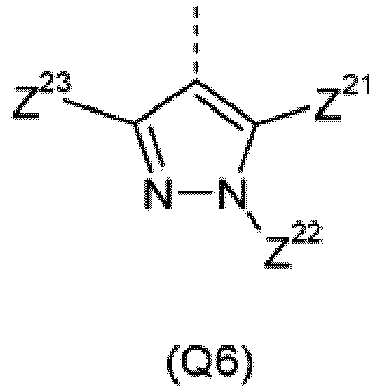 dans laquelle :Z21 et Z23 sont indépendamment choisis dans le groupe constitué par hydrogène, alkyle en C1 à C4, halogénoalkyle en C1 à C4 ayant 1 à 5 atomes d'halogène, etZ22 est choisi dans le groupe constitué par hydrogène, alkyle en C1 à C4, halogénoalkyle en C1 à C4 ayant 1 à 5 atomes d'halogène, alkyl en C1 à C4-cycloalkyle en C3 à C6, alcoxy en C1 à C4-alkyle en -C1 à C4, (alkyl en C1 à C4)2-N-alkyle en C1 à C4, morpholino-alkyle en C1 à C4, (alkyl en C1 à C4)-NH-alkyle en C1 à C4, ouQ est un cycle pyrazole de la formule (Q7)
 dans laquelle :Z24, Z25 et Z26 sont indépendamment choisis dans le groupe constitué par hydrogène, fluor, chlore, brome, cyano, alkyle en C1 à C4, halogénoalkyle en C1 à C4 ayant 1 à 5 atomes d'halogène, alcoxy en C1 à C4, halogénoalcoxy en C1 à C4 ayant 1 à 5 atomes d'halogène,ou un stéréo-isomère, un tautomère, un N-oxyde, un hydrate, un solvate, ou un sel de celui-ci, ou un mélange de ces derniers.
 - Composé selon la revendication 1, 2 ou 3, dans lequel :O vaut 0 ou 1,R est choisi dans le groupe constitué par hydrogène, fluor, chlore, alkyle en C1 à C4,n vaut 0 ou 1,X, Y sont indépendamment choisis dans le groupe constitué par CH2 et O, au moins l'un parmi X et Y étant CH2,R1 est hydrogène,R2 est choisi dans le groupe constitué par hydrogène, alkyle en C1 à C4, cycloalkyle en C3 à C6, fluoroalkyle en C1 à C4 ayant 1 à 5 atomes de fluor, alcoxy en C1 à C4-alkyle en C1 à C4, benzyle ayant 1 à 5 atomes d'halogène, alcoxy en C1 à C4, NH(alkyle en C1 à C4), N(alkyle en C1 à C4)2, -NH(cycloalkyle en C3 à C6), -N(alkyl en C1 à C4)(cycloalkyle en C3 à C6), -N(alkyle en C1 à C4)(hétérocycloalkyle de 6 chaînons), -N(alkyl en C1 à C4)(alcoxy en C1 à C4), morpholino facultativement substitué par 1 à 2 groupes alkyle en C1 à C4, alkyl en C1 à C4-N(alkyle en C1 à C4)2, chaque alkyle en C1 à C4 dans R2 pouvant être facultativement substitué par halogène,-N(alkyle en C1 à C4)2, alcoxy en C1 à C4 qui lui-même peut être substitué par alcoxy en C1 à C2 à substitution alcoxy en C1 à C2, -S-alkyle en C1 à C4, -S(O)-alkyle en C1 à C4, -SO2-alkyle en C1 à C4, ou facultativement substitué par un hétérocycle monocyclique choisi dans le groupe d'hétérocycloalkyle de 4 à 7 chaînons, qui lui-même peut être substitué par méthyle ou oxo,R3 est choisi dans le groupe constitué par hydrogène et alkyle en C1 à C4,R4 est choisi dans le groupe constitué par hydrogène, halogène, alkyle en C1 à C4, halogénoalkyle en C1 à C4 ayant 1 à 5 atomes d'halogène, cycloalkyle en C3 à C6, -S-alkyle en C1 à C4, -S(O)-alkyle en C1 à C4, -SO2-alkyle en C1 à C4, etQ est un cycle phényle substitué de la formule (Q1)
 dans laquelle :Z1, Z2, Z3, Z4 et Z5 sont indépendamment choisis dans le groupe constitué par hydrogène, fluor, chlore, brome, cyano, méthyle, propyle, difluorométhyle, trifluorométhyle, hydroxy, méthoxy, éthoxy, isopropoxy, -O-cyclopropyle, -OCH2-cyclopropyle, -OCH2CN, trifluorométhoxy, difluorométhoxy, trifluoroéthoxy, méthylamino, diméthylamino, méthyléthylamino, diéthylamino, acétylamino, méthylsulfonamide, trifluoroacétylamino, -SO2Mé, -SO2-cyclopropyle, -CH2-O-méthyle, -CH2-O-éthyle, -CH2-O-CH2-cyclopropyle, -CH2-O-isopropyle, -CH2-N(CH3)2, -CH2-N(CH2CH3)2, -CH2-N(CH3)(CH2CH3), -CH2-SCH3, -CH2-S(O)CH3, -CH2-SO2-CH3, -C(O)NH-cyclopropyle, et

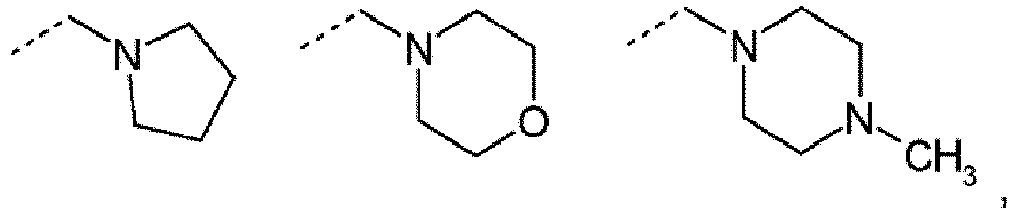 Z1 et Z2 forment, conjointement avec les atomes de carbone auxquels ils sont reliés, un hétérocycloalkyle de 5 chaînons ou un hétéroaryle de 5 chaînons, dont chacun peut être éventuellement substitué par un ou deux substituants choisis dans le groupe constitué par méthyle, fluor et oxo, etZ3, Z4 et Z5 sont indépendamment choisis dans le groupe constitué par hydrogène, fluor, chlore, brome, cyano, méthyle, propyle, difluorométhyle, trifluorométhyle, hydroxy, méthoxy, éthoxy, isopropoxy, -O-cyclopropyle, -OCH2-cyclopropyle, -OCH2CN, trifluorométhoxy, difluorométhoxy, trifluoroéthoxy, méthylamino, diméthylamino, méthyléthylamino, diéthylamino, acétylamino, méthylsulfonamide, trifluoroacétylamino, -SO2Mé, -SO2-cyclopropyle, -CH2-O-méthyle, -CH2-O-éthyle, -CH2-O-CH2-cyclopropyle, -CH2-O-isopropyle, -CH2-N(CH3)2, -CH2-N(CH2CH3)2, -CH2-N(CH3)(CH2CH3), -CH2-SCH3, -CH2-S(O)CH3, -CH2-SO2-CH3, -C(O)NH-cyclopropyle, et

 Z2 et Z3 forment, conjointement avec les atomes de carbone auxquels ils sont reliés, un cycloalkyle ou hétérocycloalkyle de 5 chaînons ou un hétéroaryle de 5 chaînons, dont chacun peut être éventuellement substitué par un ou deux substituants choisis dans le groupe constitué par méthyle, fluor et oxo, etZ1, Z4 et Z5 sont indépendamment choisis dans le groupe constitué par hydrogène, fluor, chlore, brome, cyano, méthyle, propyle, difluorométhyle, trifluorométhyle, hydroxy, méthoxy, éthoxy, isopropoxy, -O-cyclopropyle, -OCH2-cyclopropyle, -OCH2CN, trifluorométhoxy, difluorométhoxy, trifluoroéthoxy, méthylamino, diméthylamino, méthyléthylamino, diéthylamino, acétylamino, méthylsulfonamide, trifluoroacétylamino, -SO2Mé, -SO2-cyclopropyle, -CH2-O-méthyle, -CH2-O-éthyle, -CH2-O-CH2-cyclopropyle, -CH2-O-isopropyle, -CH2-N(CH3)2, -CH2-N(CH2CH3)2, -CH2-N(CH3)(CH2CH3), -CH2-SCH3, -CH2-S(O)CH3, -CH2-SO2-CH3, -C(O)NH-cyclopropyle, et

 Q est un cycle pyridine de la formule (Q2)
 dans laquelle :Z6, Z7, Z8 et Z9 sont indépendamment choisis dans le groupe constitué par hydrogène, fluor ou chlore, ouQ est un cycle pyrimidine de la formule (Q3)
 dans laquelle :Z10, Z11 et Z12 sont indépendamment choisis dans le groupe constitué par hydrogène, fluor, chlore, alkyle en C1 à C4, ouQ est un cycle pyridine de la formule (Q4)
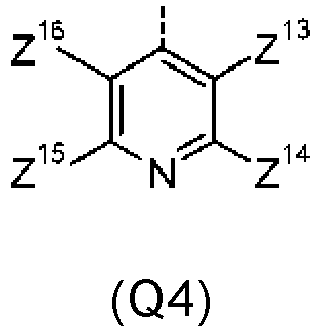 dans laquelle :Z13, Z14, Z15 et Z16 sont indépendamment choisis dans le groupe constitué par hydrogène, fluor, chlore, alkyle en C1 à C4, NH2, -NH(alkyle en C1 à C4), -N(alkyle en C1 à C4)2, -NH-CO-alkyle en C1 à C4, et morpholino, pyrazoles, triazoles, imidazoles et pyrroles, un cycle hétéroaryle étantrelié au cycle pyridine par l'intermédiaire de l'un de ses atomes d'azote, dont chacun est éventuellement substitué par 1, 2 ou 3 substituants indépendamment choisis dans le groupe constitué par hydrogène, halogène, cyano, alkyle en C1 à C4, halogénoalkyle en C1 à C4 ayant 1 à 5 atomes d'halogène, ouQ est un cycle pyridine de la formule (Q5)
 dans laquelle :Z17, Z18, Z19 et Z20 sont indépendamment choisis dans le groupe constitué par hydrogène, fluor, chlore, alkyle en C1 à C4, halogénoalkyle en C1 à C4 ayant 1 à 5 atomes d'halogène, alcoxy en C1 à C4, halogénoalcoxy en C1 à C4 ayant 1 à 5 atomes d'halogène, ouQ un cycle pyrazole de la formule (Q6)
 dans laquelle :Z21 et Z23 sont hydrogène, etZ22 est choisi dans le groupe constitué par hydrogène, alkyle en C1 à C4, halogénoalkyle en C1 à C4 ayant 1 à 5 atomes d'halogène, alkyl en C1 à C4-cycloalkyle en C3 à C6, alcoxy en C1 à C4-alkyle en C1 à C4, alkyl en C1 à C4-N(alkyle en C1 à C4)2, morpholino-alkyle en C1 à C4, ouQ est un cycle pyrazole de la formule (Q7)
 dans laquelle :Z24, Z25 et Z26 sont indépendamment choisis dans le groupe constitué par hydrogène, fluor, chlore, cyano, méthyle, trifluorométhyle,ou un stéréo-isomère, un tautomère, un N-oxyde, un hydrate, un solvate, ou un sel de celui-ci, ou un mélange de ces derniers.
 - Composé selon la revendication 1, 2, 3 ou 4, dans lequel :o vaut 0 ou 1,R est choisi dans le groupe constitué par hydrogène, fluor, chlore, méthyle,n vaut 0 ou 1,X est choisi dans le groupe constitué par CH2 et O,Y est CH2,R1 est hydrogène,R2 est choisi dans le groupe constitué par hydrogène, méthyle, éthyle, isopropyle, isobutyle, sec-butyle, cyclopropyle, méthoxyméthyl, difluorométhyle, trifluorométhyle, 4-fluorobenzyle, méthoxy, méthylamino, diméthylamino, cyclopropylamino, - N(CH3)(cyclopropyle), -N(CH3)(CH2-N(CH3)2), -N(CH3)(CH2-CHF2), - N(CH3)((CH2)2O(CH2)2)O(CH2) 2)OCH3), -N(CH3)((CH2)2-S-CH3), -N(CH3)((CH2)2-S(O)-CH3), -N(CH3)((CH2)2-SO2-CH3), -N(CH3)(1-méthyl-pipéridin-4-yle), - N(CH3)((CH2)2-(oxopyrrolidin-1-yle)), morpholino, CH2-N(CH3)2,R3 est choisi dans le groupe constitué par hydrogène et méthyle,R4 est choisi dans le groupe constitué par hydrogène, chlore, méthyle, cyclopropyle, difluorométhyle, trifluorométhyle, -S-méthyle, -S-éthyle, -S-isopropyle, -S(O)2-méthyle, -S(O)2-éthyle, -S(O)2-isopropyle, etQ est un cycle phényle substitué de la formule (Q1)
 Z1, Z2, Z3, Z4 et Z5 sont indépendamment choisis dans le groupe constitué par hydrogène, fluor, chlore, brome, cyano, méthyle, propyle, difluorométhyle, trifluorométhyle, hydroxy, méthoxy, éthoxy, isopropoxy, -O-cyclopropyle, -OCH2-cyclopropyle, -OCH2CN, trifluorométhoxy, difluorométhoxy, trifluoroéthoxy, méthylamino, diméthylamino, méthyléthylamino, diéthylamino, acétylamino, méthylsulfonamide, trifluoroacétylamino, -SO2Mé, -SO2-cyclopropyle, -CH2-O-méthyle, -CH2-O-éthyle, -CH2-O-CH2-cyclopropyle, -CH2-O-isopropyle, -CH2-N(CH3)2, -CH2-N(CH2CH3)2, -CH2-N(CH3)(CH2CH3), -CH2-SCH3, -CH2-S(O)CH3, -CH2-SO2-CH3, -C(O)NH-cyclopropyle, et

 au moins deux parmi Z1, Z2, Z3, Z4 et Z5 étant hydrogène, ouQ est un cycle pyridine de la formule (Q2)
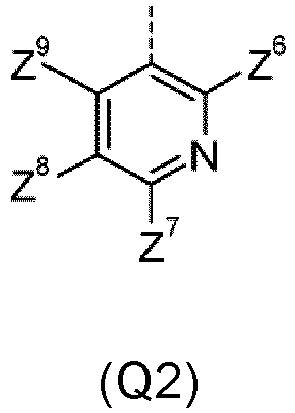 dans laquelle :Z6 est hydrogène,Z7, Z8 sont indépendamment choisis dans le groupe constitué par hydrogène, fluor, chlore, etZ9 est choisi dans le groupe constitué par hydrogène et chlore, ouQ est un cycle pyrimidine de la formule (Q3)
 dans laquelle :Z10 et Z12 sont hydrogène, etZ11 est choisi dans le groupe constitué par hydrogène et chlore, ouQ est un cycle pyridine de la formule (Q4)
 dans laquelle :Z13, Z15, et Z16 sont hydrogène, etZ14 est choisi dans le groupe constitué par hydrogène et chlore, NH2, -NH-CO-alkyle en C1 à C4, -NH(alkyle en C1 à C4), -N(alkyle en C1 à C4)2, morpholino, ouQ est un cycle pyridine de la formule (Q5)
 dans laquelle :Z17 est choisi dans le groupe constitué par fluor, chlore, méthoxy, trifluorométhyle,Z18 et Z20 sont choisis dans le groupe constitué par hydrogène et chlore,Z19 est hydrogène, ouQ un cycle pyrazole de la formule (Q6)
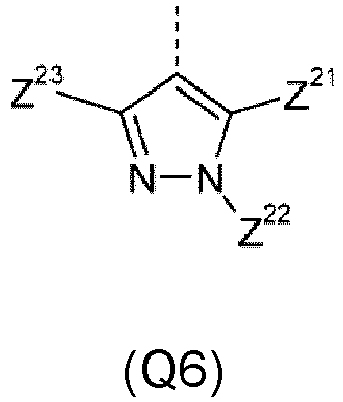 dans laquelle :Z21 et Z23 sont hydrogène, etZ22 est choisi dans le groupe constitué par hydrogène, méthyle, éthyle, isopropyle, méthoxyéthyle, -CH2-cyclopropyle, -CH2CF3, -CH2CHF2, -CH2-morpholino, -CH2-CH2-N(CH3)2, et/ou -CH2-CH2-morpholino, ouQ est un cycle pyrazole de la formule (Q7)
 dans laquelle :Z24 et Z26 sont hydrogène, etZ25 est choisi dans le groupe constitué par hydrogène et chlore, ouQ est choisi dans le groupe constitué par


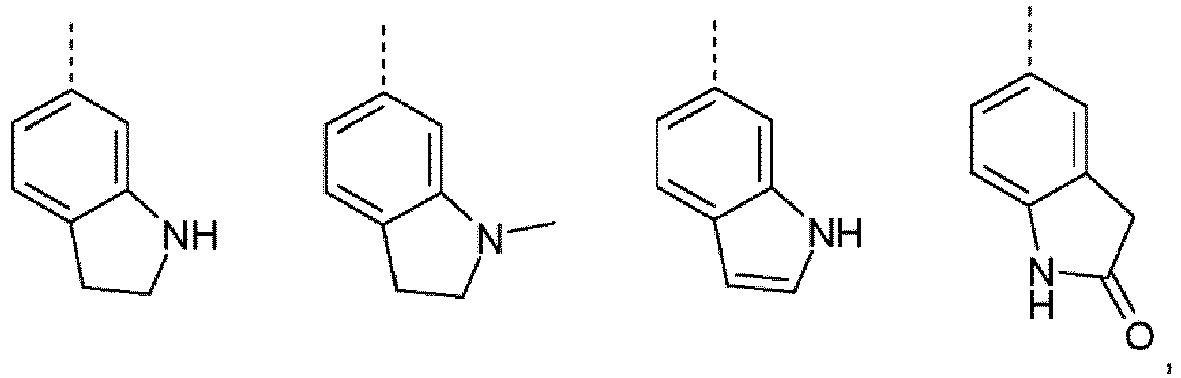 ou un stéréo-isomère, un tautomère, un N-oxyde, un hydrate, un solvate, ou un sel de celui-ci, ou un mélange de ces derniers.
 - Composé selon la revendication 1, 2, 3, 4 ou 5, dans lequel :o vaut 0 ou 1,R est choisi dans le groupe constitué par hydrogène, fluor, chlore, méthyle,n vaut 0 ou 1,X est choisi dans le groupe constitué par CH2 et O,Y est CH2,R1 est hydrogène,R2 est choisi dans le groupe constitué par hydrogène, méthyle, éthyle, isopropyle, isobutyle, sec-butyle, cyclopropyle, méthoxyméthyl, difluorométhyle, trifluorométhyle, 4-fluorobenzyle, méthoxy, méthylamino, diméthylamino, cyclopropylamino, -N(CH3)(cyclopropyle), -N(CH3)(CH2-N(CH3)2), -N(CH3)(CH2-CHF2), -N(CH3)((CH2)2O(CH2)2)O(CH2) 2)OCH3), -N(CH3)((CH2)2-S-CH3), - N(CH3)((CH2)2-S(O)-CH3), -N(CH3)((CH2)2-SO2-CH3), -N(CH3)(1-méthyl-pipéridin-4-yle), -N(CH3)((CH2)2-(oxopyrrolidin-1-yle)), morpholino, CH2-N(CH3)2,R3 est choisi dans le groupe constitué par hydrogène et méthyle,R4 est choisi dans le groupe constitué par hydrogène, chlore, méthyle, cyclopropyle, difluorométhyle, trifluorométhyle, -S-méthyle, -S-éthyle, -S-isopropyle, - S(O)2-méthyle, -S(O)2-éthyle, -S(O)2-isopropyle, etQ est un cycle phényle substitué de la formule (Q1)
dans laquelle : Z1, Z2, Z3, Z4 et Z5 sont indépendamment choisis dans le groupe constitué par hydrogène, fluor, chlore, brome, cyano, méthyle, propyle, difluorométhyle, trifluorométhyle, hydroxy, méthoxy, éthoxy, isopropoxy, -O-cyclopropyle, -OCH2-cyclopropyle, -OCH2CN, trifluorométhoxy, difluorométhoxy, trifluoroéthoxy, méthylamino, diméthylamino, méthyléthylamino, diéthylamino, acétylamino, méthylsulfonamide, trifluoroacétylamino, -SO2Mé, -SO2-cyclopropyle, -CH2-O-méthyle, -CH2-O-éthyle, -CH2-O-CH2-cyclopropyle, -CH2-O-isopropyle, -CH2-N(CH3)2, -CH2-N(CH2CH3)2, -CH2-N(CH3)(CH2CH3), -CH2-SCH3, -CH2-S(O)CH3, -CH2-SO2-CH3, -C(O)NH-cyclopropyle, et

 au moins deux parmi Z1, Z2, Z3, Z4 et Z5 étant hydrogène, ouQ est choisi dans le groupe constitué par
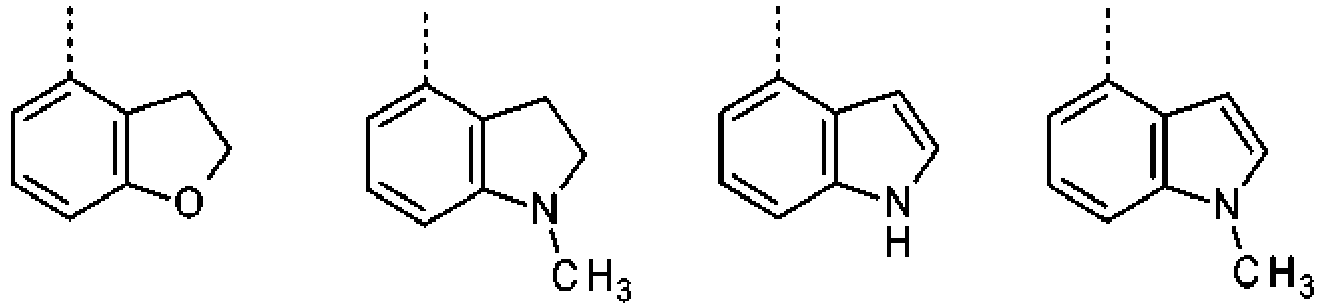

 ou un stéréo-isomère, un tautomère, un N-oxyde, un hydrate, un solvate, ou un sel de celui-ci, ou un mélange de ces derniers.
 - Procédé de préparation d'un composé de formule générale (I) selon l'une quelconque des revendications 1 à 6, ledit procédé comprenant l'étape consistant à permettre à un composé intermédiaire de formule générale 1F :
 dans laquelle R0, R1, R2, R3, R4, X, Y, o et n sont tels que définis pour le composé de formule générale (I) selon l'une quelconque des revendications 1 à 6,de réagir avec un composé de formule générale 1H :
Q-B(OR)2 1H,
dans laquelle Q est tel que défini pour le composé de formule générale (I) selon l'une quelconque des revendications 1 à 6, et chaque R peut être individuellement H ou Mé ou l'un et l'autre des R sont pinacolate,ce qui donne un composé de formule générale (I) : dans laquelle Q, R0, R1, R2, R3, R4, X, Y, o et n sont tels que définis pour le composé de formule générale (I) selon l'une quelconque des revendications 1 à 6,ou l'étape consistant à permettre à un composé intermédiaire de formule générale 2E :
 dans laquelle Q, R2, R3 et R4 sont tels que définis pour le composé de formule générale (I) selon l'une quelconque des revendications 1 à 6,
 de réagir avec un composé de formule générale 1G :dans laquelle R, R1, X, Y, o et n sont tels que définis pour le composé de formule générale (I) selon l'une quelconque des revendications 1 à 6,ce qui donne un composé de formule générale (I) :
 dans laquelle Q, R0, R1, R2, R3, R4, X, Y, o et n sont tels que définis pour le composé de formule générale (I) selon l'une quelconque des revendications 1 à 6.
 - Composé selon la revendication 1 de formule générale (II) :
 o vaut 0 ou 1,R est choisi dans le groupe constitué par hydrogène, fluor, chlore, méthyle,n vaut 0 ou 1,X est choisi dans le groupe constitué par CH2 et O,Y est CH2,R1 est hydrogène,R2 est choisi dans le groupe constitué par hydrogène, méthyle, éthyle, isopropyle, isobutyle, sec-butyle, cyclopropyle, méthoxyméthyle, difluorométhyle, trifluorométhyle, 4-fluorobenzyle, méthoxy, méthylamino, diméthylamino, cyclopropylamino, -N(CH3)(cyclopropyle), -N(CH3)(CH2-N(CH3)2), -N(CH3)(CH2-CHF2), -N(CH3)((CH2)2O(CH2)2)O(CH2) 2)OCH3), -N(CH3)((CH2)2-S-CH3), - N(CH3)((CH2)2-S(O)-CH3), -N(CH3)((CH2)2-SO2-CH3), -N(CH3)(1-méthyl-pipéridin-4-yle), -N(CH3)((CH2)2-(oxopyrrolidin-1-yle)), morpholino, CH2-N(CH3)2,R3 est choisi dans le groupe constitué par hydrogène et méthyle,R4 est choisi dans le groupe constitué par hydrogène, chlore, méthyle, cyclopropyle, difluorométhyle, trifluorométhyle, -S-méthyle, -S-éthyle, -S-isopropyle, - S(O)2-méthyle, -S(O)2-éthyle, -S(O)2-isopropyle, etQ est un cycle phényle substitué de la formule (Q1)
 dans laquelle :Z1, Z2, Z3, Z4 et Z5 sont indépendamment choisis dans le groupe constitué par hydrogène, fluor, chlore, brome, cyano, méthyle, propyle, difluorométhyle, trifluorométhyle, hydroxy, méthoxy, éthoxy, isopropoxy, -O-cyclopropyle, -OCH2-cyclopropyle, -OCH2CN, trifluorométhoxy, difluorométhoxy, trifluoroéthoxy, méthylamino, diméthylamino, méthyléthylamino, diéthylamino, acétylamino, méthylsulfonamide, trifluoroacétylamino, -SO2Mé, -SO2-cyclopropyle, -CH2-O-méthyle, -CH2-O-éthyle, -CH2-O-CH2-cyclopropyle, -CH2-O-isopropyle, -CH2-N(CH3)2, -CH2-N(CH2CH3)2, -CH2-N(CH3)(CH2CH3), -CH2-SCH3, -CH2-S(O)CH3, -CH2-SO2-CH3, -C(O)NH-cyclopropyle, et

 au moins deux parmi Z1, Z2, Z3, Z4 et Z5 étant hydrogène, ouQ un cycle pyridine de la formule (Q2)
 dans laquelle :Z6 est hydrogène,Z7, Z8 sont indépendamment choisis dans le groupe constitué par hydrogène, fluor,chlore, etZ9 est choisi dans le groupe constitué par hydrogène et chlore, ouQ est un cycle pyrimidine de la formule (Q3)
 dans laquelle :Z10 et Z12 sont hydrogène, etZ11 est choisi dans le groupe constitué par hydrogène et chlore, ouQ est un cycle pyridine de la formule (Q4)
 dans laquelle :Z13, Z15, et Z16 sont hydrogène, etZ14 est choisi dans le groupe constitué par hydrogène et chlore, NH2, -NH-CO-alkyle en C1 à C4, -NH(alkyle en C1 à C4), -N(alkyle en C1 à C4)2, morpholino, ouQ est un cycle pyridine de la formule (Q5)
 dans laquelle :Z17 est choisi dans le groupe constitué par fluor, chlore, méthoxy, trifluorométhyle,Z18 et Z20 sont choisis dans le groupe constitué par hydrogène et chlore,Z19 est hydrogène, ou
 Q un cycle pyrazole de la formule (Q6)dans laquelle :Z21 et Z23 sont hydrogène, etZ22 est choisi dans le groupe constitué par hydrogène, méthyle, éthyle, isopropyle, méthoxyéthyle, -CH2-cyclopropyle, -CH2CF3, -CH2CHF2, -CH2-morpholino, -CH2-CH2-N(CH3)2, et/ou -CH2-CH2-morpholino, ouQ est un cycle pyrazole de la formule (Q7)
 dans laquelle :Z24 et Z26 sont hydrogène, etZ25 est choisi dans le groupe constitué par hydrogène et chlore, ouQ est choisi dans le groupe constitué par


 ou un stéréo-isomère, un tautomère, un N-oxyde, un hydrate, un solvate, ou un sel de celui-ci, ou un mélange de ces derniers.
 - Composition pharmaceutique comprenant un composé de formule générale (I) selon l'une quelconque des revendications 1 à 6, ou un composé de formule générale (II) selon la revendication 8, et un ou plusieurs excipients acceptables sur le plan pharmaceutique.
- Composé de formule générale (I), composé de formule générale (II) selon la revendication 8, ou composition pharmaceutique selon la revendication 9 pour utilisation dans le contrôle, le traitement et/ou la prévention d'une maladie, la maladie étant une infection helminthique.
- Composé de formule générale (I), composé de formule générale (II) selon la revendication 8 ou composition pharmaceutique selon la revendication 9 pour utilisation dans un procédé de contrôle d'infections helminthiques chez des humains et/ou des animaux en administrant une quantité efficace sur le plan anthelminthique d'au moins un composé tel que défini dans l'une quelconque des revendications 1 à 6, ou tel que défini dans la revendication 8, ou d'une composition pharmaceutique telle que définie dans la revendication 9.
Applications Claiming Priority (2)
| Application Number | Priority Date | Filing Date | Title |
|---|---|---|---|
| EP16165572 | 2016-04-15 | ||
| PCT/EP2017/058519 WO2017178416A1 (fr) | 2016-04-15 | 2017-04-10 | Dérivés de pyrazolopyrimidine |
Publications (4)
| Publication Number | Publication Date |
|---|---|
| EP3442974A1 EP3442974A1 (fr) | 2019-02-20 |
| EP3442974B1 true EP3442974B1 (fr) | 2023-06-07 |
| EP3442974C0 EP3442974C0 (fr) | 2023-06-07 |
| EP3442974B8 EP3442974B8 (fr) | 2023-07-12 |
Family
ID=55755480
Family Applications (1)
| Application Number | Title | Priority Date | Filing Date |
|---|---|---|---|
| EP17715204.8A Active EP3442974B8 (fr) | 2016-04-15 | 2017-04-10 | Dérivés de pyrazolopyrimidine |
Country Status (22)
| Country | Link |
|---|---|
| US (3) | US10604525B2 (fr) |
| EP (1) | EP3442974B8 (fr) |
| JP (1) | JP7051703B2 (fr) |
| KR (1) | KR102467347B1 (fr) |
| CN (1) | CN109071545B (fr) |
| AR (1) | AR108130A1 (fr) |
| AU (1) | AU2017251155B2 (fr) |
| CA (1) | CA3020793C (fr) |
| CL (1) | CL2018002920A1 (fr) |
| CO (1) | CO2018010966A2 (fr) |
| DO (1) | DOP2018000226A (fr) |
| ES (1) | ES2953467T3 (fr) |
| IL (1) | IL261885A (fr) |
| MX (1) | MX389697B (fr) |
| PH (1) | PH12018550173A1 (fr) |
| PL (1) | PL3442974T3 (fr) |
| RU (1) | RU2769448C2 (fr) |
| SG (1) | SG11201808214TA (fr) |
| TW (1) | TWI742067B (fr) |
| UY (1) | UY37201A (fr) |
| WO (1) | WO2017178416A1 (fr) |
| ZA (1) | ZA201807656B (fr) |
Families Citing this family (30)
| Publication number | Priority date | Publication date | Assignee | Title |
|---|---|---|---|---|
| WO2016022066A1 (fr) | 2014-08-04 | 2016-02-11 | Jerry Tan Eye Surgery Pte Ltd | Compositions pharmaceutiques pour blépharite et encroûtement des paupières liés à demodex |
| PT3442972T (pt) | 2016-04-15 | 2020-05-29 | Abbvie Inc | Inibidores de bromodomínio |
| AU2017251155B2 (en) | 2016-04-15 | 2021-08-05 | Elanco Animal Health Gmbh | Pyrazolopyrimidine derivatives |
| CN110621316B (zh) | 2017-04-21 | 2024-01-26 | Epizyme股份有限公司 | 用ehmt2抑制剂进行的组合疗法 |
| KR102596307B1 (ko) | 2017-04-27 | 2023-10-30 | 바이엘 애니멀 헬스 게엠베하 | 새로운 비시클릭 피라졸 유도체 |
| SG11202002218VA (en) | 2017-09-15 | 2020-04-29 | Aduro Biotech Inc | Pyrazolopyrimidinone compounds and uses thereof |
| AU2018385766B2 (en) | 2017-12-15 | 2022-12-01 | Tarsus Pharmaceuticals, Inc. | Isoxazoline parasiticide formulations and methods for treating blepharitis |
| US11572357B2 (en) | 2018-05-09 | 2023-02-07 | Bayer Animal Health Gmbh | Quinoline derivatives |
| US12269822B2 (en) | 2018-07-09 | 2025-04-08 | Boehringer Ingelheim Animal Health USA Inc. | Anthelminthic heterocyclic compounds |
| EP3643711A1 (fr) | 2018-10-24 | 2020-04-29 | Bayer Animal Health GmbH | Nouveaux composés anthelminthiques |
| US20220064159A1 (en) | 2018-12-18 | 2022-03-03 | Elanco Tiergesundheit Ag | Bicyclic derivatives |
| MX2021007538A (es) * | 2018-12-18 | 2021-10-13 | Elanco Tiergesundheit Ag | Derivados biciclicos. |
| MX2021011302A (es) * | 2019-03-19 | 2022-01-19 | Boehringer Ingelheim Animal Health Usa Inc | Compuestos de aza-benzotiofeno y aza-benzofurano como antihelminticos. |
| US12502377B2 (en) | 2019-04-04 | 2025-12-23 | Tarsus Pharmaceuticals, Inc. | Method of eradicating ticks that attach to humans using lotilaner formulations |
| US12448391B2 (en) | 2019-06-07 | 2025-10-21 | Elanco Tiergesundheit Ag | Bicyclic derivatives for treating endoparasites |
| TWI865563B (zh) * | 2019-07-30 | 2024-12-11 | 德商拜耳動物保健有限公司 | 新穎異喹啉衍生物 |
| EP4077281A1 (fr) * | 2019-12-18 | 2022-10-26 | Intervet International B.V. | Composés anthelminthiques comprenant une structure de quinoléine |
| BR112022012130A2 (pt) * | 2019-12-18 | 2022-08-30 | Intervet Int Bv | Compostos antelmínticos compreendendo uma estrutura azaindólica |
| KR20230028268A (ko) | 2020-05-29 | 2023-02-28 | 뵈링거 잉겔하임 애니멀 헬스 유에스에이 인코포레이티드 | 구충성 헤테로시클릭 화합물 |
| CN116685584A (zh) * | 2020-11-18 | 2023-09-01 | 礼蓝动物保健有限公司 | 用于治疗心丝虫感染的n-(2,3-二氢-1,4-苯并噁嗪-4-基)-3-异丙基-7-(2,3,5-三氟苯基)苯并噻吩-2-甲酰胺衍生物和类似化合物 |
| WO2022106469A2 (fr) | 2020-11-18 | 2022-05-27 | Elanco Tiergesundheit Ag | Dérivés de n-(2,3-dihydro-1,4-benzoxazin-4-yl)-3-isopropyl-7-(2,3,5-trifluorophényl)benzo-thiophène-2-carboxamide et composés similaires pour le traitement d'infections par le ver du cœur |
| TW202237600A (zh) | 2020-12-04 | 2022-10-01 | 瑞士商禮藍動物保健股份有限公司 | 雙環衍生物 |
| CN116600807A (zh) * | 2020-12-11 | 2023-08-15 | 英特维特国际股份有限公司 | 包含噻吩并吡啶结构的驱虫化合物 |
| CN113252824B (zh) * | 2021-06-17 | 2022-04-19 | 湖南农业大学 | 测定水体中三氟苯嘧啶含量的气相色谱-电子捕获检测器法 |
| KR102660894B1 (ko) * | 2021-09-17 | 2024-04-26 | 기초과학연구원 | 피리미딘-2-아민 화합물의 제조방법 |
| US11999742B2 (en) | 2021-11-01 | 2024-06-04 | Boehringer Ingelheim Vetmedica Gmbh | Substituted pyrrolo[1,2-b]pyridazines as anthelmintics |
| WO2024213752A1 (fr) | 2023-04-14 | 2024-10-17 | Elanco Animal Health Gmbh | Prévention et/ou traitement à long terme d'une maladie par des inhibiteurs de slo-1 |
| CN121620507A (zh) | 2023-08-02 | 2026-03-06 | 英特维特国际股份有限公司 | 具有驱虫活性的甲酰胺-4-喹啉化合物 |
| CN119139315B (zh) * | 2024-09-23 | 2026-03-10 | 大连大学 | D724-0491在制备治疗乳腺癌药物中的应用 |
| WO2026078157A2 (fr) | 2024-10-10 | 2026-04-16 | Elanco Animal Health Gmbh | Modulateurs de slo-1 pour la prévention et/ou le traitement d'une maladie |
Family Cites Families (40)
| Publication number | Priority date | Publication date | Assignee | Title |
|---|---|---|---|---|
| MY125533A (en) * | 1999-12-06 | 2006-08-30 | Bristol Myers Squibb Co | Heterocyclic dihydropyrimidine compounds |
| RU15525U1 (ru) | 2000-07-04 | 2000-10-20 | Федеральный научно-производственный центр закрытое акционерное общество "Научно-производственный концерн (объединение) "ЭНЕРГИЯ" | Электродвигатель постоянного тока |
| US7662826B2 (en) * | 2002-04-23 | 2010-02-16 | Shionogi & Co., Ltd. | Pyrazolo [1,5-a] pyrimidine derivative and nad (p) h oxidase inhibitor containing the same |
| GB0213715D0 (en) | 2002-06-14 | 2002-07-24 | Syngenta Ltd | Chemical compounds |
| TWI312272B (en) | 2003-05-12 | 2009-07-21 | Sumitomo Chemical Co | Pyrimidine compound and pests controlling composition containing the same |
| EA009517B1 (ru) * | 2003-06-27 | 2008-02-28 | Байер Кропсайенс Аг | Пиразолопиримидины |
| ATE388138T1 (de) | 2003-06-27 | 2008-03-15 | Bayer Cropscience Ag | Pyrazolopyrimidine |
| GB0414438D0 (en) | 2004-06-28 | 2004-07-28 | Syngenta Participations Ag | Chemical compounds |
| JP4970950B2 (ja) | 2004-10-20 | 2012-07-11 | クミアイ化学工業株式会社 | 3−トリアゾリルフェニルスルフィド誘導体及びそれを有効成分として含有する殺虫・殺ダニ・殺線虫剤 |
| MY141762A (en) | 2005-10-06 | 2010-06-30 | Nippon Soda Co | Cross-linked cyclic amine compounds and agents for pest control |
| EP1918291A1 (fr) * | 2006-10-30 | 2008-05-07 | Novartis AG | Dérives de pyrazole fusionnes substitués de 3-aminocarbonyle comme modulateurs de protéine kinase |
| CA2670083A1 (fr) * | 2006-11-20 | 2008-05-29 | Alantos Pharmaceuticals Holding, Inc. | Inhibiteurs de metalloprotease heterobicycliques |
| KR20100087298A (ko) | 2007-09-28 | 2010-08-04 | 교와 핫꼬 기린 가부시키가이샤 | 피부 질환의 예방 및/또는 치료제 |
| JP5268461B2 (ja) | 2008-07-14 | 2013-08-21 | Meiji Seikaファルマ株式会社 | Pf1364物質、その製造方法、生産菌株、及び、それを有効成分とする農園芸用殺虫剤 |
| CN101337937B (zh) | 2008-08-12 | 2010-12-22 | 国家农药创制工程技术研究中心 | 具有杀虫活性的n-苯基-5-取代氨基吡唑类化合物 |
| CN101337940B (zh) | 2008-08-12 | 2012-05-02 | 国家农药创制工程技术研究中心 | 具杀虫活性的含氮杂环二氯烯丙醚类化合物 |
| CN101715774A (zh) | 2008-10-09 | 2010-06-02 | 浙江化工科技集团有限公司 | 一个具有杀虫活性化合物制备及用途 |
| EP2184273A1 (fr) | 2008-11-05 | 2010-05-12 | Bayer CropScience AG | Composés substitués par l'halogène comme pesticides |
| GB0820344D0 (en) | 2008-11-06 | 2008-12-17 | Syngenta Ltd | Herbicidal compositions |
| US8007468B2 (en) | 2009-07-13 | 2011-08-30 | Navilyst Medical, Inc. | Method to secure an elastic component in a valve |
| WO2011085575A1 (fr) | 2010-01-15 | 2011-07-21 | 江苏省农药研究所股份有限公司 | Composés de formanilide hétérocyclique, leurs procédés de synthèse et leur utilisation |
| PH12013500237A1 (en) | 2010-08-31 | 2013-03-11 | Mitsui Chemicals Crop & Life Solutions Inc | Pest control agent |
| CN101967139B (zh) | 2010-09-14 | 2013-06-05 | 中化蓝天集团有限公司 | 一种含一氟甲氧基吡唑的邻甲酰氨基苯甲酰胺类化合物、其合成方法及应用 |
| US8791162B2 (en) | 2011-02-14 | 2014-07-29 | Merck Sharp & Dohme Corp. | Cathepsin cysteine protease inhibitors |
| WO2013050317A1 (fr) | 2011-10-03 | 2013-04-11 | Syngenta Limited | Formes polymorphes d'un dérivé d'isoxazoline |
| CN102391261A (zh) | 2011-10-14 | 2012-03-28 | 上海交通大学 | 一种n-取代噁二嗪类化合物及其制备方法和应用 |
| CN104202981B (zh) | 2012-03-30 | 2018-01-30 | 巴斯夫欧洲公司 | 防治动物害虫的n‑取代的吡啶亚基化合物和衍生物 |
| EP2647626A1 (fr) | 2012-04-03 | 2013-10-09 | Syngenta Participations AG. | Dérivés de 1-aza-spiro[4.5]déc-3-ène and 1,8-diaza-spiro[4.5]déc-3-ène en tant que pesticides |
| CN104822266B (zh) | 2012-04-27 | 2017-12-05 | 陶氏益农公司 | 杀虫组合物和与其相关的方法 |
| US9282739B2 (en) | 2012-04-27 | 2016-03-15 | Dow Agrosciences Llc | Pesticidal compositions and processes related thereto |
| WO2014070978A1 (fr) | 2012-11-03 | 2014-05-08 | Boehringer Ingelheim International Gmbh | Inhibiteurs de cytomégalovirus |
| CN103232431B (zh) | 2013-01-25 | 2014-11-05 | 青岛科技大学 | 一种二卤代吡唑酰胺类化合物及其应用 |
| CN103109816B (zh) | 2013-01-25 | 2014-09-10 | 青岛科技大学 | 硫代苯甲酰胺类化合物及其应用 |
| US20140275503A1 (en) | 2013-03-13 | 2014-09-18 | Dow Agrosciences Llc | Process for the preparation of certain triaryl rhamnose carbamates |
| CN103265527B (zh) | 2013-06-07 | 2014-08-13 | 江苏省农用激素工程技术研究中心有限公司 | 邻氨基苯甲酰胺化合物及其制备方法和应用 |
| CN103524422B (zh) | 2013-10-11 | 2015-05-27 | 中国农业科学院植物保护研究所 | 苯并咪唑衍生物及其制备方法和用途 |
| WO2015058028A1 (fr) | 2013-10-17 | 2015-04-23 | Dow Agrosciences Llc | Procédés de préparation de composés pesticides |
| CN105636440A (zh) | 2013-10-17 | 2016-06-01 | 美国陶氏益农公司 | 制备杀虫化合物的方法 |
| UY36196A (es) * | 2014-07-25 | 2016-02-29 | Bayer Animal Health Gmbh | Compuestos para usar en el tratamiento antihelmíntico |
| AU2017251155B2 (en) * | 2016-04-15 | 2021-08-05 | Elanco Animal Health Gmbh | Pyrazolopyrimidine derivatives |
-
2017
- 2017-04-10 AU AU2017251155A patent/AU2017251155B2/en active Active
- 2017-04-10 SG SG11201808214TA patent/SG11201808214TA/en unknown
- 2017-04-10 CA CA3020793A patent/CA3020793C/fr active Active
- 2017-04-10 ES ES17715204T patent/ES2953467T3/es active Active
- 2017-04-10 RU RU2018140092A patent/RU2769448C2/ru active
- 2017-04-10 MX MX2018012544A patent/MX389697B/es unknown
- 2017-04-10 CN CN201780023855.8A patent/CN109071545B/zh active Active
- 2017-04-10 US US16/093,565 patent/US10604525B2/en active Active
- 2017-04-10 JP JP2018553486A patent/JP7051703B2/ja active Active
- 2017-04-10 PL PL17715204.8T patent/PL3442974T3/pl unknown
- 2017-04-10 WO PCT/EP2017/058519 patent/WO2017178416A1/fr not_active Ceased
- 2017-04-10 EP EP17715204.8A patent/EP3442974B8/fr active Active
- 2017-04-10 KR KR1020187032684A patent/KR102467347B1/ko active Active
- 2017-04-12 AR ARP170100939A patent/AR108130A1/es active IP Right Grant
- 2017-04-13 TW TW106112313A patent/TWI742067B/zh active
- 2017-04-18 UY UY0001037201A patent/UY37201A/es not_active Application Discontinuation
-
2018
- 2018-09-20 IL IL261885A patent/IL261885A/en unknown
- 2018-10-12 CL CL2018002920A patent/CL2018002920A1/es unknown
- 2018-10-12 DO DO2018000226A patent/DOP2018000226A/es unknown
- 2018-10-12 CO CONC2018/0010966A patent/CO2018010966A2/es unknown
- 2018-10-15 PH PH12018550173A patent/PH12018550173A1/en unknown
- 2018-11-14 ZA ZA2018/07656A patent/ZA201807656B/en unknown
-
2020
- 2020-01-29 US US16/776,374 patent/US11001590B2/en active Active
- 2020-01-29 US US16/776,377 patent/US10934301B2/en active Active
Also Published As
Similar Documents
| Publication | Publication Date | Title |
|---|---|---|
| US11001590B2 (en) | Pyrazolopyrimidine derivatives | |
| EP3847168B1 (fr) | Nouveaux composés anthelminthiques | |
| EP3538512B1 (fr) | Nouveaux dérivés quinoline-3-carboxamide anthelmintiques | |
| EP3634959B1 (fr) | Dérivés de quinoléine destinés au traitement d'infections par des helminthes | |
| EP3585791B1 (fr) | Nouveaux dérivés de pyrazole bicycliques | |
| EP3790874B1 (fr) | Dérivés de quinoléine anthelminthiques | |
| EP4003524B1 (fr) | Dérivés d'isoquinoléine et leur utilisation dans le traitement d'infections parasitaires | |
| AU2021253168A1 (en) | Substituted condensed azines as anthelmintic compounds | |
| RU2781426C9 (ru) | Новые бициклические пиразольные производные | |
| RU2781426C2 (ru) | Новые бициклические пиразольные производные | |
| BR112019022383B1 (pt) | Novos derivados de pirazol bicíclico |
Legal Events
| Date | Code | Title | Description |
|---|---|---|---|
| STAA | Information on the status of an ep patent application or granted ep patent |
Free format text: STATUS: UNKNOWN |
|
| STAA | Information on the status of an ep patent application or granted ep patent |
Free format text: STATUS: THE INTERNATIONAL PUBLICATION HAS BEEN MADE |
|
| PUAI | Public reference made under article 153(3) epc to a published international application that has entered the european phase |
Free format text: ORIGINAL CODE: 0009012 |
|
| STAA | Information on the status of an ep patent application or granted ep patent |
Free format text: STATUS: REQUEST FOR EXAMINATION WAS MADE |
|
| 17P | Request for examination filed |
Effective date: 20181115 |
|
| AK | Designated contracting states |
Kind code of ref document: A1 Designated state(s): AL AT BE BG CH CY CZ DE DK EE ES FI FR GB GR HR HU IE IS IT LI LT LU LV MC MK MT NL NO PL PT RO RS SE SI SK SM TR |
|
| AX | Request for extension of the european patent |
Extension state: BA ME |
|
| DAV | Request for validation of the european patent (deleted) | ||
| DAX | Request for extension of the european patent (deleted) | ||
| RIN1 | Information on inventor provided before grant (corrected) |
Inventor name: HINK, MAIKE Inventor name: WELZ, CLAUDIA Inventor name: ILG, THOMAS Inventor name: GRIEBENOW, NILS Inventor name: NENNSTIEL, DIRK Inventor name: WEI, ZHUANG Inventor name: GOERGENS, ULRICH Inventor name: RAMING, KLAUS Inventor name: KOEBBERLING, JOHANNES Inventor name: EBBINGHAUS-KINTSCHER, ULRICH Inventor name: SCHWARZ, HANS-GEORG Inventor name: KOEHLER, ADELINE Inventor name: BOEHM, CLAUDIA Inventor name: BOERNGEN, KIRSTEN Inventor name: HUEBSCH, WALTER Inventor name: ADAMCZEWSKI, MARTIN Inventor name: KULKE, DANIEL |
|
| STAA | Information on the status of an ep patent application or granted ep patent |
Free format text: STATUS: EXAMINATION IS IN PROGRESS |
|
| 17Q | First examination report despatched |
Effective date: 20201102 |
|
| GRAP | Despatch of communication of intention to grant a patent |
Free format text: ORIGINAL CODE: EPIDOSNIGR1 |
|
| STAA | Information on the status of an ep patent application or granted ep patent |
Free format text: STATUS: GRANT OF PATENT IS INTENDED |
|
| INTG | Intention to grant announced |
Effective date: 20221220 |
|
| GRAS | Grant fee paid |
Free format text: ORIGINAL CODE: EPIDOSNIGR3 |
|
| GRAA | (expected) grant |
Free format text: ORIGINAL CODE: 0009210 |
|
| STAA | Information on the status of an ep patent application or granted ep patent |
Free format text: STATUS: THE PATENT HAS BEEN GRANTED |
|
| AK | Designated contracting states |
Kind code of ref document: B1 Designated state(s): AL AT BE BG CH CY CZ DE DK EE ES FI FR GB GR HR HU IE IS IT LI LT LU LV MC MK MT NL NO PL PT RO RS SE SI SK SM TR |
|
| REG | Reference to a national code |
Ref country code: GB Ref legal event code: FG4D |
|
| RAP4 | Party data changed (patent owner data changed or rights of a patent transferred) |
Owner name: ELANCO ANIMAL HEALTH GMBH |
|
| REG | Reference to a national code |
Ref country code: CH Ref legal event code: PK Free format text: BERICHTIGUNG B8 Ref country code: CH Ref legal event code: EP Ref country code: AT Ref legal event code: REF Ref document number: 1574750 Country of ref document: AT Kind code of ref document: T Effective date: 20230615 |
|
| REG | Reference to a national code |
Ref country code: DE Ref legal event code: R096 Ref document number: 602017069488 Country of ref document: DE |
|
| U01 | Request for unitary effect filed |
Effective date: 20230705 |
|
| U07 | Unitary effect registered |
Designated state(s): AT BE BG DE DK EE FI FR IT LT LU LV MT NL PT SE SI Effective date: 20230717 |
|
| REG | Reference to a national code |
Ref country code: LT Ref legal event code: MG9D |
|
| PG25 | Lapsed in a contracting state [announced via postgrant information from national office to epo] |
Ref country code: NO Free format text: LAPSE BECAUSE OF FAILURE TO SUBMIT A TRANSLATION OF THE DESCRIPTION OR TO PAY THE FEE WITHIN THE PRESCRIBED TIME-LIMIT Effective date: 20230907 |
|
| REG | Reference to a national code |
Ref country code: ES Ref legal event code: FG2A Ref document number: 2953467 Country of ref document: ES Kind code of ref document: T3 Effective date: 20231113 |
|
| PG25 | Lapsed in a contracting state [announced via postgrant information from national office to epo] |
Ref country code: RS Free format text: LAPSE BECAUSE OF FAILURE TO SUBMIT A TRANSLATION OF THE DESCRIPTION OR TO PAY THE FEE WITHIN THE PRESCRIBED TIME-LIMIT Effective date: 20230607 Ref country code: HR Free format text: LAPSE BECAUSE OF FAILURE TO SUBMIT A TRANSLATION OF THE DESCRIPTION OR TO PAY THE FEE WITHIN THE PRESCRIBED TIME-LIMIT Effective date: 20230607 Ref country code: GR Free format text: LAPSE BECAUSE OF FAILURE TO SUBMIT A TRANSLATION OF THE DESCRIPTION OR TO PAY THE FEE WITHIN THE PRESCRIBED TIME-LIMIT Effective date: 20230908 |
|
| PG25 | Lapsed in a contracting state [announced via postgrant information from national office to epo] |
Ref country code: SK Free format text: LAPSE BECAUSE OF FAILURE TO SUBMIT A TRANSLATION OF THE DESCRIPTION OR TO PAY THE FEE WITHIN THE PRESCRIBED TIME-LIMIT Effective date: 20230607 |
|
| PG25 | Lapsed in a contracting state [announced via postgrant information from national office to epo] |
Ref country code: IS Free format text: LAPSE BECAUSE OF FAILURE TO SUBMIT A TRANSLATION OF THE DESCRIPTION OR TO PAY THE FEE WITHIN THE PRESCRIBED TIME-LIMIT Effective date: 20231007 |
|
| PG25 | Lapsed in a contracting state [announced via postgrant information from national office to epo] |
Ref country code: SM Free format text: LAPSE BECAUSE OF FAILURE TO SUBMIT A TRANSLATION OF THE DESCRIPTION OR TO PAY THE FEE WITHIN THE PRESCRIBED TIME-LIMIT Effective date: 20230607 Ref country code: SK Free format text: LAPSE BECAUSE OF FAILURE TO SUBMIT A TRANSLATION OF THE DESCRIPTION OR TO PAY THE FEE WITHIN THE PRESCRIBED TIME-LIMIT Effective date: 20230607 Ref country code: RO Free format text: LAPSE BECAUSE OF FAILURE TO SUBMIT A TRANSLATION OF THE DESCRIPTION OR TO PAY THE FEE WITHIN THE PRESCRIBED TIME-LIMIT Effective date: 20230607 Ref country code: IS Free format text: LAPSE BECAUSE OF FAILURE TO SUBMIT A TRANSLATION OF THE DESCRIPTION OR TO PAY THE FEE WITHIN THE PRESCRIBED TIME-LIMIT Effective date: 20231007 Ref country code: CZ Free format text: LAPSE BECAUSE OF FAILURE TO SUBMIT A TRANSLATION OF THE DESCRIPTION OR TO PAY THE FEE WITHIN THE PRESCRIBED TIME-LIMIT Effective date: 20230607 |
|
| REG | Reference to a national code |
Ref country code: DE Ref legal event code: R097 Ref document number: 602017069488 Country of ref document: DE |
|
| PLBE | No opposition filed within time limit |
Free format text: ORIGINAL CODE: 0009261 |
|
| STAA | Information on the status of an ep patent application or granted ep patent |
Free format text: STATUS: NO OPPOSITION FILED WITHIN TIME LIMIT |
|
| U20 | Renewal fee for the european patent with unitary effect paid |
Year of fee payment: 8 Effective date: 20240318 |
|
| 26N | No opposition filed |
Effective date: 20240308 |
|
| PG25 | Lapsed in a contracting state [announced via postgrant information from national office to epo] |
Ref country code: MC Free format text: LAPSE BECAUSE OF FAILURE TO SUBMIT A TRANSLATION OF THE DESCRIPTION OR TO PAY THE FEE WITHIN THE PRESCRIBED TIME-LIMIT Effective date: 20230607 |
|
| PG25 | Lapsed in a contracting state [announced via postgrant information from national office to epo] |
Ref country code: MC Free format text: LAPSE BECAUSE OF FAILURE TO SUBMIT A TRANSLATION OF THE DESCRIPTION OR TO PAY THE FEE WITHIN THE PRESCRIBED TIME-LIMIT Effective date: 20230607 |
|
| PG25 | Lapsed in a contracting state [announced via postgrant information from national office to epo] |
Ref country code: IE Free format text: LAPSE BECAUSE OF NON-PAYMENT OF DUE FEES Effective date: 20240410 |
|
| U20 | Renewal fee for the european patent with unitary effect paid |
Year of fee payment: 9 Effective date: 20250319 |
|
| PGFP | Annual fee paid to national office [announced via postgrant information from national office to epo] |
Ref country code: ES Payment date: 20250502 Year of fee payment: 9 |
|
| PGFP | Annual fee paid to national office [announced via postgrant information from national office to epo] |
Ref country code: CH Payment date: 20250501 Year of fee payment: 9 |
|
| PG25 | Lapsed in a contracting state [announced via postgrant information from national office to epo] |
Ref country code: CY Free format text: LAPSE BECAUSE OF FAILURE TO SUBMIT A TRANSLATION OF THE DESCRIPTION OR TO PAY THE FEE WITHIN THE PRESCRIBED TIME-LIMIT; INVALID AB INITIO Effective date: 20170410 |
|
| PG25 | Lapsed in a contracting state [announced via postgrant information from national office to epo] |
Ref country code: HU Free format text: LAPSE BECAUSE OF FAILURE TO SUBMIT A TRANSLATION OF THE DESCRIPTION OR TO PAY THE FEE WITHIN THE PRESCRIBED TIME-LIMIT; INVALID AB INITIO Effective date: 20170410 |
|
| PGFP | Annual fee paid to national office [announced via postgrant information from national office to epo] |
Ref country code: GB Payment date: 20260319 Year of fee payment: 10 |
|
| PGFP | Annual fee paid to national office [announced via postgrant information from national office to epo] |
Ref country code: PL Payment date: 20260324 Year of fee payment: 10 |
|
| U20 | Renewal fee for the european patent with unitary effect paid |
Year of fee payment: 10 Effective date: 20260319 |