EP3444983B1 - Block-ack-protokolle für ein drahtloses paketnetzwerk - Google Patents
Block-ack-protokolle für ein drahtloses paketnetzwerk Download PDFInfo
- Publication number
- EP3444983B1 EP3444983B1 EP18187988.3A EP18187988A EP3444983B1 EP 3444983 B1 EP3444983 B1 EP 3444983B1 EP 18187988 A EP18187988 A EP 18187988A EP 3444983 B1 EP3444983 B1 EP 3444983B1
- Authority
- EP
- European Patent Office
- Prior art keywords
- station
- acknowledgment
- block
- sequence number
- data
- Prior art date
- Legal status (The legal status is an assumption and is not a legal conclusion. Google has not performed a legal analysis and makes no representation as to the accuracy of the status listed.)
- Expired - Lifetime
Links
Images



Classifications
-
- H—ELECTRICITY
- H04—ELECTRIC COMMUNICATION TECHNIQUE
- H04B—TRANSMISSION
- H04B7/00—Radio transmission systems, i.e. using radiation field
- H04B7/14—Relay systems
- H04B7/15—Active relay systems
- H04B7/204—Multiple access
- H04B7/212—Time-division multiple access [TDMA]
-
- H—ELECTRICITY
- H04—ELECTRIC COMMUNICATION TECHNIQUE
- H04L—TRANSMISSION OF DIGITAL INFORMATION, e.g. TELEGRAPHIC COMMUNICATION
- H04L1/00—Arrangements for detecting or preventing errors in the information received
- H04L1/12—Arrangements for detecting or preventing errors in the information received by using return channel
- H04L1/16—Arrangements for detecting or preventing errors in the information received by using return channel in which the return channel carries supervisory signals, e.g. repetition request signals
- H04L1/1607—Details of the supervisory signal
- H04L1/1664—Details of the supervisory signal the supervisory signal being transmitted together with payload signals; piggybacking
-
- H—ELECTRICITY
- H04—ELECTRIC COMMUNICATION TECHNIQUE
- H04L—TRANSMISSION OF DIGITAL INFORMATION, e.g. TELEGRAPHIC COMMUNICATION
- H04L1/00—Arrangements for detecting or preventing errors in the information received
- H04L1/12—Arrangements for detecting or preventing errors in the information received by using return channel
- H04L1/16—Arrangements for detecting or preventing errors in the information received by using return channel in which the return channel carries supervisory signals, e.g. repetition request signals
- H04L1/1607—Details of the supervisory signal
- H04L1/1614—Details of the supervisory signal using bitmaps
-
- H—ELECTRICITY
- H04—ELECTRIC COMMUNICATION TECHNIQUE
- H04L—TRANSMISSION OF DIGITAL INFORMATION, e.g. TELEGRAPHIC COMMUNICATION
- H04L1/00—Arrangements for detecting or preventing errors in the information received
- H04L1/12—Arrangements for detecting or preventing errors in the information received by using return channel
- H04L1/16—Arrangements for detecting or preventing errors in the information received by using return channel in which the return channel carries supervisory signals, e.g. repetition request signals
- H04L1/1607—Details of the supervisory signal
- H04L1/1685—Details of the supervisory signal the supervisory signal being transmitted in response to a specific request, e.g. to a polling signal
-
- H—ELECTRICITY
- H04—ELECTRIC COMMUNICATION TECHNIQUE
- H04L—TRANSMISSION OF DIGITAL INFORMATION, e.g. TELEGRAPHIC COMMUNICATION
- H04L1/00—Arrangements for detecting or preventing errors in the information received
- H04L1/12—Arrangements for detecting or preventing errors in the information received by using return channel
- H04L1/16—Arrangements for detecting or preventing errors in the information received by using return channel in which the return channel carries supervisory signals, e.g. repetition request signals
- H04L1/18—Automatic repetition systems, e.g. Van Duuren systems
- H04L1/1829—Arrangements specially adapted for the receiver end
- H04L1/1848—Time-out mechanisms
-
- H—ELECTRICITY
- H04—ELECTRIC COMMUNICATION TECHNIQUE
- H04L—TRANSMISSION OF DIGITAL INFORMATION, e.g. TELEGRAPHIC COMMUNICATION
- H04L1/00—Arrangements for detecting or preventing errors in the information received
- H04L1/12—Arrangements for detecting or preventing errors in the information received by using return channel
- H04L1/16—Arrangements for detecting or preventing errors in the information received by using return channel in which the return channel carries supervisory signals, e.g. repetition request signals
- H04L1/18—Automatic repetition systems, e.g. Van Duuren systems
- H04L1/1867—Arrangements specially adapted for the transmitter end
- H04L1/188—Time-out mechanisms
-
- H—ELECTRICITY
- H04—ELECTRIC COMMUNICATION TECHNIQUE
- H04L—TRANSMISSION OF DIGITAL INFORMATION, e.g. TELEGRAPHIC COMMUNICATION
- H04L1/00—Arrangements for detecting or preventing errors in the information received
- H04L1/12—Arrangements for detecting or preventing errors in the information received by using return channel
- H04L2001/125—Arrangements for preventing errors in the return channel
Definitions
- the present invention generally relates to block acknowledgment protocols in a multiple-input multiple-output (MIMO) wireless network, and more particularly to the reduction of overhead and channel bandwidth consumed by block acknowledgment signaling.
- MIMO multiple-input multiple-output
- MIMO Multiple-input and multiple-output
- the second station responds with an acknowledgement frame indicating that the data transmission was properly executed.
- the required overhead may be reduced by using block acknowledgments.
- a first station transmits several frames of data to a second station.
- the first station requests an acknowledgment from the second station by sending a block acknowledgment request.
- the second station replies by sending a block acknowledgment.
- TID traffic identification
- circuits, methods, and apparatus that reduce the overhead and channel bandwidth required for block requests and acknowledgments.
- embodiments of the present invention provide circuits, methods, and apparatus that reduce the overhead and channel bandwidth required for the acknowledgment of data reception.
- An exemplary embodiment of the present invention reduces the overhead by removing the need for block acknowledgment requests. Instead of sending an acknowledgment following a request, this embodiment sends an acknowledgment after the occurrence of a triggering event.
- An enhanced block acknowledgment may be sent after the reception of a number of frames, or one may be sent after a frame having a specific sequence number is received.
- a time limit may be imposed, such that if the number of frames is not reached within the limit, an enhanced block acknowledgment is sent. This prevents a condition where a transmitter does not learn of an error in transmission for an undesirable length of time.
- the acknowledgment sent may be an enhanced block acknowledgment as described above, or it may be another block acknowledgment, such as a conventional block acknowledgment.
- an enhanced block acknowledgment may be a delayed enhanced block acknowledgment. That is, following a request or triggering event, an acknowledgment maybe transmitted. This acknowledgment maybe a conventional or other acknowledgment that does not included the same amount of detailed information such as TIDs as an enhanced block acknowledgment. This simpler acknowledgment can then be followed by an enhanced block acknowledgment.
- FIG. 1 illustrates a wireless network that may be improved by the incorporation of an embodiment of the present invention.
- This wireless network may be a multiple-input multiple-output (MIMO) or other type of wireless network.
- MIMO multiple-input multiple-output
- This figure includes a first station, station 1 100, which is shown transmitting data to a second station, station 2 140. Station 2 140 is shown acknowledging reception of the data to station 1 100.
- the first station, station 1 100 includes a digital signal processing circuit 110, which provides data to a radio 120.
- the second station, station 1140 includes a radio 150 that provides data to a digital signal processing circuit 180.
- This figure, as with the other included figures, is shown for illustrative purposes and does not limit either the possible embodiments of the present invention or the claims.
- Each of these stations, station 1 100 and station 2 140, may be included on a network interface card (NIC), motherboard, or may otherwise in communication with a computing or other electronic system. Alternately, one or both may be included on a wireless router, wireless access point, print server, storage device, or other networking or networked device.
- NIC network interface card
- the data sent from station 1 100 to station 2 140 can include several different data types.
- the transmitted frames may include audio, video, ftp, and other types of data.
- Each of these data types can be identified by a different TID.
- Data having different TEDs can be sent sequentially from station 1 100 to station 2 140, or from station 2 140 to station 1 100.
- station 1 100 transmits data to station 2 140. Following this, station 2 140 sends an acknowledgment to station 1 100 indicating that the data has been received.
- An example of this handshaking is shown in the following figure.
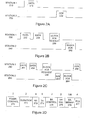
- Figure 2A illustrates an example of a handshaking routine that is improved by the incorporation of an embodiment of the present invention.
- data is sent from a first station to a second station and an acknowledgment is returned from the second station to the first station.
- station 1 210 transmits data 212 to station 2.
- This data is a data structure that may be formed as a frame or packet of data.
- station 2 220 transmits an acknowledgment signaled 222 indicating the data 212 was properly received.
- This acknowledgment process can consume excessive channel bandwidth if an acknowledgment is required each time data is sent. Accordingly, following the transmission of a number of a number of data packets, a block acknowledgment request can be made. This in turn can be responded to by a block acknowledgment. An example of this is shown in the following figure.
- FIG. 2B illustrates an acknowledgement following the reception of a number of frames of data sent from a first station to a second station.
- Station 1 230 transmits a number of data frames including data 232 and 234. Following this, station 1 makes a block acknowledgment request 236. This is responded to by station 2 240, which transmits a block acknowledgment 242.
- station 2 may take some amount of time to calculate and format the needed block acknowledgment 242. Accordingly it is permissible for station 2 to transmit a conventional acknowledgment, which is followed by a delayed block acknowledgment frame. This delay gives station 2 time to calculate and format the needed block acknowledgment frame.
- An example is shown in the following figure.
- Figure 2C illustrates an example of a delayed block acknowledgment frame.
- a first or transmitting station sends data to a second or receiving station.
- station 1 250 transmits a number of data frames including data 252 and 254.
- station 1 230 makes a block acknowledgment request 256.
- Station 2 260 replies with an acknowledgment 262.
- Station 2 260 then sends a block acknowledgment frame 264 to station 1 250.
- Station 1 250 in turn transmits an acknowledgment 258 following its reception of block acknowledgment frame 264. Again, this delay provides time for station 2 260 to determine the needed block acknowledgment frame 264.
- An example of such a block acknowledgment is shown the following figure.
- Figure 2D illustrates a block acknowledgement frame that may be improved by the incorporation of an embodiment of the present invention.
- the frame size is 150 bytes and the allocation is shown by byte counts above each field of the frame.
- the block in the bitmap can provide acknowledgments for up to 1,024 frames.
- the BA control field contains subfields that include a four bit TID value.
- the two bytes of the BA control field contain reserve bits that are typically set to zero. As will be seen below, one or more of these reserve bits may be designated as an enhanced bit for use in an enhanced block acknowledgment method. Alternately, one or more bits in another field, such as the frame control field may be used for this purpose. This enhancement reduces the number of acknowledgments required in a multiple-input multiple-output wireless system.
- each transmitting station transmits one or more frames of a stream having a particular traffic identification value.
- the transmitting station requests acknowledgment of the reception of frames in each of these streams.
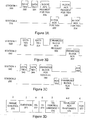
- Figure 3A illustrates the use of a block acknowledgment that is improved by the incorporation of an embodiment of the present invention .
- This figure illustrates the excessive amount of acknowledgment overhead that is required by conventional systems.
- station 1 300 transmits frames 302 and 304 to station 2 310. These frames have different TIDs, specifically data frame 302 has a TID of 0 while data frame 304 has a TID of 1. Previous to the transmission of frame 302, other frames may have been transmitted from station 1 300 to station 2 310; only two frames are shown for simplicity.
- station 1 300 transmits a block acknowledgment request 326 for data having a TID of 0. This is responded to by station 2 310, which transmits a block acknowledgment for TID0 332. Similarly, station 1 300 transmits a block acknowledgment request 328 for data having a TID of 1. This is responded to by station 2 310, which transmits a block acknowledgment for TID1 334.
- embodiments of the present invention provide an enhanced block acknowledgement that combines acknowledgments for multiple data streams having different TIDs. An example is shown in the following figure.
- Figure 3B illustrates the use of an enhanced block acknowledgment according to an embodiment of the present invention.
- a first or transmitting station transmits data to a second or receiving station. Again, two frames are shown for simplicity.
- station 1 320 transmits data frames 322 and 324. These frames have traffic ids of 0 and 1 respectively. Following these transmissions, station 1 transmits a block acknowledgment request 326. This in turn is responded to by station 2 350, which transmits an enhanced block acknowledgment 332.
- the enhanced block acknowledgement 332 provides an acknowledgment for each frame in each of the received streams, thereby reducing the required acknowledgment overhead.
- this enhanced block acknowledgment frame may take some time to calculate and format. Accordingly, a delayed enhanced block acknowledgment may be used as shown in the following figure.
- Figure 3C illustrates the use of a delayed enhanced block acknowledgment according to an embodiment of the present invention.
- a first or transmitting station transmits data to a second or receiving station.
- station 1 340 transmits data frames including data frames 342 and 344, which have TIDs of 0 and 1 respectively.
- the first station transmits an enhanced block acknowledgment request 346.
- Station 2 350 then provides an acknowledgment 352.
- station 2 350 calculates and formats an enhanced block acknowledgment 354, which it then transmits to the first station.
- the first station, station 1 340 in turn transmits acknowledgment 348 in response to its reception of enhanced block acknowledgment 354.
- the acknowledgment 348 is a simple conventional acknowledgment, such as acknowledgment 352.
- station 1 340 transmits a separate block acknowledgment request for each TID. This is responded to with one or more acknowledgments such as acknowledgment 352 and a separate block acknowledgment for each TID by station 2 350. This in turn is responded to by one or more acknowledgments such as acknowledgment 348 transmitted by station 1 340.
- Use of an embodiment of the present invention greatly simplifies the required signaling thus freeing up channel bandwidth for data transmissions.
- Figure 3D illustrates a block acknowledgement according to an embodiment of the present invention.
- the length of this block acknowledgment may be fixed or variable. As described above, one of the reserved bits in the BA control field 374 can be set to one.
- the TID block acknowledgment responses 376 is a variable length data field, where the length depends on the number of data streams received.
- the enhanced block acknowledgment requests may be similarly modified.
- one or more reserved bits in the block acknowledgement field 374 is set such that this block acknowledgement can be recognized as an enhanced block acknowledgement.
- one or more bits in one or more of this and the other fields may be used for this purpose,
- one or more bits in the frame control field 370 may be used.
- the TID block acknowledgment response field 376 has a variable length depending on the number of TIDs to be acknowledged.
- An example of a TID block acknowledgment response field 376 for one stream is shown in the following figure.
- Figure 4 illustrates a TID block acknowledgement response according to an embodiment of the present invention.
- the bit assignments are shown above each individual field. These fields include the traffic identification 410, frame starting number 420, bitmap size 430, bitmap 440, and reserved bits 450. Reserved bits 450 are used to round off field size to an even number of bytes.
- a block acknowledgment is sent in response to a block acknowledgment request. Eliminating such requests may further improve channel utilization. This may be done by providing block acknowledgments the following a triggering event, as opposed to providing a block acknowledgment after receiving a request. For example, block acknowledgments may be transmitted following a period of time, following the reception of a number of frames, or following the reception of a frame having a specific sequence number. These block acknowledgments may be the same or similar to the enhanced block acknowledgments described above, or they may be other block acknowledgments, such as conventional block acknowledgements. Flowcharts illustrating these embodiments of the present invention are shown in the following figures, though other embodiments may use other triggering mechanisms.
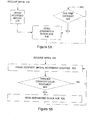
- Figure 5A illustrates a method according to an embodiment of the present invention whereby a block acknowledgment frame is transmitted on a periodic or aperiodic basis according to an embodiment of the present invention.
- Frames are received in act 510. These frames are tracked in act 515.
- a block acknowledgement frame is received in act 530. Again, the block acknowledgement may be an enhanced block acknowledgement as described above or other type of block acknowledgement.
- Figure 5B illustrates a method according to an embodiment of the present invention whereby a block acknowledgment frame is transmitted following a number of received frames. Again, frames are received in act 550. These frames are tracked and a counter is incremented in act 555. In act 560, it is determined whether a trigger counter value has been reached. If it has, a block acknowledgment frame is transmitted in act 565. Again, the block acknowledgement may be an enhanced block acknowledgement as described above or other type of block acknowledgement.
- a block acknowledgment frame may be transmitted. This prevents a transmitting station from only learning that data was not properly received after an excessive period of time.
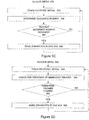
- Figure 5C illustrates a method according to an embodiment of the present invention where a block acknowledgment frame is sent after a specific sequence number has been reached.
- each frame to be transmitted is numbered in a sequential manner.
- looking for a specific sequence number can be a simple way of determining then number of transmitted frames.
- a sequence number for a received frame is determined.
- the block acknowledgement may be an enhanced block acknowledgement as described above or other type of block acknowledgement.
- a block acknowledgment frame may be sent, This prevents a transmitting station from learning of a transmission error only after an excessive period of time has elapsed.
- block acknowledgements may alternatively be triggered by data embedded in a received frame.
- one or more previously reserved bits may be set to act as a trigger for a block acknowledgment that may either be an enhanced block acknowledgment, conventional block acknowledgment, or other type of block acknowledgment.
- other previously defined bits may be redefined for this purpose. An example is shown in the following figure.
- Figure 5D illustrates a method according to an embodiment of the present invention where a block acknowledgment frame is sent after a frame including an embedded trigger has been received.
- frames are received in act 592, and tracked in act 594, such that a block acknowledgment may be calculated and formatted when needed.
- act 597 it is determined whether an embedded trigger has been received. If it has, a block acknowledgment frame is transmitted in act 598.
- the block acknowledgement may be an enhanced block acknowledgement as described above or other type of block acknowledgement.
- a block acknowledgment frame may be sent. This prevents a transmitting station from learning of a transmission error only after an excessive period of time has elapsed.
- the overhead consumed by these acknowledgment frames may be reduced by eliminating such acknowledgment frames altogether. For example, this may be done by including acknowledgment information in data frames themselves.
- a first station may transmit data to a second station.
- the second station may then send data to the first station, where the data includes an acknowledgement of the data received by the second station since the last transmission by the second station. An example of how this may be done is shown in the following figure.
- Figure 6 illustrates a method according to an embodiment of the present invention where acknowledgment data is included in a data frame.
- a second station, station 2 620 transmits a number of frames including data 622.
- a first station, station 1 610 transmits two frames, specifically data 612 and data 614. These frames may have the same or different traffic ID numbers.
- station 2 620 transmits a fourth data frame 624.
- This fourth data frame includes an acknowledgment that the two frames 612 and 614 were received by station 2 after station 2 620 sent its last frame, specifically data 622.
- This method may include a field referred to as a summed acknowledgment field, where the summed acknowledgment field indicates the number of successfully received frames since the receiving station's last transmission.
- This field may indicate the number of successfully receptions for all traffic, or for specific traffic class IDs, groups of traffic class IDs, user priorities, or other subgroup identifications or characteristics. Alternately, multiple summed acknowledgment fields may be used, each representing their own subgroup of received frames.
- These summed acknowledgment fields may be included in one of several locations. For example, they may be in the first field of the payload section of the frame. Alternately, they may be located in a first field at the start of a PSDU, the last field at the end of a PSDU, in a field or frame the following the frame, where the previous frame also indicates the destination of this summed acknowledgment field frame, or some other appropriate location. Errors in the summed acknowledgment field may be determined by the use of cyclic redundancy check (CRC) or other error correction.
- CRC cyclic redundancy check
Landscapes
- Engineering & Computer Science (AREA)
- Computer Networks & Wireless Communication (AREA)
- Signal Processing (AREA)
- Mobile Radio Communication Systems (AREA)
- Detection And Prevention Of Errors In Transmission (AREA)
- Communication Control (AREA)
- Small-Scale Networks (AREA)
Claims (11)
- Ein Verfahren zum Transferieren von Daten über einen Drahtlosnetzwerk hinweg, das Folgendes aufweist:Empfangen (570) eines ersten Datenrahmens mit einer ersten Verkehrsidentifikation und einer ersten Sequenznummer;Empfangen (570) eines zweiten Datenrahmens mit einer zweiten Verkehrsidentifikation und einer zweiten Sequenznummer; undansprechend auf ein Auftreten eines Auslöseereignisses (585), Senden (590) einer Blockbestätigung, dass der erste Datenrahmen, der die erste Verkehrsidentifikation hat, und der zweite Datenrahmen, der die zweite Verkehrsidentifikation hat, empfangen wurden,dadurch gekennzeichnet, dass das Auslöseereignis (585) eine Bestimmung aufweist, dass die erste Sequenznummer oder die zweite Sequenznummer eine spezifische Sequenznummer aufweist.
- Verfahren nach Anspruch 1, wobei ein Format der Blockbestätigung durch Setzen eines Bits in einem Feldsteuerfeld (274) identifiziert wird.
- Verfahren nach Anspruch 1, wobei das Auslöseereignis weiter einen Ablauf einer ersten Dauer aufweist, wobei das Verfahren weiter Folgendes aufweist:vor Senden der Blockbestätigung,Bestimmen (520), dass die erste Dauer abgelaufen ist.
- Verfahren nach Anspruch 1, wobei das Auslöseereignis weiter einen Empfang einer ersten Anzahl von Rahmen aufweist, wobei das Verfahren weiter Folgendes aufweist:vor Senden der Blockbestätigung,Bestimmen (560), dass die erste Anzahl von Rahmen empfangen worden ist.
- Ein Verfahren zum Transferieren von Daten über ein Drahtlosnetzwerk hinweg, das Folgendes aufweist:mit einer ersten Station (100), Senden eines ersten Datenrahmens mit einer ersten Verkehrsidentifikation und einer ersten Sequenznummer;mit der ersten Station (100), Senden eines zweiten Datenrahmens mit einer zweiten Verkehrsidentifikation und einer zweiten Sequenznummer;mit einer zweiten Station (140), Empfangen des ersten Datenrahmens mit der ersten Verkehrsidentifikation und des zweiten Datenrahmens mit der zweiten Verkehrsidentifikation, und ansprechend auf ein Auftreten eines Auslöseereignisses (585), Senden (590) einer Blockbestätigung, dass der erste Datenrahmen, der die erste Verkehrsidentifikation hat, und der zweite Datenrahmen, der die zweite Verkehrsidentifikation hat, durch die zweite Station empfangen worden sind, dadurch gekennzeichnet, dassdas Auslöseereignis eine Bestimmung aufweist, dass die erste Sequenznummer oder die zweite Sequenznummer eine spezifische Sequenznummer aufweist; undmit der ersten Station (100), Empfangen der Blockbestätigung, dass der erste Datenrahmen, der die erste Verkehrsidentifikation hat, und der zweite Datenrahmen, die die zweite Verkehrsidentifikation hat, durch die zweite Station empfangen wurden.
- Verfahren nach Anspruch 5, wobei das Auslöseereignis weiter einen Ablauf einer ersten Dauer aufweist, wobei das Verfahren weiter Folgendes aufweist:vor Senden der Blockbestätigung,mit der zweiten Station (140), Bestimmen (520), dass die erste Dauer abgelaufen ist.
- Verfahren nach Anspruch 5, wobei das Auslöseereignis weiter einen Empfang einer ersten Anzahl von Rahmen aufweist, wobei das Verfahren weiter Folgendes aufweist:vor Senden der Blockbestätigung,mit der zweiten Station (140), Bestimmen (560), dass die erste Anzahl von Rahmen empfangen worden ist.
- Verfahren nach Anspruch 1 oder 5, wobei die Bestimmung, dass die erste Sequenznummer oder die zweite Sequenznummer eine spezifizierte Sequenznummer aufweist, Bestimmen aufweist, ob eine Auslösersequenznummer erreicht worden ist.
- Verfahren nach Anspruch 8, das weiter Folgendes aufweist:Bestimmen, ob eine vorbestimmte Zeitperiode abgelaufen ist, ohne dass die Auslösersequenznummer erreicht worden ist, undSenden einer Blockbestätigung, wenn die vorbestimmte Zeitperiode abgelaufen ist.
- Eine Vorrichtung (100) für Drahtloskommunikationen, wobei die Vorrichtung konfiguriert ist zum Durchführen der Schritte nach einem der Ansprüche 1 bis 4, 8 oder 9.
- Einen Drahtlosnetzwerk, das eine erste und zweite Station (100, 140) aufweist, wobei das Drahtlosnetzwerk konfiguriert ist zum Durchführen der Schritte nach einem der Ansprüche 5 bis 9.
Applications Claiming Priority (3)
| Application Number | Priority Date | Filing Date | Title |
|---|---|---|---|
| US65946705P | 2005-03-07 | 2005-03-07 | |
| PCT/US2006/008191 WO2006096753A2 (en) | 2005-03-07 | 2006-03-07 | Block ack protocols for wireless packet network |
| EP06737370A EP1856813A4 (de) | 2005-03-07 | 2006-03-07 | Block-ack-protokolle für ein drahtloses paketnetzwerk |
Related Parent Applications (1)
| Application Number | Title | Priority Date | Filing Date |
|---|---|---|---|
| EP06737370A Division EP1856813A4 (de) | 2005-03-07 | 2006-03-07 | Block-ack-protokolle für ein drahtloses paketnetzwerk |
Publications (2)
| Publication Number | Publication Date |
|---|---|
| EP3444983A1 EP3444983A1 (de) | 2019-02-20 |
| EP3444983B1 true EP3444983B1 (de) | 2021-08-04 |
Family
ID=36953995
Family Applications (2)
| Application Number | Title | Priority Date | Filing Date |
|---|---|---|---|
| EP18187988.3A Expired - Lifetime EP3444983B1 (de) | 2005-03-07 | 2006-03-07 | Block-ack-protokolle für ein drahtloses paketnetzwerk |
| EP06737370A Ceased EP1856813A4 (de) | 2005-03-07 | 2006-03-07 | Block-ack-protokolle für ein drahtloses paketnetzwerk |
Family Applications After (1)
| Application Number | Title | Priority Date | Filing Date |
|---|---|---|---|
| EP06737370A Ceased EP1856813A4 (de) | 2005-03-07 | 2006-03-07 | Block-ack-protokolle für ein drahtloses paketnetzwerk |
Country Status (6)
| Country | Link |
|---|---|
| US (1) | US7631240B2 (de) |
| EP (2) | EP3444983B1 (de) |
| JP (2) | JP4834072B2 (de) |
| KR (1) | KR101229768B1 (de) |
| CN (1) | CN101313486B (de) |
| WO (1) | WO2006096753A2 (de) |
Families Citing this family (32)
| Publication number | Priority date | Publication date | Assignee | Title |
|---|---|---|---|---|
| US7633891B2 (en) * | 2005-03-08 | 2009-12-15 | Intel Corporation | Method and apparatus for implementing block acknowledgement in a wireless network |
| WO2008141165A1 (en) | 2007-05-10 | 2008-11-20 | Intellon Corporation | Managing distributed access to a shared medium |
| US8176378B2 (en) * | 2007-09-07 | 2012-05-08 | Broadcom Corporation | Method and system for a transmitting antenna selection failure recovery mode |
| US9686049B2 (en) * | 2007-09-12 | 2017-06-20 | Avago Technologies General Ip (Singapore) Pte. Ltd | Method and system for Bluetooth (BT) delayed acknowledgement (ACK) |
| KR100935976B1 (ko) * | 2007-12-07 | 2010-01-08 | 삼성전기주식회사 | 무선랜 시스템에서 다중 목적지 데이터 전송 방법 |
| US9450711B2 (en) | 2008-04-02 | 2016-09-20 | Qualcomm Incorporated | Method and apparatus for extended reverse direction grant in a wireless local area network (WLAN) |
| US10771199B2 (en) | 2008-04-02 | 2020-09-08 | Qualcomm Incorporated | Methods and apparatus for reverse link acknowledgement in a wireless local area network (WLAN) |
| US9203560B2 (en) * | 2008-04-04 | 2015-12-01 | Qualcomm Incorporated | Methods and apparatus for delayed block acknowledgement in a wireless local area network (WLAN) |
| US8588845B2 (en) * | 2008-06-19 | 2013-11-19 | Telefonaktiebolaget Lm Ericsson | Method and apparatus in a telecommunications network |
| US8804611B2 (en) * | 2009-02-12 | 2014-08-12 | Qualcomm Incorporated | Method and apparatus for acknowledging successful reception of a data transmission for multi-access compatibility in a wireless communication system |
| CN102771060B (zh) | 2009-11-24 | 2016-05-18 | 韩国电子通信研究院 | 用于在基于多用户多输入多输出的无线通信系统中恢复传送失败的帧的方法 |
| DE112010004553T5 (de) | 2009-11-24 | 2012-09-06 | Electronics And Telecommunications Research Institute | Verfahren zum Senden eines Rahmens in einem Drahtloskommunikationssystem auf Mehrbenutzerbasis |
| KR101948082B1 (ko) | 2009-11-24 | 2019-04-25 | 한국전자통신연구원 | 다중 사용자 다중 안테나 기반 무선통신 시스템에서 데이터 보호 방법 |
| US10225047B2 (en) | 2009-12-08 | 2019-03-05 | Qualcomm Incorporated | Method and apparatus for multicast block acknowledgement |
| US9350495B2 (en) * | 2009-12-08 | 2016-05-24 | Qualcomm Incorporated | Method and apparatus for multicast block acknowledgment |
| US8781016B2 (en) | 2010-04-12 | 2014-07-15 | Qualcomm Incorporated | Channel estimation for low-overhead communication in a network |
| US20120127973A1 (en) * | 2010-11-18 | 2012-05-24 | James Lin | System and method of sending acknowledgments through control channels to prevent unnecessary retransmission in a limited bandwidth wireless communication network |
| US9100177B2 (en) | 2011-09-02 | 2015-08-04 | Qualcomm Incorporated | Systems and methods for acknowledging communications from a plurality of devices |
| US9906342B2 (en) * | 2014-11-10 | 2018-02-27 | Huawei Technologies Co., Ltd. | System and method for low-payload acknowledgment |
| CN105743951A (zh) * | 2014-12-11 | 2016-07-06 | 清华大学 | 一种数据发送、接收的方法及装置 |
| WO2016123374A1 (en) * | 2015-01-28 | 2016-08-04 | Qualcomm Incorporated | Method and apparatus for multicast block acknowledgement |
| WO2017173126A1 (en) * | 2016-03-31 | 2017-10-05 | Square, Inc. | Combined reliable and unreliable data transmission |
| US10623149B2 (en) | 2017-01-24 | 2020-04-14 | Mediatek Inc. | Blockage detection in millimeter wave radio communications |
| EP4016893B1 (de) * | 2017-06-28 | 2024-10-16 | Telefonaktiebolaget LM ERICSSON (PUBL) | Betrieb eines benutzergeräts und eines empfangsfunkknotens basierend auf einem harq-codebuche, konfiguriert durch einen konfigurierenden funkknoten |
| US10827519B2 (en) | 2017-08-03 | 2020-11-03 | Mediatek Singapore Pte. Ltd. | Multi-TID A-MPDU transmission |
| US10932179B2 (en) | 2017-08-28 | 2021-02-23 | Mediatek Singapore Pte Ltd. | Support of A-MSDU in A-MPDU |
| US11394516B2 (en) * | 2018-02-13 | 2022-07-19 | Sony Corporation | Communication apparatus and communication method |
| CN112003684A (zh) * | 2019-05-27 | 2020-11-27 | 华为技术有限公司 | 数据传输方法及装置 |
| CN117915399A (zh) | 2019-11-08 | 2024-04-19 | 华为技术有限公司 | 修改ba协议参数的方法及设备 |
| CN114220256B (zh) * | 2020-09-03 | 2023-06-27 | 上海市环境科学研究院 | 一种气体采样无线控制协议 |
| WO2023096568A1 (en) | 2021-11-26 | 2023-06-01 | Razer (Asia-Pacific) Pte. Ltd. | System and method for facilitating data communication |
| US12380045B2 (en) | 2021-11-26 | 2025-08-05 | Razer (Asia-Pacific) Pte. Ltd. | System and method for facilitating data communication |
Family Cites Families (23)
| Publication number | Priority date | Publication date | Assignee | Title |
|---|---|---|---|---|
| JPS63169148A (ja) * | 1987-01-06 | 1988-07-13 | Nec Corp | 応答制御方式 |
| JPH06103884B2 (ja) * | 1988-12-07 | 1994-12-14 | 日本電気株式会社 | 無線パケット伝送方式 |
| EP0702472A1 (de) * | 1994-09-19 | 1996-03-20 | International Business Machines Corporation | Verfahren und Vorrichtung zur Formung des Ausgangsverkehrs in einem Netzwerknoten zur Vermittung von Zellen fester Länge |
| JPH09247132A (ja) * | 1996-03-08 | 1997-09-19 | Yazaki Corp | 無線パケット通信装置及び送信装置 |
| JP3217716B2 (ja) * | 1996-11-27 | 2001-10-15 | 矢崎総業株式会社 | 無線パケット通信装置 |
| US6546001B1 (en) * | 1998-08-14 | 2003-04-08 | Samsung Electronics Co., Ltd. | Medium access control message acknowledgment system and method of operation thereof |
| WO2000033502A1 (en) * | 1998-11-27 | 2000-06-08 | Telefonaktiebolaget Lm Ericsson (Publ) | Bandwidth efficient acknowledgement/negative acknowledegment |
| JP2001285400A (ja) * | 2000-03-29 | 2001-10-12 | Kddi Corp | トラヒック統計情報収集方法 |
| AU2002330392A1 (en) * | 2001-09-19 | 2003-04-07 | Sharp Kabushiki Kaisha | Communication method, communication apparatus, reception apparatus, communication program, computer-readable recording medium containing communication program, and network system |
| US20030135640A1 (en) * | 2002-01-14 | 2003-07-17 | Texas Instruments Incorporated | Method and system for group transmission and acknowledgment |
| JP4176402B2 (ja) * | 2002-04-17 | 2008-11-05 | シャープ株式会社 | 通信管理方法、通信管理プログラム、通信管理プログラムを記録した記録媒体、ならびに通信局 |
| JP2003324442A (ja) * | 2002-04-26 | 2003-11-14 | Matsushita Electric Ind Co Ltd | 無線ネットワークで効率的なバッファ機構を用いることにより媒体アクセスを高速化する方法 |
| US7986742B2 (en) | 2002-10-25 | 2011-07-26 | Qualcomm Incorporated | Pilots for MIMO communication system |
| US8320301B2 (en) | 2002-10-25 | 2012-11-27 | Qualcomm Incorporated | MIMO WLAN system |
| CN101159518B (zh) * | 2003-02-03 | 2012-02-22 | 索尼株式会社 | 通信方法和通信设备 |
| JP4528541B2 (ja) * | 2004-03-05 | 2010-08-18 | 株式会社東芝 | 通信装置、通信方法、および通信システム |
| US8223647B2 (en) * | 2004-07-21 | 2012-07-17 | Nokia Corporation | System and method for increasing data throughout using a block acknowledgement |
| US20060034274A1 (en) * | 2004-07-30 | 2006-02-16 | Nokia Corporation | System and method for variable length acknowledgements in a shared resource network |
| US20060136614A1 (en) * | 2004-07-30 | 2006-06-22 | Nokia Corporation | System and method for variable length aggregate acknowledgements in a shared resource network |
| US7882412B2 (en) * | 2004-10-05 | 2011-02-01 | Sanjiv Nanda | Enhanced block acknowledgement |
| JP4331088B2 (ja) * | 2004-11-01 | 2009-09-16 | 株式会社東芝 | 通信装置および通信方法 |
| US20060193279A1 (en) * | 2005-02-25 | 2006-08-31 | Daqing Gu | Method and system for accessing a channel in a wireless communications network using multi-polling |
| US20070191052A1 (en) * | 2006-01-27 | 2007-08-16 | Nokia Corporation | Automatic power save delivery (APSD) compatible with 802.11n frame aggregation and block acknowledgement |
-
2006
- 2006-03-07 EP EP18187988.3A patent/EP3444983B1/de not_active Expired - Lifetime
- 2006-03-07 JP JP2008500862A patent/JP4834072B2/ja not_active Expired - Lifetime
- 2006-03-07 EP EP06737370A patent/EP1856813A4/de not_active Ceased
- 2006-03-07 CN CN200680013999.7A patent/CN101313486B/zh not_active Expired - Lifetime
- 2006-03-07 KR KR1020077022783A patent/KR101229768B1/ko not_active Expired - Lifetime
- 2006-03-07 WO PCT/US2006/008191 patent/WO2006096753A2/en not_active Ceased
- 2006-03-07 US US11/371,185 patent/US7631240B2/en active Active
-
2011
- 2011-07-29 JP JP2011167185A patent/JP5290365B2/ja not_active Expired - Fee Related
Also Published As
| Publication number | Publication date |
|---|---|
| CN101313486B (zh) | 2016-10-05 |
| EP3444983A1 (de) | 2019-02-20 |
| WO2006096753A2 (en) | 2006-09-14 |
| EP1856813A2 (de) | 2007-11-21 |
| US20060239213A1 (en) | 2006-10-26 |
| EP1856813A4 (de) | 2011-12-07 |
| KR20080058291A (ko) | 2008-06-25 |
| JP5290365B2 (ja) | 2013-09-18 |
| CN101313486A (zh) | 2008-11-26 |
| JP2008533826A (ja) | 2008-08-21 |
| WO2006096753A3 (en) | 2007-11-01 |
| KR101229768B1 (ko) | 2013-02-06 |
| JP2012010363A (ja) | 2012-01-12 |
| JP4834072B2 (ja) | 2011-12-07 |
| US7631240B2 (en) | 2009-12-08 |
Similar Documents
| Publication | Publication Date | Title |
|---|---|---|
| EP3444983B1 (de) | Block-ack-protokolle für ein drahtloses paketnetzwerk | |
| EP2498564B1 (de) | Leistungsstarke übergabe einer drahtlosen übertragungsgelegenheit | |
| US8559437B2 (en) | Packet concatenation in wireless networks | |
| EP2086148B1 (de) | Verfahren zum Senden von Statusinformationen in einem Mobiltelekommunikationssystem und Empfänger für Mobiltelekommunikationen | |
| EP2137908B1 (de) | Verfahren und system zur übertragung verschiedener arten von informationen in drahtloser kommunikation | |
| US7944819B2 (en) | System and method for transmission and acknowledgment of blocks of data frames in distributed wireless networks | |
| CN113346982B (zh) | 数据传输方法、发送方法、接收方法及装置 | |
| EP1269675A1 (de) | Wiederübertragungsverfahren für drahtlose computernetzwerke | |
| WO2006093979A2 (en) | Method of repeating data transmission between network devices | |
| CN109861797B (zh) | 一种数据传输方法和系统 | |
| KR101178625B1 (ko) | 무선 통신 시스템에서 상태 보고 트리거링 | |
| US20130301625A1 (en) | Aggregation of information units in a wireless network | |
| US6954617B2 (en) | Apparatus and method to improve goodput in unreliable networks | |
| CN110875806A (zh) | 一种超高吞吐无线宽带数据传输方法和系统 | |
| Ohteru et al. | Throughput Estimation Method in Burst ACK Scheme for Optimizing Frame Size and Burst Frame Number Appropriate to SNR-Related Error Rate |
Legal Events
| Date | Code | Title | Description |
|---|---|---|---|
| PUAI | Public reference made under article 153(3) epc to a published international application that has entered the european phase |
Free format text: ORIGINAL CODE: 0009012 |
|
| STAA | Information on the status of an ep patent application or granted ep patent |
Free format text: STATUS: REQUEST FOR EXAMINATION WAS MADE |
|
| 17P | Request for examination filed |
Effective date: 20180808 |
|
| AC | Divisional application: reference to earlier application |
Ref document number: 1856813 Country of ref document: EP Kind code of ref document: P |
|
| AK | Designated contracting states |
Kind code of ref document: A1 Designated state(s): AT BE BG CH CY CZ DE DK EE ES FI FR GB GR HU IE IS IT LI LT LU LV MC NL PL PT RO SE SI SK TR |
|
| REG | Reference to a national code |
Ref country code: DE Ref legal event code: R079 Ref document number: 602006060144 Country of ref document: DE Free format text: PREVIOUS MAIN CLASS: H04L0001160000 Ipc: H04L0001180000 |
|
| GRAP | Despatch of communication of intention to grant a patent |
Free format text: ORIGINAL CODE: EPIDOSNIGR1 |
|
| STAA | Information on the status of an ep patent application or granted ep patent |
Free format text: STATUS: GRANT OF PATENT IS INTENDED |
|
| RIC1 | Information provided on ipc code assigned before grant |
Ipc: H04L 1/18 20060101AFI20210125BHEP Ipc: H04B 7/00 20060101ALI20210125BHEP Ipc: H04L 1/16 20060101ALI20210125BHEP |
|
| INTG | Intention to grant announced |
Effective date: 20210224 |
|
| GRAS | Grant fee paid |
Free format text: ORIGINAL CODE: EPIDOSNIGR3 |
|
| GRAA | (expected) grant |
Free format text: ORIGINAL CODE: 0009210 |
|
| STAA | Information on the status of an ep patent application or granted ep patent |
Free format text: STATUS: THE PATENT HAS BEEN GRANTED |
|
| AC | Divisional application: reference to earlier application |
Ref document number: 1856813 Country of ref document: EP Kind code of ref document: P |
|
| AK | Designated contracting states |
Kind code of ref document: B1 Designated state(s): AT BE BG CH CY CZ DE DK EE ES FI FR GB GR HU IE IS IT LI LT LU LV MC NL PL PT RO SE SI SK TR |
|
| REG | Reference to a national code |
Ref country code: GB Ref legal event code: FG4D |
|
| REG | Reference to a national code |
Ref country code: AT Ref legal event code: REF Ref document number: 1418091 Country of ref document: AT Kind code of ref document: T Effective date: 20210815 |
|
| REG | Reference to a national code |
Ref country code: CH Ref legal event code: EP |
|
| REG | Reference to a national code |
Ref country code: DE Ref legal event code: R096 Ref document number: 602006060144 Country of ref document: DE |
|
| REG | Reference to a national code |
Ref country code: IE Ref legal event code: FG4D |
|
| REG | Reference to a national code |
Ref country code: NL Ref legal event code: FP |
|
| REG | Reference to a national code |
Ref country code: SE Ref legal event code: TRGR |
|
| REG | Reference to a national code |
Ref country code: LT Ref legal event code: MG9D |
|
| REG | Reference to a national code |
Ref country code: AT Ref legal event code: MK05 Ref document number: 1418091 Country of ref document: AT Kind code of ref document: T Effective date: 20210804 |
|
| PG25 | Lapsed in a contracting state [announced via postgrant information from national office to epo] |
Ref country code: LT Free format text: LAPSE BECAUSE OF FAILURE TO SUBMIT A TRANSLATION OF THE DESCRIPTION OR TO PAY THE FEE WITHIN THE PRESCRIBED TIME-LIMIT Effective date: 20210804 Ref country code: AT Free format text: LAPSE BECAUSE OF FAILURE TO SUBMIT A TRANSLATION OF THE DESCRIPTION OR TO PAY THE FEE WITHIN THE PRESCRIBED TIME-LIMIT Effective date: 20210804 Ref country code: BG Free format text: LAPSE BECAUSE OF FAILURE TO SUBMIT A TRANSLATION OF THE DESCRIPTION OR TO PAY THE FEE WITHIN THE PRESCRIBED TIME-LIMIT Effective date: 20211104 Ref country code: PT Free format text: LAPSE BECAUSE OF FAILURE TO SUBMIT A TRANSLATION OF THE DESCRIPTION OR TO PAY THE FEE WITHIN THE PRESCRIBED TIME-LIMIT Effective date: 20211206 Ref country code: ES Free format text: LAPSE BECAUSE OF FAILURE TO SUBMIT A TRANSLATION OF THE DESCRIPTION OR TO PAY THE FEE WITHIN THE PRESCRIBED TIME-LIMIT Effective date: 20210804 Ref country code: FI Free format text: LAPSE BECAUSE OF FAILURE TO SUBMIT A TRANSLATION OF THE DESCRIPTION OR TO PAY THE FEE WITHIN THE PRESCRIBED TIME-LIMIT Effective date: 20210804 |
|
| PG25 | Lapsed in a contracting state [announced via postgrant information from national office to epo] |
Ref country code: PL Free format text: LAPSE BECAUSE OF FAILURE TO SUBMIT A TRANSLATION OF THE DESCRIPTION OR TO PAY THE FEE WITHIN THE PRESCRIBED TIME-LIMIT Effective date: 20210804 Ref country code: LV Free format text: LAPSE BECAUSE OF FAILURE TO SUBMIT A TRANSLATION OF THE DESCRIPTION OR TO PAY THE FEE WITHIN THE PRESCRIBED TIME-LIMIT Effective date: 20210804 Ref country code: GR Free format text: LAPSE BECAUSE OF FAILURE TO SUBMIT A TRANSLATION OF THE DESCRIPTION OR TO PAY THE FEE WITHIN THE PRESCRIBED TIME-LIMIT Effective date: 20211105 |
|
| PG25 | Lapsed in a contracting state [announced via postgrant information from national office to epo] |
Ref country code: DK Free format text: LAPSE BECAUSE OF FAILURE TO SUBMIT A TRANSLATION OF THE DESCRIPTION OR TO PAY THE FEE WITHIN THE PRESCRIBED TIME-LIMIT Effective date: 20210804 |
|
| REG | Reference to a national code |
Ref country code: DE Ref legal event code: R097 Ref document number: 602006060144 Country of ref document: DE |
|
| PG25 | Lapsed in a contracting state [announced via postgrant information from national office to epo] |
Ref country code: SK Free format text: LAPSE BECAUSE OF FAILURE TO SUBMIT A TRANSLATION OF THE DESCRIPTION OR TO PAY THE FEE WITHIN THE PRESCRIBED TIME-LIMIT Effective date: 20210804 Ref country code: RO Free format text: LAPSE BECAUSE OF FAILURE TO SUBMIT A TRANSLATION OF THE DESCRIPTION OR TO PAY THE FEE WITHIN THE PRESCRIBED TIME-LIMIT Effective date: 20210804 Ref country code: EE Free format text: LAPSE BECAUSE OF FAILURE TO SUBMIT A TRANSLATION OF THE DESCRIPTION OR TO PAY THE FEE WITHIN THE PRESCRIBED TIME-LIMIT Effective date: 20210804 Ref country code: CZ Free format text: LAPSE BECAUSE OF FAILURE TO SUBMIT A TRANSLATION OF THE DESCRIPTION OR TO PAY THE FEE WITHIN THE PRESCRIBED TIME-LIMIT Effective date: 20210804 |
|
| PLBE | No opposition filed within time limit |
Free format text: ORIGINAL CODE: 0009261 |
|
| STAA | Information on the status of an ep patent application or granted ep patent |
Free format text: STATUS: NO OPPOSITION FILED WITHIN TIME LIMIT |
|
| 26N | No opposition filed |
Effective date: 20220506 |
|
| PG25 | Lapsed in a contracting state [announced via postgrant information from national office to epo] |
Ref country code: IT Free format text: LAPSE BECAUSE OF FAILURE TO SUBMIT A TRANSLATION OF THE DESCRIPTION OR TO PAY THE FEE WITHIN THE PRESCRIBED TIME-LIMIT Effective date: 20210804 |
|
| PG25 | Lapsed in a contracting state [announced via postgrant information from national office to epo] |
Ref country code: SI Free format text: LAPSE BECAUSE OF FAILURE TO SUBMIT A TRANSLATION OF THE DESCRIPTION OR TO PAY THE FEE WITHIN THE PRESCRIBED TIME-LIMIT Effective date: 20210804 |
|
| PG25 | Lapsed in a contracting state [announced via postgrant information from national office to epo] |
Ref country code: MC Free format text: LAPSE BECAUSE OF FAILURE TO SUBMIT A TRANSLATION OF THE DESCRIPTION OR TO PAY THE FEE WITHIN THE PRESCRIBED TIME-LIMIT Effective date: 20210804 |
|
| REG | Reference to a national code |
Ref country code: BE Ref legal event code: MM Effective date: 20220331 |
|
| PG25 | Lapsed in a contracting state [announced via postgrant information from national office to epo] |
Ref country code: LU Free format text: LAPSE BECAUSE OF NON-PAYMENT OF DUE FEES Effective date: 20220307 Ref country code: IE Free format text: LAPSE BECAUSE OF NON-PAYMENT OF DUE FEES Effective date: 20220307 |
|
| PG25 | Lapsed in a contracting state [announced via postgrant information from national office to epo] |
Ref country code: BE Free format text: LAPSE BECAUSE OF NON-PAYMENT OF DUE FEES Effective date: 20220331 |
|
| PG25 | Lapsed in a contracting state [announced via postgrant information from national office to epo] |
Ref country code: HU Free format text: LAPSE BECAUSE OF FAILURE TO SUBMIT A TRANSLATION OF THE DESCRIPTION OR TO PAY THE FEE WITHIN THE PRESCRIBED TIME-LIMIT; INVALID AB INITIO Effective date: 20060307 |
|
| PG25 | Lapsed in a contracting state [announced via postgrant information from national office to epo] |
Ref country code: CY Free format text: LAPSE BECAUSE OF FAILURE TO SUBMIT A TRANSLATION OF THE DESCRIPTION OR TO PAY THE FEE WITHIN THE PRESCRIBED TIME-LIMIT Effective date: 20210804 |
|
| PG25 | Lapsed in a contracting state [announced via postgrant information from national office to epo] |
Ref country code: TR Free format text: LAPSE BECAUSE OF FAILURE TO SUBMIT A TRANSLATION OF THE DESCRIPTION OR TO PAY THE FEE WITHIN THE PRESCRIBED TIME-LIMIT Effective date: 20210804 |
|
| PGFP | Annual fee paid to national office [announced via postgrant information from national office to epo] |
Ref country code: NL Payment date: 20250212 Year of fee payment: 20 |
|
| PGFP | Annual fee paid to national office [announced via postgrant information from national office to epo] |
Ref country code: SE Payment date: 20250310 Year of fee payment: 20 |
|
| PGFP | Annual fee paid to national office [announced via postgrant information from national office to epo] |
Ref country code: DE Payment date: 20250210 Year of fee payment: 20 |
|
| PGFP | Annual fee paid to national office [announced via postgrant information from national office to epo] |
Ref country code: FR Payment date: 20250211 Year of fee payment: 20 |
|
| PGFP | Annual fee paid to national office [announced via postgrant information from national office to epo] |
Ref country code: GB Payment date: 20250213 Year of fee payment: 20 |
|
| PGFP | Annual fee paid to national office [announced via postgrant information from national office to epo] |
Ref country code: CH Payment date: 20250401 Year of fee payment: 20 |
|
| REG | Reference to a national code |
Ref country code: CH Ref legal event code: H14 Free format text: ST27 STATUS EVENT CODE: U-0-0-H10-H14 (AS PROVIDED BY THE NATIONAL OFFICE) Effective date: 20260307 Ref country code: DE Ref legal event code: R071 Ref document number: 602006060144 Country of ref document: DE |
|
| REG | Reference to a national code |
Ref country code: NL Ref legal event code: MK Effective date: 20260306 |
|
| REG | Reference to a national code |
Ref country code: GB Ref legal event code: PE20 Expiry date: 20260306 |