EP3447062B1 - Organometallverbindung, organische lichtemittierende vorrichtung mit der organometallverbindung und organische lichtemittierende vorrichtung mit der organischen lichtemittierenden vorrichtung - Google Patents
Organometallverbindung, organische lichtemittierende vorrichtung mit der organometallverbindung und organische lichtemittierende vorrichtung mit der organischen lichtemittierenden vorrichtung Download PDFInfo
- Publication number
- EP3447062B1 EP3447062B1 EP18190061.4A EP18190061A EP3447062B1 EP 3447062 B1 EP3447062 B1 EP 3447062B1 EP 18190061 A EP18190061 A EP 18190061A EP 3447062 B1 EP3447062 B1 EP 3447062B1
- Authority
- EP
- European Patent Office
- Prior art keywords
- group
- substituted
- formula
- unsubstituted
- formulae
- Prior art date
- Legal status (The legal status is an assumption and is not a legal conclusion. Google has not performed a legal analysis and makes no representation as to the accuracy of the status listed.)
- Active
Links
- 0 CCC(*)(C1)*([o]c(*)c2*(C)(C)**)c2C2=C1C=CCC2 Chemical compound CCC(*)(C1)*([o]c(*)c2*(C)(C)**)c2C2=C1C=CCC2 0.000 description 13
- PWDLLYLVHJIHBG-UHFFFAOYSA-N CCC1C(C)=C(CC)CCC1 Chemical compound CCC1C(C)=C(CC)CCC1 PWDLLYLVHJIHBG-UHFFFAOYSA-N 0.000 description 1
- QTBMCAGSJKFDJN-UHFFFAOYSA-N c(cc12)ccc1nc(-c(cc1)cc3c1c(-c1cc(cccc4)c4cc1)c(cccc1)c1c3-c1cc3ccccc3cc1)[n]2-c1ccccc1 Chemical compound c(cc12)ccc1nc(-c(cc1)cc3c1c(-c1cc(cccc4)c4cc1)c(cccc1)c1c3-c1cc3ccccc3cc1)[n]2-c1ccccc1 QTBMCAGSJKFDJN-UHFFFAOYSA-N 0.000 description 1
Images

Classifications
-
- C—CHEMISTRY; METALLURGY
- C07—ORGANIC CHEMISTRY
- C07F—ACYCLIC, CARBOCYCLIC OR HETEROCYCLIC COMPOUNDS CONTAINING ELEMENTS OTHER THAN CARBON, HYDROGEN, HALOGEN, OXYGEN, NITROGEN, SULFUR, SELENIUM OR TELLURIUM
- C07F15/00—Compounds containing elements of Groups 8, 9, 10 or 18 of the Periodic Table
- C07F15/0006—Compounds containing elements of Groups 8, 9, 10 or 18 of the Periodic Table compounds of the platinum group
- C07F15/0033—Iridium compounds
-
- C—CHEMISTRY; METALLURGY
- C07—ORGANIC CHEMISTRY
- C07F—ACYCLIC, CARBOCYCLIC OR HETEROCYCLIC COMPOUNDS CONTAINING ELEMENTS OTHER THAN CARBON, HYDROGEN, HALOGEN, OXYGEN, NITROGEN, SULFUR, SELENIUM OR TELLURIUM
- C07F15/00—Compounds containing elements of Groups 8, 9, 10 or 18 of the Periodic Table
- C07F15/0006—Compounds containing elements of Groups 8, 9, 10 or 18 of the Periodic Table compounds of the platinum group
- C07F15/0086—Platinum compounds
-
- C—CHEMISTRY; METALLURGY
- C09—DYES; PAINTS; POLISHES; NATURAL RESINS; ADHESIVES; COMPOSITIONS NOT OTHERWISE PROVIDED FOR; APPLICATIONS OF MATERIALS NOT OTHERWISE PROVIDED FOR
- C09K—MATERIALS FOR MISCELLANEOUS APPLICATIONS, NOT PROVIDED FOR ELSEWHERE
- C09K11/00—Luminescent materials, e.g. electroluminescent or chemiluminescent
- C09K11/06—Luminescent materials, e.g. electroluminescent or chemiluminescent containing organic luminescent materials
-
- H—ELECTRICITY
- H10—SEMICONDUCTOR DEVICES; ELECTRIC SOLID-STATE DEVICES NOT OTHERWISE PROVIDED FOR
- H10K—ORGANIC ELECTRIC SOLID-STATE DEVICES
- H10K50/00—Organic light-emitting devices
-
- H—ELECTRICITY
- H10—SEMICONDUCTOR DEVICES; ELECTRIC SOLID-STATE DEVICES NOT OTHERWISE PROVIDED FOR
- H10K—ORGANIC ELECTRIC SOLID-STATE DEVICES
- H10K50/00—Organic light-emitting devices
- H10K50/10—OLEDs or polymer light-emitting diodes [PLED]
- H10K50/11—OLEDs or polymer light-emitting diodes [PLED] characterised by the electroluminescent [EL] layers
-
- H—ELECTRICITY
- H10—SEMICONDUCTOR DEVICES; ELECTRIC SOLID-STATE DEVICES NOT OTHERWISE PROVIDED FOR
- H10K—ORGANIC ELECTRIC SOLID-STATE DEVICES
- H10K50/00—Organic light-emitting devices
- H10K50/10—OLEDs or polymer light-emitting diodes [PLED]
- H10K50/14—Carrier transporting layers
- H10K50/15—Hole transporting layers
-
- H—ELECTRICITY
- H10—SEMICONDUCTOR DEVICES; ELECTRIC SOLID-STATE DEVICES NOT OTHERWISE PROVIDED FOR
- H10K—ORGANIC ELECTRIC SOLID-STATE DEVICES
- H10K50/00—Organic light-emitting devices
- H10K50/10—OLEDs or polymer light-emitting diodes [PLED]
- H10K50/14—Carrier transporting layers
- H10K50/16—Electron transporting layers
-
- H—ELECTRICITY
- H10—SEMICONDUCTOR DEVICES; ELECTRIC SOLID-STATE DEVICES NOT OTHERWISE PROVIDED FOR
- H10K—ORGANIC ELECTRIC SOLID-STATE DEVICES
- H10K85/00—Organic materials used in the body or electrodes of devices covered by this subclass
- H10K85/30—Coordination compounds
- H10K85/341—Transition metal complexes, e.g. Ru(II)polypyridine complexes
- H10K85/342—Transition metal complexes, e.g. Ru(II)polypyridine complexes comprising iridium
-
- H—ELECTRICITY
- H10—SEMICONDUCTOR DEVICES; ELECTRIC SOLID-STATE DEVICES NOT OTHERWISE PROVIDED FOR
- H10K—ORGANIC ELECTRIC SOLID-STATE DEVICES
- H10K85/00—Organic materials used in the body or electrodes of devices covered by this subclass
- H10K85/30—Coordination compounds
- H10K85/341—Transition metal complexes, e.g. Ru(II)polypyridine complexes
- H10K85/346—Transition metal complexes, e.g. Ru(II)polypyridine complexes comprising platinum
-
- H—ELECTRICITY
- H10—SEMICONDUCTOR DEVICES; ELECTRIC SOLID-STATE DEVICES NOT OTHERWISE PROVIDED FOR
- H10K—ORGANIC ELECTRIC SOLID-STATE DEVICES
- H10K85/00—Organic materials used in the body or electrodes of devices covered by this subclass
- H10K85/40—Organosilicon compounds, e.g. TIPS pentacene
-
- C—CHEMISTRY; METALLURGY
- C09—DYES; PAINTS; POLISHES; NATURAL RESINS; ADHESIVES; COMPOSITIONS NOT OTHERWISE PROVIDED FOR; APPLICATIONS OF MATERIALS NOT OTHERWISE PROVIDED FOR
- C09K—MATERIALS FOR MISCELLANEOUS APPLICATIONS, NOT PROVIDED FOR ELSEWHERE
- C09K2211/00—Chemical nature of organic luminescent or tenebrescent compounds
- C09K2211/10—Non-macromolecular compounds
- C09K2211/1018—Heterocyclic compounds
- C09K2211/1025—Heterocyclic compounds characterised by ligands
- C09K2211/1029—Heterocyclic compounds characterised by ligands containing one nitrogen atom as the heteroatom
-
- C—CHEMISTRY; METALLURGY
- C09—DYES; PAINTS; POLISHES; NATURAL RESINS; ADHESIVES; COMPOSITIONS NOT OTHERWISE PROVIDED FOR; APPLICATIONS OF MATERIALS NOT OTHERWISE PROVIDED FOR
- C09K—MATERIALS FOR MISCELLANEOUS APPLICATIONS, NOT PROVIDED FOR ELSEWHERE
- C09K2211/00—Chemical nature of organic luminescent or tenebrescent compounds
- C09K2211/10—Non-macromolecular compounds
- C09K2211/1018—Heterocyclic compounds
- C09K2211/1025—Heterocyclic compounds characterised by ligands
- C09K2211/1044—Heterocyclic compounds characterised by ligands containing two nitrogen atoms as heteroatoms
-
- C—CHEMISTRY; METALLURGY
- C09—DYES; PAINTS; POLISHES; NATURAL RESINS; ADHESIVES; COMPOSITIONS NOT OTHERWISE PROVIDED FOR; APPLICATIONS OF MATERIALS NOT OTHERWISE PROVIDED FOR
- C09K—MATERIALS FOR MISCELLANEOUS APPLICATIONS, NOT PROVIDED FOR ELSEWHERE
- C09K2211/00—Chemical nature of organic luminescent or tenebrescent compounds
- C09K2211/18—Metal complexes
- C09K2211/185—Metal complexes of the platinum group, i.e. Os, Ir, Pt, Ru, Rh or Pd
-
- H—ELECTRICITY
- H10—SEMICONDUCTOR DEVICES; ELECTRIC SOLID-STATE DEVICES NOT OTHERWISE PROVIDED FOR
- H10K—ORGANIC ELECTRIC SOLID-STATE DEVICES
- H10K2101/00—Properties of the organic materials covered by group H10K85/00
- H10K2101/10—Triplet emission
-
- H—ELECTRICITY
- H10—SEMICONDUCTOR DEVICES; ELECTRIC SOLID-STATE DEVICES NOT OTHERWISE PROVIDED FOR
- H10K—ORGANIC ELECTRIC SOLID-STATE DEVICES
- H10K2101/00—Properties of the organic materials covered by group H10K85/00
- H10K2101/20—Delayed fluorescence emission
-
- H—ELECTRICITY
- H10—SEMICONDUCTOR DEVICES; ELECTRIC SOLID-STATE DEVICES NOT OTHERWISE PROVIDED FOR
- H10K—ORGANIC ELECTRIC SOLID-STATE DEVICES
- H10K50/00—Organic light-emitting devices
- H10K50/10—OLEDs or polymer light-emitting diodes [PLED]
- H10K50/11—OLEDs or polymer light-emitting diodes [PLED] characterised by the electroluminescent [EL] layers
- H10K50/12—OLEDs or polymer light-emitting diodes [PLED] characterised by the electroluminescent [EL] layers comprising dopants
-
- H—ELECTRICITY
- H10—SEMICONDUCTOR DEVICES; ELECTRIC SOLID-STATE DEVICES NOT OTHERWISE PROVIDED FOR
- H10K—ORGANIC ELECTRIC SOLID-STATE DEVICES
- H10K50/00—Organic light-emitting devices
- H10K50/10—OLEDs or polymer light-emitting diodes [PLED]
- H10K50/17—Carrier injection layers
-
- H—ELECTRICITY
- H10—SEMICONDUCTOR DEVICES; ELECTRIC SOLID-STATE DEVICES NOT OTHERWISE PROVIDED FOR
- H10K—ORGANIC ELECTRIC SOLID-STATE DEVICES
- H10K50/00—Organic light-emitting devices
- H10K50/10—OLEDs or polymer light-emitting diodes [PLED]
- H10K50/17—Carrier injection layers
- H10K50/171—Electron injection layers
-
- H—ELECTRICITY
- H10—SEMICONDUCTOR DEVICES; ELECTRIC SOLID-STATE DEVICES NOT OTHERWISE PROVIDED FOR
- H10K—ORGANIC ELECTRIC SOLID-STATE DEVICES
- H10K50/00—Organic light-emitting devices
- H10K50/10—OLEDs or polymer light-emitting diodes [PLED]
- H10K50/18—Carrier blocking layers
-
- H—ELECTRICITY
- H10—SEMICONDUCTOR DEVICES; ELECTRIC SOLID-STATE DEVICES NOT OTHERWISE PROVIDED FOR
- H10K—ORGANIC ELECTRIC SOLID-STATE DEVICES
- H10K50/00—Organic light-emitting devices
- H10K50/10—OLEDs or polymer light-emitting diodes [PLED]
- H10K50/18—Carrier blocking layers
- H10K50/181—Electron blocking layers
Definitions
- organic light-emitting devices may include a first electrode disposed on a substrate, and a hole transport region, an emission layer, an electron transport region, and a second electrode, which are sequentially disposed on the first electrode. Holes provided from the first electrode may move toward the emission layer through the hole transport region, and electrons provided from the second electrode may move toward the emission layer through the electron transport region. Carriers, such as holes and electrons, recombine in the emission layer to produce excitons. These excitons transit from an excited state to a ground state, thereby generating light.
- WO 2011/070992 A1 WO 2011/070989 A1
- US 2016/226006 A1 Cheng et al.
- an organic light-emitting apparatus including the organic light-emitting device and a thin film transistor, wherein the thin film transistor includes a source electrode and a drain electrode, and the first electrode of the organic light-emitting device is electrically coupled or connected to at least one of the source electrode and the drain electrode of the thin film transistor.
- X 1 in Formula 2 is N, B, O, or S, and X 2 is N or C.
- X 1 may be N, O or S.
- X 1 may be N or O.
- X 2 may be C.
- X 41 may be a single bond, *-C(Q 44 )(Q 45 )-*', or *-Si(Q 44 )(Q 45 )-*'.
- a4 indicates the number of R 4 (s) and is an integer from 1 to 10 (for example, 1 to 9, 1 to 8, 1 to 7, 1 to 6, 1 to 5, 1 to 4, 1 to 3, 1 to 1, or 1 or 2)
- a5 indicates the number of R 5 (s) and is an integer from 1 to 3.
- a4 may be 1 or 2.
- a4 may be 1.
- a4 may be 2.
- a5 may be 2 or 3.
- a5 may be 2.
- a5 may be 3.
- a plurality of R 4 (s) may be identical to or different from one another, and a plurality of R 5 (s) may be identical to or different from one another.
- L 1 in Formula 1 may be selected from ligands represented by Formulae 2-1 to 2-4:
- L 2 in Formula 1 may be selected from ligands represented by Formulae 3-1 to 3-4:
- L 2 in Formula 1 may be selected from ligands represented by Formulae 3-1 to 3-3, in Formulae 3-1 to 3-3,
- the organic layer may include, as the organometallic compound, only Compound 1.
- Compound 1 may exist (e.g., be present) in an emission layer of the organic light-emitting device.
- the organic layer may include, as the organometallic compound, Compound 1 and Compound 2.
- Compound 1 and Compound 2 may exist (e.g., be present) in an identical layer (for example, Compound 1 and Compound 2 may both exist (e.g., be present) in an emission layer), or different layers (for example, Compound 1 may exist in an emission layer and Compound 2 may exist (e.g., be present) in an electron transport region).
- the emission layer may include the organometallic compound, and the emission layer may further include a fluorescent dopant.
- the fluorescent dopant may act as an emitter and the organometallic compound may act as a metal-assisted delayed fluorescent dopant, or the organometallic compound may act as an emitter and the fluorescent dopant may act as an assistant dopant.
- FIG. 1 is a schematic view of an organic light-emitting device 10 according to an embodiment.
- the organic light-emitting device 10 includes a first electrode 110, an organic layer 150, and a second electrode 190.
- a substrate may be additionally disposed under the first electrode 110 or above the second electrode 190.
- the substrate may be a glass substrate or a plastic substrate, each having excellent mechanical strength, thermal stability, transparency, surface smoothness, ease of handling, and water resistance.
- the hole transport region may have a single-layered structure including a single layer including a plurality of different materials, or a multi-layered structure having a hole injection layer/hole transport layer structure, a hole injection layer/hole transport layer/emission auxiliary layer structure, a hole injection layer/emission auxiliary layer structure, a hole transport layer/emission auxiliary layer structure, or a hole injection layer/hole transport layer/electron blocking layer structure, wherein for each structure, constituting layers are sequentially stacked from the first electrode 110 in this stated order, but the structure of the hole transport region is not limited thereto.
- R 201 and R 202 may be linked via a single bond, and/or ii) R 203 and R 204 may be linked via a single bond.
- the compound represented by Formula 201 may be represented by Formula 201A:
- the hole transport region may further include, in addition to these materials, a charge-generation material for the improvement of conductive properties.
- the charge-generation material may be homogeneously or non-homogeneously dispersed in the hole transport region.
- the charge-generation material may be, for example, a p-dopant.
- R 221 to R 223 may have at least one substituent selected from a cyano group, -F, -Cl, -Br, -I, a C 1 -C 20 alkyl group substituted with -F, a C 1 -C 20 alkyl group substituted with -Cl, a C 1 -C 20 alkyl group substituted with -Br and a C 1 -C 20 alkyl group substituted with -I.
- the emission layer may include a host and a dopant.
- the dopant may include at least one selected from a phosphorescent dopant and a fluorescent dopant.
- a thickness of the emission layer may be in a range of about 100 A to about 1,000 ⁇ , for example, about 100 ⁇ to about 800 ⁇ , about 150 ⁇ to about 800 ⁇ , about 150 ⁇ to about 700 ⁇ , about 150 ⁇ to about 650 ⁇ , about 200 ⁇ to about 600 ⁇ or about 200 ⁇ to about 400 ⁇ .
- the thickness of the emission layer is within this range, excellent light-emission characteristics may be obtained without a substantial increase in driving voltage.
- xb11 in Formula 301 is two or more, two or more Ar 301 (s) may be linked via a single bond.
- the host may include only one compound, or two or more different compounds (for example, a host used in the following examples includes BCPDS and POPCPA).
- the electron transport region may include at least one selected from a buffer layer, a hole blocking layer, an electron control layer, an electron transport layer, and an electron injection layer, but embodiments of the present disclosure are not limited thereto.
- the electron transport region (for example, a buffer layer, a hole blocking layer, an electron control layer, or an electron transport layer in the electron transport region) may include a metal-free compound containing at least one ⁇ electron-depleted nitrogen-containing ring.
- Ar 601 may be a substituted or unsubstituted C 5 -C 30 carbocyclic group or a substituted or unsubstituted C 1 -C 20 heterocyclic group, but embodiments are not limited thereto.
- ring Ar 601 in Formula 601 may be selected from:
- a compound represented by Formula 601 may be represented by Formula 601-1:
- L 601 and L 611 to L 613 in Formulae 601 and 601-1 may each independently be selected from:
- xe1 and xe611 to xe613 in Formulae 601 and 601-1 may each independently be 0, 1, or 2.
- a thickness of the electron transport layer may be in a range of about 100 ⁇ to about 1,000 ⁇ , for example, about 100 ⁇ to about 700 ⁇ , about 100 ⁇ to about 600 ⁇ . about 150 ⁇ to about 600 ⁇ , about 150 ⁇ to about 500 ⁇ or about 250 ⁇ to about 350 ⁇ .
- the electron transport layer may have suitable or satisfactory electron transport characteristics without a substantial increase in driving voltage.
- the electron transport region (for example, the electron transport layer in the electron transport region) may further include, in addition to the materials described above, a metal-containing material.
- the metal-containing material may include at least one selected from alkali metal complex and alkaline earth-metal complex.
- the alkali metal complex may include a metal ion selected from a Li ion, a Na ion, a K ion, a Rb ion, and a Cs ion
- the alkaline earth-metal complex may include a metal ion selected from a Be ion, a Mg ion, a Ca ion, a Sr ion, and a Ba ion.
- a ligand coordinated with the metal ion of the alkali metal complex or the alkaline earth-metal complex may be selected from a hydroxy quinoline, a hydroxy isoquinoline, a hydroxy benzoquinoline, a hydroxy acridine, a hydroxy phenanthridine, a hydroxy phenyloxazole, a hydroxy phenylthiazole, a hydroxy phenyloxadiazole, a hydroxy phenylthiadiazole, a hydroxy phenylpyridine, a hydroxy phenylbenzimidazole, a hydroxy phenylbenzothiazole, a bipyridine, a phenanthroline, and a cyclopentadiene, but embodiments of the present disclosure are not limited thereto.
- the metal-containing material may include a Li complex.
- the Li complex may include, for example, Compound ET-D1 (lithium quinolate, LiQ) or ET-D2:
- the electron injection layer may have i) a single-layered structure including a single layer including a single material, ii) a single-layered structure including a single layer including a plurality of different materials, or iii) a multi-layered structure having a plurality of layers including a plurality of different materials.
- the alkali metal may be selected from Li, Na, K, Rb, and Cs. In one embodiment, the alkali metal may be Li, Na, or Cs. In one or more embodiments, the alkali metal may be Li or Cs, but embodiments of the present disclosure are not limited thereto.
- a thickness of the electron injection layer may be in a range of about 1 ⁇ to about 100 ⁇ , for example, about 1 ⁇ to about 95 ⁇ , about 2 ⁇ to about 95 ⁇ or about 3 ⁇ to about 90 ⁇ .
- the electron injection layer may have suitable or satisfactory electron injection characteristics without a substantial increase in driving voltage.
- the second electrode 190 may be disposed on the organic layer 150 having such a structure.
- the second electrode 190 may be a cathode that is an electron injection electrode, and in this regard, a material for forming the second electrode 190 may be a material having a low work function, and such a material may be metal, alloy, an electrically conductive compound, or a combination thereof.
- the second electrode 190 may have a single-layered structure, or a multi-layered structure including two or more layers.
- the organic light-emitting device may be included in an organic light-emitting apparatus.
- C 1 -C 60 alkylene group refers to a divalent group having substantially the same structure as the C 1 -C 60 alkyl group, except that the C 1 -C 60 alkylene group is divalent instead of monovalent. Corresponding definitions apply to other ranges given for the number of carbon atoms in an alkyl/alkylene group.
- C 2 -C 60 alkenyl group refers to a hydrocarbon group formed by being substituted by at least one carbon-carbon double bond in the middle or at the terminus of the C 2 -C 60 alkyl group, and non-limiting examples thereof include an ethenyl group, a propenyl group, and a butenyl group.
- C 2 -C 60 alkenylene group refers to a divalent group having substantially the same structure as the C 2 -C 60 alkenyl group, except that the C 2 -C 60 alkenylene group is divalent instead of monovalent. Corresponding definitions apply to other ranges given for the number of carbon atoms in an alkenyl/alkenylene group.
- C 3 -C 10 cycloalkyl group refers to a monovalent saturated hydrocarbon monocyclic group having 3 to 10 carbon atoms, and non-limiting examples thereof include a cyclopropyl group, a cyclobutyl group, a cyclopentyl group, a cyclohexyl group, and a cycloheptyl group.
- C 3 -C 10 cycloalkylene group refers to a divalent group having substantially the same structure as the C 3 -C 10 cycloalkyl group, except that the C 3 -C 10 cycloalkylene group is divalent instead of monovalent.
- C 1 -C 10 heterocycloalkylene group refers to a divalent group having substantially the same structure as the C 1 -C 10 heterocycloalkyl group, except that the C 1 -C 10 heterocycloalkylene group is divalent instead of monovalent.
- C 1 -C 10 heterocycloalkenyl group refers to a monovalent monocyclic group that has at least one heteroatom selected from N, O, Si, P, and S as a ring-forming atom, 1 to 10 carbon atoms, and at least one carbon-carbon double bond in its ring.
- Non-limiting examples of the C 1 -C 10 heterocycloalkenyl group include a 4,5-dihydro-1,2,3,4-oxatriazolyl group, a 2,3-dihydrofuranyl group, and a 2,3-dihydrothiophenyl group.
- C 6 -C 60 aryl group refers to a monovalent group having a carbocyclic aromatic system having 6 to 60 carbon atoms
- C 6 -C 60 arylene group refers to a divalent group having a carbocyclic aromatic system having 6 to 60 carbon atoms.
- Non-limiting examples of the C 6 -C 60 aryl group include a phenyl group, a naphthyl group, an anthracenyl group, a phenanthrenyl group, a pyrenyl group, and a chrysenyl group.
- the rings may be fused to each other.
- Corresponding definitions apply to other ranges given for the number of carbon atoms in an aryl/arylene group.
- Non-limiting examples of the C 1 -C 60 heteroaryl group include a pyridinyl group, a pyrimidinyl group, a pyrazinyl group, a pyridazinyl group, a triazinyl group, a quinolinyl group, and an isoquinolinyl group.
- the C 1 -C 60 heteroaryl group and the C 1 -C 60 heteroarylene group each include two or more rings, the rings may be fused to each other.
- Corresponding definitions apply to other ranges given for the number of carbon atoms in an heteroaryl/heteroarylene group.
- C 6 -C 60 aryloxy group refers to -OA 102 (wherein A 102 is the C 6 -C 60 aryl group), and a C 6 -C 60 arylthio group used herein indicates -SA 163 (wherein A 103 is the C 6 -C 60 aryl group).
- Corresponding definitions apply to other ranges given for the number of carbon atoms in an aryloxy group and an arylthio group.
- terphenyl group refers to "a phenyl group substituted with a biphenyl group.”
- the "terphenyl group” is a phenyl group having, as a substituent, a C 6 -C 60 aryl group substituted with a C 6 -C 60 aryl group.
- Organic light-emitting devices were manufactured in substantially the same manner as in Example 1, except that Compounds shown in Table 2 were each used instead of Compound 6 as a dopant in forming an emission layer.
- the organic light-emitting devices of Examples 1 to 10 have a low driving voltage, high luminance, and high luminescent efficiency and are suitable for deep blue light emission, as compared with those of the organic light-emitting devices of Comparative Examples A to C.
- the organic light-emitting devices of Examples 11 and 12 have a low driving voltage, high luminance, and high luminescent efficiency and are suitable for deep blue light emission.
- organic light-emitting devices including such organometallic compounds may have a low driving voltage, high efficiency, and high luminance, thereby implementing high-quality organic light-emitting devices and organic light-emitting apparatuses.
- first,” “second,” “third,” etc. may be used herein to describe various elements, components, regions, layers and/or sections, these elements, components, regions, layers and/or sections should not be limited by these terms. These terms are used to distinguish one element, component, region, layer or section from another element, component, region, layer or section. Thus, a first element, component, region, layer or section described above could be termed a second element, component, region, layer or section, without departing from the scope of the present disclosure.
- the terms “substantially,” “about,” and similar terms are used as terms of approximation and not as terms of degree, and are intended to account for the inherent deviations in measured or calculated values that would be recognized by those of ordinary skill in the art. Further, the use of “may” when describing embodiments of the present disclosure refers to “one or more embodiments of the present disclosure.” As used herein, the terms “use,” “using,” and “used” may be considered synonymous with the terms “utilize,” “utilizing,” and “utilized,” respectively. Also, the term “exemplary” is intended to refer to an example or illustration.
Landscapes
- Chemical & Material Sciences (AREA)
- Organic Chemistry (AREA)
- Engineering & Computer Science (AREA)
- Materials Engineering (AREA)
- Physics & Mathematics (AREA)
- Optics & Photonics (AREA)
- Crystallography & Structural Chemistry (AREA)
- Inorganic Chemistry (AREA)
- Electroluminescent Light Sources (AREA)
Claims (15)
- Organometallische Verbindung, die durch die Formel 1 dargestellt ist:
Formel 1 M(L1)n1(L2)n2
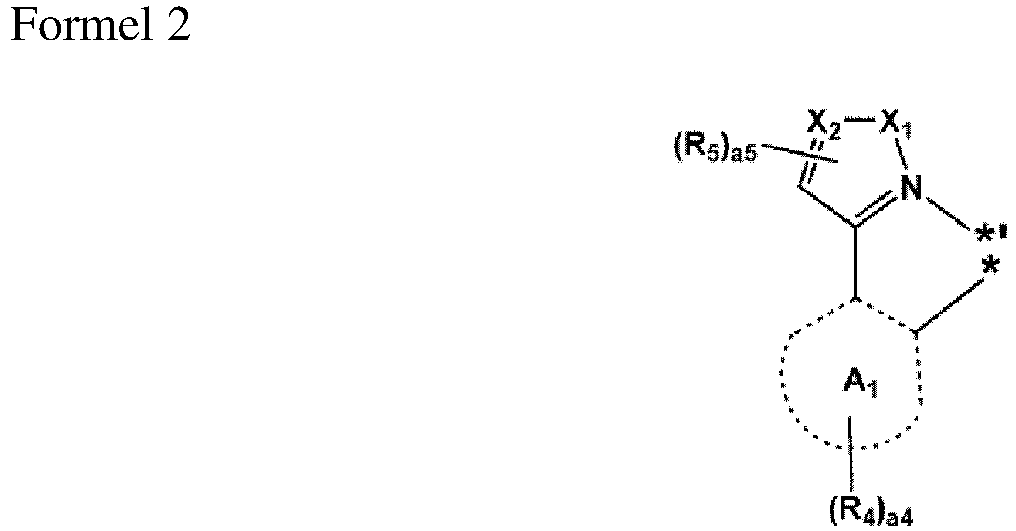
Formel 2A *-(L11)b11-[Si(Q41)(Q42)(Q43)]a11
Formel 2B *-(L11)b11-[Ge(Q41)(Q42)(Q43)]a11
Formel 2C *-(Li11)b11-[N(Q41)(Q42)]a11,
wobei M in der Formel 1 ein Übergangsmetall ist,L1 in der Formel 1 ein Ligand ist, der durch die Formel 2 dargestellt ist, und n1 1, 2 oder 3 beträgt, wobei, wenn n1 zwei oder mehr beträgt, zwei oder mehr L1 identisch oder voneinander verschieden sind,L2 in der Formel 1 ein Nicht-Carbenligand ist und n2 0, 1 oder 2 beträgt, wobei, wenn n2 zwei oder mehr beträgt, zwei oder mehr L2 identisch oder voneinander verschieden sind,die Summe von n1 und n2 in der Formel 1 2 oder 3 beträgt,* und *' in der Formel 2 jedes einen Bindungsort an M in der Formel 1 anzeigt,X1 in der Formel 2 N, B, O oder S ist,X2 in der Formel 2 N oder C ist,der Ring A1 in der Formel 2 eine carbocyclische C4-C60-Gruppe oder eine heterocyclische C1-C60-Gruppe ist,R4 und R5 in der Formel 2 jedes unabhängig ausgewählt ist von:Gruppen, die durch die Formeln 2A bis 2C dargestellt sind;Wasserstoff, Deuterium, -F, -Cl, -Br, -I, einer Hydroxylgruppe, einer Cyanogruppe, einer Nitrogruppe, einer Amidinogruppe, einer Hydrazingruppe, einer Hydrazongruppe, einer C1-C20-Alkylgruppe, einer C2-C20-Alkenylgruppe, einer C2-C20-Alkynylgruppe und einer C1-C20-Alkoxygruppe;einer C1-C20-Alkylgruppe, einer C2-C20-Alkenylgruppe, einer C2-C20-Alkynylgruppe und einer C1-C20-Alkoxygruppe, jede mit mindestens einem substituiert ausgewählt von Deuterium, -F, -Cl, -Br, -I, -CD3, -CD2H, -CDH2, -CF3, -CF2H, -CFH2, einer Hydroxylgruppe, einer Cyanogruppe, einer Nitrogruppe, einer Amidinogruppe, einer Hydrazingruppe, einer Hydrazongruppe, einer Cyclopentylgruppe, einer Cyclohexylgruppe, einer Cycloheptylgruppe, einer Cycloctylgruppe, einer Adamantanylgruppe, einer Norbornanylgruppe, einer Norbornenylgruppe, einer Cyclopentenylgruppe, einer Cyclohexenylgruppe, einer Cycloheptenylgruppe, einer Phenylgruppe, einer Naphthylgruppe, einer Pyridinylgruppe, einer Pyrimidinylgruppe, - Si(Q31)(Q32)(Q33), -N(Q31)(Q32), -B(Q31)(Q32), -C(=O)(Q31), -S(=O)2(Q31) und - P(=O)(Q31)(Q32);einer Cyclopentylgruppe, einer Cyclohexylgruppe, einer Cycloheptylgruppe, einer Cycloctylgruppe, einer Adamantanylgruppe, einer Norbornanylgruppe, einer Norbornenylgruppe, einer Cyclopentenylgruppe, einer Cyclohexenylgruppe, einer Cycloheptenylgruppe, einer Phenylgruppe, einer Naphthylgruppe, einer Fluorenylgruppe, einer Phenanthrenylgruppe, einer Anthracenylgruppe, einer Fluoranthenylgruppe, einer Triphenylenylgruppe, einer Pyrenylgruppe, einer Chrysenylgruppe, einer Pyrrolylgruppe, einer Thiophenylgruppe, einer Furanylgruppe, einer Imidazolylgruppe, einer Pyrazolylgruppe, einer Thiazolylgruppe, einer Isothiazolylgruppe, einer Oxazolylgruppe, einer Isoxazolylgruppe, einer Pyridinylgruppe, einer Pyrazinylgruppe, einer Pyridazinylgruppe, einer Isoindolylgruppe, einer Indolylgruppe, einer Indazolylgruppe, einer Purinylgruppe, einer Chinolinylgruppe, einer Isochinolinylgruppe, einer Benzochinolinylgruppe, einer Chinoxalinylgruppe, einer Chinazolinylgruppe, einer Cinnolinylgruppe, einer Carbazolylgruppe, einer Phenanthrolinylgruppe, einer Benzimidazolylgruppe, einer Benzofuranylgruppe, einer Benzothiophenylgruppe, einer Isobenzothiazolylgruppe, einer Benzoxazolylgruppe, einer Isobenzoxazolylgruppe, einer Triazolylgruppe, einer Tetrazolylgruppe, einer Oxadiazolylgruppe, einer Dibenzofuranylgruppe, einer Dibenzothiophenylgruppe, einer Benzocarbazolylgruppe, einer Dibenzocarbazolylgruppe, einer Imidazopyridinylgruppe und einer Imidazopyrimidinylgruppe;einer Cyclopentylgruppe, einer Cyclohexylgruppe, einer Cycloheptylgruppe, einer Cycloctylgruppe, einer Adamantylgruppe, einer Norbornanylgruppe, einer Norbornenylgruppe, einer Cyclopentenylgruppe, einer Cyclohexenylgruppe, einer Cycloheptenylgruppe, einer Phenylgruppe, einer Naphthylgruppe, einer Fluorenylgruppe, einer Phenanthrenylgruppe, einer Anthracenylgruppe, einer Fluoranthenylgruppe, einer Triphenylenylgruppe, einer Pyrenylgruppe, einer Chrysenylgruppe, einer Pyrrolylgruppe, einer Thiophenylgruppe, einer Furanylgruppe, einer Imidazolylgruppe, einer Pyrazolylgruppe, einer Thiazolylgruppe, einer Isothiazolylgruppe, einer Oxazolylgruppe, einer Isoxazolylgruppe, einer Pyridinylgruppe, einer Pyrazinylgruppe, einer Pyridazinylgruppe, einer Isoindolylgruppe, einer Indolylgruppe, einer Indazolylgruppe, einer Purinylgruppe, einer Chinolinylgruppe, einer Isochinolinylgruppe, einer Benzochinolinylgruppe, einer Chinoxalinylgruppe, einer Chinazolinylgruppe, einer Cinnolinylgruppe, einer Carbazolylgruppe, einer Phenantrolinylgruppe, einer Benzimidazolylgruppe, einer Benzofuranylgruppe, einer Benzothiophenylgruppe, einer Isobenzothiazolylgruppe, einer Benzoxazolylgruppe, einer Isobenzoxazolylgruppe, einer Triazolylgruppe, einer Tetrazolylgruppe, einer Oxadiazolylgruppe, einer Dibenzofuranylgruppe, einer Dibenzothiophenylgruppe, einer Benzocarbazolylgruppe, einer Dibenzocarbazolylgruppe, einer Imidazopyridinylgruppe und einer Imidazopyrimidinylgruppe, jede mit mindestens einem substituiert ausgewählt aus Deuterium, -F, -Cl, -Br, -CD3, -CD2H, -CDH2, -CF3, - CF2H, -CFH2, einer Hydroxylgruppe, einer Cyanogruppe, einer Nitrogruppe, einer Amidinogruppe, einer Hydrazingruppe, einer Hydrazongruppe, einer C1-C20-Alkylgruppe, einer C2-C20-Alkenylgruppe, einer C2-C20-Alkynylgruppe, einer C1-C20-Alkoxygruppe, einer Cyclopentylgruppe, einer Cyclohexylgruppe, einer Cycloheptylgruppe, einer Cycloctylgruppe, einer Adamantanylgruppe, einer Norbornanylgruppe, einer Norbornenylgruppe, einer Cyclopentenylgruppe, einer Cyclohexenylgruppe, einer Cycloheptenylgruppe, einer Phenylgruppe, einer Naphthylgruppe, einer Fluorenylgruppe, einer Phenanthrenylgruppe, einer Anthracenylgruppe, einer Fluoranthenylgruppe, einer Triphenylenylgruppe, einer Pyrenylgruppe, einer Chrysenylgruppe, einer Pyrrolylgruppe, einer Thiophenylgruppe, einer Furanylgruppe, einer Imidazolylgruppe, einer Pyrazolylgruppe, einer Thiazolylgruppe, einer Isothiazolyl, einer Oxazolylgruppe, einer Isoxazolylgruppe, einer Pyridinylgruppe, einer Pyrazinylgruppe, einer Pyrimidinylgruppe, einer Pyridazinylgruppe, einer Isoindolylgruppe, einer Indolylgruppe, einer Indazolylgruppe, einer Purinylgruppe, einer Chinolinylgruppe, einer Isochinolinylgruppe, einer Benzochinolinylgruppe, einer Chinoxalinylgruppe, einer Chinazolinylgruppe, einer Cinnolinylgruppe, einer Carbazolylgruppe, einer Phenanthrolinylgruppe, einer Benzimidazolylgruppe, einer Benzofuranylgruppe, einer Benzothiophenylgruppe, einer Isobenzothiazolylgruppe, einer Benzoxazolylgruppe, einer Isobenzoxazolylgruppe, einer Triazolylgruppe, einer Tetrazolylgruppe, einer Oxadiazolylgruppe, einer Triazinylgruppe, einer Dibenzofuranylgruppe, einer Dibenzothiophenylgruppe, einer Benzocarbazolylgruppe, einer Dibenzocarbazolylgruppe, einer Imidazopyridinylgruppe, einer Imidazopyrimidinylgruppe, -Si(Q31)(Q32)(Q33), -N(Q31)(Q32), -B(Q31)(Q32), -C(=O)(Q31), - S(=O)2(Q31) und -P(=O)(Q31)(Q32); und-B(Q1)(Q2), -P(Q1)(Q2) und -C(=O)(Q1),* in den Formeln 2A bis 2C einen Bindungsort an ein benachbartes Atom anzeigt,L11 in den Formeln 2A bis 2C aus einer Einfachbindung, einer substituierten oder unsubstituierten carbocyclischen C4-C60-Gruppe und einer substituierten oder unsubstituierten heterocyclischen C1-C60-Gruppe ausgewählt ist,Q41 bis Q43 in den Formeln 2A bis 2C jedes unabhängig ausgewählt ist aus Wasserstoff, Deuterium, -F, -Cl, -Br, -I, einer Hydroxylgruppe, einer Cyanogruppe, einer Nitrogruppe, einer Amidinogruppe, einer Hydrazingruppe, einer Hydrazongruppe, einer substituierten oder unsubstituierten C1-C60-Alkylgruppe, einer substituierten oder unsubstituierten C2-C60-Alkenylgruppe, einer substituierten oder unsubstituierten C2-C60-Alkynylgruppe, einer substituierten oder unsubstituierten C1-C60-Alkoxygruppe, einer substituierten oder unsubstituierten C3-C10-Cycloalkylgruppe, einer substituierten oder unsubstituierten C1-C10-Heterocycloalkylgruppe, einer substituierten oder unsubstituierten C3-C10-Cycloalkenylgruppe, einer substituierten oder unsubstituierten C1-C10-Heterocycloalkenylgruppe, einer substituierten oder unsubstituierten C6-C60-Arylgruppe, einer substituierten oder unsubstituierten C6-C60-Aryloxygruppe, einer substituierten oder unsubstituierten C6-C60-Arylthiogruppe, einer substituierten oder unsubstituierten C1-C60-Heteroarylgruppe, einer substituierten oder unsubstituierten einwertigen, nichtaromatischen, kondensierten polycyclischen Gruppe, einer substituierten oder unsubstituierten einwertigen, nichtaromatischen, kondensierten heteropolycyclischen Gruppe, -B(Q1)(Q2), -P(Q1)(Q2) und C(=O)(Q1),zwei Gruppen ausgewählt aus Q41 bis Q43 in den Formeln 2A bis 2C wahlweise verknüpft sind, um eine substituierte oder und substituierte carbocyclische C4-C60-Gruppe oder eine substituierte oder unsubstituierte heterocyclische C1-C60-Gruppe zu bilden,a11 und b11 in den Formeln 2A bis 2C jedes unabhängig eine ganze Zahl von 1 bis 5 ist,a4 in der Formel 2 eine ganze Zahl von 1 bis 10 ist,a5 in der Formel 2 eine ganze Zahl von 1 bis 3 ist,mindestens eines von R5 in der Zahl von a5 in der Formel 2 aus Gruppen ausgewählt ist, die durch die Formeln 2A bis 2C dargestellt sind,Substituenten der substituierten C1-C60-Alkylgruppe, der substituierten C2-C60-Alkenylgruppe, der substituierten C2-C60-Alkynylgruppe, der substituierten C1-C60-Alkoxygruppe, der substituierten C3-C10-Cycloalkylgruppe, der substituierten C1-C10-Heterocycloalkylgruppe, der substituierten C3-C10-Cycloalkenylgruppe, der substituierten C1-C10-Heterocycloalkenylgruppe, der substituierten C6-C60-Arylgruppe, der substituierten C6-C60-Aryloxygruppe, der substituierten C6-C60-Arylthiogruppe, der substituierten C1-C60-Heteroarylgruppe, der substituierten einwertigen, nichtaromatischen, kondensierten polycyclischen Gruppe, der substituierten einwertigen, nichtaromatischen, kondensierten heteropolycyclischen Gruppe, der substituierten carbocyclischen C4-C60-Gruppe und der substituierten heterocyclischen C1-C60-Gruppe ausgewählt sind aus:Deuterium, -F, -Cl, -Br, -I, einer Hydroxylgruppe, einer Cyanogruppe, einer Nitrogruppe, einer Amidinogruppe, einer Hydrazingruppe, einer Hydrazongruppe, einer C1-C60-Alkylgruppe, einer C2-C60-Alkenylgruppe, einer C2-C60-Alkynylgruppe und einer C1-C60-Alkoxygruppe;einer C1-C60-Alkylgruppe, einer C2-C60-Alkenylgruppe, einer C2-C60-Alkynylgruppe, einer C1-C60-Alkoxygruppe, jede mit mindestens einem substituiert ausgewählt aus Deuterium, -F, -Cl, -Br, -I, einer Hydroxylgruppe, einer Cyanogruppe, einer Nitrogruppe, einer Amidinogruppe, einer Hydrazingruppe, einer Hydrazongruppe, einer C3-C10-Cycloalkylgruppe, einer C1-C10-Heterocycloalkylgruppe, einer C3-C10-Cycloalkenylgruppe, einer C1-C10-Heterocycloalkenylgruppe, einer C6-C60-Arylgruppe, einer C6-C60-Aryloxygruppe, einer C6-C60-Arylthiogruppe, einer C1-C60-Heteroarylgruppe, einer einwertigen, nichtaromatischen, kondensierten polycyclischen Gruppe, einer einwertigen, nichtaromatischen, kondensierten heteropolycyclischen Gruppe, - Si(Q11)(Q12)(Q13), -N(Q11)(Q12), -B(Q11)(Q12), P(Q11)(Q12), -C(=O)(Q11), -S(=O)2(Q11) und -P(=O)(Q11)(Q12);einer C3-C10-Cycloalkylgruppe, einer C1-C10-Heterocycloalkylgruppe, einer C3-C10-Cycloalkenylgruppe, einer C1-C10-Heterocycloalkenylgruppe, einer C6-C60-Arylgruppe, einer C6-C60-Aryloxygruppe, einer C6-C60-Arylthiogruppe, einer C1-C60-Heteroarylgruppe, einer einwertigen, nichtaromatischen, kondensierten polycyclischen Gruppe und einer einwertigen, nichtaromatischen, kondensierten heteropolycyclischen Gruppe;einer C3-C10-Cycloalkylgruppe, einer C1-C10-Heterocycloalkylgruppe, einer C3-C10-Cycloalkenylgruppe, einer C1-C10-Heterocycloalkenylgruppe, einer C6-C60-Arylgruppe, einer C6-C60-Aryloxygruppe, einer C6-C60-Arylthiogruppe, einer C1-C60-Heteroarylgruppe, einer einwertigen, nichtaromatischen, kondensierten polycyclischen Gruppe und einer einwertigen, nichtaromatischen, kondensierten heteropolycyclischen Gruppe, jede mit mindestens einem substituiert ausgewählt aus Deuterium, -F, -Cl, -Br, -I, einer Hydroxylgruppe, einer Cyanogruppe, einer Nitrogruppe, einer Amidinogruppe, einer Hydrazingruppe, einer Hydrazongruppe, einer C1-C60-Alkylgruppe, einer C2-C60-Alkenylgruppe, einer C2-C60-Alkynylgruppe, einer C1-C60-Alkoxygruppe, einer C3-C10-Cycloalkylgruppe, einer C1-C10-Heterocycloalkylgruppe, einer C3-C10-Cycloalkenylgruppe, einer C1-C10-Heterocycloalkenylgruppe, einer C6-C60-Arylgruppe, einer C6-C60-Aryloxygruppe, einer C6-C60-Arylthiogruppe, einer C1-C60-Heteroarylgruppe, einer einwertigen, nichtaromatischen, kondensierten polycyclischen Gruppe, einer einwertigen, nichtaromatischen, kondensierten heteropolycyclischen Gruppe, - Si(Q21)(Q22)(Q23), -N(Q21)(Q22), -B(Q21)(Q22), P(Q21)(Q22), -C(=O)(Q21), -S(=O)2(Q21) und -P(=O)(Q21)(Q22); und-Si(Q31)(Q32)(Q33), -N(Q31)(Q32), -B(Q31)(Q32), P(Q31)(Q32), -C(=O)(Q31), - S(=O)2(Q31) und -P(=O)(Q31)(Q32); undQ1, Q2, Q11 bis Q13, Q21 bis Q23 und Q31 bis Q33 jedes unabhängig ausgewählt ist aus Wasserstoff, Deuterium, -F, -Cl, -Br, -I, einer Hydroxylgruppe, einer Cyanogruppe, einer Nitrogruppe, einer Amidinogruppe, einer Hydrazingruppe, einer Hydrazongruppe, einer C1-C60-Alkylgruppe, einer C2-C60-Alkenylgruppe, einer C2-C60-Alkynylgruppe, einer C1-C60-Alkoxygruppe, einer C3-C10-Cycloalkylgruppe, einer C1-C10-Heterocycloalkylgruppe, einer C3-C10-Cycloalkenylgruppe, einer C1-C10-Heterocycloalkenylgruppe, einer C6-C60-Arylgruppe, einer C1-C60-Heteroarylgruppe, einer einwertigen, nichtaromatischen, kondensierten polycyclischen Gruppe, einer einwertigen, nichtaromatischen, kondensierten heteropolycyclischen Gruppe, einer C1-C60-Alkylgruppe, die mit mindestens einem substituiert ist ausgewählt aus Deuterium, -F und einer Cyanogruppe, einer C6-C60-Arylgruppe, die mit mindestens einem substituiert ist ausgewählt aus Deuterium, -F und einer Cyanogruppe, einer Biphenylgruppe und einer Terphenylgruppe. - Organometallische Verbindung nach Anspruch 1, wobei:M in der Formel 1 Iridium oder Osmium ist und die Summe von n1 und n2 3 beträgt oderM in der Formel 1 Platin ist und die Summe von n1 und n2 2 beträgt.
- Organometallische Verbindung nach Anspruch 1 oder Anspruch 2, wobei:
der Ring A1 in der Formel 2 eine Benzolgruppe, eine Naphthalingruppe, eine Anthracengruppe, eine Phenanthrengruppe, eine Triphenylengruppe, eine Pyrengruppe, eine Chrysengruppe, eine Cyclopentadiengruppe, eine 1,2,3,4-Tetrahydronaphthalingruppe, eine Thiophengruppe, eine Furangruppe, eine Pyrrolgruppe, eine Indolgruppe, eine Indengruppe, eine Benzosilolgruppe, eine Benzothiophengruppe, eine Benzofurangruppe, eine Carbazolgruppe, eine Fluorengruppe, eine Dibenzosilolgruppe, eine Dibenzothiophengruppe, eine Dibenzofurangruppe, eine Pyridingruppe, eine Pyrimidingruppe, eine Pyrazingruppe, eine Pyridazingruppe, eine Triazingruppe, eine Chinolingruppe, eine Isochinolingruppe, eine Chinoxalingruppe, eine Chinazolingruppe, eine Phenanthrolingruppe, eine Pyrazolgruppe, eine Imidazolgruppe, eine Triazolgruppe, eine Oxazolgruppe, eine Isoxazolgruppe, eine Thiazolgruppe, eine Isothiazolgruppe, eine Oxadiazolgruppe, eine Thiadiazolgruppe, eine Benzopyrazolgruppe, eine Benzimidazolgruppe, eine Benzoxazolgruppe, eine Benzothiazolgruppe, eine Benzoxadiazolgruppe, eine Benzothiadiazolgruppe, eine 5,6,7,8-Tetrahydroisochinolingruppe oder eine 5,6,7,8-Tetrahydrochinolingruppe ist. - Organometallische Verbindung nach einem der Ansprüche 1 bis 3, wobei:
Q1, Q2 und Q31 bis Q33 jedes unabhängig ausgewählt ist aus:Wasserstoff, Deuterium, -F, -Cl, -Br, -I, einer Cyanogruppe, einer C1-C20-Alkylgruppe, einer C2-C20-Alkenylgruppe, einer C2-C20-Alkynylgruppe, einer C1-C20-Alkoxygruppe, einer C3-C10-Cycloalkylgruppe, einer C1-C10-Heterocycloalkylgruppe, einer C3-C10-Cycloalkenylgruppe, einer C1-C10-Heterocycloalkenylgruppe, einer C6-C20-Arylgruppe, einer C1-C20-Heteroarylgruppe, einer einwertigen, nichtaromatischen, kondensierten polycyclischen Gruppe und einer einwertigen, nichtaromatischen, kondensierten heteropolycyclischen Gruppe;einer C1-C20-Alkylgruppe, die mit mindestens einem substituiert ist ausgewählt aus Deuterium, -F und einer Cyanogruppe;einer C6-C20-Arylgruppe, die mit mindestens einem substituiert ist ausgewählt aus Deuterium, -F und einer Cyanogruppe; undeiner Biphenylgruppe und einer Terphenylgruppe. - Organometallische Verbindung nach einem der Ansprüche 1 bis 4, wobei:*-N(Q41)(Q42) in der Formel 2C durch die Formel 2C(1) dargestellt ist:
 X41 eine Einfachbindung, *-O-*', *-S-*', *-N(Q44))-*', *-C(Q44) (Q45)-*' oder *-Si(Q44)(Q45)-*' ist,Q44 bis Q47 die gleichen wie in Verbindung mit Q41 beschrieben sind und*einen Bindungsort an ein benachbartes Atom anzeigt.
 - Organometallische Verbindung nach einem der Ansprüche 1 bis 5, wobei:
L1 ausgewählt ist aus Liganden, die durch die Formeln 2-1 bis 2-4 dargestellt sind: wobei der Ring A1, R4, a4, *, und *' in den Formeln 2-1 bis 2-4 dieselben sind wie in Anspruch 1 beschrieben,X1 in den Formeln 2-1 und 2-3 O oder S ist,R1 bis R3 in den Formeln 2-1 bis 2-4 dieselben, wie in Verbindung mit R5 in Anspruch 1 beschrieben, sind undi) mindestens eines ausgewählt aus R2 und R3 in der Formel 2-1, ii) mindestens eines ausgewählt aus R1 bis R3 in der Formel 2-2, iii) R3 in der Formel 2-3 und iv) mindestens eines ausgewählt aus R1 und R3 in der Formel 2-4 jedes unabhängig aus Gruppen ausgewählt ist, die durch die Formeln 2A bis 2C dargestellt sind, wobei bevorzugt R3 in den Formeln 2-1 bis 2-4 aus Gruppen ausgewählt ist, die durch die Formeln 2A und 2C dargestellt sind.
 - Organometallische Verbindung nach einem der Ansprüche 1 bis 6, wobei: ein Anteil, der durch


 wobei in den Formeln 2(1) bis 2(13),R4 dasselbe wie in Anspruch 1 beschrieben ist,a46 eine ganze Zahl von 0 bis 6 ist,a45 eine ganze Zahl von 0 bis 5 ist,a44 eine ganze Zahl von 0 bis 4 ist,a43 eine ganze Zahl von 0 bis 3 ist,a42 eine ganze Zahl von 0 bis 2 ist,* einen Bindungsort an M in der Formel 1 anzeigt und*" einen Bindungsort an ein benachbartes Atom in der Formel 2 anzeigt.
 - Organometallische Verbindung nach einem der Ansprüche 1 bis 7, wobei:
L2 aus Liganden ausgewählt ist, die durch die Formeln 3-1 bis 3-4 dargestellt sind: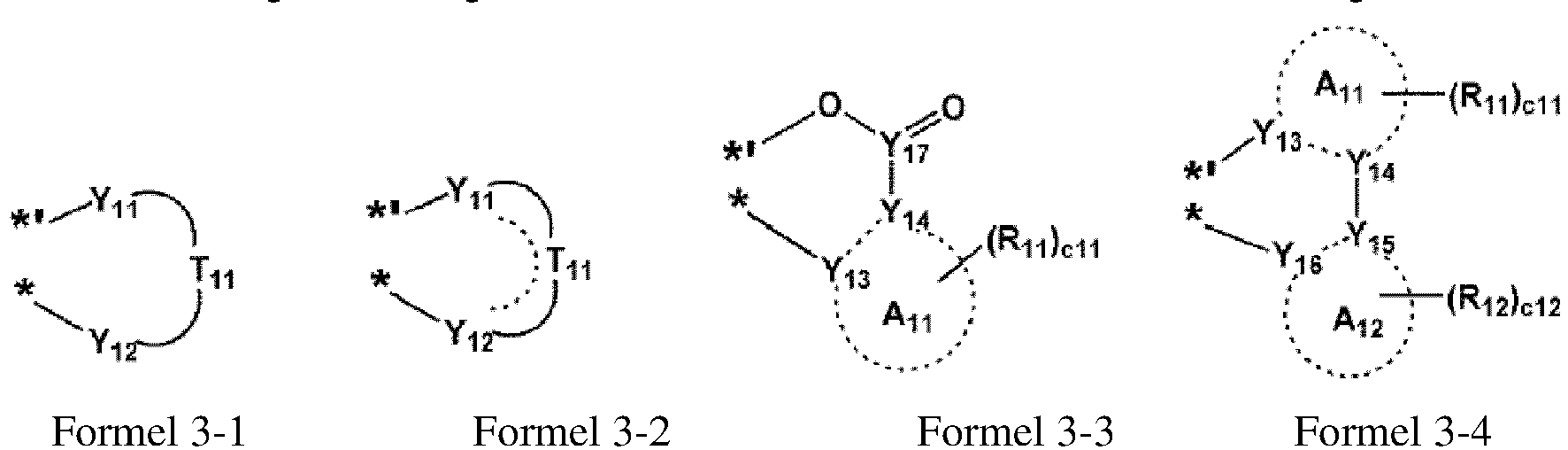 Y11O, N, N(R13), P(R13)(R14) oder As(R13)(R14) ist,Y12O, N, N(R15), P(R15)(R16) oder As(R15)(R16) ist,T11 aus einer Einzelbindung, einer Doppelbindung, *-C(R11)(R12)-*', *-C(R11)=C(R12)-*', *=C(R11)-*', *-C(R11)=*', *=C(R11)-C(R12)=C(R13)-*', *=C(R11)=C(R12)-C(R13)=*' und *-N(R11)-*' ausgewählt ist,Y13 bis Y16 jedes unabhängig C oder N ist,Y17 C, N(R17) oder P(R17) ist,der Ring A11 und der Ring A12 jeder unabhängig eine carbocyclische C4-C60-Gruppe oder eine heterocyclische C1-C60-Gruppe ist,R11 bis R17 die gleichen wie in Verbindung mit R4 in Anspruch 1 beschrieben sindc11 und c12 jedes unabhängig eine ganze Zahl von 0 bis 10 ist und* und *' jedes einen Bindungsort an M in der Formel 1 anzeigt, wobei bevorzugt L2 aus Liganden ausgewählt ist, die durch die Formeln 3-1 bis 3-3 dargestellt sind,wobei in den Formeln 3-1 bis 3-3Y11 O oder N(R13) ist,Y12 O oder N(R15) ist,T11 *-C(R11)=C(R12)-C(R13)=*' ist undY13 N ist.
 - Organometallische Verbindung nach einem der Ansprüche 1 bis 8, wobei:
die organometallische Verbindung aus den Verbindungen 1 bis 180 ausgewählt ist:











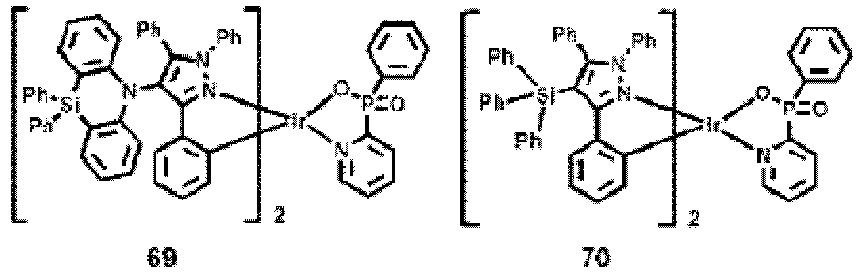


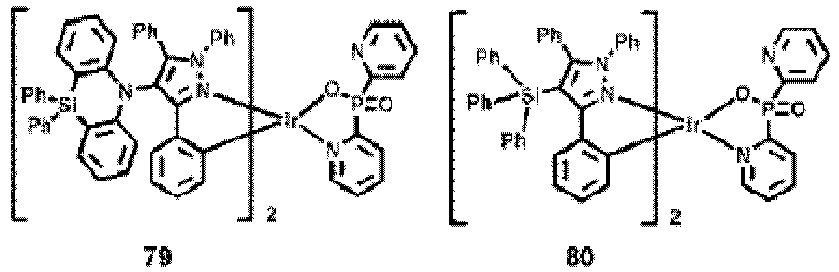














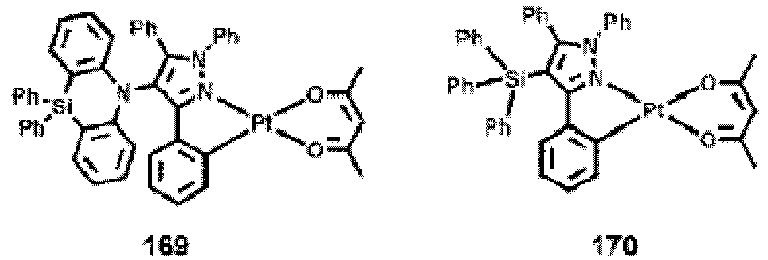


- Organometallische Verbindung nach einem der Ansprüche 1 bis 9, wobei:die organometallische Verbindung blaues Licht emittiert, das eine maximale Emissionswellenlänge von etwa 440 nm bis etwa 495 nm aufweist, undein Unterschied zwischen einem Singulett- (S1) Energieniveau und einem Triplett-(T1) Energieniveau der organometallischen Verbindung etwa 0,5 eV oder weniger beträgt.
- Organische lichtemittierende Vorrichtung umfassend:eine erste Elektrode;eine zweite Elektrode, die der ersten Elektrode zugewandt ist; undeine organische Schicht, die zwischen der ersten Elektrode und der zweiten Elektrode angeordnet ist,wobei die organische Schicht eine Emissionsschicht und mindestens eine von der organometallischen Verbindung nach einem der Ansprüche 1 bis 10 umfasst, wobei bevorzugt die Emissionsschicht die mindestens eine organometallische Verbindung umfasst, wobei noch bevorzugter die mindestens eine organometallische Verbindung der Emissionsschicht als ein phosphoreszierendes Dotiermittel wirkt, derart, dass Phosphoreszenz aus der Emissionsschicht emittiert wird; oderdie mindestens eine organometallische Verbindung der Emissionsschicht als ein verzögert fluoreszierendes Dotiermittel wirkt, derart, dass verzögerte Fluoreszenz aus der Emissionsschicht emittiert wird.
- Organische lichtemittierende Vorrichtung nach Anspruch 11, wobei:die Emissionsschicht ein Dotiermittel umfasst, das von der mindestens einen der organometallischen Verbindung verschieden ist, unddie mindestens eine organometallische Verbindung als ein metallunterstütztes, verzögert fluoreszierendes Dotiermittel wirkt.
- Organische lichtemittierende Vorrichtung nach Anspruch 11 oder 12, wobei:die Lochtransportregion die Elektronenblockierschicht umfasst und die Elektronenblockierschicht die mindestens eine organometallische Verbindung umfasst; und/oderdie Elektronentransportregion die Lochblockierschicht umfasst und die Lochblockierschicht die mindestens eine organometallische Verbindung umfasst.
- Organische lichtemittierende Vorrichtung nach einem der Ansprüche 11 bis 13, wobei:mindestens eine ausgewählt aus der Lochtransportregion und der Emissionsschicht mindestens eine umfasst ausgewählt aus einer Arylamin enthaltenden Verbindung, einer Acridin enthaltenden Verbindung und einer Carbazol enthaltenden Verbindung; und/odermindestens eine ausgewählt aus der Emissionsschicht und der Elektronentransportregion mindestens eine umfasst ausgewählt aus einer Silicium enthaltenden Verbindung, einer Phosphinoxid enthaltenden Verbindung, einer Schwefeloxid enthaltenden Verbindung, einer Phosphoroxid enthaltenden Verbindung, einer Triazin enthaltenden Verbindung, einer Pyrimidin enthaltenden Verbindung, einer Pyridin enthaltenden Verbindung, einer Dibenzofuran enthaltenden Verbindung und einer Dibenzothiophen enthaltenden Verbindung.
- Organische lichtemittierende Vorrichtung umfassend:die organische lichtemittierende Vorrichtung nach einem der Ansprüche 11 bis 14; undeinen Dünnfilmtransistor,wobei der Dünnfilmtransistor eine Quellenelektrode und eine Drain-Elektrode umfasst unddie erste Elektrode der organischen lichtemittierenden Vorrichtung elektrisch an mindestens eine angeschlossen ist ausgewählt aus der Quellenelektrode und der Drain-Elektrode des Dünnfilmtransistors.
Applications Claiming Priority (1)
| Application Number | Priority Date | Filing Date | Title |
|---|---|---|---|
| KR1020170105506A KR102504132B1 (ko) | 2017-08-21 | 2017-08-21 | 유기금속 화합물, 이를 포함한 유기 발광 소자 및 상기 유기 발광 소자를 포함한 발광 장치 |
Publications (2)
| Publication Number | Publication Date |
|---|---|
| EP3447062A1 EP3447062A1 (de) | 2019-02-27 |
| EP3447062B1 true EP3447062B1 (de) | 2020-12-23 |
Family
ID=63350464
Family Applications (1)
| Application Number | Title | Priority Date | Filing Date |
|---|---|---|---|
| EP18190061.4A Active EP3447062B1 (de) | 2017-08-21 | 2018-08-21 | Organometallverbindung, organische lichtemittierende vorrichtung mit der organometallverbindung und organische lichtemittierende vorrichtung mit der organischen lichtemittierenden vorrichtung |
Country Status (4)
| Country | Link |
|---|---|
| US (1) | US12378269B2 (de) |
| EP (1) | EP3447062B1 (de) |
| KR (1) | KR102504132B1 (de) |
| CN (1) | CN109422775B (de) |
Families Citing this family (25)
| Publication number | Priority date | Publication date | Assignee | Title |
|---|---|---|---|---|
| US9882150B2 (en) | 2012-09-24 | 2018-01-30 | Arizona Board Of Regents For And On Behalf Of Arizona State University | Metal compounds, methods, and uses thereof |
| WO2014109814A2 (en) | 2012-10-26 | 2014-07-17 | Arizona Board Of Regents Acting For And On Behalf Of Arizona State University | Metal complexes, methods, and uses thereof |
| JP6804823B2 (ja) | 2013-10-14 | 2020-12-23 | アリゾナ・ボード・オブ・リージェンツ・オン・ビハーフ・オブ・アリゾナ・ステイト・ユニバーシティーArizona Board of Regents on behalf of Arizona State University | 白金錯体およびデバイス |
| US10020455B2 (en) | 2014-01-07 | 2018-07-10 | Arizona Board Of Regents On Behalf Of Arizona State University | Tetradentate platinum and palladium complex emitters containing phenyl-pyrazole and its analogues |
| US9941479B2 (en) | 2014-06-02 | 2018-04-10 | Arizona Board Of Regents On Behalf Of Arizona State University | Tetradentate cyclometalated platinum complexes containing 9,10-dihydroacridine and its analogues |
| US9923155B2 (en) | 2014-07-24 | 2018-03-20 | Arizona Board Of Regents On Behalf Of Arizona State University | Tetradentate platinum (II) complexes cyclometalated with functionalized phenyl carbene ligands and their analogues |
| WO2016025921A1 (en) | 2014-08-15 | 2016-02-18 | Arizona Board Of Regents On Behalf Of Arizona State University | Non-platinum metal complexes for excimer based single dopant white organic light emitting diodes |
| US11329244B2 (en) | 2014-08-22 | 2022-05-10 | Arizona Board Of Regents On Behalf Of Arizona State University | Organic light-emitting diodes with fluorescent and phosphorescent emitters |
| US10033003B2 (en) | 2014-11-10 | 2018-07-24 | Arizona Board Of Regents On Behalf Of Arizona State University | Tetradentate metal complexes with carbon group bridging ligands |
| US9879039B2 (en) | 2015-06-03 | 2018-01-30 | Arizona Board Of Regents On Behalf Of Arizona State University | Tetradentate and octahedral metal complexes containing naphthyridinocarbazole and its analogues |
| WO2018140765A1 (en) | 2017-01-27 | 2018-08-02 | Jian Li | Metal-assisted delayed fluorescent emitters employing pyrido-pyrrolo-acridine and analogues |
| US11101435B2 (en) | 2017-05-19 | 2021-08-24 | Arizona Board Of Regents On Behalf Of Arizona State University | Tetradentate platinum and palladium complexes based on biscarbazole and analogues |
| US10516117B2 (en) | 2017-05-19 | 2019-12-24 | Arizona Board Of Regents On Behalf Of Arizona State University | Metal-assisted delayed fluorescent emttters employing benzo-imidazo-phenanthridine and analogues |
| WO2019079508A2 (en) | 2017-10-17 | 2019-04-25 | Jian Li | PREFERRED MOLECULAR ORIENTATED PHOSPHORESCENT EXCIMERS AS MONOCHROMATIC TRANSMITTERS FOR DISPLAY AND LIGHTING APPLICATIONS |
| US11647643B2 (en) | 2017-10-17 | 2023-05-09 | Arizona Board Of Regents On Behalf Of Arizona State University | Hole-blocking materials for organic light emitting diodes |
| US12037348B2 (en) | 2018-03-09 | 2024-07-16 | Arizona Board Of Regents On Behalf Of Arizona State University | Blue and narrow band green and red emitting metal complexes |
| CN110872325B (zh) * | 2018-09-03 | 2021-05-21 | 广东阿格蕾雅光电材料有限公司 | 基于铂四齿oncn络合物的有机发光材料、制备方法及其在有机发光二极管中的应用 |
| US11878988B2 (en) | 2019-01-24 | 2024-01-23 | Arizona Board Of Regents On Behalf Of Arizona State University | Blue phosphorescent emitters employing functionalized imidazophenthridine and analogues |
| US11594691B2 (en) * | 2019-01-25 | 2023-02-28 | Arizona Board Of Regents On Behalf Of Arizona State University | Light outcoupling efficiency of phosphorescent OLEDs by mixing horizontally aligned fluorescent emitters |
| KR102556834B1 (ko) * | 2019-10-01 | 2023-07-19 | 삼성디스플레이 주식회사 | 유기 전계 발광 소자 |
| US11785838B2 (en) | 2019-10-02 | 2023-10-10 | Arizona Board Of Regents On Behalf Of Arizona State University | Green and red organic light-emitting diodes employing excimer emitters |
| KR102853328B1 (ko) * | 2020-04-24 | 2025-09-01 | 삼성디스플레이 주식회사 | 유기금속 화합물 및 이를 포함한 유기 발광 소자 |
| US11945985B2 (en) | 2020-05-19 | 2024-04-02 | Arizona Board Of Regents On Behalf Of Arizona State University | Metal assisted delayed fluorescent emitters for organic light-emitting diodes |
| CN113683625B (zh) | 2020-05-19 | 2025-06-10 | 亚利桑那州立大学董事会 | 用于有机发光二极管的金属辅助延迟荧光发射体 |
| CN113773254B (zh) * | 2021-09-27 | 2023-05-30 | 上海兆维科技发展有限公司 | 1,3,4,5-四取代吡唑衍生物及其制备方法 |
Family Cites Families (31)
| Publication number | Priority date | Publication date | Assignee | Title |
|---|---|---|---|---|
| US6310360B1 (en) * | 1999-07-21 | 2001-10-30 | The Trustees Of Princeton University | Intersystem crossing agents for efficient utilization of excitons in organic light emitting devices |
| US6939624B2 (en) | 2000-08-11 | 2005-09-06 | Universal Display Corporation | Organometallic compounds and emission-shifting organic electrophosphorescence |
| TW545080B (en) * | 2000-12-28 | 2003-08-01 | Semiconductor Energy Lab | Light emitting device and method of manufacturing the same |
| JP4198654B2 (ja) | 2003-08-07 | 2008-12-17 | 三星エスディアイ株式会社 | イリジウム化合物及びそれを採用した有機電界発光素子 |
| US7393599B2 (en) | 2004-05-18 | 2008-07-01 | The University Of Southern California | Luminescent compounds with carbene ligands |
| WO2005123873A1 (ja) * | 2004-06-17 | 2005-12-29 | Konica Minolta Holdings, Inc. | 有機エレクトロルミネッセンス素子材料、有機エレクトロルミネッセンス素子、表示装置及び照明装置 |
| DE102004057072A1 (de) | 2004-11-25 | 2006-06-01 | Basf Ag | Verwendung von Übergangsmetall-Carbenkomplexen in organischen Licht-emittierenden Dioden (OLEDs) |
| US9051344B2 (en) | 2005-05-06 | 2015-06-09 | Universal Display Corporation | Stability OLED materials and devices |
| JP2007208102A (ja) | 2006-02-03 | 2007-08-16 | Konica Minolta Holdings Inc | 有機エレクトロルミネッセンス素子、表示装置及び照明装置 |
| KR101431844B1 (ko) | 2006-04-05 | 2014-08-25 | 바스프 에스이 | 이종 리간드 전이 금속-카르벤 착체 및 이의 유기 발광 다이오드(oled)에서의 용도 |
| US20070247061A1 (en) * | 2006-04-20 | 2007-10-25 | Vadim Adamovich | Multiple dopant emissive layer OLEDs |
| WO2007145129A1 (ja) * | 2006-06-13 | 2007-12-21 | Konica Minolta Holdings, Inc. | 有機エレクトロルミネッセンス素子、照明装置及び表示装置 |
| US20130032785A1 (en) * | 2011-08-01 | 2013-02-07 | Universal Display Corporation | Materials for organic light emitting diode |
| TW200910661A (en) | 2007-04-04 | 2009-03-01 | Koninkl Philips Electronics Nv | OLED with metal complexes having a high quantum efficiency |
| JP5256485B2 (ja) | 2007-05-16 | 2013-08-07 | コニカミノルタ株式会社 | 有機エレクトロルミネッセンス素子、表示装置及び照明装置 |
| WO2008140114A1 (ja) | 2007-05-16 | 2008-11-20 | Konica Minolta Holdings, Inc. | 有機エレクトロルミネッセンス素子、表示装置及び照明装置 |
| JP5305637B2 (ja) * | 2007-11-08 | 2013-10-02 | キヤノン株式会社 | 有機金属錯体及びこれを用いた有機発光素子並びに表示装置 |
| JP5495746B2 (ja) * | 2009-12-08 | 2014-05-21 | キヤノン株式会社 | 新規イリジウム錯体とそれを有する有機発光素子 |
| JP5596966B2 (ja) * | 2009-12-08 | 2014-09-24 | キヤノン株式会社 | 新規イリジウム錯体とそれを有する有機発光素子 |
| WO2011158544A1 (ja) | 2010-06-17 | 2011-12-22 | コニカミノルタホールディングス株式会社 | 有機エレクトロルミネッセンス材料、有機エレクトロルミネッセンス素子、表示装置及び照明装置 |
| US20130088144A1 (en) * | 2011-10-06 | 2013-04-11 | Semiconductor Energy Laboratory Co., Ltd. | Phosphorescent Iridium Metal Complex, Light-Emitting Element, Light-Emitting Device, Electronic Appliance, and Lighting Device |
| KR20130110934A (ko) * | 2012-03-30 | 2013-10-10 | 에스에프씨 주식회사 | 유기금속 화합물 및 이를 포함하는 유기전계발광소자 |
| JP2015524610A (ja) | 2012-07-04 | 2015-08-24 | サムスン エスディアイ カンパニー,リミテッド | 有機発光素子用組成物、これを含む有機発光層および有機発光素子 |
| KR101373200B1 (ko) | 2012-07-05 | 2014-03-13 | 주식회사 엘엠에스 | 광학필름, 이를 포함하는 서브 패널, 및 이를 포함하는 입체영상 표시장치 |
| US9725476B2 (en) * | 2012-07-09 | 2017-08-08 | Universal Display Corporation | Silylated metal complexes |
| US9059412B2 (en) | 2012-07-19 | 2015-06-16 | Universal Display Corporation | Transition metal complexes containing substituted imidazole carbene as ligands and their application in OLEDs |
| KR102049684B1 (ko) * | 2013-03-29 | 2019-11-28 | 코니카 미놀타 가부시키가이샤 | 이성체 혼합 금속 착체 조성물, 유기 일렉트로루미네센스 소자, 조명 장치 및 표시 장치 |
| JPWO2015046452A1 (ja) * | 2013-09-27 | 2017-03-09 | コニカミノルタ株式会社 | イリジウム錯体、イリジウム錯体の製造方法、有機エレクトロルミネッセンス素子、表示装置及び照明装置 |
| JP5905916B2 (ja) * | 2013-12-26 | 2016-04-20 | 出光興産株式会社 | 有機エレクトロルミネッセンス素子および電子機器 |
| JP6551399B2 (ja) * | 2014-04-04 | 2019-07-31 | コニカミノルタ株式会社 | 有機金属錯体の合成方法 |
| US9865825B2 (en) * | 2014-11-10 | 2018-01-09 | Arizona Board Of Regents On Behalf Of Arizona State University | Emitters based on octahedral metal complexes |
-
2017
- 2017-08-21 KR KR1020170105506A patent/KR102504132B1/ko active Active
-
2018
- 2018-08-14 CN CN201810920284.4A patent/CN109422775B/zh active Active
- 2018-08-17 US US16/104,695 patent/US12378269B2/en active Active
- 2018-08-21 EP EP18190061.4A patent/EP3447062B1/de active Active
Non-Patent Citations (1)
| Title |
|---|
| None * |
Also Published As
| Publication number | Publication date |
|---|---|
| KR20190020872A (ko) | 2019-03-05 |
| US20190058137A1 (en) | 2019-02-21 |
| CN109422775B (zh) | 2024-03-19 |
| KR102504132B1 (ko) | 2023-02-28 |
| US12378269B2 (en) | 2025-08-05 |
| EP3447062A1 (de) | 2019-02-27 |
| CN109422775A (zh) | 2019-03-05 |
Similar Documents
| Publication | Publication Date | Title |
|---|---|---|
| EP3447062B1 (de) | Organometallverbindung, organische lichtemittierende vorrichtung mit der organometallverbindung und organische lichtemittierende vorrichtung mit der organischen lichtemittierenden vorrichtung | |
| EP3657563B1 (de) | Heterocyclische verbindung und organische lichtemittierende vorrichtung damit | |
| EP3441391B1 (de) | Heterocyclische verbindung und organische lichtemittierende vorrichtung damit | |
| EP3431482B1 (de) | Organometallische verbindung und organische lichtemittierende vorrichtung damit | |
| EP3444241B1 (de) | Aminbasierte verbindung und diese enthaltende organisches lichtemittierendes element | |
| EP3389109B1 (de) | Heterozyklisch substituierte phosphor-verbindungen und organische leuchtdiode diese enthaltend | |
| EP3539972B1 (de) | Organometallische verbindung und organische lichtemittierende vorrichtung damit | |
| JP7601562B2 (ja) | 有機金属化合物、及びそれを含む有機発光素子 | |
| EP3502107B1 (de) | 1-aminodibenzofuran-basierte verbindung und organische lichtemittierende vorrichtung damit | |
| EP3537495B1 (de) | Organische lichtemittierende vorrichtung | |
| EP3561894B1 (de) | Diaminverbindung und organische lichtemittierende vorrichtung damit | |
| EP3476852B1 (de) | Heterocyclische verbindung und organische lichtemittierende vorrichtung damit | |
| EP3428149A2 (de) | Kondensierte cyclische verbindung und organische lichtemittierende vorrichtung damit | |
| EP3783007B1 (de) | Organometallische verbindung und organische lichtemittierende vorrichtung damit | |
| EP3296288B1 (de) | Kondensierte cyclische verbindung und organische lichtemittierende vorrichtung damit | |
| EP3263558A1 (de) | Heterocyclische verbindung und organische lichtemittierende vorrichtung damit | |
| EP3748706B1 (de) | Heterocyclische verbindung und organische lichtemittierende vorrichtung damit | |
| KR20200085400A (ko) | 유기금속 화합물 및 이를 포함한 유기 발광 소자 | |
| EP3575295B1 (de) | Heterocyclische verbindung und organische lichtemittierende vorrichtung damit | |
| EP3333168B1 (de) | Kondensierte cyclische verbindung und organische lichtemittierende vorrichtung damit |
Legal Events
| Date | Code | Title | Description |
|---|---|---|---|
| PUAI | Public reference made under article 153(3) epc to a published international application that has entered the european phase |
Free format text: ORIGINAL CODE: 0009012 |
|
| STAA | Information on the status of an ep patent application or granted ep patent |
Free format text: STATUS: THE APPLICATION HAS BEEN PUBLISHED |
|
| AK | Designated contracting states |
Kind code of ref document: A1 Designated state(s): AL AT BE BG CH CY CZ DE DK EE ES FI FR GB GR HR HU IE IS IT LI LT LU LV MC MK MT NL NO PL PT RO RS SE SI SK SM TR |
|
| AX | Request for extension of the european patent |
Extension state: BA ME |
|
| STAA | Information on the status of an ep patent application or granted ep patent |
Free format text: STATUS: REQUEST FOR EXAMINATION WAS MADE |
|
| 17P | Request for examination filed |
Effective date: 20190821 |
|
| RBV | Designated contracting states (corrected) |
Designated state(s): AL AT BE BG CH CY CZ DE DK EE ES FI FR GB GR HR HU IE IS IT LI LT LU LV MC MK MT NL NO PL PT RO RS SE SI SK SM TR |
|
| GRAP | Despatch of communication of intention to grant a patent |
Free format text: ORIGINAL CODE: EPIDOSNIGR1 |
|
| STAA | Information on the status of an ep patent application or granted ep patent |
Free format text: STATUS: GRANT OF PATENT IS INTENDED |
|
| RIC1 | Information provided on ipc code assigned before grant |
Ipc: H01L 51/50 20060101ALI20200609BHEP Ipc: C07F 15/00 20060101AFI20200609BHEP Ipc: H01L 51/00 20060101ALI20200609BHEP Ipc: C09K 11/06 20060101ALI20200609BHEP |
|
| INTG | Intention to grant announced |
Effective date: 20200703 |
|
| GRAS | Grant fee paid |
Free format text: ORIGINAL CODE: EPIDOSNIGR3 |
|
| GRAA | (expected) grant |
Free format text: ORIGINAL CODE: 0009210 |
|
| STAA | Information on the status of an ep patent application or granted ep patent |
Free format text: STATUS: THE PATENT HAS BEEN GRANTED |
|
| AK | Designated contracting states |
Kind code of ref document: B1 Designated state(s): AL AT BE BG CH CY CZ DE DK EE ES FI FR GB GR HR HU IE IS IT LI LT LU LV MC MK MT NL NO PL PT RO RS SE SI SK SM TR |
|
| REG | Reference to a national code |
Ref country code: GB Ref legal event code: FG4D |
|
| REG | Reference to a national code |
Ref country code: DE Ref legal event code: R096 Ref document number: 602018011029 Country of ref document: DE |
|
| REG | Reference to a national code |
Ref country code: AT Ref legal event code: REF Ref document number: 1347619 Country of ref document: AT Kind code of ref document: T Effective date: 20210115 |
|
| REG | Reference to a national code |
Ref country code: IE Ref legal event code: FG4D |
|
| PG25 | Lapsed in a contracting state [announced via postgrant information from national office to epo] |
Ref country code: RS Free format text: LAPSE BECAUSE OF FAILURE TO SUBMIT A TRANSLATION OF THE DESCRIPTION OR TO PAY THE FEE WITHIN THE PRESCRIBED TIME-LIMIT Effective date: 20201223 Ref country code: FI Free format text: LAPSE BECAUSE OF FAILURE TO SUBMIT A TRANSLATION OF THE DESCRIPTION OR TO PAY THE FEE WITHIN THE PRESCRIBED TIME-LIMIT Effective date: 20201223 Ref country code: GR Free format text: LAPSE BECAUSE OF FAILURE TO SUBMIT A TRANSLATION OF THE DESCRIPTION OR TO PAY THE FEE WITHIN THE PRESCRIBED TIME-LIMIT Effective date: 20210324 Ref country code: NO Free format text: LAPSE BECAUSE OF FAILURE TO SUBMIT A TRANSLATION OF THE DESCRIPTION OR TO PAY THE FEE WITHIN THE PRESCRIBED TIME-LIMIT Effective date: 20210323 |
|
| REG | Reference to a national code |
Ref country code: AT Ref legal event code: MK05 Ref document number: 1347619 Country of ref document: AT Kind code of ref document: T Effective date: 20201223 |
|
| REG | Reference to a national code |
Ref country code: NL Ref legal event code: MP Effective date: 20201223 |
|
| PG25 | Lapsed in a contracting state [announced via postgrant information from national office to epo] |
Ref country code: BG Free format text: LAPSE BECAUSE OF FAILURE TO SUBMIT A TRANSLATION OF THE DESCRIPTION OR TO PAY THE FEE WITHIN THE PRESCRIBED TIME-LIMIT Effective date: 20210323 Ref country code: SE Free format text: LAPSE BECAUSE OF FAILURE TO SUBMIT A TRANSLATION OF THE DESCRIPTION OR TO PAY THE FEE WITHIN THE PRESCRIBED TIME-LIMIT Effective date: 20201223 Ref country code: LV Free format text: LAPSE BECAUSE OF FAILURE TO SUBMIT A TRANSLATION OF THE DESCRIPTION OR TO PAY THE FEE WITHIN THE PRESCRIBED TIME-LIMIT Effective date: 20201223 |
|
| PG25 | Lapsed in a contracting state [announced via postgrant information from national office to epo] |
Ref country code: NL Free format text: LAPSE BECAUSE OF FAILURE TO SUBMIT A TRANSLATION OF THE DESCRIPTION OR TO PAY THE FEE WITHIN THE PRESCRIBED TIME-LIMIT Effective date: 20201223 Ref country code: HR Free format text: LAPSE BECAUSE OF FAILURE TO SUBMIT A TRANSLATION OF THE DESCRIPTION OR TO PAY THE FEE WITHIN THE PRESCRIBED TIME-LIMIT Effective date: 20201223 |
|
| REG | Reference to a national code |
Ref country code: LT Ref legal event code: MG9D |
|
| PG25 | Lapsed in a contracting state [announced via postgrant information from national office to epo] |
Ref country code: CZ Free format text: LAPSE BECAUSE OF FAILURE TO SUBMIT A TRANSLATION OF THE DESCRIPTION OR TO PAY THE FEE WITHIN THE PRESCRIBED TIME-LIMIT Effective date: 20201223 Ref country code: EE Free format text: LAPSE BECAUSE OF FAILURE TO SUBMIT A TRANSLATION OF THE DESCRIPTION OR TO PAY THE FEE WITHIN THE PRESCRIBED TIME-LIMIT Effective date: 20201223 Ref country code: SM Free format text: LAPSE BECAUSE OF FAILURE TO SUBMIT A TRANSLATION OF THE DESCRIPTION OR TO PAY THE FEE WITHIN THE PRESCRIBED TIME-LIMIT Effective date: 20201223 Ref country code: SK Free format text: LAPSE BECAUSE OF FAILURE TO SUBMIT A TRANSLATION OF THE DESCRIPTION OR TO PAY THE FEE WITHIN THE PRESCRIBED TIME-LIMIT Effective date: 20201223 Ref country code: RO Free format text: LAPSE BECAUSE OF FAILURE TO SUBMIT A TRANSLATION OF THE DESCRIPTION OR TO PAY THE FEE WITHIN THE PRESCRIBED TIME-LIMIT Effective date: 20201223 Ref country code: PT Free format text: LAPSE BECAUSE OF FAILURE TO SUBMIT A TRANSLATION OF THE DESCRIPTION OR TO PAY THE FEE WITHIN THE PRESCRIBED TIME-LIMIT Effective date: 20210423 Ref country code: LT Free format text: LAPSE BECAUSE OF FAILURE TO SUBMIT A TRANSLATION OF THE DESCRIPTION OR TO PAY THE FEE WITHIN THE PRESCRIBED TIME-LIMIT Effective date: 20201223 |
|
| PG25 | Lapsed in a contracting state [announced via postgrant information from national office to epo] |
Ref country code: PL Free format text: LAPSE BECAUSE OF FAILURE TO SUBMIT A TRANSLATION OF THE DESCRIPTION OR TO PAY THE FEE WITHIN THE PRESCRIBED TIME-LIMIT Effective date: 20201223 Ref country code: AT Free format text: LAPSE BECAUSE OF FAILURE TO SUBMIT A TRANSLATION OF THE DESCRIPTION OR TO PAY THE FEE WITHIN THE PRESCRIBED TIME-LIMIT Effective date: 20201223 |
|
| REG | Reference to a national code |
Ref country code: DE Ref legal event code: R097 Ref document number: 602018011029 Country of ref document: DE |
|
| PG25 | Lapsed in a contracting state [announced via postgrant information from national office to epo] |
Ref country code: IS Free format text: LAPSE BECAUSE OF FAILURE TO SUBMIT A TRANSLATION OF THE DESCRIPTION OR TO PAY THE FEE WITHIN THE PRESCRIBED TIME-LIMIT Effective date: 20210423 |
|
| PG25 | Lapsed in a contracting state [announced via postgrant information from national office to epo] |
Ref country code: AL Free format text: LAPSE BECAUSE OF FAILURE TO SUBMIT A TRANSLATION OF THE DESCRIPTION OR TO PAY THE FEE WITHIN THE PRESCRIBED TIME-LIMIT Effective date: 20201223 Ref country code: IT Free format text: LAPSE BECAUSE OF FAILURE TO SUBMIT A TRANSLATION OF THE DESCRIPTION OR TO PAY THE FEE WITHIN THE PRESCRIBED TIME-LIMIT Effective date: 20201223 |
|
| PLBE | No opposition filed within time limit |
Free format text: ORIGINAL CODE: 0009261 |
|
| STAA | Information on the status of an ep patent application or granted ep patent |
Free format text: STATUS: NO OPPOSITION FILED WITHIN TIME LIMIT |
|
| PG25 | Lapsed in a contracting state [announced via postgrant information from national office to epo] |
Ref country code: DK Free format text: LAPSE BECAUSE OF FAILURE TO SUBMIT A TRANSLATION OF THE DESCRIPTION OR TO PAY THE FEE WITHIN THE PRESCRIBED TIME-LIMIT Effective date: 20201223 |
|
| 26N | No opposition filed |
Effective date: 20210924 |
|
| PG25 | Lapsed in a contracting state [announced via postgrant information from national office to epo] |
Ref country code: ES Free format text: LAPSE BECAUSE OF FAILURE TO SUBMIT A TRANSLATION OF THE DESCRIPTION OR TO PAY THE FEE WITHIN THE PRESCRIBED TIME-LIMIT Effective date: 20201223 |
|
| PG25 | Lapsed in a contracting state [announced via postgrant information from national office to epo] |
Ref country code: SI Free format text: LAPSE BECAUSE OF FAILURE TO SUBMIT A TRANSLATION OF THE DESCRIPTION OR TO PAY THE FEE WITHIN THE PRESCRIBED TIME-LIMIT Effective date: 20201223 |
|
| REG | Reference to a national code |
Ref country code: CH Ref legal event code: PL |
|
| PG25 | Lapsed in a contracting state [announced via postgrant information from national office to epo] |
Ref country code: MC Free format text: LAPSE BECAUSE OF FAILURE TO SUBMIT A TRANSLATION OF THE DESCRIPTION OR TO PAY THE FEE WITHIN THE PRESCRIBED TIME-LIMIT Effective date: 20201223 |
|
| REG | Reference to a national code |
Ref country code: BE Ref legal event code: MM Effective date: 20210831 |
|
| PG25 | Lapsed in a contracting state [announced via postgrant information from national office to epo] |
Ref country code: LI Free format text: LAPSE BECAUSE OF NON-PAYMENT OF DUE FEES Effective date: 20210831 Ref country code: CH Free format text: LAPSE BECAUSE OF NON-PAYMENT OF DUE FEES Effective date: 20210831 |
|
| PG25 | Lapsed in a contracting state [announced via postgrant information from national office to epo] |
Ref country code: IS Free format text: LAPSE BECAUSE OF FAILURE TO SUBMIT A TRANSLATION OF THE DESCRIPTION OR TO PAY THE FEE WITHIN THE PRESCRIBED TIME-LIMIT Effective date: 20210423 Ref country code: LU Free format text: LAPSE BECAUSE OF NON-PAYMENT OF DUE FEES Effective date: 20210821 |
|
| PG25 | Lapsed in a contracting state [announced via postgrant information from national office to epo] |
Ref country code: IE Free format text: LAPSE BECAUSE OF NON-PAYMENT OF DUE FEES Effective date: 20210821 Ref country code: FR Free format text: LAPSE BECAUSE OF NON-PAYMENT OF DUE FEES Effective date: 20210831 Ref country code: BE Free format text: LAPSE BECAUSE OF NON-PAYMENT OF DUE FEES Effective date: 20210831 |
|
| P01 | Opt-out of the competence of the unified patent court (upc) registered |
Effective date: 20230516 |
|
| PG25 | Lapsed in a contracting state [announced via postgrant information from national office to epo] |
Ref country code: CY Free format text: LAPSE BECAUSE OF FAILURE TO SUBMIT A TRANSLATION OF THE DESCRIPTION OR TO PAY THE FEE WITHIN THE PRESCRIBED TIME-LIMIT Effective date: 20201223 |
|
| PG25 | Lapsed in a contracting state [announced via postgrant information from national office to epo] |
Ref country code: HU Free format text: LAPSE BECAUSE OF FAILURE TO SUBMIT A TRANSLATION OF THE DESCRIPTION OR TO PAY THE FEE WITHIN THE PRESCRIBED TIME-LIMIT; INVALID AB INITIO Effective date: 20180821 |
|
| PG25 | Lapsed in a contracting state [announced via postgrant information from national office to epo] |
Ref country code: MK Free format text: LAPSE BECAUSE OF FAILURE TO SUBMIT A TRANSLATION OF THE DESCRIPTION OR TO PAY THE FEE WITHIN THE PRESCRIBED TIME-LIMIT Effective date: 20201223 |
|
| PG25 | Lapsed in a contracting state [announced via postgrant information from national office to epo] |
Ref country code: TR Free format text: LAPSE BECAUSE OF FAILURE TO SUBMIT A TRANSLATION OF THE DESCRIPTION OR TO PAY THE FEE WITHIN THE PRESCRIBED TIME-LIMIT Effective date: 20201223 |
|
| PG25 | Lapsed in a contracting state [announced via postgrant information from national office to epo] |
Ref country code: MT Free format text: LAPSE BECAUSE OF FAILURE TO SUBMIT A TRANSLATION OF THE DESCRIPTION OR TO PAY THE FEE WITHIN THE PRESCRIBED TIME-LIMIT Effective date: 20201223 |
|
| PGFP | Annual fee paid to national office [announced via postgrant information from national office to epo] |
Ref country code: DE Payment date: 20250721 Year of fee payment: 8 |
|
| PGFP | Annual fee paid to national office [announced via postgrant information from national office to epo] |
Ref country code: GB Payment date: 20250722 Year of fee payment: 8 |