EP3575295B1 - Heterocyclische verbindung und organische lichtemittierende vorrichtung damit - Google Patents
Heterocyclische verbindung und organische lichtemittierende vorrichtung damit Download PDFInfo
- Publication number
- EP3575295B1 EP3575295B1 EP19164450.9A EP19164450A EP3575295B1 EP 3575295 B1 EP3575295 B1 EP 3575295B1 EP 19164450 A EP19164450 A EP 19164450A EP 3575295 B1 EP3575295 B1 EP 3575295B1
- Authority
- EP
- European Patent Office
- Prior art keywords
- group
- substituted
- unsubstituted
- aromatic condensed
- layer
- Prior art date
- Legal status (The legal status is an assumption and is not a legal conclusion. Google has not performed a legal analysis and makes no representation as to the accuracy of the status listed.)
- Active
Links
Images

Classifications
-
- C—CHEMISTRY; METALLURGY
- C07—ORGANIC CHEMISTRY
- C07D—HETEROCYCLIC COMPOUNDS
- C07D401/00—Heterocyclic compounds containing two or more hetero rings, having nitrogen atoms as the only ring hetero atoms, at least one ring being a six-membered ring with only one nitrogen atom
- C07D401/02—Heterocyclic compounds containing two or more hetero rings, having nitrogen atoms as the only ring hetero atoms, at least one ring being a six-membered ring with only one nitrogen atom containing two hetero rings
- C07D401/04—Heterocyclic compounds containing two or more hetero rings, having nitrogen atoms as the only ring hetero atoms, at least one ring being a six-membered ring with only one nitrogen atom containing two hetero rings directly linked by a ring-member-to-ring-member bond
-
- C—CHEMISTRY; METALLURGY
- C07—ORGANIC CHEMISTRY
- C07D—HETEROCYCLIC COMPOUNDS
- C07D405/00—Heterocyclic compounds containing both one or more hetero rings having oxygen atoms as the only ring hetero atoms, and one or more rings having nitrogen as the only ring hetero atom
- C07D405/02—Heterocyclic compounds containing both one or more hetero rings having oxygen atoms as the only ring hetero atoms, and one or more rings having nitrogen as the only ring hetero atom containing two hetero rings
- C07D405/04—Heterocyclic compounds containing both one or more hetero rings having oxygen atoms as the only ring hetero atoms, and one or more rings having nitrogen as the only ring hetero atom containing two hetero rings directly linked by a ring-member-to-ring-member bond
-
- C—CHEMISTRY; METALLURGY
- C07—ORGANIC CHEMISTRY
- C07D—HETEROCYCLIC COMPOUNDS
- C07D307/00—Heterocyclic compounds containing five-membered rings having one oxygen atom as the only ring hetero atom
- C07D307/77—Heterocyclic compounds containing five-membered rings having one oxygen atom as the only ring hetero atom ortho- or peri-condensed with carbocyclic rings or ring systems
- C07D307/91—Dibenzofurans; Hydrogenated dibenzofurans
-
- C—CHEMISTRY; METALLURGY
- C07—ORGANIC CHEMISTRY
- C07D—HETEROCYCLIC COMPOUNDS
- C07D333/00—Heterocyclic compounds containing five-membered rings having one sulfur atom as the only ring hetero atom
- C07D333/50—Heterocyclic compounds containing five-membered rings having one sulfur atom as the only ring hetero atom condensed with carbocyclic rings or ring systems
- C07D333/76—Dibenzothiophenes
-
- C—CHEMISTRY; METALLURGY
- C07—ORGANIC CHEMISTRY
- C07D—HETEROCYCLIC COMPOUNDS
- C07D401/00—Heterocyclic compounds containing two or more hetero rings, having nitrogen atoms as the only ring hetero atoms, at least one ring being a six-membered ring with only one nitrogen atom
- C07D401/14—Heterocyclic compounds containing two or more hetero rings, having nitrogen atoms as the only ring hetero atoms, at least one ring being a six-membered ring with only one nitrogen atom containing three or more hetero rings
-
- C—CHEMISTRY; METALLURGY
- C07—ORGANIC CHEMISTRY
- C07D—HETEROCYCLIC COMPOUNDS
- C07D405/00—Heterocyclic compounds containing both one or more hetero rings having oxygen atoms as the only ring hetero atoms, and one or more rings having nitrogen as the only ring hetero atom
- C07D405/02—Heterocyclic compounds containing both one or more hetero rings having oxygen atoms as the only ring hetero atoms, and one or more rings having nitrogen as the only ring hetero atom containing two hetero rings
- C07D405/10—Heterocyclic compounds containing both one or more hetero rings having oxygen atoms as the only ring hetero atoms, and one or more rings having nitrogen as the only ring hetero atom containing two hetero rings linked by a carbon chain containing aromatic rings
-
- C—CHEMISTRY; METALLURGY
- C07—ORGANIC CHEMISTRY
- C07D—HETEROCYCLIC COMPOUNDS
- C07D405/00—Heterocyclic compounds containing both one or more hetero rings having oxygen atoms as the only ring hetero atoms, and one or more rings having nitrogen as the only ring hetero atom
- C07D405/14—Heterocyclic compounds containing both one or more hetero rings having oxygen atoms as the only ring hetero atoms, and one or more rings having nitrogen as the only ring hetero atom containing three or more hetero rings
-
- C—CHEMISTRY; METALLURGY
- C07—ORGANIC CHEMISTRY
- C07D—HETEROCYCLIC COMPOUNDS
- C07D409/00—Heterocyclic compounds containing two or more hetero rings, at least one ring having sulfur atoms as the only ring hetero atoms
- C07D409/02—Heterocyclic compounds containing two or more hetero rings, at least one ring having sulfur atoms as the only ring hetero atoms containing two hetero rings
- C07D409/04—Heterocyclic compounds containing two or more hetero rings, at least one ring having sulfur atoms as the only ring hetero atoms containing two hetero rings directly linked by a ring-member-to-ring-member bond
-
- C—CHEMISTRY; METALLURGY
- C07—ORGANIC CHEMISTRY
- C07D—HETEROCYCLIC COMPOUNDS
- C07D409/00—Heterocyclic compounds containing two or more hetero rings, at least one ring having sulfur atoms as the only ring hetero atoms
- C07D409/02—Heterocyclic compounds containing two or more hetero rings, at least one ring having sulfur atoms as the only ring hetero atoms containing two hetero rings
- C07D409/10—Heterocyclic compounds containing two or more hetero rings, at least one ring having sulfur atoms as the only ring hetero atoms containing two hetero rings linked by a carbon chain containing aromatic rings
-
- C—CHEMISTRY; METALLURGY
- C07—ORGANIC CHEMISTRY
- C07D—HETEROCYCLIC COMPOUNDS
- C07D409/00—Heterocyclic compounds containing two or more hetero rings, at least one ring having sulfur atoms as the only ring hetero atoms
- C07D409/14—Heterocyclic compounds containing two or more hetero rings, at least one ring having sulfur atoms as the only ring hetero atoms containing three or more hetero rings
-
- C—CHEMISTRY; METALLURGY
- C07—ORGANIC CHEMISTRY
- C07D—HETEROCYCLIC COMPOUNDS
- C07D417/00—Heterocyclic compounds containing two or more hetero rings, at least one ring having nitrogen and sulfur atoms as the only ring hetero atoms, not provided for by group C07D415/00
- C07D417/02—Heterocyclic compounds containing two or more hetero rings, at least one ring having nitrogen and sulfur atoms as the only ring hetero atoms, not provided for by group C07D415/00 containing two hetero rings
- C07D417/04—Heterocyclic compounds containing two or more hetero rings, at least one ring having nitrogen and sulfur atoms as the only ring hetero atoms, not provided for by group C07D415/00 containing two hetero rings directly linked by a ring-member-to-ring-member bond
-
- C—CHEMISTRY; METALLURGY
- C07—ORGANIC CHEMISTRY
- C07D—HETEROCYCLIC COMPOUNDS
- C07D417/00—Heterocyclic compounds containing two or more hetero rings, at least one ring having nitrogen and sulfur atoms as the only ring hetero atoms, not provided for by group C07D415/00
- C07D417/14—Heterocyclic compounds containing two or more hetero rings, at least one ring having nitrogen and sulfur atoms as the only ring hetero atoms, not provided for by group C07D415/00 containing three or more hetero rings
-
- C—CHEMISTRY; METALLURGY
- C09—DYES; PAINTS; POLISHES; NATURAL RESINS; ADHESIVES; COMPOSITIONS NOT OTHERWISE PROVIDED FOR; APPLICATIONS OF MATERIALS NOT OTHERWISE PROVIDED FOR
- C09K—MATERIALS FOR MISCELLANEOUS APPLICATIONS, NOT PROVIDED FOR ELSEWHERE
- C09K11/00—Luminescent materials, e.g. electroluminescent or chemiluminescent
- C09K11/06—Luminescent materials, e.g. electroluminescent or chemiluminescent containing organic luminescent materials
-
- H—ELECTRICITY
- H10—SEMICONDUCTOR DEVICES; ELECTRIC SOLID-STATE DEVICES NOT OTHERWISE PROVIDED FOR
- H10K—ORGANIC ELECTRIC SOLID-STATE DEVICES
- H10K50/00—Organic light-emitting devices
- H10K50/10—OLEDs or polymer light-emitting diodes [PLED]
- H10K50/11—OLEDs or polymer light-emitting diodes [PLED] characterised by the electroluminescent [EL] layers
-
- H—ELECTRICITY
- H10—SEMICONDUCTOR DEVICES; ELECTRIC SOLID-STATE DEVICES NOT OTHERWISE PROVIDED FOR
- H10K—ORGANIC ELECTRIC SOLID-STATE DEVICES
- H10K50/00—Organic light-emitting devices
- H10K50/10—OLEDs or polymer light-emitting diodes [PLED]
- H10K50/14—Carrier transporting layers
- H10K50/16—Electron transporting layers
-
- H—ELECTRICITY
- H10—SEMICONDUCTOR DEVICES; ELECTRIC SOLID-STATE DEVICES NOT OTHERWISE PROVIDED FOR
- H10K—ORGANIC ELECTRIC SOLID-STATE DEVICES
- H10K85/00—Organic materials used in the body or electrodes of devices covered by this subclass
- H10K85/60—Organic compounds having low molecular weight
- H10K85/631—Amine compounds having at least two aryl rest on at least one amine-nitrogen atom, e.g. triphenylamine
- H10K85/633—Amine compounds having at least two aryl rest on at least one amine-nitrogen atom, e.g. triphenylamine comprising polycyclic condensed aromatic hydrocarbons as substituents on the nitrogen atom
-
- H—ELECTRICITY
- H10—SEMICONDUCTOR DEVICES; ELECTRIC SOLID-STATE DEVICES NOT OTHERWISE PROVIDED FOR
- H10K—ORGANIC ELECTRIC SOLID-STATE DEVICES
- H10K85/00—Organic materials used in the body or electrodes of devices covered by this subclass
- H10K85/60—Organic compounds having low molecular weight
- H10K85/631—Amine compounds having at least two aryl rest on at least one amine-nitrogen atom, e.g. triphenylamine
- H10K85/636—Amine compounds having at least two aryl rest on at least one amine-nitrogen atom, e.g. triphenylamine comprising heteroaromatic hydrocarbons as substituents on the nitrogen atom
-
- H—ELECTRICITY
- H10—SEMICONDUCTOR DEVICES; ELECTRIC SOLID-STATE DEVICES NOT OTHERWISE PROVIDED FOR
- H10K—ORGANIC ELECTRIC SOLID-STATE DEVICES
- H10K85/00—Organic materials used in the body or electrodes of devices covered by this subclass
- H10K85/60—Organic compounds having low molecular weight
- H10K85/649—Aromatic compounds comprising a hetero atom
- H10K85/657—Polycyclic condensed heteroaromatic hydrocarbons
- H10K85/6572—Polycyclic condensed heteroaromatic hydrocarbons comprising only nitrogen in the heteroaromatic polycondensed ring system, e.g. phenanthroline or carbazole
-
- H—ELECTRICITY
- H10—SEMICONDUCTOR DEVICES; ELECTRIC SOLID-STATE DEVICES NOT OTHERWISE PROVIDED FOR
- H10K—ORGANIC ELECTRIC SOLID-STATE DEVICES
- H10K85/00—Organic materials used in the body or electrodes of devices covered by this subclass
- H10K85/60—Organic compounds having low molecular weight
- H10K85/649—Aromatic compounds comprising a hetero atom
- H10K85/657—Polycyclic condensed heteroaromatic hydrocarbons
- H10K85/6574—Polycyclic condensed heteroaromatic hydrocarbons comprising only oxygen in the heteroaromatic polycondensed ring system, e.g. cumarine dyes
-
- H—ELECTRICITY
- H10—SEMICONDUCTOR DEVICES; ELECTRIC SOLID-STATE DEVICES NOT OTHERWISE PROVIDED FOR
- H10K—ORGANIC ELECTRIC SOLID-STATE DEVICES
- H10K85/00—Organic materials used in the body or electrodes of devices covered by this subclass
- H10K85/60—Organic compounds having low molecular weight
- H10K85/649—Aromatic compounds comprising a hetero atom
- H10K85/657—Polycyclic condensed heteroaromatic hydrocarbons
- H10K85/6576—Polycyclic condensed heteroaromatic hydrocarbons comprising only sulfur in the heteroaromatic polycondensed ring system, e.g. benzothiophene
-
- C—CHEMISTRY; METALLURGY
- C09—DYES; PAINTS; POLISHES; NATURAL RESINS; ADHESIVES; COMPOSITIONS NOT OTHERWISE PROVIDED FOR; APPLICATIONS OF MATERIALS NOT OTHERWISE PROVIDED FOR
- C09K—MATERIALS FOR MISCELLANEOUS APPLICATIONS, NOT PROVIDED FOR ELSEWHERE
- C09K2211/00—Chemical nature of organic luminescent or tenebrescent compounds
- C09K2211/10—Non-macromolecular compounds
- C09K2211/1003—Carbocyclic compounds
- C09K2211/1007—Non-condensed systems
-
- C—CHEMISTRY; METALLURGY
- C09—DYES; PAINTS; POLISHES; NATURAL RESINS; ADHESIVES; COMPOSITIONS NOT OTHERWISE PROVIDED FOR; APPLICATIONS OF MATERIALS NOT OTHERWISE PROVIDED FOR
- C09K—MATERIALS FOR MISCELLANEOUS APPLICATIONS, NOT PROVIDED FOR ELSEWHERE
- C09K2211/00—Chemical nature of organic luminescent or tenebrescent compounds
- C09K2211/10—Non-macromolecular compounds
- C09K2211/1003—Carbocyclic compounds
- C09K2211/1011—Condensed systems
-
- C—CHEMISTRY; METALLURGY
- C09—DYES; PAINTS; POLISHES; NATURAL RESINS; ADHESIVES; COMPOSITIONS NOT OTHERWISE PROVIDED FOR; APPLICATIONS OF MATERIALS NOT OTHERWISE PROVIDED FOR
- C09K—MATERIALS FOR MISCELLANEOUS APPLICATIONS, NOT PROVIDED FOR ELSEWHERE
- C09K2211/00—Chemical nature of organic luminescent or tenebrescent compounds
- C09K2211/10—Non-macromolecular compounds
- C09K2211/1018—Heterocyclic compounds
- C09K2211/1025—Heterocyclic compounds characterised by ligands
- C09K2211/1029—Heterocyclic compounds characterised by ligands containing one nitrogen atom as the heteroatom
-
- C—CHEMISTRY; METALLURGY
- C09—DYES; PAINTS; POLISHES; NATURAL RESINS; ADHESIVES; COMPOSITIONS NOT OTHERWISE PROVIDED FOR; APPLICATIONS OF MATERIALS NOT OTHERWISE PROVIDED FOR
- C09K—MATERIALS FOR MISCELLANEOUS APPLICATIONS, NOT PROVIDED FOR ELSEWHERE
- C09K2211/00—Chemical nature of organic luminescent or tenebrescent compounds
- C09K2211/10—Non-macromolecular compounds
- C09K2211/1018—Heterocyclic compounds
- C09K2211/1025—Heterocyclic compounds characterised by ligands
- C09K2211/1088—Heterocyclic compounds characterised by ligands containing oxygen as the only heteroatom
-
- C—CHEMISTRY; METALLURGY
- C09—DYES; PAINTS; POLISHES; NATURAL RESINS; ADHESIVES; COMPOSITIONS NOT OTHERWISE PROVIDED FOR; APPLICATIONS OF MATERIALS NOT OTHERWISE PROVIDED FOR
- C09K—MATERIALS FOR MISCELLANEOUS APPLICATIONS, NOT PROVIDED FOR ELSEWHERE
- C09K2211/00—Chemical nature of organic luminescent or tenebrescent compounds
- C09K2211/10—Non-macromolecular compounds
- C09K2211/1018—Heterocyclic compounds
- C09K2211/1025—Heterocyclic compounds characterised by ligands
- C09K2211/1092—Heterocyclic compounds characterised by ligands containing sulfur as the only heteroatom
-
- H—ELECTRICITY
- H10—SEMICONDUCTOR DEVICES; ELECTRIC SOLID-STATE DEVICES NOT OTHERWISE PROVIDED FOR
- H10K—ORGANIC ELECTRIC SOLID-STATE DEVICES
- H10K2101/00—Properties of the organic materials covered by group H10K85/00
- H10K2101/10—Triplet emission
-
- H—ELECTRICITY
- H10—SEMICONDUCTOR DEVICES; ELECTRIC SOLID-STATE DEVICES NOT OTHERWISE PROVIDED FOR
- H10K—ORGANIC ELECTRIC SOLID-STATE DEVICES
- H10K2101/00—Properties of the organic materials covered by group H10K85/00
- H10K2101/30—Highest occupied molecular orbital [HOMO], lowest unoccupied molecular orbital [LUMO] or Fermi energy values
-
- H—ELECTRICITY
- H10—SEMICONDUCTOR DEVICES; ELECTRIC SOLID-STATE DEVICES NOT OTHERWISE PROVIDED FOR
- H10K—ORGANIC ELECTRIC SOLID-STATE DEVICES
- H10K2102/00—Constructional details relating to the organic devices covered by this subclass
-
- H—ELECTRICITY
- H10—SEMICONDUCTOR DEVICES; ELECTRIC SOLID-STATE DEVICES NOT OTHERWISE PROVIDED FOR
- H10K—ORGANIC ELECTRIC SOLID-STATE DEVICES
- H10K2102/00—Constructional details relating to the organic devices covered by this subclass
- H10K2102/10—Transparent electrodes, e.g. using graphene
- H10K2102/101—Transparent electrodes, e.g. using graphene comprising transparent conductive oxides [TCO]
- H10K2102/103—Transparent electrodes, e.g. using graphene comprising transparent conductive oxides [TCO] comprising indium oxides, e.g. ITO
-
- H—ELECTRICITY
- H10—SEMICONDUCTOR DEVICES; ELECTRIC SOLID-STATE DEVICES NOT OTHERWISE PROVIDED FOR
- H10K—ORGANIC ELECTRIC SOLID-STATE DEVICES
- H10K2102/00—Constructional details relating to the organic devices covered by this subclass
- H10K2102/301—Details of OLEDs
- H10K2102/351—Thickness
-
- H—ELECTRICITY
- H10—SEMICONDUCTOR DEVICES; ELECTRIC SOLID-STATE DEVICES NOT OTHERWISE PROVIDED FOR
- H10K—ORGANIC ELECTRIC SOLID-STATE DEVICES
- H10K50/00—Organic light-emitting devices
- H10K50/10—OLEDs or polymer light-emitting diodes [PLED]
- H10K50/14—Carrier transporting layers
- H10K50/15—Hole transporting layers
- H10K50/156—Hole transporting layers comprising a multilayered structure
-
- H—ELECTRICITY
- H10—SEMICONDUCTOR DEVICES; ELECTRIC SOLID-STATE DEVICES NOT OTHERWISE PROVIDED FOR
- H10K—ORGANIC ELECTRIC SOLID-STATE DEVICES
- H10K50/00—Organic light-emitting devices
- H10K50/10—OLEDs or polymer light-emitting diodes [PLED]
- H10K50/17—Carrier injection layers
-
- H—ELECTRICITY
- H10—SEMICONDUCTOR DEVICES; ELECTRIC SOLID-STATE DEVICES NOT OTHERWISE PROVIDED FOR
- H10K—ORGANIC ELECTRIC SOLID-STATE DEVICES
- H10K50/00—Organic light-emitting devices
- H10K50/10—OLEDs or polymer light-emitting diodes [PLED]
- H10K50/17—Carrier injection layers
- H10K50/171—Electron injection layers
-
- H—ELECTRICITY
- H10—SEMICONDUCTOR DEVICES; ELECTRIC SOLID-STATE DEVICES NOT OTHERWISE PROVIDED FOR
- H10K—ORGANIC ELECTRIC SOLID-STATE DEVICES
- H10K50/00—Organic light-emitting devices
- H10K50/80—Constructional details
- H10K50/805—Electrodes
- H10K50/81—Anodes
-
- H—ELECTRICITY
- H10—SEMICONDUCTOR DEVICES; ELECTRIC SOLID-STATE DEVICES NOT OTHERWISE PROVIDED FOR
- H10K—ORGANIC ELECTRIC SOLID-STATE DEVICES
- H10K50/00—Organic light-emitting devices
- H10K50/80—Constructional details
- H10K50/805—Electrodes
- H10K50/82—Cathodes
-
- H—ELECTRICITY
- H10—SEMICONDUCTOR DEVICES; ELECTRIC SOLID-STATE DEVICES NOT OTHERWISE PROVIDED FOR
- H10K—ORGANIC ELECTRIC SOLID-STATE DEVICES
- H10K71/00—Manufacture or treatment specially adapted for the organic devices covered by this subclass
-
- H—ELECTRICITY
- H10—SEMICONDUCTOR DEVICES; ELECTRIC SOLID-STATE DEVICES NOT OTHERWISE PROVIDED FOR
- H10K—ORGANIC ELECTRIC SOLID-STATE DEVICES
- H10K71/00—Manufacture or treatment specially adapted for the organic devices covered by this subclass
- H10K71/10—Deposition of organic active material
- H10K71/16—Deposition of organic active material using physical vapour deposition [PVD], e.g. vacuum deposition or sputtering
- H10K71/164—Deposition of organic active material using physical vapour deposition [PVD], e.g. vacuum deposition or sputtering using vacuum deposition
-
- H—ELECTRICITY
- H10—SEMICONDUCTOR DEVICES; ELECTRIC SOLID-STATE DEVICES NOT OTHERWISE PROVIDED FOR
- H10K—ORGANIC ELECTRIC SOLID-STATE DEVICES
- H10K71/00—Manufacture or treatment specially adapted for the organic devices covered by this subclass
- H10K71/60—Forming conductive regions or layers, e.g. electrodes
Definitions
- One or more embodiments of the present disclosure relate to a condensed heterocyclic compound and an organic light-emitting device including the same.
- Organic light-emitting devices are self-emission devices that produce full-color images, and also have wide viewing angles, high contrast ratios, short response times, and excellent characteristics in terms of brightness, driving voltage, and response speed, as compared to other devices in the art.
- An example of such an organic light-emitting device may include a first electrode disposed on a substrate, and a hole transport region, an emission layer, an electron transport region, and a second electrode, which are sequentially disposed on the first electrode. Holes provided from the first electrode may move toward the emission layer through the hole transport region, and electrons provided from the second electrode may move toward the emission layer through the electron transport region. Carriers, such as holes and electrons, recombine in the emission layer to produce excitons. These excitons transit (e.g., transition or relax) from an excited state to a ground state, thereby generating light.
- CN 107235899 A discloses an acridine compound and organic light-emitting devices thereof.
- US 2016/248019 A1 discloses a compound, a light-emitting element and an electronic device including the same.
- US 2017/092869 A1 discloses a compound and an organic electric element including a first electrode, a second electrode, and an organic material layer between the first electrode and the second electrode and comprising the compound.
- US 2017/141311 A1 discloses a compound, an organic electronic element using same, and an electronic device comprising same.
- CN 107663169 A discloses a 6H-naphtho[2,1,8,7-klmn]acridine derivative of an organic electroluminescence device and an application of the derivative in organic electroluminescence displays.
- aspects of embodiments of the present disclosure provide a novel heterocyclic compound and an organic light-emitting device including the same.
- An aspect of an embodiment provides a heterocyclic compound represented by Formula 1-1:
- an organic light-emitting device including: a first electrode; a second electrode facing the first electrode; and an organic layer that is disposed between the first electrode and the second electrode and includes an emission layer and at least one of the heterocyclic compound described above.
- An aspect of an embodiment provides a heterocyclic compound represented by Formula 1-1:
- a 2 is selected from a benzene group, a naphthalene group, a fluorene group, a carbazole group, a dibenzofuran group, and a dibenzothiophene group.
- a 2 may be a benzene group, but embodiments of the present disclosure are not limited thereto.
- X 1 is O or S.
- * indicates a binding site to a neighboring atom.
- R 12 , R 14 , and R 20 are each independently hydrogen, deuterium, -F, -CI, -Br, -I, a hydroxyl group, a cyano group, a nitro group, an amidino group, a hydrazino group, a hydrazono group, a substituted or unsubstituted C 1 -C 60 (e.g. C 1 -C 20 ) alkyl group, a substituted or unsubstituted C 2 -C 60 (e.g. C 2 -C 20 ) alkenyl group, a substituted or unsubstituted C 2 -C 60 (e.g.
- C 2 -C 20 alkynyl group
- a substituted or unsubstituted C 1 -C 60 e.g. C 1 -C 20 ) alkoxy group
- a substituted or unsubstituted C 3 -C 10 cycloalkyl group e.g. C 1 -C 20 alkoxy group
- a substituted or unsubstituted C 3 -C 10 cycloalkyl group e.g. C 1 -C 10 alkoxy group
- a substituted or unsubstituted C 3 -C 10 cycloalkyl group a substituted or unsubstituted C 1 -C 10 heterocycloalkyl group
- a substituted or unsubstituted C 3 -C 10 cycloalkenyl group a substituted or unsubstituted C 1 -C 10 heterocycloalkenyl group
- a substituted or unsubstituted C 6 -C 60 e.
- C 6 -C 30 aryl group, a substituted or unsubstituted C 6 -C 60 (e.g. C 6 -C 30 ) aryloxy group, a substituted or unsubstituted C 6 -C 60 (e.g. C 6 -C 30 ) arylthio group, a substituted or unsubstituted C 1 -C 60 (e.g.
- R 13 is a group represented by Formula 2,
- R 12 , R 14 , and R 20 may each independently be selected from:
- R 12 , R 14 , and R 20 may each independently be selected from:
- R 20 may be selected from:
- R 20 may be hydrogen
- the group represented by Formula 2 is a group represented by one selected from Formulae 9-1 to 9-7:
- a 4 is independently selected from a benzene group, a naphthalene group, a fluorene group, a carbazole group, a dibenzofuran group, and a dibenzothiophene group.
- a 4 may be a benzene group, but embodiments of the present disclosure are not limited thereto.
- R 31 to R 34 , R 41 , R 51 , R 61 , and R 71 are each independently selected from:
- R 31 to R 34 , R 41 , and R 51 may each independently be selected from hydrogen, deuterium, -F, -CI, -Br, -I, a hydroxyl group, a cyano group, a nitro group, a methyl group, an ethyl group, a propyl group, an isobutyl group, a sec-butyl group, ter-butyl group, a C 1 -C 20 alkoxy group, a cyclopentyl group, a cyclohexyl group, a phenyl group, a naphthyl group, a fluorenyl group, a carbazolyl group, a dibenzofuranyl group, a dibenzothiophenyl group, a biphenyl group, and a terphenyl group; and a methyl group, an ethyl group, a propyl group, an iso
- R 61 and R 71 may each independently be selected from hydrogen, deuterium, -F, -CI, -Br, -I, a hydroxyl group, a cyano group, a nitro group, a methyl group, an ethyl group, a propyl group, an isobutyl group, a sec-butyl group, ter-butyl group, and a phenyl group.
- R 31 to R 34 and R 41 may each be hydrogen.
- R 61 and R 71 may each be a methyl group.
- the group represented by Formula 2 may be a group represented by Formula 9-1.
- C 1 -C 20 ) alkyl group the substituted C 2 -C 60 (e.g. C 2 -C 20 ) alkenyl group, the substituted C 2 -C 60 (e.g. C 2 -C 20 ) alkynyl group, the substituted C 1 -C 60 (e.g. C 1 -C 20 ) alkoxy group, the substituted C 3 -C 10 cycloalkyl group, the substituted C 1 -C 10 heterocycloalkyl group, the substituted C 3 -C 10 cycloalkenyl group, the substituted C 1 -C 10 heterocycloalkenyl group, the substituted C 6 -C 60 (e.g.
- C 6 -C 30 ) aryl group the substituted C 6 -C 60 (e.g. C 6 -C 30 ) aryloxy group, the substituted C 6 -C 60 (e.g. C 6 -C 30 ) arylthio group, the substituted C 1 -C 60 (e.g. C 1 -C 20 ) heteroaryl group, the substituted monovalent non-aromatic condensed polycyclic group, and the substituted monovalent non-aromatic condensed heteropolycyclic group is selected from:
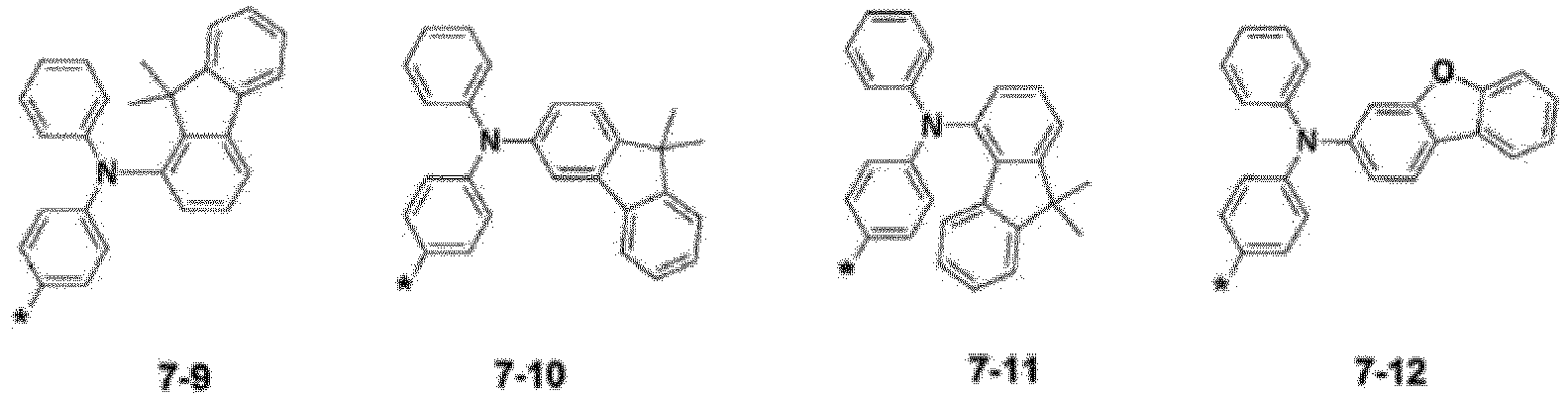
- the heterocyclic compound may be selected from Compounds 1 to 56, but embodiments of the present disclosure are not limited thereto:
- the heterocyclic compound represented by Formula 1-1 has a structure in which a dibenzofuran or a dibenzothiophene is substituted with an amine group and an acridine group, wherein a dibenzofuran group, a dibenzothiophene group, an amine group, and an acridine group may all have p-type hole transport characteristics and also have a stable structure even in oxidizing conditions. Thus, a combination of these groups may result in a suitable or appropriate energy level for the hole transport characteristics.
- an electronic device including the heterocyclic compound represented by Formula 1-1 for example, an organic light-emitting device may have low driving voltage, high luminance, high efficiency, and long lifespan.
- At least one of the heterocyclic compound represented by Formula 1-1 may be used between a pair of electrodes of an organic light-emitting device.
- the heterocyclic compound may be included in at least one layer selected from a hole transport region and an emission layer.
- the heterocyclic compound represented by Formula 1-1 may be used as a material for a capping layer located outside a pair of electrodes of an organic light-emitting device.
- an organic light-emitting device including: a first electrode; a second electrode facing the first electrode; and an organic layer between the first electrode and the second electrode, the organic layer including an emission layer, wherein the organic layer includes at least one heterocyclic compound represented by Formula 1-1.
- (an organic layer) includes at least one heterocyclic compound may include a case in which "(an organic layer) includes identical compounds represented by Formula 1-1" and a case in which "(an organic layer) includes two or more different heterocyclic compounds represented by Formula 1-1.”
- the organic layer may include, as the heterocyclic compound, only Compound 1.
- Compound 1 may exist in an emission layer of the organic light-emitting device.
- the organic layer may include, as the heterocyclic compound, Compound 1 and Compound 2.
- Compound 1 and Compound 2 may exist in an identical layer (for example, Compound 1 and Compound 2 may all exist in an emission layer), or different layers (for example, Compound 1 may exist in an emission layer and Compound 2 may exist in an electron transport layer).
- the hole transport region may include the heterocyclic compound represented by Formula 1-1.
- the hole transport region includes a hole transport layer, which includes the heterocyclic compound.
- the hole transport region may include a first hole transport layer between the first electrode and the emission layer; and a second hole transport layer between the first hole transport layer and the emission layer, wherein the first hole transport layer may include the heterocyclic compound.
- the emission layer may include a host and a dopant, and the dopant may be a fluorescent dopant or a phosphorus dopant.
- the electron transport region may include an alkali metal, an alkaline earth metal, a rare earth metal, an alkali metal compound, an alkaline earth-metal compound, a rare earth metal compound, an alkali metal complex, an alkaline earth-metal complex, a rare earth metal complex, or any combinations thereof.
- organic layer refers to a single layer and/or a plurality of layers disposed between the first electrode and the second electrode of the organic light-emitting device.
- a material included in the "organic layer” is not limited to an organic material.
- the organic layer may also include an inorganic material.
- the accompanying drawing is a schematic cross-sectional view of an organic light-emitting device 10 according to an embodiment.
- the organic light-emitting device 10 includes a first electrode 110, an organic layer 150, and a second electrode 190.
- a substrate may be additionally disposed under the first electrode 110 or above the second electrode 190.
- the substrate may be a glass substrate or a plastic substrate, each having excellent mechanical strength, thermal stability, transparency, surface smoothness, ease of handling, and water resistance.
- the first electrode 110 may be formed by depositing or sputtering a material for forming the first electrode 110 on the substrate.
- the material for a first electrode may be selected from materials with a high work function to facilitate hole injection.
- the first electrode 110 may be a reflective electrode, a semi-transmissive electrode, or a transmissive electrode.
- a material for forming a first electrode may be selected from indium tin oxide (ITO), indium zinc oxide (IZO), tin oxide (SnO 2 ), zinc oxide (ZnO), and any combinations thereof, but embodiments of the present disclosure are not limited thereto.
- a material for forming a first electrode may be selected from magnesium (Mg), silver (Ag), aluminium (Al), aluminium-lithium (Al-Li), calcium (Ca), magnesium-indium (Mg-In), magnesium-silver (Mg-Ag), and any combinations thereof, but embodiments of the present disclosure are not limited thereto.
- the first electrode 110 may have a single-layered structure, or a multi-layered structure including two or more layers.
- the first electrode 110 may have a three-layered structure of ITO/Ag/ITO, but the structure of the first electrode 110 is not limited thereto.
- the organic layer 150 is disposed on the first electrode 110.
- the organic layer 150 may include an emission layer.
- the organic layer 150 may further include a hole transport region between the first electrode 110 and the emission layer, and an electron transport region between the emission layer and the second electrode 190.
- the hole transport region may have i) a single-layered structure including a single layer including a single material, ii) a single-layered structure including a single layer including a plurality of different materials, or iii) a multi-layered structure having a plurality of layers including a plurality of different materials.
- the hole transport region may include at least one layer selected from a hole injection layer, a hole transport layer, an emission auxiliary layer, and an electron blocking layer.
- the hole transport region may have a single-layered structure including a single layer including a plurality of different materials, or a multi-layered structure having a hole injection layer/hole transport layer structure, a hole injection layer/hole transport layer/emission auxiliary layer structure, a hole injection layer/emission auxiliary layer structure, a hole transport layer/emission auxiliary layer structure, or a hole injection layer/hole transport layer/electron blocking layer structure, wherein for each structure, constituting layers are sequentially stacked from the first electrode 110 in this stated order, but the structure of the hole transport region is not limited thereto.
- the hole transport region may include the heterocyclic compound.
- the hole transport region may further include at least one selected from m-MTDATA, TDATA, 2-TNATA, NPB(NPD), ⁇ -NPB, TPD, Spiro-TPD, Spiro-NPB, methylated-NPB, TAPC, HMTPD, 4,4',4"-tris(N-carbazolyl)triphenylamine (TCTA), polyaniline/dodecylbenzenesulfonic acid (PANI/DBSA), poly(3,4-ethylenedioxythiophene)/poly(4-styrenesulfonate) (PEDOT/PSS(, polyaniline/camphor sulfonic acid (PANI/CSA), polyaniline/poly(4-styrenesulfonate) (PANI/PSS), a compound represented by Formula 201, and a compound represented by Formula 202:
- R 201 and R 202 may optionally be linked each other via a single bond, a dimethyl-methylene group, or a diphenyl-methylene group
- R 203 and R 204 may optionally be linked each other via a single bond, a dimethyl-methylene group, or a diphenyl-methylene group.
- L 201 to L 205 may each independently be selected from:
- xa1 to xa4 may each independently be 0, 1, or 2.
- xa5 may be 1, 2, 3, or 4.
- R 201 to R 204 and Q 201 may each independently be selected from:
- At least one selected from R 201 to R 203 may each independently be selected from:
- R 201 and R 202 may be linked each other via a single bond, and/or ii) R 203 and R 204 may be linked each other via a single bond.
- At least one selected from R 201 to R 204 may be selected from:
- the compound represented by Formula 201 may be represented by Formula 201A:
- the compound represented by Formula 201 may be represented by Formula 201A(1) below, but embodiments of the present disclosure are not limited thereto:
- the compound represented by Formula 201 may be represented by Formula 201A-1, but embodiments of the present disclosure are not limited thereto:
- the compound represented by Formula 202 may be represented by Formula 202A:
- the compound represented by Formula 202 may be represented by Formula 202A-1:
- the hole transport region may include at least one compound selected from Compounds HT1 to HT39, but embodiments of the present disclosure are not limited thereto:
- a thickness of the hole transport region may be in a range of about 100 ⁇ to about 10,000 ⁇ , for example, about 100 ⁇ to about 7000 ⁇ , about 100 ⁇ to about 5000 ⁇ , about 100 ⁇ to about 3000 ⁇ , or about 100 ⁇ to about 1,000 ⁇ .
- a thickness of the hole injection layer may be in a range of about 100 ⁇ to about 9,000 ⁇ , for example, about 100 ⁇ to about 7,000 ⁇ , about 100 ⁇ to about 5,000 ⁇ , about 100 ⁇ to about 3,000 ⁇ , about 100 ⁇ to about 2,000 ⁇ , about 100 ⁇ to about 1,000 ⁇ or about 500 ⁇ to about 700 ⁇ , and a thickness of the hole transport layer may be in a range of about 50 ⁇ to about 2,000 ⁇ , for example about 100 ⁇ to about 1,500 ⁇ , about 100 ⁇ to about 1,000 ⁇ , about 100 ⁇ to about 800 ⁇ , about 100 ⁇ to about 500 ⁇ , or about 200 ⁇ to about 400 ⁇ .
- suitable or satisfactory hole transporting characteristics may be obtained without a substantial increase in driving voltage.
- the emission auxiliary layer may increase light-emission efficiency by compensating for an optical resonance distance according to the wavelength of light emitted by an emission layer, and the electron blocking layer may block the flow of electrons from an electron transport region.
- the emission auxiliary layer and the electron blocking layer may include the materials as described above.
- the hole transport region may further include, in addition to these materials, a charge-generation material for the improvement of conductive properties.
- the charge-generation material may be homogeneously or non-homogeneously dispersed in the hole transport region.
- the charge-generation material may be, for example, a p-dopant.
- the p-dopant may have a lowest unoccupied molecular orbital (LUMO) level of about -3. 5 eV or less.
- LUMO lowest unoccupied molecular orbital
- the p-dopant may include at least one selected from a quinone derivative, a metal oxide, and a cyano group-containing compound, but embodiments of the present disclosure are not limited thereto.
- the p-dopant may include at least one selected from:
- the emission layer may be patterned into a red emission layer, a green emission layer, or a blue emission layer, according to a sub-pixel.
- the emission layer may have a stacked structure of two or more layers selected from a red emission layer, a green emission layer, and a blue emission layer, in which the two or more layers contact each other or are separated from each other.
- the emission layer may include two or more materials selected from a red light-emitting material, a green light-emitting material, and a blue light-emitting material, in which the two or more materials are mixed with each other in a single layer to emit white light.
- the emission layer may include a host and a dopant.
- the dopant may include at least one selected from a phosphorescent dopant and a fluorescent dopant.
- an amount of the dopant may be in a range of about 0.01 to about 15 parts by weight based on 100 parts by weight of the host, but embodiments of the present disclosure are not limited thereto.
- a thickness of the emission layer may be in a range of about 100 A to about 1,000 ⁇ , for example, about 100 ⁇ to about 800 ⁇ , about 150 ⁇ to about 800 ⁇ , about 150 ⁇ to about 700 ⁇ , about 150 ⁇ to about 650 ⁇ , about 200 ⁇ to about 600 ⁇ or about 200 ⁇ to about 400 ⁇ .
- the thickness of the emission layer is within this range, excellent light-emission characteristics may be obtained without a substantial increase in driving voltage.
- the host may include a compound represented by Formula 301: Formula 301 [Ar 301 ] xb11 -[(L 301 ) xb1 -R 301 ] xb21 .
- Ar 301 may be a substituted or unsubstituted C 6 -C 32 carbocyclic group or a substituted or unsubstituted C 1 -C 12 heterocyclic group, but embodiments are not limited thereto.
- Ar 301 in Formula 301 may be selected from:
- xb11 in Formula 301 is two or more, two or more Ar 301 (s) may be linked via a single bond.
- the compound represented by Formula 301 may be represented by Formula 301-1 or 301-2:
- L 301 to L 304 in Formulae 301, 301-1, and 301-2 may each independently be selected from: a substituted or unsubstituted C 3 -C 10 cycloalkylene group, a substituted or unsubstituted C 1 -C 10 heterocycloalkylene group, a substituted or unsubstituted C 3 -C 10 cycloalkenylene group, a substituted or unsubstituted C 1 -C 10 heterocycloalkenylene group, a substituted or unsubstituted C 6 -C 30 arylene group, a substituted or unsubstituted C 1 -C 20 heteroarylene group, a substituted or unsubstituted divalent non-aromatic condensed polycyclic group, and a substituted or unsubstituted divalent non-aromatic condensed heteropolycyclic group, but embodiments are not limited thereto.
- L 301 to L 304 may each independently be selected from:
- R 301 to R 304 in Formulae 301, 301-1, and 301-2 may each independently be selected from: deuterium, -F, -CI, -Br, -I, a hydroxyl group, a cyano group, a nitro group, an amidino group, a hydrazino group, a hydrazono group, a substituted or unsubstituted C 1 -C 60 (e.g. C 1 -C 10 ) alkyl group, a substituted or unsubstituted C 2 -C 60 (e.g. C 2 -C 10 ) alkenyl group, a substituted or unsubstituted C 2 -C 60 (e.g.
- C 2 -C 10 alkynyl group, a substituted or unsubstituted C 1 -C 60 (e.g. C 1 -C 10 ) alkoxy group, a substituted or unsubstituted C 3 -C 10 cycloalkyl group, a substituted or unsubstituted C 1 -C 10 heterocycloalkyl group, a substituted or unsubstituted C 3 -C 10 cycloalkenyl group, a substituted or unsubstituted C 1 -C 10 heterocycloalkenyl group, a substituted or unsubstituted C 6 -C 30 aryl group, a substituted or unsubstituted C 6 -C 30 aryloxy group, a substituted or unsubstituted C 6 -C 30 arylthio group, a substituted or unsubstituted C 1 -C 20 heteroaryl group, a substituted or unsubstituted mono
- R 301 to R 304 may each independently be selected from:
- the host may include an alkaline earth metal complex.
- the host may include a complex selected from a Be complex (for example, Compound H55), a Mg complex, and a Zn complex.
- the host may be selected from a Be complex (for example, Compound H55), a Mg complex, and a Zn complex.
- the host may include at least one selected from 9,10-di(2-naphthyl)anthracene (ADN), 2-methyl-9,10-bis(naphthalen-2-yl)anthracene (MADN), 9,10-di-(2-naphthyl)-2-t-butyl-anthracene (TBADN), 4,4'-bis(N-carbazolyl)-1,1'-biphenyl (CBP), 1,3-di-9-carbazolylbenzene (mCP), 1,3,5-tri(carbazol-9-yl)benzene (TCP), and Compounds H1 to H55, but embodiments of the present disclosure are not limited thereto:
- the phosphorescent dopant may include an organometallic complex represented by Formula 401: Formula 401 M(L 401 ) xc1 (L 402 ) xc2
- a 401 and A 402 may each independently be selected from a benzene group, a naphthalene group, a fluorene group, a spiro-bifluorene group, an indene group, a pyrrole group, a thiophene group, a furan group, an imidazole group, a pyrazole group, a thiazole group, an isothiazole group, an oxazole group, an isoxazole group, a pyridine group, a pyrazine group, a pyrimidine group, a pyridazine group, a quinoline group, an isoquinoline group, a benzoquinoline group, a quinoxaline group, a quinazoline group, a carbazole group, a benzimidazole group, a benzofuran group, a benzothiophene group, an isobenzothiophene
- X 401 may be nitrogen
- X 402 may be carbon
- X 401 and X 402 may each be nitrogen concurrently (e.g., at the same time).
- R 401 and R 402 may each independently be selected from:
- two A 401 (s) among two or more of L 401 (s) may optionally be linked each other via a linking group, X 407 , or two A 402 (s) may optionally be linked each other via a linking group, X 408 (see Compounds PD1 to PD4 and PD7).
- L 402 in Formula 401 may be a monovalent, divalent, or trivalent organic ligand.
- the phosphorescent dopant may be selected from, for example, Compounds PD1 to PD25, but embodiments of the present disclosure are not limited thereto:
- the fluorescent dopant may include an arylamine compound or a styrylamine compound.
- the fluorescent dopant may include a compound represented by Formula 501:
- Ar 501 may be a substituted or unsubstituted C 5 -C 30 carbocyclic group or a substituted or unsubstituted C 1 -C 20 heterocyclic group, but embodiments are not limited thereto.
- Ar 501 in Formula 501 may be selected from:
- L 501 to L 503 in Formula 501 may each independently be selected from:
- R 501 and R 502 may each independently be selected from:
- xd4 in Formula 501 may be 2, but embodiments of the present disclosure are not limited thereto.
- the fluorescent dopant may be selected from Compounds FD1 to FD22:
- the fluorescent dopant may be selected from the following compounds, but embodiments of the present disclosure are not limited thereto:
- the electron transport region may have i) a single-layered structure including a single layer including a single material, ii) a single-layered structure including a single layer including a plurality of different materials, or iii) a multi-layered structure having a plurality of layers including a plurality of different materials.
- the electron transport region may include at least one selected from a buffer layer, a hole blocking layer, an electron control layer, an electron transport layer, and an electron injection layer, but embodiments of the present disclosure are not limited thereto.
- the electron transport region may have an electron transport layer/electron injection layer structure, a hole blocking layer/electron transport layer/electron injection layer structure, an electron control layer/electron transport layer/electron injection layer structure, or a buffer layer/electron transport layer/electron injection layer structure, wherein for each structure, constituting layers are sequentially stacked from an emission layer.
- embodiments of the structure of the electron transport region are not limited thereto.
- the electron transport region (for example, a buffer layer, a hole blocking layer, an electron control layer, or an electron transport layer in the electron transport region) may include a metal-free compound containing at least one ⁇ electron-depleted nitrogen-containing ring.
- C 5 -C 60 e.g . a C 5 -C 30
- Examples of the ⁇ electron-depleted nitrogen-containing ring include an imidazole, a pyrazole, a thiazole, an isothiazole, an oxazole, an isoxazole, a pyridine, a pyrazine, a pyrimidine, a pyridazine, an indazole, a purine, a quinoline, an isoquinoline, a benzoquinoline, a phthalazine, a naphthyridine, a quinoxaline, a quinazoline, a cinnoline, a phenanthridine, an acridine, a phenanthroline, a phenazine, a benzimidazole, an isobenzothiazole, a benzoxazole, an isobenzoxazole, a triazole, a tetrazole, an oxadiazole, a triazine
- the electron transport region may include a compound represented by Formula 601: Formula 601 [Ar 601 ] xe11 -[(L 601 ) xe1 -R 601 ] xe21 .
- At least one selected from Ar 601 (s) in the number of xe11 and R 601 (s) in the number of xe21 may include the ⁇ electron-depleted nitrogen-containing ring.
- Ar 601 may be a substituted or unsubstituted C 5 -C 30 carbocyclic group or a substituted or unsubstituted C 1 -C 20 heterocyclic group, but embodiments are not limited thereto.
- Ar 601 may be selected from:
- xe11 in Formula 601 is two or more, two or more Ar 601 (s) may be linked via a single bond.
- Ar 601 in Formula 601 may be an anthracene group.
- a compound represented by Formula 601 may be represented by Formula 601-1:
- L 601 and L 611 to L 613 in Formulae 601 and 601-1 may each independently be selected from: a substituted or unsubstituted C 3 -C 10 cycloalkylene group, a substituted or unsubstituted C 1 -C 10 heterocycloalkylene group, a substituted or unsubstituted C 3 -C 10 cycloalkenylene group, a substituted or unsubstituted C 1 -C 10 heterocycloalkenylene group, a substituted or unsubstituted C 6 -C 30 arylene group, a substituted or unsubstituted C 1 -C 20 heteroarylene group, a substituted or unsubstituted divalent non-aromatic condensed polycyclic group, and a substituted or unsubstituted divalent non-aromatic condensed heteropolycyclic group, but embodiments are not limited thereto.
- L 601 and L 611 to L 613 in Formulae 601 and 601-1 may each independently be selected from:
- xe1 and xe611 to xe613 in Formulae 601 and 601-1 may each independently be 0, 1, or 2.
- R 601 and R 611 to R 613 in Formulae 601 and 601-1 may each independently be selected from: a substituted or unsubstituted C 3 -C 10 cycloalkyl group, a substituted or unsubstituted C 1 -C 10 heterocycloalkyl group, a substituted or unsubstituted C 3 -C 10 cycloalkenyl group, a substituted or unsubstituted C 1 -C 10 heterocycloalkenyl group, a substituted or unsubstituted C 6 -C 30 aryl group, a substituted or unsubstituted C 6 -C 30 aryloxy group, a substituted or unsubstituted C 6 -C 30 arylthio group, a substituted or unsubstituted C 1 -C 20 heteroaryl group, a substituted or unsubstituted monovalent non-aromatic condensed polycyclic group, a substituted or un
- R 601 and R 611 to R 613 may each independently be selected from:
- the electron transport region may include at least one compound selected from Compounds ET1 to ET36, but embodiments of the present disclosure are not limited thereto:
- the electron transport region may include at least one compound selected from 2,9-dimethyl-4,7-diphenyl-1,10-phenanthroline (BCP), 4,7-diphenyl-1,10-phenanthroline (Bphen), Alq 3 , BAlq, 3-(biphenyl-4-yl)-5-(4- tert -butylphenyl)-4-phenyl-4 H -1,2,4-triazole (TAZ), and NTAZ:
- a thickness of the buffer layer, the hole blocking layer, or the electron control layer may be in a range of about 20 ⁇ to about 1,000 ⁇ , for example, about 20 ⁇ to about 700 ⁇ , about 20 ⁇ to about 500 ⁇ , about 20 ⁇ to about 400 ⁇ , about 30 ⁇ to about 400 ⁇ or about 30 ⁇ to about 300 ⁇ .
- the electron blocking layer may have excellent electron blocking characteristics or electron control characteristics without a substantial increase in driving voltage.
- a thickness of the electron transport layer may be in a range of about 100 ⁇ to about 1,000 ⁇ , for example, about 100 ⁇ to about 700 ⁇ , about 100 ⁇ to about 600 ⁇ , about 150 ⁇ to about 600 ⁇ , about 150 ⁇ to about 500 ⁇ or about 250 ⁇ to about 350 ⁇ .
- the electron transport layer may have suitable or satisfactory electron transport characteristics without a substantial increase in driving voltage.
- the electron transport region (for example, the electron transport layer in the electron transport region) may further include, in addition to the materials described above, a metal-containing material.
- the metal-containing material may include at least one selected from alkali metal complex and alkaline earth-metal complex.
- the alkali metal complex may include a metal ion selected from a Li ion, a Na ion, a K ion, a Rb ion, and a Cs ion
- the alkaline earth-metal complex may include a metal ion selected from a Be ion, a Mg ion, a Ca ion, a Sr ion, and a Ba ion.
- a ligand coordinated with the metal ion of the alkali metal complex or the alkaline earth-metal complex may be selected from a hydroxy quinoline, a hydroxy isoquinoline, a hydroxy benzoquinoline, a hydroxy acridine, a hydroxy phenanthridine, a hydroxy phenyloxazole, a hydroxy phenylthiazole, a hydroxy diphenyloxadiazole, a hydroxy diphenylthiadiazole, a hydroxy phenylpyridine, a hydroxy phenylbenzimidazole, a hydroxy phenylbenzothiazole, a bipyridine, a phenanthroline, and a cyclopentadiene, but embodiments of the present disclosure are not limited thereto.
- the metal-containing material may include a Li complex.
- the Li complex may include, for example, Compound ET-D1 (lithium quinolate, LiQ) or ET-D2:
- the electron transport region may include an electron injection layer that facilitates injection of electrons from the second electrode 190.
- the electron injection layer may directly contact the second electrode 190.
- the electron injection layer may have i) a single-layered structure including a single layer including a single material, ii) a single-layered structure including a single layer including a plurality of different materials, or iii) a multi-layered structure having a plurality of layers including a plurality of different materials.
- the electron injection layer may include an alkali metal, an alkaline earth metal, a rare earth metal, an alkali metal compound, an alkaline earth-metal compound, a rare earth metal compound, an alkali metal complex, an alkaline earth-metal complex, a rare earth metal complex, or any combinations thereof.
- the alkali metal may be selected from Li, Na, K, Rb, and Cs. In one embodiment, the alkali metal may be Li, Na, or Cs. In one or more embodiments, the alkali metal may be Li or Cs, but embodiments of the present disclosure are not limited thereto.
- the alkaline earth metal may be selected from Mg, Ca, Sr, and Ba.
- the rare earth metal may be selected from Sc, Y, Ce, Tb, Yb, and Gd.
- the alkali metal compound, the alkaline earth-metal compound, and the rare earth metal compound may be selected from oxides and halides (for example, fluorides, chlorides, bromides, or iodides) of the alkali metal, the alkaline earth-metal, and the rare earth metal.
- oxides and halides for example, fluorides, chlorides, bromides, or iodides
- the alkali metal compound may be selected from alkali metal oxides, such as Li 2 O, Cs 2 O, or K 2 O, and alkali metal halides, such as LiF, NaF, CsF, KF, Lil, Nal, Csl, KI, or RbI.
- the alkali metal compound may be selected from LiF, Li 2 O, NaF, Lil, Nal, Csl, and KI, but embodiments of the present disclosure are not limited thereto.
- the alkaline earth-metal compound may be selected from alkaline earth-metal compounds, such as BaO, SrO, CaO, Ba x Sr 1-x O (0 ⁇ x ⁇ 1), or Ba x Ca 1-x O (0 ⁇ x ⁇ 1).
- the alkaline earth-metal compound may be selected from BaO, SrO, and CaO, but embodiments of the present disclosure are not limited thereto.
- the rare earth metal compound may be selected from YbF 3 , ScF 3 , Sc 2 O 3 , Y 2 O 3 , Ce 2 O 3 , GdF 3 , and TbF 3 .
- the rare earth metal compound may be selected from YbF 3 , ScF 3 , TbF 3 , YbI 3 , ScI 3 , and TbI 3 , but embodiments of the present disclosure are not limited thereto.
- the alkali metal complex, the alkaline earth-metal complex, and the rare earth metal complex may include an ion of alkali metal, alkaline earth-metal, and rare earth metal as described above, and a ligand coordinated with a metal ion of the alkali metal complex, the alkaline earth-metal complex, or the rare earth metal complex may be selected from hydroxy quinoline, hydroxy isoquinoline, hydroxy benzoquinoline, hydroxy acridine, hydroxy phenanthridine, hydroxy phenyloxazole, hydroxy phenylthiazole, hydroxy diphenyloxadiazole, hydroxy diphenylthiadiazole, hydroxy phenylpyridine, hydroxy phenylbenzimidazole, hydroxy phenylbenzothiazole, bipyridine, phenanthroline, and cyclopentadiene, but embodiments of the present disclosure are not limited thereto.
- the electron injection layer may consist of an alkali metal, an alkaline earth metal, a rare earth metal, an alkali metal compound, an alkaline earth-metal compound, a rare earth metal compound, an alkali metal complex, an alkaline earth-metal complex, a rare earth metal complex, or any combinations thereof, as described above.
- the electron injection layer may further include an organic material.
- an alkali metal, an alkaline earth metal, a rare earth metal, an alkali metal compound, an alkaline earth-metal compound, a rare earth metal compound, an alkali metal complex, an alkaline earth-metal complex, a rare earth metal complex, or any combinations thereof may be homogeneously or non-homogeneously dispersed in a matrix including the organic material.
- a thickness of the electron injection layer may be in a range of about 1 ⁇ to about 100 ⁇ , for example, about 3 ⁇ to about 90 ⁇ or about 3 ⁇ to about 20 ⁇ .
- the electron injection layer may have suitable or satisfactory electron injection characteristics without a substantial increase in driving voltage.
- the second electrode 190 may be disposed on the organic layer 150 having such a structure.
- the second electrode 190 may be a cathode which is an electron injection electrode, and in this regard, a material for forming the second electrode 190 may be selected from metal, an alloy, an electrically conductive compound, and a combination thereof, which have a relatively low work function.
- the second electrode 190 may include at least one selected from lithium (Li), silver (Ag), magnesium (Mg), aluminium (Al), aluminium-lithium (Al-Li), calcium (Ca), magnesium-indium (Mg-In), magnesium-silver (Mg-Ag), ITO, and IZO, but embodiments of the present disclosure are not limited thereto.
- the second electrode 190 may be a transmissive electrode, a semi-transmissive electrode, or a reflective electrode.
- the second electrode 190 may have a single-layered structure, or a multi-layered structure including two or more layers.
- Layers constituting the hole transport region, an emission layer, and layers constituting the electron transport region may be formed in a certain region by using one or more suitable methods selected from vacuum deposition, spin coating, casting, Langmuir-Blodgett (LB) deposition, ink-jet printing, laser-printing, and laser-induced thermal imaging.
- suitable methods selected from vacuum deposition, spin coating, casting, Langmuir-Blodgett (LB) deposition, ink-jet printing, laser-printing, and laser-induced thermal imaging.
- the deposition may be performed at a deposition temperature of about 100 °C to about 500 °C, a vacuum degree of about 10 -8 torr to about 10 -3 torr, and a deposition speed of about 0.01 ⁇ /sec to about 100 ⁇ /sec by taking into account a material to be included in a layer to be formed, and the structure of a layer to be formed.
- the spin coating may be performed at a coating speed of about 2000 rpm to about 5000 rpm and at a heat treatment temperature of about 80 °C to 200 °C by taking into account a material to be included in a layer to be formed, and the structure of a layer to be formed.
- C 1 -C 60 alkyl group refers to a linear or branched aliphatic saturated hydrocarbon monovalent group having 1 to 60 carbon atoms, and examples thereof include a methyl group, an ethyl group, a propyl group, an isobutyl group, a sec-butyl group, a tert-butyl group, a pentyl group, an isoamyl group, and a hexyl group.
- C 1 -C 60 alkylene group refers to a divalent group having substantially the same structure as the C 1 -C 60 alkyl group. Corresponding definitions apply to other ranges given for the number of carbon atoms in an alkyl/alkylene group.
- C 2 -C 60 alkenyl group refers to a hydrocarbon group having at least one carbon-carbon double bond at a main chain (e.g., in the middle) or at a terminus of the C 2 -C 60 alkyl group, and examples thereof include an ethenyl group, a propenyl group, and a butenyl group.
- C 2 -C 60 alkenylene group refers to a divalent group having substantially the same structure as the C 2 -C 60 alkenyl group. Corresponding definitions apply to other ranges given for the number of carbon atoms in an alkenyl/alkenylene group.
- C 2 -C 60 alkynyl group refers to a hydrocarbon group having at least one carbon-carbon triple bond at a main chain (e.g., in the middle) or at a terminus of the C 2 -C 60 alkyl group, and examples thereof include an ethynyl group, and a propynyl group.
- C 2 -C 60 alkynylene group refers to a divalent group having substantially the same structure as the C 2 -C 60 alkynyl group. Corresponding definitions apply to other ranges given for the number of carbon atoms in an alkynyl/alkynylene group.
- C 1 -C 60 alkoxy group refers to a monovalent group represented by -OA 101 (wherein A 101 is the C 1 -C 60 alkyl group), and examples thereof include a methoxy group, an ethoxy group, and an isopropyloxy group. Corresponding definitions apply to other ranges given for the number of carbon atoms in an alkoxy group.
- C 3 -C 10 cycloalkyl group refers to a monovalent saturated hydrocarbon monocyclic group having 3 to 10 carbon atoms, and examples thereof include a cyclopropyl group, a cyclobutyl group, a cyclopentyl group, a cyclohexyl group, and a cycloheptyl group.
- C 3 -C 10 cycloalkylene group refers to a divalent group having substantially the same structure as the C 3 -C 10 cycloalkyl group.
- C 1 -C 10 heterocycloalkyl group refers to a monovalent monocyclic group having at least one heteroatom selected from N, O, Si, P, and S as a ring-forming atom and 1 to 10 carbon atoms, and examples thereof include a 1,2,3,4-oxatriazolidinyl group, a tetrahydrofuranyl group, and a tetrahydrothiophenyl group.
- C 1 -C 10 heterocycloalkylene group refers to a divalent group having substantially the same structure as the C 1 -C 10 heterocycloalkyl group.
- C 3 -C 10 cycloalkenyl group refers to a monovalent monocyclic group that has 3 to 10 carbon atoms and at least one carbon-carbon double bond in the ring thereof and no aromaticity, and examples thereof include a cyclopentenyl group, a cyclohexenyl group, and a cycloheptenyl group.
- C 3 -C 10 cycloalkenylene group refers to a divalent group having substantially the same structure as the C 3 -C 10 cycloalkenyl group.
- C 1 -C 10 heterocycloalkenyl group refers to a monovalent monocyclic group that has at least one heteroatom selected from N, O, Si, P, and S as a ring-forming atom, 1 to 10 carbon atoms, and at least one carbon-carbon double bond in its ring.
- Non-limiting examples of the C 1 -C 10 heterocycloalkenyl group include a 4,5-dihydro-1,2,3,4-oxatriazolyl group, a 2,3-dihydrofuranyl group, and a 2,3-dihydrothiophenyl group.
- C 1 -C 10 heterocycloalkenylene group refers to a divalent group having substantially the same structure as the C 1 -C 10 heterocycloalkenyl group.
- C 6 -C 60 aryl group refers to a monovalent group having a carbocyclic aromatic system having 6 to 60 carbon atoms
- C 6 -C 60 arylene group refers to a divalent group having a carbocyclic aromatic system having 6 to 60 carbon atoms.
- Non-limiting examples of the C 6 -C 60 aryl group include a phenyl group, a naphthyl group, an anthracenyl group, a phenanthrenyl group, a pyrenyl group, and a chrysenyl group.
- the rings may be fused to each other (e.g., combined together).
- Corresponding definitions apply to other ranges given for the number of carbon atoms in an aryl/arylene group.
- C 1 -C 60 heteroaryl group refers to a monovalent group having a carbocyclic aromatic system that has at least one heteroatom selected from N, O, Si, P, and S as a ring-forming atom, in addition to 1 to 60 carbon atoms.
- C 1 -C 60 heteroarylene group refers to a divalent group having a carbocyclic aromatic system that has at least one heteroatom selected from N, O, Si, P, and S as a ring-forming atom, in addition to 1 to 60 carbon atoms.
- Non-limiting examples of the C 1 -C 60 heteroaryl group include a pyridinyl group, a pyrimidinyl group, a pyrazinyl group, a pyridazinyl group, a triazinyl group, a quinolinyl group, and an isoquinolinyl group.
- the C 1 -C 60 heteroaryl group and the C 1 -C 60 heteroarylene group each include two or more rings, the rings may be condensed with each other (e.g., combined together).
- Corresponding definitions apply to other ranges given for the number of carbon atoms in an heteroaryl/heteroarylene group.
- C 6 -C 60 aryloxy group refers to -OA 102 (wherein A 102 is the C 6 -C 60 aryl group), and the term “C 6 -C 60 arylthio group,” as used herein, indicates -SA 103 (wherein A 103 is the C 6 -C 60 aryl group).
- Corresponding definitions apply to other ranges given for the number of carbon atoms in an aryloxy group and an arylthio group.
- An example of the monovalent non-aromatic condensed polycyclic group is a fluorenyl group.
- divalent non-aromatic condensed polycyclic group refers to a divalent group having substantially the same structure as the monovalent non-aromatic condensed polycyclic group.
- An example of the monovalent non-aromatic condensed heteropolycyclic group is a carbazolyl group.
- divalent non-aromatic condensed heteropolycyclic group refers to a divalent group having substantially the same structure as the monovalent non-aromatic condensed heteropolycyclic group.
- C 5 -C 60 carbocyclic group refers to a monocyclic or polycyclic group having 5 to 60 carbon atoms in which a ring-forming atom is a carbon atom only.
- the C 5 -C 60 carbocyclic group may be an aromatic carbocyclic group or a non-aromatic carbocyclic group.
- the C 5 -C 60 carbocyclic group may be a ring, such as benzene, a monovalent group, such as a phenyl group, or a divalent group, such as a phenylene group.
- the C 5 -C 60 carbocyclic group may be a trivalent group or a quadrivalent group.
- Corresponding definitions apply to other ranges given for the number of carbon atoms in a carbocyclic group.
- C 1 -C 60 heterocyclic group refers to a group having substantially the same structure as the C 1 -C 60 carbocyclic group, except that as a ring-forming atom, at least one heteroatom selected from N, O, Si, P, and S is used in addition to carbon (the number of carbon atoms may be in a range of 1 to 60 or 2 to 60). Corresponding definitions apply to other ranges given for the number of carbon atoms in a heterocyclic group.
- C 1 -C 20 heteroarylene group, the substituted divalent non-aromatic condensed polycyclic group, the substituted divalent non-aromatic condensed heteropolycyclic group, the substituted C 1 -C 60 ( e.g . C 1 -C 20 ) alkyl group, the substituted C 2 -C 60 ( e.g . C 2 -C 20 ) alkenyl group, the substituted C 2 -C 60 ( e.g . C 2 -C 20 ) alkynyl group, the substituted C 1 -C 60 ( e.g .
- C 1 -C 20 alkoxy group
- the substituted C 3 -C 10 cycloalkyl group, the substituted C 1 -C 10 heterocycloalkyl group, the substituted C 3 -C 10 cycloalkenyl group, the substituted C 1 -C 10 heterocycloalkenyl group, the substituted C 6 -C 60 ( e.g . C 6 -C 30 ) aryl group, the substituted C 6 -C 60 ( e.g . C 6 -C 30 ) aryloxy group, the substituted C 6 -C 60 ( e.g . C 6 -C 30 ) arylthio group, the substituted C 1 -C 60 ( e.g . C 1 -C 20 ) heteroaryl group, the substituted monovalent non-aromatic condensed polycyclic group, and the substituted monovalent non-aromatic condensed heteropolycyclic group may be selected from:
- Ph represents a phenyl group
- Me represents a methyl group
- Et represents an ethyl group
- ter-Bu represents an ethyl group
- OMe represents a methoxy group
- biphenyl group refers to a "phenyl group substituted with a phenyl group.
- the "biphenyl group” is a "substituted phenyl group” having a "C 6 -C 60 aryl group” as a substituent.
- terphenyl group refers to a "phenyl group substituted with a biphenyl group.
- the "terphenyl group” is a "phenyl group” having, as a substituent, a "C 6 -C 60 aryl group substituted with a C 6 -C 60 aryl group.”
- a Corning glass substrate on which 15 ⁇ /cm 2 (1,200 ⁇ ) ITO was formed, was cut into a size of 50 mm ⁇ 50 mm ⁇ 0.7 mm, sonicated with isopropyl alcohol and pure water each for 5 minutes, and then, cleaned by exposure to ultraviolet rays and ozone for 30 minutes. Then, the glass substrate was provided to a vacuum deposition apparatus.
- 2-TNATA which is a previously existing material
- NPB 4,4'-bis[N-(1-naphthyl)-N-phenylamino]biphenyl
- ADN 10-di-naphthalene-2-yl-anthracene
- DPAVBi 4,4'-bis[2-(4-(N,N-diphenylamino)phenyl)vinyl]biphenyl
- DPAVBi 4,4'-bis[2-(4-(N,N-diphenylamino)phenyl)vinyl]biphenyl
- Alq 3 was deposited on the emission layer to form an electron transport layer having a thickness of 300 ⁇
- LiF which is a halogenated alkali metal
- Al was then vacuum-deposited on the electron injection layer to form a LiF/AI electrode having a thickness of 3,000 ⁇ (cathode electrode), thereby completing the manufacture of an organic light-emitting device.
- An organic light-emitting device was manufactured in substantially the same manner as in Comparative Example 1, except that Compound 1 was used instead of NPB in forming a hole transport layer.
- An organic light-emitting device was manufactured in substantially the same manner as in Comparative Example 1, except that Compound 7 was used instead of NPB in forming a hole transport layer.
- An organic light-emitting device was manufactured in substantially the same manner as in Comparative Example 1, except that Compound 15 was used instead of NPB in forming a hole transport layer.
- An organic light-emitting device was manufactured in substantially the same manner as in Comparative Example 1, except that Compound 25 was used instead of NPB in forming a hole transport layer.
- An organic light-emitting device was manufactured in substantially the same manner as in Comparative Example 1, except that Compound 29 was used instead of NPB in forming a hole transport layer.
- An organic light-emitting device was manufactured in substantially the same manner as in Comparative Example 1, except that Compound 35 was used instead of NPB in forming a hole transport layer.
- An organic light-emitting device was manufactured in substantially the same manner as in Comparative Example 1, except that Compound 43 was used instead of NPB in forming a hole transport layer.
- An organic light-emitting device was manufactured in substantially the same manner as in Comparative Example 1, except that Compound 53 was used instead of NPB in forming a hole transport layer.
- An organic light-emitting device was manufactured in substantially the same manner as in Comparative Example 1, except that Compound A was used instead of NPB in forming a hole transport layer:
- An organic light-emitting device was manufactured in substantially the same manner as in Comparative Example B, except that Compound B was used instead of NPB in forming a hole transport layer:
- An organic light-emitting device was manufactured in substantially the same manner as in Comparative Example 1, except that Compound C was used instead of NPB in forming a hole transport layer:
- the organic light-emitting devices of Examples 1 to 8 have low a low driving voltage and a high efficiency as compared with the organic light-emitting devices of Comparative Examples 1 to 4. It was also confirmed that the organic light-emitting devices of Examples 1 to 8 have high luminance and long lifespan as compared with the organic light-emitting devices of Comparative Examples 1 to 4.
- An organic light-emitting device including the heterocyclic compound according to an embodiment may have a low driving voltage, high brightness, high efficiency, and long lifespan.
- first,” “second,” “third,” etc. may be used herein to describe various elements, components, regions, layers and/or sections, these elements, components, regions, layers and/or sections should not be limited by these terms. These terms are used to distinguish one element, component, region, layer or section from another element, component, region, layer or section. Thus, a first element, component, region, layer or section described below could be termed a second element, component, region, layer or section, without departing from the scope of the present disclosure.
- spatially relative terms such as “beneath,” “below,” “lower,” “under,” “above,” “upper,” and the like, may be used herein for ease of explanation to describe one element or feature's relationship to another element(s) or feature(s) as illustrated in the figures. It will be understood that the spatially relative terms are intended to encompass different orientations of the device in use or in operation, in addition to the orientation depicted in the figures. For example, if the device in the figures is turned over, elements described as “below” or “beneath” or “under” other elements or features would then be oriented “above” the other elements or features. Thus, the example terms “below” and “under” can encompass both an orientation of above and below. The device may be otherwise oriented (e.g., rotated 90 degrees or at other orientations) and the spatially relative descriptors used herein should be interpreted accordingly.
- the terms “substantially,” “about,” and similar terms are used as terms of approximation and not as terms of degree, and are intended to account for the inherent deviations in measured or calculated values that would be recognized by those of ordinary skill in the art. Further, the use of “may” when describing embodiments of the present disclosure refers to “one or more embodiments of the present disclosure.” As used herein, the terms “use,” “using,” and “used” may be considered synonymous with the terms “utilize,” “utilizing,” and “utilized,” respectively.
- any numerical range recited herein is intended to include all subranges of the same numerical precision subsumed within the recited range.
- a range of "1.0 to 10.0" is intended to include all subranges between (and including) the recited minimum value of 1.0 and the recited maximum value of 10.0, that is, having a minimum value equal to or greater than 1.0 and a maximum value equal to or less than 10.0, such as, for example, 2.4 to 7.6.
- Any maximum numerical limitation recited herein is intended to include all lower numerical limitations subsumed therein, and any minimum numerical limitation recited in this specification is intended to include all higher numerical limitations subsumed therein.
Landscapes
- Chemical & Material Sciences (AREA)
- Organic Chemistry (AREA)
- Physics & Mathematics (AREA)
- Engineering & Computer Science (AREA)
- Materials Engineering (AREA)
- Spectroscopy & Molecular Physics (AREA)
- Optics & Photonics (AREA)
- Electroluminescent Light Sources (AREA)
- Plural Heterocyclic Compounds (AREA)
Claims (8)
- Heterocyclische Verbindung, dargestellt durch Formel 1-1:




 A2 unabhängig aus einer Benzengruppe, einer Naphthalingruppe, einer Fluorengruppe, einer Carbazolgruppe, einer Dibenzofurangruppe und einer Dibenzothiophengruppe ausgewählt ist,X1 O oder S ist,R12, R14 und R20 jeweils unabhängig Wasserstoff, Deuterium, -F, -Cl, -Br, -I, eine Hydroxylgruppe, eine Cyanogruppe, eine Nitrogruppe, eine Amidinogruppe, eine Hydrazinogruppe, eine Hydrazonogruppe, eine substituierte oder unsubstituierte C1-C60-Alkylgruppe, eine substituierte oder unsubstituierte C2-C60-Alkenylgruppe, eine substituierte oder unsubstituierte C2-C60-Alkinylgruppe, eine substituierte oder unsubstituierte C1-C60-Alkoxygruppe, eine substituierte oder unsubstituierte C3-C10-Cycloalkylgruppe, eine substituierte oder unsubstituierte C1-C10-Heterocycloalkylgruppe, eine substituierte oder unsubstituierte C3-C10-Cycloalkenylgruppe, eine substituierte oder unsubstituierte C1-C10-Heterocycloalkenylgruppe, eine substituierte oder unsubstituierte C6-C60-Arylgruppe, eine substituierte oder unsubstituierte C6-C60-Aryloxygruppe, eine substituierte oder unsubstituierte C6-C60-Arylthiogruppe, eine substituierte oder unsubstituierte C1-C60-Heteroarylgruppe, eine substituierte oder unsubstituierte einwertige nichtaromatische kondensierte polycyclische Gruppe, eine substituierte oder unsubstituierte einwertige nichtaromatische kondensierte heteropolycyclische Gruppe, -Si(Q1)(Q2)(Q3), -N(Q1)(Q2), -B(Q1)(Q2), -C(=O)(Q1), -S(=O)(Q1) oder -P(=O)(Q1)(Q2) sind,R13 eine durch Formel 2 dargestellte Gruppe ist,
 b20 1 ist,wobei die durch Formel 2 dargestellte Gruppe durch eine aus Formeln 9-1 bis 9-7 ausgewählte dargestellt ist:


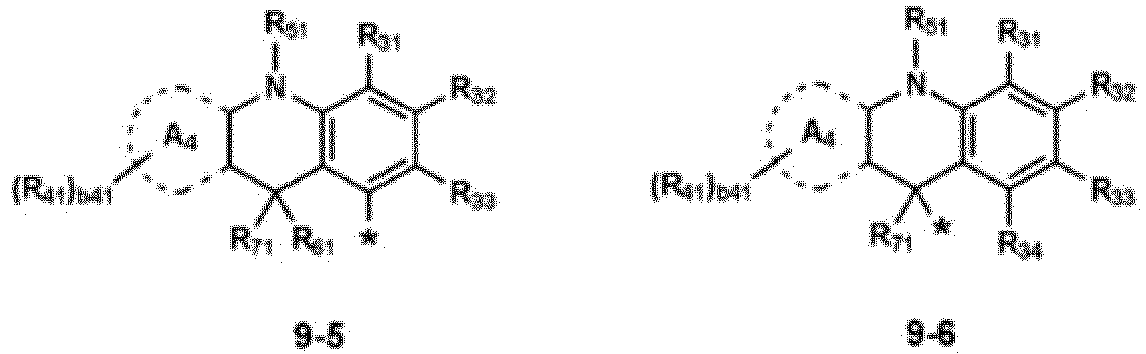
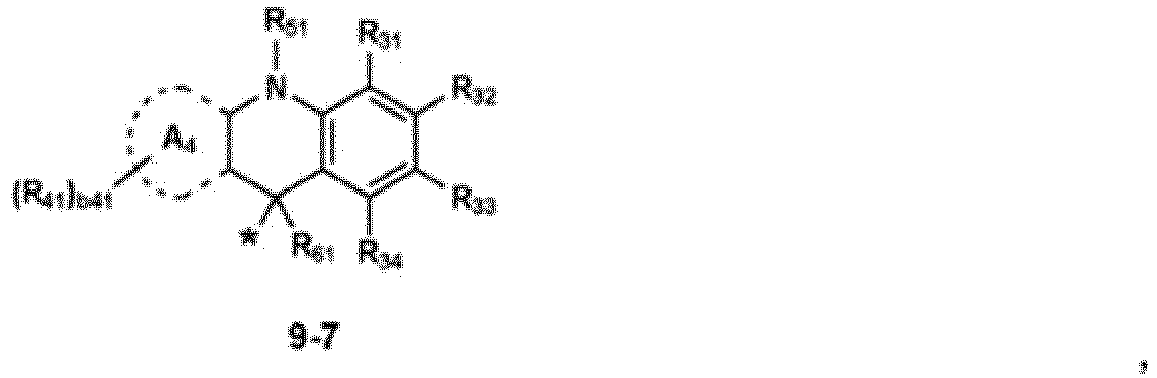 wobei, in Formeln 9-1 bis 9-7,A4 unabhängig aus einer Benzengruppe, einer Naphthalingruppe, einer Fluorengruppe, einer Carbazolgruppe, einer Dibenzofurangruppe und einer Dibenzothiophengruppe ausgewählt ist,R31 bis R34, R41, R51, R61 und R71 jeweils unabhängig ausgewählt sind aus:Wasserstoff, Deuterium, -F, -Cl, -Br, -I, einer Hydroxylgruppe, einer Cyanogruppe, einer Nitrogruppe, einer Methylgruppe, einer Ethylgruppe, einer Propylgruppe, einer Isobutylgruppe, einer sec-Butylgruppe, einer ter-Butylgruppe, einer C1-C20-Alkoxygruppe, einer Cyclopentylgruppe, einer Cyclohexylgruppe, einer Phenylgruppe, einer Naphthylgruppe, einer Fluorenylgruppe, einer Carbazolylgruppe, einer Dibenzofuranylgruppe, einer Dibenzothiophenylgruppe, einer Biphenylgruppe und einer Terphenylgruppe; undeiner Methylgruppe, einer Ethylgruppe, einer Propylgruppe, einer Isobutylgruppe, einer sec-Butylgruppe, einer ter-Butylgruppe, einer C1-C20-Alkoxygruppe, einer Cyclopentylgruppe, einer Cyclohexylgruppe, einer Phenylgruppe, einer Naphthylgruppe, einer Fluorenylgruppe, einer Carbazolylgruppe, einer Dibenzofuranylgruppe, einer Dibenzothiophenylgruppe, einer Biphenylgruppe und einer Terphenylgruppe, jeweils substituiert mit mindestens einem, ausgewählt aus Deuterium, -F, -Cl, -Br, -I, einer Hydroxylgruppe, einer Cyanogruppe, einer Nitrogruppe, einer Amidinogruppe, einer Hydrazinogruppe, einer Hydrazonogruppe, einer Methylgruppe, einer Ethylgruppe, einer Propylgruppe, einer Isobutylgruppe, einer sec-Butylgruppe, einer ter-Butylgruppe, einer Phenylgruppe, einer Naphthylgruppe, einer Fluorenylgruppe, einer Carbazolylgruppe, einer Dibenzofuranylgruppe, einer Dibenzothiophenylgruppe, einer Biphenylgruppe und einer Terphenylgruppe,b41 eine ganze Zahl von 1 bis 8 ist,mindestens ein Substituent der substituierten C3-C10-Cycloalkylengruppe, der substituierten C1-C10-Heterocycloalkylengruppe, der substituierten C3-C10-Cycloalkenylengruppe, der substituierten C1-C10-Heterocycloalkenylengruppe, der substituierten C6-C60-Arylengruppe, der substituierten C1-C60-Heteroarylengruppe, der substituierten zweiwertigen nichtaromatischen kondensierten polycyclischen Gruppe, der substituierten zweiwertigen nichtaromatischen kondensierten heteropolycyclischen Gruppe, der substituierten C1-C60-Alkylgruppe, der substituierten C2-C60-Alkenylgruppe, der substituierten C2-C60-Alkinylgruppe, der substituierten C1-C60-Alkoxygruppe, der substituierten C3-C10-Cycloalkylgruppe, der substituierten C1-C10-Heterocycloalkylgruppe, der substituierten C3-C10-Cycloalkenylgruppe, der substituierten C1-C10-Heterocycloalkenylgruppe, der substituierten C6-C60-Arylgruppe, der substituierten C6-C60-Aryloxygruppe, der substituierten C6-C60-Arylthiogruppe, der substituierten C1-C60-Heteroarylgruppe, der substituierten einwertigen nichtaromatischen kondensierten polycyclischen Gruppe und der substituierten einwertigen nichtaromatischen kondensierten heteropolycyclischen Gruppe ausgewählt ist aus:Deuterium, -F, -Cl, -Br, -I, einer Hydroxylgruppe, einer Cyanogruppe, einer Nitrogruppe, einer Amidinogruppe, einer Hydrazinogruppe, einer Hydrazonogruppe, einer C1-C60-Alkylgruppe, einer C2-C60-Alkenylgruppe, einer C2-C60-Alkinylgruppe und einer C1-C60-Alkoxygruppe;einer C1-C60-Alkylgruppe, einer C2-C60-Alkenylgruppe, einer C2-C60-Alkinylgruppe und einer C1-C60-Alkoxygruppe, jeweils substituiert mit mindestens einem, ausgewählt aus Deuterium, -F, -Cl, -Br, -I, einer Hydroxylgruppe, einer Cyanogruppe, einer Nitrogruppe, einer Amidinogruppe, einer Hydrazinogruppe, einer Hydrazonogruppe, einer C3-C10-Cycloalkylgruppe, einer C1-C10-Heterocycloalkylgruppe, einer C3-C10-Cycloalkenylgruppe, einer C1-C10-Heterocycloalkenylgruppe, einer C6-C60-Arylgruppe, einer C6-C60-Aryloxygruppe, einer C6-C60-Arylthiogruppe, einer C1-C60-Heteroarylgruppe, einer einwertigen nichtaromatischen kondensierten polycyclischen Gruppe, einer einwertigen nichtaromatischen kondensierten heteropolycyclischen Gruppe, -Si(Q11)(Q12)(Q13), -N(Q11)(Q12), -B(Q11)(Q12), -C(=O)(Q11), -S(=O)2(Q11) und -P(=O)(Q11)(Q12);einer C3-C10-Cycloalkylgruppe, einer C1-C10-Heterocycloalkylgruppe, einer C3-C10-Cycloalkenylgruppe, einer C1-C10-Heterocycloalkenylgruppe, einer C6-C60-Arylgruppe, einer C6-C60-Aryloxygruppe, einer C6-C60-Arylthiogruppe, einer C1-C60-Heteroarylgruppe, einer einwertigen nichtaromatischen kondensierten polycyclischen Gruppe und einer einwertigen nichtaromatischen kondensierten heteropolycyclischen Gruppe;einer C3-C10-Cycloalkylgruppe, einer C1-C10-Heterocycloalkylgruppe, einer C3-C10-Cycloalkenylgruppe, einer C1-C10-Heterocycloalkenylgruppe, einer C6-C60-Arylgruppe, einer C6-C60-Aryloxygruppe, einer C6-C60-Arylthiogruppe, einer C1-C60-Heteroarylgruppe, einer einwertigen nichtaromatischen kondensierten polycyclischen Gruppe und einer einwertigen nichtaromatischen kondensierten heteropolycyclischen Gruppe, jeweils substituiert mit mindestens einem, ausgewählt aus Deuterium, -F, -Cl, -Br, -I, einer Hydroxylgruppe, einer Cyanogruppe, einer Nitrogruppe, einer Amidinogruppe, einer Hydrazinogruppe, einer Hydrazonogruppe, einer C1-C60-Alkylgruppe, einer C2-C60-Alkenylgruppe, einer C2-C60-Alkinylgruppe, einer C1-C60-Alkoxygruppe, einer C3-C10-Cycloalkylgruppe, einer C1-C10-Heterocycloalkylgruppe, einer C3-C10-Cycloalkenylgruppe, einer C1-C10-Heterocycloalkenylgruppe, einer C6-C60-Arylgruppe, einer C6-C60-Aryloxygruppe, einer C6-C60-Arylthiogruppe, einer C1-C60-Heteroarylgruppe, einer einwertigen nichtaromatischen kondensierten polycyclischen Gruppe, einer einwertigen nichtaromatischen kondensierten heteropolycyclischen Gruppe, -Si(Q21)(Q22)(Q23), -N(Q21)(Q22), -B(Q21)(Q22), -C(=O)(Q21), -S(=O)2(Q21) und -P(=O)(Q21)(Q22); und-Si(Q31)(Q32)(Q33), -N(Q31)(Q32), -B(Q31)(Q32), -C(=O)(Q31), -S(=O)2(Q31) und -P(=O)(Q31)(Q32), undQ1 bis Q3, Q11 bis Q13, Q21 bis Q23, und Q31 bis Q33 jeweils unabhängig ausgewählt sind aus Wasserstoff, Deuterium, -F, -Cl, -Br, -I, einer Hydroxylgruppe, einer Cyanogruppe, einer Nitrogruppe, einer Amidinogruppe, einer Hydrazinogruppe, einer Hydrazonogruppe, einer C1-C60-Alkylgruppe, einer C2-C60-Alkenylgruppe, einer C2-C60-Alkinylgruppe, einer C1-C60-Alkoxygruppe, einer C3-C10-Cycloalkylgruppe, einer C1-C10-Heterocycloalkylgruppe, einer C3-C10-Cycloalkenylgruppe, einer C1-C10-Heterocycloalkenylgruppe, einer C6-C60-Arylgruppe, einer C1-C60-Heteroarylgruppe, einer einwertigen nichtaromatischen kondensierten polycyclischen Gruppe, einer einwertigen nichtaromatischen kondensierten heteropolycyclischen Gruppe, einer Biphenylgruppe und einer Terphenylgruppe, und∗ eine Bindungsstelle zu einem Nachbaratom angibt.
- Heterocyclische Verbindung nach Anspruch 1, wobei R12, R14 und R20 jeweils unabhängig ausgewählt sind aus:Wasserstoff, Deuterium, -F, -Cl, -Br, -I, einer Hydroxylgruppe, einer Cyanogruppe, einer Nitrogruppe, einer Methylgruppe, einer Ethylgruppe, einer Propylgruppe, einer Isobutylgruppe, einer sec-Butylgruppe, einer ter-Butylgruppe, einer C1-C20-Alkoxygruppe, einer Cyclopentylgruppe, einer Cyclohexylgruppe, einer Phenylgruppe, einer Naphthylgruppe, einer Fluorenylgruppe, einer Carbazolylgruppe, einer Dibenzofuranylgruppe, einer Dibenzothiophenylgruppe, einer Biphenylgruppe und einer Terphenylgruppe; undeiner Methylgruppe, einer Ethylgruppe, einer Propylgruppe, einer Isobutylgruppe, einer sec-Butylgruppe, einer ter-Butylgruppe, einer C1-C20-Alkoxygruppe, einer Cyclopentylgruppe, einer Cyclohexylgruppe, einer Phenylgruppe, einer Naphthylgruppe, einer Fluorenylgruppe, einer Carbazolylgruppe, einer Dibenzofuranylgruppe, einer Dibenzothiophenylgruppe, einer Biphenylgruppe und einer Terphenylgruppe, jeweils substituiert mit mindestens einem, ausgewählt aus Deuterium, -F, -Cl, -Br, -I, einer Hydroxylgruppe, einer Cyanogruppe, einer Nitrogruppe, einer Amidinogruppe, einer Hydrazinogruppe, einer Hydrazonogruppe, einer Methylgruppe, einer Ethylgruppe, einer Propylgruppe, einer Isobutylgruppe, einer sec-Butylgruppe, einer ter-Butylgruppe, einer Phenylgruppe, einer Naphthylgruppe, einer Fluorenylgruppe, einer Carbazolylgruppe, einer Dibenzofuranylgruppe, einer Dibenzothiophenylgruppe, einer Biphenylgruppe und einer Terphenylgruppe.
- Heterocyclische Verbindung, wobei die heterocyclische Verbindung ausgewählt ist aus Verbindungen 1 bis 56:


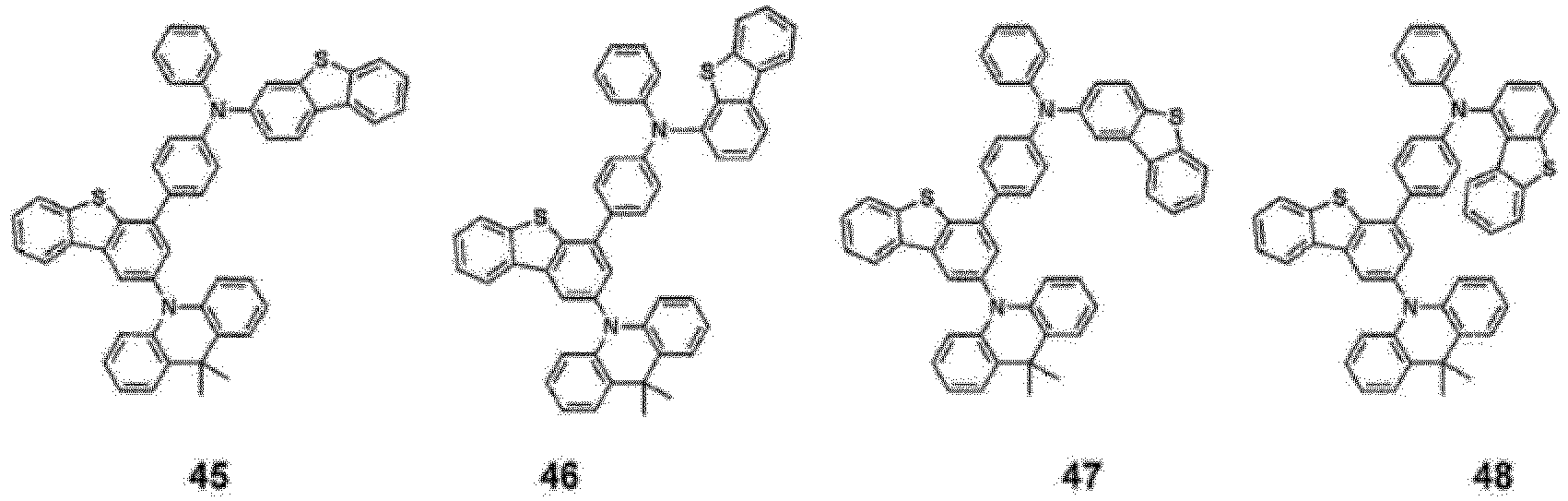


- Organische lichtemittierende Vorrichtung, umfassend:eine erste Elektrode;eine der ersten Elektrode zugewandte zweite Elektrode; undeine organische Schicht zwischen der ersten Elektrode und der zweiten Elektrode und umfassend eine Emissionsschicht und mindestens eine der heterocyclischen Verbindung nach einem der Ansprüche 1 bis 3,wobei:die erste Elektrode vorzugsweise eine Anode ist,die zweite Elektrode vorzugsweise eine Kathode ist,die organische Schicht vorzugsweise ferner eine Löchertransportregion zwischen der ersten Elektrode und der Emissionsschicht und eine Elektronentransportregion zwischen der Emissionsschicht und der zweiten Elektrode umfasst,die Löchertransportregion eine Löcherinjektionsschicht, eine Löchertransportschicht, eine Emissionshilfsschicht, eine Elektronenblockierschicht, oder eine beliebige Kombination davon, umfasst, unddie Elektronentransportregion eine Löcherblockierschicht, eine Elektronentransportschicht, eine Elektroneninjektionsschicht, oder eine beliebige Kombination davon, umfasst.
- Organische lichtemittierende Vorrichtung nach Anspruch 4, wobei die Löchertransportregion die heterocyclische Verbindung umfasst,
wobei die Löchertransportregion vorzugsweise eine Löchertransportschicht umfasst, und die Löchertransportschicht die heterocyclische Verbindung umfasst. - Organische lichtemittierende Vorrichtung nach Anspruch 4 oder Anspruch 5, wobei die Löchertransportregion umfasst:eine erste Löchertransportschicht zwischen der ersten Elektrode und der Emissionsschicht; undeine zweite Löchertransportschicht zwischen der ersten Löchertransportschicht und der Emissionsschicht, undwobei die erste Löchertransportschicht die heterocyclische Verbindung umfasst.
- Organische lichtemittierende Vorrichtung nach einem der Ansprüche 4 bis 6, wobei die Emissionsschicht einen Wirt und einen Dotanden umfasst, wobei der Dotand ein fluoreszierender Dotand oder ein phosphoreszierender Dotand ist.
- Organische lichtemittierende Vorrichtung nach einem der Ansprüche 4 bis 7, wobei die Elektronentransportregion ein Alkalimetall, ein Erdalkalimetall, ein Seltenerdmetall, eine Alkalimetallverbindung, eine Erdalkalimetallverbindung, eine Seltenerdmetallverbindung, einen Alkalimetallkomplex, einen Erdalkalimetallkomplex, einen Seltenerdmetallkomplex, oder eine beliebige Kombination davon, umfasst.
Applications Claiming Priority (1)
| Application Number | Priority Date | Filing Date | Title |
|---|---|---|---|
| KR1020180034707A KR102508497B1 (ko) | 2018-03-26 | 2018-03-26 | 헤테로시클릭 화합물 및 이를 포함한 유기 발광 소자 |
Publications (2)
| Publication Number | Publication Date |
|---|---|
| EP3575295A1 EP3575295A1 (de) | 2019-12-04 |
| EP3575295B1 true EP3575295B1 (de) | 2022-09-07 |
Family
ID=65904233
Family Applications (1)
| Application Number | Title | Priority Date | Filing Date |
|---|---|---|---|
| EP19164450.9A Active EP3575295B1 (de) | 2018-03-26 | 2019-03-21 | Heterocyclische verbindung und organische lichtemittierende vorrichtung damit |
Country Status (4)
| Country | Link |
|---|---|
| US (1) | US11289657B2 (de) |
| EP (1) | EP3575295B1 (de) |
| KR (1) | KR102508497B1 (de) |
| CN (1) | CN110357851B (de) |
Families Citing this family (1)
| Publication number | Priority date | Publication date | Assignee | Title |
|---|---|---|---|---|
| KR102760953B1 (ko) * | 2020-01-06 | 2025-01-24 | 주식회사 엘지화학 | 신규한 공중합체 및 이를 포함하는 유기 발광 소자 |
Family Cites Families (32)
| Publication number | Priority date | Publication date | Assignee | Title |
|---|---|---|---|---|
| US4720432A (en) | 1987-02-11 | 1988-01-19 | Eastman Kodak Company | Electroluminescent device with organic luminescent medium |
| US5061569A (en) | 1990-07-26 | 1991-10-29 | Eastman Kodak Company | Electroluminescent device with organic electroluminescent medium |
| JP3556258B2 (ja) | 1992-12-18 | 2004-08-18 | 株式会社リコー | 複数のキャリヤー注入層を有する有機薄膜el素子 |
| JP2873548B2 (ja) | 1995-04-21 | 1999-03-24 | バンドー化学株式会社 | 新規なトリフェニルアミン化合物 |
| US6242115B1 (en) | 1997-09-08 | 2001-06-05 | The University Of Southern California | OLEDs containing thermally stable asymmetric charge carrier materials |
| JP3856546B2 (ja) | 1997-11-11 | 2006-12-13 | 三井化学株式会社 | 有機電界発光素子 |
| US6541129B1 (en) | 1998-09-09 | 2003-04-01 | Idemitsu Kosan Co., Ltd. | Organic electroluminescence device and phenylenediamine derivative |
| JP4542646B2 (ja) | 1998-09-09 | 2010-09-15 | 出光興産株式会社 | 有機エレクトロルミネッセンス素子およびフェニレンジアミン誘導体 |
| JP4573923B2 (ja) | 1999-04-27 | 2010-11-04 | 三井化学株式会社 | アミン化合物 |
| US8188315B2 (en) | 2004-04-02 | 2012-05-29 | Samsung Mobile Display Co., Ltd. | Organic light emitting device and flat panel display device comprising the same |
| KR100787425B1 (ko) | 2004-11-29 | 2007-12-26 | 삼성에스디아이 주식회사 | 페닐카바졸계 화합물 및 이를 이용한 유기 전계 발광 소자 |
| US8771841B2 (en) | 2008-05-16 | 2014-07-08 | Hodogaya Chemical Co., Ltd. | Organic electroluminescent device |
| KR101120892B1 (ko) | 2009-06-19 | 2012-02-27 | 주식회사 두산 | 아크리딘 유도체 및 이를 포함하는 유기 전계 발광 소자 |
| KR102169273B1 (ko) | 2012-07-26 | 2020-10-23 | 주식회사 동진쎄미켐 | 아크리딘 유도체를 포함하는 유기발광 화합물 및 이를 포함하는 유기발광소자 |
| KR102160946B1 (ko) | 2012-08-07 | 2020-09-29 | 주식회사 동진쎄미켐 | 아크리딘 유도체를 포함하는 유기발광 화합물 및 이를 포함하는 유기발광소자 |
| JP2014103212A (ja) | 2012-11-19 | 2014-06-05 | Samsung Display Co Ltd | アクリジン部位及びカルバゾール部位を有するアミン誘導体を含む有機el材料及びそれを用いた有機el素子 |
| KR101468088B1 (ko) * | 2012-11-28 | 2014-12-05 | 주식회사 엘엠에스 | 신규한 화합물, 이를 포함하는 발광 소자 및 전자 장치 |
| KR101615816B1 (ko) * | 2013-09-27 | 2016-04-26 | 주식회사 엘지화학 | 헤테로환 화합물 및 이를 포함하는 유기 발광 소자 |
| WO2015178585A1 (ko) * | 2014-05-22 | 2015-11-26 | 덕산네오룩스 주식회사 | 유기전기 소자용 화합물, 이를 이용한 유기전기소자 및 그 전자 장치 |
| KR102277659B1 (ko) * | 2014-07-03 | 2021-07-15 | 덕산네오룩스 주식회사 | 유기전기 소자용 화합물, 이를 이용한 유기전기소자 및 그 전자 장치 |
| KR101852926B1 (ko) * | 2014-12-29 | 2018-04-27 | (주)피엔에이치테크 | 유기발광 화합물 및 이를 포함하는 유기전계발광소자 |
| JP2016136581A (ja) * | 2015-01-23 | 2016-07-28 | 三星ディスプレイ株式會社Samsung Display Co.,Ltd. | 有機電界発光素子用材料、これを用いた有機電界発光素子及びアミン誘導体 |
| JP6447851B2 (ja) * | 2015-06-19 | 2019-01-09 | エルジー・ケム・リミテッド | 有機発光素子 |
| US10043984B2 (en) * | 2015-07-01 | 2018-08-07 | Samsung Electronics Co., Ltd. | Condensed cyclic compound and organic light-emitting device including the same |
| KR102076884B1 (ko) | 2015-12-08 | 2020-02-13 | 주식회사 엘지화학 | 헤테로고리 화합물 및 이를 포함하는 유기 발광 소자 |
| KR102636244B1 (ko) * | 2016-03-30 | 2024-02-15 | 삼성디스플레이 주식회사 | 유기 전계 발광 소자 |
| CN107663169B (zh) * | 2016-07-27 | 2020-08-21 | 北京鼎材科技有限公司 | 一种6H-萘并[2,1,8,7-klmn]吖啶衍生物及其应用 |
| KR102032023B1 (ko) * | 2016-09-09 | 2019-10-14 | 주식회사 엘지화학 | 화합물 및 이를 포함하는 유기 전자 소자 |
| CN107235899A (zh) * | 2017-07-13 | 2017-10-10 | 长春海谱润斯科技有限公司 | 一种新的氮蒽化合物及其有机发光器件 |
| CN107986975A (zh) * | 2017-11-08 | 2018-05-04 | 长春海谱润斯科技有限公司 | 一种有机发光化合物及其有机发光器件 |
| KR20190096099A (ko) * | 2018-02-08 | 2019-08-19 | 주식회사 동진쎄미켐 | 신규 화합물 및 이를 포함하는 유기 발광 소자 |
| CN108250084A (zh) * | 2018-02-13 | 2018-07-06 | 长春海谱润斯科技有限公司 | 一种芴类衍生物及其有机发光器件 |
-
2018
- 2018-03-26 KR KR1020180034707A patent/KR102508497B1/ko active Active
-
2019
- 2019-03-21 EP EP19164450.9A patent/EP3575295B1/de active Active
- 2019-03-22 US US16/362,416 patent/US11289657B2/en active Active
- 2019-03-25 CN CN201910227477.6A patent/CN110357851B/zh active Active
Also Published As
| Publication number | Publication date |
|---|---|
| CN110357851A (zh) | 2019-10-22 |
| US11289657B2 (en) | 2022-03-29 |
| CN110357851B (zh) | 2023-08-01 |
| KR102508497B1 (ko) | 2023-03-10 |
| EP3575295A1 (de) | 2019-12-04 |
| US20190296245A1 (en) | 2019-09-26 |
| KR20190112882A (ko) | 2019-10-08 |
Similar Documents
| Publication | Publication Date | Title |
|---|---|---|
| EP3447062B1 (de) | Organometallverbindung, organische lichtemittierende vorrichtung mit der organometallverbindung und organische lichtemittierende vorrichtung mit der organischen lichtemittierenden vorrichtung | |
| JP7169802B2 (ja) | ヘテロ環式化合物、それを含んだ有機発光素子及び電子装置 | |
| KR102595922B1 (ko) | 카바졸계 화합물 및 이를 포함한 유기 발광 소자 | |
| EP3444241B1 (de) | Aminbasierte verbindung und diese enthaltende organisches lichtemittierendes element | |
| EP3539972B1 (de) | Organometallische verbindung und organische lichtemittierende vorrichtung damit | |
| EP3301097B1 (de) | [1]benzothieno[3',2':4,5]imidazo[1,2-a]pyridine derivate und verwandte verbindungen zur verwendung in organischen lichtemittierenden vorrichtungen (oleds) | |
| JP7610915B2 (ja) | 縮合環化合物、及びそれを含む有機発光素子 | |
| EP3561894B1 (de) | Diaminverbindung und organische lichtemittierende vorrichtung damit | |
| EP3537495B1 (de) | Organische lichtemittierende vorrichtung | |
| CN112062782B (zh) | 杂环化合物和包括其的有机发光装置 | |
| EP3476852B1 (de) | Heterocyclische verbindung und organische lichtemittierende vorrichtung damit | |
| KR102867206B1 (ko) | 아민계 화합물 및 이를 포함한 유기 발광 소자 | |
| KR102696804B1 (ko) | 유기 발광 소자 | |
| KR20200130614A (ko) | 유기금속 화합물 및 이를 포함한 유기 발광 소자 | |
| KR102938606B1 (ko) | 축합환 화합물 및 이를 포함한 유기 발광 소자 | |
| EP3783007B1 (de) | Organometallische verbindung und organische lichtemittierende vorrichtung damit | |
| EP3263558B1 (de) | Heterocyclische verbindung und organische lichtemittierende vorrichtung damit | |
| EP3296288B1 (de) | Kondensierte cyclische verbindung und organische lichtemittierende vorrichtung damit | |
| EP3418272A1 (de) | Triazin-verbindungen und organische lichtemittierende vorrichtungen damit | |
| EP3748706B1 (de) | Heterocyclische verbindung und organische lichtemittierende vorrichtung damit | |
| KR20250071214A (ko) | 헤테로시클릭 화합물 및 이를 포함한 유기 발광 소자 | |
| EP3854795B1 (de) | Kondensierte cyclische verbindung und organische lichtemittierende diode damit | |
| KR102696821B1 (ko) | 아민계 화합물 및 이를 포함한 유기 발광 소자 | |
| JP7792204B2 (ja) | ヘテロ環化合物、及びそれを含む有機発光素子 | |
| EP3575295A1 (de) | Heterocyclische verbindung und organische lichtemittierende vorrichtung damit |
Legal Events
| Date | Code | Title | Description |
|---|---|---|---|
| PUAI | Public reference made under article 153(3) epc to a published international application that has entered the european phase |
Free format text: ORIGINAL CODE: 0009012 |
|
| STAA | Information on the status of an ep patent application or granted ep patent |
Free format text: STATUS: THE APPLICATION HAS BEEN PUBLISHED |
|
| AK | Designated contracting states |
Kind code of ref document: A1 Designated state(s): AL AT BE BG CH CY CZ DE DK EE ES FI FR GB GR HR HU IE IS IT LI LT LU LV MC MK MT NL NO PL PT RO RS SE SI SK SM TR |
|
| AX | Request for extension of the european patent |
Extension state: BA ME |
|
| STAA | Information on the status of an ep patent application or granted ep patent |
Free format text: STATUS: REQUEST FOR EXAMINATION WAS MADE |
|
| 17P | Request for examination filed |
Effective date: 20200324 |
|
| RBV | Designated contracting states (corrected) |
Designated state(s): AL AT BE BG CH CY CZ DE DK EE ES FI FR GB GR HR HU IE IS IT LI LT LU LV MC MK MT NL NO PL PT RO RS SE SI SK SM TR |
|
| STAA | Information on the status of an ep patent application or granted ep patent |
Free format text: STATUS: EXAMINATION IS IN PROGRESS |
|
| 17Q | First examination report despatched |
Effective date: 20201223 |
|
| GRAP | Despatch of communication of intention to grant a patent |
Free format text: ORIGINAL CODE: EPIDOSNIGR1 |
|
| RIC1 | Information provided on ipc code assigned before grant |
Ipc: C07D 409/14 20060101ALN20220216BHEP Ipc: C07D 409/10 20060101ALN20220216BHEP Ipc: H01L 51/50 20060101ALI20220216BHEP Ipc: C07D 417/14 20060101ALI20220216BHEP Ipc: C07D 417/04 20060101ALI20220216BHEP Ipc: C07D 405/04 20060101ALI20220216BHEP Ipc: C07D 405/14 20060101AFI20220216BHEP |
|
| STAA | Information on the status of an ep patent application or granted ep patent |
Free format text: STATUS: GRANT OF PATENT IS INTENDED |
|
| RIC1 | Information provided on ipc code assigned before grant |
Ipc: C07D 409/14 20060101ALN20220221BHEP Ipc: C07D 409/10 20060101ALN20220221BHEP Ipc: H01L 51/50 20060101ALI20220221BHEP Ipc: C07D 417/14 20060101ALI20220221BHEP Ipc: C07D 417/04 20060101ALI20220221BHEP Ipc: C07D 405/04 20060101ALI20220221BHEP Ipc: C07D 405/14 20060101AFI20220221BHEP |
|
| INTG | Intention to grant announced |
Effective date: 20220324 |
|
| GRAS | Grant fee paid |
Free format text: ORIGINAL CODE: EPIDOSNIGR3 |
|
| GRAA | (expected) grant |
Free format text: ORIGINAL CODE: 0009210 |
|
| STAA | Information on the status of an ep patent application or granted ep patent |
Free format text: STATUS: THE PATENT HAS BEEN GRANTED |
|
| AK | Designated contracting states |
Kind code of ref document: B1 Designated state(s): AL AT BE BG CH CY CZ DE DK EE ES FI FR GB GR HR HU IE IS IT LI LT LU LV MC MK MT NL NO PL PT RO RS SE SI SK SM TR |
|
| REG | Reference to a national code |
Ref country code: GB Ref legal event code: FG4D |
|
| REG | Reference to a national code |
Ref country code: CH Ref legal event code: EP Ref country code: AT Ref legal event code: REF Ref document number: 1516968 Country of ref document: AT Kind code of ref document: T Effective date: 20220915 |
|
| REG | Reference to a national code |
Ref country code: IE Ref legal event code: FG4D |
|
| REG | Reference to a national code |
Ref country code: DE Ref legal event code: R096 Ref document number: 602019019140 Country of ref document: DE |
|
| REG | Reference to a national code |
Ref country code: LT Ref legal event code: MG9D |
|
| REG | Reference to a national code |
Ref country code: NL Ref legal event code: MP Effective date: 20220907 |
|
| PG25 | Lapsed in a contracting state [announced via postgrant information from national office to epo] |
Ref country code: SE Free format text: LAPSE BECAUSE OF FAILURE TO SUBMIT A TRANSLATION OF THE DESCRIPTION OR TO PAY THE FEE WITHIN THE PRESCRIBED TIME-LIMIT Effective date: 20220907 Ref country code: RS Free format text: LAPSE BECAUSE OF FAILURE TO SUBMIT A TRANSLATION OF THE DESCRIPTION OR TO PAY THE FEE WITHIN THE PRESCRIBED TIME-LIMIT Effective date: 20220907 Ref country code: NO Free format text: LAPSE BECAUSE OF FAILURE TO SUBMIT A TRANSLATION OF THE DESCRIPTION OR TO PAY THE FEE WITHIN THE PRESCRIBED TIME-LIMIT Effective date: 20221207 Ref country code: LV Free format text: LAPSE BECAUSE OF FAILURE TO SUBMIT A TRANSLATION OF THE DESCRIPTION OR TO PAY THE FEE WITHIN THE PRESCRIBED TIME-LIMIT Effective date: 20220907 Ref country code: LT Free format text: LAPSE BECAUSE OF FAILURE TO SUBMIT A TRANSLATION OF THE DESCRIPTION OR TO PAY THE FEE WITHIN THE PRESCRIBED TIME-LIMIT Effective date: 20220907 Ref country code: FI Free format text: LAPSE BECAUSE OF FAILURE TO SUBMIT A TRANSLATION OF THE DESCRIPTION OR TO PAY THE FEE WITHIN THE PRESCRIBED TIME-LIMIT Effective date: 20220907 |
|
| REG | Reference to a national code |
Ref country code: AT Ref legal event code: MK05 Ref document number: 1516968 Country of ref document: AT Kind code of ref document: T Effective date: 20220907 |
|
| PG25 | Lapsed in a contracting state [announced via postgrant information from national office to epo] |
Ref country code: HR Free format text: LAPSE BECAUSE OF FAILURE TO SUBMIT A TRANSLATION OF THE DESCRIPTION OR TO PAY THE FEE WITHIN THE PRESCRIBED TIME-LIMIT Effective date: 20220907 Ref country code: GR Free format text: LAPSE BECAUSE OF FAILURE TO SUBMIT A TRANSLATION OF THE DESCRIPTION OR TO PAY THE FEE WITHIN THE PRESCRIBED TIME-LIMIT Effective date: 20221208 |
|
| PG25 | Lapsed in a contracting state [announced via postgrant information from national office to epo] |
Ref country code: SM Free format text: LAPSE BECAUSE OF FAILURE TO SUBMIT A TRANSLATION OF THE DESCRIPTION OR TO PAY THE FEE WITHIN THE PRESCRIBED TIME-LIMIT Effective date: 20220907 Ref country code: RO Free format text: LAPSE BECAUSE OF FAILURE TO SUBMIT A TRANSLATION OF THE DESCRIPTION OR TO PAY THE FEE WITHIN THE PRESCRIBED TIME-LIMIT Effective date: 20220907 Ref country code: PT Free format text: LAPSE BECAUSE OF FAILURE TO SUBMIT A TRANSLATION OF THE DESCRIPTION OR TO PAY THE FEE WITHIN THE PRESCRIBED TIME-LIMIT Effective date: 20230109 Ref country code: ES Free format text: LAPSE BECAUSE OF FAILURE TO SUBMIT A TRANSLATION OF THE DESCRIPTION OR TO PAY THE FEE WITHIN THE PRESCRIBED TIME-LIMIT Effective date: 20220907 Ref country code: CZ Free format text: LAPSE BECAUSE OF FAILURE TO SUBMIT A TRANSLATION OF THE DESCRIPTION OR TO PAY THE FEE WITHIN THE PRESCRIBED TIME-LIMIT Effective date: 20220907 Ref country code: AT Free format text: LAPSE BECAUSE OF FAILURE TO SUBMIT A TRANSLATION OF THE DESCRIPTION OR TO PAY THE FEE WITHIN THE PRESCRIBED TIME-LIMIT Effective date: 20220907 |
|
| PG25 | Lapsed in a contracting state [announced via postgrant information from national office to epo] |
Ref country code: SK Free format text: LAPSE BECAUSE OF FAILURE TO SUBMIT A TRANSLATION OF THE DESCRIPTION OR TO PAY THE FEE WITHIN THE PRESCRIBED TIME-LIMIT Effective date: 20220907 Ref country code: PL Free format text: LAPSE BECAUSE OF FAILURE TO SUBMIT A TRANSLATION OF THE DESCRIPTION OR TO PAY THE FEE WITHIN THE PRESCRIBED TIME-LIMIT Effective date: 20220907 Ref country code: IS Free format text: LAPSE BECAUSE OF FAILURE TO SUBMIT A TRANSLATION OF THE DESCRIPTION OR TO PAY THE FEE WITHIN THE PRESCRIBED TIME-LIMIT Effective date: 20230107 Ref country code: EE Free format text: LAPSE BECAUSE OF FAILURE TO SUBMIT A TRANSLATION OF THE DESCRIPTION OR TO PAY THE FEE WITHIN THE PRESCRIBED TIME-LIMIT Effective date: 20220907 |
|
| REG | Reference to a national code |
Ref country code: DE Ref legal event code: R097 Ref document number: 602019019140 Country of ref document: DE |
|
| P01 | Opt-out of the competence of the unified patent court (upc) registered |
Effective date: 20230516 |
|
| PG25 | Lapsed in a contracting state [announced via postgrant information from national office to epo] |
Ref country code: NL Free format text: LAPSE BECAUSE OF FAILURE TO SUBMIT A TRANSLATION OF THE DESCRIPTION OR TO PAY THE FEE WITHIN THE PRESCRIBED TIME-LIMIT Effective date: 20220907 Ref country code: AL Free format text: LAPSE BECAUSE OF FAILURE TO SUBMIT A TRANSLATION OF THE DESCRIPTION OR TO PAY THE FEE WITHIN THE PRESCRIBED TIME-LIMIT Effective date: 20220907 |
|
| PLBE | No opposition filed within time limit |
Free format text: ORIGINAL CODE: 0009261 |
|
| STAA | Information on the status of an ep patent application or granted ep patent |
Free format text: STATUS: NO OPPOSITION FILED WITHIN TIME LIMIT |
|
| PG25 | Lapsed in a contracting state [announced via postgrant information from national office to epo] |
Ref country code: DK Free format text: LAPSE BECAUSE OF FAILURE TO SUBMIT A TRANSLATION OF THE DESCRIPTION OR TO PAY THE FEE WITHIN THE PRESCRIBED TIME-LIMIT Effective date: 20220907 |
|
| 26N | No opposition filed |
Effective date: 20230608 |
|
| PG25 | Lapsed in a contracting state [announced via postgrant information from national office to epo] |
Ref country code: SI Free format text: LAPSE BECAUSE OF FAILURE TO SUBMIT A TRANSLATION OF THE DESCRIPTION OR TO PAY THE FEE WITHIN THE PRESCRIBED TIME-LIMIT Effective date: 20220907 |
|
| PG25 | Lapsed in a contracting state [announced via postgrant information from national office to epo] |
Ref country code: MC Free format text: LAPSE BECAUSE OF FAILURE TO SUBMIT A TRANSLATION OF THE DESCRIPTION OR TO PAY THE FEE WITHIN THE PRESCRIBED TIME-LIMIT Effective date: 20220907 |
|
| REG | Reference to a national code |
Ref country code: CH Ref legal event code: PL |
|
| REG | Reference to a national code |
Ref country code: BE Ref legal event code: MM Effective date: 20230331 |
|
| PG25 | Lapsed in a contracting state [announced via postgrant information from national office to epo] |
Ref country code: LU Free format text: LAPSE BECAUSE OF NON-PAYMENT OF DUE FEES Effective date: 20230321 |
|
| REG | Reference to a national code |
Ref country code: IE Ref legal event code: MM4A |
|
| PG25 | Lapsed in a contracting state [announced via postgrant information from national office to epo] |
Ref country code: LI Free format text: LAPSE BECAUSE OF NON-PAYMENT OF DUE FEES Effective date: 20230331 Ref country code: IE Free format text: LAPSE BECAUSE OF NON-PAYMENT OF DUE FEES Effective date: 20230321 Ref country code: FR Free format text: LAPSE BECAUSE OF NON-PAYMENT OF DUE FEES Effective date: 20230331 Ref country code: CH Free format text: LAPSE BECAUSE OF NON-PAYMENT OF DUE FEES Effective date: 20230331 |
|
| PG25 | Lapsed in a contracting state [announced via postgrant information from national office to epo] |
Ref country code: BE Free format text: LAPSE BECAUSE OF NON-PAYMENT OF DUE FEES Effective date: 20230331 |
|
| PG25 | Lapsed in a contracting state [announced via postgrant information from national office to epo] |
Ref country code: IT Free format text: LAPSE BECAUSE OF FAILURE TO SUBMIT A TRANSLATION OF THE DESCRIPTION OR TO PAY THE FEE WITHIN THE PRESCRIBED TIME-LIMIT Effective date: 20220907 |
|
| PG25 | Lapsed in a contracting state [announced via postgrant information from national office to epo] |
Ref country code: BG Free format text: LAPSE BECAUSE OF FAILURE TO SUBMIT A TRANSLATION OF THE DESCRIPTION OR TO PAY THE FEE WITHIN THE PRESCRIBED TIME-LIMIT Effective date: 20220907 |
|
| PG25 | Lapsed in a contracting state [announced via postgrant information from national office to epo] |
Ref country code: BG Free format text: LAPSE BECAUSE OF FAILURE TO SUBMIT A TRANSLATION OF THE DESCRIPTION OR TO PAY THE FEE WITHIN THE PRESCRIBED TIME-LIMIT Effective date: 20220907 |
|
| PG25 | Lapsed in a contracting state [announced via postgrant information from national office to epo] |
Ref country code: CY Free format text: LAPSE BECAUSE OF FAILURE TO SUBMIT A TRANSLATION OF THE DESCRIPTION OR TO PAY THE FEE WITHIN THE PRESCRIBED TIME-LIMIT; INVALID AB INITIO Effective date: 20190321 |
|
| PG25 | Lapsed in a contracting state [announced via postgrant information from national office to epo] |
Ref country code: HU Free format text: LAPSE BECAUSE OF FAILURE TO SUBMIT A TRANSLATION OF THE DESCRIPTION OR TO PAY THE FEE WITHIN THE PRESCRIBED TIME-LIMIT; INVALID AB INITIO Effective date: 20190321 |
|
| PG25 | Lapsed in a contracting state [announced via postgrant information from national office to epo] |
Ref country code: TR Free format text: LAPSE BECAUSE OF FAILURE TO SUBMIT A TRANSLATION OF THE DESCRIPTION OR TO PAY THE FEE WITHIN THE PRESCRIBED TIME-LIMIT Effective date: 20220907 |
|
| PGFP | Annual fee paid to national office [announced via postgrant information from national office to epo] |
Ref country code: GB Payment date: 20260224 Year of fee payment: 8 |
|
| PGFP | Annual fee paid to national office [announced via postgrant information from national office to epo] |
Ref country code: DE Payment date: 20260220 Year of fee payment: 8 |