EP3447098B1 - Wässriger tintenstrahltintensatz und tintenstrahldruckverfahren - Google Patents
Wässriger tintenstrahltintensatz und tintenstrahldruckverfahren Download PDFInfo
- Publication number
- EP3447098B1 EP3447098B1 EP17187192.4A EP17187192A EP3447098B1 EP 3447098 B1 EP3447098 B1 EP 3447098B1 EP 17187192 A EP17187192 A EP 17187192A EP 3447098 B1 EP3447098 B1 EP 3447098B1
- Authority
- EP
- European Patent Office
- Prior art keywords
- pigment
- ink
- aqueous inkjet
- inkjet
- inkjet ink
- Prior art date
- Legal status (The legal status is an assumption and is not a legal conclusion. Google has not performed a legal analysis and makes no representation as to the accuracy of the status listed.)
- Revoked
Links
- SKEFYBCFPONVPX-UHFFFAOYSA-N CC(COCC(C(C(F)(F)F)(F)F)(F)F)OC(C(C(CC(O)=O)/C(/OC(C)COCC(C(C(F)(F)F)(F)F)(F)F)=[O]\C)S(O)(=O)=O)=O Chemical compound CC(COCC(C(C(F)(F)F)(F)F)(F)F)OC(C(C(CC(O)=O)/C(/OC(C)COCC(C(C(F)(F)F)(F)F)(F)F)=[O]\C)S(O)(=O)=O)=O SKEFYBCFPONVPX-UHFFFAOYSA-N 0.000 description 1
- JLRPKSUKMMHCQE-UHFFFAOYSA-M CC(COCC(C(C(F)(F)F)(F)F)(F)[I]=C)OCC(CC(OC(C)COCC(C(C(F)(F)F)(F)F)(F)F)=O)C(C(OC(C)COCC(C(C(F)(F)F)(F)F)(F)I)=O)S([O-])(=O)=O Chemical compound CC(COCC(C(C(F)(F)F)(F)F)(F)[I]=C)OCC(CC(OC(C)COCC(C(C(F)(F)F)(F)F)(F)F)=O)C(C(OC(C)COCC(C(C(F)(F)F)(F)F)(F)I)=O)S([O-])(=O)=O JLRPKSUKMMHCQE-UHFFFAOYSA-M 0.000 description 1
Images
Classifications
-
- C—CHEMISTRY; METALLURGY
- C09—DYES; PAINTS; POLISHES; NATURAL RESINS; ADHESIVES; COMPOSITIONS NOT OTHERWISE PROVIDED FOR; APPLICATIONS OF MATERIALS NOT OTHERWISE PROVIDED FOR
- C09D—COATING COMPOSITIONS, e.g. PAINTS, VARNISHES OR LACQUERS; FILLING PASTES; CHEMICAL PAINT OR INK REMOVERS; INKS; CORRECTING FLUIDS; WOODSTAINS; PASTES OR SOLIDS FOR COLOURING OR PRINTING; USE OF MATERIALS THEREFOR
- C09D11/00—Inks
- C09D11/30—Inkjet printing inks
- C09D11/40—Ink-sets specially adapted for multi-colour inkjet printing
-
- B—PERFORMING OPERATIONS; TRANSPORTING
- B32—LAYERED PRODUCTS
- B32B—LAYERED PRODUCTS, i.e. PRODUCTS BUILT-UP OF STRATA OF FLAT OR NON-FLAT, e.g. CELLULAR OR HONEYCOMB, FORM
- B32B13/00—Layered products comprising a a layer of water-setting substance, e.g. concrete, plaster, asbestos cement, or like builders' material
- B32B13/04—Layered products comprising a a layer of water-setting substance, e.g. concrete, plaster, asbestos cement, or like builders' material comprising such water setting substance as the main or only constituent of a layer, which is next to another layer of the same or of a different material
- B32B13/08—Layered products comprising a a layer of water-setting substance, e.g. concrete, plaster, asbestos cement, or like builders' material comprising such water setting substance as the main or only constituent of a layer, which is next to another layer of the same or of a different material of paper or cardboard
-
- B—PERFORMING OPERATIONS; TRANSPORTING
- B32—LAYERED PRODUCTS
- B32B—LAYERED PRODUCTS, i.e. PRODUCTS BUILT-UP OF STRATA OF FLAT OR NON-FLAT, e.g. CELLULAR OR HONEYCOMB, FORM
- B32B21/00—Layered products comprising a layer of wood, e.g. wood board, veneer, wood particle board
- B32B21/02—Layered products comprising a layer of wood, e.g. wood board, veneer, wood particle board the layer being formed of fibres, chips, or particles, e.g. MDF, HDF, OSB, chipboard, particle board, hardboard
-
- B—PERFORMING OPERATIONS; TRANSPORTING
- B32—LAYERED PRODUCTS
- B32B—LAYERED PRODUCTS, i.e. PRODUCTS BUILT-UP OF STRATA OF FLAT OR NON-FLAT, e.g. CELLULAR OR HONEYCOMB, FORM
- B32B21/00—Layered products comprising a layer of wood, e.g. wood board, veneer, wood particle board
- B32B21/04—Layered products comprising a layer of wood, e.g. wood board, veneer, wood particle board comprising wood as the main or only constituent of a layer, which is next to another layer of the same or of a different material
- B32B21/06—Layered products comprising a layer of wood, e.g. wood board, veneer, wood particle board comprising wood as the main or only constituent of a layer, which is next to another layer of the same or of a different material of paper or cardboard
-
- B—PERFORMING OPERATIONS; TRANSPORTING
- B32—LAYERED PRODUCTS
- B32B—LAYERED PRODUCTS, i.e. PRODUCTS BUILT-UP OF STRATA OF FLAT OR NON-FLAT, e.g. CELLULAR OR HONEYCOMB, FORM
- B32B29/00—Layered products comprising a layer of paper or cardboard
- B32B29/002—Layered products comprising a layer of paper or cardboard as the main or only constituent of a layer, which is next to another layer of the same or of a different material
- B32B29/005—Layered products comprising a layer of paper or cardboard as the main or only constituent of a layer, which is next to another layer of the same or of a different material next to another layer of paper or cardboard layer
-
- B—PERFORMING OPERATIONS; TRANSPORTING
- B32—LAYERED PRODUCTS
- B32B—LAYERED PRODUCTS, i.e. PRODUCTS BUILT-UP OF STRATA OF FLAT OR NON-FLAT, e.g. CELLULAR OR HONEYCOMB, FORM
- B32B29/00—Layered products comprising a layer of paper or cardboard
- B32B29/002—Layered products comprising a layer of paper or cardboard as the main or only constituent of a layer, which is next to another layer of the same or of a different material
- B32B29/007—Layered products comprising a layer of paper or cardboard as the main or only constituent of a layer, which is next to another layer of the same or of a different material next to a foam layer
-
- B—PERFORMING OPERATIONS; TRANSPORTING
- B32—LAYERED PRODUCTS
- B32B—LAYERED PRODUCTS, i.e. PRODUCTS BUILT-UP OF STRATA OF FLAT OR NON-FLAT, e.g. CELLULAR OR HONEYCOMB, FORM
- B32B3/00—Layered products comprising a layer with external or internal discontinuities or unevennesses, or a layer of non-planar shape; Layered products comprising a layer having particular features of form
- B32B3/02—Layered products comprising a layer with external or internal discontinuities or unevennesses, or a layer of non-planar shape; Layered products comprising a layer having particular features of form characterised by features of form at particular places, e.g. in edge regions
- B32B3/06—Layered products comprising a layer with external or internal discontinuities or unevennesses, or a layer of non-planar shape; Layered products comprising a layer having particular features of form characterised by features of form at particular places, e.g. in edge regions for securing layers together; for attaching the product to another member, e.g. to a support, or to another product, e.g. groove/tongue, interlocking
-
- B—PERFORMING OPERATIONS; TRANSPORTING
- B32—LAYERED PRODUCTS
- B32B—LAYERED PRODUCTS, i.e. PRODUCTS BUILT-UP OF STRATA OF FLAT OR NON-FLAT, e.g. CELLULAR OR HONEYCOMB, FORM
- B32B5/00—Layered products characterised by the non- homogeneity or physical structure, i.e. comprising a fibrous, filamentary, particulate or foam layer; Layered products characterised by having a layer differing constitutionally or physically in different parts
- B32B5/18—Layered products characterised by the non- homogeneity or physical structure, i.e. comprising a fibrous, filamentary, particulate or foam layer; Layered products characterised by having a layer differing constitutionally or physically in different parts characterised by features of a layer of foamed material
-
- B—PERFORMING OPERATIONS; TRANSPORTING
- B32—LAYERED PRODUCTS
- B32B—LAYERED PRODUCTS, i.e. PRODUCTS BUILT-UP OF STRATA OF FLAT OR NON-FLAT, e.g. CELLULAR OR HONEYCOMB, FORM
- B32B7/00—Layered products characterised by the relation between layers; Layered products characterised by the relative orientation of features between layers, or by the relative values of a measurable parameter between layers, i.e. products comprising layers having different physical, chemical or physicochemical properties; Layered products characterised by the interconnection of layers
- B32B7/04—Interconnection of layers
- B32B7/12—Interconnection of layers using interposed adhesives or interposed materials with bonding properties
-
- B—PERFORMING OPERATIONS; TRANSPORTING
- B41—PRINTING; LINING MACHINES; TYPEWRITERS; STAMPS
- B41J—TYPEWRITERS; SELECTIVE PRINTING MECHANISMS, i.e. MECHANISMS PRINTING OTHERWISE THAN FROM A FORME; CORRECTION OF TYPOGRAPHICAL ERRORS
- B41J11/00—Devices or arrangements of selective printing mechanisms, e.g. ink-jet printers or thermal printers, for supporting or handling copy material in sheet or web form
- B41J11/0015—Devices or arrangements of selective printing mechanisms, e.g. ink-jet printers or thermal printers, for supporting or handling copy material in sheet or web form for treating before, during or after printing or for uniform coating or laminating the copy material before or after printing
- B41J11/002—Curing or drying the ink on the copy materials, e.g. by heating or irradiating
-
- B—PERFORMING OPERATIONS; TRANSPORTING
- B41—PRINTING; LINING MACHINES; TYPEWRITERS; STAMPS
- B41J—TYPEWRITERS; SELECTIVE PRINTING MECHANISMS, i.e. MECHANISMS PRINTING OTHERWISE THAN FROM A FORME; CORRECTION OF TYPOGRAPHICAL ERRORS
- B41J2/00—Typewriters or selective printing mechanisms characterised by the printing or marking process for which they are designed
- B41J2/005—Typewriters or selective printing mechanisms characterised by the printing or marking process for which they are designed characterised by bringing liquid or particles selectively into contact with a printing material
- B41J2/01—Ink jet
- B41J2/21—Ink jet for multi-colour printing
- B41J2/2107—Ink jet for multi-colour printing characterised by the ink properties
-
- B—PERFORMING OPERATIONS; TRANSPORTING
- B41—PRINTING; LINING MACHINES; TYPEWRITERS; STAMPS
- B41M—PRINTING, DUPLICATING, MARKING, OR COPYING PROCESSES; COLOUR PRINTING
- B41M5/00—Duplicating or marking methods; Sheet materials for use therein
- B41M5/0023—Digital printing methods characterised by the inks used
-
- B—PERFORMING OPERATIONS; TRANSPORTING
- B44—DECORATIVE ARTS
- B44C—PRODUCING DECORATIVE EFFECTS; MOSAICS; TARSIA WORK; PAPERHANGING
- B44C1/00—Processes, not specifically provided for elsewhere, for producing decorative surface effects
- B44C1/24—Pressing or stamping ornamental designs on surfaces
-
- B—PERFORMING OPERATIONS; TRANSPORTING
- B44—DECORATIVE ARTS
- B44C—PRODUCING DECORATIVE EFFECTS; MOSAICS; TARSIA WORK; PAPERHANGING
- B44C5/00—Processes for producing special ornamental bodies
- B44C5/04—Ornamental plaques, e.g. decorative panels, decorative veneers
-
- B—PERFORMING OPERATIONS; TRANSPORTING
- B44—DECORATIVE ARTS
- B44F—SPECIAL DESIGNS OR PICTURES
- B44F9/00—Designs imitating natural patterns
- B44F9/02—Designs imitating natural patterns wood grain effects
-
- C—CHEMISTRY; METALLURGY
- C09—DYES; PAINTS; POLISHES; NATURAL RESINS; ADHESIVES; COMPOSITIONS NOT OTHERWISE PROVIDED FOR; APPLICATIONS OF MATERIALS NOT OTHERWISE PROVIDED FOR
- C09D—COATING COMPOSITIONS, e.g. PAINTS, VARNISHES OR LACQUERS; FILLING PASTES; CHEMICAL PAINT OR INK REMOVERS; INKS; CORRECTING FLUIDS; WOODSTAINS; PASTES OR SOLIDS FOR COLOURING OR PRINTING; USE OF MATERIALS THEREFOR
- C09D11/00—Inks
- C09D11/02—Printing inks
- C09D11/023—Emulsion inks
-
- C—CHEMISTRY; METALLURGY
- C09—DYES; PAINTS; POLISHES; NATURAL RESINS; ADHESIVES; COMPOSITIONS NOT OTHERWISE PROVIDED FOR; APPLICATIONS OF MATERIALS NOT OTHERWISE PROVIDED FOR
- C09D—COATING COMPOSITIONS, e.g. PAINTS, VARNISHES OR LACQUERS; FILLING PASTES; CHEMICAL PAINT OR INK REMOVERS; INKS; CORRECTING FLUIDS; WOODSTAINS; PASTES OR SOLIDS FOR COLOURING OR PRINTING; USE OF MATERIALS THEREFOR
- C09D11/00—Inks
- C09D11/30—Inkjet printing inks
- C09D11/32—Inkjet printing inks characterised by colouring agents
- C09D11/322—Pigment inks
-
- C—CHEMISTRY; METALLURGY
- C09—DYES; PAINTS; POLISHES; NATURAL RESINS; ADHESIVES; COMPOSITIONS NOT OTHERWISE PROVIDED FOR; APPLICATIONS OF MATERIALS NOT OTHERWISE PROVIDED FOR
- C09D—COATING COMPOSITIONS, e.g. PAINTS, VARNISHES OR LACQUERS; FILLING PASTES; CHEMICAL PAINT OR INK REMOVERS; INKS; CORRECTING FLUIDS; WOODSTAINS; PASTES OR SOLIDS FOR COLOURING OR PRINTING; USE OF MATERIALS THEREFOR
- C09D11/00—Inks
- C09D11/30—Inkjet printing inks
- C09D11/32—Inkjet printing inks characterised by colouring agents
- C09D11/324—Inkjet printing inks characterised by colouring agents containing carbon black
-
- C—CHEMISTRY; METALLURGY
- C09—DYES; PAINTS; POLISHES; NATURAL RESINS; ADHESIVES; COMPOSITIONS NOT OTHERWISE PROVIDED FOR; APPLICATIONS OF MATERIALS NOT OTHERWISE PROVIDED FOR
- C09D—COATING COMPOSITIONS, e.g. PAINTS, VARNISHES OR LACQUERS; FILLING PASTES; CHEMICAL PAINT OR INK REMOVERS; INKS; CORRECTING FLUIDS; WOODSTAINS; PASTES OR SOLIDS FOR COLOURING OR PRINTING; USE OF MATERIALS THEREFOR
- C09D11/00—Inks
- C09D11/30—Inkjet printing inks
- C09D11/38—Inkjet printing inks characterised by non-macromolecular additives other than solvents, pigments or dyes
-
- B—PERFORMING OPERATIONS; TRANSPORTING
- B32—LAYERED PRODUCTS
- B32B—LAYERED PRODUCTS, i.e. PRODUCTS BUILT-UP OF STRATA OF FLAT OR NON-FLAT, e.g. CELLULAR OR HONEYCOMB, FORM
- B32B2255/00—Coating on the layer surface
- B32B2255/12—Coating on the layer surface on paper layer
-
- B—PERFORMING OPERATIONS; TRANSPORTING
- B32—LAYERED PRODUCTS
- B32B—LAYERED PRODUCTS, i.e. PRODUCTS BUILT-UP OF STRATA OF FLAT OR NON-FLAT, e.g. CELLULAR OR HONEYCOMB, FORM
- B32B2255/00—Coating on the layer surface
- B32B2255/20—Inorganic coating
-
- B—PERFORMING OPERATIONS; TRANSPORTING
- B32—LAYERED PRODUCTS
- B32B—LAYERED PRODUCTS, i.e. PRODUCTS BUILT-UP OF STRATA OF FLAT OR NON-FLAT, e.g. CELLULAR OR HONEYCOMB, FORM
- B32B2255/00—Coating on the layer surface
- B32B2255/26—Polymeric coating
-
- B—PERFORMING OPERATIONS; TRANSPORTING
- B32—LAYERED PRODUCTS
- B32B—LAYERED PRODUCTS, i.e. PRODUCTS BUILT-UP OF STRATA OF FLAT OR NON-FLAT, e.g. CELLULAR OR HONEYCOMB, FORM
- B32B2255/00—Coating on the layer surface
- B32B2255/28—Multiple coating on one surface
-
- B—PERFORMING OPERATIONS; TRANSPORTING
- B32—LAYERED PRODUCTS
- B32B—LAYERED PRODUCTS, i.e. PRODUCTS BUILT-UP OF STRATA OF FLAT OR NON-FLAT, e.g. CELLULAR OR HONEYCOMB, FORM
- B32B2260/00—Layered product comprising an impregnated, embedded, or bonded layer wherein the layer comprises an impregnation, embedding, or binder material
- B32B2260/02—Composition of the impregnated, bonded or embedded layer
- B32B2260/026—Wood layer
-
- B—PERFORMING OPERATIONS; TRANSPORTING
- B32—LAYERED PRODUCTS
- B32B—LAYERED PRODUCTS, i.e. PRODUCTS BUILT-UP OF STRATA OF FLAT OR NON-FLAT, e.g. CELLULAR OR HONEYCOMB, FORM
- B32B2260/00—Layered product comprising an impregnated, embedded, or bonded layer wherein the layer comprises an impregnation, embedding, or binder material
- B32B2260/02—Composition of the impregnated, bonded or embedded layer
- B32B2260/028—Paper layer
-
- B—PERFORMING OPERATIONS; TRANSPORTING
- B32—LAYERED PRODUCTS
- B32B—LAYERED PRODUCTS, i.e. PRODUCTS BUILT-UP OF STRATA OF FLAT OR NON-FLAT, e.g. CELLULAR OR HONEYCOMB, FORM
- B32B2260/00—Layered product comprising an impregnated, embedded, or bonded layer wherein the layer comprises an impregnation, embedding, or binder material
- B32B2260/04—Impregnation, embedding, or binder material
- B32B2260/046—Synthetic resin
-
- B—PERFORMING OPERATIONS; TRANSPORTING
- B32—LAYERED PRODUCTS
- B32B—LAYERED PRODUCTS, i.e. PRODUCTS BUILT-UP OF STRATA OF FLAT OR NON-FLAT, e.g. CELLULAR OR HONEYCOMB, FORM
- B32B2264/00—Composition or properties of particles which form a particulate layer or are present as additives
- B32B2264/10—Inorganic particles
- B32B2264/102—Oxide or hydroxide
-
- B—PERFORMING OPERATIONS; TRANSPORTING
- B32—LAYERED PRODUCTS
- B32B—LAYERED PRODUCTS, i.e. PRODUCTS BUILT-UP OF STRATA OF FLAT OR NON-FLAT, e.g. CELLULAR OR HONEYCOMB, FORM
- B32B2264/00—Composition or properties of particles which form a particulate layer or are present as additives
- B32B2264/10—Inorganic particles
- B32B2264/107—Ceramic
-
- B—PERFORMING OPERATIONS; TRANSPORTING
- B32—LAYERED PRODUCTS
- B32B—LAYERED PRODUCTS, i.e. PRODUCTS BUILT-UP OF STRATA OF FLAT OR NON-FLAT, e.g. CELLULAR OR HONEYCOMB, FORM
- B32B2266/00—Composition of foam
- B32B2266/02—Organic
- B32B2266/0214—Materials belonging to B32B27/00
- B32B2266/0221—Vinyl resin
- B32B2266/0235—Vinyl halide, e.g. PVC, PVDC, PVF, PVDF
-
- B—PERFORMING OPERATIONS; TRANSPORTING
- B32—LAYERED PRODUCTS
- B32B—LAYERED PRODUCTS, i.e. PRODUCTS BUILT-UP OF STRATA OF FLAT OR NON-FLAT, e.g. CELLULAR OR HONEYCOMB, FORM
- B32B2266/00—Composition of foam
- B32B2266/02—Organic
- B32B2266/0214—Materials belonging to B32B27/00
- B32B2266/025—Polyolefin
-
- B—PERFORMING OPERATIONS; TRANSPORTING
- B32—LAYERED PRODUCTS
- B32B—LAYERED PRODUCTS, i.e. PRODUCTS BUILT-UP OF STRATA OF FLAT OR NON-FLAT, e.g. CELLULAR OR HONEYCOMB, FORM
- B32B2307/00—Properties of the layers or laminate
- B32B2307/10—Properties of the layers or laminate having particular acoustical properties
- B32B2307/102—Insulating
-
- B—PERFORMING OPERATIONS; TRANSPORTING
- B32—LAYERED PRODUCTS
- B32B—LAYERED PRODUCTS, i.e. PRODUCTS BUILT-UP OF STRATA OF FLAT OR NON-FLAT, e.g. CELLULAR OR HONEYCOMB, FORM
- B32B2307/00—Properties of the layers or laminate
- B32B2307/20—Properties of the layers or laminate having particular electrical or magnetic properties, e.g. piezoelectric
- B32B2307/21—Anti-static
-
- B—PERFORMING OPERATIONS; TRANSPORTING
- B32—LAYERED PRODUCTS
- B32B—LAYERED PRODUCTS, i.e. PRODUCTS BUILT-UP OF STRATA OF FLAT OR NON-FLAT, e.g. CELLULAR OR HONEYCOMB, FORM
- B32B2307/00—Properties of the layers or laminate
- B32B2307/40—Properties of the layers or laminate having particular optical properties
- B32B2307/402—Coloured
- B32B2307/4023—Coloured on the layer surface, e.g. ink
-
- B—PERFORMING OPERATIONS; TRANSPORTING
- B32—LAYERED PRODUCTS
- B32B—LAYERED PRODUCTS, i.e. PRODUCTS BUILT-UP OF STRATA OF FLAT OR NON-FLAT, e.g. CELLULAR OR HONEYCOMB, FORM
- B32B2307/00—Properties of the layers or laminate
- B32B2307/40—Properties of the layers or laminate having particular optical properties
- B32B2307/41—Opaque
-
- B—PERFORMING OPERATIONS; TRANSPORTING
- B32—LAYERED PRODUCTS
- B32B—LAYERED PRODUCTS, i.e. PRODUCTS BUILT-UP OF STRATA OF FLAT OR NON-FLAT, e.g. CELLULAR OR HONEYCOMB, FORM
- B32B2307/00—Properties of the layers or laminate
- B32B2307/40—Properties of the layers or laminate having particular optical properties
- B32B2307/412—Transparent
-
- B—PERFORMING OPERATIONS; TRANSPORTING
- B32—LAYERED PRODUCTS
- B32B—LAYERED PRODUCTS, i.e. PRODUCTS BUILT-UP OF STRATA OF FLAT OR NON-FLAT, e.g. CELLULAR OR HONEYCOMB, FORM
- B32B2307/00—Properties of the layers or laminate
- B32B2307/40—Properties of the layers or laminate having particular optical properties
- B32B2307/414—Translucent
-
- B—PERFORMING OPERATIONS; TRANSPORTING
- B32—LAYERED PRODUCTS
- B32B—LAYERED PRODUCTS, i.e. PRODUCTS BUILT-UP OF STRATA OF FLAT OR NON-FLAT, e.g. CELLULAR OR HONEYCOMB, FORM
- B32B2307/00—Properties of the layers or laminate
- B32B2307/70—Other properties
- B32B2307/718—Weight, e.g. weight per square meter
-
- B—PERFORMING OPERATIONS; TRANSPORTING
- B32—LAYERED PRODUCTS
- B32B—LAYERED PRODUCTS, i.e. PRODUCTS BUILT-UP OF STRATA OF FLAT OR NON-FLAT, e.g. CELLULAR OR HONEYCOMB, FORM
- B32B2307/00—Properties of the layers or laminate
- B32B2307/70—Other properties
- B32B2307/732—Dimensional properties
-
- B—PERFORMING OPERATIONS; TRANSPORTING
- B32—LAYERED PRODUCTS
- B32B—LAYERED PRODUCTS, i.e. PRODUCTS BUILT-UP OF STRATA OF FLAT OR NON-FLAT, e.g. CELLULAR OR HONEYCOMB, FORM
- B32B2307/00—Properties of the layers or laminate
- B32B2307/70—Other properties
- B32B2307/75—Printability
-
- B—PERFORMING OPERATIONS; TRANSPORTING
- B32—LAYERED PRODUCTS
- B32B—LAYERED PRODUCTS, i.e. PRODUCTS BUILT-UP OF STRATA OF FLAT OR NON-FLAT, e.g. CELLULAR OR HONEYCOMB, FORM
- B32B2329/00—Polyvinylalcohols, polyvinylethers, polyvinylaldehydes, polyvinylketones or polyvinylketals
-
- B—PERFORMING OPERATIONS; TRANSPORTING
- B32—LAYERED PRODUCTS
- B32B—LAYERED PRODUCTS, i.e. PRODUCTS BUILT-UP OF STRATA OF FLAT OR NON-FLAT, e.g. CELLULAR OR HONEYCOMB, FORM
- B32B2419/00—Buildings or parts thereof
- B32B2419/04—Tiles for floors or walls
-
- B—PERFORMING OPERATIONS; TRANSPORTING
- B32—LAYERED PRODUCTS
- B32B—LAYERED PRODUCTS, i.e. PRODUCTS BUILT-UP OF STRATA OF FLAT OR NON-FLAT, e.g. CELLULAR OR HONEYCOMB, FORM
- B32B2451/00—Decorative or ornamental articles
-
- B—PERFORMING OPERATIONS; TRANSPORTING
- B32—LAYERED PRODUCTS
- B32B—LAYERED PRODUCTS, i.e. PRODUCTS BUILT-UP OF STRATA OF FLAT OR NON-FLAT, e.g. CELLULAR OR HONEYCOMB, FORM
- B32B2471/00—Floor coverings
-
- B—PERFORMING OPERATIONS; TRANSPORTING
- B32—LAYERED PRODUCTS
- B32B—LAYERED PRODUCTS, i.e. PRODUCTS BUILT-UP OF STRATA OF FLAT OR NON-FLAT, e.g. CELLULAR OR HONEYCOMB, FORM
- B32B2479/00—Furniture
-
- B—PERFORMING OPERATIONS; TRANSPORTING
- B32—LAYERED PRODUCTS
- B32B—LAYERED PRODUCTS, i.e. PRODUCTS BUILT-UP OF STRATA OF FLAT OR NON-FLAT, e.g. CELLULAR OR HONEYCOMB, FORM
- B32B2607/00—Walls, panels
-
- B—PERFORMING OPERATIONS; TRANSPORTING
- B41—PRINTING; LINING MACHINES; TYPEWRITERS; STAMPS
- B41M—PRINTING, DUPLICATING, MARKING, OR COPYING PROCESSES; COLOUR PRINTING
- B41M5/00—Duplicating or marking methods; Sheet materials for use therein
- B41M5/50—Recording sheets characterised by the coating used to improve ink, dye or pigment receptivity, e.g. for ink-jet or thermal dye transfer recording
- B41M5/52—Macromolecular coatings
- B41M5/5218—Macromolecular coatings characterised by inorganic additives, e.g. pigments, clays
-
- B—PERFORMING OPERATIONS; TRANSPORTING
- B41—PRINTING; LINING MACHINES; TYPEWRITERS; STAMPS
- B41M—PRINTING, DUPLICATING, MARKING, OR COPYING PROCESSES; COLOUR PRINTING
- B41M5/00—Duplicating or marking methods; Sheet materials for use therein
- B41M5/50—Recording sheets characterised by the coating used to improve ink, dye or pigment receptivity, e.g. for ink-jet or thermal dye transfer recording
- B41M5/52—Macromolecular coatings
- B41M5/5254—Macromolecular coatings characterised by the use of polymers obtained by reactions only involving carbon-to-carbon unsaturated bonds, e.g. vinyl polymers
-
- B—PERFORMING OPERATIONS; TRANSPORTING
- B41—PRINTING; LINING MACHINES; TYPEWRITERS; STAMPS
- B41M—PRINTING, DUPLICATING, MARKING, OR COPYING PROCESSES; COLOUR PRINTING
- B41M7/00—After-treatment of prints, e.g. heating, irradiating, setting of the ink, protection of the printed stock
- B41M7/0027—After-treatment of prints, e.g. heating, irradiating, setting of the ink, protection of the printed stock using protective coatings or layers by lamination or by fusion of the coatings or layers
Definitions
- the present invention relates to aqueous inkjet inks and inkjet printing therewith for manufacturing decorative panels, such as flooring, kitchen, furniture and wall panels.
- US 2003106461 A discloses an aqueous inkjet ink set combining a yellow ink, a magenta ink and a cyan ink with an additional inkjet ink including a mixture of a yellow pigment, a magenta pigment and a cyan pigment, in order to reduce metamerism.
- EP 1239011 A discloses an aqueous inkjet ink set for reducing metamerism including a yellow ink containing C.I. Pigment Yellow 110; a magenta ink containing C.I. Pigment red 122 and/or C.I. Pigment Red 202; and a cyan ink containing C.I. Pigment Blue 15:3 and/or C.I. Pigment Blue 15:4.
- EP 2623567 A discloses a UV curable inkjet ink set consisting of a black inkjet ink, a cyan inkjet ink and two inkjet inks (A) and (B), optionally complemented by a white ink and/or a colourless ink, wherein the inkjet ink (A) has a hue angle H* between 70 and 85 and a chroma C* between 30 and 80; the inkjet ink (B) has a hue angle H* between 20 and 40 and a chroma C* between 30 and 80; and the CIE L* a* b* coordinates were determined on polyethylene coated white paper for a 2° observer under a D50 light source.
- EP 2865528 A discloses an aqueous inkjet ink set for manufacturing decorative surfaces consisting of: a) a cyan aqueous inkjet ink containing a copper phthalocyanine pigment; b) a red aqueous inkjet ink containing a pigment C.I Pigment Red 254 or a mixed crystal thereof; c) a yellow aqueous inkjet ink containing a pigment C.I Pigment Yellow 151 or a mixed crystal thereof; and d) a black aqueous inkjet ink containing a carbon black pigment; with the proviso that the aqueous inkjet inks do not include a polymer latex binder.
- C.I Pigment Yellow 150 or a mixed crystal thereof for pigment in the yellow aqueous inkjet ink and the combination with a specific red aqueous inkjet ink containing a red pigment selected from the group consisting of C.I. Pigment Red 254, C.I. Pigment Red 176 and mixed crystals thereof in a CRYK inkjet ink set allowed for superior metamerism.
- Anoher important advantage of the invention is that the pigment aqueous inkjet ink set exhibited high printing reliability and high productivity, which are essential for a manufacturing environment.
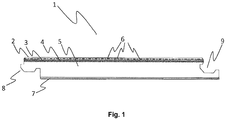
- Figure 1 shows a cross-section of an embodiment of a decorative panel (1) including, in order, a protective layer (2), an outermost ink receiving layer (3), an inner ink receiving layer (4), a core layer (5) with a tongue (8) and a groove (9) and a balancing layer (7), wherein the ink receiving layers include a jetted and dried colour image (6).
- alkyl means all variants possible for each number of carbon atoms in the alkyl group i.e. methyl, ethyl, for three carbon atoms: n-propyl and isopropyl; for four carbon atoms: n-butyl, isobutyl and tertiary-butyl; for five carbon atoms: n-pentyl, 1,1-dimethyl-propyl, 2,2-dimethylpropyl and 2-methyl-butyl, etc.
- a substituted or unsubstituted alkyl group is preferably a C 1 to C 6 -alkyl group.
- a substituted or unsubstituted alkenyl group is preferably a C 2 to C 6 -alkenyl group.
- a substituted or unsubstituted alkynyl group is preferably a C 2 to C 6 -alkynyl group.
- a substituted or unsubstituted aralkyl group is preferably phenyl group or naphthyl group including one, two, three or more C 1 to C 6 -alkyl groups.
- a substituted or unsubstituted alkaryl group is preferably a C 1 to C 6 -alkyl group including a phenyl group or naphthyl group.
- a substituted or unsubstituted aryl group is preferably a phenyl group or naphthyl group
- a substituted or unsubstituted heteroaryl group is preferably a five- or six-membered ring substituted by one, two or three oxygen atoms, nitrogen atoms, sulphur atoms, selenium atoms or combinations thereof.
- substituted in e.g. substituted alkyl group means that the alkyl group may be substituted by other atoms than the atoms normally present in such a group, i.e. carbon and hydrogen.
- a substituted alkyl group may include a halogen atom or a thiol group.
- An unsubstituted alkyl group contains only carbon and hydrogen atoms
- a substituted alkyl group, a substituted alkenyl group, a substituted alkynyl group, a substituted aralkyl group, a substituted alkaryl group, a substituted aryl and a substituted heteroaryl group are preferably substituted by one or more substituents selected from the group consisting of methyl, ethyl, n-propyl, isopropyl, n-butyl, isobutyl and tertiary-butyl, ester, amide, ether, thioether, ketone, aldehyde, sulfoxide, sulfone, sulfonate ester, sulphonamide, -CI, -Br, -I, -OH, -SH, - CN and -NO 2 .
- a pigmented aqueous inkjet ink set according to the invention comprises: a) optionally a cyan aqueous inkjet ink containing a copper phthalocyanine pigment, preferably a ⁇ -copper phthalocyanine pigment; b) a red aqueous inkjet ink containing a red pigment selected from the group consisting of C.I. Pigment Red 254, C.I.
- aqueous inkjet ink containing a pigment C.I Pigment Yellow 150 or a mixed crystal thereof; and d) a black aqueous inkjet ink containing a carbon black pigment; wherein the aqueous inkjet inks contain a surfactant.
- a cyan aqueous inkjet ink is present in the aqueous inkjet ink set as this allows for printing non-wood motifs, such as a fantasy motif or company logo's containing a blue color.
- the aqueous inkjet ink set consists of the cyan, red, yellow and black aqueous inkjet inks.
- the advantage of using such an inkjet ink set is mainly an economical benefit. By using only the specific four inkjet inks, a less expensive inkjet printing device can be made and used and consequently also cheaper maintenance is obtained, although an excellent reproduction of wood motif colour images is still achieved.
- the inkjet inks contain also a surfactant, preferably a fluorosurfactant.
- the surfactant allows for spreading on the decor paper, which enhances indirectly also the metamerism.
- the pigmented aqueous inkjet inks have a static surface tension at 25°C between 19.0 mN.m and 27.0 mN.m for good spreading on the decor paper.
- the hue angle H* of a red inkjet ink is normally in the range of 15° to 65°.
- the hue angle H* of a red inkjet ink in the present invention is preferably between 15° and 50°, more preferably between 20° and 40°.
- the red pigment is C.I. Pigment Red 254 or a mixed crystal thereof.
- the hue angle of a yellow inkjet ink is usually in the range of 75° to 110 °.
- the hue angle H* of a yellow inkjet ink in the present invention is preferably between 80°and 105°, more preferably between 85°and 95°.
- the hue angle H* of the yellow aqueous inkjet ink is higher than 85°, more preferably between 86° and 98 °, and most preferably between 87°and 95°.
- the pigmented aqueous inkjet inks in the ink set should preferably also have a chroma C* of at least more than 50.
- the pigmented aqueous inkjet inks all have a pigment concentration of at least 2.0 wt% with the weight percentage wt% based on the total weight of the pigmented aqueous inkjet inks.
- a pigment concentration of at least 2.0 wt% more preferably at least 2.2 wt%, very dark coloured wood motifs can be produced without applying too much inkjet ink, which can result in reduced adhesion of the protective layer to the decorative layer.
- the application of the inkjet ink is preferably limited to a dry weight of no more than 5.0 g/m 2 , more preferably no more than 4.0 g/m 2 or even 3.0 g/m 2 .
- a higher amount can lead to delamination, i.e. adhesion problems, because the ink layer acts as a barrier layer for water vapour formed by the crosslinking of the thermosetting resin.
- the pigment concentration in all aqueous inkjet inks is preferably between 2.2 and 6.0 wt% with the wt% based on the total weight of the ink. Higher pigment concentration tend to limit the number of colours that can be produced and increases the graininess.
- the application of ink receiving layers on the paper substrate allow to achieve a desired image quality without the need of a polymer latex binder in the aqueous inkjet inks.
- the presence of polymer latex binder usually reduces the adhesion of the protective layer to the decorative layer.
- no polymer latex binder is present in one or more of the aqueous pigmented inkjet inks, preferably none of the pigmented aqueous inkjet inks contain a polymeric latex binder.
- the inkjet printing method is preferably performed in a multi-pass mode.
- the jetting of the colour image by the inkjet print heads is performed in 2, 3, 4 or more passes, the presence of failing nozzles can be masked to a level wherein it becomes no longer visible that a nozzle is not firing inkjet ink; the latter is usually immediately visible in a single pass inkjet printing process, thus creating substantial amount of waste and economic penalties.
- Decorative panels often use a wood motif having wood nerves as a colour image. It was observed that improved image quality is obtained when the inkjet printing is performed in a manner that the wood nerves in the colour image are extending in a direction substantially corresponding to the inkjet printing direction.
- the inkjet printing direction is the transport direction of the paper substrate including one or more ink receiving layers.
- the inkjet printing direction is the scanning direction of the print heads.
- the paper substrate includes multiple ink receiving layers and an outermost ink receiving layer which contains no inorganic pigment or an amount of inorganic pigment smaller than that of the one or more ink receiving layers located between the paper substrate and the outermost ink receiving layer.
- the ink receiving layers contain high amounts of inorganic pigments, such as fumed silica, which can create dust problems due to the transporting of the paper substrate in the inkjet printer, especially in a single pass inkjet printing pass where very high speeds for transporting the paper substrate below the print heads are used. This dust problem is reduced by having an outermost ink receiving layer containing no or only a small amount of inorganic pigments.
- the paper substrate is a coloured paper substrate, more preferably a bulk coloured paper substrate.
- a coloured paper substrate reduces the amount of inkjet ink required to form the colour image.
- the one or more ink receiving layers include an inorganic pigment selected from the group consisting of alumina hydrates, aluminum oxides, aluminum hydroxides, aluminum silicates, and silicas.
- an inorganic pigment selected from the group consisting of alumina hydrates, aluminum oxides, aluminum hydroxides, aluminum silicates, and silicas. The latter inorganic pigments allow for fast drying and high image quality.
- the one or more ink receiving layers contain a polymeric binder selected from the group consisting of polyvinylalcohol, a vinylalcohol copolymer or modified polyvinyl alcohol.
- a polymeric binder selected from the group consisting of polyvinylalcohol, a vinylalcohol copolymer or modified polyvinyl alcohol.
- the latter polymeric binders are very hydrophilic and allow fast penetration of the liquids in the aqueous inkjet inks, again enhancing drying and high image quality.
- the viscosity of the one or more aqueous inkjet inks at a temperature of 32°C is preferably smaller than 15 mPa.s, and most preferably between 5 and 12 mPa.s all at a shear rate of 1,000 s -1 .
- a preferred jetting temperature is between 10 and 70°C, more preferably between 20 and 40°C, and most preferably between 25 and 35°C.
- the one or more aqueous inkjet inks are jetted at a jetting temperature of not more than 35°C.
- the colorants in the aqueous inkjet inks are colour pigments and preferably do not include any dyes.
- the aqueous inkjet inks preferably contain a dispersant, more preferably a polymeric dispersant, for dispersing the pigment.
- One or more aqueous inkjet inks may contain a dispersion synergist to improve the dispersion quality and stability of the ink.
- one or more pigmented aqueous inkjet inks may contain a so-called "self dispersible" colour pigment.
- a self-dispersible colour pigment requires no dispersant, because the pigment surface has ionic groups, which realize electrostatic stabilization of the pigment dispersion.
- the steric stabilization obtained by using a polymeric dispersant becomes optional.
- the preparation of self-dispersible colour pigments is well-known in the art and can be exemplified by EP 904327 A (CABOT).
- a particularly preferred pigment for a cyan aqueous inkjet ink is a copper phthalocyanine pigment, more preferably C.I. Pigment Blue 15:3 or C.I. Pigment Blue 15:4.
- the pigments for a red aqueous inkjet ink are C.I Pigment Red 254 and C.I. Pigment Red 176 and mixed crystals thereof.
- suitable pigment materials include carbon blacks such as RegalTM 400R, MogulTM L, ElftexTM 320 from Cabot Co., or Carbon Black FW18, Special BlackTM 250, Special BlackTM 350, Special BlackTM 550, PrintexTM 25, PrintexTM 35, PrintexTM 55, PrintexTM 90, PrintexTM 150T from DEGUSSA Co., MA8 from MITSUBISHI CHEMICAL Co., and C.I. Pigment Black 7.
- carbon blacks such as RegalTM 400R, MogulTM L, ElftexTM 320 from Cabot Co., or Carbon Black FW18, Special BlackTM 250, Special BlackTM 350, Special BlackTM 550, PrintexTM 25, PrintexTM 35, PrintexTM 55, PrintexTM 90, PrintexTM 150T from DEGUSSA Co., MA8 from MITSUBISHI CHEMICAL Co., and C.I. Pigment Black 7.
- mixed crystals may be used.
- Mixed crystals are also referred to as solid solutions.
- different quinacridones mix with each other to form solid solutions, which are quite different from both physical mixtures of the compounds and from the compounds themselves.
- the molecules of the components enter into the same crystal lattice, usually, but not always, that of one of the components.
- the x-ray diffraction of the resulting crystalline solid is characteristic of that solid and can be clearly differentiated from the pattern of a physical mixture of the same components in the same proportion. In such physical mixtures, the x-ray pattern of each of the components can be distinguished, and the disappearance of many of these lines is one of the criteria of the formation of solid solutions.
- a commercially available example is CinquasiaTM Magenta RT-355-D from Ciba Specialty Chemicals.
- the inkjet ink includes a carbon black pigment and at least one pigment selected from the group consisting of a blue pigment, a cyan pigment, magenta pigment and a red pigment. It was found that such a black inkjet ink allowed easier and better colour management for wood colours.
- the pigment particles in the pigmented inkjet ink should be sufficiently small to permit free flow of the ink through the inkjet printing device, especially at the ejecting nozzles. It is also desirable to use small particles for maximum colour strength and to slow down sedimentation.
- the average particle size of the pigment in the pigmented inkjet ink should be between 50 nm and 300 nm.
- the average pigment particle size is between 80 and 200 nm, more preferably between 100 and 150 nm. Below an average particle size of 50 nm, a reduction is often observed in light fastness. Above an average particle size of 300 nm, the colour gamut is usually reduced.
- the pigmented inkjet ink preferably contains a dispersant, more preferably a polymeric dispersant, for dispersing the pigment.
- Suitable polymeric dispersants are copolymers of two monomers but they may contain three, four, five or even more monomers.
- the properties of polymeric dispersants depend on both the nature of the monomers and their distribution in the polymer.
- Copolymeric dispersants preferably have the following polymer compositions:
- Suitable dispersants are DISPERBYKTM dispersants available from BYK CHEMIE, JONCRYLTM dispersants available from JOHNSON POLYMERS and SOLSPERSETM dispersants available from ZENECA.
- MC CUTCHEON Functional Materials, North American Edition. Glen Rock,N.J.: Manufacturing Confectioner Publishing Co., 1990. p.110-129 .
- the polymeric dispersant has preferably a number average molecular weight Mn between 500 and 30000, more preferably between 1500 and 10000.
- the polymeric dispersant has preferably a weight average molecular weight Mw smaller than 100,000, more preferably smaller than 50,000 and most preferably smaller than 30,000.
- the polymeric dispersant used in the one or more pigmented inkjet inks is a copolymer comprising between 3 and 11 mol% of a long aliphatic chain (meth)acrylate wherein the long aliphatic chain contains at least 10 carbon atoms.
- the long aliphatic chain (meth)acrylate contains preferably 10 to 18 carbon atoms.
- the long aliphatic chain (meth)acrylate is preferably decyl (meth)acrylate.
- the polymeric dispersant can be prepared with a simple controlled polymerization of a mixture of monomers and/or oligomers including between 3 and 11 mol% of a long aliphatic chain (meth)acrylate wherein the long aliphatic chain contains at least 10 carbon atoms.
- a commercially available polymeric dispersant being a copolymer comprising between 3 and 11 mol% of a long aliphatic chain (meth)acrylate is EdaplanTM 482, a polymeric dispersant from MUNZING.
- the polymeric dispersant is preferably an acrylic block copolymer dispersant, as very good ink stability has been observed with such a polymeric dispersant.
- a commercial example is DispexTM Ultra PX 4575 from BASF.
- One or more of the aqueous inkjet inks may contain a polymer latex binder, preferably a polyurethane based latex. It was observed that polyurethane based latex are less detrimental for adhesion in flooring laminates than acrylic latex binders.
- the polymer latex binder is not particularly limited as long as it has stable dispersibility in the ink composition.
- the polymer include a vinyl polymer and a condensed polymer (e.g., an epoxy resin, polyester, polyurethane, polyamide, cellulose, polyether, polyurea, polyimide, and polycarbonate).
- a vinyl polymer is particularly preferable because of easily controlled synthesis.
- the polymer latex is a polyurethane latex, more preferably a self-dispersible polyurethane latex.
- the polymer latex binder in the one or more aqueous inkjet inks is preferably a polyurethane based latex binder for reasons of compatibility with the thermosetting resin.
- the polymer latex is preferably a self-dispersing polymer latex, and more preferably a self-dispersing polymer latex having a carboxyl group, from the viewpoint of ejecting stability and stability of the liquid (particularly, dispersion stability) when using a colour pigment.
- the self-dispersing polymer latex means a latex of a water-insoluble polymer that does not contain a free emulsifier and that can get into a dispersed state in an aqueous medium even in the absence of other surfactants due to a functional group (particularly, an acidic group or a salt thereof) that the polymer itself has.
- the latex binder polymer particles preferably have a glass transition temperature (Tg) of 30°C or more.
- the minimum film-forming temperature (MFT) of the polymer latex is preferably -25 to 150°C, and more preferably 35 to 130°C.
- the aqueous inkjet inks contain at least one surfactant.
- the surfactant(s) can be anionic, cationic, non-ionic, or zwitter-ionic and are usually added in a total quantity less than 1 wt% based on the total weight of the inkjet ink and particularly in a total quantity less than 0.3 wt% based on the total weight of the inkjet ink.
- the total quantity above is expressed as dry solids.
- Suitable surfactants for the aqueous inkjet inks include fatty acid salts, ester salts of a higher alcohol, alkylbenzene sulphonate salts, sulphosuccinate ester salts and phosphate ester salts of a higher alcohol (for example, sodium dodecylbenzenesulphonate and sodium dioctylsulphosuccinate), ethylene oxide adducts of a higher alcohol, ethylene oxide adducts of an alkylphenol, ethylene oxide adducts of a polyhydric alcohol fatty acid ester, and acetylene glycol and ethylene oxide adducts thereof (for example, polyoxyethylene nonylphenyl ether, and SURFYNOLTM 104, 104H, 440, 465 and TG available from AIR PRODUCTS & CHEMICALS INC.).
- Preferred surfactants are selected from fluoro surfactants, such as fluorinated hydrocarbons.
- a particularly preferred commercial fluorosurfactant is CapstoneTM FS3100 from DU PONT.
- the surfactant is a fluorosurfactant, more preferably an alkoxylated fluorosurfactant, and most preferably an alkoxylated fluorosurfactant containing a sulfonic acid group or a salt thereof.
- alkoxylated fluorosurfactant according to Formula (I): wherein
- R1 to R3 represents hydrogen and R4 represents a methyl group, and more preferably the anionic polar group is a sulfonic acid group or a salt thereof.
- alkoxylated fluorosurfactants according to Formula (I) are shown in Table 1.
- Table 1 FS-1 FS-2 FS-3 FS-4
- Suitable biocides for the aqueous inkjet inks used in the present invention include sodium dehydroacetate, 2-phenoxyethanol, sodium benzoate, sodium pyridinethion-1-oxide, ethyl p-hydroxybenzoate and 1,2-benzisothiazolin-3-one and salts thereof.
- Preferred biocides are ProxelTM GXL, ProxelTM K and ProxelTM Ultra 5 available from ARCH UK BIOCIDES and BronidoxTM available from COGNIS.
- a particularly preferred biocide is a 1,2-benzisothiazolin-3-one based biocide.
- a biocide is preferably added in an amount of 0.001 to 3.0 wt%, more preferably 0.01 to 1.0 wt%, each based on the total weight of the pigmented inkjet ink.
- the aqueous inkjet ink preferably contains a humectant.
- Suitable humectants include triacetin, N-methyl-2-pyrrolidone, 2-pyrrolidone, glycerol, urea, thiourea, ethylene urea, alkyl urea, alkyl thiourea, dialkyl urea and dialkyl thiourea, diols, including ethanediols, propanediols, propanetriols, butanediols, pentanediols, and hexanediols.
- Preferred humectants are 2-pyrrolidone, glycerol and 1,2-hexanediol, the latter were found to be the most effective for improving inkjet printing reliability in an industrial environment.
- the humectant is preferably added to the inkjet ink formulation in an amount of 0.1 to 35 wt% of the formulation, more preferably 1 to 30 wt% of the formulation, and most preferably 3 to 25 wt% of the formulation.
- the aqueous inkjet ink may contain at least one pH adjuster.
- Suitable pH adjusters include NaOH, KOH, NEt 3 , NH 3 , HCI, HNO 3 , H 2 SO 4 and (poly)alkanolamines such as triethanol amine and 2-amino-2-methyl-1-propanol.
- Preferred pH adjusters are triethanol amine, NaOH and H 2 SO 4 .
- the pH is preferably adjusted to a value between 7.5 and 10.0, more preferably between 8.0 and 9.0; the latter pH range has been observed to result in an improved ink stability.
- the one or more aqueous inkjet inks may be prepared by precipitating or milling the colour pigment in the dispersion medium in the presence of the polymeric dispersant, or simply by mixing a self-dispersible colour pigment in the ink.
- Mixing apparatuses may include a pressure kneader, an open kneader, a planetary mixer, a dissolver, and a Dalton Universal Mixer.
- Suitable milling and dispersion apparatuses are a ball mill, a pearl mill, a colloid mill, a high-speed disperser, double rollers, a bead mill, a paint conditioner, and triple rollers.
- the dispersions may also be prepared using ultrasonic energy.
- the colour ink may be prepared using separate dispersions for each pigment, or alternatively several pigments may be mixed and co-milled in preparing the dispersion.
- the dispersion process can be carried out in a continuous, batch or semi-batch mode.
- the preferred amounts and ratios of the ingredients of the mill grind will vary widely depending upon the specific materials and the intended applications.
- the contents of the milling mixture comprise the mill grind and the milling media.
- the mill grind comprises pigment, dispersant and a liquid carrier such as water.
- the pigment is usually present in the mill grind at 1 to 50 wt%, excluding the milling media.
- the weight ratio of pigment over dispersant is preferably 20:1 to 1:2.
- the milling time can vary widely and depends upon the pigment, selected mechanical means and residence conditions, the initial and desired final particle size, etc.
- pigment dispersions with an average particle size of less than 100 nm may be prepared.
- the milling media is separated from the milled particulate product (in either a dry or liquid dispersion form) using conventional separation techniques, such as by filtration, sieving through a mesh screen, and the like. Often the sieve is built into the mill, e.g. for a bead mill.
- the milled pigment concentrate is preferably separated from the milling media by filtration.
- the colour ink in the form of a concentrated mill grind, which is subsequently diluted to the appropriate concentration for use in the ink-jet printing system.
- This technique permits preparation of a greater quantity of pigmented ink from the equipment. If the mill grind was made in a solvent, it is diluted with water and optionally other solvents to the appropriate concentration. If it was made in water, it is diluted with either additional water or water miscible solvents to make a mill grind of the desired concentration. By dilution, the ink is adjusted to the desired viscosity, colour, hue, saturation density, and print area coverage for the particular application. Viscosity can also be adjusted by using low molecular weight polyethylene glycols, for example having an average numerical molecular weight between 200 and 800. An example is PEG 200 from CLARIANT.
- the decorative panels are preferably selected from the group consisting of kitchen panels, flooring panels, furniture panels, ceiling panels and wall panels.
- a decorative panel illustrated by a flooring panel having also a tongue and groove join in Fig.1 , includes preferably at least a core layer, a decorative layer and a protective layer.
- a protective layer is applied on top of the decorative layer.
- a balancing layer may also be applied at the opposite side of the core layer to restrict or prevent possible bending of the decorative panel.
- the assembly into a decorative panel of the balancing layer, the core layer, the decorative layer and the protective layer is preferably performed in the same press treatment of preferably a DPL process (Direct Pressure Laminate).
- tongue and groove profiles are milled into the side of individual decorative panels which allow them to be slid into one another.
- the tongue and grove join ensures, in the case of flooring panels, a sturdy floor construction and protects the floor, preventing dampness from penetrating.
- the decorative panels include a tongue and a groove of a special shape, which allow them to be clicked into one another.
- the advantage thereof is an easy assembly requiring no glue.
- the shape of the tongue and groove necessary for obtaining a good mechanical join is well-known in the art of laminate flooring, as also exemplified in EP 2280130 A (FLOORING IND), WO 2004/053258 (FLOORING IND), US 2008010937 (VALINGE) and US 6418683 (PERSTORP FLOORING) .
- tongue and groove profiles are especially preferred for flooring panels and wall panels, but in the case of furniture panels, such tongue and groove profile is preferably absent for aesthetical reasons of the furniture doors and drawer fronts.
- a tongue and groove profile may be used to click together the other panels of the furniture, as illustrated by US 2013071172 (UNILIN).
- the decorative panels may further include a sound-absorbing layer as disclosed by US 8196366 (UNILIN).
- the decorative panel is an antistatic layered panel.
- Techniques to render decorative panels antistatic are well-known in the art of decorative surfaces as exemplified by EP 1567334 A (FLOORING IND).
- the top surface of the decorative panel is preferably provided with a relief matching the colour image, such as for example the wood grain, cracks and nuts in a woodprint.
- Embossing techniques to accomplish such relief are well-known and disclosed by, for example, EP 1290290 A (FLOORING IND), US 2006144004 (UNILIN), EP 1711353 A (FLOORING IND) and US 2010192793 (FLOORING IND).
- the decorative panels are made in the form of rectangular oblong strips.
- the dimensions thereof may vary greatly.
- the panels have a length exceeding 1 meter, and a width exceeding 0.1 meter, e.g. the panels can be about 1.3 meter long and about 0.15 meter wide.
- the length of the panels exceeds 2 meter, with the width being preferably about 0.2 meter or more.
- the print of such panels is preferably free form repetitions.
- the core layer is preferably made of wood-based materials, such as particle board, MDF or HDF (Medium Density Fibreboard or High Density Fibreboard), Oriented Strand Board (OSB) or the like. Use can also be made of boards of synthetic material or boards hardened by means of water, such as cement boards. In a particularly preferred embodiment, the core layer is a MDF or HDF board.
- MDF or HDF Medium Density Fibreboard or High Density Fibreboard
- OSB Oriented Strand Board
- the core layer may also be assembled at least from a plurality of paper sheets, or other carrier sheets, impregnated with a thermosetting resin as disclosed by WO 2013/050910 (UNILIN).
- Preferred paper sheets include so-called Kraft paper obtained by a chemical pulping process also known as the Kraft process, e.g. as described in US 4952277 (BET PAPERCHEM) .
- the core layer is a board material composed substantially of wood fibres, which are bonded by means of a polycondensation glue, wherein the polycondensation glue forms 5 to 20 percent by weight of the board material and the wood fibres are obtained for at least 40 percent by weight from recycled wood.
- a polycondensation glue forms 5 to 20 percent by weight of the board material and the wood fibres are obtained for at least 40 percent by weight from recycled wood.
- Suitable examples are disclosed by EP 2374588 A (UNILIN) .
- the core layer comprises a foamed synthetic material, such as foamed polyethylene or foamed polyvinyl chloride.
- the thickness of the core layer is preferably between 2 and 12 mm, more preferably between 5 and 10 mm.
- the decorative layer and preferably also the protective layer and the optional balancing layer, include paper as substrate.
- the paper preferably has a weight of less than 150 g/m 2 , because heavier paper sheets are hard to impregnate all through their thickness with a thermosetting resin.
- Preferably said paper layer has a paper weight, i.e. without taking into account the resin provided on it, of between 50 and 100 g/m 2 and possibly up to 130 g/m 2 .
- the weight of the paper cannot be too high, as then the amount of resin needed to sufficiently impregnate the paper would be too high, and reliably further processing the printed paper in a pressing operation becomes badly feasible.
- the paper sheets have a porosity according to Gurley's method (DIN 53120) of between 8 and 20 seconds.
- Gurley's method DIN 53120
- Such porosity allows even for a heavy sheet of more than 150 g/m 2 to be readily impregnated with a relatively high amount of resin.
- Suitable paper sheets having high porosity and their manufacturing are also disclosed by US 6709764 (ARJO WIGGINS) .
- the paper for the decorative layer is preferably a white paper and may include one or more whitening agents, such as titanium dioxide, calcium carbonate and the like.
- whitening agents such as titanium dioxide, calcium carbonate and the like.
- the presence of a whitening agent helps to mask differences in colour on the core layer,which can cause undesired colour effects on the colour image.
- the paper for the decorative layer is preferably a bulk coloured paper including one or more colour dyes and/or colour pigments.
- a coloured paper reduces the amount of inkjet ink required to print the colour image.
- a light brown or grey paper may be used for printing a wood motif as colour image in order to reduce the amount of inkjet ink needed.
- unbleached Kraft paper is used for a brownish coloured paper in the decorative layer.
- Kraft paper has a low lignin content resulting in a high tensile strength.
- a preferred type of Kraft paper is absorbent Kraft paper of 40 to 135 g/m 2 having high porosity, and made from clean low kappa hardwood Kraft of good uniformity.
- the protective layer includes a paper
- a paper is used which becomes transparent or translucent after resin impregnation so that the colour image in the decorative layer can be viewed.
- the above papers may also be used in the balancing layer.
- One or more ink receiving layers are present on the paper substrate of the decorative layer for enhancing the image quality.
- the ink receiving layer(s) may be a purely polymer based ink receiving layer, but preferably contain an inorganic pigment and a polymeric binder.
- the inorganic pigment may be a single type of inorganic pigment or a plurality of different inorganic pigments.
- the polymeric binder may be a single type of polymeric binder or a plurality of different polymeric binders.
- the ink receiving layer(s) have a total dry weight between 2.0 g/m 2 and 10.0 g/m 2 , more preferably between 3.0 and 6.0 g/m 2 .
- the ink receiving layer(s) include a polymeric binder selected from the group consisting of hydroxyethyl cellulose; hydroxypropyl cellulose; hydroxyethylmethyl cellulose; hydroxypropyl methyl cellulose; hydroxybutylmethyl cellulose; methyl cellulose; sodium carboxymethyl cellulose; sodium carboxymethylhydroxethyl cellulose; water soluble ethylhydroxyethyl cellulose; cellulose sulfate; polyvinyl alcohol; vinylalcohol copolymers; polyvinyl acetate; polyvinyl acetal; polyvinyl pyrrolidone; polyacrylamide; acrylamide/acrylic acid copolymer; polystyrene, styrene copolymers; acrylic or methacrylic polymers; styrene/acrylic copolymers; ethylene-vinylacetate copolymer; vinyl-methyl ether/maleic acid copolymer; poly(2-acrylamid
- the ink receiving layer(s) include a polymeric binder, preferably a water soluble polymeric binder (> 1 g/L water at 25°C), which has a hydroxyl group as a hydrophilic structural unit, e.g. a polyvinyl alcohol.
- a preferred polymer for the ink receiving layer(s) is a polyvinylalcohol (PVA), a vinylalcohol copolymer or modified polyvinyl alcohol.
- the modified polyvinyl alcohol may be a cationic type polyvinyl alcohol, such as the cationic polyvinyl alcohol grades from Kuraray, such as POVAL C506, POVAL C118 from Nippon Goshei.
- the pigment in the ink receiving layer(s) is an inorganic pigment, which can be chosen from neutral, anionic and cationic pigment types.
- Useful pigments include e.g. silica, talc, clay, hydrotalcite, kaolin, diatomaceous earth, calcium carbonate, magnesium carbonate, basic magnesium carbonate, aluminosilicate, aluminum trihydroxide, aluminum oxide (alumina), titanium oxide, zinc oxide, barium sulfate, calcium sulfate, zinc sulfide, satin white, alumina hydrate such as boehmite, zirconium oxide or mixed oxides.
- the inorganic pigment is preferably selected from the group consisting of alumina hydrates, aluminum oxides, aluminum hydroxides, aluminum silicates, and silicas.
- Particularly preferred inorganic pigments are silica particles, colloidal silica, alumina particles and pseudo-boehmite, as they form better porous structures.
- the particles may be primary particles directly used as they are, or they may form secondary particles.
- the particles Preferably, the particles have an average primary particle diameter of 2 ⁇ m or less, and more preferably 200 nm or less.
- a preferred type of alumina hydrate is crystalline boehmite, or ⁇ -AlO(OH).
- Useful types of boehmite include DISPERAL HP14, DISPERAL 40, DISPAL 23N4-20, DISPAL 14N-25 and DISPERAL AL25 from Sasol; and MARTOXIN VPP2000-2 and GL-3 from Martinswerk GmbH
- Useful cationic aluminum oxide (alumina) types include ⁇ -Al 2 O 3 types, such as NORTON E700, available from Saint-Gobain Ceramics & Plastics, Inc, and ⁇ -Al 2 O 3 types, such as ALUMINUM OXID C from Degussa.
- ⁇ -Al(OH) 3 such as PLURAL BT, available from Sasol, and Gibbsite, or ⁇ -Al(OH) 3 , such as MARTINAL grades and MARTIFIN grades from Martinswerk GmbH , MICRAL grades from JM Huber company; HIGILITE grades from Showa Denka K.K..
- silica Another preferred type of inorganic pigment is silica, which can be used as such, in its anionic form or after cationic modification.
- the silica can be chosen from different types, such as crystalline silica, amorphous silica, precipitated silica, fumed silica, silica gel, spherical and non-spherical silica.
- the silica may contain minor amounts of metal oxides from the group Al, Zr, Ti.
- Useful types include AEROSIL OX50 (BET surface area 50 ⁇ 15 m2/g, average primary particle size 40 nm, SiO 2 content > 99.8%, Al 2 O 3 content ⁇ 0.08%), AEROSIL MOX170 (BET surface area 170 g/m 2 , average primary particle size 15 nm, SiO 2 content > 98.3%, Al 2 O 3 content 0.3-1.3%), AEROSIL MOX80 (BET surface area 80 ⁇ 20 g/m 2 , average primary particle size 30 nm, SiO 2 content > 98.3%, Al 2 O 3 content 0.3-1.3%), or other hydrophilic AEROSIL grades available from Degussa-Hüls AG, which may give aqueous dispersions with a small average particle size ( ⁇ 500 nm).
- AEROSIL OX50 BET surface area 50 ⁇ 15 m2/g, average primary particle size 40 nm, SiO 2 content > 99.8%, Al 2 O 3 content ⁇
- silica particles are grouped into two types, wet-process particles and dry-process (vapour phase-process or fumed) particles.
- active silica is formed through acidolysis of silicates, and this is polymerized to a suitable degree and flocculated to obtain hydrous silica.
- a vapour-phase process includes two types; one includes high-temperature vapour-phase hydrolysis of silicon halide to obtain anhydrous silica (flame hydrolysis), and the other includes thermal reduction vaporization of silica sand and coke in an electric furnace followed by oxidizing it in air to also obtain anhydrous silica (arc process).
- the "fumed silica” means to indicate anhydrous silica particles obtained in the vapour-phase process.
- the fumed silica particles used in the invention especially preferred are the fumed silica particles.
- the fumed silica differs from hydrous silica in point of the density of the surface silanol group and of the presence or absence of pores therein, and the two different types of silica have different properties.
- the fumed silica is suitable for forming a three-dimensional structure of high porosity. Since the fumed silica has a particularly large specific surface area, its ink absorption and retention are high.
- the vapour-phase silica has an average primary particle diameter of 30 nm or less, more preferably 20 nm or less, even more preferably 10 nm or less, and most preferably from 3 to 10 nm.
- the fumed silica particles readily aggregate through hydrogen bonding at the silanol groups therein. Therefore, when their mean primary particle size is not larger than 30 nm, the silica particles may form a structure of high porosity.
- said ink receiving layer can be further crosslinked.
- Any suitable crosslinker known in the prior art can be used. Boric acid is particularly preferred as crosslinker for the ink receiving layer according to the present invention.
- the ink receiving layer(s) may include other additives, such as colorants, surfactants, biocides, antistatic agents, hard particles for wear resistance, elastomers, UV absorbers, organic solvents, plasticizers, light-stabilizers, pH adjusters, antistatic agents, whitening agents, matting agents and the like.
- additives such as colorants, surfactants, biocides, antistatic agents, hard particles for wear resistance, elastomers, UV absorbers, organic solvents, plasticizers, light-stabilizers, pH adjusters, antistatic agents, whitening agents, matting agents and the like.
- the ink receiving layer(s) may consist of a single layer or of two, three or more layers even having a different composition.
- the ink receiving layer(s) can be coated onto the support by any conventional coating technique, such as dip coating, knife coating, extrusion coating, spin coating, slide hopper coating and curtain coating.
- the ink receiving layer(s) can also be applied by a printing technique, such as flexographic printing, screen printing and inkjet printing.
- the inkjet printer preferably employs valvejet printing heads.
- thermosetting resin is preferably selected from the group consisting of melamine-formaldehyde based resins, ureum-formaldehyde based resins and phenol-formaldehyde based resins.
- thermosetting resin is a melamine-formaldehyde based resin, often simply referred to in the art as a 'melamine (based) resin'.
- the melamine formaldehyde resin preferably has a formaldehyde to melamine ratio of 1.4 to 2.
- Such melamine based resin is a resin that polycondensates while exposed to heat in a pressing operation.
- the polycondensation reaction creates water as a by-product. It is particularly with these kinds of thermosetting resins, namely those creating water as a by-product, that the present invention is of interest.
- the created water, as well as any water residue in the thermosetting resin before the pressing must leave the hardening resin layer to a large extent before being trapped and leading to a loss of transparency in the hardened layer.
- the available ink layer can hinder the diffusion of the vapour bubbles to the surface, resulting in adhesion problems.
- the paper is preferably provided with an amount of thermosetting resin equalling 40 to 250% dry weight of resin as compared to weight of the paper.
- this range of applied resin provides for a sufficient impregnation of the paper, that avoids splitting to a large extent, and that stabilizes the dimension of the paper to a high degree.
- the paper is preferably provided with such an amount of thermosetting resin that at least the paper core is satisfied with the resin. Such satisfaction can be reached when an amount of resin is provided that corresponds to at least 1.5 or at least 2 times the paper weight.
- the resin provided on said paper is in a so-called B-stage.
- B-stage exists when the thermosetting resin is not completely cross linked.
- the resin provided on said paper has a relative humidity lower than 15%, and still better of 10% by weight or lower.
- the step of providing said paper with thermosetting resin involves applying a mixture of water and the resin on the paper.
- the application of the mixture might involve immersion of the paper in a bath of the mixture and/or spraying or jetting the mixture.
- the resin is provided in a dosed manner, for example by using one or more squeezing rollers and/or doctor blades to set the amount of resin added to the paper layer.
- the dry resin content of the mixture of water and resin for impregnation depends on the type of resin.
- An aqueous solution containing a phenol-formaldehyde resin preferably has a dry resin content of about 30% by weight, while an aqueous solution containing a melamine-formaldehyde resin preferably has a dry resin content of about 60% by weight.
- Methods of impregnation with such solutions are disclosed by e.g. US 6773799 (DECORATIVE SURFACES).
- the paper is preferably impregnated with the mixtures known from US 4109043 (FORMICA CORP) and US 4112169 (FORMICA CORP), and hence preferably comprise, next to melamine formaldehyde resin, also polyurethane resin and/or acrylic resin.
- the mixture including the thermosetting resin may further include additives, such as colorants, surface active ingredients, biocides, antistatic agents, hard particles for wear resistance, elastomers, UV absorbers, organic solvents, acids, bases, and the like.
- additives such as colorants, surface active ingredients, biocides, antistatic agents, hard particles for wear resistance, elastomers, UV absorbers, organic solvents, acids, bases, and the like.
- Antistatic agents may be used in thermosetting resin. However preferably antistatic agents, like NaCl and KCI, carbon particles and metal particles, are absent in the resin, because often they have undesired side effects such as a lower water resistance or a lower transparency. Other suitable antistatic agents are disclosed by EP 1567334 A (FLOORING IND) .
- Hard particles for wear resistance are preferably included in a protective layer.
- the decorative layer includes a thermosetting resin impregnated paper and a colour image printed thereon by inkjet.
- the colour image is located on the resin impregnated paper on the opposite side than the side facing the core layer.
- a decorative panel like a floor panel, preferably has on one side of the core layer a decorative layer and a balancing layer on the other side of the core layer.
- a decorative layer may be applied on both sides of the core layer. The latter is especially desirable in the case of laminate panels for furniture.
- a protective layer is applied on both decorative layers present on both sides of the core layer.
- a colour image is obtained by jetting and drying one or more aqueous inkjet inks of an aqueous inkjet ink set upon the one or more ink receiving layers.
- the colour image may also contain information such as text, arrows, logo's and the like.
- the advantage of inkjet printing is that such information can be printed at low volume without extra cost, contrary to gravure printing.
- the colour image is a wood reproduction or a stone reproduction, but it may also be a fantasy or creative image, such as an ancient world map or a geometrical pattern, or even a single colour for making, for example, a floor consisting of black and red tiles or a single colour furniture door.
- An advantage of printing a wood colour image is that a floor can be manufactured imitating besides oak, pine and beech, also very expensive wood like black walnut which would normally not be available for house decoration.
- An advantage of printing a stone colour image is that a floor can be manufactured which is an exact imitation of a stone floor, but without the cold feeling when walking barefooted on it.
- a protective layer is applied above the printed colour image after printing, e.g. by way of an overlay, i.e. a resin provided carrier, or a liquid coating, preferably while the decor layer is laying on the core layer, either loosely or already connected or adhered thereto.
- an overlay i.e. a resin provided carrier, or a liquid coating
- the carrier of the overlay is a paper impregnated by a thermosetting resin that becomes transparent or translucent after heat pressing in a DPL process.
- the liquid coating includes preferably a thermosetting resin, but may also be another type of liquid such as a UV- or an EB-curable varnish.
- the liquid coating includes a melamine resin and hard particles, like corundum.
- the protective layer is preferably the outermost layer, but in another embodiment a thermoplastic or elastomeric surface layer may be coated on the protective layer, preferably of pure thermoplastic or elastomeric material. In the latter case, preferably a thermoplastic or elastomeric material based layer is also applied on the other side of the core layer.
- Liquid melamine coatings are exemplified in DE 19725289 C (ITT MFG ENTERPRISES) and US 3173804 (RENKL PAIDIWERK) .
- the liquid coating may contain hard particles, preferably transparent hard particles.
- Suitable liquid coatings for wear protection containing hard particles and methods for manufacturing such a protective layer are disclosed by US 2011300372 (CT FOR ABRASIVES AND REFRACTORIES) and US 8410209 (CT FOR ABRASIVES AND REFRACTORIES) .
- the transparency and also the colour of the protective layer can be controlled by the hard particles, when they comprise one or a plurality of oxides, oxide nitrides or mixed oxides from the group of elements Li, Na, K, Ca, Mg, Ba, Sr, Zn, Al, Si, Ti, Nb, La, Y, Ce or B.
- the total quantity of hard particles and transparent solid material particles is typically between 5% by volume and 70% by volume, based on the total volume of the liquid coating.
- the total quantity of hard particles is between 1 g/m 2 and 100 g/m 2 , preferably 2 g/m 2 to 50 g/m 2 .
- the hard particles such as aluminium oxide particles
- the hard particles are preferably incorporated in or on the paper.
- Preferred hard particles are ceramic or mineral particles chosen from the group of aluminium oxide, silicon carbide, silicon oxide, silicon nitride, tungsten carbide, boron carbide, and titanium dioxide, or from any other metal oxide, metal carbide, metal nitride or metal carbonitride.
- the most preferred hard particles are corundum and so-called Sialon ceramics. In principle, a variety of particles may be used. Of course, also any mixture of the above-mentioned hard particles may be applied.
- the amount of hard particles in the protective layer may be determined in function of the desired wear resistance, preferably by a so-called Taber test as defined in EN 13329 and also disclosed in WO 2013/050910 A (UNILIN) and US 8410209 (CT FOR ABRASIVES AND REFRACTOR) .
- Hard particles having an average particle size of between 1 and 200 ⁇ m are preferred.
- an amount of such particles of between 1 and 40 g/m 2 is applied above the printed image.
- An amount lower than 20 g/m 2 can suffice for the lower qualities.
- the protective layer includes a paper, then it preferably has a paper weight of between 10 and 50 g/m 2 .
- a paper is often also referred to as a so-called overlay commonly used in laminate panels. Preferred methods for manufacturing such an overlay are disclosed by WO 2007/144718 (FLOORING IND).
- the step of providing the protective layer of thermosetting resin above the printed image involves a press treatment.
- a temperature above 150°C is applied in the press treatment, more preferably between 180° and 220°C, and a pressure of more than 20 bar, more preferably between 35 and 40 bar.
- the decorative panel is manufactured using two press treatments, because this results in an extremely high abrasion resistance.
- the layers immediately underlying the wear resistant protective layer are substantially or wholly cured.
- the hard particles comprised in the wear resistant protective layer are thereby prevented from being pushed down out of the top area of the floor panel into the colour image or below the colour image and stay in the zone where they are most effective, namely essentially above the colour image.
- This makes it possible to reach an initial wear point according to the Taber test as defined in EN 13329 of over 10000 rounds, where in one press treatment of layers with the same composition only just over 4000 rounds were reached. It is clear that the use of two press treatments as defined above, leads to a more effective use of available hard particles.
- An alternative advantage of using at least two press treatments lays in the fact that a similar wearing rate, as in the case where a single press treatment is used, can be obtained with less hard particles if the product is pressed twice. Lowering the amount of hard particles is interesting, since hard particles tend to lower the transparency of the wear resistant protective layer, which is undesirable. It becomes also possible to work with hard particles of smaller diameter, e.g. particles having an average particle diameter of 15 ⁇ m or less, or even of 5 ⁇ m or less.
- the main purpose of the balancing layer(s) is to compensate tensile forces by layers on the opposite side of the core layer, so that an essentially flat decorative panel is obtained.
- a balancing layer is preferably a thermosetting resin layer, that can comprise one or more carrier layers, such as paper sheets.
- the balancing layer(s) may be a decorative layer, optionally complemented by a protective layer.
- an opaque balancing layer may be used which gives the decorative panel a more appealing look by masking surface irregularities. Additionally, it may contain text or graphical information such as a company logo or text information.
- a method of manufacturing a decorative panels includes the method of inkjet printing as described above.
- the resin impregnated decorative layer is heat pressed between a core layer and a protective layer and cut into a decorative panel selected from the group consisting of flooring, kitchen, furniture and wall panels.
- the decorative panel includes a tongue and a groove capable of achieving a glue less mechanical join between decorative panels.
- the inkjet printing method of the invention is part of a DPL process, wherein the decorative layer is taken up in a stack to be pressed with the core layer and a protective layer, and preferably also a balancing layer.
- the method of the invention would form part of a CPL (Compact Laminate) or an HPL (High Pressure Laminate) process in which the decorative layer is hot pressed at least with a plurality of resin impregnated core paper layers, e.g.
- thermosetting resin may be a colored thermosetting resin to reduce the amount of inkjet ink to be printed.
- the method of manufacturing a decorative surface preferably includes providing a relief in at least the protective layer, more preferably by means of a short cycle embossing press.
- the embossing preferably takes place at the same time that the core layer, the decorative layer and the protective layer, and preferably also one or more balancing layers, are pressed together.
- the relief in the protective layer preferably corresponds to the colour image.
- the relief comprises portions that have been embossed over a depth of more than 0.5 mm, or even more than 1 mm, with respect to the global upper surface of the decorative panel.
- the embossments may extend into the decorative layer.
- the balancing layer of a decorative panel is preferably planar. However, a relief might be applied in the balancing layer(s) for improving gluing down of the panels and/or for improved slip resistance and/or for improved, i.e. diminished, sound generation or propagation.
- any panel that comprises on the one hand a wear resistant protective layer on the basis of a thermosetting synthetic material, possibly a carrier sheet such as paper, and hard particles, and, on the other hand, one or more layers underlying the wear resistant protective layer on the basis of thermosetting synthetic material.
- the underlying layers may comprise a decorative layer, such as an inkjet printed paper provided with thermosetting resin.
- a core layer such panel might essentially comprise a board material with a density of more than 500 kg/m 3 , such as an MDF or HDF board material.
- the manufacturing panels with a plurality of press treatments is preferably put in practice with the so-called DPL panels (Direct Pressure Laminate).
- DPL panels Direct Pressure Laminate
- the decorative layer provided with thermosetting resin is cured and attached to the core material, preferably an MDF or HDF board material, whereby a whole is obtained of at least the decorative layer and the board material, and possibly a balancing layer at the side of the board opposite the decor layer.
- the wear resistant layer is cured and attached to the obtained whole.
- the method for manufacturing a decorative surface uses the inkjet printing method according to the present invention in combination with the methodology disclosed by US 2011008624 (FLOORING IND), wherein the protective layer includes a substance that hardens under the influence of ultraviolet light or electron beams.
- the one or more aqueous inkjet inks may be jetted by one or more print heads ejecting small droplets in a controlled manner through nozzles onto a substrate, which is moving relative to the print head(s).
- a preferred print head for the inkjet printing system is a piezoelectric head.
- Piezoelectric inkjet printing is based on the movement of a piezoelectric ceramic transducer when a voltage is applied thereto. The application of a voltage changes the shape of the piezoelectric ceramic transducer in the print head creating a void, which is then filled with ink. When the voltage is again removed, the ceramic expands to its original shape, ejecting a drop of ink from the print head.
- the inkjet printing method according to the present invention is not restricted to piezoelectric inkjet printing.
- Other inkjet print heads can be used and include various types, such as a continuous type.
- the inkjet print head scans back and forth in a transversal direction across the moving ink-receiver surface. Sometimes the inkjet print head does not print on the way back. Bidirectional printing is preferred for obtaining a high area throughput.
- Another preferred printing method is by a "single pass printing process", which can be performed by using page wide inkjet print heads or multiple staggered inkjet print heads, which cover the entire width of the ink-receiving surface. In a single pass printing process the inkjet print heads usually remain stationary and the substrate surface is transported under the inkjet print heads.
- PB15:3 is an abbreviation used for HostapermTM B4G-KR, a C.I. Pigment Blue 15:3 pigment from CLARIANT.
- PR254 is the abbreviation for C.I. Pigment Red 254 for which IrgazinTM DPP Red BTR from Ciba Specialty Chemicals was used.
- PY150 is an abbreviation used for FanchonTM Yellow 150:B022, a C.I. Pigment Yellow 150 from SUN CHEMICAL.
- PY151 is an abbreviation used for INK JET H4G LV 3853, a C.I. Pigment Yellow 151 from CLARIANT.
- PBL7 is an abbreviation used for PrintexTM 90, a carbon black pigment from EVONIK.
- Edaplan is an abbreviation used for EdaplanTM 482, a polymeric dispersant from MUNZING.
- Dispex is an abbreviation used for the acrylic block copolymer dispersant available as DispexTM Ultra PX 4575 (40% aqueous solution) from BASF.
- PEG 200 is a polyethylene glycol having an average molecular weight of 200 from CLARIANT.
- TEA is triethanol amine.
- Proxel is an abbreviation used for a 5% aqueous solution of 1,2-benzisothiazolin-3-one available as ProxelTM K from YDS CHEMICALS NV.
- TIVIDATM FL2500 is a solution of 30-35% of an anionic fluorosurfactant in 1-methoxy-2-propanol from MERCK.
- MPK9653 is a decor paper available as TechnocellTM premium MPK9653-100 from FELIX SCHOELLER GROUP.
- MPK9669 is a decor paper available as TechnocellTM standard MPK9669-095 from FELIX SCHOELLER GROUP.
- GRAVYEL is an abbreviation used for the rotogravure ink ArcolorTM Yellow available from ARCOLOR.
- the reflectance spectrum of each sample was measured three times with a Gretag SPM50 spectrophotometer in the range from 380 up to 730 nm in steps of 10 nm.
- the CIE L* a* b* coordinates as well as chroma C* and hue angle H* were calculated for a 2° observer and a D50 light source.
- a colour is defined using three terms L*, a*, and b*.
- L* defines the lightness of a colour, and it ranges from zero (black) to 100 (white).
- a* and b* together, define the hue.
- the term a* ranges from a negative number (green) to a positive number (red).
- the term b* ranges from a negative number (blue) to a positive number (yellow).
- ⁇ E* defines the "colour-distance", i.e. the difference between two colours, such as the colour of the original printed image and the colour of the same image after light fading.
- the higher the ⁇ E* number, the more difference between the two colours: ⁇ E * ⁇ L * 2 + ⁇ a * 2 + ⁇ b * 2 1 / 2
- the first (or reference) material could be a piece of natural wood of some kind or a kitchen cabinet door, produced with rotogravure techniques.
- the second material may be the best possible reproduction of that first material by means of inkjet printing.
- the reflectance spectrum of both materials is calculated for a selected set of light sources out of a list of 19 light sources:
- the reflectance spectrum of each sample was measured three times with a Gretag SPM50 spectrophotometer in the range from 380 up to 730 nm in steps of 10 nm. Calculation involved the reflectance spectrum of the material in combination with the light source spectrum.
- the CIE L* a* b* coordinates for a 2° observer as well as chroma C* and hue angle H* were calculated for each material and for each light source.
- the difference values for ⁇ L*, ⁇ a*, ⁇ b*, ⁇ C*, ⁇ H* and the colour-distance ⁇ E*94 were calculated for the two materials, i.e. the reference material and the printed material, which thus delivered 19 sets of difference values for each reference sample and inkjet printed material. Simple descriptive statistics on the 19 sets of difference values was calculated.
- the metameric index for the 2 materials was defined as three times the standard deviation of ⁇ E*94. The smaller the metameric index, the less colour difference between the 2 materials will be seen when they are compared to each other whilst changing light source within the selected set of 19 light sources.
- the static surface tension of the aqueous inkjet inks was measured with a KRÜSS tensiometer K9 from KRÜSS GmbH, Germany at 25°C after 60 seconds.
- the viscosity of an inkjet ink was measured, using a Brookfield DV-II+ viscometer at 32°C at a shear rate of 1,000 s -1 .
- An ink sample is diluted with ethyl acetate to a pigment concentration of 0.002 wt%.
- the average particle size of pigment particles is determined with a NicompTM 30 Submicron Particle Analyzer based upon the principle of dynamic light scattering.
- the average particle size of the dispersed particles is preferably below 250 nm.
- the inkjet ink is considered a stable pigment dispersion if the average particle size did not increase by more than 15 % after a heat treatment of 7 days at 60°C.
- the inkjet ink is considered a stable pigment dispersion if the viscosity did not increase by more than 10 % after a heat treatment of 7 days at 60°C.
- the light fastness was determined as the colour hue shift ⁇ E94 * between a print sample measured one hour after printing and the same print after12 days exposure to Xenon light in a Atlas XenotestTM 150S at an irradiance of 300-800 nm at 1250 W/m2 performed indoor behind window glass.
- the Blue Wool Scale was used as a measurement of light fastness on inkjet printed samples.
- the test originates from the textile industry, but has been adopted by the laminate flooring industry (see e.g. the website ww.eplf.com from the European Producers of Laminate Flooring).
- a rating between 0 and 8 is awarded by identifying which one of the eight strips on the blue wool standard card has faded to the same extent as the sample under test. Zero denotes extremely poor colour fastness whilst a rating of eight is deemed not to have altered from the original and thus credited as being lightfast and permanent.
- the flooring industry expects a laminate floor to have a rating on the blue wool scale of 6 or more.
- the jetting reliability was tested using a Ricoh Gen5 inkjet print head suitable for aqueous inkjet inks. All tests were performed at 32°C, 38 kHz, 1 DPD and 6m/s. An evaluation was then made in accordance with criteria described in Table 2, which are the failing nozzles at the start of printing and after 10 minutes and the number of side shooters. Table 2 Evaluation Failing Nozzles Increase in Failing Nozzles Side shooters Excellent ⁇ 10 0-5 ⁇ 15 Very good 10-20 6-15 15-25 Good 20-30 15-25 25-45 Bad 30-50 25-30 45-65 Unacceptable >50 >30 >65
- This example illustrates an aqueous inkjet ink set which is suitable for printing colour images for flooring laminates and having sufficient reliability for industrial inkjet ink printing.
- a concentrated aqueous pigment dispersion was made in the same manner by mixing a composition according to Table 3: 6 g of pigment powder, 6 g of the active dispersant and 0.16 g of Proxel were mixed into 31.6 g of water and introduced into a 100 mL plastic container. The container was filed with 160 g of 3 mm yttrium stabilized zirconia beads ("high wear resistant zirconia grinding media" from Tosoh). The container was sealed and placed on rotating rolls for 7 days. After milling, the dispersion is separated from the beads. The concentrated aqueous pigment dispersion DIS-1 served as the basis for the preparation of the inkjet inks. Table 3 Component Concentration (wt%) Pigment 15.00 Dispersant 15.00 Proxel 0.02 Water to complete 100.00 wt%
- Each of the inkjet inks C, R, Y1, Y2 and K were prepared in the same manner by diluting the corresponding concentrated pigment dispersion with the other ink ingredients according to Table 4 expressed in wt% based on the total weight of the ink.
- the component TEA was used to obtain a desired pH between 8 and 9, while PEG200 was used to obtain a desired viscosity of about 10 mPa.s. Water was added to complete the ink to the desired pigment concentration.
- the comparative pigmented aqueous inkjet ink set is CRY1K
- the inventive pigmented aqueous inkjet ink set is CRY2K.
- the inkjet inks containing the yellow inkjet ink Y2 containing PY150 has a superior ink stability compared to the yellow inkjet ink Y1 containing PY151.
- an inkjet ink set CRY2K is provided for reliable printing in an industrial environment.
- Table 7 Sample ⁇ E94*-value for substrate MPK9653 MPK9669 Y1 0.12 0.14 Y2 0.06 0.07 GRAVYEL 0.28 0.24
- the light fastness of the yellow inkjet inks Y2 containing the C.I. Pigment Yellow 150 was also tested using the blue wool scale, which is the reference test commonly used in the laminate flooring industry for determining light fastness.
- the sample scored a blue wool scale of 8, which thus meets the expectations of the flooring industry as a minimum blue wool scale of 6 is required.
- the yellow inkjet inks Y1 and Y2 and a rotogravure yellow ink GRAVYEL were coated at a wet layer thickness of 10 ⁇ m using a bar coater on two different decor papers MPK9653 and MPK9669. The coatings were air dried for 24 hours.
- the samples coated with the rotogravure yellow ink GRAVYEL were taken as the reference materials for the yellow inkjet inks Y1 and Y2 coated on the corresponding decor papers.
- the metamerism index (MI) was then determined for all the samples. The result is represented as a ratio of the metamerism index of the yellow inkjet ink Y1 over the metamerism index of the yellow inkjet ink Y2 in Table 8.
- Table 8 Décor paper Ratio of MI(Y1) over MI(Y2) MPK9653 1.13 MPK9669 1.39
- the yellow inkjet ink Y2 has an improved metamerism effect compared to the yellow inkjet ink Y1, as the ratio of MI(Y1) over MI(Y2) is larger than 1.
- the inkjet ink set CRY2K has also an improved metamerism effect compared to the inkjet ink set CRY1K.
- This example illustrates the manufacturing of decorative panels.
- a decorative layer was obtained by printing a decorative wood pattern on a decor paper MPK9653 paper using the CRY2K inkjet ink set in Table 4 and a JetiTM Tauro from AGFA GRAPHICS equipped with Ricoh Gen5 print heads at a head temperature of 32°C.
- the dry weight of the jetted ink was less than 1.0 g/m 2 .
- the printed deco paper was then impregnated with an aqueous solution containing 60 wt% of melamine-formaldehyde based resin and dried to a residual humidity of about 8 g/m2. It was found that homogenous impregnation was accomplished in a time frame acceptable for industrial manufacturing.
- Table 9 1 Decorative panel 2 Protective layer 3 Outermost ink receiving layer 4 Inner ink receiving layer 5 Core layer 6 Jetted and dried colour image 7 Balancing layer 8 Tongue 9 Groove
Landscapes
- Chemical & Material Sciences (AREA)
- Engineering & Computer Science (AREA)
- Life Sciences & Earth Sciences (AREA)
- Wood Science & Technology (AREA)
- Materials Engineering (AREA)
- Organic Chemistry (AREA)
- Structural Engineering (AREA)
- Inorganic Chemistry (AREA)
- Chemical Kinetics & Catalysis (AREA)
- Inks, Pencil-Leads, Or Crayons (AREA)
- Ink Jet Recording Methods And Recording Media Thereof (AREA)
- Laminated Bodies (AREA)
Claims (14)
- Ein Satz pigmenthaltiger wässriger Tintenstrahltinten zur Herstellung von Dekorplatten, umfassend:a) gegebenenfalls eine wässrige Cyan-Tintenstrahltinte, die ein Kupferphthalocyaninpigment enthält,b) eine rote wässrige Tintenstrahltinte, die ein rotes Pigment, ausgewählt aus der Gruppe bestehend aus C.I. Pigment Red 254, C.I. Pigment Red 176 und Mischkristallen derselben, enthält,c) eine gelbe wässrige Tintenstrahltinte, enthaltend ein Pigment C.I Pigment Yellow 150 oder einen Mischkristall desselben, undd) eine schwarze wässrige Tintenstrahltinte, die ein Rußpigment enthält,wobei die wässrigen Tintenstrahltinten ein Tensid enthalten.
- Der Satz pigmenthaltiger wässriger Tintenstrahltinten nach Anspruch 1, wobei Das Tensid ein Fluortensid ist.
- Der Satz pigmenthaltiger wässriger Tintenstrahltinten nach Anspruch 1 oder 2, wobei das rote Pigment ein C.I. Pigment Red 254 oder einen Mischkristall desselben ist.
- Der Satz pigmenthaltiger wässriger Tintenstrahltinten nach einem der Ansprüche 1 bis 3, wobei die pigmenthaltigen wässrigen Tintenstrahltinten eine Pigmentkonzentration von mindestens 2,0 Gew.-% aufweisen, wobei der Gewichtsprozentsatz Gew.-% bezogen auf das Gesamtgewicht der pigmenthaltigen wässrigen Tintenstrahltinten ausgedrückt ist.
- Der Satz pigmenthaltiger wässriger Tintenstrahltinten nach einem der Ansprüche 1 bis 4, wobei die pigmenthaltigen wässrigen Tintenstrahltinten eine statische Oberflächenspannung bei 25°C von nicht mehr als 28 mN·m aufweisen.
- Ein Tintenstrahldruckverfahren zur Herstellung von Dekorplatten, das die folgenden Schritte umfasst:a) Bereitstellen eines Papiersubstrats, das eine oder mehrere tintenaufnehmende Schichten umfasst,b) Aufspritzen eines Farbbildes unter Verwendung einer oder mehrerer pigmenthaltiger wässriger Tintenstrahltinten aus dem nach den Ansprüchen 1 bis 5 beanspruchten Satz pigmenthaltiger wässriger Tintenstrahltinten auf das eine oder mehrere tintenaufnehmende Schichten umfassende Papiersubstrat, undc) Trocknung des aufgespritzten Farbbildes.
- Das Tintenstrahldruckverfahren nach Anspruch 6, wobei das Aufspritzen des Farbbildes in einem Multi-Pass-Modus erfolgt.
- Das Tintenstrahldruckverfahren nach Anspruch 6 oder 7, wobei das Farbbild ein Holzmotiv mit Holznerven, die sich in eine im Wesentlichen der Tintenstrahldruckrichtung entsprechende Richtung erstrecken, umfasst.
- Das Tintenstrahldruckverfahren nach einem der Ansprüche 6 bis 8, wobei das Papiersubstrat mehrfache tintenaufnehmende Schichten umfasst und wobei eine tintenaufnehmende Außenschicht kein anorganisches Pigment oder eine Menge anorganischen Pigments enthält, die kleiner ist als die der einen oder mehreren tintenaufnehmenden Schichten, die sich zwischen dem Papiersubstrat und der tintenaufnehmenden Außenschicht befinden.
- Das Tintenstrahldruckverfahren nach einem der Ansprüche 6 bis 9, wobei eine oder mehrere tintenaufnehmenden Schichten ein anorganisches Pigment, ausgewählt aus der Gruppe bestehend aus Aluminiumoxidhydroxiden, Aluminiumoxiden, Aluminiumhydroxiden, Aluminiumsilikaten und Silicas, enthalten.
- Das Tintenstrahldruckverfahren nach einem der Ansprüche 6 bis 10, wobei eine oder mehrere tintenaufnehmende Schichten ein polymeres Bindemittel, ausgewählt aus der Gruppe bestehend aus Polyvinylalkohol, einem Vinylalkoholcopolymer oder modifiziertem Polyvinylalkohol, enthalten.
- Ein Verfahren zur Herstellung von Dekorplatten, das das Tintenstrahldruckverfahren nach einem der Ansprüche 6 bis 11 umfasst, wobei das Papiersubstrat mit dem aufgespritzten und getrockneten Farbbild mit einem wärmehärtenden Harz imprägniert wird.
- Das Verfahren zur Herstellung von Dekorplatten nach Anspruch 12, wobei das imprägnierte Papiersubstrat zwischen einer Kernschicht und einer Schutzschicht heißverpresst wird und zu einer Dekorplatte, ausgewählt aus der Gruppe bestehend aus Fußbodenplatten, Küchenplatten, Möbelplatten und Wandplatten, zerschnitten wird.
- Das Verfahren zur Herstellung von Dekorplatten nach Anspruch 13, wobei die Dekorplatte eine Feder und eine Nut, mit denen eine klebstofffreie mechanische Verbindung zwischen Dekorplatten erhalten wird, umfasst.
Priority Applications (14)
| Application Number | Priority Date | Filing Date | Title |
|---|---|---|---|
| EP21153154.6A EP3848422B1 (de) | 2017-08-22 | 2017-08-22 | Herstellung von dekorativen platten |
| ES17187192T ES2879957T3 (es) | 2017-08-22 | 2017-08-22 | Conjuntos de tintas de inyección acuosas y procedimientos de impresión por inyección de tinta |
| PL21153154.6T PL3848422T3 (pl) | 2017-08-22 | 2017-08-22 | Wytwarzanie paneli dekoracyjnych |
| EP17187192.4A EP3447098B1 (de) | 2017-08-22 | 2017-08-22 | Wässriger tintenstrahltintensatz und tintenstrahldruckverfahren |
| EP22180604.5A EP4098708A1 (de) | 2017-08-22 | 2017-08-22 | Wässriger tintenstrahltintensatz und tintenstrahldruckverfahren |
| ES21153154T ES2932774T3 (es) | 2017-08-22 | 2017-08-22 | Fabricación de paneles decorativos |
| CN201880054481.0A CN111032798B (zh) | 2017-08-22 | 2018-08-16 | 水性喷墨油墨组和喷墨印刷方法 |
| AU2018321096A AU2018321096B2 (en) | 2017-08-22 | 2018-08-16 | Aqueous inkjet ink sets and inkjet printing methods |
| RU2020111281A RU2750200C1 (ru) | 2017-08-22 | 2018-08-16 | Комплекты типографских красок на водной основе для краскоструйной печати и способы краскоструйной печати |
| BR112020003367-7A BR112020003367A2 (pt) | 2017-08-22 | 2018-08-16 | conjuntos de tinta aquosa para jato de tinta e métodos de impressão por jato de tinta |
| PCT/EP2018/072202 WO2019038173A1 (en) | 2017-08-22 | 2018-08-16 | INKJET AQUEOUS INK ASSEMBLIES, AND INKJET PRINTING METHODS |
| CA3070288A CA3070288C (en) | 2017-08-22 | 2018-08-16 | Aqueous inkjet ink sets and inkjet printing methods |
| US16/640,444 US11207899B2 (en) | 2017-08-22 | 2018-08-16 | Aqueous inkjet ink sets and inkjet printing methods |
| US17/527,343 US11802215B2 (en) | 2017-08-22 | 2021-11-16 | Aqueous inkjet ink sets and inkjet printing methods |
Applications Claiming Priority (1)
| Application Number | Priority Date | Filing Date | Title |
|---|---|---|---|
| EP17187192.4A EP3447098B1 (de) | 2017-08-22 | 2017-08-22 | Wässriger tintenstrahltintensatz und tintenstrahldruckverfahren |
Related Child Applications (3)
| Application Number | Title | Priority Date | Filing Date |
|---|---|---|---|
| EP21153154.6A Division-Into EP3848422B1 (de) | 2017-08-22 | 2017-08-22 | Herstellung von dekorativen platten |
| EP21153154.6A Division EP3848422B1 (de) | 2017-08-22 | 2017-08-22 | Herstellung von dekorativen platten |
| EP22180604.5A Division EP4098708A1 (de) | 2017-08-22 | 2017-08-22 | Wässriger tintenstrahltintensatz und tintenstrahldruckverfahren |
Publications (2)
| Publication Number | Publication Date |
|---|---|
| EP3447098A1 EP3447098A1 (de) | 2019-02-27 |
| EP3447098B1 true EP3447098B1 (de) | 2021-06-09 |
Family
ID=59683468
Family Applications (3)
| Application Number | Title | Priority Date | Filing Date |
|---|---|---|---|
| EP17187192.4A Revoked EP3447098B1 (de) | 2017-08-22 | 2017-08-22 | Wässriger tintenstrahltintensatz und tintenstrahldruckverfahren |
| EP22180604.5A Pending EP4098708A1 (de) | 2017-08-22 | 2017-08-22 | Wässriger tintenstrahltintensatz und tintenstrahldruckverfahren |
| EP21153154.6A Revoked EP3848422B1 (de) | 2017-08-22 | 2017-08-22 | Herstellung von dekorativen platten |
Family Applications After (2)
| Application Number | Title | Priority Date | Filing Date |
|---|---|---|---|
| EP22180604.5A Pending EP4098708A1 (de) | 2017-08-22 | 2017-08-22 | Wässriger tintenstrahltintensatz und tintenstrahldruckverfahren |
| EP21153154.6A Revoked EP3848422B1 (de) | 2017-08-22 | 2017-08-22 | Herstellung von dekorativen platten |
Country Status (10)
| Country | Link |
|---|---|
| US (2) | US11207899B2 (de) |
| EP (3) | EP3447098B1 (de) |
| CN (1) | CN111032798B (de) |
| AU (1) | AU2018321096B2 (de) |
| BR (1) | BR112020003367A2 (de) |
| CA (1) | CA3070288C (de) |
| ES (2) | ES2932774T3 (de) |
| PL (1) | PL3848422T3 (de) |
| RU (1) | RU2750200C1 (de) |
| WO (1) | WO2019038173A1 (de) |
Cited By (1)
| Publication number | Priority date | Publication date | Assignee | Title |
|---|---|---|---|---|
| EP3848422B1 (de) | 2017-08-22 | 2022-11-30 | Agfa Nv | Herstellung von dekorativen platten |
Families Citing this family (21)
| Publication number | Priority date | Publication date | Assignee | Title |
|---|---|---|---|---|
| JP7081775B2 (ja) * | 2017-10-16 | 2022-06-07 | 花王株式会社 | インクジェット記録用インクセット |
| JP6981624B2 (ja) | 2017-10-16 | 2021-12-15 | 花王株式会社 | 水系インク |
| JP7141791B2 (ja) | 2017-12-27 | 2022-09-26 | 花王株式会社 | 顔料水分散液の製造方法 |
| KR102783370B1 (ko) | 2018-08-30 | 2025-03-17 | 인터페이스 인크. | 바닥재 및 장식용 구조체들을 위한 디지털 인쇄 |
| EP3695983B1 (de) | 2019-02-12 | 2024-03-06 | Fritz Egger GmbH & Co. OG | Verfahren und system zum bereitstellen einer dekorkombination |
| CA3132935A1 (en) * | 2019-04-11 | 2020-10-15 | Adam Curtis FUHR | Stainable thermoformable sheets, compositions, and methods of manufacture |
| ES2984185T3 (es) | 2019-05-07 | 2024-10-29 | Agfa Nv | Conjuntos de tintas de inyección acuosas |
| US11718565B2 (en) | 2020-01-31 | 2023-08-08 | Champion Link International Corporation | Panel for forming a floor covering and such floor covering |
| US11927020B2 (en) | 2020-01-31 | 2024-03-12 | Champion Link International Corporation | Floor panel and method of manufacturing a floor panel |
| US11391049B2 (en) * | 2020-01-31 | 2022-07-19 | Champion Link International Corporation | Panel and method of producing such a panel |
| ES2925714T3 (es) * | 2020-02-11 | 2022-10-19 | Flooring Technologies Ltd | Procedimiento para la fabricación de al menos un material de soporte provisto de una decoración impresa |
| US11724537B2 (en) | 2020-05-26 | 2023-08-15 | Champion Link International Corporation | Panel and method for producing a panel |
| NL2025684B1 (en) | 2020-05-26 | 2021-12-14 | Champion Link Int Corp | Panel and method for producing a panel |
| US11530536B2 (en) | 2020-07-15 | 2022-12-20 | Champion Link International Corporation | Panel |
| US11326356B2 (en) | 2020-07-15 | 2022-05-10 | Champion Link International Corporation | Floor or wall panel |
| WO2022035264A1 (ko) * | 2020-08-14 | 2022-02-17 | 주식회사 엘지화학 | 인쇄 기판 |
| EP4001370B1 (de) | 2020-11-20 | 2024-08-07 | Agfa Nv | Wässrige tintenstrahltinten und tintenstrahldruckverfahren |
| JP2023115488A (ja) * | 2022-02-08 | 2023-08-21 | セイコーエプソン株式会社 | 水性インクジェットインク組成物 |
| EP4338956B1 (de) * | 2022-09-14 | 2024-11-13 | Beaulieu International Group NV | Verfahren zur herstellung von laminatplatten |
| CN116285483B (zh) * | 2023-02-23 | 2024-09-20 | 重庆宏图新材料科技有限公司 | 一种凹版印刷多功能通用添加剂及其制备方法 |
| EP4620699A1 (de) | 2024-03-20 | 2025-09-24 | Unilin, BV | Verfahren zur herstellung eines dekorativen blatts und dekoratives blatt |
Citations (12)
| Publication number | Priority date | Publication date | Assignee | Title |
|---|---|---|---|---|
| US5854308A (en) | 1996-02-29 | 1998-12-29 | Minnesota Mining And Manufacturing Company | Water-based pigmented inks having silicone-containing polymer incorporated therein |
| DE19916546A1 (de) | 1999-04-13 | 2000-10-26 | Technocell Dekor Gmbh & Co Kg | Dekorrohpapier mit Ink-Jet-Tintenaufnahmeschicht |
| EP1976697B1 (de) | 2006-01-18 | 2011-06-29 | Interglarion Limited | Verfahren zur herstellung eines verkleidungselements |
| JP2013001746A (ja) | 2011-06-14 | 2013-01-07 | Konica Minolta Ij Technologies Inc | インクジェット用水性インクセット及びインクジェット記録方法 |
| EP2623567A1 (de) | 2012-02-03 | 2013-08-07 | Agfa Graphics N.V. | Tintenstrahldruck von Holzfarben |
| US20140248473A1 (en) | 2013-03-04 | 2014-09-04 | Fujifilm Corporation | Process for producing decorative sheet, decorative sheet, decorative sheet molded product, process for producing in-mold molded article, and in-mold molded article |
| EP2865528A1 (de) | 2013-10-22 | 2015-04-29 | Agfa Graphics Nv | Herstellung von Dekorflächen durch Tintenstrahldruck |
| EP2865527A1 (de) | 2013-10-22 | 2015-04-29 | Agfa Graphics Nv | Herstellung von Dekorflächen durch Tintenstrahldruck |
| WO2016066531A1 (en) | 2014-10-31 | 2016-05-06 | Agfa Graphics Nv | Manufacturing methods of decorative laminates by inkjet |
| JP2017088658A (ja) | 2015-11-04 | 2017-05-25 | 住友ベークライト株式会社 | 化粧シート製造用インク、インクセット、化粧シートの製造方法および化粧シート |
| EP3199337A1 (de) | 2016-01-27 | 2017-08-02 | Interprint GmbH | Schichtstofflaminat |
| EP3199360A1 (de) | 2016-01-26 | 2017-08-02 | Unilin, BVBA | Verfahren zur herstellung von mit tintenstrahlbedruckbarem papier zur verwendung als dekorpapier |
Family Cites Families (60)
| Publication number | Priority date | Publication date | Assignee | Title |
|---|---|---|---|---|
| US3173804A (en) | 1960-12-16 | 1965-03-16 | Renkl Paidiwerk | Apparatus for applying a surface pattern on boards of wood, fiberboard, or the like |
| US4109043A (en) | 1977-02-11 | 1978-08-22 | Formica Corporation | Low pressure melamine resin laminates |
| US4112169A (en) | 1977-02-11 | 1978-09-05 | Formica Corporation | Elastomer modified melamine resin containing laminates |
| CA1321449C (en) | 1988-03-02 | 1993-08-24 | Cheng-I Chen | Process for producing kraft pulp for paper |
| SE9500810D0 (sv) | 1995-03-07 | 1995-03-07 | Perstorp Flooring Ab | Golvplatta |
| AU3307897A (en) | 1996-06-14 | 1998-01-07 | Cabot Corporation | Modified colored pigments and ink jet inks containing them |
| DE19710549C2 (de) | 1997-03-14 | 1999-01-28 | Vits Maschinenbau Gmbh | Verfahren und Anlage zum Imprägnieren und Trocknen einer durchlaufenden Bahn |
| SE512143C2 (sv) | 1997-05-06 | 2000-01-31 | Perstorp Ab | Förfarande för framställning av dekorativt laminat och användning därav |
| DE19725289A1 (de) | 1997-06-14 | 1998-12-17 | Itt Mfg Enterprises Inc | Elektrohydraulische Druckregelvorrichtung |
| FR2771759B1 (fr) | 1997-12-02 | 1999-12-31 | Arjo Wiggins Sa | Feuille papetiere decorative et stratifie decoratif la comportant |
| DE59908291D1 (de) | 1998-10-15 | 2004-02-19 | Bayer Chemicals Ag | Metallkomplexpigmente |
| DE19955081C1 (de) | 1999-11-15 | 2001-08-09 | Schoeller Felix Jun Foto | Basispapier für ein Aufzeichnungsmaterial für das Tintenstrahl-Druckverfahren |
| PT1676720E (pt) | 2000-06-13 | 2011-02-28 | Flooring Ind Ltd | Revestimento de pavimentos |
| JP3831941B2 (ja) | 2001-03-07 | 2006-10-11 | セイコーエプソン株式会社 | インクセット並びにこれを用いた記録方法及び記録物 |
| BE1014345A3 (nl) | 2001-08-14 | 2003-09-02 | Unilin Beheer Bv | Vloerpaneel en werkwijze voor het vervaardigen ervan. |
| JP3912246B2 (ja) | 2001-09-28 | 2007-05-09 | セイコーエプソン株式会社 | インク組成物、インクセット並びにこれらを用いた記録方法及び記録物 |
| DE60326823D1 (de) * | 2002-01-22 | 2009-05-07 | Olympus Corp | Tintensatz für bildaufzeichnungsvorrichtung |
| BE1015232A3 (nl) | 2002-12-04 | 2004-11-09 | Flooring Ind Ltd | Antistatisch gelaagd voorwerp. |
| BE1015239A3 (nl) | 2002-12-09 | 2004-11-09 | Flooring Ind Ltd | Vloerpaneel en werkwijze voor het koppelen, respectievelijk ontkoppelen van vloerpanelen. |
| JP4853606B2 (ja) * | 2004-10-22 | 2012-01-11 | セイコーエプソン株式会社 | インクジェット記録用インク |
| EP2186650B1 (de) | 2004-12-23 | 2013-03-20 | Flooring Industries Ltd. | Bodenplatte und Herstellungsverfahren derartiger Bodenplatten mittels Prägung |
| US20060144004A1 (en) | 2005-01-06 | 2006-07-06 | Oke Nollet | Floor panel and method for manufacturing a floor panel |
| GB0604020D0 (en) | 2006-02-28 | 2006-04-12 | Eastman Kodak Co | Ink-jet receiver |
| EP1857511B1 (de) * | 2006-05-19 | 2011-09-07 | Agfa Graphics N.V. | Stabile nicht wässrige Tintenstrahldruckfarbe |
| WO2007144718A2 (en) | 2006-06-13 | 2007-12-21 | Flooring Industries Limited, Sarl | Method for manufacturing coated panels and coated panel |
| US7861482B2 (en) | 2006-07-14 | 2011-01-04 | Valinge Innovation Ab | Locking system comprising a combination lock for panels |
| PL1911814T5 (pl) * | 2006-10-11 | 2023-12-11 | Agfa Nv | Sposoby sporządzania zestawów utwardzalnych pigmentowanych tuszów do druku atramentowego |
| DE102007019179A1 (de) | 2007-04-20 | 2008-10-30 | Center For Abrasives And Refractories Research & Development C.A.R.R.D. Gmbh | Verschleißschutzschicht |
| EP1992499B1 (de) | 2007-05-15 | 2012-04-04 | Flooring Industries Limited, SARL | Herstellungsverfahren für Tafeln und dadurch gewonnene Tafel |
| DE102007029540A1 (de) | 2007-06-25 | 2009-01-08 | Technocell Dekor Gmbh & Co. Kg | Durch Ink-Jet bedruckbares Dekorpapier |
| BE1017703A6 (nl) | 2007-07-26 | 2009-04-07 | Flooring Ind Ltd | Werkwijzen voor het vervaardigen van panelen en paneel. |
| US7922800B2 (en) | 2007-07-31 | 2011-04-12 | Hewlett-Packard Development Company, L.P. | Ink set, ink system and method for printing an image |
| US8011775B2 (en) | 2007-07-31 | 2011-09-06 | Hewlett-Packard Development Company, L.P. | Ink set, ink system and method for printing an image |
| AU2008328030C1 (en) * | 2007-11-19 | 2015-02-26 | Valinge Innovation Ab | Fibre based panels with a wear resistance surface |
| AU2008337508B2 (en) * | 2007-12-17 | 2012-03-15 | Technocell Dekor Gmbh & Co. Kg | Compressible decorative paper impregnating agent which can be printed by the inkjet method |
| DE102008008292A1 (de) | 2008-02-07 | 2009-08-13 | hülsta-werke Hüls GmbH & Co KG | Papierschicht zum Herstellen eines flächigen, bedruckten oder bedruckbaren Bauteils |
| DE102008008808A1 (de) | 2008-02-12 | 2009-08-13 | Dekor-Kunststoffe Gmbh | Verfahren zur Herstellung eines scheuerfesten Overlays |
| BE1018191A5 (nl) | 2008-06-19 | 2010-07-06 | Flooring Ind Ltd Sarl | Werkwijze voor het vervaardigen van een laminaatproduct, laminaatproducten hierdoor verkregen en inrichting om de werkwijze te verwezenlijken. |
| DE102009030101A1 (de) | 2008-12-08 | 2010-07-15 | Center For Abrasives And Refractories Research & Development C.A.R.R.D. Gmbh | Verschleißschutzschicht auf Basis einer Kunstharzmatrix, Verfahren zu ihrer Herstellung sowie ihre Verwendung |
| BE1018696A3 (nl) | 2009-03-12 | 2011-07-05 | Flooring Ind Ltd Sarl | Werkwijze voor het vervaardigen van panelen en panelen hierbij bekomen. |
| BE1019736A3 (de) | 2010-04-09 | 2012-12-04 | Unilin Bvba | |
| BE1019501A5 (nl) | 2010-05-10 | 2012-08-07 | Flooring Ind Ltd Sarl | Vloerpaneel en werkwijze voor het vervaardigen van vloerpanelen. |
| BE1019361A5 (nl) | 2010-06-03 | 2012-06-05 | Unilin Bvba | Samengesteld element. |
| KR20140040705A (ko) | 2011-03-11 | 2014-04-03 | 토요잉크Sc홀딩스주식회사 | 잉크젯용 안료 잉크 |
| WO2012126816A1 (de) | 2011-03-23 | 2012-09-27 | Vits Technology Gmbh | Vorrichtung und verfahren zum imprägnieren einer papierbahn |
| NL2007494C2 (nl) * | 2011-09-28 | 2013-04-02 | Trespa Int Bv | Werkwijze ter vervaardiging van een decoratieve film alsmede een decorpaneel. |
| US9695600B2 (en) | 2011-10-03 | 2017-07-04 | Unilin Bvba | Panel and method for manufacturing panels |
| ES2552695T3 (es) * | 2012-08-06 | 2015-12-01 | Unilin Bvba | Método para fabricar paneles con una superficie decorativa |
| ES2627101T3 (es) | 2012-12-11 | 2017-07-26 | Dainichiseika Color & Chemicals Mfg. Co., Ltd. | Dispersante de pigmento, método de producción para dispersante de pigmento y líquido de dispersión de pigmento |
| JP2016525950A (ja) * | 2013-04-24 | 2016-09-01 | オセ−テクノロジーズ ビーブイ | 印刷方法 |
| JP6292027B2 (ja) * | 2013-07-25 | 2018-03-14 | 株式会社リコー | インクジェット用インク、インクカートリッジ、インクジェット記録装置及びインク記録物の製造方法 |
| EP2865531B1 (de) * | 2013-10-22 | 2018-08-29 | Agfa Nv | Tintenstrahldruckverfahren zur Herstellung von Dekorflächen |
| BR112016012756B1 (pt) | 2013-12-20 | 2021-12-28 | Flooring Industries Limited, Sarl | Ladrilho de cerâmica e método para a fabricação de ladrilhos de cerâmica |
| PL2905376T3 (pl) * | 2014-02-06 | 2019-02-28 | Agfa Nv | Wytwarzanie laminatów dekoracyjnych metodą druku natryskowego |
| EP2905145B1 (de) * | 2014-02-06 | 2019-10-23 | Unilin, BVBA | Verfahren zur Herstellung von Bodenpaneelen mit dekorativer Oberfläche |
| WO2015117943A1 (en) * | 2014-02-07 | 2015-08-13 | Agfa Graphics Nv | Manufacturing of decorative workpieces by inkjet |
| JP2016034994A (ja) * | 2014-08-01 | 2016-03-17 | クラリアント・インターナシヨナル・リミテツド | 彩度と色相が改良されたイエロー着色剤組成物、そのための顔料組成物およびそれらの使用 |
| ES2762777T3 (es) * | 2015-05-22 | 2020-05-25 | Agfa Graphics Nv | Fabricación de paneles decorativos por inyección de tinta |
| EP3222684B1 (de) * | 2016-03-21 | 2020-03-11 | Agfa Nv | Uv-härtbare tintenstrahltinten |
| EP3447098B1 (de) | 2017-08-22 | 2021-06-09 | Agfa Nv | Wässriger tintenstrahltintensatz und tintenstrahldruckverfahren |
-
2017
- 2017-08-22 EP EP17187192.4A patent/EP3447098B1/de not_active Revoked
- 2017-08-22 ES ES21153154T patent/ES2932774T3/es active Active
- 2017-08-22 EP EP22180604.5A patent/EP4098708A1/de active Pending
- 2017-08-22 EP EP21153154.6A patent/EP3848422B1/de not_active Revoked
- 2017-08-22 PL PL21153154.6T patent/PL3848422T3/pl unknown
- 2017-08-22 ES ES17187192T patent/ES2879957T3/es active Active
-
2018
- 2018-08-16 WO PCT/EP2018/072202 patent/WO2019038173A1/en not_active Ceased
- 2018-08-16 CN CN201880054481.0A patent/CN111032798B/zh active Active
- 2018-08-16 US US16/640,444 patent/US11207899B2/en active Active
- 2018-08-16 RU RU2020111281A patent/RU2750200C1/ru active
- 2018-08-16 AU AU2018321096A patent/AU2018321096B2/en active Active
- 2018-08-16 CA CA3070288A patent/CA3070288C/en active Active
- 2018-08-16 BR BR112020003367-7A patent/BR112020003367A2/pt not_active Application Discontinuation
-
2021
- 2021-11-16 US US17/527,343 patent/US11802215B2/en active Active
Patent Citations (14)
| Publication number | Priority date | Publication date | Assignee | Title |
|---|---|---|---|---|
| US5854308A (en) | 1996-02-29 | 1998-12-29 | Minnesota Mining And Manufacturing Company | Water-based pigmented inks having silicone-containing polymer incorporated therein |
| DE19916546A1 (de) | 1999-04-13 | 2000-10-26 | Technocell Dekor Gmbh & Co Kg | Dekorrohpapier mit Ink-Jet-Tintenaufnahmeschicht |
| EP1976697B1 (de) | 2006-01-18 | 2011-06-29 | Interglarion Limited | Verfahren zur herstellung eines verkleidungselements |
| JP2013001746A (ja) | 2011-06-14 | 2013-01-07 | Konica Minolta Ij Technologies Inc | インクジェット用水性インクセット及びインクジェット記録方法 |
| EP2623567A1 (de) | 2012-02-03 | 2013-08-07 | Agfa Graphics N.V. | Tintenstrahldruck von Holzfarben |
| US20140248473A1 (en) | 2013-03-04 | 2014-09-04 | Fujifilm Corporation | Process for producing decorative sheet, decorative sheet, decorative sheet molded product, process for producing in-mold molded article, and in-mold molded article |
| EP2865528A1 (de) | 2013-10-22 | 2015-04-29 | Agfa Graphics Nv | Herstellung von Dekorflächen durch Tintenstrahldruck |
| EP2865527A1 (de) | 2013-10-22 | 2015-04-29 | Agfa Graphics Nv | Herstellung von Dekorflächen durch Tintenstrahldruck |
| EP2979887B1 (de) | 2013-10-22 | 2019-12-11 | Agfa Nv | Herstellung von dekorflächen durch tintenstrahldruck |
| WO2016066531A1 (en) | 2014-10-31 | 2016-05-06 | Agfa Graphics Nv | Manufacturing methods of decorative laminates by inkjet |
| JP2017088658A (ja) | 2015-11-04 | 2017-05-25 | 住友ベークライト株式会社 | 化粧シート製造用インク、インクセット、化粧シートの製造方法および化粧シート |
| EP3199360A1 (de) | 2016-01-26 | 2017-08-02 | Unilin, BVBA | Verfahren zur herstellung von mit tintenstrahlbedruckbarem papier zur verwendung als dekorpapier |
| WO2017130117A1 (en) | 2016-01-26 | 2017-08-03 | Unilin, Bvba | Method for manufacturing paper printable with inkjet for use as a decor paper |
| EP3199337A1 (de) | 2016-01-27 | 2017-08-02 | Interprint GmbH | Schichtstofflaminat |
Non-Patent Citations (3)
| Title |
|---|
| ANONYMOUS: "Dispex ® Ultra PX 4575, Technical Information", BASF, 1 December 2016 (2016-12-01), XP093109924, Retrieved from the Internet <URL:https://dispersions-resins-products.basf.us/files/technical-datasheets/DispexUltraPX4575_TI_30566525_EN.pdf> [retrieved on 20231207] |
| ANONYMOUS: "EDAPLAN® 482, Technische Information", MÜNZING, 1 March 2014 (2014-03-01), XP093109922, Retrieved from the Internet <URL:https://www.munzing.com/static/9acf835671842070cda41cecf1c8855f/td_EDAPLAN_482_DE_2b0e765dbc.pdf> [retrieved on 20231207] |
| BARASH, LAMINATES DECORATIVE SURFACES, CHAPTER 5, TRANSLATION FROM RUSSIAN, 2009, pages 90 - 91, ISBN: 978-5-93808-169-7 |
Cited By (1)
| Publication number | Priority date | Publication date | Assignee | Title |
|---|---|---|---|---|
| EP3848422B1 (de) | 2017-08-22 | 2022-11-30 | Agfa Nv | Herstellung von dekorativen platten |
Also Published As
| Publication number | Publication date |
|---|---|
| EP4098708A1 (de) | 2022-12-07 |
| CN111032798B (zh) | 2023-02-21 |
| ES2879957T3 (es) | 2021-11-23 |
| EP3848422B1 (de) | 2022-11-30 |
| EP3447098A1 (de) | 2019-02-27 |
| CN111032798A (zh) | 2020-04-17 |
| BR112020003367A2 (pt) | 2020-08-18 |
| US20220073774A1 (en) | 2022-03-10 |
| WO2019038173A1 (en) | 2019-02-28 |
| CA3070288A1 (en) | 2019-02-28 |
| PL3848422T3 (pl) | 2023-04-24 |
| US11802215B2 (en) | 2023-10-31 |
| US20200207118A1 (en) | 2020-07-02 |
| CA3070288C (en) | 2021-11-09 |
| EP3848422A1 (de) | 2021-07-14 |
| ES2932774T3 (es) | 2023-01-25 |
| RU2750200C1 (ru) | 2021-06-23 |
| AU2018321096A1 (en) | 2020-04-09 |
| US11207899B2 (en) | 2021-12-28 |
| AU2018321096B2 (en) | 2021-06-24 |
Similar Documents
| Publication | Publication Date | Title |
|---|---|---|
| US11802215B2 (en) | Aqueous inkjet ink sets and inkjet printing methods | |
| CN108725009B (zh) | 通过喷墨生产装饰性表面 | |
| US10119043B2 (en) | Aqueous inkjet inks | |
| EP3736311B1 (de) | Wasserfreie tintenstrahltintensätze | |
| US12404414B2 (en) | Aqueous inkjet inks and inkjet printing methods |
Legal Events
| Date | Code | Title | Description |
|---|---|---|---|
| PUAI | Public reference made under article 153(3) epc to a published international application that has entered the european phase |
Free format text: ORIGINAL CODE: 0009012 |
|
| STAA | Information on the status of an ep patent application or granted ep patent |
Free format text: STATUS: THE APPLICATION HAS BEEN PUBLISHED |
|
| AK | Designated contracting states |
Kind code of ref document: A1 Designated state(s): AL AT BE BG CH CY CZ DE DK EE ES FI FR GB GR HR HU IE IS IT LI LT LU LV MC MK MT NL NO PL PT RO RS SE SI SK SM TR |
|
| AX | Request for extension of the european patent |
Extension state: BA ME |
|
| STAA | Information on the status of an ep patent application or granted ep patent |
Free format text: STATUS: REQUEST FOR EXAMINATION WAS MADE |
|
| 17P | Request for examination filed |
Effective date: 20190827 |
|
| RBV | Designated contracting states (corrected) |
Designated state(s): AL AT BE BG CH CY CZ DE DK EE ES FI FR GB GR HR HU IE IS IT LI LT LU LV MC MK MT NL NO PL PT RO RS SE SI SK SM TR |
|
| GRAP | Despatch of communication of intention to grant a patent |
Free format text: ORIGINAL CODE: EPIDOSNIGR1 |
|
| STAA | Information on the status of an ep patent application or granted ep patent |
Free format text: STATUS: GRANT OF PATENT IS INTENDED |
|
| INTG | Intention to grant announced |
Effective date: 20210112 |
|
| GRAS | Grant fee paid |
Free format text: ORIGINAL CODE: EPIDOSNIGR3 |
|
| GRAA | (expected) grant |
Free format text: ORIGINAL CODE: 0009210 |
|
| STAA | Information on the status of an ep patent application or granted ep patent |
Free format text: STATUS: THE PATENT HAS BEEN GRANTED |
|
| AK | Designated contracting states |
Kind code of ref document: B1 Designated state(s): AL AT BE BG CH CY CZ DE DK EE ES FI FR GB GR HR HU IE IS IT LI LT LU LV MC MK MT NL NO PL PT RO RS SE SI SK SM TR |
|
| REG | Reference to a national code |
Ref country code: GB Ref legal event code: FG4D |
|
| REG | Reference to a national code |
Ref country code: CH Ref legal event code: EP Ref country code: AT Ref legal event code: REF Ref document number: 1400501 Country of ref document: AT Kind code of ref document: T Effective date: 20210615 |
|
| REG | Reference to a national code |
Ref country code: DE Ref legal event code: R096 Ref document number: 602017039926 Country of ref document: DE |
|
| REG | Reference to a national code |
Ref country code: IE Ref legal event code: FG4D |
|
| REG | Reference to a national code |
Ref country code: LT Ref legal event code: MG9D |
|
| PG25 | Lapsed in a contracting state [announced via postgrant information from national office to epo] |
Ref country code: HR Free format text: LAPSE BECAUSE OF FAILURE TO SUBMIT A TRANSLATION OF THE DESCRIPTION OR TO PAY THE FEE WITHIN THE PRESCRIBED TIME-LIMIT Effective date: 20210609 Ref country code: BG Free format text: LAPSE BECAUSE OF FAILURE TO SUBMIT A TRANSLATION OF THE DESCRIPTION OR TO PAY THE FEE WITHIN THE PRESCRIBED TIME-LIMIT Effective date: 20210909 Ref country code: FI Free format text: LAPSE BECAUSE OF FAILURE TO SUBMIT A TRANSLATION OF THE DESCRIPTION OR TO PAY THE FEE WITHIN THE PRESCRIBED TIME-LIMIT Effective date: 20210609 Ref country code: LT Free format text: LAPSE BECAUSE OF FAILURE TO SUBMIT A TRANSLATION OF THE DESCRIPTION OR TO PAY THE FEE WITHIN THE PRESCRIBED TIME-LIMIT Effective date: 20210609 |
|
| REG | Reference to a national code |
Ref country code: NL Ref legal event code: MP Effective date: 20210609 |
|
| REG | Reference to a national code |
Ref country code: ES Ref legal event code: FG2A Ref document number: 2879957 Country of ref document: ES Kind code of ref document: T3 Effective date: 20211123 |
|
| PG25 | Lapsed in a contracting state [announced via postgrant information from national office to epo] |
Ref country code: LV Free format text: LAPSE BECAUSE OF FAILURE TO SUBMIT A TRANSLATION OF THE DESCRIPTION OR TO PAY THE FEE WITHIN THE PRESCRIBED TIME-LIMIT Effective date: 20210609 Ref country code: GR Free format text: LAPSE BECAUSE OF FAILURE TO SUBMIT A TRANSLATION OF THE DESCRIPTION OR TO PAY THE FEE WITHIN THE PRESCRIBED TIME-LIMIT Effective date: 20210910 Ref country code: NO Free format text: LAPSE BECAUSE OF FAILURE TO SUBMIT A TRANSLATION OF THE DESCRIPTION OR TO PAY THE FEE WITHIN THE PRESCRIBED TIME-LIMIT Effective date: 20210909 Ref country code: SE Free format text: LAPSE BECAUSE OF FAILURE TO SUBMIT A TRANSLATION OF THE DESCRIPTION OR TO PAY THE FEE WITHIN THE PRESCRIBED TIME-LIMIT Effective date: 20210609 Ref country code: RS Free format text: LAPSE BECAUSE OF FAILURE TO SUBMIT A TRANSLATION OF THE DESCRIPTION OR TO PAY THE FEE WITHIN THE PRESCRIBED TIME-LIMIT Effective date: 20210609 |
|
| PG25 | Lapsed in a contracting state [announced via postgrant information from national office to epo] |
Ref country code: SK Free format text: LAPSE BECAUSE OF FAILURE TO SUBMIT A TRANSLATION OF THE DESCRIPTION OR TO PAY THE FEE WITHIN THE PRESCRIBED TIME-LIMIT Effective date: 20210609 Ref country code: SM Free format text: LAPSE BECAUSE OF FAILURE TO SUBMIT A TRANSLATION OF THE DESCRIPTION OR TO PAY THE FEE WITHIN THE PRESCRIBED TIME-LIMIT Effective date: 20210609 Ref country code: CZ Free format text: LAPSE BECAUSE OF FAILURE TO SUBMIT A TRANSLATION OF THE DESCRIPTION OR TO PAY THE FEE WITHIN THE PRESCRIBED TIME-LIMIT Effective date: 20210609 Ref country code: EE Free format text: LAPSE BECAUSE OF FAILURE TO SUBMIT A TRANSLATION OF THE DESCRIPTION OR TO PAY THE FEE WITHIN THE PRESCRIBED TIME-LIMIT Effective date: 20210609 Ref country code: NL Free format text: LAPSE BECAUSE OF FAILURE TO SUBMIT A TRANSLATION OF THE DESCRIPTION OR TO PAY THE FEE WITHIN THE PRESCRIBED TIME-LIMIT Effective date: 20210609 Ref country code: RO Free format text: LAPSE BECAUSE OF FAILURE TO SUBMIT A TRANSLATION OF THE DESCRIPTION OR TO PAY THE FEE WITHIN THE PRESCRIBED TIME-LIMIT Effective date: 20210609 Ref country code: PT Free format text: LAPSE BECAUSE OF FAILURE TO SUBMIT A TRANSLATION OF THE DESCRIPTION OR TO PAY THE FEE WITHIN THE PRESCRIBED TIME-LIMIT Effective date: 20211011 |
|
| PG25 | Lapsed in a contracting state [announced via postgrant information from national office to epo] |
Ref country code: PL Free format text: LAPSE BECAUSE OF FAILURE TO SUBMIT A TRANSLATION OF THE DESCRIPTION OR TO PAY THE FEE WITHIN THE PRESCRIBED TIME-LIMIT Effective date: 20210609 |
|
| REG | Reference to a national code |
Ref country code: DE Ref legal event code: R026 Ref document number: 602017039926 Country of ref document: DE |
|
| PLBI | Opposition filed |
Free format text: ORIGINAL CODE: 0009260 |
|
| PLAX | Notice of opposition and request to file observation + time limit sent |
Free format text: ORIGINAL CODE: EPIDOSNOBS2 |
|
| PG25 | Lapsed in a contracting state [announced via postgrant information from national office to epo] |
Ref country code: MC Free format text: LAPSE BECAUSE OF FAILURE TO SUBMIT A TRANSLATION OF THE DESCRIPTION OR TO PAY THE FEE WITHIN THE PRESCRIBED TIME-LIMIT Effective date: 20210609 |
|
| 26 | Opposition filed |
Opponent name: ARCOLOR AG Effective date: 20220308 |
|
| PG25 | Lapsed in a contracting state [announced via postgrant information from national office to epo] |
Ref country code: DK Free format text: LAPSE BECAUSE OF FAILURE TO SUBMIT A TRANSLATION OF THE DESCRIPTION OR TO PAY THE FEE WITHIN THE PRESCRIBED TIME-LIMIT Effective date: 20210609 |
|
| PG25 | Lapsed in a contracting state [announced via postgrant information from national office to epo] |
Ref country code: LU Free format text: LAPSE BECAUSE OF NON-PAYMENT OF DUE FEES Effective date: 20210822 Ref country code: AL Free format text: LAPSE BECAUSE OF FAILURE TO SUBMIT A TRANSLATION OF THE DESCRIPTION OR TO PAY THE FEE WITHIN THE PRESCRIBED TIME-LIMIT Effective date: 20210609 |
|
| PLBB | Reply of patent proprietor to notice(s) of opposition received |
Free format text: ORIGINAL CODE: EPIDOSNOBS3 |
|
| PG25 | Lapsed in a contracting state [announced via postgrant information from national office to epo] |
Ref country code: IT Free format text: LAPSE BECAUSE OF FAILURE TO SUBMIT A TRANSLATION OF THE DESCRIPTION OR TO PAY THE FEE WITHIN THE PRESCRIBED TIME-LIMIT Effective date: 20210609 Ref country code: IE Free format text: LAPSE BECAUSE OF NON-PAYMENT OF DUE FEES Effective date: 20210822 |
|
| REG | Reference to a national code |
Ref country code: AT Ref legal event code: UEP Ref document number: 1400501 Country of ref document: AT Kind code of ref document: T Effective date: 20210609 |
|
| PG25 | Lapsed in a contracting state [announced via postgrant information from national office to epo] |
Ref country code: CY Free format text: LAPSE BECAUSE OF FAILURE TO SUBMIT A TRANSLATION OF THE DESCRIPTION OR TO PAY THE FEE WITHIN THE PRESCRIBED TIME-LIMIT Effective date: 20210609 |
|
| PG25 | Lapsed in a contracting state [announced via postgrant information from national office to epo] |
Ref country code: HU Free format text: LAPSE BECAUSE OF FAILURE TO SUBMIT A TRANSLATION OF THE DESCRIPTION OR TO PAY THE FEE WITHIN THE PRESCRIBED TIME-LIMIT; INVALID AB INITIO Effective date: 20170822 |
|
| RDAF | Communication despatched that patent is revoked |
Free format text: ORIGINAL CODE: EPIDOSNREV1 |
|
| APAH | Appeal reference modified |
Free format text: ORIGINAL CODE: EPIDOSCREFNO |
|
| APBM | Appeal reference recorded |
Free format text: ORIGINAL CODE: EPIDOSNREFNO |
|
| APBP | Date of receipt of notice of appeal recorded |
Free format text: ORIGINAL CODE: EPIDOSNNOA2O |
|
| APBQ | Date of receipt of statement of grounds of appeal recorded |
Free format text: ORIGINAL CODE: EPIDOSNNOA3O |
|
| PG25 | Lapsed in a contracting state [announced via postgrant information from national office to epo] |
Ref country code: MK Free format text: LAPSE BECAUSE OF FAILURE TO SUBMIT A TRANSLATION OF THE DESCRIPTION OR TO PAY THE FEE WITHIN THE PRESCRIBED TIME-LIMIT Effective date: 20210609 |
|
| PG25 | Lapsed in a contracting state [announced via postgrant information from national office to epo] |
Ref country code: TR Free format text: LAPSE BECAUSE OF FAILURE TO SUBMIT A TRANSLATION OF THE DESCRIPTION OR TO PAY THE FEE WITHIN THE PRESCRIBED TIME-LIMIT Effective date: 20210609 |
|
| PG25 | Lapsed in a contracting state [announced via postgrant information from national office to epo] |
Ref country code: MT Free format text: LAPSE BECAUSE OF FAILURE TO SUBMIT A TRANSLATION OF THE DESCRIPTION OR TO PAY THE FEE WITHIN THE PRESCRIBED TIME-LIMIT Effective date: 20210609 |
|
| REG | Reference to a national code |
Ref country code: DE Ref legal event code: R064 Ref document number: 602017039926 Country of ref document: DE Ref country code: DE Ref legal event code: R103 Ref document number: 602017039926 Country of ref document: DE |
|
| APBU | Appeal procedure closed |
Free format text: ORIGINAL CODE: EPIDOSNNOA9O |
|
| PGFP | Annual fee paid to national office [announced via postgrant information from national office to epo] |
Ref country code: ES Payment date: 20250904 Year of fee payment: 9 |
|
| PGFP | Annual fee paid to national office [announced via postgrant information from national office to epo] |
Ref country code: DE Payment date: 20250709 Year of fee payment: 9 |
|
| PGFP | Annual fee paid to national office [announced via postgrant information from national office to epo] |
Ref country code: BE Payment date: 20250708 Year of fee payment: 9 Ref country code: GB Payment date: 20250709 Year of fee payment: 9 |
|
| PGFP | Annual fee paid to national office [announced via postgrant information from national office to epo] |
Ref country code: FR Payment date: 20250709 Year of fee payment: 9 Ref country code: AT Payment date: 20250703 Year of fee payment: 9 |
|
| PGFP | Annual fee paid to national office [announced via postgrant information from national office to epo] |
Ref country code: CH Payment date: 20250901 Year of fee payment: 9 |
|
| RDAG | Patent revoked |
Free format text: ORIGINAL CODE: 0009271 |
|
| STAA | Information on the status of an ep patent application or granted ep patent |
Free format text: STATUS: PATENT REVOKED |
|
| REG | Reference to a national code |
Ref country code: CH Ref legal event code: N12 Free format text: ST27 STATUS EVENT CODE: U-0-0-N10-N12 (AS PROVIDED BY THE NATIONAL OFFICE) Effective date: 20251231 |
|
| 27W | Patent revoked |
Effective date: 20250925 |
|
| GBPR | Gb: patent revoked under art. 102 of the ep convention designating the uk as contracting state |
Effective date: 20250925 |
|
| REG | Reference to a national code |
Ref country code: AT Ref legal event code: MA03 Ref document number: 1400501 Country of ref document: AT Kind code of ref document: T Effective date: 20250925 |