EP3447109A1 - Solution de gravure pour éliminer sélectivement du silicium sur un alliage silicium-germanium à partir d'un empilement de silicium/silicium-germanium pendant la fabrication d'un dispositif semiconducteur - Google Patents
Solution de gravure pour éliminer sélectivement du silicium sur un alliage silicium-germanium à partir d'un empilement de silicium/silicium-germanium pendant la fabrication d'un dispositif semiconducteur Download PDFInfo
- Publication number
- EP3447109A1 EP3447109A1 EP18190730.4A EP18190730A EP3447109A1 EP 3447109 A1 EP3447109 A1 EP 3447109A1 EP 18190730 A EP18190730 A EP 18190730A EP 3447109 A1 EP3447109 A1 EP 3447109A1
- Authority
- EP
- European Patent Office
- Prior art keywords
- acid
- silicon
- ammonium hydroxide
- germanium
- water
- Prior art date
- Legal status (The legal status is an assumption and is not a legal conclusion. Google has not performed a legal analysis and makes no representation as to the accuracy of the status listed.)
- Granted
Links
Images
Classifications
-
- C—CHEMISTRY; METALLURGY
- C09—DYES; PAINTS; POLISHES; NATURAL RESINS; ADHESIVES; COMPOSITIONS NOT OTHERWISE PROVIDED FOR; APPLICATIONS OF MATERIALS NOT OTHERWISE PROVIDED FOR
- C09K—MATERIALS FOR MISCELLANEOUS APPLICATIONS, NOT PROVIDED FOR ELSEWHERE
- C09K13/00—Etching, surface-brightening or pickling compositions
-
- C—CHEMISTRY; METALLURGY
- C09—DYES; PAINTS; POLISHES; NATURAL RESINS; ADHESIVES; COMPOSITIONS NOT OTHERWISE PROVIDED FOR; APPLICATIONS OF MATERIALS NOT OTHERWISE PROVIDED FOR
- C09K—MATERIALS FOR MISCELLANEOUS APPLICATIONS, NOT PROVIDED FOR ELSEWHERE
- C09K13/00—Etching, surface-brightening or pickling compositions
- C09K13/02—Etching, surface-brightening or pickling compositions containing an alkali metal hydroxide
-
- H—ELECTRICITY
- H10—SEMICONDUCTOR DEVICES; ELECTRIC SOLID-STATE DEVICES NOT OTHERWISE PROVIDED FOR
- H10D—INORGANIC ELECTRIC SEMICONDUCTOR DEVICES
- H10D30/00—Field-effect transistors [FET]
- H10D30/01—Manufacture or treatment
- H10D30/021—Manufacture or treatment of FETs having insulated gates [IGFET]
- H10D30/031—Manufacture or treatment of FETs having insulated gates [IGFET] of thin-film transistors [TFT]
-
- H—ELECTRICITY
- H10—SEMICONDUCTOR DEVICES; ELECTRIC SOLID-STATE DEVICES NOT OTHERWISE PROVIDED FOR
- H10D—INORGANIC ELECTRIC SEMICONDUCTOR DEVICES
- H10D30/00—Field-effect transistors [FET]
- H10D30/60—Insulated-gate field-effect transistors [IGFET]
- H10D30/67—Thin-film transistors [TFT]
- H10D30/6729—Thin-film transistors [TFT] characterised by the electrodes
- H10D30/673—Thin-film transistors [TFT] characterised by the electrodes characterised by the shapes, relative sizes or dispositions of the gate electrodes
- H10D30/6735—Thin-film transistors [TFT] characterised by the electrodes characterised by the shapes, relative sizes or dispositions of the gate electrodes having gates fully surrounding the channels, e.g. gate-all-around
-
- H—ELECTRICITY
- H10—SEMICONDUCTOR DEVICES; ELECTRIC SOLID-STATE DEVICES NOT OTHERWISE PROVIDED FOR
- H10D—INORGANIC ELECTRIC SEMICONDUCTOR DEVICES
- H10D30/00—Field-effect transistors [FET]
- H10D30/60—Insulated-gate field-effect transistors [IGFET]
- H10D30/67—Thin-film transistors [TFT]
- H10D30/674—Thin-film transistors [TFT] characterised by the active materials
- H10D30/6741—Group IV materials, e.g. germanium or silicon carbide
-
- H—ELECTRICITY
- H10—SEMICONDUCTOR DEVICES; ELECTRIC SOLID-STATE DEVICES NOT OTHERWISE PROVIDED FOR
- H10D—INORGANIC ELECTRIC SEMICONDUCTOR DEVICES
- H10D30/00—Field-effect transistors [FET]
- H10D30/60—Insulated-gate field-effect transistors [IGFET]
- H10D30/67—Thin-film transistors [TFT]
- H10D30/6757—Thin-film transistors [TFT] characterised by the structure of the channel, e.g. transverse or longitudinal shape or doping profile
-
- H—ELECTRICITY
- H10—SEMICONDUCTOR DEVICES; ELECTRIC SOLID-STATE DEVICES NOT OTHERWISE PROVIDED FOR
- H10D—INORGANIC ELECTRIC SEMICONDUCTOR DEVICES
- H10D84/00—Integrated devices formed in or on semiconductor substrates that comprise only semiconducting layers, e.g. on Si wafers or on GaAs-on-Si wafers
- H10D84/01—Manufacture or treatment
- H10D84/0123—Integrating together multiple components covered by H10D12/00 or H10D30/00, e.g. integrating multiple IGBTs
- H10D84/0126—Integrating together multiple components covered by H10D12/00 or H10D30/00, e.g. integrating multiple IGBTs the components including insulated gates, e.g. IGFETs
- H10D84/0128—Manufacturing their channels
-
- H—ELECTRICITY
- H10—SEMICONDUCTOR DEVICES; ELECTRIC SOLID-STATE DEVICES NOT OTHERWISE PROVIDED FOR
- H10D—INORGANIC ELECTRIC SEMICONDUCTOR DEVICES
- H10D84/00—Integrated devices formed in or on semiconductor substrates that comprise only semiconducting layers, e.g. on Si wafers or on GaAs-on-Si wafers
- H10D84/01—Manufacture or treatment
- H10D84/0123—Integrating together multiple components covered by H10D12/00 or H10D30/00, e.g. integrating multiple IGBTs
- H10D84/0126—Integrating together multiple components covered by H10D12/00 or H10D30/00, e.g. integrating multiple IGBTs the components including insulated gates, e.g. IGFETs
- H10D84/0135—Manufacturing their gate conductors
-
- H—ELECTRICITY
- H10—SEMICONDUCTOR DEVICES; ELECTRIC SOLID-STATE DEVICES NOT OTHERWISE PROVIDED FOR
- H10D—INORGANIC ELECTRIC SEMICONDUCTOR DEVICES
- H10D84/00—Integrated devices formed in or on semiconductor substrates that comprise only semiconducting layers, e.g. on Si wafers or on GaAs-on-Si wafers
- H10D84/01—Manufacture or treatment
- H10D84/0123—Integrating together multiple components covered by H10D12/00 or H10D30/00, e.g. integrating multiple IGBTs
- H10D84/0126—Integrating together multiple components covered by H10D12/00 or H10D30/00, e.g. integrating multiple IGBTs the components including insulated gates, e.g. IGFETs
- H10D84/0158—Integrating together multiple components covered by H10D12/00 or H10D30/00, e.g. integrating multiple IGBTs the components including insulated gates, e.g. IGFETs the components including FinFETs
-
- H—ELECTRICITY
- H10—SEMICONDUCTOR DEVICES; ELECTRIC SOLID-STATE DEVICES NOT OTHERWISE PROVIDED FOR
- H10D—INORGANIC ELECTRIC SEMICONDUCTOR DEVICES
- H10D84/00—Integrated devices formed in or on semiconductor substrates that comprise only semiconducting layers, e.g. on Si wafers or on GaAs-on-Si wafers
- H10D84/01—Manufacture or treatment
- H10D84/02—Manufacture or treatment characterised by using material-based technologies
- H10D84/03—Manufacture or treatment characterised by using material-based technologies using Group IV technology, e.g. silicon technology or silicon-carbide [SiC] technology
- H10D84/038—Manufacture or treatment characterised by using material-based technologies using Group IV technology, e.g. silicon technology or silicon-carbide [SiC] technology using silicon technology, e.g. SiGe
-
- H—ELECTRICITY
- H10—SEMICONDUCTOR DEVICES; ELECTRIC SOLID-STATE DEVICES NOT OTHERWISE PROVIDED FOR
- H10P—GENERIC PROCESSES OR APPARATUS FOR THE MANUFACTURE OR TREATMENT OF DEVICES COVERED BY CLASS H10
- H10P50/00—Etching of wafers, substrates or parts of devices
- H10P50/20—Dry etching; Plasma etching; Reactive-ion etching
- H10P50/28—Dry etching; Plasma etching; Reactive-ion etching of insulating materials
- H10P50/282—Dry etching; Plasma etching; Reactive-ion etching of insulating materials of inorganic materials
- H10P50/283—Dry etching; Plasma etching; Reactive-ion etching of insulating materials of inorganic materials by chemical means
-
- H—ELECTRICITY
- H10—SEMICONDUCTOR DEVICES; ELECTRIC SOLID-STATE DEVICES NOT OTHERWISE PROVIDED FOR
- H10P—GENERIC PROCESSES OR APPARATUS FOR THE MANUFACTURE OR TREATMENT OF DEVICES COVERED BY CLASS H10
- H10P50/00—Etching of wafers, substrates or parts of devices
- H10P50/60—Wet etching
- H10P50/64—Wet etching of semiconductor materials
- H10P50/642—Chemical etching
-
- H—ELECTRICITY
- H10—SEMICONDUCTOR DEVICES; ELECTRIC SOLID-STATE DEVICES NOT OTHERWISE PROVIDED FOR
- H10P—GENERIC PROCESSES OR APPARATUS FOR THE MANUFACTURE OR TREATMENT OF DEVICES COVERED BY CLASS H10
- H10P50/00—Etching of wafers, substrates or parts of devices
- H10P50/60—Wet etching
- H10P50/64—Wet etching of semiconductor materials
- H10P50/642—Chemical etching
- H10P50/644—Anisotropic liquid etching
-
- H—ELECTRICITY
- H10—SEMICONDUCTOR DEVICES; ELECTRIC SOLID-STATE DEVICES NOT OTHERWISE PROVIDED FOR
- H10P—GENERIC PROCESSES OR APPARATUS FOR THE MANUFACTURE OR TREATMENT OF DEVICES COVERED BY CLASS H10
- H10P50/00—Etching of wafers, substrates or parts of devices
- H10P50/60—Wet etching
- H10P50/66—Wet etching of conductive or resistive materials
- H10P50/663—Wet etching of conductive or resistive materials by chemical means only
- H10P50/667—Wet etching of conductive or resistive materials by chemical means only by liquid etching only
-
- H—ELECTRICITY
- H10—SEMICONDUCTOR DEVICES; ELECTRIC SOLID-STATE DEVICES NOT OTHERWISE PROVIDED FOR
- H10P—GENERIC PROCESSES OR APPARATUS FOR THE MANUFACTURE OR TREATMENT OF DEVICES COVERED BY CLASS H10
- H10P70/00—Cleaning of wafers, substrates or parts of devices
- H10P70/20—Cleaning during device manufacture
Definitions
- the present invention relates to aqueous etching solutions used in the manufacture of semiconductor devices. More specifically, the invention provides an aqueous etching solution that exhibits increased etch selectivity of silicon over silicon-germanium alloy in silicon-germanium/ silicon composite semiconductor devices.
- MOSFETs planar metal-oxide-semiconductor field effect transistors
- Fin field effect transistors have exhibited improved control over a planar gate MOSFET design by wrapping the gate electrode over three sides of a finshaped channel.
- GAA MOSFETs are similar to FinFETs but have the potential of even greater electrostatic control over the channel because the gate electrode completely surrounds the channel.
- the channel region is essentially a nanowire.
- the nanowire channel typically has a thickness (or diameter) in the tens of nanometers (nm) or less and has an unconstrained length.
- the nanowire channel is suspended generally horizontally between, and anchored to, the much larger source and drain regions of the GAA MOSFET.
- GAA MOSFETs can be fabricated on a bulk silicon substrate utilizing fully compatible CMOS technology.
- a typical manufacturing method of forming the channel regions in a GAA MOSFET involves epitaxially growing a stack (epi-stack) of sacrificial layers sandwiched between channel layers on top of a bulk substrate.
- the sacrificial layers and channel layers are composed of two different materials so that selective etching can remove the sacrificial layers.
- an epi-stack can be formed of alternating silicon (Si) and silicon germanium alloy (SiGe) layers, wherein the Si layers are the sacrificial layers and the SiGe layers are the channel layers.
- the Si layers can then be removed by selective etching (for example via a wet etching process such as a TMAH), which also inadvertently recesses trenches into the bulk substrate due to the similarity of materials composing the sacrificial layers and the substrate.
- the SiGe layers can subsequently be formed into the nanowire channels suspended over the trenches.
- a thin gate dielectric is then disposed around the SiGe nanowire channels and over the recessed trenches of the substrate. Metal is then disposed over the dielectric to form the metal gate electrode of the GAA MOSFET.
- TMAH and ammonium hydroxide are the most commonly used silicon etchants due to their known high selectivity between Si and SiO 2 , however, when employed in a process to selectively etch silicon over SiGe, these etchants suffer from low horizontal etching power in releasing Si from SiGe/ Si stack.
- the channel length is targeted to be about 5 ⁇ 10nm thus the etching rate control for a silicon sacrificial layer to yield SiGe nanowire protection is very important. If the formulation cannot give high etching selectivity, then the result will be either an incompletely etched sacrificial layer (Si) release or SiGe nanowire damage.
- the present invention provides an etching solution suitable for the selective removal of silicon over silicon-germanium from a microelectronic device, which comprises water; at least one of a quaternary ammonium hydroxide compound and an amine compound; water-miscible solvent; optionally surfactant; and optionally corrosion inhibitor.
- the present invention provides methods of selectively enhancing the etch rate of silicon relative to silicon germanium on a microelectronic device (composite semiconductor device) comprising silicon and silicon-germanium, the method comprising the steps of: contacting the microelectronic device (composite semiconductor device) comprising silicon and silicon-germanium with an aqueous composition comprising water; at least one of a quaternary ammonium hydroxide compound and an amine compound; water-miscible solvent; optionally surfactant; and optionally corrosion inhibitor; and rinsing the composite semiconductor device after the silicon is at least partially removed, wherein the selectivity of the etch for silicon over silicon-germanium is greater than about 50, or greater than 70, or greater than 90.
- the etch rate of SiGe is preferably less than 15 ⁇ /min or 12 ⁇ /min or 10 ⁇ /min or less than 5 ⁇ /min.
- the method conditions such as time and temperature, may be increased or decreased to modify the selectivity and removal rates.
- the contacting step may use any of the compositions of this invention.
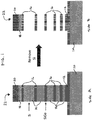
- Figure 1 is a schematic of a portion of microelectronic device prior to and after etching with the compositions and methods of this invention to selectively remove the silicon (structures, layers or films) from the device.
- the present invention relates generally to compositions useful for the selective removal of silicon over silicon-germanium from a microelectronic device having such material(s) thereon during its manufacture.
- silicon as deposited as a material on a microelectronic device will include polysilicon.
- microelectronic device or “semiconductor device” corresponds to semiconductor substrates, for example wafers, flat panel displays, phase change memory devices, solar panels and other products including solar substrates, photovoltaics, and microelectromechanical systems (MEMS), manufactured for use in microelectronic, integrated circuit, or computer chip applications.
- Solar substrates include, but are not limited to, silicon, amorphous silicon, polycrystalline silicon, monocrystalline silicon, CdTe, copper indium selenide, copper indium sulfide, and gallium arsenide on gallium.
- the solar substrates may be doped or undoped. It is to be understood that the term "microelectronic device” is not meant to be limiting in any way and includes any substrate that will eventually become a microelectronic device or microelectronic assembly.
- a “composite semiconductor device” or “composite microelectronic device” means that the device has more than one materials and/or layers and/or portions of layers present on a non-conductive substrate.
- the materials may comprise high K dielectrics, and/or low K dielectrics and/or barrier materials and/or capping materials and/or metal layers and/or others known to persons of skill.
- low-k dielectric material corresponds to any material used as a dielectric material in a layered microelectronic device, wherein the material has a dielectric constant less than about 3.5.
- the low-k dielectric materials include low-polarity materials such as silicon-containing organic polymers, silicon-containing hybrid organic/inorganic materials, organosilicate glass (OSG), TEOS, fluorinated silicate glass (FSG), silicon dioxide, and carbon-doped oxide (CDO) glass. It is to be appreciated that the low-k dielectric materials may have varying densities and varying porosities.
- high- ⁇ dielectric material refers to a material with a high dielectric constant ⁇ (as compared to silicon dioxide). High- ⁇ dielectrics may be used to replace a silicon dioxide gate dielectric or another dielectric layer of a microelectronic device.
- Thehigh-k material may be hafnium dioxide (HfO 2 ), hafnium oxynitride (HfON), zirconium dioxide (ZrO 2 ), zirconium oxynitride (ZrON), aluminum oxide (Al 2 O 3 ), aluminum oxynitride (AlON), hafnium silicon oxide (HfSiO 2 ), hafnium aluminum oxide (HfAlO), zirconium silicon oxide (ZrSiO 2 ), tantalum dioxide (Ta 2 O 5 ), aluminum oxide, Y 2 O 3 , La 2 O 3 , titanium oxide (TiO 2 ), aluminum doped hafnium dioxide, bismuth strontium titanium (BST), or platinum zirconium titanium (PZT).
- HfO 2 hafnium oxynitride
- ZrO 2 zirconium oxynitride
- AlON aluminum oxide
- Al 2 O 3 aluminum oxynitride
- AlON hafnium
- barrier material corresponds to any material used in the art to seal the metal lines, e.g., copper interconnects, to minimize the diffusion of said metal, e.g., copper, into the dielectric material.
- Preferred barrier layer materials include tantalum, titanium, ruthenium, hafnium, and other refractory metals and their nitrides and silicides.
- Substantially free is defined herein as less than 0.001 wt. %. “Substantially free” also includes 0.000 wt. %. The term “free of” means 0.000 wt. %.
- compositions wherein specific components of the composition are discussed in reference to weight percentage ranges including a zero lower limit, it will be understood that such components may be present or absent in various specific embodiments of the composition, and that in instances where such components are present, they may be present at concentrations as low as 0.001 weight percent, based on the total weight of the composition in which such components are employed. Note all percentages of the components are weight percentages and are based on the total weight of the composition, that is, 100%.
- the etching solution of the present development comprises, consists essentially of, or consists of water; at least one of a quaternary ammonium hydroxide compound and an amine compound; a water-miscible solvent; and optionally, a surfactant.
- the etching solution compositions disclosed herein are formulated to be substantially free or free of at least one of the following chemical compounds: TMAH, ammonium hydroxide, and any source of fluoride ions.
- compositions of the present invention are suitable for use in a process for making a gate all around structure on an electronic device.
- Such processes are known in the art such as, for example, the process disclosed in U.S. patent application Publication No. 2017/0179248 , U.S. patent application Publication No. 2017/0104062 , U.S. patent application Publication No. 2017/0133462 , and U.S. patent application Publication No. 2017/0040321 , the disclosures of which are incorporated herein by reference.
- compositions disclosed herein exhibit excellent silicon removal preferentially over silicon-germanium.
- the etching compositions of the present development are aqueous-based and, thus, comprise water.
- water functions in various ways such as, for example, to dissolve one or more components of the composition, as a carrier of the components, as an aid in the removal of residue, as a viscosity modifier of the composition, and as a diluent.
- the water employed in the cleaning composition is de-ionized (DI) water.
- DI de-ionized
- the weight percent of water in the composition will be present in a range with start and end points selected from the following group of numbers: 0.5, 1, 5, 10, 15, 17, 20, 23, 25, 30, 35, 40, 45, 50, 55, 60, 65 and 70.
- start and end points selected from the following group of numbers: 0.5, 1, 5, 10, 15, 17, 20, 23, 25, 30, 35, 40, 45, 50, 55, 60, 65 and 70.
- ranges of water that may be used in the composition include, for examples, from about 0.5% to about 60% by wt., or 1% to about 60% by wt.
- water or from about 0.5% to about 40% by wt., or from about 1% to about 25% by wt., or from about 1% to about 20% by wt., or from about 1% to about 15% by wt.; or from about 5% to about 20 % by wt.; or from 5% to about 15% by wt. or from 20% to about 60% by wt., or from 25% to about 60% by wt. or from about 30% to about 60% by wt., or from about 35% to about 55% by wt. of water.
- Still other preferred embodiments of the present invention may include water in an amount to achieve the desired weight percent of the other ingredients.
- the etching compositions of the present invention comprise silicon etchant that is at least one of quaternary ammonium hydroxide and amine compound.
- the silicon etchant comprises both a quaternary ammonium hydroxide and an amine compound.
- the quaternary ammonium hydroxide may be a quaternary ammonium hydroxide in which all of the alkyl groups are the same, such as, tetramethylammonium hydroxide, tetraethylammonium hydroxide, and/or tetrabutylammonium hydroxide and so on.
- quaternary ammonium hydroxides including tetraalkylammonium hydroxides wherein not all of the alkyl groups are the same.
- tetraalkylammonium hydroxides wherein not all of the alkyl groups are the same include the group consisting of benzyltrimethyl ammonium hydroxide, ethyltrimethyl ammonium hydroxide (ETMAH), 2-hydroxyethyltrimethyl ammonium hydroxide, benzyltriethyl ammonium hydroxide, hexadecyltrimethyl ammonium hydroxide, methyltriethylammonium hydroxide and mixtures thereof.
- ETMAH ethyltrimethyl ammonium hydroxide
- 2-hydroxyethyltrimethyl ammonium hydroxide benzyltriethyl ammonium hydroxide
- benzyltriethyl ammonium hydroxide hexadecyltrimethyl ammonium hydroxide
- the amount of the quaternary ammonium hydroxide compound in the composition will, for the most applications, comprise weight percents within a range having start and end points selected from the following group of numbers: 0.5, 1, 2, 3, 5, 7, 8, 10, 12, 15, 20, 25, 30 and 35.
- ranges of quaternary ammonium hydroxide in the compositions of this invention may be from about 1% to about 35% by weight of the composition, specifically, about 8% to about 35% by weight of the composition, or more specifically, about 20% to about 35% by weight of the composition.
- the quaternary ammonium hydroxide compound is an ETMAH (20% solution)
- the quaternary ammonium hydroxide compound (on a neat basis) comprises comprise weight percents within a range having start and end points selected from the following group of numbers: 0.1, 0.5, 1, 2, 3, 4, 5, 7, 8, 9, 10, 11, 12, 14, 15, 17, 20, 25, 30 and 35.
- ranges of quaternary ammonium hydroxide (neat) in the compositions of this invention may be from about 2% to about 15% weight percent and, more specifically, from about 3 to about 12% or from about from 3 to about 7%, from about 1 to about 10% or from about 1 to about 12% or from about 1 to about 7% or from about 0.5 to about 7% by weight of the composition.
- the etching compositions disclosed herein may be substantially free of or free of ammonium hydroxide and tetramethylammonium hydroxide (TMAH), and may be substantially free of or free of all tetraalkyl ammonium hydroxides wherein the alkyl groups are all the same.
- TMAH tetramethylammonium hydroxide
- Suitable amine compounds include at least one alkanolamine.
- Preferred alkanolamines include the lower alkanolamines which are primary, secondary and tertiary having from 1 to 5 carbon atoms.
- Examples of such alkanolamines include N-methylethanolamine (NMEA), monoethanolamine (MEA), diethanolamine, mono-, di- and triisopropanolamine, 2-(2-aminoethylamino)ethanol, 2-(2-aminoethoxy)ethanol, triethanolamine, N-ethyl ethanolamine, N,N-dimethylethanolamine, N,N-diethyl ethanolamine, N-methyl diethanolamine, N-ethyl diethanolamine, cyclohexylaminediethanol, and mixtures thereof.
- the amine compound is an alkanolamine selected from the group consisting of triethanolamine (TEA), diethanolamine, N-methyl diethanolamine, diisopropanolamine, monoethanol amine, amino(ethoxy) ethanol (AEE), N-methyl ethanol amine, monoisopropanol amine, cyclohexylaminediethanol, and mixtures thereof.
- TAA triethanolamine
- AEE amino(ethoxy) ethanol
- N-methyl ethanol amine monoisopropanol amine
- cyclohexylaminediethanol and mixtures thereof.
- the amount of the amine compound in the composition will, for the most applications, comprise weight percents within a range having start and end points selected from the following group of numbers: 0.5, 1, 2, 3, 5, 7, 8, 10, 12, 15, 20, 25, 30, 35, 40, 45, 50, 55, 60, 65 and 70.
- ranges of amine compound in the compositions of this invention may be comprise from about 1% to about 50% by weight of the composition, specifically, about 8% to about 50% by weight of the composition, or more specifically, about 20% to about 50% by weight of the composition.
- the amine compound comprises from about 20% to about 65% weight percent and, more specifically, from about 10 to about 60%, or from about 150 to about 55% or from about 20 to about 50% or from about 1 to about 12% or from about 25 to about 45% or from about 30 to about 40% by weight of the composition.
- compositions of this invention may be substantially free of or free of added polyfunctional acids and/or inorganic acids and/or organic acids. Additionally, the compositions of this invention may be substantially free or free of any of the above-listed individual alkanolamines alone or in any combination. Alternatively, in other embodiments, the compositions of this invention may be free of or substantially free of amines other than alkanolamines.
- the etching compositions of the present invention comprise a water-miscible solvent.
- water-miscible organic solvents that can be employed are ethylene glycol, propylene glycol, 1,4-butanediol, tripropylene glycol methyl ether, propylene glycol propyl ether, diethylene gycol n-butyl ether (BDG) (e.g., commercially available under the trade designation Dowanol DB), dipropylene glycol methyl ether (DPM) hexyloxypropylamine, poly(oxyethylene)diamine, dimethylsulfoxide (DMSO), tetrahydrofurfuryl alcohol, glycerol, alcohols, sulfolane, sulfoxides, or mixtures thereof.
- Preferred solvents are alcohols, diols, or mixtures thereof.
- Most preferred solvents are polyols including diols, such as, for example, propylene glycol and triols
- the amount of water-miscible organic solvent in the composition may be in a range having start and end points selected from the following list of weight percents: 0.5, 1, 5, 7, 10, 12, 15, 20, 25, 29, 30, 33, 35, 40, 44, 50, 59.5.
- ranges of solvent include from about 0.5% to about 59.5% by weight; or from about 1% to about 50% by weight; or from about 1% to about 40% by weight; or from about 0.5% to about 30% by weight; or from about 1% to about 30% by weight; or from about 5% to about 30% by weight; or from about 5% to about 20% by weight; or from about 7% to about 20%, or from about 10% to about 30% by weight; or from about 15% to about 25% by weight of the composition.
- the etching compositions of the present invention optionally comprise at least one surfactant.
- the surfactant functions to protect the silicon-germanium from etching.
- Surfactants for use in the compositions described herein include, but are not limited to, amphoteric salts, cationic surfactants, anionic surfactants, zwitterionic surfactants, non-ionic surfactants, and combinations thereof including, but not limited to, bis(2-ethylhexyl)phosphate, perfluoroheptanoic acid, prefluorodecanoic acid, trifluoromethanesulfonic acid, phosphonoacetic acid, dodecenylsuccinic acid, dioctadecyl hydrogen phosphate, octadecyl dihydrogen phosphate, dodecylamine, dodecenylsuccinic acid monodiethanol amide, lauric acid, palmitic acid, oleic acid, juniperic acid
- Non-ionic surfactants contemplated include, but are not limited to, polyoxyethylene lauryl ether (Emalmin NL-100 (Sanyo), Brij 30, Brij 98, Brij 35), dodecenylsuccinic acid monodiethanol amide (DSDA, Sanyo), ethylenediamine tetrakis(ethoxylate-block-propoxylate) tetrol (Tetronic 90R4), polyethylene glycols (e.g., PEG 400), polypropylene glycols, polyethylene or polypropylene glycol ethers, block copolymers based on ethylene oxide and propylene oxide (Newpole PE-68 (Sanyo), Pluronic L31, Pluronic 31R1, Pluronic L61, Pluronic F-127) (Dynol 607), polyoxypropylene sucrose ether (SN008S, Sanyo), t-octylphenoxypolyethoxyethanol (Triton X100), 10-ethoxy
- Cationic surfactants contemplated include, but are not limited to, cetyl trimethylammonium bromide (CTAB), heptadecanefluorooctane sulfonic acid, tetraethylammonium, stearyl trimethylammonium chloride (Econol TMS-28, Sanyo), 4-(4-diethylaminophenylazo)-1-(4-nitrobenzyl)pyridium bromide, cetylpyridinium chloride monohydrate, benzalkonium chloride, benzethonium chloride benzyldimethyldodecylammonium chloride, benzyldimethylhexadecylammonium chloride, hexadecyltrimethylammonium bromide, dimethyldioctadecylammonium chloride, dodecyltrimethylammonium chloride, hexadecyltrimethylammonium p-
- the cationic surfactant comprises polyalkyleneimine.
- the polyalkyleneimine is a polyethyleneimine (PEI). Any PEI may be used, but a homopolymeric polyethyleneimine may be employed.
- the PEI may be branched or linear. PEI may have any formula weight for effectiveness, or a lower formula weight (FW), such as a FW between 100 and 50,000, between 400 and 25,000, between 800 and 10,000, or between 1000 and 3000.
- the composition may comprise polyalkyleneimine e.g. polyethyleneimine (PEI) and the PEI may comprises less than 1% by weight of the composition, or less than 0.5% by weight, or from about 0.02% to 1% by weight of the composition.
- the PEI may have a molecular weight (FW) between 100 and 2500, or 200 and 1500, or 400 and 1200.
- the polyalkyleneimine may have a molecular weight between 100 and 2500, between 200 and 1500, between 400 and 1200, or between 700 and 900.
- a molecular weight of 800 is particularly suitable. The molecular weight is suitably determined by light scattering techniques known in the art.
- Polyethyleneimines are commercially available, for example Lupasol® 800 which is supplied by BASF.
- Anionic surfactants contemplated include, but are not limited to, ammonium polyacrylate (e.g., DARVAN 821A), modified polyacrylic acid in water (e.g., SOKALAN CP10S), phosphate polyether ester (e.g., TRITON H-55), decylphosphonic acid, dodecylphosphonic acid (DDPA), tetradecylphosphonic acid, hexadecylphosphonic acid, octadecylphosphonic acid, dodecylbenzenesulfonic acid, poly(acrylic acid sodium salt), sodium polyoxyethylene lauryl ether, sodium dihexylsulfosuccinate, dicyclohexyl sulfosuccinate sodium salt, sodium 7-ethyl-2-methyl-4-undecyl sulfate (Tergitol 4), SODOSIL RM02, and phosphate fluorosurfactants such as Zonyl FSJ
- Zwitterionic surfactants include, but are not limited to, acetylenic diols or modified acetylenic diols (e.g., SURFONYL® 504), cocamido propyl betaine, ethylene oxide alkylamines (AOA-8, Sanyo), N,N-dimethyldodecylamine N-oxide, sodium cocaminpropinate (LebonApl-D, Sanyo), 3-(N,N-dimethylmyristylammonio)propanesulfonate, and (3-(4-heptyl)phenyl-3-hydroxypropyl)dimethylammoniopropanesulfonate.
- acetylenic diols or modified acetylenic diols e.g., SURFONYL® 504
- cocamido propyl betaine ethylene oxide alkylamines (AOA-8, Sanyo)
- the at least one surfactant comprises dodecylbenzene sulfonic acid, dodecyl phosphonic acid, dodecyl phosphate, TRITON X-100, SOKALAN CP10S, PEG 400, and PLURONIC F-127.
- the amount of surfactant may be in a range from about 0.001 wt % to about 1 wt %, or from about 0.01 to about 1 wt %, or about 0.1 wt % to about 1 wt %, based on the total weight of the composition.
- the one or more surfactants will comprise from about 0.1 wt. % to about 15 wt. % of the composition; or from about 0.1 wt. % to about 10 wt. %, or from about 0.5 wt. % to about 5 wt. %, or from about 0.05 wt.% to about 2 wt.
- the weight percent of surfactant in the composition may be within any range having start and end points selected from the following: 0.001, 0.01, 0.05, 0.1, 0.5, 1, 2, 4, 5, 8, 10 and 15.
- compositions of this invention will be free of or substantially free of any or all of the above-listed surfactants.
- the etching composition of the present invention may also include one or more of the corrosion inhibitors.
- the corrosion inhibitors if present, may protect the silicon-germanium from etching.
- Examples of corrosion inhibitors include amino carboxylic acids, for example, triethylenetetraminehexaacetic acid (TTHA), 1,3-diamino-2-hydroxypropane-N,N,N',N'-tetraacetic acid (DHPTA), methyliminodiacetic acid, propylenediaminetetraacetic acid, ethylenediaminetetraacetic acid (EDTA), butylenediaminetetraacetic acid, (1,2-cyclohexylenediamine)tetraacetic acid (CyDTA), diethylenetriaminepentaacetic acid (DETPA), ethylenediaminetetrapropionic acid, (hydroxyethyl)ethylenediaminetriacetic acid (HEDTA), and nitrotriacetic acid (NTA), aminophosphonic acids, such as
- corrosion inhibitors include propyl gallate, pyrogallol, quinolines, such as, 8-hydroxyquinoline, piperazines, such as, 1-(2-aminoethyl)piperazine, cysteine, and N,N,N',N",N"-pentamethyldiethylenetriamine (Polycat 5).
- Another corrosion inhibitors may include hexylamine.
- Some preferred corrosion inhibitors may comprise sulfur-containing groups.
- Other preferred corrosion inhibitors may comprise aminocarboxylic acids such as EDTA, CyDTA, quinolines, such as, 8-hydroxyquinoline, decanoic acid, 11-mercaptoundecanoic acid, piperazines, such as, 1-(2-aminoethyl)piperazine, benzimidazoles, such as, 2-mercapto-5-methylbenzimidizole, and carboxylic acids, such as, oxalic acid, decanoic acid, and ascorbic acid. More preferred corrosion inhibitors include decanoic acid, ascorbic acid, 11-mercaptoundecanoic acid, 1-(2-aminoethyl)piperazine, and 8-hydroxyquinoline. Most preferred is 8-hydroxyquinoline.
- the amount of the corrosion inhibitors such as, amino carboxylic acids, carboxylic acids, quinolines, or piperazines, etc, in the composition may be in a range having start and end points selected from the following list of weight percents: 0.01, 0.05, 0.07, 0.1, 0.12, 0.15, 0.17, 0.2, 0.5, 1, 1.2, 1.5, 1.7, 2, 3, 4, 6, 8, 10, 12, 15.
- the corrosion inhibitors may be present in the composition from about 0.05 wt % to about 3 wt %, or from about 0.01 to about 3 wt %, or about 0.1 wt % to about 5 wt %, or from about 0.1 wt.
- compositions of this invention will be free of or substantially free of any or all of the above-listed corrosion inhibitors, that is, the composition is free of any or all of the above-listed aminocarboxylic acids and/or carboxylic acids and/or quinolines and/or piperazines, etc..
- cleaning composition can be included in conventional amounts, for example, amounts up to a total of about 1 or 5 or 10 weight % of the composition to the extent that they do not adversely affect the performance of the composition.
- compositions of this invention may be free or substantially free of any or all of dyes, chemical modifiers, or biocides.
- the etching solution compositions disclosed herein are formulated to be substantially free or free of fluorides and/or quaternary ammonium fluorides, for examples the composition may be substantially free or free of one or more of the following: tetramethylammonium fluoride, tetraethylammonium fluoride, methyltriethylammonium fluoride, and/or tetrabutylammonium fluoride.
- the composition may be substantially free of or free of one or more metal hydroxides, such as KOH or LiOH or NaOH.
- the composition may be substantially free of or free of a halide-containing compound, for example it may be substantially free or free of one or more of the following: fluorine-, bromine-, chlorine- or iodine-containing compounds.
- the composition may be substantially free or free of sulfonic acid and/or sulfuric acid and/or nitric acid and/or hydrochloric acid and/or phosphoric acids.
- the composition may be substantially free or free of sulfates and/or nitrates and/or sulfites and/or nitrites.
- the composition may be substantially free or free of: ammonium hydroxide and/or ethyl diamine.
- the composition may be substantially free or free of: sodium-containing compounds and/or calcium-containing compounds and/or manganese-containing compounds or magnesium-containing compounds and/or chromium-containing compounds and/or sulfur-containing compounds.
- the compositions of the present invention may be substantially free or free of oxidizing agents such as, for example, peroxide compounds such as, for example, hydrogen peroxide, persulfates (e.g., monopersulfates and/or dipersulfates), percarbonates and/or acids thereof and/or salts thereof and/or mixtures thereof.
- compositions of the present invention may be substantially free or free of one or more oxidizing agents, such as, for example, oxidized halides (e.g., iodates, periodates, and/or acids thereof, and/or mixtures thereof), perboric acid, perborates, percarbonates, peroxyacids (e.g., peracetic acid, perbenzoic acid, salts thereof, permanganates, cerium compounds and/or ferricyanides (e.g., potassium ferricyanide).
- oxidized halides e.g., iodates, periodates, and/or acids thereof, and/or mixtures thereof
- perboric acid e.g., perborates, percarbonates, peroxyacids (e.g., peracetic acid, perbenzoic acid, salts thereof, permanganates, cerium compounds and/or ferricyanides (e.g., potassium ferricyanide).
- perboric acid e.g., perborates, percarbonates
- the etching solution composition of the present invention is typically prepared by mixing the components together in a vessel at room temperature until all solids have dissolved in the aqueous-based medium.
- Examples of some embodiments of this invention will comprise from about 30% to about 70% by wt., or from about 30% to about 60% by wt., or from about 35% to about 55% by wt. water; from about 15% to about 55% by wt., or 20% to about 50% by wt., or from about 25% to about 45% by wt. of at least one of a quaternary ammonium hydroxide compound and an amine compound; from about 10% to about 50% by wt., or from about 20% to about 40% by wt., or from about 25% to about 35% by wt. water-miscible solvent; optionally from about 0.05 to about 5% by wt.
- a method for selectively enhancing the etch rate of silicon relative to silicon-germanium in a microelectronic device e.g. composite semiconductor device comprising silicon and silicon-germanium by etching the microelectronic device (composite semiconductor device) in a composition comprising, consisting essentially of, or consisting of water; at least one of a quaternary ammonium hydroxide compound and an amine compound; a water-miscible solvent; and optionally, a surfactant.
- the method comprises the steps of selectively enhancing the etch rate of silicon relative to silicon-germanium on a microelectronic device (composite semiconductor device) comprising silicon and silicon-germanium, the method comprising the steps of: contacting the microelectronic device (composite semiconductor device) comprising silicon and silicon-germanium with an aqueous composition comprising water; at least one of a quaternary ammonium hydroxide compound and an amine compound; a water-miscible solvent; and optionally, a surfactant; and rinsing the composite semiconductor device after the silicon is at least partially removed, wherein the selectivity of the etch for silicon over silicon-germanium is greater than about 50.
- An additional drying step may also be included in the method.
- "At least partially removed” means removal of at least 50% of the material, preferably at least 70% removal, most preferably, at least 80% removal using the compositions of the present invention in the method of this invention.
- etch rate selectivity on Si/ Si/ SiGe is preferable greater than (>) 50, SiN etch is preferably less than ( ⁇ ) 10 or less than 5 ⁇ /min and thermal oxide etch is preferably less than ( ⁇ ) 2 or less than 1 ⁇ /min.
- the sacrificial silicon is preferably in a (110) orientation.
- the contacting step can be carried out by any suitable means such as, for example, immersion, spray, or via a single wafer process.
- the temperature of the composition during the contacting step is preferably from about 25 to 100 °C and more preferably from about 40 to 75 °C.
- the contact time may be from about 1 to 60 minutes.
- compositions of the present invention surprisingly exhibit excellent etch selectivity for silicon over silicon-germanium when used on substrates that include silicon and silicon-germanium such as, for example, during the manufacture of a stacked gate all around device.
- the term "selectivity" is typically used to refer to a ratio of etch rates of two materials.
- Compositions according to the present invention preferably exhibit a wet etch selectivity for silicon over silicon-germanium between from about 50 to about 500. In other embodiments, the etch selectivity for silicon over silicon-germanium observed with the composition of the present invention is between from about 50 to about 200.
- the rinsing step may be carried out by any suitable means, for example, rinsing the substrate with de-ionized water by immersion or spray techniques.
- the rinsing step may be carried out employing a mixture of de-ionized water and an organic solvent such as, for example, isopropyl alcohol.
- IPA isopropyl alcohol
- compositions which are the subject of the present Examples were prepared by mixing the components in a 250 mL beaker with a 1" Teflon-coated stir bar.
- the first material added to the beaker was deionized (DI) water followed by the other components in no particular order.
- DI deionized
- SiGe/ Si multilayers were deposited by hetero-epitaxy on Si wafer.
- Side A of Figure 1 shows a schematic of the microelectronic device treated in the examples.
- the SiGe/ Si multilayer deposition started with a thick SiGe layer 12 on the Si substrate 10. Then followed by a Si / SiGe multilayer deposition. (The Si layers are labeled 14. The SiGe layers are labeled 16.)
- An oxide layer 18 and nitride hard mask (HM) layer 20 were deposited on top of the multilayer and patterned into parallel FINs 22. The SiGe/Si nanowire FINs were etched selectively and resulted in SiGe nanowire.
- Side A of Figure 1 shows the microelectronic device treated in the examples before contacting the device with the compositions of this invention.
- Side B of Figure shows the microelectronic device after treatment.
- Etching tests were run using 100g of the etching compositions in a 250 ml beaker with a 1 ⁇ 2" round Teflon stir bar set at 400 rpm.
- the etching compositions were heated to a temperature of about 45 °C on a hot plate.
- the test coupons were immersed in the compositions for about 20 minutes while stirring.
- the segments were then rinsed for 3 minutes in a DI water bath or spray and subsequently dried using filtered nitrogen.
- the silicon and silicon-germanium etch rates were estimated from changes in the thickness before and after etching and was measured by spectroscopic ellipsometry (MG-1000, Nano-View Co., Ltd., South Korea we use SCI FilmTek SE2000).
- Typical starting layer thickness was 1000 ⁇ for Si and 1000 ⁇ for SiGe.
- Table 1 Solvent Effect on Poly Si/ SiGe Etching Selectivity 294F 294C 294E 294G 294I 294D 294H ETMAH (20%) 15 15 15 15 15 15 15 15 15 15 15 15 15 15 15 15 15 15 15 15 15 15 15 15 15 15 15 15 15 15 15 15 15 15 15 15 15 15 15 15 15 15 15 15 15 15 15 15 15 15 15 15 15 15 15 15 15 15 15 15 15 15 15 15 15 15 15 15 15 15 15 15 15 15 15 15 15 15 15 15 15 15 15 15 15 15 15 15 15 15 15 15 15 15 15 15 15 15 15 15 15 15 15 15 15 15 15 15 15 15 15 15 15 15 15 15 15 15 15 15 15 15 15 15 15 15 15 15 15 15 15 15 15 15 15 15 15 15 15 15 15 15 15 15 15 15 15 15 15 15 15 15 15 15 15 15 15 15 15 15 15 15 15 15 15 15 15 15 15 15 15 15 15 15 15 15 15 15 15 15 15 15 15 15 15 15 15 15 15 15 15 15 15 15 15 15 15 15 15 15 15 15 15 15 15 15 15 15 15 15 15 15
- Corrosion inhibitors of various functionalities were evaluated for their protection of SiGe nanowire from being etched in an alkaline environment. SiGe damage occurs easily in conventional Si etchant especially when Ge concentration is near, at or below 25% by moles in the SiGe alloy. Tables 3 to 6 summarize the compositions evaluated.
- Table 2 Carboxylic Acid Functional Groups/Corrosion Inhibitors e21334-243I e21334-254A e21334-254X e21334-254Y e42807-010A e42807-010B ETMAH (20%) 15.0 15.0 15.0 15.0 15.0 DIW 40.0 39.8 39.0 39.0 39.0 39.0 AEE 25.0 25.0 25.0 25.0 25.0 25.0 Glycerol 20.0 20.0 20.0 20.0 20.0 20.0 20.0 20.0 decanoic acid 0.2 benzoic acid 1.0 ascorbic acid 1.0 oxalic acid 1.0 salicylic acid 1.0 SiGe(25%) e/r at 40 °C 12.6 8.1 12.4 4.0 9.6 11.4 Table 3 : Amino Functional Groups/Corrosion Inhibitors/Surfactants e21334-243I e21334-254K e21334-254O e21334-254Q e21334
- This composition exhibited a poly-Si/ SiGe selectivity of 99 and was found to completely release Si layers on patterned wafer. SiGe nanowire was thus successfully fabricated at 40 °C/ 3 min. In addition, this composition also exhibited good stability at 45 °C for 120 hrs, which enables it to be operated in a recirculation mode. See Tables 7 and 8.
- Table 6 Etch Rate Temp (°C) SiGe (25%) Si(100) Si(110) Si(111) Poly Si SiN (500A) SiN (200A) thermal oxide 40 5.8 637 723 238 570.6 0.4 0.1 0.2 45 7.9 1034 1199 384 n.a 0.5 0.2 0.2 55 11.5 1988 2204 771 n.a n.a n.a n.a Table 7 : Selectivity Temp (°C) Si(110)/ Si(100) Si(111)/ Si(100) Si(100)/ SiGe(25%) Si(110)/SiGe(25%) Si(111)/SiFe(25%) 40 1.14 0.37 110.59 125.52 41.32 45 1.16 0.37 130.95 151.72 48.67 55 1.11 0.39 172.85 191.69 67.04
- the invention further relates to the following numbered items:
Landscapes
- Chemical & Material Sciences (AREA)
- Engineering & Computer Science (AREA)
- Materials Engineering (AREA)
- Organic Chemistry (AREA)
- Weting (AREA)
- Chemical Kinetics & Catalysis (AREA)
- General Chemical & Material Sciences (AREA)
- Silicon Compounds (AREA)
- Cleaning Or Drying Semiconductors (AREA)
Applications Claiming Priority (2)
| Application Number | Priority Date | Filing Date | Title |
|---|---|---|---|
| US201762550491P | 2017-08-25 | 2017-08-25 | |
| US16/109,172 US10934485B2 (en) | 2017-08-25 | 2018-08-22 | Etching solution for selectively removing silicon over silicon-germanium alloy from a silicon-germanium/ silicon stack during manufacture of a semiconductor device |
Publications (2)
| Publication Number | Publication Date |
|---|---|
| EP3447109A1 true EP3447109A1 (fr) | 2019-02-27 |
| EP3447109B1 EP3447109B1 (fr) | 2020-08-05 |
Family
ID=63578918
Family Applications (1)
| Application Number | Title | Priority Date | Filing Date |
|---|---|---|---|
| EP18190730.4A Active EP3447109B1 (fr) | 2017-08-25 | 2018-08-24 | Solution de gravure pour éliminer sélectivement du silicium sur un alliage silicium-germanium à partir d'un empilement de silicium/silicium-germanium pendant la fabrication d'un dispositif semiconducteur |
Country Status (8)
| Country | Link |
|---|---|
| US (1) | US10934485B2 (fr) |
| EP (1) | EP3447109B1 (fr) |
| JP (1) | JP6892418B2 (fr) |
| KR (1) | KR102241352B1 (fr) |
| CN (1) | CN109423288B (fr) |
| IL (1) | IL261357B2 (fr) |
| SG (1) | SG10201807214WA (fr) |
| TW (1) | TWI773809B (fr) |
Cited By (7)
| Publication number | Priority date | Publication date | Assignee | Title |
|---|---|---|---|---|
| US20220315868A1 (en) * | 2019-12-26 | 2022-10-06 | Fujifilm Corporation | Cleaning solution and cleaning method |
| CN115362246A (zh) * | 2020-03-31 | 2022-11-18 | 日产化学株式会社 | 清洗剂组合物以及经加工的半导体基板的制造方法 |
| WO2023280637A1 (fr) | 2021-07-08 | 2023-01-12 | Basf Se | Utilisation d'une composition et procédé de gravure sélective de silicium |
| EP3959291A4 (fr) * | 2019-03-11 | 2023-07-19 | Versum Materials US, LLC | Solution de gravure et procédé pour nitrure d'aluminium |
| EP3983499A4 (fr) * | 2019-06-13 | 2023-08-02 | Versum Materials US, LLC | Compositions liquides pour éliminer sélectivement du polysilicium sur du silicium et du silicium-germanium dopés par p pendant la fabrication d'un dispositif semi-conducteur |
| WO2025026861A1 (fr) | 2023-08-02 | 2025-02-06 | Basf Se | Utilisation d'une composition et procédé de gravure sélective de silicium |
| WO2025202010A1 (fr) | 2024-03-25 | 2025-10-02 | Basf Se | Utilisation d'une composition et procédé de gravure sélective de silicium |
Families Citing this family (38)
| Publication number | Priority date | Publication date | Assignee | Title |
|---|---|---|---|---|
| US11031239B2 (en) * | 2018-06-29 | 2021-06-08 | Taiwan Semiconductor Manufacturing Co., Ltd. | Germanium nanosheets and methods of forming the same |
| US10680063B2 (en) * | 2018-09-07 | 2020-06-09 | International Business Machines Corporation | Method of manufacturing stacked SiGe nanotubes |
| US11180697B2 (en) | 2018-11-19 | 2021-11-23 | Versum Materials Us, Llc | Etching solution having silicon oxide corrosion inhibitor and method of using the same |
| JP7450334B2 (ja) * | 2018-12-27 | 2024-03-15 | 東京応化工業株式会社 | エッチング液、及び半導体素子の製造方法 |
| KR102678071B1 (ko) | 2019-01-08 | 2024-06-24 | 동우 화인켐 주식회사 | 실리콘 막 식각액 조성물 및 이를 사용한 패턴 형성 방법 |
| KR102444014B1 (ko) | 2019-02-05 | 2022-09-15 | 가부시키가이샤 도쿠야마 | 실리콘 에칭액 및 상기 에칭액을 이용한 실리콘 디바이스의 제조방법 |
| JP7340969B2 (ja) * | 2019-06-28 | 2023-09-08 | 東京応化工業株式会社 | シリコンエッチング液、シリコンエッチング方法、及びシリコンフィン構造体の製造方法 |
| CN110438504A (zh) * | 2019-08-19 | 2019-11-12 | 江阴江化微电子材料股份有限公司 | 一种铝栅刻开区硅渣清除组合物及硅渣清除方法 |
| TW202129061A (zh) | 2019-10-02 | 2021-08-01 | 美商應用材料股份有限公司 | 環繞式閘極輸入/輸出工程 |
| JP7664914B2 (ja) * | 2019-10-17 | 2025-04-18 | バーサム マテリアルズ ユーエス,リミティド ライアビリティ カンパニー | Euvマスク保護構造のためのエッチング組成物及び方法 |
| WO2021126340A1 (fr) * | 2019-12-20 | 2021-06-24 | Versum Materials Us, Llc | Agent de gravure humide sélectif co/cu |
| US11342409B2 (en) * | 2020-03-25 | 2022-05-24 | Intel Corporation | Isolation regions in integrated circuit structures |
| WO2022025161A1 (fr) * | 2020-07-31 | 2022-02-03 | 株式会社トクヤマ | Solution de gravure de silicium, et procédé de fabrication de dispositif de silicium ainsi que procédé de traitement de substrat de silicium mettant en œuvre cette solution de gravure de silicium |
| WO2022025163A1 (fr) | 2020-07-31 | 2022-02-03 | 株式会社トクヤマ | Solution de gravure de silicium, et procédé de fabrication de dispositif de silicium ainsi que procédé de traitement de substrat de silicium mettant en œuvre cette solution de gravure de silicium |
| KR102862934B1 (ko) * | 2020-09-09 | 2025-09-22 | 동우 화인켐 주식회사 | 실리콘 식각액 조성물, 이를 이용한 패턴 형성 방법 및 어레이 기판의 제조 방법, 및 이에 따라 제조된 어레이 기판 |
| JPWO2022138754A1 (fr) * | 2020-12-24 | 2022-06-30 | ||
| CN116635986A (zh) * | 2021-01-12 | 2023-08-22 | 三菱化学株式会社 | 蚀刻组合物、蚀刻方法、半导体器件的制造方法和全环绕栅极型晶体管的制造方法 |
| WO2022172907A1 (fr) | 2021-02-10 | 2022-08-18 | 株式会社トクヤマ | Procédé de traitement de substrat et procédé de fabrication de dispositif au silicium comprenant ledit procédé de traitement |
| WO2022190903A1 (fr) * | 2021-03-11 | 2022-09-15 | 富士フイルム株式会社 | Composition pour traitement de semi-conducteur et procédé de traitement d'objet à traiter |
| US20220290049A1 (en) * | 2021-03-12 | 2022-09-15 | LCY Chemical Corp. | Composition of etchant, method for forming semiconductor device using the same, and semiconductor device |
| JP7757096B2 (ja) * | 2021-09-14 | 2025-10-21 | 株式会社東芝 | エッチング方法 |
| JPWO2023047959A1 (fr) * | 2021-09-21 | 2023-03-30 | ||
| WO2023079908A1 (fr) * | 2021-11-02 | 2023-05-11 | 三菱ケミカル株式会社 | Agent de gravure, procédé de gravure, procédé de production de dispositif à semi-conducteur, et procédé de production d'un transistor à grille tout autour |
| US20230151274A1 (en) * | 2021-11-15 | 2023-05-18 | Cj Technology Co., Ltd. | Method for selective etching Si in the presence of silicon nitride, its composition and application thereof |
| KR20230102276A (ko) * | 2021-12-30 | 2023-07-07 | 주식회사 이엔에프테크놀로지 | 실리콘 선택적 식각액 조성물 |
| KR20240122543A (ko) | 2022-02-22 | 2024-08-12 | 후지필름 가부시키가이샤 | 반도체 제조용 조성물, 피처리물의 처리 방법, 반도체 소자의 제조 방법 |
| WO2023163002A1 (fr) * | 2022-02-24 | 2023-08-31 | 三菱瓦斯化学株式会社 | Composition, procédé de fabrication de substrat semi-conducteur et procédé de gravure l'utilisant |
| KR20230127785A (ko) * | 2022-02-25 | 2023-09-01 | 삼성전자주식회사 | 실리콘 게르마늄 막 식각용 식각 조성물 및 이를 이용하는 집적회로 소자의 제조 방법 |
| CN115011348B (zh) * | 2022-06-30 | 2023-12-29 | 湖北兴福电子材料股份有限公司 | 一种氮化铝蚀刻液及其应用 |
| KR102804745B1 (ko) * | 2022-08-11 | 2025-05-12 | 충북대학교 산학협력단 | 나노시트 반도체소자 제조방법 및 이에 의하여 제조된 나노시트 반도체소자 |
| TW202432798A (zh) * | 2022-11-22 | 2024-08-16 | 日商德山股份有限公司 | 矽蝕刻液、基板的處理方法、及矽裝置的製造方法 |
| JPWO2024166976A1 (fr) * | 2023-02-10 | 2024-08-15 | ||
| WO2024190648A1 (fr) * | 2023-03-14 | 2024-09-19 | 三菱ケミカル株式会社 | Composition de gravure, procédé de production de composition de gravure, procédé de gravure, procédé de production de dispositif à semi-conducteur, et procédé de production de transistor à grille enveloppante |
| CN117417747A (zh) * | 2023-09-13 | 2024-01-19 | 湖北兴福电子材料股份有限公司 | 一种相对于硅锗的硅选择性蚀刻液 |
| CN118995223A (zh) * | 2024-07-18 | 2024-11-22 | 湖北兴福电子材料股份有限公司 | 硅锗/硅叠层中硅的高性能选择性蚀刻液 |
| CN119081700A (zh) * | 2024-07-25 | 2024-12-06 | 湖北兴福电子材料股份有限公司 | 一种选择性去除TiSiN的蚀刻液及其制备方法 |
| FR3165338A1 (fr) | 2024-07-31 | 2026-02-06 | Soitec | Procédé de fabrication d’un substrat de silicium en vue d’applications quantiques |
| CN119979170B (zh) * | 2024-12-13 | 2026-03-03 | 湖北兴福电子材料股份有限公司 | 一种适用于微电子器件从硅锗/硅叠层中相对于硅选择性去除硅锗的组合物 |
Citations (7)
| Publication number | Priority date | Publication date | Assignee | Title |
|---|---|---|---|---|
| US20100248495A1 (en) * | 2007-10-04 | 2010-09-30 | Mitsubishi Gas Chemincal Company, Inc. | Silicon etching liquid and etching method |
| EP3040397A1 (fr) * | 2014-12-29 | 2016-07-06 | Air Products And Chemicals, Inc. | Décapant chimique et son procédé d'utilisation |
| US20170040321A1 (en) | 2015-08-06 | 2017-02-09 | Imec Vzw | Gate-all-around nanowire device and method for manufacturing such a device |
| US20170104062A1 (en) | 2015-10-12 | 2017-04-13 | International Business Machines Corporation | Stacked Nanowires |
| US20170133462A1 (en) | 2010-12-01 | 2017-05-11 | Intel Corporation | Silicon and silicon germanium nanowire structures |
| US20170145311A1 (en) * | 2015-11-25 | 2017-05-25 | Air Products And Chemicals, Inc. | Etching Compositions and Methods for Using Same |
| US20170179248A1 (en) | 2015-12-16 | 2017-06-22 | Globalfoundries Inc. | Horizontal gate all around nanowire transistor bottom isolation |
Family Cites Families (13)
| Publication number | Priority date | Publication date | Assignee | Title |
|---|---|---|---|---|
| JP3160344B2 (ja) * | 1991-01-25 | 2001-04-25 | アシュランド インコーポレーテッド | 有機ストリッピング組成物 |
| US6599370B2 (en) * | 2000-10-16 | 2003-07-29 | Mallinckrodt Inc. | Stabilized alkaline compositions for cleaning microelectronic substrates |
| KR100554517B1 (ko) | 2004-04-14 | 2006-03-03 | 삼성전자주식회사 | 실리콘 게르마늄층의 세정액 및 이를 이용한 세정 방법 |
| JP4968477B2 (ja) | 2005-08-19 | 2012-07-04 | 日産化学工業株式会社 | ハードマスクの除去用組成物及び除去方法 |
| SG175559A1 (en) | 2006-09-25 | 2011-11-28 | Advanced Tech Materials | Compositions and methods for the removal of photoresist for a wafer rework application |
| US7994062B2 (en) | 2009-10-30 | 2011-08-09 | Sachem, Inc. | Selective silicon etch process |
| US8912568B2 (en) | 2011-06-20 | 2014-12-16 | Semiconductor Manufacturing International (Beijing) Corporation | Semiconductor device and manufacturing method thereof |
| WO2013021296A1 (fr) | 2011-08-09 | 2013-02-14 | Basf Se | Compositions alcalines aqueuses et procédé de traitement de la surface de substrats de silicium |
| US8703004B2 (en) * | 2011-11-14 | 2014-04-22 | Kabushiki Kaisha Toshiba | Method for chemical planarization and chemical planarization apparatus |
| US8614123B2 (en) * | 2011-11-28 | 2013-12-24 | Globalfoundries Inc. | Method of forming a semiconductor device by using sacrificial gate electrodes and sacrificial self-aligned contact structures |
| CN103633123B (zh) * | 2013-12-10 | 2016-07-27 | 中国科学院微电子研究所 | 一种纳米线衬底结构及其制备方法 |
| JP2016054219A (ja) * | 2014-09-03 | 2016-04-14 | 株式会社東芝 | 化学的平坦化方法及び化学的平坦化装置 |
| KR102468776B1 (ko) * | 2015-09-21 | 2022-11-22 | 삼성전자주식회사 | 폴리실리콘 습식 식각용 조성물 및 이를 이용한 반도체 소자의 제조 방법 |
-
2018
- 2018-08-22 US US16/109,172 patent/US10934485B2/en active Active
- 2018-08-23 IL IL261357A patent/IL261357B2/en unknown
- 2018-08-24 JP JP2018157295A patent/JP6892418B2/ja active Active
- 2018-08-24 KR KR1020180099371A patent/KR102241352B1/ko active Active
- 2018-08-24 EP EP18190730.4A patent/EP3447109B1/fr active Active
- 2018-08-24 SG SG10201807214WA patent/SG10201807214WA/en unknown
- 2018-08-24 TW TW107129556A patent/TWI773809B/zh active
- 2018-08-27 CN CN201810983642.6A patent/CN109423288B/zh active Active
Patent Citations (7)
| Publication number | Priority date | Publication date | Assignee | Title |
|---|---|---|---|---|
| US20100248495A1 (en) * | 2007-10-04 | 2010-09-30 | Mitsubishi Gas Chemincal Company, Inc. | Silicon etching liquid and etching method |
| US20170133462A1 (en) | 2010-12-01 | 2017-05-11 | Intel Corporation | Silicon and silicon germanium nanowire structures |
| EP3040397A1 (fr) * | 2014-12-29 | 2016-07-06 | Air Products And Chemicals, Inc. | Décapant chimique et son procédé d'utilisation |
| US20170040321A1 (en) | 2015-08-06 | 2017-02-09 | Imec Vzw | Gate-all-around nanowire device and method for manufacturing such a device |
| US20170104062A1 (en) | 2015-10-12 | 2017-04-13 | International Business Machines Corporation | Stacked Nanowires |
| US20170145311A1 (en) * | 2015-11-25 | 2017-05-25 | Air Products And Chemicals, Inc. | Etching Compositions and Methods for Using Same |
| US20170179248A1 (en) | 2015-12-16 | 2017-06-22 | Globalfoundries Inc. | Horizontal gate all around nanowire transistor bottom isolation |
Non-Patent Citations (1)
| Title |
|---|
| V. LOUP ET AL: "Si and SiGe Alloys Wet Etching Using TMAH Chemistry", ECS TRANSACTIONS, vol. 58, no. 6, 31 August 2013 (2013-08-31), US, pages 47 - 55, XP055530536, ISSN: 1938-6737, DOI: 10.1149/05806.0047ecst * |
Cited By (10)
| Publication number | Priority date | Publication date | Assignee | Title |
|---|---|---|---|---|
| EP3959291A4 (fr) * | 2019-03-11 | 2023-07-19 | Versum Materials US, LLC | Solution de gravure et procédé pour nitrure d'aluminium |
| US11929257B2 (en) | 2019-03-11 | 2024-03-12 | Versum Materials Us, Llc | Etching solution and method for aluminum nitride |
| EP3983499A4 (fr) * | 2019-06-13 | 2023-08-02 | Versum Materials US, LLC | Compositions liquides pour éliminer sélectivement du polysilicium sur du silicium et du silicium-germanium dopés par p pendant la fabrication d'un dispositif semi-conducteur |
| US20220315868A1 (en) * | 2019-12-26 | 2022-10-06 | Fujifilm Corporation | Cleaning solution and cleaning method |
| CN115362246A (zh) * | 2020-03-31 | 2022-11-18 | 日产化学株式会社 | 清洗剂组合物以及经加工的半导体基板的制造方法 |
| EP4130217A4 (fr) * | 2020-03-31 | 2024-04-17 | Nissan Chemical Corporation | Composition d'agent de nettoyage et procédé permettant de produire un substrat semi-conducteur traité |
| WO2023280637A1 (fr) | 2021-07-08 | 2023-01-12 | Basf Se | Utilisation d'une composition et procédé de gravure sélective de silicium |
| US12525464B2 (en) | 2021-07-08 | 2026-01-13 | Basf Se | Use of a composition and a process for selectively etching silicon |
| WO2025026861A1 (fr) | 2023-08-02 | 2025-02-06 | Basf Se | Utilisation d'une composition et procédé de gravure sélective de silicium |
| WO2025202010A1 (fr) | 2024-03-25 | 2025-10-02 | Basf Se | Utilisation d'une composition et procédé de gravure sélective de silicium |
Also Published As
| Publication number | Publication date |
|---|---|
| SG10201807214WA (en) | 2019-03-28 |
| EP3447109B1 (fr) | 2020-08-05 |
| KR102241352B1 (ko) | 2021-04-15 |
| US10934485B2 (en) | 2021-03-02 |
| TWI773809B (zh) | 2022-08-11 |
| CN109423288A (zh) | 2019-03-05 |
| IL261357A (en) | 2019-02-28 |
| US20190085240A1 (en) | 2019-03-21 |
| JP6892418B2 (ja) | 2021-06-23 |
| CN109423288B (zh) | 2021-02-23 |
| IL261357B (en) | 2022-10-01 |
| TW201920613A (zh) | 2019-06-01 |
| JP2019050364A (ja) | 2019-03-28 |
| KR20190022414A (ko) | 2019-03-06 |
| IL261357B2 (en) | 2023-02-01 |
Similar Documents
| Publication | Publication Date | Title |
|---|---|---|
| EP3447109B1 (fr) | Solution de gravure pour éliminer sélectivement du silicium sur un alliage silicium-germanium à partir d'un empilement de silicium/silicium-germanium pendant la fabrication d'un dispositif semiconducteur | |
| US10879076B2 (en) | Etching solution for selectively removing silicon-germanium alloy from a silicon-germanium/silicon stack during manufacture of a semiconductor device | |
| EP3537473B1 (fr) | Solution de gravure pour éliminer sélectivement un alliage silicium-germanium à partir d'un empilement de silicium-germanium/germanium pendant la fabrication d'un dispositif semiconducteur | |
| EP3666852B1 (fr) | Solution de gravure comprenant un inhibiteur de corrosion d'oxyde de silicium et son procédé d'utilisation | |
| CN111164183B (zh) | 用于在半导体器件制造过程中从硅-锗/硅堆叠同时去除硅和硅-锗合金的蚀刻溶液 | |
| KR102834082B1 (ko) | 반도체 소자의 제조 동안 p-도핑된 실리콘 및 실리콘-게르마늄보다 폴리실리콘을 선택적으로 제거하기 위한 액체 조성물 | |
| US20240271040A1 (en) | Etching Solution For Selectively Removing Silicon-Germanium Alloy From A Silicon-Germanium/ Silicon Stack During Manufacture Of A Semiconductor Device | |
| EP3909068A1 (fr) | Inhibiteur de corrosion à base d'oxyde de hafnium |
Legal Events
| Date | Code | Title | Description |
|---|---|---|---|
| PUAI | Public reference made under article 153(3) epc to a published international application that has entered the european phase |
Free format text: ORIGINAL CODE: 0009012 |
|
| STAA | Information on the status of an ep patent application or granted ep patent |
Free format text: STATUS: REQUEST FOR EXAMINATION WAS MADE |
|
| 17P | Request for examination filed |
Effective date: 20180824 |
|
| AK | Designated contracting states |
Kind code of ref document: A1 Designated state(s): AL AT BE BG CH CY CZ DE DK EE ES FI FR GB GR HR HU IE IS IT LI LT LU LV MC MK MT NL NO PL PT RO RS SE SI SK SM TR |
|
| AX | Request for extension of the european patent |
Extension state: BA ME |
|
| RBV | Designated contracting states (corrected) |
Designated state(s): AL AT BE BG CH CY CZ DE DK EE ES FI FR GB GR HR HU IE IS IT LI LT LU LV MC MK MT NL NO PL PT RO RS SE SI SK SM TR |
|
| GRAP | Despatch of communication of intention to grant a patent |
Free format text: ORIGINAL CODE: EPIDOSNIGR1 |
|
| STAA | Information on the status of an ep patent application or granted ep patent |
Free format text: STATUS: GRANT OF PATENT IS INTENDED |
|
| RIC1 | Information provided on ipc code assigned before grant |
Ipc: H01L 21/306 20060101ALI20191018BHEP Ipc: H01L 29/423 20060101ALI20191018BHEP Ipc: H01L 29/66 20060101ALI20191018BHEP Ipc: C09K 13/00 20060101AFI20191018BHEP Ipc: H01L 29/786 20060101ALI20191018BHEP Ipc: H01L 21/3213 20060101ALI20191018BHEP |
|
| INTG | Intention to grant announced |
Effective date: 20191125 |
|
| RIN1 | Information on inventor provided before grant (corrected) |
Inventor name: ADAMCZYK, ANDREW J. Inventor name: YI-CHIA, LEE Inventor name: WEN, DAR LIU |
|
| GRAS | Grant fee paid |
Free format text: ORIGINAL CODE: EPIDOSNIGR3 |
|
| GRAJ | Information related to disapproval of communication of intention to grant by the applicant or resumption of examination proceedings by the epo deleted |
Free format text: ORIGINAL CODE: EPIDOSDIGR1 |
|
| GRAL | Information related to payment of fee for publishing/printing deleted |
Free format text: ORIGINAL CODE: EPIDOSDIGR3 |
|
| STAA | Information on the status of an ep patent application or granted ep patent |
Free format text: STATUS: REQUEST FOR EXAMINATION WAS MADE |
|
| GRAP | Despatch of communication of intention to grant a patent |
Free format text: ORIGINAL CODE: EPIDOSNIGR1 |
|
| STAA | Information on the status of an ep patent application or granted ep patent |
Free format text: STATUS: GRANT OF PATENT IS INTENDED |
|
| INTG | Intention to grant announced |
Effective date: 20200409 |
|
| GRAS | Grant fee paid |
Free format text: ORIGINAL CODE: EPIDOSNIGR3 |
|
| GRAA | (expected) grant |
Free format text: ORIGINAL CODE: 0009210 |
|
| STAA | Information on the status of an ep patent application or granted ep patent |
Free format text: STATUS: THE PATENT HAS BEEN GRANTED |
|
| AK | Designated contracting states |
Kind code of ref document: B1 Designated state(s): AL AT BE BG CH CY CZ DE DK EE ES FI FR GB GR HR HU IE IS IT LI LT LU LV MC MK MT NL NO PL PT RO RS SE SI SK SM TR |
|
| REG | Reference to a national code |
Ref country code: GB Ref legal event code: FG4D |
|
| REG | Reference to a national code |
Ref country code: CH Ref legal event code: EP |
|
| REG | Reference to a national code |
Ref country code: AT Ref legal event code: REF Ref document number: 1298710 Country of ref document: AT Kind code of ref document: T Effective date: 20200815 |
|
| REG | Reference to a national code |
Ref country code: DE Ref legal event code: R096 Ref document number: 602018006617 Country of ref document: DE |
|
| REG | Reference to a national code |
Ref country code: IE Ref legal event code: FG4D |
|
| REG | Reference to a national code |
Ref country code: LT Ref legal event code: MG4D |
|
| REG | Reference to a national code |
Ref country code: NL Ref legal event code: MP Effective date: 20200805 |
|
| REG | Reference to a national code |
Ref country code: AT Ref legal event code: MK05 Ref document number: 1298710 Country of ref document: AT Kind code of ref document: T Effective date: 20200805 |
|
| PG25 | Lapsed in a contracting state [announced via postgrant information from national office to epo] |
Ref country code: SE Free format text: LAPSE BECAUSE OF FAILURE TO SUBMIT A TRANSLATION OF THE DESCRIPTION OR TO PAY THE FEE WITHIN THE PRESCRIBED TIME-LIMIT Effective date: 20200805 Ref country code: AT Free format text: LAPSE BECAUSE OF FAILURE TO SUBMIT A TRANSLATION OF THE DESCRIPTION OR TO PAY THE FEE WITHIN THE PRESCRIBED TIME-LIMIT Effective date: 20200805 Ref country code: NO Free format text: LAPSE BECAUSE OF FAILURE TO SUBMIT A TRANSLATION OF THE DESCRIPTION OR TO PAY THE FEE WITHIN THE PRESCRIBED TIME-LIMIT Effective date: 20201105 Ref country code: GR Free format text: LAPSE BECAUSE OF FAILURE TO SUBMIT A TRANSLATION OF THE DESCRIPTION OR TO PAY THE FEE WITHIN THE PRESCRIBED TIME-LIMIT Effective date: 20201106 Ref country code: HR Free format text: LAPSE BECAUSE OF FAILURE TO SUBMIT A TRANSLATION OF THE DESCRIPTION OR TO PAY THE FEE WITHIN THE PRESCRIBED TIME-LIMIT Effective date: 20200805 Ref country code: PT Free format text: LAPSE BECAUSE OF FAILURE TO SUBMIT A TRANSLATION OF THE DESCRIPTION OR TO PAY THE FEE WITHIN THE PRESCRIBED TIME-LIMIT Effective date: 20201207 Ref country code: FI Free format text: LAPSE BECAUSE OF FAILURE TO SUBMIT A TRANSLATION OF THE DESCRIPTION OR TO PAY THE FEE WITHIN THE PRESCRIBED TIME-LIMIT Effective date: 20200805 Ref country code: ES Free format text: LAPSE BECAUSE OF FAILURE TO SUBMIT A TRANSLATION OF THE DESCRIPTION OR TO PAY THE FEE WITHIN THE PRESCRIBED TIME-LIMIT Effective date: 20200805 Ref country code: LT Free format text: LAPSE BECAUSE OF FAILURE TO SUBMIT A TRANSLATION OF THE DESCRIPTION OR TO PAY THE FEE WITHIN THE PRESCRIBED TIME-LIMIT Effective date: 20200805 Ref country code: BG Free format text: LAPSE BECAUSE OF FAILURE TO SUBMIT A TRANSLATION OF THE DESCRIPTION OR TO PAY THE FEE WITHIN THE PRESCRIBED TIME-LIMIT Effective date: 20201105 |
|
| PG25 | Lapsed in a contracting state [announced via postgrant information from national office to epo] |
Ref country code: LV Free format text: LAPSE BECAUSE OF FAILURE TO SUBMIT A TRANSLATION OF THE DESCRIPTION OR TO PAY THE FEE WITHIN THE PRESCRIBED TIME-LIMIT Effective date: 20200805 Ref country code: NL Free format text: LAPSE BECAUSE OF FAILURE TO SUBMIT A TRANSLATION OF THE DESCRIPTION OR TO PAY THE FEE WITHIN THE PRESCRIBED TIME-LIMIT Effective date: 20200805 Ref country code: PL Free format text: LAPSE BECAUSE OF FAILURE TO SUBMIT A TRANSLATION OF THE DESCRIPTION OR TO PAY THE FEE WITHIN THE PRESCRIBED TIME-LIMIT Effective date: 20200805 Ref country code: RS Free format text: LAPSE BECAUSE OF FAILURE TO SUBMIT A TRANSLATION OF THE DESCRIPTION OR TO PAY THE FEE WITHIN THE PRESCRIBED TIME-LIMIT Effective date: 20200805 Ref country code: IS Free format text: LAPSE BECAUSE OF FAILURE TO SUBMIT A TRANSLATION OF THE DESCRIPTION OR TO PAY THE FEE WITHIN THE PRESCRIBED TIME-LIMIT Effective date: 20201205 |
|
| PG25 | Lapsed in a contracting state [announced via postgrant information from national office to epo] |
Ref country code: LU Free format text: LAPSE BECAUSE OF NON-PAYMENT OF DUE FEES Effective date: 20200824 Ref country code: SM Free format text: LAPSE BECAUSE OF FAILURE TO SUBMIT A TRANSLATION OF THE DESCRIPTION OR TO PAY THE FEE WITHIN THE PRESCRIBED TIME-LIMIT Effective date: 20200805 Ref country code: RO Free format text: LAPSE BECAUSE OF FAILURE TO SUBMIT A TRANSLATION OF THE DESCRIPTION OR TO PAY THE FEE WITHIN THE PRESCRIBED TIME-LIMIT Effective date: 20200805 Ref country code: DK Free format text: LAPSE BECAUSE OF FAILURE TO SUBMIT A TRANSLATION OF THE DESCRIPTION OR TO PAY THE FEE WITHIN THE PRESCRIBED TIME-LIMIT Effective date: 20200805 Ref country code: CZ Free format text: LAPSE BECAUSE OF FAILURE TO SUBMIT A TRANSLATION OF THE DESCRIPTION OR TO PAY THE FEE WITHIN THE PRESCRIBED TIME-LIMIT Effective date: 20200805 Ref country code: EE Free format text: LAPSE BECAUSE OF FAILURE TO SUBMIT A TRANSLATION OF THE DESCRIPTION OR TO PAY THE FEE WITHIN THE PRESCRIBED TIME-LIMIT Effective date: 20200805 |
|
| REG | Reference to a national code |
Ref country code: DE Ref legal event code: R097 Ref document number: 602018006617 Country of ref document: DE |
|
| REG | Reference to a national code |
Ref country code: BE Ref legal event code: MM Effective date: 20200831 |
|
| PG25 | Lapsed in a contracting state [announced via postgrant information from national office to epo] |
Ref country code: MC Free format text: LAPSE BECAUSE OF FAILURE TO SUBMIT A TRANSLATION OF THE DESCRIPTION OR TO PAY THE FEE WITHIN THE PRESCRIBED TIME-LIMIT Effective date: 20200805 Ref country code: AL Free format text: LAPSE BECAUSE OF FAILURE TO SUBMIT A TRANSLATION OF THE DESCRIPTION OR TO PAY THE FEE WITHIN THE PRESCRIBED TIME-LIMIT Effective date: 20200805 |
|
| PLBE | No opposition filed within time limit |
Free format text: ORIGINAL CODE: 0009261 |
|
| STAA | Information on the status of an ep patent application or granted ep patent |
Free format text: STATUS: NO OPPOSITION FILED WITHIN TIME LIMIT |
|
| PG25 | Lapsed in a contracting state [announced via postgrant information from national office to epo] |
Ref country code: SK Free format text: LAPSE BECAUSE OF FAILURE TO SUBMIT A TRANSLATION OF THE DESCRIPTION OR TO PAY THE FEE WITHIN THE PRESCRIBED TIME-LIMIT Effective date: 20200805 |
|
| 26N | No opposition filed |
Effective date: 20210507 |
|
| PG25 | Lapsed in a contracting state [announced via postgrant information from national office to epo] |
Ref country code: IT Free format text: LAPSE BECAUSE OF FAILURE TO SUBMIT A TRANSLATION OF THE DESCRIPTION OR TO PAY THE FEE WITHIN THE PRESCRIBED TIME-LIMIT Effective date: 20200805 |
|
| PG25 | Lapsed in a contracting state [announced via postgrant information from national office to epo] |
Ref country code: SI Free format text: LAPSE BECAUSE OF FAILURE TO SUBMIT A TRANSLATION OF THE DESCRIPTION OR TO PAY THE FEE WITHIN THE PRESCRIBED TIME-LIMIT Effective date: 20200805 Ref country code: BE Free format text: LAPSE BECAUSE OF NON-PAYMENT OF DUE FEES Effective date: 20200831 |
|
| REG | Reference to a national code |
Ref country code: CH Ref legal event code: PL |
|
| PG25 | Lapsed in a contracting state [announced via postgrant information from national office to epo] |
Ref country code: LI Free format text: LAPSE BECAUSE OF NON-PAYMENT OF DUE FEES Effective date: 20210831 Ref country code: CH Free format text: LAPSE BECAUSE OF NON-PAYMENT OF DUE FEES Effective date: 20210831 |
|
| PG25 | Lapsed in a contracting state [announced via postgrant information from national office to epo] |
Ref country code: TR Free format text: LAPSE BECAUSE OF FAILURE TO SUBMIT A TRANSLATION OF THE DESCRIPTION OR TO PAY THE FEE WITHIN THE PRESCRIBED TIME-LIMIT Effective date: 20200805 Ref country code: MT Free format text: LAPSE BECAUSE OF FAILURE TO SUBMIT A TRANSLATION OF THE DESCRIPTION OR TO PAY THE FEE WITHIN THE PRESCRIBED TIME-LIMIT Effective date: 20200805 Ref country code: CY Free format text: LAPSE BECAUSE OF FAILURE TO SUBMIT A TRANSLATION OF THE DESCRIPTION OR TO PAY THE FEE WITHIN THE PRESCRIBED TIME-LIMIT Effective date: 20200805 |
|
| PG25 | Lapsed in a contracting state [announced via postgrant information from national office to epo] |
Ref country code: MK Free format text: LAPSE BECAUSE OF FAILURE TO SUBMIT A TRANSLATION OF THE DESCRIPTION OR TO PAY THE FEE WITHIN THE PRESCRIBED TIME-LIMIT Effective date: 20200805 |
|
| GBPC | Gb: european patent ceased through non-payment of renewal fee |
Effective date: 20220824 |
|
| P01 | Opt-out of the competence of the unified patent court (upc) registered |
Effective date: 20230602 |
|
| PG25 | Lapsed in a contracting state [announced via postgrant information from national office to epo] |
Ref country code: GB Free format text: LAPSE BECAUSE OF NON-PAYMENT OF DUE FEES Effective date: 20220824 |
|
| PGFP | Annual fee paid to national office [announced via postgrant information from national office to epo] |
Ref country code: DE Payment date: 20250724 Year of fee payment: 8 |
|
| PGFP | Annual fee paid to national office [announced via postgrant information from national office to epo] |
Ref country code: FR Payment date: 20250723 Year of fee payment: 8 |
|
| PGFP | Annual fee paid to national office [announced via postgrant information from national office to epo] |
Ref country code: IE Payment date: 20250725 Year of fee payment: 8 |