EP3448449B1 - Hydrolytisch stabile polymerzusammensetzungen, artikel und verfahren - Google Patents
Hydrolytisch stabile polymerzusammensetzungen, artikel und verfahren Download PDFInfo
- Publication number
- EP3448449B1 EP3448449B1 EP17726392.8A EP17726392A EP3448449B1 EP 3448449 B1 EP3448449 B1 EP 3448449B1 EP 17726392 A EP17726392 A EP 17726392A EP 3448449 B1 EP3448449 B1 EP 3448449B1
- Authority
- EP
- European Patent Office
- Prior art keywords
- carbon atoms
- polymer
- group
- composition
- hals
- Prior art date
- Legal status (The legal status is an assumption and is not a legal conclusion. Google has not performed a legal analysis and makes no representation as to the accuracy of the status listed.)
- Active
Links
Images





Classifications
-
- C—CHEMISTRY; METALLURGY
- C08—ORGANIC MACROMOLECULAR COMPOUNDS; THEIR PREPARATION OR CHEMICAL WORKING-UP; COMPOSITIONS BASED THEREON
- C08K—Use of inorganic or non-macromolecular organic substances as compounding ingredients
- C08K5/00—Use of organic ingredients
- C08K5/16—Nitrogen-containing compounds
- C08K5/29—Compounds containing one or more carbon-to-nitrogen double bonds
-
- A—HUMAN NECESSITIES
- A61—MEDICAL OR VETERINARY SCIENCE; HYGIENE
- A61L—METHODS OR APPARATUS FOR STERILISING MATERIALS OR OBJECTS IN GENERAL; DISINFECTION, STERILISATION OR DEODORISATION OF AIR; CHEMICAL ASPECTS OF BANDAGES, DRESSINGS, ABSORBENT PADS OR SURGICAL ARTICLES; MATERIALS FOR BANDAGES, DRESSINGS, ABSORBENT PADS OR SURGICAL ARTICLES
- A61L29/00—Materials for catheters, medical tubing, cannulae, or endoscopes or for coating catheters
- A61L29/14—Materials characterised by their function or physical properties, e.g. lubricating compositions
- A61L29/18—Materials at least partially X-ray or laser opaque
-
- A—HUMAN NECESSITIES
- A61—MEDICAL OR VETERINARY SCIENCE; HYGIENE
- A61L—METHODS OR APPARATUS FOR STERILISING MATERIALS OR OBJECTS IN GENERAL; DISINFECTION, STERILISATION OR DEODORISATION OF AIR; CHEMICAL ASPECTS OF BANDAGES, DRESSINGS, ABSORBENT PADS OR SURGICAL ARTICLES; MATERIALS FOR BANDAGES, DRESSINGS, ABSORBENT PADS OR SURGICAL ARTICLES
- A61L29/00—Materials for catheters, medical tubing, cannulae, or endoscopes or for coating catheters
- A61L29/04—Macromolecular materials
- A61L29/06—Macromolecular materials obtained otherwise than by reactions only involving carbon-to-carbon unsaturated bonds
-
- C—CHEMISTRY; METALLURGY
- C08—ORGANIC MACROMOLECULAR COMPOUNDS; THEIR PREPARATION OR CHEMICAL WORKING-UP; COMPOSITIONS BASED THEREON
- C08K—Use of inorganic or non-macromolecular organic substances as compounding ingredients
- C08K3/00—Use of inorganic substances as compounding ingredients
- C08K3/10—Metal compounds
- C08K3/14—Carbides
-
- C—CHEMISTRY; METALLURGY
- C08—ORGANIC MACROMOLECULAR COMPOUNDS; THEIR PREPARATION OR CHEMICAL WORKING-UP; COMPOSITIONS BASED THEREON
- C08K—Use of inorganic or non-macromolecular organic substances as compounding ingredients
- C08K5/00—Use of organic ingredients
- C08K5/16—Nitrogen-containing compounds
- C08K5/34—Heterocyclic compounds having nitrogen in the ring
- C08K5/3412—Heterocyclic compounds having nitrogen in the ring having one nitrogen atom in the ring
- C08K5/3432—Six-membered rings
- C08K5/3435—Piperidines
-
- C—CHEMISTRY; METALLURGY
- C08—ORGANIC MACROMOLECULAR COMPOUNDS; THEIR PREPARATION OR CHEMICAL WORKING-UP; COMPOSITIONS BASED THEREON
- C08L—COMPOSITIONS OF MACROMOLECULAR COMPOUNDS
- C08L77/00—Compositions of polyamides obtained by reactions forming a carboxylic amide link in the main chain; Compositions of derivatives of such polymers
- C08L77/12—Polyester-amides
-
- C—CHEMISTRY; METALLURGY
- C08—ORGANIC MACROMOLECULAR COMPOUNDS; THEIR PREPARATION OR CHEMICAL WORKING-UP; COMPOSITIONS BASED THEREON
- C08G—MACROMOLECULAR COMPOUNDS OBTAINED OTHERWISE THAN BY REACTIONS ONLY INVOLVING UNSATURATED CARBON-TO-CARBON BONDS
- C08G69/00—Macromolecular compounds obtained by reactions forming a carboxylic amide link in the main chain of the macromolecule
- C08G69/40—Polyamides containing oxygen in the form of ether groups
Definitions
- Polymers degrade over time. Molecular composition, processing, storage, and use conditions are all factors that can affect the degradation rate. For example, the hydrolytic degradation rate of a polyether block amide copolymer has been found to increase when tungsten carbide is added to make radiopaque tips for catheters. Such catheter material degradation can limit shelf life and increase costs. Methods and additives that extend the shelf life of hydrolytically unstable polymers are therefore needed.
- US 2007/066727 describes a composition comprising a polymeric material including hydrolyzable bonds and a stabilizing mixture of monomeric and polymeric carbodiimides. Further stabilizers such as a sterically hindered amine can further be added to the composition.
- the polymer compositions include additives that provide more hydrolytic stability to a polymer than the polymer without the additives.
- Polymer compositions described herein are particularly suitable for use in at least a portion of a medical device.
- composition according to the claimed invention is defined in claim 1.
- an article that includes a polymer composition of the present disclosure.
- composition refers to the formulation upon initial combination of the components (e.g., polymer, carbodiimide compound, and weak base, or polymer, carbodiimide compound, and hindered amine), prior to being processed (e.g., extruded or otherwise exposed to heat), as well as to an intermediate formed during processing, and to a final product (e.g., at least a portion of an article such as a medical article).
- components e.g., polymer, carbodiimide compound, and weak base, or polymer, carbodiimide compound, and hindered amine
- a final product e.g., at least a portion of an article such as a medical article.
- polymer includes, but is not limited to, homopolymers, copolymers, such as for example, block, graft, random and alternating copolymers, terpolymers, etc., and blends and modifications thereof. Furthermore, unless otherwise specifically limited, the term “polymer” shall include all possible geometrical configurations of the material. These configurations include, but are not limited to, isotactic, syndiotactic, and atactic symmetries.
- copolymer refers to a polymer that includes two or more different monomeric units, thereby including terpolymers, tetrapolymers, etc.
- a polymer is a molecule that consists of more than 10 monomer units.
- oligomer is a molecule that consists of 2 to 10 monomer units, including dimer, trimer, tetramer, pentamer, etc.
- a "weak base” means a chemical that can accept protons but does not fully ionize in aqueous solution, or a chemical base in which protonation is incomplete.
- organic group means a hydrocarbon group (with optional elements other than carbon and hydrogen, such as oxygen, nitrogen, sulfur, and silicon) that is classified as an aliphatic group, cyclic group, or combination of aliphatic and cyclic groups (e.g., alkaryl and aralkyl groups).
- aliphatic group means a saturated or unsaturated linear or branched hydrocarbon group. This term is used to encompass alkyl, alkenyl, and alkynyl groups, for example.
- alkyl group means a saturated linear or branched hydrocarbon group including, for example, methyl, ethyl, isopropyl, t-butyl, heptyl, dodecyl, octadecyl, amyl, 2-ethylhexyl, and the like.
- alkenyl group means an unsaturated, linear or branched hydrocarbon group with one or more carbon-carbon double bonds, such as a vinyl group.
- alkynyl group means an unsaturated, linear or branched hydrocarbon group with one or more carbon-carbon triple bonds.
- cyclic group means a closed ring hydrocarbon group that is classified as an alicyclic group, aromatic group, or heterocyclic group.
- alicyclic group means a cyclic hydrocarbon group having properties resembling those of aliphatic groups.
- aromatic group or aryl group means a mono- or polynuclear aromatic hydrocarbon group (e.g., the aryl group has at least one aromatic ring and optionally one or more additional rings that can be unsaturated, partially saturated, saturated, or aromatic, wherein one or more of the optional groups may be fused to the aromatic ring) and includes phenyl, naphthyl, biphenyl, phenanthryl, and anthracyl.
- heterocyclic group means a closed ring hydrocarbon in which one or more of the atoms in the ring is an element other than carbon (e.g., nitrogen, oxygen, sulfur, etc.).
- a group that may be the same or different is referred to as being “independently” something.
- alkoxy refers to a monovalent group having an oxy group bonded directly to an alkyl group.
- aryloxy refers to a monovalent group having an oxy group bonded directly to an aryl group.
- aralkyl refers to a monovalent group that is an alkyl group substituted with an aryl group (e.g., as in a benzyl group).
- alkaryl refers to a monovalent group that is an aryl substituted with an alkyl group (e.g., as in a tolyl group).
- the term functional group that includes a "hydrolyzable bond” refers to a group that can react with water having a pH of 1 to 10 under conditions of atmospheric pressure. Such functional groups are often converted to two separated functional groups after reacting with water.
- phrases "at least one of” and “comprises at least one of” followed by a list refers to any one of the items in the list and any combination of two or more items in the list.
- the present disclosure provides polymer compositions, articles, and methods.
- the polymer compositions include additives that provide more hydrolytic stability to a polymer than the polymer without the additives.
- composition according to claim 1 that includes: a polymer including functional groups having hydrolyzable bonds; a carbodiimide compound; and a hindered amine; wherein the carbodiimide compound and hindered amine are used in amounts effective to decrease the rate and/or extent of hydrolytic degradation of the polymer relative to either used alone in the same amount with the polymer.
- composition i.e., polymer composition
- components e.g., polymer, carbodiimide compound, and weak base, or polymer, carbodiimide compound, and hindered amine
- such composition may be an intermediate formed during processing.
- such composition may form all or part of a final article (e.g., a medical article).
- the polymer according to the claimed invention comprises a polyether or a polyether block amide.
- further polymers that include functional groups having hydrolyzable bonds. Examples of such functional groups include ester groups, amide groups, imide groups, urethane groups, urea groups, carbonate groups, or combinations thereof.
- Polymers having such functional groups include, for example, polyesters such as polyethylene terephthalate, polyamides such as nylon, polybutylene terephthalate, polylactides (PLA), polyglycolides (PLGA), polyimides, polyurethanes, or combinations thereof.
- “combinations” refers to mixtures, blends, or copolymers thereof (e.g., polyether block amides, polyester polyurethane).
- the polymer includes a polyamide, a polyether, a mixture, a blend, or a copolymer thereof.
- exemplary such polymers include polyether block amides (PEBA such as that available under the tradename PEBAX from Arkema).
- the polymers are thermoplastic polymers where the mechanical properties rely heavily on the polymer molecular weight.
- the polymers have a reasonable shelf life, but the hydrolytic degradation can be accelerated by fillers, other additives, or special use conditions.
- suitable carbodiimide compounds can be monomeric, oligomeric, or polymeric.
- the carbodiimide compound is polymeric.
- Exemplary polymeric carbodiimide compounds include a 2,6- or 2,4,6-isopropyl substituted aromatic polycarbodiimide having a number average molecular weight of 1,000 grams/mole (g/mol) to 50,000 g/mol.
- exemplary polymeric carbodiimide compounds are represented by the formula (I): wherein n represents the number of repeat units (e.g., n is from 4 to 250).
- a carbodiimide compound is sterically hindered.
- sterically hindered means there are two alkyl substituents on each of the carbon atoms attached to the nitrogen atoms.
- one or more of the cycloaliphatic and aromatic groups are substituted with alkyl groups having 1 to 9 carbon atoms.
- the alkyl groups include ethyl, propyl, or isopropyl groups.
- mixtures of two or more carbodiimide compounds may be used.
- Exemplary carbodiimide compounds are disclosed in U.S. Pat. No. 5,360,888 , U.S. Pat. No. 4,987,168 , U.S. Pat. Application No. 2007/0066727 , and International Publication No. WO 2011/153184 .
- carbodiimide compounds include those available under the trade name STABAXOL (available from Rhein Chemie Corp./Rhein Chemie Additives, a business unit of the specialty chemicals group LANXESS/ LANXESS Deutschland GmbH/Cologne, Germany). This includes both monomeric and polymeric compounds, which are disclosed at https://www.rheinchemie.com/content/uploads/2014/07/stabaxol_brochure en_12 0330_online1.pdf.
- Other commercially available carbodiimide compounds include those available under the trade names "Stabilizer 7000,” “Stabilizer 9000,” and “Stabilizer 11,000” (available from Raschig GmbH, Ludwigshafen, Germany).
- the carbodiimide compound is present in the composition in an amount of at least 01 wt-% to 20% based on the weight of the polymer alone.
- a composition of the present disclosure includes a carbodiimide compound in an amount of at least 0.1 wt-%, at least 0.5 wt-%, or at least 1 wt-%, based on the weight of the polymer alone (i.e., without carbodiimides, weak bases, fillers, or other additives).
- a composition of the present disclosure includes a carbodiimide compound in an amount of up to 20 wt-%, up to 10 wt-%, or up to 5 wt-%, based on the weight of the polymer alone (i.e., without carbodiimides, weak bases, fillers, or other additives).
- the weak base is a hindered amine as further specified in independent claim 1.
- suitable weak bases for use with carbodiimides include organic compounds, inorganic compounds, or combinations thereof.
- Preferred weak bases are organic compounds (other than the carbodiimide compounds described herein).
- a weak base works with a carbodiimide compound in the presence of a polymer with functional groups having hydrolyzable bonds by a neutralization reaction, without causing base-catalyzed hydrolysis.
- Applicant does not wish to be bound by theory, it is believed that such weak bases work as acid scavengers.
- the weak base includes an organic compound, in particular an organic amine or imine.
- the amine and imine compounds include aliphatic, cyclic or hetero cyclic structures (such as pyridine, pyrrole, imidazole, pyrazine, piperidine, pyrimide, pyridazine, quinolone, peperidine, indo etc.).
- the amine and imine compounds could have more than nitrogen atoms.
- other classes of organic weak bases include salt formed from strong base and organic acids.
- an organic amine may be a monomeric amine, an oligomeric amine, a polymeric amine, or a combination thereof.
- an organic amine may be a primary amine, a secondary amine, a tertiary amine, or a combination thereof.
- exemplary tertiary amines may have the following structure: N(R 4 )(R 5 )(R 6 ) wherein R 4 , R 5 , and R 6 individually represent a monovalent aliphatic group having 1 to 1000 carbon atoms, a cycloaliphatic group having 6 to 1000 carbon atoms, an aromatic group having 6 to 1000 carbon atoms, or a combination thereof.
- exemplary secondary amines may have the following structure: N(R 4 )(R 5 )(R 6 ) wherein R 4 , R 5 , and R 6 individually represent a monovalent aliphatic group having 1 to 1000 carbon atoms, a cycloaliphatic group having 6 to 1000 carbon atoms, an aromatic group having 6 to 1000 carbon atoms, or a combination thereof; and at least one of R 4 , R 5 , and R 6 is Hydrogen.
- suitable organic amines may be heterocyclic compounds, such as pyridine, quinolone, pyrrole, indole, pyrimidine, imidazole, and purine.
- suitable organic amines are (sterically) hindered amines (whether they function as weak bases or not).
- hindered refers to compounds containing amine groups having two alkyl groups on each of the carbon atoms attached to an amine group.
- Exemplary hindered amines include the following (wherein "n” is the number of repeat units in each polymer, and may be the number of repeat units sufficient to create a number average molecular weight of 1000 g/mol to 50,000 g/mol):
- hindered amines include one or more groups (formula II), which are incorporated into a hindered amine compound through the R and/or R' groups:
- hindered amines have the structures (formulas III and IV) (wherein "n” is the number of repeat units in each compound, and may be 1 to 1000):
- hindered amines include those available under the trade names TINUVIN 123, TINUVIN 144, TINUVIN 622, TINUVIN 765, and TINUVIN 770 (available from BASF SE, Ludwigshafen, Germany) as well as BLS 770 (available from Mayzo Inc., Suwanee, GA).
- an inorganic weak base includes a salt formed between a strong base and a weak acid, a polymeric version thereof, or a combination thereof.
- exemplary weak bases include sodium formate, potassium formate, sodium acetate, potassium acetate, sodium propionate, sodium propionate, sodium carbonate, potassium carbonate, calcium carbonate, magnesium carbonate, barium carbonate, hydrogen carbonate, sodium hydrogen carbonate, potassium hydrogen carbonate, calcium hydrogen carbonate, magnesium hydrogen carbonate, barium hydrogen carbonate, or combinations thereof.
- a weak base includes an inorganic weak base, such as an oxide, a hydroxide, a phosphate, or combinations thereof.
- inorganic weak bases include sodium phosphate, potassium phosphate, calcium hydroxide, calcium oxide, magnesium hydroxide, magnesium oxide, zinc hydroxide, zinc oxide, barium hydroxide, barium oxide, titanium hydroxide, titanium oxide, aluminum hydroxide, aluminum oxide, or combinations thereof.
- a weak base may also function as a filler. That is, in certain embodiments, a filler (particularly those that are commonly used for radiopacity) could act as a weak base.
- a weak base is not a filler. That is, in certain embodiments, a filler (particularly those that are commonly used for radiopacity) does not function as a weak base.
- the hindered amine is present in the composition in an amount of at least 0.1 wt-% to 20 wt-% based on the weight of the polymer alone.
- a composition of the present disclosure includes a weak base in an amount of at least 0.1 wt-%, at least 0.5 wt-%, at least 1 wt-%, at least 2 wt-%, at least 3 wt-%, or at least 4 wt-%, based on the weight of the polymer alone (i.e., without carbodiimides, weak bases, fillers, or other additives).
- a composition of the present disclosure includes a hindered amine in an amount of at least 0.1 wt-%, at least 0.5 wt-%, at least 1 wt-%, at least 2 wt-%, at least 3 wt-%, or at least 4 wt-%, based on the weight of the polymer alone (i.e., without carbodiimides, other hindered amines, fillers, or other additives).
- a composition of the present disclosure includes a weak base in an amount of up to 85 wt-%, up to 50 wt-%, up to 25 wt-%, up to 20 wt-%, up to 10 wt-%, or up to 5 wt-%, based on the weight of the polymer alone (i.e., without carbodiimides, weak bases, fillers, or other additives).
- a composition of the present disclosure includes a hindered amine in an amount of up to 85 wt-%, up to 50 wt-%, up to 25 wt-%, up to 20 wt-%, up to 10 wt-%, or up to 5 wt-%, based on the weight of the polymer alone (i.e., without carbodiimides, hindered amines, fillers, or other additives).
- a composition of the present disclosure includes a weak base in an amount of at least 0.25% by volume. In certain embodiments, a composition of the present disclosure includes a hindered amine in an amount of at least 0.25% by volume.
- a composition of the present disclosure includes a weak base in an amount of up to 20% by volume. In certain embodiments, a composition of the present disclosure includes a hindered amine in an amount of up to 20% by volume.
- the polymer includes a filler mixed therein.
- the filler may be a metal, metal alloy, metal-containing compound, a silica-containing compound, or combinations thereof.
- a "metal” refers to transition metals, alkali metals, and alkaline earth metals.
- Typical fillers are those commonly used for radiopacity.
- the filler may be tungsten carbide, barium sulfate, silver, tungsten, tantalum, bismuth, platinum-iridium alloy, bismuth subcarbonate, bismuth trioxide, bismuth oxychloride, glass (such as alumino-borosilicate), or combinations thereof.
- the filler includes tungsten carbide powder.
- Exemplary fillers may be in the form of a powder, spheres, fibers, or particles of irregular shapes.
- the particle size i.e., largest dimension of a particle, such as the diameter of a sphere
- the particle size is typically small enough for a body to dispose of it or degrade it, but typically not nanoparticle size, although the particle size can vary over a wide range.
- a composition of the present disclosure includes a filler in an amount of at greater than 0 volume-%, or at least 5 volume-%, based on the volume of the polymer alone (i.e., without carbodiimides, bases, fillers, or other additives).
- a composition of the present disclosure includes a filler in an amount of, up to 20 volume-%, or up to 75 volume-%, or up to 95 volume-%, based on the volume of the polymer alone (i.e., without carbodiimides, weak bases, fillers, or other additives).
- one or more additives can also be incorporated into compositions of the present disclosure.
- Such additives may be selected from a light stabilizer, antioxidant, radiopaque agent, echogenetic agent, lubricious agent, colorant, antistatic agent, tackifier, flame retardant, matting agent, or combinations thereof.
- a composition may include an ultraviolet (UV) light stabilizer, an antioxidant, or a combination thereof.
- UV ultraviolet
- a composition may include a UV light stabilizer.
- UV light stabilizers include those available under the trade names TINUVIN 326, TINUVIN 327, TINUVIN 328, TINUVIN 213, TINUVIN 571, and TINUVIN P.
- a composition may include an antioxidant.
- antioxidants include those available under the trade names IRGANOX 1010, IRGANOX 245, IRGANOX 1076, IRGANOX 1098, IRGANOX 1135, and IRGANOX 5057.
- a composition of the present disclosure includes an optional additive in an amount of at least 0.1 wt-%, at least 0.5 wt-%, or at least 1 wt-%, based on the weight of the polymer alone (i.e., without carbodiimides, weak bases, fillers, or other additives).
- a composition of the present disclosure includes an optional additive in an amount of up to 10 wt-%, or up to 5 wt-%, based on the weight of the polymer alone (i.e., without carbodiimides, weak bases, fillers, or other additives).
- the present disclosure provides a method for increasing the hydrolytic stability of a polymer that includes functional groups having hydrolyzable bonds.
- functional groups having hydrolyzable bonds include ester groups, amide groups, imide groups, urethane groups, urea groups, carbonate groups, or combinations thereof.
- the polymers particularly susceptible to hydrolysis include a polyamide, polyether, or mixture, blend, or copolymer thereof.
- a method includes providing said polymer and combining the polymer with a carbodiimide compound and a weak base to form a composition, using standard compounding conditions.
- providing a polymer comprises providing a polymer mixed with a filler. Such fillers are described herein.
- a method includes providing said polymer and combining the polymer with a carbodiimide compound and a hindered amine to form a composition, using standard compounding conditions.
- providing a polymer comprises providing a polymer mixed with a filler. Such fillers are described herein.
- the carbodiimide compound and weak base are used in amounts effective to decrease the rate and/or extent of hydrolytic degradation of the polymer relative to either used alone in the same amount with the polymer.
- the decrease in the rate and/or extent of hydrolytic degradation can be determined by measuring properties such as molecular weight, percent elongation, toughness, and/or tensile strength.
- the percent change in one or more of these properties is less than 30%, or less than 20%, or less than 10% after at least 20 weeks of aging at 65°C/50%RH.
- the hydrolytic degradation can be reduced or completely stopped to an extent such that there is no measurable difference in one or more properties such as molecular weight, percent elongation, toughness, and/or tensile strength after at least 10 weeks, or after at least 20 weeks, of aging at 65°C/50%RH.
- Particularly desirable results occur with the use of a weak base (or hindered amine) in an amount of at least 1, at least 2, at least 3, or at least 4 weight percent, based on the weight of the polymer.
- particularly desirable results occur with the use of a weak base (or hindered amine) and a carbodiimide compound in amounts of at least 1 weight percent and at least 2 (or at least 3, or at least 4) weight percent, respectively, based on the weight of the polymer.
- a weak base or hindered amine
- a carbodiimide compound in amounts of at least 1 weight percent and at least 2 (or at least 3, or at least 4) weight percent, respectively, based on the weight of the polymer.
- particularly desirable results occur with the use of a weak base (or hindered amine) and a carbodiimide compound in amounts of at least 2 weight percent and at least 2 (or at least 3, or at least 4) weight percent, respectively, based on the weight of the polymer.
- a weak base or hindered amine
- a carbodiimide compound in amounts of at least 2 weight percent and at least 2 (or at least 3, or at least 4) weight percent, respectively, based on the weight of the polymer.
- particularly desirable results occur with the use of a weak base (or hindered amine) and a carbodiimide compound in amounts of at least 3 weight percent and at least 2 (or at least 3, or at least 4) weight percent, respectively, based on the weight of the polymer.
- a weak base or hindered amine
- a carbodiimide compound in amounts of at least 3 weight percent and at least 2 (or at least 3, or at least 4) weight percent, respectively, based on the weight of the polymer.
- particularly desirable results occur with the use of a weak base (or hindered amine) and a carbodiimide compound in amounts of at least 4 weight percent and at least 2 (or at least 3, or at least 4) weight percent, respectively, based on the weight of the polymer.
- a weak base or hindered amine
- a carbodiimide compound in amounts of at least 4 weight percent and at least 2 (or at least 3, or at least 4) weight percent, respectively, based on the weight of the polymer.
- a weak base (or hindered amine) can be used in an amount of up to 20 weight percent, or up to 10 weight percent, based on the weight of the polymer.
- a carbodiimide compound can be used in an amount of up to 20 weight percent, or up to 10 weight percent, based on the weight of the polymer.
- hydrolytically stable polymer compositions described herein are suitable for use in a variety of articles susceptible to hydrolytic degradation, such as medical devices, outerwear, furniture, marine and sporting equipment and sportswear, as well as automotive, aerospace, architectural materials.
- hydrolytically stable polymer compositions described herein are particularly suitable for use in at least a portion of a medical device.
- a medical device includes any instrument, apparatus, implement, machine, appliance, implant, in vitro reagent or calibrator, material or other similar or related article, intended by the manufacturer to be used, alone or in combination, for mammals (e.g., human beings) for one or more of the specific purpose(s) of: diagnosis, prevention, monitoring, treatment, or alleviation of disease; diagnosis, monitoring, treatment, or alleviation of or compensation for an injury; investigation, replacement, modification, or support of the anatomy or of a physiological process; supporting or sustaining life; control of conception; disinfection of medical devices; providing information for medical purposes by means of in vitro examination of specimens derived from the subject, and which does not achieve its primary intended action in or on the subject by pharmacological, immunological or metabolic means, but which may be assisted in its function by such means.
- mammals e.g., human beings
- diagnosis, prevention, monitoring, treatment, or alleviation of disease diagnosis, monitoring, treatment, or alleviation of or compensation for an injury
- catheter components such as a catheter tip, catheter shaft, catheter markers, device markers, or any radiopaque markers.
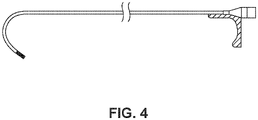
- Figure 4 shows a catheter with a tip (shown as shaded) that includes a polymeric composition as described herein.
- Polyether-block-amide (PEBA) resin (Type: PEBAX 3533) was purchased from Arkema, Inc. The PEBAX resin was dried in a desiccant drier until the moisture content was less than 0.01% by weight.
- HALS and HI were evaluated at various loading levels.
- Table 1 wherein the ratio of hindered amine to carbodiimide compound (HALS:HI) is 1:3 or 3:3 are according to the claimed invention.
- the mixture for each compounded formulation was fed through a hopper into a twin screw extruder under a dry nitrogen blanket.
- the hot extrudate was cooled in a water bath, vacuum dried to remove surface moisture, and fed into a pelletizer.
- the pellets from each formulation group were dried in a desiccant dryer at 200°F/93°C and - 40°F /-40°C dew point until the moisture content was ⁇ 0.01% by weight. After each formulation was dried, the pellets were transferred to a foil bag that was vacuum evacuated and heat sealed.
- Compounded pellets and PEBAX resin were vacuum dried at 60°C for a minimum of 12 hours, and compression molded into slabs, using an 0.064 cm (0.025 inch) inch thick by 12.7 cm ⁇ 12.7 cm (5 inches ⁇ 5 inches) frame, at 238°C using a standard compression molding procedure.
- the compounded pellets, PEBAX resin pellets, and the compression molded sheets were aged in an environmental chamber at 65°C and humidity of 50% relative humidity (RH).
- the samples were evaluated at weeks 1, 2, 4, 6, 10, and 20.
- the molecular weight was determined on the pellets using gel permeation chromatography (GPC).
- the tensile properties of dog bone samples (ASTM die D638_14 type V) were evaluated based on ASTM D638-08, using an INSTRON test system, a gauge length (extensometer) of 0.953 cm (0.375 inch), a jaw separation of 2.54 cm (1 inch), and a crosshead speed of 12.7 cm per minute (5 inches per minute).
- Stabilizer 9000 (available from Raschig GmbH) is a hydrolysis stabilizer. It can act also as a chain extender or crosslinker in polyesters, depending on the dosage and the process conditions. By reacting with carbon acid end groups in the polyester, Stabilizer 9000 "eliminates a viscosity decrease during production, or even increases the viscosity" (see information by Raschig GmbH - Stabilizer 9000 (available at www.raschig.com/-Stabilizer-9000)).
- ester molecule of the polymer is cleaved by the action of water to produce a carboxylic acid and an alcohol. Once initiated, this process accelerates auto-catalytically and results in complete breakdown.
- STABAXOL is an antihydrolysis agent for many polymers, including polyurethane (PU), polyethylene terephthalate (PET), polybutylene terephthalate (PBT), thermoplastic polyurethane (TPU), thermoplastic polyester elastomer (TPEE), and ethylene vinyl acetate (EVA).
- Polymers containing STABAXOL usually show a threefold increase in service life.
- the weight average molecular weight (Mw) as a function of weeks in 65°C/50%RH aging is shown in Figure 1 and Table 2.
- HALS:HI hindered amine to carbodiimide compound
- the Mw decrease is due to degradation by hydrolysis.
- Hydrolysis inhibitors can slow down hydrolytic degradation, and bring about up to a three-fold increase in polymer service life (Stabaxol_brochure_en_120330_online1 (available at https://www.rheinchemie.com/content/uploads/2014/07/stabaxol_brochure en_120330_ online1.pdf)). Hydrolysis inhibitors can also act as a chain extender or crosslinker (Raschig GmbH - "Stabilizer 9000" (available at www.raschig.com/-Stabilizer-9000)). In the compounded formulations the HI at level 1 (HAL:HI levels of 0:1, 1:1, 3:1) increased the initial Mw by about 30 kDa, relative to the control.
- HAL:HI levels of 0:1, 1:1, 3:1 increased the initial Mw by about 30 kDa, relative to the control.
- HALS:HI levels 0:3, 1:3, 3:3) For a HI at level 3 (HALS:HI levels 0:3, 1:3, 3:3) the Mw was almost doubled.
- the HI alone at level 1 (HALS:HI level of 0:1) had the same sharp decline as the control formulation, but crossed the 60 kDa Mw line about two weeks later, probably due to the higher initial Mw.
- the HI alone at level 3 (HALS:HI level of 0:3) had a much slower decline and crossed the 60 kDa line at 20 weeks, similar to that of the PEBAX resin.
- HALS:HI level of 1:0 or 3:0 HALS:HI level of 1:0 or 3:0
- the control formulation no HALS or HI
- crossing the 60 kDa Mw line at 13 weeks at 65°C/50%RH This indicates that HALS UV light stabilizer by itself improves the hydrolytic stability of the control formulation.
- Combinations of HALS and HI at level 1 or 3 crossed the 60 kDa Mw line at 20 weeks at 65°C/50%RH, similar to the PEBAX resin.
- the percent elongation at break as a function of aging time at 65°C/50%RH is graphed in Figure 2 and Table 3. Also here only the examples wherein the ratio of hindered amine to carbodiimide compound (HALS:HI) is 1:3 or 3:3 are according to the claimed invention.
- the initial percent elongation was not changed by the addition of the HALS and HI.
- the control formulation 0:0 (no HALS or HI) and the HI at level 1 (0:1 HALS:HI level) had a sharp decline in percent elongation.
- the HALS:HI levels of 3:1, 1:3, and 3:3 there was no change in the percent elongation up to 20 weeks.
- the neat PEBAX resin also had no decline in percent elongation at 20 weeks of aging at 65C/50%RH.
- Table 3 HALS HI Level Percent Elongation versus Weeks at 65°C/50%RH *Averaged data 0 1 2 4 6 10 20 0:0 843 500 193 69 44 26 n/a 0:1 841 804 767 604 354 100 n/a 1:0, 1:1, 3:0, 0:3* 802 796 789 780 775 760 361 PEBAX 981 1003 1025 1070 1115 1177 941 1:3, 3:1, 3:3 * 801 821 825 827 836 836 806 806
- Polyether-block-amide (PEBA) resin (Type: PEBAX 2533 and 3533) was purchased from Arkema, Inc. One sample, ID 23, the PEBAX resin was ground prior to drying. The PEBAX resin was dried in a desiccant drier until the moisture content was less than 0.01% by weight.
- Tungsten carbide powder (WC), an antioxidant (AO) (IRGANOX 1010), a UV absorber (UVA) (TINUVIN 326), a hindered amine light stabilizer (HALS) (TINUVIN 622, CAS 65447-77-0), and a carbodiimide hydrolysis inhibitor (HI) (Stabilizer 9000, CAS 29963-44-8 and 29117-01-9) were added to the formulations based on Table 5.
- UVA UV absorber
- HALS hindered amine light stabilizer
- HI carbodiimide hydrolysis inhibitor
- HALS and HI were evaluated at various loading levels.
- Table 5 wherein the ratio of hindered amine to carbodiimide compound (HALS:HI) is 1:3 or 3:3 are according to the claimed invention.
- About fifty pounds of each formulation was made per Table 5.
- the additives were pre-mixed and added to the PEBAX resin to homogenize prior to compounding.
- the sample of neat PEBAX resin did not go through the mixing and compounding process. Table 5.
- the mixture for each compounded formulation was fed through a hopper into a twin screw extruder under a dry nitrogen blanket.
- the hot extrudate was cooled in a water bath, vacuum dried to remove surface moisture, and fed into a pelletizer.
- the pellets from each formulation group were dried and transferred to a polyethylene bag and sealed.
- the compounded pellets, PEBAX resin pellets, and the compression molded sheets were aged in an environmental chamber at 65°C and humidity of 50% relative humidity (RH).
- the molecular weight was determined on the pellets using gel permeation chromatography (GPC).
- the tensile properties of dog bone samples (ASTM die D638_14 type V) were evaluated based on ASTM D638-08, using an INSTRON test system, a gauge length (extensometer) of 0.953 cm (0.375 inch), a jaw separation of 2.54 cm (1 inch), and a crosshead speed of 12.7 cm per minute (5 inches per minute). Measurements on formulations from Example 1, Table 1 were continued beyond 20 weeks and combined with formulations in Example 7, Table 5 and the data presented in Figure 5 .
- the weight average molecular weight (Mw) as a function of weeks in 65°C/50%RH aging is shown in Figure 5 .
- the Mw decrease is due to degradation by hydrolysis.
- HALS:HI levels of 4:3, and 4:4 demonstrate that additional amounts of HALS or HI does not change the desirable result observed at level 3:3.
- level 2:2 provides a mid-point between levels of 1:1 and 3:3.
- HALS:HI hindered amine to carbodiimide compound
- the collection of data to 60 weeks shows continued desirable effect beyond the 20 weeks reported in Example 6.
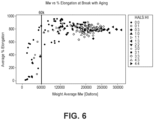
- Figure 6 is a graph of the % elongation at break vs molecular weight and demonstrates that mechanical properties are reduced when the molecular weight falls below 60,000 Daltons.
- Polyether-block-amide (PEBA) resin (Type: PEBAX 3533) was purchased from Arkema, Inc. The PEBAX resin was ground into a powder and dried in a desiccant drier until the moisture content was less than 0.01% by weight.
- Tungsten carbide powder W
- an antioxidant AO
- IRGANOX 1010 UV absorber
- UVA UV absorber
- HI carbodiimide hydrolysis inhibitor
- Stabilizer 9000 CAS 29963-44-8 and 29117-01-9
- HALS hindered amine light stabilizer
- CHIMASORB 944 and poly(4-vinylpyridine barium sulfate
- barium sulfate (B) as an alternate radiopaque filler
- HALS and HI at higher and lower levels, with and/or without tungsten carbide (W) were added to the formulations per Table 6.
- Table 6 wherein the ratio of hindered amine to carbodiimide compound (HALS:HI) is 1:3 or 3:3 are according to the claimed invention.
- the compounded pellets and PEBAX resin pellets were aged in an environmental chamber at a higher temperature of 85°C and 50% relative humidity (RH). The molecular weight was determined on the pellets using gel permeation chromatography (GPC).
- the weight average molecular weight (Mw) as a function of weeks in 65°C/50%RH aging is shown in Figure 7 .
- the Mw decrease is due to degradation by hydrolysis.
- HALS:HI levels 10:10 and 20:20 with or without tungsten carbide, or replacing HALS with alternate weak bases CHIMISORB 944 or poly(4-vinylpyridine), or replacing tungsten-carbide with barium sulfate (B), or using a HALS:HI level 1:1 without tungsten carbide reproduce the desired result observed in HALS:HI level of 3:3.
- Polyether-block-amide (PEBA) resin (Type: PEBAX 3533) was purchased from Arkema, Inc. The PEBAX resin was ground into a powder and dried in a desiccant drier until the moisture content was less than 0.01% by weight.
- the additives were pre-mixed and added to the PEBAX resin to homogenize prior to compounding.
- the sample of neat PEBAX resin did not go through the mixing or compounding process.
- Compounding was performed the same as in Example 8, except for sample number 42, which was compounded with higher shear for comparison to predicate processing.
- the compounded pellets and the PEBAX resin pellets were aged in environmental chambers at 85°C with 50% relative humidity (RH).
- the molecular weight was determined on the pellets using gel permeation chromatography (GPC).
- the weight average molecular weight (Mw) as a function of weeks in 85°C/50%RH aging is shown in Figures 8a and 8b .
- the Mw decrease is due to degradation by hydrolysis.
- Figure 8a is a graph of the effect of all 5 additives on the hydrolytic stability of PEBAX. It should be noted that the molecular weight values reported on and after week 28 were measured using a GPC system with different GPC columns, PPMA standards, and calibration methods than previous Examples, which produced lower relative molecular weight values. Molecular weight collected by GPC is a relative test of the actual molecular weight of the material, and therefore may be affected by the instrument, test method, type of columns, type of detectors, etc. used to generate the result.
- Figure 8b is a subset of the samples in Figure 8a , containing tungsten-carbide, and demonstrates that the desirable result exemplified in Examples 6 and 11 is not dependent on the anti-oxidant (AO) or ultra-violet absorber (UVA) included in any previous Examples.
- AO anti-oxidant
- UVA ultra-violet absorber
- Example 4 Material from Example 4 aged for 10 weeks (for level 0:0) and 20 weeks (for levels 3:0, 0:3, and 3:3) was further studied using 13 C Nuclear Magnetic Resonance (NMR). Hereby only the level of 3:3 is according to the claimed invention.
- NMR 13 C Nuclear Magnetic Resonance
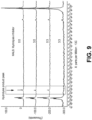
- the NMR spectra in Figure 9 shows a hydrolytic degradation byproduct in the HALS:HI level 0:0 within 10 weeks of aging.
- the degradation observed is due to the hydrolysis of the ester bond linkage in the PEBAX resin, indicated by the peak at 62-63 ppm which detects CH 2 groups next to hydroxyl groups that are a result of hydrolysis.
Landscapes
- Health & Medical Sciences (AREA)
- Chemical & Material Sciences (AREA)
- Chemical Kinetics & Catalysis (AREA)
- Medicinal Chemistry (AREA)
- Polymers & Plastics (AREA)
- Organic Chemistry (AREA)
- Epidemiology (AREA)
- Life Sciences & Earth Sciences (AREA)
- Animal Behavior & Ethology (AREA)
- General Health & Medical Sciences (AREA)
- Public Health (AREA)
- Veterinary Medicine (AREA)
- Physics & Mathematics (AREA)
- Optics & Photonics (AREA)
- Compositions Of Macromolecular Compounds (AREA)
- Pharmaceuticals Containing Other Organic And Inorganic Compounds (AREA)
- Materials For Medical Uses (AREA)
Claims (6)
- Zusammensetzung, umfassend:ein Polymer, umfassend einen Polyether oder ein Polyetherblockam id;eine Carbodiimid-Verbindung in einer Menge von mindestens 0,1 Gew.-% bis 20 Gew.-% basierend auf dem Gewicht des Polymers allein; undein gehindertes Amin in einer Menge von mindestens 0,1 Gew.-% bis 20 Gew.-% basierend auf dem Gewicht des Polymers allein;wobei die Carbodiim id-Verbindung und das gehinderte Am in in Mengen verwendet werden, die wirksam sind, um die Rate und/oder das Ausmaß des hydrolytischen Abbaus des Polymers relativ zu einem der beiden zu verringern, die/das allein in der gleichen Menge mit dem Polym er verwendet wird;wobei das Verhältnis von gehindertem Am in zu Carbodiim id-Verbindung 1 : 3 oder 3 : 3 ist;wobei die Carbodiim id-Verbindung ein 2,6- oder 2,4,6-Isopropyl-substituiertes aromatisches Polycarbodiim id umfasst, das eine zahlenmittlere Molekularmasse von 1.000 g/mol bis 50.000 g/mol aufweist; oderein sterisch gehindertes Carbodiimid, das durch die Formel (II) dargestellt wird:
R1-N=C=N-[R2-N=C=N]n-R3
wobei:n 0 bis 1.000 ist;R1 und R3 einzeln eine einwertige aliphatische Gruppe, die 1 bis 40 Kohlenstoffatome aufweist, eine cycloaliphatische Gruppe, die 6 bis 40 Kohlenstoffatome aufweist, eine aromatische Gruppe, die 6 bis 40 Kohlenstoffatom e aufweist, oder Kombinationen davon darstellen; undR2 eine zweiwertige aliphatische Gruppe, die 1 bis 40 Kohlenstoffatome aufweist, eine cycloaliphatische Gruppe, die 6 bis 40 Kohlenstoffatome aufweist, eine aromatische Gruppe, die 6 bis 40 Kohlenstoffatome aufweist, oder Kombinationen davon darstellt; oderwobei die Carbodiimid-Verbindung eine polymere Carbodiimid-Verbindung ist, die durch die Formel (I) dargestellt wird: wobei n eine Anzahl von Wiederholungseinheiten darstellt;wobei das gehinderte Am in eine oder mehrere Verbindungen der Formeln (III) und (IV) umfasst:
 wobei:R' Wasserstoff, Oxy, Hydroxy, Alkyl mit 1 bis 18 Kohlenstoffatomen, Alkenyl mit 3 bis 18 Kohlenstoffatomen, Aralkyl mit 7 bis 9 Kohlenstoffatomen, Cycloalkyl mit 5 bis 12 Kohlenstoffatomen, Hydroxyalkyl mit 2 bis 6 Kohlenstoffatomen, Alkoxyalkyl mit 2 bis 20 Kohlenstoffatom en, Alkanoyl mit 1 bis 18 Kohlenstoffatom en, Alkoxy mit 1 bis 18 Kohlenstoffatom en, Cycloalkoxy mit 5 bis 12 Kohlenstoffatom en, Aryloxy mit 6 bis 10 Kohlenstoffatomen, Hydroxyalkoxy mit 2 bis 6 Kohlenstoffatomen, Alkoxyalkoxy mit 2 bis 20 Kohlenstoffatom en, Aralkoxy mit 7 bis 15 Kohlenstoffatom en oder Bicyclo- oder nicycloaliphatisches Oxyradikal mit 7 bis 12 Kohlenstoffatom en darstellt;G1, G2, G3 und G4 jeweils unabhängig eine Alkylgruppe mit 1 bis 4 Kohlenstoffatomen oder G1 und G2 und/oder G3 und G4 zusammen Pentamethylen darstellen;R eine zweiwertige organische Gruppe darstellt; undn eine Anzahl von Wiederholungseinheiten darstellt; oderwobei das gehinderte Am in umfasst:


 wobei n eine Anzahl von Wiederholungseinheiten in jedem Polymer darstellt.
 - Zusammensetzung nach Anspruch 1, die das gesamte oder einen Teil eines Enderzeugnisses ausbildet und wobei das Enderzeugnis eine medizinische Vorrichtung ist.
- Zusammensetzung nach einem der Ansprüche 1 oder 2, ferner umfassend einen Füllstoff.
- Zusammensetzung nach Anspruch 3, wobei der Füllstoff Wolframcarbid, Bariumsulfat, Silber, Wolfram, Tantal, Bismut, Platin-Iridium-Legierung, Bismut-Subcarbonat, Bismuttrioxid, Bismutoxychlorid, Glas oder Kombinationen davon umfasst.
- Zusammensetzung nach Anspruch 4, wobei der Füllstoff Wolframcarbidpulver umfasst.
- Erzeugnis, umfassend die Zusammensetzung nach einem der Ansprüche 1 bis 5, das Erzeugnis umfassend einen Katheter, der eine röntgenstrahlenundurchlässige Markierung aufweist.
Applications Claiming Priority (2)
| Application Number | Priority Date | Filing Date | Title |
|---|---|---|---|
| US201662328742P | 2016-04-28 | 2016-04-28 | |
| PCT/US2017/029694 WO2017189761A1 (en) | 2016-04-28 | 2017-04-26 | Hydrolytically stable polymer compositions, articles, and methods |
Publications (2)
| Publication Number | Publication Date |
|---|---|
| EP3448449A1 EP3448449A1 (de) | 2019-03-06 |
| EP3448449B1 true EP3448449B1 (de) | 2023-02-22 |
Family
ID=58794141
Family Applications (1)
| Application Number | Title | Priority Date | Filing Date |
|---|---|---|---|
| EP17726392.8A Active EP3448449B1 (de) | 2016-04-28 | 2017-04-26 | Hydrolytisch stabile polymerzusammensetzungen, artikel und verfahren |
Country Status (4)
| Country | Link |
|---|---|
| US (1) | US10472493B2 (de) |
| EP (1) | EP3448449B1 (de) |
| CN (1) | CN109069700B (de) |
| WO (1) | WO2017189761A1 (de) |
Families Citing this family (7)
| Publication number | Priority date | Publication date | Assignee | Title |
|---|---|---|---|---|
| FR3073848B1 (fr) * | 2017-11-17 | 2020-11-13 | Arkema France | Copolymere a blocs presentant des resistances ameliorees a l'abrasion et a la dechirure |
| EP3636714B1 (de) | 2018-10-12 | 2024-02-28 | AKRO-PLASTIC GmbH | Thermoplastische bauteile für die verwendung in kühlkreisläufen |
| CA3208849A1 (en) * | 2021-01-28 | 2022-08-04 | Henkel Ag & Co. Kgaa | Process of incorporating gelling and phase separation inhibitor into a filled polyurethane reactive hot melt adhesive |
| JP2024513177A (ja) | 2021-03-23 | 2024-03-22 | ビーエーエスエフ ソシエタス・ヨーロピア | 耐加水分解性が向上したポリアミド組成物、その製造方法、その用途及びそれから製造された物品 |
| CN120659633A (zh) * | 2023-05-17 | 2025-09-16 | 泰尔茂株式会社 | 导管尖端 |
| WO2024262386A1 (ja) * | 2023-06-22 | 2024-12-26 | テルモ株式会社 | カテーテル |
| CN121001778A (zh) * | 2023-06-22 | 2025-11-21 | 泰尔茂株式会社 | 导管 |
Family Cites Families (22)
| Publication number | Priority date | Publication date | Assignee | Title |
|---|---|---|---|---|
| US4520171A (en) | 1982-05-05 | 1985-05-28 | Hercules Incorporated | Polymeric hindered amines |
| CH670831A5 (de) | 1986-11-25 | 1989-07-14 | Inventa Ag | |
| IT1237126B (it) | 1989-11-07 | 1993-05-18 | Ciba Geigy Spa | Stabilizzanti polimerici contenenti gruppi amminici impediti e gruppi idrossilamminici |
| DE4214193A1 (de) | 1992-04-30 | 1993-11-04 | Rhein Chemie Rheinau Gmbh | Hydrolysestabile polyamide |
| JP2004530785A (ja) | 2001-06-29 | 2004-10-07 | チバ スペシャルティ ケミカルズ ホールディング インコーポレーテッド | ナノスケール充填剤立体障害性とアミン系光安定剤との相乗的組み合わせ |
| JP4151398B2 (ja) * | 2002-12-11 | 2008-09-17 | 東洋インキ製造株式会社 | 縮合型熱可塑性樹脂組成物及びその利用 |
| MY139524A (en) | 2004-06-30 | 2009-10-30 | Ciba Holding Inc | Stabilization of polyether polyol, polyester polyol or polyurethane compositions |
| ES2337487T3 (es) * | 2005-09-21 | 2010-04-26 | Raschig Gmbh | Formulaciones que comprenden agentes estabilizadores frente a la hidrolisis. |
| US20080242783A1 (en) * | 2007-03-29 | 2008-10-02 | Balakrishnan Ganesan | Polyester compositions having improved heat resistance |
| US8147769B1 (en) | 2007-05-16 | 2012-04-03 | Abbott Cardiovascular Systems Inc. | Stent and delivery system with reduced chemical degradation |
| US8637584B2 (en) | 2007-05-25 | 2014-01-28 | Air Products And Chemicals, Inc. | Polyester polyol-containing polyurethane systems having improved hydrolytic stability |
| US20090018633A1 (en) | 2007-07-10 | 2009-01-15 | Boston Scientific Scimed, Inc. | Protector for an insertable or implantable medical device |
| CN101883808B (zh) * | 2007-10-04 | 2013-01-16 | 帝人株式会社 | 具有植物来源成分的聚碳酸酯及其制备方法 |
| CA2762930A1 (en) | 2009-06-08 | 2010-12-16 | Basf Se | Sterically hindered amine stabilizers |
| JP6176921B2 (ja) | 2009-06-08 | 2017-08-09 | ビーエーエスエフ ソシエタス・ヨーロピアBasf Se | 新規な立体障害アミン光安定剤 |
| EP2292712A1 (de) | 2009-09-02 | 2011-03-09 | Rhein Chemie Rheinau GmbH | Verwendung von Carbodiimiden als Farbstabilisator in Schmelzklebstoffen |
| US20130005872A1 (en) * | 2010-03-26 | 2013-01-03 | Yukihiro Kiuchi | Polylactic acid resin composition containing phosphorus compound and polysiloxane compound and molded article made by using the same |
| WO2011153184A1 (en) | 2010-06-01 | 2011-12-08 | Astenjohnson, Inc. | Monofilaments comprised of a polymer blend of a thermoplastic polyester, a thermoplastic polyurethane and a carbodiimide |
| MX338658B (es) * | 2010-07-08 | 2016-04-27 | Mitsubishi Gas Chemical Co | Composicion de resina de poliamida. |
| US20120071823A1 (en) * | 2010-09-22 | 2012-03-22 | Boston Scientific Scimed, Inc. | Medical balloon having improved stability and strength |
| WO2015194583A1 (ja) * | 2014-06-19 | 2015-12-23 | 東洋紡株式会社 | 熱可塑性ポリエステルエラストマー組成物 |
| US20180334593A1 (en) * | 2015-12-15 | 2018-11-22 | Mitsui Chemicals, Inc. | Laminate and method for manufacturing same, and composition for adhesion |
-
2017
- 2017-04-26 US US15/498,146 patent/US10472493B2/en active Active
- 2017-04-26 EP EP17726392.8A patent/EP3448449B1/de active Active
- 2017-04-26 WO PCT/US2017/029694 patent/WO2017189761A1/en not_active Ceased
- 2017-04-26 CN CN201780024378.7A patent/CN109069700B/zh active Active
Also Published As
| Publication number | Publication date |
|---|---|
| EP3448449A1 (de) | 2019-03-06 |
| CN109069700B (zh) | 2022-03-08 |
| US20170313853A1 (en) | 2017-11-02 |
| WO2017189761A1 (en) | 2017-11-02 |
| CN109069700A (zh) | 2018-12-21 |
| US10472493B2 (en) | 2019-11-12 |
Similar Documents
| Publication | Publication Date | Title |
|---|---|---|
| US10472493B2 (en) | Hydrolytically stable polymer compositions, articles, and methods | |
| JP6532875B2 (ja) | 成形用樹脂組成物 | |
| DE2933078A1 (de) | Neue triazinderivate, ihre herstellung und ihre verwendung als stabilisatoren fuer synthetische polymere | |
| EP1814939B1 (de) | Ultraviolettes licht (uv) absorbierende verbindungen und ultraviolettes licht (uv) absorbierende verbindungen enthaltende zusammensetzungen | |
| BRPI1015965B1 (pt) | poliuretano termoplástico, processo para produzir um poliuretano termoplástico, produto, e, uso de um éster | |
| EP2335746A1 (de) | Medizinisches gerät, medizinisches material und verfahren zu ihrer herstellung | |
| CN110651006A (zh) | 低排放聚甲醛组合物 | |
| JP4262990B2 (ja) | ハロゲン含有ポリマー用微分散安定化剤組成物 | |
| KR20180113972A (ko) | Pbat 수지 조성물 | |
| EP2364335B1 (de) | Verfahren zur herstellung wärmefester mineralgefüllter polyacetalzusammensetzungen | |
| DE69612746T2 (de) | Überbasischer pvc stabilisator | |
| KR101909434B1 (ko) | 수지 조성물용 가소제 및 이를 포함하는 수지 조성물 | |
| CN1168683A (zh) | 3-芳基丙烯酸酯作为无生命的有机物质的光防护剂和稳定剂的应用 | |
| RU2396292C2 (ru) | Термопластичный материал с регулируемым полезным сроком службы, способ его изготовления и продукты из него | |
| EP2665779B1 (de) | Flammgeschützte thermoplastische formmasse | |
| CN1527862A (zh) | 用于聚酰胺的抗氧化剂 | |
| JPH0678310B2 (ja) | ヒンダードアミン基を持つ新規なジヒドロピリジン | |
| US20150240080A1 (en) | Hydrolytically stable functionalized polyphosphonate flame retardant | |
| JP7374420B2 (ja) | 樹脂組成物、樹脂成形体、および樹脂成形体の製造方法 | |
| EP1492842B1 (de) | Verbindungen zur reduzierung des acetaldehydgehalts von polyethylenterephthalat , ihre verwendung und daraus erhaltene produkte | |
| WO2003031506A1 (de) | Stabilisatorengemisch und stabilisierte polyurethane | |
| EP2857454B1 (de) | Polymilchsäureharzzusammensetzung | |
| EP1836251B1 (de) | Phosphitester enthaltende stabilisatorzusammensetzung | |
| US9580573B2 (en) | Mixtures containing trimellitic acid ester and polyether polyol ester as plasticizers, use of the mixtures for producing polymer compounds and PVC materials containing said mixtures | |
| CA3116438C (en) | Polyglycolide copolymer and preparation thereof |
Legal Events
| Date | Code | Title | Description |
|---|---|---|---|
| STAA | Information on the status of an ep patent application or granted ep patent |
Free format text: STATUS: UNKNOWN |
|
| STAA | Information on the status of an ep patent application or granted ep patent |
Free format text: STATUS: THE INTERNATIONAL PUBLICATION HAS BEEN MADE |
|
| PUAI | Public reference made under article 153(3) epc to a published international application that has entered the european phase |
Free format text: ORIGINAL CODE: 0009012 |
|
| STAA | Information on the status of an ep patent application or granted ep patent |
Free format text: STATUS: REQUEST FOR EXAMINATION WAS MADE |
|
| 17P | Request for examination filed |
Effective date: 20181128 |
|
| AK | Designated contracting states |
Kind code of ref document: A1 Designated state(s): AL AT BE BG CH CY CZ DE DK EE ES FI FR GB GR HR HU IE IS IT LI LT LU LV MC MK MT NL NO PL PT RO RS SE SI SK SM TR |
|
| AX | Request for extension of the european patent |
Extension state: BA ME |
|
| RIN1 | Information on inventor provided before grant (corrected) |
Inventor name: OWINGS, SAMUEL I. Inventor name: DRAKE, RONALD A. Inventor name: DUNN, PATRICIA E. Inventor name: CHEN, XIANGJI |
|
| DAV | Request for validation of the european patent (deleted) | ||
| DAX | Request for extension of the european patent (deleted) | ||
| STAA | Information on the status of an ep patent application or granted ep patent |
Free format text: STATUS: EXAMINATION IS IN PROGRESS |
|
| 17Q | First examination report despatched |
Effective date: 20200128 |
|
| GRAP | Despatch of communication of intention to grant a patent |
Free format text: ORIGINAL CODE: EPIDOSNIGR1 |
|
| STAA | Information on the status of an ep patent application or granted ep patent |
Free format text: STATUS: GRANT OF PATENT IS INTENDED |
|
| INTG | Intention to grant announced |
Effective date: 20220923 |
|
| RIC1 | Information provided on ipc code assigned before grant |
Ipc: C08L 77/12 20060101ALI20220909BHEP Ipc: A61L 29/18 20060101ALI20220909BHEP Ipc: A61L 29/06 20060101AFI20220909BHEP |
|
| GRAS | Grant fee paid |
Free format text: ORIGINAL CODE: EPIDOSNIGR3 |
|
| GRAA | (expected) grant |
Free format text: ORIGINAL CODE: 0009210 |
|
| STAA | Information on the status of an ep patent application or granted ep patent |
Free format text: STATUS: THE PATENT HAS BEEN GRANTED |
|
| AK | Designated contracting states |
Kind code of ref document: B1 Designated state(s): AL AT BE BG CH CY CZ DE DK EE ES FI FR GB GR HR HU IE IS IT LI LT LU LV MC MK MT NL NO PL PT RO RS SE SI SK SM TR |
|
| REG | Reference to a national code |
Ref country code: GB Ref legal event code: FG4D |
|
| REG | Reference to a national code |
Ref country code: CH Ref legal event code: EP |
|
| REG | Reference to a national code |
Ref country code: AT Ref legal event code: REF Ref document number: 1549100 Country of ref document: AT Kind code of ref document: T Effective date: 20230315 Ref country code: IE Ref legal event code: FG4D |
|
| REG | Reference to a national code |
Ref country code: DE Ref legal event code: R096 Ref document number: 602017066184 Country of ref document: DE |
|
| REG | Reference to a national code |
Ref country code: LT Ref legal event code: MG9D |
|
| REG | Reference to a national code |
Ref country code: NL Ref legal event code: MP Effective date: 20230222 |
|
| REG | Reference to a national code |
Ref country code: AT Ref legal event code: MK05 Ref document number: 1549100 Country of ref document: AT Kind code of ref document: T Effective date: 20230222 |
|
| PG25 | Lapsed in a contracting state [announced via postgrant information from national office to epo] |
Ref country code: RS Free format text: LAPSE BECAUSE OF FAILURE TO SUBMIT A TRANSLATION OF THE DESCRIPTION OR TO PAY THE FEE WITHIN THE PRESCRIBED TIME-LIMIT Effective date: 20230222 Ref country code: PT Free format text: LAPSE BECAUSE OF FAILURE TO SUBMIT A TRANSLATION OF THE DESCRIPTION OR TO PAY THE FEE WITHIN THE PRESCRIBED TIME-LIMIT Effective date: 20230622 Ref country code: NO Free format text: LAPSE BECAUSE OF FAILURE TO SUBMIT A TRANSLATION OF THE DESCRIPTION OR TO PAY THE FEE WITHIN THE PRESCRIBED TIME-LIMIT Effective date: 20230522 Ref country code: NL Free format text: LAPSE BECAUSE OF FAILURE TO SUBMIT A TRANSLATION OF THE DESCRIPTION OR TO PAY THE FEE WITHIN THE PRESCRIBED TIME-LIMIT Effective date: 20230222 Ref country code: LV Free format text: LAPSE BECAUSE OF FAILURE TO SUBMIT A TRANSLATION OF THE DESCRIPTION OR TO PAY THE FEE WITHIN THE PRESCRIBED TIME-LIMIT Effective date: 20230222 Ref country code: LT Free format text: LAPSE BECAUSE OF FAILURE TO SUBMIT A TRANSLATION OF THE DESCRIPTION OR TO PAY THE FEE WITHIN THE PRESCRIBED TIME-LIMIT Effective date: 20230222 Ref country code: HR Free format text: LAPSE BECAUSE OF FAILURE TO SUBMIT A TRANSLATION OF THE DESCRIPTION OR TO PAY THE FEE WITHIN THE PRESCRIBED TIME-LIMIT Effective date: 20230222 Ref country code: ES Free format text: LAPSE BECAUSE OF FAILURE TO SUBMIT A TRANSLATION OF THE DESCRIPTION OR TO PAY THE FEE WITHIN THE PRESCRIBED TIME-LIMIT Effective date: 20230222 Ref country code: AT Free format text: LAPSE BECAUSE OF FAILURE TO SUBMIT A TRANSLATION OF THE DESCRIPTION OR TO PAY THE FEE WITHIN THE PRESCRIBED TIME-LIMIT Effective date: 20230222 |
|
| PG25 | Lapsed in a contracting state [announced via postgrant information from national office to epo] |
Ref country code: SE Free format text: LAPSE BECAUSE OF FAILURE TO SUBMIT A TRANSLATION OF THE DESCRIPTION OR TO PAY THE FEE WITHIN THE PRESCRIBED TIME-LIMIT Effective date: 20230222 Ref country code: PL Free format text: LAPSE BECAUSE OF FAILURE TO SUBMIT A TRANSLATION OF THE DESCRIPTION OR TO PAY THE FEE WITHIN THE PRESCRIBED TIME-LIMIT Effective date: 20230222 Ref country code: IS Free format text: LAPSE BECAUSE OF FAILURE TO SUBMIT A TRANSLATION OF THE DESCRIPTION OR TO PAY THE FEE WITHIN THE PRESCRIBED TIME-LIMIT Effective date: 20230622 Ref country code: GR Free format text: LAPSE BECAUSE OF FAILURE TO SUBMIT A TRANSLATION OF THE DESCRIPTION OR TO PAY THE FEE WITHIN THE PRESCRIBED TIME-LIMIT Effective date: 20230523 Ref country code: FI Free format text: LAPSE BECAUSE OF FAILURE TO SUBMIT A TRANSLATION OF THE DESCRIPTION OR TO PAY THE FEE WITHIN THE PRESCRIBED TIME-LIMIT Effective date: 20230222 |
|
| PG25 | Lapsed in a contracting state [announced via postgrant information from national office to epo] |
Ref country code: SM Free format text: LAPSE BECAUSE OF FAILURE TO SUBMIT A TRANSLATION OF THE DESCRIPTION OR TO PAY THE FEE WITHIN THE PRESCRIBED TIME-LIMIT Effective date: 20230222 Ref country code: RO Free format text: LAPSE BECAUSE OF FAILURE TO SUBMIT A TRANSLATION OF THE DESCRIPTION OR TO PAY THE FEE WITHIN THE PRESCRIBED TIME-LIMIT Effective date: 20230222 Ref country code: EE Free format text: LAPSE BECAUSE OF FAILURE TO SUBMIT A TRANSLATION OF THE DESCRIPTION OR TO PAY THE FEE WITHIN THE PRESCRIBED TIME-LIMIT Effective date: 20230222 Ref country code: DK Free format text: LAPSE BECAUSE OF FAILURE TO SUBMIT A TRANSLATION OF THE DESCRIPTION OR TO PAY THE FEE WITHIN THE PRESCRIBED TIME-LIMIT Effective date: 20230222 Ref country code: CZ Free format text: LAPSE BECAUSE OF FAILURE TO SUBMIT A TRANSLATION OF THE DESCRIPTION OR TO PAY THE FEE WITHIN THE PRESCRIBED TIME-LIMIT Effective date: 20230222 |
|
| REG | Reference to a national code |
Ref country code: DE Ref legal event code: R097 Ref document number: 602017066184 Country of ref document: DE |
|
| PG25 | Lapsed in a contracting state [announced via postgrant information from national office to epo] |
Ref country code: SK Free format text: LAPSE BECAUSE OF FAILURE TO SUBMIT A TRANSLATION OF THE DESCRIPTION OR TO PAY THE FEE WITHIN THE PRESCRIBED TIME-LIMIT Effective date: 20230222 |
|
| REG | Reference to a national code |
Ref country code: CH Ref legal event code: PL |
|
| PG25 | Lapsed in a contracting state [announced via postgrant information from national office to epo] |
Ref country code: LU Free format text: LAPSE BECAUSE OF NON-PAYMENT OF DUE FEES Effective date: 20230426 |
|
| PLBE | No opposition filed within time limit |
Free format text: ORIGINAL CODE: 0009261 |
|
| STAA | Information on the status of an ep patent application or granted ep patent |
Free format text: STATUS: NO OPPOSITION FILED WITHIN TIME LIMIT |
|
| REG | Reference to a national code |
Ref country code: BE Ref legal event code: MM Effective date: 20230430 |
|
| PG25 | Lapsed in a contracting state [announced via postgrant information from national office to epo] |
Ref country code: MC Free format text: LAPSE BECAUSE OF FAILURE TO SUBMIT A TRANSLATION OF THE DESCRIPTION OR TO PAY THE FEE WITHIN THE PRESCRIBED TIME-LIMIT Effective date: 20230222 |
|
| GBPC | Gb: european patent ceased through non-payment of renewal fee |
Effective date: 20230522 |
|
| 26N | No opposition filed |
Effective date: 20231123 |
|
| PG25 | Lapsed in a contracting state [announced via postgrant information from national office to epo] |
Ref country code: SI Free format text: LAPSE BECAUSE OF FAILURE TO SUBMIT A TRANSLATION OF THE DESCRIPTION OR TO PAY THE FEE WITHIN THE PRESCRIBED TIME-LIMIT Effective date: 20230222 Ref country code: MC Free format text: LAPSE BECAUSE OF FAILURE TO SUBMIT A TRANSLATION OF THE DESCRIPTION OR TO PAY THE FEE WITHIN THE PRESCRIBED TIME-LIMIT Effective date: 20230222 Ref country code: LI Free format text: LAPSE BECAUSE OF NON-PAYMENT OF DUE FEES Effective date: 20230430 Ref country code: CH Free format text: LAPSE BECAUSE OF NON-PAYMENT OF DUE FEES Effective date: 20230430 |
|
| REG | Reference to a national code |
Ref country code: IE Ref legal event code: MM4A |
|
| PG25 | Lapsed in a contracting state [announced via postgrant information from national office to epo] |
Ref country code: BE Free format text: LAPSE BECAUSE OF NON-PAYMENT OF DUE FEES Effective date: 20230430 |
|
| PG25 | Lapsed in a contracting state [announced via postgrant information from national office to epo] |
Ref country code: IE Free format text: LAPSE BECAUSE OF NON-PAYMENT OF DUE FEES Effective date: 20230426 |
|
| PG25 | Lapsed in a contracting state [announced via postgrant information from national office to epo] |
Ref country code: IE Free format text: LAPSE BECAUSE OF NON-PAYMENT OF DUE FEES Effective date: 20230426 Ref country code: GB Free format text: LAPSE BECAUSE OF NON-PAYMENT OF DUE FEES Effective date: 20230522 |
|
| PG25 | Lapsed in a contracting state [announced via postgrant information from national office to epo] |
Ref country code: IT Free format text: LAPSE BECAUSE OF FAILURE TO SUBMIT A TRANSLATION OF THE DESCRIPTION OR TO PAY THE FEE WITHIN THE PRESCRIBED TIME-LIMIT Effective date: 20230222 |
|
| PG25 | Lapsed in a contracting state [announced via postgrant information from national office to epo] |
Ref country code: BG Free format text: LAPSE BECAUSE OF FAILURE TO SUBMIT A TRANSLATION OF THE DESCRIPTION OR TO PAY THE FEE WITHIN THE PRESCRIBED TIME-LIMIT Effective date: 20230222 |
|
| PG25 | Lapsed in a contracting state [announced via postgrant information from national office to epo] |
Ref country code: BG Free format text: LAPSE BECAUSE OF FAILURE TO SUBMIT A TRANSLATION OF THE DESCRIPTION OR TO PAY THE FEE WITHIN THE PRESCRIBED TIME-LIMIT Effective date: 20230222 |
|
| PGFP | Annual fee paid to national office [announced via postgrant information from national office to epo] |
Ref country code: DE Payment date: 20250319 Year of fee payment: 9 |
|
| PG25 | Lapsed in a contracting state [announced via postgrant information from national office to epo] |
Ref country code: CY Free format text: LAPSE BECAUSE OF FAILURE TO SUBMIT A TRANSLATION OF THE DESCRIPTION OR TO PAY THE FEE WITHIN THE PRESCRIBED TIME-LIMIT; INVALID AB INITIO Effective date: 20170426 |
|
| PG25 | Lapsed in a contracting state [announced via postgrant information from national office to epo] |
Ref country code: HU Free format text: LAPSE BECAUSE OF FAILURE TO SUBMIT A TRANSLATION OF THE DESCRIPTION OR TO PAY THE FEE WITHIN THE PRESCRIBED TIME-LIMIT; INVALID AB INITIO Effective date: 20170426 |
|
| PG25 | Lapsed in a contracting state [announced via postgrant information from national office to epo] |
Ref country code: TR Free format text: LAPSE BECAUSE OF FAILURE TO SUBMIT A TRANSLATION OF THE DESCRIPTION OR TO PAY THE FEE WITHIN THE PRESCRIBED TIME-LIMIT Effective date: 20230222 |
|
| PGFP | Annual fee paid to national office [announced via postgrant information from national office to epo] |
Ref country code: FR Payment date: 20260320 Year of fee payment: 10 |