EP3449942A1 - Méthode pour le traitement de la sclérose en plaques - Google Patents
Méthode pour le traitement de la sclérose en plaques Download PDFInfo
- Publication number
- EP3449942A1 EP3449942A1 EP17789647.9A EP17789647A EP3449942A1 EP 3449942 A1 EP3449942 A1 EP 3449942A1 EP 17789647 A EP17789647 A EP 17789647A EP 3449942 A1 EP3449942 A1 EP 3449942A1
- Authority
- EP
- European Patent Office
- Prior art keywords
- group
- carbon atoms
- phenyl
- dione
- naphtho
- Prior art date
- Legal status (The legal status is an assumption and is not a legal conclusion. Google has not performed a legal analysis and makes no representation as to the accuracy of the status listed.)
- Pending
Links
- 0 CCC1=C(CCCC*(C)**)C=C(C)CC(N(C)C2=O)=C1N(*)C2=O Chemical compound CCC1=C(CCCC*(C)**)C=C(C)CC(N(C)C2=O)=C1N(*)C2=O 0.000 description 5
- RISPHECRKPHBPT-UHFFFAOYSA-N COC(C1)N(c2ccccc2)c(ccc2c3cccc2)c3NC1=O Chemical compound COC(C1)N(c2ccccc2)c(ccc2c3cccc2)c3NC1=O RISPHECRKPHBPT-UHFFFAOYSA-N 0.000 description 1
- AMGLIQJVTILRDY-UHFFFAOYSA-N O=C(C1)Nc(c(cccc2)c2cc2)c2N(c2ccccc2)C1=O Chemical compound O=C(C1)Nc(c(cccc2)c2cc2)c2N(c2ccccc2)C1=O AMGLIQJVTILRDY-UHFFFAOYSA-N 0.000 description 1
- NFSYNQKDYNZJOR-UHFFFAOYSA-N O=C1Nc(c(cccc2)c2cc2)c2C(c2ccccc2)=NC1 Chemical compound O=C1Nc(c(cccc2)c2cc2)c2C(c2ccccc2)=NC1 NFSYNQKDYNZJOR-UHFFFAOYSA-N 0.000 description 1
Images


Classifications
-
- A—HUMAN NECESSITIES
- A61—MEDICAL OR VETERINARY SCIENCE; HYGIENE
- A61K—PREPARATIONS FOR MEDICAL, DENTAL OR TOILETRY PURPOSES
- A61K31/00—Medicinal preparations containing organic active ingredients
- A61K31/33—Heterocyclic compounds
- A61K31/395—Heterocyclic compounds having nitrogen as a ring hetero atom, e.g. guanethidine or rifamycins
- A61K31/55—Heterocyclic compounds having nitrogen as a ring hetero atom, e.g. guanethidine or rifamycins having seven-membered rings, e.g. azelastine, pentylenetetrazole
- A61K31/551—Heterocyclic compounds having nitrogen as a ring hetero atom, e.g. guanethidine or rifamycins having seven-membered rings, e.g. azelastine, pentylenetetrazole having two nitrogen atoms, e.g. dilazep
-
- A—HUMAN NECESSITIES
- A61—MEDICAL OR VETERINARY SCIENCE; HYGIENE
- A61K—PREPARATIONS FOR MEDICAL, DENTAL OR TOILETRY PURPOSES
- A61K31/00—Medicinal preparations containing organic active ingredients
- A61K31/33—Heterocyclic compounds
- A61K31/395—Heterocyclic compounds having nitrogen as a ring hetero atom, e.g. guanethidine or rifamycins
- A61K31/55—Heterocyclic compounds having nitrogen as a ring hetero atom, e.g. guanethidine or rifamycins having seven-membered rings, e.g. azelastine, pentylenetetrazole
- A61K31/551—Heterocyclic compounds having nitrogen as a ring hetero atom, e.g. guanethidine or rifamycins having seven-membered rings, e.g. azelastine, pentylenetetrazole having two nitrogen atoms, e.g. dilazep
- A61K31/5513—1,4-Benzodiazepines, e.g. diazepam or clozapine
-
- A—HUMAN NECESSITIES
- A61—MEDICAL OR VETERINARY SCIENCE; HYGIENE
- A61P—SPECIFIC THERAPEUTIC ACTIVITY OF CHEMICAL COMPOUNDS OR MEDICINAL PREPARATIONS
- A61P25/00—Drugs for disorders of the nervous system
-
- A—HUMAN NECESSITIES
- A61—MEDICAL OR VETERINARY SCIENCE; HYGIENE
- A61P—SPECIFIC THERAPEUTIC ACTIVITY OF CHEMICAL COMPOUNDS OR MEDICINAL PREPARATIONS
- A61P25/00—Drugs for disorders of the nervous system
- A61P25/04—Centrally acting analgesics, e.g. opioids
-
- A—HUMAN NECESSITIES
- A61—MEDICAL OR VETERINARY SCIENCE; HYGIENE
- A61P—SPECIFIC THERAPEUTIC ACTIVITY OF CHEMICAL COMPOUNDS OR MEDICINAL PREPARATIONS
- A61P43/00—Drugs for specific purposes, not provided for in groups A61P1/00-A61P41/00
Definitions
- the present invention relates to a medicament for preventive and/or therapeutic treatment of multiple sclerosis.
- MS Multiple sclerosis
- MS is an inflammatory demyelinating disease of the central nerves, and is characterized by central nerve lesions frequently occurring spatially and temporally. It is the most frequently occurring disease among neurological disorders that affect young adults in Europe and America, where the prevalence rate per population of 100,000 is around 50, and the number of persons with this disease in Japan is estimated to be about 13,000 as a whole (about 8 or 9 persons per population of 100,000). It cannot be said that causes of the onset of this disease have fully been elucidated, although genetic factors, environmental factors, virus infection, and the like have been suggested, and it is a designated intractable disease authorized as a specified disease in Japan.
- the ATP receptors are broadly classified into the P2X family of the ion channel type receptors, and the P2Y family of the G protein coupling type receptors, and the P2X4 receptor (Genebank No. X87763), a subtype of the P2X family, has been reported to be widely expressed in the central nervous system, and the like ( EMBO J., 15, pp.55-62, 1996 ; J. Neurosci., 16, pp.448-455, 1996 ; FEBS Lett., 375, pp.129-133, 1995 ; Proc. Natl. Acad. Sci. USA, 93, pp.3684-3788, 1996 ; Biochem.
- WO2008/020651 , WO2007/049825 , WO2015/088564 , and WO2015/088565 also disclose compounds having a P2X4 receptor antagonist activity, and although they suggest effectiveness of the compounds on pain of multiple sclerosis as general descriptions, they do not disclose any verification data obtained by using EAE model animals.
- An object of the present invention is to provide a medicament for preventive and/or therapeutic treatment of multiple sclerosis.
- a more preferred object of the present invention is to provide a medicament for preventive and/or therapeutic treatment of a pain such as neuropathic pain accompanying multiple sclerosis, especially a medicament for preventive and/or therapeutic treatment of a convalescent pain accompanying multiple sclerosis.
- the inventors of the present invention conducted various researches in order to achieve the aforementioned object, as a result, found that naphthodiazepinedione derivatives having a P2X4 receptor antagonist activity are highly effective for preventive and/or therapeutic treatment of neuropathic pain accompanying multiple sclerosis, and accomplished the present invention.
- the present invention thus provides a medicament for preventive and/or therapeutic treatment of multiple sclerosis, which contains a compound having a P2X4 receptor antagonist activity, or a salt thereof, or a hydrate or solvate thereof as an active ingredient.
- the compound having a P2X4 receptor antagonist activity for example, the compounds represented by the following general formulas (IA) to (IG) can be used.
- the compounds represented by the following general formula (IH) can be used.
- the medicament of the present invention can be used for, for example, preventive and/or therapeutic treatment of a pain, preferably a neurogenic pain, accompanying multiple sclerosis, and can be more preferably used for preventive and/or therapeutic treatment of a convalescent neurogenic pain accompanying multiple sclerosis.
- a compound having a P2X4 receptor antagonist activity or a salt thereof, or a hydrate or solvate thereof for manufacture of the aforementioned medicament; and a method for preventive and/or therapeutic treatment of multiple sclerosis, preferably a pain accompanying multiple sclerosis, more preferably a neurogenic pain accompanying multiple sclerosis, particularly preferably a convalescent neurogenic pain accompanying multiple sclerosis, which comprises the step of administering a preventively and/or therapeutically effective amount of a compound having a P2X4 receptor antagonist activity or a salt thereof, or a hydrate or solvate thereof to a mammal including human.
- the medicament of the present invention is useful as a medicament for preventive and/or therapeutic treatment of multiple sclerosis, and can exhibit high effectiveness in preventive and/or therapeutic treatment of a neuropathic pain accompanying multiple sclerosis, especially a convalescent pain accompanying multiple sclerosis.
- the compounds represented by the general formulas (IA) to (IH) shown below can be used as the active ingredient of the medicament of the present invention.
- the abbreviations used in the tables mentioned below, and the like are as follows. Me: methyl group, Et: ethyl group, Pr: n-propyl group, iPr: isopropyl group, tBu: tert-butyl group, Ac: acetyl group, Ph: phenyl group.
- examples of the alkyl group having 1 to 8 carbon atoms as R 1A , R 2A , R 3A , R 4A , and R 5A include methyl group, ethyl group, propyl group, isopropyl group, butyl group, i-butyl group, t-butyl group, pentyl group, hexyl group, and the like.
- Examples of the alkenyl group having 2 to 8 carbon atoms as R 1A include allyl group, and the like.
- Examples of the alkyl group having 1 to 8 carbon atoms and substituted with 1 to 3 halogen atoms as R 1A , R 2A , R 3A , R 4A , and R 5A include methyl group, ethyl group, propyl group, isopropyl group, butyl group, or t-butyl group, and the like substituted with 1 to 3 halogen atoms such as fluorine atom, chlorine atom, and bromine atom, and preferred examples of the same include trifluoromethyl group, chloromethyl group, 2-chloroethyl group, 2-bromoethyl group, 2-fluoroethyl group, and the like.
- Examples of the alkyl group having 1 to 3 carbon atoms and substituted with phenyl group as R 1A , R 4A , and R 5A include benzyl group, and the like.
- alkoxy group having 1 to 8 carbon atoms as R 2A and R 3A examples include methoxy group, ethoxy group, propoxy group, isopropoxy group, butoxy group, i-butoxy group, t-butoxy group, pentyloxy group, hexyloxy group, and the like.
- Examples of the alkoxy group having 1 to 8 carbon atoms and substituted with 1 to 3 halogen atoms as R 2A and R 3A include methyl group ethyl group, propyl group, isopropyl group, butyl group, or t-butyl group, and the like substituted with 1 to 3 halogen atoms such as fluorine atom, chlorine atom, and bromine atom, and preferred examples of the same include trifluoromethoxy group, 2-chloroethoxy group, 2-bromoethoxy group, 2-fluoroethoxy group, and the like.
- halogen atom examples include fluorine atom, chlorine atom, bromine atom, and the like.
- Examples of the alkylamino group having 1 to 8 carbon atoms as R 2A and R 3A include methylamino group, ethylamino group, and the like.
- dialkylamino group having 1 to 8 carbon atoms as R 2A and R 3A examples include dimethylamino group, diethylamino group, and the like.
- Examples of the acylamino group having 2 to 8 carbon atoms as R 2A and R 3A include acetylamino group.
- Examples of the acylamino group having 2 to 8 carbon atoms and substituted with 1 to 3 halogen atoms as R 2A and R 3A include trifluoromethylcarbonylamino group.
- Examples of the alkylsulfonylamino group having 1 to 8 carbon atoms as R 2A and R 3A include methylsulfonylamino group.
- Examples of the acyl group having 2 to 8 carbon atoms as R 2A and R 3A include acetyl group.
- R 2A and R 3A examples include methoxycarbonyl group, ethoxycarbonyl group, and the like.
- Examples of the alkylthio group having 1 to 8 carbon atoms as R 2A and R 3A include methylthio group.
- Examples of the alkylsulfinyl group having 1 to 8 carbon atoms as R 2A and R 3A include methylsulfinyl group.
- Examples of the alkylsulfonyl group having 1 to 8 carbon atoms as R 2A and R 3A include methylsulfonyl group.
- Examples of the 5- or 6-membered heterocyclic ring which contains 1 to 4 nitrogen atoms as ring-constituting elements, and may have a substituent, as W A include tetrazole, 1,2,4-triazole, 1,2,3-triazole, 1,2,4-oxadiazole, pyrazole, imidazole, oxazole, isoxazole, pyrrole, thiazole, pyridine, and pyrrolidine.
- R 2A and R 3A may exist on the benzene rings on which R 2A and R 3A substitute.
- R 1A Substitution position of W A W A R 4A /R 5A H 2- 1H-Tetrazol-5-yl H/H H 3- 1H-Tetrazol-5-yl H/H H 3- (1-Methyl-1H-tetrazol)-5-yl H/H H 4- 1H-Tetrazol-5-yl H/H Me 3- 1H-Tetrazol-5-yl H/H Me 3- 1H-Tetrazol-5-yl Me/H Bn 3- 1H-Tetrazol-5-yl H/H H 3- 1H-Tetrazol-1-yl H/H H 3- 1H-TetrazoM-yl Me/Me H 3- (1,2,3-Triazol)-5-yl H/H H 3- (1,2,3-Triazol)-5-yl H/H H 3- (1,2,3-Triazol)-5-yl H/H H 3- (1,2,3-Triazol)-5-yl H/H H 3- (1,2,3-Tria
- R 1A , R 2A , R 4A , R 5A , and W A as well as the substitution position of W A are as shown in Table 4.
- Table 4 R 1A R 2A Substitution position of W A W A R 4A /R 5A H 4-OH 3- 1H-Tetrazol-5-yl H/H H 4-OMe 3- 1H-Tetrazol-5-yl H/H Me 2-Cl 3- 1H-Tetrazol-5-yl H/H H 2,6-Cl 3- 1H-Tetrazol-5-yl H/H H 4-F 3- 1H-Tetrazol-5-yl H/H H 4-Br 3- 1H-Tetrazol-5-yl Et/H H 3-OMe 4- (1-Methyl-1H-tetrazol)-5-yl H/H H 4-Me 3- 1H-Tetrazol-5-yl H/H R 1A R 2A Substitution position of W A W A R 4A /R 5A H 4-Cl
- R 1A , R 2A , R 3A , R 4A , R 5A , and W A as well as the substitution position of W A are as shown in Tables 5 and 6.
- [Table 5] R 1A R 2A Substitution position of W A W A R 3A R 4A /R 5A H H 3- 1H-Tetrazol-5-yl 9-Br H/H H 4-OMe 3- 1H-Tetrazol-5-yl 9-Cl H/H H 4-OH 3- 1H-Tetrazol-5-yl 10-OMe H/H H 2-Cl 3- 1H-Tetrazol-5-yl 9-Br H/H H 2,6-Cl 3- 1H-Tetrazol-5-yl 9-Me H/H H H 3- 1H-Tetrazol-5-yl 10-Cl Me/H H 3-OMe 4- (1-Methyl-1H-tetrazol)-5-yl 9-CF 3 H/H [Table 6] R 1A R 2A Sub
- examples of the alkyl group having 1 to 8 carbon atoms as R 1B , R 2B , R 3B , R 4B , R 5B , and R 6B include methyl group, ethyl group, propyl group, isopropyl group, butyl group, i-butyl group, t-butyl group, pentyl group, hexyl group, and the like.
- Examples of the alkenyl group having 2 to 8 carbon atoms as R 1B , R 2B , R 3B , and R 6B include allyl group, and the like.
- Examples of the alkyl group having 1 to 8 carbon atoms and substituted with 1 to 3 halogen atoms as R 1B , R 2B , R 3B , R 4B , R 5B , and R 6B include methyl group, ethyl group, propyl group, isopropyl group, butyl group, amd t-butyl group substituted with 1 to 3 halogen atoms such as fluorine atom, chlorine atom, and bromine atom, and the like, and preferred examples of the same include trifluoromethyl group, chloromethyl group, 2-chloroethyl group, 2-bromoethyl group, 2-fluoroethyl group, and the like.
- Examples of the alkyl group having 1 to 3 carbon atoms and substituted with phenyl group as R 3B , R 4B , and R 5B include benzyl group, and the like.
- Examples of the alkoxy group having 1 to 8 carbon atoms as R 1B , R 2B , and R 6B include methoxy group, ethoxy group, propoxy group, isopropoxy group, butoxy group, i-butoxy group, t-butoxy group, pentyloxy group, hexyloxy group, and the like.
- Examples of the alkoxy group having 1 to 8 carbon atoms and substituted with 1 to 3 halogen atoms as R 1B , R 2B , and R 6B include methoxy group, ethoxy group, propoxy group, isopropoxy group, butoxy group, t-butoxy group substituted with 1 to 3 halogen atoms such as fluorine atom, chlorine atom, and bromine atom, and the like, and preferred examples of the same include trifluoromethoxy group, chloromethoxy group, 2-chloroethoxy group, 2-bromoethoxy group, 2-fluoroethoxy group, and the like.
- halogen atom examples include fluorine atom, chlorine atom, bromine atom, and the like.
- Examples of the alkylamino group having 1 to 8 carbon atoms as R 1B , R 2B , and R 6B include methylamino group, ethylamino group, and the like.
- dialkylamino group having 2 to 8 carbon atoms examples include dimethylamino group, diethylamino group, and the like.
- Examples of the acylamino group having 2 to 8 carbon atoms as R 1B , R 2B , and R 6B include acetylamino group.
- Examples of the acylamino group having 2 to 8 carbon atoms and substituted with 1 to 3 halogen atoms as R 1B , R 2B , and R 6B include trifluoromethylcarbonylamino group.
- Examples of the alkylsulfonylamino group having 1 to 8 carbon atoms as R 1B , R 2B , and R 6B include methylsulfonylamino group.
- Examples of the acyl group having 2 to 8 carbon atoms as R 1B , R 2B , and R 6B include acetyl group.
- Examples of the alkoxycarbonyl group (the alkoxy moiety thereof has 1 to 8 carbon atoms) as R 1B , R 2B , and R 6B include methoxycarbonyl group, ethoxycarbonyl group, and the like.
- Examples of the alkylthio group having 1 to 8 carbon atoms as R 1B , R 2B , and R 6B include methylthio group.
- Examples of the alkylsulfinyl group having 1 to 8 carbon atoms as R 1B , R 2B , and R 6B include methylsulfinyl group.
- Examples of the alkylsulfonyl group having 1 to 8 carbon atoms as R 1B , R 2B , and R 6B include methylsulfonyl group.
- Preferred examples of the substituent of the phenyl group which may have a substituent as R 6B include an alkyl group having 1 to 8 carbon atoms such as methyl group and ethyl group, an alkyl group having 1 to 8 carbon atoms and substituted with 1 to 3 halogen atoms such as trifluoromethyl group, a halogen atom such as fluorine atom, cyano group, and the like.
- Preferred examples of the heterocyclic group of the heterocyclic group which may have a substituent as R 6B include tetrazolyl group, triazolyl group, pyridyl group, imidazolyl group, oxazolyl group, thiazolyl group, and the like, and it may alos be oxadiazole group.
- Preferred examples of the substituent of the heterocyclic ring which may have a substituent as R 6B include an alkyl group having 1 to 8 carbon atoms such as methyl group and ethyl group, an alkyl group having 1 to 8 carbon atoms and substituted with 1 to 3 halogen atoms such as trifluoromethyl group, a halogen atom such as fluorine atom, cyano group, oxo, and the like, and it may also be phenyl group.
- Examples of include tetrahydronaphthalene, indane, indoline, tetrahydroquinoline, tetrahydroisoquinoline, and the like.
- R 1B , R 2B , and R 6B may exist on the rings on which R 1B , R 2B , and R 6B substitute.
- examples of the alkyl group having 1 to 8 carbon atoms alkenyl group having 2 to 8 carbon atoms, alkyl group having 1 to 8 carbon atoms and substituted with 1 to 3 halogen atoms, alkyl group having 1 to 3 carbon atoms and substituted with phenyl group, alkoxy group having 1 to 8 carbon atoms, alkoxy group having 1 to 8 carbon atoms and substituted with 1 to 3 halogen atoms, halogen atom, alkylamino group having 1 to 8 carbon atoms, dialkylamino group having 1 to 8 carbon atoms, acylamino group having 2 to 8 carbon atoms, acylamino group having 2 to 8 carbon atoms and substituted with 1 to 3 halogen atoms, alkylsulfonylamino group having 1 to 8 carbon atoms,
- heterocyclic group which may have a substituent as R 16B in the general formula (IIB), and R 26B in the general formula (IIIB)
- examples of the alkyl group having 1 to 8 carbon atoms, alkoxy group having 1 to 8 carbon atoms, alkyl group having 1 to 8 carbon atoms and substituted with 1 to 3 halogen atoms, alkoxy group having 1 to 8 carbon atoms and substituted with 1 to 3 halogen atoms, halogen atom, alkylamino group having 1 to 8 carbon atoms, and dialkylamino group having 2 to 8 carbon atoms as the substituent include those mentioned above for R 1B to R 6B in the general formula (IB).
- Examples of include tetrahydronaphthalene, indane, indoline, tetrahydroquinoline, tetrahydroisoquinoline, and the like.
- R 11B , R 12B , and R 16B may exist on the rings on which R 11B , R 12B , and R 16B substitute.
- a plurality of the same or different R 21B , R 22B , and R 26B may exist on the rings on which R 21B , R 22B , and R 26B substitute.
- R 3B in the general formula (IB), R 13B in the general formula (IIB), and R 23B in the general formula (IIIB) may be an acyl group having 2 to 8 carbon atoms such as acetyl.
- R 6B in the general formula (IB), R 16B in the general formula (IIB), and R 26B in the general formula (IIIB) may be an alkoxycarbonylamino group having 3 to 8 carbon atoms such as tert-butoxycarbonylamino group.
- a B -B B -D B -E B , R 23B , R 24B /R 25B , and R 26B are as shown in Tables 7 to 9.
- [Table 7] A B -B B -D B -E B R 23B R 24B /R 25B R 26B CH 2 CH 2 CH 2 CH 2 H H/H 3-CN CH 2 CH 2 CH 2 CH 2 H H/H 3-OH CH 2 CH 2 CH 2 CH 2 H H/H 3-CO 2 H CH 2 CH 2 CH 2 CH 2 H H/H 3-CONH 2 C(CH 3 ) 2 CH 2 CH 2 CH 2 H H/H 3,4-OMe CH 2 C(CH 3 ) 2 CH 2 CH 2 Me H/H 3,4-OMe CH 2 CH 2 C(CH 3 ) 2 CH 2 Et H/H 3-OH, 4-F CH 2 CH 2 CH 2 CH 2 H H/H 3-NH 2 NHCH 2 CH 2 CH 2 H H/H 3-NHMe NMeCH 2 CH 2 CH 2 H H/H 3-CF 3
- a B -B B -D B -E B , R 24B /R 25B , R 26B , and R 27B are as shown in Tables 10 to 12, and "Position" in the tables means the substitution position of R 26B .)
- [Table 10] A B -B B -D B -E B R 24B /R 25B Position R 26B R 27B CH 2 CH 2 CH 2 CH 2 H/H 3 1H-Tetrazol-5-yl H C(CH 3 ) 2 CH 2 CH 2 CH 2 H/H 3 1H-Tetrazol-5-yl H C(CH 3 ) 2 CH 2 CH 2 CH 2 H/H 3 1H-Tetrazol-1-yl 4-F C(CH 3 ) 2 CH 2 CH 2 C(CH 3 ) 2 H/H 3 2-Methyl-2H-tetrazol-5-yl 3-F CH 2 CH 2 C(CH 3 ) 2 CH 2 H/H 3 1,2,3-Triazol-5-yl 2-
- a B -B B -D B -E B , R 24B /R 25B , and T 0B are as shown in Tables 13 to 15.
- a B -B B -D B -E B R 24B /R 25B T 0B CH 2 CH 2 CH 2 CH 2 H/H Pyrimidin-2-yl C(CH 3 ) 2 CH 2 CH 2 CH 2 H/H Pyrimidin-5-yl CH 2 C(CH 3 ) 2 CH 2 CH 2 H/H Pyridin-2-yl CH 2 CH 2 C(CH 3 ) 2 CH 2 H/H Pyridin-3-yl CH 2 CH 2 CH 2 CH 2 H/H Pyridin-4-yl NHCH 2 CH 2 CH 2 Me/H Thiophen -2-yl NMeCH 2 CH 2 CH 2 H/H Thiophen-3-yl OCH 2 CH 2 O H/H Thiophen-3-yl OCH 2 CH 2 O H/H 5-Hydroxypyridin
- a B -B B -D B , R 23B , R 24B /R 25B , and R 26B are as shown in Tables 16 to 18.
- a B -B B -D B R 23B R 24B /R 25B R 26B CH 2 CH 2 CH 2 H H/H 3-CN CH 2 CH 2 CH 2 H H/H 3-OH CH 2 CH 2 CH 2 H H/H 3-CO 2 H CH 2 CH 2 CH 2 H H/H 3-CONH 2 OCH 2 O H H/H 3,4-OMe OCH 2 O Me H/H 3,4-OMe OCH 2 O Et H/H 3-OH, 4-F OCH 2 O H H/H 3-NH 2 CH 2 CH 2 CH 2 H H/H 3-NHMe CH 2 CH 2 CH 2 H H/H 3-CF 3 CH 2 CH 2 CH 2 H H/H 3-NHCH 2 CF 3 CH 2 CH 2 CH 2 Me H/H 2-OH, 3-OH OCH 2 O Et H/H 3,4,5-Me [Table 17] A B -B B -D B
- a B -B B -D B , R 24B /R 25B , R 26B , and R 27B are as shown in Tables 19 to 21, and "Position" in the tables means the substitution positions of R 26B .)
- a B -B B -D B , R 24B /R 25B , and T 0B are as shown in Tables 22 to 24.
- a B -B B -D B R 24B /R 25B T 0B CH 2 CH 2 CH 2 H/H Pyrimidin-2-yl CH 2 CH 2 CH 2 H/H Pyrimidin-5-yl CH 2 CH 2 CH 2 H/H Pyridin-2-yl CH 2 CH 2 CH 2 H/H Quinolin -2-yl CH 2 CH 2 CH 2 H/H Quinolin-3-yl CH 2 CH 2 CH 2 H/H Pyridin-3-yl OCH 2 O H/H Pyridin-4-yl OCH 2 O Me/H Thiophen-2-yl OCH 2 O H/H Thiophen-3-yl OCH 2 O H/H Thiophen-3-yl CH 2 CH 2 CH 2 H/H 5-Hydroxypyridin-3-yl CH 2 CH 2 CH 2 H/H 5-Met
- examples of the alkyl group having 1 to 8 carbon atoms as R 1C , R 2C , R 3C , and R 4C include methyl group, ethyl group, propyl group, isopropyl group, butyl group, i-butyl group, t-butyl group, pentyl group, hexyl group, and the like.
- Examples of the alkenyl group having 2 to 8 carbon atoms as R 1C , R 2C , R 3C , and R 4C include allyl group, and the like.
- Examples of the alkyl group having 1 to 8 carbon atoms and substituted with 1 to 3 halogen atoms as R 1C , R 2C , R 3C , and R 4C include methyl group, ethyl group, propyl group, isopropyl group, butyl group, t-butyl group substituted with 1 to 3 halogen atoms such as fluorine atom, chlorine atom, and bromine atom, and the like, and preferred examples of the same include trifluoromethyl group, chloromethyl group, 2-chloroethyl group, 2-bromoethyl group, 2-fluoroethyl group, and the like.
- Examples of the aralkyl group (the aryl moiety thereof has 6 to 10 carbon atoms, and the alkylene moiety thereof has 1 to 3 carbon atoms) as R 1C , R 2C , R 3C , and R 4C include benzyl group, and the like.
- Examples of the alkoxy group having 1 to 8 carbon atoms as R 1C , R 2C , and R 4C include methoxy group, ethoxy group, propoxy group, isopropoxy group, butoxy group, i-butoxy group, t-butoxy group, pentyloxy group, hexyloxy group, and the like.
- Examples of the alkoxy group having 1 to 8 carbon atoms and substituted with 1 to 3 halogen atoms as R 1C , R 2C , and R 4C include methoxy group, ethoxy group, propoxy group, isopropoxy group, butoxy group, t-butoxy group substituted with 1 to 3 halogen atoms such as fluorine atom, chlorine atom, and bromine atom, and the like, and preferred examples of the same include trifluoromethoxy group, chloromethoxy group, 2-chloroethoxy group, 2-bromoethoxy group, 2-fluoroethoxy group, and the like.
- halogen atom examples include fluorine atom, chlorine atom, bromine atom, and the like.
- Examples of the alkylamino group having 1 to 8 carbon atoms as R 1C , R 2C , and R 4C include methylamino group, ethylamino group, and the like.
- alkylamino group having 1 to 5 carbon atoms and substituted with 1 to 5 halogen atoms as R 4C examples include 2,2,2-trifluoroethylamino group, and the like.
- dialkylamino group having 2 to 8 carbon atoms examples include dimethylamino group, diethylamino group, and the like.
- Examples of the acylamino group having 2 to 8 carbon atoms as R 1C , R 2C , and R 4C include acetylamino group.
- Examples of the acylamino group having 2 to 8 carbon atoms and substituted with 1 to 3 halogen atoms as R 1C , R 2C , and R 4C include trifluoromethylcarbonylamino group.
- Examples of the alkylsulfonylamino group having 1 to 8 carbon atoms as R 1C , R 2C , and R 4C include methylsulfonylamino group.
- Examples of the acyl group having 2 to 8 carbon atoms as R 1C , R 2C , and R 4C include acetyl group.
- Examples of the alkoxycarbonyl group (the alkoxy moiety thereof has 1 to 8 carbon atoms) as R 1C , R 2C , and R 4C include methoxycarbonyl group, ethoxycarbonyl group, and the like.
- Examples of the alkylthio group having 1 to 8 carbon atoms as R 1C , R 2C , and R 4C include methylthio group.
- Examples of the alkylsulfinyl group having 1 to 8 carbon atoms as R 1C , R 2C , and R 4C include methylsulfinyl group.
- Examples of the alkylsulfonyl group having 1 to 8 carbon atoms as R 1C , R 2C , and R 4C include methylsulfonyl group.
- Examples of the alkyl group having 1 to 8 carbon atoms and substituted with hydroxyl group as R 4C include hydroxymethyl group, and the like.
- Examples of the benzenesulfonylamino group which may have a substituent as R 4C include a benzenesulfonylamino group which may have a substituent selected from an alkyl group having 1 to 8 carbon atoms (for example, methyl group, ethyl group, and the like), an alkoxy group having 1 to 8 carbon atoms (for example, methoxy group, ethoxy group, and the like), a halogen atom (for example, fluorine atom, chlorine atom, and the like), nitro group, and the like, and preferred examples of the same include o - nitrobenzenesulfonylamino group, and the like.
- Preferred examples of the substituent of the phenyl group which may have a substituent as R 4C include an alkyl group having 1 to 8 carbon atoms such as methyl group and ethyl group, an alkyl group having 1 to 8 carbon atoms and substituted with 1 to 3 halogen atoms such as trifluoromethyl group, a halogen atom such as fluorine atom, cyano group, and the like.
- Preferred examples of the substituent of the heterocyclic ring which may have a substituent as R 4C include an alkyl group having 1 to 8 carbon atoms such as methyl group and ethyl group, an alkyl group having 1 to 8 carbon atoms and substituted with 1 to 3 halogen atoms such as trifluoromethyl group, a halogen atom such as fluorine atom, cyano group, oxo, and the like.
- a plurality of the same or different R 1C , R 2C , and R 4C may exist on the rings on which R 1C , R 2C , and R 4C substitute.
- alkyl group having 1 to 8 carbon atoms examples include alkenyl group having 2 to 8 carbon atoms, alkoxy group having 1 to 8 carbon atoms, alkyl group having 1 to 8 carbon atoms and substituted with 1 to 3 halogen atoms, alkoxy group having 1 to 8 carbon atoms and substituted with 1 to 3 halogen atoms, aralkyl group (the aryl moiety thereof has 6 to 10 carbon atoms, and the alkylene moiety thereof has 1 to 3 carbon atoms), alkyl group having 1 to 8 carbon atoms and substituted with hydroxyl group, halogen atom, alkylamino group having 1 to 8 carbon atoms, alkylamino group having 1 to 5 carbon atoms and substituted with 1 to 5 halogen atoms, dialkylamino group having 2 to 8 carbon atoms, acylamino group having 2 to 8 carbon atoms, acylamino group having 2 to 8 carbon atoms and substituted with 1 to to
- alkyl group having 1 to 8 carbon atoms examples include those exemplified for R 1C to R 4C in the general formula (IC) mentioned above.
- a plurality of the same or different R 11C , R 12C , and R 14C may exist on the rings on which R 11C , R 12C , and R 14C substitute.
- Examples further include the following compounds.
- R 1C , R 3C , and R 4C are as shown in Tables 25 to 27.
- [Table 25] R 1C R 3C R 4C H H 3-OH H H 3-Ome H H 4-OH H H 4-Ome H H 2-OH H H 2-Ome H H 2,3-OH H H 3-OH, 4-F H H 3,4-OH H H 3,4-OMe H H 3,4,5-OMe H H 3-CN
- [Table 26] R 1C R 3C R 4C H H H 4-CN H H 3-CO 2 H H H 3-CO 2 Me H H 3-Br H H H 3-F H H H 4-Me H H 3-NH 2 H H 3-NHSO 2 Ph H H 3-NHSO 2 (2-NO 2 )Ph H H H 4-NHSO 2 Ph H Me 4-NHSO 2 (2-NO 2 )Ph H Et 3-NHEt H H 3-CH 2 OH H H 4-CH 2 OH
- [Table 27] R 1C R 3C R 4C H H 3-CF 3 H H 3-Ph H H 3-N(Me) 2 H
- R 1C , R 3C , R 4C , and R 5C are as shown in Tables 28 to 30.
- [Table 28] R 1C R 3C Position of R 4C R 4C R 5C H H 3 1H-Tetrazol-5-yl H H H 4 1H-Tetrazol-5-yl H 8-Me H 3 1H-Tetrazol-5-yl H 8-Cl H 3 1H-Tetrazol-5-yl H H H 3 1H-Tetrazol-5-yl 4-F H H 3 1H-Tetrazol-5-yl 4-Me H H 3 1H-Tetrazol-5-yl 5-Br H H 3 1H-Tetrazol-5-yl 6-Me H H 3 1H-Tetrazol-5-yl 6-Cl H H 3 (5-Thioxo-1,2,4-oxadiazol)-3-yl H H H H 3 (5-Oxo-1,2,4-oxadiazol)-3-yl H H H H
- R 1C , R 3C , and T C are as shown in Tables 31 and 32.
- a C -B C -D C -E C , R 3C , and R 4C are as shown in Tables 33 to 35.
- a C -B C -D C -E C , R 3C , R 4C , and R 5C are as shown in Tables 36 to 38.
- [Table 36] A C -B C -D C -E C R 3C Position of R 4C R 4C R 5C CH 2 CH 2 CH 2 CH 2 H 3 1H-Tetrazol-5-yl H CH 2 CH 2 CH 2 CH 2 H 4 1H-Tetrazol-5-yl H CH 2 NHCH 2 CH 2 H 3 1H-Tetrazol- 5-yl H CH 2 CH 2 OCH 2 H 3 1H-Tetrazol-5-yl 4-F CH 2 CH 2 CH 2 CH 2 H 3 1H-Tetrazol-5-yl 4-Me CH 2 CH 2 CH 2 H 3 1H-Tetrazol-5-yl 5-Br CH 2 CH 2 CH 2 CH 2 H 3 1H-Tetrazol-5-yl 6-Me CH 2 CH 2 CH 2 CH 2 H 3 1H-Tetrazol-5-yl 6-
- a C -B C -D C -E C , R 3C , and T C are as shown in Tables 39 and 40.
- a C -B C -D C -E C R 3C T C CH 2 CH 2 CH 2 CH 2 H 1H-Indol-6-yl CH 2 CH 2 CH 2 CH 2 H 1H-Iindolin-6yl CH 2 CH 2 CH 2 CH 2 H 1H-Indol-4-yl CH 2 CH 2 CH 2 CH 2 H 1H-Indazol-6-yl CH 2 CH 2 CH 2 CH 2 Me 1H-Indazol-6-yl CH 2 CH 2 CH 2 CH 2 CH 2 Et 1H-Indazol-6-yl CH 2 CH 2 CH 2 CH 2 H 1H-Indazol-4-yl CH 2 CH 2 CH 2 CH 2 CH 2 H 1H-Benzimidazol-6-yl CH 2 CH 2 CH 2 CH 2 H 2-(Trifluoromethyl)-1H-benzimidazol-6-yl CH 2 CH 2 CH 2
- a C -B C -D C , R 3C , and R 4C are as shown in Tables 41 to 43.
- [Table 41] A C -B C -D C R 3C R 4C CH 2 CH 2 CH 2 H 3-OH CH 2 CH 2 CH 2 H 3-OMe CH 2 CH 2 CH 2 H 4-OH CH 2 CH 2 CH 2 H 4-OMe OCH 2 O H 2,3-OH CH 2 CH 2 CH 2 H 3,4-OH NHCH 2 CH 2 H 3,4,5-OMe CH 2 CH 2 CH 2 H 3-CN
- a C -B C -D C , R 3C , R 4C , and R 5C are as shown in Tables 44 to 46.
- a C -B C -D C , R 3C , and T C are as shown in Tables 47 and 48.
- examples of the alkyl group having 1 to 8 carbon atoms as R 1D , R 2D , R 3D , and R 4D include methyl group, ethyl group, propyl group, isopropyl group, butyl group, i-butyl group, t-butyl group, pentyl group, hexyl group, and the like.
- Examples of the alkenyl group having 2 to 8 carbon atoms as R 1D , R 2D , R 3D , and R 4D include allyl group, and the like.
- Examples of the alkyl group having 1 to 8 carbon atoms and substituted with 1 to 3 halogen atoms as R 1D , R 2D , R 3D , and R 4D include methyl group, ethyl group, propyl group, isopropyl group, butyl group, t-butyl group substituted with 1 to 3 halogen atoms such as fluorine atom, chlorine atom, and bromine atom, and the like, and preferred examples of the same include trifluoromethyl group, chloromethyl group, 2-chloroethyl group, 2-bromoethyl group, 2-fluoroethyl group, and the like.
- R 1D , R 2D , R 3D , and R 4D examples of the aralkyl group (the aryl moiety thereof has 6 to 10 carbon atoms, and the alkylene moiety thereof has 1 to 3 carbon atoms) as R 1D , R 2D , R 3D , and R 4D include benzyl group, and the like.
- Examples of the alkoxy group having 1 to 8 carbon atoms as R 1D , R 2D , and R 4D include methoxy group, ethoxy group, propoxy group, isopropoxy group, butoxy group, i-butoxy group, t-butoxy group, pentyloxy group, hexyloxy group, and the like.
- Examples of the alkoxy group having 1 to 8 carbon atoms and substituted with 1 to 3 halogen atoms as R 1D , R 2D , and R 4D include methoxy group, ethoxy group, propoxy group, isopropoxy group, butoxy group, t-butoxy group substituted with 1 to 3 halogen atoms such as fluorine atom, chlorine atom, and bromine atom, and the like, and preferred examples of the same include trifluoromethoxy group, chloromethoxy group, 2-chloroethoxy group, 2-bromoethoxy group, 2-fluoroethoxy group, and the like.
- halogen atom examples include fluorine atom, chlorine atom, bromine atom, and the like.
- Examples of the alkylamino group having 1 to 8 carbon atoms as R 1D , R 2D , and R 4D include methylamino group, ethylamino group, and the like.
- alkylamino group having 1 to 5 carbon atoms and substituted with 1 to 5 halogen atoms as R 4D examples include 2,2,2-trifluoroethylamino group, and the like.
- dialkylamino group having 2 to 8 carbon atoms examples include dimethylamino group, diethylamino group, and the like.
- Examples of the acylamino group having 2 to 8 carbon atoms as R 1D , R 2D , and R 4D include acetylamino group.
- Examples of the acylamino group having 2 to 8 carbon atoms and substituted with 1 to 3 halogen atoms as R 1D , R 2D , and R 4D include trifluoromethylcarbonylamino group.
- Examples of the alkylsulfonylamino group having 1 to 8 carbon atoms as R 1D , R 2D , and R 4D include methylsulfonylamino group.
- Examples of the acyl group having 2 to 8 carbon atoms as R 1D , R 2D , and R 4D include acetyl group.
- Examples of the alkoxycarbonyl group (the alkoxy moiety thereof has 1 to 8 carbon atoms) as R 1D , R 2D , and R 4D include methoxycarbonyl group, ethoxycarbonyl group, and the like.
- Examples of the alkylthio group having 1 to 8 carbon atoms as R 1D , R 2D , and R 4D include methylthio group.
- Examples of the alkylsulfinyl group having 1 to 8 carbon atoms as R 1D , R 2D , and R 4D include methylsulfinyl group.
- Examples of the alkylsulfonyl group having 1 to 8 carbon atoms as R 1D , R 2D , and R 4D include methylsulfonyl group.
- Examples of the alkyl group having 1 to 8 carbon atoms and substituted with hydroxyl group as R 4D include hydroxymethyl group, and the like.
- Examples of the benzenesulfonylamino group which may have a substituent as R 4D include a benzenesulfonylamino group which may have a substituent selected from an alkyl group having 1 to 8 carbon atoms (for example, methyl group, ethyl group, and the like), an alkoxy group having 1 to 8 carbon atoms (for example, methoxy group, ethoxy group, and the like), a halogen atom (for example, fluorine atom, chlorine atom, and the like), nitro group, and the like, and preferred examples of the same include o-nitrobenzenesulfonylamino group, and the like.
- Preferred examples of the substituent of the phenyl group which may have a substituent as R 4D include an alkyl group having 1 to 8 carbon atoms such as methyl group and ethyl group, an alkyl group having 1 to 8 carbon atoms and substituted with 1 to 3 halogen atoms such as trifluoromethyl group, a halogen atom such as fluorine atom, cyano group, and the like.
- heterocyclic group of the heterocyclic group which may have a substituent as R 4D include a tetrazolyl group, triazolyl group, pyridyl group, imidazolyl group, oxazolyl group, thiazolyl group, and the like.
- Preferred examples of the substituentof the heterocyclic ring which may have a substituent as R 4D include an alkyl group having 1 to 8 carbon atoms such as methyl group and ethyl group, an alkyl group having 1 to 8 carbon atoms and substituted with 1 to 3 halogen atoms such as trifluoromethyl group, a halogen atom such as fluorine atom, cyano group, oxo, and the like.
- a plurality of the same or different R 1D , R 2D , and R 4D may exist on the rings on which R 1D , R 2D , and R 4D substitute.
- alkyl group having 1 to 8 carbon atoms examples include alkenyl group having 2 to 8 carbon atoms, alkoxy group having 1 to 8 carbon atoms, alkyl group having 1 to 8 carbon atoms and substituted with 1 to 3 halogen atoms, alkoxy group having 1 to 8 carbon atoms and substituted with 1 to 3 halogen atoms, aralkyl group (the aryl moiety thereof has 6 to 10 carbon atoms, and the alkylene moiety thereof has 1 to 3 carbon atoms), alkyl group having 1 to 8 carbon atoms and substituted with hydroxyl group, halogen atom, alkylamino group having 1 to 8 carbon atoms, alkylamino group having 1 to 5 carbon atoms and substituted with 1 to 5 halogen atoms, dialkylamino group having 2 to 8 carbon atoms, acylamino group having 2 to 8 carbon atoms, acylamino group having 2 to 8 carbon atoms and substituted with 1 to to
- alkyl group having 1 to 8 carbon atoms examples include the examples of the same mentioned for R 1D to R 4D of the general formula (ID) mentioned above.
- a plurality of the same or different R 11D , R 12D , and R 14D may exist on the rings on which R 11D , R 12D , and R 14D substitute.
- R 1D , R 3D , and R 4D are as shown in Table 49.
- Table 49 R 1D R 3D R 4D H H 3-OH 8-Me H 3-OMe 8-Cl H 4-OH 9-Me H 3,4-OH 9-Cl H 3-CN H H 4-CN H H 3-CO 2 H H H 3-NH 2 H H 3-NHMe H Me 3-NHMe H Et 3-NHEt H H 3-NHCH 2 CF 3 H H 3-NHSO 2 Ph H H 3-NHSO 2 (2-NO 2 )Ph H H 1H-Tetrazol-5-yl H H 1H-Tetrazol-1-yl H H (2-Methyl-2H-tetrazol)-5-yl H H 1,3-Oxazol-2-yl H H 1-H-Imidazol-2-yl H H H (1,2,4-Triazol)-3-yl
- R 1D , R 3D , and T D are as shown in Table 50.
- R 1D R 3D T D H H 1H-Indol-6-yl 8-Me H 1H-Indol-4-yl 8-Cl H 1H-Indazol-6-yl 9-Me H 1H-Indazol-4-yl 9-Cl H 1H-Indolin-6-yl H Me 1H-Benzimidazol-6-yl H Et 1H-Benzotriazol-6-yl H H 3-Methylbenzisoxazol-6-yl H H Pyridin-3-yl H H 1H-Pyrazol-4-yl H H Pyridin-2-yl H H H 4-Methylpyridin-2-yl H H 2-Bromopyridin-5-yl
- a D -B D -D D -E D , R 3D , and R 4D are as shown in Table 51.
- a D -B D -D D -E D R 3D R 4D CH 2 CH 2 CH 2 H 3-OH CH 2 CH 2 CH 2 H 3-OMe CH 2 CH 2 (CH 2 ) 2 CH 2 H 4-OH CH 2 CH 2 (CH 2 ) 3 CH 2 H 3,4-OH CH 2 CH 2 CH 2 CH 2 H 3-CN CH 2 CH 2 NHCH 2 H 4-CN CH 2 CH 2 CH 2 CH 2 CH 2 H 3-CO 2 H CH 2 CH 2 NHCH 2 H 3-NH 2 CH 2 CH 2 CH 2 CH 2 H 3-NHMe CH 2 CH 2 CH 2 CH 2 Me 3-NHMe CH 2 CH 2 CH 2 CH 2 Et 3-NHEt CH 2 CH 2 CH 2 CH 2 H 3-NHCH 2 CF 3 CH 2 CH 2 CH 2 CH 2 H 3-NHSO 2 Ph CH 2 CH 2 CH 2 CH 2 H 3-NHSO 2 (2-NO 2 )Ph CH 2 CH 2 CH
- a D -B D -D D -E D , R 3D , and T D are as shown in Table 52.
- a D -B D -D D -E D R 3D T D CH 2 CH 2 CH 2 CH 2 H 1H-Indol-6-yl CH 2 CH 2 CH 2 H 1H-Indol-4-yl CH 2 CH 2 (CH 2 ) 2 CH 2 H 1H-Indazol-6-yl CH 2 CH 2 (CH 2 ) 3 CH 2 H 1H-Indazol-4-yl CH 2 CH 2 CH 2 CH 2 Me 1H-Indolin-6-yl CH 2 NHCH 2 CH 2 Et 1H-Benzimidazol-6-yl CH 2 CH 2 CH 2 H 1H-Benzotriazol-6-yl CH 2 CH 2 CH 2 CH 2 H 3-Methylbenzisoxazol-6-yl CH 2 CH 2 CH 2 CH 2 H Pyridin-3-yl CH 2 N(Me)CH
- examples of the alkyl group having 1 to 8 carbon atoms include methyl group, ethyl group, propyl group, isopropyl group, butyl group, i-butyl group, t-butyl group, pentyl group, hexyl group, and the like.
- Examples of the cycloalkyl group having 3 to 8 carbon atoms include cyclopropyl group, cyclohexyl group, and the like.
- alkenyl group having 2 to 8 carbon atoms examples include allyl group, and the like.
- alkoxy group having 1 to 8 carbon atoms examples include methoxy group, ethoxy group, propoxy group, isopropoxy group, butoxy group, i-butoxy group, t-butoxy group, pentyloxy group, hexyloxy group, and the like.
- alkyl group having 1 to 8 carbon atoms and substituted with 1 to 3 halogen atoms examples include methyl group, ethyl group, propyl group, isopropyl group, butyl group, t-butyl group substituted with 1 to 3 halogen atoms such as fluorine atom, chlorine atom, and bromine atom, and the like, and preferred examples of the same include trifluoromethyl group, chloromethyl group, 2-chloroethyl group, 2-bromoethyl group, 2-fluoroethyl group, and the like.
- alkoxy group having 1 to 8 carbon atoms and substituted with 1 to 3 halogen atoms examples include methoxy group, ethoxy group, propoxy group, isopropoxy group, butoxy group, t-butoxy group substituted with 1 to 3 halogen atoms such as fluorine atom, chlorine atom, and bromine atom, and the like, and preferred examples of the same include trifluoromethoxy group, chloromethoxy group, 2-chloroethoxy group, 2-bromoethoxy group, 2-fluoroethoxy group, and the like.
- halogen atom examples include fluorine atom, chlorine atom, bromine atom, and the like.
- alkylamino group having 1 to 8 carbon atoms examples include methylamino group, ethylamino group, and the like.
- dialkylamino group having 2 to 8 carbon atoms examples include dimethylamino group, diethylamino group, and the like.
- acylamino group having 2 to 8 carbon atoms examples include acetylamino group.
- acyl group having 2 to 8 carbon atoms examples include acetyl group, and the like.
- alkoxycarbonyl group examples include methoxycarbonyl group, and the like.
- Examples of the aralkyl group include benzyl group, and the like.
- alkyl group having 1 to 8 carbon atoms and substituted with hydroxyl group examples include 2-hydroxyethyl group, and the like.
- alkylsulfinyl group having 1 to 6 carbon atoms examples include methanesulfinyl group, and the like.
- alkylthio group having 1 to 6 carbon atoms examples include methylthio group, and the like.
- alkylsulfonyl group having 1 to 6 carbon atoms examples include methanesulfonyl group, and the like.
- Examples of the substituent of the phenyl group which may have a substituent, pyridyl group which may have a substituent, imidazolyl group which may have a substituent, oxazolyl group which may have a substituent, and thiazolyl group which may have a substituent include a halogen atom, an alkyl group having 1 to 8 carbon atoms, an alkoxy group having 1 to 8 carbon atoms, an alkyl group having 1 to 8 carbon atoms and substituted with 1 to 3 halogen atoms, an alkoxy group having 1 to 8 carbon atoms and substituted with 1 to 3 halogen atoms, and the like.
- B aE (substitution position), n E , E aE , and G aE are as shown in Tables 53 to 61.
- Phenyl NHCO(4) 0 Atomic bond (2-CF 3 )Phenyl NHCO(4) 0 Atomic bond (3-Br)Phenyl NHCO(4) 0 Atomic bond (4-CF 3 )Phenyl NHCO(4) 0 Atomic bond (2-Me)Phenyl NHCO(4) 0 Atomic bond (2,6-Me)Phenyl NHCO(4) 0 Atomic bond (2,6-Cl)Phenyl NHCO(4) 0 Atomic bond (3-Cl)Phenyl NHCO(4) 1 Atomic bond Phenyl NHC( S)NH(4) 0 Atomic bond Phenyl NHCO(4) 0 Atomic bond (2,3-OMe
- B aE (substitution position), n E , E aE , and G aE are as shown in Tables 63 and 64.
- Cyclohexyl NHCO(4) 0 Atomic bond (6-Me)Pyridin-2-yl NHCO(4) 0 Atomic bond (2-Me)Pyridin-3-yl NHCO(4) 0 Atomic bond (2-OMe, 3-Me)Phenyl NHCO(4) 0 Atomic bond (2,3-Cl)Phenyl NHCO(4) 0 Atomic bond (2-OH, 3-Me)Phenyl NHCO(4) 0 Atomic bond (2-I)Phenyl NHCO(4) 1 Atomic bond (1-Me)Pyrrol-2-yl NHCO(4) 1 Atomic bond (2-tBu)Phenyl NHCO(4) 0 Atomic bond (2-
- R 1E , B aE (substitution position), n E , E aE , and G aE are as shown in Table 65.
- B aE (substitution position), n E , E aE , and G aE are as shown in Table 66.
- B aE (substitution position), n E , E aE , and G aE are as shown in Table 67.
- B aE (substitution position) n E E aE G aE NHCO(4) 0 Atomic bond (2-Cl, 3-Ome)Phenyl NHCO(4) 0 Atomic bond (2-Cl, 3-OH)Phenyl NHCO(4) 0 Atomic bond (2-tBu)Phenyl NHCO(4) 0 Atomic bond (2-Cl, 6-Ome)Phenyl NHCO(4) 0 Atomic bond (2-Cl, 6-OH)Phenyl NHSO 2 (3) 0 Atomic bond Phenyl NHSO 2 (4) 1 Atomic bond (2-Cl)Phenyl
- R 5aE , B aE (substitution position), n E , E aE , and G aE are as shown in Table 73.
- [Table 73] R 5aE B aE (substitution position) n E E aE G aE Bn NBnSO 2 (4) 0 Atomic bond (2-NO 2 )Phenyl Me NBnSO 2 (4) 0 Atomic bond (2-NO 2 )Phenyl Et NBnSO 2 (4) 0 Atomic bond (2-NO 2 )Phenyl
- examples of the alkyl group having 1 to 8 carbon atoms include methyl group, ethyl group, propyl group, isopropyl group, butyl group, i-butyl group, t-butyl group, pentyl group, hexyl group, and the like.
- Examples of the 5- to 8-membered cycloalkyl ring include cyclopentyl ring, cyclohexyl ring, and the like.
- Examples of the cycloalkyl group having 3 to 8 carbon atoms include cyclopropyl group, cyclohexyl group, and the like.
- alkenyl group having 2 to 8 carbon atoms examples include allyl group, and the like.
- alkoxy group having 1 to 8 carbon atoms examples include methoxy group, ethoxy group, propoxy group, isopropoxy group, butoxy group, i-butoxy group, t-butoxy group, pentyloxy group, hexyloxy group, and the like.
- alkyl group having 1 to 8 carbon atoms and substituted with 1 to 3 halogen atoms examples include methyl group, ethyl group, propyl group, isopropyl group, butyl group, t-butyl group substituted with 1 to 3 halogen atoms such as fluorine atom, chlorine atom, and bromine atom, and the like, and preferred examples of the same include trifluoromethyl group, chloromethyl group, 2-chloroethyl group, 2-bromoethyl group, 2-fluoroethyl group, and the like.
- alkoxy group having 1 to 8 carbon atoms and substituted with 1 to 3 halogen atoms examples include methoxy group, ethoxy group, propoxy group, isopropoxy group, butoxy group, t-butoxy group substituted with 1 to 3 halogen atoms such as fluorine atom, chlorine atom, and bromine atom, and the like, and preferred examples of the same include trifluoromethoxy group, chloromethoxy group, 2-chloroethoxy group, 2-bromoethoxy group, 2-fluoroethoxy group, and the like.
- halogen atom examples include fluorine atom, chlorine atom, bromine atom, and the like.
- alkylamino group having 1 to 8 carbon atoms examples include methylamino group, ethylamino group, and the like.
- dialkylamino group having 2 to 8 carbon atoms examples include dimethylamino group, diethylamino group, and the like.
- acylamino group having 2 to 8 carbon atoms examples include acetylamino group.
- acyl group having 2 to 8 carbon atoms examples include acetyl group, and the like.
- alkoxycarbonyl group examples include methoxycarbonyl group, and the like.
- Examples of the aralkyl group include benzyl group, and the like.
- alkyl group having 1 to 8 carbon atoms and substituted with hydroxyl group examples include 2-hydroxyethyl group, and the like.
- Examples of the substituent of the phenyl group which may have a substituent, and pyridyl group which may have a substituent include a halogen atom, an alkyl group having 1 to 8 carbon atoms, an alkoxy group having 1 to 8 carbon atoms, an alkyl group having 1 to 8 carbon atoms and substituted with 1 to 3 halogen atoms, an alkoxy group having 1 to 8 carbon atoms and substituted with 1 to 3 halogen atoms, and the like.
- a aF is a pyridine ring which may have a substituent
- the pyridine ring binds to X aF at the 3-position, and binds to D aF at the 6-position.
- Examples of the pharmacologically acceptable salts of the compounds (F-1) and (F-2) include hydrochlorides, and alkali metal salts such as those of sodium, potassium, and lithium.
- stereoisomers of the compounds of the present invention such as cis- and trans-isomers, optically active substances, and racemates.
- R cF , E F , and G F are as shown in Tables 74 to 76.
- R cF , E F , and G F are as shown in Tables 77 to 79.
- R aF , R cF , E F , and G F are as shown in Tables 80 to 82.
- [Table 80] R aF R cF E F G F 7-OMe H CH 2 (2-OMe)Phenyl 6-OMe H CH 2 (2-OH)Phenyl 6,7-OMe H CH 2 -CH 2 Pyridin-3-yl 7-Me H CH 2 -CH 2 Phenyl 7-Et H CH 2 Pyridin-4-yl 7-Pr H CH 2 Phenyl 7-iPr H CH 2 Pyridin-3-yl 7-tBu H CH 2 -CH 2 Cyclohexyl 7-CN H CH 2 -CH 2 Pyridin-4-yl 7-CF 3 H CH 2 Pyridin-2-yl 7-OCF 3 H CH 2 -CH 2 Pyridin-2-yl [Table 81] R aF R cF E F G F 7,8-OMe H CH 2 Imidazol-1-yl
- R cF , E F , and G F are as shown in Tables 83 to 85.
- R cF , E F , and G F are as shown in Tables 86 to 88.
- R cF E F G F H CH 2 -CH 2 Phenyl H CH 2 (2-OMe)Phenyl H CH 2 (2-OH)Phenyl H CH 2 -CH 2 Pyridin-3-yl H CH 2 -CH 2 Phenyl H CH 2 Pyridin-4-yl H CH 2 Phenyl H CH 2 Pyridin-3-yl H CH 2 -CH 2 Cyclohexyl H CH 2 -CH 2 Pyridin-4-yl H CH 2 Pyridin-2-yl H CH 2 -CH 2 Pyridin-2-yl [Table 87] R cF E F G F H CH 2 Imidazol-1-yl H CH 2 -CH 2 Imidazol-1-yl H CH 2 -CH 2 (2-OMe)Phenyl H CH 2 -CH 2
- R cF , E F , and G F are as shown in Tables 89 to 91.
- R cF , E F , and G F are as shown in Tables 92 to 94.
- R cF E F G F H CH 2 -CH 2 Phenyl H CH 2 (2-OMe)Phenyl H CH 2 (2-OH)Phenyl H CH 2 -CH 2 Pyridin-3-yl H CH 2 -CH 2 Phenyl H CH 2 Pyridin-4-yl H CH 2 Phenyl H CH 2 Pyridin-3-yl H CH 2 Cyclohexyl H CH 2 -CH 2 Pyridin-4-yl H CH 2 Pyridin-2-yl H CH 2 -CH 2 Pyridin-2-yl [Table 93] R cF E F G F H CH 2 Imidazol-1-yl H CH 2 -CH 2 Imidazol-1-yl H CH 2 -CH 2 (2-OMe)Phenyl H CH 2 -CH 2 -CH 2
- Indane type (In the formulas, E F -G F , R F , and type of salt are as shown in Tables 96 and 97.) [Table 96] Naphthalene type or indane type E F -G F R F Salt Naphthalene type CH 2 CH 2 (3-F)Ph H HCl Naphthalene type CH 2 CH 2 (2-OMe)Ph H HCl Naphthalene type CH 2 CH 2 (4-F)Ph H HCl Naphthalene type CH 2 CH 2 (2-F)Ph H HCl Naphthalene type CH 2 CH 2 (4-CF3)Ph H HCl Naphthalene type CH 2 CH 2 (2,6-Me)Ph H HCl Naphthalene type CH 2 CH 2 (3-CF3)Ph H HCl Naphthalene type CH 2 CH 2 (3-OMe)Ph H HCl Naphthalene type CH 2 CH 2 (3-OMe)Ph H HCl Naphthalene type CH 2 CH 2 (3-OMe)
- E F -G F , R F , and type of salt are as shown in Tables 98 and 99.
- Table 98 E F -G F R F Bond-Ph H Bond-(2-OMe)Ph H CH 2 OPh H NH-(2-OMe)Ph H NH-Ph H CH 2 SPh F CH 2 NHPh OH Bond-(2-F)Ph F Bond-(2CF 3 )Ph OH Bond -(2Cl)Ph F Bond-(2-Me)Ph OH Bond-(2,6-Me)Ph F Bond-(2,6-F)Ph OH Bond-(2-OH)Ph F CH 2 O(2-F)Ph OH NH-(2,6-Me)Ph F NH-(2CF 3 )Ph OH Bond-(3-F)Ph F
- E F -G F , R F , and type of salt are as shown in Table 99.
- E F -G F R F Salt CH 2 CH 2 Ph H HCl CH 2 (4-Cl)Ph H HCl CH 2 (2-OMe)Ph H CH 2 CH 2 (3-OMe)Ph H CH 2 CH 2 (3-OMe)Ph H HCl CH 2 CH 2 (3-OH)Ph H CH 2 (2,4,6-Me)Ph H HCl CH 2 (2-CFs)Ph H HCl CH 2 (2-CN)Ph H CH 2 (2-CONH 2 )Ph H CH 2 (2-NH 2 )Ph H CH 2 CH 2 Ph OMe CH 2 CH 2 Ph OH CH 2 (3-CN)Ph H CH 2 (3-CONH 2 )Ph H CH 2 CH 2 (3-OMe)Ph F CH 2 CH 2 (3-OH)Ph F CH 2 CH 2 (3-OH)Ph F CH 2 CH 2 (3-OH)Ph F CH 2 CH 2 (3-OH)
- E F -G F , R F , and type of salt are as shown in Table 100.
- E F -G F , R F , and type of salt are as shown in Table 101.
- E F -G F R F Salt CH 2 CH 2 Ph H HCl CH 2 CH 2 (2-F)Ph H CH 2 CH 2 (3-F)Ph F CH 2 CH 2 (2-OMe)Ph F CH 2 CH 2 (3-OMe)Ph F CH 2 CH 2 (2-OH)Ph F CH 2 CH 2 (3-OH)Ph F
- examples of the alkyl group having 1 to 8 carbon atoms include methyl group, ethyl group, propyl group, isopropyl group, butyl group, i-butyl group, t-butyl group, pentyl group, hexyl group, and the like.
- Examples of the cycloalkyl group having 3 to 8 carbon atoms include cyclopropyl group, cyclohexyl group, and the like.
- alkenyl group having 2 to 8 carbon atoms examples include allyl group, and the like.
- alkoxy group having 1 to 8 carbon atoms examples include methoxy group, ethoxy group, propoxy group, isopropoxy group, butoxy group, i-butoxy group, t-butoxy group, pentyloxy group, hexyloxy group, and the like.
- alkyl group having 1 to 8 carbon atoms and substituted with 1 to 3 halogen atoms examples include methyl group, ethyl group, propyl group, isopropyl group, butyl group, t-butyl group substituted with 1 to 3 halogen atoms such as fluorine atom, chlorine atom, and bromine atom, and the like, and preferred examples of the same include trifluoromethyl group, chloromethyl group, 2-chloroethyl group, 2-bromoethyl group, 2-fluoroethyl group, and the like.
- alkoxy group having 1 to 8 carbon atoms and substituted with 1 to 3 halogen atoms examples include methoxy group, ethoxy group, propoxy group, isopropoxy group, butoxy group, t-butoxy group substituted with 1 to 3 halogen atoms such as fluorine atom, chlorine atom, and bromine atom, and the like, and preferred examples of the same include trifluoromethoxy group, chloromethoxy group, 2-chloroethoxy group, 2-bromoethoxy group, 2-fluoroethoxy group, and the like.
- halogen atom examples include iodine atom, fluorine atom, chlorine atom, bromine atom, and the like.
- alkylamino group having 1 to 8 carbon atoms examples include methylamino group, ethylamino group, and the like.
- dialkylamino group having 2 to 8 carbon atoms examples include dimethylamino group, diethylamino group, and the like.
- Examples of the 5- to 7-membered ring which is formed by R 4G , R 5G , and the nitrogen atom to which R 4G and R 5G binding together, and may further contain oxygen atom, or sulfur atom as a ring-forming heteroatom include morpholin-4-yl, 1H-pyrrol-1-yl, pyrrolidin-1-yl, and the like.
- R 1G mentioned above may have 1 to 4 of the same or different substituents.
- R 2G mentioned above may have 1 or 2 of the same or different substituents.
- R 3G mentioned above may have 1 to 4 of the same or different substituents.
- Aa the compounds represented by the general formula (IG), the following compounds are preferred.
- Examples of the pharmacologically acceptable salts of the compound of (G-1) include hydrochlorides, mesylates, and alkali metal salts such as those of sodium, potassium, and lithium.
- stereoisomers of the compounds of the present invention such as cis- and trans-isomers, optically active substances, and racemates, and these all fall within the scope of the present invention.
- R 3G , A G , Z G , and n G are as shown in Tables 102 and 103.
- [Table 102] R 3G n G Z G A G H 2 Bond Pyridin-2-yl H 0 Bond (2-Et, 3-OH)Phenyl H 0 Bond (2-Et)Pyridin-3-yl H 0 Bond (2-Et, 6-OH)Phenyl H 0 Bond (3-Et)Pyridin-2-yl H 1 O Pyridin-2-yl H 1 Bond (2-OMe)Phenyl H 2 Bond Pyridin-3-yl H 2 Bond Phenyl H 2 Bond Cyclohexyl H 1 Bond Pyridin-2-yl [Table 103] R 3G n G Z G A G H 1 Bond Pyridin-3-yl H 1 Bond Pyridin-4-yl H 3 Bond Pyridin-2-yl H 1 Bond (2-NMe 2 )Phenyl OH 1 O Pyridin-2-yl Om
- R 3G , A G , Z G , and n G are as shown in Tables 104 and 105.
- [Table 104] R 3G n G Z G A G H 2 Bond Pyridin-3-yl H 2 Bond Pyridin-4-yl F 0 Bond (2-tBu)Phenyl H 2 Bond Pyridin-2-yl H 0 Bond (2-NMe 2 )Pyridin-3-yl H 2 Bond Cyclohexyl H 1 Bond Pyridin-2-yl H 1 Bond Pyridin-3-yl [Table 105] R 3G n G Z G A G H 1 Bond Pyridin-4-yl H 3 Bond Pyridin-2-yl H 1 Bond (2-NMe 2 )Phenyl OH 1 O Pyridin-2-yl OMe 2 O Pyridin-2-yl CN 2 Bond Pyridin-2-yl Me 2 Bond Pyridin-2-yl CF 3 1 Bond Pyridin-2-yl F 2 Bond Pyridin-2-yl
- R 1G , R 2G , and type of salt are as shown in Tables 106 and 107.
- [Table 106] R 1G R 2G Salt H NMe 2 2HCl H NMe 2 2MsOH H 1H-Pyrrol-1-yl 2HCl H Morpholin-4-yl 2HCl H Pyrrolidin-1-yl 2HCl H iPr 2HCl H iPrNH 2HCl F NMe 2 OH NMe 2 F 1H-Pyrrol-1-yl OH Morpholin-4-yl [Table 107] R 1G R 2G Salt F Pyrrolidin-1-yl OH iPr F iPrNH H NEt 2 H NHEt F NHMe Me 1H-Pyrrol-1-yl Me Morpholin-4-yl Me Pyrrolidin-1-yl
- R 1G , R 2G , and type of salt are as shown in Table 108.
- [Table 108] R 1G R 2 G Salt H NMe 2 2HCl H 1H-Pyrrol-1-yl H Morpholin-4-yl H Pyrrolidin-1-yl H iPr H iPrNH F NMe 2
- R 1G , R 2G , and type of salt are as shown in Table 109.
- Table 109 R 1G R 2G Salt H NMe 2 HCl H Morpholin-4-yl HCl H Pyrrolidin-1-yl H iPr H iPrNH F NMe 2 OH NMe 2 F 1H-Pyrrol-1-yl OH Morpholin-4-yl F Pyrrolidin-1-yl OH iPr F iPrNH H NEt 2 H NHEt F NHMe Me 1H-Pyrrol-1-yl Me Morpholin-4-yl Me Pyrrolidin-1-yl
- the active ingredient of the medicament of the present invention there can be preferably used:
- R 1H , R 2H , R 3H , R 4H , R 5H , R 6H , R 7H , Z H , X H , Y H , A H , m H , B H , D H , E H , and G H can be selected so that the compounds of the general formula (IH) include the compounds of the formula (IA) and the formula (IE) mentioned above.
- the compounds represented by the general formula (IA) mentioned above are disclosed in WO2010/093061
- the compounds represented by the general formula (IB) are disclosed in WO2012/008478
- the compounds represented by the general formula (IC) are disclosed in WO2012/014910
- the compounds represented by the general formula (ID) are disclosed in WO2012/017876
- the compounds represented by the general formula (IE) are disclosed in WO2013/105608
- the compounds represented by the general formula (IF) are disclosed in WO2015/005468
- the compounds represented by the general formula (IG) are disclosed in WO2015/005467
- any of these compounds can be easily obtained by referring to these international patent publications.
- the entire disclosures of these international patent publications are incorporated into the disclosure of the present specification by reference.
- Compounds preferred as the active ingredient of the medicament of the present invention are 5-[4-[(2-chlorophenylacetyl)amino]phenyl]-1H-naphtho[1,2-b][1,4]diazepine-2,4(3H,5H)-dione; 1-[4-(2,4-dioxo-1,2,3,4-tetrahydronaphtho[1,2-b][1,4]diazepin-5-yl)phenyl]-3-phenylurea; 5-[4-(2-iodobenzoylamino)phenyl]-1H-naphtho[1,2-b][1,4]diazepine-2,4(3H,5H)-dione; 5-[4-(2-iodobenzoyl)aminophenyl]-1,2,3,4,8,9,10,11-octahydronaphtho[1,2-b][1,4]
- the compounds represented by the aforementioned general formulas (IA) to (IH) may have one or two or more asymmetric carbons depending on type of substituent.
- Arbitrary optical isomers occurring due to the presence of such asymmetric carbons, arbitrary mixtures of optical isomers, racemates, diastereoisomers occurring due to the presence of two or more asymmetric carbons, arbitrary mixtures of diastereoisomers, and the like may also be used as the active ingredient of the medicament of the present invention.
- an acid addition salt or a base addition salt of these compounds may also be used.
- the acid addition salt for example, mineral acid salts such as hydrochloride, sulfate, and nitrate, organic acid salts such as p-toluenesulfonate, oxalate, and malate, and the like can be used, but it is not limited to these.
- the base addition salt for example, metal salts such as sodium salt, potassium salt, magnesium salt, and calcium salt, ammonium salts, organic amine salts such as triethylamine salt and ethanolamine salt, and the like can be mentioned, but it is not limited to these. It is preferable to use a physiologically acceptable salt among these salts as the active ingredient of the medicament of the present invention.
- An arbitrary hydrate or solvate of the compounds in free form and the compounds in the form of a salt may also be used as the active ingredient of the medicament of the present invention.
- the compounds preferred as the active ingredient of the medicament of the present invention can exhibit superior central migration in an EAE model animal (for example, EAE model rat) than in a healthy animal.
- EAE model rat for example, EAE model rat
- concentration of the compound in the cerebrospinal fluid was measured by using LC/MS/MS
- the concentration of the compound in the cerebrospinal fluid of the EAE model rat was higher than the concentration of the compound in the cerebrospinal fluid of the healthy rat
- the ratio of the compound concentration in the cerebrospinal fluid to the compound concentration in the plasma was higher in the EAE model rat than in the healthy rat.
- the compounds preferred as the active ingredient of the medicament of the present invention show superior central migration in a human suffering from multiple sclerosis than in a healthy person.
- the medicament of the present invention can be used for preventive and/or therapeutic treatment of multiple sclerosis.
- the medicament of the present invention can exhibit high effectiveness on a pain in multiple sclerosis, especially a neuropathic pain accompanying multiple sclerosis.
- a convalescent neurogenic pain accompanying multiple sclerosis is an especially suitable target for application of the medicament of the present invention.
- Examples of the pain in multiple sclerosis include, for example, pain of muscle or bone structure, paroxysmal pain, chronic pain, and the like.
- Examples of the pain of muscle or bone structure include arthralgia accompanying reduction of muscular power and spasm, muscular pain (muscule contracture etc.), pain of tendon or ligament, and the like, and it may be produced as pain of hip joint, leg, arm, or back.
- the paroxysmal pain is a sharply stabbing pain, and frequently occurs in the face (trigeminal neuralgia etc.), and it may occur as an electric shock-like pain from the back of the head to the spine (L'hermitte's sign), when the head is inclined forward.
- the chronic pain is a pain that frequently occurs in multiple sclerosis, and includes abnormal sensation (numbness, prick pain feeling, stabbing pain, tremor, sensation of pressure, hyperesthesia of the skin, etc.), dysesthesia (burning sensation, ache, sensation of pressure, etc.), and the like. All of these pains may be a target of the application of the medicament of the present invention. However, the target of the application of the medicament of the present invention is not limited to these.
- the medicament of the present invention can be orally or parenterally administered, oral administration is preferred.
- the medicament of the present invention can be produced by a usual method used in the field of drug manufacturing as a medicament in a proper dosage form such as tablet, granule, powder, capsule, suspension, injection, and suppository.
- a proper dosage form such as tablet, granule, powder, capsule, suspension, injection, and suppository.
- usual excipients, disintegrating agents, binders, lubricants, dyes, and the like can be used.
- excipient examples include lactose, D-mannitol, crystalline cellulose, glucose, and the like
- examples of disintegrating agent include starch, carboxymethylcellulose calcium (CMC-Ca), and the like
- examples of lubricant include magnesium stearate, talc, and the like
- examples of binder include hydroxypropylcellulose (HPC), gelatin, polyvinylpyrrolidone (PVP), and the like.
- solvents, stabilizers, dissolving aids, suspending agents, emulsifiers, soothing agents, buffering agents, preservatives, and the like are used. These pharmaceutical additives and methods for preparing the medicament can be appropriately chosen by those skilled in the art.
- dose of the medicament of the present invention is not particularly limited, it is generally administered to an adult at a daily dose of about 0.01 to 100 mg as an injection, or at a daily dose of about 1 to 2000 mg by oral administration in terms of the amount of the active ingredient.
- the dose is not limited to the aforementioned dose, and can be increased or decreased depending on age, symptoms, and the like.
- the P2X4 receptor antagonist activities of the compound A and compound B were measured by the following method.
- the ATP receptor (human P2X4) was introduced into the 1321N1 cells, and the cells were used as a P2X4 receptor-stably expressing system.
- the P2X4 receptor-expressing cells were inoculated on a 96-well plate, cultured for 24 hours under the conditions of 37°C and 5% CO 2 , and used for calcium measurement.
- Fura-2AM which is a fluorescent calcium indicator, was dissolved in an extracellular fluid for calcium imaging, and the inoculated cells were treated with the solution, and left standing at room temperature for 45 minutes so that Fura-2AM was taken into the cells.
- a microplate reader EnVision (PerkinElmer), was used.
- EAE model animals were produced by using 8 to 9 weeks old LEW/CrlCrlj female rats.
- the guinea pig myelin basic protein gpMBP (68-84, YGSLPQKSQRSQDENPV) was dissolved in PBS at a concentration of 2 mg/mL, and then the same volume of the complete Freund's adjuvant (Difco Laboratories) was added to the solution.
- Mycobacterium tuberculosis H37RA (Difco Laboratories) was added to the mixture at a concentration of 2 mg/mL, and they were mixed to prepare a gpMBP(68-84)-adjuvant administration solution.
- the gpMBP(68-84)-adjuvant administration solution was intracutaneously administered at the tail base parts of the anesthetized rats in a volume of 100 ⁇ L/rat to induce EAE.
- an adjuvant administration solution not containing gpMBP (68-84) was prepared, and administered by the same procedure.
- the preparation day of the EAE model rats is defined as Day 0.
- RNAs were extracted from it by using RNeasy Lipid Tissue Mini Kit, and cDNAs were synthesized by using the mRNAs as the templates and Transcriptor First Strand cDNA Synthesis Kit (04897030001, Roche Diagnostics Japan Co., Ltd.).
- the expression amounts of the P2X4 receptor and GAPDH were quantitatively analyzed from the synthesized cDNAs by using LightCycler TaqMan Master and a real-time PCR system (LightCycler ST300).
- As the primers for rat P2X4 receptor gtgacaaccaaagccaaagg (forward), and catgatgaagagggagttttcc (reverse) were used, and as the probe, Universal Probe #76 (04688996001, Roche Diagnostics Japan Co., Ltd.) was used.
- agcttgtcatcaacgggaag (forward) and tttgatgttagtggggtctcg (reverse) were used, and as the probe, Universal Probe #9 (04685075001, Roche Diagnostics Japan Co., Ltd.) was used.
- the obtained measurement data were analyzed by the second derivative maximum method using Lightcycler Software Version 3.5, and copy numbers of the P2X4 receptor and GAPDH (housekeeping gene) were calculated.
- P2X4/GAPDH ratios were further calculated, and daily basis change of the expression was observed on the basis of ratio of the ratios (EAE model group/control group).
- the change of the P2X4 receptor expression is shown in Fig. 1 . It was observed that the expression of the mRNA for the P2X4 receptor markedly increased in the spine L5 region on Day 14 and thereafter compared with the control group in which only the adjuvant was administered.
- EAE model rats were prepared by the same method as that of Example 2. On Days 7, 14, 21, and 28, PBS was transcardially perfused in the rats anesthetized with pentobarbital, and then perfusion fixation was performed with 4% neutrally buffered paraformaldehyde. Then, the fifth lumbar cord (L5) region of the spine was extracted from each EAR rat, and a frozen section was prepared. Immunohistological staining was performed by using the P2X4 receptor antibody (Alomone Labs) and Iba1 antibody (Abcam).
- the obtained immunohistological staining images are shown in Fig. 2 .
- the P2X4 receptor-positive cells markedly increased in the EAE model rats on Day 14 and thereafter.
- the P2X4 receptor signal was observed on the cells positive to Iba1 (ionized calcium binding adapter molecule 1), which is a gene marker specifically expressed in macrophage/microglia cells.
- Iba1 ionized calcium binding adapter molecule 1
- EAE model rats were prepared by the same method as that of Example 2. Daily basis changes of symptoms, weight, and pain threshold were observed at a frequency of 3 times a week. The compound A was repetitively orally administered twice a day at a dose of 10 mg/kg over 22 days from Day 0. For symptom observation, behaviors of the animals allowed to freely act were scored in accordance with the criteria shown in Table 111. The pain threshold was measured after the animals were put into a cage for measurement of which floor is made of a wire gauze, and acclimatized in the environment for 20 minutes or longer. The measurement of the pain threshold was performed according to the method of Chaplan et al. using 7 of von Frey filaments giving different stimulation intensities, and the 50% pain threshold was calculated by the up-down method of Dixon.
- Fig. 3 The influence of the preventive administration of the compound A to the EAE model rats on the pain threshold is shown in Fig. 3 .
- the repetitive preventive oral administration of the compound A continuously suppressed mechanical allodynia induced by EAE.
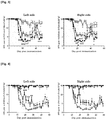
- EAE model rats were prepared by the same method as that of Example 2. Daily basis changes of symptoms, weight, and pain threshold were observed at a frequency of 3 times a week. The compound A was repetitively orally administered twice a day at a dose of 10 mg/kg over 21 days from the day on which average of the EAR scores became 2 or larger (Day 10).
- Fig. 4 The influence of the therapeutic administration of the compound A to the EAE model rats on the pain threshold is shown in Fig. 4 .
- the repetitive therapeutic oral administration of the compound A suppressed mechanical allodynia induced by EAE.
- a polystyrene catheter having an external diameter of 0.30 mm was detained in the subarachnoid cavity in each of 10 weeks old LEW/CrlCrlj female rats.
- EAE model rats were prepared by the same method as that of Example 2.
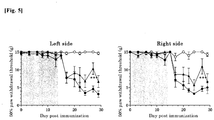
- an osmotic pressure pump (2ML2, ALZET) filled with the compound B and a medium was detained in each anesthetized rat, and connected with the previously detained catheter.
- the compound B was continuously administered into the subarachnoid cavity at a dose of 10 nmol/5 ⁇ L/hr for about 14 days. Daily basis changes of symptoms, weight, and pain threshold were observed at a frequency of 3 times a week.
- the influence of the preventive continuous administration of the compound B to the EAE model rats on the pain threshold is shown in Fig. 5 .
- the preventive continuous administration of the compound B suppressed mechanical allodynia induced by EAE.
Landscapes
- Health & Medical Sciences (AREA)
- Veterinary Medicine (AREA)
- Chemical & Material Sciences (AREA)
- Medicinal Chemistry (AREA)
- Pharmacology & Pharmacy (AREA)
- Life Sciences & Earth Sciences (AREA)
- Animal Behavior & Ethology (AREA)
- General Health & Medical Sciences (AREA)
- Public Health (AREA)
- Chemical Kinetics & Catalysis (AREA)
- Engineering & Computer Science (AREA)
- Bioinformatics & Cheminformatics (AREA)
- Epidemiology (AREA)
- General Chemical & Material Sciences (AREA)
- Nuclear Medicine, Radiotherapy & Molecular Imaging (AREA)
- Organic Chemistry (AREA)
- Biomedical Technology (AREA)
- Neurology (AREA)
- Neurosurgery (AREA)
- Pain & Pain Management (AREA)
- Pharmaceuticals Containing Other Organic And Inorganic Compounds (AREA)
- Medicines That Contain Protein Lipid Enzymes And Other Medicines (AREA)
- Plural Heterocyclic Compounds (AREA)
- Medicines Containing Material From Animals Or Micro-Organisms (AREA)
Applications Claiming Priority (2)
| Application Number | Priority Date | Filing Date | Title |
|---|---|---|---|
| JP2016090715 | 2016-04-28 | ||
| PCT/JP2017/016690 WO2017188365A1 (fr) | 2016-04-28 | 2017-04-27 | Méthode pour le traitement de la sclérose en plaques |
Publications (2)
| Publication Number | Publication Date |
|---|---|
| EP3449942A1 true EP3449942A1 (fr) | 2019-03-06 |
| EP3449942A4 EP3449942A4 (fr) | 2019-12-04 |
Family
ID=60159795
Family Applications (1)
| Application Number | Title | Priority Date | Filing Date |
|---|---|---|---|
| EP17789647.9A Pending EP3449942A4 (fr) | 2016-04-28 | 2017-04-27 | Méthode pour le traitement de la sclérose en plaques |
Country Status (7)
| Country | Link |
|---|---|
| US (1) | US11918589B2 (fr) |
| EP (1) | EP3449942A4 (fr) |
| JP (1) | JP7116679B2 (fr) |
| KR (1) | KR102535907B1 (fr) |
| CN (1) | CN109414503A (fr) |
| AU (1) | AU2017255086B2 (fr) |
| WO (1) | WO2017188365A1 (fr) |
Cited By (2)
| Publication number | Priority date | Publication date | Assignee | Title |
|---|---|---|---|---|
| EP3766497A4 (fr) * | 2018-03-14 | 2021-12-08 | Nippon Chemiphar Co., Ltd. | Médicament pour le traitement de la toux |
| EP4190356A4 (fr) * | 2020-08-03 | 2024-11-06 | Nippon Chemiphar Co., Ltd. | Composition pharmaceutique pour la prévention, la suppression ou le traitement de symptômes associés à une réaction allergique |
Families Citing this family (5)
| Publication number | Priority date | Publication date | Assignee | Title |
|---|---|---|---|---|
| JP7541483B2 (ja) | 2018-09-03 | 2024-08-28 | 日本ケミファ株式会社 | 糖尿病性末梢神経障害のための医薬 |
| CN114615889A (zh) | 2019-10-28 | 2022-06-10 | 组合化学工业株式会社 | 农药组合物及其制造方法 |
| CA3174216A1 (fr) * | 2020-03-30 | 2021-10-07 | Luca ANTONIOLI | Medicament pour prevenir ou traiter le syndrome du colon irritable ou lamaladie inflammatoire de l'intestin |
| US20250360143A1 (en) * | 2022-06-07 | 2025-11-27 | University Of Connecticut | Compositions and methods for pharmacologic treatment of stroke and myocardial ischemia reperfusion injury |
| TW202448478A (zh) | 2023-02-24 | 2024-12-16 | 日商日本化美化股份有限公司 | 具有p2x4受體拮抗作用之化合物的固體分散體 |
Family Cites Families (29)
| Publication number | Priority date | Publication date | Assignee | Title |
|---|---|---|---|---|
| DE10312969A1 (de) * | 2003-03-24 | 2004-10-07 | Bayer Healthcare Ag | Benzofuro-1,4-diazepin-2-on-Derivate |
| KR20040085440A (ko) | 2003-03-31 | 2004-10-08 | 이에스엠티 주식회사 | 경피 신경 자극 치료 장치 |
| US20050074819A1 (en) * | 2003-10-01 | 2005-04-07 | Japan Health Sciences Foundation | Screening method of drug for treatment of neuropathic pain |
| PL1896512T3 (pl) | 2005-06-30 | 2017-05-31 | Albemarle Corporation | Bromowane polimery styrenowe i ich wytwarzanie |
| WO2007049825A1 (fr) | 2005-10-28 | 2007-05-03 | Kyushu University, National University Corporation | Antagoniste du recepteur p2x4antagoniste du recepteur p2x4antagoniste du recepteur p2x4 |
| KR100766201B1 (ko) | 2005-11-09 | 2007-10-10 | 학교법인 포항공과대학교 | 알에프 전력 증폭기의 위상 변화 측정 장치 및 그 방법 |
| JPWO2008020651A1 (ja) | 2006-08-17 | 2010-01-07 | 国立大学法人九州大学 | P2x4受容体アンタゴニスト |
| US20100256123A1 (en) | 2006-08-25 | 2010-10-07 | Nippon Chemiphar Co., Ltd. | P2x4 receptor antagonist |
| JP5252477B2 (ja) | 2007-11-07 | 2013-07-31 | 住友化学株式会社 | 偏光板 |
| JP2012087053A (ja) | 2009-02-03 | 2012-05-10 | Nippon Chemiphar Co Ltd | ジアゼピンジオン誘導体 |
| DK2397480T3 (da) | 2009-02-16 | 2013-09-02 | Nippon Chemiphar Co | Diazepindionderivat |
| US8810562B2 (en) | 2009-05-19 | 2014-08-19 | Advanced Micro Devices, Inc. | Hierarchical lossless compression |
| CN103080094B (zh) * | 2010-07-13 | 2015-06-24 | 日本化学医药株式会社 | P2x4受体拮抗剂 |
| JP2013209292A (ja) * | 2010-07-23 | 2013-10-10 | Nippon Chemiphar Co Ltd | P2x4受容体拮抗剤 |
| WO2012014910A1 (fr) | 2010-07-29 | 2012-02-02 | 日本ケミファ株式会社 | Antagoniste du récepteur p2x4 |
| KR101564490B1 (ko) | 2010-07-30 | 2015-10-29 | 노파르티스 아게 | Uv―흡수 안과용 렌즈의 제조 방법 |
| WO2012017876A1 (fr) | 2010-08-03 | 2012-02-09 | 日本ケミファ株式会社 | Antagoniste du récepteur p2x4 |
| KR101161153B1 (ko) | 2010-08-20 | 2012-07-11 | 송은화 | 방향제가 구비된 전동식 디퓨져 |
| EP3132803B1 (fr) * | 2010-11-05 | 2021-06-09 | Kyushu University | Agent préventif ou thérapeutique de la douleur associée au zona en phase aiguë |
| KR101191251B1 (ko) | 2011-12-02 | 2012-10-16 | 영남대학교 산학협력단 | 3단계 동적 분류를 통한 10기가급 대용량 플로우 생성 및 제어방법 |
| JP6207399B2 (ja) * | 2012-01-13 | 2017-10-04 | 日本ケミファ株式会社 | P2x4受容体拮抗剤 |
| JP6257938B2 (ja) | 2013-07-04 | 2018-01-10 | コンビ株式会社 | 乳母車 |
| JP6242614B2 (ja) | 2013-07-04 | 2017-12-06 | コンビ株式会社 | 乳母車 |
| US9873683B2 (en) | 2013-07-12 | 2018-01-23 | Nippon Chemiphar Co., Ltd | P2X4 receptor antagonist |
| EP3020707B1 (fr) * | 2013-07-12 | 2019-08-21 | Nippon Chemiphar Co., Ltd. | Antagoniste des récepteurs p2x4 |
| WO2015088564A1 (fr) | 2013-12-13 | 2015-06-18 | Sunovion Pharmaceuticals Inc. | Composés modulateurs du récepteur p2x4 |
| WO2015088565A1 (fr) * | 2013-12-13 | 2015-06-18 | Sunovion Pharmaceuticals Inc. | Composés modulateurs du récepteur p2x4 et leurs procédés d'utilisation |
| KR102090176B1 (ko) | 2014-01-24 | 2020-03-17 | 한국전자통신연구원 | 주름 구조의 전극, 이를 포함하는 표시 장치 및 이의 제조 방법 |
| KR101567449B1 (ko) | 2014-01-24 | 2015-11-09 | 주식회사 이스트섬머 | 음성인식에 기반한 애니메이션 재생이 가능한 전자책 단말기 및 그 방법 |
-
2017
- 2017-04-27 EP EP17789647.9A patent/EP3449942A4/fr active Pending
- 2017-04-27 WO PCT/JP2017/016690 patent/WO2017188365A1/fr not_active Ceased
- 2017-04-27 US US16/350,297 patent/US11918589B2/en active Active
- 2017-04-27 AU AU2017255086A patent/AU2017255086B2/en active Active
- 2017-04-27 JP JP2018514692A patent/JP7116679B2/ja active Active
- 2017-04-27 CN CN201780026148.4A patent/CN109414503A/zh active Pending
- 2017-04-27 KR KR1020187034415A patent/KR102535907B1/ko active Active
Cited By (2)
| Publication number | Priority date | Publication date | Assignee | Title |
|---|---|---|---|---|
| EP3766497A4 (fr) * | 2018-03-14 | 2021-12-08 | Nippon Chemiphar Co., Ltd. | Médicament pour le traitement de la toux |
| EP4190356A4 (fr) * | 2020-08-03 | 2024-11-06 | Nippon Chemiphar Co., Ltd. | Composition pharmaceutique pour la prévention, la suppression ou le traitement de symptômes associés à une réaction allergique |
Also Published As
| Publication number | Publication date |
|---|---|
| CN109414503A (zh) | 2019-03-01 |
| AU2017255086B2 (en) | 2023-04-27 |
| JPWO2017188365A1 (ja) | 2019-04-04 |
| CA3022358A1 (fr) | 2017-11-02 |
| NZ748780A (en) | 2025-06-27 |
| KR20190019062A (ko) | 2019-02-26 |
| US11918589B2 (en) | 2024-03-05 |
| AU2017255086A1 (en) | 2018-12-13 |
| JP7116679B2 (ja) | 2022-08-10 |
| US20210121478A1 (en) | 2021-04-29 |
| EP3449942A4 (fr) | 2019-12-04 |
| KR102535907B1 (ko) | 2023-05-23 |
| WO2017188365A1 (fr) | 2017-11-02 |
Similar Documents
| Publication | Publication Date | Title |
|---|---|---|
| US11918589B2 (en) | Medicament for treatment of multiple sclerosis | |
| JP2022078201A (ja) | Mdm2タンパク質分解剤 | |
| CA2921203C (fr) | Derives de diazepinedione et compositions associees utiles en tant qu'antagoniste des recepteurs p2x4 | |
| US20160361298A1 (en) | Methods and compositions for treating cancer | |
| US20130150385A1 (en) | Cancer therapy using a combination of a hsp90 inhibitory compounds and a egfr inhibitor | |
| JP6513095B2 (ja) | ヘテロ原子含有デオキシウリジントリホスファターゼ阻害剤 | |
| TW200804314A (en) | Triazole compounds that modulate Hsp90 activity | |
| JP2014532712A (ja) | トポイソメラーゼi阻害剤とhsp90阻害剤の組合せを使用する癌療法 | |
| TW200846329A (en) | Compounds that modulate HSP90 activity | |
| CA2853806A1 (fr) | Polytherapie d'inhibiteurs de hsp 90 avec des agents contenant du platine | |
| KR20190084292A (ko) | HDM2-p53 상호작용 억제제에 대한 용량 및 요법 | |
| CN103391779A (zh) | 使用hsp90抑制性化合物的前列腺癌治疗 | |
| US20180117110A1 (en) | Method of treating cancer | |
| JP6325252B2 (ja) | ギラン・バレー症候群に伴う神経因性疼痛の予防又は治療剤 | |
| BR112020001949A2 (pt) | composto, composição farmacêutica, e, métodos para tratar um linfoma não hodgkin e para tratar um linfoma ou uma leucemia | |
| WO2021260379A1 (fr) | Agents thérapeutiques pour le traitement de la fshd | |
| JP2017014224A (ja) | 帯状疱疹関連痛の急性期疼痛の予防又は治療剤 | |
| TW202320808A (zh) | 用於治療多囊性腎病之方法及組合物 | |
| BR112019023214A2 (pt) | Compostos e métodos para tratamento de dor visceral | |
| CA3022358C (fr) | Methode pour le traitement de la sclerose en plaques | |
| HK40005365A (en) | Medicine for treating multiple sclerosis | |
| CA3143952A1 (fr) | Polytherapie avec du gmci et du ddri pour le traitement du cancer | |
| US20070082873A1 (en) | Combinations comprising ampa receptor antagonists for the treatment of schizophrenia | |
| US20240156800A1 (en) | Ep300 degrader and uses thereof in neuroblastoma | |
| US20060194766A1 (en) | Combinations comprising anti-epileptic drugs for the treatment of neurological disorders |
Legal Events
| Date | Code | Title | Description |
|---|---|---|---|
| STAA | Information on the status of an ep patent application or granted ep patent |
Free format text: STATUS: THE INTERNATIONAL PUBLICATION HAS BEEN MADE |
|
| PUAI | Public reference made under article 153(3) epc to a published international application that has entered the european phase |
Free format text: ORIGINAL CODE: 0009012 |
|
| STAA | Information on the status of an ep patent application or granted ep patent |
Free format text: STATUS: REQUEST FOR EXAMINATION WAS MADE |
|
| 17P | Request for examination filed |
Effective date: 20181121 |
|
| AK | Designated contracting states |
Kind code of ref document: A1 Designated state(s): AL AT BE BG CH CY CZ DE DK EE ES FI FR GB GR HR HU IE IS IT LI LT LU LV MC MK MT NL NO PL PT RO RS SE SI SK SM TR |
|
| AX | Request for extension of the european patent |
Extension state: BA ME |
|
| DAV | Request for validation of the european patent (deleted) | ||
| DAX | Request for extension of the european patent (deleted) | ||
| A4 | Supplementary search report drawn up and despatched |
Effective date: 20191106 |
|
| RIC1 | Information provided on ipc code assigned before grant |
Ipc: A61K 31/551 20060101ALI20191030BHEP Ipc: A61K 45/00 20060101AFI20191030BHEP Ipc: A61K 31/5513 20060101ALI20191030BHEP Ipc: A61P 43/00 20060101ALI20191030BHEP Ipc: A61P 25/00 20060101ALI20191030BHEP Ipc: A61P 25/04 20060101ALI20191030BHEP |
|
| REG | Reference to a national code |
Ref country code: HK Ref legal event code: DE Ref document number: 40005365 Country of ref document: HK |
|
| STAA | Information on the status of an ep patent application or granted ep patent |
Free format text: STATUS: EXAMINATION IS IN PROGRESS |
|
| 17Q | First examination report despatched |
Effective date: 20200728 |