EP3450164B1 - Corps stratifié de film à base de polyimide - Google Patents
Corps stratifié de film à base de polyimide Download PDFInfo
- Publication number
- EP3450164B1 EP3450164B1 EP17789456.5A EP17789456A EP3450164B1 EP 3450164 B1 EP3450164 B1 EP 3450164B1 EP 17789456 A EP17789456 A EP 17789456A EP 3450164 B1 EP3450164 B1 EP 3450164B1
- Authority
- EP
- European Patent Office
- Prior art keywords
- polyimide film
- coupling agent
- silane coupling
- film
- polyimide
- Prior art date
- Legal status (The legal status is an assumption and is not a legal conclusion. Google has not performed a legal analysis and makes no representation as to the accuracy of the status listed.)
- Active
Links
Images
Classifications
-
- B—PERFORMING OPERATIONS; TRANSPORTING
- B32—LAYERED PRODUCTS
- B32B—LAYERED PRODUCTS, i.e. PRODUCTS BUILT-UP OF STRATA OF FLAT OR NON-FLAT, e.g. CELLULAR OR HONEYCOMB, FORM
- B32B7/00—Layered products characterised by the relation between layers; Layered products characterised by the relative orientation of features between layers, or by the relative values of a measurable parameter between layers, i.e. products comprising layers having different physical, chemical or physicochemical properties; Layered products characterised by the interconnection of layers
- B32B7/04—Interconnection of layers
- B32B7/12—Interconnection of layers using interposed adhesives or interposed materials with bonding properties
-
- B—PERFORMING OPERATIONS; TRANSPORTING
- B32—LAYERED PRODUCTS
- B32B—LAYERED PRODUCTS, i.e. PRODUCTS BUILT-UP OF STRATA OF FLAT OR NON-FLAT, e.g. CELLULAR OR HONEYCOMB, FORM
- B32B27/00—Layered products comprising a layer of synthetic resin
- B32B27/28—Layered products comprising a layer of synthetic resin comprising synthetic resins not wholly covered by any one of the sub-groups B32B27/30 - B32B27/42
- B32B27/281—Layered products comprising a layer of synthetic resin comprising synthetic resins not wholly covered by any one of the sub-groups B32B27/30 - B32B27/42 comprising polyimides
-
- B—PERFORMING OPERATIONS; TRANSPORTING
- B32—LAYERED PRODUCTS
- B32B—LAYERED PRODUCTS, i.e. PRODUCTS BUILT-UP OF STRATA OF FLAT OR NON-FLAT, e.g. CELLULAR OR HONEYCOMB, FORM
- B32B25/00—Layered products comprising a layer of natural or synthetic rubber
- B32B25/04—Layered products comprising a layer of natural or synthetic rubber comprising rubber as the main or only constituent of a layer, which is next to another layer of the same or of a different material
- B32B25/08—Layered products comprising a layer of natural or synthetic rubber comprising rubber as the main or only constituent of a layer, which is next to another layer of the same or of a different material of synthetic resin
-
- B—PERFORMING OPERATIONS; TRANSPORTING
- B32—LAYERED PRODUCTS
- B32B—LAYERED PRODUCTS, i.e. PRODUCTS BUILT-UP OF STRATA OF FLAT OR NON-FLAT, e.g. CELLULAR OR HONEYCOMB, FORM
- B32B27/00—Layered products comprising a layer of synthetic resin
-
- B—PERFORMING OPERATIONS; TRANSPORTING
- B32—LAYERED PRODUCTS
- B32B—LAYERED PRODUCTS, i.e. PRODUCTS BUILT-UP OF STRATA OF FLAT OR NON-FLAT, e.g. CELLULAR OR HONEYCOMB, FORM
- B32B27/00—Layered products comprising a layer of synthetic resin
- B32B27/16—Layered products comprising a layer of synthetic resin specially treated, e.g. irradiated
-
- B—PERFORMING OPERATIONS; TRANSPORTING
- B32—LAYERED PRODUCTS
- B32B—LAYERED PRODUCTS, i.e. PRODUCTS BUILT-UP OF STRATA OF FLAT OR NON-FLAT, e.g. CELLULAR OR HONEYCOMB, FORM
- B32B27/00—Layered products comprising a layer of synthetic resin
- B32B27/34—Layered products comprising a layer of synthetic resin comprising polyamides
-
- B—PERFORMING OPERATIONS; TRANSPORTING
- B29—WORKING OF PLASTICS; WORKING OF SUBSTANCES IN A PLASTIC STATE IN GENERAL
- B29C—SHAPING OR JOINING OF PLASTICS; SHAPING OF MATERIAL IN A PLASTIC STATE, NOT OTHERWISE PROVIDED FOR; AFTER-TREATMENT OF THE SHAPED PRODUCTS, e.g. REPAIRING
- B29C65/00—Joining or sealing of preformed parts, e.g. welding of plastics materials; Apparatus therefor
- B29C65/02—Joining or sealing of preformed parts, e.g. welding of plastics materials; Apparatus therefor by heating, with or without pressure
-
- B—PERFORMING OPERATIONS; TRANSPORTING
- B29—WORKING OF PLASTICS; WORKING OF SUBSTANCES IN A PLASTIC STATE IN GENERAL
- B29C—SHAPING OR JOINING OF PLASTICS; SHAPING OF MATERIAL IN A PLASTIC STATE, NOT OTHERWISE PROVIDED FOR; AFTER-TREATMENT OF THE SHAPED PRODUCTS, e.g. REPAIRING
- B29C66/00—General aspects of processes or apparatus for joining preformed parts
- B29C66/01—General aspects dealing with the joint area or with the area to be joined
- B29C66/02—Preparation of the material, in the area to be joined, prior to joining or welding
- B29C66/026—Chemical pre-treatments
-
- B—PERFORMING OPERATIONS; TRANSPORTING
- B29—WORKING OF PLASTICS; WORKING OF SUBSTANCES IN A PLASTIC STATE IN GENERAL
- B29C—SHAPING OR JOINING OF PLASTICS; SHAPING OF MATERIAL IN A PLASTIC STATE, NOT OTHERWISE PROVIDED FOR; AFTER-TREATMENT OF THE SHAPED PRODUCTS, e.g. REPAIRING
- B29C66/00—General aspects of processes or apparatus for joining preformed parts
- B29C66/01—General aspects dealing with the joint area or with the area to be joined
- B29C66/05—Particular design of joint configurations
- B29C66/10—Particular design of joint configurations particular design of the joint cross-sections
- B29C66/11—Joint cross-sections comprising a single joint-segment, i.e. one of the parts to be joined comprising a single joint-segment in the joint cross-section
- B29C66/112—Single lapped joints
- B29C66/1122—Single lap to lap joints, i.e. overlap joints
-
- B—PERFORMING OPERATIONS; TRANSPORTING
- B29—WORKING OF PLASTICS; WORKING OF SUBSTANCES IN A PLASTIC STATE IN GENERAL
- B29C—SHAPING OR JOINING OF PLASTICS; SHAPING OF MATERIAL IN A PLASTIC STATE, NOT OTHERWISE PROVIDED FOR; AFTER-TREATMENT OF THE SHAPED PRODUCTS, e.g. REPAIRING
- B29C66/00—General aspects of processes or apparatus for joining preformed parts
- B29C66/40—General aspects of joining substantially flat articles, e.g. plates, sheets or web-like materials; Making flat seams in tubular or hollow articles; Joining single elements to substantially flat surfaces
- B29C66/41—Joining substantially flat articles ; Making flat seams in tubular or hollow articles
- B29C66/45—Joining of substantially the whole surface of the articles
-
- B—PERFORMING OPERATIONS; TRANSPORTING
- B29—WORKING OF PLASTICS; WORKING OF SUBSTANCES IN A PLASTIC STATE IN GENERAL
- B29C—SHAPING OR JOINING OF PLASTICS; SHAPING OF MATERIAL IN A PLASTIC STATE, NOT OTHERWISE PROVIDED FOR; AFTER-TREATMENT OF THE SHAPED PRODUCTS, e.g. REPAIRING
- B29C66/00—General aspects of processes or apparatus for joining preformed parts
- B29C66/70—General aspects of processes or apparatus for joining preformed parts characterised by the composition, physical properties or the structure of the material of the parts to be joined; Joining with non-plastics material
- B29C66/71—General aspects of processes or apparatus for joining preformed parts characterised by the composition, physical properties or the structure of the material of the parts to be joined; Joining with non-plastics material characterised by the composition of the plastics material of the parts to be joined
-
- B—PERFORMING OPERATIONS; TRANSPORTING
- B32—LAYERED PRODUCTS
- B32B—LAYERED PRODUCTS, i.e. PRODUCTS BUILT-UP OF STRATA OF FLAT OR NON-FLAT, e.g. CELLULAR OR HONEYCOMB, FORM
- B32B2250/00—Layers arrangement
- B32B2250/05—5 or more layers
-
- B—PERFORMING OPERATIONS; TRANSPORTING
- B32—LAYERED PRODUCTS
- B32B—LAYERED PRODUCTS, i.e. PRODUCTS BUILT-UP OF STRATA OF FLAT OR NON-FLAT, e.g. CELLULAR OR HONEYCOMB, FORM
- B32B2250/00—Layers arrangement
- B32B2250/24—All layers being polymeric
-
- B—PERFORMING OPERATIONS; TRANSPORTING
- B32—LAYERED PRODUCTS
- B32B—LAYERED PRODUCTS, i.e. PRODUCTS BUILT-UP OF STRATA OF FLAT OR NON-FLAT, e.g. CELLULAR OR HONEYCOMB, FORM
- B32B2255/00—Coating on the layer surface
- B32B2255/10—Coating on the layer surface on synthetic resin layer or on natural or synthetic rubber layer
-
- B—PERFORMING OPERATIONS; TRANSPORTING
- B32—LAYERED PRODUCTS
- B32B—LAYERED PRODUCTS, i.e. PRODUCTS BUILT-UP OF STRATA OF FLAT OR NON-FLAT, e.g. CELLULAR OR HONEYCOMB, FORM
- B32B2255/00—Coating on the layer surface
- B32B2255/24—Organic non-macromolecular coating
-
- B—PERFORMING OPERATIONS; TRANSPORTING
- B32—LAYERED PRODUCTS
- B32B—LAYERED PRODUCTS, i.e. PRODUCTS BUILT-UP OF STRATA OF FLAT OR NON-FLAT, e.g. CELLULAR OR HONEYCOMB, FORM
- B32B2255/00—Coating on the layer surface
- B32B2255/26—Polymeric coating
-
- B—PERFORMING OPERATIONS; TRANSPORTING
- B32—LAYERED PRODUCTS
- B32B—LAYERED PRODUCTS, i.e. PRODUCTS BUILT-UP OF STRATA OF FLAT OR NON-FLAT, e.g. CELLULAR OR HONEYCOMB, FORM
- B32B2264/00—Composition or properties of particles which form a particulate layer or are present as additives
- B32B2264/10—Inorganic particles
- B32B2264/101—Glass
-
- B—PERFORMING OPERATIONS; TRANSPORTING
- B32—LAYERED PRODUCTS
- B32B—LAYERED PRODUCTS, i.e. PRODUCTS BUILT-UP OF STRATA OF FLAT OR NON-FLAT, e.g. CELLULAR OR HONEYCOMB, FORM
- B32B2264/00—Composition or properties of particles which form a particulate layer or are present as additives
- B32B2264/10—Inorganic particles
- B32B2264/102—Oxide or hydroxide
-
- B—PERFORMING OPERATIONS; TRANSPORTING
- B32—LAYERED PRODUCTS
- B32B—LAYERED PRODUCTS, i.e. PRODUCTS BUILT-UP OF STRATA OF FLAT OR NON-FLAT, e.g. CELLULAR OR HONEYCOMB, FORM
- B32B2264/00—Composition or properties of particles which form a particulate layer or are present as additives
- B32B2264/10—Inorganic particles
- B32B2264/104—Oxysalt, e.g. carbonate, sulfate, phosphate or nitrate particles
-
- B—PERFORMING OPERATIONS; TRANSPORTING
- B32—LAYERED PRODUCTS
- B32B—LAYERED PRODUCTS, i.e. PRODUCTS BUILT-UP OF STRATA OF FLAT OR NON-FLAT, e.g. CELLULAR OR HONEYCOMB, FORM
- B32B2264/00—Composition or properties of particles which form a particulate layer or are present as additives
- B32B2264/10—Inorganic particles
- B32B2264/105—Metal
-
- B—PERFORMING OPERATIONS; TRANSPORTING
- B32—LAYERED PRODUCTS
- B32B—LAYERED PRODUCTS, i.e. PRODUCTS BUILT-UP OF STRATA OF FLAT OR NON-FLAT, e.g. CELLULAR OR HONEYCOMB, FORM
- B32B2307/00—Properties of the layers or laminate
- B32B2307/20—Properties of the layers or laminate having particular electrical or magnetic properties, e.g. piezoelectric
- B32B2307/206—Insulating
-
- B—PERFORMING OPERATIONS; TRANSPORTING
- B32—LAYERED PRODUCTS
- B32B—LAYERED PRODUCTS, i.e. PRODUCTS BUILT-UP OF STRATA OF FLAT OR NON-FLAT, e.g. CELLULAR OR HONEYCOMB, FORM
- B32B2307/00—Properties of the layers or laminate
- B32B2307/30—Properties of the layers or laminate having particular thermal properties
- B32B2307/306—Resistant to heat
-
- B—PERFORMING OPERATIONS; TRANSPORTING
- B32—LAYERED PRODUCTS
- B32B—LAYERED PRODUCTS, i.e. PRODUCTS BUILT-UP OF STRATA OF FLAT OR NON-FLAT, e.g. CELLULAR OR HONEYCOMB, FORM
- B32B2307/00—Properties of the layers or laminate
- B32B2307/30—Properties of the layers or laminate having particular thermal properties
- B32B2307/308—Heat stability
-
- B—PERFORMING OPERATIONS; TRANSPORTING
- B32—LAYERED PRODUCTS
- B32B—LAYERED PRODUCTS, i.e. PRODUCTS BUILT-UP OF STRATA OF FLAT OR NON-FLAT, e.g. CELLULAR OR HONEYCOMB, FORM
- B32B2307/00—Properties of the layers or laminate
- B32B2307/50—Properties of the layers or laminate having particular mechanical properties
- B32B2307/54—Yield strength; Tensile strength
-
- B—PERFORMING OPERATIONS; TRANSPORTING
- B32—LAYERED PRODUCTS
- B32B—LAYERED PRODUCTS, i.e. PRODUCTS BUILT-UP OF STRATA OF FLAT OR NON-FLAT, e.g. CELLULAR OR HONEYCOMB, FORM
- B32B2307/00—Properties of the layers or laminate
- B32B2307/50—Properties of the layers or laminate having particular mechanical properties
- B32B2307/558—Impact strength, toughness
-
- B—PERFORMING OPERATIONS; TRANSPORTING
- B32—LAYERED PRODUCTS
- B32B—LAYERED PRODUCTS, i.e. PRODUCTS BUILT-UP OF STRATA OF FLAT OR NON-FLAT, e.g. CELLULAR OR HONEYCOMB, FORM
- B32B2307/00—Properties of the layers or laminate
- B32B2307/70—Other properties
- B32B2307/732—Dimensional properties
-
- B—PERFORMING OPERATIONS; TRANSPORTING
- B32—LAYERED PRODUCTS
- B32B—LAYERED PRODUCTS, i.e. PRODUCTS BUILT-UP OF STRATA OF FLAT OR NON-FLAT, e.g. CELLULAR OR HONEYCOMB, FORM
- B32B2307/00—Properties of the layers or laminate
- B32B2307/70—Other properties
- B32B2307/732—Dimensional properties
- B32B2307/734—Dimensional stability
-
- B—PERFORMING OPERATIONS; TRANSPORTING
- B32—LAYERED PRODUCTS
- B32B—LAYERED PRODUCTS, i.e. PRODUCTS BUILT-UP OF STRATA OF FLAT OR NON-FLAT, e.g. CELLULAR OR HONEYCOMB, FORM
- B32B2457/00—Electrical equipment
- B32B2457/04—Insulators
-
- B—PERFORMING OPERATIONS; TRANSPORTING
- B32—LAYERED PRODUCTS
- B32B—LAYERED PRODUCTS, i.e. PRODUCTS BUILT-UP OF STRATA OF FLAT OR NON-FLAT, e.g. CELLULAR OR HONEYCOMB, FORM
- B32B2457/00—Electrical equipment
- B32B2457/08—PCBs, i.e. printed circuit boards
-
- B—PERFORMING OPERATIONS; TRANSPORTING
- B32—LAYERED PRODUCTS
- B32B—LAYERED PRODUCTS, i.e. PRODUCTS BUILT-UP OF STRATA OF FLAT OR NON-FLAT, e.g. CELLULAR OR HONEYCOMB, FORM
- B32B2457/00—Electrical equipment
- B32B2457/14—Semiconductor wafers
-
- B—PERFORMING OPERATIONS; TRANSPORTING
- B32—LAYERED PRODUCTS
- B32B—LAYERED PRODUCTS, i.e. PRODUCTS BUILT-UP OF STRATA OF FLAT OR NON-FLAT, e.g. CELLULAR OR HONEYCOMB, FORM
- B32B2605/00—Vehicles
-
- B—PERFORMING OPERATIONS; TRANSPORTING
- B32—LAYERED PRODUCTS
- B32B—LAYERED PRODUCTS, i.e. PRODUCTS BUILT-UP OF STRATA OF FLAT OR NON-FLAT, e.g. CELLULAR OR HONEYCOMB, FORM
- B32B2605/00—Vehicles
- B32B2605/18—Aircraft
Definitions
- the present invention relates to a laminate obtained by bonding plural polyimide films with each other, and further specifically relates to a polyimide film laminate having high heat resistance.
- polyimide films Since physical property change of polyimide films is extremely small in a wide temperature range from -269°C to 300 °C, applications and uses of polyimide films in the electrical and electronic fields have been increasing. In the electrical field, they are used for, for example, insulation of coil in motors for vehicle, industrial motors and the like, and insulation of electric cables in airplanes and superconductive wires and the like. Whereas, in the electronic field, they are utilized for, for example, flexible printed circuit boards, base films of semiconductor mounting film carriers and the like . As described above, the polyimide films, which have significantly high reliability among various kinds of functional polymer films, are broadly used in the electrical and electronic fields.
- Polyimide films are mainly manufactured by solution film forming by flow casting, and according to the manufacturing method, it has been difficult to form thick films, or productivity thereof has been extremely low.
- a polyimide board which is obtained by bonding thermoplastic polyimide films that have comparatively low glass transition points directly with each other by heat and pressure with no adhesive therebetween, has been proposed.
- This polyimide board has not satisfied dimensional stability, mechanical characteristic (bending elastic modulus) or adhesiveness required for the application to ceramic or glass alternate materials.
- prior art pointed out a problem that, if increasing its thickness, its adhesiveness further degrades and its warp becomes larger (see Patent Document 1).
- a polyimide board obtained by laminating plural nonthermoplastic polyimide films via an acrylic resin-based adhesive or an epoxy resin-based adhesive has been suggested.
- This polyimide board has not been practical, because its adhesiveness is sufficient but its mechanical characteristic (bending elastic modulus) is considerably low. Further, its dimensional stability is not sufficient.
- a polyimide board which is obtained by laminating plural nonthermoplastic polyimide films via a thermoplastic adhesive containing polyimidesiloxane and at least one kind of an epoxy resin, a bismaleimide-triazine resin, a bismaleimide resin, a cyanate resin and an acrylate resin, has been suggested.
- This polyimide board exhibits sufficient adhesiveness, but its mechanical characteristic (bending elastic modulus) and dimensional stability are not satisfactory (see Patent Document 2).
- thermocompressive multilayer polyimide films surface layer: thermoplastic polyimide, base layer: nonthermoplastic polyimide
- this polyimide board similarly fails to exhibit a satisfactory mechanical characteristic (bending elastic modulus) and dimensional stability (see Patent Document 3) .
- Patent Document 5 relates to a method for producing an adhesive film obtained by heat-pressing an adhesive layer on one or both sides of a substrate.
- thermoplastic or non-thermoplastic polyimide film is used as a base material, the thermoplastic film is used as an adhesive layer, and each of the pressure-bonding surfaces of the base material and the adhesive layer has a different surface modification having a functional group capable of reacting with each other.
- the present invention aims to provide a polyimide film laminate having excellent dimensional stability, mechanical characteristic (bending elastic modulus), heat resistance and impact strength as a ceramic or glass alternate material.
- the present invention has a following structure.
- the present invention relates to a polyimide film laminate, which is obtained by using a bond generated by a chemical reaction between an extremely thin silane coupling agent layer and an active group on a surface of the polyimide film.
- a thickness of the silane coupling agent is extremely thin, and thus hardly affects a macroscopic property of the laminate.
- an absolute amount of the silane coupling agent is extremely small, an amount of a low molecular component generated during condensation of the silane coupling agent and an amount of a decomposition product generated during high temperature exposure of the silane coupling agent are also small, so that the low molecular component and the decomposition product are solved and absorbed into the polyimide film layer, thereby causing no blister or the like.
- the polyimide film laminate having the high dimensional stability, mechanical characteristic (bending elastic modulus) and heat resistance and substitutable for inorganic substances such as ceramic and glass, which cannot be achieved by conventional polyimide boards, can be obtained. Further, the polyimide laminate of the present invention also has excellent impact resistance, and thus can be applied also to a part which has been difficult for the inorganic material such as ceramic and glass to be applied.
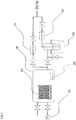
- Fig. 1 is a schematic block diagram illustrating an example of an apparatus that is used for a silane coupling agent treating method via gas phase in the present invention.
- a silane coupling agent in the present invention means a compound which has a silicon element in its molecule, and acts to enhance adhesive strength between polyimide films by physically and chemically intervening the polyimide films.
- silane coupling agent Preferable examples of the silane coupling agent include:
- silane coupling agent that can be used in the present invention, beside the above-described silane coupling agents, n-propyltrimethoxysilane, butyltrichlorosilane, 2-cyanoethyltriethoxysilane, cyclohexyltrichlorosilane, decyltrichlorosilane, diacetoxydimethylsilane, diethoxydimethylsilane, dimethoxydimethylsilane, dimethoxydiphenylsilane, dimethoxymethylphenylsilane, dodecylrichlorosilane, dodecyltrimethoxysilane, ethyltrichlorosilane, hexyltrimethoxysilane, octadecyltriethoxysilane, octadecyltrimethoxysilane, n-octyltrichlorosilane, n-
- alkoxysilanes for example, tetramethoxysilane, tetraethoxysilane or the like can be added as appropriate into the silane coupling agent.
- the silane coupling agent may be added also after slightly proceeding the reaction by mixing and heating operations.
- silane coupling agents having chemical structures which include one silicon atom in one molecule are preferably used in the present invention.
- examples of the particularly preferable silane coupling agents include:
- a phosphorus coupling agent, a titanate coupling agent or the like can be used in combination, if necessary.
- silane coupling agent treatment denotes treatment for forming a thin film layer of a silane coupling agent or a condensate of a silane coupling agent onto a surface of an object.
- the silane coupling agent treatment is performed to one surface or both surfaces of the polyimide film as necessary.
- the silane coupling agent application process is performed via gas phase.
- the "via gas phase” means that the polyimide film is exposed to a vaporized silane coupling agent.
- the "vaporized” means a state where vapor of the silane coupling agent, that is, the silane coupling agent substantially in a gas state or in a fine particle state exists.
- the exposure to the vaporized silane coupling agent means contacting the polyimide film with an atmosphere containing the vaporized silane coupling agent. Since the silane coupling agent has certain vapor pressure, a certain amount of the silane coupling agent in the gas state exists even under a normal temperature atmosphere.
- vapor of the silane coupling agent with a higher concentration can be obtained.
- the vaporized silane coupling agent may also be atomized in relation to its dew point so as to exist in a fine particle state in the gas. In the present invention, this state can be utilized as well. Further, a process for increasing vapor density by controlling its temperature and pressure can be added.
- the boiling point of the silane coupling agent is varied according to its chemical structure, and ranges from about 100°C to about 250°C. However, heating at 200°C or more is not preferable, because a side reaction of an organic group of the silane coupling agent may be caused.
- An environment for warming the silane coupling agent may be under either of applied pressure, substantially normal pressure and reduced pressure, but in order to proceed the vaporization of the silane coupling agent, the silane coupling agent is preferably warmed under substantially normal pressure or reduced pressure. Since many of the silane coupling agents are flammable liquid, they are preferably vaporized in a sealed container, which is preferably replaced with inert gas in advance. However, in the light of the improvement of the production efficiency or the reduction of the production facility cost, the silane coupling agent application is preferably carried out in environment without a vacuum.
- a silane coupling agent deposition method without a vacuum in the present invention does not mean not using a vacuum only during the deposition, but means that substantially atmospheric pressure is maintained from the time of setting the polyimide film normally in the atmosphere, replacing the atmosphere with carrier gas and depositing the silane coupling agent, until returning to the state where the silane coupling agent is absent.
- a time period for exposing the polyimide film to the silane coupling agent is not limited particularly, but is 60 minutes or less, is preferably 20 minutes or less, and is more preferably 10 minutes or less.
- the exposure time is a process planned value determined by a relation between a concentration of the silane coupling agent and a required application amount of the silane coupling agent.
- a lower limit of the exposure time is not limited particularly, but is 10 seconds or more, and is preferably about 30 seconds or more for reducing unevenness of the application amount which is generated industrially.
- a temperature of the polyimide film while being exposed to the silane coupling agent is preferably controlled to a proper temperature within a range from -50°C to 200°C, according to the kind of the silane coupling agent and a required thickness of the silane coupling agent layer.
- the polyimide film exposed to the silane coupling agent is heated preferably at 70°C to 200°C and more preferably at 75°C to 150°C after the exposure.
- an alkoxy group or a silazane group of the silane coupling agent reacts with a hydroxyl group or the like on the surface of the polyimide film, thereby completing the silane coupling agent treatment.
- a time period required for the heating is 10 seconds or more and about 10 minutes or less. If the temperature is too high or the time period is too long, the coupling agent may be deteriorated. On the other hand, if the time period is too short, the treatment effect cannot be obtained. Incidentally, in the case where a temperature of the substrate while being exposed to the silane coupling agent is already 80°C or more, the heating after the exposure can be omitted.
- a surface of the polyimide film to which the silane coupling agent is to be applied is preferably held facing down, while it is exposed to the vapor of the silane coupling agent.
- the polyimide film to which the solution is applied inevitably faces up before, during and after the application, a risk that foreign substances and the like floating in the working environment are settled onto the surface of the inorganic substrate cannot be excluded.
- the polyimide film can be held facing down, so that such settlement of foreign substances in the environment can be reduced significantly.
- the gas containing the vaporized silane coupling agent is introduced into a room for exposing the polymer substrate thereto, the gas is separated once into two or more flows, and the two or more gas flows are allowed to collide with each other in the room so as to cause turbulent flow.
- a method for vaporizing the silane coupling agent beside the evaporation by heat, a method of introducing gas into silane coupling agent liquid so as to generate air bubbles can be employed.
- this method will be called as bubbling.
- the bubbling it is also effective to put a pipe for allowing gas to simply pass through into the silane coupling agent liquid or a pipe with a porous body attached to its tip for generating many fine air bubbles, and to promote vaporization by superimposing ultrasonic waves.
- the vaporized silane coupling agent may be electrified.
- an electric field to the film during the exposure by utilizing this effect, a larger amount of the silane coupling agent can be deposited in a short period of time, and since the silane coupling agent has kinetic energy, the deposited film can be prevented from being in an island-state.
- the used carrier gas contains water, this water starts to react with the silane coupling agent.
- the dew point is favorably 15°C or less, is more favorably 10°C or less, and is further favorably 5°C or less.
- the number of silicon-containing foreign substances having a longer diameter of 10 ⁇ m or more, which exist in the silane coupling agent layer of the silane coupling agent layer-laminated polyimide film is 2000/m 2 or less, is preferably 1000/m 2 or less, and is more preferably 500/m 2 . Further, by combining the above-described operations, the preferable number of silicon-containing foreign substances can be attained.
- An application amount of the silane coupling agent depends on a thickness of a silane coupling agent condensate layer. If the silane coupling agent layer is too thick, an amount of a decomposition product generated during the high temperature exposure is increased, whereby the adhesion between the polyimide films may be inhibited.
- the thickness of the silane coupling agent condensate layer of the present invention is 5 nm or more and 300 nm or less. Further, an upper limit of the thickness is preferably less than 200 nm, is preferably 150 nm or less, is preferably 100 nm or less in practical use, is more preferably 50 nm or less, and is further preferably 30 nm or less.
- the thickness of less than 5 nm is not preferable, because there may be a case where the coupling agent exists not as a uniform coating film but in a state of clusters.
- the film thickness of the silane coupling agent condensate layer can be obtained as follows. A cross section of the polyimide film laminate which is taken in a direction perpendicular to the film surface is polished, the polished cross section is cut into a ultrathin section by using a microtome, and a photograph of the cross section is taken by using a transmission electron microscope, whereby an actual value is obtained by calculating back with magnification.
- a thickness of the polyimide film of the present invention is 3 ⁇ m or more, and is preferably 11 ⁇ m or more.
- An upper limit of the thickness of the polyimide film is 250 ⁇ m or less for the requirement as a flexible electronic device, is preferably 150 ⁇ m or less, and is more preferably 90 ⁇ m or less.
- the polyimide film of the present invention preferably has a large area in the light of production efficiencies and costs of the laminate and the flexible electronic device.
- the area is preferably 1000 cm 2 or more, is more preferably 1500 cm 2 or more, and is further preferably 2000 cm 2 or more.
- polyimide film aromatic polyimide, alicyclic polyimide, polyamide imide, polyether imide and the like can be used.
- the polyimide film is obtained by: applying solution of polyamic acid (polyimide precursor), which is obtained by a reaction between diamines and tetracarboxylic acids in a solvent, to a polyimide film-manufacturing support and drying the solution so as to form a green film (also called as a "precursor film” or a “polyamic acid film”); and treating the green film by heat at a high temperature so as to cause a dehydration ring-closure reaction on the polyimide film-manufacturing support or in a state of being peeled off from the support.
- polyamic acid polyamic acid
- a green film also called as a "precursor film” or a “polyamic acid film”
- treating the green film by heat at a high temperature so as to cause a dehydration ring-closure reaction on the polyimide film-manufacturing support or in a state of being peeled off from the support.
- the diamines for composing the polyamic acid are not limited particularly, and aromatic diamines, aliphatic diamines, alicyclic diamines and the like which are usually used for polyimide synthesis can be used.
- aromatic diamines are preferable, and among the aromatic diamines, aromatic diamines having benzoxazole structures are more preferable. If using the aromatic diamines having benzoxazole structures, a high elastic modulus, low heat shrinkability and a low coefficient of linear thermal expansion as well as the high heat resistance can be exhibited.
- the diamines can be used alone or in combination of two kinds or more.
- aromatic diamines having benzoxazole structures are not limited particularly, and examples thereof include:
- aromatic diamines except the above-described aromatic diamines having the benzoxazole structures include: 2,2'-dimethyl-4,4'-diaminobiphenyl; 1,4-bis[2-(4-aminophenyl)-2-propyl]benzene(bisaniline); 1,4-bis(4-amino-2-trifluoromethylphenoxy)benzene; 2,2'-ditrifluoromethyl-4,4'-diaminobiphenyl; 4,4'-bis(4-aminophenoxy)biphenyl; 4,4'-bis(3-aminophenoxy)biphenyl; bis [4-(3-aminophenoxy)phenyl]ketone; bis[4-(3-aminophenoxy)phenyl]sulfide; bis[4-(3-aminophenoxy)phenyl]sulfone; 2,2-bis[4-(3-aminophenoxy)phenyl]propane; 2,2,4
- aliphatic diamines examples include: 1,2-diaminoethane; 1,4-diaminobutane; 1,5-diaminopentane; 1,6-diaminohexane; 1,8-diaminooctane; and the like.
- alicyclic diamines examples include: 1,4-diaminocyclohexane; 4,4-methylenebis(2,6-dimethylcyclohexylamine); and the like.
- a total amount of the diamines except the aromatic diamines is preferably 20% by mass or less, is more preferably 10% by mass or less, and is further preferably 5% by mass or less of a total amount of the all kinds of the diamines.
- an amount of the aromatic diamines is preferably 80% by mass or more, is more preferably 90% by mass or more, and is further preferably 95% by mass or more of the total amount of the all kinds of the diamines.
- aromatic tetracarboxylic acids including their acid anhydrides
- aromatic tetracarboxylic acids including their acid anhydrides
- aliphatic tetracarboxylic acids including their acid anhydrides
- alicyclic tetracarboxylic acids including their acid anhydrides
- aromatic tetracarboxylic anhydrides and alicyclic tetracarboxylic anhydrides are preferable
- aromatic tetracarboxylic anhydrides are more preferable in the light of the heat resistance
- alicyclic tetracarboxylic acids are more preferable in the light of light transmittance.
- anhydride structures may exist in each of their molecules, but an anhydride having two anhydride structures (dianhydride) is preferable.
- the tetracarboxylic acids may be used alone or in combination of two kinds or more.
- alicyclic tetracarboxylic acids examples include: cyclobutanetetracarboxylic acid; 1,2,4,5-cyclohexanetetracarboxylic acid; 3,3',4,4'-bicyclohexyltetracarboxylic acid; and their anhydrides.
- dianhydride having two anhydride structures for example, cyclobutanetetracarboxylic dianhydride, 1,2,4,5-cyclohexanetetracarboxylic dianhydride, 3,3',4,4'-bicyclohexyltetracarboxylic dianhydride and the like
- the alicyclic tetracarboxylic acids may be used alone or in combination of two kinds or more.
- an amount of the alicyclic tetracarboxylic acids is preferably 80% by mass or more, is more preferably 90% by mass or more, and is further preferably 95% by mass or more of, for example, a total amount of the all kinds of the tetracarboxylic acids.
- the aromatic tetracarboxylic acids are not limited particularly, but a pyromellitic acid residue (which has a structure derived from pyromellitic acid) is preferable, and its anhydride is more preferable.
- aromatic tetracarboxylic acids include: pyromellitic dianhydride; 3,3',4,4'-biphenyltetracarboxylic dianhydride; 4,4'-oxydiphthalic dianhydride; 3,3',4,4'-benzophenonetetracarboxylic dianhydride; 3,3',4,4'-diphenylsulfonetetracarboxylic dianhydride; 2,2-bis[4-(3,4-dicarboxyphenoxy)phenyl]propionic anhydride; and the like.
- an amount of the aromatic tetracarboxylic acids is preferably 80% by mass or more, is more preferably 90% by mass or more, and is further preferably 95% by mass or more of, for example, the total amount of the all kinds of the tetracarboxylic acids.
- a glass transition temperature of the polyimide film of the present invention is 350°C or more. It is preferable that the glass transition point is not observed in a region of 500°C or less.
- the glass transition temperature in the present invention is obtained by differential thermal analysis (DSC).
- a coefficient of linear thermal expansion (CTE) of the polyimide film of the present invention preferably ranges from -5 ppm/K to +20 ppm/K, more preferably ranges from -5 ppm/K to +15 ppm/K, and further preferably ranges from 1 ppm/K to +10 ppm/K. If the CTE is within the above-described range, a difference in coefficient of linear thermal expansion from a general support can be kept to be small, and the polyimide film can be prevented from being peeled off from the support made of an inorganic substance even in a process of heating.
- a temperature range to be focused varies according to its intended use.
- a range from 30°C to 400°C and a range from 100°C to 400°C can be examined for a high temperature process
- a range from 50°C to 280°C can be examined for a reflow process
- a range from -50°C to 150°C can be focused as a using temperature range.
- Breaking strength of the polyimide film of the present invention is 60 MPa or more, is preferably 120 MP or more, and is more preferably 240 MPa or more.
- An upper limit of the breaking strength is not limited, but is practically less than about 1000 MPa.
- the breaking strength of the polyimide film denotes an average value of breaking strength of the polyimide film in its length direction and width direction.
- the polyimide film of the present invention preferably has a form of being wound as a long polyimide film that has a width of 300 mm or more and a length of 10 m or more at the time of its production, and more preferably has a form of a roll-type polyimide film wound around a winding core.
- lubricant particles is preferably added to be contained in the film so as to provide fine ruggedness onto the surface of the polyimide film, thereby securing its slipperiness.
- the lubricant (particles) is preferably fine particles made of an inorganic substance, and particles made of metal, metal oxide, metal nitride, metal carbide, metallate, phosphate, carbonate, talc, mica, clay, other clay mineral and the like can be used.
- metal oxide, phosphate and carbonate including silicon oxide, calcium phosphate, calcium hydrogen phosphate, calcium dihydrogen phosphate, calcium pyrophosphate, hydroxyapatite, calcium carbonate and a glass filler can be used.
- the lubricant may be one kind, or combination of two kinds or more.
- a volume average particle diameter of the lubricant (particles) usually ranges from 0.001 ⁇ m to 10 ⁇ m, preferably ranges from 0.03 ⁇ m to 2.5 ⁇ m, more preferably ranges from 0.05 ⁇ m to 0.7 ⁇ m, and further preferably ranges from 0.05 ⁇ m to 0.3 ⁇ m.
- This volume average particle diameter is based on a measured value obtained by a light scattering method. If the particle diameter is less than the lower limit, industrial production of the polyimide film becomes difficult, and if the particle diameter is more than the upper limit, the ruggedness on the surface becomes too large so as to weaken its adhering strength, whereby its practical use may be hindered.
- An adding amount of the lubricant ranges from 0.02% by mass to 50% by mass, preferably ranges from 0.04% by mass to 3% by mass, and more preferably ranges from 0.08% by mass to 1.2% by mass of a polymer component in the polyimide film. If the adding amount of the lubricant is too small, the effect of adding the lubricant is hard to be expected, and the slipperiness is not secured so much, while the production of the polyimide film may be hindered.
- the adding amount is too large, the ruggedness on the surface of the film becomes too large, which may cause problems such as deterioration of the smoothness in spite of the apparent security of the slipperiness, decrease of the breaking strength or breaking elongation of the polyimide film and increase of the CTE of the polyimide film.
- the polyimide film may have a single layer in which the lubricant is dispersed uniformly, and may also be, for example, a lubricant concentration inclined-type polyimide film of which one surface is composed of a polyimide film containing the lubricant and the other surface is composed of a polyimide film containing no lubricant or only a small amount of the lubricant.
- a lubricant concentration inclined-type polyimide film fine ruggedness is added onto the surface of the one layer (film) so as to secure the slipperiness by this layer (film), thereby obtaining the favorable handleability and productivity.
- the lubricant concentration inclined-type polyimide film that can be manufactured by a melt-draw film forming method, it can be obtained by, for example, firstly producing a film from a polyimide film material that contains no lubricant, and applying a resin layer that contains the lubricant onto at least one surface of the film in the film production process.
- the lubricant concentration inclined-type polyimide film can also be obtained in a reverse manner, that is, by producing a film from the polyimide film material that contains the lubricant, and applying the polyimide film material that contains no lubricant onto the film in the film production process or after completing the film production.
- a polyimide film that can be obtained by a solution film forming method, it can be manufactured by using two kinds of polyamic acid solutions (solutions of polyimide precursors) of: a polyamic acid solution containing the lubricant (which preferably has an average particle diameter of about 0.05 ⁇ m to about 2.5 ⁇ m) by 0.02% by mass to 50% by mass (preferably 0.04% by mass to 3% by mass, and more preferably 0.08% by mass to 1.2% by mass) with respect to the polymer solid content in the polyamic acid solution; and a polyamic acid solution containing no lubricant or only a small amount of the lubricant (preferably less than 0.02% by mass, and more preferably less than 0.01% by mass with respect to the polymer solid content in the polyamic acid solution).
- a polyamic acid solution containing the lubricant which preferably has an average particle diameter of about 0.05 ⁇ m to about 2.5 ⁇ m
- a polyamic acid solution containing the lubricant which
- a method for inclining the lubricant concentration (laminating) of the lubricant concentration inclined-type polyimide film is not limited particularly unless causing any problems of cohesion between the both layers, and may be any methods as far as the layers can be cohered without intervening any adhesive layer or the like.
- the polyimide film for example, i) a method including producing one polyimide film, applying other polyamic acid solution continuously onto this polyimide film and then imidizing the solution, ii) a method including producing one polyamic acid film by flow-casting the one polyamic acid solution, applying other polyamic acid solution continuously onto this polyamic acid film and then imidizing the solution, iii) a method by coextrusion, iv) a method including applying a polyamic acid solution that contains much lubricant onto a film made of a polyamic acid solution that contains no lubricant or only a small amount of lubricant by spray coating, T-die coating or the like, and then imidizing the solution, and the like can be exemplified.
- the above-described method i) or ii) is preferably employed.
- a ratio of thicknesses of the respective layers in the lubricant concentration inclined-type polyimide film is not limited particularly, but a ratio of an (a) layer/a (b) layer is preferably 0.05 to 0.95, where the (a) layer denotes the polymer layer containing a large amount of the lubricant, and the (b) layer denotes the polymer layer that contains no lubricant or only a small amount of the lubricant. If the ratio of the (a) layer/the (b) layer is more than 0.95, the smoothness of the (b) layer is likely to be lost, and if the ratio is less than 0.05, the improvement effect of the surface characteristics becomes insufficient, so that the slipperiness may be lost.
- the polyimide film used in the present invention is preferably subjected to surface activation treatment.
- the surface activation treatment the surface of the polyimide film is modified into a state that a functional group exists (so-called an activated state), thereby enhancing affinity for the silane coupling agent.
- the surface activation treatment in the present invention is dry or wet surface treatment.
- dry treatment of the present invention treatment of irradiating the surface with active energy rays such as ultraviolet rays, electron beams and X rays, corona treatment, vacuum plasma treatment, normal pressure plasma treatment, flame treatment, Itro treatment and the like can be employed.
- wet treatment treatment of allowing the film surface to contact an acid or alkali solution can be exemplified.
- the surface activation treatment preferably employed in the present invention is plasma treatment and a combination of plasma treatment and wet acid treatment.
- the plasma treatment is not limited particularly, and examples thereof include RF plasma treatment in vacuum, microwave plasma treatment, microwave ECR plasma treatment, atmospheric plasma treatment, corona treatment and the like, and also include treatment by gas containing fluorine, ion implantation treatment using an ion source, treatment utilizing a PBII method, flame treatment of exposing to thermal plasma, Itro treatment and the like.
- RF plasma treatment in vacuum, microwave plasma treatment and atmospheric plasma treatment are preferable.
- plasma which is known to have a chemically high etching effect including oxygen plasma and plasma containing fluorine such as CF4 and C2F6; or plasma such as Ne, Ar, Kr and Xe, which has a high effect of physically etching a polymer surface by providing physical energy, is preferable. Further, it is also favorable to add plasma such as CO 2 , CO, H 2 , N 2 NH 4 and CH 4 or their mixed gas and water vapor.
- plasma which contains at least one kind of a component selected from the group consisting of: OH, N 2 , N, CO, CO 2 , H, H 2 , O 2 , NH, NH 2 , NH 3 , COOH, NO, NO 2 , He, Ne, Ar, Kr, Xe, CH 2 O, Si(OCH 3 ) 4 , Si(OC 2 H 5 ) 4 , C 3 H 7 Si(OCH 3 ) 3 , C 3 H 7 Si(OC 2 H 5 ) 3 as gas or a decomposition product in the plasma.
- a component selected from the group consisting of: OH, N 2 , N, CO, CO 2 , H, H 2 , O 2 , NH, NH 2 , NH 3 , COOH, NO, NO 2 , He, Ne, Ar, Kr, Xe, CH 2 O, Si(OCH 3 ) 4 , Si(OC 2 H 5 ) 4 , C 3 H 7 Si(OCH 3 ) 3
- the plasma which has high energy density, ions with high kinetic energy or high number density of active species, but there is a limitation to increase the energy density because the surface smoothness is necessary.
- the oxygen plasma surface oxidation proceeds, which is advantageous for generating OH groups, but a surface that exhibits poor cohesion with the film itself is likely to be generated, and roughness of the surface becomes large, whereby the cohesion also degrades.
- microwave plasma treatment microwave ECR plasma treatment and plasma irradiation by an ion source that can easily implant ions with high energy, a PBII method and the like are also preferable.
- the polymer surface is cleaned, and a more active functional group is generated.
- the thus generated functional group is bonded with the coupling agent layer by a hydrogen bond or a chemical reaction, whereby the polyimide film layer and the coupling agent layer can be adhered firmly.
- an effect for etching the surface of the polyimide film can also be obtained.
- protrusion made of the lubricant may inhibit the adhesion between the film and the inorganic substrate.
- the surface of the polyimide film is thinly etched by the plasma treatment so as to expose a part of the lubricant particles, and the film is treated by hydrofluoric acid, the lubricant particles near the surface of the film can be removed.
- the surface activation treatment may be conducted to only one surface or both surfaces of the polyimide film.
- the plasma treatment may be conducted to one surface.
- the polyimide film is put to contact with one of parallel plate-type electrodes in the plasma treatment, only a surface of the polyimide film on a side of not contacting the electrode can be subjected to the plasma treatment.
- the polyimide film is put in a state of electrically floating in a space between the two electrodes, the both surfaces can be subjected to the plasma treatment.
- a protect film is adhered onto one surface of the polyimide film, only one surface can be treated.
- the protective film a PET film, an olefin film and the like with pressure sensitive adhesive attached can be used.
- the polyimide film laminate in which the polyimide film layers and the silane coupling agent condensate layer(s) are laminated alternately is obtained.
- the polyimide films can be laminated by superimposing the polyimide films so that their surfaces treated by the silane coupling agent may be disposed between the polyimide film layers, and then applying pressure to the polyimide films. Combination of pressure application and heat application is effective.
- press, lamination, roll lamination or the like may be carried out while being heated in the atmosphere at the atmospheric pressure or in vacuum. Further, a method of applying pressure and heat to the laminate, while it is in a flexible bag, can also be adopted.
- press or roll lamination is preferably carried out in the atmosphere, and in particular, a method using a roll (roll lamination or the like) is preferable.
- Pressure during the pressure treatment preferably ranges from 1 MPa to 20 MPa, and more preferably ranges from 3 MPa to 10 MPa. If the pressure is too high, the support may be broken, and the pressure is too low, the films may partly fail to be cohesive, and adhesion may be insufficient. A temperature during the pressure treatment does not beyond a heat resistant temperature of the used polyimide film. In the case of using nonthermoplastic polyimide films, they are preferably treated at 10°C to 400°C, and are more preferably treated at 150°C to 350°C.
- the pressure treatment can be carried out in the atmosphere at the atmospheric pressure as described above, but is preferably carried out in vacuum for obtaining stable adhesive strength of full surfaces.
- a degree of the vacuum a degree of vacuum obtained by an ordinary oil-sealed rotary pump, that is, about 10 Torr or less is sufficient.
- an "11FD” produced by Imoto Machinery Co., Ltd. or the like can be used for pressing in vacuum
- an "MVLP” produced by MEIKI CO., LTD. or the like can be used for vacuum lamination using a roll film laminator in vacuum or a film laminator for evacuating the air and then applying pressure at once to a full surface of glass by a thin rubber film.
- a pressure process and a heat process can be carried out separately.
- pressure is applied to the polyimide films and the inorganic substrate (s) (preferably at about 0.2 MPa to about 50 MPa) at a comparatively low temperature (for example, at less than 120°C, and more preferably at 95°C or less) so as to secure their cohesion, and then, the polyimide films and the inorganic substrate (s) are heated at low pressure (preferably at less than 0.2 MPa, and more preferably at 0.1 MPa or less) or normal pressure at a comparative high temperature (for example, at 120°C or more, more preferably at 120°C to 250°C, and further preferably at 150°C to 230°C), so that a chemical reaction in the cohesion interface can be promoted, whereby the polyimide films and the temporary supporting inorganic substrate(s) can be laminated.
- a comparatively low temperature for example, at less than 120°C, and more preferably at 95°C or less
- Adhesive strength between the polyimide film layers of the polyimide film laminate of the present invention is 0.1 N/cm or more and 20 N/cm or less, is preferably 0.1 N/cm or more to 10 N/cm, and is more preferably 0.15 N/cm or more to 6 N/cm, which is measured by a 90° peel test.
- the adhesive strength between the polyimide film layers of the present invention after being heated at 400°C for 15 minutes is 20% or more and 200% or less of the initial adhesive strength. According to the manufacturing method described in the present invention, the polyimide film laminate satisfying the above-described functions can be obtained.
- Reduced viscosity of a solution obtained by dissolving polyamic acid into N-methyl-2-pyrrolidone (or N,N-dimethylacetamide) so that its polymer concentration may be 0.2 g/dl was measured using a Ubbelohde's viscosity tube at 30°C (in the case of using N,N-dimethylacetamide as the solvent for preparing the polyamic acid solution, the polymer was dissolved into N,N-dimethylacetamide, and then its reduced viscosity was measured).
- Thicknesses of a polyimide film and the like were measured by a micrometer (Millitron 1245D produced by Feinpruf GmbH).
- the polyimide film to be measured was cut into a strip shape of 100 mm ⁇ 10 mm respectively in a flow direction (MD direction) and in a width direction (TD direction), thereby producing a test piece.
- Tensile elasticity, tensile breaking strength and tensile breaking elongation of the test piece in the MD direction and the TD direction were measured respectively at tensile speed of 50 mm/minute and a distance between chucks of 40 mm by a tensile tester (Autograph (R), Trade Name of AG-5000A, produced by Shimadzu Corporation).
- Adhesive strength between the polyimide film layers of the polyimide film laminate was obtained by a 90° peel method in accordance with JISK6854-1.
- a surface of the polyimide film laminate having a square shape with sides of 100 m was cut at a depth of 120% of a thickness of its outermost polyimide film, and the outermost polyimide film was peeled off from an end of the laminate, whereby the adhesive strength of the sample was measured.
- the adhesive strength was measured in an initial state and after heat treatment at 400°C for 15 minutes.
- the test sample was put into a muffle furnace, in which it is heated at 400°C in nitrogen atmosphere with nitrogen gas flowing therein, while an opening time of a door of the muffle furnace was limited within 5 seconds, and the door of the muffle furnace was then opened after a predetermined time so as to cool the sample naturally by the atmosphere. Thereafter, the adhesive strength of the sample was measured at a room temperature and the atmospheric pressure by a method similar to the measurement in the initial state.
- Expansion/contraction rates of the polyimide film in a flow direction (MD direction) and a width direction (TD direction) were respectively measured in below-described conditions, and expansion/contraction rates over time were measured at every 15°C such as 30°C to 45°C, 45°C to 60°C, etc., up to 300°C, thereby calculating an average value of the all measured values as a CTE.
- Inorganic particles to be measured were dispersed into solvent as described below, and their particle diameter distribution was obtained by using a laser scattering particle size analyzer LB-500 produced by HORIBA, Ltd., thereby calculating a weight (volume) average particle diameter and a CV value of the inorganic particles.
- a film thickness of a silane coupling agent condensate layer was obtained by polishing a cross section of the polyimide film laminate which is taken in a direction perpendicular to a film surface, cutting it into a ultrathin section by a microtome, taking a photograph of the cross section using a transmission electron microscope, and calculating an actual value back with magnification of the transmission electron microscope.
- a bending elastic modulus was measured at a testing temperature of 23°C in accordance with JIS K7171.
- a size of the test piece was 10 mm ⁇ 80 mm ⁇ thickness 4 mm in width.
- Impact strength of the test piece was evaluated according to a method specified in JIS K7110. Its measurement temperature was 23°C. A size of the test piece was equal to that of the sample for measuring the bending elastic modulus.
- the above-obtained polyamic acid solution V1 was applied onto a smooth surface (no lubricant surface) of a long polyester film ("A-4100" produced by TOYOBO CO., LTD.) having a width of 1050 mm by using a slit die so that a final film thickness (film thickness after the imidization) might be 25 ⁇ m, was dried at 105°C for 20 minutes, and was peeled off from the polyester film, thereby obtaining a self-supporting polyamic acid film that had a width of 920 mm.
- A-4100 produced by TOYOBO CO., LTD.
- the thus obtained self-supporting polyamic acid film was treated by heat using a pin tenter, while its temperature was increased stepwisely in a temperature range from 150°C to 420°C (at 180°C for 5 minutes in a first stage; at 270°C for 10 minutes in a second stage; and at 420°C for 5 minutes in a third stage), so as to be imidized, and pin holding parts at both ends were cut off by a slit, thereby obtaining a long polyimide film F1 (roll of 1000 m) having a width of 850 mm. Characteristics of the obtained film F1 will be shown in Table 1.
- the polyamic acid film was treated by heat at 150°C for 5 minutes in a first stage; at 220°C for 5 minutes in a second stage; and at 485°C for 10 minutes in a third stage using a pin tenter so as to be imidized, and pin holding parts at both ends were cut of f by a slit, thereby obtaining a long polyimide film F2 (roll of 1000 m) having a width of 850 mm. Characteristics of the obtained film F2 will be shown in Table 1.
- Polyamic acid solution V3 was obtained by operations similar to those in Production example 2 except for not adding the dispersion obtained by dispersing colloidal silica into dimethylacetamide ("SNOWTEX (Registered Trademark) DMAC-ST30" produced by NISSAN CHEMICAL INDUSTRIES, LTD).
- SNOWTEX Registered Trademark
- DMAC-ST30 dimethylacetamide
- the polyamic acid solution V2 obtained as described above was applied onto a smooth surface (no lubricant surface) of a long polyester film ("A-4100" produced by TOYOBO CO., LTD.) that had a width of 1050 mm using a comma coater so that a final film thickness (film thickness after the imidization) might be about 5 ⁇ m, and thereafter, the polyamic acid solution V3 was further applied thereto using a slit die so that a final film thickness might be 38 ⁇ m including the film thickness of V2, was dried at 105°C for 25 minutes, and then was peeled off from the polyester film, thereby obtaining a self-supporting polyamic acid film that had a width of 920 mm.
- A-4100 produced by TOYOBO CO., LTD.
- the obtained self-supporting polyamic acid film was treated by heat using a pin tenter at 180°C for 5 minutes in a first stage, at 220°C for 5 minutes in a second stage and at 495°C for 10 minutes in a third stage so as to be imidized, and pin holding parts at both ends were cut off by a slit, thereby obtaining a long polyimide film F3 (a roll of 1000 m) having a width of 850 mm. Characteristics of the obtained film F3 will be shown in Table 1.
- vacuum plasma treatment was performed to the polyimide film.
- a device for sheet glass was used, glass was set into the device so that a metal mask might be superimposed onto the glass so as to face a surface of the glass to be treated by the silane coupling agent, an inside of a vacuum chamber was evacuated until its pressure became 1 ⁇ 10 -3 Pa or less, argon gas was introduced into the vacuum chamber, and then, the surface of the glass plate was treated by plasma of argon gas in conditions of discharge electric power of 100 W and frequency of 15 kHz for 20 seconds.
- the polyimide film was treated by the silane coupling agent in following conditions.
- the polyimide film was held vertically by a stainless steel frame having an opening of 370 mm ⁇ 470 mm in the chamber in which the vapor of the silane coupling agent was to be introduced.
- silane coupling agent solution 0.5 parts by mass of the silane coupling agent ("KBM-903" produced by Shin-Etsu Chemical Co., Ltd.; 3-aminopropyltrimethoxysilane) and 99.5 parts by mass of isopropyl alcohol were mixed and stirred so as to obtain a silane coupling agent solution.
- KBM-903 produced by Shin-Etsu Chemical Co., Ltd.; 3-aminopropyltrimethoxysilane
- the polyimide film was temporarily adhered to a Pyrex (Registered Trademark) glass temporary supporting substrate having a size of 300 mm ⁇ 300 mm ⁇ 0.7 mmt, whose surface was coated with slightly sticky silicone resin, and was set into a spin coater produced by Japan Create Co., Ltd. Then, 50 ml of isopropyl alcohol was firstly dropped to a center of the film, and was spun off by being rotated at 500 rpm so as to wash the film, and thereafter, about 30 ml of the above prepared silane coupling agent solution was dropped to the center of the film, and was spun off by being rotated at 500 ml for 10 seconds and subsequently at rotation speed increased to 1500 rpm for 20 seconds. Thereafter, the film with the temporary supporting substrate was taken out from the stopped spin coater, and was heated at 100°C in a clean oven for 3 minutes, and the polyimide film was peeled off from the temporary supporting substrate.
- a Pyrex (Registered Trademark) glass temporary supporting substrate having
- silane coupling agent treatment was carried out similarly except for using other silane coupling agents.
- the used silane coupling agents will be listed as follows.
- the five above-obtained silane coupling agent-treated substrates were superimposed so as to respectively sandwich release sheets therebetween, and pressure of 100 Pa was applied to the substrates by a vacuum press under reduced pressure, thereby temporarily adhering the substrates. Subsequently, the obtained temporarily adhered laminated plate was heated at 200°C in nitrogen atmosphere in a clean oven for 1 hour, thereby obtaining the polyimide film laminate of the present invention.
- the film used in Comparative Example 2 was not a polyimide film, although it is also listed in the same table for convenience. This film was melt during the heating test at 400°C, its adhesive strength after the heating test could not be measured.
- Example 1 Example 2
- Example 3 Example 4
- Example 5 Example 6*
- Example 8* Polyimide film
- F1 F2 F3 F2 F2 F2 F2 Vacuum plasma treatment Conducted Conducted Conducted Conducted Conducted Conducted Conducted Conducted Conducted Conducted Conducted Conducted Conducted Conducted Conducted Conducted Conducted Conducted Conducted Conducted Conducted Conducted Silane coupling agent treatment method
- Treatment example 1 Treatment example 1 Treatment example 1 Treatment example 2 Treatment example 3
- Treatment example 4 Treatment example 4
- Silane coupling agent SC1 SC1 SC1 SC1 SC1 SC1 SC1 SC1 SC2 SC3 Thickness of silane coupling agent condensate layer [nm] 210 200 210 90 40 650 630 710
- a film 4 having a thickness of 25 ⁇ m was coated with epoxy adhesive so that its thickness of the epoxy adhesive might be 5 ⁇ m, the 135 coated films were superimposed to each other and were thermoset at 150°C for 1 hour, thereby obtaining a laminated plate of Comparative example 3 having a thickness of 4 mm. Evaluation results of the obtained laminated plate will be shown in Table 4. Similarly, a laminated plate of Comparative Example 4 was obtained using a film 1. Evaluation results thereof will be shown in Table 4. Either of them exhibited a lower bending elastic modulus and lower impact strength than those of Examples.
- the film laminated plate of the present invention is composed of organic substances, but nevertheless has the heat resistance of 400°C, and thus can be used as an alternate for an inorganic substance such as glass and ceramic.
- a thick sheet and even a plate can be produced by repeating the lamination. By machining them, they can be used more like engineering plastic. Further, by cutting them into fine pieces, they can be used also for a heat-resistant and lightweight spacer and the like.
Landscapes
- Laminated Bodies (AREA)
- Chemical & Material Sciences (AREA)
- Lining Or Joining Of Plastics Or The Like (AREA)
- Health & Medical Sciences (AREA)
- Chemical Kinetics & Catalysis (AREA)
- Medicinal Chemistry (AREA)
- Polymers & Plastics (AREA)
- Organic Chemistry (AREA)
- Macromolecular Compounds Obtained By Forming Nitrogen-Containing Linkages In General (AREA)
Claims (2)
- Stratifié de film de polyimide, comprenant une structure de superposition de plusieurs couches de film de polyimide et d'une ou plusieurs couches de condensat d'agent de couplage de silane, disposées en alternance, dans lequel
une épaisseur de chacune des couches de film de polyimide est de 3 µm ou plus et de 250 µm ou moins,
une épaisseur de la couche de condensat d'agent de couplage de silane est de 5 nm ou plus et de 300 nm ou moins,
la force d'adhérence initiale entre les couches de film de polyimide est de 0,1 N/cm ou plus et de 20 N/cm ou moins par une méthode de pelage à 90° conformément à la norme JISK6854-1, comme davantage décrite dans la description,
la force d'adhérence entre les couches de film de polyimide après 15 minutes de chauffage à 400°C est de 20 % ou plus et de 200 % ou moins de la force d'adhérence initiale, et
une température de transition vitreuse, telle qu'obtenue par analyse thermique différentielle, du film de polyimide est de 350°C ou plus. - Méthode pour fabriquer un stratifié de film de polyimide, la méthode comprenant au moins :(1) la production d'une couche d'agent de couplage de silane sur une surface d'un film de polyimide ; et(2) la superposition d'une pluralité de films de polyimide après la production des couches d'agent de couplage de silane, et l'application de chaleur et de pression aux films de polyimide superposés,
dans laquelle la température de transition vitreuse, telle qu'obtenue par analyse thermique différentielle, du film de polyimide, est de 350°C ou plus, dans laquelle
l'étape (1) de production de la couche d'agent de couplage de silane sur la surface du film de polyimide est effectuée par exposition de la surface du film de polyimide à un agent de couplage de silane vaporisé.
Applications Claiming Priority (2)
| Application Number | Priority Date | Filing Date | Title |
|---|---|---|---|
| JP2016090555 | 2016-04-28 | ||
| PCT/JP2017/016155 WO2017188174A1 (fr) | 2016-04-28 | 2017-04-24 | Corps stratifié de film à base de polyimide |
Publications (3)
| Publication Number | Publication Date |
|---|---|
| EP3450164A1 EP3450164A1 (fr) | 2019-03-06 |
| EP3450164A4 EP3450164A4 (fr) | 2019-12-25 |
| EP3450164B1 true EP3450164B1 (fr) | 2021-07-14 |
Family
ID=60160477
Family Applications (1)
| Application Number | Title | Priority Date | Filing Date |
|---|---|---|---|
| EP17789456.5A Active EP3450164B1 (fr) | 2016-04-28 | 2017-04-24 | Corps stratifié de film à base de polyimide |
Country Status (4)
| Country | Link |
|---|---|
| US (1) | US11065853B2 (fr) |
| EP (1) | EP3450164B1 (fr) |
| JP (1) | JP6721041B2 (fr) |
| WO (1) | WO2017188174A1 (fr) |
Families Citing this family (14)
| Publication number | Priority date | Publication date | Assignee | Title |
|---|---|---|---|---|
| JP7211374B2 (ja) * | 2018-01-04 | 2023-01-24 | 東洋紡株式会社 | フィルム積層体製造方法およびフィルム積層体製造装置 |
| JP7192799B2 (ja) * | 2018-01-05 | 2022-12-20 | 東洋紡株式会社 | スティフナー |
| JP7400273B2 (ja) * | 2018-09-03 | 2023-12-19 | 東洋紡株式会社 | ポリイミドフィルム積層体および、ポリイミドフィルム積層体の製造方法 |
| JP7287061B2 (ja) * | 2019-03-29 | 2023-06-06 | 東洋紡株式会社 | 耐熱高分子フィルム積層体の製造方法 |
| TW202102369A (zh) * | 2019-03-29 | 2021-01-16 | 日商東洋紡股份有限公司 | 耐熱高分子薄膜積層體及耐熱高分子薄膜積層體之製造方法 |
| KR102147349B1 (ko) | 2019-09-30 | 2020-08-25 | 에스케이이노베이션 주식회사 | 윈도우 커버 필름 및 이를 이용한 플렉서블 디스플레이 패널 |
| KR102147299B1 (ko) | 2019-09-30 | 2020-08-24 | 에스케이이노베이션 주식회사 | 윈도우 커버 필름 및 이를 포함하는 플렉서블 디스플레이 패널 |
| KR102147297B1 (ko) | 2019-09-30 | 2020-08-24 | 에스케이이노베이션 주식회사 | 윈도우 커버 필름 및 이를 포함하는 플렉서블 디스플레이 패널 |
| US11697719B2 (en) * | 2020-03-02 | 2023-07-11 | The Boeing Company | Method for enhanced bonding of thermoplastic composites |
| JP7452135B2 (ja) * | 2020-03-17 | 2024-03-19 | 東洋紡株式会社 | ポリイミドフィルム積層体の製造方法 |
| CN113045997B (zh) * | 2021-03-05 | 2022-05-24 | 安徽格林开思茂光电科技股份有限公司 | 一种耐高温聚酰亚胺胶带 |
| TW202319233A (zh) | 2021-07-20 | 2023-05-16 | 日商東洋紡股份有限公司 | 積層體卷 |
| TW202304706A (zh) | 2021-07-20 | 2023-02-01 | 日商東洋紡股份有限公司 | 積層體 |
| KR20240020758A (ko) * | 2022-08-08 | 2024-02-16 | 에스케이이노베이션 주식회사 | 플렉서블 스마트 윈도우 및 이의 제조 방법 |
Family Cites Families (12)
| Publication number | Priority date | Publication date | Assignee | Title |
|---|---|---|---|---|
| US4543295A (en) * | 1980-09-22 | 1985-09-24 | The United States Of America As Represented By The Director Of The National Aeronautics And Space Administration | High temperature polyimide film laminates and process for preparation thereof |
| JPS62140822A (ja) | 1985-12-17 | 1987-06-24 | Ube Ind Ltd | ポリイミド積層シ−トおよびその製造法 |
| JPS6368641A (ja) * | 1986-09-09 | 1988-03-28 | Hitachi Chem Co Ltd | ポリイミド成形品の表面処理方法 |
| JPS63125532A (ja) * | 1986-11-14 | 1988-05-28 | Hitachi Chem Co Ltd | ポリイミド成形品の接着法 |
| JPS63264351A (ja) * | 1987-04-23 | 1988-11-01 | Ube Ind Ltd | インタ−リ−フ含有繊維強化ポリイミド樹脂積層成形体 |
| US5326643A (en) * | 1991-10-07 | 1994-07-05 | International Business Machines Corporation | Adhesive layer in multi-level packaging and organic material as a metal diffusion barrier |
| JP3755556B2 (ja) * | 1997-08-01 | 2006-03-15 | 株式会社カネカ | 接着フィルムの製造方法 |
| JP4168562B2 (ja) | 1999-12-27 | 2008-10-22 | 宇部興産株式会社 | ポリイミドボ−ド及びその製法 |
| JP4123665B2 (ja) | 1999-12-27 | 2008-07-23 | 宇部興産株式会社 | 耐熱性樹脂ボ−ド及びその製造法 |
| JP4531996B2 (ja) | 2001-02-09 | 2010-08-25 | 株式会社エー・エム・ティー・研究所 | ポリイミドフィルム積層体 |
| WO2012141248A1 (fr) | 2011-04-15 | 2012-10-18 | 東洋紡績株式会社 | Stratifié, son procédé de fabrication et procédé de fabrication d'une structure de dispositif l'utilisant |
| TWI709481B (zh) | 2014-08-25 | 2020-11-11 | 日商東洋紡股份有限公司 | 矽烷偶合劑層疊層高分子膜及其製造方法、疊層體及其製造方法、可撓性電子器件之製造方法 |
-
2017
- 2017-04-24 US US16/096,490 patent/US11065853B2/en not_active Expired - Fee Related
- 2017-04-24 JP JP2018514578A patent/JP6721041B2/ja not_active Expired - Fee Related
- 2017-04-24 WO PCT/JP2017/016155 patent/WO2017188174A1/fr not_active Ceased
- 2017-04-24 EP EP17789456.5A patent/EP3450164B1/fr active Active
Non-Patent Citations (1)
| Title |
|---|
| None * |
Also Published As
| Publication number | Publication date |
|---|---|
| WO2017188174A1 (fr) | 2017-11-02 |
| US20190134963A1 (en) | 2019-05-09 |
| EP3450164A1 (fr) | 2019-03-06 |
| JP6721041B2 (ja) | 2020-07-08 |
| JPWO2017188174A1 (ja) | 2018-12-20 |
| US11065853B2 (en) | 2021-07-20 |
| EP3450164A4 (fr) | 2019-12-25 |
Similar Documents
| Publication | Publication Date | Title |
|---|---|---|
| US11065853B2 (en) | Polyimide film layered body | |
| KR102366549B1 (ko) | 실란 커플링제층 적층 고분자 필름 | |
| JP7192799B2 (ja) | スティフナー | |
| JP7013875B2 (ja) | 積層体、積層体の製造方法、フレキシブル電子デバイスの製造方法 | |
| JP6965978B2 (ja) | ポリイミドフィルムと無機基板の積層体 | |
| TWI717369B (zh) | 疊層體及其製造方法 | |
| JP6969111B2 (ja) | ガスバリア層付きポリイミド/無機基板積層体およびその製造方法 | |
| JP6780272B2 (ja) | 高分子複合フィルム | |
| JP7400273B2 (ja) | ポリイミドフィルム積層体および、ポリイミドフィルム積層体の製造方法 | |
| JP7211374B2 (ja) | フィルム積層体製造方法およびフィルム積層体製造装置 | |
| JP7452135B2 (ja) | ポリイミドフィルム積層体の製造方法 | |
| JP7651824B2 (ja) | 品位が良く、耐折り曲げ性に優れたスティフナー | |
| JPS6361030A (ja) | ポリイミドフイルム及びその製造法 | |
| JP7287061B2 (ja) | 耐熱高分子フィルム積層体の製造方法 | |
| JP7095283B2 (ja) | 剥離層形成剤および、フレキシブル電子デバイスの製造方法 | |
| JP2020111066A (ja) | 高分子複合フィルム | |
| EP3950273A1 (fr) | Stratifié de films polymères résistant à la chaleur et procédé de fabrication d'un stratifié de films polymères résistant à la chaleur |
Legal Events
| Date | Code | Title | Description |
|---|---|---|---|
| STAA | Information on the status of an ep patent application or granted ep patent |
Free format text: STATUS: THE INTERNATIONAL PUBLICATION HAS BEEN MADE |
|
| PUAI | Public reference made under article 153(3) epc to a published international application that has entered the european phase |
Free format text: ORIGINAL CODE: 0009012 |
|
| STAA | Information on the status of an ep patent application or granted ep patent |
Free format text: STATUS: REQUEST FOR EXAMINATION WAS MADE |
|
| 17P | Request for examination filed |
Effective date: 20181030 |
|
| AK | Designated contracting states |
Kind code of ref document: A1 Designated state(s): AL AT BE BG CH CY CZ DE DK EE ES FI FR GB GR HR HU IE IS IT LI LT LU LV MC MK MT NL NO PL PT RO RS SE SI SK SM TR |
|
| AX | Request for extension of the european patent |
Extension state: BA ME |
|
| DAV | Request for validation of the european patent (deleted) | ||
| DAX | Request for extension of the european patent (deleted) | ||
| A4 | Supplementary search report drawn up and despatched |
Effective date: 20191121 |
|
| RIC1 | Information provided on ipc code assigned before grant |
Ipc: B32B 7/12 20060101ALI20191115BHEP Ipc: B32B 25/08 20060101ALI20191115BHEP Ipc: C08J 5/12 20060101ALI20191115BHEP Ipc: B32B 27/16 20060101ALI20191115BHEP Ipc: B32B 27/00 20060101ALI20191115BHEP Ipc: B32B 27/28 20060101ALI20191115BHEP Ipc: B29C 65/48 20060101ALI20191115BHEP Ipc: B32B 27/34 20060101AFI20191115BHEP |
|
| STAA | Information on the status of an ep patent application or granted ep patent |
Free format text: STATUS: EXAMINATION IS IN PROGRESS |
|
| 17Q | First examination report despatched |
Effective date: 20200609 |
|
| GRAP | Despatch of communication of intention to grant a patent |
Free format text: ORIGINAL CODE: EPIDOSNIGR1 |
|
| STAA | Information on the status of an ep patent application or granted ep patent |
Free format text: STATUS: GRANT OF PATENT IS INTENDED |
|
| INTG | Intention to grant announced |
Effective date: 20210201 |
|
| RIN1 | Information on inventor provided before grant (corrected) |
Inventor name: HARA, SHOTA Inventor name: WATANABE, NAOKI Inventor name: TSUCHIYA, TOSHIYUKI Inventor name: OKUYAMA, TETSUO Inventor name: YAMASHITA, MASAHIRO |
|
| GRAS | Grant fee paid |
Free format text: ORIGINAL CODE: EPIDOSNIGR3 |
|
| GRAA | (expected) grant |
Free format text: ORIGINAL CODE: 0009210 |
|
| STAA | Information on the status of an ep patent application or granted ep patent |
Free format text: STATUS: THE PATENT HAS BEEN GRANTED |
|
| AK | Designated contracting states |
Kind code of ref document: B1 Designated state(s): AL AT BE BG CH CY CZ DE DK EE ES FI FR GB GR HR HU IE IS IT LI LT LU LV MC MK MT NL NO PL PT RO RS SE SI SK SM TR |
|
| REG | Reference to a national code |
Ref country code: GB Ref legal event code: FG4D |
|
| REG | Reference to a national code |
Ref country code: IE Ref legal event code: FG4D |
|
| REG | Reference to a national code |
Ref country code: DE Ref legal event code: R096 Ref document number: 602017042178 Country of ref document: DE |
|
| REG | Reference to a national code |
Ref country code: AT Ref legal event code: REF Ref document number: 1410319 Country of ref document: AT Kind code of ref document: T Effective date: 20210815 |
|
| REG | Reference to a national code |
Ref country code: LT Ref legal event code: MG9D |
|
| REG | Reference to a national code |
Ref country code: NL Ref legal event code: MP Effective date: 20210714 |
|
| REG | Reference to a national code |
Ref country code: AT Ref legal event code: MK05 Ref document number: 1410319 Country of ref document: AT Kind code of ref document: T Effective date: 20210714 |
|
| PG25 | Lapsed in a contracting state [announced via postgrant information from national office to epo] |
Ref country code: HR Free format text: LAPSE BECAUSE OF FAILURE TO SUBMIT A TRANSLATION OF THE DESCRIPTION OR TO PAY THE FEE WITHIN THE PRESCRIBED TIME-LIMIT Effective date: 20210714 Ref country code: RS Free format text: LAPSE BECAUSE OF FAILURE TO SUBMIT A TRANSLATION OF THE DESCRIPTION OR TO PAY THE FEE WITHIN THE PRESCRIBED TIME-LIMIT Effective date: 20210714 Ref country code: SE Free format text: LAPSE BECAUSE OF FAILURE TO SUBMIT A TRANSLATION OF THE DESCRIPTION OR TO PAY THE FEE WITHIN THE PRESCRIBED TIME-LIMIT Effective date: 20210714 Ref country code: FI Free format text: LAPSE BECAUSE OF FAILURE TO SUBMIT A TRANSLATION OF THE DESCRIPTION OR TO PAY THE FEE WITHIN THE PRESCRIBED TIME-LIMIT Effective date: 20210714 Ref country code: ES Free format text: LAPSE BECAUSE OF FAILURE TO SUBMIT A TRANSLATION OF THE DESCRIPTION OR TO PAY THE FEE WITHIN THE PRESCRIBED TIME-LIMIT Effective date: 20210714 Ref country code: PT Free format text: LAPSE BECAUSE OF FAILURE TO SUBMIT A TRANSLATION OF THE DESCRIPTION OR TO PAY THE FEE WITHIN THE PRESCRIBED TIME-LIMIT Effective date: 20211115 Ref country code: NO Free format text: LAPSE BECAUSE OF FAILURE TO SUBMIT A TRANSLATION OF THE DESCRIPTION OR TO PAY THE FEE WITHIN THE PRESCRIBED TIME-LIMIT Effective date: 20211014 Ref country code: NL Free format text: LAPSE BECAUSE OF FAILURE TO SUBMIT A TRANSLATION OF THE DESCRIPTION OR TO PAY THE FEE WITHIN THE PRESCRIBED TIME-LIMIT Effective date: 20210714 Ref country code: LT Free format text: LAPSE BECAUSE OF FAILURE TO SUBMIT A TRANSLATION OF THE DESCRIPTION OR TO PAY THE FEE WITHIN THE PRESCRIBED TIME-LIMIT Effective date: 20210714 Ref country code: BG Free format text: LAPSE BECAUSE OF FAILURE TO SUBMIT A TRANSLATION OF THE DESCRIPTION OR TO PAY THE FEE WITHIN THE PRESCRIBED TIME-LIMIT Effective date: 20211014 Ref country code: AT Free format text: LAPSE BECAUSE OF FAILURE TO SUBMIT A TRANSLATION OF THE DESCRIPTION OR TO PAY THE FEE WITHIN THE PRESCRIBED TIME-LIMIT Effective date: 20210714 |
|
| PG25 | Lapsed in a contracting state [announced via postgrant information from national office to epo] |
Ref country code: PL Free format text: LAPSE BECAUSE OF FAILURE TO SUBMIT A TRANSLATION OF THE DESCRIPTION OR TO PAY THE FEE WITHIN THE PRESCRIBED TIME-LIMIT Effective date: 20210714 Ref country code: LV Free format text: LAPSE BECAUSE OF FAILURE TO SUBMIT A TRANSLATION OF THE DESCRIPTION OR TO PAY THE FEE WITHIN THE PRESCRIBED TIME-LIMIT Effective date: 20210714 Ref country code: GR Free format text: LAPSE BECAUSE OF FAILURE TO SUBMIT A TRANSLATION OF THE DESCRIPTION OR TO PAY THE FEE WITHIN THE PRESCRIBED TIME-LIMIT Effective date: 20211015 |
|
| REG | Reference to a national code |
Ref country code: DE Ref legal event code: R097 Ref document number: 602017042178 Country of ref document: DE |
|
| PG25 | Lapsed in a contracting state [announced via postgrant information from national office to epo] |
Ref country code: DK Free format text: LAPSE BECAUSE OF FAILURE TO SUBMIT A TRANSLATION OF THE DESCRIPTION OR TO PAY THE FEE WITHIN THE PRESCRIBED TIME-LIMIT Effective date: 20210714 |
|
| PLBE | No opposition filed within time limit |
Free format text: ORIGINAL CODE: 0009261 |
|
| STAA | Information on the status of an ep patent application or granted ep patent |
Free format text: STATUS: NO OPPOSITION FILED WITHIN TIME LIMIT |
|
| PG25 | Lapsed in a contracting state [announced via postgrant information from national office to epo] |
Ref country code: SM Free format text: LAPSE BECAUSE OF FAILURE TO SUBMIT A TRANSLATION OF THE DESCRIPTION OR TO PAY THE FEE WITHIN THE PRESCRIBED TIME-LIMIT Effective date: 20210714 Ref country code: SK Free format text: LAPSE BECAUSE OF FAILURE TO SUBMIT A TRANSLATION OF THE DESCRIPTION OR TO PAY THE FEE WITHIN THE PRESCRIBED TIME-LIMIT Effective date: 20210714 Ref country code: RO Free format text: LAPSE BECAUSE OF FAILURE TO SUBMIT A TRANSLATION OF THE DESCRIPTION OR TO PAY THE FEE WITHIN THE PRESCRIBED TIME-LIMIT Effective date: 20210714 Ref country code: EE Free format text: LAPSE BECAUSE OF FAILURE TO SUBMIT A TRANSLATION OF THE DESCRIPTION OR TO PAY THE FEE WITHIN THE PRESCRIBED TIME-LIMIT Effective date: 20210714 Ref country code: CZ Free format text: LAPSE BECAUSE OF FAILURE TO SUBMIT A TRANSLATION OF THE DESCRIPTION OR TO PAY THE FEE WITHIN THE PRESCRIBED TIME-LIMIT Effective date: 20210714 Ref country code: AL Free format text: LAPSE BECAUSE OF FAILURE TO SUBMIT A TRANSLATION OF THE DESCRIPTION OR TO PAY THE FEE WITHIN THE PRESCRIBED TIME-LIMIT Effective date: 20210714 |
|
| 26N | No opposition filed |
Effective date: 20220419 |
|
| RAP4 | Party data changed (patent owner data changed or rights of a patent transferred) |
Owner name: TOYOBO CO., LTD. |
|
| PG25 | Lapsed in a contracting state [announced via postgrant information from national office to epo] |
Ref country code: IT Free format text: LAPSE BECAUSE OF FAILURE TO SUBMIT A TRANSLATION OF THE DESCRIPTION OR TO PAY THE FEE WITHIN THE PRESCRIBED TIME-LIMIT Effective date: 20210714 |
|
| REG | Reference to a national code |
Ref country code: CH Ref legal event code: PL |
|
| REG | Reference to a national code |
Ref country code: BE Ref legal event code: MM Effective date: 20220430 |
|
| PG25 | Lapsed in a contracting state [announced via postgrant information from national office to epo] |
Ref country code: MC Free format text: LAPSE BECAUSE OF FAILURE TO SUBMIT A TRANSLATION OF THE DESCRIPTION OR TO PAY THE FEE WITHIN THE PRESCRIBED TIME-LIMIT Effective date: 20210714 Ref country code: LU Free format text: LAPSE BECAUSE OF NON-PAYMENT OF DUE FEES Effective date: 20220424 Ref country code: LI Free format text: LAPSE BECAUSE OF NON-PAYMENT OF DUE FEES Effective date: 20220430 Ref country code: CH Free format text: LAPSE BECAUSE OF NON-PAYMENT OF DUE FEES Effective date: 20220430 |
|
| PG25 | Lapsed in a contracting state [announced via postgrant information from national office to epo] |
Ref country code: BE Free format text: LAPSE BECAUSE OF NON-PAYMENT OF DUE FEES Effective date: 20220430 |
|
| PG25 | Lapsed in a contracting state [announced via postgrant information from national office to epo] |
Ref country code: IE Free format text: LAPSE BECAUSE OF NON-PAYMENT OF DUE FEES Effective date: 20220424 |
|
| PGFP | Annual fee paid to national office [announced via postgrant information from national office to epo] |
Ref country code: FR Payment date: 20230309 Year of fee payment: 7 |
|
| PGFP | Annual fee paid to national office [announced via postgrant information from national office to epo] |
Ref country code: GB Payment date: 20230302 Year of fee payment: 7 |
|
| P01 | Opt-out of the competence of the unified patent court (upc) registered |
Effective date: 20230428 |
|
| PGFP | Annual fee paid to national office [announced via postgrant information from national office to epo] |
Ref country code: DE Payment date: 20230228 Year of fee payment: 7 |
|
| PG25 | Lapsed in a contracting state [announced via postgrant information from national office to epo] |
Ref country code: HU Free format text: LAPSE BECAUSE OF FAILURE TO SUBMIT A TRANSLATION OF THE DESCRIPTION OR TO PAY THE FEE WITHIN THE PRESCRIBED TIME-LIMIT; INVALID AB INITIO Effective date: 20170424 |
|
| PG25 | Lapsed in a contracting state [announced via postgrant information from national office to epo] |
Ref country code: MK Free format text: LAPSE BECAUSE OF FAILURE TO SUBMIT A TRANSLATION OF THE DESCRIPTION OR TO PAY THE FEE WITHIN THE PRESCRIBED TIME-LIMIT Effective date: 20210714 Ref country code: CY Free format text: LAPSE BECAUSE OF FAILURE TO SUBMIT A TRANSLATION OF THE DESCRIPTION OR TO PAY THE FEE WITHIN THE PRESCRIBED TIME-LIMIT Effective date: 20210714 |
|
| PG25 | Lapsed in a contracting state [announced via postgrant information from national office to epo] |
Ref country code: MT Free format text: LAPSE BECAUSE OF FAILURE TO SUBMIT A TRANSLATION OF THE DESCRIPTION OR TO PAY THE FEE WITHIN THE PRESCRIBED TIME-LIMIT Effective date: 20210714 |
|
| REG | Reference to a national code |
Ref country code: DE Ref legal event code: R119 Ref document number: 602017042178 Country of ref document: DE |
|
| GBPC | Gb: european patent ceased through non-payment of renewal fee |
Effective date: 20240424 |
|
| PG25 | Lapsed in a contracting state [announced via postgrant information from national office to epo] |
Ref country code: DE Free format text: LAPSE BECAUSE OF NON-PAYMENT OF DUE FEES Effective date: 20241105 |
|
| PG25 | Lapsed in a contracting state [announced via postgrant information from national office to epo] |
Ref country code: GB Free format text: LAPSE BECAUSE OF NON-PAYMENT OF DUE FEES Effective date: 20240424 |
|
| PG25 | Lapsed in a contracting state [announced via postgrant information from national office to epo] |
Ref country code: FR Free format text: LAPSE BECAUSE OF NON-PAYMENT OF DUE FEES Effective date: 20240430 |
|
| PG25 | Lapsed in a contracting state [announced via postgrant information from national office to epo] |
Ref country code: GB Free format text: LAPSE BECAUSE OF NON-PAYMENT OF DUE FEES Effective date: 20240424 Ref country code: FR Free format text: LAPSE BECAUSE OF NON-PAYMENT OF DUE FEES Effective date: 20240430 Ref country code: DE Free format text: LAPSE BECAUSE OF NON-PAYMENT OF DUE FEES Effective date: 20241105 |
|
| PG25 | Lapsed in a contracting state [announced via postgrant information from national office to epo] |
Ref country code: TR Free format text: LAPSE BECAUSE OF FAILURE TO SUBMIT A TRANSLATION OF THE DESCRIPTION OR TO PAY THE FEE WITHIN THE PRESCRIBED TIME-LIMIT Effective date: 20210714 |