EP3455213B1 - Méthode pour la purification des composés cannabinoids par chromatographie en lit mobile simulée (smb) - Google Patents
Méthode pour la purification des composés cannabinoids par chromatographie en lit mobile simulée (smb) Download PDFInfo
- Publication number
- EP3455213B1 EP3455213B1 EP16728841.4A EP16728841A EP3455213B1 EP 3455213 B1 EP3455213 B1 EP 3455213B1 EP 16728841 A EP16728841 A EP 16728841A EP 3455213 B1 EP3455213 B1 EP 3455213B1
- Authority
- EP
- European Patent Office
- Prior art keywords
- delta
- trans
- formula
- tetrahydrocannabinol
- tetrahydrocannabivarin
- Prior art date
- Legal status (The legal status is an assumption and is not a legal conclusion. Google has not performed a legal analysis and makes no representation as to the accuracy of the status listed.)
- Active
Links
- 0 CCCc1cc(*)cc(O)c1C(OC)=O Chemical compound CCCc1cc(*)cc(O)c1C(OC)=O 0.000 description 1
Images




Classifications
-
- C—CHEMISTRY; METALLURGY
- C07—ORGANIC CHEMISTRY
- C07D—HETEROCYCLIC COMPOUNDS
- C07D311/00—Heterocyclic compounds containing six-membered rings having one oxygen atom as the only hetero atom, condensed with other rings
- C07D311/02—Heterocyclic compounds containing six-membered rings having one oxygen atom as the only hetero atom, condensed with other rings ortho- or peri-condensed with carbocyclic rings or ring systems
- C07D311/78—Ring systems having three or more relevant rings
- C07D311/80—Dibenzopyrans; Hydrogenated dibenzopyrans
-
- B—PERFORMING OPERATIONS; TRANSPORTING
- B01—PHYSICAL OR CHEMICAL PROCESSES OR APPARATUS IN GENERAL
- B01D—SEPARATION
- B01D15/00—Separating processes involving the treatment of liquids with solid sorbents; Apparatus therefor
- B01D15/08—Selective adsorption, e.g. chromatography
- B01D15/10—Selective adsorption, e.g. chromatography characterised by constructional or operational features
- B01D15/18—Selective adsorption, e.g. chromatography characterised by constructional or operational features relating to flow patterns
- B01D15/1814—Recycling of the fraction to be distributed
- B01D15/1821—Simulated moving beds
- B01D15/185—Simulated moving beds characterised by the components to be separated
-
- C—CHEMISTRY; METALLURGY
- C07—ORGANIC CHEMISTRY
- C07C—ACYCLIC OR CARBOCYCLIC COMPOUNDS
- C07C37/00—Preparation of compounds having hydroxy or O-metal groups bound to a carbon atom of a six-membered aromatic ring
- C07C37/001—Preparation of compounds having hydroxy or O-metal groups bound to a carbon atom of a six-membered aromatic ring by modification in a side chain
- C07C37/002—Preparation of compounds having hydroxy or O-metal groups bound to a carbon atom of a six-membered aromatic ring by modification in a side chain by transformation of a functional group, e.g. oxo, carboxyl
-
- C—CHEMISTRY; METALLURGY
- C07—ORGANIC CHEMISTRY
- C07C—ACYCLIC OR CARBOCYCLIC COMPOUNDS
- C07C67/00—Preparation of carboxylic acid esters
- C07C67/02—Preparation of carboxylic acid esters by interreacting ester groups, i.e. transesterification
-
- C—CHEMISTRY; METALLURGY
- C07—ORGANIC CHEMISTRY
- C07C—ACYCLIC OR CARBOCYCLIC COMPOUNDS
- C07C67/00—Preparation of carboxylic acid esters
- C07C67/30—Preparation of carboxylic acid esters by modifying the acid moiety of the ester, such modification not being an introduction of an ester group
- C07C67/333—Preparation of carboxylic acid esters by modifying the acid moiety of the ester, such modification not being an introduction of an ester group by isomerisation; by change of size of the carbon skeleton
- C07C67/343—Preparation of carboxylic acid esters by modifying the acid moiety of the ester, such modification not being an introduction of an ester group by isomerisation; by change of size of the carbon skeleton by increase in the number of carbon atoms
-
- B—PERFORMING OPERATIONS; TRANSPORTING
- B01—PHYSICAL OR CHEMICAL PROCESSES OR APPARATUS IN GENERAL
- B01D—SEPARATION
- B01D15/00—Separating processes involving the treatment of liquids with solid sorbents; Apparatus therefor
- B01D15/08—Selective adsorption, e.g. chromatography
- B01D15/10—Selective adsorption, e.g. chromatography characterised by constructional or operational features
- B01D15/18—Selective adsorption, e.g. chromatography characterised by constructional or operational features relating to flow patterns
- B01D15/1814—Recycling of the fraction to be distributed
- B01D15/1821—Simulated moving beds
Definitions
- the present invention relates to methods for purifying trans-(-)-delta-9-tetrahydrocannabinol or trans-(-)-delta-9-tetrahydrocannabivarin using simulated moving bed chromatography, wherein the cannabinoid compound(s) is/are obtained in the extract and/or the raffinate with the total amount of isomeric impurities being below detection level.
- the present invention relates to methods for the purification of trans-(-)-delta-9-tetrahydrocannabinol, or trans-(-)-delta-9-tetrahydrocannabivarin which have been obtained by enantiopure synthesis.
- the present invention also relates to an extract and/or raffinate which is/are obtained or obtainable by the method according to the invention.
- the cannabinoid receptors CB1 and CB2 are presumed to be the accepted sites of action of molecules with a cannabinoid structure. Even though further receptors are discussed as potential CB3 receptors, it is assumed that the main effects are mediated via CB1 and CB2. Delta-9-tetrahydrocannabinol (delta-9-THC), endogenous cannabinoids and a multitude of synthetic cannabinoids connect to said receptors and exert through them an effect on the cells ( Pertwee, R. G. et al. Pharmacol. Rev. 2010, 62, 588-631 ).
- CB1 and CB2 are members of the superfamily of the G protein coupled receptors (GPCRs). More precisely, the receptors inhibit the adenylate cyclase via the heteromeric G protein and activate the mitogenically activated protein kinase ( Howlett, A. C. et al. Pharmacol. Rev. 2002, 54, 161-202 ; Howlett, A. C. Handb. Exp. Pharmacol. 2005, 168, 53-79 ). In terms of the CB1 receptor it is further described that it can modulate potassium flows via ion channels of the A-type and calcium flows via N as well as P/Q-type channels.
- GPCRs G protein coupled receptors
- CB1 receptors are able to transfer signals to the expressing cells via G s proteins ( Glass, M., Felder, C. C. J. Neurosci. 1997; 17, 5327-5333 ; Maneuf, Y. P., Brotchie, J. M. J. Pharmacol. 1997; 120, 1397-1398 ; Calandra, B. et al. Eur. J. Pharmacol. 1999; 374, 445-455 ; Jarrahian, A. et al. J. Pharmacol. Exp. Ther. 2004, 308, 880-886 ).
- CB1 and CB2 The ability of CB1 and CB2 to transfer signals via G i/o and further downstream via inhibition of the adenylate cyclase, is used in the so-called [ 35 S]GTP gammaS binding assay and the cAMP assay ( Howlett, A. C. et al. Pharmacol. Rev. 2002, 54, 161-202 ; Pertwee, R. G. Handb. Exp. Pharmacol. 2005a, 168, 1-51 ) to analyze the binding and signal transduction of cannabinoids.
- CB1 receptors have at their disposal an orthosteric as well as one or multiple allosteric binding site(s), which are considered as potential sites of action for ligands ( Price, M. R. et al. Mol. Pharmacol. 2005a, 68, 1484-1495 ; Adam, L. et al. 17th Annual Symposium of the Cannabinoids, 2007, S. 86 ; Horswill, J. G. et al. J. Pharmacol. 2007, 152, 805-814 ; Navarro, H. A. et al. J. Pharmacol. 2009, 156, 1178-1184 ).
- CB1 receptors are mainly found on the terminal ends of central and peripheral neurons, where they usually impart an inhibition of excitatory and inhibitory neurotransmitters ( Howlett, A. C. et al. Pharmacol. Rev. 2002, 54, 161-202 ; Pertwee, R. G., Ross, R. A. Prostaglandins Leukot Essent Fatty Acids, 2002, 66, 101-121 ; Szabo, B., Schlicker, E. Handb. Exp. Pharmacol. 2005, 168, 327-365 ).
- the distribution of these receptors in the central nervous system is in such a way that their activation can influence different cognitive processes (e.g. alertness and memory, different motor functions und pain perception).
- CB2 receptors are mainly localized, as mentioned before, in immune cells. Once they get activated, they modulate cell migration and the release of cytokines inside and outside the brain ( Howlett, A. C. et al. Pharmacol. Rev. 2002, 54, 161-202 ; Cabral, G. A., Staab, A. Handb. Exp. Pharmacol. 2005, 168, 385-423 ; Pertwee, R. G. Handb. Exp. Pharmacol. 2005a, 168, 1-51 ).
- firstly CB1 receptors are expressed by non-neuronal cells (including immune cells) ( Howlett, A. C. et al. Pharmacol. Rev. 2002, 54, 161-202 ) and that secondly CB2 receptors are expressed by some cells inside and outside the brain ( Skaper, S. D. et al. Proc. Natl. Acad. Sci. USA 1996, 93, 3984-3989 ; Ross, R. A. et al. Neuropharmacology 2001a, 40, 221-232 ; Van Sickle, M. D. et al. Science 2005, 310, 329-332 ; Wotherspoon, G. et al. Neuroscience 2005, 135, 235-245 ; Beltramo, M.
- CBD cannabidiol
- delta-9-tetrahydrocannabinol (delta-9-THC) from the cannabis plant has become a focus of attention in the last couple of years. Reduced to only its psycho-active effects in the past, recent studies show a more diverse range of effects. Applications in cancer and HIV therapy as well as in the treatment of multiple sclerosis are found.
- the (-)-enantiomer has been found to be the more active one ( Jones, G. et al., Biochem. Pharmacol., 1974, 23: 439 ; Roth, S. H., Can. J. Physiol. Pharmacol., 1978, 56: 968 ; Martin, B. R. et al., Life Sciences, 1981, 29: 565 ; Reichman, M. et al.
- trans-(-)-delta-9-THC is more and more synthetically produced under the name dronabinol.
- Korte et al. (Tetrahedron Letters, 1968, 3, 145-7 ) describe cannabidivarin for the first time and propose a synthesis analogous to the one by Petrzilka et al. (Helvetica Chimica Acta, 1967, 50, 719-723 ). However, only low yields can be achieved this way.
- WO 2006/136273 describes a method for the manufacture of dronabinol ((denoted (6aR-trans)-6a,7,8,10a-tetrahydro-6,6,9-trimethyl-3-pentyl-6H-dibenzo[b,d]pyran-1-ol, ⁇ 9 -tetrahydrocannabinol ( ⁇ 9 -THC) in the WO document), nowadays according to IUPAC also denoted (6a R ,10aR)-6,6,9-trimethyl-3-pentyl-6a,7,8,10a-tetrahydro-6 H -benzo[c]chromen-1-ol or delta-9-tetrahydrocannabinol, delta-9-THC or ⁇ -9-THC) from cannabidiol (CBD) via cyclization of cannabidiol (CBD) (2-[1R-3-methyl-6-(1-methylethenyl)-2-cyclohexene-1-yl
- the described method is characterized in that cannabidiol (CBD) is provided in an organic solvent and is heated and cyclized to delta-9-THC in the presence of a molecular sieve.
- CBD cannabidiol
- the used molecular sieve exhibits, besides the drying properties that have been described so far, strong catalytic properties, which are in the focus of the described conversion. Cyclizations that can only be performed in the presence of a Lewis acid catalyst are usually significantly slower and deliver worse yields of delta-9-THC than cyclizations that are performed in the presence of a molecular sieve.
- alkyl resorcylic acid esters (6-alkyl-2,4-dihydroxybenzoic acid ester) are thereby condensed with unsaturated hydrocarbons, alcohols, ketones (and their derivatives such as enol esters, enol ethers and ketals, respectively) to the corresponding 6-alkyl-2,4-dihydroxybenzoic acid esters that are substituted at the 3-position.
- the ester function-containing intermediates that were produced in the first step are subjected to a decarboxylating saponification, giving rise to the corresponding ester-free cannabinoids. If necessary, an acid catalyzed rearrangement is carried out in a third step.
- This isomerization may be e.g. the ring closure of the pyran ring of CBD to give dronabinol, but also the rearrangement of a double bond like e.g. the reorganization of delta-9 to delta-8-THC or an acid catalyzed epimerization like the rearrangement of cis-9-ketocannabinoids to the corresponding trans-compounds.
- US 5,342,971 describes a method for the manufacture of dronabinol and of the related dibenzo[b,d]pyrans. These are produced, according to the abstract, through heating of a dihydroxybenzoic acid derivative in the presence of a Lewis acid catalyst and an inert non-polar solvent, in which indeed the dihydroxybenzoic acid is soluble, but the Lewis acid catalyst is insoluble or only very slightly soluble.
- EP 2842933 B1 discloses a method for synthesizing delta-9-THC starting from menthadienol.
- menthadienol is reacted with an olivetolic acid ester to a cannabidiolic acid ester.
- This ester is then subjected to a transesterification and the product is saponified and decarboxylated to cannabidiol.
- cannabidiol is cyclised to trans-(-)-delta-9-THC in enantiopure form.
- CBDV cannabidivarin
- THCV tetrahydrocannabivarin
- the raw product generated by the above mentioned synthesis according to EP 2842933 B1 has a delta-9-THC content of 65 - 75 %, as well as 20 - 30 % of the isomer delta-8-tetrahydrocannabinol as main impurity.
- trans-(-)-delta-9-THC The purification of trans-(-)-delta-9-THC proves difficult because it can not be obtained in crystalline form.
- Pure delta-9-THC is a slightly yellow, air-sensitive resin. Therefore, a crystallization as with the related cannabinoids, cannabidiol or cannabidivarin is not possible when an enantiopure product is desired. Distillation is also not feasible due to the high boiling point (about 200 °C at 0.02 mbar) and its thermal instability.
- a particular complication is the presence of structurally very similar compounds with almost identical chemical and physical properties (polarity, boiling point etc.), which may impede purification, such as the two isomers delta-8-tetrahydrocannabinol and delta-9(11)-tetrahydrocannabinol.
- WO 2002/062782 A1 discloses a method for the production of dronabinol starting with the isolation of cannabidiol from fibrous hemp, which is then chemically cyclised.
- the resulting reaction mixture comprises up to 86 % of dronabinol, which is then isolated chromatographically on a silica gel column. The solvent is removed and the product is purified by high vacuum distillation or crystallization.
- distillation of dronabinol is highly inefficient because of its thermal instability and crystallization is only possible with an enantiomeric mixture.
- delta-9-THC and delta-9-THC carboxylic acid are extracted from plant material and then the delta-9-THC carboxylic acid is converted to delta-9-THC in the same solvent.
- the product is run over a charcoal column, the fractions containing delta-9-THC are combined, concentrated and then purified by reverse phase chromatography. Again, the combined fractions containing the product are concentrated, extracted with MTBE and filtered. Ethanol is added to the filtrate and the solution is concentrated to produce an oil, from which the solvent is evaporated.
- US 2015/0126596 A1 relates to methods for producing trans-(-)-delta-9-THC and trans-(+)-delta-9-THC in several different ways.
- the preparation is started with an enantiomeric mixture, where the two enantiomers are purified together by preparative HPLC and then crystallized as a mixture after which, in a resolving step, the (+/-)-enantiomers are separated by chiral chromatography.
- the resolving step can be carried out by simulated moving bed chromatography among other chromatography methods.
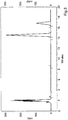
- Fig. 1a shows the preparative HPLC purification of 25 mg raw product obtained in the synthesis according to EP 2842933 B1 , wherein the two peaks are dronabinol as main product (larger peak) and delta-8-THC as main impurity (smaller peak).
- Fig. 1b shows the preparative HPLC purification of 200 mg raw product comprising dronabinol as main product and delta-8-THC as main impurity, demonstrating that these compounds can not be resolved in this quantity.
- a further chromatographic purification method is super critical fluid chromatography (SFC), in which liquid CO 2 is used as eluant.
- SFC super critical fluid chromatography
- the purification of (-)-delta-9-trans-THC by SFC is described in WO 2005/061480 A1 . This process, however, requires a complex constructional setup and is very expensive. Moreover, the CO 2 evaporates and is lost during processing.
- WO 2006/053766 suggests on page 26 line 6 to page 27 line 13 the purification of ⁇ -9-tetrahydrocannabinol by simulated moving bed chromatography.
- Examples 4-20 show the preparation of THC (including its different isomers) starting from menthadienol and olivetol, via cannabidiol.
- Examples 8 and 9 relate to the preparation of trans -(-)- ⁇ -9-tetrahydrocannabinol.
- Simulated moving bed chromatography is a continuous process based on the true moving bed principle, in which the solid phase moves in the opposite direction to the liquid phase and is therefore not stationary. Due to this opposing movement two pure compounds can be isolated or a pure compound can be isolated from a complex mixture.
- the moving solid phase on which this concept relies is technically not feasible and therefore simulated. This is implemented by arranging several preparative columns connected in series and periodically changing the valve setting so that a movement of the solid phase in the opposite direction of the flow of the liquid phase is simulated.
- the system is continuously fed with a feed mixture comprising the compounds to be separated and an eluant while a raffinate and an extract are continuously withdrawn from the system.
- the system is therefore divided into four different separation zones, in each of which the same number of columns are distributed.
- the process shown in Figure 2 comprises 8 columns in total, but alternatively, only four may be used.
- the parameters which are important for the SMB principle, are the periodical change of the position of the ports as well as the different flow rates in the four zones. These four flow rates are regulated by four pumps.
- the extract pump in zone II and the raffinate pump in zone IV are inside the column circle, the eluant and the feed pump are located outside of the column circle.
- a fine regulation is achieved by two needle valves, which regulate the ratio between the circle flow and the outlet flow.
- a mixture comprising at least one cannabinoid compound together with at least one of its isomers, such as a reaction mixture from a synthesis step, may be subjected to the method according to the invention to provide highly pure products in large yields.
- the at least one cannabinoid compound and its isomer(s) present in the mixture provided in step i) are likely very similar in chemical structure and therefore also in their physical properties. Consequently, they are particularly hard to separate. Using the method according to the present invention, however, the cannabinoid compound(s) can efficiently be separated from their isomers.
- the one or more further organic compound(s) present in the mixture provided in step i) may be any compound(s) selected from synthetic starting materials or side products of the synthesis, which are not cannabinoid compounds.
- the process is very time efficient and the required amount of eluant is significantly reduced compared to conventional chromatography. Additionally, it is advantageous that the solid phase can be used for separation during the entire process. This increases the efficiency of the separation and simultaneously reduces the required amount of eluant.
- any system suitable to perform simulated moving bed chromatography may be used.
- the stationary or solid phase may be any material, which the skilled person can easily choose according to the nature of the mixture and the compounds to be separated.
- To determine the respective flow rates at the different pumps several methods and models are known in the prior art which may be implemented in order to achieve an optimal separation of the desired compound(s).
- the desired compound(s) is/are obtained in the extract and/or the raffinate in a degree of purity with respect to any isomer of the desired cannabinoid compound(s), which is preferably below detection limit, in particular the total amount of any isomer of the cannabinoid compound(s) which was/were present in step i) is less than 100 ppm, preferably less than 70 ppm and particularly preferably less than 50 ppm.
- the degree of purity may be determined chromatographically using an HPLC apparatus (e.g. Knauer HPLC smartline series) and the appropriate USP reference standards for dronabinol and its isomers.
- a Restek - Raptor (ARC - 18, 2.7 mm, 150 x 4.6 mm) HPLC column may be used together with the respective USP eluent (45 % methanol, 25 % water, 20 % tetrahydrofuran, 10 % acetonitrile) with an eluent flow of 0.8 mL / min.
- the method as described above additionally comprises the step
- impurities other than the isomers present in step i) can be removed.
- organic compounds, which may be present from the synthetic step such as starting materials or side products of the synthesis can be removed to a degree such that they are present in an total amount of less than 100 ppm, preferably less than 70 ppm, particularly preferably less than 50 ppm.
- the extraction agent may be any substance selected from the group consisting of cyclohexane, heptane and other oxygen free hydrocarbons.
- Suitable oils to be used as extracting agents are selected from the group consisting of plant oils with medium chain triglycerides, preferably containing the fatty acids capric acid and caprylic acid.
- the resulting product comprising the desired cannabinoid compound - besides being highly pure - is particularly stable when kept under argon and in the dark.
- the medium chain triglycerides mentioned above provide an antioxidant effect and therefore enhance the stability of the product.
- the method according to the invention is used to purify the reaction product(s) of the synthesis steps described in EP 2842933 B1 .
- the reaction product to be purified is preferably trans-(-)-delta-9-THC (III).
- step i) includes the following step: conversion of menthadienol with an olivetolic acid ester to a cannabidiolic acid ester of formula (IX)
- step i) comprises the conversion of a cannabidiolic acid ester of formula (IX), wherein Y is an organic residue with an alcohol of the formula HO-X, wherein
- the compound generated by the conversion of the cannabidiolic acid ester of formula (IX) with the alcohol of formula HO-X is treated in such a way that it is decarboxylated and saponified to generate cannabidiol (II).
- the cannabidiol which is present after the decarboxylating saponification, is cyclised to trans-(-)-delta-9-tetrahydrocannabinol (III), preferably in the absence of halogenated solvents.
- any residual olivetol can be removed to such a degree that it is no more detectable by conventional HPLC analysis as demonstrated in example 3.
- the present invention particularly relates to a method as described above, wherein the one or one of the further organic compound(s) present in step i) is olivetol.
- the raw product generated by the synthesis according to EP 2842933 B1 has a delta-9-THC content of 65 - 75 %, as well as 20 - 30 % of the isomer delta-8-tetrahydrocannabinol as main impurity. Furthermore, delta-9(11)-tetrahydrocannabinol may be present. Due to the structural similarity of the isomers, the desired delta-9-THC is very hard to purify from this reaction mixture.
- the mixture provided in step i) comprises trans-(-)-delta-9-tetrahydrocannabinol together with delta-8-tetrahydrocannabinol and/or delta-9(11)-tetrahydrocannabinol.
- the method according to the invention is used to purify the reaction product(s) of the synthesis steps described in European patent application EP 15156750.0 .
- the reaction product to be purified is preferably trans-(-)-delta-9-tetrahydrocannabivarin (VIII).
- step i) comprises the conversion of menthadienol of formula (I) with a divarinic acid ester of formula (IV), to an ester of formula (V),
- step i) comprises the transesterification of the ester of formula (V) with an alcohol of the formula HO-X, wherein
- the compound generated by the conversion of ester of formula (V) with the alcohol of formula HO-X is treated in such a way that it is decarboxylated and saponified to generate cannabidivarin (VII).
- the cannabidivarin which is present after the decarboxylating saponification, is cyclised to trans-(-)-delta-9-tetrahydrocannabivarin (VIII), preferably in the absence of halogenated solvents.
- reaction products of the synthesis steps as described in European patent application EP 15156750.0 may be purified by the method according to the invention.
- the advantages described above in the context of the purification of the synthesis product(s) according to EP 2842933 apply accordingly.
- Described herein is an extract or raffinate obtained or obtainable in step c) or d) of a method as described above, or an extract or raffinate obtained or obtainable in step iii) of a method as described in the context of the corresponding embodiment above.
- An extract or raffinate obtained or obtainable in step c) or d) of a method as described above, or an extract or raffinate obtained or obtainable in step iii) of a method as described in the context of the corresponding embodiment above, comprises the desired cannabinoid compound in a degree of purity, in particular with respect to its isomers, which could not be achieved by any of the conventional processes available in the prior art.
- Step 1 Coupling step (in the continuous process); Synthesis of cannabidiolic acid methyl ester (I)
- the hydrolyzed reaction solution is transferred into a 5L jacket reaction vessel, the aqueous phase is separated and the solvent chlorobenzene is removed in vacuo.
- Ca. 2,000 g of toluene are added to the remaining 730 g of raw material and the unreacted olivetolic acid ester is extracted through the addition of 1,200 g 1% aqueous sodium hydroxide solution (four times).
- ca. 30% (140 g) of non converted olivetolic acid ester are recovered.
- Step 2 Transesterification, synthesis of 2-hydroxyethyl cannabidiolate:
- the toluene is removed in vacuo and to the remaining first intermediate 600 g of ethylene glycol are added under stirring followed by a solution of 85 g of potassium hydroxide in 300 g ethylene glycol. A vacuum of ca. 0.5 bar is applied and it is heated to 120 °C for 2 h, whereby ca. 40 g of methanol distill off.
- the resulting product composition mainly comprises 2-hydroxyethyl cannabidiolate.
- the temperature is increased to 150 °C and it is stirred at this temperature for 2 h.
- the product composition resulting from the transesterification comprising mainly 2-hydroxyethyl cannabidiolate is cooled down to ca. 40 °C and 500 g of water as well as 500 g of n-heptane are added and ca. 150 g of semi conc. sulfuric acid are added for neutralization.
- the solvent is removed using a rotary evaporator and the remainder is distilled over a thin-film evaporator using a vacuum of ca. 0.5 mbar and a jacket temperature of 230 °C.
- 310 g of cannabidiol are obtained in the form of a viscous, yellowish oil with a purity of 85%, which corresponds to a theoretical yield of 60% in relation to the used cannabidiolic acid ester.
- Step 4 Cyclization, synthesis of delta-9-THC:
- Step 1 Coupling step
- Step 2 Transesterification step:
- the toluene is removed in vacuo and to the remaining first intermediate 650 g of ethylene glycol are added under stirring followed by a solution of 122 g of potassium hydroxide in 420 g ethylene glycol. A vacuum of ca. 0.5 bar is applied and it is heated to 100-120 °C for 2 h, whereby ca. 40 g of methanol distill off.
- the resulting product composition mainly comprises 2-hydroxy-ethyl-cannabidivarinolat (VI).
- the temperature is increased to 150 °C and it is stirred at this temperature for 3-4h (also in vacuo; cfl. step 2).
- the product composition resulting from the transesterification is cooled down to ca. 40 °C and 1.500 g of water as well as 800 g of methyl-tert. butyether are added and ca. 180 g of semi conc. sulfuric acid are added for neutralization.
- the solvent is removed using a rotary evaporator and the remainder is distilled over a thin-film evaporator using a vacuum of ca. 1 mbar and a jacket temperature of 230 °C.
- cannabidivarin (VII) 270 g are obtained in the form of a viscous, yellowish oil with a purity of 85%, which corresponds to a theoretical yield of 85% in relation to the used cannabivarinic acid ester.
- Example 3 Purification of a raw product as obtained in example 1:
- Figure 3 shows the exemplary chromatogram of LN 703795.
- the chromatographic system is based on a known SMB apparatus of the company Knauer (Germany).
- the system comprises 8 separation columns (Knauer Vertex Plus, 250 x 8 mm), as well as the required pumps.
- the column configuration corresponds to the standard 2 - 2 - 2 - 2 arrangement.
- the movement of the individual columns is implemented by a 64 port rotary valve.
- the switching time of the valve is 10.81 seconds.
- the valve and the HPLC columns are located in a tempered column oven.
- the temperature of the chromatographic system is 20 to 60 °C, preferably 30 °C.
- a solid phase suitable for the separation is an RP material (Eurospher II silica gel, C18P) with a grain size of 10 to 100 ⁇ m, preferably 20 to 45 ⁇ m.
- the solid phase showed no signs of deterioration over a time period of two years. This is a further advantage compared to classical chromatographic systems.
- a mixture of methanol, tetrahydrofuran and water is used, preferably with the composition: methanol (62%), tetrahydofuran (17%), water (21%). Furthermore, 0.01% ascorbic acid is added to the mixture as antioxidant.
- the feed mixture comprises the above described raw product dissolved in eluant mixture at a concentration of 12.5 g/L.
- the eluant, extract and raffinate pump each have a maximum flow rate of 50 ml/min, the feed pump a maximum flow rate of 10 ml/min.
- the following flow rates are used: eluant pump (zone 1; 4.4 ml/min), extract pump (zone 2, 3.2 ml/min), raffinate pump (zone 4, 1.3 ml/min) and feed pump (zone 3, 0.2 ml/min).
- the flow rates are measured with a Humonics Optiflow 520.
- the supply of the system with eluant and feed solution is done from suitable stock containers, which are secured for fire safety. Eluant and feed solution are periodically overlaid with argon to keep oxygen from the air out. Before entering the system, eluant and feed solution are pumped though a deaerator.
- the SMB process does not need a constant supervision.
- the process described herein may be run continuously over several weeks without changing the parameters and without having a change in the yield.
- the particular stability of the process allows a 24 hour operation, without needing shift workers. Internal controls of the process are performed once a day.
- 0.15 g/ hour of dronabinol can continuously be obtained from the raffinate. This corresponds to a daily rate of 3.6 g.
- the daily yield can be increased to 144 g of pure dronabinol. This corresponds to a yearly production of about 40 kg of dronabinol.
- Figure 4 shows the exemplary chromatogram of the raffinate from LN 703795.
- the obtained raffinate is subjected to further processing.
- the solvent is reduced by distillation (100 mbar vacuum at a temperature of 30 °C) to 30 % organic.
- the distilled solvent is reintroduced to the process as eluant after adjustment of the starting mixture.
- the obtained reduced raffinate is extracted twice with cyclohexane (50 wt.-% with respect to the reduced raffinate).
- the olivetol contained in the raffinate stays in the water/organic phase, while the dronabinol passes into the cyclohexane phase.
- dronabinol After removal of the solvent by distillation, dronabinol is obtained with a content of > 99% at a residual solvent content of below 100 ppm.
- HPLC-Analysis: final product (DAD, in Area-%) substance - batch number LN 703795 LN 703814 LN 703842 olivetol n.d. n.d. n.d. cannabidiol 0.31 % 0.51 % 0.41 % dronabinol 99.34 % 98,10 % 99.15 % ⁇ 9(11) - tetrahydrocannabinol n.d. n.d. n.d. ⁇ 8 - tetrahydrocannabinol n.d. n.d. n.d. n.d. not detectable
- Figure 5 shows the exemplary chromatogram of the final product from LN 703795.
- a plant oil based on a mixture of medium chain triglyceride may alternatively be used. This leads to a comparable purity as obtained with cyclohexane and a stable storage medium for the pure compound.
Landscapes
- Chemical & Material Sciences (AREA)
- Organic Chemistry (AREA)
- Life Sciences & Earth Sciences (AREA)
- Sustainable Development (AREA)
- Analytical Chemistry (AREA)
- Chemical Kinetics & Catalysis (AREA)
- Pyrane Compounds (AREA)
- Pharmaceuticals Containing Other Organic And Inorganic Compounds (AREA)
- Organic Low-Molecular-Weight Compounds And Preparation Thereof (AREA)
Claims (12)
- Procédé de purification de trans-(-)-delta-9-tétrahydrocannabinol ou de trans-(-)-delta-9-tétrahydrocannabivarine comprenant les étapes consistant à:i) fournir un mélange comprenant du trans-(-)-delta-9-tétrahydrocannabinol ou du trans-(-)-delta-9-tétrahydrocannabivarine obtenu par synthèse énantiopure et un ou plusieurs de ses isomères et, en option, un ou plusieurs autres composés organiques, etii) simultanément,dans lequel l'extrait et/ou le raffinat comprend/comprennent respectivement du trans-(-)-delta-9-tétrahydrocannabinol ou du trans-(-)-delta-9-tétrahydrocannabivarine et dans lequel l'extrait et/ou le raffinat comprenant du trans-(-)-delta-9-tétrahydrocannabinol ou du trans-(-)-delta-9-tétrahydrocannabivarine comprend/comprennent moins de 100 ppm, de préférence moins de 70 ppm, de manière particulièrement préférée moins de 50 ppm au total de tout isomère du trans-(-)-delta-9-tétrahydrocannabinol ou du trans-(-)-delta-9-tétrahydrocannabivarine présent à l'étape i).a) introduire en continu le mélange de l'étape i) par une entrée dans un dispositif chromatographique à lit mobile simulé comprenant au moins quatre colonnes reliées en série et contenant une phase stationnaire, etb) introduire en continu de l'éluant dans le dispositif à travers une entrée d'éluant, etc) retirer en continu l'extrait à travers une sortie d'extrait, etd) retirer en continu le raffinat à travers une sortie de raffinat,
- Procédé selon la revendication 1, comprenant en outre l'étape consistant à
iii) soumettre l'extrait et/ou le raffinat comprenant du trans-(-)-delta-9-tétrahydrocannabinol ou du trans-(-)-delta-9-tétrahydrocannabivarine à une, deux ou plusieurs étape(s) d'extraction supplémentaire(s), de préférence en utilisant une huile en tant qu'agent d'extraction,
dans lequel l'extrait et/ou le raffinat respectivement obtenus à l'étape iii) comprend/comprennent du trans-(-)-delta-9-tétrahydrocannabinol ou du trans-(-)-delta-9-tétrahydrocannabivarine et moins de 100 ppm, de préférence moins de 70 ppm, de manière particulièrement préférée moins de 50 ppm au total de tout autre composé organique présent dans l'étape i). - Procédé selon la revendication 1 ou 2 de purification de trans-(-)-delta-9-tétrahydrocannabinol, dans lequel l'étape i) comprend l'étape suivante:
conversion de menthadiénol avec un ester d'acide olivétolique en un ester d'acide cannabidiolique de formule (IX) dans laquelle Y est un résidu organique,de préférence dans un processus continu.
 - Procédé selon la revendication 3, dans lequel l'étape i) comprend la conversion d'un ester d'acide cannabidiolique de formule (IX), dans laquelle Y est un résidu organique
avec un alcool de formule HO-X,
dans laquelleX est un résidu aliphatique avec un, deux, trois ou plus de trois groupes hydroxyle, dans lequel le nombre total d'atomes de carbone dans le résidu aliphatique X n'est pas supérieur à 15, etdans lequel le résidu aliphatique est- saturé ou insaturé
et- ramifié ou non ramifié,dans laquelle Y est différent de X et est choisi de telle sorte que l'alcool de formule HO-Y, qui est généré pendant la conversion, bout à une température plus basse à 1013 hPa que l'alcool utilisé de formule HO-X. - Procédé selon la revendication 4, dans lequel le composé généré par la conversion de l'ester d'acide cannabidiolique de formule (IX) avec l'alcool de formule HO-X est traité de telle manière qu'il soit décarboxylé et saponifié pour générer du cannabidiol (II).
- Procédé selon la revendication 5, dans lequel le cannabidiol qui est présent après la saponification décarboxylante, est cyclisé en trans-(-)-delta-9-tétrahydrocannabinol (III), de préférence en l'absence de solvants halogénés.
- Procédé selon l'une quelconque des revendications 3 à 6, dans lequel ledit un ou l'un des autre(s) composé(s) organique(s) présent(s) à l'étape i) est l'olivétol.
- Procédé selon la revendication 6 ou 7, dans lequel le mélange fourni à l'étape i) comprend du trans-(-)-delta-9-tétrahydrocannabinol conjointement avec du delta-8-tétrahydrocannabinol et/ou du delta-9(11)-tétrahydrocannabinol.
- Procédé selon la revendication 1 ou 2 de purification de trans-(-)-delta-9-tétrahydrocannabivarine, dans lequel l'étape i) comprend la conversion du menthadiénol de formule (I) avec un ester d'acide divarinique de formule (IV), en un ester de formule (V),

- Procédé selon la revendication 9, dans lequel l'étape i) comprend la transestérification de l'ester de formule (V)
avec un alcool de formule HO-X,
dans laquelleX est un résidu aliphatique avec un, deux, trois ou plus de trois groupes hydroxyle, dans lequel le nombre total d'atomes de carbone dans le résidu aliphatique X n'est pas supérieur à 15, etdans lequel le résidu aliphatique est- saturé ou insaturé
et- ramifié ou non ramifié,- acyclique ou cyclique,à condition que l'alcool de formule HO-X soit choisi dans le groupe constitué de cyclohexanol et d'hexanol dans le cas où X est un résidu aliphatique exempt de groupe hydroxyle. - Procédé selon la revendication 9 ou 10, dans lequel le composé généré par la conversion de l'ester de formule (V) avec l'alcool de formule HO-X est traité de telle manière qu'il soit décarboxylé et saponifié pour générer de la cannabidivarine (VII).
- Procédé selon la revendication 11, dans lequel la cannabidivarine qui est présente après la saponification décarboxylante, est cyclisée en trans-(-)-delta-9-tétrahydrocannabivarine (VIII), de préférence en l'absence de solvants halogénés.
Priority Applications (1)
| Application Number | Priority Date | Filing Date | Title |
|---|---|---|---|
| PL16728841T PL3455213T3 (pl) | 2016-05-13 | 2016-05-13 | Sposób oczyszczania związków kannabinoidowych przez symulowaną chromatografię z ruchomym złożem |
Applications Claiming Priority (1)
| Application Number | Priority Date | Filing Date | Title |
|---|---|---|---|
| PCT/EP2016/060905 WO2017194173A1 (fr) | 2016-05-13 | 2016-05-13 | Procédé de purification de composés cannabinoïdes |
Publications (2)
| Publication Number | Publication Date |
|---|---|
| EP3455213A1 EP3455213A1 (fr) | 2019-03-20 |
| EP3455213B1 true EP3455213B1 (fr) | 2021-11-24 |
Family
ID=56121022
Family Applications (1)
| Application Number | Title | Priority Date | Filing Date |
|---|---|---|---|
| EP16728841.4A Active EP3455213B1 (fr) | 2016-05-13 | 2016-05-13 | Méthode pour la purification des composés cannabinoids par chromatographie en lit mobile simulée (smb) |
Country Status (9)
| Country | Link |
|---|---|
| US (1) | US10647691B2 (fr) |
| EP (1) | EP3455213B1 (fr) |
| CN (1) | CN109153661B (fr) |
| CA (1) | CA3023760C (fr) |
| DK (1) | DK3455213T3 (fr) |
| ES (1) | ES2907623T3 (fr) |
| PL (1) | PL3455213T3 (fr) |
| PT (1) | PT3455213T (fr) |
| WO (1) | WO2017194173A1 (fr) |
Families Citing this family (36)
| Publication number | Priority date | Publication date | Assignee | Title |
|---|---|---|---|---|
| US10239808B1 (en) | 2016-12-07 | 2019-03-26 | Canopy Holdings, LLC | Cannabis extracts |
| US11213558B2 (en) | 2017-05-17 | 2022-01-04 | Orochem Technologies, Inc. | CBX extraction-isolation process |
| US10189762B1 (en) | 2017-07-07 | 2019-01-29 | Orochem Technologies, Inc. | Process for purification and separation of cannabinoids, from dried hemp and cannabis leaves |
| CA3089994A1 (fr) | 2018-01-31 | 2019-08-08 | Canopy Holdings, LLC | Poudre de chanvre |
| US11192870B2 (en) | 2018-03-07 | 2021-12-07 | Socati Technologies—Oregon, Llc | Continuous isolation of cannabidiol and conversion of cannabidiol to delta 8-tetrahydrocannabinol and delta 9-tetrahydrocannabinol |
| EP3762375A4 (fr) * | 2018-03-07 | 2022-02-16 | Socati Technologies-Oregon, LLC | Isolement continu de cannabidiol et conversion de cannabidiol en delta 8-tétrahydrocannabinol et delta 9-tétrahydrocannabinol |
| US11851415B2 (en) * | 2018-03-07 | 2023-12-26 | Cleen Technology Inc. | Continuous isolation of cannabidiol and cannabinoids and conversion of cannabidiol to delta 8-tetrahydrocannabinol and delta 9-tetrahydrocannabinol |
| EP4620940A3 (fr) * | 2018-06-28 | 2025-12-17 | Symrise AG | Synthese de (+)-cannabinoides et leurs effets therapeutiques |
| WO2020028198A1 (fr) | 2018-08-03 | 2020-02-06 | Biomass Oil Separation Solutions, Llc | Procédés et appareil d'extraction de substances et d'extraits enrichis à partir d'une matière végétale |
| JP2021535203A (ja) * | 2018-08-20 | 2021-12-16 | ベッソール ファルマ、エルエルシー | 既知および新規カンナビノイドの適用 |
| US11324718B2 (en) * | 2018-10-09 | 2022-05-10 | Sartorius Chromatography Equipment | Method for purifying cannabinoids |
| WO2020077153A1 (fr) | 2018-10-10 | 2020-04-16 | Canopy Holdings, LLC | Synthèse du cannabigérol |
| CA3122153A1 (fr) * | 2018-12-04 | 2020-06-11 | Orochem Technologies Inc. | Procede de purification de tetrahydrocannabinol a l'aide d'une phase stationnaire chromatographique |
| US10413845B1 (en) | 2018-12-14 | 2019-09-17 | Socati Technologies | Processes for solvent extraction of cannabinoids, terpenes and flavonoids from biomass |
| CN109734591A (zh) * | 2018-12-26 | 2019-05-10 | 江苏暨明医药科技有限公司 | 一种大麻二酚中间体及其制备方法与及应用 |
| US20200354297A1 (en) * | 2019-05-10 | 2020-11-12 | Fresh Cut Development, Llc | Methods of Manufacturing Cannabidiol or Cannabidivarin and Intermediates of Manufacturing Cannabidiol or Cannabidivarin |
| CN111943813B (zh) * | 2019-05-17 | 2023-04-14 | 上海特化医药科技有限公司 | 大麻二酚类化合物的制备方法 |
| CA3179235A1 (fr) * | 2019-05-23 | 2020-11-26 | Kare Chemical Technologies Inc. | Procedes et precurseurs de cannabinoides catalytiques |
| CN110270134A (zh) * | 2019-05-31 | 2019-09-24 | 江苏哈工药机科技股份有限公司 | 一种高纯度cbd分离纯化装置及其分离纯化方法 |
| US10799546B1 (en) | 2019-07-26 | 2020-10-13 | Biomass Oil Separation Solutions, Llc | Modular, integrated process and apparatus for extracting, refining and remediating active substances from plant material |
| CN110724589B (zh) * | 2019-08-27 | 2023-01-10 | 桂林莱茵生物科技股份有限公司 | 一种制备大麻二酚联产大麻全谱油的方法 |
| US11542243B1 (en) | 2019-09-26 | 2023-01-03 | FusionFarms, LLC | Method of converting delta9-THC to delta10-THC and the purification of the delta10-THC by crystallization |
| EP4042146A4 (fr) * | 2019-10-11 | 2023-08-16 | Compassionate Analytics Inc. | Kits d'essai et méthodes d'identification de composés cannabinoïdes |
| CN110746275A (zh) * | 2019-11-08 | 2020-02-04 | 河南汉麻生物科技有限公司 | 一种利用连续色谱系统分离大麻二酚的方法 |
| CN113896616A (zh) * | 2020-07-06 | 2022-01-07 | 复旦大学 | 一种大麻二酚的制备方法 |
| CN114432187A (zh) * | 2020-11-03 | 2022-05-06 | 北京东方淼森生物科技有限公司 | 一种桃花油的制备方法及在化妆品中的应用 |
| EP3991820A1 (fr) * | 2020-11-03 | 2022-05-04 | Sartorius Stedim Biotech GmbH | Système de chromatographie à membrane |
| WO2022125966A1 (fr) * | 2020-12-10 | 2022-06-16 | Orochem Technologies Inc. | Procédé d'élimination de thc à partir de cannabinoïdes |
| CN112843788B (zh) * | 2021-01-19 | 2022-10-28 | 温州大学新材料与产业技术研究院 | 一种采用流动相独立环外置换的温度梯度模拟移动床装置及其分离方法 |
| CN113135885A (zh) * | 2021-04-07 | 2021-07-20 | 上海同田生物技术有限公司 | 一种高速逆流色谱分离纯化四氢次大麻酚的方法 |
| JP2024518338A (ja) * | 2021-04-27 | 2024-05-01 | カーデー・ファルマ・ベクスバッハ・ゲゼルシャフト・ミト・ベシュレンクテル・ハフツング | 物質混合物を分離するための方法 |
| LU500093B1 (de) * | 2021-04-27 | 2022-10-31 | K D Pharma Bexbach Gmbh | Verfahren zum Trennen einer Stoffmischung |
| CN113683490B (zh) * | 2021-08-02 | 2022-03-25 | 云南翰谷生物科技有限公司 | 一种次大麻二酚晶体的制备方法 |
| CN115010690B (zh) * | 2022-06-06 | 2023-03-21 | 云南翰谷生物科技有限公司 | 一种高纯大麻酚晶体制备方法 |
| CN115385780B (zh) * | 2022-08-26 | 2024-02-27 | 晨光生物科技集团股份有限公司 | 一种次大麻二酚结晶多晶型物及其制备方法和应用 |
| WO2025213198A1 (fr) | 2024-04-05 | 2025-10-09 | Council For Scientific And Industrial Research | Processus chimique pour la production de composés cannabinoïdes |
Family Cites Families (13)
| Publication number | Priority date | Publication date | Assignee | Title |
|---|---|---|---|---|
| US5342971A (en) | 1992-12-29 | 1994-08-30 | The Australian National University | Process for the preparation of dibenzo[b,d]pyrans |
| WO2002045115A1 (fr) | 2000-11-28 | 2002-06-06 | Orion Electric Co., Ltd. | Ecran couleur a plasma avec temperature de couleur et luminosite ameliorees |
| DE10106024B4 (de) | 2001-02-09 | 2004-10-14 | Thc Pharm Gmbh | Verfahren zur Herstellung von Dronabinol |
| GB0112752D0 (en) * | 2001-05-25 | 2001-07-18 | Johnson Matthey Plc | Synthesis of cannabinoids |
| GB0329635D0 (en) | 2003-12-23 | 2004-01-28 | Johnson Matthey Plc | Process for purifying trans-tetrahydrocannabinol |
| US7923558B2 (en) | 2004-07-19 | 2011-04-12 | Cilag Ltd. | Method for obtaining pure tetrahydrocannabinol |
| TWI369203B (en) | 2004-11-22 | 2012-08-01 | Euro Celtique Sa | Methods for purifying trans-(-)-△9-tetrahydrocannabinol and trans-(+)-△9-tetrahydrocannabinol |
| DE102005028937B4 (de) | 2005-06-22 | 2009-07-23 | Bionorica Ag | Verfahren zur Herstellung von Dronabinol |
| CA2623723A1 (fr) * | 2005-09-29 | 2007-04-12 | Amr Technology, Inc. | Procede pour la production de delta-9-tetrahydrocannabinol |
| GB0807915D0 (en) | 2008-05-01 | 2008-06-04 | Resolution Chemicals Ltd | Production of delta 9 tetrahydrocannabinol |
| DE102009019322A1 (de) * | 2009-04-30 | 2010-11-11 | The Health Concept Gmbh | Verfahren zur Herstellung von Synthetischen Cannabinoiden |
| ES2806034T3 (es) | 2011-09-29 | 2021-02-16 | Thc Pharm Gmbh The Health Concept | Acidos carboxílicos de cannabinoide, sales de ácidos carboxílicos de cannabinoide, su preparación y aplicaciones |
| EP2842933B1 (fr) * | 2013-09-03 | 2015-07-29 | Symrise AG | Mélanges de composés cannabinoïdes, leur préparation et leur utilisation |
-
2016
- 2016-05-13 PL PL16728841T patent/PL3455213T3/pl unknown
- 2016-05-13 WO PCT/EP2016/060905 patent/WO2017194173A1/fr not_active Ceased
- 2016-05-13 PT PT167288414T patent/PT3455213T/pt unknown
- 2016-05-13 CN CN201680085631.5A patent/CN109153661B/zh active Active
- 2016-05-13 DK DK16728841.4T patent/DK3455213T3/da active
- 2016-05-13 EP EP16728841.4A patent/EP3455213B1/fr active Active
- 2016-05-13 CA CA3023760A patent/CA3023760C/fr active Active
- 2016-05-13 ES ES16728841T patent/ES2907623T3/es active Active
- 2016-05-13 US US16/300,205 patent/US10647691B2/en active Active
Non-Patent Citations (1)
| Title |
|---|
| None * |
Also Published As
| Publication number | Publication date |
|---|---|
| CA3023760A1 (fr) | 2017-11-16 |
| CN109153661B (zh) | 2023-01-17 |
| PL3455213T3 (pl) | 2022-04-04 |
| CN109153661A (zh) | 2019-01-04 |
| PT3455213T (pt) | 2022-03-01 |
| DK3455213T3 (da) | 2022-03-07 |
| US10647691B2 (en) | 2020-05-12 |
| CA3023760C (fr) | 2023-10-03 |
| EP3455213A1 (fr) | 2019-03-20 |
| WO2017194173A1 (fr) | 2017-11-16 |
| ES2907623T3 (es) | 2022-04-25 |
| US20190144414A1 (en) | 2019-05-16 |
Similar Documents
| Publication | Publication Date | Title |
|---|---|---|
| EP3455213B1 (fr) | Méthode pour la purification des composés cannabinoids par chromatographie en lit mobile simulée (smb) | |
| KR101930570B1 (ko) | 크로만 화합물 및 이의 유도체 및 전구체의 키랄 이성질체 분리 방법 | |
| CA3019890A1 (fr) | Synthese bio-enzymatique de tetrahydrocannabivarine (thc-v), de cannabinol (cbn) et de cannabivarine (cbv) et leur utilisation en tant qu'agents therapeutiques | |
| KR101829102B1 (ko) | 크로마논 2-카르복실산 유도체, 크로만 2-카르복실산 유도체 및 이의 제조방법 | |
| US11643380B2 (en) | Methods of synthesizing cannabigergol, cannabigerolic acid, and analogs thereof | |
| Achenbach et al. | Constituents of Tropical Medicinal Plants, IXX1 GC/MS-Investigations of the constituents of Piper amalago-30 new amides of the Piperine-Type | |
| ITRM20100622A1 (it) | Processo per la preparazione del nebivololo. | |
| JP2022551476A (ja) | カンナビノイド及びカンナビノイド酸の製造プロセス | |
| CA2714051A1 (fr) | Procede de preparation du nebivolol | |
| JP2005179339A (ja) | 新規化合物および医薬組成物 | |
| EP2758366B1 (fr) | Procédé de préparation de quinone chiral | |
| AU2010275690B2 (en) | Process for preparing Nebivolol | |
| EP2882731A1 (fr) | Tocophérols à teneur réduite en impuretés phénoliques | |
| Gezegen | Synthesis and Characterization of Novel 2, 4-Diaryloctahydro-2H-Chromene Derivatives with Four Stereocenters | |
| WO2021226711A1 (fr) | Procédés de synthèse de cannabigérol, d'acide cannabigérolique et de leurs analogues | |
| WO2024192324A2 (fr) | Analogues de cannabichromène et d'acide cannabichroménique et procédé de préparation | |
| EP3555057B1 (fr) | Procédé de préparation de tocols et de squalène | |
| Haynes et al. | An improved preparation of the desmethyl qinghao acid precursor of (±)-6, 9-desmethylqinghaosu |
Legal Events
| Date | Code | Title | Description |
|---|---|---|---|
| STAA | Information on the status of an ep patent application or granted ep patent |
Free format text: STATUS: THE INTERNATIONAL PUBLICATION HAS BEEN MADE |
|
| PUAI | Public reference made under article 153(3) epc to a published international application that has entered the european phase |
Free format text: ORIGINAL CODE: 0009012 |
|
| STAA | Information on the status of an ep patent application or granted ep patent |
Free format text: STATUS: REQUEST FOR EXAMINATION WAS MADE |
|
| 17P | Request for examination filed |
Effective date: 20181213 |
|
| AK | Designated contracting states |
Kind code of ref document: A1 Designated state(s): AL AT BE BG CH CY CZ DE DK EE ES FI FR GB GR HR HU IE IS IT LI LT LU LV MC MK MT NL NO PL PT RO RS SE SI SK SM TR |
|
| AX | Request for extension of the european patent |
Extension state: BA ME |
|
| RIN1 | Information on inventor provided before grant (corrected) |
Inventor name: ERFURT, HARRY Inventor name: NIEMEYER, HANS-JUERGEN Inventor name: GOETZ, MARCUS RUDOLF Inventor name: WINKLER, MATTHIAS Inventor name: WEBER, MARIA |
|
| DAV | Request for validation of the european patent (deleted) | ||
| DAX | Request for extension of the european patent (deleted) | ||
| STAA | Information on the status of an ep patent application or granted ep patent |
Free format text: STATUS: EXAMINATION IS IN PROGRESS |
|
| 17Q | First examination report despatched |
Effective date: 20191127 |
|
| GRAP | Despatch of communication of intention to grant a patent |
Free format text: ORIGINAL CODE: EPIDOSNIGR1 |
|
| STAA | Information on the status of an ep patent application or granted ep patent |
Free format text: STATUS: GRANT OF PATENT IS INTENDED |
|
| INTG | Intention to grant announced |
Effective date: 20210617 |
|
| GRAA | (expected) grant |
Free format text: ORIGINAL CODE: 0009210 |
|
| STAA | Information on the status of an ep patent application or granted ep patent |
Free format text: STATUS: THE PATENT HAS BEEN GRANTED |
|
| GRAS | Grant fee paid |
Free format text: ORIGINAL CODE: EPIDOSNIGR3 |
|
| AK | Designated contracting states |
Kind code of ref document: B1 Designated state(s): AL AT BE BG CH CY CZ DE DK EE ES FI FR GB GR HR HU IE IS IT LI LT LU LV MC MK MT NL NO PL PT RO RS SE SI SK SM TR |
|
| REG | Reference to a national code |
Ref country code: GB Ref legal event code: FG4D |
|
| REG | Reference to a national code |
Ref country code: AT Ref legal event code: REF Ref document number: 1449783 Country of ref document: AT Kind code of ref document: T Effective date: 20211215 |
|
| REG | Reference to a national code |
Ref country code: DE Ref legal event code: R096 Ref document number: 602016066555 Country of ref document: DE |
|
| REG | Reference to a national code |
Ref country code: IE Ref legal event code: FG4D |
|
| REG | Reference to a national code |
Ref country code: PT Ref legal event code: SC4A Ref document number: 3455213 Country of ref document: PT Date of ref document: 20220301 Kind code of ref document: T Free format text: AVAILABILITY OF NATIONAL TRANSLATION Effective date: 20220221 |
|
| REG | Reference to a national code |
Ref country code: DK Ref legal event code: T3 Effective date: 20220303 |
|
| REG | Reference to a national code |
Ref country code: NL Ref legal event code: FP |
|
| REG | Reference to a national code |
Ref country code: SE Ref legal event code: TRGR |
|
| REG | Reference to a national code |
Ref country code: LT Ref legal event code: MG9D |
|
| REG | Reference to a national code |
Ref country code: NO Ref legal event code: T2 Effective date: 20211124 |
|
| REG | Reference to a national code |
Ref country code: ES Ref legal event code: FG2A Ref document number: 2907623 Country of ref document: ES Kind code of ref document: T3 Effective date: 20220425 |
|
| PG25 | Lapsed in a contracting state [announced via postgrant information from national office to epo] |
Ref country code: RS Free format text: LAPSE BECAUSE OF FAILURE TO SUBMIT A TRANSLATION OF THE DESCRIPTION OR TO PAY THE FEE WITHIN THE PRESCRIBED TIME-LIMIT Effective date: 20211124 Ref country code: LT Free format text: LAPSE BECAUSE OF FAILURE TO SUBMIT A TRANSLATION OF THE DESCRIPTION OR TO PAY THE FEE WITHIN THE PRESCRIBED TIME-LIMIT Effective date: 20211124 Ref country code: FI Free format text: LAPSE BECAUSE OF FAILURE TO SUBMIT A TRANSLATION OF THE DESCRIPTION OR TO PAY THE FEE WITHIN THE PRESCRIBED TIME-LIMIT Effective date: 20211124 Ref country code: BG Free format text: LAPSE BECAUSE OF FAILURE TO SUBMIT A TRANSLATION OF THE DESCRIPTION OR TO PAY THE FEE WITHIN THE PRESCRIBED TIME-LIMIT Effective date: 20220224 |
|
| PG25 | Lapsed in a contracting state [announced via postgrant information from national office to epo] |
Ref country code: IS Free format text: LAPSE BECAUSE OF FAILURE TO SUBMIT A TRANSLATION OF THE DESCRIPTION OR TO PAY THE FEE WITHIN THE PRESCRIBED TIME-LIMIT Effective date: 20220324 Ref country code: LV Free format text: LAPSE BECAUSE OF FAILURE TO SUBMIT A TRANSLATION OF THE DESCRIPTION OR TO PAY THE FEE WITHIN THE PRESCRIBED TIME-LIMIT Effective date: 20211124 Ref country code: HR Free format text: LAPSE BECAUSE OF FAILURE TO SUBMIT A TRANSLATION OF THE DESCRIPTION OR TO PAY THE FEE WITHIN THE PRESCRIBED TIME-LIMIT Effective date: 20211124 Ref country code: GR Free format text: LAPSE BECAUSE OF FAILURE TO SUBMIT A TRANSLATION OF THE DESCRIPTION OR TO PAY THE FEE WITHIN THE PRESCRIBED TIME-LIMIT Effective date: 20220225 |
|
| PG25 | Lapsed in a contracting state [announced via postgrant information from national office to epo] |
Ref country code: SM Free format text: LAPSE BECAUSE OF FAILURE TO SUBMIT A TRANSLATION OF THE DESCRIPTION OR TO PAY THE FEE WITHIN THE PRESCRIBED TIME-LIMIT Effective date: 20211124 Ref country code: SK Free format text: LAPSE BECAUSE OF FAILURE TO SUBMIT A TRANSLATION OF THE DESCRIPTION OR TO PAY THE FEE WITHIN THE PRESCRIBED TIME-LIMIT Effective date: 20211124 Ref country code: RO Free format text: LAPSE BECAUSE OF FAILURE TO SUBMIT A TRANSLATION OF THE DESCRIPTION OR TO PAY THE FEE WITHIN THE PRESCRIBED TIME-LIMIT Effective date: 20211124 Ref country code: EE Free format text: LAPSE BECAUSE OF FAILURE TO SUBMIT A TRANSLATION OF THE DESCRIPTION OR TO PAY THE FEE WITHIN THE PRESCRIBED TIME-LIMIT Effective date: 20211124 Ref country code: CZ Free format text: LAPSE BECAUSE OF FAILURE TO SUBMIT A TRANSLATION OF THE DESCRIPTION OR TO PAY THE FEE WITHIN THE PRESCRIBED TIME-LIMIT Effective date: 20211124 |
|
| REG | Reference to a national code |
Ref country code: DE Ref legal event code: R097 Ref document number: 602016066555 Country of ref document: DE |
|
| PLBE | No opposition filed within time limit |
Free format text: ORIGINAL CODE: 0009261 |
|
| STAA | Information on the status of an ep patent application or granted ep patent |
Free format text: STATUS: NO OPPOSITION FILED WITHIN TIME LIMIT |
|
| PG25 | Lapsed in a contracting state [announced via postgrant information from national office to epo] |
Ref country code: AL Free format text: LAPSE BECAUSE OF FAILURE TO SUBMIT A TRANSLATION OF THE DESCRIPTION OR TO PAY THE FEE WITHIN THE PRESCRIBED TIME-LIMIT Effective date: 20211124 |
|
| 26N | No opposition filed |
Effective date: 20220825 |
|
| PG25 | Lapsed in a contracting state [announced via postgrant information from national office to epo] |
Ref country code: SI Free format text: LAPSE BECAUSE OF FAILURE TO SUBMIT A TRANSLATION OF THE DESCRIPTION OR TO PAY THE FEE WITHIN THE PRESCRIBED TIME-LIMIT Effective date: 20211124 |
|
| PG25 | Lapsed in a contracting state [announced via postgrant information from national office to epo] |
Ref country code: MC Free format text: LAPSE BECAUSE OF FAILURE TO SUBMIT A TRANSLATION OF THE DESCRIPTION OR TO PAY THE FEE WITHIN THE PRESCRIBED TIME-LIMIT Effective date: 20211124 Ref country code: LU Free format text: LAPSE BECAUSE OF NON-PAYMENT OF DUE FEES Effective date: 20220513 |
|
| REG | Reference to a national code |
Ref country code: AT Ref legal event code: UEP Ref document number: 1449783 Country of ref document: AT Kind code of ref document: T Effective date: 20211124 |
|
| PG25 | Lapsed in a contracting state [announced via postgrant information from national office to epo] |
Ref country code: IE Free format text: LAPSE BECAUSE OF NON-PAYMENT OF DUE FEES Effective date: 20220513 |
|
| PG25 | Lapsed in a contracting state [announced via postgrant information from national office to epo] |
Ref country code: HU Free format text: LAPSE BECAUSE OF FAILURE TO SUBMIT A TRANSLATION OF THE DESCRIPTION OR TO PAY THE FEE WITHIN THE PRESCRIBED TIME-LIMIT; INVALID AB INITIO Effective date: 20160513 |
|
| PG25 | Lapsed in a contracting state [announced via postgrant information from national office to epo] |
Ref country code: MK Free format text: LAPSE BECAUSE OF FAILURE TO SUBMIT A TRANSLATION OF THE DESCRIPTION OR TO PAY THE FEE WITHIN THE PRESCRIBED TIME-LIMIT Effective date: 20211124 Ref country code: CY Free format text: LAPSE BECAUSE OF FAILURE TO SUBMIT A TRANSLATION OF THE DESCRIPTION OR TO PAY THE FEE WITHIN THE PRESCRIBED TIME-LIMIT Effective date: 20211124 |
|
| PG25 | Lapsed in a contracting state [announced via postgrant information from national office to epo] |
Ref country code: MT Free format text: LAPSE BECAUSE OF FAILURE TO SUBMIT A TRANSLATION OF THE DESCRIPTION OR TO PAY THE FEE WITHIN THE PRESCRIBED TIME-LIMIT Effective date: 20211124 |
|
| PGFP | Annual fee paid to national office [announced via postgrant information from national office to epo] |
Ref country code: NL Payment date: 20250522 Year of fee payment: 10 |
|
| PGFP | Annual fee paid to national office [announced via postgrant information from national office to epo] |
Ref country code: PL Payment date: 20250505 Year of fee payment: 10 Ref country code: DE Payment date: 20250519 Year of fee payment: 10 |
|
| PGFP | Annual fee paid to national office [announced via postgrant information from national office to epo] |
Ref country code: ES Payment date: 20250616 Year of fee payment: 10 Ref country code: GB Payment date: 20250522 Year of fee payment: 10 Ref country code: DK Payment date: 20250521 Year of fee payment: 10 |
|
| PGFP | Annual fee paid to national office [announced via postgrant information from national office to epo] |
Ref country code: NO Payment date: 20250520 Year of fee payment: 10 |
|
| PGFP | Annual fee paid to national office [announced via postgrant information from national office to epo] |
Ref country code: IT Payment date: 20250530 Year of fee payment: 10 Ref country code: BE Payment date: 20250520 Year of fee payment: 10 |
|
| PGFP | Annual fee paid to national office [announced via postgrant information from national office to epo] |
Ref country code: PT Payment date: 20250507 Year of fee payment: 10 |
|
| PGFP | Annual fee paid to national office [announced via postgrant information from national office to epo] |
Ref country code: FR Payment date: 20250523 Year of fee payment: 10 |
|
| PGFP | Annual fee paid to national office [announced via postgrant information from national office to epo] |
Ref country code: CH Payment date: 20250601 Year of fee payment: 10 |
|
| PGFP | Annual fee paid to national office [announced via postgrant information from national office to epo] |
Ref country code: AT Payment date: 20250519 Year of fee payment: 10 |
|
| PGFP | Annual fee paid to national office [announced via postgrant information from national office to epo] |
Ref country code: SE Payment date: 20250522 Year of fee payment: 10 |
|
| PG25 | Lapsed in a contracting state [announced via postgrant information from national office to epo] |
Ref country code: TR Free format text: LAPSE BECAUSE OF FAILURE TO SUBMIT A TRANSLATION OF THE DESCRIPTION OR TO PAY THE FEE WITHIN THE PRESCRIBED TIME-LIMIT Effective date: 20211124 |