EP3460468A2 - Capteur à base de nitrure de gallium ayant une structure chauffante et son procédé de fabrication - Google Patents
Capteur à base de nitrure de gallium ayant une structure chauffante et son procédé de fabrication Download PDFInfo
- Publication number
- EP3460468A2 EP3460468A2 EP18194416.6A EP18194416A EP3460468A2 EP 3460468 A2 EP3460468 A2 EP 3460468A2 EP 18194416 A EP18194416 A EP 18194416A EP 3460468 A2 EP3460468 A2 EP 3460468A2
- Authority
- EP
- European Patent Office
- Prior art keywords
- layer
- type
- gan
- group
- gallium nitride
- Prior art date
- Legal status (The legal status is an assumption and is not a legal conclusion. Google has not performed a legal analysis and makes no representation as to the accuracy of the status listed.)
- Granted
Links
Images




Classifications
-
- G—PHYSICS
- G01—MEASURING; TESTING
- G01N—INVESTIGATING OR ANALYSING MATERIALS BY DETERMINING THEIR CHEMICAL OR PHYSICAL PROPERTIES
- G01N27/00—Investigating or analysing materials by the use of electric, electrochemical, or magnetic means
- G01N27/02—Investigating or analysing materials by the use of electric, electrochemical, or magnetic means by investigating impedance
- G01N27/04—Investigating or analysing materials by the use of electric, electrochemical, or magnetic means by investigating impedance by investigating resistance
- G01N27/12—Investigating or analysing materials by the use of electric, electrochemical, or magnetic means by investigating impedance by investigating resistance of a solid body in dependence upon absorption of a fluid; of a solid body in dependence upon reaction with a fluid, for detecting components in the fluid
- G01N27/125—Composition of the body, e.g. the composition of its sensitive layer
-
- H—ELECTRICITY
- H10—SEMICONDUCTOR DEVICES; ELECTRIC SOLID-STATE DEVICES NOT OTHERWISE PROVIDED FOR
- H10F—INORGANIC SEMICONDUCTOR DEVICES SENSITIVE TO INFRARED RADIATION, LIGHT, ELECTROMAGNETIC RADIATION OF SHORTER WAVELENGTH OR CORPUSCULAR RADIATION
- H10F77/00—Constructional details of devices covered by this subclass
- H10F77/95—Circuit arrangements
- H10F77/953—Circuit arrangements for devices having potential barriers
- H10F77/957—Circuit arrangements for devices having potential barriers for position-sensitive photodetectors, e.g. lateral-effect photodiodes or quadrant photodiodes
-
- G—PHYSICS
- G01—MEASURING; TESTING
- G01N—INVESTIGATING OR ANALYSING MATERIALS BY DETERMINING THEIR CHEMICAL OR PHYSICAL PROPERTIES
- G01N27/00—Investigating or analysing materials by the use of electric, electrochemical, or magnetic means
- G01N27/02—Investigating or analysing materials by the use of electric, electrochemical, or magnetic means by investigating impedance
- G01N27/04—Investigating or analysing materials by the use of electric, electrochemical, or magnetic means by investigating impedance by investigating resistance
- G01N27/12—Investigating or analysing materials by the use of electric, electrochemical, or magnetic means by investigating impedance by investigating resistance of a solid body in dependence upon absorption of a fluid; of a solid body in dependence upon reaction with a fluid, for detecting components in the fluid
- G01N27/122—Circuits particularly adapted therefor, e.g. linearising circuits
- G01N27/123—Circuits particularly adapted therefor, e.g. linearising circuits for controlling the temperature
- G01N27/124—Circuits particularly adapted therefor, e.g. linearising circuits for controlling the temperature varying the temperature, e.g. in a cyclic manner
-
- G—PHYSICS
- G01—MEASURING; TESTING
- G01N—INVESTIGATING OR ANALYSING MATERIALS BY DETERMINING THEIR CHEMICAL OR PHYSICAL PROPERTIES
- G01N27/00—Investigating or analysing materials by the use of electric, electrochemical, or magnetic means
- G01N27/02—Investigating or analysing materials by the use of electric, electrochemical, or magnetic means by investigating impedance
- G01N27/04—Investigating or analysing materials by the use of electric, electrochemical, or magnetic means by investigating impedance by investigating resistance
- G01N27/12—Investigating or analysing materials by the use of electric, electrochemical, or magnetic means by investigating impedance by investigating resistance of a solid body in dependence upon absorption of a fluid; of a solid body in dependence upon reaction with a fluid, for detecting components in the fluid
- G01N27/128—Microapparatus
-
- G—PHYSICS
- G01—MEASURING; TESTING
- G01N—INVESTIGATING OR ANALYSING MATERIALS BY DETERMINING THEIR CHEMICAL OR PHYSICAL PROPERTIES
- G01N27/00—Investigating or analysing materials by the use of electric, electrochemical, or magnetic means
- G01N27/02—Investigating or analysing materials by the use of electric, electrochemical, or magnetic means by investigating impedance
- G01N27/04—Investigating or analysing materials by the use of electric, electrochemical, or magnetic means by investigating impedance by investigating resistance
- G01N27/14—Investigating or analysing materials by the use of electric, electrochemical, or magnetic means by investigating impedance by investigating resistance of an electrically-heated body in dependence upon change of temperature
-
- G—PHYSICS
- G01—MEASURING; TESTING
- G01N—INVESTIGATING OR ANALYSING MATERIALS BY DETERMINING THEIR CHEMICAL OR PHYSICAL PROPERTIES
- G01N27/00—Investigating or analysing materials by the use of electric, electrochemical, or magnetic means
- G01N27/26—Investigating or analysing materials by the use of electric, electrochemical, or magnetic means by investigating electrochemical variables; by using electrolysis or electrophoresis
- G01N27/403—Cells and electrode assemblies
- G01N27/414—Ion-sensitive or chemical field-effect transistors, i.e. ISFETS or CHEMFETS
- G01N27/4141—Ion-sensitive or chemical field-effect transistors, i.e. ISFETS or CHEMFETS specially adapted for gases
-
- G—PHYSICS
- G01—MEASURING; TESTING
- G01N—INVESTIGATING OR ANALYSING MATERIALS BY DETERMINING THEIR CHEMICAL OR PHYSICAL PROPERTIES
- G01N33/00—Investigating or analysing materials by specific methods not covered by groups G01N1/00 - G01N31/00
- G01N33/0004—Gaseous mixtures, e.g. polluted air
- G01N33/0009—General constructional details of gas analysers, e.g. portable test equipment
- G01N33/0027—General constructional details of gas analysers, e.g. portable test equipment concerning the detector
- G01N33/0036—General constructional details of gas analysers, e.g. portable test equipment concerning the detector specially adapted to detect a particular component
- G01N33/005—H2
-
- H—ELECTRICITY
- H10—SEMICONDUCTOR DEVICES; ELECTRIC SOLID-STATE DEVICES NOT OTHERWISE PROVIDED FOR
- H10D—INORGANIC ELECTRIC SEMICONDUCTOR DEVICES
- H10D30/00—Field-effect transistors [FET]
- H10D30/01—Manufacture or treatment
- H10D30/015—Manufacture or treatment of FETs having heterojunction interface channels or heterojunction gate electrodes, e.g. HEMT
-
- H—ELECTRICITY
- H10—SEMICONDUCTOR DEVICES; ELECTRIC SOLID-STATE DEVICES NOT OTHERWISE PROVIDED FOR
- H10D—INORGANIC ELECTRIC SEMICONDUCTOR DEVICES
- H10D30/00—Field-effect transistors [FET]
- H10D30/40—FETs having zero-dimensional [0D], one-dimensional [1D] or two-dimensional [2D] charge carrier gas channels
- H10D30/47—FETs having zero-dimensional [0D], one-dimensional [1D] or two-dimensional [2D] charge carrier gas channels having two-dimensional [2D] charge carrier gas channels, e.g. nanoribbon FETs or high electron mobility transistors [HEMT]
-
- H—ELECTRICITY
- H10—SEMICONDUCTOR DEVICES; ELECTRIC SOLID-STATE DEVICES NOT OTHERWISE PROVIDED FOR
- H10F—INORGANIC SEMICONDUCTOR DEVICES SENSITIVE TO INFRARED RADIATION, LIGHT, ELECTROMAGNETIC RADIATION OF SHORTER WAVELENGTH OR CORPUSCULAR RADIATION
- H10F71/00—Manufacture or treatment of devices covered by this subclass
- H10F71/127—The active layers comprising only Group III-V materials, e.g. GaAs or InP
- H10F71/1276—The active layers comprising only Group III-V materials, e.g. GaAs or InP comprising growth substrates not made of Group III-V materials
-
- H—ELECTRICITY
- H10—SEMICONDUCTOR DEVICES; ELECTRIC SOLID-STATE DEVICES NOT OTHERWISE PROVIDED FOR
- H10F—INORGANIC SEMICONDUCTOR DEVICES SENSITIVE TO INFRARED RADIATION, LIGHT, ELECTROMAGNETIC RADIATION OF SHORTER WAVELENGTH OR CORPUSCULAR RADIATION
- H10F77/00—Constructional details of devices covered by this subclass
- H10F77/10—Semiconductor bodies
- H10F77/12—Active materials
- H10F77/124—Active materials comprising only Group III-V materials, e.g. GaAs
- H10F77/1248—Active materials comprising only Group III-V materials, e.g. GaAs having three or more elements, e.g. GaAlAs, InGaAs or InGaAsP
-
- H—ELECTRICITY
- H10—SEMICONDUCTOR DEVICES; ELECTRIC SOLID-STATE DEVICES NOT OTHERWISE PROVIDED FOR
- H10F—INORGANIC SEMICONDUCTOR DEVICES SENSITIVE TO INFRARED RADIATION, LIGHT, ELECTROMAGNETIC RADIATION OF SHORTER WAVELENGTH OR CORPUSCULAR RADIATION
- H10F77/00—Constructional details of devices covered by this subclass
- H10F77/20—Electrodes
-
- G—PHYSICS
- G01—MEASURING; TESTING
- G01N—INVESTIGATING OR ANALYSING MATERIALS BY DETERMINING THEIR CHEMICAL OR PHYSICAL PROPERTIES
- G01N27/00—Investigating or analysing materials by the use of electric, electrochemical, or magnetic means
- G01N27/02—Investigating or analysing materials by the use of electric, electrochemical, or magnetic means by investigating impedance
- G01N27/04—Investigating or analysing materials by the use of electric, electrochemical, or magnetic means by investigating impedance by investigating resistance
- G01N27/12—Investigating or analysing materials by the use of electric, electrochemical, or magnetic means by investigating impedance by investigating resistance of a solid body in dependence upon absorption of a fluid; of a solid body in dependence upon reaction with a fluid, for detecting components in the fluid
- G01N27/129—Diode type sensors, e.g. gas sensitive Schottky diodes
-
- H—ELECTRICITY
- H10—SEMICONDUCTOR DEVICES; ELECTRIC SOLID-STATE DEVICES NOT OTHERWISE PROVIDED FOR
- H10D—INORGANIC ELECTRIC SEMICONDUCTOR DEVICES
- H10D30/00—Field-effect transistors [FET]
- H10D30/40—FETs having zero-dimensional [0D], one-dimensional [1D] or two-dimensional [2D] charge carrier gas channels
- H10D30/47—FETs having zero-dimensional [0D], one-dimensional [1D] or two-dimensional [2D] charge carrier gas channels having two-dimensional [2D] charge carrier gas channels, e.g. nanoribbon FETs or high electron mobility transistors [HEMT]
- H10D30/471—High electron mobility transistors [HEMT] or high hole mobility transistors [HHMT]
Definitions
- the present invention relates to the manufacture of a gallium nitride-based sensor, and more particularly to a gallium nitride-based sensor having a heater structure and a method of manufacturing the same.
- Gallium nitride has a high energy bandgap of 3.4 eV and an intrinsic carrier concentration of 10 -10 cm -3 at room temperature and thus retains high durability and enables the stable operation of devices even under conditions of high temperatures of 600°C or more, high pressure and electromagnetic waves, compared to silicon and oxide semiconductors.
- GaN having large lattice energy and a chemically stable structure, may exhibit outstanding chemical stability under conditions of strong acids and bases and high humidity compared to oxide semiconductors in the form of a thin film or a nanostructure.
- an AlGaN/GaN HEMT High Electron Mobility Transistor
- an AlGaN/GaN HEMT configured such that an AlGaN thin film is grown on GaN
- a 2-DEG (2-Dimensional Electron Gas) layer having very fast electron mobility at the interface of AlGaN and GaN through spontaneous polarization and piezoelectric effects due to mismatch of lattice constants, in which the 2-DEG layer exhibits a current change that is very sensitive to changes in charge quantity on a semiconductor surface, making it possible to manufacture a stable sensor, having a very small size, low power, fast response speed, and high sensitivity, using the same.
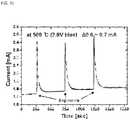
- FIGS. 1a to 1c illustrate changes in the sensitivity of a hydrogen sensor depending on the temperature.
- FIGS. 1a , 1b and 1c show changes in the sensitivity of a hydrogen sensor at different temperatures. With reference to FIGS. 1a , 1b and 1c , as the temperature is increased from room temperature to 100°C and 500°C, the sensitivity of the hydrogen sensor can be seen to increase.
- heat may be applied from the outside to decrease the reaction time of the sensing material and the detection target material.
- a gallium nitride-based sensor using a high-temperature epitaxy process makes it difficult to manufacture a heater for supplying heat to the sensing material.
- Conventional techniques are a process of growing no epitaxial thin film, in which, for instance, a gas sensor manufactured on a Si substrate is obtained by first forming a micro heater (Pt, etc.) on a membrane structure, forming a sensor structure thereon, and performing backside silicon etching.
- a micro heater Pt, etc.
- GaN-based sensor Since a GaN-based sensor is problematic in that an epitaxial thin film cannot be grown after the first formation of a heater (GaN-based epitaxy growth temperature is 1,000°C or more), a sensor structure is formed using an epitaxial thin film already grown at high temperatures and a heater structure is formed on the sensor structure. In this case, however, the distance from the heater region to the sensing material is long and thus a large amount of power is consumed in order to control the temperature and the sensor area has to include the heater region, undesirably enlarging the size of the sensor.
- GaN-based epitaxy growth temperature is 1,000°C or more
- the present invention has been made keeping in mind the above problems encountered in the related art, and the present invention is intended to provide a method of manufacturing a gallium nitride-based sensor having a heater structure.
- the present invention is intended to provide a gallium nitride-based sensor having a heater structure.
- the present invention provides a method of manufacturing a gallium nitride-based sensor having a heater structure, comprising growing an n-type or p-type GaN layer on a substrate, growing a GaN (Al x Ga 1-x N, In x Al 1-x N, or high-resistance GaN)-based monolayered or multilayered barrier layer on the n-type or p-type GaN layer, sequentially growing a u-GaN layer and a layer selected from the group consisting of an Al x Ga 1-x N layer, an In x Al 1-x N layer and an In x Al y Ga 1-x-y N layer on the barrier layer, patterning the n-type or p-type GaN layer so as to form an electrode, forming the electrode along the pattern formed on the n-type or p-type GaN layer, and forming a sensing material layer on the layer selected from the group consisting of the Al x Ga 1-x N layer, the In x Al 1-x N layer and the Indium
- the n-type or p-type GaN layer may function as a heater for generating heat due to the current applied to the electrode.
- the threshold voltage of the sensor device may be adjusted by changing the applied voltage.
- the barrier layer may be provided in the form of any one layer or a combination of layers selected from among an Al x Ga 1-x N layer, an In x Al 1-x N layer and a high-resistance GaN layer.
- the barrier layer may function to prevent the current flowing in the n-type or p-type GaN layer from flowing to the sensor structure on the barrier layer.
- the forming the sensing material layer on the layer selected from the group consisting of the Al x Ga 1-x N layer, the In x Al 1-x N layer and the In x Al yG a 1-x-y N layer may include forming a source electrode and a drain electrode on the layer selected from the group consisting of the Al x Ga 1-x N layer, the In x Al 1-x N layer and the In x Al y Ga 1-x-y N layer, and forming the sensing material layer on a portion of the region between the source electrode and the drain electrode.
- a GaN cap layer, an oxide film layer or a nitride film layer may be further formed in a single layer or multiple layers on the layer selected from the group consisting of the Al x Ga 1-x N layer, the In x Al 1-x N layer and the In x Al y Ga 1-x-y N layer, and the thickness of the GaN cap layer, the oxide film layer or the nitride film layer may be 30 nm or less.
- the forming the sensing material layer on the layer selected from the group consisting of the Al x Ga 1-x N layer, the In x Al 1-x N layer and the In x Al y Ga 1-x-y N layer may include forming an ohmic contact electrode on the layer selected from the group consisting of the Al x Ga 1-x N layer, the In x Al 1-x N layer and the In x Al y Ga 1-x-y N layer, and forming the sensing material layer for Schottky contact formation and an ohmic contact electrode connected thereto.
- the heat generated by applying current to the n-type or p-type GaN layer may be transferred to the sensing material layer.
- x In the Al x Ga 1-x N layer, x may satisfy 0 ⁇ x ⁇ 1, and in the In x Al 1-x N layer, x may satisfy 0 ⁇ x ⁇ 1.
- x and y may satisfy 0 ⁇ x ⁇ 1, 0 ⁇ y ⁇ 1, 0 ⁇ (x+y) ⁇ 1.
- x In the Al x Ga 1-x N layer for forming the barrier layer, x may satisfy 0 ⁇ x ⁇ 1, and in the In x Al 1-x N layer for forming the barrier layer, x may satisfy 0 ⁇ x ⁇ 1.
- the method of the invention may further include separating the substrate from the n-type or p-type GaN layer.
- the substrate may be made of any one material selected from the group consisting of sapphire, AlN, diamond, BN, SiC, Si and GaN.
- the present invention provides a gallium nitride-based sensor having a heater structure, comprising a substrate, an n-type or p-type GaN layer grown on the substrate, a GaN (Al x Ga 1-x N, In x Al 1-x N, or high-resistance GaN) -based monolayered or multilayered barrier layer grown on the n-type or p-type GaN layer, a u-GaN layer grown on the barrier layer, a layer selected from the group consisting of an Al x Ga 1-x N layer, an In x Al 1-x N layer and an In x Al y Ga 1-x-y N layer grown on the u-GaN layer, an electrode formed along a pattern formed on the n-type or p-type GaN layer, and a sensing material layer formed on the layer selected from the group consisting of the Al x Ga 1-x N layer, the In x Al 1-x N layer and the In x Al y Ga 1-x-y N layer.
- the n-type or p-type GaN layer may function as a heater for generating heat due to the current applied to the electrode.
- the threshold voltage of the sensor device may be adjusted by changing the applied voltage.
- the barrier layer may be provided in the form of any one layer or a combination of layers selected from among an Al x Ga 1-x N layer, an In x Al 1-x N layer and a high-resistance GaN layer.
- the barrier layer may function to prevent the current flowing in the n-type or p-type GaN layer from flowing to the sensor structure on the barrier layer.
- the senor of the invention may further include a source electrode and a drain electrode formed on the layer selected from the group consisting of the Al x Ga 1-x N layer, the In x Al 1-x N layer and the In x Al y Ga 1-x-y N layer, and the sensing material layer may be formed on a portion of the region between the source electrode and the drain electrode.
- the senor of the invention may further include an ohmic contact electrode, formed on the layer selected from the group consisting of the Al x Ga 1-x N layer, the In x Al 1-x N layer and the In x Al y Ga 1-x-y N layer, and an ohmic contact electrode connected to the sensing material layer for Schottky contact formation.
- an ohmic contact electrode formed on the layer selected from the group consisting of the Al x Ga 1-x N layer, the In x Al 1-x N layer and the In x Al y Ga 1-x-y N layer, and an ohmic contact electrode connected to the sensing material layer for Schottky contact formation.
- x In the Al x Ga 1-x N layer, x may satisfy 0 ⁇ x ⁇ 1, and in the In x Al 1-x N layer, x may satisfy 0 ⁇ x ⁇ 1.
- x and y may satisfy 0 ⁇ x ⁇ 1, 0 ⁇ y ⁇ 1, 0 ⁇ (x+y) ⁇ 1.
- x In the Al x Ga 1-x N layer for forming the barrier layer, x may satisfy 0 ⁇ x ⁇ 1, and in the In x Al 1-x N layer for forming the barrier layer, x may satisfy 0 ⁇ x ⁇ 1.
- the heat generated by applying current to the n-type or p-type GaN layer may be transferred to the sensing material layer.
- the substrate may be made of any one material selected from the group consisting of sapphire, AlN, diamond, BN, SiC, Si and GaN.
- the n-type or p-type GaN layer formed on the substrate may be formed in a stripe shape, and the thickness, width, gap, and electrical conductivity of the stripe shape may be adjusted to thereby facilitate control of the reaction time (sensitivity) of the sensing material layer and the restoration time.
- the substrate may be separated from the n-type or p-type GaN layer and then transferred to a third substrate.
- the third substrate may be made of Si, Ge, W, Cr, Ni, Cu or alloys thereof, amorphous AlN, amorphous SiC, graphite, nanocarbon, or a polymer material.
- the polymer material may include any one selected from the group consisting of polycarbonate (PC), polyethylene naphthalate (PEN), polynorbornene, polyacrylate, polyvinyl alcohol, polyimide, polyethylene terephthalate (PET), polyethersulfone (PES), polystyrene (PS), polypropylene (PP), polyethylene (PE), polyvinylchloride (PVC), polyamide (PA), polybutylene terephthalate (PBT), polymethyl methacrylate (PMMA) and polydimethylsiloxane (PDMS).
- PC polycarbonate
- PEN polyethylene naphthalate
- PET polyethylene terephthalate
- PES polyethersulfone
- PS polystyrene
- PP polypropylene
- PE polyethylene
- PVC polyvinylchloride
- PA polyamide
- PBT polybutylene terephthalate
- PMMA polymethyl methacrylate
- PDMS polydimethyl
- a HEMT sensor or a Schottky diode sensor can be heated using an n-GaN (or p-GaN) layer, thus increasing the sensitivity of the sensor and decreasing the restoration time.
- the heater structure using the n-GaN (or p-GaN) layer is located directly below the sensor structure, thereby reducing power consumption and rapidly changing the temperature of the sensing material.
- an n-GaN (or p-GaN) epitaxial layer having high conductivity and a barrier layer usable as an insulator are grown on a heterogeneous substrate (sapphire, AlN, diamond, BN, Si, SiC, etc.), and then a HEMT structure, a Schottky diode structure, or the like is formed, thereby easily manufacturing the gallium nitride-based sensor having a heater structure.
- first, second, A, “B”, etc. may be used herein to describe various elements, these elements are not intended to be limited by these terms. These terms are only used to distinguish one element from another element. For instance, a first element discussed below could be termed a second element without departing from the teachings of the present invention. Similarly, the second element could also be termed the first element. As used herein, the term “and/or” may include any one of the listed items and any combination of one or more thereof.
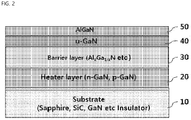
- FIG. 2 illustrates the epitaxial thin film growth for manufacturing a gallium nitride-based sensor having a heater structure according to an embodiment of the present invention.
- the epitaxial thin film for manufacturing a gallium nitride-based sensor having a heater structure may be configured to include a substrate 10, an n-type or p-type GaN layer 20 grown on the substrate, a GaN (Al x Ga 1-x N, In x Al 1-x N, or high-resistance GaN) -based monolayered or multilayered barrier layer 30 grown on the n-type or p-type GaN layer, a u-GaN layer 40 grown on the barrier layer 30, and a layer 50 selected from the group consisting of an Al x Ga 1-x N layer, an In x Al 1-x N layer and an In x Al y Ga 1-x-y N layer, grown on the u-GaN layer.
- the substrate 10 may be made of any one material selected from the group consisting of sapphire, AlN, diamond, BN, SiC, Si and GaN.
- the n-type or p-type GaN layer 20 may function as a heater for generating heat due to the current applied to an electrode.
- the barrier layer 30 is formed on the n-type or p-type GaN layer 20, when current is applied to the n-type or p-type GaN layer 20, the current flows in the transverse direction of the n-type or p-type GaN layer 20, thereby generating heat.
- the barrier layer 30 may be provided in the form of any one layer or a combination of layers selected from among an Al x Ga 1-x N layer, an In x Al 1-x N layer and a high-resistance GaN layer, and may function to prevent the current flowing in the n-type or p-type GaN layer 20 from flowing to the sensor structure on the barrier layer 30.
- the n-type or p-type GaN layer 20 having high conductivity is interposed between the substrate 10 and the barrier layer 30, whereby epitaxial thin film growth may be performed.
- FIG. 3 illustrates the MESA isolation on the epitaxial thin film for manufacturing a gallium nitride-based sensor having a heater structure according to an embodiment of the present invention
- FIG. 4 illustrates the patterning for forming an electrode on the epitaxial thin film for manufacturing a gallium nitride-based sensor having a heater structure according to an embodiment of the present invention
- FIG. 5 illustrates the electrode formation and the HEMT formation for manufacturing a gallium nitride-based sensor having a heater structure according to an embodiment of the present invention.
- the epitaxial thin film as shown in FIG. 2 comprising the substrate 10, the n-type or p-type GaN layer 20, the barrier layer 30, the u-GaN layer 40 and the layer 50 selected from the group consisting of the Al x Ga 1-x N layer, the In x Al 1-x N layer and the In x Al y Ga 1-x-y N layer, may be grown, and such a thin film structure is made structurally stable by continuously growing the GaN-based layers.
- a GaN cap layer, an oxide film layer or a nitride film layer may be further formed in a single layer or multiple layers on the layer selected from the group consisting of the Al x Ga 1-x N layer, the In x Al 1-x N layer and the In x Al y Ga 1-x-y N layer.
- the GaN cap layer, the oxide film layer or the nitride film layer preferably has a thickness of 30 nm or less.
- the thickness of the GaN cap layer, the oxide film layer or the nitride film layer may be 10 nm ⁇ 30 nm.
- the MESA isolation may be performed on the thin film structure of FIG. 2 for manufacturing the gallium nitride-based sensor having a heater structure. Specifically, some outer portions of the layer 50 selected from the group consisting of the Al x Ga 1-x N layer, the In x Al 1-x N layer and the In x Al y Ga 1-x-y N layer, the u-GaN layer 40, and the barrier layer 30 may be etched.
- the patterning for forming an electrode may be performed on the epitaxial thin film for manufacturing the gallium nitride-based sensor having a heater structure. Specifically, the n-type or p-type GaN layer 20 may be patterned so as to contact the electrode.
- the electrode 60 may be formed along the pattern formed on the n-type or p-type GaN layer 20.
- a source electrode S and a drain electrode D may be formed on the layer 50 selected from the group consisting of the Al x Ga 1-x N layer, the In x Al 1-x N layer and the In x Al y Ga 1-x-y N layer, and a sensing material layer SM may be formed on a portion of the region between the source electrode S and the drain electrode D, thereby manufacturing a gallium nitride-based HEMT sensor.
- the sensing material layer may be formed in a recess region P1 made by etching a portion of the layer 50 selected from the group consisting of the Al x Ga 1-x N layer, the In x Al 1-x N layer and the In x Al y Ga 1-x-y N layer.
- the value x of the Al x Ga 1-x N layer may satisfy 0 ⁇ x ⁇ 1
- the value x of the In x Al 1-x N layer may satisfy 0 ⁇ x ⁇ 1
- the values x and y of the In x Al y Ga 1-x-y N layer may satisfy 0 ⁇ x ⁇ 1, 0 ⁇ y ⁇ 1, 0 ⁇ (x+y) ⁇ 1.
- the value x of the Al x Ga 1-x N layer for forming the barrier layer 30 may satisfy 0 ⁇ x ⁇ 1, and the value x of the In x Al 1-x N layer for forming the barrier layer 30 may satisfy 0 ⁇ x ⁇ 1.
- the n-type or p-type GaN layer 20 may function as a heater for generating heat due to current applied to the electrode 60.
- the gallium nitride-based HEMT sensor may be configured such that heat generated by applying current to the n-type or p-type GaN layer 20 may be rapidly transferred to the sensing material layer SM via the barrier layer, the u-GaN layer and the layer selected from the group consisting of the Al x Ga 1-x N layer, the In x Al 1-x N layer and the In x Al y Ga 1-x-y N layer.
- FIG. 6 illustrates the electrode formation and the Schottky diode formation for manufacturing the gallium nitride-based sensor having a heater structure according to an embodiment of the present invention.
- the epitaxial thin film as shown in FIG. 2 comprising the substrate 10, the n-type or p-type GaN layer 20, the barrier layer 30, the u-GaN layer 40 and the layer 50 selected from the group consisting of the Al x Ga 1-x N layer, the In x Al 1-x N layer and the In x Al y Ga 1-x-y N layer, may be grown, and such a thin film structure is made structurally stable by continuously growing the GaN-based layers.
- the MESA isolation may be performed on the thin film structure of FIG. 2 for manufacturing the gallium nitride-based sensor having a heater structure. Specifically, some outer portions of the layer 50 selected from the group consisting of the Al x Ga 1-x N layer, the In x Al 1-x N layer and the In x Al y Ga 1-x-y N layer, the u-GaN layer 40, and the barrier layer 30 may be etched.
- the patterning for forming an electrode may be performed on the epitaxial thin film for manufacturing the gallium nitride-based sensor having a heater structure. Specifically, the n-type or p-type GaN layer 20 may be patterned so as to contact the electrode.
- the electrode 60 may be formed along the pattern formed on the n-type or p-type GaN layer 20.
- an ohmic contact electrode 71 may be formed on the layer 50 selected from the group consisting of the Al x Ga 1-x N layer, the In x Al 1-x N layer and the In x Al y Ga 1-x-y N layer, and an ohmic contact electrode 72 that is connected to a sensing material layer (SBSM: Schottky Barrier Sensing Materials) for Schottky contact formation may be formed, thereby manufacturing a gallium nitride-based Schottky diode sensor.
- SBSM Schottky Barrier Sensing Materials
- the n-type or p-type GaN layer 20 may function as a heater for generating heat due to current applied to the electrode 60.
- the gallium nitride-based Schottky diode sensor may be configured such that heat generated by applying current to the n-type or p-type GaN layer 20 may be rapidly transferred to the sensing material layer (SBSM) via the barrier layer, the u-GaN layer and the layer selected from the group consisting of the Al x Ga 1-x N layer, the In x Al 1-x N layer and the In x Al y Ga 1-x-y N layer.
- SBSM sensing material layer
- FIG. 7 illustrates the electrode formation and the membrane formation for manufacturing the gallium nitride-based sensor having a heater structure according to an embodiment of the present invention.
- the epitaxial thin film as shown in FIG. 2 comprising the substrate 10, the n-type or p-type GaN layer 20, the barrier layer 30, the u-GaN layer 40 and the layer 50 selected from the group consisting of the Al x Ga 1-x N layer, the In x Al 1-x N layer and the In x Al y Ga 1-x-y N layer, may be grown, and such a thin film structure is made structurally stable by continuously growing the GaN-based layers.
- the MESA isolation may be performed on the thin film structure of FIG. 2 for manufacturing the gallium nitride-based sensor having a heater structure. Specifically, some outer portions of the layer 50 selected from the group consisting of the Al x Ga 1-x N layer, the In x Al 1-x N layer and the In x Al y Ga 1-x-y N layer, the u-GaN layer 40, and the barrier layer 30 may be etched.
- the patterning for forming an electrode may be carried out on the epitaxial thin film for manufacturing the gallium nitride-based sensor having a heater structure. Specifically, the n-type or p-type GaN layer 20 may be patterned so as to contact the electrode.
- the electrode 60 may be formed along the pattern formed on the n-type or p-type GaN layer 20.
- a source electrode S and a drain electrode D may be formed on the layer 50 selected from the group consisting of the Al x Ga 1-x N layer, the In x Al 1-x N layer and the In x Al y Ga 1-x-y N layer, a sensing material layer SM may be formed on a portion of the region between the source electrode S and the drain electrode D, and the substrate 10 may be separated from the n-type or p-type GaN layer 20 and then transferred to a third substrate, thereby manufacturing a gallium nitride-based membrane or flexible sensor.
- the sensing material layer may be formed in a recess region P1 made by etching a portion of the layer 50 selected from the group consisting of the Al x Ga 1-x N layer, the In x Al 1-x N layer and the In x Al y Ga 1-x-y N layer.
- FIG. 8 illustrates the manufacture of a gallium nitride-based sensor having a heater structure according to another embodiment of the present invention.
- an insulator layer 80 may be formed in a stripe shape on a substrate 10.
- An n-type or p-type GaN layer 20 may be grown on the substrate 10 having the stripe-shaped insulator layer 80 formed thereon, and such an n-type or p-type GaN layer 20 may function as a heater. Specifically, the n-type or p-type GaN layer 20 may be grown in the stripe-shaped insulator layer 80 to thus have a stripe shape.
- a sensor structure may be formed on the insulator layer 80 and the n-type or p-type GaN layer 20, having the stripe shape, thereby manufacturing a gallium nitride-based sensor having a heater structure.
- the stripe-shaped n-type or p-type GaN layer 20 is adjusted in the thickness, width, gap, and electrical conductivity of the stripe shape, thus obtaining the gallium nitride-based sensor in which the temperature of the sensing material layer, power consumption, etc. may be easily controlled.
- a GaN-based buffer layer may be interposed between the insulator layer 80 and the substrate.
- the heater layer 20 may be patterned so as to have a planar structure or a one-dimensional linear structure.
- the substrate is separated from the n-type or p-type GaN layer 20, and may be transferred to the third substrate, and the third substrate may be made of Si, Ge, W, Cr, Ni, Cu or alloys thereof, amorphous AlN, amorphous SiC, graphite, nanocarbon, or a polymer material.
- the polymer material may include any one selected from the group consisting of polycarbonate (PC), polyethylene naphthalate (PEN), polynorbornene, polyacrylate, polyvinyl alcohol, polyimide, polyethylene terephthalate (PET), polyethersulfone (PES), polystyrene (PS), polypropylene (PP), polyethylene (PE), polyvinylchloride (PVC), polyamide (PA), polybutylene terephthalate (PBT), polymethyl methacrylate (PMMA) and polydimethylsiloxane (PDMS).
- PC polycarbonate
- PEN polyethylene naphthalate
- PET polyethylene terephthalate
- PES polyethersulfone
- PS polystyrene
- PP polypropylene
- PE polyethylene
- PVC polyvinylchloride
- PA polyamide
- PBT polybutylene terephthalate
- PMMA polymethyl methacrylate
- PDMS polydimethyl
- the gallium nitride-based sensor having a heater structure may be configured such that a process of growing an epitaxial thin film having high conductivity is included during the gallium nitride-based epitaxial thin film growth, and thus a heater structure may be embedded.
- an n-GaN (or p-GaN) epitaxial layer having high conductivity and a barrier layer usable as an insulator are grown, and then a HEMT structure, a Schottky diode structure, or the like is formed, thereby manufacturing the gallium nitride-based sensor having a heater structure.
Landscapes
- Chemical & Material Sciences (AREA)
- Life Sciences & Earth Sciences (AREA)
- Health & Medical Sciences (AREA)
- Biochemistry (AREA)
- General Physics & Mathematics (AREA)
- Pathology (AREA)
- Immunology (AREA)
- General Health & Medical Sciences (AREA)
- Physics & Mathematics (AREA)
- Analytical Chemistry (AREA)
- Electrochemistry (AREA)
- Chemical Kinetics & Catalysis (AREA)
- Engineering & Computer Science (AREA)
- Microelectronics & Electronic Packaging (AREA)
- Molecular Biology (AREA)
- Combustion & Propulsion (AREA)
- Food Science & Technology (AREA)
- Medicinal Chemistry (AREA)
- Power Engineering (AREA)
- Junction Field-Effect Transistors (AREA)
- Investigating Or Analyzing Materials By The Use Of Electric Means (AREA)
Applications Claiming Priority (1)
| Application Number | Priority Date | Filing Date | Title |
|---|---|---|---|
| KR1020170124251A KR101989977B1 (ko) | 2017-09-26 | 2017-09-26 | 히터 구조를 구비한 질화갈륨계 센서 및 그 제조 방법 |
Publications (3)
| Publication Number | Publication Date |
|---|---|
| EP3460468A2 true EP3460468A2 (fr) | 2019-03-27 |
| EP3460468A3 EP3460468A3 (fr) | 2019-04-24 |
| EP3460468B1 EP3460468B1 (fr) | 2020-10-21 |
Family
ID=63683642
Family Applications (1)
| Application Number | Title | Priority Date | Filing Date |
|---|---|---|---|
| EP18194416.6A Active EP3460468B1 (fr) | 2017-09-26 | 2018-09-14 | Capteur à base de nitrure de gallium ayant une structure chauffante et son procédé de fabrication |
Country Status (4)
| Country | Link |
|---|---|
| US (1) | US10418495B2 (fr) |
| EP (1) | EP3460468B1 (fr) |
| KR (1) | KR101989977B1 (fr) |
| WO (1) | WO2019066145A1 (fr) |
Cited By (3)
| Publication number | Priority date | Publication date | Assignee | Title |
|---|---|---|---|---|
| CN110988065A (zh) * | 2019-12-03 | 2020-04-10 | 中国科学院微电子研究所 | 氮化镓传感器件及其制备方法 |
| CN114512395A (zh) * | 2022-04-20 | 2022-05-17 | 江苏第三代半导体研究院有限公司 | 一种p型氮化物外延结构、制备方法及半导体器件 |
| CN115312600A (zh) * | 2022-07-11 | 2022-11-08 | 成都功成半导体有限公司 | 一种凹陷式Fin-MOSFET栅结构HEMT及制作方法 |
Families Citing this family (6)
| Publication number | Priority date | Publication date | Assignee | Title |
|---|---|---|---|---|
| US10593826B2 (en) * | 2018-03-28 | 2020-03-17 | Cambridge Gan Devices Limited | Infra-red devices |
| US11067422B2 (en) | 2018-03-28 | 2021-07-20 | Cambridge Gan Devices Limited | Thermal fluid flow sensor |
| US20190305122A1 (en) * | 2018-03-28 | 2019-10-03 | Taiwan Semiconductor Manufacturing Company Ltd. | Semiconductor structure |
| KR102287480B1 (ko) * | 2019-10-28 | 2021-08-09 | 한국광기술원 | 질화갈륨 기반의 히터 일체형 반도체 가스센서 및 그 제조방법 |
| WO2023146229A1 (fr) * | 2022-01-25 | 2023-08-03 | 포항공과대학교 산학협력단 | Capteur d'hydrogène résistif à couche sensible avec nanotubes de carbone simple paroi semi-conducteurs, et son procédé de fabrication |
| CN116325157A (zh) * | 2022-05-16 | 2023-06-23 | 英诺赛科(苏州)半导体有限公司 | 氮化物基半导体ic芯片及其制造方法 |
Family Cites Families (15)
| Publication number | Priority date | Publication date | Assignee | Title |
|---|---|---|---|---|
| DE10032062C2 (de) * | 2000-07-01 | 2002-06-27 | Eads Deutschland Gmbh | Gassensor und Verwendung eines Feldeffekttransistors als Gassensor |
| JP5159023B2 (ja) * | 2002-12-27 | 2013-03-06 | モーメンティブ・パフォーマンス・マテリアルズ・インク | 窒化ガリウム結晶、ホモエピタキシャル窒化ガリウムを基材とするデバイス、及びその製造方法 |
| US20070018198A1 (en) * | 2005-07-20 | 2007-01-25 | Brandes George R | High electron mobility electronic device structures comprising native substrates and methods for making the same |
| US8129725B2 (en) * | 2005-08-08 | 2012-03-06 | Microgan Gmbh | Semiconductor sensor |
| US20080124453A1 (en) * | 2006-11-28 | 2008-05-29 | Applied Matrials, Inc. | In-situ detection of gas-phase particle formation in nitride film deposition |
| US8836351B2 (en) * | 2008-06-10 | 2014-09-16 | University Of Florida Research Foundation, Inc. | Chloride detection |
| WO2010142773A2 (fr) * | 2009-06-10 | 2010-12-16 | Helmholtz Zentrum München Deutsches Forschungszentrum Für Gesundheit Und Umwelt (Gmbh) | Biocapteurs à semiconducteurs |
| JP5733594B2 (ja) * | 2010-02-18 | 2015-06-10 | スタンレー電気株式会社 | 半導体発光装置 |
| US9470650B2 (en) * | 2010-10-21 | 2016-10-18 | Carnegie Mellon University | Two-dimensional electron gas (2DEG)-based chemical sensors |
| EP2589958B1 (fr) * | 2011-11-04 | 2016-10-26 | Stichting IMEC Nederland | Détection chimique |
| KR101616615B1 (ko) * | 2014-04-16 | 2016-05-12 | 박진성 | 웨이퍼 레벨 칩 스케일 발광다이오드 패키지 |
| KR101532557B1 (ko) * | 2014-05-09 | 2015-06-30 | 부경대학교 산학협력단 | 하이브리드 센서를 가지는 LED chip과 그 제작방법 |
| EP3176571A1 (fr) * | 2015-12-04 | 2017-06-07 | IMEC vzw | Capteur de gaz d'électrons bidimensionnel |
| KR101762907B1 (ko) * | 2016-03-25 | 2017-07-31 | (재)한국나노기술원 | 고전자 이동도 트랜지스터 구조를 가지는 센서의 제조방법 |
| US20180128774A1 (en) * | 2016-11-07 | 2018-05-10 | Epistar Corporation | Sensing device |
-
2017
- 2017-09-26 KR KR1020170124251A patent/KR101989977B1/ko active Active
- 2017-12-12 WO PCT/KR2017/014506 patent/WO2019066145A1/fr not_active Ceased
-
2018
- 2018-09-13 US US16/130,721 patent/US10418495B2/en active Active
- 2018-09-14 EP EP18194416.6A patent/EP3460468B1/fr active Active
Non-Patent Citations (1)
| Title |
|---|
| None |
Cited By (4)
| Publication number | Priority date | Publication date | Assignee | Title |
|---|---|---|---|---|
| CN110988065A (zh) * | 2019-12-03 | 2020-04-10 | 中国科学院微电子研究所 | 氮化镓传感器件及其制备方法 |
| CN114512395A (zh) * | 2022-04-20 | 2022-05-17 | 江苏第三代半导体研究院有限公司 | 一种p型氮化物外延结构、制备方法及半导体器件 |
| CN114512395B (zh) * | 2022-04-20 | 2022-07-05 | 江苏第三代半导体研究院有限公司 | 一种p型氮化物外延结构、制备方法及半导体器件 |
| CN115312600A (zh) * | 2022-07-11 | 2022-11-08 | 成都功成半导体有限公司 | 一种凹陷式Fin-MOSFET栅结构HEMT及制作方法 |
Also Published As
| Publication number | Publication date |
|---|---|
| EP3460468A3 (fr) | 2019-04-24 |
| EP3460468B1 (fr) | 2020-10-21 |
| US20190097067A1 (en) | 2019-03-28 |
| US10418495B2 (en) | 2019-09-17 |
| KR20190035246A (ko) | 2019-04-03 |
| WO2019066145A1 (fr) | 2019-04-04 |
| KR101989977B1 (ko) | 2019-06-17 |
Similar Documents
| Publication | Publication Date | Title |
|---|---|---|
| US10418495B2 (en) | Gallium nitride-based sensor having heater structure and method of manufacturing the same | |
| Zhao et al. | Piezotronic effect in polarity-controlled GaN nanowires | |
| US9219137B2 (en) | Vertical gallium nitride transistors and methods of fabricating the same | |
| KR101762907B1 (ko) | 고전자 이동도 트랜지스터 구조를 가지는 센서의 제조방법 | |
| US20120175682A1 (en) | Ohmic contact to semiconductor device | |
| EP2713402A2 (fr) | Transistor à haute mobilité d'électrons normalement bloqué | |
| CN103858236A (zh) | 利用再生长栅极的GaN垂直JFET的方法和系统 | |
| US20140151749A1 (en) | High electron mobility transistor and method of manufacturing the same | |
| US10090394B2 (en) | Ohmic contact structure for group III nitride semiconductor device having improved surface morphology and well-defined edge features | |
| CN103311292A (zh) | 氮化镓超结器件 | |
| US8969198B2 (en) | Ohmic contact to semiconductor layer | |
| CN103875075A (zh) | 利用再生长沟道的GaN垂直JFET的方法和系统 | |
| EP3176571A1 (fr) | Capteur de gaz d'électrons bidimensionnel | |
| US9207203B2 (en) | Two-dimensional electron gas sensor and methods for making and using the sensor | |
| KR101862076B1 (ko) | 마이크로 히터를 구비한 센서 제조 방법 | |
| CN102830137A (zh) | 氮化镓基液体传感器及其制备方法 | |
| WO2006117902A1 (fr) | Dispositif semi-conducteur en nitrures du groupe iii et substrat épitaxial | |
| KR20190035245A (ko) | 광자극 구조를 구비한 질화갈륨계 센서 및 그 제조 방법 | |
| JP5158470B2 (ja) | 窒化物半導体デバイスの作製方法 | |
| JP6941903B1 (ja) | ノーマリーオフ型分極超接合GaN系電界効果トランジスタおよび電気機器 | |
| KR20110027994A (ko) | 전계 효과형 반도체 소자 및 그 제조 방법 | |
| JP6820224B2 (ja) | 窒化物半導体分極制御デバイス | |
| Jha et al. | Integrated nanorods and heterostructure field effect transistors for gas sensing | |
| Shi et al. | Polarity reversible freestanding AlN thin film and its application in Schottky diode | |
| Kanrar et al. | Sensitivity Analysis of HEMT Biosensor for Variation in Al x Ga 1-x N Layer Alloy Composition, Bulk Trap and Doping |
Legal Events
| Date | Code | Title | Description |
|---|---|---|---|
| PUAI | Public reference made under article 153(3) epc to a published international application that has entered the european phase |
Free format text: ORIGINAL CODE: 0009012 |
|
| STAA | Information on the status of an ep patent application or granted ep patent |
Free format text: STATUS: REQUEST FOR EXAMINATION WAS MADE |
|
| PUAL | Search report despatched |
Free format text: ORIGINAL CODE: 0009013 |
|
| 17P | Request for examination filed |
Effective date: 20180914 |
|
| AK | Designated contracting states |
Kind code of ref document: A2 Designated state(s): AL AT BE BG CH CY CZ DE DK EE ES FI FR GB GR HR HU IE IS IT LI LT LU LV MC MK MT NL NO PL PT RO RS SE SI SK SM TR |
|
| AX | Request for extension of the european patent |
Extension state: BA ME |
|
| AK | Designated contracting states |
Kind code of ref document: A3 Designated state(s): AL AT BE BG CH CY CZ DE DK EE ES FI FR GB GR HR HU IE IS IT LI LT LU LV MC MK MT NL NO PL PT RO RS SE SI SK SM TR |
|
| AX | Request for extension of the european patent |
Extension state: BA ME |
|
| RIC1 | Information provided on ipc code assigned before grant |
Ipc: G01N 33/00 20060101AFI20190318BHEP Ipc: G01N 27/414 20060101ALI20190318BHEP Ipc: G01N 27/12 20060101ALI20190318BHEP |
|
| STAA | Information on the status of an ep patent application or granted ep patent |
Free format text: STATUS: EXAMINATION IS IN PROGRESS |
|
| 17Q | First examination report despatched |
Effective date: 20191219 |
|
| GRAP | Despatch of communication of intention to grant a patent |
Free format text: ORIGINAL CODE: EPIDOSNIGR1 |
|
| STAA | Information on the status of an ep patent application or granted ep patent |
Free format text: STATUS: GRANT OF PATENT IS INTENDED |
|
| INTG | Intention to grant announced |
Effective date: 20200514 |
|
| RIN1 | Information on inventor provided before grant (corrected) |
Inventor name: PARK, KYUNGHO Inventor name: PARK, HYEONG HO Inventor name: CHO, CHUYOUNG Inventor name: KOH, YU MIN |
|
| GRAS | Grant fee paid |
Free format text: ORIGINAL CODE: EPIDOSNIGR3 |
|
| GRAA | (expected) grant |
Free format text: ORIGINAL CODE: 0009210 |
|
| STAA | Information on the status of an ep patent application or granted ep patent |
Free format text: STATUS: THE PATENT HAS BEEN GRANTED |
|
| AK | Designated contracting states |
Kind code of ref document: B1 Designated state(s): AL AT BE BG CH CY CZ DE DK EE ES FI FR GB GR HR HU IE IS IT LI LT LU LV MC MK MT NL NO PL PT RO RS SE SI SK SM TR |
|
| REG | Reference to a national code |
Ref country code: GB Ref legal event code: FG4D |
|
| REG | Reference to a national code |
Ref country code: CH Ref legal event code: EP |
|
| REG | Reference to a national code |
Ref country code: DE Ref legal event code: R096 Ref document number: 602018008881 Country of ref document: DE |
|
| REG | Reference to a national code |
Ref country code: IE Ref legal event code: FG4D |
|
| REG | Reference to a national code |
Ref country code: AT Ref legal event code: REF Ref document number: 1326329 Country of ref document: AT Kind code of ref document: T Effective date: 20201115 |
|
| REG | Reference to a national code |
Ref country code: AT Ref legal event code: MK05 Ref document number: 1326329 Country of ref document: AT Kind code of ref document: T Effective date: 20201021 |
|
| REG | Reference to a national code |
Ref country code: NL Ref legal event code: MP Effective date: 20201021 |
|
| PG25 | Lapsed in a contracting state [announced via postgrant information from national office to epo] |
Ref country code: NO Free format text: LAPSE BECAUSE OF FAILURE TO SUBMIT A TRANSLATION OF THE DESCRIPTION OR TO PAY THE FEE WITHIN THE PRESCRIBED TIME-LIMIT Effective date: 20210121 Ref country code: FI Free format text: LAPSE BECAUSE OF FAILURE TO SUBMIT A TRANSLATION OF THE DESCRIPTION OR TO PAY THE FEE WITHIN THE PRESCRIBED TIME-LIMIT Effective date: 20201021 Ref country code: RS Free format text: LAPSE BECAUSE OF FAILURE TO SUBMIT A TRANSLATION OF THE DESCRIPTION OR TO PAY THE FEE WITHIN THE PRESCRIBED TIME-LIMIT Effective date: 20201021 Ref country code: PT Free format text: LAPSE BECAUSE OF FAILURE TO SUBMIT A TRANSLATION OF THE DESCRIPTION OR TO PAY THE FEE WITHIN THE PRESCRIBED TIME-LIMIT Effective date: 20210222 |
|
| REG | Reference to a national code |
Ref country code: LT Ref legal event code: MG4D |
|
| PG25 | Lapsed in a contracting state [announced via postgrant information from national office to epo] |
Ref country code: ES Free format text: LAPSE BECAUSE OF FAILURE TO SUBMIT A TRANSLATION OF THE DESCRIPTION OR TO PAY THE FEE WITHIN THE PRESCRIBED TIME-LIMIT Effective date: 20201021 Ref country code: AT Free format text: LAPSE BECAUSE OF FAILURE TO SUBMIT A TRANSLATION OF THE DESCRIPTION OR TO PAY THE FEE WITHIN THE PRESCRIBED TIME-LIMIT Effective date: 20201021 Ref country code: BG Free format text: LAPSE BECAUSE OF FAILURE TO SUBMIT A TRANSLATION OF THE DESCRIPTION OR TO PAY THE FEE WITHIN THE PRESCRIBED TIME-LIMIT Effective date: 20210121 Ref country code: PL Free format text: LAPSE BECAUSE OF FAILURE TO SUBMIT A TRANSLATION OF THE DESCRIPTION OR TO PAY THE FEE WITHIN THE PRESCRIBED TIME-LIMIT Effective date: 20201021 Ref country code: IS Free format text: LAPSE BECAUSE OF FAILURE TO SUBMIT A TRANSLATION OF THE DESCRIPTION OR TO PAY THE FEE WITHIN THE PRESCRIBED TIME-LIMIT Effective date: 20210221 Ref country code: LV Free format text: LAPSE BECAUSE OF FAILURE TO SUBMIT A TRANSLATION OF THE DESCRIPTION OR TO PAY THE FEE WITHIN THE PRESCRIBED TIME-LIMIT Effective date: 20201021 Ref country code: SE Free format text: LAPSE BECAUSE OF FAILURE TO SUBMIT A TRANSLATION OF THE DESCRIPTION OR TO PAY THE FEE WITHIN THE PRESCRIBED TIME-LIMIT Effective date: 20201021 |
|
| PG25 | Lapsed in a contracting state [announced via postgrant information from national office to epo] |
Ref country code: NL Free format text: LAPSE BECAUSE OF FAILURE TO SUBMIT A TRANSLATION OF THE DESCRIPTION OR TO PAY THE FEE WITHIN THE PRESCRIBED TIME-LIMIT Effective date: 20201021 Ref country code: HR Free format text: LAPSE BECAUSE OF FAILURE TO SUBMIT A TRANSLATION OF THE DESCRIPTION OR TO PAY THE FEE WITHIN THE PRESCRIBED TIME-LIMIT Effective date: 20201021 |
|
| REG | Reference to a national code |
Ref country code: DE Ref legal event code: R097 Ref document number: 602018008881 Country of ref document: DE |
|
| PG25 | Lapsed in a contracting state [announced via postgrant information from national office to epo] |
Ref country code: LT Free format text: LAPSE BECAUSE OF FAILURE TO SUBMIT A TRANSLATION OF THE DESCRIPTION OR TO PAY THE FEE WITHIN THE PRESCRIBED TIME-LIMIT Effective date: 20201021 Ref country code: SK Free format text: LAPSE BECAUSE OF FAILURE TO SUBMIT A TRANSLATION OF THE DESCRIPTION OR TO PAY THE FEE WITHIN THE PRESCRIBED TIME-LIMIT Effective date: 20201021 Ref country code: RO Free format text: LAPSE BECAUSE OF FAILURE TO SUBMIT A TRANSLATION OF THE DESCRIPTION OR TO PAY THE FEE WITHIN THE PRESCRIBED TIME-LIMIT Effective date: 20201021 Ref country code: EE Free format text: LAPSE BECAUSE OF FAILURE TO SUBMIT A TRANSLATION OF THE DESCRIPTION OR TO PAY THE FEE WITHIN THE PRESCRIBED TIME-LIMIT Effective date: 20201021 Ref country code: CZ Free format text: LAPSE BECAUSE OF FAILURE TO SUBMIT A TRANSLATION OF THE DESCRIPTION OR TO PAY THE FEE WITHIN THE PRESCRIBED TIME-LIMIT Effective date: 20201021 Ref country code: SM Free format text: LAPSE BECAUSE OF FAILURE TO SUBMIT A TRANSLATION OF THE DESCRIPTION OR TO PAY THE FEE WITHIN THE PRESCRIBED TIME-LIMIT Effective date: 20201021 |
|
| PLBE | No opposition filed within time limit |
Free format text: ORIGINAL CODE: 0009261 |
|
| STAA | Information on the status of an ep patent application or granted ep patent |
Free format text: STATUS: NO OPPOSITION FILED WITHIN TIME LIMIT |
|
| PG25 | Lapsed in a contracting state [announced via postgrant information from national office to epo] |
Ref country code: DK Free format text: LAPSE BECAUSE OF FAILURE TO SUBMIT A TRANSLATION OF THE DESCRIPTION OR TO PAY THE FEE WITHIN THE PRESCRIBED TIME-LIMIT Effective date: 20201021 |
|
| 26N | No opposition filed |
Effective date: 20210722 |
|
| PG25 | Lapsed in a contracting state [announced via postgrant information from national office to epo] |
Ref country code: AL Free format text: LAPSE BECAUSE OF FAILURE TO SUBMIT A TRANSLATION OF THE DESCRIPTION OR TO PAY THE FEE WITHIN THE PRESCRIBED TIME-LIMIT Effective date: 20201021 Ref country code: IT Free format text: LAPSE BECAUSE OF FAILURE TO SUBMIT A TRANSLATION OF THE DESCRIPTION OR TO PAY THE FEE WITHIN THE PRESCRIBED TIME-LIMIT Effective date: 20201021 |
|
| PG25 | Lapsed in a contracting state [announced via postgrant information from national office to epo] |
Ref country code: SI Free format text: LAPSE BECAUSE OF FAILURE TO SUBMIT A TRANSLATION OF THE DESCRIPTION OR TO PAY THE FEE WITHIN THE PRESCRIBED TIME-LIMIT Effective date: 20201021 |
|
| REG | Reference to a national code |
Ref country code: CH Ref legal event code: PL |
|
| REG | Reference to a national code |
Ref country code: BE Ref legal event code: MM Effective date: 20210930 |
|
| PG25 | Lapsed in a contracting state [announced via postgrant information from national office to epo] |
Ref country code: IS Free format text: LAPSE BECAUSE OF FAILURE TO SUBMIT A TRANSLATION OF THE DESCRIPTION OR TO PAY THE FEE WITHIN THE PRESCRIBED TIME-LIMIT Effective date: 20210221 Ref country code: MC Free format text: LAPSE BECAUSE OF FAILURE TO SUBMIT A TRANSLATION OF THE DESCRIPTION OR TO PAY THE FEE WITHIN THE PRESCRIBED TIME-LIMIT Effective date: 20201021 |
|
| PG25 | Lapsed in a contracting state [announced via postgrant information from national office to epo] |
Ref country code: LU Free format text: LAPSE BECAUSE OF NON-PAYMENT OF DUE FEES Effective date: 20210914 Ref country code: IE Free format text: LAPSE BECAUSE OF NON-PAYMENT OF DUE FEES Effective date: 20210914 Ref country code: BE Free format text: LAPSE BECAUSE OF NON-PAYMENT OF DUE FEES Effective date: 20210930 |
|
| PG25 | Lapsed in a contracting state [announced via postgrant information from national office to epo] |
Ref country code: LI Free format text: LAPSE BECAUSE OF NON-PAYMENT OF DUE FEES Effective date: 20210930 Ref country code: CH Free format text: LAPSE BECAUSE OF NON-PAYMENT OF DUE FEES Effective date: 20210930 |
|
| PG25 | Lapsed in a contracting state [announced via postgrant information from national office to epo] |
Ref country code: CY Free format text: LAPSE BECAUSE OF FAILURE TO SUBMIT A TRANSLATION OF THE DESCRIPTION OR TO PAY THE FEE WITHIN THE PRESCRIBED TIME-LIMIT Effective date: 20201021 |
|
| PG25 | Lapsed in a contracting state [announced via postgrant information from national office to epo] |
Ref country code: HU Free format text: LAPSE BECAUSE OF FAILURE TO SUBMIT A TRANSLATION OF THE DESCRIPTION OR TO PAY THE FEE WITHIN THE PRESCRIBED TIME-LIMIT; INVALID AB INITIO Effective date: 20180914 Ref country code: GR Free format text: LAPSE BECAUSE OF FAILURE TO SUBMIT A TRANSLATION OF THE DESCRIPTION OR TO PAY THE FEE WITHIN THE PRESCRIBED TIME-LIMIT Effective date: 20201021 |
|
| PG25 | Lapsed in a contracting state [announced via postgrant information from national office to epo] |
Ref country code: MK Free format text: LAPSE BECAUSE OF FAILURE TO SUBMIT A TRANSLATION OF THE DESCRIPTION OR TO PAY THE FEE WITHIN THE PRESCRIBED TIME-LIMIT Effective date: 20201021 |
|
| PG25 | Lapsed in a contracting state [announced via postgrant information from national office to epo] |
Ref country code: MT Free format text: LAPSE BECAUSE OF FAILURE TO SUBMIT A TRANSLATION OF THE DESCRIPTION OR TO PAY THE FEE WITHIN THE PRESCRIBED TIME-LIMIT Effective date: 20201021 |
|
| PGFP | Annual fee paid to national office [announced via postgrant information from national office to epo] |
Ref country code: FR Payment date: 20250930 Year of fee payment: 8 |
|
| PG25 | Lapsed in a contracting state [announced via postgrant information from national office to epo] |
Ref country code: TR Free format text: LAPSE BECAUSE OF FAILURE TO SUBMIT A TRANSLATION OF THE DESCRIPTION OR TO PAY THE FEE WITHIN THE PRESCRIBED TIME-LIMIT Effective date: 20201021 |
|
| PGFP | Annual fee paid to national office [announced via postgrant information from national office to epo] |
Ref country code: DE Payment date: 20251015 Year of fee payment: 8 |
|
| PGFP | Annual fee paid to national office [announced via postgrant information from national office to epo] |
Ref country code: GB Payment date: 20251023 Year of fee payment: 8 |