EP3461760A2 - Récipient et dispositif de dosage de milieux liquides - Google Patents
Récipient et dispositif de dosage de milieux liquides Download PDFInfo
- Publication number
- EP3461760A2 EP3461760A2 EP18192982.9A EP18192982A EP3461760A2 EP 3461760 A2 EP3461760 A2 EP 3461760A2 EP 18192982 A EP18192982 A EP 18192982A EP 3461760 A2 EP3461760 A2 EP 3461760A2
- Authority
- EP
- European Patent Office
- Prior art keywords
- stand
- pouch
- container
- flowable composition
- bag
- Prior art date
- Legal status (The legal status is an assumption and is not a legal conclusion. Google has not performed a legal analysis and makes no representation as to the accuracy of the status listed.)
- Granted
Links
Images

Classifications
-
- B—PERFORMING OPERATIONS; TRANSPORTING
- B65—CONVEYING; PACKING; STORING; HANDLING THIN OR FILAMENTARY MATERIAL
- B65D—CONTAINERS FOR STORAGE OR TRANSPORT OF ARTICLES OR MATERIALS, e.g. BAGS, BARRELS, BOTTLES, BOXES, CANS, CARTONS, CRATES, DRUMS, JARS, TANKS, HOPPERS, FORWARDING CONTAINERS; ACCESSORIES, CLOSURES, OR FITTINGS THEREFOR; PACKAGING ELEMENTS; PACKAGES
- B65D75/00—Packages comprising articles or materials partially or wholly enclosed in strips, sheets, blanks, tubes or webs of flexible sheet material, e.g. in folded wrappers
- B65D75/008—Standing pouches, i.e. "Standbeutel"
-
- B—PERFORMING OPERATIONS; TRANSPORTING
- B01—PHYSICAL OR CHEMICAL PROCESSES OR APPARATUS IN GENERAL
- B01F—MIXING, e.g. DISSOLVING, EMULSIFYING OR DISPERSING
- B01F23/00—Mixing according to the phases to be mixed, e.g. dispersing or emulsifying
- B01F23/02—Maintaining the aggregation state of the mixed materials
- B01F23/023—Preventing sedimentation, conglomeration or agglomeration of solid ingredients during or after mixing by maintaining mixed ingredients in movement
-
- B—PERFORMING OPERATIONS; TRANSPORTING
- B01—PHYSICAL OR CHEMICAL PROCESSES OR APPARATUS IN GENERAL
- B01F—MIXING, e.g. DISSOLVING, EMULSIFYING OR DISPERSING
- B01F23/00—Mixing according to the phases to be mixed, e.g. dispersing or emulsifying
- B01F23/50—Mixing liquids with solids
-
- B—PERFORMING OPERATIONS; TRANSPORTING
- B01—PHYSICAL OR CHEMICAL PROCESSES OR APPARATUS IN GENERAL
- B01F—MIXING, e.g. DISSOLVING, EMULSIFYING OR DISPERSING
- B01F25/00—Flow mixers; Mixers for falling materials, e.g. solid particles
- B01F25/50—Circulation mixers, e.g. wherein at least part of the mixture is discharged from and reintroduced into a receptacle
-
- B—PERFORMING OPERATIONS; TRANSPORTING
- B65—CONVEYING; PACKING; STORING; HANDLING THIN OR FILAMENTARY MATERIAL
- B65D—CONTAINERS FOR STORAGE OR TRANSPORT OF ARTICLES OR MATERIALS, e.g. BAGS, BARRELS, BOTTLES, BOXES, CANS, CARTONS, CRATES, DRUMS, JARS, TANKS, HOPPERS, FORWARDING CONTAINERS; ACCESSORIES, CLOSURES, OR FITTINGS THEREFOR; PACKAGING ELEMENTS; PACKAGES
- B65D75/00—Packages comprising articles or materials partially or wholly enclosed in strips, sheets, blanks, tubes or webs of flexible sheet material, e.g. in folded wrappers
- B65D75/52—Details
- B65D75/58—Opening or contents-removing devices added or incorporated during package manufacture
- B65D75/5861—Spouts
- B65D75/5872—Non-integral spouts
- B65D75/5877—Non-integral spouts connected to a planar surface of the package wall
-
- B—PERFORMING OPERATIONS; TRANSPORTING
- B65—CONVEYING; PACKING; STORING; HANDLING THIN OR FILAMENTARY MATERIAL
- B65D—CONTAINERS FOR STORAGE OR TRANSPORT OF ARTICLES OR MATERIALS, e.g. BAGS, BARRELS, BOTTLES, BOXES, CANS, CARTONS, CRATES, DRUMS, JARS, TANKS, HOPPERS, FORWARDING CONTAINERS; ACCESSORIES, CLOSURES, OR FITTINGS THEREFOR; PACKAGING ELEMENTS; PACKAGES
- B65D2231/00—Means for facilitating the complete expelling of the contents
- B65D2231/001—Means for facilitating the complete expelling of the contents the container being a bag
-
- B—PERFORMING OPERATIONS; TRANSPORTING
- B65—CONVEYING; PACKING; STORING; HANDLING THIN OR FILAMENTARY MATERIAL
- B65D—CONTAINERS FOR STORAGE OR TRANSPORT OF ARTICLES OR MATERIALS, e.g. BAGS, BARRELS, BOTTLES, BOXES, CANS, CARTONS, CRATES, DRUMS, JARS, TANKS, HOPPERS, FORWARDING CONTAINERS; ACCESSORIES, CLOSURES, OR FITTINGS THEREFOR; PACKAGING ELEMENTS; PACKAGES
- B65D75/00—Packages comprising articles or materials partially or wholly enclosed in strips, sheets, blanks, tubes or webs of flexible sheet material, e.g. in folded wrappers
- B65D75/52—Details
- B65D75/54—Cards, coupons or other inserts or accessories
- B65D75/56—Handles or other suspension means
- B65D75/566—Hand holes or suspension apertures
Definitions
- the present invention relates to a stand-up pouch for receiving a flowable composition having two ports and a container system for a flowable composition with such a stand-up pouch. Furthermore, the present invention relates to a device for volumetric metering of a flowable composition with a recirculating container system according to the invention and a method for mixing a color formulation.
- Conventional metering devices for liquid media generally have at least one reservoir, which is driven to remove the medium via mechanical or electrical pumps. These are usually open systems in which the reservoirs are filled from the outside. For example, the containers have removable lids. Special requirements are placed on dosing systems for liquid media which contain solid particles or which potentially have the possibility of solid particles forming in them. These include z. Suspension, d. H. Dispersions of insoluble solid particles in liquids, but also partially solidified melts or liquid media with solid particles resulting from crystallization of a liquid originally dissolved in the solid. The metering systems for such media have z. As containers containing a mechanical agitator to reduce settling of the solid or at best to avoid.
- the media With the pumps connected to the containers, the media are conveyed in the desired (that is to say to be metered) quantity into a storage container (dosing template) and optionally combined with other media to form the desired product.
- a storage container dosing template
- other media to form the desired product.
- the production of a particular product mixture is sequentially from individual doses, that is, each of the individual components required to produce a particular product mixture is added in succession from the respective container.
- the reservoir and the metering device structurally form a unit.
- the EP 2067716 describes a container system comprising a dimensionally stable container and a two-port flexible bag disposed in the container.
- the container system described is suitable for use in a closed circuit in which a liquid medium, in particular a settling-prone medium can be homogenized by circulation without the use of an agitator.
- a container system which has a stand-up pouch with two connections arranged one above the other is particularly advantageous for use in a dosing device for settling-prone liquid media.
- the container system is designed so that the circulation, liquid phase separation, sedimentation, crystallization and drying of settling media are virtually eliminated by circulation of the liquid media.
- the use of a stirrer can be dispensed with.
- the use of a stand-up pouch and, if appropriate, the integration of a buffer container and / or a vacuum switch into the dosing circuit allows the residual emptying of the pouches to be improved while correct completion of color tone preparations.
- the emptying of the used stand-up pouches can be carried out up to almost complete emptying of the pouches so that no unused residual quantities remain in the pouches.
- the materials for the pouches can be selected such that sterilization of the pouch contents, for example by irradiation, is possible.
- the stand-up pouch according to the invention or the container system according to the invention advantageously make it possible to homogenize sedimentation-prone fluids while maximizing residual emptying, even under sterile conditions.
- a first subject of the present invention is a stand-up pouch for receiving a flowable composition having a first connection in its lower region and a second connection, which is arranged above the first connection at least when the stand-up pouch is completely filled.
- connections of the stand-up pouch are preferably selected from rotary, plug-in, clamped, screwed connections and combinations thereof.
- Another object of the present invention is a container system for a flowable composition with a stand-up bag according to the invention in a receiving device, a conveyor, a withdrawal line from the first terminal of the stand-up pouch, and a supply line to the second terminal of the stand-up pouch.
- the receiving device preferably has a recess which corresponds to the first connection of the stand-up pouch.
- Another object of the present invention is a device for volumetric dosing a flowable composition with a recirculating container system according to the invention and an outgoing from the circulation dosing.
- the invention is especially suitable for settling hazardous flowable compositions.
- the stand-up bag according to the invention for accommodating a flowable composition has a first connection in its lower region and a second connection, which is arranged above the first connection at least when the stand-up pouch is completely filled.
- the connections independently selected under turn, plug, clamp, screw connections and any combinations thereof.
- Stand-up bags within the meaning of the present invention are understood to be bags which are commercially available under this name.
- the term stand-up pouch also known as “stand-up pouch” or SUP briefly
- SUP refers to a self-standing bag for the transport and / or storage of liquid and free-flowing materials. Since these bags can stand without aids, for example on store shelves, they have meanwhile become established as an alternative to bag-in-box packaging systems.
- Commercially available stand-up pouches often have additional application-friendly features such as zipper reclosure, valves, tear notches, etc.
- Usual stand-up pouches may have a plough bottom or an inserted bottom. The block bottom is made of a folded piece and sealed in the bag profile.
- Stand-up pouches with an inserted bottom have a bottom brim that forms the body's center of gravity and enables a secure position of the pouch. According to the invention, stand-up pouches with inserted bottom are preferably used.
- the bag according to the invention can be designed in one or more layers.
- the individual layers can be made of the same or different materials.
- the bag according to the invention is preferably made of film.
- As the material for the films plastics, composites such as metal composites are preferably used. Materials suitable for the respective intended use are sufficiently known to the person skilled in the art.
- a flowable composition is generally understood to mean a flowable medium which has at least one liquid phase or at least one particulate phase or a combination of at least one liquid phase and at least one particulate phase.
- the flowable composition has at least one liquid phase.
- the flowable composition is a single or multi-phase liquid. Examples of flowable compositions are solutions, emulsions (biphasic and multiphase liquids), suspensions, dispersions and other liquid media.
- a flowable composition may contain particulates or potentially have the potential for particulate matter to form therein. These include z.
- the flowable composition may also be a mixture of finely divided solids, such as powder or granules.
- the flowable composition may be endangered, ie tend to form a solid sediment.
- the flowable composition may be a dye composition.
- the viscosities of flowable compositions can vary within a wide range, ranging from light to viscous / pasty.
- connections may be conventional connections known to the person skilled in the art and commercially available. These include z.
- taps such as taps
- lids such as IBC caps, hoses, couplings or other Konnektieronne.
- connections are preferably selected independently of one another under taps, lids, in particular IBC closures, hoses, one-sided or double-sided blocking couplings and combinations thereof.
- connections can be permanently sealed to the material of the stand-up pouch by technical methods known to the person skilled in the art, such as, for example, welding, gluing, vulcanization, etc.
- the first connection for removal and the second connection for supplying a flowable composition are provided.
- the first and the second connection are arranged substantially vertically one above the other when the bag is completely filled.
- the arrangement of the straight connecting line of the center points with a slight deviation for example of less than 10 °, preferably of less than 5 °, in particular of not more than 2 °, orthogonally, is to be arranged essentially vertically one above the other the level surfaces of the earth's gravity field in the direction of the resultant of the gravity of the earth.
- the distance between the first and the second connection is in the range of 10% to 99%, preferably in the range of 30% to 97%, particularly preferably in the range of 50% to 95% of the maximum possible filling level of the bag.
- the distance of the connections is determined here as the length of the straight line connecting the two centers.
- the maximum possible filling level of the bag is understood to mean the filling level of the upright bag with the maximum possible filling with water or a solution with rheologically similar behavior.
- the connections are specially arranged so that in each filling state of the bag, a thorough mixing of the bag contents by a circulation of the medium, for. B. in the circulation of a metering device is achieved.
- At least the first connection has a valve function.
- the first connection for removal advantageously has a valve function.
- the first connection is designed as a so-called single-sided or double-sided blocking coupling.
- both the first (removal) and the second (supply) connection are designed as a so-called single-sided or double-sided blocking coupling.
- the flowable composition has thixotropic behavior and / or a viscosity at room temperature in the range of 10 mPa ⁇ s to 10 3 mPa ⁇ s.
- a common method for determining the viscosity of a settling risk fluid is z.
- the stand-up pouch In a likewise particularly preferred embodiment of the stand-up pouch according to the invention, it is collapsible.
- a collapsible bag is understood to be a bag which can be compressed, pressed, folded, folded, folded or otherwise compacted without aeration or venting.
- the inner walls should preferably not stick together and / or the wall should not be damaged.
- the seal on the inside of the bag is designed so that dead volumes, in particular by the drape of the bag, are reduced to the lowest possible degree.
- the floor area is designed such that the smallest possible sediment space is formed.
- Inventive stand-up bag can z. B. for chemicals, feed, food, cosmetics, pharmaceuticals and color mixtures.
- the stand-up pouch according to the invention contains a flowable composition capable of settling.
- flowable compositions capable of settling are understood as meaning flowable mixtures and liquids, such as, for example, solutions, emulsions (di- and multiphase liquids) and liquid media which contain solid particles or which potentially have the possibility of solid particles forming in them. These include in particular suspensions or dispersions of insoluble solid particles in liquids, but also partially solidified melts or liquid media with solid particles resulting from the crystallization of a liquid originally dissolved in the solid.
- the settling flowable composition is a dye composition.
- the viscosity of the sedimentation flowable compositions can vary within a wide range, ranging from light to viscous / pasty.
- the receiving device has a recess which corresponds to the first connection of the stand-up pouch.
- the flowable composition is at risk of settling.
- the flowable composition is a dye composition.
- a corresponding opening is understood to mean the opening which corresponds in function to the corresponding connection of the bag, for example for feeding into the container system or for removal from the container system, in particular for removal from the container system.
- At least the first (lower) port of the bag is connected to the corresponding opening of the container.
- a connection that allows the passage of a medium located in the container system. As a rule, this is a line.
- the second connection of the self-supporting bag is arranged above the first connection, independently of the filling of the stand-up pouch.
- the (first) removal and the (second) supply port are designed as so-called single or double-sided blocking couplings in order to avoid a container system or system side leakage of the liquid media during the separation or changing operation.
- the stand-up pouches should be fixed.
- the stand-up pouch is fixed in the receiving device such that the second port of the pouch is positioned above the removal opening of the container, regardless of the degree of filling of the pouch.
- the receiving device has a substantially cuboid outer basic shape.
- the removal opening is arranged in particular on an end face of the receiving device.
- the bottom of the receiving device may be inclined in the direction of the end face of the removal opening.
- the receiving device has a substantially rectangular base plate and a front end wall with the removal opening.
- the receiving device may also have a front wall arranged opposite the rear wall and / or one or two side walls.
- the receiving device may also have a ceiling plate.
- the receiving device is a surrounding dimensionally stable container, as it is for example in the EP 2067716 is described.
- the stand-up pouch is not completely surrounded by the receiving device.
- the receiving device has a removal opening in its lower region, which is coupled to the first connection of the bag.
- the removal opening and the supply opening are arranged on the same end face of the receiving device.
- This embodiment proves to be particularly advantageous when several containers are stacked, especially in a modular design.
- the receiving device has a removal opening arranged in the lower region of the container, a connection from the removal opening to a first connection in the bag, optionally a feed opening and optionally a connection from the feed opening to the second connection of the bag.
- the first connection of the bag can also be guided through the removal opening of the receiving device.
- the second connection can be guided through the feed opening.
- the container system according to the invention has a connecting line from the feed opening of the container to the second terminal of the bag, which is designed to be completely or partially flexible.
- the flexible part of the connecting line is preferably made of a suitable plastic, such as polyethylene, polypropylene, polyurethane, poly (ethylene) terephthalate, plasticized PVC or silicone.
- the flexible part of the connection line can also be formed by a fabric tube.
- the flexible connecting line is fixed by a suitable holding device in the rear part of the receiving device and thus behind the bag.
- the connecting line in the interior of the receiving device is rigid up to its upper part and from there to the second port of the bag designed to be flexible.
- a suitable embodiment of the container system according to the invention comprises at least one vacuum sensor and / or one buffer container.
- the additional use of a vacuum sensor and / or buffer container allows the emptying of the bag used according to the invention to be optimized.
- the bag For example, if the bag contains less than the amount needed to produce a selected color, the bag must be changed before the selected color is finished. By customary procedures, the residual amount remaining in the bag is lost or it has to be pumped into the exchanged container. To avoid this elaborate procedure, a Vacuum switch or a buffer tank, optionally in combination, integrated into the circulation of the metering device.
- the container system according to the invention additionally comprises a vacuum sensor in the supply and / or removal line.
- a negative pressure sensor registers when the pressure drops below a specific value below the normal pressure. A drop in the pressure in the line to or below this value indicates that no more liquid is being pumped into or out of the bag.
- the conveyor can be switched off on this signal by hand or automatically. Subsequently, the stand-up pouch can be disconnected and optionally filled or replaced.
- the vacuum sensor is arranged in the extraction line.
- the container system according to the invention additionally comprises a buffer container in the supply and / or removal line.
- the buffer container remaining in a stand-up pouch remaining amount can be transferred in a simple manner or optionally stored for further use.
- the remaining quantity can alternatively be disposed of properly.
- a material for the buffer tank z As a material for the buffer tank z.
- plastics such as polyethylene, polypropylene, polyurethane, poly (ethylene) terephthalate, plasticized PVC or silicone, metal, ceramic, glass, paper, composite materials or suitable combinations thereof.
- a pressure equalization system may preferably be installed.
- the buffer container is arranged in the supply line.
- the supply line and the withdrawal line can be connected to form a circuit for the flowable composition.
- the container system described advantageously comes without additional mechanical stirring device when the mixing takes place via a circuit which by connecting the supply line and the extraction line is closed.
- the flowable composition can thus be circulated at intervals or continuously, so that segregation or sedimentation of solids is avoided or at least greatly reduced.
- the container system can be designed as a single or reusable change system.
- the receiving device has a further recess, which corresponds to the second connection of the stand-up pouch.
- the delivery device is a metering pump, preferably a piston pump, in particular an oscillating piston pump.
- the device according to the invention for the volumetric metering of a flowable composition comprises a circuit for the flowable composition with a container system according to the invention integrated in a circuit and a metering section extending from the circuit.
- the container system used according to the invention is an essentially closed unit which can already be filled and used in the circuit.
- the container system is advantageously without additional mechanical stirring device, since the mixing takes place via the circuit.
- the container system is integrated into a substantially closed system, the flowable composition can be circulated at intervals or continuously. Thus, segregation or sedimentation of solids can be avoided or at least greatly reduced.
- the container system can be designed as a single or reusable change system. It can be modularly connected to the circuit. Thus, the filling of the device with the liquid medium to be dispensed is comparably simple and clean.
- the stand-up pouch used is almost completely emptied.
- almost emptied is understood to mean that the emptied bag contains at most 5 wt .-%, preferably at most 3 wt .-%, more preferably at most 1 wt .-%, based on the weight of the maximum capacity.
- the container system can be removed from the circuit.
- Container and Pouches can either be separated or disposed of together or reused.
- the lines of the circuit and the dosing are made of a suitable for the corresponding medium, d. H. made of inert material. They are preferably flexible and easy to exchange. Suitable materials are for. B. commercially available plastic tubing, z. As polyethylene (PE), polypropylene (PP) or polyurethane (PU), poly (ethylene) terephthalate, plasticized PVC or silicone.
- the metering section comprises at least one valve.
- This valve is preferably a controllable metering valve.
- the metering section comprises at least one conveying device.
- the metering is as high pressure metering, for example, with the in the EP 2067716 described split dosage operated.
- the amount of the flowable composition to be metered is controllable over the time a valve is opened and / or a delivery device is switched on.
- the amount of the flowable composition is metered by means of a piston pump, preferably an oscillating piston pump.
- the metering section comprises a removal device.
- Such a removal device may be a tap, a valve, a dispenser, a reducer, a transition piece, such as a spout, an olive, etc., an adapter, a coupling, a reusable fitting, such as a Y or a T-piece, a manifold, other fittings, such as an elbow, or any other, suitable for the application of extraction device act.
- a reusable fitting in particular a Y or a T-piece, or a metering valve described below is used as a removal device in order to be able to meter a second liquid medium as an alternative or in addition to the liquid medium to be metered.
- the removal device contains a self-closing valve (metering valve).
- a self-closing valve is for example in the EP 2067716 described.
- the valve is opened by the liquid medium to be dispensed when the pressure of the pending medium to be dispensed is high enough to overcome the spring force of the spring piston.
- the liquid medium to be dosed simultaneously serves as a type of hydraulic fluid.
- the dosing simultaneously assumes the function of the hydraulic fluid and the sealant. In addition, it can be rinsed via a second access, in particular a second fitting.
- Another advantage is that the dosing medium is sealed against air contact directly at the nozzle opening. A drying of the nozzle is thus very effectively avoided. Even if particles should clog the nozzle orifice, the valve pin pushes through the nozzle orifice as it closes by the force of the plunger. As a result, the nozzle opening is always kept free by mechanical means. Repeated rinsing with suitable solvents or cleaning agents can almost eliminate clogging of the valve, even with long service lives. Especially when dosing dye compositions, adhesives and other critical liquid formulations, a reliable and maintenance-free valve is available.
- the self-closing valve for opening and closing is controlled electronically, mechanically or pneumatically.
- the valve can be additionally or optionally equipped with a drive means, such as a motor or auxiliary motor, a pneumatic drive or a magnet to control the valve can.
- a drive means such as a motor or auxiliary motor, a pneumatic drive or a magnet to control the valve can.
- the pull rod can be raised or lowered.
- sampling device It is also possible to dose several media via a single sampling device or to dose solvent and dosing simultaneously (admixture). For this purpose, the sampling device must have a second access.
- the pressure conditions determine the mixing ratio of the components. Especially the use with two-component systems is possible.
- split dosing is a modified form of split injection known from gas chromatography, which is used here for quotient dosing liquids.
- adjustable amounts of solvent are added to a secondary metering channel via a further access, preferably via a T, Y, X piece or an (automatic) valve. If, for example, the secondary dosing channel delivers a quantity of 1000 ⁇ l at a certain dosing pulse and the split ratio is set to 1: 100, 990 ⁇ l of solvent and 10 ⁇ l of the secondary dosing line are now dosed at a dosage of 1000 ⁇ l. The excess amount is discharged via the split valve.
- split-dosing makes it possible to dose very small amounts of liquid to be dosed with a very high accuracy and precision, since only a quotient of the liquid / solvent mixture to be dosed and dosed via the metering valve.
- the desired split ratio setting can be controlled and calibrated by adjusting the valve and changing the pump pressure.
- the device according to the invention contains a rinsing unit.
- This rinsing unit comprises a valve and / or a conveying unit for a solvent or cleaning agent and a container for a solvent or cleaning agent.
- the solvent or cleaning agent passes from the container through the conveyor unit and / or the valve via a second access in the sampling device.
- a piston pump preferably an oscillating piston pump, is arranged in the supply line.
- two or more devices according to the invention and optionally a flushing unit described above can be used together in one system.
- the individual conveyors, conveyor units and / or valves of the devices and the conveyor unit and / or the valve of the flushing unit can be controlled by a central control unit.
- a plurality of devices according to the invention and / or a flushing unit can be operated in parallel or alternately.
- a corresponding control electronics and operating software allows the control of Conveyors, conveyor units and / or valves, so that a simultaneous dosing of various liquid media is possible.
- Such a plant can be used in particular for filling and / or metering liquid media, preferably dye compositions, more preferably pigment-containing dye compositions.
- a vacuum sensor is arranged in the extraction line.
- packaging means the completion of a product. This includes all work that is necessary after filling the components to produce the product ready for sale, such as refining, mixing, packaging and / or the formation of salable units.
- the respective amount of the dye composition is metered over the time a valve is opened and / or a conveyor is switched on.
- the respective amount of the dye composition is metered by means of a piston pump, preferably by means of an oscillating piston pump.
- a vacuum sensor when reaching an absolute pressure in the range of 0.1 bar to 1 bar, preferably in the range of 0.3 bar to 0.95 bar, in particular in the range of 0.5 bar to 0.9 bar, a control signal to the dosing device, preferably a piston pump, in particular an oscillating piston pump, and this switches off.
- the vacuum sensor assumes the function of a switch in this case.
- a buffer tank may be incorporated into a paint blending / dosing unit with a closed paste pigment system to aid in the emptying and emptying of each colorant container within a metering device.
- a buffer container consists essentially of a flexible container with at least one corresponding to a further opening supply line.
- the buffer container is integrated into the line circuit of the metering device so that the container can be filled free of air bubbles.
- the flowable composition conveyed from the bag flows through the buffer container and is conveyed back into the bag via the conveyor.
- the buffer container is designed so that the rigidity of the container wall is higher than the resistance of the wall material of the collapsible stand-up pouch.
- the pump delivers from the buffer tank. Because of the now developing negative pressure this begins to collapse.
- the side walls of the buffer container in turn are connected via dimensionally stable surrounding side walls with a microswitch. As soon as the vessel wall of the buffer tank loses contact with the microswitch due to shrinkage, the control unit of the metering device receives a pulse by closing the circuit as a signal for the message "bag empty".
- the buffer container is preferably dimensioned such that sufficient colorant is still available to complete the currently processed recipe.
- a particularly advantageous variant of the emptying provides for the use of a vacuum sensor.
- a vacuum sensor can advantageously be dispensed with a buffer tank.
- an adjustable vacuum sensor is integrated into the line system in the feed of the metering pump. The switching point can be set so that the negative pressure during the dosing with continuously trailing dosing medium does not trigger, but the fully collapsed and thus empty bag delivers a switching signal by the sudden increase in negative pressure to the maximum of the pump power.
- This switching signal is detected on the control side as a message "bag empty". Since the metering pump reaches this negative pressure only in the intake phase, the metering process can be interrupted at this point.
- the operator receives the message "Bag empty" of the bag in question, for example on the monitor of the control computer. Alternatively or additionally, a warning light on the receptacle of the bag or on an operator panel may indicate the empty bag.
- the operator can now separate the empty bag from the system and connect a new, filled bag. After connecting the new, filled bag, a pressure equalization takes place, the sensor releases the device again. The dosage is continued at the point where it was interrupted without a residue remaining in the empty container.
- a vacuum sensor is particularly advantageous because with the connection of a new bag at the same time the emptying of the current, and the connection of a new, filled bag can be detected electronically in the metering device.
- These data can be transmitted to the manufacturer or supplier and / or recorded as part of inventory management or statistics. Ordering, inventory, product sales quantities, etc. can be automated based on this data. Even filling or loading with foreign material can be detected.
- the vacuum sensor provides useful information about the state of the metering device. If, for example, the negative pressure is kept in the phase between the separation of the empty bag from the system to the connection of the new bag, this is an indication of a mechanically perfect function of the metering device.
- the operator thus receives, for example, the information, for. B. on the monitor of the control unit that is expected in the near future with a malfunction of the metering device. With this information, if necessary, a preventive maintenance or repair can be performed without the system actually failing.
- a simplified variant of the metering device with a vacuum sensor is also suitable for completely emptying a bag with only one access without loss of metering medium from the bag. Again, all the advantages described above can be used.
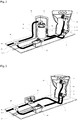
- a stand-up pouch (1) is used.
- the stand-up pouch (1) essentially stands independently in a housing (9) or can be fixed in the container system according to the invention by means of a receiving device (not shown in this figure).
- the stand-up pouch (1) can be designed as a single or reusable system and at the same time serve as transport packaging.
- Another variant provides that the bag (1) is removed from a transport container and inserted into the receiving device (9).
- the bag (1) is connected to the withdrawal line (5) by means of the removal fitting (3) and to the return line by means of the delivery fitting (2).
- the feed connection (2) is located independently of the filling state of the bag (1) above the removal connection (3).
- the extraction line (5) and the return line (4) can be connected to a circuit via a suitable connection, for example a coupling (24).
- a suitable connection for example a coupling (24).
- a supply line (14) goes to a removal and / or filling device.
- the clutch (24) is usually designed as a three-way clutch.
- the two connections of the base bag (1) ie the removal fitting (3) and the feed fitting (2) are specially arranged so that in each filling state of the bag (1) a mixing of the bag contents by a circulation of the liquid medium in the Circulation is achieved.
- the ports (2, 3) are preferably constructed or selected to facilitate connection to the circuit system, particularly via quick couplings.
- the flow through the container system ensures thorough mixing as soon as the circuit via the conveyor (13) is activated.
- the construction of the bottom of the receptacle is observed. It is preferably designed so that settling particles or phases accumulate near the removal area of the bag (1) (settling funnel principle). The settling particles are detected by activating the circuit first and fed back to the highest point of the bag.
- further turbulence-promoting or generating elements which promote a stirring or mixing effect, such as agitators, or else elements which generate a movement of the medium when excited from outside.
- the supply lines can be installed in the interior of the receiving device.
- the conveyor (13) is supplied via a supply line (12) with energy.
- the delivery device (13) is generally a pump, preferably a piston pump and, in particular, an oscillating piston pump.
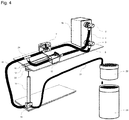
- a buffer tank (6) is integrated.
- the flowable composition in the bag (1) is removed from the bag (1) via the lower connection by means of the removal fitting (3) and passes via the withdrawal line (5) through an inlet connection (7) into the buffer container (6) ).
- the liquid medium via the drain port (8) is removed again.
- the buffer container (6) is partially or completely surrounded by a housing (9). Between the inner wall of the housing (9) and the outer wall of the buffer tank (6) is a sensor (10).
- the sensor (10) is mounted on the inner wall of the housing (9) so that it is in continuous operation with the outer wall of the buffer tank (6) in contact. If the bag (1) empties, the buffer container (6) is no longer filled with the liquid medium.
- FIG. 3 illustrated container system for a liquid medium according to the invention is equipped with a vacuum sensor (17).
- the structure of this container system substantially corresponds to the in FIG. 2 shown.
- the receiving device (16) is shown here schematically by dashed lines.
- the stand-up pouch (1) is essentially independent in the receiving device (16). It is fixed in the receiving device (16) so that the supply port (2) regardless of the filling state of the bag (1) above the withdrawal port (3). A fixation of the bag is usually due to the train, which induces the flow or the conveyor, advantageous.
- FIG. 2 Unlike the in FIG. 2 shown container system is located in the sampling line (5) a vacuum switch (17). On the in FIG. 2 illustrated buffer container (6) with the associated equipment (7, 8, 9, 10) can be omitted in this embodiment. Nevertheless, it is possible, the buffer container (6) with or without associated equipment (7, 8, 9, 10) also in the in FIG. 3 integrated cycle to integrate.
- the flowable composition located in the bag (1) is removed from the bag (1) via the lower connection by means of the removal fitting (3) and through the withdrawal line directly via the vacuum sensor to the connection (24) and further into the return line (FIG. 4).
- a, preferably adjustable, vacuum sensor (17) integrated into the circulatory system.
- the switching point of the pressure sensor (17) is usually chosen so that the negative pressure during the dosing with continuously trailing dosing does not trigger, but with completely collapsed and thus empty bag (1) by the sudden increase in negative pressure to the maximum of the pump power a switching signal supplies.
- This switching signal is transmitted via the sensor cable (15) to a control unit.
- the control unit will interrupt the dosing until a pressure equalization is achieved by inserting a full bag.
- the vacuum sensor (17) delivers a corresponding signal to the control unit, the device is released again and the dosage is continued.
- FIG. 4 a device according to the invention for dosing a liquid medium with a vacuum sensor (17) and a Dosierumble is shown.
- the device shown here is especially suitable for dosing dye compositions.
- the device essentially consists of two subassemblies: a container system connected to a circuit and a dispensing line departing from this circuit.
- the according to FIG. 4 in the device integrated container system substantially corresponds to the in FIG. 3 illustrated container system.
- the stand-up pouch is arranged in the receiving device (16). In the present presentation, only the feed fitting (2) connected to the return line (4) and the removal fitting (3) connected to the removal line (5) can be seen from the stand-up bag.
- the ports (2, 3) are designed or chosen to facilitate connection to the circuit system, preferably via quick couplings.
- the flow through the container system ensures thorough mixing as soon as the circuit via the conveyor (13) is activated. Since dye compositions are usually settling-prone media, the construction of the bottom of the receptacle should be noted. Settling particles or phases should be able to collect near the removal area of the bag (1) (settling funnel principle) to be detected first by activation of the circulation and re-fed at the highest point of the bag. It is also possible to incorporate further turbulence-promoting or generating elements which promote a stirring or mixing effect, such as agitators, or else elements which generate a movement of the medium when excited from outside.
- a circulation system can be dispensed with. In this case, only one removal path (14, 18, 19, 21) from the container system for metering must be present.
- the container system is connected by means of a coupling (24) to the supply line (14) to the dosing.
- the coupling (24) is preferably a reusable coupling.
- a reusable coupling for example, container systems with the same dye compositions can be connected in series or a residual emptying of the container system can be carried out.
- a service clutch Between the clutch (24) and the conveyor (13) may optionally be used a service clutch.
- a service coupling allows eg the Feeding additional liquid media from the outside, such as residues of the same dye composition.
- a residual emptying of the circulatory system can be made.
- the coupling (24) and the service coupling are identical.
- the conveyor (13) can be operated either continuously or at intervals, depending on the required mixing due to the properties of the medium.
- the supply line (14) is connected to a metering.
- the metering section is essentially formed from metering valve (18), metering pump (19), stepping motor (20) and metering line (21).
- the medium to be dosed can be removed from the circulation of the container system.
- the medium is pumped via the metering pump (19), for example a pressure pump, into the metering line (21).
- the metering line (21) is enabled or disabled.
- the valve (18) is e.g. around a solenoid valve.
- a removal device (22) is connected.
- the metered liquid medium enters a product container (23). From there, a further assembly can take place.
- the removal device (22) can be rinsed with a suitable solvent or cleaning agent via a rinsing unit (not shown here).
- the rinsing unit is also connected to the removal device (22).
- the solvent or cleaning agent is preferably metered under pressure.
- the solvent or cleaning agent is pumped via a separate conveyor unit, for example a pump, from a container for solvent or cleaning agent into the flushing section.
- the flushing path is enabled or disabled.
- the valve may be, for example, a solenoid valve. Is it in the removal device (22) to that in the EP 2067716 described metering valve, the entire valve chamber and the closure mechanism of the metering valve are flushed during the flushing process in an advantageous manner.
- the container for solvents or cleaning agents can be carried out in a suitable manner.
- it is designed as a stand-up pouch according to the invention.
- it is possible to design the device in a modular design.
- the individual removal devices (22) can be combined to form an assembly, a so-called dosing head.
- the EP 2067716 describes a possible embodiment of such a dosing.
- a modular liquid metering system is produced with a closed pump / container system.
- the arrangement of several of these systems form multi-channel systems that allow the simultaneous dosing of any number of individual components or preparations, but also finished media thereof.
- Such a plant consists essentially of the device described above with one or more circuits / circuits, dosing line (s), process control unit (s), a static or modular body and housing.
- the conveyors and units, pumps and valves are preferably combined in a receiving unit. They can be arranged, for example, in a drawer system.
- the compact or modular arrangement allows quick access to individual components for service or repair purposes.
- the pumps and / or the valve assembly can also be accommodated modularly as a panel in the drawer or in the dosing module.
- a container module the receiving devices for the bags of media and quick coupling units are accommodated for the production of the circuit.
- Both modules have their own piping systems, such as internal piping and / or hose systems, which are compatible and connectable. Dosing module and container module also have their own power supply and internal wiring.
- the dosing circuits with closed system can be used wherever conventional systems are already in operation.
- the systems with a closed system can be used with all types of liquid, paste and / or pigment systems such as adhesives, food ingredients, oils, solvents, alkyd, synthetic resin, polymer, acrylic, latex, nanolack, as well as dispersion and Natural color compositions are charged. But they are also suitable for sedimentation-endangered, pasty and / or sensitive food or feed.
- Solvent-containing media can be processed problem-free with the closed system described above, as no hazardous or potentially explosive vapors can escape.
- the media can be sterilized in the floor bags, for example by irradiation or by heating, before or optionally during use.
- the new container system enables inline mixing, homogenizing and dispersing of liquid, paste and / or pigment systems such as adhesives, food ingredients, oils, solvents, alkyd, synthetic resin, polymer, acrylic, latex, nanolack and dispersion - and natural color compositions, but also at risk of sedition, pasty and / or sensitive food or feed.
- liquid, paste and / or pigment systems such as adhesives, food ingredients, oils, solvents, alkyd, synthetic resin, polymer, acrylic, latex, nanolack and dispersion - and natural color compositions, but also at risk of sedition, pasty and / or sensitive food or feed.
- the stand-up pouches used in accordance with the invention opens up novel application possibilities, preferably in the use for color mixing.
- the mixing plants are not bound to specified container sizes.
- a reusable solution is possible, as long as re-filling is desired or preferred.
- the design as a stand-up bag contributes to the reduction of waste, since no separate transport packaging is necessary. The transport costs are reduced because the complete usable space is available.
Landscapes
- Chemical & Material Sciences (AREA)
- Chemical Kinetics & Catalysis (AREA)
- Engineering & Computer Science (AREA)
- Mechanical Engineering (AREA)
- Dispersion Chemistry (AREA)
- Containers And Packaging Bodies Having A Special Means To Remove Contents (AREA)
- Accessories For Mixers (AREA)
- Nozzles (AREA)
Applications Claiming Priority (1)
| Application Number | Priority Date | Filing Date | Title |
|---|---|---|---|
| DE102017120686.8A DE102017120686A1 (de) | 2017-09-07 | 2017-09-07 | Behälter und vorrichtung zum dosieren flüssiger medien |
Publications (3)
| Publication Number | Publication Date |
|---|---|
| EP3461760A2 true EP3461760A2 (fr) | 2019-04-03 |
| EP3461760A3 EP3461760A3 (fr) | 2019-08-07 |
| EP3461760B1 EP3461760B1 (fr) | 2023-11-08 |
Family
ID=63524173
Family Applications (1)
| Application Number | Title | Priority Date | Filing Date |
|---|---|---|---|
| EP18192982.9A Active EP3461760B1 (fr) | 2017-09-07 | 2018-09-06 | Récipient et dispositif de dosage de produits liquides |
Country Status (2)
| Country | Link |
|---|---|
| EP (1) | EP3461760B1 (fr) |
| DE (1) | DE102017120686A1 (fr) |
Cited By (7)
| Publication number | Priority date | Publication date | Assignee | Title |
|---|---|---|---|---|
| DE202021103214U1 (de) | 2021-06-15 | 2022-09-22 | Uwe Michael Schlitt | Kolbenpumpe mit Glaszylinder |
| DE102022110118A1 (de) | 2021-04-29 | 2022-11-03 | Uwe Michael Schlitt | Vorrichtung und Verfahren zum Dosieren fließfähiger Zusammensetzungen mit Betriebsparameter- Erfassung |
| CN115717317A (zh) * | 2021-08-24 | 2023-02-28 | 南京中竞科智能科技有限公司 | 一种容积可变容器装处理剂用自动投放系统和洗衣机、洗碗机 |
| DE102021123449A1 (de) | 2021-09-10 | 2023-03-16 | Uwe Michael Schlitt | Vorrichtung und Verfahren zum Dosieren und Konservieren flüssiger Medien |
| EP4397599A1 (fr) * | 2023-01-09 | 2024-07-10 | Uwe Michael Schlitt | Dispositif d'alimentation |
| DE102023000699A1 (de) | 2023-02-27 | 2024-08-29 | Uwe Michael Schlitt | Vorrichtung zum volumetrischen Dosieren fließfähiger Zusammensetzungen mit einer Glaszylinder-Kolbenpumpe mit PFAS-freien Kolbenmaterialien |
| WO2024184421A1 (fr) | 2023-03-06 | 2024-09-12 | Uwe Michael Schlitt | Dispositif de réception d'un tube cylindrique pour le changement rapide d'un cylindre de pompe à piston, et dispositif de dosage contenant ledit dispositif |
Citations (1)
| Publication number | Priority date | Publication date | Assignee | Title |
|---|---|---|---|---|
| EP2067716A2 (fr) | 2007-12-05 | 2009-06-10 | Schlitt, Uwe Michael | Dispositif destiné au dosage de milieux liquides et système de récipient |
Family Cites Families (7)
| Publication number | Priority date | Publication date | Assignee | Title |
|---|---|---|---|---|
| USD271805S (en) * | 1980-12-12 | 1983-12-13 | Abbott Laboratories | Container for medical liquids |
| DE4002255A1 (de) * | 1990-01-26 | 1991-08-01 | Fluid Verfahrenstechnik Gmbh | Vorrichtung zum dosieren von fluessigkeiten |
| US6039305A (en) * | 1998-01-21 | 2000-03-21 | K-2 Corporation | Bite valve for hydration bladder |
| US6854888B1 (en) * | 2000-01-28 | 2005-02-15 | Dennis B. Brown | Multispout flask with pump |
| US20070039974A1 (en) * | 2005-08-18 | 2007-02-22 | Lloyd James J | Dual-usage beverage dispensing system |
| DE102009024862A1 (de) * | 2009-06-09 | 2010-12-16 | Uwe Michael Schlitt | Dosiervorrichtung für flüssige Medien |
| US9341356B2 (en) * | 2014-09-25 | 2016-05-17 | Franklin NG | System and method for portable lantern |
-
2017
- 2017-09-07 DE DE102017120686.8A patent/DE102017120686A1/de not_active Withdrawn
-
2018
- 2018-09-06 EP EP18192982.9A patent/EP3461760B1/fr active Active
Patent Citations (1)
| Publication number | Priority date | Publication date | Assignee | Title |
|---|---|---|---|---|
| EP2067716A2 (fr) | 2007-12-05 | 2009-06-10 | Schlitt, Uwe Michael | Dispositif destiné au dosage de milieux liquides et système de récipient |
Cited By (8)
| Publication number | Priority date | Publication date | Assignee | Title |
|---|---|---|---|---|
| DE102022110118A1 (de) | 2021-04-29 | 2022-11-03 | Uwe Michael Schlitt | Vorrichtung und Verfahren zum Dosieren fließfähiger Zusammensetzungen mit Betriebsparameter- Erfassung |
| DE202021103214U1 (de) | 2021-06-15 | 2022-09-22 | Uwe Michael Schlitt | Kolbenpumpe mit Glaszylinder |
| CN115717317A (zh) * | 2021-08-24 | 2023-02-28 | 南京中竞科智能科技有限公司 | 一种容积可变容器装处理剂用自动投放系统和洗衣机、洗碗机 |
| DE102021123449A1 (de) | 2021-09-10 | 2023-03-16 | Uwe Michael Schlitt | Vorrichtung und Verfahren zum Dosieren und Konservieren flüssiger Medien |
| EP4397599A1 (fr) * | 2023-01-09 | 2024-07-10 | Uwe Michael Schlitt | Dispositif d'alimentation |
| DE102023000699A1 (de) | 2023-02-27 | 2024-08-29 | Uwe Michael Schlitt | Vorrichtung zum volumetrischen Dosieren fließfähiger Zusammensetzungen mit einer Glaszylinder-Kolbenpumpe mit PFAS-freien Kolbenmaterialien |
| WO2024184421A1 (fr) | 2023-03-06 | 2024-09-12 | Uwe Michael Schlitt | Dispositif de réception d'un tube cylindrique pour le changement rapide d'un cylindre de pompe à piston, et dispositif de dosage contenant ledit dispositif |
| DE102023000825A1 (de) | 2023-03-06 | 2024-09-12 | Uwe Michael Schlitt | Vorrichtung zur Aufnahme eines zylindrischen Rohrs zum schnellen Wechsel eines Kolbenpumpenzylinders |
Also Published As
| Publication number | Publication date |
|---|---|
| DE102017120686A1 (de) | 2019-03-07 |
| EP3461760B1 (fr) | 2023-11-08 |
| EP3461760A3 (fr) | 2019-08-07 |
Similar Documents
| Publication | Publication Date | Title |
|---|---|---|
| EP3461760B1 (fr) | Récipient et dispositif de dosage de produits liquides | |
| EP2067716B1 (fr) | Dispositif destiné au dosage de milieux liquides et système de récipient | |
| DE69613672T2 (de) | System, Vorrichtung und Verfahren zum Konservieren, Transportieren und Verteilen von Farbstoffen | |
| EP0590099B1 (fr) | Procede et dispositif de preparation de resine a couler, de transport de resine a couler et d'alimentation d'une installation de coulee en resine a couler | |
| DE60224408T2 (de) | Fluidinjektor mit lüftungs-/proportionieröffnungen | |
| DE68904785T2 (de) | Behaelter fuer prozessloesung. | |
| DE3315031C2 (de) | Verfahren und Vorrichtung zum Herstellen von Gemischen pharmazeutischer Flüssigkeiten | |
| EP2986952B1 (fr) | Dispositif d'introduction d'une quantité précise d'une deuxième poudre dans un conteneur | |
| DE102020001711A1 (de) | Hubsystem zur Dosierung von einem Fluid aus einem Behälter und Behälter für ein Fluid | |
| EP0820719B1 (fr) | Système d'emballage et de dosage | |
| EP4089161A1 (fr) | Substrat destiné à l'examen des échantillons et système comprenant le substrat | |
| WO1998028069A1 (fr) | Systeme de dosage et de nuançage | |
| EP1475325B1 (fr) | Dispositif pour le dosage des composants de matières en vrac | |
| DE102017011283A1 (de) | Behältersystem und Vorrichtung zum Dosieren flüssiger Medien innerhalb einer Mischanlage | |
| EP2152586A1 (fr) | Emballeuse | |
| DE102013207567A1 (de) | Biobehälter-Überführungsbaugruppe | |
| DE102020109058B3 (de) | Adapter-Vorrichtung zum Befüllen luftdicht verschlossener Flüssigkeitsbehälter | |
| AT518931B1 (de) | Modulares Rührwerk | |
| EP0536645A2 (fr) | Préparation de solution nécessaire de Bicarbonate pour la dialyse au bicarbonate au niveau d'un appareil de dialyse | |
| DE202023102540U1 (de) | Mischbehälter | |
| DE202017007501U1 (de) | Behältersystem und Vorrichtung zum Dosieren flüssiger Medien innerhalb einer Mischanlage | |
| DE102023112375A1 (de) | Mischbehälter | |
| DE19516989C1 (de) | Vorrichtung zum Dosieren von pulverförmigem Material | |
| DE202021102328U1 (de) | Vorrichtung zum Bereitstellen von Wirkstoffzusammensetzungen aus Fluid | |
| DE102021111137A1 (de) | Vorrichtung und Verfahren zum Bereitstellen von Wirkstoffzusammensetzungen aus Fluid |
Legal Events
| Date | Code | Title | Description |
|---|---|---|---|
| PUAI | Public reference made under article 153(3) epc to a published international application that has entered the european phase |
Free format text: ORIGINAL CODE: 0009012 |
|
| STAA | Information on the status of an ep patent application or granted ep patent |
Free format text: STATUS: THE APPLICATION HAS BEEN PUBLISHED |
|
| AK | Designated contracting states |
Kind code of ref document: A2 Designated state(s): AL AT BE BG CH CY CZ DE DK EE ES FI FR GB GR HR HU IE IS IT LI LT LU LV MC MK MT NL NO PL PT RO RS SE SI SK SM TR |
|
| AX | Request for extension of the european patent |
Extension state: BA ME |
|
| PUAL | Search report despatched |
Free format text: ORIGINAL CODE: 0009013 |
|
| AK | Designated contracting states |
Kind code of ref document: A3 Designated state(s): AL AT BE BG CH CY CZ DE DK EE ES FI FR GB GR HR HU IE IS IT LI LT LU LV MC MK MT NL NO PL PT RO RS SE SI SK SM TR |
|
| AX | Request for extension of the european patent |
Extension state: BA ME |
|
| RIC1 | Information provided on ipc code assigned before grant |
Ipc: B65D 75/00 20060101AFI20190701BHEP Ipc: B65D 75/58 20060101ALI20190701BHEP Ipc: B01F 1/00 20060101ALI20190701BHEP |
|
| STAA | Information on the status of an ep patent application or granted ep patent |
Free format text: STATUS: REQUEST FOR EXAMINATION WAS MADE |
|
| 17P | Request for examination filed |
Effective date: 20200204 |
|
| RBV | Designated contracting states (corrected) |
Designated state(s): AL AT BE BG CH CY CZ DE DK EE ES FI FR GB GR HR HU IE IS IT LI LT LU LV MC MK MT NL NO PL PT RO RS SE SI SK SM TR |
|
| STAA | Information on the status of an ep patent application or granted ep patent |
Free format text: STATUS: EXAMINATION IS IN PROGRESS |
|
| 17Q | First examination report despatched |
Effective date: 20220420 |
|
| REG | Reference to a national code |
Ref country code: DE Ref legal event code: R079 Ipc: B01F0023000000 Ref country code: DE Ref legal event code: R079 Ref document number: 502018013598 Country of ref document: DE Free format text: PREVIOUS MAIN CLASS: B65D0075000000 Ipc: B01F0023000000 |
|
| GRAP | Despatch of communication of intention to grant a patent |
Free format text: ORIGINAL CODE: EPIDOSNIGR1 |
|
| STAA | Information on the status of an ep patent application or granted ep patent |
Free format text: STATUS: GRANT OF PATENT IS INTENDED |
|
| RIC1 | Information provided on ipc code assigned before grant |
Ipc: B01F 23/00 20220101AFI20230406BHEP |
|
| INTG | Intention to grant announced |
Effective date: 20230425 |
|
| GRAS | Grant fee paid |
Free format text: ORIGINAL CODE: EPIDOSNIGR3 |
|
| GRAA | (expected) grant |
Free format text: ORIGINAL CODE: 0009210 |
|
| STAA | Information on the status of an ep patent application or granted ep patent |
Free format text: STATUS: THE PATENT HAS BEEN GRANTED |
|
| AK | Designated contracting states |
Kind code of ref document: B1 Designated state(s): AL AT BE BG CH CY CZ DE DK EE ES FI FR GB GR HR HU IE IS IT LI LT LU LV MC MK MT NL NO PL PT RO RS SE SI SK SM TR |
|
| REG | Reference to a national code |
Ref country code: GB Ref legal event code: FG4D Free format text: NOT ENGLISH |
|
| REG | Reference to a national code |
Ref country code: CH Ref legal event code: EP |
|
| REG | Reference to a national code |
Ref country code: DE Ref legal event code: R096 Ref document number: 502018013598 Country of ref document: DE |
|
| REG | Reference to a national code |
Ref country code: IE Ref legal event code: FG4D Free format text: LANGUAGE OF EP DOCUMENT: GERMAN |
|
| REG | Reference to a national code |
Ref country code: LT Ref legal event code: MG9D |
|
| REG | Reference to a national code |
Ref country code: NL Ref legal event code: MP Effective date: 20231108 |
|
| PG25 | Lapsed in a contracting state [announced via postgrant information from national office to epo] |
Ref country code: GR Free format text: LAPSE BECAUSE OF FAILURE TO SUBMIT A TRANSLATION OF THE DESCRIPTION OR TO PAY THE FEE WITHIN THE PRESCRIBED TIME-LIMIT Effective date: 20240209 |
|
| PG25 | Lapsed in a contracting state [announced via postgrant information from national office to epo] |
Ref country code: IS Free format text: LAPSE BECAUSE OF FAILURE TO SUBMIT A TRANSLATION OF THE DESCRIPTION OR TO PAY THE FEE WITHIN THE PRESCRIBED TIME-LIMIT Effective date: 20240308 |
|
| PG25 | Lapsed in a contracting state [announced via postgrant information from national office to epo] |
Ref country code: LT Free format text: LAPSE BECAUSE OF FAILURE TO SUBMIT A TRANSLATION OF THE DESCRIPTION OR TO PAY THE FEE WITHIN THE PRESCRIBED TIME-LIMIT Effective date: 20231108 |
|
| PG25 | Lapsed in a contracting state [announced via postgrant information from national office to epo] |
Ref country code: NL Free format text: LAPSE BECAUSE OF FAILURE TO SUBMIT A TRANSLATION OF THE DESCRIPTION OR TO PAY THE FEE WITHIN THE PRESCRIBED TIME-LIMIT Effective date: 20231108 |
|
| PG25 | Lapsed in a contracting state [announced via postgrant information from national office to epo] |
Ref country code: ES Free format text: LAPSE BECAUSE OF FAILURE TO SUBMIT A TRANSLATION OF THE DESCRIPTION OR TO PAY THE FEE WITHIN THE PRESCRIBED TIME-LIMIT Effective date: 20231108 |
|
| PG25 | Lapsed in a contracting state [announced via postgrant information from national office to epo] |
Ref country code: NL Free format text: LAPSE BECAUSE OF FAILURE TO SUBMIT A TRANSLATION OF THE DESCRIPTION OR TO PAY THE FEE WITHIN THE PRESCRIBED TIME-LIMIT Effective date: 20231108 Ref country code: LT Free format text: LAPSE BECAUSE OF FAILURE TO SUBMIT A TRANSLATION OF THE DESCRIPTION OR TO PAY THE FEE WITHIN THE PRESCRIBED TIME-LIMIT Effective date: 20231108 Ref country code: IS Free format text: LAPSE BECAUSE OF FAILURE TO SUBMIT A TRANSLATION OF THE DESCRIPTION OR TO PAY THE FEE WITHIN THE PRESCRIBED TIME-LIMIT Effective date: 20240308 Ref country code: GR Free format text: LAPSE BECAUSE OF FAILURE TO SUBMIT A TRANSLATION OF THE DESCRIPTION OR TO PAY THE FEE WITHIN THE PRESCRIBED TIME-LIMIT Effective date: 20240209 Ref country code: ES Free format text: LAPSE BECAUSE OF FAILURE TO SUBMIT A TRANSLATION OF THE DESCRIPTION OR TO PAY THE FEE WITHIN THE PRESCRIBED TIME-LIMIT Effective date: 20231108 Ref country code: BG Free format text: LAPSE BECAUSE OF FAILURE TO SUBMIT A TRANSLATION OF THE DESCRIPTION OR TO PAY THE FEE WITHIN THE PRESCRIBED TIME-LIMIT Effective date: 20240208 Ref country code: PT Free format text: LAPSE BECAUSE OF FAILURE TO SUBMIT A TRANSLATION OF THE DESCRIPTION OR TO PAY THE FEE WITHIN THE PRESCRIBED TIME-LIMIT Effective date: 20240308 |
|
| PG25 | Lapsed in a contracting state [announced via postgrant information from national office to epo] |
Ref country code: SE Free format text: LAPSE BECAUSE OF FAILURE TO SUBMIT A TRANSLATION OF THE DESCRIPTION OR TO PAY THE FEE WITHIN THE PRESCRIBED TIME-LIMIT Effective date: 20231108 Ref country code: RS Free format text: LAPSE BECAUSE OF FAILURE TO SUBMIT A TRANSLATION OF THE DESCRIPTION OR TO PAY THE FEE WITHIN THE PRESCRIBED TIME-LIMIT Effective date: 20231108 Ref country code: PL Free format text: LAPSE BECAUSE OF FAILURE TO SUBMIT A TRANSLATION OF THE DESCRIPTION OR TO PAY THE FEE WITHIN THE PRESCRIBED TIME-LIMIT Effective date: 20231108 Ref country code: NO Free format text: LAPSE BECAUSE OF FAILURE TO SUBMIT A TRANSLATION OF THE DESCRIPTION OR TO PAY THE FEE WITHIN THE PRESCRIBED TIME-LIMIT Effective date: 20240208 Ref country code: LV Free format text: LAPSE BECAUSE OF FAILURE TO SUBMIT A TRANSLATION OF THE DESCRIPTION OR TO PAY THE FEE WITHIN THE PRESCRIBED TIME-LIMIT Effective date: 20231108 Ref country code: HR Free format text: LAPSE BECAUSE OF FAILURE TO SUBMIT A TRANSLATION OF THE DESCRIPTION OR TO PAY THE FEE WITHIN THE PRESCRIBED TIME-LIMIT Effective date: 20231108 |
|
| PG25 | Lapsed in a contracting state [announced via postgrant information from national office to epo] |
Ref country code: DK Free format text: LAPSE BECAUSE OF FAILURE TO SUBMIT A TRANSLATION OF THE DESCRIPTION OR TO PAY THE FEE WITHIN THE PRESCRIBED TIME-LIMIT Effective date: 20231108 |
|
| PG25 | Lapsed in a contracting state [announced via postgrant information from national office to epo] |
Ref country code: CZ Free format text: LAPSE BECAUSE OF FAILURE TO SUBMIT A TRANSLATION OF THE DESCRIPTION OR TO PAY THE FEE WITHIN THE PRESCRIBED TIME-LIMIT Effective date: 20231108 |
|
| PG25 | Lapsed in a contracting state [announced via postgrant information from national office to epo] |
Ref country code: SK Free format text: LAPSE BECAUSE OF FAILURE TO SUBMIT A TRANSLATION OF THE DESCRIPTION OR TO PAY THE FEE WITHIN THE PRESCRIBED TIME-LIMIT Effective date: 20231108 |
|
| PG25 | Lapsed in a contracting state [announced via postgrant information from national office to epo] |
Ref country code: SM Free format text: LAPSE BECAUSE OF FAILURE TO SUBMIT A TRANSLATION OF THE DESCRIPTION OR TO PAY THE FEE WITHIN THE PRESCRIBED TIME-LIMIT Effective date: 20231108 Ref country code: SK Free format text: LAPSE BECAUSE OF FAILURE TO SUBMIT A TRANSLATION OF THE DESCRIPTION OR TO PAY THE FEE WITHIN THE PRESCRIBED TIME-LIMIT Effective date: 20231108 Ref country code: RO Free format text: LAPSE BECAUSE OF FAILURE TO SUBMIT A TRANSLATION OF THE DESCRIPTION OR TO PAY THE FEE WITHIN THE PRESCRIBED TIME-LIMIT Effective date: 20231108 Ref country code: IT Free format text: LAPSE BECAUSE OF FAILURE TO SUBMIT A TRANSLATION OF THE DESCRIPTION OR TO PAY THE FEE WITHIN THE PRESCRIBED TIME-LIMIT Effective date: 20231108 Ref country code: EE Free format text: LAPSE BECAUSE OF FAILURE TO SUBMIT A TRANSLATION OF THE DESCRIPTION OR TO PAY THE FEE WITHIN THE PRESCRIBED TIME-LIMIT Effective date: 20231108 Ref country code: DK Free format text: LAPSE BECAUSE OF FAILURE TO SUBMIT A TRANSLATION OF THE DESCRIPTION OR TO PAY THE FEE WITHIN THE PRESCRIBED TIME-LIMIT Effective date: 20231108 Ref country code: CZ Free format text: LAPSE BECAUSE OF FAILURE TO SUBMIT A TRANSLATION OF THE DESCRIPTION OR TO PAY THE FEE WITHIN THE PRESCRIBED TIME-LIMIT Effective date: 20231108 |
|
| REG | Reference to a national code |
Ref country code: DE Ref legal event code: R097 Ref document number: 502018013598 Country of ref document: DE |
|
| PLBE | No opposition filed within time limit |
Free format text: ORIGINAL CODE: 0009261 |
|
| STAA | Information on the status of an ep patent application or granted ep patent |
Free format text: STATUS: NO OPPOSITION FILED WITHIN TIME LIMIT |
|
| 26N | No opposition filed |
Effective date: 20240809 |
|
| PG25 | Lapsed in a contracting state [announced via postgrant information from national office to epo] |
Ref country code: SI Free format text: LAPSE BECAUSE OF FAILURE TO SUBMIT A TRANSLATION OF THE DESCRIPTION OR TO PAY THE FEE WITHIN THE PRESCRIBED TIME-LIMIT Effective date: 20231108 |
|
| PG25 | Lapsed in a contracting state [announced via postgrant information from national office to epo] |
Ref country code: SI Free format text: LAPSE BECAUSE OF FAILURE TO SUBMIT A TRANSLATION OF THE DESCRIPTION OR TO PAY THE FEE WITHIN THE PRESCRIBED TIME-LIMIT Effective date: 20231108 |
|
| PG25 | Lapsed in a contracting state [announced via postgrant information from national office to epo] |
Ref country code: MC Free format text: LAPSE BECAUSE OF FAILURE TO SUBMIT A TRANSLATION OF THE DESCRIPTION OR TO PAY THE FEE WITHIN THE PRESCRIBED TIME-LIMIT Effective date: 20231108 |
|
| REG | Reference to a national code |
Ref country code: CH Ref legal event code: PL |
|
| PG25 | Lapsed in a contracting state [announced via postgrant information from national office to epo] |
Ref country code: LU Free format text: LAPSE BECAUSE OF NON-PAYMENT OF DUE FEES Effective date: 20240906 |
|
| GBPC | Gb: european patent ceased through non-payment of renewal fee |
Effective date: 20240906 |
|
| PG25 | Lapsed in a contracting state [announced via postgrant information from national office to epo] |
Ref country code: GB Free format text: LAPSE BECAUSE OF NON-PAYMENT OF DUE FEES Effective date: 20240906 |
|
| REG | Reference to a national code |
Ref country code: BE Ref legal event code: MM Effective date: 20240930 |
|
| PG25 | Lapsed in a contracting state [announced via postgrant information from national office to epo] |
Ref country code: BE Free format text: LAPSE BECAUSE OF NON-PAYMENT OF DUE FEES Effective date: 20240930 |
|
| PG25 | Lapsed in a contracting state [announced via postgrant information from national office to epo] |
Ref country code: FR Free format text: LAPSE BECAUSE OF NON-PAYMENT OF DUE FEES Effective date: 20240930 |
|
| PG25 | Lapsed in a contracting state [announced via postgrant information from national office to epo] |
Ref country code: CH Free format text: LAPSE BECAUSE OF NON-PAYMENT OF DUE FEES Effective date: 20240930 |
|
| PG25 | Lapsed in a contracting state [announced via postgrant information from national office to epo] |
Ref country code: IE Free format text: LAPSE BECAUSE OF NON-PAYMENT OF DUE FEES Effective date: 20240906 |
|
| PG25 | Lapsed in a contracting state [announced via postgrant information from national office to epo] |
Ref country code: FI Free format text: LAPSE BECAUSE OF FAILURE TO SUBMIT A TRANSLATION OF THE DESCRIPTION OR TO PAY THE FEE WITHIN THE PRESCRIBED TIME-LIMIT Effective date: 20231108 |
|
| PGFP | Annual fee paid to national office [announced via postgrant information from national office to epo] |
Ref country code: DE Payment date: 20250930 Year of fee payment: 8 |
|
| REG | Reference to a national code |
Ref country code: AT Ref legal event code: MM01 Ref document number: 1629134 Country of ref document: AT Kind code of ref document: T Effective date: 20240906 |
|
| PG25 | Lapsed in a contracting state [announced via postgrant information from national office to epo] |
Ref country code: AT Free format text: LAPSE BECAUSE OF NON-PAYMENT OF DUE FEES Effective date: 20240906 |
|
| PG25 | Lapsed in a contracting state [announced via postgrant information from national office to epo] |
Ref country code: CY Free format text: LAPSE BECAUSE OF FAILURE TO SUBMIT A TRANSLATION OF THE DESCRIPTION OR TO PAY THE FEE WITHIN THE PRESCRIBED TIME-LIMIT; INVALID AB INITIO Effective date: 20180906 |
|
| PG25 | Lapsed in a contracting state [announced via postgrant information from national office to epo] |
Ref country code: HU Free format text: LAPSE BECAUSE OF FAILURE TO SUBMIT A TRANSLATION OF THE DESCRIPTION OR TO PAY THE FEE WITHIN THE PRESCRIBED TIME-LIMIT; INVALID AB INITIO Effective date: 20180906 |