EP3463230B1 - Dispositifs de traitement des acouphènes à l'aide d'une stimulation électrique - Google Patents
Dispositifs de traitement des acouphènes à l'aide d'une stimulation électrique Download PDFInfo
- Publication number
- EP3463230B1 EP3463230B1 EP17810752.0A EP17810752A EP3463230B1 EP 3463230 B1 EP3463230 B1 EP 3463230B1 EP 17810752 A EP17810752 A EP 17810752A EP 3463230 B1 EP3463230 B1 EP 3463230B1
- Authority
- EP
- European Patent Office
- Prior art keywords
- electrode
- patient
- tinnitus
- lead
- cochlear
- Prior art date
- Legal status (The legal status is an assumption and is not a legal conclusion. Google has not performed a legal analysis and makes no representation as to the accuracy of the status listed.)
- Active
Links
Images


Classifications
-
- A—HUMAN NECESSITIES
- A61—MEDICAL OR VETERINARY SCIENCE; HYGIENE
- A61N—ELECTROTHERAPY; MAGNETOTHERAPY; RADIATION THERAPY; ULTRASOUND THERAPY
- A61N1/00—Electrotherapy; Circuits therefor
- A61N1/18—Applying electric currents by contact electrodes
- A61N1/32—Applying electric currents by contact electrodes alternating or intermittent currents
- A61N1/36—Applying electric currents by contact electrodes alternating or intermittent currents for stimulation
- A61N1/3605—Implantable neurostimulators for stimulating central or peripheral nerve system
- A61N1/3606—Implantable neurostimulators for stimulating central or peripheral nerve system adapted for a particular treatment
- A61N1/361—Phantom sensations, e.g. tinnitus
-
- A—HUMAN NECESSITIES
- A61—MEDICAL OR VETERINARY SCIENCE; HYGIENE
- A61N—ELECTROTHERAPY; MAGNETOTHERAPY; RADIATION THERAPY; ULTRASOUND THERAPY
- A61N1/00—Electrotherapy; Circuits therefor
- A61N1/02—Details
- A61N1/04—Electrodes
- A61N1/05—Electrodes for implantation or insertion into the body, e.g. heart electrode
- A61N1/0526—Head electrodes
- A61N1/0541—Cochlear electrodes
-
- A—HUMAN NECESSITIES
- A61—MEDICAL OR VETERINARY SCIENCE; HYGIENE
- A61N—ELECTROTHERAPY; MAGNETOTHERAPY; RADIATION THERAPY; ULTRASOUND THERAPY
- A61N1/00—Electrotherapy; Circuits therefor
- A61N1/18—Applying electric currents by contact electrodes
- A61N1/32—Applying electric currents by contact electrodes alternating or intermittent currents
- A61N1/36—Applying electric currents by contact electrodes alternating or intermittent currents for stimulation
- A61N1/36036—Applying electric currents by contact electrodes alternating or intermittent currents for stimulation of the outer, middle or inner ear
- A61N1/36038—Cochlear stimulation
-
- A—HUMAN NECESSITIES
- A61—MEDICAL OR VETERINARY SCIENCE; HYGIENE
- A61N—ELECTROTHERAPY; MAGNETOTHERAPY; RADIATION THERAPY; ULTRASOUND THERAPY
- A61N1/00—Electrotherapy; Circuits therefor
- A61N1/18—Applying electric currents by contact electrodes
- A61N1/32—Applying electric currents by contact electrodes alternating or intermittent currents
- A61N1/36—Applying electric currents by contact electrodes alternating or intermittent currents for stimulation
- A61N1/372—Arrangements in connection with the implantation of stimulators
- A61N1/375—Constructional arrangements, e.g. casings
- A61N1/37518—Anchoring of the implants, e.g. fixation
-
- H—ELECTRICITY
- H04—ELECTRIC COMMUNICATION TECHNIQUE
- H04R—LOUDSPEAKERS, MICROPHONES, GRAMOPHONE PICK-UPS OR LIKE ACOUSTIC ELECTROMECHANICAL TRANSDUCERS; ELECTRIC HEARING AIDS; PUBLIC ADDRESS SYSTEMS
- H04R25/00—Electric hearing aids
- H04R25/75—Electric tinnitus maskers providing an auditory perception
-
- H—ELECTRICITY
- H04—ELECTRIC COMMUNICATION TECHNIQUE
- H04R—LOUDSPEAKERS, MICROPHONES, GRAMOPHONE PICK-UPS OR LIKE ACOUSTIC ELECTROMECHANICAL TRANSDUCERS; ELECTRIC HEARING AIDS; PUBLIC ADDRESS SYSTEMS
- H04R2225/00—Details of deaf aids covered by H04R25/00, not provided for in any of its subgroups
- H04R2225/67—Implantable hearing aids or parts thereof not covered by H04R25/606
Definitions
- This document relates to devices for treating tinnitus.
- this document relates to implantable electrodes and stimulation devices for delivering electrical stimulation to the otic capsule, cochlear region, vestibular region (e.g., vestibule or semicircular canals), the vestibulocochlear nerve, or the brainstem to treat tinnitus.
- An electrode for delivering electrical stimulation is configured to be placed intraosseously, within the bone of the cochlea, including the promontory.
- Tinnitus i.e., ringing in the ear
- Tinnitus may be unilateral, bilateral or non-localizing, and may present intermittently or continuously.
- Tinnitus remains the number one disability experienced by U.S. veterans. In 2011 alone, more than 10 percent of all veteran disability claims were due to tinnitus, making it a top research priority of the U.S. Department of Defense and the Veterans Health Administration.
- tinnitus Despite substantial clinical research in humans and study of animal models, the exact mechanism(s) behind tinnitus remain largely unknown. It is currently held that tinnitus likely reflects inadequate reorganization within the central nervous system following a peripheral auditory system injury. The theory of cochlear deafferentation as a cause for tinnitus parallels phantom limb pain, where cortical maladaptation develops in response to loss of sensory input.
- WO 2015/085135 Al describes an electrode lead with an integrated attachment mechanism for use with a cochlear implant system.
- WO 2010/120979 Al describes an electrode apparatus for neurostimulation implants.
- WO 2010/028152 A2 describes systems for stimulation of the cochlea that mimic or replace the spontaneous background neural activity of the cochlea.
- This document provides devices for treating tinnitus.
- this document provides implantable electrodes and stimulation devices for delivering electrical stimulation to the cochlea region, such as on the surface of the cochlear bone including the promontory, or endosteally and/or intraosseously within the cochlear bone, to treat tinnitus.
- the electrode device further includes an implantable stimulator device in electrical communication with the lead and configured to generate the electrical pulse stimuli.
- the implantable stimulator device includes a magnet for aligning with an external device.
- the implantable stimulator device includes a receiver coil configured to wirelessly communicate through the patient's scalp with an external device.
- the electrode is an electrode screw that has a length selected to be suitable for the patient.
- the electrode is an electrode lug that has a length that is selected to be suitable for the patient.
- the electrode is an electrode lug that is configured to be fixed in the hole using an adhesive.
- various electrode pairs or groupings within the multi-electrode array can be activated (while others are deactivated) to provide a customized stimulation treatment that is effective for a particular patient's needs.
- one or more electrodes can be placed intraosseously (e.g., in the cochlear bone). Such intraosseous placement can provide the advantage of delivering electrical stimulation in closer proximity to the cochlea (as compared to promontory surface placement).
- Other devices provided herein can advantageously deliver electrical stimulation to the vestibulocochlear nerve to treat tinnitus.
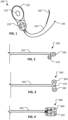
- an implantable receiver/stimulator device 100 can be used in conjunction with the various types of electrode devices provided herein.
- Receiver/stimulator device 100 can be functionally akin to an implantable receiver/stimulator device used for cochlear implant electrical stimulation. Accordingly, receiver/stimulator device 100 is implanted under the post-auricular scalp and the lead wire(s) can travel through the mastoid and facial recess to the target electrode location(s).
- the target electrode location may be the bony cochlea, otic capsule, and/or promontory (e.g., endosteally and/or intraosseously).
- the target electrode location may be the bony labyrinth (e.g., surface, intraosseous, or intra-labyrinthine) including the semicircular canals and vestibule.
- bony labyrinth e.g., surface, intraosseous, or intra-labyrinthine
- surface, intraosseous, and intra-labyrinthine electrodes can be placed in the region of the semicircular canals and vestibule to stimulate labyrinthine function. Electrical stimulation of this organ may be used to rehabilitate vestibular hypofunction or treat ongoing or recurrent vestibular diseases, such as Meniere's disease.
- An external device can be used to wirelessly communicate (through the patient's scalp) with the implanted receiver/stimulator device 100.
- Such an external device can function to activate, program, power, control, and/or otherwise interact with receiver/stimulator device 100.
- receiver/stimulator device 100 can be programmed according to pulse width, current amplitude, stimulus rate, stimulation mode, and the like.
- the receiver/stimulator device 100 includes a magnet 110, a receiver coil 120, a stimulator 130, a ground lead 140, a lead wire 150, and one or more electrodes 160.
- Magnet 110 can be used to magnetically couple and align receiver/stimulator device 100 with an external device.
- Receiver coil 120 is used to wirelessly communicate with an external device.
- Stimulator 130 controls the operations of receiver/stimulator device 100 and is the source of electrical stimuli.
- Lead wire 150 conducts the electrical stimuli to electrode 160.
- test electrodes can be placed on the patient's cochlea region via a transcanal tympanotomy using local anesthetic with the patient awake.
- An instrument set can be used to apply varying patterns of electrical stimulation, and the patient can convey which pattern resulted in greatest tinnitus reduction. Individual instruments will vary based on the number of electrodes and the distance between electrodes. Additionally, "pitch-masking" (also referred to as frequency matching) and CT imaging may assist in determining optimal electrode 160 positioning.
- cochlear surface electrode device 200 is implanted such that electrode 260 is in contact with the patient's cochlear bone (e.g., promontory).
- Anchor element 270 can be used to couple electrode device 200 to the patient's tissue at the target site, and to provide migration resistance.
- an adhesive e.g., bone cement and the like
- tissue e.g., bone, cartilage, or soft tissue.
- a mechanical anchor such as a screw or barbed member can be used to couple anchor element 270 to tissue.
- anchor element 270 defines a fenestration that can receive adhesive and/or a mechanical anchor.
- Electrode device 300 can be used to deliver electrical pulses in a patient's cochlear region to treat tinnitus.
- Electrode device 300 includes a lead 350, an electrode pair 360, and an anchor element 370.
- surface electrode device 300 is an example of a bipolar electrode device that can be used to treat tinnitus. That is, electrode pair 360 includes two electrodes. In some cases, one of the two electrodes functions as a cathode and the other functions as an anode. Hence, in some cases electrode pair 360, when placed in contact with tissue, can deliver electrical stimuli to the tissue without the need for a separate ground lead (e.g., ground lead 140 as described above in reference to FIG. 1 ). In some cases, both electrodes of electrode pair 360 are used as a cathode and a separate ground lead is used.
- Electrode device 400 can be used to deliver electrical pulses in a patient's cochlear region to treat tinnitus.
- Electrode device 400 includes a lead 450, an electrode array 460, and an anchor element 470.
- Electrode array 460 can include any number of electrodes arranged in any configuration.
- Electrode array 460 can comprise a compliant material that can conform to the topography of the patient's tissue (including bone tissue such as the promontory).
- a heat source e.g., warm water
- Surface electrode device 400 is an example of a grid electrode device that can be used to treat tinnitus. That is, grid electrode array 460 includes two or more electrode pairs. In some cases, one electrode of each of the electrode pair(s) functions as a cathode and the other functions as an anode.
- individual electrode pairs of the two or more electrode pairs of electrode array 460 can be activated individually. That is, while some electrode pairs are utilized to deliver electrical stimuli, other electrode pairs can be selectively deactivated. In that manner, particular areas or zones of the patient's target tissue (e.g., cochlear region) can receive pulse stimuli, while other areas or zones do not.
- This functionality can be used to customize the treatment to best suit a particular patient. For example, various electrode pairs (or combinations of electrode pairs) can be experimentally activated to determine which electrode pairs provide the patient with the most relief from tinnitus symptoms.
- one or more electrodes can be placed endosteally and/or intraosseously to treat tinnitus.
- one or more electrodes of the present disclosure can be placed intraosseously in the bone tissue of the otic capsule (e.g., without penetrating through the endostium of the cochlea or cochlear lumen).
- Endosteal and/or intraosseous electrodes can place the electrical stimulation in close proximity to the modiolus (the conical central axis of the cochlea) without risking sensorineural hearing loss.
- the devices depicted in FIGS. 5-7 can be used for such an implementation.
- FIG. 5 depicts a drill device 500 that can be used with a rotary driver instrument.
- Drill device 500 includes a shank 510, a depth limiter 520, and a working portion 530.
- Working portion 530 includes cutting edges that can remove tissue such as bone tissue to create a hole (e.g., such as a blind hole or through hole) in the target tissue layer (e.g., anywhere on the promontory including near or at the oval window, near or at the round window, etc.).
- the maximum depth of the hole can be controlled by depth limiter 520 (e.g., a flange portion).
- Depth limiter 520 can advantageously prevent the hole created from being a through-hole (i.e., from penetrating completely through the opposite side of the tissue layer, or into the cochlear lumen).
- drill devices 500 can be available so as to suit an individual patient's anatomy.
- a set of drill devices 500 with depth limiter 520 at differing positions can be provided so that a particular drill device 500 can be used for a particular patient to make a hole of the proper depth for the particular patient's anatomy.
- the most suitable drill device 500 and/or electrode device for a particular patient can be determined in advance of the implant procedure.
- a patient can undergo a pre-operative imaging procedure, such as a computerized tomography (CT) scan, to determine the patient's anatomical features such as, but not limited to, promontory thickness.
- CT computerized tomography
- minimal promontory thickness is about 0.4-0.5 mm and maximal promontory thickness is about 2.0-2.2 mm.
- a desirable hole depth can be about 0.3 mm to about 0.7 mm, or about 0.5 mm to about 0.9 mm, or about 0.7 mm to about 1.1 mm, or about 0.9 mm to about 1.3 mm, or about 1.1 mm to about 1.5 mm, or about 1.3 mm to about 1.7 mm, or about 1.5 mm to about 1.9 mm, or about 1.7 mm to about 2.1 mm, and/or anywhere within such ranges.
- a set of multiple drill devices 500 will be made available in 0.2 mm depth increments, or 0.1 mm depth increments.
- Electrode device 600 when a hole (e.g., a blind hole that does not completely break through the bone) has been created using drill device 500, electrode device 600 can be attached to the target tissue using the hole. Electrode device 600 includes a lead 650, an electrode screw 660, and an anchor element 670. To install electrode device 600, electrode screw 660 is passed through a fenestration in anchor element 670 and into the hole created using drill device 500.
- a hole e.g., a blind hole that does not completely break through the bone
- Electrode screw 660 can serve multiple purposes. First, electrode screw 660 can anchor electrode device 600 endosteally and/or intraosseously to the target tissue (e.g., bony cochlea or labyrinth). Secondly, electrode screw 660 can include an electrode core that can deliver electrical pulse stimuli to the tissue with which it makes contact. A set of electrode screws 660 having differing lengths can be available so that a particular electrode screw 660 having a suitable length can be selected for a particular patient. Hence, in some cases, electrode device 600 can deliver electrical stimuli endosteally and/or intraosseously (e.g., to the promontory) to treat tinnitus. In some cases, an adhesive such as bone cement can be used in conjunction with electrode screw 660.
- the target tissue e.g., bony cochlea or labyrinth
- electrode screw 660 can include an electrode core that can deliver electrical pulse stimuli to the tissue with which it makes contact.
- a set of electrode screws 660 having differing lengths can be available
- Electrode device 700 can be attached to the target tissue within the hole.
- Electrode device 700 includes a lead 750 and an electrode lug 760.
- electrode lug 760 is placed into the hole created using drill device 500.
- an adhesive e.g., bone cement
- Electrode lug 760 can include an electrode core that can deliver electrical pulse stimuli to the tissue with which it makes contact.
- a set of electrode devices 700 having differing lengths of electrode lugs 760 can be available so that a particular electrode device 700 having a suitable length of electrode lug 760 can be selected for a particular patient.
- electrode device 700 can deliver electrical stimuli endosteally and/or intraosseously to a cochlear bone (e.g., to the promontory) to treat tinnitus.
- Electrode device 800 can be used to deliver electrical pulses in a patient's cochlear region to treat tinnitus.
- Electrode device 800 includes a lead 850, one or more electrodes 860, and an anchor element 870.
- Electrode device 800 is configured for delivering electrical stimuli shallowly within the patient's cochlea lumen. That is, in some cases a distal end portion 880 of electrode device 800 can be inserted within the patient's cochlea (e.g., through the round window or oval window). In such a case, anchor element 870 can act as a soft, flexible barb member to retain distal end portion 880 shallowly within the patient's cochlea. In that arrangement, electrode(s) 860 can thereafter deliver electrical pulses to the patient's cochlea to treat tinnitus.
- devices having one or more electrodes can deliver electrical stimulation to the vestibulocochlear nerve to treat tinnitus.
- the devices depicted in FIGS. 9 and 10 can be used for such an implementation.
- Flexible band 970 can comprise a compliant material that can be wrapped around the patient's vestibulocochlear nerve.
- a heat source e.g., warm water
- flexible band 970 is malleable so that it retains its shape after being wrapped around the patient's vestibulocochlear nerve. Thereafter, electrical pulse stimuli can be delivered to the patient's vestibulocochlear nerve via electrode array 960.
- Electrode device 1000 can be used to deliver electrical pulses in a patient's vestibulocochlear nerve region to treat tinnitus.
- Electrode device 1000 includes a lead 1050 and an electrode hook 1060.
- Electrode hook 1060 can include one or more than one electrodes arranged in any configuration.
- Electrode hook 1060 can be monopolar or bipolar.
- electrode hook 1060 can comprise a shape-memory material that tends to seek a curved or spiral shape such that electrode hook 1060 will be wrapped around the patient's vestibulocochlear nerve.
- a heat source e.g., electrical current, a laser, and the like
- electrode hook 1060 will tent to retain its shape after being wrapped around the patient's vestibulocochlear nerve. Electrical pulse stimuli can then be delivered to the patient's vestibulocochlear nerve via electrode hook 1060.
- devices having one or more electrodes can deliver electrical stimulation within the vestibulocochlear nerve to treat tinnitus.
- the devices depicted in FIGS. 11-13 can be used for such an implementation. That is, distal end portions of the electrode devices can penetrate and remain within the patient's vestibulocochlear nerve to treat tinnitus.
- Electrode device 1100 includes a distal end portion 1180. Distal end portion 1180 can be inserted within the patient's vestibulocochlear nerve while electrode device 1100 is configured as shown in FIG. 11 . Thereafter, anchor element 1170 can be pivoted to the configuration shown in FIG. 12 . In that configuration, anchor element 1170 acts as an anchor to provide migration resistance. Electrical pulse stimuli can then be delivered to within the patient's vestibulocochlear nerve via electrode needle 1160.
- Electrode device 1300 can be used to deliver electrical pulses in a patient's vestibulocochlear nerve region to treat tinnitus.
- Electrode device 1300 includes a lead 1350 and an electrode needle 1360.
- Electrode needle 1360 can include one or more than one electrodes arranged in any configuration.
- Electrode needle 1360 can be monopolar or bipolar.
- Electrode device 1300 includes a distal end portion 1380.
- distal end portion 1380 is malleable.
- Distal end portion 1380 can be inserted within and/or through the patient's vestibulocochlear nerve. Thereafter, a portion of distal end portion 1380 can be bent to wrap distal end portion 1380 around the patient's vestibulocochlear nerve. In that configuration, distal end portion 1380 acts as an anchor to provide migration resistance. Electrical pulse stimuli can then be delivered to within and/or on the patient's vestibulocochlear nerve via electrode needle 1360.
Landscapes
- Health & Medical Sciences (AREA)
- Engineering & Computer Science (AREA)
- General Health & Medical Sciences (AREA)
- Biomedical Technology (AREA)
- Veterinary Medicine (AREA)
- Public Health (AREA)
- Nuclear Medicine, Radiotherapy & Molecular Imaging (AREA)
- Radiology & Medical Imaging (AREA)
- Life Sciences & Earth Sciences (AREA)
- Animal Behavior & Ethology (AREA)
- Otolaryngology (AREA)
- Neurosurgery (AREA)
- Cardiology (AREA)
- Heart & Thoracic Surgery (AREA)
- Neurology (AREA)
- Physics & Mathematics (AREA)
- Acoustics & Sound (AREA)
- Signal Processing (AREA)
- Prostheses (AREA)
- Electrotherapy Devices (AREA)
Claims (5)
- Dispositif électrode (600, 700) pour administrer des stimuli d'impulsions électriques à une région cochléaire d'un patient, le dispositif électrode comprenant :un fil (650, 750) comprenant un conducteur électrique isolé allongé unique ;une électrode unique disposée au niveau d'une extrémité distale du fil (650, 750) et en communication électrique avec le conducteur électrique isolé, dans lequel l'électrode est configurée pour être placée de manière intra-osseuse à l'intérieur d'un trou créé dans un tissu cible pour administrer des stimuli d'impulsions électriques à la région cochléaire du patient ; etun élément d'ancrage (670) disposé adjacent à l'électrode,caractérisé en ce que l'électrode est une vis d'électrode (660) incluant un coeur d'électrode, l'élément d'ancrage (670) incluant une fenestration,dans lequel la vis d'électrode (660) est configurée pour passer à travers la fenestration dans l'élément d'ancrage dans le trou créé dans le tissu cible et pour ancrer le dispositif électrode (600) de manière intra-osseuse au niveau du tissu cible, etdans lequel le coeur d'électrode est configuré pour administrer des stimuli d'impulsions électriques de manière intra-osseuse au tissu cible avec lequel il entre en contact.
- Dispositif électrode (600, 700) selon la revendication 1, comprenant en outre un dispositif stimulateur implantable (100) en communication électrique avec le fil et configuré pour générer les stimuli d'impulsions électriques.
- Dispositif électrode (600, 700) selon la revendication 2, dans lequel le dispositif stimulateur implantable (100) inclut un aimant (110) pour l'alignement avec un dispositif externe.
- Dispositif électrode (600, 700) selon la revendication 2, dans lequel le dispositif stimulateur implantable (110) comprend une bobine réceptrice (120) configurée pour communiquer sans fil à travers le cuir chevelu du patient avec un dispositif externe.
- Dispositif électrode (600) selon la revendication 1, dans lequel la vis d'électrode (660) présente une longueur qui est sélectionnée pour convenir au patient.
Priority Applications (1)
| Application Number | Priority Date | Filing Date | Title |
|---|---|---|---|
| EP24221681.0A EP4503652A3 (fr) | 2016-06-06 | 2017-06-02 | Dispositifs de traitement d'acouphènes à l'aide d'une stimulation électrique |
Applications Claiming Priority (2)
| Application Number | Priority Date | Filing Date | Title |
|---|---|---|---|
| US201662346306P | 2016-06-06 | 2016-06-06 | |
| PCT/US2017/035617 WO2017213978A1 (fr) | 2016-06-06 | 2017-06-02 | Dispositifs et procédés de traitement des acouphènes à l'aide d'une stimulation électrique |
Related Child Applications (1)
| Application Number | Title | Priority Date | Filing Date |
|---|---|---|---|
| EP24221681.0A Division EP4503652A3 (fr) | 2016-06-06 | 2017-06-02 | Dispositifs de traitement d'acouphènes à l'aide d'une stimulation électrique |
Publications (3)
| Publication Number | Publication Date |
|---|---|
| EP3463230A1 EP3463230A1 (fr) | 2019-04-10 |
| EP3463230A4 EP3463230A4 (fr) | 2019-12-18 |
| EP3463230B1 true EP3463230B1 (fr) | 2025-01-01 |
Family
ID=60578082
Family Applications (2)
| Application Number | Title | Priority Date | Filing Date |
|---|---|---|---|
| EP17810752.0A Active EP3463230B1 (fr) | 2016-06-06 | 2017-06-02 | Dispositifs de traitement des acouphènes à l'aide d'une stimulation électrique |
| EP24221681.0A Pending EP4503652A3 (fr) | 2016-06-06 | 2017-06-02 | Dispositifs de traitement d'acouphènes à l'aide d'une stimulation électrique |
Family Applications After (1)
| Application Number | Title | Priority Date | Filing Date |
|---|---|---|---|
| EP24221681.0A Pending EP4503652A3 (fr) | 2016-06-06 | 2017-06-02 | Dispositifs de traitement d'acouphènes à l'aide d'une stimulation électrique |
Country Status (3)
| Country | Link |
|---|---|
| US (3) | US11253704B2 (fr) |
| EP (2) | EP3463230B1 (fr) |
| WO (1) | WO2017213978A1 (fr) |
Families Citing this family (11)
| Publication number | Priority date | Publication date | Assignee | Title |
|---|---|---|---|---|
| EP3463230B1 (fr) | 2016-06-06 | 2025-01-01 | Mayo Foundation for Medical Education and Research | Dispositifs de traitement des acouphènes à l'aide d'une stimulation électrique |
| WO2019120568A1 (fr) * | 2017-12-22 | 2019-06-27 | Marc Possover | Système de neuromodulation |
| US20190247658A1 (en) * | 2018-02-12 | 2019-08-15 | Taiting CHEN | Inner ear apparatus |
| US20220226653A1 (en) * | 2019-06-03 | 2022-07-21 | Mayo Foundation For Medical Education And Research | Devices and methods for treating tinnitus using electrical stimulation |
| US20210023366A1 (en) | 2019-07-24 | 2021-01-28 | Cochlear Limited | Vestibular stimulation prosthesis |
| US12335692B2 (en) | 2020-02-21 | 2025-06-17 | Cochlear Limited | Implantable tinnitus therapy |
| WO2021186261A1 (fr) * | 2020-03-20 | 2021-09-23 | Cochlear Limited | Amélioration des perceptions auditives au moyen d'une simulation vestibulaire |
| US20230398365A1 (en) * | 2020-11-16 | 2023-12-14 | Cochlear Limited | System and method for electrode implantation |
| US20240075280A1 (en) | 2020-12-17 | 2024-03-07 | Cochlear Limited | Electrode placement and securement |
| US20250295922A1 (en) * | 2022-05-10 | 2025-09-25 | Mayo Foundation For Medical Education And Research | Devices and methods for treating tinnitus using electrical stimulation |
| CN118649351A (zh) * | 2024-08-21 | 2024-09-17 | 北京智冉医疗科技有限公司 | 一种植入式神经刺激系统 |
Family Cites Families (43)
| Publication number | Priority date | Publication date | Assignee | Title |
|---|---|---|---|---|
| DE2311817C2 (de) * | 1973-03-09 | 1984-06-07 | Werner Dipl.-Ing. 8000 München Kraus | Reizstromgerät zur Förderung der Heilung von Knochenschäden |
| DE2319054C3 (de) * | 1973-04-14 | 1980-03-06 | Hans Dr.Med. Stockholm Lagergren | Elektrodenanordnung |
| US4419995A (en) * | 1981-09-18 | 1983-12-13 | Hochmair Ingeborg | Single channel auditory stimulation system |
| US4462401A (en) * | 1982-11-15 | 1984-07-31 | Minnesota Mining And Manufacturing Company | Method and anchor for anchoring electrode leads used in cochlear implantation |
| US4809712A (en) | 1986-09-26 | 1989-03-07 | Cochlear Pty. Ltd. | Electrode assembly for cochlear implant |
| CA2230595C (fr) * | 1995-09-20 | 2002-08-20 | Cochlear Limited | Utilisation de polymeres bio-resorbables dans des implants cochleaires et autres |
| US6514258B1 (en) * | 1998-11-04 | 2003-02-04 | Implant Innovations, Inc. | Penetration limiting stop elements for a drill bit used for bone tissue |
| US6374143B1 (en) * | 1999-08-18 | 2002-04-16 | Epic Biosonics, Inc. | Modiolar hugging electrode array |
| US6671559B2 (en) * | 2001-01-23 | 2003-12-30 | Microphonics, Inc. | Transcanal, transtympanic cochlear implant system for the rehabilitation of deafness and tinnitus |
| DE60211896T2 (de) * | 2001-05-21 | 2007-05-10 | Medtronic, Inc., Minneapolis | Verformbare langgestreckte medizinische vorrichtung |
| AUPS322702A0 (en) | 2002-06-28 | 2002-07-18 | Cochlear Limited | Cochlear implant electrode array |
| WO2004024212A2 (fr) | 2002-09-10 | 2004-03-25 | Vibrant Med-El Hearing Technology Gmbh | Dispositifs medicaux implantables a plusieurs transducteurs |
| US20070021804A1 (en) * | 2003-05-30 | 2007-01-25 | Maltan Albert A | Stimulation using a microstimulator to treat tinnitus |
| US8926613B2 (en) * | 2011-03-25 | 2015-01-06 | Biomet Sports Medicine, Llc | Method and apparatus for forming a bone hole |
| EP1993494A2 (fr) * | 2006-02-07 | 2008-11-26 | MED-EL Medical Electronics Elektro-medizinische Geräte GmbH | Implant cochléaire de suppression d'acouphène |
| US8135476B2 (en) * | 2006-04-27 | 2012-03-13 | Medtronic, Inc. | Implantable medical electrical stimulation lead fixation method and apparatus |
| CA2672729A1 (fr) * | 2006-12-26 | 2008-07-03 | 3Win N. V. | Dispositif et procede pour ameliorer l'audition |
| WO2009062266A1 (fr) | 2007-11-16 | 2009-05-22 | Cochlear Limited | Dérivation pour un implant cochléaire |
| US9320891B2 (en) * | 2008-04-02 | 2016-04-26 | Boston Scientific Neuromodulation Corporation | Lead anchor for implantable devices and methods of manufacture and use |
| WO2010028152A2 (fr) | 2008-09-05 | 2010-03-11 | Silere Medical Technology, Inc. | Systèmes, dispositifs et procédés pour le traitement d'un acouphène |
| US8594799B2 (en) | 2008-10-31 | 2013-11-26 | Advanced Bionics | Cochlear electrode insertion |
| JP5416215B2 (ja) * | 2008-11-10 | 2014-02-12 | アキュームド・エルエルシー | 下橈尺関節の部分的又は完全な人工関節置換術 |
| FR2939304B1 (fr) * | 2008-12-05 | 2012-03-30 | Pierre Sabin | Ensemble de boitier-interface destine a etre implante dans une paroi osseuse |
| US8494641B2 (en) * | 2009-04-22 | 2013-07-23 | Autonomic Technologies, Inc. | Implantable neurostimulator with integral hermetic electronic enclosure, circuit substrate, monolithic feed-through, lead assembly and anchoring mechanism |
| US9044588B2 (en) | 2009-04-16 | 2015-06-02 | Cochlear Limited | Reference electrode apparatus and method for neurostimulation implants |
| US8880193B1 (en) | 2009-05-22 | 2014-11-04 | Advanced Bionics, Llc | Cochlear electrode array |
| WO2010135783A1 (fr) * | 2009-05-29 | 2010-12-02 | Cochlear Limited | Dispositif de stimulation vestibulaire |
| US9242094B2 (en) * | 2010-01-12 | 2016-01-26 | The Johns Hopkins University | Implantable vestibular prosthesis |
| US9974944B2 (en) * | 2010-07-29 | 2018-05-22 | Cameron Health, Inc. | Subcutaneous leads and methods of implant and explant |
| WO2012040355A2 (fr) * | 2010-09-21 | 2012-03-29 | The Johns Hopkins University | Procédé et appareil destinés à la chirurgie de l'implant cochléaire |
| AU2011343784B2 (en) | 2010-12-16 | 2014-11-13 | Med-El Elektromedizinische Geraete Gmbh | Evoked Stapedius Reflex Threshold (ESRT) tile electrode |
| US20190070413A1 (en) * | 2011-06-17 | 2019-03-07 | University Of Washington | Vestibular prostheses and associated systems and methods |
| US8790409B2 (en) | 2012-12-07 | 2014-07-29 | Cochlear Limited | Securable implantable component |
| EP3295907B1 (fr) * | 2013-01-25 | 2022-11-23 | Med-El Elektromedizinische Geraete GmbH | Protection contre les chocs pour fil électrique implantable |
| US9289222B2 (en) * | 2013-02-01 | 2016-03-22 | Biomet Sports Medicine, Llc | Apparatus and method for repairing bone defects |
| US20150066126A1 (en) * | 2013-08-29 | 2015-03-05 | Med-El Elektromedizinische Geraete Gmbh | Fenestration Electrode to Treat Patients with Meniere's Disease |
| EP3077040B1 (fr) | 2013-12-05 | 2018-11-07 | MED-EL Elektromedizinische Geraete GmbH | Fil d'électrode à mécanisme de fixation intégré |
| EP3091912B1 (fr) * | 2014-01-08 | 2023-10-25 | Smith&Nephew, Inc. | Système de guidage de foret |
| US10231778B2 (en) * | 2014-10-20 | 2019-03-19 | Biosense Webster (Israel) Ltd. | Methods for contemporaneous assessment of renal denervation |
| US9802037B2 (en) * | 2015-03-05 | 2017-10-31 | Bradley D. Vilims | Tension loop for a spinal cord stimulator |
| US20170050027A1 (en) | 2015-08-18 | 2017-02-23 | Marcus ANDERSSON | Implantable Magnet Arrangements |
| EP3463230B1 (fr) | 2016-06-06 | 2025-01-01 | Mayo Foundation for Medical Education and Research | Dispositifs de traitement des acouphènes à l'aide d'une stimulation électrique |
| US20220226653A1 (en) | 2019-06-03 | 2022-07-21 | Mayo Foundation For Medical Education And Research | Devices and methods for treating tinnitus using electrical stimulation |
-
2017
- 2017-06-02 EP EP17810752.0A patent/EP3463230B1/fr active Active
- 2017-06-02 EP EP24221681.0A patent/EP4503652A3/fr active Pending
- 2017-06-02 US US16/307,700 patent/US11253704B2/en active Active
- 2017-06-02 WO PCT/US2017/035617 patent/WO2017213978A1/fr not_active Ceased
-
2020
- 2020-07-10 US US16/925,837 patent/US20200338343A1/en active Pending
-
2023
- 2023-12-22 US US18/394,755 patent/US20240157145A1/en active Pending
Also Published As
| Publication number | Publication date |
|---|---|
| US20190167985A1 (en) | 2019-06-06 |
| US11253704B2 (en) | 2022-02-22 |
| EP3463230A1 (fr) | 2019-04-10 |
| US20240157145A1 (en) | 2024-05-16 |
| US20200338343A1 (en) | 2020-10-29 |
| EP4503652A3 (fr) | 2025-04-02 |
| WO2017213978A1 (fr) | 2017-12-14 |
| EP3463230A4 (fr) | 2019-12-18 |
| EP4503652A2 (fr) | 2025-02-05 |
Similar Documents
| Publication | Publication Date | Title |
|---|---|---|
| US20240157145A1 (en) | Devices and methods for treating tinnitus using electrical stimulation | |
| US12171999B2 (en) | Vestibular stimulation device | |
| Brackmann et al. | Auditory brainstem implant: I. Issues in surgical implantation | |
| Schwartz et al. | Auditory brainstem implants | |
| US6628991B2 (en) | Minimally-invasive access into the cochlea for electrode insertion and fluid delivery | |
| US12465755B2 (en) | Neural stimulator with flying lead electrode | |
| EP3976165B1 (fr) | Dispositifs de traitement des acouphènes à l'aide d'une stimulation électrique | |
| US20110218593A1 (en) | Systems, devices and methods for the treatment of tinnitus | |
| US20160158533A1 (en) | Tissue Penetrating Electrode | |
| KR101908453B1 (ko) | 전기자극법을 이용한 이명치료장치 | |
| Schwartz et al. | Use of a multichannel auditory brainstem implant for neurofibromatosis type 2 | |
| US9888978B2 (en) | Template for bilateral symmetric stimulator fixation/implantation | |
| US20100331913A1 (en) | Hybrid multi-function electrode array | |
| US20250295922A1 (en) | Devices and methods for treating tinnitus using electrical stimulation | |
| Kuchta | Twenty-five years of auditory brainstem implants: perspectives | |
| Portillo et al. | Auditory Brain Stem Implant: Electrical | |
| US20060041284A1 (en) | Electrical stimulation system and method for stimulating nerve tissue in the brain using a stimulation lead having a tip electrode, having at least five electrodes, or both | |
| US20230398365A1 (en) | System and method for electrode implantation | |
| Zeng et al. | Cochlear implants | |
| US20240181256A1 (en) | Vagal nerve stimulation | |
| Tatagiba et al. | Electrically evoked hearing perception by functional neurostimulation of the central auditory system |
Legal Events
| Date | Code | Title | Description |
|---|---|---|---|
| STAA | Information on the status of an ep patent application or granted ep patent |
Free format text: STATUS: THE INTERNATIONAL PUBLICATION HAS BEEN MADE |
|
| PUAI | Public reference made under article 153(3) epc to a published international application that has entered the european phase |
Free format text: ORIGINAL CODE: 0009012 |
|
| STAA | Information on the status of an ep patent application or granted ep patent |
Free format text: STATUS: REQUEST FOR EXAMINATION WAS MADE |
|
| 17P | Request for examination filed |
Effective date: 20190107 |
|
| AK | Designated contracting states |
Kind code of ref document: A1 Designated state(s): AL AT BE BG CH CY CZ DE DK EE ES FI FR GB GR HR HU IE IS IT LI LT LU LV MC MK MT NL NO PL PT RO RS SE SI SK SM TR |
|
| AX | Request for extension of the european patent |
Extension state: BA ME |
|
| DAV | Request for validation of the european patent (deleted) | ||
| DAX | Request for extension of the european patent (deleted) | ||
| A4 | Supplementary search report drawn up and despatched |
Effective date: 20191115 |
|
| RIC1 | Information provided on ipc code assigned before grant |
Ipc: H04R 25/00 20060101ALI20191111BHEP Ipc: A61N 1/18 20060101ALI20191111BHEP Ipc: A61N 1/36 20060101ALI20191111BHEP Ipc: A61F 11/04 20060101ALI20191111BHEP Ipc: A61N 1/05 20060101ALI20191111BHEP Ipc: A61F 11/00 20060101AFI20191111BHEP Ipc: A61N 1/00 20060101ALI20191111BHEP |
|
| STAA | Information on the status of an ep patent application or granted ep patent |
Free format text: STATUS: EXAMINATION IS IN PROGRESS |
|
| 17Q | First examination report despatched |
Effective date: 20220714 |
|
| GRAP | Despatch of communication of intention to grant a patent |
Free format text: ORIGINAL CODE: EPIDOSNIGR1 |
|
| STAA | Information on the status of an ep patent application or granted ep patent |
Free format text: STATUS: GRANT OF PATENT IS INTENDED |
|
| INTG | Intention to grant announced |
Effective date: 20240729 |
|
| GRAS | Grant fee paid |
Free format text: ORIGINAL CODE: EPIDOSNIGR3 |
|
| GRAA | (expected) grant |
Free format text: ORIGINAL CODE: 0009210 |
|
| STAA | Information on the status of an ep patent application or granted ep patent |
Free format text: STATUS: THE PATENT HAS BEEN GRANTED |
|
| AK | Designated contracting states |
Kind code of ref document: B1 Designated state(s): AL AT BE BG CH CY CZ DE DK EE ES FI FR GB GR HR HU IE IS IT LI LT LU LV MC MK MT NL NO PL PT RO RS SE SI SK SM TR |
|
| P01 | Opt-out of the competence of the unified patent court (upc) registered |
Free format text: CASE NUMBER: APP_62392/2024 Effective date: 20241122 |
|
| REG | Reference to a national code |
Ref country code: GB Ref legal event code: FG4D |
|
| REG | Reference to a national code |
Ref country code: CH Ref legal event code: EP |
|
| REG | Reference to a national code |
Ref country code: DE Ref legal event code: R096 Ref document number: 602017087116 Country of ref document: DE |
|
| REG | Reference to a national code |
Ref country code: IE Ref legal event code: FG4D |
|
| REG | Reference to a national code |
Ref country code: LT Ref legal event code: MG9D |
|
| REG | Reference to a national code |
Ref country code: NL Ref legal event code: MP Effective date: 20250101 |
|
| REG | Reference to a national code |
Ref country code: AT Ref legal event code: MK05 Ref document number: 1755514 Country of ref document: AT Kind code of ref document: T Effective date: 20250101 |
|
| PG25 | Lapsed in a contracting state [announced via postgrant information from national office to epo] |
Ref country code: NL Free format text: LAPSE BECAUSE OF FAILURE TO SUBMIT A TRANSLATION OF THE DESCRIPTION OR TO PAY THE FEE WITHIN THE PRESCRIBED TIME-LIMIT Effective date: 20250101 |
|
| PG25 | Lapsed in a contracting state [announced via postgrant information from national office to epo] |
Ref country code: FI Free format text: LAPSE BECAUSE OF FAILURE TO SUBMIT A TRANSLATION OF THE DESCRIPTION OR TO PAY THE FEE WITHIN THE PRESCRIBED TIME-LIMIT Effective date: 20250101 |
|
| PG25 | Lapsed in a contracting state [announced via postgrant information from national office to epo] |
Ref country code: PL Free format text: LAPSE BECAUSE OF FAILURE TO SUBMIT A TRANSLATION OF THE DESCRIPTION OR TO PAY THE FEE WITHIN THE PRESCRIBED TIME-LIMIT Effective date: 20250101 |
|
| PGFP | Annual fee paid to national office [announced via postgrant information from national office to epo] |
Ref country code: DE Payment date: 20250626 Year of fee payment: 9 |
|
| PG25 | Lapsed in a contracting state [announced via postgrant information from national office to epo] |
Ref country code: ES Free format text: LAPSE BECAUSE OF FAILURE TO SUBMIT A TRANSLATION OF THE DESCRIPTION OR TO PAY THE FEE WITHIN THE PRESCRIBED TIME-LIMIT Effective date: 20250101 |
|
| PG25 | Lapsed in a contracting state [announced via postgrant information from national office to epo] |
Ref country code: NO Free format text: LAPSE BECAUSE OF FAILURE TO SUBMIT A TRANSLATION OF THE DESCRIPTION OR TO PAY THE FEE WITHIN THE PRESCRIBED TIME-LIMIT Effective date: 20250401 Ref country code: IS Free format text: LAPSE BECAUSE OF FAILURE TO SUBMIT A TRANSLATION OF THE DESCRIPTION OR TO PAY THE FEE WITHIN THE PRESCRIBED TIME-LIMIT Effective date: 20250501 |
|
| PG25 | Lapsed in a contracting state [announced via postgrant information from national office to epo] |
Ref country code: HR Free format text: LAPSE BECAUSE OF FAILURE TO SUBMIT A TRANSLATION OF THE DESCRIPTION OR TO PAY THE FEE WITHIN THE PRESCRIBED TIME-LIMIT Effective date: 20250101 |
|
| PG25 | Lapsed in a contracting state [announced via postgrant information from national office to epo] |
Ref country code: LV Free format text: LAPSE BECAUSE OF FAILURE TO SUBMIT A TRANSLATION OF THE DESCRIPTION OR TO PAY THE FEE WITHIN THE PRESCRIBED TIME-LIMIT Effective date: 20250101 Ref country code: PT Free format text: LAPSE BECAUSE OF FAILURE TO SUBMIT A TRANSLATION OF THE DESCRIPTION OR TO PAY THE FEE WITHIN THE PRESCRIBED TIME-LIMIT Effective date: 20250502 |
|
| PG25 | Lapsed in a contracting state [announced via postgrant information from national office to epo] |
Ref country code: BG Free format text: LAPSE BECAUSE OF FAILURE TO SUBMIT A TRANSLATION OF THE DESCRIPTION OR TO PAY THE FEE WITHIN THE PRESCRIBED TIME-LIMIT Effective date: 20250101 Ref country code: GR Free format text: LAPSE BECAUSE OF FAILURE TO SUBMIT A TRANSLATION OF THE DESCRIPTION OR TO PAY THE FEE WITHIN THE PRESCRIBED TIME-LIMIT Effective date: 20250402 |
|
| PG25 | Lapsed in a contracting state [announced via postgrant information from national office to epo] |
Ref country code: AT Free format text: LAPSE BECAUSE OF FAILURE TO SUBMIT A TRANSLATION OF THE DESCRIPTION OR TO PAY THE FEE WITHIN THE PRESCRIBED TIME-LIMIT Effective date: 20250101 |
|
| PG25 | Lapsed in a contracting state [announced via postgrant information from national office to epo] |
Ref country code: CZ Free format text: LAPSE BECAUSE OF FAILURE TO SUBMIT A TRANSLATION OF THE DESCRIPTION OR TO PAY THE FEE WITHIN THE PRESCRIBED TIME-LIMIT Effective date: 20250101 |
|
| PG25 | Lapsed in a contracting state [announced via postgrant information from national office to epo] |
Ref country code: SE Free format text: LAPSE BECAUSE OF FAILURE TO SUBMIT A TRANSLATION OF THE DESCRIPTION OR TO PAY THE FEE WITHIN THE PRESCRIBED TIME-LIMIT Effective date: 20250101 |
|
| REG | Reference to a national code |
Ref country code: DE Ref legal event code: R097 Ref document number: 602017087116 Country of ref document: DE |
|
| PG25 | Lapsed in a contracting state [announced via postgrant information from national office to epo] |
Ref country code: SM Free format text: LAPSE BECAUSE OF FAILURE TO SUBMIT A TRANSLATION OF THE DESCRIPTION OR TO PAY THE FEE WITHIN THE PRESCRIBED TIME-LIMIT Effective date: 20250101 |
|
| PG25 | Lapsed in a contracting state [announced via postgrant information from national office to epo] |
Ref country code: DK Free format text: LAPSE BECAUSE OF FAILURE TO SUBMIT A TRANSLATION OF THE DESCRIPTION OR TO PAY THE FEE WITHIN THE PRESCRIBED TIME-LIMIT Effective date: 20250101 |
|
| PG25 | Lapsed in a contracting state [announced via postgrant information from national office to epo] |
Ref country code: IT Free format text: LAPSE BECAUSE OF FAILURE TO SUBMIT A TRANSLATION OF THE DESCRIPTION OR TO PAY THE FEE WITHIN THE PRESCRIBED TIME-LIMIT Effective date: 20250101 |
|
| PG25 | Lapsed in a contracting state [announced via postgrant information from national office to epo] |
Ref country code: EE Free format text: LAPSE BECAUSE OF FAILURE TO SUBMIT A TRANSLATION OF THE DESCRIPTION OR TO PAY THE FEE WITHIN THE PRESCRIBED TIME-LIMIT Effective date: 20250101 |
|
| PG25 | Lapsed in a contracting state [announced via postgrant information from national office to epo] |
Ref country code: RO Free format text: LAPSE BECAUSE OF FAILURE TO SUBMIT A TRANSLATION OF THE DESCRIPTION OR TO PAY THE FEE WITHIN THE PRESCRIBED TIME-LIMIT Effective date: 20250101 |
|
| PG25 | Lapsed in a contracting state [announced via postgrant information from national office to epo] |
Ref country code: SK Free format text: LAPSE BECAUSE OF FAILURE TO SUBMIT A TRANSLATION OF THE DESCRIPTION OR TO PAY THE FEE WITHIN THE PRESCRIBED TIME-LIMIT Effective date: 20250101 |
|
| PLBE | No opposition filed within time limit |
Free format text: ORIGINAL CODE: 0009261 |
|
| STAA | Information on the status of an ep patent application or granted ep patent |
Free format text: STATUS: NO OPPOSITION FILED WITHIN TIME LIMIT |
|
| REG | Reference to a national code |
Ref country code: CH Ref legal event code: L10 Free format text: ST27 STATUS EVENT CODE: U-0-0-L10-L00 (AS PROVIDED BY THE NATIONAL OFFICE) Effective date: 20251112 |
|
| 26N | No opposition filed |
Effective date: 20251002 |
|
| REG | Reference to a national code |
Ref country code: CH Ref legal event code: H13 Free format text: ST27 STATUS EVENT CODE: U-0-0-H10-H13 (AS PROVIDED BY THE NATIONAL OFFICE) Effective date: 20260127 |
|
| PG25 | Lapsed in a contracting state [announced via postgrant information from national office to epo] |
Ref country code: MC Free format text: LAPSE BECAUSE OF FAILURE TO SUBMIT A TRANSLATION OF THE DESCRIPTION OR TO PAY THE FEE WITHIN THE PRESCRIBED TIME-LIMIT Effective date: 20250101 |
|
| PG25 | Lapsed in a contracting state [announced via postgrant information from national office to epo] |
Ref country code: LU Free format text: LAPSE BECAUSE OF NON-PAYMENT OF DUE FEES Effective date: 20250602 |
|
| GBPC | Gb: european patent ceased through non-payment of renewal fee |
Effective date: 20250602 |
|
| REG | Reference to a national code |
Ref country code: BE Ref legal event code: MM Effective date: 20250630 |
|
| PG25 | Lapsed in a contracting state [announced via postgrant information from national office to epo] |
Ref country code: GB Free format text: LAPSE BECAUSE OF NON-PAYMENT OF DUE FEES Effective date: 20250602 |
|
| PG25 | Lapsed in a contracting state [announced via postgrant information from national office to epo] |
Ref country code: IE Free format text: LAPSE BECAUSE OF NON-PAYMENT OF DUE FEES Effective date: 20250602 |
|
| PG25 | Lapsed in a contracting state [announced via postgrant information from national office to epo] |
Ref country code: BE Free format text: LAPSE BECAUSE OF NON-PAYMENT OF DUE FEES Effective date: 20250630 |
|
| PG25 | Lapsed in a contracting state [announced via postgrant information from national office to epo] |
Ref country code: FR Free format text: LAPSE BECAUSE OF NON-PAYMENT OF DUE FEES Effective date: 20250630 |
|
| PG25 | Lapsed in a contracting state [announced via postgrant information from national office to epo] |
Ref country code: CH Free format text: LAPSE BECAUSE OF NON-PAYMENT OF DUE FEES Effective date: 20250630 |