EP3463260B1 - Verteilungssystem eines kosmetischen produkts - Google Patents
Verteilungssystem eines kosmetischen produkts Download PDFInfo
- Publication number
- EP3463260B1 EP3463260B1 EP17732768.1A EP17732768A EP3463260B1 EP 3463260 B1 EP3463260 B1 EP 3463260B1 EP 17732768 A EP17732768 A EP 17732768A EP 3463260 B1 EP3463260 B1 EP 3463260B1
- Authority
- EP
- European Patent Office
- Prior art keywords
- product
- mixture
- base product
- distributor
- cartridge
- Prior art date
- Legal status (The legal status is an assumption and is not a legal conclusion. Google has not performed a legal analysis and makes no representation as to the accuracy of the status listed.)
- Active
Links
Images




Classifications
-
- A—HUMAN NECESSITIES
- A45—HAND OR TRAVELLING ARTICLES
- A45D—HAIRDRESSING OR SHAVING EQUIPMENT; EQUIPMENT FOR COSMETICS OR COSMETIC TREATMENTS, e.g. FOR MANICURING OR PEDICURING
- A45D34/00—Containers or accessories specially adapted for handling liquid toiletry or cosmetic substances, e.g. perfumes
- A45D34/04—Appliances specially adapted for applying liquid, e.g. using roller or ball
-
- A—HUMAN NECESSITIES
- A61—MEDICAL OR VETERINARY SCIENCE; HYGIENE
- A61K—PREPARATIONS FOR MEDICAL, DENTAL OR TOILETRY PURPOSES
- A61K8/00—Cosmetics or similar toiletry preparations
- A61K8/02—Cosmetics or similar toiletry preparations characterised by special physical form
-
- A—HUMAN NECESSITIES
- A45—HAND OR TRAVELLING ARTICLES
- A45D—HAIRDRESSING OR SHAVING EQUIPMENT; EQUIPMENT FOR COSMETICS OR COSMETIC TREATMENTS, e.g. FOR MANICURING OR PEDICURING
- A45D40/00—Casings or accessories specially adapted for storing or handling solid or pasty toiletry or cosmetic substances, e.g. shaving soaps or lipsticks
- A45D40/24—Casings for two or more cosmetics
-
- A—HUMAN NECESSITIES
- A45—HAND OR TRAVELLING ARTICLES
- A45D—HAIRDRESSING OR SHAVING EQUIPMENT; EQUIPMENT FOR COSMETICS OR COSMETIC TREATMENTS, e.g. FOR MANICURING OR PEDICURING
- A45D44/00—Other cosmetic or toiletry articles, e.g. for hairdressers' rooms
- A45D44/005—Other cosmetic or toiletry articles, e.g. for hairdressers' rooms for selecting or displaying personal cosmetic colours or hairstyle
-
- A—HUMAN NECESSITIES
- A61—MEDICAL OR VETERINARY SCIENCE; HYGIENE
- A61K—PREPARATIONS FOR MEDICAL, DENTAL OR TOILETRY PURPOSES
- A61K8/00—Cosmetics or similar toiletry preparations
- A61K8/18—Cosmetics or similar toiletry preparations characterised by the composition
- A61K8/72—Cosmetics or similar toiletry preparations characterised by the composition containing organic macromolecular compounds
- A61K8/73—Polysaccharides
- A61K8/731—Cellulose; Quaternized cellulose derivatives
-
- A—HUMAN NECESSITIES
- A61—MEDICAL OR VETERINARY SCIENCE; HYGIENE
- A61K—PREPARATIONS FOR MEDICAL, DENTAL OR TOILETRY PURPOSES
- A61K8/00—Cosmetics or similar toiletry preparations
- A61K8/18—Cosmetics or similar toiletry preparations characterised by the composition
- A61K8/19—Cosmetics or similar toiletry preparations characterised by the composition containing inorganic ingredients
-
- A—HUMAN NECESSITIES
- A61—MEDICAL OR VETERINARY SCIENCE; HYGIENE
- A61K—PREPARATIONS FOR MEDICAL, DENTAL OR TOILETRY PURPOSES
- A61K8/00—Cosmetics or similar toiletry preparations
- A61K8/18—Cosmetics or similar toiletry preparations characterised by the composition
- A61K8/19—Cosmetics or similar toiletry preparations characterised by the composition containing inorganic ingredients
- A61K8/25—Silicon; Compounds thereof
-
- A—HUMAN NECESSITIES
- A61—MEDICAL OR VETERINARY SCIENCE; HYGIENE
- A61K—PREPARATIONS FOR MEDICAL, DENTAL OR TOILETRY PURPOSES
- A61K8/00—Cosmetics or similar toiletry preparations
- A61K8/18—Cosmetics or similar toiletry preparations characterised by the composition
- A61K8/19—Cosmetics or similar toiletry preparations characterised by the composition containing inorganic ingredients
- A61K8/29—Titanium; Compounds thereof
-
- A—HUMAN NECESSITIES
- A61—MEDICAL OR VETERINARY SCIENCE; HYGIENE
- A61K—PREPARATIONS FOR MEDICAL, DENTAL OR TOILETRY PURPOSES
- A61K8/00—Cosmetics or similar toiletry preparations
- A61K8/18—Cosmetics or similar toiletry preparations characterised by the composition
- A61K8/30—Cosmetics or similar toiletry preparations characterised by the composition containing organic compounds
- A61K8/31—Hydrocarbons
-
- A—HUMAN NECESSITIES
- A61—MEDICAL OR VETERINARY SCIENCE; HYGIENE
- A61K—PREPARATIONS FOR MEDICAL, DENTAL OR TOILETRY PURPOSES
- A61K8/00—Cosmetics or similar toiletry preparations
- A61K8/18—Cosmetics or similar toiletry preparations characterised by the composition
- A61K8/30—Cosmetics or similar toiletry preparations characterised by the composition containing organic compounds
- A61K8/33—Cosmetics or similar toiletry preparations characterised by the composition containing organic compounds containing oxygen
-
- A—HUMAN NECESSITIES
- A61—MEDICAL OR VETERINARY SCIENCE; HYGIENE
- A61K—PREPARATIONS FOR MEDICAL, DENTAL OR TOILETRY PURPOSES
- A61K8/00—Cosmetics or similar toiletry preparations
- A61K8/18—Cosmetics or similar toiletry preparations characterised by the composition
- A61K8/30—Cosmetics or similar toiletry preparations characterised by the composition containing organic compounds
- A61K8/33—Cosmetics or similar toiletry preparations characterised by the composition containing organic compounds containing oxygen
- A61K8/34—Alcohols
-
- A—HUMAN NECESSITIES
- A61—MEDICAL OR VETERINARY SCIENCE; HYGIENE
- A61K—PREPARATIONS FOR MEDICAL, DENTAL OR TOILETRY PURPOSES
- A61K8/00—Cosmetics or similar toiletry preparations
- A61K8/18—Cosmetics or similar toiletry preparations characterised by the composition
- A61K8/30—Cosmetics or similar toiletry preparations characterised by the composition containing organic compounds
- A61K8/33—Cosmetics or similar toiletry preparations characterised by the composition containing organic compounds containing oxygen
- A61K8/34—Alcohols
- A61K8/342—Alcohols having more than seven atoms in an unbroken chain
-
- A—HUMAN NECESSITIES
- A61—MEDICAL OR VETERINARY SCIENCE; HYGIENE
- A61K—PREPARATIONS FOR MEDICAL, DENTAL OR TOILETRY PURPOSES
- A61K8/00—Cosmetics or similar toiletry preparations
- A61K8/18—Cosmetics or similar toiletry preparations characterised by the composition
- A61K8/30—Cosmetics or similar toiletry preparations characterised by the composition containing organic compounds
- A61K8/33—Cosmetics or similar toiletry preparations characterised by the composition containing organic compounds containing oxygen
- A61K8/34—Alcohols
- A61K8/345—Alcohols containing more than one hydroxy group
-
- A—HUMAN NECESSITIES
- A61—MEDICAL OR VETERINARY SCIENCE; HYGIENE
- A61K—PREPARATIONS FOR MEDICAL, DENTAL OR TOILETRY PURPOSES
- A61K8/00—Cosmetics or similar toiletry preparations
- A61K8/18—Cosmetics or similar toiletry preparations characterised by the composition
- A61K8/30—Cosmetics or similar toiletry preparations characterised by the composition containing organic compounds
- A61K8/33—Cosmetics or similar toiletry preparations characterised by the composition containing organic compounds containing oxygen
- A61K8/34—Alcohols
- A61K8/347—Phenols
-
- A—HUMAN NECESSITIES
- A61—MEDICAL OR VETERINARY SCIENCE; HYGIENE
- A61K—PREPARATIONS FOR MEDICAL, DENTAL OR TOILETRY PURPOSES
- A61K8/00—Cosmetics or similar toiletry preparations
- A61K8/18—Cosmetics or similar toiletry preparations characterised by the composition
- A61K8/30—Cosmetics or similar toiletry preparations characterised by the composition containing organic compounds
- A61K8/33—Cosmetics or similar toiletry preparations characterised by the composition containing organic compounds containing oxygen
- A61K8/35—Ketones, e.g. benzophenone
-
- A—HUMAN NECESSITIES
- A61—MEDICAL OR VETERINARY SCIENCE; HYGIENE
- A61K—PREPARATIONS FOR MEDICAL, DENTAL OR TOILETRY PURPOSES
- A61K8/00—Cosmetics or similar toiletry preparations
- A61K8/18—Cosmetics or similar toiletry preparations characterised by the composition
- A61K8/30—Cosmetics or similar toiletry preparations characterised by the composition containing organic compounds
- A61K8/33—Cosmetics or similar toiletry preparations characterised by the composition containing organic compounds containing oxygen
- A61K8/36—Carboxylic acids; Salts or anhydrides thereof
-
- A—HUMAN NECESSITIES
- A61—MEDICAL OR VETERINARY SCIENCE; HYGIENE
- A61K—PREPARATIONS FOR MEDICAL, DENTAL OR TOILETRY PURPOSES
- A61K8/00—Cosmetics or similar toiletry preparations
- A61K8/18—Cosmetics or similar toiletry preparations characterised by the composition
- A61K8/30—Cosmetics or similar toiletry preparations characterised by the composition containing organic compounds
- A61K8/33—Cosmetics or similar toiletry preparations characterised by the composition containing organic compounds containing oxygen
- A61K8/36—Carboxylic acids; Salts or anhydrides thereof
- A61K8/361—Carboxylic acids having more than seven carbon atoms in an unbroken chain; Salts or anhydrides thereof
-
- A—HUMAN NECESSITIES
- A61—MEDICAL OR VETERINARY SCIENCE; HYGIENE
- A61K—PREPARATIONS FOR MEDICAL, DENTAL OR TOILETRY PURPOSES
- A61K8/00—Cosmetics or similar toiletry preparations
- A61K8/18—Cosmetics or similar toiletry preparations characterised by the composition
- A61K8/30—Cosmetics or similar toiletry preparations characterised by the composition containing organic compounds
- A61K8/33—Cosmetics or similar toiletry preparations characterised by the composition containing organic compounds containing oxygen
- A61K8/37—Esters of carboxylic acids
-
- A—HUMAN NECESSITIES
- A61—MEDICAL OR VETERINARY SCIENCE; HYGIENE
- A61K—PREPARATIONS FOR MEDICAL, DENTAL OR TOILETRY PURPOSES
- A61K8/00—Cosmetics or similar toiletry preparations
- A61K8/18—Cosmetics or similar toiletry preparations characterised by the composition
- A61K8/30—Cosmetics or similar toiletry preparations characterised by the composition containing organic compounds
- A61K8/49—Cosmetics or similar toiletry preparations characterised by the composition containing organic compounds containing heterocyclic compounds
- A61K8/4906—Cosmetics or similar toiletry preparations characterised by the composition containing organic compounds containing heterocyclic compounds with one nitrogen as the only hetero atom
- A61K8/4913—Cosmetics or similar toiletry preparations characterised by the composition containing organic compounds containing heterocyclic compounds with one nitrogen as the only hetero atom having five membered rings, e.g. pyrrolidone carboxylic acid
- A61K8/492—Cosmetics or similar toiletry preparations characterised by the composition containing organic compounds containing heterocyclic compounds with one nitrogen as the only hetero atom having five membered rings, e.g. pyrrolidone carboxylic acid having condensed rings, e.g. indol
-
- A—HUMAN NECESSITIES
- A61—MEDICAL OR VETERINARY SCIENCE; HYGIENE
- A61K—PREPARATIONS FOR MEDICAL, DENTAL OR TOILETRY PURPOSES
- A61K8/00—Cosmetics or similar toiletry preparations
- A61K8/18—Cosmetics or similar toiletry preparations characterised by the composition
- A61K8/72—Cosmetics or similar toiletry preparations characterised by the composition containing organic macromolecular compounds
- A61K8/73—Polysaccharides
-
- A—HUMAN NECESSITIES
- A61—MEDICAL OR VETERINARY SCIENCE; HYGIENE
- A61K—PREPARATIONS FOR MEDICAL, DENTAL OR TOILETRY PURPOSES
- A61K8/00—Cosmetics or similar toiletry preparations
- A61K8/18—Cosmetics or similar toiletry preparations characterised by the composition
- A61K8/72—Cosmetics or similar toiletry preparations characterised by the composition containing organic macromolecular compounds
- A61K8/81—Cosmetics or similar toiletry preparations characterised by the composition containing organic macromolecular compounds obtained by reactions involving only carbon-to-carbon unsaturated bonds
-
- A—HUMAN NECESSITIES
- A61—MEDICAL OR VETERINARY SCIENCE; HYGIENE
- A61Q—SPECIFIC USE OF COSMETICS OR SIMILAR TOILETRY PREPARATIONS
- A61Q1/00—Make-up preparations; Body powders; Preparations for removing make-up
- A61Q1/02—Preparations containing skin colorants, e.g. pigments
-
- A—HUMAN NECESSITIES
- A61—MEDICAL OR VETERINARY SCIENCE; HYGIENE
- A61Q—SPECIFIC USE OF COSMETICS OR SIMILAR TOILETRY PREPARATIONS
- A61Q13/00—Formulations or additives for perfume preparations
-
- A—HUMAN NECESSITIES
- A61—MEDICAL OR VETERINARY SCIENCE; HYGIENE
- A61Q—SPECIFIC USE OF COSMETICS OR SIMILAR TOILETRY PREPARATIONS
- A61Q19/00—Preparations for care of the skin
-
- B—PERFORMING OPERATIONS; TRANSPORTING
- B01—PHYSICAL OR CHEMICAL PROCESSES OR APPARATUS IN GENERAL
- B01F—MIXING, e.g. DISSOLVING, EMULSIFYING OR DISPERSING
- B01F33/00—Other mixers; Mixing plants; Combinations of mixers
- B01F33/80—Mixing plants; Combinations of mixers
- B01F33/84—Mixing plants with mixing receptacles receiving material dispensed from several component receptacles, e.g. paint tins
- B01F33/844—Mixing plants with mixing receptacles receiving material dispensed from several component receptacles, e.g. paint tins with means for customizing the mixture on the point of sale, e.g. by sensing, receiving or analysing information about the characteristics of the mixture to be made
- B01F33/8442—Mixing plants with mixing receptacles receiving material dispensed from several component receptacles, e.g. paint tins with means for customizing the mixture on the point of sale, e.g. by sensing, receiving or analysing information about the characteristics of the mixture to be made using a computer for controlling information and converting it in a formula and a set of operation instructions, e.g. on the point of sale
-
- A—HUMAN NECESSITIES
- A45—HAND OR TRAVELLING ARTICLES
- A45D—HAIRDRESSING OR SHAVING EQUIPMENT; EQUIPMENT FOR COSMETICS OR COSMETIC TREATMENTS, e.g. FOR MANICURING OR PEDICURING
- A45D34/00—Containers or accessories specially adapted for handling liquid toiletry or cosmetic substances, e.g. perfumes
- A45D2034/005—Containers or accessories specially adapted for handling liquid toiletry or cosmetic substances, e.g. perfumes with a cartridge
-
- A—HUMAN NECESSITIES
- A45—HAND OR TRAVELLING ARTICLES
- A45D—HAIRDRESSING OR SHAVING EQUIPMENT; EQUIPMENT FOR COSMETICS OR COSMETIC TREATMENTS, e.g. FOR MANICURING OR PEDICURING
- A45D44/00—Other cosmetic or toiletry articles, e.g. for hairdressers' rooms
- A45D2044/007—Devices for determining the condition of hair or skin or for selecting the appropriate cosmetic or hair treatment
-
- A—HUMAN NECESSITIES
- A45—HAND OR TRAVELLING ARTICLES
- A45D—HAIRDRESSING OR SHAVING EQUIPMENT; EQUIPMENT FOR COSMETICS OR COSMETIC TREATMENTS, e.g. FOR MANICURING OR PEDICURING
- A45D2200/00—Details not otherwise provided for in A45D
- A45D2200/05—Details of containers
- A45D2200/058—Means for mixing different substances prior to application
-
- A—HUMAN NECESSITIES
- A61—MEDICAL OR VETERINARY SCIENCE; HYGIENE
- A61K—PREPARATIONS FOR MEDICAL, DENTAL OR TOILETRY PURPOSES
- A61K2800/00—Properties of cosmetic compositions or active ingredients thereof or formulation aids used therein and process related aspects
- A61K2800/10—General cosmetic use
-
- A—HUMAN NECESSITIES
- A61—MEDICAL OR VETERINARY SCIENCE; HYGIENE
- A61K—PREPARATIONS FOR MEDICAL, DENTAL OR TOILETRY PURPOSES
- A61K2800/00—Properties of cosmetic compositions or active ingredients thereof or formulation aids used therein and process related aspects
- A61K2800/40—Chemical, physico-chemical or functional or structural properties of particular ingredients
- A61K2800/48—Thickener, Thickening system
-
- A—HUMAN NECESSITIES
- A61—MEDICAL OR VETERINARY SCIENCE; HYGIENE
- A61K—PREPARATIONS FOR MEDICAL, DENTAL OR TOILETRY PURPOSES
- A61K2800/00—Properties of cosmetic compositions or active ingredients thereof or formulation aids used therein and process related aspects
- A61K2800/80—Process related aspects concerning the preparation of the cosmetic composition or the storage or application thereof
- A61K2800/88—Two- or multipart kits
- A61K2800/882—Mixing prior to application
Definitions
- the present invention relates to systems for dispensing a cosmetic product, in particular a makeup, coloring, sun protection, care or perfume product.
- the operation consists of providing a colored material and covering the skin or an area of skin with it.
- the operation can be complex because the face has a whole range of colors.
- the operation is not simple either because it is difficult to find the colored material that best suits the appearance of the face.
- it is difficult to find the color of your complexion, especially if you want to choose a strong color, different from your natural color.
- Some people would like to choose tans or other different shades of skin tone, but they don't do so for fear that the color will offend them. does not match well. And if they do, they often give up disappointed. When they are not disappointed with the result, they no longer dare to change color.
- a first approach is to buy many products and try them all. This approach is expensive and often generates losses to the extent that only a small number of the colored materials tested are generally retained.
- a second approach consists of testing different products in store. It is not always suitable, because it is very difficult to imagine the result in a few moments and in a place without the usual benchmarks. In particular, to fully appreciate the effect of makeup in a store, it would be necessary to be able to light it in the same way as in future conditions of use, which is rarely possible. In general, it is only by testing makeup during the day that you realize whether it is suitable or not. In addition, while some stores have advisors and allow trials to be carried out, this is not the case for a large number of other points of sale and purchases made on the internet.
- the patent application EP 1 516 613 relates to a device for cosmetic products by cartridges containing said cosmetic products, the cosmetic products are slightly thickened.
- Requirement US2003069667 relates to methods and apparatus for personalizing cosmetic products used by a consumer.
- the latter provides selection criteria and a cosmetic product formula is derived from it.
- the base ingredients are mixed according to the formula and a personalized cosmetic product is dispensed onto an intermediate surface, for later application.
- the patent US5785960 discloses a process for obtaining foundations suitable for covering imperfections in human skin.
- the process steps include measuring by spectrophotometer of normal skin of a client to obtain brightness, red and yellow values of skin coloring, respectively denoted as L, a and b units. Then these values are converted by calculation into modified values determined by a program for correcting the values L, a and b. Based on these modified values, a foundation is formulated.
- a remote formulation machine converts received instructions and doses and mixes a series of base products. The mixture delivered by the machine is packaged and shipped to the customer.
- Requirement FR2970403 discloses a device for dispensing a cosmetic product, in particular a perfume, comprising at least one reservoir containing a product to be distributed, in particular several reservoirs, and a rinsing device.
- the device can be controlled using a microcomputer or the like.
- a man-machine interface for example a keyboard or a screen, in particular touchscreen, allows the user to control the distribution of a formula of his choice.
- the device can be arranged to communicate with a server or other similar devices to exchange recipes or allow the user to obtain advice.
- a memory of an electronic circuit of the device can record the best formulas, in order to reproduce them on demand and exchange them.
- the device can also be used to make mixtures of colored cosmetic products.
- a certain quantity, for example a drop, of colored composition is then produced by the device and is used to apply makeup or to mix with a foundation cream or any other colored or non-colored base.
- the device makes it possible to easily generate the color desired by the user, who can for example create several mixtures of different colors in a few moments.
- the patent application FR2818101 relates to a device for spraying a cosmetic product, in particular a foundation. It is possible to make an extemporaneous mixture on the treated substrate.
- Requirement FR 2877819 describes a dispenser for varying the relative proportion of different commodities that are dispensed. It is thus possible to adjust the color.
- the basic products are drawn from different reservoirs and distributed through separate channels which open side by side at one end of the distributor.
- a resulting disadvantage is that the user must carry out the mixing on the skin or on an intermediate support. Furthermore, if the quantity distributed is excessive, it is lost.
- the invention thus aims, according to certain of its aspects, to facilitate facial makeup and in particular the search for the products most suited to the different areas thereof.
- the invention is based on a distribution system which makes it possible to generate mixtures from basic products.
- These base products can have different colors, so that the color of the mixture can be varied.
- the base products can also make it possible to vary the coverage of the mixture, such that the color which results from the application of the mixture to human keratin materials varies, being more or less close to that of said materials.
- the concept of color must be understood with broad acceptance and encompasses mixtures whose color varies after application due to their higher or lower coverage and the color of the underlying skin.
- stirring systems are complicated, particularly if you want to make small doses.
- stirring processes require minimal time, which is difficult to limit to less than a few seconds.
- reaction time must be very short, typically less than a second, so as not to bore the user by waiting.
- stirring systems operate mainly on the mass in direct contact with them. So if we put a stirring blade, for example, it is mainly the part in contact with the blade that will be agitated. Product located in other parts such as tubing will not be agitated. However, the latter must be homogeneous in particle density.
- the manufacturer may want to intentionally impose a gradient of particles or other non-particulate ingredient in one or more reservoirs, for example, to create a variation of an effect over time such as an anti-acne effect decreasing application after application. application. In this case, it will fill the tank with a gradient that it will want to maintain over use. Homogenization would then prevent this application.
- the invention aims, according to a first aspect, to make it possible to treat one or more areas of the face and to obtain very precise mixtures in terms of color fidelity. Subsequently, we designate by “zone” a part of the face defined and quite small in surface area, with an extent of between 1 cm 2 and 100 cm 2 , better ranging from 2 cm 2 to 50 cm 2 .
- the first basic product comprises at least 0.1% by mass, relative to the total mass of the first basic product, of particles having a density difference of at least 0.5 g/cm 3 with the medium which contains them. contains.
- the first base product is contained in one of the at least two cartridges and the at least two base products delivered by the dispenser in adjustable proportions are the first base product and a second base product, contained in the another of at least two cartridges.
- the distribution system can be constituted by a single device operating autonomously, preferably manipulated with one hand, or by a device which operates by interacting with other parts or devices. This may, for example, involve different output interfaces which are mounted on the dispenser depending on the type of makeup to be carried out, as will be explained later. It may also be a computer system which exchanges information with the distributor to control it, this computer system comprising for example a portable terminal such as a smartphone, a photophone, a tablet, a personal computer, or a dedicated terminal.
- a portable terminal such as a smartphone, a photophone, a tablet, a personal computer, or a dedicated terminal.
- the distributor is arranged to pressurize one or more compartments containing the basic product(s), by means of volumetric dosing devices, preferably a motor driving a piston in the corresponding compartment.
- the distributor can be formed of a housing and at least two or three compartments, and preferably as many motors.
- the rotation of the motors drives endless screws, which push the pistons in each compartment.
- the advance of the pistons is for example controlled by the number of control pulses sent to the motors and/or by the operating time of the latter.
- the motors can be powered sequentially, or preferably simultaneously.
- the motors are powered during an elementary operating cycle for a short duration one after the other, or one at the same time as the other, so as to distribute corresponding microdoses.
- the elementary cycles are repeated, possibly with a downtime between them, which allows time for the basic products to flow out of the compartments.
- compartments can be defined by cartridges which are removed when empty. Alternatively, the compartments are permanently present and filled again once empty.
- Each cartridge can be closed with a removable cap to allow cleaning of the cartridge.
- the distributor housing is elongated along a longitudinal axis, which can facilitate its handling, and the cartridges are arranged around this axis, in the housing.
- the cartridges are put in place from the rear, and the mixture is delivered from the front.
- the cartridges can be installed individually, or alternatively, the cartridges constitute a single unit when they are installed.
- the cartridges may each include a volumetric dosing mechanism, comprising a piston moved by a distributor drive mechanism, in a direction accompanied by a reduction in the internal volume containing the base product and an expulsion of the product. It may be advantageous for the cartridges to have at least one region of their wall which is transparent, in order to allow the color of the product contained inside to be seen.
- the drive mechanism may comprise a motor system formed of motors coupled to reduction gears, of elongated shape parallel to the longitudinal axis of the distributor, and arranged between the cartridges. This positioning of the motors and cartridges makes the distributor particularly compact.
- the base product can come out in a sealed manner from the corresponding cartridge and then circulate in a channel provided for this purpose in the distributor housing, before leaving it.
- the cartridges advantageously end with a tip made in such a way that, once the cartridge is inserted into the distributor housing, the end of the tip opens flush with the housing.
- the end piece is long enough to protrude from the housing and thus connect different output interfaces that may be attached to the distributor housing.
- the drive mechanism having motors to advance pistons, it is possible to precisely deliver mixtures in very small quantities.
- the drive mechanism can deliver the basic products with a minimum flow rate less than or equal to 50 ⁇ L/s, better less than or equal to 20 ⁇ L/s, even better less than or equal 10 ⁇ L/s.
- the drive mechanism delivers flow rates of between 20 and 100 ⁇ L/s, better between 40 ⁇ L/s and 60 ⁇ L/s. It is therefore possible to easily make a mixture of around 10 mg.
- Such a distribution system is then ideal for making small touches of makeup, to cover for example an area of 1 cm 2 , better still an area of 0.5 cm 2 .
- the distribution system can thus comprise a distributor having a housing, and at least one cartridge received in the housing of the distributor, this cartridge comprising a body and a movable piston in the body, the housing comprising a motorized drive mechanism for moving the piston of the cartridge.
- the cartridge includes a dispensing tip through which the product exits, and this dispensing tip is rotated by the drive mechanism to move the piston.
- the end piece may include at least one anti-rotation relief, better still two diametrically opposed anti-rotation lugs.
- the end piece may carry a seal, in particular an O-ring.
- a seal in particular an O-ring.
- the distributor may include an electronic card for controlling the motorized drive mechanism, this electronic card being crossed by the end piece(s). This can make it possible to produce a card extending substantially over the entire section of the distributor, therefore to group all the electronic components of the distributor on a single card, and thus to gain in compactness and reliability.
- the card can extend substantially perpendicular to the longitudinal axis of the housing.
- the card may carry a switch for controlling the operation of the distributor.
- the distribution system can be arranged to operate in at least two distribution modes.
- a first mode called “continuous"
- the mixture is distributed as long as pressure is exerted on the control switch.
- dose a predefined quantity of the mixture is distributed each time the switch is pressed.
- the end piece(s) can open out at one end of the housing. This can help reduce dead volume, as will be detailed below.
- the end piece(s) may have a sealing system at their end to prevent drying of the products in the conduit, for example a healing membrane.
- the cartridge may include a hollow screw onto which the piston is screwed, the piston being able to move axially on the screw when it rotates; the piston is prevented from rotating in the cartridge body.
- the friction of the piston on the body of the cartridge may be enough to prevent it from rotating when the screw turns.
- rotation is made impossible with a cartridge body of non-circular section and a non-deformable piston.
- the torque of the motors can be determined electronically according to the current absorbed, and used for example to detect the end of the piston stroke. Information concerning the torque can be transmitted remotely to a computer system having a human-machine interface, to enable the proper functioning of the distributor to be monitored.
- the distribution system according to the invention must allow the user to vary the volume delivered from each compartment.
- the distributor is controlled by a computer system, which is integrated into the distributor, or external to it, the distributor then being able to exchange information with the computer system by wireless or cable protocol.
- the dispenser can thus be controlled to allow adjustment of the shade by simultaneous or sequential, and controlled, distribution of several basic products of different colors.
- the distribution of basic products can be continuous; if in this case, the volumes of each of the basic products are distributed in one go, simultaneously or successively.
- All basic products can be delivered simultaneously during distribution time; alternatively, the cycles of the different products are out of phase, so that one product is dispensed during a downtime of the other products.
- the mixture is delivered into a cavity of a container, which can close hermetically or not, for example in the shape of a cup, into which an applicator, in particular a stylus or a brush.
- a distribution system is specially adapted to liners, glosses and other formulas applied without direct contact with the hands.
- This container may be removable.
- the container serves as a lipstick dispenser and has a distribution system, for example screw.
- the container can be made with the body of the dispenser.
- it can constitute one output interface among others that can be mounted on the distributor.
- the compartments, and in particular the cartridges can contain all or part of the drive mechanism, and for example the motorization system, or better, part of the motorization system, in order to reduce the number of moving parts in the body of the dispenser outside the cartridges.
- the cartridges feature the motor rotor.
- the distribution system is advantageously arranged to make it possible to launch pre-programmed sequences in which the mixture delivered by it is modified continuously or discontinuously.
- a “gradient” mode allows, for example, to gradually move from a mixture A to a mixture B. In the case of application by spraying, in particular using an airbrush, this allows the gradients to be produced simply.
- An “Alternative” mode allows, for example, to quickly switch from a mixture A to a mixture B several times in a row. In the case of application by spraying, it is thus possible to produce a multilayer deposition, with different formulations for two adjacent layers superimposed.
- Another mode allows for example to offer several mixtures successive pre-programmed, the computer system each time indicating the use to be made of it to the user, for example by display on a screen.
- the mixtures are distributed, for example, in a cup.
- the person applies makeup at the recommended location with a corresponding mixture taken from the cup, then possibly cleans the cup and orders the delivery of a new mixture; the operation is repeated as many times as necessary to apply makeup completely.
- the homogenization of distributed mixtures can be done in different ways depending on the use cases. In the case of manual application, it can be done directly on the application area at the time of application or in the cup before sampling; in the case of an airbrush application, it is the airbrush nozzle which serves as the mixing chamber; in the case where the mixture is distributed in a container for later use, homogenization can be done by hand or by passing the distributed products through a mixing chamber, located between the dispenser and the container or directly integrated into the container, as detailed below.
- the product can be delivered through the distribution system and used extemporaneously.
- the product delivered by the distribution system is packaged and used subsequently, for example several times, for example with at least one day interval between two uses.
- the density of the medium which contains the particles can be between 0.7 g/cm 3 and 1.3 g/cm 3 , better still between 0.8 g/cm 3 and 1.2 g/cm 3 , even better between 0. .9 g/cm 3 and 1.1 g/cm 3 .
- One or more compartments contain particles with a density greater than or equal to 2g/cm 3 , better still greater than or equal to 5 g/cm 3 , better still greater than or equal to 6 g/cm 3 , even better between 6 g/cm 3 and 10 g/cm 3 , preferably between 7 g/cm 3 and 8 g/cm 3 at a rate of at least 0.1% by mass relative to the mass of the base product containing said particles, better still at least 1% by mass relative to the mass of the base product containing said particles, even better at least 2% by mass relative to the mass of the base product containing said particles, preferably at a rate of between 2% and 10 % by mass relative to the mass of the base product containing said particles, more preferably at a rate of between 4% and 7% by mass relative to the mass of the base product containing said particles.
- the particles may contain metal atoms, such as titanium, iron, chromium, cobalt, lead, mercury, cerium, bismuth, zinc, or copper atoms. They can be of all sizes and shapes.
- the invention also relates to products containing particles lighter than the medium in which they are present and therefore likely to accumulate upwards.
- the particles of the invention can be mineral or organic particles containing air or a gas such as silica aerogels or expanded polymer particles, such as polystyrene expanded with light alkanes.
- the density of such particles may be less than or equal to 0.5 g/cm 3 , better still less than or equal to 0.2 g/cm 3 , even better between 0.05 and 0.2 g/cm 3 .
- the particles may be intended to provide color or coverage or other optical effects (reflection, dullness, photoprotection) (main object of the invention) or other advantages such as an effect of softness, absorption of sebum or humidity or pollution.
- the viscosity of the products is measured at 1 atm and at 25°C with a CONTRAVES TV rotating viscometer equipped with an MS-r3 or MS-r4 spindle at a frequency of 60 Hz, after 10 minutes of rotation of the spindle.
- the rheologies are Newtonian or not.
- thickeners conferring a shear-thinning rheology, that is to say which sees its viscosity not be proportional to the applied stress, with or without thixotropic character, that is to say which sees its viscosity decrease in time. They are typically produced by mineral compounds such as bentonite or organic compounds such as hyaluronic acid.
- the thickeners of the invention can be gelling compounds, such as natural ingredients such as saccharides such as gum arabic or acacia gum, guar gum, gellan gum, karaya etc. synthetic polymers such as acrylic or methacrylic polyacids such as carbomer (carbopol), reverse or direct thick emulsions, or combinations of non-aqueous solvents with oil thickening agents.
- gelling compounds such as natural ingredients such as saccharides such as gum arabic or acacia gum, guar gum, gellan gum, karaya etc.
- synthetic polymers such as acrylic or methacrylic polyacids such as carbomer (carbopol), reverse or direct thick emulsions, or combinations of non-aqueous solvents with oil thickening agents.
- its mass content in the base product is between 0.1% and 5% relative to the total mass of the base product, better between 0.8 to 2.5 % relative to the total mass of the base product, even better between 1% and 2% relative to the total mass of the base product.
- the gelling agents that can be used can be natural or artificial such as starches (E441), pectins (E440), agar (E406), alginic acid (E400), sodium (E401) or potassium (E402) or ammonium alginate. (E403) or calcium (E404), Carrageenan (E407) or ingredients from the animal world (Gelatin like E441).
- an organogelator can be used. These are typically organic liquids, a mineral oil or a vegetable oil, trapped in a three-dimensional network resulting from the supramolecular self-assembly of small organic molecules (called organogelators) forming microscopic or nanoscopic structures. They are used from 1 to 10% and can be, for example derivatives of 4-tertbutyl-1-aryl cyclohexanols, polymeric derivatives such as polyethylene glycols, polyesters, polyalkylenes, derivatives of N-lauroyl-L-lysine ethyl ester, peptide derivatives, small fatty acids.
- shear-thinning rheology thickening we can use products whose viscosity exceeds 50 Pa.S, better exceeds 100 Pa.s, even better is between 10 and 100 Pa.S. We define this shear-thinning rheology, such that the viscosity drops by at least a factor of 2 when the stress is increased by a factor of 10. (change from 1 to 10 s -1 )
- the distribution system includes only one basic product containing dense particles, it preferably complies with the rheology rules defined above.
- At least one base product not containing dense particles has a viscosity less than or equal to 2 Pa.s, better less than or equal to 1 Pa. .s, more preferably less than or equal to 0.8 Pa.s, even more preferably between 0.6 Pa.s and 0.2 Pa.s.
- the low viscosity of the compartment without particles makes it possible, by dilution, to limit the viscosity of the mixture distributed.
- this compartment is used in minority proportions, for example less than 33% by weight of the final composition obtained if we are talking about a distribution system with three compartments, this dilution effect is relatively weak.
- a viscosity limiting agent such as ethanol.
- the distribution system can integrate a means of homogenization such as a vibrating part or another system moving the base product in the corresponding compartment.
- the distribution system can also be designed to be placed on a vibrating base, for example vibrating between 10000 Hz and 1 Hz, better still between 1000 and 5 Hz, even better between 400 and 100 Hz.
- This homogenization system can be triggered by the user, or can be triggered within a user-triggered sequence. For example, when the user turns on the device, homogenization is started. Or when the system senses movement (acceleration), the system produces a homogenizing action.
- the homogenization system can be triggered regularly, even when the system is not in use.
- the distribution system allows you to apply makeup day after day, treating only the areas to be masked. To do this, small doses of makeup are delivered, which are applied precisely and sequentially to the corresponding areas. Each small dose is made according to the mixture that suits the area.
- the distribution system waits for information on an area to be treated then delivers the corresponding mixture. It can use a pre-programmed correspondence table for this, this table resulting for example from a learning process as defined below.
- the dispensing system informs the person, while delivering a mixture, about the area to which the person must apply the mixture.
- the distribution system can follow an application program where it delivers, in a given order, the different mixtures to be applied.
- the distribution system is informed about the quantities to be delivered. To do this, it memorizes the correspondence between the color, the area of the face and the quantity necessary, which reduces costs and product losses, and only lightly covers the skin, thus avoiding occlusion effects. In doing so, it is possible to use products that are very covering and too covering to be applied to the entire face. Thus, it is possible to obtain makeup with natural, even undetectable appearances.
- the distribution system can also make it possible, by facilitating the distribution of small quantities and their rapid use, to reduce the shelf life of the products, thus making it possible to reduce the risks of development and/or the quantities of preservatives to be used.
- the distribution system is suitable for treating the areas that you want to mask, without having to mask the entire face.
- the distribution system can also be arranged to allow an area to be treated by varying the colors application after application.
- the person can make up the lips with different colors, which they choose from day to day according to their tastes.
- This approach is also suitable for eyelids or eyelashes, as well as facial makeup because the person may want to change their complexion color. For example, on weekdays, the person uses a light-colored foundation, and on weekends, a tan-colored foundation, or eye makeup in one color one day, and another color one day. other day.
- the distribution system can be arranged to allow the user to change color according to their tastes of the day, the moment, their outfits, the climate.
- This solution is specially adapted to travel or hotels, campsites, planes, campers, shops, schools, etc. To do this, we can provide that the distribution system can be informed about the person who uses it, in order to access previously stored personal data.
- the delivery system while delivering the product, can be made to change the formulation of the mixture.
- the outlet of the base products or the mixture can be moved relative to a container or support defining an application surface.
- the distribution system is arranged to calculate the evolution of the mixture as a function of color C1, of an area to be treated and of color C2, of another area treat. For example, knowing that the chin requires a C1 color and that the cheek requires a C2 color, the dispensing system can vary the formulation of the mixture as it delivers it to achieve a color gradient between these two colors. This makes it possible, for example, to better hide facial imperfections by ensuring that the final result is realistic, or to make color gradients for beautification purposes.
- the distribution system can also be arranged in such a way that the user can control a color variation of the mixture distributed without the starting and/or finishing colors have not been previously determined.
- the distribution system can have a localization system, or self-localization, and deduce from a correspondence table the colors C1 and C2 that it must produce, and therefore the mixture changes that it must produce. 'he must realize.
- the distribution system may include an outlet head, particularly in the case of an airbrush, which is mobile and controlled. This option then allows, without moving the rest of the distribution system, to produce gradients. For example, we locate the distribution system near the cheek, then we trigger a control system which will automatically control the variation of the formulation of the mixture and the movement of the outlet head, so as to have, for example, the center of the cheek redder than its periphery, with a gradient between the two.
- the distribution system can still be used to produce tailor-made products, which are kept for several applications.
- the dispensing system can be arranged to allow a mixture to be chosen and delivered in a container such as a cup.
- the mixture preferably comprises compounds which are such that the mixture can solidify.
- compounds are used which make the mass gain particularly rapid. These compounds are either deposited in the container before or after filling with the other constituents, or are provided in the compartments of the dispenser with the other constituents of the basic products, or are included in the dispenser in a compartment specially designed to contain them.
- compositions which can, by chemical, biochemical or physicochemical reaction, harden in an accelerated manner after evacuation.
- these compositions are very rich in solid particles, with for example more than 10% by mass of solid particles relative to the total mass of the composition, better more than 20% by mass of solid particles relative to the total mass of the composition, even better more than 30% by mass of solid particles relative to the total mass of the composition, preferably between 10 and 40% in mass of solid particles relative to the total mass of the composition.
- compositions may contain absorbent particles, or reactive compounds, such as those which react in contact with air, for example cyanoacrylate or alphasilanes, or which react to light, in particular UV.
- the container in which the mixture is distributed may comprise a compound A and the compositions distributed a compound B, A and B being chosen to react with each other and solidify the mixture.
- the distribution system integrates a heating means, for example electrical resistance, for the production of lipsticks or other waxy products.
- a heating means for example electrical resistance
- the basic products are heated before being delivered.
- the distribution system can also include a means for providing thermal and/or light energy, after distribution of the mixture in a container, for example an electrical resistance or an LED diode, in particular UV. This energy can accelerate the massing of the distributed mixture.
- the mixture is homogenized before massing, therefore homogenized after delivery.
- the distribution system may comprise a support, having several regions, and be arranged to automatically generate several mixtures deposited in said regions, for example a series of colors adapted to different parts of the face.
- the support can define several cavities to receive the mixtures or carry several containers, for example in the form of cups, possibly separable from the support.
- the support takes the shape of a face with regions to receive the mixtures for targeted application areas.
- the support be mobile, in particular rotary, relative to the body of the distributor, and for example driven in movement by the distributor, to successively fill different housings or containers.
- the distribution system can thus include a cup, and a distributor for filling the cup with at least one product, the cup being secured to the distributor at least during its filling.
- the cup is sometimes still called a “crucible” and this term should be understood with broad acceptance.
- cup secured to the distributor it must be understood that the cup is retained, in particular immobilized, at least temporarily on the distributor, being for example fixed on it by screws, by magnetization, by snap-fastening, by bayonet locking, by tightening , or made with part of the body of the distributor by molding of material.
- the cup when it is attached to the distributor allows it to be manipulated with one hand, the cup remaining in place on the distributor during the movements of the latter.
- the dispenser can be offered to the user with the cup already in place.
- this is installed by the user the first time the distribution system is used.
- the cup is less deep than wide, which facilitates access to it, and allows the product to be taken, in particular the mixture, with an applicator or the finger.
- the cup is separable from the dispenser, and constitutes an output interface which can be chosen from a set of output interfaces which can be mounted on the dispenser, at the user's choice depending on the makeup to be carried out, as detailed further away.
- the distribution system comprises several filling orifices with different basic products, opening into the cup.
- the mixing of these products can take place in the cup.
- the cup preferably has a concave bottom towards the outside, which can make it easier for the user to clean it between two uses.
- the dispenser makes it possible to deliver at least two basic products into the cup, in adjustable proportions, and better still at least three products.
- the distribution system comprises at least two cups which can be selectively supplied by the distributor. This can allow the user to quickly fill these two cups with mixtures with different characteristics. This can facilitate testing of colored materials, and/or make it possible to prepare several mixtures of different colors intended for makeup of respective areas of the face.
- the cups can be associated with identifiers reminding the user for which area of the face a mixture contained in a given cup is intended.
- the cups can be movable relative to the distributor, for example being carried by a movable support, such as a turret movable in rotation relative to the distributor, or by a drawer movable in translation relative to the distributor.
- a movable support such as a turret movable in rotation relative to the distributor, or by a drawer movable in translation relative to the distributor.
- the distribution system may include a cup closing cover. This closing lid is preferably transparent to allow the user to visualize the color of the mixture contained inside.
- the cup When the cup is separable from the dispenser, it can be inserted, if necessary, into a case allowing it to be transported more easily, this case possibly including a mirror and/or an applicator.
- the cover of the box can in this case serve as a cover for the cup.
- the volume of the cup can be between 2 and 1000 mm 3 , better between 100 and 1000 mm 3 , even better between 250 and 750 mm 3 .
- the base product(s) delivered in the cup are preferably foundations, but alternatively they are lip or eyelid makeup products.
- the cup is preferably of a symmetrical shape of revolution. Alternatively, it has a polygonal or other outline. Its largest internal diameter, or that of the inscribed circle in the case of a non-circular contour, is preferably between 2 and 100 mm, preferably between 5 and 40 mm. Its depth is preferably between 1 and 10 mm, better still between 3 and 8 mm. Preferably, the size and shape of the cup allow either direct application of the mixture to the skin, or gripping with a finger or an applicator.
- the cup can be made with an elastically deformable material, which makes it possible, for example, to reverse the concavity of the bottom of the cup and to empty it more easily or to use it to apply the product.
- the cup may not have a mixer; in this case, the basic products can arrive from the dispenser into the cup in an unmixed state, through separate respective dispensing orifices.
- the dispenser incorporates a mixer and the basic products arrive already mixed in the cup.
- the cup can also integrate a static mixer, as detailed below, which is supplied by separate filling orifices of the distributor, and which preferably delivers the mixture into a cavity of the cup located above the mixer.
- a static mixer as detailed below, which is supplied by separate filling orifices of the distributor, and which preferably delivers the mixture into a cavity of the cup located above the mixer.
- the invention also relates to a method for preparing a makeup product, comprising the step consisting of filling a cup of a distribution system as defined above with at least one base product coming from the dispenser.
- the cup is preferably filled from below.
- distribution systems using a sonotrode have been proposed.
- the cup according to the invention is not intended to vibrate to distribute the product(s) supplied by the feed channel(s) thereof. It is different from a sonotrode.
- the cup is made of plastic.
- the distribution system may thus include a dispenser having commodity outlet channels and an outlet interface separable from the dispenser, this interface having a static mixer, preferably delivering the mixture into a cavity where it can be sampled.
- the static mixer can be located under the aforementioned cavity.
- the distribution system is then particularly suited to the creation of compacts, using cups with an integrated static mixer as output interfaces. In this case, we fill the cavity of the cup with product from below. After passing through the static mixer, the mixed base products cover the mixer.
- the output interface may be single-use, if applicable.
- the static mixer comprises a central chamber communicating with inlet channels for the basic products.
- This central chamber can communicate with a peripheral chamber comprising a series of partitions which act as deflectors for the mixture, and create a shear thereof.
- the peripheral chamber may include a perforated annular partition defining openings through which the mixture passes while circulating in the peripheral chamber.
- the central and peripheral chambers can be closed at the top by a wall which defines the bottom of the cavity receiving the mixture.
- the bottom of the peripheral chamber can be helical in shape around the axis of the cup and its height decreasing as one progresses towards the outlet.
- the latter can emerge in front of a connection ramp between the bottom of the peripheral chamber and the upper wall of the mixer, this connection ramp preferably being a propeller portion extending the helix formed by the bottom wall of the peripheral chamber.
- the peripheral chamber comprises the aforementioned annular partition and radial partitions which force the mixture to circulate alternately between upper and lower regions of the peripheral chamber and between radially inner and outer regions, the mixture circulating for example from an upper region and radially exterior to a lower and radially exterior region passing through the aforementioned annular partition.
- the mixer may comprise an external body in which a part forming the heart of the mixer is received, the external body closing the peripheral chamber radially from the outside and comprising an amount which separates the central and peripheral chambers.
- the outer body of the mixer and the heart of the mixer can each be made in one piece by injection molding.
- the invention relates to a system for dispensing a makeup product, comprising a dispenser receiving at least two cartridges each having a reservoir containing a base product, the latter leaving the cartridge through an outlet channel of the cartridge, this outlet channel opening outside the dispenser or near its external surface.
- the outlet channel can in particular open into a mixture sampling zone or close to it, in particular less than 5 mm, better less than 3 mm, better less than 1 mm, better flush.
- the cross section of the outlet channel is for example between 1 and 3 mm 2 .
- each basic product coming from a cartridge can leave the dispenser without mixing with a basic product from another cartridge and the dead volume which cannot be taken and likely to increase the inertia of the cartridge is minimized. system.
- the product is more quickly available without having to circulate in specific channels of the distributor housing, avoiding a tedious purge step if changing cartridge.
- the exterior of the dispenser can be the product sampling area, particularly when the dispenser is made with a cup not intended to be removed, in which the mixture is distributed, or an area of the dispenser intended for mounting an outlet interface removable, which defines the sampling area.
- This output interface may include a cup as defined above.
- This mounting area corresponds for example to the end of the distributor housing in the absence of the output interface.
- the mounting area may be substantially planar and perpendicular to the longitudinal axis of the distributor housing.
- the dispenser can hold three basic product cartridges.
- the dispenser may include housings for receiving the cartridges, which are preferably removably received in the dispenser.
- the latter may include passages for cartridge conduits defining the output channels.
- the length of these conduits is preferably such that the conduits are located slightly set back from the bottom or flush with the cavity used for withdrawing the product, or alternatively slightly set back or flush with the end face of the distributor housing defining the mounting area.
- cartridge conduits can be end pieces used to cause the pistons to move within the cartridges, as detailed above.
- the assembly comprises at least three of said output interfaces, better still four output interfaces.
- the dispenser may include at least two different basic products and allow these to be delivered in variable proportions, and preferably, the dispenser comprises three different basic products and allows these to be delivered in variable proportions.
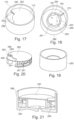
- Each output interface may include a base allowing it to be attached to the distributor.
- This fixing can be carried out using screws for example, but preferably the base is arranged to allow disassembly and replacement of an output interface without the need for tools. This is for example a quarter turn fixing or using an external locking ring.
- the outlet interface and/or the distributor housing may include seals allowing sealed communication between the distributor housing and the outlet interface.
- the distributor is arranged to recognize the output interface which is mounted on it, for example using an identifier of the output interface in the form of specific reliefs, which are detected by the distributor, or an electronic chip recognized by the distributor. This can make it possible to adapt the operation of the distributor to the output interface mounted on it.
- the distributor can communicate to a computer system information on the output interface that it carries, and the computer system can display, based on this information, a specific screen and/or launch a specific program for controlling the operating parameters of the distributor. , in order for example to adapt the dose distributed and/or the flow rate to the nature of the output interface.
- output interfaces can initially be offered to the user with a common distributor within the same packaging, for example a box or a cardboard box.
- the invention also relates to a makeup method, comprising the step of selecting an output interface, mounting it on the dispenser, and delivering the product(s) contained in the dispenser therein.
- mapping is understood here as a process of indexing a color and an area, with recording.
- Mapping can concern applications on areas smaller than one cm2. However, the naked eye then has difficulty discerning whether the result obtained is adequate, and it is preferable to replace the naked eye evaluation with an instrumented evaluation, with magnification.
- the application of small quantities of colored material can be done with the finger, with conventional tools such as brushes, or with specialized applicators.
- the mapping can be generated during a learning period, during which the user performs tests with mixtures on different areas of the face; once completed, the mapping can then be used for everyday makeup.
- Specific graphical interfaces can be used during the learning period and during the period of use of the cartography.
- the distribution system can be used with a graphical interface where the operator sees the face, which is for example schematized, figurative or precise like a photograph or a 3D simulation.
- the operator can point to part of the face on the screen to see the appropriate color appear and/or deliver.
- the graphical interface can also reveal other areas of the face where the use of the same color is appropriate.
- the operator applies a color then carries out the evaluation.
- Facial areas can be treated one after the other; for example, we perform the exercise on part of the cheek, then on the nose, etc.
- Another possibility is to make a given mixture, and apply this same mixture to several areas. The operator must then look for the area of the face for which the color is suitable. The mixture is then indexed in the computer system assigning it to the area(s) of the face for which it is suitable.
- This storage can be carried out in particular with a view to subsequent distribution of this mixture to make up said area.
- the computer system is arranged to allow the user to indicate whether the result of the test is satisfactory or not, or even to inform him about the comparison with a test carried out previously.
- the mixture is then recorded by assigning it to the area(s) of the face for which it is suitable, in a correspondence table which will subsequently be used to, starting from an area of the skin, deduce the mixture to be used. .
- the computer system evaluates and memorizes the quantities used zone by zone.
- Such a process, using “test touches”, makes it possible to identify the product(s) needed by the person who wants to apply makeup.
- the distribution system can be used at points of sale to advise people who want to apply makeup or at home to clearly define the products to order.
- the computer system interface preferably includes a touch screen displaying the color of the mixture when it is selected.
- the interface can display a face and allow the computer system to be informed by selecting the area on the displayed face.
- the computer system is preferably arranged to make it possible to associate a zone, parameters for reconstituting the mixture, and the date of the test and/or any other identifier of the mixture.
- the computer system is preferably also arranged to make it possible to further associate with said zone, with the reconstitution parameters of the mixture, and with the date or the identifier of the mixture, at least one of the following data: the name of the area, the time of year, the name of an event, a user ID, the user's age.
- Steps a) to c) can be repeated at least once before storing the characteristics of the mixture in step d).
- the computer system can be arranged to search a database for a commercial product reference, based on the characteristics of the mixture identified as suitable for at least one given area, and communicate it to the user.
- step a) can be carried out with the help of an expert system external or not to the computer system.
- the expert system may analyze an image of the user, to propose a blend color at least based on the analyzed image.
- Step a) can be preceded by the proposal of a color and an area to be tested with a mixture of this color, by the computer system to the user.
- the computer system can be arranged to allow the user to provide information on the assessment of the test result of step c) and to generate a proposal for modifying the mixture to be selected when returning to step a).
- the computer system can be arranged to propose at least one mixing color in step a) based on an application area provided by the user.
- the computer system can be arranged to offer at least one application zone in step a), depending on a color entered by the user.
- the dispenser can deliver in step b) at least two mixtures of different colors, preferably separate, for their simultaneous application to the test area.
- Such a method can use a map previously established with the user.
- the second site may in particular include a display screen which allows an advisor present in front of this screen to see the result of the makeup with the product distributed by the distributor and to advise the person who applied makeup.
- This advisor can act in return on the distributor to modify the color of the mixture and adapt it as best as possible to the face of the person present on the first site.
- this person governs the mixture delivered by the distributor.
- the first person can put on makeup while the second person watches.
- the second person sees the result of the test on their screen, and can therefore correct the mixture they will order remotely, until they obtain the ideal makeup.
- the video acquisition can be calibrated using a target, or with the mixture distributed by the distributor on a reference surface. This then allows a more faithful visualization of the makeup performed on the first site.
- the video link between the two sites is a duplex link.
- the first site can receive a tutorial from the second site, if applicable.
- Identifiers of the basic products may be communicated to the second site; this can make it possible to know precisely the color of each of the basic products.
- the method may include memorizing the distributor adjustment parameters, once a given mixture is considered satisfactory.
- this storage can be controlled from the second site.
- the storage can take place in the computer system present on the first site and/or on an external server.
- a variation can be to have one person work to help with makeup for several people.
- This mode of implementation allows the development of “Make-Up Artists” and their work either within an institute or via the internet. This also allows makeup for people with limited means, such as people who are visually impaired, or have difficulty discerning colors, or are elderly, or lack self-confidence.
- the distribution system can thus include a distributor and a computer system for controlling the distributor, this computer system comprising a touch screen on which the color of the mixture can be displayed and a selection means movable on the screen, to vary the color of the mixture distributed.
- the screen displays extreme colors between which the color of the mixture can be selected, by moving the selection means between these extreme colors.
- the screen can display a color scale between at least two colors, or a surface, in particular with a triangular outline, within which the selection means can move.
- This surface can locally make the color of the mixture appear depending, for example, on the distance to each of the vertices, each materializing a pure basic product.
- the computer system can perform part of the calculations necessary to determine the fractions of each of the basic products leading to a mixture of the desired color.
- the computer system can be a smartphone, a photophone, a tablet, a personal computer. Alternatively, it is integrated into the distributor housing.
- the computer system may have a camera.
- the latter can be used in particular for acquiring an image of the user and/or the mixture.
- the computer system may be arranged to display an image of a face, to facilitate identification of areas to which the mixture is to be applied.
- the distribution system may include or be connected to a means of spraying the mixture, preferably an airbrush.
- the dispenser can have three cartridges containing makeup products of different colors.
- the airbrush may include a stylus defining the sampling chamber, the stylus attaching to the dispenser or to an output interface attached to the dispenser, or forming an integral part of this output interface.
- the distribution system may include a circuit for controlling the operation of the distributor, making it possible to vary the proportion of basic products delivered into the sampling chamber, during operation of the airbrush.
- the proportions can be changed depending on the movement of the airbrush relative to the surface on which the mixture is sprayed. This movement can be mechanized, if necessary.
- This control circuit may include or be constituted by a computer system as defined above.
- the dispenser housing can be used as a handle when manipulating the assembly to deliver the mixture.
- the dispenser may include a camera and/or one or more sensors such as accelerometers in order to automatically locate the area on which the mixture is applied, and be able to automatically adjust the color depending on the position, if necessary.
- sensors such as accelerometers
- the invention also relates to a make-up process using an assembly as defined above, in which a mixture is sprayed onto the skin using the spraying means, in particular the airbrush.
- composition of the mixture can be modified as the airbrush moves relative to the skin.
- a gradient can be made.
- This aspect of the invention is based on the observation that the distributor can be used to supply the spraying system, in particular the airbrush, while allowing the distribution system to be sufficiently reactive to authorize a change in the color of the mixture distributed during facial makeup, especially when the area to be makeup changes.
- the depression created in the sampling chamber is sufficient to carry away the basic products, without hindering the dosage.
- the depression which prevails in the sampling chamber is for example between 10 mbar and 200 mbar, better still between 50 and 150 mbar, even better between 75 and 125 mbar.
- the section of the channels for entering the basic products into the chamber is for example between 1 and 3 mm 2 , better still between 2 and 3 mm 2 .
- the supply of product is preferably carried out continuously.
- aqueous gel and an oily gel which will be deposited in a pixelated manner directly on the skin, producing a sort of gel/gel in situ, silicones. reactive, or coloring products reacting together.
- Commodity ratios can be adjusted depending on the particular outcome desired. For example, in the case of aqueous gels and oily gels, we can vary the ratio corresponding to the volume of the first basic product to the volume of the second basic product between 10/1 and 1/10, better between 5/1 and 1/5.
- the distribution system according to the invention may have a location or self-location system.
- a localization system a means of capturing, on the part of the person, the area they are going to treat. This can be achieved in particular by systems leaving at least one hand free.
- a computer system such as a touch screen, a joystick, or a voice recognition system.
- a self-location system is a means of capturing the area to be treated without the person having to intervene. This can be achieved by one or more accelerometers which deduce, through movements, the directions that the person is aiming or by a camera and an image recognition system.
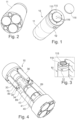
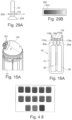
- FIG. 1 An example of a distribution system 10 which may be suitable for the invention is shown on the figures 1 and 2 , comprises a dispenser 11 which is provided in the upper part with an output interface 110 through which the distribution of a cosmetic product of personalized formulation is carried out.
- the distributor 11 can be manipulated with one hand. Its length, excluding the output interface, is for example between 140 and 160 mm and its diameter between 40 and 60 mm.
- the distribution system 10 may include, as illustrated, an actuation means making it possible to control the distribution, for example a push button 12.
- the dispenser 11 delivers the product based on information previously communicated to it by a computer system, for example using wireless transmission, as will be detailed further below.
- the operation of the push button 12 can be programmed from an interface of the computer system, so as to continuously deliver the mixture as long as pressure is exerted, or to deliver only a predefined dose, independently of the duration for which the user presses on the push button.
- the distributor 11 accommodates several cartridges 30 each containing a basic product, the dispenser 11 making it possible to dose the quantity of each of the basic products which is distributed so as to obtain, after mixing the doses distributed, a product having the desired properties.
- Each of the cartridges 30 can be introduced into the housing of the distributor 11 from the rear, as illustrated in figure 2 .
- the distributor 11 receives three cartridges 30, but the invention also extends to the case where the number of cartridges 30 is different.
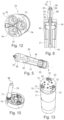
- a cartridge 30 This comprises a body 31 in which a piston 32 can move along the longitudinal axis X of the cartridge so as to reduce the volume of a reservoir 33 located under the piston 32, containing the basic product corresponding.
- the volume of the reservoir is preferably between 2 and 5 mL, being for example of the order of 3 mL.
- the piston 32 is driven to move along the axis X by a hollow rod 34, externally threaded, engaging with a corresponding thread passing through the piston 32.
- the rod 34 defines a channel through which the product contained in the tank 33 can circulate when the piston 32 moves in the body 31 in the direction of a reduction in the volume of the tank 33.
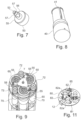
- the rod 34 is rotated around the axis 'we represented separately at the figure 8 , which comprises an axially split clamping sleeve 41, on which a locking ring 43, visible on the figure 4 .
- the support piece 40 When installing a cartridge 30, the support piece 40 is engaged thereon, on the side opposite the cannula 37, and the locking ring 43 moved onto the sleeve 41 to tighten the support piece 40 on the body 31.
- the support part 40 makes it possible to immobilize the cartridge 30 in the housing of the distributor 11.
- the head 36 of the cartridge 30, presenting the cannula 37, is capped by a driving part 50, shown in isolation on the Figure 7 , which tightens the head 36 so as to be able to rotate around the axis X with it.
- the friction force of the piston 30 on the interior surface of the body 31 is sufficient so that the piston 32 does not rotate relative to the body 31, so that the relative rotation of the rod 34 and the piston 32 causes the displacement of the latter along the axis
- the drive part 50 comprises an internal channel 52 supplied by the cannula 37 and which opens to the outside through a distribution orifice 53. This channel 52 is formed by an end piece 36.
- the drive part 50 has a skirt of mounting 54 which axially covers the head 36 of the cartridge 30. This mounting skirt 54 is connected via a transverse wall 55 to the end piece 56.
- the end piece 56 has reliefs 57 allowing it to be coupled in rotation with a toothed wheel 60, visible in particular on the Figure 9 , belonging to a drive mechanism of the distributor housing 11.
- the reliefs 57 are in the form of two diametrically opposed lugs, projecting from the end piece 56 at its base, which engage in corresponding notches of the toothed wheel 60.
- the end piece 56 has a narrowed part which includes a groove accommodating an O-ring 58.
- the narrowed part is connected by a shoulder 59 to the rest of the end piece.
- the head 36 of the cartridge 30 can carry an O-ring which ensures a tight coupling between the cannula 37 and the drive part 50.
- the drive mechanism comprises electric motors 70, equipped with reduction gears 71, visible in particular at the Figure 10 .
- the output shaft of these reducers is coupled to a driving wheel 72 which meshes with the toothed wheel 60.
- the motors 70 are arranged between the cartridges 30, the axes of rotation of the motors also being arranged at 120° from each other around the axis Y of the distributor 11. In this way, a compact construction of the distributor 11 is obtained.
- the geared motors advantageously have a torque greater than 70nN.m.
- a Maxon 118392 reference motor associated with the Maxon 218418 planetary gearbox.
- Such a motor has a diameter of 10 mm, a power of 1.5 W, a nominal voltage of 3 V, an idle speed of 1300 rpm and a maximum torque. 1.5mNm.
- the reducer has a diameter of 10 mm, an absolute reduction of 256/1 and a torque of 0.2 Nm.
- An electronic circuit 81 shown in isolation at Figure 11 , is present in the vicinity of the upper end of the distributor housing 1.
- This electronic circuit 81 comprises a card 80 which is crossed by passages 83 for the output axes of the reducers 71, as well as openings 82 for the narrowed parts 55 drive bits 56.
- Sleeves 82a can be fixed on the card 80 to provide a barrier against possible leaks of product towards the card 80.
- the end pieces 56 pass through the sleeves 82a, preferably with little clearance.
- the card 80 carries the aforementioned push button 12 and supports a certain number of output pins 86 used to power the motors 70.
- the electronic circuit 81 includes a microcontroller or the like making it possible to control the different motors 70, in order to distribute the desired quantity of each of the basic products.
- the delivery resolution of the basic products is for example between 0.001 and 0.003 mL, being for example of the order of 0.0025 mL.
- the distributor housing 11 also houses a battery whose accumulators 89 are advantageously located as seen in the Figure 4 , each in the extension of a 70 engine.
- the control of the distributor 11 is carried out using a computer system 100 such as a portable terminal, for example a smartphone, a tablet for example of the “Ipad” brand or a personal computer.
- a computer system 100 such as a portable terminal, for example a smartphone, a tablet for example of the “Ipad” brand or a personal computer.
- the transmission of control information from the distributor 11 by the terminal 100 is preferably carried out wirelessly, for example by a Bluetooth connection.
- the Texas Instrument CC2541 microcontroller integrates programmable flash memory with 256 KB of RAM as well as numerous features. This microcontroller can be programmed in C, in the IAR Embedded Workbench environment.
- the outlet orifices 53 of the cartridges 30 open substantially at the upper end of the housing of the distributor 11, as can be seen in the figure 13 notably.
- the upper face 14 of the distributor housing 11 defines a reception surface for mounting an outlet interface which channels the products coming from the cartridges towards a sampling or distribution zone.
- this output interface 110 is in the form of an attached part, which has been shown in isolation in the Figure 14 , which has on its periphery as illustrated passages 111 for screws used for fixing it to the housing of the distributor 11.
- the outlet interface 110 defines in this example a cup 115 in the bottom of which supply orifices 116 open, each in communication via an internal channel at the outlet interface 110 with a respective outlet orifice 53.
- the basic products contained in the cartridges 30 can be distributed to the cup 115 without mixing.
- the user can fill the cup 115 with predefined proportions of each of the basic products, as illustrated in Figure 3 , then can take the product present in the cup 115 in order to apply it.
- This sampling can be carried out for example with the finger, as illustrated, or using any suitable cosmetic applicator.
- the cup 115 is preferably shallow, which makes it easier to clean, and of sufficiently large diameter so as not to hinder access to the product.
- the supply orifices 116 are preferably of diameter less than 3 mm, for example of the order of 1 mm.
- the outlet interface 110 can receive a closing cover 118 of the cup 115, to prevent the product from drying out or being exposed to dirt when not in use.
- This cover 118 is preferably made of transparent plastic material and can be fixed by friction, screwing or snap-fastening on the amount of the cup 115, or more generally at any suitable location on the outlet interface 110.
- the maximum capacity of the cup 115 is preferably between 0.02 and 0.25 ml.
- the volume defined by the volume of the internal channels of the outlet interface 110 between the inlet therein from the feed ports 53 to the feed ports 116 is less than or equal to 0.4ml .
- the distributor housing 11 in its configuration illustrated in Figure 13 , that is to say without the output interface 110 described above, has the advantage of being able to be coupled to various forms of other output interfaces, depending on the makeup that one wishes to achieve and/or the area to be treated.
- outlet interface 110 comprising a distribution tip 150, generally oriented along an axis Z which extends obliquely with respect to the longitudinal axis Y of the distributor 11.
- Three internal channels communicate respectively with the outlet orifices 53 of the different cartridges 30 and open out at the end of the nozzle 150.
- the outlet interface 110 can be mounted at one end of the distributor housing 11, as illustrated in the figure 15A .
- the outlet interface 110 comprises three cannulas 160 which communicate respectively with the outlet orifices 53. These cannulas 160 are grouped in the center of the outlet interface 110, which allows the mounting thereon for example of a tip 170 for applying the product to the eyelashes, as illustrated in Figure 25, a porous tip 180 for application to the lips, as illustrated in Figure 25. Figure 27 , or a flocked tip 190 such as a felt tip, as illustrated in Figure 28 .
- the end piece 170 in Figure 25 it comprises for example, as illustrated, transverse grooves 171, between which product supply orifices open.
- the mixing of the different basic products can take place inside the nozzle 170, thanks to an integrated static mixer, for example.
- the tip 180 comprises, for example, a part made of open-cell foam, having the shape of the lips.
- the mixing of the basic products can be done within an internal conduit of the nozzle 180.
- the end piece 190 may include a porous application member 191, at the end of a rod 192, connecting to a base 193 used for mounting on the rest of the outlet interface of the Figure 16 .
- FIG. 16A schematically, the possibility of having as output interface 110 a cup 115 having passages 115a for outlet conduits 30a of the cartridges, including when these conduits are used to drive the rotation of threaded rods for moving the pistons.
- the length of the conduits 30a is such that they open into the bottom 115b of the cup or near its bottom, without protruding into it.
- the internal section of the conduits 30a is small, to minimize the dead volume.
- the outlet interface 110 comprises a tip 200 which is oriented generally obliquely relative to the longitudinal axis Y of the distributor. This tip 200 is traversed by internal channels 210, communicating respectively with the outlet orifices 53 of the basic products coming from the cartridges 30.
- the output interface 110 includes a mounting portion 215 which allows attachment to the output interface 110 of an airbrush 220, as illustrated in Fig. Figure 24 .
- the nozzle 200 is fixed in place of the usual airbrush reservoir and the channels 210 open into the airbrush nozzle where they are subjected to the depression created by the speed of the drive air flow.
- a clamp is formed by two uprights 216, to receive the body of the airbrush stylus 220, and ensure its retention by snapping.
- the orientation of the nozzle 200 is such that it allows the spray axis to be oriented substantially perpendicular to the longitudinal axis of the distributor housing 11. It can then be used as a handle to handle the airbrush.
- the outlet orifices 210 are advantageously very close together, being separated by thin internal partitions of the end piece 200.
- the section of each of the outlet orifices is less than or equal to 3 mm 2 over a length of at least 5 mm.
- the housing of the distributor 11 in the upper part with a movable support relative to the housing, for example in the form of a turret 250, as illustrated in Fig. Figure 29 .
- This turret 250 rotates for example around an axis of rotation which coincides with the longitudinal axis Y of the distributor.
- the turret 250 may include several housings 255 which can each accommodate the products delivered by the distributor 11 in a corresponding filling position. To successively fill the different housings, the turret 250 is rotated, for example by a quarter turn, each time.
- the presence of several housings 255 can make it possible to distribute products of different formulations, from different basic products, so as, for example, to vary the color of the products present in the different housings 255.
- each housing can contain a mixture whose color is adapted to the corresponding part of the face. This makes it easy for the user to know where to apply the mixture taken from a given home.
- the distributor 11 can be used to deliver a mixture whose formulation changes over time and collect the mixture in a container movable relative to the distributor, such that the mixture is deposited in a location of the container which varies over time, in order to create a gradient.
- the distribution system comprises an outlet interface 110 comprising a fixed part relative to the distributor and a mobile part 252 having a housing 253 for receiving the mixture.
- the distributor 11 is arranged in this case with the cartridge outlet orifices downwards, and equipped with a mixer, such that the mixture falls under the effect of its weight into the housing 253.
- a motor can move the movable part of the outlet interface relative to the distributor, in a synchronized manner with the variation in the characteristics of the mixture, so that a gradient is obtained along the housing 253, as illustrated in the figure 29B .
- the distribution system may include a base 254 which holds the distributor upside down.
- the outlet interface 110 may include a static mixer which ensures the mixing of the basic products.
- This output interface 110 may include an external body 260 which is fixed to the housing of the distributor 11 and which has an external tubular amount 270.
- the body 260 includes channels 261 for the admission of different basic products. These channels 261 open into a central chamber 262, delimited by an interior tubular amount 263.
- This upright 263 is crossed by an opening 264 which opens into an annular space 265, between the inner upright 263 and the outer upright 270.
- a static mixer core 280 shown in isolation at Figure 20 , is arranged in this space 265.
- the central chamber 262 can communicate with a peripheral chamber comprising a series of partitions formed by the heart of the mixer and which act as deflectors for the mixture, and create a shear thereof.
- the peripheral chamber may include an annular perforated partition 284 defining openings 285, one of which is visible on the Figure 21 , through which the mixture passes while circulating in the peripheral chamber.
- the central and peripheral chambers can be closed at the top by a wall 286 which defines the bottom of the cavity receiving the mixture.
- the bottom 287 of the peripheral chamber can be helical in shape and decreasing in height as one progresses towards the exit.
- the latter can emerge in front of a ramp 288 for connection between the bottom 287 of the peripheral chamber and the upper wall 286 of the mixer, this connection ramp preferably being a propeller portion extending the propeller formed by the wall of the mixer. bottom of the peripheral chamber.
- the peripheral chamber comprises the aforementioned annular partition and radial partitions 281 which force the mixture to circulate alternately between upper and lower regions of the peripheral chamber and between radially inner and outer regions, the mixture circulating for example from one region upper and radially outer to a lower and radially outer region passing through the aforementioned annular partition.
- the body 260 closes the peripheral chamber radially to the outside.
- the outer body 260 of the mixer and the core 280 of the mixer can each be made in one piece by injection molding.
- the product reaches the core 280 of the static mixer via passage 264, then circulates between uprights 263 and 270 over practically a complete circumference, up to outlet 282.
- the numerous baffles imposed by the partitions 281 cause an intimate mixing of the components introduced into the output interface 110.
- the mixture obtained can be taken by the user in the housing 283, above the static mixer.
- the distribution system 10 preferably comprises a man-machine interface which allows the user to easily and intuitively control the distributor 11.
- This interface can belong to a computer system 100 which communicates with the distributor 11.
- This interface can present, as illustrated in Figure 31 , a color selection zone, for example in the form of a triangle whose vertices correspond to the colors of each of the basic products contained in the cartridges.
- the user can move a cursor 300, for example in the form of a ball, relative to the vertices A, B and C of the triangle.
- the fraction of each product relative to the total quantity can be indicated at 301 by a numerical value on the interface.
- the interface can allow the user to increase or decrease the quantity of each of the products, for example by acting on control buttons 302, which allow precise adjustment of the quantity of each of the basic products.
- the surface of the triangle 310 can have a color which varies locally so as to be representative at each point of the color of the mixture resulting from the weighting of the different basic products in proportions corresponding to the relative coordinates at this point.
- the interface may include a button 305 allowing access to a specific menu for adjusting the volume of product which is distributed to purge the dispenser.
- the interface can also advantageously allow adjustment of the product flow rate using buttons 304 and 306 referring to a specific flow rate adjustment menu.
- the interface offers the choice between a continuous distribution mode, thanks to the button 304, where the products are distributed as long as the user presses the control button 12.
- the corresponding dose can be transmitted to the interface and displayed.
- Button 306 allows you to select dose mode operation, during which even a brief press on button 12 triggers the distribution of a predefined dose.
- the distributor acts, for example, on the ratio cyclical operation of the motors.
- the interface can be arranged to allow the user to program or memorize their preferred settings, using a menu 307 for accessing favorites.
- the touchscreen interface illustrated in Figure 32 causes three colored zones 400 to appear on the screen, each corresponding to the color of one of the basic products contained in the dispenser 10, and a central zone 410 showing the color of the resulting mixture.
- the relative quantity of each of the basic products can be adjusted using cursors 415 which move for example on lines joining each of the zones 400 to the central zone 410.
- the interface can memorize a given setting and cause a button 420 of the color of the mixture to appear on the screen. The user can then, by simply pressing this button 420, distribute a mixture of the corresponding color.
- the interface displays a given shade in a zone 500, and offers the user, using control buttons 510 each of the color of the corresponding basic product, to increase or decrease the proportion of this basic product in the final mixture.
- the color of zone 500 is recalculated according to the actions on the control buttons 510.
- the interface displays a color chart presenting several zones 530 each corresponding to a particular proportion of the different basic products.
- the user can select one of these areas, for example by pressing on it with their finger.
- the interface can be arranged to display on a larger scale in an area 535 the selected color.
- the programming of the distributor 11 to distribute this color is for example triggered by pressing the zone.
- the user can move a cursor 555 on a continuous color chart 550, which causes the selected color to appear in a zone 558.
- the user can then, by pressing for example in zone 556, trigger the sending to the distributor 11 of the instructions necessary for it to distribute a product of the selected color.
- the interface can memorize the different shades selected, and then make them appear on the screen so as to allow the user, by pressing corresponding buttons 560, to very easily re-select a previously chosen shade.
- FIG. 38 We represented at the figure 38 an example of user interface 1000 of a distribution system comprising a distributor, preferably as described above, and a computer system 100 to which the interface belongs.
- the computer system here comprises, for example, a device such as a laptop, a tablet or a smartphone, operating independently or connected to a remote server.
- the interface 1000 is defined by the touch screen of such a device.
- the dispenser integrates a touch screen or any other type of human machine interface, and can be used without connection to another device.
- the device runs an application, which has for example been downloaded beforehand, and which displays on the screen a face 1035 and a series of buttons allowing the user to enter information.
- the face may include several zones Z1 to Z6 that can be selected by touch, for example the forehead, nose, cheeks, eyelids, chin, and lips.
- buttons on the screen can, for example, allow you to enter the name of the makeup or user, display the selected area, choose the color, and inform the computer system of the acceptable or unacceptable result of the test. carried out, or even as illustrated to give information concerning the evaluation of the result in relation to a test carried out previously, i.e. for example better or “worse”.
- the screen can also display a button allowing you to memorize the choice of a color and a zone, after having carried out a test with this color on the zone in question.
- the computer system is arranged to store the data in the form of a correspondence table for example, so as to associate parameters with an area of the face making it possible to reproduce the mixture distributed during the test.
- These parameters include for example the relative contents of each of the distributor's basic products in the mixture, the quantity Q distributed, as well as additional data such as for example the name of the zone, the date of distribution of the mixture and/or any other identifier of the mixture, the identifiers of the basic products, the time of year, in particular the season, the age of the user, their gender, their first or last name, the name of an event associated with the makeup, for example example a birthday, among other data, the quantity of product adequate for the area.
- the ancillary data may allow the user to more easily reproduce makeup that they have considered appropriate for a time of year, or pronounced of a life event, or to give a rejuvenating effect.
- These data can be stored in the computer system 100, for example in the aforementioned device and/or on a remote server with which the device communicates, or in an electronic memory integrated into the distributor 11.
- the user can cause the dispenser to deliver a first colored material, to apply it to a first area of the face, then judge it to be suitable or not. If the result is satisfactory, the user can save it by indexing it to the zone; if the result is unsatisfactory, the user can order a new color to repeat the above operations.
- the computer system can be used in this context in various ways.
- the user chooses in a step 1010 a color to try, for example using the color scale 1011 appearing on the screen, by moving the adjustment button 1012.
- the device transmits the quantities to be distributed of each of the basic products, and the electronic circuit 81 is responsible for controlling the motors accordingly.
- step 1016 the user presses the control button 12 of the dispenser 11, which causes for example the distribution of a dose of the mixture, of the color selected by the user.
- the mixture is for example distributed in the cup 115, then taken and applied by the user to the cheeks or any other area indicated on the interface, in step 1020.
- the product is applied using an airbrush or by any other means as described above.
- the user then informs the computer system in step 1022 using buttons 1021 about the result.
- the system suggests, for example, validating the test parameters using a button in order to store them in step 1031.
- the result can nevertheless be automatically saved in step 1034.
- step 1010 The user can then carry out a new test on the same area by returning to step 1010.
- the interface can offer to indicate whether the result is estimated to be better or worse than the previous test, using corresponding buttons 1040 and 1041.
- the computer system can be arranged to determine whether, in view of the information entered by the user, a proposal can be automatically made as to the choice of the new color to be tested.
- a questionnaire may be displayed to help the computer system suggest a color based on the tests carried out and the evaluation made by the user or by a professional assisting them.
- the system can receive additional information from the user, for example "too light”, which will help it to propose a new color more in line with what is expected. the user.
- the computer system may be able to receive information comparing the result compared to previous tests, for example "it's better” or “it's worse” and from there, the system is able to deduce the new color to propose.
- the computer system can receive comparison information against a target, for example "this is almost ideal” and from there the system is able to automatically adjust its color changes.
- the system can adopt small levels of color modification and revise the colorimetric adjustment scale accordingly.
- the distribution system itself suggests the colored mixtures to be tested, it can be based on pre-programmed test scenarios and modify the monitoring of the scenario according to the successes or failures of the evaluation. So, for example, if from the third product application it receives information that the color is almost ideal for the user, the dispensing system can exit the program and then let itself be guided by the operator's instructions. .
- the user can be helped by an expert system in choosing which colors to try.
- This expert system is, for example, a program executed on the device with which the distributor communicates or on the distributor itself, which is based on responses to a questionnaire and/or on measurements, for example of skin color , carried out by a specific sensor or camera. The user can thus be helped by an instrumented evaluation, for example a color sensor.
- the expert system can also be implemented on a remote server with which the device or the distributor exchanges information. The operator can also send an image of his face to a specialist who can pre-program the choice of starting colors.
- the user presents to the computer system a photo of his face, and the computer system is arranged to analyze it and create a program defining the areas to be tested and the first products to be delivered, at the both in color and quantity.
- the computer system can be arranged to automatically select makeup colors to offer to the user by acquiring a photograph in step 1070, as illustrated in figure 42 .
- the device which communicates with the distributor 11 is equipped of a camera, and the user takes a photograph of his face.
- the image is then analyzed in step 1071, and colors are proposed for each area of the face in step 1072, for example according to predefined color matching rules.
- the distribution system can be oriented by the user to decide the color but also the quantity of product to be delivered.
- the user can indicate “nose” or “spot” and the distribution system is arranged to adapt the dose distributed according to a memory map of the doses to be distributed according to the areas to be treated.
- the computer system can guide the user in choosing the colors of the mixture to try, in order to limit the number of trials necessary until a pleasant result is obtained for the user.
- the computer system can store the corresponding parameters to allow the mixture to be recreated later.
- the system can then repeat the previous steps for a new application area.
- the operator does not need to treat the entire face. It can for example choose between 3 and 8 zones of small areas, for example 5 zones.
- the distribution system is then advantageously designed to interpolate and/or extrapolate the data concerning the colors considered adequate, in order to calculate the colors which should be considered adequate on areas on which the exercise has not been carried out.
- the system can generate a visualization of the appropriate colors on the different zones, tested or calculated.
- the distribution system can be arranged to signal if certain colors appear aberrant, relying on a comparison with standard maps in memory. Thus, it can suggest that the user redo all or part of the mapping exercise.
- the user who wishes to apply make-up only has to recall the area to be made up, in step 1080 of the figure 43 , and the system can automatically propose to the user in step 1081 a suitable mixing color.
- step 1090 the user selects a color in step 1090 and the computer system proposes in step 1091 an area where to apply a mixture of this color, based on information previously collected based on the tests carried out.
- the proposed area is for example where an identical or similar color has already been applied and the result deemed acceptable by the user.
- FIG 46 illustrates an example of implementation of the invention where after having carried out tests on different zones in step 2010, the user signals to the system the mixture(s) which he considers to provide the best result, which allows the system to know the corresponding parameters in step 2012. Then, in step 2014, the system can offer the user references to commercial products having the same or similar properties.
- the system sends to a remote manufacturing center the parameters making it possible to produce a composition of the same formulation or having the same properties as that of the mixture that the user has tested and found satisfactory.
- FIG. 45 illustrates the possibility of delivering using the dispenser several doses 2020a to 2020d of different mixtures, juxtaposed on a support 2021, so as to allow their application to distinct regions neighboring the same area.
- the user can apply a series of colors at once to quickly identify the right color.
- the colored materials present on the 2021 support may have been chosen by the operator itself or offered by the distribution system.
- the support 2021 is for example mobile relative to the distributor housing and moved sequentially to deposit the corresponding mixtures in the different zones 2020a to 2020d, being for example similar to the supports described with reference to the figures 29 Or 29A .
- the user can then easily compare the results between different regions, and report to the system which mixture produces the best effect.
- This system allows the establishment of a video link, for example via the internet, between a camera 2060 of a first site 2061 and a second site 2062.
- the camera 2060 is for example integrated into a tablet or a smartphone which constitutes the computer system 100.
- the second site 2062 is allowed to directly or indirectly control the distributor 11 present on the first site 2061.
- the person present at the first site can apply the distributed mixture and send a corresponding image to the second site 2062, to receive in return information relating to the makeup result.
- the second site 2062 may include a display screen 2064 which allows an advisor present in front of this screen to see the result of the makeup with the mixture distributed by the distributor and to advise the person who applied makeup.
- This advisor can act in return on the distributor 11 to modify the color of the mixture and adapt it as best as possible to the face of the person present on the first site.
- the data exchange protocol between the two sites thus allows the sending of order instructions to the distributor 11, either directly or via the computer system 100 present on the first site.
- the person present on the second site governs the mixture delivered by the distributor 11.
- the first person can apply makeup under the eyes of the second.
- the second person sees the result of the test on their screen, and can therefore correct the mixture they will order remotely, until they obtain the ideal makeup.
- the video link between the two sites is a duplex link, so that the user present on the first site can see the image of the advisor on the screen of the computer system.
- the latter can send a tutorial to the user present on the first site, if necessary.
- the storage of the adjustment parameters of the distributor 11, once a given mixture is considered satisfactory, can be controlled from the second site.
- the distribution system 10 is arranged to be able to aesthetically modify all the colors for each zone if the person wishes change the color of his face.
- the distribution system can be arranged in such a way that the user only needs to change one color in one area to change all the others.
- the distribution system can use translations for this, for example by raising the color saturation or shifting the hue.
- the distribution system may be arranged to receive mapping from someone else, real or virtual. It can also combine the person's mapping with the mapping of another, to enhance the makeup without losing its own characteristics.
- the interface can be used to define makeup programs where we define the order of the areas to be painted or the order of the colors to be offered.
- a distributor 11 is produced such as that illustrated in Figure 3 .
- the distributor is arranged to communicate with a tablet 100 such as an iPad.
- This computer system runs an application called “ ⁇ Mix” developed in Apple's specific environment (XCode 4 and iOS Simulator) in Objective C language.
- the continuous mode is a dispensing mode where the mixture of the three basic products is dispensed as long as the user presses the dispensing button 12.
- the product is delivered with a flow rate of which an estimate is displayed above the button 304 " Continuous ".
- the choice of flow rate is made in a “Settings” menu.
- the “dose” mode is a mode of dispensing the mixture by dose, where the dose is delivered following a push by the user on the distribution button 12. One push is enough and the user can then release the button.
- the overall dose of product distributed is that indicated above button 306 “Dose”, 0.1 ml for example. This volume can be modified in the “Settings” menu.
- the “purge” mode is a distribution mode where a dose of mixture in equal volume fractions (33%) is delivered as soon as the user presses the distribution button 12, as in the “Dose” mode. One pulse is enough and the user can then release the button. When the dose has been completely dispensed, you can release the button. If released before completion, dispensing stops, even if the specified volume is not reached.
- the overall dose of product distributed is that indicated above a 305 “Purge” button, 3 ml for example. This volume can be changed in the Settings menu.
- the user determines the desired color with the application which runs on the tablet and which calculates the fractions of the different products.
- the tablet communicates this value to the distributor via Bluetooth connection.
- the electronics integrated into the dispenser 11 retrieve the information and automatically adjust the flow rates of the three cartridges so as to obtain a mixture of the desired color.
- button 12 of the dispenser When the user wants to use the product, he presses button 12 of the dispenser to release the product. He presses the product for as long as he wants, in “continuous” mode. In “dose” mode, the user presses button 12 once and the predefined dose is delivered.
- the distribution can be done continuously, that is to say the motors operate continuously, the entire volume being distributed at once, or iteratively, the motors then operating impulsively; in this case, the time interval between two pulses makes it possible to vary the flow rate. Small volumes are delivered one after the other in several stages.
- the pulses can be separated, for example, by intervals of 50 ms, 100 ms or 200 ms.
- the duration of a pulse during which the motor runs ranges, for example, from 50 to 150 ms.
- the values of the volume fractions of products A, B and C are updated automatically.
- the ball 300 is automatically moved to the corresponding position on the triangle.
- the tablet When starting the application running on the tablet, it automatically connects to the distributor 11 if it is detected. When the dispenser turns off or the Bluetooth connection is cut, the tablet disconnects. When the user acts on the sliders for adjusting the proportions of products A and B, the values are transmitted in real time to the distributor 11.
- the product delivery mode is direct or iterative dose mode, depending on the option chosen in the Settings sheet.
- Example 1 (first aspect of the invention)
- Base products “A”, “B” and “C” are for respective cartridges. Some basic products show strong thickening (A1, B 1, C1), others do not (A2, B2, C2).
- the system is used at t0 to deliver 200 mg of product. We then spread the mixture.
- the system is used at t0 to deliver 200 mg of product. We then spread the mixture.
- the invention is not limited to each of the ten aspects which have just been described. In particular, it is possible to combine within new variants characteristics resulting from the invention according to its different aspects.
- xcvii) to xcix the filler being chosen from talc, mica, silica, kaolin, poly- ⁇ -alanine and polyethylene powders, tetrafluoroethylene polymer powders, lauroyl-lysine , starch, boron nitride, hollow polymeric microspheres such as those of polyvinylidene chloride/acrylonitrile, acrylic acid copolymers, silicone resin microbeads, elastomeric polyorganosiloxane particles, precipitated calcium carbonate, magnesium carbonate and hydrocarbonate, hydroxyapatite, sulfate barium, aluminum oxides, polyurethane powders, composite fillers, hollow silica microspheres, and glass or ceramic microcapsules, particles which have the shape of portions of hollow spheres, and mixtures thereof.
- the filler being chosen from talc, mica, silica, kaolin, poly- ⁇ -alanine and polyethylene powders, tetrafluoroethylene
- cvii) (ninth aspect) System for dispensing a perfumed product, possibly according to any of the preceding points, comprising a dispenser receiving at least two cartridges containing respectively first and second basic products, the first basic product comprising a composition containing at least one alcohol and at least one cellulose derivative, the dispenser making it possible to deliver at least these two basic products in adjustable proportions.
- each base product comprising a composition containing at least one alcohol and at least one cellulose derivative.
- cxi System according to cvii) to cx), the first basic product or each basic product containing at least one odorous compound, preferably chosen from esters, carbonates, acids, anhydrides, aldehydes, alcohols, aliphatic compounds without other functions as alkanes and alkenes, and mixtures thereof.
- at least one odorous compound preferably chosen from esters, carbonates, acids, anhydrides, aldehydes, alcohols, aliphatic compounds without other functions as alkanes and alkenes, and mixtures thereof.
- cxii System according to claim cxi), the odorous compound(s) being chosen from hexanal, octanal, nonanal, decanal, undecanal, dodecanal, tridecanal, 2-methyl decanal, 2-methyl undecanal, trans-2-hexenal, cis-4-heptanal, 2,6 dimethyl 5-hepten 1 al, E-4-decenal, 10 undecenal, 2 dodecenal, 1,1 dimethoxy 2,2 .5 trimethyl 4 hexene, 2 methyl 2 pentenoic acid, (S)-(+)-2-methyl butanoic acid, ethyl formate, cis-3- hexenyl formate, ethylacetate, butylacetate, l isoamylacetate, hexylacetate, 3,5,5 trimethyl hexylacetate, trans 2 hexenyl acetate, cis -3- hexenyla
- cellulose derivative being chosen from cellulose derivatives obtained by reaction of alkalized cellulose with propylene or ethylene oxide.
- cxv System according to cvii) to cxiv), the size of the cellulose derivative being greater than or equal to 10,000, better being between approximately 850,000 and approximately 1150,000.
- cxix System according to cvii) to cxviii), each product leaving the cartridge through an outlet channel of the cartridge, the outlet channel being defined by a distribution tip of the cartridge driven in relative rotation relative to a body of the cartridge by a dispenser drive mechanism to dispense the base product contained in the cartridge.
- cxxiii) (tenth zaspect) System for dispensing a product, possibly according to any of the preceding points, comprising a distributor receiving at least two cartridges containing respectively a first base product and a second base product, the distributor making it possible to delivering at least these two basic products in adjustable proportions, the first basic product comprising a volatile solvent and a film-forming polymer, the second basic product comprising a non-volatile oil.
- the reactive silicone comprising a mixture of telechelic polyorganosiloxane carrying a vinyl function at both chain ends and polyhydrogensiloxane.
- cxxxviii System according to cxxxvi) or cxvii), the film-forming polymer being chosen from vinyl polymers or copolymers, in particular acrylic.
- the first base product comprising a polymer or copolymer chosen from methacrylic polymers and copolymers, polyamides, alkylcelluloses, vinylpyrolidone polymers and copolymers, and silicone resins.
- the second base product comprising a polymer or copolymer chosen from acrylic, vinyl polymers and copolymers and polycondensates such as polyesters and polyurethanes.
- cxlv Process for applying a cosmetic, makeup and/or care product to human keratin materials, using a distribution system according to cxxiii) to cxliv), comprising adjusting the dispenser accordingly of the area to be treated, and the distribution of the product by taking from the cartridges of the basic products in the proportions corresponding to the setting of the distributor.
Landscapes
- Health & Medical Sciences (AREA)
- Life Sciences & Earth Sciences (AREA)
- Animal Behavior & Ethology (AREA)
- General Health & Medical Sciences (AREA)
- Public Health (AREA)
- Veterinary Medicine (AREA)
- Birds (AREA)
- Epidemiology (AREA)
- Emergency Medicine (AREA)
- Chemical & Material Sciences (AREA)
- Inorganic Chemistry (AREA)
- General Engineering & Computer Science (AREA)
- Analytical Chemistry (AREA)
- Chemical Kinetics & Catalysis (AREA)
- Engineering & Computer Science (AREA)
- Dermatology (AREA)
- Cosmetics (AREA)
- Containers And Packaging Bodies Having A Special Means To Remove Contents (AREA)
- Fats And Perfumes (AREA)
- Disinfection, Sterilisation Or Deodorisation Of Air (AREA)
- Devices For Dispensing Beverages (AREA)
Claims (14)
- System (10) zur Ausgabe eines Produkts, umfassend einen Spender, der mindestens zwei Kartuschen (30) aufnimmt, von denen jede einen Behälter hat, der ein Basisprodukt enthält, wobei ein erstes Basisprodukt mindestens 0,1 Massen-% an Partikeln umfasst, die eine Dichteabweichung, bevorzugt von mindestens 0,5 g/cm3, zu dem Milieu aufweisen, das sie enthält, wobei die Partikel eine Dichte von 2 g/cm3 oder mehr aufweisen, und ein Verdickungsmittel, wobei der Spender es ermöglicht, mindestens zwei Basisprodukte in einstellbaren Anteilen abzugeben, wobei die Viskosität des ersten Basisprodukts mehr als 2 Pa.s beträgt, wobei die Viskosität wie in der Beschreibung beschrieben gemessen wird, wobei das Verdickungsmittel des ersten Basisprodukts unter den Saccharid-Verbindungen vom Gummityp gewählt ist und sein Massengehalt in dem ersten Basisprodukt zwischen 0,8 und 2,5 % bezogen auf die Gesamtmasse des ersten Basisprodukts beträgt.
- System nach Anspruch 1, wobei die Viskosität des ersten Basisprodukts 4 Pa.s oder mehr, bevorzugter zwischen 4 Pa.s und 10 Pa.s, noch bevorzugter zwischen 5 Pa.s und 8 Pa.s beträgt, wobei die Viskosität wie in der Beschreibung beschrieben gemessen wird.
- System nach einem der Ansprüche 1 und 2, wobei der Spender eine zweite Kartusche aufnimmt, die ein zweites Basisprodukt enthält, das eine geringere Viskosität als das erste Basisprodukt hat, wobei die Viskosität wie in der Beschreibung beschrieben gemessen wird.
- System nach dem vorhergehenden Anspruch, wobei das zweite Basisprodukt eine Viskosität hat, die 1 Pa.s oder weniger, bevorzugter 0,8 Pa.s oder weniger, noch bevorzugter zwischen 0,6 Pa.s und 0,2 Pa.s beträgt, wobei die Viskosität wie in der Beschreibung beschrieben gemessen wird.
- System nach einem der vorhergehenden Ansprüche, wobei die Dichte der Partikel 5 g/cm3 oder mehr, besser 6 g/cm3 oder mehr, noch besser zwischen 6 g/cm3 und 10 g/cm3, bevorzugt zwischen 7 g/cm3 und 8 g/cm3 beträgt.
- System nach einem der vorhergehenden Ansprüche, wobei die Partikel mindestens eines der aus der folgenden Liste gewählten Materialien umfassen: Bismutchloridoxid, Ceroxid, Chromoxid, Zirconiumoxid, Eisenoxid, Titanoxid, Talk, Calciumcarbonat, Siliciumdioxid, Bornitrid, Wolframcarbid, wobei es bevorzugt unter Bismutchloridoxid und Ceroxid gewählt ist.
- System nach einem der vorhergehenden Ansprüche, wobei das zweite Produkt keine Partikel mit einer Dichte von 7 g/cm3 oder mehr, besser mit einer Dichte von 6 g/cm3 oder mehr, noch besser mit einer Dichte von 5 g/cm3 oder mehr, bevorzugt mit einer Dichte von 2 g/cm3 oder mehr aufweist.
- System nach einem der vorhergehenden Ansprüche, umfassend eine dritte Kartusche mit einem dritten Basisprodukt.
- System nach dem vorhergehenden Anspruch, wobei das dritte Basisprodukt ein Verdickungsmittel umfasst, das identisch mit oder verschieden von dem des ersten Basisprodukts ist, bevorzugt identisch mit dem des ersten Basisprodukts ist.
- System nach einem der vorhergehenden Ansprüche, wobei das Verdickungsmittel des ersten Basisprodukts unter Gummi arabicum, Akaziengummi, Guargummi, Gellangummi, Karayagummi, Carragenangummi gewählt ist.
- System nach einem der vorhergehenden Ansprüche, wobei das Verdickungsmittel des ersten Basisprodukts unter den Saccharid-Verbindungen vom Gummityp gewählt ist und sein Massengehalt zwischen 1,5 % und 2,3 % bezogen auf die Gesamtmasse des ersten Basisprodukts beträgt.
- System nach einem der vorhergehenden Ansprüche, wobei die Kartuschen herausnehmbar in dem Spender aufgenommen sind.
- System nach einem der Ansprüche, wobei jedes Produkt die Kartusche durch einen Austrittskanal der Kartusche verlässt, wobei der Austrittskanal durch ein Ausgabeendstück (56) der Kartusche definiert wird, das relativ zu einem Körper der Kartusche von einem Antriebsmechanismus des Spenders drehangetrieben wird, um das in der Kartusche enthaltene Basisprodukt auszugeben.
- System nach einem der vorhergehenden Ansprüche, umfassend einen, insbesondere vibratorischen, Mechanismus zur Homogenisierung des ersten Basisprodukts.
Priority Applications (7)
| Application Number | Priority Date | Filing Date | Title |
|---|---|---|---|
| EP23201375.5A EP4302745A1 (de) | 2016-06-02 | 2017-06-02 | Abgabesystem für ein kosmetisches produkt |
| EP23201373.0A EP4286038A3 (de) | 2016-06-02 | 2017-06-02 | Verteilungssystem eines kosmetischen produkts |
| EP23201374.8A EP4316457A1 (de) | 2016-06-02 | 2017-06-02 | Abgabesystem für ein kosmetisches produkt |
| EP23201377.1A EP4279170A3 (de) | 2016-06-02 | 2017-06-02 | Verteilungssystem eines kosmetischen produkts |
| EP23201380.5A EP4302747B1 (de) | 2016-06-02 | 2017-06-02 | Abgabesystem für ein kosmetisches produkt |
| EP23201378.9A EP4279171A3 (de) | 2016-06-02 | 2017-06-02 | System zur ausgabe eines kosmetikprodukts |
| EP23201376.3A EP4302746A1 (de) | 2016-06-02 | 2017-06-02 | Abgabesystem für ein kosmetisches produkt |
Applications Claiming Priority (2)
| Application Number | Priority Date | Filing Date | Title |
|---|---|---|---|
| FR1655053A FR3052035B1 (fr) | 2016-06-02 | 2016-06-02 | Systeme de distribution d'un produit cosmetique |
| PCT/EP2017/063508 WO2017207776A1 (fr) | 2016-06-02 | 2017-06-02 | Systeme de distribution d'un produit cosmetique |
Related Child Applications (8)
| Application Number | Title | Priority Date | Filing Date |
|---|---|---|---|
| EP23201376.3A Division EP4302746A1 (de) | 2016-06-02 | 2017-06-02 | Abgabesystem für ein kosmetisches produkt |
| EP23201374.8A Division EP4316457A1 (de) | 2016-06-02 | 2017-06-02 | Abgabesystem für ein kosmetisches produkt |
| EP23201378.9A Division EP4279171A3 (de) | 2016-06-02 | 2017-06-02 | System zur ausgabe eines kosmetikprodukts |
| EP23201373.0A Division EP4286038A3 (de) | 2016-06-02 | 2017-06-02 | Verteilungssystem eines kosmetischen produkts |
| EP23201373.0A Previously-Filed-Application EP4286038A3 (de) | 2016-06-02 | 2017-06-02 | Verteilungssystem eines kosmetischen produkts |
| EP23201377.1A Division EP4279170A3 (de) | 2016-06-02 | 2017-06-02 | Verteilungssystem eines kosmetischen produkts |
| EP23201380.5A Division EP4302747B1 (de) | 2016-06-02 | 2017-06-02 | Abgabesystem für ein kosmetisches produkt |
| EP23201375.5A Division EP4302745A1 (de) | 2016-06-02 | 2017-06-02 | Abgabesystem für ein kosmetisches produkt |
Publications (3)
| Publication Number | Publication Date |
|---|---|
| EP3463260A1 EP3463260A1 (de) | 2019-04-10 |
| EP3463260C0 EP3463260C0 (de) | 2023-11-01 |
| EP3463260B1 true EP3463260B1 (de) | 2023-11-01 |
Family
ID=56511785
Family Applications (8)
| Application Number | Title | Priority Date | Filing Date |
|---|---|---|---|
| EP17732768.1A Active EP3463260B1 (de) | 2016-06-02 | 2017-06-02 | Verteilungssystem eines kosmetischen produkts |
| EP23201378.9A Pending EP4279171A3 (de) | 2016-06-02 | 2017-06-02 | System zur ausgabe eines kosmetikprodukts |
| EP23201375.5A Withdrawn EP4302745A1 (de) | 2016-06-02 | 2017-06-02 | Abgabesystem für ein kosmetisches produkt |
| EP23201376.3A Pending EP4302746A1 (de) | 2016-06-02 | 2017-06-02 | Abgabesystem für ein kosmetisches produkt |
| EP23201373.0A Pending EP4286038A3 (de) | 2016-06-02 | 2017-06-02 | Verteilungssystem eines kosmetischen produkts |
| EP23201377.1A Withdrawn EP4279170A3 (de) | 2016-06-02 | 2017-06-02 | Verteilungssystem eines kosmetischen produkts |
| EP23201380.5A Active EP4302747B1 (de) | 2016-06-02 | 2017-06-02 | Abgabesystem für ein kosmetisches produkt |
| EP23201374.8A Pending EP4316457A1 (de) | 2016-06-02 | 2017-06-02 | Abgabesystem für ein kosmetisches produkt |
Family Applications After (7)
| Application Number | Title | Priority Date | Filing Date |
|---|---|---|---|
| EP23201378.9A Pending EP4279171A3 (de) | 2016-06-02 | 2017-06-02 | System zur ausgabe eines kosmetikprodukts |
| EP23201375.5A Withdrawn EP4302745A1 (de) | 2016-06-02 | 2017-06-02 | Abgabesystem für ein kosmetisches produkt |
| EP23201376.3A Pending EP4302746A1 (de) | 2016-06-02 | 2017-06-02 | Abgabesystem für ein kosmetisches produkt |
| EP23201373.0A Pending EP4286038A3 (de) | 2016-06-02 | 2017-06-02 | Verteilungssystem eines kosmetischen produkts |
| EP23201377.1A Withdrawn EP4279170A3 (de) | 2016-06-02 | 2017-06-02 | Verteilungssystem eines kosmetischen produkts |
| EP23201380.5A Active EP4302747B1 (de) | 2016-06-02 | 2017-06-02 | Abgabesystem für ein kosmetisches produkt |
| EP23201374.8A Pending EP4316457A1 (de) | 2016-06-02 | 2017-06-02 | Abgabesystem für ein kosmetisches produkt |
Country Status (10)
| Country | Link |
|---|---|
| US (8) | US11291287B2 (de) |
| EP (8) | EP3463260B1 (de) |
| JP (15) | JP6732957B2 (de) |
| KR (8) | KR102385774B1 (de) |
| CN (8) | CN114680444A (de) |
| BR (1) | BR112018074726B1 (de) |
| ES (2) | ES2969442T3 (de) |
| FR (1) | FR3052035B1 (de) |
| RU (1) | RU2709930C1 (de) |
| WO (8) | WO2017207787A1 (de) |
Families Citing this family (30)
| Publication number | Priority date | Publication date | Assignee | Title |
|---|---|---|---|---|
| US11819580B2 (en) * | 2016-10-18 | 2023-11-21 | PurWorld Technologies LLC | Method of chemically disinfecting a vehicle |
| FR3057743B1 (fr) * | 2016-10-21 | 2018-10-26 | B2B Cosmetics | Systeme melangeur pour fabriquer un produit cosmetique et capsule cosmetique |
| EP3563719B1 (de) * | 2018-05-01 | 2020-04-08 | The Boots Company PLC | Kosmetische zusammensetzungen |
| CN112165885B (zh) * | 2018-06-29 | 2023-11-07 | 宝洁公司 | 双相产品 |
| FR3086513B1 (fr) * | 2018-10-02 | 2021-10-15 | Oreal | Procede de traitement cosmetique |
| FR3086517B1 (fr) | 2018-10-02 | 2022-02-18 | Oreal | Procede de traitement des cheveux |
| KR102192318B1 (ko) | 2019-06-26 | 2020-12-17 | 김형완 | 카트리지 장치 및 그를 포함하는 액상 제품 제조 장치 |
| KR102255715B1 (ko) | 2019-06-26 | 2021-05-24 | 김형완 | 액상 제품 제조 장치용 카트리지 장치 |
| KR102227993B1 (ko) * | 2019-09-24 | 2021-03-15 | 주식회사 엘지생활건강 | 산화세륨 무기필러로 강화된 폴리머 및 이를 사용한 2액형 화장료 조성물 |
| US11900434B2 (en) | 2020-01-31 | 2024-02-13 | L'oréal | Ecosystem for dispensing personalized foundation |
| WO2021207425A1 (en) | 2020-04-07 | 2021-10-14 | Yoanna Gouchtchina | Dermal spray apparatus and method |
| ES2988301T3 (es) | 2020-06-16 | 2024-11-20 | Oreal | Aparato con carrusel para dispensar y mezclar composiciones cosméticas |
| JP2023536884A (ja) | 2020-08-03 | 2023-08-30 | ジョンソン アンド ジョンソン コンシューマー インコーポレイテッド | 目の下の増白を与えるための化粧品組成物の選択的適用のためのシステム及び方法 |
| KR102236106B1 (ko) * | 2021-01-14 | 2021-04-05 | 주식회사 마이스킨닥터 | 피부미용장치 및 그 장치의 구동방법 |
| WO2022162464A1 (en) * | 2021-01-29 | 2022-08-04 | L'oreal | Smart compartment system for cosmetic dispensing device |
| FR3120291B1 (fr) | 2021-03-03 | 2023-03-31 | Oreal | Applicateur cosmétique avec un mélangeur statique agencé à l'intérieur de la tige |
| WO2022265935A1 (en) * | 2021-06-14 | 2022-12-22 | Genomatica, Inc. | 1,3-butylene glycol compositions and methods of use thereof |
| CN113828206B (zh) * | 2021-07-13 | 2024-03-22 | 重庆大学 | 一种提高流体混合效果的喷气式射流搅拌桨 |
| KR20230029260A (ko) * | 2021-08-24 | 2023-03-03 | (주)아모레퍼시픽 | 효소 손상을 방지하는 화장료 조성물 및 이를 저장하는 화장품 용기 |
| US12090216B2 (en) | 2021-10-05 | 2024-09-17 | L'oreal | Peelable makeup removing compositions |
| US12376665B2 (en) | 2021-10-14 | 2025-08-05 | Kozhya LLC Sp. z o.o. | Dermal spray apparatus with disposable cartrdige and method |
| USD1035867S1 (en) | 2022-05-09 | 2024-07-16 | Kozhya LLC Sp. z o.o. | Dermal spray apparatus |
| USD1038383S1 (en) | 2022-05-09 | 2024-08-06 | Kozhya LLC Sp. z o.o. | Dermal spray apparatus |
| USD1046122S1 (en) | 2022-05-09 | 2024-10-08 | Quantum Skin Limited Liability Company | Dermal spray cartridge |
| USD1033635S1 (en) | 2022-05-09 | 2024-07-02 | Quantum Skin SP Z O.O | Dermal spray nozzle |
| FR3144914A1 (fr) * | 2023-01-13 | 2024-07-19 | Abbi | procédé de formulation cosmétique personnalisée |
| US12520928B2 (en) * | 2023-02-27 | 2026-01-13 | Connie Michele Nerio | Apparatus, systems, and methods of a multi-use cosmetic pen with blotting paper dispenser |
| FR3146583A1 (fr) | 2023-03-16 | 2024-09-20 | L'oreal | Outil multifonctionnel pour appliquer du maquillage |
| CN116712346A (zh) * | 2023-06-07 | 2023-09-08 | 广东丸美生物技术股份有限公司 | 防晒化妆品 |
| USD1073862S1 (en) * | 2023-06-28 | 2025-05-06 | Qi Lan Huang | Airbrush kit |
Family Cites Families (69)
| Publication number | Priority date | Publication date | Assignee | Title |
|---|---|---|---|---|
| LU67772A1 (de) | 1973-06-08 | 1975-03-06 | ||
| US4578266A (en) | 1983-07-29 | 1986-03-25 | Revlon, Inc. | Silicone-based cosmetic products containing pigment |
| US5051305A (en) | 1988-12-30 | 1991-09-24 | Arcade, Inc. | Stabilized perfume-containing microcapsules and method of preparing the same |
| FR2687569B1 (fr) | 1992-02-21 | 1995-06-09 | Oreal | Composition cosmetique pour le maquillage des yeux, comprenant une microdispersion de cire. |
| WO1995005892A1 (en) | 1993-08-23 | 1995-03-02 | Unilever Plc | Method and apparatus for customising facial foundation products |
| US5903465A (en) * | 1993-08-23 | 1999-05-11 | Elizabeth Arden Company | Method and apparatus for customizing cosmetic products |
| JP2673095B2 (ja) * | 1994-01-31 | 1997-11-05 | 京セラ株式会社 | 窒化アルミニウム焼結体 |
| BR9702049B1 (pt) * | 1996-01-31 | 2010-08-10 | sistema distribuidor contendo dois compartimentos para a dosagem simultánea de duas composições aquosas. | |
| FR2756176B1 (fr) | 1996-11-26 | 1998-12-18 | Oreal | Composition cosmetique comprenant un compose fluore et presentant un confort ameliore |
| US5785960A (en) | 1997-03-19 | 1998-07-28 | Elizabeth Arden Co., Division Of Conopco, Inc. | Method and system for customizing dermatological foundation products |
| US6013270A (en) * | 1998-04-20 | 2000-01-11 | The Procter & Gamble Company | Skin care kit |
| DE19837034A1 (de) * | 1998-08-14 | 2000-02-24 | Brugger Gerhard | Dosierspender |
| FR2784026B1 (fr) * | 1998-10-06 | 2000-11-24 | Oreal | Utilisation d'une phase particulaire specifique dans une composition cosmetique, notamment de maquillage, et composition cosmetique contenant une telle phase particulaire |
| JP2000191789A (ja) | 1998-12-28 | 2000-07-11 | Takemoto Oil & Fat Co Ltd | 有機シリコ―ン微粒子、その製造方法、有機シリコ―ン微粒子から成る高分子材料用改質剤及び化粧品原料 |
| FR2791648B1 (fr) * | 1999-04-02 | 2001-05-25 | Oreal | Distributeur portatif pour le conditionnement et la distribution de produits cosmetiques colores |
| FR2804600B1 (fr) | 2000-02-08 | 2002-03-22 | Oreal | Compositions photoprotectrices comprenant un melange d'un polyethylene a fonction acide carboxylique terminale et d'un polyethylene |
| ATE308375T1 (de) | 2000-02-17 | 2005-11-15 | Sulzer Chemtech Ag | Statischer mischer |
| US6516245B1 (en) | 2000-05-31 | 2003-02-04 | The Procter & Gamble Company | Method for providing personalized cosmetics |
| FR2818101B1 (fr) | 2000-12-15 | 2003-09-26 | Oreal | Dispositif pour la pulverisation d'un produit cosmetique |
| FR2823102B1 (fr) * | 2001-04-10 | 2004-03-05 | Oreal | Produit de maquillage bicouche, ses utilisations et kit de maquillage contenant ce produit |
| FR2823103B1 (fr) * | 2001-04-10 | 2003-05-23 | Oreal | Produit de maquillage bicouche contenant un pigment goniochromatique et un pigment monocolore et kit de maquillage contenant ce produit |
| WO2002094423A1 (en) * | 2001-05-22 | 2002-11-28 | Access Business Group International Llc | Method and apparatus for blending and dispensing liquid compositions |
| MY128768A (en) * | 2001-05-22 | 2007-02-28 | Access Business Group Int Llc | Method and apparatus for blending and dispensing liquid compositions |
| JP3701016B2 (ja) | 2001-10-30 | 2005-09-28 | 竹本油脂株式会社 | 有機シリコーン微粒子、有機シリコーン微粒子の製造方法、高分子材料用改質剤及び化粧品原料 |
| US6517816B1 (en) * | 2001-12-26 | 2003-02-11 | Avon Products, Inc. | Sunscreen emulsion composition and method of use |
| KR200284550Y1 (ko) * | 2002-03-21 | 2002-08-10 | 강성일 | 염색용구 |
| JP2004091507A (ja) * | 2002-08-29 | 2004-03-25 | Nippon Sheet Glass Co Ltd | ゲル状組成物およびそれを用いた製品 |
| US8153108B2 (en) * | 2003-04-25 | 2012-04-10 | Kao Corporation | Hair cosmetic product |
| DE10342211A1 (de) * | 2003-09-12 | 2005-04-07 | Beiersdorf Ag | Kosmetikum |
| FR2877819B1 (fr) * | 2004-11-15 | 2007-07-20 | Oreal | Dispositif de conditionnement et de distribution d'au moins deux compositions differentes. |
| US20070138326A1 (en) * | 2005-12-20 | 2007-06-21 | Zhiyu Hu | Automatic microfluidic fragrance dispenser |
| FR2902331B1 (fr) * | 2006-06-20 | 2009-02-20 | Oreal | Mascara comprenant au moins 21% de cire et une charge |
| CN200959919Y (zh) * | 2006-09-12 | 2007-10-17 | 无锡圣马科技有限公司 | 旋推式化妆瓶 |
| CN200988015Y (zh) * | 2006-10-30 | 2007-12-12 | 埃森·费尔索夫 | 喷雾器 |
| JP5191156B2 (ja) * | 2007-03-30 | 2013-04-24 | 小林製薬株式会社 | 外用組成物 |
| CN101580775A (zh) * | 2008-05-17 | 2009-11-18 | 刘庆民 | 一种卫生间除臭消毒清洗液的配制方法 |
| KR100864028B1 (ko) * | 2008-06-23 | 2008-10-16 | 쓰리애플즈코스메틱스 주식회사 | 비율조정이 가능한 화장품 용기 |
| CN201349675Y (zh) * | 2008-12-24 | 2009-11-25 | 李赟 | 反压式液体化妆笔 |
| US8224481B2 (en) * | 2009-01-19 | 2012-07-17 | Access Business Group International Llc | Method and apparatus for dispensing fluid compositions |
| MX347310B (es) * | 2009-10-12 | 2017-04-20 | Wyeth Llc * | Composiciones de protector solar. |
| DE102009051171A1 (de) | 2009-10-29 | 2011-05-05 | Merck Patent Gmbh | Pigmente |
| EP2433656A1 (de) * | 2010-09-23 | 2012-03-28 | Unilever PLC | Duftabgabevorrichtung |
| CN201888410U (zh) * | 2010-10-14 | 2011-07-06 | 上海惠慧企业发展有限公司 | 可调整用量比例的按压式双色润肤瓶 |
| FR2967348B1 (fr) * | 2010-11-17 | 2013-05-10 | Oreal | Composition cosmetique pour le contour des yeux |
| FR2969921B1 (fr) * | 2011-01-05 | 2013-08-09 | Oreal | Produit cosmetique en deux parties |
| FR2970403B1 (fr) | 2011-01-18 | 2013-07-05 | Oreal | Dispositif de distribution d'un produit cosmetique |
| JP5791424B2 (ja) * | 2011-08-11 | 2015-10-07 | 三菱鉛筆株式会社 | 水性化粧料組成物 |
| US8593634B1 (en) * | 2012-06-15 | 2013-11-26 | Larry Y Igarashi | Custom cosmetic blending machine |
| FR2983723B1 (fr) * | 2011-12-12 | 2016-07-29 | Lvmh Rech | Methode de soin et/ou de maquillage de la peau procurant une protection vis-a-vis des rayons uv |
| US20130272995A1 (en) * | 2012-04-12 | 2013-10-17 | Mamoru Hagiwara | Cosmetic product containing film-forming polymer |
| JP5972052B2 (ja) * | 2012-05-30 | 2016-08-17 | 花王株式会社 | ゲル状フレグランス組成物 |
| FR2991870B1 (fr) * | 2012-06-13 | 2015-08-21 | Oreal | Procede de traitement de la peau grasse |
| KR101377020B1 (ko) * | 2012-08-16 | 2014-03-27 | 주식회사 내추럴웍스 | 멀티컨테이너를 갖는 화장수 분사장치 |
| ITTO20120773A1 (it) * | 2012-09-06 | 2012-12-06 | Start Up S R L | Cartuccia perfezionata per dosatore automatico portatile e dosatore automatico portatile dotato di tali cartucce. |
| FR2996759B1 (fr) * | 2012-10-15 | 2015-01-16 | Oreal | Composition cosmetique de revetement des fibres keratiniques |
| TWI659743B (zh) * | 2013-06-28 | 2019-05-21 | 朋友股份有限公司 | 毛髮化粧料組成物及含氧化物之該組成物、毛髮化粧料及毛髮化粧用品 |
| US8977389B2 (en) * | 2013-07-17 | 2015-03-10 | ColorCulture Network, LLC | Method, system and apparatus for dispensing products for a personal care service, instructing on providing a personal care treatment service, and selecting a personal care service |
| FR3008617B1 (fr) * | 2013-07-18 | 2016-09-23 | Oreal | Emulsions pickering huile/huile renfermant des particules a rupture de courbe, compositions les comprenant et utilisation des particules pour stabiliser des emulsions h/h de pickering |
| FR3015887B1 (fr) * | 2013-12-27 | 2017-03-24 | Oreal | Dispositif et procede pour le maquillage par transfert des matieres keratiniques |
| US9498974B2 (en) * | 2014-05-02 | 2016-11-22 | Minkyung Grace Choi | Device and method for producing a customized cosmetic composition |
| US10188193B2 (en) * | 2014-07-25 | 2019-01-29 | The Procter & Gamble Company | Applicator heads for handheld treatment apparatus for modifying keratinous surfaces |
| US10022741B2 (en) * | 2014-08-22 | 2018-07-17 | Nse Products, Inc. | Selectively actuated fluid dispenser |
| CN106999881A (zh) * | 2014-10-07 | 2017-08-01 | 捷通国际有限公司 | 个人配制装置 |
| US20160136085A1 (en) * | 2014-11-13 | 2016-05-19 | L'oreal | Water-based liquid cosmetic compositions |
| FR3029090B1 (fr) | 2014-12-02 | 2018-04-06 | L'oreal | Ensemble comportant un aerographe |
| KR102118247B1 (ko) | 2014-12-02 | 2020-06-09 | 로레알 | 가변 색상의 혼합물을 이송하기 위한 분배 시스템 |
| ES2806524T3 (es) | 2014-12-02 | 2021-02-17 | Oreal | Sistema de dispensación con al menos dos interfaces de salida |
| EP3226719B1 (de) | 2014-12-02 | 2023-09-06 | L'oreal | System zur ausgabe eines schminkproduktes |
| KR101953497B1 (ko) | 2014-12-02 | 2019-02-28 | 로레알 | 적어도 하나의 메이크업 제품을 분배하기 위한 시스템 및 메이크업을 분배 및 평가하기 위한 방법 |
-
2016
- 2016-06-02 FR FR1655053A patent/FR3052035B1/fr not_active Expired - Fee Related
-
2017
- 2017-06-02 CN CN202210381640.6A patent/CN114680444A/zh active Pending
- 2017-06-02 WO PCT/EP2017/063526 patent/WO2017207787A1/fr not_active Ceased
- 2017-06-02 WO PCT/EP2017/063518 patent/WO2017207781A1/fr not_active Ceased
- 2017-06-02 KR KR1020207032089A patent/KR102385774B1/ko not_active Expired - Fee Related
- 2017-06-02 KR KR1020207032090A patent/KR102385776B1/ko active Active
- 2017-06-02 WO PCT/EP2017/063556 patent/WO2017207800A1/fr not_active Ceased
- 2017-06-02 CN CN202210383055.XA patent/CN114617352A/zh active Pending
- 2017-06-02 KR KR1020187038112A patent/KR102177887B1/ko active Active
- 2017-06-02 WO PCT/EP2017/063514 patent/WO2017207778A1/fr not_active Ceased
- 2017-06-02 CN CN201780048401.6A patent/CN109562029B/zh active Active
- 2017-06-02 CN CN202210383484.7A patent/CN114847617A/zh active Pending
- 2017-06-02 ES ES17732768T patent/ES2969442T3/es active Active
- 2017-06-02 WO PCT/EP2017/063531 patent/WO2017207789A1/fr not_active Ceased
- 2017-06-02 US US16/306,408 patent/US11291287B2/en active Active
- 2017-06-02 EP EP17732768.1A patent/EP3463260B1/de active Active
- 2017-06-02 KR KR1020207032088A patent/KR102385767B1/ko active Active
- 2017-06-02 WO PCT/EP2017/063521 patent/WO2017207783A1/fr not_active Ceased
- 2017-06-02 EP EP23201378.9A patent/EP4279171A3/de active Pending
- 2017-06-02 EP EP23201375.5A patent/EP4302745A1/de not_active Withdrawn
- 2017-06-02 EP EP23201376.3A patent/EP4302746A1/de active Pending
- 2017-06-02 KR KR1020207032087A patent/KR102353198B1/ko active Active
- 2017-06-02 CN CN202210381803.0A patent/CN114711533A/zh active Pending
- 2017-06-02 WO PCT/EP2017/063508 patent/WO2017207776A1/fr not_active Ceased
- 2017-06-02 CN CN202210382922.8A patent/CN114617351A/zh active Pending
- 2017-06-02 CN CN202210379682.6A patent/CN114847616B/zh active Active
- 2017-06-02 EP EP23201373.0A patent/EP4286038A3/de active Pending
- 2017-06-02 JP JP2018563092A patent/JP6732957B2/ja active Active
- 2017-06-02 KR KR1020207032086A patent/KR102377382B1/ko not_active Expired - Fee Related
- 2017-06-02 EP EP23201377.1A patent/EP4279170A3/de not_active Withdrawn
- 2017-06-02 RU RU2018141999A patent/RU2709930C1/ru active
- 2017-06-02 BR BR112018074726-2A patent/BR112018074726B1/pt not_active IP Right Cessation
- 2017-06-02 EP EP23201380.5A patent/EP4302747B1/de active Active
- 2017-06-02 KR KR1020207032092A patent/KR102353197B1/ko not_active Expired - Fee Related
- 2017-06-02 CN CN202210379576.8A patent/CN114847615B/zh active Active
- 2017-06-02 KR KR1020207032091A patent/KR102353193B1/ko not_active Expired - Fee Related
- 2017-06-02 ES ES23201380T patent/ES3066063T3/es active Active
- 2017-06-02 WO PCT/EP2017/063562 patent/WO2017207803A1/fr not_active Ceased
- 2017-06-02 EP EP23201374.8A patent/EP4316457A1/de active Pending
-
2020
- 2020-07-07 JP JP2020117022A patent/JP2020176131A/ja active Pending
- 2020-07-07 JP JP2020117018A patent/JP7542339B2/ja active Active
- 2020-07-07 JP JP2020117024A patent/JP2020176133A/ja active Pending
- 2020-07-07 JP JP2020117020A patent/JP2020176129A/ja active Pending
- 2020-07-07 JP JP2020117021A patent/JP2020176130A/ja active Pending
- 2020-07-07 JP JP2020117023A patent/JP2020176132A/ja active Pending
- 2020-07-07 JP JP2020117019A patent/JP7542340B2/ja active Active
-
2022
- 2022-02-08 US US17/666,846 patent/US12239209B2/en active Active
- 2022-02-08 US US17/666,783 patent/US20220160106A1/en not_active Abandoned
- 2022-02-08 US US17/666,714 patent/US11998104B2/en active Active
- 2022-02-08 US US17/666,760 patent/US11980277B2/en active Active
- 2022-02-08 US US17/666,727 patent/US11974651B2/en active Active
- 2022-02-08 US US17/666,743 patent/US20220151367A1/en not_active Abandoned
- 2022-02-08 US US17/666,802 patent/US12004630B2/en active Active
- 2022-11-18 JP JP2022185084A patent/JP2023027095A/ja active Pending
- 2022-11-18 JP JP2022185083A patent/JP2023027094A/ja active Pending
- 2022-11-25 JP JP2022188508A patent/JP2023027125A/ja active Pending
- 2022-11-25 JP JP2022188511A patent/JP2023016891A/ja active Pending
- 2022-11-25 JP JP2022188507A patent/JP2023027124A/ja active Pending
- 2022-11-25 JP JP2022188512A patent/JP2023021145A/ja active Pending
- 2022-11-25 JP JP2022188510A patent/JP2023014169A/ja active Pending
Also Published As
Similar Documents
| Publication | Publication Date | Title |
|---|---|---|
| EP4316457A1 (de) | Abgabesystem für ein kosmetisches produkt | |
| FR3029102B1 (fr) | Procede de maquillage | |
| FR3029083B1 (fr) | Systeme de distribution permettant de delivrer un melange de couleur variable |
Legal Events
| Date | Code | Title | Description |
|---|---|---|---|
| STAA | Information on the status of an ep patent application or granted ep patent |
Free format text: STATUS: UNKNOWN |
|
| STAA | Information on the status of an ep patent application or granted ep patent |
Free format text: STATUS: THE INTERNATIONAL PUBLICATION HAS BEEN MADE |
|
| PUAI | Public reference made under article 153(3) epc to a published international application that has entered the european phase |
Free format text: ORIGINAL CODE: 0009012 |
|
| STAA | Information on the status of an ep patent application or granted ep patent |
Free format text: STATUS: REQUEST FOR EXAMINATION WAS MADE |
|
| 17P | Request for examination filed |
Effective date: 20181120 |
|
| AK | Designated contracting states |
Kind code of ref document: A1 Designated state(s): AL AT BE BG CH CY CZ DE DK EE ES FI FR GB GR HR HU IE IS IT LI LT LU LV MC MK MT NL NO PL PT RO RS SE SI SK SM TR |
|
| AX | Request for extension of the european patent |
Extension state: BA ME |
|
| DAV | Request for validation of the european patent (deleted) | ||
| DAX | Request for extension of the european patent (deleted) | ||
| STAA | Information on the status of an ep patent application or granted ep patent |
Free format text: STATUS: EXAMINATION IS IN PROGRESS |
|
| 17Q | First examination report despatched |
Effective date: 20201120 |
|
| RIC1 | Information provided on ipc code assigned before grant |
Ipc: B01F 33/84 20220101ALI20230127BHEP Ipc: A61K 8/34 20060101ALI20230127BHEP Ipc: A61Q 1/02 20060101ALI20230127BHEP Ipc: A61Q 5/00 20060101ALI20230127BHEP Ipc: A61Q 17/00 20060101ALI20230127BHEP Ipc: A61K 8/29 20060101ALI20230127BHEP Ipc: A61K 8/81 20060101ALI20230127BHEP Ipc: A61Q 19/00 20060101ALI20230127BHEP Ipc: A45D 34/00 20060101ALI20230127BHEP Ipc: A45D 34/04 20060101ALI20230127BHEP Ipc: A61K 8/19 20060101ALI20230127BHEP Ipc: A61K 8/73 20060101ALI20230127BHEP Ipc: A61Q 1/00 20060101ALI20230127BHEP Ipc: A45D 44/00 20060101ALI20230127BHEP Ipc: A45D 40/24 20060101ALI20230127BHEP Ipc: A61K 8/25 20060101AFI20230127BHEP |
|
| GRAP | Despatch of communication of intention to grant a patent |
Free format text: ORIGINAL CODE: EPIDOSNIGR1 |
|
| STAA | Information on the status of an ep patent application or granted ep patent |
Free format text: STATUS: GRANT OF PATENT IS INTENDED |
|
| RAP3 | Party data changed (applicant data changed or rights of an application transferred) |
Owner name: L'OREAL |
|
| INTG | Intention to grant announced |
Effective date: 20230403 |
|
| GRAJ | Information related to disapproval of communication of intention to grant by the applicant or resumption of examination proceedings by the epo deleted |
Free format text: ORIGINAL CODE: EPIDOSDIGR1 |
|
| STAA | Information on the status of an ep patent application or granted ep patent |
Free format text: STATUS: EXAMINATION IS IN PROGRESS |
|
| GRAP | Despatch of communication of intention to grant a patent |
Free format text: ORIGINAL CODE: EPIDOSNIGR1 |
|
| INTC | Intention to grant announced (deleted) | ||
| STAA | Information on the status of an ep patent application or granted ep patent |
Free format text: STATUS: GRANT OF PATENT IS INTENDED |
|
| INTG | Intention to grant announced |
Effective date: 20230622 |
|
| GRAS | Grant fee paid |
Free format text: ORIGINAL CODE: EPIDOSNIGR3 |
|
| GRAA | (expected) grant |
Free format text: ORIGINAL CODE: 0009210 |
|
| STAA | Information on the status of an ep patent application or granted ep patent |
Free format text: STATUS: THE PATENT HAS BEEN GRANTED |
|
| AK | Designated contracting states |
Kind code of ref document: B1 Designated state(s): AL AT BE BG CH CY CZ DE DK EE ES FI FR GB GR HR HU IE IS IT LI LT LU LV MC MK MT NL NO PL PT RO RS SE SI SK SM TR |
|
| REG | Reference to a national code |
Ref country code: GB Ref legal event code: FG4D Free format text: NOT ENGLISH |
|
| REG | Reference to a national code |
Ref country code: CH Ref legal event code: EP |
|
| REG | Reference to a national code |
Ref country code: IE Ref legal event code: FG4D Free format text: LANGUAGE OF EP DOCUMENT: FRENCH |
|
| REG | Reference to a national code |
Ref country code: DE Ref legal event code: R096 Ref document number: 602017075973 Country of ref document: DE |
|
| U01 | Request for unitary effect filed |
Effective date: 20231107 |
|
| U07 | Unitary effect registered |
Designated state(s): AT BE BG DE DK EE FI FR IT LT LU LV MT NL PT SE SI Effective date: 20231110 |
|
| PG25 | Lapsed in a contracting state [announced via postgrant information from national office to epo] |
Ref country code: GR Free format text: LAPSE BECAUSE OF FAILURE TO SUBMIT A TRANSLATION OF THE DESCRIPTION OR TO PAY THE FEE WITHIN THE PRESCRIBED TIME-LIMIT Effective date: 20240202 |
|
| PG25 | Lapsed in a contracting state [announced via postgrant information from national office to epo] |
Ref country code: IS Free format text: LAPSE BECAUSE OF FAILURE TO SUBMIT A TRANSLATION OF THE DESCRIPTION OR TO PAY THE FEE WITHIN THE PRESCRIBED TIME-LIMIT Effective date: 20240301 |
|
| PG25 | Lapsed in a contracting state [announced via postgrant information from national office to epo] |
Ref country code: IS Free format text: LAPSE BECAUSE OF FAILURE TO SUBMIT A TRANSLATION OF THE DESCRIPTION OR TO PAY THE FEE WITHIN THE PRESCRIBED TIME-LIMIT Effective date: 20240301 Ref country code: GR Free format text: LAPSE BECAUSE OF FAILURE TO SUBMIT A TRANSLATION OF THE DESCRIPTION OR TO PAY THE FEE WITHIN THE PRESCRIBED TIME-LIMIT Effective date: 20240202 |
|
| REG | Reference to a national code |
Ref country code: ES Ref legal event code: FG2A Ref document number: 2969442 Country of ref document: ES Kind code of ref document: T3 Effective date: 20240520 |
|
| PG25 | Lapsed in a contracting state [announced via postgrant information from national office to epo] |
Ref country code: RS Free format text: LAPSE BECAUSE OF FAILURE TO SUBMIT A TRANSLATION OF THE DESCRIPTION OR TO PAY THE FEE WITHIN THE PRESCRIBED TIME-LIMIT Effective date: 20231101 Ref country code: PL Free format text: LAPSE BECAUSE OF FAILURE TO SUBMIT A TRANSLATION OF THE DESCRIPTION OR TO PAY THE FEE WITHIN THE PRESCRIBED TIME-LIMIT Effective date: 20231101 Ref country code: NO Free format text: LAPSE BECAUSE OF FAILURE TO SUBMIT A TRANSLATION OF THE DESCRIPTION OR TO PAY THE FEE WITHIN THE PRESCRIBED TIME-LIMIT Effective date: 20240201 Ref country code: HR Free format text: LAPSE BECAUSE OF FAILURE TO SUBMIT A TRANSLATION OF THE DESCRIPTION OR TO PAY THE FEE WITHIN THE PRESCRIBED TIME-LIMIT Effective date: 20231101 |
|
| U20 | Renewal fee for the european patent with unitary effect paid |
Year of fee payment: 8 Effective date: 20240509 |
|
| PG25 | Lapsed in a contracting state [announced via postgrant information from national office to epo] |
Ref country code: CZ Free format text: LAPSE BECAUSE OF FAILURE TO SUBMIT A TRANSLATION OF THE DESCRIPTION OR TO PAY THE FEE WITHIN THE PRESCRIBED TIME-LIMIT Effective date: 20231101 |
|
| PG25 | Lapsed in a contracting state [announced via postgrant information from national office to epo] |
Ref country code: SK Free format text: LAPSE BECAUSE OF FAILURE TO SUBMIT A TRANSLATION OF THE DESCRIPTION OR TO PAY THE FEE WITHIN THE PRESCRIBED TIME-LIMIT Effective date: 20231101 |
|
| PG25 | Lapsed in a contracting state [announced via postgrant information from national office to epo] |
Ref country code: SM Free format text: LAPSE BECAUSE OF FAILURE TO SUBMIT A TRANSLATION OF THE DESCRIPTION OR TO PAY THE FEE WITHIN THE PRESCRIBED TIME-LIMIT Effective date: 20231101 Ref country code: SK Free format text: LAPSE BECAUSE OF FAILURE TO SUBMIT A TRANSLATION OF THE DESCRIPTION OR TO PAY THE FEE WITHIN THE PRESCRIBED TIME-LIMIT Effective date: 20231101 Ref country code: RO Free format text: LAPSE BECAUSE OF FAILURE TO SUBMIT A TRANSLATION OF THE DESCRIPTION OR TO PAY THE FEE WITHIN THE PRESCRIBED TIME-LIMIT Effective date: 20231101 Ref country code: CZ Free format text: LAPSE BECAUSE OF FAILURE TO SUBMIT A TRANSLATION OF THE DESCRIPTION OR TO PAY THE FEE WITHIN THE PRESCRIBED TIME-LIMIT Effective date: 20231101 |
|
| REG | Reference to a national code |
Ref country code: DE Ref legal event code: R097 Ref document number: 602017075973 Country of ref document: DE |
|
| PLBE | No opposition filed within time limit |
Free format text: ORIGINAL CODE: 0009261 |
|
| STAA | Information on the status of an ep patent application or granted ep patent |
Free format text: STATUS: NO OPPOSITION FILED WITHIN TIME LIMIT |
|
| 26N | No opposition filed |
Effective date: 20240802 |
|
| PG25 | Lapsed in a contracting state [announced via postgrant information from national office to epo] |
Ref country code: MC Free format text: LAPSE BECAUSE OF FAILURE TO SUBMIT A TRANSLATION OF THE DESCRIPTION OR TO PAY THE FEE WITHIN THE PRESCRIBED TIME-LIMIT Effective date: 20231101 |
|
| REG | Reference to a national code |
Ref country code: CH Ref legal event code: PL |
|
| PG25 | Lapsed in a contracting state [announced via postgrant information from national office to epo] |
Ref country code: IE Free format text: LAPSE BECAUSE OF NON-PAYMENT OF DUE FEES Effective date: 20240602 |
|
| PG25 | Lapsed in a contracting state [announced via postgrant information from national office to epo] |
Ref country code: CH Free format text: LAPSE BECAUSE OF NON-PAYMENT OF DUE FEES Effective date: 20240630 |
|
| U20 | Renewal fee for the european patent with unitary effect paid |
Year of fee payment: 9 Effective date: 20250509 |
|
| PGFP | Annual fee paid to national office [announced via postgrant information from national office to epo] |
Ref country code: GB Payment date: 20250401 Year of fee payment: 9 |
|
| PG25 | Lapsed in a contracting state [announced via postgrant information from national office to epo] |
Ref country code: CY Free format text: LAPSE BECAUSE OF FAILURE TO SUBMIT A TRANSLATION OF THE DESCRIPTION OR TO PAY THE FEE WITHIN THE PRESCRIBED TIME-LIMIT; INVALID AB INITIO Effective date: 20170602 |
|
| PGFP | Annual fee paid to national office [announced via postgrant information from national office to epo] |
Ref country code: ES Payment date: 20250707 Year of fee payment: 9 |
|
| U1N | Appointed representative for the unitary patent procedure changed after the registration of the unitary effect |
Representative=s name: IPSILON; FR |
|
| PG25 | Lapsed in a contracting state [announced via postgrant information from national office to epo] |
Ref country code: HU Free format text: LAPSE BECAUSE OF FAILURE TO SUBMIT A TRANSLATION OF THE DESCRIPTION OR TO PAY THE FEE WITHIN THE PRESCRIBED TIME-LIMIT; INVALID AB INITIO Effective date: 20170602 |