EP3466882B1 - Verfahren zur herstellung von mit siliciumverbindung beschichteten oxidpartikeln, mit siliciumverbindung beschichtete oxidpartikel und mit siliciumverbindung beschichtete oxidzusammensetzung damit - Google Patents
Verfahren zur herstellung von mit siliciumverbindung beschichteten oxidpartikeln, mit siliciumverbindung beschichtete oxidpartikel und mit siliciumverbindung beschichtete oxidzusammensetzung damit Download PDFInfo
- Publication number
- EP3466882B1 EP3466882B1 EP17806508.2A EP17806508A EP3466882B1 EP 3466882 B1 EP3466882 B1 EP 3466882B1 EP 17806508 A EP17806508 A EP 17806508A EP 3466882 B1 EP3466882 B1 EP 3466882B1
- Authority
- EP
- European Patent Office
- Prior art keywords
- silicon compound
- oxide particles
- bonds
- compound coated
- ratio
- Prior art date
- Legal status (The legal status is an assumption and is not a legal conclusion. Google has not performed a legal analysis and makes no representation as to the accuracy of the status listed.)
- Active
Links
Images




Classifications
-
- B—PERFORMING OPERATIONS; TRANSPORTING
- B22—CASTING; POWDER METALLURGY
- B22F—WORKING METALLIC POWDER; MANUFACTURE OF ARTICLES FROM METALLIC POWDER; MAKING METALLIC POWDER; APPARATUS OR DEVICES SPECIALLY ADAPTED FOR METALLIC POWDER
- B22F1/00—Metallic powder; Treatment of metallic powder, e.g. to facilitate working or to improve properties
- B22F1/16—Metallic particles coated with a non-metal
-
- C—CHEMISTRY; METALLURGY
- C01—INORGANIC CHEMISTRY
- C01F—COMPOUNDS OF THE METALS BERYLLIUM, MAGNESIUM, ALUMINIUM, CALCIUM, STRONTIUM, BARIUM, RADIUM, THORIUM, OR OF THE RARE-EARTH METALS
- C01F17/00—Compounds of rare earth metals
- C01F17/20—Compounds containing only rare earth metals as the metal element
- C01F17/206—Compounds containing only rare earth metals as the metal element oxide or hydroxide being the only anion
- C01F17/224—Oxides or hydroxides of lanthanides
- C01F17/235—Cerium oxides or hydroxides
-
- B—PERFORMING OPERATIONS; TRANSPORTING
- B22—CASTING; POWDER METALLURGY
- B22F—WORKING METALLIC POWDER; MANUFACTURE OF ARTICLES FROM METALLIC POWDER; MAKING METALLIC POWDER; APPARATUS OR DEVICES SPECIALLY ADAPTED FOR METALLIC POWDER
- B22F1/00—Metallic powder; Treatment of metallic powder, e.g. to facilitate working or to improve properties
- B22F1/17—Metallic particles coated with metal
-
- B—PERFORMING OPERATIONS; TRANSPORTING
- B01—PHYSICAL OR CHEMICAL PROCESSES OR APPARATUS IN GENERAL
- B01J—CHEMICAL OR PHYSICAL PROCESSES, e.g. CATALYSIS OR COLLOID CHEMISTRY; THEIR RELEVANT APPARATUS
- B01J13/00—Colloid chemistry, e.g. the production of colloidal materials or their solutions, not otherwise provided for; Making microcapsules or microballoons
- B01J13/02—Making microcapsules or microballoons
-
- B—PERFORMING OPERATIONS; TRANSPORTING
- B22—CASTING; POWDER METALLURGY
- B22F—WORKING METALLIC POWDER; MANUFACTURE OF ARTICLES FROM METALLIC POWDER; MAKING METALLIC POWDER; APPARATUS OR DEVICES SPECIALLY ADAPTED FOR METALLIC POWDER
- B22F1/00—Metallic powder; Treatment of metallic powder, e.g. to facilitate working or to improve properties
- B22F1/05—Metallic powder characterised by the size or surface area of the particles
- B22F1/054—Nanosized particles
-
- B—PERFORMING OPERATIONS; TRANSPORTING
- B22—CASTING; POWDER METALLURGY
- B22F—WORKING METALLIC POWDER; MANUFACTURE OF ARTICLES FROM METALLIC POWDER; MAKING METALLIC POWDER; APPARATUS OR DEVICES SPECIALLY ADAPTED FOR METALLIC POWDER
- B22F1/00—Metallic powder; Treatment of metallic powder, e.g. to facilitate working or to improve properties
- B22F1/05—Metallic powder characterised by the size or surface area of the particles
- B22F1/054—Nanosized particles
- B22F1/056—Submicron particles having a size above 100 nm up to 300 nm
-
- B—PERFORMING OPERATIONS; TRANSPORTING
- B22—CASTING; POWDER METALLURGY
- B22F—WORKING METALLIC POWDER; MANUFACTURE OF ARTICLES FROM METALLIC POWDER; MAKING METALLIC POWDER; APPARATUS OR DEVICES SPECIALLY ADAPTED FOR METALLIC POWDER
- B22F1/00—Metallic powder; Treatment of metallic powder, e.g. to facilitate working or to improve properties
- B22F1/10—Metallic powder containing lubricating or binding agents; Metallic powder containing organic material
- B22F1/102—Metallic powder coated with organic material
-
- C—CHEMISTRY; METALLURGY
- C01—INORGANIC CHEMISTRY
- C01B—NON-METALLIC ELEMENTS; COMPOUNDS THEREOF; METALLOIDS OR COMPOUNDS THEREOF NOT COVERED BY SUBCLASS C01C
- C01B13/00—Oxygen; Ozone; Oxides or hydroxides in general
- C01B13/14—Methods for preparing oxides or hydroxides in general
-
- C—CHEMISTRY; METALLURGY
- C01—INORGANIC CHEMISTRY
- C01B—NON-METALLIC ELEMENTS; COMPOUNDS THEREOF; METALLOIDS OR COMPOUNDS THEREOF NOT COVERED BY SUBCLASS C01C
- C01B13/00—Oxygen; Ozone; Oxides or hydroxides in general
- C01B13/14—Methods for preparing oxides or hydroxides in general
- C01B13/145—After-treatment of oxides or hydroxides, e.g. pulverising, drying, decreasing the acidity
-
- C—CHEMISTRY; METALLURGY
- C01—INORGANIC CHEMISTRY
- C01B—NON-METALLIC ELEMENTS; COMPOUNDS THEREOF; METALLOIDS OR COMPOUNDS THEREOF NOT COVERED BY SUBCLASS C01C
- C01B33/00—Silicon; Compounds thereof
- C01B33/02—Silicon
-
- C—CHEMISTRY; METALLURGY
- C01—INORGANIC CHEMISTRY
- C01B—NON-METALLIC ELEMENTS; COMPOUNDS THEREOF; METALLOIDS OR COMPOUNDS THEREOF NOT COVERED BY SUBCLASS C01C
- C01B33/00—Silicon; Compounds thereof
- C01B33/20—Silicates
- C01B33/32—Alkali metal silicates
- C01B33/325—After-treatment, e.g. purification or stabilisation of solutions, granulation; Dissolution; Obtaining solid silicate, e.g. from a solution by spray-drying, flashing off water or adding a coagulant
-
- C—CHEMISTRY; METALLURGY
- C01—INORGANIC CHEMISTRY
- C01F—COMPOUNDS OF THE METALS BERYLLIUM, MAGNESIUM, ALUMINIUM, CALCIUM, STRONTIUM, BARIUM, RADIUM, THORIUM, OR OF THE RARE-EARTH METALS
- C01F17/00—Compounds of rare earth metals
- C01F17/20—Compounds containing only rare earth metals as the metal element
- C01F17/206—Compounds containing only rare earth metals as the metal element oxide or hydroxide being the only anion
-
- C—CHEMISTRY; METALLURGY
- C01—INORGANIC CHEMISTRY
- C01F—COMPOUNDS OF THE METALS BERYLLIUM, MAGNESIUM, ALUMINIUM, CALCIUM, STRONTIUM, BARIUM, RADIUM, THORIUM, OR OF THE RARE-EARTH METALS
- C01F7/00—Compounds of aluminium
-
- C—CHEMISTRY; METALLURGY
- C01—INORGANIC CHEMISTRY
- C01G—COMPOUNDS CONTAINING METALS NOT COVERED BY SUBCLASSES C01D OR C01F
- C01G49/00—Compounds of iron
- C01G49/009—Compounds containing iron, with or without oxygen or hydrogen, and containing two or more other elements
-
- C—CHEMISTRY; METALLURGY
- C01—INORGANIC CHEMISTRY
- C01G—COMPOUNDS CONTAINING METALS NOT COVERED BY SUBCLASSES C01D OR C01F
- C01G49/00—Compounds of iron
- C01G49/02—Oxides; Hydroxides
-
- C—CHEMISTRY; METALLURGY
- C01—INORGANIC CHEMISTRY
- C01G—COMPOUNDS CONTAINING METALS NOT COVERED BY SUBCLASSES C01D OR C01F
- C01G49/00—Compounds of iron
- C01G49/02—Oxides; Hydroxides
- C01G49/06—Ferric oxide [Fe2O3]
-
- C—CHEMISTRY; METALLURGY
- C01—INORGANIC CHEMISTRY
- C01G—COMPOUNDS CONTAINING METALS NOT COVERED BY SUBCLASSES C01D OR C01F
- C01G51/00—Compounds of cobalt
- C01G51/80—Compounds containing cobalt, with or without oxygen or hydrogen, and containing one or more other elements
- C01G51/82—Compounds containing cobalt, with or without oxygen or hydrogen, and containing two or more other elements
-
- C—CHEMISTRY; METALLURGY
- C01—INORGANIC CHEMISTRY
- C01G—COMPOUNDS CONTAINING METALS NOT COVERED BY SUBCLASSES C01D OR C01F
- C01G53/00—Compounds of nickel
- C01G53/80—Compounds containing nickel, with or without oxygen or hydrogen, and containing one or more other elements
- C01G53/82—Compounds containing nickel, with or without oxygen or hydrogen, and containing two or more other elements
-
- C—CHEMISTRY; METALLURGY
- C01—INORGANIC CHEMISTRY
- C01G—COMPOUNDS CONTAINING METALS NOT COVERED BY SUBCLASSES C01D OR C01F
- C01G9/00—Compounds of zinc
- C01G9/006—Compounds containing zinc, with or without oxygen or hydrogen, and containing two or more other elements
-
- C—CHEMISTRY; METALLURGY
- C01—INORGANIC CHEMISTRY
- C01G—COMPOUNDS CONTAINING METALS NOT COVERED BY SUBCLASSES C01D OR C01F
- C01G9/00—Compounds of zinc
- C01G9/02—Oxides; Hydroxides
-
- C—CHEMISTRY; METALLURGY
- C03—GLASS; MINERAL OR SLAG WOOL
- C03C—CHEMICAL COMPOSITION OF GLASSES, GLAZES OR VITREOUS ENAMELS; SURFACE TREATMENT OF GLASS; SURFACE TREATMENT OF FIBRES OR FILAMENTS MADE FROM GLASS, MINERALS OR SLAGS; JOINING GLASS TO GLASS OR OTHER MATERIALS
- C03C17/00—Surface treatment of glass, not in the form of fibres or filaments, by coating
- C03C17/006—Surface treatment of glass, not in the form of fibres or filaments, by coating with materials of composite character
- C03C17/007—Surface treatment of glass, not in the form of fibres or filaments, by coating with materials of composite character containing a dispersed phase, e.g. particles, fibres or flakes, in a continuous phase
-
- C—CHEMISTRY; METALLURGY
- C09—DYES; PAINTS; POLISHES; NATURAL RESINS; ADHESIVES; COMPOSITIONS NOT OTHERWISE PROVIDED FOR; APPLICATIONS OF MATERIALS NOT OTHERWISE PROVIDED FOR
- C09C—TREATMENT OF INORGANIC MATERIALS, OTHER THAN FIBROUS FILLERS, TO ENHANCE THEIR PIGMENTING OR FILLING PROPERTIES ; PREPARATION OF CARBON BLACK ; PREPARATION OF INORGANIC MATERIALS WHICH ARE NO SINGLE CHEMICAL COMPOUNDS AND WHICH ARE MAINLY USED AS PIGMENTS OR FILLERS
- C09C1/00—Treatment of specific inorganic materials other than fibrous fillers; Preparation of carbon black
- C09C1/04—Compounds of zinc
- C09C1/043—Zinc oxide
-
- C—CHEMISTRY; METALLURGY
- C09—DYES; PAINTS; POLISHES; NATURAL RESINS; ADHESIVES; COMPOSITIONS NOT OTHERWISE PROVIDED FOR; APPLICATIONS OF MATERIALS NOT OTHERWISE PROVIDED FOR
- C09C—TREATMENT OF INORGANIC MATERIALS, OTHER THAN FIBROUS FILLERS, TO ENHANCE THEIR PIGMENTING OR FILLING PROPERTIES ; PREPARATION OF CARBON BLACK ; PREPARATION OF INORGANIC MATERIALS WHICH ARE NO SINGLE CHEMICAL COMPOUNDS AND WHICH ARE MAINLY USED AS PIGMENTS OR FILLERS
- C09C1/00—Treatment of specific inorganic materials other than fibrous fillers; Preparation of carbon black
- C09C1/22—Compounds of iron
-
- C—CHEMISTRY; METALLURGY
- C09—DYES; PAINTS; POLISHES; NATURAL RESINS; ADHESIVES; COMPOSITIONS NOT OTHERWISE PROVIDED FOR; APPLICATIONS OF MATERIALS NOT OTHERWISE PROVIDED FOR
- C09C—TREATMENT OF INORGANIC MATERIALS, OTHER THAN FIBROUS FILLERS, TO ENHANCE THEIR PIGMENTING OR FILLING PROPERTIES ; PREPARATION OF CARBON BLACK ; PREPARATION OF INORGANIC MATERIALS WHICH ARE NO SINGLE CHEMICAL COMPOUNDS AND WHICH ARE MAINLY USED AS PIGMENTS OR FILLERS
- C09C1/00—Treatment of specific inorganic materials other than fibrous fillers; Preparation of carbon black
- C09C1/22—Compounds of iron
- C09C1/24—Oxides of iron
-
- C—CHEMISTRY; METALLURGY
- C09—DYES; PAINTS; POLISHES; NATURAL RESINS; ADHESIVES; COMPOSITIONS NOT OTHERWISE PROVIDED FOR; APPLICATIONS OF MATERIALS NOT OTHERWISE PROVIDED FOR
- C09C—TREATMENT OF INORGANIC MATERIALS, OTHER THAN FIBROUS FILLERS, TO ENHANCE THEIR PIGMENTING OR FILLING PROPERTIES ; PREPARATION OF CARBON BLACK ; PREPARATION OF INORGANIC MATERIALS WHICH ARE NO SINGLE CHEMICAL COMPOUNDS AND WHICH ARE MAINLY USED AS PIGMENTS OR FILLERS
- C09C3/00—Treatment in general of inorganic materials, other than fibrous fillers, to enhance their pigmenting or filling properties
- C09C3/06—Treatment with inorganic compounds
-
- C—CHEMISTRY; METALLURGY
- C09—DYES; PAINTS; POLISHES; NATURAL RESINS; ADHESIVES; COMPOSITIONS NOT OTHERWISE PROVIDED FOR; APPLICATIONS OF MATERIALS NOT OTHERWISE PROVIDED FOR
- C09C—TREATMENT OF INORGANIC MATERIALS, OTHER THAN FIBROUS FILLERS, TO ENHANCE THEIR PIGMENTING OR FILLING PROPERTIES ; PREPARATION OF CARBON BLACK ; PREPARATION OF INORGANIC MATERIALS WHICH ARE NO SINGLE CHEMICAL COMPOUNDS AND WHICH ARE MAINLY USED AS PIGMENTS OR FILLERS
- C09C3/00—Treatment in general of inorganic materials, other than fibrous fillers, to enhance their pigmenting or filling properties
- C09C3/06—Treatment with inorganic compounds
- C09C3/063—Coating
-
- C—CHEMISTRY; METALLURGY
- C09—DYES; PAINTS; POLISHES; NATURAL RESINS; ADHESIVES; COMPOSITIONS NOT OTHERWISE PROVIDED FOR; APPLICATIONS OF MATERIALS NOT OTHERWISE PROVIDED FOR
- C09C—TREATMENT OF INORGANIC MATERIALS, OTHER THAN FIBROUS FILLERS, TO ENHANCE THEIR PIGMENTING OR FILLING PROPERTIES ; PREPARATION OF CARBON BLACK ; PREPARATION OF INORGANIC MATERIALS WHICH ARE NO SINGLE CHEMICAL COMPOUNDS AND WHICH ARE MAINLY USED AS PIGMENTS OR FILLERS
- C09C3/00—Treatment in general of inorganic materials, other than fibrous fillers, to enhance their pigmenting or filling properties
- C09C3/12—Treatment with organosilicon compounds
-
- C—CHEMISTRY; METALLURGY
- C09—DYES; PAINTS; POLISHES; NATURAL RESINS; ADHESIVES; COMPOSITIONS NOT OTHERWISE PROVIDED FOR; APPLICATIONS OF MATERIALS NOT OTHERWISE PROVIDED FOR
- C09D—COATING COMPOSITIONS, e.g. PAINTS, VARNISHES OR LACQUERS; FILLING PASTES; CHEMICAL PAINT OR INK REMOVERS; INKS; CORRECTING FLUIDS; WOODSTAINS; PASTES OR SOLIDS FOR COLOURING OR PRINTING; USE OF MATERIALS THEREFOR
- C09D5/00—Coating compositions, e.g. paints, varnishes or lacquers, characterised by their physical nature or the effects produced; Filling pastes
-
- C—CHEMISTRY; METALLURGY
- C09—DYES; PAINTS; POLISHES; NATURAL RESINS; ADHESIVES; COMPOSITIONS NOT OTHERWISE PROVIDED FOR; APPLICATIONS OF MATERIALS NOT OTHERWISE PROVIDED FOR
- C09D—COATING COMPOSITIONS, e.g. PAINTS, VARNISHES OR LACQUERS; FILLING PASTES; CHEMICAL PAINT OR INK REMOVERS; INKS; CORRECTING FLUIDS; WOODSTAINS; PASTES OR SOLIDS FOR COLOURING OR PRINTING; USE OF MATERIALS THEREFOR
- C09D7/00—Features of coating compositions, not provided for in group C09D5/00; Processes for incorporating ingredients in coating compositions
- C09D7/40—Additives
- C09D7/60—Additives non-macromolecular
- C09D7/61—Additives non-macromolecular inorganic
- C09D7/62—Additives non-macromolecular inorganic modified by treatment with other compounds
-
- B—PERFORMING OPERATIONS; TRANSPORTING
- B22—CASTING; POWDER METALLURGY
- B22F—WORKING METALLIC POWDER; MANUFACTURE OF ARTICLES FROM METALLIC POWDER; MAKING METALLIC POWDER; APPARATUS OR DEVICES SPECIALLY ADAPTED FOR METALLIC POWDER
- B22F2301/00—Metallic composition of the powder or its coating
- B22F2301/10—Copper
-
- B—PERFORMING OPERATIONS; TRANSPORTING
- B22—CASTING; POWDER METALLURGY
- B22F—WORKING METALLIC POWDER; MANUFACTURE OF ARTICLES FROM METALLIC POWDER; MAKING METALLIC POWDER; APPARATUS OR DEVICES SPECIALLY ADAPTED FOR METALLIC POWDER
- B22F2301/00—Metallic composition of the powder or its coating
- B22F2301/15—Nickel or cobalt
-
- B—PERFORMING OPERATIONS; TRANSPORTING
- B22—CASTING; POWDER METALLURGY
- B22F—WORKING METALLIC POWDER; MANUFACTURE OF ARTICLES FROM METALLIC POWDER; MAKING METALLIC POWDER; APPARATUS OR DEVICES SPECIALLY ADAPTED FOR METALLIC POWDER
- B22F2301/00—Metallic composition of the powder or its coating
- B22F2301/25—Noble metals, i.e. Ag Au, Ir, Os, Pd, Pt, Rh, Ru
- B22F2301/255—Silver or gold
-
- B—PERFORMING OPERATIONS; TRANSPORTING
- B22—CASTING; POWDER METALLURGY
- B22F—WORKING METALLIC POWDER; MANUFACTURE OF ARTICLES FROM METALLIC POWDER; MAKING METALLIC POWDER; APPARATUS OR DEVICES SPECIALLY ADAPTED FOR METALLIC POWDER
- B22F2302/00—Metal Compound, non-Metallic compound or non-metal composition of the powder or its coating
- B22F2302/25—Oxide
- B22F2302/256—Silicium oxide (SiO2)
-
- B—PERFORMING OPERATIONS; TRANSPORTING
- B22—CASTING; POWDER METALLURGY
- B22F—WORKING METALLIC POWDER; MANUFACTURE OF ARTICLES FROM METALLIC POWDER; MAKING METALLIC POWDER; APPARATUS OR DEVICES SPECIALLY ADAPTED FOR METALLIC POWDER
- B22F2304/00—Physical aspects of the powder
- B22F2304/05—Submicron size particles
- B22F2304/054—Particle size between 1 and 100 nm
-
- B—PERFORMING OPERATIONS; TRANSPORTING
- B22—CASTING; POWDER METALLURGY
- B22F—WORKING METALLIC POWDER; MANUFACTURE OF ARTICLES FROM METALLIC POWDER; MAKING METALLIC POWDER; APPARATUS OR DEVICES SPECIALLY ADAPTED FOR METALLIC POWDER
- B22F2304/00—Physical aspects of the powder
- B22F2304/05—Submicron size particles
- B22F2304/056—Particle size above 100 nm up to 300 nm
-
- C—CHEMISTRY; METALLURGY
- C01—INORGANIC CHEMISTRY
- C01G—COMPOUNDS CONTAINING METALS NOT COVERED BY SUBCLASSES C01D OR C01F
- C01G23/00—Compounds of titanium
- C01G23/04—Oxides; Hydroxides
-
- C—CHEMISTRY; METALLURGY
- C01—INORGANIC CHEMISTRY
- C01P—INDEXING SCHEME RELATING TO STRUCTURAL AND PHYSICAL ASPECTS OF SOLID INORGANIC COMPOUNDS
- C01P2002/00—Crystal-structural characteristics
- C01P2002/01—Crystal-structural characteristics depicted by a TEM-image
-
- C—CHEMISTRY; METALLURGY
- C01—INORGANIC CHEMISTRY
- C01P—INDEXING SCHEME RELATING TO STRUCTURAL AND PHYSICAL ASPECTS OF SOLID INORGANIC COMPOUNDS
- C01P2002/00—Crystal-structural characteristics
- C01P2002/02—Amorphous compounds
-
- C—CHEMISTRY; METALLURGY
- C01—INORGANIC CHEMISTRY
- C01P—INDEXING SCHEME RELATING TO STRUCTURAL AND PHYSICAL ASPECTS OF SOLID INORGANIC COMPOUNDS
- C01P2002/00—Crystal-structural characteristics
- C01P2002/70—Crystal-structural characteristics defined by measured X-ray, neutron or electron diffraction data
-
- C—CHEMISTRY; METALLURGY
- C01—INORGANIC CHEMISTRY
- C01P—INDEXING SCHEME RELATING TO STRUCTURAL AND PHYSICAL ASPECTS OF SOLID INORGANIC COMPOUNDS
- C01P2002/00—Crystal-structural characteristics
- C01P2002/70—Crystal-structural characteristics defined by measured X-ray, neutron or electron diffraction data
- C01P2002/72—Crystal-structural characteristics defined by measured X-ray, neutron or electron diffraction data by d-values or two theta-values, e.g. as X-ray diagram
-
- C—CHEMISTRY; METALLURGY
- C01—INORGANIC CHEMISTRY
- C01P—INDEXING SCHEME RELATING TO STRUCTURAL AND PHYSICAL ASPECTS OF SOLID INORGANIC COMPOUNDS
- C01P2002/00—Crystal-structural characteristics
- C01P2002/80—Crystal-structural characteristics defined by measured data other than those specified in group C01P2002/70
- C01P2002/82—Crystal-structural characteristics defined by measured data other than those specified in group C01P2002/70 by IR- or Raman-data
-
- C—CHEMISTRY; METALLURGY
- C01—INORGANIC CHEMISTRY
- C01P—INDEXING SCHEME RELATING TO STRUCTURAL AND PHYSICAL ASPECTS OF SOLID INORGANIC COMPOUNDS
- C01P2002/00—Crystal-structural characteristics
- C01P2002/80—Crystal-structural characteristics defined by measured data other than those specified in group C01P2002/70
- C01P2002/84—Crystal-structural characteristics defined by measured data other than those specified in group C01P2002/70 by UV- or VIS- data
-
- C—CHEMISTRY; METALLURGY
- C01—INORGANIC CHEMISTRY
- C01P—INDEXING SCHEME RELATING TO STRUCTURAL AND PHYSICAL ASPECTS OF SOLID INORGANIC COMPOUNDS
- C01P2004/00—Particle morphology
- C01P2004/01—Particle morphology depicted by an image
- C01P2004/03—Particle morphology depicted by an image obtained by SEM
-
- C—CHEMISTRY; METALLURGY
- C01—INORGANIC CHEMISTRY
- C01P—INDEXING SCHEME RELATING TO STRUCTURAL AND PHYSICAL ASPECTS OF SOLID INORGANIC COMPOUNDS
- C01P2004/00—Particle morphology
- C01P2004/01—Particle morphology depicted by an image
- C01P2004/04—Particle morphology depicted by an image obtained by TEM, STEM, STM or AFM
-
- C—CHEMISTRY; METALLURGY
- C01—INORGANIC CHEMISTRY
- C01P—INDEXING SCHEME RELATING TO STRUCTURAL AND PHYSICAL ASPECTS OF SOLID INORGANIC COMPOUNDS
- C01P2004/00—Particle morphology
- C01P2004/50—Agglomerated particles
-
- C—CHEMISTRY; METALLURGY
- C01—INORGANIC CHEMISTRY
- C01P—INDEXING SCHEME RELATING TO STRUCTURAL AND PHYSICAL ASPECTS OF SOLID INORGANIC COMPOUNDS
- C01P2004/00—Particle morphology
- C01P2004/60—Particles characterised by their size
- C01P2004/62—Submicrometer sized, i.e. from 0.1-1 micrometer
-
- C—CHEMISTRY; METALLURGY
- C01—INORGANIC CHEMISTRY
- C01P—INDEXING SCHEME RELATING TO STRUCTURAL AND PHYSICAL ASPECTS OF SOLID INORGANIC COMPOUNDS
- C01P2004/00—Particle morphology
- C01P2004/60—Particles characterised by their size
- C01P2004/64—Nanometer sized, i.e. from 1-100 nanometer
-
- C—CHEMISTRY; METALLURGY
- C01—INORGANIC CHEMISTRY
- C01P—INDEXING SCHEME RELATING TO STRUCTURAL AND PHYSICAL ASPECTS OF SOLID INORGANIC COMPOUNDS
- C01P2004/00—Particle morphology
- C01P2004/80—Particles consisting of a mixture of two or more inorganic phases
-
- C—CHEMISTRY; METALLURGY
- C01—INORGANIC CHEMISTRY
- C01P—INDEXING SCHEME RELATING TO STRUCTURAL AND PHYSICAL ASPECTS OF SOLID INORGANIC COMPOUNDS
- C01P2006/00—Physical properties of inorganic compounds
- C01P2006/60—Optical properties, e.g. expressed in CIELAB-values
-
- C—CHEMISTRY; METALLURGY
- C01—INORGANIC CHEMISTRY
- C01P—INDEXING SCHEME RELATING TO STRUCTURAL AND PHYSICAL ASPECTS OF SOLID INORGANIC COMPOUNDS
- C01P2006/00—Physical properties of inorganic compounds
- C01P2006/60—Optical properties, e.g. expressed in CIELAB-values
- C01P2006/62—L* (lightness axis)
-
- C—CHEMISTRY; METALLURGY
- C01—INORGANIC CHEMISTRY
- C01P—INDEXING SCHEME RELATING TO STRUCTURAL AND PHYSICAL ASPECTS OF SOLID INORGANIC COMPOUNDS
- C01P2006/00—Physical properties of inorganic compounds
- C01P2006/60—Optical properties, e.g. expressed in CIELAB-values
- C01P2006/66—Hue (H*)
-
- C—CHEMISTRY; METALLURGY
- C01—INORGANIC CHEMISTRY
- C01P—INDEXING SCHEME RELATING TO STRUCTURAL AND PHYSICAL ASPECTS OF SOLID INORGANIC COMPOUNDS
- C01P2006/00—Physical properties of inorganic compounds
- C01P2006/90—Other properties not specified above
-
- C—CHEMISTRY; METALLURGY
- C03—GLASS; MINERAL OR SLAG WOOL
- C03C—CHEMICAL COMPOSITION OF GLASSES, GLAZES OR VITREOUS ENAMELS; SURFACE TREATMENT OF GLASS; SURFACE TREATMENT OF FIBRES OR FILAMENTS MADE FROM GLASS, MINERALS OR SLAGS; JOINING GLASS TO GLASS OR OTHER MATERIALS
- C03C2217/00—Coatings on glass
- C03C2217/20—Materials for coating a single layer on glass
- C03C2217/21—Oxides
- C03C2217/216—ZnO
-
- C—CHEMISTRY; METALLURGY
- C03—GLASS; MINERAL OR SLAG WOOL
- C03C—CHEMICAL COMPOSITION OF GLASSES, GLAZES OR VITREOUS ENAMELS; SURFACE TREATMENT OF GLASS; SURFACE TREATMENT OF FIBRES OR FILAMENTS MADE FROM GLASS, MINERALS OR SLAGS; JOINING GLASS TO GLASS OR OTHER MATERIALS
- C03C2217/00—Coatings on glass
- C03C2217/40—Coatings comprising at least one inhomogeneous layer
- C03C2217/42—Coatings comprising at least one inhomogeneous layer consisting of particles only
-
- C—CHEMISTRY; METALLURGY
- C03—GLASS; MINERAL OR SLAG WOOL
- C03C—CHEMICAL COMPOSITION OF GLASSES, GLAZES OR VITREOUS ENAMELS; SURFACE TREATMENT OF GLASS; SURFACE TREATMENT OF FIBRES OR FILAMENTS MADE FROM GLASS, MINERALS OR SLAGS; JOINING GLASS TO GLASS OR OTHER MATERIALS
- C03C2217/00—Coatings on glass
- C03C2217/70—Properties of coatings
- C03C2217/72—Decorative coatings
-
- C—CHEMISTRY; METALLURGY
- C03—GLASS; MINERAL OR SLAG WOOL
- C03C—CHEMICAL COMPOSITION OF GLASSES, GLAZES OR VITREOUS ENAMELS; SURFACE TREATMENT OF GLASS; SURFACE TREATMENT OF FIBRES OR FILAMENTS MADE FROM GLASS, MINERALS OR SLAGS; JOINING GLASS TO GLASS OR OTHER MATERIALS
- C03C2217/00—Coatings on glass
- C03C2217/70—Properties of coatings
- C03C2217/76—Hydrophobic and oleophobic coatings
-
- C—CHEMISTRY; METALLURGY
- C03—GLASS; MINERAL OR SLAG WOOL
- C03C—CHEMICAL COMPOSITION OF GLASSES, GLAZES OR VITREOUS ENAMELS; SURFACE TREATMENT OF GLASS; SURFACE TREATMENT OF FIBRES OR FILAMENTS MADE FROM GLASS, MINERALS OR SLAGS; JOINING GLASS TO GLASS OR OTHER MATERIALS
- C03C2218/00—Methods for coating glass
- C03C2218/10—Deposition methods
- C03C2218/11—Deposition methods from solutions or suspensions
- C03C2218/116—Deposition methods from solutions or suspensions by spin-coating, centrifugation
-
- C—CHEMISTRY; METALLURGY
- C08—ORGANIC MACROMOLECULAR COMPOUNDS; THEIR PREPARATION OR CHEMICAL WORKING-UP; COMPOSITIONS BASED THEREON
- C08K—Use of inorganic or non-macromolecular organic substances as compounding ingredients
- C08K3/00—Use of inorganic substances as compounding ingredients
- C08K3/18—Oxygen-containing compounds, e.g. metal carbonyls
- C08K3/20—Oxides; Hydroxides
- C08K3/22—Oxides; Hydroxides of metals
- C08K2003/2296—Oxides; Hydroxides of metals of zinc
-
- C—CHEMISTRY; METALLURGY
- C08—ORGANIC MACROMOLECULAR COMPOUNDS; THEIR PREPARATION OR CHEMICAL WORKING-UP; COMPOSITIONS BASED THEREON
- C08K—Use of inorganic or non-macromolecular organic substances as compounding ingredients
- C08K9/00—Use of pretreated ingredients
- C08K9/04—Ingredients treated with organic substances
- C08K9/06—Ingredients treated with organic substances with silicon-containing compounds
-
- Y—GENERAL TAGGING OF NEW TECHNOLOGICAL DEVELOPMENTS; GENERAL TAGGING OF CROSS-SECTIONAL TECHNOLOGIES SPANNING OVER SEVERAL SECTIONS OF THE IPC; TECHNICAL SUBJECTS COVERED BY FORMER USPC CROSS-REFERENCE ART COLLECTIONS [XRACs] AND DIGESTS
- Y02—TECHNOLOGIES OR APPLICATIONS FOR MITIGATION OR ADAPTATION AGAINST CLIMATE CHANGE
- Y02E—REDUCTION OF GREENHOUSE GAS [GHG] EMISSIONS, RELATED TO ENERGY GENERATION, TRANSMISSION OR DISTRIBUTION
- Y02E60/00—Enabling technologies; Technologies with a potential or indirect contribution to GHG emissions mitigation
- Y02E60/10—Energy storage using batteries
Definitions
- the present invention relates to a method of producing silicon compound coated oxide particles, silicon compound coated oxide particles, and a silicon compound coated oxide composition containing the same.
- the properties include not impairing aesthetic appearance, texture or designability; hardly getting dirty by a dust or substance, etc. contained in rainwater; and not degrading performance and designability of a product or a part incorporated in the product, etc. for a long time by self-cleaning function using properties of a substance contained in the product even if it gets dirty.
- Patent Literature 1 it has been suggested to impart self-cleaning function by forming a layer containing oxide particles having photocatalytic activity such as titanium oxide in a product to decompose an organic substance or the like causing hydrophilization or stain by photocatalytic ability.
- an organic substance or the like causing stain is once adhered or adsorbed to a product coating film etc. containing oxide particles having photocatalytic ability, and after that the stain is decomposed by photocatalytic ability possessed by titanium oxide or the like. Therefore, it is desired to prevent its adhesion and adsorption from the beginning.
- an organic substance or the like of a resin or peripheral material contained in the product or coating film are also decomposed, and that a function or designability possessed by the coating film of the product or the product itself is lowered.
- Patent Literature 2 a coating film or the like using a water repellent of an organic substance has been proposed.
- the organic substance itself is easily decomposed by ultraviolet rays and the like, and is unstable in terms of durability, so that a water repellent of an inorganic substance having high weather resistance has been desired.
- oxide microparticles having water repellency described in Patent Literature 3 are hydrophobic silica, and water repellency is occasionally insufficient.
- Patent Literature 3 does not disclose a material also having ultraviolet protection ability or near infrared protection ability which are necessary characteristics other than water repellency, or a material with delicately controlled color characteristics, and a composition using them.
- the water repellent base material using metal oxide microparticles described in Patent Literature 4 obtains the water repellency mainly by roughness formed on the surface layer of the base material by the aggregate of the metal oxide microparticles. It is not certain whether or not the water repellency of the metal oxide microparticles themselves is improved.
- the ultraviolet shielding or infrared shielding described in Patent Literature 4 is a property that a base material for forming a coating film using aggregates of the metal oxide microparticles may possess.
- Patent Literature 4 does not disclose a material having water repellency and ultraviolet protection ability or near infrared protection ability, or a composition using them, similarly to Patent Literature 3.
- Patent Literature 5 describes particles obtained by further surface treatment of silica coated metal oxide particles with a hydrophobicity imparting material such as dimethylethoxysilane.
- a hydrophobicity imparting material such as dimethylethoxysilane.
- the treatment of the particles with a hydrophobicity imparting material is solely for enhancing dispersibility in an oil dispersion medium such as polyglycerin triisostearate, silicone oil and squalane, for the purpose of cosmetics.
- Patent Literature 5 describes that a peak observed at 1,150 to 1,250 cm -1 in an infrared absorption spectrum is based on absorption of deformation vibration of Si-OH, the peak should usually be assigned to the Si-O bond so that the description of Si-OH is a clerical error.
- Patent Literature 5 does not disclose a material having water repellency and ultraviolet protection ability or near infrared protection ability, or a composition using them, similarly to Patent Literature 3.
- a ultraviolet absorption ability per unit mass in the wavelength range of 200 nm to 380 nm is higher, namely, a "molar absorption coefficient" is higher, the more ultraviolet rays can be absorbed by even a small amount. Therefore, when a molar absorption coefficient is high, even small amount exhibits ultraviolet absorption ability similar to or more than that of the conventional one, so that a haze value can be small, and transparency of a transparent material such as a coating material such as a coating film, a transparent resin, film or glass can be enhanced, and aesthetic appearance and designability can be enhanced.
- a near infrared protection ability for example, when a material absorbing near infrared rays is used for a glass or clear coating film, half of thermal energy derived from near infrared rays absorbed by the glass or clear coating film can be shielded in principle, but the other half is dissipated in the direction to be shielded.
- half of thermal energy can be released outside a room, but the other half is dissipated into a room, so that an actual heat shielding effect is not sufficient.
- a material having an excellent reflection property for near infrared rays particularly, in the wavelength range of 780 nm to 2,500 nm, and also having no problem in terms of cost and environmental load in mining have been desired.
- Patent Literatures 6 and 7 filed by the present applicant discloses a method of producing uniform oxide nanoparticles using a method of precipitating various nanoparticles such as oxide between two processing surfaces being capable of approaching to and separating from each other and rotating relative to each other.
- Patent Literature 6 describes separate production of an oxide and hydroxide.
- Patent Literature 7 describes production of uniform oxide.
- a method of producing an oxide in relation with ultraviolet protection ability or near infrared protection ability and control of water repellency or oil repellency is not described in these patent literatures. From the above, a material and composition that effectively protect ultraviolet rays or near infrared rays and have controlled wettability such as water repellency, oil repellency or hydrophilicity have been desired.
- Patent Literature 8 discloses a cosmetic material comprising silica-coated metal oxide particles further surface-treated with a hydrophobicizing agent, and metal oxide particles having a specified infrared absorption spectrum intensity ratio and refractive index which are further treated with a hydrophobicizing agent, and to a process for their production.
- the invention further relates to a silica-coated metal oxide sol which gives such particles, and to a process for its production.
- Patent Literature 9 relates to a silica-coated mixed crystal oxide particle obtained by coating a dense and practical silica thin film having a specific infrared absorption spectrum peak on the surface of a mixed crystal oxide particle having a BET specific surface area of 10 to 200 m2 /g and containing primary particles in a mixed crystal state, which has good dispersibility and is suitably used for cosmetic materials, particularly ultraviolet-shielding cosmetic materials, and also relates to a production process thereof.
- an object of the present invention is to provide a method of producing silicon compound coated oxide particles, silicon compound coated oxide particles, and a silicon compound coated oxide composition using the same.
- an object of the present invention is to provide a method of producing silicon compound coated oxide particles, silicon compound coated oxide particles, and a silicon compound coated oxide composition using the same, wherein a ratio of Si-OH bonds contained in the silicon compound coated oxide particles, or a ratio of CF bonds / Si-OH bonds which is a ratio of CF bonds relative to Si-OH bonds contained in the silicon compound coated oxide particles, is controlled; and wettability such as water repellency, oil repellency or hydrophilicity and color characteristics of ultraviolet protection ability or near infrared protection ability are controlled, for the purpose of maximally enhancing properties originally possessed by oxides or for compensating for such properties.
- An object of the present invention is to control a transmittance or molar absorption coefficient in the ultraviolet wavelength range of 200 nm to 380 nm, in addition to wettability such as water repellency, oil repellency or hydrophilicity.
- An object of the present invention is to control reflectivity in the near infrared wavelength range of 780 nm to 2,500 nm. Further, an object of the present invention is to control a transmittance in the visible wavelength range of 380 nm to 780 nm.
- a ratio of Si-OH bonds or a ratio of CF bonds / Si-OH bonds contained in the silicon compound coated oxide particles is related to color characteristics, wettability such as water repellency, ratio of Si-OH bonds or a ratio of CF bonds / Si-OH bonds contained in the silicon compound coated oxide particles is related to color characteristics, wettability such as water repellency, oil repellency or hydrophilicity of silicon compound coated zinc oxide particles, silicon compound coated iron oxide particles, silicon compound coated titanium oxide particles, or silicon compound coated cerium oxide particles, etc. which are the silicon compound coated oxide particles.
- an object of the present invention is to provide a method of producing silicon compound coated oxide particles having controlled wettability such as water repellency, oil repellency or hydrophilicity, and also color characteristics such as ultraviolet protection ability or near infrared protection ability; to provide the silicon compound coated oxide particles; and to provide a composition containing the same.
- a ratio of Si-OH bonds or a ratio of CF bonds / Si-OH bonds which is a ratio of CF bonds relative to Si-OH bonds contained in the silicon compound coated oxide particles, has relevance to wettability such as water repellency, oil repellency or hydrophilicity, and also color characteristics such as transmission property, absorption property, reflection property and the like of the silicon compound coated oxide particles, and has accomplished the present inventions.
- the present invention is a method of producing silicon compound coated oxide particles in which at least a part of a surface of a metal oxide particle is coated with a silicon compound, wherein wettability and color characteristics are controlled by controlling a ratio of Si-OH bonds contained in the silicon compound coated oxide particles.
- the present invention is also a method of producing silicon compound coated oxide particles in which at least a part of a surface of a metal oxide particle is coated with a silicon compound,
- the wettability is preferably water repellency or oil repellency.
- the color characteristics are preferably any one of reflectivity, transmittance, and molar absorption coefficient.
- the ratio of Si-OH bonds or the ratio of CF bonds / Si-OH bonds contained in the silicon compound coated oxide particles is preferably calculated by separating waveforms of peaks derived from the silicon compound coated oxide particles between wavenumbers 650 cm -1 and 1,300 cm -1 in an infrared absorption spectrum measured by the total reflection measurement method (ATR method).
- the peak of the separated waveform derived from CF bonds is preferably a peak of the separated waveform in the wavenumber range of 1,200 cm -1 to 1,220 cm -1 .
- the ratio of Si-OH bonds contained in the silicon compound is preferably controlled by performing a modification treatment of a functional group contained in the silicon compound.
- the modification treatment of a functional group is preferably a fluorinating treatment.
- the fluorinating treatment is preferably trifluoromethylating treatment.
- the ratio of Si-OH bonds contained in the silicon compound is preferably controlled in the state of a dispersion in which the silicon compound coated oxide particles are dispersed in a dispersion medium.
- the ratio of Si-OH bonds contained in the silicon compound is preferably controlled by performing a heat treatment to the dispersion.
- the ratio of Si-OH bonds contained in the silicon compound is preferably controlled between two processing surfaces being capable of approaching to and separating from each other and rotating relative to each other.
- the dispersion is a coating film, film or glass, and the water repellency or oil repellency and color characteristics of the silicon compound coated oxide particles are controlled by performing a heat treatment to the dispersion.
- an average reflectivity in the wavelength range of 780 nm to 2,500 nm is preferably controlled to be high, by controlling the ratio of Si-OH bonds to be low.
- an average molar absorption coefficient in the wavelength range of 200 nm to 380 nm of a dispersion in which the silicon compound coated oxide particles are dispersed in an organic solvent is preferably controlled to be high, by controlling the ratio of Si-OH bonds to be low.
- the present invention is silicon compound coated oxide particles, in which at least a part of a surface of a metal oxide particle is coated with a silicon compound,
- the present invention is also the silicon compound coated oxide particles wherein the ratio of Si-OH bonds contained in the silicon compound coated oxide particles is 5% or more and 70% or less.
- the present invention is also the silicon compound coated oxide particles wherein an oxide constituting the metal oxide particles is at least one selected from the group consisting of zinc oxide, iron oxide, cerium oxide and titanium oxide.
- the present invention is also preferably the silicon compound coated oxide particles wherein an average reflectivity in the wavelength range of 780 nm to 2,500 nm of the silicon compound coated oxide particles is 50% or more.
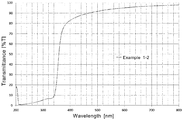
- the present invention is also preferably the silicon compound coated oxide particles wherein an average transmittance for the lights of wavelengths 200 nm to 380 nm in the state of a dispersion in which the silicon compound coated oxide particles are dispersed in a dispersion medium, is 15% or less, and an average transmittance for the lights of wavelengths of 380 nm to 780 nm is 80% or more.
- the present invention is also preferably the silicon compound coated oxide particles wherein oxide particles constituting the metal oxide particles are composite oxide particles composed of two or more kinds of elements, and color characteristics of the silicon compound coated oxide particles are in the range of 40 ⁇ L* ⁇ 95, -35 ⁇ a* ⁇ 35, or -35 ⁇ b* ⁇ 35 in the L*a*b* color system.
- the present invention is also preferably the silicon compound coated oxide particles wherein the silicon compound is a silicon compound containing an amorphous silicon oxide.
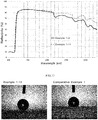
- the present invention is also preferably the silicon compound coated oxide particles wherein a contact angle of a water drop to a coated surface coated with the silicon compound coated oxide particles is 110 ° or more.
- the present invention can be performed as a silicon compound coated oxide composition for ultraviolet protection and water repellency or oil repellency, comprising the silicon compound coated oxide particles.
- the present invention can provide silicon compound coated oxide particles wherein a ratio of Si-OH bonds or a ratio of CF bonds / Si-OH bonds which is a ratio of CF bonds relative to Si-OH bonds contained in the silicon compound coated oxide particles, is controlled, and wettability such as water repellency, oil repellency or hydrophilicity is controlled, and color characteristics of any one of reflectivity, molar absorption coefficient or transmittance are controlled.
- a ratio of Si-OH bonds or a ratio of CF bonds / Si-OH bonds which is a ratio of CF bonds relative to Si-OH bonds contained in the silicon compound coated oxide particles is controlled, and the particles are silicon compound coated oxide particles having controlled color characteristics of reflectivity, molar absorption coefficient or transmittance, in addition to wettability such as water repellency, oil repellency or hydrophilicity.
- the silicon compound coated oxide particles of the present invention can be used as a composition suitable for effectively shielding ultraviolet rays or near infrared rays according to the purpose in addition to controlled water repellency or oil repellency, when used for a composition intended for use as a coating film, sealing material or coated body, a composition intended for use in a textile such as clothes, a composition for use in a clear coating film or glass for which transparency is required, or a composition for use in a transparent resin or film like composition. Furthermore, since it is possible to obtain a composition having high transmission property or transparency in the visible region, it is possible to provide a silicon compound coated metal oxide composition for water repellency or oil repellency which does not impair designability, aesthetic appearance or texture for a long time, and can be effectively used.
- the composition requiring transparency includes, for example, a composition contained in a glass, transparent resin or clear coating film, a film like composition used for a film combined with a glass, such as one attaching to a glass or transparent resin, and a paint for coating on a glass or transparent resin.
- the silicon compound coated oxide particles of the present invention are silicon compound coated oxide particles in which at least a part of a surface of a metal oxide particle is coated with a silicon compound.
- the metal is metal oxide particles containing a single element or a plurality of different elements of a metal element or a metalloid element in the chemical periodic table.
- the metal element in the present invention is not particularly limited, but includes preferably a divalent or trivalent metal element, more preferably a metal element such as Zn, Fe, Ce, Ti and the like.
- a metalloid element in the present invention is not particularly limited, but preferably includes a metalloid element such as Si, Ge, As, Sb, Te, Se and the like.
- metals and metalloids may be metal oxide particles composed of a single metal element, or may be composite metal oxide particles composed of a plurality of metal elements or composite metal oxide particles containing a metal element and a metalloid element.
- the present invention is silicon compound coated oxide particles, in the case where Si is contained in elements constituting the metal oxide, the metal oxide must be an oxide consisting of Si and a metal element or a plurality of elements with a metalloid element different from Si.
- the silicon compound coated oxide particles of the present invention are not limited to particles composed only of oxides.
- Oxide particles containing a compound other than oxides may be also used to the extent that the compound does not affect the present invention.
- silicon compound coated metal oxide particles in which at least a part of a surface of a metal oxide particle or composite metal oxide particle containing a compound other than oxides is coated with a silicon compound may be used.
- Examples of the above compound other than oxides include a hydroxide, nitride, carbide, various salts such as a nitrate and sulfate, and a hydrate and organic solvate.
- the silicon compound coated oxide particles of the present invention are silicon compound coated oxide particles in which a ratio of Si-OH bonds or a ratio of CF bonds / Si-OH bonds being a ratio of CF bonds relative to Si-OH bonds contained in the silicon compound coated oxide particles, is controlled. Therefore, the silicon compound coated oxide particles of the present invention include at least silicon (Si) and oxygen (O).
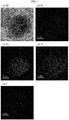
- a method of evaluating that silicon (Si) and oxygen (O) are contained, is preferably a method of observing a plurality of particles using a transmission electron microscope (TEM) or a scanning transmission electron microscope (STEM), and confirming a presence ratio and presence position of silicon relative to elements other than silicon in each particle by an energy dispersive X-ray analyzer (EDS).
- TEM transmission electron microscope
- STEM scanning transmission electron microscope
- the examples include a method of evaluating uniformity by specifying a presence ratio (molar ratio) of silicon and elements other than silicon contained in a single silicon compound coated oxide particle and calculating an average value of the mole ratio and its variation coefficient in the plurality of silicon compound coated oxide particles, or a method of specifying a presence position of silicon contained in the silicon compound coated oxide particles by mapping.
- the silicon compound coated oxide particles of the present invention are preferably silicon compound coated oxide particles in which silicon is detected in the vicinity of the surface layer of the particles in the STEM mapping or linear analysis.
- the silicon compound coated oxide particles of the present invention may be used as silicon compound coated oxide particles in which at least a part of a surface of the metal oxide particle is coated with a silicon compound.
- photocatalytic ability generated by micronization of oxide particles is preferably suppressed by coating at least a part of a surface of the particle with the silicon compound.
- chemical stability such as water resistance and acid / alkali resistance can be imparted to the oxide by coating a surface of the oxide particles with a silicon compound.
- a fluorine (F) is contained, and more preferably CF bonds are contained, in order to control wettability such as water repellency, oil repellency or hydrophilicity.
- the CF bonds are a fluorine or CF bonds derived from a trifluoromethyl group.
- the fluorine or CF bonds are mainly present on the surface side of the silicon compound coated oxide particles for the purpose of water repellency or oil repellency.
- the fluorine or CF bonds may be present inside the silicon compound coated oxide particles.
- CF 3 group trifluoromethyl group
- water repellency and oil repellency can be enhanced by including CF 3 groups in the particles, especially on the surface of the particles.
- water repellency, oil repellency, color characteristics such as ultraviolet absorption ability and near infrared reflection ability of the silicon compound coated oxide particles can be controlled, by controlling a ratio of CF bonds.
- a method of evaluating that a fluorine is contained in the silicon compound coated oxide particles includes the same method as that mentioned for silicon or oxygen.
- wettability such as water repellency or oil repellency and various color characteristics such as reflectivity, transmittance, molar absorption coefficient and the like are controlled by controlling a ratio of Si-OH bonds or a ratio of CF bonds / Si-OH bonds being a ratio of CF bonds relative to Si-OH bonds contained in the silicon compound coated oxide particles.
- the ratio of Si-OH bonds or the ratio of CF bonds / Si-OH bonds can be determined based on the FT-IR measurement results as an example.
- IR is an abbreviation of infrared absorption spectroscopy (hereinafter, simply referred to as IR).
- the ratio of Si-OH bonds or the ratio of CF bonds / Si-OH bonds may be measured by a method other than IR measurement, and the examples include an X-ray photoelectron spectroscopy (XPS), solid nuclear magnetic resonance (solid NMR), electron energy loss spectroscopy (EELS), and the like.
- XPS X-ray photoelectron spectroscopy
- solid NMR solid nuclear magnetic resonance
- EELS electron energy loss spectroscopy
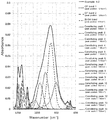
- a ratio of Si-OH bonds or a ratio of CF bonds / Si-OH bonds contained in the silicon compound coated oxide particles is preferably calculated by waveform separation of the peaks in the wavenumber range of 650 cm -1 to 1,300 cm -1 in an infrared absorption spectrum measurement of the silicon compound coated oxide particles.
- oxide particles having wettability such as water repellency, oil repellency or hydrophilicity and color characteristics controlled by controlling an area ratio of a peak obtained by separating waveforms as a peak from Si-OH bonds relative to a total area of peaks obtained by separating waveforms in the wavenumber range of 650 cm -1 to 1,300 cm -1 , or a ratio of a peak obtained by separating waveforms as a peak from CF bonds relative to a peak obtained by separating waveforms as a peak from Si-OH bonds (a ratio of CF bonds / Si-OH bonds), wherein a peak obtained by separating waveforms in the wavenumber range of 850 cm -1 to 950 cm -1 , preferably a peak obtained by separating waveforms in the wavenumber range of 890 cm -1 to 920 cm -1 is assigned as a peak derived from Si-OH bonds, and a peak obtained by separating waveforms in the wavenumber range of 1,200 cm -1 to 1,220 cm -1 is
- waveforms of different vibrations derived from Si-OH bonds may be separated into a plurality of peaks in the wavenumber range of 850 cm -1 to 950 cm -1 similarly to the CF bonds.
- the silicon compound coating at least a part of a surface of the metal oxide particle preferably contains an amorphous silicon oxide, because in particular a ratio of Si-OH bonds can be easily controlled.
- a method of evaluating that the silicon compound contains an amorphous silicon oxide is not particularly limited. However, the examples include a method of evaluating in combination of confirmation of presence of Si and O by an STEM mapping, and confirmation of presence of silicon oxide by an infrared absorption spectrum, and confirmation that a peak derived from crystalline silica (SiO 2 ) is not observed in an XRD measurement; and a method of confirming that a crystal lattice is not observed in a site where Si and O are detected in TEM observation or STEM observation, and the like.
- a molar absorption coefficient can be calculated from an absorbance and a molar concentration of a substance to be measured in a measurement sample in ultraviolet-visible absorption spectrum measurement, by Formula 1 below.
- ⁇ A / c ⁇ l
- ⁇ is a constant specific to the substance, and is referred to as a molar absorption coefficient. Since it means an absorbance of a dispersion at 1 mol/L with a thickness of 1 cm, the unit is L/(mol ⁇ cm).
- A is an absorbance in ultraviolet-visible absorption spectrum measurement.
- c is a molar concentration of a sample (mol/L).
- optical path length typically a thickness of a cell in measuring the ultraviolet-visible absorption spectrum.
- a simple average of the molar absorption coefficients for a plurality of wavelengths in the measurement wavelength range of 200 nm to 380 nm is calculated and evaluated as an "average molar absorption coefficient".
- the present invention in the same manner as a molar absorption coefficient and an average molar absorption coefficient in the ultraviolet region in the wavelength range from 200 nm to 380 nm, by controlling the ratio of Si-OH bonds or the ratio of CF bonds / Si-OH bonds, color characteristics such as a transmittance and average transmittance in a specific region of the visible wavelength range of 380 nm to 780 nm, and a reflectivity and average reflectivity in a specific region in the near infrared wavelength range of 780 nm to 2,500 nm, can be accurately and strictly controlled.
- particularly silicon compound coated oxide particles having water repellency and oil repellency suitable for a composition for ultraviolet protection or near infrared protection can be provided.
- the silicon compound coated oxide particles are suitable for a composition for ultraviolet protection or near infrared protection for not impairing aesthetic appearance and texture of a coated body or glass itself or designability, or a composition for a transparent material used for not impairing aesthetic appearance, designability or product properties of interior decorative articles or equipment having a glass containing the silicon compound coated oxide particles of the present invention.
- a silicon compound coated oxide particle composition for coloring having controlled wettability such as water repellency, oil repellency or hydrophilicity and color characteristics can be provided by coloring silicon compound coated oxide particles in which at least a part of a surface of a metal oxide particle is coated with a silicon compound, by using as the metal oxide particle a metal oxide particle consisting of at least two kinds of elements selected from the above metal elements and metalloid elements; and using the colored silicon compound coated oxide particles as the composition.
- M2/M1 and M2 are respectively a metal element or metalloid element
- the composition is suitable for use in a composition for coating or a composition for a transparent material which does not impair aesthetic appearance, texture, or aesthetic appearance due to its ability to efficiently protect lights in the ultraviolet region.
- the composition is also suitable for use in a composition for coloring because it can be colored positively depending on the purpose.
- M1 and M2 for the purpose of coloring the present invention is not limited to a composite oxide composed of two kinds of metal elements or metalloid elements. An oxide composed of three or more kinds of metal elements or metalloid elements such as M1, M2, M3 ... Mn, may be used in the present invention.
- the L*a*b* color system is one of the uniform color space and L* indicates a value representing brightness, and a larger numerical value indicates as being brighter.
- a* and b* indicate chromaticity.
- the color system is not limited to the L*a*b* color system. Color characteristics may be evaluated using other color systems such as XYZ system.
- coloring can be controlled from dark color to bright color.
- coloring can be brought close to a color friendly to human eyes without too strong tinting strength.
- the present invention is especially suitable for use as a composition for coloring for ultraviolet protection.
- a method of controlling the ratio of Si-OH bonds or the ratio of CF bonds / Si-OH bonds is not particularly limited, but it is preferable to control the ratio of Si-OH bonds or the ratio of CF bonds / Si-OH bonds by a modification treatment of a functional group contained in the silicon compound coated oxide particles.
- the modification treatment of a functional group is a fluorinating treatment.
- the modification treatment of a functional group may be performed by a method using a reaction such as a substitution reaction, addition reaction, elimination reaction, dehydration reaction, condensation reaction to a functional group contained in the silicon compound coated oxide particles, to control the ratio of Si-OH bonds or the ratio of CF bonds / Si-OH bonds.
- a reaction such as a substitution reaction, addition reaction, elimination reaction, dehydration reaction, condensation reaction to a functional group contained in the silicon compound coated oxide particles, to control the ratio of Si-OH bonds or the ratio of CF bonds / Si-OH bonds.
- the ratio of CF bonds or Si-OH bonds may be increased or decreased.
- CF bonds can be imparted to the silicon compound coated oxide particles, for example by an esterification reaction achieved by a dehydration and condensation reaction in which OH is removed from a carboxyl group (-COOH) of a carboxylic acid having a CF 3 group such as trifluoroacetic anhydride, and H is removed from a hydroxyl group (-OH) of an Si-OH group contained in the silicon compound coated oxide particles.
- a dehydration and condensation reaction in which OH is removed from a carboxyl group (-COOH) of a carboxylic acid having a CF 3 group such as trifluoroacetic anhydride, and H is removed from a hydroxyl group (-OH) of an Si-OH group contained in the silicon compound coated oxide particles.
- a method using a mixed acid anhydride, an acid halide or the like, or a method using a dehydrating agent such as a carbodiimide or the like can also be used.
- the esterification reaction it is also possible to control the ratio of Si-OH bonds or the ratio of CF bonds / Si-OH bonds by a method of forming an ether bond between a fluorine containing substance and Si by dehydration by reacting a substance having a fluorine and a hydroxyl group, or an alkyl halide, aryl halide, or heteroaryl halide having a fluorine with an Si-OH group, preferably in the presence of an acid catalyst; or by a method of forming a (thio)urethane bond by reacting an isocyanate or thioisocyanate containing a fluorine with an Si-OH group, or the like.
- the present invention is not limited to formation of other new bonds by directly reacting another substance or functional group with Si-OH bonds.
- the ratio of Si-OH bonds or the ratio of CF bonds / Si-OH bonds can also be controlled by a method of reacting a fluorine containing carboxylic acid contained in a carbodiimide or the like.
- the ratio of Si-OH bonds or the ratio of CF bonds / Si-OH bonds can also be controlled by a method of reacting hydrogen peroxide or ozone to the oxide particles.
- the ratio of Si-OH bonds or the ratio of CF bonds / Si-OH bonds can also be controlled by a method of controlling formulation of the oxide raw material liquid or the oxide precipitation solvent or the pH or the like, at the time of precipitating the silicon compound coated oxide particles.
- the ratio of Si-OH bonds or the ratio of CF bonds / Si-OH bonds can also be controlled by a method of a heat treatment of the silicon compound coated oxide particles as an example of a dehydration reaction.
- the ratio of Si-OH bonds or the ratio of CF bonds / Si-OH bonds is controlled by a method of a heat treatment of the silicon compound coated oxide particles
- a dry heat treatment may be performed, or a heat treatment of the silicon compound coated oxide particles in the state of a dispersion in which the silicon compound coated oxide particles are dispersed in a dispersion medium.
- the silicon compound coated oxide particles may be dispersed in a desired solvent, and a substance containing a functional group may be added to the dispersion, and the mixture may be subjected to a treatment such as stirring to control the ratio of Si-OH bonds or the ratio of CF bonds / Si-OH bonds.
- a dispersion containing the precipitated silicon compound coated oxide particles prepared by mixing the oxide raw material liquid, the oxide precipitation solvent and the silicon compound raw material liquid, as it is, may be subject to a treatment such as stirring to control the ratio of Si-OH bonds or the ratio of CF bonds / Si-OH bonds.
- a treatment such as stirring to control the ratio of Si-OH bonds or the ratio of CF bonds / Si-OH bonds.
- the slurry temperature or the temperature of the cleaning solution used for the cross flow may be changed to control the ratio of Si-OH bonds or the ratio of CF bonds / Si-OH bonds.
- the pH at precipitating the silicon compound coated oxide particles may be adjusted by adding a pH adjusting agent such as an acidic substance or a basic substance in at least one of various solutions and solvents in the present invention, or may be adjusted by changing a flow rate at the time of mixing the fluid containing the oxide raw material liquid and the fluid containing the oxide precipitation solvent.
- a pH adjusting agent such as an acidic substance or a basic substance in at least one of various solutions and solvents in the present invention
- a method of modifying a functional group contained in the silicon compound coated oxide particle of the present invention is not particularly limited.
- the silicon compound coated oxide particles may be dispersed in a desired solvent, and a substance containing a functional group may be added to the dispersion, and the mixture may be subjected to a treatment such as stirring.
- a fluid containing the silicon compound coated oxide particles and a fluid containing a substance containing a functional group may be mixed using a microreactor described in Patent Literature 6 or 7.
- the substance containing a functional group is not particularly limited.
- the substance is a substance containing a functional group substitutable with a hydroxyl group contained in the oxide particle, and includes an acylating agent such as acetic anhydride and propionic anhydride; a methylating agent such as dimethyl sulfurate and dimethyl carbonate; a silane coupling agent such as chlorotrimethylsilane, methyltrimethoxysilane, and the like.
- a ratio of Si-OH bonds can be controlled.
- a substance containing a CF bond for introducing CF bonds into silicon compound coated oxide particles includes various fluorinating compounds.
- the fluorinating compound examples include, but are not limited to, a fluorine containing compound such as trifluoroacetic acid and trifluoromethanesulfonic acid, or an anhydride thereof; a fluorine containing silane coupling agent such as triethoxy-1H, 1H, 2H, 2H-heptadecafluorodecylsilane and trimethoxy(3,3,3-trifluoropropyl)silane; or a fluorine compound such as trifluoromethane and trifluoroethane, and these listed fluorinating compounds are preferable because a trifluoromethyl group (CF 3 group) is included.
- a fluorine containing compound such as trifluoroacetic acid and trifluoromethanesulfonic acid, or an anhydride thereof
- a fluorine containing silane coupling agent such as triethoxy-1H, 1H, 2H, 2H-heptadecafluorodecyls
- CF bonds may be imparted by reacting the fluorinating compound with a hydroxyl group contained in the silicon compound coated oxide particles.
- silicon compound coated oxide particles containing CF bonds may be prepared by reacting the fluorinating compound at the time of precipitating the silicon compound coated oxide particles.
- the silicon compound coated oxide particles of the present invention may be prepared by a method of reacting a gas such as trifluoromethane and trifluoroethane with silicon compound coated oxide particles or silicon compound coated oxide particles having CF bonds already. And a ratio of Si-OH bonds or a ratio of CF bonds / Si-OH bonds contained in the silicon compound coated oxide particles can be controlled.
- a ratio of Si-OH bonds or a ratio of CF bonds / Si-OH bonds can also be controlled by a method of reacting hydrogen peroxide or ozone with the oxide particles.
- a method of reacting hydrogen peroxide or ozone with the oxide particles is not particularly limited.
- the silicon compound coated oxide particles may be dispersed in a desired solvent, and hydrogen peroxide or ozone or a solvent such as water containing it may be added to the dispersion, and the mixture may be subjected to a treatment such as stirring.
- a fluid containing the silicon compound coated oxide particles and a fluid containing hydrogen peroxide or ozone may be mixed using a microreactor described in Patent Literature 6 or 7.
- the dispersion may be a liquid dispersion in which the silicon compound coated oxide particles are dispersed in a liquid dispersion medium such as water, an organic solvent and a resin, or a coating film like dispersion prepared by using a dispersion containing the silicon compound coated oxide particles.
- a heat treatment in the state of a dispersion containing the silicon compound coated oxide particles aggregation of the particles can be suppressed as compared with a dry heat treatment.
- the silicon compound coated oxide particles of the present invention are used, for example, in the multilayer coating film and the highly designed multilayer coating film described in JP 2014-042891 and JP 2014-042892 , wettability such as water repellency, oil repellency or hydrophilicity and color characteristics of the silicon compound coated oxide particles can be controlled by controlling the ratio of CF bonds or the ratio of CF bonds / Si-OH bonds contained in the oxide particles by a heat treatment or the like after preparation of the multilayer coating film and the highly designed multilayer coating film from the silicon compound coated oxide particles. Therefore, it is suitable for reduction of number of steps, and control of water repellency or oil repellency to a water resistant body or glass, and strict control of color characteristics.
- the multilayer coating film and the highly designed multilayer coating film described in JP 2014-042891 and JP 2014-042892 achieve a sense of depth and denseness by increasing difference between highlight and shade for a specific color, thereby varying reflected lights greatly depending on an observation angle. Therefore, enhancement of a transmittance for a specific color for raising highlight, and increase of difference between highlight and shade, are required.
- a coating film containing a substance having a ultraviolet shielding property such as the silicon compound coated oxide for example, a clear coating film
- a molar absorption coefficient in the ultraviolet region, being a ultraviolet absorption ability of the silicon compound coated oxide particles increases, a transparency of the coating film as the oxide particle dispersion will be enhanced. Further, a haze value can be reduced by lowering an amount of usage of the silicon compound coated oxide particles.
- the silicon compound coated oxide particles can be suitably used for ultraviolet absorption or near infrared reflection by dispersing the silicon compound coated oxide particles in a glass, resin, or the like. Further, the silicon compound coated oxide particles can be suitably used as a silicon compound coated oxide composition for ultraviolet protection or near infrared protection because a transmission property for the visible light can be enhanced.
- water repellency, oil repellency or hydrophilicity and color characteristics of the silicon compound coated oxide particles can be controlled by controlling the ratio of CF bonds or the ratio of CF bonds / Si-OH bonds contained in the silicon compound coated oxide particles by a modification treatment of a functional group by a heat treatment, fluorinating treatment or the like after the silicon compound coated oxide particles are dispersed in a glass, transparent resin or the like to form a film. Therefore, similarly to the above multilayer coating film, it is suitable for reduction of number of steps, and strict control of water repellency or oil repellency and color characteristics.
- a primary particle diameter of the metal oxide in the silicon compound coated oxide particles is preferably 1 nm or more and 100 nm or less, more preferably 1 nm or more and 50 nm or less.
- a primary particle diameter of the silicon compound coated oxide particle is also preferably 1 nm or more and 100 nm or less, and more preferably 1 nm or more and 50 nm or less.
- control of a ratio of Si-OH bonds or a ratio of CF bonds / Si-OH bonds of the silicon compound coated oxide particles greatly affects wettability such as water repellency, oil repellency or hydrophilicity and color characteristics such as a transmission property, absorption property, reflection property, hue and chroma and the like of the silicon compound coated oxide particles.
- the silicon compound coated oxide particles having a primary particle diameter of 100 nm or less it is an advantage that predetermined color characteristics (particularly suitable color characteristics for use as a composition for use in a coating film, or coated body, a composition for textile applications such as clothing or the like, or a coated body required to have transparency, a glass, a transparent resin or a film like composition) can be exerted by controlling a ratio of Si-OH bonds or a ratio of CF bonds / Si-OH bonds contained in the silicon compound coated oxide particles.
- the average primary particle diameter of the silicon compound coated oxide particles after coating by the compound is 100.5% or more and 190% or less relative to the average primary particle diameter of the metal oxide particles before coating.
- the average primary particle diameter of the silicon compound coated oxide particles after coating by the silicon compound is not less than 100.5% relative to the average primary particle diameter of the metal oxide particles.
- the average primary particle diameter of the silicon compound coated oxide particles after coating by the silicon compound is not more than 190% relative to the average primary particle diameter of the oxide particles.
- the silicon compound coated oxide particles coated with a silicon compound of the present invention may be core/shell type silicon compound coated oxide particles in which the entire surface of the core metal oxide particle is uniformly coated with the compound.
- the silicon compound coated oxide particles are preferably silicon compound coated oxide particles in which a plurality of the metal oxide particles are not aggregated and at least a part of the surface of a single metal oxide particle is coated with the compound.
- the silicon compound coated oxide particles may be silicon compound coated oxide particles in which at least a part of the surface of an aggregate in which a plurality of metal oxide particles are aggregated, is coated with the compound.
- a compound coating at least a part of a surface of the oxide of the present invention is preferably a silicon compound, and more preferably a compound containing a silicon oxide, and further preferably a compound containing an amorphous silicon oxide.
- the amorphous silicon oxide as the silicon compound, color characteristics such as reflectivity, transmittance, a molar absorption coefficient, hue, chroma and the like of the silicon compound coated oxide particles can be controlled more strictly.
- the silicon compound is a crystalline silicon oxide, it is very difficult to make Si-OH be present, so that it may be difficult to control color characteristics of the present invention in some cases.
- a method of producing silicon compound coated oxide particles of the present invention it is preferable to use a method of producing the silicon compound coated oxide particles by providing an oxide raw material liquid containing at least a raw material of metal oxide particles to be coated with a silicon compound and an oxide precipitation solvent containing at least an oxide precipitation substance for precipitating metal oxide particles; and precipitating metal oxide particles by a method such as a reaction, crystallization, precipitation and coprecipitation, in a mixed fluid in which the oxide raw material liquid and the oxide precipitation solvent are mixed; and coating at least a part of the surface of the metal oxide particle with a silicon compound being a coating compound by mixing the mixed fluid containing the precipitated metal oxide particles with a silicon compound raw material liquid containing at least a raw material of the silicon compound.
- a plurality of different metal elements or metalloid elements contained in the metal oxide particles may be contained together in the oxide raw material liquid, or may be contained in the oxide raw material liquid and the oxide precipitation solvent respectively, or may be contained in both of the oxide raw material liquid and the oxide precipitation solvent or the silicon compound raw material liquid.
- a raw material of silicon compound coated oxide particles of the present invention is not particularly limited. Any substances can be used as long as the substances become silicon compound coated oxide particles in a manner such as a reaction, crystallization, precipitation, coprecipitation or the like.
- a compound of a metal element or metalloid element is referred to as a compound.
- the compound is not particularly limited, but includes, for example, a salt, an oxide, a hydroxide, a hydroxide oxide, a nitride, a carbide, a complex, an organic salt, an organic complex, an organic compound of the metal or metalloid including a metal element or metalloid element, or a hydrate thereof, an organic solvate thereof, and the like.
- a metal salt or metalloid salt is not particularly limited, but includes a nitrate, a nitrite, a sulfate, a sulfite, a carbonate, a formate, an acetate, a phosphate, a phosphite, a hypophosphite, a chloride, an oxy salt, an acetylacetonate of the metal or metalloid, or a hydrate thereof, an organic solvate thereof and the like.
- An organic compound includes a metal alkoxide, a metalloid alkoxide, and the like.
- metal compound or metalloid compound may be used alone, or a mixture of a plurality of these compounds may be used as a raw material of oxide particles.
- a metal oxide constituting the silicon compound coated oxide particles is a plurality of different metal elements or metalloid elements
- a molar ratio of M2 to M1 (M2/M1) constituting the M2 doped oxide particles is preferably 0.01 or more and 1.00 or less, wherein M1 is the main metal element and M2 is the subordinate metal element or metalloid element.
- a raw material of the silicon compound includes a silicon oxide, a silicon hydroxide, other compounds such as a silicon salt and a silicon alkoxide, and a hydrate thereof.
- it includes a silicate such as sodium silicate, phenyltrimethoxysilane, methyltrimethoxysilane, methyltriethoxysilane, 3-glycidoxypropyltrimethoxysilane, 3 -trifluoropropyl-trimethoxysilane, methacryloxypropyltriethoxysilane, tetramethoxysilane (TMOS), tetraethoxysilane (TEOS), and an oligomeric condensate of TEOS, for example, ethyl silicate 40, tetraisopropylsilane, tetrapropoxysilane, tetraisobutoxysilane, tetrabutoxysilane, and a similar material thereof.
- siloxane compound bis(triethoxysilyl)methane, 1,9-bis(triethoxysilyl)nonane, diethoxydichlorosilane, triethoxychlorosilane and the like may be used. These are not used only for coating surfaces of the particles, but also can be used as compounds containing the M1 or M2.
- each raw material of the metal oxide particles or a raw material of a silicon compound for coating is a solid, it is preferable to use each raw material in a molten state, or in a state of being mixed or dissolved in a solvent described below, including a dispersion state. Even when each raw material is a liquid or gas, it is preferable to use it in a state of being mixed or dissolved in a solvent described below, including a dispersion state.
- An oxide precipitation substance is not particularly limited as long as the substance can make a raw material of the silicon compound coated oxide particles contained in an oxide raw material liquid be precipitated as silicon compound coated oxide particles.
- an acidic substance or a basic substance may be used. It is preferable to use an oxide precipitation substance at least in the state that the substance is mixed, dissolved or molecularly dispersed in a solvent described below.
- a basic substance includes a metal hydroxide such as sodium hydroxide and potassium hydroxide, a metal alkoxide such as sodium methoxide and sodium isopropoxide, an amine compound such as triethylamine, diethylaminoethanol and diethylamine, ammonia and the like.
- a metal hydroxide such as sodium hydroxide and potassium hydroxide
- a metal alkoxide such as sodium methoxide and sodium isopropoxide
- an amine compound such as triethylamine, diethylaminoethanol and diethylamine, ammonia and the like.
- An acidic substance includes an inorganic acid such as aqua regia, hydrochloric acid, nitric acid, fuming nitric acid, sulfuric acid, fuming sulfuric acid, and an organic acid such as formic acid, acetic acid, chloroacetic acid, dichloroacetic acid, oxalic acid, trifluoroacetic acid, trichloroacetic acid, citric acid and the like.
- the basic substance and the acidic substance can also be used for precipitating silicon compound coated oxide particles or a compound for coating.
- a solvent used in preparation of an oxide raw material liquid, an oxide precipitation solvent and a silicon compound raw material liquid includes, for example, water, an organic solvent, or a mixed solvent of a plurality of these solvents.
- the water includes tap water, ion exchange water, pure water, ultrapure water, RO water (reverse osmosis water) and the like.
- the organic solvent includes, an alcohol solvent, an amide solvent, a ketone solvent, an ether solvent, an aromatic compound solvent, carbon disulfide, an aliphatic compound solvent, a nitrile solvent, a sulfoxide solvent, a halogen compound solvent, an ester solvent, an ionic liquid, a carboxylic acid compound, a sulfonic acid compound and the like.
- An alcohol solvent includes a monohydric alcohol such as methanol and ethanol, a polyol such as ethylene glycol and propylene glycol, and the like.
- dispersing agents or surfactants may be used depending on a purpose or necessity, as long as they do not adversely affect production of the silicon compound coated oxide particles of the present invention.
- a dispersing agent or a surfactant various generally used commercial products or products, and newly synthesized products and the like may be used.
- a dispersing agent such as an anionic surfactant, a cationic surfactant, a nonionic surfactant, and various polymers and the like may be used. These may be used alone or two or more thereof may be used in combination.
- the surfactant and dispersing agent may be contained in at least one fluid of the oxide raw material liquid and oxide precipitation solvent.
- the surfactant and dispersing agent may be contained in another fluid different from the oxide raw material liquid and oxide precipitation solvent.
- metal oxide particles coated with the silicon compound are produced by precipitation or the like as described above.
- the metal oxide particles are composed of a plurality of different elements M1 and M2, at least both M1 and M2 are preferably present inside the particles.
- M2 metallic element or metalloid element
- Oxides composed of M1 or M2 contained in the oxide raw material liquid have respective different pHs, temperatures and the like suitable for their precipitation.
- pH of the mixed liquid of the oxide raw material liquid and the oxide precipitation solvent gradually changes from acidic to basic, and at first when the pH becomes close to the pH at which either one of M1 and M2 tends to precipitate, an oxide of the one of M1 or M2 precipitates or begins to precipitate, and later when the pH of the mixed liquid changes to the basic side by further adding the oxide precipitation solvent, the other oxide different from the earlier precipitated oxide precipitates.
- the silicon compound raw material liquid is mixed with a fluid containing the metal oxide particles, it is important that after precipitating the metal oxide particles, the silicon compound precipitates on the surface of the metal oxide particles by adding the silicon compound raw material liquid at a rate faster than aggregation occurs. Furthermore, by introducing the silicon compound raw material liquid into the fluid containing the metal oxide particles, pH of the fluid containing the metal oxide particles and a concentration of the silicon compound raw material gradually change.
- the silicon compound for coating the surface of the particles precipitates after an easily dispersible state is changed to an easily aggregating state, there is a possibility that it becomes difficult to coat before aggregation and the characteristics of the present invention cannot be exhibited. It is preferable to actuate the silicon compound raw material contained in the silicon compound raw material liquid immediately after the metal oxide particles precipitate.
- the inventors of the present application have found that by controlling a ratio of Si-OH bonds or a ratio of CF bonds / Si-OH bonds contained in the silicon compound coated oxide particles, wettability such as water repellency, oil repellency or hydrophilicity, and color characteristics can be controlled, and has accomplished the present inventions.
- JP application 2016-111346 a priority claimed application of the present application, discloses silicon compound coated oxide particles wherein the silicon compound is a silicon oxide; and utilization of a substance containing a CF bond such as trifluoroacetic acid for imparting CF bonds to the silicon compound coated oxide particles at precipitation of the silicon compound coated oxide particles, and 3-trifluoropropyl-trimethoxysilane as an oxide raw material for shell; and that the particles have unique properties.
- the inventors of the present invention further discovered that by controlling Si-OH bonds contained in the silicon compound coated oxide particles, water repellency or oil repellency and color characteristics of the silicon compound coated oxide particles can be controlled.
- the silicon compound coated oxide particles of the present invention substantially correspond to the silicon compound coated oxide particles disclosed in JP 2016-111346 , a priority claimed application of the present application.
- a method of producing the silicon compound coated oxide particles of the present invention includes, for example, a method of producing the silicon compound coated oxide particles by using a microreactor, or by a reaction in a dilute system in a batch vessel or the like, and the like.
- the apparatus and method as proposed by the present applicant and described in JP 2009-112892 may be also used for producing the silicon compound coated oxide particles.
- the apparatus described in JP 2009-112892 comprises a stirring tank having an inner peripheral surface which cross-section is circular, and a mixing tool attached to the stirring tank with a slight gap to the inner peripheral surface of the stirring tank, wherein the stirring tank comprises at least two fluid inlets and at least one fluid outlet; from one of the fluid inlets, the first fluid to be processed containing one of the reactants among the fluids to be processed is introduced into the stirring tank; from one fluid inlet other than the above inlet, the second fluid to be processed containing one of reactants different from the above reactant is introduced into the stirring tank through a different flow path; at least one of the stirring tank and the mixing tool rotates at a high speed relative to the other to let the above fluids be in a state of a thin film; and in the above thin film, the reactants contained in the first and second fluids to be processed are reacted.
- JP 2009-112892 further describes that three or more inlet tubes may be provided as shown in FIGs. 4 and 5 to introduce three or more fluids to be processed into the stirring tank.
- the microreactor an apparatus using the same principle as the fluid processing apparatus described in Patent Literatures 6 and 7 can be used.
- metal oxide particles may be prepared by using a pulverization method such as a beads mill and the like, and then a process of coating oxide particles with a silicon compound may be performed in a reaction vessel or the microreactor described above or the like.
- the silicon compound coated oxide particles of the present invention is intended for wettability such as water repellency, oil repellency, hydrophilicity and the like, and protection of ultraviolet rays or near infrared rays, and coloring.
- the silicon compound coated oxide particles may be used as a composition for use in a coating film, sealing material or coated body, a composition for textile applications such as clothing or the like, or a coated body required to have transparency, a glass, a transparent resin or a film like composition.
- the silicon compound coated oxide particles may be used for a composition for coloring or a composition for a transparent material.
- composition for coating is not particularly limited, and examples thereof include a composition for coating for use in various paints such as a solvent based paint and water based paint, and a composition for coating intended for a cosmetic such as a lipstick and foundation, sunscreen and the like, or for application to a skin.
- the composition for a transparent material includes a composition for use in a coated body required to have transparency, a glass for use in a building or vehicle or a glass for eyeglasses, a transparent resin or a film like composition, and a composition contained in a glass, transparent resin or clear coating film, a composition contained in an intermediate film of a combined glass, a film like composition used for a film combined with a glass, such as one attaching to a glass or transparent resin, a paint for coating on a glass, and the like.
- the above transparent resin includes PMMA (polymethyl methacrylate), PC (polycarbonate), PET (polyethylene terephthalate), and the like.
- the silicon compound coated oxide particle composition of the present invention can be used by a method of mixing the silicon compound coated oxide particle composition of the present invention to a composition such as a coating film forming a paint or coated body or a cosmetic or the like, or a method of directly kneading them to a glass or pre-hardened glass or clear resin, or a method of mixing them in a film for various glasses or a composition for forming a clear coating film.
- composition for coating for ultraviolet or near infrared protection suitable for effectively shielding ultraviolet rays or near infrared rays according to the purpose, and having controlled wettability such as water repellency, oil repellency, hydrophilicity and the like, or a composition for a transparent material for ultraviolet or near infrared protection having controlled wettability such as water repellency, oil repellency, hydrophilicity and the like, can be obtained.
- composition for coating for ultraviolet or near infrared protection or the composition for a transparent material for ultraviolet or near infrared protection may further comprise an additive such as a pigment, dye, wetting agent, dispersing agent, color separation inhibitor, leveling agent, viscosity modifier, anti-skinning agent, anti-gelling agent, antifoaming agent, thickener, anti-sagging agent, antifungal agent, ultraviolet absorber, film-forming assistant agent, surfactant, resin component, if necessary, depending on its purpose.
- a resin component for painting purpose includes a polyester resin, melamine resin, phenol resin, epoxy resin, vinyl chloride resin, acrylic resin, urethane resin, silicone resin, fluorine resin and the like.
- a coating material which a paint containing the silicon compound coated oxide particles of the present invention is applied to may be a single layer coating material composed of a single composition for coating, or a multilayer coating material composed of a plurality of a composition for coating such as laminated coating film as described in JP 2014-042891 or JP 2014-042892 .
- the coating material may be performed by adding it to a paint containing a pigment, or to a paint such as a clear paint.
- a binder resin, curing agent, curing catalyst, leveling agent, surfactant, silane coupling agent, defoaming agent, coloring agent such as a pigment or dye, antioxidant and the like may be contained.
- the composition for coating for ultraviolet or near infrared protection or the composition for a transparent material for ultraviolet or near infrared protection having controlled wettability such as water repellency, oil repellency, hydrophilicity and the like of the present invention comprises powers of silicon compound coated oxide particles; a dispersion wherein silicon compound coated oxide particles are dispersed in a liquid dispersion medium; and a dispersion wherein silicon compound coated oxide particles are dispersed in a solid such as a glass and resin, and the like.
- the silicon compound coated oxide particles contained in the above composition may be composed of one silicon compound coated oxide particle, or may be composed of an aggregate of a plurality of silicon compound coated oxide particles, or may be composed of both of those.
- the silicon compound coated oxide particles are composed of an aggregate of a plurality of the silicon compound coated oxide particles, a size of the aggregate is preferably 100 nm or less.
- the composition for coating for ultraviolet or near infrared protection or the composition for a transparent material for ultraviolet or near infrared protection may be used together with various coloring materials, or may be a composition for overcoating on a glass as a coating film.
- a dispersion medium includes water such as tap water, distilled water, RO water (reverse osmosis water), pure water and ultrapure water; an alcohol solvent such as methanol, ethanol and isopropyl alcohol; a polyhydric alcohol solvent such as propylene glycol, ethylene glycol, diethylene glycol and glycerine; an ester solvent such as ethyl acetate and butyl acetate; an aromatic solvent such as benzene, toluene and xylene; a ketone solvent such as acetone and methyl ethyl ketone; a nitrile solvent such as acetonitrile; silicone oil, a vegetable oil, a wax and the like.
- water such as tap water, distilled water, RO water (reverse osmosis water), pure water and ultrapure water
- an alcohol solvent such as methanol, ethanol and isopropyl alcohol
- a polyhydric alcohol solvent such as propylene glycol, ethylene
- a color of a coating material used for the composition for coating for ultraviolet or near infrared protection or the composition for a transparent material for ultraviolet or near infrared protection having controlled wettability such as water repellency, oil repellency, hydrophilicity and the like of the present invention, or a transparent material such as a film, glass and the like used for the composition for a transparent material for ultraviolet or near infrared protection, is not particularly limited.
- the composition for coating for ultraviolet or near infrared protection or the composition for a transparent material for ultraviolet or near infrared protection of the present invention can be used for a desired hue.
- the silicon compound coated oxide particles of the present invention can strictly and accurately control color characteristics by controlling the ratio of Si-OH bonds or the ratio of CF bonds / Si-OH bonds, the silicon compound coated oxide particles are also suitable for use as a composition for coloring for ultraviolet or near infrared protection.
- the composition for coating, for a transparent material or for coloring of the present invention contains the silicon compound coated oxide particles, so that wettability such as water repellency, oil repellency, hydrophilicity and the like can be controlled, and ultraviolet or near infrared protection ability can be increased when the composition is used as a paint or coated material such as a coated body used for a building, vehicle, etc., or when the composition is used for as a transparent material of a film like composition such as a clear coating film or a glass or a display or a contact lens; for a coated body such as a building and vehicle, in addition to control of the wettability, decomposition of an organic substance contained in the coated body, or damages of a skin in a human body and the like can be suppressed; for a glass used for a building or vehicle and the like, in addition to control of the wettability, damages of an organic compound and equipment in a room by ultraviolet rays transmitted through the glass can be suppressed; temperature rise by near infrared rays can be
- composition for coating Color of composition for coating, composition for a transparent material or composition for coloring
- Colors of the coating material or transparent material include a white color, gray color or black color such as color of white color of a lightness of 10 to black color of a lightness 0 in the Munsell color system, a red color such as color having a hue from RP to YR in the Munsell hue circle; a yellow to green color such as a color having a hue from Y to BG in the Munsell hue circle; a blue to purple color such as a color having a hue from B to P in the Munsell hue circle (each of these colors includes a metallic color), and the like. These colors may be preferably blended to a composition for coating used for a coating material having these colors. However, the present invention is not limited to these colors, and may be a color of any other hues.
- compositions for coating or a composition for a transparent material containing the silicon compound coated oxide particles of the present invention to a top coat of a coating film or coated body exhibiting these colors, various compositions with controlled wettability such as water repellency, oil repellency, hydrophilicity and the like can be obtained, impairment of coloring of each color can be remarkably reduced, and effective coloring is also possible, so that it is also suitable as a composition for coloring for enhancing designability of a coated body.
- a pigment or dye optionally included in a composition for coating a transparent material or coloring, various pigments and dyes may be used, and for example, all pigments and dyes registered in the color index may be used.
- a pigment or dye constituting a pigment constituting a green color includes, for example, a pigment or dye classified into C. I. Pigment Green; a pigment constituting a blue color includes, for example, a pigment or dye classified into C. I. Pigment Blue; a pigment constituting a white color includes, for example, a pigment or dye classified into C. I. Pigment White; a pigment constituting a yellow color includes, for example, a pigment or dye classified into C. I. Pigment Yellow; a red color includes, for example, a pigment or dye classified into C. I. Pigment Red in the Color Index, a pigment or dye classified into C. I. Pigment Violet or C. I. Pigment Orange in the Color Index, and the like.
- More specific examples include a quinacridone pigment such as C. I. Pigment Red 122 and C. I. Violet 19; a diketopyrrolopyrrole pigment such as C. I. Pigment Red 254 and C. I. Pigment Orange73; a naphthol pigment such as C. I. Pigment Red 150 and C. I. Pigment Red 170; a perylene pigment such as C. I. Pigment Red 123 and C. I. Pigment Red 179; and an azo pigment such as C. I. Pigment Red 144, and the like.
- These pigments and dyes may be used alone, or a plurality of these may be mixed and used.
- the composition comprising the silicon compound coated oxide particles of the present invention may be also mixed in a composition for coating, a transparent material or coloring alone without mixing with the above pigments and dyes and the like.
- a part of the wet cake samples of the silicon compound coated oxide particles obtained in Examples was dispersed in propylene glycol monomethyl ether, and the resulting dispersion was dropped to a collodion membrane, and dried to prepare a TEM observation sample or an STEM observation sample.
- a part of the wet cake samples of the obtained silicon compound coated oxide particles was dispersed in propylene glycol, and further was diluted to 100 fold by isopropyl alcohol (IPA). The resulting diluted liquid was dropped to a collodion membrane, and dried to prepare a TEM observation sample or an STEM observation sample.
- IPA isopropyl alcohol
- the transmission electron microscopy JEM-2100 (JEOL Ltd.) equipped with the energy dispersive X-ray analyzer JED-2300 (JEOL Ltd.) was used.
- the observation condition was the acceleration voltage of 80 kV, and the observation magnification of 25,000 times or more.
- the particle diameters were calculated from the maximum distance between two points on the outer periphery of the silicon compound coated oxide particles observed by TEM, and the average value of the measured particle diameters of 100 particles (average primary particle diameter) was calculated.
- a molar ratio of the elemental components contained in the silicon compound coated oxide was calculated by TEM-EDS, and the average value of the results of calculated molar ratio for 10 or more particles was calculated.
- the atomic resolution analytical electron microscopy JEM-ARM200F (JEOL Ltd.) equipped with the energy dispersive X-ray analyzer Centurio (JEOL Ltd.) was used.
- the observation condition was the acceleration voltage of 80 kV and the observation magnification of 50,000 times or more, and a beam diameter of 0.2 nm was used for analysis.
- X-ray diffraction the powder X-ray diffractometer Empyrean (Spectris Co., Ltd., PANalytical Division) was used.
- the measurement condition was measurement range of 10 to 100 [°2Theta], Cu anticathode, tube voltage of 45 kV, tube current of 40 mA, and scanning speed of 0.3 °/min.
- the XRD was measured using the dry powders of the silicon compound coated oxide particles obtained in Examples and Comparative Examples.
- the Fourier transform infrared spectrophotometer FT/IR-6600 (JASCO Corporation) was used. The measurement condition was the resolution of 4.0 cm -1 and accumulated number of 1,024 times, using an ATR method under a nitrogen atmosphere. Waveform separation of peaks in the wavenumbers of 650 cm -1 to 1,300 cm -1 in the IR spectrum was processed by curve-fitting such that a residual square sum is 0.01 or less, using the spectral analysis program attached to the control software of FT/IR-6600. The FT-IR was measured using the dry powders of the silicon compound coated oxide particles obtained in Examples and Comparative Examples.
- Transmission spectrum, absorption spectrum, reflection spectrum, hue, and chroma were measured by ultraviolet visible near infrared spectroscopy (product name: V-770, JASCO Corporation). Measurement range of transmission spectrum was 200 nm to 800 nm, and measurement range of absorption spectrum was 200 nm to 800 nm, the sampling rate was 0.2 nm, and the measurement speed was low speed. The transmittances at a plurality of measurement wavelengths in a specific wavelength range were simply averaged to obtain average transmittance.
- a molar absorption coefficient at each measurement wavelength was calculated from the absorbance obtained from the measurement result and the concentration of the oxide particles in the dispersion, and the graph was prepared showing the measurement wavelength on the horizontal axis and the molar absorption coefficient on vertical axis.
- a liquid cell of thickness of 1 cm was used for measurements.
- the molar absorption coefficients measured at a plurality of wavelengths from 200 nm to 380 nm were simply averaged to obtain an average molar absorption coefficient.
- Measurement range of reflection spectrum was 200 to 2,500 nm, and the sampling rate was 2.0 nm, and the measurement speed was medium speed, and measurement method was a double beam photometry. Total reflection measurement for measuring specular reflection and diffuse reflection was performed. For a background measurement (baseline) in measuring powders, the standard white plate (product name: SpectralonTM, Labsphere Inc.) was used. Reflection spectrum was measured using dry powders of the silicon compound coated oxide particles in Examples. Reflectivities at a plurality of measurement wavelengths in a specific wavelength range were simply averaged to obtain an average reflectivity.
- Hue and chroma were measured from the reflection spectrum measurement result in the L*a*b* color system, in which the field of view was 2 (deg), the light source was D65-2, the color matching function was JIS Z 8701: 1999, and the data interval as 5 nm.
- Example 1 describes silicon compound coated zinc oxide particles in which at least a part of a surface of a zinc oxide particle as a metal oxide particle is coated with a silicon compound.
- An oxide precipitation solvent (liquid A), an oxide raw material liquid (liquid B), and a silicon compound raw material liquid (liquid C) were prepared using the high-speed rotary dispersion emulsification apparatus CLEAMIX (product name: CLM-2.2 S, M. Technique Co., Ltd.). Specifically, based on the formulation of the oxide raw material liquid shown in Example 1 of Table 1, the components of the oxide raw material liquid were mixed homogeneously by stirring using CLEARMIX at preparation temperature of 40 °C and at the rotor rotational speed of 20,000 rpm for 30 min to prepare the oxide raw material liquid.
- the components of the oxide precipitation solvent were mixed homogeneously by stirring using CLEARMIX at preparation temperature of 45 °C and at the rotor rotational speed of 15,000 rpm for 30 min to prepare the oxide precipitation solvent.
- CLEARMIX methanol
- the above preparation process was not performed.
- the components of the silicon compound raw material liquid were mixed homogeneously by stirring using CLEARMIX at preparation temperature of 20 °C and at the rotor rotational speed of 6,000 rpm for 10 min to prepare the silicon compound raw material liquid.
- MeOH is methanol (Godo Co., Ltd.)
- EG is ethylene glycol (Kishida Chemical Co., Ltd.)
- KOH is potassium hydroxide (Nippon Soda Co., Ltd.)
- TEOS is tetraethyl orthosilicate (Wako Pure Chemical Industry Ltd.)
- ZnO is zinc oxide (Kanto Kagaku Co., Ltd.)
- Zn(NO 3 ) 2 ⁇ 6H 2 O is zinc nitrate hexahydrate (Kanto Kagaku Co., Ltd.)
- Co(NO 3 ) 2 ⁇ 6H 2 O is cobalt nitrate hexahydrate (Kanto Kagaku Co., Ltd.)
- Mn(NO 3 ) 2 ⁇ 6H 2 O is manganese nitrate hexahydrate (Kanto Kagaku Co., Ltd.)
- Al(NO 3 ) 3 ⁇ 9H 2 O is aluminum nitrate
- the fluid processing apparatus described in Patent Literature 7 is an apparatus described in FIG. 1(B) of Patent Literature 7, wherein the openings of the second and third introduction parts have concentric annular shapes which are surrounding the central opening of the processing surface 2 which is a ring-shaped disc, which was used.
- the oxide raw material liquid or the oxide precipitation solvent as liquid A was introduced from the first introduction part d1 into the space between the processing surfaces 1 and 2, and while driving the processing member 10 at a rotational speed of 1,130 rpm, as liquid B the other liquid of the oxide raw material liquid and the oxide precipitation solvent other than the liquid sent as liquid A was introduced from the second introduction part d2 into the space between the processing surfaces 1 and 2, and the oxide raw material liquid and the oxide precipitation solvent were mixed in the thin film fluid, to let the core zinc oxide particles be precipitated in the space between the processing surfaces 1 and 2.
- the silicon compound raw material liquid as liquid C was introduced from the third introduction part d3 into the space between the processing surfaces 1 and 2, and liquid C was mixed with a mixed fluid containing the core zinc oxide particles in the thin film fluid.
- the silicon compound was precipitated on the surface of the core zinc oxide particles.
- the discharge liquid containing the silicon compound coated zinc oxide particles (hereinafter, the silicon compound coated zinc oxide particle dispersion) was discharged from the space between the processing surfaces 1 and 2 of the fluid processing apparatus.
- the silicon compound coated zinc oxide particle dispersion was collected in the beaker b through the vessel v.
- Table 2 shows the operating conditions of the fluid treatment apparatus, and the average primary particle diameters calculated from the TEM observation result of the silicon compound coated zinc oxide particles, and the molar ratios of F/Si/Zn calculated from TEM-EDS analysis, and the calculated values calculated from the formulations and introduction flow rates of liquid A, liquid B and liquid C.
- core zinc oxide particles are a complex oxide containing a metal element or metalloid element other than zinc for the purpose of coloring
- the molar ratio of F/Si/(Zn+M2+M3) is referred to the ratio, wherein M2 and M3 represent the metal element or metalloid element different from zinc.
- the introduction temperatures (liquid sending temperatures) and the introduction pressures (liquid sending pressures) of liquid A, liquid B and liquid C shown in Table 2 were measured using a thermometer and a pressure gauge provided in a sealed inlet path leading to the space between the processing surfaces 1 and 2 (the first introduction part d1, the second introduction part d2 and the third introduction part d3).
- the introduction temperature of liquid A shown in Table 2 is the actual temperature of liquid A under the introduction pressure in the first introduction part d1.
- the introduction temperature of liquid B shown in Table 2 is the actual temperature of liquid B under the introduction pressure in the second introduction part d2.
- the introduction temperature of liquid C shown in Table 2 is the actual temperature of liquid C under the introduction pressure in the third introduction part d3.
- the pH meter model number D-51 manufactured by HORIBA Ltd. was used.
- the pHs of liquid A, liquid B and liquid C were measured at room temperature prior to introduction into the fluid processing apparatus. Further, it is difficult to measure the pH of the mixed fluid immediately after mixing the oxide raw material liquid and the oxide precipitation solvent, and the pH of the mixed fluid immediately after mixing the fluid containing the core zinc oxide particles and the silicon compound raw material liquid. Therefore, the silicon compound coated zinc oxide particle dispersion was discharged from the apparatus and collected in the beaker b, and the pH of the liquid was measured at room temperature.
- Dry powders and wet cake samples were produced from the silicon compound coated zinc oxide particle dispersion which was discharged from the fluid processing apparatus, and collected in the beaker b.
- the manufacturing method was conducted according to a conventional method of this type of processing.
- the discharged silicon compound coated zinc oxide particle dispersion was collected, and the silicon compound coated zinc oxide particles were settled, and the supernatant was removed. Thereafter, the silicon compound coated zinc oxide particles were washed and settled three times repetitively with 100 parts by weight of pure water, and then, were washed and settled three times repetitively with pure water.
- a part of the finally obtained wet cake of the silicon compound coated zinc oxide particles was dried at 25 °C at -0.10 MPaG for 20 hours to obtain the dry powders. The rest was the wet cake sample.
- Example 1-1 to 1-3 a temperature at which metal oxide particles were precipitated, and a fluid containing a silicon compound and a substance containing CF bonds (fluorinating agent) was allowed to act on the metal oxide particles, was changed for the purpose of changing a ratio of Si-OH bonds or a ratio of CF bonds / Si-OH bonds which is a ratio of Si-OH bonds relative to CF bonds.
- type of a fluorinating agent in Example 1-1 was changed.
- the metal oxide to be coated is not only zinc (Zn), but also cobalt (Co), iron (Fe), manganese (Mn) or aluminum (Al) for the purpose of coloring the silicon compound coated zinc oxide particles.
- Examples 1-1 to 1-10 a ratio of Si-OH bonds and CF bonds contained in the silicon compound coated zinc oxide particles was controlled between two processing surfaces being capable of approaching to and separating from each other and rotating relative to each other.
- modification treatment of a functional group contained in the silicon compound coated zinc oxide particles (Example 1-11)
- the silicon compound coated zinc oxide particles were fluorinated by reacting the silicon compound coated zinc oxide particles obtained in Comparative Example 1 with trifluoroacetic anhydride.
- the silicon compound coated zinc oxide particles obtained in Comparative Example 1 were added to methyl ethyl ketone in an amount of 0.1 % by mass as silicon compound coated zinc oxide particles, and were mixed and dispersed homogeneously by stirring using the high-speed rotary dispersion emulsification apparatus CLEAMIX (product name: CLM-2.2 S, M. Technique Co., Ltd.) at preparation temperature of 30 °C and at the rotor rotational speed of 20,000 rpm for 30 min to prepare the silicon compound coated zinc oxide particle dispersion.
- CLEAMIX product name: CLM-2.2 S, M. Technique Co., Ltd.
- Example 1-1 The silicon compound coated zinc oxide particles obtained in Example 1-1 were subjected with a heat treatment using an electric furnace as a modification treatment of a functional group contained in the silicon compound of the silicon compound coated zinc oxide particles.
- the heat treatment conditions were, Example 1-1: untreated, Example 1-12: 100 °C for 30 minutes, Example 1-13: 200 °C for 30 minutes, Example 1-14: 200 °C for 60 minutes, Example 1-15: 200 °C for 90 minutes.
- the silicon compound coated zinc oxide particles of Example 1-1 were subjected to a heat treatment using an electric furnace while flowing methane trifluoride gas, as a modification treatment of a functional group contained in the silicon compound of the silicon compound coated zinc oxide particles.
- the heat treatment conditions were, Example 1-16: 100 °C for 60 minutes (gas flow: 2 L/min), Example 1-17: 200 °C for 60 minutes (gas flow: 2 L/min), Example 1-18: 200 °C for 60 minutes (gas flow: 5 L/min).
- the silicon compound coated zinc oxide particles obtained in Comparative Example 1 were subjected to a heat treatment using an electric furnace as a modification treatment of a functional group contained in the silicon compound of the silicon compound coated zinc oxide particles.
- the heat treatment conditions were, Comparative Example 1: untreated, Example 1-19: 100 °C for 30 minutes, Example 1-20: 200 °C for 30 minutes, Example 1-21: 200 °C for 60 minutes, Example 1-22: 200 °C for 90 minutes.
- FIG. 1 shows an STEM mapping result of the silicon compound coated zinc oxide particles obtained in Example 1-2.
- FIG. 2 shows the result of a linear analysis at the position indicated by the broken line in the BF image of FIG. 1 .
- (a) shows a mapping result of a bright field (BF image)
- (b) shows a mapping result of silicon (Si)
- (c) shows a mapping result of zinc (Zn)
- (d) shows a mapping result of oxygen (O)
- e) shows a mapping result of fluorine (F).
- FIG. 2 shows the result of a linear analysis at the position indicated by the broken line in the BF image of FIG. 1 , which shows the atomic% (mol%) of the elements detected in the line part from the edge to the other edge of the particle.
- Example 2 oxygen, silicon and fluorine were detected from end to end in the analysis range in the linear analysis, but zinc was detected only up to about several nm inside from the edge of the particle. It is understood that the surface of zinc oxide particle was coated with a silicon compound containing a silicon oxide and a compound containing a fluorine. As seen from FIGs. 1 and 2 , the silicon compound coated zinc oxide particles obtained in Example 1-2 were observed as a zinc oxide particle in which whole the particle was coated with a silicon compound and a compound containing a fluorine. In the silicon compound coated zinc oxide particles obtained in Example 1-1 and Examples 1-3 to 1-22, STEM mapping and linear analysis results similar to those of Example 1-2 were obtained.
- the silicon compound coated zinc oxide particles in which whole the zinc oxide particle was not coated with a silicon oxide, but a part of the surface of the zinc oxide particle was coated with a silicon compound containing a silicon oxide were also observed.
- the present invention can be performed as silicon compound coated oxide particles in which at least a part of a surface of a metal oxide particle is coated with a silicon compound.
- FIG. 3 shows IR measurement results measured by the ATR method of the silicon compound coated zinc oxide particles obtained in Example 1-2, Example 1-11 and Comparative Example 1.
- a new peak was observed in the area of around 1,000 cm -1 cm to around 1,300 cm -1 in the IR measurement results of the silicon compound coated oxide particles obtained in Example 1-2 and Example 1-11, in comparison with the IR measurement result of the silicon compound coated zinc oxide obtained in Comparative Example 1.
- a peak around 1,673 cm -1 derived from a carbonyl group was observed in the silicon compound coated zinc oxide particles obtained in Example 1-11.
- FIGs. 4 , 5 and 6 show the results of waveform separation of the IR measurement results between wavenumbers 650 cm -1 and 1,300 cm -1 , respectively of the silicon compound coated zinc oxide particles obtained in Comparative Example 1, of the silicon compound coated zinc oxide particles obtained in Example 1-2, and of the silicon compound coated zinc oxide particles obtained in Example 1-11.
- Example 6 can be assigned to CF bonds, so that it has been confirmed that the silicon compound coated zinc oxide particles obtained in Example 1-2 and Example 1-11 were silicon compound coated zinc oxide particles containing CF bonds.
- a ratio of the area of Si-OH bonds relative to the total area of the separated waveform peaks was lowered in the fluorinated silicon compound coated zinc oxide particles obtained in Example 1-2 and Example 1-11, as compared with one in the silicon compound coated zinc oxide particles obtained in Comparative Example 1.
- wettability such as water repellency, oil repellency or hydrophilicity and color characteristics of the silicon compound coated zinc oxide particles can be controlled, by controlling an area ratio of the area of Si-OH bonds (Si-OH ratio [%]) relative to the total area of the separated waveform peaks in the wavenumber of 650 cm -1 to 1,300 cm -1 in the IR spectrum, or an area ratio of CF bonds / Si-OH bonds which is an area ratio of the area ratio of Si-OH bonds (Si-OH ratio [%]) relative to the area ratio of CF bonds (CF ratio [%]).
- FIG. 7 shows an XRD measurement result of the silicon compound coated zinc oxide particles obtained in Example 1-2.
- the silicon compound containing a silicon oxide observed in the STEM and IR measurements was an amorphous silicon compound.
- Example 1-1 and Examples 1-3 to 1-22 similar XRD measurement results were obtained.
- FIG 8 shows a graph of the molar absorption coefficient results of the dispersions obtained by dispersing in propylene glycol monomethyl ether (PGME) the fluorinated silicon compound coated zinc oxide particles obtained in Example 1-2, Example 1-3, Example 1-5 and Example 1-11, and the molar absorption coefficient result of the dispersion obtained by dispersing in propylene glycol (PG) the silicon compound coated zinc oxide particles obtained in Comparative Example 1.
- a dispersion medium for Comparative Example 1 was propylene glycol, because the particles of Comparative Example 1 were not fluorinated silicon compound coated zinc oxide particles, and hydrophilicity of the particles was high due to the ratio of Si-OH bonds exceeding 70%.
- a dispersion medium for Example 1-2, Example 1-3, Example 1-5 and Example 1-11 was changed to propylene glycol monomethyl ether, because water repellency was increased by fluorination. Thereby, molar absorption coefficients were measured in a condition that primary particle diameters and dispersed particle diameters were similar.
- the silicon compound coated zinc oxide particles obtained in Comparative Example 1 were dispersed in propylene glycol monomethyl ether, dispersion stability was very low, and the particles were precipitated immediately after completion of dispersing treatment.
- the silicon compound coated zinc oxide particles obtained in Example 1 -2, Example 1-3, Example 1-5, and Example 1-11 were dispersed in propylene glycol, similarly the particles were precipitated immediately after completion of dispersing treatment.
- propylene glycol monomethyl ether was used as a dispersion medium of a dispersion for measuring a molar absorption coefficient and transmittance
- propylene glycol was used as a dispersion medium.
- Example 8 it has been found that molar extinction coefficients in the wavelength range of 200 nm to 380 nm of the silicon compound coated zinc oxide particles obtained in Example 1-2, Example 1-3, Example 1-5 and Example 1-11 were increased more than one of Comparative Example 1. Namely, it has been found that by changing a ratio of Si-OH bonds contained in the particles, an average molar absorption coefficient in the wavelength range of 200 nm to 380 nm changes. In Examples 1-1 to 1-22 above, the average molar absorption coefficients in the wavelength range of 200 nm to 380 nm are 650 L/(mol ⁇ cm) or more, and the particles have an ability to effectively absorb lights in the ultraviolet wavelength range of 200 nm to 380 nm.
- FIG 9 shows a transmission spectrum of the dispersion obtained by dispersing in propylene glycol monomethyl ether the silicon compound coated zinc oxide particles obtained in Example 1-2.
- an average transmittance in the wavelength range of 200 nm to 380 nm was 15% or less, and one in the wavelength range of 380 nm to 780 nm was 80% or more, so that the dispersion has very high transmission property for lights in the visible region, and can be suitably used for various compositions.
- FIG 10 shows reflectivity measurement results of the silicon compound coated zinc oxide particles obtained in Example 1-2 and Example 1-11. As seen from FIG. 10 , an average reflectivity in the wavelength range of 780 nm to 2,500 nm was 50% or more, so that it has been found that the particles have high reflection property for lights in the near infrared region.
- a dispersion obtained by dispersing the silicon compound coated zinc oxide particles obtained in Example 1-13 in propylene glycol monomethyl ether was coated on a glass substrate using the spin coater (MS-A100, MIKAS Co., Ltd.), and dried in vacuum (-0.1 MPaG) at 200 °C for 2 hours to obtain a silicon compound coated zinc oxide particle coating film. Further, a dispersion obtained by dispersing the silicon compound coated zinc oxide particles obtained in Comparative Example 1 in propylene glycol was coated on a glass substrate using the spin coater (MS-A100, MIKASA Co., Ltd.), and dried in vacuum (-0.1 MPaG) at 20 °C for 20 hours to obtain a silicon compound coated zinc oxide particle coating film.
- a contact angle of the obtained coating film against pure water or castor oil was measured using the contact angle meter (LSE-B 100; ASUMI GIKEN, Limited). The contact angle was calculated using the ⁇ /2 calculation method. A photograph of the measurement using pure water is shown in FIG. 11 .
- the contact angle of Example 1-13 was 159.7 °, and the contact angle of Comparative Example 1 was 95.1 °. From this result, it has been found that the silicon compound coated zinc oxide particles obtained in Example 1-13 have improved water repellency.
- Table 3 shows a ratio of Si-OH bonds, ratio of CF bonds, ratio of CF bonds / Si-OH bonds, average reflectivity, average molar absorption coefficient, average transmittance, L* value, a* value, b* value, hue, chroma, and contact angle of the silicon compound coated zinc oxide particles obtained in Examples 1-1 to 1-22 and Comparative Example 1.
- a ratio of CF bonds / Si-OH bonds is 0 or more and 4.5 or less, a ratio of Si-OH bonds is 5% or more and 70% or less, and an average molar absorption coefficient in the wavelength range of 200 nm to 380 nm in the state of a dispersion in which the silicon compound coated oxide particles are dispersed in a dispersion medium is 650 L/(mol-cm) or more.
- coloring was also possible by combining elements such as Fe, Co, Mn, and A1 with zinc oxide particles.
- Example 2 describes silicon compound coated iron oxide particles in which at least a part of a surface of an iron oxide particle as an oxide particle is coated with a silicon compound.
- the particles were prepared in the same manner as in Examples 1-1 to 1-6 except that the preparation conditions were changed to those shown in Tables 4 and 5.
- MeOH is methanol (Godo Co., Ltd.)
- TEOS is tetraethyl orthosilicate (Wako Pure Chemical Industry Ltd.)
- Fe(NO 3 ) 3 ⁇ 9H 2 O is iron nitrate nonahydrate (Kanto Kagaku Co., Ltd.)
- NaOH is sodium hydroxide (Kanto Kagaku Co., Inc.)
- NMP is N-methyl-2-pyrrolidone (Kishida Chemical Co., Ltd.)
- fluorinating agent 1 is triethoxy-1H, 1H, 2H, 2H-heptadecafluorodecylsilane (Tokyo Chemical Industry Co., Ltd.)
- fluorinating agent 2 is trimethoxy-(3,3,3-trifluoropropyl)-silane (Tokyo Chemical Industry Co., Ltd.)
- fluorinating agent 3 is trifluoroacetic anhydride (Kanto Kagaku
- Example 2 As an STEM mapping result and linear analysis result and XRD measurement result, the same results as in Example 1 were obtained, and in the XRD measurement result, only a peak derived from ⁇ -Fe 2 O 3 was detected.
- Table 6 shows a ratio of Si-OH bonds, ratio of CF bonds, ratio of CF bonds / Si-OH bonds, average reflectivity, average molar absorption coefficient, average transmittance, and contact angle of the silicon compound coated iron oxide particles obtained in Examples 2-1 to 2-6 and Comparative Example 2.
- water repellency or oil repellency and color characteristics can be controlled as in Example 1 by controlling the ratio of Si-OH bonds or the ratio of CF bonds / Si-OH bonds contained in the silicon compound coated oxide particles.
- silicon compound coated iron oxide particles are preferably silicon compound coated iron oxide particles wherein a ratio of CF bonds / Si-OH bonds is 0 or more and 4.5 or less, a ratio of Si-OH bonds is 5% or more and 70% or less, and an average molar absorption coefficient in the wavelength range of 200 nm to 380 nm in the state of a dispersion in which the silicon compound coated iron oxide particles are dispersed in a dispersion medium is 1,500 L/(mol ⁇ cm) or more.
- Example 3 describes silicon compound coated cerium oxide particles in which at least a part of a surface of a cerium oxide particle as an oxide particle is coated with a silicon compound.
- the particles were prepared in the same manner as in Examples 1-1 to 1-6 except that the preparation conditions were changed to those shown in Tables 7 and 8.
- MeOH is methanol (Godo Co., Ltd.)
- TEOS is tetraethyl orthosilicate (Wako Pure Chemical Industry Ltd.)
- Ce(NO 3 ) 3 ⁇ 6H 2 O is cerium nitrate hexahydrate (Kanto Kagaku Co., Ltd.)
- NaOH is sodium hydroxide (Kanto Kagaku Co., Inc.)
- NMP is N-methyl-2-pyrrolidone (Kishida Chemical Co., Ltd.)
- fluorinating agent 1 is triethoxy-1H, 1H, 2H, 2H-heptadecafluorodecylsilane (Tokyo Chemical Industry Co., Ltd.)
- fluorinating agent 2 is trimethoxy-(3,3,3-trifluoropropyl)-silane (Tokyo Chemical Industry Co., Ltd.)
- fluorinating agent 3 is trifluoroacetic anhydride (Kanto
- Example 2 As an STEM mapping result and linear analysis result and XRD measurement result, the same results as in Example 1 were obtained, and in the XRD measurement result, only a peak derived from CeO 2 was detected.
- Table 9 shows a ratio of Si-OH bonds, ratio of CF bonds, ratio of CF bonds / Si-OH bonds, average reflectivity, average molar absorption coefficient, average transmittance, and contact angle of the silicon compound coated cerium oxide particles obtained in Examples 3-1 to 3-6 and Comparative Example 3.
- water repellency or oil repellency and color characteristics can be controlled as in Examples 1 and 2 by controlling the Si-OH ratio or the ratio of CF bonds / Si-OH bonds contained in the silicon compound coated oxide particles.
- silicon compound coated cerium oxide particles are preferably silicon compound coated cerium oxide particles wherein a ratio of CF bonds / Si-OH bonds is 0 or more and 4.5 or less, a ratio of Si-OH bonds is 5% or more and 70% or less, and an average molar absorption coefficient in the wavelength range of 200 nm to 380 nm in the state of a dispersion in which the silicon compound coated cerium oxide particles are dispersed in a dispersion medium is 3,500 L/(mol ⁇ cm) or more.
- Example 3-1 Example 3-2
- Example 3-3 Example 3-4
- Example 3-5 Comparative Example 3 Ratio of Si-OH [%] 39.6 21.2 5.3 56.4 60.0 66.2 72.2
- Average reflectivity [%] 780-2,500nm 68.6 71.9 76.4 66.4 64.1 61.2 48.6
- Average tranmittance [%] 200-380nm (dispersion medium: PGME) 6.6 6.6 7.1 6.6 5.5 6.2 5.9 *)
- 380-780nm (dispersion medium: PGME) 88.1 83.2 81.2 87.1 86.6 86.3 8
- Example 4 describes silicon compound coated titanium oxide particles in which at least a part of a surface of a titanium oxide particle as an oxide particle is coated with a silicon compound.
- the particles were prepared in the same manner as in Examples 1-1 to 1-6 except that the preparation conditions were changed to those shown in Tables 10 and 11.
- MeOH is methanol (Godo Co., Ltd.)
- TEOS is tetraethyl orthosilicate (Wako Pure Chemical Industry Ltd.)
- TiOSO 4 ⁇ nH 2 O is titanyl sulfate n hydrate (Kanto Kagaku Co., Ltd., TiOSO 4 ⁇ 2H 2 O was used)
- NaOH is sodium hydroxide (Kanto Kagaku Co., Inc.)
- NMP is N-methyl-2-pyrrolidone (Kishida Chemical Co., Ltd.)
- fluorinating agent 1 is triethoxy-1H, 1H, 2H, 2H-heptadecafluorodecylsilane (Tokyo Chemical Industry Co., Ltd.)
- fluorinating agent 2 is trimethoxy-(3,3,3-trifluoropropyl)-silane (Tokyo Chemical Industry Co., Ltd.)
- fluorinating agent 3 is trifluorfluorin
- Example 2 As an STEM mapping result and linear analysis result and XRD measurement result, the same results as in Example 1 were obtained, and in the XRD measurement result, only a peak derived from TiO 2 was detected.
- Table 12 shows a ratio of Si-OH bonds, ratio of CF bonds, ratio of CF bonds / Si-OH bonds, average reflectivity, average molar absorption coefficient, average transmittance, and contact angle of the silicon compound coated titanium oxide particles obtained in Examples 4-1 to 4-6 and Comparative Example 4.
- water repellency or oil repellency and color characteristics can be controlled as in Examples 1 to 3 by controlling the ratio of Si-OH bonds or the ratio of CF bonds / Si-OH bonds contained in the silicon compound coated oxide particles.
- silicon compound coated titanium oxide particles are preferably silicon compound coated titanium oxide particles wherein a ratio of CF bonds / Si-OH bonds is 0 or more and 4.5 or less, a ratio of Si-OH bonds is 5% or more and 70% or less, and an average molar absorption coefficient in the wavelength range of 200 nm to 380 nm in the state of a dispersion in which the silicon compound coated titanium oxide particles are dispersed in a dispersion medium is 4,000 L/(mol ⁇ cm) or more.
- Example 4-1 Example 4-2
- Example 4-3 Example 4-4
- Example 4-5 Example 4-6 Comparative Example 4 Ratio of Si-OH [%] 39.8 21.6 5.2 56.2 57.2 65.2 71.8
- Average reflectivity [%] 780-2,500nm 64.1 68.7 72.6 61.8 58.6 55.3 Average molar absorption coefficient [L/I(mol ⁇ cm)] 200-380nm (dispersion medium: PGME) 4545 4636 4763 4369 4236 4162 3456 *)
- 380-780nm (dispersion medium: PGME) 85.9 90.3 91.9 83.6 88.6 84.9 90.1
- Example 5 the silicon compound coated zinc oxide particles were prepared in the same manner as in Example 1 except for using an apparatus described in JP 2009-112892 , and using a method of mixing and reacting liquid A, liquid B and liquid C.
- the apparatus of JP 2009-112892 was an apparatus described in FIG. 1 of JP 2009-112892 , and the inner diameter of the stirring tank was 80 mm, and the gap between the outer end of the mixing tool and the inner peripheral surface of the stirring tank was 0.5 mm, and the rotor rotational speed of the stirring blade was 7,200 rpm.
- liquid A was introduced into the stirring tank, and liquid B was added, mixed and reacted in the thin film consisting of liquid A that was crimped to the inner peripheral surface of the stirring tank.
- Table 13 shows a ratio of Si-OH bonds, ratio of CF bonds, ratio of CF bonds / Si-OH bonds, average reflectivity, average molar absorption coefficient, average transmittance, and contact angle of the silicon compound coated zinc oxide particles obtained in Example 5 and Comparative Example 5.
- Table 13 it has been found that even in Example 5, which was performed using an apparatus different from the apparatus described in Patent Literature 7, water repellency or oil repellency and color characteristics can be controlled as in Examples 1 to 4 by controlling the ratio of Si-OH bonds or the ratio of CF bonds / Si-OH bonds contained in the silicon compound coated oxide particles.
- Example 5-1 Example 5-2
- Example 5-3 Example 5-4
- Example 5-6 Comparative Example 5 Ratio of Si-OH [%] 60.0 52.2 46.2 42.2 20.2 6.5 72.0
- Average reflectivity [%] 780-2,500nm 61.2 62.3 63.9 68.4 71.2 73.3 47.9
- 380-780nm (dispersion medium: PGME) 90.1 91.2 80.9 83.6 81.4 83.6 88.2 *
Landscapes
- Chemical & Material Sciences (AREA)
- Organic Chemistry (AREA)
- Inorganic Chemistry (AREA)
- Engineering & Computer Science (AREA)
- Life Sciences & Earth Sciences (AREA)
- Nanotechnology (AREA)
- Geology (AREA)
- Materials Engineering (AREA)
- Wood Science & Technology (AREA)
- Chemical Kinetics & Catalysis (AREA)
- Dispersion Chemistry (AREA)
- General Chemical & Material Sciences (AREA)
- Composite Materials (AREA)
- Geochemistry & Mineralogy (AREA)
- Inorganic Compounds Of Heavy Metals (AREA)
- Compounds Of Iron (AREA)
- Pigments, Carbon Blacks, Or Wood Stains (AREA)
- Silicon Compounds (AREA)
- Paints Or Removers (AREA)
- Powder Metallurgy (AREA)
- Compounds Of Alkaline-Earth Elements, Aluminum Or Rare-Earth Metals (AREA)
- Surface Treatment Of Glass (AREA)
- Oxygen, Ozone, And Oxides In General (AREA)
- Manufacture Of Metal Powder And Suspensions Thereof (AREA)
- Cosmetics (AREA)
- Silicates, Zeolites, And Molecular Sieves (AREA)
- Combustion & Propulsion (AREA)
- Optical Filters (AREA)
- Conductive Materials (AREA)
- Non-Insulated Conductors (AREA)
Claims (15)
- Verfahren zum Herstellen von mit einer Siliciumverbindung beschichteten Oxidpartikeln, bei denen mindestens ein Teil einer Oberfläche eines Metalloxidpartikels mit einer Siliciumverbindung beschichtet ist, wobei die Siliciumverbindung eine Siliciumverbindung ist, die ein amorphes Siliciumoxid enthält, und wobei(a) Benetzbarkeit und Farbcharakteristika der mit einer Siliciumverbindung beschichteten Oxidpartikel durch Steuern eines Verhältnisses von Si-OH-Bindungen, die in den mit einer Siliciumverbindung beschichteten Oxidpartikeln enthalten sind, gesteuert werden, wobei das Verhältnis ein Flächenverhältnis eines Peaks ist, erhalten durch Trennen von Wellenformen als ein Peak aus Si-OH-Bindungen relativ zu einer gesamten Fläche von Peaks, erhalten durch Trennen von Wellenformen im Wellenzahlbereich von 650 cm-1 bis 1300 cm-1; oder(b) die mit einer Siliciumverbindung beschichteten Oxidpartikel C-F-Bindungen umfassen und Benetzbarkeit und Farbcharakteristika der mit einer Siliciumverbindung beschichteten Oxidpartikel durch Steuern eines Verhältnisses von C-F-Bindungen/Si-OH-Bindungen, das ein Verhältnis von C-F-Bindungen relativ zu Si-OH-Bindungen, die in den mit einer Siliciumverbindung beschichteten Oxidpartikeln enthalten sind, ist, gesteuert werden.
- Verfahren zum Herstellen von mit einer Siliciumverbindung beschichteten Oxidpartikeln nach Anspruch 1, wobei die Benetzbarkeit Wasser-Abweisungsvermögen oder Öl-Abweisungsvermögen ist.
- Verfahren zum Herstellen von mit einer Siliciumverbindung beschichteten Oxidpartikeln nach Anspruch 1 oder 2, wobei die Farbcharakteristika ein beliebiges eines von Reflexionsvermögen, Durchlässigkeit und molarem Absorptionskoeffizient sind.
- Verfahren zum Herstellen von mit einer Siliciumverbindung beschichteten Oxidpartikeln nach einem der Ansprüche 1 bis 3, wobei das Verhältnis von Si-OH-Bindungen oder das Verhältnis von C-F-Bindungen/Si-OH-Bindungen, die in den mit einer Siliciumverbindung beschichteten Oxidpartikeln enthalten sind, durch Trennen von Wellenformen von Peaks, abgeleitet von den mit einer Siliciumverbindung beschichteten Oxidpartikeln zwischen den Wellenzahlen 650 cm-1 und 1300 cm-1 in einem Infrarot-Absorptionsspektrum, gemessen durch das Gesamtreflexionsmessverfahren (ATR-Verfahren), berechnet wird.
- Verfahren zum Herstellen von mit einer Siliciumverbindung beschichteten Oxidpartikeln nach Anspruch 4, wobei der Peak der getrennten Wellenform, abgeleitet von C-F-Bindungen, ein Peak der getrennten Wellenform im Wellenzahlbereich von 1200 cm-1 bis 1220 cm-1 ist.
- Verfahren zum Herstellen von mit einer Siliciumverbindung beschichteten Oxidpartikeln nach einem der Ansprüche 1 bis 5, wobei das Verhältnis von Si-OH-Bindungen, die in der Siliciumverbindung enthalten sind, durch Durchführen einer Modifikationsbehandlung einer funktionellen Gruppe, die in der Siliciumverbindung enthalten ist, gesteuert wird.
- Verfahren zum Herstellen von mit einer Siliciumverbindung beschichteten Oxidpartikeln nach Anspruch 6, wobei die Modifikationsbehandlung einer funktionellen Gruppe eine Fluoridierungsbehandlung ist.
- Verfahren zum Herstellen von mit einer Siliciumverbindung beschichteten Oxidpartikeln nach einem der Ansprüche 1 bis 7, wobei das Verhältnis von Si-OH-Bindungen, die in der Siliciumverbindung enthalten sind, durch Durchführen einer Wärmebehandlung an einer Dispersion, in der die mit einer Siliciumverbindung beschichteten Oxidpartikel in einem Dispersionsmedium dispergiert sind, gesteuert wird.
- Verfahren zum Herstellen von mit einer Siliciumverbindung beschichteten Oxidpartikeln nach einem der Ansprüche 1 bis 8, wobei das Verhältnis von Si-OH-Bindungen, die in der Siliciumverbindung enthalten sind, zwischen zwei Verarbeitungsoberflächen, die imstande sind, sich einander anzunähern und sich voneinander zu trennen und sich relativ zueinander zu drehen, gesteuert wird.
- Verfahren zum Herstellen von mit einer Siliciumverbindung beschichteten Oxidpartikeln nach Anspruch 8, wobei die Dispersion ein Beschichtungsfilm, ein Film oder Glas ist und das Wasser-Abweisungsvermögen oder Öl-Abweisungsvermögen und die Farbcharakteristika der mit einer Siliciumverbindung beschichteten Oxidpartikel durch Durchführen einer Wärmebehandlung an der Dispersion gesteuert werden.
- Verfahren zum Herstellen von mit einer Siliciumverbindung beschichteten Oxidpartikeln nach einem der Ansprüche 1 bis 10, wobei(a) ein durchschnittliches Reflexionsvermögen in dem Wellenlängenbereich von 780 nm bis 2500 nm gesteuert wird, größer zu sein als eines der mit einer Siliciumverbindung beschichteten Oxidpartikel vor der Steuerung, durch Steuern des Verhältnisses von Si-OH-Bindungen, kleiner zu sein als eines der mit einer Siliciumverbindung beschichteten Oxidpartikel vor der Steuerung; oder(b) ein durchschnittlicher molarer Absorptionskoeffizient in dem Wellenlängenbereich von 200 nm bis 380 nm einer Dispersion, in der die mit einer Siliciumverbindung beschichteten Oxidpartikel in einem organischen Lösungsmittel dispergiert sind, gesteuert wird, größer zu sein als einer einer Dispersion der mit einer Siliciumverbindung beschichteten Partikel vor der Steuerung, durch Steuerung des Verhältnisses von Si-OH-Bindungen, kleiner zu sein als eines der mit einer Siliciumverbindung beschichteten Partikel vor der Steuerung.
- Mit einer Siliciumverbindung beschichtete Oxidpartikel, bei denen mindestens ein Teil einer Oberfläche eines Metalloxidpartikels mit einer Siliciumverbindung beschichtet ist, wobei die Siliciumverbindung eine Siliciumverbindung ist, die ein amorphes Siliciumoxid enthält, undwobei Benetzbarkeit und Farbcharakteristika der Metalloxidpartikel durch Beschichten mindestens eines Teils der Oberfläche des Metalloxidpartikels mit der Siliciumverbindung verändert werden;ein Verhältnis von C-F-Bindungen/Si-OH-Bindungen, das ein Verhältnis von C-F-Bindungen zu Si-OH-Bindungen, die in den mit einer Siliciumverbindung beschichteten Oxidpartikeln enthalten sind, ist, das durch Trennen von Wellenformen von Peaks, abgeleitet von den mit einer Siliciumverbindung beschichteten Oxidpartikeln zwischen den Wellenzahlen 650 cm-1 und 1300 cm-1 in einem Infrarot-Absorptionsspektrum, gemessen durch das Gesamtreflexionsmessverfahren (ATR Verfahren), berechnet wird, 0 oder mehr und 4,5 oder weniger beträgt; undein durchschnittlicher molarer Absorptionskoeffizient in dem Wellenlängenbereich von 200 nm bis 380 nm im Zustand einer Dispersion, in der die mit einer Siliciumverbindung beschichteten Oxidpartikel in einem Dispersionsmedium dispergiert sind, 650 L/(mol·cm) oder mehr beträgt.
- Mit einer Siliciumverbindung beschichtete Oxidpartikel nach Anspruch 12, wobei das Verhältnis von Si-OH-Bindungen, die in den mit einer Siliciumverbindung beschichteten Oxidpartikeln enthalten sind, 5% oder mehr und 70% oder weniger beträgt.
- Mit einer Siliciumverbindung beschichtete Oxidpartikel nach Anspruch 12 oder 13, wobei(a) ein durchschnittliches Reflexionsvermögen in dem Wellenlängenbereich von 780 nm bis 2500 nm der mit einer Siliciumverbindung beschichteten Oxidpartikel 50% oder mehr beträgt;(b) eine durchschnittliche Durchlässigkeit für die Lichter der Wellenlängen 200 nm bis 380 nm in dem Zustand einer Dispersion, in der die mit einer Siliciumverbindung beschichteten Oxidpartikel in einem Dispersionsmedium dispergiert sind, 15% oder weniger beträgt und eine durchschnittliche Durchlässigkeit für die Lichter der Wellenlängen 380 nm bis 780 nm 80% oder mehr beträgt;(c) Oxidpartikel, die die Metalloxidpartikel bilden, zusammengesetzte Oxidpartikel sind, zusammengesetzt aus zwei oder mehr Arten von Elementen, und Farbcharakteristika der mit einer Siliciumverbindung beschichteten Oxidpartikel in dem Bereich von 40 ≤ L* ≤ 95, -35 ≤ a* ≤ 35 oder -35 ≤ b* ≤ 35 in dem Farbsystem L*a*b* sind; oder(d) ein Kontaktwinkel eines Wassertropfens zu einer beschichteten Oberfläche, beschichtet mit den mit einer Siliciumverbindung beschichteten Oxidpartikeln, 110° oder mehr beträgt.
- Mit einer Siliciumverbindung beschichtete Oxidzusammensetzung für Ultraviolettschutz und Wasser-Abweisungsvermögen oder Öl-Abweisungsvermögen, umfassend die mit einer Siliciumverbindung beschichteten Oxidpartikel nach einem der Ansprüche 12 bis 14.
Applications Claiming Priority (4)
| Application Number | Priority Date | Filing Date | Title |
|---|---|---|---|
| JP2016111346 | 2016-06-02 | ||
| PCT/JP2016/066542 WO2017061140A1 (ja) | 2015-10-05 | 2016-06-03 | 金属酸化物粒子及びその製造方法 |
| PCT/JP2016/083001 WO2018083805A1 (ja) | 2016-11-07 | 2016-11-07 | 色特性を制御されたケイ素化合物被覆酸化物粒子の製造方法、及びケイ素化合物被覆酸化物粒子、並びにそのケイ素化合物被覆酸化物粒子を含む塗布用組成物 |
| PCT/JP2017/019469 WO2017208951A1 (ja) | 2016-06-02 | 2017-05-25 | ケイ素化合物被覆酸化物粒子の製造方法、ケイ素化合物被覆酸化物粒子及びそれを含むケイ素化合物被覆酸化物組成物 |
Publications (3)
| Publication Number | Publication Date |
|---|---|
| EP3466882A1 EP3466882A1 (de) | 2019-04-10 |
| EP3466882A4 EP3466882A4 (de) | 2019-12-04 |
| EP3466882B1 true EP3466882B1 (de) | 2021-09-01 |
Family
ID=60477555
Family Applications (11)
| Application Number | Title | Priority Date | Filing Date |
|---|---|---|---|
| EP17806084.4A Active EP3467061B1 (de) | 2016-06-02 | 2017-02-21 | Ultraviolett- und/oder nahinfrarot-blockerzusammensetzung für transparentes material |
| EP17806508.2A Active EP3466882B1 (de) | 2016-06-02 | 2017-05-25 | Verfahren zur herstellung von mit siliciumverbindung beschichteten oxidpartikeln, mit siliciumverbindung beschichtete oxidpartikel und mit siliciumverbindung beschichtete oxidzusammensetzung damit |
| EP17806806.0A Pending EP3466883A4 (de) | 2016-06-02 | 2017-06-01 | Mit einer siliciumverbindung beschichtete metallpartikel |
| EP22216365.1A Pending EP4183482A1 (de) | 2016-06-02 | 2017-06-02 | Oxidteilchen mit kontrollierten farbeigenschaften und beschichtungszusammensetzung oder filmartige zusammensetzung mit diesen oxidteilchen |
| EP22216384.2A Pending EP4183746A1 (de) | 2016-06-02 | 2017-06-02 | Oxidteilchen mit kontrollierten farbeigenschaften und beschichtungszusammensetzung oder filmartige zusammensetzung mit diesen oxidteilchen |
| EP20172549.6A Active EP3730209B1 (de) | 2016-06-02 | 2017-06-02 | Oxidpartikel mit kontrollierten farbeigenschaften und beschichtungszusammensetzung oder filmartige zusammensetzung mit diesen oxidpartikeln |
| EP17806855.7A Active EP3466885B1 (de) | 2016-06-02 | 2017-06-02 | Oxidpartikel mit kontrollierten farbeigenschaften und beschichtungszusammensetzung oder filmartige zusammensetzung mit diesen oxidpartikeln |
| EP17806838.3A Active EP3466884B1 (de) | 2016-06-02 | 2017-06-02 | Siliciumbeschichtete metallpartikel, mit siliciumverbindung beschichtete metallpartikel und herstellungsverfahren dafür |
| EP23209851.7A Pending EP4303273A3 (de) | 2016-06-02 | 2017-06-02 | Verfahren zur herstellung von oxidpartikeln mit gesteuerten farbeigenschaften |
| EP17806856.5A Active EP3466886B1 (de) | 2016-06-02 | 2017-06-02 | Verfahren zur herstellung von oxidpartikeln mit gesteuerten farbeigenschaften |
| EP22216396.6A Pending EP4180397A1 (de) | 2016-06-02 | 2017-06-02 | Oxidteilchen mit kontrollierten farbeigenschaften und beschichtungszusammensetzung oder filmartige zusammensetzung mit diesen oxidteilchen |
Family Applications Before (1)
| Application Number | Title | Priority Date | Filing Date |
|---|---|---|---|
| EP17806084.4A Active EP3467061B1 (de) | 2016-06-02 | 2017-02-21 | Ultraviolett- und/oder nahinfrarot-blockerzusammensetzung für transparentes material |
Family Applications After (9)
| Application Number | Title | Priority Date | Filing Date |
|---|---|---|---|
| EP17806806.0A Pending EP3466883A4 (de) | 2016-06-02 | 2017-06-01 | Mit einer siliciumverbindung beschichtete metallpartikel |
| EP22216365.1A Pending EP4183482A1 (de) | 2016-06-02 | 2017-06-02 | Oxidteilchen mit kontrollierten farbeigenschaften und beschichtungszusammensetzung oder filmartige zusammensetzung mit diesen oxidteilchen |
| EP22216384.2A Pending EP4183746A1 (de) | 2016-06-02 | 2017-06-02 | Oxidteilchen mit kontrollierten farbeigenschaften und beschichtungszusammensetzung oder filmartige zusammensetzung mit diesen oxidteilchen |
| EP20172549.6A Active EP3730209B1 (de) | 2016-06-02 | 2017-06-02 | Oxidpartikel mit kontrollierten farbeigenschaften und beschichtungszusammensetzung oder filmartige zusammensetzung mit diesen oxidpartikeln |
| EP17806855.7A Active EP3466885B1 (de) | 2016-06-02 | 2017-06-02 | Oxidpartikel mit kontrollierten farbeigenschaften und beschichtungszusammensetzung oder filmartige zusammensetzung mit diesen oxidpartikeln |
| EP17806838.3A Active EP3466884B1 (de) | 2016-06-02 | 2017-06-02 | Siliciumbeschichtete metallpartikel, mit siliciumverbindung beschichtete metallpartikel und herstellungsverfahren dafür |
| EP23209851.7A Pending EP4303273A3 (de) | 2016-06-02 | 2017-06-02 | Verfahren zur herstellung von oxidpartikeln mit gesteuerten farbeigenschaften |
| EP17806856.5A Active EP3466886B1 (de) | 2016-06-02 | 2017-06-02 | Verfahren zur herstellung von oxidpartikeln mit gesteuerten farbeigenschaften |
| EP22216396.6A Pending EP4180397A1 (de) | 2016-06-02 | 2017-06-02 | Oxidteilchen mit kontrollierten farbeigenschaften und beschichtungszusammensetzung oder filmartige zusammensetzung mit diesen oxidteilchen |
Country Status (10)
| Country | Link |
|---|---|
| US (8) | US10906097B2 (de) |
| EP (11) | EP3467061B1 (de) |
| JP (16) | JP6269896B1 (de) |
| KR (7) | KR102698658B1 (de) |
| CN (11) | CN114621681B (de) |
| AU (4) | AU2017273976B2 (de) |
| CA (2) | CA3023211A1 (de) |
| MX (3) | MX2018014550A (de) |
| MY (2) | MY188625A (de) |
| WO (6) | WO2017208522A1 (de) |
Families Citing this family (23)
| Publication number | Priority date | Publication date | Assignee | Title |
|---|---|---|---|---|
| CN110312683B (zh) * | 2017-02-14 | 2022-10-11 | M技术株式会社 | 硅掺杂金属氧化物粒子、及含有硅掺杂金属氧化物粒子的紫外线吸收用组合物 |
| JP7006908B2 (ja) * | 2017-08-24 | 2022-01-24 | 国立大学法人 鹿児島大学 | 金属酸化物ナノ粒子及びその製造方法 |
| KR102451333B1 (ko) | 2018-10-22 | 2022-10-06 | 주식회사 엘지화학 | 마이크로비드 및 그 제조방법 |
| CN109806819B (zh) * | 2019-01-22 | 2021-05-18 | 吉林大学 | 一种复合疏水纳米粉体包覆液体弹珠的制备方法 |
| US11508641B2 (en) * | 2019-02-01 | 2022-11-22 | Toyota Motor Engineering & Manufacturing North America, Inc. | Thermally conductive and electrically insulative material |
| JP7111636B2 (ja) * | 2019-02-05 | 2022-08-02 | 国立大学法人 東京大学 | 鉄系酸化物磁性粉およびその製造方法 |
| KR20220002309A (ko) * | 2019-04-25 | 2022-01-06 | 에이지씨 가부시키가이샤 | 나노 입자의 집합체, 나노 입자의 분산액, 잉크, 박막, 유기 발광 다이오드, 및 나노 입자의 집합체의 제조 방법 |
| JP7268520B2 (ja) * | 2019-07-25 | 2023-05-08 | セイコーエプソン株式会社 | 磁性粉末、磁性粉末の製造方法、圧粉磁心およびコイル部品 |
| CN114207748B (zh) | 2019-07-29 | 2025-08-19 | 株式会社村田制作所 | 软磁性粉末及其制造方法、使用软磁性粉末的线圈部件以及使用软磁性粉末的磁性材料的制造方法 |
| CN112824325A (zh) * | 2019-11-20 | 2021-05-21 | 中国科学院大连化学物理研究所 | 一种孔状的铈铌氧化物纳米片状材料及制备方法 |
| CN110835474B (zh) * | 2019-11-22 | 2021-06-08 | 上海卫星装备研究所 | 一种星用低吸收比颜料颗粒及其制备方法 |
| US12174406B2 (en) * | 2020-02-17 | 2024-12-24 | Mitsubishi Materials Corporation | Infrared shielding film and infrared shielding material |
| KR20220138055A (ko) | 2020-02-21 | 2022-10-12 | 넥스닷 | 반도체 나노입자를 포함하는 안과용 렌즈 제조용 조성물 |
| KR102747963B1 (ko) * | 2020-09-22 | 2024-12-31 | 오티아이 루미오닉스 인크. | Ir 신호 투과 영역을 포함하는 디바이스 |
| US12113279B2 (en) | 2020-09-22 | 2024-10-08 | Oti Lumionics Inc. | Device incorporating an IR signal transmissive region |
| JP2022059146A (ja) * | 2020-10-01 | 2022-04-13 | Agc株式会社 | 塗料及び塗膜付き基材 |
| KR102550751B1 (ko) * | 2021-02-10 | 2023-07-03 | 도레이첨단소재 주식회사 | 표면에너지 조절용 유무기 입자, 이를 포함하는 이형필름, 및 상기 표면에너지 조절용 유무기 입자의 제조방법 |
| JP7642416B2 (ja) * | 2021-03-26 | 2025-03-10 | 旭化成株式会社 | 金属顔料組成物 |
| US20240178372A1 (en) | 2021-04-08 | 2024-05-30 | M. Technique Co., Ltd. | Silicon compound coated metal magnesium particles |
| CN112986304A (zh) * | 2021-04-25 | 2021-06-18 | 武汉大学 | 对地聚合物成分进行定性定量分析的方法 |
| JP2023069015A (ja) * | 2021-11-04 | 2023-05-18 | 株式会社ノリタケカンパニーリミテド | 非導電性金属複合材料およびその製造方法 |
| WO2023234074A1 (ja) * | 2022-06-02 | 2023-12-07 | Agc株式会社 | ナノ粒子、分散液、インク、薄膜、有機発光ダイオードおよび量子ドットディスプレイ、ならびにナノ粒子を製造する方法 |
| CN116873932A (zh) * | 2023-07-28 | 2023-10-13 | 北京华威锐科化工有限公司 | 一种高纯片状硅生产系统及制备方法 |
Family Cites Families (123)
| Publication number | Priority date | Publication date | Assignee | Title |
|---|---|---|---|---|
| US2068294A (en) * | 1931-02-07 | 1937-01-19 | Ig Farbenindustrie Ag | Inorganic colored pigment and a process of preparing the same |
| US3843349A (en) * | 1971-03-24 | 1974-10-22 | Graham Magnetics Inc | Method of making fine powders |
| US4133677A (en) * | 1976-04-05 | 1979-01-09 | Toda Kogyo Corp. | Process for producing acicular magnetic metallic particle powder |
| US4136158A (en) * | 1976-11-01 | 1979-01-23 | Toda Kogyo Corp. | Production of acicular magnetic iron oxides |
| DK141034B (da) * | 1977-11-22 | 1979-12-31 | C C Hansen | Elektrode til indsaetning i oerets snegl (cochlea) |
| DE2904491A1 (de) * | 1979-02-07 | 1980-08-21 | Bayer Ag | Plaettchenfoermige eisenoxidpigmente und verfahren zu deren herstellung sowie deren verwendung |
| JPS5931004A (ja) | 1982-08-14 | 1984-02-18 | Hitachi Maxell Ltd | 金属磁性粉末の製造方法 |
| JPS60135506A (ja) | 1983-12-22 | 1985-07-18 | Toyo Soda Mfg Co Ltd | 強磁性金属粉末の製造法 |
| DE3516884A1 (de) | 1985-05-10 | 1986-11-13 | Basf Ag, 6700 Ludwigshafen | Verfahren zur herstellung nadelfoermiger, im wesentlichen aus eisen bestehender ferromagnetischer metallteilchen |
| JPS61266705A (ja) | 1985-05-17 | 1986-11-26 | 大淀小松株式会社 | 剥離破砕機 |
| JP2717103B2 (ja) | 1988-02-26 | 1998-02-18 | 三菱マテリアル株式会社 | 透明紫外線吸収塗料 |
| JP2561782B2 (ja) * | 1992-09-07 | 1996-12-11 | 化成オプトニクス株式会社 | 顔料付青色発光蛍光体及びカラーブラウン管 |
| JP3327959B2 (ja) * | 1992-10-27 | 2002-09-24 | 化成オプトニクス株式会社 | 青色発光組成物 |
| JP3242236B2 (ja) * | 1993-09-16 | 2001-12-25 | 大日精化工業株式会社 | 微粒子複合酸化物ブルー顔料の製造方法 |
| US5599627A (en) * | 1993-10-08 | 1997-02-04 | Toda Kogyo Corporation | Magnetic particles comprising magnetite core and process for producing the same |
| EP0679382A1 (de) * | 1994-01-27 | 1995-11-02 | Ajinomoto Co., Inc. | Kiesel-Kugeln, die ein ultraviolettfiltrierender Mittel enthalten, und dessen Oberfläche mit N-lauroyl-L-Lysin behandelt ist, Puder und kosmetische Zubereitungen, die sie enthalten |
| DE19620942A1 (de) * | 1995-06-05 | 1996-12-12 | Gen Electric | Effizientes Verfahren zum Hydrophobieren von anorganischem Pulver |
| GB9616978D0 (en) * | 1996-08-13 | 1996-09-25 | Tioxide Specialties Ltd | Zinc oxide dispersions |
| JP3496858B2 (ja) | 1996-10-15 | 2004-02-16 | 三井金属鉱業株式会社 | 超微細酸化亜鉛の製造方法 |
| EP0953610A4 (de) | 1996-12-10 | 2008-06-25 | Catalysts & Chem Ind Co | Mit anorganischen verbindungen beschichtete pigmente und kosmetika |
| US6235270B1 (en) | 1997-04-18 | 2001-05-22 | Showa Denko K.K. | Cosmetics, silica-coated metal oxide powder and production method therefor |
| JP3570730B2 (ja) * | 1997-04-18 | 2004-09-29 | 昭和電工株式会社 | 化粧料、シリカ被覆金属酸化物粉およびその製法 |
| JPH11193354A (ja) | 1997-12-26 | 1999-07-21 | Fuji Shikiso Kk | シリカ被覆酸化亜鉛粒子、その製法及びその粒子を含有する 組成物 |
| JP3710935B2 (ja) | 1998-06-17 | 2005-10-26 | 日鉄鉱業株式会社 | 磁性流体を用いた制動部材 |
| AU750973B2 (en) * | 1999-01-11 | 2002-08-01 | Showa Denko Kabushiki Kaisha | Cosmetic material, surface-hydrophobicized silica-coated metal oxide particles, silica-coated metal oxide sol and process for their preparation |
| CN1312233C (zh) * | 1999-01-11 | 2007-04-25 | 昭和电工株式会社 | 化妆料、表面疏水化二氧化硅被覆金属氧化物粒子、二氧化硅被覆金属氧化物溶胶、以及它们的制法 |
| JP2002286916A (ja) | 2001-03-28 | 2002-10-03 | Sekisui Jushi Co Ltd | 自浄性集光反射体及び太陽光集光発電装置 |
| JP4644390B2 (ja) | 2001-06-28 | 2011-03-02 | 宇部日東化成株式会社 | シリカ被覆金属系複合粉体の製造方法 |
| US7347986B2 (en) | 2001-09-14 | 2008-03-25 | Showa Denko K.K. | Silica-coated mixed crystal oxide particle, production process thereof and cosmetic material using the same |
| JP5082179B2 (ja) * | 2001-09-14 | 2012-11-28 | 昭和電工株式会社 | シリカ被覆混晶酸化物粒子、その製法及びそれを用いた化粧料 |
| US7524528B2 (en) * | 2001-10-05 | 2009-04-28 | Cabot Corporation | Precursor compositions and methods for the deposition of passive electrical components on a substrate |
| ATE416147T1 (de) * | 2001-12-12 | 2008-12-15 | Mitsui Mining & Smelting Co | Schwarzes mischoxidteilchen und herstellungsverfahren dafür |
| JP4118085B2 (ja) * | 2002-05-29 | 2008-07-16 | 触媒化成工業株式会社 | シリカ被覆金微粒子、その製造方法および赤色顔料 |
| DE60334096D1 (de) | 2002-06-05 | 2010-10-21 | Showa Denko Kk | Nkoxid, polymerzusammensetzung enthaltend dieses pulver sowie daraus hergestellte formkörper |
| JP4582439B2 (ja) | 2002-06-05 | 2010-11-17 | 昭和電工株式会社 | シリカ被覆酸化亜鉛含有粉末、それを含有する有機重合体組成物およびその成形品 |
| JP2004124069A (ja) * | 2002-07-31 | 2004-04-22 | Showa Denko Kk | シリカ被覆アルミニウム顔料およびその製造方法並びにその用途 |
| JP2004339396A (ja) * | 2003-05-16 | 2004-12-02 | Showa Denko Kk | グラビア印刷インキ及びそれを用いた紫外線カット印刷物 |
| DE102004004147A1 (de) * | 2004-01-28 | 2005-08-18 | Degussa Ag | Oberflächenmodifizierte, mit Siliziumdioxid umhüllte Metalloid/Metalloxide |
| JP2007031216A (ja) | 2005-07-27 | 2007-02-08 | Nippon Shokubai Co Ltd | 金属酸化物粒子およびその用途 |
| JP4706411B2 (ja) | 2005-09-21 | 2011-06-22 | 住友電気工業株式会社 | 軟磁性材料、圧粉磁心、軟磁性材料の製造方法、および圧粉磁心の製造方法 |
| WO2007043496A1 (en) | 2005-10-03 | 2007-04-19 | Kaneka Corporation | Transparent polymer nanocomposites containing nanoparticles and method of making same |
| CN101321816A (zh) * | 2005-10-03 | 2008-12-10 | 株式会社钟化 | 含纳米颗粒的透明聚合物纳米复合材料及其制备方法 |
| DE102005056622A1 (de) | 2005-11-25 | 2007-05-31 | Merck Patent Gmbh | Nanopartikel |
| JP4933780B2 (ja) * | 2006-01-17 | 2012-05-16 | 日本板硝子株式会社 | 車両用窓ガラス及びその製造方法 |
| US7998266B2 (en) * | 2006-02-14 | 2011-08-16 | Toyo Aluminium Kabushiki Kaisha | Colored metallic pigment, process for producing the same, and coating composition and cosmetic preparation containing said colored metallic pigment |
| JP2007277018A (ja) * | 2006-04-03 | 2007-10-25 | Nippon Sheet Glass Co Ltd | 着色膜付きガラス板及び着色膜付きガラス板の製造方法 |
| DE102006038518A1 (de) * | 2006-08-17 | 2008-02-21 | Evonik Degussa Gmbh | Umhüllte Zinkoxidpartikel |
| JPWO2008032839A1 (ja) * | 2006-09-15 | 2010-01-28 | 宇部日東化成株式会社 | 金属層被覆基材およびその製造方法 |
| JP5201655B2 (ja) * | 2006-10-05 | 2013-06-05 | 独立行政法人産業技術総合研究所 | コアシェル型金属酸化物微粒子分散液の製造方法及びその分散液 |
| KR101024467B1 (ko) | 2006-10-17 | 2011-03-23 | 히다치 가세고교 가부시끼가이샤 | 피복 입자와 그의 제조 방법 및 피복 입자를 이용한 이방 도전성 접착제 조성물 및 이방 도전성 접착제 필름 |
| TWI327556B (en) | 2006-10-19 | 2010-07-21 | Ind Tech Res Inst | Ultraviolet absorber formulation |
| DE102006051634A1 (de) * | 2006-11-02 | 2008-05-08 | Evonik Degussa Gmbh | Oberflächenmodifizierte Zink-Silicium-Oxidpartikel |
| WO2008075784A1 (ja) * | 2006-12-20 | 2008-06-26 | Hoya Corporation | 金属酸化物系ナノ粒子、その製造方法、ナノ粒子分散樹脂およびその製造方法 |
| JP5049624B2 (ja) * | 2007-03-26 | 2012-10-17 | 株式会社東芝 | 金属微粒子分散膜、および金属微粒子分散膜の製造方法 |
| JP4770776B2 (ja) | 2007-04-11 | 2011-09-14 | 信越半導体株式会社 | ルツボ内残融液の固化方法 |
| JP2008260648A (ja) * | 2007-04-11 | 2008-10-30 | Sprout Net Working:Kk | 磁性超微粒子の表面における無機酸化膜のコーティング処理及び分散方法 |
| WO2008129901A1 (ja) * | 2007-04-13 | 2008-10-30 | Asahi Glass Company, Limited | 疎水化酸化ケイ素被覆金属酸化物粒子の製造方法 |
| JP5234305B2 (ja) | 2007-04-16 | 2013-07-10 | 独立行政法人産業技術総合研究所 | 光触媒構造体 |
| DE102007028842A1 (de) | 2007-06-20 | 2008-12-24 | Eckert Gmbh | Dunkle, IR-Strahlung reflektierende Pigmente, Verfahren zu deren Herstellung und Verwendung derselben |
| EP2179966B1 (de) * | 2007-07-06 | 2017-11-08 | M Technique Co., Ltd. | Verfahren zur herstellung von keramiknanopartikeln |
| JP4817154B2 (ja) * | 2007-07-06 | 2011-11-16 | エム・テクニック株式会社 | 強制超薄膜回転式処理法を用いたナノ粒子の製造方法 |
| JP5288848B2 (ja) * | 2007-10-05 | 2013-09-11 | 油脂製品株式会社 | 金呈色用顔料および金呈色用顔料の製造方法 |
| JP5648986B2 (ja) | 2007-11-02 | 2015-01-07 | エム・テクニック株式会社 | 流体処理装置及び流体処理方法 |
| JP5413554B2 (ja) | 2008-04-25 | 2014-02-12 | 戸田工業株式会社 | 太陽光高反射塗料用着色顔料 |
| JP4655105B2 (ja) | 2008-04-30 | 2011-03-23 | 住友金属鉱山株式会社 | 紫外線遮蔽透明樹脂成形体およびその製造方法 |
| JP2010001555A (ja) * | 2008-06-23 | 2010-01-07 | Hoya Corp | シリカ被覆ナノ粒子、ナノ粒子堆積基板、およびそれらの製造方法 |
| JPWO2010007956A1 (ja) | 2008-07-17 | 2012-01-05 | 旭硝子株式会社 | 撥水性基体およびその製造方法 |
| JP5661273B2 (ja) * | 2008-11-26 | 2015-01-28 | 三ツ星ベルト株式会社 | 金属コロイド粒子及びそのペースト並びにその製造方法 |
| DE102008044384A1 (de) * | 2008-12-05 | 2010-06-10 | Evonik Degussa Gmbh | Eisen-Silicium-Oxidpartikel mit einer Kern-Hülle-Struktur |
| JP4790003B2 (ja) | 2008-12-26 | 2011-10-12 | 株式会社カーメイト | コーティング膜形成方法およびコーティング液 |
| JP2010229197A (ja) * | 2009-03-26 | 2010-10-14 | Seiko Epson Corp | 耐水化アルミニウム顔料分散液の製造方法、耐水化アルミニウム顔料およびそれを含有する水性インク組成物 |
| US20120177707A1 (en) * | 2009-09-15 | 2012-07-12 | Sumitomo Osaka Cement Co., Ltd. | Metallic oxide particle-containing resin powder, dispersion liquid and aqueous dispersion element including the same, method of manufacturing metallic oxide particle-containing resin powder, and cosmetic material |
| TWI436470B (zh) | 2009-09-30 | 2014-05-01 | 日月光半導體製造股份有限公司 | 封裝製程及封裝結構 |
| JP2011094212A (ja) * | 2009-10-30 | 2011-05-12 | Hoya Corp | 溶媒分散性粒子の製造方法 |
| CN102905783B (zh) | 2010-05-25 | 2016-04-27 | M技术株式会社 | 控制了掺杂元素量的析出物质的制造方法 |
| JP5165733B2 (ja) * | 2010-07-28 | 2013-03-21 | 東洋アルミニウム株式会社 | 着色金属顔料、その製造方法、それを含有するコーティング組成物および化粧料 |
| JP2012036489A (ja) | 2010-08-11 | 2012-02-23 | Toda Kogyo Corp | 金属ナノ粒子粉末の製造方法及び金属ナノ粒子粉末 |
| JP5598989B2 (ja) | 2011-02-07 | 2014-10-01 | エム・テクニック株式会社 | ドープ元素量を制御された析出物質の製造方法 |
| KR101876767B1 (ko) * | 2011-03-14 | 2018-07-10 | 엠. 테크닉 가부시키가이샤 | 금속 미립자의 제조 방법 |
| EP2690079B1 (de) | 2011-03-23 | 2016-03-09 | M Technique Co., Ltd. | Hocheffizientes verfahren zur herstellung von keramischen mikropartikeln |
| WO2012147209A1 (ja) | 2011-04-28 | 2012-11-01 | エム・テクニック株式会社 | 酸化物・水酸化物の製造方法 |
| JP5781366B2 (ja) | 2011-05-16 | 2015-09-24 | 東洋アルミニウム株式会社 | 樹脂被覆メタリック顔料 |
| EP2740771B1 (de) | 2011-08-03 | 2023-07-19 | Sakai Chemical Industry Co., Ltd. | Verbundstoffpulver und herstellungsverfahren dafür |
| JP6303499B2 (ja) * | 2011-09-12 | 2018-04-04 | 国立研究開発法人産業技術総合研究所 | 金属コア・酸化物シェルのコアシェル構造ナノ粒子の連続合成方法および連続合成装置 |
| JP5653884B2 (ja) | 2011-10-19 | 2015-01-14 | 大日精化工業株式会社 | 紫外線・近赤外線遮断水性塗料、該塗料からなる塗膜が形成された遮熱処理ガラス及び該塗料を用いた窓ガラスの遮熱処理方法 |
| DE102011055072A1 (de) * | 2011-11-04 | 2013-05-08 | Eckart Gmbh | Beschichtete, nasschemisch oxidierte Aluminiumeffektpigmente, Verfahren zu deren Herstellung, Beschichtungsmittel und beschichteter Gegenstand |
| CN103945959B (zh) | 2011-11-16 | 2016-10-12 | M技术株式会社 | 固体金属合金 |
| EP2821133B1 (de) * | 2012-02-29 | 2024-03-20 | M. Technique Co., Ltd. | Mikropartikel-herstellungsverfahren |
| US9732230B2 (en) * | 2012-04-02 | 2017-08-15 | Dainichiseika Color & Chemicals Mfg. Co., Ltd. | Composite oxide black pigment and method for producing same |
| TWI597112B (zh) | 2012-04-06 | 2017-09-01 | 東邦鈦股份有限公司 | 金屬鎳粉末及金屬鎳粉末之製造方法 |
| CN102616828B (zh) * | 2012-04-12 | 2014-01-08 | 江苏省东泰精细化工有限责任公司 | 一种掺杂纳米氧化锌粉体及其制备方法 |
| JP5113302B1 (ja) | 2012-04-13 | 2013-01-09 | 浩司 岡本 | 紫外線・赤外線遮蔽コーティング剤及び紫外線・赤外線遮蔽コーティング被膜 |
| JP5737523B2 (ja) | 2012-06-01 | 2015-06-17 | 学校法人 名古屋電気学園 | 黒色系顔料、並びにそれを含む釉薬及び塗料 |
| US20140027667A1 (en) * | 2012-07-26 | 2014-01-30 | Toyota Motor Engineering & Manufacturing Na | Iron cobalt ternary alloy nanoparticles with silica shells |
| WO2014022364A1 (en) * | 2012-07-31 | 2014-02-06 | Global Cooling, Inc. | Passive vacuum relief valve |
| EP2883847B1 (de) | 2012-07-31 | 2018-03-07 | Sekisui Chemical Co., Ltd. | Zwischenfilm für verbundglas, verbundglas und verfahren zur montage des verbundglases |
| JP6255658B2 (ja) | 2012-08-28 | 2018-01-10 | マツダ株式会社 | 積層塗膜及び塗装物 |
| JP5765741B2 (ja) | 2012-08-28 | 2015-08-19 | 日本ペイント・オートモーティブコーティングス株式会社 | 高意匠複層塗膜形成方法 |
| CN104736624B (zh) | 2012-08-30 | 2017-08-04 | 横滨橡胶株式会社 | 轮胎胎面用橡胶组合物 |
| EP2896476B1 (de) * | 2012-09-12 | 2019-05-01 | M. Technique Co., Ltd. | Verfahren zur herstellung von metallmikropartikeln |
| WO2014041705A1 (ja) * | 2012-09-12 | 2014-03-20 | エム・テクニック株式会社 | 金属微粒子の製造方法 |
| US20140134216A1 (en) * | 2012-11-14 | 2014-05-15 | National University Corporation Okayama University | Iron oxide red pigment |
| US9642785B2 (en) * | 2013-04-19 | 2017-05-09 | Sumitomo Osaka Cement Co., Ltd. | Silicon-oxide-coated zinc oxide and method for manufacturing same, silicon-oxide-coated-zinc-oxide-containing composition, and cosmetic |
| JPWO2014175278A1 (ja) * | 2013-04-24 | 2017-02-23 | 旭硝子株式会社 | 複合粒子分散液の製造方法、複合粒子、及び金属ナノ粒子分散液の製造方法 |
| JP6133749B2 (ja) * | 2013-04-26 | 2017-05-24 | 国立大学法人 東京大学 | 酸化鉄ナノ磁性粒子粉およびその製造方法、当該酸化鉄ナノ磁性粒子粉を含む酸化鉄ナノ磁性粒子薄膜およびその製造方法 |
| WO2015013762A1 (en) | 2013-07-29 | 2015-02-05 | Sg Ventures Pty Limited | Metallic pigments and method of coating a metallic substrate |
| CN103436111B (zh) * | 2013-07-29 | 2017-11-10 | 复旦大学 | 一种基于ZnO量子点的水性紫外屏蔽涂料的制备方法 |
| EP3055362B1 (de) * | 2013-10-07 | 2021-04-21 | PPG Industries Ohio, Inc. | Behandelte füllstoffe zusammensetzungen damit und daraus hergestellte artikel |
| DE102013220253A1 (de) * | 2013-10-08 | 2015-04-09 | Evonik Industries Ag | Kupfer und Siliciumdioxid enthaltende Kompositpartikel |
| JP6269439B2 (ja) * | 2013-11-01 | 2018-01-31 | 信越化学工業株式会社 | 酸化チタン含有コーティング組成物及び被覆物品 |
| JP2016011346A (ja) | 2014-06-27 | 2016-01-21 | Jnc株式会社 | 重合性化合物、重合性組成物および液晶表示素子 |
| US10364508B2 (en) | 2014-07-14 | 2019-07-30 | M. Technique Co., Ltd. | Method for producing single crystalline zinc oxide nanoparticles |
| US20170213624A1 (en) | 2014-07-17 | 2017-07-27 | Tanaka Kikinzoku Kogyo K.K. | Magnetic material loaded with magnetic alloy particles and method for producing said magnetic material |
| JP6474212B2 (ja) * | 2014-08-19 | 2019-02-27 | 学校法人東京理科大学 | 中空シリカ粒子の製造方法及び中空シリカ粒子 |
| JP6215163B2 (ja) * | 2014-09-19 | 2017-10-18 | 株式会社東芝 | 複合磁性材料の製造方法 |
| KR20170068550A (ko) | 2014-10-16 | 2017-06-19 | 스미토모 오사카 세멘토 가부시키가이샤 | 표면 수식 금속 산화물 입자 분산액 및 그 제조 방법, 표면 수식 금속 산화물 입자-실리콘 수지 복합 조성물, 표면 수식 금속 산화물 입자-실리콘 수지 복합체, 광학 부재, 및 발광 장치 |
| KR101818579B1 (ko) | 2014-12-09 | 2018-01-15 | 삼성에스디아이 주식회사 | 유기 광전자 소자 및 표시 장치 |
| JP6107891B2 (ja) | 2015-06-25 | 2017-04-05 | ダイキン工業株式会社 | パーフルオロ(ポリ)エーテル基含有シラン化合物を含む表面処理剤 |
| US11629063B2 (en) * | 2015-06-26 | 2023-04-18 | M. Technique Co., Ltd. | Method of producing ultraviolet protective agent composition, and ultraviolet protective agent composition obtained thereby |
| JP6035500B1 (ja) * | 2015-10-05 | 2016-11-30 | エム・テクニック株式会社 | 塗料用ケイ素酸化物被覆酸化鉄組成物 |
| AU2016334203A1 (en) * | 2015-10-05 | 2018-03-15 | M. Technique Co., Ltd. | Metal oxide particles and method for producing same |
| JP6083780B1 (ja) | 2016-11-07 | 2017-02-22 | エム・テクニック株式会社 | 色特性を制御されたケイ素化合物被覆酸化物粒子の製造方法、及びケイ素化合物被覆酸化物粒子、並びにそのケイ素化合物被覆酸化物粒子を含む塗布用組成物 |
| JP6149283B1 (ja) * | 2017-01-06 | 2017-06-21 | エム・テクニック株式会社 | 色特性を制御されたケイ素化合物被覆酸化物粒子の製造方法 |
-
2017
- 2017-02-21 US US16/306,190 patent/US10906097B2/en active Active
- 2017-02-21 KR KR1020187037231A patent/KR102698658B1/ko active Active
- 2017-02-21 WO PCT/JP2017/006444 patent/WO2017208522A1/ja not_active Ceased
- 2017-02-21 EP EP17806084.4A patent/EP3467061B1/de active Active
- 2017-02-21 JP JP2017515257A patent/JP6269896B1/ja active Active
- 2017-02-21 CN CN202210250380.9A patent/CN114621681B/zh active Active
- 2017-02-21 CN CN201780027378.2A patent/CN109072010B/zh active Active
- 2017-05-25 CN CN201780033017.9A patent/CN109195914B/zh active Active
- 2017-05-25 KR KR1020187033731A patent/KR102341564B1/ko active Active
- 2017-05-25 WO PCT/JP2017/019469 patent/WO2017208951A1/ja not_active Ceased
- 2017-05-25 JP JP2017531789A patent/JP6241700B1/ja active Active
- 2017-05-25 EP EP17806508.2A patent/EP3466882B1/de active Active
- 2017-05-25 US US16/306,446 patent/US11052461B2/en active Active
- 2017-06-01 EP EP17806806.0A patent/EP3466883A4/de active Pending
- 2017-06-01 WO PCT/JP2017/020494 patent/WO2017209256A1/ja not_active Ceased
- 2017-06-01 JP JP2017533983A patent/JP6273633B1/ja active Active
- 2017-06-01 KR KR1020227005543A patent/KR102507578B1/ko active Active
- 2017-06-01 CN CN201780027389.0A patent/CN109071256A/zh active Pending
- 2017-06-01 CN CN202210558256.9A patent/CN114736540A/zh active Pending
- 2017-06-01 US US16/306,242 patent/US10882109B2/en active Active
- 2017-06-01 KR KR1020187026497A patent/KR102366636B1/ko active Active
- 2017-06-02 MY MYPI2018002114A patent/MY188625A/en unknown
- 2017-06-02 KR KR1020227009643A patent/KR102512280B1/ko active Active
- 2017-06-02 US US16/306,098 patent/US11033960B2/en active Active
- 2017-06-02 CA CA3023211A patent/CA3023211A1/en active Pending
- 2017-06-02 EP EP22216365.1A patent/EP4183482A1/de active Pending
- 2017-06-02 CN CN202210992410.3A patent/CN115215366B/zh active Active
- 2017-06-02 WO PCT/JP2017/020727 patent/WO2017209306A1/ja not_active Ceased
- 2017-06-02 KR KR1020187034465A patent/KR102379410B1/ko active Active
- 2017-06-02 CN CN202211120369.7A patent/CN115464137B/zh active Active
- 2017-06-02 WO PCT/JP2017/020659 patent/WO2017209288A1/ja not_active Ceased
- 2017-06-02 US US16/306,816 patent/US20190292374A1/en not_active Abandoned
- 2017-06-02 JP JP2017533984A patent/JP6273634B1/ja active Active
- 2017-06-02 EP EP22216384.2A patent/EP4183746A1/de active Pending
- 2017-06-02 US US16/306,225 patent/US11247912B2/en active Active
- 2017-06-02 AU AU2017273976A patent/AU2017273976B2/en active Active
- 2017-06-02 EP EP20172549.6A patent/EP3730209B1/de active Active
- 2017-06-02 KR KR1020237009119A patent/KR102858485B1/ko active Active
- 2017-06-02 AU AU2017273975A patent/AU2017273975B2/en active Active
- 2017-06-02 MX MX2018014550A patent/MX2018014550A/es unknown
- 2017-06-02 EP EP17806855.7A patent/EP3466885B1/de active Active
- 2017-06-02 EP EP17806838.3A patent/EP3466884B1/de active Active
- 2017-06-02 WO PCT/JP2017/020726 patent/WO2017209305A1/ja not_active Ceased
- 2017-06-02 EP EP23209851.7A patent/EP4303273A3/de active Pending
- 2017-06-02 CN CN202210497305.2A patent/CN114671456B/zh active Active
- 2017-06-02 EP EP17806856.5A patent/EP3466886B1/de active Active
- 2017-06-02 CN CN201780033183.9A patent/CN109195915B/zh active Active
- 2017-06-02 CN CN201780025496.XA patent/CN109071254B/zh active Active
- 2017-06-02 EP EP22216396.6A patent/EP4180397A1/de active Pending
- 2017-06-02 CN CN201780025497.4A patent/CN109071255B/zh active Active
- 2017-06-02 MY MYPI2018002115A patent/MY191075A/en unknown
- 2017-06-02 JP JP2017533985A patent/JP6273635B1/ja active Active
- 2017-06-02 JP JP2017533365A patent/JP6273632B1/ja active Active
- 2017-06-02 CA CA3024834A patent/CA3024834A1/en active Pending
- 2017-06-02 MX MX2018014695A patent/MX2018014695A/es unknown
- 2017-08-21 JP JP2017158762A patent/JP7043050B2/ja active Active
- 2017-08-22 JP JP2017159026A patent/JP2018009183A/ja active Pending
- 2017-09-29 JP JP2017190962A patent/JP2017222574A/ja active Pending
- 2017-10-12 JP JP2017198350A patent/JP2018012893A/ja active Pending
-
2018
- 2018-11-28 MX MX2024001763A patent/MX2024001763A/es unknown
-
2020
- 2020-12-01 US US17/108,842 patent/US20210154736A1/en not_active Abandoned
-
2021
- 2021-06-16 JP JP2021100069A patent/JP2021152222A/ja not_active Withdrawn
- 2021-12-09 JP JP2021200453A patent/JP7421026B2/ja active Active
- 2021-12-21 US US17/558,111 patent/US20220112090A1/en active Pending
-
2022
- 2022-01-04 JP JP2022000091A patent/JP7253162B2/ja active Active
- 2022-01-28 AU AU2022200574A patent/AU2022200574A1/en not_active Abandoned
- 2022-02-10 AU AU2022200859A patent/AU2022200859B2/en active Active
-
2023
- 2023-03-13 JP JP2023038923A patent/JP7561447B2/ja active Active
- 2023-12-08 JP JP2023208041A patent/JP2024019462A/ja active Pending
-
2024
- 2024-09-13 JP JP2024159111A patent/JP7849903B2/ja active Active
Also Published As
Similar Documents
| Publication | Publication Date | Title |
|---|---|---|
| EP3466882B1 (de) | Verfahren zur herstellung von mit siliciumverbindung beschichteten oxidpartikeln, mit siliciumverbindung beschichtete oxidpartikel und mit siliciumverbindung beschichtete oxidzusammensetzung damit | |
| US10182975B2 (en) | Silicon oxide-coated iron oxide composition for coating comprising iron oxide particles coated with silicon oxide | |
| US20230357582A1 (en) | Coloring ultraviolet protective agent | |
| EP3584221B1 (de) | Siliciumdotierte metalloxidteilchen und uv-absorbierende zusammensetzung mit siliciumdotierten metalloxidteilchen |
Legal Events
| Date | Code | Title | Description |
|---|---|---|---|
| STAA | Information on the status of an ep patent application or granted ep patent |
Free format text: STATUS: THE INTERNATIONAL PUBLICATION HAS BEEN MADE |
|
| PUAI | Public reference made under article 153(3) epc to a published international application that has entered the european phase |
Free format text: ORIGINAL CODE: 0009012 |
|
| STAA | Information on the status of an ep patent application or granted ep patent |
Free format text: STATUS: REQUEST FOR EXAMINATION WAS MADE |
|
| 17P | Request for examination filed |
Effective date: 20181224 |
|
| AK | Designated contracting states |
Kind code of ref document: A1 Designated state(s): AL AT BE BG CH CY CZ DE DK EE ES FI FR GB GR HR HU IE IS IT LI LT LU LV MC MK MT NL NO PL PT RO RS SE SI SK SM TR |
|
| AX | Request for extension of the european patent |
Extension state: BA ME |
|
| DAV | Request for validation of the european patent (deleted) | ||
| DAX | Request for extension of the european patent (deleted) | ||
| A4 | Supplementary search report drawn up and despatched |
Effective date: 20191031 |
|
| RIC1 | Information provided on ipc code assigned before grant |
Ipc: C01F 17/00 20060101ALI20191025BHEP Ipc: C09C 3/12 20060101ALI20191025BHEP Ipc: C01B 13/36 20060101ALI20191025BHEP Ipc: C09C 3/06 20060101ALI20191025BHEP Ipc: C01G 49/06 20060101ALI20191025BHEP Ipc: C09C 1/36 20060101ALI20191025BHEP Ipc: C01G 9/02 20060101AFI20191025BHEP Ipc: C09C 1/04 20060101ALI20191025BHEP Ipc: C09C 3/08 20060101ALI20191025BHEP Ipc: C09C 1/24 20060101ALI20191025BHEP Ipc: C01G 23/047 20060101ALI20191025BHEP |
|
| RIC1 | Information provided on ipc code assigned before grant |
Ipc: C09C 1/36 20060101ALI20210121BHEP Ipc: C03C 17/00 20060101ALI20210121BHEP Ipc: C01B 13/36 20060101ALI20210121BHEP Ipc: B01J 13/02 20060101ALI20210121BHEP Ipc: C09C 1/24 20060101ALI20210121BHEP Ipc: C09C 3/08 20060101ALI20210121BHEP Ipc: C08K 9/06 20060101ALI20210121BHEP Ipc: C09D 7/62 20180101ALI20210121BHEP Ipc: C08K 3/22 20060101ALI20210121BHEP Ipc: C01G 9/02 20060101AFI20210121BHEP Ipc: C09C 3/06 20060101ALI20210121BHEP Ipc: C01B 33/18 20060101ALI20210121BHEP Ipc: C01G 49/06 20060101ALI20210121BHEP Ipc: C01F 17/00 20200101ALI20210121BHEP Ipc: C09C 1/04 20060101ALI20210121BHEP Ipc: C09C 3/12 20060101ALI20210121BHEP Ipc: C01G 23/047 20060101ALI20210121BHEP |
|
| GRAP | Despatch of communication of intention to grant a patent |
Free format text: ORIGINAL CODE: EPIDOSNIGR1 |
|
| STAA | Information on the status of an ep patent application or granted ep patent |
Free format text: STATUS: GRANT OF PATENT IS INTENDED |
|
| INTG | Intention to grant announced |
Effective date: 20210324 |
|
| RIN1 | Information on inventor provided before grant (corrected) |
Inventor name: HONDA, DAISUKE Inventor name: ENOMURA, MASAKAZU |
|
| GRAS | Grant fee paid |
Free format text: ORIGINAL CODE: EPIDOSNIGR3 |
|
| GRAA | (expected) grant |
Free format text: ORIGINAL CODE: 0009210 |
|
| STAA | Information on the status of an ep patent application or granted ep patent |
Free format text: STATUS: THE PATENT HAS BEEN GRANTED |
|
| AK | Designated contracting states |
Kind code of ref document: B1 Designated state(s): AL AT BE BG CH CY CZ DE DK EE ES FI FR GB GR HR HU IE IS IT LI LT LU LV MC MK MT NL NO PL PT RO RS SE SI SK SM TR |
|
| REG | Reference to a national code |
Ref country code: GB Ref legal event code: FG4D |
|
| REG | Reference to a national code |
Ref country code: CH Ref legal event code: EP Ref country code: AT Ref legal event code: REF Ref document number: 1426072 Country of ref document: AT Kind code of ref document: T Effective date: 20210915 |
|
| REG | Reference to a national code |
Ref country code: DE Ref legal event code: R096 Ref document number: 602017045307 Country of ref document: DE |
|
| REG | Reference to a national code |
Ref country code: IE Ref legal event code: FG4D |
|
| REG | Reference to a national code |
Ref country code: LT Ref legal event code: MG9D |
|
| REG | Reference to a national code |
Ref country code: NL Ref legal event code: MP Effective date: 20210901 |
|
| PG25 | Lapsed in a contracting state [announced via postgrant information from national office to epo] |
Ref country code: RS Free format text: LAPSE BECAUSE OF FAILURE TO SUBMIT A TRANSLATION OF THE DESCRIPTION OR TO PAY THE FEE WITHIN THE PRESCRIBED TIME-LIMIT Effective date: 20210901 Ref country code: SE Free format text: LAPSE BECAUSE OF FAILURE TO SUBMIT A TRANSLATION OF THE DESCRIPTION OR TO PAY THE FEE WITHIN THE PRESCRIBED TIME-LIMIT Effective date: 20210901 Ref country code: HR Free format text: LAPSE BECAUSE OF FAILURE TO SUBMIT A TRANSLATION OF THE DESCRIPTION OR TO PAY THE FEE WITHIN THE PRESCRIBED TIME-LIMIT Effective date: 20210901 Ref country code: ES Free format text: LAPSE BECAUSE OF FAILURE TO SUBMIT A TRANSLATION OF THE DESCRIPTION OR TO PAY THE FEE WITHIN THE PRESCRIBED TIME-LIMIT Effective date: 20210901 Ref country code: FI Free format text: LAPSE BECAUSE OF FAILURE TO SUBMIT A TRANSLATION OF THE DESCRIPTION OR TO PAY THE FEE WITHIN THE PRESCRIBED TIME-LIMIT Effective date: 20210901 Ref country code: NO Free format text: LAPSE BECAUSE OF FAILURE TO SUBMIT A TRANSLATION OF THE DESCRIPTION OR TO PAY THE FEE WITHIN THE PRESCRIBED TIME-LIMIT Effective date: 20211201 Ref country code: BG Free format text: LAPSE BECAUSE OF FAILURE TO SUBMIT A TRANSLATION OF THE DESCRIPTION OR TO PAY THE FEE WITHIN THE PRESCRIBED TIME-LIMIT Effective date: 20211201 Ref country code: LT Free format text: LAPSE BECAUSE OF FAILURE TO SUBMIT A TRANSLATION OF THE DESCRIPTION OR TO PAY THE FEE WITHIN THE PRESCRIBED TIME-LIMIT Effective date: 20210901 |
|
| REG | Reference to a national code |
Ref country code: AT Ref legal event code: MK05 Ref document number: 1426072 Country of ref document: AT Kind code of ref document: T Effective date: 20210901 |
|
| PG25 | Lapsed in a contracting state [announced via postgrant information from national office to epo] |
Ref country code: PL Free format text: LAPSE BECAUSE OF FAILURE TO SUBMIT A TRANSLATION OF THE DESCRIPTION OR TO PAY THE FEE WITHIN THE PRESCRIBED TIME-LIMIT Effective date: 20210901 Ref country code: LV Free format text: LAPSE BECAUSE OF FAILURE TO SUBMIT A TRANSLATION OF THE DESCRIPTION OR TO PAY THE FEE WITHIN THE PRESCRIBED TIME-LIMIT Effective date: 20210901 Ref country code: GR Free format text: LAPSE BECAUSE OF FAILURE TO SUBMIT A TRANSLATION OF THE DESCRIPTION OR TO PAY THE FEE WITHIN THE PRESCRIBED TIME-LIMIT Effective date: 20211202 |
|
| PG25 | Lapsed in a contracting state [announced via postgrant information from national office to epo] |
Ref country code: AT Free format text: LAPSE BECAUSE OF FAILURE TO SUBMIT A TRANSLATION OF THE DESCRIPTION OR TO PAY THE FEE WITHIN THE PRESCRIBED TIME-LIMIT Effective date: 20210901 |
|
| PG25 | Lapsed in a contracting state [announced via postgrant information from national office to epo] |
Ref country code: IS Free format text: LAPSE BECAUSE OF FAILURE TO SUBMIT A TRANSLATION OF THE DESCRIPTION OR TO PAY THE FEE WITHIN THE PRESCRIBED TIME-LIMIT Effective date: 20220101 Ref country code: SM Free format text: LAPSE BECAUSE OF FAILURE TO SUBMIT A TRANSLATION OF THE DESCRIPTION OR TO PAY THE FEE WITHIN THE PRESCRIBED TIME-LIMIT Effective date: 20210901 Ref country code: SK Free format text: LAPSE BECAUSE OF FAILURE TO SUBMIT A TRANSLATION OF THE DESCRIPTION OR TO PAY THE FEE WITHIN THE PRESCRIBED TIME-LIMIT Effective date: 20210901 Ref country code: RO Free format text: LAPSE BECAUSE OF FAILURE TO SUBMIT A TRANSLATION OF THE DESCRIPTION OR TO PAY THE FEE WITHIN THE PRESCRIBED TIME-LIMIT Effective date: 20210901 Ref country code: PT Free format text: LAPSE BECAUSE OF FAILURE TO SUBMIT A TRANSLATION OF THE DESCRIPTION OR TO PAY THE FEE WITHIN THE PRESCRIBED TIME-LIMIT Effective date: 20220103 Ref country code: NL Free format text: LAPSE BECAUSE OF FAILURE TO SUBMIT A TRANSLATION OF THE DESCRIPTION OR TO PAY THE FEE WITHIN THE PRESCRIBED TIME-LIMIT Effective date: 20210901 Ref country code: EE Free format text: LAPSE BECAUSE OF FAILURE TO SUBMIT A TRANSLATION OF THE DESCRIPTION OR TO PAY THE FEE WITHIN THE PRESCRIBED TIME-LIMIT Effective date: 20210901 Ref country code: CZ Free format text: LAPSE BECAUSE OF FAILURE TO SUBMIT A TRANSLATION OF THE DESCRIPTION OR TO PAY THE FEE WITHIN THE PRESCRIBED TIME-LIMIT Effective date: 20210901 Ref country code: AL Free format text: LAPSE BECAUSE OF FAILURE TO SUBMIT A TRANSLATION OF THE DESCRIPTION OR TO PAY THE FEE WITHIN THE PRESCRIBED TIME-LIMIT Effective date: 20210901 |
|
| REG | Reference to a national code |
Ref country code: DE Ref legal event code: R097 Ref document number: 602017045307 Country of ref document: DE |
|
| PLBE | No opposition filed within time limit |
Free format text: ORIGINAL CODE: 0009261 |
|
| STAA | Information on the status of an ep patent application or granted ep patent |
Free format text: STATUS: NO OPPOSITION FILED WITHIN TIME LIMIT |
|
| PG25 | Lapsed in a contracting state [announced via postgrant information from national office to epo] |
Ref country code: IT Free format text: LAPSE BECAUSE OF FAILURE TO SUBMIT A TRANSLATION OF THE DESCRIPTION OR TO PAY THE FEE WITHIN THE PRESCRIBED TIME-LIMIT Effective date: 20210901 Ref country code: DK Free format text: LAPSE BECAUSE OF FAILURE TO SUBMIT A TRANSLATION OF THE DESCRIPTION OR TO PAY THE FEE WITHIN THE PRESCRIBED TIME-LIMIT Effective date: 20210901 |
|
| 26N | No opposition filed |
Effective date: 20220602 |
|
| PG25 | Lapsed in a contracting state [announced via postgrant information from national office to epo] |
Ref country code: SI Free format text: LAPSE BECAUSE OF FAILURE TO SUBMIT A TRANSLATION OF THE DESCRIPTION OR TO PAY THE FEE WITHIN THE PRESCRIBED TIME-LIMIT Effective date: 20210901 |
|
| REG | Reference to a national code |
Ref country code: BE Ref legal event code: MM Effective date: 20220531 |
|
| PG25 | Lapsed in a contracting state [announced via postgrant information from national office to epo] |
Ref country code: MC Free format text: LAPSE BECAUSE OF FAILURE TO SUBMIT A TRANSLATION OF THE DESCRIPTION OR TO PAY THE FEE WITHIN THE PRESCRIBED TIME-LIMIT Effective date: 20210901 Ref country code: LU Free format text: LAPSE BECAUSE OF NON-PAYMENT OF DUE FEES Effective date: 20220525 |
|
| PG25 | Lapsed in a contracting state [announced via postgrant information from national office to epo] |
Ref country code: BE Free format text: LAPSE BECAUSE OF NON-PAYMENT OF DUE FEES Effective date: 20220531 |
|
| PG25 | Lapsed in a contracting state [announced via postgrant information from national office to epo] |
Ref country code: HU Free format text: LAPSE BECAUSE OF FAILURE TO SUBMIT A TRANSLATION OF THE DESCRIPTION OR TO PAY THE FEE WITHIN THE PRESCRIBED TIME-LIMIT; INVALID AB INITIO Effective date: 20170525 |
|
| PG25 | Lapsed in a contracting state [announced via postgrant information from national office to epo] |
Ref country code: MK Free format text: LAPSE BECAUSE OF FAILURE TO SUBMIT A TRANSLATION OF THE DESCRIPTION OR TO PAY THE FEE WITHIN THE PRESCRIBED TIME-LIMIT Effective date: 20210901 Ref country code: CY Free format text: LAPSE BECAUSE OF FAILURE TO SUBMIT A TRANSLATION OF THE DESCRIPTION OR TO PAY THE FEE WITHIN THE PRESCRIBED TIME-LIMIT Effective date: 20210901 |
|
| PG25 | Lapsed in a contracting state [announced via postgrant information from national office to epo] |
Ref country code: MT Free format text: LAPSE BECAUSE OF FAILURE TO SUBMIT A TRANSLATION OF THE DESCRIPTION OR TO PAY THE FEE WITHIN THE PRESCRIBED TIME-LIMIT Effective date: 20210901 |
|
| PGFP | Annual fee paid to national office [announced via postgrant information from national office to epo] |
Ref country code: DE Payment date: 20250408 Year of fee payment: 9 |
|
| PGFP | Annual fee paid to national office [announced via postgrant information from national office to epo] |
Ref country code: FR Payment date: 20250409 Year of fee payment: 9 |
|
| PGFP | Annual fee paid to national office [announced via postgrant information from national office to epo] |
Ref country code: CH Payment date: 20250601 Year of fee payment: 9 |
|
| PGFP | Annual fee paid to national office [announced via postgrant information from national office to epo] |
Ref country code: IE Payment date: 20250409 Year of fee payment: 9 |
|
| PG25 | Lapsed in a contracting state [announced via postgrant information from national office to epo] |
Ref country code: TR Free format text: LAPSE BECAUSE OF FAILURE TO SUBMIT A TRANSLATION OF THE DESCRIPTION OR TO PAY THE FEE WITHIN THE PRESCRIBED TIME-LIMIT Effective date: 20210901 |
|
| PGFP | Annual fee paid to national office [announced via postgrant information from national office to epo] |
Ref country code: GB Payment date: 20260325 Year of fee payment: 10 |