EP3467836A2 - Teilsimulationsverfahren, simulationsvorrichtung und programm - Google Patents
Teilsimulationsverfahren, simulationsvorrichtung und programm Download PDFInfo
- Publication number
- EP3467836A2 EP3467836A2 EP18183583.6A EP18183583A EP3467836A2 EP 3467836 A2 EP3467836 A2 EP 3467836A2 EP 18183583 A EP18183583 A EP 18183583A EP 3467836 A2 EP3467836 A2 EP 3467836A2
- Authority
- EP
- European Patent Office
- Prior art keywords
- particle
- local region
- velocity
- particles
- centroid
- Prior art date
- Legal status (The legal status is an assumption and is not a legal conclusion. Google has not performed a legal analysis and makes no representation as to the accuracy of the status listed.)
- Withdrawn
Links
Images

Classifications
-
- G—PHYSICS
- G05—CONTROLLING; REGULATING
- G05D—SYSTEMS FOR CONTROLLING OR REGULATING NON-ELECTRIC VARIABLES
- G05D23/00—Control of temperature
- G05D23/19—Control of temperature characterised by the use of electric means
- G05D23/1917—Control of temperature characterised by the use of electric means using digital means
-
- G—PHYSICS
- G05—CONTROLLING; REGULATING
- G05B—CONTROL OR REGULATING SYSTEMS IN GENERAL; FUNCTIONAL ELEMENTS OF SUCH SYSTEMS; MONITORING OR TESTING ARRANGEMENTS FOR SUCH SYSTEMS OR ELEMENTS
- G05B17/00—Systems involving the use of models or simulators of said systems
- G05B17/02—Systems involving the use of models or simulators of said systems electric
-
- G—PHYSICS
- G05—CONTROLLING; REGULATING
- G05D—SYSTEMS FOR CONTROLLING OR REGULATING NON-ELECTRIC VARIABLES
- G05D23/00—Control of temperature
- G05D23/19—Control of temperature characterised by the use of electric means
-
- G—PHYSICS
- G06—COMPUTING OR CALCULATING; COUNTING
- G06F—ELECTRIC DIGITAL DATA PROCESSING
- G06F30/00—Computer-aided design [CAD]
- G06F30/20—Design optimisation, verification or simulation
-
- G—PHYSICS
- G16—INFORMATION AND COMMUNICATION TECHNOLOGY [ICT] SPECIALLY ADAPTED FOR SPECIFIC APPLICATION FIELDS
- G16C—COMPUTATIONAL CHEMISTRY; CHEMOINFORMATICS; COMPUTATIONAL MATERIALS SCIENCE
- G16C10/00—Computational theoretical chemistry, i.e. ICT specially adapted for theoretical aspects of quantum chemistry, molecular mechanics, molecular dynamics or the like
-
- G—PHYSICS
- G16—INFORMATION AND COMMUNICATION TECHNOLOGY [ICT] SPECIALLY ADAPTED FOR SPECIFIC APPLICATION FIELDS
- G16C—COMPUTATIONAL CHEMISTRY; CHEMOINFORMATICS; COMPUTATIONAL MATERIALS SCIENCE
- G16C60/00—Computational materials science, i.e. ICT specially adapted for investigating the physical or chemical properties of materials or phenomena associated with their design, synthesis, processing, characterisation or utilisation
-
- G—PHYSICS
- G06—COMPUTING OR CALCULATING; COUNTING
- G06F—ELECTRIC DIGITAL DATA PROCESSING
- G06F2111/00—Details relating to CAD techniques
- G06F2111/10—Numerical modelling
Definitions
- a certain embodiment of the present invention relates to a simulation method, a simulation apparatus, and a program.
- a simulation method of performing temperature control according to a molecular dynamics method is well-known (for example, Japanese Unexamined Patent Application Publication No. 1998-334076 ). For example, a velocity of a particle calculated according to the molecular dynamics method is updated on the basis of a desired setting temperature and a temperature of a system.
- the temperature of a system including a plurality of molecules and an average value of kinetic energy of the plurality of molecules are associated with each other by using a Boltzmann constant. Since the temperature does not depend on an inertial system, in a case where a fluid system is analyzed, it is necessary to calculate kinetic energy of a molecule on the basis of a value obtained by subtracting the centroid velocity of the system from the velocity of each molecule when the temperature of the system is calculated.
- centroid velocity is obtained at a position of a certain particle
- the centroid velocity is obtained on the basis of an average velocity of a particle group in the vicinity (local region) of the particle.
- a particle density is low, and thus other particles are not present around a single particle.
- a centroid velocity at a position of the particle of interest is the same as a velocity of the particle.
- a difference between the velocity of the particle and the centroid velocity at the position is zero, and thus a calculated temperature also becomes zero. Thus, appropriate temperature control cannot be performed.
- An object of the present invention is to provide a simulation method, a simulation apparatus, and a program capable of performing temperature control even in analysis of a particle system of which a particle density is low and which is fluid, for example, as in a gaseous state.
- a simulation method of simulating a behavior of a particle system including a plurality of particles disposed in an analysis region, by using a molecular dynamics method including: converting centroid velocities of the particles present in a local region including a particle of interest on the basis of the number of particles present in the local region for each of the particles, so as to calculate a conversion value of a centroid velocity of the local region; and performing temperature control of maintaining the temperature of the particle system to be a target temperature by using a difference between a velocity of the particle and the conversion value of the centroid velocity of the local region including the particle as a velocity of the particle which is a basis for calculating the temperature of the particle system.
- a simulation apparatus including a processor that simulates a behavior of a particle system including a plurality of particles disposed in an analysis region, by using a molecular dynamics method, in which the processor has a function of acquiring an initial condition and a boundary condition for simulation, and a target temperature of the particle system from an input device, a function of simulating a behavior of the particle system on the basis of the input initial condition and boundary condition, a function of converting centroid velocities of the particles present in a local region including a particle of interest on the basis of the number of particles present in the local region for each of the particles, so as to calculate a conversion value of a centroid velocity of the local region, and performing temperature control of maintaining the temperature of the particle system to be a target temperature by using a difference between a velocity of the particle and the conversion value of the centroid velocity of the local region including the particle as a velocity of the particle which is a basis for calculating the temperature of the particle system, and a function of
- a program that causes a computer to realize a function of simulating a behavior of a particle system including a plurality of particles disposed in an analysis region, by using a molecular dynamics method, the program having: a function of simulating a behavior of the particle system on the basis of a given initial condition and boundary condition; and a function of converting centroid velocities of the particles present in a local region including a particle of interest on the basis of the number of particles present in the local region for each of the particles, so as to calculate a conversion value of a centroid velocity of the local region, and performing temperature control of maintaining the temperature of the particle system to be a target temperature by using a difference between a velocity of the particle and the conversion value of the centroid velocity of the local region including the particle as a velocity of the particle which is a basis for calculating the temperature of the particle system.
- N is the number of particles
- mi is the mass of a particle i
- vi is a velocity of the particle i
- T is the temperature of the particle system
- k B is a Boltzmann constant.
- the temperature of the system does not depend on an inertial system, in a case where a fluid particle system of which the centroid moves is analyzed, it is necessary to use a value obtained by subtracting a centroid velocity of the particle system from a velocity of each particle when the temperature T of the particle system is obtained.
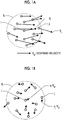
- Fig. 1A is a schematic diagram illustrating velocities of a particle i and a plurality of particles j located in the vicinity (a local region Si centering on a position of the particle i) thereof. If the number of particles j (including the particle i) present in the local region Si is indicated by n i , and a velocity of each of the particles j is indicated by v j , a centroid velocity (hereinafter, referred to as a centroid velocity of the local region S i ) V g,i of the particle j present in the local region S i may be computed according to the following equation.
- V g , i 1 n i ⁇ j ⁇ S i n i v j
- Fig. 1B is a schematic diagram illustrating a relative velocity v j -V g,i for the centroid velocity V g,i , of the particle j present in the local region S i .
- An average of the relative velocity v j -V g,i is zero.
- Equation (3) indicates that, when the temperature T of the particle system is obtained, as a velocity of the particle i, a value obtained by subtracting the centroid velocity V g,i of the local region S i centering on a position of the particle i is subtracted from the velocity vi of the particle i is used.
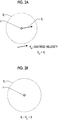
- Fig. 2A is a schematic diagram illustrating the particle i and the local region S i in a case of a state in which a particle density is low such as a gaseous state. Since the particle density is low, only the particle i is present in the local region S i .
- the centroid velocity V g,i of the local region S i in this case is the same as the velocity vi of the particle i.
- Fig. 2B is a schematic diagram illustrating the relative velocity v i -V g,i for the centroid velocity V g,i , of the particle i present in the local region S i .
- a relative velocity v i -V g,i is zero. If the temperature T of the particle system in this case is obtained on the basis of Equation (3), the temperature T is zero. Even in a case where the number of particles n i in the local region Si is not 1, if the number of particles n i is small, the temperature T is estimated to be lower than an actual temperature. Thus, appropriate temperature control cannot be performed in simulation based on the molecular dynamics method.
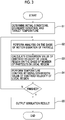
- Fig. 3 is a flowchart illustrating a simulation method according to the embodiment.
- initial conditions a boundary condition, and a target temperature in simulation are determined (step S1).
- the initial conditions include a position and a velocity of each particle of a particle system.
- boundary condition for example, a cyclic boundary condition is applied.
- temperature control is performed such that the temperature T of the particle system is close to the target temperature.
- step S2 motion analysis is performed on the basis of a motion equation followed by a particle (step S2).
- a Lennard-Jones potential may be used as an inter-molecular interaction potential.
- the centroid velocity V g,i of the local region S i including the particle i of interest is converted on the basis of the number of particles n i present in the local region S i for each particle forming the particle system, and thus a conversion value W g,i of the centroid velocity of the local region S i is calculated (step S3) .
- the conversion value W g,i of the centroid velocity is calculated on the basis of the following conversion rule.
- the conversion rule in Equation (4) is used, as the number of particles n i present in the local region S i becomes smaller, the conversion value W g,i of the centroid velocity becomes closer to zero. If the number of particles n i is 1, the conversion value W g,i of the centroid velocity is zero. If the number of particles n i increases, the conversion value W g,i of the centroid velocity is close to the centroid velocity V g,i . If the number of particles n i is infinity, the conversion value W g,i of the centroid velocity is the same as the centroid velocity V g,i .
- step S4 temperature control is performed by using the conversion value W g,i of the centroid velocity of the local region S i (step S4).
- a Langevin method may be used for temperature control.
- temperature control is performed by applying random force and dissipative force to a particle.
- the Langevin method is described in J. M. Thijssen, "Computational Physics", Maruzen Publishing Co., Ltd. (2003), pages 204 to 208 .
- step S5 The processes from step S2 to step S4 are repeatedly performed by the number of time steps to be executed, and then a simulation result is output (step S5).
- the number of time steps to be executed is set in advance.
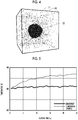
- Fig. 4 is a schematic diagram illustrating a simulation target particle system.
- a plurality of particles 11 are disposed in a cubic analysis region 10.
- a region having a high particle density is present at the substantial center of the analysis region 10.
- the region having the high particle density corresponds to a water droplet 12.
- the particles 11 in a water vapor state are present in a region having a low particle density around the water droplet 12.
- Cyclic boundary conditions were applied to front, rear, upper, lower, left, and right boundaries of the analysis region 10.
- the number of particles was 8000, and a target temperature of the particle system was 300 K.
- ⁇ and ⁇ are fitting parameters.
- values obtained by supposing water molecules were used as ⁇ and ⁇ .
- ⁇ 404.52 K
- ⁇ 0.264 nm
- the mass mi in Equation (5) was 18.02 Da.
- a resistance coefficient was 0.1 ⁇ .
- a sphere of which a radius is a distance at which particles produce interaction was as the local region S i .
- Fig. 5 is a graph illustrating a temporal change of the temperature T of the particle system, calculated through simulation, through comparison with a comparison example.
- a transverse axis expresses an elapsed time in the unit "ps”
- a longitudinal axis expresses the temperature T in the unit "K”.
- a solid line indicates a result of simulation performed according to the method of the embodiment
- a dashed line indicates a result of simulation performed according to a comparison example.
- the temperature T of the particle system was calculated by using Equation (3) without converting the centroid velocity V g,i .
- a target temperature is set to 300 K, and temperature control for maintaining the temperature T of the particle system to be the target temperature is performed.
- the temperature T increases with the passage of time, and thus becomes distant from the target temperature. This is because the temperature T of the particle system is estimated to be lower than an actual temperature as described with reference to Figs. 2A and 2B .
- the temperature T of the particle system is substantially maintained to be the target temperature of 300 K.
- Equation (4) is used as the conversion value W g,i of a centroid velocity which is a basis for calculating the temperature T of a particle system, but the conversion value W g,i of a centroid velocity may be calculated according to other conversion rules.
- a conversion rule may be used in which the conversion value W g,i of a centroid velocity of the local region S i monotonously increases as the number of particles n i present in the local region Si increases, and thus comes close to the centroid velocity V g,i of the local region S i .
- a conversion rule may be used in which the conversion value W g,i of a centroid velocity is 0 if the number of particles n i present in the local region S i is 1, and comes gradually closer to the centroid velocity V g,i of the local region S i as the number of particles n i increases.
- the conversion rule in Equation (3) is an example of such a conversion rule.
- the Langevin method is used for temperature control, but other methods may be used.
- a velocity of a particle may be scaled such that the temperature T of a particle system is maintained to be a target temperature.
- a Nose-Hoover method of giving a physically exact heat bath may be used.
- a sphere of which a radius is a distance at which the particle i substantially produces interaction was as the local region Si, but other regions may be used as the local region S i .
- a region used as a region in which interaction with the particle i of interest is produced may be used as the local region S i .
- the local region Si may include a region in which the particle i substantially produces interaction with other particles.
- a renormalized molecular dynamics method as a result of developing a molecular dynamics method in order to be able to handle a macro-system has been proposed.
- the simulation method according to the embodiment may be applied to simulation using the renormalized molecular dynamics method.
- the renormalized molecular dynamics method may be considered to be an aspect of the molecular dynamics method, and, in the present specification, the "molecular dynamics method” is used as a generic concept including the "renormalized molecular dynamics method".
- the simulation apparatus includes a program causing a computer to execute the simulation method illustrated in Fig. 3 , and executes the program.
- Fig. 6 is a block diagram illustrating the simulation apparatus according to the embodiment.
- a computer executing a simulation program may be used.
- the computer includes a central processing unit (CPU) 20, a main memory 21, an auxiliary storage device 22, an input device 23, and an output device 24.
- the auxiliary storage device 22 includes a recording medium in which a simulation program is stored.
- the recording medium may be built into the auxiliary storage device 22, and may be a removable medium which is attachable to and detachable from the auxiliary storage device 22.
- the simulation program is loaded to the main memory 21, and is executed by the CPU 20.
- Information required for simulation is input from the input device 23. For example, various pieces of information which are set in step S1 ( Fig. 3 ) are input.
- the CPU 20 acquires the initial conditions, the boundary condition, and the target temperature which are input from the input device 23.
- the CPU 20 outputs a simulation result to the output device 24.
- step S5 Fig. 3
- an image in which a behavior of a particle is visualized, a graph indicating a temporal change of a temperature of the particle system illustrated in Fig. 5 , and the like are displayed on the output device 24.
- the embodiment and the modification examples are only examples, partial replacement or combination of the configurations described in the embodiment and the modification examples may occur.
- the same advantageous effects based on the same configurations as those in the embodiment and the modification examples are not sequentially described in the embodiment and the modification examples.
- the process is not limited to the embodiment and the modification examples. For example, it is clear to a person skilled in the art that various alterations, modifications, combinations, and the like may occur.
Landscapes
- Engineering & Computer Science (AREA)
- Theoretical Computer Science (AREA)
- Physics & Mathematics (AREA)
- Computing Systems (AREA)
- General Physics & Mathematics (AREA)
- Automation & Control Theory (AREA)
- Life Sciences & Earth Sciences (AREA)
- Bioinformatics & Cheminformatics (AREA)
- Bioinformatics & Computational Biology (AREA)
- General Health & Medical Sciences (AREA)
- Spectroscopy & Molecular Physics (AREA)
- Health & Medical Sciences (AREA)
- Computer Hardware Design (AREA)
- Evolutionary Computation (AREA)
- Geometry (AREA)
- General Engineering & Computer Science (AREA)
- Management, Administration, Business Operations System, And Electronic Commerce (AREA)
Applications Claiming Priority (1)
| Application Number | Priority Date | Filing Date | Title |
|---|---|---|---|
| JP2017195751A JP6910729B2 (ja) | 2017-10-06 | 2017-10-06 | シミュレーション方法、シミュレーション装置、及びプログラム |
Publications (2)
| Publication Number | Publication Date |
|---|---|
| EP3467836A2 true EP3467836A2 (de) | 2019-04-10 |
| EP3467836A3 EP3467836A3 (de) | 2019-06-05 |
Family
ID=63207482
Family Applications (1)
| Application Number | Title | Priority Date | Filing Date |
|---|---|---|---|
| EP18183583.6A Withdrawn EP3467836A3 (de) | 2017-10-06 | 2018-07-16 | Teilsimulationsverfahren, simulationsvorrichtung und programm |
Country Status (3)
| Country | Link |
|---|---|
| US (1) | US10691147B2 (de) |
| EP (1) | EP3467836A3 (de) |
| JP (1) | JP6910729B2 (de) |
Cited By (2)
| Publication number | Priority date | Publication date | Assignee | Title |
|---|---|---|---|---|
| CN113343549A (zh) * | 2021-05-14 | 2021-09-03 | 武汉大学 | 一种用于物质和材料的新型计算机仿真模拟方法及装置 |
| CN115841063A (zh) * | 2023-02-24 | 2023-03-24 | 东方空间技术(山东)有限公司 | 用于动导数数值模拟的滑移动网格生成方法和装置 |
Families Citing this family (3)
| Publication number | Priority date | Publication date | Assignee | Title |
|---|---|---|---|---|
| CN111883215B (zh) * | 2020-07-20 | 2022-10-04 | 深圳先进电子材料国际创新研究院 | 一种三维空间多颗粒填充动力学模拟方法 |
| CN115440319B (zh) * | 2022-08-03 | 2024-03-15 | 电子科技大学长三角研究院(湖州) | 一种模拟材料结构非晶化的新方法 |
| JP2025078297A (ja) * | 2023-11-08 | 2025-05-20 | トヨタ自動車株式会社 | 硫黄腐食試験方法 |
Citations (1)
| Publication number | Priority date | Publication date | Assignee | Title |
|---|---|---|---|---|
| JPH10334076A (ja) | 1997-05-29 | 1998-12-18 | Nec Corp | 分子動力学法における温度制御方法 |
Family Cites Families (7)
| Publication number | Priority date | Publication date | Assignee | Title |
|---|---|---|---|---|
| JP2003303313A (ja) * | 1996-12-19 | 2003-10-24 | Fujitsu Ltd | 粒子シミュレーションシステムおよび記憶媒体 |
| US7693587B2 (en) * | 2004-02-03 | 2010-04-06 | Ut-Battelle, Llc | Control of friction at the nanoscale |
| JP4666357B2 (ja) * | 2005-04-04 | 2011-04-06 | 住友重機械工業株式会社 | シミュレーション方法 |
| JP5132768B2 (ja) * | 2007-07-02 | 2013-01-30 | マグマ ギエッセレイテクノロジ ゲーエムベーハー | モールド充填プロセスのシミュレーションにおいて、粒子の統計的な配向分布を記述するための方法および装置。 |
| JP5241468B2 (ja) * | 2008-12-19 | 2013-07-17 | 住友重機械工業株式会社 | シミュレーション方法及びプログラム |
| WO2014045492A1 (ja) * | 2012-09-21 | 2014-03-27 | 住友重機械工業株式会社 | 解析装置 |
| JP6543557B2 (ja) * | 2015-11-11 | 2019-07-10 | 富士通株式会社 | 粒子シミュレーションプログラム、粒子シミュレーション装置、及び計算機資源配分方法 |
-
2017
- 2017-10-06 JP JP2017195751A patent/JP6910729B2/ja active Active
-
2018
- 2018-07-16 EP EP18183583.6A patent/EP3467836A3/de not_active Withdrawn
- 2018-07-20 US US16/040,969 patent/US10691147B2/en not_active Expired - Fee Related
Patent Citations (1)
| Publication number | Priority date | Publication date | Assignee | Title |
|---|---|---|---|---|
| JPH10334076A (ja) | 1997-05-29 | 1998-12-18 | Nec Corp | 分子動力学法における温度制御方法 |
Non-Patent Citations (1)
| Title |
|---|
| J. M. THIJSSEN: "Computational Physics", 2003, MARUZEN PUBLISHING CO., LTD., pages: 204 - 208 |
Cited By (3)
| Publication number | Priority date | Publication date | Assignee | Title |
|---|---|---|---|---|
| CN113343549A (zh) * | 2021-05-14 | 2021-09-03 | 武汉大学 | 一种用于物质和材料的新型计算机仿真模拟方法及装置 |
| CN115841063A (zh) * | 2023-02-24 | 2023-03-24 | 东方空间技术(山东)有限公司 | 用于动导数数值模拟的滑移动网格生成方法和装置 |
| CN115841063B (zh) * | 2023-02-24 | 2023-04-28 | 东方空间技术(山东)有限公司 | 用于动导数数值模拟的滑移动网格生成方法和装置 |
Also Published As
| Publication number | Publication date |
|---|---|
| JP2019070896A (ja) | 2019-05-09 |
| EP3467836A3 (de) | 2019-06-05 |
| US10691147B2 (en) | 2020-06-23 |
| US20190107852A1 (en) | 2019-04-11 |
| JP6910729B2 (ja) | 2021-07-28 |
Similar Documents
| Publication | Publication Date | Title |
|---|---|---|
| EP3467836A2 (de) | Teilsimulationsverfahren, simulationsvorrichtung und programm | |
| EP3791324B1 (de) | Stichprobeneffizientes verstärkungslernen | |
| JP6827539B2 (ja) | アクション選択ニューラルネットワークをトレーニングすること | |
| EP3948690B1 (de) | Trainieren sicherer neuronaler netze mittels lokaler linearitätsregelung | |
| EP3674821A1 (de) | Optimierungsvorrichtung und steuerungsverfahren einer optimierungsvorrichtung | |
| CN107531249B (zh) | 用于检测机动车辆驾驶员行为改变的方法和设备 | |
| EP3163477A1 (de) | Simulationsverfahren, simulationsvorrichtung und simulationsprogramm für die gekoppelte simulation von strukturellen elastischen effekten und wärmeleitung | |
| JP2019159782A (ja) | 連続最適化問題の大域的探索装置及びプログラム | |
| Sellami et al. | Rollover risk prediction of heavy vehicles by reliability index and empirical modelling | |
| Kneifl et al. | A nonintrusive nonlinear model reduction method for structural dynamical problems based on machine learning | |
| Erb et al. | Uncertainty analysis of turbulence model closure coefficients for shock wave-boundary layer interaction simulations | |
| Keane et al. | Fast calibration of car-following models to trajectory data using the adjoint method | |
| EP3121745A1 (de) | Simulationsverfahren, simulationsprogramm und simulationsvorrichtung | |
| Liu et al. | Differentially weighted operator splitting Monte Carlo method for simulating complex aerosol dynamic processes | |
| Klausen et al. | Firefly Optimization and Mathematical Modeling of a Vehicle Crash Test Based on Single‐Mass | |
| Schwing et al. | Detached-eddy simulation of capsule wake flows and comparison to wind-tunnel test data | |
| CN115516466A (zh) | 超参数神经网络集成 | |
| EP2899655A1 (de) | Analysevorrichtung | |
| EP3825921B1 (de) | Verfahren und vorrichtung zur verarbeitung von sensordaten | |
| Xiao et al. | Lazy gaussian process committee for real-time online regression | |
| Hui et al. | An anisotropic traffic flow model with look-ahead effect for mixed autonomy traffic | |
| Kruse et al. | Enhanced importance sampling through latent space exploration in normalizing flows | |
| Pérez et al. | Data-driven bifurcation analysis using parameter-dependent trajectories | |
| Gardner et al. | Bayesian history matching for forward model-driven structural health monitoring | |
| Granados et al. | Understanding the hamiltonian monte carlo through its physics fundamentals and examples |
Legal Events
| Date | Code | Title | Description |
|---|---|---|---|
| PUAI | Public reference made under article 153(3) epc to a published international application that has entered the european phase |
Free format text: ORIGINAL CODE: 0009012 |
|
| STAA | Information on the status of an ep patent application or granted ep patent |
Free format text: STATUS: REQUEST FOR EXAMINATION WAS MADE |
|
| 17P | Request for examination filed |
Effective date: 20180716 |
|
| AK | Designated contracting states |
Kind code of ref document: A2 Designated state(s): AL AT BE BG CH CY CZ DE DK EE ES FI FR GB GR HR HU IE IS IT LI LT LU LV MC MK MT NL NO PL PT RO RS SE SI SK SM TR |
|
| AX | Request for extension of the european patent |
Extension state: BA ME |
|
| PUAL | Search report despatched |
Free format text: ORIGINAL CODE: 0009013 |
|
| STAA | Information on the status of an ep patent application or granted ep patent |
Free format text: STATUS: EXAMINATION IS IN PROGRESS |
|
| AK | Designated contracting states |
Kind code of ref document: A3 Designated state(s): AL AT BE BG CH CY CZ DE DK EE ES FI FR GB GR HR HU IE IS IT LI LT LU LV MC MK MT NL NO PL PT RO RS SE SI SK SM TR |
|
| AX | Request for extension of the european patent |
Extension state: BA ME |
|
| RIC1 | Information provided on ipc code assigned before grant |
Ipc: G16C 10/00 20190101AFI20190429BHEP Ipc: G16C 60/00 20190101ALI20190429BHEP |
|
| 17Q | First examination report despatched |
Effective date: 20190517 |
|
| STAA | Information on the status of an ep patent application or granted ep patent |
Free format text: STATUS: THE APPLICATION IS DEEMED TO BE WITHDRAWN |
|
| 18D | Application deemed to be withdrawn |
Effective date: 20210202 |