EP3473200A1 - Ablation catheter with microelectrode and method for producing an ablation catheter - Google Patents
Ablation catheter with microelectrode and method for producing an ablation catheter Download PDFInfo
- Publication number
- EP3473200A1 EP3473200A1 EP18156706.6A EP18156706A EP3473200A1 EP 3473200 A1 EP3473200 A1 EP 3473200A1 EP 18156706 A EP18156706 A EP 18156706A EP 3473200 A1 EP3473200 A1 EP 3473200A1
- Authority
- EP
- European Patent Office
- Prior art keywords
- microelectrode
- ablation
- catheter
- ablation electrode
- insulating material
- Prior art date
- Legal status (The legal status is an assumption and is not a legal conclusion. Google has not performed a legal analysis and makes no representation as to the accuracy of the status listed.)
- Granted
Links
Images




Classifications
-
- A—HUMAN NECESSITIES
- A61—MEDICAL OR VETERINARY SCIENCE; HYGIENE
- A61B—DIAGNOSIS; SURGERY; IDENTIFICATION
- A61B18/00—Surgical instruments, devices or methods for transferring non-mechanical forms of energy to or from the body
- A61B18/04—Surgical instruments, devices or methods for transferring non-mechanical forms of energy to or from the body by heating
- A61B18/12—Surgical instruments, devices or methods for transferring non-mechanical forms of energy to or from the body by heating by passing a current through the tissue to be heated, e.g. high-frequency current
-
- A—HUMAN NECESSITIES
- A61—MEDICAL OR VETERINARY SCIENCE; HYGIENE
- A61B—DIAGNOSIS; SURGERY; IDENTIFICATION
- A61B18/00—Surgical instruments, devices or methods for transferring non-mechanical forms of energy to or from the body
- A61B18/04—Surgical instruments, devices or methods for transferring non-mechanical forms of energy to or from the body by heating
- A61B18/12—Surgical instruments, devices or methods for transferring non-mechanical forms of energy to or from the body by heating by passing a current through the tissue to be heated, e.g. high-frequency current
- A61B18/14—Probes or electrodes therefor
- A61B18/1492—Probes or electrodes therefor having a flexible, catheter-like structure, e.g. for heart ablation
-
- A—HUMAN NECESSITIES
- A61—MEDICAL OR VETERINARY SCIENCE; HYGIENE
- A61B—DIAGNOSIS; SURGERY; IDENTIFICATION
- A61B17/00—Surgical instruments, devices or methods
- A61B2017/00017—Electrical control of surgical instruments
- A61B2017/00022—Sensing or detecting at the treatment site
- A61B2017/00026—Conductivity or impedance, e.g. of tissue
-
- A—HUMAN NECESSITIES
- A61—MEDICAL OR VETERINARY SCIENCE; HYGIENE
- A61B—DIAGNOSIS; SURGERY; IDENTIFICATION
- A61B17/00—Surgical instruments, devices or methods
- A61B2017/00017—Electrical control of surgical instruments
- A61B2017/00022—Sensing or detecting at the treatment site
- A61B2017/00039—Electric or electromagnetic phenomena other than conductivity, e.g. capacity, inductivity, Hall effect
- A61B2017/00044—Sensing electrocardiography, i.e. ECG
- A61B2017/00048—Spectral analysis
- A61B2017/00053—Mapping
-
- A—HUMAN NECESSITIES
- A61—MEDICAL OR VETERINARY SCIENCE; HYGIENE
- A61B—DIAGNOSIS; SURGERY; IDENTIFICATION
- A61B17/00—Surgical instruments, devices or methods
- A61B2017/00526—Methods of manufacturing
-
- A—HUMAN NECESSITIES
- A61—MEDICAL OR VETERINARY SCIENCE; HYGIENE
- A61B—DIAGNOSIS; SURGERY; IDENTIFICATION
- A61B18/00—Surgical instruments, devices or methods for transferring non-mechanical forms of energy to or from the body
- A61B2018/00005—Cooling or heating of the probe or tissue immediately surrounding the probe
- A61B2018/00011—Cooling or heating of the probe or tissue immediately surrounding the probe with fluids
- A61B2018/00029—Cooling or heating of the probe or tissue immediately surrounding the probe with fluids open
-
- A—HUMAN NECESSITIES
- A61—MEDICAL OR VETERINARY SCIENCE; HYGIENE
- A61B—DIAGNOSIS; SURGERY; IDENTIFICATION
- A61B18/00—Surgical instruments, devices or methods for transferring non-mechanical forms of energy to or from the body
- A61B2018/00053—Mechanical features of the instrument of device
- A61B2018/00059—Material properties
- A61B2018/00071—Electrical conductivity
- A61B2018/00083—Electrical conductivity low, i.e. electrically insulating
-
- A—HUMAN NECESSITIES
- A61—MEDICAL OR VETERINARY SCIENCE; HYGIENE
- A61B—DIAGNOSIS; SURGERY; IDENTIFICATION
- A61B18/00—Surgical instruments, devices or methods for transferring non-mechanical forms of energy to or from the body
- A61B2018/00053—Mechanical features of the instrument of device
- A61B2018/00107—Coatings on the energy applicator
- A61B2018/00136—Coatings on the energy applicator with polymer
-
- A—HUMAN NECESSITIES
- A61—MEDICAL OR VETERINARY SCIENCE; HYGIENE
- A61B—DIAGNOSIS; SURGERY; IDENTIFICATION
- A61B18/00—Surgical instruments, devices or methods for transferring non-mechanical forms of energy to or from the body
- A61B2018/00315—Surgical instruments, devices or methods for transferring non-mechanical forms of energy to or from the body for treatment of particular body parts
- A61B2018/00345—Vascular system
- A61B2018/00351—Heart
-
- A—HUMAN NECESSITIES
- A61—MEDICAL OR VETERINARY SCIENCE; HYGIENE
- A61B—DIAGNOSIS; SURGERY; IDENTIFICATION
- A61B18/00—Surgical instruments, devices or methods for transferring non-mechanical forms of energy to or from the body
- A61B2018/00315—Surgical instruments, devices or methods for transferring non-mechanical forms of energy to or from the body for treatment of particular body parts
- A61B2018/00345—Vascular system
- A61B2018/00351—Heart
- A61B2018/00357—Endocardium
-
- A—HUMAN NECESSITIES
- A61—MEDICAL OR VETERINARY SCIENCE; HYGIENE
- A61B—DIAGNOSIS; SURGERY; IDENTIFICATION
- A61B18/00—Surgical instruments, devices or methods for transferring non-mechanical forms of energy to or from the body
- A61B2018/00571—Surgical instruments, devices or methods for transferring non-mechanical forms of energy to or from the body for achieving a particular surgical effect
- A61B2018/00577—Ablation
-
- A—HUMAN NECESSITIES
- A61—MEDICAL OR VETERINARY SCIENCE; HYGIENE
- A61B—DIAGNOSIS; SURGERY; IDENTIFICATION
- A61B18/00—Surgical instruments, devices or methods for transferring non-mechanical forms of energy to or from the body
- A61B2018/00571—Surgical instruments, devices or methods for transferring non-mechanical forms of energy to or from the body for achieving a particular surgical effect
- A61B2018/00589—Coagulation
-
- A—HUMAN NECESSITIES
- A61—MEDICAL OR VETERINARY SCIENCE; HYGIENE
- A61B—DIAGNOSIS; SURGERY; IDENTIFICATION
- A61B18/00—Surgical instruments, devices or methods for transferring non-mechanical forms of energy to or from the body
- A61B2018/00636—Sensing and controlling the application of energy
- A61B2018/00773—Sensed parameters
- A61B2018/00875—Resistance or impedance
-
- A—HUMAN NECESSITIES
- A61—MEDICAL OR VETERINARY SCIENCE; HYGIENE
- A61B—DIAGNOSIS; SURGERY; IDENTIFICATION
- A61B18/00—Surgical instruments, devices or methods for transferring non-mechanical forms of energy to or from the body
- A61B18/04—Surgical instruments, devices or methods for transferring non-mechanical forms of energy to or from the body by heating
- A61B18/12—Surgical instruments, devices or methods for transferring non-mechanical forms of energy to or from the body by heating by passing a current through the tissue to be heated, e.g. high-frequency current
- A61B18/14—Probes or electrodes therefor
- A61B2018/1405—Electrodes having a specific shape
- A61B2018/1407—Loop
-
- A—HUMAN NECESSITIES
- A61—MEDICAL OR VETERINARY SCIENCE; HYGIENE
- A61B—DIAGNOSIS; SURGERY; IDENTIFICATION
- A61B18/00—Surgical instruments, devices or methods for transferring non-mechanical forms of energy to or from the body
- A61B18/04—Surgical instruments, devices or methods for transferring non-mechanical forms of energy to or from the body by heating
- A61B18/12—Surgical instruments, devices or methods for transferring non-mechanical forms of energy to or from the body by heating by passing a current through the tissue to be heated, e.g. high-frequency current
- A61B18/14—Probes or electrodes therefor
- A61B2018/1465—Deformable electrodes
-
- A—HUMAN NECESSITIES
- A61—MEDICAL OR VETERINARY SCIENCE; HYGIENE
- A61B—DIAGNOSIS; SURGERY; IDENTIFICATION
- A61B2218/00—Details of surgical instruments, devices or methods for transferring non-mechanical forms of energy to or from the body
- A61B2218/001—Details of surgical instruments, devices or methods for transferring non-mechanical forms of energy to or from the body having means for irrigation and/or aspiration of substances to and/or from the surgical site
- A61B2218/002—Irrigation
-
- A—HUMAN NECESSITIES
- A61—MEDICAL OR VETERINARY SCIENCE; HYGIENE
- A61B—DIAGNOSIS; SURGERY; IDENTIFICATION
- A61B5/00—Measuring for diagnostic purposes; Identification of persons
- A61B5/24—Detecting, measuring or recording bioelectric or biomagnetic signals of the body or parts thereof
- A61B5/25—Bioelectric electrodes therefor
- A61B5/279—Bioelectric electrodes therefor specially adapted for particular uses
- A61B5/28—Bioelectric electrodes therefor specially adapted for particular uses for electrocardiography [ECG]
- A61B5/283—Invasive
- A61B5/287—Holders for multiple electrodes, e.g. electrode catheters for electrophysiological study [EPS]
-
- A—HUMAN NECESSITIES
- A61—MEDICAL OR VETERINARY SCIENCE; HYGIENE
- A61B—DIAGNOSIS; SURGERY; IDENTIFICATION
- A61B5/00—Measuring for diagnostic purposes; Identification of persons
- A61B5/48—Other medical applications
- A61B5/4836—Diagnosis combined with treatment in closed-loop systems or methods
-
- A—HUMAN NECESSITIES
- A61—MEDICAL OR VETERINARY SCIENCE; HYGIENE
- A61M—DEVICES FOR INTRODUCING MEDIA INTO, OR ONTO, THE BODY; DEVICES FOR TRANSDUCING BODY MEDIA OR FOR TAKING MEDIA FROM THE BODY; DEVICES FOR PRODUCING OR ENDING SLEEP OR STUPOR
- A61M25/00—Catheters; Hollow probes
- A61M25/0009—Making of catheters or other medical or surgical tubes
- A61M25/0012—Making of catheters or other medical or surgical tubes with embedded structures, e.g. coils, braids, meshes, strands or radiopaque coils
Definitions
- the disclosure relates to an ablation catheter having a microelectrode and to a method of making an ablation catheter.
- the intracardiac mapping (eg, by impedance measurement between catheter electrodes) in the contact zone of an ablation electrode of an electrophysiological catheter with the heart tissue is known.
- the so-called “micro-mapping" using one or more microelectrodes on the catheter is a promising approach to be used for medical diagnostic and monitoring purposes during ablation for the treatment of cardiac arrhythmias.
- the document US 2004/0092806 A1 discloses an ablation catheter with microelectrodes.
- the metallic microelectrodes in the form of cylinders, cones or fungi are inserted into holes in and electrically insulated from the ablation electrode and provided with electrical leads in the inner region of the ablation catheter.
- the document US 2008/0243214 A1 also discloses an ablation catheter with microelectrodes.
- the microelectrodes are shaped as cylinders and arranged in holes on the catheter head.
- the document EP 3 015 064 A2 discloses an ablation catheter having wells for receiving microelectrodes.
- microelectrode catheter concepts require a relatively large space requirement for the microelectrodes on the ablation electrode, in particular for the attachment, the electrical insulation and the contacting with the electrical leads.
- the design and assembly of the electrical lead conduction greatly affect the routing of the flushing lines and the design of the flushing channels.
- the object may be considered to provide improved technologies for ablation catheters.
- the space requirement of a microelectrode and its supply line should be reduced.
- an ablation catheter has a catheter shaft and an ablation electrode disposed at a distal end of the catheter shaft. Furthermore, a microelectrode and a line element are provided. The microelectrode is disposed on a surface of the ablation electrode. The line element is electrically conductively connected to the microelectrode. The conducting element is surrounded by an insulating material, so that the conducting element is electrically insulated from the ablation electrode. The insulating material is arranged with the line element at least in sections on the surface of the ablation electrode.
- a method for making an ablation catheter comprises the following steps: providing a catheter shaft, disposing an ablation electrode at a distal end of the catheter shaft, disposing a microelectrode at a surface of the catheter shaft Ablation electrode, and providing a conduction member which is electrically connected to the microelectrode.
- the conducting element is surrounded by an insulating material, so that the conducting element is electrically insulated from the ablation electrode.
- the insulating material is arranged with the line element at least in sections on the surface of the ablation electrode.
- microelectrodes may be disposed on the ablation electrode, wherein each of the plurality of microelectrodes may be electrically isolated from the ablation electrode.
- Each of the plurality of microelectrodes may be connected to a dedicated conduit element. It can also be provided that a plurality of microelectrodes are connected to a common line element. Also mixed forms are possible. For example, a first group of a plurality of microelectrodes can be connected to a common first line element, and a second group of a plurality of microelectrodes can be connected to a common second line element.
- the microelectrodes can be shaped in many ways, for. B. round, oval or semicircular. The microelectrodes may point in different directions on the surface of the ablation electrode.
- the microelectrode can be arranged on an end face of the ablation electrode or on a lateral surface of the ablation electrode. If a plurality of microelectrodes are provided, one or more microelectrodes may be arranged on the end face of the ablation electrode. Additionally or alternatively, one or more microelectrodes can be arranged on the lateral surface of the ablation electrode. Several microelectrodes can be evenly distributed on the end face and / or the lateral surface of the ablation electrode. The end face of the ablation electrode may also be referred to as the distal end of the ablation electrode.
- the distal end of the catheter shaft is understood to mean the end that is inserted into the body of the patient during use of the catheter (for example during ablation).
- the distal end of the catheter shaft with the ablation electrode may also be referred to as a catheter head.
- a proximal end of the catheter shaft is the end that remains outside the body when the catheter is used.
- a catheter handle may be formed to the proximal end of the catheter shaft.
- a connection device for connecting the ablation electrode and the microelectrode (s) to a control device may be provided on the catheter handle.
- the conduit element surrounded by the insulating material is arranged at least in sections in a recess formed on the surface of the ablation electrode. It can also be provided that the microelectrode and the conduit element surrounded by the insulating material are arranged in a recess formed on the surface of the ablation electrode.
- the microelectrode and the conductive material surrounding the microelectrode may be considered to be embedded in the surface of the ablation electrode.
- the recess may be formed on the end face and / or on the lateral surface of the ablation electrode.
- a plurality of recesses can be formed on the surface of the ablation electrode, such that each microelectrode and / or the respective line element are arranged in one of the plurality of recesses.
- the recess (or recesses, if any) may have a depth of 0.05mm or less (eg, 0.03mm or 0.01mm).
- microelectrode and / or the conduit element surrounded by the insulating material can be glued into the recess.
- the microelectrode and / or the insulating material may be secured by means of clamping, re-clamping, shrinking or stretching.
- Other possibilities for fastening the microelectrode and / or the conduit element surrounded by the insulating material are also conceivable.
- the microelectrode may be electrically isolated from the ablation electrode, for example by means of the insulating material.
- the insulating material may be polyimide (PI), polyurethane (PUR), polyether block amide (PEBA) or a liquid crystal polymer (LCP).
- PI polyimide
- PUR polyurethane
- PEBA polyether block amide
- LCP liquid crystal polymer
- Liquid crystal polymers are easy to process (even at short-term 100 ° C still dimensionally stable and stable) and biocompatible, which makes them particularly suitable for use in an ablation catheter.
- the insulating material can be used as a flexible film material be provided, for. B. as LCP film or a film of one of the other aforementioned materials.
- microelectrode and / or the line element surrounded by the insulating material can be arranged in the recess in a form-fitting (or precise fit) manner.
- the conduit member may include a metal (eg, copper) or a metal alloy, or may be made of a metal (eg, copper) or a metal alloy.
- the line element may be formed as a conductor track.
- the conductive element is formed as a copper trace, which is surrounded by a flexible LCP film for electrical insulation.
- the microelectrode may include a metal (eg, copper) or a metal alloy, or may be made of a metal (eg, copper) or a metal alloy.
- the microelectrode may be coated, for example, with a metal (eg, gold, platinum, or other plateable biocompatible metal) or a metal alloy.
- the microelectrode can be formed as a flat microelectrode, wherein the extent of the microelectrode in two dimensions (area of the microelectrode) is substantially greater than in the third dimension (height of the microelectrode).
- the areal extent eg, the diameter of the microelectrode
- the microelectrode (or possibly the microelectrodes) may be formed as a flat (or slightly curved) microelectrode of copper which is coated with gold.
- Important is the surface area of the ablation electrode covered by the microelectrodes including insulation edges (and therefore not effective). This should be less than a third.
- the peripheral shapes of the microelectrodes can be designed so that the free contact surface of the Ablation electrode in each roll and tilt angle position with the heart tissue is large enough for efficient Ablationsstromabgabe.
- the microelectrode and / or the line element surrounded by the insulating material forms a smooth termination with the surface of the ablation electrode.
- a transition from the microelectrode and / or the insulating material to the surface of the ablation electrode may be free of bumps or edges.
- the conductive element surrounding the insulating material may be disposed from the microelectrode to a distal end of the catheter shaft at the surface of the ablation electrode and guided at the distal end of the catheter shaft into an interior region of the catheter shaft.
- a transition from the material of the ablation electrode typically a metal, eg, gold or platinum, or a metal alloy
- the material of the catheter shaft eg, a plastic.
- the conduit element with the insulating material can be guided into the inner region of the catheter shaft.
- a flushing opening may be formed.
- the flushing opening can be connected to a flushing line arranged in the inner region of the catheter shaft. It is also possible for a plurality of flushing openings to be formed in the ablation electrode, which are connected to the flushing line. Arrangements and geometries of purge lines are known. For example, those in the document EP 2 380 517 A1 disclosed embodiments (in particular those in the Fig. 3B and 4B shown variants) are combined with the present disclosure.
- the microelectrode may be formed as a ring electrode surrounding the ablation electrode around its circumference.
- the microelectrode may be formed as a toothed microelectrode.
- microelectrode may be transferred to multiple microelectrode embodiments.
- the features disclosed in the context of the ablation catheter may be applied analogously to the method of making the ablation catheter, and vice versa.
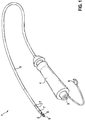
- Fig. 1 to 3 show an exemplary embodiment of a micro-impedance measurement ablation catheter 1 for performing, for example, micro-mapping for diagnostic purposes and / or for monitoring lesion formation during ablation.
- Fig. 1 schematically illustrates the ablation catheter 1 with an ablation electrode 2.
- the ablation electrode 2 is disposed at a distal end of a catheter shaft 5.
- lateral microelectrodes 8 on a lateral surface 18 (FIG. Fig. 2 ) of the ablation electrode 2 and a frontal microelectrode 9 on an end face 17 (FIG. Fig. 2 ) of the ablation electrode 2.
- Several frontal microelectrodes can also be arranged on the end face 17 (not shown).
- Proximal to the ablation electrode 2 are three ring electrodes 7 for the conventional mapping method.
- a catheter handle 4 is arranged.
- the ablation electrode 2, the lateral microelectrodes 8, the frontal microelectrode 9 and the ring electrodes 7 are connected via the catheter shaft 5 through the catheter handle 4 with poles in a plug 3.
- the plug 3 provides a connection for the ablation electrode 2, the lateral microelectrodes 8, the frontal microelectrode 9 and the ring electrodes 7 and optionally a thermocouple to a control device.
- a flushing connection 6 for the flushing of the ablation electrode 2 is led out of the catheter grip 4.
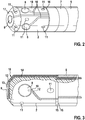
- Fig. 2 shows the catheter head with the ablation electrode 2 and a part of the catheter shaft 5 and one of the ring electrodes 7.
- the ablation electrode 2 is equipped with a frontal microelectrode 9 and four lateral microelectrodes 8.
- the microelectrodes 8, 9 are electrically insulated by LCP foils 10 from the ablation electrode 2.
- the LCP foils each surround a conductor track, each microelectrode 8, 9 being connected to a conductor track (not shown).
- the LCP foils 10 are embedded in recesses in the ablation electrode 2. The depth of the recesses is 0.05 mm.
- the microelectrodes 8, 9 and the LCP foils 10 form a smooth termination with the surface of the ablation electrode 2.
- the LCP foils 10 are guided to a proximal end of the ablation catheter 2 on the surface of the ablation catheter. At the proximal end, the LCP films (with the conductor tracks) are led into an inner region of the catheter shaft 5.
- the LCP sheets 10 may be folded or bent like paper and thus easily guided around an edge of the ablation electrode 2 by a bond 15 in the catheter shaft 5.
- the LCP films 10 are designed so that flushing openings 11 are bypassed well and thus kept free.
- Fig. 3 shows the ablation electrode 2 Fig. 2 cut so that the cross section of a recess to the frontal microelectrode 9 is visible.
- the LCP film 10 is here connected to the ablation electrode 2 by means of an adhesive 14 for the microelectrode 9 at the bottom of the recess.
- a trace 12 eg, a copper trace
- an exposed gold-coated electrode 13 eg, a copper electrode.
- the conductor 12 is shown in dashed lines, since this is completely surrounded by the LCP film 10 (and therefore not directly visible). After proximal, the conductor 12 is electrically isolated passed through the catheter shaft 5 and the catheter handle 4 and finally connected to a corresponding pole of the plug 3.
- Fig. 4 shows a schematic representation of a micro-electrode 20.
- the micro-electrode 20 has in the embodiment shown a circular surface with a diameter D (eg 0.3 mm).
- the microelectrode 20 is electrically isolated from the ablation electrode (not shown) by means of an insulating material 22.
- the insulating material 22 may be, for example, an LCP film.
- a conductive member 21 eg, a copper conductor
- the microelectrode 20 is connected to the line element 21 on its underside.
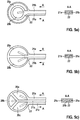
- Fig. 5 shows schematic representations of embodiments of a multi-part microelectrode. In each case, a section along the line A - A is shown.
- Fig. 5 a shows a concentric microelectrode with two segments 20a, 20b.
- a first segment 20a forms an open or closed loop surrounding a second segment 20b in the form of a circular area.
- the two segments 20a, 20b are connected to line elements 21a, 21b.
- the two segments 20a, 20b and the conducting elements 21b, 21b are insulated with the insulating material 22 from the ablation electrode (not shown).
- a two-part microelectrode with two semicircular segments 20a, 20b is shown.
- the two segments 20a, 20b are connected to line elements 21a, 21b.
- the two segments 20a, 20b and the conducting elements 21b, 21b are insulated with the insulating material 22 from the ablation electrode (not shown).
- FIG Fig. 5c A microelectrode with three segments 20a, 20b, 20c is shown in FIG Fig. 5c) shown.
- the three segments 20a, 20b, 20c are connected to line elements 21a, 21b, 21c.
- the three segments 20a, 20b, 20c and the conducting elements 21b, 21b, 21c are insulated with the insulating material 22 from the ablation electrode (not shown).
- Fig. 6 shows a microelectrode 20 having a hole 23.
- the microelectrode 20 is connected to the conducting element 21.
- the microelectrode 20 and the conducting element 21 are insulated with the insulating material 22 from the ablation electrode (not shown). Furthermore, sections along the lines A - A and B - B are shown.
- Fig. 7 shows a catheter head of a rinsed catheter with microelectrodes 20 after Fig. 6 , The scavenging port 11 passes through the hole in the microelectrode 20.
- a catheter head with ring microelectrodes 24a, 24b is shown.
- the two ring microelectrodes 24a, 24b are connected to line elements 21a, 21b.
- the two ring microelectrodes 24a, 24b and the conducting elements 21b, 21b are insulated with the insulating material 22 from the ablation electrode.
- the line elements 21 a, 21 b are completely surrounded by the insulating material 22.
- the section along the line B - B shows the ring microelectrodes 24a, 24b embedded in the insulating material 22.
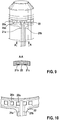
- Fig. 9 shows a catheter head with toothed microelectrodes 25a, 25b.
- the two toothed microelectrodes 25a, 25b are connected to line elements 21a, 21b.
- the two toothed microelectrodes 25a, 25b and the conducting elements 21b, 21b are insulated with the insulating material 22 from the ablation electrode.
- the line elements 21 a, 21 b are completely surrounded by the insulating material 22.
- the terminals of the toothed microelectrodes 25a, 25b to the line elements 21a, 21b is in Fig. 10 shown.
- the two line elements 21a, 21b are connected to connection elements. In this way, the toothed microelectrodes can be connected to only two line elements 21a, 21b.
- Other tooth shapes are possible, such as triangular teeth or semi-circular teeth.
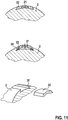
- Fig. 11 shows an attachment of the insulating material 22 without gluing. Instead, the insulating material 22 hooks behind an edge 30 (undercut clamping).
- the insulating material (and / or the microelectrode) can be clipped into a recess so that it hooks behind the edge 30 (middle image of Fig. 11 ) or it can be pushed into the recess (lower picture of Fig. 11 ).
- FIG. 12 An attachment by means of tensioning is shown in a groove.
- Fig. 13 shows a fastening by shrinking.
- the ablation catheter is in this case for a short time cooler than the microelectrodes 20 with their feed line 21.
- the microelectrodes with the leads and the insulating material are arranged in a groove 31. After cooling, the microelectrodes are firmly seated on the ablation electrode.
Landscapes
- Health & Medical Sciences (AREA)
- Life Sciences & Earth Sciences (AREA)
- Surgery (AREA)
- Engineering & Computer Science (AREA)
- Plasma & Fusion (AREA)
- General Health & Medical Sciences (AREA)
- Otolaryngology (AREA)
- Physics & Mathematics (AREA)
- Veterinary Medicine (AREA)
- Biomedical Technology (AREA)
- Heart & Thoracic Surgery (AREA)
- Medical Informatics (AREA)
- Molecular Biology (AREA)
- Animal Behavior & Ethology (AREA)
- Nuclear Medicine, Radiotherapy & Molecular Imaging (AREA)
- Public Health (AREA)
- Cardiology (AREA)
- Surgical Instruments (AREA)
- Measurement And Recording Of Electrical Phenomena And Electrical Characteristics Of The Living Body (AREA)
Abstract
Die Offenbarung betrifft einen Ablationskatheter (1), mit einem Katheterschaft (5), einer Ablationselektrode (2), die an einem distalen Ende des Katheterschafts (5) angeordnet ist, einer Mikroelektrode (20; 24; 25), die an einer Oberfläche der Ablationselektrode (2) angeordnet ist, und einem Leitungselement (21), das mit der Mikroelektrode (20; 24; 25) elektrisch leitend verbunden ist, wobei das Leitungselement (12; 21) von einem Isoliermaterial (10; 22) umgeben ist, so dass das Leitungselement (12; 21) von der Ablationselektrode (2) elektrisch isoliert ist, und wobei das Isoliermaterial (10; 22) mit dem Leitungselement (12; 21) zumindest abschnittsweise an der Oberfläche der Ablationselektrode (2) angeordnet ist. Des Weiteren ist ein Verfahren zum Herstellen eines Ablationskatheters offenbart.The disclosure relates to an ablation catheter (1) comprising a catheter shaft (5), an ablation electrode (2) disposed at a distal end of the catheter shaft (5), a microelectrode (20; 24; Ablationselektrode (2) is arranged, and a line member (21), which is electrically conductively connected to the microelectrode (20; 24; 25), wherein the line member (12; 21) of an insulating material (10; 22) is surrounded, so in that the conducting element (12; 21) is electrically insulated from the ablation electrode (2), and wherein the insulating material (10; 22) with the conducting element (12; 21) is arranged at least in sections on the surface of the ablation electrode (2). Furthermore, a method for manufacturing an ablation catheter is disclosed.
Description
Die Offenbarung betrifft einen Ablationskatheter mit einer Mikroelektrode sowie ein Verfahren zum Herstellen eines Ablationskatheters.The disclosure relates to an ablation catheter having a microelectrode and to a method of making an ablation catheter.
Das intrakardiale Mapping (z. B. durch Impedanzmessung zwischen Katheterelektroden) in der Kontaktzone einer Ablationselektrode eines elektrophysiologischen Katheters mit dem Herzgewebe ist bekannt. Das sogenannte "Micro-Mapping" mittels einer oder mehrerer Mikroelektroden an dem Katheter ist ein vielversprechender Ansatz, um für medizinische Diagnose- und Überwachungszwecke während der Ablation zur Behandlung von Herzrhythmusstörungen genutzt zu werden.The intracardiac mapping (eg, by impedance measurement between catheter electrodes) in the contact zone of an ablation electrode of an electrophysiological catheter with the heart tissue is known. The so-called "micro-mapping" using one or more microelectrodes on the catheter is a promising approach to be used for medical diagnostic and monitoring purposes during ablation for the treatment of cardiac arrhythmias.
Das Dokument
Das Dokument
Das Dokument
Die bekannten Mikroelektroden-Katheter-Konzepte benötigen für die Mikroelektroden einen relativ großen Platzbedarf auf der Ablationselektrode, insbesondere für die Befestigung, die elektrische Isolation und die Kontaktierung mit den elektrischen Zuleitungen. Bei gespülten Ablationskathetern beeinträchtigen die Gestaltung und die Montage der elektrischen Zuleitungsführung in hohem Maße die Führung der Spülleitungen und die Gestaltung der Spülkanäle.The known microelectrode catheter concepts require a relatively large space requirement for the microelectrodes on the ablation electrode, in particular for the attachment, the electrical insulation and the contacting with the electrical leads. With flushed ablation catheters, the design and assembly of the electrical lead conduction greatly affect the routing of the flushing lines and the design of the flushing channels.
Als Aufgabe kann angesehen werden, verbesserte Technologien für Ablationskatheter bereitzustellen. Insbesondere soll der Platzbedarf einer Mikroelektrode und deren Zuleitung verringert werden.The object may be considered to provide improved technologies for ablation catheters. In particular, the space requirement of a microelectrode and its supply line should be reduced.
Es sind ein Ablationskatheter nach Anspruch 1 und ein Verfahren zum Herstellen eines Ablationskatheters nach Anspruch 14 offenbart. Weitere Ausführungsformen sind Gegenstand von abhängigen Ansprüchen.An ablation catheter according to claim 1 and a method of making an ablation catheter according to
Nach einem Aspekt ist ein Ablationskatheter bereitgestellt. Der Ablationskatheter weist einen Katheterschaft und eine an einem distalen Ende des Katheterschafts angeordnete Ablationselektrode auf. Des Weiteren sind eine Mikroelektrode und ein Leitungselement vorgesehen. Die Mikroelektrode ist an einer Oberfläche der Ablationselektrode angeordnet. Das Leitungselement ist mit der Mikroelektrode elektrisch leitend verbunden. Das Leitungselement ist von einem Isoliermaterial umgeben, so dass das Leitungselement von der Ablationselektrode elektrisch isoliert ist. Das Isoliermaterial ist mit dem Leitungselement zumindest abschnittsweise an der Oberfläche der Ablationselektrode angeordnet.In one aspect, an ablation catheter is provided. The ablation catheter has a catheter shaft and an ablation electrode disposed at a distal end of the catheter shaft. Furthermore, a microelectrode and a line element are provided. The microelectrode is disposed on a surface of the ablation electrode. The line element is electrically conductively connected to the microelectrode. The conducting element is surrounded by an insulating material, so that the conducting element is electrically insulated from the ablation electrode. The insulating material is arranged with the line element at least in sections on the surface of the ablation electrode.
Nach einem weiteren Aspekt ist ein Verfahren zum Herstellen eines Ablationskatheters offenbart. Das Verfahren umfasst die folgenden Schritte: Bereitstellen eines Katheterschafts, Anordnen einer Ablationselektrode an einem distalen Ende des Katheterschafts, Anordnen einer Mikroelektrode an einer Oberfläche der Ablationselektrode, und Bereitstellen eines Leitungselements, das mit der Mikroelektrode elektrisch leitend verbunden ist. Das Leitungselement wird von einem Isoliermaterial umgeben, so dass das Leitungselement von der Ablationselektrode elektrisch isoliert ist. Das Isoliermaterial wird mit dem Leitungselement zumindest abschnittsweise an der Oberfläche der Ablationselektrode angeordnet.In another aspect, a method for making an ablation catheter is disclosed. The method comprises the following steps: providing a catheter shaft, disposing an ablation electrode at a distal end of the catheter shaft, disposing a microelectrode at a surface of the catheter shaft Ablation electrode, and providing a conduction member which is electrically connected to the microelectrode. The conducting element is surrounded by an insulating material, so that the conducting element is electrically insulated from the ablation electrode. The insulating material is arranged with the line element at least in sections on the surface of the ablation electrode.
Es können mehrere Mikroelektroden an der Ablationselektrode angeordnet sein, wobei jede der mehreren Mikroelektroden von der Ablationselektrode elektrisch isoliert sein kann. Jede der mehreren Mikroelektroden kann mit einem ausschließlich ihr zugeordneten Leitungselement verbunden sein. Es kann auch vorgesehen sein, dass mehrere Mikroelektroden mit einem gemeinsamen Leitungselement verbunden sind. Auch Mischformen sind möglich. Beispielsweise kann eine erste Gruppe von mehreren Mikroelektroden mit einem gemeinsamen ersten Leitungselement verbunden sein und eine zweite Gruppe von mehreren Mikroelektroden kann mit einem gemeinsamen zweiten Leitungselement verbunden sein. Die Mikroelektroden können vielfältig geformt sein, z. B. rund, oval oder halbkreisförmig. Die Mikroelektroden können auf der Oberfläche der Ablationselektrode in verschiedene Richtungen zeigen.Multiple microelectrodes may be disposed on the ablation electrode, wherein each of the plurality of microelectrodes may be electrically isolated from the ablation electrode. Each of the plurality of microelectrodes may be connected to a dedicated conduit element. It can also be provided that a plurality of microelectrodes are connected to a common line element. Also mixed forms are possible. For example, a first group of a plurality of microelectrodes can be connected to a common first line element, and a second group of a plurality of microelectrodes can be connected to a common second line element. The microelectrodes can be shaped in many ways, for. B. round, oval or semicircular. The microelectrodes may point in different directions on the surface of the ablation electrode.
Die Mikroelektrode kann an einer Stirnfläche der Ablationselektrode oder an einer Mantelfläche der Ablationselektrode angeordnet sein. Wenn mehrere Mikroelektroden vorgesehen sind, können eine oder mehrere Mikroelektroden an der Stirnfläche der Ablationselektrode angeordnet sein. Ergänzend oder alternativ können eine oder mehrere Mikroelektroden an der Mantelfläche der Ablationselektrode angeordnet sein. Mehrere Mikroelektroden können an der Stirnfläche und/oder der Mantelfläche der Ablationselektrode gleichmäßig verteilt sein. Die Stirnfläche der Ablationselektrode kann auch als distales Ende der Ablationselektrode bezeichnet werden.The microelectrode can be arranged on an end face of the ablation electrode or on a lateral surface of the ablation electrode. If a plurality of microelectrodes are provided, one or more microelectrodes may be arranged on the end face of the ablation electrode. Additionally or alternatively, one or more microelectrodes can be arranged on the lateral surface of the ablation electrode. Several microelectrodes can be evenly distributed on the end face and / or the lateral surface of the ablation electrode. The end face of the ablation electrode may also be referred to as the distal end of the ablation electrode.
Als distales Ende des Katheterschafts wird das Ende verstanden, das bei der Verwendung des Katheters (beispielsweise während der Ablation) in den Körper des Patienten eingeführt wird. Das distale Ende des Katheterschafts mit der Ablationselektrode kann auch als Katheterkopf bezeichnet werden. Ein proximales Ende des Katheterschafts ist das Ende, das bei der Verwendung des Katheters außerhalb des Körpers verbleibt. An dem proximalen Ende des Katheterschafts kann ein Kathetergriff gebildet sein. An dem Kathetergriff kann eine Anschlusseinrichtung zum Anschluss der Ablationselektrode und der Mikroelektrode(n) an eine Steuervorrichtung vorgesehen sein.The distal end of the catheter shaft is understood to mean the end that is inserted into the body of the patient during use of the catheter (for example during ablation). The distal end of the catheter shaft with the ablation electrode may also be referred to as a catheter head. A proximal end of the catheter shaft is the end that remains outside the body when the catheter is used. To the proximal end of the catheter shaft, a catheter handle may be formed. A connection device for connecting the ablation electrode and the microelectrode (s) to a control device may be provided on the catheter handle.
Es kann vorgesehen sein, dass das mit dem Isoliermaterial umgebene Leitungselement wenigstens abschnittsweise in einer an der Oberfläche der Ablationselektrode gebildeten Aussparung angeordnet ist. Es kann ebenfalls vorgesehen sein, dass die Mikroelektrode und das mit dem Isoliermaterial umgebene Leitungselement in einer an der Oberfläche der Ablationselektrode gebildeten Aussparung angeordnet sind. Die Mikroelektrode und das die Mikroelektrode umgebende Leitungsmaterial können als in die Oberfläche der Ablationselektrode eingebettet angesehen werden. Die Aussparung kann an der Stirnfläche und/oder an der Mantelfläche der Ablationselektrode gebildet sein. Wenn mehrere Mikroelektroden vorgesehen sind, können mehrere Aussparungen an der Oberfläche der Ablationselektrode gebildet sein, derart, dass jede Mikroelektrode und/ oder das jeweilige Leitungselement in einer der mehreren Aussparungen angeordnet sind. Die Aussparung (oder ggf. die Aussparungen) kann eine Tiefe von 0,05 mm oder weniger (z. B. 0,03 mm oder 0,01 mm) haben.It can be provided that the conduit element surrounded by the insulating material is arranged at least in sections in a recess formed on the surface of the ablation electrode. It can also be provided that the microelectrode and the conduit element surrounded by the insulating material are arranged in a recess formed on the surface of the ablation electrode. The microelectrode and the conductive material surrounding the microelectrode may be considered to be embedded in the surface of the ablation electrode. The recess may be formed on the end face and / or on the lateral surface of the ablation electrode. If a plurality of microelectrodes are provided, a plurality of recesses can be formed on the surface of the ablation electrode, such that each microelectrode and / or the respective line element are arranged in one of the plurality of recesses. The recess (or recesses, if any) may have a depth of 0.05mm or less (eg, 0.03mm or 0.01mm).
Die Mikroelektrode und/oder das mit dem Isoliermaterial umgebene Leitungselement können in die Aussparung geklebt sein. Alternativ können die Mikroelektrode und/oder das Isoliermaterial mittels einer Klemmbefestigung, Umspannen, Aufschrumpfen oder Aufdehnen befestigt sein. Andere Möglichkeiten zur Befestigung der Mikroelektrode und/oder des mit dem Isoliermaterial umgebenen Leitungselements sind ebenfalls denkbar.The microelectrode and / or the conduit element surrounded by the insulating material can be glued into the recess. Alternatively, the microelectrode and / or the insulating material may be secured by means of clamping, re-clamping, shrinking or stretching. Other possibilities for fastening the microelectrode and / or the conduit element surrounded by the insulating material are also conceivable.
Die Mikroelektrode kann von der Ablationselektrode elektrisch isoliert sein, beispielsweise mittels des Isoliermaterials.The microelectrode may be electrically isolated from the ablation electrode, for example by means of the insulating material.
Das Isoliermaterial kann Polyimid (PI), Polyurethan (PUR), Polyether-Block-Amid (PEBA) oder ein Flüssigkristallpolymer (LCP - liquid crystal polymer) sein. Flüssigkristallpolymere sind einfach zu verarbeiten (auch bei kurzzeitig 100°C noch formstabil und beständig) und biokompatibel, was sie besonders zur Anwendung bei einem Ablationskatheter geeignet macht. Das Isoliermaterial kann als flexibles Folienmaterial bereitgestellt werden, z. B. als LCP-Folie oder eine Folie aus einem der anderen vorgenannten Materialien.The insulating material may be polyimide (PI), polyurethane (PUR), polyether block amide (PEBA) or a liquid crystal polymer (LCP). Liquid crystal polymers are easy to process (even at short-term 100 ° C still dimensionally stable and stable) and biocompatible, which makes them particularly suitable for use in an ablation catheter. The insulating material can be used as a flexible film material be provided, for. B. as LCP film or a film of one of the other aforementioned materials.
Die Mikroelektrode und/oder das mit dem Isoliermaterial umgebene Leitungselement können formschlüssig (oder passgenau) in der Aussparung angeordnet sein.The microelectrode and / or the line element surrounded by the insulating material can be arranged in the recess in a form-fitting (or precise fit) manner.
Das Leitungselement kann ein Metall (z. B. Kupfer) oder eine Metalllegierung enthalten oder aus einem Metall (z. B. Kupfer) bzw. einer Metalllegierung bestehen. Das Leitungselement kann als Leiterbahn ausgebildet sein. In einer Ausführungsform ist das Leitungselement als Kupferleiterbahn gebildet, die von einer flexiblen LCP-Folie zur elektrischen Isolierung umgeben ist.The conduit member may include a metal (eg, copper) or a metal alloy, or may be made of a metal (eg, copper) or a metal alloy. The line element may be formed as a conductor track. In one embodiment, the conductive element is formed as a copper trace, which is surrounded by a flexible LCP film for electrical insulation.
Die Mikroelektrode (oder die Mikroelektroden) kann ein Metall (z. B. Kupfer) oder eine Metalllegierung enthalten oder aus einem Metall (z. B. Kupfer) bzw. einer Metalllegierung bestehen. Die Mikroelektrode kann beschichtet sein, beispielsweise mit einem Metall (z. B. Gold, Platin oder einem anderen galvanisierbaren biokompatiblen Metall) oder einer Metalllegierung. Die Mikroelektrode kann als flächige Mikroelektrode gebildet sein, wobei die Ausdehnung der Mikroelektrode in zwei Dimensionen (Fläche der Mikroelektrode) wesentlich größer ist als in die dritte Dimension (Höhe der Mikroelektrode). Die Ausdehnung in der Fläche (z. B. der Durchmesser der Mikroelektrode) kann 0,3 mm betragen. Beispielsweise kann die Mikroelektrode (oder ggf. die Mikroelektroden) als flächige (oder leicht gewölbte) Mikroelektrode aus Kupfer gebildet sein, die mit Gold beschichtet ist.The microelectrode (or microelectrodes) may include a metal (eg, copper) or a metal alloy, or may be made of a metal (eg, copper) or a metal alloy. The microelectrode may be coated, for example, with a metal (eg, gold, platinum, or other plateable biocompatible metal) or a metal alloy. The microelectrode can be formed as a flat microelectrode, wherein the extent of the microelectrode in two dimensions (area of the microelectrode) is substantially greater than in the third dimension (height of the microelectrode). The areal extent (eg, the diameter of the microelectrode) may be 0.3 mm. For example, the microelectrode (or possibly the microelectrodes) may be formed as a flat (or slightly curved) microelectrode of copper which is coated with gold.
Die Dimensionen orientieren sich am Umfang und der axialen Länge der Ablationselektrode (z. B. Umfang U = 7 mm und Länge L = 3 bis 8 mm). Der Elektrodendurchmesser D der Mikroelektroden inklusive Isolationskanten ist maximal D = U/n, wobei n die Anzahl der Mikroelektroden ist. Wichtig ist der von den Mikroelektroden inklusive Isolationskanten abgedeckte (und somit nicht wirksame) Flächenanteil der Ablationselektrode. Dieser sollte etwa unter einem Drittel liegen. Die Umfangsformen der Mikroelektroden können so gestaltet sein, dass die freie Kontaktfläche der Ablationselektrode in jeder Roll- und Kippwinkelstellung mit dem Herzgewebe groß genug für eine effiziente Ablationsstromabgabe ist.The dimensions are based on the circumference and the axial length of the ablation electrode (eg circumference U = 7 mm and length L = 3 to 8 mm). The electrode diameter D of the microelectrodes including insulation edges is at most D = U / n, where n is the number of microelectrodes. Important is the surface area of the ablation electrode covered by the microelectrodes including insulation edges (and therefore not effective). This should be less than a third. The peripheral shapes of the microelectrodes can be designed so that the free contact surface of the Ablation electrode in each roll and tilt angle position with the heart tissue is large enough for efficient Ablationsstromabgabe.
Es kann vorgesehen sein, dass die Mikroelektrode und/oder das mit dem Isoliermaterial umgebene Leitungselement einen glatten Abschluss mit der Oberfläche der Ablationselektrode bilden. Insbesondere kann ein Übergang von der Mikroelektrode und/oder dem Isoliermaterial zu der Oberfläche der Ablationselektrode frei von Unebenheiten oder Kanten sein.It can be provided that the microelectrode and / or the line element surrounded by the insulating material forms a smooth termination with the surface of the ablation electrode. In particular, a transition from the microelectrode and / or the insulating material to the surface of the ablation electrode may be free of bumps or edges.
Das mit dem Isoliermaterial umgebene Leitungselement kann von der Mikroelektrode bis zu einem distalen Ende des Katheterschafts an der Oberfläche der Ablationselektrode angeordnet sein und an dem distalen Ende des Katheterschafts in einen Innenbereich des Katheterschafts geführt sein. An dem distalen Ende des Katheterschafts ist ein Übergang vom Material der Ablationselektrode (in der Regel ein Metall, z. B. Gold oder Platin, oder eine Metalllegierung) zum Material des Katheterschafts (z. B. ein Kunststoff). An diesem Übergang kann das Leitungselement mit dem Isoliermaterial in den Innenbereich des Katheterschafts geführt werden.The conductive element surrounding the insulating material may be disposed from the microelectrode to a distal end of the catheter shaft at the surface of the ablation electrode and guided at the distal end of the catheter shaft into an interior region of the catheter shaft. At the distal end of the catheter shaft, a transition from the material of the ablation electrode (typically a metal, eg, gold or platinum, or a metal alloy) to the material of the catheter shaft (eg, a plastic). At this transition, the conduit element with the insulating material can be guided into the inner region of the catheter shaft.
In der Ablationselektrode kann eine Spülöffnung gebildet sein. Die Spülöffnung kann mit einer im Innenbereich des Katheterschafts angeordneten Spülleitung verbunden sein. Es können auch mehrere Spülöffnungen in der Ablationselektrode gebildet sein, die mit der Spülleitung verbunden sind. Anordnungen und Geometrien von Spülleitungen sind bekannt. Beispielsweise können die in dem Dokument
Die Mikroelektrode kann mit einem Loch gebildet sein und derart auf der Oberfläche der Ablationselektrode angeordnet sein, dass das Loch der Mikroelektrode zumindest abschnittsweise auf der Spülöffnung angeordnet. In diesem Fall kann eine Spülung durch das Loch in der Mikroelektrode erfolgen. Dies kann folgende Vorteile haben:
- 1. Erweiterte Flächenausnutzung und weitere Platzierungsmöglichkeiten für Mikroelektroden.
- 2. Schutz vor Überhitzung und daraus resultierende Thrombenbildung an den Materialübergängen: Isolationskante (Polymer) zur Mikro- und Ablationselektrode.
- 1. Extended area utilization and further placement options for microelectrodes.
- 2. Protection against overheating and resulting thrombus formation at the material transitions: Insulation edge (polymer) to the micro and ablation electrode.
Die Mikroelektrode kann als Ringelektrode gebildet sein, welche die Ablationselektrode um deren Umfang herum umgibt.The microelectrode may be formed as a ring electrode surrounding the ablation electrode around its circumference.
Die Mikroelektrode kann als gezahnte Mikroelektrode gebildet sein.The microelectrode may be formed as a toothed microelectrode.
Merkmale, die für die Mikroelektrode offenbart sind, können auf Ausführungsformen mit mehreren Mikroelektroden übertragen werden. Die Merkmale, welche im Zusammenhang mit dem Ablationskatheter offenbart sind, können in analoger Weise auf das Verfahren zum Herstellen des Ablationskatheters angewendet werden und umgekehrt.Features disclosed for the microelectrode may be transferred to multiple microelectrode embodiments. The features disclosed in the context of the ablation catheter may be applied analogously to the method of making the ablation catheter, and vice versa.
Im Folgenden werden beispielhafte Ausführungsformen unter Bezugnahme auf Figuren näher erläutert. Es zeigen:
- Fig. 1
- eine schematische Darstellung eines Ablationskatheters mit Mikroelektroden,
- Fig. 2
- eine schematische Darstellung eines Katheterkopfs des Katheters aus
Fig. 1 , - Fig. 3
- einen Querschnitt des Katheterkopfs aus
Fig. 2 , - Fig. 4
- eine schematische Darstellung einer Mikroelektrode,
- Fig. 5
- schematische Darstellungen von weiteren Ausführungsformen einer Mikroelektrode,
- Fig. 6
- eine schematische Darstellung einer anderen Ausführungsform einer Mikroelektrode,
- Fig. 7
- eine schematische Darstellung eines Katheterkopfs mit Mikroelektroden gemäß der Ausführungsform nach
Fig. 6 , - Fig. 8
- eine schematische Darstellung eines Katheterkopfs, wobei die Mikroelektroden als Ringelektroden ausgeführt sind,
- Fig. 9
- eine schematische Darstellung eines Katheterkopfs, wobei die Mikroelektroden als gezahnte Mikroelektroden ausgeführt sind,
- Fig. 10
- eine schematische Darstellung der Anschlüsse der Leitungselemente an die gezahnten Mikroelektroden aus
Fig. 9 , und - Fig. 11 - 13
- verschiedene Arten der Befestigung der Mikroelektroden an der Ablationselektrode.
- Fig. 1
- a schematic representation of an ablation catheter with microelectrodes,
- Fig. 2
- a schematic representation of a catheter head of the catheter
Fig. 1 . - Fig. 3
- a cross section of the catheter head
Fig. 2 . - Fig. 4
- a schematic representation of a microelectrode,
- Fig. 5
- schematic representations of further embodiments of a microelectrode,
- Fig. 6
- a schematic representation of another embodiment of a microelectrode,
- Fig. 7
- a schematic representation of a catheter head with microelectrodes according to the embodiment according to
Fig. 6 . - Fig. 8
- a schematic representation of a catheter head, wherein the microelectrodes are designed as ring electrodes,
- Fig. 9
- a schematic representation of a catheter head, wherein the microelectrodes are designed as toothed microelectrodes,
- Fig. 10
- a schematic representation of the connections of the line elements to the toothed microelectrodes
Fig. 9 , and - Fig. 11 - 13
- various ways of attaching the microelectrodes to the ablation electrode.
Für gleiche Komponenten werden die gleichen Bezugszeichen verwendet.The same reference numerals are used for the same components.
In
Eine Mikroelektrode mit drei Segmenten 20a, 20b, 20c ist in
In
In
Der Ablationskatheter nach den offenbarten Ausführungsformen kann die folgenden Vorteile aufweisen:
- 1. Die Mikroelektroden haben einen sehr geringen Platzbedarf an der Ablationselektrode, insbesondere für die Befestigung, die elektrische Isolation und die Kontaktierung mit den elektrischen Zuleitungen.
- 2. Die Gestaltung und die Montage der elektrischen Zuleitungsführung ist relativ einfach durch Kleben, Falten und Biegen zu bewältigen und beeinträchtigt nicht die Führung der Spülleitungen und der Spülkanäle in der Ablationselektrode.
- 3. Bei der Verwendung von mehreren Mikroelektroden kann gewährleistet sein, dass während der Ablation immer mindestens eine Mikroelektrode in Gewebekontakt ist.
- 4. Insbesondere die Ausführung eines Ablationskatheters mit partiellen LCP-Oberflächen ist biokompatibel und EO-sterilisierbar.
- 5. Elektrode mit Loch für bessere Flächenausnutzung und weitere Platzierungsmöglichkeiten für Mikroelektroden und Schutz vor Überhitzung und daraus resultierender Thrombenbildung an den Materialübergängen: Isolationskante (Polymer) zur Mikro- und Ablationselektrode.
- 1. The microelectrodes have a very small footprint on the ablation electrode, in particular for the attachment, the electrical insulation and the contact with the electrical leads.
- 2. The design and installation of the electrical lead guide is relatively easy to handle by gluing, folding and bending and does not affect the leadership of the flushing lines and the flushing channels in the ablation.
- 3. When using multiple microelectrodes, it can be ensured that at least one microelectrode is always in tissue contact during ablation.
- 4. In particular, the design of an ablation catheter with partial LCP surfaces is biocompatible and EO sterilizable.
- 5. Electrode with hole for better surface utilization and further placement options for microelectrodes and protection against overheating and consequent thrombus formation at the material transitions: Insulation edge (polymer) to the micro and ablation electrode.
Die in der Beschreibung, den Ansprüchen und den Figuren offenbarten Merkmale können für die Verwirklichung von Ausführungsformen sowohl einzeln als auch in beliebiger Kombination miteinander relevant sein.The features disclosed in the specification, the claims and the figures may be relevant to the realization of embodiments both individually and in any combination with each other.
- 11
- Ablationskatheterablation catheter
- 22
- Ablationselektrodeablation
- 33
- Steckerplug
- 44
- Kathetergriffcatheter handle
- 55
- Katheterschaftcatheter shaft
- 66
- SpülanschlussFlushing connection
- 77
- Ringelektrodenring electrodes
- 88th
- Mikroelektrode lateralMicroelectrode lateral
- 99
- Mikroelektrode frontalMicroelectro frontal
- 1010
- LCP-FolieLCP film
- 1111
- Spülöffnungflushing opening
- 1212
- Leiterbahnconductor path
- 1313
- Elektrodeelectrode
- 1414
- Kleber für die MikroelektrodeAdhesive for the microelectrode
- 1515
- Klebung der Ablationselektrode mit dem KatheterschaftBonding of the ablation electrode to the catheter shaft
- 1616
- distales Ende des Katheterschaftsdistal end of the catheter shaft
- 1717
- Stirnfläche der AblationselektrodeEnd face of the ablation electrode
- 1818
- Mantelfläche der AblationselektrodeLateral surface of the ablation electrode
- 20(a,b,c)20 (a, b, c)
- Mikroelektrodemicroelectrode
- 21(a,b,c)21 (a, b, c)
- Leiterelementconductor element
- 22(a,b,c)22 (a, b, c)
- Isoliermaterialinsulating material
- 2323
- Lochhole
- 24(a,b)24 (a, b)
- Ring-MikroelektrodeRing microelectrode
- 25(a,b)25 (a, b)
- gezahnte Mikroelektrodetoothed microelectrode
- 3030
- Kanteedge
- 3131
- Nutgroove
Claims (14)
Priority Applications (3)
| Application Number | Priority Date | Filing Date | Title |
|---|---|---|---|
| CN201811153738.6A CN109692038A (en) | 2017-10-23 | 2018-09-30 | Ablation catheter and its manufacturing method with microelectrode |
| US16/157,697 US20190117299A1 (en) | 2017-10-23 | 2018-10-11 | Ablation catheter with microelectrode and method for producing the same |
| MX2018012552A MX2018012552A (en) | 2017-10-23 | 2018-10-12 | Ablation catheter with microelectrode and method for producing the same. |
Applications Claiming Priority (1)
| Application Number | Priority Date | Filing Date | Title |
|---|---|---|---|
| DE102017124651 | 2017-10-23 |
Publications (2)
| Publication Number | Publication Date |
|---|---|
| EP3473200A1 true EP3473200A1 (en) | 2019-04-24 |
| EP3473200B1 EP3473200B1 (en) | 2020-10-07 |
Family
ID=61231068
Family Applications (1)
| Application Number | Title | Priority Date | Filing Date |
|---|---|---|---|
| EP18156706.6A Not-in-force EP3473200B1 (en) | 2017-10-23 | 2018-02-14 | Ablation catheter with microelectrode and method for producing an ablation catheter |
Country Status (4)
| Country | Link |
|---|---|
| US (1) | US20190117299A1 (en) |
| EP (1) | EP3473200B1 (en) |
| CN (1) | CN109692038A (en) |
| MX (1) | MX2018012552A (en) |
Families Citing this family (1)
| Publication number | Priority date | Publication date | Assignee | Title |
|---|---|---|---|---|
| JP7701855B2 (en) * | 2021-11-02 | 2025-07-02 | 株式会社カネカ | Electrode catheter and method for manufacturing the same |
Citations (10)
| Publication number | Priority date | Publication date | Assignee | Title |
|---|---|---|---|---|
| DE10008918A1 (en) * | 2000-02-25 | 2001-08-30 | Biotronik Mess & Therapieg | Ablation catheter to create linear lesions in cardiac muscle tissue |
| US20040092806A1 (en) | 2001-12-11 | 2004-05-13 | Sagon Stephen W | Microelectrode catheter for mapping and ablation |
| US20080243214A1 (en) | 2007-03-26 | 2008-10-02 | Boston Scientific Scimed, Inc. | High resolution electrophysiology catheter |
| EP2380517A1 (en) | 2010-04-20 | 2011-10-26 | VascoMed GmbH | Electrode for an electrophysiological ablation catheter |
| US20140081111A1 (en) * | 2012-09-18 | 2014-03-20 | Boston Scientific Scimed, Inc. | Map and ablate closed-loop cooled ablation catheter |
| WO2015183635A1 (en) * | 2014-05-30 | 2015-12-03 | Boston Scientific Scimed, Inc. | Double micro-electrode catheter |
| EP3009092A1 (en) * | 2014-10-14 | 2016-04-20 | Biosense Webster (Israel) Ltd. | Effective parasitic capacitance minimization for micro ablation electrode |
| EP3015064A2 (en) | 2014-10-28 | 2016-05-04 | Biosense Webster (Israel) Ltd. | Basket catheter with microelectrode array distal tip |
| EP3040043A1 (en) * | 2014-12-30 | 2016-07-06 | Biosense Webster (Israel) Ltd. | Catheter with irrigated tip electrode with porous substrate and high density surface micro-electrodes |
| WO2017070559A1 (en) * | 2015-10-21 | 2017-04-27 | St. Jude, Cardiology Division, Inc. | High density electrode mapping catheter |
Family Cites Families (5)
| Publication number | Priority date | Publication date | Assignee | Title |
|---|---|---|---|---|
| US8814857B2 (en) * | 2010-12-17 | 2014-08-26 | St. Jude Medical, Atrial Filbrillation Division, Inc. | Irrigated ablation electrode assemblies |
| US10743932B2 (en) * | 2011-07-28 | 2020-08-18 | Biosense Webster (Israel) Ltd. | Integrated ablation system using catheter with multiple irrigation lumens |
| CN103027750B (en) * | 2012-11-23 | 2015-02-11 | 刘宗军 | Electrical ablation balloon radiofrequency catheter in percutaneous renal artery |
| CN103989521B (en) * | 2014-05-16 | 2017-11-17 | 上海微创电生理医疗科技有限公司 | A kind of catheter ablation device and its radio frequency ablation catheter |
| CN107260297A (en) * | 2017-06-30 | 2017-10-20 | 上海微创电生理医疗科技股份有限公司 | A kind of radio frequency ablation catheter and radio frequency ablation system |
-
2018
- 2018-02-14 EP EP18156706.6A patent/EP3473200B1/en not_active Not-in-force
- 2018-09-30 CN CN201811153738.6A patent/CN109692038A/en active Pending
- 2018-10-11 US US16/157,697 patent/US20190117299A1/en not_active Abandoned
- 2018-10-12 MX MX2018012552A patent/MX2018012552A/en unknown
Patent Citations (10)
| Publication number | Priority date | Publication date | Assignee | Title |
|---|---|---|---|---|
| DE10008918A1 (en) * | 2000-02-25 | 2001-08-30 | Biotronik Mess & Therapieg | Ablation catheter to create linear lesions in cardiac muscle tissue |
| US20040092806A1 (en) | 2001-12-11 | 2004-05-13 | Sagon Stephen W | Microelectrode catheter for mapping and ablation |
| US20080243214A1 (en) | 2007-03-26 | 2008-10-02 | Boston Scientific Scimed, Inc. | High resolution electrophysiology catheter |
| EP2380517A1 (en) | 2010-04-20 | 2011-10-26 | VascoMed GmbH | Electrode for an electrophysiological ablation catheter |
| US20140081111A1 (en) * | 2012-09-18 | 2014-03-20 | Boston Scientific Scimed, Inc. | Map and ablate closed-loop cooled ablation catheter |
| WO2015183635A1 (en) * | 2014-05-30 | 2015-12-03 | Boston Scientific Scimed, Inc. | Double micro-electrode catheter |
| EP3009092A1 (en) * | 2014-10-14 | 2016-04-20 | Biosense Webster (Israel) Ltd. | Effective parasitic capacitance minimization for micro ablation electrode |
| EP3015064A2 (en) | 2014-10-28 | 2016-05-04 | Biosense Webster (Israel) Ltd. | Basket catheter with microelectrode array distal tip |
| EP3040043A1 (en) * | 2014-12-30 | 2016-07-06 | Biosense Webster (Israel) Ltd. | Catheter with irrigated tip electrode with porous substrate and high density surface micro-electrodes |
| WO2017070559A1 (en) * | 2015-10-21 | 2017-04-27 | St. Jude, Cardiology Division, Inc. | High density electrode mapping catheter |
Also Published As
| Publication number | Publication date |
|---|---|
| EP3473200B1 (en) | 2020-10-07 |
| US20190117299A1 (en) | 2019-04-25 |
| MX2018012552A (en) | 2019-07-15 |
| CN109692038A (en) | 2019-04-30 |
Similar Documents
| Publication | Publication Date | Title |
|---|---|---|
| EP1878462B1 (en) | Insertion device | |
| DE69928234T2 (en) | IMPLANTABLE MEDICAL ELECTRODE CONTACTS | |
| DE69924182T2 (en) | Multi-element tip electrodes for mapping catheters | |
| EP1127552B1 (en) | Ablation catheter for producing linear lesions in the heart muscle | |
| EP2658444B1 (en) | Method for providing an efficient biosensor, as well as corresponding biosensor, substrate and insertion kit | |
| DE60130536T2 (en) | ANALYTENSENSOR | |
| DE69716940T2 (en) | ELECTRO-PHYSIOLOGICAL CATHETER WITH ELECTRODE IN THE FORM OF A BULL EYE | |
| DE4402058C1 (en) | Implantable temporary electrode cable | |
| EP4364791B1 (en) | Electrode assembly for electrical stimulation and method for producing an electrode assembly | |
| DE2712816A1 (en) | SINGLE ELECTRODE FOR ELECTROMEDICAL PURPOSES AND METHOD OF MANUFACTURING A SET OF SUCH ELECTRODES | |
| DE9420821U1 (en) | Steerable electrophysiological catheter | |
| DE2605637A1 (en) | SURGICAL ELECTRODE | |
| EP1260186B1 (en) | Needle assembly for blocking peripheral nerves | |
| DE102005019968A1 (en) | Biostable neuroelectrode for deriving electrical signals/electrically stimulating neuronal tissue, comprises flexible and/or rigid substrate from electric conductive/non-conductive material, and electrodes arranged in the substrate surface | |
| DE202012012950U1 (en) | Probe for brain mapping | |
| DE3140075A1 (en) | ELECTRODE FOR AN IMPLANITABLE LINE, AND METHOD FOR PRODUCING SUCH AN ELECTRODE | |
| DE102008048984B4 (en) | Sensor for detecting electrical bio-potentials and medical apparatus with a sensor | |
| DE102018221355B4 (en) | Contacting method and system | |
| EP2166940B1 (en) | Electrode arrangement and measuring device for measuring the electrical activity in an electrically active tissue | |
| EP3473200B1 (en) | Ablation catheter with microelectrode and method for producing an ablation catheter | |
| DE102007042257A1 (en) | Process for the stepwise or continuous production of disposable biomedical electrodes and electrode system formed therefrom | |
| DE19640670B4 (en) | Bipolar electrode | |
| DE4320702A1 (en) | Medical-surgical device | |
| DE3038885A1 (en) | Electro-stimulation probe for e.g. pacemaker - has conductors as ducts contg. conductive liq. | |
| DE102020118372B3 (en) | Multi-layer ring electrode with several openings and an intermediate diffusion layer |
Legal Events
| Date | Code | Title | Description |
|---|---|---|---|
| PUAI | Public reference made under article 153(3) epc to a published international application that has entered the european phase |
Free format text: ORIGINAL CODE: 0009012 |
|
| STAA | Information on the status of an ep patent application or granted ep patent |
Free format text: STATUS: THE APPLICATION HAS BEEN PUBLISHED |
|
| AK | Designated contracting states |
Kind code of ref document: A1 Designated state(s): AL AT BE BG CH CY CZ DE DK EE ES FI FR GB GR HR HU IE IS IT LI LT LU LV MC MK MT NL NO PL PT RO RS SE SI SK SM TR |
|
| AX | Request for extension of the european patent |
Extension state: BA ME |
|
| STAA | Information on the status of an ep patent application or granted ep patent |
Free format text: STATUS: REQUEST FOR EXAMINATION WAS MADE |
|
| 17P | Request for examination filed |
Effective date: 20191023 |
|
| RBV | Designated contracting states (corrected) |
Designated state(s): AL AT BE BG CH CY CZ DE DK EE ES FI FR GB GR HR HU IE IS IT LI LT LU LV MC MK MT NL NO PL PT RO RS SE SI SK SM TR |
|
| GRAP | Despatch of communication of intention to grant a patent |
Free format text: ORIGINAL CODE: EPIDOSNIGR1 |
|
| STAA | Information on the status of an ep patent application or granted ep patent |
Free format text: STATUS: GRANT OF PATENT IS INTENDED |
|
| RIC1 | Information provided on ipc code assigned before grant |
Ipc: A61B 5/0245 20060101ALN20200422BHEP Ipc: A61B 5/053 20060101ALN20200422BHEP Ipc: A61B 18/00 20060101ALN20200422BHEP Ipc: A61B 18/14 20060101AFI20200422BHEP Ipc: A61B 17/00 20060101ALN20200422BHEP Ipc: A61B 5/042 20060101ALN20200422BHEP |
|
| INTG | Intention to grant announced |
Effective date: 20200514 |
|
| GRAS | Grant fee paid |
Free format text: ORIGINAL CODE: EPIDOSNIGR3 |
|
| GRAA | (expected) grant |
Free format text: ORIGINAL CODE: 0009210 |
|
| STAA | Information on the status of an ep patent application or granted ep patent |
Free format text: STATUS: THE PATENT HAS BEEN GRANTED |
|
| AK | Designated contracting states |
Kind code of ref document: B1 Designated state(s): AL AT BE BG CH CY CZ DE DK EE ES FI FR GB GR HR HU IE IS IT LI LT LU LV MC MK MT NL NO PL PT RO RS SE SI SK SM TR |
|
| REG | Reference to a national code |
Ref country code: GB Ref legal event code: FG4D Free format text: NOT ENGLISH |
|
| REG | Reference to a national code |
Ref country code: AT Ref legal event code: REF Ref document number: 1320335 Country of ref document: AT Kind code of ref document: T Effective date: 20201015 Ref country code: CH Ref legal event code: EP |
|
| REG | Reference to a national code |
Ref country code: IE Ref legal event code: FG4D Free format text: LANGUAGE OF EP DOCUMENT: GERMAN |
|
| REG | Reference to a national code |
Ref country code: DE Ref legal event code: R096 Ref document number: 502018002637 Country of ref document: DE |
|
| REG | Reference to a national code |
Ref country code: NL Ref legal event code: MP Effective date: 20201007 |
|
| PG25 | Lapsed in a contracting state [announced via postgrant information from national office to epo] |
Ref country code: GR Free format text: LAPSE BECAUSE OF FAILURE TO SUBMIT A TRANSLATION OF THE DESCRIPTION OR TO PAY THE FEE WITHIN THE PRESCRIBED TIME-LIMIT Effective date: 20210108 Ref country code: NO Free format text: LAPSE BECAUSE OF FAILURE TO SUBMIT A TRANSLATION OF THE DESCRIPTION OR TO PAY THE FEE WITHIN THE PRESCRIBED TIME-LIMIT Effective date: 20210107 Ref country code: FI Free format text: LAPSE BECAUSE OF FAILURE TO SUBMIT A TRANSLATION OF THE DESCRIPTION OR TO PAY THE FEE WITHIN THE PRESCRIBED TIME-LIMIT Effective date: 20201007 Ref country code: RS Free format text: LAPSE BECAUSE OF FAILURE TO SUBMIT A TRANSLATION OF THE DESCRIPTION OR TO PAY THE FEE WITHIN THE PRESCRIBED TIME-LIMIT Effective date: 20201007 Ref country code: PT Free format text: LAPSE BECAUSE OF FAILURE TO SUBMIT A TRANSLATION OF THE DESCRIPTION OR TO PAY THE FEE WITHIN THE PRESCRIBED TIME-LIMIT Effective date: 20210208 |
|
| REG | Reference to a national code |
Ref country code: LT Ref legal event code: MG4D |
|
| PG25 | Lapsed in a contracting state [announced via postgrant information from national office to epo] |
Ref country code: ES Free format text: LAPSE BECAUSE OF FAILURE TO SUBMIT A TRANSLATION OF THE DESCRIPTION OR TO PAY THE FEE WITHIN THE PRESCRIBED TIME-LIMIT Effective date: 20201007 Ref country code: BG Free format text: LAPSE BECAUSE OF FAILURE TO SUBMIT A TRANSLATION OF THE DESCRIPTION OR TO PAY THE FEE WITHIN THE PRESCRIBED TIME-LIMIT Effective date: 20210107 Ref country code: LV Free format text: LAPSE BECAUSE OF FAILURE TO SUBMIT A TRANSLATION OF THE DESCRIPTION OR TO PAY THE FEE WITHIN THE PRESCRIBED TIME-LIMIT Effective date: 20201007 Ref country code: PL Free format text: LAPSE BECAUSE OF FAILURE TO SUBMIT A TRANSLATION OF THE DESCRIPTION OR TO PAY THE FEE WITHIN THE PRESCRIBED TIME-LIMIT Effective date: 20201007 Ref country code: IS Free format text: LAPSE BECAUSE OF FAILURE TO SUBMIT A TRANSLATION OF THE DESCRIPTION OR TO PAY THE FEE WITHIN THE PRESCRIBED TIME-LIMIT Effective date: 20210207 Ref country code: SE Free format text: LAPSE BECAUSE OF FAILURE TO SUBMIT A TRANSLATION OF THE DESCRIPTION OR TO PAY THE FEE WITHIN THE PRESCRIBED TIME-LIMIT Effective date: 20201007 |
|
| PG25 | Lapsed in a contracting state [announced via postgrant information from national office to epo] |
Ref country code: NL Free format text: LAPSE BECAUSE OF FAILURE TO SUBMIT A TRANSLATION OF THE DESCRIPTION OR TO PAY THE FEE WITHIN THE PRESCRIBED TIME-LIMIT Effective date: 20201007 Ref country code: HR Free format text: LAPSE BECAUSE OF FAILURE TO SUBMIT A TRANSLATION OF THE DESCRIPTION OR TO PAY THE FEE WITHIN THE PRESCRIBED TIME-LIMIT Effective date: 20201007 |
|
| REG | Reference to a national code |
Ref country code: DE Ref legal event code: R097 Ref document number: 502018002637 Country of ref document: DE |
|
| PG25 | Lapsed in a contracting state [announced via postgrant information from national office to epo] |
Ref country code: RO Free format text: LAPSE BECAUSE OF FAILURE TO SUBMIT A TRANSLATION OF THE DESCRIPTION OR TO PAY THE FEE WITHIN THE PRESCRIBED TIME-LIMIT Effective date: 20201007 Ref country code: SK Free format text: LAPSE BECAUSE OF FAILURE TO SUBMIT A TRANSLATION OF THE DESCRIPTION OR TO PAY THE FEE WITHIN THE PRESCRIBED TIME-LIMIT Effective date: 20201007 Ref country code: SM Free format text: LAPSE BECAUSE OF FAILURE TO SUBMIT A TRANSLATION OF THE DESCRIPTION OR TO PAY THE FEE WITHIN THE PRESCRIBED TIME-LIMIT Effective date: 20201007 Ref country code: CZ Free format text: LAPSE BECAUSE OF FAILURE TO SUBMIT A TRANSLATION OF THE DESCRIPTION OR TO PAY THE FEE WITHIN THE PRESCRIBED TIME-LIMIT Effective date: 20201007 Ref country code: EE Free format text: LAPSE BECAUSE OF FAILURE TO SUBMIT A TRANSLATION OF THE DESCRIPTION OR TO PAY THE FEE WITHIN THE PRESCRIBED TIME-LIMIT Effective date: 20201007 Ref country code: LT Free format text: LAPSE BECAUSE OF FAILURE TO SUBMIT A TRANSLATION OF THE DESCRIPTION OR TO PAY THE FEE WITHIN THE PRESCRIBED TIME-LIMIT Effective date: 20201007 |
|
| PLBE | No opposition filed within time limit |
Free format text: ORIGINAL CODE: 0009261 |
|
| STAA | Information on the status of an ep patent application or granted ep patent |
Free format text: STATUS: NO OPPOSITION FILED WITHIN TIME LIMIT |
|
| PG25 | Lapsed in a contracting state [announced via postgrant information from national office to epo] |
Ref country code: DK Free format text: LAPSE BECAUSE OF FAILURE TO SUBMIT A TRANSLATION OF THE DESCRIPTION OR TO PAY THE FEE WITHIN THE PRESCRIBED TIME-LIMIT Effective date: 20201007 |
|
| 26N | No opposition filed |
Effective date: 20210708 |
|
| PG25 | Lapsed in a contracting state [announced via postgrant information from national office to epo] |
Ref country code: MC Free format text: LAPSE BECAUSE OF FAILURE TO SUBMIT A TRANSLATION OF THE DESCRIPTION OR TO PAY THE FEE WITHIN THE PRESCRIBED TIME-LIMIT Effective date: 20201007 |
|
| REG | Reference to a national code |
Ref country code: BE Ref legal event code: MM Effective date: 20210228 |
|
| PG25 | Lapsed in a contracting state [announced via postgrant information from national office to epo] |
Ref country code: CH Free format text: LAPSE BECAUSE OF NON-PAYMENT OF DUE FEES Effective date: 20210228 Ref country code: AL Free format text: LAPSE BECAUSE OF FAILURE TO SUBMIT A TRANSLATION OF THE DESCRIPTION OR TO PAY THE FEE WITHIN THE PRESCRIBED TIME-LIMIT Effective date: 20201007 Ref country code: LU Free format text: LAPSE BECAUSE OF NON-PAYMENT OF DUE FEES Effective date: 20210214 Ref country code: IT Free format text: LAPSE BECAUSE OF FAILURE TO SUBMIT A TRANSLATION OF THE DESCRIPTION OR TO PAY THE FEE WITHIN THE PRESCRIBED TIME-LIMIT Effective date: 20201007 Ref country code: LI Free format text: LAPSE BECAUSE OF NON-PAYMENT OF DUE FEES Effective date: 20210228 |
|
| PG25 | Lapsed in a contracting state [announced via postgrant information from national office to epo] |
Ref country code: SI Free format text: LAPSE BECAUSE OF FAILURE TO SUBMIT A TRANSLATION OF THE DESCRIPTION OR TO PAY THE FEE WITHIN THE PRESCRIBED TIME-LIMIT Effective date: 20201007 |
|
| PG25 | Lapsed in a contracting state [announced via postgrant information from national office to epo] |
Ref country code: IE Free format text: LAPSE BECAUSE OF NON-PAYMENT OF DUE FEES Effective date: 20210214 Ref country code: FR Free format text: LAPSE BECAUSE OF NON-PAYMENT OF DUE FEES Effective date: 20210228 |
|
| PG25 | Lapsed in a contracting state [announced via postgrant information from national office to epo] |
Ref country code: IS Free format text: LAPSE BECAUSE OF FAILURE TO SUBMIT A TRANSLATION OF THE DESCRIPTION OR TO PAY THE FEE WITHIN THE PRESCRIBED TIME-LIMIT Effective date: 20210207 |
|
| PG25 | Lapsed in a contracting state [announced via postgrant information from national office to epo] |
Ref country code: BE Free format text: LAPSE BECAUSE OF NON-PAYMENT OF DUE FEES Effective date: 20210228 |
|
| GBPC | Gb: european patent ceased through non-payment of renewal fee |
Effective date: 20220214 |
|
| PG25 | Lapsed in a contracting state [announced via postgrant information from national office to epo] |
Ref country code: GB Free format text: LAPSE BECAUSE OF NON-PAYMENT OF DUE FEES Effective date: 20220214 |
|
| PG25 | Lapsed in a contracting state [announced via postgrant information from national office to epo] |
Ref country code: CY Free format text: LAPSE BECAUSE OF FAILURE TO SUBMIT A TRANSLATION OF THE DESCRIPTION OR TO PAY THE FEE WITHIN THE PRESCRIBED TIME-LIMIT Effective date: 20201007 |
|
| P01 | Opt-out of the competence of the unified patent court (upc) registered |
Effective date: 20230612 |
|
| PG25 | Lapsed in a contracting state [announced via postgrant information from national office to epo] |
Ref country code: HU Free format text: LAPSE BECAUSE OF FAILURE TO SUBMIT A TRANSLATION OF THE DESCRIPTION OR TO PAY THE FEE WITHIN THE PRESCRIBED TIME-LIMIT; INVALID AB INITIO Effective date: 20180214 |
|
| REG | Reference to a national code |
Ref country code: AT Ref legal event code: MM01 Ref document number: 1320335 Country of ref document: AT Kind code of ref document: T Effective date: 20230214 |
|
| PG25 | Lapsed in a contracting state [announced via postgrant information from national office to epo] |
Ref country code: AT Free format text: LAPSE BECAUSE OF NON-PAYMENT OF DUE FEES Effective date: 20230214 |
|
| PG25 | Lapsed in a contracting state [announced via postgrant information from national office to epo] |
Ref country code: MK Free format text: LAPSE BECAUSE OF FAILURE TO SUBMIT A TRANSLATION OF THE DESCRIPTION OR TO PAY THE FEE WITHIN THE PRESCRIBED TIME-LIMIT Effective date: 20201007 Ref country code: AT Free format text: LAPSE BECAUSE OF NON-PAYMENT OF DUE FEES Effective date: 20230214 |
|
| PGFP | Annual fee paid to national office [announced via postgrant information from national office to epo] |
Ref country code: DE Payment date: 20240216 Year of fee payment: 7 |
|
| PG25 | Lapsed in a contracting state [announced via postgrant information from national office to epo] |
Ref country code: MT Free format text: LAPSE BECAUSE OF FAILURE TO SUBMIT A TRANSLATION OF THE DESCRIPTION OR TO PAY THE FEE WITHIN THE PRESCRIBED TIME-LIMIT Effective date: 20201007 |
|
| REG | Reference to a national code |
Ref country code: DE Ref legal event code: R119 Ref document number: 502018002637 Country of ref document: DE |
|
| PG25 | Lapsed in a contracting state [announced via postgrant information from national office to epo] |
Ref country code: TR Free format text: LAPSE BECAUSE OF FAILURE TO SUBMIT A TRANSLATION OF THE DESCRIPTION OR TO PAY THE FEE WITHIN THE PRESCRIBED TIME-LIMIT Effective date: 20201007 |
|
| PG25 | Lapsed in a contracting state [announced via postgrant information from national office to epo] |
Ref country code: DE Free format text: LAPSE BECAUSE OF NON-PAYMENT OF DUE FEES Effective date: 20250902 |
|
| PGFP | Annual fee paid to national office [announced via postgrant information from national office to epo] |
Ref country code: AT Payment date: 20260410 Year of fee payment: 5 |